Linking the Deployment of Renewable Energy Technologies with Multidimensional Societal Welfare: A Panel Data Analysis


Abstract
1. Introduction
2. Materials and Methods
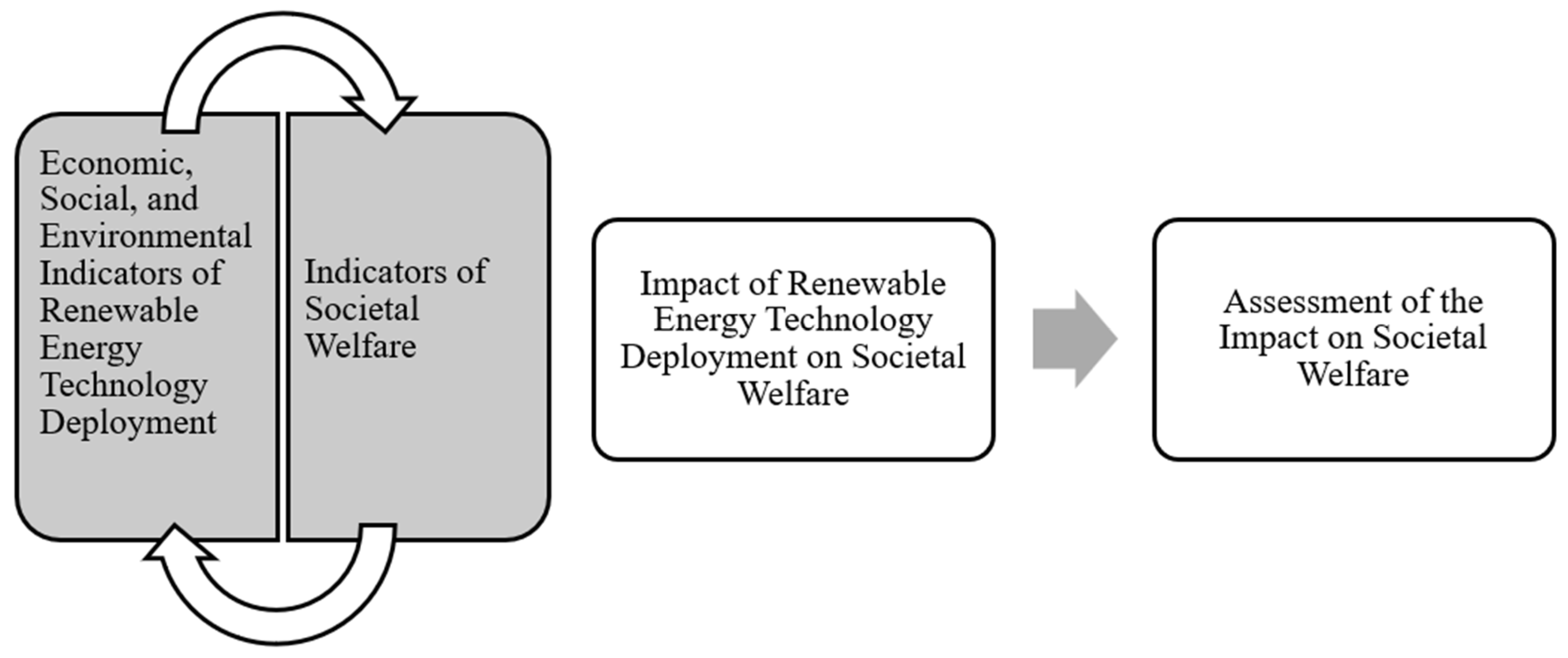
2.1. Research Methodology and Structure
2.2. Theoretical Background
2.2.1. Key Determinants of Renewable Energy Technology Deployment
RET Economic Determinants
RET Social Determinants
RET Environmental Determinants
2.2.2. Societal Welfare
2.2.3. Overview of Methodological Approaches in the Literature
2.2.4. Indicators for Renewable Energy Technologies Implementation and Societal Welfare
2.2.5. Summary of the Literature and Research Gap
3. Results
3.1. Research Motivation and Econometric Framework
3.2. Data Collection and Analysis
Renewable Energy Technologies and Their Representation in the Dataset
3.3. Correlations Between Economic RET Indicators and Societal Welfare Indicators
- Material living conditions
- Entrepreneurial and business competitiveness
- Health services
- Educational services
- Demography, civic and social engagement
- Public infrastructure, quality of the living environment, and safety
3.4. Correlations Between Social RET Indicators and Societal Welfare Indicators
- Material living conditions
- Entrepreneurial and business competitiveness
- Health services
- Educational services
- Demography, civic and social engagement
- Public infrastructure, quality of the living environment, and safety
3.5. Correlations Between Environmental RET Indicators and Societal Welfare Indicators
- Material Living Conditions
- Entrepreneurial and business competitiveness
- Health services
- Educational services
- Demography, civic and social engagement
- Public infrastructure, quality of the living environment, and safety
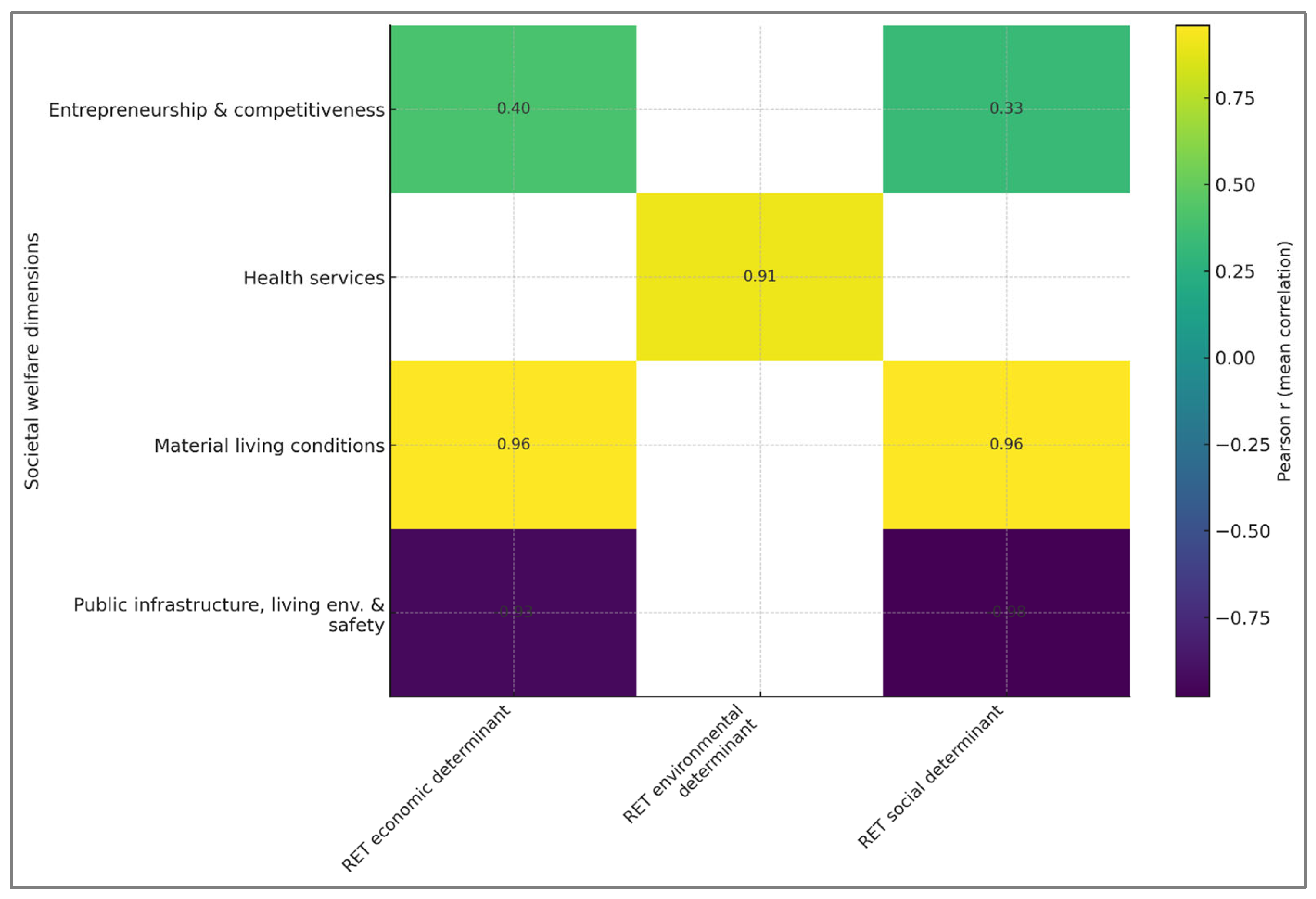
3.6. Correlation Analysis Summary
3.7. Linear Regression Analysis
- Regression Models Diagnostics and Exceptions
- (i)
- Health services model: heteroskedasticity (Breusch–Pagan p = 0.045 < 0.05) and strong negative autocorrelation (Durbin–Watson DW = 3.919 > 3);
- (ii)
- Demography, civic and social engagement model: heteroskedasticity (Breusch–Pagan p = 0.031 < 0.05) and very strong negative autocorrelation (Durbin–Watson DW = 4.739 > 3).
- Regression Models
- —dependent variable (the specific dimension of societal welfare).
- —aggregated economic, social, and environmental factor groups (composite indicators), standardized to z-scores.
- constant; the predicted value of when all factors are at their average level (X = 0).
- regression coefficients indicating the direction (sign) and magnitude (strength) of each factor’s effect.
- —random error.
3.7.1. Results by Welfare Dimension
- Material living conditions
- Entrepreneurial and business competitiveness
- Educational services
- Public infrastructure, quality of the living environment and safety
3.7.2. Summary of the Regression Models
3.8. Robustness Analysis
4. Discussion
4.1. Economic and Social Dimensions of the RET–Welfare Nexus
4.2. Environmental Dimension of the RET–Welfare Nexus
4.3. Methodological Considerations and Limitations
5. Conclusions
5.1. Summary of Main Findings
- (1)
- Economic determinants associated with RET deployment are statistically and positively linked to several key welfare dimensions in particular material living conditions, entrepreneurship and business competitiveness, educational services, and public infrastructure, living-environment quality and safety.
- (2)
- Social determinants show heterogeneous associations: they support entrepreneurship and public infrastructure and safety, but their relationships with material living conditions and education are weaker and statistically insignificant, suggesting that social conditions primarily operate through collective and institutional channels.
- (3)
- Environmental determinants were associated with lower air pollution in the broader literature and with higher hospital-service utilization when pollution increased in the data; however, in the regression models, negative short-run associations were observed with entrepreneurship and public infrastructure, consistent with transition-related trade-offs rather than straightforward welfare gains.
- (4)
- Methodologically, the use of standardized, equally weighted composite indices for the economic, social, and environmental determinants, combined with Pearson correlations and linear OLS regressions, provides a coherent and internally consistent picture of the RET–welfare nexus at the national level. The factor-level results broadly mirror the simple correlations, indicating that the findings are not driven by any single indicator but rather by the joint behavior of the underlying determinant groups.
- (5)
- Taken together, these results indicate that, within the Lithuanian context over 2020–2024, RET deployment is empirically associated with improvements in the economic aspects of societal welfare, while social and environmental dimensions exert more nuanced, domain-specific and sometimes conflicting influences that policymakers must carefully balance.
5.2. Future Research Directions
- (1)
- Extending the temporal and spatial scope of the analysis, for example, by constructing longer national time series, regional panel datasets within Lithuania, or comparative panels across countries, would allow for more robust identification strategies and the use of richer dynamic or nonlinear models.
- (2)
- Experimenting with alternative methods of constructing factor indices (e.g., principal component analysis-based weights or other data-driven aggregation schemes) could test the sensitivity of the results to the chosen weighting structure and provide deeper insight into the relative importance of individual indicators within each determinant group.
- (3)
- Incorporating explicit lag structures or dynamic specifications, once longer time series become available, would help to capture delayed effects of RET deployment and environmental improvements on different welfare dimensions and would better distinguish short-term adjustment costs from long-term benefits.
- (4)
- Finally, future work could explore the distributional aspects of the RET–welfare nexus, examining how the benefits and costs of renewable deployment are shared across regions, income groups, or vulnerable populations, thereby complementing the aggregate national-level perspective adopted in this study.
Author Contributions
Funding
Institutional Review Board Statement
Informed Consent Statement
Data Availability Statement
Conflicts of Interest
Abbreviations
| ARDL | Autoregressive Distributed Lag |
| BP | Breusch–Pagan test |
| CO2 | Carbon Dioxide |
| DW | Durbin–Watson statistic |
| EU | European Union |
| EU-28 | 28 Member States of the European Union |
| FDI | Foreign Direct Investment |
| GDP | Gross Domestic Product |
| GHG | Greenhouse Gas |
| HDI | Human Development Index |
| LQLI | Lithuanian Quality of Life Index |
| OECD | Organization for Economic Co-operation and Development |
| OLS | Ordinary Least Squares |
| PV | Photovoltaic |
| QLI | Quality of Life Index |
| QoL | Quality of Life |
| RES | Renewable Energy Sources |
| RET/RETs | Renewable Energy Technology/Technologies |
| SEDI | Sustainable Energy Development Index |
| VIF | Variance Inflation Factor |
| WtE | Waste-to-Energy |
Appendix A

| RET_Determ | RET_Indicator | Welfare_Dim | Welfare_Indicator | r | p | Direction |
|---|---|---|---|---|---|---|
| Economic | Disposable income per month (per household, EUR) | Material living conditions | Employment share, working-age (%) | 0.98 | 0.003 | Positive |
| Economic | Foreign direct investment per capita (end of period, EUR) | Material living conditions | Employment share, working-age (%) | 0.997 | 0.000 | Positive |
| Economic | GDP per capita (EUR) | Material living conditions | Employment share, working-age (%) | 0.998 | 0.000 | Positive |
| Economic | Share of RES in final energy consumption in transport (%) | Material living conditions | Employment share, working-age (%) | 0.966 | 0.007 | Positive |
| Economic | Share of RES in total final energy consumption (%) | Material living conditions | Employment share, working-age (%) | 0.944 | 0.016 | Positive |
| Economic | Subsidies and grants (thousand EUR) | Material living conditions | Employment share, working-age (%) | 0.899 | 0.038 | Positive |
| Social | Education of population (thousands persons) | Material living conditions | Employment share, working-age (%) | 0.961 | 0.009 | Positive |
| Social | Employment (thousands of persons) | Material living conditions | Employment share, working-age (%) | 0.999 | 0.000 | Positive |
| Social | Labour force (thousands persons) | Material living conditions | Employment share, working-age (%) | 0.906 | 0.034 | Positive |
| Economic | Disposable income per month (per household, EUR) | Material living conditions | Net wage (EUR, monthly) | 0.978 | 0.004 | Positive |
| Economic | Foreign direct investment per capita (end of period, EUR) | Material living conditions | Net wage (EUR, monthly) | 0.986 | 0.002 | Positive |
| Economic | GDP per capita (EUR) | Material living conditions | Net wage (EUR, monthly) | 0.983 | 0.003 | Positive |
| Economic | Share of RES in final energy consumption for heating and cooling (%) | Material living conditions | Net wage (EUR, monthly) | 0.89 | 0.043 | Positive |
| Economic | Share of RES in final energy consumption in transport (%) | Material living conditions | Net wage (EUR, monthly) | 0.913 | 0.030 | Positive |
| Economic | Share of RES in total final energy consumption (%) | Material living conditions | Net wage (EUR, monthly) | 0.982 | 0.003 | Positive |
| Economic | Subsidies and grants (thousand EUR) | Material living conditions | Net wage (EUR, monthly) | 0.962 | 0.009 | Positive |
| Social | Education of population (thousands persons) | Material living conditions | Net wage (EUR, monthly) | 0.972 | 0.006 | Positive |
| Social | Employment (thousands of persons) | Material living conditions | Net wage (EUR, monthly) | 0.985 | 0.002 | Positive |
| Social | Labour force (thousands persons) | Material living conditions | Net wage (EUR, monthly) | 0.933 | 0.021 | Positive |
| Economic | Disposable income per month (per household, EUR) | Material living conditions | Usable floor space pc (m2/person) | 0.993 | 0.001 | Positive |
| Economic | Foreign direct investment per capita (end of period, EUR) | Material living conditions | Usable floor space pc (m2/person) | 0.992 | 0.001 | Positive |
| Economic | GDP per capita (EUR) | Material living conditions | Usable floor space pc (m2/person) | 0.99 | 0.001 | Positive |
| Economic | Share of RES in final energy consumption for heating and cooling (%) | Material living conditions | Usable floor space pc (m2/person) | 0.879 | 0.049 | Positive |
| Economic | Share of RES in final energy consumption in transport (%) | Material living conditions | Usable floor space pc (m2/person) | 0.942 | 0.017 | Positive |
| Economic | Share of RES in total final energy consumption (%) | Material living conditions | Usable floor space pc (m2/person) | 0.966 | 0.008 | Positive |
| Economic | Subsidies and grants (thousand EUR) | Material living conditions | Usable floor space pc (m2/person) | 0.937 | 0.019 | Positive |
| Social | Education of population (thousands persons) | Material living conditions | Usable floor space pc (m2/person) | 0.963 | 0.008 | Positive |
| Social | Employment (thousands of persons) | Material living conditions | Usable floor space pc (m2/person) | 0.995 | 0.000 | Positive |
| Social | Labour force (thousands persons) | Material living conditions | Usable floor space pc (m2/person) | 0.923 | 0.025 | Positive |
| Economic | Share of RES in final energy consumption for heating and cooling (%) | Entrepreneurship and competitiveness | Company turnover per 1k inh. (mn EUR) | 0.88 | 0.049 | Positive |
| Economic | Share of RES in total final energy consumption (%) | Entrepreneurship and competitiveness | Company turnover per 1k inh. (mn EUR) | 0.944 | 0.016 | Positive |
| Economic | Subsidies and grants (thousand EUR) | Entrepreneurship and competitiveness | Company turnover per 1k inh. (mn EUR) | 0.915 | 0.029 | Positive |
| Social | People unable to pay bills on time (%) | Entrepreneurship and competitiveness | Company turnover per 1k inh. (mn EUR) | −0.916 | 0.029 | Negative |
| Economic | Disposable income per month (per household, EUR) | Entrepreneurship and competitiveness | FDI per 1k inh. (eoy, mn EUR) | 0.977 | 0.004 | Positive |
| Economic | Foreign direct investment per capita (end of period, EUR) | Entrepreneurship and competitiveness | FDI per 1k inh. (eoy, mn EUR) | 1 | 0.000 | Positive |
| Economic | GDP per capita (EUR) | Entrepreneurship and competitiveness | FDI per 1k inh. (eoy, mn EUR) | 0.998 | 0.000 | Positive |
| Economic | Share of RES in final energy consumption in transport (%) | Entrepreneurship and competitiveness | FDI per 1k inh. (eoy, mn EUR) | 0.971 | 0.006 | Positive |
| Economic | Share of RES in total final energy consumption (%) | Entrepreneurship and competitiveness | FDI per 1k inh. (eoy, mn EUR) | 0.953 | 0.012 | Positive |
| Economic | Subsidies and grants (thousand EUR) | Entrepreneurship and competitiveness | FDI per 1k inh. (eoy, mn EUR) | 0.904 | 0.035 | Positive |
| Social | Education of population (thousands persons) | Entrepreneurship and competitiveness | FDI per 1k inh. (eoy, mn EUR) | 0.954 | 0.012 | Positive |
| Social | Employment (thousands of persons) | Entrepreneurship and competitiveness | FDI per 1k inh. (eoy, mn EUR) | 0.999 | 0.000 | Positive |
| Social | Labour force (thousands persons) | Entrepreneurship and competitiveness | FDI per 1k inh. (eoy, mn EUR) | 0.891 | 0.043 | Positive |
| Economic | Disposable income per month (per household, EUR) | Entrepreneurship and competitiveness | Material investment per 1k inh. (th EUR) | 0.943 | 0.016 | Positive |
| Economic | Foreign direct investment per capita (end of period, EUR) | Entrepreneurship and competitiveness | Material investment per 1k inh. (th EUR) | 0.977 | 0.004 | Positive |
| Economic | GDP per capita (EUR) | Entrepreneurship and competitiveness | Material investment per 1k inh. (th EUR) | 0.98 | 0.003 | Positive |
| Economic | Share of RES in final energy consumption in transport (%) | Entrepreneurship and competitiveness | Material investment per 1k inh. (th EUR) | 0.903 | 0.036 | Positive |
| Economic | Share of RES in total final energy consumption (%) | Entrepreneurship and competitiveness | Material investment per 1k inh. (th EUR) | 0.956 | 0.011 | Positive |
| Economic | Subsidies and grants (thousand EUR) | Entrepreneurship and competitiveness | Material investment per 1k inh. (th EUR) | 0.931 | 0.022 | Positive |
| Social | Education of population (thousands persons) | Entrepreneurship and competitiveness | Material investment per 1k inh. (th EUR) | 0.979 | 0.004 | Positive |
| Social | Employment (thousands of persons) | Entrepreneurship and competitiveness | Material investment per 1k inh. (th EUR) | 0.975 | 0.005 | Positive |
| Social | Labour force (thousands persons) | Entrepreneurship and competitiveness | Material investment per 1k inh. (th EUR) | 0.934 | 0.020 | Positive |
| Economic | Disposable income per month (per household, EUR) | Public infrastructure, living env. and safety | Air pollutant emissions, stationary sources (t) | −0.936 | 0.019 | Negative |
| Economic | Foreign direct investment per capita (end of period, EUR) | Public infrastructure, living env. and safety | Air pollutant emissions, stationary sources (t) | −0.942 | 0.017 | Negative |
| Economic | GDP per capita (EUR) | Public infrastructure, living env. and safety | Air pollutant emissions, stationary sources (t) | −0.959 | 0.010 | Negative |
| Economic | Share of RES in total final energy consumption (%) | Public infrastructure, living env. and safety | Air pollutant emissions, stationary sources (t) | −0.906 | 0.034 | Negative |
| Economic | Subsidies and grants (thousand EUR) | Public infrastructure, living env. and safety | Air pollutant emissions, stationary sources (t) | −0.905 | 0.035 | Negative |
| Social | Education of population (thousands persons) | Public infrastructure, living env. and safety | Air pollutant emissions, stationary sources (t) | −0.995 | 0.000 | Negative |
| Social | Employment (thousands of persons) | Public infrastructure, living env. and safety | Air pollutant emissions, stationary sources (t) | −0.952 | 0.013 | Negative |
| Social | Labour force (thousands persons) | Public infrastructure, living env. and safety | Air pollutant emissions, stationary sources (t) | −0.99 | 0.001 | Negative |
References
- Fang, Y. Economic welfare impacts from renewable energy consumption: The China experience. Renew. Sustain. Energy Rev. 2011, 15, 5120–5128. [Google Scholar] [CrossRef]
- Kalimeris, P.; Bithas, K.; Richardson, C.; Nijkamp, P. Hidden linkages between resources and economy: A “Beyond-GDP” approach using alternative welfare indicators. Ecol. Econ. 2020, 169, 106508. [Google Scholar] [CrossRef]
- Bilan, Y.; Mishchuk, H.; Samoliuk, N.; Yurchyk, H. Impact of income distribution on social and economic well-being of the state. Sustainability 2020, 12, 429. [Google Scholar] [CrossRef]
- Aitken, A. Measuring welfare beyond GDP. Natl. Inst. Econ. Rev. 2019, 249, 3–16. [Google Scholar] [CrossRef]
- Polcyn, J.; Us, Y.; Lyulyov, O.; Pimonenko, T.; Kwilinski, A. Factors influencing the renewable energy consumption in selected European countries. Energies 2021, 15, 108. [Google Scholar] [CrossRef]
- Simionescu, M.; Strielkowski, W.; Tvaronavičienė, M. Renewable energy in final energy consumption and income in the EU-28 countries. Energies 2020, 13, 2280. [Google Scholar] [CrossRef]
- Wang, W.; Melnyk, L.; Kubatko, O.; Kovalov, B.; Hens, L. Economic and technological efficiency of renewable energy technologies implementation. Sustainability 2023, 15, 8802. [Google Scholar] [CrossRef]
- Yadav, A. Promoting economic stability: The role of renewable energy transition in mitigating global volatility. Int. J. Energy Sect. Manag. 2025, 19, 1163–1185. [Google Scholar] [CrossRef]
- Ben Mbarek, M.; Saidi, K.; Amamri, M. The relationship between pollutant emissions, renewable energy, nuclear energy and GDP: Empirical evidence from 18 developed and developing countries. Int. J. Sustain. Energy 2018, 37, 597–615. [Google Scholar] [CrossRef]
- Özbay, F.; Pehlivan, C. Relationship between the use of renewable energy, carbon dioxide emission, and economic growth: An empirical application on Turkey. In Handbook of Research on Strategic Management for Current Energy Investments; IGI Global: Hershey, PA, USA, 2021; pp. 339–355. [Google Scholar]
- Mirziyoyeva, Z.; Salahodjaev, R. Renewable energy, GDP and CO2 emissions in high-globalized countries. Front. Energy Res. 2023, 11, 1123269. [Google Scholar] [CrossRef]
- Aguirre, M.; Ibikunle, G. Determinants of renewable energy growth: A global sample analysis. Energy Policy 2014, 69, 374–384. [Google Scholar] [CrossRef]
- Apergis, N.; Payne, J.E. Renewable energy, output, CO2 emissions, and fossil fuel prices in Central America: Evidence from a nonlinear panel smooth transition vector error correction model. Energy Econ. 2014, 42, 226–232. [Google Scholar] [CrossRef]
- Apergis, N.; Payne, J.E. The causal dynamics between renewable energy, real GDP, emissions and oil prices: Evidence from OECD countries. Appl. Econ. 2014, 46, 4519–4525. [Google Scholar] [CrossRef]
- Omri, A.; Nguyen, D.K. On the determinants of renewable energy consumption: International evidence. Energy 2014, 72, 554–560. [Google Scholar] [CrossRef]
- Dogan, E.; Seker, F. Determinants of CO2 emissions in the European Union: The role of renewable and non-renewable energy. Renew. Energy 2016, 94, 429–439. [Google Scholar] [CrossRef]
- Bhattacharya, M.; Churchill, S.A.; Paramati, S.R. The dynamic impact of renewable energy and institutions on economic output and CO2 emissions across regions. Renew. Energy 2017, 111, 157–167. [Google Scholar]
- Lu, W.C. Renewable energy, carbon emissions, and economic growth in 24 Asian countries: Evidence from panel cointegration analysis. Environ. Sci. Pollut. Res. 2017, 24, 26006–26015. [Google Scholar] [CrossRef]
- Dong, K.; Hochman, G.; Zhang, Y.; Sun, R.; Li, H.; Liao, H. CO2 emissions, economic and population growth, and renewable energy: Empirical evidence across regions. Energy Econ. 2018, 75, 180–192. [Google Scholar] [CrossRef]
- McGee, J.A.; Greiner, P.T. Renewable energy injustice: The socio-environmental implications of renewable energy consumption. Energy Res. Soc. Sci. 2019, 56, 101214. [Google Scholar] [CrossRef]
- Uzar, U. Is income inequality a driver for renewable energy consumption? J. Clean. Prod. 2020, 255, 120287. [Google Scholar] [CrossRef]
- Apergis, N.; Kuziboev, B.; Abdullaev, I.; Rajabov, A. Investigating the association among CO2 emissions, renewable and non-renewable energy consumption in Uzbekistan: An ARDL approach. Environ. Sci. Pollut. Res. 2023, 30, 39666–39679. [Google Scholar] [CrossRef]
- Jahanshahi, A.; Kamali, M.; Khalaj, M.; Khodaparast, Z. Delphi-based prioritization of economic criteria for development of wave and tidal energy technologies. Energy 2019, 167, 819–827. [Google Scholar] [CrossRef]
- Mikulčić, H.; Klemeš, J.J.; Duić, N. Shaping sustainable development to support human welfare. Clean Technol. Environ. Policy 2016, 18, 1633–1639. [Google Scholar] [CrossRef]
- Bigerna, S.; Polinori, P. Assessing the determinants of renewable electricity acceptance integrating meta-analysis regression and a local comprehensive survey. Sustainability 2015, 7, 11909–11932. [Google Scholar] [CrossRef]
- Lehr, U.; Lutz, C.; Edler, D. Green jobs? Economic impacts of renewable energy in Germany. Energy Policy 2012, 47, 358–364. [Google Scholar] [CrossRef]
- Carrera, D.G.; Mack, A. Sustainability assessment of energy technologies via social indicators: Results of a survey among European energy experts. Energy Policy 2010, 38, 1030–1039. [Google Scholar] [CrossRef]
- Karasmanaki, E.; Tsantopoulos, G. Factors affecting citizens’ decision to invest in renewable energy. E3S Web Conf. 2023, 436, 6008. [Google Scholar] [CrossRef]
- Tu, Y.X.; Kubatko, O.; Piven, V.; Sotnyk, I.; Kurbatova, T. Determinants of renewable energy development: Evidence from the EU countries. Energies 2022, 15, 7093. [Google Scholar] [CrossRef]
- Adler, M.D. Measuring Social Welfare: An Introduction; Oxford University Press: Oxford, UK, 2019. [Google Scholar]
- Ferranna, M.; Hammitt, J.K.; Robinson, L.A. From Benefit–Cost Analysis to Social Welfare: A Pragmatic Approach. J. Benefit-Cost Anal. 2024, 15, 84–109. [Google Scholar] [CrossRef]
- Abebe, R.; Goldner, K. Mechanism design for social good. AI Matters 2018, 4, 27–34. [Google Scholar] [CrossRef]
- Tzagkarakis, S.I. Conceptualization and Practical Dimensions of Social Welfare: Fundamental Perspectives and New Challenges. Stud. Srod. I Bałkanistyczne 2023, 32, 185–199. [Google Scholar]
- Marciano, A. Retrospectives: James Buchanan: Clubs and alternative welfare economics. J. Econ. Perspect. 2021, 35, 243–256. [Google Scholar] [CrossRef]
- Viscusi, W.K. Why Office of Management and Budget’s (OMB) Social Welfare Function Is Not Society’s Social Welfare Function. J. Benefit-Cost Anal. 2024, 15, 252. [Google Scholar]
- Lobonț, O.R.; Trip, A.; Țăran, A.M.; Mihiț, L.D.; Moldovan, N.C. Science mapping and country clustering regarding challenges of public governance to ensure societal well-being. BRAIN. Broad Res. Artif. Intell. Neurosci. 2023, 14, 257–284. [Google Scholar] [CrossRef]
- Stoll, L.; Michaelson, J.; Seaford, C. Well-Being Evidence for Policy: A Review; New Economics Foundation: London, UK, 2012. [Google Scholar]
- Matallana, M.d.M.; López-Martínez, M.; Riquelme-Perea, P.J. Measurement of quality of life in Spanish regions. Appl. Res. Qual. Life 2022, 17, 1–30. [Google Scholar]
- Corrado, L.; De Michele, G. Are Governments Matching Citizens’ Demand for Better Lives? A New Approach Comparing Subjective and Objective Welfare Measures; European Stability Mechanism: Luxembourg, 2019. [Google Scholar]
- Aroca, P.; Gonzalez, P.A.; Valdebenito, R. The heterogeneous level of life quality across Chilean regions. Habitat Int. 2017, 68, 84–98. [Google Scholar] [CrossRef]
- Cambir, A.; Vasile, V. Material dimension of life quality and social inclusion. Procedia Econ. Financ. 2015, 32, 932–939. [Google Scholar] [CrossRef]
- Shek, D.T. Quality of life in East Asia: The case of Hong Kong. In Handbook of Social Indicators and Quality of Life Research; Springer: Dordrecht, The Netherlands, 2011; pp. 473–497. [Google Scholar]
- Káčerová, M.; Ondačková, J. How seniors live from an economic, health, social and emotional point of view? Multidimensional review of the quality of life of seniors in Europe. Geogr. Pol. 2020, 93, 183–209. [Google Scholar] [CrossRef]
- Munien, S.; Bob, U.; Matthews, A.P. A Comparative Assessment of the Socio-Economic and Spatial Factors Impacting the Implementation of Renewable Energy in Marginalised Communities: The Case of Inanda and Bergville. Master’s Thesis, University of KwaZulu-Natal, Durban, South Africa, 2016. [Google Scholar]
- Alola, A.A.; Yildirim, H. The renewable energy consumption by sectors and household income growth in the United States. Int. J. Green Energy 2019, 16, 1414–1421. [Google Scholar] [CrossRef]
- Naeimi, E.; Askariazad, M.H.; Khalili-Damghani, K. Forecasting the Effect of Renewable Energy Consumption on Economic Welfare: Using Artificial Neural Networks. Int. J. Manag. Account. Econ. 2015, 2, 10–25. [Google Scholar]
- Keeley, A.R.; Matsumoto, K.I. Investors’ perspective on determinants of foreign direct investment in wind and solar energy in developing economies–Review and expert opinions. J. Clean. Prod. 2018, 179, 132–142. [Google Scholar] [CrossRef]
- Camila, E.M.; Agustin, G.; Sumarsono, H. Economic growth in OPEC nations: The role of renewable energy consumption, CO2 emissions, and foreign direct investment. Soc. Ecol. Econ. Sustain. Dev. Goals J. 2024, 2, 15–29. [Google Scholar] [CrossRef]
- Rath, B.N.; Dash, A.K.; Mishra, A.K. The linkage between FDI and energy use in the case of emerging market economies. Environ. Dev. Sustain. 2024, 1–19. [Google Scholar] [CrossRef]
- Zhang, D.; Cao, H.; Zou, P. Exuberance in China’s renewable energy investment: Rationality, capital structure and implications with firm level evidence. Energy Policy 2016, 95, 468–478. [Google Scholar] [CrossRef]
- Bernini, C.; Pellegrini, G. How are growth and productivity in private firms affected by public subsidy? Evidence from a regional policy. Reg. Sci. Urban Econ. 2011, 41, 253–265. [Google Scholar] [CrossRef]
- Buckley, P.J. The impact of the global factory on economic development. J. World Bus. 2009, 44, 131–143. [Google Scholar] [CrossRef]
- Werner, L.; Scholtens, B. Firm type, feed-in tariff, and wind energy investment in Germany: An investigation of decision making factors of energy producers regarding investing in wind energy capacity. J. Ind. Ecol. 2017, 21, 402–411. [Google Scholar] [CrossRef]
- Paukku, E. How could Finland promote renewable-energy technology innovation and implementation? Clean Energy 2021, 5, 447–463. [Google Scholar] [CrossRef]
- Przedworska, K.; Kubiczek, J. Subsidies and business competitiveness in poland’s renewable energy market. Scientific Papers of Silesian University of Technology. Organ. Manag. 2024, 2024, 515–528. [Google Scholar] [CrossRef]
- Nicolini, M.; Tavoni, M. Are renewable energy subsidies effective? Evidence from Europe. Renew. Sustain. Energy Rev. 2017, 74, 412–423. [Google Scholar] [CrossRef]
- Bhattarai, U.; Maraseni, T.; Apan, A.; Devkota, L.P. Rationalizing donations and subsidies: Energy ecosystem development for sustainable renewable energy transition in Nepal. Energy Policy 2023, 177, 113570. [Google Scholar] [CrossRef]
- Sahari, A. Electricity prices and consumers’ long-term technology choices: Evidence from heating investments. Eur. Econ. Rev. 2019, 114, 19–53. [Google Scholar] [CrossRef]
- Rokicki, T.; Bórawski, P.; Gradziuk, B.; Gradziuk, P.; Mrówczyńska-Kamińska, A.; Kozak, J.; Guzal-Dec, D.J.; Wojtczuk, K. Differentiation and changes of household electricity prices in EU countries. Energies 2021, 14, 6894. [Google Scholar] [CrossRef]
- Thankappan Nair, R.; Sankar, A. Dynamic pricing based on a cloud computing framework to support the integration of renewable energy sources. J. Eng. 2014, 2014, 680–687. [Google Scholar] [CrossRef]
- Prokopenko, O.; Kurbatova, T.; Khalilova, M.; Zerkal, A.; Prause, G.; Binda, J.; Berdiyorov, T.; Klapkiv, Y.; Sanetra-Półgrabi, S.; Komarnitskyi, I. Impact of investments and R&D costs in renewable energy technologies on companies’ profitability indicators: Assessment and forecast. Energies 2023, 16, 1021. [Google Scholar] [CrossRef]
- Islam, S.; Raihan, A.; Ridwan, M.; Rahman, M.S.; Paul, A.; Karmakar, S.; Paul, P.; Tanchangya, T.; Rahman, J.; Jubayed, A.A. The influences of financial development, economic growth, energy price, and foreign direct investment on renewable energy consumption in the BRICS. J. Environ. Energy Econ. 2023, 2, 17–28. [Google Scholar] [CrossRef]
- Kohli, A.; Wadhwa, R.; Tripathi, G.C. Impact of Sustainable Energy Policies on Sustainable Investments in Technology and Flow of Sustainable Finance to Renewable Energy or Green Energy Sector: An Indian Perspective. In Intelligent IT Solutions for Sustainability in Industry 5.0 Paradigm. ICEIL 2023; Springer: Singapore, 2023; pp. 451–466. [Google Scholar]
- Sart, G.; Bayar, Y.; Sezgin, F.H.; Danilina, M. Impact of educational attainment on renewable energy use: Evidence from emerging market economies. Energies 2022, 15, 2695. [Google Scholar] [CrossRef]
- Jamshid; Villanthenkodath, M.A.; Velan, N. Can educational attainment promote renewable energy consumption? Evidence from heterogeneous panel models. Int. J. Energy Sect. Manag. 2022, 16, 1017–1036. [Google Scholar] [CrossRef]
- Sardianou, E.; Genoudi, P. Which factors affect the willingness of consumers to adopt renewable energies? Renew. Energy 2013, 57, 1–4. [Google Scholar] [CrossRef]
- Kontogianni, A.; Tourkolias, C.; Skourtos, M. Renewables portfolio, individual preferences and social values towards RES technologies. Energy Policy 2013, 55, 467–476. [Google Scholar] [CrossRef]
- Kosenius, A.K.; Ollikainen, M. Valuation of environmental and societal trade-offs of renewable energy sources. Energy Policy 2013, 62, 1148–1156. [Google Scholar] [CrossRef]
- Ahmar, M.; Ali, F.; Jiang, Y.; Wang, Y.; Iqbal, K. Determinants of adoption and the type of solar PV technology adopted in rural Pakistan. Front. Environ. Sci. 2022, 10, 895622. [Google Scholar] [CrossRef]
- Kumar, J.C.R.; Majid, M.A. Renewable energy for sustainable development in India: Current status, future prospects, challenges, employment, and investment opportunities. Energy Sustain. Soc. 2020, 10, 2. [Google Scholar] [CrossRef]
- Dvořák, P.; Martinát, S.; Van der Horst, D.; Frantál, B.; Turečková, K. Renewable energy investment and job creation; a cross-sectoral assessment for the Czech Republic with reference to EU benchmarks. Renew. Sustain. Energy Rev. 2017, 69, 360–368. [Google Scholar] [CrossRef]
- Satrianto, A.; Ikhsan, A. Analysis of renewable energy, environment quality and energy consumption on economic growth: Evidence from developing countries. Int. J. Energy Econ. Policy 2024, 14, 57–65. [Google Scholar] [CrossRef]
- Apergis, N.; Jebli, M.B.; Youssef, S.B. Does renewable energy consumption and health expenditures decrease carbon dioxide emissions? Evidence for sub-Saharan Africa countries. Renew. Energy 2018, 127, 1011–1016. [Google Scholar] [CrossRef]
- Li, F.; Chang, T.; Wang, M.C.; Zhou, J. The relationship between health expenditure, CO2 emissions, and economic growth in the BRICS countries—Based on the Fourier ARDL model. Environ. Sci. Pollut. Res. 2022, 29, 10908–10927. [Google Scholar] [CrossRef]
- Khan, S.A.R. The Role of Renewable Energy, Public Health Expenditure, Logistics and Environmental Performance in Economic Growth: An Evidence from Structural Equation Modelling. Preprints 2019. [Google Scholar] [CrossRef]
- Khan, A.; Hussain, J.; Bano, S.; Chenggang, Y. The repercussions of foreign direct investment, renewable energy and health expenditure on environmental decay? An econometric analysis of B&RI countries. J. Environ. Plan. Manag. 2019, 63, 1965–1986. [Google Scholar] [CrossRef]
- Vatamanu, A.F.; Onofrei, M.; Cigu, E.; Oprea, F. Renewable energy consumption, institutional quality and life expectancy in EU countries: A cointegration analysis. Energy Sustain. Soc. 2025, 15, 2. [Google Scholar] [CrossRef]
- Zhao, J.; Dong, K.; Dong, X.; Shahbaz, M. How renewable energy alleviate energy poverty? A global analysis. Renew. Energy 2022, 186, 299–311. [Google Scholar] [CrossRef]
- Chu, L.K.; Doğan, B.; Ghosh, S.; Shahbaz, M. The influence of shadow economy, environmental policies and geopolitical risk on renewable energy: A comparison of high-and middle-income countries. J. Environ. Manag. 2023, 342, 118122. [Google Scholar] [CrossRef]
- Leuratti, N.; Marangoni, G.; Drouet, L.; Kamp, L.M.; Kwakkel, J. Green hydrogen in the iron and steel industry increases resilience against shocks in energy prices. Environ. Res. Lett. 2025, 20, 024021. [Google Scholar] [CrossRef]
- Cergibozan, R. Renewable energy sources as a solution for energy security risk: Empirical evidence from OECD countries. Renew. Energy 2022, 183, 617–626. [Google Scholar] [CrossRef]
- Chen, L.; Zhang, T.; Zhang, C.; Liu, F.; Feng, Y. Does Geopolitical Risk Endanger Energy Resilience? Empirical Evidence from Cross-Country Data. Pol. J. Environ. Stud. 2025, 34, 2589–2607. [Google Scholar] [CrossRef]
- Nashi, R.; Ouakil, H. Energy price shocks and current account balances: What role for economic structure, energy dependency and renewable energy development? Sustain. Futures 2025, 9, 100402. [Google Scholar] [CrossRef]
- Khan, H.; Khan, I.; Binh, T.T. The heterogeneity of renewable energy consumption, carbon emission and financial development in the globe: A panel quantile regression approach. Energy Rep. 2020, 6, 859–867. [Google Scholar] [CrossRef]
- Kuo, Y.M.; Fukushima, Y. Greenhouse gas and air pollutant emission reduction potentials of renewable energy—Case Studies on photovoltaic and wind power introduction considering interactions among technologies in Taiwan. J. Air Waste Manag. Assoc. 2009, 59, 360–372. [Google Scholar] [CrossRef] [PubMed]
- Oreggioni, G.D.; Monforti-Ferraio, F.; Crippa, M.; Schaaf, E.; Guizzardi, D.; Muntean, M.; Duerr, M.; Vignati, E. EDGAR v5. 0: A tool to evaluate the influence of technology incorporation and regulatory frameworks on global greenhouse gases and air pollutant emissions. In Proceedings of the EGU General Assembly 2020, Online, 4–8 May 2020; p. 20237. [Google Scholar]
- Xing, R.; Hanaoka, T.; Kanamori, Y.; Masui, T. Greenhouse gas and air pollutant emissions of China’s residential sector: The importance of considering energy transition. Sustainability 2017, 9, 614. [Google Scholar] [CrossRef]
- von Uexküll, O. Energy and water: The ignored link. Refocus 2004, 5, 40–44. [Google Scholar] [CrossRef]
- Baker, J.; Strzepek, K.; Farmer, W.; Schlosser, C.A. Quantifying the impact of renewable energy futures on cooling water use. J. Am. Water Resour. Assoc. 2014, 50, 1289–1303. [Google Scholar] [CrossRef]
- Liu, J.; Xie, N.; Yu, Z. Analysis of regional water and energy consumption considering economic development. Water 2021, 13, 3582. [Google Scholar] [CrossRef]
- Zemite, L.; Stipnieks, E.; Backurs, A.; Laizans, A.; Vonda, K.; Cnubben, P. Optimizing Municipal Waste Recycling for Renewable Energy Production. In Proceedings of the 2024 IEEE 65th International Scientific Conference on Power and Electrical Engineering of Riga Technical University (RTUCON), Riga, Latvia, 10–12 October 2024; IEEE: New York, NY, USA, 2024; pp. 1–6. [Google Scholar]
- Yusuf, M.; Kusumah, H. Integration of renewable energy technology in waste recycling utilization. In Proceedings of the 2022 IEEE Creative Communication and Innovative Technology (ICCIT), Tangerang, Indonesia, 22–23 November 2022; IEEE: New York, NY, USA, 2022; pp. 1–7. [Google Scholar]
- Bayar, Y.; Gavriletea, M.D.; Sauer, S.; Paun, D. Impact of municipal waste recycling and renewable energy consumption on CO2 emissions across the European Union (EU) member countries. Sustainability 2021, 13, 656. [Google Scholar] [CrossRef]
- Kropáč, J.; Bébar, L.; Pavlas, M. Industrial and hazardous waste combustion and energy production. Chem. Eng. 2012, 29, 673–678. [Google Scholar]
- Ramadan, A.R.; Sherif, Y. Hazardous waste management in Egypt: Performance indicators for industry. WIT Trans. Ecol. Environ. 2008, 109, 349–359. [Google Scholar][Green Version]
- Blazejczak, J.; Braun, F.G.; Edler, D.; Schill, W.P. Economic effects of renewable energy expansion: A model-based analysis for Germany. Renew. Sustain. Energy Rev. 2014, 40, 1070–1080. [Google Scholar] [CrossRef]
- Awijen, H.; Belaïd, F.; Zaied, Y.B.; Hussain, N.; Lahouel, B.B. Renewable energy deployment in the MENA region: Does innovation matter? Technol. Forecast. Soc. Change 2022, 179, 121633. [Google Scholar] [CrossRef]
- Gharbi, I.; Kammoun, A.; Kefi, M.K. To what extent does renewable energy deployment reduce pollution indicators? The moderating role of research and development expenditure: Evidence from the top three ranked countries. Front. Environ. Sci. 2023, 11, 1096885. [Google Scholar] [CrossRef]
- Lelieveld, J.; Klingmüller, K.; Pozzer, A.; Burnett, R.T.; Haines, A.; Ramanathan, V. Effects of fossil fuel and total anthropogenic emission removal on public health and climate. Proc. Natl. Acad. Sci. USA 2019, 116, 7192–7197. [Google Scholar] [CrossRef]
- Kutan, A.M.; Paramati, S.R.; Ummalla, M.; Zakari, A. Financing renewable energy projects in major emerging market economies: Evidence in the perspective of sustainable economic development. Emerg. Mark. Financ. Trade 2018, 54, 1761–1777. [Google Scholar] [CrossRef]
- Lelieveld, J.; Evans, J.S.; Fnais, M.; Giannadaki, D.; Pozzer, A. The contribution of outdoor air pollution sources to premature mortality on a global scale. Nature 2015, 525, 367–371. [Google Scholar] [CrossRef] [PubMed]
- Soeder, D.J. Greenhouse gas sources and mitigation strategies from a geosciences perspective. Adv. Geo-Energy Res. 2021, 5, 274–285. [Google Scholar] [CrossRef]
- Brauer, M.; Freedman, G.; Frostad, J.; Van Donkelaar, A.; Martin, R.V.; Dentener, F.; van Dingenen, R.; Estep, K.; Amini, H.; Apte, J.S.; et al. Ambient air pollution exposure estimation for the global burden of disease 2013. Environ. Sci. Technol. 2016, 50, 79–88. [Google Scholar] [CrossRef] [PubMed]
- Perera, F. Pollution from fossil-fuel combustion is the leading environmental threat to global pediatric health and equity: Solutions exist. Int. J. Environ. Res. Public Health 2018, 15, 16. [Google Scholar] [CrossRef]
- Ogunkunle, O.; Ahmed, N.A. Overview of biodiesel combustion in mitigating the adverse impacts of engine emissions on the sustainable human–environment scenario. Sustainability 2021, 13, 5465. [Google Scholar] [CrossRef]
- Cohen, A.J.; Brauer, M.; Burnett, R.; Anderson, H.R.; Frostad, J.; Estep, K.; Balakrishnan, K.; Brunekreef, B.; Dandona, L.; Dandona, R.; et al. Estimates and 25-year trends of the global burden of disease attributable to ambient air pollution: An analysis of data from the Global Burden of Diseases Study 2015. Lancet 2017, 389, 1907–1918. [Google Scholar] [CrossRef]
- Adams, S.; Acheampong, A.O. Reducing carbon emissions: The role of renewable energy and democracy. J. Clean. Prod. 2019, 240, 118245. [Google Scholar] [CrossRef]
- Li, Y.; Ravi, V.; Heath, G.; Zhang, J.; Vahmani, P.; Lee, S.M.; Zhang, X.; Sanders, K.T.; Ban-Weiss, G.A. Air quality and public health co-benefits of 100% renewable electricity adoption and electrification pathways in Los Angeles. Environ. Res. Lett. 2024, 19, 034015. [Google Scholar] [CrossRef]
- Moriarty, P.; Honnery, D. Can renewable energy power the future? Energy Policy 2016, 93, 3–7. [Google Scholar] [CrossRef]
- Wang, Z.; Asghar, M.M.; Zaidi, S.A.H.; Wang, B. Dynamic linkages among CO2 emissions, health expenditures, and economic growth: Empirical evidence from Pakistan. Environ. Sci. Pollut. Res. 2019, 26, 15285–15299. [Google Scholar] [CrossRef]
- Koengkan, M.; Fuinhas, J.A.; Silva, N. Exploring the capacity of renewable energy consumption to reduce outdoor air pollution death rate in Latin America and the Caribbean region. Environ. Sci. Pollut. Res. 2021, 28, 1656–1674. [Google Scholar] [CrossRef] [PubMed]
- Kotcher, J.; Maibach, E.; Choi, W.T. Fossil fuels are harming our brains: Identifying key messages about the health effects of air pollution from fossil fuels. BMC Public Health 2019, 19, 1079. [Google Scholar] [CrossRef] [PubMed]
- Marais, E.A.; Silvern, R.F.; Vodonos, A.; Dupin, E.; Bockarie, A.S.; Mickley, L.J.; Schwartz, J. Air quality and health impact of future fossil fuel use for electricity generation and transport in Africa. Environ. Sci. Technol. 2019, 53, 13524–13534. [Google Scholar] [CrossRef] [PubMed]
- Lelieveld, J.; Klingmüller, K.; Pozzer, A.; Pöschl, U.; Fnais, M.; Daiber, A.; Münzel, T. Cardiovascular disease burden from ambient air pollution in Europe reassessed using novel hazard ratio functions. Eur. Heart J. 2019, 40, 1590–1596. [Google Scholar] [CrossRef]
- González-Eguino, M. Energy poverty: An overview. Renew. Sustain. Energy Rev. 2015, 47, 377–385. [Google Scholar] [CrossRef]
- Machol, B.; Rizk, S. Economic value of US fossil fuel electricity health impacts. Environ. Int. 2013, 52, 75–80. [Google Scholar] [CrossRef]
- Apergis, N.; Bhattacharya, M.; Hadhri, W. Health care expenditure and environmental pollution: A cross-country comparison across different income groups. Environ. Sci. Pollut. Res. 2020, 27, 8142–8156. [Google Scholar] [CrossRef]
- Shadrina, E. Non-hydropower renewable energy in central Asia: Assessment of deployment status and analysis of underlying factors. Energies 2020, 13, 2963. [Google Scholar] [CrossRef]
- Többen, J. Regional net impacts and social distribution effects of promoting renewable energies in Germany. Ecol. Econ. 2017, 135, 195–208. [Google Scholar] [CrossRef]
- Böhringer, C.; Keller, A.; Van der Werf, E. Are green hopes too rosy? Employment and welfare impacts of renewable energy promotion. Energy Econ. 2013, 36, 277–285. [Google Scholar] [CrossRef]
- Iddrisu, I.; Bhattacharyya, S.C. Sustainable Energy Development Index: A multi-dimensional indicator for measuring sustainable energy development. Renew. Sustain. Energy Rev. 2015, 50, 513–530. [Google Scholar] [CrossRef]
- Ahn, K.; Chu, Z.; Lee, D. Effects of renewable energy use in the energy mix on social welfare. Energy Econ. 2021, 96, 105174. [Google Scholar] [CrossRef]
- Pasten, C.; Santamarina, J.C. Energy and quality of life. Energy Policy 2012, 49, 468–476. [Google Scholar] [CrossRef]
- Yang, X.; Liu, Y.; Thrän, D.; Bezama, A.; Wang, M. Effects of the German Renewable Energy Sources Act and environmental, social and economic factors on biogas plant adoption and agricultural land use change. Energy Sustain. Soc. 2021, 11, 6. [Google Scholar] [CrossRef]
- Bartosevičienė, V. Ekonominės statistikos pagrindai. In Kaunas: Technologija; KTU Leidykla Technologija: Kaunas, Lithuania, 2010. [Google Scholar]
- Pukėnas, K. Kokybinių Duomenų Analizė SPSS Programa; Lietuvos Kūno Kultūros Akademija: Kaunas, Lithuania, 2009. [Google Scholar]
- Bourcet, C. Empirical determinants of renewable energy deployment: A systematic literature review. Energy Econ. 2020, 85, 104563. [Google Scholar] [CrossRef]
- Şener, Ş.E.C.; Sharp, J.L.; Anctil, A. Factors impacting diverging paths of renewable energy: A review. Renew. Sustain. Energy Rev. 2018, 81, 2335–2342. [Google Scholar] [CrossRef]
- Virah-Sawmy, D.; Sturmberg, B. Socio-economic and environmental impacts of renewable energy deployments: A review. Renew. Sustain. Energy Rev. 2025, 207, 114956. [Google Scholar] [CrossRef]
- Milčiuvienė, S.; Paškevičius, J. The Investment Environment for Renewable Energy Development in Lithuania: The Electricity Sector. Balt. J. Law Politics 2014, 7, 29–48. [Google Scholar] [CrossRef]
- Vojtovič, S.; Stundžienė, A.; Kontautienė, R. The Impact of Socio-Economic Indicators on Sustainable Consumption of Domestic Electricity in Lithuania. Sustainability 2018, 10, 162. [Google Scholar] [CrossRef]
- Gomółka, K.; Kasprzak, P. ETS prices and renewable energy sources share in the energy mix—Example of Lithuania, Latvia and Estonia. Econ. Environ. 2024, 90, 844. [Google Scholar]
- Gecevičius, G.; Kavaliauskas, Ž. Development of Renewable Energy in Lithuania: Experience, State and Trends. Environ. Res. Eng. Manag. 2021, 77, 64–72. [Google Scholar] [CrossRef]
- Jonynas, R.; Puida, E.; Poškas, R.; Paukštaitis, L.; Jouhara, H.; Gudzinskas, J.; Miliauskas, G.; Lukoševičius, V. Renewables for district heating: The case of Lithuania. Energy 2020, 211, 119064. [Google Scholar] [CrossRef]
- Valančius, R.; Singh, R.; Jurelionis, A.; Vaiciunas, J. A Review of Heat Pump Systems and Applications in Cold Climates: Evidence from Lithuania. Energies 2019, 12, 4331. [Google Scholar] [CrossRef]
- Grigolienė, R.; Kiyak, D.; Šimanskienė, L.; Labanauskaitė, D.; Župerkienė, E.; Mishenina, H. Household energy consumption tendencies: The Baltic States context. J. Bus. Econ. Manag. 2024, 25, 1202–1219. [Google Scholar] [CrossRef]
- Walker, G. The role for ‘community’ in carbon governance. Wiley Interdiscip. Rev. Clim. Change 2011, 2, 777–782. [Google Scholar]
- Blumer, Y.B.; Stauffacher, M.; Lang, D.J.; Hayashi, K.; Uchida, S. Non-technical success factors for bioenergy projects—Learning from a multiple case study in Japan. Energy Policy 2013, 60, 386–395. [Google Scholar] [CrossRef]
- Donastorg, A.; Renukappa, S.; Suresh, S. Financing renewable energy projects in developing countries: A critical review. IOP Conf. Ser. Earth Environ. Sci. 2017, 83, 012012. [Google Scholar]
- Branker, K.; Shackles, E.; Pearce, J.M. Peer-to-peer financing mechanisms to accelerate renewable energy deployment. J. Sustain. Financ. Investig. 2011, 1, 138–155. [Google Scholar]
- Maulidia, M.; Dargusch, P.; Ashworth, P.; Ardiansyah, F. Rethinking renewable energy targets and electricity sector reform in Indonesia: A private sector perspective. Renew. Sustain. Energy Rev. 2019, 101, 231–247. [Google Scholar] [CrossRef]
- Geddes, A.; Schmidt, T.S.; Steffen, B. The multiple roles of state investment banks in low-carbon energy finance: An analysis of Australia, the UK and Germany. Energy Policy 2018, 115, 158–170. [Google Scholar] [CrossRef]
- Xu, N.; Kasimov, I.; Wang, Y. Unlocking private investment as a new determinant of green finance for renewable development in China. Renew. Energy 2022, 198, 1121–1130. [Google Scholar] [CrossRef]
- Janeliūnas, T. Energy Transformation in Lithuania: Aiming for the Grand Changes. In From Economic to Energy Transition; Palgrave Macmillan: Cham, Switzerland, 2020; pp. 283–313. [Google Scholar]
- Sattich, T.; Morgan, R.; Moe, E. Searching for energy independence, finding renewables? Energy security perceptions and renewable energy policy in Lithuania. Political Geogr. 2022, 96, 102656. [Google Scholar]
- Biekša, D.; Šiupšinskas, G.; Martinaitis, V.; Jaraminienė, E. Energy Efficiency Challenges in Multi-Apartment Building Renovation in Lithuania. J. Civ. Eng. Manag. 2011, 17, 467–475. [Google Scholar] [CrossRef]
- Prozuments, A.; Borodiņecs, A.; Zaharovs, S.; Banionis, K.; Monstvilas, E.; Norvaišienė, R. Evaluating Reduction in Thermal Energy Consumption across Renovated Buildings in Latvia and Lithuania. Buildings 2023, 13, 1916. [Google Scholar] [CrossRef]
- Švažas, M.; Bilan, Y.; Navickas, V.; Okręglicka, M. Energy Transformation in Municipal Areas—Key Datasets and Their Influence on Process Evaluation. Energies 2023, 16, 6193. [Google Scholar] [CrossRef]
- Baskutis, S.; Baskutienė, J.; Navickas, V.; Bilan, Y.; Cieslinski, W. Perspectives and Problems of Using Renewable Energy Sources and Implementation of Local “Green” Initiatives: A Regional Assessment. Energies 2021, 14, 5888. [Google Scholar] [CrossRef]
- Török, L. Economic Drivers of Renewable Energy Growth in the European Union: Evidence from a Panel Data Analysis (2015–2023). Energies 2025, 18, 3363. [Google Scholar] [CrossRef]
- Stec, M.; Grzebyk, M.; Caputa, W.; Hejdukova, P. Levels of Renewable Energy Use in Selected European Union Countries–Statistical Assessment of Changes and Prospects for Development. Comp. Econ. Res. Cent. East. Eur. 2024, 27, 117–140. [Google Scholar] [CrossRef]
- Kranzl, L.; Kalt, G.; Müller, A.; Hummel, M.; Egger, C.; Öhlinger, C.; Dell, G. Renewable energy in the heating sector in Austria with particular reference to the region of Upper Austria. Energy Policy 2013, 59, 17–31. [Google Scholar] [CrossRef]
- Şoimoşan, T.M.; Felseghi, R.A.; Răboacă, M.S.; Filote, C. Heating Systems: A Comparative Assessment of Alternative Solutions. In Retrofitting for Optimal Energy Performance; IGI Global: Hershey, PA, USA, 2019; pp. 283–307. [Google Scholar]
- Collazos, J.S.G.; Ardila, L.M.C.; Cardona, C.J.F. Energy transition in sustainable transport: Concepts, policies, and methodologies. Environ. Sci. Pollut. Res. 2024, 31, 58669–58686. [Google Scholar] [CrossRef]
- Cansino, J.M.; Pablo-Romero, M.D.P.; Román, R.; Yñiguez, R. Taxes incentives to promote res deployment: The Eu-27 case. In Sustainable Growth and Applications in Renewable Energy Sources; IntechOpen: London, UK, 2011. [Google Scholar]
- Varnagirytė-Kabašinskienė, I.; Lukmine, D.; Mizaras, S.; Beniusiene, L.; Armolaitis, K. Lithuanian forest biomass resources: Legal, economic and ecological aspects of their use and potential. Energy Sustain. Soc. 2019, 9, 41. [Google Scholar] [CrossRef]
- Balžekienė, A.; Budžytė, A. The Role of Environmental Attitudes in Explaining Public Perceptions of Climate Change and Renewable Energy Technologies in Lithuania. Sustainability 2021, 13, 4376. [Google Scholar] [CrossRef]
- Švažas, M.; Navickas, V.; Bilan, Y.; Nakonieczny, J.; Španková, J. Biomass Clusterization from a Regional Perspective: The Case of Lithuania. Energies 2021, 14, 6993. [Google Scholar] [CrossRef]
- Balázs, S.; Donatas, D. The impact of social structure and physical characteristics on housing estate renovation in postsocialist cities: Cases of Vilnius and Budapest. Geogr. Pol. 2020, 93, 229–244. [Google Scholar] [CrossRef]
- Navickienė, O.; Meidutė-Kavaliauskienė, I.; Činčikaitė, R.; Morkūnas, M.; Valackienė, A. The Expression of the Country’s Modernisation in the Context of Economic Environmental Sustainability: The Case of Lithuania. Sustainability 2023, 15, 10649. [Google Scholar] [CrossRef]
- Jakimavičius, D.; Adžgauskas, G.; Šarauskienė, D.; Kriaučiūnienė, J. Climate Change Impact on Hydropower Resources in Gauged and Ungauged Lithuanian River Catchments. Water 2020, 12, 3265. [Google Scholar] [CrossRef]
- Činčikaitė, R. Assessment of Sustainable Waste Management: A Case Study in Lithuania. Sustainability 2024, 17, 120. [Google Scholar] [CrossRef]
- Katinas, V.; Marčiukaitis, M.; Perednis, E.; Dzenajavičienė, E. Analysis of biodegradable waste use for energy generation in Lithuania. Renew. Sustain. Energy Rev. 2019, 101, 559–567. [Google Scholar] [CrossRef]
- Rybakovas, E.; Liugailaitė-Radzvickienė, L. Objectively Measured Quality of Life: The Case of Lithuanian Municipalities. Soc. Sci. 2013, 78, 7–21. [Google Scholar] [CrossRef][Green Version]
- Rybakovas, E. Quality of Life Peculiarities in Lithuania Regions. Econ. Manag. 2012, 17, 209–215. [Google Scholar] [CrossRef][Green Version]
- Ubarevičienė, R.; Van Ham, M. Population decline in Lithuania: Who lives in declining regions and who leaves? Reg. Stud. Reg. Sci. 2017, 4, 57–79. [Google Scholar] [CrossRef]
- Steć, M.; Grzebyk, M. Statistical Analysis of the Level of Development of Renewable Energy Sources in the Countries of the European Union. Energies 2022, 15, 8278. [Google Scholar] [CrossRef]
- Huterski, R.; Huterska, A.; Zdunek-Rosa, E.; Voss, G. Evaluation of the Level of Electricity Generation from Renewable Energy Sources in European Union Countries. Energies 2021, 14, 8150. [Google Scholar] [CrossRef]
- Brodny, J.; Tutak, M.; Bindzár, P. Assessing the Level of Renewable Energy Development in the European Union Member States. A 10-Year Perspective. Energies 2021, 14, 3765. [Google Scholar] [CrossRef]
- Andreas, J.; Burns, C.; Touza, J. Renewable Energy as a Luxury? A Qualitative Comparative Analysis of the Role of the Economy in the EU’s Renewable Energy Transitions During the ‘Double Crisis’. Ecol. Econ. 2017, 142, 81–90. [Google Scholar] [CrossRef]
- Musiał, W.; Zioło, M.; Luty, L.; Musiał, K. Energy Policy of European Union Member States in the Context of Renewable Energy Sources Development. Energies 2021, 14, 2864. [Google Scholar] [CrossRef]
- Sompolska-Rzechuła, A.; Bąk, I.; Becker, A.; Marjak, H.; Perzyńska, J. The Use of Renewable Energy Sources and Environmental Degradation in EU Countries. Sustainability 2024, 16, 10416. [Google Scholar] [CrossRef]
- Abdolmaleki, S.; Abdolmaleki, D.; Bugallo, P. Finding Sustainable Countries in Renewable Energy Sector: A Case Study for an EU Energy System. Sustainability 2023, 15, 10084. [Google Scholar] [CrossRef]
- Venghaus, S.; Märker, C.; Dieken, S.; Siekmann, F. Linking Environmental Policy Integration and the Water-Energy-Land-(Food-)Nexus: A Review of the European Union’s Energy, Water, and Agricultural Policies. Energies 2019, 12, 4446. [Google Scholar] [CrossRef]
- Eva, K.; Juraj, F.; Natalia, S.; Terezia, K.-G. Bitcoin, cryptocurrencies and tax evasion: A systematic literature review on global approaches to cryptocurrency taxation and the challenges for harmonising regulatory frameworks. Data Sci. Financ. Econ. 2025, 5, 234–257. [Google Scholar]
- Du, Z.; Lv, G. Can Digital Finance Unleash the Potential for Household Consumption? A Comparison Based on the Inconsistency Between Income and Consumption Classes. J. Theor. Appl. Electron. Commer. Res. 2025, 20, 275. [Google Scholar] [CrossRef]
- Zafar, M.W.; Shahbaz, M.; Sinha, A.; Sengupta, T.; Qin, Q. How renewable energy consumption contribute to environmental quality? The role of education in OECD countries. J. Clean. Prod. 2020, 268, 122149. [Google Scholar] [CrossRef]
- Petrauskienė, K.; Skvarnavičiūtė, M.; Dvarionienė, J. Comparative environmental life cycle assessment of electric and conventional vehicles in Lithuania. J. Clean. Prod. 2020, 246, 119042. [Google Scholar] [CrossRef]
- Sabūnas, A. Assessing the Feasibility of Climate Policies of Japan, Latvia and Lithuania to Reach the Targets of the Paris Agreement. Conect. Int. Sci. Conf. Environ. Clim. Technol. 2024, 70. [Google Scholar] [CrossRef]
- Punys, P.; Jurevičius, L. Assessment of Hydropower Potential in Wastewater Systems and Application in a Lowland Country, Lithuania. Energies 2022, 15, 5173. [Google Scholar] [CrossRef]
- Volkova, A.; Koduvere, H.; Pieper, H. Large-scale heat pumps for district heating systems in the Baltics: Potential and impact. Renew. Sustain. Energy Rev. 2022, 167, 112749. [Google Scholar] [CrossRef]
- Proença, S.; Fortes, P. The social face of renewables: Econometric analysis of the relationship between renewables and employment. Energy Rep. 2020, 6, 581–586. [Google Scholar] [CrossRef]
- Li, B.; Amin, A.; Nureen, N.; Saqib, N.; Wang, L.; Rehman, M. Assessing factors influencing renewable energy deployment and the role of natural resources in MENA countries. Resour. Policy 2024, 88, 104417. [Google Scholar] [CrossRef]
- Le, H.; Sarkodie, S. Dynamic linkage between renewable and conventional energy use, environmental quality and economic growth: Evidence from Emerging Market and Developing Economies. Energy Rep. 2020, 6, 965–973. [Google Scholar] [CrossRef]
- Chen, Y. Renewable energy investment and employment in China. Int. Rev. Appl. Econ. 2018, 33, 314–334. [Google Scholar] [CrossRef]
- De Laurentis, C.; Pearson, P.J. Policy-relevant insights for regional renewable energy deployment. Energy Sustain. Soc. 2021, 11, 19. [Google Scholar] [CrossRef]
- Belaîd, F.; Elsayed, A.; Omri, A. Key drivers of renewable energy deployment in the MENA Region: Empirical evidence using panel quantile regression. Struct. Change Econ. Dyn. 2021, 57, 225–238. [Google Scholar] [CrossRef]
- Cadoret, I.; Padovano, F. The political drivers of renewable energies policies. Energy Econ. 2016, 56, 261–269. [Google Scholar] [CrossRef]
- Piran, M.; Sharifi, A.; Safari, M.M. Exploring the roles of education, renewable energy, and global warming on health expenditures. Sustainability 2023, 15, 14352. [Google Scholar] [CrossRef]
- Qudrat-Ullah, H. A Review and Analysis of Green Energy and the Environmental Policies in South Asia. Energies 2023, 16, 7486. [Google Scholar] [CrossRef]
- Buonocore, J.; Hughes, E.; Michanowicz, D.; Heo, J.; Allen, J.; Williams, A. Climate and health benefits of increasing renewable energy deployment in the United States. Environ. Res. Lett. 2019, 14, 114010. [Google Scholar] [CrossRef]
- Atalla, T.; Bigerna, S.; Bollino, C.A.; Fuentes, R. Analyzing the effects of renewable energy and climate conditions on consumer welfare. Energy J. 2017, 38, 115–136. [Google Scholar] [CrossRef]


| Quantitative Characteristic of Relationship Strength | <0.3 | 0.3–<0.7 | 0.7–<0.9 | 0.9–0.99 |
|---|---|---|---|---|
| Qualitative characteristic of relationship strength | weak | moderate | strong | very strong |
| Welfare Domain (Theory) | Lithuanian Quality of Life Index (LQLI) (Dimensions) | Eurostat 8+1 (Dimensions) | Notes |
|---|---|---|---|
| Economy | Material living conditions; Entrepreneurial and business competitiveness | Material living conditions; Productive or main activity | Income/employment; productivity/enterprise |
| Social relationships and community | Demography, civic and social engagement | Leisure and social interactions; partially Governance and basic rights | Participation, volunteering, civic activity; governance proxied via civic engagement |
| Health | Health services | Health | Services/access focus; add outcome indicators where available |
| Education and care | Educational services | Education | Access/quality of services; informal care only partly captured |
| Local environment | Infrastructure, living environment and safety | Natural and living environment; Economic security and physical safety | Housing, transport, pollution, crime/safety |
| Personal characteristics | Demography, civic and social engagement | — (Context across domains) | Demographic structure as context; informs distributional analysis |
| Subjective synthesis | — (no direct LQLI dimension) | Overall experience of life (life satisfaction) | LQLI lacks a direct counterpart; complement with survey-based life satisfaction/trust |
| Economic, Social, and Environmental Determinants of Renewable Energy Technology Deployment |
|---|
| Economic RET Indicators |
| GDP per capita (EUR) |
| Disposable income per month (per household, EUR) |
| Foreign direct investment per capita (end of period, EUR) |
| Subsidies and grants (thousand EUR) |
| Electricity prices for households (annual consumption 1000–2500 kWh, incl. taxes, EUR) |
| Share of RES in total final energy consumption (%) |
| Share of RES in final energy consumption for heating and cooling (%) |
| Share of RES in final energy consumption in transport (%) |
| Social RET Indicators |
| Unemployment rate (%) |
| Labor force (thousands persons) |
| Employment (total by economic activity) (thousand persons) |
| Poverty risk level (%) |
| People unable to pay bills on time (%) |
| People who cannot afford to heat their homes adequately (%) |
| Health care expenditure (% of GDP) |
| Education of population (thousands persons) |
| Environmental RET Indicators |
| Amount of pollutants emitted into the atmosphere (thousand tons) |
| Greenhouse gas emissions (thousand tons) |
| Water consumed for energy purposes (thousand m3) |
| Recycled municipal waste (%) |
| Hazardous waste generated per 1000 population (tons) |
| Dimensions Defining Societal Welfare |
|---|
| Material living conditions |
| Net monthly wage, EUR |
| Share of employed people among working-age population (%) |
| Usable floor space per capita (m2/person) |
| Entrepreneurial and business competitiveness |
| Foreign direct investment per 1000 inhabitants (end of year, million EUR) |
| Material investment per 1000 inhabitants (thousand EUR) |
| Company turnover per 1000 inhabitants (million EUR) |
| Health services |
| Mortality from non-communicable diseases (per 100,000 inhabitants) |
| Educational services |
| Number of students in universities and colleges per 1000 inhabitants |
| Demography, civic and social engagement |
| Gross natural population change rate |
| Number of persons arriving and departing (net migration) |
| Public infrastructure, quality of the living environment, and safety |
| Air pollutant emissions from stationary sources (tons) |
| Welfare Dimension | Breusch–Pagan p | Decision (Dispersion) | Durbin–Watson | Decision (Autocorr.) | Conclusion |
|---|---|---|---|---|---|
| Material living conditions | 0.125 | (p > 0.05) | 1.919 | (~1.5–2.5) | Assumptions satisfied |
| Entrepreneurial and business competitiveness | 0.325 | (p > 0.05) | 1.817 | (~1.5–2.5) | Assumptions satisfied |
| Educational services | 0.155 | (p > 0.05) | 1.829 | (~1.5–2.5) | Assumptions satisfied |
| Public infrastructure, quality of the living environment, and safety | 0.214 | (p > 0.05) | 1.623 | (~1.5–2.5) | Assumptions satisfied |
| Variable | B | Std. Error | Sig. (p) | Tolerance | VIF |
|---|---|---|---|---|---|
| Constant | 4.353 | 0.030 | — | — | — |
| Economic factors | 0.960 | 0.057 | 0.038 | 0.374 | 2.676 |
| Social factors | 0.175 | 0.098 | 0.325 | 0.949 | 1.054 |
| Environmental factors | 0.348 | 0.227 | 0.369 | 0.362 | 2.760 |
| Variable | B | Std. Error | Sig. (p) | Tolerance | VIF |
|---|---|---|---|---|---|
| Constant | −1.288 | 0.051 | — | — | — |
| Economic factors | 0.419 | 0.097 | 0.045 | 0.374 | 2.676 |
| Social factors | 0.204 | 0.167 | 0.044 | 0.949 | 1.054 |
| Environmental factors | −1.129 | 0.387 | 0.010 | 0.362 | 2.760 |
| Variable | B | Std. Error | Sig. (p) | Tolerance | VIF |
|---|---|---|---|---|---|
| Constant | 1.567 | 0.015 | — | — | — |
| Economic factors | 0.434 | 0.028 | 0.015 | 0.371 | 2.636 |
| Social factors | −0.411 | 0.048 | 0.092 | 0.932 | 1.454 |
| Environmental factors | 0.050 | 0.112 | 0.449 | 0.357 | 2.640 |
| Variable | B | Std. Error | Sig. (p) | Tolerance | VIF |
|---|---|---|---|---|---|
| Constant | 0.014 | 0.183 | — | — | — |
| Economic factors | 0.649 | 0.351 | 0.015 | 0.644 | 2.676 |
| Social factors | 0.548 | 0.601 | 0.029 | 0.479 | 1.054 |
| Environmental factors | −1.506 | 1.394 | 0.048 | 0.562 | 2.760 |
Disclaimer/Publisher’s Note: The statements, opinions and data contained in all publications are solely those of the individual author(s) and contributor(s) and not of MDPI and/or the editor(s). MDPI and/or the editor(s) disclaim responsibility for any injury to people or property resulting from any ideas, methods, instructions or products referred to in the content. |
© 2026 by the authors. Licensee MDPI, Basel, Switzerland. This article is an open access article distributed under the terms and conditions of the Creative Commons Attribution (CC BY) license.
Share and Cite
Kunskaja, S.; Pažėraitė, A.; Budzyński, A.; Cieśla, M. Linking the Deployment of Renewable Energy Technologies with Multidimensional Societal Welfare: A Panel Data Analysis. Sustainability 2026, 18, 1111. https://doi.org/10.3390/su18021111
Kunskaja S, Pažėraitė A, Budzyński A, Cieśla M. Linking the Deployment of Renewable Energy Technologies with Multidimensional Societal Welfare: A Panel Data Analysis. Sustainability. 2026; 18(2):1111. https://doi.org/10.3390/su18021111
Chicago/Turabian StyleKunskaja, Svetlana, Aušra Pažėraitė, Artur Budzyński, and Maria Cieśla. 2026. "Linking the Deployment of Renewable Energy Technologies with Multidimensional Societal Welfare: A Panel Data Analysis" Sustainability 18, no. 2: 1111. https://doi.org/10.3390/su18021111
APA StyleKunskaja, S., Pažėraitė, A., Budzyński, A., & Cieśla, M. (2026). Linking the Deployment of Renewable Energy Technologies with Multidimensional Societal Welfare: A Panel Data Analysis. Sustainability, 18(2), 1111. https://doi.org/10.3390/su18021111