


Abstract
This paper examines the impacts of formal and informal environmental regulations on inclusive green development in 30 Chinese provinces from 2011 to 2021 within the context of the digital economy. Inclusive green development is quantified using the Inclusive Green Total Factor Productivity Index. The findings reveal that formal regulations significantly promote inclusive green development through the “innovation compensation” and “employment promotion” effects, whereas informal regulations hinder such development due to the “compliance cost” effect imposed on enterprises. The digital economy amplifies the “compliance cost” and “employment suppression” effects of formal regulations, it reduces the compliance costs associated with informal regulations by enhancing information transparency. Spatial effect analysis further shows that stringent regulations may prompt enterprises to relocate to regions with looser regulatory environments, forming “pollution havens” that degrade environmental quality in surrounding areas. These negative spillover effects outweigh any potential local economic and social benefits.
1. Introduction and Literature Review
Since the inception of reform and opening-up, China’s extensive growth model has not only driven rapid economic expansion but also supported social stability and harmonious development. However, contemporary China faces significant challenges, including internal structural imbalances in the economy, severe environmental pollution, and widening income inequality. According to the Environmental Performance Index jointly released by Yale University and Columbia University, China ranked 156th in environmental performance in 2024 [1]. Data from the National Bureau of Statistics show that from 2011 to 2021 China’s Gini coefficient remained between 0.47 and 0.48, a Gini coefficient above 0.4 is generally taken to indicate a pronounced wealth gap [2]. This situation has intensified the tensions among economic development, environmental protection, and social equity. In the Outline of the 14th Five-Year Plan and Long-Range Objectives for 2035, the current priorities of environmental policy are prominently embodied. Its aim is to generate sustainable momentum for development through the transformation of ecological resources. At its core, it underscores that stringent and high-level environmental regulation serves as a driving force for progress, while the fruits of such development should be equitably shared across society. Addressing the lack of inclusiveness and environmental sustainability in the course of development has become a central concern for policymakers and scholars. The notion of integrating inclusive development with green development was first introduced at the 2012 Rio+20 Summit, inclusive green development is a model that emphasizes social inclusiveness and environmental sustainability to achieve comprehensive and balanced development [3,4]. Inclusion in green development implies not only the harmonious development of environment and economy, but also the inclusion of a social equity dimension in the process. The ultimate aim is to avoid “the sacrifice of fairness for green or the sacrifice of ecology for growth”, and long-term cooperation between the economic, social and natural dimensions. The basis of inclusion is that the benefits of green development should be fairly distributed throughout all regions, industries, and social sectors, fully allow them to participate in the process, and prevent the birth of new inequality.
Both formal and informal environmental regulation influence the regional inclusiveness and environmental sustainability. Governmentled formal regulations play a critical role in realizing the balance between economic growth and environmental protection, despite the higher compliance cost, they have proven to be effective in protecting regional ecosystems and promoting green technological innovations [5]. Informal regulation, supported by public participation, is complementary to formal regulation. Some firms take advantage of the loopholes in the formal regulations to avoid formal regulatory oversight. Informal regulatory oversight exerts a soft constraint on the polluting behavior of firms by means of reputational pressure through social opinion [6].
China has entered the digital economy era, data resources are deeply embedded in the industry, this integration becomes the driving force of green inclusive development, significantly improving the productivity of various industries, and reshaping the mechanism of environmental regulation, promoting inclusive green development. This leads to a series of questions: What are the specific impacts of the different forms of environmental regulation on inclusive green development? How does the digital economy moderate the effectiveness of dual environmental regulation?
2. Literature Review
2.1. Inclusive Green Development
The concept of inclusive green development was first proposed in 2012 Rio+20 Summit. The academic discussions on this topic have mainly focused on two areas: defining the principles of it and developing a rigorous framework for its evaluation. (1) Basic principles of Inclusive Green Development. Rauniyar (2010) claims that inclusive green development can be attained through economical efficient growth and environmental sustainability, along with fair distribution of economic opportunities [7]. Berkhout (2018) argues that inclusive development must be combined with environmental sustainability to achieve sustainable development [8]. Zhou (2018) claims that inclusive green development lies in the interlinkages among economic growth, environmental protection, and social equity and hence improves the economy by ensuring environmental integrity and social inclusion [9]. Wu (2019) claims that inclusive green development is a genuinely sustainable development model that creates synergistic positive effects in environmental, economic, and social dimensions [10]. (2) The Measurement of Inclusive Green Development Levels. In view of the inclusive green development analyzed from multiple angles, scholars have built various indicator systems to measure its leve [11,12,13]. They both focus on environmental sustainability and inclusive nature, with the fact that environmental issues and inclusiveness are tightly interrelated. The World Bank (2012) innovatively integrated indicators of economic growth, environmental development, and inclusiveness to a single system and has formed an index system for measuring inclusive green development [3]. Zhang et al. (2021) studied people livelihood, environmental resources, and infrastructural development from the perspective of wealth and constructed an indicator system for measuring green inclusiveness [14]. Wang (2022), based on the framework of the Asian Development Bank’s Inclusive Green Development Index, constructed an inclusive green development model integrating economic development, sustainable production and consumption, social equity, and environmental protection, considering China’s actual conditions and needs [15]. Another approach involves measuring inclusive green total factor productivity. Scholars have used the SBM directional distance function to calculate inclusive green total factor productivity, thereby assessing the level of inclusive green development [16,17,18]. Sun (2020) proposed a comprehensive directional distance function and relaxation measurement model to measure inclusive green development [16]. Ren (2022) combined the SBM-DDF model with GML to calculate the level of inclusive green development at the city level in 282 cities in China from 2003 to 2015 [18]. Ma (2024) constructed a Super-SBM model with characteristics of undesirable outputs, non directionality, and constant returns to scale as an evaluation tool for inclusive green development [19].
2.2. Environmental Regulations
The impact of environmental regulations on economic, environmental, and social development remains controversial. Three main perspectives exist regarding their influence on green development: (1) The “compliance cost” effect dominates, arguing that environmental regulations increase enterprises’ additional costs for emission reduction and pollution control, thereby diminishing their competitiveness [20,21]. (2) The “innovation compensation” effect prevails, suggesting that environmental regulations stimulate green innovation and enhance productivity, offsetting the “compliance cost” effect [22,23,24]. (3) Prior studies on the environmental regulation and green development link have yielded a variety of, even contradictory, findings. There is evidence indicating that the impact of environmental regulation on green development may be a nonlinear [25,26,27]. The link between environmental regulation and green development may be either a U-shaped curve or an inverted U-shaped curve. There are two major perspectives: (1) Some scholars claim that environmental regulation may cause a decline in employment. Compliance with environmental regulation increases production costs which erodes the competitive advantage of firms in the market, faced with increasing cost pressure, firms may resort to cutting down employment or lowering wages to ease the financial burden [28,29,30]. (2) Other scholars claim that well crafted environmental regulation can simultaneously promote environmental and social benefits by improving environmental quality and creating new jobs [31,32]. Environmental regulation can be formal, government determined, and institutionalized, and informal, initiated. When the public is increasingly aware of environmental protection issues, the government will intensify its enforcement; at the same time, the public pressure on polluting enterprises will also increase, so as to reduce polluting. While formal regulation has a broader environmental and sustainability goal, informal regulation has a narrower environmental goal, and focuses on particular issues that reflect the local and individual interests [33]. Current scholars have investigated the impact of dual environmental regulations on green development. From the perspective of firms’ innovation outputs, Su X. (2019) examined green development and found that dual environmental regulations exert a nonlinear effect on firms’ innovation performance, while government subsidies play opposite moderating roles in the relationships between different environmental regulatory regimes and corporate innovation [34]. Jiang X. (2019) examined the extent to which foreign direct investment influences green development from the perspective of different types of environmental regulation, finding that the impact of formal environmental regulation is less pronounced than that of informal environmental regulation [35]. Li J. (2021) contends that dual environmental regulations exert markedly different nonlinear impacts on green development, depending on the prevailing level of technological innovation [36]. Most studies focus on the economic and environmental impacts of environmental regulation, few integrate economic, environmental, and social dimensions to examine the role of dual environmental regulation [37]. The distinction of this study from previous research lies in its adoption of inclusive green development as an overarching research objective, while positioning the digital economy as a pivotal factor in shaping the impact of environmental regulation on inclusive green development.
2.3. Digital Economy
During China’s economic transformation, the digital economy occupies a pivotal position. Its extensive integration with various industries has become the primary driver of new era’s economic development [38]. The digital economy and the green economy in China are developing in a coordinated manner at present, and innovative regional development models based on intelligence and sustainability are emerging [39], this integration has led to significant regional green productivity improvements [40]. The digital economy plays a crucial role in promoting China’s green development, and its effects are more obvious in economically developed regions [41]. In addition, the agglomeration effect of the digital economy promotes inclusive development across regions [18], through the inclusive green transition, the digital economy plays a vital role in balancing economic growth and social equality [42]. Under the backdrop of the digital economy, the development of new forms of infrastructure exerts a pivotal influence on digital inclusive finance as well as on inclusive and sustainable green development [43].
Existing studies primarily focus on the relationship between environmental regulation and economic development, with few integrating economic development, environmental protection, and social equity into a unified analytical framework to assess the overall impacts of environmental regulation; even fewer examine how, in an era of deep integration of the digital economy across industries, environmental regulation can better serve inclusive green development. This paper makes three potential contributions to the field: theoretically, it develops a framework that integrates economic, environmental, and social dimensions to analyze the effects of environmental regulation on inclusive green development; contextually, it investigates how the digital economy moderates the relationship between dual environmental regulation and inclusive green development; methodologically, it employs two-way fixed effects and spatial durbin models to conduct a heterogeneity analysis of the impacts of environmental regulation across provinces that differ in their levels of resource dependence and geographic location.
This study employs multiple methods to investigate inclusive green development. Using the Global Malmquist–Luenberger index derived from the SBM–DDF model, we evaluate the inclusive green total factor productivity of 30 Chinese provinces over the period 2011–2021. Building on established theoretical foundations, we develop a unified analytical framework and employ a two-way fixed effects model to investigate the impact of environmental regulation on inclusive green development. The analysis further considers the moderating role of the digital economy and examines potential spatial spillover effects arising from both forms of environmental regulation.
3. Theoretical Mechanism Analysis
3.1. Impact of Dual Environmental Regulation on Inclusive Green Development
Environmental regulation: formal and informal regulation can be based on governmental and civil society institutions, respectively. Formal regulation, based on governmental institutions, aims at reducing pollutant emissions and improving environmental quality through the use of instruments such as pollutant emission taxes and caps on pollutant releases. Informal regulation, based on civil society institutions, represents the public concern about the impact of corporate pollutants on daily life and on local environment, and is mobilized through grassroots pressure, media advocacy and organized protest actions. These collective actors pressurize highly polluting firms to redesign their production processes in order to reduce emissions.
Formal regulation on environment raises production cost of the local firms and can crowd out the R&D spending. Some firms may reduce their production and lay off workers to save cost, which could lead to negative local effect on employment conditions [20,21]. In some extreme cases, firms facing high cost may go bankrupt or relocate to adjacent regions with relaxed environmental regulation, which may reduce pollution of the originating region, but usually increase the pollutant emission of the receiving region [44]. The decline of heavy polluting local enterprises has caused structural unemployment and increased the number of jobless, which impeded the inclusive development of the region [28]. In accordance with the Porter hypothesis, formal regulation on environment promotes local firms to carry out the development of the pollutant emission reduction technologies, and thus creates an “innovation compensation” effect, offsetting the production pressure caused by compliance with regulations, and thus pormotes the inclusive development of both economy and environment [5]. In addition to the environmental effects, formal regulation may bring positive social externalities. Formal regulation can bring new employment opportunities and thus achieves the coordinated development between environment protection and social weal [45]. Formal regulation may also lead to the labor market polarization. Green technology innovation may increase the demand for highly skilled labor but decrease the employment of low skilled labor, which would increase the income disparity between skill level and hinder the inclusive development of society [46].
Informal environmental regulation is the social surveillance mechanism that allows the public to monitor and assess companies’ pollution emissions. Government will improve policy design by public pressure, and enterprises will directly bear the influence of public opinion, thereby making it more attached to the energy conservation and emission reduction [47]. However, this kind of pressure is not objective, but the product of people’s subjective preferences and perceptions. Public expectations often exceed the specific requirements in environmental legislation, that is, there is a lot of public pressure on enterprises that fully meet the national standards when the public dissatisfaction. Informal regulation can also lead to collective conformity behavior, in which increasingly intense public sentiment can increase punishment and enforcement pressures on polluting enterprises, thus significantly increasing regulatory costs in the entire industry. Small and micro enterprises, and those with low innovation capacity, are particularly affected by this. The public pressure on enterprises can also be amplified by widespread media coverage of pollution events, which can severely damage the reputation of the companies, and in extreme cases, even push the company into bankruptcy. Moreover, demand for environmental protection in the public’s eyes can sometimes be at odds with employment, which may lead to layoffs in the sector.
Based on this, this paper proposes the following hypotheses:
Hypothesis 1.
Dual environmental regulation is conducive to inclusive green development.
3.2. The Moderating Role of Digital Economy in the Impact of Dual Environmental Regulations on Inclusive Green Development
Underpinned by data and enabled by artificial intelligence and other digital technologies, the digital economy is increasingly integrated across industries, reshaping China’s economic landscape. Moreover, it plays a pivotal role in the interplay between dual environmental regulatory regimes and inclusive green development.
In the increasingly pivotal context of the digital economy, it may exert an overall “employment suppression” effect. In less developed regions and among small and medium sized enterprises, insufficient digital infrastructure and a shortage of technical talent often lead to higher compliance costs for meeting environmental regulations [48]. Digital technologies are intensifying regional and corporate disparities in the enforcement of formal environmental regulations. As the proportion of high skilled digital jobs grows within the current employment structure and traditional industries experience a decline in job opportunities, vulnerable groups lacking digital skills are more likely to become trapped in structural unemployment.
The rapid development of the digital economy has rendered various types of information increasingly transparent. Information related to environmental protection can now circulate more smoothly across diverse media channels, the acquisition of information relevant to the public has also become more accessible and dependable. This transparency not only removes major barriers to public participation in environmental oversight but also alleviates public skepticism about government regulatory effectiveness and corporate environmental standards. By addressing information gaps, it eases public pressure and reduces environmental compliance costs for companies. Enterprises can leverage a diverse array of digital technologies to conduct innovative research and development, which reduce trial-and-error costs and improve innovation efficiency, thus raising the probability of generating high-quality green technology innovation outputs.
Based on this, this paper proposes the following hypotheses:
Hypothesis 2.
Digital economy weakens the impact of dual environmental regulation on inclusive green development.
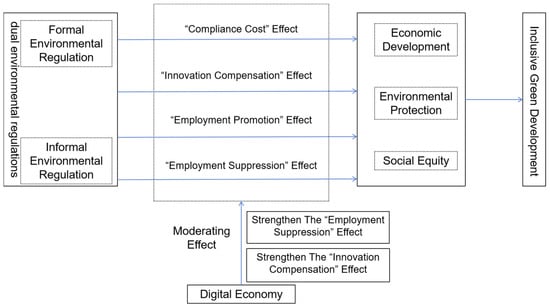
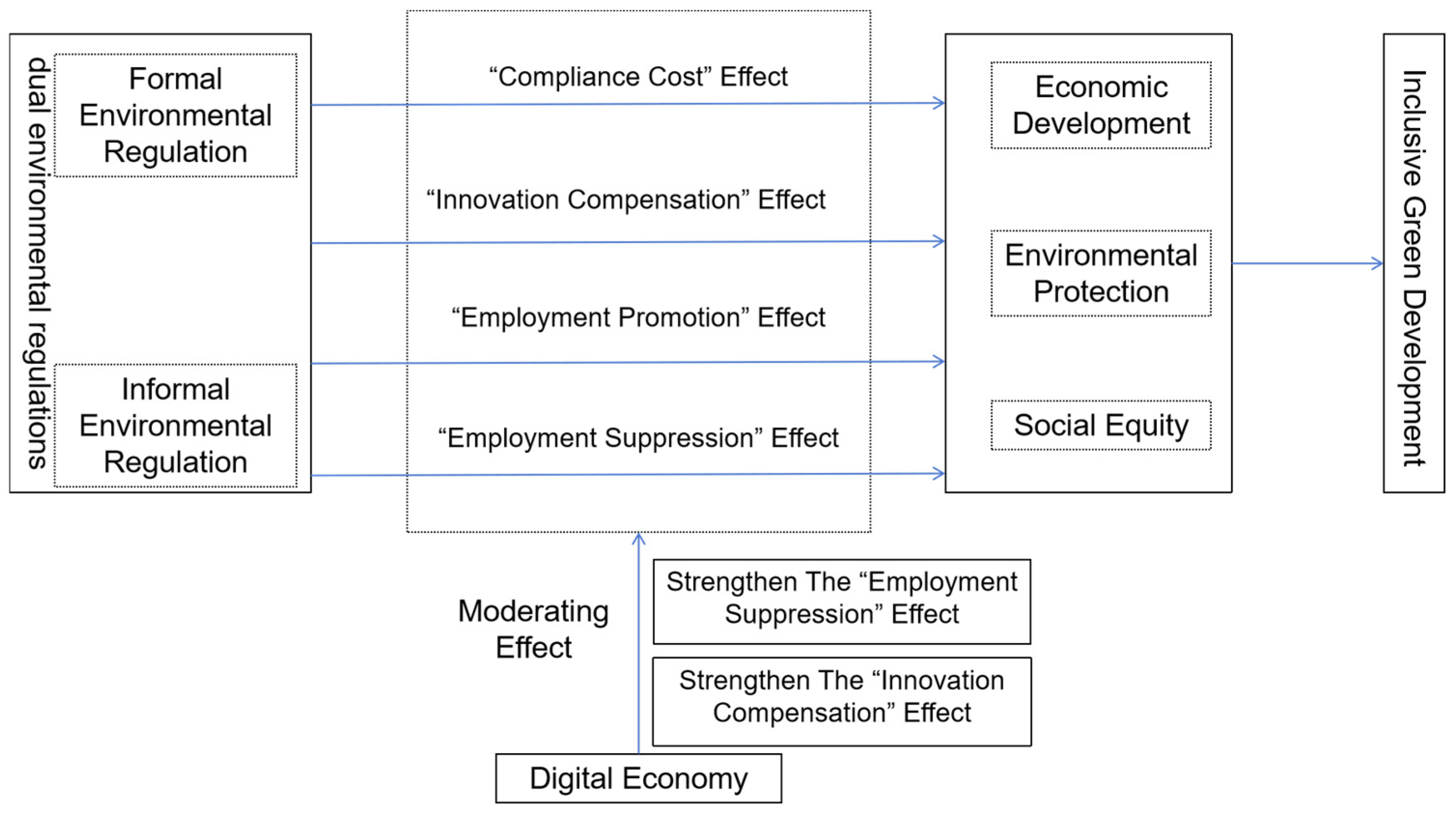
Figure 1 provides a detailed description of the impact mechanism of dual environmental regulations on inclusive green development within the context of the digital economy.
Figure 1.
The impact mechanism of dual environmental regulations on inclusive green development in the digital economy context.
4. Study Design
4.1. Model Setup
4.1.1. Benchmark Regression Model
To verify Hypothesis 1, we construct the following benchmark regression model:
lnIGDit = α0 + α1lnErit + αklnXit + μi + vt + εit
lnIGDit = β0 + β1lnIErit + βklnXit + μi + vt + εit
In Formulas (1) and (2), i denotes the province, and t denotes the year. The level of inclusive green development in province i during year t is represented by IGDit. Formal environmental regulation in province i during year t is denoted by Erit, while informal environmental regulation is indicated by IErit. The set of control variables is represented by Xit and primarily includes spatial fixed effects μi, temporal fixed effects vt, and the random error term εit. To address heteroscedasticity and ensure data stationarity, all indicators have been logarithmically transformed.
4.1.2. The Moderating Effect of Digital Economy on Dual Environmental Regulations
To verify Hypotheses 2, the baseline regression model incorporates the digital economy and the interaction term between the digital economy and dual environmental regulations.
lnIGDit = γ0 + γ1lnErit + γ2c_lnErit × c_lnDigit + γ3lnDigit + γkXit + μi + vt + εit
lnIGDit = δ0 + δ1lnIErit + δ2c_lnIErit × c_lnDigit + δ3lnDigit + δkXit + μi + vt + εit
The digital economy index of province i in year t is denoted by Digit, with the meanings of other symbols remaining unchanged. To avoid multicollinearity issues arising from the inclusion of interaction terms, this paper applies centering to the variables that constitute the interaction terms.
4.2. Variable Selection
4.2.1. Dependent Variable
Measuring the Inclusive Green Development (IGD) Level is the core focus of this study. Existing research on IGD measurement primarily adopts two approaches: The first involves establishing an evaluation index system for IGD, where scholars analyze its constituent elements from various perspectives and dimensions, subsequently constructing multi dimensional evaluation frameworks. The second approach incorporates social inequity as a undesirable output, employing Inclusive Green Total Factor Productivity (IG-TFP) for measurement. This paper utilizes the Malmquist- Luenberger index derived from the SBM-DDF method to quantify IG-TFP and thereby assess IGD levels [17]. The measurement requires defining input and output variables: Input variables include capital stock, labor input, and energy input. The capital stock is estimated using the perpetual inventory method, referencing Shan Haojie’s (2008) methodology with 2009 as the base year and a 10.96% annual depreciation rate [49]. Labor input is measured by the annual employment figures of urban units in each province, while energy input is gauged by total provincial energy consumption. Desirable output variables include provincial GDP, with environmental undesirable outputs measured by particulate matter emissions, wastewater chemical oxygen demand, sulfur dioxide emissions, and carbon emissions. The social undesirable output variable is calculated as the urban rural income gap (calculated as urban disposable income divided by rural disposable income) [50]. The calculation was performed using the software MaxDEA Ultra 9 under variable returns to scale conditions.
4.2.2. Explanatory Variables
The formal environmental regulation (Er) is measured through four primary approaches in domestic and international literature: (1) pollution control investment–based measurement, (2) pollutant emission volume based measurement, (3) composite index methodology for indicator construction, and (4) a proxy indicator was calculated as the proportion of environmental protection related terms in provincial government work reports relative to the total word frequency of the reports. This study uses pollutant emission volume as a measurement criterion, focusing on industrial particulate emissions, sulfur dioxide emissions, and the chemical oxygen demand of industrial wastewater. The entropy method determines indicator weights, with the composite environmental regulation index calculated using standardized values. Higher index scores indicate stricter government environmental regulations.
The informal environmental regulation (IEr) employs Pargal et al.’s measurement method, using the entropy method to combine four indicators—per capita income, population density, education level, and age structure—into a single metric that reflects the intensity of informal environmental regulation across regions [51].
4.2.3. Adjustment Variables
The digital economy level (Dig) adopts the construction approach of Zhao Tao et al. (2020) [52], using a comprehensive evaluation of internet penetration rate, relevant employment situation, related output, mobile phone penetration rate, and digital financial development. These indicators correspond to the number of internet users per 100 people, the proportion of employees in the computer, communication, and other electronic manufacturing industries, information service transmission industries, and radio and television industries, among urban employees, the total telecom business per capita, the number of mobile phone users per 100 people, and the China Digital Inclusive Finance Index jointly compiled by the Digital Finance Research Center of Peking University and Ant Financial Group [53]. This paper determines the indicator weights through the entropy method and calculates the comprehensive index of digital economy level based on the weights and standardized values.
4.2.4. Control Variables
- (1)
- The economic development level (Pgdp) is measured by per capita GDP in each province. This level serves as the foundation for inclusive and green development.
- (2)
- Government Technology Support (Gts): This study adopts the methodology proposed by Ye Xiangsong et al. (2018), which measures Gts by analyzing the proportion of government expenditure in R&D internal expenditures relative to total R&D spending [54].
- (3)
- Foreign Direct Investment (FDI) is measured by the ratio of actual utilized foreign investment to GDP. While FDI brings advanced technologies and management expertise to drive green economic development [55], the stringent environmental regulations in foreign countries may lead to the relocation of highly polluting industries to China [56]. Therefore, the impact of FDI on inclusive green development remains to be verified.
- (4)
- Openness (Open) is measured as the ratio of a province’s export value to its gross domestic product. Examining the influence of exports on inclusive green development is crucial, as exports can drive technological innovation while simultaneously exerting environmental pressures.
- (5)
- Urbanization (Urb) is defined as the proportion of the urban population to the total population within each province. While the concentration of population and economic activities in cities brings positive effects such as economies of scale, it also causes negative impacts like environmental pollution. Therefore, it is necessary to consider the impact of urbanization on inclusive green development [57].
- (6)
- Industrial upgrading (Isa) is measured by the ratio of the tertiary sector’s output value to that of the secondary sector. The transition from low value added, energy intensive, and labor intensive industries to high value added, technology intensive, knowledge intensive, and service dominated structures will impact various aspects of the economy, environment, and employment. Therefore, it is essential to consider the effects of industrial upgrading on inclusive green development [58].
4.3. Data Sources
This paper selects panel data from 30 provinces of China (excluding Xizang, Hong Kong, Macao, and Taiwan) from 2011 to 2021 for econometric analysis. The data are mainly sourced from the “China Statistical Yearbook”, “China Environmental Statistical Yearbook”, “China Environmental Statistical Annual Report”, “China Science and Technology Statistical Yearbook”, CEADs, and regional statistical yearbooks. These statistical yearbooks are all published by the Chinese government on its official website. All variables in this paper are trimmed at the upper and lower 1% levels and then introduced into the equation after logarithmic transformation. This study conducted the Fisher-ADF test, and the results in Table 1 indicate that each variable passed the ADF test, confirming the stability of all data. This study conducted variance inflation factor (VIF) tests on the benchmark regression models related to formal and informal environmental regulation. The results show that the average VIF values are 3.4 and 4, respectively, with all individual variables having VIF values below 10, indicating the absence of multicollinearity.
Table 1.
Descriptive Statistics (Including the ADF test).
5. Empirical Results Analysis and Discussion
5.1. Hausman Test
Table 2 presents the results of the Hausman test, which indicate that, whether examining formal or informal environmental regulations, the unique characteristics of individuals exert a significant influence on the outcomes and cannot be disregarded. Consequently, this study adopts the fixed effects model.
Table 2.
Hausman Test.
5.2. Benchmark Regression Results
Table 3 presents the benchmark regression results from Equation (1) in Columns (1) and (2). Column (1) shows the model estimation results after accounting for provincial and temporal fixed effects, without including additional variables. The regression coefficient for formal environmental regulation (Er) is 0.161, which is statistically significant at the 1% level. This initial finding suggests that formal environmental regulation fosters inclusive green development. Column (2) presents updated model results that incorporate additional control variables, going beyond provincial and temporal effects. In this report, the regression coefficient of formal environmental regulation (Er) is 0.237 and is statistically significant at the 1% level. Our analysis shows that the institutionalization of the formal environmental regulatory mechanism has a significantly positive effect on inclusive green development, which provides empirical evidence for Hypothesis 1. This is in line with the findings of Luo et al. [59] and Zhong et al. [60], who argue that stricter environmental regulation can trigger both “innovation compensation” effect and “employment promotion” effect. These two mechanisms are the main drivers for regional enterprises to undertake green technological innovations and create employment.
Table 3.
Impact of Formal Environmental Regulations on Inclusive Green Development with Moderating Effect of Digital Economy (Baseline regression and moderation effect).
Among control variables, the coefficient of the level of economic development (Pgdp) is 1% significant positive, suggesting that the higher the level of economic development, the better the region is for inclusive green development. The reason may be that the level of economic development, is hgh the fiscal capacity of the region, and the infrastructure level are also high. The coefficient of government technological support (Gts) is 10% significant negative, meaning that government technological support is not conducive to inclusive green development. This may be because government funding for science and technology has a crowding out effect on corporate R&D investment, the reason may be that the government funding for science and technology causes enterprises to lean on the back of the government to solve environmental problems, which reduces enterprises’ innovation efficiency and causes environmental problems to remain unresolved. The coefficient of openness (Open) is 1% significant negative, meaning that the openness of the region is not conducive to inclusive green development. This may be due to the environmental pressure caused by export-oriented production and the interregional relocation of enterprises. The coefficient of foreign direct investment (FDI) is positively related, but the statistical significance is not robust. Although foreign investment brings technology to the host country, it often flows into polluting industries, and the environmental pollution is also increased. The coefficient of urbanization (Urb) is 1% significant negative, indicating that the degree of urbanization is not conducive to inclusive green development, and the degree of negative effect of urbanization on inclusive green development is strong. A possible explanation is that large scale migration of the rural population to cities has led to a decline in rural labor supply. Such demographic shifts may, to some extent, constrain rural development and widen the urban rural divide. Moreover, the expansion of factories and the rapid growth of urban populations have driven continuous enlargement of city scale, further exacerbating environmental problems. Ultimately, increased urbanization levels may suppress inclusive green development. The coefficient of industrial upgrading (Isa) is positive but not statistically significant. This disparity may be because the expanding tertiary sector can absorb large numbers of workers and help alleviate income inequality, whereas the expansion of capital intensive and technology intensive industries reduces the labor income share.
Columns (1) and (2) of Table 4 present the baseline regression results of Equation (2). Column (1) shows the estimation results of the model controlling only for provincial and temporal fixed effects. The coefficient for informal environmental regulation (IEr) is −0.169, which is significant at the 1% level. This preliminary result suggests that informal environmental regulation may have an inhibitory effect on inclusive green development. In Column (2), in addition to provincial and time fixed effects, other control variables are included. The coefficient on informal environmental regulation (IEr) becomes −0.295 and remains significant at the 1% level. This evidence indicates that informal environmental regulation significantly suppresses inclusive green development, thereby Rejected Hypothesis 1. It suggests that the “compliance cost” effect predominates, consistent with Wang et al. [61]: as informal environmental regulation intensifies, public scrutiny of governments and firms increases, and environmental compliance costs rise. In some cases, informal regulation is more stringent than formal standards; firms that comply with national requirements may still face sustained public pressure if they fall short of societal expectations, which constrains their capacity for sustainable development.
Table 4.
Impact of Informal Environmental Regulation on Inclusive Green Development with Moderating Effect of Digital Economy (Baseline regression and moderation effect).
5.3. Adjustment Effect
Column (3) of Table 3 displays the regression results for Equation (3). This study aims to examine how formal environmental regulations affect inclusive green development within the digital economy. Specifically, we introduced an interaction term lnEr × lnDig between formal environmental regulations and the level of digital economic development. The coefficient of the digital economy level (Dig) is 0.0603, significant at the 5% level, while the coefficient of lnEr × lnDig is −0.129, statistically significant at the 1% level. This indicates that the digital economy weakens the positive impact of formal environmental regulations on inclusive green development, thereby confirming Hypothesis 2. As the digital economy develops, it has intensified the “compliance cost” and “employment suppression” effects of formal environmental regulations. Firms are particularly sensitive to the compliance costs imposed by such regulations, and the digital economy makes various expenses more transparent to them. Meanwhile, when digital tools combine with formal regulations, automation and artificial intelligence may worsen labor market inequality. Some positions become redundant, and lower-skilled workers face higher unemployment risks. As a result, the “employment suppression” effect presents a clear challenge to development that is truly inclusive.
Column (3) of Table 4 presents the regression results of Equation (4). To investigate the impact of informal environmental regulations on inclusive green development in the digital economy context, this study introduced an interaction term lnIEr × lnDig between informal environmental regulations and digital economy level. The regression coefficient of digital economy level (Dig) was 0.109, significant at the 1% level, while the coefficient of lnIEr × lnDig was 0.0889, also significant at the 1% level. This indicates that the digital economy mitigates the negative impact of informal environmental regulations on inclusive green development, thereby validating Hypothesis 2. As the digital economy expands, it reduces the “compliance cost” effect caused by informal environmental regulations. Through digital platforms and technologies, the digital economy empowers enterprises and communities to respond more effectively to environmental challenges. Public monitoring is becoming more transparent. This pushes businesses toward meaningful innovation. At the same time, big data and IoT systems are cutting the expenses linked to green research, energy management, and pollution control. As a result, companies are better able to turn outside pressures into real operational gains—they can raise productivity and reuse resources more effectively. These changes strengthen the “innovation compensation” effect and ease the burden of compliance costs.
5.4. Mechanism Testing of the Moderating Effect
The aforementioned research results indicate that the digital economy significantly moderates the relationship between dual environmental regulation and inclusive green development. Therefore, it is necessary to further elucidate the mechanism underlying the moderating effect of the digital economy, drawing on the testing approach proposed by Ye Baojuan (2013) [62].
lnMediatorit = a0 + a1lnErit + a2lnDigit + a3c_lnErit × c_lnDigit + aklnXit + μi + vt + εit
lnIGDit = c0 + c1lnErit + c2c_lnErit × c_lnDigit + c3lnDigit + b1lnMediatorit + b2c_lnMediatorit × c_lnDigit + nklnXit + μi + vt + εit
In Formulas (5) and (6), lnMediator denotes the mediating variable. In this study, the mediating variables are defined as lnGin, representing the level of green innovation, and lnEm, representing the level of employment. The green innovation level is measured by the logarithm of the number of green patents, while the employment level is measured by the logarithm of the number of employed persons. The same reasoning applies to the formula for informal environmental regulation.
The results according to Yebaojuan’s testing method are presented in Table 5, in Formulas (1) and (2), coefficients a1 and b2 are significant, whereas a3 is not. This finding indicates that the digital economy indirectly moderates the relationship between formal environmental regulation and inclusive green development through the innovation compensation effect. Similarly, in Formulas (3) and (4), a1 and b2 remain significant while a3 is insignificant, suggesting that the digital economy also indirectly moderates the influence of informal environmental regulation on inclusive green development via the innovation compensation effect. In Formulas (5) and (6), a1 and b2 are significant, but a3 is not, implying that the digital economy indirectly moderates the relationship between formal environmental regulation and inclusive green development through the employment suppression effect. Finally, in Formulas (7) and (8), a1 and b2 are significant, whereas a3 is insignificant, indicating that the digital economy similarly moderates the impact of informal environmental regulation on inclusive green development via the employment suppression effect.
Table 5.
The results of the mechanism test for the moderating effect (“innovation compensation” effect and “employment suppression” effect).
5.5. Robustness Test
5.5.1. Instrumental Variable
To address potential endogeneity issues in the model, we employed first-order lagged terms of dual environmental regulations as instrumental variables to test model robustness. The results showed significant lagged coefficients for both formal and informal environmental regulations. The formal environmental regulation lagged coefficient was 0.2043 with a KP-LM statistic of 208.498 (p = 0), indicating no miss identification. The Cragg-Danald F statistic reached 578.764, far exceeding the 10% critical value for weak identification tests, confirming no weak instrument problem. Similarly, the informal environmental regulation lagged coefficient was −0.4041 with a KP-LM statistic of 136.157 (p = 0) and a Cragg-Danald F statistic of 211.08, both significantly exceeding the 10% critical value for weak identification tests. After carefully addressing potential endogeneity in our analysis, we find that the effect of dual environmental regulations on inclusive green development still shows both statistical significance and substantive importance. This provides strong evidence for the robustness of our conclusions.
5.5.2. Replace Core Explanatory Variables
We conducted further tests by substituting proxy variables into our regression model. Formal environmental regulation is now quantified as pollution control investment relative to industrial GDP, while informal regulation uses the Baidu smog search index per Wu Libo et al. (2022) [47]. Baidu’s search dominance and the public’s use of visibility cues make “smog” searches an effective measure of environmental engagement, serving as a valid proxy for informal regulation [47]. Results in Table 6 confirm consistent variable signs and significance levels for both regulations. Notably, modifying the calculation method for dual environmental regulations did not alter the original conclusions, demonstrating the robustness of the empirical findings.
Table 6.
Replace explanatory variables and exclude abnormal years.
5.5.3. Remove Outlier Years
During the sample period, the COVID-19 pandemic after 2020 significantly impacted regional development. To minimize the influence of abnormal years on research outcomes, the regression analysis was conducted after excluding data from 2020–2021. As shown in Table 6, the signs and significance of both formal and informal environmental regulations remained consistent with previous findings after removing the anomalous years. The regression results showed no changes when altering the year range, demonstrating the robustness of the empirical conclusions.
5.6. Heterogeneity Analysis
This study investigates the effects of both formal and informal environmental regulations on inclusive green development across various provincial categories, where significant disparities may occur. Utilizing Wang Yueting’s (2023) [63] classification of provinces according to levels of resource dependence, the research uses the ratio of mining employment in urban non-private sectors to total urban non-private sector employment as an indicator of resource dependence. Based on the 2021 resource dependence rankings, the 15 provinces with the highest levels of resource dependence are classified as resource-dependent provinces, while the others are categorized as non-resource-dependent provinces.
The results are presented in Table 7. In resource-dependent provinces, the regression coefficient for formal environmental regulations is 0.228, significant at the 1% level, while the coefficient for informal environmental regulations is −0.183, significant at the 10% level. In contrast, for non-resource-dependent provinces, the coefficient for formal environmental regulations is 0.201, also significant at the 1% level, and the coefficient for informal environmental regulations is −0.33, significant at the 1% level. These findings indicate that in both resource-dependent and non-resource-dependent provinces, increased intensity of formal environmental regulations fosters inclusive green development, whereas increased intensity of informal environmental regulations hinders it. Notably, the regression coefficient for formal environmental regulations is higher in resource-dependent provinces compared to non-resource-dependent ones, suggesting a greater impact on inclusive green development. This may be attributed to the more pronounced “innovation compensation” and “employment promotion” effects in resource-dependent provinces. These provinces have long relied on highly polluting resource-based industries, where stringent formal environmental regulations compel energy-intensive enterprises to upgrade their technologies or face elimination, thereby fostering an industrial structure more aligned with inclusive green development. The detrimental effect of informal environmental regulation on inclusive green development is less pronounced in resource-dependent provinces. Due to their long reliance on resource-based industries and repeated exposure to public scrutiny arising from severe pollution, governments and firms in these regions have accumulated substantial experience in managing informal regulatory pressures, enabling faster responses and attenuating the associated adverse impacts.
Table 7.
Heterogeneity Analysis (Different levels of resource dependence).
5.7. Placebo Test
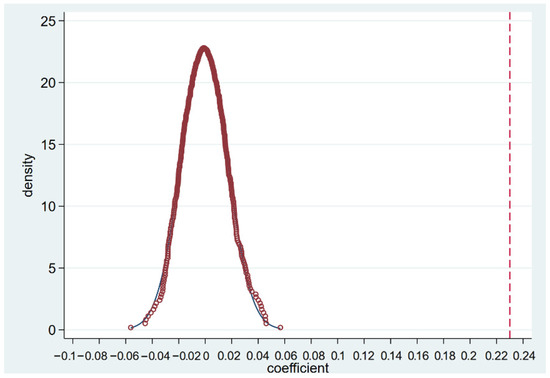
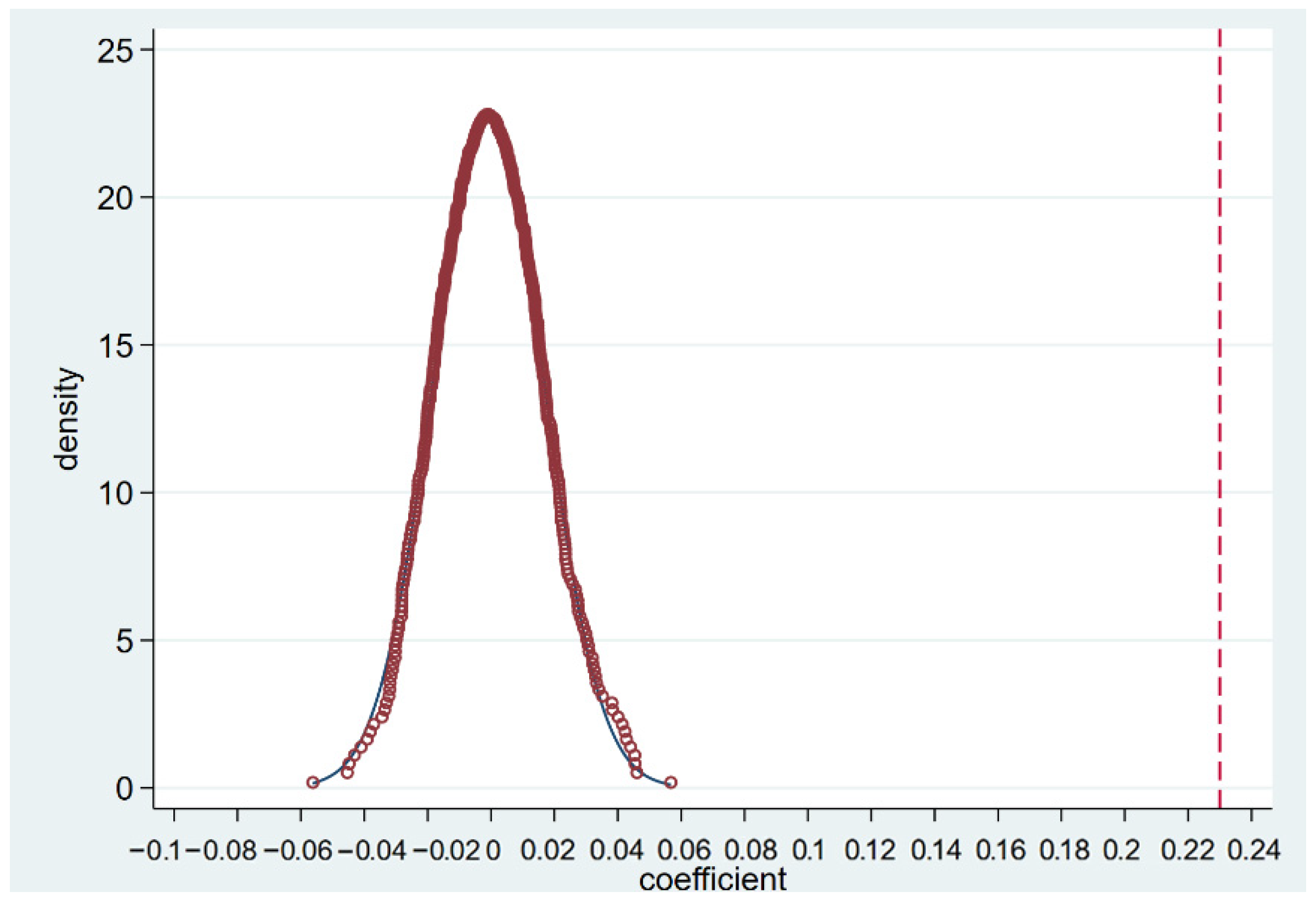
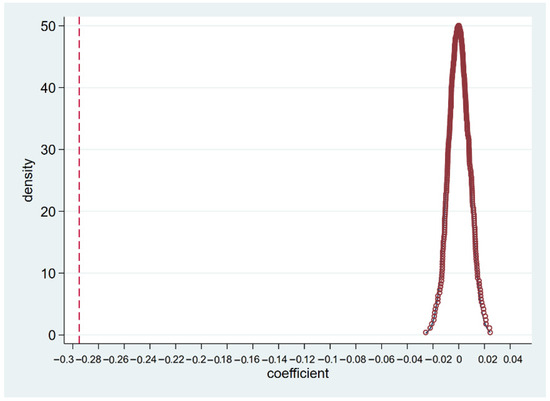
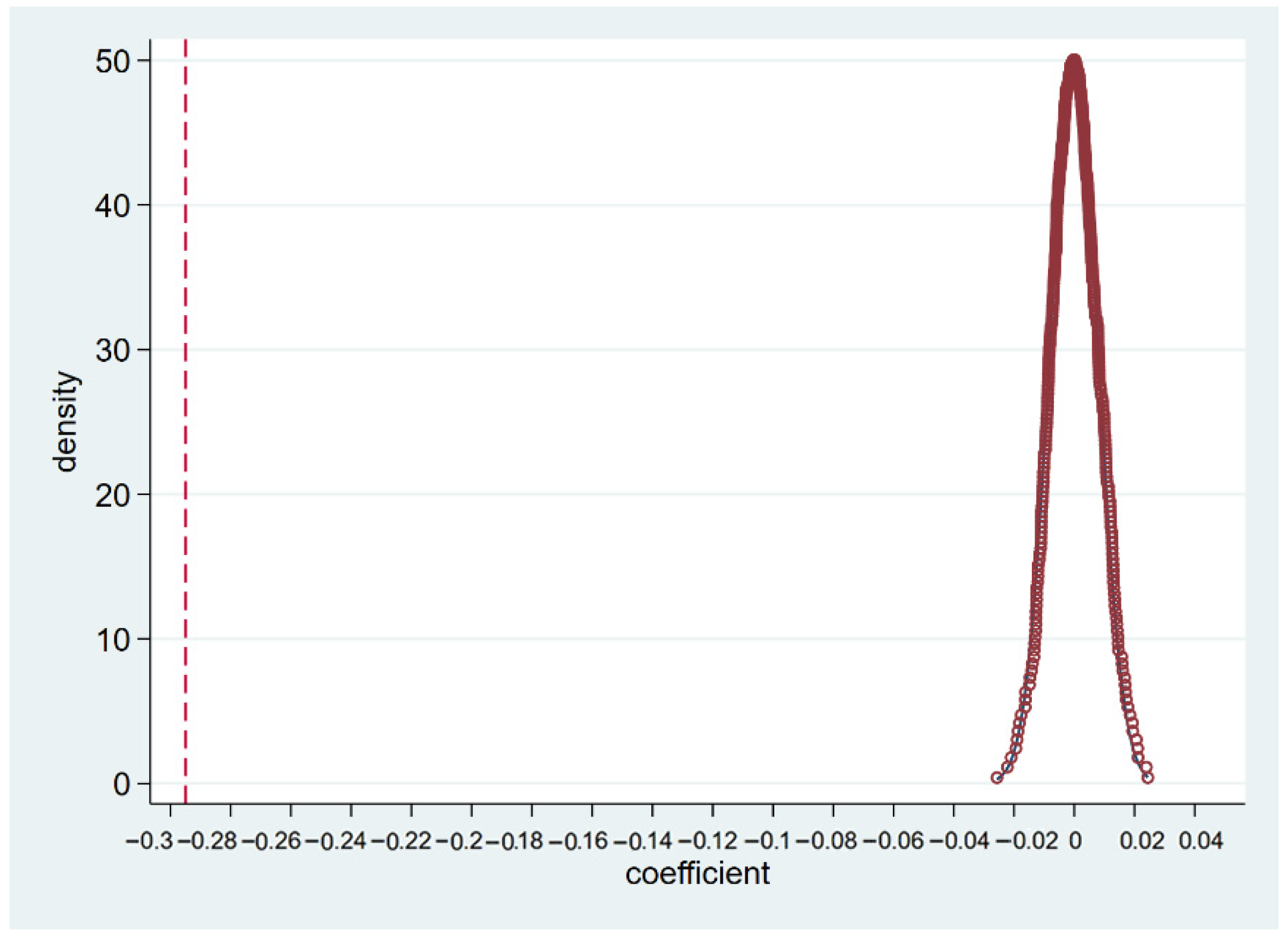
To eliminate potential interference from unobservable factors in the estimation results, this study conducts a placebo test by randomly generating the explanatory variables lnEr and lnIEr. The process is repeated 500 times. Figure 2 and Figure 3 present the distributions of the regression coefficients for the two randomly generated explanatory variables, respectively. The results indicate that the spurious coefficients cluster around zero, whereas the actual coefficients are distinctly distant from these spurious values. This finding suggests that the baseline regression results are robust and are not significantly affected by hidden confounding factors.
Figure 2.
Placebo test of Formal environmental regulations.
Figure 3.
Placebo test of Informal environmental regulation.
6. Further Research: Spatial Spillover Effect
6.1. Spatial Correlation Test and Spatial Econometric Model Construction
We constructed a geographic distance weight matrix by taking the inverse of squared distances between provincial capitals. Guided by statistical diagnostics, we adopted a spatial econometric model, with detailed results reported in Table 8. The Lagrange Multiplier (LM) diagnostics show that Moran’s I is significant at the 1% level, indicating strong spatial dependence among the explanatory variables of inclusive green development. The LM tests also reject the null hypotheses at the 1% significance level, confirming the presence of both spatial lag and spatial error effects in inclusive green development. This suggests the Spatial Distance Model (SDM) is suitable for this research. The Hausman test confirms the fixed effects approach under the geographical distance-weighted matrix. The Likelihood Ratio (LR) test further validates the dual fixed effects model as the most appropriate choice. Finally, Wald and LR tests confirm that the SDM model maintains its validity across different weighting matrices, neither degenerating into Spatial Autoregressive (SAR) nor Spatial Error Model (SEM) models. This demonstrates the SDM’s suitability for this study, with the following formula constructed:
lnIGDit = φ0 + φ1WlnIGDit + φ2lnErit + φ3WlnErit + φklnXit + μi + vt + εit
lnIGDit = ω0 + ω1WlnIGDit + ω2lnIErit + ω3WlnIErit + ωklnXit + μi + vt + εit
Table 8.
Spatial correlation test.
In Formulas (7) and (8), i represents the province, t denotes the year, W is the spatial weight matrix, WlnIGDit indicates the spatial lag term of inclusive green development level, WlnErit signifies the spatial lag term of formal environmental regulation, and WlnIErit represents the spatial lag term of informal environmental regulation.
6.2. Spatial Effect Decomposition
LeSage and Pace contend that using spatial lag coefficients of explanatory variables to measure spatial spillover effects may introduce inaccuracies. When variables exhibit spatial spillover effects, changes in this indicator not only affect the dependent variable in the local region but also influence neighboring regions, which in turn impacts the local area through feedback effects. Building on their theory, this study decomposes the impact of explanatory variables on inclusive green development into “direct effects” and “indirect effects” [64]. We employed a geographically weighted spatial matrix to examine both the direct and indirect effects of environmental regulation on inclusive green development.
Table 9 presents the regression results of the effect decomposition based on Equations (7) and (8). The direct effect coefficient of formal environmental regulation is 0.207, and the indirect effect coefficient is −0.565, both are statistically significant at the 1% level. This indicates that formal environmental regulation generates negative spatial spillover effects that impede inclusive green development in neighboring regions. The direct effect coefficient of informal environmental regulation is −0.145, significant at the 10% level, and the indirect effect coefficient is −1.039, both are statistically significant at the 1% level. This suggests that informal environmental regulation likewise produces negative spatial spillovers, hindering inclusive green development at the local level. These empirical patterns can be explained by firms, under substantial compliance cost pressures, relocating to adjacent provinces with laxer environmental regulations to relieve public opinion pressure; for the receiving regions, environmental quality is unavoidably adversely affected.
Table 9.
Spatial decomposition of the impact of dual environmental regulations within the Digital economy on inclusive green development (Geographical Distance Weight Matrix).
All coefficients related to the digital economy exhibit statistically significant positive associations at the 1% significance level. In terms of direct effects, the coefficient of lnEr × lnDig is −0.176, whereas that of lnIEr × lnDig is 0.107; both are significant at the 1% level, consistent with the preceding regression results. Furthermore, lnEr × lnDig shows an indirect effect of −0.497 at the 5% significance level, indicating that the digital economy amplifies the negative spatial spillover effect of formal regulation. Specifically, by providing platforms that lower difficulty of information search and transaction costs, the digital economy enables firms subject to stringent environmental regulation to more readily identify jurisdictions with looser policy constraints and relocate. The indirect effect coefficient for lnIEr × lnDig is −0.194, significant at the 10% level. This suggests that when the high transparency afforded by the digital economy combines with the regional specificity of public pressure, firms can more efficiently shift environmentally demanding and labor intensive segments of production to adjacent areas with laxer public oversight. Such reallocation often alters the target regions’ environmental quality and employment structure, resulting in ecological degradation and a tilt of the employment mix toward lower-skilled positions.
This paper further incorporates a geo-economic distance spatial weight matrix to test the robustness of the results of the spatial spillover effects. The elements of this spatial weight matrix are defined as the reciprocal of the Euclidean distance between the provincial capitals multiplied by the ratio of the average annual per capita GDP of the target region and the average per capita GDP of all regions. The results are presented in Table 10. Under the geo-economic distance spatial weight matrix, the direct and indirect effects of the explanatory variables and moderating variables are reported, which are consistent with the results under the geographical distance spatial matrix, indicating that the Spatial Durbin Model in this study has certain stability.
Table 10.
Spatial decomposition of the impact of dual environmental regulations within the Digital economy on inclusive green development (Geographical economic distance weight matrix).
7. Conclusions and Policy Recommendations
7.1. Conclusions
This study differentiates environmental regulation into two categories and uses: formal and informal. Subsequently, a using panel data from 30 provinces in China spanning 2011–2021, an econometric model is constructed to empirically examine the effects of these two types of environmental regulation on inclusive green development. In this study, we position the digital economy within the theoretical framework and set up a effect model to clarify its in the relationship between dual environmental regulations and inclusive green development in addition, we further investigate the spatial spillover effects of dual environmental regulations. The empirical results indicate that formal environmental regulation has a significant positive effect on inclusive green development at this stage through the “innovation compensation” and the “employment promotion” effect. Green technology innovation and the creation of employment are very salient. And informal environmental regulation has a significant restraining effect on inclusive green development. The extra compliance cost imposed by public pressure under the public force has become huge for those who fail to meet the social expectation. When the digital economy is present, digital technology will amplify the “compliance cost” effect and the “employment suppression” effect of the formal environmental regulations. The regulatory that have been amplified through digital means partially counteract the positive effects of the “innovation compensation” effect and the “employment promotion” effect. The digital economy will weaken the “compliance cost” effect pressures of informal environmental regulations by reducing information asymmetry and improving regulatory compliance efficiency. Therefore, digital technology alleviates the pressure of public opinion on firms. When the environmental regulation is too strict, companies tend to choose to relocate to other areas with factors of production is highly free from the “pollution haven” effect. As a result, pollution relocates with these firms, and environmental conditions in the receiving regions deteriorate. The damage caused by this pollution transfer substantially exceeds any employment gains that might come from the business relocation.
7.2. Limitations and Future Prospects
This study examines how dual environmental regulations influence inclusive green development within the context of the digital economy, but certain limitations remain in the research. For example, the analysis uses a relatively simple approach by dividing regulations into just two types: formal and informal. Future studies could benefit from developing a more detailed classification system. Researchers should also conduct more in-depth studies on how environmental regulations actually affect green development. Because in the context of the new era, potential mechanisms (such as in the context of artificial intelligence) still require further investigation. Although the Digital Economy Index demonstrates a high degree of comprehensiveness, its constituent elements may change rapidly. Therefore, in future research, you may need to update these components accordingly.
7.3. Policy Recommendations
Based on the above conclusions, the policy implications of this paper are as follows:
- (1)
- Better enforcement of formal environmental rules requires establishing a special fund to cover risks in green technology innovation. This would encourage the creation of green financial products, including credit, bonds, and insurance. Small and medium-sized enterprises involved in green projects would be the main beneficiaries of these financial tools. Refining the green tech innovation compensation system serves two purposes: it strengthens regional capacity to bear risks for green enterprises and amplifies the “innovation compensation” effect. Concurrently, increasing investment in green infrastructure in former industrial areas facilitates the development of green industries, generates local employment, and strengthens the “employment promotion” effect.
- (2)
- Governments can establish authoritative, transparent databases tracking corporate environmental performance, including greenhouse gas emissions, resource usage, and carbon footprints. Requiring the use of consistent accounting standards would improve the comparability of data and reduce the amount of misinformation. Complementary partnerships with media and focused public education campaigns are also necessary to convey the importance of balancing environmental protection with ensuring employment, highlighting the upgrading of technology rather than the closure of a firm. For enterprises that are pressured to shut down due to public opinion, governments would provide active support such as retraining of the workforce, job placement services and entrepreneurship programs.
- (3)
- To curb the “pollution haven” phenomenon, governments can link banks’ credit and other opportunities to firms’ emissions performance. They can also reduce taxes and increase the proportion of targeted subsidies for enterprises that adopt cleaner production methods to encourage firms to deal with environmental pollution. The prevention of relocation of polluting firms into their jurisdiction should be included in the performance evaluation of local officials. Most importantly, regions should cooperatively formulate harmonized environmental standards and regulatory frameworks in order to address the root causes of pollution haven behavior of enterprises.
- (4)
- To strengthen the integration between the dual regime of environmental regulation and the digital economy, digital technologies should be fully leveraged to develop intelligent environmental regulatory systems that enable high-polluting enterprises to transmit their emissions data and the operational status of pollution-control facilities to governmental regulatory authorities in real time. Through automated anomaly detection in these data, regulators can monitor polluting behaviors in real time, thereby addressing at the source the problem of “digital weakening” in formal environmental regulation. In addition, a visual public participation platform will be established to provide intuitive, real time updates on regional environmental quality, the spatial distribution of pollution sources, and progress in pollution control. This will allow the public to gain real time insights into polluting activities, thereby mitigating the adverse effects of informal environmental regulation on inclusive green development in the context of the digital economy.
Author Contributions
Conceptualization, Z.L. and H.Y.; methodology, Z.L.; software, Z.L.; validation, Z.L.; formal analysis, Z.L.; investigation, Z.L.; resources, Z.L.; data curation, Z.L.; writing—original draft preparation, Z.L.; writing—review and editing, Z.L.; visualization, Z.L.; supervision, Z.L.; project administration, Z.L.; funding acquisition, Z.L. and H.Y. All authors have read and agreed to the published version of the manuscript.
Funding
This research was funded by the Ministry of Education of the People’s Republic of China, grant number 15JJD790026.
Institutional Review Board Statement
Not applicable.
Informed Consent Statement
Not applicable.
Data Availability Statement
The data presented in this study are available on request from the corresponding author.
Conflicts of Interest
The authors declare no conflicts of interest. The funders had no role in the design of the study; in the collection, analyses, or interpretation of data; in the writing of the manuscript; or in the decision to publish the results.
References
- 2024 Environmental Performance Index—Ecosystem Vitality. Available online: https://epi.yale.edu/measure/2024/ECO (accessed on 26 November 2025).
- National Data. Available online: https://data.stats.gov.cn/easyquery.htm?cn=C01&zb=A0A0G&sj= (accessed on 26 November 2025).
- Fay, M. Inclusive Green Growth: The Pathway to Sustainable Development; World Bank Publications: Washington, DC, USA, 2012. [Google Scholar]
- Zhou, X. Inclusive green development: Theoretical interpretation and institutional support system. Acad. Mon. 2020, 52, 41–54. [Google Scholar] [CrossRef]
- Porter, M.E. Technology and competitive advantage. J. Bus. Strategy 1985, 5, 60–78. [Google Scholar] [CrossRef] [Scilit]
- Zhang, Y.; Wang, J.; Xue, Y.; Yang, J. Impact of environmental regulations on green technological innovative behavior: An empirical study in China. J. Clean. Prod. 2018, 188, 763–773. [Google Scholar] [CrossRef] [Scilit]
- Rauniyar, G.; Kanbur, R. Inclusive growth and inclusive development: A review and synthesis of Asian Development Bank literature. J. Asia Pac. Econ. 2010, 15, 455–469. [Google Scholar] [CrossRef] [Scilit]
- Berkhout, E.; Bouma, J.; Terzidis, N.; Voors, M. Supporting local institutions for inclusive green growth: Developing an Evidence Gap Map. NJAS Wagening. J. Life Sci. 2018, 84, 51–71. [Google Scholar] [CrossRef] [Scilit]
- Zhou, X.; Wu, W. Measurement and analysis of Inclusive green growth in China. Quant. Tech. Econ 2018, 35, 3–20. [Google Scholar] [CrossRef]
- Wu, W.; Zhou, X. Construction and Application of China’s Inclusive Green Growth Performance Evaluation System. China Manag. Sci. 2019, 27, 183–194. [Google Scholar] [CrossRef]
- Hua, Y.; Zhang, J.; Ding, X.; Ding, G. Does new urbanization support the rural inclusive green development under domestic circulation in China? Sustainability 2024, 16, 2950. [Google Scholar] [CrossRef] [Scilit]
- Feng, Y.; Sun, M.; Pan, Y.; Zhang, C. Fostering inclusive green growth in China: Identifying the impact of the regional integration strategy of Yangtze River Economic Belt. J. Environ. Manag. 2024, 358, 120952. [Google Scholar] [CrossRef] [Scilit] [PubMed]
- Wu, Y.; Cao, Y.; Zhu, Y.; Zhang, J. Spatial correlation network, regional differentiation and convergence of inclusive green development in China. J. Nat. Resour. 2025, 40, 436–458. [Google Scholar] [CrossRef] [Scilit]
- Zhang, B.; Nozowa, W.; Managi, S. Spatial inequality of inclusive wealth in China and Japan. Econ. Anal. Policy 2021, 71, 164–179. [Google Scholar] [CrossRef] [Scilit]
- Wang, D.; Hou, Y.; Li, X.; Xu, Y. Developing a functional index to dynamically examine the spatio-temporal disparities of China’s inclusive green growth. Ecol. Indic. 2022, 139, 108861. [Google Scholar] [CrossRef] [Scilit]
- Sun, Y.; Ding, W.; Yang, Z.; Yang, G.; Du, J. Measuring China’s regional inclusive green growth. Sci. Total Environ. 2020, 713, 136367. [Google Scholar] [CrossRef] [Scilit]
- Dong, B.; Xu, Y. The impact of Chinese government’s attention on inclusive green development: Evidence from 253 cities in China. Environ. Dev. Sustain. 2025, 27, 11335–11367. [Google Scholar] [CrossRef] [Scilit]
- Ren, S.; Li, L.; Han, Y.; Hao, Y.; Wu, H. The emerging driving force of inclusive green growth: Does digital economy agglomeration work? Bus. Strategy Environ. 2022, 31, 1656–1678. [Google Scholar] [CrossRef] [Scilit]
- Ma, R.; Liu, H.; Li, Z.; Ma, Y.; Fu, S. Promoting sustainable development: Revisiting digital economy agglomeration and inclusive green growth through two-tier stochastic frontier model. J. Environ. Manag. 2024, 355, 120491. [Google Scholar] [CrossRef] [Scilit]
- Jorgenson, D.W.; Wilcoxen, P.J. Environmental regulation and U.S. economic growth. RAND J. Econ. 1990, 21, 314–340. [Google Scholar] [CrossRef] [Scilit]
- Telle, K.; Larsson, J. Do environmental regulations hamper productivity growth? How accounting for improvements of plants’ environmental performance can change the conclusion. Ecol. Econ. 2007, 61, 438–445. [Google Scholar] [CrossRef] [Scilit]
- Yan, Z.; Yu, Y.; Du, K.; Zhang, N. How does environmental regulation promote green technology innovation? Evidence from China’s total emission control policy. Ecol. Econ. 2024, 219, 108137. [Google Scholar] [CrossRef] [Scilit]
- Lan, C.; Li, X.; Peng, B.; Li, X. Unlocking Urban Ecological Resilience: The Dual Role of Environmental Regulation and Green Technology Innovation. Sustain. Cities Soc. 2025, 128, 106466. [Google Scholar] [CrossRef] [Scilit]
- Li, Q.; Wu, X.; Liu, Y.; Ge, J.; Yang, L. Environmental regulation, factor flow, and resource misallocation. J. Environ. Manag. 2025, 373, 123197. [Google Scholar] [CrossRef] [Scilit]
- Liu, L.; Ren, R.; Cui, K.; Song, L. A dynamic panel threshold model analysis on heterogeneous environmental regulation, R&D investment, and enterprise green total factor productivity. Sci. Rep. 2024, 14, 5208. [Google Scholar] [CrossRef] [Scilit]
- Jiang, H.; Sun, T. Unravelling the impact pathways of green innovation and environmental regulation on China’s green development efficiency goals: Direct and spillover effects. Ecol. Indic. 2024, 168, 112713. [Google Scholar] [CrossRef] [Scilit]
- Hou, M.; Cui, X.; Chu, L.; Wang, H.; Xi, Z.; Deng, Y. Nonlinear effects of environmental regulation on PM2.5 and CO2 in China: Evidence from a quantile-on-quantile approach. Energy 2024, 292, 130456. [Google Scholar] [CrossRef] [Scilit]
- Henderson, V. The impact of air quality regulation on industrial location. Ann. d’Économie Stat. 1997, 45, 123–137. [Google Scholar] [CrossRef] [Scilit]
- Lu, Y. China’s Green Policies and Employment: Do They Have Dual Dividends? Econ. Res. 2011, 46, 42–54. Available online: https://kns.cnki.net/kcms2/article/abstract?v=LYi8dJWcB0WAevImpygmXMwitt3x5doIy9T04dRfPmcJ8qSAv0ZhkmNjNApQ3tLPgxAyqFwTYzYf-ftWX2OHlAL3hJH7gEhYcVuUR15PKKRBTJqk6J3cKz-lYpveoNcXCilos5_NX83IU1MqTzjwyO145t5fmgk1dXoYrjwzBR77oXcw_uxvFg==&uniplatform=NZKPT&language=CHS (accessed on 27 November 2025).
- Kahn, M.E.; Mansur, E.T. Do local energy prices and regulation affect the geographic concentration of employment? J. Public Econ. 2013, 101, 105–114. [Google Scholar] [CrossRef] [Scilit]
- Marx, A. Ecological modernization, environmental policy and employment. Can environmental protection and employment be reconciled? Innov. Eur. J. Soc. Sci. Res. 2000, 13, 311–325. [Google Scholar] [CrossRef] [Scilit]
- Li, B.; Zhan, K.; Hu, Z. Can Environmental Regulation and Employment Truly Achieve a ‘Double Dividend’?—An Empirical Study Based on China’s’ Two Control Zones’ Policy. Ind. Econ. Res. 2019, 1, 113–126. [Google Scholar] [CrossRef]
- Zheng, S.; Wan, G.; Sun, W.; Luo, D. Public Demands and Urban Environmental Governance. Manag. World 2013, 6, 72–84. [Google Scholar] [CrossRef]
- Su, X.; Zhou, S. The Impact and Moderation of Dual Environmental Regulations and Government Subsidies on Corporate Innovation Output. Chin. J. Popul. Resour. Environ. 2019, 29, 31–39. Available online: https://kns.cnki.net/kcms2/article/abstract?v=LYi8dJWcB0UaZCs0Lx9PJJ4QuREfOctsD7pHGfnAHVJush_x7uXuNAHZ5XhXUzLjBvc1QERtrnDieuNn6EF2U19JiuhUUQNiMaziLTcE_PlPvfUJLCIkf84jGq8kA64R_KIict_KszUJ31-SyFUO0E12K-3Mugz96jq41Xfh6gSdWR6H3IknXg==&uniplatform=NZKPT&language=CHS (accessed on 27 November 2025).
- Jiang, X.; Zhao, S. Does FDI Suppress Carbon Emissions Under Dual Environmental Regulation Perspectives? An Empirical Study Using Dynamic System GMM Estimation and Threshold Model. Int. Trade Issues 2019, 3, 115–130. [Google Scholar] [CrossRef]
- Li, J.; Li, X.; Hao, L. Impact of dual environmental regulations on carbon emission intensity under the constraint of technological innovation. Chin. J. Popul. Resour. Environ. 2021, 31, 34–44. Available online: https://kns.cnki.net/kcms2/article/abstract?v=LYi8dJWcB0Vc6b-WB_veEwzF5OwGYQh-BZIdnEp5tUEJ2GUT4t3WNXfZVdHecn1fMmOQimeQwp5TYVIL35ITmz76h0pdwL1ALwjiTXS2HtDZzgsvvLkIwAYWuQR32c2u7YQ92VgCFiXOJOMgpf9qEebSijtWpYr6XuNocGrWi8OHZrZx_sqv3w==&uniplatform=NZKPT&language=CHS (accessed on 27 November 2025).
- Wang, J.; Zhang, G. Can Environmental Regulation Improve High-Quality Economic Development in China? The Mediating Effects of Digital Economy. Sustainability 2022, 14, 12143. [Google Scholar] [CrossRef] [Scilit]
- Chen, Y.; Hu, S.; Wu, H. The digital economy, green technology innovation, and agricultural green total factor productivity. Agriculture 2023, 13, 1961. [Google Scholar] [CrossRef] [Scilit]
- Zhang, M.; Yin, S. Can China’s digital economy and green economy achieve coordinated development? Sustainability 2023, 15, 5666. [Google Scholar] [CrossRef] [Scilit]
- Zhao, C.; Liu, Z.; Yan, X. Does the digital economy increase green TFP in cities? Int. J. Environ. Res. Public Health 2023, 20, 1442. [Google Scholar] [CrossRef] [Scilit] [PubMed]
- Razzaq, A.; Yang, X. Digital finance and green growth in China: Appraising inclusive digital finance using web crawler technology and big data. Technol. Forecast. Soc. Change 2023, 188, 122262. [Google Scholar] [CrossRef] [Scilit]
- Xin, C.; Fan, S.; Guo, Z. Can digital finance promote inclusive growth to meet sustainable development in China? A machine learning approach. Environ. Dev. Sustain. 2024, 26, 26647–26677. [Google Scholar] [CrossRef] [Scilit]
- Song, Y.; Huang, H.; Li, Y.; Xia, J. Towards inclusive green growth in China: Synergistic roles and mechanisms of new infrastructure construction. J. Environ. Manag. 2024, 353, 120281. [Google Scholar] [CrossRef] [Scilit]
- Copeland, B.; Taylor, M. North-South trade and the environment. Q. J. Econ. 1994, 109, 755–787. [Google Scholar] [CrossRef] [Scilit]
- Bezdek, R.H.; Wendling, R.M.; Diperna, P. Environmental protection, the economy, and jobs: National and regional analyses. J. Environ. Manag. 2008, 86, 63–79. [Google Scholar] [CrossRef] [Scilit]
- Pi, J.; Zhang, P. Foreign capital, pollution control, and wage inequality in developing countries. Int. Rev. Econ. Finance 2017, 48, 280–288. [Google Scholar] [CrossRef] [Scilit]
- Wu, L.; Yang, M.; Sun, K. The Impact of Public Environmental Concern on Corporate and Government Environmental Governance. Chin. J. Popul. Resour. Environ. 2022, 32, 1–14. Available online: https://kns.cnki.net/kcms2/article/abstract?v=LYi8dJWcB0USKtVcY0oRXlWkTy0EI-tuPKXFWbK1fmWjMahWkboOUP3RXLp_Mp4NxvEDwLw_DoXroANBwQZjUv19XImZYfrd6YT67JJPoClk4N7A7XgsNhheHeRxcs4922XCcHIONwWM8XZDAwpHenrVkfbFgVNKzppouhNY9Mg=&uniplatform=NZKPT&language=CHS (accessed on 27 November 2025).
- Zhang, H.; Mo, C. The Dual Impact of Heterogeneous Environmental Regulations on Green Total Factor Productivity in the Digital Economy Context. Bus. Res. 2024, 6, 142–152. [Google Scholar] [CrossRef]
- Shan, H. Reestimation of China’s capital stock K: 1952–2006. Quant. Tech. Econ. Res. 2008, 25, 17–31. [Google Scholar] [CrossRef]
- Sun, H.; Li, W.; Guo, X.; Wu, Z.; Mao, Z.; Feng, J. How Does Digital Inclusive Finance Affect Agricultural Green Development? Evidence from Thirty Provinces in China. Sustainability 2025, 17, 1449. [Google Scholar] [CrossRef] [Scilit]
- Pargal, S.; Wheeler, D. Informal regulation of industrial pollution in developing countries: Evidence from Indonesia. J. Political Econ. 1996, 104, 1314–1327. [Google Scholar] [CrossRef] [Scilit]
- Zhao, T.; Zhang, Z.; Liang, S. Digital Economy, Entrepreneurial Activity, and High-Quality Development: Empirical Evidence from Cities in China. Manag. World 2020, 36, 65–76. [Google Scholar] [CrossRef]
- Guo, F.; Wang, J.; Wang, F. Measuring the Development of Digital Financial Inclusion in China: Index Compilation and Spatial Characteristics. Econ. Q. 2020, 19, 1401–1418. [Google Scholar] [CrossRef]
- Ye, X.; Liu, J. Heterogeneous R&D, Government Support, and the Innovation Dilemma of China. Econ. Res. 2018, 53, 116–132. Available online: https://kns.cnki.net/kcms2/article/abstract?v=LYi8dJWcB0XApmtEp8eHE8Bpa2smE5jPXOaazDlPeIyZrN2nq3oMr6U76biz8C04Hfv_fTMGZ_uOV2Ipwb6AHndL1S7rWMeO_vbOEfSAO0llbTTbkF3V9_UUDSdK-X4ZU_AyjGVFXT7QOCZzOVmTRzhMo-pSd04d3TwwRlZgp1M=&uniplatform=NZKPT&language=CHS (accessed on 27 November 2025).
- Demena, B.A.; Afesorgbor, S.K. The effect of FDI on environmental emissions: Evidence from a meta-analysis. Energy Policy 2020, 138, 111192. [Google Scholar] [CrossRef] [Scilit]
- Zhang, Z.; Zhao, Y.; Cai, H.; Ajaz, T. Influence of renewable energy infrastructure, Chinese outward FDI, and technical efficiency on ecological sustainability in belt and road node economies. Renew. Energy 2023, 205, 608–616. [Google Scholar] [CrossRef] [Scilit]
- Song, J.; Zhou, H.; Gao, Y.; Guan, Y. Digital inclusive finance, human capital and inclusive green development—Evidence from China. Sustainability 2022, 14, 9922. [Google Scholar] [CrossRef] [Scilit]
- Dong, F.; Hu, M.; Gao, Y.; Liu, Y.; Zhu, J.; Pan, Y. How does digital economy affect carbon emissions? Evidence from global 60 countries. Sci. Total Environ. 2022, 852, 158401. [Google Scholar] [CrossRef] [Scilit] [PubMed]
- Luo, G.; Guo, J.; Yang, F.; Wang, C. Environmental regulation, green innovation and high-quality development of enterprise: Evidence from China. J. Clean. Prod. 2023, 418, 138112. [Google Scholar] [CrossRef] [Scilit]
- Zhong, S.; Xiong, Y.; Xiang, G. Environmental regulation benefits for whom? Heterogeneous effects of the intensity of the environmental regulation on employment in China. J. Environ. Manag. 2021, 281, 111877. [Google Scholar] [CrossRef] [Scilit]
- Wang, X.; Wu, S.; Qin, X.; La, M.; Zuo, H. Informal environment regulation, green technology innovation and air pollution: Quasi-natural experiments from prefectural cities in China. Sustainability 2022, 14, 6333. [Google Scholar] [CrossRef] [Scilit]
- Ye, B.; Wen, Z. A discussion on testing methods for mediated moderation models: Discrimination and integration. Acta Psychol. Sin. 2013, 45, 1050–1060. [Google Scholar] [CrossRef] [Scilit]
- Wang, Y. Research on Industrial Innovation Capacity, Ecology, and Efficiency in Resource-Based Regions. Ph.D. Dissertation, Shanxi University of Finance and Economics, Taiyuan, China, 2023. [Google Scholar] [CrossRef]
- LeSage, J.; Pace, R.K. Introduction to Spatial Econometrics; CRC Press: New York, NY, USA, 2009. [Google Scholar]

Disclaimer/Publisher’s Note: The statements, opinions and data contained in all publications are solely those of the individual author(s) and contributor(s) and not of MDPI and/or the editor(s). MDPI and/or the editor(s) disclaim responsibility for any injury to people or property resulting from any ideas, methods, instructions or products referred to in the content. |
© 2026 by the authors. Licensee MDPI, Basel, Switzerland. This article is an open access article distributed under the terms and conditions of the Creative Commons Attribution (CC BY) license.