Article

Assessing the Climate Benefits of Hybridization in Forest Harvesters: A Life Cycle Perspective

Department of Wood and Forest Sciences, Université Laval, Quebec, QC G1V 0A6, Canada
*
Author to whom correspondence should be addressed.
Sustainability 2026, 18(18), 9541; https://doi.org/10.3390/su18189541
Submission received: 28 July 2026 / Revised: 9 September 2026 / Accepted: 10 September 2026 / Published: 17 September 2026
(This article belongs to the Section Sustainable Forestry)

Abstract

Hybrid-electric powertrains have emerged as a promising solution for reducing fuel consumption and greenhouse gas (GHG) emissions in mechanized forest operations. This study presents a cradle-to-grave life cycle assessment (LCA) comparing a conventional diesel engine and a hybrid-electric powertrain used in forestry harvesters. The assessment was conducted in SimaPro using the IMPACT World+ midpoint method and the Average Dissipation Rate (ADR) approach for mineral resource dissipation. Two functional units were used: a primary, productivity-normalized unit of 1 m3 of harvested wood, and a secondary engine-level unit of one harvester engine system over a lifetime of 15,000 operating hours. Results showed that the operation phase dominated most environmental impact categories. On the engine-hour basis, the hybrid-electric powertrain reduced climate change impacts by 6.9% and fossil and nuclear energy use by 6.6% relative to the conventional diesel engine; when normalized per m3 of harvested wood using the average productivity of each system, these reductions increased to 26.4% and 26.4%, respectively, reflecting the hybrid system’s combined advantage in fuel efficiency and productivity. Most other operation-driven categories showed a similar pattern, including ozone layer depletion, terrestrial acidification, freshwater eutrophication, marine eutrophication, particulate matter formation, photochemical oxidant formation, and water scarcity. Land occupation, which increased by 10.0% for the hybrid system on an engine-hour basis, instead decreased by 13.2% on a per-m3 basis. However, freshwater ecotoxicity, human toxicity non-cancer, ionizing radiation, and mineral resource dissipation remained higher for the hybrid system on both bases, because of the additional electric motor, power electronics, and supercapacitor. Overall, the hybrid-electric powertrain improves the environmental performance of forestry harvesters on a like-for-like service-output basis, although increased material requirements and resource use for specific categories remain important trade-offs for future technology development.

1. Introduction

Over the past decade, global warming has accelerated significantly compared to the early 2000s, driven by rising global greenhouse gas (GHG) emissions, which reached a record 36.8 Gt in 2024 [1]. In the context of global warming, forests and wood-based products play a crucial role in mitigating GHG through carbon sequestration, long-term carbon storage in biomass and harvested wood products, and the substitution of fossil-intensive materials and energy sources [2]. Despite these benefits, forest harvesting operations are associated with considerable fuel consumption by heavy forest machinery. According to Kärhä et al. (2024) [1], global CO2 emissions from fully mechanized cut-to-length (CTL) operations are estimated at approximately 4 million tonnes. Of this total, harvesters account for about 57% of emissions, while forwarders, machines used for log transportation within forest stands, contribute the remaining 43% [1]. The reliance on internal combustion engines in conventional harvesters has raised environmental concerns, as emissions such as carbon dioxide and methane are closely linked to operating conditions and fuel use [3]. In response to these challenges, hybrid harvesting technologies have emerged as a promising approach to improve energy efficiency and reduce emissions in forest operations [4,5]. However, evaluating the overall environmental benefits of these technologies requires a comprehensive assessment approach capable of considering impacts across the entire life cycle of the machinery, including material production, operation, and end-of-life treatment.
Life cycle assessment (LCA) provides a systematic framework to quantify the environmental impacts associated with all stages of a product or system, from raw material production to operation and end-of-life management [6,7,8]. According to ISO 14040 [9], LCA is the “compilation and evaluation of the inputs, outputs, and the potential environmental impacts of a product system throughout its life cycle system” [10]. In ISO 14040 standards, four LCA phases are included: (1) goal and scope definition; (2) life cycle inventory; (3) life cycle impact assessment; and (4) interpretation. The system boundaries and functional unit are first determined. Data for the inventory is then collected and calculated by considering the functional unit and in the life cycle impact assessment phase, the potential environmental impacts are identified and qualified. In the life cycle impact assessment (LCIA), emissions results of the Life Cycle Inventory (LCI) are linked to the environmental categories to which they contributed [10].
LCA approaches allow the evaluation of a broader set of environmental impacts over the life cycle of wood production, addressing not only forest operations but also the production of energy and materials consumed [6]. By identifying the life cycle stages and harvesting processes that contribute most significantly to environmental impacts, including GHG emissions, LCA can support the development of technical, operational, and economic strategies aimed at improving sustainability [11,12,13]. Consequently, LCA has been widely applied to evaluate the environmental performance of forest harvesting systems [14]. Studies have shown that over 85% of the energy inputs in forest harvesting operations are attributed to fuel consumption by forest machinery. Berendt et al. (2018) [7] assessed the environmental impact of remote-controlled mini forestry crawlers with categories that include global warming potential (GWP), acidification potential (AP), eutrophication potential (EP), and human toxicity potential (HTP). They showed that the GWP of the harvester was related to the diesel consumption for machine use (40%), electricity (26.6%), and district heat (11.5%) during machine manufacturing, assembling, and maintenance [7]. In the concept of system boundary, most of the studies followed a cradle-to-gate methodology, with two distinct system boundaries identified: from the forest-to-forest road (25%) and from forest-to-plant gate (61%). Only 14% of the studies considered a cradle-to-grave approach, or at least either the consumer stage or recycling, respectively [15,16,17,18].
Schweier et al. (2016) [10] reported that, when different silvicultural treatments were evaluated separately, the semi-mechanized harvesting system (harvester, chainsaw, and forwarder) exhibited the lowest environmental impacts for thinning operations. For final felling, the fully mechanized system (harvester and forwarder) generated the lowest environmental impacts compared with the motor-manual system (chainsaw and forest tractor), based on global warming potential (GWP), eutrophication potential (EP), and acidification potential (AP) indicators [10]. Furthermore, Alzamora et al. (2022) [13] compared semi-mechanized, mechanized, and tower logging to evaluate their environmental impact on harvesting activities. These activities included felling, logging, processing, sorting, loading, and transportation. They concluded that, based on the LCA approach, the mechanized harvesting system demonstrated the highest fuel-use efficiency and the lowest GHG emissions under average monthly production conditions, with emissions estimated at approximately 11 kg CO2-eq m−3 of harvested timber [13].
However, Abbas and Handler (2018) [12] showed that through the LCA approach, the chainsaw-based harvesting system had lower GHG emissions and fossil energy demand per green tonnes of wood compared to feller buncher-based harvesting. Despite their lower productivity, the reduced consumption of fuel and lubricants, together with lower machinery requirements, contributed to improved environmental performance. Abbas and Handler (2018) [12] used the information of fuel consumption and lubricants to compare the environmental impacts of these two harvesters and only estimated the operation phase and the repair factors for maintenance of these harvesters without considering end-of-life and manufacturing process [12]. Additionally, Kühmaier et al. (2022) [8] found, based on an LCA, that the GHG emissions for felling, delimbing, and crosscutting were significantly lower when using a chainsaw compared to a harvester [8]. Despite the growing body of LCA research on harvesting systems, limited attention has been paid to hybrid harvesting technologies. Therefore, this study applied an LCA approach to compare hybrid and conventional harvester systems and assess their potential for reducing fuel consumption and associated GHG emissions.
Hybridization has also been investigated in other forest operations. Zemánek et al. (2022) [19] evaluated a timber tractor-trailer equipped with an electric hybrid drive and showed that the electric system assisted the combustion engine during high-power-demand conditions, particularly when transporting loaded timber uphill. These findings demonstrate the potential of hybrid technologies to support energy-demanding operations in forest machinery [19]. Hybrid harvesters typically integrate internal combustion engines with electric power systems, enabling more efficient energy use and reduced fuel consumption compared to conventional machines [5,20]. However, their life cycle environmental performance under real forestry conditions remains insufficiently quantified. Previous studies have mainly addressed simulated hybrid non-road machinery or the operational impacts of forest machines. This study is the first cradle-to-grave LCA of a real hybrid-electric forest harvester powertrain that includes hybrid-system manufacturing materials. This study presents a comparative life cycle assessment of a forest harvesting system equipped with either a conventional internal combustion engine (ICE) or a hybrid-electric powertrain. The analysis evaluates the environmental performance of both configurations across the full life cycle, with a focus on energy use and Global Warming Potential (GWP). We hypothesize that the additional manufacturing burdens of the hybrid-electric powertrain are offset by lower operational impacts as utilization increases, resulting in lower overall life cycle impacts than the conventional system.
The study addresses the following questions:
  • What is the difference in life cycle environmental impacts between a hybrid harvester engine and a conventional baseline engine?
  • Can reductions in environmental impacts during the use phase offset the additional burdens associated with the production of the hybrid-electric powertrain?

2. Materials and Methods

This study follows the framework for life cycle assessment (LCA) as defined by International Organization for Standardization standards ISO 14040 and ISO 14044 [21]. The methodology consists of four main phases: goal and scope definition, life cycle inventory (LCI) analysis, life cycle impact assessment (LCIA), and interpretation.

2.1. Goal and Scope Definition

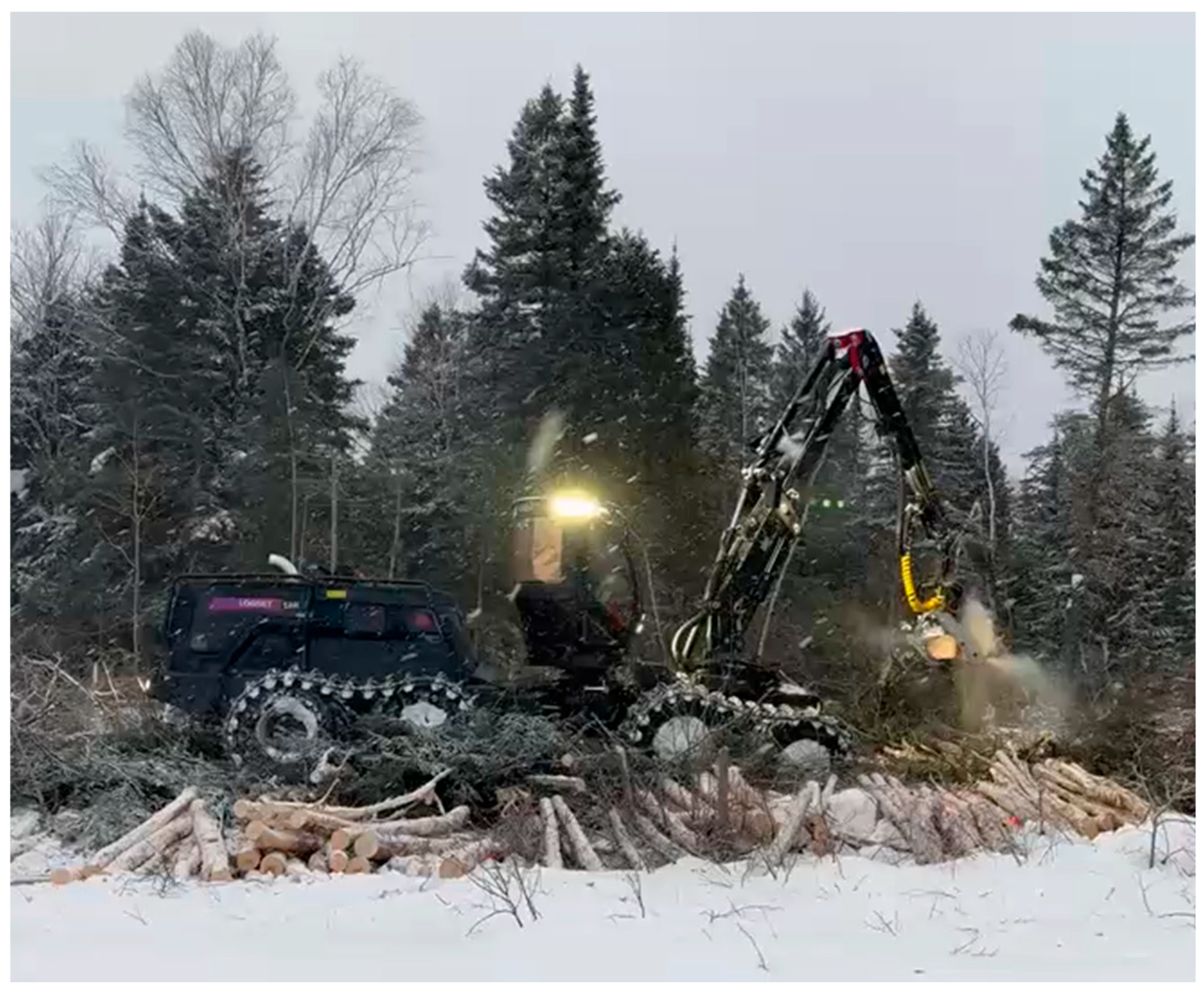
The goal of this study was to evaluate and compare the environmental impacts associated with the life cycle of a conventional diesel engine and a hybrid-electric powertrain used in a forestry harvester. To fulfill this objective, an LCA methodology was applied, and a cradle-to-grave analysis was conducted with a focus on energy consumption and GHG emissions, expressed as Global Warming Potential (GWP). These indicators were prioritized because fuel combustion during forest harvesting operations represents the main source of operational environmental impacts and contributes directly to climate change. In addition, reducing GHG emissions and fossil energy consumption was consistent with recent decarbonization pathways proposed by the IPCC [22]. The machine under evaluation was a Logset 12H GTE Hybrid harvester (Logset, Koivulahti, Finland) that combines a diesel engine with a hybrid-electric powertrain (Figure 1).
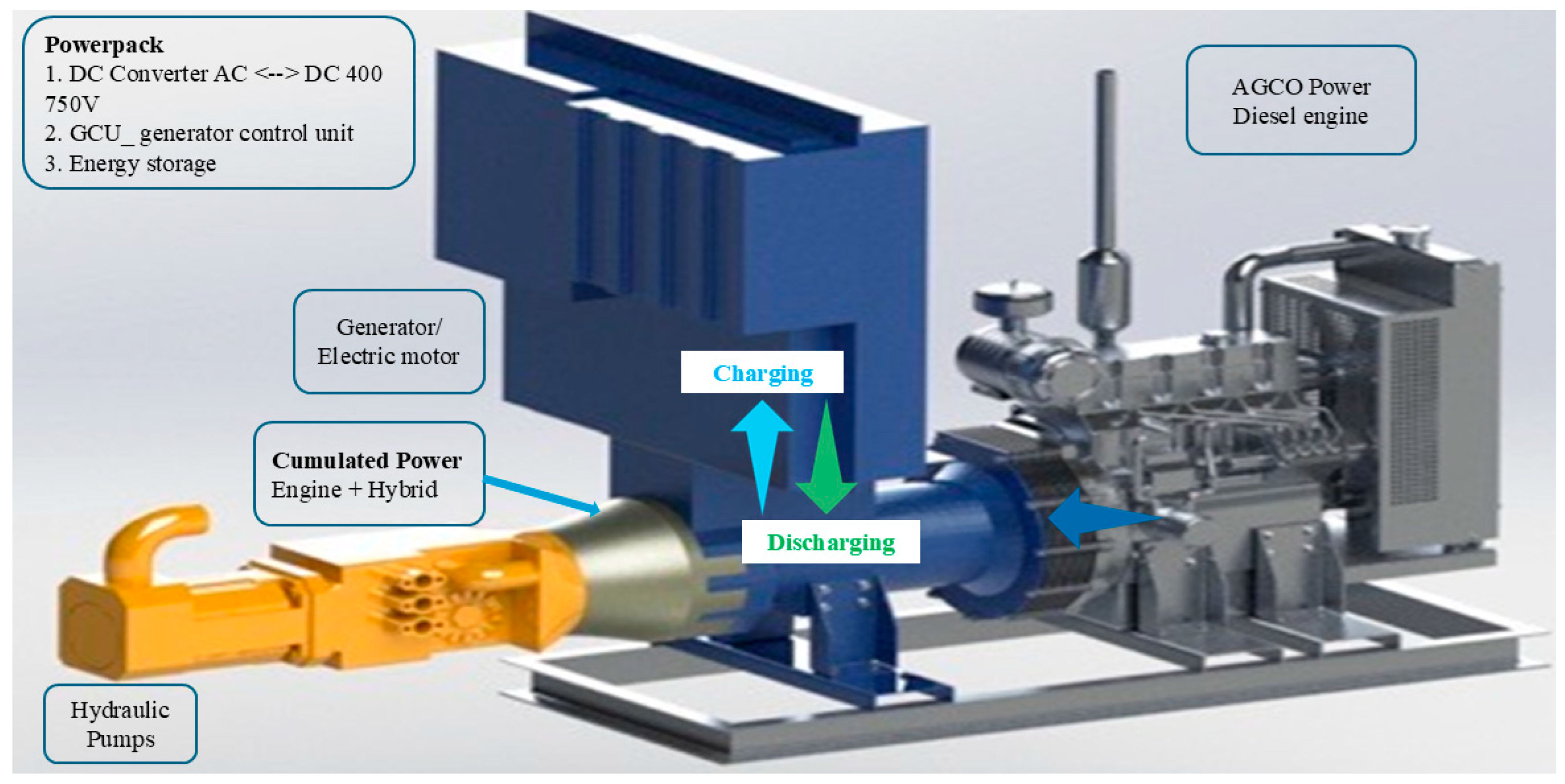
The diesel engine operates at a mostly constant speed within its optimal efficiency range, while the electric motor supplies additional power during peak loads. The hybrid-electric powertrain includes an electric motor, supercapacitor-based energy storage, and a generator control unit (GCU) that manages energy flow between the engine and the hybrid unit (Figure 2). During low power demand, the electric motor functions as a generator to recharge the energy storage system, enabling stable and efficient operation even under demanding harvesting conditions [23].
The technical and powertrain specifications of the evaluated Logset 12H GTE Hybrid harvester are presented in Table 1.
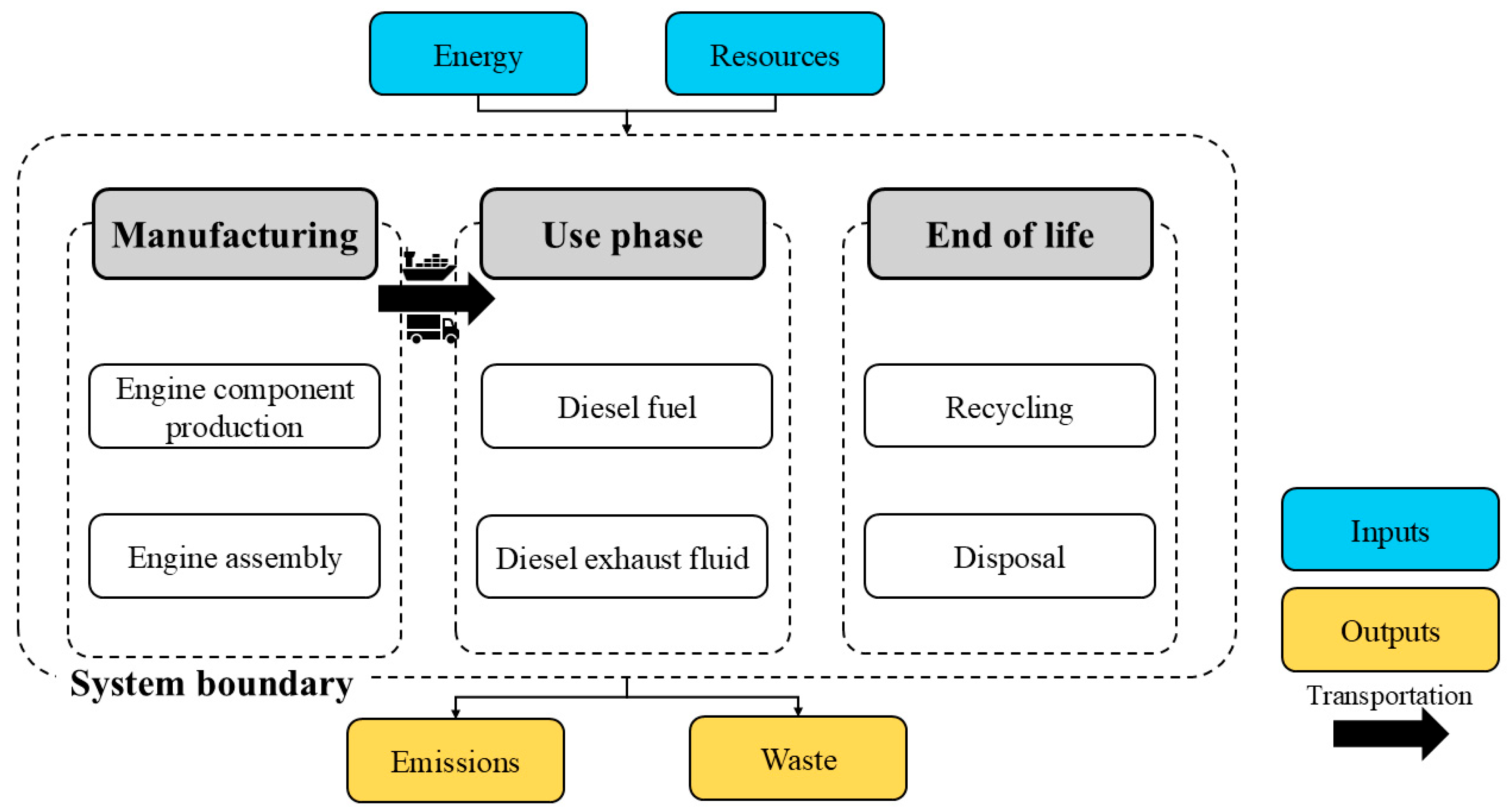
Figure 3 presents the system boundary applied in this engine-level LCA, encompassing all major life cycle stages from raw material acquisition and manufacturing to operation and end-of-life treatment within a “cradle-to-grave” framework. The cradle-to-grave boundary applies to the engine/powertrain systems rather than the complete harvester; common machine components, infrastructure, relocation between job sites, and routine maintenance were excluded. During the use phase, only energy and material flows required for engine operation were considered. These included diesel fuel consumption and Diesel Exhaust Fluid (DEF) for both diesel and hybrid engines, with the latter adjusted according to its operational characteristics.
The functional unit provides the reference to which all inputs and outputs in an LCA are normalized and may differ depending on the stage of the supply chain being assessed [24]. Two complementary functional units were used in this study. The secondary functional unit is defined as “one engine system for a forest harvester” operated over a lifetime of 15,000 h, enabling a consistent comparison of engine configuration and isolating the environmental performance of the powertrain itself from field productivity, stand conditions, and operator effects. The primary functional unit is defined as 1 m3 of wood harvested, enabling a comparison on the basis of equivalent service output between the two systems, which differ in productivity. Results are reported on the recalculated-to-the-per-m3 basis using the average productivity of each system: 16.3 m3/h for the diesel-powered harvester and 20.62 m3/h for the hybrid-electric harvester, derived from the field measurements reported in the companion study by Yadegari et al. (2026) [5]. Because raw material, manufacturing, transport, and end-of-life burdens are fixed per engine system regardless of hours operated, and operation-phase burdens scale linearly with operating hours, the per-m3 results were obtained by dividing each system’s total lifetime impact by the total volume of wood harvested over its 15,000 h operational lifetime: 244,500 m3 for the diesel-powered harvester (15,000 h × 16.3 m3/h) and 309,300 m3 for the hybrid-electric harvester (15,000 h × 20.62 m3/h). This rescaling does not alter the relative contribution of each life cycle stage to total impact, since every stage is divided by the same constant for a given system. The impact assessment focused on GHG emissions and global warming potential.

2.2. Life Cycle Inventory Analysis

The LCI is organized around four stages: (i) raw materials for the diesel and hybrid harvester engines, (ii) energy inputs required for engine manufacturing and assembly, (iii) the use phase of the engines, and (iv) the end-of-life phase of both engines. The detailed life cycle inventory (LCI), including the material composition and mass of the main powertrain components, is provided in Table A1 (Appendix A).

2.2.1. Raw Material Acquisition

The LCI begins with the quantification of material inputs required for the production of the engine components. The material composition of both the conventional diesel engine and the hybrid-electric powertrain was established using a combination of manufacturer data from Logset, literature sources, and representative datasets from the ecoinvent database. The inventory includes major material groups such as cast iron, steel, aluminum, copper, plastics, and electronic components. The material inputs were modeled using datasets from the ecoinvent database, which already include upstream processes such as raw material extraction and processing. Therefore, these stages were not assessed separately, and the system boundary was limited to material production and component manufacturing.
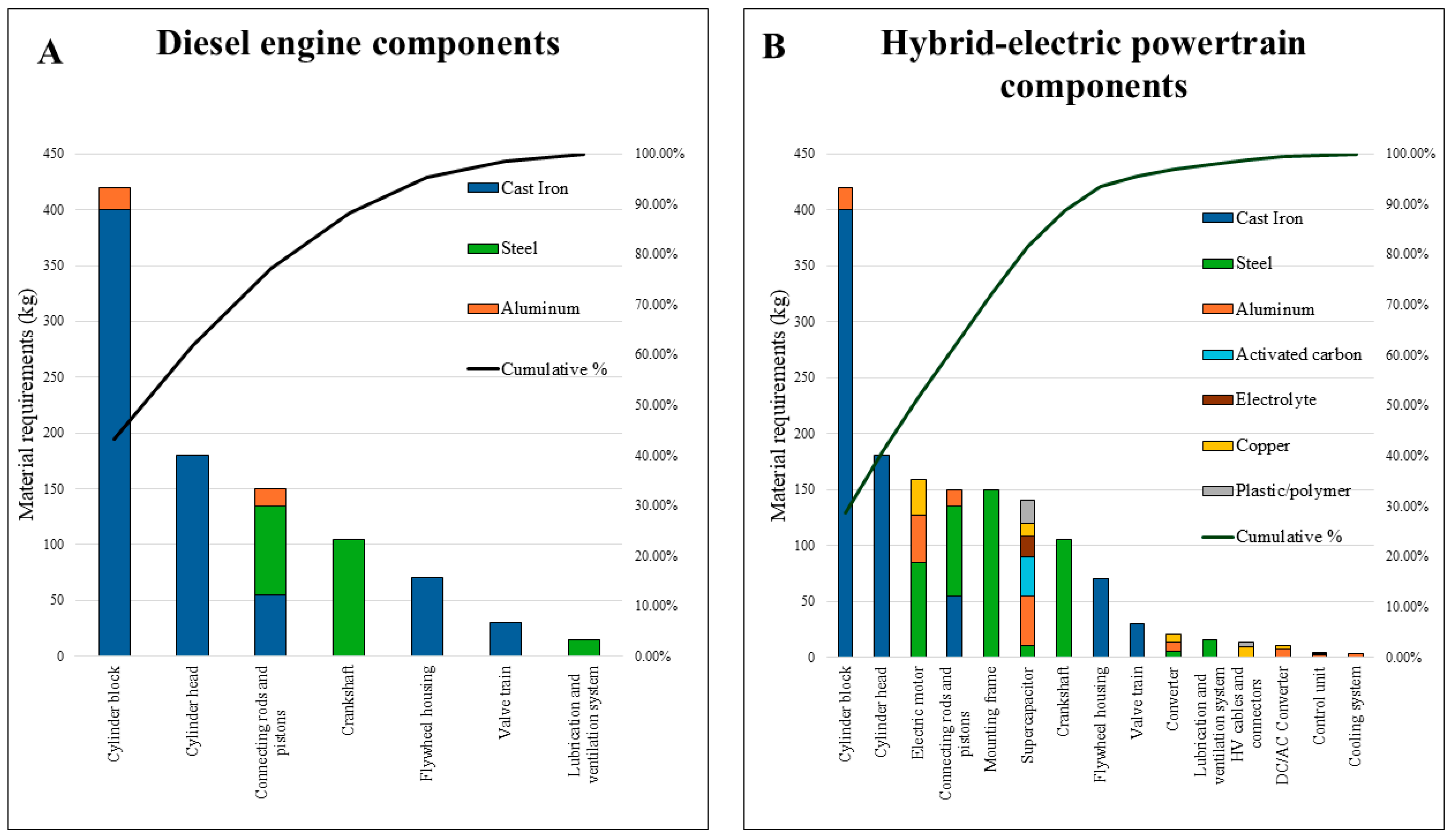
For the conventional configuration, the inventory consisted of the diesel engine block, cylinder head, and crankshaft system, and associated mechanical parts. In contrast, the hybrid configuration included additional components such as an electric motor/generator unit, power electronics (e.g., DC converter and generator control unit), and an energy storage system. These additional components require greater quantities of material, particularly in copper, steel, and electronic materials, thereby contributing to higher environmental burdens during the manufacturing phase. As a general consideration, inventory modelling focused on the components that contribute most significantly to the engine weight, in order to reduce data collection efforts, while maintaining the reliability and consistency of the results. Despite excluding lighter components, the model still accounted for more than 90% of the total engine mass. Small components representing less than 1–5% of the total component mass were excluded or represented using proxy datasets when no specific ecoinvent process was available. Figure 4 presents the material composition of the diesel and hybrid-electric powertrain, along with the cumulative contribution of individual components to the total engine mass.

2.2.2. Manufacturing

The manufacturing phase was represented using a simplified level of detail, in which engine components were aggregated into major subsystems. Each subsystem consists of one or more components, allowing a structured representation of the engine architecture. The material production and manufacturing processes were modeled using datasets from the ecoinvent database within the SimaPro version 1.00 environment.

2.2.3. Use Phase Emissions and Calculation Methodology

The use phase of the life cycle was modeled based on the operational fuel consumption of the machinery, as this parameter directly determines emissions during operation. Routine machine maintenance, including hydraulic oils, lubricants, filters, and other common maintenance activities, was excluded from the system boundary. Manufacturer information indicated no additional routine maintenance requirement for the hybrid-specific components during the considered operational period; therefore, servicing or replacement of the electric motor, power electronics, and supercapacitor was not included. Fuel consumption values for both the conventional diesel and hybrid harvester configurations were derived from extensive field studies conducted by Yadegari et al. (2026) [5], which evaluated hybrid harvester performance under real operating conditions in Quebec, Canada. The study was based on approximately 4 months of data collection across multiple seasons, including summer, autumn, and winter, ensuring representative operating conditions. Based on these results, the average fuel consumption was set to 21.2 kg/h (1.59 L/m3) for conventional diesel harvesters and 19.59 kg/h (1.26 L/m3) for hybrid harvesters. Further details of the experimental design and statistical analysis are reported in Yadegari et al. (2026) [5]. These values, together with DEF consumption, were used as the basis for estimating use phase emissions, as described in the following subsection [5].
DEF, also known as AUS 32, is a non-toxic aqueous solution composed of 32.5% high-purity urea and 67.5% deionized water, used in Selective Catalytic Reduction (SCR) systems to reduce nitrogen oxide (NOx) emissions (ISO 22241 [25]; EPA).
An operational lifetime of 15,000 h was adopted as the base-case scenario based on the service-life assumption provided for the studied Logset harvester. This value is also consistent with assumptions and empirical estimates reported for CTL harvesting machinery. Ackerman et al. (2021) [26] assumed an economic lifetime of 15,000 h for harvesters, while Spinelli et al. (2011) [27], based on more than 1000 used-machine records from Europe and North America, estimated an economic life of approximately 18,000 h for harvesters and forwarders [26,27]. To assess the influence of this assumption on the results, a sensitivity analysis was conducted over an extended lifetime range, as discussed in Section 3.4 [28].
Emissions during the operation phase were estimated using a fuel-based (Tier 2) approach in accordance with the European Monitoring and Evaluation Programme/European Environment Agency (EMEP/EEA) air pollutant emission inventory guidebook. This approach was selected due to the availability of fuel consumption data for both the conventional diesel and hybrid harvester configurations, allowing direct quantification of emissions based on actual fuel use. The method is particularly suitable for this study, as the primary objective is to evaluate the environmental benefits associated with reduced fuel consumption of the hybrid-electric powertrain during operation. To ensure consistency, the emission factors were aligned with Stage V emission standards.
Emissions for each engine were calculated using Equation (1), which is a modified version of the EMEP/EEA formulation adapted to the scope of this study. For each pollutant i , emissions were calculated as:
Ei = EFi * FC
where Ei represents the emission of pollutant i, FC is the fuel consumption (kg/h), and EFi is the corresponding emission factor expressed per unit of fuel consumed. This formulation enables a transparent comparison between the diesel and hybrid configurations, as differences in emissions are directly driven by differences in fuel consumption. The baseline emission factors used in this study for the forestry sector and Stage V technology are presented in Table 2.
The resulting hourly emissions estimated using the Tier 2 method are presented in Table 3. The hybrid configuration results in consistently lower emissions across all pollutants compared to the conventional diesel engine. This reduction (approximately 7–8%) is directly proportional to the decrease in fuel consumption, as identical emission factors were applied. The emission indicates that hybridization reduces emissions primarily through improved fuel efficiency, leading to lower environmental impacts across both climate change and air pollution categories.
CO2 and SO2 emissions are primarily associated with fuel combustion and therefore depend on engine characteristics and equipment technology. CO2 emissions were estimated using the carbon intensity of diesel fuel, assumed to be 3146 g CO2 per kg of fuel combusted. In addition, diesel fuel density was assumed to be 0.85 kg/L. SO2 emissions were estimated based on the sulfur content of diesel fuel. A maximum sulfur concentration of 10 ppm was assumed, with complete oxidation of sulfur to SO2 during combustion. Both CO2 and SO2 were therefore treated as fuel-dependent emissions during the operation phase.
Using this approach, CO2 emissions were calculated at 66.70 kg/h for the conventional diesel engine and 61.64 kg/h for the hybrid configuration. Corresponding SO2 emissions were estimated at 0.424 g/h for the diesel engine and 0.392 g/h for the hybrid-electric powertrain.

2.2.4. End-of-Life Disposal

The end-of-life phase was modeled using a material-specific waste treatment approach based on recycling, incineration, and landfill scenarios. Recycling rates for key materials were derived from Quebec-specific waste management statistics, reflecting the geographic location where the harvesters are used and scrapped. Rates were taken from RECYC-QUÉBEC’s Bilan 2023 de la gestion des matières résiduelles au Québec (RECYC-QUÉBEC, 2025), which reports material-specific recycling rates calculated as the ratio of quantities generated to quantities directed to recycling for the municipal collection [32].
Waste treatment processes were implemented using datasets from the ecoinvent database within the SimaPro environment, following the cut-off system model. Where a representative dataset was unavailable within the cut-off system model, datasets from other available ecoinvent system models (e.g., APOS or Alloc Rec) were used to represent the required process or material. The energy requirements and emissions associated with recycling and residual waste treatment processes were also obtained from the corresponding ecoinvent datasets. For materials not recovered through recycling, residual waste was allocated to municipal waste treatment based on Quebec-specific disposal statistics, with 96.0% disposed of in engineered landfill and 4.0% treated through incineration (RECYC-QUÉBEC, 2025) [32].

2.3. Study Assumption

Due to limitations in the availability of detailed manufacturer-specific data and the complexity of modeling hybrid forest machines, a set of assumptions was adopted to ensure consistency and transparency in the life cycle assessment. Foreground inventory data were prioritized from system-specific primary sources where available. Material and component information for the hybrid-electric powertrain was obtained directly from Logset, while operational fuel-consumption data were derived from the field measurements reported by Yadegari et al. (2026) [5]. In the absence of manufacturer-specific inventory data for the conventional diesel engine, its material composition was modeled using the published literature. The 15,000 h operational lifetime was based on Logset technical documentation. Secondary background data for material production and manufacturing were obtained from ecoinvent, while emission factors and end-of-life parameters were derived from published guidelines and official statistics, respectively. A summary of the key assumptions applied in this study is presented in Table 4.

2.4. Life Cycle Impact Assessment

The IMPACT World+ midpoint + ADR method was implemented in SimaPro to quantify environmental impacts. Impact categories were considered in the analysis, covering climate change, fossil and nuclear energy use, mineral resources use, photochemical oxidant formation, ozone layer depletion, freshwater and terrestrial ecotoxicity, human toxicity (cancer and non-cancer), ionizing radiation, land occupation and transformation, marine and freshwater eutrophication and acidification, particulate matter formation, and water scarcity. The environmental impact categories, corresponding units, and their descriptions used in the life cycle impact assessment are presented in Table S1.
Dissipation-based indicators were applied to evaluate mineral resource use in the hybrid-electric powertrain and diesel engines. The Average Dissipation Rate (ADR) method was used to quantify the dissipation of metals through emissions, disposal, and non-functional recycling, reflecting how quickly materials become unavailable for future use after extraction [37,38]. Expressed relative to iron, the ADR indicator was applied to key materials in the engine systems, including aluminum, copper, and steel. This approach enables the evaluation of how material choices in the hybrid-electric powertrain, particularly in the electric motor, power electronics, and supercapacitor-based energy storage, influence long-term resource availability.

3. Results

3.1. Overall Environmental Performance of Diesel and Hybrid Harvester Engines

The environmental impacts associated with the diesel engine and the hybrid-electric powertrain are summarized in Table 5. The results indicate that hybridization improves environmental performance in several operation-related impact categories through reduced fuel consumption; however, additional materials and electronic components introduce higher impacts in some categories associated with manufacturing and upstream processes.
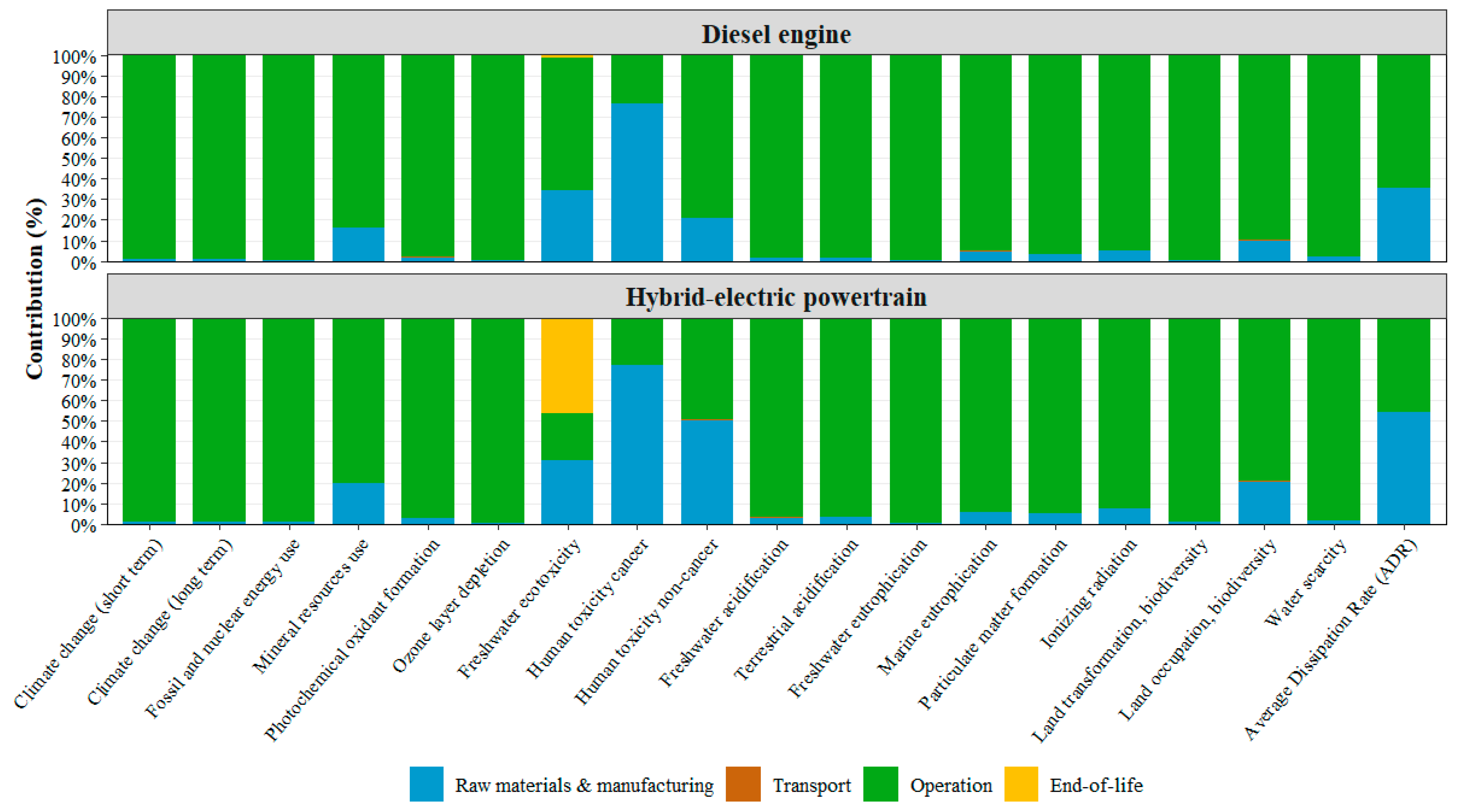
Overall, the operation phase dominates most environmental impact categories for both engine types. Climate change, fossil and nuclear energy use, ozone layer depletion, freshwater eutrophication, particulate matter formation, terrestrial acidification, and water scarcity are primarily driven by fuel combustion during operation, with operational contributions generally exceeding 94% of total impacts.
The hybrid configuration reduced several operation-related impacts compared with the conventional diesel engine. Climate change impacts decreased from 1.20 × 10⁶ to 1.11 × 10⁶ kg CO2 eq, corresponding to a reduction of approximately 6.9%. Similarly, fossil and nuclear energy use decreased by approximately 6.6%, while reductions were also observed for ozone layer depletion, terrestrial acidification, freshwater eutrophication, particulate matter formation, ionizing radiation, and water scarcity. These reductions are mainly attributed to the lower fuel consumption achieved by the hybrid-electric powertrain during operation. The results therefore demonstrate that hybridization can improve operational efficiency and reduce fuel-related environmental burdens in forestry machinery.
However, the hybrid-electric powertrain exhibits higher impacts in several categories associated with material production and upstream processes. Freshwater ecotoxicity increased from 4.29 × 10⁸ to 1.18 × 10⁹ CTUe, while human toxicity non-cancer increased from 0.0227 to 0.0358 CTUh. Land occupation also increased from 1221.2 to 1342.8 m2·yr arable. These increases are mainly associated with the additional components required for hybridization, including the electric motor, power electronics, and energy storage system. In contrast, mineral resource use remained relatively similar between the two systems, decreasing slightly from 4485.3 to 4472.6 kg deprived. Marine eutrophication also showed only a marginal reduction, while photochemical oxidant formation decreased from 2011.4 to 1892.0 kg NMVOC eq.

3.2. Contribution of Life Cycle Stages

To further visualize the relative contribution of each life cycle stage across the evaluated impact categories, Figure 5 presents the percentage contributions of raw materials and manufacturing, transport, operation, and end-of-life processes for both the diesel and hybrid-electric powertrain.
The results show that the operation phase is the dominant contributor to most impact categories for both systems. In particular, climate change, and fossil and nuclear energy use, are overwhelmingly influenced by operational fuel consumption, with the operation stage contributing between approximately 95% and 100% of total impacts for these categories. For human toxicity cancer, both systems share the same underlying driver: electric arc furnace slag treatment, a landfill-disposal byproduct of cast iron and low-alloyed steel production, dominates the manufacturing-stage impact for both configurations (Figure S1). The diesel engine’s larger cast iron mass (420 kg cylinder block, 180 kg cylinder head) yields a marginally higher total (0.0288 CTUh) than the hybrid configuration (0.0282 CTUh, driven primarily by a 105 kg crankshaft and downsized engine core), a difference of roughly 2%. Here, hybridization does not change the mechanism generating the impact, only slightly reducing the ferrous mass responsible for it.
In contrast, upstream processes associated with raw materials and manufacturing contribute substantially to several toxicity and resource-related categories, especially in the hybrid-electric powertrain. For freshwater ecotoxicity, raw materials and manufacturing contribute 30.6% of total impacts in the hybrid configuration, compared with 34.3% for the conventional diesel engine; as discussed below, the hybrid system’s end-of-life stage now contributes more to this category than either raw materials and manufacturing or operation. Process-contribution analysis (Figure S2) provides mechanistic insight beyond the aggregate values reported in Table 5. Average Dissipation Rate (ADR) results indicate that manufacturing processes dominate mineral resource dissipation impacts in the hybrid-electric powertrain, mainly due to the additional metals and electronic components associated with the electric system.
The end-of-life stage remains negligible (below 1%) for most impact categories for the diesel engine. Transport contributes only marginally across all categories for both systems, generally remaining below 1% of total impacts.

3.3. Comparison of Selected Environmental Impact Categories

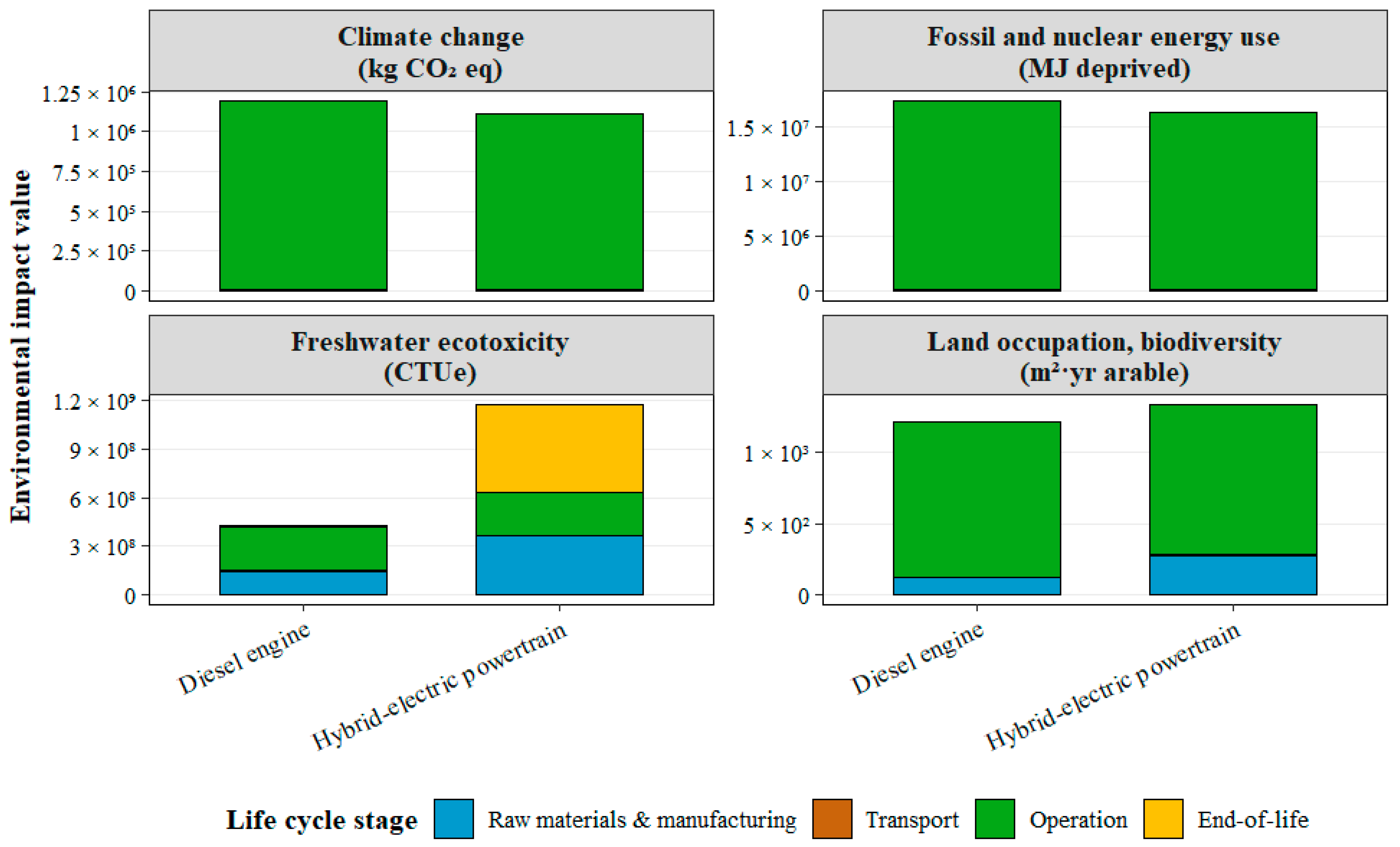
The environmental trade-offs associated with hybridization can be further examined by comparing the contributions of individual life cycle stages. Figure 6 presents the absolute contributions of these stages for selected impact categories, including climate change, fossil and nuclear energy use, freshwater ecotoxicity, and land occupation.
As shown in Figure 6, the hybrid-electric powertrain substantially reduces climate change and fossil energy impacts during the operation phase due to lower fuel consumption. In contrast, freshwater ecotoxicity and land occupation are higher in the hybrid-electric powertrain because of increased contributions from raw material extraction and manufacturing processes associated with hybrid components.
The results indicate a clear trade-off between operational benefits and upstream material-related burdens. While the hybrid-electric powertrain reduces fuel and energy-related impacts through lower fuel consumption during operation, these benefits are partly offset by increased impacts from material extraction, manufacturing, and end-of-life processes. This highlights the importance of considering both operational efficiency and material-related burdens when evaluating cleaner production strategies for hybrid forestry machinery.

3.4. Sensitivity Analysis of Accumulated-Utilization-Hours Scenario

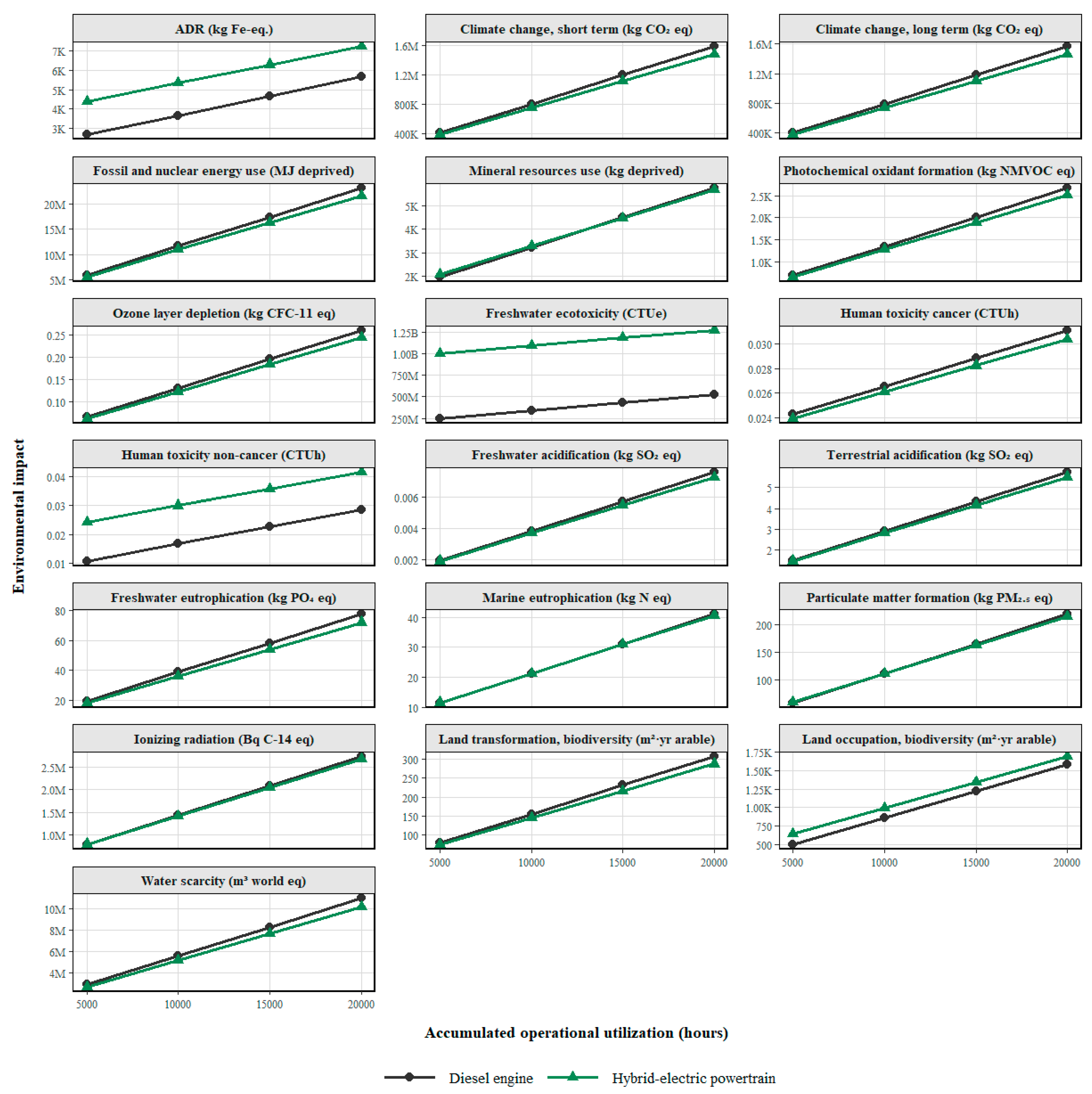
A sensitivity analysis was performed by varying the lifetime from 5000 h up to 20,000 h [28] to assess the influence of operational lifetime on the environmental performance of the studied systems. The results were evaluated for both diesel and hybrid configurations to examine changes in total impacts and relative differences between the systems. It should be noted that the sensitivity analysis evaluated the effect of operational lifetime on a single engine system. These scenarios represent accumulated utilization rather than equipment durability, and no component replacement was assumed.
As expected, prolonging machine use from 5000 to 20,000 h resulted in higher cumulative impacts across all categories, mainly due to increased fuel consumption and operational inputs. The effects of operational lifetime on the environmental impacts of the diesel engine and hybrid-electric powertrain are presented in Figure 7.
In most categories, the diesel engine and hybrid-electric powertrain followed similar increasing trends. However, the hybrid-electric powertrain showed lower impacts than the diesel engine at longer lifetimes for several key categories, including climate change, fossil and nuclear energy use, freshwater eutrophication, land transformation, and water scarcity. This indicates that the environmental benefit of the hybrid-electric powertrain becomes more evident as machine lifetime increases.
Marine eutrophication, mineral resource use, particulate matter formation, and ionizing radiation showed similar environmental impacts for both powertrain configurations across the evaluated lifetime. Some categories, particularly freshwater ecotoxicity, human toxicity non-cancer, and land occupation, remained higher for the hybrid-electric powertrain. These higher impacts were primarily attributable to the additional materials and components required for the hybrid-electric powertrain, including the electric motor, control system, and energy storage system. The accumulated-utilization-hours sensitivity results indicated that increasing operational lifetime improves the relative environmental performance of the hybrid harvester in energy- and climate-related categories, while some toxicity- and material-related impacts remain higher. Therefore, the environmental advantage of the hybrid-electric powertrain is most evident when the machine is used over longer service lifetimes.

3.5. Uncertainty Analysis

In addition to the contribution and sensitivity analyses, an uncertainty analysis was conducted to evaluate the robustness and reliability of the life cycle impact assessment (LCIA) results. The uncertainty analysis focused on the variability of the developed life cycle inventory (LCI) data and its influence on the total impact assessment results. Uncertainty in the input and output flows of each process was quantified using the pedigree matrix approach [39]. This approach evaluates data quality through six qualitative indicators, namely reliability, completeness, temporal correlation, geographical correlation, technological correlation, and sample size. Based on these indicators, uncertainty factors were assigned to all relevant flows within the modeled system. Monte Carlo simulation was performed within the SimaPro software version 1.00 environment using 1000 iterations to propagate uncertainties through the model. The results are presented as distributions of impact category indicators, reflecting the variability of the outcomes [29].
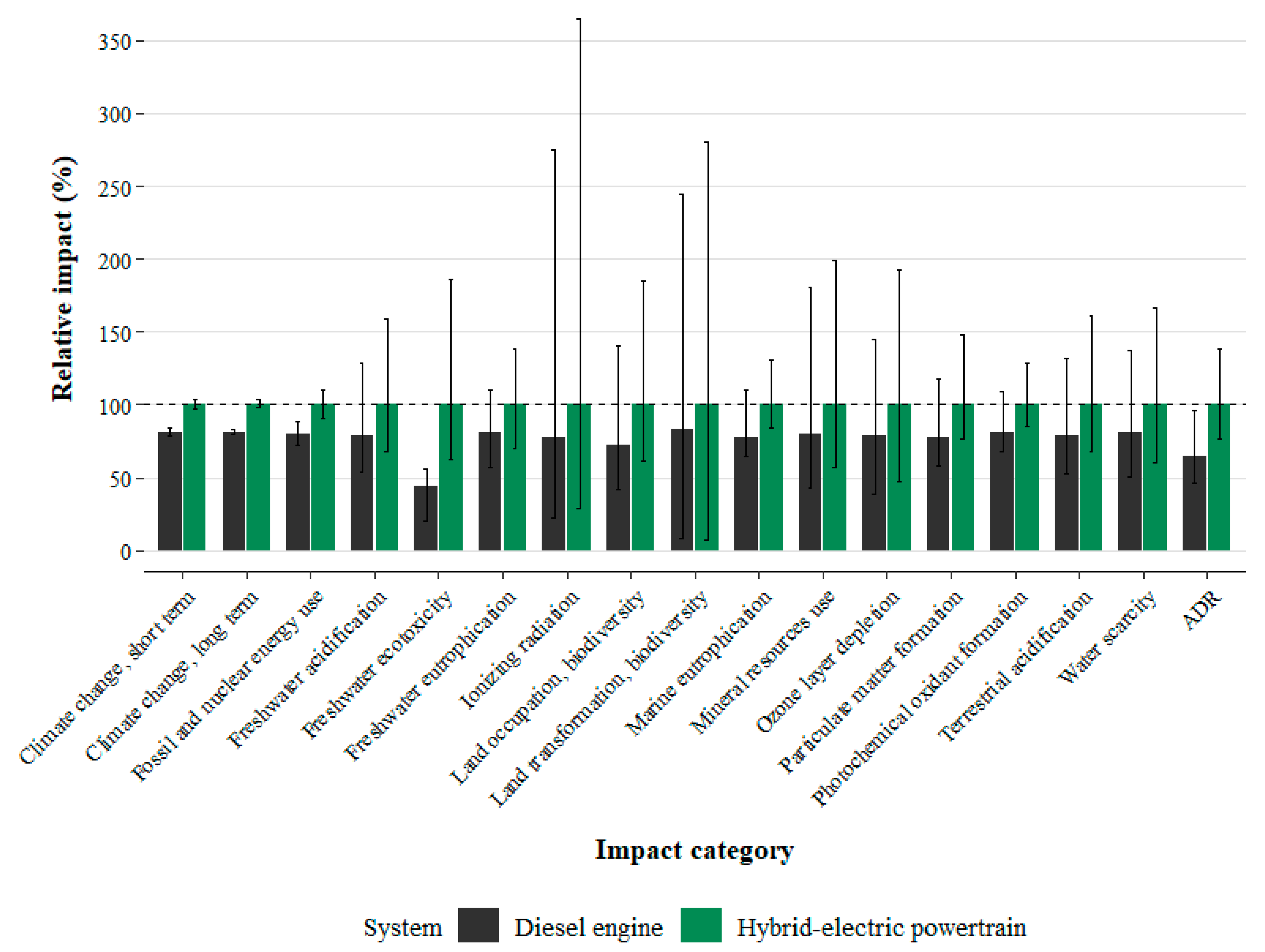
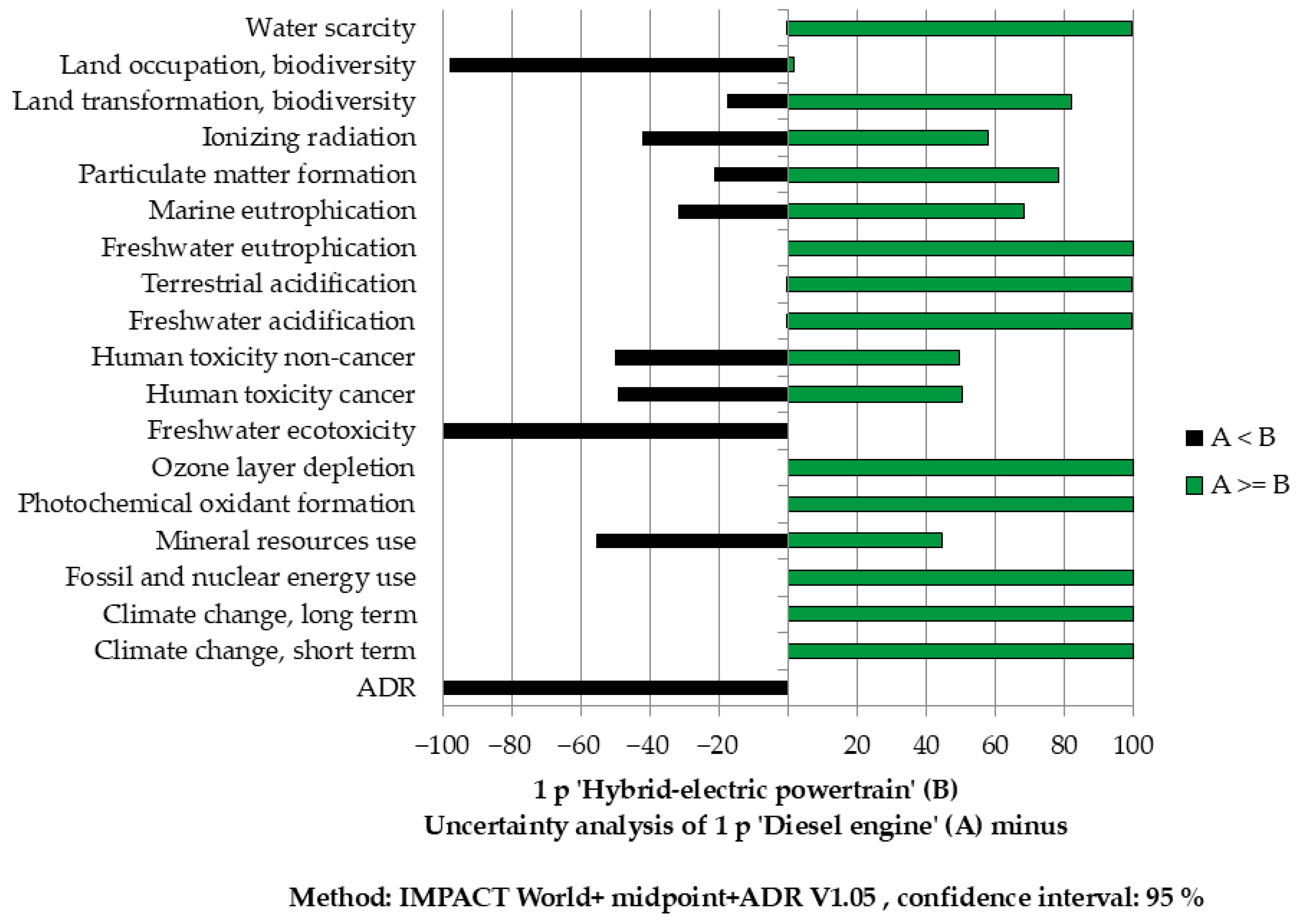
The uncertainty analysis results are presented in Figure 8 and Figure 9. Figure 8 shows the normalized mean environmental impacts together with the corresponding 95% confidence intervals obtained from 1000 Monte Carlo simulation runs. Figure 9 presents the comparative Monte Carlo probabilities for the diesel engine and hybrid-electric powertrain. For each impact category, the comparison represents the proportion of simulation runs in which one alternative produced a lower impact than the other, thereby providing an indication of the robustness and direction of the observed differences. Figure 8 and Figure 9 differ in simulation structure. Figure 8 derives from two independent single-system Monte Carlo runs, while Figure 9 uses SimaPro’s comparative Monte Carlo function, which evaluates both systems together within each iteration and samples shared background processes identically across systems; this paired sampling correctly accounts for correlation and underlies the robustness claims in this section.
Pedigree-based uncertainty was concentrated on hybrid-specific inputs, where data uncertainty is comparatively elevated due to proxy substitution and technology-specific characterization. The diesel engine’s core components are common to both configurations and were treated as fixed values based on manufacturer specifications, given that Figure 9’s paired sampling draws shared inputs identically across systems.
The uncertainty ranges of several impact categories overlap considerably between the two systems, indicating substantial uncertainty in their absolute LCIA results. However, overlap between the individual confidence intervals alone does not determine the robustness of the comparative difference. Therefore, the direction and robustness of the differences were further evaluated using the comparative Monte Carlo analysis presented in Figure 9. Categories with comparative probabilities close to an even split between the alternatives indicate no clear environmental advantage, whereas probabilities strongly favoring one alternative indicate a more robust directional difference under the modeled uncertainty. Categories such as freshwater ecotoxicity, land occupation biodiversity, ionizing radiation and land transformation biodiversity exhibit particularly large confidence intervals, reflecting high uncertainty in background datasets and land-use-related emissions. Marine eutrophication and mineral resource use also show substantial variability, suggesting sensitivity to assumptions regarding material extraction and upstream supply chains. Despite these uncertainties, the hybrid-electric powertrain generally trends toward reduced environmental burdens or similar performance relative to the diesel engine configuration.
Figure 9 presents the comparative Monte Carlo probabilities between the diesel engine (A) and the hybrid-electric powertrain (B). For each impact category, the bars represent the percentage of Monte Carlo iterations in which A < B and A ≥ B, rather than the percentage difference in LCIA scores between the two systems. A strong predominance of one outcome indicates a robust directional difference under the modeled uncertainty, whereas a more balanced probability indicates substantial uncertainty regarding which alternative has the lower environmental impact. The comparative analysis showed robust lower impacts for the hybrid-electric powertrain in several operationally dominated categories, particularly short and long-term climate change, fossil and nuclear energy use, ozone layer depletion, freshwater and terrestrial acidification, freshwater eutrophication, and water scarcity. In contrast, freshwater ecotoxicity, ADR, land occupation, and ionizing radiation showed a high probability of greater impacts for the hybrid-electric powertrain. Other categories showed less decisive comparative probabilities and should therefore be interpreted as trends rather than robust differences. For short-term climate change, the robustness of the comparison was further examined using the Monte Carlo distribution of the difference between the diesel and hybrid systems (Diesel − Hybrid; Figure S3). The distribution remained entirely above zero and was centered at approximately 8.2 × 10⁴ kg CO2 eq, indicating that the diesel system consistently produced a higher climate change impact than the hybrid-electric powertrain across the simulated uncertainty range.

4. Discussion

4.1. Comparison of Environmental Impact Results

The magnitude and distribution of environmental impacts across the life cycle stages observed in this study are generally consistent with findings reported in previous LCA studies on diesel engines and forestry machinery. Similar to earlier studies, the operation phase was identified as the dominant contributor to most environmental impact categories, particularly climate change, fossil energy use, particulate matter formation, and acidification-related impacts, while the raw material and manufacturing stages represented the second-largest contribution [33,34,40].
Direct comparison between the present study and previous LCA studies remains difficult because of differences in engine applications, power capacities, operational conditions, functional units, and system boundaries. Most previous studies focused on automotive, agricultural, or construction machinery engines, whereas the present study evaluated a heavy-duty hybrid forestry harvester operating under highly variable load conditions. In addition, several earlier studies adopted cradle-to-gate boundaries or excluded raw materials, manufacturing, and end-of-life stages, while the present study followed a cradle-to-grave approach [8,14,41,42]. These methodological differences influence the absolute magnitude of environmental impacts and limit direct quantitative comparison.
Nevertheless, comparison of climate change impacts with previous diesel engine studies provides useful context. Li et al. (2013) evaluated the life cycle impacts of a six-cylinder diesel bus engine and reported that the use phase contributed approximately 97.7% of total climate change impacts, while raw material acquisition and manufacturing accounted for less than 1% each [33]. Similarly, the present study showed that the operation phase dominated climate change impacts, contributing 99.18% and 98.83% of total impacts for the diesel and hybrid-electric powertrains, respectively. The contribution of the manufacturing stage remained comparatively small but increased in the hybrid configuration because of the additional electric motor, power electronics, and energy storage components. These findings are consistent with the conclusions of Li et al. (2013) [33], who identified fuel combustion during operation as the primary environmental hotspot of diesel engines.
The dominance of the operation phase is also consistent with studies conducted on forestry and non-road mobile machinery. Berendt et al. (2018) reported that diesel consumption during machine operation was the major contributor to global warming potential in forestry machinery [7], while Khan and Huang (2023) observed that operational fuel use remained the primary source of climate impacts in diesel and hybrid construction excavators [31]. Similarly, Alzamora et al. (2022) found that mechanized forest harvesting systems with improved fuel efficiency exhibited lower greenhouse gas emissions compared with less efficient harvesting alternatives [13]. The reductions in climate change and fossil energy impacts observed for the hybrid harvester in the present study therefore align with previous findings regarding the environmental benefits of hybridization and reduced fuel consumption in heavy-duty machinery.
Engine-hour functional unit environmental impacts during the use phase were calculated based on hourly fuel consumption (kg/h), resulting in a 6.9% reduction in climate change impacts for the hybrid-electric powertrain. As anticipated from the field-measured fuel consumption reduction of approximately 20% per cubic meter of harvested wood reported by Yadegari et al. (2026) [5].
Unlike conventional diesel engine studies, the hybrid powertrain in this study exhibited higher impacts in some categories associated with material production and upstream processes, particularly freshwater ecotoxicity and human toxicity non-cancer. Similar trends were reported by Khan and Huang (2023), who demonstrated that hybrid and electric excavators may reduce operational emissions while simultaneously increasing impacts associated with material extraction, electronics manufacturing, and battery-related processes [31]. In the present study, these increases were primarily linked to the additional electric motor, power electronics, supercapacitor system, and associated materials used in the hybrid drivetrain.
Although the hybrid-electric powertrain exhibited higher impacts in several manufacturing-related categories, these results should be interpreted in the context of the substantially higher power capability provided by the hybrid configuration. The conventional diesel engine evaluated in this study delivers 205 kW, whereas the hybrid-electric configuration combines the diesel engine with a 175 kW electric motor, resulting in a maximum short-term combined power output of approximately 380 kW. Consequently, the comparison represents a relatively conservative assessment of the hybrid system, since the hybrid machine provides significantly greater peak power while maintaining lower fuel consumption during operation.
In forestry applications, achieving a comparable power output using a conventional diesel-only configuration would require a substantially larger engine with greater displacement, additional cylinders, larger cooling and exhaust after-treatment systems, and increased structural requirements [43]. Such modifications would increase both material requirements and operational fuel consumption, thereby leading to higher environmental burdens during both manufacturing and use phases. Therefore, the additional manufacturing impacts associated with the hybrid components should be interpreted alongside the functional advantage of delivering substantially higher peak power and improved power management capability without relying exclusively on a larger diesel engine. The lifetime sensitivity analysis assumes that both powertrains remain operational for up to 20,000 h. This assumption was adopted to compare the influence of operational lifetime on environmental performance, although the long-term durability of hybrid-specific components remains uncertain because hybrid forestry harvesters are still a relatively recent technology. Although the inventory covers the major powertrain components, a complete manufacturer BoM was unavailable, and minor components representing approximately 1–5% of component mass were excluded. Because environmental relevance is not necessarily proportional to mass, this exclusion may influence some material- and toxicity-related categories, particularly for electronics and specialized materials. However, the contribution analysis indicates that operation dominates most fuel-related impact categories and the principal comparative conclusions.
The comparison also highlights the importance of considering multiple environmental indicators rather than focusing solely on greenhouse gas emissions. While the hybrid-electric powertrain improved environmental performance in climate change, fossil energy use and water scarcity categories trade-offs were observed in several toxicity- and resource-related impacts. Comparable conclusions were reported by Jiang et al. (2014), who emphasized that improvements in one environmental category do not necessarily correspond to overall environmental superiority across all impact categories [34].
Finally, although differences in methodology and machine configuration prevent exact comparison with previous studies, the general trends observed in the present work are consistent with the existing LCA literature on diesel engines and heavy-duty machinery systems. The results confirm that fuel consumption during operations remains the primary driver of climate-related impacts, while hybridization can reduce operational emissions at the expense of increased upstream impacts associated with additional materials and electronic components.

4.2. Mineral Resource Dissipation Results

To complement the IMPACT World+ midpoint + ADR assessment, the Mineral Resource Dissipation method developed by Poncelet et al. (2022) [38] was applied to evaluate the dissipation potential of mineral resources associated with the diesel engine and hybrid-electric powertrains. This method assesses the loss of mineral resource accessibility after extraction due to dissipative flows, providing additional insight into long-term resource availability [38].
The Average Dissipation Rate (ADR) indicator was incorporated into the midpoint impact assessment as an additional category. The hybrid-electric powertrain showed an ADR value more than the conventional diesel engine in Table 6, indicating substantially greater mineral resource dissipation associated with hybrid technologies. Higher ADR values represent increased dissipation rates of metals after extraction and lower long-term availability within the Technosphere [38].
The higher ADR impact of the hybrid-electric powertrain is likely related to the additional electronic components, batteries, and specialty metals required for electrification. These materials are often associated with lower recycling efficiencies and higher dissipative losses. Therefore, although the hybrid-electric powertrain may reduce impacts in several climate and energy-related categories, it also increases the potential loss of valuable mineral resources, highlighting a trade-off between operational environmental benefits and long-term resource sustainability.

4.3. Productivity-Normalized Comparison

Table 7 recasts the same results on the primary, productivity-normalized functional unit of 1 m3 of harvested wood, using the conversion described in Section 2.1 (16.3 m3/h for the diesel-powered harvester and 20.62 m3/h for the hybrid-electric harvester; 244,500 m3 and 309,300 m3 total lifetime volume, respectively).
Normalizing the life cycle impacts by harvested volume strengthens the environmental advantage of the hybrid-electric powertrain in most impact categories by accounting for its higher observed productivity. For climate change, the impact decreased from 4.89 kg CO2 eq/m3 for the diesel engine to 3.60 kg CO2 eq/m3 for the hybrid-electric powertrain, corresponding to a reduction of approximately 26.4%. Similar reductions were observed for fossil and nuclear energy use (26.4%), ozone layer depletion (27.5%), freshwater eutrophication (26.5%), photochemical oxidant formation (25.7%), terrestrial acidification (24.1%), and water scarcity (26.9%). These differences are substantially greater than those obtained using the 15,000 h powertrain-level comparison, demonstrating the importance of considering harvesting productivity when comparing the environmental performance of the two systems. Notably, land occupation, which was higher for the hybrid system on the 15,000 h basis, became lower when expressed per m3 because the fixed life cycle burdens were distributed over a larger lifetime harvesting output.
The productivity-normalized results also show that the environmental advantage of hybridization is not uniform across all categories. Despite the larger lifetime harvesting output of the hybrid system, freshwater ecotoxicity remained substantially higher (3814 versus 1756 CTUe/m3), as did human toxicity non-cancer and ADR. In contrast, ionizing radiation decreased from 8.55 Bq C-14 eq/m3 for the diesel engine to 6.64 Bq C-14 eq/m3 for the hybrid-electric powertrain, corresponding to a reduction of approximately 22.3%. Land occupation also changed from being higher for the hybrid system on the 15,000 h basis to approximately 13.1% lower when expressed per m3. Overall, productivity normalization reinforces the hybrid system’s benefits in operation-dominated categories while showing that some material-intensive categories remain higher. The comparative Monte Carlo analysis further showed that the environmental advantages of hybridization are not equally robust across all impact categories. The reduction in climate change impact was maintained across the simulated uncertainty range, supporting the robustness of the climate-related benefit. In contrast, several toxicity, resource-use, and land-related indicators exhibited greater uncertainty and less decisive comparative probabilities. Consequently, deterministic differences in these categories should be interpreted as tendencies rather than conclusive environmental advantages or disadvantages. These results emphasize that the environmental benefit of hybridization is most clearly supported for operationally driven categories, whereas conclusions for material-sensitive categories remain more dependent on inventory and background-dataset assumptions.
The present study is limited to environmental LCA and does not evaluate the social or economic dimensions of hybridization. Social aspects such as occupational exposure, noise, ergonomics, employment, and community impacts, as well as economic factors including acquisition, maintenance, component replacement, and utilization, should be addressed in future social-LCA and life cycle costing studies. Detailed information on the datasets used for the modeled materials and components, including the proxy datasets applied where exact matches were unavailable, is provided in Table A2 (Appendix A). Most materials were represented using direct ecoinvent datasets, while proxies were required for a limited number of inputs. The results for material-sensitive impact categories should therefore be interpreted with this limitation in mind, and more component-specific inventory data would improve the robustness of future assessments. Unexpected replacement or maintenance of hybrid-specific components was not modelled and could influence material-related impacts if such interventions occur during the assumed lifetime. A further limitation is that identical fuel-based Stage V emission factors were applied to both powertrains; therefore, differences in NOx, PM, CO, CH4, and other exhaust emissions reflect differences in fuel consumption rather than measured engine-specific emission behavior.

5. Conclusions

This study evaluated and compared the environmental performance of conventional diesel and hybrid-electric powertrains through a powertrain-level life cycle assessment framework. The results showed that the operation phase dominated most environmental impact categories for both systems due to fuel consumption during machine use. The hybrid-electric powertrain showed clear environmental advantages in several operation-related impact categories. Reductions were observed in climate change, fossil and nuclear energy use, ozone layer depletion, freshwater eutrophication, terrestrial acidification, photochemical oxidant formation, ionizing radiation, and water scarcity. These reductions were substantially larger when normalized per m3 of harvested wood rather than over the 15,000 h engine-level lifetime (e.g., 26.4% versus 6.9% for climate change), reflecting the hybrid system’s combined advantage in fuel efficiency and productivity. Despite these operational benefits, the hybrid-electric powertrain generated higher impacts in some categories associated with material extraction, manufacturing, and upstream supply chains, particularly freshwater ecotoxicity, human toxicity non-cancer, and mineral resource dissipation. Land occupation also increased on the engine-hour basis but decreased by approximately 13.1% for the hybrid system once results were normalized per m3 of harvested wood. The ADR assessment highlighted the greater dissipation potential of mineral resources in the hybrid configuration, emphasizing the importance of considering long-term resource availability alongside climate-related benefits.
Sensitivity analysis showed that the environmental advantages of the hybrid-electric powertrain became more pronounced as operational utilization increased, indicating that extended machine utilization can improve the relative sustainability of hybrid forestry machinery. However, uncertainty analysis also demonstrated that several impact categories remain sensitive to assumptions regarding material production, land use, and background inventory datasets.
Overall, the findings confirm that hybrid-electric powertrain represents a promising pathway toward reducing fuel consumption and greenhouse gas emissions in mechanized forest operations. Nevertheless, achieving broader environmental sustainability will require not only improvements in operational efficiency, but also advances in material selection, component recycling, and sustainable supply-chain management for hybrid technologies. Future developments should therefore focus on improving both the operational efficiency and material sustainability of hybrid forestry machinery.

Supplementary Materials

The following supporting information can be downloaded at: https://www.mdpi.com/article/10.3390/su18189541/s1, Table S1: Description of the environmental impact categories and units applied in the IMPACT World+ midpoint + ADR assessment method used in this study. Figure S1: Process contribution trees for human toxicity, cancer, comparing the diesel engine (left) and hybrid-electric powertrain (right), per engine-hour lifetime. Both systems show electric arc furnace slag treatment a landfill-disposal byproduct of ferrous material production as the dominant contributor: cast iron production for the cylinder block (420 kg) and cylinder head (180 kg) in the diesel engine (left), and low-alloyed steel production for the crankshaft (105 kg) and downsized engine core in the hybrid-electric powertrain (right). Figure S2: Process contribution trees for freshwater ecotoxicity, comparing the diesel engine (left) and hybrid-electric powertrain (right), per engine-hour lifetime. The two systems diverge mechanistically: the diesel engine’s impact (left) is driven by the operation stage, tracing through diesel fuel combustion to upstream electricity inputs for crude oil extraction and refining, whereas the hybrid-electric powertrain’s impact (right) is dominated by end-of-life landfill treatment of aluminum components, with copper production for the electric motor windings as a secondary contributor. Figure S3: Monte Carlo distribution of the difference in short-term climate-change impact between the hybrid-electric powertrain (A) and diesel engine (B). Negative values indicate a lower impact for the hybrid-electric powertrain. The distribution remains below zero across the simulations, supporting the robustness of the climate-change reduction.

Author Contributions

M.Y.: Writing—editing, Data collection, Conceptualization, Formal analysis. B.L.: Methodology, Review & editing, Validation, Supervision. E.R.L.: Methodology, Review & editing, Validation, Supervision. L.L.: Methodology, Review & editing, Validation, Supervision. All authors have read and agreed to the published version of the manuscript.

Funding

This research was funded by the Ministère des Ressources naturelles et des Forêts (MRNF) du Québec through the Sustainable Forest Development axis of the Natural Resources Fund (Decree 1516-2022).

Institutional Review Board Statement

Not applicable.

Informed Consent Statement

Not applicable.

Data Availability Statement

The data supporting the findings of this study are available within the article and its Supplementary Materials. The Supplementary Materials include the complete life cycle inventory, SimaPro model inputs, ecoinvent processes, and uncertainty assumptions used in the analysis. Additional data are available from the corresponding author(s) upon reasonable request. Proprietary background datasets from the ecoinvent database are subject to licensing restrictions and therefore cannot be publicly redistributed.

Acknowledgments

The authors would like to thank the field operators and industry partners for their cooperation during data collection. The authors also acknowledge the support of Université Laval.

Conflicts of Interest

The authors declare no conflicts of interest. The funder had no role in the design of the study; in the collection, analyses, or interpretation of data; in the writing of the manuscript; or in the decision to publish the results.

Appendix A

Table A1. The ecoinvent process used throughout the study.
Life Cycle Inventory Modeled of Engines (Stand Software for Data Reference in Ecoinvent 3)AmountUnitUncertainty
1. Diesel engine components
OutputCamshaft30kgLognormal
Inputs from Technosphere: material/fuelsCast iron G L O |market for cast iron|Conseq, U30kgLognormal
Inputs from Technosphere: material/fuelsCast iron sand casting30kgLognormal
Inputs from Technosphere: electricity/heatElectricity, production mix FI/FI U21.4kWhLognormal
Inputs from Technosphere: electricity/heatHeat, district heating, manufacturing48.27MJLognormal
OutputConrods50kgLognormal
Inputs from Technosphere: material/fuelsSteel, low-alloyed G L O |market for steel, low-alloyed|APOS, U 50kgLognormal
Inputs from Technosphere: material/fuelsForging, steel G L O |market for forging, steel|Cut-off, U50kgLognormal
Inputs from Technosphere: electricity/heatElectricity, production mix FI/FI U35.66kWhLognormal
Inputs from Technosphere: electricity/heatHeat, district heating, manufacturing80.49MJLognormal
OutputCrankshaft105kgLognormal
Inputs from Technosphere: material/fuelsSteel, low-alloyed G L O |market for steel, low-alloyed|APOS, U 105kgLognormal
Inputs from Technosphere: material/fuelsForging, steel G L O |market for forging, steel|Cut-off, U105kgLognormal
Inputs from Technosphere: electricity/heatElectricity, production mix FI/FI U74.9kWhLognormal
Inputs from Technosphere: electricity/heatHeat, district heating, manufacturing169.05MJLognormal
OutputCylinder block420kgLognormal
Inputs from Technosphere: material/fuelsAluminum alloy, AlLi G L O |market for aluminium alloy, AlLi|Cutt-off, U20kgLognormal
Inputs from Technosphere: material/fuelsCast iron, aluminum, low-wax G L O |market for casting, aluminum, low-wax|Cut-off, U400kgLognormal
Inputs from Technosphere: material/fuelsCasting, aluminum, low-wax G L O |market for casting, aluminum, low-wax|Cut-off, U20kgLognormal
Inputs from Technosphere: material/fuelsCast iron sand casting400kgLognormal
Inputs from Technosphere: electricity/heatElectricity, production mix FI/FI U299.6kWhLognormal
Inputs from Technosphere: electricity/heatHeat, district heating, manufacturing676.33MJLognormal
OutputCylinder head180kgLognormal
Inputs from Technosphere: material/fuelsCast iron G L O |market for cast iron|APOS, U180kgLognormal
Inputs from Technosphere: material/fuelsCast iron sand casting180kgLognormal
Inputs from Technosphere: electricity/heatElectricity, production mix FI/FI U128.4kWhLognormal
Inputs from Technosphere: electricity/heatHeat, district heating, manufacturing289.836MJLognormal
OutputFlywheel70kgLognormal
Inputs from Technosphere: material/fuelsCast iron G L O |market for cast iron|APOS, U70kgLognormal
Inputs from Technosphere: material/fuelsCast iron sand casting70kgLognormal
Inputs from Technosphere: electricity/heatElectricity, production mix FI/FI U49.93kWhLognormal
Inputs from Technosphere: electricity/heatHeat, district heating, manufacturing112MJLognormal
OutputOil pressure relief valve15kgLognormal
Inputs from Technosphere: material/fuelsSteel, low-alloyed G L O |market for steel, low-alloyed|APOS, U 15kgLognormal
Inputs from Technosphere: material/fuelsForging, steel G L O |market for forging, steel|Cut-off, U15kgLognormal
Inputs from Technosphere: electricity/heatElectricity, production mix FI/FI U10.7kWhLognormal
Inputs from Technosphere: electricity/heatHeat, district heating, manufacturing24.12MJLognormal
OutputPistons100kgLognormal
Inputs from Technosphere: material/fuelsCast iron G L O |market for cast iron|APOS, U55kgLognormal
Inputs from Technosphere: material/fuelsSteel, low-alloyed G L O |market for steel, low-alloyed|APOS, U30kgLognormal
Inputs from Technosphere: material/fuelsAluminum alloy, AlLi G L O |market for aluminium alloy, AlLi|Cut-off, U15kgLognormal
Inputs from Technosphere: material/fuelsForging, steel G L O |market for forging, steel|Cut-off, U30kgLognormal
Inputs from Technosphere: material/fuelsCasting, aluminum, low-wax G L O |market for casting, aluminum, low-wax|Cut-off, U15kgLognormal
Inputs from Technosphere: material/fuelsCast iron sand casting55kgLognormal
Inputs from Technosphere: electricity/heatElectricity, production mix FI/FI U71.33kWhLognormal
Inputs from Technosphere: electricity/heatHeat, district heating, manufacturing160.92MJLognormal
2. Diesel engine transportation
ProcessesTransport, freight, lorry 16 –32 metric ton, EURO3 G L O |market for|Alloc Rec, U684tkmLognormal
ProcessesTransport, freight, sea, transoceanic ship G L O |transport, freight, sea, transoceanic ship|APOS, U6587.27tkmLognormal
3. Diesel engine use phase
OutputUse phase diesel engine1hrLognormal
Inputs from Technosphere: material/fuelsDiesel, low-Sulphur, at refinery/RER U21.2kgLognormal
Inputs from Technosphere: material/fuelsUrea R E R |market for urea|Cut-off, U0.20kgLognormal
Inputs from Technosphere: material/fuelsWater, deionized R O W |market for water, deionized|Cut-off, U0.43kgLognormal
Emission to airParticulates, <2.5 um1.25gLognormal
Emission to airCarbon dioxide66.70kgLognormal
Emission to airMethane0.276gLognormal
Emission to airNitrogen oxides40.60gLognormal
Emission to airCarbon monoxide127.37gLognormal
Emission to airNMVOC, non-methane volatile organic compounds, CA11.49gLognormal
Emission to airCarbon black0.191gLognormal
Emission to airTSP1.25gLognormal
Emission to airSulfur dioxide, Ca0.424gLognormal
Emission to airParticulates, <10 um1.25gLognormal
Emission to airDinitrogen monoxide2.95gLognormal
Emission to airAmmonia, CA0.170gLognormal
4. Hybrid-electric powertrain components
OutputConverter23kgLognormal
Inputs from Technosphere: material/fuelsAluminum alloy, AlLi G L O |market for Aluminium alloy, AlLi|Cut-off, U8kgLognormal
Inputs from Technosphere: material/fuelsCopper, cathode G L O |market for copper, cathode|Cut-off, U8kgLognormal
Inputs from Technosphere: material/fuelsSteel, electric, un- and low-alloyed, at plant/RER U5kgLognormal
OutputCooling system10kgLognormal
Inputs from Technosphere: material/fuelsAluminum, cast alloy G L O |market for|Alloc Rec, U3kgLognormal
Inputs from Technosphere: material/fuelsEthylene glycol R o W |market for ethylene glycol|Cut-off, U1kgLognormal
Inputs from Technosphere: material/fuelsWater, deionised E u r o p e   w i t h o u t   S w i t z e r l a n d |market for water, deionised|Cut-off, U1kgLognormal
Inputs from Technosphere: material/fuelsOther components5kgLognormal
OutputDC/AC Convertor14kgLognormal
Inputs from Technosphere: material/fuelsAluminum alloy, AlLi G L O |market for Aluminium alloy, AlLi|Cut-off, U7kgLognormal
Inputs from Technosphere: material/fuelsCopper, cathode G L O |market for copper, cathode|Cut-off, U3kgLognormal
Inputs from Technosphere: material/fuelsOther components4kgLognormal
OutputElectric motor172kgLognormal
Inputs from Technosphere: material/fuelsAluminum alloy, AlLi G L O |market for Aluminium alloy, AlLi|Cut-off, U42kgLognormal
Inputs from Technosphere: material/fuelsSteel, electric, un- and low-alloyed, at plant/RER U65kgLognormal
Inputs from Technosphere: material/fuelsCopper, cathode G L O |market for copper, cathode|Cut-off, U32kgLognormal
Inputs from Technosphere: material/fuelsSteel, low-alloyed G L O |market for|Alloc Rec, U20kgLognormal
Inputs from Technosphere: material/fuelsMischmetal G L O |neodumium oxide to generic market for mischmetal|Cut-off, U7kgLognormal
Inputs from Technosphere: material/fuelsOther components6kgLognormal
OutputHV cables and connectors15kgLognormal
Inputs from Technosphere: material/fuelsSynthetic rubber G L O |market for|Alloc Rec, U4kgLognormal
Inputs from Technosphere: material/fuelsCopper, cathode G L O |market for copper, cathode|Cut-off, U9kgLognormal
Inputs from Technosphere: material/fuelsOther components2kgLognormal
OutputControl unit8kgLognormal
Inputs from Technosphere: material/fuelsElectronics, for control unit R E R |production|Alloc Rec, U8kgLognormal
OutputMounting frame150kgLognormal
Inputs from Technosphere: material/fuelsSteel, low-alloyed G L O |market for|Alloc Rec, U150kgLognormal
OutputSupercapacitor150kgLognormal
Inputs from Technosphere: material/fuelsActivated carbon, granular G L O |market for activated carbon, granular|Cut-off, S35kgLognormal
Inputs from Technosphere: material/fuelsAluminum, wrought alloy G L O |market for|Alloc Rec, U45kgLognormal
Inputs from Technosphere: material/fuelsCopper, cathode G L O |market for copper, cathode|Cut-off, U12kgLognormal
Inputs from Technosphere: material/fuelsSteel, low-alloyed G L O |market for|Alloc Rec, U10kgLognormal
Inputs from Technosphere: material/fuelsPolylactic acid, granulate G L O |market for polylactic acid, granulate|Cut-off, U20kgLognormal
Inputs from Technosphere: material/fuelsPrinted wiring board, surface mounted, unspecific, Pb free G L O |market for|Alloc Rec, U7kgLognormal
Inputs from Technosphere: material/fuelsElectrolyte, for Li-ion battery G L O |market for electrolyte, for Li-ion battery|Cut-off, U18kgLognormal
Inputs from Technosphere: material/fuelsOther components6kgLognormal
5. Hybrid-electric powertrain transportation
ProcessesTransport, freight, lorry 16–32 metric ton, EURO3 G L O |market for|Alloc Rec, U1065.96tkmLognormal
ProcessesTransport, freight, sea, transoceanic ship G L O |transport, freight, sea, transoceanic ship|APOS, U10,267.992tkmLognormal
6. Hybrid-electric powertrain use phase
OutputUse phase hybrid-electric powertrain1hrLognormal
Inputs from Technosphere: material/fuelsDiesel, low-sulphur, at refinery/RER U19.59kgLognormal
Inputs from Technosphere: material/fuelsUrea R E R |market for urea|Cut-off, U0.41kgLognormal
Inputs from Technosphere: material/fuelsWater, deionized R O W |market for water, deionized|Cut-off, U0.85kgLognormal
Emission to airTSP1.16gLognormal
Emission to airCarbon dioxide61.64kgLognormal
Emission to airMethane0.255gLognormal
Emission to airNitrogen oxides37.53gLognormal
Emission to airCarbon monoxide117.68gLognormal
Emission to airNMVOC, non-methane volatile organic compounds, CA10.62gLognormal
Emission to airCarbon black0.176gLognormal
Emission to airParticulates, <2.5 um1.16gLognormal
Emission to airParticulates, <10 um 1.16gLognormal
Emission to airDinitrogen monoxide2.72gLognormal
Emission to airSulfur dioxide, CA0.392gLognormal
Emission to airAmmonia, CA0.157gLognormal
Table A2. Material data sources and proxy substitutions used in the life cycle inventory.
System/ComponentMaterial or Process RepresentedDataset Used in SimaProGeographyBasis/Classification
Diesel engineEngine material compositionLiterature-derived material inventory + ecoinvent (cast iron, low-alloyed steel)GLODirect material representation; not a proxy
Electric motorElectrical steelSteel, electric, un- and low-alloyed, at plantRERDirect material representation; not a proxy
Electric motor/Converter/DC/AC ConverterCopper conductors, busbars and cablesCopper, cathode—market for copper, cathode, Cut-off, UGLODirect material representation; not a proxy
HV cables and connectorsCable insulationSynthetic rubber—market for, Alloc Rec, UGLODirect material representation; not a proxy
Control unitPCB and electronic componentsElectronics, for control units—production, Alloc Rec, UGLODirect, purpose-specific dataset; not a proxy
Electric motorPermanent magnets (NdFeB)Mischmetal, neodymium oxide to generic market for mischmetal, Cut-off, U GLOProxy, no NdFeB-specific process exists in ecoinvent; mischmetal used as the closest available rare-earth-content analogue
SupercapacitorElectrode/electrolyte materialElectrolyte, for Li-ion battery—market for, Cut-off, UGLOProxy, no supercapacitor-specific process exists in ecoinvent; Li-ion battery electrolyte used as the closest available electrochemical analogue
SupercapacitorSeparator/polymer componentsPolylactic acid, granulate—market for, Cut-off, UGLOProxy, no supercapacitor separator-material dataset exists in ecoinvent; generic biopolymer used as the closest available material analogue
SupercapacitorPCB/electronic control componentsPrinted wiring board, surface mounted, unspecified, Pb free—market for, Alloc Rec, UGLODirect, generic representation of embedded electronics; not a proxy

References

  1. Kärhä, K.; Eliasson, L.; Kuehmaier, M.; Spinelli, R. Fuel Consumption and CO2 Emissions in Fully Mechanized Cut-to-Length (CTL) Harvesting Operations of Industrial Roundwood: A Review. Curr. For. Rep. 2024, 10, 255–272. [Google Scholar] [CrossRef] [Scilit]
  2. Giasson, L.A.; Thiffault, E.; Lebel, L.; Carle, J.F. Carbon Balance of Forest Management and Wood Production in the Boreal Forest of Quebec (Canada). Front. For. Glob. Change 2023, 6, 1242218. [Google Scholar] [CrossRef] [Scilit]
  3. Ferreira, D.W.; Santos, N.; Sárvio, D.; Valente, M.; Fernandes, C.; Paulo De Souza, A.; Cecon, P.R. Technical, Economic, and Environmental Parameters of Excavator-Based Harvester in Function of Engine Speed and Hydraulic Pump Flow. Croat. J. For. Eng. 2020, 41, 1–12. [Google Scholar] [CrossRef] [Scilit]
  4. Pandur, Z.; Šušnjar, M.; Bačić, M. Battery Technology—Use in Forestry. Croat. J. For. Eng. 2021, 42, 135–148. [Google Scholar] [CrossRef] [Scilit]
  5. Yadegari, M.; Labelle, E.R.; LeBel, L. Hybrid Harvesters as a Potential Pathway towards Fuel-Efficient and Productive Forest Operations. Clean. Eng. Technol. 2026, 32, 101220. [Google Scholar] [CrossRef] [Scilit]
  6. Dias, A.C.; Arroja, L. Environmental Impacts of Eucalypt and Maritime Pine Wood Production in Portugal. J. Clean. Prod. 2012, 37, 368–376. [Google Scholar] [CrossRef] [Scilit]
  7. Berendt, F.; Fortin, M.; Suchomel, C.; Schweier, J. Productivity, Costs, and Selected Environmental Impacts of Remote-Controlled Mini Forestry Crawlers. Forests 2018, 9, 591. [Google Scholar] [CrossRef] [Scilit]
  8. Kühmaier, M.; Kral, I.; Kanzian, C. Greenhouse Gas Emissions of the Forest Supply Chain in Austria in the Year 2018. Sustainability 2022, 14, 792. [Google Scholar] [CrossRef] [Scilit]
  9. ISO14040; Environmental Management—Life Cycle Assessment—Principles and Framework. ISO: Geneva, Switzerland, 2006.
  10. Schweier, J.; Schnitzler, J.P.; Becker, G. Selected Environmental Impacts of the Technical Production of Wood Chips from Poplar Short Rotation Coppice on Marginal Land. Biomass Bioenergy 2016, 85, 235–242. [Google Scholar] [CrossRef] [Scilit]
  11. Klein, D.; Wolf, C.; Schulz, C.; Weber-Blaschke, G. 20 Years of Life Cycle Assessment (LCA) in the Forestry Sector: State of the Art and a Methodical Proposal for the LCA of Forest Production. Int. J. Life Cycle Assess. 2015, 20, 556–575. [Google Scholar] [CrossRef] [Scilit]
  12. Abbas, D.; Handler, R.M. Life-Cycle Assessment of Forest Harvesting and Transportation Operations in Tennessee. J. Clean. Prod. 2018, 176, 512–520. [Google Scholar] [CrossRef] [Scilit]
  13. Alzamora, R.M.; Oviedo, W.; Rubilar, R. Life Cycle Analysis to Estimate CO2 e Emissions from Forest Harvesting Systems in Intensively Managed Pinus Radiata Plantations. Scand. J. For. Res. 2022, 37, 144–152. [Google Scholar] [CrossRef] [Scilit]
  14. Labelle, E.R.; Lemmer, K.J. Selected Environmental Impacts of Forest Harvesting Operations with Varying. Croat. J. For. Eng. 2019, 40, 239–257. [Google Scholar] [CrossRef] [Scilit]
  15. Laschi, A.; Marchi, E.; González-García, S. Forest Operations in Coppice: Environmental Assessment of Two Different Logging Methods. Sci. Total Environ. 2016, 562, 493–503. [Google Scholar] [CrossRef] [Scilit]
  16. Silva, D.A.L.; Firmino, A.S.; Ferro, F.S.; Christoforo, A.L.; Leite, F.R.; Lahr, F.A.R.; Kellens, K. Life Cycle Assessment of a Hot-Pressing Machine to Manufacture Particleboards: Hotspots, Environmental Indicators, and Solutions. Int. J. Life Cycle Assess. 2020, 25, 1059–1077. [Google Scholar] [CrossRef] [Scilit]
  17. Garnica, T.; Montilla, S.; Otero, S.; Tenorio, J.A.; Conde, M. Background Data in the Context of Pinus Sylvestris, L. Glued Laminated Timber Manufacturing in Spain. Sustainability 2023, 15, 16182. [Google Scholar] [CrossRef] [Scilit]
  18. Nakano, K.; Koide, M.; Yamada, Y.; Ogawa, T.; Hattori, N. Environmental Impacts of Structural Lumber Production in Japan. J. Wood Sci. 2024, 70, 4. [Google Scholar] [CrossRef] [Scilit]
  19. Zemánek, T.; Procházka, P.; Pazdera, I.; Neruda, J.; Mergl, V.; Vítek, O.; Ulrich, R.; Staněk, L. Operating Characteristics of a Timber Trailer with aHybrid Drive. Forests 2022, 13, 1317. [Google Scholar] [CrossRef] [Scilit]
  20. Lajunen, A. Energy Consumption and Cost-Benefit Analysis of Hybrid and Electric City Buses. Transp. Res. Part C Emerg. Technol. 2014, 38, 1–15. [Google Scholar] [CrossRef] [Scilit]
  21. ISO14044; Environmental Management—Life Cycle Assessment—Requirements and Guidelines. ISO: Geneva, Switzerland, 2006.
  22. Calvin, K.; Dasgupta, D.; Krinner, G.; Mukherji, A.; Thorne, P.W.; Trisos, C.; Romero, J.; Aldunce, P.; Barrett, K.; Blanco, G.; et al. IPCC, 2023: Climate Change 2023: Synthesis Report. Contribution of Working Groups I, II and III to the Sixth Assessment Report of the Intergovernmental Panel on Climate; Arias, P., Bustamante, M., Elgizouli, I., Flato, G., Howden, M., Méndez-Vallejo, C., Pereira, J.J., Pichs-Madruga, R., Rose, S.K., Saheb, Y., et al., Eds.; Intergovernmental Panel on Climate Change (IPCC): Geneva, Switzerland, 2023. [Google Scholar]
  23. Mergl, V.; Pandur, Z.; Klepárník, J.; Kopseak, H.; Bačić, M.; Šušnjar, M. Technical Solutions of Forest Machine Hybridization. Energies 2021, 14, 2793. [Google Scholar] [CrossRef] [Scilit]
  24. Perić, M.; Antonijević, D.; Komatina, M.; Bugarski, B.; Rakin, M. Life Cycle Assessment of Wood Chips Supply Chain in Serbia. Renew. Energy 2020, 155, 1302–1311. [Google Scholar] [CrossRef] [Scilit]
  25. ISO22241; Diesel Engines—NOx Reduction Agent AUS 32—Part 1: Quality Requirements. ISO: Geneva, Switzerland, 2019.
  26. Ackerman, S.A.; Talbota, B.; Astrup, R. The Effect of Tree and Harvester Size on Productivity and Harvester Investment Decisions. Int. J. For. Eng. 2021, 33, 22–32. [Google Scholar] [CrossRef] [Scilit]
  27. Spinelli, R.; Magagnotti, N.; Picchi, G. Annual Use, Economic Life and Residual Value of Cut-to-Length Harvesting Machines. J. For. Econ. 2011, 17, 378–387. [Google Scholar] [CrossRef] [Scilit]
  28. Lajunen, A.; Suomela, J.; Pippuri, J.; Tammi, K.; Lehmuspelto, T.; Sainio, P. Electric and Hybrid Electric Non-Road Mobile Machinery—Present Situation and Future Trends. World Electr. Veh. J. 2016, 8, 172–183. [Google Scholar] [CrossRef] [Scilit]
  29. Ebrahimi, B.; Wallbaum, H.; Jakobsen, P.D.; Booto, G.K. Regionalized Environmental Impacts of Construction Machinery. Int. J. Life Cycle Assess. 2020, 25, 1472–1485. [Google Scholar] [CrossRef] [Scilit]
  30. European Environment Agency. EMEP/EEA Air Pollutant Emission Inventory Guidebook 2023; European Environment Agency: Copenhagen, Denmark, 2023. [Google Scholar]
  31. Khan, A.U.; Huang, L. Toward Zero Emission Construction: A Comparative Life Cycle Impact Assessment of Diesel, Hybrid, and Electric Excavators. Energies 2023, 16, 6025. [Google Scholar] [CrossRef] [Scilit]
  32. RECYC-QUÉBEC. Bilan 2023 de la Gestion des Matières Résiduelles; RECYC-QUÉBEC: Québec, QC, Canada, 2025.
  33. Li, T.; Liu, Z.-C.; Zhang, H.-C.; Jiang, Q.-H. Environmental Emissions and Energy Consumptions Assessment of a Diesel Engine from the Life Cycle Perspective. J. Clean. Prod. 2013, 53, 7–12. [Google Scholar] [CrossRef] [Scilit]
  34. Jiang, Q.; Liu, Z.; Li, T.; Zhang, H.; Iqbal, A. Life Cycle Assessment of a Diesel Engine Based on an Integrated Hybrid Inventory Analysis Model. Procedia CIRP 2014, 15, 496–501. [Google Scholar] [CrossRef] [Scilit]
  35. Burke, A. Ultracapacitor Technologies and Application in Hybrid and Electric Vehicles. Int. J. Energy Res. 2010, 34, 133–151. [Google Scholar] [CrossRef] [Scilit]
  36. Mergl, V.; Zeizinger, L.; Kománek, M. Advancing Sustainability in Forestry Machinery: Electro-Hybrid Drives for Greenhouse Gas Reduction and Enhanced Energy Efficiency. Cent. Eur. For. J. 2024, 70, 41–50. [Google Scholar] [CrossRef] [Scilit]
  37. Charpentier Poncelet, A.; Loubet, P.; Laratte, B.; Muller, S.; Villeneuve, J.; Sonnemann, G. A Necessary Step Forward for Proper Non-Energetic Abiotic Resource Use Consideration in Life Cycle Assessment: The Functional Dissipation Approach Using Dynamic Material Flow Analysis Data. Resour. Conserv. Recycl. 2019, 151, 104449. [Google Scholar] [CrossRef] [Scilit]
  38. Charpentier Poncelet, A.; Loubet, P.; Helbig, C.; Beylot, A.; Muller, S.; Villeneuve, J.; Laratte, B.; Thorenz, A.; Tuma, A.; Sonnemann, G. Midpoint and Endpoint Characterization Factors for Mineral Resource Dissipation: Methods and Application to 6000 Data Sets. Int. J. Life Cycle Assess. 2022, 27, 1180–1198. [Google Scholar] [CrossRef] [Scilit]
  39. Winther, M.; Samaras, Z.; Zierock, K.-H.; Lambrecht, U. EMEP/EEA Emission Inventory Guidebook 2013; European Environment Agency (EEA): Copenhagen, Denmark, 2013. [Google Scholar]
  40. Lee, J.; Cho, H.-J.; Choi, B.; Sung, J.; Lee, S.; Shin, M. Life Cycle Assessment of Tractors. Int. J. Life Cycle Assess. 2000, 5, 205–208. [Google Scholar] [CrossRef] [Scilit]
  41. González-García, S.; Bonnesoeur, V.; Pizzi, A.; Feijoo, G.; Moreira, M.T. The Influence of Forest Management Systems on the Environmental Impacts for Douglas-Fir Production in France. Sci. Total Environ. 2013, 461–462, 681–692. [Google Scholar] [CrossRef] [Scilit]
  42. Gan, K.S.; Zairul, A.R.; Geetha, R.; Khairul, M. Life Cycle Assessment on Log Harvesting from Natural Forest in Peninsular Malaysia. J. Trop. For. Sci. 2021, 33, 213–223. [Google Scholar] [CrossRef] [Scilit]
  43. Einola, K. Prestudy on Power Management of a Cut-to-Length Forest Harvester with a Hydraulic Hybrid System. In Proceedings of the 13th Scandinavian International Conference on Fluid Power, SICFP2013, Linköping, Sweden, 3–5 June 2013. [Google Scholar]
Figure 1. Logset 12H GTE Hybrid forest harvester operating in Quebec, Canada.
Sustainability 18 09541 g001
Figure 2. Hybrid engine configuration of the studied harvesters, illustrating the integration of the AGCO Power Diesel engine with the generator/motor unit, hybrid powerpack (DC converter, GCU, and energy storage), and hydraulic pump system. Arrows indicate charging and discharging energy flows within the hybrid-electric powertrain [5].
Sustainability 18 09541 g002
Figure 3. System boundary of the engine-level LCA.
Sustainability 18 09541 g003
Figure 4. Material composition and cumulative mass contribution of (A) the conventional diesel engine and (B) the hybrid-electric powertrain, showing the distribution of key materials across major components.
Sustainability 18 09541 g004
Figure 5. Contribution of life cycle stages (raw materials & manufacturing, transport, operation, and end-of-life) to the environmental impact categories for the diesel engine and hybrid-electric powertrain.
Sustainability 18 09541 g005
Figure 6. Contribution of life cycle stages to selected environmental impact categories for diesel and hybrid-electric powertrain.
Sustainability 18 09541 g006
Figure 7. Effect of accumulated utilization hours on environmental impacts for both combustion engines and diesel engines with hybrid-electric powertrain.
Sustainability 18 09541 g007
Figure 8. Mean normalized environmental impacts and 95% confidence intervals for the diesel engine and hybrid-electric powertrain obtained from Monte Carlo simulation.
Sustainability 18 09541 g008
Figure 9. Comparative Monte Carlo uncertainty analysis between the diesel engine (A) and hybrid-electric powertrain (B). Bars represent the percentage of simulation runs in which A < B or A ≥ B for each impact category.
Sustainability 18 09541 g009
Table 1. Technical and powertrain specifications of the evaluated Logset 12H GTE Hybrid harvester.
CategoryParameterSpecification
MachineMachine modelLogset 12H GTE Hybrid
Base machine weight24,500 kg (54,000 lbs)
Harvesting head modelTH75
Fuel tank capacity500 L (132 US gal)
DEF capacity40 L (11 US gal)
Diesel enginePower at 2100 rpm205 kW (280 hp)
Power at 1900 rpm220 kW (300 hp)
Max torque at 1500 rpm1200 Nm
Electric motor (hybrid unit)Max power at 2100 rpm175 kW (230 hp) for 4.5 s
Power at 1500 rpm125 kW (170 hp) for 6 s
Max torque at 100–2100 rpm800 Nm
Hybrid-electric powertrain (diesel + electric motor)Max power at 2100 rpm380 kW (510 hp) for 4.5 s
Power at 1500 rpm313 kW (420 hp) for 6 s
Max torque at 1500 rpm2000 Nm
Table 2. Baseline fuel-based emission factors used for Stage V forestry machinery [29,30,31].
PollutantBCCH4CON2ONH3NMVOCNOXPM10PM2.5PM
Amount913600813985421915595959
Unitsg/tonnes fuelg/tonnes fuelg/tonnes fuelg/tonnes fuelg/tonnes fuelg/tonnes fuelg/tonnes fuelg/tonnes fuelg/tonnes fuelg/tonnes fuel
Table 3. Hourly emissions (g/h) of conventional diesel and hybrid harvester engines estimated using fuel consumption data and Tier 2 emission factors.
PollutantDiesel EngineHybrid-Electric Powertrain
CH40.2760.255
N2O2.952.72
NH30.1700.157
CO127.37117.68
NMVOC11.4910.62
NOx40.6037.53
BC0.1910.176
PM101.251.16
PM2.51.251.16
TSP1.251.16
Table 4. Key assumptions used in the life cycle assessment model.
CategoryParameterAssumptionSource/JustificationData Type
LifetimeOperational lifetime15,000 h (base case); 5000–20,000 h (sensitivity range, Section 3.4)Logset documentation, [26,27,28,29]Secondary—manufacturer documentation and literature
Fuel consumptionDiesel engine; Hybrid engine21.2 kg/h; 19.59 kg/h[5]Primary—field measurements
Emission factorsUse phaseTier 2 (fuel-based approach)EMEP/EEA guidelines [30]Secondary—emission-factor database
DEF consumptionBoth systemsIncluded (urea + deionized water)Field study data [5]Primary—field measurements
Diesel engine material compositionComponentsMajor components representing >90% of total massLogset company, literature [31,33,34]Secondary—literature
Hybrid-electric powertrainConfigurationParallel hybrid-electric powertrainLogset and Danfoss documentation, literature [35,36]Primary—manufacturer
Background manufacturing processesSourceecoinvent database implemented in SimaProStandard LCA practiceSecondary—LCI database
End-of-lifeRecycling rates(RECYC-QUÉBEC, 2025) [32][32]Secondary—official statistics
Table 5. Environmental impacts of the raw materials and manufacturing, transport, operation, and end-of-life stages of diesel and hybrid harvester engines.
Contribution (%)
Impact CategoryUnitEngineTotalRaw Materials and ManufacturingTransportOperationEnd-of-Life
Climate changekg CO2 eqDiesel engine1,195,744.60.800.0299.18<0.01
Hybrid-electric powertrain1,113,757.91.140.0398.83<0.01
Fossil and nuclear energy useMJ deprivedDiesel engine17,462,203.00.650.0299.34<0.01
Hybrid-electric powertrain163,105,4390.940.0399.03<0.01
Mineral resource usekg deprivedDiesel engine4485.216.220.0783.71<0.01
Hybrid-electric powertrain4472.619.930.1179.960.01
Photochemical oxidant formationkg NMVOC eqDiesel engine2011.391.80.1098.09<0.01
Hybrid-electric powertrain1892.032.690.1797.13<0.01
Ozone layer depletionkg CFC-11 eqDiesel engine0.190.160.0199.82<0.01
Hybrid-electric powertrain0.180.360.0499.6<0.01
Freshwater ecotoxicityCTUeDiesel engine429,385,070.034.260.1464.181.42
Hybrid-electric powertrain1,179,783,000.030.640.0423.146.23
Human toxicity cancerCTUhDiesel engine0.02876.280.0523.650.02
Hybrid-electric powertrain0.02876.930.0322.870.18
Human toxicity non-cancerCTUhDiesel engine0.02220.990.0878.920.01
Hybrid-electric powertrain0.03550.490.0848.780.06
Freshwater acidificationkg SO2 eqDiesel engine0.00561.560.0898.35<0.01
Hybrid-electric powertrain0.00543.110.1496.74<0.01
Terrestrial acidificationkg SO2 eqDiesel engine4.321.660.0998.25<0.01
Hybrid-electric powertrain4.163.310.1696.53<0.01
Freshwater eutrophicationkg PO4 eqDiesel engine58.140.360.0199.63<0.01
Hybrid-electric powertrain54.040.500.0299.48<0.01
Marine eutrophicationkg N eqDiesel engine31.144.690.1295.18<0.01
Hybrid-electric powertrain30.935.540.1994.27<0.01
Particulate matter formationkg PM2.5 eqDiesel engine165.73.070.0996.84<0.01
Hybrid-electric powertrain163.584.990.1494.860.01
Ionizing radiationBq C-14 eqDiesel engine2,090,869.75.140.0694.80<0.01
Hybrid-electric powertrain2,054,481.87.220.1392.640.01
Land transformation, biodiversitym2 yr arableDiesel engine231.080.430.0299.55<0.01
Hybrid-electric powertrain215.920.920.0399.040.01
Land occupation, biodiversitym2 yr arableDiesel engine1221.29.980.3889.630.04
Hybrid-electric powertrain1342.8220.490.5478.890.08
Water scarcitym3 world eqDiesel engine8,308,617.11.90<0.0198.01<0.01
Hybrid-electric powertrain7,694,099.21.95<0.0198.05<0.01
Average Dissipation Rate (ADR)kg Fe-eq.Diesel engine4665.235.340.2864.38<0.01
Hybrid-electric powertrain6294.354.170.1045.73<0.01
Table 6. Average Dissipation Rate results for the diesel engine and hybrid-electric powertrains based on the Mineral Resource Dissipation method developed by Poncelet et al. (2022) [38].
Impact CategoryUnitDiesel EngineHybrid-Electric Powertrain
ADRkg Fe-eq.4662.236294.35
Table 7. Environmental impacts of the diesel engine and hybrid-electric powertrain, normalized per m3 of harvested wood (primary functional unit).
Impact CategoryUnitDiesel Engine (per m3)Hybrid-Electric Powertrain (per m3)
Climate changekg CO2 eq4.89063.6008
Fossil and nuclear energy useMJ deprived71.5752.70
Mineral resources usekg deprived0.018360.01445
Photochemical oxidant formationkg NMVOC eq0.0082210.006111
Ozone layer depletionkg CFC-11 eq8.160 × 10−75.917 × 10⁻⁷
Freshwater ecotoxicityCTUe17563815
Human toxicity cancerCTUh1.178 × 10−79.117 × 10⁻⁸
Human toxicity non-cancerCTUh9.284 × 10−81.157 × 10⁻⁷
Freshwater acidificationkg SO2 eq2.331 × 10−81.769 × 10⁻⁸
Terrestrial acidificationkg SO2 eq1.771 × 10−51.345 × 10⁻⁵
Freshwater eutrophicationkg PO4 eq2.376 × 10−41.746 × 10⁻⁴
Marine eutrophicationkg N eq1.272 × 10−49.990 × 10⁻⁵
Particulate matter formationkg PM2.5 eq6.789 × 10−45.302 × 10⁻⁴
Ionizing radiationBq C-14 eq8.5526.642
Land transformation, biodiversitym2yr arable9.448 × 10−46.984 × 10⁻⁴
Land occupation, biodiversitym2yr arable0.0049900.004332
Water scarcitym3 world eq33.9924.86
Average Dissipation Rate (ADR)kg Fe-eq.0.019100.02035
Disclaimer/Publisher’s Note: The statements, opinions and data contained in all publications are solely those of the individual author(s) and contributor(s) and not of MDPI and/or the editor(s). MDPI and/or the editor(s) disclaim responsibility for any injury to people or property resulting from any ideas, methods, instructions or products referred to in the content.