Decision Model for DLT Applicability in Recycling Life Cycle Tracking

Abstract
1. Introduction
- Application and selection of DLT to the recycling context;
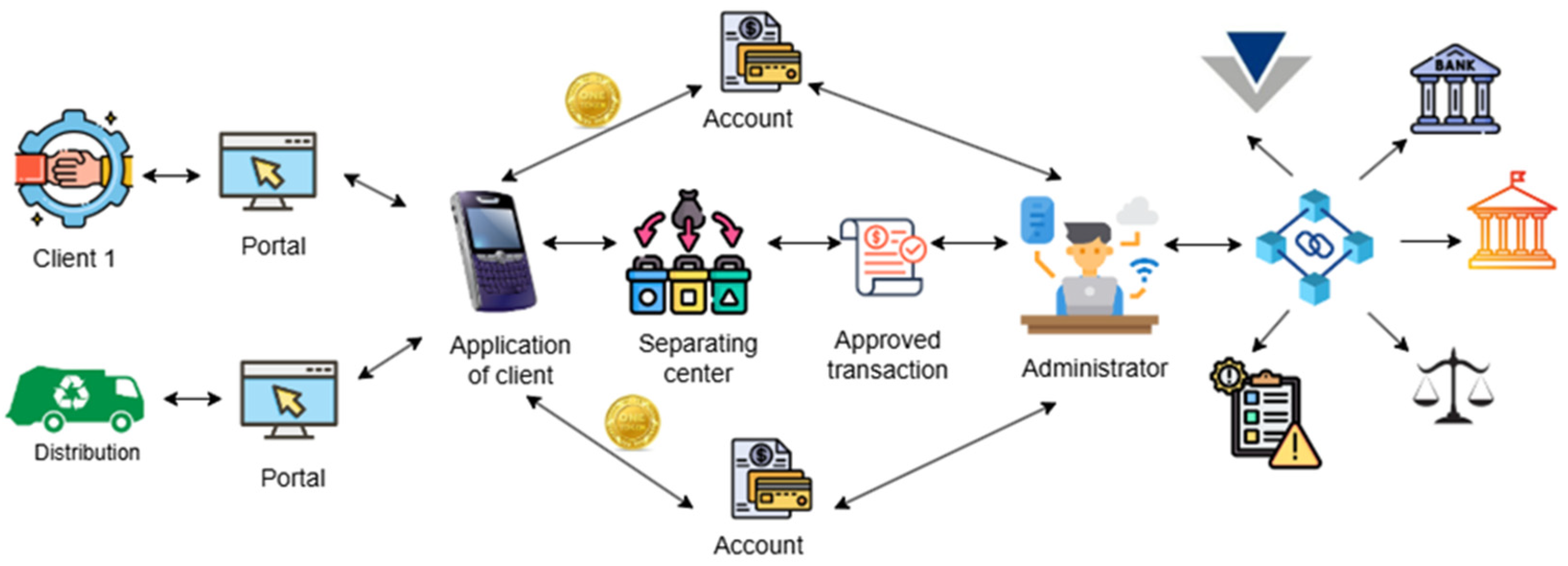
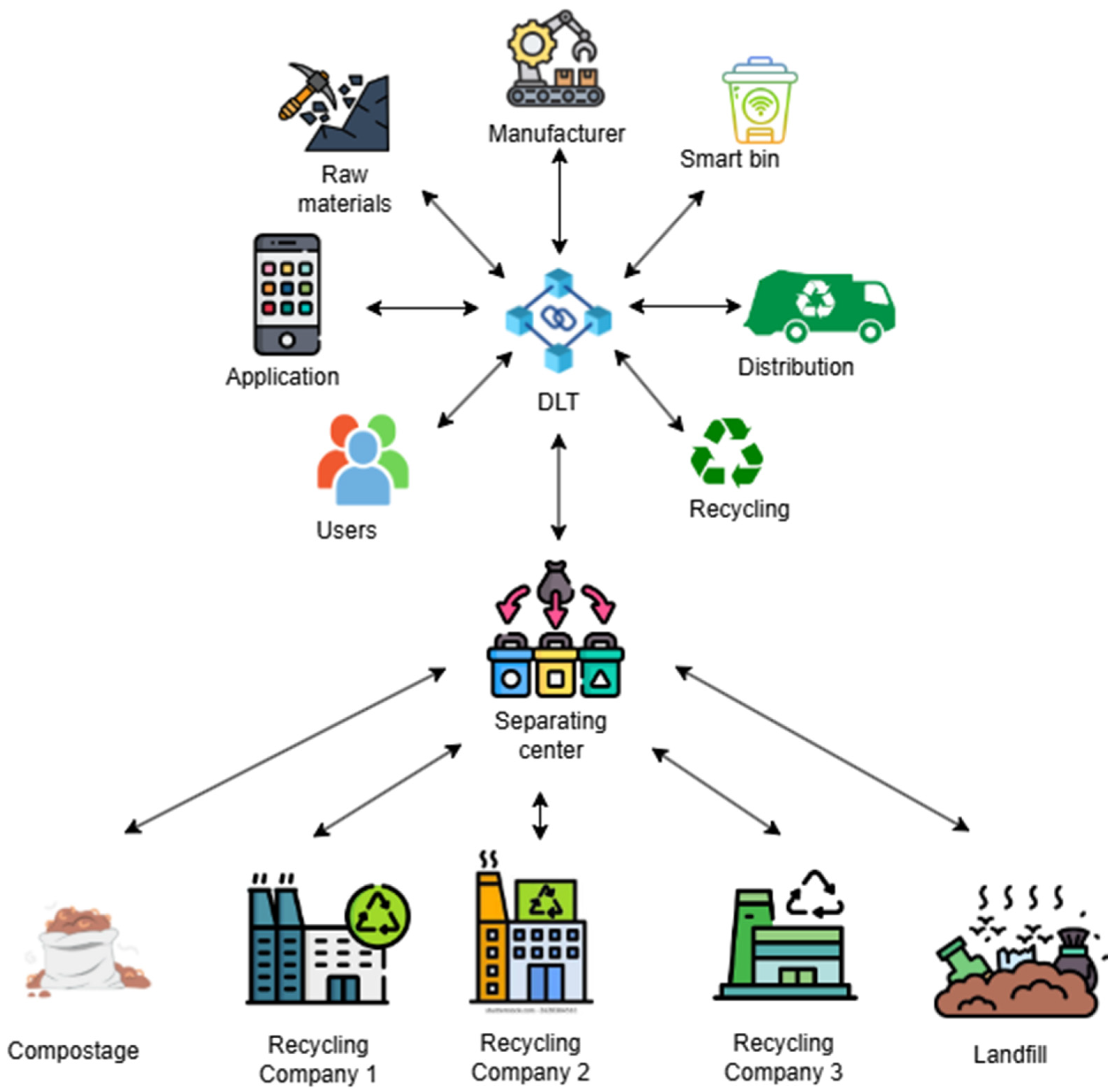
- Definition of the functions of the separation center as a new participant;
- Clear rules for selecting DLT or database;
- Synthesis of an appropriate decision support tree for selecting the architecture.
- Introducing an application or tokens to reward participants or third parties.
2. Materials and Methods
3. Results
- Producers: Design for recycling, use of recyclates, and recycling of production waste.
- Consumers: Improving separation behavior and purchase decisions, which can be encouraged as part of a community that supports higher environmental standards and customer engagement [32].
- Recyclers: Improving the sourcing of suitable waste-streams [14]. We focus on producers because they record waste collected at the input stage and process it.
4. Discussion
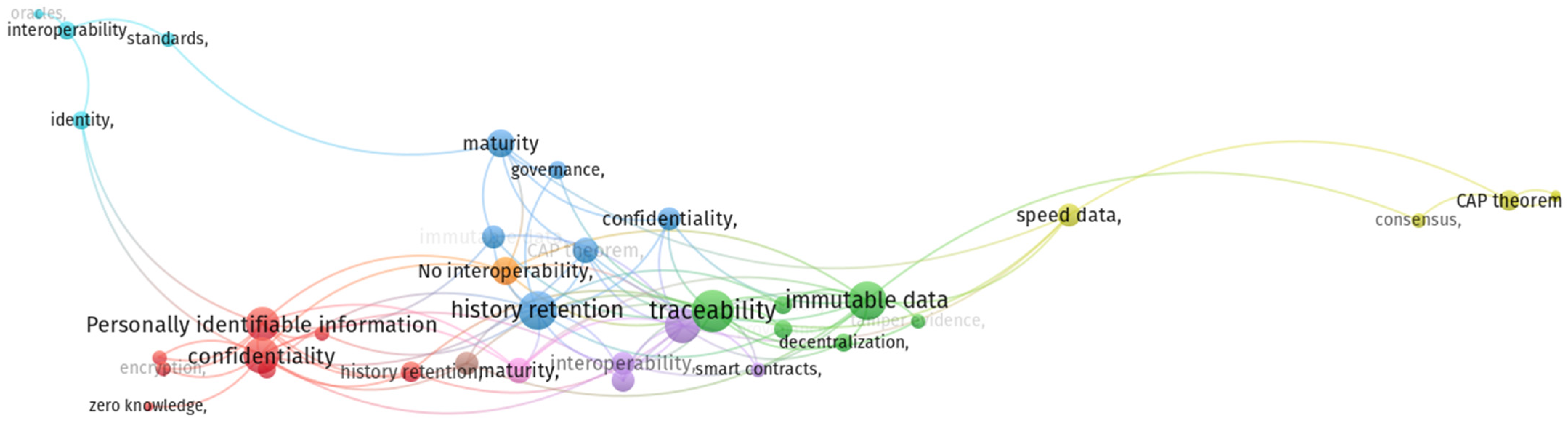
4.1. DLT—Selection Criteria
- -
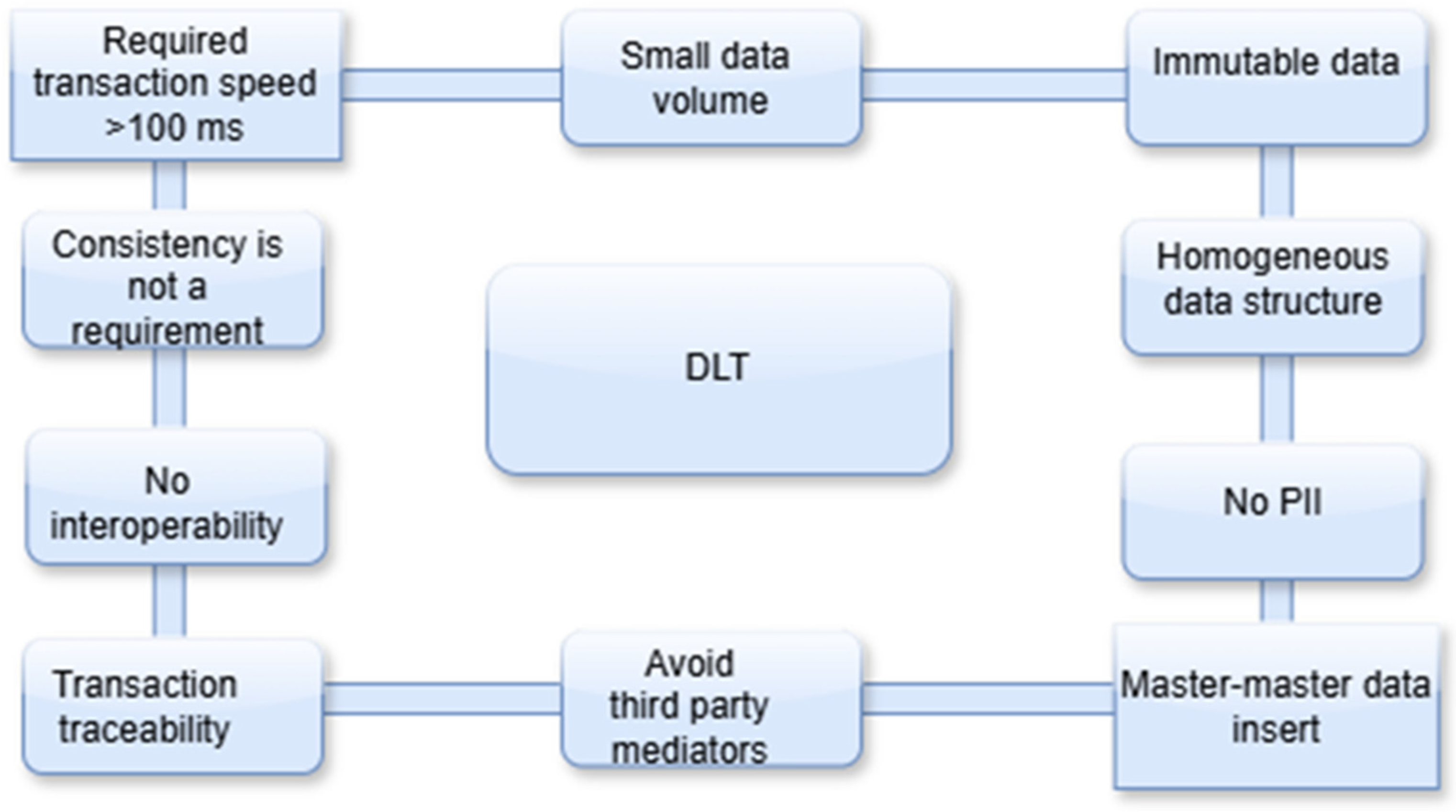
- Transaction traceability—The desired traceability of transactions recorded on the chain is achieved through DLT that enables trusted traceability among participating parties.
- -
- -
- CAP Theorem—Consistency—Every read receives the most recent write or an error. Availability—Every request receives a (non-error) response, without the guarantee that it contains the most recent write. Partition tolerance—The system continues to operate despite an arbitrary number of messages being dropped (or delayed) by the network between nodes [36].
- -
- -
- Data volume—In the circular economy system, specific pre-selected data types by category are used, whose volume grows only up to certain limits [37].
- -
- -
- Data type (single-type/multi-type) [37] The homogeneous data structure is among the drawbacks of DLT technologies because different DLT archetypes exist and their processes differ significantly. Work is underway on a unified archetype to provide greater flexibility, scalability, and transaction processing capacity.
- -
- No PII (personally identifiable information)—Under the EU’s GDPR (and similarly in the United States), information that leads to personal data must not be stored on DLT because it is immutable.
- -
- -
- -
- Need to retain history and a transaction register—These records are real accounts. They are used to obtain tokens, rewards, penalties, reports to regulators, and so on [40]—Model DHS.
- -
- Need to remove intermediaries—This leads to increased trust among network participants [37]—Cathy Mulligan.
4.2. Scheme
- -
- -
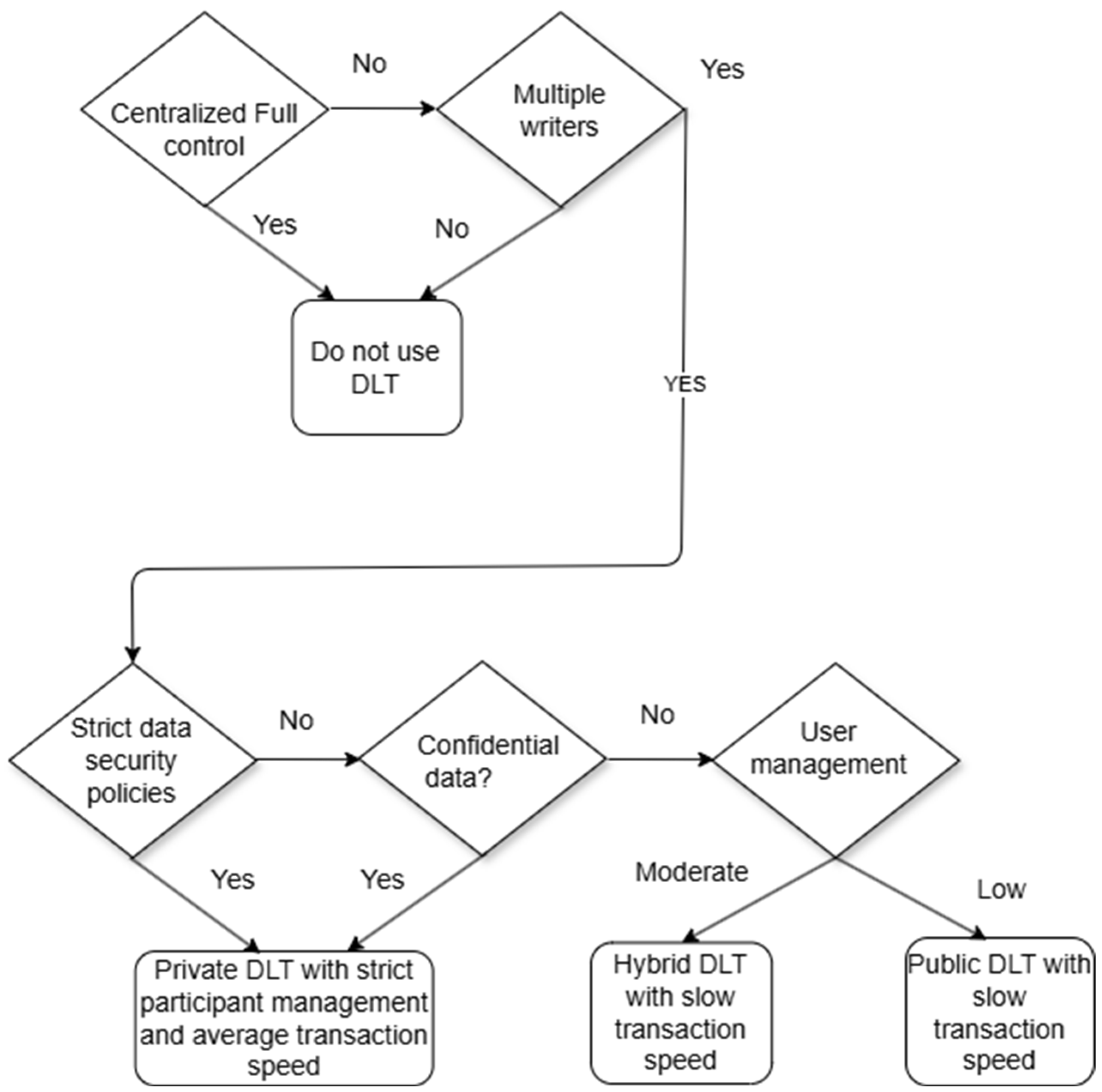
- How many people have the right to modify the data?
- -
- Right to admit a new member—intrafirm or interfirm organization, or control over business logic; we propose this node as the option to include new suppliers.
- -
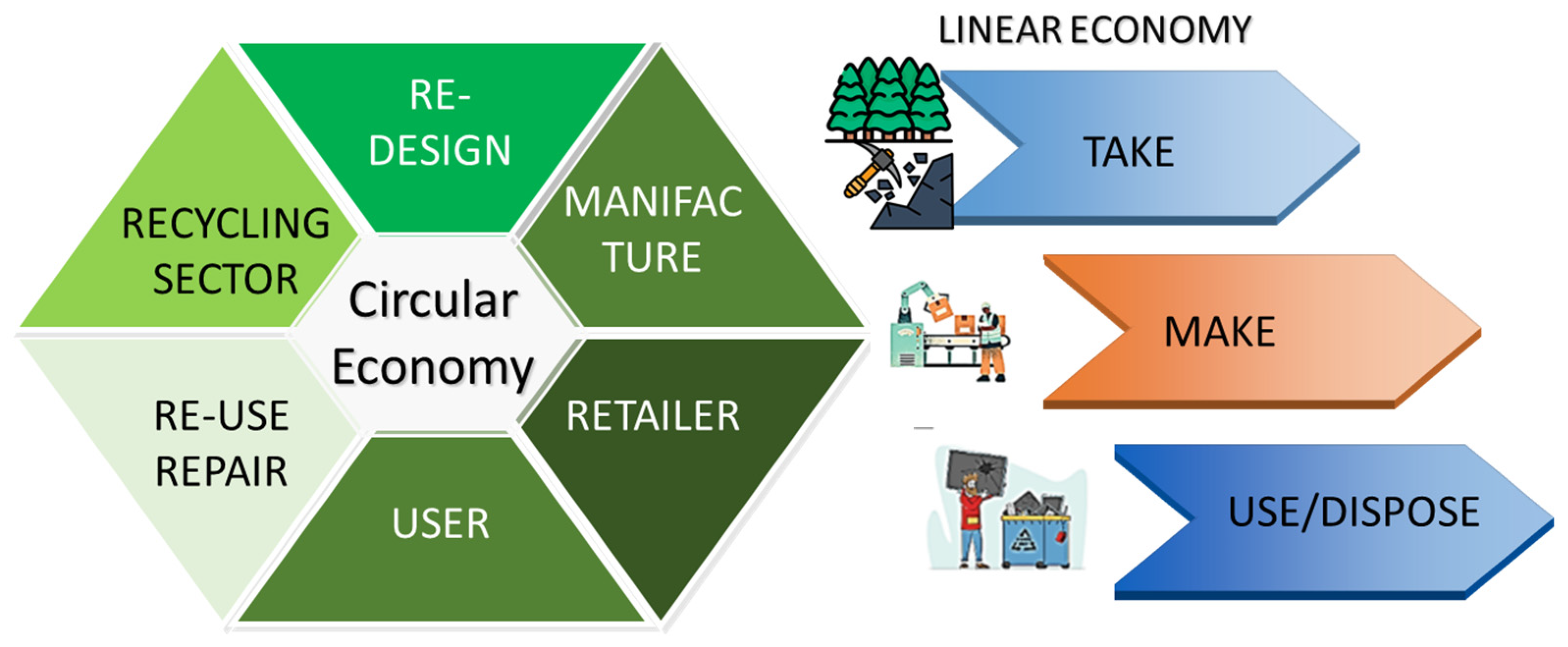
4.3. Applicability of Criteria for Recycling
- There are zero intermediaries in one sense, but also a defined set of validators with a special role in organizing sharing with distributed trust—not literally “zero intermediaries” [5].
- For firms, it is enterprise-grade, which suits audit and SLA requirements.
4.4. A Decision Support Tree
- -
- Its applicability in multi-stage and multi-cycle production;
- -
- Usability in hybrid DLT architectures with different data access rights;
- -
- A practical tool for selecting an appropriate architecture for managing data sharing.
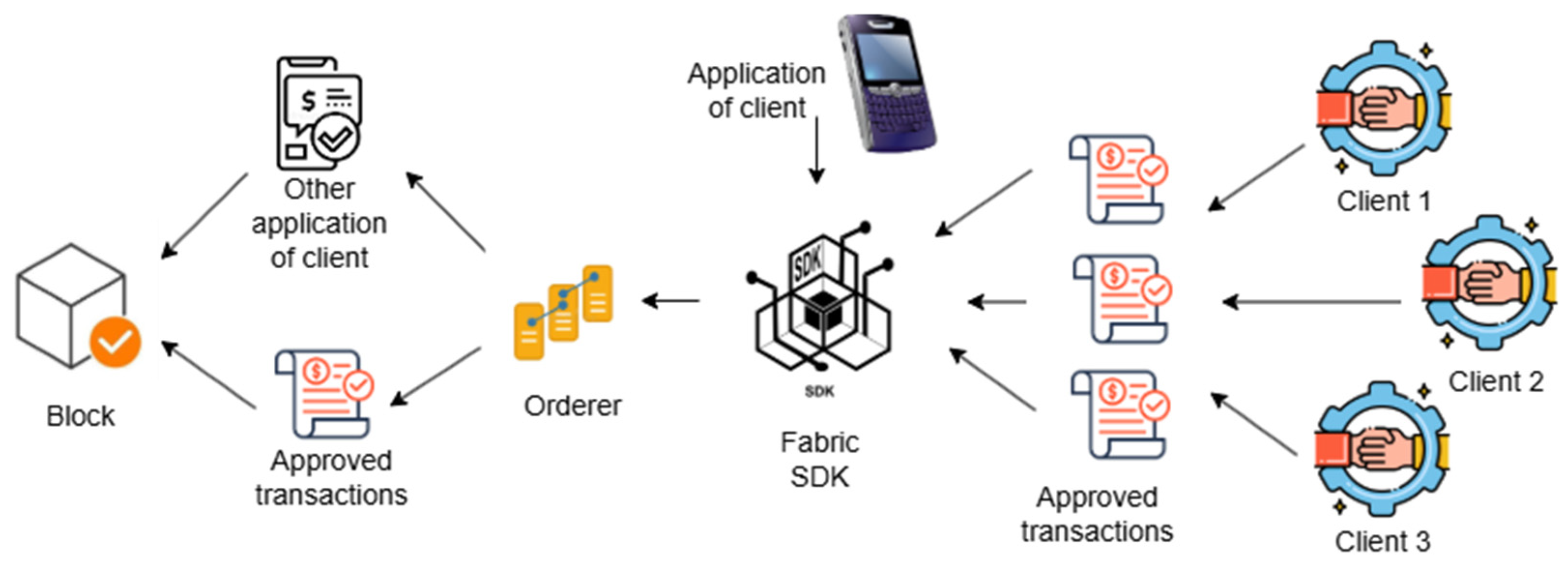
- Hyperledger Fabric—a private multichannel network for business consortia;
- R3 Corda—with high trust among validators and strong identity control for financial institutions;
- Enterprise Ethereum—with restricted participants;
- Quorum—for corporate deployments;
- Multichain—public or private, for role and permission management.
- Reliable, traceable exchange among several organizations—plant, transport company, waste collection, recycling, reuse of materials, their incorporation into other products, and so on;
- Clear, available reports to regulators;
- Secure financial reporting;
- No disclosure of sensitive data.
5. Conclusions
Author Contributions
Funding
Institutional Review Board Statement
Informed Consent Statement
Data Availability Statement
Conflicts of Interest
References
- Khan, I.A.; Haq, F.; Kiran, M.; Aziz, T. Circular Economy and Waste Management: Transforming Waste into Resources for a Sustainable Future. Int. J. Environ. Sci. Technol. 2025, 22, 17327–17346. [Google Scholar] [CrossRef] [Scilit]
- Sadeghi, M.; Mahmoudi, A.; Deng, X. Adopting Distributed Ledger Technology (DLT) for the Sustainable Construction Industry: Evaluating the Barriers Using Ordinal Priority Approach (OPA). Res. Sq. 2021, 29, 10495–10520. [Google Scholar] [CrossRef] [Scilit]
- Gopalakrishnan, P.; Hall, J.; Behdad, S. A Blockchain-Based Traceability System for Waste Management in Smart Cities. In Proceedings of the ASME 2020 International Design Engineering Technical Conferences and Computers and Information in Engineering Conference, St. Louis, MO, USA, 17–19 August 2020. [Google Scholar]
- Europe 2020 Strategy. Available online: https://commission.europa.eu/topics/business-and-industry_en (accessed on 16 May 2026).
- A French Act of Law Against Waste and for a Circular Economy. European Circular Economy Stakeholder Platform. Available online: https://circulareconomy.europa.eu/platform/en/strategies/french-act-law-against-waste-and-circular-economy (accessed on 16 May 2026).
- People’s Republic of China. Circular Economy Promotion Law. 2008. Available online: https://scholar.google.com (accessed on 16 May 2026).
- OECD Annual Report. Available online: https://www.oecd.org/newsroom/43125523.pdf (accessed on 16 May 2026).
- Kulwant, M.; Raj, D.; Yadav, A.K. Waste Management and Recycling. In Computational Techniques in Environmental Engineering, 1st ed.; CRC Press: Boca Raton, FL, USA, 2025; pp. 187–202. [Google Scholar]
- Bułkowska, K.; Zielińska, M.; Bułkowski, M. Blockchain-Based Management of Recyclable Plastic Waste. Energies 2024, 17, 2937. [Google Scholar] [CrossRef] [Scilit]
- Saboor, A. Sustainable Waste Management Using Blockchain Technology in ASEAN Nations: Case Study of Indonesia. Available online: https://pdfs.semanticscholar.org/c025/fcedb1352cd423905e2599f72e2218c0f36e.pdf (accessed on 16 May 2026).
- Ugozor, A.O.; Udebuani, A.C.; Nnorom, O.O. Production of Bioplastic from Waste Agricultural Biomass. Eur. J. Sustain. Dev. Res. 2025, 9, em0285. [Google Scholar] [CrossRef] [Scilit]
- Liang, W.; Fan, L.; Yang, Z.; Yang, J.; Zou, Q.; Huang, C.; Huang, Q.; Duan, H.; Yang, J. How to Track the Dumped Waste? From Data Collection to Advanced Source Identification. J. Hazard. Mater. 2025, 499, 140052. [Google Scholar] [CrossRef] [Scilit] [PubMed]
- Khudyakova, T.; Lyaskovskaya, E. Improving the Sustainability of Regional Development in the Context of Waste Management. Sustainability 2021, 13, 1755. [Google Scholar] [CrossRef] [Scilit]
- Berg, H.; Sebestyén, J.; Bendix, P.; Le Blevennec, K.; Vrancken, K. Digital Waste Management; Eionet Report—ETC/WMGE 2020/4; European Environment Agency: Copenhagen, Denmark, 2020; Available online: https://wmge.eionet.europa.eu (accessed on 16 May 2026).
- Gong, Y.; Xie, S.; Arunachalam, D.; Duan, J.; Luo, J. Blockchain-Based Recycling and Its Impact on Recycling Performance: A Network Theory Perspective. Bus. Strategy Environ. 2022, 31, 3717–3741. [Google Scholar] [CrossRef] [Scilit]
- Enache, B.-A.; Banica, C.-K.; Bogdan, A.G. Intelligent Trash Level Detection for Sustainable Urban Waste Management. Sci. Bull. Electr. Eng. Fac. 2024, 24, 56–59. [Google Scholar] [CrossRef] [Scilit]
- Obiorah, C.A.; Ndubuisi, O.G.; Ali, S.E.; Aku, U.T.; Nesiama, O.; Agbakhamen, C.O.; Gumi, S.A. Integrating Waste Management into Sustainable Development Planning: A Framework for Urban Areas. Int. J. Innov. Soc. Sci. Humanit. Res. 2025, 13, 27–42. [Google Scholar] [CrossRef]
- Flynn, S. 3 Ways the Recycling Supply Chain Is Using Blockchain. Available online: https://www.ibm.com (accessed on 16 May 2026).
- German Association Using IOTA DLT to Incentivize Plastic Recycling. Ledger Insights. 2019. Available online: https://www.ledgerinsights.com/german-association-using-iota-dlt-to-incentivize-plastic-recycling/ (accessed on 16 May 2026).
- Preece, J.; Easton, J. To Blockchain or Not to Blockchain, These Are the Questions: A Structured Analysis of Blockchain Decision Schemes. Telemat. Inform. Rep. 2023, 13, 100115. [Google Scholar] [CrossRef] [Scilit]
- Ntshangase, S.; Ndhlovu, N.; Myaka, S.; Mahlasela, O.; Siphambili, N.; Mthethwa, S. An Evaluation of DLT Governance Models. In Proceedings of the 2024 International Conference on Artificial Intelligence, Big Data, Computing and Data Communication Systems (icABCD), Port Louis, Mauritius, 5–6 August 2024; pp. 1–7. [Google Scholar]
- Wang, B.; Wang, N. Decision Models for a Dual-Recycling Channel Reverse Supply Chain with Consumer Strategic Behavior. Sustainability 2022, 14, 10870. [Google Scholar] [CrossRef] [Scilit]
- Khadke, S.K.; Gupta, P.; Rachakunta, S.; Mahata, C.; Dawn, S.; Sharma, M.; Verma, D.; Pradhan, A.; Krishna, A.M.S.; Ramakrishna, S.; et al. Efficient Plastic Recycling and Remolding Circular Economy Using the Technology of Trust—Blockchain. Sustainability 2021, 13, 9142. [Google Scholar] [CrossRef] [Scilit]
- Taylor, P.; Steenmans, K.; Steenmans, I. Blockchain Technology for Sustainable Waste Management. Front. Polit. Sci. 2020, 2, 590923. [Google Scholar] [CrossRef] [Scilit]
- Chidepatil, A.; Bindra, P.; Kulkarni, D.; Qazi, M.; Kshirsagar, M.; Sankaran, K. From Trash to Cash: How Blockchain and Multi-Sensor-Driven Artificial Intelligence Can Transform Circular Economy of Plastic Waste? Adm. Sci. 2020, 10, 23. [Google Scholar] [CrossRef] [Scilit]
- Zhou, Z.; Tang, Y.; Dong, J.; Chi, Y.; Ni, M.; Li, N.; Zhang, Y. Environmental Performance Evolution of Municipal Solid Waste Management by Life Cycle Assessment in Hangzhou, China. J. Environ. Manag. 2018, 227, 23–33. [Google Scholar] [CrossRef] [Scilit]
- Lamichhane, M. A Smart Waste Management System Using IoT and Blockchain Technology. Master’s Thesis, University of Lorraine, Nancy, France, 2017. Available online: https://lutpub.lut.fi/bitstream/handle/10024/143751/PERCCOM_MASTERS_THESIS_ManishLamichhane_20170720_final.pdf (accessed on 16 May 2026).
- Li, J.; Kassem, M.; Ciribini, A.L.C.; Bolpagni, M. A Proposed Approach Integrating DLT, BIM, IoT and Smart Contracts: Demonstration Using a Simulated Installation Task. In Proceedings of the International Conference on Smart Infrastructure and Construction 2019, Cambridge, UK, 8–10 July 2019. [Google Scholar]
- Ahmad, R.W.; Salah, K.; Jayaraman, R.; Yaqoob, I.; Omar, M.A. Blockchain for Waste Management in Smart Cities: A Survey. IEEE Access 2021, 9, 112022–112048. [Google Scholar] [CrossRef] [Scilit]
- Hansen, J. Brilliency Wallet to Include Swytch’s Blockchain-Based Token. Business Wire, 3 December 2018. Available online: https://www.businesswire.com (accessed on 16 May 2026).
- Flourentzou, P. Decentralised Sustainability: Integrating Climate Action into Digital Asset Management on Distributed Ledger Technology (DLT); Standard Development Bureau, Emerging Technology Division. 2025. Available online: https://blockstand.eu/blockstand/uploads/2025/05/Decentralised-Sustainability-Integrating-Climate-Action-into-Digital-Asset-Management-on-DLT.pdf (accessed on 16 May 2026).
- Chowdhury, M.; Colman, A.; Kabir, M.; Han, J.; Sarda, P. Blockchain Versus Database: A Critical Analysis. In Proceedings of the IEEE International Conference on Trust, Security and Privacy in Computing and Communications (TrustCom)/IEEE International Conference on Big Data Science and Engineering (BigDataSE), New York, NY, USA, 1–3 August 2018. [Google Scholar]
- Tijan, E.; Aksentijević, S.; Ivanić, K.; Jardas, M. Blockchain Technology Implementation in Logistics. Sustainability 2019, 11, 1185. [Google Scholar] [CrossRef] [Scilit]
- Chu, T.; Ma, J.; Zhong, Y.; Sun, H.; Jia, W. Shared Recycling Model for Waste Electrical and Electronic Equipment Based on the Targeted Responsibility System in the Context of China. Humanit. Soc. Sci. Commun. 2024, 11, 442. [Google Scholar] [CrossRef] [Scilit]
- Riley, L. Universal DLT Interoperability Is Now a Practical Reality. Hyperledger Foundation. 2021. Available online: https://www.hyperledger.org/blog/2021/05/10/universal-dlt-interoperability-is-now-a-practical-reality (accessed on 16 May 2026).
- Hristov, P. Data Management Model Based on Distributed Ledger Technologies. Ph.D. Thesis, University of Library Studies and Information Technologies, Sofia, Bulgaria, 2021. [Google Scholar]
- Fox, A.; Brewer, E. Harvest, Yield, and Scalable Tolerant Systems. Available online: http://citeseerx.ist.psu.edu/viewdoc/download?doi=10.1.1.24.3690&rep=rep1&type=pdf (accessed on 16 May 2026).
- Mulligan, C. These 11 Questions Will Help You Decide If Blockchain Is Right for Your Business. World Economic Forum. 2018. Available online: https://www.weforum.org/agenda/2018/04/questions-blockchain-toolkit-right-for-business (accessed on 16 May 2026).
- Peck, M. Do You Need a Blockchain? IEEE Spectr. 2017, 54, 32–35. Available online: https://spectrum.ieee.org/computing/networks/do-you-need-a-blockchain (accessed on 16 May 2026). [CrossRef] [Scilit]
- Koens, T.; Poll, E. What Blockchain Alternative Do You Need? Radboud University: Nijmegen, The Netherlands, 2018. [Google Scholar]
- Yaga, D.; Mell, P.; Roby, N.; Scarfone, K. Blockchain Technology Overview; NISTIR 8202; National Institute of Standards and Technology: Gaithersburg, MD, USA, 2018. [Google Scholar]
- Lewis, A. The Basics of Bitcoins and Blockchains: An Introduction to Cryptocurrencies and the Technology that Powers Them; Mango Publishing: Birmingham, UK, 2018. [Google Scholar]
- IBM. IBM Blockchain—Enterprise Blockchain Solutions & Services. Available online: https://www.ibm.com/blockchain (accessed on 28 December 2020).
- Suichies, B. Why Blockchain Must Die in 2016. Medium. 2015. Available online: https://medium.com/block-chain/why-blockchain-must-die-in-2016-e992774c03b4 (accessed on 16 May 2026).
- Pons, J. Blockchain and DLT Application to Sustainable Development: New Architectures and Use Cases for Circular Economy, Climate Action and Biodiversity Conservation; ResearchGate: Berlin, Germany, 2024. [Google Scholar]
- Nakamoto, S. Bitcoin: A Peer-to-Peer Electronic Cash System. 2008. Available online: https://bitcoin.org/bitcoin.pdf (accessed on 16 May 2026).
- Parulava, S.; Brown, R.; Birch, D. Towards Ambient Accountability in Financial Services: Shared Ledgers, Translucent Transactions and the Technological Legacy of the Great Financial Crisis. J. Paym. Strategy Syst. 2016, 10, 118–131. [Google Scholar] [CrossRef] [Scilit]
- Castro, M.; Liskov, B. Practical Byzantine Fault Tolerance. In Proceedings of the 3rd Symposium on Operating Systems Design and Implementation (OSDI), New Orleans, LA, USA, 22–25 February 1999; pp. 173–186. [Google Scholar]
- European Commission. Blockchain and the GDPR. 2018. Available online: https://blockchain-observatory.ec.europa.eu/ (accessed on 16 May 2026).
- Anceaume, E.; Del Pozzo, A.; Rieutord, T.; Tucci-Piergiovanni, S. On Finality in Blockchains. In Proceedings of the International Conference on Principles of Distributed Systems (OPODIS), Paris, France, 13–15 December 2021; Volume 217, pp. 6:1–6:19. [Google Scholar]
- Androulaki, E.; Barger, A.; Bortnikov, V.; Cachin, C.; Christidis, K.; De Caro, A.; Enyeart, D.; Ferris, C.; Laventman, G.; Manevich, Y.; et al. Hyperledger Fabric: A Distributed Operating System for Permissioned Blockchains. In Proceedings of the Thirteenth EuroSys Conference, Porto, Portugal, 23–26 April 2018; pp. 1–15. [Google Scholar]
- Garay, J.; Kiayias, A.; Leonardos, N. The Bitcoin Backbone Protocol: Analysis and Applications. In Advances in Cryptology—EUROCRYPT 2015; Springer: Berlin/Heidelberg, Germany, 2015. [Google Scholar]
- Dwork, C.; Lynch, N.; Stockmeyer, L. Consensus in the Presence of Partial Synchrony. J. ACM 1988, 35, 288–323. [Google Scholar] [CrossRef] [Scilit]
- Malavolta, G.; Moreno-Sanchez, P.; Kate, A.; Maffei, M.; Ravi, S. Concurrency and Privacy with Payment-Channel Networks. In Proceedings of the 2017 ACM SIGSAC Conference on Computer and Communications Security (CCS), Dallas, TX, USA, 30 October–3 November 2017; pp. 455–471. [Google Scholar]
- Maiti, I.; Kotliarov, I.; Lipatnikov, V. A Future Triple Entry Accounting Framework Using Blockchain Technology. Blockchain Res. Appl. 2021, 2, 100037. [Google Scholar] [CrossRef] [Scilit]
- Interoperability of Blockchain Solutions. European Union Blockchain Observatory and Forum. 2023. Available online: https://blockchain-observatory.ec.europa.eu/ (accessed on 16 May 2026).
- Bellavista, P.; Corradi, A.; Foschini, L.; Monti, S. Improved Adaptation and Survivability via Dynamic Service Composition of Ubiquitous Computing Middleware. IEEE Access 2018, 6, 33604–33620. [Google Scholar] [CrossRef] [Scilit]
- Nwufoh, P.; Hu, Z.; Wen, D.; Wang, M. Nanoparticle assisted EOR during sand-pack flooding: Electrical tomography to assess flow dynamics and oil recovery. Sensors 2019, 19, 3036. [Google Scholar] [CrossRef] [Scilit] [PubMed]
- Caldarelli, G. Understanding the Blockchain Oracle Problem: A Call for Action. Information 2020, 11, 509. [Google Scholar] [CrossRef] [Scilit]
- Vogels, W. Eventually Consistent. Commun. ACM 2009, 52, 40–44. [Google Scholar] [CrossRef] [Scilit]
- Kannengießer, N.; Lins, S.; Dehling, T.; Sunyaev, A. Mind the Gap: Trade-Offs between Distributed Ledger Technology Characteristics. arXiv 2019, arXiv:1906.00861. [Google Scholar] [CrossRef] [Scilit]
- Projects—Sun Exchange. Available online: https://sunexchange.com/projects/ (accessed on 13 April 2026).
- The Capital Market for Every Asset on Earth—Solana. Available online: https://solana.com/ (accessed on 13 April 2026).
- WHES—Intelligent C&I Energy Storage Manufacturer & Solution Provider. Available online: https://www.whes.com/ (accessed on 13 April 2026).
- Stone, L. Energy Web Foundation Launches Pioneering Blockchain to Accelerate a Low-Carbon, Customer-Centric Energy System. Rocky Mountain Institute. 2017. Available online: https://rmi.org/energy-web-foundation-launches-pioneering-blockchain-to-accelerate-a-low-carbon-customer-centric-energy-system/ (accessed on 13 April 2026).
- Linnet, M.E.; Wagner, S.; Haswell, H. Maersk and IBM Introduce TradeLens Blockchain Shipping Solution. IBM Newsroom, 9 August 2018. Available online: https://newsroom.ibm.com/2018-08-09-Maersk-and-IBM-Introduce-TradeLens-Blockchain-Shipping-Solution (accessed on 16 May 2026).
- Flaherty, N. Volkswagen Uses Blockchain for Automotive Supply Chain. EE News Europe, 27 December 2022. Available online: https://www.eenewseurope.com/en/volkswagen-uses-blockchain-for-automotive-supply-chain/ (accessed on 16 May 2026).
- Blockchain in the Energy Sector—Real World Blockchain Use Cases. Consensys. Available online: https://consensys.io/blockchain-use-cases/energy-and-sustainability (accessed on 13 April 2026).
- Švažas, M.; Makutenas, V. Energy Systems in Agriculture: Synergies and Perspectives. In Proceedings of the 6th International Conference on Communications, Information, Electronic and Energy Systems (CIEES), Ruse, Bulgaria, 26–28 November 2025. [Google Scholar] [CrossRef] [Scilit]
- Bhubalan, K.; Tamothran, A.M.; Kee, S.H.; Foong, S.Y.; Lam, S.S.; Ganeson, K.; Vigneswari, S.; Amirul, A.-A.; Ramakrishna, S. Leveraging Blockchain Concepts as Watermarkers of Plastics for Sustainable Waste Management in Progressing Circular Economy. Environ. Res. 2022, 213, 113631. [Google Scholar] [CrossRef] [Scilit] [PubMed]
- Sultana, A.; Barua, M. Emerging Technologies in Sustainable Finance: AI and DLT as Enablers of the Green Economy. Holistica J. Bus. Public Adm. 2025, 16, 98–114. [Google Scholar] [CrossRef] [Scilit]
- Bodislav, D.A.; Moraru, L.C.; Georgescu, R.I.; Grigore, G.E.; Vlăduț, O.; Staicu, G.I.; Chenic, A.Ș. Recyclable Consumption and Its Implications for Sustainable Development in the EU. Sustainability 2025, 17, 3110. [Google Scholar] [CrossRef] [Scilit]





| № | Reference | C | Tr | SD | R | CE |
|---|---|---|---|---|---|---|
| [1] | Khan, I.A.; Haq, F.; Kiran, M.; Aziz, T. Circular Economy and Waste Management: Transforming Waste into Resources for a Sustainable Future. | 3 | 1 | 2 | 4 | 6 |
| [2] | Sadeghi, M.; Mahmoudi, A.; Deng, X. Adopting Distributed Ledger Technology (DLT) for the Sustainable Construction Industry: Evaluating the Barriers Using Ordinal Priority Approach | 1 | 1 | 6 | 1 | 2 |
| [3] | Gopalakrishnan, P.; Hall, J.; Behdad, S. A Blockchain-Based Traceability System for Waste Management in Smart Cities | 5 | 2 | 3 | 3 | 5 |
| [4] | Europe 2020 Strategy. Available online: https://ec.europa.eu/info/ (accessed on 16 May 2026) | 2 | 0 | 3 | 2 | 5 |
| [5] | A French Act of Law against Waste and for a Circular Economy. European Circular Economy Stakeholder Platform | 1 | 0 | 2 | 2 | 4 |
| [6] | People’s Republic of China. Circular Economy Promotion Law, 2008 | 2 | 0 | 2 | 2 | 4 |
| [7] | OECD Annual Report. Available online: https://www.oecd.org/newsroom/43125523.pdf (accessed on 16 May 2026) | 1 | 0 | 2 | 2 | 4 |
| [8] | Kulwant, M.; Raj, D.; Yadav, A.K. Waste Management and Recycling | 2 | 0 | 2 | 2 | 4 |
| [9] | Bułkowska, K.; Zielińska, M.; Bułkowski, M. Blockchain-Based Management of Recyclable Plastic Waste | 2 | 1 | 0 | 2 | 0 |
| [10] | Saboor, A. Sustainable Waste Management Using Blockchain Technology in ASEAN Nations: Case Study of Indonesia | 2 | 0 | 4 | 2 | 4 |
| [11] | Ugozor, A.O.; Udebuani, A.C.; Nnorom, O.O. Production of Bioplastic from Waste Agricultural Biomass | 1 | 0 | 0 | 1 | 0 |
| [12] | Liang, W.; et al. How to Track the Dumped Waste? From Data Collection to Advanced Source Identification | 1 | 1 | 0 | 0 | 2 |
| [13] | Khudyakova, T.; Lyaskovskaya, E. Improving the Sustainability of Regional Development in the Context of Waste Management | 1 | 1 | 1 | 0 | 1 |
| [14] | Berg, H.; Sebestyén, J.; Bendix, P.; Le Blevennec, K.; Vrancken, K. Digital Waste Management | 6 | 1 | 1 | 1 | 1 |
| [15] | Gong, Y.; Xie, S.; Arunachalam, D.; Duan, J.; Luo, J. Blockchain-Based Recycling and Its Impact on Recycling Performance: A Network Theory Perspective | 4 | 3 | 0 | 3 | 0 |
| [16] | Enache, B.-A.; Banica, C.-K.; Bogdan, A.G. Intelligent Trash Level Detection for Sustainable Urban Waste Management | 1 | 0 | 1 | 2 | 0 |
| [30] | Hansen, J. Brilliency Wallet to Include Swytch’s Blockchain-Based Token | 1 | 1 | 1 | 2 | 0 |
| [17] | Obiorah, C.A.; Ndubuisi, O.G.; Ali, S.E.; Aku, U.T.; Nesiama, O.; Agbakhamen, C.O.; Gumi, S.A. Integrating Waste Management into Sustainable Development Planning: A Framework for Urban Areas | 1 | 0 | 1 | 2 | 0 |
| [18] | Flynn, S. 3 Ways the Recycling Supply Chain Is Using Blockchain | 2 | 1 | 0 | 1 | 0 |
| [19] | German Association Using IOTA DLT to Incentivize Plastic Recycling | 1 | 2 | 0 | 0 | 0 |
| [20] | Preece, J.; Easton, J. To Blockchain or Not to Blockchain, These Are the Questions: A Structured Analysis of Blockchain Decision Schemes | 2 | 0 | 0 | 2 | 1 |
| [21] | Ntshangase, S.; Ndhlovu, N.; Myaka, S.; Mahlasela, O.; Siphambili, N.; Mthethwa, S. An Evaluation of DLT Governance Models | 1 | 1 | 0 | 1 | 0 |
| [22] | Wang, B.; Wang, N. Decision Models for a Dual-Recycling Channel Reverse Supply Chain with Consumer Strategic Behavior | 1 | 1 | 0 | 1 | 0 |
| [23] | Khadke, S.K.; et al. Efficient Plastic Recycling and Remolding Circular Economy Using the Technology of Trust—Blockchain | 4 | 2 | 0 | 2 | 0 |
| [24] | Taylor, P.; Steenmans, K.; Steenmans, I. Blockchain Technology for Sustainable Waste Management | 5 | 2 | 0 | 2 | 0 |
| [25] | Chidepatil, A.; Bindra, P.; Kulkarni, D.; Qazi, M.; Kshirsagar, M.; Sankaran, K. From Trash to Cash: How Blockchain and Multi-Sensor-Driven Artificial Intelligence Can Transform Circular Economy of Plastic Waste? | 2 | 2 | 0 | 1 | 0 |
| [26] | Zhou, Z.; et al. Environmental Performance Evolution of Municipal Solid Waste Management by Life Cycle Assessment in Hangzhou | 1 | 1 | 0 | 1 | 0 |
| [27] | Lamichhane, M. A Smart Waste Management System Using IoT and Blockchain Technology | 3 | 2 | 0 | 1 | 0 |
| [28] | Li, J.; Kassem, M.; Ciribini, A.L.C.; Bolpagni, M. A Proposed Approach Integrating DLT, BIM, IoT and Smart Contracts: Demonstration Using a Simulated Installation Task | 2 | 1 | 0 | 0 | 0 |
| [29] | Ahmad, R.W.; Salah, K.; Jayaraman, R.; Yaqoob, I.; Omar, M.A. Blockchain for Waste Management in Smart Cities: A Survey | 1 | 1 | 0 | 1 | 0 |
| [31] | Flourentzou, P. Decentralized Sustainability: Integrating Climate Action into Digital Asset Management on Distributed Ledger Technology (DLT) | 2 | 3 | 1 | 2 | 0 |
| [32] | Chowdhury, M.; Colman, A.; Kabir, M.; Han, J.; Sarda, P. Blockchain Versus Database: A Critical Analysis | 1 | 0 | 0 | 0 | 0 |
| [33] | Tijan, E.; Aksentijević, S.; Ivanić, K.; Jardas, M. Blockchain Technology Implementation in Logistics | 2 | 1 | 0 | 0 | 0 |
| [34] | Chu, T.; Ma, J.; Zhong, Y.; Sun, H.; Jia, W. Shared Recycling Model for Waste Electrical and Electronic Equipment Based on the Targeted Responsibility System in the Context of China | 1 | 3 | 0 | 1 | 0 |
| [35] | Riley, L. Universal DLT Interoperability Is Now a Practical Reality | 1 | 1 | 0 | 0 | 0 |
| [36] | Hristov, P. Data Management Model Based on Distributed Ledger Technologies | 1 | 1 | 0 | 0 | 0 |
| [37] | Fox, A.; Brewer, E. Harvest, Yield, and Scalable Tolerant Systems | 2 | 1 | 0 | 0 | 0 |
| [38] | Mulligan, C. These 11 Questions Will Help You Decide If Blockchain Is Right for Your Business | 7 | 3 | 0 | 0 | 1 |
| [39] | Peck, M. Do You Need a Blockchain? | 5 | 1 | 0 | 0 | 0 |
| [40] | Koens, T.; Poll, E. What Blockchain Alternative Do You Need? | 2 | 2 | 0 | 0 | 0 |
| [41] | Yaga, D.; Mell, P.; Roby, N.; Scarfone, K. Blockchain Technology Overview. | 3 | 1 | 0 | 0 | 0 |
| [42] | Lewis, A. The Basics of Bitcoins and Blockchains: An Introduction to Cryptocurrencies and the Technology that Powers Them | 2 | 1 | 0 | 0 | 0 |
| [43] | IBM Blockchain—Enterprise Blockchain Solutions & Services | 2 | 1 | 0 | 0 | 0 |
| [44] | Suichies, B. Why Blockchain Must Die in 2016 | 2 | 0 | 0 | 0 | 0 |
| [45] | Pons, J. Blockchain and DLT Application to Sustainable Development: New Architectures and Use Cases for Circular Economy | 3 | 0 | 2 | 4 | 4 |
| [46] | Nakamoto, S. Bitcoin: A Peer-to-Peer Electronic Cash System | 2 | 1 | 0 | 1 | 0 |
| [47] | Parulava, S.; Brown, R.; Birch, D. Towards Ambient Accountability in Financial Services: Shared Ledgers | 1 | 0 | 0 | 0 | 0 |
| [48] | Castro, M.; Liskov, B. Practical Byzantine Fault Tolerance | 2 | 1 | 0 | 0 | 0 |
| [49] | Blockchain and the GDPR | 2 | 2 | 0 | 0 | 0 |
| [50] | Anceaume, E.; Del Pozzo, A.; Rieutord, T.; Tucci-Piergiovanni, S. On Finality in Blockchains | 3 | 0 | 0 | 1 | 0 |
| [51] | Androulaki, E.; et al. Hyperledger Fabric: A Distributed Operating System for Permissioned Blockchains | 3 | 2 | 0 | 1 | 0 |
| [52] | Garay, J.; Kiayias, A.; Leonardos, N. The Bitcoin Backbone Protocol: Analysis and Applications | 1 | 0 | 0 | 1 | 0 |
| [53] | Dwork, C.; Lynch, N.; Stockmeyer, L. Consensus in the Presence of Partial Synchrony | 4 | 0 | 0 | 1 | 0 |
| [54] | Malavolta, G.; Moreno-Sanchez, P.; Kate, A.; Maffei, M.; Ravi, S. Concurrency and Privacy with Payment-Channel Networks | 1 | 0 | 0 | 0 | 0 |
| [55] | Maiti, I.; Kotliarov, I.; Lipatnikov, V. A Future Triple Entry Accounting Framework Using Blockchain Technology | 1 | 1 | 0 | 0 | 0 |
| [56] | Interoperability of Blockchain Solutions. European Union Blockchain Observatory and Forum | 1 | 1 | 0 | 0 | 0 |
| [57] | Bellavista, P.; Corradi, A.; Foschini, L.; Monti, S. Improved Adaptation and Survivability via Dynamic Service Composition of Ubiquitous Computing Middleware | 1 | 0 | 0 | 0 | 0 |
| [58] | Nwufoh, P.; Hu, Z.; Wen, D.; Wang, M. Nanoparticle Assisted EOR during Sand-Pack Flooding: Electrical Tomography to Assess Flow Dynamics and Oil Recovery | 1 | 0 | 0 | 0 | 0 |
| [59] | Caldarelli, G. Understanding the Blockchain Oracle Problem: A Call for Action | 1 | 1 | 0 | 0 | 0 |
| [60] | Vogels, W. Eventually Consistent | 1 | 0 | 0 | 0 | 0 |
| [39] | Peck, M. Blockchain World: Do You Need a Blockchain? This Chart Will Tell You If the Technology Can Solve Your Problem | 1 | 1 | 0 | 0 | 0 |
| [61] | Kannengießer, N.; Lins, S.; Dehling, T.; Sunyaev, A. Mind the Gap: Trade-Offs between Distributed Ledger Technology Characteristics | 1 | 1 | 0 | 0 | 0 |
| [62] | Projects—Sun Exchange | 1 | 1 | 0 | 0 | 0 |
| [63] | The Capital Market for Every Asset on Earth—Solana | 1 | 1 | 0 | 0 | 0 |
| [64] | WHES—Intelligent C&I Energy Storage Manufacturer & Solution Provider | 1 | 1 | 0 | 0 | 0 |
| [65] | Stone, L. Energy Web Foundation Launches Pioneering Blockchain to Accelerate a Low-Carbon | 1 | 1 | 0 | 0 | 0 |
| [66] | Linnet, M.E.; Wagner, S.; Haswell, H. Maersk and IBM Introduce TradeLens Blockchain Shipping Solution | 1 | 1 | 0 | 0 | 0 |
| [67] | Flaherty, N. Volkswagen Uses Blockchain for Automotive Supply Chain | 1 | 2 | 0 | 0 | 0 |
| [68] | Blockchain in the Energy Sector—Real World Blockchain Use Cases | 1 | 2 | 0 | 0 | 0 |
| [69] | Švažas, M.; Makutenas, V. Energy Systems in Agriculture: Synergies and Perspectives | 1 | 0 | 1 | 0 | 1 |
| [70] | Bhubalan, K.; et al. Leveraging Blockchain Concepts as Watermarkers of Plastics for Sustainable Waste Management in Progressing Circular Economy | 1 | 0 | 0 | 1 | 0 |
| [71] | Sultana, A.; Barua, M. Emerging Technologies in Sustainable Finance: AI and DLT as Enablers of the Green Economy | 1 | 1 | 0 | 1 | 1 |
| [72] | Bodislav, D.A.; et al. Recyclable Consumption and Its Implications for Sustainable Development in the EU | 1 | 0 | 0 | 1 | 1 |
| Function | Input | Interaction with | Output or DLT Record |
|---|---|---|---|
| Batch intake | Delivery and digital batch ID | Transport company, producer/consumer records | Record for intake confirmation |
| Material qualification | Sensor or manual with QR, RFID, composition data | Monitoring entity, plant capability database | Material profile mi |
| Record validation | Batch metadata, origin, quantity, timestamps | Producers, consumers, regulators | Valid or invalid status |
| Routing decision | mi, plant capability, availability, regulation | Recycling plants of n, composting, landfill | Routing instruction according D(Bi) |
| Exception handling | Plant outage, overload, new technology availability | Transport operator, alternative plants | Re—routing event |
| Audit & reporting | Routing history, processing route | Regulators, third-party auditors | Immutable audit transaction |
| Incentive linkage | Verified collection | Payment or token | Reward (no PII) |
| Aspect | Synchronous Network | Partially Synchronous Network | Asynchronous Network |
|---|---|---|---|
| Packet delay guarantee | Every message arrives within ≤Δ (known Δ) | Delay is bounded, but after GST, there is an unknown Δ | No upper bound; a packet may be delayed arbitrarily; with a reliable channel, delivery still occurs |
| Transmission predictability | High: known maximum delivery time | Medium: unpredictable before GST, stable after GST | Low; in many models, loss occurs |
| Packets in a blockchain context | Blocks, votes, transactions—fixed timeouts used | Blocks, votes, transactions—adaptive timeouts; stabilization via BFT rounds with expected latency | Many timeouts, many retransmissions; the rule does not apply; no “single Δ for all” |
| Link to data finality | Planned; time for commit: “after k·Δ all honest nodes have seen the block” | After GST, deterministic finality under BFT | Probabilistic finality: “final” after N confirmations on the longest chain |
| Risk of reordering/late packets | Limited within Δ | Limited after GST; high before GST | High, arrival of an old block leads to chain re-evaluation (Nakamoto) |
| Criterion: Interoperability | Synchronous Network (Known Δ) | Asynchronous Network (No Delay Bound) | Partially Synchronous Network |
|---|---|---|---|
| Cross-chain coordination | Common timeouts and rounds are easy to set through synchronized clocks between parties. | There is no reliable message bound; reliance is on cryptographic proofs, not on “everyone has seen by time T.” | After stabilization, BFT is easier to plan; before GST, behavior is unpredictable. |
| HTLC/time locks | With a realistic Δ, time windows are aligned. | Risk of late messages when timeouts expire; time-jacking attacks, because there is no unified clock. | Compromise: after GST, delays are more stable in consortium networks. |
| Notary/relay/light client | In controlled infrastructure (data center, private links), there are few problems. | On the public internet, proofs of inclusion, finality, etc., are required. | Predictable delays after stabilization. |
| Standards and layers (ISO, W3C, common formats) | Not directly dependent on Δ, but applied in test networks with fixed timeouts. | Focus on formats and semantics; time is off-network uncertainty. | Enterprise standards and operational SLAs after stabilization. |
Disclaimer/Publisher’s Note: The statements, opinions and data contained in all publications are solely those of the individual author(s) and contributor(s) and not of MDPI and/or the editor(s). MDPI and/or the editor(s) disclaim responsibility for any injury to people or property resulting from any ideas, methods, instructions or products referred to in the content. |
© 2026 by the authors. Licensee MDPI, Basel, Switzerland. This article is an open access article distributed under the terms and conditions of the Creative Commons Attribution (CC BY) license.
Share and Cite
Hristova, T.; Tsenov, G. Decision Model for DLT Applicability in Recycling Life Cycle Tracking. Sustainability 2026, 18, 9156. https://doi.org/10.3390/su18179156
Hristova T, Tsenov G. Decision Model for DLT Applicability in Recycling Life Cycle Tracking. Sustainability. 2026; 18(17):9156. https://doi.org/10.3390/su18179156
Chicago/Turabian StyleHristova, Teodora, and Georgi Tsenov. 2026. "Decision Model for DLT Applicability in Recycling Life Cycle Tracking" Sustainability 18, no. 17: 9156. https://doi.org/10.3390/su18179156
APA StyleHristova, T., & Tsenov, G. (2026). Decision Model for DLT Applicability in Recycling Life Cycle Tracking. Sustainability, 18(17), 9156. https://doi.org/10.3390/su18179156