1. Introduction
The growing convergence of digital transformation and sustainability imperatives is fundamentally reshaping value creation logics across industries, requiring companies to reconsider how products, services, and digital technologies interact throughout increasingly complex product lifecycles. In the fashion sector, these pressures are particularly acute because of high environmental impacts and accelerating consumption patterns (19 kg of textile consumption per person) [
1]. Recent research emphasises that the sector’s transition towards circularity requires not only technological innovation but also the systemic reconfiguration of value creation mechanisms across the entire product lifecycle [
2,
3]. This transition increasingly combines resource efficiency strategies, product recirculation mechanisms, and digitally enabled sustainability practices aimed at extending product lifetimes and encouraging more responsible consumption patterns [
4]. Consequently, digital technologies, including traceability platforms, lifecycle data infrastructures, and consumer-facing service systems, are increasingly recognised as important enablers of circular strategies such as repair, reuse, resale, and recycling [
5,
6].
Although research on circular fashion, digital transformation, and servitization has expanded considerably, these streams have largely developed in parallel and therefore provide only a fragmented understanding of digitally enabled circular value creation. Circular economy research predominantly explains material recovery, recycling systems, and sustainable production strategies [
2,
7,
8], whereas digital transformation studies primarily examine supply chain transparency, traceability technologies, and smart manufacturing infrastructures [
9,
10].
Consumer-oriented research focuses mainly on sustainable consumption behaviour and ethical purchasing decisions, often without connecting these behavioural dynamics to service-based circular infrastructures [
11], while the servitization literature investigates how firms create value through integrated product service systems, predominantly within industrial manufacturing contexts, where firms integrate services with physical products to enhance operational efficiency and long-term customer relationships [
12,
13,
14,
15]. More recently, digital servitization research has demonstrated how advanced digital technologies support service innovation through connectivity, digital platforms, and data analytics [
16]. However, these studies mainly examine industrial settings in which digital technologies optimise product performance during the use phase rather than supporting circular value creation after purchase. Similarly, studies addressing digitalisation within the textile and fashion industries mainly emphasise upstream activities, including design optimisation, production efficiency, and supply chain transparency. Systematic reviews further indicate that successful circular outcomes depend heavily on consumer participation during product use and post-consumption stages, including maintenance, repair, reuse, and end-of-life return behaviours, while digitally enabled communication represents an important mechanism for encouraging such participation, highlighting the relevance of behavioural dimensions within sustainability-oriented digital ecosystems [
17]. Hence, these research streams indicate that the post-consumption stage plays a decisive role in determining whether circular strategies translate into tangible sustainability outcomes. However, they continue to explain this stage from separate theoretical perspectives. Previous studies typically examine material circularity and digital technologies as separate phenomena, while the interaction between physical product circulation, lifecycle information exchange, and consumer participation remain insufficiently conceptualised. Consequently, an analytical perspective capable of integrating these complementary dimensions to explain digitally enabled circular value creation during the post-consumption stage remains underdeveloped.
To address this conceptual gap, the present study develops a dual-cycle analytical framework that integrates insights from servitization, digital servitization, and circular economy research. The framework provides an analytical lens for examining how digitally enabled services simultaneously support material lifecycle extension and lifecycle information exchange during the post-purchase stage. It distinguishes two complementary mechanisms. The first, the Product–Service–Product (P-S-P) cycle, represents a material loop in which services such as repair, reuse, resale, and take-back enable products to remain in circulation and eventually re-enter production systems as secondary resources. The second, the Service–Product–Service (S-P-S) cycle, represents an information loop in which digital interactions between firms and consumers generate lifecycle data that can be reintegrated into product development, service optimisation, and organisational decision-making. Hence, these complementary mechanisms provide an analytical framework for examining how material and informational dimensions of digital servitization interact to support circular value creation across the product lifecycle.
Building on this framework, the study investigates how digital servitization is operationalised across the Italian fashion ecosystem, focusing specifically on the post-purchase stage, where consumer participation becomes central to both material recirculation and lifecycle information generation. Accordingly, the study addresses the following research questions:
RQ1. How is digital servitization operationalised by fashion companies to support circular value creation during the post-purchase stage of the product lifecycle?
RQ2. How do observable material-loop (P-S-P) and information-loop (S-P-S) mechanisms differ across upstream and downstream positions within the fashion value chain?
In order to answer these questions, the study applies the proposed dual-cycle analytical framework to a comparative qualitative analysis of Italian B Corp organisations operating across different stages of the fashion value chain. Rather than assessing overall circular performance, the framework focuses on observable lifecycle-oriented service mechanisms and digitally enabled interactions communicated through company websites. In doing so, the study illustrates the analytical usefulness of the proposed framework for comparing observable configurations of digital servitization across different organisational roles within the fashion ecosystem and provides an exploratory application of the framework to the analysis of circular service systems.
To reach the objective of the study, the paper is structured as follows.
Section 2 reviews the literature on servitization, digital transformation, and circular economy and develops the dual-cycle analytical framework from resource-based and value-oriented perspectives.
Section 3 presents the qualitative research design, case selection, website content analysis, and operationalisation of the analytical framework.
Section 4 reports the empirical findings.
Section 5 discusses the results in relation to the previous literature and considers their theoretical and managerial implications. Finally,
Section 6 concludes the paper by summarising the main contributions, acknowledging the study’s limitations and outlining directions for future research.
2. Theoretical Background
Servitization represents a strategic transformation through which firms move from a product-centric logic toward service-enhanced value creation, fundamentally reconfiguring how value is generated and captured across the product lifecycle by integrating lifecycle services, strengthening customer relationships, enabling performance-oriented outcomes, and shifting managerial focus toward product longevity and continuous value delivery rather than one-time transactions [
18,
19,
20,
21]. This transformation has been extensively recognised as a fundamental shift from transactional product provision towards lifecycle-oriented value creation and long-term customer relationships [
12,
22]. Within this transition, companies increasingly complement physical products with integrated product service systems (PSSs), enabling firms to extend customer relationships beyond the point of sale while simultaneously improving resource efficiency and product lifespan, thereby transforming traditional linear value chains into relational systems centred on lifecycle management and long-term service provision [
23,
24,
25]. In this context, circularity becomes operationalised through service provision, while sustainability shifts from a peripheral branding initiative towards a strategic capability embedded within business models.
Digital servitization deepens this transformation by integrating digital technologies with service-based value creation, enabling firms to orchestrate circular material flows, capture lifecycle data, and facilitate value co-creation among multiple stakeholders throughout the product lifecycle [
15,
26,
27]. It extends beyond the digitisation of existing services and instead involves the reconfiguration of organisational capabilities, value propositions, and relational structures that collectively enable lifecycle data management, new forms of customer interaction, outcome-based offerings, and ecosystem collaboration [
20,
28,
29]. Through these mechanisms, digital servitization shifts value creation from the sale of discrete physical products towards the management of lifecycle value across interconnected material and informational flows. Recent systematic reviews further demonstrate that digital servitization has evolved into a multidisciplinary research field integrating digital technologies, servitization, sustainability, and ecosystem perspectives, while highlighting the need for stronger conceptual integration between lifecycle services, digital capabilities, and circular value creation [
15].
Although previous studies have established important links between servitization, digitalization, and the circular economy, these research streams have predominantly evolved along parallel trajectories. Servitization research emphasises service-based value creation and product service systems, supported by the extensive conceptual and review literature [
12,
22]. Circular economy research focuses primarily on material recirculation and resource efficiency as fundamental principles of sustainable production and consumption [
30,
31], while digital servitization studies examine the role of digital technologies in supporting service innovation, organisational transformation, and ecosystem development [
15]. Consequently, the existing literature provides limited explanation of how material lifecycle services and digitally enabled lifecycle information interact as complementary but analytically distinct mechanisms within circular business models, particularly during the post-consumption stage where product recovery, consumer engagement, and lifecycle learning converge. Addressing this conceptual gap requires an analytical perspective capable of examining how material lifecycle services and digitally enabled lifecycle information jointly contribute to circular value creation. The proposed framework was developed to address this gap. Despite these important contributions, existing frameworks provide limited conceptualisation of digital servitization as the interaction of complementary material and informational lifecycle mechanisms during the post-consumption stage of fashion ecosystems.
Garment lifecycles are shaped by both production processes and consumer decisions related to maintenance, reuse, resale, and disposal. As emphasised in the circular economy literature, preserving product value through extended use, resource recirculation, and waste prevention constitutes a fundamental prerequisite for sustainable production systems [
30,
31]. Without active consumer participation, however, the environmental effectiveness of circular strategies such as repair services, recommerce platforms, and take-back programmes remains inherently constrained, as reducing resource consumption, extending product longevity, and promoting reuse and recycling practices increasingly constitute core strategic dimensions of sustainability-oriented business models adopted by fashion companies [
32]. Within fashion ecosystems, the post-consumption stage therefore represents a particularly important phase for circular value creation because the environmental performance of garments ultimately depends on how consumers maintain, reuse, resell, or return products after purchase.
However, although the post-consumption stage is widely recognised as critical for achieving circularity, it remains comparatively under-theorised within digital servitization research. Existing studies typically examine repair services, resale platforms, digital technologies, or circular strategies independently, providing limited explanation of how these mechanisms interact as an integrated lifecycle architecture.
In this context, digital servitization provides a toolkit that supports post-purchase behaviour and consumer participation in circular service ecosystems, fostering practices such as repair services, recommerce platforms, and digital take-back systems that allow garments to remain in circulation instead of becoming waste. Strategic communication mechanisms implemented during post-consumption stages further reinforce consumer responsibility and encourage participation in circular ecosystems [
33]. Hence, digital servitization increasingly supports lifecycle-spanning sustainability models in consumer-facing industries such as fashion [
34]. Consistent with ecosystem theory, value creation increasingly depends on the alignment of complementary capabilities distributed across multiple actors rather than on the activities of individual firms alone [
35,
36]. Accordingly, digital servitization is increasingly conceptualised as an ecosystem-level phenomenon in which firms, consumers, technology providers, and partners co-create value through digitally mediated service interactions extending across the entire product lifecycle [
37,
38].
Within circular economy contexts, digital servitization links servitization capabilities, digital infrastructures, and sustainability objectives across the product lifecycle by enabling firms to operationalise circular strategies through service-based value creation supported by digital technologies. Consistent with circular economy principles that seek to maintain the value of products, materials, and resources within economic systems for as long as possible [
30,
31], environmental capabilities function, from a resource-based perspective, as strategic assets that preserve material resources and recover physical value from products after consumption through service mechanisms such as repair, refurbishment, take-back schemes, and recycling programmes [
37,
39,
40]. Initially, a product is created through traditional or digitally enhanced manufacturing processes. During and after the use phase, digital servitization introduces service modules (repair facilitation, refurbishment, digital care guidance, reverse logistics, authentication, resale enablement, and recycling orchestration) that extend the product’s lifespan and ensure circularity. The outcome of these service processes is either the same product (restored and recirculated) or a new product (remanufactured or produced using recovered materials) [
41,
42]. Thus, the Product–Service–Product (P-S-P) cycle represents material circularity enabled by service-based interactions and supported by digital infrastructures that collect, process, and apply product lifecycle data. This cycle illustrates how services extend product lifetime and return materials to circulation, enabling products to re-enter the value stream after the consumption phase while fostering continuous brand–consumer interaction. Such ongoing engagement helps resolve the sustainability paradox, where reduced consumption might otherwise conflict with business growth, by shifting value creation from ownership to relationships: firms cultivate customer loyalty as an intangible asset, grounded in trust, service experience, and long-term engagement rather than transactional exchange alone. Complementing this perspective, value-oriented approaches emphasise that service-based business models depend on the value experienced by consumers, including functional, environmental, emotional, and social benefits arising from participation in circular practices [
25,
26,
43,
44,
45]. Digital interfaces facilitate these interactions while simultaneously generating lifecycle information that supports organisational learning, product redesign, and service improvement. In this context, digital services surrounding products generate informational feedback loops that allow firms to collect data on product usage, maintenance, repair behaviour, and post-consumption activities, thereby supporting organisational learning and informing the design of future products and services.
Recent reviews further emphasise that product service systems represent one of the principal mechanisms through which circular economy objectives are operationalised, as lifecycle-oriented services support resource efficiency, product longevity, and material recirculation [
46]. Here, the cycle begins with service interactions (digital engagement, customization sessions, usage monitoring, customer feedback, repair requests, and recycling data), which generate valuable insights into consumer preferences and product behaviour. These insights directly influence new product design (e.g., design-for-repair, modularity, recyclable materials, and durability), production planning, and the configuration of circular service architectures. After the new or improved product is released, it becomes the foundation for additional service innovation, thereby completing the feedback loop. In this sense, the Data Lifecycle, conceptualised as a Service–Product–Service (S-P-S) loop, represents a digitally enabled cycle that reconnects consumers with firms through continuous data exchange, whereby interactions generate feedback that is reintegrated into both product design and service development. This informational dynamic forms the S-P-S architecture, a data-driven lifecycle loop through which service interactions generate knowledge that reinforces the continuous evolution of service offerings and product design. The S-P-S cycle therefore represents data-driven value creation, where digital services inform product evolution, and products become platforms for continuously expanding service ecosystems.
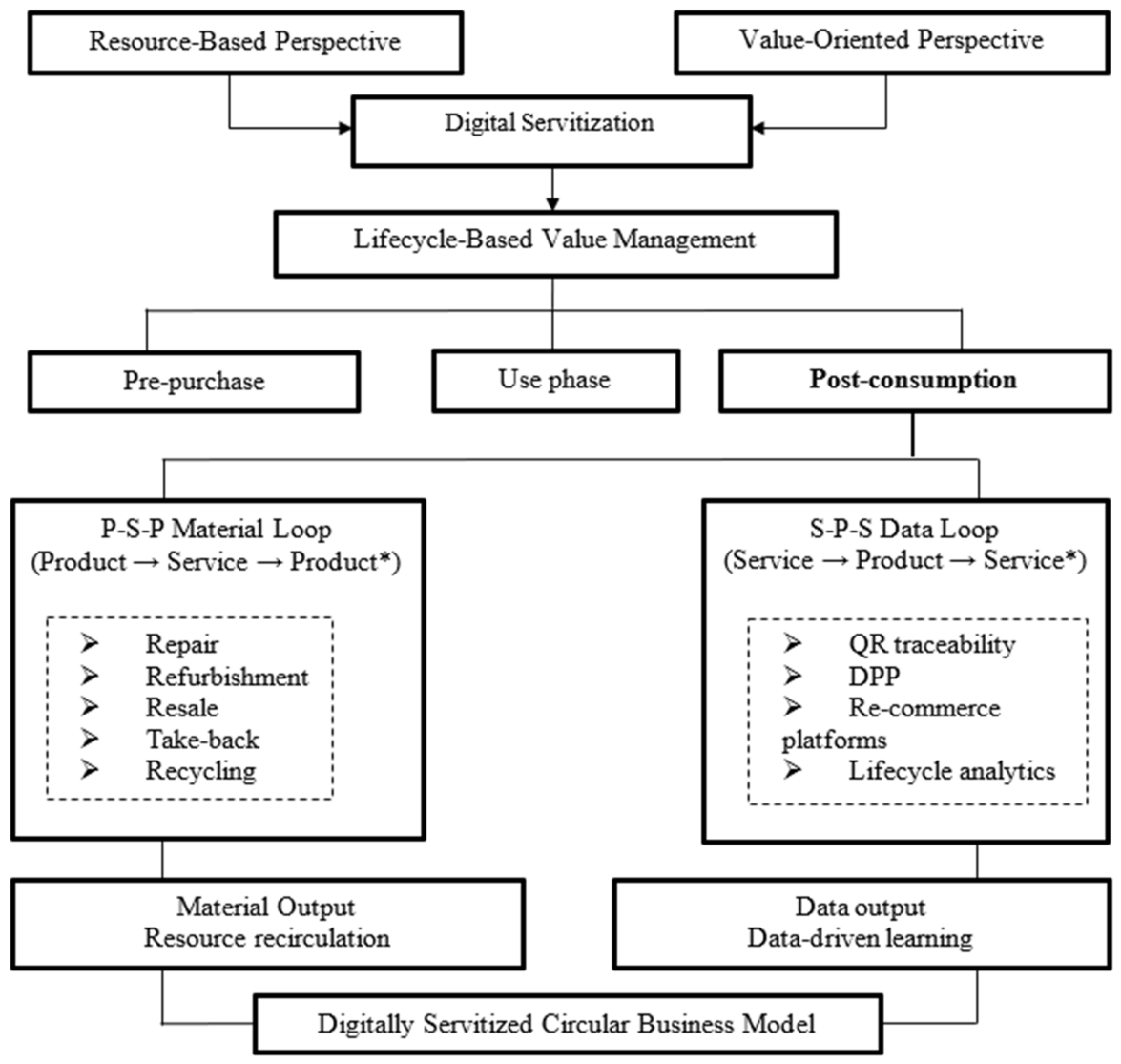
Building on resource-based and value-oriented perspectives, this study proposes an integrated analytical framework that synthesises these previously separate strands of the literature into a common analytical structure (
Figure 1).
The framework considers two complementary lifecycle mechanisms that distinguish material value recirculation from informational value creation, positioning digital servitization as the integrative mechanism linking servitization capabilities, digitalization infrastructures, and circularity objectives across the product lifecycle [
47,
48]. In doing so, it provides an analytical lens for examining how digital servitization is operationalised during the post-consumption stage of the product lifecycle. Through this lifecycle-based perspective, the framework identifies three stages of customer interaction (pre-purchase, purchase and use, and post-consumption), while distinguishing two complementary mechanisms operating during the post-consumption phase.
The first mechanism, the Product–Service–Product (P-S-P) cycle, represents the material dimension of circular value creation and is based on the assumption that products can retain economic and environmental value beyond the initial ownership transaction when supported by lifecycle-oriented services. Services such as repair, refurbishment, resale and take-back programmes extend product lifetimes, facilitate material recovery, and enable products or recovered materials to re-enter production and consumption systems, reflecting the role of product service systems and lifecycle-oriented services in supporting circular value retention [
12,
46]. Digital technologies primarily support this process through traceability, authentication, operational coordination, and product identification.
The second mechanism, the Service–Product–Service (S-P-S) cycle, represents the informational dimension of circular value creation and builds on the premise that digitally mediated service interactions transform products into sources of lifecycle knowledge that can continuously inform future product and service decisions. Through Digital Product Passports, lifecycle data systems, QR-enabled interfaces, and consumer engagement platforms, interactions between firms and users generate lifecycle information that supports product redesign, service optimisation, and organisational learning, consistent with recent perspectives on digital servitization as the data-enabled transformation of service ecosystems [
15]. Whereas the P-S-P cycle captures the circulation of material value, the S-P-S cycle captures the circulation of informational value generated through digitally mediated service interactions.
The theoretical contribution of this dual-cycle architecture lies in conceptualising the interaction between established elements of servitization, circular economy, and digitalisation through two complementary and analytically distinguishable lifecycle mechanisms. While product service systems, circular economy practices, and digital technologies have been extensively examined in previous research, these perspectives have generally been investigated as related but separate domains. The proposed framework advances existing conceptualisations of digital servitization by positioning it as an integration mechanism connecting the circulation of physical resources with the generation, exchange, and reuse of lifecycle information. The P-S-P and S-P-S cycles therefore represent two interdependent but non-equivalent dimensions of digital servitization: the former captures how services preserve and recirculate material value, whereas the latter captures how digitally mediated interactions generate informational value that supports continuous learning and service innovation.
Together, these cycles describe how physical resource flows and digital information flows become mutually reinforcing mechanisms supporting circularity, lifecycle extension, and sustainability-oriented business model innovation. Within this architecture, the P-S-P cycle emphasises the preservation of material value over time, with digital technologies serving primarily as enablers of traceability, grading, sorting, and operational coordination. The S-P-S cycle, by contrast, frames the product as a generator of continuous data streams. Services (e.g., Digital Product Passports, usage analytics, and platform-based engagement) precede and follow the physical product, shaping its design, use, and end-of-life pathways. Here, the primary value is informational rather than material: the accumulation, interpretation, and redeployment of data enhance optimisation, transparency, trust, and adaptive service design.
In particular, the framework highlights the post-consumption stage as the critical point for circular value creation within fashion companies and their service ecosystem, where consumer participation in repair, resale, and recycling activities determines whether products re-enter material and informational cycles. Hence, this study conceptualises digital servitization through a dual-cycle architecture linking material circularity and data-driven lifecycle learning. Together, these mechanisms illustrate how digital servitization enables fashion companies to transform linear value chains into data-supported circular ecosystems, where consumer engagement during the post-purchase stage becomes a central driver of circular value creation. In such a way, these complementary cycles provide an analytical framework for examining how fashion companies operationalise digital servitization during the post-consumption stage. Rather than treating circularity and digitalisation as separate developments, the framework illustrates how material lifecycle services and lifecycle information infrastructures interact to support circular value creation across the fashion ecosystem. Accordingly, the proposed framework contributes by analytically decomposing digital servitization into complementary material and informational lifecycle mechanisms and operationalising these mechanisms through observable indicators. This enables systematic empirical examination of publicly observable digital servitization configurations across organisations occupying different positions within the fashion value chain while recognising their distinct ecosystem roles.
3. Methodology
3.1. Research Design
This study adopts an exploratory qualitative, theory-informed multiple-case research design using systematic website content analysis to investigate how digital servitization is operationalised within circular fashion ecosystems. The analysis focuses on the post-consumption stage of the product lifecycle, which has increasingly been recognised as a critical phase of circular value creation because product lifetime extension and resource recovery depend on users’ engagement with digitally enabled services after purchase. The study is guided by the dual-cycle conceptual framework developed in the theoretical section, which distinguishes two complementary mechanisms through which digital servitization contributes to circular business models. The P-S-P architecture represents the material circulation of products through lifecycle extension and resource recovery, whereas the S-P-S architecture captures the digital information flows that support lifecycle management, continuous service improvement, and circular value creation.
The empirical analysis follows a deductive content analysis approach in which the proposed theoretical framework provides the coding structure for identifying observable manifestations of digital servitization. Rather than deriving categories inductively from the data, the analysis examines whether the digital service architectures conceptualised within the framework can be identified through organisations’ publicly communicated practices.
A website content analysis was selected as the primary empirical method because corporate websites, sustainability reports, and publicly accessible digital service interfaces represent the principal channels through which organisations communicate digital servitization initiatives to customers and other ecosystem stakeholders [
49]. In particular, repair services, take-back programmes, resale initiatives, Digital Product Passports, traceability systems, QR-enabled interfaces, and customer interaction platforms are typically implemented and communicated through digital environments, making official corporate websites an appropriate and transparent source for systematic cross-case comparison.
Accordingly, the study evaluates the externally communicated implementation of digital servitization architectures rather than organisations’ internal digital capabilities or overall sustainability performance. The analysis is therefore limited to lifecycle-oriented services and digital information infrastructures that are publicly observable through official corporate digital interfaces, acknowledging that some organisational practices may remain undisclosed. Consequently, the findings provide an assessment of externally observable digital servitization architectures within the scope of publicly available organisational communication.
3.2. Case Selection
The empirical sample was constructed using a population-based purposive sampling strategy. Rather than selecting individual organisations opportunistically, the study sought to include the complete population of Italian certified B Corporations operating within the fashion and textile ecosystem that met predefined inclusion criteria at the time of data collection. The official B Lab directory served as the primary sampling frame, after which each organisation was systematically screened to verify its relevance to the Italian fashion and textile value chain and the availability of sufficient publicly accessible digital information for systematic website content analysis.
To ensure analytical consistency, organisations were included only if they: (i) held active B Corp certification; (ii) operated within the Italian fashion and textile ecosystem; (iii) maintained an official corporate website accessible during the data collection period; and (iv) publicly communicated information relating to sustainability and circular economy initiatives, products, or digital services through their official digital interfaces. One organisation identified during the screening process was excluded because its website remained inaccessible throughout the data collection period, preventing reliable evidence collection. Consequently, the final analytical sample comprised fourteen organisations (see
Table 1).
The selected organisations represent multiple positions within the fashion value chain, including textile manufacturers, yarn producers, fashion brands, circular fashion innovators, sustainability consultancies, retail platforms, and industrial solution providers (see
Table 2). This heterogeneous composition reflects the multi-actor nature of circular fashion ecosystems, where value creation depends on the coordination of complementary capabilities distributed among producers, brands, intermediaries, and consumers. Accordingly, the ecosystem perspective adopted in this study recognises that circular value creation emerges through interactions among multiple actors rather than individual firms alone. Upstream organisations primarily contribute through material innovation, production expertise, industrial traceability and enabling technologies, whereas downstream firms are more likely to implement consumer-facing lifecycle services. Consequently, observable manifestations of digital servitization were expected to differ across value chain positions, particularly for indicators describing post-consumption services that require direct interaction with end users. The comparison therefore focuses on the visibility of the proposed dual-cycle architecture across ecosystem roles rather than on overall organisational capability, sustainability performance, or innovation potential. Accordingly, the assessment captures the externally observable implementation of post-consumption service architectures across different positions within the fashion value chain. For upstream organisations, the assessment primarily reflects the public visibility of customer-facing lifecycle services, while industrial digital capabilities embedded within production processes and business-to-business relationships remain beyond the analytical scope.
The empirical analysis focuses exclusively on certified Italian B Corporations, providing an exploratory assessment of how sustainability-oriented organisations operationalise externally observable digital servitization within circular fashion ecosystems. This sampling strategy supports analytical comparison among organisations with explicit sustainability commitments while defining the empirical scope of the study.
3.3. Data Collection
Data were collected through systematic website content analysis of publicly available information communicated by each organisation regarding sustainability and circular economy practices, product descriptions, lifecycle information, digital traceability systems, repair and after-sales services, take-back initiatives, resale programmes, customer support, Digital Product Passports, QR-enabled interfaces, and other digital infrastructures supporting interactions between organisations and product users. As digital servitization is primarily implemented and communicated through digital environments, official corporate websites provide an appropriate and transparent empirical source for examining externally observable circular service architectures. The analysis covered all publicly accessible webpages describing sustainability initiatives, circular economy practices, digital services, and lifecycle-related activities, including homepages, sustainability sections, product pages, customer care and repair pages, FAQs, circularity initiatives, traceability systems, Digital Product Passport platforms, and other dedicated digital service interfaces (
Table 3). Where available, sustainability reports accessible through corporate websites were also consulted to verify the consistency of publicly communicated practices and minimise the risk of overlooking relevant evidence. Internal documents, password-protected platforms, third-party databases, and unpublished materials were excluded from the analysis. Data collection was conducted in March 2026, when all fourteen organisations were examined using the same analytical procedure. The collected website evidence was subsequently reviewed in July 2026 using the same analytical procedure, and the July review established the final dataset used in the empirical analysis.
3.4. Operationalisation of Digital Servitization
To operationalise the proposed dual-cycle framework, digital servitization was translated into eight predefined indicators distributed equally across two complementary analytical architectures representing the material and informational dimensions of circular value creation. Rather than measuring organisational performance or internal digital capabilities, the indicators capture observable manifestations of digital servitization communicated through publicly accessible corporate digital interfaces.
The indicators were developed through an integrative synthesis of the literature on Product Service Systems [
46,
50], service-dominant logic [
51], circular business models [
52], digital servitization [
53], and circular economy indicators [
54]. Together, these perspectives identify recurring service capabilities through which organisations extend product lifetimes, facilitate resource recovery, generate lifecycle information, and maintain continuous interactions with users. The selected indicators therefore represent observable empirical expressions of the theoretical constructs underpinning the proposed dual-cycle framework.
Given the exclusive use of publicly available digital information, only service capabilities that could be consistently identified through corporate websites and related digital interfaces were operationalised. Accordingly, the framework evaluates how digital servitization becomes externally visible within circular fashion ecosystems rather than providing an exhaustive assessment of organisational capabilities.
The P-S-P architecture captures the material dimension of circular value creation through four indicators:
P1—repair or after-sales maintenance services supporting product lifetime extension;
P2—take-back, resale, or recycling programmes facilitating product recirculation;
P3—product identification or traceability mechanisms supporting product authentication and physical recovery within the material lifecycle;
P4—customer or user support services facilitating product lifetime extension.
The complementary S-P-S architecture captures the informational dimension of digital servitization through four indicators:
S1—Digital Product Passports or lifecycle data systems;
S2—QR-enabled digital interfaces providing lifecycle-related product information;
S3—digital user engagement platforms supporting circular lifecycle interactions;
S4—recommerce or digital marketplace integration supporting second-life markets.
Equal weighting was assigned to all eight indicators because no established theoretical or empirical evidence justifies differential weighting within the exploratory context of this research. Following the recommendations of [
55], equal weighting reduces researcher subjectivity, enhances methodological transparency, and facilitates replication across empirical contexts.
Although jointly representing digital servitization, the two architectures capture conceptually distinct yet complementary dimensions of circular value creation and were therefore operationalised using functionally differentiated coding criteria. The P-S-P architecture evaluates service mechanisms supporting the physical circulation of products, whereas the S-P-S architecture evaluates digitally enabled service mechanisms and infrastructures fostering lifecycle information exchange, user interaction, and continuous data generation.
3.5. Conceptual Boundaries Between the Analytical Architectures
The P-S-P and S-P-S architectures represent complementary but functionally distinct dimensions of digital servitization and were operationalised using functionally differentiated coding criteria. This distinction prevents conceptual overlap between material circularity mechanisms and digital information infrastructures by assigning observed evidence according to its primary analytical function. The P-S-P architecture represents the material flow of circularity and captures service mechanisms that physically extend product lifetimes or facilitate product recovery and material recirculation, including repair, maintenance, take-back, reuse, and recycling activities [
52]. The S-P-S architecture represents the information flow enabled by digital servitization and captures digital infrastructures that generate, store, communicate, or utilise lifecycle information, including Digital Product Passports, digital traceability systems, and consumer interaction platforms [
53].
Accordingly, coding was determined by the primary analytical function evidenced by the observed practice rather than by the technological artefact through which that function was delivered. A single technological artefact could therefore provide evidence relevant to more than one indicator where it performed analytically distinct functions. For example, a Digital Product Passport may provide product identification supporting physical recovery (P3) while also functioning as a lifecycle data system (S1). The indicators are therefore analytically distinct at the level of function. This distinction allows the coding to capture different functions performed by the same digital mechanism without treating the mere presence of a particular technology as sufficient evidence for every associated indicator. For example, a repair service was assigned to the P-S-P architecture because it directly supports product lifetime extension, whereas a Digital Product Passport recording repair history was assigned to the S-P-S architecture because its primary function is lifecycle information management. Likewise, a take-back programme was coded as evidence of material recirculation, whereas a digital platform documenting returned products and their subsequent lifecycle status was coded as evidence of information management.
This distinction was particularly important for P3 (product identification or traceability mechanisms) and S1 (Digital Product Passports or lifecycle data systems). Product identification or traceability mechanisms (P3) were assigned to the P-S-P architecture only when their primary purpose was to support product identification, authentication, or physical recovery within the material lifecycle. Digital Product Passports and other lifecycle data systems were assigned to S1 when their observable function was to generate, store, or communicate lifecycle information. Accordingly, coding decisions were based on the primary functional role of the observed practice rather than on the underlying technology itself. The operational boundaries applied during coding are summarised in
Table 4.
3.6. Coding Procedure
The empirical analysis followed a structured deductive coding procedure derived directly from the proposed dual-cycle framework. Prior to data collection, a coding protocol was developed specifying the operational definition of each indicator, the required website evidence, and the decision rules applied throughout the analysis. The protocol was applied consistently across all organisations to reduce interpretative bias and maximise analytical consistency and case comparability.
Coding was conducted manually through systematic examination of the official websites of the fourteen organisations included in the sample. The coding procedure comprised four sequential stages. First, all relevant website content was systematically reviewed to identify information corresponding to the operational definitions of the analytical indicators. Second, textual and visual evidence corresponding to these indicators was extracted and recorded within the coding procedure. Third, the collected evidence was assessed against the predefined coding criteria. Finally, each indicator was assigned a binary value:
A binary coding approach was adopted because the study sought to identify the observable presence of predefined digital servitization mechanisms rather than evaluate their sophistication or effectiveness. Consequently, only explicit evidence satisfying the operational definition of an indicator was coded positively. General sustainability statements, corporate commitments, or standard e-commerce functionalities (e.g., contact forms, online catalogues, or ordering systems) were not considered sufficient unless they explicitly supported the circular servitization function represented by the respective indicator. Where evidence was ambiguous or insufficient, a conservative coding value of 0 was assigned. For instance, where Digital Product Passports were identified, the S1 indicator was assigned on the basis of explicit evidence that lifecycle data were made available through a Digital Product Passport or equivalent lifecycle data system. The S2 indicator was coded separately and required explicit evidence that customers accessed lifecycle information through a dedicated customer-facing digital interface (e.g., a QR-enabled interface or comparable interactive product interface). The existence of a Digital Product Passport alone was therefore not considered sufficient to assign both indicators, thereby preserving the conceptual distinction between lifecycle data systems (S1) and customer-facing digital interfaces (S2).
Because the proposed framework evaluates digitally enabled post-consumption servitization, digital traceability, Digital Product Passports, and related technologies were coded positively only when explicit evidence demonstrated that they functioned as observable lifecycle service mechanisms consistent with the operational definition of the corresponding indicator. Technologies implemented solely for upstream manufacturing, production control, or supply chain transparency were not considered sufficient unless they also supported observable post-consumption lifecycle information exchange or customer-facing service interactions. This conservative decision rule preserved the conceptual distinction between Product–Service–Product and Service–Product–Service mechanisms while avoiding over-interpretation of publicly available website evidence.
Table 5 illustrates the coding procedure applied during the analysis.
Coding reflects the evidence identified on company websites during the final data collection period (July 2026). The coding procedure evaluates publicly communicated implementation of the predefined indicators and captures externally observable configurations of digital servitization. Because the framework focuses specifically on digitally enabled post-consumption servitization, the indicators examine observable lifecycle-oriented service mechanisms rather than the broader spectrum of sustainability or digital transformation activities undertaken by organisations.
3.7. Coding Consistency and Transparency
Several procedures were implemented to enhance the consistency, transparency, and trustworthiness of the analysis. First, all coding criteria were established before data collection through predefined operational definitions derived deductively from the theoretical framework, reducing the risk that coding decisions would be influenced by emerging empirical observations. Second, all organisations were analysed using the same coding protocol, indicator definitions, and decision rules, ensuring consistency and comparability across cases. Indicators were coded only when explicit evidence satisfying the operational definition was identified. Where evidence was ambiguous, incomplete, or insufficiently specific, a conservative coding value of 0 was assigned.
The complete coding procedure for all 14 companies, including webpage titles, coding decisions, and supporting evidence, is provided in the
Supplementary Materials to ensure methodological transparency and facilitate replication. This provides a transparent coding record linking each coding decision to the corresponding website evidence and supports consistent and evidence-based application of the coding criteria.
To further enhance consistency, the coding protocol was piloted on two organisations representing different positions within the fashion value chain. The pilot exercise informed refinement of the operational boundaries between selected indicators, particularly those distinguishing customer support from repair services and product traceability mechanisms from Digital Product Passports. The pilot analysis was not included in the final assessment and served exclusively to refine the operational boundaries before the empirical coding was undertaken.
To further assess consistency in the application of the coding protocol, the complete dataset was systematically reviewed twice by the same coder, approximately four months apart. The initial coding was conducted in March 2026, followed by a complete review in July 2026 using the established coding protocol, operational definitions, and decision rules. The coding logic remained unchanged between the two rounds, while the presentation of selected operational boundaries was further clarified to make the decision criteria more explicit. No indicators were added or removed, the binary coding principle was retained, and the predefined operational definitions and decision rules continued to govern the assignment of indicator values. Of the 112 binary indicator-level decisions, 105 remained unchanged, corresponding to 93.8% agreement. This comparison is reported as a single-coder coding consistency check and provides an additional indication of consistency in the application of the predefined coding protocol across the dataset.
The July 2026 review established the final coding dataset used in the empirical analysis. Earlier coding observations were used solely for the coding consistency assessment and were not treated as a separate empirical dataset or incorporated into the reported results. Accordingly, all indicator values, cross-case comparisons, and aggregate results presented in the manuscript refer exclusively to the final July 2026 coding dataset.
3.8. Digital Servitization Assessment
Following coding, indicator scores were aggregated separately for the two analytical architectures. Each organisation could obtain a score ranging from 0 to 4 for the P-S-P architecture and 0 to 4 for the S-P-S architecture. Because both architectures comprise four equally weighted indicators, the aggregated scores enable direct comparison between the material and informational dimensions of digital servitization. The resulting scores represent the observable implementation of predefined digital servitization mechanisms communicated through publicly available digital interfaces, providing a systematic basis for comparing externally observable service configurations across organisations. The aggregated scores were interpreted according to the extent of observable implementation identified through the coding process: 0—no observable implementation; 1—limited observable implementation; 2—emerging observable implementation; 3—established observable implementation; and 4—broad observable implementation. Higher levels of observable implementation, therefore, indicate that a greater number of theoretically defined digital servitization mechanisms were identified through official corporate digital channels. The comparative analysis subsequently examined: (i) the observable implementation of the P-S-P architecture; (ii) the observable implementation of the S-P-S architecture; and (iii) similarities and differences across organisations occupying different positions within the circular fashion ecosystem. Consequently, the analysis is interpreted as an assessment of observable digital servitization configurations rather than as an evaluation of organisations’ overall digital capabilities, sustainability performance, or organisational maturity.
4. Results
The analysis indicated substantial variation in the observable implementation of digital servitization across the fourteen organisations included in the sample. While many companies communicate sustainability-related initiatives, comparatively fewer provide explicit evidence of lifecycle-oriented service mechanisms or digitally enabled infrastructures consistent with the proposed dual-cycle analytical framework. Across the dataset, material-loop mechanisms (P-S-P) are observed more frequently than information-loop mechanisms (S-P-S), suggesting that organisations more commonly demonstrate observable implementation of practices related to product lifetime extension, recovery, and recirculation than digitally enabled lifecycle information infrastructures.
According to the indicator-based assessment, most organisations demonstrate either limited or emerging observable implementation of the proposed framework, whereas only a small number exhibit established or broad observable implementation across both analytical architectures. The observed differences coincide with organisational position, business model configuration, and the degree of direct interaction with final customers. Organisations operating closer to consumers generally have greater opportunities to implement and publicly communicate lifecycle-oriented services because repair, resale, take-back, and digital engagement mechanisms directly involve post-purchase relationships. In contrast, upstream organisations may undertake relevant circular activities within production processes, supplier relationships, or industrial infrastructures that are less visible through customer-facing digital channels. These findings indicate that observable configurations of digital servitization differ considerably across organisations and across the two complementary mechanisms proposed in this study.
4.1. Material-Loop Implementation (P-S-P Architecture)
The P-S-P architecture captures observable lifecycle-oriented service mechanisms that support product recirculation after purchase. Across the analysed organisations, these mechanisms remain unevenly distributed. Only a limited number of companies demonstrate explicit evidence of integrated services such as repair, structured take-back programmes, resale initiatives, product identification mechanisms, and customer support designed to extend product use. In contrast, several organisations communicate sustainability commitments, responsible sourcing practices, or durability-related product characteristics without providing observable evidence of service-based mechanisms supporting post-consumption circulation.
Table 6 presents the indicator-based assessment of the P-S-P architecture. Save The Duck, Rifò, and SEAY exhibit the broadest observable implementation of material-loop mechanisms, combining several lifecycle-oriented services including repair, take-back programmes, product identification, and customer-facing support. Artknit Studios and North Sails demonstrate emerging implementation through selected lifecycle services, particularly repair support and product care guidance, although evidence of integrated recovery or recirculation systems is more limited. Beyond differences between organisations, the distribution of individual indicators also reveals variation in the observable implementation of specific lifecycle service mechanisms. Repair services (P1) and customer support activities (P4) were identified more frequently than structured take-back or resale programmes (P2), while product identification mechanisms (P3) occupied an intermediate position. Although the present cross-sectional analysis does not permit conclusions regarding implementation sequences, the observable pattern indicates that services supporting product use and maintenance are more frequently implemented than comprehensive recovery and recirculation mechanisms. By contrast, several upstream organisations communicate sustainability primarily through production-related activities, including material innovation, responsible sourcing, and manufacturing improvements. While these initiatives contribute to broader sustainability objectives, they do not constitute observable post-consumption service mechanisms within the analytical boundaries of the proposed framework.
4.2. Information-Loop Implementation (S-P-S Architecture)
Compared with the P-S-P architecture, the S-P-S architecture demonstrates a lower level of observable implementation across the analysed organisations. Digital infrastructures capable of supporting lifecycle information exchange, consumer interaction, and product-related data feedback are identified only in a limited number of cases.
Table 7 summarises the distribution of S-P-S indicators across the sample. Observable implementation of Digital Product Passports, QR-enabled interfaces, consumer engagement platforms, and recommerce systems is concentrated among relatively few organisations. A similar pattern is evident across the individual information-loop indicators. Consumer engagement mechanisms (S3) were identified more frequently than Digital Product Passport capabilities (S1), customer-facing lifecycle interfaces (S2), or recommerce platforms (S4). This suggests that organisations currently communicate interactive digital engagement more often than comprehensive lifecycle information infrastructures, although the present study does not assess how these capabilities develop over time. In many cases, companies provide sustainability information through websites, reports, or product descriptions; however, these communication practices do not constitute digital servitization mechanisms within the proposed framework unless they facilitate observable lifecycle information exchange, digitally supported service interactions, or active user participation.
Therefore, the comparison between the two analytical architectures indicates that material-loop services are more frequently observable than information-loop mechanisms. Repair, recovery, and recycling initiatives were more frequently observable than digital infrastructures supporting lifecycle data generation and continuous feedback.
This pattern is consistent with an uneven implementation of the two complementary dimensions of digital servitization.
4.3. Differences Across Value Chain Positions
Observable implementation also differs according to organisational position within the fashion value chain. Consumer-facing organisations generally exhibit a higher number of observable indicators within the proposed framework, reflecting the fact that lifecycle-oriented services such as repair, take-back, resale, and digital product interaction are implemented and communicated directly through customer-facing channels and therefore become observable through website analysis.
This pattern can be interpreted through the ecosystem perspective underlying the framework. Downstream organisations occupy positions involving more direct post-purchase interaction with consumers, making lifecycle services and digital interactions more visible through customer-facing channels and forming an observable part of their customer propositions. In turn, upstream organisations contribute primarily through material transformation, production expertise, and supply chain coordination, where circular-oriented activities may exist without requiring direct post-consumption interaction with end users. Therefore, lower observable implementation among upstream actors should not be interpreted as lower circular capability, but rather as a different configuration of ecosystem participation.
By contrast, upstream organisations contribute to circularity through different types of activities, including material innovation, production efficiency, industrial processing capabilities, and supply chain transparency. Although these activities support circular transitions, they are less frequently expressed as customer-facing lifecycle services and therefore generate fewer observable indicators within the scope of the analytical framework. For example, textile manufacturers such as Linificio and Reda communicate sustainability initiatives primarily through materials, production processes, and environmental performance, whereas limited evidence of post-consumption service mechanisms was identified. Similarly, Tintoria Jacchetti contributes primarily through process-oriented activities, with limited observable evidence of direct consumer interaction. Conversely, organisations such as Save The Duck, SEAY, and Artknit Studios provide more extensive observable evidence of lifecycle-oriented services because their business models include direct interaction with consumers throughout the post-purchase stage. ACBC, in turn, represents an intermediate observable configuration, with evidence concentrated in ecosystem-level digital infrastructure and product identification rather than in consumer-facing post-consumption services.
The company demonstrates observable implementation of Digital Product Passport capabilities that primarily function as enabling digital infrastructures supporting ecosystem coordination, while observable evidence of customer-facing lifecycle service mechanisms remains comparatively limited.
4.4. Cross-Case Implementation Patterns
Comparison of the P-S-P and the S-P-S architectures reveals three broad patterns of observable implementation across the analysed organisations.
The first pattern comprises organisations demonstrating coordinated implementation of both material-loop and information-loop mechanisms. Three organisations demonstrated the strongest observable implementation across both analytical architectures. Save The Duck and Rifò demonstrated broad observable implementation across both analytical architectures, whereas SEAY demonstrated substantial implementation across both dimensions. Most of the remaining organisations demonstrated partial implementation concentrated within one or both architectures, indicating that integrated observable configurations of material and information-loop mechanisms remain comparatively uncommon across the analysed sample. Companies such as Save The Duck, Rifò, and SEAY combine repair, recovery, product identification, consumer interaction, and second-life pathways, illustrating how lifecycle-oriented services can be supported by complementary digital information infrastructures. Save The Duck provides a particularly illustrative example by integrating repair services, product identification mechanisms, and digitally enabled consumer interaction within a coherent observable lifecycle-oriented service configuration. These organisations exhibit the strongest observable alignment with the dual-cycle analytical framework.
The second pattern includes organisations where material-loop mechanisms are observable, whereas information-loop mechanisms remain considerably less observable. Artknit Studios and North Sails illustrate this configuration through observable implementation of selected lifecycle-oriented service mechanisms, including repair and product care and, in the case of North Sails, take-back and upcycling initiatives. At the same time, both organisations provide comparatively limited observable evidence of digital infrastructures supporting lifecycle information exchange and interactive consumer participation.
The third pattern consists of organisations for which only limited observable implementation of either architecture was identified. Companies such as Lampasrl, MaisonCashmere, and Dynamo Shop primarily communicate sustainability commitments, product characteristics, or social missions but provide limited evidence of observable lifecycle-oriented services or digitally enabled post-consumption interactions. For example, MaisonCashmere provides garment care guidance intended to encourage product longevity; however, no observable evidence was identified of dedicated repair programmes, take-back schemes, recommerce mechanisms, or lifecycle information infrastructures. Within the proposed framework, this configuration reflects an emphasis on durable products rather than an integrated circular servitization architecture.
These patterns are consistent with the theoretical proposition that digital servitization within circular ecosystems comprises two complementary but distinguishable dimensions. The findings indicate that material circulation and information circulation do not necessarily develop simultaneously, suggesting that organisations may adopt lifecycle-oriented services without establishing advanced digital information infrastructures, or alternatively develop digital tools without extensive material recirculation mechanisms. Moreover, the findings demonstrate that sustainability initiatives and digital servitization represent analytically distinct concepts within the proposed framework. While many organisations communicate environmental responsibility, observable digital servitization requires observable lifecycle-oriented service mechanisms, digital infrastructures supporting lifecycle information exchange, or the integration of both. Consequently, the proposed framework differentiates observable configurations of digital servitization through the interaction between material-loop and information-loop mechanisms, while treating sustainability communication as analytically distinct from observable lifecycle service implementation.
5. Discussion
The findings reveal a pronounced asymmetry in the observable implementation of digital servitization across the analysed organisations. Although sustainability commitments are widely communicated, only a limited number of companies, notably Rifo, Save The Duck, and SEAY, provide observable evidence of integrated lifecycle-oriented service architectures combining structured post-purchase services with digitally mediated consumer interaction.
The empirical patterns also suggest that observable information-loop mechanisms rarely occur in isolation. Across the analysed organisations, relatively advanced observable implementation of the S-P-S architecture was consistently accompanied by observable implementation of material-loop mechanisms, whereas several organisations demonstrated material-loop mechanisms without comparable information-loop implementation. Although the present cross-sectional design does not permit conclusions regarding implementation sequences, this pattern is consistent with the interpretation that digitally enabled lifecycle information exchange is more commonly observable where lifecycle-oriented service practices have already been established. Within the analysed cases, observable information-loop mechanisms generally co-occur with observable material-loop mechanisms, whereas material-loop mechanisms are also observed in cases where comparable information-loop implementation is not explicitly observable.
These findings illustrate the analytical usefulness of the proposed dual-cycle framework by revealing different observable configurations of material and informational mechanisms across the analysed organisations. Rather than developing uniformly, the P-S-P material loop and the S-P-S information loop exhibit uneven observable implementation, with material-loop mechanisms appearing considerably more frequently than information-loop mechanisms. This observable asymmetry supports the conceptual distinction proposed by the framework, indicating that material circulation and digitally enabled lifecycle information exchange represent complementary dimensions of digital servitization whose observable implementation is not necessarily synchronous. In this way, the framework extends existing conceptualisations of digital servitization by distinguishing two analytically separate but interdependent lifecycle mechanisms that become externally visible to different degrees across organisations. This interpretation is consistent with previous studies describing digital servitization as a gradual organisational transformation involving the progressive development of service capabilities and digital infrastructures [
23,
26]. Intermediate configurations, such as Artknit Studios and North Sails, illustrate this asymmetry by combining selected lifecycle services with limited digital integration. More broadly, several organisations implement repair, recycling, or sustainability initiatives without these activities being integrated into coherent service ecosystems combining material recirculation with digitally enabled customer engagement. Within the proposed framework, these fragmented configurations indicate that lifecycle extension services alone are insufficient to constitute digital servitization; rather, digital servitization emerges through the integration of material-loop mechanisms with digitally enabled lifecycle information exchange. Consistent with previous research, this pattern may be interpreted as an observable asymmetry between lifecycle-oriented service mechanisms and the digital infrastructures that support lifecycle information exchange [
23,
26].
The analysis also reveals systematic differences according to the organisational position within the fashion value chain. Higher observable implementation among consumer-facing organisations coincides with the greater visibility of lifecycle-oriented services through customer-facing interfaces, whereas upstream organisations are more frequently represented through enabling activities including material innovation, production expertise, and industrial traceability. This interpretation reflects ecosystem-oriented servitization perspectives, which recognise that value creation mechanisms differ according to organisations’ positions within the value chain and their relationships with end users, which shape the context for the development of interactive and data-driven service systems [
16,
61].
Across the analysed organisations, observable evidence of integrated lifecycle service systems combining material circulation with digital interaction remained comparatively limited, despite widespread communication of sustainability initiatives and repair-related activities. This finding reinforces the analytical distinction between circularity and digital servitization, as several organisations demonstrate circular practices without corresponding observable digitally enabled service architectures. The comparison between the P-S-P and S-P-S architectures further indicates that digital technologies are more frequently employed to support operational efficiency, traceability, and sustainability communication than to facilitate continuous lifecycle interaction with consumers. In many cases, digital systems are observable primarily as mechanisms for transparency and information provision rather than as interfaces supporting observable lifecycle feedback or continuous consumer interaction. This observable pattern is consistent with previous studies characterising digital servitization as extending from operational digitalisation towards more advanced customer-centred service configurations [
26]. Likewise, digitalisation frequently enhances transparency, monitoring, and internal coordination without generating interactive consumer participation or data-driven value co-creation [
22,
63,
64].
This interpretation is consistent with the view that organisations commonly implement tangible operational interventions before developing more complex data-driven capabilities, since digital servitization requires additional organisational competences, technological integration, and strategic alignment. Back Wellness Wear illustrates this distinction: although the company refers to repair within conventional warranty arrangements, these activities remain associated with conventional post-sale obligations rather than lifecycle-oriented service systems characterised by continuity, user participation, and digitally enabled interaction. Consistent with foundational servitization theory, services generate strategic value when they are embedded within integrated value propositions and relational processes instead of functioning as isolated post-sale activities [
25]. Accordingly, ecosystem-oriented servitization perspectives suggest that the development of digitally enabled service systems depends not only on organisational capabilities but also on firms’ positions within the value chain and their opportunities to engage end users through continuous service relationships [
16,
70].
By contrast, upstream organisations, including Linificio, Reda, and Tintoria Jacchetti, primarily contribute to circularity through material innovation, production capabilities, traceability, and process optimisation. Although these activities support circular value creation, they are less frequently observable as customer-facing lifecycle service configurations within the scope of the proposed analytical framework. This pattern is consistent with previous studies showing that digital technologies are often introduced to improve operational efficiency, monitoring, and traceability before supporting interactive, customer-oriented service ecosystems [
23]. Accordingly, in organisations such as Linificio and Reda, digitalisation primarily reinforces supply chain transparency and reporting functions, while consumer interaction and lifecycle data generation remain largely absent. Similarly, Miomojo employs digital channels predominantly for sustainability communication rather than continuous lifecycle engagement.
These observations are considered in relation to value co-creation perspectives, according to which digital technologies contribute to servitization when they facilitate continuous interaction between firms and users. In this context, informational or communication-oriented digital applications alone do not constitute digitally enabled service ecosystems when they do not provide mechanisms for continuous interaction between firms and users [
71,
72]. Consequently, digital servitization is more appropriately interpreted as an ecosystem-level phenomenon than solely as a firm-level capability. Effective circular service systems depend on the alignment of complementary capabilities distributed across manufacturers, technology providers, brands, and consumers, supported by collaborative innovation, intermediary actors, and cross-organisational knowledge exchange [
37,
73]. ACBC illustrates this distinction particularly well. Although the company demonstrates observable Digital Product Passport capabilities and lifecycle data infrastructures, these technologies primarily function as ecosystem-enabling mechanisms supporting information exchange across the value chain, with limited observable implementation as customer-facing lifecycle services. This example highlights the distinction between the presence of a digital technology and its observable integration into a lifecycle-oriented service architecture: Digital Product Passports facilitate ecosystem coordination but do not, by themselves, constitute integrated servitization architectures.
A similar distinction emerges when comparing MaisonCashmere, Back Wellness Wear, and Save The Duck. MaisonCashmere promotes garment care guidance and product durability, whereas Back Wellness Wear provides repair activities largely associated with conventional warranty obligations. In both cases, limited observable evidence of digitally enabled lifecycle information exchange, continuous customer interaction, or integrated post-consumption service architectures was identified. By contrast, Save The Duck combines repair, recovery, product identification, and digital interaction within a coherent lifecycle-oriented service system. These comparisons demonstrate that repair programmes, durability-oriented practices, recycled materials, or sustainability communication alone do not constitute digital servitization. Consistent with foundational servitization theory, value creation emerges when lifecycle services, digital technologies, and user participation are strategically integrated into coherent product service systems rather than implemented as isolated initiatives [
16,
25,
74].
As a result, many observed configurations remain materially oriented while lacking the informational dimension required for fully developed digital servitization architectures. This finding is consistent with research on sustainability transitions suggesting that circular practices frequently precede digital servitization, with digital capabilities subsequently introduced to strengthen, coordinate, and scale existing circular initiatives rather than initiate them [
4,
75]. Even where sustainability information is extensively communicated, digital systems often operate as static interfaces rather than as mechanisms supporting observable lifecycle feedback and continuous user interaction. Such configurations reflect the tensions identified in paradox-based analyses of digital servitization between efficiency-oriented digitalisation and the development of interactive, customer-centred service models [
76,
77].
From the perspective of the proposed analytical framework, these observations highlight the complementary roles of the two lifecycle mechanisms. The P-S-P architecture captures observable mechanisms associated with physical product circulation through repair, resale, take-back, and product recovery, whereas the S-P-S architecture captures observable mechanisms associated with lifecycle information exchange through digitally mediated interaction and information infrastructures. These two dimensions provide complementary analytical lenses for examining how material and informational mechanisms are externally observable within circular service configurations. This interpretation aligns with platform-based and data-driven servitization research, which identifies continuous user interaction as an important basis for lifecycle data generation, iterative learning, and adaptive service innovation [
78,
79]. Accordingly, the post-consumption stage represents the point at which both architectures converge: firms such as Save The Duck and SEAY demonstrate how integrated post-consumption service configurations combining repair or resale, product authentication, and digital interaction simultaneously sustain material recirculation while generating observable lifecycle information.
Importantly, the findings confirm that the presence of circular activities does not automatically imply the existence of digital servitization architectures. Although several organisations implement repair, recycling, or material recovery initiatives, these practices frequently lack the digitally mediated, user-integrated, and continuously managed service structures required for fully developed servitization architectures [
80]. Consequently, the predominance of material-loop mechanisms indicates that circular service systems within the analysed sample are characterised primarily by repair, recovery, and product lifetime extension, while integrated lifecycle information infrastructures supporting continuous feedback are comparatively less observable. This imbalance also highlights the distinction between sustainability communication and digital servitization. Despite the extensive communication of sustainability commitments through websites and reports, comparatively few organisations provide observable evidence of digitally enabled mechanisms supporting continuous customer interaction throughout the product lifecycle. Accordingly, digital channels primarily function as communication and transparency tools, while observable infrastructures supporting lifecycle management, service co-creation, and feedback generation remain comparatively uncommon.
Hence, these observations reinforce the analytical distinction between circularity and digital servitization proposed by the framework. Circular practices contribute to material recirculation, whereas digital servitization emerges through the integration of lifecycle-oriented services, digital infrastructures, and continuous user participation within coherent service architectures. By distinguishing complementary material-loop and information-loop mechanisms, the proposed framework enables systematic identification of different observable configurations of digital servitization across organisations occupying different positions within the fashion value chain.
From a managerial perspective, the findings indicate the importance, within the proposed framework, of considering repair programmes, take-back schemes, and digital technologies as interconnected components of lifecycle-oriented service architectures rather than as isolated observable initiatives. The proposed framework offers organisations a structured analytical approach for examining the observable configuration of digital servitization across complementary material and informational dimensions. By distinguishing between material-loop and information-loop mechanisms, the framework enables managers to identify which lifecycle-oriented services and digital infrastructures are publicly observable, where observable gaps exist between physical lifecycle services and digitally enabled information exchange, and how these mechanisms relate within an integrated circular service architecture. The findings further indicate that the observable configuration of circular service mechanisms differs according to organisations’ positions within the ecosystem. For consumer-facing organisations, this involves connecting repair, resale, authentication, and take-back services with digital interfaces supporting customer interaction. For upstream organisations, ecosystem integration can involve linking traceability systems and Digital Product Passport capabilities with downstream lifecycle services through collaboration across the value chain. From an implementation perspective, the findings suggest differentiated priorities across ecosystem actors. Fashion brands and consumer-facing organisations should prioritise the development of integrated lifecycle service portfolios by connecting repair, resale, and take-back programmes with digital interfaces that facilitate customer participation and lifecycle information exchange. Manufacturers and suppliers should strengthen traceability and lifecycle data infrastructures that can be shared with downstream partners, enabling greater transparency, and coordination across the value chain. Ecosystem intermediaries and digital platforms can support this transition by facilitating data exchange, interoperability, and collaboration among producers, brands, and consumers. These actions can help transform isolated circular initiatives into more integrated digital servitization architectures and provide potential pathways for strengthening the integration between material-loop and information-loop mechanisms. Hence, the framework supports systematic assessment of observable digital servitization configurations and informs strategic decisions concerning the integration of complementary material and informational mechanisms.
Such integration facilitates more coherent circular service ecosystems in which material and informational value creation reinforce one another throughout the product lifecycle. Therefore, distinguishing these two dimensions, the proposed framework provides an analytical lens for examining how observable configurations of lifecycle-oriented services and digitally enabled information exchange differ across organisations and positions within the fashion value chain. Consequently, from a theoretical perspective, the proposed framework extends existing conceptualisations of digital servitization by distinguishing material and informational mechanisms whose observable implementation is not necessarily synchronous. Thus, the findings support the interpretation of digital servitization as an ecosystem phenomenon emerging through the interaction of complementary material and informational lifecycle mechanisms rather than as a single organisational capability. By demonstrating that these mechanisms exhibit different observable configurations across organisations occupying different positions within the fashion value chain, the findings further highlight the importance of considering digital servitization beyond firm-level capability perspectives. In such a way, it provides an analytical decomposition of digital servitization into complementary material and informational lifecycle mechanisms that enables systematic empirical examination of observable post-consumption configurations across different ecosystem actors.
6. Conclusions
This study examined how digital servitization is operationalised within the fashion ecosystem to support circular value creation, addressing the need for a more integrated understanding of how material lifecycle extension and digitally enabled information exchange jointly contribute to circularity during the post-consumption stage. The findings suggest that observable digital servitization is represented through two complementary mechanisms captured by the proposed P-S-P and S-P-S architectures. Across the analysed organisations, observable implementation of material-loop mechanisms was more common than information-loop mechanisms supporting lifecycle information exchange. This indicates that observable implementation is more frequently centred on repair, recovery, and product lifetime extension services than on digitally enabled lifecycle information infrastructures. The results therefore suggest that the observable configuration of digitally enabled circular service systems remains uneven, with material and informational service architectures showing different levels of implementation.
The analysis also revealed systematic differences in the observable implementation of digital servitization across organisations occupying different positions within the fashion value chain. These differences are interpreted as reflecting the distinct observable roles of different actor groups within the value chain rather than differences in their overall contribution to circularity. Consumer-facing organisations generally demonstrated higher levels of observable implementation within the proposed framework because lifecycle-oriented services, including repair, take-back, resale, and digitally enabled customer interaction, are primarily delivered and communicated at the customer interface, where they become externally visible through digital channels. By contrast, upstream manufacturers, suppliers, and enabling organisations contribute to circular value creation mainly through material innovation, production capabilities, industrial traceability, and ecosystem-supporting digital technologies. Although these activities provide important foundations for circularity, they are less likely to appear as customer-facing lifecycle services and are therefore only partially captured by indicators designed to assess observable post-consumption service architectures. Accordingly, the proposed framework identifies where digital servitization becomes externally observable across the fashion value chain without assessing the overall circular performance of different actor types.
From a theoretical perspective, the study contributes by proposing and empirically applying a dual-cycle analytical framework that distinguishes between material service architectures (P-S-P) and information service architectures (S-P-S) within digitally enabled circular business models. Instead of treating circularity, digitalisation, and servitization as interchangeable concepts, the framework conceptualises observable circular servitization as the interaction between physical product circulation mechanisms and digitally enabled lifecycle information exchange. The findings further demonstrate the value of examining the post-consumption stage as the point at which material recirculation, consumer participation, and lifecycle information converge. By enabling consistent analysis across organisations occupying different positions within the fashion value chain, the framework also contributes to digital servitization research by supporting ecosystem-level interpretation of observable service configurations.
The study also provides practical implications for organisations implementing digital servitization within circular fashion ecosystems. By distinguishing between complementary material-loop and information-loop mechanisms, the proposed framework supports systematic assessment of observable digital servitization configurations and helps identify the extent to which lifecycle-oriented services and digitally enabled information exchange are integrated within publicly observable service architectures. In doing so, it provides a structured basis for evaluating digital servitization practices across different positions within the fashion value chain and for identifying opportunities to strengthen the coherence of circular service ecosystems.
Several limitations define the scope of the present findings. First, the analysis relied exclusively on publicly available information communicated through company websites. Consequently, the findings reflect externally observable digital servitization mechanisms rather than the complete range of organisational practices, and some internally implemented initiatives may not have been publicly communicated during the period of data collection. Second, the study employed a qualitative multiple-case design involving fourteen Italian B Corps operating across different positions within the fashion value chain. Although this sampling strategy enabled analytical comparison across different actor types, the findings should not be interpreted as statistically representative of the wider fashion industry. Third, the proposed framework applies binary indicators to identify the observable presence of predefined digital servitization mechanisms. This approach increases transparency and comparability but does not assess the sophistication, effectiveness, or organisational performance associated with individual practices. Accordingly, the findings should be interpreted as an exploratory assessment of observable digital servitization architectures rather than as a comprehensive evaluation of firms’ overall circular capabilities.
These limitations identify several directions for future research. Interview-based and mixed-method research comparing publicly communicated practices with internally implemented digital servitization strategies would provide deeper insight into organisational decision-making, implementation processes, and ecosystem collaboration. Longitudinal studies examining the evolution of material-loop and information-loop architectures would contribute to understanding how observable configurations of digital servitization change over time, particularly in response to emerging regulatory initiatives such as Digital Product Passports. Comparative studies across countries and institutional contexts would extend understanding of how regulatory environments, market conditions, and ecosystem structures influence observable implementation patterns. Further empirical research involving larger international samples would enable refinement and quantitative validation of the proposed analytical framework through survey-based approaches and statistical techniques such as Structural Equation Modelling, while also examining relationships between observable digital servitization configurations and organisational outcomes, including customer engagement, circular business model innovation, and sustainability performance.
Therefore, the study demonstrates that observable digital servitization within circular fashion ecosystems is characterised by the interaction of complementary material and informational mechanisms rather than by digital technologies or sustainability initiatives considered in isolation. By distinguishing observable lifecycle-oriented service mechanisms from digitally enabled lifecycle information infrastructures, the proposed dual-cycle framework provides a structured basis for analysing different observable configurations, ranging from isolated circular service mechanisms to more integrated combinations of material-loop and information-loop mechanisms. More broadly, the framework shifts attention from digitalisation as a technological implementation issue towards digital servitization as an ecosystem-level process in which material circulation, information exchange, and stakeholder interaction represent complementary dimensions of circular service configurations.