1. Introduction
Saudi Arabia is experiencing rapid urbanisation and substantial growth in urban infrastructure, accompanied by increasing demands for energy, water, and other natural resources [
1,
2,
3]. These pressures are particularly significant in the country’s hot-arid climatic context, where water scarcity, high cooling-energy demand, and increasing urban consumption present important challenges for long-term resource security and sustainable urban development. Addressing these challenges has become a key priority within Saudi Vision 2030, which emphasises environmental sustainability, resource efficiency, technological innovation, and the development of more sustainable and resilient cities [
4]. Against this background, the integration of smart urban technologies offers an important opportunity to improve the monitoring, management, and efficient use of urban resources.
More broadly, rapid urbanisation is one of the defining trends of the twenty-first century, placing increasing pressure on urban infrastructure, natural resources, and environmental systems. Cities account for a substantial proportion of global energy consumption, water use, and waste generation, intensifying concerns about sustainability and long-term resource security [
5,
6,
7]. In response, the smart-city paradigm has emerged as a strategic approach that uses digital technologies, data-driven decision-making, and integrated infrastructure to improve urban management and sustainability outcomes [
8,
9,
10]. However, the implementation and effectiveness of smart-city approaches vary considerably across contexts. In rapidly developing urban environments such as Saudi Arabia, the challenge extends beyond technological adoption to the integration of smart energy, water, and waste systems with effective governance and resource-efficiency strategies. This provides an important context for examining how integrated smart urban systems are associated with resource-efficiency outcomes.
Saudi Arabia is undergoing a profound urban transformation driven by population growth, economic diversification, and large-scale development initiatives. Urban centres such as Riyadh, Jeddah, and Dammam are expanding rapidly, resulting in increased demand for energy, water, and waste management services [
2,
3]. This growth is further compounded by the country’s arid climate, limited freshwater resources, and high dependence on energy-intensive desalination processes, which collectively heighten the urgency for efficient resource management [
11,
12,
13]. Consequently, improving resource efficiency has become a central priority within national development strategies, particularly under Saudi Vision 2030, which emphasises sustainable urban development, environmental stewardship, and technological innovation.
In response to these challenges, smart urban systems encompassing smart energy, smart water, and smart waste management have been increasingly promoted as key enablers of resource efficiency [
12,
14]. Smart energy systems, for instance, utilise advanced metering infrastructure, real-time monitoring, and grid optimisation technologies to reduce energy losses and enhance efficiency. Similarly, smart water systems employ digital sensors and data analytics to improve water distribution, detect leakages, and optimise consumption. Smart waste systems, on the other hand, leverage automation and tracking technologies to enhance waste collection, recycling, and disposal processes. Collectively, these systems have the potential to transform urban resource management by enabling more efficient, responsive, and sustainable operations [
1,
11,
12].
Despite these advancements, the existing literature has often examined smart urban subsystems such as energy, water, and waste through relatively distinct analytical perspectives, which may limit understanding of their combined implications for resource efficiency [
15,
16,
17]. Although studies have demonstrated the benefits of individual smart systems, comparatively less attention has been given to the interrelationships and potential synergies among these domains within an integrated analytical framework. For instance, smart energy management may contribute to water efficiency by reducing the energy requirements associated with water treatment and distribution, while advanced waste-management systems can support resource recovery and energy generation. These interdependencies suggest the value of examining smart urban systems as interconnected components rather than exclusively as separate domains.
A further area requiring greater empirical attention concerns governance efficiency as an enabling mechanism within smart urban development. Existing research recognises the importance of institutional coordination, policy frameworks, regulatory capacity, and effective decision-making in supporting smart-city implementation [
16,
18,
19,
20]. However, the extent to which governance efficiency may influence the relationship between integrated smart urban systems and resource-efficiency outcomes has received comparatively less empirical examination, particularly within the Saudi Arabian context. Accordingly, examining governance efficiency as a potential mediating mechanism may provide additional insight into how technological systems are translated into perceived resource-efficiency outcomes.
The literature also indicates growing interest in connecting circular-economy principles with smart urban development. Circular Economy approaches emphasise resource conservation, reuse, recovery, and the reduction of waste, thereby complementing the resource-efficiency objectives of smart cities [
21,
22]. Nevertheless, empirical understanding of how circular resource use interacts with integrated smart urban systems and contributes to resource-efficiency outcomes remains developing, particularly in emerging and rapidly urbanising contexts. This study therefore responds to these areas of limited empirical integration by examining the relationships among smart energy, smart water, smart waste, governance efficiency, circular resource use, and perceived resource efficiency in selected Saudi Arabian cities.
Against this backdrop, this study seeks to address these gaps by developing and testing an integrated empirical model to examine the relationships among smart urban systems, governance efficiency, and resource efficiency in Saudi Arabia. Specifically, the study conceptualises smart energy, smart water, and smart waste systems as components of a higher-order construct, integrated smart urban systems and investigates their collective impact on resource efficiency. In addition, governance efficiency is introduced as a mediating variable to assess its role in enhancing the effectiveness of these systems. The study also explores the contribution of circular resource use as a complementary mechanism for improving sustainability outcomes.
The primary aim of this research is to examine how integrated smart urban systems influence resource efficiency in Saudi Arabia, with a particular focus on the mediating role of governance efficiency. To achieve this aim, the study pursues several key objectives:
- (i)
Evaluating the individual contributions of smart energy, water, and waste systems to integrated smart urban systems;
- (ii)
Assessing the direct impact of integrated smart urban systems on resource efficiency and Circular Resource Use;
- (iii)
Analysing the influence of governance efficiency on resource efficiency outcomes and Circular Resource Use;
- (iv)
Testing the mediating role of governance efficiency in the relationship between smart urban systems and resource efficiency and Circular Resource Use.
These objectives are operationalised through a set of research questions and hypotheses designed to capture both direct and indirect relationships among the constructs. The central research questions guiding this study are as follows:
- (i)
How do smart energy, water, and waste systems contribute to integrated smart urban systems?
- (ii)
What is the impact of these integrated systems on resource efficiency and Circular Resource Use?
- (iii)
To what extent does governance efficiency influence resource efficiency outcomes and Circular Resource Use? and;
- (iv)
Does governance efficiency mediate the relationship between smart urban systems, resource efficiency and Circular Resource Use?
Correspondingly, the study formulates a series of hypotheses that test the positive effects of smart subsystems on integrated systems, the impact of integrated systems on resource efficiency, and the mediating role of governance efficiency.
The significance of this study is twofold. From a theoretical perspective, it advances smart city research by developing a unified framework that integrates multiple smart urban systems and incorporates governance as a mediating variable. This approach moves beyond fragmented analyses and provides a more comprehensive understanding of how technological and institutional factors interact to influence urban sustainability outcomes. By bridging the gap between smart city theory and the circular economy, the study also enriches the conceptual foundations of sustainable urban development.
In particular, the study highlights the importance of adopting an integrated approach to smart urban systems, emphasising the need for coordination across energy, water, and waste sectors. It also underscores the critical role of governance efficiency in maximising the benefits of smart technologies, suggesting that investments in institutional capacity and policy frameworks are as important as technological advancements. These insights are directly aligned with the objectives of Saudi Vision 2030, which seeks to promote sustainable urban development and resource efficiency through innovation and strategic planning.
3. Theoretical Framework
This study is grounded in an integrated theoretical framework that combines insights from Smart City Theory and Systems Theory. Smart city theory provides the conceptual basis for understanding how digital technologies and smart infrastructure contribute to urban sustainability [
9,
39,
40]. It emphasises the role of interconnected systems, data-driven decision-making, and innovation in enhancing urban performance. However, while smart city theory highlights the importance of technology, it often underestimates the complexity of interactions between different urban subsystems. Systems theory addresses this limitation by offering a holistic perspective on urban environments as complex, interconnected systems.
According to systems theory, changes in one component of a system can have cascading effects on other components, highlighting the importance of integration and coordination [
41,
42]. In the context of this study, systems theory supports the conceptualisation of smart energy, water, and waste systems as interdependent components of a larger urban system. By integrating these two theoretical perspectives, this study develops a comprehensive conceptual model that captures the relationships between smart urban systems, governance efficiency, and resource efficiency. The model conceptualises smart energy, water, and waste systems as first-order constructs that collectively form a second-order construct, integrated smart urban systems. Governance efficiency is positioned as a mediating variable, reflecting its role in enhancing the effectiveness of these systems.
The development of this conceptual model represents a significant advancement in the literature by moving beyond fragmented analyses and providing a unified framework for understanding urban sustainability. It also enables the empirical testing of complex relationships using Structural Equation Modelling, thereby contributing to both theoretical and methodological development in smart city research. Thus, the literature review highlights the importance of integrating technological, institutional, and sustainability dimensions in the study of smart urban systems. By synthesising insights from smart city theory and systems theory, the study establishes a robust theoretical foundation for examining how smart energy, smart water, and smart waste systems collectively contribute to integrated smart urban systems, while explicitly incorporating Governance Efficiency (GE) and Resource Efficiency (RE) as interconnected components.
3.1. Hypotheses Development
Building on the preceding literature and the integrated theoretical foundation, this study develops hypotheses capturing the direct, indirect, and complementary relationships among smart urban systems, governance efficiency, circular resource use, and resource efficiency. The hypotheses are grounded in Smart City and Systems Theory, which collectively emphasise the interdependence of technological, institutional, and sustainability dimensions in urban environments. Smart urban systems, comprising smart energy, smart water, and smart waste subsystems, are widely recognised as key drivers of resource efficiency in contemporary cities. These systems leverage digital technologies, real-time data, and automation to optimise resource consumption, reduce inefficiencies, and enhance service delivery [
9,
10]. For instance, smart energy systems improve energy distribution and reduce transmission losses, while smart water systems minimise leakages and enhance conservation [
1,
26]. Similarly, smart waste systems facilitate efficient waste collection and recycling, thereby reducing environmental impacts.
From a systems perspective, integrating these subsystems into a unified framework, known as integrated smart urban systems, enables synergistic interactions that further enhance resource efficiency. This aligns with systems theory, which posits that the performance of a system is greater than the sum of its individual components [
41]. Empirical studies have also demonstrated that cities adopting integrated smart infrastructure tend to achieve higher levels of efficiency and sustainability [
5,
17,
20]. Based on this reasoning, the following hypothesis is proposed:
Hypothesis H1. Integrated smart urban systems have a significant positive effect on resource efficiency.
While smart technologies provide the infrastructure to improve resource efficiency, their effectiveness largely depends on governance structures that enable coordination, regulation, and implementation. Governance efficiency encompasses institutional capacity, policy alignment, regulatory effectiveness, and stakeholder collaboration, all of which are critical for the successful deployment of smart urban systems [
16,
18,
19]. In the context of smart cities, governance plays a dual role. First, it serves as an enabler, facilitating the integration and operation of smart systems. Second, it functions as a mediating mechanism that enhances the impact of these systems on resource efficiency. For example, effective governance ensures that smart technologies are properly implemented, maintained, and aligned with sustainability objectives, thereby maximising their benefits.
Despite its importance, the mediating role of governance efficiency has been largely overlooked in empirical research. Most studies focus on the direct relationship between smart technologies and urban outcomes, without considering the institutional context within which these technologies operate. This study addresses this gap by explicitly modelling governance efficiency as a mediator. Accordingly, the following hypotheses are formulated:
Hypothesis H2. Integrated smart urban systems have a significant positive effect on governance efficiency and Circular Resource Use.
Hypothesis H3. Governance efficiency has a significant positive effect on resource efficiency and Circular Resource Use.
Hypothesis H4. Governance efficiency mediates the relationship between integrated smart urban systems and resource efficiency and Circular Resource Use.
3.2. Summary of Hypotheses
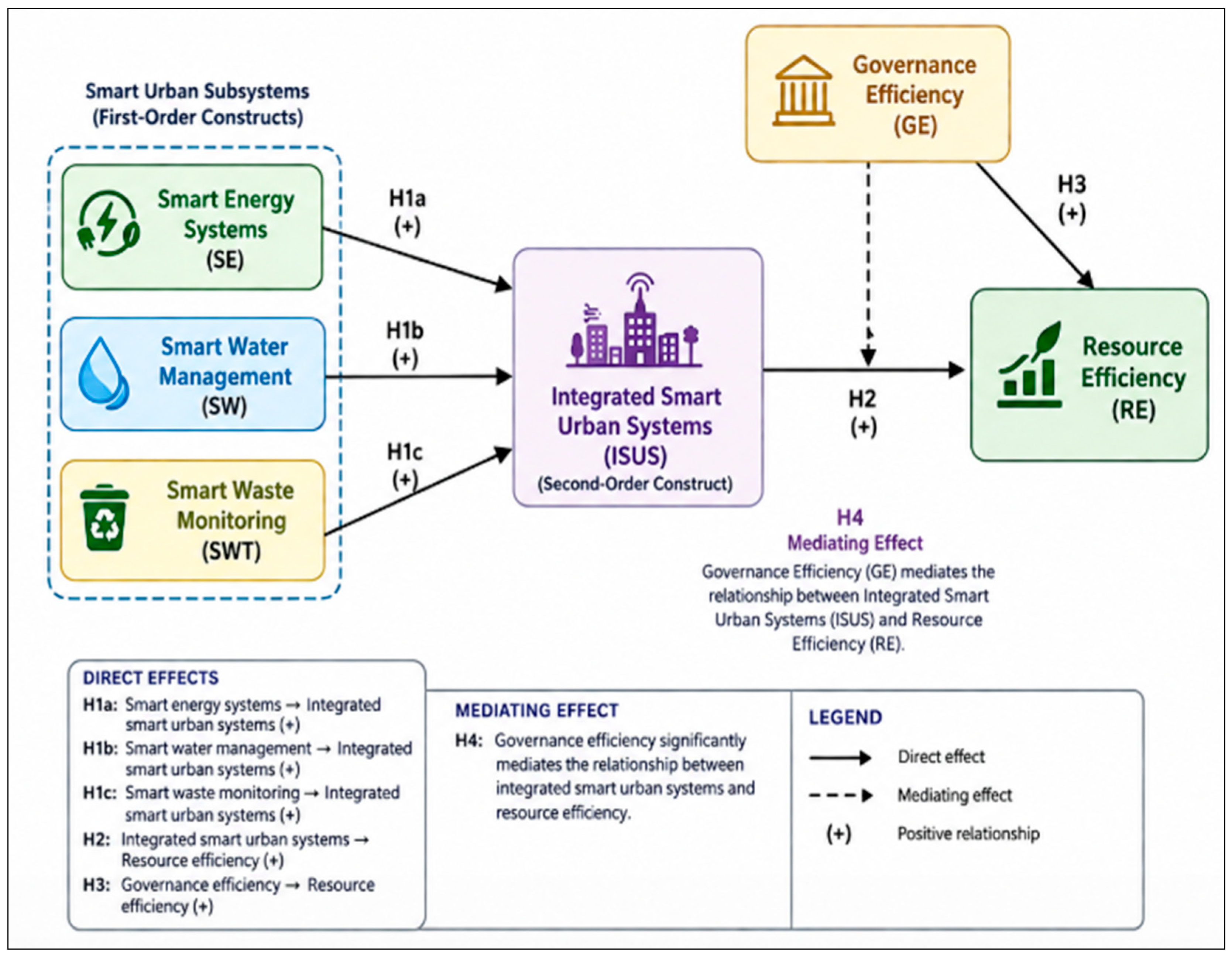
This study develops an integrated conceptual framework to examine the interrelationships between smart urban subsystems, governance efficiency, and resource efficiency. At its core, the model positions smart energy systems, smart water management, and smart waste monitoring as first-order constructs that collectively form Integrated Smart Urban Systems (ISUS) as a higher-order construct. The framework proposes that each of these subsystems contributes positively to ISUS through direct effects (H1a–H1c), reflecting their individual roles in enhancing urban system integration. Beyond these foundational relationships, the model further hypothesises that ISUS exerts a significant positive influence on overall resource efficiency (H2), highlighting the importance of system integration in achieving sustainability outcomes. In addition, governance efficiency is introduced as a key mediating construct, through which ISUS is expected to indirectly enhance resource efficiency (H3). This mediation pathway emphasises the enabling role of effective governance in translating integrated smart urban system performance into tangible resource efficiency gains. H4 represents its mediating role between ISUS and resource efficiency.
Together, these hypotheses form a coherent and interrelated structure that captures direct, indirect, and systemic relationships within smart urban environments (
Figure 1). The full model is empirically tested using Structural Equation Modelling (SEM), allowing for simultaneous examination of the proposed pathways and providing a robust analytical framework for understanding how integrated smart urban systems contribute to sustainable urban resource management.
4. Methodology
4.1. Brief Description of the Study Area
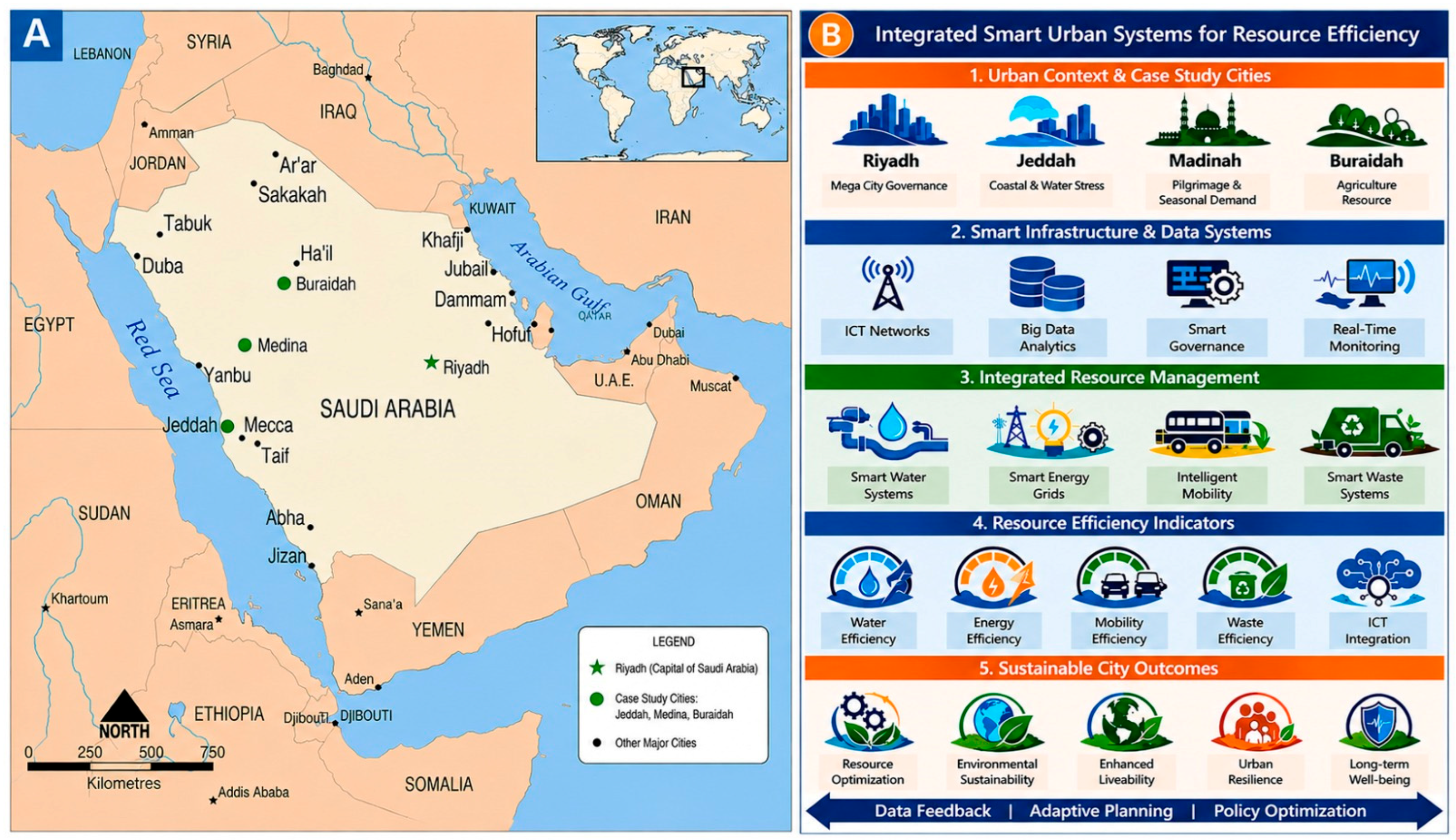
This research focuses on four major urban centres in the Kingdom of Saudi Arabia: Jeddah, Buraydah, Madinah, and Riyadh (
Figure 2). The selected cities represent diverse urban typologies, governance contexts, and resource efficiency challenges within the national smart city transformation agenda. Together, these cities provide a multi-scalar framework for examining how integrated smart urban systems can advance resource efficiency across coastal, inland, religious, agricultural, and capital-city contexts aligned with Saudi Arabia’s Vision 2030 development strategy [
43,
44,
45].
4.1.1. Jeddah
Jeddah is the second-largest city in Saudi Arabia and the principal commercial gateway to the holy cities of Makkah and Madinah. Located along the Red Sea coast, it functions as a major logistics, tourism, and economic hub, with a population exceeding four million residents. Its strategic coastal location positions it as a critical node for international trade and pilgrimage-related mobility systems [
46,
47]. However, Jeddah’s rapid urban expansion has generated significant environmental and infrastructural pressures, particularly in relation to flooding risk, water scarcity, and high energy consumption. The city is prone to flash floods due to its low elevation and inadequate stormwater infrastructure, making water-sensitive urban planning and drainage optimisation key priorities [
48]. In response, ongoing urban transformation initiatives under Vision 2030 emphasise smart mobility systems, coastal redevelopment, and integrated urban monitoring technologies aimed at improving resilience and resource efficiency. Consequently, Jeddah represents a critical case for examining smart urban systems in a climate-vulnerable coastal megacity context where environmental risks intersect with high urban growth and seasonal population fluctuations.
4.1.2. Buraydah
Buraydah, the capital of the Al-Qassim Region, is a medium-sized inland city characterised by its strong agricultural economy and role as a regional food distribution centre. Unlike the metropolitan structures of Jeddah and Riyadh, Buraydah exhibits a more decentralised, horizontally expanding urban form shaped by surrounding agricultural land uses [
49]. The city is particularly known for its date production and agricultural markets, making it a strategic location for studying the water–energy–food nexus in arid environments. Given its semi-arid climate, water scarcity and irrigation efficiency remain key challenges for sustainable urban and agricultural development. This has led to increasing interest in precision agriculture, sensor-based irrigation systems, and decentralised renewable energy applications to improve resource efficiency [
50]. Although digital infrastructure development is less advanced compared to Saudi Arabia’s major metropolitan centres, Buraydah provides a valuable case for understanding how smart systems can be adapted to secondary cities with strong agricultural dependencies and emerging digital capacity [
51].
4.1.3. Madinah
Madinah (Al-Madinah Al-Munawara) is one of the holiest cities in Islam and a major global destination for religious tourism. It experiences extreme seasonal population fluctuations due to Hajj and Umrah pilgrimages, placing substantial pressure on urban services, transportation systems, water supply, and energy infrastructure [
52,
53]. Urban management in Madinah is therefore highly dynamic, requiring scalable systems capable of responding to sudden increases in population density. This has led to the adoption of intelligent crowd management systems, real-time transport optimisation, and digital infrastructure for pilgrim flow monitoring. Additionally, climate-related challenges such as high temperatures and water scarcity necessitate advanced cooling strategies and efficient resource distribution systems [
6]. At the same time, Madinah presents unique constraints related to cultural and religious heritage preservation, requiring that modern infrastructure and smart technologies be integrated sensitively within historically significant urban landscapes. As such, Madinah provides a distinctive case for studying smart urban systems in a heritage-sensitive, high-demand tourism city with extreme temporal variability in population load.
4.1.4. Riyadh
Riyadh, the capital and largest city of Saudi Arabia, is the administrative, financial, and technological centre of national development. With a population exceeding seven million residents, Riyadh is undergoing rapid transformation under the Saudi Vision 2030 framework, which positions the city as a global model for smart urban development [
4]. The city is characterised by high levels of urban sprawl, private car dependency, and increasing demand for energy and water resources. These conditions present significant challenges for resource efficiency, particularly in transportation systems, land use planning, and environmental sustainability [
54]. In response, Riyadh has launched several large-scale smart city initiatives, including intelligent traffic management systems, digital governance platforms, and the development of the Riyadh Metro as part of an integrated public transport strategy. Furthermore, the city is investing in smart energy grids, green infrastructure, and data-driven urban planning systems aimed at improving efficiency and sustainability outcomes. Riyadh, therefore, represents a high-capacity smart city laboratory for testing scalable integrated urban systems in a rapidly growing mega-city context.
4.1.5. Justifications and Comparative Significance of Study Areas
Collectively, the four cities, Jeddah, Buraydah, Madinah, and Riyadh, represent a strategically selected urban system reflecting the spatial, economic, and functional diversity of Saudi Arabia. Riyadh serves as the national innovation and governance hub; Jeddah represents a coastal global gateway exposed to environmental vulnerabilities; Madinah reflects a high-pressure religious tourism city with heritage constraints; and Buraydah represents a resource-dependent agricultural city with emerging smart infrastructure potential. This diversity enables a comprehensive evaluation of how integrated smart urban systems can improve resource efficiency across different urban typologies, climatic conditions, and socio-economic structures. The comparative framework strengthens the analytical robustness of the study by allowing cross-case synthesis of smart urban system performance under varying contextual conditions. The four cities collectively represent a structured comparative framework for evaluating smart urban systems across five resource efficiency domains as summarised in
Table 2.
4.2. Research Design
This study adopts a quantitative method design to investigate the relationships between integrated smart urban systems, governance efficiency, and resource efficiency in Saudi Arabia. The quantitative phase constitutes the core of the analysis, employing Structural Equation Modelling (SEM) to test hypothesised relationships. This enables assessment of both direct and indirect relationships, making it appropriate for testing mediation effects and higher-order constructs in smart city research [
55,
56,
57]. Thus, this study follows a theory-driven approach grounded in smart city and systems theory, ensuring that the empirical model aligns with established conceptual frameworks [
5,
9,
14].
4.3. Sampling and Data Collection
Data were collected using a structured questionnaire from stakeholders in the four selected study cities in Saudi Arabia: Riyadh, Jeddah, Madinah, and Buraydah. A stratified sampling technique was employed to ensure that the principal professional groups relevant to smart urban development and resource management were adequately represented. The sampling frame comprised professionals and stakeholders identified through relevant governmental institutions, municipal and urban-planning organisations, infrastructure and utility agencies, universities and research institutions, and private-sector organisations involved in urban development and smart-city initiatives.
The population was divided into five predefined strata according to respondents’ professional roles: (i) policymakers and government officials, (ii) urban planners and architects, (iii) infrastructure and utility managers, (iv) academics and researchers, and (v) private-sector urban-development professionals. These strata were established before questionnaire administration to ensure that participants were selected according to their professional relevance rather than through general convenience sampling.
Within each stratum, participants were selected from the identified sampling frame based on predefined eligibility criteria: respondents had to be 18 years or older, have professional involvement or relevant experience in urban planning, infrastructure, policymaking, academia, or private-sector urban development, and possess knowledge of smart urban systems or resource-management practices. Questionnaires were administered only to eligible individuals identified within the respective strata. This procedure ensured that the sample incorporated diverse professional perspectives while maintaining a clear relationship between the sampling frame, strata, and participant-selection process. Stratification was considered appropriate because it improves subgroup representation and reduces the risk that the findings would be dominated by a single professional category [
58].
The determination of the sample size was guided by Cochran’s sample size formula, which is widely used for large populations
where the exact population size is unknown or very large [
59]. The formula provides a statistically reliable minimum sample size for achieving acceptable precision and confidence levels in survey-based research.
The Cochran formula is expressed as:
where
For this study, the following assumptions were adopted:
The value of p = 0.5 was selected because it provides the maximum variability and produces the most conservative sample size estimate where the actual population proportion is unknown.
Substituting these values into Cochran’s formula gives:
Thus, the initial approximate Cochran sample estimate of 384 was considered statistically adequate for the study. To ensure geographical representation, the sample distribution reflected the relative urban scale and institutional concentration of the selected cities. Riyadh and Jeddah, being the largest metropolitan centres with more advanced smart city initiatives and higher concentrations of urban institutions, accounted for a larger proportion of respondents. Madinah and Buraydah contributed smaller but proportionally adequate samples due to their comparatively smaller urban and institutional sizes. The final distribution included approximately: (i) Riyadh–121 respondents; (ii) Jeddah–105 respondents; (iii) Madinah–86 respondents; and (iv) Buraydah–72 respondents, giving a total of 384 valid respondents.
Within each city, respondents were further distributed across stakeholder categories to ensure balanced sectoral representation. For example, urban planners and policymakers were primarily selected from municipal authorities and planning agencies; infrastructure managers were drawn from utility and transport agencies; academics/researchers were selected from universities and research institutions; while private-sector professionals were recruited from consultancy firms, technology companies, and urban development organisations. The sample size of 384 exceeds the minimum threshold recommended for Structural Equation Modelling (SEM), which generally requires large samples to achieve statistical reliability, model stability, and adequate estimation power [
55]. The adequacy of the sample was further justified by the multidimensional nature of the study, which examines relationships among multiple latent constructs relating to water efficiency, energy efficiency, mobility systems, waste management, and ICT integration.
Questionnaires were administered using both physical and digital survey formats to improve response rates and accessibility across stakeholder groups. Before the main survey, a pilot study was conducted to assess the clarity, reliability, and validity of the questionnaire items. Feedback obtained from the pilot phase was used to refine question wording, improve consistency, and reduce ambiguity. Overall, the sampling and data collection strategy ensured that the study captured a broad range of expert and institutional perspectives regarding the implementation and effectiveness of integrated smart urban systems in advancing resource efficiency across Saudi Arabian cities.
4.4. Quantitative Model Measurement, Data Collection Tools, and Analytical Techniques
This study employed a quantitative research approach to examine the relationships between integrated smart urban systems, governance efficiency, resource efficiency, and circular resource use within selected Saudi Arabian cities. All study constructs were operationalised as reflective latent variables using multi-item measurement scales adapted from validated instruments in previous smart city and sustainability studies. This approach ensured conceptual consistency, content validity, and comparability with existing empirical research.
Measurement items and constructs for the study are presented in
Table 3. It incorporates smart urban system dimensions, such as Smart Energy (SE), Smart Water (SW), and Smart Waste (SWT), which were adapted from established and validated measurements relating to smart city frameworks and urban technology studies [
9,
10]. Others, including Governance Efficiency (GE) items, were derived from smart governance and institutional management literature [
1,
60], while Resource Efficiency (RE) and Circular Resource Use (CRU) constructs were informed by circular economy and sustainability transition studies [
60,
61]. The study operationalised six principal latent constructs, including (i) Smart Energy (SE); (ii) Smart Water (SW); (iii) Smart Waste (SWT); (iv) Governance Efficiency (GE); (v) Resource Efficiency (RE); and (vi) Circular Resource Use (CRU).
In addition, the study conceptualised Integrated Smart Urban Systems (ISUS) as a second-order higher-order construct formed by three distinct first-order dimensions: Smart Energy, Smart Water, and Smart Waste. Each first-order dimension was measured reflectively using its respective observed indicators, whereas the higher-order ISUS construct was specified as formative, because these subsystems represent complementary but conceptually distinct components whose combination defines the overall level of urban-system integration. An improvement or change in one subsystem does not necessarily imply a corresponding change in the others. This hierarchical specification reflects the multidimensional and interconnected nature of smart urban systems and is consistent with previous research conceptualising smart-city development as an integration of complementary technological and infrastructural subsystems [
5,
10,
20,
25]. All measurement items were assessed using a five-point Likert scale ranging from: 1 = Strongly Disagree, 2 = Disagree, 3 = Neutral, 4 = Agree, and 5 = Strongly Agree.
Before the main survey administration, the questionnaire instrument underwent pre-testing and pilot validation to ensure clarity, contextual relevance, readability, and measurement consistency. Feedback obtained during the pilot stage was used to refine item wording and improve the instrument’s overall reliability. Data collection was conducted between 11 March and 25 June 2026, through structured questionnaires administered via physical and online distributions to stakeholders involved in urban planning, governance, infrastructure management, environmental sustainability, and smart city implementation across Riyadh, Jeddah, Madinah, and Buraydah. The quantitative data obtained were subsequently analysed using Structural Equation Modelling (SEM), which was selected for its suitability in examining complex relationships among multiple latent constructs simultaneously.
The measurement model was first evaluated using Confirmatory Factor Analysis (CFA) to assess construct reliability and validity. Internal consistency reliability was examined using Cronbach’s alpha and Composite Reliability (CR), with values above the recommended threshold of 0.70 indicating acceptable reliability [
55]. Convergent validity was assessed through the Average Variance Extracted (AVE), where values exceeding 0.50 confirmed adequate shared variance among measurement items. Discriminant validity was evaluated using both the Fornell–Larcker criterion and the Heterotrait–Monotrait (HTMT) ratio. The Fornell–Larcker criterion verified that each construct shared greater variance with its indicators than with other constructs, while HTMT values below the recommended threshold confirmed satisfactory construct distinctiveness [
62].
Following measurement model validation, the structural model was assessed to examine the hypothesised relationships among Integrated Smart Urban Systems (ISUS), Governance Efficiency (GE), Resource Efficiency (RE), and Circular Resource Use (CRU). Path coefficients, significance levels, coefficient of determination (R2), and predictive relevance measures were used to evaluate model performance and explanatory capacity. Methodologically, this study contributes to smart city and sustainability research by integrating a higher-order SEM framework with mediation analysis to capture the complex interdependencies between technological systems, governance mechanisms, and sustainability outcomes. By combining institutional, infrastructural, and circular economy dimensions within a unified analytical framework, the study advances empirical approaches to smart urban systems research and provides a replicable methodological model for future investigations in emerging smart cities.
4.5. Data Analysis and Validation Techniques
A multi-stage quantitative analytical procedure was employed to assess the measurement properties and structural relationships among the study constructs. The analysis comprised reliability assessment, exploratory factor analysis (EFA), confirmatory factor analysis (CFA), and structural equation modelling (SEM). To address the potential concern associated with evaluating the exploratory and confirmatory models using the same observations, the revised analysis distinguishes the exploratory assessment from the subsequent confirmatory validation and explicitly reports the validation procedure adopted.
Initially, Cronbach’s alpha was calculated to assess the internal consistency of the measurement items for Smart Energy (SE), Smart Water (SW), Smart Waste (SWT), Governance Efficiency (GE), and Resource Efficiency (RE). The reliability coefficients exceeded the recommended threshold of 0.70, indicating satisfactory internal consistency [
55].
EFA was subsequently undertaken using IBM SPSS Statistics Version 27 to examine the underlying dimensional structure of the measurement items. The suitability of the data for factor analysis was assessed using the Kaiser–Meyer–Olkin (KMO) measure of sampling adequacy and Bartlett’s Test of Sphericity. The KMO statistic exceeded the recommended minimum of 0.70, while Bartlett’s test was statistically significant (
p < 0.001), confirming that the correlation matrix was appropriate for factor analysis [
63]. The factor solution demonstrated the expected dimensional structure, with substantial primary loadings and limited cross-loadings.
CFA was then conducted using AMOS Version 29 to evaluate the measurement model independently of the exploratory factor-extraction decision. The CFA assessed standardised factor loadings, construct reliability, convergent validity, discriminant validity, and overall model fit. Specifically, Cronbach’s alpha, Composite Reliability (CR), and Average Variance Extracted (AVE) were examined, while the Fornell–Larcker criterion and HTMT ratio were used to assess discriminant validity. Model fit was evaluated using CFI, TLI, RMSEA, and SRMR.
Following validation of the measurement model, the structural model was estimated using SEM to examine the hypothesised relationships among the study constructs and the proposed mediating relationship involving Governance Efficiency. The analysis also evaluated the explanatory power (R2) and effect sizes (f2) of the endogenous constructs.
Importantly, EFA results were treated as preliminary evidence of the factor structure and were not considered, by themselves, sufficient evidence of construct validity. CFA provided the principal confirmatory assessment of the measurement model. The revised manuscript therefore avoids presenting the EFA and CFA as two fully independent validations where the same dataset was used for both stages. This distinction has been explicitly acknowledged to ensure methodological transparency.
All analyses were conducted using IBM SPSS Statistics Version 27 and AMOS Version 29. The analytical sequence was designed to provide a systematic assessment of reliability, dimensionality, measurement validity, and structural relationships within the proposed smart urban systems framework.
4.5.1. Mediation Analysis
This study further examined the mediating role of Governance Efficiency (GE) in the relationship between Integrated Smart Urban Systems (ISUS) and Resource Efficiency (RE). Mediation analysis was conducted using bootstrapping procedures with 5000 resamples, as recommended for Structural Equation Modelling (SEM) mediation testing [
64]. The bootstrapping approach was adopted because it provides more robust and reliable estimates of indirect effects without assuming a normal distribution of the sampling data.
The mediation effect was assessed by examining the significance of the indirect pathway between Integrated Smart Urban Systems and Resource Efficiency through Governance Efficiency (ISUS → GE → RE). In addition, the analysis evaluated the extent to which the direct relationship between ISUS and RE was reduced after including Governance Efficiency as a mediator in the structural model. A statistically significant indirect effect, together with a reduction in the direct effect, indicates the presence of mediation. This procedure enabled the study to determine whether governance mechanisms strengthen or facilitate the influence of smart urban systems on resource-efficiency outcomes in the selected Saudi Arabian cities.
4.5.2. Ethical Considerations
The study adhered to established ethical principles governing social science and urban research throughout the data collection and analysis processes. Participation in the study was entirely voluntary, and all respondents were informed about the academic purpose, objectives, and scope of the research before questionnaire administration. Participants were given the freedom to decline participation or withdraw from the study at any stage without any consequence. Informed consent was obtained from all respondents before participation, ensuring that participants fully understood the nature of the study and their role within the research process. Respondents were also assured that all information provided would be used strictly for academic and research purposes only. To ensure confidentiality and privacy protection, responses were collected anonymously, and no personally identifiable information was requested or recorded during the data collection process. Furthermore, all data were analysed and reported in aggregated form to prevent the identification of individual participants or institutions. The study therefore complied with standard ethical requirements relating to voluntary participation, informed consent, anonymity, confidentiality, and responsible data management in social science research [
65].
5. Results and Discussion
A total of 400 questionnaires were distributed to professionals and stakeholders across the selected case-study cities in Saudi Arabia, including Riyadh, Jeddah, Madinah, and Buraydah. The survey targeted respondents involved in urban planning, infrastructure management, policymaking, academia, and private-sector urban development activities related to smart urban systems. Of the 400 questionnaires distributed, 391 were returned, representing an initial response rate of 97.8%. Following a systematic screening and data-cleaning process, 7 questionnaires (1.8% of the returned questionnaires) were excluded because of incomplete responses, missing values, duplicated entries, or inconsistent response patterns. Consequently, 384 valid questionnaires were retained for the final analysis, corresponding to a valid response rate of 96.0% of the distributed questionnaires.
The adequacy of the final sample was assessed in relation to the complexity of the specified SEM rather than solely based on a generic sample-size threshold. The final analysis comprised 384 valid responses, five latent constructs, and 20 observed indicators, with four indicators assigned to each construct. The structural model included the direct relationships among the smart urban-system components, Governance Efficiency, and Resource Efficiency, together with the proposed mediation pathway. The largest endogenous construct was specified with up to three predictors. Using a significance level of α = 0.05, a target statistical power of 0.80, and a conventional medium effect-size benchmark of f2 = 0.15, the achieved sample of 384 observations provides substantially more cases than required for a model of this complexity. Accordingly, the sample was considered adequate for stable parameter estimation and hypothesis testing within the specified SEM. Nevertheless, sample adequacy does not by itself establish causal validity or population-wide generalisability, which remain subject to the study’s cross-sectional design and sampling context.
The high response rate is attributed to the professional relevance of the research topic, effective questionnaire administration procedures, and the increasing institutional interest in smart urban systems and sustainable urban transformation within Saudi Arabia. High response rates are important in quantitative research because they improve data representativeness, minimise sampling bias, and enhance the credibility of statistical inferences. As noted by [
66,
67], higher response rates contribute significantly to the reliability and validity of collected data while reducing the likelihood of biased or unscientific conclusions in empirical research.
Furthermore, the distribution of respondents across different demographic and professional categories ensured adequate representation of diverse stakeholder perspectives relevant to smart urban governance and integrated urban infrastructure systems. The respondents comprised policymakers, urban planners, infrastructure managers, academics/researchers, and private-sector professionals with varying levels of educational attainment, professional experience, and familiarity with smart urban systems. Such diversity enhanced the comprehensiveness and contextual relevance of the dataset.
5.1. Respondents’ Demographic and Professional Profiles
The demographic and professional profile of the respondents (
Table 4) provides important insights into the composition, representativeness, and reliability of the study sample regarding smart urban systems and integrated urban management practices. The findings indicate a relatively balanced distribution across gender, age, professional roles, educational attainment, professional experience, familiarity with smart urban systems, and geographic representation from major Saudi Arabian cities.
The results revealed that male respondents constituted the majority of the participants (55.7%), while female respondents accounted for 44.3%. This relatively balanced gender representation suggests increasing female participation in urban planning, infrastructure management, and smart city governance. The finding reflects ongoing professional diversification within urban development sectors in Saudi Arabia and aligns with recent reforms encouraging women’s participation in technical and managerial professions. Previous studies have similarly observed male dominance in urban governance and infrastructure-related professions, although female representation has steadily increased in smart city and sustainability fields [
10,
15]. This distribution implies that the study captures perspectives from both male and female professionals, thereby enhancing inclusiveness and reducing gender bias in the assessment of smart urban systems implementation.
The majority of respondents were within the 26–35 years age group (33.3%), followed by respondents aged 36–45 years (26.6%). Younger respondents aged 18–25 years represented 16.1%, while respondents above 55 years constituted only 7.3% of the sample. This indicates that most participants belong to economically active and technologically adaptive age categories. This finding is consistent with a study by [
9]. This emphasised that younger and middle-aged professionals are more actively engaged in smart city innovation, digital governance, and urban technology adoption. The implication is that the study benefited from respondents who are likely familiar with digital transformation initiatives and contemporary urban sustainability practices. Furthermore, the dominance of middle-aged professionals suggests that respondents possess sufficient professional maturity and practical exposure necessary for informed evaluation of smart urban systems.
Urban planners represented the highest proportion of respondents (25.0%), followed by academics/researchers (21.4%) and infrastructure managers (19.3%). Policymakers accounted for 15.1%, while private sector professionals constituted 15.6% of the respondents. The broad representation across professional categories strengthens the interdisciplinary nature of the study because smart urban systems require collaboration among planners, policymakers, engineers, researchers, and private stakeholders. This finding corroborates previous studies that identified multi-stakeholder participation as fundamental to successful smart city governance and integrated urban management [
1,
18]. The implication is that the findings reflect diverse institutional perspectives, thereby improving the comprehensiveness and practical relevance of the study outcomes. The dominance of urban planners and academics may also indicate stronger awareness of sustainability-oriented urban transformation strategies among professionals directly involved in planning and research activities.
The findings showed that respondents possessed relatively high educational qualifications. Bachelor’s degree holders constituted 38.0% of the respondents, while 37.0% possessed Master’s degrees. Respondents with PhD qualifications accounted for 16.1%, and those with professional certifications represented 8.9%. This educational profile indicates that the respondents possess substantial academic and technical competence to understand and evaluate complex smart urban systems. Similar studies have emphasised that highly educated professionals are more likely to support innovation-driven urban governance and sustainability initiatives [
68]. The implication is that the reliability and credibility of the responses are strengthened because participants are capable of critically assessing technological integration, urban infrastructure systems, and smart governance frameworks. The high proportion of postgraduate respondents further suggests strong analytical capacity within the study sample.
Respondents with more than six years of professional experience constituted the largest group (33.8%), followed by those with 5–6 years of experience (29.2%). Respondents with 1–2 years of experience represented only 14.1%. This finding indicates that the majority of respondents possess extensive professional exposure to urban development and infrastructure management processes. Experienced professionals are more likely to understand institutional challenges, governance structures, and practical implementation barriers associated with smart urban systems. Previous studies have shown that professional experience significantly influences perceptions of urban innovation adoption and infrastructure integration effectiveness [
16,
19]. The implication is that the study findings are grounded in practical professional knowledge rather than purely theoretical assumptions. The dominance of experienced respondents, therefore, enhances the validity of the conclusions regarding integrated smart urban systems.
Most respondents reported either high (32.8%) or moderate (30.7%) familiarity with smart urban systems, while only a small proportion indicated very low familiarity (5.2%). This suggests that the respondents were generally knowledgeable about smart city technologies, urban digitalisation, and integrated infrastructure systems. The result supports the assumption that professionals in urban governance and infrastructure sectors increasingly interact with smart technologies and sustainable urban management practices. Similar observations were reported in studies by Hollands and Townsend, who noted growing professional awareness of smart city concepts across urban institutions. The implication is that the respondents were adequately informed to provide meaningful opinions regarding the implementation and effectiveness of smart urban systems. High familiarity levels also indicate institutional diffusion of smart city concepts within Saudi Arabian urban sectors.
The respondents were relatively well distributed across Riyadh (31.51%), Jeddah (27.34%), Madinah (22.40%), and Buraydah (18.75%). Riyadh recorded the highest representation, likely due to its status as the administrative and economic centre of Saudi Arabia and its strong engagement in smart city initiatives under Vision 2030. This geographic distribution improves the representativeness of the study because it captures perspectives from multiple urban contexts with varying infrastructure capacities and urban development patterns. Previous studies have emphasised that urban experiences and smart city implementation differ significantly across cities depending on governance structures, technological readiness, and population density. The implication is that the findings provide broader contextual relevance for smart urban system development across Saudi Arabian cities rather than being limited to a single metropolitan area.
Overall, the demographic profile demonstrates that the study sample consisted predominantly of educated, experienced, and professionally diverse respondents with moderate-to-high familiarity with smart urban systems. This strengthens the credibility, validity, and contextual relevance of the study findings. The balanced representation across gender, professional sectors, and cities also enhances the generalizability of the results to broader smart urban governance contexts within Saudi Arabia. The findings further imply that the successful implementation of integrated smart urban systems requires interdisciplinary collaboration among professionals with strong technical knowledge, institutional experience, and awareness of sustainability-oriented urban transformation practices.
5.2. Factor Extraction: Pattern Matrix (Promax Oblique Rotation)
The factor analysis was conducted using Principal Component Analysis (PCA) with Promax Oblique Rotation [
69,
70] to examine the underlying structure of the Smart Urban Systems constructs. Before factor extraction, the data’s eligibility for factor analysis was confirmed by the statistical significance of Bartlett’s Test of Sphericity (χ
2 = 3847.56,
p < 0.001) and the Kaiser-Meyer-Olkin (KMO) measure of sampling adequacy (0.892), which was above the suggested threshold of 0.70.
As presented in
Table 5, the rotated component matrix revealed a clear six-factor structure corresponding to the six theoretical constructs: Smart Energy (SE), Smart Water (SW), Smart Waste Monitoring (SWT), Governance Efficiency (GE), Resource Efficiency (RE), and Circular Resource Use (CRU). All measurement items loaded strongly on their respective factors, with factor loadings ranging from 0.77 to 0.87, exceeding the recommended minimum threshold of 0.70. Furthermore, cross-loadings on non-corresponding factors were relatively low, indicating adequate discriminant validity among the constructs.
The first factor, Smart Energy (SE), comprised four indicators (SE1–SE4) with loadings ranging from 0.79 to 0.85, demonstrating a strong representation of smart energy system characteristics. The second factor, Smart Water (SW), included four indicators (SW1–SW4) with loadings between 0.77 and 0.82, indicating substantial contributions to the construct. Similarly, Smart Waste Monitoring (SWT) emerged as the third factor, with item loadings ranging from 0.81 to 0.86, reflecting a robust measurement structure.
Governance Efficiency (GE), identified as the fourth factor, recorded factor loadings between 0.79 and 0.83, suggesting strong indicator reliability. The fifth factor, Resource Efficiency (RE), exhibited the highest loadings among all constructs, ranging from 0.84 to 0.87, highlighting the strong association between the indicators and the latent variable. Finally, Circular Resource Use (CRU) formed the sixth factor, with loadings ranging from 0.78 to 0.82, confirming the adequacy of its measurement items.
The eigenvalues for the six extracted factors ranged from 2.874 to 4.132, all exceeding the recommended threshold of 1.0. Collectively, the six factors accounted for 87.92% of the total variance explained, indicating that the measurement items captured a significant amount of the data’s variance. More importantly, Smart Energy accounted for 17.22% of the variance, followed by Smart Water (16.02%), Smart Waste Monitoring (15.12%), Governance Efficiency (14.24%), Resource Efficiency (13.34%), and Circular Resource Use (11.98%).
Overall, the results of the rotated component matrix demonstrate a well-defined and theoretically consistent factor structure. The high factor loadings, substantial variance explained, satisfactory KMO value, and significant Bartlett’s Test collectively provide strong evidence of construct validity and support the suitability of the measurement model for subsequent structural equation modelling analysis.
5.3. Item Descriptions and Measurement Model Fit Assessment
The item-level descriptive statistics indicate generally high levels of agreement across all six constructs as presented in
Table 6. Mean scores ranged from 3.95 (CRU4) to 4.22 (RE2), suggesting that respondents generally perceived smart urban systems, governance efficiency, resource efficiency, and circular resource use positively. The highest mean was recorded for RE2 (M = 4.22, SD = 0.63), while the lowest was observed for CRU4 (M = 3.95, SD = 0.84). Standard deviations ranged from 0.63 to 0.84, indicating relatively moderate and consistent dispersion in respondents’ perceptions. Overall, the relatively high means combined with modest standard deviations suggest a generally favourable and reasonably consistent response pattern across the 24 measurement items.
Confirmatory Factor Analysis (CFA) was conducted using AMOS Version 29 to validate the measurement model and assess construct reliability, convergent validity, and discriminant validity. The standardised factor loadings for all measurement items ranged from 0.71 to 0.89, exceeded the recommended threshold value of 0.50 and were statistically significant, demonstrating adequate convergent validity [
55]. Cronbach’s Alpha values ranged from 0.82 to 0.91, while Composite Reliability (CR) ranged from 0.84 to 0.93 and Average Variance Extracted (AVE) values ranged from 0.65 to 0.74, which also exceeded the recommended thresholds of 0.70 and 0.50, respectively, confirming acceptable construct reliability and shared variance among indicators [
55].
To assess the potential for common method bias (CMB),
Harman’s single-factor test was conducted using an unrotated exploratory factor analysis of all measurement items [
71]. All items were entered simultaneously into the analysis without rotation, and the proportion of total variance explained by the first extracted factor was examined. The results showed that the first factor accounted for 35.60% of the total variance, which was below the commonly adopted 50% threshold. This finding indicates that no single factor accounted for the majority of the covariance among the measurement items, suggesting that common method bias is unlikely to pose a serious threat to the validity of the study findings. The result provides additional support for the robustness of the measurement model and the subsequent structural equation modelling analysis.
Discriminant validity was assessed using both the Fornell–Larcker criterion and the Heterotrait–Monotrait (HTMT) ratio. As presented in
Table 7, the square roots of AVE for all constructs exceeded their corresponding inter-construct correlations, satisfying the Fornell–Larcker criterion. Furthermore, the HTMT ratios ranged from 0.61 to 0.78 and remained below the conservative threshold of 0.85, providing additional evidence that the six constructs were empirically distinct [
62]. The results confirmed that each construct was empirically distinct from the others, thereby validating the uniqueness of the latent variables within the integrated smart urban systems framework [
62].
Model fitness was assessed using multiple goodness-of-fit indices. The measurement and structural models achieved acceptable fit based on the following criteria: (i) Comparative Fit Index (CFI > 0.95); (ii) Tucker–Lewis Index (TLI > 0.95); (iii) Root Mean Square Error of Approximation (RMSEA < 0.06); (iv) Standardised Root Mean Square Residual (SRMR < 0.08). These fit indices collectively indicate a strong model fit consistent with the recommendations of [
72,
73]. Additionally, multicollinearity was examined using Variance Inflation Factor (VIF) values, which ranged from 1.87 to 2.36, well below the critical threshold of 5.0, as shown in
Table 8. These results confirm that the model is free from collinearity issues and that the measurement and structural models are robust and suitable for hypothesis testing using Structural Equation Modelling.
5.4. Structural Model Fit Assessment
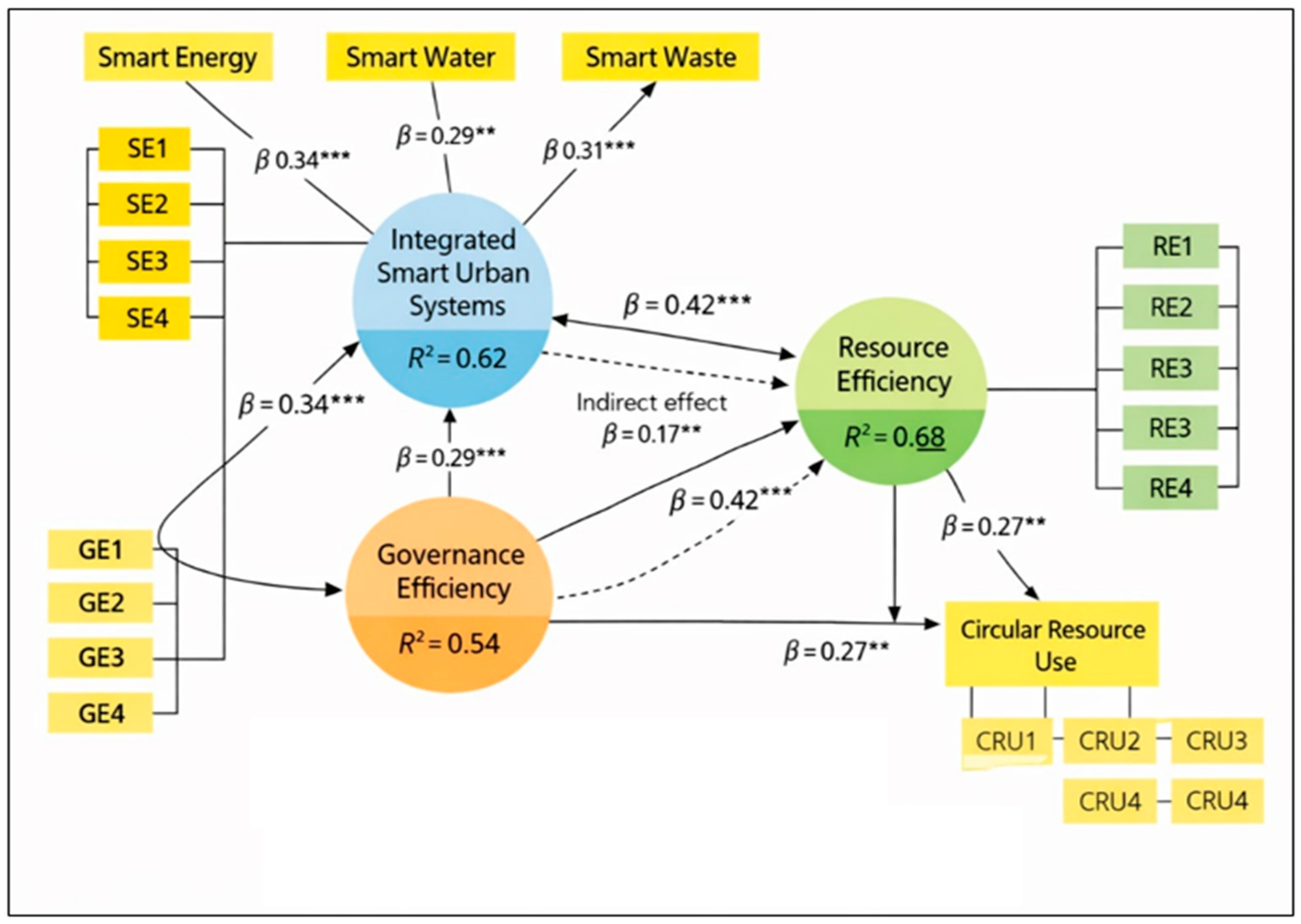
The structural model was assessed to examine the hypothesised relationships among Smart Energy Systems, Smart Water Management, Smart Waste Monitoring, Integrated Smart Urban Systems (ISUS), Governance Efficiency, and Resource Efficiency as presented in
Figure 3. The evaluation of the model fit indices indicated that the proposed model adequately represented the observed data. Specifically, the Comparative Fit Index (CFI) was 0.93, the Tucker–Lewis Index (TLI) was 0.91, the Root Mean Square Error of Approximation (RMSEA) was 0.052, and the Standardised Root Mean Square Residual (SRMR) was 0.047. These values satisfy the recommended thresholds proposed by [
73], namely CFI and TLI values above 0.90 and RMSEA and SRMR values below 0.08, thereby confirming an acceptable overall model fit. These values meet recommended thresholds [
73], indicating an acceptable model fit.
The results of the structural model analysis are presented in
Table 9. The findings indicate that Smart Energy Systems exerted a significant positive effect on Integrated Smart Urban Systems (β = 0.34,
p < 0.001), thereby supporting Hypothesis H1a. This result suggests that improvements in smart energy technologies and management practices contribute substantially to the development of integrated smart urban systems. Similarly, Smart Water Management was found to have a significant positive influence on Integrated Smart Urban Systems (β = 0.29,
p < 0.01), providing support for Hypothesis H1b. This finding underscores the importance of intelligent water management solutions in facilitating urban system integration.
The analysis further revealed that Smart Waste Monitoring significantly and positively affected Integrated Smart Urban Systems (β = 0.31, p < 0.001), supporting Hypothesis H1c. This result demonstrates that effective waste monitoring and management technologies play a critical role in strengthening urban system integration and sustainability. Regarding the subsequent relationships, Integrated Smart Urban Systems were found to have a significant positive effect on Resource Efficiency (β = 0.42, p < 0.001), supporting Hypothesis H2. Among all direct effects examined, this relationship exhibited the strongest standardised coefficient, indicating that integrated urban systems substantially enhance the efficient utilisation of urban resources. Governance Efficiency also demonstrated a significant positive effect on Resource Efficiency (β = 0.27, p < 0.01), thereby supporting Hypothesis H3. This finding highlights the importance of effective governance structures and institutional coordination in improving resource management outcomes.
The mediating analysis further showed that Governance Efficiency significantly mediated the relationship between Integrated Smart Urban Systems and Resource Efficiency (β = 0.17, p < 0.01), supporting Hypothesis H4. This result suggests that the positive influence of integrated smart urban systems on resource efficiency is strengthened through effective governance mechanisms, emphasising the complementary role of governance in achieving sustainable urban resource management.
5.5. Variance Explained (R2)
The explanatory power of the structural model was evaluated using the coefficient of determination (R
2), which measures the proportion of variance in endogenous constructs explained by their respective predictors. As presented in
Table 10, Smart Energy, Smart Water, and Smart Waste collectively explained 62.0% of the variance in Integrated Smart Urban Systems (ISUS) (R
2 = 0.62), indicating substantial predictive capability and confirming the important role of smart urban subsystems in fostering integrated urban management. In addition, Integrated Smart Urban Systems explained 54.0% of the variance in Governance Efficiency (R
2 = 0.54), demonstrating that the integration of smart technologies significantly contributes to improving governance processes and operational effectiveness.
Furthermore, Integrated Smart Urban Systems (ISUS), Governance Efficiency (GE), and Circular Resource Use (CRU) jointly explained 68.0% of the variance in Resource Efficiency (R
2 = 0.68). This indicates substantial explanatory power and suggests that the combination of technological integration, governance capacity, and resource-management practices provides a meaningful account of perceived resource-efficiency outcomes. In line with established SEM interpretation guidelines, the R
2 value should be understood as the proportion of variance in Resource Efficiency explained by the predictors, rather than as independent evidence of model robustness or causal effectiveness. This interpretation is broadly consistent with previous empirical studies that have highlighted the importance of integrated smart technologies, institutional capacity, and resource-management strategies in shaping urban sustainability outcomes [
13,
74,
75].
The finding also extends previous research by considering these dimensions within a single structural framework, rather than examining smart technologies, governance, and resource management independently. The relatively high explained variance therefore provides empirical support for examining resource efficiency through an integrated systems perspective. However, given the cross-sectional and perception-based nature of the data, the results demonstrate associations and explanatory relationships rather than causal effects. Overall, the findings provide support for the hypothesised relationships and indicate that the integration of smart energy, water, and waste systems, together with effective governance and resource-management practices, is associated with perceived improvements in urban resource efficiency.
5.6. Total Effects Matrix
Table 11 presents the estimated relationships among the higher-order Integrated Smart Urban Systems (ISUS) construct, Governance Efficiency (GE), Resource Efficiency (RE), and Circular Resource Use (CRU), while distinguishing the formative component relationships from the structural effects. Smart Energy (β = 0.340), Smart Water (β = 0.290), and Smart Waste (β = 0.310) represent the respective formative contributions to ISUS. Smart Energy shows the largest contribution among the three components, followed by Smart Waste and Smart Water, indicating their respective importance in defining the integrated smart urban systems construct.
The structural results indicate a positive relationship between ISUS and Governance Efficiency (β = 0.480). ISUS also shows a positive direct association with Resource Efficiency (β = 0.420), while Governance Efficiency is positively associated with Resource Efficiency (β = 0.420). In addition, Circular Resource Use demonstrates a positive relationship with Resource Efficiency (β = 0.270).
The results further indicate an indirect association between Integrated Smart Urban Systems (ISUS) and Resource Efficiency through Governance Efficiency (GE) (β = 0.202). Together with the direct effect of ISUS on Resource Efficiency (β = 0.420), this produces an estimated total effect of approximately β = 0.622 (≈0.62). The presence of both direct and indirect pathways is consistent with a partial mediation pattern, subject to confirmation through the bootstrap confidence interval and significance assessment. This finding is broadly consistent with previous research emphasising that smart-city technologies are more likely to contribute to sustainability outcomes when supported by effective institutional coordination, governance capacity, and data-driven decision-making [
7,
13,
18,
19]. The present finding extends this literature by empirically examining Governance Efficiency as an intervening mechanism linking integrated smart urban systems with perceived resource-efficiency outcomes.
The results therefore suggest that resource-efficiency perceptions are associated not only with the integration of smart urban subsystems but also with governance processes that may facilitate their coordination, implementation, and management. This interpretation supports the argument in previous smart-city research that technological infrastructure and institutional arrangements should be considered together when assessing urban sustainability performance. In addition, the formative contributions of Smart Energy, Smart Water, and Smart Waste indicate that these subsystems represent complementary dimensions of ISUS rather than conventional independent predictors. This specification reinforces a systems-oriented understanding in which the combined integration of these subsystems provides the basis for examining their relationship with governance and resource-efficiency outcomes. Given the cross-sectional and perception-based nature of the study, however, these findings should be interpreted as associations rather than evidence of causal effects.
5.7. Total Effects on Resource Efficiency
The overall total-effects analysis provides further insight into the relative contribution of the study constructs to Resource Efficiency (RE). As shown in
Table 12, Integrated Smart Urban Systems (ISUS) demonstrate the largest total effect on Resource Efficiency (β = 0.590), comprising a direct effect of β = 0.420 and a total indirect effect of β = 0.170. Governance Efficiency (GE) shows a positive direct effect of β = 0.420, while Circular Resource Use (CRU) has a positive direct effect of β = 0.270. These results indicate that the integration of smart urban systems, effective governance, and circular resource practices are all meaningfully associated with perceived resource-efficiency outcomes. This pattern is consistent with previous research emphasising the importance of combining technological, institutional, and resource-management dimensions in smart and sustainable urban development [
13,
17,
19].
At the subsystem level, Smart Energy (SE) shows the largest total effect among the three formative components of ISUS (β = 0.202), followed by Smart Waste (SWT) (β = 0.184) and Smart Water (SW) (β = 0.172). These effects are reported as indirect contributions transmitted through the higher-order ISUS and associated structural pathways. The relatively stronger contribution of Smart Energy is consistent with previous studies highlighting the importance of energy management, demand optimisation, and smart energy technologies in improving urban resource performance [
7,
10]. Similarly, the contributions of Smart Water and Smart Waste are consistent with research emphasising digital monitoring, water conservation, waste reduction, recycling, and resource recovery as important components of sustainable urban resource management [
9,
17].
The results also indicate that Governance Efficiency has a substantial direct association with Resource Efficiency (β = 0.420). This finding supports previous research suggesting that institutional coordination, effective decision-making, governance capacity, and supportive organisational arrangements are important for translating smart-city capabilities into sustainability-related outcomes [
13,
18,
19]. In this study, the indirect contribution of ISUS through Governance Efficiency further indicates that governance constitutes an important pathway within the estimated structural relationships.
The positive association between Circular Resource Use and Resource Efficiency (β = 0.270) is likewise consistent with circular-economy research emphasising resource recovery, reuse, waste minimisation, and the closing of material loops. The finding suggests that stronger circular-resource practices are associated with more favourable perceived resource-efficiency outcomes within the study context.
Taken together, the results support an integrated interpretation of urban resource management in which smart energy, water, and waste systems, governance efficiency, and circular resource practices operate as interconnected dimensions of resource-efficiency performance. The findings extend previous research by bringing these dimensions together within a single empirical framework. Nevertheless, the reported coefficients represent statistical associations within the estimated model and should not be interpreted as evidence of causal impacts. Given the cross-sectional and self-reported nature of the data, future research should incorporate longitudinal designs and objective indicators of energy consumption, water use, waste recovery, and material efficiency to further validate these relationships.
5.8. Results of the Effect Sizes (f2)
The effect-size results presented in
Table 13 provide further evidence of the relative contribution of the constructs within the proposed structural model. Integrated Smart Urban Systems (ISUS) show a large effect on Resource Efficiency (f
2 = 0.38), indicating that ISUS makes a substantial relative contribution to the explained variance in Resource Efficiency. This finding is consistent with previous smart-city research emphasising the importance of integrating digital infrastructure and interconnected urban systems rather than considering smart technologies as isolated interventions [
10,
13,
17]. However, the f
2 statistic indicates the relative contribution of ISUS to the model’s explained variance and does not establish that integrated smart systems causally improve resource efficiency.
The medium effect of Smart Energy on ISUS (f
2 = 0.18) indicates a relatively important contribution of the energy dimension to the higher-order ISUS construct. This is broadly consistent with previous studies highlighting smart energy management, energy monitoring, demand optimisation, and renewable-energy integration as important dimensions of smart-city development [
7,
10]. Smart Waste also demonstrates a medium effect on ISUS (f
2 = 0.16), suggesting a meaningful contribution of intelligent waste-management practices to the integrated smart urban system. Previous research similarly identifies digital waste monitoring, collection optimisation, recycling, and resource recovery as relevant components of sustainable urban management [
9,
17].
The medium effect of ISUS on Governance Efficiency (f
2 = 0.30) further indicates a meaningful association between technological integration and governance within the estimated model. This finding is consistent with previous research suggesting that smart-city systems can provide information and coordination capabilities that support data-informed urban management and institutional decision-making [
13,
18,
19]. Importantly, this result should not be interpreted as evidence that technological integration independently causes improvements in governance efficiency.
Similarly, Governance Efficiency demonstrates a medium effect on Resource Efficiency (f
2 = 0.22). This finding supports previous research that identifies institutional coordination, governance capacity, and effective implementation arrangements as important dimensions of smart and sustainable urban development [
13,
19]. Within the present model, governance therefore represents an important complementary dimension alongside technological integration.
In comparison, Smart Water → ISUS (f2 = 0.13) and Circular Resource Use → Resource Efficiency (f2 = 0.11) show smaller relative effect sizes. These results indicate that the two relationships make comparatively smaller contributions to the explained variance than the larger effects observed elsewhere in the model. Nevertheless, their inclusion remains theoretically relevant. Smart water systems support monitoring, conservation, and distribution management, while circular resource practices are associated with resource recovery, reuse, and waste reduction. Their smaller effect sizes suggest that their relative contribution within this particular model is more limited, rather than indicating that these dimensions are unimportant in sustainable urban development.
Overall, the effect-size analysis indicates that ISUS makes the largest relative contribution to Resource Efficiency (f
2 = 0.38), while Governance Efficiency also demonstrates meaningful effects within the structural model. The pattern is broadly consistent with previous research advocating integrated approaches that combine technological infrastructure with institutional and resource-management dimensions [
10,
17]. Nevertheless, f
2 values should be interpreted as measures of relative explanatory contribution, not as evidence of intervention effectiveness or causality. Given the cross-sectional and self-reported nature of the study, future research using longitudinal designs and objective indicators such as actual energy consumption, water use, waste-recovery rates, and material-use efficiency would be valuable for determining whether the observed statistical relationships translate into measurable real-world sustainability outcomes.
6. Conclusions
This study addresses a critical gap in the literature by providing an integrated, empirically tested model of smart urban systems and their impact on resource efficiency, with governance efficiency as a key mediating factor. The study predicts that integrated smart urban systems significantly enhance resource efficiency, confirming the central premise of this study. Among the subsystems, smart energy appears to have the strongest influence, reflecting the critical role of energy optimisation in urban sustainability transitions. Importantly, governance efficiency emerges as a key mediating mechanism, indicating that technological infrastructure alone is insufficient without effective institutional coordination. This finding relates to the argument that smart cities are socio-technical systems rather than purely technological constructs.
By focusing on the context of Saudi Arabia, the research offers both theoretical contributions and practical relevance, supporting the development of more sustainable and efficient urban systems in rapidly urbanising environments. This study’s framework allows an appropriate understanding of how smart urban systems drive resource efficiency. The findings bridge a critical gap between theory and practice, offering both conceptual advancement and policy relevance. This study provides robust empirical evidence that integrated smart urban systems play a critical role in advancing resource efficiency in rapidly urbanising contexts such as Saudi Arabia. By demonstrating the significant contributions of smart energy, water, and waste systems, the findings underscore the importance of adopting a holistic and integrated approach to urban infrastructure development.
A key contribution of this research lies in identifying governance efficiency as a partial mediator, highlighting that the effectiveness of smart technologies is contingent upon institutional capacity, coordination, and policy support. Furthermore, the incorporation of circular resource use strengthens the sustainability dimension of the model, reinforcing the relevance of circular economy principles in smart city development. The study contributes to theory by integrating smart urban systems and governance into a unified analytical framework, while offering practical guidance for policymakers and urban planners. The findings support the development of evidence-based strategies aligned with Saudi Vision 2030, particularly in promoting resource-efficient and sustainable urban environments.
6.1. Theoretical Implications
This study makes three major theoretical contributions:
First, it advances Smart City Theory by empirically validating an integrated systems approach, moving beyond fragmented analyses of individual smart components.
Second, it extends Systems Theory by demonstrating how interdependencies between infrastructure and governance shape urban performance outcomes.
Third, by incorporating circular resource use, the study strengthens the link between smart cities and the Circular Economy, highlighting how resource loops contribute to efficiency gains.
6.2. Practical Implications
The findings provide actionable insights for urban practitioners and planners in Saudi Arabia:
Emphasise integration across smart systems rather than isolated deployment
Prioritise governance reforms to maximise infrastructure performance
Promote data-driven decision-making frameworks
Strengthen circular resource strategies in urban planning
6.3. Policy Implications
The study provides a strong empirical basis for aligning smart urban development with Saudi Vision 2030. Specifically, the findings suggest that:
Policy frameworks should integrate energy, water, and waste systems holistically
Governance structures must be enhanced to support cross-sector coordination
Urban policies should explicitly incorporate resource efficiency targets
Circular economy principles should be embedded in national sustainability strategies
These insights contribute to the development of evidence-based policies for sustainable urban transformation.
6.4. Limitations and Future Research Directions
Despite the significant contributions of this study, limitations relate to the context-specific nature of Saudi Arabia, where national development initiatives such as Vision 2030, smart city investments, and sustainability policies have created unique institutional and technological conditions. The proposed framework offers important insights into sustainable urban transformation, differences in governance systems, economic structures, technological readiness, cultural factors, and environmental conditions relevant to other similar areas. Future research should address this limitation by conducting longitudinal studies that track the evolution of smart urban systems and sustainability outcomes over extended periods. Such studies would provide stronger evidence regarding causal relationships and allow researchers to examine how changes in technology adoption, governance practices, and resource management strategies influence urban sustainability performance over time. Longitudinal investigations would also enable the assessment of the long-term effectiveness and resilience of integrated smart urban initiatives. In addition, comparative international research is recommended to test the applicability and robustness of the proposed model across diverse geographical, socio-economic, and institutional contexts.
A limitation of this study is its reliance on self-reported perceptions to assess resource efficiency, as objective and consistently comparable resource-consumption data were not available across all four case-study cities. Consequently, the findings reflect respondents’ perceived rather than directly measured resource-efficiency outcomes. Future studies should strengthen this assessment by integrating objective indicators, including energy and water consumption, waste-recovery rates, material-use efficiency, and other measurable resource-performance indicators, to validate and complement perception-based findings.
The absence of a multi-group analysis (MGA) across Riyadh, Jeddah, Madinah, and Buraydah represents a limitation of the present study, as potential differences in the relationships among smart urban systems, governance efficiency, and resource efficiency across cities could not be empirically examined. Future research should therefore employ MGA using larger and more balanced city-level samples to identify contextual variations in model relationships. In addition, comparative studies involving cities across developed and developing countries could further reveal contextual differences in the implementation and performance of smart urban systems and help identify common drivers of resource efficiency and sustainable urban development. Such analyses would strengthen the refinement, transferability, and generalisability of the proposed framework.