Review

From Species Selection to Performance: A Review of Extensive Green Roof Suitability in the Mediterranean Basin


1
Institute of Heritage Science (CNR-ISPC), National Research Council of Italy, Area della Ricerca di Roma 1, Montelibretti, Via Salaria Km 29,300, 00015 Rome, Italy
2
Department of Sciences, University Roma Tre, Viale Marconi 446, 00146 Rome, Italy
*
Authors to whom correspondence should be addressed.
Sustainability 2026, 18(17), 8742; https://doi.org/10.3390/su18178742
Submission received: 23 July 2026 / Revised: 19 August 2026 / Accepted: 23 August 2026 / Published: 26 August 2026

Abstract

Mediterranean extensive green roofs are increasingly recognized as Nature-based Solutions for climate adaptation and urban sustainability, yet plant selection remains largely based on a limited set of drought-tolerant species. This review critically evaluates the biodiversity, biogeographical composition, and performance of plant species tested on Mediterranean extensive green roofs. A systematic analysis of 118 studies published between 2010 and 2025 identified 340 taxa belonging to 48 families, while species-level performance data were extracted from 92 studies. Research effort was strongly concentrated in Italy, Greece, and Spain, revealing significant geographical biases across the Mediterranean Basin. The species pool was dominated by chamaephytes and succulent taxa, particularly Crassulaceae, whereas Mediterranean endemics were underrepresented. Although native species accounted for most occurrence records, more than half of the tested taxa belonged to extra-Mediterranean chorotypes, indicating only partial geographical coherence. Performance assessments focused primarily on survival, growth, and drought tolerance, whereas reproduction, biodiversity outcomes, and ecosystem services were rarely evaluated. Several Mediterranean native species, including Helichrysum italicum, Salvia officinalis, Origanum dictamnus, and Crithmum maritimum, showed performance comparable to that of commonly used Sedum species, highlighting the potential of underutilized regional flora. The review supports a shift from establishment-based plant selection toward ecologically coherent approaches that integrate biodiversity, biogeographical affinity, ecosystem functioning, and long-term resilience.

1. Introduction

Urban areas are increasingly challenged by climate change, particularly through rising temperatures, altered precipitation regimes, and intensified urban heat island effects. Nature-based Solutions (NbS) have therefore received attention as key approaches to improve urban sustainability and adaptation [1,2,3]. Among them, green roofs are widely implemented because they provide multiple ecosystem services, including thermal mitigation, stormwater regulation, habitat provision, and biodiversity support. Recent studies further highlight their role in enhancing ecological connectivity and contributing to climate-resilient urban environments [3,4,5].
The importance of green roofs is particularly evident in the Mediterranean area, which is widely recognized as a climate change hotspot. This area, like the other regions with Mediterranean climates (South Africa, California, part of Chile and Australia), is characterized by hot, dry summers, high solar radiation, and an increasing frequency of extreme climatic events, conditions that strongly influence vegetation establishment and performance [6,7,8]. Future climate scenarios predict further increases in water stress and thermal extremes across Mediterranean cities, reinforcing the need for vegetation capable of maintaining ecological functions under increasingly challenging environmental conditions. Consequently, identifying drought-adapted species able to ensure long-term roof performance and resilience has become a major research priority [8,9,10].
Consequently, plant selection is a crucial determinant of green roof success, as species must withstand prolonged water deficits, thermal stress, and the limitations imposed by shallow substrates [11]. Such environmental constraints are exacerbated in Extensive Green Roofs (EGRs), where low substrate depths and limited irrigation often intensify drought stress, reducing plant cover, survival, and long-term system stability. Furthermore, the reduced maintenance typical of low-input green roofs restricts opportunities to compensate for adverse environmental conditions through irrigation or fertilization, potentially leading to fluctuating vegetation performance over time [9,12,13]. These challenges highlight the need for ecologically informed plant selection strategies that maximize both resilience and ecosystem functioning.
Despite their harsh climatic conditions, ecosystems of the Mediterranean basin represent one of the world’s major biodiversity hotspots [7,14]. Their flora has evolved a wide range of adaptations to drought, intense solar exposure, nutrient-poor soils, and periodic heat stress, traits that closely match the environmental conditions encountered on urban rooftops. Consequently, Mediterranean species constitute a valuable resource for diversifying green roof vegetation while enhancing the ecological suitability and long-term sustainability of these systems [15].
Extensive green roofs are still largely based on a limited palette of drought-tolerant succulents, especially species of Sedum and Delosperma, selected for their persistence under shallow-substrate and low-maintenance conditions [16,17,18,19,20,21,22,23,24]. While this strategy has proved effective for plant establishment, it often results in vegetation communities characterized by low taxonomic and functional diversity and reduced ecological complexity [25,26]. Growing evidence suggests that integrating a wider range of native Mediterranean species can maintain satisfactory performance while improving ecosystem multifunctionality, biodiversity support, and long-term resilience [13,27,28,29,30].
Interest in regional flora has grown considerably as green roof research increasingly recognizes the importance of ecological coherence and vegetation diversification. Recent studies have shown that Mediterranean perennial and geophytic species can perform successfully under extensive roof conditions, broadening the range of candidates beyond the traditionally used succulent taxa [27,28,31,32]. Accordingly, increasing effort has been devoted to screening plants from drought-prone and rocky habitats, whose ecological and functional traits are particularly suited to rooftop environments [33,34,35,36]. Emerging evidence suggests that a trait- and biogeography-informed approach to species selection can support both environmental adaptation and ecological functioning in Mediterranean green roofs [37,38,39]. Reduced plant diversity can constrain ecosystem functioning, as vegetation composition plays a key role in determining green roof performance. In fact, experimental studies have demonstrated that species-rich mixtures can outperform monocultures in delivering multiple ecosystem services, including water retention, evapotranspiration, and thermal regulation [37]. Consequently, green roofs dominated by a few stress-tolerant species may exhibit reduced ecological functionality and lower overall performance, particularly under the variable and extreme conditions typical of Mediterranean climates.
Recent studies advocate for the use of ecologically coherent plant assemblages inspired by natural habitat analogs rather than simplified vegetation systems. Early efforts in the Mediterranean region identified a broad pool of potentially suitable species based on ecological and functional criteria, compiling a database of 138 taxa for extensive green roofs [15]. Since then, research has progressively moved from assessing plant establishment alone towards evaluating broader ecological dimensions, including biodiversity, species interactions, ecosystem functioning, and long-term resilience. Consequently, species selection is increasingly regarded as an ecological design process aimed at maximizing both environmental performance and ecosystem value [27,40,41]. The review of Leotta et al. [11] collected over 180 potentially suitable species (belonging to more than 40 families), providing a comprehensive synthesis of the species tested under Mediterranean bioclimatic conditions and their potential suitability in the Mediterranean basin. The review underlined that the effectiveness of EGR in Mediterranean environments strongly depends on the selection of stress-tolerant species and on the use of diverse plant communities. However, plant performance was neither systematically analyzed, nor standardized in the comparative evaluations provided; moreover, the limited availability of experimental data and the high variability of design conditions represent significant constraints. Furthermore, Paço [10] developed a water-centered conceptual framework based on a synthesis of studies (29 papers identifying 124 species) conducted in Southern Europe, emphasizing the role of water availability, habitat analogies, and drought-adaptation strategies in species selection. Todeschini and Fett-Neto [29], on the other hand, performed a large-scale quantitative and trait-based analysis, integrating data from 439 studies worldwide to identify the most frequently used species and to define representative plant functional types (2032 plant species) based on shared morpho physiological traits across different climate types. Both reviews adopt complementary analytical approaches to investigate plant suitability for EGRs. These reviews provide valuable ecological and functional frameworks for plant selection in extensive green roofs, but they rely mainly on indirect evidence (traits, habitat analogies, or conceptual approaches), with limited or no direct experimental validation of species performance under real rooftop conditions.
Despite recent advances, existing reviews have primarily addressed species traits, irrigation management, habitat analogs, or broad suitability frameworks. As a result, key aspects such as biodiversity composition, biogeographical affinity, nativeness, invasion risk, and experimentally validated plant performance have rarely been examined within a single integrative perspective. Consequently, the extent to which current Mediterranean green roof vegetation reflects regional ecological patterns and supports ecologically coherent design remains insufficiently understood [10,11,29].
To address this knowledge gap, the present review provides a comprehensive assessment of the evidence available on plant selection for Mediterranean extensive green roofs. Specifically, it aims to (i) evaluate the diversity of plant taxa reported in Mediterranean EGRs; (ii) characterize their biological and chorological composition and assess their biogeographical relationship with the areas in which they were tested; (iii) identify which dimensions of suitability have been investigated across the existing literature; and (iv) determine the taxa supported by replicated evidence of successful performance. By integrating floristic, biogeographical, and performance-related information, this review seeks to advance ecologically informed plant-selection strategies and support the design of resilient green roof systems adapted to Mediterranean urban environments.

2. Materials and Methods

2.1. Bibliographic Search

We carried out a comprehensive literature search using Web of Science and Scopus databases through January 2010 to May 2026. The search was run in the topic field (title, abstract and author keywords) and restricted to English-language documents, using the following keyword combinations: “Plant Biodiversity AND Mediterranean extensive Green Roofs”, “Plant Biodiversity AND Mediterranean EGRs”, and “Plant Biodiversity AND Mediterranean vegetated roofs”, “Plant Species performance AND Mediterranean extensive Green Roofs”, “Plant species performance AND Mediterranean EGRs”, and “Plant species performance AND Mediterranean vegetated roofs”.
Our analysis included experimental studies published in indexed scientific journals, specifically focusing on field-based research that tests defined plant species on EGR systems, where the limited substrate depth imposes significant constraints on plant growth and survival, and that were geographically located within the Mediterranean basin. Simulated and modeling studies lacking direct experimental evidence were excluded (Figure 1).
The search yielded 3291 records (2654 from the Web of Science and 637 from Scopus), which were reduced to 1414 unique records after removal of duplicates within and between databases. These were screened on title and abstract, and 367 reports were then examined in full text to ensure alignment with our inclusion criteria; 249 were excluded at this stage, leaving 118 studies.
For each selected study, we collected data on species selection, performance outcomes, and evidence regarding their suitability for green roof applications in different experimental locations. When available, information on species’ success or failure under green roof conditions was also recorded.

2.2. Floristic Species Dataset

The floristic assessment was derived from the species list analyzed in the articles of the literature review. For each study, the plant species were integrated into a database, eliminating duplicates. A nomenclatural update was then performed using Plants of the World Online (POWO) [42], Bartolucci et al. [43] for the Italian flora, and World Flora Online (WFO). When species names were reported without author citation and presented multiple taxonomic options, a disambiguation procedure was carried out.
For each validated taxon, biogeographical, taxonomic and structural descriptors, including botanical family, life form based on Raunkiaer’s system [44], geographical native range, and the corresponding chorotypes, were assigned. Nativeness was assessed at the occurrence level by comparing each species’ native range (POWO) [42] with the country in which it was tested.

2.3. Performance Species Dataset

The performance dataset was constructed by selecting publications that explicitly reported species-specific performance evaluations under green roof conditions. Given the heterogeneity among studies in terms of both the assessed variables and the methodologies employed for their evaluation, a harmonization procedure was applied, clustering the original performance metrics into macro-categories representing the main investigated variables. The plant-performance dimensions considered were: survival, growth/coverage, reproduction, the three stress-tolerance components—drought (water demand), heat and salt tolerance (scored separately, because studies rarely addressed them jointly), and esthetic value (from explicit aesthetic-appearance rating or qualitative descriptors of ornamental quality).
The system-performance dimensions comprised: thermal regulation, energy savings, water management, Air-quality-CO2 sequestration and biodiversity, capturing the ecosystem services delivered by the vegetated roof (Table 1).
Species performance was then translated into a unified five-level qualitative–quantitative scale, developed for this review to harmonize heterogeneous evidence from the literature. The approach follows established principles for synthesizing qualitative and quantitative ecological evidence [45] while using transparent expert judgment where studies reported only descriptive outcomes [46].
Because the primary studies reported performance in heterogeneous and largely non-numerical forms (fewer than 5% of the extracted performance entries contained a quantitative value, and the units used were not comparable across studies) the scale was defined by generic ordinal anchors rather than by fixed numerical cut-offs. Three mapping rules were applied. Studies that already reported a five-level ordinal rating were mapped directly, one rating level to one score. Studies reporting a three-level qualitative judgment were mapped onto the corresponding levels of the five-point scale. Studies reporting only descriptive outcomes were scored by expert judgement against the generic anchors, using the range of outcomes reported across the corpus for that dimension as the reference. Where quantitative values were available, they were used as supporting evidence for the level assigned rather than as thresholds. Higher scores always denote more favorable performance, so water demand is scored on an inverted scale. Survival was scored only where explicitly reported and was never inferred from cover or biomass (Table 2).

2.4. Statistical Analysis

The statistical analysis was structured to evaluate the floristic dataset and species performance in Mediterranean EGRs, also assessing the geographical frequencies, and the occurrence of plant species in the various countries. Two counting units were used throughout: taxa (each accepted species counted once) and records (each species × study occurrence); dimensions coded NA were excluded pairwise, and significance was assessed at α = 0.05.
We quantified richness per family (distinct taxa) and records per species. The evenness of use within families and across the whole pool was measured by Gini coefficients of per-species record counts, together with the share of total deployment records accounted for by the most-used taxa [47].
A rank–frequency distribution of species use (number of contributing studies per taxon) complemented this analysis. Here, frequency represents the number of independent studies in which a taxon was tested and therefore describes the allocation of experimental effort across the species pool rather than the abundance of individuals within a biological community. To characterize the shape of this distribution, candidate discrete frequency distributions (Poisson-lognormal, log-series, Zipf (zeta), and geometric) were fitted by maximum likelihood and compared using AIC and Akaike weights; goodness of fit was assessed using χ2 tests on pooled frequency classes.
To evaluate the geographical coherence of species selection, the chorotype of each species was analyzed and compared with the location of the experimental study. This allowed for the identification of patterns in the use of native versus non-native (exotic) species across different Mediterranean contexts. We also examined the plant life forms, with particular attention to their suitability for EGRs.
Native share was computed per country, record- and species-weighted, with 95% Wilson confidence intervals. Finally, species performance was synthesized from the harmonized 1–5 scores. For the adequately covered plant attributes (survival, growth/coverage, drought tolerance and reproduction), per-species estimates were calculated as evidence-weighted means, weighting each record by its evidence-weight score, and restricted to taxa with adequate replication (≥ 4 contributing studies) to avoid over-interpreting single-study values. The distribution of scores was summarized per attribute.
All data processing, statistical analyses and figures were produced in R (v4.4) [48] using the ggplot2 v4.0.3, ggrepel v0.9.8, dplyr v1.2.1, DescTools v0.99.60 and patchwork v1.3.2, packages and Microsoft Excel (16.106.1).

3. Results

3.1. The Data Set

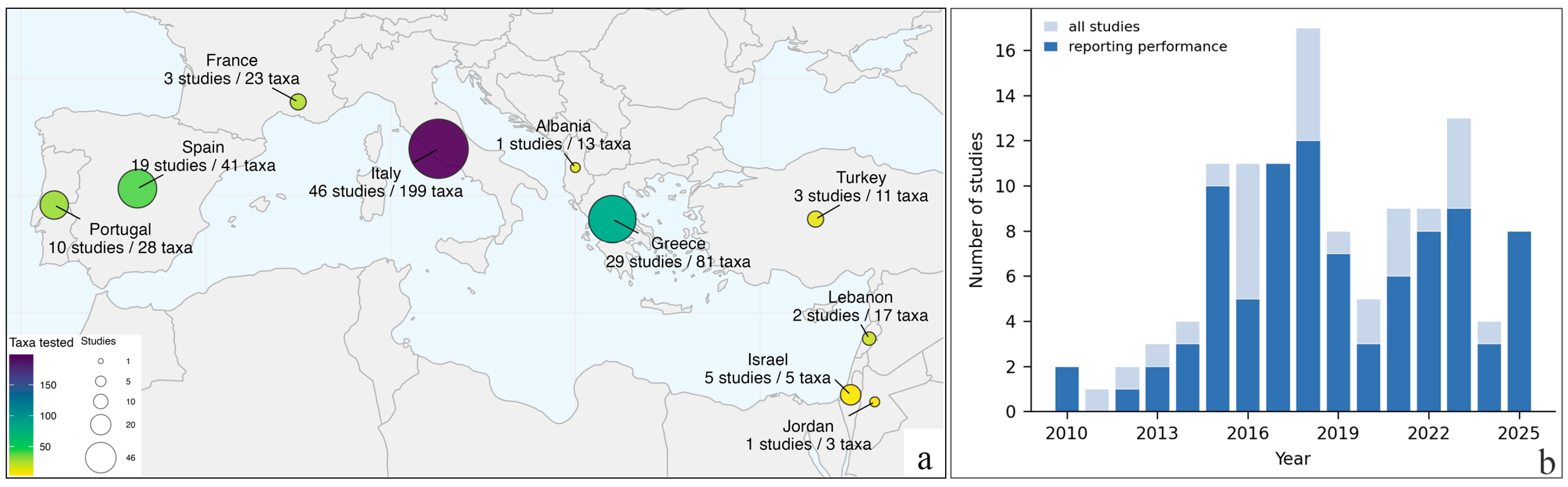
The review collected 118 studies published between 2010 and 2025 (Table S1), of which 90 (76.2%) provided species-level performance data and were included in the quantitative synthesis (Figure 2).
The geographical distribution of research was highly uneven (Figure 2a), with a strong concentration in some countries. Italy dominated the literature, contributing 46 studies and 199 tested taxa, followed by Greece (29 studies, 81 taxa) and Spain (19 studies, 41 taxa). Together, these three countries accounted for nearly 80% of all reviewed studies, highlighting their leading role in shaping the current evidence base. In contrast, the south-eastern Mediterranean was represented by only a limited number of studies from Israel, Turkey, Lebanon, Jordan, and Albania, despite hosting diverse xerophytic floras potentially well suited to green roof applications. Taxonomic coverage generally reflected research effort, although some countries, such as France and Lebanon, showed relatively high numbers of tested taxa compared with the number of studies conducted, indicating broader species-screening approaches.
The temporal distribution of publications revealed a marked expansion of research activity from the years 2013–2014 (Figure 2b). Annual publication rates increased rapidly between 2015 and 2019, reaching a peak in 2018, and most studies published during this period also reported quantitative performance data. Although publication output declined slightly around 2020, probably due to the COVID-19 pandemic, research activity remained relatively stable thereafter, with a substantial proportion of studies continuing to include species-performance evaluations.

3.2. Taxonomic Composition of the Species Pool

After nomenclatural standardization, the analyzed studies collectively recorded 340 plant taxa belonging to 179 genera and 48 families (Table S2). Family richness and frequency of use revealed contrasting patterns (Figure 3).
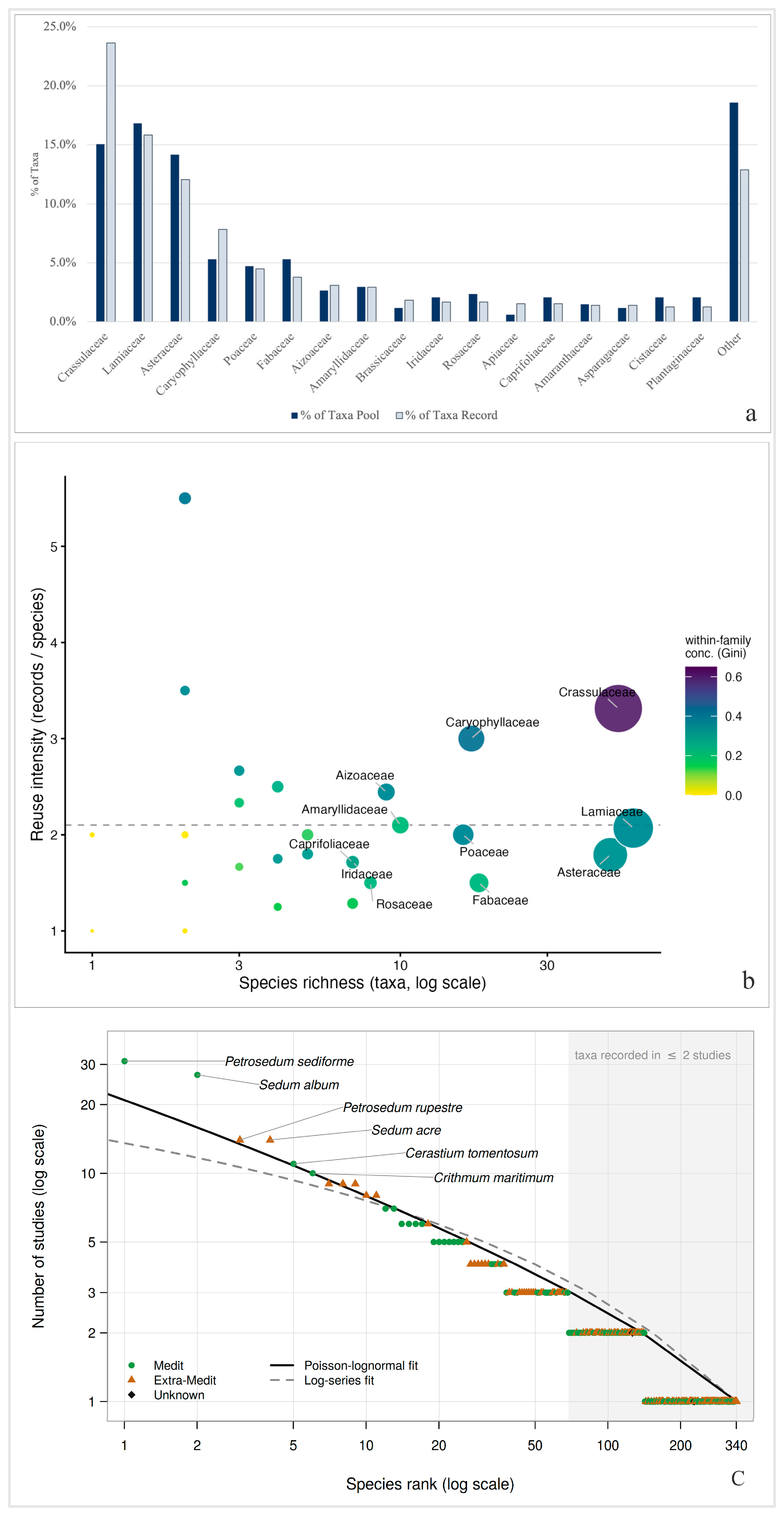
Lamiaceae (56 taxa), Crassulaceae (51), and Asteraceae (48) were the most species-rich families, whereas Crassulaceae dominated experimental use, accounting for 169 occurrence records across 54 studies, followed by Lamiaceae (112 records, 42 studies) and Asteraceae (86 records, 40 studies) (Figure 3a). Thus, although Lamiaceae contributed the largest number of taxa, the related species were generally tested infrequently, while Crassulaceae relied on a comparatively smaller set of species that were repeatedly evaluated, reflecting the central role of succulent taxa in Mediterranean green roof research.
Reuse intensity further highlighted these differences (Figure 3b). Crassulaceae (3.3 records per species) and Caryophyllaceae (3.2) were the only families substantially exceeding the overall mean of 2.1 records per species, whereas the species-rich families Lamiaceae and Asteraceae remained close to or below this threshold. Within-family use was also highly uneven. Crassulaceae showed the highest concentration of records (Gini = 0.618), followed by Caryophyllaceae (0.442), Lamiaceae (0.352), and Asteraceae (0.341); the Gini coefficient for the full species pool was 0.413 (Table S4). This pattern indicates strong dependence on a few key taxa, primarily Sedum and Petrosedum species. At the dataset level, the top 20% of taxa accounted for 51.8% of all deployment records.
Among the fitted distributions, the zero-truncated Poisson-lognormal provided the best fit to the observed species-use frequency distribution (AIC = 927.1; Akaike weight > 0.999; Table S5), with no evidence of lack of fit based on the χ2 goodness-of-fit test (χ2 = 1.26, df = 3, p = 0.73). The fitted distribution was strongly right skewed, reflecting the concentration of experimental use among a small number of taxa. More than half of all taxa (58.5%) were represented by a single study and 80% by no more than two, indicating a highly uneven allocation of research effort.
Diversity was distributed very unevenly across the taxonomic hierarchy. The most species-rich genera were Sedum (24 taxa), Phedimus (13) and Salvia (12), followed by a group of genera each represented by seven taxa (Trifolium, Allium, Dianthus, Thymus) and Origanum (6); conversely, 122 of the 179 genera (68.2%) were represented by a single taxon, indicating a pool built around a few intensively diversified genera and a long tail of singletons. Species use were strongly skewed toward a limited number of taxa (Figure 3c).
Petrosedum sediforme and Sedum album were by far the most frequently tested species, followed by Sedum acre, Petrosedum rupestre, Cerastium tomentosum, and Crithmum maritimum. In contrast, most taxa received very limited experimental attention: nearly 60% of the recorded species were reported in a single study, while 80% appeared in no more than two studies. Consequently, although Mediterranean green roof research encompasses a broad floristic diversity, the available evidence is concentrated around a small core of repeatedly investigated species. This uneven distribution was further confirmed by the rank–frequency analysis, which showed that the top 20% of species accounted for more than half of all deployment records.

3.3. Biological (Life-Form) and Chorological Spectra

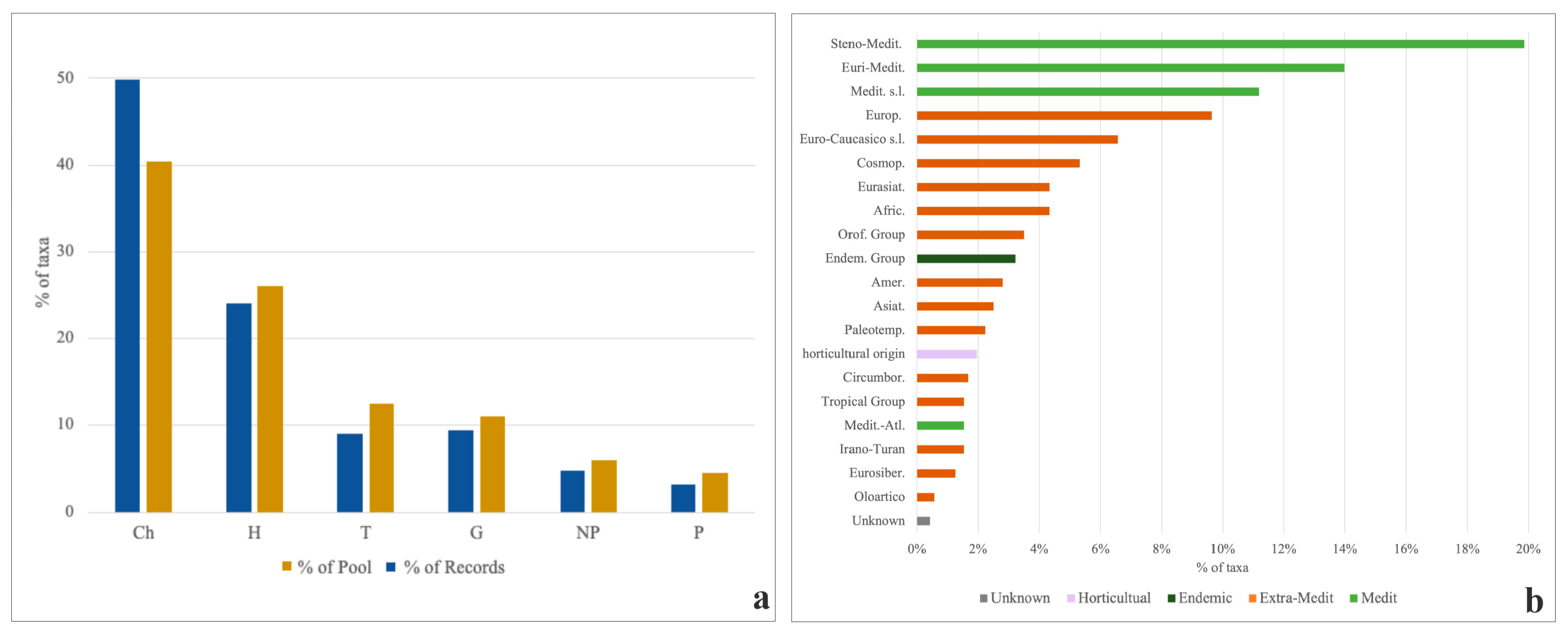
The Raunkiær spectrum was strongly dominated by chamaephytes, which accounted for 40.6% of the species pool (138 taxa) and almost half of all deployment records (49.9%), reflecting the widespread use of low-growing perennial succulents, particularly Sedum and Petrosedum species (Figure 4a). Hemicryptophytes represented the second largest group (25.9%), whereas therophytes (12.4%) and geophytes (10.9%) had lower values.
The chorological spectrum showed only a partial correspondence with the Mediterranean biogeographic context (Figure 4b). Mediterranean taxa, including Steno-, Euri-, and Mediterranean s.l. chorotypes, accounted for 42.1% of the species pool (46.5% when weighted by deployment records). However, a slightly larger proportion of taxa (51.2%) belonged to extra-Mediterranean chorotypes, including European, Cosmopolitan, Eurasiatic, African, American, and Asiatic elements. Notably, Mediterranean endemics represented only 2.9% of the recorded taxa, while horticultural species accounted for 3.2%.

3.4. Nativeness and the Alien/Invasive Load

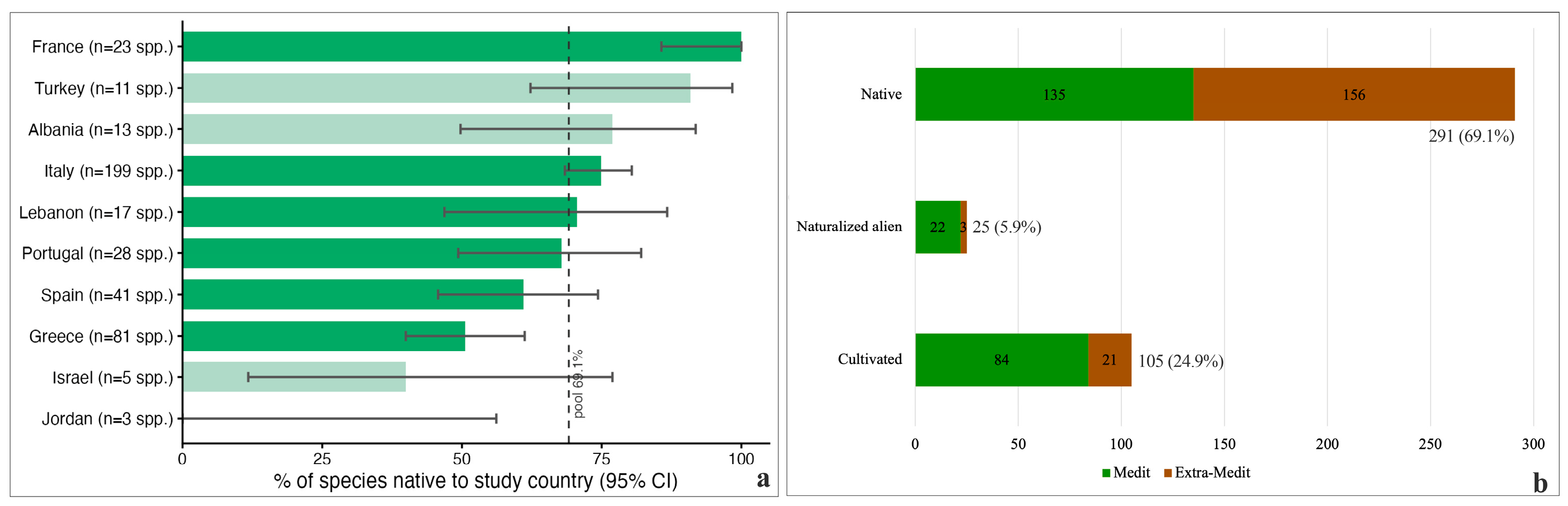
Overall, 524 of 716 occurrence records (73.2%) involved species native to the study country, while 192 records (26.8%) corresponded to introduced taxa. Country-level patterns varied considerably (Figure 5a). Native representation was highest in France (100%, 95% Wilson CI 91.2–100.0), Turkey (91.7%, 64.6–98.5), and Italy (77.5%, CI 72.8–81.6), while Greece showed a lower observed proportion (57.1%, CI 48.2–65.7) and Israel (25.0%, 7.1–59.1%; Table S6). Estimates for countries represented by few studies or occurrence records should be interpreted cautiously and should not be taken as evidence of statistically significant differences among countries.
Nativeness in a country and Mediterranean biogeographic affinity, however, did not necessarily overlap (Figure 5b). Among the 524 records involving native species, only 291 corresponded to Mediterranean chorotypes, whereas 233 involved native taxa belonging to broader European, Eurasian, Cosmopolitan, or other extra-Mediterranean floristic elements. Likewise, the introduced fraction included both extra-Mediterranean exotics (150 records) and Mediterranean taxa cultivated outside their native countries (42 records).
A further notable result was the persistence of exotic taxa within the literature. Cultivated-only exotics accounted for 20.5% of all occurrence records, compared with 73.2% for native taxa and 6.3% for naturalized aliens. Moreover, 22 taxa identified as invasive or potentially invasive were recorded in 44 occurrences across 32 studies. The most frequently used were Carpobrotus edulis and Phedimus spurius, followed by Satureja montana, Oxalis pes-caprae, Mesembryanthemum cordifolium, and Sedum sexangulare. Their occurrence was concentrated mainly in Italy and Spain.

3.5. How Species Suitability Has Been Measured

Because the reviewed studies were never designed to a common protocol, the dimensions along which “suitability” was evaluated varied greatly, and mapping this variation is itself a result. Across the 90 studies that reported any performance information (Table S3), a study assessed on average 2.8 of the 13 harmonized dimensions (median 3, maximum 7); 43 studies (47%) reported only one or two dimensions, and only 11 (12%) reported five or more. The evidence base is therefore broad in species but shallow in the number of attributes measured per species.
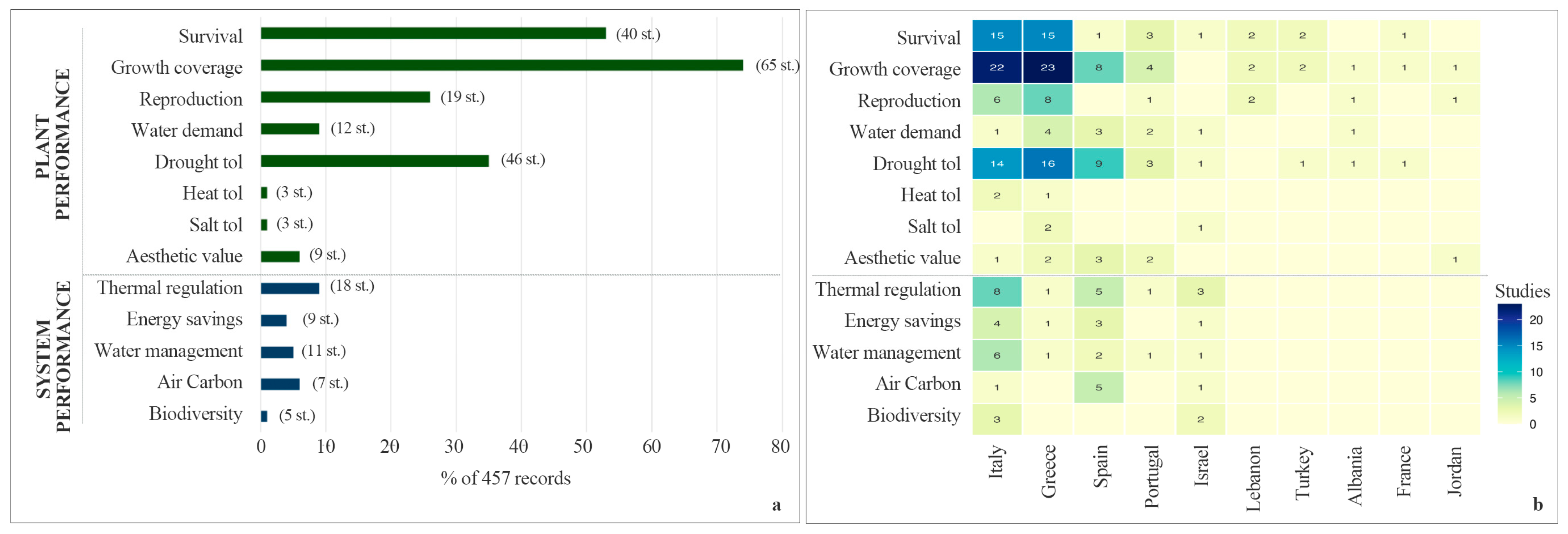
Coverage was also highly skewed toward the plant-performance axis and, within it, toward a few attributes (Figure 6). Growth/coverage was the single most frequently reported attribute, present in 344 records (72.4%) from 65 studies and 219 taxa, followed by survival (246 records, 51.8%; 40 studies; 171 taxa), drought tolerance (163 records, 34.3%; 47 studies; 113 taxa) and reproduction (122 records, 25.7%; 19 studies; 97 taxa). The remaining plant attributes were sparsely documented: esthetic value appeared in 28 records (5.9%), and—despite their direct relevance to Mediterranean roof conditions—heat tolerance and salt tolerance were each quantified in only 5–6 records from three studies. The system-performance axis was uniformly under-reported: thermal regulation, the best-covered system service, appeared in 47 records (9.9%; 21 studies; 36 taxa), followed by air/carbon (29 records, 6.1%), water management (27, 5.7%), energy savings (23, 4.8%) and biodiversity (11 records, 2.3%; 8 studies; 9 taxa). Water demand, on the resource axis, was reported in 42 records (8.8%).
The asymmetry is equally clear at the level of study design. Of the 90 studies, 54 (60%) addressed only plant-level attributes, 22 (24.4%) combined plant and system measurements, and 12 (13.3%) reported system-level outcomes without species-resolved plant data; the remaining 2 (2.2%) contributed species records without a scored performance di-mension.
The reviewed literature exhibited a marked imbalance in the performance dimensions investigated, with a strong emphasis on plant establishment and vegetation development (Figure 6a). Growth and vegetation cover were the most frequently assessed variables, occurring in 74% of studies (65 studies), followed by survival (53%; 40 studies) and drought tolerance (35%; 46 studies). In contrast, reproductive performance was examined in only 26% of studies (19 studies), while heat tolerance, salt tolerance, esthetic value, and biodiversity were rarely considered, each appearing in less than 10% of the literature. Among system-level outcomes, thermal regulation was the most evaluated ecosystem service (18 studies), whereas energy savings, water management, air/carbon-related functions, and biodiversity were addressed only sporadically. Water demand represented the sole resource-use variable monitored with some regularity, although it was reported in just 12 studies.
Evidence was also unevenly distributed geographically (Figure 6b). Italy and Greece accounted for most records across nearly all performance dimensions, particularly growth, survival, and drought tolerance, while Spain contributed substantially to drought-related and thermal performance research. In contrast, studies from Portugal, Israel, Turkey, Lebanon, France, Albania, and Jordan were comparatively scarce and typically focused on a limited set of variables.
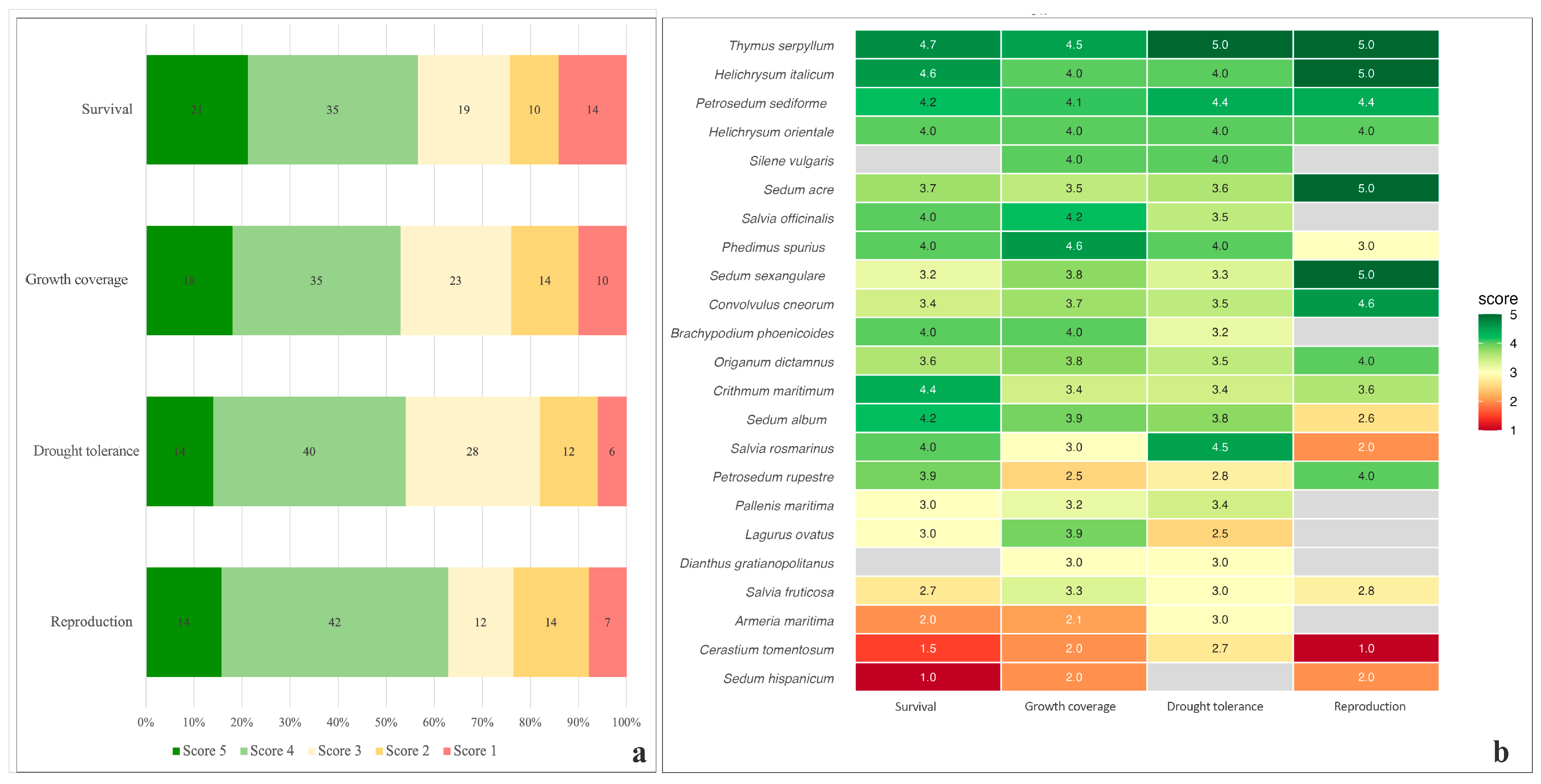
The distribution of performance scores was strongly skewed toward the highest categories (scores 4–5) across all evaluated dimensions (Figure 7a), indicating that most assessed taxa performed well under Mediterranean green roof conditions. Survival and growth/cover showed the most favorable outcomes, with 56 and 53 records, respectively, receiving scores of 4 or 5. Drought tolerance displayed a similarly positive pattern, with 54 records assigned to the highest performance classes and very few receiving low scores. Reproductive performance exhibited greater variability than the other dimensions, although high scores remained predominant. Overall, poor performance (scores 1–2) was relatively uncommon, particularly for drought tolerance, suggesting that most species selected for experimental testing possessed at least moderate adaptation to Mediterranean environmental conditions. A selection of 60 species with higher value of performance (at least in 3 categories with values ≥3) is shown in Table 3.
Among taxa evaluated in at least four independent studies, several species consistently achieved high scores across multiple performance dimensions (Figure 7b). Thymus serpyllum, Helichrysum italicum, and Petrosedum sediforme exhibited the most balanced performance profiles, combining high survival, vigorous growth, strong drought tolerance, and reliable reproductive capacity. Traditional green roof succulents, including Sedum album, Sedum acre, Petrosedum sediforme, and P. rupestre, generally scored highly for survival and drought tolerance, confirming their continued suitability for Mediterranean EGRs.
Several native Mediterranean taxa, notably Helichrysum italicum, Salvia officinalis, Origanum dictamnus, and Crithmum maritimum, showed performance scores comparable to, and in some dimensions higher than, those of conventional Sedum species in the reviewed studies, highlighting their potential as alternative or complementary species for climate-adapted green roof plantings. On the contrary, Cerastium tomentosum and Sedum hispanicum consistently received low scores for survival, growth, and reproduction, indicating limited suitability under the tested conditions.
Overall, the available evidence identifies a relatively small group of taxa with consistently high and well-documented performance across multiple ecological dimensions. At the same time, the results demonstrate that several native Mediterranean species can perform as well as, or better than, traditionally used succulent species, supporting efforts to diversify green roof vegetation while maintaining high levels of ecological and functional performance.
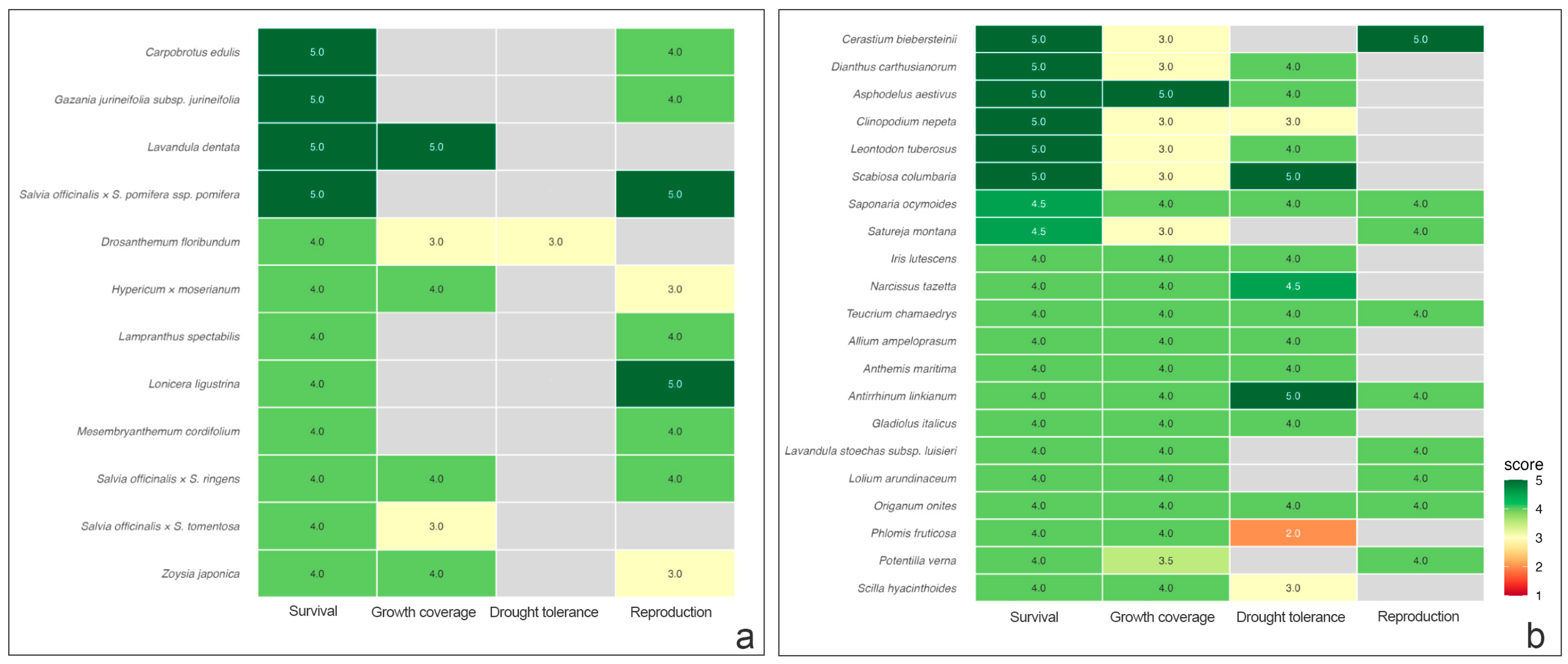
The species included in Figure 8a were selected from the wider pool of taxa assessed in the reviewed studies due to the high-performance scores across one or more evaluation criteria. The results indicate that both exotic and native species can successfully establish and persist on Mediterranean green roofs.
Species of exotic and horticultural origin generally showed high performance across the evaluated criteria, with high survival and generally positive values for growth and substrate-covering capacity. In contrast, information on reproductive performance was comparatively scarce, reflecting the limited attention given to this trait in the reviewed studies.
The native taxa included in Figure 8b (Asphodelus aestivus, Scabiosa columbaria, Antirrhinum linkianum, and Narcissus tazetta) were also selected among those that have received limited attention in the literature but nevertheless exhibited high performance across one or more evaluation criteria. These findings suggest that Mediterranean native species represent promising candidates for green roof applications.
For most native taxa, evidence is still limited to survival, growth, drought tolerance, and, less frequently, reproductive performance, leaving their ecological multifunctionality largely unexplored. Among the many native species tested on Mediterranean green roofs, only 34 taxa have been evaluated for at least one ecosystem service. These assessments were concentrated on a few species, with Petrosedum sediforme being the only taxon evaluated across all five service categories, followed by Brachypodium phoenicoides and Sedum album. Most other species were assessed for a single service dimension, while biodiversity-support functions were rarely investigated. This highlights a substantial knowledge gap and limits the identification of truly multifunctional species for ecologically coherent green roof design.

4. Discussion

4.1. Research Trend and Evidence Gaps

The increasing recognition of green roofs as nature-based solutions for urban sustainability and climate adaptation has intensified research on plant selection for EGRs. While earlier reviews of Getter et al. [49], Oberndorfer et al. [50] and, Berardi et al. [51] mainly emphasized the ecological benefits and potential of green roof technology, our analysis reveals a rapid growth of experimental studies since 2014 focused on testing plant performance and identifying species suited to Mediterranean conditions. This shift highlights the growing importance of evidence-based species selection for resilient and sustainable green roof design.
Despite the growing number of tested taxa, evidence remains concentrated in a few countries, particularly Italy, Greece, and Spain, highlighting a persistent geographical bias in Mediterranean green roof research. Similar patterns were reported by Leotta et al. [11] and Paço [10], who observed that the available evidence is largely derived from a limited number of regions despite the broad environmental heterogeneity of the Mediterranean Basin. Consequently, current species-selection frameworks may reflect the ecological conditions, research traditions, and plant availability of these countries rather than the full diversity of adaptive strategies developed across Mediterranean ecosystems. The eastern and southern Mediterranean, despite hosting highly diverse floras and numerous drought-adapted taxa, remain severely underrepresented in experimental studies as highlighted by Lionello at al. [11], Paço [10] and, Van Mechelen et al. [39], who called for a broader exploration of Mediterranean flora for green roof applications. This imbalance is particularly relevant because Mediterranean biodiversity is characterized by strong regional differentiation and high levels of endemism, suggesting that many potentially suitable species have not yet been evaluated for green roof applications [14,52]. Moreover, habitat-template approaches have repeatedly highlighted the value of species drawn from a broad range of Mediterranean habitats, including rocky outcrops, coastal cliffs, phrygana, and xeric grasslands [33,39]. Therefore, expanding research efforts towards underexplored Mediterranean regions could substantially enlarge the pool of candidate species and improve the ecological representativeness of plant-selection strategies. Moreover, most studies focus on short-term establishment metrics such as survival, growth, and drought tolerance, while long-term vegetation dynamics, reproduction, and ecosystem functioning remain poorly investigated. This limitation constrains our understanding of vegetation resilience and ecological stability over time [16,50,53].

4.2. Geographical Coherence of Mediterranean EGRs Species Pools

Data showed that research considered a relatively small subset of repeatedly tested species despite the broader taxonomic diversity available. Notably, both Mediterranean and extra-Mediterranean taxa occurred, suggesting that research effort has been driven by the repeated use of a limited set of well-established green roof plants. As a result, a substantial proportion of the recorded biodiversity remains supported by scarce experimental evidence, highlighting a significant gap in current knowledge and a potentially underexplored reservoir of species suitable for Mediterranea EGR applications.
The species pool identified in this review shows only partial ecological coherence with Mediterranean ecosystems. The predominance of chamaephytes reflects the strong environmental filtering imposed by EGRs, where shallow substrates, intense solar radiation, and prolonged summer drought favor low-growing, drought-tolerant perennial species. These characteristics closely resemble the adaptive traits found in naturally stressful Mediterranean habitats such as rocky outcrops, coastal cliffs, and xeric grasslands [15,39,54,55].
Geophytes and therophytes, which are important drought-avoidance life forms in Mediterranean ecosystems, were markedly underrepresented in the reviewed studies, probably because maintaining summer plant cover is often prioritized in green roof design. However, recent studies of Fabian and Talhouk [28] and, Jano et al. [31] demonstrated the suitability of geophytes for non-irrigated Mediterranean green roofs, while evidence from self-sustaining and biodiverse roof communities suggests that a wider range of Mediterranean life forms could be incorporated beyond the commonly used succulent species [27,56,57]. A similar pattern emerged from the chorological analysis: although Mediterranean taxa represented the largest biogeographical group, more than half of the recorded species belonged to extra-Mediterranean chorotypes, while Mediterranean endemics were rarely used. Although Mediterranean endemics may offer valuable ecological distinctiveness and adaptation to drought and heat stress, their restricted distributions require careful conservation and sustainable propagation practices [52,58].
The review also indicates that Mediterranean native flora remains an underexploited resource for green roof design. Several poorly studied native species achieved survival, growth, reproductive, or drought-tolerance scores comparable to those of the most frequently used species despite being evaluated in only a few studies [13,27,28,40,59,60,61,62]. These results suggest that the current species pool is shaped overall by horticultural filtering, whereby commercially available and historically established species receive disproportionate experimental attention [11,16,63,64].
The performance analysis confirms the reliability of the species that currently dominate Mediterranean green roof practice. Succulent taxa such as Sedum album, Sedum acre, Petrosedum sediforme, and P. rupestre consistently achieved high scores for survival, growth, and drought tolerance, confirming their suitability for the harsh conditions imposed by shallow substrates and prolonged summer drought. These findings are consistent with the long-established role of Crassulaceae as the foundation of extensive green roof systems [16,65]. However, high performance was not restricted to succulent species. Several native Mediterranean taxa, including Helichrysum italicum, Origanum dictamnus, Thymus serpyllum, Salvia officinalis, and Crithmum maritimum, showed high performance scores across multiple dimensions [13,27,40,66,67,68,69,70], demonstrating that successful green roof vegetation can be achieved through a broader range of functional strategies than those represented by the conventional Sedum-based palette. Similar conclusions have been reported for Mediterranean native flora adapted to rocky, coastal, and xeric habitats [15,39,71,72].
The concentration of experimental evidence on a small group of species suggests a potential research effort bias, as the taxa most frequently identified as high performing are also those most extensively studied. Consequently, the dominance of a few well-established species may partly reflect research intensity rather than the full spectrum of Mediterranean plants suitable for green roof applications.
The concentration of experimental evidence on a small group of taxa indicates that research effort is highly unevenly distributed across the species pool. A limited number of established taxa have been repeatedly tested, whereas many species remain supported by only one or two studies. This pattern describes the allocation of experimental evidence rather than ecological rarity and highlights the uncertainty surrounding the suitability of less-studied Mediterranean native taxa.

4.3. Beyond Survival: Functionality and Biodiversity

Species selection has primarily focused on persistent, drought-tolerant perennials, with research largely emphasizing establishment-related traits such as survival, growth, and drought tolerance. In contrast, ecosystem services and broader ecological functions have received considerably less attention. This review revealed a marked imbalance in the evaluation of native species: although several Mediterranean taxa identified as highly suitable for green roofs (e.g., Helichrysum italicum, Salvia officinalis, Crithmum maritimum, Teucrium chamaedrys, and Iris lutescens) showed strong establishment performance, only a small subset has been assessed for ecosystem-service provision. Overall, just 34 native species were evaluated for at least one ecosystem-service category, and these assessments were concentrated on a few taxa, with Petrosedum sediforme, Brachypodium phoenicoides, and Sedum album being the most comprehensively studied. For most species, evidence remains limited to plant-performance metrics, leaving their multifunctional ecological role largely unknown. This lack of standardized reporting hinders robust species comparisons and limits opportunities for quantitative synthesis, weakening the basis for selecting multifunctional native species for Mediterranean green roofs.
Notably, biodiversity was among the least evaluated dimensions, and only a few studies explicitly quantified it using ecological metrics. For example, Vasl et al. [73] assessed community diversity and species dynamics, whereas Schindler et al. [74], Tuttolomondo et al. [75], Vannucchi et al. [76] and, Trenta et al. [32] primarily discussed biodiversity as a potential benefit of vegetation diversification rather than as a measurable ecological outcome. This imbalance has important implications for species selection, as plants are generally chosen according to their ability to survive rooftop conditions rather than their contribution to ecological functioning. Consequently, traits associated with pollinator support, reproductive persistence, habitat provision, community interactions, and ecosystem-service delivery are likely underestimated during the selection process. Yet, increasing evidence indicates that species-rich and functionally diverse plant communities enhance ecosystem multifunctionality, including thermal regulation, stormwater retention, habitat quality, and resilience to disturbance [37,77,78]. The limited assessment of ecosystem services constrains both our understanding of Mediterranean green roof ecology and the identification of species assemblages that maximize biodiversity and ecosystem functioning. Vegetation persistence should therefore be considered a prerequisite rather than the goal of green roof design. In protected horticulture, thermal interventions have been quantified through heat-flux measurements against an uncovered control, with external insulation reducing night-time heat loss from 198.6 to 54.2 W m−2 [79], while greenhouse environmental models can incorporate crop physiological processes such as photosynthesis and respiration to represent interactions between plant responses and system behavior [80]. This comparison is instructive for green roof research, where only 22 of the 90 studies reporting performance in our dataset measured plant and system outcomes together. Future studies should adopt a standardized framework reporting survival, growth or cover, reproductive performance, and at least one ecosystem-service indicator. This would improve cross-study comparability, facilitate meta-analyses, and support evidence-based selection of multifunctional native species.

4.4. Species Selection and Ecological Risk: Towards Ecologically Coherent Mediterranean Green Roofs

Despite a preference for native species, plant selection in Mediterranean EGRs research continues to rely substantially on horticultural and non-native taxa, including species of potential biosecurity concern. The performance results indicate that several exotic and horticultural species achieve high levels of survival, growth, and drought tolerance under Mediterranean green roof conditions. However, the occurrence of 22 invasive or potentially invasive taxa within the reviewed literature [28,31,41,62,67,68,81,82,83,84,85,86,87,88,89,90,91,92,93,94,95,96,97,98,99,100,101,102,103,104] highlights a potential conflict between technical performance and ecological suitability. Carpobrotus edulis emerged as one of the most frequently used non-native species [83,93,96,99,100] despite being widely recognized as an invasive plant in Mediterranean coastal ecosystems.
This pattern suggests that some of the traits responsible for successful establishment on green roofs—such as vigorous growth, high propagative capacity, and strong competitive ability—are the same characteristics that can promote invasiveness in adjacent natural habitats. Similar concerns have been raised for Mediterranean and urban ecosystems, where highly competitive alien species may reduce native biodiversity and alter ecosystem functioning [105,106,107].
Therefore, species selection should not rely solely on performance metrics but should also consider invasion risk and ecological compatibility. Biodiversity, ecological fit, and technical performance should therefore be regarded as complementary objectives that collectively enhance the resilience, multifunctionality, and sustainability of green roof systems under future climate change scenarios [16,37,39,71,77,78]. Importantly, the results indicate that the main constraint is the limited experimental exploration of the regional flora. Expanding research toward underrepresented native taxa and poorly studied Mediterranean regions will therefore be essential to identify plant assemblages capable of maximizing both ecological and functional performance [11,15,39,71,72].
Economic constraints and commercial supply chain dynamics are likely to influence regional species selection; generalist taxa (e.g., Sedum and Phedimus spp.) are largely reinforced by their availability as low-cost, pre-grown commercial mats. In contrast, the lack of a developed regional nursery sector for native wild perennials elevates procurement costs and establishment risks, creating a practical barrier to the adoption of native Mediterranean flora despite their ecological suitability.
A notable limitation of this review stems from the qualitative and heterogeneous nature of performance metrics across the included studies, which required a standardized harmonization procedure. While the ordinal scoring scale enabled a comparative synthesis across diverse datasets, alternative scoring thresholds or weighting schemes were not subjected to formal quantitative sensitivity testing due to data sparsity and inconsistent reporting across primary sources. Consequently, although our qualitative syntheses and broad ranking patterns align with established ecological frameworks, minor shifts in species rankings might occur under different harmonization boundaries. Future meta-analyses with more granular, standardized datasets should incorporate systematic sensitivity checks to further test the mathematical robustness of these performance metrics.

5. Conclusions

This review identified 340 taxa from 48 families evaluated for extensive green roofs in Mediterranean climates, while also highlighting a strong research focus on a limited set of species and performance metrics. Our findings provide strong evidence that many native Mediterranean species perform comparably to commonly used succulent species, supporting the diversification of plant palettes beyond Sedum-dominated systems. At present, species selection can be confidently informed by survival and drought tolerance, which are the most extensively investigated traits. However, long-term vegetation dynamics, reproductive persistence, species interactions, and ecosystem-service delivery remain poorly understood and have rarely been assessed. Consequently, recommendations for maximizing multifunctionality and ecosystem-service provision are still constrained by the available evidence. While native species represent promising alternatives for increasing biodiversity and ecological value, achieving ecologically coherent and resilient plant communities requires experimental testing of species mixtures and their long-term dynamics, which remains a critical research gap. Future studies should therefore expand research to understudied native taxa, evaluate ecosystem-service outcomes directly, and adopt standardized performance metrics to support more robust species selection and the development of resilient, regionally adapted green roof systems under future climate change scenarios.

Supplementary Materials

The following supporting information can be downloaded at https://www.mdpi.com/article/10.3390/su18178742/s1, Table S1: List of references included in the review, with the number of species reported (Species) and whether the study evaluated species performance (Performance) indicated for each reference. Table S2: List of plant species in different references used in the floristic analysis, including taxonomic, and life-form data for each species. Table S3: List of references and associated plant species used in the performance analysis, including survival, growth, and functional trait scores recorded for each species. Table S4: Family-level summary of taxonomic richness, occurrence records, contributing studies, records per taxon, and within-family Gini coefficients. Table S5: Comparison of the candidate discrete frequency distributions fitted to the species-use frequency data, with log-likelihood, AIC, Akaike weights and goodness-of-fit statistics. Table S6: Country-level native share of occurrence records, with 95% Wilson confidence intervals.

Author Contributions

Conceptualization, F.B., G.C. and A.B.; methodology, F.B. and Z.H.; validation, F.B. and G.C.; formal analysis, Z.H.; investigation, F.B. and A.B.; data curation, F.B. and Z.H.; writing—original draft preparation, F.B.; writing—review and editing, F.B., Z.H., A.B. and G.C.; visualization, F.B. and Z.H.; supervision, G.C.; funding acquisition, G.C. All authors have read and agreed to the published version of the manuscript.

Funding

This research was funded by Grant of Excellence Departments, MIUR-Italy Italian Ministry of University and Research, National Operational Program “Research and Innovation” 2014–2020 (PON), CUP ECCELLENZA_2023-27_BMCAE. The numerical evaluations of plant survival and colonization dynamics were supported by the European Union NextGenerationEU through the Rome Technopole Innovation Ecosystem grant—PNRR Mission 4 Component 2 Investment 1.5 (CUP F83B22000040006).

Institutional Review Board Statement

Not applicable.

Informed Consent Statement

Not applicable.

Data Availability Statement

The original contributions presented in this study are included in the article/Supplementary Material. Further inquiries can be directed to the corresponding authors.

Conflicts of Interest

The authors declare no conflicts of interest.

References

  1. Kabisch, N.; Frantzeskaki, N.; Pauleit, S.; Naumann, S.; Davis, M.; Artmann, M.; Haase, D.; Knapp, S.; Korn, H.; Stadler, J.; et al. Nature-based solutions to climate change mitigation and adaptation in urban areas: Perspectives on indicators, knowledge gaps, barriers, and opportunities for action. Ecol. Soc. 2016, 21, 39. [Google Scholar] [CrossRef] [Scilit]
  2. Cohen-Shacham, E.; Walters, G.; Janzen, C.; Maginnis, S. (Eds.) Nature-Based Solutions to Address Global Societal Challenges; IUCN: Gland, Switzerland, 2016. [Google Scholar] [CrossRef] [Scilit]
  3. Cook, E.M.; Kim, Y.; Grimm, N.B.; McPhearson, T.; Anderson, P.; Bulkeley, H.; Collier, M.J.; Diep, L.; Morató, J.; Zhou, W. Nature-based solutions for urban sustainability. Proc. Natl. Acad. Sci. USA 2024, 121, e2315909122. [Google Scholar] [CrossRef] [Scilit]
  4. De Cristo, E.; Evangelisti, L.; Barbaro, L.; De Lieto Vollaro, R.; Asdrubali, F. A systematic review of green roofs’ thermal and energy performance in the Mediterranean region. Energies 2025, 18, 2517. [Google Scholar] [CrossRef] [Scilit]
  5. Wang, L.; Wang, H.; Wang, Y.; Che, Y.; Ge, Z.; Mao, L. The relationship between green roofs and urban biodiversity: A systematic review. Biodivers. Conserv. 2022, 31, 1771–1796. [Google Scholar] [CrossRef] [Scilit]
  6. Giorgi, F.; Lionello, P. Climate change projections for the Mediterranean region. Glob. Planet. Change 2008, 63, 90–104. [Google Scholar] [CrossRef] [Scilit]
  7. Matesanz, S.; Valladares, F. Ecological and evolutionary responses of Mediterranean plants to global change. Environ. Exp. Bot. 2014, 103, 53–67. [Google Scholar] [CrossRef] [Scilit]
  8. Lionello, P.; Scarascia, L. The relation between climate change in the Mediterranean region and global warming. Reg. Environ. Change 2018, 18, 1481–1493. [Google Scholar] [CrossRef] [Scilit]
  9. Przybysz, A.; Sæbø, A.; Pawełkowicz, M.; Moniuszko, H.; Hanslin, H.M. Wind-Driven Drought Stress in Green Roof Vegetation: Implications for Urban Resilience. Land 2026, 15, 974. [Google Scholar] [CrossRef] [Scilit]
  10. Paço, T.A. Green Roofs in Southern Europe: Assessing Native Vegetation Suitability While Tackling Water Management Strategies. Water 2026, 18, 398. [Google Scholar] [CrossRef] [Scilit]
  11. Leotta, L.; Toscano, S.; Romano, D. Which plant species for green roofs in the Mediterranean environment? Plants 2023, 12, 3985. [Google Scholar] [CrossRef] [Scilit]
  12. Raimondo, F.; Trifilò, P.; Lo Gullo, M.A.; Andri, S.; Savi, T.; Nardini, A. Plant performance on Mediterranean green roofs: Interaction of species-specific hydraulic strategies and substrate water relations. AoB Plants 2015, 7, plv007. [Google Scholar] [CrossRef] [Scilit]
  13. Bellini, A.; Bartoli, F.; Kumbaric, A.; Casalini, R.; Caneva, G. Evaluation of Mediterranean perennials for extensive green roofs in water-limited regions: A two-year experiment. Ecol. Eng. 2024, 209, 107399. [Google Scholar] [CrossRef] [Scilit]
  14. Cowling, R.M.; Rundel, P.W.; Lamont, B.B.; Arroyo, M.K.; Arianoutsou, M. Plant diversity in Mediterranean-climate regions. Trends Ecol. Evol. 1996, 11, 362–366. [Google Scholar] [CrossRef] [Scilit]
  15. Caneva, G.; Kumbaric, A.; Savo, V.; Casalini, R. Ecological approach in selecting extensive green roof plants: A data-set of Mediterranean plants. Plant Biosyst. 2015, 149, 374–383. [Google Scholar] [CrossRef] [Scilit]
  16. Lundholm, J.T. Green roof plant species diversity improves ecosystem multifunctionality. J. Appl. Ecol. 2015, 52, 726–734. [Google Scholar] [CrossRef] [Scilit]
  17. Monterusso, M.A.; Rowe, D.B.; Rugh, C.L. Establishment and persistence of Sedum spp. and native taxa for green roof applications. HortScience 2005, 40, 391–396. [Google Scholar] [CrossRef] [Scilit]
  18. VanWoert, N.D.; Rowe, D.B.; Andresen, J.A.; Rugh, C.L.; Fernandez, R.T.; Xiao, L. Green roof stormwater retention: Effects of roof surface, slope, and media depth. J. Environ. Qual. 2005, 34, 1036–1044. [Google Scholar] [CrossRef] [Scilit]
  19. Thuring, C.E.; Dunnett, N. Vegetation composition of old extensive green roofs (from 1980s Germany). Ecol. Process. 2014, 3, 4. [Google Scholar] [CrossRef] [Scilit]
  20. Rowe, D.B.; Getter, K.L.; Durhman, A.K. Effect of green roof media depth on Crassulacean plant succession over seven years. Landsc. Urban Plan. 2012, 104, 310–319. [Google Scholar] [CrossRef] [Scilit]
  21. Nektarios, P.A.; Ntoulas, N.; Nydrioti, E.; Kokkinou, I.; Bali, E.-M.; Amountzias, I. Drought stress response of Sedum sediforme grown in extensive green roof systems with different substrate types and depths. Sci. Hortic. 2015, 181, 52–61. [Google Scholar] [CrossRef] [Scilit]
  22. Nektarios, P.A.; Kokkinou, I.; Ntoulas, N. The effects of substrate depth and irrigation regime on seeded Sedum species grown on urban extensive green roof systems under semi-arid Mediterranean climatic conditions. J. Environ. Manag. 2021, 279, 111607. [Google Scholar] [CrossRef] [Scilit]
  23. Azeñas, V.; Janner, I.; Medrano, H.; Gulías, J. Performance evaluation of five Mediterranean species to optimize ecosystem services of green roofs under water-limited conditions. J. Environ. Manag. 2018, 212, 236–247. [Google Scholar] [CrossRef] [Scilit]
  24. Azeñas, V.; Janner, I.; Medrano, H.; Gulías, J. Evaluating the establishment performance of six native perennial Mediterranean species for use in extensive green roofs under water-limiting conditions. Urban For. Urban Green. 2019, 41, 158–169. [Google Scholar] [CrossRef] [Scilit]
  25. Mason, A.R.; Puchol-Salort, P.; Gathorne-Hardy, A.; Smith, B.M.; Myers, R.J. Local terrestrial biodiversity impacts in life cycle assessment: A case study of sedum roofs in London, UK. J. Ind. Ecol. 2024, 28, 496–511. [Google Scholar] [CrossRef] [Scilit]
  26. Drukker, E.F.; Tanis, M.; Marshall, L.; Quist, C.W.; Schranz, M.E.; Fatouros, N.E. Scarcity of flowering plants on sedum roofs limits pollinator diversity. bioRxiv 2025. [Google Scholar] [CrossRef] [Scilit]
  27. Bellini, A.; Bartoli, F.; D’Amato, L.; Casalini, R.; Caneva, G. Enhancing biodiversity and functionality of extensive green roof: A comparative study of five native Mediterranean perennial species in Rome. Build. Environ. 2025, 282, 113285. [Google Scholar] [CrossRef] [Scilit]
  28. Fabian, M.; Talhouk, S.N. Constructed communities of geophyte and succulent mixes are suitable for non-irrigated extensive green roofs in Mediterranean cities. Urban Ecosyst. 2025, 28, 26. [Google Scholar] [CrossRef] [Scilit]
  29. Todeschini, C.C.; Fett-Neto, A.G. Life at the top: Extensive green roof plant species and their traits for urban use. Plants 2025, 14, 735. [Google Scholar] [CrossRef] [Scilit]
  30. Riva, E.; Guffanti, D.; Ferrari, E.; Vignati, S.; Franzoni, G.; Provolo, G.; Ferrante, A. Effect of substrate depth on plant and thermal performances of a light-weight green roof for rural buildings. Heliyon 2025, 11, e43745. [Google Scholar] [CrossRef] [Scilit]
  31. Jano, S.; Dhrami, K.; Imami, F.; Vuksani, G. Evaluating indigenous Albanian bulbous plants on green roofs for urban ecosystem enhancement in Mediterranean climates. J. Regener. Econ. 2024, 1, 191–203. [Google Scholar] [CrossRef] [Scilit]
  32. Trenta, M.; Quadri, A.; Sambuco, B.; Perez Garcia, C.A.; Barbaresi, A.; Tassinari, P.; Torreggiani, D. Green roof management in Mediterranean climates: Evaluating the performance of native herbaceous plant species and green manure to increase sustainability. Buildings 2025, 15, 640. [Google Scholar] [CrossRef] [Scilit]
  33. Lundholm, J.T. Green roofs and facades: A habitat template approach. Urban Habitats 2006, 4, 87–101. [Google Scholar]
  34. MacIvor, J.S.; Lundholm, J. Performance evaluation of native plants suited to extensive green roof conditions in a maritime climate. Ecol. Eng. 2011, 37, 407–417. [Google Scholar] [CrossRef] [Scilit]
  35. Sutton, R. Introduction to Green Roof Ecosystems. In Green Roof Ecosystems; Sutton, R., Ed.; Ecological Studies; Springer: Cham, Switzerland, 2015; Volume 223. [Google Scholar] [CrossRef] [Scilit]
  36. Farrell, C.; Szota, C.; Williams, N.S.G.; Arndt, S.K. High-water users can be drought tolerant: Using physiological traits for green roof plant selection. Plant Soil 2013, 372, 177–193. [Google Scholar] [CrossRef] [Scilit]
  37. Lundholm, J.; MacIvor, J.S.; MacDougall, Z.; Ranalli, M. Plant species and functional group combinations affect green roof ecosystem functions. PLoS ONE 2010, 5, e9677. [Google Scholar] [CrossRef] [Scilit]
  38. Lundholm, J.T.; Walker, E.A. Evaluating the habitat template approach applied to green roofs. Urban Nat. 2018, 1, 39–59. [Google Scholar]
  39. Van Mechelen, C.; Dutoit, T.; Hermy, M. Mediterranean open habitat vegetation offers great potential for extensive green roof design. Landsc. Urban Plan. 2014, 121, 81–91. [Google Scholar] [CrossRef] [Scilit]
  40. Bellini, A.; Savo, V.; Caneva, G.; D’Amico, E.; Casalini, R.; Bartoli, F. How a green roof becomes biodiverse: Vegetation analysis on a green roof with no maintenance in Rome (Italy). Plants 2025, 14, 3180. [Google Scholar] [CrossRef] [Scilit]
  41. Cascone, S.; Vitaliano, S. Innovative green roof technologies in Mediterranean climate: Implications for sustainable design of the built environment. Build. Environ. 2025, 273, 112715. [Google Scholar] [CrossRef] [Scilit]
  42. POWO. Plants of the World Online. Facilitated by the Royal Botanic Gardens, Kew. Available online: https://powo.science.kew.org/ (accessed on 1 May 2026).
  43. Bartolucci, F.; Peruzzi, L.; Galasso, G.; Alessandrini, A.; Ardenghi, N.M.G.; Bacchetta, G.; Banfi, E.; Barberis, G.; Bernardo, L.; Bouvet, D.; et al. A second update to the checklist of the vascular flora native to Italy. Plant Biosyst. 2024, 158, 219–296. [Google Scholar] [CrossRef] [Scilit]
  44. Raunkiær, C. The Life Forms of Plants and Statistical Plant Geography; Oxford University Press: Oxford, UK, 1934. [Google Scholar]
  45. Koricheva, J.; Gurevitch, J.; Mengersen, K. (Eds.) Handbook of Meta-Analysis in Ecology and Evolution; Princeton University Press: Princeton, NJ, USA, 2013. [Google Scholar]
  46. Mukherjee, N.; Hugé, J.; Sutherland, W.J.; McNeill, J.; Van Opstal, M.; Dahdouh-Guebas, F.; Koedam, N. The Delphi technique in ecology and biological conservation: Applications and guidelines. Methods Ecol. Evol. 2015, 6, 1097–1109. [Google Scholar] [CrossRef] [Scilit]
  47. Damgaard, C.; Weiner, J. Describing inequality in plant size or fecundity. Ecology 2000, 81, 1139–1142. [Google Scholar] [CrossRef]
  48. R Core Team. R: A Language and Environment for Statistical Computing; R Foundation for Statistical Computing: Vienna, Austria, 2024; Available online: https://www.R-project.org/ (accessed on 1 May 2026).
  49. Getter, K.L.; Rowe, D.B. The role of extensive green roofs in sustainable development. HortScience 2006, 41, 1276–1285. [Google Scholar] [CrossRef] [Scilit]
  50. Oberndorfer, E.; Lundholm, J.; Bass, B.; Coffman, R.R.; Doshi, H.; Dunnett, N.; Gaffin, S.; Köhler, M.; Liu, K.K.Y.; Rowe, B. Green roofs as urban ecosystems: Ecological structures, functions, and services. BioScience 2007, 57, 823–833. [Google Scholar] [CrossRef] [Scilit]
  51. Berardi, U.; GhaffarianHoseini, A.; GhaffarianHoseini, A. State-of-the-art analysis of the environmental benefits of green roofs. Appl. Energy 2014, 115, 411–428. [Google Scholar] [CrossRef] [Scilit]
  52. Médail, F.; Quézel, P. Biodiversity hotspots in the Mediterranean Basin: Setting global conservation priorities. Conserv. Biol. 1999, 13, 1510–1513. [Google Scholar] [CrossRef] [Scilit]
  53. Butler, C.; Butler, E.; Orians, C.M. Native plant enthusiasm reaches new heights: Perceptions, evidence, and the future of green roofs. Urban For. Urban Green. 2012, 11, 1–10. [Google Scholar] [CrossRef] [Scilit]
  54. Blondel, J.; Aronson, J.; Bodiou, J.Y.; Boeuf, G. The Mediterranean Region: Biological Diversity in Space and Time; Oxford University Press: Oxford, UK, 2010. [Google Scholar]
  55. Lundholm, J. The ecology and evolution of constructed ecosystems as green infrastructure. Front. Ecol. Evol. 2015, 3, 106. [Google Scholar] [CrossRef] [Scilit]
  56. Vannucchi, F.; Bibbiani, C.; Caudai, C.; Bretzel, F. Mediterranean extensive green roof self-sustainability mediated by substrate composition and plant strategy. Horticulturae 2023, 9, 1117. [Google Scholar] [CrossRef] [Scilit]
  57. Vidaller, C.; Jouet, A.; Van Mechelen, C.; De Almeida, T.; Cortet, J.; Rivière, L.; Mahy, G.; Hermy, M.; Dutoit, T. Coexistence and succession of spontaneous and planted vegetation on extensive Mediterranean green roofs: Impacts on soil, seed banks, and mesofauna. Land 2023, 12, 1726. [Google Scholar] [CrossRef] [Scilit]
  58. Lavergne, S.; Thompson, J.D.; Garnier, E.; Debussche, M. The biology and ecology of narrow endemic and widespread plants: A comparative study of trait variation in 20 congeneric pairs. Oikos 2004, 107, 505–518. [Google Scholar] [CrossRef] [Scilit]
  59. Benvenuti, S. Wildflower green roofs for urban landscaping, ecological sustainability and biodiversity. Landsc. Urban Plan. 2014, 124, 151–161. [Google Scholar] [CrossRef] [Scilit]
  60. Ebadati Esfahani, R.; Paço, T.A.; Martins, D.; Arsénio, P. Increasing the resistance of Mediterranean extensive green roofs by using native plants from old roofs and walls. Ecol. Eng. 2022, 178, 106576. [Google Scholar] [CrossRef] [Scilit]
  61. Paço, T.A.; Cruz de Carvalho, R.; Arsénio, P.; Martins, D. Green roof design techniques to improve water use under Mediterranean conditions. Urban Sci. 2019, 3, 14. [Google Scholar] [CrossRef] [Scilit]
  62. Provenzano, M.E.; Cardarelli, M.; Saccardo, F.; Colla, G.; Battistelli, A.; Proietti, S. Evaluation of perennial herbaceous species for their potential use in a green roof under Mediterranean climate conditions. In Proceedings of the II International Conference on Landscape and Urban Horticulture, Bologna, Italy, 9–11 June 2010. [Google Scholar]
  63. Dunnett, N.; Kingsbury, N. Planting Green Roofs and Living Walls; Timber Press: Portland, OR, USA, 2008. [Google Scholar]
  64. Snodgrass, E.C.; Snodgrass, L.L. Green Roof Plants: A Resource and Planting Guide; Timber Press: Portland, OR, USA, 2006. [Google Scholar]
  65. Dunnett, N.; Nolan, A. The effect of substrate depth and supplementary watering on the growth of nine herbaceous perennials in a semi-extensive green roof. Acta Hortic. 2004, 643, 305–309. [Google Scholar] [CrossRef] [Scilit]
  66. Savi, T.; Andri, S.; Nardini, A. Impact of different green roof layering on plant water status and drought survival. Ecol. Eng. 2013, 57, 188–196. [Google Scholar] [CrossRef] [Scilit]
  67. Monteiro, C.M.; Calheiros, C.S.C.; Martins, J.P.; Costa, F.M.; Palha, P.; Freitas, S.; Ramos, N.M.M.; Castro, P.M.L. Substrate influence on aromatic plant growth in extensive green roofs in a Mediterranean climate. Urban Ecosyst. 2017, 20, 1347–1357. [Google Scholar] [CrossRef] [Scilit]
  68. Monteiro, C.M.; Calheiros, C.S.C.; Palha, P.; Castro, P.M.L. Growing substrates for aromatic plant species in green roofs and water runoff quality: Pilot experiments in a Mediterranean climate. Water Sci. Technol. 2017, 76, 2094–2103. [Google Scholar] [CrossRef] [Scilit]
  69. Martini, A.N.; Papafotiou, M.; Evangelopoulos, K. Effect of substrate type and depth on the establishment of the edible and medicinal native species Crithmum maritimum on an urban Mediterranean green roof. Acta Hortic. 2017, 1189, 451–454. [Google Scholar] [CrossRef] [Scilit]
  70. Benvenuti, S.; Bacci, D. Initial agronomic performances of Mediterranean xerophytes in simulated dry green roofs. Urban Ecosyst. 2010, 13, 349–363. [Google Scholar] [CrossRef] [Scilit]
  71. Van Mechelen, C.; Dutoit, T.; Hermy, M. Adapting green roof irrigation practices for a sustainable future: A review. Sustain. Cities Soc. 2015, 19, 74–90. [Google Scholar] [CrossRef] [Scilit]
  72. Catalano, C.; Marcenò, C.; Laudicina, V.A.; Guarino, R. Thirty years unmanaged green roofs: Ecological research and design implications. Landsc. Urban Plan. 2016, 149, 11–19. [Google Scholar] [CrossRef] [Scilit]
  73. Vasl, A.; Shalom, H.; Kadas, G.J.; Blaustein, L. Sedum–annual plant interactions on green roofs: Facilitation, competition and exclusion. Ecol. Eng. 2017, 108, 318–329. [Google Scholar] [CrossRef] [Scilit]
  74. Schindler, B.Y.; Blaustein, L.; Vasl, A.; Kadas, G.J.; Seifan, M. Cooling effect of Sedum sediforme and annual plants on green roofs in a Mediterranean climate. Urban For. Urban Green. 2019, 38, 392–396. [Google Scholar] [CrossRef] [Scilit]
  75. Tuttolomondo, T.; Fascella, G.; Licata, M.; Schicchi, R.; Gennaro, M.C.; La Bella, S.; Leto, C.; Aprile, S. Studies on Sedum taxa found in Sicily (Italy) for Mediterranean extensive green roofs. Ital. J. Agron. 2018, 13, 1077. [Google Scholar] [CrossRef] [Scilit]
  76. Vannucchi, F.; Pini, R.; Scatena, M.; Benelli, G.; Canale, A.; Bretzel, F. Deinking sludge in the substrate reduces the fertility and enhances the plant species richness of extensive green roofs. Ecol. Eng. 2018, 116, 87–96. [Google Scholar] [CrossRef] [Scilit]
  77. Cook-Patton, S.C.; Bauerle, T.L. Potential benefits of plant diversity on vegetated roofs: A literature review. J. Environ. Manag. 2012, 106, 85–92. [Google Scholar] [CrossRef] [Scilit]
  78. Heim, A.; Lundholm, J. Species interactions in green roof vegetation suggest complementary planting mixtures. Landsc. Urban Plan. 2014, 130, 125–133. [Google Scholar] [CrossRef] [Scilit]
  79. Li, K.; Shi, J.; Hu, C.; Xue, W. The Intelligentization Process of Agricultural Greenhouse: A Review of Control Strategies and Modeling Techniques. Agriculture 2025, 15, 2135. [Google Scholar] [CrossRef] [Scilit]
  80. Guan, W.; Guo, W.; Chen, F.; Han, X.; Wang, H.; Sun, W.; Zhao, Q.; Jia, D.; Wei, X.; Zhu, Q. Multi-Span Greenhouse Energy Saving by External Insulation: System Design and Implementation. Agriculture 2024, 14, 281. [Google Scholar] [CrossRef] [Scilit]
  81. A’saf, T.S.; Al-Ajlouni, M.G.; Ayad, J.Y.; Othman, Y.A.; St. Hilaire, R. Performance of six different soilless green roof substrates for the Mediterranean region. Sci. Total Environ. 2020, 730, 139182. [Google Scholar] [CrossRef] [Scilit]
  82. Baraldi, R.; Neri, L.; Costa, F.; Facini, O.; Rapparini, F.; Carriero, G. Ecophysiological and micromorphological characterization of green roof vegetation for urban mitigation. Urban For. Urban Green. 2019, 37, 24–32. [Google Scholar] [CrossRef] [Scilit]
  83. Di Miceli, G.; Iacuzzi, N.; Licata, M.; La Bella, S.; Tuttolomondo, T.; Aprile, S. Growth and development of succulent mixtures for extensive green roofs in a Mediterranean climate. PLoS ONE 2022, 17, e0269446. [Google Scholar] [CrossRef] [Scilit]
  84. Fabian, M.; Talhouk, S.N. Assessment of a constructed community of native geophytes and sedum species as a habitat analog for extensive green roofs in an urban East Mediterranean environment. Res. Sq. 2024. [Google Scholar] [CrossRef] [Scilit]
  85. Fantozzi, F.; Bibbiani, C.; Gargari, C.; Rugani, R.; Salvadori, G. Do green roofs really provide significant energy saving in a Mediterranean climate? Critical evaluation based on different case studies. Front. Archit. Res. 2021, 10, 447–465. [Google Scholar] [CrossRef] [Scilit]
  86. Ferrante, P.; La Gennusa, M.; Peri, G.; Scaccianoce, G.; Sorrentino, G. Comparison between conventional and vegetated roof by means of a dynamic simulation. Energy Procedia 2015, 78, 2917–2922. [Google Scholar] [CrossRef] [Scilit]
  87. Ferrante, P.; La Gennusa, M.; Peri, G.; Rizzo, G.; Scaccianoce, G. Vegetation growth parameters and leaf temperature: Experimental results from a six plots green roofs system. Energy 2016, 115, 1723–1732. [Google Scholar] [CrossRef] [Scilit]
  88. Giagnacovo, G.; Biagiotti, D.; Di Bonito, R.; Di Lonardo, S.; Campiotti, C.A. On the influence of plant morphology in the extensive green roof cover: A case study in Mediterranean area. Ecol. Eng. 2025, 213, 107562. [Google Scholar] [CrossRef] [Scilit]
  89. Giorgioni, M.E.; Grandi, F. Use of evergreen grey-leaved shrubs from Mediterranean garrigue for greening extensive living roofs. Acta Hortic. 2021, 1331, 173–180. [Google Scholar] [CrossRef] [Scilit]
  90. Gurrea-Ysasi, G.; Blanca-Giménez, V.; Fernández de Córdova, P.; Cortés-Olmos, C.; Rodríguez-Burruezo, A.; Fita, I.C. Comparative study of different Crassulaceae species for their potential use as plant covers to improve thermal performance of green roofs. Horticulturae 2022, 8, 846. [Google Scholar] [CrossRef] [Scilit]
  91. Marouli, C.; Savvidou, P.; Koutsokali, M.; Papadopoulou, P.; Misseyanni, A.; Tsiliki, G.; Georgas, D. Plant growth on a Mediterranean green roof: A pilot study on influence of substrate depth, substrate composition, and type of green roof. Front. Sustain. Cities 2022, 3, 796441. [Google Scholar] [CrossRef] [Scilit]
  92. Martini, A.N.; Tassoula, L.; Papafotiou, M. Adaptation of Salvia fruticosa, S. officinalis, S. ringens and interspecific hybrids in an extensive green roof under two irrigation frequencies. Not. Bot. Horti Agrobot. Cluj-Napoca 2022, 50, 12767. [Google Scholar] [CrossRef] [Scilit]
  93. Moroni, M.; Porti, M.; Piro, P. Design of a remote-controlled platform for green roof plants monitoring via hyperspectral sensors. Water 2019, 11, 1368. [Google Scholar] [CrossRef] [Scilit]
  94. Nektarios, P.A.; Ischyropoulos, D.; Kalozoumis, P.; Savvas, D.; Yfantopoulos, D.; Ntoulas, N.; Tsaniklidis, G.; Goumenaki, E. Impact of substrate depth and fertilizer type on growth, production, quality characteristics and heavy metal contamination of tomato and lettuce grown on urban green roofs. Sci. Hortic. 2022, 305, 111318. [Google Scholar] [CrossRef] [Scilit]
  95. Ntoulas, N.; Nektarios, P.A.; Charalambous, E.; Psaroulis, A. Zoysia matrella cover rate and drought tolerance in adaptive extensive green roof systems. Urban For. Urban Green. 2013, 12, 522–531. [Google Scholar] [CrossRef] [Scilit]
  96. Palermo, S.A.; Turco, M.; Principato, F.; Piro, P. Hydrological effectiveness of an extensive green roof in Mediterranean climate. Water 2019, 11, 1378. [Google Scholar] [CrossRef] [Scilit]
  97. Papafotiou, M.; Martini, A.N.; Tassoula, L.; Stylias, E.G.; Kalantzis, A.; Dariotis, E. Acclimatization of Mediterranean native sages (Salvia spp.) and interspecific hybrids in an urban green roof under regular and reduced irrigation. Sustainability 2022, 14, 4978. [Google Scholar] [CrossRef] [Scilit]
  98. Pérez, G.; Vila, A.; Rincón, L.; Solé, C.; Cabeza, L.F. Use of rubber crumbs as drainage layer in green roofs as potential energy improvement material. Appl. Energy 2012, 97, 347–354. [Google Scholar] [CrossRef] [Scilit]
  99. Piro, P.; Porti, M.; Veltri, S.; Lupo, E.; Moroni, M. Hyperspectral monitoring of green roof vegetation health state in sub-Mediterranean climate: Preliminary results. Sensors 2017, 17, 662. [Google Scholar] [CrossRef] [Scilit]
  100. Piro, P.; Carbone, M.; De Simone, M.; Maiolo, M.; Bevilacqua, P.; Arcuri, N. Energy and hydraulic performance of a vegetated roof in sub-Mediterranean climate. Sustainability 2018, 10, 3473. [Google Scholar] [CrossRef] [Scilit]
  101. Santos, M.L.; Silva, C.M.; Ferreira, F.; Matos, J.S. Hydrological analysis of green roofs performance under a Mediterranean climate: A case study in Lisbon, Portugal. Sustainability 2023, 15, 1064. [Google Scholar] [CrossRef] [Scilit]
  102. Schweitzer, O.; Erell, E. Evaluation of the energy performance and irrigation requirements of extensive green roofs in a water-scarce Mediterranean climate. Energy Build. 2014, 68, 25–32. [Google Scholar] [CrossRef] [Scilit]
  103. Tomasella, M.; De Nardi, E.; Petruzzellis, F.; Andri, S.; Castello, M.; Nardini, A. Green roof irrigation management based on substrate water potential assures water saving without affecting plant physiological performance. Ecohydrology 2022, 15, e2428. [Google Scholar] [CrossRef] [Scilit]
  104. Vestrella, A.; Biel, C.; Savé, R.; Bartoli, F. Mediterranean green roof simulation in Caldes de Montbui (Barcelona): Thermal and hydrological performance test of Frankenia laevis L., Dymondia margaretae Compton and Iris lutescens Lam. Appl. Sci. 2018, 8, 2497. [Google Scholar] [CrossRef] [Scilit]
  105. Vilà, M.; Tessier, M.; Suehs, C.M.; Brundu, G.; Carta, L.; Galanidis, A.; Lambdon, P.; Manca, M.; Médail, F.; Moragues, E.; et al. Local and regional assessments of the impacts of plant invaders on vegetation structure and soil properties of Mediterranean islands. J. Biogeogr. 2006, 33, 853–861. [Google Scholar] [CrossRef] [Scilit]
  106. Campoy, J.G.; Acosta, A.T.; Affre, L.; Barreiro, R.; Brundu, G.; Buisson, E.; González, L.; Lema, M.; Novoa, A.; Retuerto, R.; et al. Monographs of invasive plants in Europe: Carpobrotus. Bot. Lett. 2018, 165, 440–475. [Google Scholar] [CrossRef] [Scilit]
  107. Madre, F.; Vergnes, A.; Machon, N.; Clergeau, P. Green roofs as habitats for wild plant species in urban landscapes. Landsc. Urban Plan. 2014, 122, 100–107. [Google Scholar] [CrossRef] [Scilit]
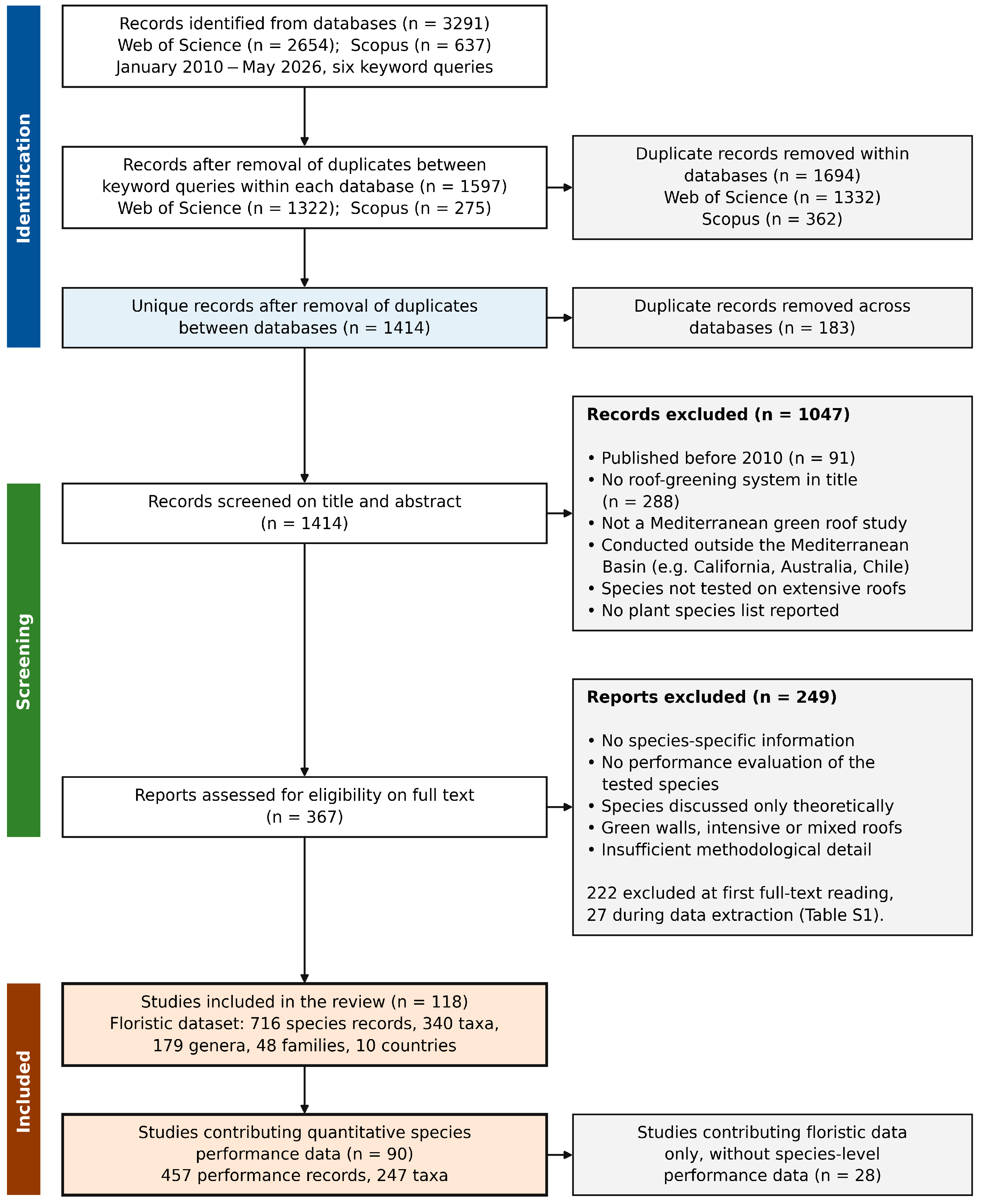
Figure 1. Simplified PRISMA flow diagram illustrating the literature selection process used to identify studies on plant biodiversity and species performance in Mediterranean extensive green roofs.
Sustainability 18 08742 g001
Figure 2. Geographic and temporal coverage of the reviewed literature on Mediterranean EGR. (a) Proportional-symbol map of the Mediterranean Basin showing the number of studies contributing to the review per country (symbol area) and the number of taxa tested in each country. (b) Annual distribution of studies published between 2010 and 2025, distinguishing all reviewed studies from those providing quantitative performance data.
Sustainability 18 08742 g002
Figure 3. Taxonomic composition and reuse patterns of plant families in Mediterranean EGRs studies. (a) Family richness (% of taxa) versus frequency of use (% of records). (b) Relationship between family richness and reuse intensity (records per species). Bubble size indicates the number of records per family, color represents within-family use concentration (Gini coefficient), and the dashed line shows the mean reuse intensity across families. (c) Rank–frequency distribution of species-use frequency across studies (log–log scale), showing the concentration of experimental effort among a limited number of taxa; symbols and colors indicate biogeographical origin. The solid line shows the maximum-likelihood fit of a zero-truncated Poisson-lognormal distribution to the species-use frequency data.
Sustainability 18 08742 g003
Figure 4. Biological, chorological, and usage patterns of plant taxa reported in Mediterranean EGRs studies. (a) Comparison between the life-form spectrum of the species pool and their deployment frequency. (b) Chorological composition of the recorded taxa.
Sustainability 18 08742 g004
Figure 5. Native status and biogeographical origin of plant taxa used in Mediterranean green roof studies. (a) Percentage of taxa native to the study country across Mediterranean countries; the dashed line indicates the overall mean. Pale bars indicate countries represented by fewer than 15 species, for which the estimate is imprecise; (b) Distribution of occurrence records by nativeness status (native, naturalized alien, cultivated-only exotic) and chorotype (Mediterranean vs. extra-Mediterranean). Numbers indicate occurrence of records and percentages of the total dataset.
Sustainability 18 08742 g005
Figure 6. Performance dimensions assessed in Mediterranean EGRs studies. (a) Frequency of reported performance metrics across the reviewed literature, grouped into plant performance, system performance, and resource-use categories. Percentages refer to the 457 extracted performance records, with the number of studies shown in parentheses. (b) Distribution of evidence across performance dimensions and Mediterranean countries; values indicate the number of studies evaluating each metric.
Sustainability 18 08742 g006
Figure 7. Synthesis of plant performance scores across Mediterranean EGRs studies. (a) Distribution of standardized scores (1–5) for survival, growth/cover, drought tolerance, and reproduction. (b) Mean scores for taxa evaluated in at least four studies. Gray cells denote unavailable data.
Sustainability 18 08742 g007
Figure 8. Heatmap of performance scores (1–5) for (a) exotic species and (b) native species (rarely studied) on Mediterranean EGRs. Darker green indicates higher performance, while blank cells represent unavailable data. Most species showed high survival, whereas growth, reproduction, and drought tolerance varied among taxa.
Sustainability 18 08742 g008
Table 1. Harmonized semi-quantitative scale used to score each performance dimension.
Plant PerformanceSystem Performance
Survivalmortality, % survival, multi-season persistenceThermal regulationsubstrate/surface and indoor temperature reduction, evapo-transpirative cooling
Growth and Coveragebiomass, height, ground cover, growth indexEnergy savingsreduction in building heating/cooling energy demand attributable to the vegetated layer
Reproductionflowering, seed set, self-propagationWater managementrainfall retention, runoff reduction and delay (roof-level stormwater service)
Stress tolerancedrought/heat/salinity (scored separately)Air-quality—CO2 sequestrationair-quality improvement, particulate capture, CO2 sequestration/carbon storage
Esthetic valueOrnamental/visual quality—provisional rubricBiodiversitysupport for fauna (pollinators, arthropods, birds), floristic diversity, habitat provision
Table 2. Five-level ordinal scale used to harmonize species performance across the reviewed studies, giving the generic anchor that defines each level and the forms in which that level was expressed in the primary literature.
ScoreGeneric AnchorForm in Which the Level Was Expressed in the Primary Studies
5ExcellentOutcome at the top of the range reported for that dimension across the corpus; descriptors such as “excellent”, “optimal” or “very high”; full survival or near-complete cover where these were explicitly reported
4GoodFavorable outcome with only minor limitations; descriptors such as “good” or “high”
3ModerateIntermediate, acceptable or seasonally variable outcome; descriptors such as “moderate” or “acceptable”
2LimitedBelow-average outcome with substantial limitations; descriptors such as “limited”, “reduced” or “scarce”
1Poor or failureMinimal performance, including failure to establish or plant death; descriptors such as “poor”, “very low” or “failure”
NANot assessedDimension not measured or not reported in that study
Table 3. The 60 Species with higher performance at least in 3 categories with values ≥3 (only for reproduction category value ≥2).
Species Stud.Surv.Grow.DroughtRepro. NativeAlienEndemLife Form
Allium aflatunense B.Fedtsch. 1 4 4 4 NoNoNoG
Allium ampeloprasum L. 2 4 4 4 YesNoNoG
Allium sphaerocephalon L.23444YesNoNoG
Anthemis maritima L. 2 4 4 4 YesNoNoH
Antirrhinum linkianum Boiss. & Reut. 2 4 4 4 5 YesNoYesCh
Asphodelus aestivus Brot. 2 5 5 4 NoNoYesG
Brachypodium phoenicoides (L.) Roem. & Schult. *5443 YesNoNoH
Cerastium biebersteinii DC. 3 5 3 5 NoNoNoH
Clinopodium nepeta (L.) Kuntze253 3YesNoNoCh
Convolvulus cneorum L.53445Yes/NoNoNoCh
Crithmum maritimum L. *94334YesNoNoCh
Dianthus carthusianorum L.353 4YesNoNoH
Drosanthemum floribundum (Haw.) Schwantes243 3NoNoNoCh
Echium plantagineum L. 1 4 5 4 5 YesNoNoH
Euphorbia myrsinites L. 1 4 4 4 YesNoNoCh
Gazania jurineifolia subsp. jurineifolia 3 5 3 4 NoNoYesH
Gladiolus italicus Mill. 2 4 4 4 YesNoNoG
Helichrysum italicum (Roth) G.Don * 8 4.5 4 4 5 Yes/NoNoNoCh
Helichrysum orientale (L.) Gaertn. * 5 4 4 4 4 YesNoNoCh
Helichrysum stoechas subsp. barrelieri (Ten.) Nyman 1 4 4 4 YesNoNoCh
Hypericum × moserianum André2443 NoNoNoCh
Hypericum empetrifolium Willd.144 4YesNoNoCh
Iris lutescens Lam. *344 4YesNoNoG
Lampranthus spectabilis (Haw.) N.E.Br.2434 NoNoNoCh
Lavandula angustifolia Mill. 2 4 4 4 NoYesNoNP
Lavandula dentata L. 2 5 5 5 NoNoNoNP
Lavandula stoechas subsp. luisieri (Rozeira) Rozeira 3 4 4 4 YesNoNoNP
Leontodon tuberosus L. 2 5 3 4 YesNoNoH
Limonium graecum (Poir.) Kuntze144 4YesNoNoCh
Lolium arundinaceum (Schreb.) Darbysh. ‘Plantation’ *2444 YesNoNoH
Medicago arborea L.144 4YesNoNoP
Narcissus tazetta L. 3 4 4.33 4.67 YesNoNoG
Origanum dictamnus L.54444YesNoNoCh
Origanum onites L. * 2 4 4 4 4 YesNoNoCh
Origanum vulgare subsp. hirtum (Link) A.Terracc.144 4YesNoNoH
Petrosedum rupestre (L.) P.V.Heath54334YesNoNoCh
Petrosedum sediforme (Jacq.) Grulich * 30 4.12 4 4.4 4.4 YesNoNoCh
Phedimus spurius (M.Bieb.) ‘t Hart54333NoYesNoCh
Phlomis fruticosa L. *244 2YesNoNoNP
Potentilla verna L.2444 YesNoNoH
Salvia officinalis × S. pomifera1 5 5 NoNoNoCh
Salvia officinalis × S. ringens2 4 4 4 NoNoNoCh
Salvia officinalis L. *5444 YesNoNoCh
Salvia pomifera subsp. pomifera1444 YesNoNoCh
Saponaria ocymoides L. 3 4.5 4 4 4 YesNoNoH
Satureja montana L.3534 Yes/NoYes/NoNoCh
Satureja thymbra L.144 4YesNoNoCh
Scabiosa columbaria L. 2 5 3 5 YesNoNoH
Scilla hyacinthoides L.244 3YesNoNoG
Sedum acre L. 14 3.75 3.6 3.67 5 YesNoNoCh
Sedum album L. *144443YesNoNoCh
Sedum sexangulare L.54435Yes/NoYes/NoNoCh
Stachys major (L.) Bartolucci & Peruzzi143 4YesNoNoCh
Stachys thirkei K.Koch1443 YesNoNoH
Teucrium capitatum L.144 4YesNoNoCh
Teucrium chamaedrys L.34444YesNoNoCh
Thymbra capitata (L.) Cav. 2 4 4 4 YesNoNoCh
Thymus serpyllum L. 5 4.67 4.5 5 5 NoNoNoCh
Veronica chamaedrys L. 1 4 5 5 YesNoNoH
Zoysia japonica Steud.1443 NoNoNoH
Species marked with an ‘*’ were evaluated not only for plant performance traits but also for one or more ecosystem service indicators.
Disclaimer/Publisher’s Note: The statements, opinions and data contained in all publications are solely those of the individual author(s) and contributor(s) and not of MDPI and/or the editor(s). MDPI and/or the editor(s) disclaim responsibility for any injury to people or property resulting from any ideas, methods, instructions or products referred to in the content.