Ranking Soil Quality Indicators Using the SMART Criteria, AHP Method and Chatbots



Abstract
1. Introduction
1.1. Concepts of Soil, Soil Health and Soil Quality Indicators
1.2. The AHP Method and SMART Criteria
1.3. Linking AHP and SMART Criteria with Soil Indicators
2. Material and Methods
2.1. Selection of Soil Quality Indicators
2.2. Selection of AI Platforms
2.3. Experimental Procedure, Prompt Design and Data Analysis
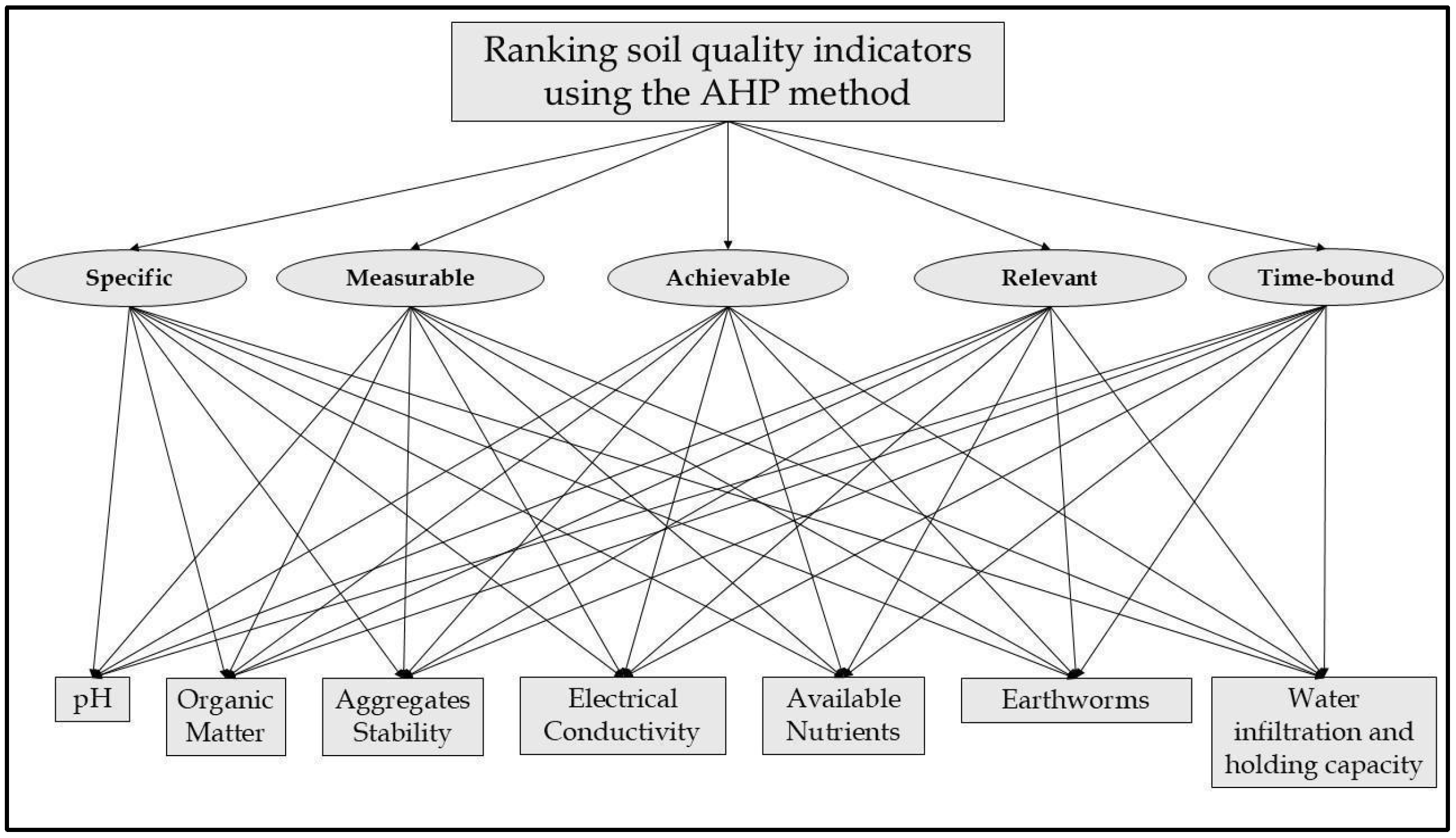
Hello, I’m working on a project involving the Analytic Hierarchy Process (AHP).
The goal is to establish a hierarchical system of parameters related to soil quality indicators.
As criteria, I’m considering those of the SMART system (specific, measurable, achievable, relevant, and time-bound).
As parameters, I’m considering pH, organic matter, aggregate stability, electrical conductivity, available nutrients, earthworms, and water infiltration and retention capacity.
Assuming you are acting as a soil scientist, could you generate matrices with suggestive AHP values in this context?
I also need you to present, in detail, that is, with explanations and numerical values, the final values for the consistency index and the consistency ratio.
3. Results
3.1. Ranking the S.M.A.R.T. Criteria and Consistency Analysis
3.2. Ranking of Soil Quality Indicators and Consistency Analysis
3.3. Performance of the AI Platforms
4. Discussion
4.1. Selection and Representativeness of AI Platforms
4.2. Ranking the S.M.A.R.T. Criteria and Consistency Analysis
4.3. Ranking of Soil Quality Indicators and Consistency Analysis
4.4. Interpretative Capacity of AI Platforms
4.5. Mechanisms Underlying Inter-Platform Differences
5. Final Remarks
Author Contributions
Funding
Institutional Review Board Statement
Informed Consent Statement
Data Availability Statement
Acknowledgments
Conflicts of Interest
Appendix A
References
- Muñoz-Rojas, M. Soil quality indicators: Critical tools in ecosystem restoration. Curr. Opin. Environ. Sci. Health 2018, 5, 47–52. [Google Scholar] [CrossRef] [Scilit]
- Maienza, A.; Buttafuoco, G.; Biancofiore, G.; Ün, A.; Renovell, J.; Pisarčik, M.; Fuksa, P.; Grabiński, J.; Lumini, E.; Di Lonardo, S.; et al. Soil quality indicators in agroecological practices: Lessons from a systematic review of long-term experiments. Eur. J. Soil Sci. 2025, 76, e70138. [Google Scholar] [CrossRef] [Scilit]
- Negiş, H.; Şeker, C.; Şeker, H.K. Using artificial intelligence algorithms to analyze chromatic attributes for soil quality indicators. J. Soil Sci. Plant Nutr. 2025, 25, 3466–3483. [Google Scholar] [CrossRef] [Scilit]
- Pacci, S.; Dengiz, O.; Alaboz, P.; Demirağ Turan, İ.N.C.İ.; Özkan, B. A smart approach to soil quality evaluation by integrating hesitant fuzzy-AHP and artificial intelligence for multi-criteria decision. Int. J. Environ. Sci. Technol. 2026, 23, 104. [Google Scholar] [CrossRef] [Scilit]
- Panagos, P.; Montanarella, L.; Barbero, M.; Schneegans, A.; Aguglia, L.; Jones, A. Soil priorities in the European Union. Geoderma Reg. 2022, 29, e00510. [Google Scholar] [CrossRef] [Scilit]
- Smith, P.; Poch, R.M.; Lobb, D.A.; Bhattacharyya, R.; Alloush, G.; Eudoxie, G.D.; Anjos, L.H.; Castellano, M.; Ndzana, G.M.; Chenu, C.; et al. Status of the World’s Soils. Annu. Rev. Environ. Resour. 2024, 49, 73–104. [Google Scholar] [CrossRef] [Scilit]
- Fausak, L.K.; Bridson, N.; Diaz-Osorio, F.; Jassal, R.S.; Lavkulich, L.M. Soil health–a perspective. Front. Soil Sci. 2024, 4, 1462428. [Google Scholar]
- Maaz, T.M.; Heck, R.H.; Glazer, C.T.; Loo, M.K.; Zayas, J.R.; Krenz, A.; Beckstrom, T.; Crow, S.E.; Deenik, J.L. Measuring the immeasurable: A structural equation modeling approach to assessing soil health. Sci. Total Environ. 2023, 870, 161900. [Google Scholar] [CrossRef] [Scilit]
- Belcher, B.M.; Claus, R.; Davel, R.; Place, F. Indicators for monitoring and evaluating research-for-development: A critical review of a system in use. Environ. Sustain. Indic. 2024, 24, 100526. [Google Scholar] [CrossRef] [Scilit]
- Sharma, S.; Lishika, B.; Kaushal, S. Soil quality indicators: A comprehensive review. Int. J. Plant Soil Sci. 2023, 35, 315–325. [Google Scholar] [CrossRef] [Scilit]
- Simon, C.D.P.; Gomes, T.F.; Pessoa, T.N.; Soltangheisi, A.; Bieluczyk, W.; Camargo, P.B.D.; Martinelli, L.A.; Cherubin, M.R. Soil quality literature in Brazil: A systematic review. Rev. Bras. Cienc. Solo 2022, 46, e0210103. [Google Scholar] [CrossRef] [Scilit]
- Souza, R.S.; de Morais, I.S.; Rosset, J.S.; de Melo Rodrigues, T.; Loss, A.; Pereira, M.G. Aggregation as a soil quality indicator in areas under different uses and managements. Farming Syst. 2024, 2, 100082. [Google Scholar] [CrossRef] [Scilit]
- Saaty, T.L. The Analytic Hierarchy Process: Planning, Priority Setting and Resource Allocation; McGraw-Hill: New York, NY, USA, 1980. [Google Scholar]
- Saaty, T.L. Rank generation, preservation and reversal in the analytic hierarchy process. Decis. Sci. 1987, 18, 157–177. [Google Scholar] [CrossRef] [Scilit]
- Tang, H.; Shi, P.; Fu, X. An analysis of soil erosion on construction sites in megacities using analytic hierarchy process. Sustainability 2023, 15, 1325. [Google Scholar] [CrossRef] [Scilit]
- Kumar, A.; Pant, S. Analytical hierarchy process for sustainable agriculture: An overview. MethodsX 2023, 10, 101954. [Google Scholar] [CrossRef] [Scilit]
- Aldridge, C.A.; Colvin, M.E. Writing SMART objectives for natural resource and environmental management. Ecol. Solut. Evid. 2024, 5, e12313. [Google Scholar] [CrossRef] [Scilit]
- USDA Natural Resources Conservation Service. Soil Quality Indicators-Biological Indicators and Soil Functions. Factsheet, 2015. Available online: https://www.nrcs.usda.gov/sites/default/files/2023-01/Indicators-Biological-Indicators-and-Soil-Functions.pdf (accessed on 5 May 2026).
- FMES (Forbes Magazine Editorial Staff). From ChatGPT to DeepSeek: The 10 Most Used AIs by Professionals (in Portuguese). 2026. Available online: https://forbes.com.br/forbes-tech/2026/03/do-chatgpt-ao-deepseek-o-mapa-das-50-ias-que-ja-dominam-a-internet/ (accessed on 10 May 2026).
- Evangelou, E.; Giourga, C. Identification of soil quality factors and indicators in Mediterranean agro-ecosystems. Sustainability 2024, 16, 10717. [Google Scholar] [CrossRef] [Scilit]
- Matson, A.; Fantappiè, M.; Campbell, G.A.; Miranda-Vélez, J.F.; Faber, J.H.; Gomes, L.C.; Hessel, R.; Lana, M.; Mocali, S.; Smith, P.; et al. Four approaches to setting soil health targets and thresholds in agricultural soils. J. Environ. Manag. 2024, 371, 123141. [Google Scholar] [CrossRef] [Scilit]
- Çelik, Ö.; Sürücü, A. Soil quality assessment in the Araban plain across various land use types. J. King Saud. Univ. Sci. 2024, 36, 103385. [Google Scholar] [CrossRef] [Scilit]
- Kooch, Y.; Heydari, M.; Parsapour, M.K.; Valkó, O. Earthworm: A keystone species of soil quality, health, and functions. Acta Oecol. 2025, 128, 104106. [Google Scholar] [CrossRef] [Scilit]
- Bhaduri, D.; Sihi, D.; Bhowmik, A.; Verma, B.C.; Munda, S.; Dari, B. A review of effective soil health bio-indicators for ecosystem restoration and sustainability. Front. Microbiol. 2022, 13, 938481. [Google Scholar] [CrossRef] [Scilit]
- Gatica-Saavedra, P.; Aburto, F.; Rojas, P.; Echeverría, C. Soil health indicators for monitoring forest ecological restoration: A critical review. Restor. Ecol. 2023, 31, e13836. [Google Scholar] [CrossRef] [Scilit]
- Sun, J.; Hua, L.; Niu, Y.; Zhang, Z.; Dong, R.; Chu, B.; Sun, W.; Cai, B. Grassland restoration measures influence soil water-holding capacity by altering soil and vegetation properties composition. Int. Soil Water Conserv. Res. 2026, 14, 100611. [Google Scholar] [CrossRef] [Scilit]
- Ascenzi, I.; Hilbers, J.P.; van Katwijk, M.M.; Huijbregts, M.A.; Hanssen, S.V. Empirically based estimates of soil organic carbon gains after ecosystem restoration and their global climate benefits. Sustainability 2026, 18, 2516. [Google Scholar] [CrossRef] [Scilit]
- Schweng, S.; Bernardini, L.; Keiblinger, K.; Kaul, H.P.; Fister, I., Jr.; Lukač, N.; Ser, J.D.; Holzinger, A. What can artificial intelligence do for soil health in agriculture? Comput. Sci. Rev. 2026, 59, 100832. [Google Scholar] [CrossRef] [Scilit]
- FAO (Food and Agriculture Organization). Soil Testing Methods. Global Soil Doctors Program—A Farmer-to-Farmer Training Program; FAO: Rome, Italy, 2020. [Google Scholar]
- Rauber, L.R.; Mallman, M.S.; Reinert, D.J.; Pires, F.S.; Vargas, F.D.; Gubiani, P.I. Automatic measurement of water infiltration into the soil. Rev. Bras. Cienc. Solo 2024, 48, e0230078. [Google Scholar] [CrossRef] [Scilit]
- Michaud, M.E.; Gan, H. Comparison of common methods to quantify field saturated hydraulic conductivity in glacial till soils of Northeastern United States. Soil Sci. Soc. Am. J. 2025, 89, e70112. [Google Scholar] [CrossRef] [Scilit]
- Brown, P.H.; Zhao, F.J.; Dobermann, A. What is a plant nutrient? Changing definitions to advance science and innovation in plant nutrition. Plant Soil 2022, 476, 11–23. [Google Scholar] [CrossRef] [Scilit]
- Carter, M.R.; Gregorich, E.G. Soil Sampling and Methods of Analysis; CRC Press: New York, NY, USA, 2007. [Google Scholar]
- Piccini, C.; Metzger, K.; Debaene, G.; Stenberg, B.; Götzinger, S.; Borůvka, L.; Sandén, T.; Bragazza, L.; Liebisch, F. In-field soil spectroscopy in Vis–NIR range for fast and reliable soil analysis: A review. Eur. J. Soil Sci. 2024, 75, e13481. [Google Scholar] [CrossRef] [Scilit]
- Hamza, A.; Karčauskienė, D.; Mockevičienė, I.; Repšienė, R.; Tahir, M.A.; Manzoor, M.Z.; Kousar, S.; Lodhi, S.S.; Rasool, N.; Ullah, I. Soil Aggregate Dynamics and Stability: Natural and Anthropogenic Drivers. Agriculture 2025, 15, 2500. [Google Scholar] [CrossRef] [Scilit]
- Liu, X.; Fan, S.; Huang, Z.; Liu, J.; Su, W.; Liang, G.; Liu, G. Aggregate protection dominates the variation in soil organic matter temperature sensitivity induced by the expansion of Moso bamboo into Chinese fir forests. Plant Soil 2025, 518, 1–18. [Google Scholar] [CrossRef] [Scilit]
- Almajmaie, A.; Hardie, M.; Acuna, T.; Birch, C. Evaluation of methods for determining soil aggregate stability. Soil Tillage Res. 2017, 167, 39–45. [Google Scholar] [CrossRef] [Scilit]
- Fajardo, M.; Pino, V.; Jones, E.; Morgan, C.; Stevenson, B.; Saby, N.; Lacoste, M.; McBratney, A. Measuring soil aggregate stability with mobile phones: Lessons, challenges, and future work. Sci. Rep. 2025, 15, 24536. [Google Scholar] [CrossRef] [Scilit]
- Gerenfes, D.; Giorgis, A.; Negasa, G. Comparison of organic matter determination methods in soil by the loss on ignition and the potassium dichromate method. Int. J. Hortic. Food Sci. 2022, 4, 49–53. [Google Scholar] [CrossRef] [Scilit]
- Rukaitė, J.; Juknevičius, D.; Kriaučiūnienė, Z.; Šarauskis, E. Determination of soil organic carbon by conventional and spectral methods, including assessment of the use of biostimulants, N-fertilisers, and economic benefits. J. Agric. Food Res. 2024, 18, 101434. [Google Scholar] [CrossRef] [Scilit]
- Gyawali, A.J.; Wiseman, M.; Ackerson, J.P.; Coffman, S.; Meissner, K.; Morgan, C.L. Measuring in situ soil carbon stocks: A study using a novel handheld VisNIR probe. Geoderma 2025, 453, 117152. [Google Scholar] [CrossRef] [Scilit]
- Hartemink, A.E.; Barrow, N.J. Soil pH-nutrient relationships: The diagram. Plant Soil 2023, 486, 209–215. [Google Scholar] [CrossRef] [Scilit]
- Wang, C.; Kuzyakov, Y. Soil organic matter priming: The pH effects. Glob. Change Biol. 2024, 30, e17349. [Google Scholar] [CrossRef] [Scilit]



| S.M.A.R.T. Factor ↓ \A.I. Platform → | Claude | ChatGPT | Copilot | Gemini | Average | CV (%) |
|---|---|---|---|---|---|---|
| Relevant | 0.363 | 0.426 | 0.307 | 0.406 | 0.375 | 14.0 |
| Measurable | 0.270 | 0.251 | 0.232 | 0.270 | 0.256 | 7.1 |
| Specific | 0.164 | 0.172 | 0.287 | 0.157 | 0.195 | 31.7 |
| Achievable | 0.098 | 0.094 | 0.104 | 0.095 | 0.098 | 4.8 |
| Time-bound | 0.105 | 0.057 | 0.069 | 0.072 | 0.076 | 27.3 |
| Coefficient of Variation—CV (%) | 57.7 | 73.3 | 53.9 | 69.1 | ---- | |
| Claude | ChatGPT | Copilot | Gemini | |
|---|---|---|---|---|
| λmax | 5.33 | 5.11 | 5.12 | 5.06 |
| Consistency Index | 0.083 | 0.027 | 0.030 | 0.015 |
| Consistency Ratio | 0.074 | 0.024 | 0.027 | 0.013 |
| Soil Quality Indicator | Claude | ChatGPT | Copilot | Gemini | Average | CV (%) |
|---|---|---|---|---|---|---|
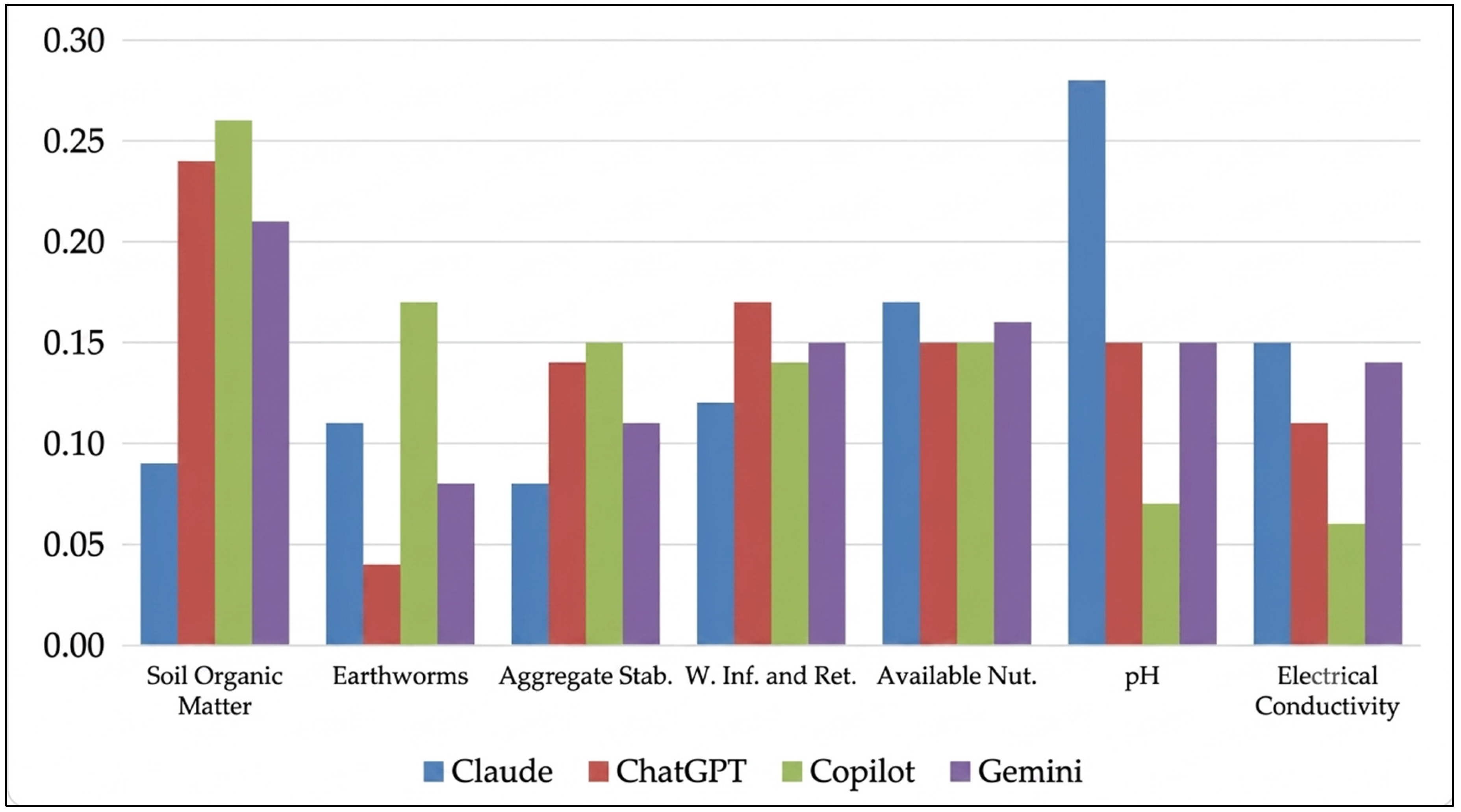
| Soil Organic Matter | 0.189 ±0.019 | 0.224 ±0.042 | 0.229 ±0.068 | 0.226 ±0.029 | 0.217 | 8.8 |
| pH | 0.164 ±0.013 | 0.162 ±0.045 | 0.137 ±0.050 | 0.201 ±0.042 | 0.166 | 16.0 |
| Available Nutrients | 0.136 ±0.024 | 0.145 ±0.023 | 0.163 ±0.045 | 0.140 ±0.028 | 0.146 | 8.3 |
| Water Infiltration and Retention | 0.131 ±0.014 | 0.144 ±0.024 | 0.144 ±0.044 | 0.119 ±0.019 | 0.135 | 8.8 |
| Aggregate Stability | 0.119 ±0.014 | 0.155 ±0.057 | 0.149 ±0.045 | 0.102 ±0.036 | 0.131 | 19.3 |
| Electrical Conductivity | 0.155 ±0.020 | 0.113 ±0.059 | 0.092 ±0.047 | 0.150 ±0.025 | 0.128 | 23.6 |
| Earthworms | 0.107 ±0.019 | 0.057 ±0.012 | 0.085 ±0.028 | 0.061 ±0.011 | 0.078 | 30.1 |
| Coefficient of Variation (%) | 19.6 | 35.6 | 33.6 | 39.6 | ||
| Claude | ChatGPT | Copilot | Gemini | |
|---|---|---|---|---|
| λmax | 7.35 | 7.57 | 7.45 | 7.22 |
| Consistency Index | 0.058 | 0.084 | 0.075 | 0.056 |
| Consistency Ratio | 0.044 | 0.065 | 0.057 | 0.023 |
| AI Platform | Interpretative Explanations Provided by AI Platforms |
|---|---|
| Claude Sonnet 5 | Among the soil parameters, Available Nutrients and Organic Matter consistently receive top global scores because they excel across all SMART dimensions: they are specific (quantifiable in mg.kg−1 or %), highly measurable (lab and field kits), relevant to crop performance, and respond to management within 1–3 growing seasons. Earthworms, while a powerful biotic indicator, rank lower primarily due to lower measurability and attainability scores, counting protocols are labor-intensive and subject to seasonal variability. |
| ChatGPT OpenAI GPT-5.5 Instant | Organic Matter and Water Infiltration dominate the Relevance criterion because they influence structure, nutrient cycling, and resilience. The pH, EC, and Available Nutrients score highest in Measurability due to standardized laboratory methods. Earthworms rank lower in Attainability and Measurability because biological sampling introduces variability. Most influential indicators—Organic Matter, Water Infiltration and Retention, Aggregate Stability (representing soil structure), water regulation, and carbon cycling, which are central to soil quality. Moderately important—Available Nutrients, pH. Lower weight indicators: Electrical Conductivity, Earthworms (due to measurement variability. |
| Copilot 365 | The platform did not provide any interpretative explanations. |
| Gemini Flash 3 | Organic Matter—High relevance outweighs lower “Time-bound” scores. Available Nutrients—Balanced performance across all SMART criteria. pH—Carried by extremely high Measurability/Attainability. Water Capacity—Essential for crop health; moderate ease of measurement. Electrical Conductivity—High ease of use, but lower specific relevance to all soils. Aggregate Stability—Critical physical indicator, but harder to measure (Attainability). Earthworms—High biological relevance but lack “Time-bound” precision. |
Disclaimer/Publisher’s Note: The statements, opinions and data contained in all publications are solely those of the individual author(s) and contributor(s) and not of MDPI and/or the editor(s). MDPI and/or the editor(s) disclaim responsibility for any injury to people or property resulting from any ideas, methods, instructions or products referred to in the content. |
© 2026 by the authors. Licensee MDPI, Basel, Switzerland. This article is an open access article distributed under the terms and conditions of the Creative Commons Attribution (CC BY) license.
Share and Cite
da Silva, A.M.; Kostecki, J. Ranking Soil Quality Indicators Using the SMART Criteria, AHP Method and Chatbots. Sustainability 2026, 18, 8713. https://doi.org/10.3390/su18178713
da Silva AM, Kostecki J. Ranking Soil Quality Indicators Using the SMART Criteria, AHP Method and Chatbots. Sustainability. 2026; 18(17):8713. https://doi.org/10.3390/su18178713
Chicago/Turabian Styleda Silva, Alexandre Marco, and Jakub Kostecki. 2026. "Ranking Soil Quality Indicators Using the SMART Criteria, AHP Method and Chatbots" Sustainability 18, no. 17: 8713. https://doi.org/10.3390/su18178713
APA Styleda Silva, A. M., & Kostecki, J. (2026). Ranking Soil Quality Indicators Using the SMART Criteria, AHP Method and Chatbots. Sustainability, 18(17), 8713. https://doi.org/10.3390/su18178713