1. Introduction
The growing intensification of climate change, biodiversity loss, and unsustainable consumption patterns has reinforced the global recognition of education as a central mechanism for fostering sustainability awareness and enabling behavioral transformation toward more responsible environmental practices. The establishment of the United Nations 2030 Agenda and the Sustainable Development Goals (SDGs) has formally inscribed this recognition in international policy, designating Education for Sustainable Development (ESD) as a strategic vehicle for preparing individuals capable of critically engaging with environmental challenges and contributing to sustainable development initiatives [
1]. Within this policy context, SDG Target 4.7 specifically calls for all learners to acquire the knowledge, skills, and values needed to promote sustainable development by 2030, situating sustainability awareness not merely as an educational outcome but as a political and societal imperative.
Yet the concept of sustainability awareness in education remains theoretically underdeveloped and empirically fragmented. Students may exhibit high levels of declared environmental concern while remaining largely unable to translate such awareness into sustained practice, and the same pattern is visible at the scale of national policy systems.
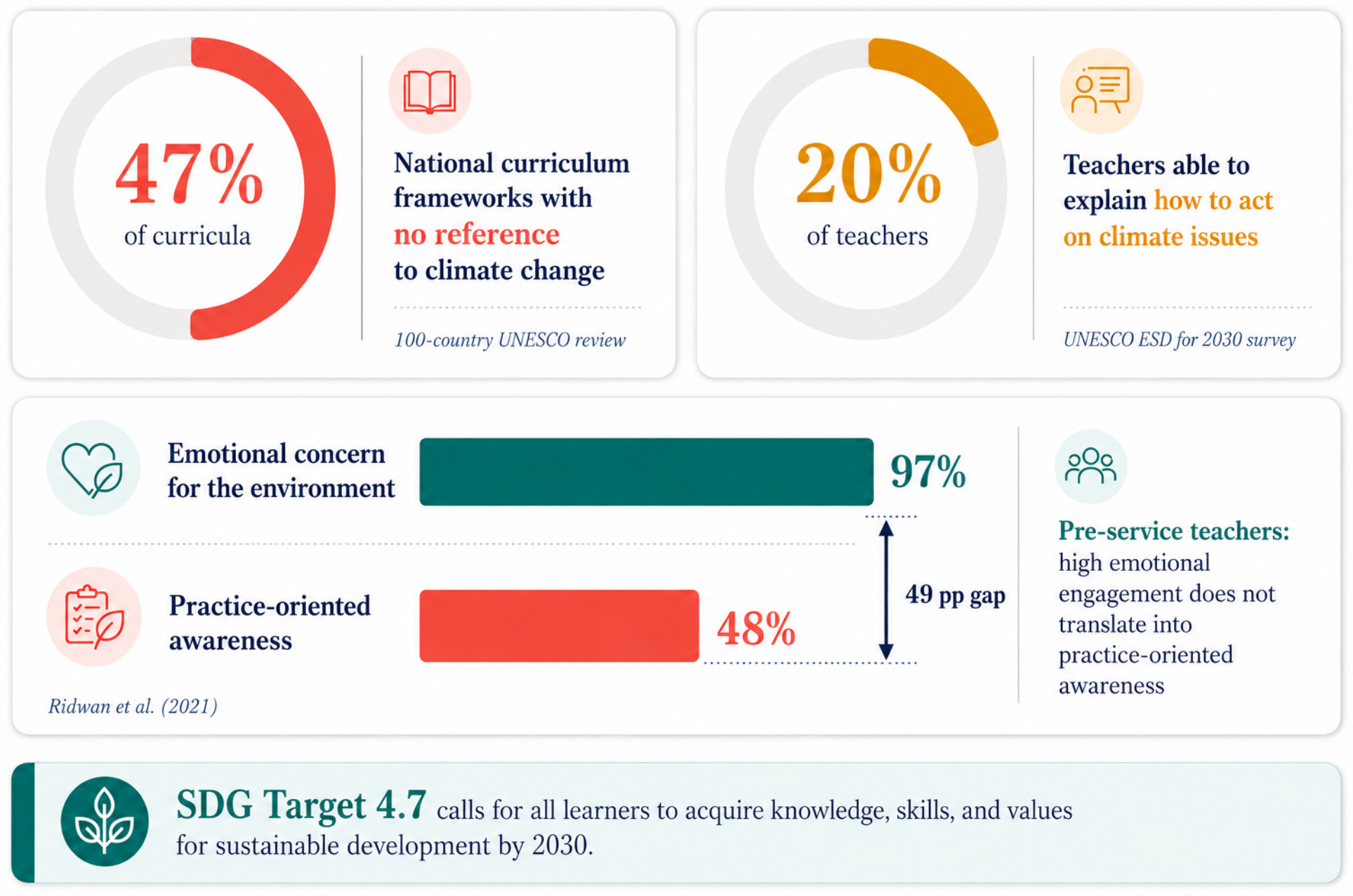
Figure 1 synthesizes three empirical indicators of this gap: at the individual level, Ridwan et al. [
2] found among pre-service physics teachers a 49 percentage-point distance between emotional engagement (97%) and practice-oriented awareness (48%); at the institutional level, UNESCO’s monitoring of ESD for 2030 across 100 national curriculum frameworks reports that 47% make no reference to climate change and that only 20% of surveyed teachers feel able to explain how to take action on climate issues [
3,
4]. These figures mark the distance between SDG Target 4.7, which calls for all learners to acquire the knowledge, skills, and values for sustainable development by 2030, and the institutional conditions that would make that target realizable. This distance is not reducible to curriculum content or resource constraints; it reflects structural barriers that a diagnostic framework for sustainability education must be capable of naming before they can be addressed, and that the present article analyzes in detail in its later sections.
This persistent gap between declarative awareness and enacted behavior reflects a broader structural limitation: available educational frameworks tend to operationalize sustainability education along a single or narrow set of dimensions, failing to account for the cognitive depth, disciplinary integration, and real-world connection required for more transformative learning outcomes.
A second, related limitation lies in the fragmentation of the educational research field itself. Four major traditions have developed largely in parallel—Environmental Education (EE), Climate Education (CE), Education for Sustainable Development (ESD), and Climate Justice Education (CJE)—each with distinct epistemological commitments, pedagogical emphases, and relationships to political action. Research within each of these traditions has produced valuable, but internally bounded, insights. EE, for example, has built a robust foundation in place-based learning and ecological systems thinking; Kudryavtsev et al. [
5] demonstrated that sense of place—comprising place attachment and ecological place meaning—constitutes a significant mediating variable between educational experiences and pro-environmental behavior, yet this insight has remained largely confined within EE scholarship, rarely informing the broader field. Similarly, CE has developed increasingly sophisticated approaches to futures thinking and climate literacy, while ESD has produced comprehensive competency frameworks that remain unevenly implemented in practice. CJE, the most recently consolidated tradition, brings a transformative orientation—centering power, equity, and structural injustice—but faces persistent barriers to institutional adoption [
6,
7].
The consequences of this fragmentation are both theoretical and practical. Theoretically, the absence of a shared analytical vocabulary prevents cross-tradition comparison, accumulation of evidence, and identification of structural gaps in the field. Practically, it limits the capacity of curriculum designers, educators, and policymakers to diagnose dimensional weaknesses in specific educational programs and to develop targeted interventions. Walker [
8] identified one such practical consequence in her analysis of children as “agents of change” in sustainability education: the dominant policy model of ESD—premised on an individualist, Attitude–behavior–Choice logic—consistently underestimates the relational and structural dimensions of environmental knowledge transmission, failing to account for the intergenerational, spatial, and material contingencies that shape whether sustainability education actually influences household and community practices. Her call for a “socially sensitive” model of sustainable development resonates precisely because it exposes the theoretical impoverishment of frameworks that treat awareness as a unidimensional variable.
The fragmentation of educational traditions is also evidenced in the rapidly expanding domain of digitally mediated sustainability education. Research in this area has revealed positive outcomes associated with immersive technologies, digital storytelling, and drama-based approaches; Zakopoulos et al. [
9], in a systematic review of digital theatre and sustainability education, identified growing evidence that digital drama pedagogies can activate critical thinking, empathy, collaborative competencies, and environmental awareness across educational levels. However, the authors also acknowledged that these effects remain undertheorized and that the field lacks a unified framework capable of categorizing and comparing the dimensional sustainability learning outcomes produced by different pedagogical modalities.
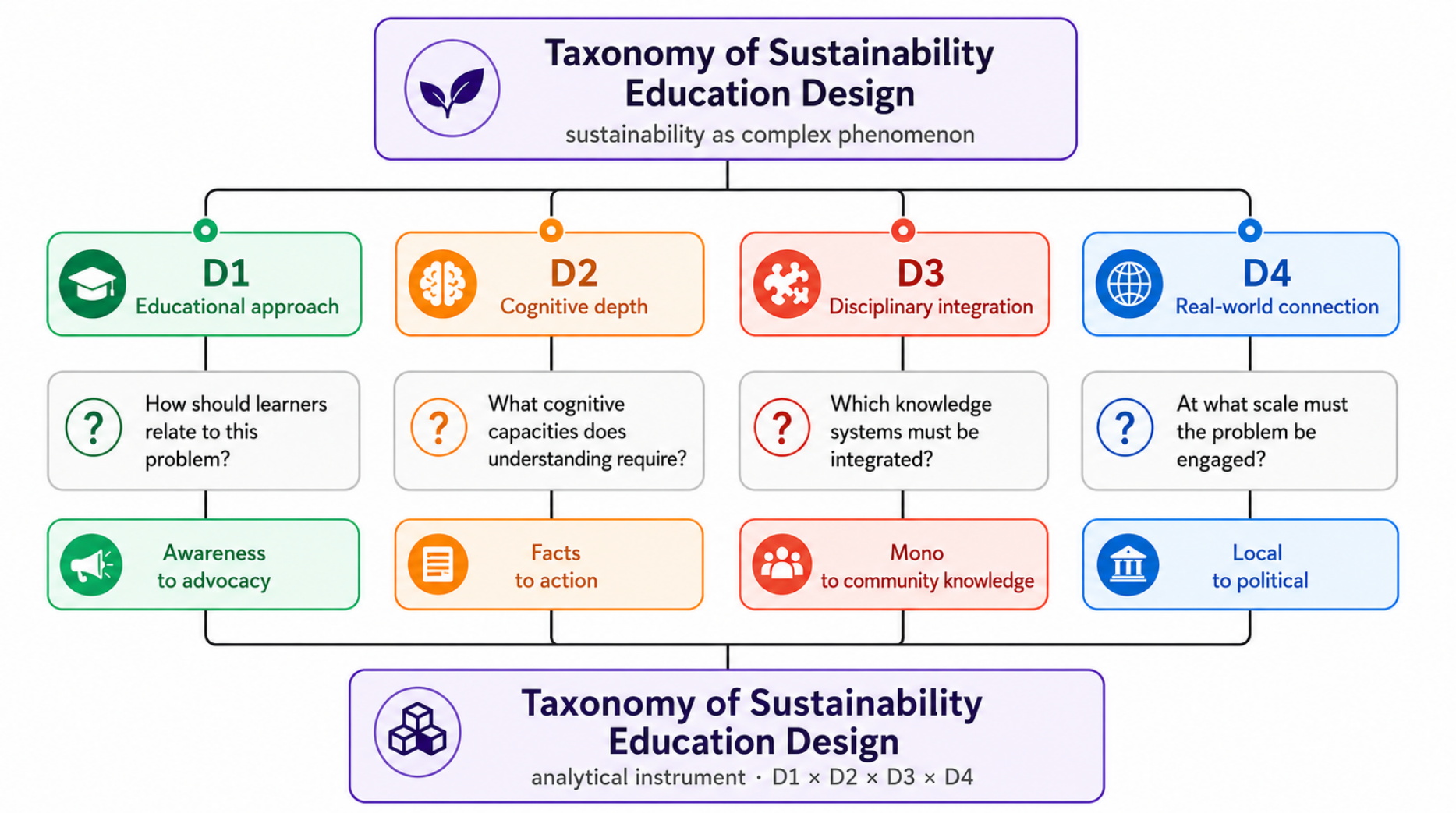
It is precisely this absence of a unified, multidimensional framework capable of rendering visible the structural gaps across traditions, pedagogical approaches, and educational levels that motivates the present article. Addressing this gap requires moving beyond descriptive taxonomies of educational practices toward an analytically rigorous framework that maps sustainability education along multiple analytically distinct dimensions that are interdependent in practice yet distinguishable for diagnostic purposes: the nature of the educational approach, the cognitive depth targeted, the degree of disciplinary integration, and the quality of real-world connection. Such a framework would not only provide a shared language for the field but would also enable the kind of diagnostic mapping that individual traditions, by virtue of their bounded scope, cannot accomplish alone.
The analytical approach adopted in this article combines a critical literature review with theoretical framework construction. The literature review proceeded in two movements. It was organized first around four educational traditions, Environmental Education, Climate Education, Education for Sustainable Development, and Climate Justice Education, selected on the basis of three criteria: institutional consolidation at the international level, documented epistemological distinctiveness, and relevance to the dimensional axes of the proposed taxonomy. It then confronted these traditions with a second body of thought, the Southern epistemologies reviewed in
Section 2.5, selected not by the same criteria of institutional consolidation but by their capacity to expose the epistemological limits that the four Northern traditions share. Sources were identified through purposive, iterative searches of ERIC, Scopus, and Web of Science, complemented by targeted searches of UNESCO and IPCC institutional repositories, covering the period from 1975 to 2025. This review followed the logic of a critical review in the sense established by Grant and Booth [
10]: it does not report a search protocol, screening flow, or inter-rater agreement, and it therefore does not claim the reproducibility of a systematic review. Its value lies instead in the interpretive and integrative work a systematic protocol is not designed to perform, namely tracing the conceptual lineage that connects four historically successive traditions, identifying where their normative commitments converge and diverge, and surfacing the dimensional gaps that motivate the taxonomy developed in
Section 3. This is consistent with Snyder [
11], who observes that critique-oriented reviews serve a synthesising function that systematic reviews are not designed to perform, at the cost of the search replicability that only a systematic protocol can provide. The taxonomy proposed here should accordingly be read as a theoretically grounded and literature-informed instrument, not as the output of a systematic evidence synthesis. The taxonomy was constructed inductively from the patterns of dimensional variation identified across the reviewed traditions and subsequently subjected to philosophical grounding through Edgar Morin’s framework of complex thought as a criterion of interpretive validation [
12,
13]—a relationship described in detail in
Section 3.1. Accordingly, the mapping of the four traditions presented in
Table 1 should be read as an illustration of the internal coherence of the taxonomy, not as evidence of its discriminant validity, which remains a task for the independent coding protocol specified in
Section 3.4.
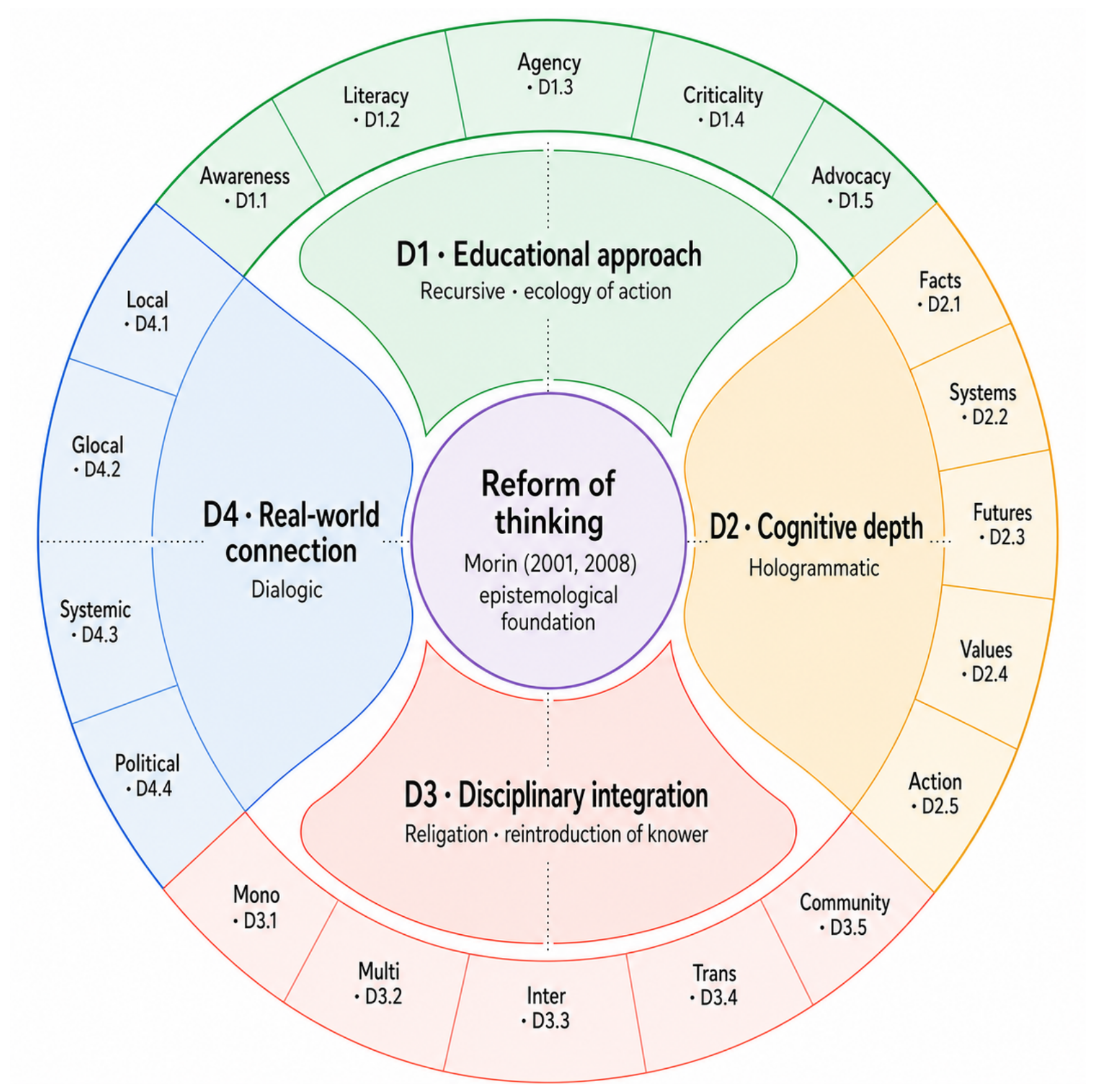
This article proposes and defends a four-dimensional Taxonomy of Sustainability Education Design, structured around the dimensions of Educational Approach (D1), Cognitive Depth (D2), Disciplinary Integration (D3), and Real-World Connection (D4).
Section 2 maps the four major educational traditions against this taxonomy through a critical literature review, revealing their respective dimensional strengths and structural underdevelopments, and confronts them with the epistemologies of the South, from the Philosophy of Liberation to Ubuntu thought, that expose the limits those traditions share.
Section 3 presents the formal specification of the taxonomy, its validity conditions, and two contrasting diagnostic applications, to the UNESCO Associated Schools Network and to the Brazilian National Environmental Education program.
Section 4 develops the philosophical implications of the framework through Morin’s complex thought, showing that the dimensional gaps documented in
Section 2 are systematic expressions of a paradigm of disjunction rather than contingent omissions.
Section 5 then follows this diagnosis to its structural conclusion: if the most underdeveloped dimensions of the field, criticality, community and Indigenous knowledge, and systemic-political connection, are not accidental gaps but patterned ones, then the sites where they become materially consequential, the geopolitics of epistemic authority, the education of climate-displaced communities, the historical production of ecological vulnerability, and the governance of artificial intelligence, are not optional extensions of the framework but the terrain on which its diagnostic claims are tested.
Section 6 presents the conclusions, acknowledges the study’s limitations, and proposes a research agenda.
2. Literature Review: Mapping the Educational Field
The four educational traditions examined in this review did not emerge simultaneously. Their historical development reflects a progressive broadening of the conceptual and normative scope of sustainability education, in which successive socio-environmental challenges generated new pedagogical frameworks without displacing their predecessors. Environmental Education (EE) was the first to be formally institutionalized, anchored in the Belgrade Charter [
14] and the Tbilisi Declaration [
15], which established the foundational principles for educating citizens capable of understanding environmental problems and engaging in ecosystem protection. The concept of sustainable development, introduced by the Brundtland Report [
16] and operationalized through Agenda 21 [
17], subsequently provided the normative impetus for Education for Sustainable Development (ESD), which expanded EE’s scope by integrating social, economic, cultural, and political dimensions of sustainability, recognizing that environmental challenges are inseparable from prevailing models of human development.
The growing scientific evidence on anthropogenic climate change, consolidated through successive IPCC Assessment Reports and institutionalized in documents such as Climate Literacy: The Essential Principles of Climate Science [
18] and UNESCO’s Climate Change Education for Sustainable Development [
19], motivated the emergence of Climate Education (CE) as a distinct subfield oriented toward the physical mechanisms of the climate system and toward mitigation and adaptation competencies. Most recently, researchers and social movements have argued that scientific understanding of climate change, while necessary, is insufficient to address the structural drivers of the crisis. Climate Justice Education (CJE) emerged from this critique, drawing on environmental justice scholarship [
20] and climate justice advocacy [
21] to foreground the unequal distribution of climate impacts across countries, communities, and social groups, and to incorporate questions of equity, vulnerability, citizenship, human rights, and historical responsibility into the educational agenda.
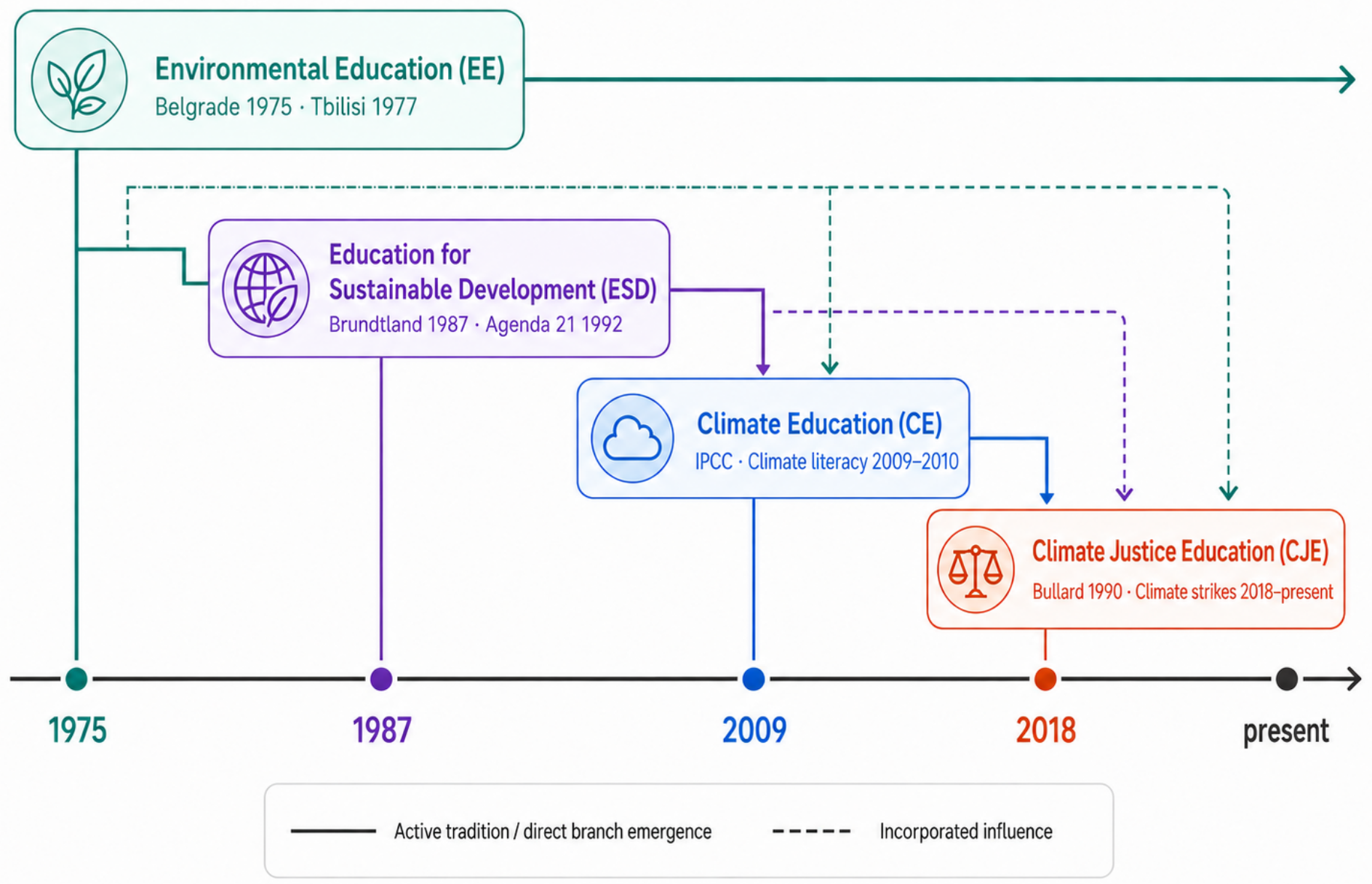
These four traditions—EE, ESD, CE, and CJE—should not be interpreted as mutually substitutive. Each successive framework incorporates elements of its predecessors while expanding the analytical scope of the field whereas for part of the time they developed in parallel. Their consolidation follows a cumulative rather than substitutive logic: each tradition emerged in response to perceived limitations of its predecessors while retaining and transforming their foundational insights. Environmental Education (1975–1977) established the ecological foundation; Education for Sustainable Development (1987–1992) broadened it to encompass social, economic, and political dimensions; Climate Education (2009–2010) deepened the scientific and futures-oriented axis; and Climate Justice Education (2018–present) centered the structural and political dimensions of vulnerability that earlier traditions had left undertheorized. A phylogenetic representation of this cumulative structure is provided in
Figure 2, illustrating that the emergence of each tradition incorporates rather than displaces its predecessors. The vertical trunk represents Environmental Education (EE, 1975–1977) as the foundational tradition, which remains active and continues to develop independently. Successive branches indicate the emergence of Education for Sustainable Development (ESD, 1987–1992), Climate Education (CE, 2009–2010), and Climate Justice Education (CJE, 2018–present), each incorporating elements from prior traditions (shown by dashed influence lines) while introducing new epistemological and political orientations. Dates shown in each node indicate the consolidation moment of each tradition, not the publication date of its foundational literature: Bullard (1990), for instance, appears as intellectual lineage of Climate Justice Education, whose consolidation as a distinct pedagogical tradition is dated to the climate strikes of 2018–present. The modal taxonomic profiles of each tradition are summarized in
Table 1. Nodes are color-coded by dimensional orientation: teal (EE)—ecological and place-based foundation; purple (ESD)—integrative and competency-oriented; blue (CE)—scientific and futures-focused; coral (CJE)—transformative and justice-centered. Rather than treating these traditions as fully separate domains, this review maps them against the four dimensions of the proposed taxonomy, revealing both their distinctive contributions and the structural gaps that a unified analytical framework of sustainability education can address.
These four traditions do not, however, exhaust the intellectual terrain relevant to sustainability education. They share a common provenance in Northern academic institutions and a common horizon within which the epistemological foundations of formal education are not themselves called into question.
Section 2.5 therefore complements the genealogy traced here with a review of epistemologies produced in Latin America and Africa that approach ecological knowledge and education from outside that horizon. These do not constitute a fifth branch of the phylogeny represented in
Figure 2, because they do not descend from the same institutional lineage; they are reviewed separately, and after the four traditions, precisely because they occupy the plane of epistemological foundation rather than that of pedagogical design, and because it is against them that the deepest structural limits of the four Northern traditions become visible.
2.1. Environmental Education
Environmental Education emerged in the 1970s as an organized response to growing ecological awareness, institutionalized through landmark documents such as the Belgrade Charter (1975) and the Tbilisi Declaration (1977). From its inception, EE positioned itself as a field concerned with developing ecological knowledge and pro-environmental behavior, foregrounding the individual’s relationship with the natural world [
15]. Seminal theoretical contributions by Orr [
22] and Scott and Gough [
23] helped consolidate EE’s identity around the cultivation of ecological literacy—an understanding of natural systems, biodiversity, and the consequences of human activity on ecosystems.
Within the proposed taxonomy, EE operates predominantly at the Awareness and Literacy levels of the Educational Approach Dimension (D1), and along the Facts and Systems continuum of the Cognitive Depth Dimension (D2). The field has historically valued disciplinary coherence through Natural Sciences, placing it at the Multidisciplinary to Interdisciplinary tiers (D3.2–D3.3) of the Disciplinary Integration Dimension (D3). Geographically, EE tends toward the Local level of the Real-World Connection Dimension (D4), emphasizing place-based learning and direct experience of natural environments [
24].
A persistent critique of the EE tradition concerns its tendency toward depoliticization. As Gough [
25] and, more recently, Stevenson et al. [
26] have argued, mainstream EE has often reproduced an implicitly apolitical framing of environmental problems, positioning individual behavior change as the primary lever of transformation. This orientation limits EE’s reach within D1—foreclosing the Criticality and Advocacy levels—and constrains its engagement with systemic and political dimensions of environmental crises (D4). The field’s largely mono-logical engagement with scientific knowledge also leaves relatively underexplored the epistemic possibilities of community and Indigenous ways of knowing (D3.5).
This critique of depoliticization, however, has itself generated a vigorous response within the field, particularly in Latin American scholarship, where a distinct tradition of
critical Environmental Education (Educação Ambiental Crítica) has consolidated over the past three decades. Sauvé’s cartography of Environmental Education [
27] identifies fifteen currents operating within the field, among which the socially critical current explicitly incorporates the analysis of power relations, structural inequalities, and the political construction of environmental knowledge, addressing dimensions of D1 Criticality and D4 Political engagement that the mainstream tradition tends to foreclose. In the Brazilian and broader Latin American context, this orientation has been developed through the work of Loureiro [
28], Carvalho [
29], and Layrargues and Lima [
30], whose analysis of three macro-tendencies (conservationist, pragmatic, and critical) in Brazilian Environmental Education documents that the tradition is neither internally homogeneous nor uniformly depoliticized. The critical current articulates Environmental Education with Freirean pedagogy, political ecology, and the emancipatory dimension of the Latin American educational tradition, and provides the theoretical infrastructure for national policy formulations that exceed the modal profile identified in the mainstream literature. This intra-tradition variation is one of the analytical patterns the taxonomy proposed in
Section 3 is designed to render visible, as illustrated by the case examined in
Section 3.5.2.
Despite these tensions, Environmental Education provides an indispensable foundation for sustainability education: its robust pedagogical tradition around place-based learning, ecological systems thinking, and inquiry-based approaches constitutes the empirical and experiential base upon which more critical and transformative orientations can build. The challenge, as this paper proposes, is to understand EE not as a complete educational program but as an essential—and necessarily partial—configuration within a broader multidimensional framework.
2.2. Climate Education
Climate Education consolidated as a distinct educational subfield over the course of the 2000s, accelerated by the growing public salience of anthropogenic climate change and the publication of successive IPCC Assessment Reports, and reaching institutional codification in 2009–2010 with the U.S. Climate Literacy framework and UNESCO’s climate change education program. The field is broadly defined by its concern with transmitting scientific knowledge about the climate system, communicating the causes and consequences of global warming, and developing learner competencies for mitigation and adaptation [
31]. Key institutional actors—including the U.S. Global Change Research Program’s Climate Literacy initiative (2009) and the integration of climate content into national science curricula across multiple countries—have shaped CE’s predominantly science-centered identity.
In taxonomic terms, Climate Education exhibits considerable strength in the Cognitive Depth Dimension (D2), covering Facts, Systems, and increasingly Futures through scenario-based learning and climate modeling exercises. Its Educational Approach (D1) tends to foreground Literacy and, in more participatory implementations, Agency—though Criticality and Advocacy remain underrepresented in mainstream CE curricula [
32]. Disciplinary integration (D3) is predominantly Mono- to Multidisciplinary, with science education as the primary site of instruction, though interdisciplinary approaches linking physical sciences with social studies, economics, and ethics are gaining traction. In terms of real-world connection (D4), CE spans Local to Glocal, particularly in curricula that link local weather events to global climate patterns.
A significant scholarly debate within CE concerns what Kwauk [
33] has described as the tension between a technocratic and a transformative orientation. The dominant technocratic strand foregrounds scientific facts, technological solutions, and individual behavioral adjustments—a framing that risks positioning climate change as a problem amenable to technical management while leaving unquestioned the structural drivers of the crisis. More transformative approaches, drawing on the work of Kagawa and Selby [
34] and Hicks and Bord [
35], argue for a CE that integrates affective dimensions of climate anxiety and engages learners in futures thinking and participatory inquiry.
The climate education field also faces a specific pedagogical challenge with respect to eco-anxiety and climate grief, increasingly documented as significant barriers to effective learning among young people [
36]. Addressing this requires CE to develop emotional and relational competencies—moving beyond cognitive acquisition toward what Ojala [
37] terms “constructive hope”, a dimension that sits at the intersection of D2 (Values) and D1 (Agency). Notwithstanding these limitations, Climate Education’s empirical grounding and its increasingly sophisticated treatment of futures thinking represent vital contributions to the broader field of sustainability education.
2.3. Education for Sustainable Development (ESD)
Education for Sustainable Development emerged from the United Nations’ broader sustainable development agenda, formalized through the UN Decade of Education for Sustainable Development (2005–2014) and subsequently embedded in UNESCO’s Global Action program on ESD and the Education 2030 Agenda. As a policy framework, ESD is distinctive in its ambition to transform education systems rather than merely enrich existing curricula—advancing a vision of learning that develops the knowledge, skills, values, and attitudes needed to navigate an uncertain and rapidly changing world [
38]. Theoretically diverse and politically contested, ESD has generated substantial debate regarding its relationship to sustainable development as a hegemonic concept [
39,
40].
ESD’s taxonomic profile is the broadest among the four traditions surveyed here. Across the Educational Approach Dimension (D1), ESD curricula span from Awareness through to Agency, with the more transformative iterations—particularly those informed by critical pedagogy and deliberative learning—reaching toward Advocacy. In the Cognitive Depth Dimension (D2), ESD is distinguished by its explicit commitment to Systems thinking, Futures literacy, and Value-based deliberation, drawing on competency frameworks such as the eight key sustainability competencies identified by Wiek et al. [
41] and UNESCO’s own framework [
1]. Disciplinary integration (D3) is a defining feature of ESD, which explicitly advocates for inter- and transdisciplinary approaches to sustainability challenges.
In terms of real-world connection (D4), ESD’s embrace of whole-institution approaches, community partnerships, and global citizenship education positions it at the Glocal to Systemic levels, often articulating local learning with global sustainability agendas. A notable weakness, however, identified across the critical ESD literature, is the field’s susceptibility to normative vagueness [
42]. The concept of “sustainable development” itself is contested, and ESD frameworks that fail to engage critically with this contestation risk becoming prescriptive rather than emancipatory—substituting one orthodoxy for another. This tension is particularly acute in relation to the Values and Action levels of D2, where the difference between normative transmission and critical deliberation is consequential.
Notwithstanding these critiques, ESD represents the most comprehensive existing framework for organizing sustainability education, offering a transdisciplinary, competency-oriented, and futures-conscious pedagogy that cuts across institutional levels. Its principal limitation lies not in its scope but in the uneven and often shallow implementation of its more transformative dimensions—a gap that the present taxonomy seeks to render visible and addressable through explicit dimensional mapping.
2.4. Climate Justice Education
Climate Justice Education is the most recently consolidated of the four traditions, emerging from the confluence of climate activism, critical pedagogy, and environmental justice scholarship. Its development draws on the foundational analysis of racialized environmental harm presented by Bullard [
20] and on the climate justice advocacy articulated by Robinson [
21]. The field gained significant momentum following the global school climate strikes of 2018–2019. Unlike EE, CE, or even ESD, CJE foregrounds questions of power, equity, and structural injustice as constitutive—rather than peripheral—dimensions of the climate crisis [
43,
44]. Its foundational premise is that climate change is not merely an environmental or scientific problem but a deeply political one, shaped by and reproducing existing inequalities of race, class, gender, and coloniality.
In taxonomic terms, CJE operates at the most advanced levels of the Educational Approach (D1) and Real-World Connection (D4) dimensions. D1 Criticality and Advocacy are not aspirational endpoints but the default mode of CJE pedagogy: learners are positioned not as recipients of climate information but as political subjects with the capacity and responsibility to act collectively. Similarly, D4 extends to the Systemic and Political levels, with CJE curricula routinely engaging with the political economy of fossil fuels, climate finance, and differential vulnerability to climate impacts. A distinctive feature is CJE’s engagement with climate justice movements—from Standing Rock to Fridays for Future—as pedagogical resources.
The Disciplinary Integration Dimension (D3) in CJE tends toward Transdisciplinary and Community knowledge configurations, incorporating Indigenous ecological knowledge, feminist political ecology, and post-colonial theory alongside mainstream scientific frameworks [
45]. This epistemic pluralism is both a strength and a site of ongoing negotiation: integrating non-Western knowledge systems within institutional educational settings raises complex questions of appropriation, representation, and power that CJE scholars are actively working through [
44]. In the Cognitive Depth Dimension (D2), CJE operates most powerfully at the Values and Action levels, though its engagement with Systems and Futures thinking—increasingly articulated through climate justice scenario-building—is growing.
The principal challenge facing Climate Justice Education lies in its institutionalization. As a tradition born in activism and oriented toward political transformation, CJE faces structural tensions when translated into formal curricula, standardized assessments, and school governance frameworks [
6]. There is a genuine risk that institutional incorporation domesticates CJE’s most critical dimensions, reducing Advocacy to simulation and Systemic analysis to abstract discussion. Scholarly work by Hursh et al. [
7] and by Patel [
46] underscores the importance of maintaining CJE’s structural-critical orientation even—and especially—within institutional contexts.
2.5. Epistemologies of the South: Liberation, Buen Vivir, Counter-Colonial and Ubuntu Thought
The four traditions reviewed above were consolidated predominantly within Northern academic institutions, and share, despite their differences, a common horizon: they debate how sustainability should be taught within an educational architecture whose epistemological foundations they do not fundamentally question. A rigorous account of the field cannot end there. A substantial body of thought produced in Latin America and Africa approaches ecological knowledge, education and the human relationship with the living world from outside that architecture, and it is precisely this body of thought that gives Dimension D3.5 (Community and Indigenous Knowledge) its content. This subsection reviews four strands of that thought, not as a fifth pedagogical tradition to be added to the previous four, but as the epistemological ground against which the limits of the other four become visible.
The first strand is the Philosophy of Liberation developed by Enrique Dussel [
47]. Its central category, the
exteriority of the excluded Other, the peoples, knowledges, and lives that the totality of modern European thought placed outside itself, offers a philosophical account of exactly the structural absence this article documents. Where the taxonomy identifies dimensions systematically underdeveloped across the Northern traditions, Dussel provides the reason: a knowledge organized from the perspective of the center cannot recognize as valid what it constituted as its outside. The affinity with Morin is direct and mutually illuminating. Morin’s principle of religation calls for reconnecting what the paradigm of disjunction has separated; Dussel specifies from where that reconnection must begin, from the exteriority of those excluded from the dominant totality. Read together, the two thinkers describe a single reform of thinking from two positions: Morin from within the critique of European rationality, Dussel from the perspective of the periphery it excluded. This convergence also connects the present framework to the Latin American pedagogical tradition, since Dussel develops his pedagogics of liberation in explicit dialogue with Freire.
The second strand is Buen Vivir (
sumak kawsay,
suma qamaña), the Andean indigenous principle of a life in harmony among human beings and with nature, elaborated as a civilizatory alternative to development by Acosta and others [
48]. Its significance for the present argument is specific and concrete: Buen Vivir demonstrates that the recognition of indigenous knowledge as constitutive rather than illustrative, the highest level of D3.5, is not a theoretical aspiration but has been institutionalized, having been incorporated into the constitutions of Ecuador and Bolivia. It provides, in other words, documented evidence that D3.5 is realizable at the scale of national policy. This potential must be stated together with its limits: critics, including proponents of the concept, have noted that Buen Vivir has been invoked by states that continued extractivist practices, so that its constitutional inscription did not by itself transform the material relations it names. The lesson for sustainability education is instructive rather than disqualifying: institutionalizing an epistemology is necessary but not sufficient, and the gap between constitutional principle and educational practice is itself a D3.5 problem.
The third strand is the counter-colonial thought of the Brazilian quilombola thinker Antônio Bispo dos Santos, known as Nêgo Bispo [
49,
50]. Writing from the Saco-Curtume quilombo, Bispo distinguishes what he calls organic thought, rooted in relationships of reciprocity with the land and transmitted orally across generations, from the synthetic thought of monoculture and accumulation. His concept of confluence, the principle by which different elements coexist without being homogenized, nothing that joins need mix, offers a striking non-Western articulation of exactly the dialogic principle Morin formulates: the maintenance of difference within relation. Bispo’s thought is doubly pertinent to this article. It connects directly to the historical argument developed in
Section 5.3, since the quilombo is the concrete historical form in which enslaved and escaped Africans preserved ecological knowledge against the extractive logic of the plantation; and it grounds D3.5 not in an abstract category but in a living, territorially situated knowledge system that theorizes its own ecological practice.
The fourth strand is African decolonial and Ubuntu thought, represented here by Ndlovu-Gatsheni’s argument for epistemic freedom [
51] and Ramose’s articulation of African philosophy through Ubuntu [
52]. Ndlovu-Gatsheni names the condition this article addresses at the scale of the continent: the systematic location of Africa outside legitimate knowledge production, and the consequent need for epistemic freedom as the precondition of every other freedom. Ramose’s account of Ubuntu, the relational ontology captured in the maxim
motho ke motho ka batho (a person is a person through other persons), extends this relationality beyond the human, and, notably, mounts an explicit philosophical critique of the fragmentation of knowledge that parallels Morin’s own. That an African relational philosophy and a European critic of the paradigm of simplification arrive independently at a critique of fragmentation is itself evidence of the argument this article advances: the reconnection of what disjunctive thought has separated is not the property of any single tradition but a convergent demand arising wherever the costs of separation are confronted.
Taken together, these four strands do not constitute an additional column to be inserted into
Table 1 because they do not occupy the same plane as the four pedagogical traditions. They operate at the level of epistemological foundation rather than pedagogical design, and their function in the argument is to establish that Dimension D3, at its highest levels, and the criticality and political dimensions of D1 and D4, are not marginal refinements of the Northern traditions but the point at which sustainability education either confronts or evades the epistemological question. It is against this ground that the synthesis of the four pedagogical traditions, to which the discussion now turns, must be read.
2.6. Synthesis: Towards a Unified Framework
Across the four pedagogical traditions reviewed in
Section 2.1,
Section 2.2,
Section 2.3 and
Section 2.4, and read against the epistemological ground established in
Section 2.5, a common pattern emerges: each has developed with particular strengths in specific taxonomic dimensions while leaving others structurally underdeveloped. Environmental Education provides a rich foundation in ecological systems literacy but tends to foreclose critical and political dimensions. Climate Education offers scientific depth and increasingly sophisticated futures thinking but often remains constrained by a technocratic framing. ESD advances the most comprehensive vision of competency development but risks normative shallowness without robust critical engagement. Climate Justice Education brings a distinctively transformative orientation—integrating criticality, community knowledge, and political action—but faces significant barriers to institutional uptake.
Table 1 summarizes the positioning of each tradition across the four dimensions of the proposed taxonomy. It is important to note that these mappings represent modal tendencies rather than fixed properties: individual implementations within each tradition can exceed or fall short of the modal profile. The value of the taxonomic framework proposed in this paper lies precisely in its capacity to render these variations visible, enabling researchers, curriculum designers, and practitioners to diagnose and address dimensional gaps in specific educational programs.
The mapping presented in
Table 1 points to a structural asymmetry in the field: the dimensions most consistently underdeveloped, D1 Criticality and Advocacy and D4 Systemic and Political, are precisely those associated with transformative, justice-oriented, and structurally-aware education. On this reading, the asymmetry reflects broader political and institutional constraints on educational systems rather than theoretical failures within the traditions themselves; the evidentiary status of the reading, and the conditions under which it could be tested independently, are addressed in
Section 3.4. A central argument of this paper is that making these gaps explicit through dimensional mapping is a prerequisite for addressing them, and that the proposed Taxonomy of Sustainability Education Design provides the analytical infrastructure to do so.
4. Discussion
4.1. Complexity as a Philosophical Foundation: Morin and the Limits
of Analytical Separation
The taxonomy proposed in this article performs a necessary analytical operation: it disaggregates sustainability education into four analytically distinct dimensions, Educational Approach (D1), Cognitive Depth (D2), Disciplinary Integration (D3), and Real-World Connection (D4), in order to render structural gaps visible and comparable across traditions and programs. This operation is diagnostically productive. But it carries a risk that must be named from the outset of the Discussion: the risk of substituting one form of reductionism for another, replacing the fragmentation of traditions with the fragmentation of dimensions.
It is precisely here that the philosophy of complex thought developed by Morin [
12] and articulated for education in his UNESCO essay [
13] provides the indispensable conceptual grounding for the framework proposed here. Recent scholarship confirms the consolidation of complex thinking as a research construct in the educational sciences, with bibliometric evidence documenting 428 publications across eight decades [
69], situating the present contribution within an ongoing agenda rather than an idiosyncratic theoretical choice. Morin’s central argument is that the dominant paradigm of Western science, organized around the principles of disjunction, reduction and abstraction, has produced what he terms a
mutilating intelligence: a form of knowledge that isolates objects from their contexts, separates what is inseparable and mistakes the map for the territory [
12]. Applied to education, this paradigm has produced exactly the fragmentation documented in
Section 2: traditions that develop certain dimensions while systematically excluding others, treating ecological knowledge as separable from political analysis, cognitive depth as separable from affective engagement, local experience as separable from global structural dynamics. The four-dimensional taxonomy proposed here is designed to make this fragmentation visible, but the philosophical framework that gives it critical force is Morin’s insistence that such separations are not natural properties of the world but products of a way of thinking that must itself be transformed.
The principles of complex thought articulated by Morin [
12,
13] bear directly on the argument of this article. The dialogic principle, the capacity to maintain complementary and antagonistic logics simultaneously, is the epistemological foundation for understanding why EE and CJE, ESD and CE, are not simply different points on a single spectrum but genuinely different epistemic orientations whose tension is productive rather than resolvable. The recursive organizational principle, whereby effects become causes in non-linear feedback loops, provides the theoretical basis for understanding why sustainability education cannot be organized as a linear transmission from awareness to behavior, a model that Walker [
8] has critiqued empirically and that Morin critiques philosophically. The hologrammatic principle, whereby the whole is present in each part and each part contains the whole, challenges the assumption that any single tradition can produce complete sustainability education by itself, which is precisely the structural illusion that the taxonomy exposes.
Most consequentially for the argument developed in this Discussion, Morin’s seventh principle, the reintroduction of the knower into all knowledge ([
13], Chapter 7), establishes that every act of knowing is a reconstruction performed by a subject embedded in a culture, a history and a specific relationship with the world being known. This principle has radical implications for sustainability education: it means that the separation between the learner and the ecological systems being learned about is itself an artefact of Western pedagogical tradition, not an epistemological necessity. And it is in this context that taking Indigenous ontologies seriously contributes to the constitution of the many worlds and of the many possible futures that are complexly constituted.
The taxonomy, properly understood through Morin’s framework, is therefore not a goal, but an instrument. Its four dimensions do not represent four separate components to be developed in isolation; they represent four analytical axes whose integration, or
religation in Morin’s term [
12], is what transformative sustainability education actually requires. Programs that achieve high scores across all four dimensions are not simply “more complete” than others; they are approaching the kind of complex, reflexive, politically engaged and territorially grounded learning that Morin’s reform of thinking demands.
4.2. The Taxonomy as Diagnostic Infrastructure: Rendering Structural Gaps Visible
The mapping formalized in
Section 3 points to a pattern that, within the limits of the present typological reading (
Section 3.4), is analytically consequential: the four major traditions of sustainability education appear structurally asymmetric in their dimensional development. The dimensions most consistently underdeveloped across traditions, D1 Criticality and Advocacy and D4 Systemic and Political, are precisely those associated with transformative, justice-oriented, and structurally aware education, whereas the dimensions most consistently attained, D2.1–D2.2 (Facts and Systems) and D4.1 (Local), correspond to less politically demanding, more institutionally tractable forms of learning.
Understood through Morin’s framework, this asymmetry is not a collection of individual program failures. It is the educational expression of the paradigm of simplification: the systematic separation of ecological knowledge from political analysis, of emotional engagement from structural critique, of local experience from global causality. A system of education organized around the paradigm of disjunction will reliably produce exactly the dimensional profile that the taxonomy documents: strong at the levels that correspond to separated, specialized, institutionally contained knowledge, and weak at the levels that require the reconnection of what has been separated.
Walker [
8] identified one dimension of this structural constraint in her analysis of sustainability education policy: the dominant model of ESD is premised on an individualist Attitude–Behavior–Choice logic that systematically underestimates the relational, intergenerational, and structural dimensions of environmental knowledge transmission. In Morinian terms, this is the paradigm of disjunction applied to human agency: the individual is separated from the social, the cognitive from the material, the present from the intergenerational. A reform of thinking in sustainability education—not merely a reform of content or of pedagogical technique—requires replacing this logic with what Morin calls a dialogic understanding of agency: one in which the individual and the collective, the local and the global, the present and the future are maintained in productive tension rather than resolved into one another.
The practical implication for curriculum designers is direct. Rather than asking whether a program “covers sustainability,” the taxonomy enables the more precise diagnostic question: at what level of each dimension is the program operating, and which dimensional gaps reflect the deeper paradigmatic constraint that Morin names? A program that operates at D1.2, D2.2, D3.2, and D4.1 has a specific dimensional signature whose gaps in D1 Criticality and D4 Political are not simply content omissions; they are expressions of a paradigmatic orientation that positions knowledge as separable from power, and learning as separable from action.
4.3. The Awareness-Practice Gap and Its Dimensional Interpretation
One of the most robust findings in the environmental and sustainability education literature is the persistent discrepancy between declared environmental awareness and enacted sustainable behavior, a discrepancy examined in the influential synthesis of pro-environmental behavior developed by Kollmuss and Agyeman [
70]. Their framework distinguishes demographic, external (institutional, economic, cultural, and social), and internal (motivation, environmental knowledge, values, and emotional involvement) factors, and shows that internal factors alone rarely translate into consistent action once external and structural barriers are taken into account. Recent evidence confirms that this gap remains central to the field: Portus et al. [
71], in a semi-systematic review of the environmental value-action gap in education research published in
Environmental Education Research, identify that the literature converges on two organizing axes, the role of specific pedagogical approaches and the influence of broader policy and institutional structure, a distinction that maps directly onto the D1 (Educational Approach) and D4 (Real-World Connection) dimensions of the present taxonomy. A specific illustration of the same gap within a defined educational population is provided by Ridwan et al. [
2], whose study of pre-service physics teachers found that while 97% of students registered high levels of emotional concern for environmental issues, practice-oriented awareness reached only 48%, classified as the lowest category among the three dimensions assessed. This gap is structurally produced, and the taxonomy offers a more precise diagnosis of its origins than unidimensional awareness scales, including the model proposed by Kollmuss and Agyeman [
70] itself, can provide, since it locates the gap not only within the individual learner but within the dimensional profile of the educational program that shaped that learner’s awareness.
In Morinian terms, this gap is the predictable outcome of teaching that develops knowledge about the world without developing the capacity to act from within the world. The learner who registers high emotional concern but does not compost, reduce plastic use, or participate in campus environmental initiatives is not simply lacking information or motivation; they are operating within a pedagogical framework that treats sustainability as an object of awareness rather than as a condition of existence. Morin’s distinction between adaptive and generative knowledge is relevant here: adaptive knowledge fits the learner to existing conditions; generative knowledge equips the learner to transform them. The awareness-practice gap corresponds exactly to the preponderance of adaptive over generative learning in sustainability education.
In taxonomic terms, the gap corresponds to the distance between D1.1 (Awareness) and D1.3–D1.5 (Agency, Criticality, Advocacy), and between D2.1 (Facts) and D2.5 (Action). Programs that develop strong emotional concern and factual knowledge without developing agentic, critical, and action-oriented dimensions are structurally positioned to produce exactly the pattern documented by Ridwan et al. [
2]. This finding is consistent with the evidence presented by Kudryavtsev et al. [
5], who showed that place attachment and ecological place meaning, when considered together, are associated with stronger pro-environmental behavioral outcomes than either factor in isolation. This pattern can be interpreted through the hologrammatic principle in pedagogical terms: sustainable practice emerges when emotional engagement, cognitive understanding, and territorial rootedness are integrated throughout the learning experience, rather than assembled only at its conclusion.
4.4. Indigenous and Traditional Ecological Knowledge: From Taxonomic Inclusion to Epistemic Justice
A foundational extension of Morin’s philosophical framework—and thus, a significant dimension of the taxonomy that demands deeper treatment—is the place of indigenous and traditional peoples and their ecological knowledge systems within sustainability education. This is not an addendum to the framework. It is a test of whether the framework genuinely embodies the reform of thinking it advocates or reproduces, in more sophisticated form, the paradigm of disjunction it claims to overcome.
Morin’s seventh principle—the reintroduction of the knower into all knowledge—establishes that every act of knowing is inseparable from the culture, the territory, and the relationships within which it is produced. Indigenous and traditional peoples have understood this not as a philosophical principle requiring formal articulation, but as the lived condition of alternative knowledge systems. For the Guaraní, the Yanomami, the ribeirinho communities of the Amazon, the quilombola communities of the Atlantic Forest, or the indigenous peoples of the Cerrado, ecological knowledge is not a set of propositional facts about nature held separately from social practice and territorial relationship. It is a form of being in the world that integrates observation, memory, ceremony, governance, management, and ethic into integrated complex systems. This is complex thought not as academic program, but as a cosmological condition.
The taxonomic implications are profound. A community elder who transmits oral knowledge of flood cycles, indicator species for water quality, sustainable fishing practices, forest fire management, and medicinal plant ecology to younger generations is not merely delivering “local content” that supplements the scientific curriculum at D3.5. That elder is simultaneously operating at D2.2 (Systems), D2.3 (Futures), D2.4 (Values), D2.5 (Action), D1.3 (Agency), D1.4 (Criticality), D4.1 (Local), and D4.3 (Systemic)—in a single act of knowledge transmission that Western educational frameworks have no instrument to recognize, evaluate, or learn from. This is the hologrammatic principle made concrete: the entire taxonomy is present in a single act of traditional ecological pedagogy.
Santos [
63] names the historical process by which this knowledge was destroyed as epistemicide—the systematic elimination of alternative epistemologies as a constitutive dimension of colonization, not its by-product. The relevance for sustainability education is direct and uncomfortable: an educational framework that treats indigenous knowledge as an optional enrichment at the highest level of a Western-designed taxonomy is not correcting epistemicide; it is continuing it in more benevolent language. The difference between genuine epistemic inclusion and its simulation is the difference between asking indigenous communities what they know about the forest and building curricula together with communities—as participants who bring different but equally irreducible forms of knowledge to the shared project of understanding what is happening to the living world.
Whyte [
44] adds the political dimension that makes this argument urgent rather than merely philosophical: for indigenous peoples, climate change is not a new threat. It is a continuation of the ecological violence of colonization, which began with the disruption of the territorial relationships and knowledge transmission systems that sustained indigenous communities for millennia.
In this sense Kopenawa and Albert [
72] provide what may be the most generative theoretical contribution to this argument—not as illustration, but as argument. Kopenawa does not describe Yanomami ecological knowledge from outside; he theorizes from within it, demonstrating through the texture of his own thought the inseparability of territorial relationship, cosmological understanding, political responsibility, and knowledge transmission that Western epistemological frameworks have taken centuries to arrive at as a theoretical proposition. His account of
xapiri—the spirit-helpers who carry the images of all living things and sustain the forest’s existence—is not mythology requiring translation into ecological science. It is an epistemological framework that makes legible forms of ecological interdependence that Western science has systematically failed to see. To engage with Kopenawa’s text as theory, rather than as testimony, is one of the concrete practices through which D3.5 ceases to be a taxonomic level and becomes an epistemological transformation.
A methodological clarification is owed on what such engagement involves, since
The Falling Sky is not a conventionally authored monograph. The text is the product of what Albert, in his postface, calls an ethnographic pact: Kopenawa’s oral narrative in Yanomami, delivered across three decades, transcribed, translated and composed into written form by Albert at Kopenawa’s own request [
72]. This double mediation, from orality to writing and from Yanomami to European languages, must be acknowledged rather than concealed; but it does not disqualify the text as theory, any more than the mediation of Plato’s writing disqualifies the thought of Socrates. What distinguishes reading such a text as theory from reading it as testimony is well established in the literature on
testimonio: the testimonial frame positions the narrator as a witness whose account carries evidentiary and moral force while interpretive authority remains with the reader, whereas the theoretical frame attributes to the narrator the authorship of concepts [
73]. Concretely, this means citing Kopenawa as the author of an epistemological framework, engaging his categories,
xapiri, the falling sky, the people of merchandise, as analytical instruments that can be thought with and argued against, and holding the mediated character of the text present as a condition of reading rather than as a reason for demotion to ethnographic data. It is this practice, and not the mere presence of an indigenous name in a reference list, that D3.5 designates.
A curriculum that teaches climate science without teaching this history is not merely incomplete; it is epistemically dishonest, because it presents the crisis as unprecedented when it is, from the perspective of indigenous communities, the most recent chapter of a centuries-long emergency. Tuck and Yang [
45] are explicit: decolonization is not a metaphor for inclusion. It requires the restitution of land, sovereignty, and epistemic authority—conditions that sustainability education frameworks cannot achieve by themselves, but that they can either reinforce or contest in their design choices.
The practical implication for the taxonomy is that D3.5 (Community and Indigenous Knowledge) cannot function as a merely additive level—a higher degree of inclusivity achieved by inviting indigenous voices into a pre-designed curriculum. It requires a structural transformation of the curriculum’s relationship to knowledge authority: indigenous and traditional communities are not informants or contributors but epistemological partners whose frameworks have equal standing to academic disciplines in the production of sustainability knowledge. This requires, in Morin’s terms, not the addition of new content to existing disciplines but the reform of the paradigm that organizes how knowledge is produced, validated, and transmitted. The dialogic principle demands that indigenous knowledge systems and Western scientific frameworks be held in productive tension—complementary and antagonistic—rather than synthesized into a hierarchy in which science retains the final word.
The concrete pedagogical consequence is that programs aspiring to operate at D3.5 cannot be designed from within universities and schools alone. They require genuine partnership with indigenous and traditional communities, the incorporation of their pedagogical methods (oral transmission, territorial experience, intergenerational mentorship, ceremonial knowledge), and the willingness to measure learning outcomes against indigenous epistemological criteria, not only against Western competency frameworks. This is neither simple nor free of political difficulty. But it is the educational expression of what the IPCC AR6 affirms scientifically [
74]: that indigenous and local knowledge contributes irreplaceably to the understanding of climate impacts and to the design of effective adaptation strategies—and that excluding it from sustainability education is a scientific impoverishment as much as a political injustice.
4.5. Digitally Mediated Sustainability Education: Opportunities and Dimensional Constraints
The expanding domain of digitally mediated sustainability education presents both opportunities and risks that the taxonomy, understood through Morin’s framework, is well positioned to evaluate. Zakopoulos et al. [
9], in their systematic review of digital theatre and sustainability education, identified growing evidence that digital drama pedagogies can activate critical thinking, empathy, collaborative competencies, and emotional engagement with environmental issues. These outcomes correspond to movements along multiple dimensional axes simultaneously: from D1.1 toward D1.3 and D1.4, from D2.1 toward D2.4, and from D3.1 toward D3.3 and D3.4.
However, the Morinian framework reveals a specific risk in digitally mediated approaches that enthusiasm for their pedagogical potential tends to obscure: digital environments are, by design, environments of simulation and representation, not of direct territorial relationship. They can produce vivid experiences of distant ecosystems, abstract climate scenarios, or social justice dilemmas—experiences that may be emotionally powerful and cognitively demanding—while leaving intact the fundamental separation between the learner and the living world. This is the paradigm of disjunction operating through the most sophisticated available tools: the learner experiences the rainforest through a VR headset rather than inhabiting it, and the ecological knowledge transmitted through the simulation is propositional rather than somatic, declarative rather than relational.
This does not disqualify digital tools from a serious taxonomy of sustainability education. It requires that they be evaluated against the question: does this technology reinforce or begin to overcome the separation between the knower and the known? Digital storytelling grounded in community testimony, collaborative mapping platforms co-designed with indigenous communities, augmented reality applications that layer traditional ecological knowledge onto physical landscapes, and social media networks that connect local environmental action with global justice movements—these approaches use digital mediation in the service of territorial and relational reconnection. They are different in kind from immersive experiences designed to produce individual emotional responses to abstract environmental problems.
Zakopoulos et al. [
9] acknowledged that the field lacks a unified framework capable of categorizing the dimensional sustainability learning outcomes produced by different pedagogical modalities. The taxonomy proposed here, enriched by Morin’s epistemological framework, provides precisely that: not simply a classification instrument, but a principled criterion for evaluating whether a given digital approach deepens the reform of thinking that complex sustainability challenges require, or whether it produces, at higher technological cost, the same adaptive and propositional learning that simpler approaches already deliver.
4.6. The Institutionalization Problem and the Paradigmatic Constraint
The structural asymmetry documented throughout this Discussion—the systematic underdevelopment of D1 Criticality and Advocacy and D4 Systemic and Political, and the near-total absence of D3.5 from institutional programs—points to what Morin [
12] identifies as the deepest obstacle to a reform of education: the reform cannot be merely programmatic. It must be paradigmatic.
A programmatic reform adds new content, new methods, new technologies, and new competencies to existing structures. It is what most ESD initiatives have attempted: integrating sustainability themes into existing curricula, training teachers in new environmental content, and expanding assessment frameworks to include sustainability outcomes. The evidence reviewed in this article suggests that programmatic reform, while valuable, is insufficient. The dimensional gaps it leaves open—particularly at D1.4–D1.5, D3.4–D3.5, and D4.3–D4.4—are not gaps that can be closed by adding more content to existing frameworks. They are produced by the paradigmatic orientation of those frameworks: by a way of organizing knowledge that separates the cognitive from the political, the scientific from the local, the individual from the structural.
A paradigmatic reform, in Morin’s sense, requires replacing the principle of disjunction—which separates disciplines, separates the learner from the world, and separates knowledge from action—with the principle of religation, which reconnects without reducing. Applied to sustainability education, this means designing curricula not around disciplinary sequences but around socioecological problems of genuine complexity; not around the transmission of expert knowledge but around the co-production of situated understanding with communities, including indigenous and traditional communities whose epistemological frameworks already embody the complex, relational, and action-oriented knowledge that Western education is struggling to construct.
Climate Justice Education, as analyzed in
Section 2.4, comes closest to this paradigmatic orientation among the four traditions reviewed, but faces precisely the institutional barriers that Morin’s analysis predicts: standardized assessment regimes, school governance structures, and curriculum accountability frameworks are all products of the paradigm of disjunction, and they reliably domesticate transformative educational content when it enters institutional channels [
6,
7]. Walker [
8] calls for a “socially sensitive” model of sustainable development, which, in this light, also implies a reform of the institutional paradigm.
The taxonomy proposed here cannot resolve this institutional constraint. What it can do—what it is designed to do—is make the constraint analytically visible, which is a necessary condition for naming it, contesting it, and designing deliberate strategies to work against it. Making the paradigmatic gap explicit is the first move in the reform of thinking that Morin demands.
4.7. Implications for Research, Curriculum Design, and Policy
The analytical implications of the framework, enriched by Morin’s philosophy and by the epistemological challenge of indigenous and traditional knowledge systems, operate at three levels.
For researchers, the framework provides a common language for comparative cross-tradition and cross-context analysis, enabling the accumulation of evidence about which dimensional combinations—and which paradigmatic orientations—produce genuine transformative learning outcomes. Priority research questions include: how do programs that incorporate indigenous and traditional ecological knowledge at D3.5 differ in their dimensional profiles and learning outcomes from those that operate at D3.3–D3.4? What institutional conditions enable programs to sustain operation at D1.4–D1.5 over time without being domesticated into lower-dimensional forms? How do digital pedagogies interact with place-based and community-grounded approaches across the dimensional axes? The operationalized dimension definitions in
Section 3.2 provide the basis for inter-rater reliability studies and dimensional assessment instruments that go beyond unidimensional awareness scales (cf. [
2]).
For curriculum designers and practitioners, the taxonomy functions as a diagnostic and design tool. The Morinian framework adds a criterion that purely analytical taxonomies cannot provide: is the proposed curriculum designed to reinforce the separation of what has been separated, or to begin its religation? A curriculum that teaches ecological systems through a single scientific discipline, assesses learning through factual recall, excludes community knowledge, and connects students to global sustainability through media consumption rather than territorial experience is performing the paradigm of disjunction even when it uses the language of sustainability. Designing against this tendency requires deliberate choices at every dimension—choices that are now nameable, because the taxonomy provides the vocabulary.
For policymakers, the framework provides analytical infrastructure for monitoring at a level of specificity that generic competency frameworks cannot provide. The capacity to specify that a national curriculum operates at D1.2, D2.2, D3.2, and D4.2—and that D1.4–D1.5, D3.4–D3.5, and D4.3–D4.4 are systematically absent—is more actionable than a binary assessment of whether sustainability is “included.” It is also more honest about the paradigmatic work that remains undone: work that requires not only new content and new methods, but the kind of reform of thinking that Morin argues must be simultaneously institutional and mental, programmatic and paradigmatic.
The limitations that bound these implications (the predominantly Northern provenance of the reviewed literature, the absence of psychometric validation, and the static character of the dimensional profiles) were stated in
Section 3.4 and are consolidated, together with the research agenda they define, in
Section 6. The following section develops the policy implications that this diagnostic reading of the field makes possible.
5. Normative and Policy Implications
The taxonomy proposed in this article, and the philosophical framework of complex thought through which the preceding Discussion interpreted it, carry implications that extend beyond academic classification and curriculum design. They point toward a set of structural conditions, political, institutional, historical, and technological, that educational policy must address if sustainability education is to function as a genuine instrument of transformation rather than as a sophisticated form of adaptive compliance. The recommendations that follow are not a program of implementation. They are a set of principled orientations, derived from the argument of this article, for policymakers, international organizations, and educational institutions willing to engage with the paradigmatic depth of the challenge.
Importantly, these four policy domains are not an open-ended list of topics that could be extended or substituted at will. They are the domains in which the dimensions the taxonomy identifies as most consistently underdeveloped, D1 Criticality and Advocacy, D3.5 Community and Indigenous Knowledge, and D4 Systemic and Political, become materially visible and politically consequential. Each domain is selected and structured by the taxonomy rather than merely illustrated by it: the geopolitics of epistemological authority (
Section 5.1) is where a D3.5 gap becomes a question of who authors sustainability knowledge; the education of climate-displaced communities (
Section 5.2) is where the same D3.5 gap becomes a question of whose knowledge survives displacement; the historical grammar of vulnerability (
Section 5.3) is where a D4.4 gap becomes a question of whether education can name the historical production of ecological harm; and the governance of artificial intelligence (
Section 5.4) is where the same gaps become a question of whether algorithmic infrastructure will entrench or contest the paradigm of disjunction. Read together, the four domains are not four separate problems but a single structural condition observed at four sites. This is why the taxonomy is a precondition for the analysis and not a decorative frame around it: without the dimensional apparatus, these four domains would appear as unrelated policy concerns rather than as coordinated expressions of the same paradigmatic underdevelopment.
The distance between aspiration and reality in current sustainability education policy is precisely what
Figure 1, introduced at the opening of this article, was designed to render measurable. The 47% of national curriculum frameworks with no reference to climate change, the 20% of teachers who feel equipped to explain how to act, and the 49 percentage-point distance between emotional engagement and practice-oriented awareness do not look the same after the preceding analysis as they did at the outset: what appeared as implementation deficits are now legible as dimensional absences. A curriculum that reaches only D1.1 cannot produce the critical orientation that translates concern into action; a system that excludes D3.5 cannot validate the community and Indigenous knowledge that gives environmental commitment its territorial anchor; and an institutional structure organized around D2.1 factual transmission cannot build the cognitive depth that D4.4 demands. The gaps in
Figure 1 are not gaps in content coverage. They are gaps in the dimensional architecture of sustainability education itself, and that is why they cannot be closed by adding new topics to existing structures. A transformative policy agenda must reorganize what counts as knowledge, whose experience counts as evidence, and what kinds of civic action education is expected to make possible.
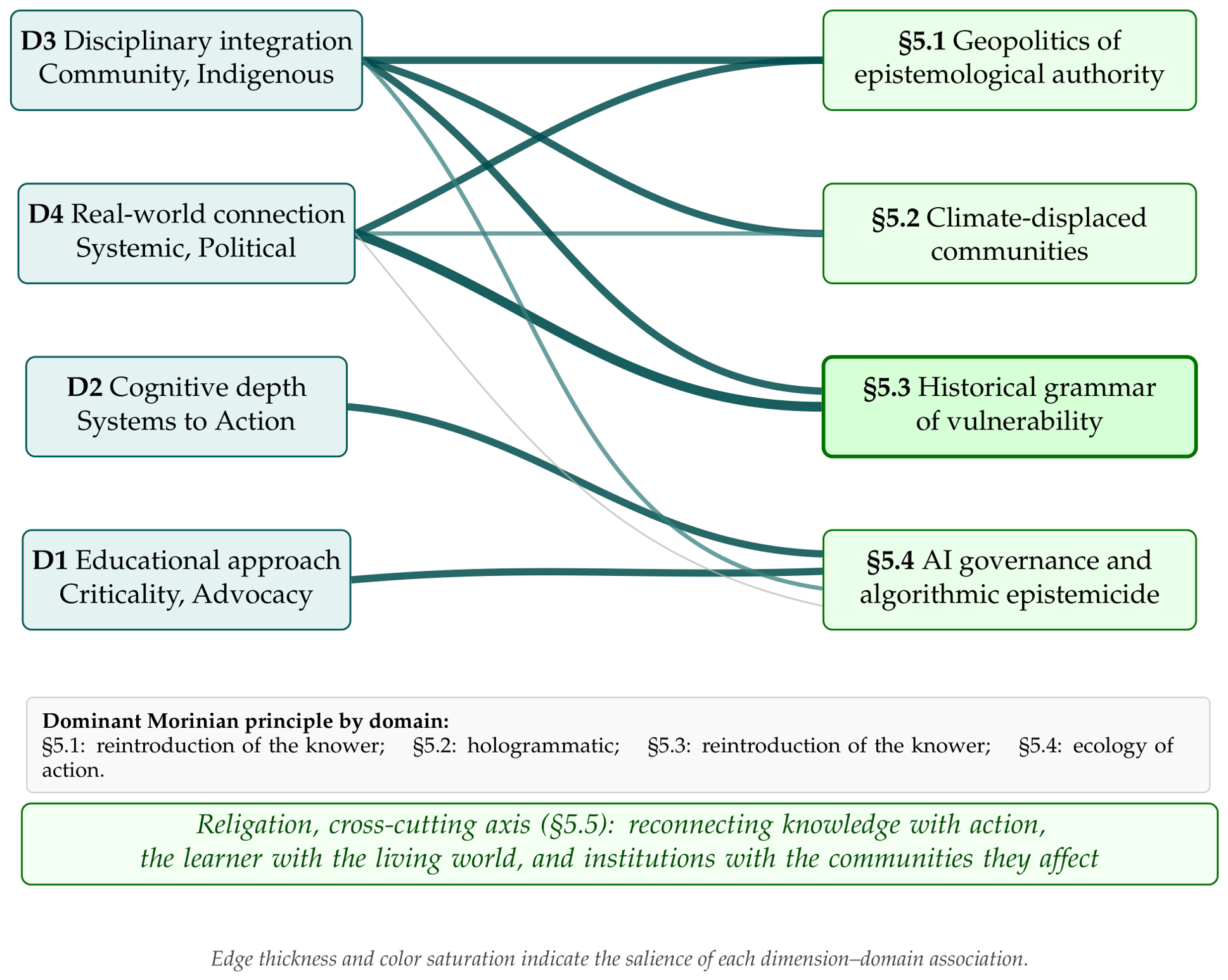
Figure 5 formalizes this claim by mapping each taxonomic dimension onto the policy domain that primarily follows from it, with the Morinian principle of religation as the unifying axis. The mapping is not a loose thematic pairing but a structured argument about salience, and it repays reading dimension by dimension. Dimension D3 (Disciplinary Integration), and specifically its highest level D3.5, projects most strongly onto the geopolitics of epistemological authority and the education of displaced communities, because both domains turn on whether non-Western and community knowledge systems are recognized as authoritative rather than illustrative. Dimension D4 (Real-World Connection), and specifically D4.4, projects most strongly onto the historical grammar of vulnerability, because naming the colonial and slavery-based production of differential ecological risk is precisely the systemic-political work that D4.4 names and that lower levels of D4 cannot perform. Dimension D2 (Cognitive Depth) and Dimension D1 (Criticality and Advocacy) project jointly onto AI governance, because evaluating algorithmic systems demands both the capacity to reason about consequences and uncertainties (D2) and the critical disposition to interrogate whose knowledge those systems encode (D1). The varying thickness of the edges in
Figure 5 is therefore not ornamental: it encodes the claim that each policy domain follows more strongly from some dimensions than from others, and that the pattern of those dependencies is itself evidence that the four domains share a common taxonomic root. The principle of religation, represented as the cross-cutting axis, expresses what unites them: in every domain, the policy task is to reconnect what the paradigm of disjunction has separated, knowledge from action, the learner from the living world, and institutions from the communities whose knowledge and vulnerability they govern. In
Figure 5, edge thickness and color saturation jointly indicate the salience of each dimension–domain association; the thickest edge marks the primary dependency.
5.1. Rethinking the Geopolitics of Sustainability Education: Africa and the Global South at the Center
This policy domain follows primarily from D3.5 (Community and Indigenous Knowledge), with D4.4 (Political) as its necessary complement: D3.5 determines who is authorized to produce sustainability knowledge, and D4.4 situates that authority within the geopolitical structures that distribute it unequally. Read through the principle of the reintroduction of the knower and the principle of religation, the taxonomy requires that sustainability education policy recognize knowledge as situated, territorial and historically structured. Yet the traditions reviewed in this article were consolidated predominantly in Northern academic contexts, positioning Africa, the Global South and Indigenous communities worldwide as objects of sustainability education policy rather than as its epistemological authorities. This is the D3.5 gap observed at the scale of global knowledge governance: the systematic non-recognition of whole regions as authors rather than recipients of sustainability knowledge.
This distortion has consequences that are now quantifiable. The IPCC AR6 Working Group II documents that observed average mortality from floods, droughts and storms is fifteen times higher in very highly vulnerable regions than in very low-vulnerability ones, and that poor populations, those with the lowest carbon footprints, are disproportionately harmed while lacking access to adaptation options [
74]. Africa faces some of the most severe projected climate impacts of any region, including accelerating desertification, intensified drought cycles, coastal inundation and extreme heat events, while having contributed less than 3% of the world’s cumulative energy-related CO
2 emissions [
75]. This disproportion between contribution and harm is not a contingency of the present but the outcome of a longer history, one whose colonial and extractive foundations are examined in
Section 5.3; the geopolitical asymmetry named here and the historical grammar developed there are two moments of a single structure. A framework that does not place this structural injustice at its analytical center reproduces the conditions that produced the crisis.
The reorganization advocated here is not, however, only a normative claim external to the field, but has documented institutional precedents in the Global South. In Latin America, the Brazilian National Environmental Education program (
Section 3.5.2) adopts the interaction between Indigenous, traditional-community and technical-scientific knowledges as an operational objective, and inscribes complexity as its first guiding principle [
68], placing it at D3.4 with orientation toward D3.5. This trajectory rests on the Latin American tradition of critical Environmental Education consolidated in the work of Loureiro [
28], Carvalho [
29], and Layrargues and Lima [
30]. Continental precedents also exist in Africa: the African Ministerial Conference on the Environment (AMCEN), established in 1985 and serviced by UNEP as the continent’s ministerial-level body on environmental governance across 54 member states [
76], endorsed in 2015 the Africa Environmental Education and Training Action Plan 2015–2024 as a continent-wide framework aligned to its flagship programs [
77]. The formal period of the AEETAP has now closed and its renewal remains an open policy agenda. The research literature confirms that the gap between such policy instruments and their implementation is itself a structural condition: the systematic review by Mbah and Ezegwu [
78], covering 36 empirical studies of climate change and environmental education in Africa, documents persistent epistemic exclusion and alienation of Indigenous and local knowledge across formal educational settings in the continent, with place-based pedagogy and participatory curriculum co-creation emerging as the most promising available strategies for closing it. A national program in Brazil, a continental instrument endorsed by 54 African states, and an empirical literature documenting both the scale of the exclusion and the conditions under which it can be addressed together demonstrate that the epistemological redistribution advocated here has documented policy traction outside the Anglo-European center, and that its consolidation is a matter of political will and institutional continuity rather than of programmatic invention from scratch.
The policy implications are twofold. First, international bodies, including UNESCO, the African Union Commission and regional educational organizations, must develop joint governance mechanisms for sustainability curriculum design that give African educational voices and Indigenous knowledge holders institutional weight equivalent to Northern academic traditions. Second, the financial architecture of climate education, which currently directs less than 2% of total climate finance to the education sector [
79], must be restructured toward contexts of greatest vulnerability and greatest epistemological richness. In much of Sub-Saharan Africa these conditions coincide: the communities most exposed to climate disruption are frequently those whose ecological knowledge systems are most sophisticated and most endangered.
5.2. Education in Displacement: Sustainability Awareness for, with, and by Climate-Displaced Communities
The educational condition of climate-displaced communities can be read through D3.5 and D4.1–D4.4: D3.5 requires that displaced communities be recognized as producers of ecological, territorial and intergenerational knowledge, not only as recipients of educational provision, and D4 connects the immediate experience of displacement to the systemic and political structures that produce vulnerability. Through the hologrammatic principle [
13], the experience of each displaced community carries traces of broader climatic, economic and political processes.
The concept of sustainability education is predominantly designed for stable institutional contexts, an assumption increasingly disconnected from the reality of climate-driven displacement, which the IPCC treats as part of the cascade through which climate change erodes livelihood security and interacts with humanitarian crisis [
74]. The taxonomy enables a stronger framing than the conventional humanitarian one: where displaced communities are routinely constructed in policy discourse as learners in need of emergency provision, D3.5 reframes them as authors of knowledge policy rather than only its beneficiaries. This inversion follows from the IPCC Working Group II position that indigenous and local knowledge is essential for addressing climate change and carries moral, ecological and temporal knowledge unavailable in many formal archives, even as displacement itself disrupts the intergenerational transmission of those knowledges by scattering the communities, languages and land-based practices through which they are reproduced [
74]. The educational implication is that host systems, municipalities and humanitarian actors should build arrangements for community-authored curricula, oral-history repositories, multilingual credentials, and the formal recognition of ecological expertise carried by displaced learners and their families. The detailed empirical analysis of displacement magnitudes, the legal distinctions among refugee categories, and the governance of climate mobility exceed the scope of the present framework and are developed elsewhere; what matters here is the taxonomic point, that D3.5 transforms displacement from a humanitarian problem of provision into an epistemic question of authorship.
5.3. The Unacknowledged Foundation: Slavery, Colonial Extraction, and the Historical Grammar of Vulnerability
Of the four policy domains developed in this section, none illustrates the diagnostic force of the taxonomy more sharply than the historical grammar of vulnerability. This is the domain where Dimension D4.4 (Systemic and Political) ceases to be an abstract category and becomes an analytical demand: the requirement that sustainability education render legible the historical processes through which ecological vulnerability came to be distributed as it is. Where the preceding domains identified gaps in epistemic authority (D3.5) and in the recognition of displaced knowledge, this domain names the deepest structural absence in mainstream sustainability education, the systematic failure to teach that the present distribution of ecological harm is not a natural fact but a historical inheritance. The principle of the reintroduction of the knower prevents these histories from being treated as external background, since the social and historical position of communities is constitutive of how environmental knowledge is produced and interpreted. It is, in the terms of the taxonomy, the clearest case of a D4.4 gap that no amount of D2.1 factual content can close.
No serious policy agenda for sustainability education can treat the distribution of ecological vulnerability as a present-day fact without a historical architecture. The IPCC AR6 Working Group II is explicit: vulnerability results from interlinked issues such as poverty, migration, inequality, access to services, education, and governance capacities, “often made more complex by past developments, such as histories of colonialism” [
74]. This is the bridge that links the empirical data on differential vulnerability to the historical argument: the fifteen-fold mortality gap noted in
Section 5.1 is not the result of natural variation. It is the sedimented outcome of historical processes, the transatlantic slave trade, plantation monoculture, colonial land dispossession, and the systematic destruction of African and indigenous governance systems, through which present vulnerability has been racialized, territorialized, and normalized.
The historical mechanism is not merely analogical but material and continuous. The plantation, as environmental historians have increasingly argued, was not simply a site of racialized labor extraction but a technology of ecological transformation, one that reorganized entire landscapes around the logic of monocultural export production, exhausted soils, redirected watercourses, eliminated biodiversity, and displaced the polycultural and regenerative practices of both indigenous peoples and enslaved Africans [
80,
81]. The scholarship on what has been termed the “Plantationocene” makes this continuity explicit: the plantation was an early and paradigmatic instance of the extractive relationship to the living world that the climate crisis has now globalized. The same logic that treated enslaved human beings as instruments of production, interchangeable, exhaustible, and denied any relationship of responsibility to the land they worked, treated ecosystems as resources to be depleted without obligation of restoration. Slavery and ecological extraction were not parallel injustices; they were expressions of a single organizing principle, the conversion of living beings, human and other-than-human, into disposable inputs for accumulation.
This is where the concept of epistemicide developed by Santos [
63] becomes structural rather than ornamental. The destruction or devaluation of African and indigenous knowledge systems was not a by-product of colonization but one of its instruments. Communities that understood themselves as embedded in and responsible to their ecological systems, whose agricultural, hydrological, and forest-management knowledge encoded long-term relationships of reciprocity with specific territories, were more resistant to the forms of extraction that colonial economies required. The suppression of these knowledge systems, through the violence of enslavement, forced displacement, religious and linguistic imposition, and the deliberate breaking of intergenerational transmission, was therefore not incidental to ecological destruction but a precondition of it. The destruction of knowledge preceded and enabled the destruction of ecosystems. To teach the ecological crisis without teaching this sequence is to present its effects while concealing its causes.
The policy implication is that sustainability education must build a historical grammar into the curriculum itself, not append slavery and colonialism as a “background” subsection to be covered and set aside. A historical grammar, in the sense intended here, is not a body of content but a structuring logic: a way of reading present ecological arrangements as the legible outcomes of historical decisions about whose land, whose labor, and whose knowledge counted. Climate, economy, citizenship, public health, geography, and digital studies should all be taught through a reparative lens that makes visible the longer chains linking plantation economies, racial labor extraction, land concentration, dispossession, and the governance of whose lives are treated as disposable. When Afro-descendant, indigenous, and peripheral communities appear today as disproportionately exposed to heat, flooding, precarious housing, food insecurity, and displacement, sustainability education should not present this as unfortunate coincidence or as a problem to be solved by individual behavioral change. It should make legible the historical grammar through which that exposure was produced, and in doing so, it should raise the question of what is owed.
This framing is gaining traction at the edge of international climate-justice discourse. Ahead of COP30, more than 240 organizations urged governments to connect climate justice with reparatory justice, explicitly linking colonialism and slavery to present inequalities, emissions patterns, and the marginalization of vulnerable communities from decision-making [
82]. The convergence of the climate-justice and reparations movements is not rhetorical opportunism; it reflects a recognition, increasingly shared across scholarship and advocacy, that the ecological debt owed to the Global South and the historical debt produced by slavery and colonization are not separate ledgers but the same account viewed from two angles [
83]. The principle of “common but differentiated responsibilities” that structures international climate governance is, at its foundation, an implicit acknowledgement of this history, even where the explicit language of reparation remains politically contested. A policy agenda connecting climate education to reparative historical literacy is therefore not peripheral to international climate policy; it is increasingly central to it.
The pedagogical stakes of this argument are precise and consequential. A curriculum that teaches climate science without teaching this history is not merely incomplete; it is epistemically misleading. It presents the crisis as unprecedented, as a rupture in an otherwise stable relationship between humanity and nature, when from the perspective of communities that have already lived through the ecological violence of colonization, it is not a rupture at all but the most recent and most globalized chapter of a catastrophe that began five centuries ago. As argued in
Section 4.4 with respect to indigenous communities, for the descendants of the enslaved and the colonized the climate emergency is continuous with a longer emergency, the destruction of the territorial, ecological, and epistemic conditions of their communities’ existence. To name this continuity is not to burden students with guilt or to reduce a complex history to a morality tale. It is to equip them with the analytical capacity, precisely the capacity that D4.4 names, to understand ecological vulnerability as a political and historical phenomenon rather than a natural or technical one, and therefore as something that can be contested, redressed, and transformed rather than merely adapted to.
5.4. Artificial Intelligence and the Risk of Epistemicide at Algorithmic Scale
The governance of artificial intelligence in sustainability education emerges primarily from D2 (Cognitive Depth), D3 (Disciplinary Integration), and D1.4 (Criticality). D2 requires learners and institutions to evaluate the consequences and uncertainties associated with algorithmic systems, while D3 raises the question of which languages, epistemologies, and forms of knowledge are represented or excluded. Through the ecology of action principle, AI systems must be assessed not only by their intended educational benefits, but also by the unintended effects they may produce across linguistic, cultural, and epistemological environments.
Artificial intelligence presents sustainability education with both a genuine opportunity and an acute risk of paradigmatic regression. On the opportunity side, large language models and AI-mediated environments can expand access to sustainability content and personalize learning pathways in ways that policy should support. But AI also carries, embedded in its architecture, a powerful expression of the paradigm of disjunction this article has sought to overcome, a risk that UNESCO’s guidance on generative AI and its Recommendation on the Ethics of Artificial Intelligence both register in documenting how these systems can embed bias, compound inequalities, and outpace regulatory adaptation [
84,
85]. The deeper concern is epistemic: because dominant multilingual models systematically privilege some languages and language ecologies over others [
86,
87], educational AI trained on dominant-linguistic corpora, optimized around dominant benchmarks, and procured without obligations to linguistic plurality risks reproducing epistemicide at algorithmic scale, determining which languages are recognized as teachable, which ways of explaining environmental change appear valid, and which oral and place-based knowledges are flattened into generic summaries. This concern is consistent with the IPCC’s warning that indigenous knowledge should not be “integrated” by being subsumed into dominant validation regimes [
74]. The full development of this argument, including the empirical evidence from multilingual NLP research and the design of an appropriate governance architecture, lies beyond the scope of the present framework; the taxonomic point retained here is the criterion that must govern any deployment of AI in sustainability education, namely whether the tool deepens or undermines the religation of the knower with the known, the learner with the living world, and knowledge with action and justice.
5.5. A Convergent Principle: Education as Religation and as Political Act
This final subsection integrates the four policy domains through the full architecture of the taxonomy: D1 defines the learner’s relation to action and political agency, D2 the cognitive and normative complexity required for decision-making, D3 the knowledge systems recognized, and D4 the territorial, systemic and political situatedness of learning. The principle of religation [
12] functions as the unifying normative criterion of the framework: transformative sustainability education must reconnect knowledge with action, the learner with the living world, and educational institutions with the communities and histories they affect.
The four thematic areas developed in this section, the geopolitics of Africa and the Global South, climate-displaced communities as authors of knowledge policy, the historical grammar of slavery and colonial extraction, and the epistemic risks of algorithmic infrastructure, are not independent policy problems. They are expressions of a single structural condition, the paradigm of disjunction that separates knowledge from power and the learner from the living world. Among the four, the historical grammar of vulnerability (
Section 5.3) occupies a culminating position, because it makes explicit the historical mechanism, colonial extraction, slavery, and epistemicide, through which the asymmetries visible in the other three domains were produced; the geopolitical distribution of epistemic authority, the displacement of knowledge-bearing communities, and the linguistic hierarchies encoded in algorithmic systems are all, in different registers, inheritances of that history. The policy agenda that emerges from this analysis is therefore not a list of measures to be added to existing sustainability education frameworks. It is a call for the kind of reform that Morin identifies as paradigmatic rather than programmatic [
12], a transformation not of content alone, but of the principles by which knowledge is organized, validated, transmitted and put in the service of life.
The scope of this section is deliberately bounded, and three limitations should be acknowledged directly. First, the evidence base for digital sustainability education shows positive effects on engagement and awareness but remains thinner on long-term behavioral and structural change, a reason to avoid technological solutionism without abandoning digital pedagogy altogether. Second, two of the domains treated here, the education of climate-displaced communities and the governance of artificial intelligence, have been developed at the level of taxonomic thesis rather than full empirical elaboration: the detailed treatment of displacement magnitudes and the legal categories of forced migration, and the detailed treatment of the multilingual evidence underlying the argument about algorithmic epistemicide, exceed the scope of the present framework and are reserved for dedicated future work. Their inclusion here is warranted not by exhaustive demonstration but by their function as sites where the taxonomy’s underdeveloped dimensions become politically legible. Third, the inference about algorithmic epistemicide, though grounded in current evidence and consistent with UNESCO’s ethical framework and the IPCC’s warnings about Indigenous knowledge, remains an inference requiring ongoing empirical validation rather than a settled conclusion. These limitations share a common feature: they are not resolved by more data alone; they require a prior commitment to the values the present framework articulates, namely cognitive justice, epistemic plurality, territorial relationship, and the right of communities to be authors rather than subjects of the knowledge systems that shape their futures.
That commitment is the animating force of the policy agenda this section articulates. It operates through the formation of educators, researchers and policymakers who have themselves undergone the reform of thinking that Morin demands, and through the gradual transformation of what educational institutions consider legitimate knowledge, legitimate pedagogy, and legitimate outcome. It is power in the most consequential sense: the capacity to determine what the next generation knows, cares about and believes is possible. In an era of cascading ecological disruption, forced mobility, democratic strain and technological concentration, that capacity is not a peripheral educational concern. It is among the most important political decisions a society can make.
6. Conclusions
This article set out to address a structural problem in sustainability education research: the absence of a shared analytical instrument capable of rendering visible the dimensional gaps that exist across, and within, the major educational traditions. The four-dimensional Taxonomy of Sustainability Education Design proposed here is a response to that absence. By mapping Environmental Education, Climate Education, Education for Sustainable Development, and Climate Justice Education against the dimensions of Educational Approach (D1), Cognitive Depth (D2), Disciplinary Integration (D3), and Real-World Connection (D4), and by confronting those Northern traditions with the epistemologies of the South reviewed in
Section 2.5, the framework surfaces a pattern that descriptive accounts of each tradition individually do not make visible: on the present interpretive reading, the asymmetry appears structural rather than accidental, a claim that independent coding across a broader corpus, following the protocol specified in
Section 3.4, would need to confirm. The dimensions most consistently underdeveloped across traditions, D1 Criticality and Advocacy, D3.5 Community and Indigenous Knowledge, and D4 Systemic and Political, are precisely those associated with transformative, justice-oriented, and epistemically plural education. This is not a collection of individual program failures. It is, as Morin [
12] would identify it, the educational expression of the paradigm of disjunction.
The convergence of this diagnosis from two independent directions is itself part of the argument. Morin’s critique of the paradigm of disjunction, developed from within European philosophy of science, and the critiques advanced from the exteriority of the colonial difference by Dussel, from the quilombo by Bispo dos Santos, and from the relational ontology of Ubuntu by Ramose and Ndlovu-Gatsheni, arrive independently at the same object: a knowledge that separates what is related, that severs the knower from the known and the learner from the living world. That a European critic of simplification and a set of Southern epistemologies converge on this diagnosis is not incidental to the framework; it is evidence for its central claim, that the religation of what disjunctive thought has separated is not the property of any single tradition but a demand that arises wherever the costs of separation are confronted. The taxonomy is the instrument through which that convergent demand is made analytically legible. The scope of that convergence should be stated precisely, since it is easily overstated. What converges is the diagnosis, the identification of separation as the operative failure of dominant knowledge, and not the construction of the instrument that follows from it: the taxonomy was built from one of these starting points and subsequently read against the other. Convergence of diagnosis is evidence that the object is real rather than an artifact of a single vantage point; it is not evidence of joint authorship, and the two claims should not be conflated.
The application of Morin’s philosophy of complex thought as a criterion of interpretive coherence, rather than a retrospective gloss, has consequences that extend beyond theoretical consistency. It establishes that the dimensional gaps the taxonomy documents are not simply content omissions addressable by programmatic reform. They are produced by a paradigmatic orientation that separates the cognitive from the political, the scientific from the territorial, and the individual from the structural. This is confirmed at the scale of national policy by the case of ProNEA analyzed in
Section 3.5.2, where a policy text that reaches the highest dimensional levels on paper coexists with an implementation that frequently does not: a documented instance of the distance between programmatic and paradigmatic reform. Closing that distance requires what Morin calls a reform of thinking, not the addition of new topics to existing frameworks, but the religation of what the paradigm of disjunction has separated. The taxonomy provides the diagnostic infrastructure for this reform, making the gaps nameable, comparable, and therefore contestable.
That the framework’s policy implications are not an optional appendix but a test of its diagnostic claims is the argument of
Section 5. If the most underdeveloped dimensions of the field are patterned rather than accidental, then the domains where they become materially consequential, the geopolitics of epistemic authority, the education of climate-displaced communities, the historical production of ecological vulnerability through colonial extraction and slavery, and the governance of artificial intelligence, are the terrain on which the diagnosis is confronted with its stakes. Among these, the historical grammar of vulnerability occupies a culminating position: it names the mechanism, colonial extraction, enslavement, and epistemicide, through which the asymmetries visible in the other domains were historically produced, and it is the point at which Dimension D4.4 ceases to be an abstract category and becomes a demand that education render the production of vulnerability legible rather than natural.
Three contributions of the framework deserve explicit statement. For researchers, the operationalized dimension definitions enable comparative cross-tradition and cross-context analysis, and provide the basis for the inter-rater reliability studies specified in
Section 3.4 and for dimensional assessment instruments that go beyond unidimensional awareness scales. For curriculum designers, the Morinian annotations enable a second-order diagnostic: not only which dimensional levels are attained, but which epistemological orientations are operative, and which paradigmatic constraints produce the gaps. For policymakers, the framework provides a level of analytical specificity that generic competency frameworks cannot supply: the capacity to specify that a national curriculum operates at D1.2, D2.2, D3.2, and D4.2, and that D1.4–D1.5, D3.4–D3.5, and D4.3–D4.4 are systematically absent, is more actionable than a binary assessment of whether sustainability is “included.”
Three limitations bound these contributions and define the research agenda they open. First, although the review of Southern epistemologies in
Section 2.5 was introduced precisely to address the predominantly Northern provenance of the four traditions, the taxonomic categories themselves were derived from the Northern literature and subsequently confronted with Southern thought, rather than co-constructed with it; applying the taxonomy to educational contexts in Latin America, Sub-Saharan Africa, and Southeast Asia will require critical examination of whether the dimensional categories adequately capture locally constituted forms of sustainability education, or whether those epistemologies demand categories of their own. This limitation is not merely methodological. Co-construction in the sense D3.5 specifies, shared governance over what counts as a category, is precisely what the present framework was unable to enact in its own production, so that the article reproduces, in its conditions of authorship, the asymmetry it sets out to diagnose. The subsequent phase this defines is specific: submitting the dimensional categories to revision by the knowledge communities D3.5 names, under arrangements in which their criteria can alter the categories rather than only populate them. Second, the taxonomy has not yet been subjected to independent validation; the coding protocol specified in
Section 3.4, with its reliability criteria, corpus design, and registration conditions, defines the necessary next step toward an empirically validated instrument and toward answering the circularity that attends any framework first applied by the team that constructed it. Third, the static dimensional profiles of the taxonomy do not capture program evolution over time; longitudinal designs tracking dimensional development in relation to learning outcomes represent the most productive direction for extending the framework’s empirical reach.
What the taxonomy can claim, and what this article has sought to substantiate, is more modest than priority: it offers a perspective that differs from existing frameworks in seeking to ground a diagnostic instrument simultaneously in the empirical literature of sustainability education traditions, in the formal architecture of learning taxonomies, and in the philosophical framework of complex thought, read together with the epistemologies of the South that share its critique of separation. Its purpose is not to classify and conclude. It is to make visible the structural conditions of a more transformative education: one that, in Morin’s terms, unites while distinguishing, connects while respecting difference, and restores to the knower the world from which the paradigm of disjunction has long separated them. In a century increasingly shaped by ecological disruption, forced mobility, and the concentration of epistemic authority in algorithmic systems, that capacity for religation is not a peripheral educational aspiration. It is among the most consequential intellectual and political tasks a society can undertake.




 ,
,