1. Introduction
ESG ratings have become a central information device in sustainable finance. Investors use them to screen portfolios, banks use them to evaluate credit risk, and firms use them to communicate non-financial performance to external stakeholders. In principle, ESG ratings should reduce information asymmetry by transforming complex environmental, social, and governance information into comparable signals. This function is especially important in emerging markets, where information frictions, uneven disclosure quality, and external financing dependence remain salient. Yet the growing importance of ESG ratings has been accompanied by a persistent problem: rating agencies often disagree sharply in their evaluations of the same firm. Prior research shows that sustainability ratings often fail to converge across agencies, creating challenges for managers, investors, and strategy researchers [
1]. Such divergence reflects differences in rating scope, measurement choices, indicator weights, data availability, estimation methods, and subjective interpretation. When the same firm receives inconsistent ESG signals, the informational value of ESG ratings becomes less clear, and external stakeholders may face greater difficulty in assessing the firm’s true sustainability risks.
This problem has direct implications for corporate finance. Financing constraints arise when firms cannot obtain external funds at a reasonable cost despite having valuable investment opportunities. Information asymmetry is one of the classic sources of such constraints. Classic corporate-finance theory shows that information gaps between firms and investors can distort financing and investment decisions [
2], while early empirical work links financing constraints to corporate investment behavior [
3]. If ESG rating divergence increases uncertainty about a firm’s environmental risk, social responsibility, governance quality, or disclosure credibility, capital providers may respond conservatively. Banks may adjust loan terms, bond investors may require higher risk premiums, and equity investors may discount firm value. Prior research shows that ESG rating uncertainty affects sustainable investing and stock-return outcomes [
4,
5], and rating disagreement has also been linked to stock returns, excess returns, stock price reactions, market efficiency, mispricing, and bank loan availability [
6,
7,
8,
9,
10,
11]. However, important questions remain regarding the market-based transmission channel through which rating divergence is associated with financing frictions and the firm-level capabilities that may attenuate this relationship.
A second unresolved question concerns the mechanism. ESG rating divergence may be associated with financing constraints through several channels, including creditor risk perception, analyst uncertainty, investor attention, or stock market liquidity. This study focuses on stock turnover. Turnover is not only a conventional measure of trading activity but also a market-based reflection of liquidity and information-processing frictions. When investors face conflicting ESG signals, they may delay trades, reduce participation, or demand greater compensation for liquidity risk. Lower turnover may then be associated with higher financing-friction proxies through weaker market liquidity and a higher cost of external capital. A third question is whether firms can mitigate their exposure to ESG rating divergence. This study argues that digital transformation may function as an internal information-governance mechanism. Digital transformation improves data collection, information processing, internal monitoring, operational transparency, and external communication. Firms with stronger digital capabilities may be better able to provide capital providers with structured, timely, and verifiable information, thereby offsetting part of the uncertainty generated by inconsistent external ESG ratings.
Building on this literature, this paper uses Chinese A-share listed firms from 2009 to 2024 to examine three research questions. First, is ESG rating divergence associated with higher values of the SA-based financing-constraint proxy? Second, does stock turnover mediate this relationship? Third, does digital transformation weaken the relationship between ESG rating divergence and the SA-based proxy? The empirical design distinguishes among three layers of information friction. ESG rating divergence is an external information problem created by third-party evaluators. Stock turnover is a market-behavior response observed in secondary-market trading. Digital transformation is an internal corporate capability that may reduce dependence on external evaluative signals. Studying these elements jointly helps to explain not only whether ESG rating divergence is associated with financing-constraint proxies but also how market participants react and when firms are less exposed to this association.
This paper takes a deliberately conservative empirical stance. The baseline model controls for firm and year fixed effects, while additional tests address alternative measurement, pandemic-year shocks, random placebo assignment, instrumental-variable identification, and a lagged-variable specification. Nevertheless, the study avoids overstating strict causality because ESG rating divergence is not randomly assigned, rating coverage is uneven, and the dependent variable is a proxy constructed from firm size and age. The results are therefore interpreted as robust associative evidence and as evidence that is consistent with the proposed mechanisms. The paper makes three contributions. First, it frames ESG rating divergence as an information-governance problem in which inconsistent third-party signals can be reflected in SA-based financing-constraint proxies rather than treating rating divergence only as a measurement inconsistency. Second, it identifies stock turnover as a market-based pathway through which ESG information disagreement may be translated into financing-friction proxies, thereby connecting non-financial signal ambiguity with secondary-market liquidity. Third, it conceptualizes digital transformation as an internal information-governance capability that can reduce firms’ exposure to external rating disagreement by improving data traceability, operational transparency, and external communication.
2. Literature Review and Hypothesis Development
2.1. ESG Rating Divergence and Financing Constraints
ESG ratings reduce information costs only when they make non-financial performance easier to compare. A consistent ESG assessment can help capital providers to evaluate risk, form expectations about disclosure quality, and assess firms whose environmental and social exposures are otherwise difficult to observe. Rating divergence undermines this function because it leaves outsiders with competing interpretations of the same firm. Berg et al. [
12] attribute aggregate confusion in ESG ratings to differences in scope, measurement, and weighting, while Christensen et al. [
13] show that agencies may evaluate corporate virtue through different lenses. Luo and Farag [
14] further indicate that ESG disagreement can appear at an aggregate level rather than only in isolated firm observations. Firm conditions may also matter: Chang et al. [
15] examine customer concentration and ESG rating disagreement, and Chen et al. [
16] link ESG washing to rating divergence. These studies imply that disagreement may contain both methodological noise and information about firm-specific uncertainty.
Financing decisions are sensitive to this ambiguity. Creditors and investors care not only about the average ESG assessment but also about the possibility that some risks are being underreported or interpreted differently across agencies. A dispersed set of ratings may therefore suggest that the firm’s ESG profile is harder to evaluate, even when part of the dispersion comes from agency methodology. In China, this issue is amplified by continuing variation in ESG disclosure quality across firms, industries, and regions. If investors and creditors rely on rating agencies to process non-financial information, disagreement among agencies can turn a simplifying signal into an additional interpretive burden, especially for listed firms that depend on bank credit, bonds, and equity refinancing.
For firms seeking external capital, the consequence of such ambiguity is likely to be reflected in financing frictions. When non-financial risk is difficult to verify, capital providers may demand higher compensation or become less willing to supply funds. Rating disagreement is also related to analyst forecast quality, suggesting that inconsistent ESG information can affect professional information processing [
17]. Related evidence links ESG information to debt and equity financing costs: Alves and Meneses [
18] study ESG scores and debt costs, Fiorillo et al. [
19] examine ESG performance in corporate bond markets, and ESG rating disagreement has been connected with the cost of equity financing [
20,
21]. Qin and Wang [
11] relate ESG rating disagreement to bank loan availability, while You et al. [
22] and Zhang, Shan, Zhang, and Xing [
23] examine debt-cost implications of ESG disclosure quality and rating divergence. Cotugno et al. [
24] and Zhou and Ma [
25] provide further evidence that ESG-related events and rating divergence can matter for capital market pricing. Zhao et al. [
26] are closest to this study; they document a relationship between ESG rating divergence and WW-index financing constraints in China, with analyst forecast bias and ESG disclosure compliance as the mechanism and boundary condition. Building on this stream, the present paper uses a longer sample period, an SA-based proxy, stock turnover as a liquidity-related channel, and digital transformation as an information-governance moderator. Therefore, ESG rating divergence is expected to be positively associated with financing constraints.
H1. ESG rating divergence is positively associated with the SA-based corporate financing-constraint proxy.
2.2. Stock Turnover as a Transmission Channel
Stock turnover provides a market-based way to observe how investors respond to conflicting ESG information. It measures how actively tradable shares change hands, but it can also reflect liquidity, uncertainty, and disagreement among investors. Barinov [
27] distinguishes the liquidity and uncertainty components of turnover, and Kang et al. [
28] show that information uncertainty is relevant for liquidity pricing. Evidence from China confirms that turnover is meaningful in emerging-market settings [
29], while Chuang et al. [
30] show that trading behavior responds to prior returns. In an ESG context, Zhang, Sun, and Gao [
31] connect ESG rating divergence with stock liquidity in China. When agencies issue inconsistent evaluations, investors may read the divergence either as hidden ESG risk or agency-level measurement noise. Both interpretations raise processing costs and may reduce the willingness to trade, especially when adverse selection is a concern.
This channel differs from a simple disclosure-quality explanation. Even when a firm releases ESG information, investors still need to decide how to interpret it. Divergent ratings indicate that professional evaluators process available information in different ways, so a lower willingness to trade can reflect uncertainty about interpretation rather than a complete lack of disclosure. The channel also connects secondary-market liquidity with financing outcomes. Firms with less liquid shares may face weaker investor demand, higher equity-financing costs, and less favorable refinancing conditions. Prior work shows that stock market liquidity affects the cost of issuing equity [
32]. Creditors may also view thin trading as a signal of weaker market confidence or greater refinancing risk. Stock turnover is therefore a plausible observable link between ESG signal inconsistency and financing-constraint proxies.
Accordingly, reduced turnover is expected to carry part of the positive association between ESG rating divergence and financing constraints. The expected mediation is partial: rating divergence can also operate through creditors’ risk assessments, analysts’ forecasts, and broader investor uncertainty.
H2. ESG rating divergence is negatively associated with stock turnover, and lower stock turnover partially mediates the positive association between ESG rating divergence and the SA-based financing-constraint proxy.
2.3. Digital Transformation as a Moderator
Digital transformation is treated here as a firm-level information capability rather than as a guarantee of better ESG performance. It refers to the adoption of digital technologies, data systems, digital infrastructure, and digitally enabled organizational processes [
33]. Such capabilities can make internal records more timely, traceable, and comparable, which is relevant when outside stakeholders need additional evidence beyond third-party ESG scores. Prior research shows that digital transformation can alleviate financing constraints [
34,
35]. Its effects may also extend through supply-chain relationships [
36], interact with government digital attention [
37], and relate to digital finance, information transparency, and investment efficiency [
38]. Evidence from debt markets further indicates that issuers’ digital transformation can influence bond rating quality [
39], while open government data is related to debt costs [
40]. These studies suggest that digital capacity can reshape the information environment faced by capital providers.
The moderating logic is that digital systems can improve the credibility and usability of firm-provided ESG-related information. Data traceability, cross-departmental coordination, and process monitoring help firms to update and substantiate information about environmental investment, supply-chain management, governance procedures, and operational risk. Xu and Yin [
41] relate digital transformation to ESG performance through technological innovation and financing constraints, and Zang and Wei [
42] connect digital transformation with financing constraints and earnings management. For capital providers, better internal information infrastructure may reduce exclusive reliance on divergent external ratings. A firm with weak digital systems may struggle to explain why ratings differ, whereas a digitally advanced firm can provide more organized supporting evidence.
Digital transformation is therefore not expected to remove disagreement among rating agencies. Its expected role is narrower: it may dampen the association between external rating inconsistency and financing-friction proxies by making firm-specific information easier for capital providers to verify.
H3. Digital transformation negatively moderates the relationship between ESG rating divergence and the SA-based financing-constraint proxy.
3. Research Design
3.1. Data Sources and Sample Selection
The sample starts from Chinese A-share listed companies observed between 2009 and 2024. Financial firms are removed because their leverage, regulation, and financing activities are not directly comparable with those of non-financial firms. ST, PT, and ST* firms are also excluded to avoid observations with abnormal financial status that may distort financing-constraint and trading-activity measures. Firm–years with missing key variables are then dropped, and continuous variables are winsorized at the 1st and 99th percentiles. Firm-level financial and governance data are obtained from the China Stock Market & Accounting Research (CSMAR) database, except for ESG ratings and the CSMAR digital transformation index. ESG ratings are collected from Huazheng, SynTao Green Finance, Bloomberg, FTSE Russell, and Wind, which together provide both domestic and international assessment perspectives for Chinese listed firms. Because the rating panel is not balanced across firms and years, ESGdif5 is constructed from the valid agency scores available in each firm–year. The digital transformation variable comes from the CSMAR China Listed Firms’ Digital Transformation Research Database. The final sample contains 41,272 firm–year observations for 4663 firms.
The 2009–2024 window captures the expansion of ESG disclosure practices, sustainable-finance policies, and corporate digital transformation in China. Its panel structure allows the empirical tests to use within-firm changes rather than only cross-sectional differences. This is important because stable differences in firm scale, ownership, industry background, and governance quality may otherwise confound the association between ESG rating divergence and financing constraints. The panel is unbalanced because listed firms enter and exit the sample and because some variables are unavailable in particular years. The fixed-effects design retains the available observations while absorbing time-invariant firm characteristics.
3.2. Variable Definitions
The dependent variable is the SA-based financing-constraint proxy. Following Hadlock and Pierce [
43], the SA index is calculated from firm size and firm age; because the index is generally negative, the analysis uses its absolute value, |SA|. Higher |SA| values indicate stronger financing constraints. This measure is parsimonious, but it is not a direct observation of loan availability, interest spreads, or issuance costs. Accordingly, the ESGdif5 coefficient is interpreted as an association with the SA-based proxy rather than as a structural estimate of financing conditions. The key explanatory variable is ESG rating divergence. Each agency’s original ESG score is winsorized at the 1st and 99th percentiles and then converted to a 1–10 scale using a min–max transformation. The minimum and maximum values used for rescaling are agency-specific bounds calculated over the pooled 2009–2024 sample after winsorization. ESGdif5 is the standard deviation across the available rescaled agency scores in a given firm–year. Let
denote the rescaled score assigned by rating agency
j to firm
i in year
t.
In these equations,
j denotes a rating agency and
is the number of valid non-missing agency ratings for firm
i in year
t. ESGdif5 is calculated only for firm–years with at least two valid ratings. A higher ESGdif5 indicates stronger disagreement among the ratings available for that firm–year. Because the commercial databases do not form a balanced agency panel,
changes across observations. The resulting measure therefore captures disagreement among available ratings and may also be affected by coverage differences and changes in agency composition.
Table 1 reports the distribution of valid ESG rating sources used in the construction of ESGdif5.
The mediating variable is stock turnover, measured as the natural logarithm of the annual turnover rate of tradable shares. It captures trading activity and market liquidity rather than disclosure transparency itself. The moderating variable is the digital transformation index from the CSMAR China Listed Firms’ Digital Transformation Research Database. This index aggregates six standardized dimensions: strategic leadership, technology enabling, organizational enabling, environmental enabling, digital achievement, and digital application. Larger values represent a higher level of corporate digital transformation.
Here, DT denotes the CSMAR DigitalTransIndex, while SL, TE, OE, EE, DAch, and DApp represent strategic leadership, technology enabling, organizational enabling, environmental enabling, digital achievement, and digital application, respectively. The database is built from annual reports, fundraising announcements, qualification recognitions, digital-technology word frequencies, digital investment plans, digital human-capital inputs, digital infrastructure, and digital innovation outcomes. Relying on this database avoids constructing a new ad hoc text-mining measure and improves replicability. The remaining firm-level control variables are defined in
Table 2.
3.3. Model Specification
H1 is tested with a two-way fixed-effects model that relates |SA| to ESGdif5, control variables, firm fixed effects, and year fixed effects. All empirical analyses were conducted using Stata 17.0. Firm fixed effects remove time-invariant firm heterogeneity, and year fixed effects account for macroeconomic and regulatory shocks shared by listed firms. Standard errors are clustered at the firm level unless otherwise noted. The coefficient on ESGdif5 therefore reflects the association between within-firm changes in rating divergence and within-firm changes in the SA-based proxy, conditional on controls.
H2 is examined with a stepwise mediation framework. The first equation estimates the total association between ESGdif5 and |SA|. The second equation uses logged turnover as the dependent variable. The third equation includes ESGdif5 and logged turnover jointly in the |SA| regression. A firm-cluster bootstrap with 500 replications is used to evaluate the indirect effect.
H3 is tested by adding the interaction between ESGdif5 and digital transformation to the fixed-effects model. A negative and statistically significant interaction coefficient indicates that digital transformation weakens the positive association between ESG rating divergence and the SA-based financing-constraint proxy.
4. Empirical Results
4.1. Descriptive Statistics
Table 3 reports the descriptive statistics. The mean value of |SA| is 3.8387, with a standard deviation of 0.2921, indicating meaningful variation in financing constraints across firms. ESGdif5 has a mean of 1.1473 and a standard deviation of 1.0090, suggesting that ESG rating divergence is common and heterogeneous among Chinese listed firms. The digital transformation index has a mean of 36.7919 and a standard deviation of 10.2959, reflecting substantial cross-firm variation in digital capability. Logged turnover has a mean of 6.2277, indicating considerable trading activity in the sample. The remaining control variables show patterns that are consistent with listed-firm samples in corporate-finance research. Variance inflation factor diagnostics are also conducted for the baseline and moderation specifications. The mean VIFs are 2.60 and 2.12, respectively, and the maximum VIFs are 5.28 and 3.89, all below conventional warning thresholds. Multicollinearity is therefore unlikely to materially affect the regression estimates.
4.2. Baseline Regression
Table 4 reports the baseline regression results. Column (1) includes only ESGdif5 and shows a positive coefficient of 0.0219, significant at the 1% level. Column (2) adds firm-level control variables, and the coefficient remains significantly positive at 0.0195. Column (3) further controls for firm and year fixed effects. The coefficient of ESGdif5 is 0.0109 and remains significant at the 1% level. The decline in coefficient magnitude after adding controls and fixed effects indicates that part of the raw association is explained by observable firm characteristics and unobservable time-invariant heterogeneity, but the positive relationship remains robust. These results support H1. Economically, a one-standard-deviation increase in ESGdif5 is associated with an increase of approximately 0.0110 in |SA|, equivalent to about 3.8% of the sample standard deviation of |SA|. This magnitude is modest, so the result is best interpreted as statistically robust evidence of a positive association rather than as a large economic effect. The coefficient should not be interpreted as a structural causal effect.
4.3. Robustness Checks
Table 5 presents robustness checks. Column (1) replaces ESGdif5 with ESGrange5, the range between the maximum and minimum of the five rescaled ESG ratings. For both ESGdif5 and ESGrange5, each agency’s winsorized score is rescaled using the agency-specific minimum and maximum calculated over the pooled 2009–2024 sample; these bounds are not recalculated separately by year or by agency–year. The coefficient of ESGrange5 is 0.0033 and significant at the 1% level. Column (2) clusters standard errors at the industry level, and the coefficient on ESGdif5 remains significantly positive at 0.0109. Column (3) excludes observations from 2020 to 2022 to reduce the influence of the COVID-19 period; the coefficient remains 0.0110 and significant at the 1% level. These tests support the stability of the association across alternative divergence measures, clustering choices, and pandemic-period exclusions.
4.4. Placebo Test
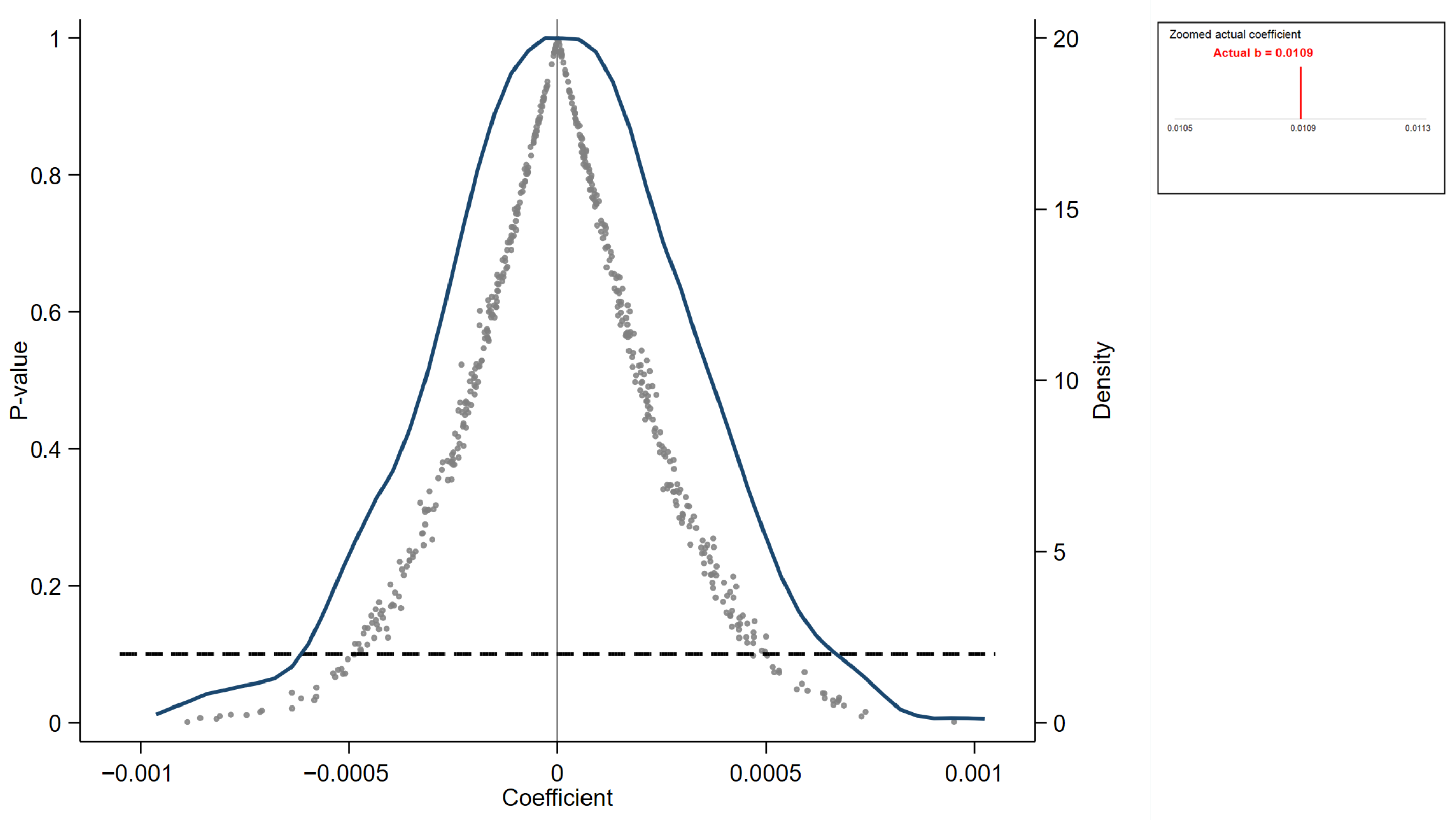
As an additional placebo test, ESGdif5 is randomly reshuffled across firm–year observations while the dependent variable, control variables, firm fixed effects, and year fixed effects are kept unchanged. This procedure is repeated 500 times. As shown in
Figure 1, the placebo coefficients are tightly centered around zero, with a mean of 0.000003 and a 99th percentile of 0.000668. For readability,
Figure 1 presents the placebo distribution on the main axis and reports the actual coefficient in a zoomed inset. The actual coefficient from the baseline fixed-effects model is 0.0109, which lies far outside the placebo distribution. None of the 500 placebo coefficients exceeds the actual coefficient, implying an empirical right-tail
p-value below 0.002. This result suggests that the baseline association is unlikely to be generated by random assignment of ESG rating divergence.
4.5. Endogeneity Checks
Although the baseline model includes firm and year fixed effects, endogeneity concerns may remain. Time-varying omitted factors may simultaneously affect ESG rating divergence and financing constraints, and financially constrained firms may disclose ESG information differently. To address these concerns, this study conducts two sensitivity checks: an instrumental-variable fixed-effects regression and a lagged-variable specification. For the instrumental-variable approach, the instrument is the industry–year average ESG rating divergence of peer firms, excluding the focal firm. The IV fixed-effects estimate remains positive and significant, with a coefficient of 0.0320 at the 1% level. Weak-instrument diagnostics support instrument relevance: the Kleibergen–Paap rk Wald F-statistic is 142.840 and the Cragg–Donald Wald F-statistic is 459.180, both exceeding the Stock–Yogo 10% maximal IV size critical value of 16.38. Nevertheless, the peer instrument may capture broader industry–year information, regulatory, or financing conditions. Because the exclusion restriction cannot be directly verified, the IV analysis is interpreted as a sensitivity check rather than definitive causal identification.
The lagged-variable specification replaces current ESGdif5 with its one-period lag while retaining the same controls, firm fixed effects, year fixed effects, and firm-clustered standard errors. The coefficient of lagged ESGdif5 is 0.0087 and remains significant at the 1% level. This result reduces the concern that the baseline association is driven only by contemporaneous feedback from financing constraints to ESG rating divergence. It does not eliminate omitted-variable concerns, but it provides a more credible temporal ordering than the same-year specification.
Table 6 reports the results of these endogeneity checks.
4.6. Mechanism and Moderation Analysis
4.6.1. Mediating Mechanism Analysis
Columns (1)–(3) of
Table 7 test the stock-turnover mechanism. Column (1) reports the total association of ESGdif5 with the SA-based financing-constraint proxy. Column (2) uses logged turnover as the dependent variable and shows that ESGdif5 has a coefficient of −0.0184, significant at the 1% level. Column (3) includes both ESGdif5 and logged turnover in the financing-constraints model. The coefficient on logged turnover is −0.0022 and significant at the 5% level, while the coefficient on ESGdif5 remains positive and significant. A firm-level cluster bootstrap test with 500 replications gives an indirect effect of 0.0000403, with a percentile 95% confidence interval of [0.0000058, 0.0000854], which excludes zero. The evidence supports a statistically detectable partial mediation pathway, but the indirect effect is small relative to the total association. Because the variables are measured in the same annual panel setting, the result is interpreted as evidence that is consistent with a liquidity-related pathway rather than definitive causal mediation. Stock turnover should therefore be interpreted as one liquidity-related channel rather than the primary or complete mechanism.
As a temporal-ordering sensitivity analysis, additional lagged mediation checks are also conducted. When lagged ESGdif5 is used to predict current turnover and current |SA|, lagged ESGdif5 is negatively associated with turnover (coefficient = −0.0197, p < 0.001), but the turnover coefficient in the joint financing-constraint equation is not statistically significant (coefficient = 0.0010, p = 0.333). When lagged turnover is used in the joint equation, its coefficient is also not statistically significant (coefficient = −0.0013, p = 0.113). These checks do not provide affirmative evidence for a complete temporal mediation pathway. They therefore reinforce a cautious interpretation: the same-year bootstrap result identifies a statistically detectable liquidity-related association, but it does not establish stock turnover as a causal or dominant transmission mechanism.
4.6.2. Moderating Effect Analysis
Column (4) of
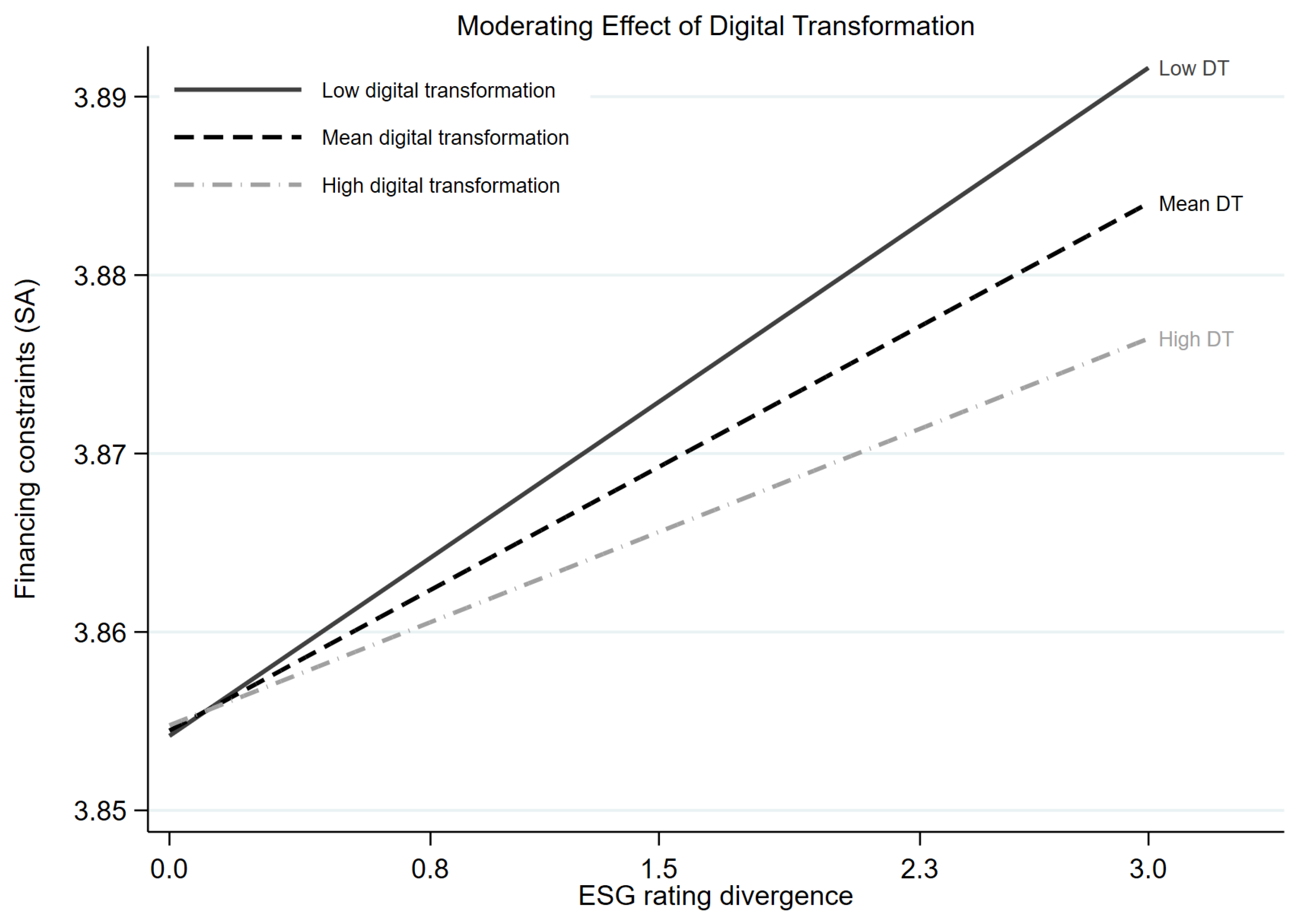
Table 7 reports the moderation results. For estimation, ESGdif5 and digital transformation are mean-centered before their interaction is constructed; the original variable names are retained in the table for readability. The coefficient on ESGdif5 is therefore interpreted at the mean level of digital transformation. The coefficient on ESGdif5 remains positive and significant, while the coefficient on digital transformation is negative and marginally significant. More importantly, the interaction term is −0.0003 and significant at the 1% level. Its 95% confidence interval is [−0.000366, −0.000141], which excludes zero. Simple-slope estimates show that the ESGdif5 slope is 0.0125 when digital transformation is low, 0.0099 at the mean, and 0.0072 when it is high; the corresponding 95% confidence intervals are [0.0104, 0.0146], [0.0084, 0.0113], and [0.0056, 0.0088]. These estimates support the interpretation that digital transformation weakens, but does not eliminate, the positive association between rating divergence and the SA-based financing-constraint proxy.
Figure 2 further visualizes this moderating pattern. The upward-sloping lines indicate that ESG rating divergence is positively associated with financing constraints across different levels of digital transformation. However, the slope is steepest for firms with low digital transformation and flattest for firms with high digital transformation. This pattern is consistent with the negative interaction term reported in
Table 7 and the confidence intervals reported above. Digital transformation mitigates, rather than reverses, the adverse financing effect of ESG rating divergence.
4.7. Heterogeneity Analysis
To examine whether the baseline association varies across different institutional and information environments, this study conducts heterogeneity analyses from three perspectives: ownership structure, internal governance, and external attention. Ownership structure captures differences between state-owned enterprises and non-state-owned enterprises in policy expectations, resource access, and stakeholder scrutiny. Internal governance is proxied by CEO–chair duality because the separation or concentration of leadership roles may affect governance checks, information processing, and the credibility of firms’ responses to ESG-related uncertainty. External attention is measured by analyst attention, which reflects the extent to which information intermediaries follow and interpret firm-level signals for capital market participants.
Table 8 reports the subgroup results. ESGdif5 is positive and statistically significant in all six subsamples. The point estimates are larger for state-owned enterprises, firms with separated chair and CEO positions, and firms with high analyst attention. These estimates are reported as descriptive subgroup patterns rather than as causal moderation evidence.
These descriptive patterns are consistent with possible differences in ownership expectations, internal governance, and external information attention. The stronger estimate among state-owned enterprises may reflect different stakeholder expectations, while the patterns associated with leadership structure and analyst attention may reflect differences in governance visibility and information processing. These interpretations are hypotheses for future work rather than direct findings of the current subgroup regressions.
5. Discussion
The findings show that ESG rating divergence is associated with the SA-based financing-constraint proxy. Rating disagreement is often discussed as a measurement problem, but the evidence suggests that it can have financial relevance in corporate-finance settings. When external ESG signals are inconsistent, capital providers may face higher information-processing costs, which is consistent with higher values of the SA-based proxy. The estimated baseline magnitude is statistically clear but economically modest: a one-standard-deviation increase in ESGdif5 corresponds to about 3.8% of one standard deviation in |SA|. The stock-turnover mechanism connects ESG information uncertainty to market trading behavior. The mediation result is statistically supported, but its economic magnitude is small and its same-year design does not establish complete temporal ordering. Lagged mediation checks further indicate that stock turnover should be interpreted as one observable pathway rather than the full explanation. Future studies should examine additional mechanisms, including analyst coverage, analyst forecast dispersion, institutional investor holdings, bank loan availability, bond spreads, and credit ratings.
The moderating role of digital transformation highlights the potential importance of internal information governance. Firms cannot directly control how rating agencies design ESG methodologies, but they can improve their own data infrastructure, operational transparency, and disclosure capacity. Digital transformation may therefore reduce vulnerability to external rating disagreement. The subgroup estimates are positive across ownership, leadership-structure, and analyst-attention settings, but they are best treated as descriptive evidence about information environments rather than as conclusive heterogeneous effects.
The policy implications should be interpreted in proportion to the observational evidence. Regulators can improve the comparability and transparency of ESG disclosure standards, while rating agencies can provide clearer information about data sources, indicator weights, coverage changes, and methodological updates. Listed firms may strengthen digital information systems and data traceability to provide capital providers with more verifiable supplementary information when third-party ratings conflict. These recommendations follow from the information-friction interpretation of the results; the study does not directly estimate the effects of any specific regulatory or corporate intervention.
6. Conclusions and Policy Implications
This study investigates the relationship between ESG rating divergence and an SA-based corporate financing-constraint proxy using Chinese A-share non-financial listed companies from 2009 to 2024. The ESG rating divergence is measured as the standard deviation of the available rescaled ratings from five agencies, and the financing constraints are proxied by the absolute value of the SA index. The results show that ESG rating divergence is positively associated with the SA-based financing-constraint proxy. The association remains positive and significant when ESGdif5 is lagged by one period. The instrumental-variable estimation provides additional sensitivity evidence, while the peer-based exclusion restriction remains unverifiable. The mechanism analysis indicates that ESG rating divergence is associated with lower stock turnover, and the bootstrap evidence supports a statistically significant but economically modest partial mediation effect. Lagged mediation checks do not establish a complete temporal pathway, so the turnover result is interpreted as a possible liquidity-related channel rather than causal mediation. The moderation analysis shows that digital transformation weakens the positive association. The subsample estimates are positive across the ownership, leadership-duality, and analyst-attention groups and are interpreted descriptively.
These findings have several policy implications. Regulators should continue improving the comparability and transparency of ESG disclosure standards, especially by encouraging standardized disclosure of core ESG indicators while allowing industry-specific materiality. Rating agencies should provide clearer information about data sources, indicator weights, coverage changes, and rating procedures so that market participants can better understand the sources of disagreement. Listed firms should strengthen digital transformation and information governance to provide more reliable supplementary information to capital providers when third-party ESG ratings conflict. Investors and creditors should not mechanically interpret ESG rating divergence as poor ESG performance; instead, they should integrate third-party ratings with firm-level digital, operational, and governance information. This study has important limitations. First, |SA| is a proxy that is mechanically constructed from size and age rather than a direct financing outcome, so the results should not be interpreted as evidence about a particular loan rate, credit limit, bond spread, or issuance decision. Second, ESG rating coverage differs across agencies and firm–years, and changes in agency composition may affect cross-firm comparability; ESGdif5 therefore reflects disagreement in the available ratings rather than a perfectly balanced five-agency panel. Third, the stock-turnover pathway is statistically detectable but small, and the contemporaneous mediation design does not establish a complete causal sequence. Finally, the IV exclusion restriction cannot be directly verified, and the digital transformation index may not capture all firm-specific digital practices. Future research can use direct financing outcomes and richer agency-level data to test whether environmental, social, and governance sub-dimension disagreement has distinct financing associations.
Despite these limitations, the evidence points to an important conclusion: ESG rating divergence is associated with SA-based financing-constraint proxies. Firms should not treat divergent ESG assessments as merely external noise because such disagreement is linked to financing-friction proxies. At the same time, firms are not passive recipients of rating disagreement. By improving digital transformation and information governance, they may reduce their exposure to external ESG uncertainty.