Systematic Assessment of Phosphogypsum Resource Utilization in China: Pathways, Hotspots, and Policy Implications for a Circular Economy


Abstract
1. Introduction
2. Methods and Data Sources
2.1. A Literature Review and Bibliometric Methods
2.2. Review on Bibliometric Methods
2.2.1. Data Source
2.2.2. Data Analysis
3. Current Status of PRU
3.1. Current Status Globally
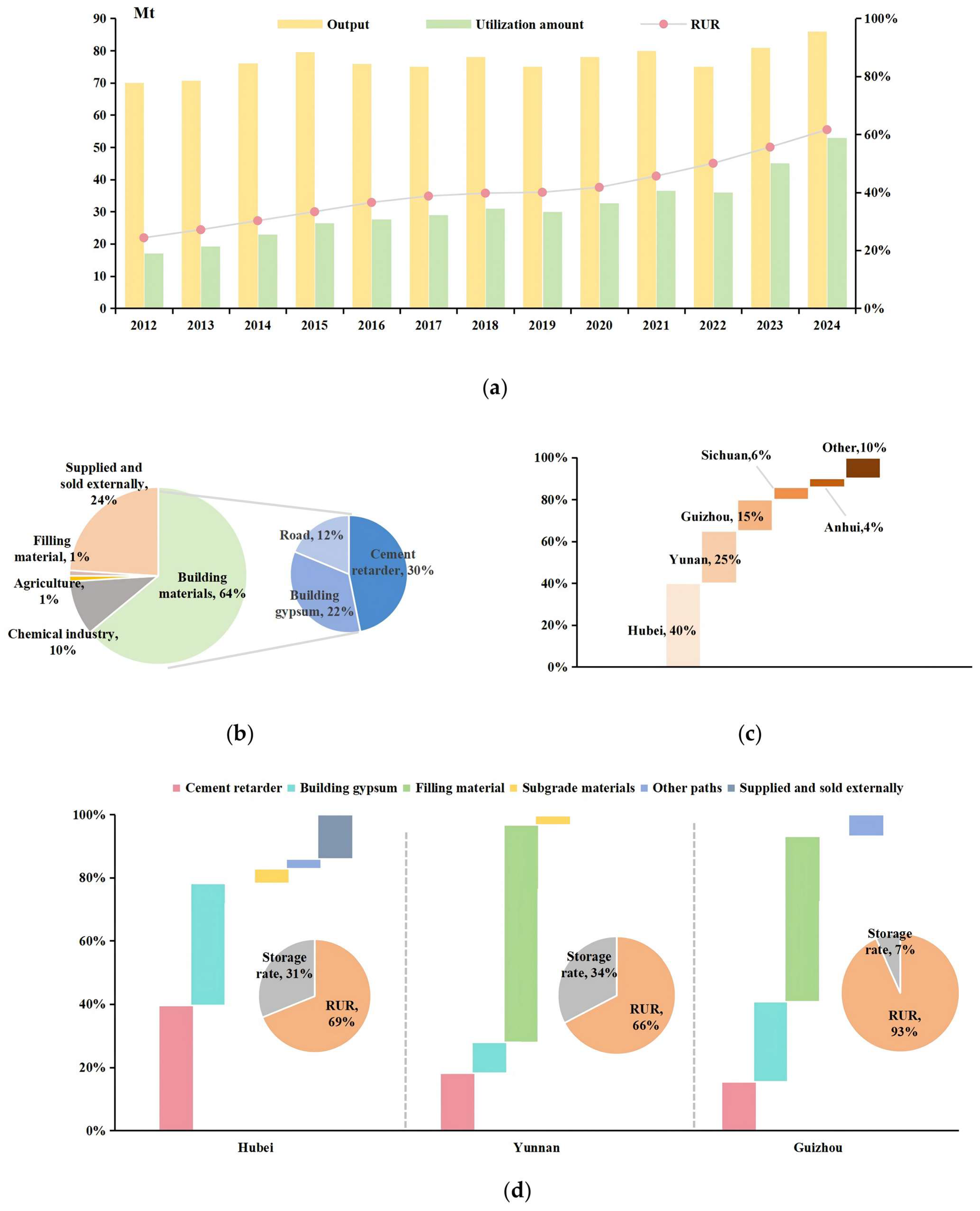
3.2. PG Utilization Pathways in China
4. Research Hotspots of Regarding PG RUPs
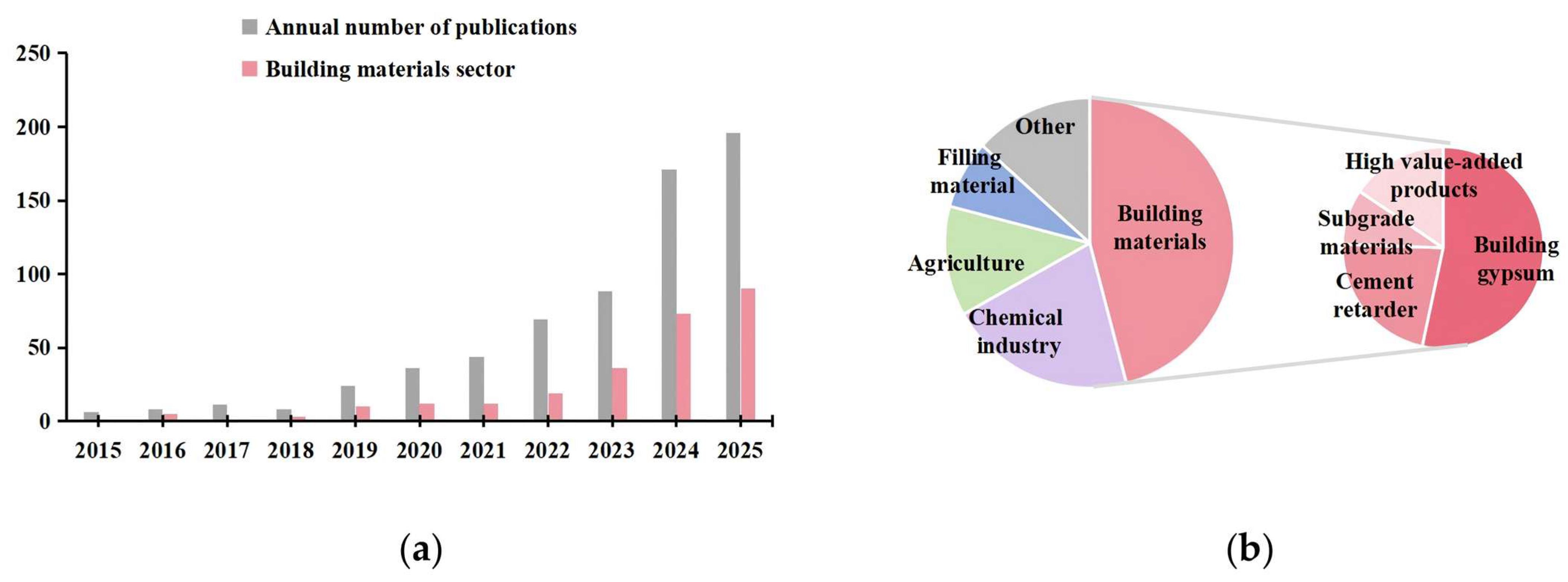
4.1. Literature Retrieval and Classification Statistics
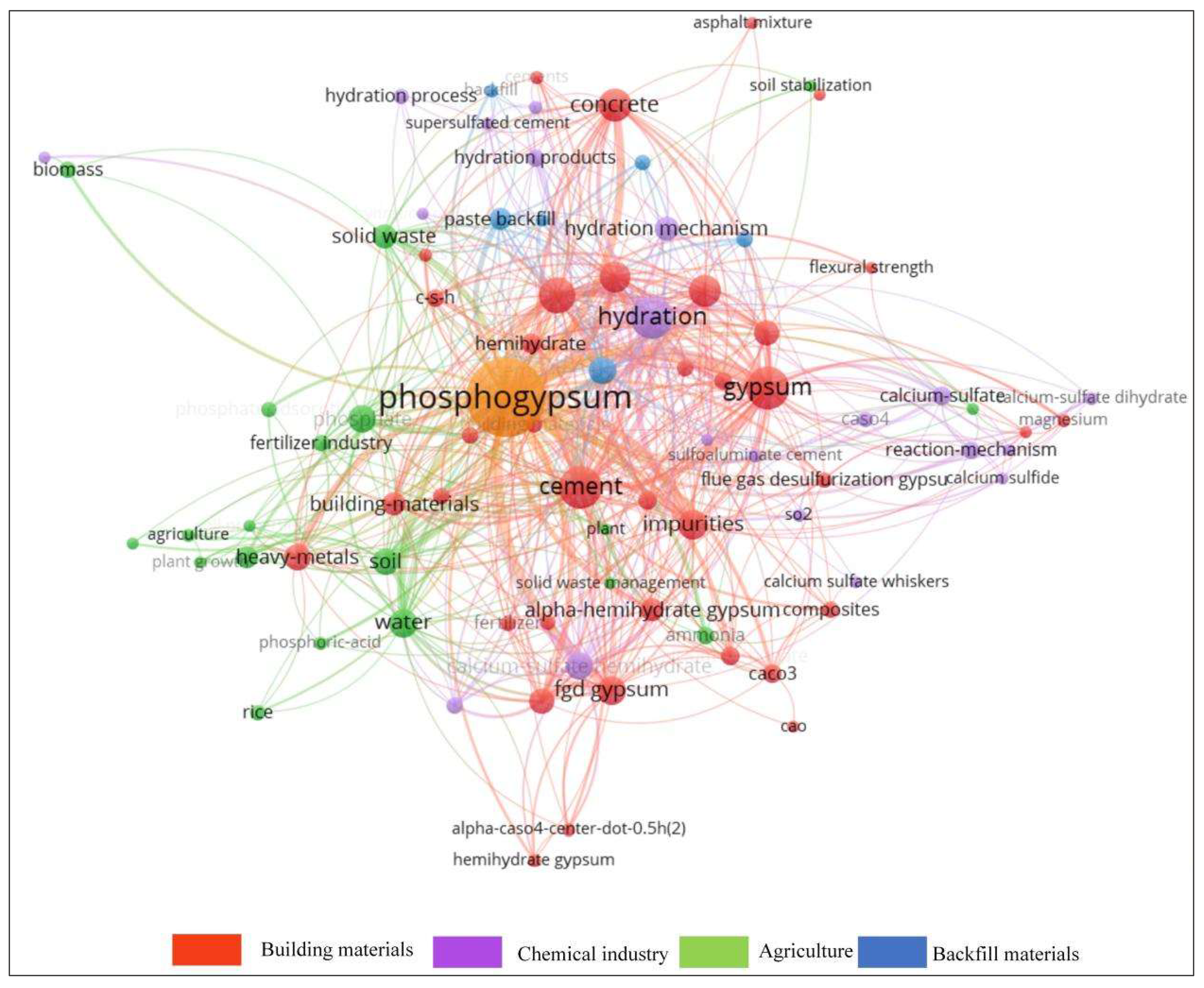
4.2. Keyword Co-Occurrence Analysis
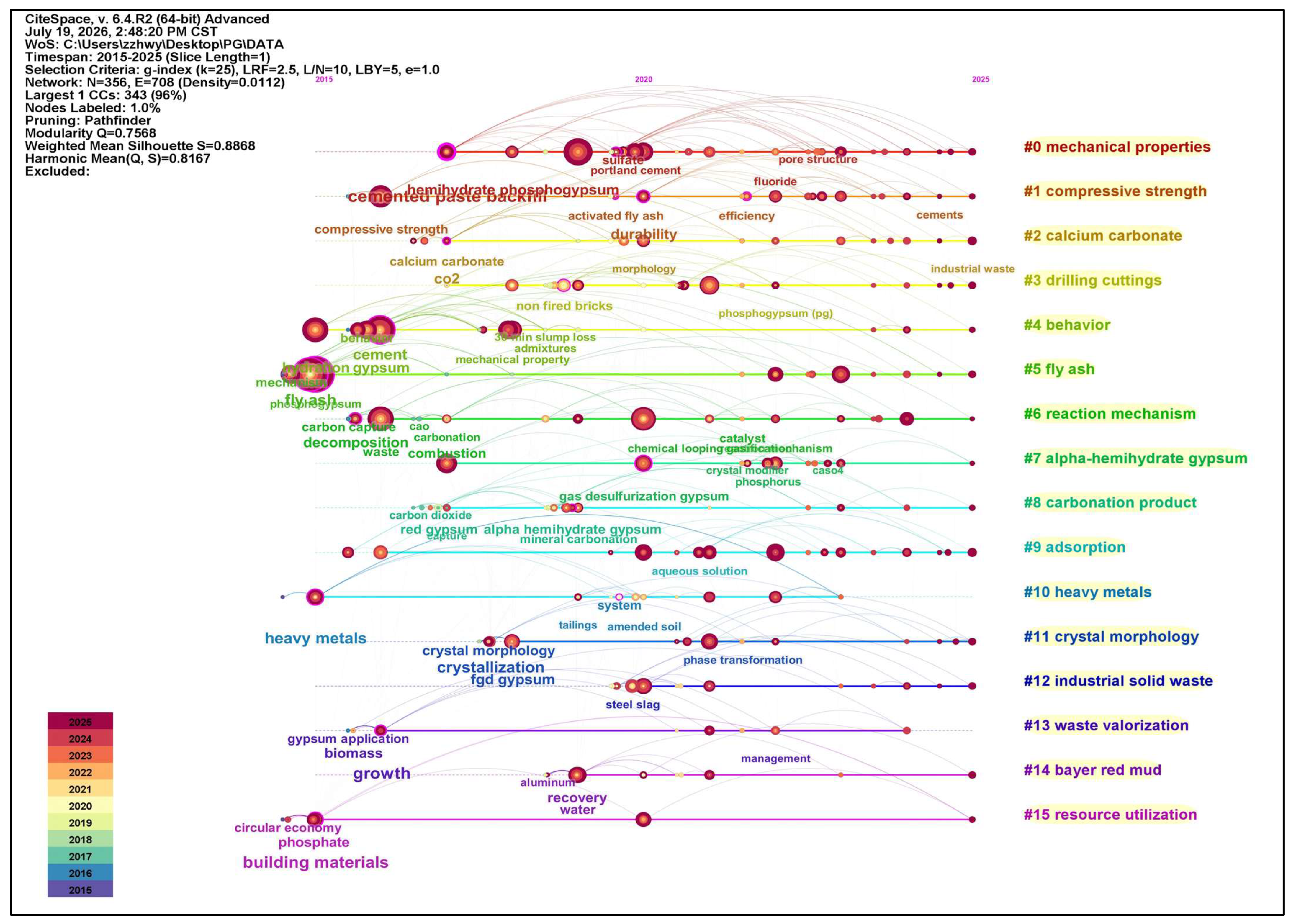
4.3. Timeline View of Keywords
5. Analysis of the PRU
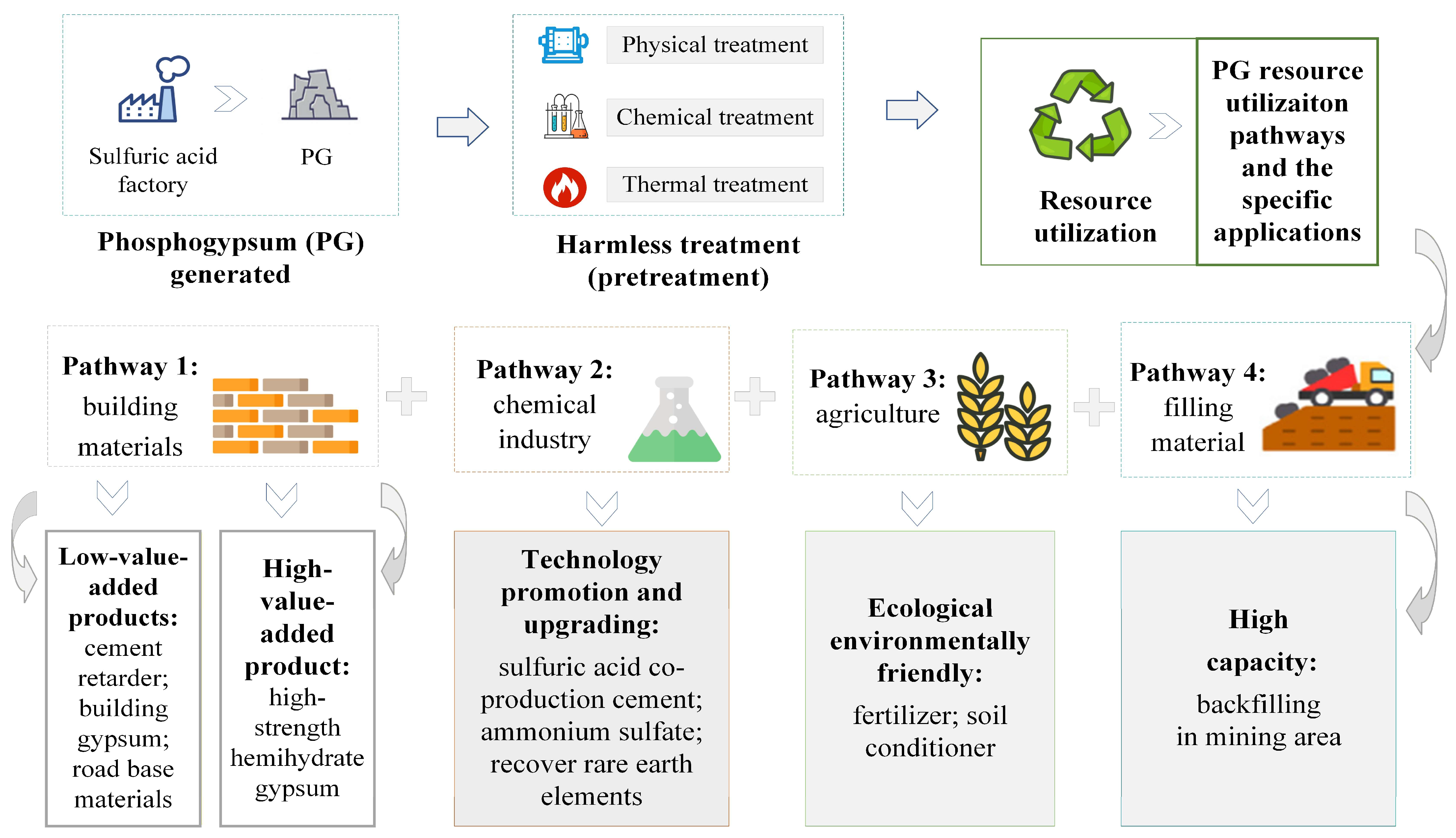
5.1. Framework of the RUPs for PG
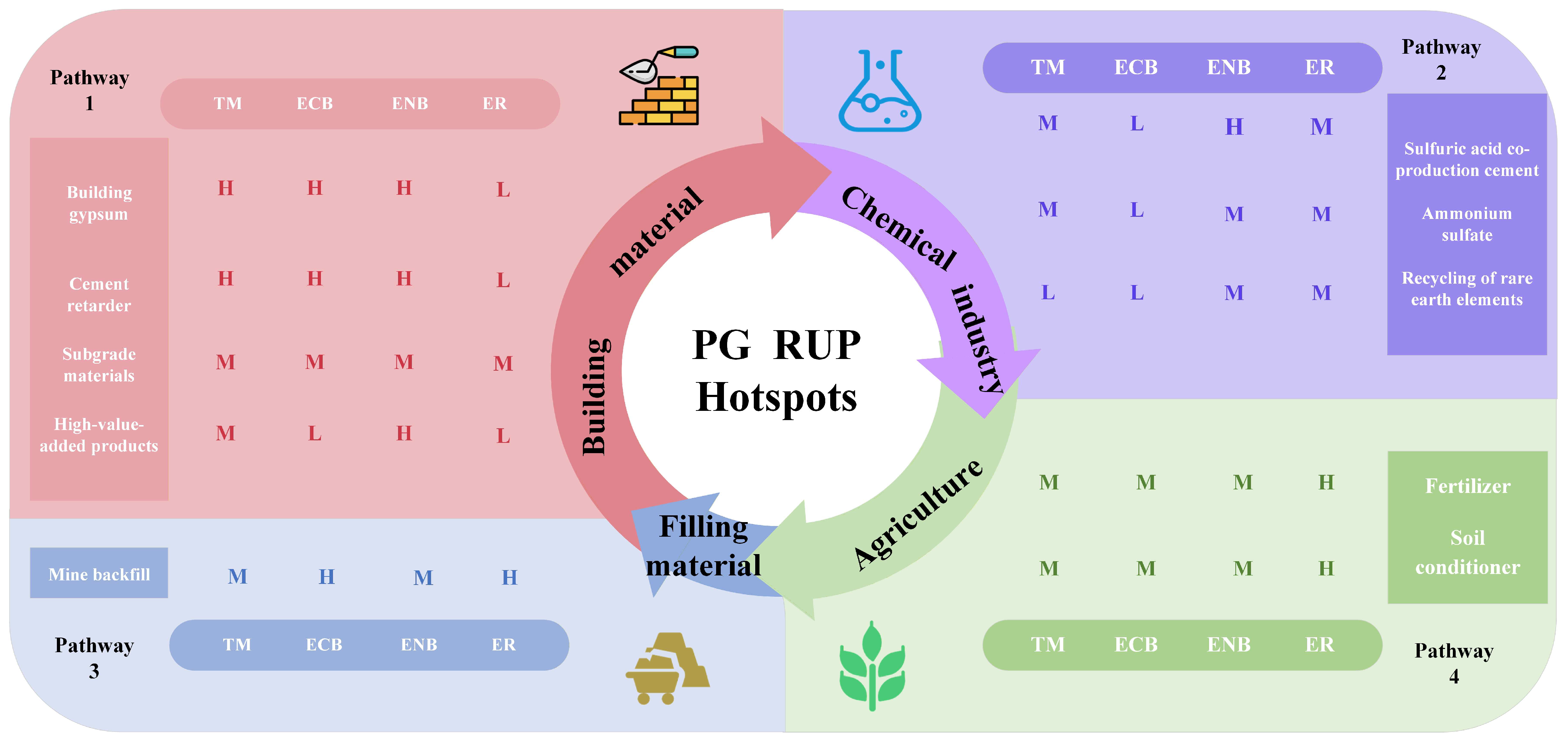
5.2. Research Hotspots Regarding the RUPs of PG
5.3. Other Pathways
5.3.1. Chemical Industry
5.3.2. Agriculture
5.3.3. Filling Material
5.4. Development Trend of PRU
5.5. Policy Implication
5.5.1. Existing Policy Systems and Standards
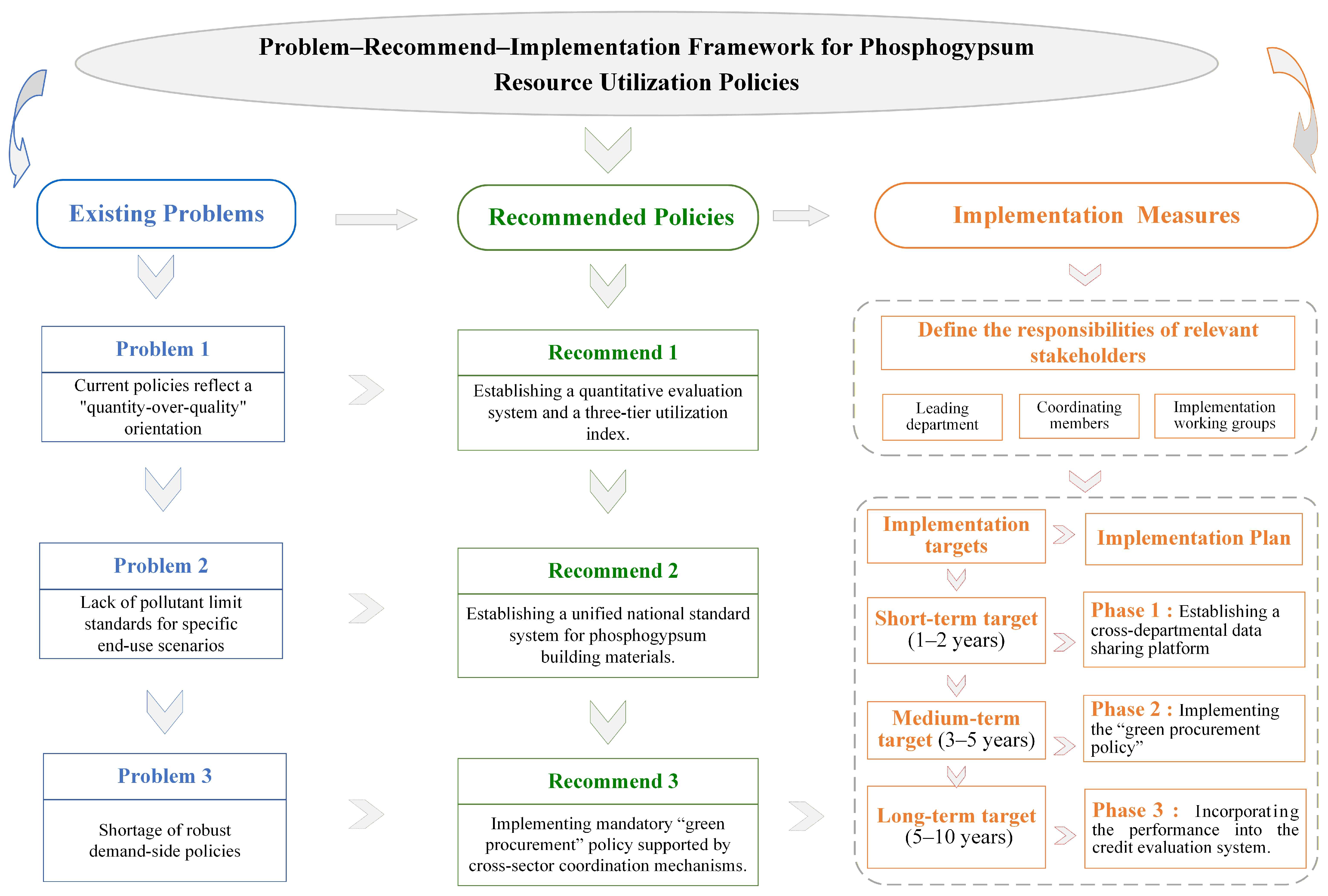
5.5.2. Policies Recommendations
5.6. Limitation and Further Study
6. Conclusions
Supplementary Materials
Author Contributions
Funding
Institutional Review Board Statement
Informed Consent Statement
Data Availability Statement
Acknowledgments
Conflicts of Interest
Abbreviations
| Abbreviation | Full title or explanation |
| PG | Phosphogypsum |
| Mt | Million metric tons |
| TP | Total phosphorus |
| NDRC | National Development and Reform Commission |
| RUR | Resource utilization rate |
| PRU | PG resource utilization |
| RUPs | Resource utilization pathways |
| WOSCC | Web of Science Core Collection |
| Gt | Billion metric tonnes |
| REEs | Rare earth elements |
| TM | Technical maturity |
| ECB | Economic benefit |
| ENB | Environmental benefit |
| ER | Environmental risk |
| SC | State Council |
| MEE | Ministry of Ecology and Environment |
| MIIT | Ministry of Industry and Information Technology |
| HPPGGO | Hubei Provincial People’s Government General Office |
| GPPGGO | Guizhou Provincial People’s Government General Office |
| DEITSP | Department Economy and Information Technology of Sichuan Provincial |
| MHURD | Ministry of Housing and Urban-Rural Development |
References
- Liu, S.; Wu, F.H.; Qu, G.F.; Zhao, C.Y.; Chen, B.J.; Yang, Y.Y. Migration and Transformation of Heavy Metals in Phosphogypsum Storage Process and Their Ecological Effect. Asian J. Ecotoxicol. 2022, 17, 302–314. [Google Scholar]
- Li, F.; Gu, H.M. Analysis of Stockpiling and Comprehensive Utilization of Phosphogypsum in the Phosphate Fertilizer Industry. Environ. Sci. Surv. 2016, 35, 98–99. [Google Scholar]
- Shandong Chemical Industry Network. The Comprehensive Utilization Level of Phosphogypsum in Our Country Has Been Steadily Improving. Available online: http://www.sdchem.com.cn/html/hgzhfw/hydt/2025/0623/43000.html (accessed on 21 January 2026).
- Xiang, Z.H.; Sun, C.P.; Chen, S.F.; Huang, J.R.; Zhang, Y.F.; Shao, C.W.; Li, Y.; Zhang, H. A review on current status and functional applications of phosphogypsum. Inorg. Chem. Ind. 2026, 58, 10–19+59. [Google Scholar] [CrossRef]
- Murali, G.; Azab, M. Recent research in utilization of phosphogypsum as building materials: Review. J. Mater. Res. Technol. 2023, 25, 960–987. [Google Scholar] [CrossRef]
- Zhu, Z.W.; He, D.S.; Chen, F.; Zhang, K.C.; Wang, Q.Y.; Zhang, Z.Q. Research Progress on Pretreatment and Comprehensive Utilization of Phosphogypsum. Conserv. Util. Miner. Resour. 2019, 39, 19–25. [Google Scholar] [CrossRef]
- Junchen, X.; Jingping, Q.; Pangkun, Z.; Xiaogang, S.; Yingliang, Z.; Xiaowei, G. Usage of biowashing to remove impurities and heavy metals in raw phosphogypsum and calcined phosphogypsum for cement paste preparation. Chem. Eng. J. 2023, 451, 138594. [Google Scholar] [CrossRef]
- Li, X.; Lv, X.; Xiang, L. Review of the State of Impurity Occurrences and Impurity Removal Technology in Phosphogypsum. Materials 2023, 16, 5630. [Google Scholar] [CrossRef] [PubMed]
- General Administration of Quality Supervision, Inspection and Quarantine of the People’s Republic of China. Standard for Groundwater Quality. Available online: https://openstd.samr.gov.cn/bzgk/std/newGbInfo?hcno=F745E3023BD5B10B9FB5314E0FFB5523 (accessed on 17 July 2026).
- Ministry of Ecology and Environment of the People’s Republic of China. Identification Standards for Hazardous Wastes-Identification for Extraction Toxicity. Available online: https://www.mee.gov.cn/ywgz/fgbz/bz/bzwb/gthw/wxfwjbffbz/200705/t20070522_103957.shtml (accessed on 17 July 2026).
- Zhu, H.D.; Yang, Y.B.; Gu, Z.C. Analysis on Monitoring and Management of Groundwater Quality Change in Liushuqing Phosphogypsum Residual Site. Environ. Sci. Surv. 2017, 36, 109–114. [Google Scholar]
- Wan, H.R. Analysis on Generation Coefficient of Manganese Slag and Phosphogypsum in China. Min. Metall. 2013, 22, 81–85. [Google Scholar]
- Wang, X.B.; Yan, X.; Li, X.Y.; Ji, H.J. Environmental Risks for Application of Phosphogysum in Agricultural Soils in China. J. Integr. Agric. 2019, 52, 293–311. [Google Scholar]
- Chen, F.; Li, X.H.; Wang, W.J.; Peng, L.; Qian, B. Temporal and spatial variation characteristics of total phosphorus in Yangtze River Basin from 2018 to 2022. Express Water Resour. Hydropower Inf. 2023, 44, 91–97. [Google Scholar]
- Shi, X.; Zeng, A.; Duan, H.; Zhang, H.; Yang, J. Status and development trends of phosphogypsum utilization in China. Circ. Econ. 2024, 3, 100116. [Google Scholar] [CrossRef]
- General Office of the State Council of the People’s Republic of China. Implementation Plan for Strengthening Supervision and Utilization Disposal Capacity of Hazardous Waste. Available online: https://www.gov.cn/gongbao/content/2021/content_5616156.htm (accessed on 17 July 2026).
- National Development and Reform Commission. Action Plan for Comprehensive Utilization of Phosphogypsum. Available online: https://wap.miit.gov.cn/zwgk/zcwj/wjfb/tz/art/2024/art_2bd9ebff0b0b4cffa20bedc5d7ec15d9.html (accessed on 25 June 2026).
- Xu, C.Z.; Yu, J.H.; Li, Y.L. Research progress of pretreatment and comprehensive utilization of phosphogypsum. Saf. Environ. Eng. 2024, 31, 260–270. [Google Scholar]
- Li, K.; Song, Z.; Jiang, L.; Chen, A.; Liu, H.; Jin, W. Effects of different composite activator systems on mechanical properties and hydration behavior of large amounts of Bayer red mud based low carbon cementitious materials. Powder Technol. 2025, 464, 121256. [Google Scholar] [CrossRef]
- Cheng, G.; Zhang, Z.; Mao, R.; Wu, H.; Liang, X.; Zhou, J. Experimental investigation on thermal and mechanical performance of alkali-activated coal gangue foam materials doped with phosphogypsum. Arch. Civ. Mech. Eng. 2025, 25, 164. [Google Scholar] [CrossRef]
- Ou, Z.B.; Yang, W.J.; He, B.B. The General Introduction of Phosphogypsum Comprehensive Utilization Technology in China. Yunnan Chem. Technol. 2021, 48, 6–9. [Google Scholar]
- Shao, C.; Ma, M.; Zhu, X.; Xing, B.; Zhang, C.; Du, D.; Chi, R. Phosphogypsum as an industrial byproduct: A critical review on environmental risks, remediation, and resource recovery-circular challenges. Process Saf. Environ. Prot. 2026, 208, 108456. [Google Scholar] [CrossRef]
- Liu, W. The data source of this study is Web of Science Core Collection? Not enough. Scientometrics 2019, 121, 1815–1824. [Google Scholar] [CrossRef]
- Zeng, X.P.; Jiang, J.H.; Huang, L. Bibliometric Analysis of Workplace Learning Research in Medical Education Based on the Web of Science. Med. Soc. 2026, 39, 92–101. [Google Scholar]
- Yadav, A.A.; Hirekhan, S.G.; Bhandari, P.S.; Bhagat, R.M.; Ranit, A.B.; Shelare, S.; Soudagar, M.E.M.; Sharma, S.; Raja, V.K.B.; Mahapatro, A.; et al. AI-driven sustainable concrete mix design: Hybrid deep Q-Learning and genetic algorithms-based multi-objective machine learning optimizations for high structural strength, low cost, and low carbon footprints. Structures 2025, 82, 110443. [Google Scholar] [CrossRef]
- Wei, Z.Q.; Deng, Z.B. Research hotspots and trends of comprehensive utilization of phosphogypsum: Bibliometric analysis. J. Environ. Radioact. 2022, 242, 106778. [Google Scholar] [CrossRef] [PubMed]
- Jan, v.E.N.; Ludo, W. Software survey: VOSviewer, a computer program for bibliometric mapping. Scientometrics 2010, 84, 523–538. [Google Scholar]
- Malea, E.O.; Costas, R. Link-based approach to study scientific software usage: The case of VOSviewer. Scientometrics 2021, 126, 1–34. [Google Scholar] [CrossRef]
- Huang, K.; He, Y.; Wan, H.; Ban, X.X.; Chen, X.Y.; Hu, X.M.; Wan, X.X.; Lu, R.; Zhang, Q.; Xiong, K. Bibliometric and visualized analysis on global trends and hotspots of TAK1 in regulated cell death: 1999 to 2024. Front. Immunol. 2024, 15, 1437570. [Google Scholar] [CrossRef] [PubMed]
- Ni, Y.; Gan, X.; Lan, T.; Gong, D. Comparative analysis of research hotspots and development trends of pediatric palliative care at home and abroad based on CiteSpace: A bibliometric study. Front. Pediatr. 2026, 14, 1688720. [Google Scholar] [CrossRef] [PubMed]
- Ke, X.T.; Zhang, L.; Tang, W.X. Evolutionary Trends in Integrated Care in 2000–2020 in China: A Scientometric Review Using CiteSpace. Int. J. Integr. Care 2022, 22, 22. [Google Scholar] [CrossRef] [PubMed]
- Xing, Y.; Yasinjan, F.; Du, Y.J.; Geng, H.Y.; Zhang, Y.; He, M.H.; Guo, R.; Yang, L.; Cui, J.Y.; Mu, D.M.; et al. Immunotherapy in cervical cancer: From the view of scientometric analysis and clinical trials. Front. Immunol. 2023, 14, 1094437. [Google Scholar] [CrossRef] [PubMed]
- Cao, X.; Furuoka, F.; Rasiah, R. Knowledge Mapping of Industrial Upgrading Research: A Visual Analysis Using CiteSpace. Sustainability 2023, 15, 16547. [Google Scholar] [CrossRef]
- Han, W.J.; Zhang, Z.J. Current status of pretreatment and comprehensive utilization of phosphogypsum. Mod. Chem. Ind. 2025, 45, 19–24. [Google Scholar]
- Shi, Z.Y.; Chen, Q.Y.; Zhao, W.H.; Wang, T.; Zhu, Y.; Cheng, W.; Wu, W.J.; Liu, M.Z.; Liu, Y.Q.; Zhu, H.D.; et al. Research Perspectives in the field of phosphogypsum. China Environ. Sci. 2026, 46, 2594–2609. [Google Scholar]
- Ilyas, C.; Aziz, A.; Mostafa, M.E.; Mohammed, B. Waste to wealth: Synthesis of hydrocalumite from Moroccan phosphogypsum and aluminum wastes. Waste Manag. 2023, 171, 26–31. [Google Scholar] [CrossRef] [PubMed]
- Jiang, J.Y.; Zhang, S.H.; Fu, X.D.; Sun, H. Characteristics and resource utilization of phosphogypsum from phosphorus chemical waste. Shanxi Archit. 2021, 47, 1–4. [Google Scholar]
- Cui, R.Z.; Bai, H.D.; Gao, Y.F.; Xiu, X.F. Current situation of comprehensive utilization of phosphogypsum and its development trend of 14th Five-Year Plan. Inorg. Chem. Ind. 2022, 54, 1–4. [Google Scholar]
- Cui, R.Z. Status of comprehensive utilization of phosphogypsum in China in 2021 and suggestions. Phosphate Compd. Fertil. 2022, 37, 1–3. [Google Scholar]
- Cui, R.Z.; Xiu, X.F.; Wang, C. Current situation of comprehensive utilization of phosphogypsum in China and thoughts and suggestions for its development during the “15th Five-Year Plan” period. Eco-Ind. Sci. Phosphorus Fluor. Eng. 2025, 40, 1–6. [Google Scholar] [CrossRef]
- China Solid Waste and Chemicals Management. Research Report on the Progress of “Zero-Waste City” Construction. 2024. Available online: https://www.meescc.cn/zxly/gtfwgl/202512/t20251230_1139322.shtml (accessed on 5 June 2026).
- Yunnan Provincial Committee of Chinese People’s Political Consultative Conference. Proposal on Accelerating the Formulation of Provincial Standards for Large-Scale Application of Phosphogypsum as Subgrade Material. Available online: https://ynzx.gov.cn/tiangongkai/276246.jhtml (accessed on 5 June 2026).
- Yun, D.; Lu, Z.; Hong, Z. Current status of phosphogypsum comprehensive utilization in Guizhou province. Eco-Ind. Sci. Phosphorus Fluor. Eng. 2025, 40, 94–101. [Google Scholar]
- Bai, C.H.; Wang, J.B.; Li, G.H.; Liu, Y.Q.; Xu, Y.; Qian, C.; Lin, M.S.; Long, J.; Yao, G.Y. Research on the Pollution Characteristics, Utilization and EnvironmentalManagement of Phosphogypsum in China. Res. Environ. Sci. 2025, 38, 632–641. [Google Scholar]
- Bureau of Industry and Information Technology of Kunming. Official Reply Letter to Proposal No. 144353 at the Fourth Session of the 14th Kunming Municipal Committee of the CPPCC. Available online: https://gxj.km.gov.cn/c/2025-07-29/5007317.shtml (accessed on 27 July 2026).
- Xing, A.A.; Miao, J.Y.; Liu, X.Y.; Yang, K.; Gu, S.Y.; Hou, C.H. Bibliometric analysis of the application status and hot trends of phosphogypsum. Appl. Chem. Ind. 2025, 54, 506–515. [Google Scholar]
- Liu, Y.; He, D.; Zou, H.; Chen, Z.; Xue, S. Utilization and treatment of phosphogypsum: Environmental impacts and resource potential. J. Environ. Sci. 2026, 167, 590–612. [Google Scholar] [CrossRef] [PubMed]
- Wang, T.; Chen, C.; Jiang, X.; Zhao, Y.; Zhao, Y.; Li, X.; Wang, L.; Wanghan, J.; Ma, W.; Liu, Z. Current research status and emerging trends of phosphogypsum resource utilization: A review combined with bibliometric analysis. J. Environ. Chem. Eng. 2026, 14, 121807. [Google Scholar] [CrossRef]
- Wang, C.Q.; Chen, S.; Huang, D.M.; Huang, Q.C.; Li, X.Q.; Shui, Z.H. Safe environmentally friendly reuse of red mud modified phosphogypsum composite cementitious material. Constr. Build. Mater. 2023, 368, 130348. [Google Scholar] [CrossRef]
- Zhang, Q.T.; Liang, C.F.; Ruan, Y.Y.; Yang, B.Q.; Yu, J.X.; Luo, H.H.; Chi, R.A.; Zhou, F. Research status of phosphogypsum harmlessness and resource utilization. Eco-Ind. Sci. Phosphorus Fluor. Eng. 2025, 40, 84–90. [Google Scholar]
- Ma, L.P. Current situation and consideration of comprehensive utilization of phosphogypsumresources. Phosphate Compd. Fertil. 2019, 34, 5–9. [Google Scholar]
- Bai, H.D. Current situation, problems and suggestions of phosphogypsum utilization of 2019 in China. Sulfuric Acid Ind. 2020, 12, 7–10. [Google Scholar]
- Wu, W.T.; Tao, C.; Wang, L.W.; Wan, Y. Research progress on harmless treatment and resource utilization of phosphogypsum. Environ. Prot. Chem. Ind. 2025, 46, 301–311. [Google Scholar]
- Yan, Y.J.; Zhang, H.; Yu, S.F. Discussion on FGD gypsum calcination process and calcination equipment. New Build. Mater. 2018, 45, 100–102. [Google Scholar]
- Song, H. Research on Technical Performance and Economic Analysis of Yunnan β-type Phosphogypsum Building Gypsum Products. Master’s Thesis, Kunming University of Science and Technology, Kunming, China, 2014. [Google Scholar]
- Hu, L.C.; Li, X.Q.; Liu, Y.H.; Chen, J.F. CO2 Emission Evaluation for Phosphogypsum Building Materials. Mater. Rep. 2025, 39, 141–146. [Google Scholar]
- Jia, X.W.; Wu, Z.; Ma, Y. Present Status of Phosphogypsum Utilization in Building Materials. Mater. Rep. 2013, 27, 139–141. [Google Scholar]
- Zhang, L.Z.; Zhang, Y.X.; Zhang, X.F.; Tan, X.M.; Lv, Z.H. Research Progress on Resource Utilization of Phosphogypsum in China. Conserv. Util. Miner. Resour. 2019, 39, 14–18. [Google Scholar]
- Bai, P.; Hu, J.S.; Liang, A.L.; Gao, H. A review on comprehensive utilization and pretreatment method of phosphogypsum. Mod. Chem. Ind. 2023, 43, 76–79. [Google Scholar]
- Li, B.X.; Li, L.; Chen, X.; Ma, Y.; Zhou, M.K. Modification of phosphogypsum using circulating fluidized bed fly ash and carbide slag for use as cement retarder. Constr. Build. Mater. 2022, 338, 127630. [Google Scholar] [CrossRef]
- Yuan, W.Y.; Hao, C.Q.; Liu, W.S.; Cui, X.E. Application of Phosphogypsum in Production of Retarded Cement. Coal Ash 2015, 27, 29–30. [Google Scholar]
- Zeng, A.; Shi, X.; Zhang, H.; Zou, Q.; Ding, Y.; Duan, H.; Yang, J. Can phosphogypsum utilization in China be sustainable? An integrated life cycle environmental and economic evaluation. J. Environ. Manag. 2026, 402, 129095. [Google Scholar] [CrossRef] [PubMed]
- Dutta, R.K.; Kumar, V. Suitability of Flyash-Lime-Phosphogypsum Composite in Road Pavements. Period. Polytech. Civ. Eng. 2016, 60, 455–469. [Google Scholar] [CrossRef]
- Raja, Z.; Mounir, B.; Ikram, N.; Chaouki, S.; Boubaker, E.; Ali, S. A phosphogypsum-based road material with enhanced mechanical properties for sustainable environmental remediation. Environ. Prog. Sustain. Energy 2021, 41, 13732. [Google Scholar] [CrossRef]
- Yang, H.Q.; Liu, Z.X.; Sun, G.L.; Guo, W.; Huang, S.W.; Kan, T. Research on the Performance of Modified Phosphogypsum Composite Materials for Roadbed. Fly Ash Compr. Util. 2025, 39, 46–50. [Google Scholar]
- Guo, X.D.; Zhang, H.; Zhong, J.; Qi, F.Y.; Dong, Y.H.; Zhang, M.J. Analysis of Current Situation and Technical Route of Building Materials Prepared by Phosphogypsum. JES 2023, 15, 313–325. [Google Scholar] [CrossRef]
- Ru, X.; Ma, B.; Huang, J.; Huang, Y. Phosphogypsum Transition to α-Calcium Sulfate Hemihydrate in the Presence of Omongwaite in NaCl Solutions Under Atmospheric Pressure. J. Am. Ceram. Soc. 2012, 95, 3478–3482. [Google Scholar] [CrossRef]
- Chao, L.; Chuigang, F.; Runguo, L.; Dongxue, Y.; Songgeng, L. Preparation of α-Hemihydrate Gypsum from Phosphogypsum by Flotation and Atmospheric Trans-Crystallization in Solution. Master’s Thesis, Institute of Process Engineering, Chinese Academy of Sciences (IPE), Beijing, China, 2023. [Google Scholar]
- Yang, X.; Li, Y.; Wang, J.; Zhang, G. Progress in preparation of α-hemihydrous gypsum from phosphogypsum and its application. New Build. Mater. 2024, 51, 32–38. [Google Scholar]
- Cesur, H.; Balkaya, N. Zinc removal from aqueous solution using an industrial by-product phosphogypsum. Chem. Eng. J. 2006, 131, 203–208. [Google Scholar] [CrossRef]
- Yang, X.; Zhang, Z.; Wang, X.; Yang, L.; Zhong, B.; Liu, J. Thermodynamic study of phosphogypsum decomposition by sulfur. J. Chem. Thermodyn. 2013, 57, 39–45. [Google Scholar] [CrossRef]
- Du, C.; Li, H.; Wang, J.; Wang, X.; Liu, W.; Shi, C. Phosphogypsum-to-Sulfuric Acid and Cement Co-production: Current Status and Prospect Analysis. Creat. Living 2023, 5, 186–189. [Google Scholar]
- Zhu, B.; Zhang, Y.; Zou, X.; Liang, J.; Duan, Q. Prospects of the Technology for Co-producing Sulfuric Acid and Cement from Phosphogypsum. China Cem. 2024, 68–70. [Google Scholar]
- He, B.B.; Hu, H.; Xue, S.X.; Xie, T. Reaction mechanism and kinetics of ammonium sulfate prepared by phosphogypsumD. Chem. Eng. 2017, 45, 68–71. [Google Scholar]
- Yang, F.N. Study on the production of ammonium sulfate and calcium carbonate by mineralizing carbon dioxide with phosphogypsum. Sulfuric Acid Ind. 2022, 4, 15–17. [Google Scholar]
- JeanLuc, M.; Paul, E.C.; Omoniyi, P.; Felicia, P.L. Rare Earths’ Recovery from Phosphogypsum: An Overview on Direct and Indirect Leaching Techniques. Minerals 2021, 11, 1051. [Google Scholar] [CrossRef]
- Nkabinde, S.S.; Ledwaba, M.; Shumbula, N.P.; Muller, E.; Ndlovu, G. Pretreatment strategies for enhancing rare earth elements leaching efficiency from phosphogypsum—A review with a focus on hydrometallurgical processes. J. Rare Earths 2026, 44, 988–1006. [Google Scholar] [CrossRef]
- Xia, L.L.; Wang, L.; Yang, G.H.; Li, S.; Liu, S.X.; Nie, Y.M.; Fan, C.Z. Research Progress on Leaching of Rare Earth Element from Phosphogypsum. Met. Mine 2023, 126–134. [Google Scholar]
- Pan, K.L.; Li, N.; Hu, J.P.; Hou, H.J. Research progress on extraction and recovery of rare earth elements from phosphogypsum. J. Huazhong Univ. Sci. Technol. (Nat. Sci. Ed.) 2023, 51, 77–83. [Google Scholar]
- Smerigan, A.; Shi, R. Advancing the Economic and Environmental Sustainability of Rare Earth Element Recovery from Phosphogypsum. Environ. Sci. Technol. 2025, 59, 19755–19767. [Google Scholar] [CrossRef] [PubMed]
- Shen, L.Y. Current situation of comprehensive utilization of phosphogypsum in Honglin Branch. Sulfuric Acid Ind. 2014, 1, 49–51. [Google Scholar]
- Li, J.; Wu, H.S.; Gao, Z.Q.; Shang, X.X.; Zheng, P.H.; Yin, J.; Kakpa, D.; Ren, Q.Q.; Ogou, K.F.; Chen, S.Y.; et al. Impact of Phosphogypsum Wastes on the Wheat Growth and CO2 Emissions and Evanuation of Economic-environmental Benefit. Environ. Sci. 2015, 36, 3099–3105. [Google Scholar]
- Tao, T.; Zhang, C.; Zheng, F.; Yang, S.; Guo, Y.; Xu, S. Effect of phosphogypsum on saline-alkalinity and aggregate stability of bauxite residue. Trans. Nonferrous Met. Soc. China 2021, 31, 1484–1495. [Google Scholar] [CrossRef]
- Qi, J.; Zhu, H.; Zhou, P.; Wang, X.; Wang, Z.; Yang, S.; Yang, D.; Li, B. Application of phosphogypsum in soilization: A review. Int. J. Environ. Sci. Technol. 2023, 20, 10449–10464. [Google Scholar] [CrossRef]
- Guan, Q.; Wang, Z.; Zhou, F.; Yu, W.; Yin, Z.; Zhang, Z.; Chi, R.a.; Zhou, J. The Impurity Removal and Comprehensive Utilization of Phosphogypsum: A Review. Materials 2024, 17, 2067. [Google Scholar] [CrossRef] [PubMed]
- Nayak, A.K.; Mishra, V.K.; Sharma, D.K.; Jha, S.K.; Singh, C.S.; Shahabuddin, M.; Shahid, M. Efficiency of Phosphogypsum and Mined Gypsum in Reclamation and Productivity of Rice–Wheat Cropping System in Sodic Soil. Commun. Soil Sci. Plant Anal. 2013, 44, 909–921. [Google Scholar] [CrossRef]
- Wang, W.; Li, M.; Zhang, W.H.; Han, Y.Q.; Liu, M.M.; Du, J.D. Effect of the Improvement Measures on Growth and Yield of Kidney Beans in Saline-alkali Soil. J. Heilongjiang Aug. 1st Land Reclam. Univ. 2018, 30, 1–7. [Google Scholar]
- Nada, E.; Mohamed, Z.; Leila, C.; Ben, A.F.; Steve, W.; Monem, K. Effect of phosphogypsum on growth, physiology, and the antioxidative defense system in sunflower seedlings. Environ. Sci. Pollut. Res. Int. 2015, 22, 14829–14840. [Google Scholar] [CrossRef] [PubMed]
- Yuan, Y.H.; Wang, G.; Xu, L.L.; Li, C.L.; Wang, X.D. Solidification and Control of Harmful Substances in Plant Substrates Via Phosphogypsum Modified. Guangzhou Chem. Ind. 2024, 52, 75–78. [Google Scholar]
- Liu, S.L.; Wang, Y.M.; Wu, A.X.; Li, Y.C.; Song, X.T. Research status and development trend of phosphogypsum resource disposal in China. Acta Mater. Compos. Sin. 2026, 43, 3940–3960. [Google Scholar]
- Li, X.B.; Liu, Z.X.; Gu, D.S. Thought of the Strategy of Utilizing Solid Tailings in Mined-out Area. Min. Metall. Eng. 2005, 25, 1–5. [Google Scholar]
- Cao, Z.; Liu, B.; Li, X.; Li, D.; Dong, L. Experimental Study on Backfilling Mine Goafs with Chemical Waste Phosphogypsum. Geofluids 2019, 2019, 9218916. [Google Scholar] [CrossRef]
- Zhang, P.; Sun, W.; Zhang, S.; Wen, Y.; Ding, F.; Shan, B.; Wang, Y. Research on the leaching behavior and morphological transformation of pollutants in the phosphogypsum filling body. Waste Manag. 2026, 221, 115617. [Google Scholar] [CrossRef] [PubMed]
- National Development and Reform Commission. Guiding Opinions on the Comprehensive Utilization of Bulk Solid Waste During the 14th Five-Year Plan Period. Available online: https://www.mee.gov.cn/xxgk2018/xxgk/xxgk10/202103/t20210326_826255.html (accessed on 9 April 2026).
- State Council. Action Plan for Carbon Dioxide Peaking by 2030. Available online: https://www.gov.cn/zhengce/content/2021-10/26/content_5644984.htm (accessed on 9 April 2026).
- Ministry of Ecology and Environment. Work Plan for the Construction of “Zero-Waste Cities” During the 14th Five-Year Plan Period. Available online: https://www.mee.gov.cn/xxgk2018/xxgk/xxgk03/202112/t20211215_964275.html (accessed on 9 April 2026).
- Ministry of Industry and Information Technology. Implementation Plan for Efficient and High-Value Utilization of Phosphorus Resources. Available online: https://www.miit.gov.cn/zwgk/zcwj/wjfb/tz/art/2024/art_be28226ad819454b901bb24a05ce26e5.html (accessed on 9 April 2026).
- Ministry of Ecology and Environment. Technical Specification for Pollution Control of Phosphogypsum Utilization and Harmless Storage. Available online: https://www.mee.gov.cn/xxgk2018/xxgk/xxgk01/202506/t20250610_1121011.html (accessed on 9 April 2026).
- Hubei Provincial People’s Government General Office. Implementation Plan for the Transformation and Upgrading of Guizhou’s Chemical Industry (2023–2025). Available online: https://www.hubei.gov.cn/zfwj/ezbf/202310/t20231027_4916518.shtml (accessed on 9 April 2026).
- Guizhou Provincial People’s Government General Office. Guizhou Provincial Opinions on Comprehensively Strengthening the Comprehensive Utilization of Phosphogypsum and Promoting Green Development of the Phosphorus Chemical Industry. Available online: https://www.guizhou.gov.cn/zwgk/zcfg/szfwj/qff/202405/t20240515_84637978.html (accessed on 9 April 2026).
- Department Economy and Information Technology of Sichuan Province. Implementation Plan for Comprehensive Utilization of Phosphogypsum in Sichuan Province. Available online: https://jxt.sc.gov.cn/scjxt/qtwj/2024/12/5/139b8199ea9b4d12a2561bc89814122e.shtml (accessed on 9 April 2026).
- GONYN in 2022, About 36 Million Tons of Phosphogypsum Were Comprehensively Utilized in China, with a Utilization Rate of 48%. Available online: https://www.sohu.com/a/585258682_121388092 (accessed on 25 July 2026).
- Xuedong, Y. Current situation, existing problems and suggestions of phosphogypsum utilization in China in 2018. Eco-Ind. Sci. Phosphorus Fluor. Eng. 2019, 34, 1–4. [Google Scholar]
- Yun, D.; Zhengqing, Z. Preparation Research of Slow Release Urea Wrapped with Phosphogypsum. Yunnan Chem. Technol. 2010, 37, 13–15. [Google Scholar]
- Qiusong, C.; Aixiang, W. Research progress of phosphogypsum-based backfill technology. Chin. J. Eng. 2025, 47, 195–214. [Google Scholar]




| Globe | RUR | RUPs and the Description | Data Source | ||
|---|---|---|---|---|---|
| Country Type | Name | RUPs | Share/Application | ||
| Developed countries | Belgium | 100% | Building materials | 95% | [15] |
| Agriculture | 5% | ||||
| Japan | 100% | Building materials | 60%/building gypsum | [15] | |
| 30%/a cement retarder | |||||
| Chemical industry | 10%/food and medical industries | ||||
| Germany | 95% | Building materials | 95%/a cement retarder | [35] | |
| Finland | <10% | Agriculture | <5% | [21] | |
| Filling material | <5%/road construction | ||||
| Spain | 1% | Agriculture | <1%/fertilizers | [37] | |
| <1%/soil amendments | |||||
| United States | 2% | Agriculture | — | [37] | |
| Filling material | <1%/cement-based backfill | ||||
| <1%/road base materials | |||||
| <1%/backfilling | |||||
| Developing countries | Morocco | <10% | Agriculture | — | [38] |
| Filling material | pilot road projects | ||||
| Philippines | 50% | Building materials | 50%/cement production | [38] | |
| Agriculture | <1% | ||||
| Kazakhstan | <10% | Agriculture | soil conditioner | [38] | |
| China | 61.6% | Building materials | 64% | [3,15] | |
| Chemical industry | 10% | ||||
| Agriculture | 1% | ||||
| Filling material | 1% | ||||
| Supplied and sold externally | 24% | ||||
| Scale | Issuing Authority | Issuing Time | Policies/Regulations | Description | Data Source |
|---|---|---|---|---|---|
| National | NDRC | March 2021 | Guiding Opinions on the Comprehensive Utilization of Bulk Solid Waste during the 14th Five-Year Plan Period | Efficient and green utilization of by-product gypsum, with a goal of 50% of utilization rate by 2025 | [94] |
| SC | October 2021 | Action Plan for Carbon Dioxide Peaking by 2030 | High-value utilization: soil improvement, underground backfilling, roadbed construction | [95] | |
| MEE | December 2021 | Work Plan for the Construction of “Zero-Waste Cities” during the 14th Five-Year Plan Period | Establishing about 100 “zero-waste cities” by 2025 and highlighting PG utilization in green building materials, road construction, etc. | [96] | |
| MIIT | January 2024 | Implementation Plan for Efficient and High-Value Utilization of PG Resources | Achieving 100% of harmless disposal of newly generated PG and historical stockpile reduction | [97] | |
| NDRC | April 2024 | Action Plan for Comprehensive Utilization of PG | Obtaining 65% of Comprehensive utilization of PG by 2026 and building 10 specialized industrial bases in typical provinces | [17] | |
| MEE | March 2025 | Technical Specification for Pollution Control of PG and Harmless Storage | Specify pollution control requirements for the utilization and storage of PG | [98] | |
| Local | HPPGGO | October 2023 | Implementation Plan for the Transformation and Upgrading of Guizhou’s Chemical Industry (2023–2025) | To cultivate the fine phosphorus chemical industry and drive industrial transformation and upgrading | [99] |
| GPPGGO | May 2024 | Guizhou Provincial Opinions on Comprehensively Strengthening the Comprehensive Utilization of PG and Promoting Green Development of the Phosphorus Chemical Industry | To prevent new stock or reduce existing stock; promote green, efficient, high-value, and large-scale utilization of PG | [100] | |
| DEITSP | December 2024 | Implementation Plan for Comprehensive Utilization of PG in Sichuan Province | Improving the utilization level of PG and harmless disposal rate, and building 2–3 specialized industrial bases. | [101] |
Disclaimer/Publisher’s Note: The statements, opinions and data contained in all publications are solely those of the individual author(s) and contributor(s) and not of MDPI and/or the editor(s). MDPI and/or the editor(s) disclaim responsibility for any injury to people or property resulting from any ideas, methods, instructions or products referred to in the content. |
© 2026 by the authors. Licensee MDPI, Basel, Switzerland. This article is an open access article distributed under the terms and conditions of the Creative Commons Attribution (CC BY) license.
Share and Cite
Zhang, Z.; Fan, L.; Zhang, H.; Li, Y.; Zhao, Z.; Li, S. Systematic Assessment of Phosphogypsum Resource Utilization in China: Pathways, Hotspots, and Policy Implications for a Circular Economy. Sustainability 2026, 18, 8209. https://doi.org/10.3390/su18168209
Zhang Z, Fan L, Zhang H, Li Y, Zhao Z, Li S. Systematic Assessment of Phosphogypsum Resource Utilization in China: Pathways, Hotspots, and Policy Implications for a Circular Economy. Sustainability. 2026; 18(16):8209. https://doi.org/10.3390/su18168209
Chicago/Turabian StyleZhang, Zhihao, Lijia Fan, Hui Zhang, Yunfu Li, Zhicheng Zhao, and Shuangdou Li. 2026. "Systematic Assessment of Phosphogypsum Resource Utilization in China: Pathways, Hotspots, and Policy Implications for a Circular Economy" Sustainability 18, no. 16: 8209. https://doi.org/10.3390/su18168209
APA StyleZhang, Z., Fan, L., Zhang, H., Li, Y., Zhao, Z., & Li, S. (2026). Systematic Assessment of Phosphogypsum Resource Utilization in China: Pathways, Hotspots, and Policy Implications for a Circular Economy. Sustainability, 18(16), 8209. https://doi.org/10.3390/su18168209