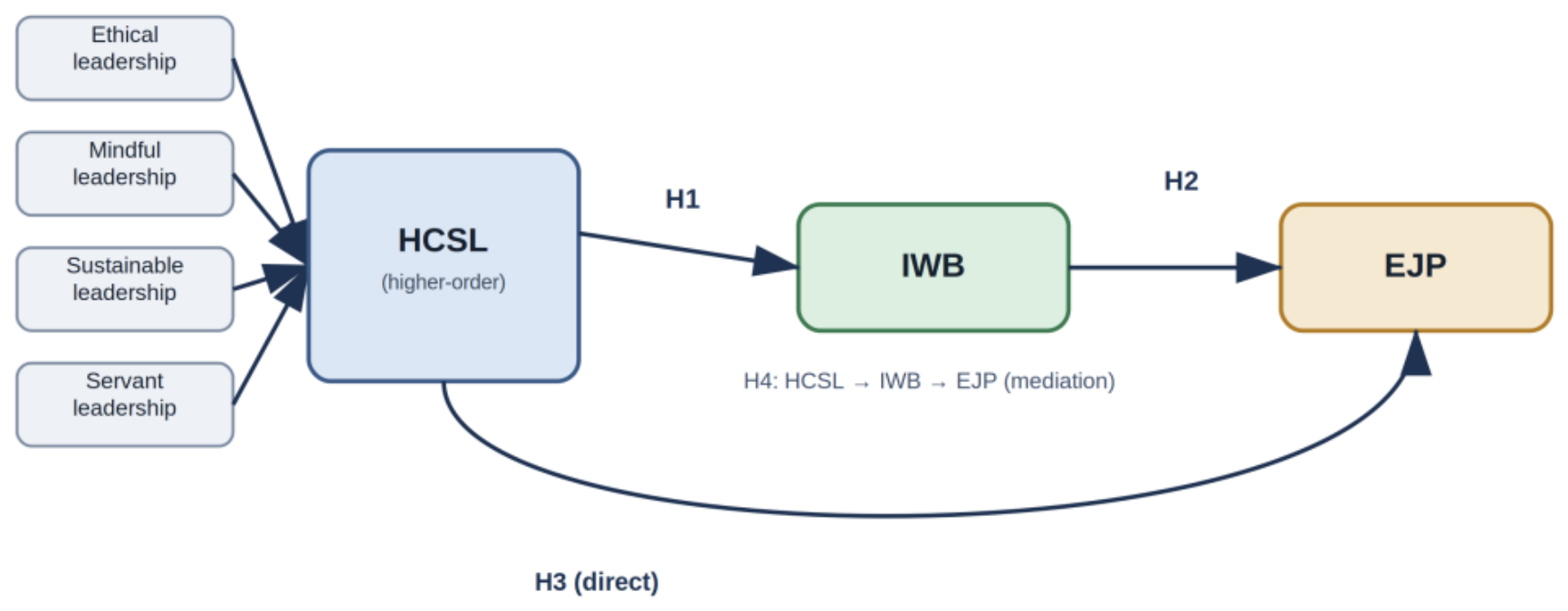
Human Capital Sustainability Leadership and Employee Job Performance in Public Asset Management: The Mediating Role of Innovative Work Behavior Among Indonesian Civil Servants
Abstract
1. Introduction
2. Theoretical Background and Hypothesis Development
2.1. Self-Determination Theory as Theoretical Foundation
2.2. Human Capital Sustainability Leadership (HCSL)
2.3. Innovative Work Behavior (IWB)
2.4. Employee Job Performance (EJP)
2.5. Hypothesis Development
2.5.1. HCSL and Innovative Work Behavior (H1)
2.5.2. Innovative Work Behavior and Employee Job Performance (H2)
2.5.3. HCSL and Employee Job Performance (H3)
2.5.4. The Mediating Role of IWB (H4)
3. Materials and Methods
3.1. Research Design and Population
3.2. Sample and Sampling Procedure
3.3. Instruments
3.4. Translation Procedure
3.5. Pilot Study
3.6. Common Method Bias Remedies
3.7. Data Analysis
4. Results
4.1. Descriptive Statistics and Sample Profile
4.2. Measurement Model Assessment
4.2.1. Indicator Reliability and Internal Consistency
4.2.2. Convergent Validity
4.2.3. Discriminant Validity
4.3. Structural Model Assessment
4.3.1. Collinearity
4.3.2. Hypothesis Testing
4.3.3. Explanatory Power and Effect Size
4.3.4. Predictive Relevance
5. Discussion
5.1. Summary of Findings
5.2. HCSL and Innovative Work Behavior
5.3. Innovative Work Behavior and Employee Job Performance
5.4. HCSL and Employee Job Performance: Direct Effect
5.5. The Mediating Role of Innovative Work Behavior
5.6. Implications for Sustainable Public Sector Management
5.7. Theoretical Contributions
5.8. Practical Implications
5.9. Limitations and Future Research
6. Conclusions
Author Contributions
Funding
Institutional Review Board Statement
Informed Consent Statement
Data Availability Statement
Acknowledgments
Conflicts of Interest
Abbreviations
| ASN | Aparatur Sipil Negara (Indonesian civil servants) |
| AVE | Average Variance Extracted |
| BMD | Barang Milik Daerah (regional government assets) |
| CI | Confidence Interval |
| CMB | Common Method Bias |
| EJP | Employee Job Performance |
| HCSL | Human Capital Sustainability Leadership |
| HTMT | Heterotrait–Monotrait Ratio |
| IWB | Innovative Work Behavior |
| IWPQ | Individual Work Performance Questionnaire |
| PLS-SEM | Partial Least Squares Structural Equation Modeling |
| SDT | Self-Determination Theory |
| SKPD/UKPD | Satuan Kerja/Unit Kerja Perangkat Daerah (regional working units) |
| VIF | Variance Inflation Factor |
Appendix A. Sample Profile and Indicator-Level Statistics for the Focal Constructs

| Characteristic | Category | n | % |
|---|---|---|---|
| Gender | Male | 340 | 62.8 |
| Female | 201 | 37.2 | |
| Age | <25 years | 1 | 0.2 |
| 25–35 years | 86 | 15.9 | |
| 36–45 years | 245 | 45.3 | |
| 46–55 years | 172 | 31.8 | |
| >55 years | 37 | 6.8 | |
| Education | Senior high school (SMA/SMK) | 95 | 17.6 |
| Diploma | 72 | 13.3 | |
| Bachelor’s degree (S1) | 297 | 54.9 | |
| Master’s degree (S2) | 76 | 14.0 | |
| Doctorate (S3) | 1 | 0.2 | |
| Tenure in government | <5 years | 38 | 7.0 |
| 5–10 years | 81 | 15.0 | |
| 11–15 years | 198 | 36.6 | |
| 16–20 years | 99 | 18.3 | |
| >20 years | 125 | 23.1 | |
| Position | Staff/implementer | 154 | 28.5 |
| Functional asset custodian (Pengurus Barang) | 298 | 55.1 | |
| Echelon IV official | 85 | 15.7 | |
| Echelon III official | 4 | 0.7 | |
| Type of work unit | UKPD (work-unit level) | 426 | 78.7 |
| SKPD (agency level) | 104 | 19.2 | |
| Regional Asset Management Agency (BPAD) | 11 | 2.0 | |
| Experience in BMD management | <2 years | 162 | 29.9 |
| 2–5 years | 244 | 45.1 | |
| 6–10 years | 98 | 18.1 | |
| >10 years | 37 | 6.8 |
| Item | Dimension | Indicator (English) | M | SD | r(it) | λ |
|---|---|---|---|---|---|---|
| HCSL1 | Ethical | Leader complies with laws and regulations on BMD management | 4.606 | 0.556 | 0.748 | 0.769 |
| HCSL2 | Ethical | Leader’s integrity in decisions on regional asset management | 4.582 | 0.589 | 0.729 | 0.750 |
| HCSL3 | Ethical | Leader sets an example in applying good-governance principles | 4.571 | 0.578 | 0.763 | 0.783 |
| HCSL4 | Ethical | Leader’s transparency in BMD-related decision-making | 4.567 | 0.588 | 0.769 | 0.788 |
| HCSL5 | Ethical | Leader’s honesty in reporting the condition of BMD | 4.599 | 0.568 | 0.746 | 0.768 |
| HCSL6 | Ethical | Leader’s fairness in treating all employees | 4.484 | 0.663 | 0.814 | 0.829 |
| HCSL7 | Ethical | Leader’s consistency in honoring commitments | 4.518 | 0.622 | 0.819 | 0.834 |
| HCSL8 | Ethical | Trust in the leader to meet performance targets | 4.573 | 0.584 | 0.791 | 0.809 |
| HCSL9 | Ethical | Leader’s consistency in implementing BMD management policy | 4.560 | 0.586 | 0.771 | 0.790 |
| HCSL10 | Ethical | Leader’s adherence to rules in BMD management decisions | 4.586 | 0.573 | 0.781 | 0.800 |
| HCSL11 | Ethical | Leader’s public-interest orientation in BMD decisions | 4.555 | 0.583 | 0.798 | 0.816 |
| HCSL12 | Ethical | Leader’s prudence in resolving BMD problems | 4.616 | 0.564 | 0.755 | 0.775 |
| HCSL13 | Sustainable | Leader encourages employees to update knowledge of BMD regulations | 4.436 | 0.714 | 0.727 | 0.739 |
| HCSL14 | Sustainable | Leader facilitates training in BMD management | 4.455 | 0.725 | 0.738 | 0.749 |
| HCSL15 | Sustainable | Leader supports employees in pursuing BMD competency certification | 4.558 | 0.649 | 0.712 | 0.724 |
| HCSL16 | Sustainable | Leader identifies employees’ competence-development needs | 4.438 | 0.711 | 0.827 | 0.833 |
| HCSL17 | Sustainable | Leader provides mentoring on technical BMD skills | 4.394 | 0.749 | 0.820 | 0.826 |
| HCSL18 | Sustainable | Leader creates sustainable human-resource development programs | 4.366 | 0.776 | 0.825 | 0.830 |
| HCSL19 | Sustainable | Leader helps plan employees’ career development | 4.353 | 0.798 | 0.814 | 0.819 |
| HCSL20 | Sustainable | Leader provides job-rotation opportunities | 4.246 | 0.812 | 0.756 | 0.764 |
| HCSL21 | Sustainable | Leader supports employees in pursuing formal education | 4.523 | 0.665 | 0.781 | 0.790 |
| HCSL22 | Sustainable | Leader identifies strategic priorities in BMD management | 4.462 | 0.673 | 0.840 | 0.846 |
| HCSL23 | Sustainable | Leader directs resources toward asset-utilization optimization | 4.470 | 0.684 | 0.830 | 0.837 |
| HCSL24 | Sustainable | Leader ensures a focus on sustainable asset management | 4.471 | 0.695 | 0.838 | 0.844 |
| HCSL25 | Mindful | Leader understands the challenges employees face in managing BMD | 4.360 | 0.729 | 0.863 | 0.866 |
| HCSL26 | Mindful | Leader is attentive to the workload of BMD staff | 4.325 | 0.761 | 0.858 | 0.859 |
| HCSL27 | Mindful | Leader is sensitive to the workload levels of BMD staff | 4.327 | 0.769 | 0.867 | 0.868 |
| HCSL28 | Mindful | Leader understands employees’ perspectives on technical BMD problems | 4.348 | 0.739 | 0.872 | 0.874 |
| HCSL29 | Mindful | Leader anticipates employees’ support needs before being asked | 4.299 | 0.781 | 0.854 | 0.857 |
| HCSL30 | Mindful | Leader is responsive to BMD facility and infrastructure needs | 4.355 | 0.745 | 0.868 | 0.871 |
| HCSL31 | Mindful | Leader provides access to information proactively | 4.301 | 0.772 | 0.824 | 0.828 |
| HCSL32 | Mindful | Leader recognizes each employee’s specific expertise | 4.299 | 0.759 | 0.862 | 0.864 |
| HCSL33 | Mindful | Leader assigns tasks accurately according to employee competence | 4.362 | 0.701 | 0.875 | 0.877 |
| HCSL34 | Mindful | Leader remains calm under BMD audit pressure | 4.377 | 0.719 | 0.838 | 0.842 |
| HCSL35 | Mindful | Leader’s emotional control when facing complex problems | 4.320 | 0.747 | 0.833 | 0.838 |
| HCSL36 | Mindful | Leader’s objectivity in assessing problems before key decisions | 4.397 | 0.717 | 0.874 | 0.877 |
| HCSL37 | Mindful | Leader prioritizes employee capacity development | 4.381 | 0.709 | 0.860 | 0.864 |
| HCSL38 | Mindful | Leader attends to employees’ work–life balance | 4.281 | 0.757 | 0.844 | 0.847 |
| HCSL39 | Servant | Leader helps resolve employees’ performance obstacles | 4.375 | 0.703 | 0.857 | 0.860 |
| HCSL40 | Servant | Leader motivates employees to improve performance | 4.449 | 0.669 | 0.844 | 0.849 |
| HCSL41 | Servant | Leader encourages employees to innovate in BMD management | 4.373 | 0.734 | 0.859 | 0.861 |
| HCSL42 | Servant | Leader appreciates employees’ performance achievements | 4.312 | 0.817 | 0.840 | 0.843 |
| HCSL43 | Servant | Leader ensures employees receive up-to-date BMD regulatory information | 4.403 | 0.723 | 0.863 | 0.865 |
| HCSL44 | Servant | Leader communicates openly about BMD management policy | 4.397 | 0.737 | 0.871 | 0.874 |
| HCSL45 | Servant | Leader provides adequate access to information systems | 4.421 | 0.702 | 0.872 | 0.876 |
| HCSL46 | Servant | Collaborative cross-unit work climate built by the leader | 4.397 | 0.714 | 0.871 | 0.874 |
| HCSL47 | Servant | Leader’s coordination with other work units | 4.444 | 0.672 | 0.856 | 0.861 |
| HCSL48 | Servant | Culture of mutual support built by the leader within the team | 4.442 | 0.690 | 0.870 | 0.874 |
| Item | Dimension | Indicator (English) | M | SD | r(it) | λ |
|---|---|---|---|---|---|---|
| IWB1 | Exploration | Attends to BMD problems beyond one’s own unit | 4.213 | 0.874 | 0.707 | 0.728 |
| IWB2 | Exploration | Identifies potential problems in optimizing BMD management | 4.384 | 0.678 | 0.853 | 0.863 |
| IWB3 | Generation | Develops new methods to speed up BMD inventory | 4.327 | 0.774 | 0.849 | 0.860 |
| IWB4 | Generation | Seeks innovative ways to improve asset-data accuracy | 4.344 | 0.753 | 0.894 | 0.902 |
| IWB5 | Generation | Finds new approaches to optimizing BMD management | 4.359 | 0.748 | 0.890 | 0.898 |
| IWB6 | Generation | Generates alternative solutions for resolving BMD disputes | 4.342 | 0.745 | 0.867 | 0.876 |
| IWB7 | Generation | Creatively formulates solutions for idle-asset optimization | 4.322 | 0.772 | 0.887 | 0.896 |
| IWB8 | Generation | Produces practical ideas for BMD management effectiveness | 4.338 | 0.737 | 0.915 | 0.921 |
| IWB9 | Generation | Finds efficient ways of recording BMD | 4.360 | 0.726 | 0.906 | 0.913 |
| IWB10 | Generation | Develops innovative approaches to BMD monitoring | 4.370 | 0.738 | 0.913 | 0.920 |
| IWB11 | Generation | Takes initiative to improve BMD standard operating procedures | 4.366 | 0.732 | 0.921 | 0.927 |
| IWB12 | Championing | Arouses colleagues’ enthusiasm for new BMD systems | 4.397 | 0.714 | 0.905 | 0.913 |
| IWB13 | Championing | Spreads enthusiasm for adopting BMD technology | 4.431 | 0.676 | 0.896 | 0.906 |
| IWB14 | Championing | Encourages colleagues to be open to BMD system change | 4.436 | 0.682 | 0.896 | 0.905 |
| IWB15 | Championing | Persuades colleagues of the benefits of BMD digitalization | 4.451 | 0.672 | 0.876 | 0.888 |
| IWB16 | Championing | Secures support for implementing an integrated BMD system | 4.445 | 0.669 | 0.862 | 0.874 |
| IWB17 | Championing | Effectively communicates the value of asset innovation | 4.383 | 0.712 | 0.907 | 0.915 |
| IWB18 | Championing | Presents BMD-improvement ideas to the team | 4.381 | 0.735 | 0.908 | 0.916 |
| IWB19 | Championing | Proposes BMD-efficiency ideas to the leader | 4.360 | 0.726 | 0.898 | 0.907 |
| IWB20 | Championing | Systematically introduces BMD-optimization concepts | 4.372 | 0.748 | 0.927 | 0.933 |
| IWB21 | Implementation | Applies innovative BMD ideas in daily work | 4.349 | 0.761 | 0.894 | 0.903 |
| IWB22 | Implementation | Persists in realizing a better asset-management system | 4.418 | 0.699 | 0.889 | 0.899 |
| IWB23 | Implementation | Ensures BMD-data improvement ideas are implemented | 4.401 | 0.717 | 0.912 | 0.920 |
| IWB24 | Implementation | Refines the BMD system based on feedback | 4.372 | 0.702 | 0.895 | 0.904 |
| IWB25 | Implementation | Develops applications into a comprehensive BMD system | 4.396 | 0.754 | 0.874 | 0.884 |
| IWB26 | Implementation | Adaptively modifies innovations as needed | 4.410 | 0.713 | 0.879 | 0.889 |
| Item | Dimension | Indicator (English) | M | SD | r(it) | λ |
|---|---|---|---|---|---|---|
| EJP1 | Task | Completes BMD tasks according to standards | 4.506 | 0.573 | 0.840 | 0.854 |
| EJP2 | Task | Meets BMD data-accuracy targets | 4.494 | 0.583 | 0.853 | 0.865 |
| EJP3 | Task | Meets the leader’s expectations for work output | 4.466 | 0.591 | 0.844 | 0.858 |
| EJP4 | Task | Performs duties per the Governor’s BMD regulation | 4.529 | 0.579 | 0.848 | 0.862 |
| EJP5 | Task | Reliably completes BMD reports on time | 4.457 | 0.644 | 0.817 | 0.831 |
| EJP6 | Task | Achieves performance indicators per the performance agreement | 4.508 | 0.598 | 0.859 | 0.872 |
| EJP7 | Task | Consistently meets minimum BMD service standards | 4.484 | 0.595 | 0.867 | 0.879 |
| EJP8 | Task | Proactively supports an unqualified (WTP) audit opinion | 4.558 | 0.553 | 0.824 | 0.840 |
| EJP9 | Task | Focuses on activities affecting SAKIP assessment | 4.508 | 0.586 | 0.854 | 0.868 |
| EJP10 | Task | Ensures fulfillment of BMD performance-assessment aspects | 4.492 | 0.576 | 0.867 | 0.880 |
| EJP11 | Task | Completes the BMD management cycle thoroughly | 4.494 | 0.579 | 0.874 | 0.887 |
| EJP12 | Task | Complies with mandatory BMD procedures | 4.549 | 0.568 | 0.855 | 0.870 |
| EJP13 | Task | Ensures completeness of mandatory BMD documents | 4.560 | 0.563 | 0.826 | 0.844 |
| EJP14 | Task | Successfully completes periodic BMD reports | 4.560 | 0.566 | 0.854 | 0.870 |
| EJP15 | Task | Successfully completes periodic BMD reports (second indicator) | 4.547 | 0.568 | 0.821 | 0.839 |
| EJP16 | Task | Successfully completes periodic BMD reports (third indicator) | 4.543 | 0.575 | 0.846 | 0.861 |
| EJP17 | Task | Reliable on crucial tasks such as BMD reconciliation | 4.506 | 0.601 | 0.854 | 0.867 |
| EJP18 | Contextual | Covers tasks for absent colleagues | 4.325 | 0.708 | 0.817 | 0.822 |
| EJP19 | Contextual | Helps with absent colleagues’ asset work | 4.294 | 0.736 | 0.805 | 0.809 |
| EJP20 | Contextual | Takes over verification tasks for unavailable colleagues | 4.257 | 0.764 | 0.815 | 0.819 |
| EJP21 | Contextual | Helps overwhelmed colleagues with BMD work | 4.397 | 0.672 | 0.862 | 0.865 |
| EJP22 | Contextual | Shares inventory tasks with overloaded colleagues | 4.349 | 0.732 | 0.821 | 0.825 |
| EJP23 | Contextual | Helps ease colleagues’ burden at deadlines | 4.396 | 0.677 | 0.856 | 0.859 |
| EJP24 | Contextual | Takes initiative to prepare BMD data for the leader | 4.455 | 0.624 | 0.886 | 0.890 |
| EJP25 | Contextual | Proactively supports the leader in BMD meetings | 4.477 | 0.592 | 0.887 | 0.895 |
| EJP26 | Contextual | Voluntarily helps the leader draft BMD policy | 4.451 | 0.647 | 0.874 | 0.879 |
| EJP27 | Contextual | Listens to colleagues’ BMD-related concerns | 4.445 | 0.638 | 0.860 | 0.865 |
| EJP28 | Contextual | Makes time to consult on asset problems | 4.423 | 0.664 | 0.871 | 0.875 |
| EJP29 | Contextual | Is a confidant for colleagues stressed by audits | 4.303 | 0.748 | 0.822 | 0.827 |
| EJP30 | Contextual | Helps orient new BPAD DKI Jakarta staff | 4.353 | 0.737 | 0.836 | 0.840 |
| EJP31 | Contextual | Guides new staff to understand the BMD system | 4.440 | 0.668 | 0.854 | 0.859 |
| EJP32 | Contextual | Ensures new staff understand BMD regulations | 4.409 | 0.681 | 0.840 | 0.846 |
| EJP33 | Contextual | Shares information on BMD policy changes | 4.442 | 0.655 | 0.889 | 0.892 |
| EJP34 | Contextual | Ensures colleagues receive BMD system updates | 4.431 | 0.676 | 0.830 | 0.837 |
| EJP35 | Contextual | Communicates inter-unit coordination in BMD management | 4.470 | 0.631 | 0.886 | 0.891 |
Appendix B. Full Item Wording (English and Bahasa Indonesia)
| Item | Indicator (English) | Indikator (Bahasa Indonesia—As Administered) |
|---|---|---|
| HCSL1 | Leader complies with laws and regulations on BMD management | Perilaku pimpinan dalam mematuhi peraturan perundang-undangan pengelolaan Barang Milik Daerah |
| HCSL2 | Leader’s integrity in decisions on regional asset management | Integritas pimpinan dalam mengambil keputusan terkait pengelolaan aset daerah |
| HCSL3 | Leader sets an example in applying good-governance principles | Keteladanan pimpinan dalam menerapkan prinsip-prinsip good governance |
| HCSL4 | Leader’s transparency in BMD-related decision-making | Transparansi pimpinan dalam pengambilan keputusan terkait Barang Milik Daerah |
| HCSL5 | Leader’s honesty in reporting the condition of BMD | Kejujuran pimpinan dalam melaporkan kondisi Barang Milik Daerah |
| HCSL6 | Leader’s fairness in treating all employees | Keadilan pimpinan dalam memperlakukan semua pegawai |
| HCSL7 | Leader’s consistency in honoring commitments | Konsistensi pimpinan dalam menepati komitmen |
| HCSL8 | Trust in the leader to meet performance targets | Kepercayaan terhadap pimpinan dalam memenuhi target kinerja |
| HCSL9 | Leader’s consistency in implementing BMD management policy | Konsistensi pimpinan dalam menjalankan kebijakan pengelolaan Barang Milik Daerah |
| HCSL10 | Leader’s adherence to rules in BMD management decisions | Kepatuhan pimpinan dalam keputusan pengelolaan Barang Milik Daerah |
| HCSL11 | Leader’s public-interest orientation in BMD decisions | Orientasi kepentingan publik pimpinan dalam pengambilan keputusan terkait pengelolaan Barang Milik Daerah |
| HCSL12 | Leader’s prudence in resolving BMD problems | Kehati-hatian pimpinan dalam menyelesaikan permasalahan Barang Milik Daerah |
| HCSL13 | Leader encourages employees to update knowledge of BMD regulations | Pimpinan mendorong pegawai memperbarui pengetahuan regulasi pengelolaan Barang Milik Daerah |
| HCSL14 | Leader facilitates training in BMD management | Pimpinan memfasilitasi pelatihan pengelolaan Barang Milik Daerah |
| HCSL15 | Leader supports employees in pursuing BMD competency certification | Pimpinan mendukung pegawai mengikuti sertifikasi keahlian pengelolaan Barang Milik Daerah |
| HCSL16 | Leader identifies employees’ competence-development needs | Pimpinan mengidentifikasi kebutuhan pengembangan kompetensi pegawai |
| HCSL17 | Leader provides mentoring on technical BMD skills | Pimpinan memberikan mentoring kemampuan teknis pengelolaan Barang Milik Daerah |
| HCSL18 | Leader creates sustainable human-resource development programs | Pimpinan menciptakan program pengembangan sumber daya manusia yang berkelanjutan |
| HCSL19 | Leader helps plan employees’ career development | Pimpinan membantu merencanakan pengembangan karir pegawai |
| HCSL20 | Leader provides job-rotation opportunities | Pimpinan memberikan kesempatan rotasi jabatan |
| HCSL21 | Leader supports employees in pursuing formal education | Pimpinan mendukung pegawai mengikuti pendidikan formal |
| HCSL22 | Leader identifies strategic priorities in BMD management | Pimpinan mengidentifikasi prioritas strategis pengelolaan Barang Milik Daerah |
| HCSL23 | Leader directs resources toward asset-utilization optimization | Pimpinan mengarahkan sumber daya pada kegiatan optimalisasi pemanfaatan aset |
| HCSL24 | Leader ensures a focus on sustainable asset management | Pimpinan memastikan fokus pada pengelolaan aset berkelanjutan |
| HCSL25 | Leader understands the challenges employees face in managing BMD | Pimpinan paham tingkat tantangan pegawai dalam mengelola Barang Milik Daerah |
| HCSL26 | Leader is attentive to the workload of BMD staff | Pimpinan peduli terhadap tingkatan beban kerja pegawai pengelola Barang Milik Daerah |
| HCSL27 | Leader is sensitive to the workload levels of BMD staff | Pimpinan peduli terhadap tingkatan beban kerja pegawai pengelola Barang Milik Daerah 2 |
| HCSL28 | Leader understands employees’ perspectives on technical BMD problems | Pimpinan mampu memahami perspektif pegawai menghadapi permasalahan teknis terkait pengelolaan Barang Milik Daerah |
| HCSL29 | Leader anticipates employees’ support needs before being asked | Pimpinan memenuhi kebutuhan dukungan sebelum diminta pegawai dalam bekerja |
| HCSL30 | Leader is responsive to BMD facility and infrastructure needs | Pimpinan tanggap terhadap kebutuhan sarana prasarana pengelolaan Barang Milik Daerah |
| HCSL31 | Leader provides access to information proactively | Pimpinan menyediakan akses informasi tanpa diminta |
| HCSL32 | Leader recognizes each employee’s specific expertise | Pimpinan mampu mengenali keahlian khusus setiap pegawai |
| HCSL33 | Leader assigns tasks accurately according to employee competence | Pimpinan memiliki ketepatan dalam memberikan penugasan sesuai kompetensi pegawai |
| HCSL34 | Leader remains calm under BMD audit pressure | Pimpinan tenang dalam menghadapi tekanan audit pengelolaan Barang Milik Daerah |
| HCSL35 | Leader’s emotional control when facing complex problems | Pengendalian emosi pimpinan menghadapi permasalahan kompleks |
| HCSL36 | Leader’s objectivity in assessing problems before key decisions | Tingkat objektivitas pimpinan dalam melihat permasalahan sebelum mengambil keputusan penting |
| HCSL37 | Leader prioritizes employee capacity development | Pimpinan mengedepankan prioritas dalam pengembangan kapasitas pegawai |
| HCSL38 | Leader attends to employees’ work–life balance | Pimpinan memperhatikan work–life balance pegawai |
| HCSL39 | Leader helps resolve employees’ performance obstacles | Bantuan pimpinan menyelesaikan kendala kinerja pegawai |
| HCSL40 | Leader motivates employees to improve performance | Pimpinan memotivasi pegawai untuk meningkatkan kinerja |
| HCSL41 | Leader encourages employees to innovate in BMD management | Pimpinan mendorong pegawai untuk berinovasi dalam pengelolaan Barang Milik Daerah |
| HCSL42 | Leader appreciates employees’ performance achievements | Pimpinan memberikan apresiasi atas pencapaian kinerja pegawai |
| HCSL43 | Leader ensures employees receive up-to-date BMD regulatory information | Pimpinan memastikan pegawai mendapat informasi terkini regulasi pengelolaan Barang Milik Daerah |
| HCSL44 | Leader communicates openly about BMD management policy | Pimpinan berkomunikasi secara terbuka mengenai kebijakan pengelolaan Barang Milik Daerah |
| HCSL45 | Leader provides adequate access to information systems | Pimpinan menyediakan akses sistem informasi yang memadai |
| HCSL46 | Collaborative cross-unit work climate built by the leader | Suasana kerja kolaboratif yang dibangun pemimpinan antar unit |
| HCSL47 | Leader’s coordination with other work units | Koordinasi yang dilakukan pemimpin dengan unit kerja lain dalam bekerja |
| HCSL48 | Culture of mutual support built by the leader within the team | Budaya saling mendukung yang dibangun pimpinan dalam tim |
| Item | Indicator (English) | Indikator (Bahasa Indonesia—As Administered) |
|---|---|---|
| IWB1 | Attends to BMD problems beyond one’s own unit | Memperhatikan masalah pengelolaan Barang Milik Daerah di luar unit kerja |
| IWB2 | Identifies potential problems in optimizing BMD management | Mengidentifikasi potensi masalah optimalisasi pengelolaan Barang Milik Daerah |
| IWB3 | Develops new methods to speed up BMD inventory | Mengembangkan metode baru untuk mempercepat inventarisasi BMD |
| IWB4 | Seeks innovative ways to improve asset-data accuracy | Mencari cara inovatif dalam meningkatkan akurasi data aset |
| IWB5 | Finds new approaches to optimizing BMD management | Menemukan pendekatan baru optimalisasi pengelolaan Barang Milik Daerah |
| IWB6 | Generates alternative solutions for resolving BMD disputes | Menghasilkan alternatif solusi dalam menyelesaikan sengketa Barang Milik Daerah |
| IWB7 | Creatively formulates solutions for idle-asset optimization | Kreatif merumuskan solusi optimalisasi aset yang idle |
| IWB8 | Produces practical ideas for BMD management effectiveness | Menghasilkan ide praktis efektivitas pengelolaan Barang Milik Daerah |
| IWB9 | Finds efficient ways of recording BMD | Menemukan cara kerja yang efisien dalam pencatatan Barang Milik Daerah |
| IWB10 | Develops innovative approaches to BMD monitoring | Mengembangkan pendekatan inovatif dalam pelaksanaan monitoring pengelolaan Barang Milik Daerah |
| IWB11 | Takes initiative to improve BMD standard operating procedures | Berinisiatif memperbaiki Prosedur Operasi Standar (POS) pengelolaan Barang Milik Daerah |
| IWB12 | Arouses colleagues’ enthusiasm for new BMD systems | Membangkitkan antusiasme rekan terhadap sistem pengelolaan Barang Milik Daerah baru |
| IWB13 | Spreads enthusiasm for adopting BMD technology | Menularkan semangat penerapan teknologi pengelolaan Barang Milik Daerah |
| IWB14 | Encourages colleagues to be open to BMD system change | Mendorong rekan terbuka terhadap perubahan sistem pengelolaan Barang Milik Daerah |
| IWB15 | Persuades colleagues of the benefits of BMD digitalization | Meyakinkan rekan tentang manfaat digitalisasi pengelolaan Barang Milik Daerah |
| IWB16 | Secures support for implementing an integrated BMD system | Mendapat dukungan implementasi sistem pengelolaan Barang Milik Daerah yang terintegrasi |
| IWB17 | Effectively communicates the value of asset innovation | Efektif mengkomunikasikan akan nilai inovasi aset |
| IWB18 | Presents BMD-improvement ideas to the team | Mempresentasikan ide peningkatan pengelolaan Barang Milik Daerah kepada tim |
| IWB19 | Proposes BMD-efficiency ideas to the leader | Mengusulkan gagasan efisiensi pengelolaan Barang Milik Daerah kepada pimpinan |
| IWB20 | Systematically introduces BMD-optimization concepts | Sistematis memperkenalkan konsep optimalisasi pengelolaan Barang Milik Daerah |
| IWB21 | Applies innovative BMD ideas in daily work | Menerapkan ide inovatif pengelolaan Barang Milik Daerah sehari-hari |
| IWB22 | Persists in realizing a better asset-management system | Memiliki sikap gigih guna mewujudkan sistem pengelolaan aset yang lebih baik |
| IWB23 | Ensures BMD-data improvement ideas are implemented | Memastikan ide peningkatan data Barang Milik Daerah yang diimplementasikan |
| IWB24 | Refines the BMD system based on feedback | Menyempurnakan sistem pengelolaan Barang Milik Daerah berdasarkan umpan balik |
| IWB25 | Develops applications into a comprehensive BMD system | Mengembangkan aplikasi menjadi sistem pengelolaan Barang Milik Daerah yang komprehensif |
| IWB26 | Adaptively modifies innovations as needed | Adaptif dalam memodifikasi inovasi sesuai kebutuhan |
| Item | Indicator (English) | Indikator (Bahasa Indonesia—As Administered) |
|---|---|---|
| EJP1 | Completes BMD tasks according to standards | Tingkat penyelesaian tugas pengelolaan Barang Milik Daerah sesuai standar |
| EJP2 | Meets BMD data-accuracy targets | Kemampuan memenuhi target akurasi data Barang Milik Daerah |
| EJP3 | Meets the leader’s expectations for work output | Pemenuhan hasil kerja terhadap ekspektasi pimpinan |
| EJP4 | Performs duties per the Governor’s BMD regulation | Pelaksanaan kewajiban sesuai Peraturan Gubernur Barang Milik Daerah mengenai pengelolaan Barang Milik Daerah |
| EJP5 | Reliably completes BMD reports on time | Keandalan menyelesaikan laporan pengelolaan Barang Milik Daerah tepat waktu |
| EJP6 | Achieves performance indicators per the performance agreement | Pencapaian indikator kinerja sesuai Perjanjian Kinerja |
| EJP7 | Consistently meets minimum BMD service standards | Konsistensi memenuhi standar pelayanan minimal pengelolaan Barang Milik Daerah |
| EJP8 | Proactively supports an unqualified (WTP) audit opinion | Proaktivitas mendukung capaian opini wajar tanpa pengecualian (WTP) laporan pengelolaan Barang Milik Daerah |
| EJP9 | Focuses on activities affecting SAKIP assessment | Fokus pada aktivitas berdampak penilaian sistem akuntabilitas kinerja instansi pemerintah (SAKIP) |
| EJP10 | Ensures fulfillment of BMD performance-assessment aspects | Kepastian pemenuhan aspek penilaian kinerja pengelolaan Barang Milik Daerah |
| EJP11 | Completes the BMD management cycle thoroughly | Kelengkapan pelaksanaan siklus pengelolaan Barang Milik Daerah |
| EJP12 | Complies with mandatory BMD procedures | Kepatuhan terhadap prosedur wajib pengelolaan Barang Milik Daerah |
| EJP13 | Ensures completeness of mandatory BMD documents | Kepastian kelengkapan dokumen pengelolaan Barang Milik Daerah wajib |
| EJP14 | Successfully completes periodic BMD reports | Keberhasilan menyelesaikan laporan pengelolaan Barang Milik Daerah periodik |
| EJP15 | Successfully completes periodic BMD reports (second indicator) | Keberhasilan menyelesaikan laporan pengelolaan Barang Milik Daerah periodik 2 |
| EJP16 | Successfully completes periodic BMD reports (third indicator) | Keberhasilan menyelesaikan laporan pengelolaan Barang Milik Daerah periodik 3 |
| EJP17 | Reliable on crucial tasks such as BMD reconciliation | Keandalan untuk tugas krusial seperti rekonsiliasi Barang Milik Daerah |
| EJP18 | Covers tasks for absent colleagues | Menggantikan tugas rekan kerja yang tidak masuk |
| EJP19 | Helps with absent colleagues’ asset work | Membantu pekerjaan aset rekan kerja yang absen |
| EJP20 | Takes over verification tasks for unavailable colleagues | Mengambil alih tugas verifikasi rekan kerja berhalangan |
| EJP21 | Helps overwhelmed colleagues with BMD work | Membantu rekan kerja saat kewalahan menyusun pengelolaan Barang Milik Daerah |
| EJP22 | Shares inventory tasks with overloaded colleagues | Berbagi tugas inventarisasi dengan rekan kerja yang overload |
| EJP23 | Helps ease colleagues’ burden at deadlines | Membantu meringankan beban rekan saat deadline |
| EJP24 | Takes initiative to prepare BMD data for the leader | Inisiatif menyiapkan data pengelolaan Barang Milik Daerah untuk pimpinan |
| EJP25 | Proactively supports the leader in BMD meetings | Proaktif mendukung pimpinan dalam rapat pengelolaan Barang Milik Daerah |
| EJP26 | Voluntarily helps the leader draft BMD policy | Sukarela membantu pimpinan menyusun kebijakan terkait pengelolaan Barang Milik Daerah |
| EJP27 | Listens to colleagues’ BMD-related concerns | Mendengarkan keluhan rekan tentang pengelolaan Barang Milik Daerah |
| EJP28 | Makes time to consult on asset problems | Menyediakan waktu konsultasi masalah aset |
| EJP29 | Is a confidant for colleagues stressed by audits | Menjadi tempat curhat rekan stress audit |
| EJP30 | Helps orient new BPAD DKI Jakarta staff | Membantu orientasi pegawai baru bidang BPAD DKI Jakarta |
| EJP31 | Guides new staff to understand the BMD system | Membimbing pegawai baru memahami sistem pengelolaan Barang Milik Daerah |
| EJP32 | Ensures new staff understand BMD regulations | Memastikan pegawai baru paham regulasi pengelolaan Barang Milik Daerah |
| EJP33 | Shares information on BMD policy changes | Membagikan informasi perubahan kebijakan pengelolaan Barang Milik Daerah |
| EJP34 | Ensures colleagues receive BMD system updates | Memastikan rekan kerja mendapat update sistem pengelolaan Barang Milik Daerah |
| EJP35 | Communicates inter-unit coordination in BMD management | Komunikatif menyampaikan koordinasi antar unit dalam pengelolaan Barang Milik Daerah |
References
- United Nations. Transforming Our World: The 2030 Agenda for Sustainable Development; UN General Assembly: New York, NY, USA, 2015. [Google Scholar]
- Pfeffer, J. Building sustainable organizations: The human factor. Acad. Manag. Perspect. 2010, 24, 34–45. [Google Scholar] [CrossRef]
- Lokuwaduge, C.S.D.S.; De Silva, K.M. Determinants of public sector asset management: A conceptual review. Int. J. Public Sect. Manag. 2018, 31, 717–733. [Google Scholar]
- Republic of Indonesia. Government Regulation No. 27/2014 Jo. 28/2020 on the Management of State/Regional Owned Assets; Government of Indonesia: Jakarta, Indonesia, 2020.
- Tummers, L.; Bekkers, V. Policy implementation, street-level bureaucracy, and the importance of discretion. Public Manag. Rev. 2014, 16, 527–547. [Google Scholar]
- Vigoda-Gadot, E.; Beeri, I. Change-oriented organizational citizenship behavior in public administration: The power of leadership and the cost of organizational politics. J. Public Adm. Res. Theory 2012, 22, 573–596. [Google Scholar] [CrossRef]
- Di Fabio, A.; Peiró, J.M. Human Capital Sustainability Leadership to promote sustainable development and healthy organizations: A new scale. Sustainability 2018, 10, 2413. [Google Scholar] [CrossRef]
- Hood, C. The “new public management” in the 1980s: Variations on a theme. Account. Organ. Soc. 1995, 20, 93–109. [Google Scholar] [CrossRef]
- Pollitt, C.; Bouckaert, G. Public Management Reform: A Comparative Analysis—Into the Age of Austerity, 4th ed.; Oxford University Press: Oxford, UK, 2017. [Google Scholar]
- De Jong, J.; Den Hartog, D. Measuring innovative work behaviour. Creat. Innov. Manag. 2010, 19, 23–36. [Google Scholar] [CrossRef]
- Peiró, J.M.; Di Fabio, A. Human capital sustainability leadership and healthy organizations: Building sustainable workplaces. Front. Psychol. 2024, 15, 1352128. [Google Scholar] [CrossRef]
- Slemp, G.R.; Kern, M.L.; Patrick, K.J.; Ryan, R.M. Leader autonomy support in the workplace: A meta-analytic review. Motiv. Emot. 2018, 42, 706–724. [Google Scholar] [CrossRef] [PubMed]
- Audenaert, M.; Decramer, A.; George, B.; Verschuere, B.; Van Waeyenberg, T. When employee performance management affects individual innovation in public organizations: The role of consistency and LMX. Int. J. Hum. Resour. Manag. 2020, 31, 815–834. [Google Scholar]
- Bysted, R.; Jespersen, K.R. Exploring managerial mechanisms that influence innovative work behaviour: Comparing private and public employees. Public Manag. Rev. 2014, 16, 217–241. [Google Scholar]
- Ryan, R.M.; Deci, E.L. Self-Determination Theory: Basic Psychological Needs in Motivation, Development, and Wellness; Guilford Publications: New York, NY, USA, 2017. [Google Scholar]
- Deci, E.L.; Olafsen, A.H.; Ryan, R.M. Self-determination theory in work organizations: The state of a science. Annu. Rev. Organ. Psychol. Organ. Behav. 2017, 4, 19–43. [Google Scholar] [CrossRef]
- Deci, E.L.; Ryan, R.M. The “what” and “why” of goal pursuits: Human needs and the self-determination of behavior. Psychol. Inq. 2000, 11, 227–268. [Google Scholar] [CrossRef]
- Gagné, M.; Deci, E.L. Self-determination theory and work motivation. J. Organ. Behav. 2005, 26, 331–362. [Google Scholar] [CrossRef]
- Van den Broeck, A.; Ferris, D.L.; Chang, C.H.; Rosen, C.C. A review of self-determination theory’s basic psychological needs at work. J. Manag. 2016, 42, 1195–1229. [Google Scholar] [CrossRef]
- Vaamonde, J.D.; Peiró, J.M. Sustainability and well-being at work: Toward an integrative agenda. Sustainability 2025, 17, 1124. [Google Scholar]
- Hargreaves, A.; Fink, D. Sustainable Leadership; Jossey-Bass: San Francisco, CA, USA, 2006. [Google Scholar]
- Davis, J.H.; Schoorman, F.D.; Donaldson, L. Toward a stewardship theory of management. Acad. Manag. Rev. 1997, 22, 20–47. [Google Scholar] [CrossRef]
- Khalil, S.H.; Shah, S.H.A.; Khalil, S.M. Sustaining work outcomes through human capital sustainability leadership. Leadersh. Organ. Dev. J. 2021, 42, 886–902. [Google Scholar] [CrossRef]
- Effendi, M.; Setiawan, M.; Soekarno, S. Human capital sustainability leadership and adaptive performance: Evidence from Southeast Asia. J. Manag. Dev. 2024, 43, 215–232. [Google Scholar]
- Ministry of Administrative and Bureaucratic Reform of the Republic of Indonesia. Regulation of the Minister No. 6 of 2022 on Core Values of Civil Servants (BerAKHLAK); MENPANRB: Jakarta, Indonesia, 2022. [Google Scholar]
- Pless, N.M.; Maak, T. Responsible leadership: Pathways to the future. J. Bus. Ethics 2011, 98, 3–13. [Google Scholar] [CrossRef]
- Brown, M.E.; Treviño, L.K.; Harrison, D.A. Ethical leadership: A social learning perspective for construct development and testing. Organ. Behav. Hum. Decis. Process. 2005, 97, 117–134. [Google Scholar] [CrossRef]
- Robertson, J.L.; Barling, J. Greening organizations through leaders’ influence on employees’ pro-environmental behaviors. J. Organ. Behav. 2013, 34, 176–194. [Google Scholar]
- Janssen, O. Job demands, perceptions of effort-reward fairness and innovative work behaviour. J. Occup. Organ. Psychol. 2000, 73, 287–302. [Google Scholar] [CrossRef]
- De Vries, H.; Bekkers, V.; Tummers, L. Innovation in the public sector: A systematic review and future research agenda. Public Adm. 2016, 94, 146–166. [Google Scholar]
- Damanpour, F.; Schneider, M. Characteristics of innovation and innovation adoption in public organizations: Assessing the role of managers. J. Public Adm. Res. Theory 2009, 19, 495–522. [Google Scholar]
- Borins, S. Encouraging innovation in the public sector. J. Intellect. Cap. 2001, 2, 310–319. [Google Scholar] [CrossRef]
- Osborne, S.P.; Brown, L. Managing Change and Innovation in Public Service Organizations; Routledge: London, UK, 2005. [Google Scholar]
- Edmondson, A.C. Psychological safety and learning behavior in work teams. Adm. Sci. Q. 1999, 44, 350–383. [Google Scholar] [CrossRef]
- Liu, D.; Chen, X.P.; Yao, X. From autonomy to creativity: A multilevel investigation of the mediating role of harmonious passion. J. Appl. Psychol. 2011, 96, 294–309. [Google Scholar] [CrossRef] [PubMed]
- Perry, J.L.; Wise, L.R. The motivational bases of public service. Public Adm. Rev. 1990, 50, 367–373. [Google Scholar] [CrossRef]
- Atatsi, E.A.; Stoffers, J.; Kil, A. Factors affecting employee performance: A systematic literature review. J. Adv. Manag. Res. 2019, 16, 329–351. [Google Scholar] [CrossRef]
- Koopmans, L.; Bernaards, C.M.; Hildebrandt, V.H.; De Vet, H.C.; Van der Beek, A.J. Construct validity of the individual work performance questionnaire. J. Occup. Environ. Med. 2014, 56, 331–337. [Google Scholar] [CrossRef] [PubMed]
- Bovaird, T.; Loeffler, E. From engagement to co-production: The contribution of users and communities to outcomes and public value. Volunt. Int. J. Volunt. Nonprofit Organ. 2012, 23, 1119–1138. [Google Scholar] [CrossRef]
- Ferlie, E.; Ashburner, L.; Fitzgerald, L.; Pettigrew, A. The New Public Management in Action; Oxford University Press: Oxford, UK, 1996. [Google Scholar]
- Amabile, T.M.; Schatzel, E.A.; Moneta, G.B.; Kramer, S.J. Leader behaviors and the work environment for creativity: Perceived leader support. Leadersh. Q. 2004, 15, 5–32. [Google Scholar] [CrossRef]
- Khalil, S.A.; Khan, M.A.; Mahmood, K. Sustainable leadership and innovative work behaviour: The mediating role of organizational learning culture. Sustainability 2021, 13, 12081. [Google Scholar]
- Yuan, F.; Woodman, R.W. Innovative behavior in the workplace: The role of performance and image outcome expectations. Acad. Manag. J. 2010, 53, 323–342. [Google Scholar] [CrossRef]
- Hammond, M.M.; Neff, N.L.; Farr, J.L.; Schwall, A.R.; Zhao, X. Predictors of individual-level innovation at work: A meta-analysis. Psychol. Aesthet. Creat. Arts 2011, 5, 90–105. [Google Scholar] [CrossRef]
- Demircioglu, M.A. The effects of empowerment practices on perceived barriers to innovation: Evidence from public organizations. Int. J. Public Adm. 2018, 41, 1302–1313. [Google Scholar] [CrossRef]
- Reb, J.; Narayanan, J.; Chaturvedi, S. Leading mindfully: Two studies on the influence of supervisor trait mindfulness on employee well-being and performance. Mindfulness 2014, 5, 36–45. [Google Scholar] [CrossRef]
- Ministry of Home Affairs of the Republic of Indonesia. Regulation of the Minister No. 19/2016 Jo. 47/2021 on the Management of Regional Government Assets (Barang Milik Daerah); Ministry of Home Affairs: Jakarta, Indonesia, 2021.
- Hair, J.F.; Hult, G.T.M.; Ringle, C.M.; Sarstedt, M. A Primer on Partial Least Squares Structural Equation Modeling (PLS-SEM), 3rd ed.; Sage: Thousand Oaks, CA, USA, 2022. [Google Scholar]
- Hinkin, T.R. A brief tutorial on the development of measures for use in survey questionnaires. Organ. Res. Methods 1998, 1, 104–121. [Google Scholar] [CrossRef]
- MacKenzie, S.B.; Podsakoff, P.M.; Podsakoff, N.P. Construct measurement and validation procedures in MIS and behavioral research: Integrating new and existing techniques. MIS Q. 2011, 35, 293–334. [Google Scholar] [CrossRef]
- Carpenter, S. Ten steps in scale development and reporting: A guide for researchers. Commun. Methods Meas. 2018, 12, 25–44. [Google Scholar] [CrossRef]
- Beaton, D.E.; Bombardier, C.; Guillemin, F.; Ferraz, M.B. Guidelines for the process of cross-cultural adaptation of self-report measures. Spine 2000, 25, 3186–3191. [Google Scholar] [CrossRef] [PubMed]
- Sarstedt, M.; Hair, J.F.; Cheah, J.H.; Becker, J.M.; Ringle, C.M. How to specify, estimate, and validate higher-order constructs in PLS-SEM. Australas. Mark. J. 2019, 27, 197–211. [Google Scholar] [CrossRef]
- Lawshe, C.H. A quantitative approach to content validity. Pers. Psychol. 1975, 28, 563–575. [Google Scholar] [CrossRef]
- Brislin, R.W. Back-translation for cross-cultural research. J. Cross-Cult. Psychol. 1970, 1, 185–216. [Google Scholar] [CrossRef]
- Podsakoff, P.M.; MacKenzie, S.B.; Podsakoff, N.P. Sources of method bias in social science research and recommendations on how to control it. Annu. Rev. Psychol. 2012, 63, 539–569. [Google Scholar] [CrossRef] [PubMed]
- Kock, N. Common method bias in PLS-SEM: A full collinearity assessment approach. Int. J. e-Collab. 2015, 11, 1–10. [Google Scholar]
- Shmueli, G.; Sarstedt, M.; Hair, J.F.; Cheah, J.H.; Ting, H.; Vaithilingam, S.; Ringle, C.M. Predictive model assessment in PLS-SEM: Guidelines for using PLSpredict. Eur. J. Mark. 2019, 53, 2322–2347. [Google Scholar] [CrossRef]
- Zhao, X.; Lynch, J.G.; Chen, Q. Reconsidering Baron and Kenny: Myths and truths about mediation analysis. J. Consum. Res. 2010, 37, 197–206. [Google Scholar] [CrossRef]
- Henseler, J.; Ringle, C.M.; Sarstedt, M. A new criterion for assessing discriminant validity in variance-based structural equation modeling. J. Acad. Mark. Sci. 2015, 43, 115–135. [Google Scholar] [CrossRef]
- Fornell, C.; Larcker, D.F. Evaluating structural equation models with unobservable variables and measurement error. J. Mark. Res. 1981, 18, 39–50. [Google Scholar] [CrossRef]
- Cohen, J. Statistical Power Analysis for the Behavioral Sciences, 2nd ed.; Lawrence Erlbaum Associates: Hillsdale, NJ, USA, 1988. [Google Scholar]
- Hofstede, G. Culture’s Consequences: International Differences in Work-Related Values; Sage: Beverly Hills, CA, USA, 1980. [Google Scholar]
- Lozano, R. Envisioning sustainability three-dimensionally. J. Clean. Prod. 2008, 16, 1838–1846. [Google Scholar] [CrossRef]

| AVE | rho_c | rho_a | Cronbach’s α | Construct |
|---|---|---|---|---|
| 0.737 | 0.990 | 0.990 | 0.989 | EJP |
| 0.689 | 0.991 | 0.991 | 0.990 | HCSL |
| 0.802 | 0.991 | 0.990 | 0.990 | IWB |
| IWB | HCSL | EJP | Construct |
|---|---|---|---|
| — | EJP | ||
| — | 0.765 | HCSL | |
| — | 0.839 | 0.755 | IWB |
| IWB | HCSL | EJP | Construct |
|---|---|---|---|
| 0.859 | EJP | ||
| 0.830 | 0.758 | HCSL | |
| 0.895 | 0.834 | 0.749 | IWB |
| Decision | 95% CI | p | t | SE | β | Path | Hypothesis |
|---|---|---|---|---|---|---|---|
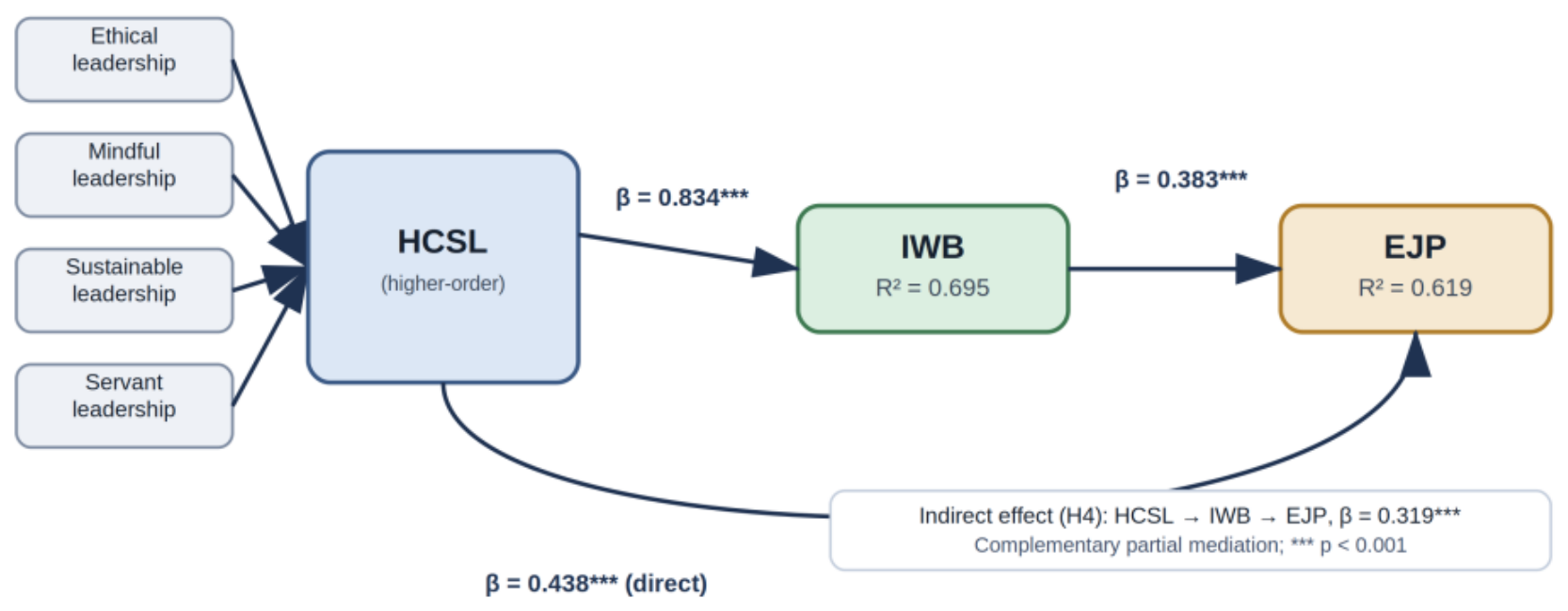
| Supported | [0.793, 0.868] | <0.001 | 37.270 | 0.022 | 0.834 | HCSL → IWB | H1 |
| Supported | [0.234, 0.531] | <0.001 | 4.211 | 0.091 | 0.383 | IWB → EJP | H2 |
| Supported | — | <0.001 | 4.879 | 0.090 | 0.438 | HCSL → EJP | H3 |
| Supported | [0.194, 0.440] | <0.001 | 4.247 | 0.075 | 0.319 | HCSL → IWB → EJP | H4 |
| MAE | RMSE | Q2predict | Construct |
|---|---|---|---|
| 0.480 | 0.659 | 0.570 | EJP |
| 0.348 | 0.560 | 0.691 | IWB |
Disclaimer/Publisher’s Note: The statements, opinions and data contained in all publications are solely those of the individual author(s) and contributor(s) and not of MDPI and/or the editor(s). MDPI and/or the editor(s) disclaim responsibility for any injury to people or property resulting from any ideas, methods, instructions or products referred to in the content. |
© 2026 by the authors. Licensee MDPI, Basel, Switzerland. This article is an open access article distributed under the terms and conditions of the Creative Commons Attribution (CC BY) license.
Share and Cite
Syahkuala, I.; Rivai, V.; Kasmir; Elmi, F. Human Capital Sustainability Leadership and Employee Job Performance in Public Asset Management: The Mediating Role of Innovative Work Behavior Among Indonesian Civil Servants. Sustainability 2026, 18, 8115. https://doi.org/10.3390/su18168115
Syahkuala I, Rivai V, Kasmir, Elmi F. Human Capital Sustainability Leadership and Employee Job Performance in Public Asset Management: The Mediating Role of Innovative Work Behavior Among Indonesian Civil Servants. Sustainability. 2026; 18(16):8115. https://doi.org/10.3390/su18168115
Chicago/Turabian StyleSyahkuala, Irfan, Veithzal Rivai, Kasmir, and Farida Elmi. 2026. "Human Capital Sustainability Leadership and Employee Job Performance in Public Asset Management: The Mediating Role of Innovative Work Behavior Among Indonesian Civil Servants" Sustainability 18, no. 16: 8115. https://doi.org/10.3390/su18168115
APA StyleSyahkuala, I., Rivai, V., Kasmir, & Elmi, F. (2026). Human Capital Sustainability Leadership and Employee Job Performance in Public Asset Management: The Mediating Role of Innovative Work Behavior Among Indonesian Civil Servants. Sustainability, 18(16), 8115. https://doi.org/10.3390/su18168115