Systematic Review

Conceptualizing Digital Education for Sustainable and Equitable Face-to-Face Schooling: A Systematic Review


by
Héctor Martínez García
1,2,
Marta Rubio Gómez-Cadiñanos
2,
Trinidad García
1,
Débora Areces
1,
Ana Isabel Álvarez
3,
Celestino Rodríguez
1 and
José Carlos Núñez
1,*
1
Department of Psychology, University of Oviedo, 33003 Oviedo, Spain
2
Salesianos Domingo Savio School, 26008 Logroño, Spain
3
Departament of English Philology, University of Oviedo, 33005 Oviedo, Spain
*
Author to whom correspondence should be addressed.
Sustainability 2026, 18(15), 7979; https://doi.org/10.3390/su18157979
Submission received: 16 June 2026 / Revised: 22 July 2026 / Accepted: 3 August 2026 / Published: 6 August 2026

Abstract

The integration of Information and Communication Technologies (ICT) into face-to-face compulsory education has accelerated globally, but the conceptual definition and pedagogical application of Digital Education (DE) remain unclear. This systematic review explores how DE is defined, implemented, and assessed in in-person primary and secondary school settings. Guided by PRISMA methodology, 33 peer-reviewed empirical studies published between January 2012 and June 2025 were selected from Scopus and Web of Science, and through reference checking. Methodological quality and potential sources of bias were appraised using the Mixed Methods Appraisal Tool (MMAT), and that appraisal informed the interpretation of the evidence. The results indicate significant ambiguity surrounding the term DE, which is often conflated with ICT use or digital competence. While many studies report positive outcomes in student engagement and basic skill acquisition, few articulate clear operational frameworks or pedagogical strategies for effective implementation. DE is predominantly applied to low-cognitive-demand tasks and is underused in promoting deeper learning. Key barriers include insufficient teacher training, fragmented educational policies, and infrastructural limitations. Nonetheless, when digital tools are intentionally combined with pedagogical goals—such as personalized instruction, learner autonomy, and content creation—DE demonstrates potential to improve motivation and support achievement. The findings suggest that well-designed DE can contribute to educational sustainability by strengthening learning opportunities, supporting equity and inclusion, and advancing Sustainable Development Goal 4 (Quality Education), but they also highlight the need for coherent policies, teacher training, and equitable access to digital resources.

1. Introduction

The rapid development of Information and Communication Technologies (ICT) has had a significant impact on multiple domains, including education. Over recent decades, digital tools have been progressively incorporated into classrooms, presented as a transformative force that could improve education quality and accessibility [1]. This development is now commonly framed under the umbrella of Digital Education (DE), a term that is being used increasingly in both policy and academic discourse, but which still often lacks conceptual clarity.
According to [2], integrating ICT into education can potentially promote equity, improve quality, and transform teaching and learning practices. The Organisation for Economic Co-operation and Development [3] also emphasizes DE’s potential to expand access, improve cost-efficiency, and increase learner engagement. These perceived benefits have led to the global proliferation of DE-related policies and the formation of a consensus around its strategic importance.
Despite this promise, there are complex, persistent challenges to implementing DE. One critical issue is the conceptual ambiguity surrounding the term itself. DE is often conflated with digital literacy or digital competence—terms that address the “what” and “how” of digital skills—but DE goes further by contextualizing these competencies within formal teaching and learning processes. To address this ambiguity, this systematic review aims not only to map the use and impact of DE in face-to-face school contexts, but also to develop an operational, evidence-based definition of the term, grounded in the empirical studies summarized in this review. Models such as TPACK [4] illustrate how pedagogy, content, and technology can be combined to support educational goals. However, these frameworks are not consistently applied, and empirical research reveals wide variability in how DE is defined and operationalized [5,6]. In pursuit of a deeper conceptual framework, this review also considers complementary models such as SAMR (Substitution, Augmentation, Modification, Redefinition), DigCompEdu (Digital Competence Framework for Educators), and the PICRAT framework. PICRAT is a two-dimensional framework that guides educators in evaluating technology integration by combining two axes: the student’s relationship to the activity (Passive, Interactive, Creative) and the degree to which technology alters the learning task (Replace, Amplify, Transform). This approach highlights both pedagogical intent and student engagement, offering a more nuanced lens through which to analyze technology-enhanced learning experiences. Together, these models provide additional perspectives for analyzing DE practices, helping to capture the complexity of technology integration beyond knowledge domains and highlighting different dimensions of pedagogical transformation and educator competence.
These frameworks were used as interpretive lenses rather than as hypotheses. TPACK informed the analysis of the relationship between technology, pedagogy, and content; SAMR and PICRAT helped distinguish low-complexity replacement uses from more interactive, creative, and transformative uses of technology; while DigCompEdu informed interpretation of teacher competence and professional development needs. Together, these frameworks provided a conceptual basis for the research questions and for interpreting the conditions under which DE may become educationally meaningful and sustainable.
In addition to highlighting the need for conceptual clarity, empirical research has also emphasized the broader pedagogical and systemic implications of DE. Research on DE has consistently highlighted its potential to foster 21st-century skills, including communication, collaboration, critical thinking, and self-regulated learning [7,8]. The COVID-19 pandemic further accelerated digital adoption, reinforcing the need to incorporate digital modalities into compulsory education [9]. Nonetheless, many education systems have struggled to keep pace with technological change [10], and reforms have often been driven more by political or commercial agendas than by empirical evidence [11,12].
Empirical studies have often reported increased student motivation in classrooms that incorporate digital tools [13,14,15]. However, the source of this motivation and how long it lasts is still a matter of debate. While digital devices may initially stimulate engagement, teachers frequently describe this effect as short-lived or superficial, potentially diverting attention from academic content [16,17]. Furthermore, teachers are generally less motivated or ready for digital integration than students, due to limited training, time constraints, and infrastructure challenges [18,19]. Recent post-search literature reinforces the importance of these issues. Current work highlights that effective digital integration increasingly depends on school-level coordination, distributed responsibilities, and institutional support rather than isolated teacher initiatives [20]. Recent evidence from primary and secondary education also shows that teachers’ digital competence remains a key condition for supporting students’ digital transitions across educational stages [21]. Similarly, practice-oriented ICT integration models in teacher education suggest that digital tools become more educationally meaningful when combined with mentoring, pedagogical alignment, and school-based implementation [22]. These recent contributions confirm that DE should be understood as a pedagogical and organizational process, not merely as the adoption of new technologies.
In terms of cognitive development, DE has significant potential. Studies suggest that digital environments support personalized learning, enhance metacognition, and allow for more interactive and student-centered methodologies [23,24]. However, the evidence is fragmented due to variations in subject areas, research methodologies, and digital tools used. Most implementations have tended to prioritize lower-order skills, such as information retrieval and word processing [25], rather than fostering deeper cognitive engagement. This may reflect a lack of pedagogical planning or inadequate teacher training [23]. While emerging technologies like adaptive learning systems and Artificial Intelligence (AI) offer promising paths toward deeper learning [26,27], their incorporation into compulsory education is still limited and exploratory [28].
When it comes to academic performance, the literature offers mixed findings. Some studies have shown positive correlations between the use of digital tools and student achievement, especially when usage is guided by pedagogical intent and supported by structured planning [23,29]. However, the mere presence of technology does not guarantee improved outcomes; effectiveness depends on contextual variables such as device type, subject matter, and frequency and quality of use [30].
Global statistics illustrate uneven progress. In 2022, approximately 50% of lower secondary schools worldwide had internet access for teaching purposes [31], and around 30% of countries had policies to provide every student with a personal device [2]. Such initiatives are often referred to as one-to-one device programs (1:1), in which each learner is assigned an individual digital device—typically a laptop or tablet—intended for continuous use in the classroom and at home. From a technical standpoint, 1:1 models aim to ensure ubiquitous access to digital resources, facilitate personalized learning pathways, and foster equity by removing the need for device sharing. However, research indicates that their pedagogical effectiveness depends not only on hardware provision, but also on sustained teacher training, curricular alignment, and infrastructure maintenance [8].
Despite these advances, regional disparities persist. Progress in areas such as Latin America is fragile. Although some countries adopted 1:1 device initiatives, many of these programs encountered serious limitations in continuity and equity, particularly in rural or low-income areas, suggesting that device provision alone is insufficient without sustained infrastructure and policy support [32].
Although digital devices have become more prevalent in classrooms, their educational impact is still shaped by a wide range of contextual, pedagogical, and systemic factors. The literature indicates that while DE is rich in potential, current implementation is fragmented and uneven. As a result, it is difficult to draw comprehensive, transferable conclusions or provide evidence-based recommendations for practitioners.
Accordingly, the main gap this review addresses is not the absence of research on ICT or digital tools in schools, but the lack of an integrated synthesis that clarifies how Digital Education is conceptualized, operationalized, implemented, and connected to educational sustainability in face-to-face compulsory schooling. The review contributes to the literature by bringing together empirical evidence from primary and secondary education, proposing an operational understanding of DE, identifying the pedagogical and institutional conditions associated with positive outcomes, and distinguishing access-oriented digitalization from pedagogically meaningful DE.
From a sustainability perspective, the value of DE should not be understood as an automatic consequence of introducing digital devices into classrooms. Its contribution to sustainable educational development depends on whether these technologies are used to expand equitable access to learning opportunities, reduce socio-digital inequalities, support inclusive participation, and strengthen the pedagogical capacity and resilience of schools over time. In this regard, poorly planned digitalization may reproduce inequalities, increase fragmentation, or confine technology to low-cognitive-demand tasks. In contrast, pedagogically intentional DE can support more sustainable schooling when it combines access, teacher preparation, curricular alignment, and evidence-based instructional design. These conditions are closely aligned with the United Nations Sustainable Development Goals (SDGs), particularly SDG 4 (Quality Education), SDG 9 (Industry, Innovation and Infrastructure), and SDG 10 (Reduced Inequalities) [33]. Therefore, the present review treats sustainability not as an external justification for DE, but as an analytical dimension for examining whether, how, and under what conditions DE contributes to equitable and resilient face-to-face compulsory education.
Given that context, this systematic review seeks to explore and clarify the concept of DE, along with its characteristics, impact, effectiveness, implementation challenges, and contribution to sustainable educational development in in-person compulsory education. More specifically, the study poses the following Research Questions (RQ):
RQ1. 
How is DE conceptualized and defined within the context of face-to-face compulsory education, and what parameters guide its use?
RQ2. 
What are the reported effects of DE on student motivation, skill acquisition, and academic performance, based on current empirical evidence?
RQ3. 
What are the primary barriers and challenges that hinder successful integration of DE in classroom settings?
RQ4. 
How can DE contribute to sustainable and equitable face-to-face schooling, particularly in relation to access, inclusion, digital equity, teacher capacity, and the long-term development of educational systems?
To address these questions, a systematic review was conducted of the literature published between January 2012 and June 2025.

2. Materials and Methods

The published scientific literature regarding DE in compulsory education was systematically reviewed, following the Preferred Reporting Items for Systematic Reviews and Meta-Analyses (PRISMA) checklist [34]. The review was not registered, and no separate review protocol was prepared or published.
Web of Science (WoS) and Scopus databases were selected as the primary sources for this systematic review. The bibliographic references of the selected articles were also reviewed to identify any relevant studies not included in these databases, resulting in five additional studies in this case.
The systematic search covered the period from 2012 to June 2025, focusing on the presence of the term “digital education” in the title, abstract, or keywords. This period was selected to capture developments following key milestones in DE, including the publication of influential policies around 2012 and the accelerated digital transformation of education due to recent global events such as the COVID-19 pandemic. Only articles published in English or Spanish were considered. The specific search formula used was:
-
Web of Science: (“digital education” (All Fields) and 2012-01-01/2025-06-30 (Publication Date) and Articles (Document Types) and English or Spanish (Languages)
-
Scopus: TITLE-ABS-KEY (“digital education”) AND PUBYEAR > 2011 AND (LIMIT-TO(DOCTYPE, “ar”)) AND(LIMIT-TO(LANGUAGE, “English”) OR LIMIT-TO (LANGUAGE, “Spanish”).
Before the articles were analyzed, various inclusion (IC) and exclusion criteria (EC) were defined (Table 1).
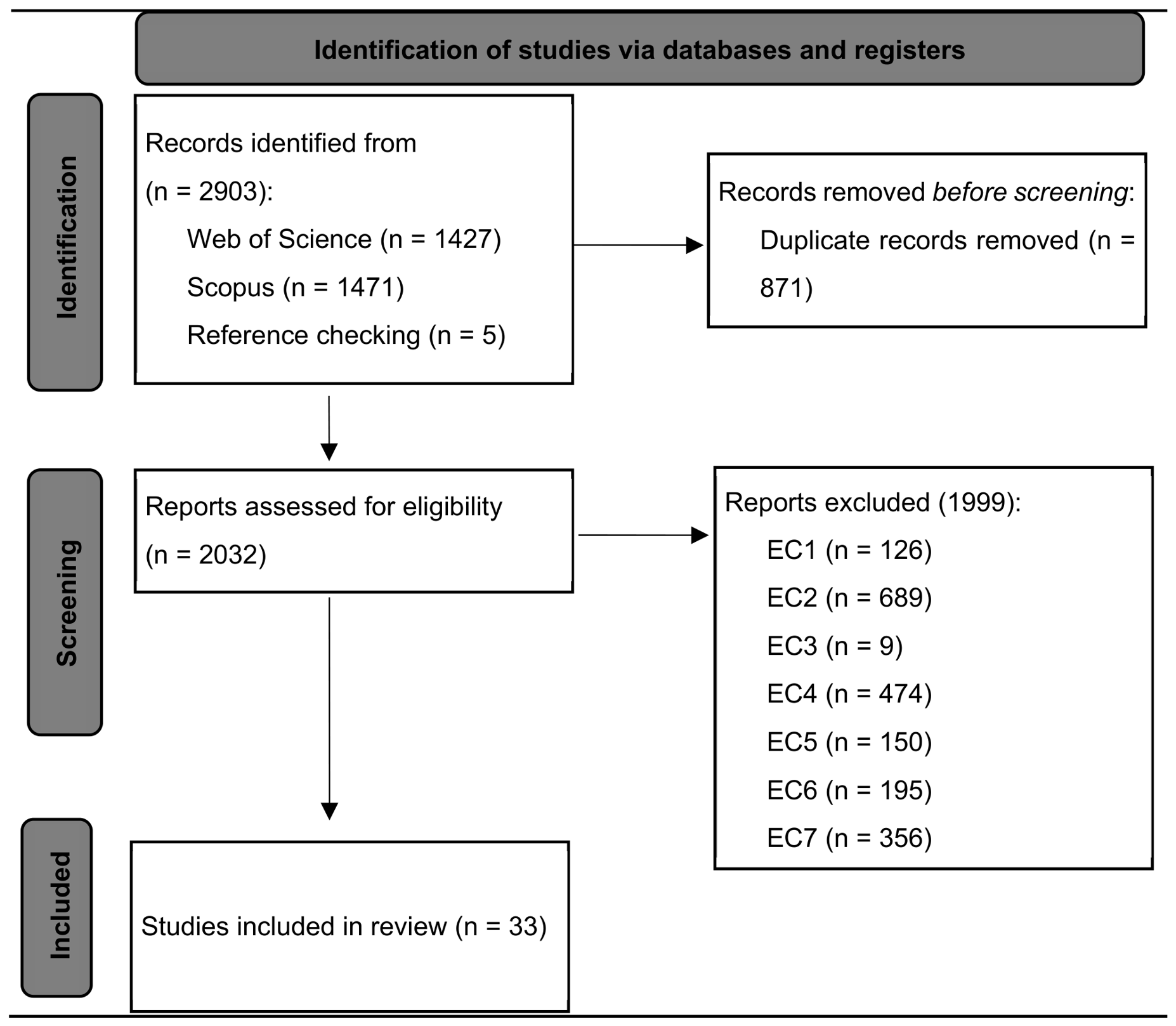
A total of 2903 records were identified from Scopus (n = 1471), WoS (n = 1427), and reference checking (n = 5), with 871 duplicates removed. Of the remaining 2032 records, 1618 were excluded based on the predefined exclusion criteria after title and abstract screening. A full-text analysis led to the rejection of a further 381 articles. Ultimately, 33 studies met the inclusion criteria and were selected for thorough analysis (Figure 1). To make the screening process more transparent, Figure 1 specifies the number of records identified, duplicates removed, reports assessed for eligibility, exclusion criteria applied during screening and full-text assessment, and the final number of studies included in the review.
Following PRISMA recommendations, the information extracted during the review was organized using the Participants, Intervention, Comparisons, Outcomes or Results, and Study design (PICOS) framework [34]. Additionally, details such as author, year, language, country, purpose, type of research, length, intervention program, and challenges identified in each study were recorded (see Supplementary Table S1).

Data Extraction, Methodological Quality Appraisal, and Interrater Reliability

The articles identified from the databases were reviewed by two independent researchers, both high school teachers and experts in education, following the predefined inclusion and exclusion criteria (Table 1). The initial screening consisted of reading the titles and abstracts, followed by reading the full text if necessary. Any discrepancies were resolved by consensus. In the second phase, the reviewers independently read the full text of the selected articles to finalize the list for the review. Data extraction from each article was then done independently by the two researchers, with any discrepancies resolved by consensus.
The methodological quality of the included studies and potential sources of bias were appraised using the Mixed Methods Appraisal Tool (MMAT), version 2018 [35]. This tool was selected because the review included qualitative, quantitative, and mixed-methods studies. Each study was first classified according to its methodological design and then assessed using the corresponding MMAT criteria. Depending on study type, the appraisal considered aspects such as the suitability of the research question, sampling strategy, representativeness, measurement quality, completeness of outcome data, coherence between data sources and interpretation, and the integration of qualitative and quantitative components in mixed-methods studies. Two reviewers independently conducted the appraisal, and discrepancies were resolved by consensus. Following MMAT recommendations, studies were not excluded on the basis of methodological quality alone; instead, the appraisal was used to qualify the interpretation of the evidence and to identify recurrent limitations across the included literature. The results of the appraisal are summarized in Supplementary Table S1.
Interrater reliability was measured using Cohen’s kappa coefficient [36], which gave a value of 0.81, indicating a very good level of agreement.
IBM SPSS Statistics (v. 27.0) [37] was used to compute descriptive summaries of the included studies, including frequencies by publication period, country, educational stage, methodological design, device type, and outcome category, as well as Cohen’s kappa for interrater agreement. No inferential statistical models or meta-analysis were conducted because the included studies varied greatly in terms of design, educational stage, digital tools, intervention duration, outcome measures, and statistical reporting.

3. Results

3.1. General Description of the Studies

A detailed analysis of the selected studies, including authors, year, language and country, study settings, sample, methodological design, objectives, and main findings, is provided in Supplementary Table S1.
This analysis showed that over one-third of the articles were published between 2023 and June 2025, reflecting a growing interest in recent years. English was the predominant language (31 articles), with Spain (6 articles) and Australia (5 articles) being where the most studies were published. A substantial portion of the research targeted exclusively secondary education settings (19 studies).
Sample sizes varied considerably, ranging from studies with 17 participants [38] to over 300,000 in large-scale cross-national research [39]. There was a total of 502,701 participants across all included studies. Most studies used a quantitative methodology (17 articles), followed by mixed-methods approaches (9 articles) and qualitative designs (7 articles). While some studies focused on specific subjects (e.g., mathematics [40], music [29], English [41], and science [25]), the majority (15 articles) explored DE across multiple subjects or the entire curriculum [10].
Nine articles compared DE with traditional models in terms of performance, motivation, or skill acquisition. Laptops were the most commonly used devices (20 articles), followed by tablets (12 articles) and smartphones (1 article). Most studies focused on skills acquisition (12 articles) (e.g., [42]), while others explored usage patterns (11 articles) (e.g., [27]), attitude and motivation (9 articles) (e.g., [43]), or academic performance (8 articles) (e.g., [44]).
The methodological quality appraisal indicated that the included studies provided a suitable empirical basis for a descriptive and interpretative synthesis, although several recurrent limitations were identified. Overall, most studies presented clear research aims and methodological designs aligned with their objectives. However, the strength of the evidence was limited by the heterogeneity of designs, samples, educational stages, digital tools, and outcome measures. Common sources of potential bias included small or context-specific samples, reliance on self-reported measures, limited longitudinal follow-up, insufficient detail regarding implementation fidelity, and in some cases, absence of comparison groups. Quantitative studies provided useful evidence on performance, motivation, and skills acquisition, whereas qualitative and mixed-methods studies contributed more contextual information about implementation processes, perceptions, and classroom conditions. These limitations did not justify excluding studies from the review, but they were considered when interpreting the consistency, transferability, and strength of the evidence. A summary of the methodological quality appraisal and potential sources of bias for each study is provided in Supplementary Table S1.

3.2. Definition of Digital Education

Although many studies referred to DE as part of significant pedagogical transformations, only a few provided explicit and operational definitions. A subset of the reviewed literature conceptualized DE as an education system supported by digital tools, methods, and platforms that facilitate interaction between teachers and students, either synchronously or asynchronously (e.g., [45]). These definitions generally converged on three interrelated components: technological (digital infrastructure and tools), pedagogical (curriculum design, learning content, assessment strategies), and administrative (policy frameworks and organizational support); and DE was further categorized into synchronous, asynchronous, blended, and fully remote modalities, each with distinct instructional implications.
Other contributions framed DE as the deliberate incorporation of digital technologies to enhance learning experiences, promote student engagement, and foster 21st-century competencies such as creativity, critical thinking, and digital citizenship (as cited in [46]). Case studies such as [46] illustrate how tools like GeoGebra and 3D printing can be integrated into subject-specific instruction (e.g., geometry), demonstrating measurable improvements in conceptual understanding and motivation. Additionally, the concept of digital capital, as proposed by [39], offers a systemic perspective encompassing hardware, software, digital skills, and the institutional capacity to integrate these resources effectively. From this perspective, DE is not only about access but also about strategic implementation and competence development at multiple levels.
Despite these valuable insights, most of the studies stopped short of providing concrete operational parameters that distinguish DE from traditional instruction. Few articulated methodological guidelines for effective use of DE in face-to-face contexts, and even fewer included quantitative indicators, such as the number of hours allocated to digital instruction or the frequency of tool usage. This lack of definitional and methodological clarity highlights the importance of exploring not only how DE is conceptualized, but also how it influences key educational outcomes.
The following section addresses this by examining the reported effects of DE on student motivation, skill acquisition, and academic performance (RQ2).

3.3. Effects on Student Motivation, Learning and Performance

3.3.1. Motivation

Nine studies examined the relationship between DE and student motivation, with most reporting increased engagement and interest [26,47,48]. However, these effects appear to be moderated by contextual and developmental factors. For instance, one study reported variations depending on subject area and implementation quality [38], while another observed a decline in interest with age [43], suggesting the need for tailored motivational strategies in older students.
Gamified approaches and combining DE with traditional teaching methods were highlighted as more effective than digital-only instruction [49]. Tools such as GeoGebra, 3D printers, and Flipgrid—particularly when incorporated into coherent pedagogical frameworks—were associated with enhanced motivation and reduced anxiety. Emerging evidence also points to the motivational potential of generative artificial intelligence when used to personalize learning experiences [46,50].
Several studies noted that DE was particularly effective for low-cognitive-demand tasks such as note-taking, digital textbook use, and simple online searches [25,51,52]. These findings suggest that the motivational benefits of DE are closely tied to task complexity and instructional design.

3.3.2. Skills Acquisition

The impact of DE on skills acquisition was explored in fourteen studies, which generally reported favorable outcomes. Improvements were most evident in low- to medium-complexity tasks, including information search, content presentation, and the application or transfer of knowledge [25,42,53]. In contrast, there was limited evidence for gains in higher-order cognitive skills such as analysis, synthesis, and evaluation.
Some studies reported benefits in transversal competencies, including learner autonomy and collaboration [51], spatial reasoning [54], visual thinking, and mathematical performance [45]. Smaller-scale improvements were also noted in self-regulated learning [27] and creativity [26]. Additionally, DE contributed to domain-specific outcomes such as environmental awareness [43] and collaborative learning strategies [55].
Digital competence emerged as a recurrent area of development, especially when students actively produced digital content rather than passively consumed it [49]. However, this type of engagement was infrequent and often limited, again, to low-complexity contexts [56]. Teacher guidance and structured pedagogical support were identified as essential facilitators [57].
Notably, instructional strategies traditionally used in face-to-face settings, such as peer assessment, also demonstrated positive effects when adapted to digital formats. In particular, digital peer evaluation was associated with increased confidence and perceived learning [58].

3.3.3. Academic Performance

Eight studies assessed the relationship between DE and academic performance. Positive effects were reported in targeted areas, such as listening comprehension in language learning [41], and in science subjects—especially physics—when digital tools such as simulators, applications, and spreadsheets were used [59,60]. Active learning approaches supported by digital environments also showed promise in improving outcomes [49].
However, other studies reported no significant improvements [29,60], indicating that the effect of DE on academic performance is variable and contingent upon subject area, implementation quality, and instructional design.
Recent evidence points to two key mediating factors: the availability of digital infrastructure at the school level (e.g., educational software), and the students’ own digital competence. Both were positively associated with academic performance, underscoring the importance of digital readiness for successful learning outcomes [39].

3.4. Challenges in the Use of DE in Compulsory Education Contexts

The literature review indicated a number of challenges facing DE. The first is teacher training. For eleven of the reviewed studies, the need for practical, realistic teacher training seemed evident (e.g., [59]). Training in this regard should aim to empower teachers, encouraging them to incorporate DE into higher-order tasks and leverage the opportunities offered by 1:1 laptops [25], or optimize their role as guides and moderators in digital contexts [51].
A second challenge is the need for further research. Fifteen of the reviewed studies suggested that further research was needed to examine specific aspects, such as how students use their devices and how this affects their academic performance [60], or in relation to teamwork and teacher coordination in areas such as unifying software and work dynamics [11].
Coherent educational policies were discussed in nine articles. While digital initiatives are often encouraged at international, national, school-based, or inter-agency levels, the studies highlighted a lack of continuity and alignment between them [61]. There is a pressing need for policies to be informed by research evidence rather than short-term political or economic interests [17], ensuring a sustainable and pedagogically grounded direction for DE.
Teacher and student motivation and commitment were also highlighted as challenges in seven studies. Teacher workload is not always compatible with the need for training, preparation time, or potential disruptions that DE sometimes causes (e.g., [62]).
Finally, additional challenges the literature identified included the need to establish professional learning communities and cross-disciplinary working groups to support implementation [11]; persistent infrastructure deficits and socio-digital inequalities [28,63,64]; the limited evaluation of educational software by subject area or pedagogical purpose [48]; and the absence of distributed leadership within the teaching profession. Furthermore, teacher engagement with DE is often constrained by insufficient financial resources and limited time for training and planning [62]. In this regard, Jeong et al. [39] emphasized that investment strategies should be tailored to the level of national ICT development: in contexts with limited digital infrastructure, efforts should prioritize access and connectivity, while in more advanced systems, the focus should shift toward strengthening educators’ digital competencies.

3.5. Contribution of DE to Sustainable and Equitable Schooling

The evidence reviewed suggests that DE can contribute to sustainable and equitable face-to-face schooling only when it is implemented as a systemic and pedagogically guided process rather than as the mere provision of digital devices. Across the included studies, four conditions emerged as particularly important for this contribution: equitable access to digital resources, the development of students’ and teachers’ digital competencies, pedagogical alignment between technology and learning goals, and sustained institutional and policy support.
First, several studies indicated that access to infrastructure remains a necessary but insufficient condition for sustainable DE. Large-scale evidence showed that school-level digital infrastructure and students’ digital competence were positively associated with academic performance [39]. However, other studies also highlighted persistent socio-digital inequalities, suggesting that digitalization may reinforce existing disparities when access, connectivity, and support are unevenly distributed [28,63,64]. From this perspective, DE contributes to sustainability only when access is accompanied by meaningful opportunities to use technology for learning.
Second, the reviewed studies showed that DE can support inclusion and learner participation when digital tools are embedded in guided, collaborative, and active learning experiences. For example, studies involving educational apps, peer assessment, digital storytelling, and content creation reported benefits for autonomy, collaboration, confidence, and engagement [47,49,51,58]. Nevertheless, these benefits were not automatic; they depended strongly on teacher mediation, task design, and the extent to which students moved beyond passive or low-complexity uses of technology.
Third, the findings suggest that the sustainable value of DE is limited when digital tools are mainly used for low-cognitive-demand activities, such as information searches, note-taking, or basic presentation tasks [25,52]. In contrast, DE appeared more educationally meaningful when it supported content creation, feedback, problem solving, visualization, or subject-specific learning activities [49,53,54,58]. This distinction is important because sustainable educational development requires not only access to digital tools, but also that they be used in ways that strengthen learning quality and reduce superficial or fragmented implementation.
Finally, the contribution of DE to sustainable schooling depends on teacher training and coherent policy support. Several studies identified insufficient teacher training, limited time, fragmented policies, and lack of distributed leadership as barriers to effective implementation [11,61,62]. Therefore, the reviewed evidence indicates that DE can support sustainable and equitable schooling when digital innovation is connected to long-term institutional capacity, teacher professional development, and pedagogically grounded decision-making.

4. Discussion

This systematic review provides a comprehensive synthesis of DE in compulsory schooling, examining its influence on student motivation, skills development, and academic performance, while identifying persistent structural and pedagogical challenges [17,28,62]. The evidence shows both the transformative potential of DE and the considerable gap between this potential and its current implementation.
A central and recurring finding is the conceptual ambiguity surrounding DE. Across the reviewed literature, definitions range from narrow descriptions—digital tools as mere instruments to support interaction and information exchange [45]—to broader conceptualizations that frame DE as a driver for cultivating 21st-century skills [46]. However, few studies provided operational definitions or explicit implementation criteria for face-to-face contexts, limiting comparability and hampering coherent policy formulation. This review addresses this gap by proposing a definition of DE as a systemic, pedagogically driven integration of digital technologies, instructional strategies, and digital competencies into face-to-face education. This integration is aimed at enriching teaching, personalizing learning, and fostering both disciplinary knowledge and transversal skills. Crucially, achieving these outcomes demands more than infrastructure—it requires sustained investment in teacher training, leadership, instructional design, and an equity-focused vision.
Device-level practices offer a microcosm of broader trends. One-to-one device programs are increasingly common, yet in most cases they are used for low-cognitive-demand tasks, reflecting an instrumental rather than transformative approach [56]. The distinction made by Hromada [65] between “education-with-digital” and “education-about-digital” is particularly useful here: the former centers on simple access to devices, while the latter involves deep pedagogical integration designed to enhance higher-order thinking. The literature suggests that this distinction is still largely unacknowledged in everyday practice, which may explain why large-scale device initiatives often fail to deliver substantive learning gains.
Motivation emerged as the most consistently reported benefit of DE. Several studies noted increased engagement when digital tools were integrated into blended learning environments or gamified tasks—for example, through Flipgrid, GeoGebra, or 3D printing [49]. These tools appeared to reduce anxiety and increase curiosity, particularly when embedded within coherent pedagogical frameworks. However, motivational gains were not uniform: they tended to diminish with age [43] and were less evident in digital-only settings. Taken together, these findings suggest that motivation is less a direct consequence of technology than of the interplay between task design, developmental appropriateness, and teacher facilitation.
The development of student skills showed a similarly nuanced pattern. Gains were most frequently reported for low- to medium-complexity tasks such as information retrieval, multimedia production, and the application of prior knowledge [42,53]. Evidence for the acquisition of transversal skills—collaboration, autonomy, visual thinking—was moderate, while robust improvement in higher-order cognitive skills remained rare. One notable exception was when students engaged in active creation of digital content, which correlated with increased digital competence [56]. Yet such opportunities were infrequent and often lacked pedagogical depth, reinforcing prior research indicating that teacher scaffolding and intentional instructional design are critical to achieving meaningful learning outcomes [57].
The relationship between DE and academic performance proved complex and context-dependent. Some studies reported measurable gains in subjects such as science and language learning when digital tools were aligned with active, task-oriented pedagogies [41,59], while others found no significant differences compared to traditional instruction [60]. These discrepancies point to the mediating role of two factors: robust school-level digital infrastructure and students’ digital competence [39]. Without these conditions, the presence of technology alone appears insufficient to improve academic achievement.
Implementation challenges cut across all these findings. Professional development for teachers emerged as both the most critical and the most underprovided element. Sustained, practice-oriented training in higher-order instructional design is essential for translating digital resources into pedagogical transformation [25,51]. Nonetheless, systemic barriers—workload, limited planning time, and inconsistent policy support—frequently impede participation [62]. Policy fragmentation compounds these issues; initiatives often lack vertical alignment between local, regional, and national governance, and are insufficiently grounded in empirical evidence [17]. Persistent socio-digital inequalities further constrain equitable DE integration, particularly in under-resourced contexts [28]. Addressing these systemic weaknesses requires tailored investment strategies calibrated to each educational system’s digital maturity [39].
These conclusions are consistent with recent post-search literature emphasizing that the successful use of digital tools in schools requires coordinated roles, institutional support, and sustained professional development [20]. Recent evidence on teacher digital competence across primary and secondary education also reinforces the need for targeted training and highlights that students’ digital development depends partly on teachers’ capacity to guide increasingly complex digital tasks [21]. Likewise, recent work on ICT-integrated teacher education suggests that the educational value of digital tools increases when they are embedded in pedagogically coherent, mentored, and practice-based learning experiences [22].
A final challenge concerns the persistent disconnect between research and practice. Few studies examined the micro-level realities of classroom integration or assessed the pedagogical coherence of tool use. Bridging this gap will require stronger, iterative links between empirical findings and real-world application, supported by cross-sector collaboration between researchers, educators, and policymakers.
The findings also have important implications for sustainability. The review indicates that DE can contribute to more sustainable educational systems when digital technologies are incorporated through evidence-based pedagogical practices rather than solely through technology-driven initiatives. Sustainable implementation requires balancing technological innovation with equity, teacher capacity building, and long-term institutional support. In this regard, the challenges identified in the literature—particularly digital inequalities, insufficient teacher training, and fragmented policies—represent not only educational barriers but also obstacles to achieving SDG 4 (Quality Education) and SDG 10 (Reduced Inequalities) [33]. Therefore, sustainable DE should be understood as a systemic process that combines access, pedagogical quality, and social inclusion.

5. Limitations

This review has several limitations that should be considered when interpreting its findings. First, the search was limited to peer-reviewed journal articles indexed in Scopus and Web of Science, complemented by reference checking. Although these databases provide broad coverage of high-quality scientific literature, this decision may have excluded relevant studies published in other databases, institutional reports, policy documents, conference proceedings, book chapters, or other forms of grey literature. Therefore, the findings should be interpreted as a synthesis of indexed empirical research rather than as an exhaustive account of all educational initiatives related to DE.
Second, only studies published in English or Spanish were included. This criterion allowed for rigorous screening and analysis by the review team, but it may have limited the representation of research conducted in other linguistic and educational contexts. This is particularly relevant in the field of DE, where national policies, infrastructure, and classroom practices vary considerably across regions.
Third, the review focused on face-to-face compulsory education and excluded studies centered exclusively on distance education, e-learning, or fully online learning. This decision was consistent with the aim of clarifying the role of DE within in-person primary and secondary schooling. However, it also means that the findings cannot be directly generalized to remote, hybrid, higher education, adult education, or non-formal learning contexts.
Fourth, the included studies were highly heterogeneous in terms of educational stage, country, sample size, research design, digital tools, intervention duration, and outcome measures. This heterogeneity limited the possibility of conducting a meta-analysis and required a descriptive and interpretative synthesis. Although methodological quality was appraised using the MMAT, the diversity of study designs and reporting practices prevented any single quantitative estimate of effect.
Finally, the conceptual ambiguity surrounding DE remains both a finding and a limitation of the review. Because many studies used the term DE without providing an explicit operational definition, some interpretative decisions were required during screening, coding, and synthesis. To reduce this limitation, two reviewers independently conducted the selection, extraction, and appraisal procedures, and discrepancies were resolved by consensus.
Ethical reporting should also be considered when interpreting the evidence. Because this was a systematic review of published studies, no new data were collected from human participants. However, the included studies did not report ethical approval, informed consent, or participant-protection procedures with the same level of detail. This uneven reporting was considered as part of the appraisal of methodological transparency, but it was not used as an exclusion criterion.

6. Recommendations

Based on the findings of this review, several recommendations can be proposed for educational practice, policy, and future research.
First, schools and policymakers should avoid equating DE with the mere provision of digital devices or infrastructure. Access to technology is a necessary condition, but it is not sufficient to improve learning or promote educational sustainability. Digital initiatives should be accompanied by clear pedagogical goals, curricular alignment, teacher support, and mechanisms for assessing their educational value.
Second, teacher professional development should be strengthened as a central condition for effective DE implementation. Training should move beyond technical instruction and focus on how digital tools can support higher-order thinking, feedback, collaboration, self-regulated learning, content creation, and subject-specific understanding. Professional development should also be sustained over time and connected to teachers’ real classroom needs.
Third, DE policies should be designed from an equity and sustainability perspective. This requires addressing not only access to devices and connectivity, but also differences in students’ digital competence, family support, school infrastructure, and teachers’ capacity to integrate technology meaningfully. Without these conditions, digitalization may reproduce or amplify existing educational inequalities.
Fourth, researchers should provide more explicit operational definitions of DE and report implementation conditions in greater detail. Future studies should specify the type of digital tools used, duration and frequency of use, pedagogical approach, teacher role, assessment procedures, and contextual factors. This would improve comparability across studies and support more robust evidence-based recommendations.
Fifth, future research should include more longitudinal, mixed-methods, and comparative designs to examine not only whether DE is associated with improved outcomes, but also under what conditions, for whom, and through which pedagogical mechanisms it becomes effective. Particular attention should be paid to higher-order cognitive skills, academic achievement, teacher practices, digital equity, and the long-term sustainability of digital initiatives.

7. Conclusions

This systematic review clarifies the concept, implementation, and educational implications of DE in face-to-face compulsory education. The findings show that DE remains a conceptually ambiguous term, frequently used as a synonym for ICT use, digital tools, or digital competence. In response to this ambiguity, the review proposes an operational understanding of DE as the pedagogically intentional integration of digital technologies, instructional strategies, and digital competencies into in-person schooling to enhance learning, participation, and educational equity.
The evidence reviewed suggests that DE can support student motivation, skills acquisition, and, in some contexts, academic performance. However, these effects are neither automatic nor uniform. Positive outcomes were more likely when digital tools were aligned with clear pedagogical purposes, supported by teacher mediation, and used for active learning, feedback, content creation, visualization, or subject-specific understanding. In contrast, when technology was used mainly for information searches, note-taking, or basic presentation tasks, its educational value appeared more limited.
The review also highlights several persistent barriers to effective DE implementation, including insufficient teacher training, fragmented policies, infrastructural inequalities, limited implementation fidelity, and the absence of shared operational criteria. These barriers help explain why the promise of DE often exceeds its actual classroom impact. Therefore, the contribution of this review lies not only in synthesizing the empirical literature, but also in identifying the conditions under which DE can move from superficial digitalization toward meaningful pedagogical transformation.
From a sustainability perspective, the findings indicate that DE can contribute to more equitable and resilient educational systems when it expands access to meaningful learning opportunities, supports inclusion, strengthens teacher capacity, and reduces socio-digital inequalities. Its sustainable value does not lie in the availability of technology itself, but in the extent to which digital innovation is embedded in coherent pedagogical, institutional, and policy frameworks. In this sense, DE can support the achievement of the Sustainable Development Goals, particularly SDG 4, when it is guided by equity, educational quality, and long-term systemic capacity.
Overall, this review provides an evidence-based framework for understanding DE in compulsory face-to-face schooling and offers guidance for researchers, practitioners, and policymakers seeking to design more effective, inclusive, and sustainable digital education practices.

Supplementary Materials

The following supporting information can be downloaded at: https://www.mdpi.com/article/10.3390/su18157979/s1, Supplementary Table S1: Detailed characteristics of included studies; Supplementary File S2: PRISMA 2020 checklist.

Author Contributions

Conceptualization, H.M.G., T.G. and C.R.; methodology, H.M.G., T.G. and C.R.; investigation (data search and screening), H.M.G., M.R.G.-C., T.G. and C.R.; data curation (data extraction), H.M.G., M.R.G.-C., T.G. and C.R.; formal analysis, H.M.G., T.G. and C.R.; writing—original draft preparation, H.M.G., T.G. and C.R.; writing—review and editing, H.M.G., M.R.G.-C., D.A., A.I.Á., J.C.N., T.G. and C.R.; supervision, H.M.G., D.A., J.C.N., T.G. and C.R.; project administration, H.M.G., J.C.N., T.G. and C.R. All authors have read and agreed to the published version of the manuscript.

Funding

This research was funded by the Principality of Asturias, grant number IDE/2024/0000713. The APC was funded by the Principality of Asturias.

Institutional Review Board Statement

Not applicable.

Informed Consent Statement

Not applicable.

Data Availability Statement

The data extracted and analyzed during this systematic review are available in Supplementary Table S1. No additional datasets were generated.

Conflicts of Interest

The authors declare no conflicts of interest.

Abbreviations

The following abbreviations are used in this manuscript:
DEDigital Education
DigCompEduEuropean Framework for the Digital Competence of Educators
ICTInformation and Communication Technologies
PICOSParticipants, Intervention, Comparison, Outcomes, Study design
PRISMAPreferred Reporting Items for Systematic Reviews and Meta-Analyses
SDGSustainable Development Goal
SDGsSustainable Development Goals
TPACKTechnological Pedagogical Content Knowledge

References

  1. Santiago-Campión, R.; Nalda, F.; Celaya, L. Perceptions of School Leaders about the Use and Value of ICT for Educational Change and Innovation. Estud. Sobre Educ. 2016, 30, 145–174. [Google Scholar] [CrossRef][Green Version]
  2. UNESCO. Technology in Education: GEM Report 2023|Global Education Monitoring Report. Available online: https://www.unesco.org/gem-report/en/publication/technology-education (accessed on 8 August 2025).
  3. OECD. Digital Education Outlook. 2021. Available online: https://www.oecd.org/en/publications/oecd-digital-education-outlook-2021_589b283f-en.html (accessed on 8 August 2025).
  4. Koehler, M.J.; Mishra, P.; Kereluik, K.; Shin, T.S.; Graham, C.R. The Technological Pedagogical Content Knowledge Framework. In Handbook of Research on Educational Communications and Technology; Spector, J.M., Merill, M.D., Elen, J., Bishop, M.J., Eds.; Springer: New York, NY, USA, 2014; pp. 101–111. [Google Scholar]
  5. Bayne, S.; Gallagher, M. Near Future Teaching: Practice, Policy and Digital Education Futures. Policy Futures Educ. 2021, 19, 607–625. [Google Scholar] [CrossRef]
  6. Harju, V.; Koskinen, A.; Pehkonen, L. An Exploration of Longitudinal Studies of Digital Learning. Educ. Res. 2019, 61, 388–407. [Google Scholar] [CrossRef]
  7. Xie, K.; Hawk, N. Technology’s Role and Place in Student Learning: What We Have Learned from Research and Theories. In Technology in School Classrooms: How It Can Transform Teaching and Student Learning Today; Rowman & Littlefield: Lanham, MD, USA, 2017; pp. 1–17. ISBN 978-1-4758-3104-7. [Google Scholar]
  8. Zheng, B.; Warschauer, M.; Lin, C.-H.; Chang, C. Learning in One-to-One Laptop Environments: A Meta-Analysis and Research Synthesis. Rev. Educ. Res. 2016, 86, 1052–1084. [Google Scholar] [CrossRef]
  9. Troussas, C.; Krouska, A.; Sgouropoulou, C. Enriching Mobile Learning Software with Interactive Activities and Motivational Feedback for Advancing Users’ High-Level Cognitive Skills. Computers 2022, 11, 18. [Google Scholar] [CrossRef]
  10. Varier, D.; Dumke, E.K.; Abrams, L.M.; Conklin, S.B.; Barnes, J.S.; Hoover, N.R. Potential of One-to-One Technologies in the Classroom: Teachers and Students Weigh In. Educ. Technol. Res. Dev. 2017, 65, 967–992. [Google Scholar] [CrossRef]
  11. Panesi, S.; Bocconi, S.; Ferlino, L. Promoting Students’ Well-Being and Inclusion in Schools Through Digital Technologies: Perceptions of Students, Teachers, and School Leaders in Italy Expressed Through SELFIE Piloting Activities. Front. Psychol. 2020, 11, 1563. [Google Scholar] [CrossRef] [PubMed]
  12. Schröder, A.; Krüger, D. Social Innovation as a Driver for New Educational Practices: Modernising, Repairing and Transforming the Education System. Sustainability 2019, 11, 1070. [Google Scholar] [CrossRef]
  13. Gómez-Tone, H.C.; Martín-Gutiérrez, J.; Valencia-Anci, B.K. Augmented Reality-Based Training to Improve Spatial Skills and Academic Performance in Engineering Students. Digit. Educ. Rev. 2022, 41, 306–322. [Google Scholar] [CrossRef]
  14. Hawk, N.A.; Vongkulluksn, V.W.; Xie, K.; Bowman, M.A. Cognitive Tasks in the Core Content Areas: Factors That Influence Students’ Technology Use in High-School Classrooms. J. Comput. Assist. Learn. 2021, 37, 1077–1090. [Google Scholar] [CrossRef]
  15. Nikolopoulou, K.; Gialamas, V. ICT and Play in Preschool: Early Childhood Teachers’ Beliefs and Confidence. Int. J. Early Years Educ. 2015, 23, 409–425. [Google Scholar] [CrossRef]
  16. Auld, G.; Johnson, N.F. Teaching the “Other”: Curriculum “Outcomes” and Digital Technology in the Out-of-School Lives of Young People; Critical Perspectives on Technology and Education; Palgrave Macmillan: London, UK, 2015; ISBN 978-1-137-38545-1. [Google Scholar]
  17. Tallvid, M.; Lundin, J.; Svensson, L.; Lindstrom, B. Exploring the Relationship between Sanctioned and Unsanctioned Laptop Use in a 1:1 Classroom. Educ. Technol. Soc. 2015, 18, 237–249. [Google Scholar]
  18. Ferro, C.; Senra, A.I.M.; Martínez Senra, A.I.; Otero Neira, M.C. Ventajas Del Uso de Las TICs En El Proceso de Enseñanza-Aprendizaje Desde La Óptica de Los Docentes Universitarios Españoles. EDUTEC Rev. Electrón. Tecnol. Educ. 2009, 29, a119. [Google Scholar] [CrossRef]
  19. Garmendia, M.; Karrera, I.; Larrañaga, N.; Garitaonandia, C. The Role of School Mediation in the Development of Digital Skills among Spanish Minors. Prof. Inf. 2021, 30, 12. [Google Scholar] [CrossRef]
  20. OECD. Co-Ordinating the Use of Digital Tools at the School Level; OECD Education Working Papers, 344; OECD Publishing: Paris, France, 2026. [Google Scholar] [CrossRef]
  21. Bueno-Baquero, A.; González-Calero, J.A.; Del Olmo-Muñoz, J.; Sánchez Pérez, M.D.C. Bridging Digital Transitions: Teacher Digital Competence across Primary and Secondary Education. Educ. Inf. Technol. 2026, 31, 3097–3124. [Google Scholar] [CrossRef]
  22. Bekbenova, A.; Ilyassova, G.; Mukatayeva, Z.; Gavronskaya, Y.; Amangeldi, O.; Umirzakova, N. Pedagogical Bases of ICT Integration in Pre-Service Chemistry Teacher Education: University-School Bridge. Front. Educ. 2026, 11, 1729019. [Google Scholar] [CrossRef]
  23. Crompton, H.; Burke, D.; Lin, Y.C. Mobile Learning and Student Cognition: A Systematic Review of PK-12 Research Using Bloom’s Taxonomy. Br. J. Educ. Technol. 2019, 50, 684–701. [Google Scholar] [CrossRef]
  24. Keane, T.; Keane, W.F.; Blicblau, A.S. Beyond Traditional Literacy: Learning and Transformative Practices Using ICT. Educ. Inf. Technol. 2016, 21, 769–781. [Google Scholar] [CrossRef]
  25. Crook, S.J.; Sharma, M.D. Bloom-Ing Heck! The Activities of Australian Science Teachers and Students Two Years into a 1:1 Laptop Program across 14 High Schools. Int. J. Innov. Sci. Math. Educ. 2013, 21, 54–69. [Google Scholar]
  26. Rong, Q.M.; Lian, Q.; Tang, T.R. Research on the Influence of AI and VR Technology for Students’ Concentration and Creativity. Front. Psychol. 2022, 13, 767689. [Google Scholar] [CrossRef] [PubMed]
  27. Xia, Q.; Chiu, T.K.F.; Chai, C.S.; Xie, K. The Mediating Effects of Needs Satisfaction on the Relationships between Prior Knowledge and Self-Regulated Learning through Artificial Intelligence Chatbot. Br. J. Educ. Technol. 2023, 54, 967–986. [Google Scholar] [CrossRef]
  28. Castaño Muñoz, J.; Pokropek, A.; Garcia, L.W. For All Those Who Have, More Will Be Given? Evidence from the Adoption of the SELFIE Tool for the Digital Capacity of Schools in Spain. Br. J. Educ. Technol. 2022, 53, 1937–1955. [Google Scholar] [CrossRef]
  29. Guillén-Gámez, F.D.; Álvarez-García, F.J.; Rodríguez, I.M. Digital Tablets in the Music Classroom: A Study about the Academic Performance of Students in the BYOD Context. J. Music Technol. Educ. 2018, 11, 171–182. [Google Scholar] [CrossRef] [PubMed]
  30. Yarbro, J.; McKnight, K.; Elliott, S.; Kurz, A.; Wardlow, L. Digital Instructional Strategies and Their Role in Classroom Learning. J. Res. Technol. Educ. 2016, 48, 274–289. [Google Scholar] [CrossRef]
  31. UNESCO. Proportion of Schools with Access to Internet for Pedagogical Purposes; Institute for Statistics (UIS): Montreal, QC, Canada, 2023. [Google Scholar]
  32. Romero-Hall, E. Current Initiatives, Barriers, and Opportunities for Networked Learning in Latin America. Educ. Technol. Res. Dev. 2021, 69, 2267–2283. [Google Scholar] [CrossRef] [PubMed]
  33. United Nations. Transforming Our World: The 2030 Agenda for Sustainable Development; United Nations: New York, NY, USA, 2015. [Google Scholar]
  34. Page, M.J.; McKenzie, J.E.; Bossuyt, P.M.; Boutron, I.; Hoffmann, T.C.; Mulrow, C.D.; Shamseer, L.; Tetzlaff, J.M.; Akl, E.A.; Brennan, S.E.; et al. The PRISMA 2020 Statement: An Updated Guideline for Reporting Systematic Reviews. BMJ 2021, 372, n71. [Google Scholar] [CrossRef] [PubMed]
  35. Hong, Q.N.; Fàbregues, S.; Bartlett, G.; Boardman, F.; Cargo, M.; Dagenais, P.; Gagnon, M.-P.; Griffiths, F.; Nicolau, B.; O’Cathain, A.; et al. The Mixed Methods Appraisal Tool (MMAT) Version 2018 for Information Professionals and Researchers. Educ. Inf. 2018, 34, 285–291. [Google Scholar] [CrossRef]
  36. Cohen, J. A Coefficient of Agreement for Nominal Scales. Educ. Psychol. Meas. 1960, 20, 37–46. [Google Scholar] [CrossRef]
  37. IBM Corp. IBM SPSS Statistics for Windows, Version 27.0; IBM Corp.: Armonk, NY, USA, 2020.
  38. de Diezmas, E.N.M.; Manzano, P.D. PLEs in Primary School: The Learners’ Experience in The Piplep Project. Digit. Educ. Rev. 2016, 29, 45–61. [Google Scholar]
  39. Jeong, D.; Moon, H.; Jeong, S.; Moon, C. Digital Capital Accumulation in Schools, Teachers, and Students and Academic Achievement: Cross-Country Evidence from the PISA 2018. Int. J. Educ. Dev. 2024, 107, 103024. [Google Scholar] [CrossRef]
  40. Holguin-Alvarez, J.; Cruz-Montero, J.; Ruiz-Salazar, J.; Wong, R.; Merino-Flores, I. Dynamics, Strategies and Feedback Applied with Mixed Gamification: Do They Improve Poor School Cognitive Performance? Digit. Educ. Rev. 2024, 45, 179–190. [Google Scholar] [CrossRef]
  41. Sejdiu, S. Are Listening Skills Best Enhanced Through the Use of Multimedia Technology. Digit. Educ. Rev. 2017, 32, 60–72. [Google Scholar]
  42. Yan, D.; Li, G. A Heterogeneity Study on the Effect of Digital Education Technology on the Sustainability of Cognitive Ability for Middle School Students. Sustainability 2023, 15, 2784. [Google Scholar] [CrossRef]
  43. Álvarez-Herrero, J.F.; Hernández-Ortega, J. Didactic Itineraries with Smartphones to Promote Environmental Education and Digital Competence among Secondary School Students. Digit. Educ. Rev. 2021, 39, 319–335. [Google Scholar]
  44. Lee, H.; Kim, Y. Exploring the Effects of Computer and Smart Device-Assisted Learning on Students’ Achievements: Empirical Evidence from Korea. Sustainability 2023, 15, 13241. [Google Scholar] [CrossRef]
  45. Alabdulaziz, M.S.; Alhammadi, A.A. The Effectiveness of Digital Education Based on the Use of Infographic Technology and Its Impact on Developing Visual Thinking Skills and Mathematical Achievement among Middle School Students. Int. J. Inf. Educ. Technol. 2025, 15, 576–594. [Google Scholar] [CrossRef]
  46. Scippo, S.; Madiai, S.; Cuomo, S. Digital Tessellation for Geometry Learning in Primary School: A Quasi-Experimental Study. J. Inf. Technol. Educ. Res. 2025, 24, 009. [Google Scholar] [CrossRef] [PubMed]
  47. Preradovic, N.M.; Lesin, G.; Boras, D. Introduction of Digital Storytelling in Preschool Education: A Case Study from Croatia. Digit. Educ. Rev. 2016, 30, 94–105. [Google Scholar]
  48. Rajabion, L.; Wakil, K.; Badfar, A.; Nacini, S.M.; Zareie, B. A New Model for Assessing the Impact of ICT and Digital Knowledge on Students’ Thoughts and Beliefs. J. Eng. Des. Technol. 2019, 17, 943–959. [Google Scholar] [CrossRef]
  49. Slussareff, M.; Bohackova, P. Students as Game Designers vs. “Just” Players: Comparison of Two Different Approaches to Location-Based Games Implementation into School Curricula. Digit. Educ. Rev. 2016, 36, 284–297. [Google Scholar]
  50. Chust-Pérez, V.; Esteve-Faubel, R.; Fernández-Morante, M.; Esteve-Faubel, J. The Utilisation of the Flipgrid Application through Mobile Devices to Enhance Motivation and Oral Expression Skills in Secondary School Students Learning English as a Foreign Language. Pixel-Bit. Rev. Medios Educ. 2025, 73, 1. [Google Scholar] [CrossRef]
  51. Faria, C.; Guilherme, E.; Pintassilgo, J.; Mogarro, M.J.; Pinho, A.S.; Baptista, M.; Chagas, I.; Galvao, C. The Portuguese Maritime Voyages of Discovery: The Exploration of the History of a City with an App as an Educational Resource. Digit. Educ. Rev. 2019, 36, 85–99. [Google Scholar] [CrossRef]
  52. Selwyn, N.; Nemorin, S.; Bulfin, S.; Johnson, N.F. The “obvious” Stuff: Exploring the Mundane Realities of Students’ Digital Technology Use in School. Digit. Educ. Rev. 2020, 37, 1–14. [Google Scholar] [CrossRef]
  53. Castro-García, D.; Dussan, F.A.O.; Corredor, J. Technology for Communication and Problem Solving in the Classroom. Effects on Meaningful Learning. Digit. Educ. Rev. 2016, 30, 207–219. [Google Scholar]
  54. Abylkassymova, A.; Yessetov, Y.; Tuyakov, Y.; Ardabayeva, A. Teaching Geometry in School: Digital Resources to Develop Students’ Spatial Thinking. Int. J. Innov. Res. Sci. Stud. 2025, 8, 439–450. [Google Scholar] [CrossRef]
  55. Gigantesco, A.; Palumbo, G.; Zadworna-Cieslak, M.; Cascavilla, I.; Del Re, D.; Kossakowska, K.; Chrusciel, M.; Kelpsait, D.; Kuklinska, G.; Zaharieva, B.; et al. An International Study of Middle School Students’ Preferences about Digital Interactive Education Activities for Promoting Psychological Well-Being and Mental Health. Ann. dell’Ist. Super. Sanità 2019, 55, 108–117. [Google Scholar] [CrossRef] [PubMed]
  56. Kastner-Hauler, O.; Tengler, K.; Sabitzer, B.; Lavicza, Z. Combined Effects of Block-Based Programming and Physical Computing on Primary Students’ Computational Thinking Skills. Front. Psychol. 2022, 13, 875382. [Google Scholar] [CrossRef] [PubMed]
  57. Kerslake, L.; Hannam, J. Designing Media and Information Literacy Curricula in English Primary Schools: Children’s Perceptions of the Internet and Ability to Navigate Online Information. Ir. Educ. Stud. 2022, 41, 151–160. [Google Scholar] [CrossRef]
  58. Kuo, Y.S.; Wang, S.I.C.; Liu, E.Z.F. Peer Assessment Using One-to-One Tablets to Improve the English Oral Presentation of Fourth-Grade Students in Taiwan. Comput. Educ. Open 2025, 8, 100262. [Google Scholar] [CrossRef]
  59. Bicer, A.; Capraro, R.M. Longitudinal Effects of Technology Integration and Teacher Professional Development on Students’ Mathematics Achievement. Eurasia J. Math. Sci. Technol. Educ. 2017, 13, 815–833. [Google Scholar] [CrossRef]
  60. Crook, S.J.; Sharma, M.D.; Wilson, R. An Evaluation of the Impact of 1:1 Laptops on Student Attainment in Senior High School Sciences. Int. J. Sci. Educ. 2015, 37, 272–293. [Google Scholar] [CrossRef]
  61. Llorent-Vaquero, M.; De Pablos-Pons, J.; Velez, I. Digital Learning and Public Policy in Schools: A Transformative Paradigm for a Changing World. Policy Futures Educ. 2024, 22, 547–592. [Google Scholar] [CrossRef]
  62. Keane, T.; Keane, W. Achievements and Challenges: Implementing a 1:1 Program in a Secondary School. Educ. Inf. Technol. 2017, 22, 1025–1041. [Google Scholar] [CrossRef]
  63. García-Gil, M.A.; Fajardo-Bullón, F.; Felipe-Castaño, E. Analysis of Academic Performance and Mental Health of Secondary School Students by Access to Technological Resources. Educ. XX1 2022, 25, 243–270. [Google Scholar] [CrossRef]
  64. Janssen, K.C.; Phillipson, S. Are We Ready for BYOD?: An Analysis of the Implementation and Communication of BYOD Programs in Victorian Schools. Aust. Educ. Comput. 2015, 30, 54. [Google Scholar]
  65. Hromada, D.D. Digital Education: “Education-with”/”Education-about” Distinction and the Teleological Definition. Digit. Educ. 2021, 1–10. [Google Scholar] [CrossRef]
Figure 1. Flowchart of Study Selection Procedure According to PRISMA.
Sustainability 18 07979 g001
Table 1. Inclusion and exclusion criteria.
Inclusion criteria (IC)
-
IC1: The article must be published in a peer-reviewed journal indexed in the Journal Citation Reports (Web of Science) and/or Scopus
-
IC2: Published and written in English or Spanish between January 2012 and June 2025 (inclusive)
-
IC3: Related to the field of face-to-face educational contexts, including during pandemic-affected periods
-
IC4: Quantitative, qualitative or mixed-methods research designs
-
IC5: Focused on DE in compulsory education (primary and secondary education), specifically from a student perspective
Exclusion criteria (EC)
-
EC1: Book chapters, books, or other types of non-peer-reviewed publications
-
EC2: Studies outside the context of compulsory education or that do not consider a digital methodology
-
EC3: Articles not available as a full text
-
EC4: Studies on distance education models (e-learning, online learning) or exclusive distance learning (e.g., during pandemics, natural disasters)
-
EC5: Studies focused on digital skills acquisition, digital literacy, or socioeconomic or cultural factors affecting students’ opportunities
-
EC6: Studies not within an educational context (e.g., clinical studies, addiction, neuroscience, pathologies)
-
EC7: Theoretical articles
Disclaimer/Publisher’s Note: The statements, opinions and data contained in all publications are solely those of the individual author(s) and contributor(s) and not of MDPI and/or the editor(s). MDPI and/or the editor(s) disclaim responsibility for any injury to people or property resulting from any ideas, methods, instructions or products referred to in the content.