Article

From Entrepreneurial Marketing to Environmental Performance of Small and Medium-Sized Enterprises in the UAE: The Roles of Market Agility, Customer Agility, Marketing Capability, and Market Turbulence

by
Rusul Mohammed
* and
Joshua Chibuike Sopuru
Faculty of Business and Economics, Girne American University, Karmi Campus, Mersin 10, Kyrenia 99300, North Cyprus, Turkey
*
Author to whom correspondence should be addressed.
Sustainability 2026, 18(15), 7741; https://doi.org/10.3390/su18157741
Submission received: 5 July 2026 / Revised: 26 July 2026 / Accepted: 28 July 2026 / Published: 31 July 2026
(This article belongs to the Special Issue Inclusive and Sustainable Marketing and Business Performance)

Abstract

Entrepreneurial marketing (EM) has emerged as a critical strategic orientation for small and medium-sized enterprises (SMEs) navigating volatile markets, yet the mechanisms through which EM is associated with environmental performance of SMEs remain theoretically underdeveloped. Drawing on entrepreneurial marketing theory, dynamic capabilities theory, the resource-based view, the natural resource-based view, and contingency theory, this study proposes and tests a two-stage capability model in which EM is linked to market agility and customer agility as parallel dynamic mechanisms that subsequently build marketing capability, which in turn is associated with environmental performance of SMEs. Market turbulence is examined as a boundary condition moderating the agility-to-capability pathways. Data were collected from 402 SME owners and managers across manufacturing and service sectors in the United Arab Emirates and analyzed using partial least squares structural equation modeling (PLS-SEM) in SmartPLS 4. Results confirm that EM is positively associated with market agility, customer agility, and marketing capability, and that both agility constructs partially mediate the EM-to-marketing capability relationship. Marketing capability shows a strong positive association with environmental performance of SMEs. Market turbulence significantly strengthens the market agility-to-marketing capability and customer agility-to-marketing capability relationships, while its moderating role in the direct EM-to-marketing capability path is not significant. These findings contribute to the entrepreneurial marketing and dynamic capability literature by specifying the organizational mechanisms linking EM to environmental performance and by identifying market turbulence as a selective boundary condition that strengthens agility-driven, but not orientation-driven, capability development. Practical implications for SME managers in emerging market contexts are discussed.

1. Introduction

Small and medium-sized enterprises (SMEs) are central engines of economic development [1,2], yet their capacity to sustain competitive performance while simultaneously meeting growing environmental expectations represents one of the most pressing strategic challenges in contemporary business research [3,4]. As market conditions grow increasingly volatile and stakeholder demands for environmental accountability intensify [5,6], the question of how SMEs can build the organizational capabilities that are associated with their marketing behaviors and environmental outcomes becomes theoretically important and practically consequential [7,8]. This study addresses that question by examining how entrepreneurial marketing (EM) is associated with the environmental performance of UAE-based SMEs through the sequential development of market agility, customer agility, and marketing capability, and by investigating how market turbulence shapes the strength of these capability-building pathways [9,10].
The United Arab Emirates provides a strategically compelling research context. The UAE economy is one of the most rapidly diversifying in the Gulf Cooperation Council (GCC) region, with SMEs operating under intensifying competitive pressures driven by digital transformation, foreign direct investment inflows, and shifting consumer expectations [11]. At the same time, the UAE government has embedded sustainability at the centre of its national development agenda through We the UAE 2031, the UAE Circular Economy Policy (2021), the UAE Net Zero by 2050 Strategy (UAE Government, 2021), the UAE Green Agenda 2030, and associated national innovation and digitalization frameworks, which together create a regulatory and institutional environment that increasingly requires enterprises to demonstrate measurable environmental responsibility alongside commercial performance [12]. SMEs constitute more than 94% of all businesses in the UAE [13] and account for more than 50% of GDP while employing over 85% of the private-sector workforce [11]. Despite this centrality, empirical research examining how UAE SMEs translate their marketing orientations into environmental performance outcomes through organizational capability mechanisms remains scarce. The UAE context thus offers both practical relevance and theoretical opportunity that has been underutilised in the entrepreneurial marketing literature, where GCC-based studies remain limited relative to those conducted in Western, South Asian, and Sub-Saharan African settings [2,14].
The practical problem motivating this study is clear: UAE SMEs face simultaneous pressure to compete aggressively in a volatile market environment and to meet rising sustainability expectations from regulators, customers, and institutional stakeholders. How they build the organizational capabilities needed to achieve both objectives through their marketing orientation is a question that existing research has not adequately answered. Entrepreneurial marketing has attracted growing scholarly attention as an organizational orientation that integrates the proactive, opportunity-driven, and resource-leveraging logic of entrepreneurship with the customer-focused and value-creating principles of marketing [9,10]. Research has established that EM is positively associated with firm performance, particularly under conditions of environmental uncertainty [14,15,16]. Osei et al. [17] further demonstrated that the EM-performance relationship is shaped by affective organizational commitment as a dual-edged mechanism, underscoring the importance of organizational context in moderating EM outcomes. Studies conducted in Arab and Gulf contexts have further confirmed that EM-related orientations predict superior performance outcomes among resource-constrained SMEs operating under competitive and regulatory pressure [2,14]. However, the organizational mechanisms through which EM is associated with these outcomes, and particularly environmental performance ones, remain theoretically underdeveloped. Most existing studies treat the EM-performance relationship as relatively direct, without adequately specifying the capability pathways that connect entrepreneurial marketing behaviors to measurable environmental results [2,18].
To address this gap, the present study develops and tests a two-stage capability model. In the first stage, EM is linked to market agility and customer agility as dynamic mechanisms. In the second stage, these agility capabilities are associated with the development of marketing capability, which in turn is associated with the environmental performance of SMEs. Market turbulence functions as a boundary condition that moderates the strength of the pathways from EM and from the two agility constructs to marketing capability. This model integrates entrepreneurial marketing theory, dynamic capabilities theory, the resource-based view, the natural resource-based view, and contingency theory into a coherent explanatory framework. Each theory addresses a distinct and non-overlapping segment of the proposed causal chain, and their integration is motivated by the complexity of the research question rather than theoretical eclecticism.
The study contributes to the literature in three distinct ways. First, it introduces a two-stage capability framework that specifies agility constructs as the dynamic capability layer between EM and marketing capability, explicitly distinguishing dynamic capabilities (market agility and customer agility) from ordinary capabilities (marketing capability) and thereby providing a more granular account of the EM-to-performance mechanism than prior research [19,20]. Second, it contributes empirical evidence from the UAE, a context that combines high economic dynamism with explicit sustainability policy pressures, extending the geographic coverage of SME environmental performance research to the GCC region, where empirical evidence connecting marketing orientation to sustainability outcomes remains limited. Third, it identifies market turbulence as a selective boundary condition that strengthens agility-driven, but not orientation-driven, capability-building mechanisms, adding contingency precision to the growing body of EM literature.
The remainder of the paper is organized as follows. Section 2 reviews the relevant literature and develops the research hypotheses. Section 3 describes the research methodology. Section 4 reports the empirical results. Section 5 discusses the findings, theoretical and managerial implications, and directions for future research.

2. Literature Review and Hypotheses Development

2.1. Theoretical Framework

The conceptual model advanced in this study is grounded in the integration of five theoretical perspectives, each addressing a distinct and non-redundant segment of the causal chain from entrepreneurial marketing to environmental performance of SMEs. Together, they form a unified explanatory architecture rather than a set of parallel justifications. No single theory within this framework can account for the full explanatory chain; removing any one perspective would leave a specific causal mechanism unaddressed.
Entrepreneurial marketing theory, originating with Morris et al. [9] and substantially extended by Alqahtani and Uslay [10,21], defines EM as an organizational orientation characterized by opportunity recognition, customer intensity, proactiveness, value creation, resource leveraging, and calculated risk management. This theory explains why EM serves as the strategic starting point of the model: SMEs operating under resource constraints require marketing approaches that are adaptive, opportunity-driven, and customer-responsive rather than reliant on large marketing budgets or established market positions. Critically, Alqahtani et al. [15] demonstrated that EM outperforms other strategic orientations specifically under high market turbulence and competitive pressure, a finding that motivates the moderation logic incorporated in the present framework.
Dynamic capabilities theory (DCT), established by Teece et al. [19] and refined by Eisenhardt and Martin [22], explains the intermediate mechanisms through which EM is associated with capability development. DCT posits that competitive advantage derives not from static resource possession but from the organizational capacity to sense opportunities, seize them, and reconfigure internal resources in response to environmental change. Critically, DCT distinguishes between dynamic capabilities with higher-order mechanisms that modify and reconfigure the resource base and ordinary capabilities with stable, process-oriented competencies that execute operational functions [19,22]. In this model, market agility and customer agility represent dynamic capabilities, while marketing capability represents the ordinary capability that the dynamic layer builds over time. Market agility and customer agility therefore represent precisely these sensing and seizing mechanisms, functioning as the dynamic capability layer through which entrepreneurial marketing behaviors generate the organizational responsiveness needed to develop marketing capability over time [23]. A growing body of empirical research confirms that agility constructs serve as dynamic capability mediators between strategic orientations and performance outcomes in SME contexts [24,25,26,27,28].
The resource-based view (RBV), grounded in Barney (1991) and extended to the marketing domain by Vorhies and Morgan [8] and Morgan [29], explains the role of marketing capability as a strategically valuable and difficult-to-imitate organizational resource. Marketing capability encompasses the complex bundle of skills, knowledge, and organizational processes involved in pricing, product development, channel management, communication, sales management, market information systems, planning, and strategy implementation [30]. RBV addresses a distinct causal question from DCT: whereas DCT explains how dynamic agility mechanisms build marketing capability, RBV explains why marketing capability, once developed, functions as a durable source of competitive advantage and a proximate driver of performance outcomes [31]. RBV explains why agility mechanisms, once associated with EM, crystallize into marketing capability as a durable organizational asset, and why this capability functions as a proximate driver of firm performance outcomes.
The natural resource-based view (NRBV), introduced by Hart [7], provides the critical theoretical bridge between marketing capability and environmental performance of SMEs. NRBV extends RBV to incorporate the natural environment as a domain of competitive advantage, arguing that firms develop capabilities oriented toward pollution prevention, product stewardship, and sustainable development that generate superior performance precisely because they address the ecological constraints that are increasingly binding on all organizations [32]. In the present model, NRBV explains why marketing capability, understood as a complex organizational competency encompassing product development, communication, and strategic planning, enables SMEs to embed environmental considerations into their marketing activities and thereby achieve measurable environmental performance outcomes. It is important to note that NRBV does not require the capability itself to be inherently green in its design; rather, it argues that firms can deploy existing organizational capabilities within an environmentally conscious strategic context to achieve environmental competitive advantage [7]. The UAE’s national sustainability mandates provide precisely this context, creating institutional pressure that orients SME marketing capability toward environmental performance outcomes. This argument receives empirical support from Schmidt et al. [4], who demonstrated that marketing-related organizational orientations are associated with circular economy practices in SMEs through an NRBV mechanism, and from Hanaysha and Al-Shaikh [3], who confirmed that marketing capability directly predicts business sustainability in UAE SMEs. Leonidou et al. [33] further demonstrated that marketing capabilities, even when measured as general competencies, are empirically associated with environmental performance outcomes when deployed within sustainability-oriented strategic contexts, providing direct empirical grounding for the generic-capability-to-environmental-outcome pathway proposed in H6.
Contingency theory, drawing on Donaldson [34] and the foundational marketing work of Jaworski and Kohli [5], provides the boundary condition logic of the framework. Contingency theory argues that the effectiveness of organizational behaviors and capabilities is not uniform but depends on the characteristics of the external environment. In the present model, market turbulence moderates the pathways from EM and from the two agility mechanisms to marketing capability, strengthening these relationships when customer preferences are volatile and market conditions unpredictable. This is consistent with the empirical evidence from Wilden and Gudergan [6], Abuseta et al. [28], and Uzkurt et al. [35], all of which confirm that environmental conditions shape the strength of capability-building mechanisms. The integration of these five perspectives produces a theoretically coherent framework in which each theory addresses a distinct causal question without redundancy, and together they explain the full pathway from entrepreneurial marketing behaviors to environmental performance outcomes. Table 1 summarises the distinct explanatory role of each theoretical perspective within the proposed model.
Taken together, these five perspectives form a coherent and sequential explanatory chain rather than a collection of independent justifications. Entrepreneurial marketing theory establishes the strategic orientation that initiates the model. DCT explains how that orientation generates dynamic agility mechanisms, specifically market agility and customer agility, that sense and respond to environmental change. RBV explains how those dynamic mechanisms crystallize into marketing capability as a durable and strategically valuable organizational asset. NRBV then explains why that marketing capability, when deployed within an institutionally sustainability-pressured context such as the UAE, is associated with environmental performance outcomes. Contingency theory finally explains why the strength of these associations varies with the degree of market turbulence. Each theory therefore addresses the output of the preceding one, producing a chain in which no link is explained by more than one theory and no theory explains more than one link. This architecture is consistent with recent calls in the SME capability literature for multi-theory [26,36] frameworks that reflect the layered complexity of orientation-capability-performance relationships.

2.2. Entrepreneurial Marketing and Market Agility

Market agility refers to an organization’s capacity to rapidly detect and respond to changes in the competitive environment, including the emergence of new competitors, disruptive technologies, and evolving business threats and opportunities [37]. Within the DCT framework, market agility operationalizes the sensing and seizing components of dynamic capability, reflecting the speed and precision with which firms translate environmental intelligence into adaptive action [19].
Entrepreneurial marketing is theorized as a direct antecedent of market agility because the proactiveness, opportunity focus, and calculated risk management dimensions of EM cultivate the organizational behaviors and routines that underpin rapid market sensing and response [38]. SMEs practicing EM continuously scan for untapped opportunities and respond swiftly when conditions change, thereby exercising and reinforcing the agile capabilities needed to maintain competitive positioning. This association is also theoretically consistent with the finding that EM performs best when markets are turbulent and moving quickly [15], precisely the conditions under which market agility is most valuable.
Empirical evidence supports this reasoning. Sahu and Panda [26] demonstrated that EM is positively associated with organizational agility in Indian manufacturing SMEs, with agility partially mediating the EM-performance relationship. Smirnova and Golovacheva [24] confirmed that market sensing, a closely related construct, develops through entrepreneurially oriented organizational behaviors and is associated with adaptive marketing implementation. Khan et al. [37] further demonstrated that marketing agility serves as a dynamic moderating mechanism within entrepreneurial marketing capability frameworks, underscoring its role as an outcome of entrepreneurial organizational behavior.
H1. 
Entrepreneurial marketing is positively associated with market agility.

2.3. Entrepreneurial Marketing and Customer Agility

Customer agility refers to the organizational capacity to rapidly sense and respond to changes in customer behavior, needs, and preferences [39]. It captures the speed with which a firm implements customer-related activities, detects fundamental shifts in purchasing behavior, identifies emerging customer needs, and adjusts its offerings accordingly. Customer agility reflects the outside-in responsiveness routines that allow firms to maintain alignment with evolving customer expectations [25].
The customer intensity and value creation dimensions of EM establish the direct theoretical connection to customer agility. SMEs practicing EM invest deeply in understanding their customers, communicate with them to identify innovation opportunities, and continuously create new customer value [9,40]. These behavioral patterns generate rich customer knowledge and cultivate the monitoring and response habits that constitute customer agility. A firm that consistently engages in intensive customer learning and acts swiftly on that learning is, by definition, developing and exercising customer agility as an organizational capability.
Wamba [39] demonstrated that customer agility mediates the relationship between technological capability assimilation and firm performance, confirming its status as a dynamic capability outcome of strategic organizational investment in customer knowledge processes. Agag et al. [25] found that customer-related agility mechanisms are associated with both customer satisfaction and long-term profitability, with these associations strongest when customer engagement is most intensive. In the EM context, studies confirming that EM is positively associated with customer-oriented performance outcomes [38,41,42] implicitly support the pathway from EM through customer responsiveness to capability development.
H2. 
Entrepreneurial marketing is positively associated with customer agility.

2.4. Entrepreneurial Marketing and Marketing Capability

Marketing capability encompasses the organizational competencies and processes involved in planning, executing, and monitoring marketing strategies across pricing, product development, distribution, communication, sales management, market information systems, and strategic planning [8,30]. From an RBV perspective, marketing capability is a strategically valuable organizational resource that enables firms to convert their market knowledge and orientation into superior performance outcomes [29].
Beyond its role in generating agility mechanisms, EM is directly associated with the development of marketing capability through the value creation and resource leveraging dimensions that characterize entrepreneurial marketing behavior. SMEs practicing EM actively experiment with creative low-cost marketing approaches, leverage existing resources in novel ways, and build communication processes grounded in customer insight [40]. Each of these behaviors contributes progressively to the accumulation of marketing knowledge, skills, and organizational routines that constitute marketing capability. This direct pathway reflects the RBV logic that strategic orientations, when consistently practiced, become embedded in organizational processes as durable capabilities.
Zahara et al. [38] demonstrated that EM is positively associated with digital marketing capabilities in Indonesian SMEs, with capabilities mediating the EM-performance relationship. Susanto et al. [43] confirmed that marketing capabilities mediate the relationship between entrepreneurial orientation and SME performance, supporting the broader orientation-to-capability logic that applies equally to EM. Haverila et al. [20] provided further confirmation that entrepreneurially oriented marketing behaviors are associated with marketing capability development, which subsequently improves organizational performance. Elgarhy and Abou-Shouk [44] showed that marketing capability, alongside entrepreneurial orientation, is associated with sustainable competitive advantage and market performance in service contexts. Fard and Amiri [45] further confirmed that entrepreneurial marketing is positively associated with SME performance in niche market contexts, adding cross-industry support to this orientation-to-capability logic.
H3. 
Entrepreneurial marketing is positively associated with marketing capability.

2.5. Market Agility and Marketing Capability

Market agility is associated with the development of marketing capability by providing organizations with the environmental responsiveness and competitive intelligence needed to refine and upgrade their marketing processes continuously. When a firm rapidly detects and reacts to competitive shifts and new opportunities, it feeds market knowledge back into its internal marketing routines, progressively enhancing its capacity to segment markets effectively, manage channels, communicate value, and adapt strategic plans to changing conditions. This feedback loop between market agility and marketing capability reflects the DCT reconfiguring mechanism, in which dynamic capabilities progressively strengthen ordinary capabilities over time [19,22].
Haverila et al. [20] directly demonstrated that marketing agility is positively associated with marketing capabilities, which subsequently are associated with perceived market and financial performance, confirming the agility-to-capability pathway within a PLS-SEM framework. Smirnova and Golovacheva [24] demonstrated that market sensing routines serve as antecedents of implementation capability development, supporting the argument that agility processes precede and enable capability accumulation. Wilden and Gudergan [6] provided further evidence that dynamic capability processes of sensing and reconfiguring are positively associated with marketing capabilities, with these associations particularly pronounced in turbulent competitive environments.
H4. 
Market agility is positively associated with marketing capability.

2.6. Customer Agility and Marketing Capability

Customer agility is associated with the strengthening of marketing capability by ensuring that an organization’s marketing competencies are continuously informed by current and actionable customer knowledge. A firm that rapidly senses shifts in customer preferences, implements customer-related activities with speed and precision, and identifies emerging needs before competitors possesses a richer and more timely information base from which to develop and refine its marketing strategies [28,39]. This dynamic process enriches all dimensions of marketing capability, from product development decisions grounded in actual customer needs to communication strategies that reflect evolving customer expectations.
The outside-in perspective in marketing research, which emphasizes the primacy of customer insight in capability development [30,46], provides strong theoretical grounding for this relationship. Customer agile firms, by virtue of their responsiveness routines, continuously associate customer intelligence with improved marketing practice, elevating the sophistication and effectiveness of their marketing capability across all functional domains. Cruz Rincon et al. [36] confirmed that marketing capability develops through sequential mediation pathways in which customer-sensing orientations serve as antecedents, directly supporting the customer agility-to-capability logic. Wamba [39] found that customer agility functions as a complementary dynamic capability mechanism with direct performance implications, confirming its active role in organizational value creation.
H5. 
Customer agility is positively associated with marketing capability.

2.7. Marketing Capability and Environmental Performance of SMEs

The environmental performance of SMEs, as operationalised in this study, refers to the environmental sustainability dimensions of organizational outcomes, encompassing the minimization of resource consumption, greenhouse gas and other atmospheric emissions, water releases, residual materials, and overall environmental impact, alongside the protection of biodiversity [47]. This operationalisation deliberately focuses on the ecological dimension of sustainability, consistent with the NRBV framework [7] and reflecting the environmental accountability demands increasingly placed on SMEs in emerging market economies such as the UAE. The social and economic dimensions of sustainability, while acknowledged as complementary, fall outside the scope of the present study.
The NRBV provides the primary theoretical bridge between marketing capability and environmental performance of SMEs. Hart [7] argued that firms develop competitive advantage through capabilities oriented toward environmental sustainability, and that the organizational capacity to manage environmental concerns through existing processes constitutes a source of competitive advantage that is increasingly difficult to replicate. When marketing capability encompasses the planning, communication, product development, and information management competencies identified by Ali et al. [30], it equips firms with the organizational infrastructure to embed environmental considerations into their marketing strategies, communicate sustainability commitments to multiple stakeholder groups, develop environmentally responsible product portfolios, and monitor their environmental footprints systematically. Importantly, this pathway does not require marketing capability to be inherently environmental in its design; rather, as Hart [7] and Leonidou et al. [33] argue, general organizational capabilities become conduits for environmental performance when deployed within institutional contexts that create sustainability imperatives, precisely the condition that characterises UAE SMEs operating under national green economy mandates.
Schmidt et al. [4] provided foundational empirical evidence that marketing orientation is associated with circular economy practices in German SMEs through an NRBV mechanism, establishing the connection between marketing-related organizational orientations and environmental performance outcomes. Hanaysha and Al-Shaikh [3] confirmed in the UAE context that marketing capability directly and significantly predicts business sustainability, providing the most contextually aligned empirical support for this hypothesis. Kankam-Kwarteng et al. [48] further confirmed that entrepreneurial marketing activities are associated with sustainable performance outcomes in African SMEs, extending the empirical base across emerging market contexts. In the UAE, where both regulatory pressure and national sustainability commitments create strong environmental performance incentives for SMEs, the capability-to-environmental performance pathway is particularly well-motivated.
H6. 
Marketing capability is positively associated with the environmental performance of SMEs.

2.8. Mediating Roles of Market Agility and Customer Agility

The sequential mediation structure at the core of this model proposes that EM is associated with marketing capability through two parallel first-stage dynamic mechanisms: market agility and customer agility. When EM is associated with market agility, the competitive sensing and adaptive responsiveness this agility provides then feeds the development of marketing capability. When EM is associated with customer agility, the customer intelligence and responsiveness routines it cultivates similarly enrich the firm’s marketing capability. Together, these two pathways capture the dual mechanisms through which entrepreneurial marketing behaviors are progressively linked to organizational marketing capacity, with agility functioning as the essential dynamic capability layer that converts EM-related sensing and responsiveness behaviors into the stable, process-oriented competencies that constitute marketing capability [19].
This mediation structure advances prior research that has demonstrated capability-based mediation between strategic orientations and performance outcomes [20,36,43] by specifying the nature and sequencing of the mediation more precisely. Rather than treating marketing capability as a direct mediator between EM and performance, the present model introduces agility constructs as first-stage dynamic mediators that explain how EM generates the organizational responsiveness necessary for capability development. This distinction is theoretically meaningful because it separates the dynamic, sensing-oriented mechanisms of agility from the more stable, process-oriented nature of marketing capability, explicitly reflecting the DCT distinction between dynamic capabilities and ordinary capabilities [6,19,22]. Because EM is also directly associated with marketing capability, agility represents an important but not exclusive pathway through which EM is associated with capability development, and the nature of this mediation will be determined empirically in the results section.
H7. 
Market agility mediates the association between entrepreneurial marketing and marketing capability.
H8. 
Customer agility mediates the association between entrepreneurial marketing and marketing capability.

2.9. Moderating Role of Market Turbulence

Market turbulence refers to the rate and unpredictability of change in customer preferences, the composition of a firm’s customer base, and the stability of existing demand patterns [5]. Under high turbulence, customer needs shift rapidly, new customer segments emerge with unfamiliar requirements, and the product–market relationships that firms rely on for sustained performance become less predictable over time [28]. These conditions simultaneously create pressure on SMEs to develop and upgrade their organizational capabilities and increase the value of entrepreneurial and agile behaviors as inputs to that capability development process [31,35].
Contingency theory argues that the relationship between organizational behaviors and their outcomes varies according to the environmental context in which those behaviors occur [34]. Applied to the present model, this logic predicts that market turbulence is associated with stronger pathways from EM to marketing capability and from the two agility mechanisms to marketing capability. Under high turbulence, the proactive and opportunity-driven behaviors of EM generate more distinctive organizational learning than in stable environments, because the variety and novelty of market signals encountered is greater. This enhanced learning is more substantively associated with marketing capability development, producing a stronger EM-to-capability association at high turbulence levels than at low ones.
The moderation of the agility-to-capability pathways follows complementary logic. When market turbulence is high, the intelligence that market-agile firms generate is more differentiated and more rapidly changing, making it a more potent input to capability refinement. Similarly, customer agility becomes a particularly consequential antecedent of marketing capability in turbulent markets because the rate of customer change is highest and the premium on real-time customer knowledge is greatest. Xi and Zhang [49] confirmed empirically that the association between knowledge creation and dynamic capabilities is significantly stronger in highly turbulent markets, directly supporting this boundary condition logic. Abuseta et al. [28] further demonstrated that market turbulence strengthens the association between organizational capabilities and innovation outcomes in Turkish SMEs. Sulaiman et al. [14] and Hilal and Tantawy [16] both confirmed that market turbulence positively moderates the EM-performance association in Gulf and North African emerging market contexts respectively, reinforcing the applicability of this moderation logic to the UAE.
H9. 
Market turbulence positively moderates the association between entrepreneurial marketing and marketing capability, such that this association is stronger under conditions of high market turbulence.

H10. 
Market turbulence positively moderates the association between market agility and marketing capability, such that this association is stronger under conditions of high market turbulence.
H11. 
Market turbulence positively moderates the association between customer agility and marketing capability, such that this association is stronger under conditions of high market turbulence.


2.10. Research Model

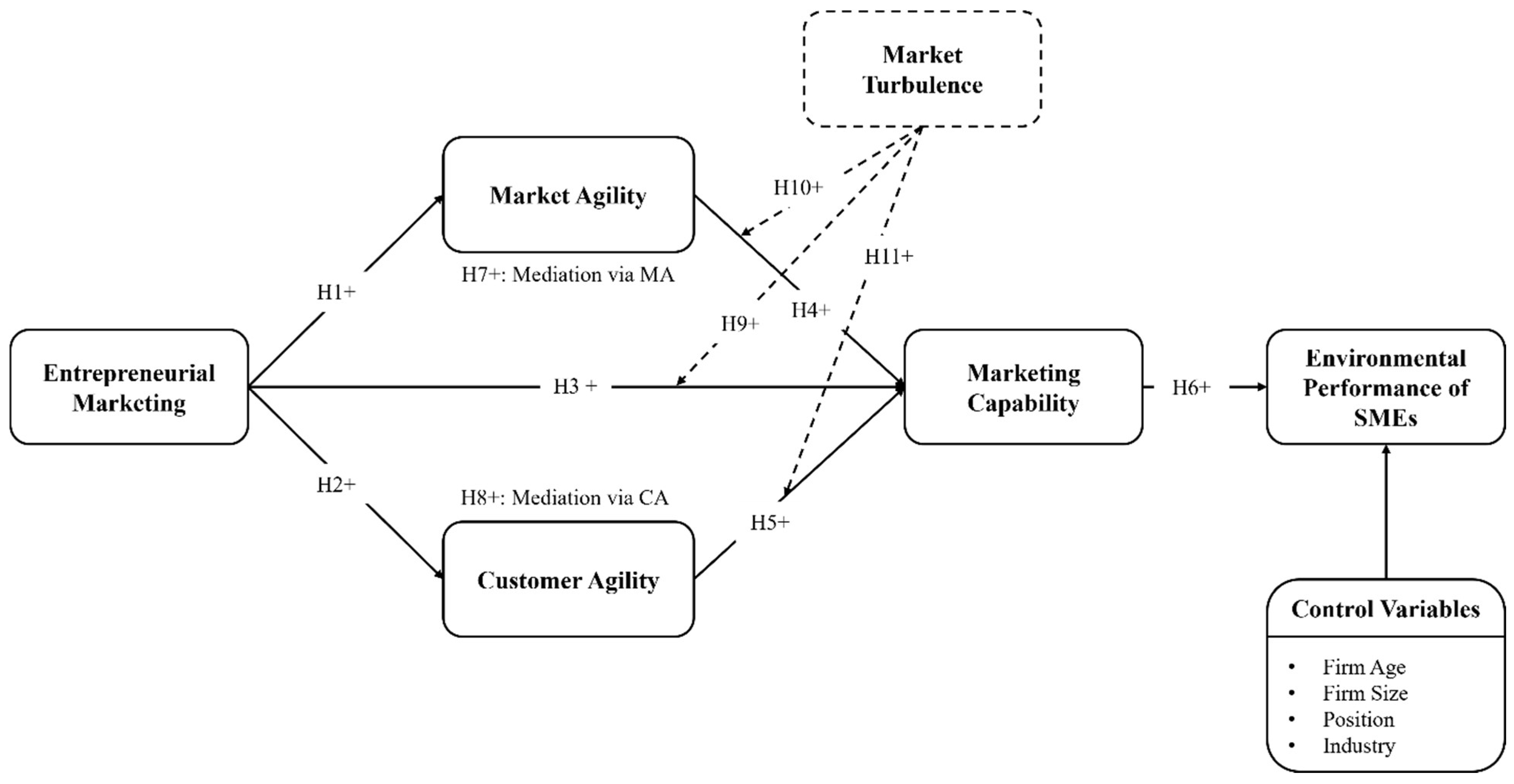
Figure 1 presents the conceptual model that integrates the theoretical framework and research hypotheses developed in the preceding sections. The model positions entrepreneurial marketing as the independent variable that is associated with market agility (H1) and customer agility (H2) as parallel first-stage dynamic mechanisms, and directly associated with marketing capability (H3). Market agility (H4) and customer agility (H5) each are associated with marketing capability as a second-stage organizational resource, which in turn is associated with environmental performance of SMEs (H6). The mediation hypotheses (H7 and H8) specify the indirect pathways from EM to marketing capability through each agility construct, while the moderation hypotheses (H9, H10, and H11) position market turbulence as a boundary condition that strengthens the EM-to-capability and agility-to-capability associations. Control variables include firm age, firm size, respondent position, and industry sector.

3. Methodology

3.1. Research Context

This study was conducted among small and medium-sized enterprises (SMEs) operating across multiple industry sectors in the United Arab Emirates. SMEs represent the structural backbone of the UAE economy, accounting for the substantial majority of registered businesses and a significant share of non-oil economic output, and they operate within a regulatory and market environment that combines rapid economic diversification with rising stakeholder expectations regarding environmental responsibility. This combination of competitive dynamism and sustainability pressure makes UAE SMEs a theoretically appropriate population for examining how entrepreneurial marketing behaviors are associated with environmental performance outcomes through organizational capability mechanisms. Restricting the sampling frame to SMEs rather than large enterprises is consistent with prior entrepreneurial marketing research, which has consistently argued that EM behaviors are most clearly observable in resource-constrained firms that rely on opportunity recognition and resource leveraging rather than formalized, resource-intensive marketing departments [1,9]. Micro-enterprises, typically defined as firms with fewer than ten employees under UAE classification standards, were excluded from the sampling frame on the grounds that they rarely employ formal marketing functions or managers, making the entrepreneurial marketing and marketing capability constructs less theoretically applicable to their operational context [11]. Future research should examine whether the proposed model holds for micro-enterprise contexts, where resource constraints are more severe and marketing practices are less formalised.

3.2. Sampling Method and Data Collection

A non-probability purposive sampling technique was employed to identify SMEs that met three eligibility criteria: registration as a small or medium-sized enterprise under UAE classification standards, a minimum of one year of continuous operation, and the presence of at least one respondent occupying an owner, managerial, or supervisory role with direct knowledge of the firm’s marketing practices and performance outcomes. Purposive sampling was selected over probability-based alternatives because no complete and publicly accessible sampling frame of UAE SMEs exists, a constraint commonly encountered in SME survey research in the GCC region and addressed through comparable non-probability approaches in prior studies [3,14]. While purposive sampling is distinct from pure convenience sampling in that respondents were screened against explicit eligibility criteria, it nonetheless constitutes a non-probability technique that limits the statistical generalizability of the findings to the broader UAE SME population, and this constraint is acknowledged as a study limitation [50]. The target population consisted of owners, top managers, middle managers, marketing managers, and operations managers, since these individuals are directly responsible for strategic decision-making, the design and implementation of marketing strategies, and the achievement of firm-level performance outcomes.
Data were collected through a self-administered structured questionnaire distributed electronically to SME representatives across the manufacturing and services sectors. Eligible respondents were screened at the outset of the questionnaire to confirm their organizational role and decision-making involvement before proceeding to the substantive items. A total of 900 questionnaires were distributed, of which 423 were returned, yielding a response rate of approximately 47%, consistent with response rates typically reported in SME survey research in emerging market contexts [2]. After excluding 21 responses with substantial missing data or patterned response behavior indicative of inattentive completion, a final valid sample of 402 usable responses was retained for analysis. This sample size exceeds the minimum threshold recommended for the proposed model under the inverse square root method and the ten-times rule [51,52], and is adequate given the complexity of the model, which includes a second-order construct, two mediating variables, one moderating variable, and a combination of mediation and moderation paths estimated simultaneously.

3.3. Respondents’ Demographic Profile

Table 2 presents the demographic characteristics of the 402 respondents who comprised the final analytical sample. The sample exhibited a relatively balanced gender distribution, a broad spread of respondent ages and educational backgrounds, and adequate representation across organizational positions, industry sectors, firm ages, and firm sizes, supporting the generalizability of the findings within the UAE SME population.

3.4. Measurement Instruments

All constructs in the research model were measured using items adopted and adapted from previously validated scales reported in the entrepreneurial marketing, dynamic capabilities, and sustainability literature. The questionnaire was developed and administered in English. Entrepreneurial marketing was operationalized as a reflective-reflective second-order construct comprising twelve items across four lower-order dimensions, namely opportunity-driven behavior, value creation, customer-focused innovation, and risk management, following Buccieri and Park [40]. Market agility was measured with four items adapted from Khan et al. [37], capturing the speed and precision with which firms detect and respond to competitive and technological change. Customer agility was measured with five items adapted from Wamba [39], reflecting the firm’s responsiveness to shifts in customer behavior and needs. Marketing capability was measured with eight items adapted from Ali et al. [30], spanning pricing, product development, channel management, marketing communication, sales management, marketing information systems, planning, and implementation. Market turbulence was measured with five-item scale adapted from Jaworski and Kohli [5]. Environmental performance of SMEs was measured with six items adapted from Borah et al. [47], capturing the environmental performance dimensions of organizational outcomes, including resource consumption, emissions, water releases, residual materials, biodiversity protection, and overall environmental impact. All items were rated on a five-point Likert scale ranging from 1 (strongly disagree) to 5 (strongly agree). Table 3 presents the operational definitions, measurement sources, number of items, and scale format for all constructs included in the research model. The full questionnaire is provided in Appendix A (Table A1).

3.5. Common Method Variance

Because all constructs were measured using self-reported perceptual data collected from a single respondent per firm at a single point in time, the potential for common method variance (CMV) was addressed through both procedural and statistical remedies. Procedurally, respondent anonymity was assured, items were worded to minimize ambiguity and social desirability bias, the constructs were separated psychologically within the questionnaire by interspersing items measuring different constructs rather than grouping them by construct, and a cover message clarified that there were no right or wrong answers, all consistent with the procedural recommendations of Podsakoff et al. [53]. Statistically, two complementary tests were conducted. First, Harman’s single-factor test was performed by entering all measurement items into an unrotated exploratory factor analysis; the first factor accounted for 36.8% of the total variance explained, below the 50% threshold beyond which common method bias is considered a serious concern [53], indicating that no single factor accounted for the majority of variance in the data. Second, the full collinearity test proposed by Kock [54] was conducted by examining the variance inflation factor (VIF) associated with each indicator in the structural model; all VIF values fell below the conservative threshold of 3.3, providing converging evidence that common method bias is unlikely to have materially affected the structural relationships reported in this study. It is nonetheless acknowledged that Harman’s single-factor test and the full collinearity VIF criterion are among the less diagnostic remedies for CMV [55]. Stronger approaches, such as the marker variable technique [56] or the unmeasured latent method factor procedure, were not employed in this study and represent a residual methodological limitation that future research should address through multi-source data collection or objective performance indicators.

3.6. Data Analysis Procedure

Data were initially screened and prepared using IBM SPSS version 25, including checks for missing values, outliers, and the demographic profiling reported in the preceding section. The structural relationships proposed in the research model were then estimated using partial least squares structural equation modeling (PLS-SEM) in SmartPLS 4 [57], a method well suited to complex models involving second-order constructs, multiple mediators, and moderation effects, and appropriate given the prediction-oriented and theory-extension objectives of this study [58]. The analysis proceeded in two stages. First, the measurement model was assessed for indicator reliability, internal consistency reliability, convergent validity, and discriminant validity, including bootstrapped confidence intervals for the heterotrait–monotrait (HTMT) ratio following Henseler et al. [59]. Second, the structural model was assessed for collinearity, explanatory power, predictive relevance, and the significance of direct, indirect, and interaction effects, using bootstrapping with 5,000 subsamples to generate bias-corrected confidence intervals for all path coefficients. Effect sizes (f2) and R2 change (ΔR2) were extracted for all moderation interaction terms to assess the practical magnitude of the hypothesised boundary condition associations [51,60]. Mediation was tested following the variance accounted for approach recommended by Nitzl et al. [61], and moderation was tested using the two-stage approach with bootstrapped confidence intervals for the interaction terms. To examine potential heterogeneity across industry sectors, a measurement invariance assessment using the MICOM procedure [62] was conducted as a prerequisite for multigroup analysis comparing the manufacturing and services subgroups.

4. Data Analysis and Results

4.1. Measurement Model Assessment

The measurement model was evaluated for indicator reliability, internal consistency reliability, and convergent validity, following the criteria recommended by Hair et al. [58]. As shown in Table 4, all indicator loadings exceeded the recommended threshold of 0.70, with the exception of several marketing capability and market turbulence items that exceeded the minimum acceptable threshold of 0.70 only marginally, a pattern that is common for newly contextualized scales applied outside their original cultural setting [63]. Internal consistency reliability was confirmed for all constructs, with Cronbach’s alpha values ranging from 0.722 to 0.886 and composite reliability (CR) values ranging from 0.814 to 0.902, all exceeding the recommended threshold of 0.70 [51,64]. Convergent validity was established for all constructs, with average variance extracted (AVE) values ranging from 0.555 to 0.803, exceeding the recommended minimum of 0.50 [65]. One item from the market turbulence scale (MT5), a reverse-coded item, was removed prior to the final model estimation due to a loading below the acceptable threshold, consistent with prior applications of this scale in PLS-SEM research [28]. The reflective-reflective second-order specification for entrepreneurial marketing was confirmed as appropriate given that the four lower-order dimensions co-vary as manifestations of the same underlying EM orientation, consistent with the reflective-reflective Type II hierarchical component model classification [66]. The construct was estimated using the repeated indicators approach in SmartPLS 4 [51].
Discriminant validity was assessed using both the heterotrait–monotrait (HTMT) ratio of correlations with bootstrapped 95% confidence intervals and the Fornell–Larcker criterion [67]. As shown in Table 5, all HTMT values were below the conservative threshold of 0.85 [59], with the highest value observed between marketing capability and market turbulence (0.768; 95% CI [0.682, 0.849]), indicating adequate discriminant validity between all pairs of constructs. Critically, none of the bootstrapped confidence intervals for any HTMT pair included 1.0, confirming discriminant validity for all construct pairs [59,67]. The moderate correlation between marketing capability and market turbulence likely reflects the tendency of firms with stronger marketing capability to be more attuned to perceiving market-level change, a pattern consistent with the perceptual nature of both constructs within a single-respondent design rather than evidence of construct overlap [51]. As shown in Table 6, the square root of the AVE for each construct exceeded its correlations with all other constructs, providing further support for discriminant validity [65]. Taken together, the measurement model results confirm that the constructs in the research model are reliable, convergently valid, and empirically distinct from one another, providing an adequate foundation for the structural model assessment.

4.2. Structural Model Assessment

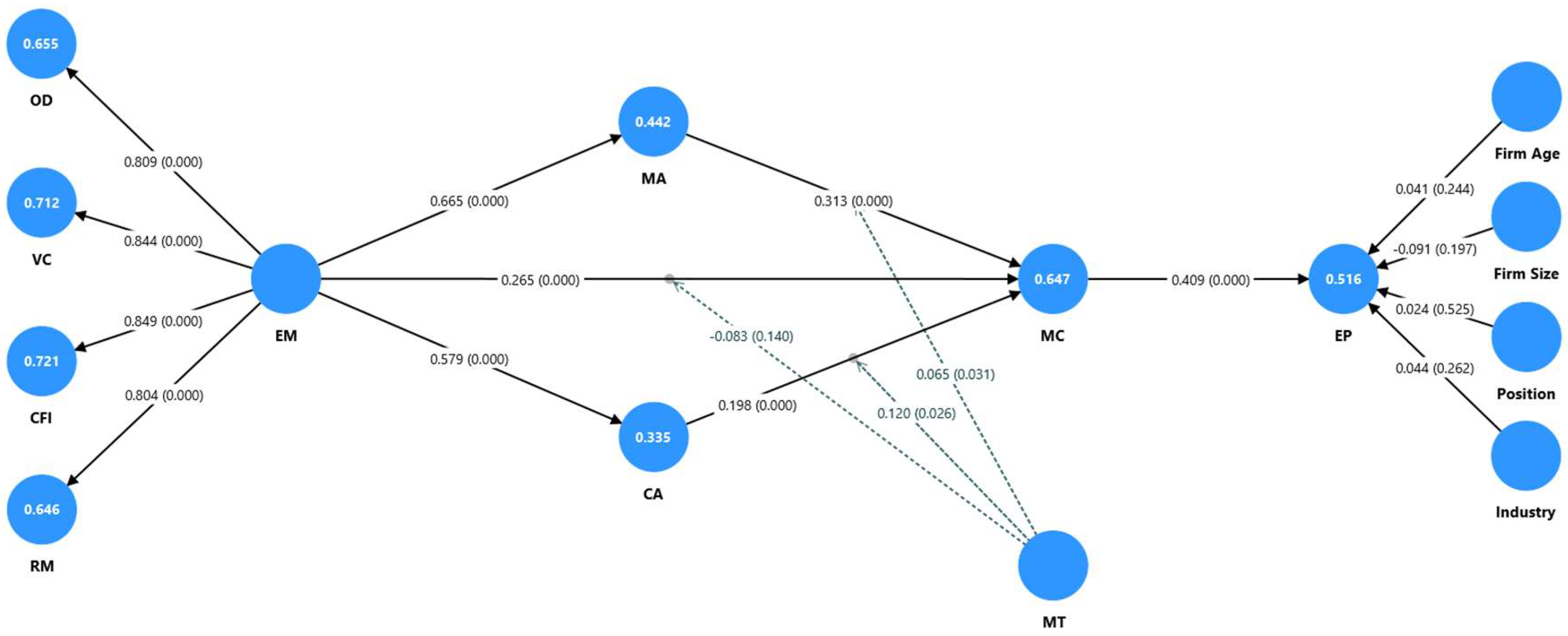
Prior to testing the hypothesized relationships, the structural model was assessed for collinearity, explanatory power, and predictive relevance. All inner VIF values, reported in Table 4, remained below the conservative threshold of 3.3, indicating that collinearity among the predictor constructs did not bias the structural model estimates [51,54]. As shown in Table 7, the model explained 44.2% of the variance in market agility (R2 = 0.442) and 33.5% of the variance in customer agility (R2 = 0.335), both representing moderate explanatory power for dynamic capability constructs. The model explained 64.7% of the variance in marketing capability (R2 = 0.647), representing substantial explanatory power. The model explained 51.6% of the variance in environmental performance of SMEs (R2 = 0.516), representing substantial explanatory power for an environmental performance outcome [60]. The Q2 values for all four endogenous constructs were positive and exceeded zero by a considerable margin (market agility Q2 = 0.435; customer agility Q2 = 0.329; marketing capability Q2 = 0.519; environmental performance of SMEs Q2 = 0.422), confirming that the model possesses adequate predictive relevance. Figure 2 presents the full structural model with standardized path coefficients, indicator loadings, and R2 values for the endogenous constructs, as generated in SmartPLS 4.
Table 8 presents the results of the hypothesis tests for the direct associations in the structural model. Entrepreneurial marketing showed a strong and significant positive association with market agility (β = 0.665, t = 15.870, p < 0.001), supporting H1, and a significant positive association with customer agility (β = 0.579, t = 11.559, p < 0.001), supporting H2. Entrepreneurial marketing also showed a significant direct positive association with marketing capability (β = 0.265, t = 4.772, p < 0.001), supporting H3. Market agility was positively associated with marketing capability (β = 0.313, t = 5.885, p < 0.001), supporting H4, and customer agility likewise showed a significant positive association with marketing capability (β = 0.198, t = 3.942, p < 0.001), supporting H5. Marketing capability showed a strong positive association with environmental performance of SMEs (β = 0.409, t = 7.631, p < 0.001), supporting H6. None of the four control variables, firm age, firm size, respondent position, or industry, showed a significant association with environmental performance of SMEs, indicating that the observed structural associations are robust to these firm-level characteristics.

4.3. Mediation Analysis

The mediating roles of market agility and customer agility in the association between entrepreneurial marketing and marketing capability were tested using bootstrapped indirect associations with 5000 resamples, following the variance accounted for approach recommended by Nitzl et al. [61]. As shown in Table 9, the indirect association of entrepreneurial marketing with marketing capability through market agility was significant (β = 0.208, t = 6.015, p < 0.001), supporting H7. The indirect association of entrepreneurial marketing with marketing capability through customer agility was likewise significant (β = 0.115, t = 3.821, p < 0.001), supporting H8. Because entrepreneurial marketing also showed a significant direct association with marketing capability, both mediation associations are classified as complementary partial mediation, indicating that market agility and customer agility each represent meaningful but not exclusive pathways through which entrepreneurial marketing is associated with marketing capability [68].
Beyond the hypothesized mediation paths, additional indirect associations extending to environmental performance of SMEs were examined to clarify the full chain of associations implied by the model. The indirect association of entrepreneurial marketing with environmental performance of SMEs through the EM → MC → EP path was significant (β = 0.108, t = 4.040, p < 0.001), as were the indirect associations from market agility to environmental performance of SMEs via marketing capability (β = 0.128, t = 4.837, p < 0.001) and from customer agility to environmental performance of SMEs via marketing capability (β = 0.081, t = 3.246, p = 0.001). The full serial mediation chains from entrepreneurial marketing to environmental performance of SMEs through market agility and marketing capability (β = 0.085, t = 4.794, p < 0.001) and through customer agility and marketing capability (β = 0.047, t = 3.096, p = 0.002) were also significant, confirming that the two-stage capability mechanism proposed in this study extends meaningfully to environmental performance outcomes.

4.4. Moderation Analysis

The moderating role of market turbulence was tested for three associations within the model: entrepreneurial marketing with marketing capability, market agility with marketing capability, and customer agility with marketing capability. As shown in Table 10, the interaction of market turbulence on the entrepreneurial marketing with marketing capability association was not significant (β = −0.083, t = 1.477, p = 0.140; f2 = 0.017), and H9 was therefore not supported. This result suggests that the association of entrepreneurial marketing with marketing capability remains stable across varying levels of market turbulence, rather than being contingent on the surrounding competitive environment.
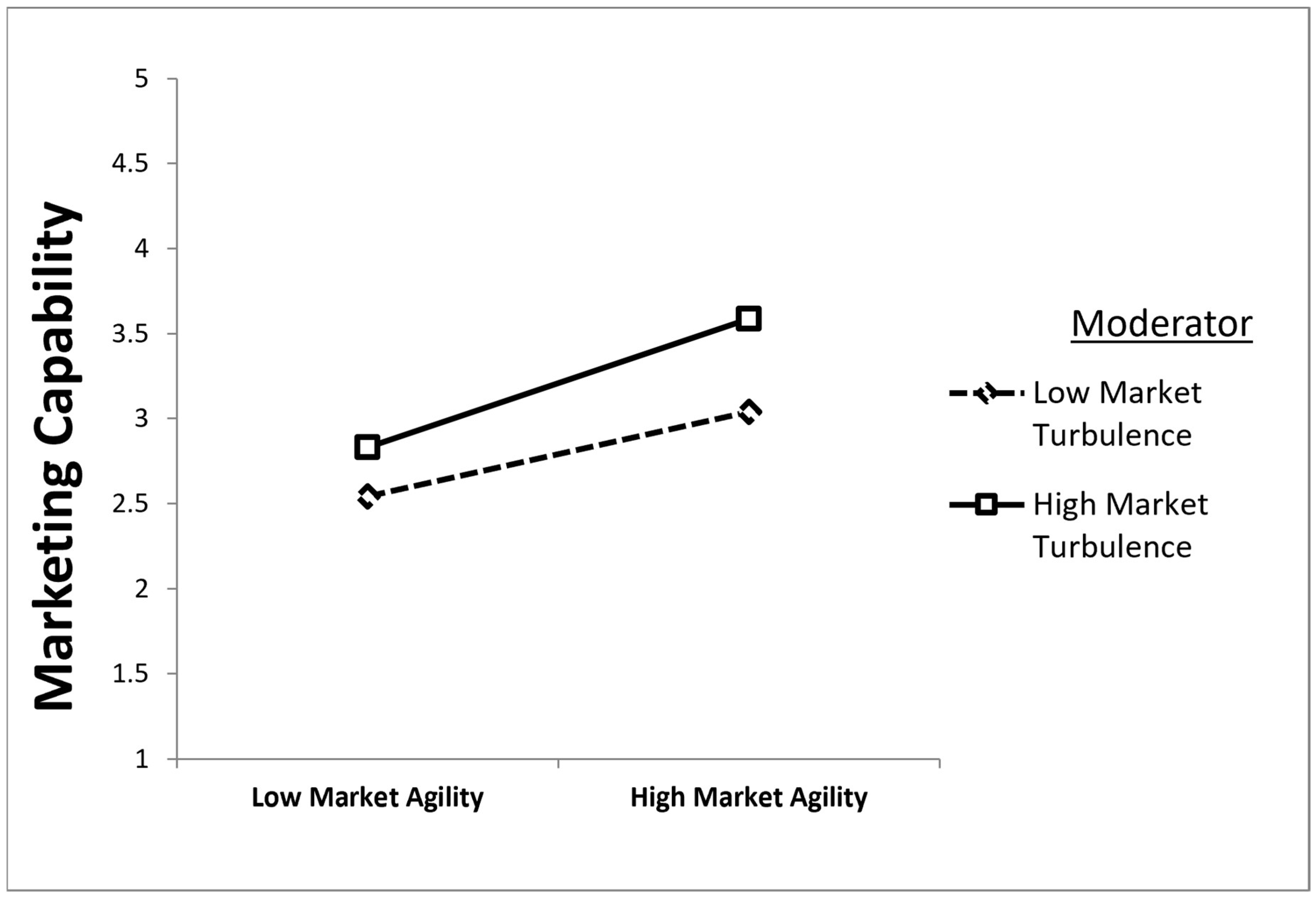
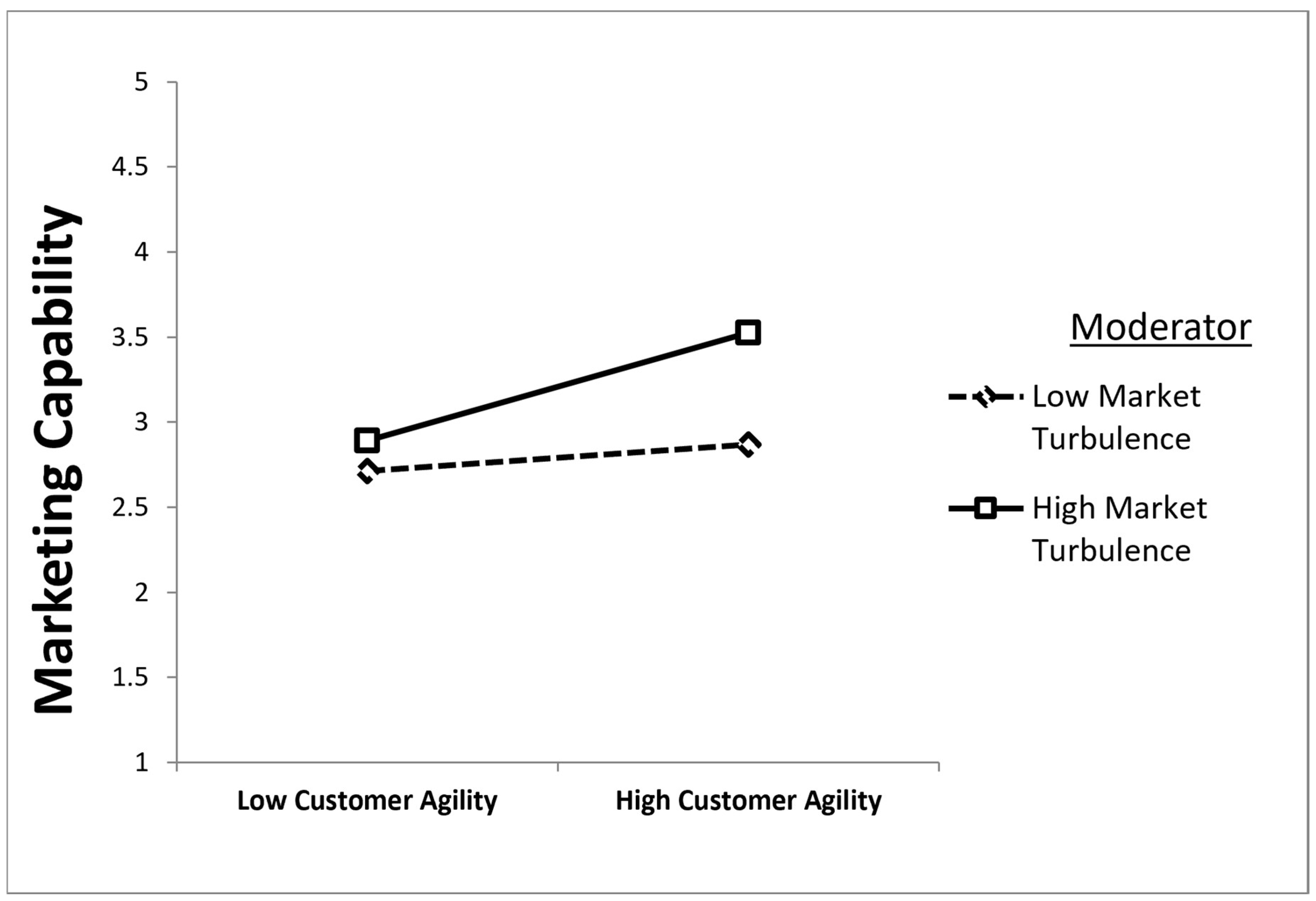
By contrast, market turbulence significantly strengthened the association between market agility and marketing capability (β = 0.065, t = 2.157, p = 0.031; f2 = 0.024), supporting H10, and the association between customer agility and marketing capability (β = 0.120, t = 2.224, p = 0.026; f2 = 0.055), supporting H11. Both interaction associations are small in magnitude, as reflected by the f2 values, which is consistent with typical interaction effect sizes observed in PLS-SEM moderation analyses [60,69,70]. The combined addition of the three interaction terms increased the R2 of marketing capability from 0.607 to 0.647, representing a ΔR2 of 0.040. Both interaction associations were positive, indicating that the association of market agility and customer agility with marketing capability is stronger as market turbulence increases. Figure 3 and Figure 4 present the simple slope plots for these two significant interactions, illustrating the steeper positive slopes for both agility-to-capability associations under conditions of high market turbulence relative to low market turbulence.

4.5. Predictive Assessment

To assess the out-of-sample predictive power of the research model, a PLSpredict analysis was conducted following the procedure recommended by Shmueli et al. [71], using tenfold cross-validation with ten repetitions. The Q2 predict values for all indicators of market agility, customer agility, marketing capability, and environmental performance of SMEs were positive, indicating that the PLS-SEM model outperforms a simple mean-based benchmark in predicting out-of-sample observations. A comparison of the root mean squared error (RMSE) values generated by the PLS path model against those generated by a linear regression model benchmark showed lower RMSE values for the PLS-SEM model across the majority of indicators, providing evidence of satisfactory predictive power at both the construct and indicator level [71]. These results, considered together with the in-sample R2 and Q2 values reported in Table 7, support the conclusion that the proposed model possesses both explanatory and predictive validity.

4.6. Measurement Invariance and Multigroup Analysis

To examine whether the proposed model operates equivalently across manufacturing and services SMEs, a measurement invariance assessment of composites using the MICOM procedure [62] was conducted prior to PLS-MGA. MICOM proceeds across three steps: configural invariance, compositional invariance, and equality of construct means and variances.
Step 1 confirmed configural invariance, as the same model specification, algorithm settings, and data treatment were applied identically across both groups.
Step 2 tested compositional invariance by comparing the original composite correlations against a permutation distribution. Results indicated that compositional invariance was established for all substantive constructs (CA: p = 0.274; EM: p = 0.159; MA: p = 0.822; MT: p = 0.431; EP: p = 0.125) with the exception of marketing capability (MC: p = 0.015), which did not achieve compositional invariance across the manufacturing and services groups. This partial non-invariance indicates that the MC composite is weighted differently across groups, and accordingly, path coefficients involving MC should be interpreted with caution in the multigroup context.
Step 3a examined equality of construct means and Step 3b examined equality of construct variances. No significant mean differences were found for any substantive construct. No significant variance differences were found for the substantive constructs, with the exception of the EM opportunity-driven dimension, which reflects a difference in score dispersion between manufacturing and services SMEs rather than a structural model concern.
Given partial invariance, the PLS-MGA results are reported as exploratory. As shown in Table 11, no substantive path coefficient differed significantly between the manufacturing and services groups. The only significant group difference was observed for the control variable firm size on environmental performance of SMEs (p = 0.000), suggesting that firm size plays a stronger role in environmental performance within the services subsample than in the manufacturing subsample. These findings indicate that the pooled model is broadly appropriate for the substantive structural associations, while the differential role of firm size across sectors warrants attention in future research.

5. Discussion and Implications

5.1. Discussion of Findings

The results of this study provide empirical support for the proposed two-stage capability model linking entrepreneurial marketing to environmental performance of SMEs among UAE-based SMEs. The pattern of findings is discussed below according to the principal associations specified in the research model: the association of entrepreneurial marketing with performance-relevant outcomes, the association of entrepreneurial marketing with the two agility constructs, the association of marketing capability with environmental performance, the mediating role of agility, and the moderating role of market turbulence.
With respect to entrepreneurial marketing and environmental performance, the combined direct and indirect associations of EM with environmental performance of SMEs, transmitted primarily through marketing capability, confirm that entrepreneurially oriented marketing behaviors among UAE SMEs are associated with measurable environmental performance outcomes rather than remaining confined to commercial or financial gains. This finding is consistent with the broader entrepreneurial marketing literature establishing EM as a robust positive predictor of firm performance across diverse emerging market contexts, including Jordan [2], Ghana [1,48], and the wider Gulf region [14]. Studies conducted in Arab and Gulf contexts have further confirmed that EM-related orientations are associated with superior performance outcomes among resource-constrained SMEs operating under competitive and regulatory pressure [2,14], lending regional contextual credibility to the present findings. The present results contribute to this literature by demonstrating that the performance-associated pattern of EM applies specifically to the environmental performance dimension, a relationship that has received comparatively limited direct empirical testing despite being theoretically anticipated by Hart’s [7] natural resource-based view.
With respect to entrepreneurial marketing and agility, the strong direct associations of entrepreneurial marketing with both market agility (β = 0.665) and customer agility (β = 0.579) confirm that EM functions as a generative organizational orientation that simultaneously cultivates competitive sensing and customer-responsive capacity, in line with the dynamic capabilities argument that entrepreneurially oriented firms develop the sensing and seizing routines that underlie organizational agility [19,26]. The comparatively larger association observed for market agility relative to customer agility parallels the finding of Khan et al. [37], who reported that entrepreneurial marketing capabilities in emerging market SMEs are more strongly weighted toward outside-in competitive responsiveness than toward narrowly customer-focused responsiveness, suggesting that in highly competitive emerging markets such as the UAE, EM behaviors may be disproportionately oriented toward monitoring rivals and market shifts rather than customer-specific signals alone.
With respect to marketing capability and environmental performance, the strong positive association of marketing capability with environmental performance of SMEs (β = 0.409) provides direct empirical support for the natural resource-based view argument that marketing-related organizational competencies serve as a conduit through which strategic orientations are associated with environmentally responsible outcomes [7]. Consistent with the NRBV logic advanced by Hart [7] and the empirical evidence of Leonidou et al. [33], the results confirm that general marketing competencies become conduits for environmental performance when deployed within an institutionally sustainability-pressured context, precisely the condition characterising UAE SMEs operating under national green economy mandates. This finding is consistent with Hanaysha and Al-Shaikh [3], who reported a comparable positive association between marketing capability and business sustainability among UAE SMEs, and with Schmidt et al. [4], who demonstrated that marketing-related organizational orientations are associated with circular economy practices among German SMEs through a closely related theoretical mechanism. The convergence of these findings across markedly different institutional contexts, Northern Europe and the Gulf region, lends cross-contextual credibility to the proposition that marketing capability functions as a generalizable mechanism linking strategic marketing orientation to environmental performance.
With respect to the mediating roles of agility, the significant indirect associations of entrepreneurial marketing with marketing capability through both market agility (β = 0.208) and customer agility (β = 0.115) confirm that both agility constructs function as meaningful, complementary partial mediating mechanisms. Because entrepreneurial marketing also retained a significant direct association with marketing capability after accounting for these indirect paths, the mediation pattern observed here is classified as complementary partial mediation following the typology of Zhao et al. [68], indicating that agility represents an important but not exclusive channel through which entrepreneurial marketing is associated with organizational marketing capability. This finding contributes to the predominantly direct treatment of the EM-capability association found in prior research [38,43] by specifying the dynamic intermediate mechanisms through which entrepreneurially oriented behaviors are linked to durable capability, a distinction also emphasized by Haverila et al. [20] in their treatment of marketing agility as an antecedent of marketing capability development.
With respect to the moderating role of market turbulence, the pattern of results is more nuanced than uniformly hypothesized and merits careful interpretation. Market turbulence did not significantly strengthen the direct association between entrepreneurial marketing and marketing capability, suggesting that the capability-building association of entrepreneurial marketing behaviors remains relatively stable across varying levels of market volatility. This result departs from the moderation pattern reported for the direct EM-performance association by Sulaiman et al. [14] and Hilal and Tantawy [16], both of whom found that market turbulence strengthens the EM-performance association in Gulf and North African banking contexts respectively. A plausible explanation for this divergence is that turbulence may condition the association between EM and overall firm performance, which aggregates financial, operational, and strategic outcomes, more strongly than it conditions the narrower process of internal marketing capability accumulation examined in the present model, a distinction consistent with Wilden and Gudergan’s [6] argument that turbulence exerts differential associations across distinct capability and performance constructs rather than uniformly strengthening all organizational associations. The small effect sizes observed for the two supported interaction terms (f2 = 0.024 and f2 = 0.055 respectively) indicate that market turbulence serves as a meaningful but modest boundary condition, and the contribution of this finding lies in the selective pattern of moderation rather than in the magnitude of individual interactions. By contrast, market turbulence significantly strengthened both the market agility to marketing capability association and the customer agility to marketing capability association, confirming that the association of dynamic agility mechanisms with capability development becomes more pronounced as environmental unpredictability increases. This pattern directly corroborates the theoretical proposition, advanced within dynamic capabilities theory, that sensing and responding capabilities yield their greatest organizational value precisely under the high-uncertainty conditions for which they are functionally designed [19,22], and is empirically consistent with Xi and Zhang [49], who found that the association between knowledge creation and dynamic capabilities is significantly stronger under conditions of high market turbulence, and with Wilden and Gudergan [6], who reported that environmental turbulence strengthens the association between dynamic capabilities and operational marketing capability. Taken together, the selective pattern of moderation observed in this study suggests that market turbulence strengthens capability-building associations that are inherently dynamic and sensing-oriented in nature, such as market and customer agility, while leaving more stable, entrepreneurially driven antecedents of capability comparatively unaffected by the surrounding level of environmental volatility.

5.2. Theoretical Implications

This study offers several theoretical contributions to the entrepreneurial marketing and dynamic capability literature. First, it refines entrepreneurial marketing theory by demonstrating that EM’s association with organizational capability operates through distinguishable dynamic mechanisms rather than as an undifferentiated direct association, addressing the call by Abbas and Tiberius [18] for research that specifies the intermediate processes connecting EM to capability and performance outcomes. The empirical finding that EM is more strongly associated with market agility than with customer agility further extends EM theory by suggesting that, within high-competition emerging market contexts such as the UAE, the proactiveness and opportunity-focus dimensions of EM are more consequential for competitive sensing than for customer-specific responsiveness, a nuance that prior EM studies have not distinguished empirically.
Second, the study empirically integrates dynamic capabilities theory with the resource-based view and the natural resource-based view within a single tested sequence, providing evidence that dynamic, sensing-oriented capabilities, represented here by market and customer agility, function as a distinct organizational layer that precedes and is associated with more stable, process-oriented capabilities such as marketing capability, which in turn are associated with sustainability outcomes consistent with the NRBV logic articulated by Hart [7] and empirically supported by Schmidt et al. [4] and Leonidou et al. [33]. The empirical confirmation of the full chain, from EM through agility to marketing capability to environmental performance, provides the first integrated test of this multi-theory sequence in a Gulf SME context, extending DCT and RBV beyond their predominantly Western and manufacturing-sector applications. This sequencing contributes to prior single-theory applications, such as Cruz Rincon et al. [36], who modeled marketing capability as a direct mediator without specifying an antecedent dynamic capability layer.
Third, by explicitly modeling and testing market agility and customer agility as parallel but theoretically distinct mechanisms, the study clarifies how outside-in customer responsiveness and broader competitive responsiveness operate as separable, only partially overlapping pathways to capability development, a distinction that addresses the conceptual ambiguity present in prior agility research that has frequently treated organizational and customer agility as a single undifferentiated construct [25,39]. The finding that market agility carries a stronger association with marketing capability than customer agility further refines DCT by indicating that competitive sensing mechanisms contribute more substantially to ordinary capability accumulation than customer-specific responsiveness mechanisms in the present context, adding construct-level precision to the broader DCT sensing-seizing-reconfiguring framework [19].
Fourth, the selective pattern of moderation observed for market turbulence introduces important boundary condition precision to entrepreneurial marketing and dynamic capabilities research, indicating that environmental turbulence does not uniformly strengthen all capability-building associations in a given model but instead selectively strengthens those mechanisms most directly rooted in dynamic sensing and responsiveness, a refinement consistent with the differentiated treatment of turbulence associations advanced by Wilden and Gudergan [6] and supported empirically here through the contrasting moderation results. The modest effect sizes of the supported interactions, rather than diminishing this contribution, reinforce the argument that boundary condition associations in capability-performance research are often contextually specific and incremental rather than dominant, and that their theoretical value lies in the pattern they reveal rather than in their magnitude alone [72].
Finally, by testing this integrated model in the UAE, a Gulf Cooperation Council economy characterized by an unusual combination of high market dynamism and explicit national sustainability commitments, the study contributes to the geographic and institutional scope of sustainability-oriented entrepreneurial marketing research beyond the predominantly Western, South Asian, and Sub-Saharan African contexts in which it has previously been examined [3,48]. The absence of significant path coefficient differences across manufacturing and services groups in the multigroup analysis further supports the cross-sectoral generalizability of the proposed model within the UAE SME population, strengthening the external validity of the findings.

5.3. Managerial Implications for SMEs

The findings carry several practical implications for SME owners and managers operating in the UAE and comparable emerging market contexts. First, given the substantial total association of entrepreneurial marketing with environmental performance, SME managers should deliberately embed opportunity-driven, customer-focused, and resource-leveraging behaviors into routine marketing practice rather than treating entrepreneurial marketing as an occasional or improvised activity. Specifically, this means instituting structured opportunity-scanning sessions as part of regular strategic planning cycles, developing systematic customer co-creation processes that generate continuous insight into emerging needs, and adopting creative low-cost marketing experimentation protocols with predefined risk parameters. The consistent association between these specific EM dimensions and superior firm outcomes across multiple emerging market studies [1,40] suggests that the structured cultivation of these behaviors, rather than reliance on ad hoc entrepreneurial instinct, offers the most reliable route to capability accumulation.
Second, because marketing capability showed the strongest proximate association with environmental performance in this study, consistent with the capability-performance association established by Vorhies and Morgan [8] and more recently confirmed in the UAE context by Hanaysha and Al-Shaikh [3], SMEs should prioritize sustained investment in the foundational marketing competencies of pricing, product development, channel management, communication, and strategic planning identified by Ali et al. [30]. In practice, this means allocating dedicated resources to marketing analytics platforms, formalizing cross-functional marketing planning cycles that incorporate environmental performance metrics such as resource consumption targets and emissions reduction goals, and building channel partnership programmes that extend the firm’s environmental communication reach to key stakeholder groups.
Third, given the significant mediating roles of market agility and customer agility identified in this study, SME managers should institutionalize formal routines for competitive monitoring and customer feedback collection, ensuring that the organization systematically converts external intelligence into capability refinement. Practical mechanisms include competitive intelligence dashboards that track competitor entry signals and technology adoption patterns, monthly customer advisory panels that capture real-time shifts in customer preferences, and dedicated rapid-response protocols that translate market and customer intelligence into marketing capability adjustments within defined timeframes. This recommendation is consistent with evidence from Smirnova and Golovacheva [24] and Haverila et al. [20] that structured market-sensing processes, rather than informal or sporadic monitoring, are associated with the strongest agility-to-capability returns.
Fourth, the selective moderation results suggest that SMEs operating in market segments characterized by high volatility should place particular strategic emphasis on strengthening their agility-based sensing mechanisms, since these associations yield disproportionately greater capability returns precisely when market conditions are most turbulent, a pattern consistent with the contingency argument advanced by Wilden and Gudergan [6] regarding the conditional value of dynamic capabilities. At the same time, because the direct association of entrepreneurial marketing with capability was not contingent on turbulence in this study, SME managers can pursue entrepreneurial marketing behaviors with confidence as a consistently beneficial capability-building strategy regardless of the surrounding level of market volatility, rather than reserving such behaviors for periods of perceived instability.
For UAE policymakers and SME development authorities, including bodies such as the Mohammed Bin Rashid Establishment for SME Development, the findings suggest several actionable priorities. Entrepreneurial marketing training modules should be incorporated into existing SME capacity-building programmes, given the consistent association between EM orientation and environmental performance outcomes. Green economy incentive schemes should recognize marketing capability development as a qualifying criterion, acknowledging it as a documented pathway through which SMEs convert strategic orientation into environmental outcomes. Environmental compliance frameworks for UAE SMEs should include capacity-building components targeting market and customer agility, given the evidence that these dynamic mechanisms are associated with stronger capability development under turbulent conditions. National SME diagnostic instruments should also incorporate marketing capability and agility dimensions to enable systematic monitoring of these capability pathways across the UAE SME population.

5.4. Limitations and Future Research

This study is subject to several limitations that suggest avenues for future research. The cross-sectional design precludes strong causal inference regarding the temporal ordering of the associations examined, and the possibility of reverse causality cannot be ruled out; for instance, firms with superior marketing capability may invest more in entrepreneurial marketing. Future studies should adopt longitudinal or instrumental variable designs to address this concern, following the recommendations of Hult et al. [73] and Antonakis et al. [74], and to examine how the entrepreneurial marketing to environmental performance association develops as SMEs mature and accumulate capability over time, consistent with calls by Eisenhardt and Martin [22] for dynamic capability research to capture capability evolution longitudinally. The reliance on single-respondent, self-reported data, while addressed through procedural and statistical common method variance remedies, remains a limitation; Harman’s single-factor test and the full collinearity VIF criterion are acknowledged as less diagnostic than stronger approaches such as the marker variable technique [56] or the unmeasured latent method factor procedure [55], and future replications should employ multi-source data collection or objective environmental performance indicators.
The non-probability sampling strategy, while guided by explicit eligibility criteria that distinguish it from pure convenience sampling, limits statistical generalizability, and micro-enterprises were excluded from the present study; future research should explore probability-based sampling where feasible and examine whether the proposed capability pathways operate differently in micro-enterprise contexts. The UAE focus limits transferability to other GCC or emerging market settings, and cross-national replication following the comparative approach of Alqahtani et al. [15] would help establish the boundary conditions of the model; the partial compositional non-invariance of marketing capability across manufacturing and services groups further warrants attention in future research using designs with sufficient within-sector sample sizes for fully invariant multigroup comparisons. Finally, the non-significant moderation of market turbulence on the direct entrepreneurial marketing to marketing capability association invites investigation into alternative contingency variables, such as competitive intensity or technological turbulence, both of which have been shown to condition related capability associations in prior research [6,35], and which may more directly explain this particular pathway than market turbulence alone.

Author Contributions

Writing—original draft, R.M.; Supervision, J.C.S.; Validation, R.M. and J.C.S.; Writing—review and editing, R.M. All authors have read and agreed to the published version of the manuscript.

Funding

This research received no external funding.

Institutional Review Board Statement

The study was conducted in accordance with the Declaration of Helsinki, and approved by the Institutional Review Board of Girne American University, Social Sciences Ethics Committee (protocol code 2024-25/052 and date of approval 21 July 2025).

Informed Consent Statement

All participants in this study provided their informed consent.

Data Availability Statement

The data from this study can be requested from the corresponding author, Rusul Mohammed.

Conflicts of Interest

The authors report no conflicts of interest.

Appendix A

Table A1. Survey Questionnaire Items.
ConstructCodeItem
Entrepreneurial Marketing Source: Buccieri and Park [40]
Opportunity-DrivenOD1We regularly pursue untapped market opportunities regardless of budgetary or staffing constraints.
OD2When new market opportunities arise, we respond quickly.
OD3We excel at identifying new marketing opportunities.
Value CreationVC1We expect every employee to look for ways to create more value for customers.
VC2Employees actively contribute ideas to create customer value.
VC3We continuously attempt to find new ways to create value for our customers.
Customer-Focused InnovationCFI1We invest considerable effort in learning more about our customers.
CFI2Our marketing efforts reflect a deep understanding of what customers want from our products or services.
CFI3Communicating with customers helps us identify new innovation opportunities.
Risk ManagementRM1When pursuing new marketing directions, we do so gradually rather than all at once.
RM2Our marketing activities tend to involve a relatively low level of risk.
RM3We use creative, low-cost methods to reduce risks associated with new marketing activities.
Market Agility Source: Khan et al. [37]
MA1We quickly adapt and react to the entry of new competitors.
MA2We adapt rapidly to the emergence of new technologies.
MA3We are able to detect and respond promptly to new business threats.
MA4We quickly detect and react to new business opportunities.
Customer Agility Source: Wamba [39]
CA1We respond rapidly when something important happens regarding our customers.
CA2We quickly implement planned activities related to customers.
CA3We react quickly to fundamental changes in customer behavior.
CA4When we identify a new customer need, we respond promptly.
CA5We are fast in responding to changes in customers’ product or service needs.
Marketing Capability Source: Ali et al. [30]
MC1Pricing strategy and techniques, such as discounts, cost reductions, and competitor price monitoring.
MC2Product development, such as product design, quantity decisions, and product launching.
MC3Channel management, such as distribution channel control, support, and coordination.
MC4Marketing communication, such as advertising, sales promotion, public relations, and personal selling.
MC5Sales management, such as sales planning, control systems, sales force training, and support.
MC6Marketing information systems, such as collecting and analyzing market and customer information.
MC7Marketing planning, such as segmentation, targeting, and strategic planning.
MC8Marketing implementation, such as execution, monitoring, and evaluation of marketing strategies.
Market Turbulence Source: Jaworski and Kohli [4]
MT1In our kind of business, customers’ product preferences change quite a bit over time.
MT2Our customers tend to look for new products all the time.
MT3We are witnessing demand for our products and services from customers who have never bought them before.
MT4New customers tend to have product-related needs that are different from those of our existing customers.
MT5We cater to many of the same customers that we used to in the past. (removed due to weak psychometric performance)
Environmental Performance of SMEs Source: Borah et al. [47]
EP1Our company minimizes its consumption of resources, including raw materials, water, and energy.
EP2Our company protects biodiversity and protected areas.
EP3Our company minimizes its emissions into the air, including greenhouse gases and other substances.
EP4Our company minimizes its releases into water.
EP5Our company minimizes residual materials.
EP6Our company minimizes the environmental impact of its products.
Note: MT5 was included in the original questionnaire as administered but removed during the measurement model assessment due to weak psychometric performance, consistent with established practice in PLS-SEM applications of this scale. All remaining items were retained in the final analysis. Item codes correspond to those used in Table 4 of the main manuscript.

References

  1. Sadiku-Dushi, N.; Dana, L.-P.; Ramadani, V. Entrepreneurial Marketing Dimensions and SMEs Performance. J. Bus. Res. 2019, 100, 86–99. [Google Scholar] [CrossRef]
  2. Kakeesh, D.F.; Al-Weshah, G.A.; Alalwan, A.A. Entrepreneurial Marketing and Business Performance in SMEs: The Mediating Role of Competitive Aggressiveness. J. Mark. Anal. 2025, 13, 1133–1156. [Google Scholar] [CrossRef]
  3. Hanaysha, J.R.; Al-Shaikh, M.E. Impact of Entrepreneurial Orientation, Marketing Capability, and Market Orientation on Business Sustainability and Corporate Reputation. Discov. Sustain. 2024, 5, 273. [Google Scholar] [CrossRef]
  4. Schmidt, C.V.H.; Kindermann, B.; Behlau, C.F.; Flatten, T.C. Understanding the Effect of Market Orientation on Circular Economy Practices: The Mediating Role of Closed-Loop Orientation in German SMEs. Bus. Strategy Environ. 2021, 30, 4171–4187. [Google Scholar] [CrossRef]
  5. Jaworski, B.J.; Kohli, A.K. Market Orientation: Antecedents and Consequences. J. Mark. 1993, 57, 53–70. [Google Scholar] [CrossRef]
  6. Wilden, R.; Gudergan, S.P. The Impact of Dynamic Capabilities on Operational Marketing and Technological Capabilities: Investigating the Role of Environmental Turbulence. J. Acad. Mark. Sci. 2015, 43, 181–199. [Google Scholar] [CrossRef]
  7. Hart, S.L. A Natural-Resource-Based View of the Firm. Acad. Manag. Rev. 1995, 20, 986–1014. [Google Scholar] [CrossRef]
  8. Vorhies, D.W.; Morgan, N.A. Benchmarking Marketing Capabilities for Sustainable Competitive Advantage. J. Mark. 2005, 69, 80–94. [Google Scholar] [CrossRef]
  9. Morris, M.H.; Schindehutte, M.; LaForge, R.W. Entrepreneurial Marketing: A Construct for Integrating Emerging Entrepreneurship and Marketing Perspectives. J. Mark. Theory Pract. 2002, 10, 1–19. [Google Scholar] [CrossRef]
  10. Alqahtani, N.; Uslay, C. Entrepreneurial Marketing and Firm Performance: Synthesis and Conceptual Development. J. Bus. Res. 2020, 113, 62–71. [Google Scholar] [CrossRef]
  11. Salman, H.A.J.D.; Mansor, N.B.; Alshami, S.A. Digital Transformation and Competitiveness of SMEs in the UAE: A Review Paper on Challenges and Strategic Responses. Int. J. Acad. Reserach Econ. Manag. Sci. 2025, 14, 684–691. [Google Scholar] [CrossRef] [PubMed]
  12. Alsaoudi, T.; Acquaye, A. From Policy Vision to Innovation Practice: An Integrated Framework for Governing the Circular–Digital Transition in the UAE. Digit. Bus. 2026, 6, 100173. [Google Scholar] [CrossRef]
  13. Jneibi, F.A.A.R.A.; Kudus, N.B. Unlocking the Potential of SMEs in the UAE: Exploring Challenges, Opportunities, and the Role of Organizational Learning in Manufacturing Innovation. Int. J. Acad. Res. Bus. Soc. Sci. 2024, 14, 2705–2712. [Google Scholar] [CrossRef] [PubMed]
  14. Sulaiman, M.A.B.A.; Asad, M.; Awain, A.M.S.B.; Asif, M.U.; Shanfari, K.S.A. Entrepreneurial Marketing and Performance: Contingent Role of Market Turbulence. Discov. Sustain. 2024, 5, 492. [Google Scholar] [CrossRef]
  15. Alqahtani, N.; Uslay, C.; Yeniyurt, S. Comparing the Moderated Impact of Entrepreneurial Orientation, Market Orientation, and Entrepreneurial Marketing on Firm Performance. J. Small Bus. Manag. 2024, 62, 2741–2778. [Google Scholar] [CrossRef]
  16. Hilal, O.A.; Tantawy, A.A. Entrepreneurial Marketing and Bank Performance in Egypt: Is Environmental Turbulence a Missing Link? J. Entrep. Emerg. Econ. 2021, 14, 252–273. [Google Scholar] [CrossRef]
  17. Osei, F.; Amoa-Gyarteng, K.; Kankam-Kwarteng, C.; Wilson-Wünsch, B. Entrepreneurial Marketing and SME Performance: The Double-Edged Role of Affective Organizational Commitment. J. Res. Mark. Entrep. 2026, 28, 63–92. [Google Scholar] [CrossRef]
  18. Abbas, A.F.; Tiberius, V. Unveiling Entrepreneurial Marketing: A Bibliometric Journey from Inception. J. Small Bus. Entrep. 2026, 38, 399–439. [Google Scholar] [CrossRef]
  19. Teece, D.J.; Pisano, G.; Shuen, A. Dynamic Capabilities and Strategic Management. Strateg. Manag. J. 1997, 18, 509–533. [Google Scholar] [CrossRef]
  20. Haverila, K.; Haverila, M.; McLaughlin, C.; Mohiuddin, M.; Su, Z. The Effect of Marketing Capabilities on Marketing Agility and Perceived Performance. Int. J. Product. Perform. Manag. 2025, 74, 3077–3102. [Google Scholar] [CrossRef]
  21. Alqahtani, N.; Uslay, C.; Yeniyurt, S. Entrepreneurial Marketing and Firm Performance: Scale Development, Validation, and Empirical Test. J. Strateg. Mark. 2025, 33, 859–880. [Google Scholar] [CrossRef]
  22. Eisenhardt, K.M.; Martin, J.A. Dynamic Capabilities: What Are They? Strateg. Manag. J. 2000, 21, 1105–1121. [Google Scholar] [CrossRef]
  23. Alfaqiyah, E.; Alzubi, A.; Aljuhmani, H.Y.; Öz, T. How Industry 4.0 Technologies Enhance Supply Chain Resilience: The Interplay of Agility, Adaptability, and Customer Integration in Manufacturing Firms. Sustainability 2025, 17, 7922. [Google Scholar] [CrossRef]
  24. Smirnova, M.M.; Golovacheva, K.S. How to Succeed in a Dysfunctional Environment: Configuring Marketing Agility Components for Better Performance. Ind. Mark. Manag. 2026, 132, 32–45. [Google Scholar] [CrossRef]
  25. Agag, G.; Yousaf, A.; Adiguzel, F. Marketing Agility and Firm Performance: The Role of Customer Service Performance and Customer Co-Creation. Eur. J. Mark. 2025, 59, 2607–2641. [Google Scholar] [CrossRef]
  26. Sahu, C.K.; Panda, R.K. Entrepreneurial Marketing, Organizational Agility and Business Ties: Implications for Manufacturing SMEs Performance in India. J. Bus. Ind. Mark. 2026, 41, 938–953. [Google Scholar] [CrossRef]
  27. Wilopo, W.; Nuralam, I.P.; Said, A.; Dahana, W.D. Strategic Agility, Marketing Agility, and Market-Driving Capability: A Dynamic Capability Perspective on SME Performance in Emerging Markets. J. Entrep. Emerg. Econ. 2026, 18, 735–765. [Google Scholar] [CrossRef]
  28. Abuseta, H.; Iyiola, K.; Aljuhmani, H.Y. Digital Technologies and Business Model Innovation in Turbulent Markets: Unlocking the Power of Agility and Absorptive Capacity. Sustainability 2025, 17, 5296. [Google Scholar] [CrossRef]
  29. Morgan, N.A. Marketing and Business Performance. J. Acad. Mark. Sci. 2012, 40, 102–119. [Google Scholar] [CrossRef]
  30. Ali, S.; Tian, H.; Wu, W.; Ali, S.; Kumail, T.; Saif, N. Marketing Capabilities, Market Ambidexterity and Product Innovation Outcomes: A Yin-Yang of inside-out and Outside-In. Ind. Mark. Manag. 2024, 118, 27–43. [Google Scholar] [CrossRef]
  31. Durman, S.; Iyiola, K.; Alzubi, A.B.; Aljuhmani, H.Y. Dynamic Capabilities in Action: Digital Capability, Business Model Innovation and Absorptive Capacity. Manag. Decis. 2025, 1–36. [Google Scholar] [CrossRef]
  32. Hart, S.L.; Dowell, G. Invited Editorial: A Natural-Resource-Based View of the Firm: Fifteen Years After. J. Manag. 2011, 37, 1464–1479. [Google Scholar] [CrossRef]
  33. Leonidou, C.N.; Katsikeas, C.S.; Morgan, N.A. “Greening” the Marketing Mix: Do Firms Do It and Does It Pay Off? J. Acad. Mark. Sci. 2013, 41, 151–170. [Google Scholar] [CrossRef]
  34. Donaldson, L. The Contingency Theory of Organizations; SAGE Publications, Inc.: Thousand Oaks, CA, USA, 2001; ISBN 978-0-7619-1574-4. [Google Scholar]
  35. Uzkurt, C.; Ekmekcioglu, E.B.; Ceyhan, S. Business Ties, Adaptive Capability and Technological Turbulence: Implications for SMEs’ Performance in Turkey. J. Bus. Ind. Mark. 2023, 39, 568–580. [Google Scholar] [CrossRef]
  36. Cruz Rincon, M.L.; Agredo Diaz, M.L.; Puente, R.C. Is Entrepreneurship Enough to Achieve Superior Performance in SMEs in Emerging Countries? Multiple Mediation of Market Orientation and Marketing Capabilities. J. Entrep. Emerg. Econ. 2022, 15, 945–966. [Google Scholar] [CrossRef]
  37. Khan, H.; Mavondo, F.; Zahoor, N. Integration of Outside-in and inside-out Entrepreneurial Marketing Capabilities, Marketing Agility and Resources for Entrepreneurial Firm Performance. Int. J. Entrep. Behav. Res. 2022, 31, 609–630. [Google Scholar] [CrossRef]
  38. Zahara, Z.; Ikhsan; Santi, I.N.; Farid. Entrepreneurial Marketing and Marketing Performance through Digital Marketing Capabilities of SMEs in Post-Pandemic Recovery. Cogent Bus. Manag. 2023, 10, 2204592. [Google Scholar] [CrossRef]
  39. Fosso Wamba, S. Impact of Artificial Intelligence Assimilation on Firm Performance: The Mediating Effects of Organizational Agility and Customer Agility. Int. J. Inf. Manag. 2022, 67, 102544. [Google Scholar] [CrossRef]
  40. Buccieri, D.; Park, J. Entrepreneurial Marketing and Reconfiguration towards Post-Entry Performance: Moderating Effects of Market Dynamism and Entry Mode. J. Bus. Res. 2022, 148, 89–100. [Google Scholar] [CrossRef]
  41. Rezvani, M.; Fathollahzadeh, Z. The Impact of Entrepreneurial Marketing on Innovative Marketing Performance in Small- and Medium-Sized Companies. J. Strateg. Mark. 2020, 28, 136–148. [Google Scholar] [CrossRef]
  42. Sari, D.; Kusuma, B.A.; Sihotang, J.; Febrianti, T. The Role of Entrepreneurial Marketing & Innovation Capability in the Performance of SMEs during Covid-19 Pandemic: Evidence of MSMEs in West Java. Cogent Bus. Manag. 2023, 10, 2194091. [Google Scholar] [CrossRef]
  43. Susanto, P.; Hoque, M.E.; Shah, N.U.; Candra, A.H.; Hashim, N.M.H.N.; Abdullah, N.L. Entrepreneurial Orientation and Performance of SMEs: The Roles of Marketing Capabilities and Social Media Usage. J. Entrep. Emerg. Econ. 2021, 15, 379–403. [Google Scholar] [CrossRef]
  44. Elgarhy, S.D.; Abou-Shouk, M. Effects of Entrepreneurial Orientation, Marketing, and Innovation Capabilities, on Market Performance: The Mediating Effect of Sustainable Competitive Advantage. Int. J. Contemp. Hosp. Manag. 2022, 35, 1986–2004. [Google Scholar] [CrossRef]
  45. Fard, M.H.; Amiri, N.S. The Effect of Entrepreneurial Marketing on Halal Food SMEs Performance. J. Islam. Mark. 2018, 9, 598–620. [Google Scholar] [CrossRef]
  46. Ozkaya, H.E.; Droge, C.; Hult, G.T.M.; Calantone, R.; Ozkaya, E. Market Orientation, Knowledge Competence, and Innovation. Int. J. Res. Mark. 2015, 32, 309–318. [Google Scholar] [CrossRef]
  47. Borah, P.S.; Iqbal, S.; Akhtar, S. Linking Social Media Usage and SME’s Sustainable Performance: The Role of Digital Leadership and Innovation Capabilities. Technol. Soc. 2022, 68, 101900. [Google Scholar] [CrossRef]
  48. Kankam-Kwarteng, C.; Dzansi, D.Y.; Atiase, V.Y. Entrepreneurial Marketing Effects on Sustainable Social Performance of SMEs: The Mediating Role of Entrepreneurial Ecosystem Policy. Adm. Sci. 2026, 16, 167. [Google Scholar] [CrossRef]
  49. Xi, Y.; Zhang, G. How Market-Specific Social Capital Leverages Knowledge Creation to Improve Dynamic Capabilities: The Moderating Role of Market Turbulence. J. Knowl. Manag. 2026, 30, 1947–1974. [Google Scholar] [CrossRef]
  50. Etikan, I.; Musa, S.A.; Alkassim, R.S. Comparison of Convenience Sampling and Purposive Sampling. Am. J. Theor. Appl. Stat. 2016, 5, 1–4. [Google Scholar] [CrossRef]
  51. Hair, J.F.; Risher, J.J.; Sarstedt, M.; Ringle, C.M. When to Use and How to Report the Results of PLS-SEM. Eur. Bus. Rev. 2019, 31, 2–24. [Google Scholar] [CrossRef]
  52. Kock, N.; Hadaya, P. Minimum Sample Size Estimation in PLS-SEM: The Inverse Square Root and Gamma-Exponential Methods. Inf. Syst. J. 2018, 28, 227–261. [Google Scholar] [CrossRef]
  53. Podsakoff, P.M.; MacKenzie, S.B.; Lee, J.-Y.; Podsakoff, N.P. Common Method Biases in Behavioral Research: A Critical Review of the Literature and Recommended Remedies. J. Appl. Psychol. 2003, 88, 879–903. [Google Scholar] [CrossRef] [PubMed]
  54. Kock, N. Common Method Bias in PLS-SEM: A Full Collinearity Assessment Approach. Int. J. E-Collab. 2015, 11, 1–10. [Google Scholar] [CrossRef]
  55. Podsakoff, P.M.; MacKenzie, S.B.; Podsakoff, N.P. Sources of Method Bias in Social Science Research and Recommendations on How to Control It. Annu. Rev. Psychol. 2012, 63, 539–569. [Google Scholar] [CrossRef] [PubMed]
  56. Lindell, M.K.; Whitney, D.J. Accounting for Common Method Variance in Cross-Sectional Research Designs. J. Appl. Psychol. 2001, 86, 114–121. [Google Scholar] [CrossRef] [PubMed]
  57. Ringle, C.M.; Wende, S.; Becker, J.-M. SmartPLS, version 4; SmartPLS GmbH: Oststeinbek, Germany, 2022.
  58. Hair, J.; Hult, G.T.M.; Ringle, C.M.; Sarstedt, M. A Primer on Partial Least Squares Structural Equation Modeling, 3rd ed.; SAGE Publications, Inc.: Los Angeles, CA, USA, 2021; ISBN 978-1-5443-9640-8. [Google Scholar]
  59. Henseler, J.; Ringle, C.M.; Sarstedt, M. A New Criterion for Assessing Discriminant Validity in Variance-Based Structural Equation Modeling. J. Acad. Mark. Sci. 2015, 43, 115–135. [Google Scholar] [CrossRef]
  60. Cohen, J. Statistical Power Analysis for the Behavioral Sciences, 2nd ed.; Routledge: Hillsdale, NJ, USA, 1988; ISBN 978-0-8058-0283-2. [Google Scholar]
  61. Nitzl, C. The Use of Partial Least Squares Structural Equation Modelling (PLS-SEM) in Management Accounting Research: Directions for Future Theory Development. J. Account. Lit. 2016, 37, 19–35. [Google Scholar] [CrossRef]
  62. Henseler, J.; Ringle, C.M.; Sarstedt, M. Testing Measurement Invariance of Composites Using Partial Least Squares. Int. Mark. Rev. 2016, 33, 405–431. [Google Scholar] [CrossRef]
  63. Hair, J.F.; Sarstedt, M.; Ringle, C.M.; Gudergan, S.P. Advanced Issues in Partial Least Squares Structural Equation Modeling, 2nd ed.; SAGE Publications, Inc.: Thousand Oaks, CA, USA, 2024; ISBN 978-1-0718-6250-6. [Google Scholar]
  64. Nunnally, J.C. Psychometric Theory, 2nd ed.; McGraw-Hill Companies: New York, NY, USA, 1978. [Google Scholar]
  65. Fornell, C.; Larcker, D.F. Evaluating Structural Equation Models with Unobservable Variables and Measurement Error. J. Mark. Res. 1981, 18, 39–50. [Google Scholar] [CrossRef]
  66. Sarstedt, M.; Hair, J.F.; Cheah, J.-H.; Becker, J.-M.; Ringle, C.M. How to Specify, Estimate, and Validate Higher-Order Constructs in PLS-SEM. Australas. Mark. J. 2019, 27, 197–211. [Google Scholar] [CrossRef]
  67. Franke, G.; Sarstedt, M. Heuristics versus Statistics in Discriminant Validity Testing: A Comparison of Four Procedures. Internet Res. 2019, 29, 430–447. [Google Scholar] [CrossRef]
  68. Zhao, X.; Lynch, J.G., Jr.; Chen, Q. Reconsidering Baron and Kenny: Myths and Truths about Mediation Analysis. J. Consum. Res. 2010, 37, 197–206. [Google Scholar] [CrossRef]
  69. Al-Geitany, S.; Aljuhmani, H.Y.; Emeagwali, O.L.; Nasr, E. Consumer Behavior in the Post-COVID-19 Era: The Impact of Perceived Interactivity on Behavioral Intention in the Context of Virtual Conferences. Sustainability 2023, 15, 8600. [Google Scholar] [CrossRef]
  70. Henseler, J.; Chin, W.W. A Comparison of Approaches for the Analysis of Interaction Effects Between Latent Variables Using Partial Least Squares Path Modeling. Struct. Equ. Model. A Multidiscip. J. 2010, 17, 82–109. [Google Scholar] [CrossRef]
  71. Shmueli, G.; Sarstedt, M.; Hair, J.F.; Cheah, J.-H.; Ting, H.; Vaithilingam, S.; Ringle, C.M. Predictive Model Assessment in PLS-SEM: Guidelines for Using PLSpredict. Eur. J. Mark. 2019, 53, 2322–2347. [Google Scholar] [CrossRef]
  72. Heubeck, T.; Held, P.; Meckl, R. Slack Resources and SMEs’ International Performance: The Moderating Role of Dynamic Capabilities. Int. Bus. Rev. 2026, 35, 102608. [Google Scholar] [CrossRef]
  73. Hult, G.T.M.; Hair, J.F.; Proksch, D.; Sarstedt, M.; Pinkwart, A.; Ringle, C.M. Addressing Endogeneity in International Marketing Applications of Partial Least Squares Structural Equation Modeling. J. Int. Mark. 2018, 26, 1–21. [Google Scholar] [CrossRef]
  74. Antonakis, J.; Bendahan, S.; Jacquart, P.; Lalive, R. On Making Causal Claims: A Review and Recommendations. Leadersh. Q. 2010, 21, 1086–1120. [Google Scholar] [CrossRef]
Figure 1. Conceptual Research Model.
Sustainability 18 07741 g001
Figure 2. Structural Model Results.
Sustainability 18 07741 g002
Figure 3. Simple Slope Analysis for H10.
Sustainability 18 07741 g003
Figure 4. Simple Slope Analysis for H11.
Sustainability 18 07741 g004
Table 1. Theoretical Framework Summary.
TheoryExplainsModel Segment
EM TheoryWhy EM is the strategic starting pointIV justification
DCTWhy EM generates agility mechanisms; distinction between dynamic and ordinary capabilitiesEM → MA; EM → CA; MA/CA → MC
RBVWhy MC is a durable strategic resource driving performanceMC as mediating asset
NRBVWhy generic MC is associated with environmental performance when deployed in sustainability-oriented contextsMC → EP
Contingency TheoryWhy market turbulence shapes the strength of capability-building relationshipsMT moderating H9–H11
Table 2. Demographic Profile of Respondents.
Demographic VariableCategoryFrequencyPercentage
GenderMale21052.24
Female19247.76
Age18–256917.16
26–306415.92
31–355212.94
36–405212.94
41–454310.70
46 and above12230.35
EducationVocational/High School16240.30
University Degree15739.05
Postgraduate Degree6516.17
Other184.48
PositionTop Management14335.57
Middle Management13132.59
Owners11528.61
Other133.23
IndustryManufacturing18846.8
Services21453.2
Firm Age1–5 years12430.8
6–10 years14536.1
11–15 years10024.9
More than 15 years338.2
Firm SizeSmall-sized firm13132.6
Medium-sized firm27167.4
Table 3. Construct Definitions and Measurement Overview.
ConstructDefinitionMeasurement SourcesNo. of Items
Entrepreneurial Marketing (EM)An organizational orientation characterized by opportunity recognition, customer intensity, proactiveness, value creation, resource leveraging, and calculated risk management, operationalized as a second-order construct across four dimensions: opportunity-driven behavior, value creation, customer-focused innovation, and risk managementMorris et al. [9]; Alqahtani & Uslay [10]; Buccieri & Park [40]12
Market Agility (MA)The organizational capacity to rapidly detect and respond to changes in the competitive environment, including the emergence of new competitors, disruptive technologies, and evolving business threats and opportunitiesTeece et al. [19]; Khan et al. [37]4
Customer Agility (CA)The organizational capacity to rapidly sense and respond to changes in customer behavior, needs, and preferences, reflecting outside-in responsiveness routines that maintain alignment with evolving customer expectationsWamba [39]5
Marketing Capability (MC)A complex bundle of organizational skills, knowledge, and processes involved in planning, executing, and monitoring marketing strategies across pricing, product development, channel management, communication, sales management, information systems, and implementationVorhies & Morgan [8]; Morgan [29]; Ali et al. [30]8
Market Turbulence (MT)The rate and unpredictability of change in customer preferences, the composition of a firm’s customer base, and the stability of existing demand patternsJaworski & Kohli [5]5
Environmental Performance of SMEs (EP)The environmental sustainability dimensions of organizational outcomes, encompassing minimization of resource consumption, emissions, water releases, residual materials, and overall environmental impact, alongside biodiversity protectionHart [7]; Borah et al. [47]6
Control VariablesFirm-specific characteristics included to control for heterogeneity in the sample, comprising firm age, firm size, respondent position, and industry sector 4
Table 4. Reliability and Convergent Validity.
Construct/ItemLoadingVIFCronbach’s αCRAVE
Entrepreneurial marketing (EM)0.8860.8990.629
Opportunity-Driven (OD)0.8340.8990.748
OD10.8561.990
OD20.8852.150
OD30.8531.738
Value Creation (VC)0.7220.8410.725
VC10.8231.419
VC20.7191.319
VC30.8071.318
Customer-Focused Innovation (CFI)0.7990.8650.764
CFI10.8271.440
CFI20.8051.461
CFI30.7121.210
Risk Management (RM)0.7550.8910.803
RM10.7361.036
RM20.8211.580
RM30.8371.607
Market Agility (MA)0.7350.8330.555
MA10.7601.412
MA20.7621.392
MA30.7581.447
MA40.7291.300
Marketing Capability (MC)0.8690.8970.621
MC10.7381.580
MC20.7171.730
MC30.7491.817
MC40.7291.727
MC50.7251.716
MC60.7241.703
MC70.7261.794
MC80.7191.760
Customer Agility (CA)0.8330.8800.594
CA10.7271.570
CA20.7921.785
CA30.8081.829
CA40.7771.697
CA50.7481.632
Market Turbulence (MT)0.7980.8140.623
MT10.7291.265
MT20.7421.368
MT30.7351.257
MT40.7631.404
MT5DeletedDeleted
Environmental Performance of SMEs (EP)0.8680.9020.607
EP10.7321.862
EP20.7832.485
EP30.8232.684
EP40.8402.301
EP50.8431.818
EP60.7551.290
Note: EM = Entrepreneurial Marketing; OD = Opportunity-Driven; VC = Value Creation; CFI = Customer-Focused Innovation; RM = Risk Management; MA = Market Agility; MC = Marketing Capability; CA = Customer Agility; MT = Market Turbulence; EP = Environmental Performance of SMEs; CR = Composite Reliability; AVE = Average Variance Extracted; VIF = Variance Inflation Factor.
Table 5. Heterotrait–Monotrait (HTMT) Ratio with Bootstrapped 95% Confidence Intervals.
ConstructCAMCMTMAEPEM
CA
MC0.718 [0.624, 0.806]
MT0.612 [0.504, 0.722]0.768 [0.682, 0.849]
MA0.484 [0.345, 0.625]0.512 [0.393, 0.638]0.373 [0.254, 0.520]
EP0.533 [0.417, 0.638]0.726 [0.643, 0.800]0.762 [0.675, 0.842]0.274 [0.158, 0.408]
EM0.549 [0.407, 0.681]0.641 [0.512, 0.766]0.611 [0.503, 0.724]0.731 [0.621, 0.834]0.514 [0.378, 0.641]
Note: EM = Entrepreneurial Marketing; MA = Market Agility; MC = Marketing Capability; CA = Customer Agility; MT = Market Turbulence; EP = Environmental Performance of SMEs. Values in brackets represent bootstrapped 95% confidence intervals based on 5000 subsamples. Discriminant validity is supported when the upper bound of the confidence interval does not include 1.0 [59,67].
Table 6. Fornell–Larcker Criterion.
ConstructCAMCMTMAEPEM
CA0.771
MC0.6140.722
MT0.4640.6090.723
MA0.4020.4390.2950.865
EP0.4570.6340.6200.2380.779
EM0.4260.5100.4250.5770.3980.784
Note: Diagonal values (in bold position) represent the square root of the AVE for each construct.
Table 7. Structural Model Quality Criteria.
Endogenous ConstructR2Adjusted R2Q2
Market Agility0.4420.4410.435
Customer Agility0.3350.3340.329
Marketing Capability0.6470.6410.519
Environmental Performance of SMEs0.5160.5080.422
Table 8. Direct Associations.
Hyp.Pathβt-Valuep-Value95% CIf2Decision
H1EM → MA0.66515.8700.000[0.581, 0.745]0.794Supported
H2EM → CA0.57911.5590.000[0.478, 0.672]0.505Supported
H3EM → MC0.2654.7720.000[0.161, 0.376]0.196Supported
H4MA → MC0.3135.8850.000[0.204, 0.413]0.214Supported
H5CA → MC0.1983.9420.000[0.098, 0.294]0.075Supported
H6MC → EP0.4097.6310.000[0.302, 0.514]0.313Supported
Firm age → EP0.0411.1650.244[−0.030, 0.110]NS
Firm size → EP−0.0911.2910.197[−0.227, 0.046]NS
Position → EP0.0240.6350.525[−0.050, 0.101]NS
Industry → EP0.0441.1210.262[−0.034, 0.120]NS
Note: NS = Not Significant. Bootstrapping based on 5000 subsamples.
Table 9. Indirect Associations.
Hyp.Indirect Pathβt-Valuep-Value95% CIDecision
H7EM → MA → MC0.2086.0150.000[0.138, 0.274]Supported (Partial Mediation)
H8EM → CA → MC0.1153.8210.000[0.057, 0.175]Supported (Partial Mediation)
Ind1EM → MC → EP0.1084.0400.000[0.060, 0.165]Significant (Mediation)
Ind2MA → MC → EP0.1284.8370.000[0.077, 0.181]Significant (Mediation)
Ind3CA → MC → EP0.0813.2460.001[0.037, 0.135]Significant (Mediation)
SM1EM → MA → MC → EP0.0854.7940.000[0.052, 0.122]Significant (Serial Mediation)
SM2EM → CA → MC → EP0.0473.0960.002[0.021, 0.080]Significant (Serial Mediation)
Table 10. Moderation Associations.
Hyp.Interaction Pathβt-Valuep-Value95% CIf2ΔR2Decision
H9MT × EM → MC−0.0831.4770.140[−0.200, 0.019]0.0170.040Not Supported
H10MT × MA → MC0.0652.1570.031[0.018, 0.136]0.024Supported
H11MT × CA → MC0.1202.2240.026[0.015, 0.226]0.055Supported
Note: f2 = effect size; ΔR2 = R2 change when all three interaction terms are added to the model (combined ΔR2 = 0.040; individual term contributions are not separable in the two-stage moderation approach). Bootstrapping based on 5000 subsamples.
Table 11. PLS-MGA Results (Manufacturing vs. Services).
Pathβ (Manufacturing)β (Services)Differencep-ValueDecision
EM → MA0.6120.708−0.0960.299No significant difference
EM → CA0.5540.607−0.0540.604No significant difference
EM → MC0.3370.2100.1270.246No significant difference
MA → MC0.3580.2350.1230.253No significant difference
CA → MC0.1420.272−0.1300.207No significant difference
MC → EP0.3660.455−0.0900.408No significant difference
MT × EM → MC−0.083−0.031−0.0520.667No significant difference
MT × MA → MC0.1320.0330.0990.087No significant difference
MT × CA → MC0.1680.0730.0950.403No significant difference
Firm age → EP−0.0090.089−0.0980.181No significant difference
Firm size → EP0.1600.647−0.4870.000Significant difference
Position → EP0.0390.0260.0130.879No significant difference
Industry → EP0.0790.0150.0640.423No significant difference
Note: EP = Environmental Performance of SMEs. Results are exploratory given partial compositional non-invariance of MC. Permutation-based p-values based on 5000 permutations [62].
Disclaimer/Publisher’s Note: The statements, opinions and data contained in all publications are solely those of the individual author(s) and contributor(s) and not of MDPI and/or the editor(s). MDPI and/or the editor(s) disclaim responsibility for any injury to people or property resulting from any ideas, methods, instructions or products referred to in the content.