Revisiting the Growth–Environment Nexus in South Africa: Short-Term and Long-Term Evidence from an ARDL-Based EKC Model with Trade Openness and Energy Intensity



Abstract
1. Introduction
- (i)
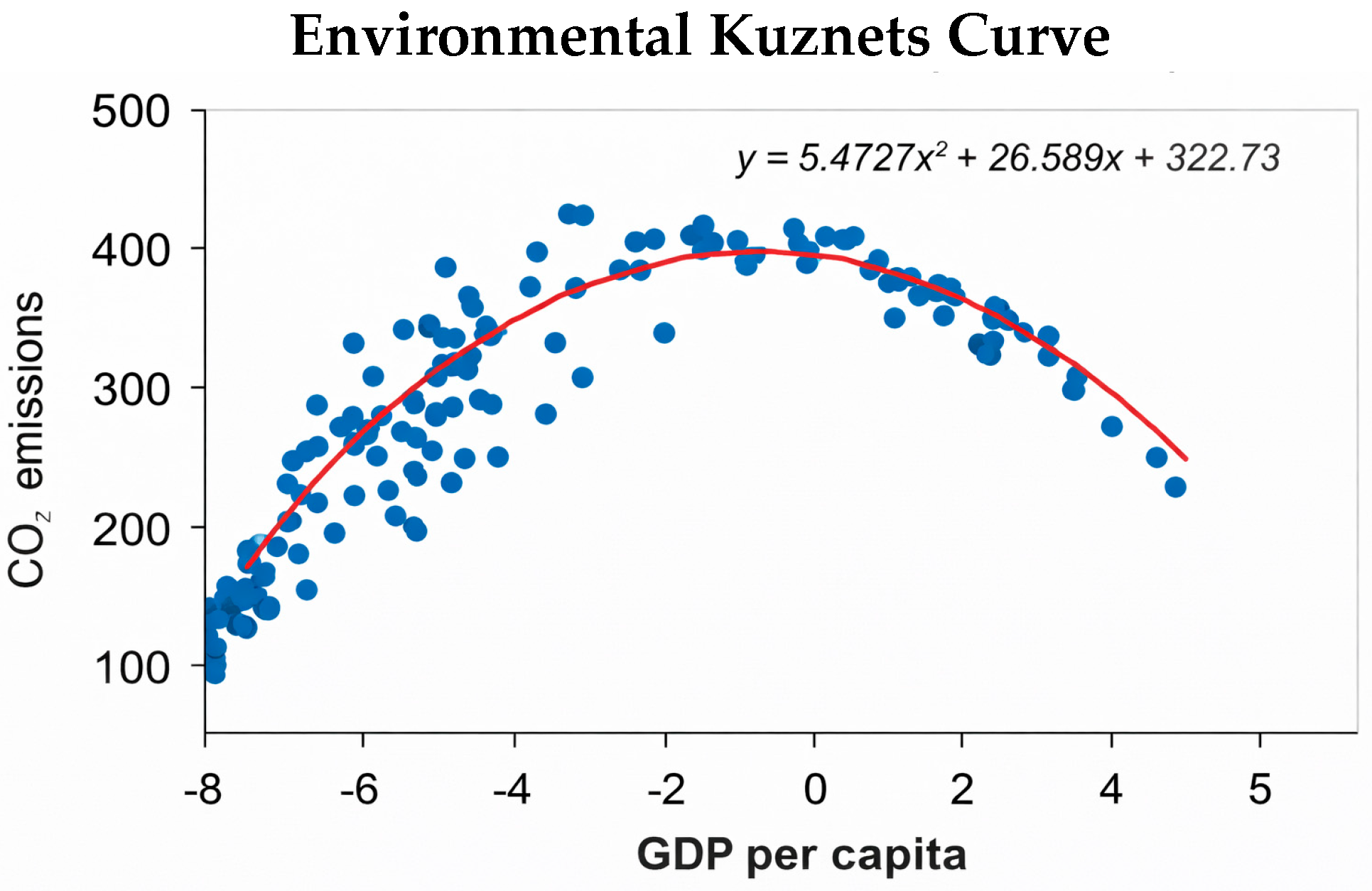
- Test the validity of the Environmental Kuznets Curve hypothesis;
- (ii)
- Estimate the short-term and long-term effects of economic growth on carbon emissions;
- (iii)
- Examine the role of trade openness and energy intensity;
- (iv)
- Determine whether South Africa has reached the EKC turning point.
2. Literature Review
2.1. Theoretical Literature
2.2. Empirical Literature
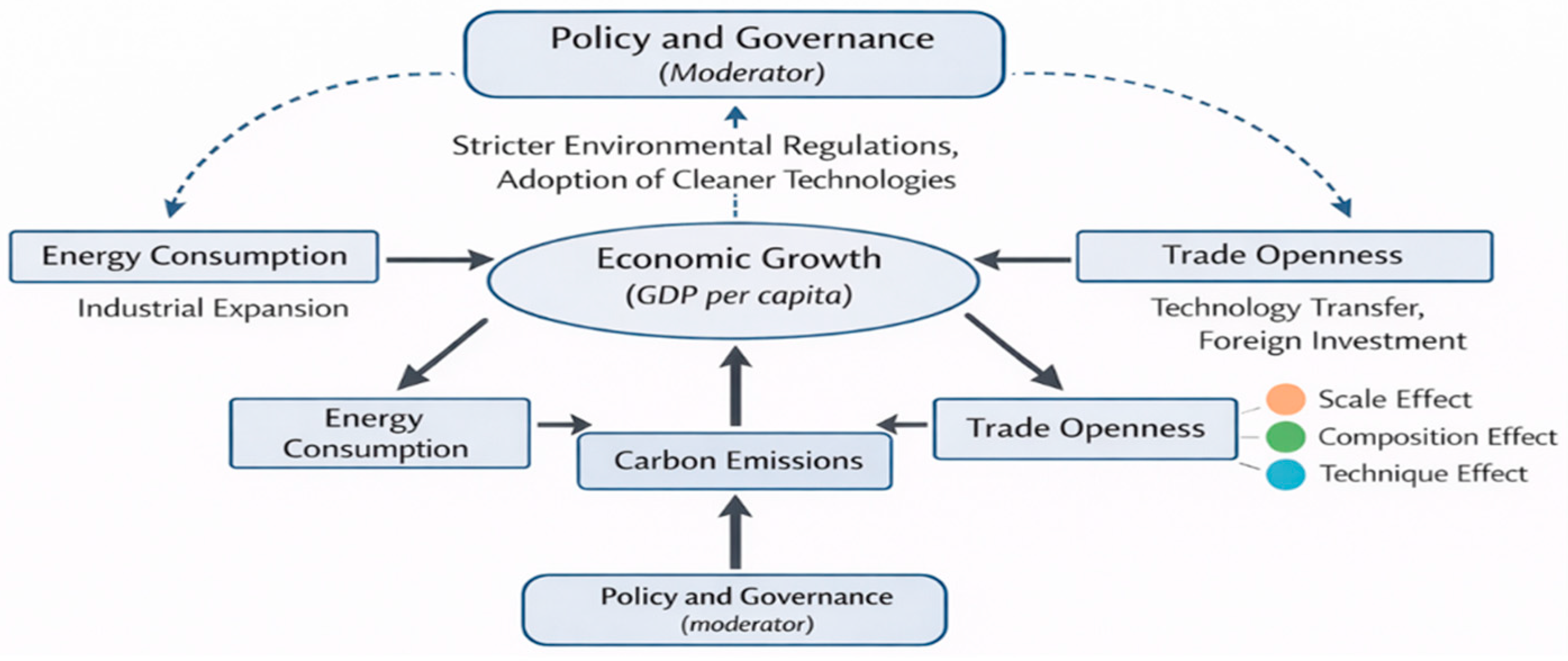
2.3. Conceptual Framework
2.4. Research Gap
3. Methodology
3.1. Model Specification
Data Sources
3.2. Variable Definition and Expected Relationships
Flowchart of Data Processing and Empirical Analysis
| Data collection (1970–2023) ↓ Variable definition and log transformation ↓ Descriptive statistics ↓ Unit root tests (ADF and PP) ↓ ARDL bounds test for cointegration ↓ Long-term estimation ↓ Short-term dynamics (Error-Correction Model) ↓ Diagnostic tests (serial correlation, heteroscedasticity, normality) ↓ Interpretation of results (EKC validation) |
3.3. Estimation Strategy: Long-Term and Short-Term Dynamics
3.4. Diagnostic and Robustness Tests
4. Results and Discussion
4.1. Descriptive Statistics
4.2. Unit Root Test Results
4.3. ARDL Estimation Results
4.4. Bounds Test for Cointegration
4.5. Error-Correction Model (ECM)
4.6. Long-Term Coefficients
4.7. Granger Causality Results
4.8. Diagnostic Tests
5. Conclusions, Policy Recommendations and Limitations of the Study
5.1. Conclusions
5.2. Policy Recommendations
5.3. Limitations of the Study
Author Contributions
Funding
Institutional Review Board Statement
Informed Consent Statement
Data Availability Statement
Acknowledgments
Conflicts of Interest
Abbreviations
| ADF | Augmented Dickey–Fuller Test |
| AIC | Akaike Information Criterion |
| ARDL | Autoregressive Distributed Lag |
| CO2 | Carbon Dioxide Emissions |
| CUSUM | Cumulative Sum of Recursive Residuals |
| CUSUMSQ | Cumulative Sum of Squares of Recursive Residuals |
| CTS | Composite Trade Share (proxy for trade openness) |
| ECM | Error-Correction Model |
| ECT | Error-Correction Term |
| EI | Energy Intensity |
| EKC | Environmental Kuznets Curve |
| GDP | Gross Domestic Product |
| GDP2 | Squared Gross Domestic Product |
| GDP_pc | Gross Domestic Product per capita |
| GMM | Generalized Method of Moments |
| I(0) | Integrated of order zero |
| I(1) | Integrated of order one |
| I(2) | Integrated of order two |
| LCO2 | Log of Carbon Emissions |
| LEI | Log of Energy Intensity |
| LGDP | Log of GDP per capita |
| LGDP2 | Log of squared GDP per capita |
| LTO | Log of Trade Openness |
| LogL | Log-Likelihood |
| PP | Phillips–Perron Test |
| SIC | Schwarz Information Criterion |
| TO | Trade Openness |
| TTS | Traditional Trade Share (proxy for trade openness) |
References
- Grossman, G.M.; Krueger, A.B. Economic growth and the environment. Q. J. Econ. 1995, 110, 353–377. [Google Scholar] [CrossRef] [Scilit]
- World Bank Data 2026. Available online: https://data360.worldbank.org/en/economies (accessed on 12 July 2026).
- Ntim-Amo, G.; Qi, Y.; Ankrah-Kwarko, E.; Ankrah Twumasi, M.; Ansah, S.; Boateng Kissiwa, L.; Ruiping, R. Investigating the validity of the agricultural-induced environmental Kuznets curve (EKC) hypothesis for Ghana: Evidence from an autoregressive distributed lag (ARDL) approach with a structural break. Manag. Environ. Qual. Int. J. 2022, 33, 494–526. [Google Scholar]
- Ganda, F. The environmental impacts of financial development in OECD countries: A panel GMM approach. Environ. Sci. Pollut. Res. 2019, 26, 6758–6772. [Google Scholar] [CrossRef] [Scilit]
- Panayotou, T. Empirical Tests and Policy Analysis of Environmental Degradation at Different Stages of Economic Development; Working Paper WP238 Technology and Employment Programme; International Labour Office: Geneva, Switzerland, 1993; Volume 4. [Google Scholar]
- Stern, D.I. The rise and fall of the environmental Kuznets curve. World Dev. 2004, 32, 1419–1439. [Google Scholar] [CrossRef] [Scilit]
- Dinda, S. Environmental Kuznets curve hypothesis: A survey. Ecol. Econ. 2004, 49, 431–455. [Google Scholar] [CrossRef] [Scilit]
- Ali, Q.; Mahmood, M.A.; Ashfaq, M. Smog and Sustainable Development Goals: An Integrated Assessment Framework. In Global Trends in Smog and Air Pollution Control; IGI Global Scientific Publishing: Hershey, PA, USA, 2026; pp. 57–76. [Google Scholar]
- Belaïd, F.; Taylor, M. From energy deprivation to decarbonization constraints: A global typology of residential energy use. Energy Policy 2026, 212, 115140. [Google Scholar] [CrossRef] [Scilit]
- Smulders, S.; Bretschger, L. Explaining Environmental Kuznets Curves: How Pollution Induces Policy and New Technology; Universität Greifswald, Rechts- und Staatswissenschaftliche Fakultät: Greifswald, Germany, 2000. [Google Scholar]
- Taylor, M.S.; Copeland, B.R. Trade, Growth and the Environment; National Bureau of Economic Research: Cambridge, MA, USA, 2003. [Google Scholar]
- Wang, Q.; Zhang, F.; Li, R. Free trade and carbon emissions revisited: The asymmetric impacts of trade diversification and trade openness. Sustain. Dev. 2024, 32, 876–901. [Google Scholar]
- Oyebade, O.O.; Oyebamiji, S.I.; Kiyala, J.C.K.; Khalema, E.N.; Solomon, O.O. Effects of Soft Power Diplomacy on Peace and Security in BRICS+ Nations: The Case of South Africa. In Expanded BRICS Nations: Peace, Security, Global Economy and Sustainable Development; Springer: Singapore, 2026; pp. 197–220. [Google Scholar]
- Werghemmi, N.; Mtiraoui, A.; Lassoued, M. Assessing the Economic, Social and Environmental Effects of Trade Openness: An OECD Analysis. Science 2026, 2026, 35–43. [Google Scholar] [CrossRef] [Scilit]
- Öztürk, F.; Bektaş, E. Determinants of the Green Trade Transition in OECD Countries: Evidence from Dynamic Panel Models. Sustainability 2026, 18, 1329. [Google Scholar] [CrossRef] [Scilit]
- Ashraf, M.Z.; Wei, W.; Aslam, N.; Maqsood, U.S.; Hussain, H. Can effective natural resource governance unlock green trade’s sustainability potential in carbon-intensive countries? Energy Environ. 2026. [Google Scholar] [CrossRef] [Scilit]
- Avazdahandeh, S.; Shahiki Tash, M.N. Kuznets curve in circular economy vs. linear economy? evidence from European countries: With emphasis on types of packaging waste. Environ. Dev. Sustain. 2026, 1–19. [Google Scholar] [CrossRef] [Scilit]
- Bakri, M.A.; Chia, Y.-E.; Chia, R.C.-J. Trade openness and carbon emissions using threshold approach: Evidence from selected Asian countries. Carbon Res. 2025, 4, 47. [Google Scholar] [CrossRef] [Scilit]
- Farrukh, B.; Shah, W.U.; Gupta, H.; Longsheng, C. Analyzing Forest Land and Environmental Degradation: Evidence From Land Management in Low-Income, Degraded Ecosystem Economies. Land Degrad. Dev. 2026, 37, 5105–5132. [Google Scholar] [CrossRef] [Scilit]
- Azadda, W.N.; Koomson, S. The role of environmental policy in reducing ecological damage’s economic consequences acrossSub-Saharan Africa. Int. J. Ethics Syst. 2026, 1–25. [Google Scholar] [CrossRef] [Scilit]
- Singh, G.J.; Singh, P.K.; Kumar, R.; Aman, A.; Alam, I.; Fatma, R.; Ansari, S. Dynamic Causality between CO2 Emissions, Urbanization and Economic Growth in India and South Africa. Int. J. Energy Econ. Policy 2026, 16, 276. [Google Scholar]
- Adebayo, M.T.; Ilesanmi, K.D. The human capital–Green growth nexus in South Africa. J. Econ. Financ. Sci. 2026, 19, 1061. [Google Scholar] [CrossRef] [Scilit]
- Efayena, O.O.; Anthony, B.O.; Oniore, J.O.; Irikefe, P.O.; Zainudin, A.D. Revisiting the nexus between electricity consumption, economic growth and environmental sustainability in the new BRICS: Asymmetric panel evidence. Cogent Econ. Financ. 2026, 14, 2611622. [Google Scholar] [CrossRef] [Scilit]
- Boujedra, F. Revisiting the environmental kuznets curve: Non-parametric evidence on the interaction between real income and educated labour. Environ. Dev. Sustain. 2026, 1–25. [Google Scholar] [CrossRef] [Scilit]
- Nagashima, F.; Tanaka, T. Grain energy intensity and food security in Africa. Energy Rep. 2026, 15, 109103. [Google Scholar] [CrossRef] [Scilit]
- Copeland, B.R.; Taylor, M.S. Trade, growth, and the environment. J. Econ. Lit. 2004, 42, 7–71. [Google Scholar] [CrossRef]
- Pesaran, M.H.; Shin, Y.; Smith, R.J. Bounds testing approaches to the analysis of level relationships. J. Appl. Econom. 2001, 16, 289–326. [Google Scholar] [CrossRef] [Scilit]
- Jeleč Raguž, M. Economic Growth and CO2 Emissions in Croatia: An ARDL-Based Assessment of the EKC Hypothesis. Sustainability 2026, 18, 1427. [Google Scholar] [CrossRef] [Scilit]
- Manickam, T.; Vijayakumar, N.C.; Kumar, G.S.; Pazhamalai, S.; Babu, S.R. The Dynamics of FDI Inflows, Economic Growth, Trade Openness and CO2 Emissions in India: An ARDL Approach with Structural Breaks. Int. J. Energy Econ. Policy 2026, 16, 135. [Google Scholar]
- Brown, R.L.; Durbin, J.; Evans, J.M. Techniques for testing the constancy of regression relationships over time. J. R. Stat. Soc. Ser. B Stat. Methodol. 1975, 37, 149–163. [Google Scholar] [CrossRef] [Scilit]
- Lefatsa, P.M.; Gumede, S. Determinants of Energy Consumption in South Africa: Evidence from an ARDL Model (1980–2023). Energies 2026, 19, 2329. [Google Scholar] [CrossRef] [Scilit]
- Inah, O.I.; Sotenga, P.Z.; Akuru, U.B. Systemic Carbon Lock-In Dynamics and Optimal Sustainable Reduction Pathways for a Just Industrial Transition in South Africa. Sustainability 2026, 18, 956. [Google Scholar] [CrossRef] [Scilit]
- Ayık, U.; Erkal, G.; Yalçınkaya, Ö. Examining the impact of environmental technologies on carbon emissions in G-20 countries: An alternative environmental hypothesis proposal (EGC) Journal name: Economic change and restructuring. Econ. Change Restruct. 2026, 59, 34. [Google Scholar] [CrossRef] [Scilit]
- Luong, H.G.; Nguyen, T.L.A.; Xuan, V.N. Assessing sustainability indicators of carbon emissions in the Netherlands: The roles of innovation, renewable energy, and economic openness. Environ. Sustain. Indic. 2026, 30, 101167. [Google Scholar] [CrossRef] [Scilit]
- Sasana, H.; Khusniati, N.A.; Purnomo, R.A.; Shafiai, M.H.M. Analysis of Green Investment, Access to Clean Fuels, Green Jobs, Green Energy, and CO2 Emissions on Economic Growth and Welfare: An Empirical Study in Developing Countries. Int. J. Energy Econ. Policy 2026, 16, 251. [Google Scholar] [CrossRef] [Scilit]
- Lefatsa, P.M.; Gumede, S. Energy System Performance and Human Development in South Africa: An ARDL Approach (1980–2023). Energies 2026, 19, 2364. [Google Scholar] [CrossRef] [Scilit]
- Jmaii, A. The Nexus Between Economic Growth and Carbon Emission in Tunisia: Evidence from Nonlinear Autoregressive Distributed Lag Model in the Context of Renewable Energy. In Global Nexus Handbook; Wiley: Hoboken, NJ, USA, 2026; Volume 2, pp. 413–430. [Google Scholar]



| (a) | ||||||||
| Variable | N | Mean | Std. Dev. | Median | Minimum | Maximum | Skewness | Kurtosis |
| lnCO2 | 212 | 0.72 | 0.12 | 0.72 | 0.42 | 1.02 | −0.11 | −0.40 |
| lnGDP | 212 | 6.76 | 0.59 | 6.71 | 5.27 | 7.78 | −0.34 | −0.66 |
| lnGDP2 | 212 | 46.04 | 7.85 | 45.07 | 27.73 | 60.54 | −0.18 | −0.84 |
| lnTrade | 212 | 2.47 | 0.19 | 2.47 | 2.00 | 2.98 | 0.00 | −0.40 |
| lnEnergy | 212 | −0.28 | 0.28 | −0.25 | −0.98 | 0.25 | −0.25 | −0.98 |
| (b) | ||||||||
| Variable | lnCO2 | lnGDP | lnGDP2 | lnTrade | lnEnergy | |||
| lnCO2 | 1.0000 | 0.1084 | 0.1145 | 0.1401 | −0.1043 | |||
| LnGDP | 0.1084 | 1.0000 | 0.9988 | 0.4022 | −0.5358 | |||
| lnGDP2 | 0.1145 | 0.9988 | 1.0000 | 0.4114 | −0.5622 | |||
| LnTrade | 0.1401 | 0.4022 | 0.4114 | 1.0000 | −0.5607 | |||
| LnEnergy | −0.1043 | −0.5358 | −0.5622 | −0.5607 | 1.0000 | |||
| (a) | |||||
| Variable | ADF Statistic | ADF p-Value | PP Statistic | PP p-Value | Order of Integration |
| lnCO2 (Level) | −2.822 | 0.231 | −210.400 | 0.010 | Non-stationary |
| lnGDP (Level) | −2.449 | 0.388 | −41.797 | 0.010 | Non-stationary |
| lnTrade (Level) | −2.347 | 0.431 | −125.336 | 0.010 | Non-stationary |
| lnEnergy (Level) | −1.455 | 0.805 | −39.547 | 0.010 | Non-stationary |
| lnGDP2 (Level) | −2.393 | 0.411 | −43.412 | 0.010 | Non-stationary |
| ΔlnCO2 | −9.954 | 0.010 | −256.523 | 0.010 | I(1) |
| ΔlnGDP | −6.067 | 0.010 | −248.715 | 0.010 | I(1) |
| ΔlnTrade | −8.443 | 0.010 | −264.510 | 0.010 | I(1) |
| ΔlnEnergy | −9.714 | 0.010 | −253.528 | 0.010 | I(1) |
| ΔlnGDP2 | −6.113 | 0.010 | −249.832 | 0.010 | I(1) |
| (b) | |||||
| Dependent Variable | Selected ARDL Model | ||||
| lnCO2 | ARDL(1, 0, 1, 2, 1) | ||||
| Statistic | Value |
|---|---|
| R2 | 0.1486 |
| Adjusted R2 | 0.1103 |
| F-statistic | 3.879 |
| Prob(F-statistic) | 0.00015 |
| (a) | ||||
| Test Statistic | Value | |||
| F-statistic | 36.488 | |||
| p-value | 0.000001 | |||
| Number of Regressors (k) | 4 | |||
| Decision | Cointegration Exists | |||
| (b) | ||||
| Variable | Coefficient | Std. Error | t-Statistic | p-Value |
| Constant | 3.2507 | 1.3120 | 2.478 | 0.014 * |
| L(lnCO2,1) | 0.0723 | 0.0690 | 1.048 | 0.296 |
| lnGDP | −0.9911 | 0.4081 | −2.428 | 0.016 * |
| lnGDP2 | 0.0831 | 0.0307 | 2.704 | 0.007 *** |
| L(lnGDP2,1) | −0.0067 | 0.0037 | −1.790 | 0.075 |
| LnTrade | 0.0535 | 0.0571 | 0.938 | 0.349 |
| L(lnTrade,1) | −0.0203 | 0.0568 | −0.357 | 0.722 |
| L(lnTrade,2) | 0.2281 | 0.0569 | 4.008 | 0.000 *** |
| lnEnergy | −0.0005 | 0.0614 | −0.009 | 0.993 |
| L(lnEnergy,1) | 0.1640 | 0.0606 | 2.706 | 0.007 *** |
| (a) | ||||
| Variable | Coefficient | Std. Error | t-Statistic | p-Value |
| Constant | 3.2507 | 0.2386 | 13.623 | 0.000 *** |
| ΔlnGDP2 | 0.0831 | 0.0062 | 13.473 | 0.000 *** |
| ΔlnTrade | 0.0535 | 0.0509 | 1.050 | 0.295 |
| ΔL(lnTrade,1) | −0.2281 | 0.0510 | −4.468 | 0.000 *** |
| ΔlnEnergy | −0.0005 | 0.0533 | −0.010 | 0.992 |
| ECT(-1) | −0.9277 | 0.0680 | −13.642 | 0.000 *** |
| (b) | ||||
| Statistic | Value | |||
| R2 | 0.5143 | |||
| Adjusted R2 | 0.5024 | |||
| F-statistic | 43.20 | |||
| Prob(F-statistic) | 0.000 | |||
| Variable | Coefficient | Std. Error | t-Statistic | p-Value |
|---|---|---|---|---|
| Constant | 3.5042 | 1.3885 | 2.524 | 0.012 * |
| lnGDP | −1.0684 | 0.4331 | −2.467 | 0.014 * |
| lnGDP2 | 0.0823 | 0.0331 | 2.488 | 0.014 * |
| lnTrade | 0.2817 | 0.0781 | 3.609 | 0.000 *** |
| lnEnergy | 0.1762 | 0.0647 | 2.725 | 0.007 *** |
| (a) | |||
| Null Hypothesis | F-Statistic | p-Value | Decision |
| lnGDP does not have a Granger causal effect on lnCO2 | 0.398 | 0.672 | Fail to reject |
| lnCO2 does not have a Granger causal effect on lnGDP | 0.321 | 0.726 | Fail to reject |
| lnTrade does not have a Granger causal effect on lnCO2 | 7.059 | 0.001 *** | Reject |
| lnEnergy does not have a Granger causal effect on lnCO2 | 0.455 | 0.635 | Fail to reject |
| lnGDP2 does not have a Granger causal effect on lnCO2 | 0.437 | 0.646 | Fail to reject |
| (b) | |||
| Measure | Value | ||
| Turning Point (GDP) | 389.93 | ||
| Test | Statistic | p-Value | Decision |
|---|---|---|---|
| Ljung–Box serial correlation | χ2 = 0.449 | 0.503 | No autocorrelation |
| Breusch–Pagan heteroskedasticity | BP = 3.963 | 0.914 | Homoskedastic residuals |
| Jarque–Bera normality | JB = 4.622 | 0.099 | Residuals approximately normal |
Disclaimer/Publisher’s Note: The statements, opinions and data contained in all publications are solely those of the individual author(s) and contributor(s) and not of MDPI and/or the editor(s). MDPI and/or the editor(s) disclaim responsibility for any injury to people or property resulting from any ideas, methods, instructions or products referred to in the content. |
© 2026 by the authors. Licensee MDPI, Basel, Switzerland. This article is an open access article distributed under the terms and conditions of the Creative Commons Attribution (CC BY) license.
Share and Cite
Lefatsa, P.M.; Gumede, S. Revisiting the Growth–Environment Nexus in South Africa: Short-Term and Long-Term Evidence from an ARDL-Based EKC Model with Trade Openness and Energy Intensity. Sustainability 2026, 18, 7474. https://doi.org/10.3390/su18147474
Lefatsa PM, Gumede S. Revisiting the Growth–Environment Nexus in South Africa: Short-Term and Long-Term Evidence from an ARDL-Based EKC Model with Trade Openness and Energy Intensity. Sustainability. 2026; 18(14):7474. https://doi.org/10.3390/su18147474
Chicago/Turabian StyleLefatsa, Palesa Milliscent, and Sanele Gumede. 2026. "Revisiting the Growth–Environment Nexus in South Africa: Short-Term and Long-Term Evidence from an ARDL-Based EKC Model with Trade Openness and Energy Intensity" Sustainability 18, no. 14: 7474. https://doi.org/10.3390/su18147474
APA StyleLefatsa, P. M., & Gumede, S. (2026). Revisiting the Growth–Environment Nexus in South Africa: Short-Term and Long-Term Evidence from an ARDL-Based EKC Model with Trade Openness and Energy Intensity. Sustainability, 18(14), 7474. https://doi.org/10.3390/su18147474