1. Introduction
Sustainability research has shifted attention from end-of-pipe waste treatment to circular forms of production [
1,
2,
3,
4]. This shift matters for industries built on mineral extraction, energy-intensive firing, and materials that remain in the environment long after use. Ceramic production fits this problem closely [
5]. Ceramics are valued for their durability, aesthetic qualities, and cultural significance. However, durability means that ceramic waste, such as kiln rejects, defective bodies, glaze residues, and post-production fragments, is highly persistent and difficult to degrade naturally [
6,
7]. In major ceramic-producing regions such as Jingdezhen, centuries of large-scale production have generated substantial volumes of ceramic waste. Historically, much of this waste was reused in urban construction, including land reclamation, building foundations, walls, and drainage infrastructure [
8,
9]. However, alongside rapid urbanization, shifts in mainstream construction materials, and stricter environmental regulations, traditional waste disposal methods are no longer viable. In ceramic production hubs such as Jingdezhen, massive volumes of broken porcelain have long been sent to landfills or discarded openly due to the lack of mature systems for centralized collection, classification, and recycling. This outdated approach has rendered the sustainable reutilization of ceramic waste a pressing practical challenge [
10]. Thus, the difficulty of ceramic waste management arises not only from the material properties of ceramics but also from the interaction between waste management systems, economic feasibility, and local industrial practices. Contemporary Jingdezhen is not only a historical kiln city. It also includes daily-use ceramics, artistic porcelain, industrial ceramics, cultural tourism, exhibitions, design studios, and creative retail. The growth of this ceramic economy has also made waste more visible across production, circulation, and consumption.
According to the Jiangxi Blue Book: Report on Jiangxi’s Economic and Social Development (2022), jointly released by the Jiangxi Academy of Social Sciences and Social Sciences Academic Press, the total output value of Jingdezhen’s ceramic industry increased from approximately CNY 37.2 billion in 2017 to around CNY 51.62 billion in 2021, representing an overall growth of 38.8%. Among this total, daily-use ceramics accounted for CNY 16.55 billion and artistic decorative ceramics for CNY 18.53 billion, together contributing approximately 68% of the industry’s total output value, while the remaining share consisted primarily of architectural ceramics, advanced ceramics, and other specialized products [
11].
More recent statistics indicate that the industry has continued to expand rapidly, with total output values reaching CNY 66.5 billion in 2022, CNY 86.1 billion in 2023, and CNY 93.9 billion in 2024 [
12]. Even during periods characterized by relatively slower growth, the ceramic industry has maintained a stable upward trajectory, demonstrating its continued economic vitality and reinforcing Jingdezhen’s position as one of China’s leading ceramic production centers [
13]. Jingdezhen has accumulated more than a millennium of ceramic production, craft knowledge, and cultural identity [
14]. Its contemporary ceramic economy includes artistic porcelain, daily-use ceramics, industrial ceramics, and increasingly diversified creative industries. This cultural strength is inseparable from a material burden: sustained production generates substantial volumes of ceramic waste, much of which is difficult to degrade and costly to manage through conventional landfill or disposal routes [
15].
Circular-economy research often treats ceramic waste as a recoverable material stream [
4,
16]. Studies have shown that ceramic residues can be used in aggregates, concrete, bricks, tiles, and other construction or industrial products [
17,
18,
19]. This technical literature is necessary, but it does not fully explain the Jingdezhen cases. In a city where porcelain is tied to place identity, heritage tourism, and craft memory, a broken shard is not only an input for recycling. It can also be read as evidence of production history, a sign of locality, or a material for public interpretation [
20].
For that reason, this article does not treat ceramic waste reutilization as a purely technical question. The central issue is how discarded ceramics become materially useful, economically supportable, and culturally legible. A recycled tile, a wall built from porcelain fragments, and an installation assembled from unsold vessels all reduce waste, but they do so through different social arrangements and produce different kinds of value.
This distinction matters because sustainability transitions in craft-based industrial regions rarely come from material substitution alone [
21]. Reuse lasts only when recovered materials can be accepted by manufacturers, designers, visitors, institutions, and publics. In Jingdezhen, that acceptance is shaped by the city’s ceramic history. Waste is often understood not only as residue, but also as a trace of skill, excess, failure, memory, and experimentation.
The study therefore treats ceramic waste as a socio-material resource [
22,
23]. The term is used here in a specific sense. Fired ceramic fragments have physical properties, including hardness, chemical stability, and resistance to biodegradation [
24], which make them difficult to manage after disposal. At the same time, they carry meanings linked to craft, locality, aesthetic judgment, and industrial change. The analytical task is to explain how these two sides work together in actual reuse practices [
25,
26].
This article explores how waste ceramics can generate sustainable value within Jingdezhen’s ceramic industry. To fully reflect the diversified modes of ceramic waste recycling and reuse, this research analyzes typical cases covering industrial production, public environmental governance, and artistic creation. The present study is framed around three core research questions, as follows:
RQ1: Through which application pathways are waste ceramics transformed into reusable resources?
RQ2: What environmental, economic, and socio-cultural values are produced by these practices?
RQ3: How can local reuse practices inform broader strategies for sustainable ceramic development?
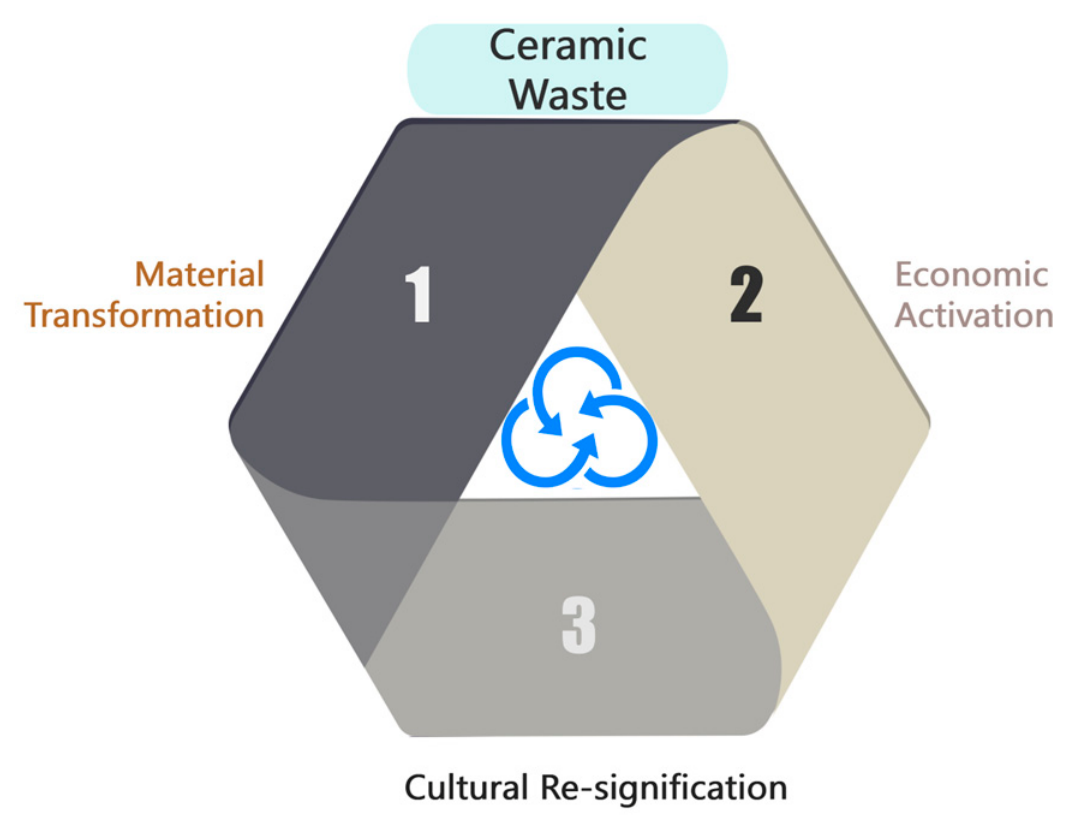
To answer these questions, the article develops a three-dimensional framework that links material transformation, economic activation, and cultural re-signification. The framework is used to interpret representative reuse practices in Jingdezhen. The article makes three contributions. First, it extends the circular-economy discussion by showing that material circulation can be shaped by place-based cultural values, not by technical recovery alone. Second, it offers a case-based typology of ceramic waste reutilization in Jingdezhen, distinguishing industrial, environmental, and artistic pathways. Third, beyond identifying different forms of ceramic waste reuse, this study seeks to explain how different value dimensions interact and how cultural heritage functions as an enabling mechanism for sustainable value creation.
3. Results
3.1. Industrial Reprocessing: Waste Ceramics as Productive Inputs
Industrial ceramic reuse creates value first by returning waste to productive systems [
34]. In the cases below, crushing, grading, compounding, and remanufacturing convert discarded ceramics into materials for architectural, industrial, and consumer product applications. The analysis focuses on how technical processing connects to market acceptance and, in some cases, to a visible design language of sustainability.
Yi Design represents an industrially oriented model of ceramic waste reutilization [
35]. Yi Design was selected because it is one of the most influential ceramic waste reutilization enterprises in Jingdezhen and has received multiple international design awards, including the Good Design Award, IF Design Award Gold, and Red Dot Award. The company focuses on addressing ceramic waste management challenges in China, with particular attention to the recycling and reprocessing of industrial ceramic waste into functional products such as ceramic tiles and architectural bricks for decorative and construction applications. The company collects ceramic waste and other solid residues from Jingdezhen factories and studios, then classifies, crushes, mixes, and reprocesses these materials into recycled ceramic tiles, permeable paving materials, and handmade bricks. According to the product information of Yi Design, the recycled content of some product lines exceeds 90%, and approximately 35–77 kg of ceramic waste can be reused per square meter, depending on the product type [
36]. Project documents for Yi Design’s waste porcelain recycling initiative indicate that the company has collaborated with more than 100 ceramic factories and studios in Jingdezhen and has processed over 5000 tons of ceramic waste to date [
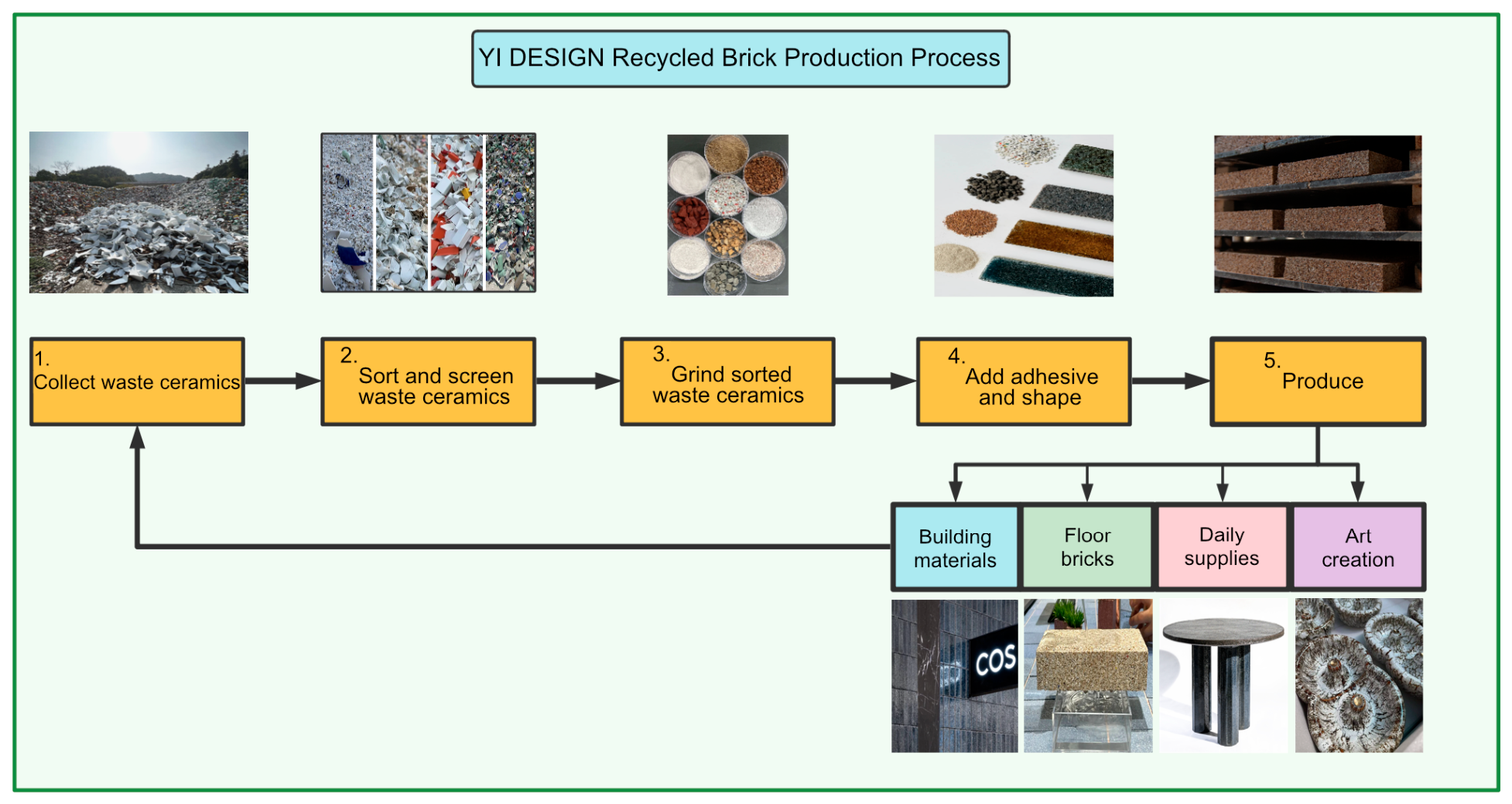
36]. The recycled ceramic tiles developed by Yi Design are produced from locally sourced ceramic waste and other industrial solid residues generated in Jingdezhen. The production process involves the classification and mechanical grinding of waste materials according to their material characteristics, including firing temperature, density, and composition. The processed materials are then combined with proprietary binding agents and adjusted through controlled grading and additive formulation, followed by secondary low-energy sintering.
Figure 2 illustrates the recycling and remanufacturing process of the recyclable bricks designed by Yi Design. Comparative analysis indicates that, relative to conventional fired bricks, recycled ceramic bricks demonstrate advantages in material diversity, resource efficiency, and design flexibility (see
Table 5).
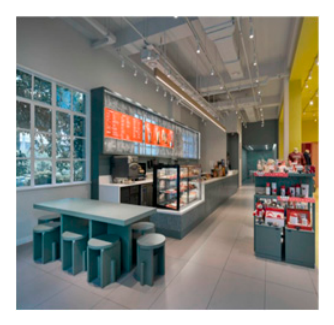
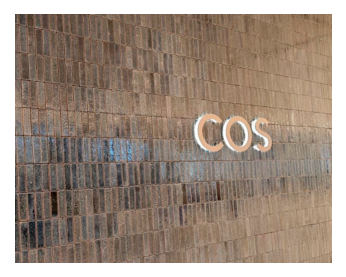
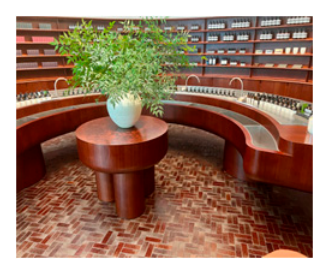
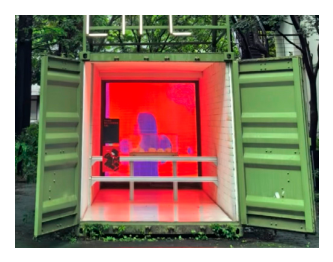
Building on these recycled architectural materials, Yi Design has also collaborated with brand designers and commercial partners in projects that extend ceramic waste into retail interiors, product surfaces, and everyday design contexts, as summarized in
Table 6.
Yi Design fuses material recovery with product innovation in its reuse strategy. Ceramic waste is gathered, sorted, cleaned, and pulverized before being processed into recycled powders or aggregates. These materials are then crafted into products such as YiBrick permeable bricks and YiClay composite materials.
Unlike conventional recycling, which often downcycles ceramic waste into low-value fillers, Yi Design retains the original qualities of porcelain. It applies recycled ceramics to architectural, interior, and design products. Rather than competing as inexpensive substitutes, these products are promoted for their textures, environmental performance, and design quality. By linking recycled materials with design-oriented applications, Yi Design extends the useful life of ceramic waste and broadens its commercial potential. This also reduces dependence on virgin resources.
A distinctive aspect of Yi Design’s strategy is its cultural reinterpretation of ceramic waste. Instead of concealing recycled content, the company highlights variations in texture, color, and surface irregularities as aesthetic features that communicate authenticity, environmental responsibility, and local identity. In the context of Jingdezhen, recycled ceramics retain associations with the city’s porcelain heritage, allowing environmental values and cultural continuity to be expressed simultaneously through design. Yi Design demonstrates how recycled ceramic materials can be successfully integrated into commercially viable products while retaining visible connections to Jingdezhen’s ceramic heritage. By combining material recycling, product design, and heritage-inspired aesthetics, Yi Design illustrates how industrial reuse can enhance both resource efficiency and product value.
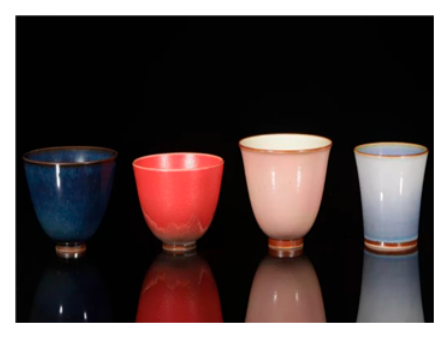
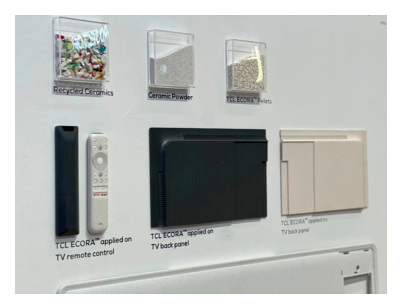
TCL ECORA provides a second industrial example, but with a different market orientation. The project transforms waste ceramics into a ceramic-polymer composite material for consumer product manufacturing [
37]. Compared with conventional downcycling into low-value fill or aggregate, ECORA positions discarded ceramic material as a component of higher-value industrial design [
38].
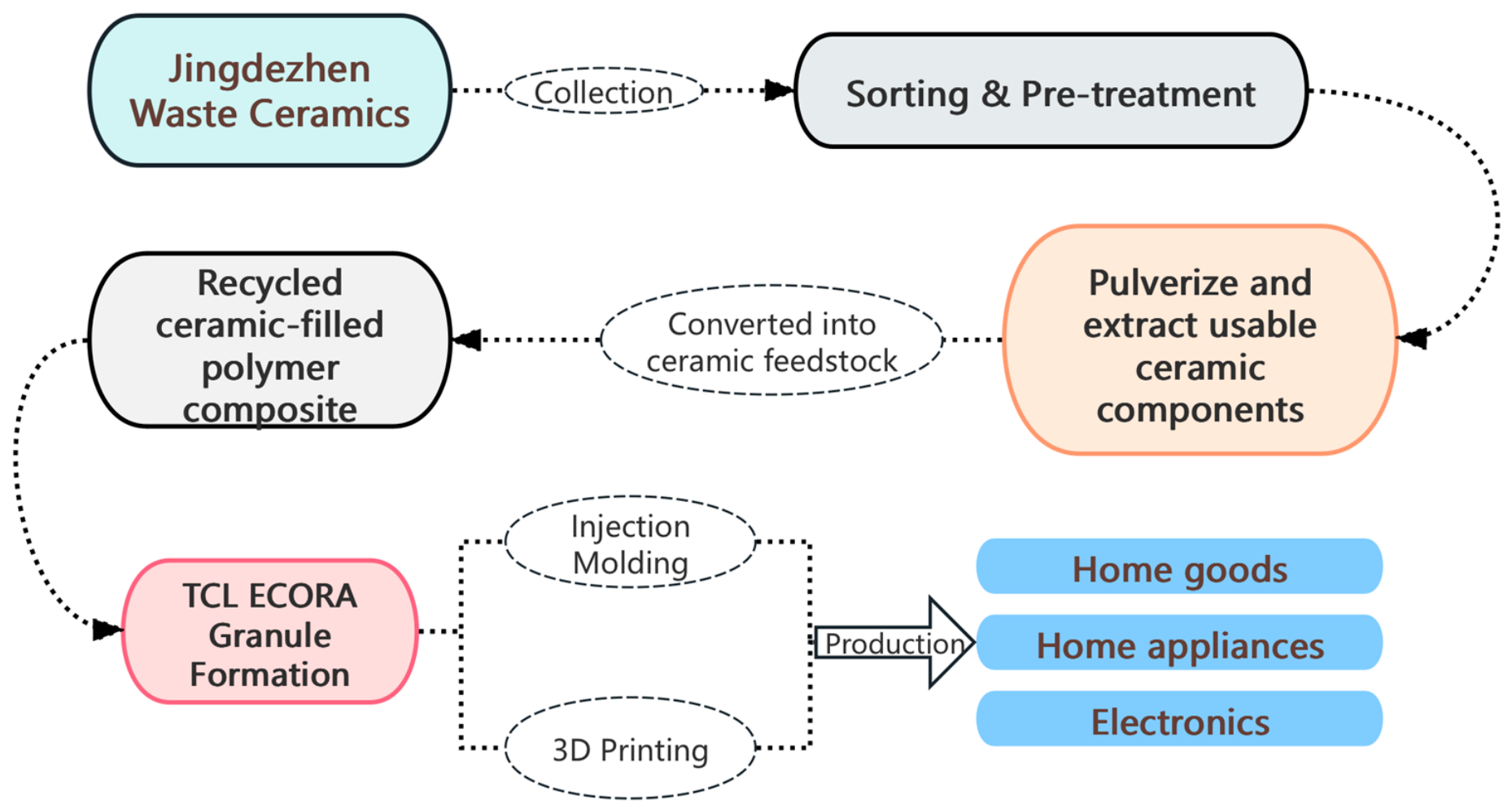
The development of ECORA is based on the concept of treating waste ceramics as secondary resources within a circular economy framework [
3]. Waste ceramics collected from production processes are first sorted and pre-treated to remove impurities before being crushed into reusable ceramic feedstock. The processed ceramic particles are then incorporated into polymer matrices to produce a recycled ceramic-filled polymer composite suitable for injection molding and additive manufacturing (
Figure 3).
Through this process, discarded ceramic material is reintegrated into manufacturing, rather than being sent directly to a landfill. The case matters because it links resource recovery with consumer product design, where tactile quality, color, surface finish, and brand narrative all influence user acceptance of recycled materials.
At the material level, ECORA redefines ceramic waste as a valuable secondary resource within a circular production system. Waste ceramics are collected, processed into recycled ceramic fillers, compounded with polymer matrices, and manufactured into high-performance composite materials through conventional injection molding technologies. This process extends the material life cycle by reducing dependence on virgin mineral resources while diverting ceramic waste from landfill disposal.
From a circular-economy perspective, ECORA’s material transformation also opens economic possibilities. Recycled ceramic fillers are used not only to reduce waste. They contribute to hardness, tactile qualities, surface effects, and compatibility with existing manufacturing processes. This makes the material legible to designers and manufacturers as a product-development opportunity instead of a mere environmental concession. By integrating recycled materials into established manufacturing systems, ECORA demonstrates that ceramic waste can support both resource efficiency and industrial innovation.
Beyond its material and economic functions, ECORA also generates cultural value by integrating references to Jingdezhen’s ceramic heritage into contemporary material design. According to the project’s official design concept [
36], the surface aesthetics of ECORA draw inspiration from two representative porcelain traditions. The cool mineral tones and layered textures reference Jingdezhen’s Yuan dynasty blue and white porcelain, whose cobalt underglaze decoration and white porcelain body have become enduring symbols of Chinese ceramic culture. At the same time, the subtle color transitions and refined surface textures echo the visual characteristics of Qing dynasty famille rose porcelain, known for its overglaze enamels and delicate tonal variation. Through these design strategies, recycled ceramic materials are positioned not only as functional composites but also as carriers of local heritage, thereby connecting contemporary sustainable manufacturing with the historical aesthetic traditions of Jingdezhen.
The ECORA case illustrates how industrial ceramic reuse can combine material recovery, product innovation, and cultural continuity within a single manufacturing system. Ceramic waste is repositioned as a sustainable material, an industrial feedstock, and a carrier of Jingdezhen’s ceramic heritage, demonstrating its potential to support both circular production and value-added design.
3.2. Environment-Oriented Ceramics: Waste as Spatial and Cultural Infrastructure
Environment-oriented ceramic projects [
39] show a different reuse logic. Instead of processing ceramic waste into uniform mass-produced items, these works incorporate fragmented, defective, and surplus ceramics into landscape design, architectural cladding, and outdoor environmental installations. In these cases, the visibility of waste is central. The reused material is meant to be seen, touched, photographed, and interpreted.
The Porcelain Palace, the Millennium Wall at Sanbao International Ceramic Village, and the Recycled Tree project represent three cases through which environmental ceramics contribute to sustainable value creation.
The Porcelain Palace (Ci Gong) represents one of the most prominent examples of architectural reuse of waste ceramics in Jingdezhen. According to official information from this Jingdezhen tourist attraction, the Porcelain Palace is constructed from more than 60,000 ceramic objects and approximately 80 tons of discarded porcelain fragments, with broken ceramics directly integrated into its exterior walls, interior surfaces, and decorative structures [
40]. Unlike conventional recycling processes that require crushing and remanufacturing, the Porcelain Palace preserves the original material characteristics of ceramic fragments through direct architectural embedding, allowing waste materials to retain both their physical integrity and artistic qualities.
The reuse strategy adopted by the Porcelain Palace differs fundamentally from industrial recycling. Its pathway can be summarized as shown in
Figure 4.
The Porcelain Palace maintains the original form of discarded pieces and extends their service life through direct architectural application. This approach minimizes additional processing while preserving the historical and aesthetic traces carried by individual fragments.
Viewed through the lens of circular economy, this practice represents a form of direct material reuse that prolongs product life cycles without requiring complete material reprocessing [
41]. Waste ceramics that might otherwise be discarded are incorporated into permanent architectural structures, reducing the demand for newly manufactured decorative materials while maintaining the functional use of existing ceramic resources. The Porcelain Palace has also become a cultural destination in Jingdezhen. As a publicly accessible landmark, it attracts visitors interested in ceramic heritage and contributes indirectly to the local economy through tourism and place branding. In this way, the project links material reuse with broader social and economic benefits associated with heritage conservation.
More importantly, the project re-signifies ceramic waste by repositioning discarded porcelain as an integral component of architectural memory. Fragments that once represented production surpluses or damaged products are reassembled into a coherent cultural landscape, where their historical associations and material traces remain visible. The building, therefore functions simultaneously as architecture, archive, and public narrative, demonstrating how waste materials can preserve and communicate local identity through spatial practice.
The Millennium Wall at Sanbao International Ceramic Village represents a distinctive form of environmental ceramic practice that integrates waste ceramic reuse, historical narration, and contemporary artistic expression. Created in 2004 by New York artist Jim Leedy, the approximately 20 m long installation incorporates excavated ancient kiln fragments, discarded porcelain donated by local ceramic factories, and contemporary ceramic works created in collaboration with local artists [
42]. Beyond pure decorative purposes, the wall functions as a spatial archive that ties Jingdezhen’s long-standing ceramic tradition to current artistic work.
The integration of contemporary ceramic artworks further distinguishes the Millennium Wall from conventional recycling projects. By embedding newly created artistic pieces alongside archaeological remains and industrial waste, the installation rejects the notion that tradition and modernity exist in opposition. The case demonstrates that contemporary ceramic creation can emerge from engagement with historical materials, with cultural inheritance acting as a catalyst for innovation. As Jim Leedy described, the wall functions as both a cultural metaphor and an open visual passage where tradition and modernity intersect, using the concept of the “wall” as a carrier of accumulated cultural memory [
43].
From the perspective of circular economy and sustainable development, the Millennium Wall is best understood as narrative reuse. It repositions discarded ceramic fragments as historical evidence, spatial texture, and a medium for communicating sustainability values. Equally important, the visibility of discarded ceramics within a public landscape reshapes social perceptions of waste. Unlike being hidden or discarded, broken porcelain is presented as an integral component of the cultural environment, encouraging visitors to recognize its historical significance and artistic potential. This process elevates waste from residual material to shared heritage, demonstrating that sustainability can be achieved not only through technological recycling but also through cultural reinterpretation and public engagement.
The Millennium Wall therefore expands environmental ceramics from material reuse to narrative reconstruction. Its contribution lies in showing how archaeological remnants, industrial by-products, and contemporary artistic interventions can be assembled into a public account of continuity, loss, and renewal.
By using recycled ceramic tiles and waste materials to form the image of a growing tree, the installation links ceramic fragments with ecological regeneration and public environmental awareness [
44].
The transformation of fragmented recycled ceramic bricks into an organic tree form challenges conventional perceptions of waste by associating discarded objects with growth, resilience, and regeneration. The project does not focus primarily on the permanence of the structure or its function as a historical record. Instead, it conveys the concept of sustainable development through the symbolic expression of recycled ceramic bricks and public engagement. The project embodies the principle of upcycling not only in material terms but also in conceptual and cultural dimensions.
By linking recycled ceramics with ecological symbolism, the Recycled Tree encourages viewers to reconsider waste as a renewable resource capable of fostering creativity, environmental awareness, and community engagement. The installation extends the significance of ceramic reuse beyond its functional role by making circular practices visible in public space.
Collectively, the Porcelain Palace, the Millennium Wall, and the Recycled Tree represent three distinct approaches to environment-oriented ceramic reuse. While the Porcelain Palace highlights architectural integration, the Millennium Wall emphasizes historical continuity, and the Recycled Tree focuses on ecological symbolism, all three projects retain the physical visibility of discarded ceramics and embed them within shared public spaces. These cases illustrate how environmental reuse can contribute simultaneously to landscape design, public participation, and local cultural identity.
3.3. Craft-Based Artistic Creation: Waste as Aesthetic and Conceptual Medium
Craft-based artistic creation represents a third mode of ceramic waste reutilization. Here, discarded fragments, defective wares, antique shards, and industrial surplus are not primarily treated as construction inputs or commercial materials. They have become aesthetic and conceptual media through which artists examine memory, failure, overproduction, and renewal.
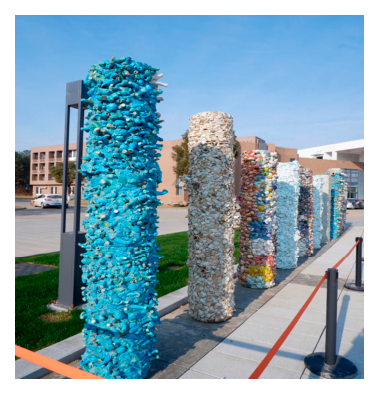
Zhu Zhenhong’s ceramic installation Nie (蘖) exemplifies an artistic mode of ceramic waste reutilization in which discarded porcelain fragments are transformed into conceptual and cultural media. The work consists of multiple hollow ceramic columns reaching approximately two meters in height, each densely embedded with recycled ceramic shards originating from different historical periods, including Song-dynasty Qingbai porcelain, slip-cast ceramic lions from the 1970s, contemporary monochrome-glazed wares, and defective wood-fired ceramics (
Table 7). By preserving the original identity of these fragments instead of remanufacturing them, the installation maintains the material traces of different stages in Jingdezhen’s ceramic history [
45].
The process of assembling heterogeneous ceramic remnants into a unified sculptural form represents a distinct approach to material transformation. By preserving the original form and surface traces of discarded ceramics, the project maintains the material continuity of the fragments while placing them within a new artistic context. This shift transforms ceramic waste from abandoned objects into expressive media that carry renewed aesthetic, symbolic, and cultural significance.
The title Nie (蘖), meaning new shoots emerging from an existing trunk, reflects the artist’s understanding of renewal as a process of continuation. As noted by Zhu Zhenhong, the installation creates a spatial experience in which viewers encounter the continuity of ceramic history through fragments that have survived production failures, historical change, and material abandonment. Within this context, discarded ceramics are reinterpreted as an ongoing process rooted in continuity, bringing together fragments from different historical periods into a shared narrative of Jingdezhen’s ceramic heritage.
By relocating discarded fragments into the context of contemporary art, Nie challenges conventional distinctions between completion and failure, preservation and disposal. The installation not only disseminates knowledge of Jingdezhen’s ceramic heritage but also questions established aesthetic hierarchies by granting defective and discarded objects renewed cultural significance. The work illustrates how artistic reuse can preserve the material presence of ceramic waste while extending its historical and cultural meanings through contemporary artistic expression.
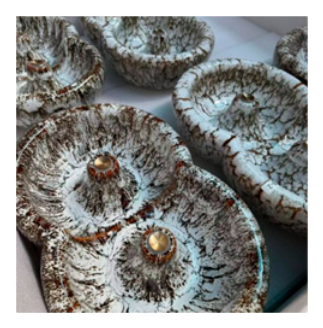
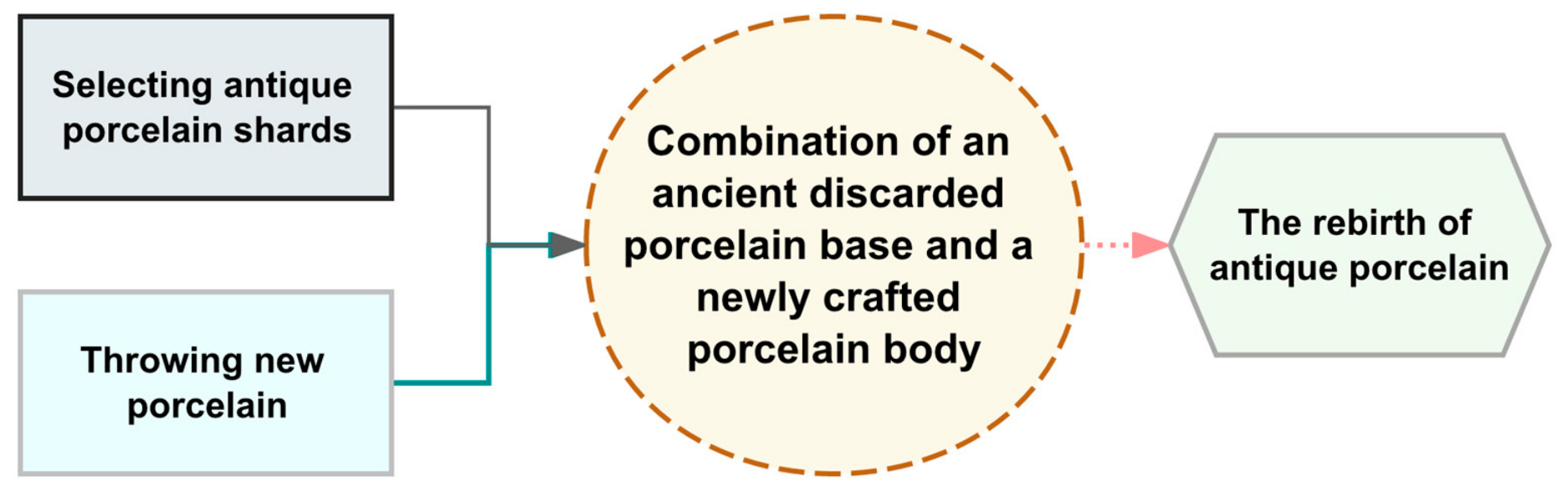
Taxoo Lee’s Rebirth Blue and White Porcelain series offers another artistic approach to ceramic waste reutilization (
Figure 5). Discarded porcelain fragments are reconstructed into sculptural vessels. Ancient shards remain visible within the new form, allowing the reconstructed work to embody the continuity, and artistic reinterpretation of traditional ceramic craftsmanship.
The creation process involves the careful selection, cleaning, re-firing, and manual reassembly of ancient ceramic shards through repeated experimentation until structurally and visually coherent compositions are achieved. Instead of conceiving reuse as a simple act of material recovery, Lee interprets “rebirth” as a process of transformation and continuity that is conceptually closer to renewal than to recycling. By combining fragments from different temporal and material contexts, the works establish a dialogue between historical ceramics and contemporary artistic practice, allowing broken porcelain to acquire new aesthetic and symbolic significance. In this process, ceramic waste is not treated as evidence of loss or obsolescence but is reconfigured as a medium through which memory, history, and material continuity are expressed.
The project demonstrates that the sustainable value of ceramic waste reutilization in artistic practice extends beyond resource efficiency to include the cultural re-signification of discarded materials. Through physical reconstruction, ceramic waste becomes a vehicle for reinterpreting heritage and sustaining the continuity of ceramic traditions.
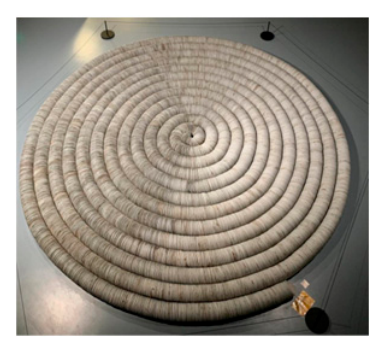
Torbjørn Kvasbø’s installations focus on the cultural and conceptual transformation of industrial surplus. The Cluster of Jingdezhen Vases and Plate Floor Installation uses unsold ceramic vessels and plates collected from abandoned or declining factories in Jingdezhen, where overproduction and changing market demand left large quantities of finished products without practical use.
In The Cluster of Jingdezhen Vases, approximately 4500 discarded ceramic vases are suspended and connected by steel wire to form a large spiral installation. Dinner Plate Installations (2024) assembles more than 5100 porcelain plates into an immersive spatial composition using locally sourced clay [
46]. In both works, the original form and material integrity of the ceramic objects are deliberately preserved. Material transformation occurs not through crushing or remanufacturing but through spatial reconfiguration, allowing industrial surplus to acquire new relationships and meanings without losing its historical identity.
These installations reposition obsolete commercial ceramic products within the context of contemporary art, challenging conventional boundaries between value and waste, production and abandonment. The accumulation of thousands of nearly identical objects visualizes industrial overproduction while acknowledging these discarded objects as part of Jingdezhen’s ceramic history. These works do not primarily pursue direct economic return. Their value lies in critical reflection and public engagement. The discarded ceramics become a way to question modernization, industrialization, and material consumption while also recording the disappearing manufacturing culture of Jingdezhen.
These artistic practices are especially relevant in Jingdezhen, where ceramic identity has long depended on the relationship between technical mastery and aesthetic production. They do not reject tradition. They reactivate it by addressing overproduction, resource pressure, and changing cultural expectations.
Viewed collectively, these artistic projects demonstrate that ceramic waste can retain social and cultural significance after its original functional life has ended. By preserving the material presence of discarded ceramics while opening new spaces for artistic interpretation and public dialogue, they expand the cultural significance of ceramic reuse within contemporary society.
3.4. Cross-Case Synthesis
To identify the common mechanisms and distinctive strengths of ceramic waste reutilization, a cross-case synthesis was conducted across the representative industrial, environment-oriented, and craft-based cases. Ceramic waste reutilization in Jingdezhen follows several operational pathways rather than a single recycling model. Industrial, environment-oriented, and craft-based practices differ in objectives, methods, and audiences. Still, each converts discarded ceramics into socio-material resources through different combinations of material transformation, economic activation, and cultural re-signification.
To facilitate systematic comparison, representative evidence from each case was deductively coded according to the three analytical dimensions of material transformation, economic activation, and cultural re-signification. The coding examples presented in
Table 8 demonstrate how heterogeneous case materials were translated into a common analytical framework, providing a transparent basis for subsequent cross-case analysis.
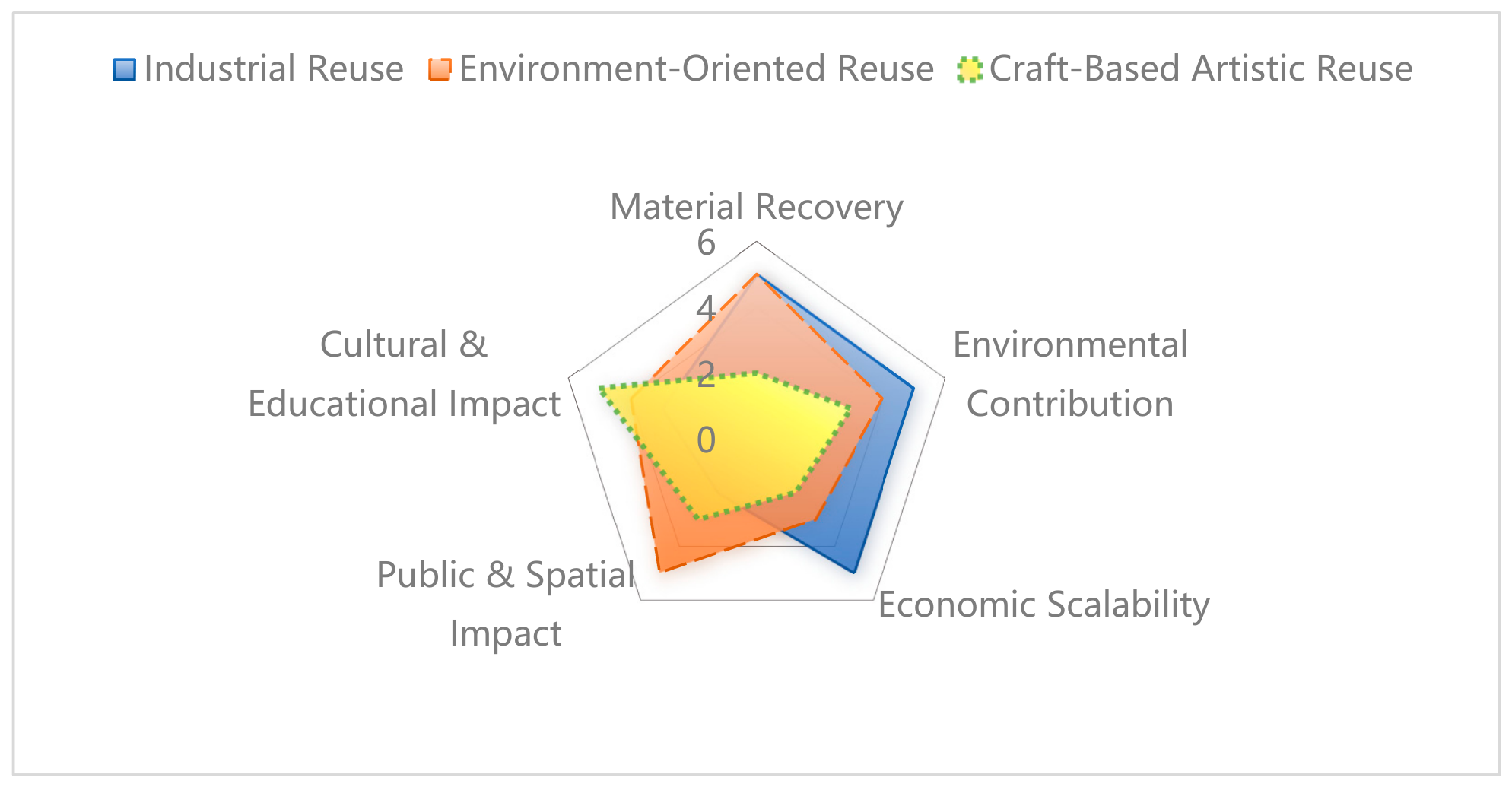
Building on the coding results, the cross-case comparison further evaluates the relative strengths of the three reutilization pathways using five comparative dimensions derived from the three analytical dimensions: material recovery capacity, environmental contribution, economic scalability, public and spatial impact, and cultural and educational impact. While each pathway contributes to circular development, their relative advantages differ according to the mechanisms through which sustainable value is generated. These comparative patterns are summarized in
Table 9 and further visualized in
Figure 6.
The cases reveal three complementary mechanisms for sustainable value generation. Industrial reuse primarily relies on material reprocessing, in which ceramic waste is crushed, reformulated, and reintegrated into new production systems to generate economic value through circular manufacturing. Environment-oriented projects instead emphasize material preservation and spatial embedding, incorporating discarded ceramics directly into architectural and public landscapes where sustainability is communicated through place-making and collective experience. Craft-based artistic practices similarly preserve the physical identity of ceramic fragments but extend their value through conceptual reconstruction, transforming waste into carriers of historical memory, artistic expression, and cultural reflection.
Across these diverse practices, sustainable value emerges not from material recovery alone but from the interaction between economic transformation and cultural reinterpretation. Material intervention provides the necessary foundation for reuse, yet the long-term significance of ceramic waste reutilization depends equally on whether recovered materials can generate economic viability, public visibility, or cultural legitimacy. In this sense, the transformation of waste is simultaneously technical, social, and symbolic.
Consequently, the cross-case comparison indicates that the three ceramic waste reutilization pathways differ in their primary strengths and mechanisms of value generation. Industrial reuse demonstrates the greatest potential for material recovery and economic scalability; environment-oriented reuse is most effective in enhancing public visibility and place-based sustainability; and craft-based artistic reuse contributes primarily through cultural and educational engagement. Despite these differences, the cases consistently show that ceramic waste can generate sustainable value beyond material recovery by supporting environmental, economic, social, and cultural functions. These empirical findings provide the foundation for the following discussion of sustainable value creation in heritage-based circular economy practices.
4. Discussion
4.1. Ceramic Waste as a Mechanism of Sustainable Value Creation
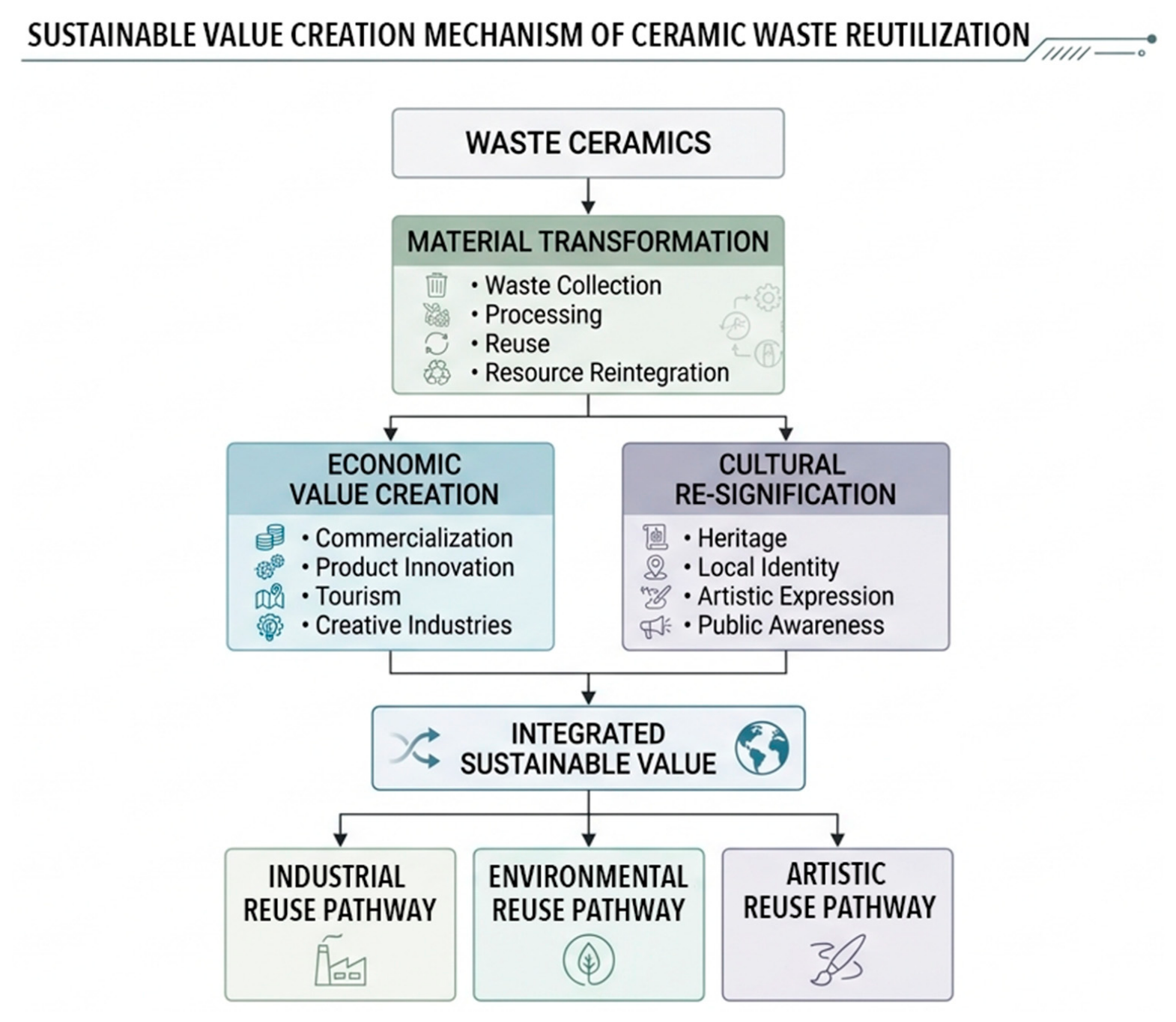
This study conceptualizes ceramic waste reutilization as a socio-material process of sustainable value creation. Across industrial, environment-oriented, and artistic practices, this process unfolds through three interrelated stages: material transformation, value realization, and cultural re-signification. Collectively, these processes form a sequential and mutually reinforcing pathway through which ceramic waste is progressively transformed into new material functions, economic opportunities, and socio-cultural meanings, as illustrated in
Figure 7.
At the material level, all cases extend the life cycle of discarded ceramics by preventing landfill disposal and reducing reliance on virgin resources. However, the forms of transformation differ substantially. Industrial projects such as ECORA emphasize material reprocessing and technological innovation, whereas environment-oriented projects preserve the physical integrity of ceramic fragments through architectural or landscape applications. Artistic practices, by contrast, prioritize conceptual reconstruction over material efficiency, treating broken ceramics as expressive media rather than purely functional resources.
Material transformation should therefore be understood as a necessary enabling condition for sustainable value creation, but not a sufficient one. Without subsequent processes of economic activation and cultural re-signification, recycled materials may remain technically reusable yet socially under-recognized and economically non-viable.
In industrial cases, economic value is realized through commercially competitive products and material innovation. In environment-oriented projects, value is generated indirectly through tourism, place branding, and cultural infrastructure development. Artistic practices contribute less to conventional markets but generate value through exhibitions, cultural industries, and creative economies. These differences suggest that economic value within circular systems should be understood as a broader process of resource activation and value realization beyond direct product sales.
The third mechanism, cultural re-signification, distinguishes the Jingdezhen cases from conventional technical recycling models. Material recovery alone cannot ensure a sustainable transition if recycled materials remain socially invisible or institutionally undervalued. The Jingdezhen cases demonstrate that cultural re-signification provides the interpretive and institutional framework through which recycled materials gain socio-cognitive acceptance, meaning reconstruction, and symbolic legitimacy. In this sense, culture is not an ancillary outcome of recycling but a constitutive condition for its long-term sustainability.
Taken together, these observations suggest that sustainable value emerges from the dynamic interaction of material transformation, economic activation, and cultural re-signification. Material transformation enables subsequent economic activation, while cultural re-signification conditions and reinforces both material reuse and economic viability. Accordingly, the sustainability of ceramic waste reutilization should be understood not merely as the extension of material life, but as the coordinated extension of material, economic, and cultural life through an integrated socio-material value creation system.
4.2. Theoretical Contributions and Practical Implications
Building on these findings, the study further argues that cultural meaning should be understood not merely as an outcome of ceramic waste reutilization but as an active mechanism shaping heritage-based circular economy practices. Although circular economy research has traditionally focused on material recovery, resource efficiency, and technological innovation, studies in heritage and material culture have shown that the social meaning attached to objects also influences how materials are perceived, valued, and reused [
20].
In heritage-based industrial regions such as Jingdezhen, the transition from ceramic waste to resource is not determined solely by the physical properties of discarded materials. It is also influenced by the cultural values attached to them. From this perspective, cultural meaning should be understood not only as an outcome of ceramic waste reutilization but also as an important mechanism that supports the development of heritage-based circular economy practices.
Heritage is continuously produced and reinterpreted through contemporary social practices, making it an evolving social process rather than a fixed historical legacy [
47,
48].
One reason why discarded ceramics in Jingdezhen can be successfully reintegrated into contemporary production and public life is their strong connection with local heritage and place identity. Unlike ordinary construction debris or industrial waste, ceramic fragments are closely associated with the city’s millennium-long porcelain tradition. For local residents, artisans, designers, and consumers, these materials embody craft knowledge, collective memory, and regional identity. Even after being broken and reassembled, they continue to represent a material link with Jingdezhen’s ceramic heritage. This cultural continuity enhances the social acceptance of recycled ceramics and encourages their reinterpretation as valuable resources rather than disposable waste. In this sense, cultural meaning mediates the transition from discarded material to a socially recognized resource. Culture is key to what makes cities attractive, creative, and sustainable. History shows that culture is at the heart of urban development, evidenced through cultural landmarks, heritage, and traditions [
49].
The three reutilization pathways examined in this study further illustrate how cultural meaning contributes to sustainable value creation in different ways. In the industrial pathway, the commercial success of Yi Design demonstrates that the market competitiveness of recycled ceramic products is supported not only by their environmental performance but also by their close association with Jingdezhen’s ceramic identity. The retained texture and material characteristics of recycled ceramics reinforce product authenticity and differentiate them from conventional recycled materials. In the environment-oriented pathway, projects such as the Porcelain Palace and the Millennium Wall derive their broader value less from the act of recycling itself than from their ability to transform ceramic waste into cultural landmarks. These projects strengthen local identity, support heritage tourism, and enhance place branding, thereby generating indirect economic and social benefits. In the craft-based artistic pathway, although the amount of ceramic waste reused is relatively limited, artistic reinterpretation gives discarded ceramics new symbolic meanings. Through exhibitions and public engagement, these works encourage reflection on heritage, sustainability, and material consumption, extending their influence beyond the artworks themselves.
These findings suggest that cultural meaning is not merely an additional benefit of circular economy practices. Rather, it functions as an enabling condition that helps recycled materials gain social recognition, economic value, and long-term legitimacy. The Jingdezhen case indicates that, in heritage-based industrial regions, successful circular economy practices depend not only on technical solutions for material recovery but also on the cultural processes through which discarded materials are reinterpreted, accepted, and incorporated into contemporary social and economic life.
The findings also have practical implications for multiple stakeholders involved in ceramic waste reutilization. Because the three reutilization pathways rely on different mechanisms of sustainable value creation, effective implementation requires coordinated actions rather than a single policy approach.
For industrial reuse, local governments can facilitate market adoption by establishing product standards, certification systems, and green procurement policies for recycled ceramic materials. At the same time, ceramic enterprises could strengthen waste classification and collection at the production stage and collaborate with designers to develop higher-value-added recycled products, thereby extending the industrial value chain.
For environment-oriented reuse, urban planners and public institutions can increase the visibility of circular practices by incorporating recycled ceramics into public landscapes, urban regeneration projects, and cultural infrastructure. Such applications reduce waste while also reinforcing local identity, supporting heritage tourism, and enhancing public engagement with sustainable development.
For craft-based artistic reuse, designers and artists can further explore the cultural narratives embedded in discarded ceramics and translate them into contemporary design and artistic practices. Museums and universities can complement these efforts through exhibitions, interdisciplinary teaching, and collaborative research, helping to strengthen public awareness of recycled materials while cultivating future professionals in heritage conservation and sustainable design.
Together, these measures contribute to an integrated ecosystem in which governments, industries, cultural institutions, and creative practitioners jointly promote the sustainable transformation of ceramic waste in heritage-based industrial regions.
4.3. Limitations and Future Research
Several limitations should be acknowledged. First, the research adopts a qualitative case-study approach and therefore does not aim to provide statistically representative evidence for all ceramic waste practices in Jingdezhen. Instead, the selected cases illustrate diverse mechanisms through which sustainable value can be generated across industrial, environmental, and artistic contexts.
Second, the availability of quantitative environmental data varies considerably among cases. Publicly reported figures concerning recycled-content ratios, waste quantities, and environmental performance require further verification through company documentation, laboratory testing, or independent life cycle assessment before they can support stronger comparative conclusions.
Moreover, although the proposed framework identifies a sequential relationship among material transformation, economic activation, and cultural re-signification, the causal interactions among these dimensions remain theoretically inferred rather than empirically tested. Future research could employ longitudinal or mixed-method designs to validate the proposed mechanism quantitatively.
Future research should integrate the socio-material framework proposed here with material-flow analysis, life cycle assessment, stakeholder interviews, consumer perception research, and economic evaluation. Such mixed-method approaches would enable more precise measurement of how material transformation, economic activation, and cultural re-signification interact to shape the long-term sustainability of ceramic waste reutilization in heritage-based industrial regions.
5. Conclusions
This study examined how ceramic waste generates sustainable value in Jingdezhen through a qualitative multiple-case analysis of industrial reuse, environment-oriented reuse, and craft-based artistic reuse. The findings indicate that ceramic waste reutilization extends well beyond technical recycling by linking material recovery with economic activation and cultural reinterpretation.
Across the cases, industrial reuse emphasizes product innovation and resource recovery, environment-oriented reuse creates value through spatial reconstruction and public engagement, while craft-based artistic reuse contributes primarily through cultural reinterpretation and critical reflection.
The proposed framework demonstrates that sustainable value emerges through the interaction of material, economic, and cultural processes rather than through isolated interventions. It therefore expands circular-economy research by recognizing culture as an active component of resource circulation rather than a secondary outcome. Ceramic waste should not be viewed solely as a residual material stream. Its significance derives from both physical properties and cultural associations. A socio-material perspective is therefore a useful lens for explaining how discarded ceramics can function simultaneously as industrial resources, design materials, heritage carriers, and cultural symbols.
Although this study focuses on Jingdezhen, the proposed material economic cultural perspective has broader relevance for heritage-based industrial regions where discarded materials possess both functional and cultural significance. Sustainable value creation depends not only on technical resource recovery but also on how cultural meaning supports material acceptance, public engagement, and long-term value creation. More broadly, the approach is not limited to ceramic waste. It may also inform research on other forms of culturally embedded, non-biodegradable waste, where sustainable value creation depends on the interaction between material recovery, economic activation, and cultural meaning.
Future research could further evaluate the transferability of this framework by applying it to other ceramic production regions, such as Dehua and Foshan, and to other heritage-based industries, including glassmaking, stone carving, and metal crafts. Such comparative studies would help clarify how cultural heritage shapes sustainable value creation across different materials, industries, and regional contexts.












 Photograph by the authors (2023).