1. Introduction
Against the backdrop of the coordinated advancement of rural revitalization and new urbanization, the construction of public cultural spaces in rural China has entered a stage of rapid expansion. Rural libraries, cultural squares, and digital cultural facilities have become widely available across rural areas [
1,
2,
3]. From the perspective of infrastructure provision, the primary objectives of this stage have largely been achieved. However, when attention shifts from spatial construction to operational processes, an important problem emerges: to what extent can these spaces become sustainably embedded in everyday rural life and develop stable patterns of participation? In rural practice, public cultural spaces do exist, yet such spaces have not necessarily evolved into a stable state of use. Villagers’ participation is often characterized by intermittency, and cultural activities tend to rely on periodic mobilization rather than on endogenous mechanisms capable of sustaining long-term engagement [
4,
5]. From the perspective of social sustainability, this phenomenon not only indicates relatively low levels of utilization but also reflects a lack of stable participatory support and feedback mechanisms within the long-term operation of public cultural systems, resulting in what may be described as a low-resilience operation [
6,
7,
8]. Existing studies have examined this issue through different theoretical perspectives. The exogenous development approach emphasizes government-led resource inputs and infrastructure construction, suggesting that public cultural services can achieve broad coverage through standardized provision. However, this perspective pays limited attention to the mechanisms through which provision is translated into sustained participation [
9,
10]. In contrast, the endogenous development approach highlights the self-sustaining capacity of rural social networks and local cultural traditions. Whereas, under conditions of population mobility and changing social structures, its explanatory power regarding long-term sustainability remains constrained [
11,
12,
13]. Neo-endogenous development theory attempts to integrate external embeddedness with internal generation by emphasizing the interactive transformation of resources and local actors, thereby providing a more comprehensive framework for understanding the operation of rural public culture [
14,
15,
16]. Nevertheless, it has yet to adequately explain how external resources are transformed into sustainable participatory mechanisms through specific institutional arrangements and social relationships after entering rural communities.
Notably, why does participation gradually stabilize in some contexts while rapidly decline in others? The central issue is not whether participation exists, but whether it possesses the capacity for continuous reproduction. In this study, participation resilience refers to the capacity of a rural public cultural participation system to maintain and reproduce meaningful participation while continuously responding to recurring demographic, resource-related, and organizational constraints. The concept is not equivalent simply to an unchanged frequency of attendance, nor does it presuppose recovery following a major external shock. Participation resilience is manifested in four interrelated features: continuity beyond short-term mobilization; institutionalization through relatively stable participation channels; self-reproduction through sustained and increasingly autonomous action; and the adaptive adjustment of actor relationships and resource allocation when constraints arise. Farmers’ agency refers to an actor-level capacity expressed through the articulation of needs, participation in consultation, and the initiation of collective action. Adaptive linkage is the process through which farmers’ agency is connected with resources and institutions; participation resilience is the system-level capacity generated through this process; and social sustainability refers to the broader value of the system in promoting social inclusion, interpersonal trust, social cohesion, and institutional continuity.
This question extends beyond the scope of cultural service provision and enters the broader analytical domains of social sustainability and system resilience. To address this issue, this study takes adaptive linkage as analytical framework and conceptualizes rural public cultural spaces as dynamic systems jointly shaped by multiple actors. Within this system, government resource inputs constitute the initial conditions, village-level organizations facilitate transformation through institutional arrangements and relational coordination, and the sustainability of system operation depends on the stability of interactions among different actors and the extent to which these interactions become institutionalized. This study takes Sanchalu Village in Wuhan, China, as a case. Under the “Shared Village” model, this village has developed a relatively typical multi-actor collaborative structure, providing an appropriate context for examining the operation and evolution of rural public cultural systems. Based on in-depth interview data collected from 13 participants, this study employs a constructivist grounded theory approach and uses three-stage coding procedures to identify and refine the underlying mechanism structure. This study aims to explain how multi-actor interactions enable episodic participation in rural public cultural spaces to gradually evolve into a resilient participatory structure. To address this research purpose, the study poses the following research questions:
RQ1: How do external resources influence villagers’ perceptions of and participation in public cultural spaces after entering rural communities?
RQ2: How do village-level organizations transform initial participation into relatively stable and institutionalized participation through institutional arrangements and relational regulation?
RQ3: How do interactions among multi-actor facilitate the transition from episodic participation to long-term stable engagement, thereby generating a resilient operational structure?
Accordingly, this study advances a central argument: participation resilience is not an automatic outcome of infrastructure provision or resource investment. It emerges only when village-level organizations translate external inputs into accessible participation opportunities, connect them with endogenous cultural resources, and consolidate them through trust-based reciprocity and multi-actor collaboration. In Sanchalu Village, this process transforms episodic participation into a form of participation characterized by greater continuity, stronger institutional support, and enhanced adaptive capacity. The value of participation resilience for social sustainability lies in sustaining channels through which residents can articulate their needs, maintaining reciprocal social relations, fostering collective identity, and ensuring the long-term and stable operation of rural public cultural participation mechanisms.
2. Literature Review and Theoretical Framework
2.1. From Exogenous Provision to Endogenous Construction
As an important component of the national public service system, the development of rural public cultural spaces has long been incorporated into an exogenous provision framework dominated by government intervention. Within this paradigm, research has primarily focused on visible indicators such as fiscal investment, facility construction, and spatial coverage. Rural public cultural spaces have been regarded as infrastructure-based public goods aimed at achieving the balanced distribution of cultural resources in some studies [
17,
18]. As these initiatives, however, have expanded in practice, the growth of spatial provision has not necessarily resulted in stable structures of cultural participation. In many regions, public cultural spaces operates under conditions characterized by “being built but underused” or “existing yet weakly interactive.” This phenomenon suggests that the central issue has shifted from whether public cultural spaces exist to how they can be continuously utilized, reflecting a transition from a logic of provision to a logic of operation and sustainability [
19,
20].
In response, this research has increasingly turned to the perspective of endogenous development, emphasizing the role of local cultural resources, social networks, and the reproduction of indigenous cultural traditions within rural communities [
21,
22,
23]. From this perspective, farmers are reinterpreted as participants in cultural practice and producers of meaning rather than merely recipients of public services [
24]. Current studies have demonstrated that activating local cultural identity, community mutual-support networks, and grassroots participation can strengthen the endogenous vitality of rural public culture [
25,
26,
27]. Under conditions of population outmigration, weakened social structures, and declining organizational capacity, however, local cultural resources may struggle to sustain stable mobilization, thus imposing structural constraints on the long-term effectiveness of endogenous development [
28,
29,
30]. Consequently, the tension between exogenous provision and endogenous construction fundamentally reflects a structural challenge concerning the sustainability of rural public cultural systems.
2.2. Neo-Endogenous Development and Agency Mechanisms
To overcome the dichotomy between exogenous and endogenous approaches, neo-endogenous development theory has gradually emerged as an important explanatory framework in rural studies. This perspective argues that rural development is not driven by a single force but results from the continuous interaction and coordination between externally embedded resources and the capacities of local actors [
31,
32]. From this perspective, the development of rural public culture is understood as a dynamic process of transformation. External resources do not automatically become developmental drivers upon entering rural communities; rather, they must be reinterpreted and processed through local organizations and institutional mechanisms, thereby transforming resource inputs into collective capacities for action [
33].
Within the field of agency studies, the concept of relational agency further strengthens this explanatory logic by emphasizing that farmers’ agency is not a fixed attribute but a process continuously shaped and reconstructed within the relational structures of the state, market, and community [
34]. This perspective moves beyond the traditional agency–structure dichotomy and redirects attention toward the interaction between institutional networks and social practices. However, neo-endogenous development theory still has several limitations. (1) It provides limited explanation of how external resources undergo contextual adaptation and re-embeddedness after entering rural communities [
14]. (2) It offers insufficient descriptions of the mediating role of village-level organizations in resource transformation and actor linkage [
35]. (3) It lacks a systematic explanation of how farmers’ agency evolves from short-term activation to long-term stable participation [
36].
2.3. Rural Public Culture and System Resilience
System resilience theory within sustainability research emphasizes that the critical feature of a social system lies not in short-term resource inputs or one-time participation, but in its capacity to maintain structural stability and functional continuity over time, namely its resilience and adaptive capacity [
37,
38,
39]. Under this framework, rural public cultural spaces are no longer regarded as isolated cultural facilities but as socio-institutional systems composed of interactions among multiple actors. Their sustainability depends not only on the intensity of resource provision but also on the stability of participation structures, the self-regulating capacity of institutional mechanisms, and the continuous reproduction of interactions among actors [
40,
41,
42]. In this study, social sustainability is analytically specified through four interrelated dimensions: (1) inclusive participation and voice, reflected in whether different groups can access cultural spaces, articulate their needs, and participate in collective deliberation; (2) relational cohesion, encompassing the cultivation of trust, reciprocity, and interaction among social groups; (3) collective agency and cultural continuity, referring to villagers’ capacity to initiate activities, contribute local knowledge, and reproduce cultural practices; and (4) institutional continuity and adaptive capacity, reflected in stable and accessible participation channels, coordinated rights and responsibilities among actors, and the capacity to adjust resource allocation and operating mechanisms in response to changing needs. On this basis, the study examines not only whether participation can be sustained, but also what forms of social relationships and collective capacities are reproduced through the participatory process.
Existing studies have suggested that multi-actor collaborative governance, digital participation mechanisms, and platform technologies are reshaping patterns of participation in rural public culture. These developments make low-cost and high-frequency interactions increasingly feasible, thereby enhancing participation resilience to some extent [
43,
44]. However, current research still lacks a systematic understanding of the dynamic relationships among resource embeddedness, organizational transformation, and actor participation. Empirical analyses of how participation resilience is generated, strengthened, and sustained through multi-actor interactions also remain limited [
45,
46,
47]. Therefore, it is necessary to develop an analytical framework capable of simultaneously connecting resource inputs, institutional transformation, agency formation, and long-term operation in order to reveal the underlying mechanisms through which rural public cultural systems achieve sustainable functioning.
2.4. Theoretical Integration
The literature reviewed above indicates that, although existing studies have examined rural public culture from the perspectives of exogenous provision, endogenous development, and neo-endogenous development, a comprehensive analytical framework integrating resource inputs, institutional transformation, agency formation, and long-term operation remains lacking. To address this gap, this study proposes adaptive linkage as an analytical perspective and conceptualizes rural public cultural spaces as socially sustainable systems capable of continuous self-adjustment. Within this analytical framework, adaptive linkage connects actor-level agency with system-level participation resilience by coordinating resource access, organizational mediation, and sustained interaction. Social sustainability, in turn, represents the broader social outcome that emerges when these operational arrangements sustain inclusive participation, social trust, collective cohesion, and institutional continuity over time.
Accordingly, the proposed mechanism consists of four interrelated processes. (1) Externally embedded resources led by government initiatives provide the initial conditions and institutional foundations for system development, with the central issue being how resources are transformed into accessible opportunity structures. (2) Institutional transformation mechanisms led by village-level organizations convert external resources into actionable participation structures through organizational empowerment, interest linkage, and digital governance. (3) Participation resilience emerges through interactions between internal and external resources, allowing dispersed forms of participation to gradually stabilize and evolve into self-reinforcing patterns of interaction. (4) An institutional ecology constructed through multi-actor collaboration consolidates these processes and supports the long-term sustainable operation of the system through institutional stabilization.
Based on this framework, this study develops a four-stage adaptive linkage model consisting of government leadership, village-level organizational mediation, resource linkage, and collaborative governance. The model seeks to explain the generation of social sustainability within rural public cultural systems and provides the theoretical foundation for the subsequent empirical analysis.
3. Methods
3.1. Case Selection and Research Context
Sanchalu Village is located in Fenghuang Town, Wuhan, Hubei Province, approximately one kilometer from the town center. The village consists of 16 natural hamlets, with a registered population of approximately 2000 and a permanent resident population of around 1000. Like many rural communities, it has long faced challenges associated with population outmigration and population aging.
Since 2018, supported by the Beautiful Countryside initiative, the village has implemented a “Shared Village” development model. Through a collaborative mechanism characterized by government leadership, enterprise operation, and villager participation, vacant rural houses have been repurposed to create a diversified spatial system that includes homestays, shared living rooms, shared gardens, and public cultural spaces. Meanwhile, the village has established a relatively comprehensive public cultural service system, including a rural library, a digital reading system, an activity center for elderly, and a cultural activity square. These spaces are embedded within local social networks and collectively form a typical cultural–governance complex, providing an appropriate empirical context for examining the formation and sustained operation of farmers’ agency. The “Shared Village” model integrates government guidance, enterprise operation, village-level coordination, and villager participation, linking the revitalization and reuse of idle rural housing with public cultural services, local employment, community welfare, and shared-space governance. This model makes Sanchalu Village a typical information-rich case for examining how external resources are translated into sustained participation through locally embedded organizations and social relationships.
Fieldwork was conducted in November 2025, with the core investigation taking place on 20 November 2025. Additional interviews and participant observation were subsequently undertaken to enrich and refine the data structure. The investigation covered multiple sites, including the rural library, shared gardens, cultural square, shared living rooms, and the village committee office, thereby facilitating a holistic understanding of the operation of public cultural spaces (
Supplementary Materials S2).
3.2. Research Design
This study adopts a case study design and selects Sanchalu Village in Wuhan, Hubei Province, as a typical case to explore the mechanisms underlying the formation of farmers’ agency and its pathways toward sustainability in the development of rural public cultural spaces. Methodologically, the study employs a constructivist grounded theory approach, which emphasizes that agency is not a predetermined attribute but a processual outcome continuously constructed and reproduced through specific social contexts and everyday interactions [
48]. From this research orientation, this study focuses not only on how participation occurs but also on the structural conditions and sustainability mechanisms underlying participation. Specifically, it examines how public cultural spaces develop into stable socio-institutional systems through interactions among multiple actors. Constructivist grounded theory is therefore particularly suitable for identifying process mechanisms and pathways through which system resilience emerges from empirical data, which is consistent with the process-oriented explanatory logic emphasized in sustainability research [
49].
Case study is well suited to explaining mechanism-based issues in complex social phenomena, particularly those concerning how certain processes emerge and why they can be sustained over time [
50]. Accordingly, this study employs the case study as the overall research strategy and grounded theory as the primary analytical method, thereby facilitating a process of theory generation that moves from empirical description to mechanism construction.
3.3. Participants and Sampling Strategy
This study employed purposive sampling [
51,
52] to ensure that the sample covered key actors and structural positions involved in the operation of public cultural spaces. The sampling criteria included: (1) villagers who directly participated in the use or governance of public cultural spaces; (2) organizers involved in village governance and resource allocation; (3) government and enterprise representatives engaged in the provision of external resources; and (4) key insiders capable of providing long-term observational insights into village development.
The participant sample was determined by the analytical objectives of the qualitative study rather than by considerations of statistical representativeness. Participants were selected because they possessed direct and complementary knowledge of resource provision, organizational coordination, space operation, or everyday cultural participation. Collectively, the participants covered the principal institutional and villager perspectives required to analyze the adaptive linkage process. Therefore, 13 participants were ultimately selected, and their backgrounds and basic characteristics are presented in
Table 1 and
Table S1.
3.4. Data Collection
This study adopted an interview strategy combining open-ended questions with follow-up probes to elicit detailed descriptions of specific events and process-oriented narratives from participants. The interviews focused on five core themes: (1) the current use of and participation in public cultural spaces; (2) motivations for and barriers to participation; (3) organizational mechanisms and institutional arrangements; (4) multi-actor interactions and community integration; and (5) sustainable development and future expectations (
Table 2). This study collected textual data primarily through semi-structured in-depth interviews, supplemented by participant observation and documentary analysis, to develop a multidimensional understanding of the operation of rural public cultural spaces.
All interviews were audio-recorded and transcribed with the informed consent of the participants, generating approximately 58,000 words of interview transcripts. All participants provided written informed consent prior to participation. The study was conducted in accordance with the Declaration of Helsinki (2013 revision) and was reviewed and approved in accordance with the research management procedures of Hubei University (Approval No. HUBU-GL2025010). In addition, participant observation and field notes were conducted simultaneously to document patterns of space utilization, villager interactions, and governance processes.
Supplementary materials, including WeChat group records, activity notices, and institutional documents, were also collected to facilitate data triangulation. The participants included representatives from government agencies, village-level organizations, enterprises, and different groups of villagers. This diverse sample ensured that the formation mechanisms and sustainable evolution of farmers’ agency in the development of public cultural spaces could be examined from the perspective of multi-actor interactions.
3.5. Data Analysis
This study employed a case study as the overall research strategy and adopted constructivist grounded theory as the primary analytical method [
48,
50]. Through the constant comparative method, concept generation and theory construction were conducted in an iterative manner, allowing the mechanisms underlying the formation of farmers’ agency and the logic of its sustained operation within rural public cultural spaces to emerge progressively from the empirical data. The analysis emphasizes the development of an explanatory framework grounded in empirical evidence, thereby responding to the analytical concerns of sustainability research regarding process mechanisms and system resilience. NVivo 14 was used to manage and organize the coding process. Data analysis followed the three-stage coding procedure of constructivist grounded theory, including open coding, axial coding, and selective coding (
Table 3).
- (1)
Open Coding: The interview transcripts were analyzed line by line using a coding strategy that remained close to participants’ original expressions while focusing on actions and processes. Raw narratives were conceptualized in ways that preserved their contextual meanings and explanatory value. Examples include: (a) “I first came here to enjoy the cool air and then started reading books” → awakening of cultural needs; (b) “registering for activities through a WeChat group sign-up” → digital participation; and (c) “a rental payment of RMB 60,000 for a 20-year lease” → perceived economic benefits. Through constant comparison and theoretical saturation checks, a total of 174 initial concepts were generated.
- (2)
Axial Coding: Building on the results of open coding, the initial concepts were systematically integrated around causal conditions, contextual conditions, action strategies, and consequences, resulting in 12 subcategories. Through further constant comparison and process-oriented analysis, these subcategories were consolidated into four major categories according to their semantic similarities and relationships within action processes: (a) external resource embeddedness and the awakening of agency; (b) village-level organizational empowerment and the cultivation of endogenous capacities; (c) internal–external resource linkage and the generation of participation resilience; and (d) multi-actor collaboration and the construction of an institutional ecology. This stage reflects a process of progressive abstraction from the identification of empirical phenomena to the explanation of structural relationships.
- (3)
Selective Coding: Through theoretical memo writing and continuous comparative analysis, this study identified adaptive linkage as the core category. This category explains how farmers’ agency within rural public cultural spaces evolves from short-term participation to long-term stable operation through the combined effects of external resource inputs, organizational transformation, and multi-actor interactions. The mechanism is conceptualized as a four-stage structure consisting of: (a) government leadership (external embeddedness); (b) village-level organizations (endogenous empowerment); (c) resource linkage (internal–external coordination); and (d) collaborative governance (institutional stabilization). Within this structure, government leadership provides the initial conditions and resource inputs; village-level organizations facilitate resource transformation and amplify collective action; resource linkage enables the coupling and continuous circulation of internal and external resources; and collaborative governance ensures the stable operation of the system through institutionalized arrangements.
- (4)
Trustworthiness and Theoretical Saturation: Analytical traceability was ensured through participant identifiers, coding records, and theoretical memos linking original interview excerpts to 174 initial concepts, 12 subcategories, four main categories, and the core category of adaptive linkage. Representative coding pathways are presented in
Table S4. Theoretical saturation was considered to have been reached when continued coding and constant comparison no longer generated new concepts or categories and revealed no relationships requiring revision of the existing analytical framework. Saturation was further assessed by examining whether the categories recurred across different actor groups and were corroborated by interview data, observation records, WeChat records, field notes, and official documents. Divergent accounts were retained and interpreted as contextual constraints rather than excluded from the analysis. Data triangulation, member checking, constant comparison, and cross-source verification further strengthened the credibility of the findings.
4. Findings
The findings are organized around four interrelated main categories: external resource embeddedness and agency activation, organizational empowerment and institutionalized participation, internal–external resource linkage and participation resilience, and multi-actor collaboration and institutional ecology. Together, these categories constitute the core process of adaptive linkage and provide the analytical structure for the presentation of the findings.
4.1. External Resource Embeddedness and the Activation of Sustainable Participation
4.1.1. Visualizing Economic Benefits
The transformation of idle resources into tangible economic returns served as the initial driver attracting villagers’ attention and involvement. Under the “Shared Village” model, housing rentals enabled the monetization of previously underutilized assets. As one village cadre explained: “A single-story house can be rented out for ¥3000 per year. With a 20-year lease, villagers receive ¥60,000 as a one-time payment.” (CM01). Enterprise relocation to rural areas creates additional job opportunities. Specifically, during the construction of enterprise facilities, local youth can be hired as casual laborers on a daily wage basis, thereby generating immediate earnings for them. (OV01). For return migrants, participation in village development provided a stable source of income. One participant noted: “I receive a monthly salary and can also stay at home to take care of my children.” (MM01). These visible economic benefits directly linked individual interests to village development, transforming villagers from passive observers into stakeholders who became increasingly concerned about the future of the project.
4.1.2. Awakening of Cultural Needs
Beyond economic incentives, the attractiveness of public cultural spaces gradually stimulated villagers’ endogenous cultural needs. The rural library provided a comfortable environment through cooling facilities and air-conditioned spaces, creating opportunities for villagers to move from physical presence to active participation. “At first, people came in simply because the environment was comfortable and cool. Over time, they noticed that others were reading, and they began looking for books that interested them.” (AD01). As participation deepened, villagers no longer merely used cultural spaces arranged by others but began to shape the content of cultural life autonomously. Residents proposed calligraphy activities through the WeChat group and voluntarily registered for village cultural performances (AD01; CM01). OV04 noted that villagers with shared interests spontaneously formed singing, dancing, and recitation groups and sustained regular afternoon activities without relying on one-off administrative mobilization. Villagers also contributed to the cultural environment by creating murals and engaging in locally distinctive cultural practices (OV03). These actions marked a shift in villagers’ participation from mere attendance toward the active articulation of cultural needs and the autonomous production of cultural activities.
4.1.3. Strengthening Identity and Confidence
The combined effects of economic benefits and cultural awakening contributed to a cognitive shift among villagers, fostering a growing belief that both they and their village were capable of positive change. As CM01 explained: “In the past, when the village was hollowing out, there was no point in making suggestions because nothing would happen. As development has progressed, people have become more optimistic about the future of the village and have started sharing their ideas and suggestions.” The visible implementation of villagers’ proposals further reinforced their sense of efficacy. Under the encouragement of local leaders and organizers, villagers increasingly felt that their voices could be heard and their contributions recognized. “Now people are willing to speak up and offer suggestions.” (CM02).
4.2. Organizational Empowerment and the Institutionalization of Sustainable Participation
4.2.1. Benefit-Sharing Mechanisms
The points-based system functioned as a core institutional mechanism of village empowerment. Public activities such as mutual-support eldercare and environmental maintenance were translated into accumulable and redeemable points. As one participant explained: “One hour of service earns ten points. These points can be exchanged for rice, cooking oil, or meals in the village canteen.” (CM02). By directly linking individual contributions with everyday rewards, the system reconstructed expectations that fair effort would be recognized and reciprocated.
More importantly, participation gradually became internalized as a social norm rather than remaining a purely instrumental exchange. As CM03 noted: “About 90 percent of people are not doing it for the points. They participate because they want to contribute to the village. One woman in her eighties even donated the rice she redeemed back to the canteen.”
4.2.2. Organizational Channels for Participation
Participation channels enabled villagers to move beyond merely expressing their own needs toward contributing to collective decision-making and assuming operational responsibilities. Major public affairs were discussed through village representative meetings and the “Four Discussions and Two Disclosures” procedure before implementation (CM01). From the villagers’ perspective, OV02 regarded consultation as restoring the value of local experience and judgment, while NV01 and NV02 used village-level communication and deliberative channels to raise practical concerns regarding logistical support, transportation, and public-service accessibility. Participation also extended to the implementation of collective affairs. In the mutual-support eldercare program, villagers alternated between providing services and receiving care (CM03); residents voluntarily took turns managing the rural library (AD01); and mixed cultural groups organized activities without distinguishing between long-term and new residents (OV04). These practices demonstrate three interrelated expressions of villagers’ participatory agency: articulating needs, participating in deliberation, and assuming responsibility for collective activities. Village-level organizations established pathways for participation, while villagers gradually gained the capacity to shape the content of collective action and sustain its continuation.
4.2.3. Digital Participation Platforms
WeChat groups and digital reading devices created virtual spaces for participation that extended beyond the constraints of physical time and space. Villagers used WeChat groups to organize activities, provide feedback, and discuss community issues. CM01 noted that there is interaction in the group almost every day, and it has become part of everyday village governance. The rural library’s “citizen request” function further enabled decentralized expression of cultural needs: “If people cannot find a book on the reading machine, they can submit a request through the ordering function, and the relevant departments will arrange resources according to demand.” (AD01). Digital tools significantly lowered barriers to participation, particularly for older residents and those with limited confidence in public expression. As a result, communication, consultation, and feedback became more convenient and transparent.
4.3. Internal–External Resource Linkage and the Generation of Participation Resilience
4.3.1. Activation of Endogenous Cultural Resources
Previously dispersed and dormant local skills and cultural traditions were rediscovered and redefined as resources with public value. Both CM01 and OV03 described how an elderly villager with a passion for painting began creating artworks on the walls of his courtyard. His work attracted newly arrived residents who were interested in art and eventually led to informal painting activities for local children. Similarly, villagers voluntarily shared agricultural knowledge and cultivation experience with one another. When new villagers do not know what vegetables to grow, older villagers patiently explain it to them and even take them to their own gardens to pick vegetables. (OV02). These daily interactions which based on local skills and interests, gradually became distinctive cultural assets of the village and provided an endogenous foundation for public cultural activities.
4.3.2. Transformation of External Resource Inputs
Alongside the activation of endogenous resources, external resources were increasingly transformed into forms that responded more directly to local needs. According to AD01, university volunteers regularly stayed in the village to provide summer educational programs for left-behind children. At the same time, the district Civil Affairs Bureau and local library system selected and delivered books based on feedback provided by library administrators: “Books are selected according to the specific needs reported by the library.” (AD01). Enterprises also contributed to village development through rent reductions, local procurement, and employment opportunities (EN01; CM01). Thus, the transformation of external resources was not a passive process of reception. Instead, it operated through a structured sequence of demand articulation, resource coordination, and targeted matching, whereby villagers expressed needs, the village committee collected and communicated those needs, higher-level organizations sought relevant resources, and external support was subsequently aligned with local priorities. This process ensured a closer correspondence between resource inputs and local demands.
4.3.3. Self-Maintaining and Reciprocal Mechanisms
The development of trust served as a critical bridge linking endogenous and exogenous resources into a stable collaborative system. The donation case of the village canteen illustrates the way trust accumulates: the son of one villager initially opposed a road construction project and demanded compensation. However, after personally witnessing how the village canteen provided care and support for older residents, he not only abandoned his compensation claim but also immediately donated CNY 2000 to the canteen. (CM01). CM03 observed that ordinary people care about results first. Once they see real benefits, they become willing to work together with you. This pattern of “seeing results first and developing identification afterward,” combined with endogenous resource reproduction mechanisms such as voluntary labor and collectively managed gardens, generated a positive reinforcement cycle characterized by increasing participation, trust, and support. As this cycle strengthened, the organizational costs of collective action were substantially reduced.
4.4. Multi-Actor Collaboration and Institutional Sustainability
4.4.1. Multi-Actor Collaboration
A collaborative structure characterized by both clarity and flexibility gradually emerged within the village. According to GV01: “The government is responsible for setting the overall direction, providing support, and exercising supervision. It cannot do everything itself.” At the same time, enterprise operations were expected to respect villagers’ interests and perspectives: “Major issues must be discussed with the village. Economic benefits cannot be the only consideration.” (EN01). CM01 further explained that the village committee played a coordinating role: “Enterprise projects are first reported to the village committee, then discussed at village meetings to solicit opinions, and finally reported to higher authorities.” This model of government leadership, enterprise operation, village-level coordination, and villager participation maintained the vitality of market-oriented development while simultaneously protecting local cultural characteristics and public interests.
4.4.2. Integration Between Long-Term and New Residents
Social integration provided an important basis of collective identification within the institutional ecology. At the beginning of the project, certain social boundaries existed between long-term villagers and newcomers. As OV02 recalled: “They came from the city and seemed more educated than us. We felt that we could not easily relate to them.” These boundaries, however, gradually weakened through everyday interactions, including mutual assistance activities, community gatherings, and shared festival celebrations. Activities such as making rice dumplings together in the shared living room and participating in performances in the village square enabled newcomers to move from the status of outsiders to that of neighbors. As OV04 explained: “Once people move here, there is no distinction between new villagers and old villagers. Everyone can participate together.” This process of social integration provided a broad foundation of shared identification that supported the continued vitality of public cultural spaces.
4.4.3. Leadership Transformation in Local Governance
The effective functioning of the governance system was strongly driven by a leadership team that enjoyed the trust of local residents. The village experienced a remarkable transformation, moving from being ranked among the poorest-performing villages in environmental sanitation within the municipality to achieving substantial improvements in governance performance. Underlying this change was a shift in leadership style, from that of resource distributors to service-oriented practitioners committed to practical action. When confronted with accusations of formalism, village leaders consistently responded through action rather than rhetoric. As CM03 stated: “We do not explain ourselves. We prove it through practical action.” According to CM02, strict meeting attendance requirements, responsibility-based management arrangements, and service-oriented grassroots engagement ensured that village leaders maintained the highest attendance rates and remained actively involved in local affairs. These practices significantly strengthened the continuity of villagers’ participation. This process forms a governance feedback loop where “leaders lead by example, villagers respond actively, and organizational capacity is strengthened.”
Although these findings collectively provide an empirical explanation of the sustainable formation of farmers’ agency, the interview data also revealed several persistent structural constraints. These included population aging and youth outmigration, uncertainties associated with dependence on external resources, the gradual nature of integration between long-term and new residents, and disparities in digital participation capacities. The new residents also reflected practical constraints related to the accessibility of public services, including insufficient coverage of express delivery services, limited conditions of public transportation, untimely maintenance of public facilities, and issues such as the lack of property management. Additionally, the small-scale farming model and the fragmented land characteristics limited economic income opportunities, placing cultural activity participation relatively subordinate position in daily life and production arrangements (NV01, NV02).
These constraints did not disappear during the adaptive linkage process; in turn, they constituted the practical context against which the level of participation resilience could be assessed. The resilient participatory structure observed in this case remained at an emerging stage and had not yet become fully consolidated. Cultural activities and online interactions moved beyond one-off mobilization; points-based incentives, consultation procedures, volunteer rotation, and channels for reporting needs supported institutional continuity; villagers independently initiated cultural activities and contributed local knowledge; and resource allocation and actor responsibilities could be adjusted dynamically in response to changing needs. These patterns broadened channels for public expression, strengthened reciprocity and trust, promoted interaction between long-term and new residents, and sustained collective cultural action under continuing demographic and public-service constraints, thereby supporting social sustainability.
Drawing on the empirical categories and mechanisms summarized in
Table S2, as well as the stage-specific functions, representative codes, and implementation outcomes presented in
Table S3,
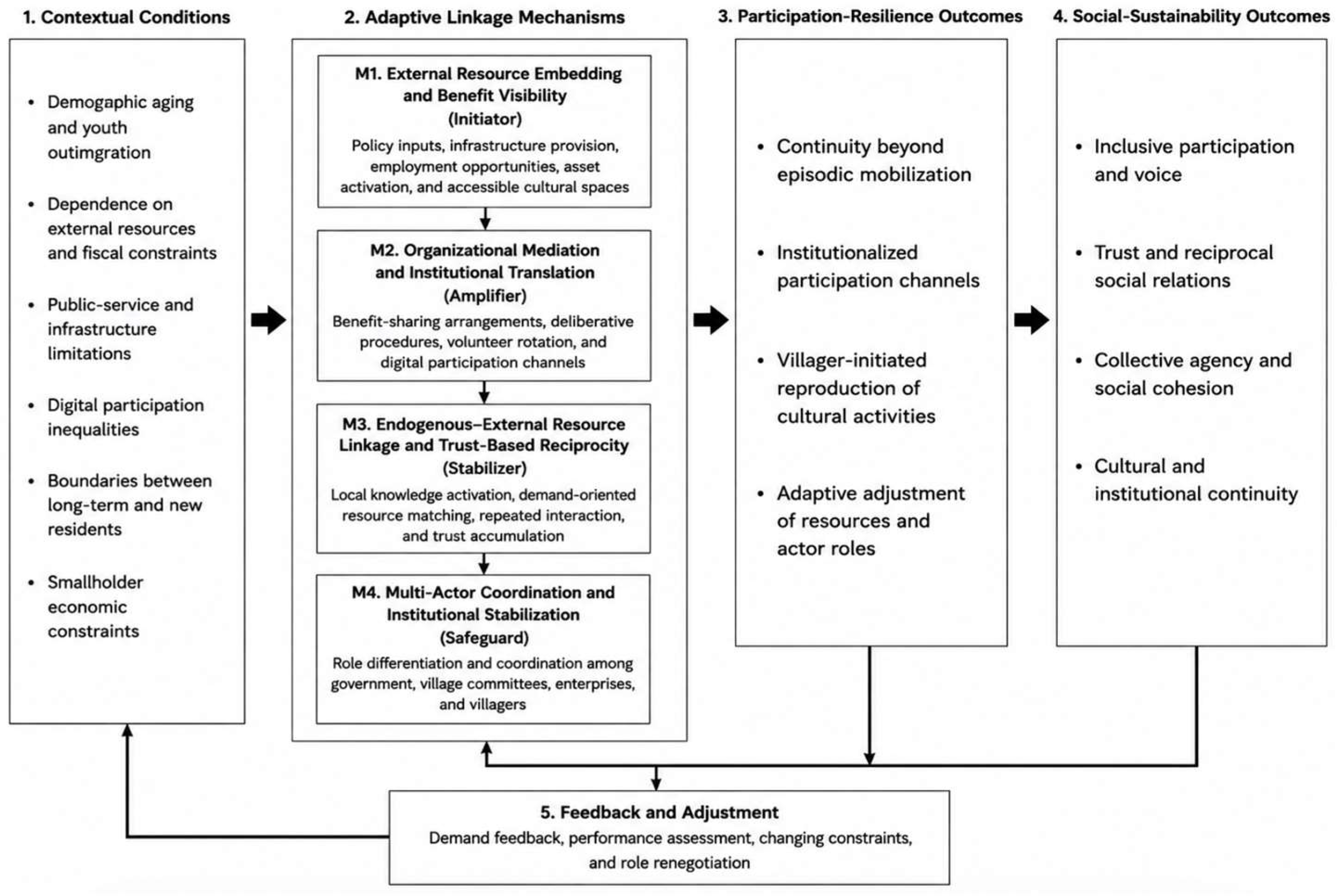
Figure 1 organizes the adaptive linkage mechanism into a conditions–mechanisms–outcomes–feedback analytical structure. Population aging, youth outmigration, dependence on external resources, inadequate public-service provision, the digital divide, and persistent divisions among resident groups jointly constitute the contextual conditions under which participation evolves. These conditions do not directly determine participation outcomes; rather, they generate continuing pressures that drive the operation and adjustment of the four interrelated mechanisms.
Based on these findings, the model should not be understood as a strictly linear process. External resources may create initial opportunities for participation, but these opportunities can develop into long-term mechanisms only when village-level organizations translate them into operational participation arrangements, internal and external resources are connected through reciprocal interaction, and multi-actor collaboration clarifies the boundaries of rights and responsibilities. Participation resilience is manifested in the continuity, institutionalization, self-reproduction, and adaptive adjustment of participation, whereas social sustainability is reflected in inclusive voice, social trust, collective agency, social cohesion, and institutional continuity. Feedback generated by participation outcomes, together with changing contextual pressures, continuously drives the adjustment and optimization of resource allocation, organizational participation channels, and actor relationships.
5. Discussion
5.1. Resource Embeddedness and the Activation of Sustainable Participation
Government-led external resource inputs activated participation in hollowing villages through the dual pathways of benefit visibility and daily embeddedness [
14,
18]. Rather than assuming that resource inputs automatically generate participation, the findings suggest that resources must first be transformed into opportunities that villagers can perceive, access, and incorporate into their daily lives.
In the case, rental income from vacant houses, local employment opportunities, and the comfort provided by public spaces collectively constituted villagers’ direct experiences of visible development benefits. Such visibility should not be understood merely as economic incentives. Rather, it reflects a process of relational embeddedness in which external resources are reinterpreted as personally relevant reasons for action after entering villagers’ daily life [
23].
Notably, participation followed a progressive trajectory from seeking shade to staying, observing, participating, and ultimately making suggestions. This finding suggests that the activation of public cultural spaces is not the result of one-time mobilization but rather a gradual process of cognitive reconstruction. Villagers first re-entered spatial relationships through embodied experiences, then established social reference points by observing others, and finally developed a sense of efficacy when their suggestions were recognized and adopted. The villagers’ opinions were duly acknowledged, significantly enhancing their sense of village identity and laying a solid psychological foundation for more sustained and meaningful participation.
This mechanism refines and extends relational agency theory by suggesting that the formation of agency depends not only on relational embeddedness but also on the visibility of feedback as a critical enabling condition [
10,
19,
21]. From the perspective of social sustainability, this stage represents the initiation conditions of the system. Within the social–ecological system framework, this process implies that external resources do not merely function as input variables. Rather, they reshape the initial state of the system by altering actors’ perceptual structures, thereby providing the micro-motivational foundation for subsequent institutionalization processes [
37,
49]. This finding suggests that the key to policy design lies not in the volume of resources, but in whether resources can be translated into participatory opportunities that are perceptible in daily life. Otherwise, public cultural spaces may fall into a condition of physical presence but social absence.
5.2. Organizational Empowerment and the Institutional Translation of Sustainable Participation
Participation intentions activated by external resources are likely to dissipate rapidly if they are not supported by institutionalized pathways. In this study, village-level organizations connected individual willingness and collective action through benefit-sharing mechanisms, participation channels, and digital platforms, thereby functioning as a process of institutional translation [
14,
33].
This mechanism provides an empirical elaboration of the concept of secondary coding within neo-endogenous development theory. The points-based system represents the core component of this institutional translation process. By converting mutual-help behaviors into accumulable and redeemable forms of social credit, it reconstructed villagers’ expectations regarding participation and collective action [
25].
More importantly, the points-based system gradually extended beyond instrumental exchange, as participation shifted from external incentives toward internalized norms of reciprocity and collective responsibility. This transition represents a resilience-enhancing process in which institutional arrangements become increasingly self-sustaining. When participation no longer depends primarily on external rewards but is instead supported by collectively shared norms, the system becomes better able to withstand external disturbances. This finding is highly consistent with the concept of institutional internalization emphasized in resilience theory [
30,
39].
In addition, the coexistence of formal and informal participation channels created a multilayered institutional structure that prevented participation from being monopolized through any single institutional pathway [
34,
36]. The introduction of digital platforms should also be interpreted as more than a technological intervention. It constituted a lightweight restructuring of power relations by lowering barriers to expression and enabling marginalized groups to access public decision-making processes, thereby enhancing the adaptive capacity of the system [
12,
44].
Therefore, the fundamental function of village-level organizations extends beyond the implementation of resource allocation. Through institutional design, these organizations facilitate three interconnected transformations: the conversion of resources into action structures, individual intentions into collective capacities, and external inputs into internal institutional arrangements. Such process extend existing explanations of organizational mediation within neo-endogenous development theory.
5.3. Resource Linkage and the Generation of Participation Resilience
Once participation enters a relatively stable organizational stage, the central challenge becomes how to avoid excessive dependence on external resources and develop a self-sustaining resilience structure. The generation of participation resilience does not arise from any single factor; rather, it emerges through the continuous alignment and co-evolution of endogenous and exogenous resources. This process can be understood as a form of social–ecological matching mechanism [
37,
39].
The activation of endogenous cultural resources provided a sustainable foundation for local meaning-making. Local skills, everyday practices, and indigenous knowledge were reorganized and transformed into public cultural resources, thereby enabling the system to reproduce cultural content continuously [
18,
26]. In this sense, endogenous cultural resources functioned as a cultural buffering mechanism that enhanced the system’s capacity to resist pressures toward standardization.
Moreover, external resources were re-embedded through demand-oriented mechanisms, transforming resource allocation from a supply-driven model into a cyclical system characterized by demand, feedback, and adjustment [
14,
43]. This process substantially reduced the risk of mismatches between resource provision and local needs, thereby enhancing system stability.
Whereas, the most critical foundation of participation resilience lies in the accumulation of trust. In social interaction, villagers’ trust in collective actions is not preconceived but gradually formed in the process of “visible results–empirical verification–repeated participation” [
24]. This visibility-based trust mechanism helps explain why some systems achieve long-term stability while others decline rapidly.
The findings are highly consistent with the concept of self-organization emphasized in resilience theory and further suggest that resilience should not be understood as a static structural attribute. Instead, it is a dynamic process generated through trust-based interactions and reinforced through continuous participation [
30,
49]. Participation resilience can therefore be understood as a positive feedback system sustained through the mutually reinforcing relationships among trust, reciprocity, and repeated participation.
5.4. Multi-Actor Collaboration and the Sustainable Governance of Institutional Ecology
The previous three stages address the activation, institutionalization, and resilience generation of participation. However, long-term stability relies on a higher-level institutional ecological structure. The collaborative relationships formed among government agencies, enterprises, village collectives, and both long-term and new residents constitute a polycentric governance system with adaptive regulatory capacity. This system can be understood as the institutional ecology of rural public cultural spaces [
37].
- (1)
At the structural level, multi-actor collaboration achieves a dynamic balance of governance boundaries through nested arrangements of rights and responsibilities. This structure not only avoids the dependency risks associated with excessive government intervention but also prevents market-oriented logics from undermining public values. Thus it creates a governance configuration characterized by limited intervention and polycentric collaboration. This arrangement is consistent with the principles of redundancy and modular governance emphasized within the social–ecological systems (SES) framework [
37,
49], while also reflecting the systemic characteristics of multi-actor participation and collaborative governance [
11].
- (2)
At the social level, the integration of long-term and new residents constitutes the trust foundation of the institutional ecology. The dissolution of identity boundaries is not the result of institutional coercion but rather emerges gradually through shared practices and daily interactions [
21,
25]. This process reduces the costs of collaboration and strengthens the informal constraints that support institutional implementation [
19,
24].
- (3)
At the driving level, the transformation of village leadership serves as a critical mechanism sustaining the institutional ecology. The shift in village cadres from administrative managers to service-oriented leaders enhances both their moral legitimacy and mobilization capacity, thereby generating a feedback process characterized by leadership engagement, villager responsiveness, and organizational strengthening. This mechanism demonstrates that the institutional ecosystem is not a static structure, but rather a dynamic system that relies on the continuous production and adaptation by key actors [
38,
49].
Therefore, multi-actor collaboration represents not merely a governance arrangement but an “adaptive governance structure” embedded within local social networks. It provides both institutional safeguards and risk-buffering capacities for the long-term operation of the system.
5.5. Adaptive Linkage Mechanism: A Process Explanation of Participation Resilience and Social Sustainability
Building on the mechanisms identified above, the principal theoretical contribution of this study lies in the proposal of an Adaptive Linkage Mechanism. By integrating perspectives from social–ecological systems theory, resilience theory, and adaptive governance, this study develops an analytical framework with the potential to function as a middle-range theoretical explanation.
- (1)
The proposed framework moves beyond the conventional dichotomy between exogenous provision and endogenous development. The findings suggest that sustainability is more likely to emerge from a dynamic generative process—one that consists of external embedding, institutional transformation, interactive matching, and ecological consolidation. Building on existing neo-endogenous development theory, this analysis provides further empirical elaboration and processual supplementation of its resource conversion mechanism.
- (2)
The study reconceptualizes participation resilience as a dynamic process rather than a static outcome. Participation resilience emerges through the combined effects of resource embeddedness, organizational empowerment, interactive linkage, and institutional ecological stabilization. This process-oriented framework provides a micro-level explanatory pathway for resilience theory and translates resilience from an abstract system attribute into an empirically observable developmental process.
- (3)
The study proposes a system evolution logic characterized by cyclical feedback. Government actors provide the initial conditions for development, village-level organizations facilitate institutional translation and mobilization, continuous linkage between internal and external resources sustains system operation, and multi-actor collaborative governance supplies stability and risk-buffering capacities. These mechanisms should not be understood as strictly linear relationships. Rather, they interact dynamically and may reinforce one another over time. Institutional maturation may reduce the costs of subsequent resource embeddedness, while enhanced resilience may further improve organizational effectiveness, thereby generating a continuous process of positive feedback.
Through these dimensions, it shows that the adaptive linkage mechanism promotes social sustainability across several interrelated levels. Formal, informal, and digital channels broaden opportunities for public participation and voice; sustained interaction and visible collective benefits strengthen social trust and reciprocal relations; villager-initiated activities and the mobilization of local knowledge foster collective agency and cultural continuity; and demand-oriented resource matching, role differentiation, and multi-actor collaboration support institutional continuity and system-level adaptive capacity. Accordingly, social sustainability in this case does not simply refer to the continued operation of cultural facilities. Rather, it refers to the ongoing reproduction of inclusive participation, social relations, locally grounded capacities for action, and institutional arrangements through the collective co-construction of rural public cultural life.
This case also reveals contextual constraints related to the accessibility of public services and the conditions of the smallholder economy. Such constraints suggest that the formation of participation sustainability is shaped not only by organizational empowerment and the functioning of institutional mechanisms, but also by the broader socioeconomic and public service environment. Nevertheless, these constraints do not fundamentally weaken the operation of the adaptive linkage mechanism. Instead, they act as persistent external pressures, continuously urging the system to adjust and adapt, further highlighting the resilient characteristics of sustainable participation.
Therefore, this study is mainly applicable to explaining the generation and evolution process of participation mechanisms in rural public cultural spaces, and provides an expandable analytical perspective for related rural public affairs research, rather than a universally applicable theoretical model in a strict sense.
5.6. Practical Implications
This study provides the following implications: (1) Village-level organizations can establish a closed-loop demand-response mechanism linking the entire process of villager request submission, organizational coordination, external resource matching, and public feedback. Existing participation channels, including WeChat groups, the rural library request system, village meetings, and regular consultation mechanisms, should be integrated so that villagers’ expressed needs are visibly connected to subsequent decision-making and resource allocation.
- (1)
Points-based incentives should serve as an entry mechanism for cultivating participation rather than as a long-term substitute for voluntary involvement. In Sanchalu Village, material incentives became more sustainable when combined with volunteer rotation, public recognition, mutual-help responsibilities, and opportunities to organize activities. Participation systems should therefore establish a progressive pathway that enables villagers to move from passive, incentive-based involvement toward regular participation characterized by active responsibility-taking and self-organization.
- (2)
Endogenous cultural resources should be systematically identified and precisely connected with external support. A villager resource register could be established to document the cultural skills and local knowledge of long-term residents, together with the professional expertise, educational backgrounds, and social resources of new residents. This information could support targeted activity design, strengthen collaboration among different resident groups, and prevent standardized external projects from marginalizing or replacing locally rooted cultural practices.
- (3)
Multi-actor collaboration should be translated into explicit, operational, and assessable institutional arrangements. Government agencies, village committees, operating enterprises, and villagers should have a clear understanding of their respective rights and responsibilities, while consultation procedures and mechanisms for protecting villagers’ interests should be incorporated into enterprise cooperation agreements. Long-term mechanisms should also be established to sustain funding, volunteer networks, and local leadership, thereby reducing excessive dependence on individual core actors and temporary projects. Evaluation systems should likewise be improved by moving beyond attendance frequency alone to include demand responsiveness, the breadth of group participation, the effectiveness of villager-initiated activities, and the continuity of participation channels.
5.7. Limitations and Future Research Directions
This study has several limitations as following statement: (1) Although the case study approach enables an in-depth examination of process mechanisms, the generalizability of the findings requires further examination through comparative case studies or larger-scale empirical research. The “Shared Village” model implemented in Sanchalu Village operates under specific conditions characterized by strong policy support and capital investment. Villages with more limited resources or weaker village leadership may exhibit different forms of adaptive linkage mechanisms or may lack such mechanisms altogether. Future research could compare different village types to examine variations in sustainability pathways.
- (1)
The study relies primarily on retrospective interviews. Longitudinal research would provide a more precise understanding of the dynamic evolution of participation behaviors and the critical turning points associated with system development.
- (2)
The analysis focuses primarily on social and institutional dimensions while giving relatively limited attention to environmental sustainability within the broader cultural ecosystem. Future studies could integrate ecological considerations into the analytical framework to better connect social sustainability with environmental sustainability.
- (3)
The Adaptive Linkage Mechanism proposed in this study could be further operationalized through the development of measurable resilience indicators. Mixed-methods research designs may then be employed to test the proposed mechanisms and evaluate their effectiveness.
Despite these limitations, the present study provides an empirical foundation for understanding the formation of farmers’ agency within rural public cultural spaces and offers an expandable analytical pathway for future research.
6. Conclusions
This study explains how episodic participation in rural public cultural spaces can gradually evolve into an emerging resilient participatory structure. The case analysis shows that infrastructure provision and external resource inputs do not directly develop participation resilience. Participation resilience emerges only when village-level organizations translate external resources into accessible participation opportunities and stable participation channels, connect them with local knowledge and cultural practices, and consolidate participation through trust, reciprocal relations, and coordinated rights and responsibilities among actors. Adaptive linkage therefore describes a recursive process through which villagers’ participatory agency is transformed, under conditions of persistent constraint, into a system-level capacity to sustain, reproduce, and adjust participation.
By advancing research on rural public cultural spaces, this study shifts analytical attention from facility provision and short-term patterns of use to the continuing social and institutional reproduction of participation. It also clarifies four interrelated but conceptually distinct core concepts. Villagers’ participatory agency refers to the capacity to articulate needs, engage in consultation, and initiate collective action. Adaptive linkage refers to the mechanism that connects agency with resources and institutions. Participation resilience is manifested in the continuity, institutionalization, self-reproduction, and adaptive adjustment of participation. Social sustainability, in turn, refers to the broader condition in which inclusive voice, reciprocal relations, collective cohesion, cultural continuity, and institutional capacity are continuously reproduced. On this basis, social sustainability does not simply mean that cultural facilities remain open to the public; rather, it concerns the maintenance of the social relations and capacities for action on which collective cultural life depends.
These conclusions are bounded by the specific contextual conditions of Sanchalu Village. The operation of its adaptive linkage mechanism benefited from targeted policy support, substantial enterprise involvement, an active village committee, service-oriented local governance leaders, and readily mobilizable endogenous cultural resources. Villages with weaker organizational capacity, limited external support, or markedly different social structures may not be able to reproduce the same developmental pathway. In addition, the single-case design and its primary reliance on retrospective data cannot demonstrate that the resilient participatory structure has become fully mature or test the system’s capacity to recover from a major shock. The available evidence supports only the conclusion that the village has gradually developed the capacity to sustain and adjust participation under recurring demographic, resource, and public-service constraints. The analytical model developed in this study should therefore be understood as a context-sensitive framework rather than as a standardized developmental pathway applicable to all rural areas.
Supplementary Materials
The following supporting information can be downloaded at:
https://www.mdpi.com/article/10.3390/su18147435/s1, Supplementary Materials S1: Table S1. Study Participants and Semi-Structured Interview Design. Table S2. Empirical Themes and Mechanisms of Participation Resilience. Table S3. Adaptive Linkage Mechanism Model of Participation Resilience. Table S4. Representative Coding Pathways from Interview Excerpts to the Core Category. Supplementary Materials S2: Fieldwork images.
Author Contributions
Conceptualization, R.L.; Methodology, D.X. and S.X.; Validation, S.X.; Formal analysis, D.X. and S.X.; Investigation, S.X.; Data curation, D.X. and S.X.; Writing—original draft, D.X. and S.X.; Writing—review and editing, R.L. and S.X.; Supervision, R.L.; Project administration, R.L.; Funding acquisition, R.L. and D.X. All authors have read and agreed to the published version of the manuscript.
Funding
This research was funded by the National Social Science Fund of China, Grant No. 23BZZ054, and the National Social Science Fund of China Art Studies Program, Grant No. 23BH167.
Institutional Review Board Statement
This study was conducted in accordance with the ethical principles of the Declaration of Helsinki (2013 revision). All participants were adults (aged 18 years or older) and provided written informed consent prior to participation. The study involved non-interventional, anonymous semi-structured interviews and posed minimal risk to participants. The study protocol was reviewed and approved in accordance with the research management procedures of Hubei University (Approval No. HUBU-GL2025010; Approval Date: 22 October 2025).
Informed Consent Statement
Informed consent was obtained from all subjects involved in the study.
Data Availability Statement
The original contributions presented in this study are included in the article and
Supplementary Materials. Further inquiries can be directed to the corresponding author.
Conflicts of Interest
The authors declare no conflicts of interest.
References
- Qian, J.; Lu, Y.; Cai, Y. Culture-Led Rural Revitalisation in China: Relational Practices of Materiality, Creativity, and Sustainability. Habitat Int. 2025, 165, 103557. [Google Scholar] [CrossRef]
- Liu, D.; Wang, K. Research on the Siting of Rural Public Cultural Space Based on the Path-Clustering Algorithm: A Case Study of Yumin Township, Yushu City, Jilin Province, China. Sustainability 2023, 15, 1999. [Google Scholar] [CrossRef]
- Zhang, J.; Zheng, Y.; Xiang, Y. Cultural and Social Capital in Rural Revitalization: The Production of Public Cultural Space and Power Relationships in Dananpo Village. J. Rural Stud. 2026, 122, 103902. [Google Scholar] [CrossRef]
- Xin, S. State-Driven Social Innovation: Can Neo-Exogenous Development Address Rural Marginalization? A Tale of Two Villages in China. J. Rural Stud. 2026, 121, 103922. [Google Scholar] [CrossRef]
- Lang, W.; Gkartzios, M.; Yan, J.; Chen, T.; Tan, S. Community Co-Creation through Knowledge (Co)Production: The Engagement of Universities in Promoting Rural Revitalization in China. J. Rural Stud. 2024, 112, 103455. [Google Scholar] [CrossRef]
- Huang, M.-F.; Peng, L.-P. Extracting Evaluation Factors of Social Resilience in Water Resource Protection Areas Using the Fuzzy Delphi Method. Sustainability 2023, 15, 13764. [Google Scholar] [CrossRef]
- Liukkonen, J.; Kyttä, M.; Broberg, A.; Tyrväinen, L. Community Resilience and Cultural Sustainability in Two Finnish Urban Neighbourhoods. Front. Polit. Sci. 2023, 5, 1213240. [Google Scholar] [CrossRef]
- Imperiale, A.J.; Vanclay, F. From Project-Based to Community-Based Social Impact Assessment: New Social Impact Assessment Pathways to Build Community Resilience and Enhance Disaster Risk Reduction and Climate Action. Curr. Sociol. 2024, 72, 697–717. [Google Scholar] [CrossRef]
- Li, X.; Lam, J.F.I.; Lin, Z.; Song, K. The Value Co-Creation Mechanism of Public Cultural Services Ecosystem in China Based on “Public Value” Theory. PLoS ONE 2025, 20, e0315192. [Google Scholar] [CrossRef] [PubMed]
- AbouAssi, K.; Wang, R. Public Participation at the Local Level in China—How Does It Work? A Perspective from Within. Chin. Public Adm. Rev. 2023, 14, 71–82. [Google Scholar] [CrossRef]
- Vivier, E.; Sanchez-Betancourt, D. Participatory Governance and the Capacity to Engage: A Systems Lens. Public Adm. Dev. 2023, 43, 220–231. [Google Scholar] [CrossRef]
- OECD. Tackling Civic Participation Challenges with Emerging Technologies: Beyond the Hype; OECD Public Governance Policy Papers No. 72; OECD Publishing: Paris, France, 2025. [Google Scholar] [CrossRef]
- Jäntti, A.; Paananen, H.; Kork, A.-A.; Kurkela, K. Towards Interactive Governance: Embedding Citizen Participation in Local Government. Adm. Soc. 2023, 55, 1529–1554. [Google Scholar] [CrossRef]
- Xin, S.; Gallent, N. Conceptualising ‘Neo-Exogenous Development’: The Active Party-State and Activated Communities in Chinese Rural Governance and Development. J. Rural Stud. 2024, 109, 103306. [Google Scholar] [CrossRef]
- Sun, P.; Zhou, L.; Ge, D.; Lu, X.; Sun, D.; Lu, M.; Qiao, W. How Does Spatial Governance Drive Rural Development in China’s Farming Areas? Habitat Int. 2021, 109, 102320. [Google Scholar] [CrossRef]
- Zou, T.; Zhou, J.; He, D. From “Administrative Embeddedness” to “Endogenous Integration”: Action Logic and Practical Mechanisms of High-Quality Party Building Leading Rural Revitalization: Based on Field Observations in City Q, Northern Guangdong. Front. Humanit. Soc. Sci. 2025, 5, 37–42. [Google Scholar] [CrossRef]
- Liu, L.; Wang, Y. Rural Public Cultural Service System in Heilongjiang Province Based on Coupled Coordination Analysis. J. Comput. Methods Sci. Eng. 2025, 25, 2361–2383. [Google Scholar] [CrossRef]
- Cai, X.; He, J.; Liu, M.; Morrison, A.M.; Wu, Y. Building Rural Public Cultural Spaces for Enhanced Well-Being: Evidence from China. Local Environ. 2024, 29, 540–564. [Google Scholar] [CrossRef]
- Lin, G.; Yu, X.; Li, Y. Social Network Dynamics in Rural Public Spaces of Multi-Ethnic Settlements: A Case Study from Tongren, China. Alex. Eng. J. 2024, 102, 132–148. [Google Scholar] [CrossRef]
- Flock, R. Creating the Spectacular City in Everyday Life: A Governance Analysis of Urban Public Space in China. Urban Stud. 2024, 61, 1094–1110. [Google Scholar] [CrossRef]
- Xu, K.; Xia, X. The Influence of Farmers’ Clan Networks on Their Participation in Living Environment Improvement during the Time of Transition in Traditional Rural China. Agriculture 2023, 13, 1055. [Google Scholar] [CrossRef]
- Wang, Y.; Qu, W.; Zheng, L.; Yao, M. Multi-Dimensional Social Capital and Farmer’s Willingness to Participate in Environmental Governance. Trop. Conserv. Sci. 2022, 15, 1–12. [Google Scholar] [CrossRef]
- Wu, Y.; Xu, L.; Lin, J.; Ghani, M.I. Subject Embedding, Relationship Interaction, and Resource Integration: The Value Co-Creation Mechanism in Rural Communities. Systems 2023, 11, 507. [Google Scholar] [CrossRef]
- Chen, F.; Yi, Y.; Zhao, Y. The Effect of Social Capital at the Community and Individual Levels on Farmers’ Participation in the Rural Public Goods Provision. Agriculture 2023, 13, 1247. [Google Scholar] [CrossRef]
- Ruan, H.; Chen, J.; Wang, C.; Xu, W.; Tang, J. Social Network, Sense of Responsibility, and Resident Participation in China’s Rural Environmental Governance. Int. J. Environ. Res. Public Health 2022, 19, 6371. [Google Scholar] [CrossRef] [PubMed]
- Lu, Y.; Qian, J. Rural Creativity for Community Revitalization in Bishan Village, China: The Nexus of Creative Practices, Cultural Revival, and Social Resilience. J. Rural Stud. 2023, 97, 255–268. [Google Scholar] [CrossRef]
- Chen, H.-C.; Knierim, A.; Bock, B.B. The emergence of social innovation in rural revitalisation practices: A comparative case study from Taiwan. J. Rural Stud. 2022, 90, 134–146. [Google Scholar] [CrossRef]
- Zhou, Y.; Fang, T. Dynamic Characteristics and Evolution Analysis of China’s Rural Population Migration Networks from 2000 to 2020 Based on the Perspective of Regional Differences. Systems 2023, 11, 270. [Google Scholar] [CrossRef]
- Liu, Y.; Shu, L.; Peng, L. The Hollowing Process of Rural Communities in China: Considering the Regional Characteristic. Land 2021, 10, 911. [Google Scholar] [CrossRef]
- Zhang, R.; Yuan, Y.; Li, H.; Hu, X. Improving the framework for analyzing community resilience to understand rural revitalization pathways in China. J. Rural Stud. 2022, 94, 287–294. [Google Scholar] [CrossRef]
- You, T. Embeddedness at Varying Depths: Interactions between Rural E-Commerce Entrepreneurs and China’s Local Politico-Economic Contexts. J. Chin. Sociol. 2023, 10, 22. [Google Scholar] [CrossRef]
- Cheng, Y.; Han, P. Resource Endowment, Rural Governance, and the “New Agriculture” in China. Mod. China 2021, 47, 154–177. [Google Scholar] [CrossRef]
- Peng, Y.; Peng, X.; Li, X.; Lu, M.; Yin, M. Effectiveness in Rural Governance: Influencing Factors and Driving Pathways—Based on 20 Typical Cases of Rural Governance in China. Land 2023, 12, 1452. [Google Scholar] [CrossRef]
- Cliff, T. Institutional Articulation: Governance Between Family and State in Rural China. Am. Behav. Sci. 2022, 66, 197–212. [Google Scholar] [CrossRef]
- Yin, J.; Rui, J. Sustainable Endogenous Development Path Based on Rural Local Elite Governance Model: A Case Study of Xiamen. Sustainability 2023, 15, 8882. [Google Scholar] [CrossRef]
- Li, Y.; Qin, X.; Sullivan, A.; Chi, G.; Lu, Z.; Pan, W.; Liu, Y. Collective Action Improves Elite-Driven Governance in Rural Development within China. Humanit. Soc. Sci. Commun. 2023, 10, 600. [Google Scholar] [CrossRef]
- Adger, W.N.; Brown, K.; Butler, C.; Quinn, T. Social Ecological Dynamics of Catchment Resilience. Water 2021, 13, 349. [Google Scholar] [CrossRef] [PubMed]
- Scharte, B. The Need for General Adaptive Capacity—Discussing Resilience with Complex Adaptive Systems Theory. Risk Anal. 2025, 45, 1443–1452. [Google Scholar] [CrossRef] [PubMed]
- Schoenmakers, S.; Feudel, U. A Resilience Concept Based on System Functioning: A Dynamical Systems Perspective. Chaos 2021, 31, 053126. [Google Scholar] [CrossRef] [PubMed]
- Chou, R.-J.; Huang, F.-T. Building Community Resilience via Developing Community Capital toward Sustainability: Experiences from a Hakka Settlement in Taiwan. Int. J. Environ. Res. Public Health 2021, 18, 9012. [Google Scholar] [CrossRef] [PubMed]
- Lazurko, A.; Schweizer, V.; Armitage, D. Exploring “Big Picture” Scenarios for Resilience in Social–Ecological Systems: Transdisciplinary Cross-Impact Balances Modeling in the Red River Basin. Sustain. Sci. 2023, 18, 1773–1794. [Google Scholar] [CrossRef] [PubMed]
- Gocer, O.; Boyacıoğlu, D.; Ergöz Karahan, E.; Shrestha, P. Cultural Tourism and Rural Community Resilience: A Framework and Its Application. J. Rural Stud. 2024, 107, 103238. [Google Scholar] [CrossRef]
- Yin, S.; Li, Y.; Chen, X.; Yamaka, W.; Liu, J. Collaborative Digital Governance for Sustainable Rural Development in China: An Evolutionary Game Approach. Agriculture 2024, 14, 1535. [Google Scholar] [CrossRef]
- Stein, V.; Pentzold, C.; Peter, S.; Sterly, S. Digital Political Participation for Rural Development: Necessary Conditions and Cultures of Participation. Inf. Soc. 2024, 41, 18–32. [Google Scholar] [CrossRef]
- Xie, J.; Yang, G.; Wang, G.; Xia, W. How Do Network Embeddedness and Environmental Awareness Affect Farmers’ Participation in Improving Rural Human Settlements? Land 2021, 10, 1095. [Google Scholar] [CrossRef]
- Zhang, J.; Xia, Y.; Xu, S.; Lei, B. Schematic Language of Public Cultural Spaces in Traditional Villages of Shaanxi Province and Its Suitable Construction Model. J. Asian Archit. Build. Eng. 2025, 1–18. [Google Scholar] [CrossRef]
- Olmedo, L.; O’Shaughnessy, M. Community-Based Social Enterprises as Actors for Neo-Endogenous Rural Development: A Multi-Stakeholder Approach. Rural Sociol. 2022, 87, 1191–1218. [Google Scholar] [CrossRef]
- Charmaz, K.C. Constructing Grounded Theory: A Practical Guide Through Qualitative Analysis; Sage: London, UK, 2006. [Google Scholar]
- Folke, C. Resilience: The Emergence of a Perspective for Social–Ecological Systems Analyses. Glob. Environ. Change 2006, 16, 253–267. [Google Scholar] [CrossRef]
- Yin, R.K. Case Studies and Organizational Innovation: Strengthening the Connection. Knowledge 1985, 6, 249–260. [Google Scholar] [CrossRef]
- Patton, M.Q. Qualitative Research and Evaluation Methods; SAGE Publications: Thousand Oaks, CA, USA, 2002. [Google Scholar]
- Creswell, J.W.; Poth, C.N. Qualitative Inquiry and Research Design: Choosing Among Five Approaches, 4th ed.; SAGE Publications: Thousand Oaks, CA, USA, 2018. [Google Scholar]
| Disclaimer/Publisher’s Note: The statements, opinions and data contained in all publications are solely those of the individual author(s) and contributor(s) and not of MDPI and/or the editor(s). MDPI and/or the editor(s) disclaim responsibility for any injury to people or property resulting from any ideas, methods, instructions or products referred to in the content. |