Article

Open and Sustainable Innovation in Port Ecosystems: A Case Study of the Port of Sines

by
Maria Rosilene Sabino
1,2,*,
Maria do Rosário Cabrita
2,3,
Ana de Jesus Mendes
1,2,
Tiago Pinho
1,2 and
Marcela Castro
1,4,5
1
Instituto Politécnico de Setúbal, Escola Superior de Ciências Empresariais, 2910-765 Setúbal, Portugal
2
UNIDEMI, Department of Mechanical and Industrial Engineering, NOVA School of Science and Technology, NOVA University Lisbon, 2829-516 Caparica, Portugal
3
LASI—Intelligent Systems Associate Laboratory, 4800-058 Guimarães, Portugal
4
NECE—Research Centre for Business Sciences, Department of Management and Economics, Faculty of Human and Social Sciences, Universidade da Beira Interior, 6200-209 Covilhã, Portugal
5
CIEQV—Life Quality Research Centre, Santarém Polytechnic University, 2001-964 Santarém, Portugal
*
Author to whom correspondence should be addressed.
Sustainability 2026, 18(14), 7423; https://doi.org/10.3390/su18147423
Submission received: 30 May 2026 / Revised: 3 July 2026 / Accepted: 13 July 2026 / Published: 20 July 2026
(This article belongs to the Special Issue Advances in Business Model Innovation and Corporate Sustainability)

Abstract

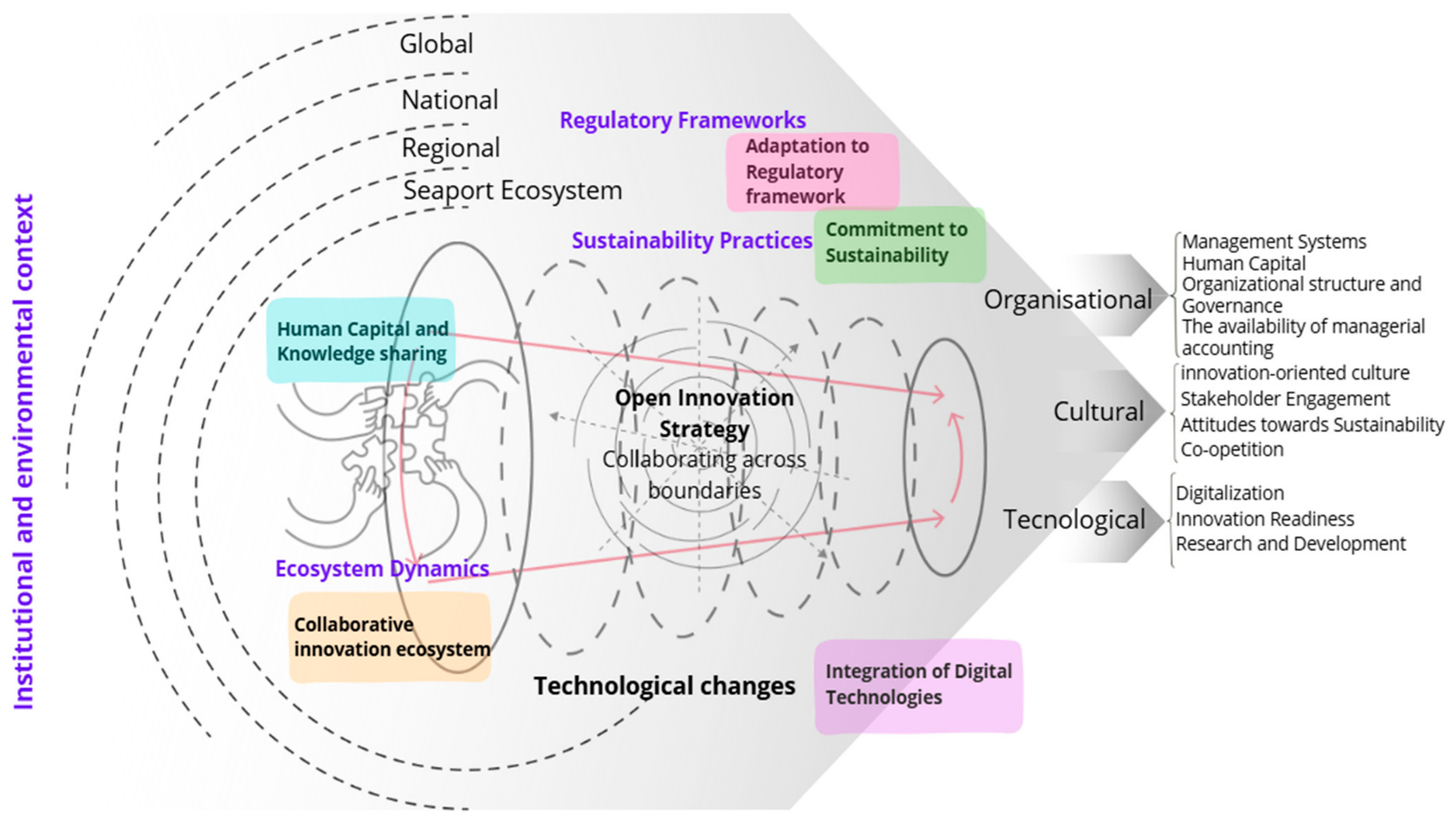
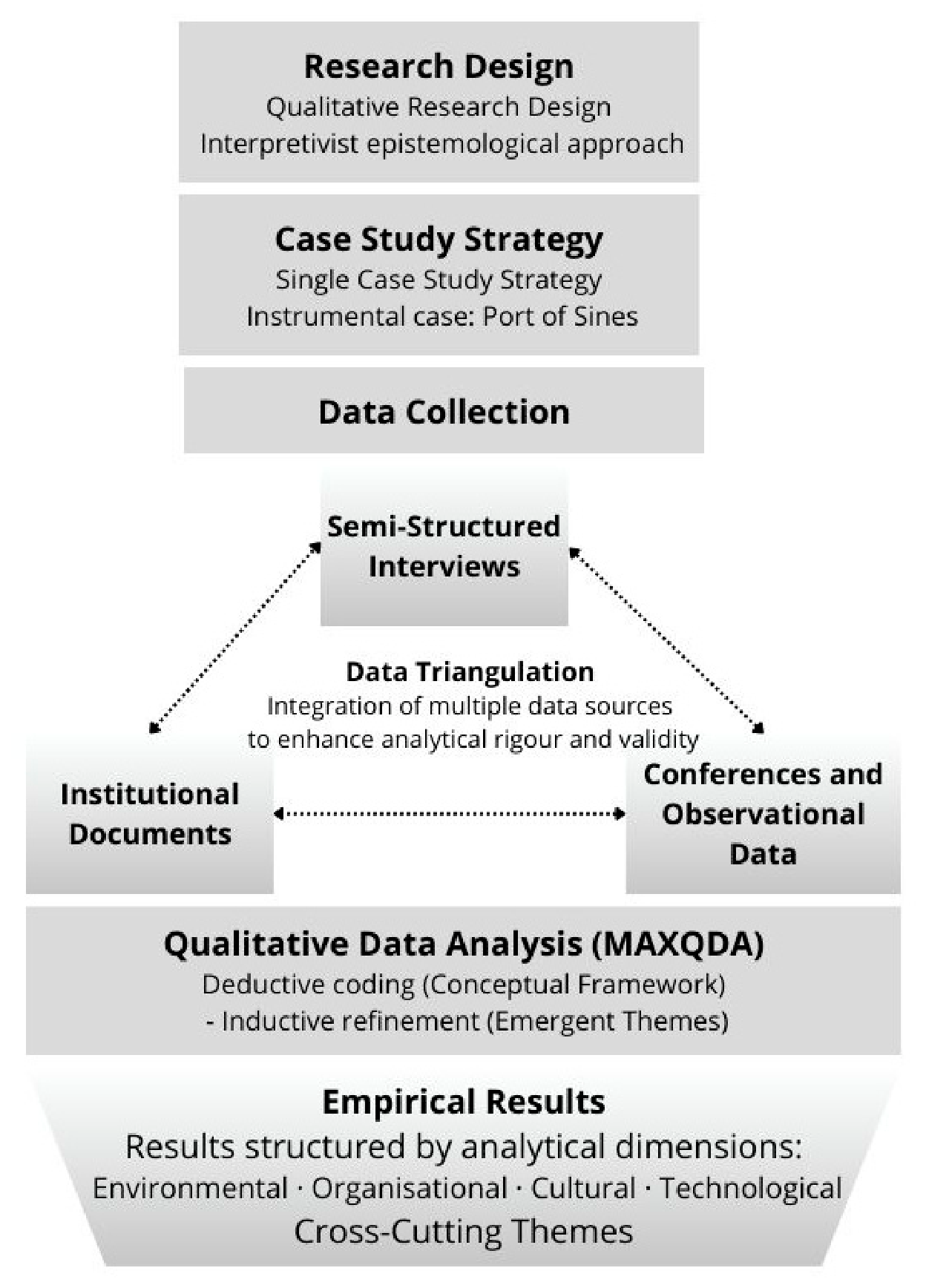
Ports are increasingly required to respond to environmental regulation, digital transformation, and demands for more sustainable logistics systems. Although research on smart ports, green ports and innovation ecosystems has expanded, less attention has been given to how Open and Sustainable Innovation is enabled, constrained and institutionalised within public port authorities. This study examines this process in the Port of Sines, Portugal’s largest port and a strategic Atlantic logistics hub. A qualitative single-case study was conducted, drawing on institutional documents, nine semi-structured interviews, observational material and MAXQDA-supported qualitative coding. The analysis was structured around four interdependent dimensions: environmental, organisational, cultural and technological. The findings show that Open and Sustainable Innovation is enabled by European sustainability agendas, digitalisation initiatives, the NEXUS Agenda and multi-stakeholder collaboration. However, it remains only partially institutionalised. Organisational fragmentation, limited learning routines, uneven cultural readiness, data-sharing concerns and dependence on externally funded projects constrain long-term innovation capabilities. The study contributes by conceptualising Open and Sustainable Innovation in public port ecosystems as an institutionalisation process rather than as a set of isolated digital, environmental or collaborative initiatives. It offers practical insights for strengthening governance coordination, stakeholder trust, data-sharing arrangements and organisational learning in sustainable port transformation.
Keywords: open and sustainable innovation; port ecosystems; public port authority; port governance; sustainability transitions; digital transformation; organisational learning open and sustainable innovation; port ecosystems; public port authority; port governance; sustainability transitions; digital transformation; organisational learning