Environmental Impacts of Lithium-Ion and Lead-Acid Battery Recycling Programs: A Systematic Review and Meta-Analysis
 , ,
, , 
Abstract
1. Introduction
2. Materials and Methods
2.1. Data Source
2.2. Selection Criteria
2.3. Data Extraction and Coding
2.4. Quality Assessment
3. Results and Discussion
3.1. Descriptive Analysis
3.1.1. Effect Size Computation
3.1.2. Heterogeneity Analysis
3.1.3. Publication Bias
- (a)
- Methodological Validity
- (b)
- Captures Real-World Variability
- (c)
- Geographic Specificity as a Key Source of Variability
- (d)
- Precedent in Literature
- (e)
- Sensitivity Analysis Confirms Stability
3.2. Environmental Impacts
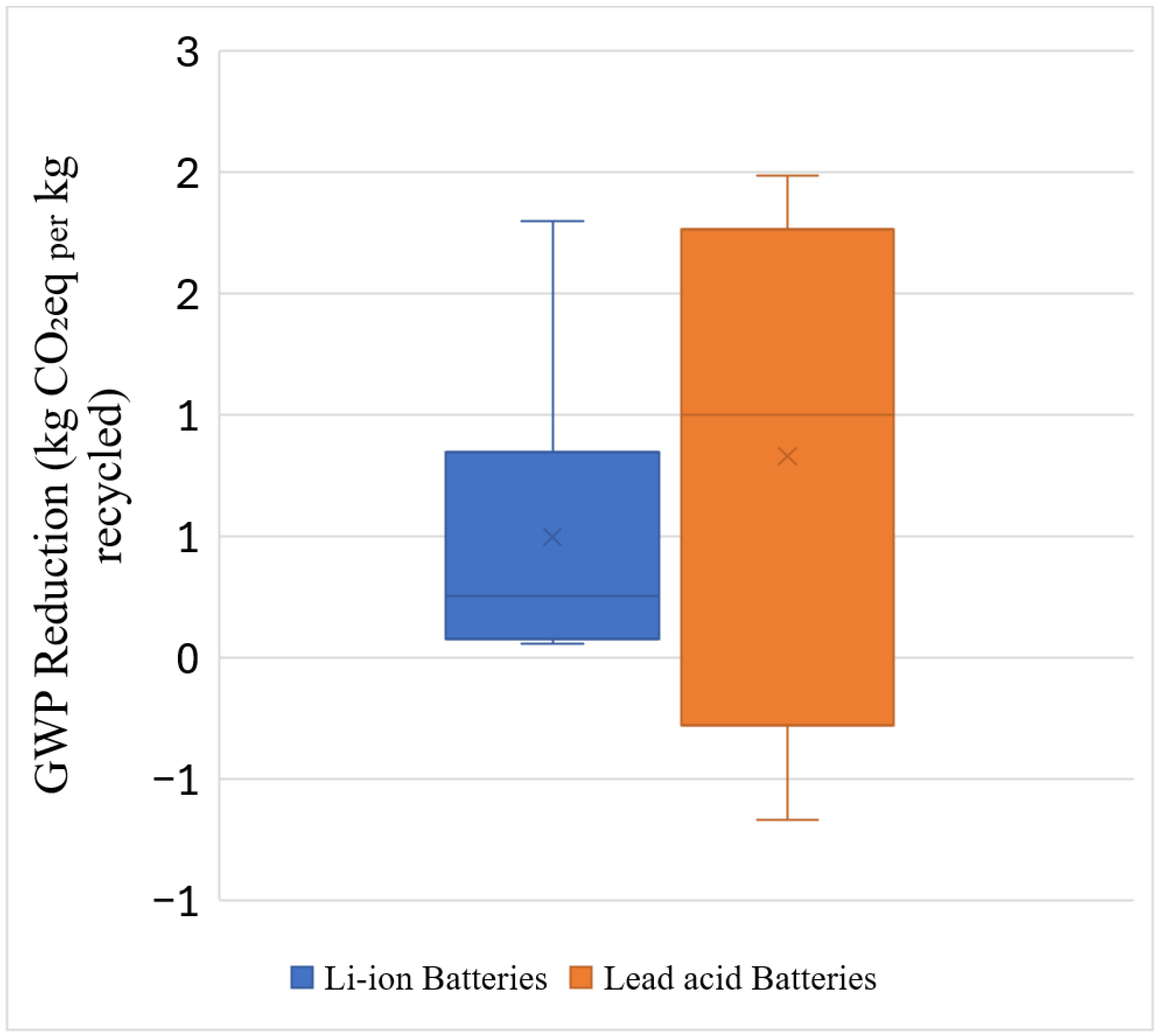
Global Warming Potential Reduction Average
3.3. Economic Benefits
3.4. Policy and Regulatory Framework
4. Conclusions
Supplementary Materials
Author Contributions
Funding
Institutional Review Board Statement
Informed Consent Statement
Data Availability Statement
Acknowledgments
Conflicts of Interest
Abbreviations
| GWP | Global Warming Potential |
| RRM | Reusable Recovered Material |
| EPR | Extended Producer Responsibility |
| NEMWA | National Environmental Management: Waste Act |
| LCA | Life Cycle Assessment |
Appendix A

| Study No | Publication Type | Reference | Risk-of-Bias Assessment |
|---|---|---|---|
| Study 1 | Journal article | [28] | Low |
| Study 2 | Journal article | [29] | Low |
| Study 3 | Journal article | [30] | Low |
| Study 4 | Journal article | [18] | Low |
| Study 5 | Journal article | [14] | Low |
| Study 6 | Journal article | [31] | Low |
| Study 7 | Journal article | [32] | Low |
| Study 8 | Journal article | [17] | Low |
| Study 9 | Journal article | [33] | Low |
| Study 10 | Journal article | [34] | Low |
| Study 11 | Journal article | [35] | Low |
| Study 12a & b | Journal article | [36] | Low |
| Study 13 | Journal article | [37] | Low |
| Study 14 | Journal article | [38] | Low |
| Study 15 | Journal article | [39] | Low |
| Study 16 | Journal article | [40] | Low |
| Study 17 | Technical report papers | [41] | Moderate–high |
| Study 18 | Technical report papers | [42] | Moderate–high |
| Study 19 | Technical report papers | [43] | Moderate–high |
| Study 20 | Government report | [44] | Moderate |
| Study 21 | Government report | [45] | Moderate |
| Study 22 | Government report | [46] | Moderate |
| Study 23 | Government report | [47] | Moderate |
| Study 24 | Government report | [48] | Moderate |
| Author(s) & Year | Battery Type | Recycling Technology | System Boundary | Functional Unit | Geographical Context |
|---|---|---|---|---|---|
| [28] | LFP | Hydrometallurgy | Cradle to gate | 1 kg of LFP battery material | China |
| [29] | NMC (111, 532, 622, and 811) | Simulation-based LCA | Cradle to gate | 1 kg of NMC cathode material G | Germany (simulated) |
| [30] | NMC (111, 523, 622, and 811) | Hydrometallurgy | Cradle to gate | 1 kg of NMC battery material | China |
| [18] | LMO, NCM622, and NCA | Cascaded use + recycling | Cradle to gate | 1 kWh battery capacity | China |
| [14] | NMC111, NMC622, NMC811, and ZEBRA (Na-Ni-Cl) | Hydrometallurgy | Cradle to gate | 1 kWh battery capacity | Italy (simulated) |
| [31] | NMC111 and NMC811 | Direct + Hydrometallurgy | Cradle to gate | 1 kg of NMC battery material | Germany |
| [32] | NMC (variants) | Hydrometallurgy vs. Pyrometallurgy | Cradle to gate | 1 kg of NMC battery material | Australia (simulated) |
| [17] | LiNi1/3Mn1/3Co1/3O2 | Hydrometallurgy | Cradle to gate | 1 kg of NMC111 cathode material | Spain |
| [33] | Various Li-ion | Cell-chemistry-specific LCA | Cradle to gate | 1 kWh battery capacity | Germany |
| [34] | Black mass (Li-ion) | Hydrometallurgy | Cradle to gate | 1 kg of black mass | Finland |
| [35] | Li-ion | Various | Cradle to gate | 1 kg of Li-ion battery material | Norway |
| [36] | Li-ion (NMC and LFP) | Not specified | Cradle to grave | 1 kWh battery capacity | France |
| [37] | Lead-acid | Pyrometallurgy | Cradle to gate | 1 kg of lead-acid battery material | Sweden (simulated) |
| [38] | Lead-acid and Li-ion (various) | Review of multiple technologies | Cradle to gate | Not applicable | China (review) |
| [39] | Li-ion (traction) | Not specified | Cradle to grave | 1 kWh battery capacity | Italy |
| [40] | Li-ion (black mass) | Hydrometallurgy (simulated) | Cradle to gate | 1 kg of black mass | Belgium |
| [41] | Li-ion | Technology landscape | Gate to gate (economic) | Not applicable | South Africa |
| [42] | Li-ion | EverBatt model (closed loop) | Cradle to cradle | 1 kg Li-ion battery material | USA |
| [43] | Li-ion | Regional cooperation outlook | Policy review | Not applicable | SADC region (Southern Africa) |
| [44] | N/A (policy) | N/A | N/A | Not applicable | South Africa |
| [45] | N/A (policy) | N/A | N/A | Not applicable | South Africa |
| [46] | N/A (policy) | N/A | N/A | Not applicable | South Africa |
| [47] | N/A (policy) | N/A | N/A | Not applicable | South Africa |
| [48] | N/A (policy) | N/A | N/A | Not applicable | South Africa |
| Database and Search Strategy Recommended Format: Database Name Search String and Any Relevant Filters | Number of Research Items |
|---|---|
| Springer Nature Link (“battery recycling” OR “battery recovery” OR “battery waste management”) AND (“environmental impact” OR “resource conservation”) AND (“economic impact” OR “cost-benefit”) AND (emissions) AND (LCI) | 06 |
| Scopus (Science direct) (“battery recycling” OR “battery recovery” OR “battery waste management”) AND (“environmental impact” OR “resource conservation”) AND (“economic impact” OR “cost-benefit”) AND (emissions) AND (LCI) | 44 |
| Google scholar (“environmental impact” OR “resource conservation”) AND (“economic impact” OR “cost-benefit”) AND (“battery recycling” OR “battery recovery” OR “battery waste management”) AND (emissions) AND (LCI) (“extended producer responsibility” OR EPR) AND (“lithium-ion” OR “Li-ion”) AND (“battery recycling” OR “electronic waste”) AND (“policy implementation” OR “regulatory gap” OR “bylaws”) | 121 |
| JSTOR environmental and economic impacts of battery recycling emissions and LCI | 09 |
| ProQuest (“environmental impact” OR “resource conservation”) AND (“economic impact” OR “cost-benefit”) AND (“battery recycling” OR “battery recovery” OR “battery waste management”) AND (emissions) AND (LCI) | 40 |
| ResearchGate (“environmental impact” OR “resource conservation”) AND (“economic impact” OR “cost-benefit”) AND (“battery recycling” OR “battery recovery” OR “battery waste management”) AND (emissions) AND (LCI) | 08 |
| MDPI environmental and economic impacts battery recycling | 42 |
| MDPI (“environmental impact” OR “resource conservation”) AND (“economic impact” OR “cost-benefit”) AND (“battery recycling” OR “battery recovery” OR “battery waste management”) AND (emissions) AND (LCI) | 06 |
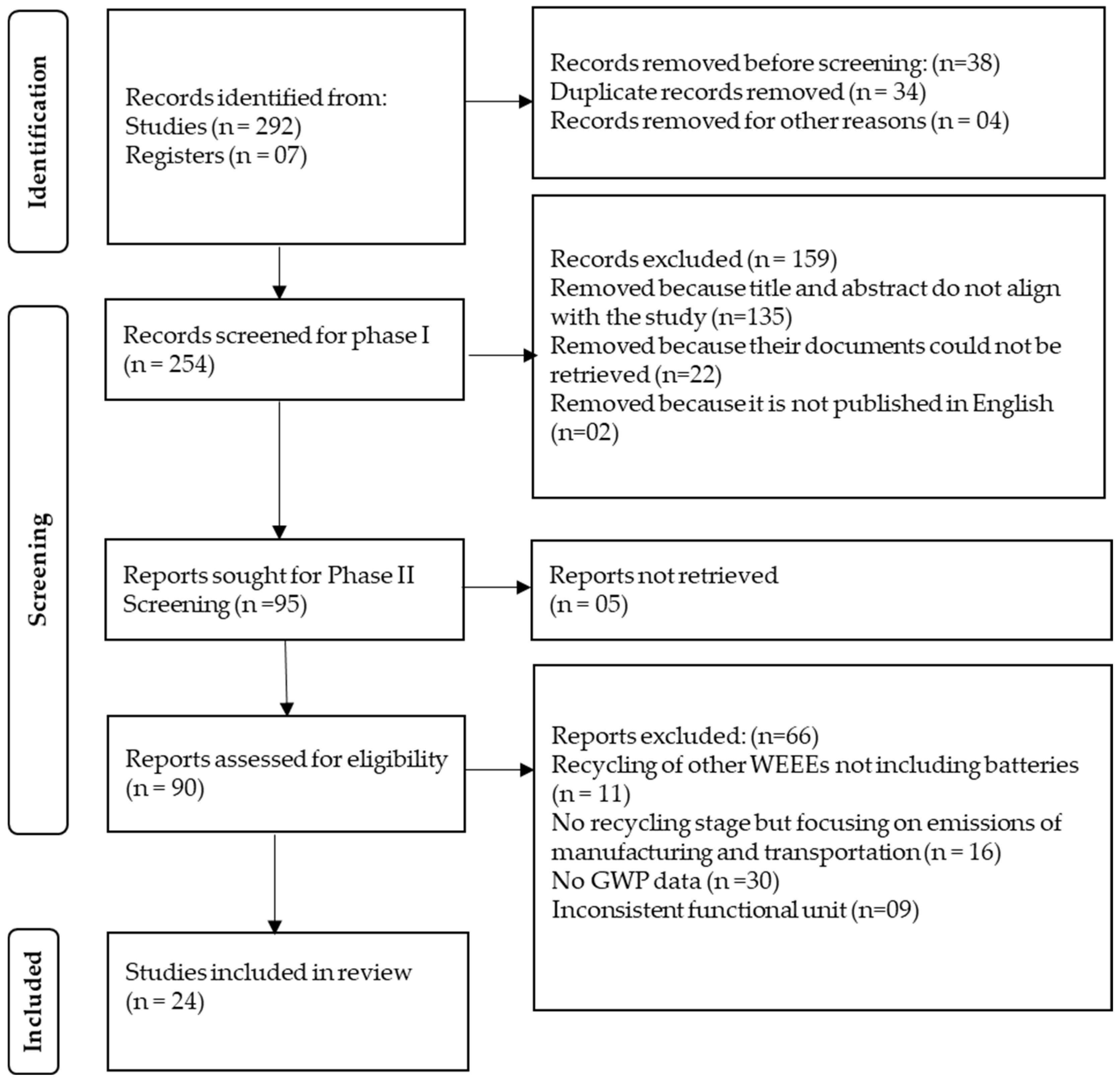
| Total number of research items retrieved | 292 |
| Removed articles not accessible | 04 |
| Duplicates removed | 34 |
| Unique items for phase I screening | 254 |
| Items removed during phase I screening | 159 |
| Removed because title and abstract do not align with what I want | 135 |
| Removed because could not retrieve their documents | 22 |
| Removed because it is not published in English | 02 |
| Items sought for phase II screening | 95 |
| Items removed for being inaccessible for phase II | 05 |
| Article removed coz it was under review | 01 |
| Articles that were inaccessible | 03 |
| Book that is irrelevant | 01 |
| Items screened during phase II screening (note: sometimes this is different from the items sought because some items may not be located) | 90 |
| Items removed during phase II screening | 66 |
| Exclusion Reason 1 = Recycling of other WEEEs not including batteries | 11 |
| Exclusion Reason 2 = No recycling stage but focusing on emissions of manufacturing and transportation | 16 |
| Exclusion Reason 3 = No GWP data | 30 |
| Exclusion Reason 4 = Inconsistent functional unit | 09 |
| Items eligible for meta-analysis | 24 |
| Study | Relevance of Objectives (0–2) | Transparency of Methodology (0–2) | Data Completeness & Statistical Validity (0–2) | Reproducibility of Findings (0–2) | Total Score (0–8) | Quality Category |
|---|---|---|---|---|---|---|
| Study 1 | 2 | 2 | 2 | 2 | 8 | High |
| Study 2 | 2 | 1 | 2 | 1 | 6 | Medium |
| Study 3 | 2 | 2 | 2 | 2 | 8 | High |
| Study 4 | 2 | 2 | 1 | 2 | 7 | High |
| Study 5 | 2 | 2 | 2 | 1 | 7 | High |
| Study 6 | 2 | 2 | 2 | 2 | 8 | High |
| Study 7 | 2 | 2 | 2 | 2 | 8 | High |
| Study 8 | 2 | 2 | 2 | 2 | 8 | High |
| Study 9 | 1 | 1 | 1 | 1 | 4 | Low |
| Study 10 | 2 | 2 | 2 | 2 | 8 | High |
| Study 11 | 2 | 2 | 2 | 2 | 8 | High |
| Study 12a | 2 | 1 | 2 | 1 | 6 | Medium |
| Study 12b | 2 | 1 | 2 | 1 | 6 | Medium |
| Study 13 | 2 | 2 | 2 | 2 | 8 | High |
| Study 14 | 2 | 2 | 2 | 2 | 8 | High |
| Study 15 | 2 | 2 | 2 | 2 | 8 | High |
| Study 16 | 2 | 2 | 2 | 2 | 8 | High |
| Study 17 | 2 | 2 | 2 | 2 | 8 | High |
| Study 18 | 2 | 2 | 2 | 2 | 8 | High |
| Study 19 | 2 | 2 | 2 | 2 | 8 | High |
| Study 20 | 1 | 1 | 1 | 1 | 4 | Low |
| Study 21 | 1 | 1 | 1 | 1 | 4 | Low |
| Study 22 | 2 | 1 | 2 | 1 | 6 | Medium |
| Study 23 | 2 | 1 | 2 | 1 | 6 | Medium |
| Study 24 | 2 | 1 | 1 | 1 | 5 | Medium |
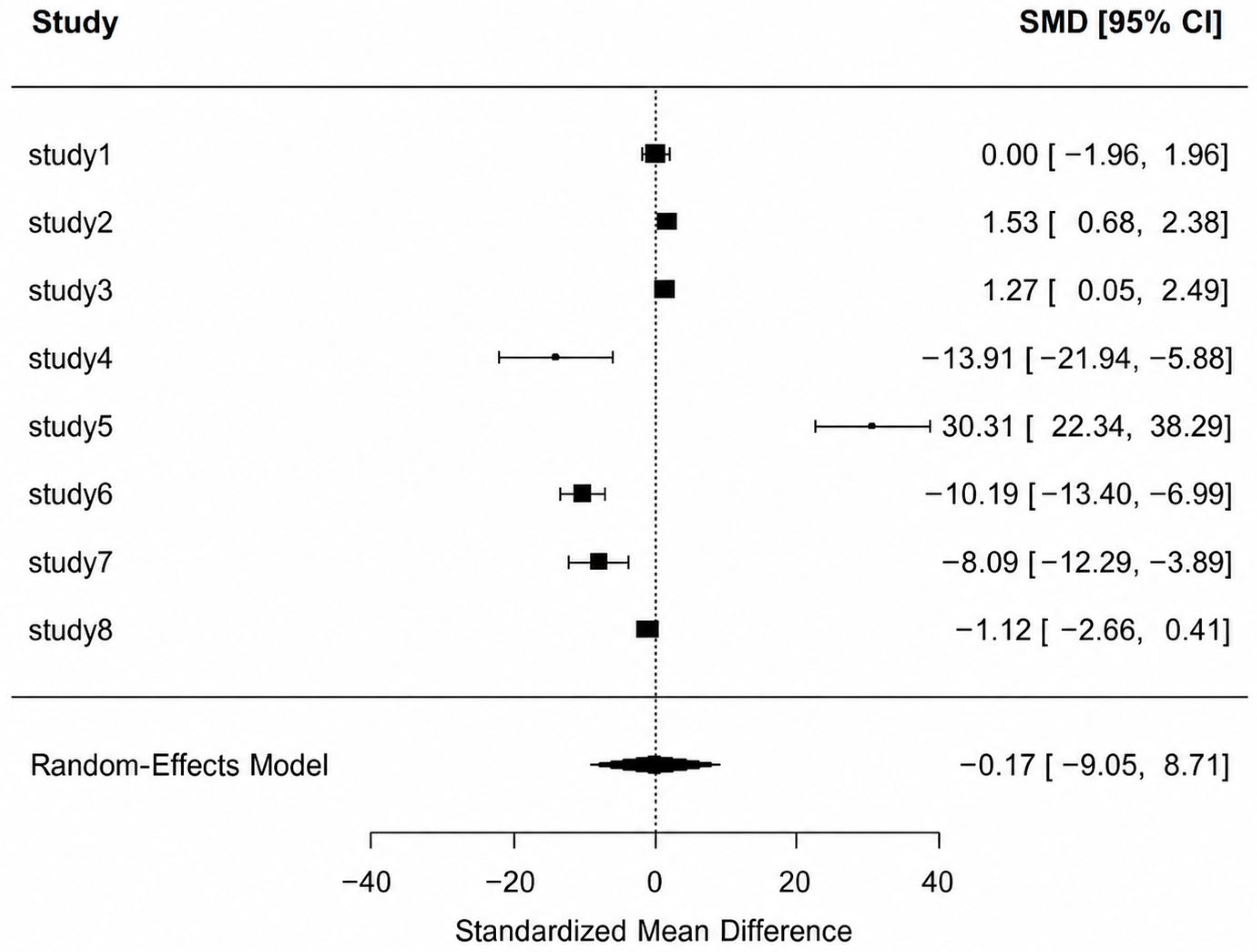
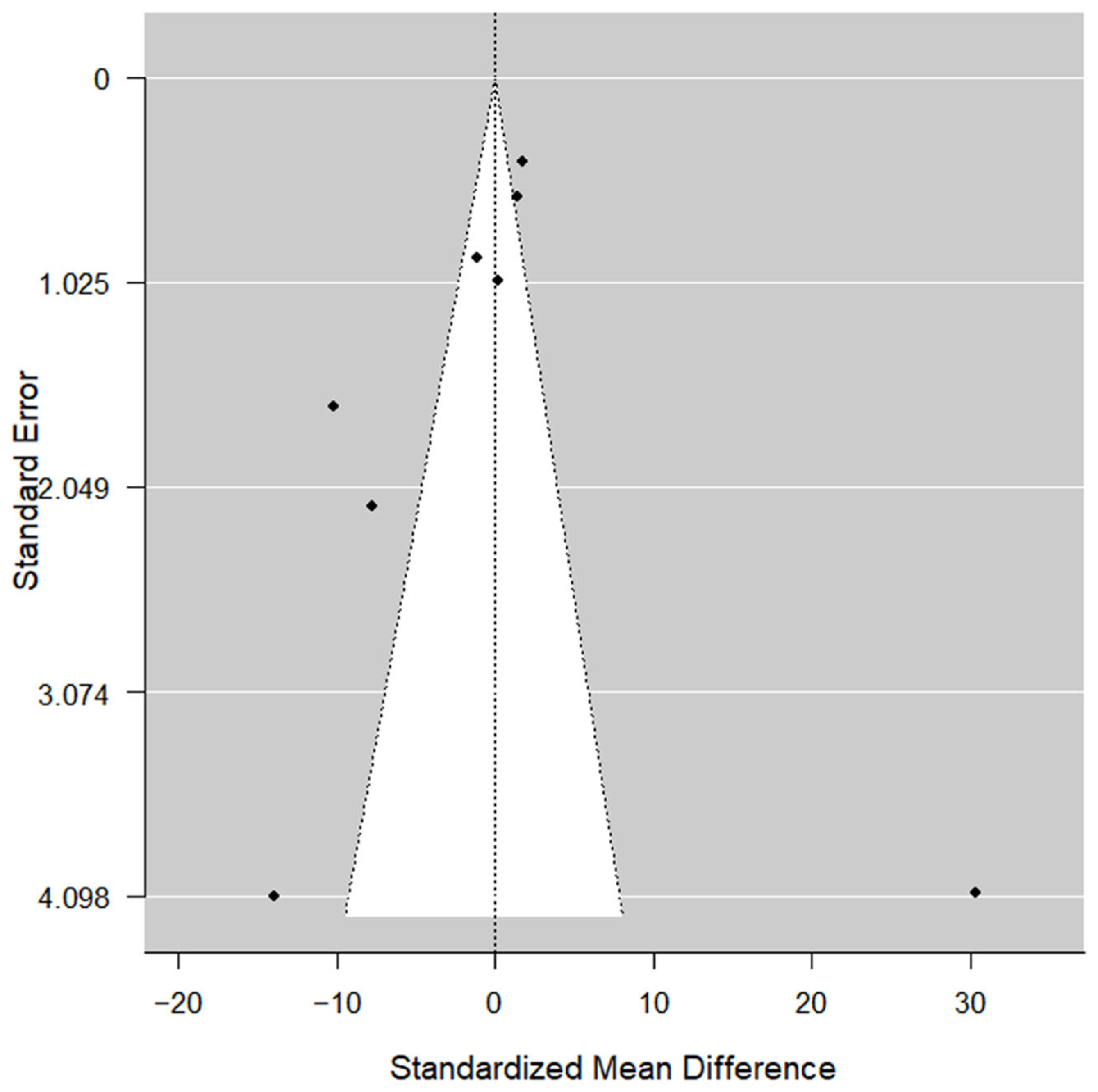
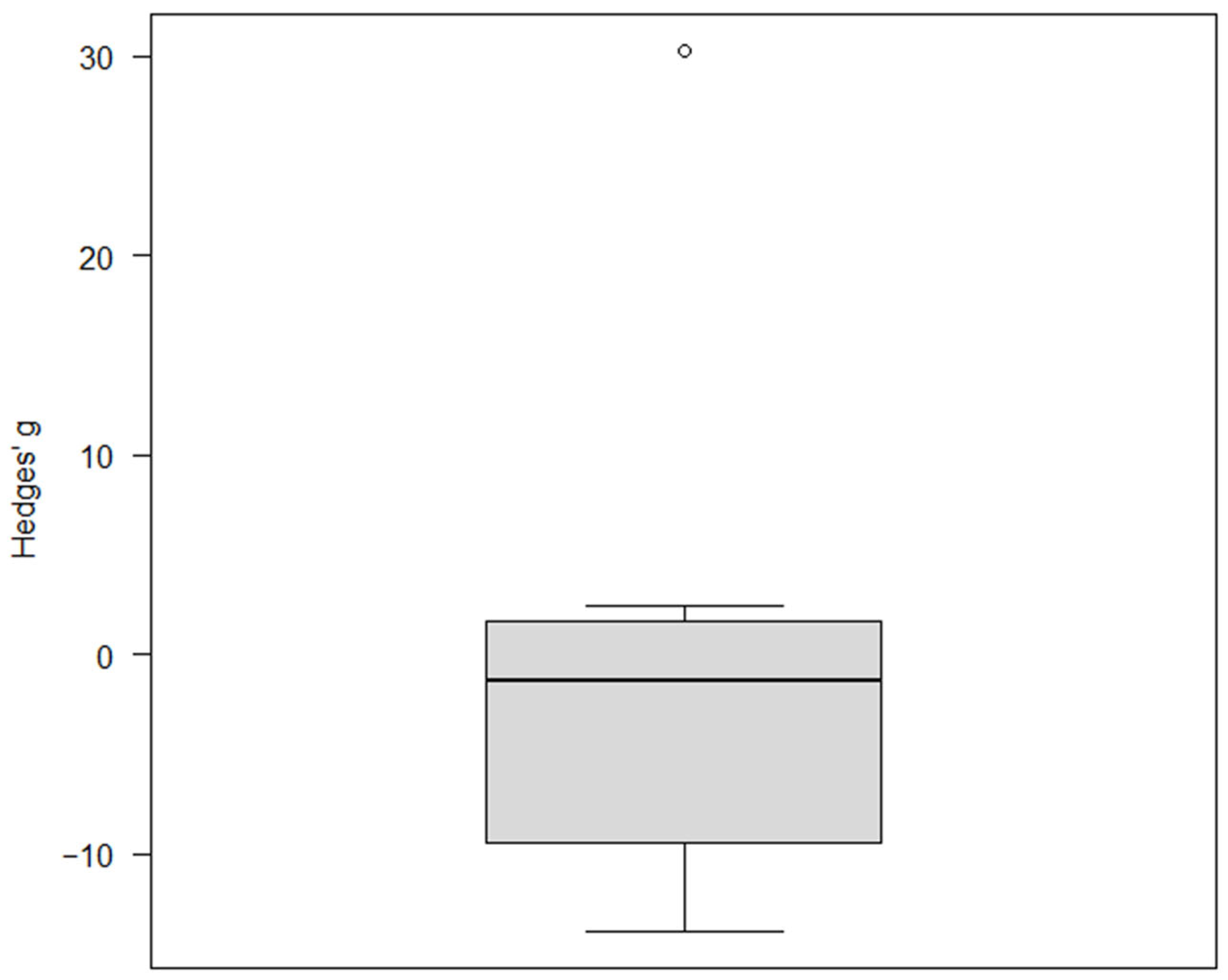
| data <- data.frame( Study = c(“study1”,”study2”,”study3”,”study4”,”study5”,”study6”,”study7”,”study8”), n.e = c(2, 18, 8, 3, 14, 12, 4, 5), mean.e = c(1.6, 177.2, −2.7, 0.016, 2.4069, 3, 17.14126333, 41.16), Sd.e = c(0.2, 18.62552157, 1.39335092, 0.003, 0.00995, 0.135065052, 0.613360979, 17.52706479), n.c = c(2, 11, 5, 3, 14, 9, 4, 3), mean.c = c(1.6, 98.3, −5.4, 0.14, 2.0661, 4.55, 22.85424167, 73.1), sd.c = c(0.2, 78.71123782, 2.713761228, 0.0096, 0.0118, 0.159712067, 0.613347461, 34.8716217) # Display just yi and vi result_table <- data.frame( Study = data$study, yi = round(data$yi, 4), vi = round(data$vi, 4) ) print(result_table) Below is the data coding information that was inserted to generate the forest plot. FOREST PLOT # Set graphical parameters for better display par(mar = c(5, 4, 4, 2)) # Create forest plot forest(re_model, slab = data$study, main = “Forest Plot: Hydrometallurgy vs. Control”, xlab = “Standardized Mean Difference (SMD)”, mlab = “Random-Effects Model (REML)”, psize = 1, header = “Study”, cex = 0.9) # Add text annotations text(−16, 9.5, “Favors Control”, pos = 4, cex = 0.8) text(16, 9.5, “Favors Treatment”, pos = 2, cex = 0.8) |
| Study | n.e | Mean.e | SD.e | n.c | Mean.c | SD.c | yi (ES) | vi |
|---|---|---|---|---|---|---|---|---|
| Study 1 | 2 | 1.6 | 0.2 | 2 | 1.6 | 0.2 | 0 | 1 |
| Study 2 | 18 | 177.2 | 18.62552 | 11 | 98.3 | 78.71124 | 1.5297 | 0.1868 |
| Study 3 | 8 | −2.7 | 1.393351 | 5 | −5.4 | 2.713761 | 1.2693 | 0.387 |
| Study 4 | 3 | 0.016 | 0.003 | 3 | 0.14 | 0.0096 | −13.9114 | 16.794 |
| Study 5 | 14 | 2.4069 | 0.00995 | 14 | 2.0661 | 0.0118 | 30.3142 | 16.5527 |
| Study 6 | 12 | 3 | 0.135065 | 9 | 4.55 | 0.159712 | −10.1943 | 2.6688 |
| Study 7 | 4 | 17.14126 | 0.613361 | 4 | 22.85424 | 0.613348 | −8.0907 | 4.5912 |
| Study 8 | 5 | 41.16 | 17.52706 | 3 | 73.1 | 34.87162 | −1.1232 | 0.6122 |
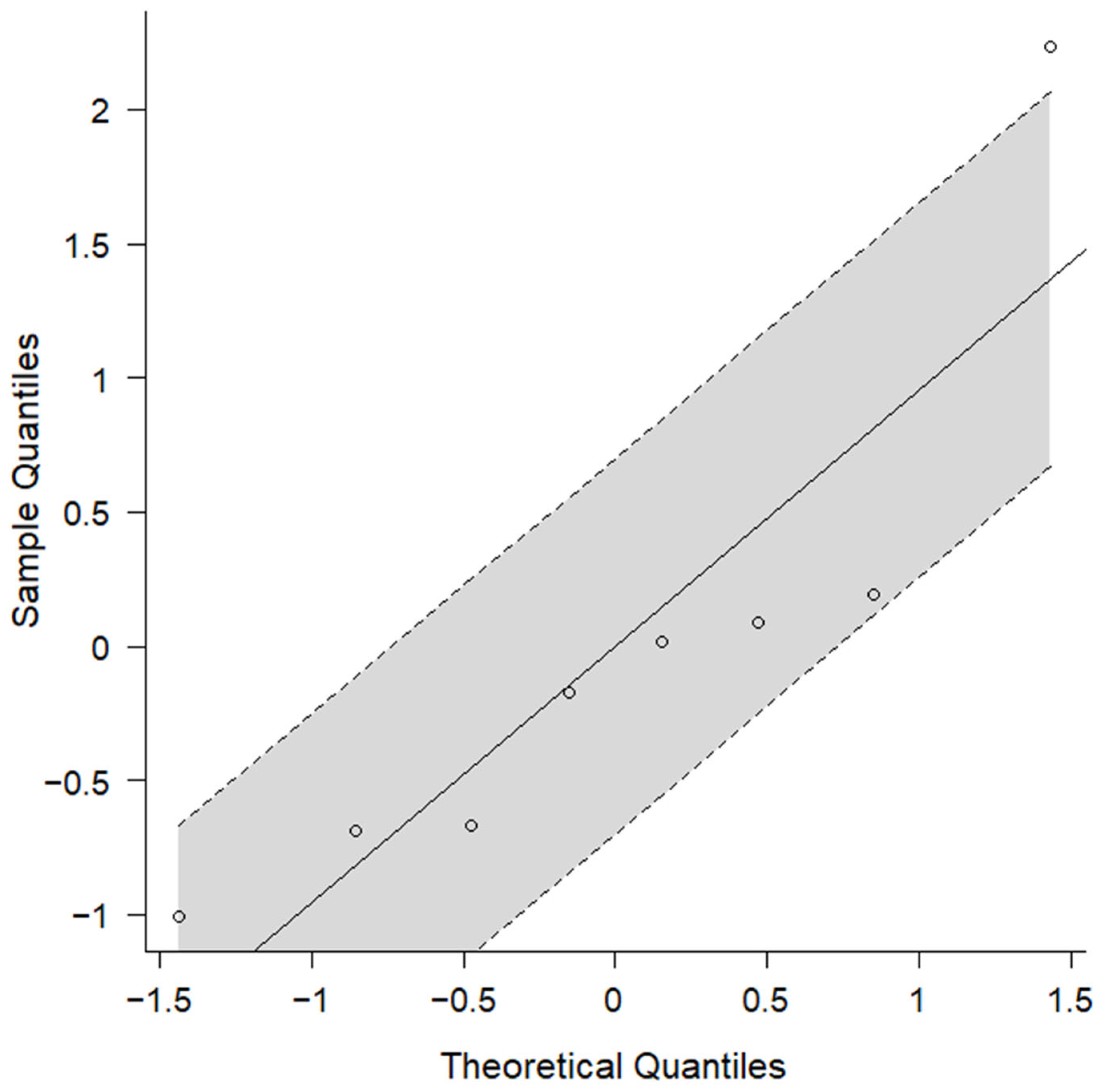
| Estima | te se | Zva | l Pval | Ci | lb Ci.u | b | Q Qp | Tau2 ta | u2 I | 2 |
|---|---|---|---|---|---|---|---|---|---|---|
| Study 1 | −0.1725 | 5.295 | −0.0326 | 0.974 | −10.5504 | 10.2055 | 136.5031 | 0 | 190.5231 | 99.5229 |
| Study 2 | −0.398 | 5.2889 | −0.0753 | 0.94 | −10.7641 | 9.9681 | 124.8058 | 0 | 189.9538 | 99.2451 |
| Study 3 | −0.3593 | 5.2907 | −0.0679 | 0.9459 | −10.7289 | 10.0103 | 134.4625 | 0 | 190.1154 | 99.3678 |
| Study 4 | 1.6332 | 4.7505 | 0.3438 | 0.731 | −7.6777 | 10.9441 | 124.3803 | 0 | 154.4361 | 99.5 |
| Study 5 | −3.7184 | 2.1752 | −1.7095 | 0.0874 | −7.9816 | 0.5449 | 82.5453 | 0 | 30.0756 | 97.4843 |
| Study 6 | 1.2909 | 4.989 | 0.2587 | 0.7958 | −8.4873 | 11.0691 | 92.8279 | 0 | 168.7728 | 99.5172 |
| Study 7 | 0.9776 | 5.1016 | 0.1916 | 0.848 | −9.0214 | 10.9766 | 120.5305 | 0 | 176.9977 | 99.5517 |
| Study 8 | −0.0078 | 5.2946 | −0.0015 | 0.9988 | −10.385 | 10.3695 | 132.0081 | 0 | 190.4393 | 99.4656 |


| Studies | GWP (Initial) | GWP (Final) | Units | Reduction (%) | Energy Density (KWh/kg) | GWP Reduction | |
|---|---|---|---|---|---|---|---|
| Li-ion batteries | 2 | 1 | kg CO2-eq/kg | 30% | 0.3 | ||
| 4 | 0.092 | 0.009 | kg CO2-eq/kg | 0.083 | |||
| 9 | 90.4975 | kgCO2-eq/KWh | 171.64 | 0.527252 | |||
| 10 | 6.22 | 4.42 | kg CO2-eq/kg | 1.8 | |||
| 11 | 0.545 | kg CO2-eq/kg | 10% | 0.0545 | |||
| 12a | 110.3 | kgCO2-eq/KWh | 39.70% | 207.4 | 0.211134 | ||
| Lead-acid batteries | 12b | 67.7 | kgCO2-eq/KWh | −39.70% | 40 | −0.67192 | |
| 13a | 11.034 | kg CO2-eq/kg | 18% | 1.98612 | |||
| 13b | 11.034 | kg CO2-eq/kg | 10% | 1.1034 | |||
| 14 | 2 | kg CO2-eq/kg | 45% | 0.9 |
| Dimension | Lead-Acid | Lithium-Ion (Hydrometallurgy) | Lithium-Ion (Direct Recycling) |
|---|---|---|---|
| Revenue (risk adjusted, USD/kg black mass) | 0.40–0.70 | 3.50–5.50 | 4.00–6.00 |
| Processing cost (USD/kg) | 0.55–1.20 | 1.15–2.80 | 0.75–2.00 |
| Logistics cost (USD/kg, urban) | 0.05–0.10 | 0.05–0.10 | 0.05–0.10 |
| Logistics cost (USD/kg, remote) | 0.50–1.20 | 0.50–1.20 | 0.50–1.20 |
| Risk premium (cobalt volatility, CV = 0.45) | N/A (no Co) | −35% to −45% of Co revenue | −35% to −45% of Co revenue |
| Net without subsidies (urban, avg. prices) | +0.10 to +0.30 | −0.50 to +1.50 | +0.50 to +2.50 |
| Net without subsidies (remote, avg. prices) | −0.50 to −0.10 | −1.50 to −0.50 | −1.00 to 0.00 |
| Subsidy required for viability (USD/kg) | 0.05–0.10 | 0.20–0.50 | 0.10–0.30 |
| Primary risk | Lead price (stable) | Cobalt price volatility | Cobalt price volatility |
| Viable without policy? | Marginally yes (urban only) | No (requires subsidies or Co > 25 USD/kg) | No (requires subsidies or Co > 20 USD/kg) |

References
- Dehghani-Sanij, A.; Tharumalingam, E.; Dusseault, M.; Fraser, R. Study of energy storage systems and environmental challenges of batteries. Renew. Sustain. Energy Rev. 2019, 104, 192–208. [Google Scholar] [CrossRef] [Scilit]
- Zhao, Y.; Pohl, O.; Bhatt, A.I.; Collis, G.E.; Mahon, P.J.; Rüther, T.; Hollenkamp, A.F. A review on battery market trends, second-life reuse, and recycling. Sustain. Chem. 2021, 2, 167–205. [Google Scholar] [CrossRef] [Scilit]
- Dhiman, S.; Gupta, B. Partition studies on cobalt and recycling of valuable metals from waste Li-ion batteries via solvent extraction and chemical precipitation. J. Clean. Prod. 2019, 225, 820–832. [Google Scholar] [CrossRef] [Scilit]
- Jia, C.; Liu, W.; Chau, K.T.; He, H.; Zhou, J.; Niu, S. Passenger-aware reinforcement learning for efficient and robust energy management of fuel cell buses. eTransportation 2026, 27, 100537. [Google Scholar] [CrossRef] [Scilit]
- Shojaei, M.; Guelfo, J.L.; Barlaz, M.A.; Cogollo-Carcamo, G.; Rivera, N.A., Jr.; Hsu-Kim, H.; Ferguson, P.L. Evaluation of Fluorochemical Leaching from Lithium-Ion Batteries Under Simulated Solid Waste Landfill Conditions. Environ. Sci. Technol. 2025, 59, 26750–26761. [Google Scholar] [CrossRef] [Scilit] [PubMed]
- Pincay-Pilay, D.A.; Carrasco, E.F. Environmental Impact of Lead-Acid Batteries: A Review of Sustainable Alternatives for Production and Recycling Based on Life Cycle Analysis. Sustainability 2025, 17, 10815. [Google Scholar] [CrossRef] [Scilit]
- Kozhevnikova, A.V.; Zinov’eva, I.V.; Zakhodyaeva, Y.A.; Baranovskaya, V.B.; Voshkin, A.A. Application of hydrophobic deep eutectic solvents in extraction of metals from real solutions obtained by leaching cathodes from end-of-life Li-ion batteries. Processes 2022, 10, 2671. [Google Scholar] [CrossRef] [Scilit]
- Bui, T.D.; Tseng, J.W.; Tseng, M.L.; Lim, M.K. Opportunities and challenges for solid waste reuse and recycling in emerging economies: A hybrid analysis. Resour. Conserv. Recycl. 2022, 177, 105968. [Google Scholar] [CrossRef] [Scilit]
- Li, Y.; Lv, W.; Huang, H.; Yan, W.; Li, X.; Ning, P.; Cao, H.; Sun, Z. Recycling of spent lithium-ion batteries in view of green chemistry. Green Chem. 2021, 23, 6139–6171. [Google Scholar] [CrossRef] [Scilit]
- Gies, E. Recycling: Lazarus batteries. Nature 2015, 526, S100–S101. [Google Scholar] [CrossRef] [Scilit] [PubMed]
- Chen, Q.; Hou, Y.; Lai, X.; Shen, K.; Gu, H.; Wang, Y.; Guo, Y.; Lu, L.; Han, X.; Zheng, Y. Evaluating environmental impacts of different hydrometallurgical recycling technologies of the retired nickel-manganese-cobalt batteries from electric vehicles in China. Sep. Purif. Technol. 2023, 311, 123277. [Google Scholar] [CrossRef] [Scilit]
- Chen, Q.; Lai, X.; Hou, Y.; Gu, H.; Lu, L.; Liu, X.; Ren, D.; Guo, Y.; Zheng, Y. Investigating the environmental impacts of different direct material recycling and battery remanufacturing technologies on two types of retired lithium-ion batteries from electric vehicles in China. Sep. Purif. Technol. 2023, 308, 122966. [Google Scholar] [CrossRef] [Scilit]
- Shahjalal, M.; Roy, P.K.; Shams, T.; Fly, A.; Chowdhury, J.I.; Ahmed, M.R.; Liu, K. A review on second-life of Li-ion batteries: Prospects, challenges, and issues. Energy 2022, 241, 122881. [Google Scholar] [CrossRef] [Scilit]
- Accardo, A.; Dotelli, G.; Musa, M.L.; Spessa, E. Life cycle assessment of an NMC battery for application to electric light-duty commercial vehicles and comparison with a sodium-nickel-chloride battery. Appl. Sci. 2021, 11, 1160. [Google Scholar] [CrossRef] [Scilit]
- Anuradha, S.; Manimegalai, R.; Devasena, M. Challenges in recycling lead acid battery and lithium-ion battery: A comprehensive review. In Proceedings of the 2024 International Conference on Smart Systems for Electrical, Electronics, Communication and Computer Engineering (ICSSEECC), Coimbatore, India, 2024; IEEE: Piscataway, NJ, USA, 2024. [Google Scholar] [CrossRef] [Scilit]
- Bača, P.; Vanýsek, P. Issues concerning manufacture and recycling of lead. Energies 2023, 16, 4468. [Google Scholar] [CrossRef] [Scilit]
- Iturrondobeitia, M.; Vallejo, C.; Berroci, M.; Akizu-Gardoki, O.; Minguez, R.; Lizundia, E. Environmental impact assessment of LiNi1/3Mn1/3Co1/3O2 hydrometallurgical cathode recycling from spent lithium-ion batteries. ACS Sustain. Chem. Eng. 2022, 10, 9798–9810. [Google Scholar] [CrossRef] [Scilit]
- Tao, Y.; You, F. Comparative Life Cycle Assessment of three Recycling Approaches for Electric Vehicle Lithium-ion Battery after Cascaded Use. CET J. Chem. Eng. Trans. 2020, 81, 1123–1128. [Google Scholar] [CrossRef] [Scilit]
- Ma, X.; Meng, Z.; Bellonia, M.V.; Spangenberger, J.; Harper, G.; Gratz, E.; Olivetti, E.; Arsenault, R.; Wang, Y. The evolution of lithium-ion battery recycling. Nat. Rev. Clean Technol. 2025, 1, 75–94. [Google Scholar] [CrossRef] [Scilit]
- Pyrometallurgical Smelting for Battery Recycling: Process and Efficiency—ATOMFAIR. Available online: https://atomfair.com/battery-research/pyrometallurgical-smelting-for-battery-recycling-process-and-efficiency/ (accessed on 18 June 2026).
- Sun, Q.; Cheng, H.; Mei, X.; Liu, Y.; Li, G.; Xu, Q.; Lu, X. Efficient Synchronous Extraction of Nickel, Copper, and Cobalt from Low—Nickel Matte by Sulfation Roasting—Water Leaching Process. Sci. Rep. 2020, 10, 10534. [Google Scholar] [CrossRef] [Scilit] [PubMed]
- Güngör, O.; Güloğlu, E.; Orhan, G. An overview of sustainable lithium-ion battery recycling: Principles, applications, and future directions. J. Ind. Eng. Chem. 2025, 158, 74–103. [Google Scholar] [CrossRef] [Scilit]
- Das, P.; Hewage, K.; Kotagodahetti, R.; Wanniarachchi, S.; Sadiq, R. Lithium-ion battery recycling: A critical review of techno-economical and socio-environmental impacts. Sep. Purif. Technol. 2026, 382, 135847. [Google Scholar] [CrossRef] [Scilit]
- Hantanasirisakul, K.; Sawangphruk, M. Sustainable Reuse and Recycling of Spent Li-Ion batteries from Electric Vehicles: Chemical, Environmental, and Economical Perspectives. Glob. Chall. 2023, 7, 2200212. [Google Scholar] [CrossRef] [Scilit] [PubMed]
- Liu, S.; Dolotko, O.; Bergfeldt, T.; Knapp, M.; Ehrenberg, H. Towards Sustainable Direct Recycling: Unraveling Structural Degradation Induced by Thermal Pretreatment of Lithium-Ion Battery Electrodes. ChemSusChem 2024, 17, e202400727. [Google Scholar] [CrossRef] [Scilit] [PubMed]
- Pražanová, A.; Plachý, Z.; Kočí, J.; Fridrich, M.; Knap, V. Direct Recycling Technology for Spent Lithium-Ion Batteries: Limitations of Current Implementation. Batteries 2024, 10, 81. [Google Scholar] [CrossRef] [Scilit]
- Page, M.J.; McKenzie, J.E.; Bossuyt, P.M.; Boutron, I.; Hoffmann, T.C.; Mulrow, C.D.; Shamseer, L.; Tetzlaff, J.M.; Akl, E.A.; Brennan, S.E.; et al. The PRISMA 2020 statement: An updated guideline for reporting systematic reviews. BMJ 2021, 372, n71. [Google Scholar] [CrossRef] [Scilit] [PubMed]
- Sun, Y.; Zhou, Z.; He, H.; Li, Q. Risk-based environmental assessment of atmospheric impact in the hydrometallurgical recycling of LFP batteries: A comparative analysis of operational scenarios. J. Clean. Prod. 2025, 501, 145306. [Google Scholar] [CrossRef] [Scilit]
- Ali, A.R.; Bartie, N.; Husmann, J.; Cerdas, F.; Schröder, D.; Herrmann, C. Simulation-based life cycle assessment of secondary materials from recycling of lithium-ion batteries. Resour. Conserv. Recycl. 2024, 202, 107384. [Google Scholar] [CrossRef] [Scilit]
- Jiang, S.; Hua, H.; Zhang, L.; Liu, X.; Wu, H.; Yuan, Z. Environmental impacts of hydrometallurgical recycling and reusing for manufacturing of lithium-ion traction batteries in China. Sci. Total. Environ. 2022, 811, 152224. [Google Scholar] [CrossRef] [Scilit] [PubMed]
- Rosenberg, S.; Kurz, L.; Huster, S.; Wehrstein, S.; Kiemel, S.; Schultmann, F.; Reichert, F.; Wörner, R.; Glöser-Chahoud, S. Combining dynamic material flow analysis and life cycle assessment to evaluate environmental benefits of recycling–A case study for direct and hydrometallurgical closed-loop recycling of electric vehicle battery systems. Resour. Conserv. Recycl. 2023, 198, 107145. [Google Scholar] [CrossRef] [Scilit]
- Islam, M.T.; Ali, A.; Qadir, S.A.; Shahid, M.; Shumon, R.; Hasan, A.M.; Huda, N. Decarbonizing transport through circular battery solutions: Life cycle impacts of hydrometallurgy vs pyrometallurgy in NMC battery recycling. J. Power Sources 2025, 658, 238246. [Google Scholar] [CrossRef] [Scilit]
- Mohr, M.; Peters, J.F.; Baumann, M.; Weil, M. Toward a cell-chemistry specific life cycle assessment of lithium-ion battery recycling processes. J. Ind. Ecol. 2020, 24, 1310–1322. [Google Scholar] [CrossRef] [Scilit]
- Rinne, M.; Aromaa-Stubb, R.; Elomaa, H.; Porvali, A.; Lundström, M. Evaluation of hydrometallurgical black mass recycling with simulation-based life cycle assessment. Int. J. Life Cycle Assess. 2024, 29, 1582–1597. [Google Scholar] [CrossRef] [Scilit]
- Dorri, I. Comparative LCA of Li-Ion Battery Cells’ Recycling Processes. Master’s Thesis, Norwegian University of Science and Technology (NTNU), Trondheim, Norway, 2022. [Google Scholar]
- Robert, C.; Ravey, A.; Perey, R.; Hissel, D. Environmental impacts of batteries for transportation application according to different life cycle steps. In Proceedings of the Vehicle Power and Propulsion Conference, Merced, CA, USA, November 2022; IEEE: Piscataway, NJ, USA, 2022. [Google Scholar] [CrossRef] [Scilit]
- Huaman, D.A.V. Towards Sustainable Recycling: A Comprehensive Life Cycle and Material Flow Analysis of Lead-Acid Battery Recycling Processes. Master’s Thesis, KTH Royal Institute of Technology, Stockholm, Sweden, 2024. [Google Scholar]
- Song, J.; Cui, G.; Han, Y.; Yao, X.; Shen, X.; Wang, Y. Review on environmental impacts of various types of power batteries using LCA. Environ. Dev. Sustain. 2025, 1–25. [Google Scholar] [CrossRef] [Scilit]
- Cusenza, M.A.; Bobba, S.; Ardente, F.; Cellura, M.; Di Persio, F. Energy and environmental assessment of a traction lithium-ion battery pack for plug-in hybrid electric vehicles. J. Clean. Prod. 2019, 215, 634–649649. [Google Scholar] [CrossRef] [Scilit] [PubMed]
- Perocillo, Y.K.; Pirard, E.; Léonard, A. Process simulation-based LCA: Li-ion battery recycling case study. Int. J. Life Cycle Assess. 2025, 30, 2494–2518. [Google Scholar] [CrossRef] [Scilit]
- Gericke, M.; Nyanjowa, W.; Robertson, S. Technology Landscape Report and Business Case for the Recycling of Li-Ion Batteries in South Africa; Mintek: Johannesburg, South Africa, 2021; Available online: https://wasteroadmap.co.za/wp-content/uploads/2021/05/30-Mintek-Final_Technical-report_LIB-plan.pdf (accessed on 16 October 2025).
- Dai, Q.; Spangenberger, J.; Ahmed, S.; Gaines, L.; Kelly, J.C.; Wang, M. EverBatt: A Closed-Loop Battery Recycling Cost and Environmental Impacts Model; Argonne National Laboratory (ANL): Argonne, IL, USA, 2019. [Google Scholar] [CrossRef] [Scilit] [PubMed]
- Mathe, M.; Palaniyandy, N.; Kebede, M.; Modibedi, M.; Gericke, M.; Xakalashe, B. Li-ion battery recycling, a SADC 20-year regional cooperation future: 2023–2043. In Proceedings of the Battery Material Conference, Gauteng, South Africa, 24–25 August 2022; Available online: https://www.researchgate.net/publication/363654619_Li-ion_battery_recycling_a_SADC_20-year_regional_cooperation_future_2023_-2043 (accessed on 22 October 2025).
- Department of Forestry, Fisheries and the Environment. National Environmental Management: Waste Act 59 of 2008; Government Gazette: Cape Town, South Africa, 2009. Available online: https://www.dffe.gov.za/sites/default/files/legislations/nema_amendment_act59.pdf (accessed on 10 December 2024).
- Department of Environment, Forestry and Fisheries. National Waste Management Strategy; Department of Environment, Forestry and Fisheries: Pretoria, South Africa, 2020. Available online: https://www.dffe.gov.za/sites/default/files/docs/nationalwaste_management_strategy.pdf (accessed on 11 February 2025).
- Department of Forestry, Fisheries and the Environment. Extended Producer Responsibility Regulations; Minister of Forestry, Fisheries and the Environment: Cape Town, South Africa, 2020. Available online: https://cer.org.za/wp-content/uploads/2009/07/NEMWA-Extended-Producer-Responsibility-Regulations-2020.pdf (accessed on 14 February 2025).
- South African Waste Information Centre. Separation of Waste at Source Guideline; UNEP: Pretoria, South Africa, 2021; Available online: https://www.csir.co.za/sites/default/files/Documents/Municipal%20Waste%20Separation%20at%20Source%20Implementation%20-%20Guideline%20Derived%20from%20the%20Pilot%20Study%20Learning%201.pdf (accessed on 14 February 2025).
- Department of Environmental Affairs. Atmospheric Emission License: Manual for Licensing Authorities; SAAQIS: Pretoria, South Africa, 2009. Available online: https://saaqis.environment.gov.za/documents/AQ%20Legislation/Atmospheric_emission_licence_Manual_for_licensing_authorities_1.pdf (accessed on 14 February 2025).


| Impact Indicator | Measurement Unit | Description/Interpretation | Data Source |
|---|---|---|---|
| Global Warming Potential (GWP) | Kilograms of CO2-equivalent (kg CO2e) per kg of recycled battery material. | Represents the total greenhouse gas emissions avoided through recycling compared to virgin material. | Global Warming Potential (GWP) |
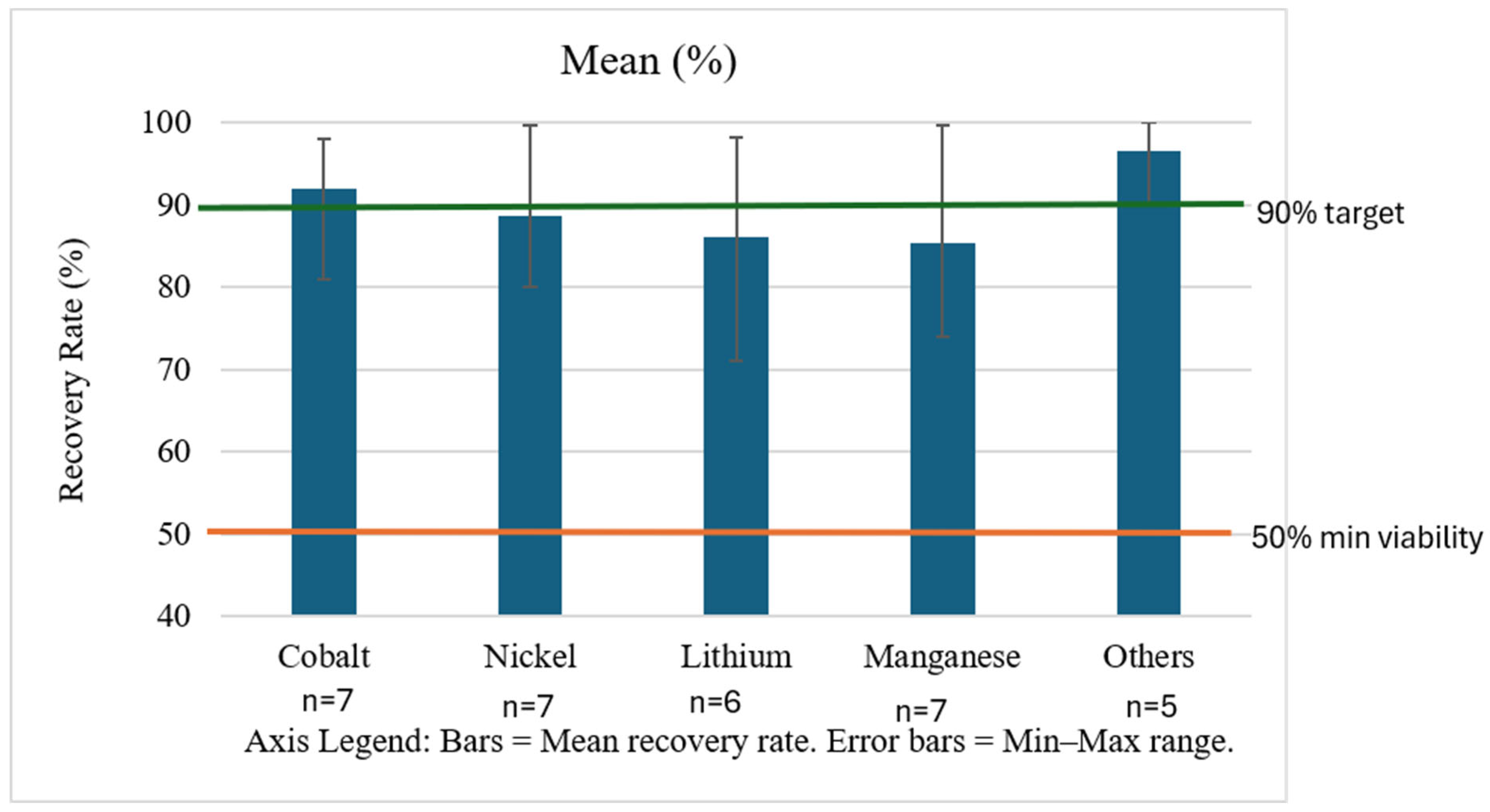
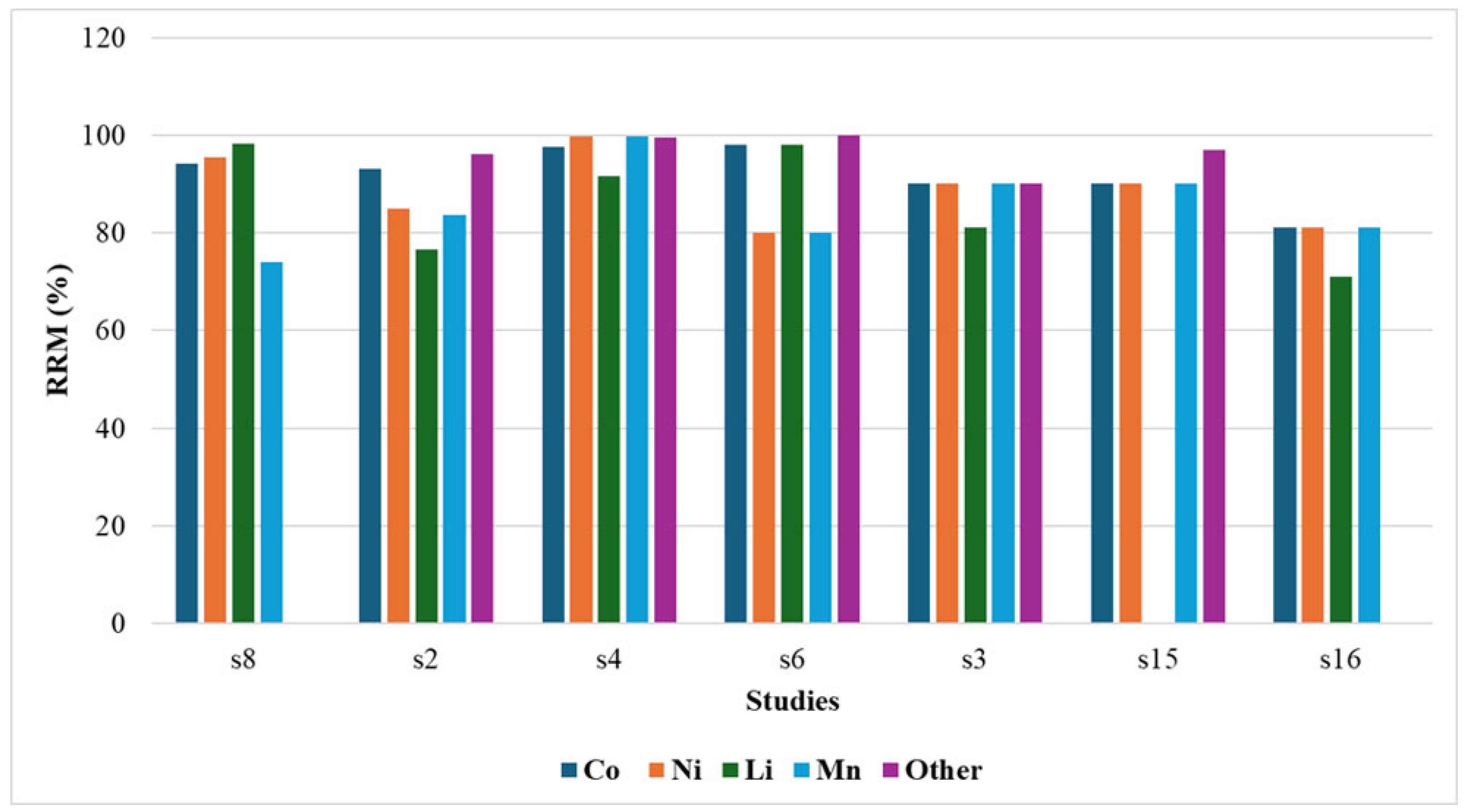
| Reusable Recovered Materials (RRMs) | Percentage (%) of material recovered that can be reused or reprocessed. | Indicates the efficiency of recycling facilities in extracting valuable metals (lead, lithium, nickel, and cobalt) and reducing landfill waste. | Data obtained from municipal waste reports and industrial recovery statistics. |
| Economic Benefits (EBs) | Benefit–Cost Ratio (BCR) | Includes revenues from recovered materials, cost savings from landfill diversion, and employment creation in the recycling sector. | Derived from financial records, company sustainability reports, and economic analyses. |
| Criteria | Inclusion | Exclusion |
|---|---|---|
| Impact Indicator | Studies that contain LCA with GWP as the environmental impact indicator. | Studies not performed using the LCA method focusing on the GWP impact indicator. |
| Types of Studies | Independent articles and a mixture of review articles and independent articles that have original data. | Review articles without original data. |
| Emissions | Studies that measure greenhouse gas emission data. | Studies that do not have greenhouse gas emissions in the recycling stage. Studies that are only on CO2 emissions, not CO2-eq, were excluded. |
| Language | Must be published in English and publicly available. | Studies not published in English. |
| Units | Studies that utilised kg CO2-eq/kg. | A study whose functional unit is kg CO2-eq/kWh lacks sufficient information to convert it to kg CO2-eq/kg. |
| Years | 2000–2025 | Prior to 2000. |
| Study | Battery Type | CO2 Reduction (kg CO2e/kg) | Landfill Diversion (%) | BCR | Jobs Created |
|---|---|---|---|---|---|
| s8 | LiNi1/3Co1/3Mn1/3O2 cathode from LIB. | ~31.94 | ~100 | N/A | N/A |
| s7 | Four NMC variants: NMC 111, NMC 523, NMC 622, and NMC 811. | ~5.71 | ~100 | N/A | N/A |
| s2 | NMC (111, 532, 622, and 811) | ~−78.9 | ~100 | 73.5 | N/A |
| s4 | LMO, NCM622 and NCA | ~0.11 | ~100 | N/A | N/A |
| s5 | NMC111, NMC622, NMC811 and ZEBRA (Na-Ni-Cl) | ~−0.3408 | ~100 | N/A | N/A |
| s6 | NMC111 and NMC 811 | ~1.55 | ~100 | N/A | N/A |
| s1 | LFP | 0 | ~100 | N/A | N/A |
| s3 | LFP and NMC | ~−2.7 | ~100 | N/A | N/A |
| Revenue/Market Value of Recovered Materials ($/kg) Studies | Studies | |
|---|---|---|
| Recovered Materials | s17 | s18 |
| Al | 1.9 | 1.30 |
| Co | 34 | 6.60 |
| Cu | 7.7 | N/A |
| Fe | 0.1 | N/A |
| Li | 8.75 | N/A |
| Ni | 15.8 | N/A |
| Mn | 2 | N/A |
| Slag | 27.5 | N/A |
| Steel | N/A | 0.30 |
| Plastics | N/A | 0.10 |
| Electrolyte solvents | N/A | 0.15 |
| Graphite | N/A | 0.28 |
| Study | SMD [95% CI] | Interpretation |
|---|---|---|
| Study 1 | 0.00 [−1.96, 1.96] |
|
| Study 2 | 1.53 [0.68, 2.38] |
|
| Study 3 | 1.27 [0.05, 2.49] |
|
| Study 4 | –13.91 [−21.94, −5.88] |
|
| Study 5 | 30.31 [22.34, 38.29] |
|
| Study 6 | −10.19 [−13.40, −6.99] |
|
| Study 7 | −8.09 [−12.29, −3.89] |
|
| Study 8 | −1.12 [−2.66, 0.41] |
|
| Characteristic | Pyrometallurgy | Hydrometallurgy | Direct Recycling | Emerging Low-Impact Technologies |
|---|---|---|---|---|
| Technology Readiness Level (TRL) | TRL 9 (commercial and mature) | TRL 7–8 (demo to commercial) | TRL 4–5 (pilot scale) | TRL 3–4 (laboratory to pilot) |
| Operating Temperature | 1200–1500 °C (smelting) | 50–200 °C (leaching + drying) | 100–400 °C (mild thermal) | 25–60 °C (ambient or low heat) |
| Energy Demand (kWh/kg battery) | 5–10 | 2–5 | 0.5–1.5 | <1 (projected) |
| Chemical Inputs | Low (fluxes, coke, and reductants) | High (H2SO4, HCl, H2O2, NaOH, and solvents) | Low to moderate (solvents for separation and relithiation agents) | Very low (biogenic lixiviants, deep eutectic solvents, and ionic liquids) |
| Water Consumption | Low (primarily cooling) | High (leaching, washing, and rinsing) | Low to moderate | Very low (closed-loop potential) |
| Waste Generation | Slag and off-gas (dioxins, SOx, and heavy metals) | Wastewater, spent acids, and secondary precipitates | Minimal (solid residues only) | Minimal (biodegradable solvents and recyclable DES) |
| Recovery Efficiency (Co and Ni) | 60–80% (Co lost in slag) | 85–98% | 90–95% (cathode restoration) | 70–85% (improving rapidly) |
| Recovery Efficiency (Li) | <10% (lost to slag/off-gas) | 75–90% | 85–95% (preserves cathode structure) | 60–85% |
| Recovery Efficiency (Al, Cu, and graphite) | Low (metals oxidize or slag) | Moderate to high (80–95%) | High (physical separation preserves foils) | Moderate (under development) |
| GWP Range (kg CO2e/kg battery) | +1 to +5 (often net positive) | −3 to +3 (highly variable) | −5 to −1 (consistently beneficial) | −6 to −2 (projected) |
| GWP Sensitivity to Grid Mix | Very high (coal = disaster; hydro = acceptable) | High (2–5 kWh/kg × grid intensity) | Low (low energy demand) | Very low (minimal energy input) |
| Fugitive Emission Risk | Moderate (off-gas and slag dust) | Low (if closed loop) | Very low | Very low |
| Metal Purity of Output | Mixed alloy (requires further refining) | High-purity salts or metals (battery-grade possible) | Direct cathode material (ready for reuse) | High purity (target specific) |
| Cathode Chemistry Flexibility | High (can process mixed streams) | Moderate (prefers sorted NMC; LFP challenging) | Low (cathode-specific; needs single chemistry) | Moderate (emerging specificity) |
| Capital Cost | High (furnaces and off-gas treatment) | Moderate to high (reactors and separation trains) | Low to moderate (crushing, sorting, and mild reactors) | Low (projected and simple equipment) |
| Operating Cost | Moderate (energy dominates) | Moderate to high (chemicals dominate) | Low (energy + labour) | Very low (projected and no chemicals) |
| Scalability | High (large continuous furnaces) | Moderate (batch or semi-continuous) | Low to moderate (needs sorted streams) | Low (currently lab scale) |
| Commercially Operating Facilities | Many (Umicore, Glencore, and Sumitomo) | Several (Li-Cycle, Redwood, and Retriev) | Few (OnTo Technology and Battery Resources) | None (pilot/demo only) |
| Main Advantages | Simple and robust; accepts mixed feedstocks | High recovery of valuable metals (Co, Ni, and Li) | Lowest GWP, preserves cathode structure, and highest material efficiency | Lowest environmental footprint and no toxic chemicals |
| Main Limitations | High energy, low Co/Li recovery, and air pollution | Chemical-intensive, wastewater treatment, and variable GWP | Requires sorted, single-chemistry streams; not yet scaled | Slow kinetics, low TRL, and unknown scaling behaviour |
| Best Suited For | Bulk processing of low-value or mixed battery waste | High-value metal recovery from sorted NMC black mass | Single-chemistry streams (e.g., LFP and NMC from OEMs) | Future low-carbon, low-chemical recycling in green grids |
| GWP Performance (relative) | Poor to moderate (often net emitter) | Poor to excellent (depends on grid and chemicals) | Good to excellent (consistently beneficial) | Excellent (projected and needs validation) |
| Policy Recommendation | Phase out or require carbon capture | Subsidize only when powered by low-carbon grid + closed-loop chemicals | Prioritize R&D funding and demonstration plants | Fund basic research and pilot-scale trials |
Disclaimer/Publisher’s Note: The statements, opinions and data contained in all publications are solely those of the individual author(s) and contributor(s) and not of MDPI and/or the editor(s). MDPI and/or the editor(s) disclaim responsibility for any injury to people or property resulting from any ideas, methods, instructions or products referred to in the content. |
© 2026 by the authors. Licensee MDPI, Basel, Switzerland. This article is an open access article distributed under the terms and conditions of the Creative Commons Attribution (CC BY) license.
Share and Cite
Matshivha, U.; Malaza, N.; Zide, D.; Mpungose, P.; Bladergroen, B. Environmental Impacts of Lithium-Ion and Lead-Acid Battery Recycling Programs: A Systematic Review and Meta-Analysis. Sustainability 2026, 18, 7393. https://doi.org/10.3390/su18147393
Matshivha U, Malaza N, Zide D, Mpungose P, Bladergroen B. Environmental Impacts of Lithium-Ion and Lead-Acid Battery Recycling Programs: A Systematic Review and Meta-Analysis. Sustainability. 2026; 18(14):7393. https://doi.org/10.3390/su18147393
Chicago/Turabian StyleMatshivha, Uhone, Ntokozo Malaza, Dorcas Zide, Philani Mpungose, and Bernard Bladergroen. 2026. "Environmental Impacts of Lithium-Ion and Lead-Acid Battery Recycling Programs: A Systematic Review and Meta-Analysis" Sustainability 18, no. 14: 7393. https://doi.org/10.3390/su18147393
APA StyleMatshivha, U., Malaza, N., Zide, D., Mpungose, P., & Bladergroen, B. (2026). Environmental Impacts of Lithium-Ion and Lead-Acid Battery Recycling Programs: A Systematic Review and Meta-Analysis. Sustainability, 18(14), 7393. https://doi.org/10.3390/su18147393