Article

Artificial Intelligence and Corporate Sustainability Disclosure: Evidence from Corporate Climate Risk Disclosure in China

1
School of Economics and Finance, Xi’an Jiaotong University, Xi’an 710061, China
2
Department of Economics, Duke University, Durham, NC 27707, USA
*
Author to whom correspondence should be addressed.
Sustainability 2026, 18(14), 7313; https://doi.org/10.3390/su18147313
Submission received: 15 June 2026 / Revised: 14 July 2026 / Accepted: 14 July 2026 / Published: 17 July 2026
(This article belongs to the Section Economic and Business Aspects of Sustainability)

Abstract

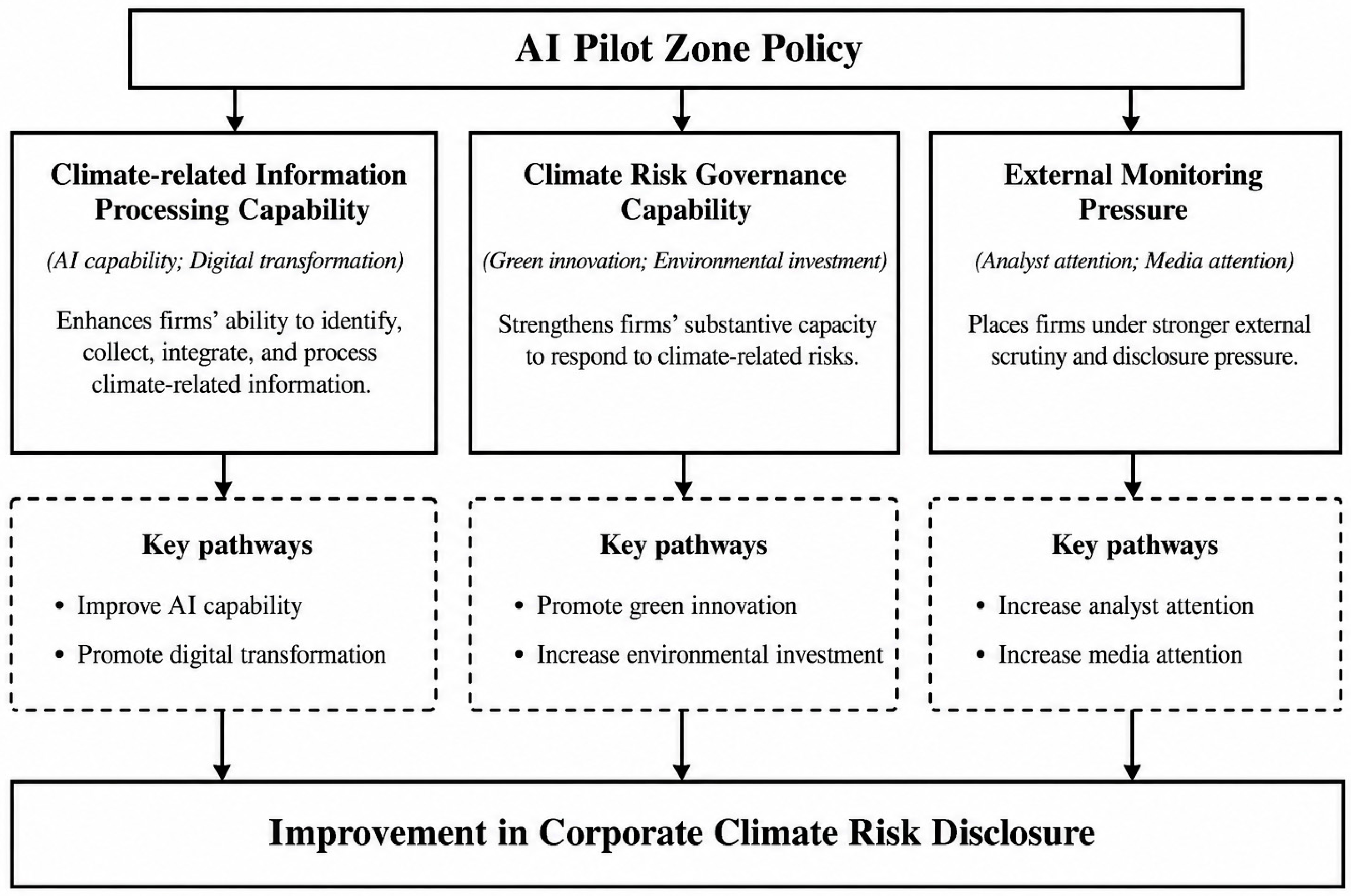
As artificial intelligence becomes more deeply embedded in corporate sustainability governance, it remains unclear whether public policies centered on AI development are linked to changes in corporate sustainability disclosure. Focusing on corporate climate risk disclosure as an important dimension of sustainability disclosure, this study examines how China’s National Artificial Intelligence Innovation and Development Pilot Zone policy, referred to as the AI Pilot Zone policy, is associated with firms’ disclosure of climate-related risks. Using Chinese A-share listed firms from 2014 to 2023 and a multi-period difference-in-differences approach, we find that the AI Pilot Zone policy is associated with higher levels of corporate climate risk disclosure. A series of robustness checks further confirms the stability of this finding. Mechanism analysis provides suggestive evidence consistent with three channels: climate-related information-processing capability, climate risk governance capability, and external monitoring pressure. The subsample estimates reveal that the association is more pronounced among firms under greater environmental pressure, firms with higher levels of institutional ownership, and firms whose managers exhibit stronger green awareness. Additional analysis suggests that climate risk disclosure is positively associated with ESG performance, especially environmental and governance performance. This study contributes firm-level empirical evidence on the association between AI-oriented public policies and corporate climate risk disclosure, while highlighting the need to distinguish disclosure improvement from substantive sustainability transformation.
Keywords: national artificial intelligence innovation and development pilot zone policy; corporate sustainability disclosure; climate risk disclosure; ESG performance national artificial intelligence innovation and development pilot zone policy; corporate sustainability disclosure; climate risk disclosure; ESG performance