1. Introduction
Rural tourism has become a central instrument of regional development, cultural preservation, and rural revitalization across many emerging economies, and especially in China [
1]. Local governments and operators have responded by building rural tourism, shared farms, and leisure agriculture sites at a rapid pace. This supply-driven expansion, however, has produced a recurring problem: many destinations converge on a similar formula of standardized facilities, packaged landscapes, and commercial attractions that resemble one another more than they resemble the rural places they claim to represent. Homogenization erodes the very distinctiveness that motivates rural travel in the first place [
2,
3,
4,
5], a tension visible in rural destinations where commercialization and perceived authenticity pull against one another [
6]. When destinations compete mainly on scale and infrastructure, they risk substituting visible construction for the place-based character that sustains long-term appeal. The case of Hainan sharpens this tension. As China’s flagship free trade port and a national pilot for rural revitalization, Hainan has invested heavily in rural tourism resorts that combine ecological landscapes, tropical agriculture, and village life. Hainan is therefore not merely a convenient field site but a theoretically informative one. The simultaneous push for large-scale, standardized resort construction and the policy mandate to protect ecological and cultural distinctiveness place the tension between supplied locality and perceived locality in unusually sharp relief, which makes Hainan a near-critical case for observing whether sustainability support tracks facility provision or perceived place character. The rapid, state-backed pace of development also keeps visitors’ willingness to support conservation salient and policy-relevant, so the relationships among locality, authenticity, and sustainable intention should be more readily detectable here than in settings where such development pressures are muted.
These investments raise an unavoidable question for planners and operators alike. Does visitor support for sustainable development follow from facility completeness, or does it follow from something tourists perceive in the place itself? The question matters because sustainable outcomes in rural destinations depend not only on supply-side design but also on whether tourists are willing to protect the environment, respect local culture, behave responsibly, and recommend the destination to others. These willingness components, which we group under sustainable behavioral intention, are demand-side conditions for durable rural tourism [
7,
8,
9]. A key concept in rural destination planning is locality, the degree to which a place expresses authentic regional character, genuine rural life, and differentiation from generic commercial sites. Locality has been treated largely as a supply-side or expert judgment, assessed through planning indicators, design quality, or heritage inventories. Far less is known about locality as a tourist perception, that is, whether and how visitors actually register place-based distinctiveness and convert it into support for sustainability. This gap is consequential. A destination can score well on planning indicators yet fail to make tourists feel that the place is distinctive, real, and worth protecting. Reframing locality as a perceptual construct moves the analysis from what planners provide to what tourists experience, and it allows the two perspectives to be linked within a single explanatory model.
We model the association between perception and behavioral intention through two experiential systems that have been widely recognized in the tourism literature but whose behavioral specialization remains insufficiently understood. Previous studies have generally examined affective and cognitive mechanisms independently or assumed that they jointly contribute to a common set of visitor outcomes. It therefore remains unclear whether these experiential pathways differentially shape sustainability-oriented behaviors and loyalty-related intentions. Addressing this gap, the present study examines whether the affective and cognitive pathways exhibit distinct behavioral specializations within rural tourism destinations. Drawing on the tourism authenticity literature [
10,
11,
12] and place attachment theory [
13,
14], we propose an affective route in which perceived locality and authenticity foster an emotional bond with the place, and that bond is associated with willingness to support conservation, cultural protection, civil behavior, and advocacy. Drawing on satisfaction and loyalty research [
15,
16], we propose a parallel cognitive route in which perceptions of the planning and service environment foster satisfaction, and satisfaction motivates revisit and recommendation. The central proposition is that the two pathways are associated with different behavioral outcomes: the emotional, identity-based pathway primarily relates to sustainability-oriented behaviors, whereas the appraisal-based pathway is more strongly associated with revisit and recommendation intentions. Locality is also allowed a direct association with sustainable behavioral intention, since recognizing a place as distinctive may motivate protection before any deeper emotional bond or cognitive appraisal develops.
Accordingly, this study addresses the following research question: Do affective and cognitive experiential pathways differentially influence sustainability-oriented behavioral intention and revisit/recommendation intention in rural tourism destinations? To test this reasoning, we surveyed visitors to rural tourism destinations in Hainan and analyzed an effective sample of 411 respondents within a dual-path mediation framework that contrasts the two experiential routes. The estimation strategy, including the latent-variable structural model and the bootstrap test of competing indirect effects, is described in the Methods section; here we keep the focus on the theoretical problem. This study offers three contributions. Theoretically, it converts locality from a planning judgment into a measurable tourist perception and shows that it relates to sustainability support primarily through emotional attachment rather than through satisfaction, extending authenticity and place attachment research into the rural resort context. Conceptually, rather than proposing the existence of affective and cognitive pathways, this study demonstrates that these established experiential mechanisms are associated with different behavioral outcomes. By distinguishing sustainability-oriented behavioral intention from revisit and recommendation intention, the study shows that the two outcomes need not be treated as manifestations of a single experiential process within rural tourism destinations. Practically, it shows that durable support for a destination’s protection and durable patronage are different goals served by different levers: authentic rural character for the former, service-environment quality for the latter.
The remainder of the paper is organized as follows.
Section 2 reviews the literature on locality, authenticity, place attachment, and sustainable behavioral intention, and develops the hypotheses.
Section 4 describes the study area, instrument, measures, sample, and analytical strategy.
Section 5 reports the empirical findings.
Section 6 interprets the results and draws theoretical and practical implications, and
Section 7 concludes with limitations and future directions.
2. Literature Review
2.1. Locality and Authenticity: From Supply Attribute to Tourist Perception
Locality refers to the distinctive character that ties a destination to its region, its rural way of life, and its cultural traditions. In rural tourism scholarship and destination planning, locality has often been treated as a supply attribute, evaluated through landscape quality, architectural vernacular, heritage assets, or expert appraisal of village authenticity [
3,
4]. Recent work on rural revitalization continues to frame place-based distinctiveness mainly as a development resource to be planned and managed, with traditional villages positioned as assets whose cultural and ecological fabric tourism can either sustain or erode [
5,
17,
18]. This framing captures what a destination offers, yet it says little about what visitors register. A planned vernacular streetscape, for example, may read as distinctive to a planner and as generic to a tourist who has seen many similar streets. The gap between supplied locality and perceived locality motivates a shift in the unit of analysis from the place as designed to the place as experienced.
We therefore define locality perception as the extent to which tourists perceive that a rural destination expresses genuine regional identity, real rural life, and differentiation from standardized commercial sites. This perceptual definition aligns rural tourism research with the broader sense-of-place and consumer experience traditions, in which subjective interpretation, rather than objective provision, drives attitudes and behavior. It also creates an empirical bridge: planners supply place-based features, but only perceived features enter tourists’ psychological processes.
Perceived locality is closely tied to, but distinct from, perceived authenticity, one of the most debated constructs in tourism research. Early objectivist accounts located authenticity in the genuineness of objects and toured settings [
12], whereas later work reframed it as constructed and existential, residing in tourists’ interpretations and experiences rather than in artifacts alone [
11]. Consumer-based perspectives operationalize authenticity as a perception that can be measured and managed [
10], and recent studies continue to treat object-based and existential authenticity as separable drivers of tourist evaluation and intention across heritage and mediated settings [
19,
20,
21,
22,
23]. Across these traditions, perceived authenticity captures whether tourists judge a destination’s culture, life, and traditions to be real and credible rather than fabricated or over-commercialized. Crucially, locality and authenticity are not synonyms: tourists can register distinctive local features and still question their genuineness, which positions perceived locality as a cue from which authenticity judgments are formed rather than as authenticity itself.
It is therefore useful to fix the conceptual boundaries among locality perception and the neighbouring constructs with which it is easily conflated. Locality perception is the tourist’s reading of how strongly a destination expresses genuine, differentiated regional character. It is narrower than destination image, the overall set of beliefs and impressions a person holds about a place, of which distinctiveness is only one component: a destination can enjoy a strong image built on climate, comfort, or amenities while reading as generic in local character. It differs from sense of place and place identity, which describe a bond or self-definition that develops through repeated and often residential experience, whereas locality perception is an in-visit appraisal of the stimulus rather than a relationship with it. It is also distinct from cultural identity, which is a property of a community’s own heritage, because locality concerns what the visitor perceives rather than what the community objectively possesses. Perceived authenticity, finally, is an evaluative judgment of genuineness that is logically downstream of locality: locality supplies the distinctive cues (vernacular landscape, rural life, differentiation from generic attractions), and authenticity is the verdict the tourist reaches about whether those cues are real rather than staged. The two can diverge, since visitors may notice strong local features yet doubt their genuineness, which is precisely why we model locality as an antecedent of authenticity rather than as the same construct.
2.2. Two Experiential Routes: Affective Attachment and Cognitive Satisfaction
How in-place perceptions translate into behavioral consequences is best understood through tourists’ experiences of the destination. Contemporary experience research distinguishes two broad evaluative systems that operate in parallel: an affective system, captured by emotional bonding with the place, and a cognitive system, captured by appraisal of whether the visit met expectations [
24,
25]. We organize the present model around these two routes. The affective route is represented by place attachment, the emotional bond that forms between a person and a place, studied extensively in environmental psychology and tourism [
13,
14,
21,
22,
23,
26,
27]. Attachment typically combines an emotional dimension, a sense that the place matters to the individual, with an identity or dependence dimension. It is more likely to develop when the experience feels real: authenticity supplies the experiential substance from which emotional bonds grow, whereas a perceived facade offers little to bond with [
28]. Critically for our purposes, attachment is repeatedly shown to predict pro-environmental and responsible behavior, because emotional bonds give visitors a stake in the wellbeing of the place [
8,
9,
29], an association that recent rural-tourism work extends to place identity and behavioral intention in the Chinese context [
30,
31].
The cognitive route is represented by tourist satisfaction, the evaluative judgment that a visit was worthwhile relative to expectations and cost. Whereas attachment is affect-laden and identity-based, satisfaction is an appraisal that responds directly to the quality of what is provided, such as environmental conditions, wayfinding, and service facilities. Satisfaction is a well-established antecedent of loyalty outcomes such as revisit and recommendation intention [
16,
32,
33,
34]. Treating attachment and satisfaction as distinct, parallel routes, rather than collapsing them into a single experiential block, allows the model to ask which kind of experience carries perceived locality into which kind of behavior, an issue that single-mediator chains cannot address. We should be explicit about what this parallel-route claim does and does not assert. Prior studies frequently report a positive correlation between satisfaction and place attachment, and we do not dispute that the two can co-occur. Our claim is functional rather than one of orthogonality at the level of zero-order association: the two systems differ in their typical inputs, in their psychological character, and in the behaviour they motivate, so they are not interchangeable carriers of the same perception. Attachment is affect-laden and identity-relevant; it grows from meaning, distinctiveness, and a sense that a place is one’s own, and it has repeatedly been tied to other-regarding, pro-environmental conduct because an emotional stake in a place extends concern to its welfare.
Satisfaction is an appraisal of received value relative to expectation; it responds to the quality of what is provided and motivates self-regarding loyalty, returning and recommending, because the visit paid off. Because a normative, conservation-oriented disposition draws on identity and emotion rather than on transactional payoff, while loyalty draws on payoff rather than on identity, there is a theoretical reason to expect each route to specialize by outcome even when the mediators themselves are modestly correlated. The parallel specification lets us test that expectation directly, by asking which route carries a given perception into which behaviour, rather than assuming a priori that one experiential block explains both.
2.3. Planning Quality Perception and Sustainable Support
Beyond locality and authenticity, rural resorts are also evaluated on the quality of their planning and service environment. Two dimensions are particularly salient for landscape and destination planning: environmental quality, covering the ecological condition, cleanliness, and accessibility of the site, and spatial service design, covering circulation, functional zoning, and public service facilities. These are classic concerns of rural tourism planning [
3,
4,
27,
35,
36,
37], yet they are typically assessed through expert appraisal rather than tourist perception. Reframed perceptually, they become antecedents of the cognitive route: tourists who perceive a well-kept environment and a legible, well-serviced space are more likely to feel that the visit was worthwhile.
On the outcome side, we distinguish two behavioral consequences that are often conflated. Sustainable behavioral intention captures willingness to act in ways that support a destination’s long-term viability, such as supporting ecological protection even when it limits development, supporting the preservation of local culture and rural lifeways, complying with conservation norms, and advocating for the destination [
4,
38,
39]. Although these behaviours differ in their targets, namely the natural environment, local culture, on-site conduct, and word-of-mouth advocacy, we treat them as indicators of a single reflective construct because they share one underlying disposition: a willingness to incur some personal cost or forgo some convenience for the long-term good of the destination. On this reading the specific behaviours are interchangeable expressions of an other-regarding, normative orientation toward the place rather than conceptually separate intentions, which is the condition a reflective construct requires; their high internal consistency in our data, reported in the Results, is consistent with this treatment. We nonetheless acknowledge the breadth of the content and return to its measurement implications when discussing convergent validity. This is a largely normative, other-regarding disposition, and recent pro-environmental behavior research links such intentions to values, identity, and emotional connection rather than to transactional evaluation alone [
40,
41,
42]. Revisit and recommendation intention, by contrast, is a loyalty disposition rooted in personal payoff and satisfaction with the experience [
16,
34]. Separating a normative outcome from a loyalty outcome makes it possible to test whether the affective and cognitive routes specialize: whether attachment matters more for normative support while satisfaction matters more for loyalty.
3. Hypotheses and Research Model
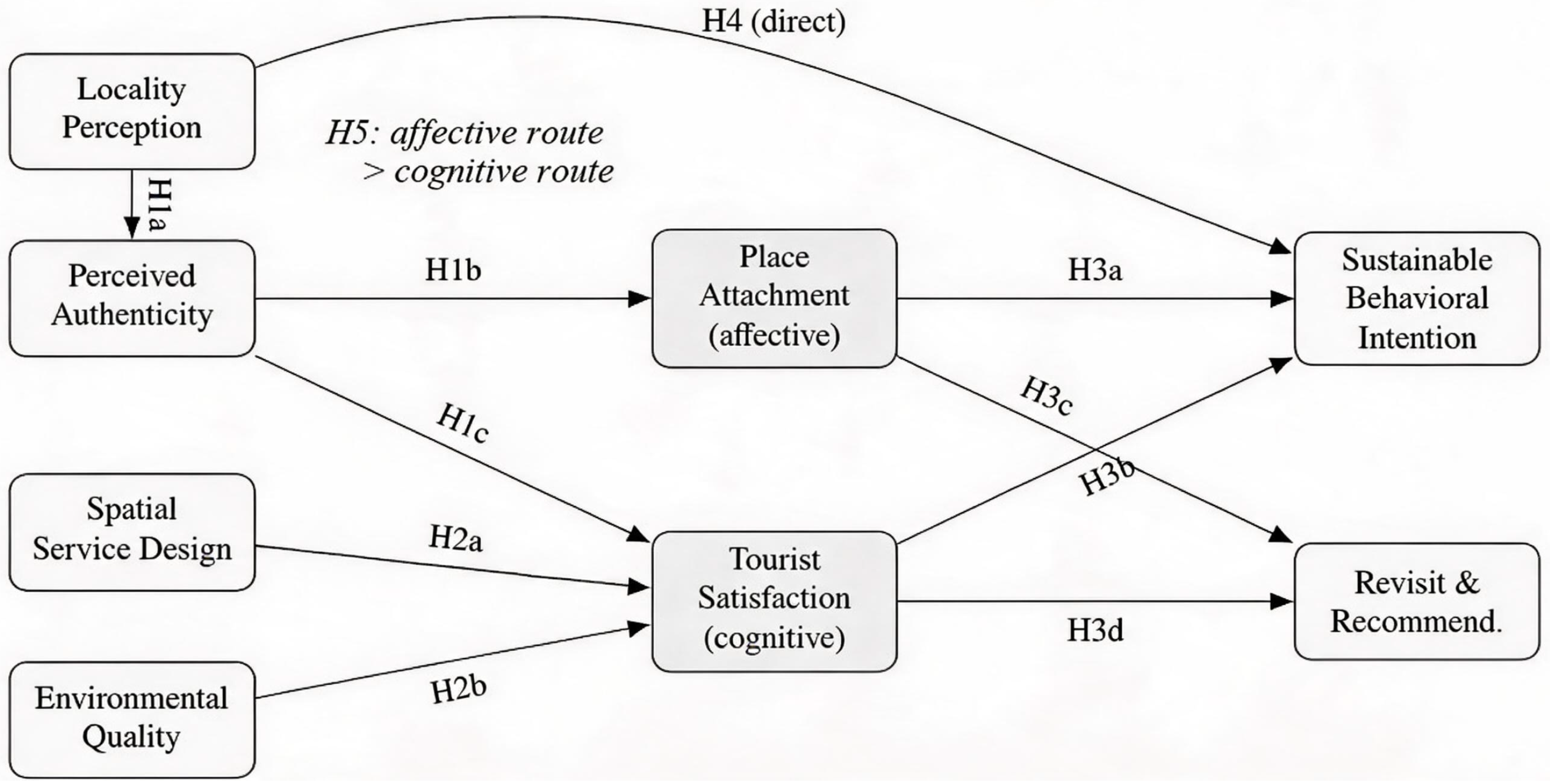
Building on the two-route logic, we specify a model in which in-place perceptions and planning quality perceptions feed two parallel experiential routes, which in turn are linked to two distinct behavioral outcomes. The hypotheses are organized into five groups;
Figure 1 summarizes the structure.
In-place perception forms the two routes. When tourists sense strong place-based character and differentiation from generic attractions, they acquire the cues from which authenticity judgments are formed; distinctiveness signals that a destination has not been reduced to a packaged product [
5,
19,
21,
22,
23]. Authenticity, once established, supplies the raw material for both experiential routes: a place accepted as genuine is both easier to bond with emotionally [
28] and more likely to be appraised as a worthwhile visit.
H1a. Locality perception positively affects perceived authenticity.
H1b. Perceived authenticity positively affects place attachment (affective route).
H1c. Perceived authenticity positively affects tourist satisfaction (cognitive route).
Planning quality feeds the cognitive route. Satisfaction is an appraisal of provided quality. Tourists who perceive a well-kept environment and a legible, well-serviced space are more likely to judge the visit worthwhile, whereas deficiencies in circulation, facilities, or environmental condition depress that appraisal [
4,
36,
37].
H2a. Spatial service design perception positively affects tourist satisfaction.
H2b. Environmental quality perception positively affects tourist satisfaction.
The two routes convert experience into behavior. Emotional bonds give visitors a stake in protecting the place, so attachment should raise normative, pro-sustainability intentions [
8,
9,
39]; satisfaction, a personal payoff judgment, should raise loyalty intentions such as revisit and recommendation [
16]. Because the routes are not exclusive, we allow each to reach both outcomes and test their relative strength in H5. We make no directional prediction for the cross-over paths (satisfaction to sustainable intention, attachment to loyalty) or for the incidental paths among antecedents and outcomes. Following the specialization logic above we expect the cross-over paths to be weak, and we treat any unexpected associations, including ones of negative sign, as exploratory results to be interpreted in the discussion rather than as tested hypotheses.
H3a. Place attachment positively affects sustainable behavioral intention.
H3b. Tourist satisfaction positively affects sustainable behavioral intention.
H3c. Place attachment positively affects revisit and recommendation intention.
H3d. Tourist satisfaction positively affects revisit and recommendation intention.
Locality also acts directly on sustainable support. Perceived distinctiveness can frame a destination as a special and irreplaceable resource, motivating support for its protection before any deep emotional bond or satisfaction judgment forms. A direct path is consistent with a partial mediation structure in which some of locality’s influence flows through the routes and some operates directly.
H4. Locality perception positively affects sustainable behavioral intention directly.
The affective route carries locality into sustainable support (competing mediation). The central theoretical claim is that the two routes are not interchangeable carriers of locality but specialize by the type of behavior they serve. Normative, other-regarding support is rooted in identity and emotional connection rather than transactional evaluation [
39,
40,
42], so the influence of perceived locality on sustainable behavioral intention should travel mainly through emotional bonding rather than through appraisal. We therefore contrast the two indirect routes from locality to sustainable intention and expect the affective route to dominate.
H5. The indirect effect of locality perception on sustainable behavioral intention through place attachment (affective route) exceeds its indirect effect through tourist satisfaction (cognitive route).
We deliberately frame H5 around the affective route. Whether the cognitive route shows a symmetric advantage for loyalty is left as an open empirical question rather than a hypothesis, because locality is theorized to be an emotional rather than a transactional cue, and loyalty is instead expected to be fed by planning quality through satisfaction (H2, H3d). We return to this asymmetry when interpreting the results.
4. Materials and Methods
4.1. Study Area and Data Collection
The study focuses on rural tourism destinations in Hainan Province, China, including rural tourism resorts, rural tourism villages, shared farms, and leisure agriculture sites. Hainan provides a theoretically relevant setting because it combines rapid rural tourism development with strong policy commitments to rural revitalization, ecological conservation, and cultural preservation, making visitors’ sustainability-related perceptions and behaviors particularly salient. Data were collected through a self-administered online questionnaire distributed via WeChat. The survey link was disseminated through Hainan tourism-related WeChat interest groups and public accounts, while an initial group of participants was invited to share the survey within their personal networks, resulting in a combined convenience and snowball sampling approach. To reduce potential temporal bias, survey distribution was conducted across both weekday and weekend periods. A screening question ensured that only individuals who had visited a rural tourism destination in Hainan within the previous 12 months were eligible to participate. Respondents were instructed to answer all questions with reference to their most recent rural tourism experience. Prior to formal data collection, the questionnaire was reviewed by three scholars with expertise in tourism and consumer behavior research and was pilot-tested with 30 respondents to assess item clarity, wording, and survey flow. Based on the feedback received, minor wording modifications were made to improve readability and contextual relevance.
The pilot responses were excluded from the final dataset. Data collection yielded 411 valid responses after applying the screening criteria and data-quality checks. The final sample exceeds commonly recommended sample-size thresholds for structural equation modeling and provides sufficient statistical power for the proposed analyses. Because participation was voluntary and recruitment relied on WeChat-based distribution, the sample should not be considered a probability sample of all visitors to Hainan’s rural tourism destinations. Consequently, individuals with stronger travel interests or higher levels of digital engagement may be overrepresented. The study, therefore, uses the sample primarily to examine relationships among theoretical constructs rather than to generate population-level estimates. This limitation is acknowledged and discussed in the final section of the manuscript.
4.2. Measures
All focal constructs were measured using multi-item reflective scales on a five-point Likert format, anchored at 1 (strongly disagree) and 5 (strongly agree). The questionnaire was developed by adapting measurement items from previously validated scales to the rural tourism context. Specifically, each item was drawn from established instruments, reworded where necessary to reflect the characteristics of rural tourism destinations, and reviewed by the authors to ensure content relevance and conceptual clarity. Prior to formal data collection, the questionnaire was further evaluated by three scholars with expertise in tourism and consumer behavior research and pilot-tested with 30 respondents to assess item wording, clarity, and survey flow. Based on the feedback received, minor wording refinements were made to improve readability, and the pilot responses were excluded from the final analysis. The questionnaire was administered in Chinese. All measurement items were translated and carefully reviewed to ensure conceptual and semantic equivalence with the original English scales, with minor wording adjustments made where necessary to improve clarity and suitability for the rural tourism context. The model contains eight constructs grouped into two perceptual systems, two experiential routes, and two outcomes. On the place-based, affective side, locality perception (LP) used four items capturing perceived regional distinctiveness, vernacular landscape and culture, real rural atmosphere, and differentiation from generic commercial attractions. Perceived authenticity (PA) used three items capturing the credibility of the destination’s rural culture, the absence of over-packaging, and the retention of local life and traditions. Place attachment (PLA), the affective mediator, used three items capturing affective fondness, memorable impression, and willingness to engage more deeply with the place.
In keeping with our theoretical focus on the emotional route, we operationalize place attachment through its affective dimension, that is, emotional bonding with the place, rather than through the fuller multidimensional structure (place identity and place dependence) sometimes used in the literature. This is a deliberate narrowing that matches the affective mechanism we theorise, and we note its implications for construct coverage among the limitations. On the planning-based, cognitive side, spatial service design perception (SSD) used three items capturing circulation, functional zoning, and public service facilities. Environmental quality perception (EQP) used three items capturing ecological condition, cleanliness, and accessibility. Tourist satisfaction (TS), the cognitive mediator, used three items capturing overall evaluation of the visit relative to expectations. The two outcomes were measured separately. Sustainable behavioral intention (SBI) used four items capturing support for ecological protection, support for cultural and lifeway preservation, compliance with conservation and civility norms, and advocacy through word of mouth and repeat support. Revisit and recommendation intention (RRI) used three items capturing intention to return and to recommend the destination to others. The full item wording appears in
Table A1 in
Appendix A.
The questionnaire also recorded demographic and trip characteristics, including gender, age, education, occupation, place of residence, visit frequency, and length of stay. Gender, age, and education are summarized in the sample profile and were verified during data screening. The treatment of the remaining trip variables is explained next.
4.3. Data Screening and Quality
We applied four screening rules: respondents had to pass the visitation screening question, complete the questionnaire in a plausible amount of time, show non-zero variance across the core items rather than straight-line, and have no missing values on the core measures. A total of 438 questionnaires were collected, and after screening, the final valid sample consisted of 411 responses.
4.4. Analytical Strategy
The analysis proceeds in stages. First, we assess internal consistency with Cronbach’s alpha and evaluate the eight-construct measurement model with confirmatory factor analysis, reporting composite reliability and average variance extracted. We examine discriminant validity with the Fornell–Larcker criterion [
43] and corroborate it with the heterotrait–monotrait (HTMT) ratio of correlations [
44]. Given the cross-sectional design, all directed paths are interpreted as theory-guided associations rather than causal effects. Second, we estimate a latent-variable structural equation model that links the two perceptual systems to the two experiential routes and the two outcomes, testing the directed hypotheses H1 through H4 with standardized path coefficients and overall model fit. Third, we test the competing-mediation hypothesis H5 with a composite-score path model and bootstrap resampling using 5000 replications and bias-corrected confidence intervals, which is the recommended approach for inference on indirect effects and on the contrast between two indirect effects [
45,
46]. An indirect effect, or a difference between two indirect effects, is significant when its bias-corrected interval excludes zero. We use composite scores rather than the full latent model for this bootstrap because resampling the complete eight-construct measurement model across thousands of replications is numerically unstable for the marginal-AVE constructs; the directed pattern recovered by the composite path model is nonetheless consistent with the standardized structural estimates of the latent model reported in
Section 5.5. In other words, the latent model carries the measurement-and-structure inference, while the composite path model serves the narrower purpose of obtaining stable bias-corrected intervals for the contrast between two indirect effects. Using composites here trades a small amount of measurement-error correction for numerical stability, and the convergence of the two approaches indicates that this choice does not drive the competing-mediation result.
Finally, we probe robustness. We re-estimate the competing-mediation contrast separately by visitor origin, classifying respondents by their self-reported place of residence (in-province versus out-of-province) rather than inferred from where the survey was completed, so that origin reflects stated residency rather than network location, to assess whether the affective route generalizes across visitor types, and we inspect the zero-order correlation structure to confirm that the dissociation between the two outcome systems is not an artifact of the latent specification.
5. Results
5.1. Sample Profile
The analytic sample comprises 411 valid responses. Women account for 55.5% of respondents and men for 43.8%. Respondents concentrate in the younger and middle adult brackets, with 33.6% aged 18 to 25 and 28.0% aged 26 to 35. Education is broadly distributed, and bachelor and college graduates together make up 58.4% of the sample. Based on self-reported place of residence, 56.2% of respondents reported Hainan residence and 43.8% reported non-Hainan residence, indicating substantial participation by both local and visiting tourists.
Table 1 summarizes the profile.
5.2. Reliability and Validity
Internal consistency is satisfactory for all eight constructs. Cronbach’s alpha equals 0.778 for locality perception, 0.742 for perceived authenticity, 0.893 for spatial service design, 0.903 for environmental quality, 0.903 for place attachment, 0.906 for tourist satisfaction, 0.780 for sustainable behavioral intention, and 0.900 for revisit and recommendation intention, all above the 0.70 benchmark. The eight-construct confirmatory factor analysis fits the data well: x2(271) = 357.88 (x2/df = 1.32), CFI = 0.984, TLI = 0.981, RMSEA = 0.048 with a 90% confidence interval of [0.019, 0.036], and SRMR = 0.041. Standardized loadings range from 0.612 to 0.751 for locality perception, 0.649 to 0.778 for perceived authenticity, 0.842 to 0.887 for spatial service design, 0.851 to 0.891 for environmental quality, 0.796 to 0.909 for place attachment, 0.870 to 0.880 for tourist satisfaction, 0.560 to 0.735 for sustainable behavioral intention, and 0.853 to 0.889 for revisit and recommendation intention. All loadings are significant at p < 0.001.
Composite reliability ranges from 0.745 to 0.906, comfortably above 0.70 (
Table 2). Average variance extracted exceeds the 0.50 threshold for the five planning, mediator, and loyalty constructs (0.737 to 0.764) but falls slightly below it for locality perception (0.473), perceived authenticity (0.495), and sustainable behavioral intention (0.477). Following established guidance, convergent validity can still be regarded as adequate when composite reliability exceeds 0.70 and discriminant validity holds, because composite reliability is a more stable indicator of construct reliability than average variance extracted [
43]. The three marginal values stem mainly from broad-content scales with one weaker item each, most visibly SBI2 (loading 0.560); we retain these items to preserve content coverage. Because two of these marginal constructs, locality perception and sustainable behavioral intention, anchor the focal affective route, we treat the route’s directional pattern as robust but interpret the magnitude of its point estimates with corresponding caution. Concretely, an average variance extracted below 0.50 means that, for these three constructs, less than half of the item variance is captured by the latent factor, so a non-trivial share of measurement error remains in the indicators. The practical implication is twofold. First, paths involving locality, authenticity, and sustainable intention are more likely to be attenuated than inflated by this error, so the estimates are conservative rather than optimistic. Second, conclusions about the existence and direction of these relationships rest on firmer ground than conclusions about their precise size. We carry this caveat into the interpretation of the focal affective route and list scale refinement among the limitations.
Discriminant validity is well supported. For every construct the average variance extracted exceeds its squared correlation with each other construct, and the square root of average variance extracted exceeds the corresponding inter-construct correlations, satisfying the Fornell–Larcker criterion [
43,
44]. The heterotrait–monotrait ratio of correlations provides convergent evidence: every inter-construct ratio falls well below the conservative 0.85 threshold, with the largest value only 0.399 (locality perception with sustainable behavioral intention) [
44]. The constructs are therefore empirically distinct.
5.3. Common Method Bias
Because all measures are self-reported, common method bias deserves attention [
47]. At the design stage we applied several procedural remedies recommended for reducing method bias: respondents were assured of anonymity and told there were no right or wrong answers, which lessens evaluation apprehension and social-desirability pressure; item wording was kept concrete and simple to reduce ambiguity; and the predictor and outcome items were not grouped under labels that signal the hypothesized links, so that respondents were less able to infer and enact the expected relationships. Beyond these procedural remedies in the instrument, the observed pattern itself argues against a dominant method factor. A common method factor inflates correlations roughly uniformly, yet the two outcome systems here are nearly orthogonal: locality, authenticity, and attachment correlate with sustainable behavioral intention but not with revisit and recommendation intention, the planning and satisfaction constructs show the reverse, and the two outcomes are themselves uncorrelated (
Table 3). Several theoretically required cross-construct correlations are near zero. This structured pattern of presence and absence of association is inconsistent with the diffuse inflation that a single method factor would produce, which lowers the plausibility that common method variance drives the findings. Two formal checks reinforce this conclusion. In Harman’s single-factor test the first unrotated factor accounts for only 17.1% of the variance, far below the 50% threshold that would flag a dominant method factor. Moreover, a confirmatory model that forces all items onto a single common factor fits the data poorly (CFI = 0.19, TLI = 0.12), whereas the eight-factor measurement model fits well (CFI = 0.98, TLI = 0.98; x
2(271) = 357.88); a single method factor therefore cannot reproduce the observed covariance structure.
5.4. Descriptive Statistics and Correlations
Construct means range from 3.38 to 3.88 on the five-point scale, indicating moderately positive perceptions with room for variation (
Table 3). The correlation structure already previews the central result. The place-based constructs correlate with sustainable behavioral intention (locality r = 0.311, authenticity r = 0.218, attachment r = 0.265, all
p < 0.01) but show essentially no positive association with revisit and recommendation intention; authenticity even correlates negatively with it (r = −0.142,
p < 0.01). The planning and satisfaction constructs show the mirror image, correlating with revisit and recommendation intention (spatial service design r = 0.257, environmental quality r = 0.226, satisfaction r = 0.185, all
p < 0.01) but not with sustainable intention. Locality is uncorrelated with the planning constructs and with satisfaction, and the two outcomes are themselves uncorrelated (r = −0.062, n.s.). Two perceptual systems thus run in parallel toward two distinct outcomes.
5.5. Structural Model and Hypothesis Tests
The structural model fits the data well (x
2(277) = 386.86, x
2/df = 1.40, CFI = 0.980, TLI = 0.976, RMSEA = 0.041 with a 90% confidence interval of [0.023, 0.038], SRMR = 0.048.
Table 4 reports the standardized coefficients, which trace two separate routes. The affective route forms as theorized. Locality perception positively predicts perceived authenticity (β = 0.322,
p < 0.001, H1a), authenticity positively predicts place attachment (β = 0.201,
p = 0.001, H1b), and locality is additionally associated with attachment directly (β = 0.165,
p = 0.005). Attachment in turn positively predicts sustainable behavioral intention (β = 0.192,
p = 0.001, H3a), and locality shows a strong direct association with the same outcome (β = 0.300,
p < 0.001, H4), the largest single path to sustainable intention in the model. The cognitive route forms from a different source. Spatial service design and environmental quality both positively predict satisfaction (β = 0.256 and β = 0.242, both
p < 0.001, H2a and H2b), and satisfaction positively predicts revisit and recommendation intention (β = 0.210,
p < 0.001, H3d). Crucially, authenticity is unrelated to satisfaction (β = −0.018,
p = 0.768, H1c not supported), so the place-based system does not enter the cognitive route.
The two routes also keep to their own outcomes. Satisfaction does not predict sustainable intention (β = 0.081, p = 0.137, H3b not supported), and attachment does not predict revisit and recommendation intention (β = 0.004, p = 0.945, H3c not supported). The pattern therefore resembles a double dissociation: the affective route runs from place-based perception to sustainable support, the cognitive route runs from planning quality to loyalty, and neither crosses into the other’s outcome. Two estimated paths carry an unexpected negative sign, authenticity to revisit and recommendation intention (β = −0.197, p = 0.002) and environmental quality to attachment (β = −0.129, p = 0.017); we examine both when interpreting the results. Beyond statistical significance, the magnitudes are modest but substantively meaningful for cross-sectional perception data. The standardized coefficients on the supported structural paths fall mainly in the 0.19 to 0.32 range, which corresponds to small-to-moderate effects, and the strongest single predictor of sustainable behavioral intention is locality (β = 0.300). In the composite-score model used for the mediation analysis, locality together with the affective route accounts for roughly 17% of the variance in sustainable behavioral intention, a level comparable to other perception-to-intention models in tourism and one that leaves substantial room for unmeasured drivers. The study, therefore, read the results as identifying which levers are associated with which outcome, and in which direction, rather than as implying that perception alone determines behaviour. Given the cross-sectional design of the present study, these recommendations should be interpreted as evidence-informed management strategies that warrant implementation, monitoring, and further evaluation rather than as universally established causal prescriptions.
5.6. Mediation Analysis
We tested the competing indirect effects with a composite-score path model and bootstrap resampling of 5000 replications with bias-corrected confidence intervals (
Table 5). The hypothesis test concerns whether locality reaches sustainable intention more through the affective route than through the cognitive route. The affective indirect effect of locality through attachment is positive and significant (0.038, 95% CI [0.015, 0.071]), whereas the cognitive indirect effect through satisfaction is null (−0.002, 95% CI [−0.018, 0.002]). Their difference, the competing contrast, excludes zero (0.041, 95% CI [0.018, 0.073]), so H5 is supported: the place-based route into sustainability support runs through emotion, not appraisal. The mediation pattern also confirms the dissociation from the other direction. Locality reaches revisit and recommendation intention through neither route; the affective and cognitive indirect effects are both null and their contrast spans zero (0.006, 95% CI [−0.022, 0.033]). Instead, loyalty is fed by planning quality through the cognitive route. Both spatial service design and environmental quality reach revisit and recommendation intention through satisfaction (0.043, 95% CI [0.017, 0.082]; and 0.039, 95% CI [0.015, 0.074]), while their affective indirect effects on loyalty are null. The same planning constructs reach sustainable intention only through attachment, where spatial service design carries a positive effect (0.026, 95% CI [0.007, 0.053]) and environmental quality a negative one (−0.019, 95% CI [−0.041, −0.004], discussed below). Each outcome is thus reached through one route and one perceptual system, not both.
5.7. Robustness Checks
Two checks corroborate the main findings. First, the competing-mediation contrast was re-estimated separately by visitor origin, classifying respondents by self-reported place of residence as in-province (
n = 231) or out-of-province (
n = 180). Among in-province respondents the affective route dominates: the affective indirect effect of locality on sustainable intention is significant (0.047, bias-corrected 95% CI [0.013, 0.104]), the cognitive indirect effect is null (−0.003, [−0.026, 0.005]), and their contrast excludes zero (0.050, [0.016, 0.108]). The same pattern holds among out-of-province respondents, where the affective indirect effect (0.024, [0.001, 0.072]) and the contrast (0.025, [0.000, 0.071]) again exclude zero while the cognitive effect remains null. A formal between-group test confirms that this affective dominance does not differ by origin: the difference between the two contrasts is small and non-significant (0.025, z = 0.89,
p = 0.38, 95% CI [−0.031, 0.081]). The affective route therefore operates in the same direction, and with comparable strength, across visitor types. Second, the dissociation is visible before any latent modeling. In the raw composite correlations (
Table 3) the place-based constructs associate with sustainable intention but not with loyalty, the planning constructs associate with loyalty but not with sustainable intention, and the two outcomes are uncorrelated. The structural result is thus not an artifact of the measurement model; it is already present in the observed data.
6. Discussion
6.1. Summary and Interpretation of Findings
This study asked how tourist perceptions are associated with two different behavioral dispositions, normative support for sustainability and personal loyalty, and through what psychological routes. The evidence gives a clear and unusually clean answer: two perceptual systems are associated with two parallel experiential routes that specialize by outcome. In the modeled structure, the affective route links place-based perception, locality and authenticity, with sustainable behavioral intention through emotional attachment. The cognitive route links planning quality in the service environment with revisit and recommendation intention through satisfaction. The competing-mediation test supports the first claim directly: locality is linked to sustainable intention through attachment, not through satisfaction (H5 supported). Because the data are cross-sectional, we describe these as patterns of association consistent with the theorized ordering rather than as demonstrated causal flows.
What makes the result strong is not any single path but the pattern of non-paths. Authenticity is not associated with higher satisfaction (H1c), so the place-based system never enters the cognitive route. Attachment is not associated with higher loyalty (H3c), unlike settings where emotional bonding feeds repeat visitation [
48], and satisfaction is not associated with higher sustainable intention (H3b), so neither mediator crosses into the other outcome. Locality is linked to loyalty through neither route, while planning quality is linked to loyalty robustly through satisfaction. The two outcomes are themselves uncorrelated. This pattern resembles a double dissociation rather than a single dominant chain; because the data are cross-sectional we describe it as a robust pattern of association rather than as evidence of two causally separate processes. Read this way, the psychology of wanting a place protected appears separable from the psychology of wanting to return to it, with each associated with its own antecedents and its own mediator. Sustainable support patterns as an emotional, identity-laden disposition tied to a sense that the place is genuinely distinctive; loyalty patterns as an appraisal-based disposition tied to a well-run visit.
6.2. Two Negative Associations
Two estimated paths carry an unexpected negative sign and deserve a candid reading rather than silence. The first, environmental quality to place attachment (β = −0.129), is most likely a statistical suppression effect. Its zero-order correlation is not significant (r = −0.086), and environmental quality is moderately correlated with spatial service design and satisfaction; once those shared planning perceptions are partialled out, the small residual relation to attachment turns slightly negative. The study does not interpret it as evidence that a cleaner environment reduces emotional bonding. Substantively, attachment in this model is built from place-based meaning, not from amenities, so environmental quality simply has little affective content to contribute once locality and authenticity are in the model. The second, perceived authenticity to revisit and recommendation intention (β = −0.197), is more interesting because the negative sign appears already at the zero-order level (r = −0.142, p < 0.01). Authenticity is associated with a lower, not higher, intention to return and recommend. The study offers two candidate explanations and treats both as untested.
One is a novelty-seeking account: tourists who most value authenticity may treat a genuine rural place as a singular experience to have once rather than a product to repeat, and may even resist recommending it in ways that could erode the very authenticity they prize. The other is a measurement-side possibility: revisit and recommendation intention has the highest mean in the sample (3.88), so a ceiling or restricted-range effect on that outcome could depress its observed covariance with authenticity. Our data cannot adjudicate between these, and we flag the negative path as a finding to be replicated rather than explained with confidence. Either way, the observed negative association should be interpreted as exploratory rather than conclusive. Although the finding is consistent with the broader pattern observed in this study, the present cross-sectional design does not permit definitive conclusions regarding its underlying mechanism. One plausible interpretation is that perceived authenticity primarily contributes to the affective, conservation-oriented pathway, while revisit and recommendation intentions are driven more strongly by cognitive evaluations of service quality and visitor satisfaction. Within the context of Hainan’s rapidly commercializing rural tourism destinations, visitors who most strongly value authentic rural character may also become more sensitive to commercialization and therefore exhibit greater caution toward repeated visitation or encouraging additional tourist flows.
However, this explanation remains speculative and should not be interpreted as a general behavioral mechanism. Future research employing longitudinal designs, experimental approaches, or comparative studies across different destination contexts is needed to determine whether this negative relationship represents a context-specific phenomenon or reflects a broader pattern linking authenticity perceptions with loyalty-related behavioral intentions.
6.3. A Supplementary Antecedent: Community Participation Experience
Beyond the eight modeled constructs, the survey also measured community participation experience (CPE) with a three-item scale capturing perceived opportunities to interact with hosts and to take part in local community life (Cronbach’s α = 0.901, mean = 3.89). Because participation in rural life is sometimes argued to deepen the emotional bond with a place [
49], we explored CPE as an additional antecedent of both routes. This analysis is exploratory, and we therefore report it in directional terms only rather than as a formal hypothesis test. The pattern is consistent with, not contrary to, the dissociation: community participation experience is positively associated with satisfaction but shows no association with place attachment, so it does not carry into sustainable behavioral intention through either route. Participation thus patterns like the other planning and service perceptions, as an appraisal-side input related to a satisfying visit rather than an affective input related to the attachment behind sustainability support. That a construct often assumed to forge emotional connection appears on the cognitive rather than the affective side is suggestive of how cleanly the two systems separate, and it cautions against treating “experiential” engagement as automatically attachment-building. We keep CPE outside the main model because it lies outside the core two-route specification, and we present this reading as tentative evidence to be confirmed in future work rather than as a tested result.
6.4. Theoretical Implications
The study makes three theoretical moves. First, it reconstitutes locality from a supply-side planning judgment into a measurable tourist perception and shows that this perception is associated with sustainability support specifically through emotional attachment rather than through satisfaction. This shifts the unit of analysis from the place as designed to the place as experienced and gives demand-side evidence for a relationship that rural tourism scholarship has largely asserted from the planning side [
3,
4,
27]. Locality emerges as an affective asset: it matters because it is felt, not merely because it is provided, and its behavioral association is conservation-oriented rather than loyalty-oriented. Second, and most importantly, the results suggest that two outcomes tourism research routinely bundles can be empirically distinguished, at least in the context studied here. Pro-environmental support and revisit or recommendation intention are often treated as facets of a single favorable disposition, or chained one to the other. In our data they are uncorrelated and are associated with different perceptual systems through different mediators. We frame this as evidence that the two outcomes can be separated in this rural-tourism setting, rather than as a general refutation of approaches that link them: what the pattern shows is that a single-mediator or single-experiential-block account is not necessary to explain how place experience relates to behaviour here.
A normative, identity-based disposition and an appraisal-based loyalty disposition thus appear to be distinguishable psychological products in this context, and a model that collapses them risks misassigning both their antecedents and their levers. Third, by specifying which modeled mediator links which antecedent to which outcome, the study answers the call for mediation research to move beyond demonstrating that an indirect effect exists toward identifying competing routes [
46]. The contribution is not one significant indirect effect but a tested contrast between two: the affective route is stronger than the cognitive route for sustainability support, while the cognitive route links planning quality to loyalty. Establishing where routes dominate, and where they fail to cross, is a more demanding and more informative claim than establishing that mediation occurs.
6.5. Practical Implications
For destination planners and operators in Hainan and comparable rural settings, the central lesson is that support for sustainability and repeat patronage are different goals that require different levers, and that investment aimed at one should not be expected to deliver the other. If the objective is to build tourist willingness to protect the environment, respect local culture, and advocate for conservation, the effective lever is place-based character: protect and foreground vernacular landscape, genuine rural life, and local cultural expression, and avoid the standardized, packaged formula that flattens destinations into one another. In our data such perceptions are associated with stronger emotional attachment, which is in turn the route linked to sustainability support. If the objective is to build revisit and recommendation, the effective lever is instead the quality of the service environment: legible circulation, functional zoning, public service facilities, and a clean, accessible, well-kept site. These perceptions are associated with higher satisfaction, which is in turn the route linked to loyalty, and this association holds regardless of how distinctive the place feels. Planners should be cautious about assuming that authenticity automatically secures return visits; in our cross-sectional data it does not, and the association is even negative, though this single-sample result warrants replication before it guides investment.
A destination that wants both outcomes must invest on both fronts deliberately, because neither perceptual system substitutes for the other. Concretely, and offered as possibilities supported by the present associations rather than as established causal prescriptions, managers aiming at sustainability support might curate vernacular architecture and landscape, program visible local cultural activities such as crafts, food, and festivals, and restrain the standardized commercial add-ons that dilute perceived locality; managers aiming at repeat patronage might instead prioritize wayfinding, functional zoning, sanitation, and accessibility. Because these rest on cross-sectional, self-reported associations, we frame them as design hypotheses for managers to pilot and monitor rather than as guaranteed returns on investment.
6.6. Limitations
Several limitations qualify these conclusions. First, the design is cross-sectional and the measures are self-reported, so the causal ordering we impose is theoretical rather than demonstrated. We argued that the structured, non-uniform correlation pattern makes a dominant common method factor implausible [
47], but only longitudinal or experimental designs can establish the directionality the model assumes. Second, the average variance extracted for three of the eight constructs (locality, authenticity, and sustainable intention) falls marginally below the conventional 0.50 threshold; we judged convergent validity adequate on the strength of composite reliability above 0.70 and clean discriminant validity [
43,
44], but these broad-content scales, each with one weaker item, invite refinement in future work. Third, the two negative associations we report, environmental quality to attachment and authenticity to loyalty, warrant direct replication; the first is most likely a suppression effect and the second, though present at the zero-order level, rests on a single sample and a single operationalization of loyalty. Fourth, although the affective route was consistently observed across both visitor-origin subgroups and formal multi-group analysis detected no significant differences, the out-of-province subsample remained relatively modest in size. Consequently, the cross-origin robustness reported here should be confirmed using larger and more balanced samples.
More broadly, the findings should be interpreted within the specific institutional and developmental context of Hainan Province, China, where rapid rural tourism development coexists with strong ecological conservation and rural revitalization policies. Under these conditions, the relative importance of the affective pathway may depend on the extent to which destinations retain distinctive rural character, while the observed negative relationship between perceived authenticity and loyalty-related intentions may reflect characteristics of rapidly developing, highly commercialized destinations rather than a universal behavioral pattern. In more mature heritage destinations, or where authenticity and visitor comfort are mutually reinforcing rather than competing, different relationships may emerge. Accordingly, future research should replicate the proposed framework across other regions of China and in rural tourism destinations outside China to examine its cross-contextual validity, identify potential boundary conditions, and establish the broader generalizability of the findings. Finally, because participation relied on voluntary recruitment through WeChat, the sample may have overrepresented visitors with stronger travel interests or higher levels of digital engagement. Although this self-selection is unlikely to substantially bias the estimated relationships among constructs, it does limit the generalizability of the descriptive characteristics of the sample.
7. Conclusions
Using survey data from 411 visitors to rural tourism destinations in Hainan, China, this study examined whether the established affective and cognitive experiential pathways are differentially associated with sustainability-oriented and loyalty-related behavioral intentions. The findings support the presence of two parallel experiential pathways associated with distinct behavioral outcomes. An affective pathway links locality perception and perceived authenticity with sustainable behavioral intention through place attachment, while a competing-mediation analysis indicates that this association operates primarily through emotional attachment rather than tourist satisfaction. In contrast, a cognitive pathway links perceptions of planning quality with revisit and recommendation intention through satisfaction. The two behavioral outcomes are largely independent, and neither mediator is significantly associated with the other pathway’s outcome, suggesting that support for destination sustainability and loyalty-related intentions represent distinct psychological responses with different experiential foundations. The practical implications should be interpreted cautiously given the cross-sectional nature of the study. Rather than implying causal effects, the findings suggest that destinations seeking to strengthen sustainability-oriented behaviors may benefit from preserving authentic rural character and reinforcing visitors’ emotional attachment to place, whereas destinations aiming to encourage revisit and recommendation intentions may consider prioritizing improvements in planning quality, visitor facilities, accessibility, and the overall service environment that contribute to visitor satisfaction. These findings therefore indicate that sustainability support and destination loyalty may require different management strategies rather than a single integrated intervention. The study also contributes to tourism theory by demonstrating that affective and cognitive experiential mechanisms need not converge on the same behavioral outcomes. Instead, the findings suggest that these established pathways may exhibit different behavioral specializations within the context of rural tourism destinations. Future research should extend this work using longitudinal or experimental designs to establish temporal ordering, refine measurement scales for constructs with marginal convergent validity, examine actual behavioral outcomes in addition to behavioral intentions, and replicate the proposed framework across different regions of China and rural tourism destinations in other countries to evaluate its broader generalizability and identify potential contextual boundary conditions.