Review

Crop Straw Returning Drives Soil Multifunctionality: From Physical Reconstruction to Micro-Ecological Succession

1
School of Agricultural Engineering, Jiangsu University, Zhenjiang 212013, China
2
Suzhou Agricultural Machinery Technology Promotion Station, Suzhou 215128, China
*
Author to whom correspondence should be addressed.
Sustainability 2026, 18(14), 7231; https://doi.org/10.3390/su18147231
Submission received: 2 June 2026 / Revised: 10 July 2026 / Accepted: 13 July 2026 / Published: 15 July 2026
(This article belongs to the Section Sustainable Agriculture)

Abstract

Long-term intensive agriculture has contributed to soil compaction, carbon depletion, nutrient imbalances, and disruption of microbial ecological processes, collectively constraining multiple soil functions relevant to agricultural sustainability. Crop straw return is widely considered a potential strategy for alleviating these constraints. However, existing studies and reviews have often evaluated direct straw return, straw-derived biochar, and straw-based compost separately or through individual soil indicators, limiting understanding of how biomass transformation, amendment properties, and site conditions jointly shape soil responses. To address this gap, this review comparatively synthesizes the reported mechanisms, outcomes, limitations, and potential application contexts of these three strategies within a soil multifunctionality framework. The reviewed literature is characterized by substantial heterogeneity in soil type, climate, feedstock, amendment preparation, application rate, experimental duration, and management conditions; therefore, the direction, magnitude, and persistence of reported effects require context-specific interpretation. Direct straw return was often associated with changes in soil structure, labile-carbon availability, water retention, and microbial activity, although these responses varied with straw type, incorporation depth, moisture conditions, decomposition rate, and nitrogen availability. Biochar was frequently linked to carbon stabilization, sorption, nutrient retention, and pH buffering, but the magnitude of these effects varied with feedstock properties, pyrolysis conditions, application rate, soil characteristics, and climatic context. Compost was commonly associated with increases in nutrient availability and microbial activity, whereas its performance varied with maturity, raw-material composition, salinity and pathogen risks, and field management. These comparisons suggest that the three strategies should not be assumed to be functionally equivalent, although their effects may overlap and potential combinations may be beneficial under some conditions. Based on patterns identified across the reviewed literature, we synthesize an interpretive framework linking dominant soil constraints with amendment properties and targeted soil functions. This literature-derived framework is intended to organize context-dependent evidence and support adaptive straw-return management rather than provide a universal prescription. Future research should prioritize standardized soil multifunctionality indicators, long-term multi-site comparisons, and integrated assessments of agronomic benefits, carbon persistence, nutrient losses, greenhouse gas emissions, and economic feasibility.

1. Introduction

Long-term intensive agriculture significantly boosts global crop production while triggering a series of systemic obstacles, including the degradation of soil physical structure, the depletion of carbon pools, nutrient imbalances, and the loss of micro-ecological network connectivity. These issues severely threaten the sustainable development of agroecosystems [1,2,3,4]. Crop straws represent the most abundant renewable biomass resource in agricultural systems, containing rich reserves of carbon, nitrogen, phosphorus, and multiple trace elements. Their resource-oriented return is widely recognized as a core pathway for supplementing soil organic matter, mitigating soil fertility decline, and expanding agricultural carbon sinks [5,6,7,8]. Traditional straw return practices (e.g., shallow rotary tillage or simple surface mulching) frequently encounter agronomic bottlenecks, including uneven spatial distribution, slow initial decomposition, imbalanced carbon-to-nitrogen ratios, and severe micro-ecological oscillations [9,10,11]. The deepening integration of precision agriculture and modern soil science has driven the evolution of straw return technologies from a singular “material return” into a multidimensional technological matrix aimed at systematic interventions in agricultural habitats. Therefore, the key question is no longer whether straw should be returned to soil, but how different straw-derived matrices should be selected and managed according to specific soil constraints, such as compaction, carbon depletion, nutrient limitation, salinity, or microbial degradation.
Currently, the resource-oriented return of crop straws primarily unfolds along three core pathways: direct return based on mechanical intervention and spatial configuration, biochar application based on thermochemical conversion, and composting based on biological ex situ pretreatment [12,13]. These three practices exhibit fundamental differences in the physicochemical properties, energy states, and degradation kinetics of the matrices, exerting distinct and profound impacts on the agricultural soil environment [14]. In recent years, the academic understanding of straw return effects has advanced beyond the static description of single apparent physicochemical indicators, evolving into a cross-scale systemic science driven by mechanism deduction. Research indicates that the introduction of straw and its derivatives is by no means a simple mass substitution; rather, it constitutes a physicochemical and biological system reorganization governed by matrix characteristics [15,16,17]. Although numerous reviews have summarized the agronomic effects of straw returning, many of them focus on a single pathway or a single soil function, such as soil organic carbon accumulation, nutrient cycling, or microbial community shifts. A systematic comparison among direct straw return, straw-derived biochar, and straw compost is still limited. In particular, their differences in matrix properties, dominant mechanisms, response times, suitable soil constraints, and potential trade-offs have not been fully integrated within a unified soil multifunctionality framework.
At the physical level, straw-derived materials modify soil bulk density, aggregate stability, pore connectivity, and water transport [18,19]. At the chemical level, they regulate carbon persistence, nutrient availability, pH buffering, and the retention or immobilization of ions and contaminants [20,21,22]. At the biological level, changes in substrate availability and microhabitat structure reshape microbial communities, extracellular enzyme activities, co-occurrence networks, and soil micro-food webs [23,24,25]. These linked physical, chemical, and biological responses provide the mechanistic basis through which straw returning may enhance soil multifunctionality.
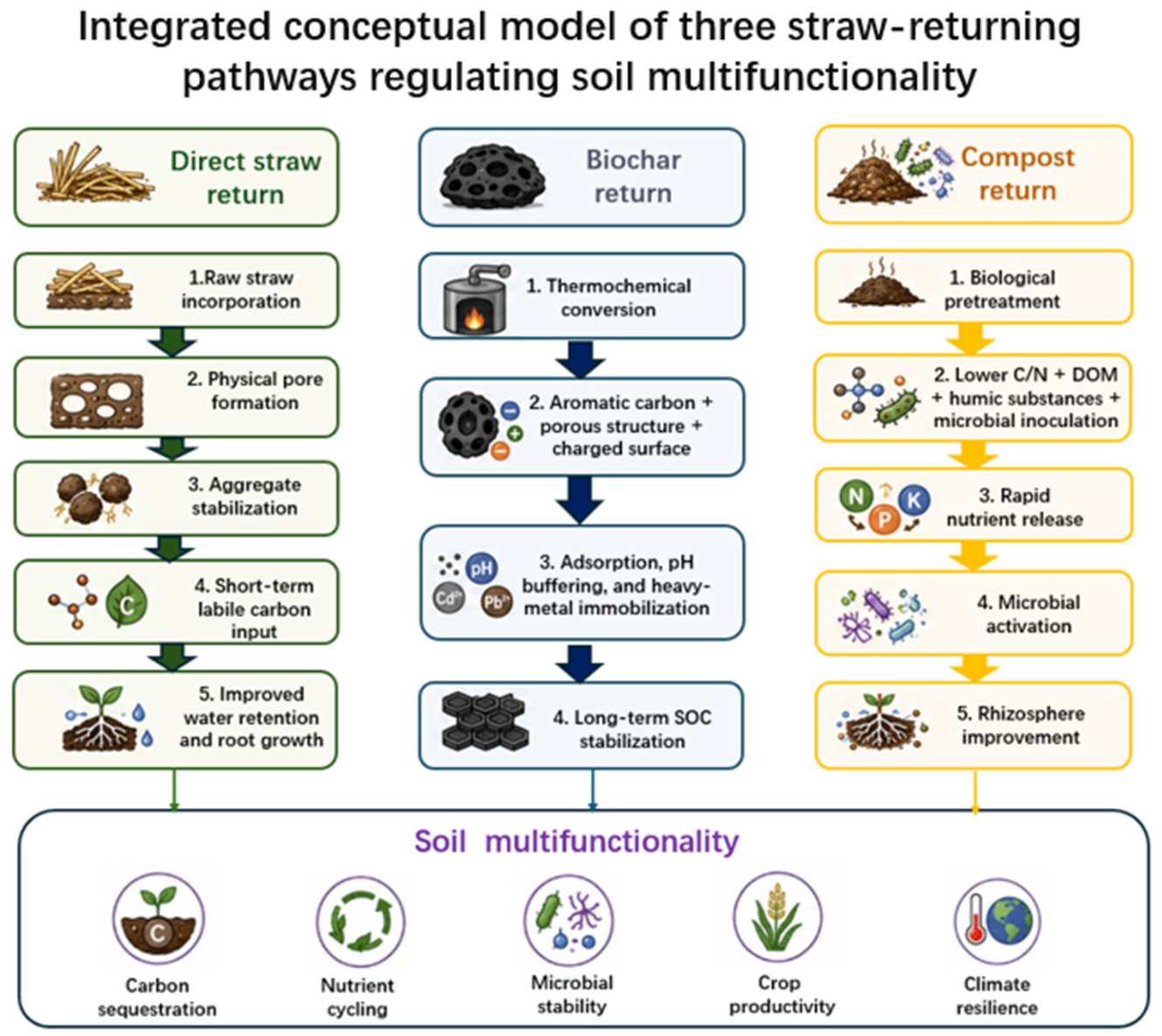
Therefore, this review aims to synthesize how three major straw-returning strategies—direct straw return, straw biochar application, and straw compost return—regulate soil multifunctionality through distinct but interconnected mechanisms. Specifically, we compare these strategies in terms of their matrix characteristics, dominant physical and biochemical processes, response times, agronomic benefits, potential limitations, and suitable application scenarios. To provide a clear framework for the following sections, Table 1 summarizes the key differences among the three pathways. Based on this framework, the review then discusses direct straw return, biochar application, and compost return with emphasis on soil physical reconstruction, nutrient cycling, microbial succession, and their combined contribution to soil multifunctionality.

2. Materials and Methods

2.1. Review Design and Reporting Framework

This review was conducted as a PRISMA-informed systematic narrative review. The literature search and screening process included five main steps: literature identification, duplicate removal, title and abstract screening, full-text eligibility assessment, and qualitative synthesis. Because the included studies differed substantially in straw type, straw-return strategy, amendment preparation, application rate, soil type, climate condition, experimental duration, and measured indicators, a quantitative meta-analysis was not conducted. Instead, this review used thematic classification and narrative synthesis to compare how direct straw return, biochar return, and compost return regulate soil multifunctionality.

2.2. Literature Search Strategy

A structured literature search was conducted in Web of Science Core Collection and Scopus for publications from January 2000 to May 2026. The year 2000 was selected as the starting point because modern studies on straw return, biochar application, compost amendment, and soil multifunctionality have developed rapidly since this period. Earlier foundational studies were supplemented through backward reference tracking when necessary.
The search terms were organized into five keyword groups: straw-return practices, soil multifunctionality and soil health, soil physical structure, soil chemical properties and nutrient cycling, and soil microbial ecology. Representative keywords included “straw return”, “crop residue return”, “straw incorporation”, “straw mulching”, “biochar”, “straw biochar”, “compost”, “straw compost”, “organic amendment”, “soil multifunctionality”, “soil organic carbon”, “aggregate stability”, “pore network”, “bulk density”, “nutrient cycling”, “priming effect”, “C:N stoichiometry”, “microbial community”, “enzyme activity”, “co-occurrence network”, “microbial necromass”, “soil food web”, and “nematode community”. Keywords within the same group were connected using OR, and different keyword groups were combined using AND. Reference lists of key articles and reviews were also checked to identify additional relevant studies.

2.3. Inclusion and Exclusion Criteria

Studies were included when they met the following criteria: (1) they focused on agricultural soils amended with crop straw, straw-derived biochar, or straw-based compost; (2) they reported at least one soil physical, chemical, biological, or multifunctionality-related indicator, such as bulk density, aggregate stability, soil organic carbon, nutrient availability, microbial community composition, enzyme activity, greenhouse gas emissions, or soil food-web structure; (3) they were field experiments, greenhouse pot experiments, laboratory incubation studies, reviews, or meta-analyses with clear relevance to straw-return effects; and (4) they were peer-reviewed English journal articles with accessible full texts.
Studies were excluded when they focused only on non-agricultural uses of straw, such as bioenergy, industrial raw materials, construction materials, or animal feed, without evaluating soil responses. Studies were also excluded when they reported only crop yield or quality without soil-related measurements, lacked essential experimental information, had duplicated data from the same experiment without additional soil indicators, or were conference abstracts, book chapters, editorials, corrections, news articles, or non-peer-reviewed materials.

2.4. Literature Screening and Data Extraction

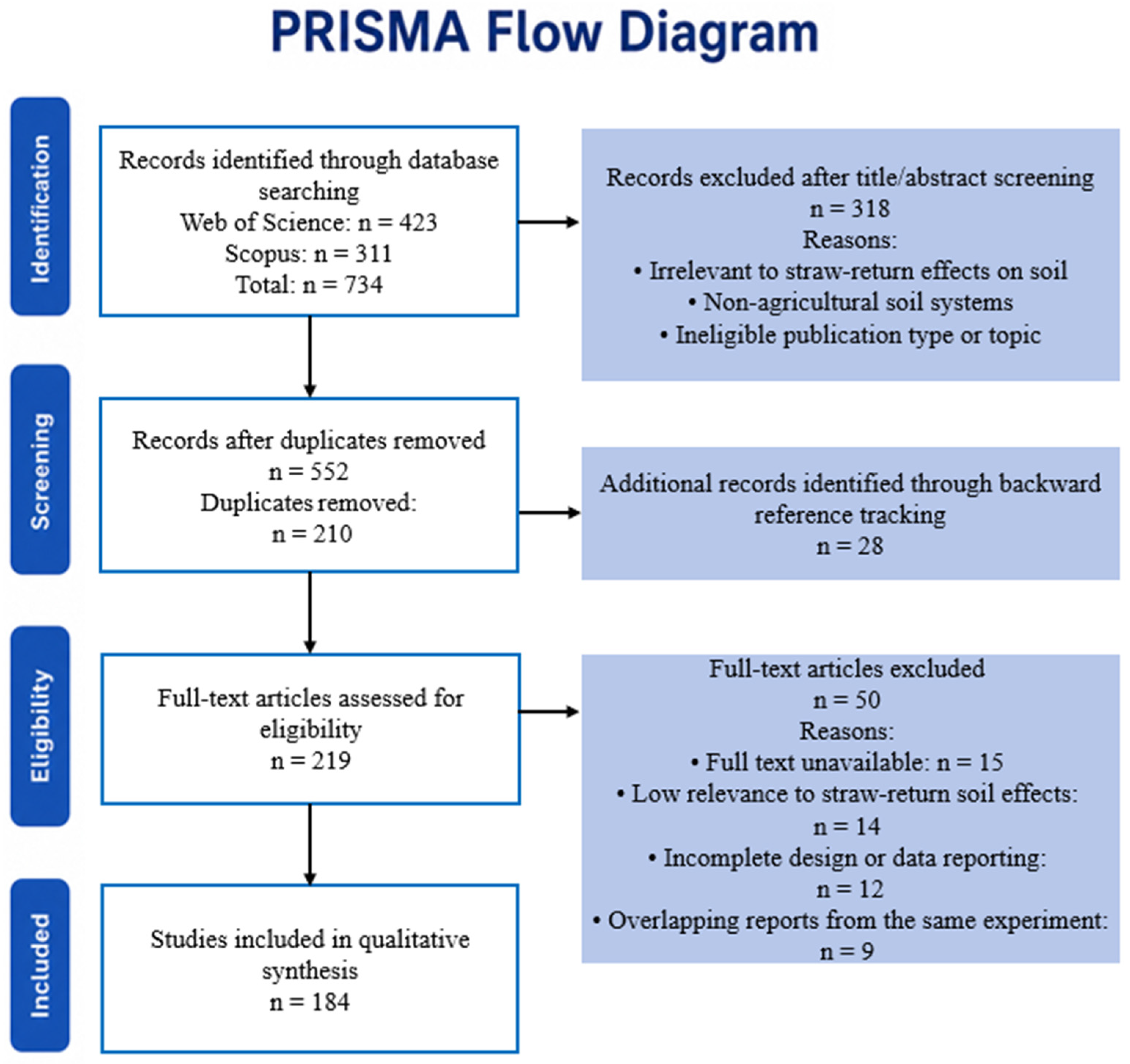
All retrieved records were imported into EndNote for duplicate removal. After duplicate removal, titles and abstracts were screened according to the inclusion and exclusion criteria. Articles that could not be clearly judged from the title and abstract were retained for full-text assessment. During full-text screening, studies were excluded if they were not directly related to straw-return effects on soil, lacked key methodological information, or reported overlapping data without additional relevant indicators. Finally, 184 eligible publications were included for qualitative synthesis. The complete literature screening process is summarized in Figure 1.
For each included study, information was extracted using a standardized data-extraction framework. The extracted information included publication details, straw type, straw-return strategy, amendment preparation method, application rate, experimental type, soil type, climate region, experimental duration, and measured soil indicators. For biochar studies, pyrolysis temperature, residence time, and relevant physicochemical properties were recorded when available. For compost studies, raw material composition, composting duration, and maturity indicators were extracted when reported. Soil indicators were grouped into physical properties, chemical and biogeochemical properties, microbial and ecological indicators, and integrated agronomic or environmental outcomes.

2.5. Thematic Synthesis and Methodological Limitations

The included studies were synthesized according to four thematic dimensions. The first dimension focused on soil physical habitat reconstruction, including bulk density, aggregate stability, pore structure, hydraulic properties, and mechanical resistance. The second dimension focused on soil chemical regulation and nutrient cycling, including soil organic carbon fractions, nitrogen and phosphorus dynamics, pH buffering, cation exchange capacity, greenhouse gas emissions, and ecoenzymatic stoichiometry. The third dimension focused on microbial succession and soil food-web dynamics, including microbial diversity, community composition, co-occurrence networks, functional genes, enzyme activities, and nematode community indicators. The fourth dimension compared the three straw-return strategies in terms of response time, carbon-sequestration potential, nutrient-use efficiency, environmental trade-offs, and suitable application scenarios.
This review has several methodological limitations. First, the review protocol was not prospectively registered; therefore, this work should be interpreted as a PRISMA-informed systematic narrative review rather than a registered systematic review. Second, only English peer-reviewed journal articles indexed in Web of Science Core Collection and Scopus were included, which may introduce language and database bias. Third, the included studies were highly heterogeneous in straw type, amendment preparation, application rate, soil type, climate condition, experimental duration, and measured indicators, making quantitative meta-analysis unsuitable for the present review. Therefore, the conclusions of this review are mainly qualitative and mechanism-oriented.

3. Direct Straw Return

3.1. Technical Models and Spatial Topological Configurations

As the core pathway for the in situ recycling of biomass resources, the evolution of direct straw return technologies profoundly influences material cycling and energy flow within agroecosystems [26,27,28,29,30]. Traditional return practices primarily focused on simple mechanical incorporation into the surface soil layer. The progressive integration of precision agriculture and conservation tillage concepts has transformed these practices from a singular material return into the systematic regulation of spatial configuration, mechanical interventions, and the soil-stubble interaction interface [31]. Diverse agronomic practices, such as deep burial, subsoiling, mulching, and rotary tillage, alter the distribution patterns of straw within the three-dimensional soil matrix. These practices directly influence the extent of microbial contact areas and the evolutionary trajectory of soil physical structure [32,33,34,35,36]. In this section, we comprehensively review the current mainstream modes of direct straw return and their underlying physical intervention mechanisms, examining them through the lenses of spatial topological characteristics and the synergistic perturbation of tillage machinery.

3.1.1. Spatial Distribution Characteristics of Straw and Deep Incorporation Strategies

The three-dimensional spatial distribution of straw within the soil matrix acts as the primary variable governing its decomposition rate and subsequent physicochemical effects. In conventional agricultural production, shallow rotary tillage frequently induces a high concentration of crop residues within the 0–10 cm surface layer [37]. This heterogeneous distribution triggers seed suspension issues during the sowing period, while the frequent dry-wet alternating cycles within the topsoil severely restrict the stable release of straw-derived nutrients [38].
To accurately quantify and optimize this distribution characteristic, Zhou et al. [39] approached the issue from a comparative perspective of agricultural machinery. They utilized a high-precision three-dimensional straw coordinate measurement system to track material displacement driven by various implements. The study evaluated three operational modes: traditional rotary tillage (TR), straw rotary burial return (SR), and subsoiling combined with straw rotary burial return (SSR) [40]. Empirical data demonstrate that the SSR practice manifests a distinct capability in improving the vertical distribution uniformity of crop residues [41]. The subsoiling components preemptively fracture the underlying dense formations, establishing physical channels that facilitate the downward propulsion of materials during the rotary burial process. This dynamic enables a more homogeneous blending of straw throughout the entire plow layer, ultimately optimizing the three-dimensional physical configuration of the root zone soil [42,43,44].
Addressing the degradation of physicochemical properties caused by the prolonged deficit of exogenous carbon inputs in the subsoil of intensive farmlands [45], researchers are extending targeted interventions beyond shallow boundaries into deeper soil profiles. Ling et al. [46] investigated the efficacy of a deep injection return paradigm, which consolidates and incorporates pulverized corn straw into the 20–38 cm subsoil layer to form a localized accumulation band of defined width. Compared to surface blending, this deep injection practice significantly enhances the quality of the subsoil adjacent to the accumulation band, manifesting as reduced soil bulk density, increased water content, and elevated levels of soil organic carbon (SOC), total nitrogen (TN), microbial biomass, and enzyme activity. This strategic shift in straw return methodologies indicates that the regulatory scope of modern agricultural technologies is expanding from singular topsoil maintenance [47] toward whole-profile quality enhancement encompassing the entire root-zone domain [48].

3.1.2. Combined Tillage and Physical Synergistic Effects on the Plow Pan

In highly mechanized large-scale agricultural regions, the rigid plow pan created by prolonged compaction from heavy machinery serves as a physical barrier that hinders the gravitational infiltration of water and the deep penetration of crop roots [49]. Merely blending straw into the surface layer is insufficient to disrupt this mechanical barrier; thus, the integration of subsoiling technology with straw return has emerged as a predominant strategy for restoring the continuity of the soil profile [50].
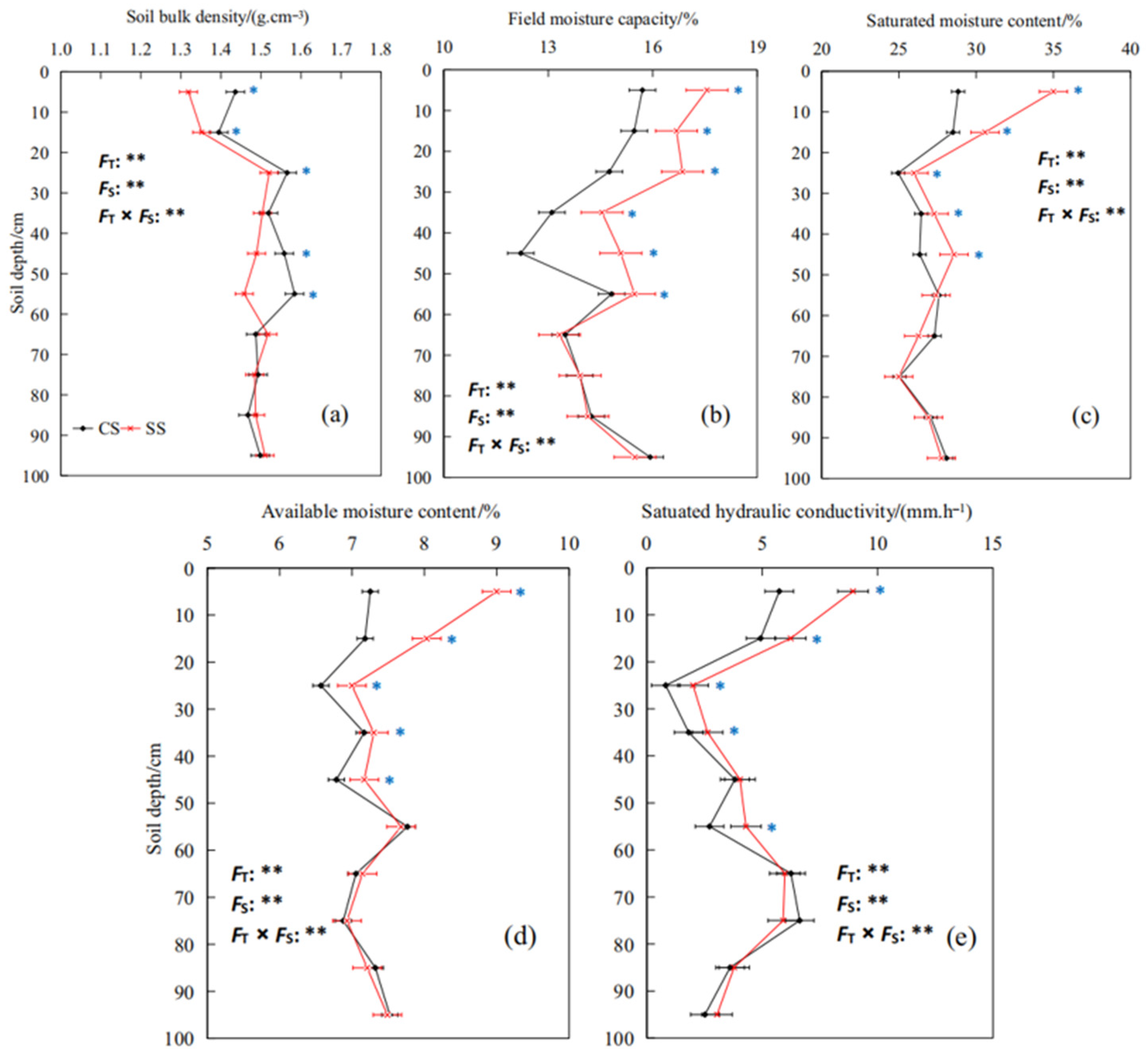
From a long-term field evolution perspective, Yang et al. [51] conducted a study using a long-term field experiment to compare the effects of conventional tillage with straw mulching (CS) and subsoiling with straw mulching (SS) on soil physical structures and hydraulic properties. Figure 2 illustrates that the SS treatment reduced bulk density in the 0–60 cm soil profile (Figure 2a) and increased important hydraulic parameters such as field capacity, saturated water content, available water content, and saturated hydraulic conductivity (Figure 2b–e) compared to the CS treatment. These findings suggest a substantial alleviation of soil compaction in the primary root zone. By combining the mechanical actions of subsoiling to fracture the compacted plow pan and straw mulching to safeguard the surface soil structure, the long-term synergy of these practices optimizes spatial pore distribution, improving water flow and retention capacities. This integrated physical approach ultimately establishes an exceptionally conducive hydrological setting for crop root growth.
The coupled intervention of mechanical disturbance intensity and exogenous organic materials profoundly reconstructs the structural stability of soil aggregates from the underlying mechanical and biochemical dimensions. Relying on the quantitative evaluation of physical fractionation methods, prominently including the wet sieving method, empirical evidence confirms that subsoiling combined with straw return extremely significantly elevates the mass proportion of water-stable macroaggregates with a particle size exceeding 2 mm [52]. Moderate mechanical soil disruption pre-expands an initial three-dimensional physical space conducive to matrix condensation. Superimposed with sugar-rich secretions released during the initial stages of straw degradation, functioning as highly efficient organic cementing media, this profound synergy between physical pore creation and biochemical cementation substantially elevates the mechanical stability of the mixed matrix against external disruptive forces [53,54]. Soil compaction rebound is a common phenomenon post-tillage. Addressing this issue, a follow-up study by Yang et al. [51] demonstrated the effectiveness of subsoiling combined with surface mulching. This paradigm effectively buffers external compaction forces and maintains the cross-seasonal connectivity of the macropore network.

3.2. Effects on Soil Physical Properties

In agroecosystems, the soil physical structure serves as the fundamental physical matrix. It sustains water and salt transport, gas–liquid exchange, and root extension [55]. Intensive agriculture has long faced persistent challenges of soil compaction and structural degradation. Fundamentally, these issues manifest as an uneven pore distribution within the physical media and an imbalanced mechanical bearing capacity [56]. Direct straw return interventions physically incorporate low-density, high-porosity exogenous organic materials into the dense inorganic mineral matrix. This physical incorporation triggers a systemic reconstruction of the solid, liquid, and gas three-phase volume distribution at both kinetic and spatial topological levels [57,58,59]. In this section, we move beyond singular indicator descriptions. We comprehensively integrate the topological evolution of the media, the spatiotemporal dynamics of aggregate development, the iteration of mechanical response models, and hydrological boundary characteristics. By doing so, we multidimensionally elucidate the profound mechanisms of how straw intervention alters soil physical properties.

3.2.1. Bulk Density Reduction and Quantitative Reconstruction of Three-Dimensional Microscopic Pore Networks

In the evaluation of organic amendments, traditional soil physics frequently attributes the apparent reduction in bulk density to a simple mass substitution mechanism [60]. Examined through the perspective of porous media materials science, this physical variation fundamentally originates from intense spatial steric hindrance effects. Systematic quantitative evaluations targeting low-density agricultural wastes definitively confirm this underlying mechanism. Forcibly penetrating the compact mineral matrix, the tubular fibrous characteristics of straw residues actively construct an irregular mechanical support network within the soil mass [61]. Synchronously diluting the overall compaction degree of the mixed matrix, this supporting effect substantially amplifies the volume proportion of effective macropores, physically broadening the core channels for the high-frequency metabolism of aerobic microorganisms and the three-dimensional expansion of root systems.
The spatial steric hindrance effect occupies a core weighting in the targeted amelioration of deep profile structures. Relying purely on external mechanical forces, prominently including subsoiling, achieves only an instantaneous shattering of the underlying compact structure. Long-term field positioning observations within the Yellow River Basin verify a critical physical phenomenon. Under the dual stress of natural rainfall kinetic energy impact and soil self-weight settlement, these newly generated micro-fissures exhibit an extremely high closure tendency [51]. The synchronous filling of straw materials precisely compensates for the physical defects inherent in pure mechanical disturbance. Exerting a persistent padding and isolating effect within the fissures, the fibrous skeleton systematically maintains the cross-seasonal connectivity of the longitudinal pore network within the profile. Approaching directly from the fluid dynamics dimension, this structural integration thoroughly eradicates the conduction barriers obstructing surface runoff from deep gravitational infiltration [62,63].
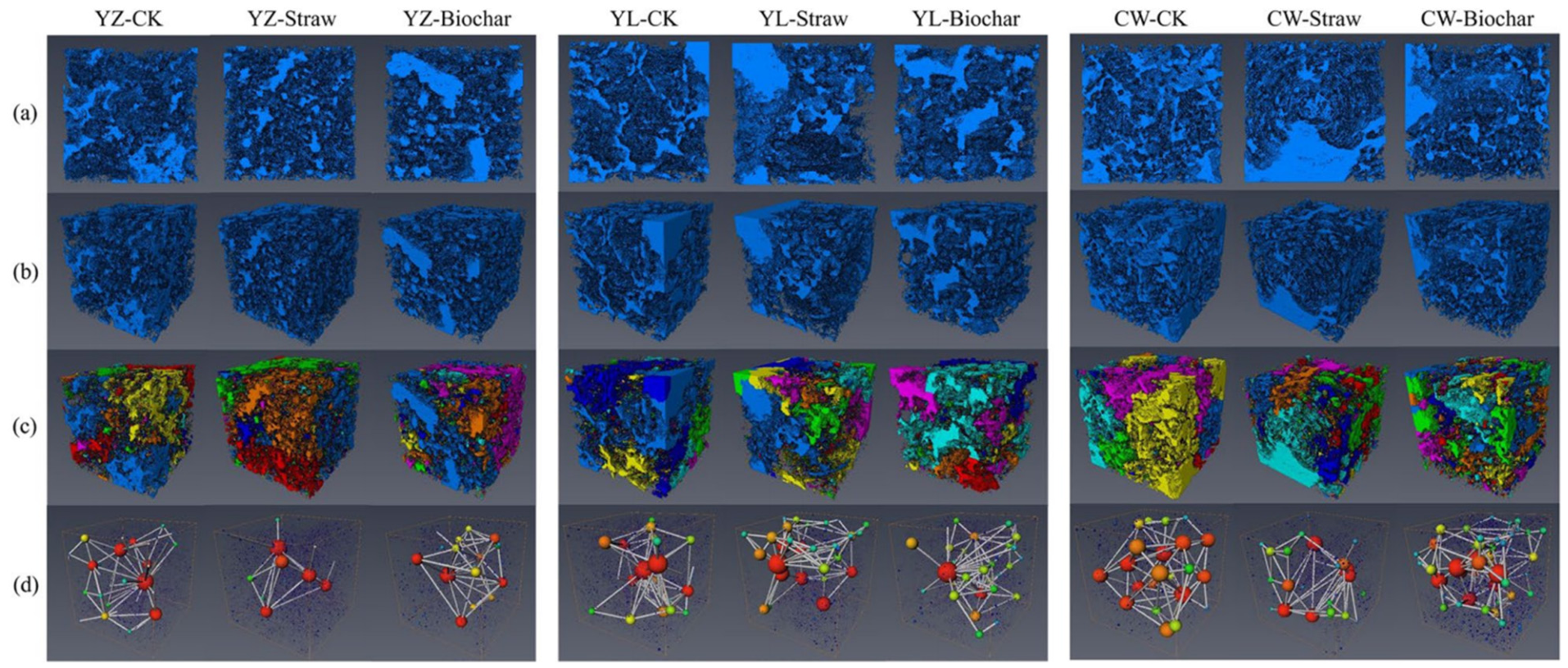
With the evolution of testing methods, the research community’s understanding of pore characteristics has transcended the appearance estimation of two-dimensional sections and moved towards non-destructive analysis of three-dimensional topologies. Yang et al. [64] abandoned the traditional destructive sampling and integrated 13C stable isotope tracer with high-resolution X-ray computed tomography (X-ray CT) technology. This methodological breakthrough has achieved precise quantification of the internal pore connectivity and geometric configuration of large aggregates (as shown in Figure 3).
The three-dimensional visualization structure and spatial topological parameters of the pore network shown in Figure 3 indicate that the direct input of exogenous materials significantly increases the connectivity ratio of micro-pores at the sub-micron level. This leap in microscopic connectivity not only reduces the physical resistance of gas–liquid transport but also systematically defines the physical protection threshold of exogenous organic carbon in the complex mineral space, providing core geometric topological parameters for clarifying the physical barrier mechanism of carbon sequestration mediated by the direct return of straw to the field model.
Similar improvements in pore continuity, aggregate stability, and hydraulic conductivity have also been reported in long-term subsoiling–straw systems and straw-amended soils with different textures [51,62,63]. These independent lines of evidence indicate that pore-network reconstruction under direct straw return is not limited to the X-ray CT observations of Yang et al. [64] but represents a broader physical response involving mechanical loosening, straw-fiber support, aggregate cementation, and long-term structural stabilization.

3.2.2. Dynamics of Aggregate Development and Physical Stabilization of a Structure

The long-term retention of soil microscopic pore networks heavily relies on enhanced water stability within soil aggregates. Aggregation represents a complex dynamic process. It intimately couples mineral coagulation with biochemical cementation. During the straw degradation sequence, polysaccharides and fungal hyphae are continually released into the matrix. These biological components constitute crucial transient cementing agents. They effectively envelop and bind primary mineral particles [65,66].
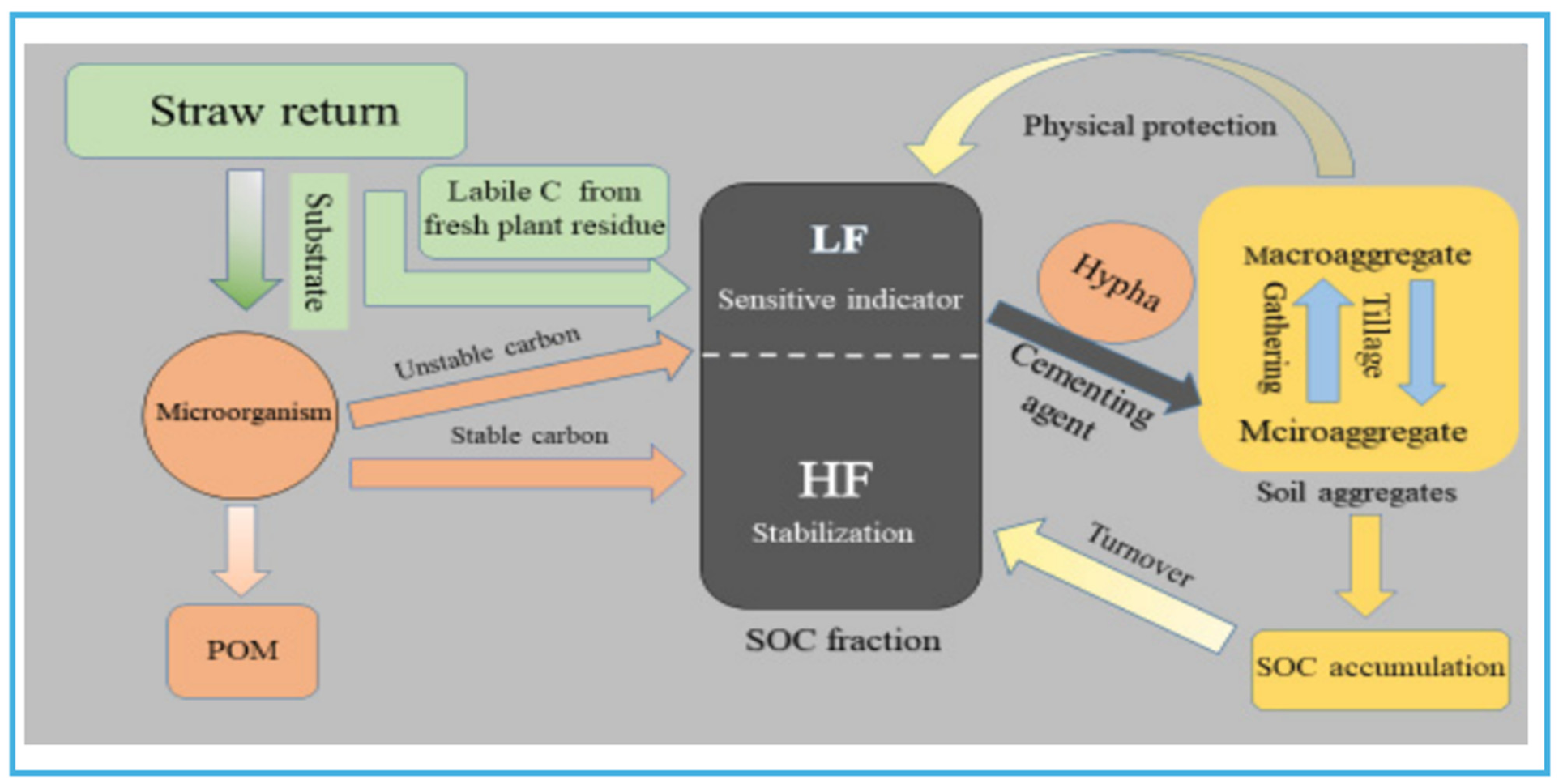
Short-term observations are frequently disrupted by fluctuations in environmental temperature and humidity, complicating the assessment of the true steady-state trend in aggregate evolution. Consequently, long-term positioning experiments that span generations have emerged as a critical method for elucidating this mechanism. Gan et al. [67] conducted a 10-year continuous corn straw return experiment in the Mollisol region of Northeast China. They proposed a conceptual framework illustrating how straw input drives aggregate transformation and the physical protection of SOC (Figure 4).
As illustrated, continuous straw inputs provide accessible carbon sources for microorganisms. This supply promotes the participation of fungal hyphae and microbial metabolites in cementing soil particles. Consequently, microaggregates progressively transform into water-stable macroaggregates. Accompanying this structural reorganization, light fraction organic carbon responds more sensitively to management practices. Conversely, heavy fraction organic carbon achieves enhanced stability through mineral binding and aggregate protection. Long-term straw return transcends the mere addition of exogenous carbon inputs. It actively drives the synergistic occurrence of Mollisol structural stabilization and SOC accumulation. This synergy unfolds through a continuous sequential process: organic substrate supply, biological cementation, aggregate restructuring, and carbon fraction protection.
When assessing the universality of straw-induced cementation, incorporating different inherent soil types as environmental variables provides more comprehensive empirical evidence for objectively evaluating the effectiveness of this cementation effect. Long-term continuous experiments have shown that, in calcareous soils prone to structural crusting and compaction, the long-term incorporation of 50% crushed straw can maximize the resistance of aggregates to detachment [68]. The distinctive feature of this developmental process lies in the fact that it restructures the soil architecture without inducing a significant surge in heterotrophic respiration flux, thereby achieving compatibility between structural improvement benefits and carbon-emission balance.

3.2.3. Reconstruction of Soil Mechanical Properties and Compressive and Shear Resistance Mechanisms

Beyond resisting natural water and wind erosion, the physical structure of modern topsoil faces a direct threat. This threat originates from the compaction stress exerted by heavy agricultural machinery [69]. The compaction process destroys existing macroscopic pores. Concurrently, it triggers a sharp escalation in soil penetration resistance (PR) and modulus of rupture (MR) [70]. Introducing straw, a highly compressible fibrous matrix, profoundly alters the stress–strain constitutive relationship of the mixed media.
When assessing the mechanical response of heterogeneous soil, the traditional linear regression model [71] exhibits notable fitting limitations. To address this issue, Hamza Negi and Cevdet Şeker [72] focused on calcareous clay soil in a semi-arid region and incorporated artificial neural networks (ANNs) to predict the soil fracture modulus (MR). They utilized conventional physical indicators, including average weight diameter (MWD), macroscopic aggregate stability (MAS), geometric mean diameter (GMD), bulk density, penetration resistance (PR), and structural stability index (SSI), as input variables. The findings indicate that the ANN model effectively predicts MR, suggesting that soil mechanical strength is influenced by multiple factors rather than a single variable. These factors include aggregate stability, compaction state, and pore structure. Furthermore, the application of high-dose corn-based organic materials, particularly corn compost and green manure treatments, significantly improved aggregate stability and water use efficiency while decreasing bulk density, penetration resistance, and fracture modulus. This suggests that the addition of organic materials fosters a more favorable physical environment for root growth and water utilization by enhancing particle cementation, increasing structural porosity, and alleviating soil compaction, thereby reducing the mechanical resistance of clayey soil.
The mechanical buffering effect carries immense practical weight in agricultural systems implementing high-frequency crop rotations. Chen et al. [73] conducted a 6-year in situ field study in the North China Plain. This research systematically examined the mechanical evolution under a “winter wheat-summer corn” double-cropping rotation system. Double-cropping systems constantly face high-frequency, heavy machinery pressure. Under these intensive conditions, the long-term implementation of full straw incorporation continuously dilutes the solid-phase matrix bearing density of the topsoil. When subjected to external loads, the straw fiber network undergoes both plastic and elastic deformation. This physical response effectively absorbs and dissipates the downward-transmitted mechanical energy. This energy dissipation substantially alleviates the trend of deep mechanical compaction. Maintaining an appropriate physical presence of straw serves as a core defense line. It sustains the mechanical bearing capacity of the intensive plow layer and actively resists systemic compaction degradation.
Synthesizing these discussions, direct straw return interventions in physical microhabitats transcend superficial variations in isolated indicators. Rather, they trigger a profound physicochemical system reorganization governed by media characteristics across multiple spatiotemporal scales. Evidence spanning from three-dimensional pore topological parameters extracted via X-ray CT technology to the long-lasting physical sequestration of aggregates verified by decade-long experiments confirms this dynamic. Diversified methodological perspectives and comparative demonstrations reveal a critical mechanism. The precise introduction of low-density porous organic media constitutes the foundational driving force. It dismantles the physical barriers of degraded matrices, ultimately constructing modern agricultural systems characterized by high hydraulic conductivity and low mechanical resistance.

3.3. Effects on Soil Chemical Properties and Nutrient Cycling

The chemical matrix characteristics of agricultural soils dictate the solid–liquid phase partitioning of available nutrients. Concurrently, these characteristics regulate the biogeochemical cycling rates of biogenic elements, including carbon, nitrogen, and phosphorus [74]. Straw represents a complex organic macromolecular polymer. Its direct return significantly alters the initial boundary conditions of ecological stoichiometry (the mass or molar ratio of C:N:P:K) within the soil microhabitat [75]. Within microbe-dominated degradation networks, this stoichiometric signature establishes the thermodynamic direction of substrate turnover. It simultaneously defines the critical threshold for nutrient release [76,77,78,79]. The continuous input of exogenous materials systematically intervenes in the soil redox potential (Eh), acid-base buffering capacity, and complexation-coordination reactions. These physicochemical interventions unfold through profound mechanisms, encompassing solute diffusion, ion exchange, and enzymatic degradation. In this section, we comprehensively evaluate the mechanistic impacts of straw return. Our assessment spans organic carbon fraction dynamics, multi-element synergistic and antagonistic effects, the mitigation of chemical barriers in degraded habitats, and the underlying ecoenzymatic stoichiometric characteristics [80].

3.3.1. Dynamics of Soil Organic Carbon Fractions and Quantitative Reconstruction of the Priming Effect

The dynamic budget of the soil organic carbon (SOC) pool serves as a core quantitative indicator. This metric critically evaluates the sustainability of tillage management practices. Straw return fundamentally introduces massive quantities of easily extractable organic carbon (EOC) into the soil matrix. This highly active substrate arrives as a pulsed input. This influx significantly expands the baseline of the exogenous carbon pool. Simultaneously, it inevitably perturbs the turnover rate of native SOC. Exogenous carbon triggers a non-linear shift in the mineralization rate of this background carbon. This specific biogeochemical phenomenon is defined as the “Priming Effect” [81].
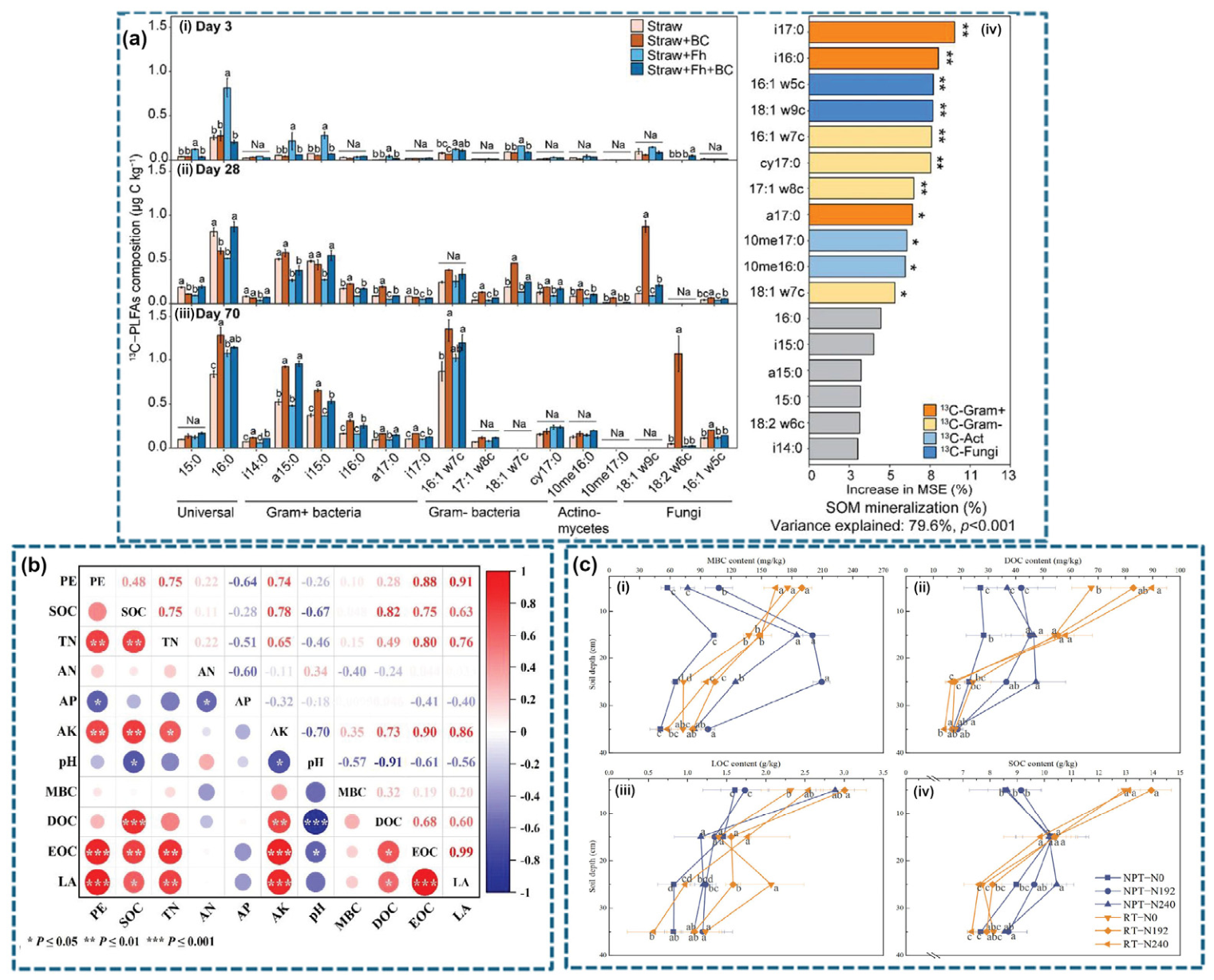
At the field scale, the apparent intensity of the priming effect depends heavily on the physical methods of agricultural mechanical intervention. Cai et al. [82] conducted a quantitative assessment. Their findings demonstrate that adding fresh straw significantly elevates the basal soil respiration rate. This input induces a positive priming effect. This study thoroughly demonstrated the constraints imposed by physical spatial configuration on carbon turnover. The researchers constructed a multidimensional correlation heatmap (Figure 5b). This visual model mapped the apparent priming effect (PE) against soil physicochemical properties and active carbon fractions. Through this matrix, they successfully revealed the underlying logic of substrate accessibility.
The correlation matrix visually confirms a distinct pattern. The apparent intensity of the priming effect exhibits a highly significant positive correlation with the SOC lability index (LA) and easily oxidizable organic carbon. It exhibits no significant correlation with the baseline abundance of total organic carbon. Moderate mechanical incorporation regulates the effective contact surface area between straw residues and inorganic mineral particles. This regulation promotes the participation of straw as a cementation core in macroaggregate assembly. This assembly process substantially alters the spatial accessibility of the substrates. This physical regulation preferentially mineralizes highly correlated active components. Concurrently, it constructs a robust physical shelter for the native stable organic carbon located within the aggregates. This physical isolation effectively severs the biological pathways responsible for massive mineralization losses. The matrix topological parameters verify this selective mineralization tendency. From a kinetic perspective, this specific dynamic achieves a steady-state balance. It equilibrates the net input of exogenous carbon with the mineralization output of native carbon.
To verify the substrate utilization pathways of this process at the molecular level, Liu et al. [83] conducted precise source tracking. They utilized 13C stable isotope tracing combined with 13C-phospholipid fatty acid (13C-PLFA) compound-specific isotope analysis. This approach systematically outlines the microbial metabolic mechanism model of the soil priming effect triggered by exogenous carbon inputs (Figure 5a). The figure visually characterizes a multidimensional causal chain. Active microbial communities absorb labeled carbon sources, synthesize intracellular biomass, and release degradation substrates extracellularly. Quantitative results indicate a significant increase. The input of 13C-labeled straw carbon increases the mineralization release of native soil organic matter by 61% compared to the control group. Leveraging this clear map of intra- and extracellular carbon fluxes, the study effectively rules out the simple “energy spillover” hypothesis. It confirms the “Co-metabolism” mechanism. Specific microbial-assimilating taxa utilize exogenous active carbon as primary electron donors and carbon sources. These taxa synthesize and secrete non-specific extracellular oxidases. These enzymes diffuse through the matrix space. They non-selectively degrade adjacent high-molecular-weight, chemically resistant native recalcitrant carbon fractions.
Regarding the spatiotemporal evolution characteristics of these fractions, the conversion efficiency from active to steady-state carbon pools directly determines the long-term effectiveness of carbon sequestration. Zhao et al. [84] quantified the vertical distribution of active organic carbon fractions under different tillage and straw-return practices (Figure 5c). Their results showed that subsoiling combined with no-tillage straw mulching enhanced the downward transport of dissolved organic carbon (DOC) into the 20–40 cm soil layer, thereby reducing excessive carbon accumulation in the surface layer. Long-term field evidence further suggests that repeated microbial assimilation and microbial necromass accumulation may promote the transformation of labile carbon into mineral-associated organic carbon, linking short-term substrate input with long-term SOC stabilization. Unlike biochar, which mainly stabilizes carbon through aromatic condensation and surface adsorption, direct straw return first increases labile carbon inputs and DOC fluxes; therefore, its carbon-sequestration effect depends more strongly on incorporation depth, soil moisture, and microbial transformation.

3.3.2. Release Dynamics of Nitrogen and Phosphorus Nutrients and Multi-Element Chemical Synergistic Trade-Offs

Governed by the fundamental laws of ecological stoichiometry, straw typically exhibits a high C/N ratio (often >60). Upon initial incorporation into the soil matrix, this high ratio subjects the degradation process to severe limitations due to the available nitrogen. Microorganisms strive to maintain their internal elemental stoichiometric balance. To achieve this balance, they competitively assimilate inorganic nitrogen sources from the soil solution. This biological action triggers a distinct “Nitrogen Immobilization” phase. This elemental flow exhibits a pronounced hysteresis effect. This delayed dynamic profoundly alters the nutrient supply curve during critical crop growth stages [85,86,87,88].
Physical structural characteristics exert significant feedback effects on the nitrogen cycle. Huang et al. [52] elucidated the regulatory mechanisms of structural heterogeneity on these chemical processes. They conducted a study in the hilly regions of Southwest China. Their findings demonstrate that subsoiling combined with straw mulching actively promotes the development of water-stable macroaggregates. Oxygen diffusion faces severe limitations within these aggregate interiors. This physical restriction forms micro-scale redox potential gradients. These Eh gradients finely regulate the rate ratio between ammonia oxidation and denitrification processes. This physicochemical immobilization within the microhabitat significantly reduces the concentration peaks of nitrate nitrogen in the soil solution. This reduction effectively mitigates the risk of deep leaching of reactive nitrogen in regions with abundant precipitation.

3.3.3. Chemical Environment Impedance of Degraded Soils: Acid-Base Buffering and Targeted Remediation of Saline-Alkali Soils

Soil pH and the composition of exchangeable cations on colloidal surfaces constitute fundamental chemical constraints. These specific parameters strictly limit soil nutrient availability and root development. The straw decomposition process generates massive quantities of distinct organic compounds. These products include fatty acids, small-molecule aromatic compounds, and highly polymerized humic macromolecules [9,89,90]. The surfaces of these secondary metabolites dissociate extensive carboxyl and phenolic hydroxyl groups. This chemical dissociation triggers a sharp escalation in the Proton Buffering Capacity and cation exchange capacity at the soil solid–liquid interface. This dynamic establishes a critical thermodynamic foundation. This foundation actively regulates the acid-base balance and salt distribution within degraded soils [91].
Targeting the in situ remediation of composite chemical obstacles within saline-alkali soils, continuous field positioning observations spanning 20 years provide definitive evidence characterizing geochemical evolution across time scales [92]. Within severely salinized background habitats, the long-term input of straw profoundly reshapes the competitive equilibrium of ion adsorption at the colloidal interface. Mechanistic resolution confirms a critical physicochemical dynamic. Persistently released during material decomposition, H+ and organic ligands powerfully neutralize the high concentrations of carbonate and bicarbonate within the soil solution. Actively intervening at colloidal adsorption sites, these reactive agents execute a massive, targeted displacement of exchangeable sodium ions. Synchronously optimized by straw interventions, the physical infiltration rate of pores directly drives the deep gravitational leaching of the desorbed free Na+ accompanying the downward infiltrating water. Exhibiting a profound synergy between continuous interfacial chemical displacement and macroscopic physical leaching, this composite mechanism forces an irreversible and substantial suppression in the pH value, total alkalinity, and exchangeable sodium percentage of severely salinized soils. Thoroughly eradicating the dual physiological stress of sodium toxicity and high alkalinity, this composite impedance mechanism definitively secures the robust escalation of summer corn yields at the field scale.
The intensity of organic matter-driven chemical property evolution is frequently constrained by the initial soil mineralogical background. In-depth profiling using Fourier-transform infrared spectroscopy across diverse parent material habitats confirms that continuous exogenous organic carbon input exhibits highly convergent evolutionary characteristics in driving the aromatic condensation of humic macromolecules and stimulating biochemical enzyme activities [93]. Long-term interventions with exogenous organic materials substantially transcend the baseline physicochemical boundaries imposed by inherent soil types on the humification process, compelling multi-source heterogeneous degraded matrices to systematically converge toward a steady-state chemical phase characterized by high charge density and robust acid-base buffering capacity.

3.3.4. Soil Ecoenzymatic Stoichiometry and Biological Multifunctionality Driving Nutrient Cycling

The depolymerization and mineralization rates of soil biogenic elements are ultimately governed by the activity of extracellular enzymes. Microorganisms actively secrete these essential biochemical agents. Straw return significantly alters the C:N:P ratio of the input substrates. This severe alteration forces the soil microbial community to execute adaptive adjustments within its metabolic pathways. The theory of “Ecoenzymatic Stoichiometry” provides a robust framework to address this complex dynamic. This theoretical approach quantifies the relative activity ratios of specific functional enzymes. These targeted proteins include carbon-acquiring enzymes, nitrogen-acquiring enzymes, and phosphorus-acquiring enzymes. This precise quantification effectively elucidates the microscopic rate-limiting steps of nutrient cycling.
Relying on an 11-year empirical field gradient intervention and eco-enzymatic stoichiometry modeling, the phenomenon of microbial metabolic carbon limitation under long-term singular inorganic nutrient stress has been precisely quantified [94]. Continuous exogenous organic carbon inputs substantially reconstruct the carbon supply baseline of the matrix. The material intervention gradients of 4, 8, and 12 t ha−1 yr−1 accurately map onto a targeted surge in the absolute abundance of core carbon-degrading genes, validating the profound biological response of the micro-ecological baseline to carbon restriction alleviation from the perspective of molecular genetic signatures. Concomitant with the dynamic resetting of microbial carbon use efficiency, the demand for biogenic elements within the community undergoes an adaptive shift. To satisfy the strict stoichiometric ratios required for exponential population growth, microorganisms specifically and preferentially allocate assimilated carbon energy into the synthesis networks of nitrogen- and phosphorus-acquiring hydrolytic enzymes. This enzymatic cascade amplification mechanism, governed by fluctuations in substrate stoichiometry, establishes the core transformation pathway from sequestered organic nitrogen and phosphorus into inorganic available states from an underlying kinetic dimension.
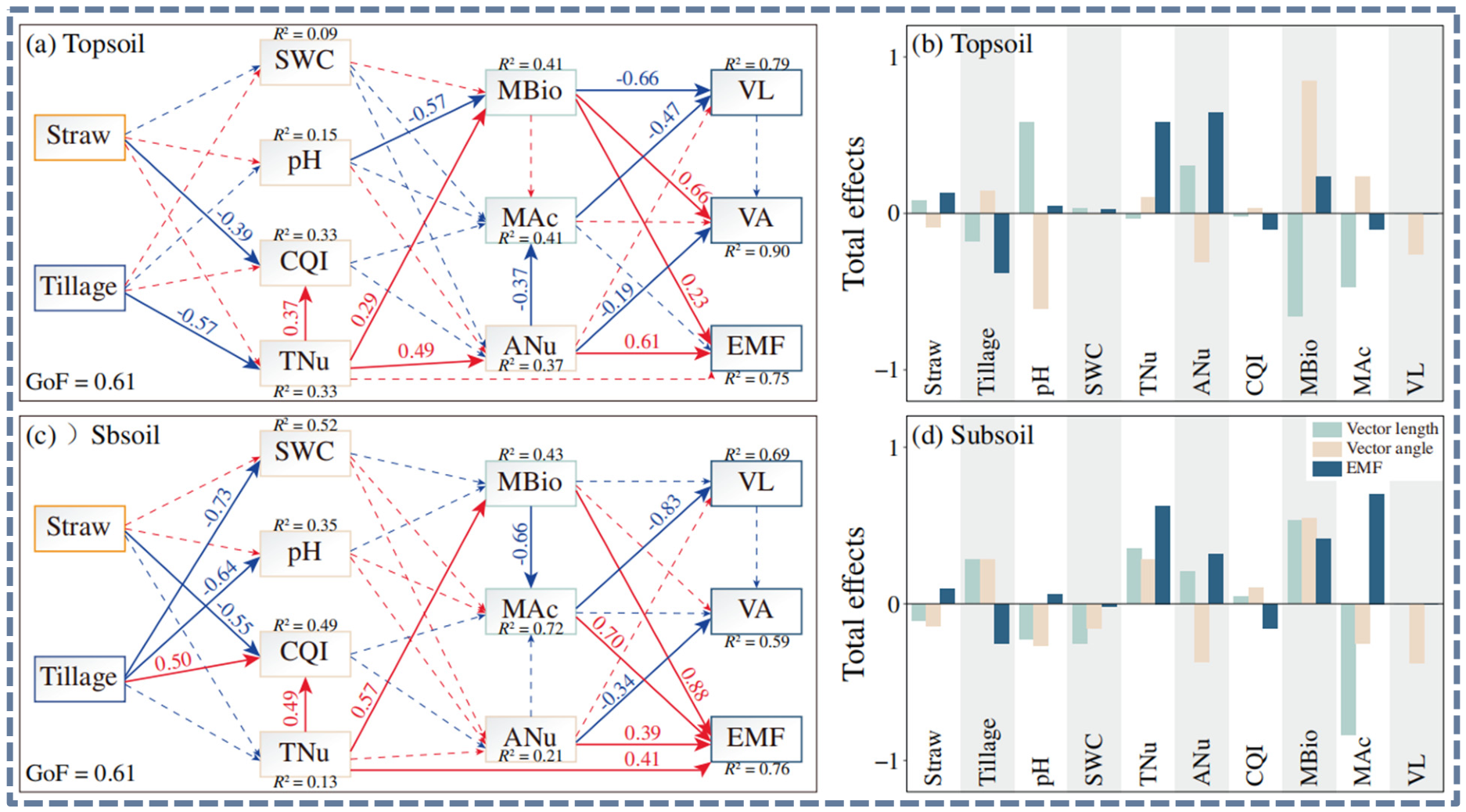
The enhancement of enzymatic activity at the microscopic level, when superimposed on the macroscopic scale of the ecosystem, is directly reflected in a significant increase in the multifunctionality index of the soil ecosystem. Chu et al. [95] utilized partial least squares path modeling. This robust statistical approach quantitatively resolved this cascading mechanism (Figure 6). The model calculations confirm a distinct biogeochemical dynamic. No-tillage combined with straw return delivers highly efficient exogenous carbon inputs. These precise inputs substantially alleviate the metabolic C limitation within the microbial community. This fundamental alleviation of metabolic pressure triggers a systemic response. It systemically upregulates the activities of extracellular enzymes associated with carbon, nitrogen, and phosphorus cycling. Multi-element turnover rates accelerate synergistically. Concurrently, these positive micro-ecological cascading effects drive a comprehensive elevation of SMF at the macroscopic level. This outcome validates a critical ecological concept from a systems theory perspective. Straw interventions play a definitive role in enhancing nutrient turnover, solidifying carbon sequestration, and sustaining primary productivity. Targeting strictly degraded arid habitats, the combined application of high-dose straw and exogenous functional microbial fertilizers constitutes a robust composite ecological intervention matrix [96]. In situ empirical data confirm that this multi-source targeted intervention systematically reconstructs the impaired micro-ecological biochemical cycling network within an extremely brief time window, directly driving a substantial, targeted expansion of the available nutrient pool capacity within the degraded matrix. The rapid resuscitation of this foundational biochemical network provides definitive ecological engineering mechanistic support for mitigating the stress of extreme climate fluctuations and in situ reshaping the chemical fertility and system multifunctionality of degraded croplands.
Synthesizing the preceding mechanism analyses, the impacts of direct straw return on soil chemical properties span multiple scales, ranging from molecular bonding to macroscopic elemental mass balance. Tracing techniques based on 13C-PLFA confirm the priming mechanism where exogenous carbon accelerates native mineralization through co-metabolism. Long-term experiments reveal complex non-linear trade-off effects, encompassing coordination complexation and antagonistic leaching among multiple elements. Furthermore, the application of ecoenzymatic stoichiometric models elucidates the controlling influence of extracellular enzyme secretion patterns on nutrient cycling rates from the perspective of substrate limitation.
Current chemical intervention research largely remains confined to the apparent budgets of macronutrients, such as carbon, nitrogen, and phosphorus. Future research urgently requires refining the dynamic complexation models between the molecular diversity of DOM and microelement availability across different climatic backgrounds and soil texture types. Deepened investigations are also essential in the context of climate fluctuations. These studies should explore precise adjustments to the physicochemical characteristic parameters of straw addition. Such precise regulation seeks to maximally balance the long-term sequestration of carbon pools with the immediate release of available nutrients. Ultimately, these systematic approaches provide a rigorous, quantitative scientific basis for precise nutrient management and carbon emission reduction in modern agriculture [80].

3.4. Effects on Soil Biological Properties

In direct straw return, soil biological responses are mainly driven by the decomposition of raw straw and the pulsed input of labile carbon. Unlike biochar and compost, raw straw has a relatively high C/N ratio and contains structurally complex lignocellulosic components. Therefore, its biological effects are often characterized by short-term microbial fluctuation, nitrogen immobilization, priming effects, and the activation of extracellular enzymes involved in carbon, nitrogen, and phosphorus cycling. This section focuses on how direct straw return regulates soil biological properties through substrate decomposition, microbial assimilation of straw-derived carbon, extracellular enzyme production, and micro-food-web responses [97,98,99].

3.4.1. Spatiotemporal Evolution and Targeted Enrichment Characteristics of Microbial Community Assembly

The microbial response to direct straw return is primarily controlled by the availability and degradability of straw-derived substrates. Raw straw contains soluble carbohydrates as well as resistant lignocellulosic polymers, creating a sequential carbon-supply pattern during decomposition. In the early stage, labile carbon can stimulate fast-growing heterotrophic bacteria and increase microbial biomass. As decomposition proceeds, microorganisms capable of degrading cellulose, hemicellulose, and lignin become more important. Therefore, direct straw return can drive microbial community succession through substrate quality, decomposition stage, and soil nutrient status [100,101].
Long-term field experiments are more suitable than short-term incubations for capturing the sustained microbial response to straw return, because microbial community succession is strongly affected by soil moisture, redox conditions, crop growth, and seasonal variation [102]. In a 10-year in situ field experiment using paddy soil, Nan et al. [103] found that continuous straw return produced different responses in bacterial and archaeal communities. Bacterial alpha diversity increased over time, possibly because straw-derived carbon favored heterotrophic bacteria capable of utilizing decomposable organic substrates. In contrast, archaeal diversity declined, which may reflect greater sensitivity to changes in redox conditions, substrate competition, and niche filtering in flooded soils. These results suggest that continuous straw return does not stimulate all microbial groups uniformly but may instead shift microbial community structure through changes in substrate availability and soil environmental conditions [104].
Expanding the research scope to a macro-geographical scale, straw return demonstrates highly consistent spatial intervention characteristics on micro-ecological community assembly processes [105]. Soil parent materials and initial physicochemical baselines across diverse latitudinal climatic zones exhibit profound spatial heterogeneity; the complete incorporation of exogenous straw robustly overrides these environmental barriers, consistently triggering a profound “targeted enrichment” effect across expansive spatial dimensions. The influx of specific substrates extensively enriches core functional microorganisms belonging to phyla such as Latescibacterota. These micro-ecological taxa are heavily enriched with genetic sequences encoding complex carbohydrate-active enzymes, dominating the core ecological function of depolymerizing recalcitrant polysaccharide macromolecules within plant cell walls. Such directional enrichment succession, transcending habitat heterogeneity, directly reflects that substrate chemical attributes possess an underlying deterministic power—surpassing macroscopic environmental and climatic factors—in driving the assembly of specific lignocellulose-depolymerizing functional consortia.

3.4.2. Topological Structure of Microbial Co-Occurrence Networks and Ecosystem Resilience

Soil microorganisms do not function as isolated individuals but form co-occurrence networks through resource exchange, metabolite interactions, niche competition, and signal-mediated communication. Compared with single diversity indices, network topological parameters can provide additional information on potential microbial interactions and the resilience of soil micro-ecosystems [106,107]. In this section, network reorganization is interpreted as a response to raw-straw decomposition and labile carbon pulses, rather than as the persistent pore-refuge or pH-buffering effect discussed for biochar returns. From the perspective of community assembly, Xu et al. [105] used a null model approach to examine how straw input affects microbial network formation. In carbon-limited or degraded soils, strong environmental filtering may constrain microbial survival and reduce network complexity. The addition of raw straw supplies decomposable organic substrates, expands available ecological niches, and promotes the assembly of bacterial–fungal co-occurrence networks. Increases in network nodes, edges, and modularity suggest that direct straw return can enhance potential interactions among decomposer microorganisms and improve functional redundancy. However, this response should be understood mainly as substrate-driven network reorganization rather than as long-term habitat stabilization.
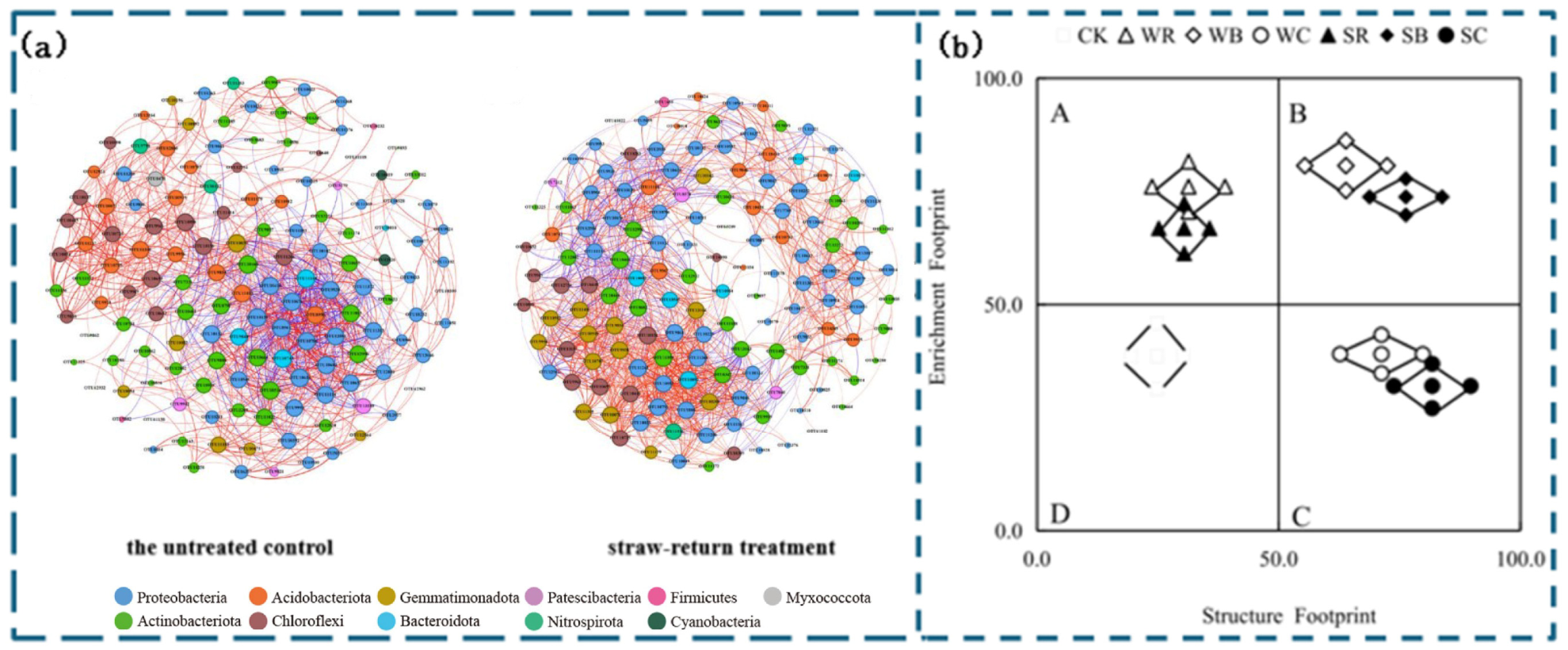
Network reorganization may also help buffer agronomic stresses. In intensive wheat cropping systems of the Huang-Huai-Hai Plain, long-term high nitrogen fertilization can cause soil acidification, secondary salinization, and a decline in beneficial rhizobacteria [108]. Straw return may partly offset these negative effects by supplying degradable carbon, improving plant–microbe feedbacks, and reshaping rhizosphere co-occurrence modules. Similarly, Ding et al. [109] reported that short-term straw return altered the bacterial co-occurrence network in the parent material of degraded black soil. Compared with the untreated control, the straw-return treatment showed a greater number of network edges, a higher average degree, and increased network density (Figure 7a). These results suggest that straw return may strengthen potential associations among bacterial taxa by increasing the availability of decomposable carbon substrates. However, co-occurrence patterns represent statistical associations and should not be interpreted as direct evidence of microbial cooperation or long-term network stability.

3.4.3. Evolution of Trophic Cascades in the Micro-Food Web

Soil food-web responses under direct straw return are mainly driven by bottom-up resource supply. During raw straw decomposition, the release of available carbon stimulates bacteria and fungi, which subsequently supports bacterivorous and fungivorous nematodes. Therefore, nematode communities provide useful indicators for evaluating how straw-derived resources are transferred from primary decomposers to higher trophic levels [97].
Zhong et al. [110] compared the effects of different straw-return models on nematode community succession and constructed a two-dimensional functional metabolic footprint model (Figure 7b). In this model, the enrichment footprint reflects nutrient enrichment and microbial-loop activity, whereas the structure footprint indicates food-web complexity and stability. Direct straw return shifted nematode communities toward the high-enrichment quadrant, suggesting that raw straw decomposition rapidly increased basal resource availability and stimulated microbial-loop processes. This response was mainly associated with the increase in bacterivorous and fungivorous nematodes, which are closely linked to bacterial and fungal decomposer pathways. The maturity index and colonizer–persister (c-p) scale further help explain the ecological meaning of this response. Direct straw return mainly enriched opportunistic nematodes with low c-p values, which are characterized by short life cycles, rapid reproduction, and strong responses to nutrient pulses. Through frequent feeding and excretion, these nematodes can accelerate the turnover of microbial biomass and promote the mineralization of nitrogen and phosphorus from microbial cells. However, this process should be interpreted as a short-term nutrient-enrichment pathway rather than as evidence of a mature and stable soil food web. Overall, direct straw return regulates soil biological properties through a substrate-driven pathway. Raw straw decomposition stimulates microbial growth, activates decomposer-based food chains, enriches low c-p value nematodes, and enhances microbial-loop nutrient cycling. Nevertheless, these effects may also be accompanied by short-term community fluctuations and temporary nutrient competition. Therefore, the food-web effect of direct straw return should be distinguished from the more persistent habitat-buffering and food-web stabilization mechanisms associated with biochar return [111].

4. Straw Biochar Return: Physical Microhabitats and Targeted Chemical Remediation Driven by Pyrolytic Reconstruction

Serving as a cutting-edge intervention strategy based on thermochemical conversion, straw biochar return provides a novel pathway to overcome short-term mineralization bottlenecks inherent in traditional direct straw return. Driven by pyrolysis, straw undergoes a fundamental reconstruction, transforming into a highly stable carbonaceous medium characterized by a highly aromatized skeleton and a hierarchical pore network [112]. Upon introduction into the soil matrix, this fundamental transformation in medium properties enables the biochar to transcend short-term biochemical degradation, durably remediating the physicochemical habitats of degraded agricultural lands through physical spatial reorganization and coordination of chemical reactions at the solid–liquid interface [113,114,115,116,117]. Functioning as a potent ecological screening dynamic, the alteration of the underlying physicochemical baseline profoundly drives the directional evolution of the micro-ecological network topology and the cascading responses of the micro-food web [118]. Establishing the physicochemical evolution of the carbonaceous medium as our logical starting point, our team systematically dissects the profound, multidimensional coupling mechanisms through which SBR reshapes soil habitats and drives micro-ecological succession. Ultimately, we aim to provide robust theoretical support for the targeted application of this technology.

4.1. Property Evolution of the Carbonized Medium and Its Functional Basis

Straw biochar returning is an agronomic intervention technology founded on the principles of thermochemical conversion. Under oxygen-limited pyrolysis conditions, cellulose, hemicellulose, and lignin within the straw biomass undergo profound physicochemical phase transitions, encompassing dehydration, decarboxylation, and aromatization condensation, ultimately transforming into a carbonaceous medium with extremely high biochemical resistance. The evolution of the physicochemical properties of this medium is strictly governed by the regulation of pyrolysis kinetic parameters. Elucidating the evolutionary dynamics of the compositional characteristics, microscopic pore structures, and surface electrochemical properties of the carbonaceous medium across varying thermodynamic gradients constitutes the essential material foundation for decoding its functional capacity to remediate soil physicochemical habitats [112,119,120,121,122].

4.1.1. Ecological Niche Evolution of Straw Carbonization Pathways and Thermodynamic Steady State of the Carbon Pool

Within the carbon cycling models of agricultural ecosystems, aliphatic carbohydrates introduced by traditional in situ straw return exhibit rapid mineralization rates under soil extracellular enzymatic action, triggering the predominant release of carbon as carbon dioxide within a short timeframe. To break through this critical agronomic bottleneck, Meng et al. [123] described straw biochar returning as an integrated approach that links crop-straw collection, thermochemical conversion, biochar-based product development, and agricultural soil application. Through oxygen-limited pyrolysis, part of the carbon contained in raw straw is converted into relatively condensed aromatic structures that are generally more resistant to microbial decomposition than the original biomass. However, biochar also contains labile organic and inorganic carbon fractions, and their relative proportions vary with feedstock characteristics and pyrolysis conditions, particularly temperature. These production-dependent properties influence biochar persistence, adsorption behavior, nutrient retention, and interactions with native soil organic carbon. Therefore, the contribution of straw-derived biochar to long-term carbon stabilization and soil improvement should be interpreted as a context-dependent outcome governed by biochar properties, soil conditions, application rate, and environmental factors rather than as a uniform consequence of carbonization [124,125].

4.1.2. Pyrolysis Kinetics-Driven Reconstruction of the Pore Network and Microscopic Characterization

The physical amelioration of soil water retention and aeration by the carbonaceous medium fundamentally relies on the hierarchical pore topological network formed during the pyrolysis stage [126]. Utilizing a predictive parameter model, Wang et al. [127] demonstrated that 60–80% of the volatile matter within the straw vaporizes and escapes during the pyrolysis process. The intense interaction between the resulting airflow pressure and the thermal strain generated by carbon skeleton shrinkage actively drives the differentiation and development of micropores (<2 nm), mesopores (2–50 nm), and macropores (>50 nm). The study further confirmed that pyrolysis heating rate and residence time function as the core independent control variables dictating pore morphology evolution. Decreasing the heating rate allows volatile components to precipitate smoothly under a low-pressure gradient, effectively preventing the physical collapse of micropore walls. Concurrently, an extended residence time promotes the secondary cracking and gasification of residual tar within the pore channels, significantly elevating the absolute specific surface area (SSA) and optimizing the microscopic pore size distribution.
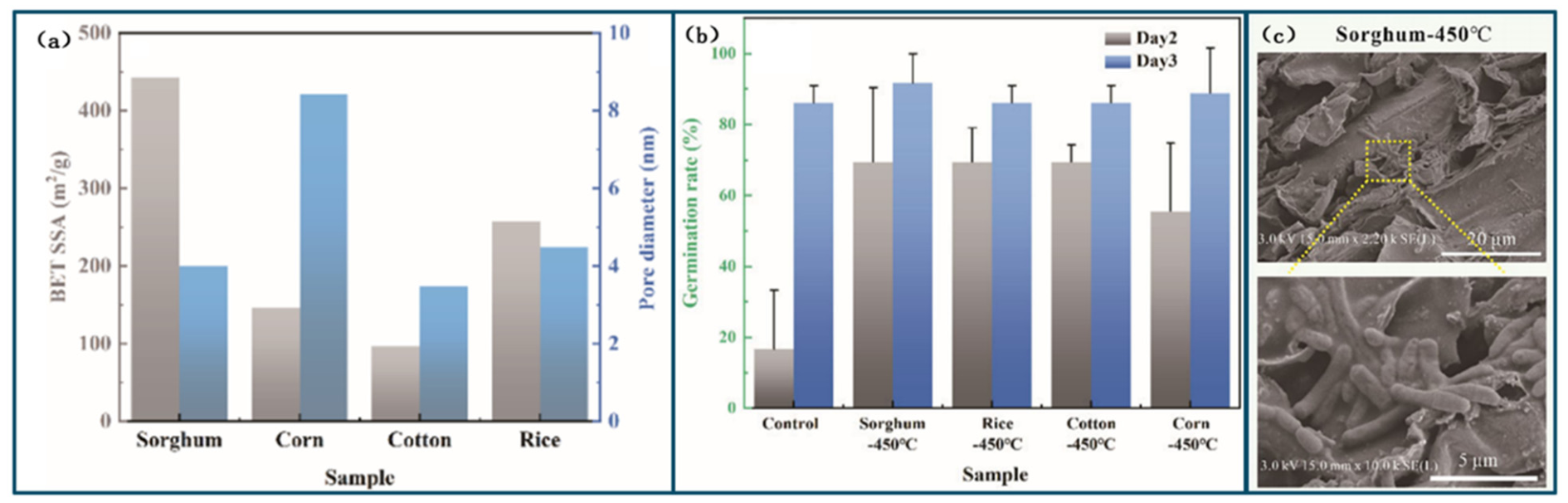
Regarding the characterization of micro-morphology and elemental distribution, Xi et al. [128] used field-emission scanning electron microscopy combined with energy-dispersive X-ray spectroscopy (FESEM/EDS) to examine rice-straw biochar before and after soil application. The original biochar exhibited a rough and porous surface, whereas biochar recovered from soil showed the attachment of fine mineral particles and partial occupation of pore spaces. Elemental analysis further indicated increases in mineral-associated elements, particularly Al and Fe, on the biochar surface after soil application. These observations suggest that biochar can interact with soil minerals through surface attachment and pore filling, potentially influencing soil aggregation, pore characteristics, and nutrient retention. However, these interfacial effects may vary with biochar preparation conditions, soil mineral composition, and field aging processes.
Clay mineral particles mechanically infiltrate and adhere via electrostatic attraction to occupy the biochar pore channels, actively promoting the formation of stable organo-mineral complexes and significantly elevating the mechanical bearing capacity of the medium. Synchronous quantitative EDS analysis further reveals that biochar, relying on its pore-filling effect and surface negative charge sites, exerts intense electrostatic chelation on aluminum and iron ions within the solution. This specific coordination chemical mechanism directly reduces the solution concentration of reactive metal ions, fundamentally alleviating the physiological toxicity of free metal ions in acidic red soils at the physicochemical level [129,130].

4.1.3. Evolution of Surface Electrochemical Characteristics and Ion Adsorption Kinetics

The chemical reactivity of carbonized media at the solid–liquid interface is primarily governed by the abundance of surface-distributed polar oxygen-containing functional groups, such as carboxyl and phenolic hydroxyl groups, as well as the microscopic charge density. The highest treatment temperature constitutes the core thermodynamic parameter controlling these interfacial electrochemical features. Statistical models of physicochemical property evolution constructed via large-scale meta-analysis confirm that within the thermodynamic window of 400 °C to 600 °C, temperature escalation intensely stimulates dehydration and decarbonylation reactions, compelling a substantial reduction in the solid yield of biochar [131]. Accompanying this thermochemical phase transition, the aromaticity of the carbon skeleton undergoes profound polymerization, simultaneously driving a non-linear surge in the exposure density of effective electrochemically active sites. This systemic reconstruction of surface electrochemical attributes endows high-temperature carbonized media with exceptional cation exchange capacity and potent interfacial adsorption potential from a fundamental thermodynamic dimension.
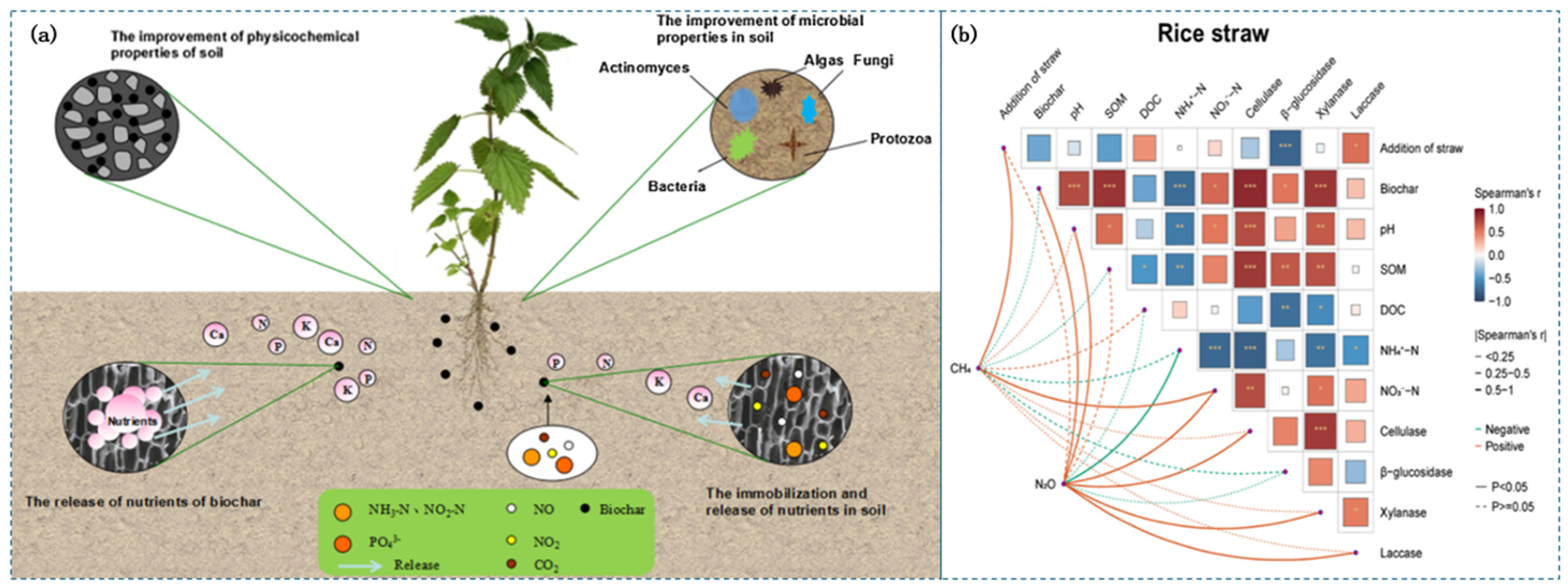
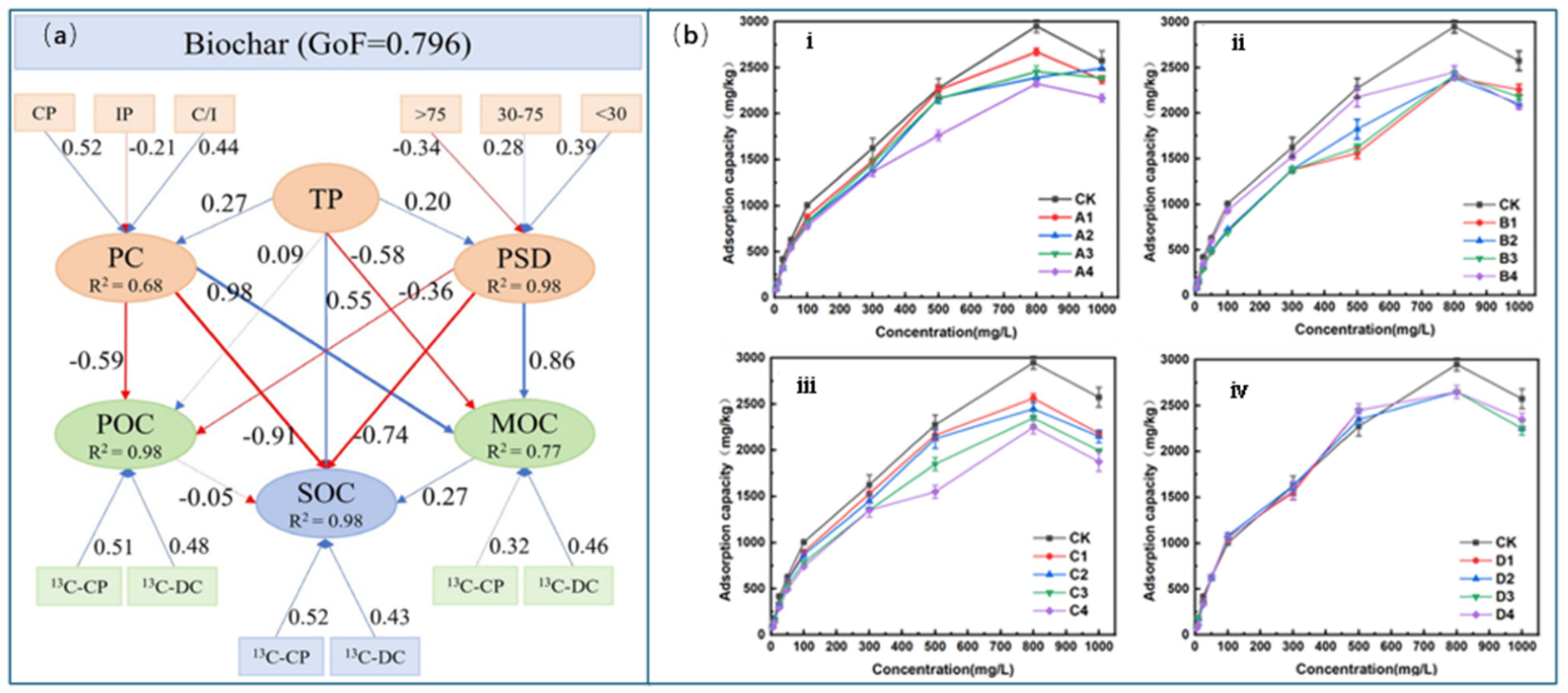
Building upon these interfacial electrochemical characteristics, Ding et al. [132] demonstrated the adsorption–desorption kinetic mechanisms through which biochar regulates soil nutrient availability. The unique surface chemical traits of the carbonaceous medium constitute the biochemical background for reshaping the conventional soil fertility matrix. Ding et al. systematically summarized the multidimensional interactive mechanisms of soil fertility leaps induced by biochar (Figure 8a). The research demonstrates that, driven by the abundance evolution of oxygen-containing functional groups during pyrolysis, the solid-phase surface of biochar exhibits excellent electrochemical activity and cation exchange capacity. This porous and highly charged physicochemical interface efficiently adsorbs and locks easily leached mineral nutrients, including ammonium nitrogen and potassium, successfully achieving a kinetic transition of nutrients from rapid loss to in situ slow release. From a thermodynamic perspective, this specific interfacial chemical mechanism elucidates the intrinsic reasons for biochar reducing the leaching flux of available nutrients and fundamentally elevating fertilizer utilization efficiency throughout the entire crop growth period.

4.1.4. Regulatory Mechanisms of the Carbonized Medium on Micro-Ecosystems and Gaseous Carbon and Nitrogen Fluxes

Upon the introduction of the carbonaceous medium into the soil matrix, its physicochemical specificity acts as an underlying variable, actively intervening in the biochemical degradation kinetic fluxes of subsequent exogenous fresh organic matter. This specific intervention fundamentally shapes the substrate assimilation and energy allocation strategies of the indigenous microbial community [134]. Conducting a 90-day controlled microcosm incubation experiment, Zhang et al. [133] quantitatively assessed the regulatory effects of biochar prepared under varying pyrolysis conditions on the degradation of fresh straw and the evolutionary dynamics of greenhouse gas sources and sinks. Empirical data demonstrate that low-temperature biochar prepared at 300 °C, when incorporated into the soil at a mass fraction of 2.5% to 5.0%, drives a substantial 14.94% to 36.04% increase in the apparent degradation rate of concurrently applied fresh straw. To systematically decode the micro-ecological driving mechanisms behind this accelerated degradation phenomenon, the research constructed a multidimensional Mantel test correlation heatmap mapping environmental factors against biochemical response indicators (Figure 8b). The topological chromatogram of this matrix visually confirms an extremely significant positive coupling correlation between biochar input and soil pH, background abundance of soil organic matter, and extracellular cellulase activity [135]. Target-activated by the physicochemical properties of biochar, this cascading enzymatic network response directly dominates the highly efficient depolymerization of carbohydrates, actively driving a significant escalation in the absolute activity of cellulase.
The characteristic evolution of the carbonaceous medium constitutes a physicochemical reconstruction process strictly controlled by pyrolysis techniques. Thermodynamic parameters, encompassing heating rate, residence time, and highest treatment temperature, precisely establish the aromatized inert carbon skeleton, the three-dimensional hierarchical pore network, and the electrochemically active sites mediating ion exchange within the medium [112]. The systemic evolution of these physicochemical characteristics forms the fundamental basis for biochar functioning as a soil physical habitat remediator and a chemical nutrient reservoir. Distinguished from the singular biomineralization pathway of pristine straw, the carbonaceous medium relies on its high environmental persistence and interfacial chemical tunability, providing robust thermodynamic support for shattering structural compaction and remediating stoichiometric imbalances in degraded agricultural lands.
Synthesizing these comprehensive discussions, the biocharization of straw represents by no means a singular physicochemical phase transition but rather a systemic reprogramming of agricultural carbon cycling trajectories and matrix microhabitats. By inducing the aromatized cross-linking of carbon atomic orbitals, thermochemical intervention decisively truncates the rapid biomineralization pathway from a thermodynamic dimension, establishing a highly stable foundation for long-term carbon pools. Accompanying this thermodynamic evolution, strictly controlled kinetic parameters precisely sculpt a hierarchical pore topological network and high-density charge sites, actively transforming the carbonaceous medium at the microscopic scale into a high-energy interface equipped with targeted interception and chemical locking functionalities. While effectively intercepting mineral nutrient leaching and preventing free heavy metal toxicity, this porous solid–liquid interface systematically reshapes the hydrodynamic distribution and redox gradients within the micro-domain space. This bidirectional synergy of physical impedance and chemical buffering redirects the substrate metabolic fluxes of the micro-ecological community at the chassis level, substantially suppressing the explosive emission of greenhouse gases at the source. Ultimately, these cascading physicochemical and biological responses definitively confirm a core mechanism: the characteristic evolution of the carbonaceous medium constitutes the fundamental material chassis for degraded agricultural lands to achieve structural pore breakthroughs, stoichiometric balance restoration, and micro-ecological low-carbon recovery.

4.2. Reconstruction and Amelioration of the Soil Physicochemical Environment

Compared with direct straw return, biochar return introduces a more stable and recalcitrant carbon matrix produced through thermochemical conversion. Its effects are less dependent on rapid microbial decomposition and are more strongly governed by its intrinsic pore structure, aromatic carbon skeleton, surface functional groups, pH buffering capacity, and adsorption–desorption processes [136,137]. Therefore, biochar regulates degraded soils through both physical pore-based habitat modification and interfacial chemical reactions. This section focuses on biochar-specific mechanisms, including internal pore space, mineral attachment, surface adsorption, long-term carbon stabilization, and rhizosphere physicochemical regulation [138,139,140,141].

4.2.1. Reconstruction of Topological Heterogeneity and Evolution of Microscopic Physical Structural Characteristics

Soil mechanical stability and fluid transport are closely related to the spatial arrangement and pore connectivity of the internal soil matrix [142,143]. However, unlike direct straw return, which improves pore structure mainly through residue incorporation, mechanical loosening, and aggregate formation, biochar regulates soil physical structure through its intrinsic porous carbon skeleton and stable solid–liquid interface. Therefore, the biochar-induced structural effect should be interpreted not only as general pore-network reconstruction but also as a biochar-specific process involving persistent internal pores, rigid carbon frameworks, and biochar–mineral interfaces.
Yang et al. [64] combined high-resolution X-ray computed tomography with 13C stable isotope tracing to visualize the three-dimensional pore evolution and physical protection of organic carbon within dryland macroaggregates amended with straw biochar (Figure 9a). Their results showed that straw biochar promoted pore development and improved pore connectivity within macroaggregates. More importantly, the isotope-based spatial analysis indicated that biochar increased the physical interception and allocation of particulate organic carbon (POC) within the solid phase under equivalent carbon inputs. These findings suggest that biochar improves the hydraulic and gas-diffusion properties of compact soils partly by modifying aggregate-scale pore geometry while also creating stable microsites for organic carbon protection.
Descending from micron-scale aggregates to the nanoscale solid–liquid interface, the topological interaction between three-dimensional biochar pores and indigenous minerals forms the crux of matrix structural evolution analysis. In situ microscopic elucidation via FESEM/EDS verifies the highly heterogeneous physical morphology on the surface of pyrolyzed rice straw biochar [128]. The incorporation of this carbonized matrix into the soil solution initiates an intense dynamic interfacial reorganization. Compelled by the dual forces of mechanical infiltration and electrostatic attraction, liberated inorganic clay particles infiltrate and securely anchor within the internal biochar pore networks. Such an apparent physical “pore clogging” effect fundamentally signifies the in situ assembly of robust organo-mineral complexes. Empowered by dense interfacial cross-linking, this composite substrate systematically upgrades the micro-domain soil’s mechanical shear strength and anti-hydraulic dispersion capacity.
Integrating the aforementioned microscopic mechanisms ranging from the nano-interface to the aggregate scale, Paradelo et al. [61] conducted a macroscopic systemic evaluation regarding the amelioration effects of biochar derived from multi-source agricultural waste. Comprehensive data analysis demonstrates a robust dual physical enhancement. Extending beyond significantly reducing clay bulk density via the volume replacement effect, the complex internal pore network of biochar actively constructs a continuous physical buffering medium within the macroscopic soil body. This cross-scale spatial reshaping definitively establishes the physical boundaries for degraded agricultural lands to recover structural elasticity and fluid transport functionalities.

4.2.2. Electrochemical Reconstruction at the Solid–Liquid Interface and Kinetics of Solute Coordination Impedance

The physical pore network rigorously delineates the hydrodynamic boundaries governing soil solute convection and dispersion. Complementing these structural boundaries, the high-density electrochemically active sites distributed across the surface of the biochar carbon skeleton dictate the partition coefficients and speciation of target ions between the solid and liquid phases via interfacial coordination mechanisms [145,146]. Pyrogenically synthesized polar oxygen-containing functional groups, prominently including carboxyl and lactone groups, fundamentally alter the cation exchange capacity and proton buffering capacity of the soil matrix.
To explore the underlying logic of interfacial chemical mechanisms in reversing fertility decline within degraded habitats, it is urgent to transition from static total quantity calibration to dynamic nutrient release kinetics analysis. In situ thermodynamic characterization of the solid–liquid interface demonstrates that the targeted interception of inorganic nutrients, such as nitrogen, phosphorus, and potassium, by straw biochar is not an irreversible chemical deadlock. Instead, it is governed by highly reversible thermodynamic processes, including surface electrostatic adsorption, ligand exchange, and surface complexation [132]. This electrochemical interfacial interception potently reconstructs the microscopic migration fluxes of solutes. The adsorbed ion pool precisely detects the dynamic concentration gradients of ions within the rhizosphere micro-domain, spontaneously activating a delayed desorption process driven by thermodynamic potential differences. Across both spatial and temporal dimensions, this kinetic mechanism compulsorily anchors the biochemical coupling between substrate nutrient supply fluxes and crop root uptake rates.
The expression intensity of interfacial chemical characteristics is rigidly constrained by the thermodynamic boundaries of matrix synthesis. A statistical model of electrochemical evolution, developed through a large-scale meta-analysis, precisely deconstructs the chemical phase transition trajectory within the 400–600 °C thermodynamic window [131]. The escalation of peak pyrolysis temperatures continuously drives the deep polymerization of the carbon skeleton’s aromaticity. The contraction in the absolute abundance of surface acidic functional groups, induced by intense decarboxylation reactions, is robustly compensated by the non-linear expansion of the absolute specific surface area stimulated by hierarchical pore network development. At the macroscopic system level, this spatial interplay between microscopic physical topology and chemical functional groups endows high-temperature carbonized media with exceptionally potent physicochemical retention efficacy for cations.
This surface coordination-driven retention mechanism exhibits profound consistency in the remediation of extreme chemically polluted habitats. Utilizing pseudo-second-order kinetics and isothermal models, Cui et al. [144] precisely quantified the adsorption and impedance trajectories of straw biochar on soils severely contaminated with high concentrations of fluorine, constructing a non-linear fitting map of isothermal adsorption under various medium interventions (Figure 9b). The apparent fitting curves and chi-square statistical characteristics of this map visually confirm a strict thermodynamic conformity. The fluorine retention process dominated by straw biochar highly aligns with the thermodynamic evolutionary laws of Langmuir monolayer adsorption. Kinetic parameters further demonstrate that straw biochar dominates the chemical adsorption process via rapid ligand exchange reactions, precipitously reducing the effective concentration of free fluorine within the liquid phase. Analyzing the reverse desorption behavior, isothermal model data indicate that the straw biochar intervention group exhibits the lowest apparent desorption capacity and an exceedingly high characteristic desorption constant across all treatment matrices. Constructing a stable chemical barrier from dual thermodynamic and kinetic dimensions, this profound targeted interception capacity systematically suppresses the secondary release risk of adsorbed fluorine ions, ultimately endowing the degraded matrix with maximum fluorine isolation and locking potential.

4.2.3. Molecular Evolution of Humic Substances and Sequestration of the Recalcitrant Carbon Pool Under Long-Term Perturbation

Assessing the effects of soil physical and chemical environment improvements requires a long-term perspective to differentiate short-term physical disturbances from long-term carbon pool changes. Biochar, although not entirely chemically inert in soil, experiences gradual abiotic oxidation and cross-cycle polymerization with native organic substances on its surface. These processes significantly influence the molecular structure evolution of deep humus [147].
Transcending the temporal constraints of short-term simulated disturbances is essential for decoding the fundamental successional logic of biochar carbon sequestration mechanisms. Backed by 15 years of uninterrupted in situ field monitoring, the remodeling impact of prolonged biochar interventions on the basal molecular architecture of carbon sinks possesses profound empirical validation [148]. Integrated with dynamic spectral tracing of humic fractions across distinct aggregate size classes, the effect of long-term biochar integration on the substrate carbon pool fundamentally exceeds the mere physical accumulation of absolute total organic carbon. The 15-year spatiotemporal intervention sharply drives up the spatial distribution proportion of humic acid carbon and highly aromatic structural carbon within macro-aggregates. This extended evolutionary path systematically exposes the dual biochemical traits of high-temperature carbonized substrates: the high-bond-energy aromatic framework inherently repels the degradation mechanisms of extracellular hydrolytic enzymes, while the hyperactive solid–liquid interface strictly directs the matrix’s original DOM into a targeted phase shift toward stable polymers characterized by superior bond energies and intricate three-dimensional molecular topologies.
Broadening the analytical scope to macro-agroecosystem dimensions, a 7-year field baseline evaluation accurately profiles the comprehensive restructuring power of periodic biochar interventions on systemic material flux [149]. The successive cyclic application of this matrix firmly expands the physicochemical frontiers of the recalcitrant carbon pool, directly propelling the absolute carbon sequestration flux of the macroscopic system. Coinciding with the systemic refinement of basal microstructural aeration and the targeted interception of denitrification substrates, this multi-faceted ecological intervention severely dampens the emission pulse magnitude of agricultural greenhouse gases, synchronously securing a stable, long-term upward growth trajectory for crop productivity. This multi-year in situ successional evidence strictly articulates the dual ecological and agricultural synergistic gain mechanisms driven by biochar physicochemical modification from the perspective of underlying system dynamics.

4.2.4. Systemic Responses and Amelioration of the Rhizosphere Microenvironment

Serving as the frontline interface for high-frequency material and energy exchange between crop roots and the soil matrix, the rhizosphere critically mediates plant–soil interactions. The systemic physicochemical reshaping of the macroscopic soil body by biochar ultimately accomplishes its systemic feedback on crop physiological development exclusively through altering the concentration gradients, redox potential, and nutrient availability within this specific rhizosphere micro-domain [150,151,152,153,154,155,156].
In typical highly reducing paddy habitats, overcoming the physicochemical barriers of the subsoil constitutes a core agronomic challenge. Based on a two-year comparative field experiment, the profound reconstructing logic of subsoiling synergized with biochar intervention on the subsoil physicochemical environment is systematically analyzed [157]. The physical spatial occupation of the biochar matrix and its interfacial electrochemical interception synergize robustly, substantially elevating the absolute retention abundance of nitrate and ammonium nitrogen within the initially barren subsoil. The physical unloading of mechanical penetration resistance and the chemical optimization of vertical nutrient gradients collectively propel a rigorous targeted extension of rice roots into deeper profiles. This three-dimensional topological reconstruction of the rhizosphere physicochemical habitat compulsorily transforms the dormant, inefficacious subsoil into a highly active nutrient supply pool, anchoring a substantial surge in rice productivity at the macroscopic scale.
The effects of straw-derived biochar on the rhizosphere are closely related to feedstock-dependent physicochemical properties. Bao et al. [158] showed that biochars produced from sorghum, corn, cotton, and rice straw differed markedly in specific surface area and pore size, with sorghum-straw biochar exhibiting the highest specific surface area at 450 °C (Figure 10a). Biochar extracts also promoted early rapeseed germination (Figure 10b), while SEM observations showed that Pseudomonas parafulva could colonize the biochar surface (Figure 10c). These results suggest that feedstock selection and pyrolysis conditions may influence both the structural characteristics of biochar and its interactions with plants and microorganisms. However, these responses were observed under controlled conditions and require further validation in field soils.
Extending the perspective to highly intensive greenhouse vegetable production networks, the essence of continuous cropping obstacles manifests as the precipitous collapse of the physicochemical habitat within the rhizosphere micro-domain. Based on a systematic evaluation of the intervention efficacy of composite agricultural organic waste on the cabbage rhizosphere, the composite matrix—enriched with highly active DOC and stable three-dimensional hierarchical pores—robustly buffers the severe fluctuations of physicochemical parameters across the rhizosphere profile [159]. This underlying micro-habitat, optimized via targeted interventions, pioneers a highly stable physical colonization space for core beneficial bacterial consortia such as Proteobacteria, forcefully reversing the micro-ecological network imbalance induced by continuous cropping stress from the basal biochemical baseline dimension.
Synthesizing these comprehensive discussions, the reshaping of the physicochemical environment of degraded agricultural lands by straw biochar represents a systematic, multi-coupled process spanning from microscopic nanoscale pore development to the long-term evolution of molecular carbon pools. Current academic progress has decisively broken through the static description of singular apparent parameters, establishing a robust evaluation system based strictly on mechanistic deduction. This mechanistic depth is evidenced across a broad spectrum of phenomena, ranging from the three-dimensional mechanical reconstruction of macroaggregates visualized via X-ray CT technology to the aromatization phase transitions of deep humus confirmed by 15-year continuous experiments. Parallel mechanisms extend from the precise matching of nutrient adsorption–desorption kinetics within the rhizosphere micro-domain to the in situ coordination passivation of toxic heavy metal ions. Multidimensional empirical studies collectively demonstrate a unified conclusion. Relying on its highly controlled porous physical skeleton and interfacial chemical and electrical properties, biochar fundamentally alters the transport kinetic boundaries of soil solutes and gases. Altering these critical boundaries, this intervention provides a cross-disciplinary pathway characterized by high time-scale stability for combating agricultural structural degradation, achieving systemic productivity rejuvenation, and expanding long-term carbon sinks.

4.3. Responses of the Soil Micro-Ecosystem and Community Reconstruction

Biochar return regulates soil micro-ecosystems through mechanisms that differ from the rapid substrate-driven responses caused by direct straw return. Owing to its stable aromatic carbon skeleton, porous structure, charged surface, and pH-buffering capacity, biochar can provide persistent microhabitats for microorganisms and reduce environmental fluctuations in degraded soils [160]. Therefore, the biological effects of biochar are more closely associated with habitat stabilization, pore refuge, redox and pH regulation, long-term microbial network stability, and the stabilization of soil micro-food webs. This section focuses on biochar-specific biological mechanisms, including microbial community succession, co-occurrence network reorganization, metabolic limitation alleviation, and nematode-mediated trophic responses.

4.3.1. Succession Patterns of Microbial Community Diversity and Long-Term Stability

Long-term observations are useful for evaluating whether biochar-induced microbial changes represent temporary fluctuations or persistent community restructuring. Compared with raw straw, biochar decomposes more slowly and can provide more stable microsites for microbial colonization. Therefore, the long-term biological effects of biochar should be interpreted mainly from the perspective of habitat stabilization, pH buffering, and micro-site protection rather than rapid substrate stimulation [103].
At shorter timescales, biochar preparation conditions may shape the initial trajectory of microbial community responses. In a 42-day greenhouse pot experiment, Liu et al. [161] compared maize-straw biochars produced at 300, 450, and 600 °C and applied at rates of 0.5%, 1%, and 2%. Redundancy analysis and variation partitioning analysis indicated that pyrolysis temperature explained more independent variation in bacterial community structure than either application rate or incubation time. The study also showed that pyrolysis temperature altered biochar elemental composition, pH, and pore structure, suggesting that production-dependent physicochemical properties may contribute to differences in bacterial community responses. However, because the experiment was short-term and bacterial communities were characterized using DGGE, these findings should be interpreted as evidence of initial community responses rather than direct evidence of long-term microbial stabilization.
Field observations during the heading stage of winter wheat further showed that biochar addition at 20 t ha−1 improved the soil microhabitat by reducing bulk density and enhancing water retention. These physical changes were associated with increased activities of urease, phosphatase, and catalase in the plow layer [162]. This suggests that biochar may indirectly enhance microbial enzymatic activity by improving the physical and chemical conditions of the soil microhabitat.

4.3.2. Spatial Micro-Site Effects and Topological Reconstruction of Co-Occurrence Networks

At the micro-site scale, the porous structure of biochar can provide protected spaces for microbial colonization and reduce direct exposure to environmental stress. These pores may act as physical refuges and support the formation of localized microbial niches. Focusing on soil macroaggregates, rice straw biochar addition at 1.5% was reported to alter bacterial–fungal co-occurrence networks within aggregates [163]. Increases in network connectivity and modularity suggest that biochar may enhance potential microbial interactions and improve the organization of aggregate-associated microbial communities. This network effect should be understood as a consequence of biochar-derived pore habitats and biochar–mineral interfaces, rather than as a rapid nutrient pulse.
In degraded black soils, Ding et al. [109] reported that biochar-based amendments combined with organic inputs improved microbial network organization and rhizosphere micro-ecological health. This result suggests that biochar may contribute to the recovery of degraded soils by providing colonization sites, improving microhabitat conditions, and enhancing microbial network connectivity. However, when biochar is applied together with manure or other organic materials, the observed effects should be interpreted as a combined amendment response rather than as a biochar-only mechanism.

4.3.3. Metabolic Limitation Alleviation and Functional Gene Responses

At the functional level, biochar can affect soil microbial processes by regulating nutrient transformation pathways and metabolic limitations. In the nitrogen cycle, biochar produced under specific thermal conditions may enrich nitrifying microorganisms such as Nitrospira, thereby influencing nitrification and nitrogen turnover [161]. Metagenomic evidence also suggests that long-term biochar addition can alter the abundance of functional genes related to ammonification and other carbon–nitrogen cycling processes [96].
Ecoenzymatic stoichiometry provides another approach for evaluating microbial metabolic limitation under biochar return [95]. Because biochar can modify soil pH, nutrient availability, and carbon protection, it may alleviate microbial carbon limitation in some degraded soils and shift microbial resource allocation toward nitrogen- or phosphorus-acquiring enzymes. This does not mean that biochar acts as a rapidly available carbon source like raw straw or compost-derived dissolved organic matter. Instead, its effect is mainly mediated by habitat improvement, surface adsorption, nutrient retention, and changes in soil physicochemical conditions.

4.3.4. Cascade Responses of the Micro-Food Web and Stability of Predator Communities

Structural shifts in microbial communities propagate upward along the food chain, actively triggering cascading responses in higher trophic-level organisms. Functioning as apex consumers within the soil micro-food web, nematode communities exhibit response characteristics to biochar intervention that hold profound ecological indicator value. A cross-cycle monitoring study by Zhong et al. [110] meticulously compared two intervention models. Direct return of pristine straw primarily induces the explosive proliferation of low c-p value bacterivorous nematodes via substrate driving. While accelerating nutrient mineralization in the short term, this specific process simultaneously triggers severe oscillations in community structure. From a trophic-regulation perspective, straw-derived amendments influence soil micro-food webs mainly through bottom-up resource control and habitat filtering. Labile carbon inputs first stimulate bacteria and fungi, which then alter the abundance of bacterivorous and fungivorous nematodes. These primary consumers further regulate omnivorous and predatory nematodes, leading to cascading responses across trophic levels. Direct straw return usually produces a rapid substrate pulse and may favor the short-term enrichment of opportunistic bacterivores with low c-p values. In contrast, biochar provides a more stable porous habitat and can buffer environmental fluctuations, which may support higher c-p value nematodes and a more mature food-web structure. Therefore, nematode enrichment, structure, and maturity indices can be used to evaluate whether straw-derived amendments promote a transient nutrient-enrichment pathway or a more stable multi-trophic soil food web.
Compared with direct straw return, biochar return shows stronger habitat-buffering effects. Long-term biochar addition increased total nematode richness and promoted persister taxa with high c-p values. Because high c-p value nematodes are sensitive to disturbance and usually indicate a more stable habitat, their increase suggests that biochar may help the soil micro-food web shift toward a more mature and stable structure [164,165]. In addition to supporting nutrient cycling through the microbial loop, biochar-induced food-web restructuring may also strengthen biological suppression of plant-parasitic nematodes [110,166].
Taken together, biochar affects the soil micro-food web through both resource-mediated and habitat-mediated pathways. Unlike direct straw return, which mainly drives short-term nutrient enrichment through rapid microbial growth, biochar may promote a more stable food-web structure by providing persistent pore habitats, buffering environmental stress, and supporting higher trophic-level organisms. This indicates that the effect of biochar on soil biological functions should be evaluated not only by microbial abundance or diversity but also by trophic indicators such as nematode maturity, enrichment, and structure indices [160,167,168].
Similar trophic responses have been reported in studies linking organic amendments with nematode maturity, enrichment, and structure indices, suggesting that the micro-food-web response to straw-derived amendments should be interpreted through multiple trophic indicators rather than through a single taxonomic group or one experimental dataset [110,164,165,166].

5. Straw Composting Return: Pre-Composting-Driven Nutrient Unlocking and Microbial Network Reconstruction

Transitioning from direct return at the physical dimension and carbonaceous reconstruction at the thermochemical dimension, an additional core pathway for straw resource utilization targets biological ex situ pre-treatment, specifically the composting process. The direct incorporation of pristine straw into the soil frequently encounters profound agronomic dilemmas, encompassing carbon-nitrogen (C/N) ratio imbalances [169], sluggish initial decomposition, and the potential triggering of competition with crops for available nitrogen [170]. Conducted under strictly controlled conditions, composting fermentation fundamentally constitutes an artificially intervened, accelerated humification process. Driven by the highly efficient metabolism of aerobic microbial consortia, the inherently rigid lignocellulosic skeleton undergoes profound structural pre-deconstruction, translating into a highly reactive medium characterized by an equilibrated C/N ratio, abundant DOM, and an extensive array of beneficial metabolic products. Upon introduction into agricultural fields, this pre-decomposed organic material actively triggers fundamental chemical deconstruction and micro-ecological niche reorganization within the underlying soil matrix [171,172,173].

5.1. Comprehensive Amelioration of Soil Physicochemical Properties

Raw straw return is often limited by its high C/N ratio and the slow degradation of lignocellulose. In contrast to raw straw and biochar, composted straw is a biologically pre-treated matrix with a lower C/N ratio, higher dissolved organic matter (DOM) availability, and enriched humic substances. Through aerobic fermentation, composting partially decomposes lignin and cellulose and converts part of the straw biomass into dissolved organic carbon (DOC), humic acids, and other reactive organic compounds. Therefore, compost return usually leads to faster nutrient release and stronger short-term microbial activation. Upon application to agricultural soils, these reactive materials can improve soil physical structure and increase the availability of nutrients bound to mineral phases [170,171]. This section discusses the effects of compost return on three aspects: soil physical structure, nutrient release, and the dynamics of active carbon pools.

5.1.1. Reconstruction of Soil Physical and Mechanical Properties and Hydrological Regulation Driven by Pre-Composted Materials

The evolution of the soil physical structure is directly governed by the input of organic cementing materials. Distinguished from the coarse physical skeleton formed by direct return, composting products possess smaller particle sizes and more abundant surface charges. Their function within the soil matrix primarily manifests as aggregate stabilization and volume expansion at the microscopic level. Aiming to quantify the impact of organic amendments on the physical and mechanical properties of extremely compact soils, the introduction of the artificial neural network (ANN) algorithm into agricultural soil physical assessment [72] effectively overcomes the limitations of traditional linear models in processing multidimensional non-linear parameters. Within severely degraded calcareous clays, the computational results of the ANN model regarding macroaggregate stability (MAS), soil bulk density (Pb), penetration resistance (PR), and modulus of rupture (MR) confirm a critical mechanism. The high-dose application of corn compost significantly reduces the modulus of rupture and root penetration mechanical resistance of the soil by enhancing the cation bridging effect. Extending beyond ameliorating the vertical distribution space for crop roots, this fundamental softening of physical and mechanical characteristics significantly elevates the water use efficiency (WUE) of the system at the field scale.
While altering mechanical resistance, the optimization of physical structures profoundly impacts the hydrological cycling pathways of the surface. By altering the thermodynamic boundary conditions at the soil-atmosphere interface, surface mulching models trigger a series of hydrological cascading effects [174]. Targeting controlled greenhouse habitats, specific research evaluated the functional mechanisms of semi-decomposed rice straw serving as a surface mulch [175]. The research demonstrates that, by constructing a mulching layer equipped with physical thermal insulation properties, these materials suppress temperature fluctuations in the topsoil and curtail the ineffective flux of water evaporation toward the surface, actively elevating the water-holding capacity of deep profiles. At the physicochemical level, under the leaching of rainfall and irrigation, the semi-decomposed mulching layer slowly and continuously transports massive amounts of organic matter and available nutrients to the rhizosphere [113]. Concurrently, by substantially restricting light penetration via a shading effect at the spatial scale, this layer strictly inhibits the germination and growth of weeds [176]. Aiming to systematically quantify the causal correlations between various agronomic traits and micro-ecological physicochemical indicators under this three-dimensional intervention, the study constructed a matrix correlation heatmap of multidimensional variables (Figure 11E). The chromatographic distribution of this topological matrix visually reveals that the enrichment of SOC and exchangeable potassium (Soil-Kex) driven by semi-decomposed rice straw exhibits an extremely significant positive coupling correlation with the photosynthetic rate (Pn), fruit morphological characteristics, and final total yield of the crops. The intense negative correlation characteristics characterizing total yield against weed density and fresh/dry biomass within the matrix further confirm a core logic. Combining surface impedance with vertical infiltration nourishment, this composite model accomplishes the competitive disadvantage of weeds and the maximization of crop metabolic fluxes from the underlying logic, ultimately translating into the synergistic enhancement of the yield and quality of target crops.

5.1.2. Targeted Unlocking of Occluded Inert Nutrients and Their Chemically Effective Release

While the amelioration of physical structures establishes critical pore channels for nutrient transport, further breakthroughs in productivity fundamentally depend on the chemical activation of occluded nutrients. Within long-term intensive cropping systems, exogenously applied nutrients, prominently including phosphorus (P) and potassium (K), are highly susceptible to binding with aluminum, iron, and calcium ions in the soil, forming extremely insoluble occluded complexes [178]. Abundant humus and secondary metabolites within composting products supply a profound driving force to shatter this chemical lock-in via coordination chemical mechanisms [179,180]. Targeting high-intensity wheat-corn double-cropping systems, Chen et al. [73] tracked the biogeochemical effects following the combined composting of straw and manure. Empirical research confirms that the critical biochemical logic of the combined composting treatment lies in introducing massive quantities of DOM equipped with intense coordination and complexation capabilities into the soil matrix. Actively attacking mineral surfaces, these highly reactive chelating agents accelerate the bioavailability processes of occluded phosphorus and potassium. Translating inert nutrients sequestered in mineral-bound states into free states highly absorbable by plants, this precise chemical activation fundamentally safeguards the nutrient supply equilibrium of high-yield systems.
The aforementioned phosphorus release mechanisms based on complexation and desorption exhibit profound environmental universality within severely chemically weathered soils. Under typical highly weathered habitats such as tropical Ultisols, massively enriched free aluminum and iron oxides within the matrix constitute an intense coordination and fixation stress on reactive phosphorus. Quantitatively verifying the biochemical driving force of straw compost in shattering this chemical lock-in constraint, Kasifah et al. [177] constructed a spatiotemporal evolutionary kinetic map detailing occluded phosphorus components against available phosphorus release (Figure 11A–D). The desorption curves of this map visually deconstruct the underlying thermodynamic processes of ion exchange reactions. Relying on high-density reactive groups, macromolecular humic acids abundant within the liquid phase of corn straw compost directly intervene and powerfully dismantle complex precipitation structures, specifically including aluminum-phosphorus (Al-P), iron-phosphorus (Fe-P), and calcium-phosphorus (Ca-P) complexes. The downward trajectory characterizing insoluble components within the map confirms that this intense chemical chelation reaction drives a substantial 67.35% reduction in the fixed quantity of recalcitrant calcium-bound phosphorus. Accompanying the systemic disintegration of insoluble mineral structures, the upward curve of available phosphorus exhibits a targeted expansion of nearly 10-fold. Definitively confirming from a kinetic dimension, these desorption characteristics based on multiple coordination reactions demonstrate that pre-decomposed straw materials systematically breach the initial chemical limitations of the soil parent material. Successfully bypassing these constraints, this intervention provides robust physicochemical mechanism support for implementing in situ targeted remediation strategies, characterized by “mobilizing phosphorus via carbon,” in degraded habitats.

5.1.3. Rapid Replenishment of the Active Organic Carbon Pool and Reorientation of Humification Pathways

The chemical unlocking of occluded nutrients strongly correlates with microbial metabolic activity. This dynamic biological process is intrinsically governed by the turnover of SOC fractions. Active soil carbon pools, prominently including DOC and POC, constitute the critical substrates driving short-term biogeochemical cycling. Distinguished from the protracted biochemical decomposition cycle inherent in direct return, composting return achieves the instantaneous replenishment of the active carbon pool [181,182]. Investigating the priming effect induced by the input of highly reactive organic matter on intrinsic SOC, Cai et al. [82] conducted an extensive empirical study. Empirical data demonstrate that pre-decomposed materials rapidly replenish the DOC pool within the liquid phase. Actively alleviating the carbon starvation state of indigenous microorganisms, this instantaneous supply provides abundant energy substrates for the synthesis of extracellular hydrolytic enzymes. This biochemical cascade actively triggers the cascading mineralization of nutrients, ultimately elevating the short-term fertilizer supply capacity of the system.
The steady-state maintenance of long-term carbon sequestration takes deep root in the fundamental reshaping of the evolutionary trajectory of soil humification. Transcending a mere absolute quantitative superposition of carbon pools, the continuous input of exogenous pre-decomposed substances directly reconstructs the assembly trajectories of humus molecules. Relying on spectroscopic and micro-ecoenzymatic methodologies, cross-background habitat profiling definitively confirms a profound mechanism [93]. The driving intensity of straw compost concerning the polymerization of highly active humic substances and the stimulation of key biochemical enzymes substantially surpasses the physicochemical boundaries imposed by inherent soil types. Relying on its pre-polymerized precursor carbon skeleton, pre-decomposed materials exhibit an immense cross-medium reshaping capacity, forcibly directing highly heterogeneous matrices, such as sandy and clay soils, to undergo convergent structural evolution toward high porosity, robust acid-base buffering capacity, and elevated metabolic activity. Governed by the intervention of highly reactive substrates, this directional succession fundamentally elevates the biogeochemical baseline of agricultural ecosystems.

5.2. Regulation of Soil Biological Communities and Microecological Functions

Soil biological communities, including microorganisms and microfauna, play central roles in nutrient cycling and ecological function maintenance in agricultural soils [168]. As a biological ex situ pretreatment pathway, compost return affects soil biological communities through both substrate supply and microbial inoculation. Unlike direct straw return, which often causes short-term microbial fluctuations during early decomposition, compost return can more rapidly reshape the rhizosphere microbial community because it supplies active dissolved organic matter (DOM), humic substances, and fermentation-derived microbial consortia. These inputs provide readily available carbon sources, promote beneficial microbial recruitment, and may enhance the activity of microorganisms involved in carbon and nitrogen cycling. This section focuses on compost-specific biological mechanisms, including rhizosphere microbial recruitment, microbial network reorganization, functional gene activation, pathogen suppression, and root–soil–microbe interactions.

5.2.1. Targeted Reshaping of Rhizosphere Core Microbial Communities

The crop rhizosphere is a key interface for nutrient exchange and microbial recruitment between roots and soil [183]. After composted straw is applied to soil, compost-derived DOM, humic substances, organic acids, and fermentation-associated microorganisms can alter rhizosphere nutrient gradients and provide substrates for microbial growth. These changes may promote the recruitment of beneficial microbial taxa and reshape the rhizosphere community structure [179].
A high-throughput sequencing study evaluated the effects of agricultural waste composts containing corn straw on the cabbage rhizosphere microbial community [159]. The stacked bar plots and Circos diagrams showed clear shifts in bacterial and fungal community composition at the phylum level (Figure 12). Compared with the unfertilized control, selected compost treatments increased the relative abundances of nutrient-responsive and residue-degrading groups, including Proteobacteria, Actinobacteria, and Firmicutes, while reducing the proportion of Acidobacteria. For fungi, compost treatments also changed the relative abundances of Ascomycota, Basidiomycota, Olpidiomycota, and Mortierellomycota. These results indicate that compost return can rapidly reshape rhizosphere microbial communities by supplying active organic substrates and microbial inocula.
In degraded Mollisols, Ding et al. [109] reported that the combined application of straw-derived organic materials and animal manure altered microbial community composition and enriched functional taxa related to nutrient cycling, including Massilia and Sphingomonas. These taxa may contribute to soil aggregation and nutrient transformation through extracellular polymeric substances and other microbial metabolites. However, because this treatment involved combined organic inputs, the observed response should be interpreted as a compost- or organic-amendment-driven rhizosphere recovery process rather than as the effect of compost alone.
Similar increases in copiotrophic, residue-degrading, and nutrient-cycling microbial groups have also been reported under different compost and organic fertilizer systems [109,159,179]. Therefore, the conclusion that compost return reshapes rhizosphere microbial communities should be understood as a cross-validated pattern driven by active substrate supply, humic substances, and microbial inoculation, rather than as a result derived from a single compost experiment.

5.2.2. Microbial Network Reorganization and Rhizosphere Resilience

Via complex interactions prominently encompassing metabolite cross-feeding and antagonistic competition, soil microorganisms actively construct highly non-linear co-occurrence networks. Profoundly altering the availability of matrix nutrients, the pulsed input of composting products directly reshapes the topological characteristics of this micro-ecological network [184]. Relying on the quantitative evaluation of network topological analysis tools, empirical evidence confirms that the combined intervention of straw and manure significantly elevates the node degree and modularity of bacterial and fungal co-occurrence networks [109]. This definitive leap in network complexity confirms that pre-decomposed materials forcefully drive the tight consolidation of metabolic collaborative relationships among microorganisms across distinct trophic levels. Constructing robust ecological niche redundancy, this highly interconnected topological structure effectively absorbs and buffers physicochemical perturbations triggered by drought or sudden temperature shifts, substantially enhancing the ecological resilience of the agricultural system.
Introducing the metabolic limitation theory enables a precise resolution of the underlying driving forces behind this network evolution from the dimension of energy flow [95]. Under the chronic stress of long-term, high-intensity, intensive production, microbial communities universally descend into a severe state of metabolic carbon limitation. This pervasive energetic deficit actively triggers the systemic atrophy of the micro-ecological network. Functioning as exogenous high-energy substrates, the abundant DOC within composting products precisely breaks this metabolic restriction. The rapid repletion of the carbon supply actively resets the internal energy flow rates of microorganisms, synergistically driving the high-throughput turnover of limiting nutrients, prominently including inorganic nitrogen and phosphorus, within the system. Governed by the intervention of highly reactive substrates, this micro-ecological network resuscitation directly maps onto a comprehensive surge in ecosystem multifunctionality at the macroscopic ecosystem scale [179].

5.2.3. Functional Gene Regulation and Nutrient-Cycling Processes

Changes in microbial community composition and network structure can further affect functional genes related to carbon and nitrogen cycling. Metagenomic analyses provide evidence that straw-derived organic amendments combined with functional microbial fertilizers can regulate genes involved in ammonification, nitrification, denitrification, and organic matter decomposition [96]. In particular, the upregulation of genes related to ammonification may accelerate the conversion of organic nitrogen into ammonium nitrogen, thereby improving soil nutrient availability. Compost-derived DOM, humic substances, and microbial consortia may also influence redox conditions and microbial metabolic pathways in the rhizosphere. By supplying active carbon and promoting microbial activity, compost return can enhance nutrient mineralization and improve soil biochemical functioning. However, these effects should be distinguished from biochar-mediated microbial regulation, which is mainly associated with stable pore habitats, adsorption interfaces, and physicochemical buffering. In compost return, the dominant mechanism is rapid biological activation through active organic substrates and microbial inoculation. Overall, compost return regulates soil biological communities mainly through active substrate supply and microbial inoculation. Compost-derived DOM, humic substances, and fermentation-associated microorganisms promote rhizosphere microbial recruitment, enhance microbial network organization, and regulate functional genes involved in nutrient cycling. Compared with direct straw return, compost usually produces faster biological activation because part of the straw biomass has already been decomposed during fermentation. Compared with biochar, compost has weaker long-term structural stability but stronger short-term effects on microbial recruitment and nutrient mineralization. Therefore, compost return is particularly suitable for degraded soils that require rapid fertility recovery and rhizosphere biological activation.
Based on the pathway-specific mechanisms discussed above, the integrated conceptual model of the three straw-returning pathways and their contributions to soil multifunctionality is summarized in Figure 13.

6. Conclusions and Perspectives

6.1. Conclusions

Overall, the three straw-return strategies improve soil multifunctionality through different but complementary pathways. Direct straw return mainly improves soil physical structure and provides short-term labile carbon. Biochar return contributes to long-term carbon stabilization and interfacial adsorption. Compost return rapidly enhances nutrient availability and microbial activity. Therefore, the agronomic value of each strategy depends on matching its matrix properties with specific soil constraints. (1) Direct straw return: Direct straw return is most effective in improving compacted soils, especially when combined with subsoiling or conservation tillage. The fibrous structure of raw straw helps reduce soil bulk density, increase pore connectivity, and promote the formation of water-stable aggregates [63,67,84,105]. These changes improve water infiltration, gas exchange, and root growth. However, raw straw usually has a high C/N ratio and decomposes slowly, which may cause short-term nitrogen immobilization and microbial fluctuation. Therefore, direct straw return is more suitable for compacted soils, water-conservation systems, and fields where mechanical loosening is needed.
(2) Straw biochar return: Compared with raw straw, biochar provides a more stable carbon matrix because of its aromatic carbon structure, porous surface, and charged functional groups. These properties allow biochar to improve nutrient retention, buffer soil pH, reduce heavy-metal mobility, and support long-term soil organic carbon stabilization [92,149]. Biochar return is particularly useful in acidic soils, saline-alkali soils, heavy-metal-stressed soils, and systems aiming at long-term carbon sequestration. However, its effects strongly depend on feedstock type, pyrolysis temperature, application rate, and soil background. Excessive or unsuitable biochar application may also reduce nutrient availability in the short term.
(3) Straw compost return: Compost return differs from both raw straw and biochar because it introduces a biologically pre-treated organic matrix with a lower C/N ratio, abundant dissolved organic matter, humic substances, and fermentation-derived microorganisms. These characteristics allow compost to release nutrients more rapidly, increase phosphorus and potassium availability, stimulate microbial activity, and improve rhizosphere functions [159]. Compost return is therefore suitable for nutrient-deficient soils, greenhouse production systems, and degraded rhizospheres that require rapid fertility improvement. However, compost quality must be carefully controlled. Immature compost may introduce salinity, pathogens, or unstable organic compounds, which can weaken its agronomic benefits.
Taken together, direct straw return, biochar return, and compost return should not be regarded as interchangeable practices. Direct straw return is mainly a physical-structural amendment, biochar is mainly a stable carbon and adsorption amendment, and compost is mainly a rapid nutrient and biological amendment. Future straw management should therefore shift from a single “return-to-field” approach to a soil-specific strategy based on amendment properties, soil degradation type, and targeted soil multifunctionality.

6.2. Future Perspectives

Although substantial progress has been made in understanding how straw return affects soil structure, nutrient cycling, carbon stabilization, and microbial communities, several research gaps remain. Future studies should move from general descriptions of straw-return effects toward more quantitative, predictive, and soil-specific management frameworks.
(1) Development of cross-scale predictive models with defined input and output variables: Current studies still rely heavily on single soil indicators or single-omics datasets, which limits their ability to predict the long-term effects of straw-return strategies across different soil types and climates. Future models should integrate machine learning approaches, such as artificial neural networks, random forests, and graph neural networks, with field experiments and multi-omics datasets. The input variables should include amendment properties, soil background conditions, and biological indicators. Amendment-related variables may include straw particle size, C/N ratio, lignin/cellulose ratio, return depth, biochar pyrolysis temperature, specific surface area, pH, cation exchange capacity, and compost maturity index. Soil background variables should include soil texture, pH, SOC, TN, TP, CEC, bulk density, water content, and aggregate stability. Biological inputs may include microbial alpha diversity, microbial co-occurrence network complexity, functional genes involved in C/N/P cycling, and enzyme activities such as β-glucosidase, N-acetyl-glucosaminidase, and phosphatase. The predicted outputs should include SOC sequestration potential, nitrogen mineralization or leaching risk, greenhouse gas emissions, crop yield, cost–benefit performance, and the soil multifunctionality index. Such models could be used to recommend site-specific straw-return strategies, for example, selecting direct straw return for compacted soils, biochar for acidic or heavy-metal-stressed soils, and compost for nutrient-deficient or degraded rhizosphere soils.
(2) Climate change is increasing the frequency of drought, flooding, heat stress, and freeze–thaw events in agricultural systems. These extreme conditions can strongly alter straw decomposition, nutrient release, microbial activity, and greenhouse gas emissions. Therefore, future studies should move beyond normal field conditions and evaluate how different straw-return strategies perform under climate stress. Direct straw return may improve water retention and reduce soil temperature fluctuations, but its decomposition rate and nitrogen immobilization may become more unstable under drought or excessive rainfall. Biochar may enhance soil water-holding capacity, improve pH buffering, and reduce nutrient leaching, making it potentially useful under drought, salinity, and heavy-rainfall conditions. Compost return can rapidly supply available nutrients and active organic matter, but its effects may be shortened under high temperature or intense leaching conditions. Future experiments should therefore compare direct straw return, biochar return, and compost return under controlled drought, flooding, warming, and freeze–thaw scenarios. Key indicators should include soil moisture, aggregate stability, SOC fractions, nitrogen transformation rates, enzyme activities, microbial community stability, greenhouse gas emissions, and crop resilience. Such studies will help clarify which straw-return strategy is most suitable for maintaining soil multifunctionality under specific climate risks.
(3) Future straw management should shift from a single return practice to soil-specific combined strategies. Because direct straw return, biochar return, and compost return have different matrix properties and response times, their combined use may provide complementary benefits. For compacted soils, direct straw return combined with subsoiling can improve pore structure and root penetration. For acidic, saline-alkali, or heavy-metal-stressed soils, biochar can be combined with straw or compost to enhance pH buffering, nutrient retention, and pollutant immobilization. For nutrient-deficient or degraded rhizosphere soils, compost return can be used to rapidly increase available nutrients, dissolved organic matter, and microbial activity. In practice, the selection of straw-return strategies should be based on soil constraints, amendment properties, crop demand, and the targeted soil functions. Future research should further optimize combined application rates, timing, placement depth, and interactions with mineral fertilizers. Long-term field trials are especially needed to determine whether combined strategies can simultaneously improve crop yield, SOC sequestration, nutrient-use efficiency, microbial stability, and soil multifunctionality. This soil-specific approach will support the transition from generalized straw recycling to precise and climate-resilient straw management.
(4) Beyond predictive modeling, future research should move toward a mechanism-guided design of straw-derived amendments. Instead of applying raw straw, biochar, or compost as fixed materials, future studies could engineer amendment properties according to target soil constraints. For example, biochar can be designed with specific pore size distribution, surface charge, or mineral loading to improve nutrient retention or heavy-metal immobilization. Compost can be developed as a carrier for beneficial microbial consortia to enhance pathogen suppression, phosphorus mobilization, or nitrogen transformation. In addition, synthetic rhizosphere microbiomes could be combined with straw-derived substrates to test whether designed microbial functions can be maintained under field conditions. This direction would shift straw management from passive residue recycling toward active design of soil functions.

Author Contributions

Conceptualization, C.Z. and G.L.; methodology, J.S.; literature search and data curation, C.Z. and T.Y.; writing—original draft preparation, C.Z.; writing—review and editing, Z.T.; supervision, X.L.; funding acquisition, W.Z. All authors have read and agreed to the published version of the manuscript.

Funding

This research was funded by the Modern Agricultural Machinery Equipment and Technology Promotion Project of Jiangsu Province (NJ2025-16) and the Science and Technology Plan Project of Inner Mongolia Autonomous Region (2025YFDZ0033).

Institutional Review Board Statement

Not applicable.

Informed Consent Statement

Not applicable.

Data Availability Statement

No new datasets were generated in this study. All information analyzed in this review was derived from publicly available literature indexed in the Web of Science Core Collection and CNKI.

Acknowledgments

The authors express their sincere gratitude for the valuable technical support and resources that contributed to this research.

Conflicts of Interest

The authors declare no conflicts of interest.

References

  1. Banerjee, S.; Walder, F.; Büchi, L.; Meyer, M.; Held, A.Y.; Gattinger, A.; Keller, T.; Charles, R.; van der Heijden, M.G.A. Agricultural intensification reduces microbial network complexity and the abundance of keystone taxa in roots. Isme J. 2019, 13, 1722–1736. [Google Scholar] [CrossRef] [PubMed]
  2. Kopittke, P.M.; Menzies, N.W.; Wang, P.; McKenna, B.A.; Lombi, E. Soil and the intensification of agriculture for global food security. Environ. Int. 2019, 132, 105078. [Google Scholar] [CrossRef] [PubMed]
  3. Amundson, R.; Berhe, A.A.; Hopmans, J.W.; Olson, C.; Sztein, A.E.; Sparks, D.L. Soil and human security in the 21st century. Science 2015, 348, 1261071. [Google Scholar] [CrossRef] [PubMed]
  4. Ali, A.B.; Elshaikh, N.A.; Hong, L.; Adam, A.B.; Yan, H.F. Conservation tillage as an approach to enhance crops water use efficiency. Acta Agric. Scand. Sect. B-Soil Plant Sci. 2017, 67, 252–262. [Google Scholar]
  5. Blanco-Canqui, H.; Lal, R. Crop Residue Removal Impacts on Soil Productivity and Environmental Quality. Crit. Rev. Plant Sci. 2009, 28, 139–163. [Google Scholar] [CrossRef]
  6. Lehtinen, T.; Schlatter, N.; Baumgarten, A.; Bechini, L.; Krüger, J.; Grignani, C.; Zavattaro, L.; Costamagna, C.; Spiegel, H. Effect of crop residue incorporation on soil organic carbon and greenhouse gas emissions in European agricultural soils. Soil Use Manag. 2014, 30, 524–538. [Google Scholar] [CrossRef]
  7. Maqbool, Z.; Farooq, M.S.; Rafiq, A.; Uzair, M.; Hussain, Q. Utilisation of Climate-Smart Conservation Agriculture Practices for Improved Soil Carbon Sequestration, Greenhouse Gas Mitigation and Sustainable Crop Productivity. Soil Use Manag. 2025, 41, e70103. [Google Scholar] [CrossRef]
  8. Wang, X.W.; Zheng, Z.; Jia, W.D.; Tai, K.L.; Xu, Y.J.; He, Y.M. Response Mechanism and Evolution Trend of Carbon Effect in the Farmland Ecosystem of the Middle and Lower Reaches of the Yangtze River. Agronomy 2024, 14, 2354. [Google Scholar] [CrossRef]
  9. Fu, B.; Chen, L.; Huang, H.Y.; Qu, P.; Wei, Z.G. Impacts of crop residues on soil health: A review. Environ. Pollut. Bioavailab. 2021, 33, 164–173. [Google Scholar] [CrossRef]
  10. Kuzyakov, Y.; Friedel, J.K.; Stahr, K. Review of mechanisms and quantification of priming effects. Soil Biol. Biochem. 2000, 32, 1485–1498. [Google Scholar] [CrossRef]
  11. Memon, M.S.; Chen, S.R.; Niu, Y.X.; Zhou, W.W.; Elsherbiny, O.; Liang, R.Z.; Du, Z.Q.; Guo, X.H. Evaluating the Efficacy of Sentinel-2B and Landsat-8 for Estimating and Mapping Wheat Straw Cover in Rice-Wheat Fields. Agronomy 2023, 13, 2691. [Google Scholar] [CrossRef]
  12. Agegnehu, G.; Bird, M.I.; Nelson, P.N.; Bass, A.M. The ameliorating effects of biochar and compost on soil quality and plant growth on a Ferralsol. Soil Res. 2015, 53, 1–12. [Google Scholar] [CrossRef]
  13. Liyanage, L.; Sulaiman, M.F.; Ismail, R.; Gunaratne, G.P.; Dharmakeerthi, R.S.; Rupasinghe, M.G.N.; Mayakaduwa, A.P.; Hanafi, M.M. Carbon Mineralization Dynamics of Organic Materials and Their Usage in the Restoration of Degraded Tropical Tea-Growing Soil. Agronomy 2021, 11, 1191. [Google Scholar] [CrossRef]
  14. Yu, H.W.; Zou, W.X.; Chen, J.J.; Chen, H.; Yu, Z.B.; Huang, J.; Tang, H.R.; Wei, X.Y.; Gao, B. Biochar amendment improves crop production in problem soils: A review. J. Environ. Manag. 2019, 232, 8–21. [Google Scholar] [CrossRef]
  15. Baveye, P.C.; Otten, W.; Kravchenko, A.; Balseiro-Romero, M.; Beckers, É.; Chalhoub, M.; Darnault, C.; Eickhorst, T.; Garnier, P.; Hapca, S.; et al. Emergent Properties of Microbial Activity in Heterogeneous Soil Microenvironments: Different Research Approaches Are Slowly Converging, Yet Major Challenges Remain. Front. Microbiol. 2018, 9, 1929. [Google Scholar] [CrossRef] [PubMed]
  16. Tsolis, V.; Barouchas, P. Biochar as Soil Amendment: The Effect of Biochar on Soil Properties Using VIS-NIR Diffuse Reflectance Spectroscopy, Biochar Aging and Soil Microbiology—A Review. Land 2023, 12, 1580. [Google Scholar] [CrossRef]
  17. Rillig, M.C.; Ryo, M.; Lehmann, A.; Aguilar-Trigueros, C.A.; Buchert, S.; Wulf, A.; Iwasaki, A.; Roy, J.; Yang, G.W. The role of multiple global change factors in driving soil functions and microbial biodiversity. Science 2019, 366, 886–890. [Google Scholar] [CrossRef] [PubMed]
  18. Zanutel, M.; Garré, S.; Sanglier, P.; Bielders, C. Biochar modifies soil physical properties mostly through changes in soil structure rather than through its internal porosity. Vadose Zone J. 2024, 23, e20301. [Google Scholar]
  19. Peth, S.; Horn, R.; Beckmann, F.; Donath, T.; Fischer, J.; Smucker, A.J.M. Three-dimensional quantification of intra-aggregate pore-space features using synchrotron-radiation-based microtomography. Soil Sci. Soc. Am. J. 2008, 72, 897–907. [Google Scholar] [CrossRef]
  20. Xie, N.H.; Fan, Y.C.; Duan, N.; Yang, L.; Radosevich, M.; Zhang, Y.; Wang, Y.F.; Wang, J.K.; Liang, X.L. Interactive effects of straw and biochar amendments on soil organic carbon stabilization and bacterial community dynamics. Biol. Fertil. Soils 2025, 61, 1423–1437. [Google Scholar] [CrossRef]
  21. Shi, R.Y.; Ni, N.; Nkoh, J.N.; Dong, Y.; Zhao, W.R.; Pan, X.Y.; Li, J.Y.; Xu, R.K.; Qian, W. Biochar retards Al toxicity to maize (Zea mays L.) during soil acidification: The effects and mechanisms. Sci. Total Environ. 2020, 719, 137448. [Google Scholar] [CrossRef] [PubMed]
  22. Yan, K.; Wang, B.B.; Zhang, Z.L.; Lin, R.Q.; Li, X.R.; Lu, D.S.; Han, W.H.; Wang, Y.; Li, Z.Y.; Wang, Q.T.; et al. Positive biotic associations of microorganisms promote metabolic efficiency to drive organic carbon stabilization in saline soils. Geoderma 2026, 469, 117819. [Google Scholar] [CrossRef]
  23. Wagg, C.; Schlaeppi, K.; Banerjee, S.; Kuramae, E.E.; van der Heijden, M.G.A. Fungal-bacterial diversity and microbiome complexity predict ecosystem functioning. Nat. Commun. 2019, 10, 4841. [Google Scholar] [CrossRef] [PubMed]
  24. Morriën, E.; Hannula, S.E.; Snoek, L.B.; Helmsing, N.R.; Zweers, H.; de Hollander, M.; Soto, R.L.; Bouffaud, M.L.; Buée, M.; Dimmers, W.; et al. Soil networks become more connected and take up more carbon as nature restoration progresses. Nat. Commun. 2017, 8, 14349. [Google Scholar] [CrossRef] [PubMed]
  25. Xiong, C.; Lu, Y.H. Microbiomes in agroecosystem: Diversity, function and assembly mechanisms. Environ. Microbiol. Rep. 2022, 14, 833–849. [Google Scholar] [CrossRef] [PubMed]
  26. Kladivko, E.J. Tillage systems and soil ecology. Soil Tillage Res. 2001, 61, 61–76. [Google Scholar] [CrossRef]
  27. Rasool, G.; Guo, X.P.; Wang, Z.C.; Ali, M.U.; Chen, S.; Zhang, S.X.; Wu, Q.J.; Ullah, M.S. Coupling fertigation and buried straw layer improves fertilizer use efficiency, fruit yield, and quality of greenhouse tomato. Agric. Water Manag. 2020, 239, 106239. [Google Scholar] [CrossRef]
  28. Rasool, G.; Guo, X.P.; Wang, Z.C.; Hassan, M.; Aleem, M.; Javed, Q.; Chen, S. Effect of Buried Straw Layer Coupled with Fertigation on Florescence and Yield Parameters of Chinese Cabbage Under Greenhouse Environment. J. Soil Sci. Plant Nutr. 2020, 20, 598–609. [Google Scholar] [CrossRef]
  29. Guo, Y.; Cui, M.L.; Xu, Z.G. Spatial Characteristics of Transfer Plots and Conservation Tillage Technology Adoption: Evidence from a Survey of Four Provinces in China. Agriculture 2023, 13, 1601. [Google Scholar] [CrossRef]
  30. Bankole, O.O.; Danso, F.; Zhang, N.; Zhang, J.; Zhang, K.; Dong, W.J.; Lu, C.Y.; Zhang, X.; Li, G.X.; Raheem, A.; et al. Integrated Effects of Straw Incorporation and N Application on Rice Yield and Greenhouse Gas Emissions in Three Rice-Based Cropping Systems. Agronomy 2024, 14, 490. [Google Scholar] [CrossRef]
  31. Xu, G.M.; Xie, Y.X.; Joseph, O.A.; Chen, X.X.; Matin, M.A.; Abbas, A.; He, R.Y.; Ding, Q.S. A novel method for measuring and evaluating spatial distribution of straw incorporated by rotary tillage. Agron. J. 2022, 114, 853–866. [Google Scholar]
  32. Zhao, L.L.; Li, L.S.; Chen, X.J.; Li, Y.B.; Ge, J.K.; Wang, X.W. Responses of Soil Profile Hydrology, Structure and Microbial Respiration to Organic Amendments Under Different Tillage Systems on the Loess Plateau. Agronomy 2025, 15, 250. [Google Scholar] [CrossRef]
  33. Coppens, F.; Garnier, P.; De Gryze, S.; Merckx, R.; Recous, S. Soil moisture, carbon and nitrogen dynamics following incorporation and surface application of labelled crop residues in soil columns. Eur. J. Soil Sci. 2006, 57, 894–905. [Google Scholar] [CrossRef]
  34. Gao, Y.Y.; Hu, Y.Y.; Yang, Y.F.; Feng, K.Y.; Han, X.; Li, P.Y.; Zhu, Y.Y.; Song, Q. Optimization of Operating Parameters for Straw Returning Machine Based on Vibration Characteristic Analysis. Agronomy 2024, 14, 2388. [Google Scholar] [CrossRef]
  35. Zhang, B.; Bai, T.C.; Wu, G.; Wang, H.W.; Zhu, Q.Z.; Zhang, G.Q.; Meng, Z.J.; Wen, C.K. Fatigue Analysis of Shovel Body Based on Tractor Subsoiling Operation Measured Data. Agriculture 2024, 14, 1604. [Google Scholar] [CrossRef]
  36. Zhu, Y.Y.; Cui, B.B.; Yu, Z.L.; Gao, Y.Y.; Wei, X.H. Tillage Depth Detection and Control Based on Attitude Estimation and Online Calibration of Model Parameters. Agriculture 2024, 14, 2130. [Google Scholar] [CrossRef]
  37. Franzluebbers, A.J. Soil organic matter stratification ratio as an indicator of soil quality. Soil Tillage Res. 2002, 66, 95–106. [Google Scholar] [CrossRef]
  38. Fierer, N.; Schimel, J.P. Effects of drying-rewetting frequency on soil carbon and nitrogen transformations. Soil Biol. Biochem. 2002, 34, 777–787. [Google Scholar] [CrossRef]
  39. Zhou, H.; Zhang, C.L.; Zhang, W.L.; Yang, Q.J.; Li, D.; Liu, Z.Y.; Xia, J.F. Evaluation of straw spatial distribution after straw incorporation into soil for different tillage tools. Soil Tillage Res. 2020, 196, 104440. [Google Scholar] [CrossRef]
  40. Chen, X.X.; Xu, G.M.; Zhang, X.Y.; Tan, W.C.; Ding, Q.S.; Tagar, A.A. Performance Evaluation of Biomimetic-Designed Rotary Blades for Straw Incorporation in an Intensive Tillage System. Agriculture 2024, 14, 1426. [Google Scholar] [CrossRef]
  41. Mu, X.Y.; Zhao, Y.L.; Liu, K.; Ji, B.Y.; Guo, H.B.; Xue, Z.W.; Li, C.H. Responses of soil properties, root growth and crop yield to tillage and crop residue management in a wheat-maize cropping system on the North China Plain. Eur. J. Agron. 2016, 78, 32–43. [Google Scholar] [CrossRef]
  42. Ucgul, M.; Fielke, J.M.; Saunders, C. Three-dimensional discrete element modelling of tillage: Determination of a suitable contact model and parameters for a cohesionless soil. Biosyst. Eng. 2014, 121, 105–117. [Google Scholar] [CrossRef]
  43. Gao, J.; Qi, H. Soil Throwing Experiments for Reverse Rotary Tillage at Various Depths, Travel Speeds, And Rotational Speeds. Trans. Asabe 2017, 60, 1113–1121. [Google Scholar] [CrossRef]
  44. Rasool, G.; Guo, X.P.; Wang, Z.C.; Chen, S.; Ullah, I.; Ali, M.; Saifullah, M. Effect of Fertigation Levels on Water Consumption, Soil Total Nitrogen, and Growth Parameters of Brassica chinensis under Straw Burial. Commun. Soil Sci. Plant Anal. 2021, 52, 32–44. [Google Scholar]
  45. Rumpel, C.; Kögel-Knabner, I. Deep soil organic matter-a key but poorly understood component of terrestrial C cycle. Plant Soil 2011, 338, 143–158. [Google Scholar]
  46. Ling, J.; Zhou, J.; Wu, G.; Zhao, D.Q.; Wang, Z.T.; Wen, Y.; Zhou, S.L. Deep-injected straw incorporation enhances subsoil quality and wheat productivity. Plant Soil 2024, 499, 207–220. [Google Scholar]
  47. Syswerda, S.P.; Corbin, A.T.; Mokma, D.L.; Kravchenko, A.N.; Robertson, G.P. Agricultural Management and Soil Carbon Storage in Surface vs. Deep Layers (vol 75, pg 92, 2011). Soil Sci. Soc. Am. J. 2014, 78, 1489. [Google Scholar] [CrossRef]
  48. Jobbágy, E.G.; Jackson, R.B. The vertical distribution of soil organic carbon and its relation to climate and vegetation. Ecol. Appl. 2000, 10, 423–436. [Google Scholar] [CrossRef]
  49. Lipiec, J.; Hatano, R. Quantification of compaction effects on soil physical properties and crop growth. Geoderma 2003, 116, 107–136. [Google Scholar] [CrossRef]
  50. Hamza, M.A.; Anderson, W.K. Soil compaction in cropping systems—A review of the nature, causes and possible solutions. Soil Tillage Res. 2005, 82, 121–145. [Google Scholar] [CrossRef]
  51. Yang, Y.H.; Liu, H.; Wu, J.C.; Gao, C.M.; Zhang, S.S.; Tang, D.W.S. Long-term combined subsoiling and straw mulching conserves water and improves agricultural soil properties. Land Degrad. Dev. 2024, 35, 1050–1060. [Google Scholar]
  52. Huang, C.Y.; Huang, H.J.; Huang, S.J.; Li, W.B.; Zhang, K.R.; Chen, Y.; Yang, L.; Luo, L.; Deng, L.J. Effects of Straw Returning on Soil Aggregates and Its Organic Carbon and Nitrogen Retention under Different Mechanized Tillage Modes in Typical Hilly Regions of Southwest China. Agronomy 2024, 14, 928. [Google Scholar] [CrossRef]
  53. Abiven, S.; Menasseri, S.; Chenu, C. The effects of organic inputs over time on soil aggregate stability—A literature analysis. Soil Biol. Biochem. 2009, 41, 1–12. [Google Scholar] [CrossRef]
  54. Six, J.; Bossuyt, H.; Degryze, S.; Denef, K. A history of research on the link between (micro)aggregates, soil biota, and soil organic matter dynamics. Soil Tillage Res. 2004, 79, 7–31. [Google Scholar] [CrossRef]
  55. Dexter, A.R. Soil physical quality—Part I. Theory, effects of soil texture, density, and organic matter, and effects on root growth. Geoderma 2004, 120, 201–214. [Google Scholar] [CrossRef]
  56. Zhang, B.X.; Jia, Y.F.; Fan, H.M.; Guo, C.J.; Fu, J.; Li, S.; Li, M.Y.; Liu, B.; Ma, R.M. Soil compaction due to agricultural machinery impact: A systematic review. Land Degrad. Dev. 2024, 35, 3256–3273. [Google Scholar] [CrossRef]
  57. Budhathoki, S.; Lamba, J.; Srivastava, P.; Williams, C.; Arriaga, F.; Karthikeyan, K.G. Impact of land use and tillage practice on soil macropore characteristics inferred from X-ray computed tomography. Catena 2022, 210, 105886. [Google Scholar] [CrossRef]
  58. Guo, Z.C.; Ding, T.Y.; Wang, Y.K.; Zhang, P.; Gao, L.; Peng, X.H. Quantifying and visualizing soil macroaggregate pore structure and particulate organic matter in a Vertisol under various straw return practices using X-ray computed tomography. Geoderma 2024, 452, 117105. [Google Scholar] [CrossRef]
  59. Ji, C.; Yang, P.Z.; Wang, J.; Liu, J.R.; Zhou, J.; Xu, C.; Yuan, J.; Liang, D.; Hu, N.J.; Ning, Y.W.; et al. Straw-decomposing inoculants strengthen the mitigation effect of straw on N2O emissions via synergistically inhibiting the abundance and activity of AOB in a wheat field. Plant Soil 2026, 519, 1717–1731. [Google Scholar] [CrossRef]
  60. Yang, Y.H.; Wu, J.C.; Zhao, S.W.; Mao, Y.P.; Zhang, J.M.; Pan, X.Y.; He, F.; van der Ploeg, M. Impact of long-term sub-soiling tillage on soil porosity and soil physical properties in the soil profile. Land Degrad. Dev. 2021, 32, 2892–2905. [Google Scholar] [CrossRef]
  61. Paradelo, R.; Navarro-Pedreño, J.; Glaser, B.; Grobelak, A.; Kowalska, A.; Singh, B.R. Potential and Constraints of Use of Organic Amendments from Agricultural Residues for Improvement of Soil Properties. Sustainability 2024, 16, 158. [Google Scholar]
  62. McCourty, M.A.; Gyawali, A.J.; Stewart, R.D. Of macropores and tillage: Influence of biomass incorporation on cover crop decomposition and soil respiration. Soil Use Manag. 2018, 34, 101–110. [Google Scholar] [CrossRef]
  63. Duan, Z.Y.; Wang, C.; Zhu, C.L.; Chen, X.A.; Zhai, Y.M.; Ma, L.; Sun, N.; Cai, J.H.; Fu, Y. Effects of Straw Incorporation and Decomposition on Soil Preferential Flow Patterns Using the Dye-Tracer Method. Agriculture 2024, 14, 201. [Google Scholar] [CrossRef]
  64. Yang, C.D.; Chang, Y.X.; Liu, J.J.; Tian, Y.; Lu, S.G.; Wang, J. Differences in the physical protection mechanisms of soil organic carbon with 13C-labeled straw and biochar. Biochar 2025, 7, 32. [Google Scholar] [CrossRef]
  65. Lehmann, J.; Solomon, D.; Kinyangi, J.; Dathe, L.; Wirick, S.; Jacobsen, C. Spatial complexity of soil organic matter forms at nanometre scales. Nat. Geosci. 2008, 1, 238–242. [Google Scholar] [CrossRef]
  66. Zhou, R.R.; Tian, J.; Cui, Z.L.; Zhang, F.S. Microbial Necromass Within Aggregates Stabilizes Physically-Protected C Response To Cropland Management. Front. Agric. Sci. Eng. 2023, 10, 198–209. [Google Scholar] [CrossRef]
  67. Gan, J.W.; Qiu, C.; Han, X.Z.; Kwaw-Mensah, D.; Chen, X.; Yan, J.; Lu, X.C.; Zou, W.X. Effects of 10 Years of the Return of Corn Straw on Soil Aggregates and the Distribution of Organic Carbon in a Mollisol. Agronomy 2022, 12, 2374. [Google Scholar] [CrossRef]
  68. Lin, H.Y.; Zheng, J.; Zhou, M.H.; Xu, P.; Lan, T.; Kuang, F.H.; Li, Z.Y.; Yao, Z.S.; Zhu, B. Crop straw incorporation increases the soil carbon stock by improving the soil aggregate structure without stimulating soil heterotrophic respiration. J. Integr. Agric. 2025, 24, 1542–1561. [Google Scholar] [CrossRef]
  69. Liu, S.F.; Tang, Z.; Shen, C.; Wang, T.; Liang, Y.Q. Effect of Rice Stubble on Soil Compaction Properties of a Crawler Undergoing Combine Harvester Harvesting. Eng. Agric. 2023, 43, e20230057. [Google Scholar] [CrossRef]
  70. Zhang, B.; Horn, R.; Hallett, P.D. Mechanical resilience of degraded soil amended with organic matter. Soil Sci. Soc. Am. J. 2005, 69, 864–871. [Google Scholar] [CrossRef]
  71. Du, Z.; Hu, Y.G.; Buttar, N.A. Analysis of mechanical properties for tea stem using grey relational analysis coupled with multiple linear regression. Sci. Hortic. 2020, 260, 108886. [Google Scholar] [CrossRef]
  72. Negis, H.; Seker, C. Maize-based organic amendments improve soil physical quality in a calcareous clay: Modulus of rupture prediction via ANN. Plant Soil 2026, 520, 1153–1175. [Google Scholar] [CrossRef]
  73. Chen, S.Y.; Zhang, X.Y.; Shao, L.W.; Sun, H.Y.; Niu, J.F.; Liu, X.W. Effects of straw and manure management on soil and crop performance in North China Plain. Catena 2020, 187, 104359. [Google Scholar] [CrossRef]
  74. Zhang, Q.; Xing, D.K.; Wu, Y.Y.; Zhao, K.; Wang, J.; Mao, R.L. Effects of Low-Phosphorus Stress on Use of Leaf Intracellular Water and Nutrients, Photosynthesis, and Growth of Brassica napus L. Horticulturae 2024, 10, 821. [Google Scholar] [CrossRef]
  75. Yu, Z.; Lin, M.W.; Chen, Y.; He, X.J.; Lu, K.; Wen, K.R.; Sun, W.H.; Fu, W.G. Predicting and Optimizing Cotton Yield and Nitrogen-Phosphorus Fertilization Using the DSSAT Model and Ecological Stoichiometry Theory. J. Soil Sci. Plant Nutr. 2025, 25, 8481–8495. [Google Scholar] [CrossRef]
  76. Liu, Y.M.; Fu, W.G.; Li, P.P.; Ten, B.Q. Complementary Utilization of Nutrients between Phragmites australis and Phalaris arundinacea Based on Accumulative Dynamics of Soil Nutrient during Litter Decomposition. Commun. Soil Sci. Plant Anal. 2021, 52, 1622–1630. [Google Scholar] [CrossRef]
  77. Chen, C.; Xiao, W.Y. The global positive effect of phosphorus addition on soil microbial biomass. Soil Biol. Biochem. 2023, 176, 108882. [Google Scholar] [CrossRef]
  78. Wu, Z.F.; Li, P.F.; Chen, Y.; Chen, X.H.; Feng, Y.; Guo, Z.J.; Zhu, D.C.; Yong, Y.C.; Chen, H.Y. Rational Design for Enhancing Cellobiose Dehydrogenase Activity and Its Synergistic Role in Straw Degradation. J. Agric. Food Chem. 2024, 72, 24620–24631. [Google Scholar] [CrossRef] [PubMed]
  79. Shi, Q.; Fu, W.G.; Zhang, L.; Wang, F.K. Effects of Stoichiometric Traits of Nitrogen and Phosphorus in Soil on Photosynthetic Characteristics of Wheat. Commun. Soil Sci. Plant Anal. 2020, 51, 1204–1212. [Google Scholar] [CrossRef]
  80. Nazir, M.J.; Li, G.L.; Nazir, M.M.; Zulfiqar, F.; Siddique, K.H.M.; Iqbal, B.; Du, D.L. Harnessing soil carbon sequestration to address climate change challenges in agriculture. Soil Tillage Res. 2024, 237, 105959. [Google Scholar] [CrossRef]
  81. Zheng, Y.Y.; Jin, J.; Wang, X.J.; Kopittke, P.M.; O’Sullivan, J.B.; Tang, C.X. Disentangling the effect of nitrogen supply on the priming of soil organic matter: A critical review. Crit. Rev. Environ. Sci. Technol. 2024, 54, 676–697. [Google Scholar]
  82. Cai, P.X.; Wang, H.X.; Zhao, Z.H.; Li, X.; Wang, Y.; Zhan, X.M.; Han, X.R. Effects of Straw Addition on Soil Priming Effects Under Different Tillage and Straw Return Modes. Plants 2024, 13, 3188. [Google Scholar] [CrossRef] [PubMed]
  83. Liu, Q.; Wu, C.Y.; Wei, L.; Wang, S.; Deng, Y.W.; Ling, W.L.; Xiang, W.; Kuzyakov, Y.; Zhu, Z.K.; Ge, T.D. Microbial mechanisms of organic matter mineralization induced by straw in biochar-amended paddy soil. Biochar 2024, 6, 18. [Google Scholar] [CrossRef]
  84. Zhao, Z.H.; Geng, P.; Wang, X.; Li, X.; Cai, P.X.; Zhan, X.M.; Han, X.R. Improvement of Active Organic Carbon Distribution and Soil Quality with the Combination of Deep Tillage and No-Tillage Straw Returning Mode. Agronomy 2023, 13, 2398. [Google Scholar] [CrossRef]
  85. Trinsoutrot, I.; Recous, S.; Bentz, B.; Linères, M.; Chèneby, D.; Nicolardot, B. Biochemical quality of crop residues and carbon and nitrogen mineralization kinetics under nonlimiting nitrogen conditions. Soil Sci. Soc. Am. J. 2000, 64, 918–926. [Google Scholar] [CrossRef]
  86. Wang, L.; Zhang, H.; Wang, J.; Wang, J.D.; Zhang, Y.C. Long-term fertilization with high nitrogen rates decreased diversity and stability of diazotroph communities in soils of sweet potato. Appl. Soil Ecol. 2022, 170, 104266. [Google Scholar] [CrossRef]
  87. Zheng, W.G.; Lan, R.P.; Zhangzhong, L.; Yang, L.N.; Gao, L.T.; Yu, J.X. A Hybrid Approach for Soil Total Nitrogen Anomaly Detection Integrating Machine Learning and Spatial Statistics. Agronomy 2023, 13, 2669. [Google Scholar] [CrossRef]
  88. Ji, C.; Wang, J.D.; Sun, Y.X.; Xu, C.; Zhou, J.; Zhong, Y.H.; Ning, Y.W.; Zhang, H.; Zhang, Y.C.; Chen, Y.L. Wheat straw and microbial inoculants have an additive effect on N2O emissions by changing microbial functional groups. Eur. J. Soil Sci. 2024, 75, e13494. [Google Scholar] [CrossRef]
  89. Chen, L.M.; Sun, S.L.; Yao, B.; Peng, Y.T.; Gao, C.F.; Qin, T.; Zhou, Y.Y.; Sun, C.R.; Quan, W. Effects of straw return and straw biochar on soil properties and crop growth: A review. Front. Plant Sci. 2022, 13, 986763. [Google Scholar] [CrossRef] [PubMed]
  90. Francis, K.; Mao, H.P.; Li, Q.L.; Han, L.H. Assessment of Tomato Seedling Substrate-Root Quality Using X-Ray Computed Tomography And Scanning Electron Microscopy. Appl. Eng. Agric. 2016, 32, 417–427. [Google Scholar] [CrossRef]
  91. Solangi, K.A.; Siyal, A.A.; Wu, Y.Y.; Abbasi, B.; Solangi, F.; Lakhiar, I.A.; Zhou, G.Y. An Assessment of the Spatial and Temporal Distribution of Soil Salinity in Combination with Field and Satellite Data: A Case Study in Sujawal District. Agronomy 2019, 9, 869. [Google Scholar] [CrossRef]
  92. Chen, Y.W.; Fu, X.K.; Gong, Y.P.; Wang, Z.F.; Chen, X.; Wang, Y.Q. Long-term straw return improves soil fertility and maize yield while mitigating salinity. Nutr. Cycl. Agroecosyst. 2026, 132, 23. [Google Scholar] [CrossRef]
  93. Jin, S.A.; Ma, H.B.; Jia, L.; Liu, X.W.; Hussain, Q.; Song, X.Y.; Cui, L.Q.; Wang, C.J.; Cui, D.J. Organic material additions have stronger effects on humic substances and enzyme activities than soil types. Land Degrad. Dev. 2022, 33, 2783–2794. [Google Scholar] [CrossRef]
  94. Li, S.L.; Cui, Y.X.; Xia, Z.Q.; Zhang, X.H.; Zhu, M.M.; Gao, Y.; An, S.Y.; Yu, W.T.; Ma, Q. The mechanism of the dose effect of straw on soil respiration: Evidence from enzymatic stoichiometry and functional genes. Soil Biol. Biochem. 2022, 168, 108636. [Google Scholar] [CrossRef]
  95. Chu, J.C.; Wang, L.H.; Jia, R.; Zhou, J.; Zang, H.D.; Wang, J.H.; Yang, Y.D.; Jiang, Y.; Wang, Y.X.; Peixoto, L.; et al. Straw Returning With No-Tillage Alleviates Microbial Metabolic Carbon Limitation and Improves Soil Multifunctionality in the Northeast Plain. Land Degrad. Dev. 2024, 35, 5149–5161. [Google Scholar] [CrossRef]
  96. Tian, J.; Bu, L.Y.; Luo, J.P.; Tang, H.Y.; Chai, Y.X.; Wei, G.H.; Wang, H.L. High-quantity straw combined with microbial fertilizer positively drives soil multifunctionality and fertility in degraded arid desert ecosystems. Appl. Soil Ecol. 2025, 207, 105938. [Google Scholar] [CrossRef]
  97. Teshita, A.; Khan, W.; Ullah, A.; Iqbal, B.; Ahmad, N. Soil Nematodes in Agroecosystems: Linking Cropping System’s Rhizosphere Ecology to Nematode Structure and Function. J. Soil Sci. Plant Nutr. 2024, 24, 6467–6482. [Google Scholar] [CrossRef]
  98. de Vries, F.T.; Thebault, E.; Liiri, M.; Birkhofer, K.; Tsiafouli, M.A.; Bjornlund, L.; Jorgensen, H.B.; Brady, M.V.; Christensen, S.; de Ruiter, P.C.; et al. Soil food web properties explain ecosystem services across European land use systems. Proc. Natl. Acad. Sci. USA 2013, 110, 14296–14301. [Google Scholar] [CrossRef] [PubMed]
  99. Moore, J.C.; Berlow, E.L.; Coleman, D.C.; de Ruiter, P.C.; Dong, Q.; Hastings, A.; Johnson, N.C.; McCann, K.S.; Melville, K.; Morin, P.J.; et al. Detritus, trophic dynamics and biodiversity. Ecol. Lett. 2004, 7, 584–600. [Google Scholar] [CrossRef]
  100. Adomako, M.O.; Xue, W.; Du, D.L.; Yu, F.H. Soil biota and soil substrates influence responses of the rhizomatous clonal grass Leymus chinensis to nutrient heterogeneity. Plant Soil 2021, 465, 19–29. [Google Scholar] [CrossRef]
  101. Pascault, N.; Cécillon, L.; Mathieu, O.; Hénault, C.; Sarr, A.; Lévêque, J.; Farcy, P.; Ranjard, L.; Maron, P.A. In Situ Dynamics of Microbial Communities during Decomposition of Wheat, Rape, and Alfalfa Residues. Microb. Ecol. 2010, 60, 816–828. [Google Scholar] [CrossRef] [PubMed]
  102. Li, P.; Li, Y.C.; Zheng, X.Q.; Ding, L.N.; Ming, F.; Pan, A.H.; Lv, W.G.; Tang, X.M. Rice straw decomposition affects diversity and dynamics of soil fungal community, but not bacteria. J. Soils Sediments 2018, 18, 248–258. [Google Scholar]
  103. Nan, Q.; Chi, W.C.; Yang, X.L.; Li, S.J.; Qin, Y.; Wang, L.; Wu, W.X. Long-term impacts of straw and biochar applications on microbial diversity and soil functions in paddy soils. Environ. Pollut. 2025, 384, 126943. [Google Scholar] [CrossRef] [PubMed]
  104. Kama, R.; Liu, Y.; Aidara, M.; Kpalari, D.F.; Song, J.B.; Diatta, S.; Sulemana, H.; Li, H.S.; Li, Z.Y. Plant-Soil Feedback Combined with Straw Incorporation Under Maize/Soybean Intercropping Increases Heavy Metals Migration in Soil-Plant System and Soil HMRG Abundance Under Livestock Wastewater Irrigation. J. Soil Sci. Plant Nutr. 2024, 24, 7090–7104. [Google Scholar] [CrossRef]
  105. Xu, Z.Y.; Sun, R.H.; He, T.Y.; Sun, Y.Z.; Wu, M.C.; Xue, Y.H.; Meng, F.Q.; Wang, J. Disentangling the impact of straw incorporation on soil microbial communities: Enhanced network complexity and ecological stochasticity. Sci. Total Environ. 2023, 863, 160918. [Google Scholar] [CrossRef] [PubMed]
  106. de Vries, F.T.; Griffiths, R.I.; Bailey, M.; Craig, H.; Girlanda, M.; Gweon, H.S.; Hallin, S.; Kaisermann, A.; Keith, A.M.; Kretzschmar, M.; et al. Soil bacterial networks are less stable under drought than fungal networks. Nat. Commun. 2018, 9, 3033. [Google Scholar] [CrossRef] [PubMed]
  107. Yuan, M.M.; Guo, X.; Wu, L.W.; Zhang, Y.; Xiao, N.J.; Ning, D.L.; Shi, Z.; Zhou, X.S.; Wu, L.Y.; Yang, Y.F.; et al. Climate warming enhances microbial network complexity and stability. Nat. Clim. Change 2021, 11, 343–348. [Google Scholar] [CrossRef]
  108. Zhang, X.; Zhang, Y. Straw incorporation improves wheat yield by mediating soil nutrient-root-bacterial community interactions. Plant Soil 2026, 521, 2023–2038. [Google Scholar] [CrossRef]
  109. Ding, J.H.; Li, Z.; Wu, J.L.; Ma, D.L.; Chen, Q.; Li, J.Y. Effects of Short-Term Straw Return and Manure Fertilization on Soil Microorganisms and Soybean Yield in Parent Material of Degraded Black Soil in Northeast China. Microorganisms 2025, 13, 1137. [Google Scholar] [CrossRef] [PubMed]
  110. Zhong, S.; Qi, L.L.; Song, T.T.; Li, Y.H.; Qin, Y.; Bai, X.Y.; Li, Y.H.; Zhou, Z.Q.; Ge, Z.Q. Straw and its derivatives returning affect the response of soil nematodes. Acta Agric. Scand. Sect. B-Soil Plant Sci. 2025, 75, 2583478. [Google Scholar] [CrossRef]
  111. Huang, C.X.; Yao, Z.Y.; Wang, T.; Wang, X.G.; Zhang, Y.J.; Zhu, B. Application of synthetic fertilizers with crop straw facilitates optimization of soil nematode community and supports crop yields. Appl. Soil Ecol. 2024, 197, 105340. [Google Scholar] [CrossRef]
  112. Tomczyk, A.; Sokolowska, Z.; Boguta, P. Biochar physicochemical properties: Pyrolysis temperature and feedstock kind effects. Rev. Environ. Sci. Bio-Technol. 2020, 19, 191–215. [Google Scholar] [CrossRef]
  113. Qiu, X.Q.; Xu, C.; Yan, D.; Li, W.J.; Wang, J.Z.; Yang, Z.Q.; Yuan, J.; Ji, C.; Wang, J.D.; Zhang, Y.C. Diversified Cropping Combined with Biochar Application Enhances Soil Fertility, Biodiversity, and Crop Productivity in a Coastal Saline-Alkali Soil. Agriculture 2025, 15, 2492. [Google Scholar] [CrossRef]
  114. Cheng, P.F.; Chen, J.L.; Xu, R.; Tian, Q.; Luo, X.B.; Dai, Z.C.; Li, Z.L.; Lu, Y.; Li, L.H.; Cheng, K.; et al. Biochar and iron minerals facilitate the reduction of pollution and sequestration of carbon in chloramphenicol-contaminated soil under dry conditions. Appl. Soil Ecol. 2025, 215, 106458. [Google Scholar] [CrossRef]
  115. Zhou, B.L.; Liu, X.J.; Ji, S.R.; Zhou, X.Y.; Wang, M.; Dichiara, A.; Liu, N.Q. Synergistic biochar-silicon amendments: A mechanistic study to enhanced salt tolerance and soil health in turfgrass systems. Plant Soil 2025, 517, 791–811. [Google Scholar] [CrossRef]
  116. Ma, G.X.; Mao, H.P.; Bu, Q.; Han, L.H.; Shabbir, A.; Gao, F. Effect of Compound Biochar Substrate on the Root Growth of Cucumber Plug Seedlings. Agronomy 2020, 10, 1080. [Google Scholar] [CrossRef]
  117. Jing, Y.L.; Zhang, Y.H.; Han, I.; Wang, P.; Mei, Q.W.; Huang, Y.J. Effects of different straw biochars on soil organic carbon, nitrogen, available phosphorus, and enzyme activity in paddy soil. Sci. Rep. 2020, 10, 8837. [Google Scholar] [CrossRef] [PubMed]
  118. Joseph, S.; Cowie, A.L.; Van Zwieten, L.; Bolan, N.; Budai, A.; Buss, W.; Cayuela, M.L.; Graber, E.R.; Ippolito, J.A.; Kuzyakov, Y.; et al. How biochar works, and when it doesn’t: A review of mechanisms controlling soil and plant responses to biochar. Glob. Change Biol. Bioenergy 2021, 13, 1731–1764. [Google Scholar] [CrossRef]
  119. Kluepfel, L.; Keiluweit, M.; Kleber, M.; Sander, M. Redox Properties of Plant Biomass-Derived Black Carbon (Biochar). Environ. Sci. Technol. 2014, 48, 5601–5611. [Google Scholar] [CrossRef]
  120. Ali, A.B.; Elshaikh, N.A.; Hussien, G.; Abdallah, F.E.; Hassan, S. Biochar Addition for Enhanced Cucumber Fruit Quality Under Deficit Irrigation. Biosci. J. 2020, 36, 1930–1937. [Google Scholar] [CrossRef]
  121. Cheng, X.X.; Jiang, D.; Zhu, W.Y.; Xu, H.; Ling, Q.F.; Yang, J.W.; Wang, X.Y.; Zhang, K.X.; Zheng, X.L.; He, S.R.; et al. Iron and nitrogen co-doping biochar for simultaneous and efficient adsorption of oxytetracycline and norfloxacin from wastewater. Ind. Crops Prod. 2025, 226, 120646. [Google Scholar] [CrossRef]
  122. Mahmood, F.; Ali, M.; Khan, M.; Mbeugang, C.F.M.; Isa, Y.M.; Kozlov, A.; Penzik, M.; Xie, X.; Yang, H.P.; Zhang, S.H.; et al. A review of biochar production and its employment in synthesizing carbon-based materials for supercapacitors. Ind. Crops Prod. 2025, 227, 120830. [Google Scholar] [CrossRef]
  123. Meng, J.; He, T.Y.; Sanganyado, E.; Lan, Y.; Zhang, W.M.; Han, X.R.; Chen, W.F. Development of the straw biochar returning concept in China. Biochar 2019, 1, 139–149. [Google Scholar] [CrossRef]
  124. Liu, X.H.; Yang, Y.; Xie, Y.Q.; Zeng, Y.C.; Li, K.; Hu, L.N. Improving soil carbon sequestration stability in Siraitia grosvenorii farmland through co-application of rice straw and its biochar. Front. Plant Sci. 2024, 15, 1470486. [Google Scholar] [CrossRef] [PubMed]
  125. Sun, Q.; Yang, X.; Bao, Z.R.; Gao, J.; Meng, J.; Han, X.R.; Lan, Y.; Liu, Z.Q.; Chen, W.F. Responses of microbial necromass carbon and microbial community structure to straw- and straw-derived biochar in brown earth soil of Northeast China. Front. Microbiol. 2022, 13, 967746. [Google Scholar] [CrossRef] [PubMed]
  126. Qiu, L.; Li, C.; Zhang, S.; Wang, S.; Li, B.; Cui, Z.H.; Tang, Y.G.; Hu, X. Distinct property of biochar from pyrolysis of poplar wood, bark, and leaves of the same origin. Ind. Crops Prod. 2023, 202, 117001. [Google Scholar] [CrossRef]
  127. Wang, H.X.; Xu, J.L.; Sheng, L.X. Preparation of straw biochar and application of constructed wetland in China: A review. J. Clean. Prod. 2020, 273, 123131. [Google Scholar] [CrossRef]
  128. Xi, J.G.; Li, H.; Xi, J.M.; Tan, S.B.; Zheng, J.L.; Tan, Z.X. Effect of returning biochar from different pyrolysis temperatures and atmospheres on the growth of leaf-used lettuce. Environ. Sci. Pollut. Res. 2020, 27, 35802–35813. [Google Scholar] [CrossRef]
  129. Lu, X.; Sun, J.W.; Pan, G.J.; Qi, W.C.; Zhang, Z.H.; Xing, J.C.; Gao, Y. Ball-Milling-Modified Biochar with Additives Enhances Soil Cd Passivation, Increases Plant Growth and Restrains Cd Uptake by Chinese Cabbage. Horticulturae 2025, 11, 168. [Google Scholar] [CrossRef]
  130. El-Sharkawy, M.; Li, J.; Kamal, N.; Mahmoud, E.; Omara, A.E.D.; Du, D.L. Assessing and Predicting Soil Quality in Heavy Metal-Contaminated Soils: Statistical and ANN-Based Techniques. J. Soil Sci. Plant Nutr. 2023, 23, 6510–6526. [Google Scholar] [CrossRef]
  131. Li, S.M.; Harris, S.; Anandhi, A.; Chen, G. Predicting biochar properties and functions based on feedstock and pyrolysis temperature: A review and data syntheses. J. Clean. Prod. 2019, 215, 890–902. [Google Scholar] [CrossRef]
  132. Ding, Y.; Liu, Y.G.; Liu, S.B.; Li, Z.W.; Tan, X.F.; Huang, X.X.; Zeng, G.M.; Zhou, L.; Zheng, B.H. Biochar to improve soil fertility. A review. Agron. Sustain. Dev. 2016, 36, 36. [Google Scholar] [CrossRef]
  133. Zhang, S.J.; Xu, G.Y.; Quan, X.L.; Tan, X.D.; Zhang, R.X.; Fu, X.; Peng, H.; Luo, S. Biochar accelerates straw decomposition and reduces greenhouse gas emissions by driving microbial community dynamics. Chem. Biol. Technol. Agric. 2025, 12, 150. [Google Scholar] [CrossRef]
  134. Lu, Y.Y.; Zhao, X.Y.; Li, Y.X.; Li, G.L.; Wu, G.Z.; Wang, Q.W.; Li, J.; Du, D.L. Effects of Aged Biochar on Remediation of Cd-Contaminated Soil and Greenhouse Gas Emission in Chinese Cabbage (Brassica chinensis L.) Growth. Horticulturae 2025, 11, 800. [Google Scholar] [CrossRef]
  135. Jiang, L.; Xu, B.Y.; Wang, Q. Functional Characteristics and Cellulose Degradation Genes of the Microbial Community in Soils with Different Initial pH Values. Agriculture 2025, 15, 1068. [Google Scholar] [CrossRef]
  136. Zhang, C.; Zhou, J.A.; Yan, H.F.; Akhlaq, M.; Ni, Y.X.; Xue, R.; Li, J. Effects of different irrigation amounts and biochar application on soil physical and mechanical properties in the short term. Irrig. Drain. 2024, 73, 866–881. [Google Scholar] [CrossRef]
  137. Jiang, Y.; Li, B.Y.; Wang, X.Y.; Shi, B. Determination of optimal biochar application and irrigation rate for tomatoes based on the EWM-TOPSIS evaluation method. Irrig. Sci. 2025, 44, 18. [Google Scholar] [CrossRef]
  138. Omondi, M.O.; Xia, X.; Nahayo, A.; Liu, X.Y.; Korai, P.K.; Pan, G.X. Quantification of biochar effects on soil hydrological properties using meta-analysis of literature data. Geoderma 2016, 274, 28–34. [Google Scholar] [CrossRef]
  139. Liu, Y.X.; Yu, H.Z.; Xing, Y.C.; Zhao, Q.; Ashan, R.; Feng, B.; Tao, B.; Shangguan, Q.Y.; Liu, Y.C.; Zhang, H.Y.; et al. Ball-Milling-Assisted Fe3O4 Loadings of Rice Straw Biochar for Enhanced Tetracycline Adsorption in Aquatic Systems. Agronomy 2025, 15, 1987. [Google Scholar]
  140. Zhang, H.; Wang, Y.C.; Liu, L.C.; Zhou, J.Y.; Wan, Q.; Chen, J.; Cao, Y.Y.; Zhang, L.G.; Feng, F.Y.; Ning, Q.; et al. Bibliometric Analysis of Contemporary Research on the Amelioration of Saline Soils. Agronomy 2024, 14, 2935. [Google Scholar] [CrossRef]
  141. Zhang, C.; Li, X.Y.; Yan, H.F.; Ullah, I.; Zuo, Z.Y.; Li, L.L.; Yu, J.J. Effects of irrigation quantity and biochar on soil physical properties, growth characteristics, yield and quality of greenhouse tomato. Agric. Water Manag. 2020, 241, 106263. [Google Scholar] [CrossRef]
  142. Abubaker, B.A.; Yan, H.F.; Hong, L.; You, W.Y.; Elshaikh, N.A.; Hussein, G.; Pandab, S.; Hassan, S. Enhancement of Depleted Loam Soil as Well as Cucumber Productivity Utilizing Biochar Under Water Stress. Commun. Soil Sci. Plant Anal. 2019, 50, 49–64. [Google Scholar]
  143. Srocke, F.; Han, L.W.; Dutilleul, P.; Xiao, X.H.; Smith, D.L.; Masek, O. Synchrotron X-ray microtomography and multifractal analysis for the characterization of pore structure and distribution in softwood pellet biochar. Biochar 2021, 3, 671–686. [Google Scholar] [CrossRef] [PubMed]
  144. Cui, J.T.; Zhang, M.Y.; Mi, M.; Zhao, Y.M.; Jin, Z.W.; Wong, M.H.; Shan, S.D.; Ping, L.F. Effects of swine manure and straw biochars on fluorine adsorption-desorption in soils. PLoS ONE 2024, 19, e0302937. [Google Scholar] [CrossRef] [PubMed]
  145. Chen, Z.M.; Xiao, X.; Chen, B.L.; Zhu, L.Z. Quantification of Chemical States, Dissociation Constants and Contents of Oxygen-containing Groups on the Surface of Biochars Produced at Different Temperatures. Environ. Sci. Technol. 2015, 49, 309–317. [Google Scholar] [PubMed]
  146. Alam, M.S.; Gorman-Lewis, D.; Chen, N.; Safari, S.; Baek, K.; Konhauser, K.O.; Alessi, D.S. Mechanisms of the Removal of U(VI) from Aqueous Solution Using Biochar: A Combined Spectroscopic and Modeling Approach. Environ. Sci. Technol. 2018, 52, 13057–13067. [Google Scholar] [CrossRef] [PubMed]
  147. Iqbal, J.; Kiran, S.; Hussain, S.; Iqbal, R.K.; Ghafoor, U.; Younis, U.; Zarei, T.; Naz, M.; Germi, S.G.; Danish, S.; et al. Acidified Biochar Confers Improvement in Quality and Yield Attributes of Sufaid Chaunsa Mango in Saline Soil. Horticulturae 2021, 7, 418. [Google Scholar] [CrossRef]
  148. Li, X.; Li, J.; Zhao, Z.H.; Zhou, K.Y.; Zhan, X.M.; Wang, Y.; Liu, N.; Han, X.R.; Li, X. Soil Organic Carbon and Humus Characteristics: Response and Evolution to Long-Term Direct/Carbonized Straw Return to Field. Agronomy 2024, 14, 2400. [Google Scholar] [CrossRef]
  149. Chang, F.; Yue, S.C.; Li, S.; Wang, H.; Chen, Y.F.; Yang, W.J.; Wu, B.Y.; Sun, H.N.; Wang, S.W.; Yin, L.N.; et al. Periodic straw-derived biochar improves crop yield, sequesters carbon, and mitigates emissions. Eur. J. Agron. 2025, 164, 127516. [Google Scholar] [CrossRef]
  150. Gong, X.; Li, S.X.; Wu, Z.L.; Hamoud, Y.A.; Shaghaleh, H.; Kalkhajeh, Y.K.; Si, C.X.; Zhu, L.; Ma, C. Biochar Enhances Soil Resource Availability and Suppresses Microbial Metabolism Genes in the Rhizosphere of Wheat. Life 2023, 13, 1843. [Google Scholar] [CrossRef] [PubMed]
  151. Yan, H.; Cong, M.F.; Hu, Y.; Qiu, C.C.; Yang, Z.L.; Tang, G.M.; Xu, W.L.; Zhu, X.P.; Sun, X.; Jia, H.T. Biochar-mediated changes in the microbial communities of rhizosphere soil alter the architecture of maize roots. Front. Microbiol. 2022, 13, 1023444. [Google Scholar] [CrossRef] [PubMed]
  152. Liao, H.; Li, Y.Y.; Yao, H.Y. Biochar Amendment Stimulates Utilization of Plant-Derived Carbon by Soil Bacteria in an Intercropping System. Front. Microbiol. 2019, 10, 1361. [Google Scholar] [CrossRef] [PubMed]
  153. Mao, H.P.; Kumi, F.; Li, Q.L.; Han, L.H. Combining X-ray computed tomography with relevant techniques for analyzing soil-root dynamics—An overview. Acta Agric. Scand. Sect. B-Soil Plant Sci. 2016, 66, 1–19. [Google Scholar]
  154. Wang, C.Y.; Wu, B.D.; Jiang, K.; Wei, M.; Wang, S. Effects of different concentrations and types of Cu and Pb on soil N-fixing bacterial communities in the wheat rhizosphere. Appl. Soil Ecol. 2019, 144, 51–59. [Google Scholar] [CrossRef]
  155. Khan, I.; Iqbal, B.; Khan, A.A.; Inamullah; Rehman, A.; Fayyaz, A.; Shakoor, A.; Farooq, T.H.; Wang, L.X. The Interactive Impact of Straw Mulch and Biochar Application Positively Enhanced the Growth Indexes of Maize (Zea mays L.) Crop. Agronomy 2022, 12, 2584. [Google Scholar] [CrossRef]
  156. Ma, G.X.; Shi, Q.; Wu, Y.C.; Liu, Y.; Han, L.; Hu, J.P.; Mao, H.P.; Zuo, Z.Y. Effects of Biochar on the Growth and Physiological and Mechanical Properties of Cucumber Plug Seedlings Before and After Transplanting. Agriculture 2024, 14, 2012. [Google Scholar] [CrossRef]
  157. Kong, F.X.; Jiu, A.; Kan, Z.R.; Zhou, J.; Yang, H.S.; Li, F.M. Deep tillage combined with straw biochar return increases rice yield by improving nitrogen availability and root distribution in the subsoil. Field Crops Res. 2024, 315, 109481. [Google Scholar] [CrossRef]
  158. Bao, Y.H.; Buck, D.; Cai, Y.C.; Wu, J.H.; Yang, Z.Y.; Wang, C.C.; Wang, S.S.; Ma, H.H.; Zhou, J.B.; Wang, L.C. Optimization of Crop Straw Biochar Physicochemical Properties and Facilitating Plant Growth and Shaping Rhizospheric Microbial Community. Chemistryselect 2025, 10, e03406. [Google Scholar] [CrossRef]
  159. Wang, J.; Zhang, B.; Wang, J.; Zhang, G.B.; Yue, Z.B.; Hu, L.L.; Yu, J.H.; Liu, Z.C. Effects of Different Agricultural Waste Composts on Cabbage Yield and Rhizosphere Environment. Agronomy 2024, 14, 413. [Google Scholar] [CrossRef]
  160. Lehmann, J.; Rillig, M.C.; Thies, J.; Masiello, C.A.; Hockaday, W.C.; Crowley, D. Biochar effects on soil biota—A review. Soil Biol. Biochem. 2011, 43, 1812–1836. [Google Scholar] [CrossRef]
  161. Liu, J.; Ding, Y.L.; Ji, Y.R.; Gao, G.H.; Wang, Y.Y. Effect of Maize Straw Biochar on Bacterial Communities in Agricultural Soil. Bull. Environ. Contam. Toxicol. 2020, 104, 333–338. [Google Scholar] [CrossRef] [PubMed]
  162. Li, Y.; Feng, H.; Chen, J.; Lu, J.S.; Wu, W.J.; Liu, X.Z.; Li, C.; Dong, Q.E.; Siddique, K.H.M. Biochar incorporation increases winter wheat (Triticum aestivum L.) production with significantly improving soil enzyme activities at jointing stage. Catena 2022, 211, 105979. [Google Scholar] [CrossRef]
  163. Wu, J.J.; Li, Z.C.; Li, Y.; Liu, J.W.; Liu, C.; Chai, Y.J.; Ai, C.; Hussain, Q.; Drosos, M.; Shan, S.D. Effects of rice straw biochar application rates on soil aggregate biogeochemistry and linkages to microbial community structure and enzyme activities. Soil Tillage Res. 2025, 252, 106589. [Google Scholar] [CrossRef]
  164. Huang, T.Y.; Huang, J.H.; Zhang, J.; Li, G.Q.; Zhao, S.W. Organic Amendments Enhance Agroecosystem Multifunctionality via Divergent Regulation of Energy Flow Uniformity in Soil Nematode Food Webs. Agronomy 2025, 15, 1048. [Google Scholar] [CrossRef]
  165. Li, J.; Chen, Y.X.; Zhang, G.L.; Ruan, W.B.; Shan, S.J.; Lai, X.; Yang, D.L.; Yu, Z.G. Integration of behavioural tests and transcriptome sequencing of C. elegans reveals how the nematode responds to peanut shell biochar amendment. Sci. Total Environ. 2020, 707, 136024. [Google Scholar] [CrossRef] [PubMed]
  166. Shi, G.P.; Luan, L.; Zhu, G.F.; Zeng, Z.Y.; Zheng, J.; Shi, Y.; Sun, B.; Jiang, Y.J. Interaction between nematodes and bacteria enhances soil carbon sequestration under organic material amendments. Front. Microbiol. 2023, 14, 1155088. [Google Scholar] [CrossRef] [PubMed]
  167. Banerjee, S.; Schlaeppi, K.; van der Heijden, M.G.A. Keystone taxa as drivers of microbiome structure and functioning. Nat. Rev. Microbiol. 2018, 16, 567–576. [Google Scholar] [CrossRef] [PubMed]
  168. Wagg, C.; Bender, S.F.; Widmer, F.; van der Heijden, M.G.A. Soil biodiversity and soil community composition determine ecosystem multifunctionality. Proc. Natl. Acad. Sci. USA 2014, 111, 5266–5270. [Google Scholar] [CrossRef] [PubMed]
  169. Xu, Y.H.; Ma, Y.; Cayuela, M.L.; Sánchez-Monedero, M.A.; Wang, Q.J. Compost biochemical quality mediates nitrogen leaching loss in a greenhouse soil under vegetable cultivation. Geoderma 2020, 358, 113984. [Google Scholar] [CrossRef]
  170. Wu, D.; Wei, Z.M.; Zhao, Y.; Zhao, X.Y.; Mohamed, T.A.; Zhu, L.J.; Wu, J.Q.; Meng, Q.Q.; Yao, C.H.; Zhao, R. Improved lignocellulose degradation efficiency based on Fenton pretreatment during rice straw composting. Bioresour. Technol. 2019, 294, 122132. [Google Scholar] [CrossRef] [PubMed]
  171. Xu, J.B.; Li, B.X.; Wu, Y.H.; Liu, L.; Zhou, G.Y.; Liu, X.L.; Chen, L.; Wu, M.; Ma, X.Y.; Preece, C.; et al. Long-term organic amendments regulate cbbL-harboring bacterial community via soil physicochemical properties and enzyme activities in a paddy soil. J. Soils Sediments 2026, 26, 51. [Google Scholar] [CrossRef]
  172. Liu, E.X.; Terumasa, T. Effects of Applying Recycled Urban Green Waste Compost Made from Pruning Materials to Soil on the Growth of Plants. J. Soil Sci. Plant Nutr. 2022, 22, 1088–1097. [Google Scholar] [CrossRef]
  173. Zhang, H.; Li, X.; Zhou, J.Y.; Wang, J.D.; Wang, L.; Yuan, J.; Xu, C.; Dong, Y.; Chen, Y.H.; Ai, Y.C.; et al. Combined Application of Chemical Fertilizer and Organic Amendment Improved Soil Quality in a Wheat-Sweet Potato Rotation System. Agronomy 2024, 14, 2160. [Google Scholar] [CrossRef]
  174. Yan, H.F.; Zhang, C.; Oue, H.; Peng, G.J.; Darko, R.O. Determination of crop and soil evaporation coefficients for estimating evapotranspiration in a paddy field. Int. J. Agric. Biol. Eng. 2017, 10, 130–139. [Google Scholar] [CrossRef]
  175. El-Mogy, M.M.; Abdelkader, N.H.; Mahmoud, A.W.M.; Abdel-Wahab, A.; Abdelasziz, S.M.; Ayad, A.A.; Abdeldaym, E.A. Application of Partially Composted Organic Materials as Mulch Improves Soil Fertility, Weed Suppression, and Agro-Physiological Properties of Colored Pepper Grown Under Greenhouse Conditions. N. Z. J. Crop Hortic. Sci. 2026, 54, e70130. [Google Scholar] [CrossRef]
  176. Al-Bataina, B.B.; Young, T.M.; Ranieri, E. Effects of compost age on the release of nutrients. Int. Soil Water Conserv. Res. 2016, 4, 230–236. [Google Scholar] [CrossRef]
  177. Kasifah, K.; Bilad, M.R.; Baja, S. Application of rice straw and corn straw compost for enhancing phosphorus availability in ultisol and corn plants. Clean. Waste Syst. 2025, 10, 100213. [Google Scholar] [CrossRef]
  178. Zaman, W.; Ayaz, A.; Puppe, D. Biogeochemical Cycles in Plant-Soil Systems: Significance for Agriculture, Interconnections, and Anthropogenic Disruptions. Biology 2025, 14, 433. [Google Scholar] [CrossRef] [PubMed]
  179. Rambia, A.; Thilakarathna, M.S. A Review on Compost-Based Biostimulants: Production, Functional Mechanisms, and Current Challenges. Nitrogen 2026, 7, 30. [Google Scholar] [CrossRef]
  180. Bohórquez-Sandoval, L.J.; García-Molano, J.F.; Pascual-Valero, J.A.; Ros-Muñoz, M. A comprehensive review on organic waste compost as an effective phosphorus source for sustainable agriculture. Int. J. Recycl. Org. Waste Agric. 2024, 13, 11–16. [Google Scholar] [CrossRef]
  181. Zheng, S.; Wu, J.G.; Sun, L.M. Effects of Different Conditioners on Soil Microbial Community and Labile Organic Carbon Fractions under the Combined Application of Swine Manure and Straw in Black Soil. Agronomy 2024, 14, 879. [Google Scholar] [CrossRef]
  182. Su, Y.; He, Z.C.; Yang, Y.H.; Jia, S.Q.; Yu, M.; Chen, X.J.; Shen, A.L. Linking soil microbial community dynamics to straw-carbon distribution in soil organic carbon. Sci. Rep. 2020, 10, 5526. [Google Scholar] [CrossRef] [PubMed]
  183. Chen, W.; Gao, Y.; Yang, J.; Fan, F.J.; Zhang, W.G.; Li, J.Y.; Zhou, C.; Shi, G.L.; Tong, F.; Fan, G.P. Taxonomical and functional bacterial community selection in the rhizosphere of the rice genotypes with different nitrogen use efficiencies. Plant Soil 2022, 470, 111–125. [Google Scholar]
  184. Solangi, F.; Zhu, X.Y.; Solangi, K.A.; Iqbal, R.; Elshikh, M.S.; Alarjani, K.M.; Elsalahy, H.H. Responses of soil enzymatic activities and microbial biomass phosphorus to improve nutrient accumulation abilities in leguminous species. Sci. Rep. 2024, 14, 11139. [Google Scholar] [CrossRef] [PubMed]
Figure 1. PRISMA-informed literature screening flow diagram.
Sustainability 18 07231 g001
Figure 2. (a) soil bulk density, (b) field moisture capacity, (c) saturated moisture content, (d) available moisture content, and (e) saturated hydraulic conductivity (Ksat) in the different soil layers (0–100 cm) under conventional tillage with straw mulching (CS) and subsoiling with straw mulching (SS) treatments. Horizontal bars represent the standard deviation (n = 3). The asterisk indicated differences between conventional tillage and sub-soiling (p < 0.05). FT, FS, and FT × FS mean F-values of two treatments, soil depth, and their interactions in variance analysis, respectively. ** indicates differences at the 0.01 probability level [51].
Sustainability 18 07231 g002
Figure 3. Total pore distribution (a,b), connected pores (c), and pore network model (d) of macroaggregates in soils amended with 1% straw or straw biochar (200 × 200 × 200 voxels). Site: Yuzhong (YZ), Yangling (YL), and Changwu (CW) [64].
Sustainability 18 07231 g003
Figure 4. Graphical sketch of the effects of straw return for macroaggregates and microaggregates on the physical fractions of soil organic carbon (light and heavy fractions) and their transformation and microbial mechanisms. SOC, soil organic carbon; LF, light fraction; HF, heavy fraction; POM, particulate organic matter [67].
Sustainability 18 07231 g004
Figure 5. (a) Absolute contents of individual 13C-labeled phospholipid fatty acids (13C-PLFAs) derived from straw (aiaiii). The contribution of the absolute contents of individual 13C-PLFAs to soil organic matter (SOM) mineralization was studied using a random forest model (aiv). Vertical bars denote the standard errors of the means. Lowercase letters illustrate significant differences at p < 0.05 among amendments at each sampling period. Na indicates no significant differences between treatments at each sampling period. The colored bars indicate various microbial groups (* p < 0.05, ** p < 0.01) [83]; (b) Correlation analysis between soil physicochemical property, apparent priming effect, and soil active organic carbon fractions (p < 0.05, n = 3) [82]; (c) The profile distribution characteristics of soil organic carbon and its active components, including microbial biomass carbon ((ci), MBC), dissolved organic carbon ((cii), DOC), labile organic carbon ((ciii), LOC), and total organic carbon ((civ), SOC) content in the 0–40 cm soil layer. Different lowercase letters indicate significant differences among treatments (p < 0.05, n = 3) [84].
Sustainability 18 07231 g005
Figure 6. The partial least squares path model (PLS-PM) reveals the cascading relationship between treatment, soil physicochemical properties, microbial properties, and vector length, angle, and ecosystem multifunctionality in the topsoil ((a), 0–20 cm) and subsoil ((c), 20–40 cm), respectively. Bootstrapping of 1000 resamples was used to check the precision of the PLS parameter estimates. The red arrows represent positive effects, and the blue arrows represent negative effects. The values next to the solid arrows indicate significant path coefficients based on bootstrapping validation (p < 0.05). Non-significant paths are shown by dotted arrows. GoF, the goodness of fit; R2, the coefficients of determination of the endogenous components. ANu, soil available nutrient; CQI, carbon quality index; EMF, soil ecosystem multifunctionality; Mac, microbial activity; Mbio, microbial biomass; Straw, straw returning; SWC, soil water content; Tillage, tillage intensity; TNu, soil total nutrient; VA, vector angle; VL, vector length. Panels (b,d) show the total effect of each component on the vector length, angle, and EMF in the corresponding PLS-PM [95].
Sustainability 18 07231 g006
Figure 7. (a) Bacterial co-occurrence networks under the untreated control (CK) and straw-return treatment (STR) in the parent material of degraded black soil. Nodes represent bacterial operational taxonomic units and are colored according to phylum; node size is proportional to node degree. Red and blue edges indicate significant positive and negative correlations, respectively [109]. (b) Functional metabolic footprint of nematodes subjected to the straw returning effect. Notes: CK, no addition; WS, wheat straw covering; SS, soybean straw covering; WB, wheat straw biochar; SB, soybean straw biochar; CW, composted wheat straw; CS, composted soybean straw [110]. A–D represent four soil food-web conditions classified according to the enrichment and structure footprints. Quadrants A, B, C, and D indicate enriched but disturbed, enriched and structured, structured but resource-limited, and depleted/degraded food-web conditions, respectively.
Sustainability 18 07231 g007
Figure 8. (a) The possible mechanisms for improving soil fertility [132]; (b) environmental factors (addition of straw, biochar, physicochemical properties, and enzyme activities) with rice straw decomposition (* p < 0.05, ** p < 0.01, *** p < 0.001) [133].
Sustainability 18 07231 g008
Figure 9. (a) Differences in the pore structure affecting organic C sequestration in biochar-amended soils. TP-total porosity, PC-pore connectivity, PSD-pore size distribution, CP-connected porosity, IP-isolated porosity, C/I-the ratio of connected porosity/isolated porosity, 13C-CP-the contribution percentages of organic C from S/B in SOC, POC, or MOC, 13C-DC-the contents of organic C from S/B in SOC, POC, or MOC. The boxes represent the observed variables, while the circles represent the latent variable. Blue and red arrows indicate positive and negative effects, respectively. Solid and dashed lines indicate significant and non-significant correlations at the p < 0.05 level, respectively [64]. (b) Adsorption isotherms curves in biochar-treated soil samples. (Note: weight of soil = 1.0 g, solution volume = 20 mL, pH = 7, 25 °C) [144]. Note: (i) PBC350-treated soil; (ii) PBC500-treated soil; (iii) PBC650-treated soil; and (iv) RBC500-treated soil.
Sustainability 18 07231 g009
Figure 10. Feedstock-dependent physicochemical properties and biological responses of straw-derived biochars. (a) Brunauer-Emmett-Teller (BET) specific surface area and average pore size of biochars derived from sorghum, corn, cotton, and rice straw and prepared at 450 °C under a nitrogen atmosphere. (b) Rapeseed germination rates after 2 and 3 days of incubation with aqueous extracts of the four straw-derived biochars; ultrapure water was used as the control. (c) Representative scanning electron microscopy (SEM) images showing the attachment and colonization of Pseudomonas parafulva on sorghum-straw biochar [158].
Sustainability 18 07231 g010
Figure 11. Effects of compost return on phosphorus mobilization and crop-related soil functions. (AD) Changes in aluminum-bound phosphorus (Al-P), iron-bound phosphorus (Fe-P), calcium-bound phosphorus (Ca-P), and available phosphorus in Ultisol during incubation. U0 represents untreated Ultisol; URC represents Ultisol amended with rice straw compost at 20 t ha−1; UCS represents Ultisol amended with corn stover compost at 20 t ha−1. (E) Correlation matrix of soil chemical properties, morpho-physiological traits, and yield-related indicators of sweet pepper under different organic mulch treatments. Red and blue indicate positive and negative correlations, respectively. CRS, CDV, CMW, COP, and CSD represent composted rice straw, Dodonaea viscosa wastes, chicken manure wastes, olive pruning wastes, and sawdust waste, respectively; CHT, HAD, and CON represent chemical treatment, hand hoeing, and control, respectively. Panels (AD) are adapted from [177], and panel (E) is adapted from [175].
Sustainability 18 07231 g011
Figure 12. Relative abundances of major bacterial and fungal phyla in cabbage rhizosphere soil under different agricultural waste compost treatments. Panels (A,C) show the bacterial community composition, and panels (B,D) show the fungal community composition at the phylum level. Panels (A,B) present stacked bar plots, whereas panels (C,D) present Circos plots. In the Circos plots, the outer ring represents compost treatments and dominant microbial phyla, and the inner ribbons link each treatment with the corresponding microbial phyla. Ribbon width indicates the relative contribution of each phylum to a given treatment. Different colors distinguish treatments and taxonomic groups. CK1 represents no fertilization, and CK2 represents local commercial organic fertilizer. T6, T7, and T8 represent selected agricultural waste compost formulations: T6 = cow manure straw vegetable manure = 1:1:2:6, T7 = mushroom residue straw vegetable manure = 1:1:2:6, T8 = cow manure residue straw vegetable manure = 1:1:1:2:5. Taxa with relative abundance lower than 0.01 were grouped as “Others” [159].
Sustainability 18 07231 g012
Figure 13. Integrated conceptual model showing how direct straw return, biochar return, and compost return regulate soil multifunctionality through different but complementary pathways. Direct straw return mainly improves soil physical structure, aggregate stability, water retention, and short-term labile carbon supply. Biochar return enhances long-term SOC stabilization, adsorption, pH buffering, heavy-metal immobilization, and microhabitat stability. Compost return promotes rapid nutrient release, microbial activation, and rhizosphere improvement through biological pretreatment, dissolved organic matter, humic substances, and microbial inoculation. These pathways jointly contribute to carbon sequestration, nutrient cycling, microbial stability, crop productivity, and climate resilience.
Sustainability 18 07231 g013
Table 1. Comparative framework of three straw-returning strategies for regulating soil multifunctionality.
StrategyCharacteristicsDominant MechanismMain BenefitsLimitationsSuitable Scenarios
Direct straw returnRaw straw, high C/N, fibrous and slowly decomposedPhysical pore formation, aggregate cementation, short-term labile C inputReduces bulk density, improves aggregation, supplies CN immobilization, slow decomposition, microbial fluctuationCompacted soils, subsoiling systems, water conservation
Biochar returnAromatic carbon, porous, alkaline/charged surfaceAdsorption, pH buffering, long-term carbon stabilizationEnhances nutrient retention, immobilizes metals, stabilizes SOCEffects depend on pyrolysis temperature and feedstock; high rates may immobilize nutrientsAcidic/saline soils, heavy-metal stress, long-term carbon sequestration
Compost returnPre-decomposed straw, lower C/N, rich DOM/humic substancesRapid nutrient release, microbial inoculation, humificationQuickly improves fertility, unlocks P/K, stimulates beneficial microbesRequires maturity control; potential salinity/pathogen risk if immatureNutrient-deficient soils, greenhouse systems, degraded rhizospheres
Disclaimer/Publisher’s Note: The statements, opinions and data contained in all publications are solely those of the individual author(s) and contributor(s) and not of MDPI and/or the editor(s). MDPI and/or the editor(s) disclaim responsibility for any injury to people or property resulting from any ideas, methods, instructions or products referred to in the content.