Environmental Impacts of Generative AI in Education: A Systematic Review of Educational and Technical Evidence




Abstract
1. Introduction
- RQ1: What types of environmental impacts are associated with the use of generative AI tools in educational contexts in the published literature?
- RQ2: What indicators, data sources, assumptions, and methodological approaches are used to measure, estimate, or report these environmental impacts?
2. Analytical Framework
2.1. Operational Environmental Impacts
2.2. Embodied and Lifecycle Impacts
2.3. Levels of Environmental Assessment
2.4. Application of the Framework to the Review
3. Materials and Methods
3.1. Research Design
3.2. Eligibility Criteria
3.2.1. Education-Specific Studies
- Generative AI focus. The publication examined generative artificial intelligence, including large language models, AI chatbots, text-to-image systems, code-generating models, or other systems capable of generating new content.
- Educational context. The study addressed teaching, learning, assessment, curriculum design, student support, teacher work, professional development, educational administration, institutional implementation, or educational policy.
- Environmental relevance. The publication measured, estimated, reported, or substantively discussed at least one environmental impact associated with generative AI. Eligible impacts included electricity consumption, computational demand, greenhouse gas emissions, carbon footprint, data-center use, water use, hardware or infrastructure requirements, raw-material use, embodied impacts, and electronic waste.
- Relevance to the review questions. The study provided evidence concerning either the type of environmental impact associated with educational GenAI use or the indicators, data sources, assumptions, system boundaries, or methodological approaches used to assess that impact.
3.2.2. Complementary Technical Studies
- Generative AI focus. The publication examined identifiable generative AI models, generative AI workloads, or infrastructure used specifically for generative AI.
- Transferable environmental evidence. The study reported an environmental indicator, measurement, model, dataset, calculation procedure, or assessment method that could be applied to educational GenAI use.
- Defined unit or method of assessment. The publication provided a transferable unit of analysis or methodological procedure, such as energy per query, token, image, task, model, or training run; emissions per functional unit; hardware-level power measurements; water-use estimates; lifecycle assessment; carbon-accounting methods; or software tools for estimating environmental impact.
- Relevance to educational assessment. The reported evidence could reasonably support estimation or interpretation of environmental impacts arising from student, teacher, classroom, course, platform, or institutional use of GenAI.
3.2.3. Common Publication Criteria
- Were published between January 2022 and June 2026;
- Were written in English;
- Were available as full text;
- Were published as peer-reviewed journal articles, conference papers, or review articles.
3.2.4. Exclusion Criteria
- They addressed artificial intelligence, machine learning, learning analytics, adaptive systems, or educational technology without a clear focus on generative AI.
- They discussed generative AI but contained no relevant information about environmental impacts, environmental indicators, computational demand, infrastructure, resource use, or assessment methods.
- They referred to sustainability only in a social, economic, ethical, pedagogical, or institutional sense without addressing an environmental dimension.
- They were outside education and did not provide transferable environmental evidence, indicators, data sources, assumptions, or methods applicable to educational GenAI use.
- They addressed general data-center sustainability or conventional computing without a clear connection to generative AI.
- They were editorials, opinion pieces, news items, blog posts, book reviews, abstracts, posters, presentation slides, or other non-peer-reviewed publication types.
- The full text was unavailable.
- They were not published in English or fell outside the specified publication period.
3.3. Information Sources
3.4. Search Strategy
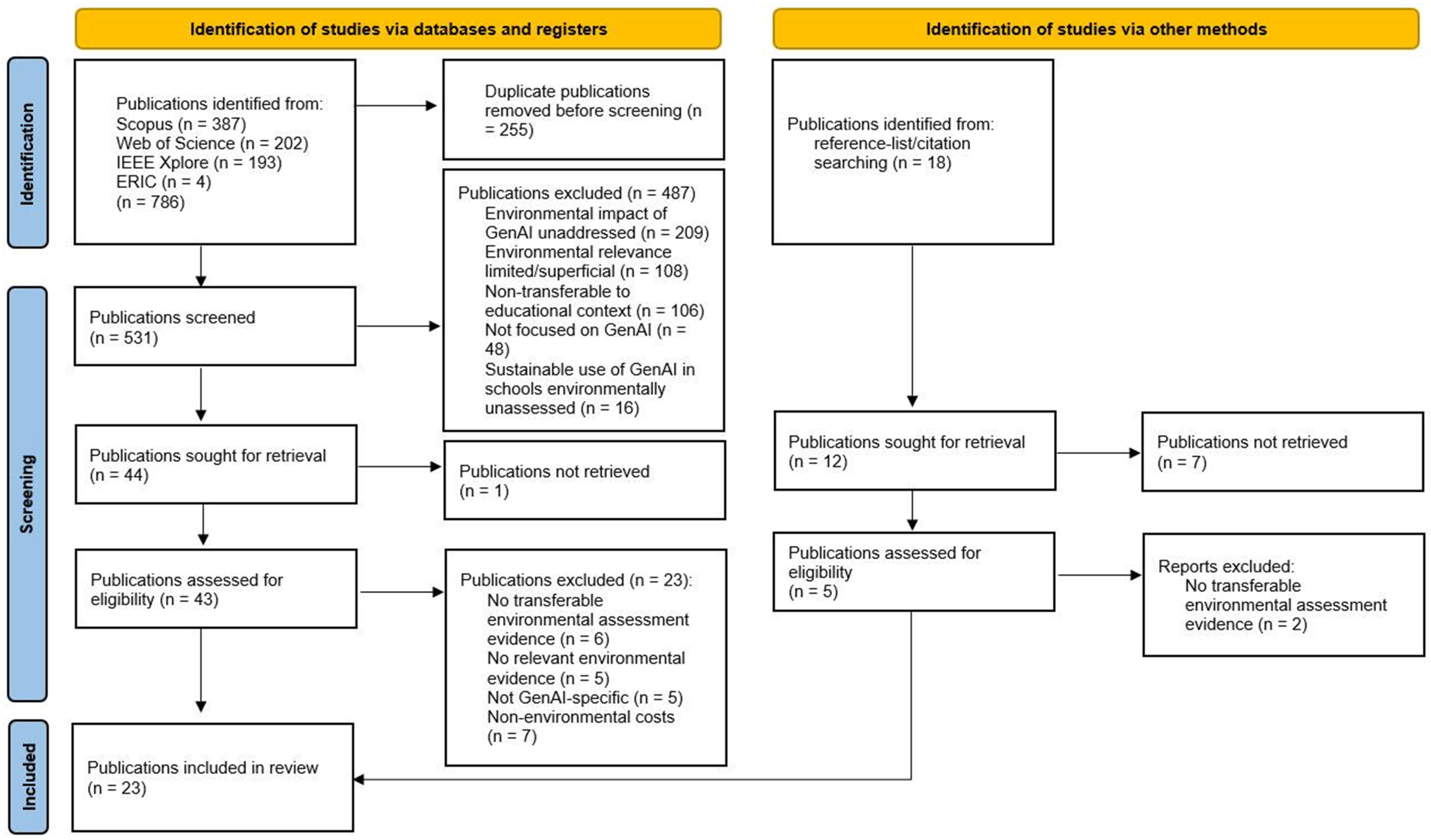
3.5. Study Selection
3.6. Data Extraction
- The first question recorded the publication type. Publications were classified as journal articles, conference papers, review articles, or another eligible publication category.
- The second question recorded the educational context in which generative AI was discussed or used. Relevant contexts included higher education, primary or secondary education, teacher education, professional development, medical education, institutional or policy settings, and other educational contexts. For complementary technical publications without a direct educational setting, the item was marked as not applicable, and the potential relevance of the publication to educational assessment was described in the accompanying notes.
- The third question identified the type of GenAI use examined in the publication. Categories included teaching, learning, assessment, student support, teacher work, curriculum development, content generation, educational administration, and institutional implementation. More than one category could be selected. For technical publications, the notes described how the model, workload, benchmark, or measurement method could relate to student, teacher, course, platform, or institutional use of GenAI.
- The fourth question captured the types of environmental impact identified or discussed. Categories included energy or electricity consumption, greenhouse gas emissions, carbon footprint, computational demand, data-center operation, water consumption, hardware and infrastructure requirements, raw-material use, embodied or lifecycle impacts, and electronic waste. Multiple environmental impact categories could be assigned to a single publication.
- The fifth question recorded the measurement or estimation approach used to assess or report environmental impact. Relevant approaches included direct hardware measurement, platform or application logs, model benchmarking, token-based estimation, secondary-data estimation, carbon-accounting calculations, lifecycle assessment, software-based estimation tools, survey-based evidence, and conceptual discussion without original quantification. More than one approach could be recorded where appropriate.
3.7. Data Synthesis
- Stage 1: Classification of study contexts and environmental impacts.
- Stage 2: Comparison of indicators and methodological approaches.
- Stage 3: Comparison of evidence streams and identification of research gaps.
3.8. Quality Assessment
3.9. Use of Generative AI
4. Results
4.1. Theme 1: Operational Electricity Consumption and Grid Demand
4.1.1. Synthesis
4.1.2. Methodological Comparison
4.1.3. Strength of Evidence
4.1.4. Research Gaps
4.2. Theme 2: Operational Carbon and Greenhouse Gas Footprints
4.2.1. Synthesis
4.2.2. Methodological Comparison
4.2.3. Strength of Evidence
4.2.4. Research Gaps
4.3. Theme 3: Water Consumption and Data-Center Cooling Demands
4.3.1. Synthesis
4.3.2. Methodological Comparison
4.3.3. Strength of Evidence
4.3.4. Research Gaps
4.4. Theme 4: Embodied Resources, Supply Chains, and e-Waste Lifecycle Impacts
4.4.1. Synthesis
4.4.2. Methodological Comparison
4.4.3. Strength of Evidence
4.4.4. Research Gaps
4.5. Theme 5: Comparative Labor Footprints: Human vs. Artificial Intelligence
4.5.1. Synthesis
4.5.2. Methodological Comparison
4.5.3. Strength of Evidence
4.5.4. Research Gaps
4.6. Theme 6: Educational Interventions, Student Awareness, and Behavioral Feedback
4.6.1. Synthesis
4.6.2. Methodological Comparison
4.6.3. Strength of Evidence
4.6.4. Research Gaps
4.7. Systematic Synthesis of Reviewed Evidence
5. Discussion
5.1. The Myth of Dematerialized Digital Learning
5.2. Inverted Accountability: How Users Handle Guilt
5.3. Closing the Methodological Divide
- Model Architecture: Mixture-of-Experts (MoE) designs (such as DeepSeek V3) route questions to specific sub-modules, which can reduce active parameters and lower emissions by 90% compared to dense models [16].
- Hardware Efficiency: Power Usage Effectiveness (PUE) ratings of the target data center and GPU generation (NVIDIA H100 vs. older A100 architectures) dramatically change the power needed to process a token [11].
5.4. The Correctness-Control Fallacy in Human–AI Labor Studies
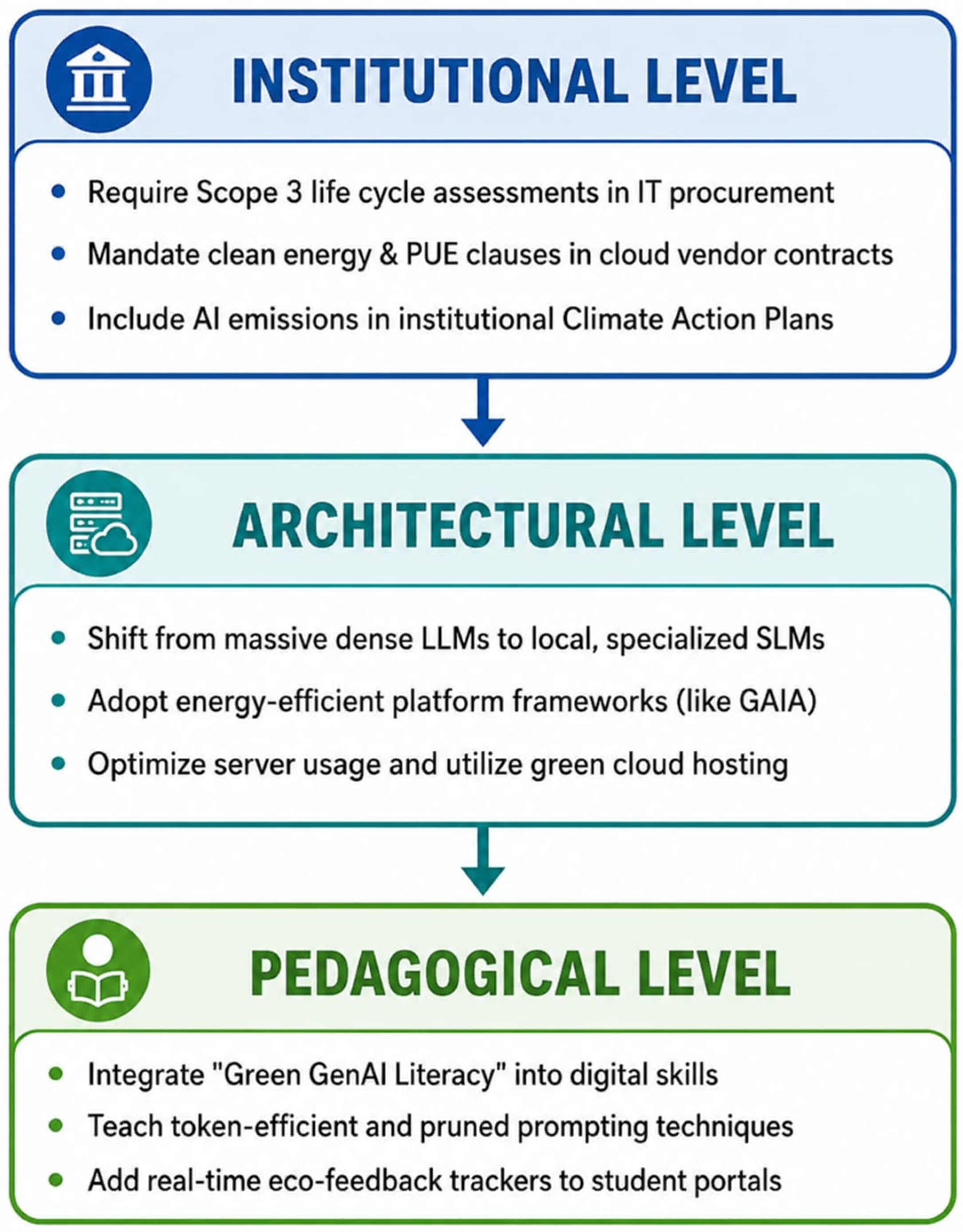
5.5. A Policy Framework for Sustainable Educational AI
5.5.1. Classroom and Pedagogical Habits
- Token-saving techniques: Teaching learners prompt pruning and translation habits. As Jung et al. [19] showed, bilingual translation and concise drafting reduce token consumption by 6% to 20% without losing educational quality.
- Eco-feedback software: Adding visual trackers, such as the prompt carbon estimator developed by Andersen et al. [18], to school portals to help students develop more conscious prompting habits.
5.5.2. Technical and Platform Choices
- Specialized Small Language Models (SLMs): Multi-task models are orders of magnitude more power-hungry than specialized, task-specific models [51]. Schools and districts could consider running local, specialized SLMs (typically under 8 billion parameters) fine-tuned for educational tasks.
- Green local platforms: Building green architectures like GAIA [45] can cut platform energy consumption by 30% through optimized local server routing and lightweight model designs.
5.5.3. Institutional Governance and Purchasing
- Green cloud agreements: Authorities could explore including environmental clauses in vendor contracts, with a goal of increasing the proportion of renewable energy powering educational server workloads over time, recognizing that immediate 100% locally additive renewable energy requirements may not be feasible for all institutions.
- Carbon auditing boundaries: Computing energy and data center emissions must be included in institutional Greenhouse Gas audits and Climate Action Plans (CAPs) [4]. This ensures that digital tools do not silently cancel out physical campus and building emission reductions.
6. Conclusions
Supplementary Materials
Author Contributions
Funding
Institutional Review Board Statement
Informed Consent Statement
Data Availability Statement
Acknowledgments
Conflicts of Interest
Abbreviations
| ADP | Abiotic Depletion Potential |
| API | Application Programming Interface |
| CAP | Climate Action Plan |
| GAIA | Green AI Analytics |
| GenAI | Generative Artificial Intelligence |
| GPU | Graphics Processing Unit |
| GPT | Generative Pre-trained Transformer |
| IEA | International Energy Agency |
| IT | Information Technology |
| LCA | Life Cycle Assessment |
| LLM | Large Language Model |
| MMAT | Mixed Methods Appraisal Tool |
| MoE | Mixture of Experts |
| NVML | NVIDIA System Management Interface |
| PRISMA | Preferred Reporting Items for Systematic Reviews and Meta-Analyses |
| PUE | Power Usage Effectiveness |
| SLM | Small Language Model |
References
- Konyrova, L. The evolution of language learning: Exploring ai’s impact on teaching english as a second language. Eurasian Sci. Rev. 2024, 2, 133–138. [Google Scholar] [CrossRef] [Scilit]
- Moybeka, A.M.S.; Syariatin, N.; Tatipang, D.P.; Mushthoza, D.A.; Dewi, N.P.J.L.; Tineh, S. Artificial Intelligence and English Classroom: The Implications of AI Toward EFL Students’ Motivation. Edumaspul-J. Pendidik. 2023, 7, 2444–2454. [Google Scholar] [CrossRef] [Scilit]
- Zhang, C.; Margulieux, L.E.; Haddadian, N. Integrating Generative Artificial Intelligence (GenAI) for Leveraging Early Literacy Instruction: A High-Leverage Teaching Practice (HLTP) Approach. In Exploring the Potential of Artificial Intelligence in Early Childhood Education: New Learning Experiences for Young Children; Routledge: New York, NY, USA, 2026; pp. 103–123. [Google Scholar] [CrossRef] [Scilit]
- Bozkurt, A. AI’s Thirst, AI’s Heat, AI’s Waste: Exposing the Hidden Environmental Impact of Every Artificial Intelligence Interaction. Open Prax. 2025, 17, 638–647. [Google Scholar] [CrossRef] [Scilit]
- Pantelimon, F.-V.; Bologa, R.; Toma, A.; Posedaru, B.-S. The Evolution of AI-Driven Educational Systems during the COVID-19 Pandemic. Sustainability 2021, 13, 13501. [Google Scholar] [CrossRef] [Scilit]
- van den Berg, G.; du Plessis, E. ChatGPT and Generative AI: Possibilities for Its Contribution to Lesson Planning, Critical Thinking and Openness in Teacher Education. Educ. Sci. 2023, 13, 998. [Google Scholar] [CrossRef] [Scilit]
- Kneese, T.; Young, M. Carbon Emissions in the Tailpipe of Generative AI. Harv. Data Sci. Rev. 2024. [Google Scholar] [CrossRef] [Scilit]
- Lin, C.-C.; Huang, A.Y.Q.; Lu, O.H.T. Artificial intelligence in intelligent tutoring systems toward sustainable education: A systematic review. Smart Learn. Environ. 2023, 10, 41. [Google Scholar] [CrossRef] [Scilit]
- Morrison, J.; Na, C.; Fernandez, J.; Dettmers, T.; Strubell, E.; Dodge, J. Holistically Evaluating the Environmental Impact of Creating Language Models. arXiv 2025, arXiv:2503.05804. [Google Scholar] [CrossRef] [Scilit]
- IEA. Energy and AI; IEA: Paris, France, 2025. [Google Scholar]
- Caravaca, F. Measuring Energy Consumption of LLMs Inferences. Perform. Eval. Rev. 2026, 53, 18–19. [Google Scholar] [CrossRef] [Scilit]
- Luccioni, S.; Jernite, Y.; Strubell, E. Power Hungry Processing: Watts Driving the Cost of AI Deployment? In Proceedings of the 2024 ACM Conference on Fairness, Accountability, and Transparency; Association for Computing Machinery: New York, NY, USA, 2024; pp. 85–99. [Google Scholar] [CrossRef] [Scilit]
- Rincé, S.; Banse, A. EcoLogits: Evaluating the Environmental Impacts of Generative AI. J. Open Source Softw. 2025, 10, 7471. [Google Scholar] [CrossRef] [Scilit]
- Bouza, L.; Bugeau, A.; Lannelongue, L. How to estimate carbon footprint when training deep learning models? A guide and review. Environ. Res. Commun. 2023, 5, 115014. [Google Scholar] [CrossRef] [Scilit] [PubMed]
- Wu, S.; Xu, J.; Feng, S. Opportunities and Challenges of Generative AI in STEAM Education: A Thematic Co-occurrence Network Analysis of Primary and Secondary School Leaders’ Perspectives. Technol. Knowl. Learn. 2026. [Google Scholar] [CrossRef] [Scilit]
- Esho, E.O.; Akinyelu, A.A.; Dinis, M.A.P. Sustainable generative AI and quantum computing: Review assessment on the environmental impact of generative AI and quantum technologies. Front. Sustain. 2026, 7, 1726832. [Google Scholar] [CrossRef] [Scilit]
- Marmouzi, O.; Oumaira, I.; Ajana El Khaddar, M. A Systematic Review of Green and Sustainable AI: Taxonomy, Metrics, Challenges, and Open Research Directions. Sustainability 2026, 18, 4115. [Google Scholar] [CrossRef] [Scilit]
- Andersen, L.B.; Herklotz, M.; Liu, A.; Goeke, M.; Juelich, M.; Kern, C.; Kreuter, F. From Awareness to Action? The Impact of CO2 Emission Feedback on Student LLM Usage. In Proceedings of the Extended Abstracts of the 2026 CHI Conference on Human Factors in Computing Systems; Association for Computing Machinery: New York, NY, USA, 2026. [Google Scholar] [CrossRef] [Scilit]
- Jung, H.; Min, J.; Moon, Y.; Son, J.; Whipple, M.E. Towards Sustainable Inference of LLMs for Medical Education through Token Count Minimization. Stud. Health Technol. Inform. 2025, 329, 1796–1797. [Google Scholar] [CrossRef] [Scilit] [PubMed]
- Lupetti, M.L.; Cavallin, E.; Murray-Rust, D. The Unbearable Lightness of Prompting: A Critical Reflection on the Environmental Impact of genAI use in Design Education. arXiv 2025, arXiv:2501.16061. [Google Scholar] [CrossRef] [Scilit]
- d’Orgeval, A.; Sheehan, S.; Avenas, Q.; Assoumou, E.; Sessa, V. Generative AI impact assessment through a life cycle analysis of multiple data center typologies. Appl. Energy 2026, 406, 127288. [Google Scholar] [CrossRef] [Scilit]
- Henderson, P.; Hu, J.; Romoff, J.; Brunskill, E.; Jurafsky, D.; Pineau, J. Towards the Systematic Reporting of the Energy and Carbon Footprints of Machine Learning. J. Mach. Learn. Res. 2020, 21, 248. [Google Scholar]
- IEA. Key Questions on Energy and AI; IEA: Paris, France, 2026. [Google Scholar]
- Kaack, L.H.; Donti, P.L.; Strubell, E.; Kamiya, G.; Creutzig, F.; Rolnick, D. Aligning artificial intelligence with climate change mitigation. Nat. Clim. Change 2022, 12, 518–527. [Google Scholar] [CrossRef] [Scilit]
- Khajeh Naeeni, S.; Nouhi, N. The Environmental Impacts of AI and Digital Technologies. AI Tech Behav. Soc. Sci. 2023, 1, 11–18. [Google Scholar] [CrossRef] [Scilit]
- Luccioli, V.; Iyengar, R.; Panley, R.; Haberkorn, F.; Ge, X.; Crane, L.; Sinha, N.; Lee, S.J. LLM on a Budget: Active Knowledge Distillation for Efficient Classification of Large Text Corpora; Board of Governors of the Federal Reserve System: Washington, DC, USA, 2025; pp. 2405–2414.
- Strubell, E.; Ganesh, A.; McCallum, A. Energy and policy considerations for deep learning in NLP. In Proceedings of the Annual Meeting of the Association for Computational Linguistics, Florence, Italy, 28 July–2 August 2019; pp. 3645–3650. [Google Scholar]
- Mytton, D. Data center water consumption. npj Clean Water 2021, 4, 11. [Google Scholar] [CrossRef] [Scilit]
- Wang, Y. Integrating large language models into medical undergraduate laboratory course to enhance bioethical competence: A quasi-experimental study. Front. Med. 2026, 12, 1745975. [Google Scholar] [CrossRef] [Scilit] [PubMed]
- Cornelis, P.B.; Kuehr, R.; Yamamoto, T.; McDonald, R.; D’Angelo, E.; Althaf, S.; Bel, G.; Deubzer, O.; Fernandez-Cubillo, E.; Forti, V.; et al. The Global E-Waste Monitor 2024; International Telecommunication Union (ITU): Geneva, Switzerland; United Nations Institute for Training and Research (UNITAR): Bonn, Germany, 2024. [Google Scholar]
- Ren, S.; Tomlinson, B.; Black, R.W.; Torrance, A.W. Reconciling the contrasting narratives on the environmental impact of large language models. Sci. Rep. 2024, 14, 26310. [Google Scholar] [CrossRef] [Scilit] [PubMed]
- Tomlinson, B.; Black, R.W.; Patterson, D.J.; Torrance, A. The carbon emissions of writing and illustrating are lower for AI than for humans. Sci. Rep. 2023, 14, 3732. [Google Scholar] [CrossRef] [Scilit] [PubMed]
- Woo, N.H. A comparative study of AI and human programming on environmental sustainability. Sci. Rep. 2025, 15, 39182. [Google Scholar] [CrossRef] [Scilit] [PubMed]
- Rizzo, S.A. To be Artificial Intelligence for sustainability or not to be sustainable Artificial Intelligence. Renew. Sustain. Energy Rev. 2025, 223, 116063. [Google Scholar] [CrossRef] [Scilit]
- Page, M.J.; McKenzie, J.E.; Bossuyt, P.M.; Boutron, I.; Hoffmann, T.C.; Mulrow, C.D.; Shamseer, L.; Tetzlaff, J.M.; Akl, E.A.; Brennan, S.E.; et al. The PRISMA 2020 statement: An updated guideline for reporting systematic reviews. BMJ 2021, 372, n71. [Google Scholar] [CrossRef] [Scilit] [PubMed]
- Ouzzani, M.; Hammady, H.; Fedorowicz, Z.; Elmagarmid, A. Rayyan—A web and mobile app for systematic reviews. Syst. Rev. 2016, 5, 210. [Google Scholar] [CrossRef] [Scilit] [PubMed]
- Hong, Q.N.; Fàbregues, S.; Bartlett, G.; Boardman, F.; Cargo, M.; Dagenais, P.; Gagnon, M.-P.; Griffiths, F.; Nicolau, B.; O’Cathain, A.; et al. The Mixed Methods Appraisal Tool (MMAT) version 2018 for information professionals and researchers. Educ. Inf. 2018, 34, 285–291. [Google Scholar] [CrossRef] [Scilit]
- Dungo, C.A.B.; Beltran, Z.L.E.; Declaro, B.C.; Dela-Cruz, J.J.C.; Viray, R.U. Students’ Level of Awareness on the Environmental Implications of Generative AI. J. Educ. Sci. Environ. Health 2025, 11, 93–107. [Google Scholar] [CrossRef] [Scilit]
- Ansari, B.; Sameer, A. The shifting locus of accountability: The discourse of young Indian adults (YIAs) on the environmental impact of artificial intelligence. AI Soc. 2026. [Google Scholar] [CrossRef] [Scilit]
- Wen, T.J.; Walker, K.; Xiao, C.J. Co-Designing Media Plans with Generative AI: Teaching Media Planning as Human–AI Collaboration in the Classroom. J. Advert. Educ. 2026. [Google Scholar] [CrossRef] [Scilit]
- Sivapragasam, C.; Vasudevan, M.; Natarajan, N.; Saravanan, P. Exploring the Challenges of LLMs in Higher Education: Is ChatGPT a Boon or Bane for the Students? J. Eng. Educ. Transform. 2026, 39, 574–583. [Google Scholar] [CrossRef] [Scilit]
- Mbah, M.F.; Nugraha, T.R.; Kushnir, I. Challenges and Opportunities for Leveraging Generative AI for Sustainability Education: A Critical Review. Sustainability 2025, 17, 10623. [Google Scholar] [CrossRef] [Scilit]
- Jetly, K.; Saif Al-Maqbali, M.; Nasser Said Al Fuliti, M. The Environmental Impact of Artificial Intelligence: Problems Possibilities and Solutions. J. Phys. Conf. Ser. 2026, 3191, 012056. [Google Scholar] [CrossRef] [Scilit]
- Malik, F. Carbon-Conscious Intelligence: Life Cycle Assessment and Green Standards for Generative AI. Int. J. Innov. Sci. Res. Technol. 2025, 10, 1030–1037. [Google Scholar] [CrossRef] [Scilit]
- Wen, X.; Lv, Y. Energy-efficient and secure digital learning using the GAIA green AI analytics framework. Results Eng. 2026, 29, 108746. [Google Scholar] [CrossRef] [Scilit]
- ISO 14040:2006; Environmental Management—Life cycle assessment—Principles and Framework. International Organization for Standardization: Geneva, Switzerland, 2006.
- ISO 14044:2006; Environmental Management—Life Cycle Assessment—Requireme. International Organization for Standardization: Geneva, Switzerland, 2006.
- Ren, Y.; Wang, Y.; Dong, S.; Su, W.; Wu, Y.; Liang, S.; Yang, X. Application of Artificial Intelligence in Medical Education: A Systematic and Narrative Review of Pedagogical Potential and Ethical Implications. Adv. Med. Educ. Pract. 2026, 17, 567190. [Google Scholar] [CrossRef] [Scilit] [PubMed]
- Jung, J.; Joo, S.; Park, H.; Han, I. Challenges of integrating ChatGPT into EFL writing: An Activity Theory framework. Comput. Assist. Lang. Learn. 2026. [Google Scholar] [CrossRef] [Scilit]
- Lait, J. Invisible energy policy and schools: How energy issues feature in the policies and documents of a UK secondary school. Energy Effic. 2023, 16, 58. [Google Scholar] [CrossRef] [Scilit]
- Oliveira, L.; Tavares, C.; Strzelecki, A.; Silva, M. Prompting Minds: Evaluating How Students Perceive Generative AI’s Critical Thinking Dispositions. Electron. J. e-Learn. 2025, 23, 1–18. [Google Scholar] [CrossRef] [Scilit]



| Database | Search Query | Records Retrieved |
|---|---|---|
| Scopus | TITLE-ABS-KEY ((“generative AI” OR “generative artificial intelligence” OR ChatGPT OR “large language model” OR LLM OR “AI chatbot” OR “foundation model” OR GPT OR Copilot OR Gemini OR “diffusion model” OR “text-to-image” OR “image generation” OR inference) AND (“higher education” OR “educational context” OR “educational setting” OR “educational technolog” OR “teaching” OR “teacher” OR “educator” OR “student” OR “classroom” OR “curriculum” OR “assessment” OR “teacher education” OR “medical education”) AND (“carbon footprint” OR “carbon emission” OR “energy consumption” OR “computational cost” OR “environmental impact” OR “environmental cost” OR “water footprint” OR “water consumption” OR “life cycle assessment” OR “electronic waste” OR “greenhouse gas” OR “e-waste”)) AND PUBYEAR > 2021 AND PUBYEAR < 2027 AND LANGUAGE(English) AND ( LIMIT-TO (DOCTYPE, “ar”) OR LIMIT-TO (DOCTYPE, “cp”) OR LIMIT-TO (DOCTYPE, “re”)) | n = 387 |
| Web of Science Core Collection | TS = ((“generative AI” OR “generative artificial intelligence” OR ChatGPT OR “large language model” OR LLM OR “AI chatbot” OR “foundation model” OR GPT OR Copilot OR Gemini OR “diffusion model” OR “text-to-image” OR “image generation” OR inference) AND (“higher education” OR “educational context” OR “educational setting” OR “educational technolog” OR teaching OR teacher* OR educator* OR student* OR classroom* OR curriculum OR assessment OR “teacher education” OR “medical education”) AND (“carbon footprint” OR “carbon emission” OR “energy consumption” OR “computational cost” OR “environmental impact” OR “environmental cost” OR “water footprint” OR “water consumption” OR “life cycle assessment” OR “electronic waste” OR “greenhouse gas” OR “e-waste”)) | n = 202 |
| ERIC | (“generative AI” OR “generative artificial intelligence” OR ChatGPT OR “large language model” OR “large language models” OR LLM OR LLMs OR “AI chatbot” OR “AI chatbots” OR “foundation model” OR “foundation models” OR GPT OR Copilot OR Gemini OR “diffusion model” OR “diffusion models” OR “text-to-image” OR “image generation” OR inference) AND (“higher education” OR “educational context” OR “educational contexts” OR “educational setting” OR “educational settings” OR “educational technology” OR teaching OR teacher OR teachers OR educator OR educators OR student OR students OR classroom OR classrooms OR curriculum OR assessment OR “teacher education” OR “medical education”) AND (“carbon footprint” OR “carbon emission” OR “carbon emissions” OR “energy consumption” OR “computational cost” OR “computational costs” OR “environmental impact” OR “environmental impacts” OR “environmental cost” OR “environmental costs” OR “water footprint” OR “water consumption” OR “life cycle assessment” OR “electronic waste” OR “greenhouse gas” OR “e-waste”) | n = 4 |
| IEEE Xplore | ((“All Metadata”:“generative AI” OR “All Metadata”:“generative artificial intelligence” OR “All Metadata”:“ChatGPT” OR “All Metadata”:“large language model” OR “All Metadata”:“large language models” OR “All Metadata”:“LLM” OR “All Metadata”:“LLMs” OR “All Metadata”:“AI chatbot” OR “All Metadata”:“AI chatbots” OR “All Metadata”:“foundation model” OR “All Metadata”:“foundation models” OR “All Metadata”:“GPT” OR “All Metadata”:“Copilot” OR “All Metadata”:“Gemini” OR “All Metadata”:“diffusion model” OR “All Metadata”:“text-to-image” OR “All Metadata”:“image generation” OR “All Metadata”:“inference”) AND (“All Metadata”:“higher education” OR “All Metadata”:“educational context” OR “All Metadata”:“educational setting” OR “All Metadata”:“educational technology” OR “All Metadata”:“teaching” OR “All Metadata”:“teacher” OR “All Metadata”:“teachers” OR “All Metadata”:“educator” OR “All Metadata”:“educators” OR “All Metadata”:“student” OR “All Metadata”:“students” OR “All Metadata”:“classroom” OR “All Metadata”:“curriculum” OR “All Metadata”:“assessment” OR “All Metadata”:“teacher education” OR “All Metadata”:“medical education”) AND (“All Metadata”:“carbon footprint” OR “All Metadata”:“carbon emission” OR “All Metadata”:“carbon emissions” OR “All Metadata”:“energy consumption” OR “All Metadata”:“computational cost” OR “All Metadata”:“computational costs” OR “All Metadata”:“environmental impact” OR “All Metadata”:“environmental impacts” OR “All Metadata”:“environmental cost” OR “All Metadata”:“environmental costs” OR “All Metadata”:“water footprint” OR “All Metadata”:“water consumption” OR “All Metadata”:“life cycle assessment” OR “All Metadata”:“electronic waste” OR “All Metadata”:“greenhouse gas” OR “All Metadata”:“e-waste”)) | n = 193 |
| Study | Year | Evidence Stream | Publication Type/Design | Main Field | Country/Region | Educational Context or Technical Relevance | GenAI System/Use |
|---|---|---|---|---|---|---|---|
| Dungo et al. (2025) [38] | 2025 | Education-specific | Journal article; quantitative descriptive survey | Educational technology/environmental studies | Philippines | Higher education; college students | General student use of GenAI for productivity and entertainment |
| Ansari et al. (2026) [39] | 2026 | Education-specific | Journal article; mixed-methods survey and topic analysis | AI ethics/digital sociology/environmental studies | India | Higher education; technical university students | ChatGPT, Gemini, Perplexity AI, DeepSeek, and Llama used for general productivity |
| Andersen et al. (2026) [18] | 2026 | Education-specific | Conference paper; non-randomized experimental study | HCI/responsible AI/educational technology | Germany | Undergraduate statistics course | GPT-4o, GPT-4o-mini, and GPT-4.1 used for study support with real-time CO2 feedback |
| Esho et al. (2026) [16] | 2026 | Complementary technical | Review article | Environmental sustainability/green computing/AI | International/not specified | No direct educational setting; transferable sustainability evidence | Generative AI and quantum computing reviewed comparatively |
| Marmouzi et al. (2026) [17] | 2026 | Complementary technical | Systematic review | Green AI/sustainable AI/computer science | International | No direct educational setting; taxonomy and metrics transferable to education | AI systems including LLMs and other generative models |
| Wen et al. (2026) [40] | 2026 | Education-specific | Research article; prototype validation | Computer science/educational technology | China | Digital learning platform infrastructure | GAIA framework uses lightweight AI/ML models as an energy-efficient alternative to large LLMs |
| Rizzo (2025) [34] | 2025 | Complementary technical | Journal article; conceptual and analytical study | Electrical engineering/sustainable energy | International/not specified | No direct educational setting; general environmental implications of AI | AI and LLMs discussed in relation to sustainable energy systems |
| Ren et al. (2024) [31] | 2024 | Complementary technical | Journal article; empirical comparative study | Computer science/environmental studies | International/comparative | No direct educational setting; knowledge-work comparison relevant to education | LLMs compared with human labor across environmental indicators |
| Caravaca (2026) [11] | 2026 | Complementary technical | Conference/workshop paper; empirical benchmarking | Computer science | International/technical benchmarking | No direct educational setting; inference benchmarks transferable to education | Multiple LLMs, including DeepSeek and Llama models, tested across GPUs |
| Wu et al. (2026) [15] | 2026 | Complementary technical | Journal article; conceptual framework and analytical study | Computer science/sustainability | International/not specified | No direct educational setting; infrastructure-level framework | AI, big data, and ICT analyzed through green/red AI concepts |
| Sivapragasam et al. (2026) [41] | 2026 | Education-specific | Journal article; quantitative descriptive survey | Engineering education | India | Higher education; undergraduate engineering students | ChatGPT and LLMs used for writing, coding, problem-solving, exam preparation, and brainstorming |
| Jung et al. (2025) [19] | 2025 | Education-specific | Conference paper; experimental methodological study | Medical informatics/medical education | South Korea/United States | Medical education | ChatGPT-based tasks; translation and prompt paraphrasing used to reduce token counts |
| Woo (2025) [33] | 2025 | Complementary technical | Journal article; comparative experimental/modeling study | Computer science/computational sustainability | United States | Competitive programming; technically relevant to AI-assisted learning | GPT-based models compared with human programmers on correctness-controlled coding tasks |
| Mbah et al. (2025) [42] | 2025 | Education-specific | Review article; critical thematic review | Education/sustainability studies | United Kingdom | Sustainability education | ChatGPT and related tools used for information search, explanation, summarizing, and writing support |
| Rincé et al. (2025) [13] | 2025 | Complementary technical | Software/method paper | Computer science/environmental informatics | Belgium | No direct educational setting; tool applicable to educational GenAI use | EcoLogits estimates energy, carbon, water, and embodied impacts of GenAI API requests |
| Jetly et al. (2026) [43] | 2026 | Complementary technical | Conference paper; narrative review | Computer science/environmental sustainability | International/not specified | No direct educational setting; wider AI-sustainability evidence | ChatGPT and other LLMs reviewed in relation to energy, carbon, water, hardware, and e-waste |
| d’Orgeval et al. (2026) [21] | 2026 | Complementary technical | Journal article; lifecycle simulation study | Applied energy/environmental engineering | France | No direct educational setting; infrastructure evidence transferable to education | GPT-4o, LLaMA 3.1 405B, and DeepSeek V3 across multiple data-center typologies |
| Luccioni et al. (2024) [12] | 2024 | Complementary technical | Conference paper; empirical benchmarking | Computer science/AI accountability | International/technical benchmarking | No direct educational setting; inference evidence transferable to education | Task-specific and general-purpose models compared over 1000 inferences |
| Bouza et al. (2023) [14] | 2023 | Complementary technical | Research article; methodological review and guide | Computer science/environmental research | France/United Kingdom | No direct educational setting; carbon-estimation methods transferable to education | Deep-learning training tools and carbon-estimation methods |
| Tomlinson et al. (2023) [32] | 2023 | Complementary technical | Journal article; comparative emissions analysis | Computer science/environmental sustainability | United States | No direct educational setting; creative-task comparison relevant to education | ChatGPT and DALL-E 2 compared with human writers and illustrators |
| Malik (2025) [44] | 2025 | Complementary technical | Lifecycle modeling study | Sustainable AI/lifecycle assessment | Spain | No direct educational setting; LCA framework transferable to education | GPT-3, ChatGPT, GPT-4, LLaMA 2, PaLM 2, and DistilBERT |
| Lupetti et al. (2025) [20] | 2025 | Education-specific | Case study/critical reflection with energy estimation | Design education/sustainable HCI | Netherlands | Higher education; design workshop with 49 students | Text- and image-generation tools used in a design workshop |
| Kneese et al. (2024) [7] | 2024 | Complementary technical | Critical essay/review | Technology policy/environmental justice | United States | No direct educational setting; lifecycle and justice implications | Generative AI examined through carbon, infrastructure, and regulatory perspectives |
| Theme | Studies Contributing Evidence | Level of Evidence | Main Methodological Approaches |
|---|---|---|---|
| Operational Electricity & Grid Demand | [11,12,13,15,16,17,20,45] | Strong (Hardware benchmarks & workspace trials) | Physical GPU Watt meters, on-site energy logging, bottom-up API software calculators, and PUE calculations. |
| Operational Carbon & GHG Footprints | [13,16,18,21,44] | Strong (LCA simulations & API logging trials) | Carbon-accounting packages (EcoLogits, Green Algorithms), grid emission intensity multipliers, API activity logging, and token count tracking. |
| Water Consumption & Cooling Demands | [15,16,39,43,44] | Limited (Restricted to secondary estimates) | Applying broad water-intensity coefficients to energy models, secondary corporate disclosures, and localized water-stress indexing. |
| Embodied Resources & e-Waste Lifecycles | [7,13,15,16,17,20,21,43] | Moderate (Strong technically, absent in education) | Multi-stage lifecycle assessment (LCA) software frameworks, industrial material database queries (Ecoinvent), and server replacement frequency models. |
| Comparative Labor Footprints | [32,33,48] | Strong (Controlled code-completion experiments) | Automated correctness compilation cycles, calorie-to-carbon conversions, software debugging models, and amortized manufacturing additions. |
| Educational Interventions & Student Dynamics | [18,19,20,38,39,41,42] | Moderate (Surveys & single-site pilot trials) | Self-reported Likert scale surveys, platform-embedded eco-feedback widgets, qualitative focus group transcript analyses, and prompt-level translation trials. |
Disclaimer/Publisher’s Note: The statements, opinions and data contained in all publications are solely those of the individual author(s) and contributor(s) and not of MDPI and/or the editor(s). MDPI and/or the editor(s) disclaim responsibility for any injury to people or property resulting from any ideas, methods, instructions or products referred to in the content. |
© 2026 by the authors. Licensee MDPI, Basel, Switzerland. This article is an open access article distributed under the terms and conditions of the Creative Commons Attribution (CC BY) license.
Share and Cite
Radovan, M.; Košmerl, T.; Makovec Radovan, D. Environmental Impacts of Generative AI in Education: A Systematic Review of Educational and Technical Evidence. Sustainability 2026, 18, 7213. https://doi.org/10.3390/su18147213
Radovan M, Košmerl T, Makovec Radovan D. Environmental Impacts of Generative AI in Education: A Systematic Review of Educational and Technical Evidence. Sustainability. 2026; 18(14):7213. https://doi.org/10.3390/su18147213
Chicago/Turabian StyleRadovan, Marko, Tadej Košmerl, and Danijela Makovec Radovan. 2026. "Environmental Impacts of Generative AI in Education: A Systematic Review of Educational and Technical Evidence" Sustainability 18, no. 14: 7213. https://doi.org/10.3390/su18147213
APA StyleRadovan, M., Košmerl, T., & Makovec Radovan, D. (2026). Environmental Impacts of Generative AI in Education: A Systematic Review of Educational and Technical Evidence. Sustainability, 18(14), 7213. https://doi.org/10.3390/su18147213