A Staged Resource-Recovery Pathway for Breeder Chicken Manure Under Intensive Farming Conditions: A Practice-Based Case Evaluation


Abstract
1. Introduction
1.1. Challenges and Research Gap
1.2. Objectives and Contributions
- (1)
- Establish a staged resource-recovery pathway adapted to the production characteristics and operational organization of breeder chicken farms;
- (2)
- Evaluate the operational characteristics and engineering roles of the implemented primary and secondary stages using enterprise operational records, field investigations, and routine monitoring information;
- (3)
- Assess product-quality indicators and benchmark compliance of secondary-stage fertilizer products based on available testing data and enterprise product specifications;
- (4)
- Examine operational constraints related to material routing, data coverage, logistics, and seasonal continuity under practical farm and enterprise conditions;
- (5)
- Discuss the potential function and evidence boundary of a conceptual winter continuity-support module under low-temperature conditions.
2. Materials and Methods
2.1. Study Design and Analytical Boundary
2.2. Study Area and Case Background
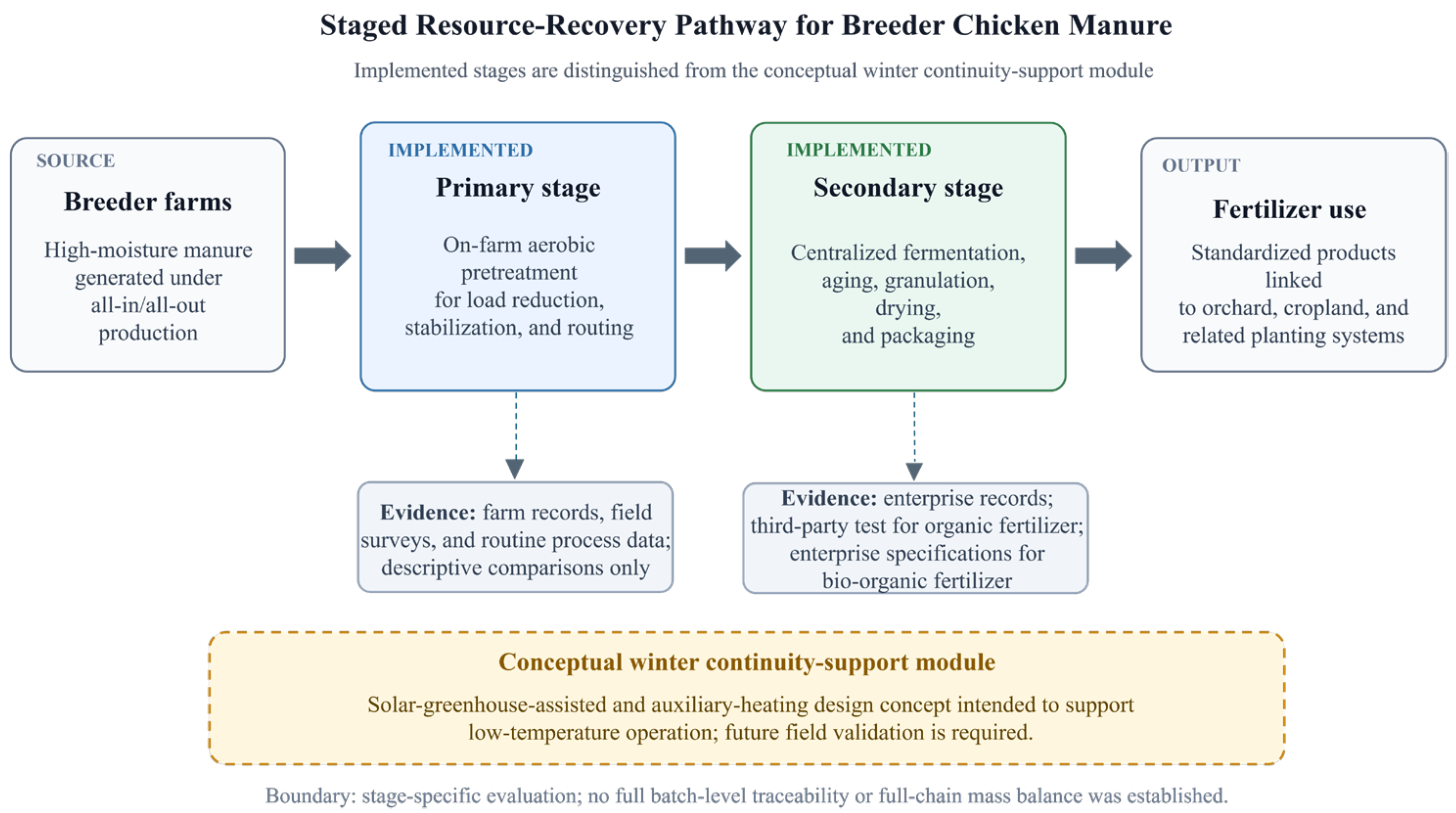
2.3. Configuration of the Staged Resource-Recovery Pathway
- Primary stage: on-farm pretreatment and load reduction;
- Secondary stage: centralized processing, standardization, and product formation;
- Conceptual winter continuity-support module: seasonal support under low-temperature conditions.
2.3.1. Primary Stage: On-Farm Pretreatment and Load Reduction
2.3.2. Secondary Stage: Centralized Processing, Standardization, and Product Formation
2.4. Conceptual Design Basis for Winter Continuity Support
2.5. Data Sources and Evaluation Indicators
2.6. Use of Generative Artificial Intelligence
3. Results
3.1. Primary-Stage Operational Characteristics and Routing Role
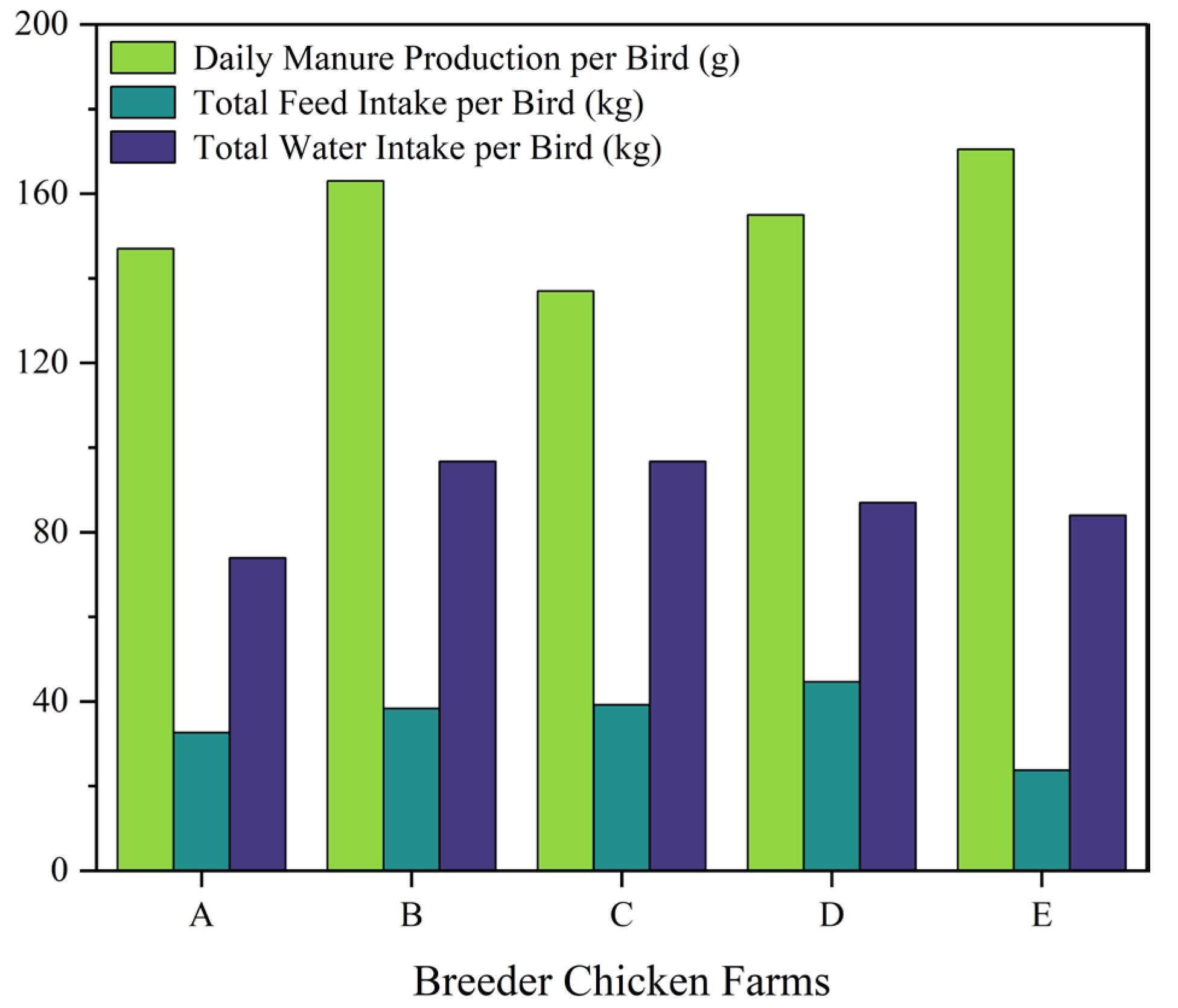
3.1.1. Descriptive Analysis of Basic Farming Indicators
3.1.2. Process Characteristics of the Primary Stage
3.2. Secondary Stage as the Standardization and Product-Output Node
3.2.1. Fermentation Equipment
3.2.2. Fermentation Process
3.2.3. Aging
3.2.4. Granulation, Drying, and Packaging System
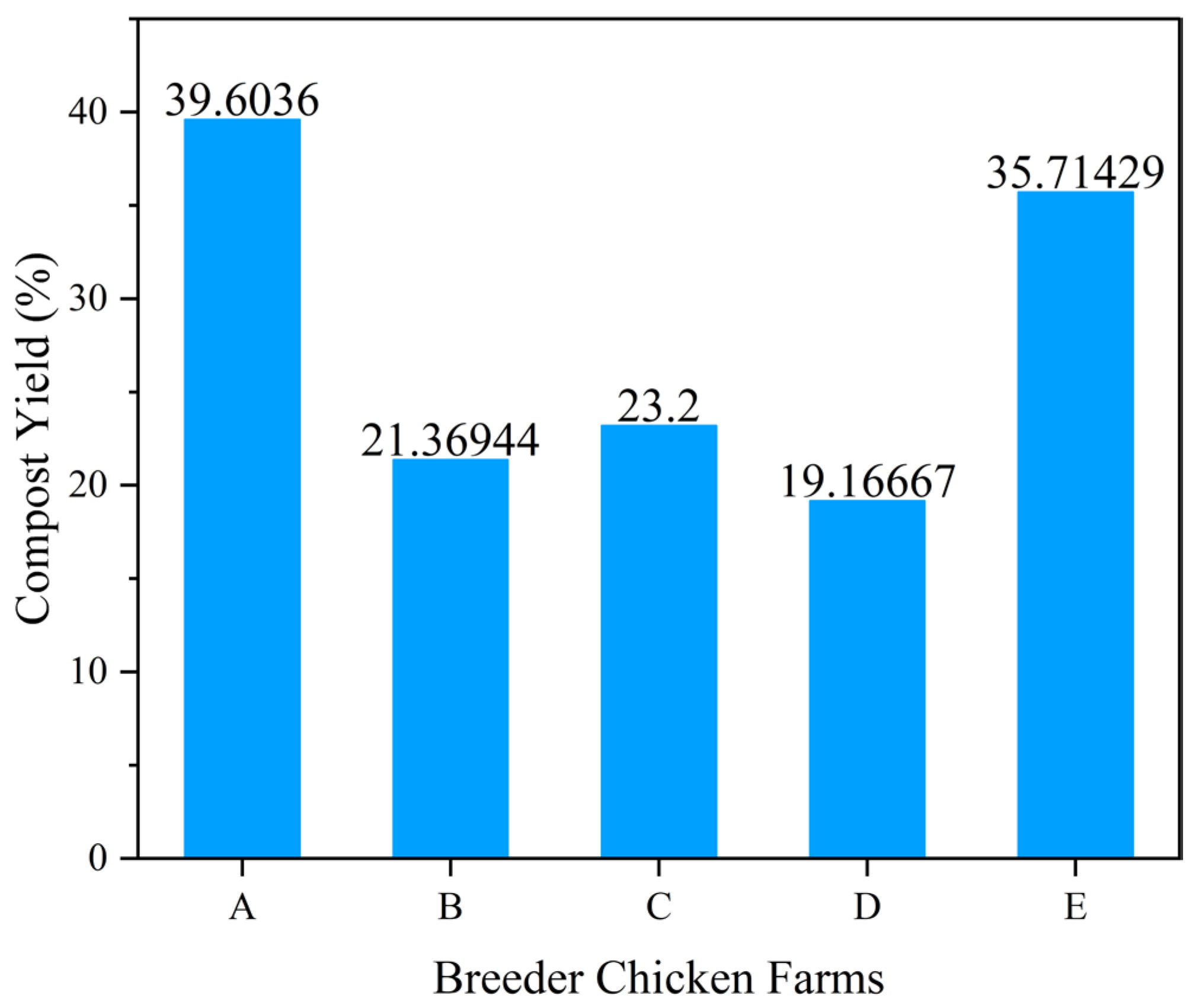
3.2.5. Product-Quality Evidence and Benchmark Comparison
4. Discussion
4.1. Functional Roles of the Staged Pathway
4.2. Management Implications for Manure Resource Recovery
4.3. Applicability and Deployment Conditions
4.4. Evidence Boundary, Limitations, and Future Validation Needs
5. Conclusions
Supplementary Materials
Author Contributions
Funding
Institutional Review Board Statement
Informed Consent Statement
Data Availability Statement
Acknowledgments
Conflicts of Interest
Abbreviations
| APC | Article Processing Charge |
| C/N | Carbon-to-nitrogen ratio |
| GB/T | Recommended National Standard of the People’s Republic of China |
| GenAI | Generative Artificial Intelligence |
| LCA | Life Cycle Assessment |
| NY | Agricultural Industry Standard of the People’s Republic of China |
References
- Sun, L.; Liu, T.; Zhang, L. Current status of large-scale livestock and poultry farming in China and its impact on the ecological environment. J. South China Agric. Univ. Soc. Sci. Ed. 2016, 15, 23–30. [Google Scholar]
- Shi, S.; Sun, W.; Tang, J.; Wang, D.; Zhou, Y.; Yuan, Y.; Fang, B.; Liu, P. Research progress on aerobic composting technology for organic solid waste. Mod. Chem. Eng. 2024, 44, 62–67. [Google Scholar] [CrossRef]
- Wu, G.Y.; Liao, X.D.; He, D.C.; Li, J. Current status and countermeasures for pollution prevention and control in livestock and poultry farming in China. J. Agric. Environ. Sci. 2014, 33, 1261–1264. [Google Scholar]
- Wichuk, K.M.; McCartney, D. A review of the effectiveness of current time-temperature regulations on pathogen inactivation during composting. J. Environ. Eng. Sci. 2007, 6, 573–586. [Google Scholar] [CrossRef] [Scilit]
- Wang, K.; He, C.; You, S.; Liu, W.; Wang, W.; Zhang, R.; Qi, H.; Ren, N. Transformation of organic matters in animal wastes during composting. J. Hazard. Mater. 2015, 300, 745–753. [Google Scholar] [CrossRef] [Scilit] [PubMed]
- Chen, L.; Chen, Y.; Li, Y.; Liu, Y.; Jiang, H.; Li, H.; Yuan, Y.; Chen, Y.; Zou, B. Improving the humification by additives during composting: A review. Waste Manag. 2023, 158, 93–106. [Google Scholar] [CrossRef] [Scilit] [PubMed]
- Huzir, N.M.; Ahmad Asmadi, A.; Rosly, M.B.; Tamunaidu, P.; Amin, A.N.R. Composting as a pathway for organic waste valorization: Substrate performance, process strategies, and quality benchmarks. J. Mater. Cycles Waste Manag. 2026, 28, 815–833. [Google Scholar] [CrossRef] [Scilit]
- Pajura, R. Composting municipal solid waste and animal manure in response to the current fertilizer crisis: A recent review. Sci. Total Environ. 2024, 912, 169221. [Google Scholar] [CrossRef] [Scilit] [PubMed]
- Sadeghpour, A.; Afshar, R.K. Livestock manure: From waste to resource in a circular economy. J. Agric. Food Res. 2024, 17, 101255. [Google Scholar] [CrossRef] [Scilit]
- Zhang, L.; E, R.; Ali, M.M.; Lin, H.; Zhang, S.; Jin, S.; Zhu, Z.; Hu, J.; Yao, Y.; Sun, Y.; et al. Livestock and poultry manure management from the perspective of carbon neutrality in China. Front. Agric. Sci. Eng. 2023, 10, 341–362. [Google Scholar] [CrossRef] [Scilit]
- Cui, S.; Pang, L. Empty-lot management plan under the “all-in, all-out” rearing model in layer farms. China J. Anim. Sci. Technol. 2013, 49, 63–64. [Google Scholar]
- Shen, Y.; Ren, L.; Li, G.; Chen, T.; Guo, R. Influence of aeration on CH4, N2O, and NH3 emissions during aerobic composting of a chicken manure and high C/N waste mixture. Waste Manag. 2011, 31, 33–38. [Google Scholar] [CrossRef] [Scilit] [PubMed]
- Qasim, W.; Moon, B.E.; Okyere, F.G.; Khan, F.; Nafees, M.; Kim, H.T. Influence of aeration rate and reactor shape on the composting of poultry manure and sawdust. J. Air Waste Manag. Assoc. 2019, 69, 633–645. [Google Scholar] [CrossRef] [Scilit] [PubMed]
- Jiang, Y.; Yao, Y.; Liu, H.; Zhang, S.; Bai, X.; Ma, X.; Wang, Y.; Ren, Q. Volatile organic compounds conversion pathways and odor gas emission characteristics in chicken manure composting process. Front. Ecol. Evol. 2023, 11, 1192132. [Google Scholar] [CrossRef] [Scilit]
- Shang, B.; Zhou, T.; Tao, X.; Chen, Y.; Dong, H. Simultaneous removal of ammonia and volatile organic compounds from composting of dead pigs and manure using pilot-scale biofilter. J. Air Waste Manag. Assoc. 2021, 71, 378–391. [Google Scholar] [CrossRef] [Scilit] [PubMed]
- Gotowska, M.; Jakubczak, A. Sustainable biodegradable waste management for circular economy: Comparative assessment of composting technologies. Sustainability 2025, 17, 8978. [Google Scholar] [CrossRef] [Scilit]
- Peng, J.; Baležentis, T.; Streimikiene, D.; Dabkiene, V.; Agnusdei, G.P. Circular economy in agriculture: A systematic literature review. Sustain. Dev. 2025, 33, 501–516. [Google Scholar] [CrossRef] [Scilit]
- Vasmara, C.; Martini, A. Transforming livestock and aquaculture waste into renewable energy and materials—A review. Sustainability 2025, 17, 10590. [Google Scholar] [CrossRef] [Scilit]
- Velthof, G.L.; Cals, T.C.A.; van ’t Hull, J.P.; Lesschen, J.P.; Lessmann, M.; Porre, R.J.; Ros, M.B.H.; Rietra, R.P.J.J.; Schoumans, O.F.; Veenemans, L.; et al. Managing organic resources in agriculture: Future challenges from a scientific perspective. Front. Sustain. Food Syst. 2024, 8, 1393190. [Google Scholar] [CrossRef] [Scilit]
- Babcock-Jackson, L.; Konovalova, T.; Krogman, J.P.; Bird, R.; Díaz, L.L. Sustainable fertilizers: Publication landscape on wastes as nutrient sources, wastewater treatment processes for nutrient recovery, biorefineries, and green ammonia synthesis. J. Agric. Food Chem. 2023, 71, 8265–8296. [Google Scholar] [CrossRef] [Scilit] [PubMed]
- Kuligowski, K.; Tran, Q.B.; Nguyen, C.C.; Kaczyński, P.; Konkol, I.; Świerczek, L.; Cenian, A.; Nguyen, X.C. Analyzing and predicting the agronomic effectiveness of fertilizers derived from food waste using data-driven models. Appl. Sci. 2025, 15, 5999. [Google Scholar] [CrossRef] [Scilit]
- Hidalgo, D.; Martín-Marroquín, J.M.; Corona, F.; Verdugo, F. Waste-derived fertilizers: Conversion technologies, circular bioeconomy perspectives and agronomic value. Agronomy 2025, 15, 2167. [Google Scholar] [CrossRef] [Scilit]
- Bhatia, T.; Sindhu, S.S. Sustainable management of organic agricultural wastes: Contributions in nutrients availability, pollution mitigation and crop production. Discov. Agric. 2024, 2, 130. [Google Scholar] [CrossRef] [Scilit]
- Kung, C.C.; Hu, S.; Lee, T.J.; Li, J. An economic and environmental evaluation of Taiwan’s manure to energy applications. iScience 2025, 28, 113492. [Google Scholar] [CrossRef] [Scilit] [PubMed]
- Kamilaris, A.; Engelbrecht, A.; Pitsillides, A.; Prenafeta-Boldú, F.X. Transfer of manure as fertilizer from livestock farms to crop fields: The case of Catalonia. Comput. Electron. Agric. 2020, 175, 105550. [Google Scholar] [CrossRef] [Scilit]
- Palese, A.M.; Persiani, A.; D’Adamo, C.; Pergola, M.; Pastore, V.; Sileo, R.; Ippolito, G.; Lombardi, M.A.; Celano, G. Composting as manure disposal strategy in small/medium-size livestock farms: Some demonstrations with operative indications. Sustainability 2020, 12, 3315. [Google Scholar] [CrossRef] [Scilit]
- Pampuro, N.; Caffaro, F.; Cavallo, E. Reuse of animal manure: A case study on stakeholders’ perceptions about pelletized compost in Northwestern Italy. Sustainability 2018, 10, 2028. [Google Scholar] [CrossRef] [Scilit]
- Arsic, M.; Abdalla, A.L.; Dong, H.; Loyon, L.; Packer, A.P.C.; Saha, C.K.; Si, B.; Meo Zilio, D.; Amon, B.R. Circular bioeconomy approaches for livestock manure and post-consumer wastes: Opportunities for biofertilizers and bioenergy. Anim. Front. 2025, 15, 54–64. [Google Scholar] [CrossRef] [Scilit] [PubMed]
- Chew, K.W.; Chia, S.R.; Yen, H.-W.; Nomanbhay, S.; Ho, Y.-C.; Show, P.L. Transformation of biomass waste into sustainable organic fertilizers. Sustainability 2019, 11, 2266. [Google Scholar] [CrossRef] [Scilit]
- Cai, S.; Ma, Y.; Bao, Z.; Yang, Z.; Niu, X.; Meng, Q.; Qin, D.; Wang, Y.; Wan, J.; Guo, X. The impacts of the C/N ratio on hydrogen sulfide emission and microbial community characteristics during chicken manure composting with wheat straw. Agriculture 2024, 14, 948. [Google Scholar] [CrossRef] [Scilit]
- Su, J.J.; Huang, H.C.; Chen, Y.C.; Shih, M.Y. A design of a solar fermentation system on chicken manure by fuzzy logic temperature control. Appl. Sci. 2021, 11, 10703. [Google Scholar] [CrossRef] [Scilit]
- Alexopoulos, S. Biogas systems: Basics, biogas multifunction, principle of fermentation and hybrid application with a solar tower for the treatment of waste animal manure. J. Eng. Sci. Technol. Rev. 2012, 5, 48–55. [Google Scholar] [CrossRef] [Scilit]
- Chen, Y.; Yu, F.; Liang, S.W.; Wang, Z.; Liu, Z.; Xiong, Y. Utilization of solar energy in sewage sludge composting: Fertilizer effect and application. Waste Manag. 2014, 34, 2014–2021. [Google Scholar] [CrossRef] [Scilit] [PubMed]
- Chen, W.; Zhang, Y.; Zhao, H.; Ning, Z.; Wang, Y.; Wu, Y.; Liao, X.; Mi, J. Seasonal variation in egg-laying hen manure production and pollutant emission characteristics. J. Domest. Anim. Ecol. 2023, 44, 50–54. [Google Scholar]
- Oguntunji, A.O.; Aderemi, F.A.; Lawal, T.E.; Alabi, O.M. The influence of seasonal variation on performance of a commercial laying strain in a derived savanna environment in Nigeria. Niger. Poult. Sci. J. 2008, 5, 75–82. [Google Scholar]
- Xin, H.; Gates, R.S.; Puma, M.C.; Ahn, D.U. Drinking water temperature effects on laying hens subjected to warm cyclic environments. Poult. Sci. 2002, 81, 608–617. [Google Scholar] [CrossRef] [Scilit] [PubMed]
- Kemper, N.P.; Goodwin, H.L., Jr. Feasibility and production costs of composting breeder and pullet litter with eggshell waste. J. Appl. Poult. Res. 2009, 18, 172–184. [Google Scholar] [CrossRef] [Scilit]
- Das, K.C.; Minkara, M.Y.; Melear, N.D.; Tollner, E.W. Effect of poultry litter amendment on hatchery waste composting. J. Appl. Poult. Res. 2002, 11, 282–290. [Google Scholar] [CrossRef] [Scilit]
- Glatz, P.; Miao, Z.; Rodda, B. Handling and treatment of poultry hatchery waste: A review. Sustainability 2011, 3, 216–237. [Google Scholar] [CrossRef] [Scilit]
- Harmel, R.D.; Harmel, B.; Patterson, M.C. On-farm agro-economic effects of fertilizing cropland with poultry litter. J. Appl. Poult. Res. 2008, 17, 545–555. [Google Scholar] [CrossRef] [Scilit]
- Petric, I.; Šestan, A.; Šestan, I. Influence of initial moisture content on the composting of poultry manure with wheat straw. Biosyst. Eng. 2009, 104, 125–134. [Google Scholar] [CrossRef] [Scilit]
- Li, M.X.; He, X.S.; Tang, J.; Li, X.; Zhao, R.; Tao, Y.Q.; Wang, C.; Qiu, Z.P. Influence of moisture content on chicken manure stabilization during microbial agent-enhanced composting. Chemosphere 2021, 264, 128549. [Google Scholar] [CrossRef] [Scilit] [PubMed]
- Bryndum, S.; Muschler, R.; Nigussie, A.; Magid, J.; de Neergaard, A. Reduced turning frequency and delayed poultry manure addition reduces N loss from sugarcane compost. Waste Manag. 2017, 65, 169–177. [Google Scholar] [CrossRef] [Scilit] [PubMed]
- Liu, X.; Li, H.; Ding, M.; Zhang, J.; Wang, F.; Yu, H.; Zha, D. Effects of turning frequency and mixing ratio on trough aerobic composting of chicken manure. Agric. Eng. 2023, 13, 35–41. [Google Scholar] [CrossRef]
- Ogunwande, G.A.; Osunade, J.A.; Adekalu, K.O.; Ogunjimi, L.A.O. Nitrogen loss in chicken litter compost as affected by carbon to nitrogen ratio and turning frequency. Bioresour. Technol. 2008, 99, 7495–7503. [Google Scholar] [CrossRef] [Scilit] [PubMed]
- Zhou, J. Effect of turning frequency on co-composting pig manure and fungus residue. J. Air Waste Manag. Assoc. 2017, 67, 313–321. [Google Scholar] [CrossRef] [Scilit] [PubMed]
- Manga, M.; Muoghalu, C.; Camargo-Valero, M.A.; Evans, B.E. Effect of turning frequency on the survival of fecal indicator microorganisms during aerobic composting of fecal sludge with sawdust. Int. J. Environ. Res. Public Health 2023, 20, 2668. [Google Scholar] [CrossRef] [Scilit] [PubMed]
- Petric, I.; Šestan, A.; Šestan, I. Influence of wheat straw addition on composting of poultry manure. Process Saf. Environ. Prot. 2009, 87, 206–212. [Google Scholar] [CrossRef] [Scilit]
- Cao, R.; Huang, Y.; Li, R.; Li, K.; Ren, Z.; Wu, J. Regulation of nitrogen transformation and microbial community by inoculation during livestock manure composting. Environ. Microbiol. Rep. 2024, 16, e13256. [Google Scholar] [CrossRef] [Scilit] [PubMed]
- Liu, Z.; Wang, X.; Cao, Y.; Ma, L. Research on process optimization of vertical silo reactor composting technology. Chin. J. Ecol. Agric. Chin. Engl. 2020, 28, 1979–1989. [Google Scholar] [CrossRef]
- NY/T 525-2021; Organic Fertilizer. China Agriculture Press: Beijing, China, 2021.
- NY 884-2012; Bio-Organic Fertilizer. China Agriculture Press: Beijing, China, 2012.
- Wan, L.; Wang, X.; Cong, C.; Li, J.; Xu, Y.; Li, X.; Hou, F.; Wu, Y.; Wang, L. Effect of inoculating microorganisms in chicken manure composting with maize straw. Bioresour. Technol. 2020, 301, 122730. [Google Scholar] [CrossRef] [Scilit] [PubMed]
- García-Rández, A.; Orden, L.; Marks, E.A.N.; Andreu-Rodríguez, J.; Franco-Luesma, S.; Martínez-Sabater, E.; Saéz-Tovar, J.A.; Pérez-Murcia, M.D.; Agulló, E.; Bustamante, M.Á.; et al. Monitoring of greenhouse gas emissions and compost quality during olive mill waste co-composting at industrial scale: The effect of N and C sources. Waste Manag. 2025, 193, 33–43. [Google Scholar] [CrossRef] [Scilit] [PubMed]
- Ren, K.; Su, L.; Zhang, Y.; He, X.; Cai, X. Optimization and experiment of livestock and poultry manure composting equipment with vented heating. Sustainability 2023, 15, 11353. [Google Scholar] [CrossRef] [Scilit]
- He, K.; Liu, Y.; Zheng, J. Development of integrated crop–livestock circular agriculture under the “dual carbon” goals. J. Zhongnan Univ. Econ. Law 2024, 6, 28–39. [Google Scholar] [CrossRef]
- Liu, W.; Xu, S.; Liang, S.; Feng, X.; Lu, P.; Zhang, H.; Cao, L.; Sha, Z. Carbon footprint and nitrogen flux analysis of an integrated crop–livestock ecological farm in Shanghai. Chin. J. Ecol. Agric. Chin. Engl. 2025, 33, 1732–1747. [Google Scholar] [CrossRef]
- Hou, J.; Xing, C.; Yang, L.; Wu, C.; Zhao, H.; Duan, Y.; Yan, X. Differences and relationships in soil fertility and bacterial community structure following carbon inputs from biochar and organic fertilizers. Environ. Sci. 2024, 45, 4218–4227. [Google Scholar] [CrossRef] [Scilit] [PubMed]
- Zhang, B.; Fu, T.; Guan, C.-Y.; Cui, S.; Fan, B.; Tan, Y.; Luo, W.; Wei, Q.; Li, G.; Peng, Y. Environmental life cycle assessments of chicken manure compost using tobacco residue, mushroom bran, and biochar as additives. Sustainability 2022, 14, 4976. [Google Scholar] [CrossRef] [Scilit]



| Research Subject | Breeder Chicken Farm | Secondary Fermentation Center (Fertilizer Plant) | ||||
|---|---|---|---|---|---|---|
| A | B | C | D | E | ||
| Data Coverage Period | July 2023–May 2025 | September 2023–October 2024 | October 2023–December 2024 | February 2024–January 2025 | February 2024–November 2024 | November 2024 |
| Design Parameter | Parameter Description | Reference Basis | Expected Function |
|---|---|---|---|
| Target Temperature Range | Designed to help maintain the reactor body or reaction system within the target fermentation temperature range | Low-temperature organic-waste management and solar-assisted composting literature [23,31,33] | Potential mitigation of slow winter temperature rise and support for fermentation activity |
| Auxiliary Heating Trigger Conditions | Designed to activate supplemental heating during periods of insufficient solar heating, such as at night or during consecutive cloudy days | Solar greenhouse heat-collection strategy and auxiliary heating logic [31,32] | Temperature-stability support and reduced risk of fermentation interruption |
| Thermophilic-phase support | Monitoring of the high-temperature phase duration to support sanitization and decomposition requirements | Temperature-control logic and stabilizing treatment conditions [23,31] | Support for pathogen inactivation and organic-matter stabilization |
| Changes in the maturation cycle | Evaluation of extended maturation cycles during low-temperature seasons and optimization potential | Low-temperature continuity-support rationale and engineering design objectives [22,23,31] | Potential reduction in maturation delays and support for processing efficiency |
| Key regulatory parameters | Temperature, humidity, turning/ventilation frequency, timing of heating switching, etc. | Integrated control factors reported for organic-waste treatment systems [23,31,32,33] | Basis for subsequent parameter optimization |
| System operational positioning | Supplementary conceptual winter continuity-support module positioned to support primary and secondary fermentation | Staged pathway coordination and circular management logic [22,28] | Support for processing-chain continuity and stability |
| Evaluation Item | Data Source | Process Stage | Analytical Purpose | Boundary or Limitation |
|---|---|---|---|---|
| Manure generation characteristics | Enterprise production records; field observations | Upstream farm operation | Describe manure generation context and handling demand at breeder farms | Data windows differed among case-study farms |
| Primary-stage equipment configuration | Field visits; enterprise equipment records | Primary stage | Identify the main pretreatment modes used at farm level | Equipment configuration varied across farms |
| Primary-stage operating parameters, including fresh manure moisture content, batch duration, temperature trajectory, moisture evolution, and pH range | Routine process records; enterprise ledgers | Primary stage | Summarize key operating ranges and site-specific variation across Farms A–E | Cross-farm comparisons were descriptive rather than statistically synchronized |
| Primary-stage product destination and utilization mode | Enterprise records; field survey information | Primary stage | Describe whether products were locally utilized or transferred downstream | Material routing was evaluated functionally rather than by full batch-level traceability |
| Secondary-stage process flow and equipment organization | Field surveys; process descriptions provided by company personnel | Secondary stage | Characterize downstream centralized processing, including aerobic fermentation, aging, granulation, and packaging | Evaluated as an enterprise-level downstream processing node |
| Product quality and standard-compliance documentation | Product testing records; company documentation | Secondary stage | Assess standardized product formation and compliance with relevant fertilizer standards | Based on available documentation and test records provided by the enterprise |
| Transport-related information and selected cost items | Enterprise logistics and cost records | Between primary and secondary stages | Evaluate management-relevant logistics characteristics of the staged pathway | Cost and transport information were interpreted at case level |
| Winter continuity-support design parameters | Literature sources; engineering design logic | Conceptual winter support module | Summarize the proposed design basis for low-temperature continuity support | Conceptual module; not evaluated through full-scale operational validation |
| Stage coordination and functional compatibility | Integrated analysis of operational records, field survey materials, and stage-specific information | Integrated pathway interpretation | Evaluate stage coordination, treatment-continuity support, and downstream processing suitability | No continuous batch-level traceability or full-chain mass balance; engineering-oriented interpretation only |
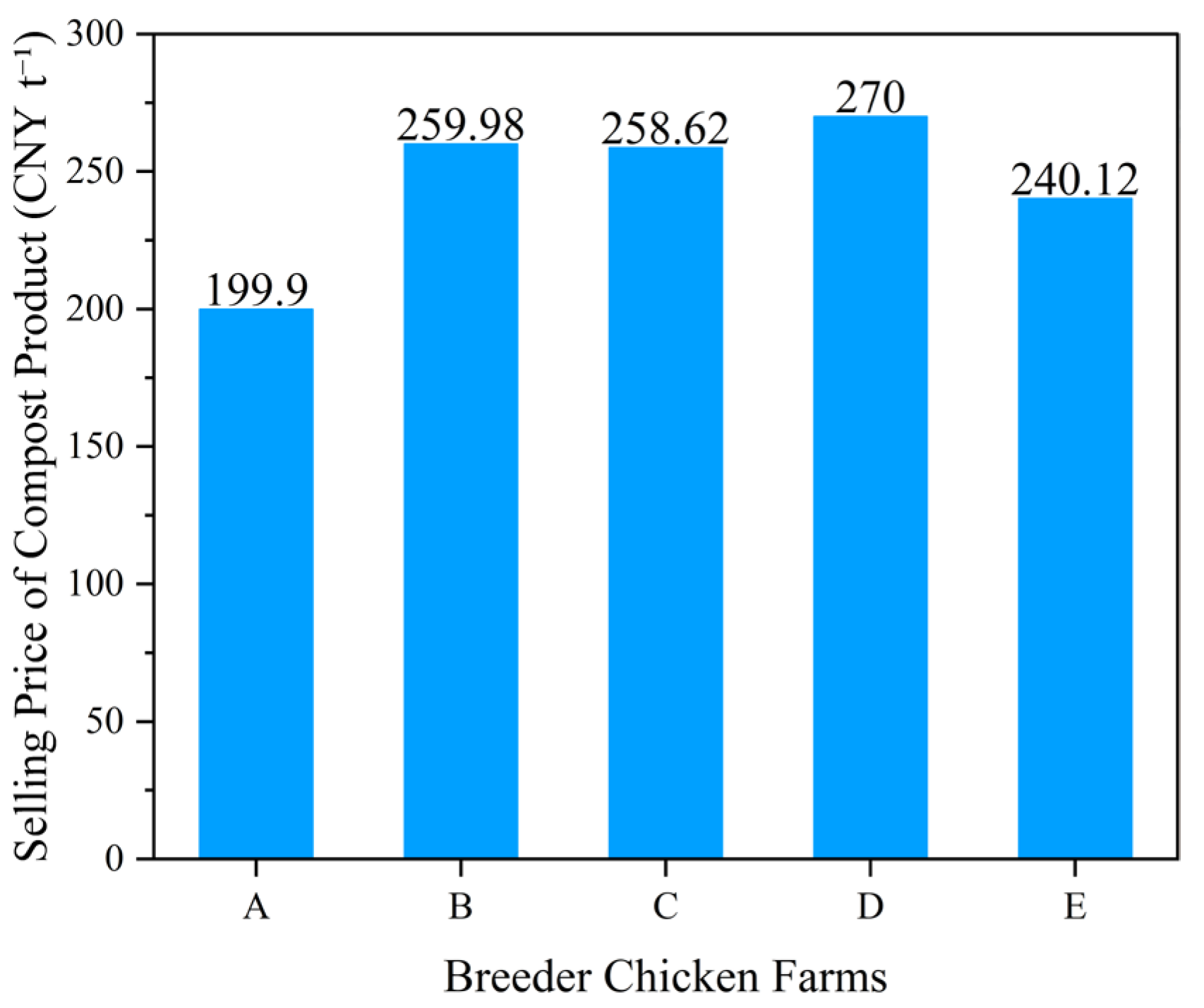
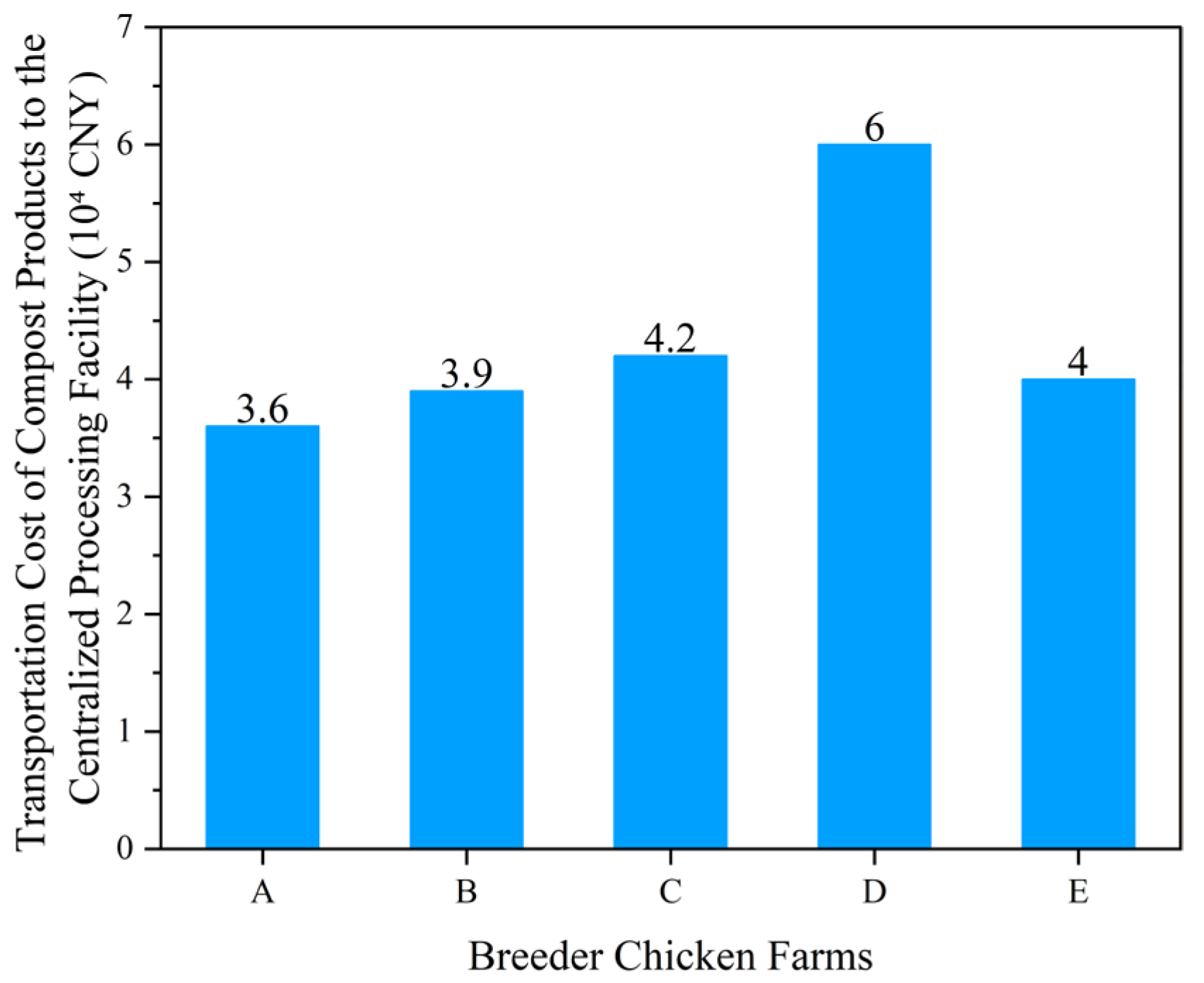
| Farm | Yield Rate (%) | Market Price (CNY/t) | Transport Cost (10,000 CNY/Cycle) |
|---|---|---|---|
| A | 39.60 | 199.90 | 3.60 |
| B | 21.37 | 259.98 | 3.90 |
| C | 23.20 | 258.62 | 4.20 |
| D | 19.17 | 270.00 | 6.00 |
| E | 35.71 | 240.12 | 4.00 |
| Mean | 27.81 | 245.72 | 4.34 |
| SD | 9.20 | 27.79 | 0.95 |
| CV (%) | 33.09 | 11.31 | 21.96 |
| Parameter | Farm A | Farm B | Farm C | Farm D | Farm E |
|---|---|---|---|---|---|
| Fresh manure moisture content (%) | 85–90 | 85–90 | 85–90 | 85–90 | 85–90 |
| Batch duration (d) | 15–21 | 7–10 | 15–21 | 15–21 | 15–21 |
| Temperature profile (°C) | 30 → 60 → 40 | 30 → 60 → 40 | 30 → 60 → 40 | 30 → 60 → 40 | 30 → 60 → 40 |
| Moisture evolution (%) | 50–55% → 35–40% | 55–60% → 35–40% | 50–55% → 35–40% | 50–55% → 35–40% | 55–60% → 35–40% |
| pH range during fermentation | 7.0–9.5 | 7.0–9.5 | 7.0–9.5 | 7.0–9.5 | 7.0–9.5 |
| Indicator | Standard Requirement | Organic Fertilizer (Third-Party Tested) | Bio-Organic Fertilizer (Enterprise Specification Only) |
|---|---|---|---|
| Organic matter (%) | ≥30 (NY/T 525-2021) | 36 | ≥60 |
| Total nutrients (%) | ≥4.0 (NY/T 525-2021) | 9.0 | - |
| Moisture (%) | ≤30 (NY/T 525-2021) | 21 | - |
| pH | 5.5–8.5 (NY/T 525-2021) | 8.4 | - |
| As (mg/kg) | ≤15 (NY/T 525-2021) | 1 | - |
| Cd (mg/kg) | ≤3 (NY/T 525-2021) | 1 | - |
| Pb (mg/kg) | ≤50 (NY/T 525-2021) | 23 | - |
| Cr (mg/kg) | ≤150 (NY/T 525-2021) | 10 | - |
| Hg (mg/kg) | ≤2 (NY/T 525-2021) | 0.1 | - |
| Fecal coliforms | ≤100/g (NY/T 525-2021) | <3 | - |
| Helminth egg mortality (%) | ≥95 (NY/T 525-2021) | 100 | - |
| Viable microbial count (CFU g−1) | ≥0.2 × 10⁸ (NY 884-2012) | - | ≥5 × 10⁸ |
Disclaimer/Publisher’s Note: The statements, opinions and data contained in all publications are solely those of the individual author(s) and contributor(s) and not of MDPI and/or the editor(s). MDPI and/or the editor(s) disclaim responsibility for any injury to people or property resulting from any ideas, methods, instructions or products referred to in the content. |
© 2026 by the authors. Licensee MDPI, Basel, Switzerland. This article is an open access article distributed under the terms and conditions of the Creative Commons Attribution (CC BY) license.
Share and Cite
Yuan, M.; Yu, Y.; Liu, W.; Kong, F. A Staged Resource-Recovery Pathway for Breeder Chicken Manure Under Intensive Farming Conditions: A Practice-Based Case Evaluation. Sustainability 2026, 18, 7186. https://doi.org/10.3390/su18147186
Yuan M, Yu Y, Liu W, Kong F. A Staged Resource-Recovery Pathway for Breeder Chicken Manure Under Intensive Farming Conditions: A Practice-Based Case Evaluation. Sustainability. 2026; 18(14):7186. https://doi.org/10.3390/su18147186
Chicago/Turabian StyleYuan, Mengtang, Yang Yu, Wenqi Liu, and Fanke Kong. 2026. "A Staged Resource-Recovery Pathway for Breeder Chicken Manure Under Intensive Farming Conditions: A Practice-Based Case Evaluation" Sustainability 18, no. 14: 7186. https://doi.org/10.3390/su18147186
APA StyleYuan, M., Yu, Y., Liu, W., & Kong, F. (2026). A Staged Resource-Recovery Pathway for Breeder Chicken Manure Under Intensive Farming Conditions: A Practice-Based Case Evaluation. Sustainability, 18(14), 7186. https://doi.org/10.3390/su18147186