Factors Influencing the Flood-Risk Cognition of Peasant Households Based on Structural Equation Models: A Case Study of Rural Areas in Southwestern China

Abstract
1. Introduction
2. Materials and Methods
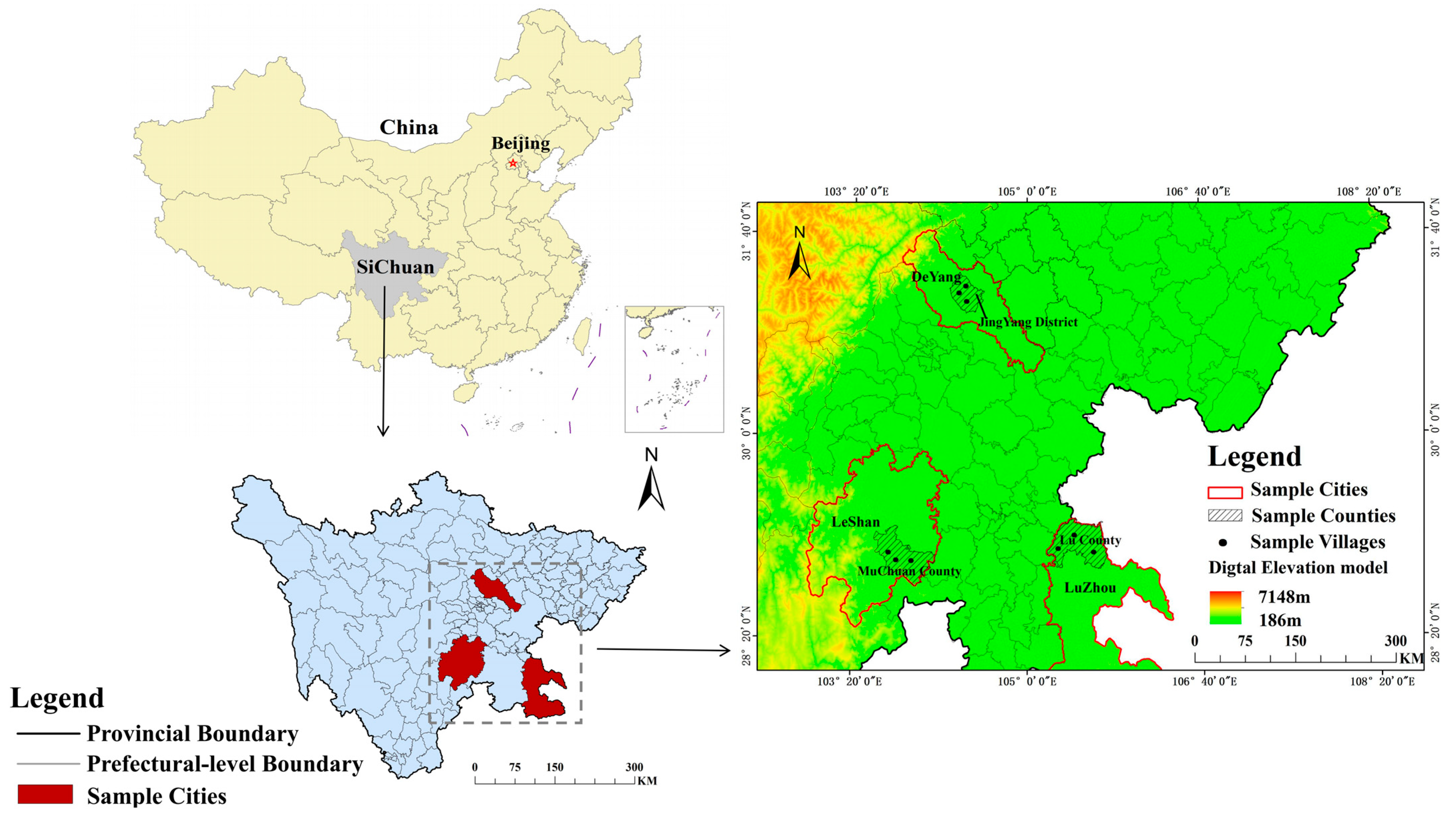
2.1. Study Region
2.2. Data Sources
2.3. Methodology
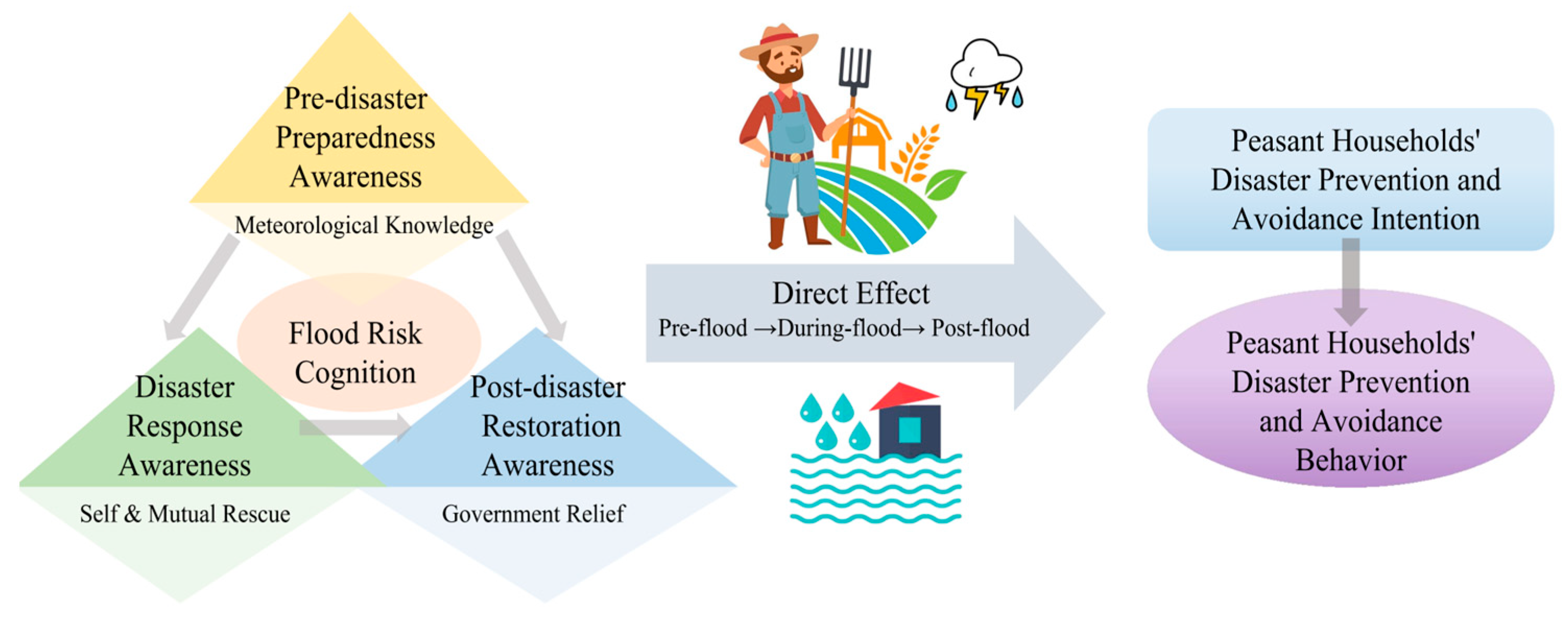
2.3.1. Theoretical Analysis and Research Hypotheses
2.3.2. Validity and Reliability of the Survey
2.3.3. SEM
- (1)
- SEM construction
- (2)
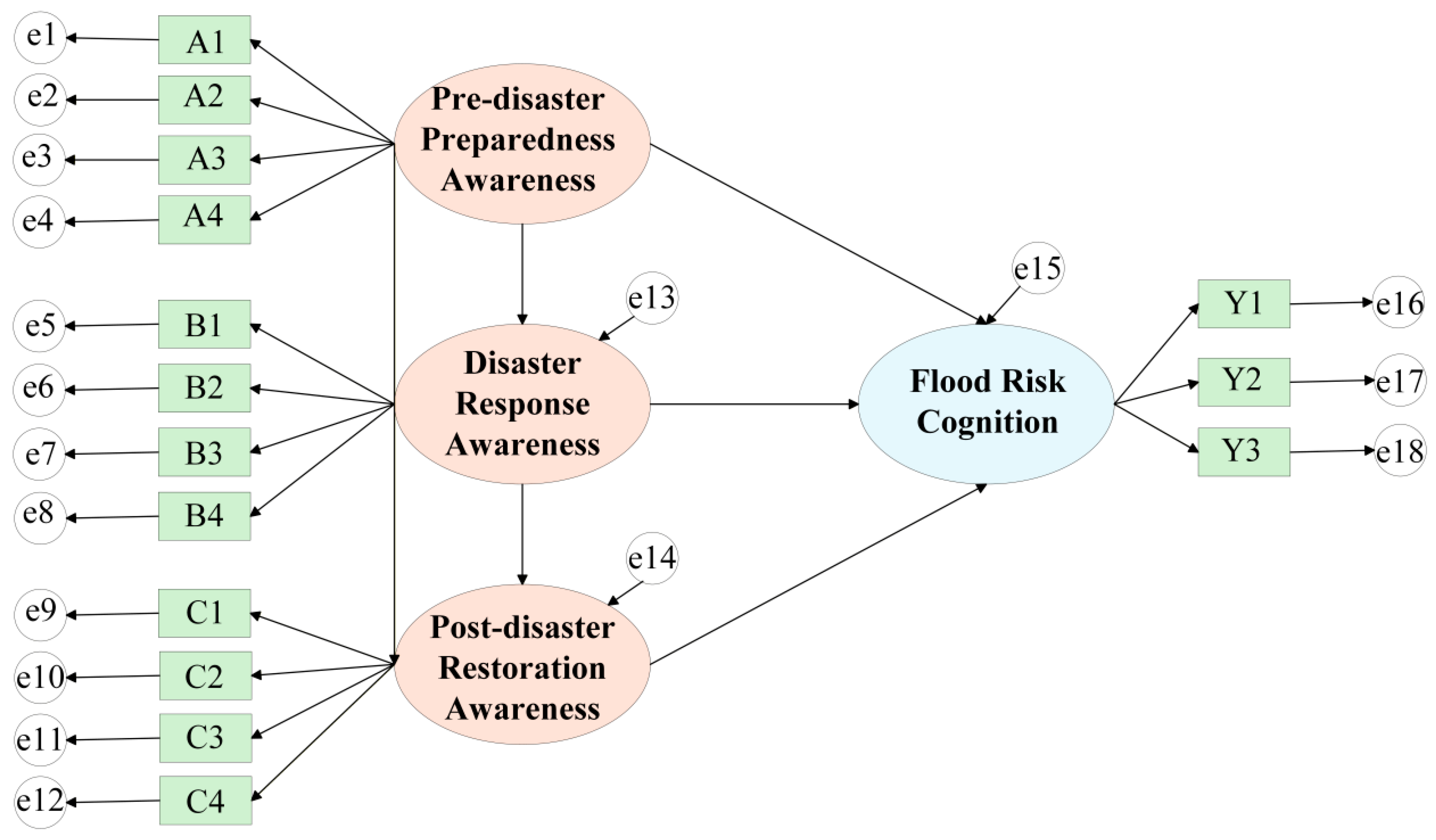
- Selection of Indicator Variables and Model Construction
- (3)
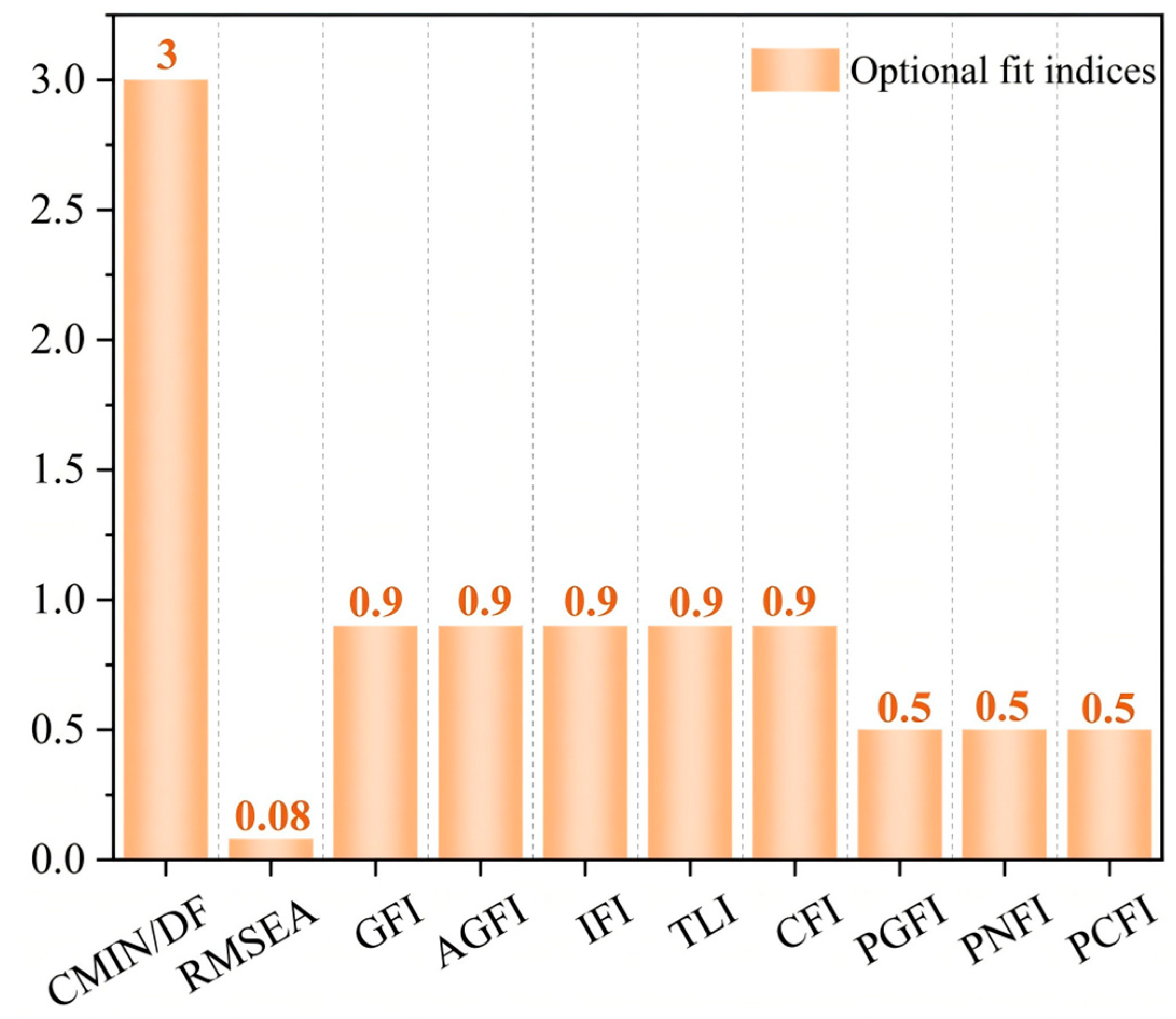
- Modification Method of SEM
- (4)
- Multi-group SEM
- (1)
- Configural invariance (Baseline): no equality constraints; only an identical factor structure was imposed across groups. This model had to achieve acceptable overall fit: CFI ≥ 0.90, TLI ≥ 0.90, RMSEA ≤ 0.08. This can be expressed as follows:
- (2)
- Measurement weights: based on configural invariance, the factor loadings of different groups of observed variables on latent variables were constrained to be equal to verify the cross-group measurement consistency of the latent variables. This can be expressed as follows:
- (3)
- Structural covariance invariance: building on the confirmed measurement weight invariance, latent variable variance–covariance matrices were constrained to equality across groups to assess the cross-group consistency of intercorrelations among latent constructs. This can be expressed as follows:
- (4)
- Measurement residuals: based on structural covariance invariance, the variance–covariance matrices of the measurement errors were constrained to be equal across groups to verify the cross-group stability of the measurement errors. This can be expressed as follows:where is the covariance matrix of observed variables of group ( represents different sampling groups), is the factor load matrix of observed variables on the latent variables, and are the variance–covariance matrices of the latent variables under free estimation and equal cross-group constraint, respectively, and and are the variance–covariance matrices of the measurement residuals under free estimation and equal cross-group constraint, respectively.
3. Results
3.1. Statistical Description of Survey Participants
3.2. Reliability and Validity of Measures
3.3. Results of SEM Analysis
3.3.1. Model Fit and Modification Outcomes
3.3.2. Recognition and Analysis of Important Influencing Factors
3.3.3. Hypothesis Testing
- (1)
- Modification results of the full-sample structural model
- (2)
- Hypothesis verification of the group structural model
4. Discussion
4.1. Contributions and Innovations
4.2. Discussion and Analysis of the Important Factors Influencing Flood-Risk Cognition
4.3. Gender Differences in the Effects of Disaster Response Awareness on Post-Disaster Restoration Awareness and Flood-Risk Cognition
4.4. Limitations of This Study and Implications for Further Research
5. Conclusions
- (1)
- Overcoming structural shortages of peasant households’ risk cognition and optimising primary disaster prevention and publicity logic: Disaster prevention publicity should focus on complementing peasant households’ blind cognition of the long-term secondary damage associated with flood disasters, rather than simply focusing on motivating and advocating. Given the fragmented mountain terrain and the large share of low-educated, left-behind elderly in the sample, publicity should prioritise dialect audio broadcasts and door-to-door guidance over text-intensive materials. Meanwhile, flood-risk cognition among peasant households should be consolidated through the systematic dissemination of flood information, self-rescue training, and scientific guidance on willingness to relocate.
- (2)
- It is essential to set up an integrated cognition guidance system based on management of the full disaster life cycle: Primary disaster prevention should not conform to the traditional single pre-disaster publicity and education mode. Rather, an overall plan for the entire process from pre-disaster warning and publicity to disaster emergency guidance, and then to post-disaster cognition reshaping, should be adopted. For high-altitude villages with sparse road networks and delayed external rescue, a tiered village-to-household manual warning chain should be built to reduce terrain-induced information delay. More attention should be paid to post-disaster risk re-education and training in restoration. The flood-risk cognition of peasant households could be strengthened during post-disaster reconstruction and land-use optimisation. This would improve cognitive literacy throughout the different stages. Continuous door-to-door follow-up should be provided for elderly and low-educated respondents to consolidate long-term cognitive effects.
- (3)
- Promotion of a gender-based disaster prevention strategy: Disaster prevention policies should abandon a “one-size-fits-all” model. To take advantage of females’ better overall risk-cognition sensitivity, females should be encouraged to volunteer for community disaster prevention and publicising of disaster risks. With high male out-migration in mountainous areas, female volunteers could cover left-behind elderly households by issuing daily risk reminders. At the same time, guidance for the cognitive characteristics of males should be optimised to improve the overall flood resilience of rural areas. Targeted training for males could be held during the Spring Festival and other peak periods to lift coverage during population outflows. These findings provide solid support for developing long-term, effective disaster control strategies and promoting sustainable rural development.
- (4)
- Local governments can leverage the mediating role of post-disaster restoration awareness and embed flood-risk training into the whole process of post-disaster reconstruction. During rural housing restoration and cultivated land reclamation, technical training on secondary disaster prevention and agricultural production resumption can be conducted simultaneously, and farmers’ risk cognition can be strengthened alongside publicity of agricultural insurance claim settlements. Meanwhile, regular exchanges of disaster prevention experiences can be organised by village collectives during the post-disaster production recovery period to transform short-term post-disaster assistance demands into long-term disaster prevention capacity-building. This would form a positive cycle of “post-disaster restoration–cognitive upgrading–pre-disaster defence”.
Author Contributions
Funding
Institutional Review Board Statement
Informed Consent Statement
Data Availability Statement
Acknowledgments
Conflicts of Interest
References
- Aitsi-Selmi, A.; Egawa, S.; Sasaki, H.; Wannous, C.; Murray, V. The Sendai framework for disaster risk reduction: Renewing the global commitment to people’s resilience, health, and well-being. Int. J. Disaster Risk Sci. 2015, 6, 164–176. [Google Scholar] [CrossRef]
- Munene, M.B.; Swartling, Å.G.; Thomalla, F. Adaptive governance as a catalyst for transforming the relationship between development and disaster risk through the Sendai Framework? Int. J. Disaster Risk Reduct. 2018, 28, 653–663. [Google Scholar] [CrossRef]
- Plummer, R.; Baird, J.; Bullock, R.; Dzyundzyak, A.; Dupont, D.; Swartling, Å.G.; Johannessen, Å.; Huitema, D.; Lyth, A.; Zurita, M.L.M.; et al. Flood governance: A multiple country comparison of stakeholder perceptions and aspirations. Environ. Policy Gov. 2018, 28, 67–81. [Google Scholar] [CrossRef]
- Jongman, B. Effective adaptation to rising flood risk. Nat. Commun. 2018, 9, 1986. [Google Scholar] [CrossRef] [PubMed]
- Shah, A.A.; Ullah, W.; Khan, N.A.; Alotaibi, B.A.; Xu, C. Mapping rural household vulnerability to flood-induced health risks in disaster-stricken Khyber Pakhtunkhwa, Pakistan. Sustainability 2024, 16, 10578. [Google Scholar] [CrossRef]
- Faruk, M.O.; Maharjan, K.L. The determinants of farmers’ perceived flood-risk and their flood adaptation assessments: A study in a char-land area of Bangladesh. Sustainability 2023, 15, 13727. [Google Scholar] [CrossRef]
- Ahmad, D.; Afzal, M. Psychological distancing and floods risk perception relating to climate change in flood-prone Bait communities of Punjab, Pakistan. Environ. Dev. Sustain. 2024, 26, 12939–12970. [Google Scholar] [CrossRef]
- Botzen, W.J.; Aerts, J.C.; van den Bergh, J.C. Dependence of flood-risk perceptions on socioeconomic and objective risk factors. Water Resour. Res. 2009, 45, W10440. [Google Scholar] [CrossRef]
- Padhan, N.; Madheswaran, S. Determinants of farm-level adaptation strategies to flood: Insights from a farm household-level survey in coastal districts of Odisha. Water Policy 2022, 24, 450–469. [Google Scholar] [CrossRef]
- Shah, A.A.; Ajiang, C.; Khan, N.A.; Alotaibi, B.A.; Tariq, M.A.U.R. Flood-risk perception and its attributes among rural households under developing country conditions: The case of Pakistan. Water 2022, 14, 992. [Google Scholar] [CrossRef]
- Wachinger, G.; Renn, O.; Begg, C.; Kuhlicke, C. The risk perception paradox—Implications for governance and communication of natural hazards. Risk Anal. 2013, 33, 1049–1065. [Google Scholar] [CrossRef] [PubMed]
- Xu, D.; Zhou, W.; Deng, X.; Ma, Z.; Yong, Z.; Qin, C. Information credibility, disaster risk perception and evacuation willingness of rural households in China. Nat. Hazards 2020, 103, 2865–2882. [Google Scholar] [CrossRef]
- Terpstra, T. Emotions, trust, and perceived risk: Affective and cognitive routes to flood preparedness behavior. Risk Anal. Int. J. 2011, 31, 1658–1675. [Google Scholar] [CrossRef] [PubMed]
- Lin, C.A. flood-risk management via risk communication, cognitive appraisal, collective efficacy, and community action. Sustainability 2023, 15, 14191. [Google Scholar] [CrossRef]
- Chen, W.; Qian, H.; Zhang, L.; Pan, Y.; Li, Z.; Gardoni, P. Supply-demand mismatch causes substantial deterioration in prehospital emergency medical service under disasters. Commun. Eng. 2025, 4, 145. [Google Scholar] [CrossRef] [PubMed]
- Liu, D.; Li, Y.; Fang, S.; Zhang, Y. Influencing factors for emergency evacuation capability of rural households to flood hazards in western mountainous regions of Henan province, China. Int. J. Disaster Risk Reduct. 2017, 21, 187–195. [Google Scholar] [CrossRef]
- Wu, V.C.S.; Russell, A.R.; Scott, M.L. What Can Nonprofits Learn from Mutual Aid Organizing? Investigating Mutual Aid Approaches During the COVID-19 Pandemic. Nonprofit Manag. Leadersh. 2025, 35, 783–798. [Google Scholar] [CrossRef]
- Mollinger, I. Community in times of COVID: Building resilience in a self-help neighborhood in Medellin. Child. Geogr. 2024, 22, 1–15. [Google Scholar] [CrossRef]
- Sutton, J.; Kuligowski, E.; Olson, M.; Walpole, H.; Wood, M.M. Measuring the effectiveness of disaster warning messages: A forum. Nat. Hazards Rev. 2025, 26, 02524001. [Google Scholar] [CrossRef]
- Xu, L.; Bathgate, K.; Robbennolt, J.; Sun, J.; Pan, S.; Han, Z.; Boyles, S.D. Understanding the utilization of real-time traffic information during hurricane evacuations in Texas. Transp. Res. Rec. 2024, 2678, 1177–1191. [Google Scholar] [CrossRef]
- Karki, J.; Matthewman, S.; Grayman, J.H. From goods to goats: Examining post-disaster livelihood recovery in the aftermath of the Nepal earthquake 2015. Nat. Hazards 2022, 114, 3787–3809. [Google Scholar] [CrossRef] [PubMed]
- Thompson, W.J.; Varma, V.; Joerin, J.; Bonilla-Duarte, S.; Bebber, D.P.; Blaser-Hart, W.; Kopainsky, B.; Späth, L.; Curcio, B.; Six, J. Smallholder farmer resilience to extreme weather events in a global food value chain. Clim. Change 2023, 176, 152. [Google Scholar] [CrossRef] [PubMed]
- Deryugina, T. The fiscal cost of hurricanes: Disaster aid versus social insurance. Am. Econ. J. Econ. Policy 2017, 9, 168–198. [Google Scholar] [CrossRef]
- Kousky, C. The role of natural disaster insurance in recovery and risk reduction. Annu. Rev. Resour. Econ. 2019, 11, 399–418. [Google Scholar] [CrossRef]
- Kitagawa, K. Conceptualising ‘disaster education’. Educ. Sci. 2021, 11, 233. [Google Scholar] [CrossRef]
- Seddig, G.L.M.; Ducatti, A.P.S.; Cazane, A.L.; Cabrini, M.L.; de Souza Lima, I.A.; de Brito Júnior, I. The Role of Prior Disaster Experience in Shaping Risk Perception and Preparedness in Brazil. Int. J. Disaster Risk Sci. 2026, 17, 99–113. [Google Scholar] [CrossRef]
- Saflor, C.S.R.; Kudhal, K. Emergency Alert and Warning Systems and Their Impact on Sustainable Disaster Preparedness and Awareness in the Philippines: A SEM-ANN Analysis. Sustainability 2026, 18, 3590. [Google Scholar] [CrossRef]
- Breen, R.; Karlson, K.B.; Holm, A. Total, direct, and indirect effects in logit and probit models. Sociol. Methods Res. 2013, 42, 164–191. [Google Scholar] [CrossRef]
- Xu, D.; Peng, L.; Su, C.; Liu, S.; Wang, X.; Chen, T. Influences of mass monitoring and mass prevention systems on peasant households’ disaster risk perception in the landslide-threatened Three Gorges Reservoir area, China. Habitat Int. 2016, 58, 23–33. [Google Scholar] [CrossRef]
- Ballesteros, J.; Isaza, C. Adaptation measures to climate change as perceived by smallholder farmers in the Andes. J. Ethnobiol. 2021, 41, 428–446. [Google Scholar] [CrossRef]
- Kirezci, E.; Young, I.R.; Ranasinghe, R.; Lincke, D.; Hinkel, J. Global-scale analysis of socioeconomic impacts of coastal flooding over the 21st century. Front. Mar. Sci. 2023, 9, 1024111. [Google Scholar] [CrossRef]
- Rhubart, D.; Sun, Y. The social correlates of flood risk: Variation along the US rural–urban continuum. Popul. Environ. 2021, 43, 232–256. [Google Scholar] [CrossRef]
- Kellens, W.; Terpstra, T.; De Maeyer, P. Perception and communication of flood risks: A systematic review of empirical research. Risk Anal. 2012, 33, 24–49. [Google Scholar] [CrossRef] [PubMed]
- Yang, L.; Ji, X.; Li, M.; Yang, P.; Jiang, W.; Chen, L.; Yang, C.; Sun, C.; Li, Y. A comprehensive framework for assessing the spatial drivers of flood disasters using an Optimal Parameter-based Geographical Detector–machine learning coupled model. Geosci. Front. 2024, 15, 101889. [Google Scholar] [CrossRef]
- Tang, H.; Liu, J.; Dai, X.; Zhang, Y.; He, W.; Yin, Q.; Huang, F.; Ran, R.; Liu, Y. Household groups’ land use decisions investigation based on perspective of livelihood heterogeneity in Sichuan Province, China. Int. J. Environ. Res. Public Health 2022, 19, 9485. [Google Scholar] [CrossRef] [PubMed]
- Zheng, L.; Ma, Q.; Jiang, T.; Liu, X.; Mou, J.; Wang, C.; Lan, Y. Analysis of the Spatial Temporal Evolution Pattern and Influencing Factors of Grain Production in Sichuan Province of China. Smart Agric. 2025, 7, 13–25. [Google Scholar] [CrossRef]
- Zhang, D.; Dong, H. Understanding arable land change patterns and driving forces in major grain-producing areas: A case study of Sichuan province using the PLUS model. Land 2023, 12, 1443. [Google Scholar] [CrossRef]
- Yang, Z.; Jiang, S.; Xie, H.; Hou, Y. Spatiotemporal Characteristics and Driving Factors of Drought-Flood Abrupt Alternation in the Sichuan Basin. Atmosphere 2026, 17, 412. [Google Scholar] [CrossRef]
- Dang, H.; Deng, Y.; Hai, Y.; Chen, H.; Wang, W. Characterization of spatio-temporal evolution of grain production and identification of its heterogeneity drivers in Sichuan Province based on Geodetector and GWR models. Front. Sustain. Food Syst. 2025, 9, 1561910. [Google Scholar] [CrossRef]
- Yang, J.; Huo, Z.; Wu, L.; Wang, T.; Zhang, G. Indicator-based evaluation of spatiotemporal characteristics of rice flood in Southwest China. Agric. Ecosyst. Environ. 2016, 230, 221–230. [Google Scholar] [CrossRef]
- Bai, L.; Liu, T.; Sha, A.; Li, D. The spatiotemporal fluctuations of extreme rainfall and their potential influencing factors in Sichuan Province, China, from 1970 to 2022. Remote Sens. 2025, 17, 883. [Google Scholar] [CrossRef]
- Alsafadi, K.; Sun, J.; Ullah, I.; Srivastava, A.K.; Ewert, F.; Larbi, B.R.; Bi, S.; Yang, S.; Wang, F.; Cao, W. Urbanization’s dual role in the exacerbation and mitigation of drought dynamics in China. npj Urban Sustain. 2025, 5, 79. [Google Scholar] [CrossRef]
- Lindell, M.K.; Perry, R.W. The protective action decision model: Theoretical modifications and additional evidence. Risk Anal. 2012, 32, 616–632. [Google Scholar] [CrossRef] [PubMed]
- Wu, Q.; Li, R. The driving mechanism of citizens’ protective behaviors for rainstorm flood disasters in China: An empirical study based on the protection motivation theory and protective action decision model. Heliyon 2024, 10, e38482. [Google Scholar] [CrossRef] [PubMed]
- Grothmann, T.; Reusswig, F. People at risk of flooding: Why some residents take precautionary action while others do not. Nat. Hazards 2006, 38, 101–120. [Google Scholar] [CrossRef]
- Bubeck, P.; Berghäuser, L.; Hudson, P.; Thieken, A.H. Using panel data to understand the dynamics of human behavior in response to flooding. Risk Anal. 2020, 40, 2340–2359. [Google Scholar] [CrossRef] [PubMed]
- Luo, X.; Lone, T.; Jiang, S.; Li, R.; Berends, P. A study of farmers’ flood perceptions based on the entropy method: An application from Jianghan Plain, China. Disasters 2016, 40, 573–588. [Google Scholar] [CrossRef] [PubMed]
- Kreibich, H.; Bubeck, P.; Van Vliet, M.; De Moel, H. A review of damage-reducing measures to manage fluvial flood risks in a changing climate. Mitig. Adapt. Strateg. Glob. Change 2015, 20, 967–989. [Google Scholar] [CrossRef]
- Şentürk, M.; Özdinç, Ö.; Topal, M.H.; Başpınar, A.; Cergibozan, R.; Mengüç, K.; Durmuş, A. A conceptual co-design co-create framework for citizen engagement in disaster risk reduction and resilience. Sustainability 2026, 18, 4596. [Google Scholar] [CrossRef]
- Zhong, M.; Xiao, L.; Zhang, Q.; Jiang, T. Risk Perception, Risk communication, and mitigation actions of flash floods: Results from a survey in three types of communities. Sustainability 2021, 13, 12389. [Google Scholar] [CrossRef]
- Lechowska, E. What determines flood-risk perception? A review of factors of flood-risk perception and relations between its basic elements. Nat. Hazards 2018, 94, 1341–1366. [Google Scholar] [CrossRef]
- Wang, Z.; Zhang, F.; Liu, S.; Xu, D. Consistency between the subjective and objective flood-risk and willingness to purchase natural disaster insurance among farmers: Evidence from rural areas in Southwest China. Environ. Impact Assess. Rev. 2023, 102, 107201. [Google Scholar] [CrossRef]
- Botzen, W.W.; Kunreuther, H.; Czajkowski, J.; de Moel, H. Adoption of individual flood damage mitigation measures in New York City: An extension of protection motivation theory. Risk Anal. 2019, 39, 2143–2159. [Google Scholar] [CrossRef] [PubMed]
- Valente, M.J.; Gonzalez, O.; Miočević, M.; MacKinnon, D.P. A note on testing mediated effects in structural equation models: Reconciling past and current research on the performance of the test of joint significance. Educ. Psychol. Meas. 2016, 76, 889–911. [Google Scholar] [CrossRef] [PubMed]
- Memarbashi, P.; Mojarradi, G.; Maleksaeidi, H. Identifying factors affecting flood-risk perception among strawberry growers in Kurdistan province. Iran. J. Agric. Econ. Dev. Res. 2023, 54, 895–910. [Google Scholar] [CrossRef]
- Misra, S.; Roberts, P.; Rhodes, M. Information overload, stress, and emergency managerial thinking. Int. J. Disaster Risk Reduct. 2020, 51, 101762. [Google Scholar] [CrossRef]
- Ge, Y.; Yang, G.; Wang, X.; Dou, W.; Lu, X.; Mao, J. Understanding risk perception from floods: A case study from China. Nat. Hazards 2021, 105, 3119–3140. [Google Scholar] [CrossRef] [PubMed]
- Paton, D.; Buergelt, P. Risk, transformation and adaptation: Ideas for reframing approaches to disaster risk reduction. Int. J. Environ. Res. Public Health 2019, 16, 2594. [Google Scholar] [CrossRef] [PubMed]
- Li, Y.; Wang, P. Unbalanced relationship between flood-risk perception and flood preparedness from the perspective of response intention and socio-economic factors: A case study of Nanjing, China. Nat. Hazards Earth Syst. Sci. 2025, 25, 4071–4088. [Google Scholar] [CrossRef]
- Khan, A.N.; Soomro, M.A. Integrating Social Support and Digital Technologies to Boost Coping Mechanisms and Collective Action During Extreme Disasters. Risk Anal. 2026, 46, e70166. [Google Scholar] [CrossRef] [PubMed]
- Ao, Y.; Zhou, X.; Ji, F.; Wang, Y.; Yang, L.; Wang, Q.; Martek, I. Flood disaster preparedness: Experience and attitude of rural residents in Sichuan, China. Nat. Hazards 2020, 104, 2591–2618. [Google Scholar] [CrossRef]
- Hung, L.S. Gender, intra-household dynamics, and household hurricane preparedness: An exploratory study employing a dyadic interview approach. Int. J. Disaster Risk Sci. 2018, 9, 16–27. [Google Scholar] [CrossRef]
- Ao, Y.; Tan, L.; Feng, Q.; Tan, L.; Li, H.; Wang, Y.; Wang, T.; Chen, Y. Livelihood capital effects on famers strategy choices in flood-prone areas A study in rural China. Int. J. Environ. Res. Public Health 2022, 19, 7535. [Google Scholar] [CrossRef] [PubMed]
- Bradshaw, S. Gender, Development and Disasters; Edward Elgar Publishing: Cheltenham, UK, 2013. [Google Scholar] [CrossRef]




| Latent Variables | Observed Variables | Definition | Mean | b SE |
|---|---|---|---|---|
| Pre-disaster Preparedness Awareness | A1: Meteorological disaster knowledge and skills | Attach great importance to learning and accumulating meteorological disaster knowledge and skills. i | 3.178 | 1.132 |
| A2: Familiarity with secondary disasters of rainstorm floods | Degree of familiarity with secondary disasters induced by rainstorm and flood events. i | 3.261 | 1.090 | |
| A3: Knowledge of flood defence | Level of understanding of rainstorm flood prevention. i | 3.285 | 1.093 | |
| A4: Clarity of early warning signals | Level of clarity regarding emergency disaster early warning signals. i | 3.507 | 1.143 | |
| Disaster Response Awareness | B1: Willingness to evacuate under flood threat | Willingness to temporarily evacuate in response to flood disaster threats. ii | 4.120 | 1.016 |
| B2: Willingness to relocate under flood threat | Willingness to permanently relocate under the threat of flood disasters. ii | 3.820 | 1.098 | |
| B3: Mastery of self-rescue and mutual rescue knowledge | Level of mastery of flood disaster self-rescue and mutual rescue knowledge. i | 3.546 | 1.232 | |
| B4: Clarity of escape routes | Degree of clarity regarding emergency evacuation routes under disaster conditions. i | 3.723 | 1.147 | |
| Post-disaster Restoration Awareness | C1: Disease prevention awareness | Disease prevention awareness after flood disasters. i | 3.349 | 1.072 |
| C2: Self-reliance in resolving household basic living difficulties | Degree to which household basic living difficulties can be resolved through self-efforts. i | 3.362 | 1.098 | |
| C3: Demand for government assistance | Demand for seeking help from the government after floods. i | 2.629 | 1.022 | |
| C4: Demand for social assistance | Demand for seeking help from society after floods. i | 3.791 | 0.982 | |
| Flood Risk Cognition | Y1: Possibility of disaster occurrence | Within the next decade, households’ housing and land may be affected by potential disasters. i | 3.372 | 1.257 |
| Y2: Perceived threat | In the event of flooding, roads will be destroyed, and villages will be rendered isolated. i | 2.771 | 1.262 | |
| Y3: Mitigation attitude | Possess the capability to fulfil all necessary tasks for evacuation. i | 4.091 | 0.948 |
| Criteria for Invariance | DELTA-NFI | DELTA-RFI | DELTA-IFI | DELTA-TLI | DELTA-CFI | DELTA-RMSEA |
|---|---|---|---|---|---|---|
| Measurement weights | ≤0.02 | ≤0.02 | ≤0.02 | ≤0.02 | ≤0.01 | ≤0.015 |
| Structural covariances | ≤0.02 | ≤0.02 | ≤0.02 | ≤0.02 | ≤0.01 | ≤0.015 |
| Measurement residuals | ≤0.02 | ≤0.02 | ≤0.02 | ≤0.02 | ≤0.01 | ≤0.015 |
| Variable | Definition | Min | Max | Mean | b SE |
|---|---|---|---|---|---|
| Flood experience | 0 = No experience, 1 = Have experienced flood | 0 | 1 | 0.898 | 0.303 |
| Gender | 0 = Male, 1 = Female | 0 | 1 | 0.601 | 0.490 |
| Age | Age (years) | 17 | 94 | 61.241 | 12.434 |
| Education level | Years of education | 0 | 16 | 5.825 | 3.741 |
| Village position | 1 = Ordinary villager, 2 = Village Party Secretary/Director, 3 = Village committee member, 4 = Group leader, 5 = Member of supervisory/council board of cooperative or collective economic organisation | 1 | 5 | 1.257 | 0.818 |
| Self-assessed health | 1 = Very good, 2 = Good, 3 = Fair, 4 = Poor, 5 = Very poor | 1 | 5 | 2.352 | 1.010 |
| Number of labour force | Number of labourers aged 16–64 | 0 | 13 | 2.149 | 1.574 |
| Area of cultivated land in operation | Area of cultivated land currently operated (mu) | 0 | 11 | 2.397 | 1.445 |
| Latent Variables | Observed Variables | Cronbach’s Alpha | KMO | Bartlett’s Test of Sphericity | ||
|---|---|---|---|---|---|---|
| Approximate Chi-Square | Degree of Freedom | p-Value | ||||
| Pre-disaster Preparedness Awareness | A1 A2 A3 A4 | 0.775 | 0.769 | 738.443 | 6 | 0.000 |
| Disaster Response Awareness | B1 B2 B3 B4 | 0.716 | 0.649 | 629.265 | 6 | 0.000 |
| Post-disaster Restoration Awareness | C1 C2 C3 C4 | 0.725 | 0.745 | 528.491 | 6 | 0.000 |
| Flood Risk Cognition | Y1 Y2 Y3 | 0.715 | 0.658 | 409.775 | 3 | 0.000 |
| Overall | 0.876 | 0.894 | 3542.903 | 105 | 0.000 | |
| Factor | |||||
|---|---|---|---|---|---|
| 1 | 2 | 3 | 4 | ||
| Pre-disaster Preparedness Awareness | A1 | 0.128 | 0.727 | 0.080 | 0.118 |
| A2 | 0.168 | 0.748 | 0.234 | 0.120 | |
| A3 | 0.140 | 0.752 | 0.286 | 0.118 | |
| A4 | 0.167 | 0.420 | 0.622 | 0.076 | |
| Disaster Response Awareness | B1 | 0.219 | 0.108 | 0.289 | 0.737 |
| B2 | 0.103 | 0.131 | 0.135 | 0.838 | |
| B3 | 0.115 | 0.105 | 0.812 | 0.188 | |
| B4 | 0.135 | 0.150 | 0.814 | 0.145 | |
| Post-disaster Restoration Awareness | C1 | 0.430 | 0.582 | 0.046 | 0.035 |
| C2 | 0.628 | 0.300 | 0.221 | 0.014 | |
| C3 | 0.724 | 0.021 | 0.179 | 0.154 | |
| C4 | 0.785 | 0.083 | 0.133 | 0.042 | |
| Flood Risk Cognition | Y1 | 0.522 | 0.339 | −0.159 | 0.370 |
| Y2 | 0.556 | 0.348 | 0.006 | 0.211 | |
| Y3 | 0.513 | 0.383 | 0.196 | 0.334 | |
| Cumulative variance contribution rate | 61.627% | ||||
| Items | NSE | a SE | CR | b SE | ||
|---|---|---|---|---|---|---|
| Pre-disaster preparedness awareness | → | A4 | 1.021 | 0.082 | 12.513 | 0.613 *** |
| Pre-disaster preparedness awareness | → | A3 | 1.243 | 0.083 | 14.890 | 0.780 *** |
| Pre-disaster preparedness awareness | → | A2 | 1.188 | 0.083 | 14.316 | 0.748 *** |
| Pre-disaster preparedness awareness | → | A1 | 1.000 | 0.606 *** | ||
| Post-disaster restoration awareness | → | C4 | 0.931 | 0.074 | 12.651 | 0.636 *** |
| Post-disaster restoration awareness | → | C3 | 0.902 | 0.076 | 11.899 | 0.592 *** |
| Post-disaster restoration awareness | → | C2 | 1.106 | 0.081 | 13.576 | 0.676 *** |
| Post-disaster restoration awareness | → | C1 | 1.000 | 0.626 *** | ||
| Disaster response awareness | → | B4 | 0.801 | 0.083 | 9.629 | 0.507 *** |
| Disaster response awareness | → | B3 | 0.862 | 0.086 | 10.031 | 0.508 *** |
| Disaster response awareness | → | B2 | 0.940 | 0.072 | 13.057 | 0.622 *** |
| Disaster response awareness | → | B1 | 1.000 | 0.715 *** | ||
| Flood risk cognition | → | Y3 | 1.156 | 0.088 | 13.178 | 0.733 *** |
| Flood risk cognition | → | Y2 | 1.036 | 0.074 | 13.910 | 0.562 *** |
| Flood risk cognition | → | Y1 | 1.000 | 0.542 *** | ||
| Paths | NSE | a SE | CR | b SE | Verified | |||
|---|---|---|---|---|---|---|---|---|
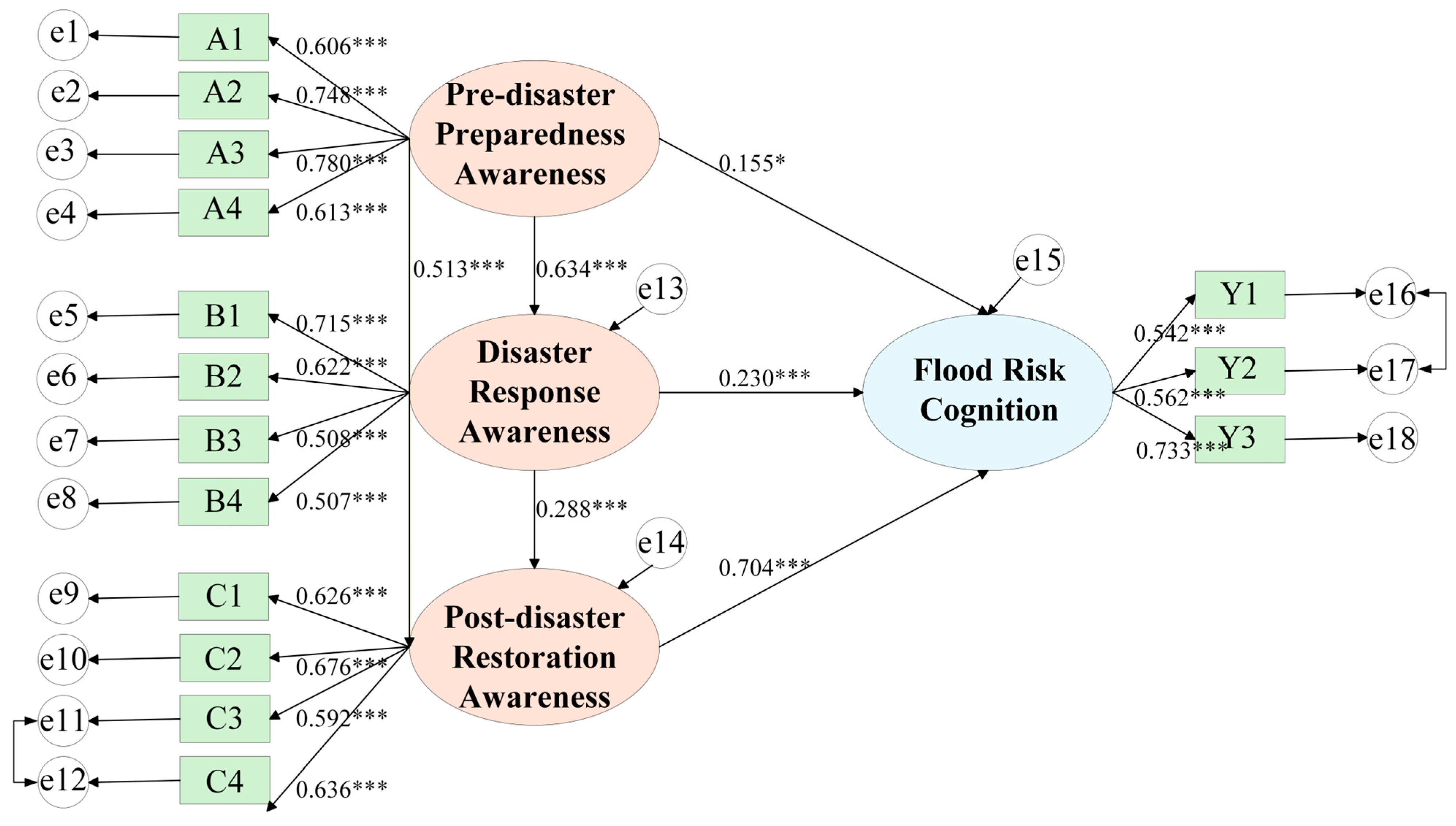
| H1 | Flood Risk Cognition | ← | Pre-disaster Preparedness Awareness | 0.145 | 0.070 | 2.081 | 0.155 * | Yes |
| H2 | Flood Risk Cognition | ← | Disaster Response Awareness | 0.203 | 0.061 | 3.314 | 0.230 *** | Yes |
| H3 | Flood Risk Cognition | ← | Post-disaster Restoration Awareness | 0.673 | 0.086 | 7.789 | 0.704 *** | Yes |
| H4 | Disaster Response Awareness | ← | Pre-disaster Preparedness Awareness | 0.672 | 0.065 | 10.399 | 0.634 *** | Yes |
| H5 | Post-disaster restoration Awareness | ← | Disaster Response Awareness | 0.265 | 0.065 | 4.072 | 0.288 *** | Yes |
| H6 | Post-disaster restoration Awareness | ← | Pre-disaster Preparedness Awareness | 0.501 | 0.076 | 6.631 | 0.513 *** | Yes |
| Variables | Pre-Disaster Preparedness Awareness | Disaster Response Awareness | Post-Disaster Restoration Awareness | ||||||
|---|---|---|---|---|---|---|---|---|---|
| Direct Effects | Indirect Effects | Total Effects | Direct Effects | Indirect Effects | Total Effects | Direct Effects | Indirect Effects | Total Effects | |
| Disaster Response Awareness | 0.634 | 0.634 | |||||||
| Post-disaster Restoration Awareness | 0.513 | 0.182 | 0.695 | 0.288 | 0.288 | ||||
| Flood Risk Cognition | 0.155 | 0.635 | 0.790 | 0.230 | 0.202 | 0.432 | 0.704 | 0.704 | |
| Criteria for Invariance | DELTA-NFI | DELTA-RFI | DELTA-IFI | DELTA-TLI | DELTA-CFI | DELTA-RMSEA |
|---|---|---|---|---|---|---|
| Measurement weights | 0.005 | 0.004 | 0.001 | 0.005 | 0.001 | 0.002 |
| Structural covariances | 0.002 | 0.002 | 0.002 | 0.001 | 0.002 | 0 |
| Measurement residuals | 0.006 | 0.009 | 0.001 | 0.009 | 0 | 0.002 |
| Items | NSE | a SE | CR | b SE | ||
|---|---|---|---|---|---|---|
| Pre-disaster preparedness awareness | → | A4 | 1.056 | 0.141 | 7.507 | 0.598 *** |
| Pre-disaster preparedness awareness | → | A3 | 1.210 | 0.133 | 9.097 | 0.752 *** |
| Pre-disaster preparedness awareness | → | A2 | 1.203 | 0.136 | 8.824 | 0.728 *** |
| Pre-disaster preparedness awareness | → | A1 | 1.000 | 0.596 *** | ||
| Post-disaster restoration awareness | → | C4 | 0.866 | 0.113 | 7.694 | 0.613 *** |
| Post-disaster restoration awareness | → | C3 | 0.799 | 0.115 | 6.948 | 0.5428 ** |
| Post-disaster restoration awareness | → | C2 | 1.124 | 0.135 | 8.341 | 0.673 *** |
| Post-disaster restoration awareness | → | C1 | 1.000 | 0.624 *** | ||
| Disaster response awareness | → | B4 | 1.126 | 0.171 | 6.602 | 0.669 *** |
| Disaster response awareness | → | B3 | 1.016 | 0.168 | 6.041 | 0.584 *** |
| Disaster response awareness | → | B2 | 0.951 | 0.109 | 8.720 | 0.596 *** |
| Disaster response awareness | → | B1 | 1.000 | 0.726 *** | ||
| Flood risk cognition | → | Y3 | 1.283 | 0.177 | 7.243 | 0.693 *** |
| Flood risk cognition | → | Y2 | 1.191 | 0.148 | 8.027 | 0.547 *** |
| Flood risk cognition | → | Y1 | 1.000 | 0.476 *** | ||
| Items | NSE | a SE | CR | b SE | ||
|---|---|---|---|---|---|---|
| Pre-disaster preparedness awareness | → | A4 | 1.024 | 0.102 | 10.035 | 0.636 *** |
| Pre-disaster preparedness awareness | → | A3 | 1.271 | 0.109 | 11.717 | 0.796 *** |
| Pre-disaster preparedness awareness | → | A2 | 1.188 | 0.106 | 11.214 | 0.759 *** |
| Pre-disaster preparedness awareness | → | A1 | 1.000 | 0.606 *** | ||
| Post-disaster restoration awareness | → | C4 | 0.976 | 0.099 | 9.876 | 0.647 *** |
| Post-disaster restoration awareness | → | C3 | 0.976 | 0.103 | 9.480 | 0.629 *** |
| Post-disaster restoration awareness | → | C2 | 1.116 | 0.106 | 10.514 | 0.681 *** |
| Post-disaster restoration awareness | → | C1 | 1.000 | 0.619 *** | ||
| Disaster response awareness | → | B4 | 0.649 | 0.099 | 6.536 | 0.420 *** |
| Disaster response awareness | → | B3 | 0.800 | 0.106 | 7.541 | 0.467 *** |
| Disaster response awareness | → | B2 | 0.947 | 0.098 | 9.635 | 0.632 *** |
| Disaster response awareness | → | B1 | 1.000 | 0.690 *** | ||
| Flood risk cognition | → | Y3 | 1.117 | 0.102 | 10.994 | 0.764 *** |
| Flood risk cognition | → | Y2 | 0.964 | 0.086 | 11.174 | 0.565 ** |
| Flood risk cognition | → | Y1 | 1.000 | 0.575 *** | ||
| Path | Group 1 (Females) | Verified | Group 2 (Males) | Verified | |||||
|---|---|---|---|---|---|---|---|---|---|
| b SE | a SE | b SE | a SE | ||||||
| H1 | Flood Risk Cognition | ← | Pre-disaster Preparedness Awareness | 0.228 | 0.130 | No | 0.127 | 0.086 | No |
| H2 | Flood Risk Cognition | ← | Disaster Response Awareness | 0.190 | 0.091 | No | 0.281 ** | 0.095 | Yes |
| H3 | Flood Risk Cognition | ← | Post-disaster Restoration Awareness | 0.707 *** | 0.133 | Yes | 0.658 *** | 0.119 | Yes |
| H4 | Disaster Response Awareness | ← | Pre-disaster Preparedness Awareness | 0.708 *** | 0.107 | Yes | 0.608 *** | 0.082 | Yes |
| H5 | Post-disaster Restoration Awareness | ← | Disaster Response Awareness | 0.052 | 0.118 | No | 0.415 *** | 0.087 | Yes |
| H6 | Post-disaster Restoration Awareness | ← | Pre-disaster Preparedness Awareness | 0.691 *** | 0.147 | Yes | 0.430 *** | 0.092 | Yes |
Disclaimer/Publisher’s Note: The statements, opinions and data contained in all publications are solely those of the individual author(s) and contributor(s) and not of MDPI and/or the editor(s). MDPI and/or the editor(s) disclaim responsibility for any injury to people or property resulting from any ideas, methods, instructions or products referred to in the content. |
© 2026 by the authors. Licensee MDPI, Basel, Switzerland. This article is an open access article distributed under the terms and conditions of the Creative Commons Attribution (CC BY) license.
Share and Cite
Wu, Y.; Shen, Y.; Zhong, J.; Chen, R. Factors Influencing the Flood-Risk Cognition of Peasant Households Based on Structural Equation Models: A Case Study of Rural Areas in Southwestern China. Sustainability 2026, 18, 7185. https://doi.org/10.3390/su18147185
Wu Y, Shen Y, Zhong J, Chen R. Factors Influencing the Flood-Risk Cognition of Peasant Households Based on Structural Equation Models: A Case Study of Rural Areas in Southwestern China. Sustainability. 2026; 18(14):7185. https://doi.org/10.3390/su18147185
Chicago/Turabian StyleWu, Yanxi, Yuejia Shen, Jia Zhong, and Ruiyin Chen. 2026. "Factors Influencing the Flood-Risk Cognition of Peasant Households Based on Structural Equation Models: A Case Study of Rural Areas in Southwestern China" Sustainability 18, no. 14: 7185. https://doi.org/10.3390/su18147185
APA StyleWu, Y., Shen, Y., Zhong, J., & Chen, R. (2026). Factors Influencing the Flood-Risk Cognition of Peasant Households Based on Structural Equation Models: A Case Study of Rural Areas in Southwestern China. Sustainability, 18(14), 7185. https://doi.org/10.3390/su18147185