Integrated Sustainability Assessment of Morocco’s Renewable Energy Transition: Comparative Analysis of Solar, Wind, and Hydropower Development


Abstract
1. Introduction
2. Materials and Methods
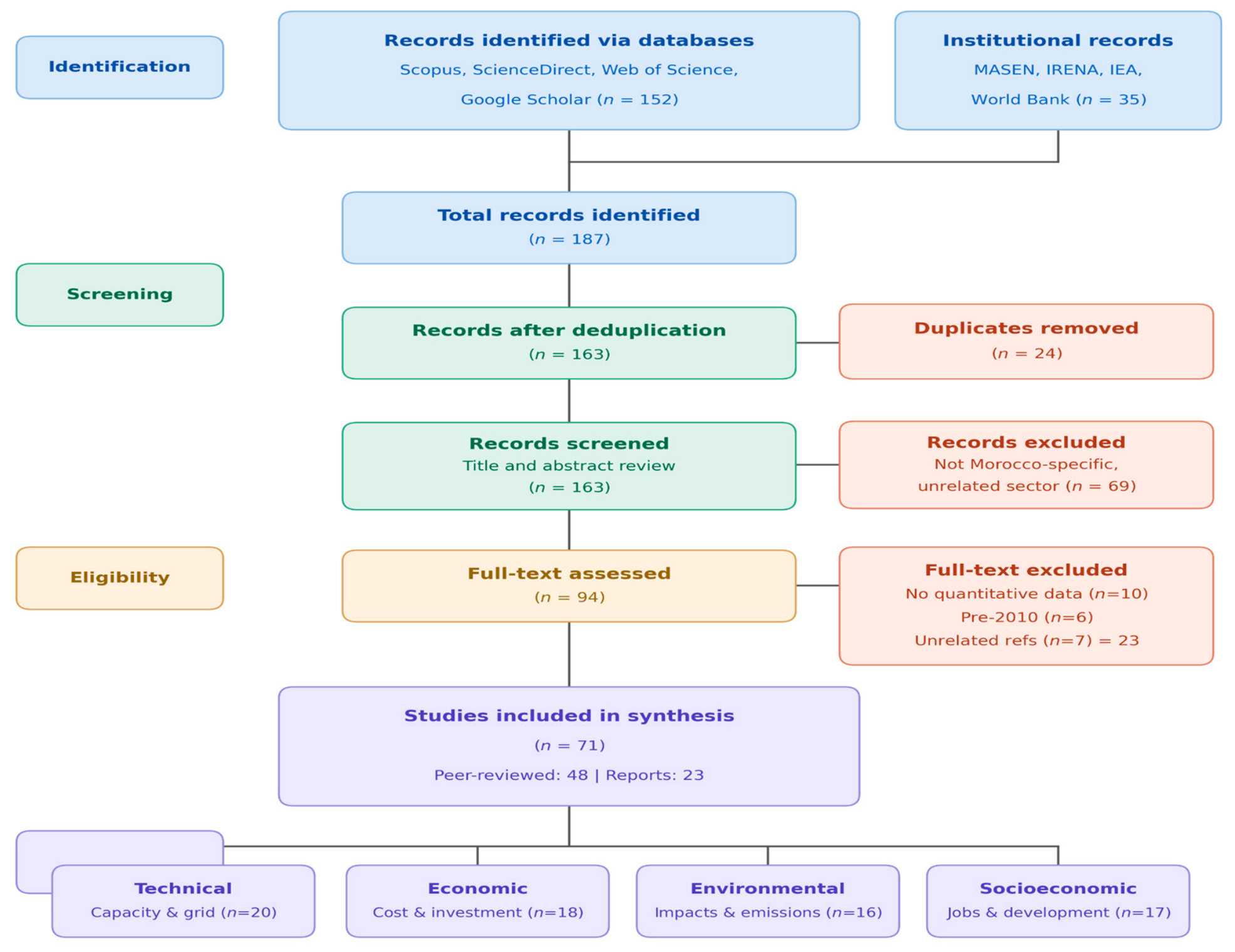
2.1. Literature Search and Screening
- («Morocco» OR «Maroc») AND («renewable energy» OR «solar energy» OR «wind energy» OR «hydropower») AND («sustainability» OR «energy transition» OR «socioeconomic impact»)
- («Morocco») AND («NOOR» OR «Tarfaya» OR «Ain Beni Mathar» OR «MASEN») AND («capacity» OR «investment» OR «employment»)
- («Maroc») AND («énergie renouvelable» OR «énergie solaire» OR «éolien» OR «hydroélectricité») AND («transition énergétique» OR «impact socioéconomique»)
2.2. Data Extraction and Thematic Classification
2.3. Scoring Framework and Sensitivity Analysis
- -
- Score 5/5: Strongly outperforms the other two technologies on the criterion’s evidence base
- -
- Score 4/5: Performs well with only minor limitations
- -
- Score 3/5: Moderate performance with notable trade-offs
- -
- Score 2/5: Below-average performance with significant structural constraints
- -
- Score 1/5: Weakest performer with major limitations relative to the other technologies
2.4. Methodological Limitations
3. Results and Discussion
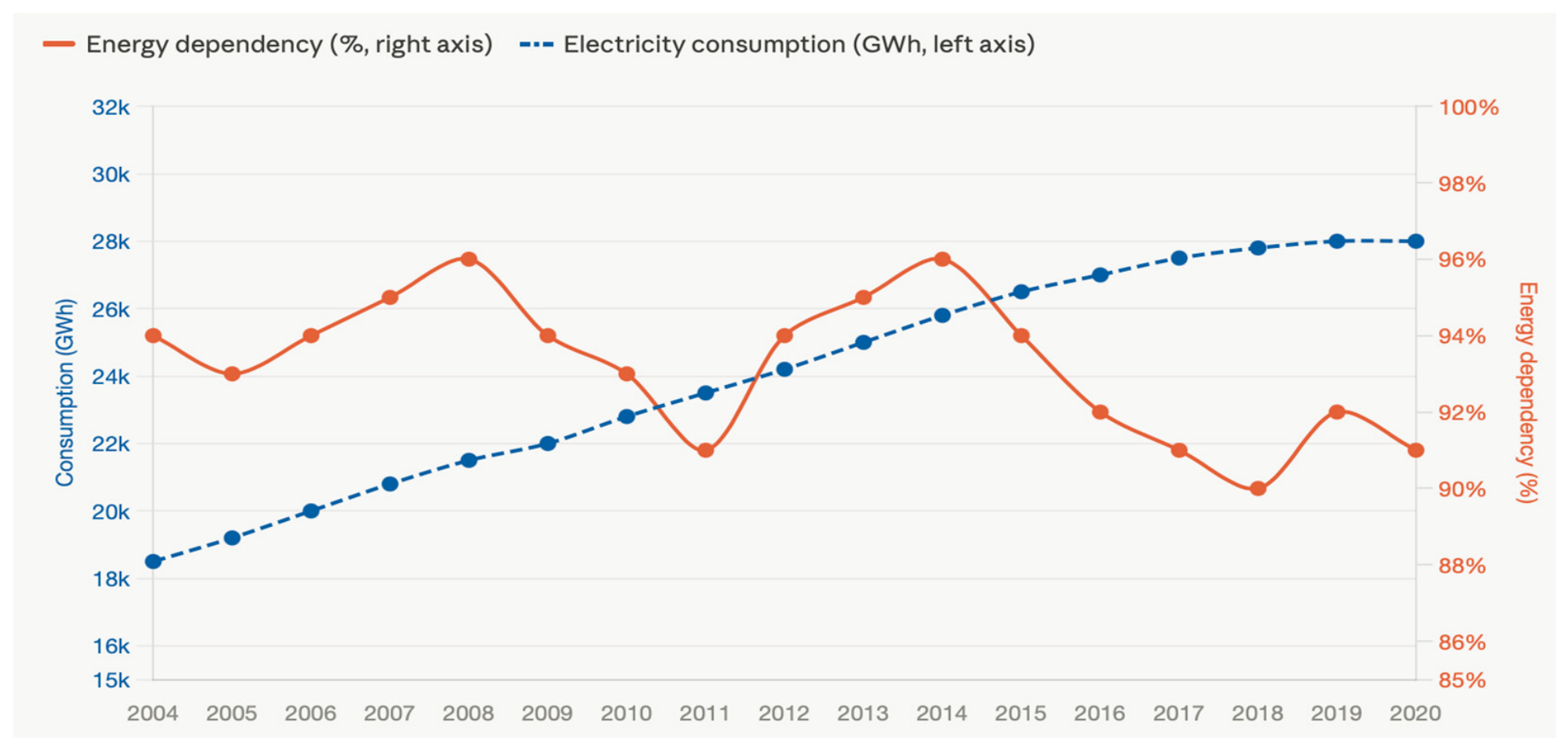
3.1. Morocco’s Energy Landscape
3.2. The Potential of Renewable Energies in Morocco
3.3. Limitations and Strategic Aims of Morocco’s Electricity Sector
3.4. Solar Energy in Morocco
3.4.1. Solar Resources in Morocco
3.4.2. Main Solar Projects
3.5. Wind Energy Potential in Morocco
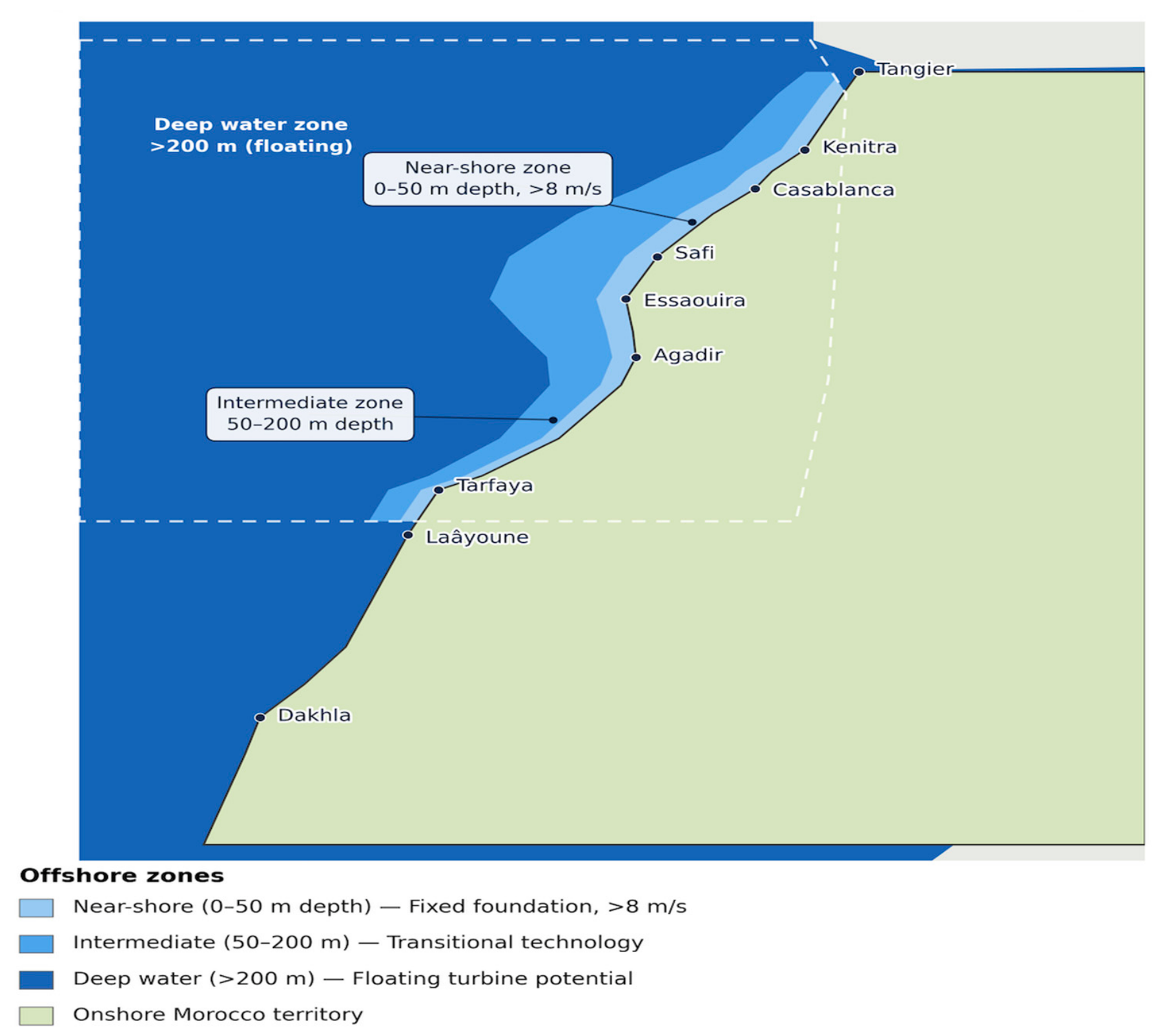
3.5.1. Wind Resource in Morocco
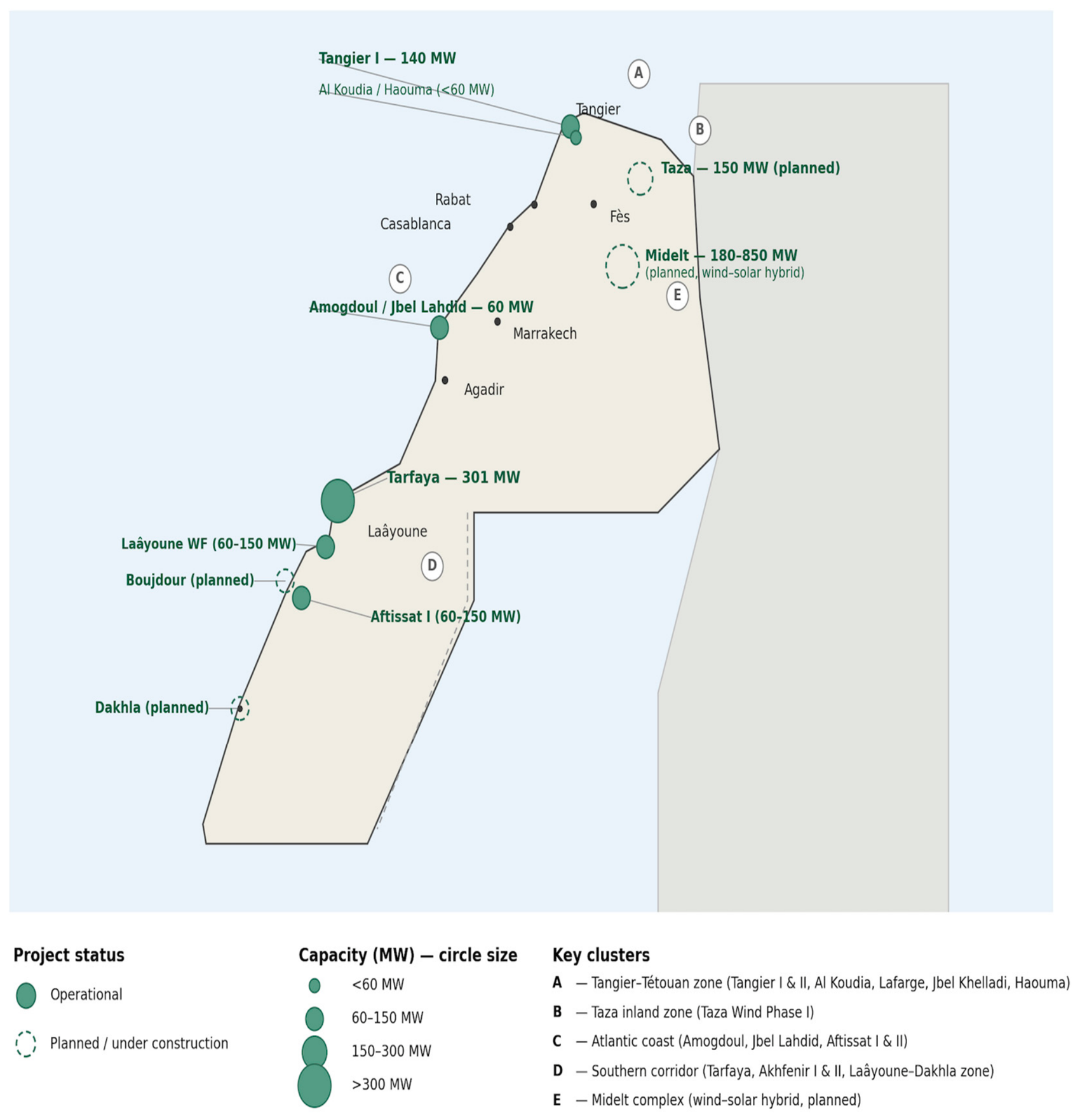
3.5.2. Latest Wind Projects in Morocco
3.6. Hydropower in Morocco
3.6.1. Historical Evolution of Hydropower Development
3.6.2. Installed Capacity and Role in the National Energy Mix
3.6.3. Hydropower Expansion and Private Sector Participation
3.7. Current Renewable Energy Laws and Institutional Framework
3.8. Socioeconomic Impacts of Renewable Energies Implementation in Morocco
3.8.1. Economic Diversification and Industrial Transformation
3.8.2. Employment Generation and Human Capital Development
3.8.3. Reduction in Energy Import Dependency and Improved Macroeconomic Stability
3.8.4. Regional Development and Territorial Equity
3.8.5. Environmental and Public Health Improvements
3.8.6. Attraction of Foreign Investment and Strengthened International Partnerships
3.8.7. Contribution to Morocco’s Long-Term Climate and Development Goals
3.9. Integrated Assessment of Morocco’s Renewable Energy Transition
3.9.1. Sustainability Assessment Framework
3.9.2. Comparative Sustainability Assessment of Renewable Energy Sources
3.9.3. Comparative Sustainability Scoring Analysis
Comparative Score Justification
- -
- Energy security: Solar is awarded a score of 4 due to its intermittent generation and substantial installed capacity. Wind also receives a score of 4 due to its increasing contribution to electricity generation and high capacity factor. The maximum score (5) is awarded to hydropower due to its dispatchability and its contribution to grid balancing through pumped-storage facilities.
- -
- Economic competitiveness: Wind is awarded the highest score due to its relatively low LCOE. Solar receives a moderate score because CSP remains relatively expensive despite declining PV costs. Although hydropower is a well-established technology, its growth opportunities are restricted.
- -
- Environmental Sustainability: Solar and wind obtain high scores given their low lifecycle greenhouse gas emissions. Hydropower scores slightly lower because of the ecological impacts associated with reservoir development and water resource alteration.
- -
- Grid Stability: Hydropower is awarded the highest score due to its dispatchability and storage capacity. Solar is restricted by its intermittency, while wind offers moderate grid support.
- -
- Scalability: The highest score is assigned to solar, as it exhibits the most significant remaining technical potential in Morocco. Wind also offers significant expansion opportunities, while hydropower expansion is restricted by the scarcity of remaining suitable sites.
- -
- Socioeconomic Impacts: Solar and wind create significant employment opportunities, attract substantial investment, and promote regional development. Hydropower continues to offer localized socioeconomic benefits through rural electrification and water resource management; however, its prospective employment potential is comparatively lower.
Sensitivity Analysis

| Criterion | Baseline | Technical Emphasis | Economic Emphasis | Social Emphasis | Grid Stability Emphasis |
|---|---|---|---|---|---|
| Energy security | 17% | 20% | 10% | 15% | 15% |
| Economic competitiveness | 17% | 10% | 30% | 10% | 10% |
| Environmental sustainability | 17% | 15% | 10% | 15% | 15% |
| Grid Stability | 17% | 25% | 10% | 10% | 30% |
| Scalability potential | 16% | 20% | 15% | 15% | 20% |
| Socioeconomic impact | 16% | 10% | 25% | 35% | 10% |
| Total | 100% | 100% | 100% | 100% | 100% |
| Criterion | Solar | Wind | Hydropower |
|---|---|---|---|
| Energy security | 4 | 4 | 5 |
| Economic competitiveness | 3 | 5 | 3 |
| Environmental sustainability | 4 | 4 | 3 |
| Grid Stability | 2 | 3 | 5 |
| Scalability potential | 5 | 4 | 2 |
| Socioeconomic impact | 4 | 4 | 3 |
3.9.4. Effectiveness of Morocco’s Renewable Energy Policy Framework
3.9.5. Structural Challenges Affecting the Renewable Energy Transition in Morocco
3.9.6. Integrated Evaluation of Morocco’s Energy Transition
4. Conclusions
Author Contributions
Funding
Institutional Review Board Statement
Informed Consent Statement
Data Availability Statement
Conflicts of Interest
References
- International Energy Agency. World Energy Outlook 2021; IEA: Paris, France, 2021. [Google Scholar]
- World Bank. Morocco Country Climate and Development Report; World Bank: Washington, DC, USA, 2022; Available online: https://documents.worldbank.org/en/publication/documents-reports/documentdetail/099655011022211130 (accessed on 15 June 2026).
- Ministère de la Transition Énergétique et du Développement Durable. Chiffres Clés Annuels de L’énergie (Édition 2022); Government of Morocco: Rabat, Morocco, 2022.
- International Renewable Energy Agency. Renewable Energy Market Analysis: Africa and Its Regions; IRENA: Abu Dhabi, United Arab Emirates, 2022. [Google Scholar]
- United Nations Framework Convention on Climate Change. Morocco’s Updated Nationally Determined Contribution. 2021. Available online: https://unfccc.int/NDCREG (accessed on 18 June 2026).
- Alhamwi, A.; Kleinhans, D.; Weitemeyer, S.; Vogt, T. Moroccan national energy strategy reviewed from a meteorological perspective. Energy Strategy Rev. 2015, 6, 39–47. [Google Scholar] [CrossRef]
- Amegroud, T. Morocco’s Renewable Energy Strategy: Balancing Ambition and Reality; Policy Center for the New South: Rabat, Morocco, 2020. [Google Scholar]
- Bajja, S.; Sackitey, G.M.; El Mahboul, B.; Fumey, M.P. Effects of technological innovation and cleaner energy consumption on economic growth and employment: Case of Morocco. Environ. Sustain. Indic. 2025, 27, 100857. [Google Scholar] [CrossRef]
- Belghazi, S. The Local Impact of Renewable Energy Projects in Morocco: Lessons from the Noor Ouarzazate Complex; Heinrich Böll Stiftung: Berlin, Germany, 2019. [Google Scholar]
- Saltelli, A.; Ratto, M.; Andres, T.; Campolongo, F.; Cariboni, J.; Gatelli, D.; Saisana, M.; Tarantola, S. Global Sensitivity Analysis: The Primer; John Wiley & Sons: Hoboken, NJ, USA, 2008. [Google Scholar]
- International Energy Agency. Energy Policies Beyond IEA Countries: Morocco 2019 Review; International Energy Agency: Paris, France, 2019; Available online: https://www.iea.org/reports/energy-policies-beyond-iea-countries-morocco-2019 (accessed on 20 June 2026).
- International Energy Agency. Morocco Energy Outlook 2023; IEA: Paris, France, 2023. [Google Scholar]
- Alaoui, C. Review and assessment of offshore renewable energy resources in Morocco’s coastline. Cogent Eng. 2019, 6, 1654659. [Google Scholar] [CrossRef]
- Benbba, R.; Barhdadi, M.; Ficarella, A.; Manente, G.; Romano, M.P.; El Hachemi, N.; Barhdadi, A.; Al-Salaymeh, A.; Outzourhit, A. Solar energy resource and power generation in Morocco: Current situation, potential, and future perspective. Resources 2024, 13, 140. [Google Scholar] [CrossRef]
- Kousksou, T.; Allouhi, A.; Belattar, M.; Jamil, A.; El Rhafiki, T.; Arid, A.; Zeraouli, Y. Renewable energy potential and national policy directions for sustainable development in Morocco. Renew. Sustain. Energy Rev. 2015, 47, 46–57. [Google Scholar] [CrossRef]
- Tazi, G.; Jbaihi, O.; Ghennioui, A.; Alami Merrouni, A.; Bakkali, M. Estimating the renewable energy potential in Morocco: Solar energy as a case study. IOP Conf. Ser. Earth Environ. Sci. 2018, 161, 012015. [Google Scholar] [CrossRef]
- National Office of Electricity and Drinking Water (ONEE). 2022 Annual Activity Report. 2023. Available online: https://www.one.org.ma (accessed on 22 June 2026).
- Bouabid, A.; Sleptchenko, A.; Mouline, S. Pathways to 100 percent renewable energy supply: Morocco options until 2030. In Proceedings of the 2019 7th International Renewable and Sustainable Energy Conference (IRSEC), Agadir, Morocco, 27–30 November 2019; pp. 1–6. [Google Scholar] [CrossRef]
- Leonard, A. Renewable energy in Morocco: Assessing opportunities and risks through a resource governance perspective. Energy Res. Soc. Sci. 2023, 98, 103020. [Google Scholar]
- Bouramdane, A.-A. Morocco’s path to a climate-resilient energy transition: Identifying emission drivers, proposing solutions, and addressing barriers. Sci. Technol. Energy Transit. 2024, 79, 26. [Google Scholar] [CrossRef]
- Azeroual, M.; El Makrini, A.; El Moussaoui, H.; El Markhi, H. Renewable energy potential and available capacity for wind and solar power in Morocco towards 2030. J. Eng. Sci. Technol. Rev. 2018, 11, 189–198. [Google Scholar] [CrossRef]
- Moroccan Agency for Sustainable Energy. Annual Report. 2023. Available online: https://www.masen.ma (accessed on 24 June 2026).
- SolarGIS. Global Horizontal Irradiation Map of Morocco. 2013. Available online: https://solargis.com (accessed on 24 June 2026).
- International Renewable Energy Agency. Renewable Energy Prospects for Morocco; IRENA: Abu Dhabi, United Arab Emirates, 2023. [Google Scholar]
- El Khchine, Y.; Bennouna, A.; El Amrani, M. Evaluation of wind energy potential and trends in Morocco. Heliyon 2019, 5, e01830. [Google Scholar] [CrossRef] [PubMed]
- Haidi, T.; Cheddadi, B.; El Mariami, F.; El Idrissi, Z.; Tarrak, A. Wind energy development in Morocco: Evolution and impacts. Int. J. Electr. Comput. Eng. 2021, 11, 2811–2819. [Google Scholar] [CrossRef]
- Nakach, I.; Mouhat, O.; Shamass, R.; El Mennaouy, F. Review of strategies for sustainable energy in Morocco. Polityka Energ.-Energy Policy J. 2023, 26, 65–104. [Google Scholar] [CrossRef]
- Hardwick, J.; Smith, A.; Fitch-Roy, O.; Connor, P.; Sundaram, S. Policy frameworks for ocean energy development. Energy Policy 2018, 113, 422–432. [Google Scholar]
- Rye, E.A.; Lie, A.Ø.; Svendsen, H.G.; Korpås, M.; Farahmand, H. Analyzing large-scale renewable energy integration and energy storage in Morocco using a flow-based market model. In 2016 13th International Conference on the European Energy Market (EEM); IEEE: Piscataway, NJ, USA, 2016; pp. 1–5. [Google Scholar] [CrossRef]
- En-Nouaary, B.; Beniaich, R.; Hmioui, A. Prioritizing sustainability of renewable energy projects in Morocco. Int. J. Energy Sect. Manag. 2025, 19, 612–631. [Google Scholar] [CrossRef]
- Sarsar, L.; Echaoui, A. The effect of economic growth on renewable energy production in Morocco. Int. J. Trade Manag. 2024, 1, 172–182. [Google Scholar]
- Boulakhbar, M.; Lebrouhi, B.; Kousksou, T.; Smouh, S.; Jamil, A.; Maaroufi, M.; Zazi, M. Towards a large-scale integration of renewable energies in Morocco. J. Energy Storage 2020, 32, 101806. [Google Scholar] [CrossRef] [PubMed]
- Oxford Business Group. Energy. The Report: Morocco 2016—Energy. Oxford Business Group. 2016. Available online: https://oxfordbusinessgroup.com/reports/morocco/2016-report (accessed on 26 June 2026).
- Hawila, D.; Mondal, M.A.H.; Kennedy, S.; Mezher, T. Renewable energy readiness assessment for North African countries. Renew. Sustain. Energy Rev. 2014, 31, 165–179. [Google Scholar] [CrossRef]
- Usman, Z.; Amegroud, T. Lessons from Power Sector Reforms: The Case of Morocco; World Bank: Washington, DC, USA, 2019. [Google Scholar]
- Autorité Nationale de Régulation de l’Électricité (ANRE). Electricity Sector Regulations and Legal Framework. Available online: https://www.anre.ma (accessed on 27 June 2026).
- Boutbhirt, N.; Adaskou, M. Financial innovation of small and medium enterprises in Morocco in the area of energy optimization: State of the art. E3S Web Conf. 2023, 412, 01084. [Google Scholar] [CrossRef]
- Laaroussi, A.; Bouayad, A.; Lissaneddine, Z.; Alaoui, L.A. Impact study of NOOR 1 project on the Moroccan territorial economic development. Renew. Energy Environ. Sustain. 2021, 6, 8. [Google Scholar] [CrossRef]
- Terrapon-Pfaff, J.; Fink, T.; Viebahn, P.; Jamea, E.M. Social impacts of large-scale solar thermal power plants: Assessment results for the NOORO I power plant in Morocco. Renew. Sustain. Energy Rev. 2020, 118, 109259. [Google Scholar] [CrossRef]
- Moudene, K.; El-Oud, R.; Ejbari, R.; Amedjar, A. Renewable energy and economic growth in Morocco. J. Hum. Resour. Sustain. Stud. 2023, 11, 401–413. [Google Scholar] [CrossRef]
- Hanger, S.; Komendantova, N.; Schinke, B.; Zejli, D.; Ihlal, A.; Patt, A. Community acceptance of large-scale solar energy installations in developing countries: Evidence from Morocco. Energy Res. Soc. Sci. 2016, 14, 80–89. [Google Scholar] [CrossRef]
- Makki, M.; Kaspard, J.; Khalil, F.; Maw, J.L. Renewable energy consumption determinants: Do they differ between oil-exporting countries and oil-importing ones? Sustainability 2024, 16, 7295. [Google Scholar] [CrossRef]
- Ben Jebli, M.; Ben Youssef, S. The role of renewable energy and agriculture in reducing CO2 emissions: Evidence for North Africa countries. Ecol. Indic. 2017, 72, 366–373. [Google Scholar] [CrossRef]
- Khan, Y.; Oubaih, H.; Elgourrami, F.Z. The effect of renewable energy sources on carbon dioxide emissions: Evaluating the role of governance and ICT in Morocco. Renew. Energy 2022, 189, 752–763. [Google Scholar] [CrossRef]
- Bouarfa, O.; Abdellaoui, M. The impact of foreign direct investments on the renewable energy sector in Morocco. In Digital Technologies and Applications; Lecture Notes in Networks and Systems; Motahhir, S., Bossoufi, B., Eds.; Springer: Berlin/Heidelberg, Germany, 2024; Volume 1099. [Google Scholar] [CrossRef]
- Chehbouni, A. Assessing the alignment and implementation challenges of the Sustainable Development Goals (SDGs) 2030 in Morocco. Afr. J. Gov. Dev. 2024, 15, 186–223. [Google Scholar] [CrossRef]
- International Renewable Energy Agency. Renewable Energy and Jobs: Annual Review 2023; IRENA: Abu Dhabi, United Arab Emirates, 2023. [Google Scholar]
- Intergovernmental Panel on Climate Change (IPCC). Climate Change 2022: Mitigation of Climate Change; Contribution of Working Group III to the Sixth Assessment Report; Cambridge University Press: Cambridge, UK, 2022. [Google Scholar]
- Ellabban, O.; Abu-Rub, H.; Blaabjerg, F. Renewable energy resources: Current status, future prospects and challenges. Renew. Sustain. Energy Rev. 2014, 39, 748–764. [Google Scholar] [CrossRef]




| Project Site/Location | Installed Capacity (MW) | Land Area (Ha) | Year of Commissioning | System Type | Status | Data Verified |
|---|---|---|---|---|---|---|
| Aïn Beni Mathar (Oriental Region) | 470 | 160 | 2010 | Hybrid CSP integrated with combined cycle gas turbine | Operational | January 2026 |
| Noor Ouarzazate I | 160 | 480 | 2016 | CSP with molten-salt thermal storage (~3 h) | Operational | January 2026 |
| Noor Ouarzazate II | 200 | 610 | 2018 | Parabolic trough CSP with >7 h of thermal storage | Operational | January 2026 |
| Noor Ouarzazate III | 150 | 582 | 2018 | Solar tower CSP with >7 h thermal storage | Operational | January 2026 |
| Noor Ouarzazate IV | 72 | 137 | 2018 | Photovoltaic PV with tracking system | Operational | January 2026 |
| Noor Laâyoune I | 85 | 240 | 2018 | Photovoltaic PV with tracking system | Operational | January 2026 |
| Noor Boujdour I | 20 | 60 | 2018 | Photovoltaic PV with tracking system | Operational | January 2026 |
| Sidi Bennour PV Station | 48 | Data pending | 2023 | Photovoltaic (PV) | Operational | January 2026 |
| Noor Midelt I | 800 | 939 | Under development | Hybrid CSP-PV configuration | Planned | January 2026 |
| Noor Midelt II | 210 | Data pending | Under development | Hybrid CSP-PV configuration | Planned | January 2026 |
| Wind Project/Location | Installed Capacity (MW) | Year of Commissioning | Technology/Notes | Status | Data Verified |
|---|---|---|---|---|---|
| Al Koudia Al Baida (Tetouan) | 54 | 2000 | Morocco’s first utility-scale wind farm | Operational | January 2026 |
| Amogdoul (Essaouira) | 60 | 2007 | Onshore wind farm | Operational | January 2026 |
| Tangier I (Beni Mejmel) | 140 | 2011 | Large-scale onshore wind farm | Operational | January 2026 |
| Tarfaya Wind Farm | 301 | 2014 | One of Africa’s largest wind farms | Operational | January 2026 |
| Akhfenir I and II (Laayoune) | 204 | 2014–2016 | Onshore wind farm complex | Operational | January 2026 |
| Jbel Khelladi (Tangier) | 120 | 2018 | Onshore wind farm | Operational | January 2026 |
| Afissat I (Boujdour) | 200 | 2018 | Siemens wind turbines | Operational | January 2026 |
| Afissat II (Laayoune) | 200 | 2022 | GE wind turbines | Operational | January 2026 |
| Taza Wind Farm-Phase I | 150 | 2025 | National wind expansion program | Under construction | January 2026 |
| Jbel Lahdid (Essaouira) | 270 | 2023 | Major wind expansion project | Under construction | January 2026 |
| Xlinks Renewable Energy Hub (Guelmim-Oued Noun) | 3500 | Expected 2028 | Hybrid wind-solar export project | Planned | January 2026 |
| Project | Capacity (MW) | Type | Status | Year |
|---|---|---|---|---|
| Al Wahda | 240 | Conventional Hydropower | Operational | 1998 |
| Allal El Fassi | 240 | Conventional Hydropower | Operational | 1994 |
| Bin El Ouidane | 135 | Conventional Hydropower | Operational | 1953 |
| Al Massira | 128 | Conventional Hydropower | Operational | 1980 |
| Ahmed El Hansali | 92 | Conventional Hydropower | Operational | 2003 |
| El Menzel | 95 | Conventional Hydropower | Operational | NA |
| Hassan I | 67 | Conventional Hydropower | Operational | 1991 |
| STEP Afourer | 464 | Pumped Storage | Operational | 2005 |
| Imezdi/Tasdert:Tajemout | 128 | Conventional Hydropower | Under construction | 2025 |
| STEP Abdelmoumen | 350 | Pumped Storage | Planned | NA |
| El MenzeI—Sefrou II | 300 | Pumped Storage | Planned | 2026 |
| Dimension | Indicator | Evaluation Objective | Quantitative Proxy | Data Source |
|---|---|---|---|---|
| Technical | Installed capacity growth | Measure deployment performance | MW installed (operational only) | [1,22] |
| Technical | Grid integration flexibility | Evaluate network capability | Dispatchability rating; capacity factor (%) | [1,17] |
| Economic | Investment intensity | Assess financial sustainability | LCOE(USD/MWh); capital cost (USD/kW) | [2,48] |
| Economic | Job creation potential | Measure economic contribution | Direct jobs per MW installed | [48] |
| Environmental | Emission reduction potential | Evaluate climate benefits | tCO2/GWh avoided (lifecycle) | [49] |
| Environmental | Resource efficiency | Assess ecological sustainability | Land use (km2/GWh); water dependency index | Literature review |
| Social | Regional development impact | Evaluate territorial inclusivity | Geographic distribution of employment and investment | [22] |
| Social | Energy security contribution | Assess import dependency reduction | Firm dispatchable capacity (MW); pumped-storage (MW) | [17] |
| Dimensions | Solar | Wind | Hydropower | System-Level Assessment |
|---|---|---|---|---|
| Contribution to installed capacity | Very high (dominant source: 2.8–3 GW [17,22]) | High and expanding (2.4–2.6 GW [17,22]) | Moderate and stable (1.7–1.8 GW [17,22]) | Solar-dominant electricity system |
| Energy security role | Medium (intermittent generation) | Medium-high (capacity factor 35–45% [12,17]) | High (dispatchable capacity including STEP Afourer 464 MW [17]) | Partial diversification achieved |
| Cost competitiveness | Improving but variable (PV 25–45 USD/MWh; high CSP costs: 80–120 USD/MWh [2,25]) | Highly competitive (20–35 USD/MWh [2,25] | Mature but geographically limited (40–70 USD/MWh [2,24]) | Wind remains the most cost-efficient option |
| Grid integration flexibility | Low-medium (require storage) | Medium (partially predictable) | High (Hydropower + pumping services provide balancing services [12,17]) | Storage remains a critical challenge |
| Environmental impacts | Low lifecycle emissions; moderate land use impact [49] | Low lifecycle emissions, localized visual/ecosystem impact [49] | Ecosystem alteration associated with reservoirs (dams) [49] | Overall environmental benefits outweigh localized impacts |
| Scalability potential | Very high Solar technical potential > 20 GW [22,24] | High wind > 25 GW in high-resource region [24] | Low (Limited expansion potential) | Future expansion expected mainly through solar and wind |
| Socioeconomic impact | Largest employment contribution (~9500 jobs [48]) and highest investment concentration | Strong employment and investment concentration (~7200 jobs [48]) | Localized benefits through rural electrification and water-resource management (~2800 jobs [48]) | Uneven spatial distribution of socioeconomic benefits |
| Indicator | Solar | Wind | Hydropower |
|---|---|---|---|
| Installed operational capacity (MW, 2023) | ≅3900 [17,22] | ≅1900 [17,22] | ≅1770 [17,22] |
| Annual Electricity generation (GWh, 2022) | ≅2100 [17] | ≅4400 [17] | ≅1800 [17] |
| Capacity factor (%) | 22–28 (PV); 40–50 (CSP) [12,22] | 35–45 [12] | 25–35 [12] |
| LCOE (USD/MWh) | 25–45 (PV); 80–120 (CSP) [2,24] | 20–35 [2,25] | 40–70 [2,25] |
| Dispatchability | Low-Medium (CSP with storage) [12,17] | Low [12] | High [12,17] |
| Pumped storage capacity (MW) | 0 | 0 | 460 (STEP Afourer) [17] |
| Direct jobs per MW installed | 3–5 [48] | 2–4 [48] | 1–2 [48] |
| Renewable energy employment (jobs) | ≅9500 [48] | ≅7200 [48] | ≅2800 [48] |
| Water dependency | Moderate-High (CSP), Low (PV) [2,17] | Very Low [2] | High [2,17] |
| Geographic distribution of benefits | National [3,22] | Coastal Concentration [3,22] | Localized rural regions [3,22] |
| Criterion | Scoring Basis | Solar Rationale | Wind Rational | Hydro Rationale |
|---|---|---|---|---|
| Energy security contribution | Installed capacity (MW); dispatchability; contribution to electricity generation | 4/5: Growing = Installed capacity reached ≅3900 MW [17,22]. However, solar PV remains intermittent, and firm capacity contribution is limited to CSP facilities with storage. | 4/5: Growing ≅ Installed capacity reached ≅ 1900 MW in 2023 with capacity factors of 35–45% [12,17]; Despite strong generation performance, wind remains non-dispatchable | 5/5: Hydropower provides dispatchable renewable generation and includes 460 MW of pumped-storage capacity at STEP Afourer [17] supporting grid balancing and peak demand management. |
| Economic competitiveness | LCOE (USD/MWh); capital cost (USD/kW) | 3/5: Utility-scale PV exhibits competitive LCOE values of approximately 25–45 USD/MWh, whereas CSP remains more costly at 80–120 USD/MWh, increasing the overall cost profile of solar technologies [2,24]. | 5/5: Wind demonstrates the lowest LCOE among the assessed technologies, ranging from 20 to 35 USD/MWh, making it the most cost-competitive renewable option. [2,24] | 3/5: Hydropower benefits from low operating costs but has limited opportunities for additional low-cost expansion because most economically viable sites have already been developed [2,17] |
| Environmental sustainability | Life cycle emissions (tCO2/GWh avoided); land use; water dependency | 4/5: Solar technologies provide substantial emission reductions with very low lifecycle greenhouse-gas emissions [49]. Nevertheless, CSP facilities may require greater land occupation and water consumption than PV systems. | 4/5: Wind power exhibits very low lifecycle emissions and negligible water requirements [49], although visual and ecosystem impacts may occur in specific locations. | 3/5: Hydropower provides low lifecycle emissions but may generate ecosystem alterations associated with reservoirs and exhibits greater sensitivity to water availability during drought periods [49]. |
| Grid stability | Dispatchability; pumped-storage (MW); capacity factor (%) | 2/5: Solar PV is fully intermittent and depends on storage or complementary generation for balancing. Storage-supported CSP deployment remains limited to selected projects such as Noor III [22] | 3/5: Wind generation is non-dispatchable but provides partial temporal complementarity with solar production and benefits from relatively high capacity factors [12]. | 5/5: Hydropower is fully dispatchable and supported by 460 MW of pumped-storage capacity at STEP Afourer [17], providing rapid-response balancing services. |
| Scalability | Remaining potential (MW); share of viable sites developed (%) | 5/5: Morocco possesses excellent solar resources with DNI values of approximately 5–7 kWh/m2/day across large areas of the country and an estimated technical potential exceeding 20 GW [22,24] | 4/5: Wind potential exceeds 25 GW in high-resource regions, although future deployment may face grid integration and transmission constraints [24]. | 2/5: Expansion opportunities are limited because a large proportion of economically viable hydropower sites have already been exploited, while future development is constrained by hydrological conditions [17]. |
| Socioeconomic impact | Jobs per MW; geographic distribution; Investment (USD) | 4/5: Solar projects support approximately 3–5 jobs/MW and around 9500 sector-related jobs, while also attracting significant investment and industrial development in regions such as Ouarzazate [48]. | 4/5: Wind projects support approximately 2–4 jobs/MW and around 7200 jobs, particularly in major development regions including Tarfaya, Laayoune, and Dakhla [48]. | 3/5: Hydropower contributes approximately 1–2 jobs/MW and around 2800 jobs, generating localized socioeconomic benefits through rural electrification and water-resource management [48]. |
| Technology | Baseline | Technical | Economic | Social | Grid Stability |
|---|---|---|---|---|---|
| Solar | 3.67 | 3.75 | 3.45 | 3.7 | 3.55 |
| Wind | 4.00 | 3.90 | 4.30 | 3.95 | 3.85 |
| Hydropower | 3.50 | 3.75 | 3.25 | 3.35 | 3.95 |
| Scenario | 1st | 2nd | 3rd |
|---|---|---|---|
| Baseline | Wind | Hydropower | Solar |
| Technical emphasis | Wind and Hydropower | - | Solar |
| Economic emphasis | Wind | Solar | Hydropower |
| Social emphasis | Wind | Solar | Hydropower |
| Grid Stability emphasis | Hydropower | Wind | Solar |
| Observation | Result |
|---|---|
| Wind ranked first | 4 of 5 scenarios |
| Hydropower ranked first | 1 of 5 scenarios |
| Solar ranked first | 0 of 5 scenarios |
| Solar highest scalability score | Yes |
| Overall ranking stable | Yes |
| Main conclusion affected | No |
| Challenge | Impact on Transition | Sustainability Implications |
|---|---|---|
| Intermittency | Grid instability risks | Need for storage systems |
| High investment costs | Financial dependency | Slower infrastructure expansion |
| Grid integration limitation | Reduced renewable efficiency | Infrastructure modernization required |
| Regional disparities | Unequal socioeconomic benefits | Territorial imbalance |
| Water consumption in CSP | Environmental pressure | Resource management challenge |
Disclaimer/Publisher’s Note: The statements, opinions and data contained in all publications are solely those of the individual author(s) and contributor(s) and not of MDPI and/or the editor(s). MDPI and/or the editor(s) disclaim responsibility for any injury to people or property resulting from any ideas, methods, instructions or products referred to in the content. |
© 2026 by the authors. Licensee MDPI, Basel, Switzerland. This article is an open access article distributed under the terms and conditions of the Creative Commons Attribution (CC BY) license.
Share and Cite
Errifai, C.; Atmani, M.; Benabderrahmane, A. Integrated Sustainability Assessment of Morocco’s Renewable Energy Transition: Comparative Analysis of Solar, Wind, and Hydropower Development. Sustainability 2026, 18, 7178. https://doi.org/10.3390/su18147178
Errifai C, Atmani M, Benabderrahmane A. Integrated Sustainability Assessment of Morocco’s Renewable Energy Transition: Comparative Analysis of Solar, Wind, and Hydropower Development. Sustainability. 2026; 18(14):7178. https://doi.org/10.3390/su18147178
Chicago/Turabian StyleErrifai, Chaimaa, Majid Atmani, and Asmae Benabderrahmane. 2026. "Integrated Sustainability Assessment of Morocco’s Renewable Energy Transition: Comparative Analysis of Solar, Wind, and Hydropower Development" Sustainability 18, no. 14: 7178. https://doi.org/10.3390/su18147178
APA StyleErrifai, C., Atmani, M., & Benabderrahmane, A. (2026). Integrated Sustainability Assessment of Morocco’s Renewable Energy Transition: Comparative Analysis of Solar, Wind, and Hydropower Development. Sustainability, 18(14), 7178. https://doi.org/10.3390/su18147178