Key Factors Influencing the Operation of Logistics Companies in Self-Operation and Outsourcing Cooperation Mode: An LDA-TISM-SNA Approach

Abstract
1. Introduction
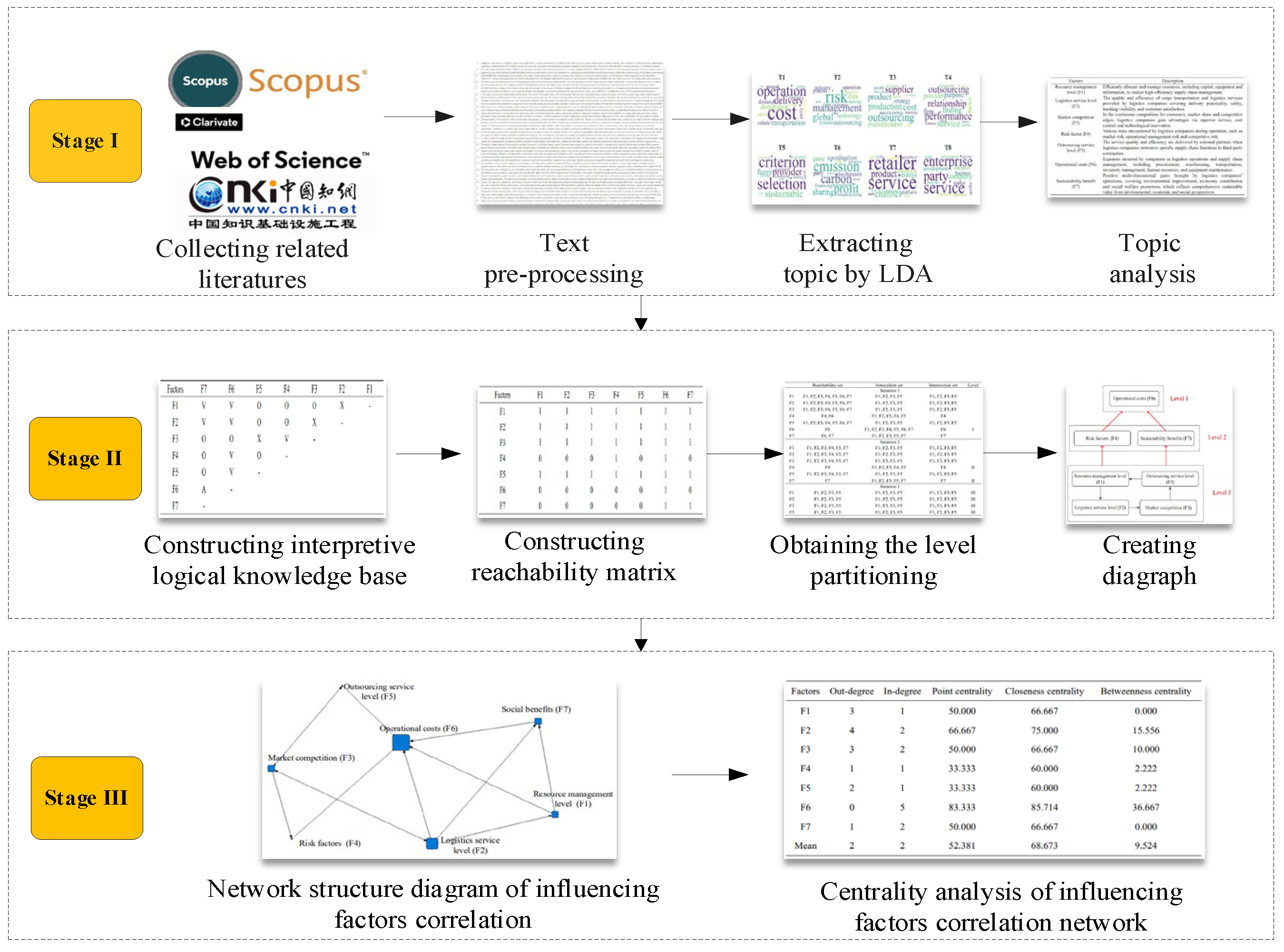
- A novel LDA-TISM-SNA three-stage analytical framework is proposed to explore the driving factors of logistics firms in the self-operation and outsourcing cooperation mode.
- A probabilistic topic modeling approach is employed to identify the key factors influencing the development of logistics companies in the self-operation and outsourcing cooperation mode, supported by a large body of literature.
- Based on the support of practitioners as well as relevant researchers, this work highlights the hierarchical relationships among drivers through the TISM approach to uncover the root causes affecting the development of logistics companies.
- SNA is employed to examine the roles and positions of the influencing factors and their significance.
2. Literature Review
2.1. Research on Influencing Factors in Logistics Companies
2.2. Research on Self-Operation and Outsourcing Cooperation Mode
2.3. Methodology of Research on Influencing Factors
3. Methodology
3.1. LDA
3.2. TISM
3.3. SNA
- (1)
- Degree centrality
- (2)
- Closeness centrality
- (3)
- Betweenness centrality
4. Results and Analysis
4.1. LDA Analysis
4.1.1. Relevant Literature Collection
4.1.2. Text Pre-Processing
4.1.3. Identification of Influencing Factors
- (1)
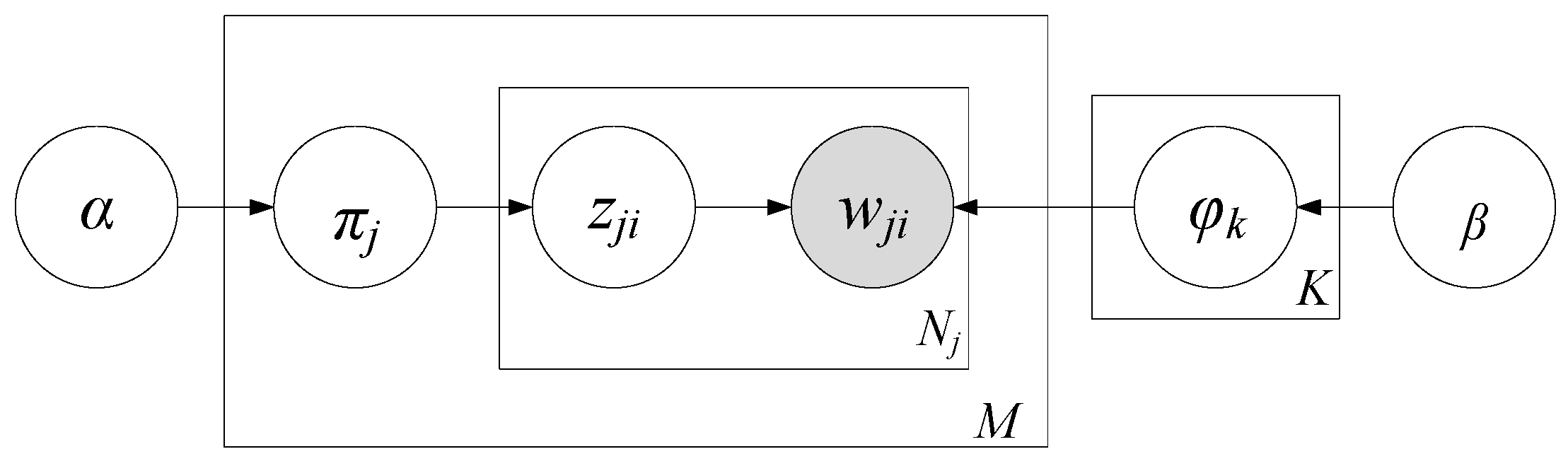
- LDA model construction and corpus update
- (2)
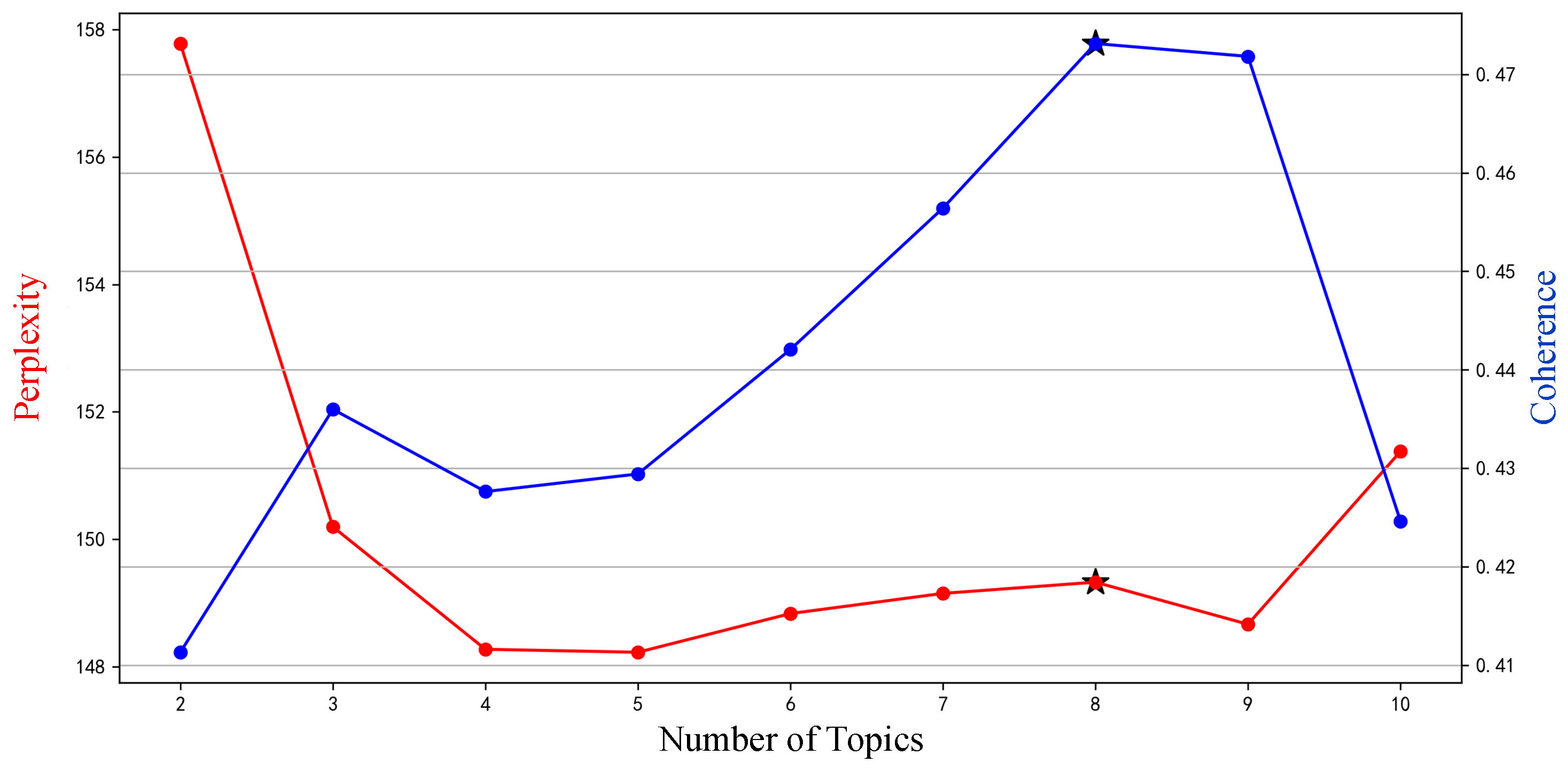
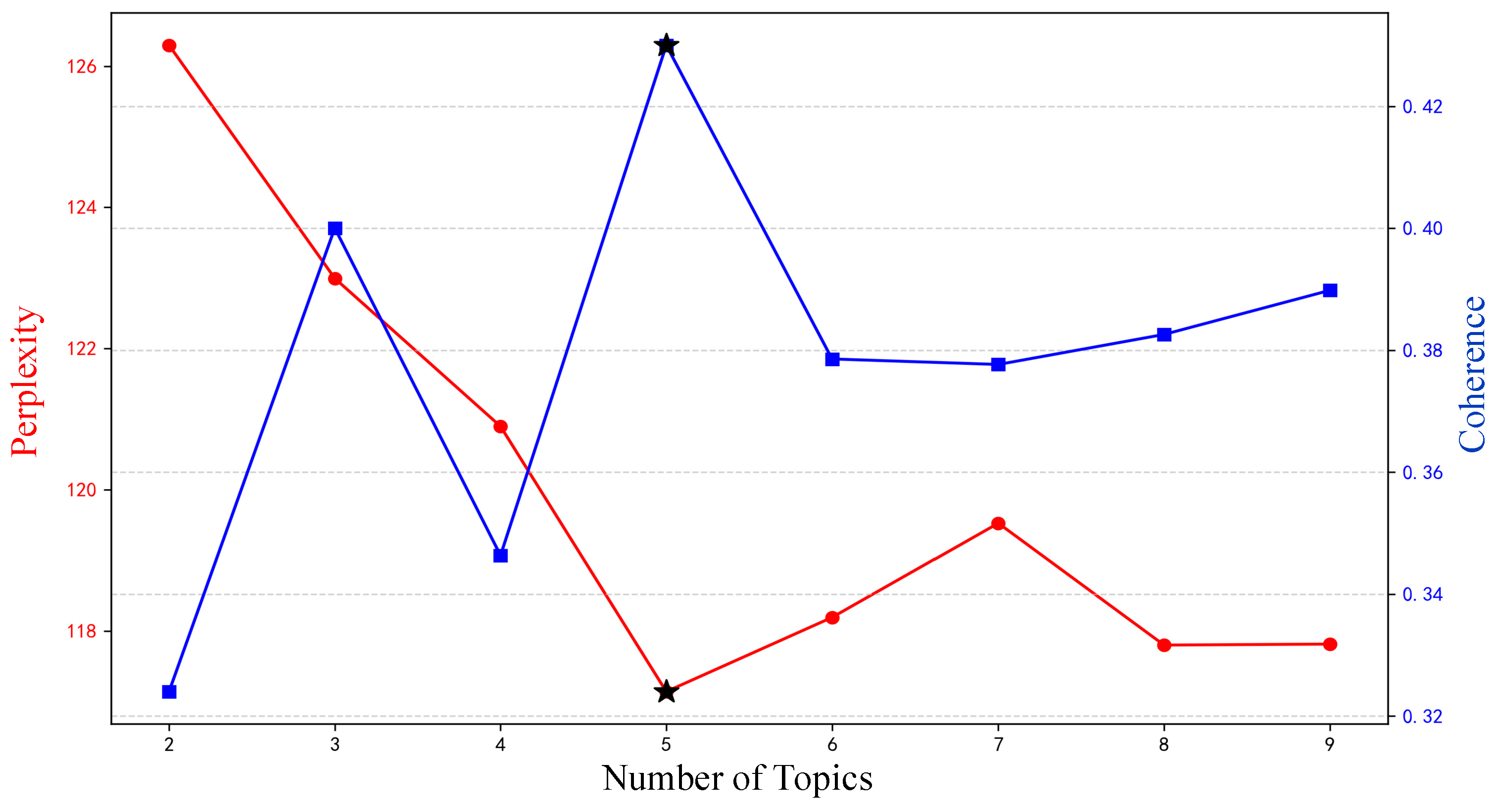
- Perplexity
- (3)
- Coherence scores
- (4)
- Results of the influencing-factor identification
- (5)
- Influencing-factor identification results
- (6)
- Summary of the influencing factors
4.2. TISM Analysis
4.3. SNA Analysis
- (1)
- Degree centrality analysis
- (2)
- Closeness centrality analysis
- (3)
- Betweenness centrality analysis
4.4. Managerial Implications
4.5. Theoretical Implications
4.6. Policy Implications
5. Conclusions
Author Contributions
Funding
Institutional Review Board Statement
Informed Consent Statement
Data Availability Statement
Acknowledgments
Conflicts of Interest
Appendix A

| Topic | Words |
|---|---|
| Topic 1 | service, provider, party, customer, enterprise, quality, commerce, value, model, paper, competitive, satisfaction, business, market, important |
| Topic 2 | performance, outsourcing, relationship, finding, research, firm, factor, purpose, effect, capability, limited, implication, knowledge, literature, publishing |
| Topic 3 | company, management, process, industry, business, research, case, outsourcing, activity, operation, paper, organization, analysis, approach, framework |
| Topic 4 | sustainable, transport, sustainability, environmental, springer, chapter, economic, nature, author, outsourcing, practice, offshoring, development, integration, challenge |
| Topic 5 | global, production, firm, outsourcing, value, market, international, impact, economy, country, structure, economic, policy, social, right |
| Topic 6 | China, food, agricultural, development, fresh, trade, blockchain, national, region, regional, Chinese, producer, country, product, consumption |
| Topic 7 | data, carrier, digital, learning, energy, based, system, city, smart, job, user, architecture, IoT, thing, technology |
| Topic 8 | model, cost, problem, distribution, transportation, proposed, time, based, order, demand, paper, algorithm, result, multi, solution |
| Topic 9 | risk, management, strategy, information, control, cold, social, effective, public, technique, high, structural, key, challenge, action |
| Topic10 | sourcing, warehouse, disruption, material, uncertainty, capacity, plant, shipping, recovery, transaction, strategy, resilience, picking, market, frequency |
| Topic 11 | decision, criterion, selection, method, fuzzy, making, evaluation, approach, proposed, provider, based, multi, ahp, weight, process |
| Topic 12 | delivery, freight, mechanism, financial, urban, driver, mile, center, pollution, run, fuel, province, grey, finance, footprint |
| Topic 13 | procurement, pharmaceutical, fashion, south, power, organisation, brand, conflict, auction, acquisition, editorial, battery, African, Africa, electric |
| Topic 14 | manufacturer, outsourcing, profit, strategy, decision, game, mode, price, product, production, enterprise, pricing, market, model, optimal |
| Topic 15 | contract, retailer, product, cost, sharing, channel, quality, coordination, information, platform, online, decision, level, price, retail |
| Topic 16 | emission, carbon, policy, remanufacturing, closed, government, container, loop, environmental, waste, recycling, low, impact, phone, trade |
| Topic 17 | network, collaborative, collaboration, design, resource, information, sharing, fourth, truck, flow, hub, algorithm, node, graph, optimization |
| Topic 18 | problem, vehicle, routing, shipper, scale, instance, route, search, linguistic, location, time, fleet, tax, solved, interval |
| Topic 19 | technology, green, review, research, scm, cloud, lsps, practice, management, literature, adoption, future, paper, innovation, industry |
| Topic 20 | supplier, manufacturing, outsourcing, design, reverse, product, construction, group, component, cluster, buyer, attribute, vendor, trust, security |
| Topic | Words |
|---|---|
| Topic 1 | service, conduct, coordination, system, production, demand, network, selection, food, third party, model, this paper, based on, propose, customer |
| Topic 2 | mode, reverse, e-commerce, third party, development, conduct, platform, selection, logistics distribution, construction, problem, B2C, e-commerce, operation, government |
| Topic 3 | relationship, third party, influence, performance, cooperation, theory, conduct, integration, mode, this paper, quality, through, effect, capability, operation |
| Topic 4 | supply chain, retailer, decision, profit, third party, mode, influence, service, cost, supplier, coordination, model, system, strategy, revenue |
| Topic 5 | financing, third party, supply chain, cost, disassembly, vegetable, vaccine, can, influence, fund, credit, mode, bank, guarantee, realization |
| Topic 6 | development, manufacturing, logistics, industry, China, linkage, service, economy, level, coordination, promotion, sector, two industries, propose, this paper |
| Topic 7 | distribution, e-commerce, mode, chain, logistics distribution, cost, supermarket, shopping, selection, demand, route, problem, product, vehicle, influence |
| Topic 8 | procurement, 3PL, system, profit, cluster, retailer, supply chain, region, management, influence, third party, resource, demand, improvement, model |
| Topic 9 | supply chain, manufacturer, dominance, service, recycling, mode, strategy, self-operated, seller, selection, influence, closed-loop, cost, retailer, third party |
| Topic10 | company, selection, evaluation, service provider, conduct, supplier, management, indicator, service, this paper, business, theory, synthesis, indicator system, through |
| Topic 11 | risk, conduct, outsourcing, evaluation, factor, propose, through, business, this paper, process, model, selection, transportation, assessment, mode |
| Topic 12 | business, control, mode, performance, influence, decision, model, outsourcing, home appliance, conduct, small and medium enterprise, society, retail industry, management control, third party |
| Topic 13 | risk, manufacturing, distribution, 3PL, outsourcing, equipment, time, contract, conduct, outsourcer, risk management, 4PL, optimal, process, effort |
| Topic 14 | distribution, mode, e-commerce, selection, cost, platform, agricultural products, O2O, conduct, problem, pricing, center, self-operated, through, model |
| Topic 15 | linkage, development, two industries, logistics industry, conduct, forecast, data, model, supply chain, mode, manufacturing, platform, integration, through, propose |
| Topic 16 | management, cost, company, problem, development, business, conduct, outsourcing, control, this paper, supply chain, existence, through, propose, project |
| Topic 17 | risk, manpower, outsourcing, human resources, resource management, conduct, implementation, evaluation, response, identification, theory, company, China, competition, customer |
| Topic 18 | third party, supplier, supply chain, fourth party, development, problem, incentive, service, conduct, selection, model, theory, through, agency, emission reduction |
| Topic 19 | transportation, model, customer, algorithm, problem, service, cost, conduct, demand, route, solution, satisfaction, outsourcing, optimization, selection |
| Topic 20 | cross-border, third-party, development, mode, e-commerce, China, railway, service, conduct, e-commerce, efficiency, trade, influence, training, management |
Appendix B
| Factor | F1 | F2 | F3 | F4 | F5 | F6 | F7 |
|---|---|---|---|---|---|---|---|
| F1 | 1 | 1 | 1 | 1 | 1 | 1 | 1 |
| F2 | 1 | 1 | 1 | 1 | 1 | 1 | 1 |
| F3 | 1 | 1 | 1 | 1 | 1 | 1 | 1 |
| F4 | 0 | 0 | 0 | 1 | 0 | 1 | 0 |
| F5 | 1 | 1 | 1 | 1 | 1 | 1 | 1 |
| F6 | 0 | 0 | 0 | 0 | 0 | 1 | 0 |
| F7 | 0 | 0 | 0 | 0 | 0 | 1 | 1 |
| Factor | Description | Level in TISM |
|---|---|---|
| F1 | Resource management level | III |
| F2 | Logistics service level | III |
| F3 | Market competition | III |
| F4 | Risk factors | II |
| F5 | Outsourcing service level | III |
| F6 | Operational costs | I |
| F7 | Sustainability benefits | II |
References
- Cai, X.; Chen, J.; Xiao, Y.; Xu, X.; Yu, G. Fresh-product supply chain management with logistics outsourcing. Omega 2013, 41, 752–765. [Google Scholar] [CrossRef]
- Huo, B.; Fu, D.; Zhao, X.; Zhu, J. Curbing opportunism in logistics outsourcing relationships: The role of relational norms and contract. Int. J. Prod. Econ. 2016, 182, 293–303. [Google Scholar] [CrossRef]
- Deng, S.; Xu, J. Manufacturing and procurement outsourcing strategies of competing original equipment manufacturers. Eur. J. Oper. Res. 2023, 308, 884–896. [Google Scholar] [CrossRef]
- Zhang, Y.; He, Z.; He, S.; Cai, K.; Wang, D. Manufacturer warranty service outsourcing strategies in a dual-channel supply chain. Int. Trans. Oper. Res. 2020, 27, 2899–2926. [Google Scholar] [CrossRef]
- Ayaad, O.; Al-Ruzzieh, M.A.; Qaddumi, B.; Al Hroub, A.; Ayyad, M.; Abuseif, S.; Çelik, Y. Outsourcing services in the healthcare sector: Balancing risks and benefits. Br. J. Healthc. Manag. 2022, 28, 96–103. [Google Scholar] [CrossRef]
- Nicholson, L.; Vakharia, A.J.; Selcuk Erenguc, S. Outsourcing inventory management decisions in healthcare: Models and application. Eur. J. Oper. Res. 2004, 154, 271–290. [Google Scholar] [CrossRef]
- Skipworth, H.; Delbufalo, E.; Mena, C. Logistics and procurement outsourcing in the healthcare sector: A comparative analysis. Eur. Manag. J. 2020, 38, 518–532. [Google Scholar] [CrossRef] [PubMed]
- Gahm, C.; Brabänder, C.; Tuma, A. Vehicle routing with private fleet, multiple common carriers offering volume discounts, and rental options. Transp. Res. Part E Logist. Transp. Rev. 2017, 97, 192–216. [Google Scholar] [CrossRef]
- Tang, C.-H. Optimization for transportation outsourcing problems. Comput. Ind. Eng. 2020, 139, 106213. [Google Scholar] [CrossRef]
- Abbasi, M.; Nilsson, F. Developing environmentally sustainable logistics: Exploring themes and challenges from a logistics service providers’ perspective. Transp. Res. Part D Transp. Environ. 2016, 46, 273–283. [Google Scholar] [CrossRef]
- Coe, N.M. Missing links: Logistics, governance and upgrading in a shifting global economy. Rev. Int. Political Econ. 2014, 21, 224–256. [Google Scholar] [CrossRef]
- Karia, N.; Wong, C.Y. The impact of logistics resources on the performance of Malaysian logistics service providers. Prod. Plan. Control 2013, 24, 589–606. [Google Scholar] [CrossRef]
- Piecyk, M.I.; Björklund, M. Logistics service providers and corporate social responsibility: Sustainability reporting in the logistics industry. Int. J. Phys. Distrib. Logist. Manag. 2015, 45, 459–485. [Google Scholar] [CrossRef]
- Feng, B.; Ye, Q. Operations management of smart logistics: A literature review and future research. Front. Eng. Manag. 2021, 8, 344–355. [Google Scholar] [CrossRef]
- Mahdaly, K.; Adeinat, I. Factors that affect the adoption of RFID in the Saudi logistics industry: An empirical investigation. Int. J. Logist. Manag. 2022, 33, 1017–1039. [Google Scholar] [CrossRef]
- Perotti, S.; Bastidas Santacruz, R.F.; Bremer, P.; Beer, J.E. Logistics 4.0 in warehousing: A conceptual framework of influencing factors, benefits and barriers. Int. J. Logist. Manag. 2022, 33, 193–220. [Google Scholar] [CrossRef]
- Cichosz, M.; Wallenburg, C.M.; Knemeyer, A.M. Digital transformation at logistics service providers: Barriers, success factors and leading practices. Int. J. Logist. Manag. 2020, 31, 209–238. [Google Scholar] [CrossRef]
- Lin, C.-Y.; Ho, Y.-H. Determinants of Green Practice Adoption for Logistics Companies in China. J. Bus. Ethics 2011, 98, 67–83. [Google Scholar] [CrossRef]
- Onstein, A.T.C.; Tavasszy, L.A.; van Damme, D.A. Factors determining distribution structure decisions in logistics: A literature review and research agenda. Transp. Rev. 2019, 39, 243–260. [Google Scholar] [CrossRef]
- Mikl, J.; Herold, D.M.; Ćwiklicki, M.; Kummer, S. The impact of digital logistics start-ups on incumbent firms: A business model perspective. Int. J. Logist. Manag. 2021, 32, 1461–1480. [Google Scholar] [CrossRef]
- Gunasekaran, A.; Subramanian, N.; Papadopoulos, T. Information technology for competitive advantage within logistics and supply chains: A review. Transp. Res. Part E Logist. Transp. Rev. 2017, 99, 14–33. [Google Scholar] [CrossRef]
- Gupta, A.; Singh, R.K.; Mangla, S.K. Evaluation of logistics providers for sustainable service quality: Analytics based decision making framework. Ann. Oper. Res. 2022, 315, 1617–1664. [Google Scholar] [CrossRef]
- Tsai, S.-B.; Wang, K. Using a Novel Method to Evaluate the Performance of Human Resources in Green Logistics Enterprises. Ecol. Chem. Eng. S 2019, 26, 629–640. [Google Scholar] [CrossRef]
- Fritschy, C.; Spinler, S. The impact of autonomous trucks on business models in the automotive and logistics industry–a Delphi-based scenario study. Technol. Forecast. Soc. Change 2019, 148, 119736. [Google Scholar] [CrossRef]
- Xu, X.; He, Y.; Ji, Q. Collaborative logistics network: A new business mode in the platform economy. Int. J. Logist. Res. Appl. 2022, 25, 791–813. [Google Scholar] [CrossRef]
- Anca, V. Logistics and Supply Chain Management: An Overview. Stud. Bus. Econ. 2019, 14, 209–215. [Google Scholar] [CrossRef]
- Hofer, A.R.; Jin, Y.H.; Knemeyer, A.M. Environmental uncertainty and cross-buying in logistics outsourcing arrangements: A resource dependence perspective. Int. J. Phys. Distrib. Logist. Manag. 2021, 51, 236–258. [Google Scholar] [CrossRef]
- Gultekin, B.; Demir, S.; Gunduz, M.A.; Cura, F.; Ozer, L. The logistics service providers during the COVID-19 pandemic: The prominence and the cause-effect structure of uncertainties and risks. Comput. Ind. Eng. 2022, 165, 107950. [Google Scholar] [CrossRef] [PubMed]
- Mamaghani, E.J.; Battaia, O. Toward sustainable and customer-centric reverse logistics: Machine learning-enhanced multi-objective optimization. Comput. Ind. Eng. 2025, 211, 111622. [Google Scholar]
- Sethanan, K.; Pitakaso, R.; Chamnanlor, C.; Wu, K.J. Multi-Period Scheduling and Fleet Management in Agricultural Production Logistics: A Novel Reinforcement Learning Approach. Appl. Soft Comput. 2025, 186, 114084. [Google Scholar] [CrossRef]
- Sun, Z.; Ma, S.; Jian, Y.; Lu, Y.; Sun, Z. Cold chain delivery route modeling and optimizing based on the clustered Whale Optimization Algorithm. Appl. Soft Comput. 2025, 182, 113544. [Google Scholar] [CrossRef]
- Li, K.; Wang, Z.; Xie, F.; Xu, L.; Chen, J. A modified adaptive large neighborhood search algorithm for solving network-shared manufacturing resource scheduling. Comput. Oper. Res. 2026, 192, 107492. [Google Scholar] [CrossRef]
- Guo, J.; Zhou, Y.; Burlion, L.; Savkin, A.V.; Huang, C. Autonomous UAV last-mile delivery in urban environments: A survey on deep learning and reinforcement learning solutions. Control Eng. Pract. 2025, 165, 106491. [Google Scholar] [CrossRef]
- Guan, Q.; Cao, H.; Niu, T.; Jia, L.; Yan, D.; Chen, B. Heterogeneous attention-driven deep reinforcement learning for solving EVRPs with pickup-delivery and time windows. Appl. Energy 2026, 407, 127355. [Google Scholar] [CrossRef]
- Liu, L.; Gong, Z. Coalition-based facility location optimization for urban UAV logistics. Transp. Res. Part C Emerg. Technol. 2026, 186, 105624. [Google Scholar] [CrossRef]
- Xu, Y.; Klibi, W.; Montreuil, B. Dynamic deployment of pooled human-robot resources in urban parcel logistics. Transp. Res. Part B Methodol. 2026, 205, 103409. [Google Scholar] [CrossRef]
- Choi, T.M.; Wallace, S.W.; Wang, Y. Risk management and coordination in service supply chains: Information, logistics and outsourcing. J. Oper. Res. Soc. 2016, 67, 159–164. [Google Scholar] [CrossRef]
- De, A.; Singh, S.P. Technology outsourcing of 3PL firm in a B2B contractual agri-supply chain. Procedia Comput. Sci. 2023, 217, 552–561. [Google Scholar] [CrossRef]
- Wang, T.; Deng, C.P.; Teo, T.S.H. Appropriating IT outsourcing for IT alignment: An adaptive structuration theory perspective. Technol. Forecast. Soc. Change 2023, 192, 122581. [Google Scholar] [CrossRef]
- Aghajani, M.; Ali Torabi, S.; Altay, N. Resilient relief supply planning using an integrated procurement-warehousing model under supply disruption. Omega 2023, 118, 102871. [Google Scholar] [CrossRef]
- Tang, C.H.; Wang, Y.W. Transportation outsourcing problems considering feasible probabilities under stochastic demands. Comput. Oper. Res. 2021, 126, 105109. [Google Scholar] [CrossRef]
- Rème-Harnay, P. Outsourcing the last mile: Should regulation be strictly focused on the urban segment? Res. Transp. Bus. Manag. 2022, 45, 100833. [Google Scholar] [CrossRef]
- Tsai, M.C.; Lai, K.-H.; Lloyd, A.E.; Lin, H.-J. The dark side of logistics outsourcing- unraveling the potential risks leading to failed relationships. Transp. Res. Part E Logist. Transp. Rev. 2012, 48, 178–189. [Google Scholar] [CrossRef]
- Lan, Y.Q.; Li, Y.Z.; Papier, F. Competition and coordination in a three-tier supply chain with differentiated channels. Eur. J. Oper. Res. 2018, 269, 870–882. [Google Scholar] [CrossRef]
- Feng, T.J.; Ren, Z.J.; Zhang, F.Q. Service outsourcing: Capacity, quality and correlated costs. Prod. Oper. Manag. 2019, 28, 682–699. [Google Scholar] [CrossRef]
- Hu, Y.H.; Qu, S.N.; Li, G.; Sethi, S.P. Power structure and channel integration strategy for online retailers. Eur. J. Oper. Res. 2021, 294, 951–964. [Google Scholar] [CrossRef]
- Wang, X.; Huang, G.Q. When and how to share first-mile parcel collection service. Eur. J. Oper. Res. 2021, 288, 153–169. [Google Scholar] [CrossRef]
- Liu, H.; Xu, T.T.; Jing, S.; Liu, Z.; Wang, S. The interplay between logistics strategy and platform’s channel structure design in B2C platform market. Eur. J. Oper. Res. 2023, 310, 812–833. [Google Scholar] [CrossRef]
- Yang, Z.; Chen, X.; Pan, R.; Yuan, Q. Exploring location factors of logistics facilities from a spatiotemporal perspective: A case study from Shanghai. J. Transp. Geogr. 2022, 100, 103318. [Google Scholar] [CrossRef]
- Alzarooni, A.M.; Khan, S.A.; Gunasekaran, A.; Mubarik, M.S. Enablers for digital supply chain transformation in the service industry. Ann. Oper. Res. 2022, 348, 1281–1305. [Google Scholar] [CrossRef]
- Badraoui, I.; van der Lans, I.; Boulaksil, Y.; van der Vorst, J.G.A.J. Antecedents of horizontal logistics collaboration in agri-food supply chains. Int. J. Logist. Manag. 2022, 33, 239–260. [Google Scholar] [CrossRef]
- Lee, J.; Cho, H. Determinants and effects of using ethical management system in Korean logistics companies. Asian J. Shipp. Logist. 2022, 38, 1–9. [Google Scholar] [CrossRef]
- Tavana, M.; Zareinejad, M.; Di Caprio, D.; Kaviani, M.A. An integrated intuitionistic fuzzy AHP and SWOT method for outsourcing reverse logistics. Appl. Soft Comput. 2016, 40, 544–557. [Google Scholar] [CrossRef]
- Vidal Vieira, J.G.; Ramos Toso, M.; da Silva, J.E.A.R.; Cabral Ribeiro, P.C. An AHP-based framework for logistics operations in distribution centres. Int. J. Prod. Econ. 2017, 187, 246–259. [Google Scholar] [CrossRef]
- Karam, A.; Hussein, M.; Reinau, K.H. Analysis of the barriers to implementing horizontal collaborative transport using a hybrid fuzzy Delphi-AHP approach. J. Clean. Prod. 2021, 321, 128943. [Google Scholar] [CrossRef]
- Ding, J.-F.; Weng, J.-H.; Chou, C.-C. Assessment of key risk factors in the cold chain logistics operations of container carriers using best worst method. Int. J. Refrig. 2023, 153, 116–126. [Google Scholar] [CrossRef]
- Dohale, V.; Ambilkar, P.; Kumar, A.; Mangla, S.K.; Bilolikar, V. Analyzing the enablers of circular supply chain using Neutrosophic-ISM method: Lessons from the Indian apparel industry. Int. J. Logist. Manag. 2023, 34, 611–643. [Google Scholar] [CrossRef]
- Menti, F.; Romero, D.; Jacobsen, P. A technology assessment and implementation model for evaluating socio-cultural and technical factors for the successful deployment of Logistics 4.0 technologies. Technol. Forecast. Soc. Change 2023, 190, 122469. [Google Scholar] [CrossRef]
- Palkina, E. Transformation of business models of logistics and transportation companies in digital economy. Transp. Res. Procedia 2022, 63, 2130–2137. [Google Scholar] [CrossRef]
- Raza, Z.; Woxenius, J.; Vural, C.A.; Lind, M. Digital transformation of maritime logistics: Exploring trends in the liner shipping segment. Comput. Ind. 2023, 145, 103811. [Google Scholar] [CrossRef]
- Blei, D.M.; Ng, A.Y.; Jordan, M.I. Latent Dirichlet Allocation. J. Mach. Learn. Res. 2003, 3, 993–1022. [Google Scholar]
- Wu, Y.; Shen, L.; Shuai, C.; Jiao, L.; Liao, S.; Guo, Z. Key driving forces on the development of low carbon city (LCC) in China. Ecol. Indic. 2021, 124, 107379. [Google Scholar] [CrossRef]
- Sushil. Interpreting the Interpretive Structural Model. Glob. J. Flex. Syst. Manag. 2012, 13, 87–106. [Google Scholar] [CrossRef]
- Scott, J. Social Network Analysis: A Handbook, 3rd ed.; Sage Publication: London, UK, 2007. [Google Scholar]
- Freeman, L.C. Centrality in social networks: Conceptual clarification. In Social Network: Critical Concepts in Sociology; Routledge: London, UK, 2002; Volume 1, pp. 238–263. [Google Scholar]
- Li, H.; Han, Z.; Zhang, J.; Philbin, S.P.; Liu, D.; Ke, Y. Systematic identification of the influencing factors for the digital transformation of the construction industry based on LDA-DEMATEL-ANP. Buildings 2022, 12, 1409. [Google Scholar] [CrossRef]
- Wang, Z.; Wang, W.; Li, D.; Wang, Y.; Yu, L.; Zhou, S.; Zhou, H. Factors influencing contractors’ low-carbon construction behaviors in China: A LDA-DEMATEL-ISM approach. Environ. Sci. Pollut. Res. 2024, 31, 49040–49058. [Google Scholar] [CrossRef]
- Li, J.; Li, G.; Liu, M.; Zhu, X.; Wei, L. A novel text-based framework for forecasting agricultural futures using massive online news headlines. Int. J. Forecast. 2022, 38, 35–50. [Google Scholar] [CrossRef]
- Teh, P.L.; Piao, S.; Almansour, M.; Ong, H.F.; Ahad, A. Analysis of Popular Social Media Topics Regarding Plastic Pollution. Sustainability 2022, 14, 1709. [Google Scholar] [CrossRef]
- Shen, L.; Song, X.; Wu, Y.; Liao, S.; Zhang, X. Interpretive Structural Modeling based factor analysis on the implementation of Emission Trading System in the Chinese building sector. J. Clean. Prod. 2016, 127, 214–227. [Google Scholar] [CrossRef]




| Topic | 15 Words | Categorization |
|---|---|---|
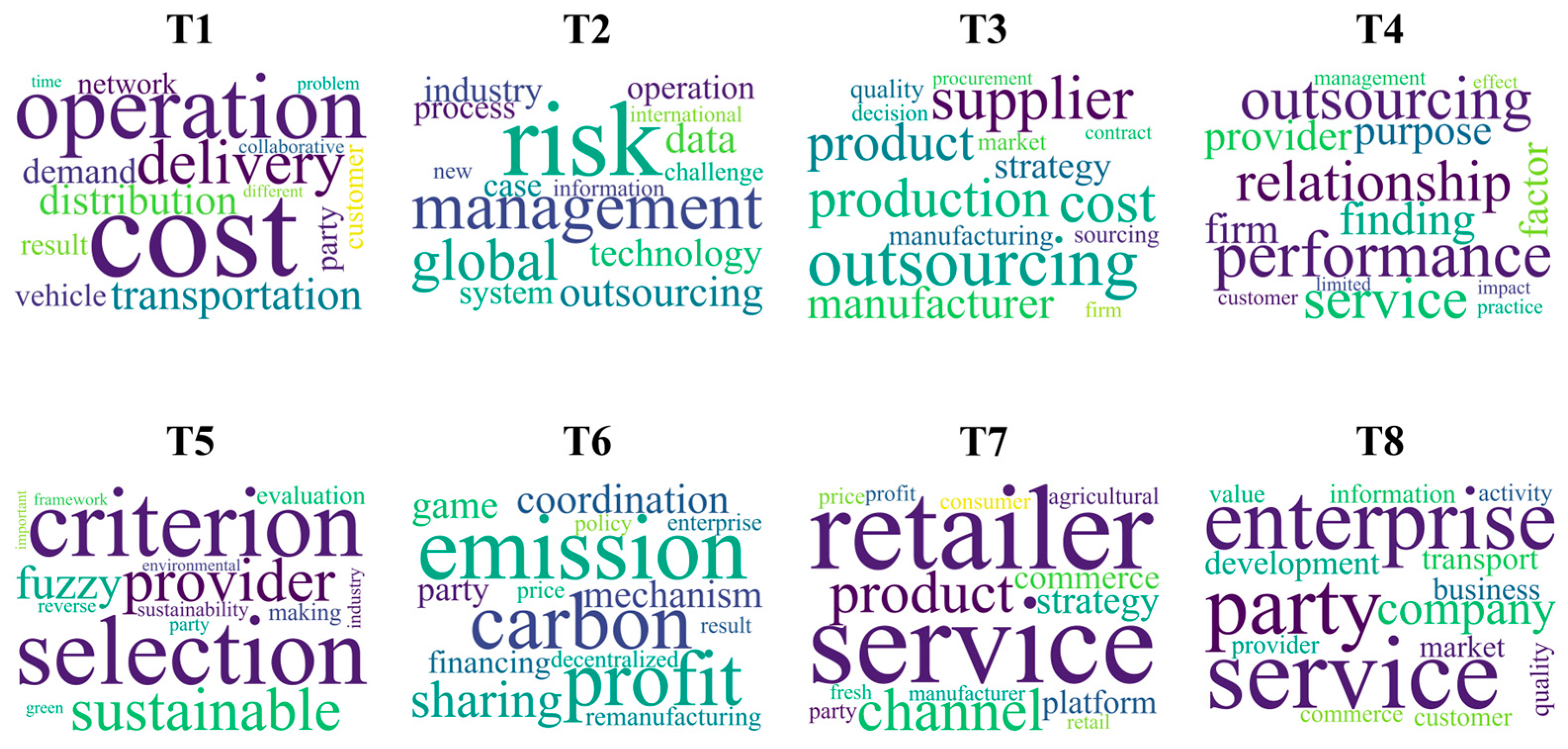
| T 1 | cost, operation, delivery, transportation, distribution, demand, vehicle, party, result, network, customer, collaborative, problem, time, different | Operational cost |
| T 2 | risk, management, global, outsourcing, data, technology, industry, operation, system, case, process, challenge, information, new, international | Risk management |
| T 3 | outsourcing, supplier, cost, production, product, manufacturer, strategy, manufacturing, quality, market, sourcing, decision, firm, contract, procurement | Outsourcing strategy |
| T 4 | performance, outsourcing, relationship, service, finding, provider, purpose, firm, factor, management, customer, practice, impact, limited, effect | Outsourcing performance evaluation |
| T 5 | selection, criterion, provider, sustainable, fuzzy, evaluation, making, sustainability, reverse, party, industry, green, environmental, framework, important | Service provider selection |
| T 6 | emission, carbon, profit, sharing, coordination, game, mechanism, party, financing, remanufacturing, enterprise, decentralized, price, policy, result | Environmental sustainability |
| T 7 | service, retailer, product, channel, strategy, commerce, platform, agricultural, price, party, consumer, profit, manufacturer, fresh, retail | Retail supply chain service |
| T 8 | service, enterprise, party, company, development, transport, business, market, customer, information, quality, provider, value, commerce, activity | Service quality |
| Topic | 15 Words | Categorization |
|---|---|---|
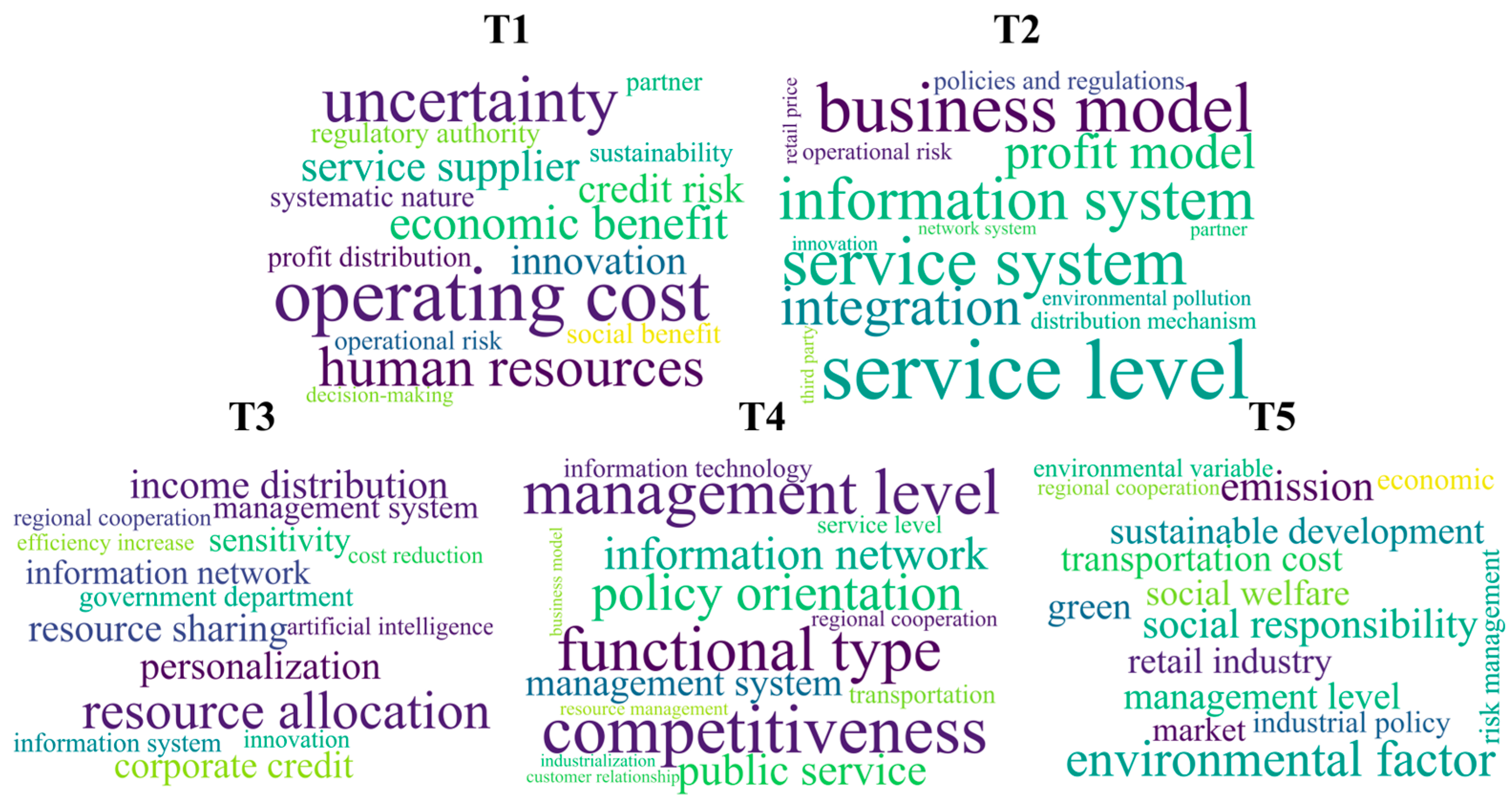
| T 1 | operating cost, uncertainty, human resources, economic benefit, service supplier, credit risk, innovation, systematic nature, regulatory authority, profit distribution, social benefit, operational risk, sustainability, partner, decision-making | Operational cost |
| T 2 | service level, business model, service system, information system, integration, profit model, policies and regulations, operational risk, distribution mechanism, environmental pollution, retail price, innovation, partner, network system, third party | Third-party service level |
| T 3 | resource allocation, income distribution, personalization, resource sharing, corporate credit, sensitivity, information network, management system, government department, information system, artificial intelligence, innovation, regional cooperation, cost reduction, efficiency increase, distribution mechanism | Resource management level |
| T 4 | competitiveness, management level, functional type, policy orientation, information network, public service, management system, information technology, transportation, service level, regional cooperation, resource management, industrialization, customer relationship, business model | Competitive capability |
| T 5 | environmental factor, emission, social responsibility, management level, sustainable development, transportation cost, green, retail industry, social welfare, market, economic, industrial policy, risk management, environmental variable, regional cooperation | Sustainability benefits |
| Factor | Description |
|---|---|
| Resource management level (F1) | Efficient allocation and management of resources, including capital, equipment and information, to achieve high-efficiency supply chain management. |
| Logistics service level (F2) | The quality and efficiency of cargo transportation and logistics services provided by logistics companies, covering delivery punctuality, safety, tracking visibility, and customer satisfaction. |
| Market competition (F3) | Advantages gained by logistics companies via superior service, cost control, and technological innovation in the continuous competition for customers, market share, and competitive edge. |
| Risk factor (F4) | Various risks encountered by logistics companies during operation, such as market, operational management, and competitive risk. |
| Outsourcing service level (F5) | The service quality and efficiency delivered by external partners when logistics companies outsource specific supply chain functions to third-party contractors. |
| Operational costs (F6) | Expenses incurred by companies in logistics operations and supply chain management, including procurement, warehousing, transportation, inventory management, human resources, and equipment maintenance. |
| Sustainability benefits (F7) | Positive multi-dimensional gains brought about by logistics companies’ operations, covering environmental improvement, economic contribution, and social welfare promotion, which reflect comprehensive sustainable value from environmental, economic, and social perspectives. |
| Factor | Paired Comparison of Factors | Ways in Which a Factor May Influence/Enhance Another Factor |
|---|---|---|
| F1 | F1–F2 | Improvements in resource management capabilities can directly influence and enhance logistics service performance through effective inventory management, supply chain visibility, human resource management, and resource allocation and optimization. |
| F1–F6 | A high level of resource management capability can help firms reduce inventory costs, decrease empty-load rates, and improve operational efficiency. | |
| F1–F7 | By reducing energy consumption, improving traffic flow, lowering costs, and enhancing service quality, resource management increases social benefits and contributes to the achievement of sustainable development. | |
| F2 | F2–F1 | By improving supply chain visibility, delivery reliability, and customer satisfaction, logistics service performance can directly enhance firms’ resource management capabilities, facilitating the effective allocation and utilization of resources to achieve higher levels of performance. |
| F2–F3 | By expanding market reach through efficient service provision, firms can offer more competitive prices and attract a larger customer base. | |
| F2–F6 | Improvements in logistics service performance can reduce transportation and inventory costs while simultaneously increasing investment costs associated with human resources and technology. | |
| F2–F7 | By reducing cargo dwell time, shortening transportation distances, and optimizing transportation routes, logistics service performance can reduce fuel consumption and emissions, thereby mitigating negative environmental impacts. | |
| F3 | F3–F2 | Market competition can motivate logistics firms to continuously innovate and improve their service quality standards. |
| F3–F4 | Market competition creates new challenges and opportunities for firms in terms of cost management, customer loyalty, technological innovation, supply chain complexity, and supply chain visibility. Firms need to develop effective risk management strategies to address the challenges arising from market competition and ensure sustainability. | |
| F3–F5 | Resource service providers can withstand competitive pressure by continuously improving their outsourcing services, including enhancing transportation efficiency, reducing costs, and providing faster delivery, thereby improving overall service performance. | |
| F4 | F4–F6 | Risk factors can directly influence or increase the operational costs of logistics firms through various channels, including traffic disruptions, supply chain disruptions, and trust-related risks. Firms need effective risk management strategies to mitigate the adverse cost impacts of these risks and ensure business sustainability and profitability. |
| F5 | F5–F3 | Outsourcing services have a direct impact on the reputation and customer satisfaction of logistics firms. High-quality outsourcing services enable firms to meet customer needs while focusing on their core business activities, thereby enhancing their core competitiveness in the market. |
| F5–F6 | The implementation of efficient and cost-effective outsourcing services can help logistics firms reduce their operational costs. | |
| F7 | F7–F6 | Pursuing sustainability benefits, including energy conservation, emission reduction, green operation and corporate social responsibility, directly raise operational costs. Extra upfront investment and continuous operating expenditure are required for purchasing high-efficiency vehicles, constructing eco-friendly warehouses and implementing social responsibility projects. |
| Factor | F7 | F6 | F5 | F4 | F3 | F2 | F1 |
|---|---|---|---|---|---|---|---|
| F1 | V | V | O | O | O | X | - |
| F2 | V | V | O | O | X | - | |
| F3 | O | O | X | V | - | ||
| F4 | O | V | O | - | |||
| F5 | O | V | - | ||||
| F6 | A | - | |||||
| F7 | - |
| Factor | F1 | F2 | F3 | F4 | F5 | F6 | F7 |
|---|---|---|---|---|---|---|---|
| F1 | 1 | 1 | 0 | 0 | 0 | 1 | 1 |
| F2 | 1 | 1 | 1 | 0 | 0 | 1 | 1 |
| F3 | 0 | 1 | 1 | 1 | 1 | 0 | 0 |
| F4 | 0 | 0 | 0 | 1 | 0 | 1 | 0 |
| F5 | 0 | 0 | 1 | 0 | 1 | 1 | 0 |
| F6 | 0 | 0 | 0 | 0 | 0 | 1 | 0 |
| F7 | 0 | 0 | 0 | 0 | 0 | 1 | 1 |
| Factor | F1 | F2 | F3 | F4 | F5 | F6 | F7 |
|---|---|---|---|---|---|---|---|
| F1 | 1 | 1 | 1 | 1 | 1 | 1 | 1 |
| F2 | 1 | 1 | 1 | 1 | 1 | 1 | 1 |
| F3 | 1 | 1 | 1 | 1 | 1 | 1 | 1 |
| F4 | 0 | 0 | 0 | 1 | 0 | 1 | 0 |
| F5 | 1 | 1 | 1 | 1 | 1 | 1 | 1 |
| F6 | 0 | 0 | 0 | 0 | 0 | 1 | 0 |
| F7 | 0 | 0 | 0 | 0 | 0 | 1 | 1 |
| Reachability Set | Antecedent Set | Intersection Set | Level | |
|---|---|---|---|---|
| Iteration 1 | ||||
| F1 | F1, F2, F3, F4, F5, F6, F7 | F1, F2, F3, F5 | F1, F2, F3, F5 | |
| F2 | F1, F2, F3, F4, F5, F6, F7 | F1, F2, F3, F5 | F1, F2, F3, F5 | |
| F3 | F1, F2, F3, F4, F5, F6, F7 | F1, F2, F3, F5 | F1, F2, F3, F5 | |
| F4 | F4, F6 | F1, F2, F3, F4, F5 | F4 | |
| F5 | F1, F2, F3, F4, F5, F6, F7 | F1, F2, F3, F5 | F1, F2, F3, F5 | |
| F6 | F6 | F1, F2, F3, F4, F5, F6, F7 | F6 | I |
| F7 | F6, F7 | F1, F2, F3, F5, F7 | F7 | |
| Iteration 2 | ||||
| F1 | F1, F2, F3, F4, F5, F7 | F1, F2, F3, F5 | F1, F2, F3, F5 | |
| F2 | F1, F2, F3, F4, F5, F7 | F1, F2, F3, F5 | F1, F2, F3, F5 | |
| F3 | F1, F2, F3, F4, F5, F7 | F1, F2, F3, F5 | F1, F2, F3, F5 | |
| F4 | F4 | F1, F2, F3, F4, F5 | F4 | II |
| F5 | F1, F2, F3, F4, F5, F7 | F1, F2, F3, F5 | F1, F2, F3, F5 | |
| F7 | F7 | F1, F2, F3, F5, F7 | F7 | II |
| Iteration 3 | ||||
| F1 | F1, F2, F3, F5 | F1, F2, F3, F5 | F1, F2, F3, F5 | III |
| F2 | F1, F2, F3, F5 | F1, F2, F3, F5 | F1, F2, F3, F5 | III |
| F3 | F1, F2, F3, F5 | F1, F2, F3, F5 | F1, F2, F3, F5 | III |
| F5 | F1, F2, F3, F5 | F1, F2, F3, F5 | F1, F2, F3, F5 | III |
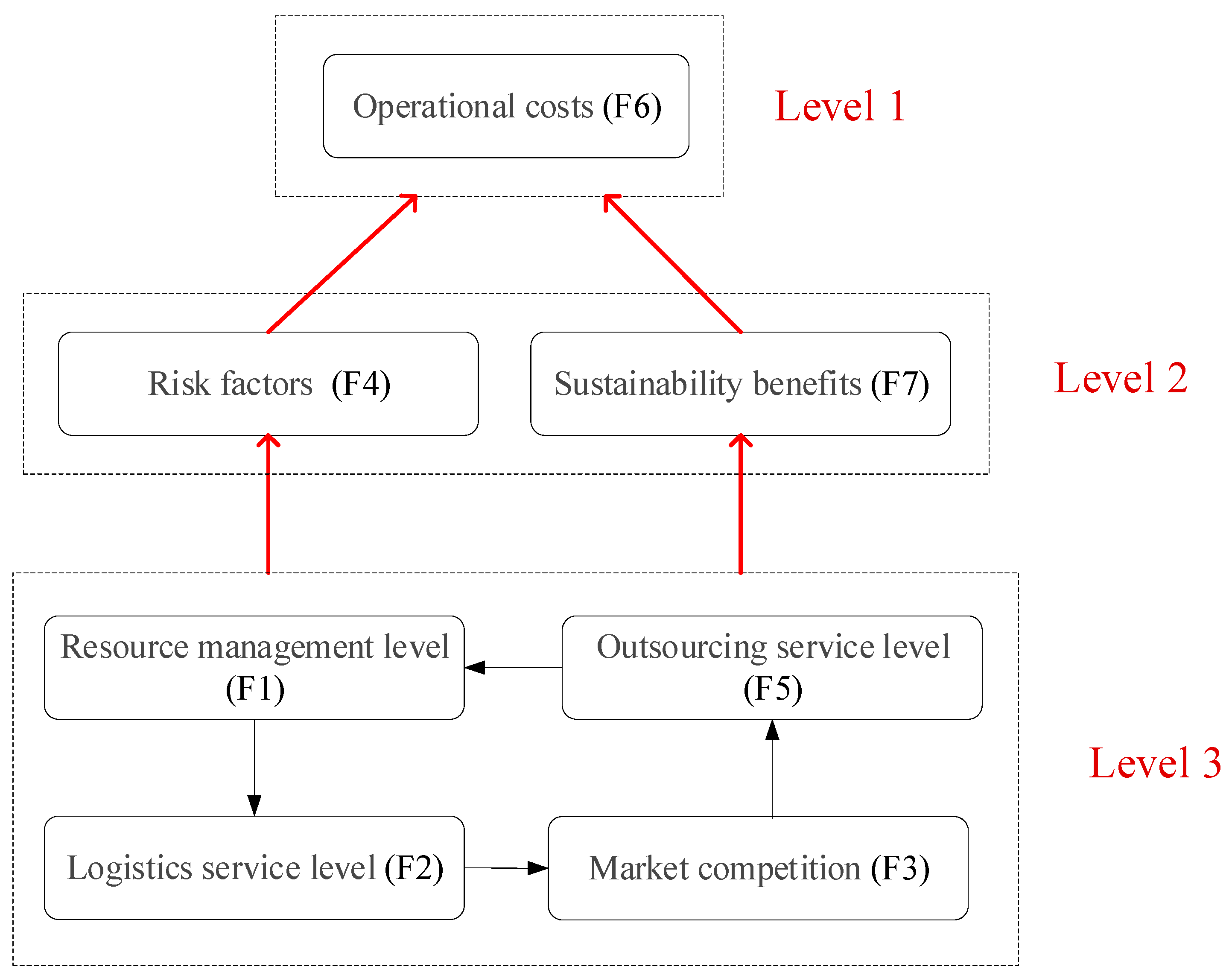
| Factor | Description | Level in TISM |
|---|---|---|
| F1 | Resource management level | III |
| F2 | Logistics service level | III |
| F3 | Market competition | III |
| F4 | Risk factors | II |
| F5 | Outsourcing service level | III |
| F6 | Operational costs | I |
| F7 | Sustainability benefits | II |
| Factor | Out-Degree | In-Degree | Point Centrality | Closeness Centrality (Inward/Outward) | Betweenness Centrality |
|---|---|---|---|---|---|
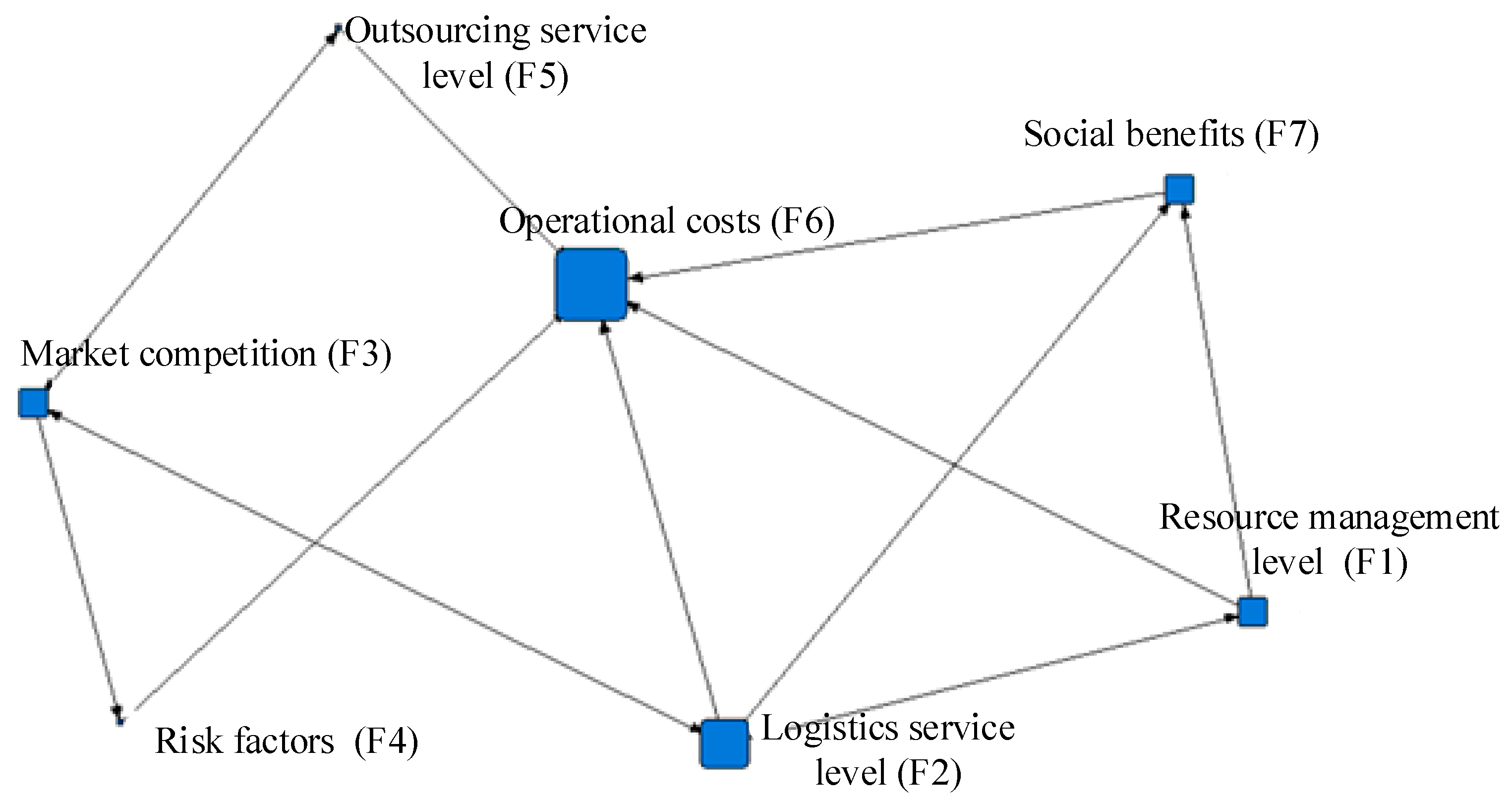
| F1 | 3 | 1 | 50.000 | 66.667 (22.222/54.545) | 0.000 |
| F2 | 4 | 2 | 66.667 | 75.000 (24.000/75.000) | 15.556 |
| F3 | 3 | 2 | 50.000 | 66.667 (24.000/66.667) | 10.000 |
| F4 | 1 | 1 | 33.333 | 60.000 (27.273/16.667) | 2.222 |
| F5 | 2 | 1 | 33.333 | 60.000 (22.222/50.000) | 2.222 |
| F6 | 0 | 5 | 83.333 | 85.714 (85.714/14.286) | 36.667 |
| F7 | 1 | 2 | 50.000 | 66.667 (28.571/16.667) | 0.000 |
| Mean | 2 | 2 | 52.381 | 68.673 (33.429/41.976) | 9.524 |
Disclaimer/Publisher’s Note: The statements, opinions and data contained in all publications are solely those of the individual author(s) and contributor(s) and not of MDPI and/or the editor(s). MDPI and/or the editor(s) disclaim responsibility for any injury to people or property resulting from any ideas, methods, instructions or products referred to in the content. |
© 2026 by the authors. Licensee MDPI, Basel, Switzerland. This article is an open access article distributed under the terms and conditions of the Creative Commons Attribution (CC BY) license.
Share and Cite
He, Y.; Gao, Y.; He, Z.; Shi, X.; Xue, J.; Ge, S. Key Factors Influencing the Operation of Logistics Companies in Self-Operation and Outsourcing Cooperation Mode: An LDA-TISM-SNA Approach. Sustainability 2026, 18, 7140. https://doi.org/10.3390/su18147140
He Y, Gao Y, He Z, Shi X, Xue J, Ge S. Key Factors Influencing the Operation of Logistics Companies in Self-Operation and Outsourcing Cooperation Mode: An LDA-TISM-SNA Approach. Sustainability. 2026; 18(14):7140. https://doi.org/10.3390/su18147140
Chicago/Turabian StyleHe, Yangyang, Yuli Gao, Zhengqiu He, Xiaoyu Shi, Jing Xue, and Shaohui Ge. 2026. "Key Factors Influencing the Operation of Logistics Companies in Self-Operation and Outsourcing Cooperation Mode: An LDA-TISM-SNA Approach" Sustainability 18, no. 14: 7140. https://doi.org/10.3390/su18147140
APA StyleHe, Y., Gao, Y., He, Z., Shi, X., Xue, J., & Ge, S. (2026). Key Factors Influencing the Operation of Logistics Companies in Self-Operation and Outsourcing Cooperation Mode: An LDA-TISM-SNA Approach. Sustainability, 18(14), 7140. https://doi.org/10.3390/su18147140