The Circular Turn in Hospitality: Strategies, Drivers, and Impacts of Circular Practices in the Hotel Industry—A Systematic Review

Abstract
1. Introduction
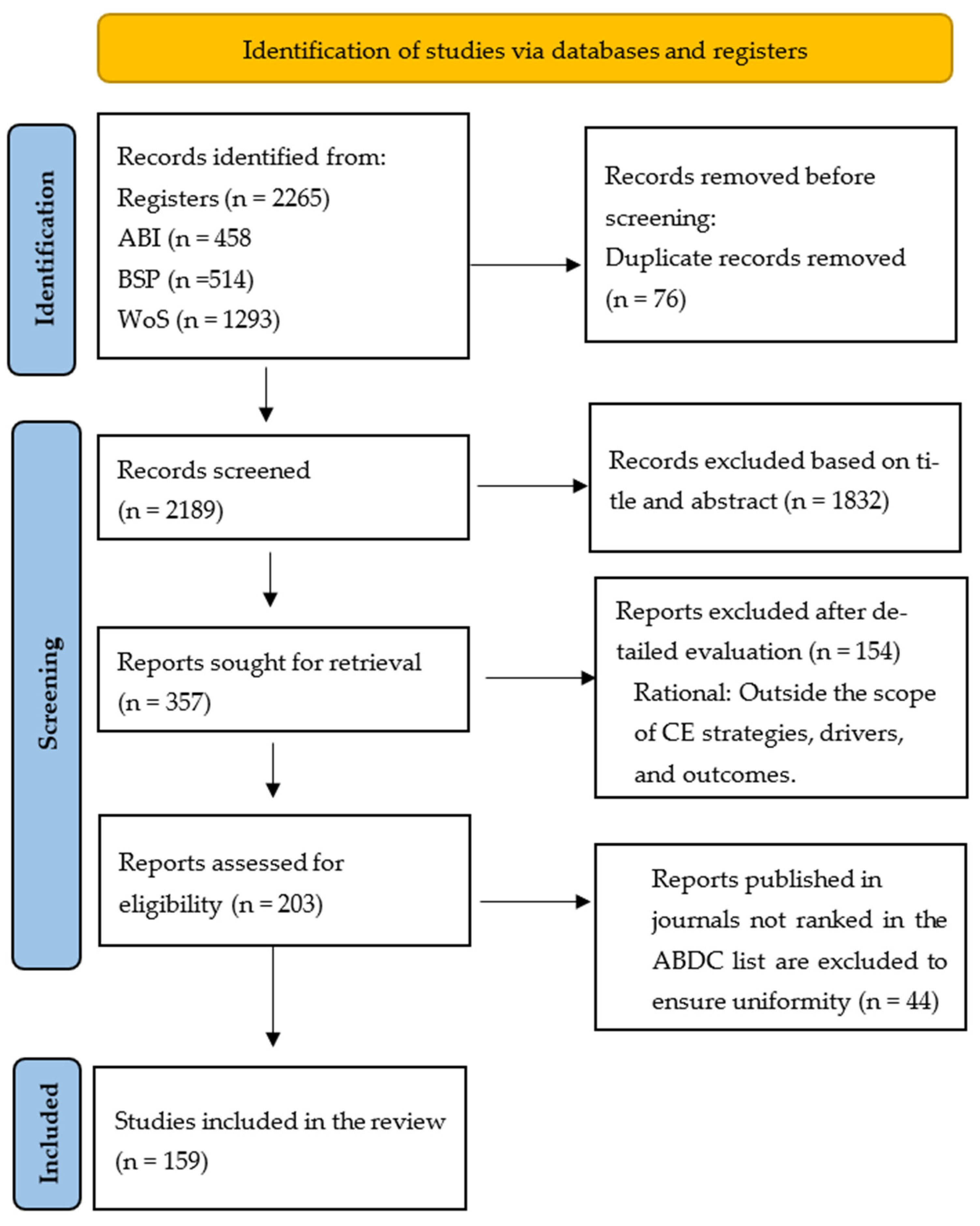
2. Materials and Methods
2.1. Research Objective and Review Protocol
2.2. Inclusion and Exclusion Criteria
2.3. Localization Strategy
(“circula*” OR “share” OR “lease” OR “reuse” OR “repair” OR “refurbish” OR “recycle” OR “waste” OR “prevention” OR “reduction” OR “recovery” OR “disposal”) AND (“hotel” OR “hostel” OR “motel”)
2.4. Data Extraction and Coding

3. Results
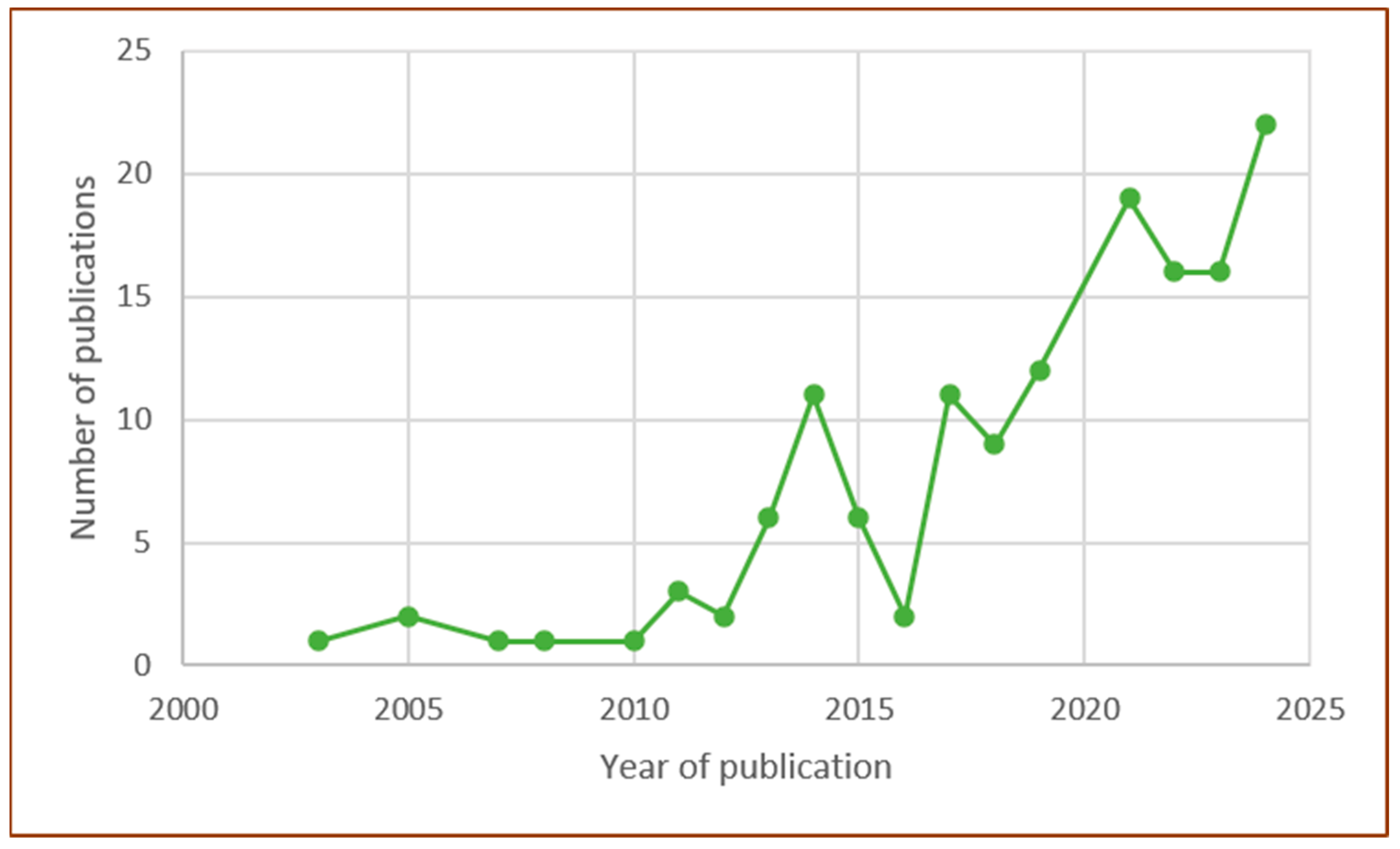
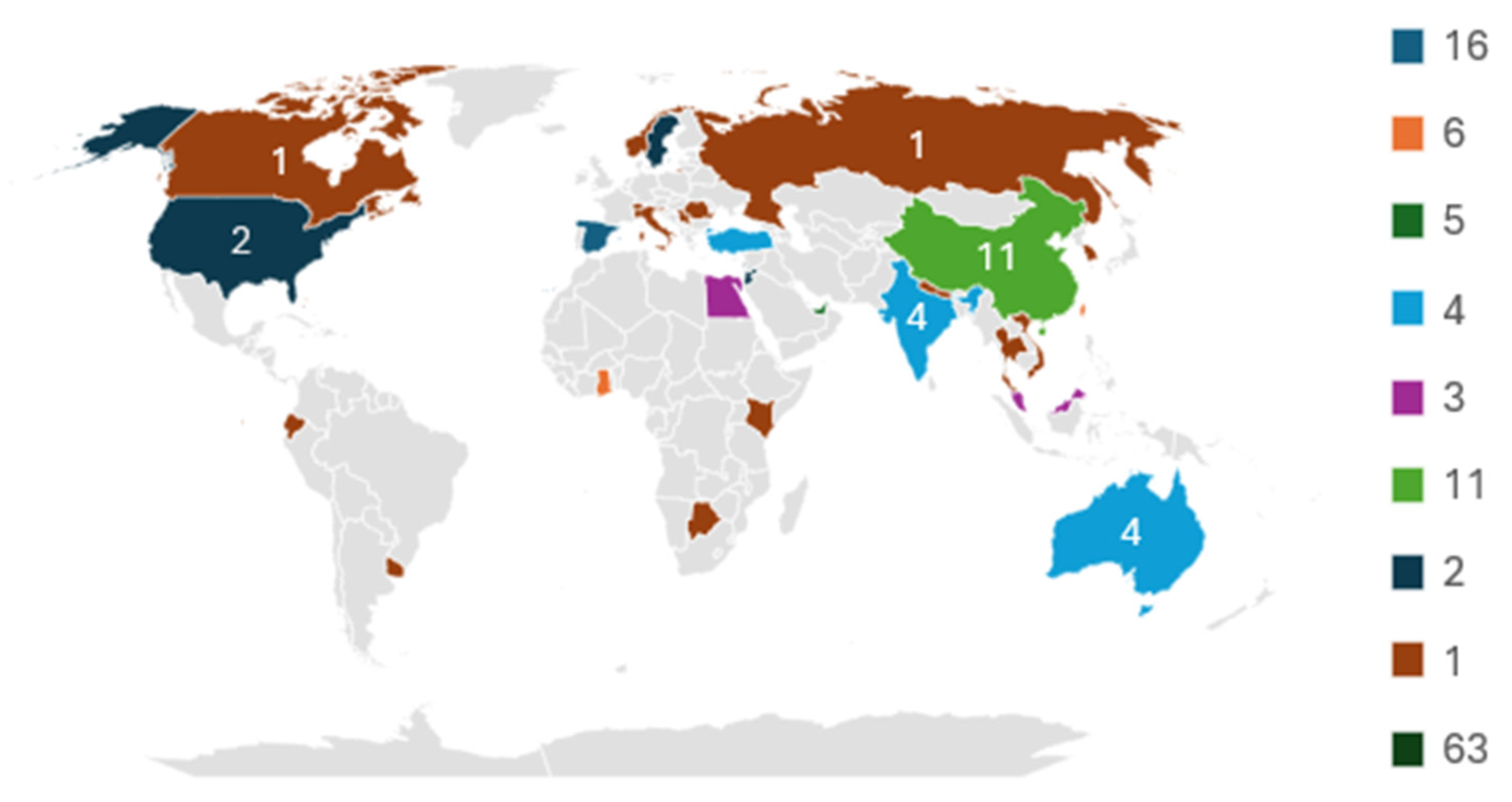
3.1. Research Profile
3.2. Thematic Foci
3.2.1. Circular Practices in the Hotel Sector
3.2.2. Determinants of CE in the Hotel Sector
- Internal Determinants
- External Determinants
3.2.3. Key Stakeholders and Their Roles in CE Transition in Hotel Sector
3.2.4. CE Initiatives Outcomes in Hotel Sector
4. Discussion
4.1. Foundational CE Practices in Hotel Sector
4.2. Drivers and Barriers of CE Practices in Hotel Sector
4.3. Impacts of CE Practices in the Hotel Sector
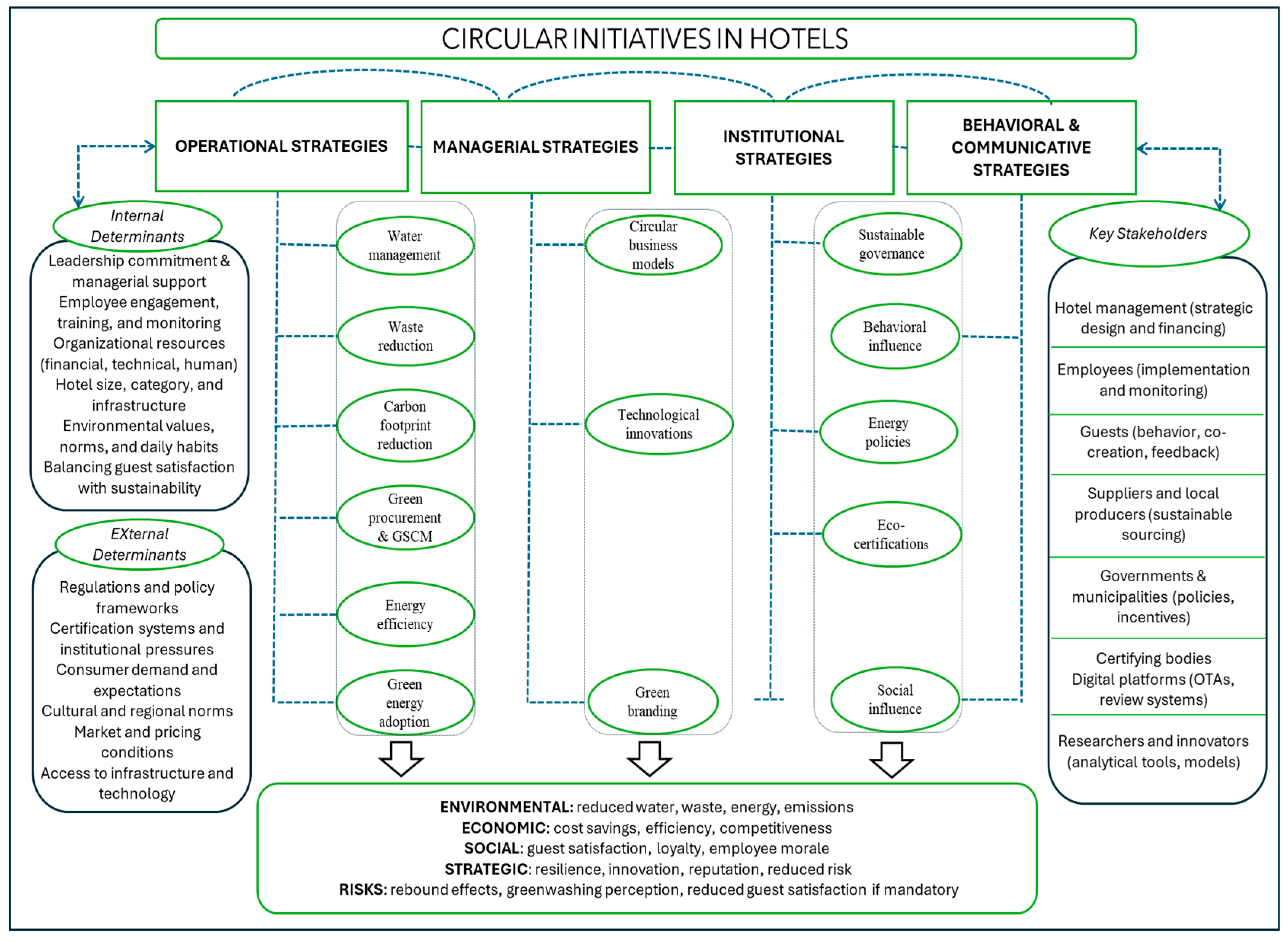
4.4. Framework of CE Initiatives in Hotel Sector
5. Research Agenda on CE in Hotel Sector
5.1. Operational Strategies
5.2. Managerial Innovation and Business Models
5.3. Institutional Frameworks and Policy Alignment
5.4. Behavioral and Social Influence
5.5. Equity and Social Justice in CE Transition in the Hotel Industry
5.6. Digital Technologies in CE Transition in the Hotel Sector
5.7. Systemic Perspective on CE in Hotel Sector
6. Conclusions and Contributions
Supplementary Materials
Author Contributions
Funding
Institutional Review Board Statement
Informed Consent Statement
Data Availability Statement
Conflicts of Interest
References
- Camilleri-Fenech, M.; i Sola, J.O.; Farreny, R.; Durany, X.G. A snapshot of solid waste generation in the hospitality industry: The case of a five-star hotel on the island of Malta. Sustain. Prod. Consum. 2020, 21, 104–119. [Google Scholar] [CrossRef] [Scilit]
- Sakshi; Shashi; Cerchione, R.; Bansal, H. Measuring the impact of sustainability policy and practices in tourism and hospitality industry. Bus. Strategy Environ. 2020, 29, 1109–1126. [Google Scholar]
- Mak, A.H.; Chang, R.C. The driving and restraining forces for environmental strategy adoption in the hotel industry: A force field analysis approach. Tour. Manag. 2019, 73, 48–60. [Google Scholar] [CrossRef] [Scilit]
- Styles, D.; Schoenberger, H.; Galvez-Martos, J.L. Water management in the European hospitality sector: Best practice, performance benchmarks and improvement potential. Tour. Manag. 2015, 46, 187–202. [Google Scholar] [CrossRef] [Scilit]
- Gatt, K.; Schranz, C. Retrofitting a 3 star hotel as a basis for piloting water minimisation interventions in the hospitality sector. Int. J. Hosp. Manag. 2015, 50, 115–121. [Google Scholar] [CrossRef] [Scilit]
- Palani, H.; Karatas, A. Holistic approach for reducing occupants’ energy consumption in hotel buildings. J. Clean. Prod. 2022, 365, 132679. [Google Scholar] [CrossRef] [Scilit]
- Ioannidis, A.; Chalvatzis, K.J.; Leonidou, L.C.; Feng, Z. Applying the reduce, reuse, and recycle principle in the hospitality sector: Its antecedents and performance implications. Bus. Strategy Environ. 2021, 30, 3394–3410. [Google Scholar] [CrossRef] [Scilit]
- Bux, C.; Amicarelli, V. Circular economy and sustainable strategies in the hospitality industry: Current trends and empirical implications. Tour. Hosp. Res. 2023, 23, 624–636. [Google Scholar]
- Sorin, F.; Sivarajah, U. Exploring circular economy in the hospitality industry: Empirical evidence from Scandinavian hotel operators. Scand. J. Hosp. Tour. 2021, 21, 265–285. [Google Scholar] [CrossRef] [Scilit]
- Alonso-Almeida, M.; Giglio, C.; Iazzolino, G. A cross-country analysis of decision-making factors influencing tourists’ shift toward circular destinations in EU-27. Socioecon. Plan. Sci. 2024, 94, 101955. [Google Scholar] [CrossRef] [Scilit]
- Lo, J.Y.; Chan, W.; Zhang, C.X. Tools for benchmarking and recognizing hotels’ green effort—Environmental assessment methods and eco-labels. J. China Tour. Res. 2014, 10, 165–185. [Google Scholar] [CrossRef] [Scilit]
- Kaszás, N.; Jakab, B.; Keller, K. Rethinking tourism sustainability certification: A circular economy approach-analysis of the circular economy criteria for sustainability certificates in tourism. Circ. Econ. Sustain. 2026, 6, 7. [Google Scholar] [CrossRef] [Scilit]
- Rahman, I.; Park, J.; Chi, C.G.Q. Consequences of “greenwashing”: Consumers’ reactions to hotels’ green initiatives. Int. J. Contemp. Hosp. Manag. 2015, 27, 1054–1081. [Google Scholar] [CrossRef] [Scilit]
- Migdadi, Y.K.A.A. Identifying the best practices in hotel green supply chain management strategy: A global study. J. Qual. Assur. Hosp. Tour. 2023, 24, 504–544. [Google Scholar]
- Thomas-Francois, K.; von Massow, M.; Joppe, M. Service-oriented, sustainable, local food value chain—A case study. Ann. Tour. Res. 2017, 65, 83–96. [Google Scholar] [CrossRef] [Scilit]
- Pai, C.H.; Shang, Y.; Wang, L.; Zhang, Y. A study on the influence of technology products introduced into green hotels. J. Organ. End. User Comput. 2023, 35, 1–20. [Google Scholar] [CrossRef] [Scilit]
- Ray, A.; Ray, A.; Bala, P.K.; Rana, N.P. What affects the use of green technology in hotels? Assessing hotel management viewpoint using natural language processing based qualitative study. J. Hosp. Mark. Manag. 2023, 32, 917–946. [Google Scholar] [CrossRef] [Scilit]
- Singjai, K.; Winata, L.; Kummer, T.F. Green initiatives and their competitive advantage for the hotel industry in developing countries. Int. J. Hosp. Manag. 2018, 75, 131–143. [Google Scholar] [CrossRef] [Scilit]
- Tiong, Y.Y.; Sondoh, S.L.; Tanakinjal, G.H.; Iggau, O.A. Cleaner operations in hotels: Recommendation for post-pandemic green recovery. J. Clean. Prod. 2021, 283, 124621. [Google Scholar] [CrossRef] [Scilit] [PubMed]
- Zaki, K. The impact of circular economy on environmental performance in the tourism and hospitality industry: The role of low-carbon behavior and eco-friendly behavior. Int. J. Tour. Hosp. Stud. 2024, 7, 285–304. [Google Scholar] [CrossRef] [Scilit]
- Akel, G.; Noyan, E. Exploring the criteria for a green and smart hotel: Insights from hotel managers’ perspectives. J. Hosp. Tour. Insights 2024, 7, 2992–3012. [Google Scholar] [CrossRef] [Scilit]
- Khassawneh, O.; Mohammad, T.; Bouchon, F.; Behery, M. Eco-innovation and customer satisfaction in the hospitality industry in Dubai: The role of green leadership. J. Hum. Resour. Hosp. Tour. 2024, 23, 413–438. [Google Scholar] [CrossRef] [Scilit]
- Goldstein, N.J.; Cialdini, R.B.; Griskevicius, V. A room with a viewpoint: Using social norms to motivate environmental conservation in hotels. J. Consum. Res. 2008, 35, 472–482. [Google Scholar] [CrossRef] [Scilit]
- Juvan, E.; Grün, B.; Dolnicar, S. Biting off more than they can chew: Food waste at hotel breakfast buffets. J. Travel Res. 2018, 57, 232–242. [Google Scholar]
- Omune, B.; Kambona, O.; Wadongo, B.; Wekesa, A. Environmental management practices implemented by the hotel sector in Kenya. World Leis. J. 2021, 63, 98–108. [Google Scholar] [CrossRef] [Scilit]
- Ruiz Molina, M.E.; Belda-Miquel, S.; Hytti, A.; Gil-Saura, I. Addressing sustainable food management in hotels: Proposing a framework and examining hotel groups. Br. Food J. 2022, 124, 462–492. [Google Scholar]
- Jones, P.; Wynn, M.G. The circular economy, natural capital and resilience in tourism and hospitality. Int. J. Contemp. Hosp. Manag. 2019, 31, 2544–2563. [Google Scholar] [CrossRef] [Scilit]
- Tan, S.H.; Habibullah, M.S.; Tan, S.K.; Choon, S.W. The impact of the dimensions of environmental performance on firm performance in travel and tourism industry. J. Environ. Manag. 2017, 203, 603–611. [Google Scholar] [CrossRef] [Scilit]
- Azzaz, A.M.; Elshaer, I.A. Heritage tourism resilience and sustainable performance post COVID-19: Evidence from hotels sector. Heritage 2024, 7, 1162–1173. [Google Scholar] [CrossRef] [Scilit]
- Sobaih, A.E.E.; Elshaer, I.; Hasanein, A.M.; Abdelaziz, A.S. Responses to COVID-19: The role of performance in the relationship between small hospitality enterprises’ resilience and sustainable tourism development. Int. J. Hosp. Manag. 2021, 94, 102824. [Google Scholar] [CrossRef] [Scilit] [PubMed]
- Ashaal, A.; Bakri, A.; AlKhatib, N.; Chreif, M.; Zakhem, N.B. Harvesting sustainability: Navigating green practices and barriers in Lebanon’s hospitality sector. Bus. Strategy Dev. 2024, 7, e369. [Google Scholar] [CrossRef] [Scilit]
- Staples, M.; Niazi, M. Experiences using systematic review guidelines. J. Syst. Softw. 2007, 80, 1425–1437. [Google Scholar] [CrossRef] [Scilit]
- Cooper, C.; Booth, A.; Varley-Campbell, J.; Britten, N.; Garside, R. Defining the process to literature searching in systematic reviews: A literature review of guidance and supporting studies. BMC Med. Res. Methodol. 2018, 18, 85. [Google Scholar] [CrossRef] [Scilit] [PubMed]
- Tranfield, D.; Denyer, D.; Smart, P. Toward a methodology for developing evidence-informed management knowledge by means of systematic review. Br. J. Manag. 2003, 14, 207–222. [Google Scholar] [CrossRef] [Scilit]
- Hill, J. Circular Economy and the Policy Landscape in the UK; Springer International Publishing: Cham, Switzerland, 2018; pp. 265–274. [Google Scholar]
- Chembessi, C.; Gohoungodji, P.; Rajaonson, J. “A fine wine, better with age”: Circular economy historical roots and influential publications: A bibliometric analysis using Reference Publication Year Spectroscopy (RPYS). J. Ind. Ecol. 2023, 27, 1593–1612. [Google Scholar] [CrossRef] [Scilit]
- Simonnot-Lanciaux, A.; Gohoungodji, P.; Perron-Brault, A.; Dantas, D.C. A spectroscopic exploration of the music marketing literature: Origins, historical roots and recent developments. Int. J. Arts Manag. 2025, 27, 43–61. [Google Scholar]
- Gohoungodji, P.; Amara, N. Art of innovating in the arts: Definitions, determinants, and mode of innovation in creative industries, a systematic review. Rev. Manag. Sci. 2023, 17, 2685–2725. [Google Scholar]
- Thomas, D.R. A general inductive approach for analyzing qualitative evaluation data. Am. J. Eval. 2006, 27, 237–246. [Google Scholar] [CrossRef] [Scilit]
- Strauss, A.; Corbin, J. Basics of Qualitative Research Techniques; SAGE Publications, Inc.: Thousand Oaks, CA, USA, 1998. [Google Scholar]
- Page, M.J.; McKenzie, J.E.; Bossuyt, P.M.; Boutron, I.; Hoffmann, T.C.; Mulrow, C.D.; Shamseer, L.; Tetzlaff, J.M.; Akl, E.A.; Brennan, S.E.; et al. The PRISMA 2020 statement: An updated guideline for reporting systematic reviews. BMJ 2021, 372, n71. [Google Scholar] [CrossRef] [Scilit]
- Erdogan, N.; Baris, E. Environmental protection programs and conservation practices of hotels in Ankara, Turkey. Tour. Manag. 2007, 28, 604–614. [Google Scholar] [CrossRef] [Scilit]
- Al-Aomar, R.; Hussain, M. An assessment of green practices in a hotel supply chain: A study of UAE hotels. J. Hosp. Tour. Manag. 2017, 32, 71–81. [Google Scholar] [CrossRef] [Scilit]
- Barberán, R.; Egea, P.; Gracia-de-Rentería, P.; Salvador, M. Evaluation of water saving measures in hotels: A Spanish case study. Int. J. Hosp. Manag. 2013, 34, 181–191. [Google Scholar] [CrossRef] [Scilit]
- Casado-Díaz, A.B.; Sancho-Esper, F.; Rodriguez-Sanchez, C.; Sellers-Rubio, R. Tourists’ water conservation behavior in hotels: The role of gender. In Gender and Tourism Sustainability; Routledge: London, UK, 2022; pp. 63–83. [Google Scholar]
- Dolnicar, S.; Knezevic Cvelbar, L.; Grün, B. Do pro-environmental appeals trigger pro-environmental behavior in hotel guests? J. Travel Res. 2017, 56, 988–997. [Google Scholar]
- Bowen, R.; Dowell, D.; Morris, W. Hospitality SMEs and the circular economy: Strategies and practice post-COVID. Br. Food J. 2024, 126, 80–97. [Google Scholar]
- Xu, X.; Gursoy, D. STHRSCAPE: Developing and validating a collaborative economy based short-term hospitality rental service scape scale. Int. J. Hosp. Manag. 2021, 94, 102833. [Google Scholar] [CrossRef] [Scilit]
- Mensah, I. Different shades of green: Environmental management in hotels in Accra. Int. J. Tour. Res. 2014, 16, 450–461. [Google Scholar]
- Apolloni, M.; Volgger, M.; Pforr, C. Analysis of accommodation providers’ carbon footprint in Australia: Motivations and challenges. Int. J. Contemp. Hosp. Manag. 2024, 36, 1490–1511. [Google Scholar]
- Atanasova, N.; Dalmau, M.; Comas, J.; Poch, M.; Rodriguez-Roda, I.; Buttiglieri, G. Optimized MBR for greywater reuse systems in hotel facilities. J. Environ. Manag. 2017, 193, 503–511. [Google Scholar] [CrossRef] [Scilit]
- Hocaoglu, S.M. Evaluations of on-site wastewater reuse alternatives for hotels through water balance. Resour. Conserv. Recycl. 2017, 122, 43–50. [Google Scholar] [CrossRef] [Scilit]
- Suárez-Fernández, S.; Zapico, E.; Boto-García, D. Water-saving strategies at hotels: Which are more effective? Curr. Issues Tour. 2024, 28, 1135–1154. [Google Scholar] [CrossRef] [Scilit]
- Rico, A.; Olcina, J.; Baños, C.; Garcia, X.; Saurí, D. Declining water consumption in the hotel industry of mass tourism resorts: Contrasting evidence for Benidorm, Spain. Curr. Issues Tour. 2020, 23, 770–783. [Google Scholar]
- Estelrich, M.; Vosse, J.; Comas, J.; Atanasova, N.; Costa, J.; Gattringer, H.; Buttiglieri, G. Feasibility of vertical ecosystem for sustainable water treatment and reuse in touristic resorts. J. Environ. Manag. 2021, 294, 112968. [Google Scholar] [CrossRef] [Scilit]
- Estevez, S.; Feijoo, G.; Moreira, M. Environmental synergies in decentralized wastewater treatment at a hotel resort. J. Environ. Manag. 2022, 317, 115392. [Google Scholar] [CrossRef] [Scilit]
- Han, H.; Lee, J.; Trang, H.; Kim, W. Water conservation and waste reduction management for increasing guest loyalty and green hotel practices. Int. J. Hosp. Manag. 2018, 75, 58–66. [Google Scholar] [CrossRef] [Scilit]
- Tsai, K.; Lin, T.; Hwang, R.; Huang, Y. Carbon dioxide emissions generated by energy consumption of hotels and homestay facilities in Taiwan. Tour. Manag. 2014, 42, 13–21. [Google Scholar] [CrossRef] [Scilit]
- Dolnicar, S.; Juvan, E.; Grün, B. Reducing the plate waste of families at hotel buffets—A quasi-experimental field study. Tour. Manag. 2020, 80, 104103. [Google Scholar] [CrossRef] [Scilit]
- Kasavan, S.; Mohamed, A.; Halim, S.; Yusof, S.; Siron, R. Challenges for source separation of food waste and turning waste into compost for island-based hotels. Akademika 2022, 92, 39–49. [Google Scholar] [CrossRef] [Scilit]
- Sealey, K.; Smith, J. Recycling for small island tourism developments: Food waste composting at Sandals Emerald Bay, Exuma, Bahamas. Resour. Conserv. Recycl. 2014, 92, 25–37. [Google Scholar] [CrossRef] [Scilit]
- Dolnicar, S. Eat up! Prevention of plate waste in tourism and hospitality: A perspective paper. Tour. Rev. 2021, 76, 43–46. [Google Scholar]
- Lagioia, G.; Amicarelli, V.; Strippoli, R.; Bux, C.; Gallucci, T. Sustainable and circular practices in the hotel industry in Southern Italy: Opportunities, barriers and trends in food waste management. Br. Food J. 2024, 126, 428–452. [Google Scholar]
- Mohammad, A.A.A. Approaching the adoption of lean thinking principles in food operations in hotels in Egypt. Tour. Rev. Int. 2017, 21, 365–378. [Google Scholar] [CrossRef] [Scilit]
- Goh, E.; Okumus, B.; Jie, F.; Djajadikerta, H.; Lemy, D. Managing food wastage in hotels: Discrepancies between injunctive and descriptive norms amongst hotel food and beverage managers. Br. Food J. 2022, 124, 4666–4685. [Google Scholar] [CrossRef] [Scilit]
- Zaki, K. Enabling hotel circularity via Industry 4.0 innovations for enhanced hotel performance: Insights from Saudi Arabia and Egypt. J. Hosp. Tour. Insights 2025, 8, 915–936. [Google Scholar] [CrossRef] [Scilit]
- MacInnes, S.; Grün, B.; Dolnicar, S. Habit drives sustainable tourist behaviour. Ann. Tour. Res. 2022, 92, 103329. [Google Scholar] [CrossRef] [Scilit]
- Nilashi, M.; Minaei-Bidgoli, B.; Alrizq, M.; Alghamdi, A.; Alsulami, A.; Samad, S.; Mohd, S. An analytical approach for big social data analysis for customer decision-making in eco-friendly hotels. Expert Syst. Appl. 2021, 186, 115722. [Google Scholar] [CrossRef] [Scilit]
- Song, J.; Jai, T.-M.C.; Li, X. Examining green reviews on TripAdvisor: Comparison between resort/luxury hotels and business/economy hotels. Int. J. Hosp. Tour. Adm. 2020, 21, 165–187. [Google Scholar]
- Wan, X.; Jiang, B.; Li, Q.; Hou, X. Dual-channel environmental hotel supply chain network equilibrium decision under altruism preference and demand uncertainty. J. Clean. Prod. 2020, 271, 122595. [Google Scholar] [CrossRef] [Scilit]
- Thomas-Francois, K.; von Massow, M.; Joppe, M. Strengthening farmers–hotel supply chain relationships: A service management approach. Tour. Plan. Dev. 2017, 14, 198–219. [Google Scholar]
- McGregor, K.; Becken, S.; Vada, S.; Mackey, B. Enhancing compliance assessment through regenerative transformations: A food waste perspective. J. Sustain. Tour. 2025, 33, 780–799. [Google Scholar]
- Huang, K.; Wang, J.; Wang, Y. Analysis and benchmarking of greenhouse gas emissions of luxury hotels. Int. J. Hosp. Manag. 2015, 51, 56–66. [Google Scholar] [CrossRef] [Scilit]
- Khonje, L.Z.; Simatele, M.D.; Musavengane, R. Environmental sustainability innovations in the accommodation sub-sector: Views from Lilongwe, Malawi. Dev. S. Afr. 2020, 37, 312–327. [Google Scholar]
- Filimonau, V.; Tochukwu, C.O. Exploring managerial approaches to mitigating solid waste in hotels of Lagos, Nigeria. J. Clean. Prod. 2021, 270, 122410. [Google Scholar]
- Garrido, S.; Rodríguez-Antón, J.; Amado, C.A.; Santos, S.; Dias, L.C. Development and application of a composite circularity index. J. Environ. Manag. 2023, 337, 117752. [Google Scholar] [CrossRef] [Scilit]
- Hussain, M.; Al-Aomar, R.; Melhem, H. Assessment of lean-green practices on the sustainable performance of hotel supply chains. Int. J. Contemp. Hosp. Manag. 2019, 31, 2448–2467. [Google Scholar] [CrossRef] [Scilit]
- Chen, H.; Bernard, S.; Rahman, I. Greenwashing in hotels: A structural model of trust and behavioral intentions. J. Clean. Prod. 2019, 206, 326–335. [Google Scholar] [CrossRef] [Scilit]
- Gössling, S.; Araña, J.E.; Aguiar-Quintana, J.T. Towel reuse in hotels: Importance of normative appeal designs. Tour. Manag. 2019, 70, 273–283. [Google Scholar] [CrossRef] [Scilit]
- Song, J.; Lin, Z.; Zheng, C. Effective pro-environmental communication: Message framing and context congruency effect. J. Travel Res. 2025, 64, 206–221. [Google Scholar]
- Yu, W.; Liao, X.; Ji, S.; Cui, F. Green rewards vs. non-green rewards? The impact of hotel marketing incentives on guests’ green consumption intentions. J. Sustain. Tour. 2024, 33, 1534–1552. [Google Scholar] [CrossRef] [Scilit]
- Mahachi, D.; Mokgalo, L.L.; Pansiri, J. Exploitation of renewable energy in the hospitality sector: Case studies of Gaborone Sun and the Cumberland Hotel in Botswana. Int. J. Hosp. Tour. Adm. 2015, 16, 331–354. [Google Scholar] [CrossRef] [Scilit]
- Stylos, N.; Koroneos, C.; Roset, J.; González-Sánchez, C.; Xydis, G.; Muñoz, F.S. Exergy as an indicator for enhancing evaluation of environmental management performance in the hospitality industry. J. Clean. Prod. 2018, 198, 1503–1514. [Google Scholar] [CrossRef] [Scilit]
- Wan, Y.K.P.; Chan, S.H.J.; Huang, H.L.W. Environmental awareness, initiatives and performance in the hotel industry of Macau. Tour. Rev. 2017, 72, 87–103. [Google Scholar] [CrossRef] [Scilit]
- Andoh, R.; Owusu, N.; Hayford, C.; Ansong, L.; Ansong, A. Implications of green knowledge sharing, organizational green culture and green training and development for organizational environmental citizenship behavior in the hotel sector. J. Hosp. Tour. Insights 2024, 8, 637–653. [Google Scholar] [CrossRef] [Scilit]
- Li, L.L.; Liu, Y.W.; Tseng, M.L.; Lin, G.Q.; Ali, M.H. Reducing environmental pollution and fuel consumption using optimization algorithm to develop combined cooling heating and power system operation strategies. J. Clean. Prod. 2020, 247, 119082. [Google Scholar] [CrossRef] [Scilit]
- Topcuoglu, E.; Kim, H.; Kim, S.; Kim, S. Green message strategies and green brand image in a hotel context. J. Hosp. Mark. Manag. 2022, 31, 311–325. [Google Scholar]
- Filimonau, V.; Magklaropoulou, A. Exploring the viability of a new “pay-as-you-use” energy management model in budget hotels. Int. J. Hosp. Manag. 2020, 89, 102538. [Google Scholar] [CrossRef] [Scilit]
- Tsai, Y.; Wu, C.; Wang, T. Attitude towards green hotel by hoteliers and travel agency managers in Taiwan. Asia Pac. J. Tour. Res. 2014, 19, 1091–1109. [Google Scholar]
- Chan, W.W.; Lam, J.C. Energy-saving supporting tourism sustainability: A case study of hotel swimming pool heat pump. J. Sustain. Tour. 2003, 11, 74–83. [Google Scholar] [CrossRef] [Scilit]
- Mensah, I.; Ampofo, E.T. Effects of managers’ environmental attitudes on waste management practices in small hotels in Accra. Int. Hosp. Rev. 2021, 35, 109–126. [Google Scholar]
- Chiang, C.-F.; Chen, J. How empowering leadership and a cooperative climate influence employees’ voice behavior and knowledge sharing in the hotel industry. J. Qual. Assur. Hosp. Tour. 2021, 22, 476–495. [Google Scholar]
- Dai, Y.-D.; Zhuang, W.-L.; Yang, P.-K.; Wang, Y.-J.; Huan, T.-C. Exploring hotel employees’ regulatory foci and voice behavior: The moderating role of leader–member exchange. Int. J. Contemp. Hosp. Manag. 2021, 33, 27–47. [Google Scholar]
- Hewa Heenipellage, A.; Fernando, M.; Gibbons, B. Upper echelon characteristics and environmental sustainability practices: Evidence from upper echelons in the hotel industry. J. Clean. Prod. 2022, 379, 134618. [Google Scholar] [CrossRef] [Scilit]
- Untaru, E.; Ispas, A.; Han, H. Exploring the synergy between customer home-based and hotel-based water consumption and conservation behaviors: An empirical approach. J. Consum. Behav. 2020, 19, 542–555. [Google Scholar] [CrossRef] [Scilit]
- Piaggio, M.; Alcántara, V.; Padilla, E. Greenhouse gas emissions and economic structure in Uruguay. Econ. Syst. Res. 2014, 26, 155–176. [Google Scholar] [CrossRef] [Scilit]
- Wang, D.; Deng, Z.; Lo, W. A toolkit for hotel environment management capability development. J. Travel Tour. Mark. 2024, 41, 1005–1019. [Google Scholar] [CrossRef] [Scilit]
- Schäufele-Elbers, I.; Schamel, G.; Perathoner, M. Nudging food waste off the plate? An explorative study investigating the generation of plate waste over time and the effectiveness of information nudges to bridge the attitude–behavior gap. J. Foodserv. Bus. Res. 2024, 28, 774–792. [Google Scholar] [CrossRef] [Scilit]
- Yu, H.; Chiu, C.-N. Environmental quality and its impact on business performance of the bed and breakfasts (B&Bs) industry: Evidence from Taiwan. J. Clean. Prod. 2021, 295, 126234. [Google Scholar] [CrossRef] [Scilit]
- Bhattacharyya, J.; Balaji, M.; Jiang, Y. Assessing the effectiveness of environmental sustainability performance communication in tourism: Mediation and moderation effects. J. Travel Res. 2023, 63, 1933–1952. [Google Scholar] [CrossRef] [Scilit]
- Chen, H.; DeSalvo, D. The effect of message framing and focus on reducing food waste. J. Qual. Assur. Hosp. Tour. 2022, 23, 650–668. [Google Scholar]
- Cozzio, C.; Tokarchuk, O.; Maurer, O. Minimising plate waste at hotel breakfast buffets: An experimental approach through persuasive messages. Br. Food J. 2021, 123, 3208–3227. [Google Scholar] [CrossRef] [Scilit]
- Hameed, I.; Hussain, H.; Khan, K. The role of green practices in green word-of-mouth using the stimulus-organism-response model. J. Hosp. Tour. Insights 2022, 5, 1046–1061. [Google Scholar]
- Lee, W.; Cheng, C. Less is more: A new insight for measuring service quality of green hotels. Int. J. Hosp. Manag. 2018, 68, 32–40. [Google Scholar] [CrossRef] [Scilit]
- Trung, D.N.; Kumar, S. Resource use and waste management in Vietnam hotel industry. J. Clean. Prod. 2005, 13, 109–116. [Google Scholar] [CrossRef] [Scilit]
- Neugebauer, S.; Bolz, M.; Mankaa, R.; Traverso, M. How sustainable are sustainability conferences? Comprehensive life cycle assessment of an international conference series in Europe. J. Clean. Prod. 2020, 242, 118516. [Google Scholar] [CrossRef] [Scilit]
- Leverenz, D.; Hafner, G.; Moussawel, S.; Kranert, M.; Goossens, Y.; Schmidt, T. Reducing food waste in hotel kitchens based on self-reported data. Ind. Mark. Manag. 2021, 93, 617–627. [Google Scholar] [CrossRef] [Scilit]
- Goh, E.; Jie, F. To waste or not to waste: Exploring motivational factors of Generation Z hospitality employees toward food wastage in the hospitality industry. Int. J. Hosp. Manag. 2019, 80, 126–135. [Google Scholar] [CrossRef] [Scilit]
- Guerra-Lombardi, V.; Gutiérrez-Taño, D.; Hernández-Martín, R.; Padrón-Fumero, N. Green behavioural intention and behaviour of hotel employees: Mediation roles of customers, coworkers, supervisors, and corporate attitudes. Sustainability 2024, 17, 5928. [Google Scholar]
- Antonschmidt, H.; Lund-Durlacher, D. Stimulating food waste reduction behaviour among hotel guests through context manipulation. J. Clean. Prod. 2021, 329, 129709. [Google Scholar] [CrossRef] [Scilit]
- Pérez López, M.C.; Plata Díaz, A.M.; Martin Salvador, M.; López Pérez, G. A machine learning approach to classifying sustainability practices in hotel management. J. Sustain. Tour. 2024, 33, 1634–1657. [Google Scholar] [CrossRef] [Scilit]
- Teng, C.; Horng, J.; Hu, M.; Chien, L.; Shen, Y. Developing energy conservation and carbon reduction indicators for the hotel industry in Taiwan. Int. J. Hosp. Manag. 2012, 31, 199–208. [Google Scholar] [CrossRef] [Scilit]
- Budovska, V.; Torres Delgado, A.; Øgaard, T. Pro-environmental behaviour of hotel guests: Application of the Theory of Planned Behaviour and social norms to towel reuse. Tour. Hosp. Res. 2020, 20, 105–116. [Google Scholar]
- Milindi, P.S.; De Lieto, F.; Chopra, S.S. Food waste–energy–water–emissions (FEWE) nexus in the food service sector: Comparing a restaurant meal from imported ingredients versus an imported ready-to-eat meal. J. Clean. Prod. 2022, 380, 134871. [Google Scholar] [CrossRef] [Scilit]
- Huang, H.; Lin, T.; Lai, M.; Lin, T. Environmental consciousness and green customer behavior: An examination of motivation crowding effect. Int. J. Hosp. Manag. 2014, 40, 139–149. [Google Scholar] [CrossRef] [Scilit]
- Xue, N.; Chan, E.; Wan, L. How eco-certificate/effort influences hotel preference. Ann. Tour. Res. 2023, 101, 103616. [Google Scholar] [CrossRef] [Scilit]
- Matyakubov, U.; Filimonau, V.; Ermolaev, V. The (De)motives to conserve the environment among small independent hotels in a resource scarce destination. J. Qual. Assur. Hosp. Tour. 2022, 23, 1596–1622. [Google Scholar]
- Menegaki, A.; Tiwari, A. Willingness to pay for new technologies and environmental technologies in hotels: A multinomial logit approach. J. Knowl. Econ. 2023, 15, 14902–14934. [Google Scholar] [CrossRef] [Scilit]
- Naramski, M.; Stecuła, K. Virtual reality for innovative and responsible tourism. Sustainability 2025, 17, 10233. [Google Scholar] [CrossRef] [Scilit]
- Suanpang, P.; Pothipassa, P. Integrating generative AI and IoT for sustainable smart tourism destinations. Sustainability 2024, 16, 7435. [Google Scholar] [CrossRef] [Scilit]
- Han, H.; Lee, M.J.; Kim, W. Promoting towel reuse behaviour in guests: A water conservation management and environmental policy in the hotel industry. Bus. Strategy Environ. 2018, 27, 1302–1312. [Google Scholar] [CrossRef] [Scilit]
- Han, H.; Chua, B.L.; Hyun, S.S. Eliciting customers’ waste reduction and water saving behaviors at a hotel. Int. J. Hosp. Manag. 2020, 87, 102386. [Google Scholar] [CrossRef] [Scilit]
- Mensah, I.; Blankson, E.J. Commitment to environmental management in hotels in Accra. Int. J. Hosp. Tour. Adm. 2014, 15, 150–171. [Google Scholar] [CrossRef] [Scilit]
- Diaz-Farina, E.; Díaz-Hernández, J.J.; Padrón-Fumero, N. A participatory waste policy reform for the hotel sector: Evidence of a progressive Pay-As-You-Throw tariff. J. Sustain. Tour. 2025, 33, 697–718. [Google Scholar]
- Filimonau, V.; Rosa, M.S.; Franca, L.S.; Creus, A.C.; Ribeiro, G.M.; Molnarova, J.; Piumatti, R.G.; Valsasina, L.; Safaei, A. Environmental and carbon footprint of tourist accommodation: A comparative study of popular hotel categories in Brazil and Peru. J. Clean. Prod. 2021, 328, 129561. [Google Scholar] [CrossRef] [Scilit]
- Ball, S.; Abou Taleb, M. Benchmarking waste disposal in the Egyptian hotel industry. Tour. Hosp. Res. 2011, 11, 1–18. [Google Scholar] [CrossRef] [Scilit]
- Teng, C.; Horng, J.; Hu, M.; Chen, P. Exploring the energy and carbon literacy structure for hospitality and tourism practitioners: Evidence from hotel employees in Taiwan. Asia Pac. J. Tour. Res. 2014, 19, 451–468. [Google Scholar]
- Junkrachang, P.; Butcher, K.; Yodsuwan, C. Investigating guest reactions to plate waste reduction strategies: A field experiment in a casual-dining restaurant. Int. J. Hosp. Manag. 2024, 121, 103805. [Google Scholar] [CrossRef] [Scilit]
- Bt Mohamed Sadom, N.Z.; Quoquab, F.; Mohammad, J. “Waste not, want not”: Fostering frugality amongst Muslim tourists in the Malaysian hotel industry. J. Islam. Mark. 2022, 13, 1656–1684. [Google Scholar]
- Velickovic, G.; Stanojevic, J.; Veselinovic, M. Managing financial performance toward achievements in sustainability prospects: Comparative analysis of the e-commerce and hospitality industries. J. Risk Financ. Manag. 2023, 16, 395. [Google Scholar] [CrossRef] [Scilit]
- Heung, V.; Pun, P. Dimensions of environmentalism: A study of policies and good practices in the Hong Kong hotel industry. J. China Tour. Res. 2013, 9, 50–80. [Google Scholar] [CrossRef] [Scilit]
- Razumova, M.; Ibáñez, J.L.; Palmer, J.R.-M. Drivers of environmental innovation in Majorcan hotels. J. Sustain. Tour. 2015, 23, 1529–1549. [Google Scholar] [CrossRef] [Scilit]
- Kim, D.; Roseman, M.G. The effect of non-optional green practices in hotels on guests’ behavioral intentions. J. Qual. Assur. Hosp. Tour. 2022, 23, 345–364. [Google Scholar]
- Okumus, B.; Taheri, B.; Giritlioglu, I.; Gannon, M. Tackling food waste in all-inclusive resort hotels. Int. J. Hosp. Manag. 2020, 88, 102543. [Google Scholar] [CrossRef] [Scilit]
- Shanti, J. A study on environmental sustainability practices of star hotels in Bangalore. Asian J. Bus. Ethics 2016, 5, 185–194. [Google Scholar] [CrossRef] [Scilit]
- Pirani, S.I.; Arafat, H.A. Reduction of food waste generation in the hospitality industry. J. Clean. Prod. 2016, 132, 129–145. [Google Scholar] [CrossRef] [Scilit]
- Kusa, R.; Suder, M.; Duda, J. Impact of greening on performance in the hospitality industry: Moderating effect of flexibility and inter-organizational cooperation. Technol. Forecast. Soc. Change 2023, 190, 122423. [Google Scholar] [CrossRef] [Scilit]
- Lai, J. Mandatory reporting of greenhouse gas emissions from buildings: Stakeholders’ opinions in Hong Kong. Energy Policy 2014, 75, 278–288. [Google Scholar] [CrossRef] [Scilit]
- Miao, L.; Wei, W. Consumers’ pro-environmental behavior and the underlying motivations: A comparison between household and hotel settings. Int. J. Hosp. Manag. 2013, 32, 102–112. [Google Scholar] [CrossRef] [Scilit]
- Manniche, J.; Larsen, K.T.; Broegaard, R.B. The circular economy in tourism: Transition perspectives for business and research. Scand. J. Hosp. Tour. 2021, 21, 247–264. [Google Scholar] [CrossRef] [Scilit]
- Singh, N.; Cranage, D.; Lee, S. Green strategies for hotels: Estimation of recycling benefits. Int. J. Hosp. Manag. 2014, 43, 13–22. [Google Scholar] [CrossRef] [Scilit]
- Bhochhibhoya, S.; Pizzol, M.; Marinello, F.; Cavalli, R. Sustainability performance of hotel buildings in the Himalayan region. J. Clean. Prod. 2020, 250, 119538. [Google Scholar] [CrossRef] [Scilit]
- Kularatne, T.; Wilson, C.; Månsson, J.; Hoang, V.; Lee, B. Do environmentally sustainable practices make hotels more efficient? A study of major hotels in Sri Lanka. Tour. Manag. 2019, 71, 213–225. [Google Scholar] [CrossRef] [Scilit]
- Chandran, C.; Bhattacharya, P. Hotel’s best practices as a strategic driver for environmental sustainability and green marketing. J. Glob. Sch. Mark. Sci. 2019, 29, 218–233. [Google Scholar] [CrossRef] [Scilit]
- Hasan, A.; Rahman, M. Factors influencing green hotel revisit intentions after COVID-19 in Bangladesh. Int. J. Tour. Cities 2023, 9, 143–158. [Google Scholar] [CrossRef] [Scilit]
- Kim, Y.; Palakurthi, R.; Hancer, M. The environmentally friendly programs in hotels and customers’ intention to stay: An online survey approach. Int. J. Hosp. Tour. Adm. 2012, 13, 195–214. [Google Scholar] [CrossRef] [Scilit]
- Lopez-Gamero, M.; Claver-Cortés, E.; Molina-Azorín, J. Environmental perception, management, and competitive opportunity in Spanish hotels. Cornell Hosp. Q. 2011, 52, 480–500. [Google Scholar] [CrossRef] [Scilit]
- Kement, U.; Dogan, S.; Baydeniz, E.; Bayar, S.; Bayram, G.; Basar, B. Effect of environmental attitude on environmentally responsible behavior: A comparative analysis among green and non-green hotel guests in Türkiye. J. Hosp. Tour. Insights 2024, 8, 2995–3019. [Google Scholar] [CrossRef] [Scilit]
- Kang, E.; Atkinson, L.; Sung, Y. Flattery will get you somewhere, sometimes? The effect of flattery and hotel segments on hotel guests’ green behavior. J. Consum. Behav. 2024, 23, 423–439. [Google Scholar] [CrossRef] [Scilit]
- Ghaderi, Z.; Shakori, H.; Bagheri, F.; Hall, C.M.; Rather, R.A.; Moaven, Z. Green supply chain management, environmental costs and supply chain performance in the hotel industry: The mediating role of supply chain agility and resilience. Curr. Issues Tour. 2024, 27, 2101–2117. [Google Scholar] [CrossRef] [Scilit]
- Bohdanowicz, P.; Simanic, B.; Martinac, I. Environmental training and measures at Scandic Hotels, Sweden. Tour. Rev. Int. 2005, 9, 7–19. [Google Scholar] [CrossRef] [Scilit]
- Chen, L. Hotel chain affiliation as an environmental performance strategy for luxury hotels. Int. J. Hosp. Manag. 2019, 77, 1–6. [Google Scholar] [CrossRef] [Scilit]
- Gyódi, K. Airbnb in European cities: Business as usual or true sharing economy? J. Clean. Prod. 2019, 221, 536–551. [Google Scholar] [CrossRef] [Scilit]
- Iraldo, F.; Testa, F.; Lanzini, P.; Battaglia, M. Greening competitiveness for hotels and restaurants. J. Small Bus. Enterp. Dev. 2017, 24, 607–628. [Google Scholar] [CrossRef] [Scilit]
- Mak, T.; Yu, I.; Tsang, D.; Hsu, S.; Poon, C. Promoting food waste recycling in the commercial and industrial sector by extending the Theory of Planned Behaviour: A Hong Kong case study. J. Clean. Prod. 2018, 204, 1034–1043. [Google Scholar] [CrossRef] [Scilit]
- Han, H.; Hyun, S. What influences water conservation and towel reuse practices of hotel guests? Tour. Manag. 2018, 64, 87–97. [Google Scholar] [CrossRef] [Scilit]
- Okumus, B. How do hotels manage food waste? Evidence from hotels in Orlando, Florida. J. Hosp. Mark. Manag. 2020, 29, 291–309. [Google Scholar]
- Prakash, S.; Sharma, V.; Singh, R.; Vijayvargy, L.; Nilaish. Adopting green and sustainable practices in hotel industry operations: An analysis of critical performance indicators for improved environmental quality. Manag. Environ. Qual. 2023, 34, 1057–1076. [Google Scholar]
- Mair, J.; Bergin-Seers, S. The effect of interventions on the environmental behaviour of Australian motel guests. Tour. Hosp. Res. 2010, 10, 255–268. [Google Scholar] [CrossRef] [Scilit]
- Mensah, I.; Blankson, E. Determinants of hotels’ environmental performance: Evidence from the hotel industry in Accra, Ghana. J. Sustain. Tour. 2013, 21, 1212–1231. [Google Scholar] [CrossRef] [Scilit]
- Gil-Soto, E.; Armas-Cruz, Y.; Morini-Marrero, S.; Ramos-Henríquez, J. Hotel guests’ perceptions of environmental friendly practices in social media. Int. J. Hosp. Manag. 2019, 78, 59–67. [Google Scholar] [CrossRef] [Scilit]
- Han, H.; Yu, J.; Lee, J.S.; Kim, W. Impact of hotels’ sustainability practices on guest attitudinal loyalty: Application of loyalty chain stages theory. J. Hosp. Mark. Manag. 2019, 28, 905–925. [Google Scholar] [CrossRef] [Scilit]
- Campos, C.; Laso, J.; Cristobal, J.; Alberti, J.; Bala, A.; Fullana, M.; Fullana-i-Palmer, P.; Margallo, M.; Aldaco, R. Towards more sustainable tourism under a carbon footprint approach: The Camino Lebaniego case study. J. Clean. Prod. 2022, 369, 133222. [Google Scholar] [CrossRef] [Scilit]
- Errmann, A.; Kim, J.; Lee, D.C.; Seo, Y.; Lee, J.; Kim, S.S. Mindfulness and pro-environmental hotel preference. Ann. Tour. Res. 2021, 90, 103263. [Google Scholar] [CrossRef] [Scilit]
- Kallbekken, S.; Sælen, H. Nudging hotel guests to reduce food waste as a win-win environmental measure. Econ. Lett. 2013, 119, 325–327. [Google Scholar] [CrossRef] [Scilit]
- Kim, Y.; Barber, N.; Kim, D. Sustainability research in the hotel industry: Past, present, and future. J. Hosp. Mark. Manag. 2019, 28, 576–620. [Google Scholar]
- Chan, E.S.; Okumus, F.; Chan, W. The applications of environmental technologies in hotels. J. Hosp. Mark. Manag. 2017, 26, 23–47. [Google Scholar]
- Cui, Y.; Errmann, A.; Kim, J.; Seo, Y.; Xu, Y.; Zhao, F. Moral effects of physical cleansing and pro-environmental hotel choices. J. Travel Res. 2020, 59, 1105–1118. [Google Scholar]
- Gohoungodji, P.; Amara, N. Art of innovating in the arts: Disentangling determinants of technological and symbolic innovations in creative industries—Evidence from Canadian museums. J. Innov. Knowl. 2025, 10, 100824. [Google Scholar] [CrossRef] [Scilit]
- Lin, Y.; Wu, D.; Chiu, C.H. Impact of customer environmental attitude-behavior gap. J. Travel Tour. Mark. 2023, 40, 802–817. [Google Scholar] [CrossRef] [Scilit]
- Cvelbar, L.K.; Grün, B.; Dolnicar, S. Which hotel guest segments reuse towels? Selling sustainable tourism services through target marketing. J. Sustain. Tour. 2017, 25, 921–934. [Google Scholar]
- Abdou, A.H.; Shehata, H.S. Digital synergy for hospitality sustainability: A moderated mediation model of IoT, data-driven decision-making, AI, and hotel sustainable performance. Front. Sustain. 2026, 6, 1727952. [Google Scholar] [CrossRef] [Scilit]
- Saydam, M.B.; Nagy, A.; Schneider, A. Hotel managers’ voices on circular economy: Unveiling barriers, enablers and strategic solutions. J. Hosp. Tour. Insights 2026, 1–22. [Google Scholar] [CrossRef] [Scilit]
- Giordano, V.; Castagnoli, A.; Pecorini, I.; Chiarello, F. Identifying technologies in circular economy paradigm through text mining on scientific literature. PLoS ONE 2024, 19, e0312709. [Google Scholar] [CrossRef] [Scilit] [PubMed]
- Maitra, R. Adoption and implementation of digital transformation for the sustainability of tourism and hospitality business in India. J. Serv. Res. 2021, 21, 88. [Google Scholar]
- Guerra-Lombardi, V.; Hernández-Martín, R.; Padrón-Fumero, N. Drivers, barriers and key practices of corporate sustainability strategy implementation in hotels. Int. J. Hosp. Manag. 2024, 120, 103791. [Google Scholar] [CrossRef] [Scilit]
- Elshaer, I.A.; Azazz, A.M.S.; Kooli, C.; Alqasa, K.M.A.; Afaneh, J.; Fathy, E.A.; Fouad, A.M.; Fayyad, S. Resilience for Sustainability: The Synergistic Role of Green Human Resources Management, Circular Economy, and Green Organizational Culture in the Hotel Industry. Adm. Sci. 2024, 14, 297. [Google Scholar] [CrossRef] [Scilit]
- Aagreh, Y.; Al-Ghzawi, A. Feasibility of utilizing renewable energy systems for a small hotel in Ajloun city, Jordan. Appl. Energy 2013, 103, 25–31. [Google Scholar] [CrossRef] [Scilit]
- Osolase, E.; Rasdi, R.; Mansor, Z. Developing awareness of green human resource development practices in the hotel industry. Adv. Dev. Hum. Resour. 2023, 25, 116–122. [Google Scholar] [CrossRef] [Scilit]
- Moreno Brito, Y.L.; Ban, H.-J.; Kim, H.-S. Ecological hotels’ customer satisfaction through text mining of online reviews: A case of Ecuador hotels. J. Hosp. Tour. Insights 2024, 7, 1532–1552. [Google Scholar]
- Millar, M.; Baloglu, S. Hotel guests’ preferences for green guest room attributes. Cornell Hosp. Q. 2011, 52, 302–311. [Google Scholar] [CrossRef] [Scilit]
- Hudayberdiev, U.; Lee, J.; Fayzullaev, O. Smart tourism landmark recognition: A multi-threshold enhancement and selective ensemble approach using YOLO11. Sustainability 2025, 17, 8081. [Google Scholar] [CrossRef] [Scilit]
- Hudayberdiev, U.; Lee, J. An ensemble deep learning framework for smart tourism landmark recognition using pixel-enhanced YOLO11 models. Sustainability 2025, 17, 5420. [Google Scholar] [CrossRef] [Scilit]
- Gohoungodji, P.; Amara, N. Greening live shows: What factors matter? A systematic review of factors affecting sustainability practices in music festivals. Int. J. Arts Manag. 2024, 26, 69–90. [Google Scholar]
- Gohoungodji, P.; N’DRi, A.B.; Latulippe, J.-M.; Matos, A.L.B. What is stopping the automotive industry from going green? A systematic review of barriers to green innovation in the automotive industry. J. Clean. Prod. 2020, 277, 123524. [Google Scholar] [CrossRef] [Scilit]
- Liu, B.; Xu, J.; Guo, Y.; Fu, Y. How the perceived value of green creativity influences employees’ green creativity: The dual promotion–prevention path. J. Sustain. Tour. 2024, 32, 132–150. [Google Scholar]


Disclaimer/Publisher’s Note: The statements, opinions and data contained in all publications are solely those of the individual author(s) and contributor(s) and not of MDPI and/or the editor(s). MDPI and/or the editor(s) disclaim responsibility for any injury to people or property resulting from any ideas, methods, instructions or products referred to in the content. |
© 2026 by the authors. Licensee MDPI, Basel, Switzerland. This article is an open access article distributed under the terms and conditions of the Creative Commons Attribution (CC BY) license.
Share and Cite
Gohoungodji, P.; Chembessi, C. The Circular Turn in Hospitality: Strategies, Drivers, and Impacts of Circular Practices in the Hotel Industry—A Systematic Review. Sustainability 2026, 18, 7123. https://doi.org/10.3390/su18147123
Gohoungodji P, Chembessi C. The Circular Turn in Hospitality: Strategies, Drivers, and Impacts of Circular Practices in the Hotel Industry—A Systematic Review. Sustainability. 2026; 18(14):7123. https://doi.org/10.3390/su18147123
Chicago/Turabian StyleGohoungodji, Paulin, and Chedrak Chembessi. 2026. "The Circular Turn in Hospitality: Strategies, Drivers, and Impacts of Circular Practices in the Hotel Industry—A Systematic Review" Sustainability 18, no. 14: 7123. https://doi.org/10.3390/su18147123
APA StyleGohoungodji, P., & Chembessi, C. (2026). The Circular Turn in Hospitality: Strategies, Drivers, and Impacts of Circular Practices in the Hotel Industry—A Systematic Review. Sustainability, 18(14), 7123. https://doi.org/10.3390/su18147123