1. Introduction
The decarbonization of productive activity today requires organizational capabilities that articulate, rather than dissociate, the green transition and the digital transition. Under the term dual transition or twin transition, recent literature has characterized this realignment as a process in which advanced digitalization and the circular economy operate in tandem to decarbonize value chains and advance toward net-zero emission scenarios [
1]. The Digital Decade 2030 Program, aligned with the European Green Deal, elevated this coordination to an EU policy priority [
2], and subsequent research has extended the debate beyond Europe to industrial ecosystems in Asia, Africa, and Latin America [
3,
4]. This expansion has placed small- and medium-sized enterprises at the center of the analysis, as without their effective inclusion, global climate neutrality goals lack sufficient critical mass.
SMEs account for more than 90 percent of the global business sector, generate a substantial share of employment and value added, and have a corporate environmental footprint that is growing in tandem with the segment’s economic weight [
5]. Their ability to support the dual transition, however, follows an asymmetrical pattern: despite recognizing the strategic importance of circularity and digitalization, their effective implementation is hampered by capital constraints, a shortage of technical talent, infrastructure deficits, and regulatory frameworks that remain insufficient [
6,
7,
8]. These tensions are exacerbated in emerging economies, where sectoral heterogeneity, fragmented value chains, and partial informality create a particularly complex operating environment [
3,
9,
10]. After systematically reviewing the intersection between Industry 4.0 and the triple bottom line, it was noted that the potential benefits of the dual transition coexist with implementation costs, skills gaps, and organizational resistance, the intensity of which varies with firm size and institutional context [
11].
The quantitative data accumulated over the past five years have allowed for a refined understanding of the phenomenon. Using European microdata, Findik et al. [
12] verified that investment in Industry 4.0 technologies is positively associated with the adoption of circular practices, although the magnitude of this association depends on the specific technology family considered. Arroyabe et al. [
13] presented converging results; using regression and machine learning on Eurobarometer data, they found that digitalization strengthens the integration of circular approaches, though the reverse condition is not symmetrical. The Bayesian approach by Aiello et al. [
14] adds nuance to this interpretation: the probabilistic relationships between digital technologies and environmental practices follow heterogeneous patterns, depending on the technology portfolio and the sector of activity. In emerging contexts, Nudurupati et al. [
8] documented that circular adoption in Indian manufacturing SMEs remains in its infancy despite government initiatives, while Mondal et al. [
3] identified institutional constraints and organizational capacity as critical factors for the simultaneous advancement of circularity and digitalization in micro and small enterprises in the same country.
The consolidation of this body of research reveals, however, three areas where the available evidence is insufficient to support general claims about the dual transition in SMEs. From a geographical perspective, research has been conducted primarily in European companies [
12,
14,
15,
16] and in some Asian countries such as India or Turkey [
3,
9,
17]. Latin America remains virtually absent from the recent empirical debate, despite being home to economies whose productive fabric is dominated by SMEs and where environmental pressures are growing. On a conceptual level, a considerable portion of the literature continues to treat digital transformation and the circular economy as separate lines of reasoning, where the former assumes a merely instrumental role with respect to the latter; such an interpretation underestimates the possibility that both capabilities may emerge in tandem as an organizational response to shared institutional, market, and resource pressures [
1,
18]. Methodologically, the recent inclination toward confirmatory tests and causal models has occurred under conditions where the conceptualization of the phenomenon is still under construction; this mismatch suggests the advisability of prior exploratory diagnostics that allow for characterizing the phenomenon before moving toward stricter causal formulations [
1].
Peru constitutes a particularly relevant setting for studying the dual transition because its productive structure is dominated by micro-, small-, and medium-sized enterprises, while its official size classifications and policy instruments continue to be strongly shaped by annual sales and firm-level capacities. This makes the Peruvian case analytically useful for observing how formal firms embedded in regional business networks respond to sustainability and digitalization pressures under constraints that differ from those documented in European samples [
19,
20].
Specific Peruvian experiences also show that sustainability strategies in MSMEs have moved beyond discourse and include waste management improvements, energy-consumption savings, sustainability reporting, and stakeholder-oriented management practices. The Global Reporting Initiative documented more than thirty Peruvian MSME cases in which sustainability was used as a source of competitiveness, which provides a practical benchmark for interpreting the present exploratory diagnosis [
21].
Against this backdrop, the present study is organized around three questions of a descriptive and diagnostic nature. The first examines the degree of development achieved by circular economy and sustainability-oriented digital transformation capabilities in SMEs within a Latin American emerging economy. The second examines which dimensions, within each construct, exhibit the highest perceived performance and which lag behind. The third asks to what extent both families of capabilities coexist in an integrated manner within the business fabric under study, rather than as parallel processes whose evolution could be analyzed in isolation.
From these questions, a general objective, three specific objectives, and three exploratory working hypotheses are derived. The general objective is to characterize, through an exploratory empirical diagnosis, the state of circular and digital capabilities oriented toward sustainability in Chamber-affiliated SMEs in Lambayeque, Peru, as well as the degree of preliminary association between the two families of capabilities. The specific objectives are as follows:
SO1. Describe the perceived levels of development of the eight dimensions of capabilities grouped under the constructs of the circular economy and sustainability-oriented digital transformation.
SO2. Examine, for descriptive purposes, the extent of the coupling between the two higher-order constructs and the heterogeneity of the loadings of the first-order dimensions on each construct.
SO3. Identify the dimensions and items with the lowest perceived performance and derive implications for business management and public policy in the context of SMEs in emerging economies.
Consistent with its exploratory nature, the study is guided by working hypotheses rather than confirmatory causal hypotheses. H1: The capability dimensions will show intermediate levels of development, with heterogeneous progress among components. H2: Cultural and operational dimensions will register higher perceived performance than technological infrastructure and circular business model dimensions, consistent with capital, labor, and infrastructure constraints typical of emerging-economy SMEs. H3: Both higher-order constructs will show a positive empirical association; however, because the design is cross-sectional and exploratory, this association is interpreted as preliminary evidence of co-occurrence or overlap, not as proof of causal integration.
The approach adopted facilitates contributions on three levels. Theoretically, the study reframes the dual transition as a possible pattern of capability co-occurrence in a Latin American emerging economy rather than as a unidirectional effect of digitalization on circularity. This contribution is intentionally bounded: the study does not validate a definitive causal architecture, but it clarifies which circular and digital dimensions appear to move together in Chamber-affiliated SMEs. Methodologically, it presents an exploratory assessment designed to document the phenomenon in a business population underrepresented in the debate, paving the way for subsequent confirmatory studies with larger and sector-specific samples. On the practical and public policy level, it identifies dimensions and items with the lowest perceived performance and directs interventions toward critical levers such as reverse logistics, digital platforms enabling circularity, and the monetization of circular models. The remainder of the manuscript is organized into five sections:
Section 2 summarizes the theoretical framework;
Section 3 describes the materials and methods;
Section 4 presents the results;
Section 5 discusses the findings in the context of prior literature; and
Section 6 presents the conclusions, limitations, and future research agenda.
3. Materials and Methods
3.1. Research Design
The study employed a quantitative, non-experimental, cross-sectional design with an exploratory-diagnostic scope. The choice of scope stems from three converging considerations. The first is conceptual in nature: the phenomenon of dual transition in Latin American SMEs still lacks a sufficiently consolidated empirical conceptualization, making a strictly confirmatory approach premature [
1]. The second is methodological: the complexity of the measurement model, comprising eight first-order reflective dimensions, requires a volume of observations greater than that available for a robust confirmatory estimation, a condition that is, however, appropriate for a descriptive analysis. The third relates to the state of the field: in the Latin American context, and particularly in Peru, the available quantitative evidence on the dual transition in SMEs is notably limited, which justifies prior characterization efforts before moving toward more demanding causal models [
3]. Under these premises, the structural modeling employed in the study is used as an analytical tool for descriptive purposes, aimed at estimating the magnitude of the coupling between constructs, rather than as evidence of directional causal relationships.
3.2. Population, Sampling Frame, and Procedure
The target population consisted of formally incorporated and economically active firms in the department of Lambayeque, Peru, with the analytical focus placed on micro-, small-, and medium-sized enterprises. In Peru, the legal classification of firm size is based primarily on annual sales expressed in Tax Units (UIT), while employment ranges are commonly used as an operational proxy in descriptive research and international comparisons [
19,
20]. Because the survey did not collect revenue or asset data, firm size was identified through the Chamber-affiliated business records and the self-reported employment ranges included in the questionnaire.
The sampling procedure was non-probabilistic and based on convenience, adapted to the operational possibilities of the context and the exploratory nature of the study. The selection of participants focused on business owners and senior respondents affiliated with the CCPL during 2025 who regularly participated in institutional activities, a condition that ensured the presence of respondents with direct knowledge of the business practices being evaluated. The instrument was distributed in digital format during institutional events held throughout 2025, including business meetings, outreach workshops, specialized trade-association committee sessions, training activities, networking spaces, and business formalization events. The questionnaire was administered via a self-administered online form, with an estimated completion time of fifteen minutes.
The initial database consisted of 111 firms with complete and valid responses. Of these, 104 were micro-, small-, or medium-sized enterprises and seven were large Chamber-affiliated firms. The seven large firms were retained in the study only as contextual comparators to document the composition of the CCPL business network, but they were excluded from all statistical processing. Therefore, the final analytical sample used in the descriptive statistics, reliability analysis, convergent-validity assessment, item-level analysis, figures, and exploratory SEM consisted exclusively of 104 Chamber-affiliated SMEs. All substantive claims are restricted to this 104-SME analytical sample. The study does not generalize to all SMEs in Lambayeque, Peru, Latin America, or emerging economies. The sample size is appropriate for a preliminary descriptive diagnosis, but it is insufficient for strong confirmatory inference in a complex hierarchical SEM model; therefore, the SEM estimates are treated as exploratory descriptors only.
3.3. Measurement Instrument
Data collection was conducted using a self-administered questionnaire developed in-house, which was based on recent empirical literature on the adoption of the circular economy in SMEs [
7,
31] and on sustainable digital maturity in smart supply chains [
17,
35]. The instrument was organized into two complementary sections. The first section included variables characterizing the business, including company type by size, age, number of employees, and economic sector of activity. The second section, organized on a five-point Likert scale (1 = strongly disagree, 5 = strongly agree), measured eight reflective dimensions using a total of thirty items. A full appendix has been added to report the item code, associated dimension, synthesized item wording, item mean, and first-order loading for each indicator (
Supplementary Materials, Excel S1).
The four dimensions of the circular economy operationalized practices related to circular design and eco-design, resource optimization, circular waste management, and circular business models. The four dimensions of sustainability-oriented digital transformation, in turn, encompassed digital technological infrastructure, dynamic digital capabilities, sustainable digital strategy, and a culture of digital innovation. The assignment of items to each dimension was based on the categorization proposed by the referenced literature and was adapted to the SME context by simplifying technical language and incorporating practical examples relevant to the reality of the sector.
Before its final administration, the instrument underwent a content review by three academic experts with prior publications in corporate sustainability, digital transformation, and quantitative research methodology. The experts evaluated the relevance, clarity, and comprehensiveness of the items based on a structured protocol, and their observations were incorporated into the instrument prior to fieldwork (see
Supplementary Materials, File S1). This content validation constitutes a necessary quality control measure to ensure the instrument’s suitability for the phenomenon under study and the characteristics of the business segment analyzed. The instrument’s internal consistency and convergent validity were subsequently verified using the data actually collected, as reported in the
Section 4.
3.4. Ethical Procedure
The study was conducted in accordance with the ethical principles conventionally applicable to research in the social and business sciences, as well as with Peruvian regulations on personal data protection contained in Law No. 29733. Before beginning the questionnaire, participants received an informed consent form specifying the study’s objective, the voluntary nature of participation, the anonymous processing of information, the exclusively academic use of the data, and the right to withdraw at any time without any consequences. The identity of the participating companies was protected through complete anonymization of the records, and the data were stored in a restricted-access repository under the control of the research team. Given the nature of the collected information—which focused on aggregated organizational practices and did not include sensitive data on individuals—the protocol was conducted under a declaration of good scientific conduct and prior informed consent, without requiring specific approval from an institutional ethics committee.
3.5. Analytical Strategy
Data processing followed three successive phases, each oriented toward one of the study’s specific objectives. Before these phases, the seven large Chamber-affiliated firms identified among the 111 complete responses were removed from the analytical database; thus, all subsequent calculations were performed with the 104 micro-, small-, and medium-sized enterprises. The first phase, which was of a descriptive nature, involved calculating frequencies and percentages for categorical variables and means and standard deviations for Likert items, as well as the initial cleaning of records through inspection of outliers and verification of response patterns. Additionally, assumptions of univariate normality were evaluated using skewness and kurtosis coefficients, and the presence of multicollinearity was examined using variance inflation factors, with the conventional threshold of less than five as the criterion for ruling out problematic col-linearity.
The second phase, which focused on psychometrics and methodological quality control, examined the instrument’s properties. Internal consistency was assessed using Cronbach’s alpha, with values of 0.70 or higher as the benchmark. Composite reliability and average extracted variance complemented the analysis, with conventional thresholds of 0.70 and 0.50, respectively. The standardized factor loadings of the items on their first-order dimensions are reported along with their minimum and maximum ranges (full detail in
Supplementary Materials, Excel S1). In the present design, these indicators serve a strictly verifying function: they confirm that the instrument measures the intended theoretical constructs with adequate consistency before proceeding to the substantive analysis.
The third phase modeled the hierarchical structure of the two higher-order constructs and the association between them using only the 104-SME analytical sample. Eight first-order reflective dimensions were specified and grouped into two second-order constructs—the circular economy and sustainability-oriented digital transformation—and the relationship between these two higher-order constructs was estimated. The estimation was performed in R version 4.x using the lavaan package with a robust maximum likelihood estimator. Given the sample size, the cross-sectional self-report design, and the complexity of the model, these results are interpreted strictly as preliminary and descriptive. The standardized association between constructs is not interpreted as causal evidence or as confirmation of discriminant validity. Instead, a very high coefficient is explicitly treated as a diagnostic warning that may indicate capability co-occurrence, conceptual overlap, common method effects, or insufficient construct separation. Overall fit indices are reported transparently and used to delimit the inferential scope of the model.
4. Results
4.1. Profile of Participating Companies
The initial fieldwork generated 111 complete Chamber-affiliated responses. However, seven observations corresponded to large Chamber-affiliated firms and were only retained as contextual comparators; they were not considered in the processing of the results. The final analytical sample, therefore consisted of 104 micro-, small-, and medium-sized enterprises. Within this analytical sample, the micro/small/SME category predominated, with 83 cases, equivalent to 79.81% of the 104 SMEs. Medium-sized enterprises accounted for 21 observations, equivalent to 20.19%. The seven large firms represented 6.31% of the initial 111 complete responses, but they were excluded from all descriptive, psychometric, item-level, graphical, and SEM analyses. In terms of tenure within the analytical SME sample, the largest group consisted of organizations that had been in operation for more than 10 years (41.35%), followed by firms in operation for between 5 and 10 years (32.69%) and those in operation for less than 5 years (25.96%). Regarding employment size, the most common category was 11 to 50 employees (36.54%), followed by the ranges of 2 to 5 employees (24.04%) and 6 to 10 employees (23.08%) (see
Table 1).
At the sectoral level, the 104-SME analytical sample remained heterogeneous, with services and commerce as the most visible groups, followed by manufacturing, agribusiness, and other activities. This heterogeneity provides a broad exploratory view of Chamber-affiliated SMEs, but it also restricts causal interpretation because circular practices differ substantially between sectors. For this reason, the absence of sector-specific or multi-group analysis is explicitly acknowledged as a limitation and future robustness requirement.
4.2. Descriptive Analysis of the Model’s Dimensions
The descriptive analysis of the 104-SME analytical sample revealed mean values close to the midpoint of the scale, although with significant differences between dimensions. The culture of digital innovation had the highest mean (M = 3.31; SD = 0.86), indicating a relatively more favorable perception of leadership, openness to change, and organizational learning associated with digital innovation. Resource optimization ranked second (M = 3.14; SD = 0.87), followed by circular waste management (M = 3.02; SD = 0.93) and circular business models (M = 3.02; SD = 0.98). In contrast, digital technology infrastructure recorded the lowest mean (M = 2.78; SD = 1.09), suggesting a lower level of consolidation of enabling technological systems, platforms, or solutions within the analyzed SME landscape (see
Table 2).
At the aggregate level, based on the same 104-SME analytical sample, the circular economy construct achieved a mean of 3.04 (SD = 0.82), slightly higher than the mean for the sustainability-oriented digital transformation construct, which stood at 2.99 (SD = 0.91). This closeness between the two averages suggests that SMEs report an intermediate and relatively balanced development of circular practices and sustainability-oriented digital capabilities. However, the dispersion observed in dimensions such as digital technology infrastructure and sustainable digital strategy indicates that adoption is not uniform across organizations (see
Table 2).
4.3. Items with the Highest and Lowest Ratings
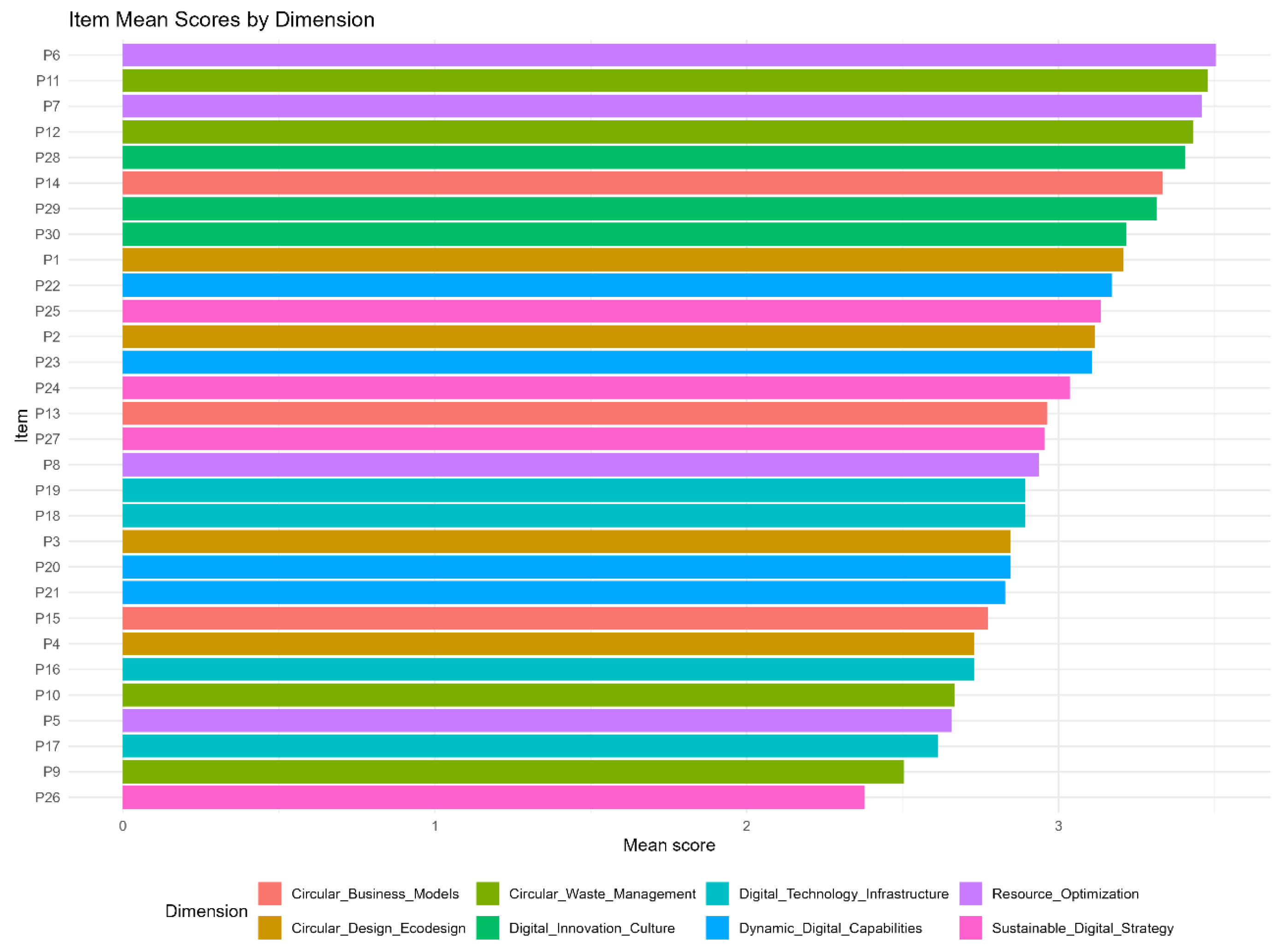
A detailed examination of the items showed that the highest ratings were concentrated on specific operational practices and organizational openness (see
Figure 1). In particular, item P6 on efficiency in the use of materials, energy, and water (M = 3.505), item P11 on circular waste monitoring and management routines (M = 3.477), item P7 on reduction and utilization of operational losses or by-products (M = 3.459), item P12 on coordination of circular waste practices with internal or external actors (M = 3.432), and item P28 on openness to sustainability-oriented digital innovation and reputational improvement (M = 3.405) registered the highest means (see
Table 3). This pattern suggests that companies perform better in actions focused on efficiency, operational monitoring, recovery routines, and external legitimacy.
At the opposite end of the spectrum, the lowest averages were recorded in item P26, regarding the strategic monetization of digital-circular initiatives (M = 2.378), in P9, linked to more formalized circular waste management and recovery routines (M = 2.505), in P17, regarding digital platforms that facilitate circular practices (M = 2.613), in P5, referring to resource-efficiency-oriented process or service redesign (M = 2.658), and in P10, concerning reverse logistics systems for product recovery (M = 2.667). Taken together, these results show that the areas lagging the most do not correspond to general awareness or strategic discourse, but rather to monetization, formalization of circular operations, technological platforms, and advanced reverse-flow systems.
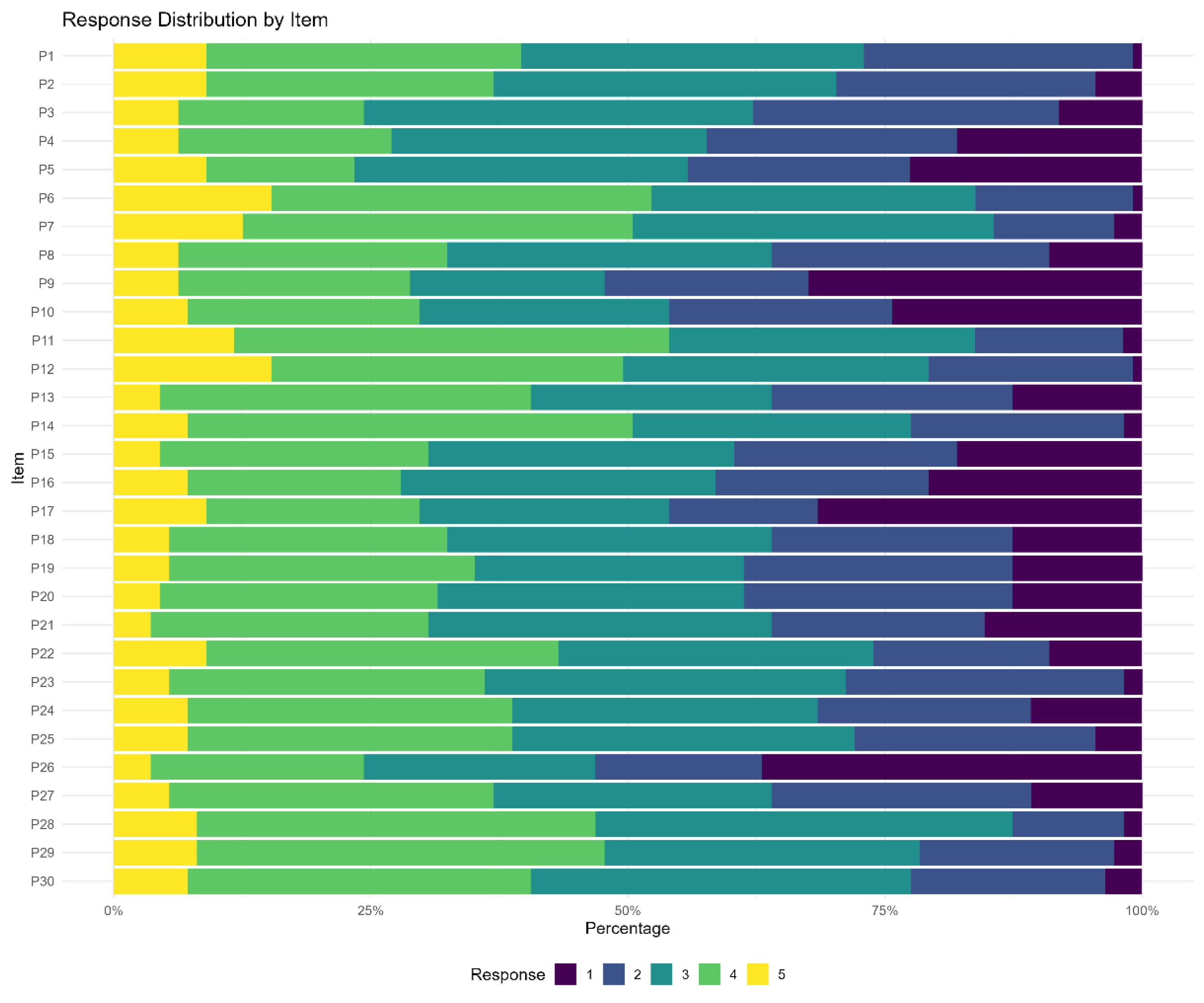
Figure 2 shows that, within the 104-SME analytical sample, the distribution of responses by item reveals a pattern concentrated primarily in categories 3 and 4 of the Likert scale. Overall, 30.36% of responses fell into option 3 and 29.46% into option 4, while the extreme categories were less frequent, especially option 5, which accounted for 7.57% of the total. This pattern suggests that the dominant trend is neither one of absolute rejection nor of full acceptance, but rather an intermediate position reflecting partial and heterogeneous progress in digital-circular integration.
4.4. Internal Consistency and Convergent Validity
Using the 104-SME analytical sample, the reliability results showed robust performance of the instrument across virtually all its dimensions. Cronbach’s alpha coefficients ranged from 0.830 to 0.928, confirming adequate and, in several cases, high levels of internal consistency. The highest estimates were observed in digital technology infrastructure (α = 0.928), digital innovation culture (α = 0.918), sustainable digital strategy (α = 0.913), and circular design and eco-design (α = 0.912). In turn, the composite reliability coefficients were above 0.84 across all dimensions, and the average extracted variance exceeded the 0.50 threshold in all cases, with values ranging from 0.564 to 0.795. These findings support adequate convergent validity for the first-order factors (see
Table 4).
The standardized loadings of the indicators also reinforced this interpretation. In general terms, they remained in high ranges, from 0.629 to 0.935, indicating that the items converge sufficiently strongly around their respective dimensions. The highest values were observed in digital innovation culture and digital technology infrastructure, while the lowest loading was recorded in one of the variables linked to dynamic digital capabilities. Nevertheless, the set of estimates confirms that the measurement model presents a consistent internal structure at the factor level.
4.5. Exploratory Structural Modeling of the Coupling Between Constructs
The hierarchical model estimation was performed with the 104-SME analytical sample and for strictly descriptive purposes, in accordance with the diagnostic logic stated in the
Section 3. The coefficients obtained are therefore reported as preliminary indicators of association among capability dimensions, not as evidence that the proposed hierarchical structure has been confirmed. This distinction is essential because the model fit is weak and the sample is small for complex hierarchical SEM.
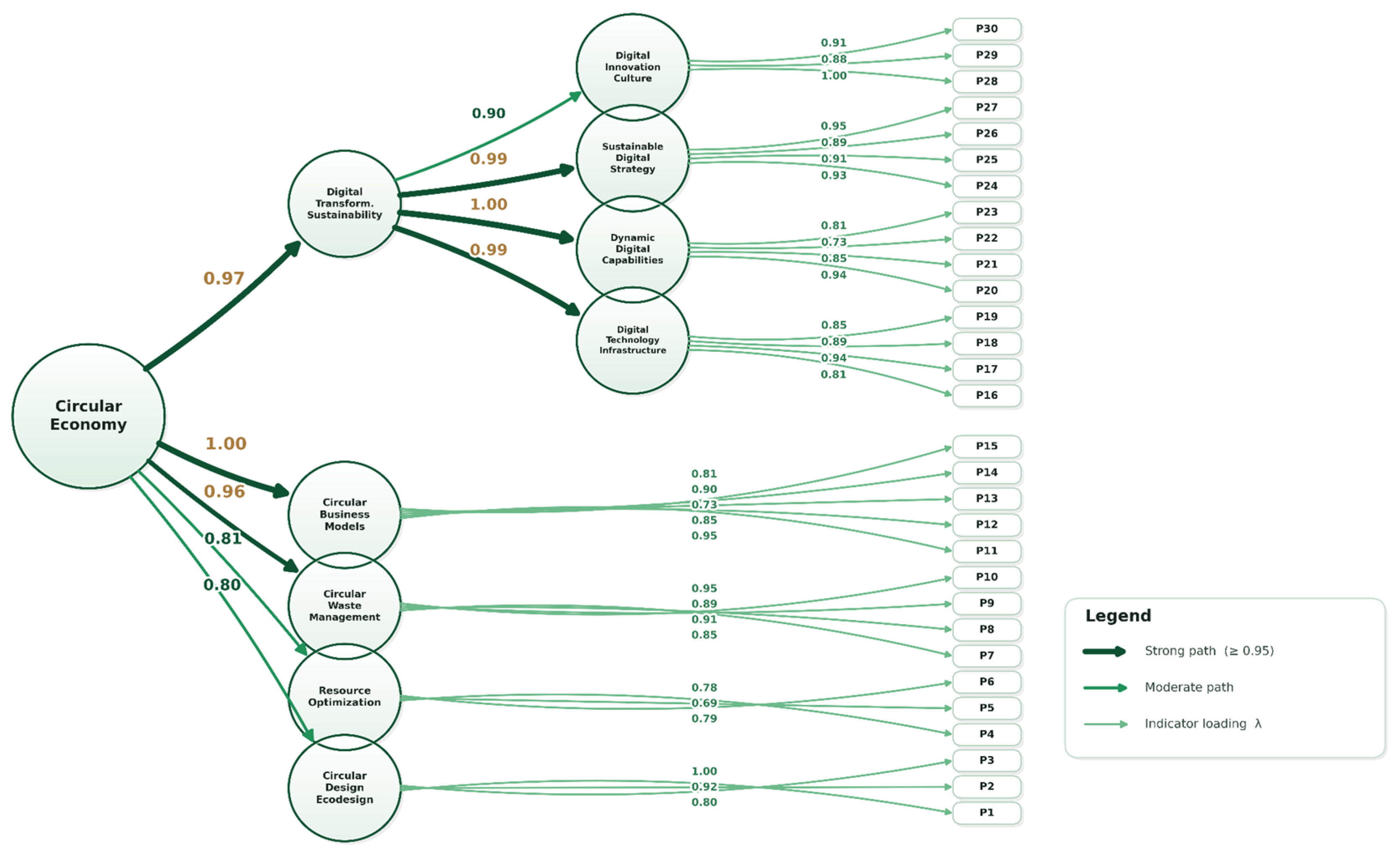
The estimated association between the two higher-order constructs yielded a standardized coefficient of very high magnitude (β = 0.985; p < 0.001). In the revised interpretation, this coefficient is not treated as a substantive confirmation of the dual transition. A coefficient close to unity is more appropriately read as a diagnostic signal that may reflect one or more of the following: strong capability co-occurrence in the observed firms, conceptual overlap between the constructs, common method bias derived from self-reported cross-sectional data, or insufficient discriminant validity. Consequently, the result is presented as preliminary descriptive evidence that motivates further validation, not as proof of causal or structural integration.
The standardized coefficients of the first-order dimensions on each higher-order construct describe the internal pattern estimated by the model, but they should not be overinterpreted. In particular, coefficients equal to 1.000 in
Table 5 correspond to identification constraints used to scale the higher-order constructs; they are not empirical evidence that those dimensions have the highest substantive loading. The table has therefore been revised to distinguish fixed identification coefficients from freely estimated coefficients.
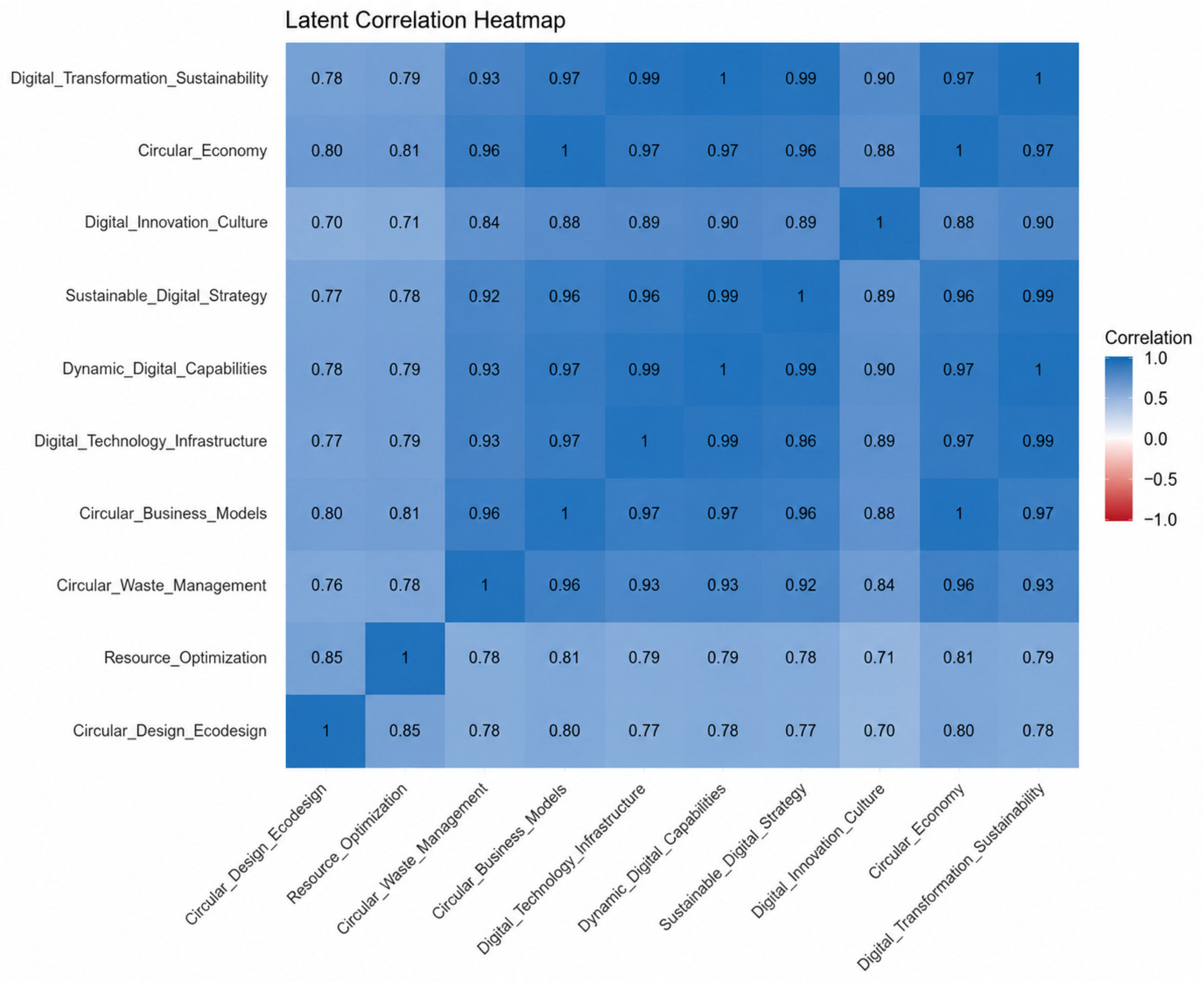
Figure 3 presents the heat map of latent correlations between dimensions for the 104-SME analytical sample, showing a matrix of predominantly positive associations of high intensity. From a descriptive perspective, this configuration supports the existence of an empirical association pattern between circular and digital capabilities oriented toward sustainability.
Figure 4 shows the path diagram, which illustrates the structural architecture of the model and the magnitude of the estimated relationships between first-order dimensions and higher-order constructs.
The overall fit indices, estimated on the 104-SME analytical sample, confirm that the hierarchical specification should not be treated as a well-fitting confirmatory model. The chi-square statistic was highly significant (χ
2 = 1364.947; df = 396;
p < 0.001), and the comparative indices fell below conventional thresholds (CFI = 0.761; TLI = 0.738; RMSEA = 0.149) (see
Table 6). These values substantially limit the scope of the SEM findings. The model is only retained as an exploratory device for organizing preliminary evidence on the co-occurrence of circular and digital capabilities; it does not validate the proposed structure, establish discriminant validity, or support causal claims.
In summary, the SMEs analyzed exhibit intermediate levels of development in both constructs, with strengths concentrated in digital innovation culture, resource optimization, and operational monitoring, and marked lags in eco-design-related redesign, reverse logistics, digital platforms enabling circularity, and monetization of circular models. The estimated structure suggests a very strong preliminary association between the two families of capabilities, but this association must be interpreted cautiously as descriptive evidence of co-occurrence or overlap within the observed SME network.
5. Discussion
5.1. Levels of Capability Development and Heterogeneity Across Dimensions
The descriptive results place Lambayeque-based Chamber-affiliated SMEs at intermediate levels of development in both constructs analyzed, with aggregate means of 3.04 for the circular economy and 2.99 for sustainability-oriented digital transformation. These results are based exclusively on the 104-SME analytical sample, after excluding the seven large Chamber-affiliated firms from all statistical processing. This pattern is consistent with evidence from firms in other emerging economies, where the simultaneous adoption of circular and digital capabilities tends to be in early stages of consolidation [
3,
8]. It should be noted, however, that the highest mean corresponded to digital innovation culture (M = 3.31), followed by resource optimization (M = 3.14) and circular waste management (M = 3.02), a finding consistent with studies that document faster adoption of cultural and operational components than capital-intensive technological components in emerging-market firms [
9,
17].
The digital technological infrastructure dimension had the lowest mean of the set (M = 2.78), a pattern that reinforces the interpretation that the lack of enabling technological support constitutes a recurring bottleneck in the SME segment, particularly in contexts where access to financing for digital investment is restricted [
26,
35]. The sustainable digital strategy dimension (M = 2.88) accompanied this lag, in line with the observation that the formalization of the link between digitalization and environmental goals is still incipient in much of the segment [
26]. Overall, the contrast between cultural and operational dimensions, on the one hand, and technological and strategic dimensions, on the other, supports the first two exploratory working hypotheses but does not imply causal ordering.
This pattern can also be explained through firm-level constraints in emerging economies. Financial and labor obstacles reduce firms’ ability to expand employment and organizational capabilities, especially among low-growth firms [
40]. Recent evidence from Vietnam also shows that innovation contributes to firm growth, but the benefits depend on firm-level capacity and the type of innovation implemented [
41]. In broader financial and institutional environments, climate-risk transmission and market-information frictions further illustrate how uncertainty and weak institutional conditions can raise the cost of long-horizon investment [
42,
43]. This literature helps explain why firms may express cultural openness toward sustainability while still lagging in digital platforms, reverse logistics, and circular business model monetization.
5.2. Coupling Between Capabilities and the Debate on the Dual Transition
The magnitude of the estimated association between the two higher-order constructs (β = 0.985) must be interpreted more cautiously than in the original version. A first, substantive reading would associate this value with the dual-transition debate, in which digitalization and circularity may develop together under shared institutional and market pressures [
1,
18]. However, from a SEM perspective, a coefficient so close to one is also a warning sign: it may reflect discriminant-validity problems, common method bias, or conceptual redundancy in the operationalization of the constructs. The paper therefore avoids presenting this coefficient as proof of an integrated organizational phenomenon.
The evidence should instead be read as preliminary and descriptive. The observed association suggests that firms reporting higher circular capabilities also tend to report higher sustainability-oriented digital capabilities, but the current design does not allow the authors to establish whether this reflects co-emergence, measurement overlap, shared response tendencies, or a directional enabling effect. This interpretation is more consistent with the weak global fit indices and with the exploratory scope of the study.
Accordingly, the revised contribution is deliberately modest: the study identifies a pattern that deserves further testing, rather than validating a hierarchical SEM model. Future research must test discriminant validity with larger samples, alternative model specifications, longitudinal designs, and method-bias controls before any strong claim about structural coupling can be sustained.
5.3. Critical Levers with Lower Perceived Performance
The analysis of individual items identifies five critical levers with the lowest perceived performance in the segment studied. The generation of new revenue streams derived from circular models (P26, M = 2.378) and business models based on services, leasing, or the sharing economy (P9, M = 2.505) reveals that the monetization of circularity remains in its early stages, a finding consistent with the observations of Pizzi et al. [
27] and Huynh [
30] regarding the contractual and financial complexity associated with redesigning business models in SMEs. The low score for digital platforms enabling circular practices (P17, M = 2.613) reinforces the findings of Mügge et al. [
34] regarding the underdevelopment of specific technological solutions for circularity in the SME segment, while the lag in eco-design (P5, M = 2.658) and reverse logistics systems (P10, M = 2.667) aligns with the findings of Mukherjee et al. [
4] in the Indian context.
The convergence among these five items defines a concrete agenda for intervention. The levers with the lowest performance are not found in the realm of strategic discourse or general awareness of sustainability, but rather in specific components of monetization, product redesign, and the technological institutionalization of advanced circular processes. This characterization is particularly relevant for the design of public support programs for SMEs aimed at accelerating the dual transition, as well as for the allocation of resources in business financing instruments.
5.4. Theoretical, Practical, and Public Policy Implications
On a theoretical level, the findings contribute to the dual-transition literature by situating the debate in a Latin American emerging economy and by showing how circular and digital capability dimensions may appear together in a formal, Chamber-affiliated SME network. The contribution is not the confirmation of a universal structural model; rather, it is the construction of an empirically grounded diagnostic map that helps distinguish cultural, operational, strategic, and technological components of the dual transition in a context underrepresented in previous research.
On a practical level, the results provide managers with a diagnostic map of the capabilities in which investments should be prioritized. The identification of digital innovation culture and resource optimization as relatively stronger dimensions suggests that there is an organizational foundation upon which to deploy more demanding interventions. However, because the SEM evidence is preliminary, the observed association between the two constructs should be used to justify integrated managerial experimentation, not to assume automatic spillover effects between circular and digital investments.
At the public policy level, the findings guide support instruments toward three specific levers. Reverse logistics requires regulatory developments that facilitate the formalization of recovery chains and coordination between public and private actors. Digital platforms enabling circularity require shared infrastructure, interoperability standards, and technical assistance for smaller firms. Finally, the monetization of circular models requires financial instruments tailored to service, leasing, and sharing-economy schemes, as well as tax incentives that reduce the transition costs from traditional linear models.
6. Conclusions
This research characterized, through an exploratory empirical analysis, the state of circular economy capabilities and sustainability-oriented digital transformation capabilities in a final analytical sample of 104 Chamber-affiliated SMEs in Lambayeque, Peru. The initial database contained 111 complete responses, but seven large Chamber-affiliated firms were retained only as contextual comparators and excluded from all statistical processing. The study also examined the preliminary association between these two families of capabilities. The findings support three bounded conclusions consistent with the exploratory working hypotheses, but they do not provide confirmatory evidence of a validated hierarchical SEM model.
The first conclusion documents intermediate levels of development in both constructs, with heterogeneous progress across dimensions. Digital innovation culture, resource optimization, and circular waste management lead in perceived performance, while digital technological infrastructure and sustainable digital strategy lag behind. This configuration supports the exploratory hypothesis regarding heterogeneous progress and reinforces the interpretation that the observed firms advance more rapidly in cultural and operational components than in technological and strategic enablers.
The second conclusion documents adequate internal consistency and convergent validity of the measurement instrument. Cronbach’s alpha coefficients ranged from 0.830 to 0.928, composite reliability coefficients exceeded 0.84 across all dimensions, and the average extracted variance remained above 0.50 for all eight factors. These results support the use of the instrument for exploratory diagnosis, although discriminant validity between the two higher-order constructs requires further testing.
The third conclusion is deliberately cautious. The estimated association between the two higher-order constructs (β = 0.985) indicates a very strong preliminary co-occurrence between circular and digital capabilities in the observed business network. However, this magnitude may also indicate conceptual overlap, common method bias, or insufficient construct separation. Therefore, the finding should be understood as a starting point for future validation rather than as confirmation of a robust structural coupling or causal integration.
6.1. Limitations
The study acknowledges several limitations that constrain the scope of its conclusions. First, the sampling strategy was non-probabilistic and limited to firms affiliated with the Lambayeque Chamber of Commerce and Production that participated in institutional activities, which introduces selection bias toward formal, better connected, and potentially more developed organizations. Second, the initial database contained 111 complete Chamber-affiliated responses, but seven large firms were retained only as contextual comparators and excluded from all statistical processing; therefore, all substantive findings are based exclusively on 104 micro-, small-, and medium-sized enterprises. Third, the sectoral composition of the SME analytical sample was heterogeneous, including services, commerce, manufacturing, agribusiness, and other activities; without sectoral or multi-group analysis, observed differences may partly reflect sector composition. Fourth, the sample size (n = 104) is insufficient for strong confirmatory inference in a complex hierarchical SEM model. Fifth, the very high inter-construct coefficient may indicate discriminant-validity problems, common method bias, or conceptual redundancy. These limitations do not invalidate the descriptive diagnosis, but they require substantial caution in interpretation.
6.2. Future Research Agenda
The study’s findings shape a future research agenda organized into four lines. The first line proposes replicating the analysis in larger and representative SME samples from other Peruvian regions and Latin American countries. The second line should conduct sector-specific or multi-group analyses within SME samples and, separately, compare SME results with large-firm contextual comparators to assess whether circular and digital capabilities behave differently across firm sizes and sectors. The third line should test alternative measurement specifications, discriminant validity, and common method bias using stricter confirmatory designs. The fourth line should incorporate longitudinal or mixed-method designs to identify the mechanisms through which firms coordinate circular and digital capabilities over time.
Further research could also examine how financial constraints, labor constraints, infrastructure gaps, innovation capacity, and borrowing conditions shape firms’ ability to move from cultural openness toward actual investment in digital platforms, reverse logistics, and circular revenue models. This agenda would strengthen the theoretical explanation of the dual transition in emerging economies and help distinguish true capability co-emergence from measurement overlap.




 ,
,