Ecological Risk Assessment of Innovative Soil Substitute Cover in Post-Mining Land Reclamation: A Case Study of the Janina Mine Spoil Heap


Abstract
1. Introduction
2. Materials and Methods
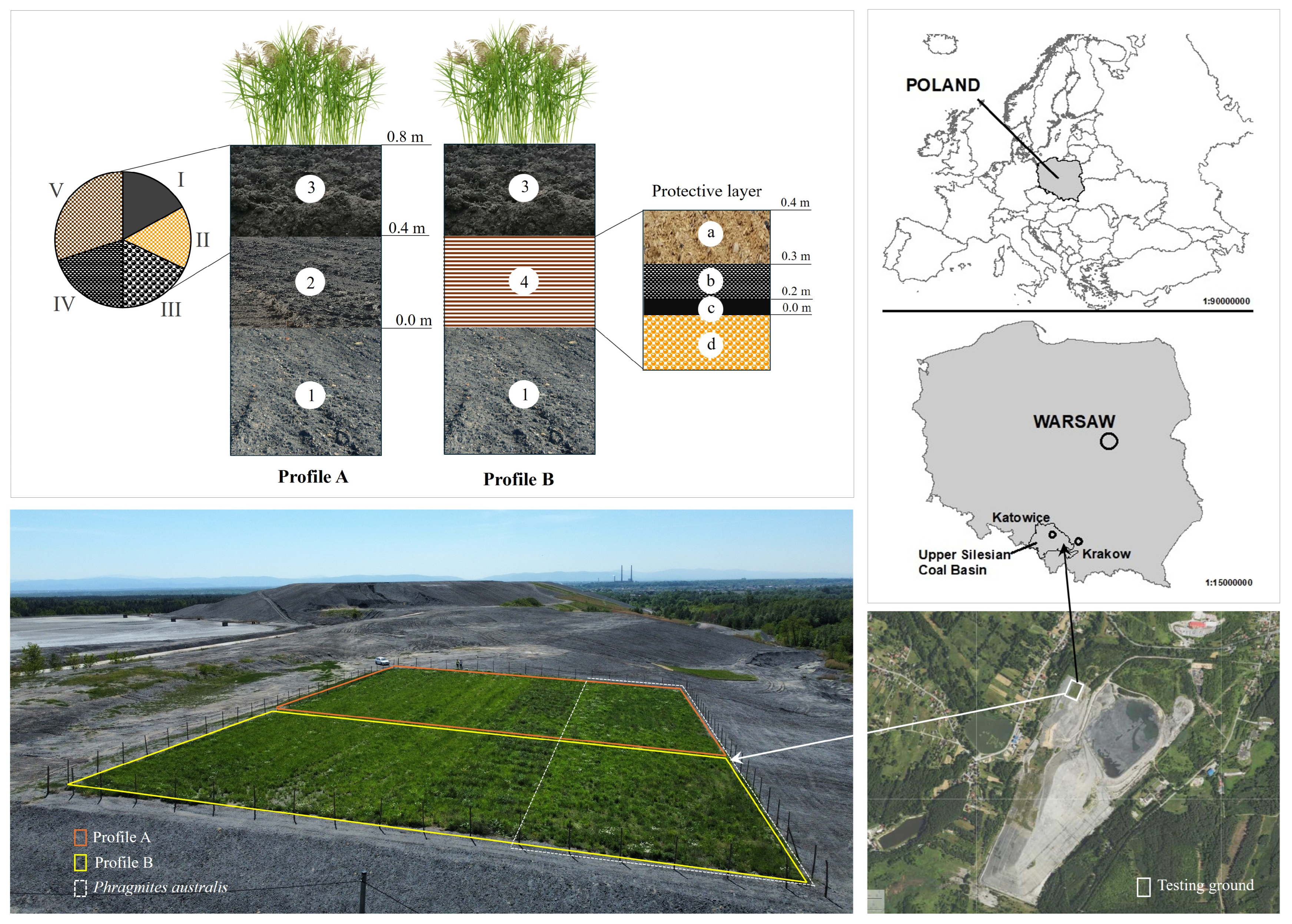
2.1. Study Area
2.2. Samples Collection and Analysis
2.2.1. Soil Covers Samples
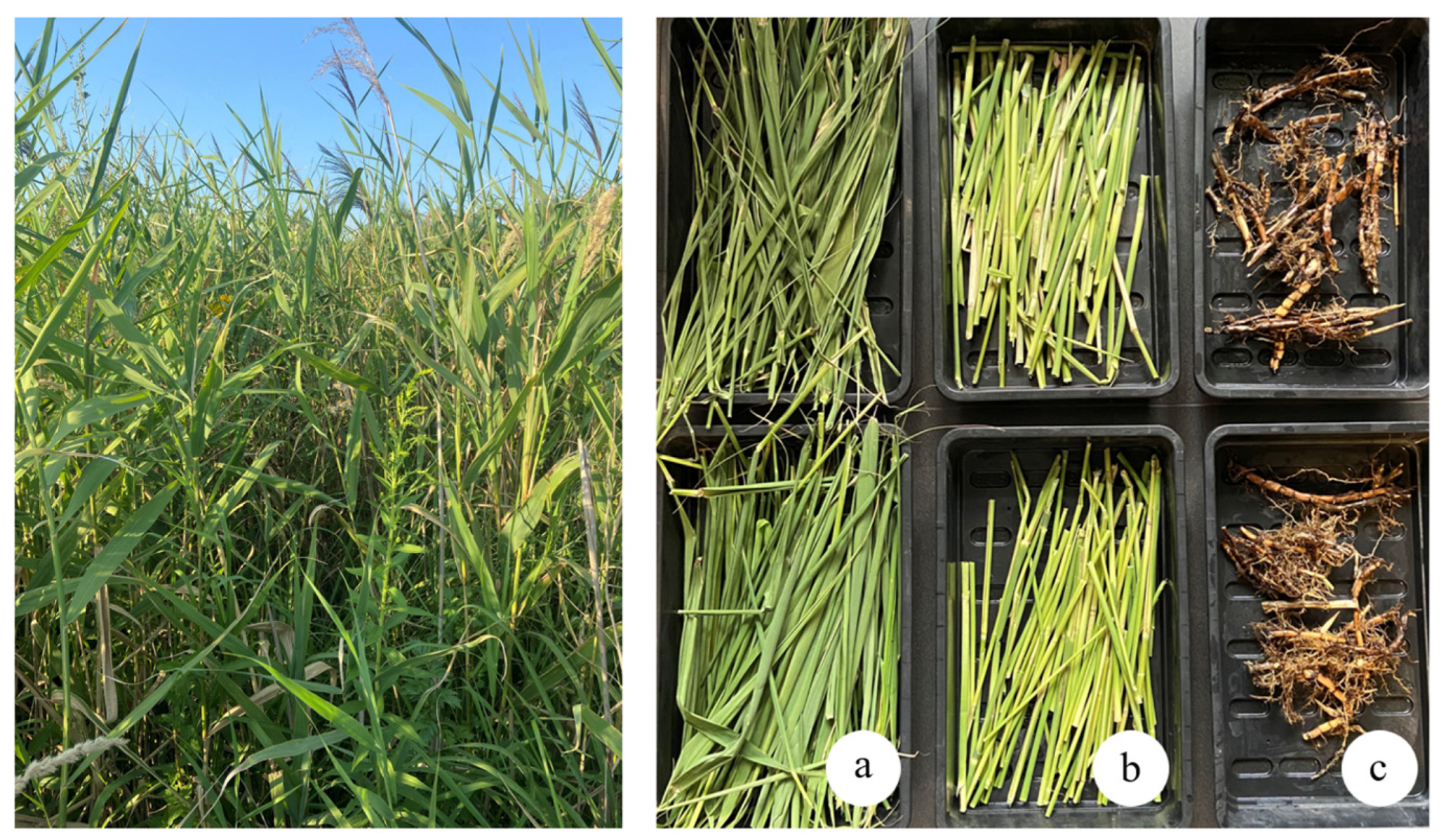
2.2.2. Plant Samples
2.3. Ecological Risk Assessment
2.3.1. Ecological Risk Factors
2.3.2. Potential Ecological Risk Index
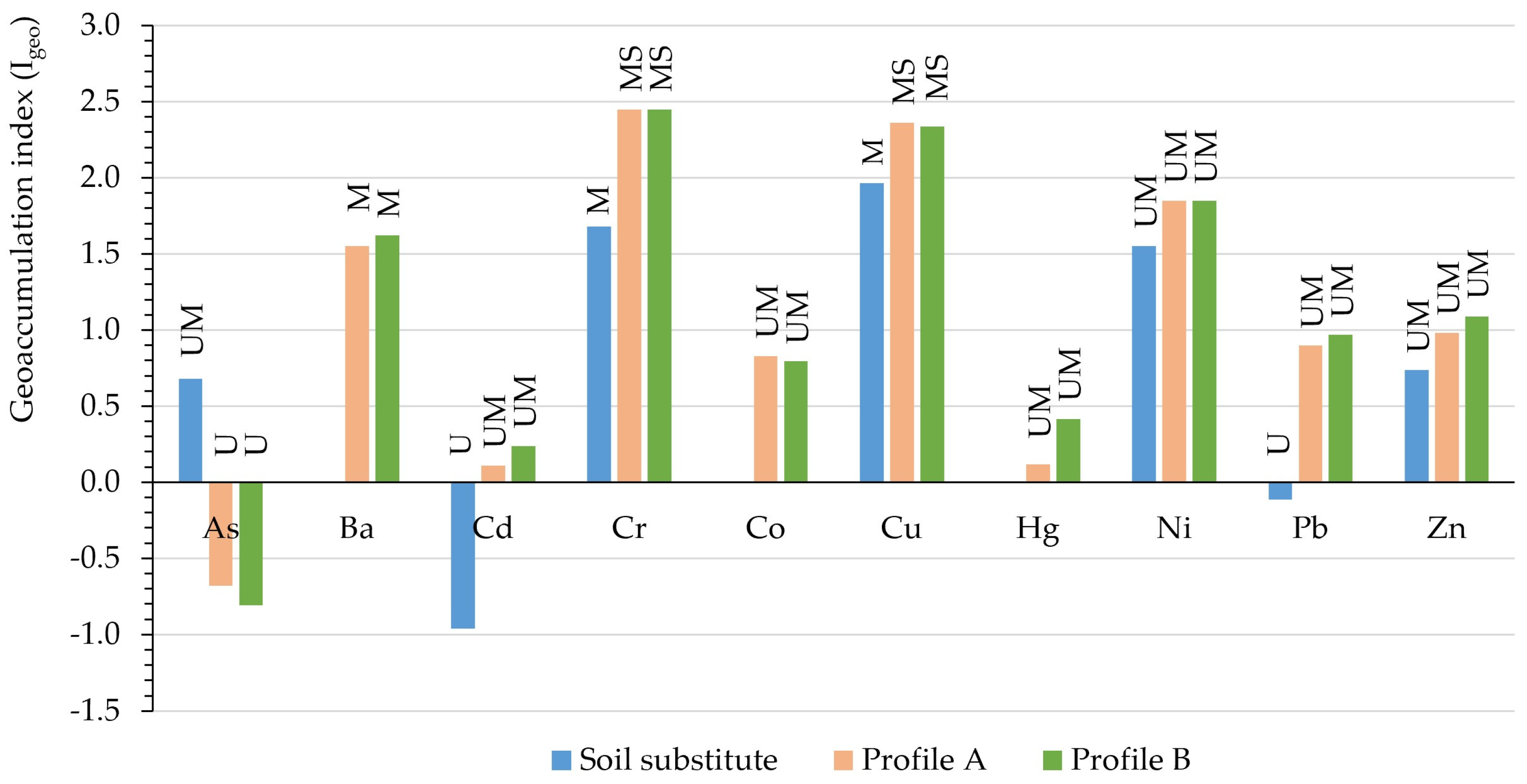
2.3.3. Geoaccumulation Index
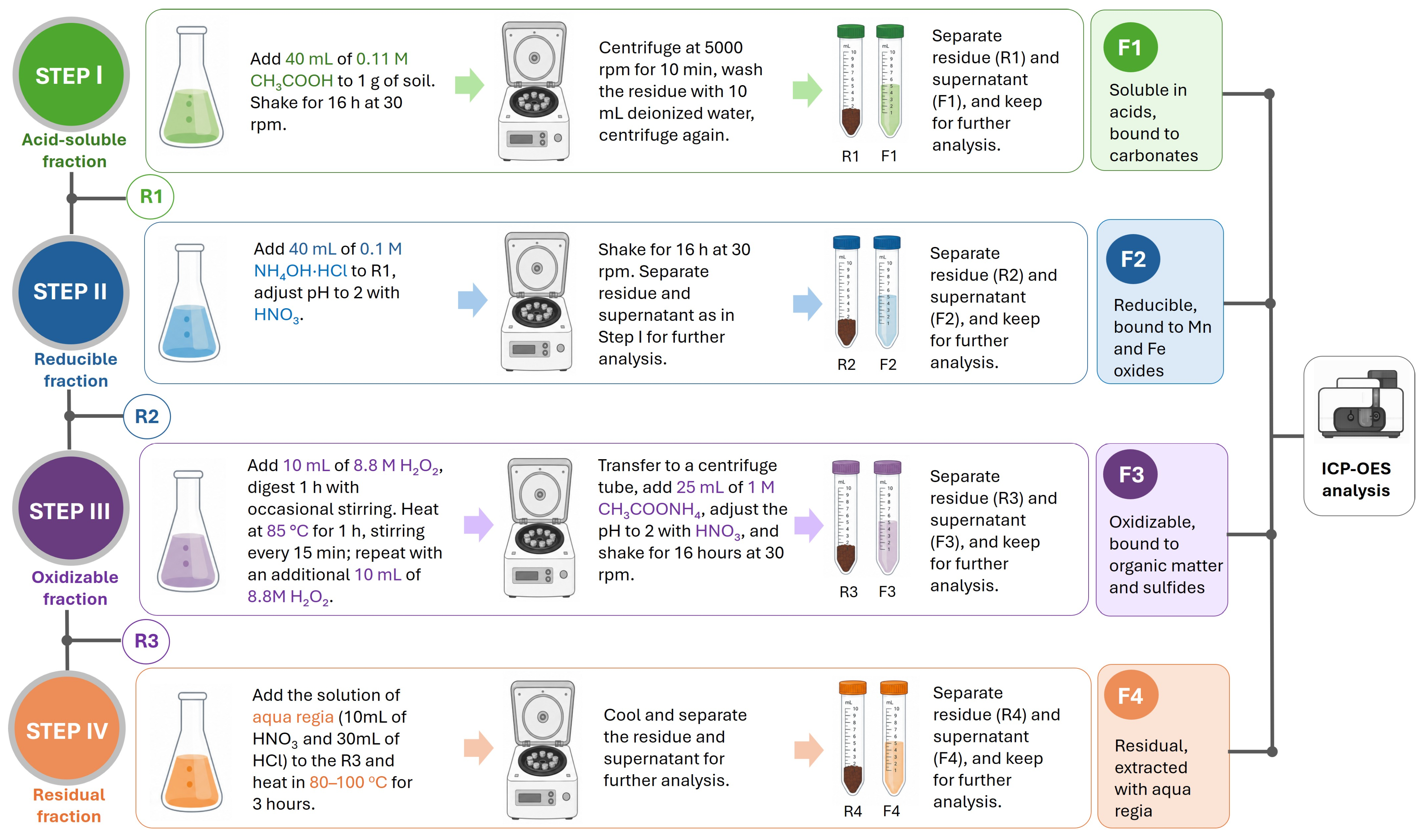
2.4. Modified BCR-Sequential Extraction Method
2.5. Bioconcentration and Translocation Factors
3. Results and Discussion
3.1. Concentrations of Heavy Metals in Soil Substitutes
3.2. Results of the Ecological Risk Assessment
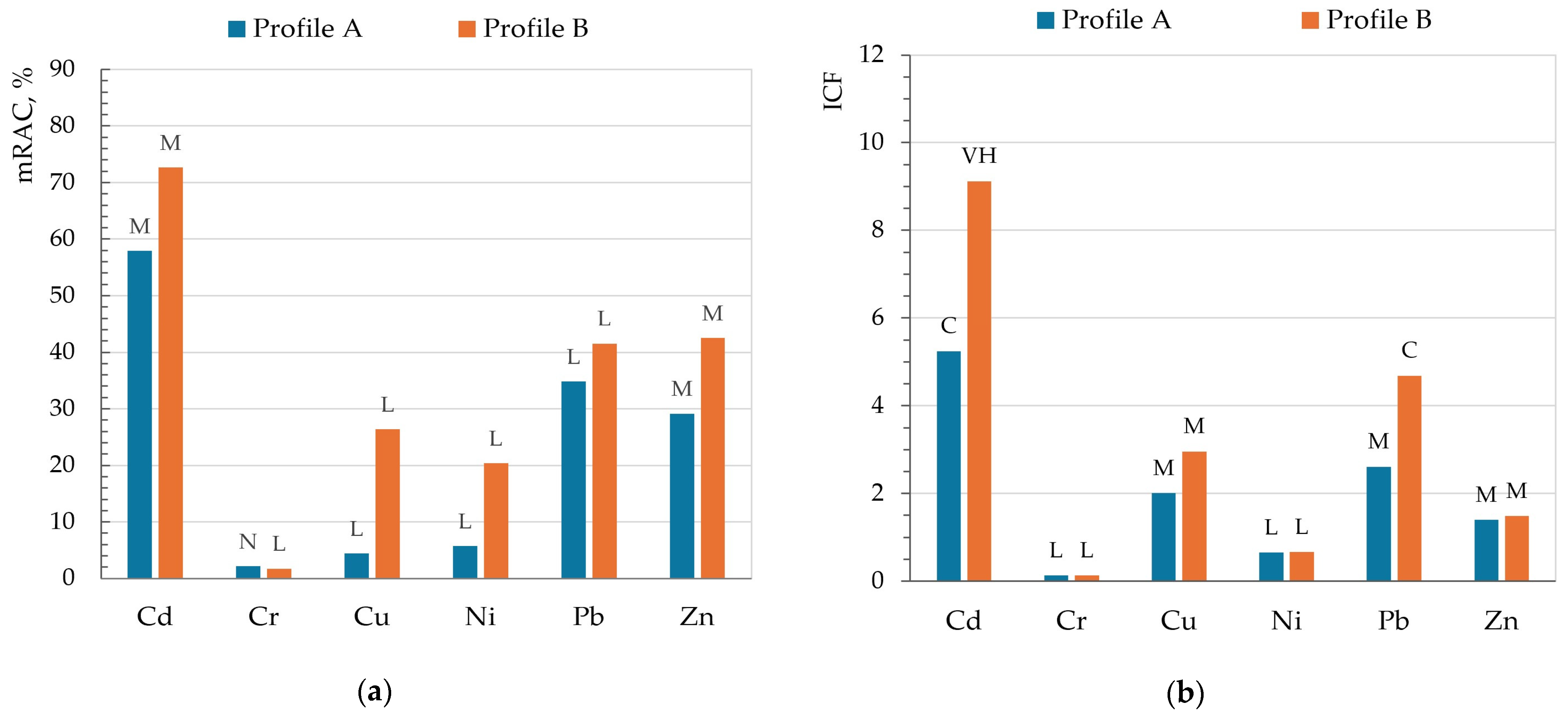
3.3. Result of BCR Sequential Extraction
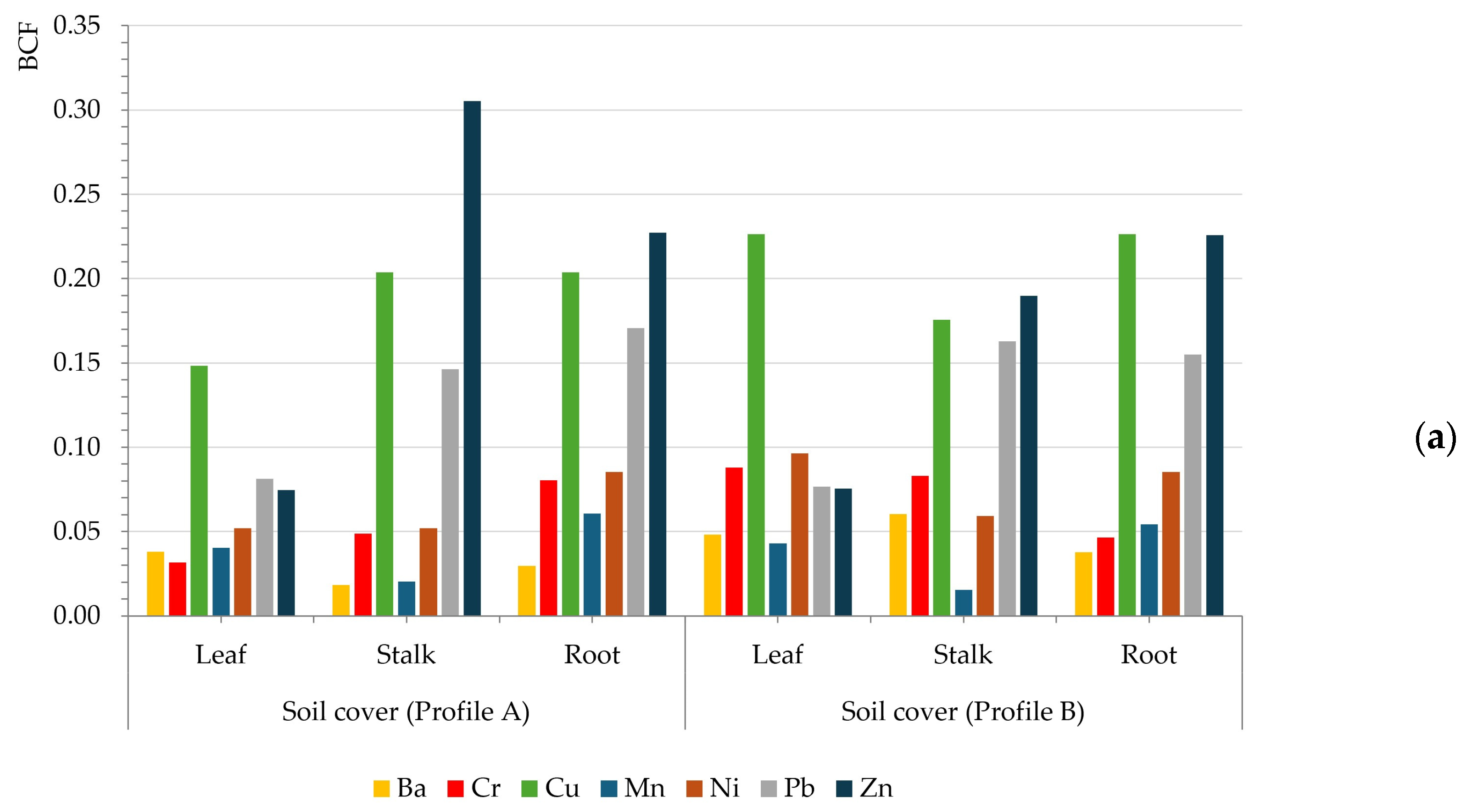
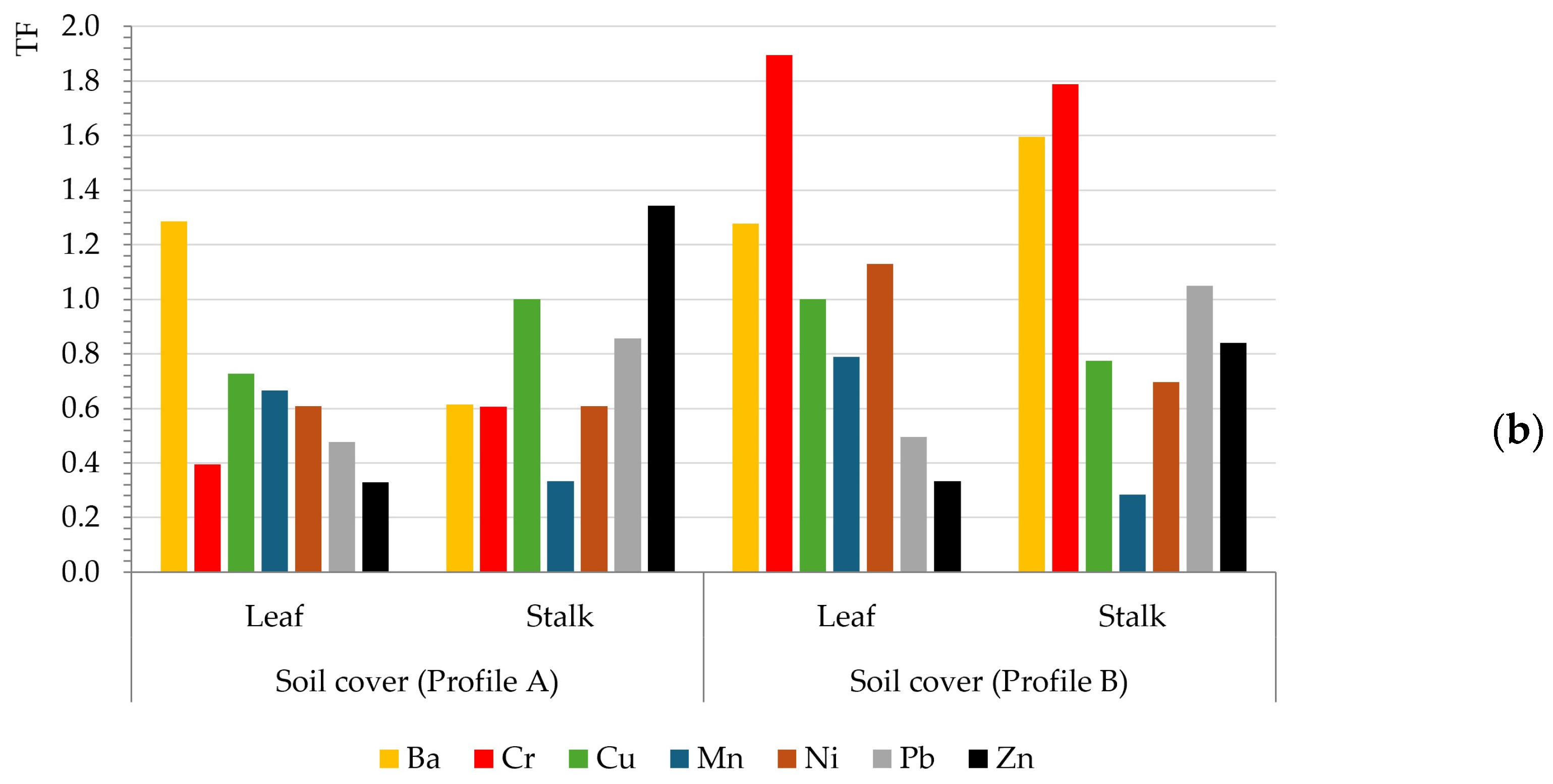
3.4. Accumulation of Heavy Metals in Phragmites australis
4. Conclusions
Author Contributions
Funding
Institutional Review Board Statement
Informed Consent Statement
Data Availability Statement
Acknowledgments
Conflicts of Interest
Abbreviations
| ER | Ecological risk factor |
| Tr | Toxic response factor |
| PERI | Potential ecological risk index |
| Igeo | Geoaccumulation index |
| mRAC | Modified risk assessment code |
| ICF | Individual contamination factor |
| BCF | The bioconcentration factor |
| TF | Translocation factor |
References
- Wuana, R.A.; Okieimen, F.E. Heavy Metals in Contaminated Soils: A Review of Sources, Chemistry, Risks and Best Available Strategies for Remediation. Int. Sch. Res. Not. 2011, 2011, 402647. [Google Scholar] [CrossRef]
- Rashid, A.; Schutte, B.J.; Ulery, A.; Deyholos, M.K.; Sanogo, S.; Lehnhoff, E.A.; Beck, L. Heavy Metal Contamination in Agricultural Soil: Environmental Pollutants Affecting Crop Health. Agronomy 2023, 13, 1521. [Google Scholar] [CrossRef]
- Latosińska, J.; Kowalik, R.; Gawdzik, J. Risk Assessment of Soil Contamination with Heavy Metals from Municipal Sewage Sludge. Appl. Sci. 2021, 11, 548. [Google Scholar] [CrossRef]
- Gworek, B.; Baczewska-Dąbrowska, A.H.; Kalinowski, R.; Górska, E.B.; Rekosz-Burlaga, H.; Olejniczak, I.; Chmielewski, J.; Dmuchowski, W. Ecological Risk Assessment Based on the TRIAD Approach in an Area Contaminated by the Metallurgical and Mining Industries. J. Elem. 2024, 29, 99–121. [Google Scholar] [CrossRef]
- Ahmad, O.A. The effect of anthropogenic activities on soil quality (Shafa Badran watercourse) in the Al Zarqa River Basin. J. Ecol. Eng. 2025, 26, 108–118. [Google Scholar] [CrossRef] [PubMed]
- Ahmad, W.; Alharthy, R.D.; Zubair, M.; Ahmed, M.; Hameed, A.; Rafique, S. Toxic and Heavy Metals Contamination Assessment in Soil and Water to Evaluate Human Health Risk. Sci. Rep. 2021, 11, 17006. [Google Scholar] [CrossRef] [PubMed]
- Regulation of the Minister of Environment on the Manner of Conducting Assessment of Pollution of the Ground Surface; Journal of Laws of the Republic of Poland; Warsaw, Poland 2016. Available online: https://isap.sejm.gov.pl/isap.nsf/DocDetails.xsp?id=WDU20160001395 (accessed on 4 May 2026).
- Alloway, B.J. Heavy Metals in Soils. In Trace Metals and Metalloids in Soils and Their Bioavailability, 3rd ed.; Springler: Dordrecht, The Netherlands, 2013. [Google Scholar] [CrossRef]
- Akcil, A.; Koldas, S. Acid Mine Drainage (AMD): Causes, Treatment and Case Studies. J. Clean. Prod. 2006, 14, 1139–1145. [Google Scholar] [CrossRef]
- Manaviparast, H.R.; Miranda, T.; Pereira, E.; Cristelo, N. Applied Sciences A Comprehensive Review on Mine Tailings as a Raw Material in the Alkali Activation Process. Appl. Sci. 2024, 14, 5127. [Google Scholar] [CrossRef]
- Sheoran, V.; Sheoran, A.S.; Poonia, P. Soil Reclamation of Abandoned Mine Land by Revegetation: A Review. Int. J. Soil Sediment Water 2010, 3, 1–25. Available online: https://hdl.handle.net/20.500.14394/30708 (accessed on 4 May 2026).
- Johnson, D.B.; Hallberg, K.B. Acid Mine Drainage Remediation Options: A Review. Sci. Total Environ. 2005, 338, 3–14. [Google Scholar] [CrossRef] [PubMed]
- Gitari, W.M.; Petrik, L.F.; Etchebers, O.; Key, D.L.; Iwuoha, E.; Okujeni, C. Passive Neutralisation of Acid Mine Drainage by Fly Ash and Its Derivatives: A Column Leaching Study. Fuel 2008, 87, 1637–1650. [Google Scholar] [CrossRef]
- Więckol-Ryk, A.; Pierzchała, Ł.; Bauerek, A.; Krzemień, A. Minimising Coal Mining’s Impact on Biodiversity: Artificial Soils for Post-Mining Land Reclamation. Sustainability 2023, 15, 9707. [Google Scholar] [CrossRef]
- Krzemień, A.; Riesgo Fernández, P.; Von Döhren, P. Best Practice Guidelines: An Innovative Framework for Land Rehabilitation and Ecological Restoration of Coal Mining-Affected Areas During or After Mine Operations. Recovery RFCS Research Project No 847205,2023. Available online: https://recoveryproject.uniovi.es/wp-content/uploads/2023/06/D6.1-Best-Practice-Guidelines.pdf (accessed on 29 April 2026).
- Vymazal, J.; Březinová, T. Accumulation of Heavy Metals in Aboveground Biomass of Phragmites australis in Horizontal Flow Constructed Wetlands for Wastewater Treatment: A Review. Chem. Eng. J. 2016, 290, 232–242. [Google Scholar] [CrossRef]
- Bonanno, G.; Lo Giudice, R. Heavy Metal Bioaccumulation by the Organs of Phragmites australis (Common Reed) and Their Potential Use as Contamination Indicators. Ecol. Indic. 2010, 10, 639–645. [Google Scholar] [CrossRef]
- Milke, J.; Gałczyńska, M.; Wróbel, J. The Importance of Biological and Ecological Properties of Phragmites australis (Cav.) Trin. Ex Steud., in Phytoremediation of Aquatic Ecosystems–The Review. Water 2020, 12, 1770. [Google Scholar] [CrossRef]
- Abbott, D.E.; Essington, M.E.; Mullen, M.D.; Ammons, J.T. Fly Ash and Lime-Stabilized Biosolid Mixtures in Mine Spoil Reclamation: Simulated Weathering. J. Environ. Qual. 2001, 30, 608–616. [Google Scholar] [CrossRef] [PubMed]
- Park, J.Y. The Evolution of Waste into a Resource: Examining Innovation in Technologies Reusing Coal Combustion by-Products Using Patent Data. Res. Policy 2014, 43, 1816–1826. [Google Scholar] [CrossRef]
- Bosch-Serra, A.D.; Cruz, J.; Poch, R.M. Soil Quality in Rehabilitated Coal Mining Areas. Appl. Sci. 2023, 13, 9592. [Google Scholar] [CrossRef]
- Poonia, P.; Choudhary, R.P.; Parihar, S. A Review on Impact of Coal Mining on Soil Properties and Reclamation by Organic Amendments. Ecol. Environ. Conserv. 2020, 26, 188–196. [Google Scholar]
- Ram, L.C.; Masto, R.E. An Appraisal of the Potential Use of Fly Ash for Reclaiming Coal Mine Spoil. J. Environ. Manag. 2010, 91, 603–617. [Google Scholar] [CrossRef] [PubMed]
- Skousen, J.; Yang, J.E.; Lee, J.S.; Ziemkiewicz, P. Review of Fly Ash as a Soil Amendment. Geosystem Eng. 2013, 16, 249–256. [Google Scholar] [CrossRef]
- Rauret, G.; López-Sánchez, J.F.; Lück, D.; Yli-Halla, M.; Muntau, H.; Quevauviller, P. The Certification of the Extractable Contents (Mass Fractions) of Cd, Cr, Cu, Ni, Pb and Zn in Freshwater Sediment Following a Sequential Extraction Procedure BCR-701. Report EUR 19775 2001. Available online: https://ec.europa.eu/jrc/en/publication/eur-scientific-and-technical-research-reports/additional-certification-pb-mass-fraction-bcr-320r-channel-sediment (accessed on 28 April 2026).
- Różański, Z.; Wrona, P.; Pach, G.; Niewiadomski, A.P.; Markowska, M.; Wrana, A.; Frączek, R.; Balcarczyk, L.; Quintana, G.V.; Paz Ruiz, D. de Influence of Water Erosion on Fire Hazards in a Coal Waste Dump—A Case Study. Sci. Total Environ. 2022, 834, 155350. [Google Scholar] [CrossRef] [PubMed]
- Więckol-Ryk, A.; Pierzchała, Ł.; Bauerek, A. Sustainable Reclamation of Post-Mining Areas in Poland: The Long-Term Effects of Soil Substitute Covers and Phragmites australis Plantations. Sustainability 2025, 17, 11294. [Google Scholar] [CrossRef]
- Hakanson, L. An Ecological Risk Index for Aquatic Pollution Control. A Sedimentological Approach. Water Res. 1980, 14, 975–1001. [Google Scholar] [CrossRef]
- Gong, C.; Wen, L.; Lu, H.; Wang, S.; Liu, J.; Tan, C. Ecological, Environmental Risks and Sources of Arsenic and Other Elements in Soils of Tuotuo River Region, Qinghai Tibet Plateau. Environ. Geochem. Health 2024, 46, 460. [Google Scholar] [CrossRef] [PubMed]
- Rehman, A.; Zhong, S.; Du, D.; Zheng, X.; Ijaz, S.; Haider, M.I.S.; Hussain, M. Unveiling Sources, Contamination, and Eco-Human Health Implications of Potentially Toxic Metals from Urban Road Dust. Sci. Rep. 2025, 15, 10673. [Google Scholar] [CrossRef] [PubMed]
- Oliviera, J.R.; Fernandez, M.B.G.; Leal, O.A.; Brisolara, B.L.; Ribeiro, A.S.; Gomes, C.G.; Pinto, L.F.S.; Job, M.T.P.; Stumpf, L. Environmental, ecological and human health risk assessment for Ba, Cr, Zn and V in minesoil after 20 years of restoration in southern. Braz. Front. Soil Sci. 2016, 6, 1754030. [Google Scholar] [CrossRef]
- Lis, J.; Piaseczna, A. Geochemical Atlas of Upper Silesia, 1:200,000; Polish Geological Institute: Warsaw, Poland, 1995. [Google Scholar]
- Muller, G. Index of Geoaccumulation in Sediments of the Rhine River. GeoJournal 1969, 2, 108–118. [Google Scholar]
- Tytła, M. Assessment of Heavy Metal Pollution and Potential Ecological Risk in Sewage Sludge from Municipal Wastewater Treatment Plant Located in the Most Industrialized Region in Poland—Case Study. Int. J. Environ. Res. Public Health 2019, 16, 2430. [Google Scholar] [CrossRef] [PubMed]
- Roques, S.; Kendall, S.; Smith, K.A.; Newell Price, P.; Berry, P. Review of the Non-NPKS Nutrient Requirements of UK Cereals and OilseedRape; Home Grown Cereals Authority: Kenilworth, UK, 2013. [Google Scholar]
- Fabiańska, M.J.; Ciesielczuk, J.; Szczerba, M.; Misz-Kennan, M.; Więcław, D.; Szram, E.; Nádudvari, Á.; Ciesielska, Z. Weathering alterations of coal wastes geochemistry, petrography, and mineralogy, a case study from the Janina and Marcel Coal Mines, Upper Silesian Coal Basin (Poland). Int. J. Coal Geol. 2024, 281, 104407. [Google Scholar] [CrossRef]
- Klojzy-Karczmarczyk, B.; Mazurek, J.; Staszczak, J. Analysis of the quality of waste from coal mining in relation to the requirements for inert mining waste. Miner. Resour. Manag. 2016, 95, 227–242. [Google Scholar]
- Statistical Parameters of Chemical Elements and Acidity of Topsoils (0.0–0.3 m) at Libiąż. Polish Geological Institute-National Research Institute, Warsaw. Available online: https://mapgeochem.pgi.gov.pl/wp-content/uploads/2021/06/libiaz_tab_2-1.pdf (accessed on 30 May 2026).
- Matei, E.; Râpă, M.; Mates, I.M.; Popescu, A.-F.; Bădiceanu, A.; Ioan Balint, A.; Covaliu-Mierlă, C.I. Heavy Metals in Particulate Matter—Trends and Impacts on Environment. Molecules 2025, 30, 1455. [Google Scholar] [CrossRef] [PubMed]
- Kumar, V.; Pandita, S.; Setia, R. A Meta-Analysis of Potential Ecological Risk Evaluation of Heavy Metals in Sediments and Soils. Gondwana Res. 2022, 103, 487–501. [Google Scholar] [CrossRef]
- Pan, Y.; Chen, M.; Wang, X.; Chen, Y.; Dong, K. Ecological Risk Assessment and Source Analysis of Heavy Metals in the Soils of a Lead-Zinc Mining Watershed Area. Water 2023, 15, 113. [Google Scholar] [CrossRef]
- Saleem, M.; Pierce, D.; Wang, Y.; Sens, D.A.; Somji, S.; Garrett, S.H. Heavy Metal(oid)s Contamination and Potential Ecological Risk Assessment in Agricultural Soils. J. Xenobiotics 2024, 14, 634–650. [Google Scholar] [CrossRef] [PubMed]
- Kowalik, R.; Gawdzik, J.; Gawdzik, B. Risk Analysis of Accumulation of Heavy Metals from Sewage Sludge in Soil from the Sewage Treatment Plant in Starachowice. Struct. Environ. 2019, 11, 287–295. [Google Scholar] [CrossRef]
- Tytła, M. Identification of the Chemical Forms of Heavy Metals in Municipal Sewage Sludge as a Critical Element of Ecological Risk Assessment in Terms of Its Agricultural or Natural Use. Int. J. Environ. Res. Public Health 2020, 17, 4640. [Google Scholar] [CrossRef] [PubMed]
- Leśniok, M.; Małarzewski, Ł.; Niedźwiedź, T. Classification of Circulation Types for Southern Poland with an Application to Air Pollution Concentration in Upper Silesia. Phys. Chem. Earth 2010, 35, 516–522. [Google Scholar] [CrossRef]
- Pasieczna, A.; Markowski, W. Geochemical Mapping of Agricultural Soils and Grazing Land in Poland—National Report 2014. Warsaw. Available online: https://mapgeochem.pgi.gov.pl/wp-content/uploads/2021/06/gemas_tab_1-1.pdf (accessed on 30 May 2026).
- Nadłonek, W.; Pasieczna, A.; Skreczko, S. Potentially Harmful Elements Content in Soil and Stream Sediments in Southwestern Districts of Katowice (Southern Poland)—Geochemical Record of Historical Industrial Plants’ Activity. Environ. Nat. Resour. 2023, 34, 154–173. [Google Scholar] [CrossRef]
- Tomczyk, P.; Wdowczyk, A.; Wiatkowska, B.; Szymańska-Pulikowska, A. Assessment of Heavy Metal Contamination of Agricultural Soils in Poland Using Contamination Indicators. Ecol. Indic. 2023, 156, 111161. [Google Scholar] [CrossRef]
- Kowalska, B.J.; Mazurek, R.; Gąsiorek, M.; Zalewski, T. Pollution Indices as Useful Tools for the Comprehensive Evaluation of the Degree of Soil Contamination—A Review. Environ. Geochem. Health 2018, 40, 2395–2420. [Google Scholar] [CrossRef] [PubMed]
- Chen, L.; Wang, G.; Wu, S.; Xia, Z.; Cui, Z.; Wang, C.; Zhou, S. Heavy Metals in Agricultural Soils of the Lihe RiveWatershed, East China: Spatial Distribution, Ecological Risk, and Pollution Source. Int. J. Environ. Res. Public Health 2019, 16, 2094. [Google Scholar] [CrossRef] [PubMed]
- Golia, E.E.; Papadimou, S.G.; Cavalaris, C.; Tsiropoulos, N.G. Level of Contamination Assessment of Potentially Toxic Elements in the Urban Soils of Volos City (Central Greece). Sustainability 2021, 13, 2029. [Google Scholar] [CrossRef]
- Swain, C.K. Environmental Pollution Indices: A Review on Concentration of Heavy Metals in Air, Water, and Soil near Industrialization and Urbanisation. Discov. Environ. 2024, 2, 5. [Google Scholar] [CrossRef]
- Duan, B.; Zhang, W.; Zheng, H.; Wu, C.; Zhang, Q.; Bu, Y. Disposal Situation of Sewage Sludge from Municipal Wastewater Treatment Plants (WWTPs) and Assessment of the Ecological Risk of Heavy Metals for Its Land Use in Shanxi, China. Int. J. Environ. Res. Public Health 2017, 14, 823. [Google Scholar] [CrossRef] [PubMed]
- Tytła, M.; Widziewicz-Rzońca, K. Ecological and Human Health Risk Assessment of Heavy Metals in Sewage Sludge Produced in Silesian Voivodeship, Poland: A Case Study. Environ. Monit. Assess. 2023, 195, 1373. [Google Scholar] [CrossRef] [PubMed]
- Xiao, Z.; Yuan, X.; Li, H.; Jiang, L.; Leng, L.; Chen, X.; Zeng, G.; Li, F.; Cao, L. Chemical speciation, mobility and phyto-accessibility of heavy metals in fly ash and slag from combustion of pelletized municipal sewage sludge. Sci. Total Environ. 2025, 536, 774–783. [Google Scholar] [CrossRef] [PubMed]
- Fernández-Martínez, R.; Corrochana, N.; Álvarez-Quintana, J.; Ordóñez, A.; Álvarez, R.; Rucandio, I. Assessment of the Ecological Risk and Mobility of Arsenic and Heavy Metals in Soils and Mine Tailings from the Carmina Mine Site (Asturias, NW Spain). Environ. Geochem. Health 2024, 46, 90. [Google Scholar] [CrossRef] [PubMed]
- Bakircioglu, D.; Bakircioglu Kurtulus, Y.; Ibar, H. Investigation of Trace Elements in Agricultural Soils by BCR Sequential Extraction Method and Its Transfer to Wheat Plants. Environ. Monit. Assess. 2011, 175, 303–314. [Google Scholar] [CrossRef] [PubMed]
- Liu, Y.; Tang, Y.; Zhong, G.; Zeng, H. A Comparison Study on Heavy Metal/Metalloid Stabilization in Maozhou River Sediment by Five Types of Amendments. J. Soils Sediments 2019, 19, 3922–3933. [Google Scholar] [CrossRef]
- Delgado, J.; Barba-Bioso, C.; Miguel, J.; Boski, T. Speciation and Ecological Risk of Toxic Elements in Estuarine Sediments Affected by Multiple Anthropogenic Contributions (Guadiana Saltmarshes, SW Iberian Peninsula): I. SurFi Cial Sediments. Sci. Total Environ. 2011, 409, 3666–3679. [Google Scholar] [CrossRef] [PubMed]
- Pueyo, M.; Rauret, G.; Lück, D.; Yli-Halla, M.; Muntau, H.; Quevauviller, P.; López-Sánchez, J.F. Certification of the Extractable Contents of Cd, Cr, Cu, Ni, Pb and Zn in a Freshwater Sediment Following a Collaboratively Tested and Optimised Three-Step Sequential Extraction Procedure. J. Environ. Monit. 2001, 3, 243–250. [Google Scholar] [CrossRef] [PubMed]
- Samadi, M.T.; Leili, M.; Asgari, G.; Chavoshi, S. The Potential of Phragmites australis to Bioaccumulation and Translocate Heavy Metals from Landfill Leachate. J. Water Process Eng. 2024, 64, 105657. [Google Scholar] [CrossRef]
- Kabata-Pendias, A.; Pendias, H. Trace Elements in Soils and Plants, 4th ed.; CRC Press: Boca Raton, FL, USA, 2010. [Google Scholar]
- Bonanno, G.; Borg, J.A.; Di, V. Science of the Total Environment Levels of Heavy Metals in Wetland and Marine Vascular Plants and Their Biomonitoring Potential: A Comparative Assessment. Sci. Total Environ. 2017, 576, 796–806. [Google Scholar] [CrossRef] [PubMed]
- Nawrot, N. Heavy Metal Accumulation and Distribution in Phragmites australis Seedlings Tissues Originating from Natural and Urban Catchment. Environ. Sci. Pollut. Res. 2021, 28, 14299–14309. [Google Scholar] [CrossRef] [PubMed]
- Wdowczyk, A.; Szymańska-Pulikowska, A. Effect of Substrates on the Potential of Phragmites australis to Accumulate and Translocate Selected Contaminants from Landfill Leachate. Water Resour. Ind. 2023, 29, 100203. [Google Scholar] [CrossRef]
- Chitimus, D.; Nedeff, V.; Mosnegutu, E.; Barsan, N.; Irimia, O.; Nedeff, F. Studies on the Accumulation, Translocation, and Enrichment Capacity of Soils and the Plant Species Phragmites australis (Common Reed) with Heavy Metals. Sustainability 2023, 15, 8729. [Google Scholar] [CrossRef]
- Montes-Rocha, J.A.; Diaz-Torres, R.D.C.; Alonso-Castro, A.J.; Ilizaliturri-Hernández, C.A.; Carrizales-Yáñez, L.; Carranza-Álvarez, C. Determination and Removal of Potentially Toxic Elements by Phragmites australis (Cav.) Trin. Ex Steud. (Poaceae) in the Valles River, San Luis Potos í (Central Mexico). Plants 2025, 14, 33. [Google Scholar] [CrossRef] [PubMed]
- Kiviat, E. Ecosystem Services of Phragmites in North America with Emphasis on Habitat Functions. AoB Plants 2013, 5, plt008. [Google Scholar] [CrossRef]
- Cižková, H.; Kučera, T.; Poulin, B.; Květ, J. Ecological Basis of Ecosystem Services and Management of Wetlands Dominated by Common Reed (Phragmites australis): European Perspective. Diversity 2023, 15, 629. [Google Scholar] [CrossRef]



| Index/Factor | Value | Criteria for Risk Assessment |
|---|---|---|
| Ecological risk factor (ERi) | ERi < 40 | Low risk (L) |
| 40 ≤ ERi < 80 | Moderate risk (M) | |
| 80 ≤ ERi < 160 | Considerable risk (C) | |
| 160 ≤ ERi < 320 | High risk (H) | |
| ERi ≥ 320 | Very high risk (VH) | |
| Potential ecological risk index (PERI) | PERI < 150 | Low ecological risk (L) |
| 150 ≤ PERI < 300 | Moderate ecological risk (M) | |
| 300 ≤ PERI < 600 | Considerable ecological risk (C) | |
| PERI ≥ 600 | Very high ecological risk (VH | |
| Geo accumulation index (Igeo) | Igeo < 0 | Unpolluted (U) |
| 0 < Igeo ≤ 1 | Unpolluted to moderately polluted (UM) | |
| 1 < Igeo ≤ 2 | Moderate polluted (M) | |
| 2 < Igeo ≤ 3 | Moderately to strongly polluted (MS) | |
| 3 < Igeo ≤ 4 4 < Igeo ≤ 5 | Strongly polluted (S) Strongly to extremely polluted (SE) | |
| Igeo > 5 | Extremely polluted (E) |
| Index/Factor | Value | Criteria for Risk Assessment |
|---|---|---|
| Modified risk assessment code (mRAC) | mRAC ≤ 1% | No risk (N) |
| 1% ≤ mRAC < 10% | Low risk (L) | |
| 10% ≤ mRAC < 30% | Medium risk (M) | |
| 30% ≤ mRAC < 50% | High risk (H) | |
| mRAC ≥ 50% | Very high risk (VH) | |
| Individual contamination factor (ICF) | ICF < 1 | Low contamination (L) |
| 1 ≤ ICF < 3 | Moderate contamination (M) | |
| 3 ≤ ICF < 6 | Considerable contamination (C) | |
| ICF ≥ 6 | Very high contamination (VH) |
| Trace Elements | 2020 | 2025 | Permissible Values Adopted for Group of Soils | ||||
|---|---|---|---|---|---|---|---|
| Profile A | Profile B | I | II | III | IV | ||
| As | 6.0 ± 2.1 | 4.6 ± 1.6 | 4.2 ± 1.5 | 25 | 10–50 | 50 | 100 |
| Ba | n.d. | 237 ± 47 | 249 ± 49 | 400 | 200–600 | 1000 | 1500 |
| Cd | 1.0 ± 0.4 | 2.1 ± 0.7 | 2.3 ± 0.8 | 2 | 2–5 | 10 | 15 |
| Co | n.d. | 8.0 ± 2.8 | 7.8 ± 2.7 | 50 | 20–50 | 100 | 200 |
| Cr | 24 ± 5 | 41 ± 8 | 41 ± 8 | 200 | 150–500 | 500 | 1000 |
| Cu | 41 ± 8 | 54 ± 11 | 53 ± 11 | 200 | 100 | 300 | 600 |
| Hg | n.d. | 0.13 ± 0.04 | 0.16 ± 0.05 | 5 | 2–5 | 10 | 30 |
| Mn | 379 ± 76 | 347 ± 69 | 350 ± 70 | n.a. | n.a. | n.a. | n.a. |
| Mo | n.d. | 0.6 ± 0.2 | 0.7 ± 0.2 | 50 | 10–50 | 100 | 250 |
| Ni | 22 ± 4 | 27 ± 5 | 27 ± 5 | 150 | 100–300 | 300 | 500 |
| Pb | 61 ± 12 | 123 ± 25 | 129 ± 26 | 200 | 100–500 | 500 | 600 |
| Sb | n.d. | 2.0 ± 0.7 | 2.3 ± 0.8 | n.a. | n.a. | n.a. | n.a. |
| Sn | n.d. | 1.4 ± 0.4 | 1.5 ± 0.5 | 20 | 10–40 | 100 | 350 |
| Zn | 260 ± 52 | 308 ± 62 | 332 ± 66 | 500 | 300–1000 | 1000 | 2000 |
| pH | 8.1 ± 0.2 | 7.6 ± 0.2 | 7.4 ± 0.2 | ||||
| Trace Elements | Soil Substitute | Soil Cover | ||||
|---|---|---|---|---|---|---|
| Profile A | Profile B | |||||
| ERi | PERI | ERi | PERI | ERi | PERI | |
| As | 12.0 (L) | 105 (L) | 9.2 (L) | 239 (M) | 8.4 (L) | 258 (M) |
| Ba | n.d. | 4.4 (L) | 4.6 (L) | |||
| Cd | 23.1 (L) | 48.5 (M) | 53.1 (M) | |||
| Cr | 9.6 (L) | 16.4 (L) | 16.4 (L) | |||
| Co | n.d. | 13.3 (L) | 13.0 (L) | |||
| Cu | 29.3 (L) | 38.6 (L) | 37.9 (L) | |||
| Hg | n.d. | 65.0 (M) | 80.0 (C) | |||
| Ni | 22.0 (L) | 27.0 (L) | 27.0 (L) | |||
| Pb | 6.9 (L) | 14.0 (L) | 14.7 (L) | |||
| Zn | 2.5 (L) | 3.0 (L) | 3.2 (L) | |||
| Soil Cover | Fraction | Heavy Metal Concentrations (mg/kg) of Dry Matter | |||||
|---|---|---|---|---|---|---|---|
| Cd | Cr | Cu | Ni | Pb | Zn | ||
| Profile A | F1 | 0.44 ± 0.11 | 0.08 ± 0.02 | 0.40 ± 0.10 | 1.16 ± 0.29 | 1.28 ± 0.32 | 43.60 ± 4.36 |
| F2 | 0.64 ± 0.13 | 0.96 ± 0.24 | 1.08 ± 0.27 | 0.37 ± 0.09 | 39.2 ± 7.84 | 56.80 ± 5.68 | |
| F3 | 0.49 ± 0.10 | 4.70 ± 1.18 | 21.00 ± 4.20 | 9.00 ± 2.25 | 43.5 ± 8.7 | 101.50 ± 10.05 | |
| F4 | 0.30 ± 0.07 | 42.40 ± 10.60 | 11.18 ± 2.79 | 16.18 ± 4.04 | 32.16 ± 8.04 | 143.42 ± 35.85 | |
| Total | 1.86 ± 0.21 | 48.14 ± 10.7 | 33.66 ± 5.05 | 26.71 ± 4.63 | 116.14 ± 14.2 | 344.32 ± 37.9 | |
| R, % | 89 | 117 | 62 | 99 | 94 | 112 | |
| Profile B | F1 | 0.64 ± 0.16 | 0.08 ± 0.21 | 0.36 ± 0.09 | 1.32 ± 0.33 | 1.48 ± 0.37 | 68.80 ± 6.88 |
| F2 | 0.92 ± 0.2 | 0.84 ± 0.20 | 10.0 ± 2.00 | 4.40 ± 1.10 | 48.80 ± 4.88 | 82.80 ± 8.28 | |
| F3 | 0.38 ± 0.1 | 4.70 ± 1.18 | 19.0 ± 3.80- | 5.50 ± 1.38 | 49.50 ± 9.90 | 61.50 ± 6.15 | |
| F4 | 0.21 ± 0.1 | 47.44 ± 11.86 | 9.93 ± 2.48 | 16.89 ± 4.22 | 21.29 ± 5.32 | 143.47 ± 35.87 | |
| Total | 2.15 ± 0.29 | 53.06 ± 11.9 | 39.29 ± 4.96 | 28.11 ± 4.59 | 121.07 ± 12.3 | 356.57 ± 38.0 | |
| R, % | 93 | 129 | 74 | 104 | 94 | 107 | |
| Trace Elements | Soil Cover (Profile A) | Soil Cover (Profile B) | ||||
|---|---|---|---|---|---|---|
| Leaf | Stalk | Root | Leaf | Stalk | Root | |
| As | n.d. | n.d. | n.d. | n.d. | n.d. | n.d. |
| Ba | 9.0 ± 3.2 | 4.3 ± 1.5 | 7.0 ± 2.5 | 12 ± 2 | 15 ± 3 | 9.4 ± 3.3 |
| Cd | n.d. | n.d. | n.d. | 2.2 ± 0.8 | n.d. | n.d. |
| Co | n.d. | n.d. | n.d. | n.d. | n.d. | n.d. |
| Cr | 1.3 ± 0.5 | 2.0 ± 0.7 | 3.3 ± 1.2 | 3.6 ± 1.3 | 3.4 ± 1.2 | 1.9 ± 0.7 |
| Cu | 8.0 ± 2.8 | 11 ± 2 | 11 ± 2 | 12 ± 2 | 9.3 ± 3.3 | 12 ± 2 |
| Hg | n.d. | n.d. | n.d. | n.d. | n.d. | n.d. |
| Mn | 14 ± 3 | 7.0 ± 2.5 | 21 ± 4 | 15 ± 3 | 5.4 ± 1.9 | 19 ± 4 |
| Mo | 1.1 ± 0.4 | n.d. | n.d. | 1 ± 0.4 | n.d. | n.d. |
| Ni | 1.4 ± 0.5 | 1.4 ± 0.5 | 2.3 ± 0.8 | 2.3 ± 0.8 | 1.6 ± 0.6 | 2.6 ± 0.9 |
| Pb | 10 ± 2 | 18 ± 4 | 21 ± 4 | 9.9 ± 3.5 | 21 ± 4 | 20 ± 4 |
| Sb | n.d. | n.d. | 4.1 ± 1.4 | n.d. | 2.8 ± 1.0 | 1.0 ± 0.4 |
| Sn | 3.0 ± 1.1 | 8.9 ± 3.1 | 8.7 ± 3.0 | 5.7 ± 2.0 | 11 ± 4 | 8.1 ± 2.8 |
| Zn | 23 ± 5 | 94 ± 19 | 70 ± 14 | 25 ± 5 | 63 ± 13 | 75 ± 15 |
Disclaimer/Publisher’s Note: The statements, opinions and data contained in all publications are solely those of the individual author(s) and contributor(s) and not of MDPI and/or the editor(s). MDPI and/or the editor(s) disclaim responsibility for any injury to people or property resulting from any ideas, methods, instructions or products referred to in the content. |
© 2026 by the authors. Licensee MDPI, Basel, Switzerland. This article is an open access article distributed under the terms and conditions of the Creative Commons Attribution (CC BY) license.
Share and Cite
Więckol-Ryk, A.; Cempa, M. Ecological Risk Assessment of Innovative Soil Substitute Cover in Post-Mining Land Reclamation: A Case Study of the Janina Mine Spoil Heap. Sustainability 2026, 18, 7072. https://doi.org/10.3390/su18147072
Więckol-Ryk A, Cempa M. Ecological Risk Assessment of Innovative Soil Substitute Cover in Post-Mining Land Reclamation: A Case Study of the Janina Mine Spoil Heap. Sustainability. 2026; 18(14):7072. https://doi.org/10.3390/su18147072
Chicago/Turabian StyleWięckol-Ryk, Angelika, and Magdalena Cempa. 2026. "Ecological Risk Assessment of Innovative Soil Substitute Cover in Post-Mining Land Reclamation: A Case Study of the Janina Mine Spoil Heap" Sustainability 18, no. 14: 7072. https://doi.org/10.3390/su18147072
APA StyleWięckol-Ryk, A., & Cempa, M. (2026). Ecological Risk Assessment of Innovative Soil Substitute Cover in Post-Mining Land Reclamation: A Case Study of the Janina Mine Spoil Heap. Sustainability, 18(14), 7072. https://doi.org/10.3390/su18147072