
Determining Marine Protected Area Zoning Under Multiple Objectives: Do Marine Managers’ Priorities Align?
 , ,
, ,  , , , and
Abstract
1. Introduction
2. Materials and Methods
2.1. Identifying Management Objectives
2.2. Elicitation of Objective Preference Weights
2.3. Group Coherence
2.4. Comparison of Group Means
2.5. Inconsistencies
2.6. Survey Sample and Response Rate
3. Results
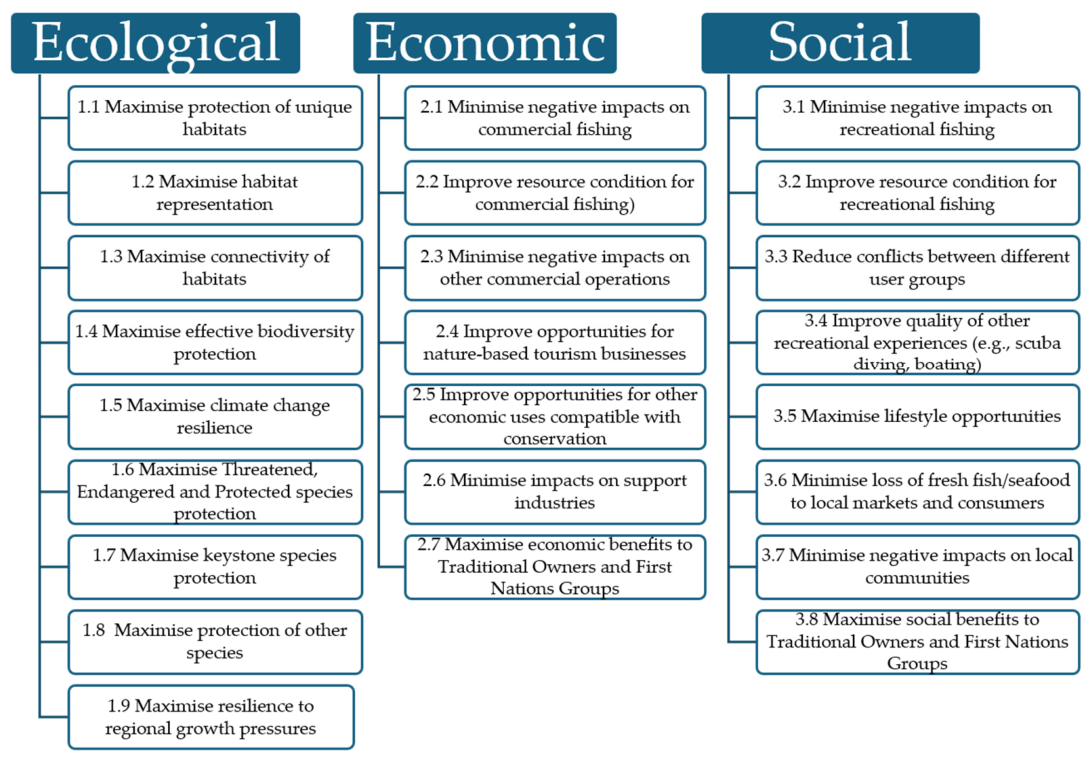
3.1. Identification of Operational Objectives
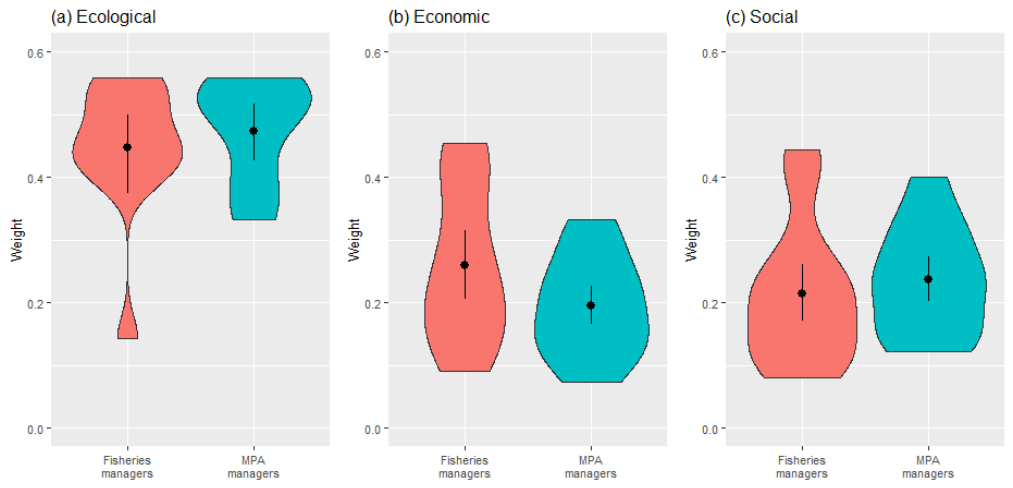
3.2. Objective Preferences
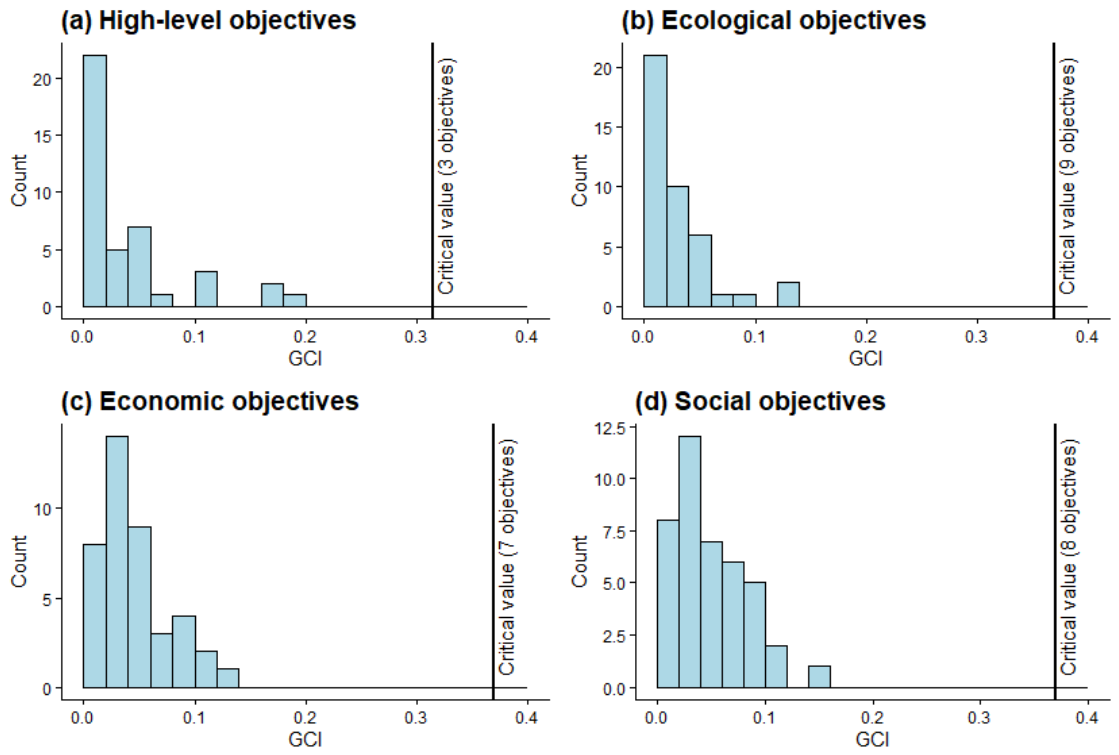
3.3. Coherence
3.4. Level of Inconsistencies
4. Discussion
5. Conclusions
Supplementary Materials
Author Contributions
Funding
Institutional Review Board Statement
Informed Consent Statement
Data Availability Statement
Acknowledgments
Conflicts of Interest
Abbreviations
| AHP | Analytic Hierarchy Process |
| GCI | Geometric Consistency Index |
| FPA | Fully Protected Area |
| MAHP | Modified Analytic Hierarchy Process |
| MPA | Marine Protected Area |
| PPA | Partially Protected Area |
| TBL | Tripple Bottom Line |
| TEP | Threatened, Endangered and Protected |
References
- Coglan, L.; Dewilde, E.; Abeysiriwardena, N.; Doshi, A.; Haro, I.; Pascoe, S.; Cannard, T.; Roos, M.; Kenyon, R.; Dunstan, P. Trade-Offs and Co-Benefits Between Fishing and Conservation Through Area Closures and Partially Protected Areas; Fisheries Research and Development Corporation: Canberra, Australia, 2025. [Google Scholar]
- Qureshi, F. Sustainable Resource Management: Balancing Human Needs and Environmental Protection. Front. Environ. Sci. Sustain. 2024, 1, 1–19. [Google Scholar] [CrossRef]
- Rodríguez-Rodríguez, D.; Merkohasanaj, M.; López, I. Social and economic sustainability of multiple-use marine protected areas in Spain: A mixed methods, multi-scale study. Ocean Coast. Manag. 2019, 171, 47–55. [Google Scholar] [CrossRef]
- UN General Assembly. Transforming Our World: The 2030 Agenda for Sustainable Development, RES/70/1. Resolution Adopted by the General Assembly on 25 September 2015; United Nations: New York, NY, USA, 2015. [Google Scholar]
- Pike, E.P.; MacCarthy, J.M.C.; Hameed, S.O.; Harasta, N.; Grorud-Colvert, K.; Sullivan-Stack, J.; Claudet, J.; Horta e Costa, B.; Gonçalves, E.J.; Villagomez, A.; et al. Ocean protection quality is lagging behind quantity: Applying a scientific framework to assess real marine protected area progress against the 30 by 30 target. Conserv. Lett. 2024, 17, e13020. [Google Scholar] [CrossRef]
- Convention on Biological Diversity. Decision Adopted by the Conference of the Parties to the Convention on Biological Diversity 15/4. Kunming-Montreal Global Biodiversity Framework. In Proceedings of the Conference of the Parties to the Convention on Biological Diversity, Fifteenth Meeting—Part II, Montreal, QC, Canada, 7–19 December 2022. [Google Scholar]
- Day, J.; Dudley, N.; Hockings, M.; Holmes, G.; Laffoley, D.; Stolton, S.; Wells, S.; Wenzel, L. Guidelines for Applying the IUCN Protected Area Management Categories to Marine Protected Areas. Second Edition. 2019. Available online: https://portals.iucn.org/library/sites/library/files/documents/PAG-019-2nd%20ed.-En.pdf (accessed on 5 May 2025).
- Zupan, M.; Fragkopoulou, E.; Claudet, J.; Erzini, K.; Horta e Costa, B.; Gonçalves, E.J. Marine partially protected areas: Drivers of ecological effectiveness. Front. Ecol. Environ. 2018, 16, 381–387. [Google Scholar] [CrossRef]
- OECD. Marine Protected Areas: Economics, Management and Effective Policy Mixes; OECD: Paris, France, 2017. [Google Scholar]
- Turnbull, J.W.; Johnston, E.L.; Clark, G.F. Evaluating the social and ecological effectiveness of partially protected marine areas. Conserv. Biol. 2021, 35, 921–932. [Google Scholar] [CrossRef] [PubMed]
- Phillips, G.A.C.; Ogier, E.; Dutton, I.; Barrett, N.; Krueck, N.C.; Hartmann, K. The ambiguous role of partially protected marine protected areas in Australia: Results from a systematic literature review. PLoS ONE 2025, 20, e0307324. [Google Scholar] [CrossRef] [PubMed]
- Di Lorenzo, M.; Claudet, J.; Guidetti, P. Spillover from marine protected areas to adjacent fisheries has an ecological and a fishery component. J. Nat. Conserv. 2016, 32, 62–66. [Google Scholar] [CrossRef]
- Angulo-Valdés, J.A.; Hatcher, B.G. A new typology of benefits derived from marine protected areas. Mar. Policy 2010, 34, 635–644. [Google Scholar] [CrossRef]
- Pascoe, S.; Coglan, L.; Roos, M.; Cannard, T.; Scheufele, G.; Doshi, A.; Haro, I. Fisheries’ Economic Impacts from the Rezoning of the Multi-Use Moreton Bay Marine Park. Fishes 2025, 10, 192. [Google Scholar] [CrossRef]
- Erm, P.; Balmford, A.; Holden, M.H. The biodiversity benefits of marine protected areas in well-regulated fisheries. Biol. Conserv. 2023, 284, 110049. [Google Scholar] [CrossRef]
- Rees, S.E.; Ashley, M.; Evans, L.; Mangi, S.; Sheehan, E.V.; Mullier, T.; Rees, A.; Attrill, M.J. An evaluation of the social and economic impact of a Marine Protected Area on commercial fisheries. Fish. Res. 2021, 235, 105819. [Google Scholar] [CrossRef]
- Perea-Muñoz, J.M.; Miles, A.; Bayle-Sempere, J.T. Sharing goals by timely communication improves fishermen’s satisfaction with marine protected areas: A case study in the Mediterranean. Ambio 2022, 51, 1520–1534. [Google Scholar] [CrossRef] [PubMed]
- Jones, P. Governing Marine Protected Areas: Resilience Through Diversity; Routledge: Abingdon-on-Thames, UK, 2014. [Google Scholar]
- Jones, P.J.S. Marine protected area strategies: Issues, divergences and the search for middle ground. Rev. Fish Biol. Fish. 2002, 11, 197–216. [Google Scholar] [CrossRef]
- Jentoft, S.; Chuenpagdee, R.; Pascual-Fernandez, J.J. What are MPAs for: On goal formation and displacement. Ocean Coast. Manag. 2011, 54, 75–83. [Google Scholar] [CrossRef]
- Brooks, K.; Barclay, K.; Grafton, R.Q.; Gollan, N. Transforming coastal and marine management: Deliberative democracy and integrated management in New South Wales, Australia. Mar. Policy 2022, 139, 104053. [Google Scholar] [CrossRef]
- Li, Y.; Yin, J.; Sun, M.; Kleisner, K.; Litsinger, E.; Jud, S.; Tang, Y.; Chen, Y. Examining the discrepancy and synergy between marine protected areas and fisheries management in the Bohai Sea, China. Ocean Coast. Manag. 2024, 258, 107409. [Google Scholar] [CrossRef]
- Rice, J.; Moksness, E.; Attwood, C.; Brown, S.K.; Dahle, G.; Gjerde, K.M.; Grefsrud, E.S.; Kenchington, R.; Ring Kleiven, A.; McConney, P.; et al. The role of MPAs in reconciling fisheries management with conservation of biological diversity. Ocean Coast. Manag. 2012, 69, 217–230. [Google Scholar] [CrossRef]
- Horta e Costa, B.; Guimarães, M.H.; Rangel, M.; Ressurreição, A.; Monteiro, P.; Oliveira, F.; Bentes, L.; Sales Henriques, N.; Sousa, I.; Alexandre, S.; et al. Co-design of a marine protected area zoning and the lessons learned from it. Front. Mar. Sci. 2022, 9, 969234. [Google Scholar] [CrossRef]
- De Santo, E.M. Assessing public “participation” in environmental decision-making: Lessons learned from the UK Marine Conservation Zone (MCZ) site selection process. Mar. Policy 2016, 64, 91–101. [Google Scholar] [CrossRef]
- Mangubhai, S.; Wilson, J.R.; Rumetna, L.; Maturbongs, Y.; Purwanto. Explicitly incorporating socioeconomic criteria and data into marine protected area zoning. Ocean Coast. Manag. 2015, 116, 523–529. [Google Scholar] [CrossRef]
- Rangel, M.; Horta e Costa, B.; Guimarães, M.H.; Ressurreição, A.; Monteiro, P.; Oliveira, F.; Bentes, L.; Sales Henriques, N.; Sousa, I.; Alexandre, S.; et al. Engaging and legitimizing communities: Co-designing a community-based Marine Protected Area. Mar. Policy 2025, 178, 106695. [Google Scholar] [CrossRef]
- Green, A.L.; Fernandes, L.; Almany, G.; Abesamis, R.; McLeod, E.; Aliño, P.M.; White, A.T.; Salm, R.; Tanzer, J.; Pressey, R.L. Designing Marine Reserves for Fisheries Management, Biodiversity Conservation, and Climate Change Adaptation. Coast. Manag. 2014, 42, 143–159. [Google Scholar] [CrossRef]
- Pascoe, S.; Farmery, A.; Nichols, R.; Lothian, S.; Azmi, K. A Modified Analytic Hierarchy Process Suitable for Online Survey Preference Elicitation. Algorithms 2024, 17, 245. [Google Scholar] [CrossRef]
- Brooks, K.; Schirmer, J.; Pascoe, S.; Triantafillos, L.; Jebreen, E.; Cannard, T.; Dichmont, C.M. Selecting and assessing social objectives for Australian fisheries management. Mar. Policy 2015, 53, 111–122. [Google Scholar] [CrossRef]
- Queensland Government. Moreton Bay Marine Park—Scientific Guiding Principles, The State of Queensland (Department of Environment, Science and Innovation). Available online: https://parks.desi.qld.gov.au/parks/moreton-bay/zoning/zoning-plan-history/the_science_behind_the_zoning_plan/moreton_bay_marine_park__scientific_guiding_principles#:~:text=The%20Socio-economic%20Guiding%20Principles,ensure%20efficient%20management%20and%20enforcement. (accessed on 19 October 2023).
- Parks Australia. Goals and Principles for the Establishment of the National Representative System of Marine Protected Areas in Commonwealth Waters. Available online: https://parksaustralia.gov.au/marine/management/resources/scientific-publications/goals-and-principles-establishment-national-representative-system-marine-protected-areas/ (accessed on 8 June 2026).
- Elkington, J. Cannibals with Forks: The Triple Bottom Line of 21st Century Business; New Society Publishers: Stony Creek, CT, USA, 1998. [Google Scholar]
- Saaty, T.L. The Analytic Hierarchy Process; McGraw-Hill: New York, NY, USA, 1980. [Google Scholar]
- Tversky, A.; Kahneman, D. Judgment under Uncertainty: Heuristics and Biases. Science 1974, 185, 1124–1131. [Google Scholar] [CrossRef] [PubMed]
- Yang, Z.; Zhang, Z.-K.; Zhou, T. Anchoring bias in online voting. Europhys. Lett. 2012, 100, 68002. [Google Scholar] [CrossRef]
- Casper, W.C.; Edwards, B.D.; Wallace, J.C.; Landis, R.S.; Fife, D.A. Selecting response anchors with equal intervals for summated rating scales. J. Appl. Psychol. 2020, 105, 390–409. [Google Scholar] [CrossRef] [PubMed]
- Crawford, G.; Williams, C. A note on the analysis of subjective judgment matrices. J. Math. Psychol. 1985, 29, 387–405. [Google Scholar] [CrossRef]
- Crawford, G.B. The geometric mean procedure for estimating the scale of a judgement matrix. Math. Model. 1987, 9, 327–334. [Google Scholar] [CrossRef]
- Saaty, T.L. Axiomatic Foundation of the Analytic Hierarchy Process. Manag. Sci. 1986, 32, 841–855. [Google Scholar] [CrossRef]
- Himes, A.H. Performance indicator importance in MPA management using a multi-criteria approach. Coast. Manag. 2007, 35, 601–618. [Google Scholar] [CrossRef]
- Zahir, S. Clusters in a group: Decision making in the vector space formulation of the analytic hierarchy process. Eur. J. Oper. Res. 1999, 112, 620–634. [Google Scholar] [CrossRef]
- Pendred, S.; Fischer, A.; Fischer, S. Improved Management Effectiveness of a Marine Protected Area through Prioritizing Performance Indicators. Coast. Manag. 2016, 44, 93–115. [Google Scholar] [CrossRef]
- Escobar, M.T.; Aguarón, J.; Moreno-Jiménez, J.M.; Turón, A. A Decision Support System for Improving the Inconsistency in AHP. Int. J. Decis. Support Syst. Technol. (IJDSST) 2023, 15, 1–16. [Google Scholar] [CrossRef]
- Aguarón, J.; Moreno-Jiménez, J.M.A. The geometric consistency index: Approximated thresholds. Eur. J. Oper. Res. 2003, 147, 137–145. [Google Scholar] [CrossRef]
- Wu, M.-J.; Zhao, K.; Fils-Aime, F. Response rates of online surveys in published research: A meta-analysis. Comput. Hum. Behav. Rep. 2022, 7, 100206. [Google Scholar] [CrossRef]
- DCCEEW. Achieving 30 by 30 on Land: National Roadmap for Protecting and Conserving 30% of Australia’s Land by 2030; Department of Climate Change, Energy, the Environment and Water: Canberra, Australia, 2024. [Google Scholar]
- Pascoe, S.; Doshi, A.; Dell, Q.; Tonks, M.; Kenyon, R. Economic value of recreational fishing in Moreton Bay and the potential impact of the marine park rezoning. Tour. Manag. 2014, 41, 53–63. [Google Scholar] [CrossRef]
- Rassweiler, A.; Costello, C.; Siegel, D.A. Marine protected areas and the value of spatially optimized fishery management. Proc. Natl. Acad. Sci. USA 2012, 109, 11884–11889. [Google Scholar] [CrossRef] [PubMed]
- Lynch, T.P. Incorporation of Recreational Fishing Effort into Design of Marine Protected Areas. Conserv. Biol. 2006, 20, 1466–1476. [Google Scholar] [CrossRef] [PubMed]
- Gaines, S.D.; White, C.; Carr, M.H.; Palumbi, S.R. Designing marine reserve networks for both conservation and fisheries management. Proc. Natl. Acad. Sci. USA 2010, 107, 18286–18293. [Google Scholar] [CrossRef] [PubMed]
- Jones, P.J.S. A review and analysis of the objectives of marine nature reserves. Ocean Coast. Manag. 1994, 24, 149–178. [Google Scholar] [CrossRef]
- World Bank. Scaling Up Marine Management—The Role of Marine Protected Areas; World Bank: Washington, DC, USA, 2006. [Google Scholar]
- Pascoe, S.; Cannard, T.; Dowling, N.A.; Dichmont, C.M.; Breen, S.; Roberts, T.; Pears, R.J.; Leigh, G.M. Developing Harvest Strategies to Achieve Ecological, Economic and Social Sustainability in Multi-Sector Fisheries. Sustainability 2019, 11, 644. [Google Scholar] [CrossRef]
- Pascoe, S.; Dichmont, C.M.; Brooks, K.; Pears, R.; Jebreen, E. Management objectives of Queensland fisheries: Putting the horse before the cart. Mar. Policy 2013, 37, 115–122. [Google Scholar] [CrossRef]
- Clarke, B.; Thurstan, R.; Yates, K. Stakeholder Perceptions of a Coastal Marine Protected Area. J. Coast. Res. 2016, 75, 622–626. [Google Scholar] [CrossRef]
- Heck, N.; Dearden, P.; McDonald, A. Stakeholder Evaluation Priorities for Demonstrating Marine Protected Area Effectiveness at the Pacific Rim National Park Reserve, Canada. Coast. Manag. 2012, 40, 55–72. [Google Scholar] [CrossRef]
- McNeill, A.; Clifton, J.; Harvey, E.S. Attitudes to a marine protected area are associated with perceived social impacts. Mar. Policy 2018, 94, 106–118. [Google Scholar] [CrossRef]
- Paredes, S.; Pascoe, S.; Coglan, L.; Richards, C. Increasing Local Fish Consumption: A Bayesian Belief Network Analysis. J. Int. Food Agribus. Mark. 2021, 33, 104–121. [Google Scholar] [CrossRef]
- Jones, P.J.S. Equity, justice and power issues raised by no-take marine protected area proposals. Mar. Policy 2009, 33, 759–765. [Google Scholar] [CrossRef]
- Mast, A.; Gill, D.; Ahmadia, G.N.; Darling, E.S.; Andradi-Brown, D.A.; Geldman, J.; Epstein, G.; MacNeil, M.A. Shared governance increases marine protected area effectiveness. PLoS ONE 2025, 20, e0315896. [Google Scholar] [CrossRef] [PubMed]
- Garlock, T.; Anderson, J.L.; Asche, F.; Smith, M.D.; Camp, E.; Chu, J.; Lorenzen, K.; Vannuccini, S. Global insights on managing fishery systems for the three pillars of sustainability. Fish Fish. 2022, 23, 899–909. [Google Scholar] [CrossRef]
- DCCEEW. Collaborative Australian Protected Areas Database 2024. 2026. Available online: https://www.dcceew.gov.au/environment/land/nrs/science/capad/2024#toc_4 (accessed on 25 April 2026).
- Jones, P.J.S.; Stafford, R.; Hesse, I.; Khuu, D.T. Incentive diversity is key to the more effective and equitable governance of marine protected areas. Front. Mar. Sci. 2024, 11, 1412654. [Google Scholar] [CrossRef]



| Group | Invitations | Responses (Complete) | Rejections (Automatic) | Response Rate (%) |
|---|---|---|---|---|
| MPA managers | 44 | 22 | 2 | 52% |
| Fisheries managers | 61 | 19 | 8 | 36% |
| Total | 105 | 41 | 10 | 43% |
| Objective | MPA Managers | Fisheries Managers | Probability a | ||||
|---|---|---|---|---|---|---|---|
| Mean | Std Error | Mean | Std Error | Wilcoxon–Mann–Whitney | Welch Two-Sample t-Test | ||
| Ecological | 0.568 | 0.028 | 0.527 | 0.032 | 0.471 | 0.335 | |
| 1.1 | Maximise protection of unique habitats | 0.084 | 0.012 | 0.074 | 0.010 | 0.708 | 0.506 |
| 1.2 | Maximise habitat representation | 0.076 | 0.008 | 0.058 | 0.008 | 0.121 | 0.119 |
| 1.3 | Maximise connectivity of habitats | 0.060 | 0.005 | 0.050 | 0.007 | 0.227 | 0.277 |
| 1.4 | Maximise effective biodiversity protection | 0.084 | 0.007 | 0.086 | 0.012 | 0.747 | 0.887 |
| 1.5 | Maximise climate change resilience | 0.058 | 0.006 | 0.056 | 0.010 | 0.429 | 0.858 |
| 1.6 | Maximise Threatened, Endangered and Protected (TEP) species protection | 0.058 | 0.007 | 0.065 | 0.010 | 0.727 | 0.550 |
| 1.7 | Maximise keystone species protection | 0.058 | 0.007 | 0.051 | 0.006 | 0.331 | 0.416 |
| 1.8 | Maximise protection of other species | 0.034 | 0.005 | 0.038 | 0.006 | 0.526 | 0.539 |
| 1.9 | Maximise resilience to regional growth pressures | 0.056 | 0.007 | 0.049 | 0.009 | 0.198 | 0.498 |
| Economic | 0.195 | 0.017 | 0.259 | 0.028 | 0.122 | 0.056 | |
| 2.1 | Minimise negative impacts on commercial fishing | 0.025 | 0.003 | 0.060 | 0.010 | 0.004 | 0.002 |
| 2.2 | Improve resource condition for commercial fishing | 0.026 | 0.004 | 0.055 | 0.011 | 0.045 | 0.027 |
| 2.3 | Minimise negative impacts on other commercial operations | 0.020 | 0.003 | 0.019 | 0.005 | 0.543 | 0.905 |
| 2.4 | Improve opportunities for nature-based tourism businesses | 0.035 | 0.004 | 0.033 | 0.006 | 0.444 | 0.767 |
| 2.5 | Improve opportunities for other economic uses | 0.037 | 0.005 | 0.034 | 0.004 | 0.907 | 0.665 |
| 2.6 | Minimise impacts on support industries | 0.014 | 0.002 | 0.021 | 0.005 | 0.371 | 0.205 |
| 2.7 | Maximise economic benefits to Traditional Owners and First Nations Groups | 0.039 | 0.005 | 0.038 | 0.007 | 0.543 | 0.853 |
| Social | 0.237 | 0.018 | 0.214 | 0.026 | 0.244 | 0.472 | |
| 3.1 | Minimise negative impacts on recreational fishing | 0.022 | 0.004 | 0.022 | 0.004 | 0.990 | 0.998 |
| 3.2 | Improve resource condition for recreational fishing | 0.027 | 0.004 | 0.037 | 0.009 | 0.632 | 0.349 |
| 3.3 | Reduce conflicts between different user groups | 0.024 | 0.003 | 0.026 | 0.005 | 0.651 | 0.737 |
| 3.4 | Improve quality of other recreational experiences | 0.034 | 0.005 | 0.024 | 0.005 | 0.073 | 0.133 |
| 3.5 | Maximise lifestyle opportunities | 0.024 | 0.004 | 0.017 | 0.004 | 0.114 | 0.220 |
| 3.6 | Minimise loss of fresh fish/seafood to local markets and consumers | 0.018 | 0.003 | 0.027 | 0.005 | 0.127 | 0.098 |
| 3.7 | Minimise negative impacts on local communities | 0.035 | 0.004 | 0.026 | 0.004 | 0.092 | 0.114 |
| 3.8 | Maximise social benefits to Traditional Owners and First Nations Groups | 0.053 | 0.005 | 0.037 | 0.007 | 0.024 | 0.065 |
| Within Group | Across Groups | |||||
|---|---|---|---|---|---|---|
| MPA Managers | Fisheries Managers | Pooled | ||||
| High level (TBL) | 0.976 | ** | 0.960 | ** | 0.944 | ** |
| Ecological | 0.944 | ** | 0.920 | * | 0.910 | * |
| Economic | 0.935 | ** | 0.903 | * | 0.893 | - |
| Social | 0.937 | ** | 0.897 | - | 0.719 | - |
Disclaimer/Publisher’s Note: The statements, opinions and data contained in all publications are solely those of the individual author(s) and contributor(s) and not of MDPI and/or the editor(s). MDPI and/or the editor(s) disclaim responsibility for any injury to people or property resulting from any ideas, methods, instructions or products referred to in the content. |
© 2026 by the authors. Licensee MDPI, Basel, Switzerland. This article is an open access article distributed under the terms and conditions of the Creative Commons Attribution (CC BY) license.
Share and Cite
Pascoe, S.; Coglan, L.; Dewilde, E.; Cannard, T.; Abeysiriwardena, N.; Doshi, A.; Haro, I.; Scheufele, G. Determining Marine Protected Area Zoning Under Multiple Objectives: Do Marine Managers’ Priorities Align? Sustainability 2026, 18, 7035. https://doi.org/10.3390/su18147035
Pascoe S, Coglan L, Dewilde E, Cannard T, Abeysiriwardena N, Doshi A, Haro I, Scheufele G. Determining Marine Protected Area Zoning Under Multiple Objectives: Do Marine Managers’ Priorities Align? Sustainability. 2026; 18(14):7035. https://doi.org/10.3390/su18147035
Chicago/Turabian StylePascoe, Sean, Louisa Coglan, Ella Dewilde, Toni Cannard, Nipuni Abeysiriwardena, Amar Doshi, Isabel Haro, and Gabriela Scheufele. 2026. "Determining Marine Protected Area Zoning Under Multiple Objectives: Do Marine Managers’ Priorities Align?" Sustainability 18, no. 14: 7035. https://doi.org/10.3390/su18147035
APA StylePascoe, S., Coglan, L., Dewilde, E., Cannard, T., Abeysiriwardena, N., Doshi, A., Haro, I., & Scheufele, G. (2026). Determining Marine Protected Area Zoning Under Multiple Objectives: Do Marine Managers’ Priorities Align? Sustainability, 18(14), 7035. https://doi.org/10.3390/su18147035