Optimizing Hurricane Evacuation Decisions Under Climate Change: Adaptation Limits and Implications for Sustainable Coastal Resilience

 and
and
Abstract
1. Introduction
- We build a climate-forward RL framework that embeds CMIP6 climate projections directly into the training data, allowing the agent to cope with non-stationary storm statistics and eroding forecast skill across the SSP2-4.5 and SSP5-8.5 warming scenarios.
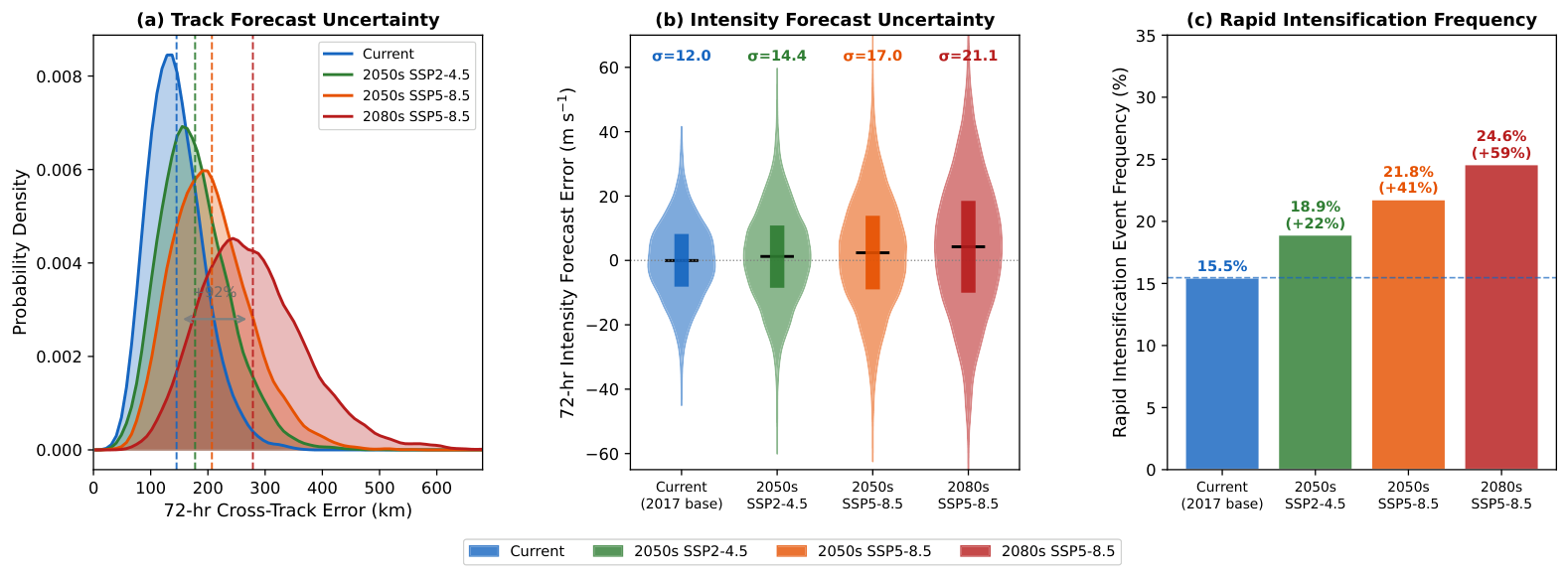
- We provide the first quantification of how AI-based ensemble forecast uncertainty scales with warming: 72 h track errors almost double (145 to 280 km) while intensity-forecast standard deviations climb from 12 to 21 m/s by the 2080s SSP5-8.5 horizon.
- We empirically establish and formally define the climate evacuation paradox: RL’s relative gain over fixed policies climbs from 7.1% in the current climate to 16.8% under the 2080s SSP5-8.5, even as absolute evacuation performance worsens by 44%, surpassing what suboptimal policies incur today.
2. Literature Review
2.1. Climate Change Impacts on Hurricane Evacuation
2.2. Evolution of Evacuation Modeling Under Uncertainty
2.3. Decision-Making Under Deep Uncertainty
2.4. AI-Driven Approaches for Climate Adaptation
2.5. The Adaptation Limits Hypothesis
3. Methodology
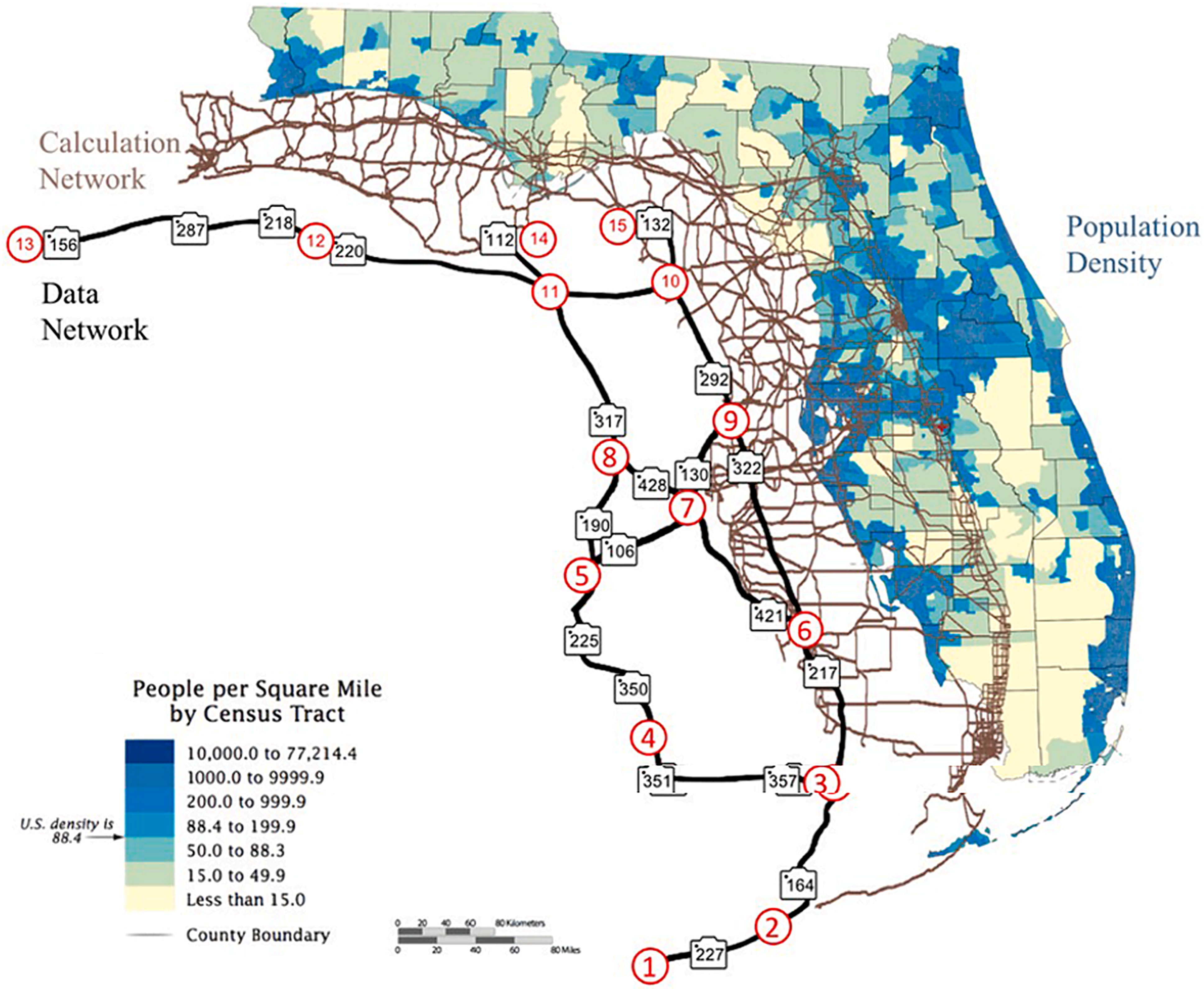
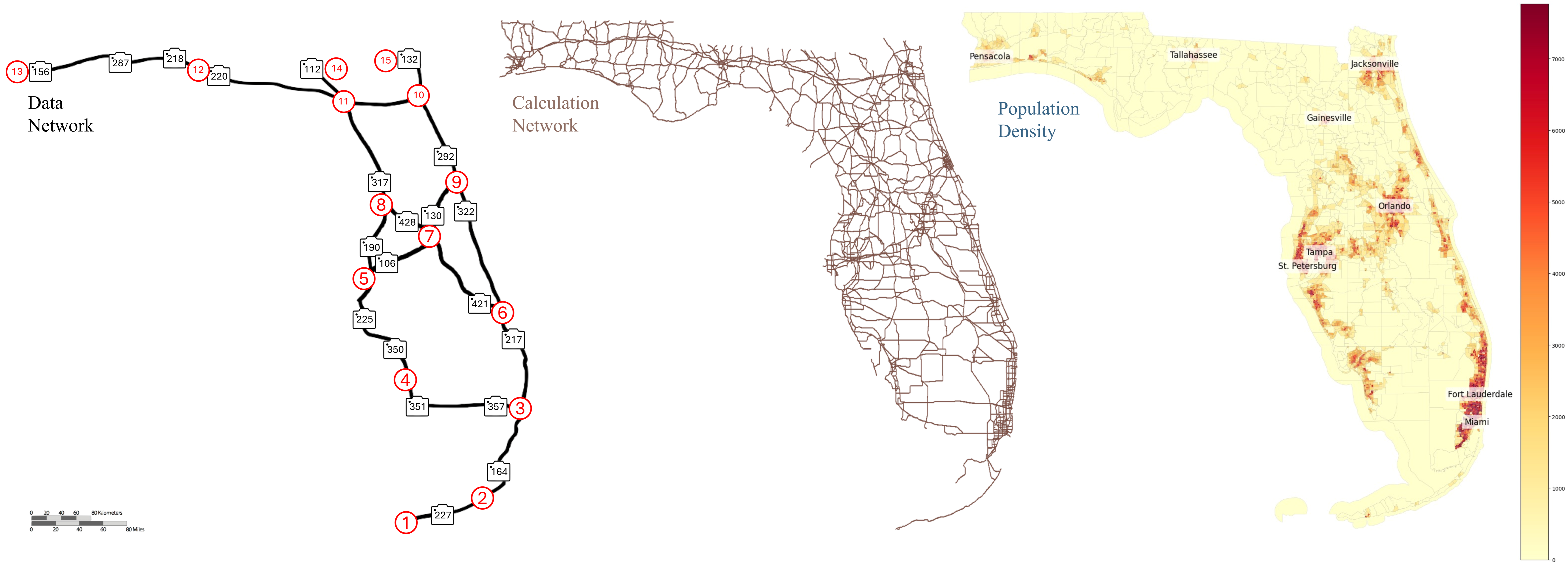
3.1. Study Area and Data
3.2. Climate-Adjusted Hurricane Simulation Framework
3.2.1. Climate Projection Integration
3.2.2. Ensemble Generation with Climate Perturbations
3.3. Evacuation Traffic Modeling
3.3.1. Evacuation Demand Model
3.3.2. Traffic Flow Dynamics
3.4. Reinforcement Learning Under Climate Uncertainty
3.4.1. Modified State Space
3.4.2. Objective Function
- Travel-time term: ;
- Home-distance term: ;
- Travel-risk term: ;
- Shelter-risk term: .
3.4.3. LSTM Architecture for Climate Scenarios
3.4.4. Q-Learning with Climate-Dependent Rewards
3.5. Training Data Generation
- Present-climate baseline: 10,000 Irma-like TC realizations driven by 2017 atmospheric conditions, following Cui et al. [9].
- Mid-century projection: 10,000 realizations apiece under both SSP2-4.5 and SSP5-8.5 forcing, spanning 2040–2060.
- Late-century projection: 10,000 realizations apiece for both SSP pathways over 2080–2100.
- Draw perturbed ensembles from Pangu-Weather under climate-adjusted fields;
- Derive optimal evacuation orders via the deterministic optimization of Cui et al. [9];
- Pre-train the LSTM on partial-observation sequences;
- Fine-tune with Q-learning under climate-dependent rewards.
3.6. Performance Metrics Under Climate Change
3.7. Model Assumptions and Their Justification
- (1)
- Behavioral parameters are climate-invariant. The logit coefficients (–) are calibrated to Hurricane Irma (2017) data [8] and held constant across scenarios. The rationale is that the decision drivers—official orders, storm category, distance to the coast, and surge zone—are stable social constructs whose statistical relationships do not shift over the decadal horizons considered [15,22]. What varies across scenarios is the realized value of these covariates (stronger storms, wider surge zones), not households’ sensitivity to them.
- (2)
- Compliance rates are constant. We assume full compliance with official orders within each designated zone. Real-world compliance, of course, varies with trust in authorities, prior experience, and socioeconomic constraints [23]. Because we compare the relative performance of policies within one behavioral model, this assumption does not bias the RL-versus-fixed comparison; it does mean, though, that the absolute values should be read as indicative upper bounds on compliance-weighted outcomes.
- (3)
- Route choice follows the validated BPR-based mean-field model. Drivers are taken to select routes per the Markov transition matrix calibrated to Irma traffic data [7], with individual route-learning and real-time navigation effects abstracted away. Standard in large-scale evacuation modeling [27], this simplification makes computation over 20,000 scenarios tractable.
- (4)
- Climate perturbations are additive. The superposition presumes that the climate signal does not reshape the synoptic steering environment nonlinearly in ways incompatible with the 2017 large-scale pattern. Higher-order interactions are possible, but additive perturbation is a common, physically grounded technique in pseudo-global-warming experiments [1,2].
- (5)
- AI forecast-skill degradation is stationary within each scenario. We represent degradation through the larger ensemble spread produced by climate-perturbed initial conditions, and we do not credit future gains in AI model training or data assimilation. This is deliberately conservative: since forecasting systems will keep improving, our degradation estimates probably mark a worst-case bound rather than a central projection.
4. Results
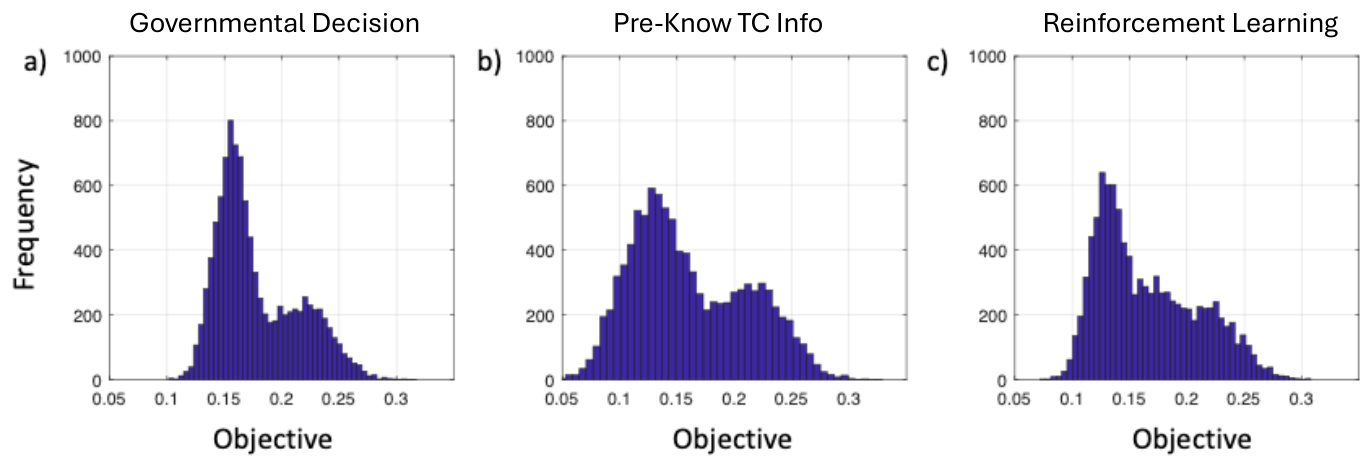
4.1. Baseline Performance Under Current Climate
4.2. The Paradox of Enhanced RL Performance Under Climate Change
4.3. Forecast Uncertainty Scaling Under Climate Change
5. Discussion
6. Conclusions
Author Contributions
Funding
Institutional Review Board Statement
Informed Consent Statement
Data Availability Statement
Acknowledgments
Conflicts of Interest
References
- Knutson, T.R.; McBride, J.L.; Chan, J.; Emanuel, K.; Holland, G.; Landsea, C.; Held, I.; Kossin, J.P.; Srivastava, A.; Sugi, M. Tropical cyclones and climate change. Nat. Geosci. 2010, 3, 157–163. [Google Scholar] [CrossRef]
- Emanuel, K.A. Downscaling CMIP5 climate models shows increased tropical cyclone activity over the 21st century. Proc. Natl. Acad. Sci. USA 2013, 110, 12219–12224. [Google Scholar] [CrossRef] [PubMed]
- Mendelsohn, R.; Emanuel, K.; Chonabayashi, S.; Bakkensen, L. The impact of climate change on global tropical cyclone damage. Nat. Clim. Change 2012, 2, 205–209. [Google Scholar] [CrossRef]
- Zhang, F.; Emanuel, K.A. Predictability and prediction of tropical cyclones on daily to seasonal time scales. Trop. Cyclone Res. Rev. 2019, 8, 123–146. [Google Scholar]
- Regnier, E. Public evacuation decisions and hurricane track uncertainty. Manag. Sci. 2008, 54, 16–28. [Google Scholar] [CrossRef]
- Regnier, E. Evacuation decision making and hurricane track uncertainty. Decis. Anal. 2009, 6, 187–205. [Google Scholar]
- Feng, K.; Lin, N. Reconstructing and analyzing the traffic flow during evacuation in Hurricane Irma (2017). Transp. Res. Part D Transp. Environ. 2021, 94, 102788. [Google Scholar] [CrossRef]
- Feng, K.; Lin, N. Modeling and analyzing the traffic flow during evacuation in Hurricane Irma (2017). Transp. Res. Part D Transp. Environ. 2022, 110, 103412. [Google Scholar] [CrossRef]
- Cui, Y.; Feng, K.; Ma, W.; He, B. Reinforcement learning for optimizing hurricane evacuation decisions: Hurricane Irma case study. Transp. Res. Part D Transp. Environ. 2025, 147, 104882. [Google Scholar]
- Bi, K.; Xie, L.; Zhang, H.; Chen, X.; Gu, X.; Tian, Q. Accurate medium-range global weather forecasting with 3D neural networks. Nature 2023, 619, 533–538. [Google Scholar] [CrossRef] [PubMed]
- Davidson, R.A.; Nozick, L.K.; Wachtendorf, T.; Blanton, B.; Colle, B.; Kolar, R.L.; Dresback, K.; Yi, W.; Yang, K.; Leonardo, N. Integrating forecast and observed uncertainties to estimate evacuation-related decision timing during extreme weather events. Int. J. Disaster Risk Reduct. 2020, 46, 101510. [Google Scholar]
- Sadri, A.M.; Ukkusuri, S.V.; Gladwin, H. Integrating social network analysis with analytic network process for identifying the critical evacuation paths. Transp. Res. Part A Policy Pract. 2018, 114, 38–60. [Google Scholar]
- Racherla, P.; Chinthala, J. Artificial Intelligence for Climate Change Adaptation: Opportunities and Challenges. Front. Artif. Intell. 2022, 5, 844425. [Google Scholar]
- Nateghi, R.; Mukherjee, S. A multi-paradigm framework to assess the impacts of climate change on end-use energy demand. PLoS ONE 2021, 16, e0258504. [Google Scholar] [CrossRef]
- Lindell, M.K. Hurricane evacuation studies: Methodological considerations, reliable findings, contradictory results, and unresolved issues. Clim. Res. 2021, 68, 141–163. [Google Scholar]
- Marchau, V.A.W.J.; Walker, W.E.; Bloemen, P.J.T.M.; Popper, S.W. (Eds.) Decision Making under Deep Uncertainty: From Theory to Practice; Springer: Cham, Switzerland, 2019. [Google Scholar]
- Urbanik, T. Evacuation time estimates for nuclear power plants. J. Hazard. Mater. 2000, 75, 165–180. [Google Scholar] [CrossRef] [PubMed]
- Lindell, M.K.; Prater, C.S. Critical behavioral assumptions in evacuation time estimate analysis for private vehicles: Examples from hurricane research and planning. J. Urban Plan. Dev. 2007, 133, 18–29. [Google Scholar] [CrossRef]
- Wolshon, B. Evacuation planning and engineering for Hurricane Katrina. Bridge 2006, 36, 27–34. [Google Scholar]
- Zscheischler, J.; Martius, O.; Westra, S.; Bevacqua, E.; Raymond, C.; Horton, R.M.; van den Hurk, B.; AghaKouchak, A.; Jézéquel, A.; Mahecha, M.D.; et al. A typology of compound weather and climate events. Nat. Rev. Earth Environ. 2020, 1, 333–347. [Google Scholar] [CrossRef]
- Couasnon, A.; Eilander, D.; Muis, S.; Veldkamp, T.I.E.; Haigh, I.D.; Wahl, T.; Winsemius, H.C.; Ward, P.J. Measuring compound flood potential from river discharge and storm surge extremes at the global scale. Nat. Hazards Earth Syst. Sci. 2020, 20, 489–504. [Google Scholar] [CrossRef]
- Huang, S.-K.; Lindell, M.K.; Prater, C.S. Who leaves and who stays? A review and statistical meta-analysis of hurricane evacuation studies. Environ. Behav. 2022, 48, 991–1029. [Google Scholar]
- Baker, E.J. Hurricane evacuation behavior. Int. J. Mass Emergencies Disasters 2021, 9, 287–310. [Google Scholar]
- Demuth, J.L. Explicating experience: Development of a valid scale of past hazard experience for tornadoes. Risk Anal. 2020, 40, 1921–1943. [Google Scholar]
- Morss, R.E.; Mulder, K.J.; Lazo, J.K.; Demuth, J.L. How do people perceive, understand, and anticipate responding to flash flood risks and warnings? Results from a public survey in Boulder, Colorado, USA. J. Hydrol. 2022, 508, 127–141. [Google Scholar]
- Chiu, Y.-C.; Zheng, H.; Villalobos, J.; Gautam, B. Modeling no-notice mass evacuation using a dynamic traffic flow optimization model. IIE Trans. 2007, 39, 83–94. [Google Scholar] [CrossRef]
- Pel, A.J.; Bliemer, M.C.; Hoogendoorn, S.P. A review on travel behaviour modelling in dynamic traffic simulation models for evacuations. Transportation 2012, 39, 97–123. [Google Scholar]
- Chen, X.; Zhan, F.B. Agent-based modelling and simulation of urban evacuation: Relative effectiveness of simultaneous and staged evacuation strategies. J. Oper. Res. Soc. 2008, 59, 25–33. [Google Scholar] [CrossRef]
- Lämmel, G.; Grether, D.; Nagel, K. The representation and implementation of time-dependent inundation in large-scale microscopic evacuation simulations. Transp. Res. Part C Emerg. Technol. 2010, 18, 84–98. [Google Scholar] [CrossRef]
- Ying, W.; Cheng, Y.; Ling, H.; Shi, Y. A hybrid model for simulating urban evacuation. Phys. A Stat. Mech. Its Appl. 2016, 451, 578–592. [Google Scholar]
- Ahmed, S.; Dey, K.; Fries, R. Evaluation of transportation network reliability during emergency evacuation. J. Transp. Saf. Secur. 2019, 11, 586–606. [Google Scholar]
- Murray-Tuite, P.; Wolshon, B. Evacuation transportation modeling: An overview of research, development, and practice. Transp. Res. Part C Emerg. Technol. 2013, 27, 25–45. [Google Scholar] [CrossRef]
- Ozbay, K.; Iloglu, S.; Morgul, E.F.; Mudigonda, S.; Iyer, S. Optimal evacuation planning under uncertainty. Transp. Res. Rec. 2023, 2677, 1–15. [Google Scholar]
- Dolan, F.; Lamontagne, J.; Link, R.; Hejazi, M.; Reed, P.; Edmonds, J. Evaluating the economic impacts of the 1.5 °C global warming target. Sci. Adv. 2021, 7, eabl4927. [Google Scholar]
- Reichstein, M.; Camps-Valls, G.; Stevens, B.; Jung, M.; Denzler, J.; Carvalhais, N.; Prabhat, F. Deep learning and process understanding for data-driven Earth system science. Nature 2019, 566, 195–204. [Google Scholar] [CrossRef] [PubMed]
- Lam, R.; Sanchez-Gonzalez, A.; Willson, M.; Wirnsberger, P.; Fortunato, M.; Alet, F.; Ravuri, S.; Ewalds, T.; Eaton-Rosen, Z.; Hu, W.; et al. Learning skillful medium-range global weather forecasting. Science 2023, 382, 1416–1421. [Google Scholar] [CrossRef] [PubMed]
- Price, I.; Sanchez-Gonzalez, A.; Alet, F.; Andersson, T.R.; El-Kadi, A.; Masters, D.; Ewalds, T.; Stott, J.; Mohamed, S.; Battaglia, P.; et al. Probabilistic weather forecasting with machine learning. Nature 2024, 637, 84–90. [Google Scholar] [CrossRef] [PubMed]
- Sadeghlou, T.; Galip Gok, S.; Gelenbe, E.; Gai, W. Adaptive evacuation management using reinforcement learning. ACM Trans. Auton. Adapt. Syst. (TAAS) 2020, 14, 1–23. [Google Scholar]
- Chen, Y.; Tang, J. Emergency resource allocation using reinforcement learning. Knowl.-Based Syst. 2020, 205, 106270. [Google Scholar]
- Sharma, J.; Andersen, P.-A.; Granmo, O.-C.; Goodwin, M. Deep Q-learning with Q-matrix transfer learning for novel fire evacuation environment. IEEE Trans. Syst. Man Cybern. Syst. 2020, 51, 7363–7381. [Google Scholar]
- Hino, M.; Field, C.B.; Burke, K.L. Managed retreat as a response to natural hazard risk. Nat. Clim. Change 2017, 7, 364–370. [Google Scholar] [CrossRef]
- Siders, A.R.; Hino, M.; Mach, K.J. The case for strategic and managed climate retreat. Science 2019, 365, 761–763. [Google Scholar] [CrossRef] [PubMed]
- Cutter, S.L.; Ash, K.D.; Emrich, C.T. The geographies of community disaster resilience. Glob. Environ. Change 2014, 29, 65–77. [Google Scholar] [CrossRef]



| Method | Total Travel Time | Total Distance from Home | Total Travel Risk | Total Risk of Sheltering at Home |
|---|---|---|---|---|
| Original | 0.1543 | 0.2072 | 0.1537 | 0.2164 |
| (0.1154, 0.2321) | (0.1739, 0.2738) | (0.1154, 0.2321) | (0.1782, 0.2928) | |
| TC-informed | 0.1011 | 0.1756 | 0.1429 | 0.2177 |
| (0.0462, 0.2109) | (0.1287, 0.2694) | (0.0462, 0.2109) | (0.1683, 0.3165) | |
| RL | 0.1235 | 0.1773 | 0.1522 | 0.2083 |
| (0.0750, 0.2205) | (0.1371, 0.2577) | (0.0750, 0.2205) | (0.1614, 0.3021) |
| Climate Scenario | Policy | Overall Objective | Travel Time | Distance from Home | Travel Risk | Shelter Risk |
|---|---|---|---|---|---|---|
| Current | Original | 0.1781 | 0.1543 | 0.2072 | 0.1537 | 0.2164 |
| RL | 0.1654 | 0.1235 | 0.1773 | 0.1522 | 0.2083 | |
| Improvement | 7.1% | 20.0% | 14.4% | 1.0% | 3.7% | |
| 2050s SSP2-4.5 | Original | 0.2134 | 0.1876 | 0.2318 | 0.1923 | 0.2651 |
| RL | 0.1908 | 0.1462 | 0.1967 | 0.1834 | 0.2398 | |
| Improvement | 10.6% | 22.1% | 15.1% | 4.6% | 9.5% | |
| 2050s SSP5-8.5 | Original | 0.2365 | 0.2127 | 0.2472 | 0.2208 | 0.2945 |
| RL | 0.2067 | 0.1671 | 0.2134 | 0.2065 | 0.2601 | |
| Improvement | 12.6% | 21.4% | 13.7% | 6.5% | 11.7% | |
| 2080s SSP5-8.5 | Original | 0.2871 | 0.2654 | 0.2849 | 0.2765 | 0.3428 |
| RL | 0.2389 | 0.2008 | 0.2367 | 0.2518 | 0.2954 | |
| Improvement | 16.8% | 24.3% | 16.9% | 8.9% | 13.8% |
| Climate Scenario | 72 h Track Error (km) | 72 h Intensity Error (m s−1) | |||
|---|---|---|---|---|---|
| Mean | SD | 90th pct | Mean | SD () | |
| Current | 145 (111–174) | 48 | 208 | −0.1 (−8 to +8) | 12.0 |
| 2050s SSP2-4.5 | 178 (135–214) | 60 | 258 | +1.3 (−8 to +11) | 14.4 |
| 2050s SSP5-8.5 | 207 (157–248) | 69 | 298 | +2.3 (−9 to +14) | 17.0 |
| 2080s SSP5-8.5 | 280 (213–334) | 92 | 399 | +4.3 (−10 to +19) | 21.1 |
Disclaimer/Publisher’s Note: The statements, opinions and data contained in all publications are solely those of the individual author(s) and contributor(s) and not of MDPI and/or the editor(s). MDPI and/or the editor(s) disclaim responsibility for any injury to people or property resulting from any ideas, methods, instructions or products referred to in the content. |
© 2026 by the authors. Licensee MDPI, Basel, Switzerland. This article is an open access article distributed under the terms and conditions of the Creative Commons Attribution (CC BY) license.
Share and Cite
Cui, Y.; Xu, H.; Wei, Q.; Li, K.; Feng, K.; Song, Y.; Hou, J. Optimizing Hurricane Evacuation Decisions Under Climate Change: Adaptation Limits and Implications for Sustainable Coastal Resilience. Sustainability 2026, 18, 7020. https://doi.org/10.3390/su18147020
Cui Y, Xu H, Wei Q, Li K, Feng K, Song Y, Hou J. Optimizing Hurricane Evacuation Decisions Under Climate Change: Adaptation Limits and Implications for Sustainable Coastal Resilience. Sustainability. 2026; 18(14):7020. https://doi.org/10.3390/su18147020
Chicago/Turabian StyleCui, Yaodan, Haonan Xu, Qinyu Wei, Kaiyu Li, Kairui Feng, Yue Song, and Jiazuo Hou. 2026. "Optimizing Hurricane Evacuation Decisions Under Climate Change: Adaptation Limits and Implications for Sustainable Coastal Resilience" Sustainability 18, no. 14: 7020. https://doi.org/10.3390/su18147020
APA StyleCui, Y., Xu, H., Wei, Q., Li, K., Feng, K., Song, Y., & Hou, J. (2026). Optimizing Hurricane Evacuation Decisions Under Climate Change: Adaptation Limits and Implications for Sustainable Coastal Resilience. Sustainability, 18(14), 7020. https://doi.org/10.3390/su18147020