Article

More Grain-Oriented, but Limited Efficiency Gains? Smallholder Grain Production Under Farm-Scale Expansion in Rural China


College of Public Administration, Huazhong University of Science and Technology, Wuhan 430074, China
*
Author to whom correspondence should be addressed.
Sustainability 2026, 18(13), 6874; https://doi.org/10.3390/su18136874
Submission received: 4 June 2026 / Revised: 30 June 2026 / Accepted: 1 July 2026 / Published: 6 July 2026
(This article belongs to the Section Sustainable Agriculture)

Abstract

Farm-scale expansion is widely viewed as a means of improving agricultural efficiency and linking smallholders to modern agriculture. Yet whether it improves the conditions under which smallholders participate in grain production remains unclear. Using panel data from the China Rural Revitalization Survey (CRRS) for 2020 and 2022, this study examines how village-level farm-scale expansion affects smallholder grain production. The results show that a 0.1 increase in village-level farm-scale expansion intensity is associated with a 0.81-percentage-point higher grain-sown share, but without corresponding improvements in production conditions. Farm-scale expansion is also associated with lower mechanization, a lower share of spending on purchased agricultural services, greater reliance on household-owned machinery, and higher family labor input. We describe this pattern as constrained grain-oriented adjustment: an increase in grain-sown share without corresponding improvements in mechanization or external service support, leaving production more dependent on household-based resources. Cooperative membership is associated with less severe mechanization and cost pressures. Overall, a higher grain-sown share under farm-scale expansion does not necessarily imply improved conditions for smallholder grain production. To promote inclusive agricultural modernization, policy efforts should focus not only on farm-scale operations, but also on strengthening smallholders’ access to mechanized, service-based, and organizational support.

1. Introduction

Farm-scale operation is widely regarded as an important pathway of agricultural transformation in developing countries [1]. It is often expected to introduce advanced machinery [2], improve resource allocation [3], and strengthen grain production capacity [4]. However, in agricultural systems where smallholders remain widespread, agricultural modernization depends on more than the development of farm-scale operation. It also requires that smallholders be able to continue farming under improved production conditions. Globally, there are roughly 500 million farms under 2 hectares, accounting for 84% of all farms. These smallholders produce about 35% of the world’s food on only 12% of global agricultural land [5]. Therefore, examining how smallholders participate in grain production under farm-scale expansion is relevant not only to household livelihoods, but also to food security and social sustainability in agricultural modernization.
China provides an ideal setting for examining this issue [2]. Over the past decade, the Chinese government has promoted farm-scale operation through institutional reform and policy support. A key institutional step was the 2016 policy on the separation of rural land ownership, contract rights, and management rights. While maintaining collective land ownership and stabilizing farmers’ contract rights, this policy liberalized land management rights and allowed them to be legally transferred to other agricultural operators. This reform provided the property-rights basis for the development of moderate-scale farming in China [2,3]. Since then, scale operators such as family farms and farmer cooperatives have grown rapidly. By the end of October 2023, nearly 4 million family farms had been officially registered, and 2.216 million farmer cooperatives had been legally established. Together, their operated farmland accounted for around 30% of China’s total cultivated land (Source: Press Office of the Ministry of Agriculture and Rural Affairs, (New Agricultural Operators Maintain a Sound Development Momentum), https://www.gov.cn/lianbo/bumen/202312/content_6921803.htm (accessed on 2 May 2026)). In this process, land transfer has been the key channel through which agricultural production has shifted from smallholder farming toward farm-scale operation. In 2022, the transferred area of household-contracted farmland reached approximately 39.4 million hectares, of which about 21.1 million hectares were transferred to family farms, cooperatives, and other scale operators (Source: Ministry of Agriculture and Rural Affairs, (Statistical Annual Report on China’s Rural Policies and Reform (2022))).
Despite ongoing land transfers and farm-scale expansion, smallholders in China have not rapidly exited agriculture [4]. By the end of 2023, around 210 million households operated less than 0.67 hectares of farmland, accounting for 98% of all agricultural households (Source: Statistical Communiqué of the People’s Republic of China on the 2023 National Economic and Social Development). This means that China’s agricultural production system remains based on the widespread presence of smallholders, even as farm-scale operation continues to expand. The persistence of smallholders is not simply a transitional outcome of incomplete scale expansion. It is closely related to stable land contract rights and household livelihood structures that combine farming with off-farm employment [5]. Under the “Three Rights Separation” system, the transfer of land management rights follows the principles of legality, voluntariness, and compensation. Whether and how much land is transferred remains largely determined by households themselves. At the same time, expanding off-farm employment has led many smallholders to rely mainly on wage income while retaining farming as a supplementary livelihood activity (Source: No. 1 Central Document of 2025, (Further Deepening Rural Reform and Solidly Advancing All-Round Rural Revitalization)). Yet the instability and limited protection of off-farm work mean that land still plays an important buffering role in household livelihoods [6]. Farm-scale expansion in China is therefore not a simple process of smallholder replacement. Rather, it is an agricultural transformation unfolding alongside the continued presence of smallholders. This raises a critical question: how do smallholders who continue farming participate in grain production under farm-scale expansion, and have their grain production conditions genuinely improved?
Existing studies generally agree that farm-scale expansion can reshape smallholders’ agricultural production. However, they differ in how they understand the direction and consequences of this change. The more optimistic view suggests that farm-scale expansion can generate modernization benefits [7]. Larger operators are more likely to adopt advanced machinery and organize agricultural socialized services [8]. They may also help surrounding smallholders connect with modern agriculture through service provision and technology diffusion [1]. From this perspective, farm-scale expansion can provide modern production support for smallholders and enable them to farm more efficiently. However, these benefits are not necessarily transmitted to smallholders automatically or evenly [7,9]. Within villages, land, machinery, and agricultural services are often limited, and their allocation can be selective and exclusionary [10,11]. Scale operators may gain priority access to mechanized operations, socialized services, and other production resources because of their organizational advantages. This can reshape the local allocation of production factors [12]. Under such conditions, farm-scale expansion may not translate into technology spillovers or service support for smallholders. Smallholders may still face insufficient external production support.
Previous studies have examined farm-scale expansion from the perspectives of agricultural efficiency [13,14], technology diffusion [15], and income improvement [16,17]. These studies have improved our understanding of farm-scale expansion, but two issues remain. First, most studies focus on scale operators or overall modernization outcomes, with limited attention to smallholders who continue farming under farm-scale expansion. Second, existing research often examines changes in cropping structure but rarely considers whether a stronger grain orientation is accompanied by improved production conditions. This distinction is crucial, as it is not enough to know whether smallholders remain in farming; more importantly, we need to assess whether they are effectively integrated into modern production support systems and benefit from development gains. Grain production provides an important window for examining this question. On the one hand, grain production remains an important part of smallholders’ farming activities in a context where part-time livelihoods are widespread. On the other hand, grain production is relatively standardized, and modern technologies and services are concentrated in key stages such as tillage, plant protection, and harvesting. If farm-scale expansion promotes smallholder modernization through technology diffusion and service provision, this effect should be visible in smallholders’ grain production process. Therefore, this study takes grain production as its analytical entry point. It examines how farm-scale expansion affects smallholders’ grain production choices and production conditions, and further asks whether smallholders actually share the development benefits of agricultural modernization.
Empirically, this study uses two waves of data from the China Rural Revitalization Survey (CRRS) in 2020 and 2022. It first examines whether village-level farm-scale expansion increases smallholders’ grain-sown share. It then assesses the nature of smallholders’ grain production by analyzing changes in production inputs. Finally, it examines the moderating role of cooperative membership in this process. This study makes three contributions. First, it focuses on smallholders’ grain production during agricultural modernization and examines whether they actually receive modern production support. In doing so, it links agricultural modernization, food security, and smallholder livelihood sustainability. Second, it conceptualizes the observed pattern as constrained grain-oriented adjustment. Rather than treating this pattern only as risk avoidance or livelihood adaptation, this term emphasizes the coexistence of a higher grain-sown share and constrained production conditions under farm-scale expansion. Third, it highlights the organizational dimension of smallholder responses. The results suggest that cooperative membership is associated with less severe changes in mechanization support and production costs. These findings highlight the need for an agricultural modernization pathway that improves efficiency while ensuring smallholders’ access to production services and meaningful inclusion.
The remainder of this paper is organized as follows. Section 2 develops the theoretical framework and research hypotheses. Section 3 introduces the data, variable measurements, and model specifications. Section 4 presents the empirical results. Section 5 discusses the main findings and their implications. Section 6 presents the conclusions, policy recommendations, and limitations.

2. Theoretical Analysis and Research Hypotheses

2.1. Farm-Scale Expansion and Smallholders’ Cropping Choices

Critical agrarian political economy has long emphasized that agricultural scaling is not a frictionless or cost-free win-win process. It often involves the redistribution of resources and economic opportunities [18,19], and may generate differentiated forms of inclusion and exclusion [20]. From this perspective, the effects of farm-scale expansion extend beyond the concentration of operated farmland. They may also reshape the production environment and operating boundaries faced by smallholders [21,22]. In China, farm-scale expansion relies mainly on the transfer of land management rights. Smallholders transfer part or all of their land management rights to scale operators, such as family farms, cooperatives, and agricultural enterprises [2]. This process first changes smallholders’ available farmland and its relationship with household livelihoods [23]. Previous studies show that land transfer decisions affect household income sources and farming arrangements [16]. Therefore, land transfer and changes in operating boundaries do not necessarily mean that smallholders exit agriculture. They may also mean that smallholders need to reorganize agricultural production within more limited or uncertain operating boundaries [5].
Against this changing production environment, smallholders’ cropping choices may not follow a path of high-input, high-value-added, or profit-maximizing production [24]. Scott’s “safety-first” principle helps explain this pattern [25]. When market risks are high and household livelihood capacity is limited, smallholders do not simply pursue higher returns. They tend to avoid production risks that may threaten basic household subsistence. This can also be understood from the perspectives of transaction costs and household livelihood arrangements. Compared with grain crops, cash crops and high-value agriculture usually require more capital, continuous labor, and stronger technical management. They also involve more complex coordination in input procurement, service access, quality control, and marketing [26]. By contrast, grain production is relatively standardized, with more manageable input intensity and production risks [27]. It is also more compatible with smallholders’ limited farmland operations and part-time livelihood arrangements [28,29]. Therefore, when farm-scale expansion reshapes smallholders’ operating boundaries and production environment, they may be less likely to move first toward high-input or high-value crops. Instead, they may allocate a large share of their sown area to grain crops.

2.2. Farm-Scale Expansion and Smallholders’ Production Conditions

Farm-scale expansion is often expected to generate technology spillovers and service-driven benefits. According to this view, when scale operators enter a village, they may improve the production conditions of surrounding smallholders through advanced machinery, agricultural socialized services, and technology diffusion. However, such modernization benefits do not necessarily translate into stable and accessible production conditions for smallholders. This uncertainty stems from the organizational logic of agricultural service provision. Agricultural socialized services are not neutral forms of supply that uniformly cover all farmers. Services such as mechanized operations, plant protection, and harvesting are highly seasonal, requiring providers to coordinate machinery, labor, plot locations, and operation schedules within limited farming windows. According to the logic of economies of scale and transaction costs [10], operators with larger farm sizes, more concentrated plots, and more stable service demand are better able to reduce the organizational costs of field operations and are more likely to receive responses from service providers [30]. By contrast, land fragmentation and spatial dispersion tend to increase the costs of mechanized services [31].
As smallholder households allocate more family labor to off-farm employment, many agricultural tasks are no longer completed entirely within the household. They are increasingly carried out through service-based arrangements, such as mechanized operations, plant protection, harvesting, and production trusteeship. Yet when scale operators manage more contiguous farmland and generate more stable service demand, limited mechanized operations and socialized services within villages may be more likely to be organized around these operators [26]. Smallholders also need mechanization and socialized service support. However, their smaller operating scale, dispersed plots, and fragmented service demand may make it more difficult for market-based service systems to respond effectively [27,29].
Therefore, whether farm-scale expansion improves smallholders’ grain production conditions should be assessed through the actual input structure of grain production. If the benefits of modernization are effectively transmitted to smallholders, they should have greater access to external mechanized operations and agricultural socialized services during grain production. Their reliance on household-based inputs should also not increase significantly. By contrast, if modern production conditions do not reach smallholders at the same pace, smallholders may continue grain production by relying more on self-owned machinery and family labor [32]. This study argues that, under the logic of economies of scale and transaction costs in agricultural service provision, smallholders may find it difficult to obtain stable access to external services [33].

2.3. Cooperatives and Smallholders’ Access to Production Support

In China’s agricultural modernization process, the government has consistently regarded smallholders as a fundamental part of the agricultural production system. Cooperatives are also viewed as important organizational forms for linking smallholders with modern agriculture [34]. Cooperatives are agricultural organizations based on member collaboration and shared services. They can organize dispersed smallholders and provide coordinated support across several production and market stages, including input procurement, mechanized operations, technical services, and product marketing [35].
Against the backdrop of farm-scale expansion reshaping smallholders’ production environment, cooperatives may play a buffering role. Existing studies show that cooperatives can reduce the transaction costs that smallholders face when entering service and market systems individually. They can also improve smallholders’ resource accessibility, technology adoption capacity, and market connectivity [36]. Cooperatives can aggregate the production demands of their members [37]. In doing so, they transform fragmented small-scale demands into relatively stable collective demands. For grain production, cooperatives may coordinate key operations such as tillage, planting, plant protection, and harvesting. This can reduce the time costs, organizational costs, and price pressures that smallholders face when purchasing services individually. Therefore, under farm-scale expansion, smallholders who join cooperatives may have more stable channels for service access and stronger production coordination capacity than non-members. This may improve their grain production conditions.
Based on the above theoretical analysis, this study proposes the following research hypotheses:
H1. 
Farm-scale expansion is expected to encourage a grain-oriented adjustment in smallholders’ cropping structures.
H2. 
Farm-scale expansion is expected to be accompanied by constrained grain production conditions among smallholders, reflected in insufficient improvement in external production support and greater reliance on household-based inputs.
H3. 
Cooperative membership moderates the relationship between farm-scale expansion and smallholders’ grain production conditions. Compared with non-members, cooperative members are expected to face less severe changes in production conditions under farm-scale expansion.

3. Data, Measures, and Analytical Approach

3.1. Data and Sample

This study uses panel data from the 2020 and 2022 waves of the China Rural Revitalization Survey (CRRS), conducted by the Institute of Rural Development at the Chinese Academy of Social Sciences. The 2020 baseline survey covered 10 provinces and autonomous regions across eastern, central, western, and northeastern China. It included 50 counties, 150 townships, and 300 villages. The survey collected more than 3700 household questionnaires and information on over 15,000 household members. In 2022, the CRRS conducted a follow-up survey based on the baseline sample. The follow-up rate was 100% at the village level and about 81% at the household level.
The CRRS sample covers economically developed coastal areas, major agricultural provinces, and less-developed western regions. This coverage helps capture regional differences in development levels, resource endowments, and agricultural operating structures during China’s agricultural transformation. The survey also provides multi-level information on village operating structures, land transfers, household farming activities, and intra-household labor allocation. This allows us to link village-level farm-scale expansion with household-level changes in cropping structure and grain production.
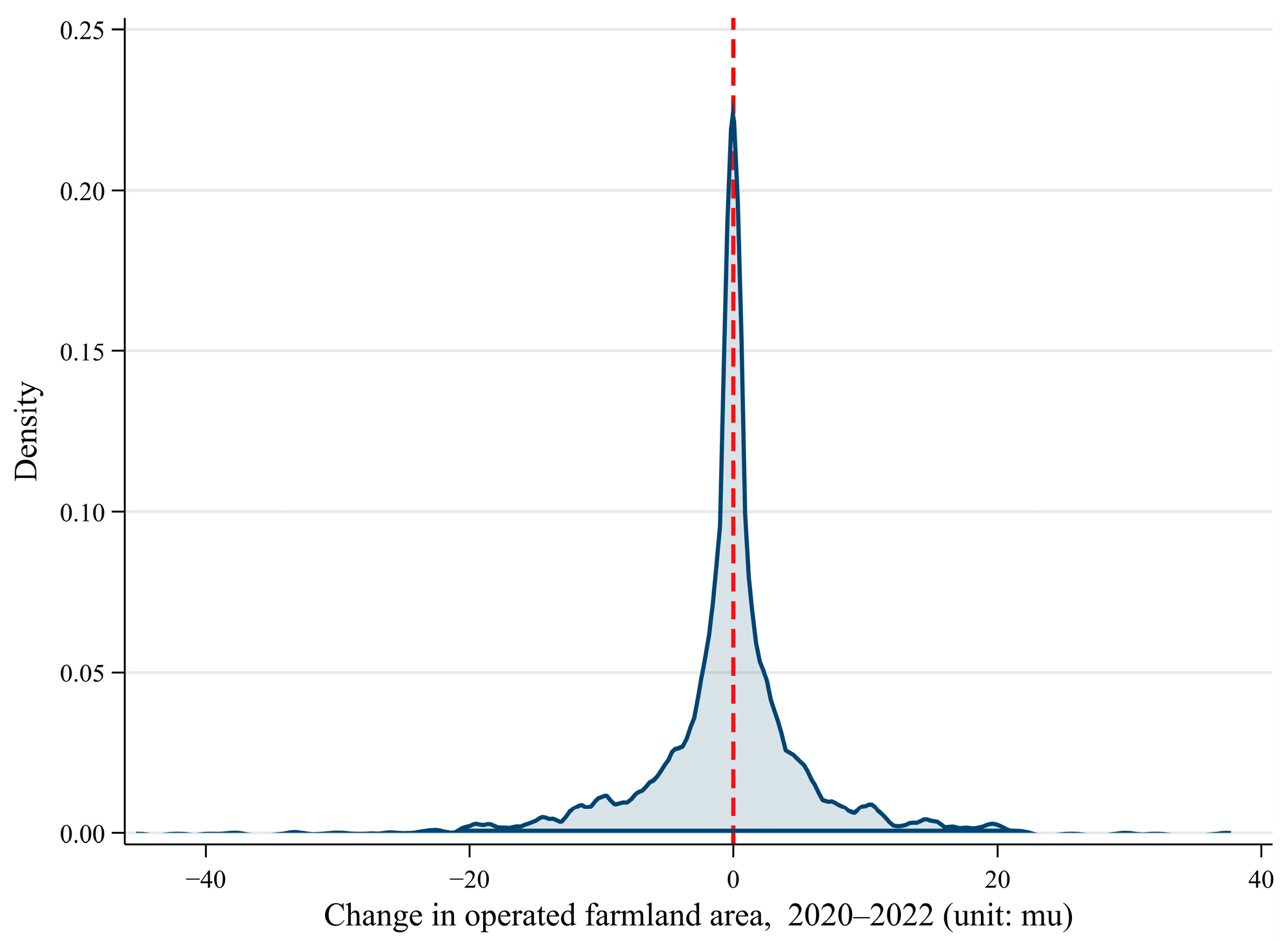
For the empirical analysis, we first identify a core sample of 1649 smallholder households that were successfully followed in both the 2020 and 2022 survey waves and had positive operated farmland area in both years. In the subsequent analysis, the number of observations may vary across models because some variables contain missing values. Observations with missing values in model-specific variables are excluded through listwise deletion. Tracking this sample shows that between 2020 and 2022, 44.4% of these households experienced a reduction in operated farmland area. The distribution of changes in operated farmland also shows a clear leftward shift (Figure 1). This suggests that continuing smallholders should not be treated as a fully stable group. Although they remained in farming, many faced shrinking land access, narrower crop allocation space, and less room for production adjustment.

3.2. Variable Descriptions

3.2.1. Dependent Variable

The dependent variable is the degree of grain-oriented adjustment in smallholders’ cropping structures, measured by the grain-sown share [28]. It is calculated as the ratio of a household’s grain-sown area to its total crop-sown area. A higher value indicates a stronger orientation toward grain crops. Compared with a binary indicator of whether a household grows grain, the grain-sown share captures more precisely how smallholders allocate their limited farmland to grain production under farm-scale expansion.

3.2.2. Core Explanatory Variable

The core explanatory variable is village-level farm-scale expansion intensity. It is measured as the share of farmland operated by scale operators in a village’s total household-contracted farmland area [38]. We use this village-level measure rather than farmers’ individual perceptions because farm-scale expansion in China mainly occurs through the transfer of land management rights from smallholders. This village-level share therefore captures the extent to which farm-scale expansion reshapes the local smallholder structure and the rural production environment.

3.2.3. Variables for Mechanism Analysis

To examine whether smallholders’ grain production is supported by modern production conditions, we use four mechanism variables. These variables capture mechanization, service-based support, and household inputs during grain production. First, the mechanization level. It is measured as the sum of mechanized-operations shares across key stages of grain production, including tillage, sowing, pesticide spraying, fertilizing, and harvesting/transportation. Second, the cost share of socialized services. This is calculated as the ratio of expenditure on agricultural socialized services to total grain production costs. Third, the share of self-owned machinery operations refers to the proportion of mechanized tasks completed with household-owned machinery in total mechanized operations. Fourth, family agricultural labor input is measured as the natural logarithm of the total hours of family labor invested in crop production.
Together, these variables describe how smallholders participate in grain production. Higher mechanization levels and a higher cost share of purchased socialized services would be consistent with stronger external service-based support in grain production. If this occurs without a marked increase in family labor input, it would suggest that smallholders may share the efficiency gains from modern agricultural services and mechanization. Conversely, if such changes are not observed, smallholders may not have benefited from the technology and service spillovers associated with farm-scale expansion.

3.2.4. Moderating Variables

The moderating variable is cooperative membership [37,39]. It equals 1 if a smallholder household has joined a cooperative, and 0 otherwise. This variable captures whether smallholders are connected to agricultural production, service, and market systems through an organizational channel. In the moderation analysis, we also examine grain production cost per unit area as an outcome variable, in order to further assess how farm-scale expansion affects production costs under different organizational conditions.

3.2.5. Control Variables

To control for observable factors that may affect both farm-scale expansion and smallholders’ cropping structure and grain production participation, we include variables at the household, village, and crop return levels. At the household level, we include family size, village political embeddedness, internet access, and health shocks [38,40]. These variables capture time-varying differences in production capacity, information access, local embeddedness, and labor constraints. At the village level, per capita net income measures local economic development [41]. We also include the provincial-level price ratio of grain to cash crops to account for changes in relative crop returns across regions and years. The model includes household fixed effects, which absorb time-invariant or stable household characteristics. Therefore, household-head variables such as education, age, and farming experience are not included. Table 1 reports variable definitions and descriptive statistics.

3.3. Model Specification

3.3.1. Baseline Model

Because the dependent variable is the household grain-sown share, the analysis focuses on smallholders with positive operated farmland in both survey years. This captures households that remained engaged in agricultural production. Using panel data, we exploit within-household variation over time and estimate a two-way fixed effects model with household and year fixed effects. Household fixed effects control for time-invariant characteristics, such as stable farming preferences, household endowments, and long-standing cropping habits. Year fixed effects capture shocks common to all households in a given year. Since households within the same village may face common village-level shocks, standard errors are clustered at the village level. The baseline model is specified as follows:
G r a i n S h a r e i v t = β S c a l e v t + γ X i v t + μ i + λ t + ε i v t
where G r a i n S h a r e i v t denotes the grain-sown share of household i in village v in year t . S c a l e v t represents the village-level farm-scale expansion intensity. X i v t is a vector of control variables. μ i denotes household fixed effects, and λ t denotes year fixed effects. ε i v t is the error term.
The coefficient β is the key parameter of interest. It captures the association between changes in village-level farm-scale expansion intensity and changes in the grain-sown share of the same household, after controlling for household fixed characteristics, year shocks, and other observable factors. A significantly positive β indicates that farm-scale expansion is associated with a higher grain-sown share among smallholders.

3.3.2. Model for Mechanism Analysis

Building on the baseline model, we further examine whether farm-scale expansion is associated with changes in the way smallholders participate in grain production. Drawing on existing studies that analyze potential mechanisms through mechanism variables [42], this section provides mechanism-related evidence rather than formal causal mediation estimates. The analysis focuses on four dimensions: mechanization level, the cost share of purchased socialized services, the share of household-owned machinery operations, and family agricultural labor input. The model is specified as follows:
M i v t k = α + β S c a l e v t + γ X i v t + μ i + λ t + ε i v t
where M i v t k denotes the k t h production input variable for household i in village v in year t . S c a l e v t represents the village-level farm-scale expansion intensity of village v . X i v t is a vector of control variables.

3.3.3. Moderating Role of Cooperative Membership

We then examine whether the association between farm-scale expansion and smallholders’ grain production conditions differs by cooperative membership. The analysis proceeds in two steps. First, we test whether farm-scale expansion is associated with cooperative membership status:
C o o p i v t = α + β S c a l e v t + γ X i v t + μ i + λ t + ε i v t
where C o o p i v t indicates whether household i is a cooperative member. S c a l e v t represents the village-level farm-scale expansion intensity. X i v t is a vector of control variables. μ i denotes household fixed effects, and λ t denotes year fixed effects.
Second, we include an interaction term between farm-scale expansion intensity and cooperative membership. The model is specified in Equation (4):
Y i v t = α + β 1 S c a l e v t + β 2 C o o p i v t + β 3 S c a l e v t × C o o p i v t + γ X i v t + μ i + λ t + ε i v t
where Y i v t denotes smallholders’ grain production conditions, including the mechanization level in grain production and grain production cost per unit area. The coefficient of the interaction term, β 3 , is the key parameter of interest in this model. It captures whether the association between farm-scale expansion and grain production conditions differs between cooperative members and non-members.

4. Empirical Results and Analysis

4.1. Impact of Farm-Scale Expansion on Smallholders’ Grain-Oriented Cropping Adjustment

4.1.1. Baseline Results

Table 2 reports the association between village-level farm-scale expansion intensity and smallholders’ grain-sown share. Column (1) presents the baseline result. After controlling for household and year fixed effects, the coefficient of farm-scale expansion intensity is positive and statistically significant. Specifically, a 0.1 increase in village-level farm-scale expansion intensity is associated with a 0.81-percentage-point increase in smallholders’ grain-sown share. This result suggests that farm-scale expansion is related not only to who operates farmland, but also to how continuing smallholders allocate their sown area. Under farm-scale expansion, smallholders who remain in farming tend to allocate a higher share of their sown area to grain crops, rather than shifting further toward non-grain crops. This finding raises a further question: whether this grain-oriented adjustment is accompanied by improved production conditions.

4.1.2. Robustness Checks

To ensure that the finding is not driven by a particular model specification, we conduct a series of robustness checks. First, because the dependent variable is a proportion bounded between 0 and 1, we re-estimate the model using a panel fractional logit specification. As reported in Column (2) of Table 2, the coefficient remains positive and statistically significant. Second, to test whether the results are sensitive to within-region error correlation, we cluster standard errors at the prefecture level. The result in Column (3) remains similar. Third, to check whether the results depend on how farm-scale expansion is measured, we replace the core explanatory variable with the logarithm of village-level farm-scale operation area. As shown in Column (4), the coefficient remains positive and significant.

4.1.3. Endogeneity Test

To mitigate potential endogeneity concerns, this study employs an instrumental variable (IV) approach (Table 2, Column 5). Following existing studies [41,43], the IV is constructed as the average farm-scale expansion intensity of other villages within the same prefecture, excluding the focal village. Villages within the same prefecture share land-transfer markets and agricultural environments, so expansion in other villages can predict that in the focal village. The first-stage results confirm this relevance, with a strong correlation (F-statistic = 386.46). To reduce the influence of common regional factors, the model controls for household characteristics and agricultural conditions, and includes household and year fixed effects. The second-stage results show that the coefficient of farm-scale expansion intensity remains positive and significant, consistent with the baseline findings.

4.2. Characterizing Grain-Oriented Adjustment Through Production Inputs

A higher grain-sown share does not necessarily imply that smallholders participate in grain production in a more efficient or sustainable manner. Rather than explaining the entire process of crop switching, this section examines whether the observed grain-oriented adjustment is accompanied by improved production conditions. To do so, we estimate regressions using four production-input indicators, with the results reported in Table 3.
We first examine changes in external service support. Column (1) shows that farm-scale expansion is negatively associated with the cost share of purchased agricultural socialized services in grain production. Column (2) shows a significant negative association with mechanization level. Together, these results provide no evidence of stronger external service support. Columns (3) and (4) turn to household-based inputs. Column (3) shows a positive association with the share of self-owned machinery operations. Column (4) shows a positive association with family agricultural labor input. This pattern is consistent with greater reliance on household machinery and family labor when external support is limited.
Overall, greater participation in grain production does not necessarily mean that smallholders benefit from the efficiency gains associated with the diffusion of modern agricultural services. A more cautious interpretation is that the grain-oriented adjustment observed here is accompanied by weaker external service support and greater reliance on household-based inputs, making it closer to a constrained grain-oriented adjustment. Rather than reflecting an efficiency-enhancing integration into modern agriculture, it appears to be an adaptive strategy through which smallholders maintain grain production under constrained production conditions.

4.3. Heterogeneity Analysis: Which Smallholders Become More Grain-Oriented?

Farm-scale expansion does not lead all smallholders to adjust their cropping patterns in the same way. To examine these differences, we divide the sample by the median values of operated farmland area, land fragmentation, and household livelihood endowments, using households’ 2020 baseline characteristics. We use subgroup regressions to capture heterogeneous responses across different types of smallholders [38], providing a clearer view of how farm-scale expansion relates to cropping pattern adjustment under different conditions.
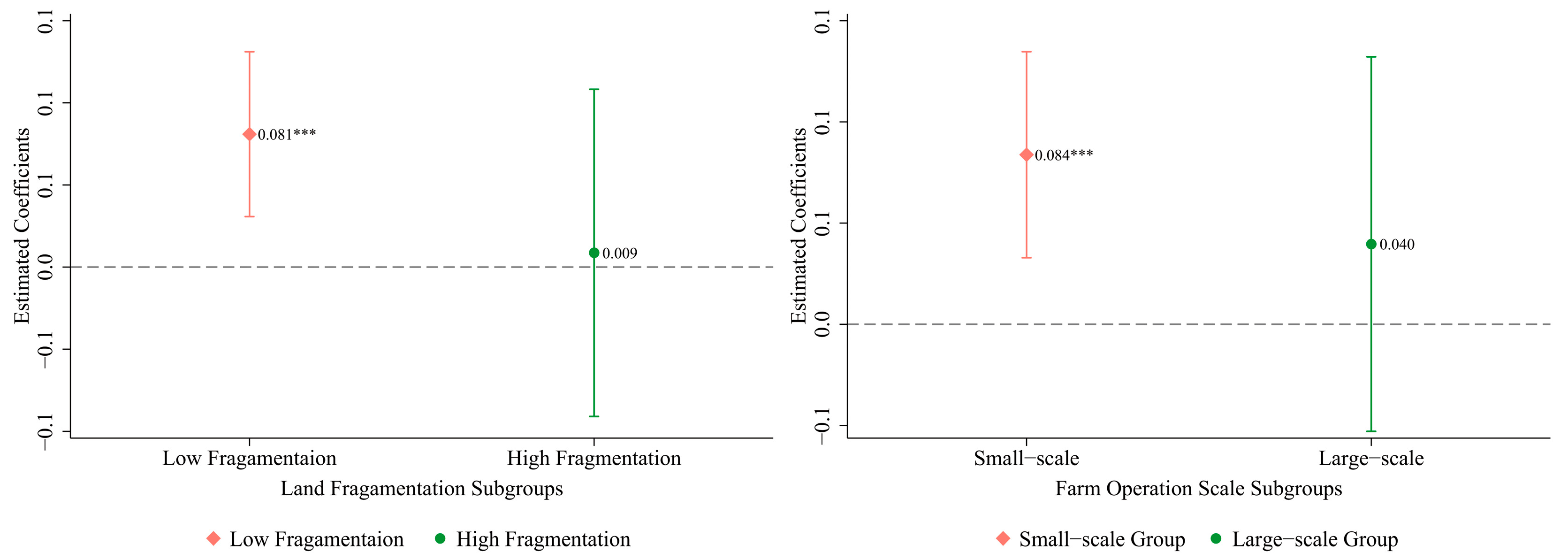
Figure 2 plots the grouped regression results by land resource characteristics. The estimates show that the positive association between farm-scale expansion and grain-sown share is mainly observed among households with smaller operated farmland areas and lower levels of land fragmentation. In contrast, the coefficients are not statistically significant among households with larger operated areas or highly fragmented plots. One possible explanation is that highly fragmented plots constrain production by limiting mechanized operations and reducing room for crop reallocation. By comparison, households with smaller operated areas but less fragmented plots lack scale advantages but retain some operational flexibility. This may explain why grain-oriented adjustment appears more evident in this subgroup.
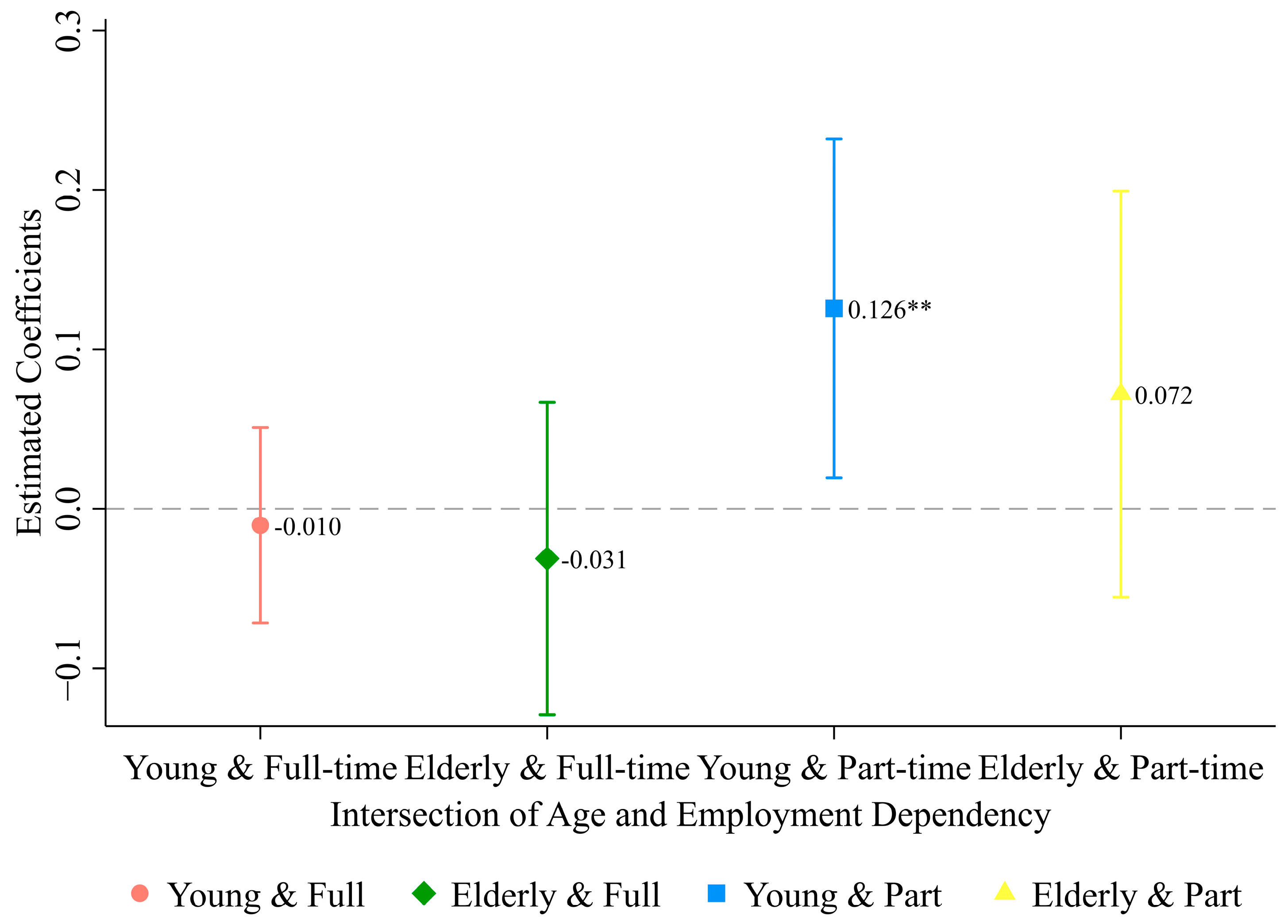
We further consider household life cycles and livelihood structures. By combining age structure with off-farm employment, we classify smallholders into four groups: elderly full-time farmers, young full-time farmers, elderly part-time farmers, and young part-time farmers. Figure 3 shows the grouped regression results. The positive association between farm-scale expansion and grain-sown share is mainly observed among young part-time farmers, while the coefficients for the other three groups are not statistically significant. This pattern suggests that grain-oriented adjustment is less evident among households fully dependent on farming or elderly households with weaker labor capacity. Instead, it appears more pronounced among households that still have labor capacity while allocating part of their labor to off-farm work. For these households, grain production may be easier to combine with land retention, livelihood security, and part-time employment.
The heterogeneity results further help interpret the nature of grain-oriented adjustment. The results do not point to a general expansion among scale-advantaged households or a uniform response among all resource-constrained households. Rather, grain-oriented adjustment appears more evident among smallholders who retain some room for production adjustment but still face constraints in choosing high-input or service-dependent farming practices. This pattern is consistent with the production input results above. Taken together, these findings suggest that, under farm-scale expansion, a stronger orientation toward grain is more closely related to household livelihood adjustment under constrained production conditions. It is less likely to reflect clear efficiency gains from modern service spillovers.

4.4. Moderating Effect of Cooperative Membership

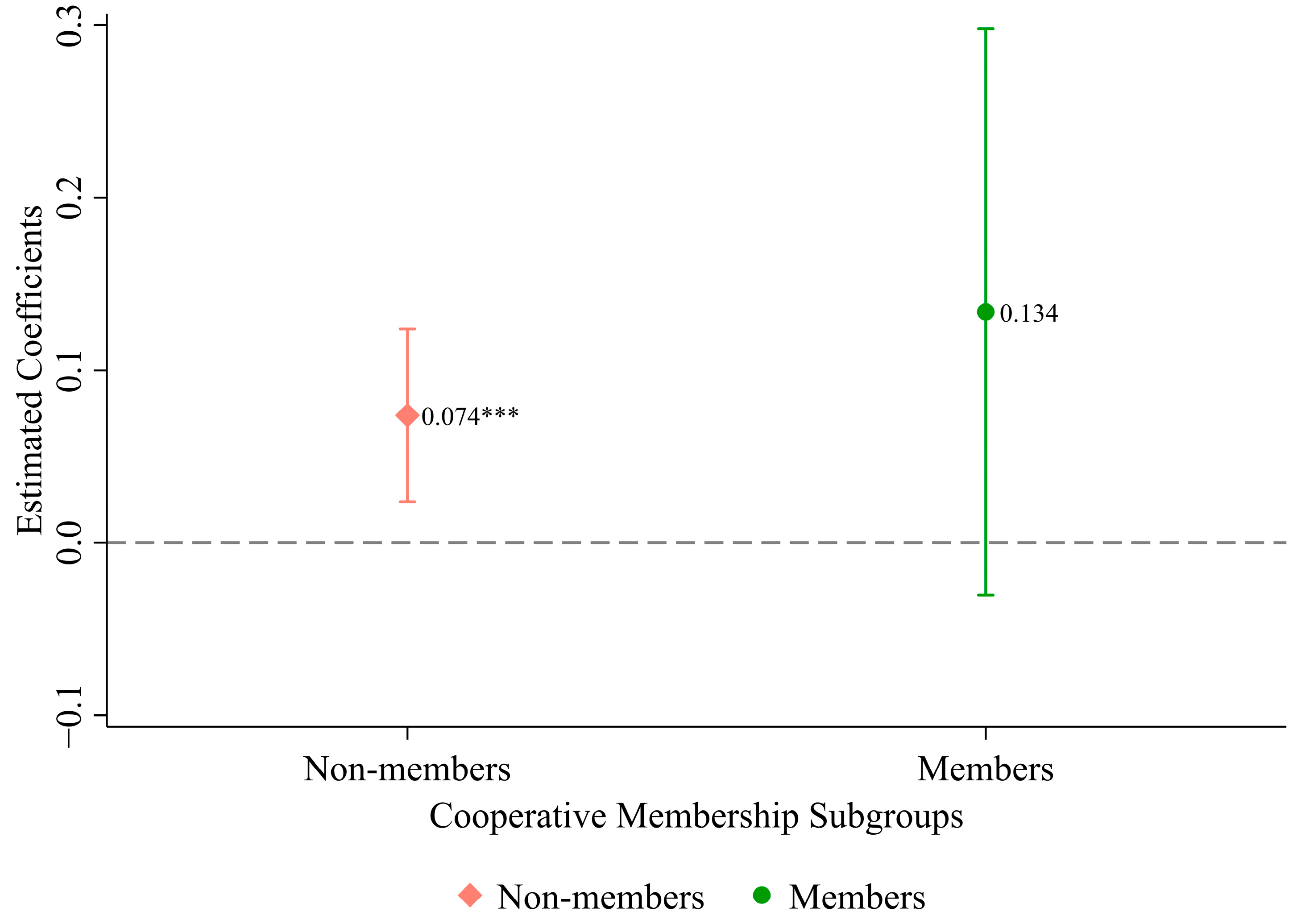
The preceding results suggest that farm-scale expansion is associated with a pattern consistent with constrained grain-oriented adjustment among smallholders. This section further examines whether this pattern and smallholders’ grain production conditions differ by cooperative membership. We first conduct separate regressions for cooperative members and non-members. As shown in Figure 4, village-level farm-scale expansion intensity is positively and significantly associated with grain-sown share among households that do not belong to cooperatives. In contrast, this association is not statistically significant among cooperative members. This suggests that cooperatives, as an organizational channel, may help ease members’ difficulties in accessing external services and coordinating production. Accordingly, their cropping adjustments do not exhibit the same pronounced grain-oriented response observed among non-members.
We next estimate interaction models to further examine the moderating role of cooperative membership. Column (1) of Table 4 shows that village-level farm-scale expansion intensity is positively associated with the likelihood of being a cooperative member. Column (2) shows a negative association between farm-scale expansion intensity and mechanization in smallholders’ grain production. The interaction term between farm-scale expansion intensity and cooperative membership is positive and statistically significant. This suggests that the negative association between farm-scale expansion and mechanization is weaker among cooperative members. Column (3) reports the moderating result for grain production costs per unit area. The coefficient of village-level farm-scale expansion intensity is significantly positive, whereas the interaction term is significantly negative. This indicates that cooperative membership partly offsets the cost-increasing effect of farm-scale expansion on grain production. Overall, cooperatives do not eliminate the changes in production conditions associated with farm-scale expansion. However, cooperative members appear to face less severe changes in mechanization support and production costs. This pattern may reflect stronger organizational linkages or better access to production services among cooperative members.

5. Discussion

In the mainstream view of agricultural modernization, farm-scale expansion is often expected to improve resource allocation, promote agricultural services, and help smallholders engage with modern agriculture. A key assumption is that better access to mechanization and production services will gradually reach smallholders as larger farms expand. Our findings suggest a more complex picture. Farm-scale expansion is associated with a higher grain-sown share among smallholders, but it does not appear to improve their grain production conditions. Mechanization levels and the use of agricultural services do not increase accordingly. Instead, smallholders rely more on their own household resources to sustain grain production. These results suggest that a stronger grain orientation under farm-scale expansion does not necessarily reflect deeper integration into modern agricultural production.
We interpret this pattern as constrained grain-oriented adjustment. It captures the main finding: smallholders increase their grain-sown share, but production conditions improve little. “Constrained” contrasts with efficiency-enhancing adjustment, indicating that grain production is not supported by higher mechanization or stronger external services. Compared with explanations based on risk avoidance or livelihood security, this term more precisely describes the coexistence of grain-oriented choices and constrained production conditions under farm-scale expansion. A higher grain-sown share does not imply stronger farming capacity. When operating boundaries are limited and external support is weak, grain becomes a more manageable option. Compared with cash crops or service-intensive farming, grain production is more standardized and involves more controllable risks. The heterogeneity results support this interpretation. Grain-oriented adjustment is more evident among households with greater flexibility, especially younger part-time farmers and those with less fragmented land. For these households, farming helps maintain land use, provide security, and supplement livelihoods, but is not the main income source. Grain production is therefore easier to combine with off-farm work and broader livelihood strategies.
If farm-scale expansion is associated with constrained grain-oriented adjustment, the implications are twofold. From a national food security perspective, a higher grain-sown share among continuing smallholders helps stabilize the grain cultivation base [44]. However, this effect is not uniform across regions and production systems [45]. In major grain-producing areas, it typically reflects sustained land use for grain production, directly supporting output and supply stability. In contrast, in cash-crop-oriented or peri-urban systems, demand for cash crops is often stronger. In such contexts, this type of adjustment is more likely to be driven by risk avoidance or livelihood considerations [46]. It may disrupt existing production structures and has limited contribution to enhancing grain production capacity [47]. At the household level, this adjustment means more family labor and greater use of self-owned machinery, but it does not necessarily improve production capacity. Existing studies show that agricultural socialized services can help smallholders connect with modern agriculture [48]. However, our results suggest that these benefits do not reach all smallholders under farm-scale expansion. The burden on households depends on local conditions and service availability. Plot characteristics and service market development affect smallholders’ access to mechanization and their production choices [49]. Therefore, a higher grain-sown share does not mean that smallholders are “planting grain better,” nor that they are integrated into modern agriculture in a stable and efficient way. A tension may still exist between national food security goals and the sustainability of smallholder production and livelihoods.
This tension is not unique to China, but speaks to a broader challenge in agricultural modernization across the Global South. International evidence shows that farm consolidation, commercialization, and value-chain integration do not automatically improve smallholders’ production conditions [35,50,51]. Whether smallholders benefit depends on their access to mechanization, services, markets, credit, and organizational support [20,52]. Our findings add to this debate by showing that smallholders may continue farming and become more grain-oriented, but this adjustment is not necessarily efficiency-enhancing. Instead, it may reflect an adaptive response under constrained production conditions. At the same time, the Chinese case has its own institutional basis. Stable land contract rights allow farmland to function not only as a production asset, but also as a source of household security. This may help explain why smallholders continue to participate in farming even when production conditions do not improve substantially.
If stable land rights help explain why smallholders continue farming, the next question is how their continued participation can become less constrained. This brings organizational channels to the foreground. The results show that cooperative membership is associated with lower pressure in mechanization and lower grain production costs per unit area. This suggests that cooperatives may help buffer the limited external support faced by smallholders through organized services, resource coordination, and cost sharing. Cooperatives do not eliminate the changes in production conditions associated with farm-scale expansion. However, they appear to reshape how these changes affect member households. From this perspective, farm-scale expansion should not be evaluated solely by the growth of operational scale or a higher grain-sown share. Equally important is whether it can support a more inclusive form of agricultural modernization and enable smallholders to participate in agricultural production in a more efficient and sustainable way.

6. Conclusions, Policy Recommendations, and Limitations

6.1. Conclusions

Using panel data from the China Rural Revitalization Survey (CRRS) for 2020 and 2022, this study examines how village-level farm-scale expansion influences smallholders’ grain-sown share and their production conditions. The results show that greater farm-scale expansion at the village level is associated with a higher grain-sown share among smallholders. However, this shift toward grain production does not appear to reflect more efficient participation in grain farming. Farm-scale expansion is linked to lower levels of mechanization and a smaller share of spending on purchased agricultural services. At the same time, smallholders rely more on their own machinery and devote more family labor to agricultural production. These findings suggest that a higher grain-sown share does not necessarily mean that smallholders benefit from the efficiency gains associated with modern agricultural services and mechanization. We interpret this pattern as constrained grain-oriented adjustment, which refers to a situation in which smallholders continue grain production under limited external support and greater reliance on household resources.
The heterogeneity analysis shows that this adjustment is most evident among households with smaller farm sizes, lower land fragmentation, and younger part-time farmers. Cooperative membership also matters. Smallholders who belong to cooperatives face less pressure in mechanization and grain production costs per unit of land. Overall, a higher grain-sown share under farm-scale expansion does not necessarily mean that smallholders are producing grain under better conditions. The implications of farm-scale expansion for sustainable agricultural transformation should therefore be assessed from a broader perspective. Beyond changes in farm size or grain-sown share, attention should also be paid to whether the conditions under which smallholders participate in grain production have actually improved.

6.2. Policy Recommendations

Based on these findings, this study proposes three policy implications.
First, agricultural services for smallholders may need to better adapt to their production conditions. For part-time households, service provision could be more flexible so that mechanized operations and production trusteeship better match their farming schedules and off-farm work. For smallholders with small or fragmented plots, coordinated service arrangements may improve service coordination and timeliness, such as village-level booking, area-based operations, and machinery scheduling.
Second, cooperatives may play a more important organizational role in smallholder grain production. The results on cooperative membership suggest that cooperatives can help ease production constraints by pooling service demand and coordinating mechanized operations. Policy efforts could therefore focus on whether cooperative services can consistently and effectively reach ordinary smallholders.
Third, when promoting farm-scale expansion, policy design could pay more attention to how it connects with shared service systems for smallholders. Where possible, support for scale operators, such as subsidies or project funding, could be tied to their provision of machinery services and production support for nearby smallholders. This could increase the chances that farm-scale expansion not only leads to more concentrated land operations, but also improves the conditions under which smallholders continue to participate in grain production.

6.3. Limitations

Despite its contributions, this study has two main limitations. First, it uses only two waves of panel data from 2020 and 2022, so it captures short-term relationships rather than long-term dynamics between farm-scale expansion and smallholder grain production. Therefore, the policy implications should be understood as inferences based on short-term observations, rather than as evidence of whether these policies can produce sustained effects over time. Second, the characterization of constrained grain-oriented adjustment is based on observed combinations of production processes and input structures. This concept is better viewed as an interpretive summary, rather than a directly tested causal mechanism. In addition, residual endogeneity may still remain despite the use of fixed effects and robustness checks, and some self-reported input variables may contain measurement error. The findings should also be generalized with caution beyond China’s institutional context, especially where land tenure and agricultural service systems differ. Future research should examine the persistence of this pattern, its mechanisms, and its variation across contexts.

Author Contributions

J.L.: conceptualization, resources and supervision, writing—original draft. Z.S.: writing—original draft, data curation, methodology, formal analysis, revision preparation. Z.X.: formal analysis, review and editing. All authors have read and agreed to the published version of the manuscript.

Funding

This research was funded by the National Social Science Fund of China, grant No. 23BZZ066.

Data Availability Statement

This study draws on data from the Comprehensive Survey on Rural Revitalization and China Rural Revitalization Survey (CRRS) Database (Project Numbers: GQDC2020017; GQDC2022020; 2024ZDDC001), a major economic and social investigation project funded by the Chinese Academy of Social Sciences. The analysis uses the 2020 and 2022 waves of the CRRS data. According to the data usage policy, the CRRS dataset can be accessed through an official application on the project website (source: https://183.242.252.238:8081/home (accessed on 2 May 2026)). However, redistribution or sharing of the dataset is prohibited under the data use agreement, and therefore, the data cannot be made publicly available.

Conflicts of Interest

The authors declare no conflicts of interest.

References

  1. Qian, W.; Li, D.; Shi, X. Competitive or Crowding-out? Estimating Spillover Effects from Large-scale Farms on Smallholders in China. Agric. Econ. 2025, 56, 27–44. [Google Scholar] [CrossRef]
  2. Rogers, S.; Wilmsen, B.; Han, X.; Wang, Z.J.-H.; Duan, Y.; He, J.; Li, J.; Lin, W.; Wong, C. Scaling up Agriculture? The Dynamics of Land Transfer in Inland China. World Dev. 2021, 146, 105563. [Google Scholar] [CrossRef]
  3. Bu, D.; Liao, Y. Land Property Rights and Rural Enterprise Growth: Evidence from Land Titling Reform in China. J. Dev. Econ. 2022, 157, 102853. [Google Scholar] [CrossRef]
  4. Zhang, Q.F.; Wu, M. The Decline and Transformation of Smallholders in Chinese Agriculture: National Trends. J. Peasant Stud. 2025, 52, 485–512. [Google Scholar] [CrossRef]
  5. Dong, H.; Zhang, Y.; Sun, Y.; Jiang, T. To Keep or Not to Keep the Farmland? Incentives and Barriers to Farmers’ Decisions in Urbanizing China. Habitat Int. 2022, 130, 102693. [Google Scholar] [CrossRef]
  6. Zhou, Z.; Tan, L.; Qu, L.; Li, Y.; Chen, X. The Impact of Rural Land Transfer on the Living Satisfaction of Middle-Aged Rural Residents and the Implications: A Perspective of Land Attachment. Habitat Int. 2024, 148, 103085. [Google Scholar] [CrossRef]
  7. Duflo, E.; Keniston, D.; Suri, T.; Zipfel, C. Chat over Coffee? Diffusion of Agronomic Practices and Market Spillovers in Rwanda. J. Dev. Econ. 2026, 182, 103733. [Google Scholar] [CrossRef]
  8. Zhang, P.; Lu, H.; Geng, X.; Chen, Y. How Do Outsourcing Services Affect Agricultural Eco-Efficiency? Perspectives from Farmland Scale and Technology Substitution. J. Environ. Plan. Manag. 2025, 68, 338–362. [Google Scholar] [CrossRef]
  9. Zhang, Q.F.; Zeng, H. Politically Directed Accumulation in Rural China: The Making of the Agrarian Capitalist Class and the New Agrarian Question of Capital. J. Agrar. Change 2021, 21, 677–701. [Google Scholar] [CrossRef]
  10. Qian, L.; Lu, H.; Gao, Q.; Lu, H. Household-Owned Farm Machinery vs. Outsourced Machinery Services: The Impact of Agricultural Mechanization on the Land Leasing Behavior of Relatively Large-Scale Farmers in China. Land Use Policy 2022, 115, 106008. [Google Scholar] [CrossRef]
  11. Xu, C.; Li, X.; Cai, A.; Zhu, J. Can Rural-Urban Migration Benefit Sustainable Agriculture with Large-Scale Farming? Humanit. Soc. Sci. Commun. 2026, 13, 551. [Google Scholar] [CrossRef]
  12. Yang, S.; Jiang, G.; Yu, H. Has Rural Depopulation Reduced Agricultural Land Use Efficiency? Mediating Roles of Cropland Abandonment, Scale Operation, and Cultivation Structure. Land Use Policy 2025, 159, 107821. [Google Scholar] [CrossRef]
  13. Yin, G.; You, Y.; Han, X.; Chen, D. The Effect of Agricultural Scale Management on Farmers’ Income from a Dual-Scale Perspective: Evidence from Rural China. Int. Rev. Econ. Financ. 2024, 94, 103372. [Google Scholar] [CrossRef]
  14. Zhong, Z.; Jiang, W.; Yang, S. Does Agricultural Outsourcing Improve Technical Efficiency? Evidence from Farms of Various Scales in China. J. Rural Stud. 2025, 117, 103650. [Google Scholar] [CrossRef]
  15. Peng, Y.; Guo, J.; Liu, Y.; Liao, L.; Jiang, S.; Tang, Y. Will Land Transfer Improve Grain Farmers’ Adoption of Agricultural Green Production Technology? Evidence from Jiangxi Province, China. Humanit. Soc. Sci. Commun. 2025, 12, 466–478. [Google Scholar] [CrossRef]
  16. Chen, M.; Lu, H.; Xu, D. “Absorbing in” or “Crowding out”: The Impact of High-Standard Farmland Construction on Farmers’ Land Withdrawal. Land Use Policy 2025, 157, 107661. [Google Scholar] [CrossRef]
  17. Xu, W.; Gao, M.; Fan, S.; Zhu, C. Impacts of High-Standard Farmland Construction on Farmers’ Income in China: A Comparative Analysis of Moderate-Scale Farmers and Smallholders. Food Policy 2026, 138, 102994. [Google Scholar] [CrossRef]
  18. Woods, K.M. Smaller-Scale Land Grabs and Accumulation from below: Violence, Coercion and Consent in Spatially Uneven Agrarian Change in Shan State, Myanmar. World Dev. 2020, 127, 104780. [Google Scholar] [CrossRef]
  19. Cousins, B. Smallholder Irrigation Schemes, Agrarian Reform and “accumulation from above and from below” in South Africa. J. Agrar. Chang. 2013, 13, 116–139. [Google Scholar] [CrossRef]
  20. Borras, S.M., Jr.; Franco, J.C. Global Land Grabbing and Trajectories of Agrarian Change: A Preliminary Analysis. J. Agrar. Change 2012, 12, 34–59. [Google Scholar] [CrossRef]
  21. Akram-Lodhi, A.H.; Kay, C. Surveying the Agrarian Question (Part 1): Unearthing Foundations, Exploring Diversity. J. Peasant Stud. 2010, 37, 177–202. [Google Scholar] [CrossRef]
  22. Akram-Lodhi, A.H.; Kay, C. Surveying the Agrarian Question (Part 2): Current Debates and Beyond. J. Peasant Stud. 2010, 37, 255–284. [Google Scholar] [CrossRef]
  23. Han, W.; Zhang, Z.; Zhang, X. The Impact of Farmland Transfer Participation on Farmers’ Livelihood Choices—An Empirical Study of the Effectiveness of the 2014 Three Property Rights Separation Reform. China Agric. Econ. Rev. 2023, 15, 534–562. [Google Scholar] [CrossRef]
  24. Millar, J.R. A Reformulation of A. V. Chayanov’s Theory of the Peasant Economy. Econ. Dev. Cult. Change 1970, 18, 219–229. [Google Scholar] [CrossRef] [PubMed]
  25. Scott, J.C. The Moral Economy of the Peasant: Rebellion and Subsistence in Southeast Asia; Yale University Press: New Haven, CT, USA, 2000; ISBN 978-0-300-02190-5. [Google Scholar]
  26. Xu, Z.; Liang, Z.; Cheng, J.; Groot, J.C.J.; Zhang, C.; Cong, W.-F.; Zhang, F.; Van Der Werf, W. Comparing the Sustainability of Smallholder and Business Farms in the North China Plain; a Case Study in Quzhou. Agric. Syst. 2024, 216, 103896. [Google Scholar] [CrossRef]
  27. Zhang, T. Why Are Chinese Small Farmers Planting More Grain Crops?—Review of the Logic of Grain Planting (2018). China Agric. Econ. Rev. 2019, 12, 173–175. [Google Scholar] [CrossRef]
  28. Qiu, T. What Leads to a “Tendency to Plant Grains” inAgricultural Planting Structure? An Empirical Analysis Based on the Impact Factors of Land Property Rights and Factors Allocation. Chin. Rural Econ. 2018, 2, 65–80. (In Chinese) [Google Scholar] [CrossRef]
  29. Wang, J.; Yuan, Z.; Wu, Z.; Kuang, X.; Ye, F. Insurance Policy and Cropping Structure Adjustment toward Staple Grains in China: Implications for Food System Resilience and Security. Front. Nutr. 2025, 12, 1636296. [Google Scholar] [CrossRef] [PubMed]
  30. Wang, Y.; Li, X.; Lu, D.; Yan, J. Evaluating the Impact of Land Fragmentation on the Cost of Agricultural Operation in the Southwest Mountainous Areas of China. Land Use Policy 2020, 99, 105099. [Google Scholar] [CrossRef]
  31. Wang, X.; Yamauchi, F.; Huang, J.; Rozelle, S. What Constrains Mechanization in Chinese Agriculture? Role of Farm Size and Fragmentation. China Econ. Rev. 2020, 62, 101221. [Google Scholar] [CrossRef]
  32. Liu, Y.; Heerink, N.; Li, F.; Shi, X. Do Agricultural Machinery Services Promote Village Farmland Rental Markets? Theory and Evidence from a Case Study in the North China Plain. Land Use Policy 2022, 122, 106388. [Google Scholar] [CrossRef]
  33. Xu, M.; Chen, C.; Ahmed, M.A. Market-Oriented Farmland Transfer and Outsourced Machinery Services: Evidence from China. Econ. Anal. Policy 2024, 81, 1214–1226. [Google Scholar] [CrossRef]
  34. Zhong, Z.; Jiang, W.; Li, Y. Bridging the Gap between Smallholders and Modern Agriculture: Full Insight into China’s Agricultural Cooperatives. J. Rural Stud. 2023, 101, 103037. [Google Scholar] [CrossRef]
  35. Bizikova, L.; Nkonya, E.; Minah, M.; Hanisch, M.; Turaga, R.M.R.; Speranza, C.I.; Karthikeyan, M.; Tang, L.; Ghezzi-Kopel, K.; Kelly, J.; et al. A Scoping Review of the Contributions of Farmers’ Organizations to Smallholder Agriculture. Nat. Food 2020, 1, 621–630. [Google Scholar] [CrossRef] [PubMed]
  36. Chen, C.; Gan, C.; Li, J.; Lu, Y.; Rahut, D. Linking Farmers to Markets: Does Cooperative Membership Facilitate e-Commerce Adoption and Income Growth in Rural China? Econ. Anal. Policy 2023, 80, 1155–1170. [Google Scholar] [CrossRef]
  37. He, Y.; Chen, Y. The Impact of Agricultural Cooperatives on Farmers’ Agricultural Revenue: Evidence from Rural China. Sustainability 2024, 16, 10979. [Google Scholar] [CrossRef]
  38. Zheng, L. Big Hands Holding Small Hands: The Role of New Agricultural Operating Entities in Farmland Abandonment. Food Policy 2024, 123, 102605. [Google Scholar] [CrossRef]
  39. Liu, Y.; Garnevska, E.; Shadbolt, N. The Role of Agriculture Cooperatives in Green Agri-Food Value Chains in China: Cases in Shandong Province. Sustainability 2025, 17, 7343. [Google Scholar] [CrossRef]
  40. Chen, M.; Han, Q.; Zhang, C.; Chen, J. Valuing the Effect of Capital Goes to Countryside on Cropland Abandonment: Evidence from Rural China. Habitat Int. 2025, 156, 103299. [Google Scholar] [CrossRef]
  41. Xu, D.; Chen, M.; Li, R. How High-Standard Farmland Construction Can Affect Farmers’ Grain Cultivation Behavior: Evidence from Rural China. Habitat Int. 2025, 160, 103384. [Google Scholar] [CrossRef]
  42. Li, Y.; Cui, B. Will Joining Cooperatives Aggravate “Non-grain” of Farmland?—On the Balance between Increasing Grain Production and Farmers’ Income. Economist 2025, 7, 108–117. (In Chinese) [Google Scholar] [CrossRef]
  43. Zhu, Y.; Liu, N.; Li, Y.; Han, Y. The Double-Edged Impact of e-Commerce Participation on Farm’s Income: Evidence from China. World Dev. 2026, 204, 107399. [Google Scholar] [CrossRef]
  44. Cheng, P.; Zhang, Y.; Liu, K.; Kong, X.; Wu, S.; Yan, H.; Jiang, P. Continuing the Continuous Harvests of Food Production: From the Perspective of the Interrelationships among Cultivated Land Quantity, Quality, and Grain Yield. Humanit. Soc. Sci. Commun. 2025, 12, 46. [Google Scholar] [CrossRef]
  45. Zhou, J.; Fu, M. Degree of Non-Grain Production of Cultivated Land and Its Impact on Grain Production in China: Analysis of 2481 County-Level Units. Land Use Policy 2025, 155, 107586. [Google Scholar] [CrossRef]
  46. Huang, D.; Lu, Y.; Liu, Y.; Liu, Y.; Tong, Z.; Xing, L.; Dou, C. Multifunctional Evaluation and Multiscenario Regulation of Non-Grain Farmlands from the Grain Security Perspective: Evidence from the Wuhan Metropolitan Area, China. Land Use Policy 2024, 146, 107322. [Google Scholar] [CrossRef]
  47. Pan, C.; Min, S.; Waibel, H. How Does Agricultural Transformation Affect the Household Food Self-Sufficiency of Smallholders in the Upper Mekong Region, Southwest China? Food Secur. 2025, 17, 231–255. [Google Scholar] [CrossRef]
  48. Zou, B.; Mishra, A.K. Modernizing Smallholder Agriculture and Achieving Food Security: An Exploration in Machinery Services and Labor Reallocation in China. Appl. Econ. Perspect. Policy 2024, 46, 1662–1691. [Google Scholar] [CrossRef]
  49. Cai, B.; Wangda, L.; Shi, F.; Abate, M.C.; Geremew, B.; Addis, A.K. Agricultural Socialized Services and Chinese Food Security: Examining the Threshold Effect of Land Tenure Change. Front. Sustain. Food Syst. 2024, 8, 1371520. [Google Scholar] [CrossRef]
  50. Abdulwahid, N.; Bakari, L.; Hussein, A.; Kawa, S.K.; Lavoe, F.; Mwisomba, T.; Msuha, B.; Wineman, A. Spillover Effects of Medium- and Large-Scale Farms on Smallholder Farmers in Tanzania: Evidence from the National Sample Census of Agriculture 2019/20. World Dev. Perspect. 2024, 34, 100590. [Google Scholar] [CrossRef]
  51. Lowder, S.K.; Sánchez, M.V.; Bertini, R. Which Farms Feed the World and Has Farmland Become More Concentrated? World Dev. 2021, 142, 105455. [Google Scholar] [CrossRef]
  52. McCarthy, J.F. Processes of Inclusion and Adverse Incorporation: Oil Palm and Agrarian Change in Sumatra, Indonesia. J. Peasant Stud. 2010, 37, 821–850. [Google Scholar] [CrossRef] [PubMed]
Figure 1. Kernel density of changes in operated farmland area among continuing smallholders.
Sustainability 18 06874 g001
Figure 2. Subgroup estimates by operated farmland area and land fragmentation. Note: *** indicate statistical significance at 1%, 5%, and 10%, respectively.
Sustainability 18 06874 g002
Figure 3. Subgroup estimates by age structure and non-farm employment combinations among smallholders. Note: ** indicate statistical significance at 1%, 5%, and 10%, respectively. Following the Third National Agricultural Census of China, individuals aged 55 and above are classified as elderly labor.
Sustainability 18 06874 g003
Figure 4. Subgroup estimates by cooperative membership. Note: *** indicate statistical significance at 1%, 5%, and 10%, respectively.
Sustainability 18 06874 g004
Table 1. Variables and descriptive statistics.
Variable TypeVariable NameDescriptionMeanSD
Dependent variableGrain-sown shareRatio of a household’s grain-sown area to its total crop-sown area0.7530.360
Core explanatory variablesFarm-scale expansion intensityShare of village household-contracted farmland operated by scale operators0.2180.292
Mechanism variablesMechanization level in grain productionSum of mechanized-operation shares across five key grain production stages: tillage, sowing, pesticide spraying, fertilization, and harvesting/transportation1.5381.496
Cost share of purchased socialized servicesExpenditure on agricultural socialized services as a share of total grain production costs0.2170.747
Share of self-owned machinery operationsShare of self-owned machinery operations: Ratio of summed household-owned machinery-operation shares to summed mechanized-operation shares across the same five stages0.1860.280
Family agricultural labor inputNatural logarithm of total household labor time spent on crop production5.2531.054
Moderating VariablesCooperative membershipWhether the household has joined a cooperative: 1 = yes, 0 = no0.2010.401
Grain production cost per unit areaSum of per-mu costs across five grain production stages (tillage, sowing, pesticide spraying, fertilization, harvesting/transportation), used in logarithmic form in the analysis.0.0430.193
Control variablesFamily sizeNumber of household members4.2131.704
Village political embeddednessWhether the household head holds a village office: 1 = yes, 0 = no0.2360.424
Internet accessWhether the household owns an internet-enabled device: 1 = yes, 0 = no0.9210.269
Health shockWhether any household member is reported to be in poor or very poor health relative to peers of the same age: 1 = yes, 0 = no0.2770.448
Village income levelNatural logarithm of village per capita net income9.4080.574
Relative crop returnsRatio of provincial grain crop prices to cash crop prices1.0580.037
Note: Except for relative crop returns, all variables are drawn from the CRRS. Relative crop returns are calculated from the China Yearbook of Agricultural Product Price Survey.
Table 2. Baseline regression results.
VariableDependent Variables: Grain-Sown Share
(1)(2)(3)(4)(5)
Farm-scale expansion intensity0.081 ***
(0.023)
1.012 ***
(0.162)
0.081 ***
(0.030)
0.098 **
(0.047)
Ln(farm-scale operation area) 0.023 ***
(0.005)
Family size−0.003
(0.006)
−0.058 **
(0.024)
−0.003
(0.007)
−0.003
(0.006)
−0.003
(0.006)
Village political embeddedness0.006
(0.022)
−0.129
(0.093)
0.006
(0.022)
0.007
(0.022)
0.006
(0.021)
Internet access0.002
(0.028)
−0.093
(0.148)
0.002
(0.029)
0.001
(0.028)
0.001
(0.028)
Health shock0.029 *
(0.015)
0.112
(0.084)
0.029 *
(0.015)
−0.030 **
(0.015)
0.028 *
(0.015)
Ln(Income level)−0.005
(0.010)
−0.877 ***
(0.107)
−0.005
(0.015)
−0.005
(0.010)
−0.006
(0.010)
Relative crop returns−0.104 ***
(0.040)
1.202 ***
(0.268)
−0.103 *
(0.055)
−0.096**
(0.039)
−0.105 ***
(0.041)
_Cons1.197 ***
(0.212)
8.473 ***
(1.076)
0.889 ***
(0.155)
−0.863 ***
(0.109)
0.931 ***
(0.109)
N32703277327032703275
Adj R20.575 0.5750.577
Instrumental variable 0.051 ***
(0.035)
First-stage F-statistic 386.46
Notes: Standard errors are presented in parentheses; ***, **, and * indicate statistical significance at 1%, 5%, and 10%, respectively. Observations are model-specific household-year observations and may vary across columns because observations with missing values in variables required by each model are excluded through listwise deletion.
Table 3. Regression Results for Mechanism Analysis.
Variable(1) Cost Share of Purchased Socialized Services(2) Mechanization Level in Grain Production(3) Share of Self-Owned Machinery Operations(4) Family Agricultural Labor Input
Farm-scale expansion intensity−0.065 **
(0.025)
−0.309 **
(0.128)
0.044 *
(0.026)
0.192 **
(0.092)
Control variablesYesYesYesYes
_Cons−0.115
(0.644)
2.511 ***
(0.415)
−0.107
(0.148)
4.269 ***
(0.557)
N2572327023743114
Adj R20.0410.5790.4100.337
Notes: ***, **, and * indicate statistical significance at 1%, 5%, and 10%, respectively. All models include the same control variables, household fixed effects, and year fixed effects as in Table 2. Observations are model-specific household-year observations. Differences in observations across columns mainly reflect variable-specific missing values in the mechanism variables and listwise deletion.
Table 4. Cooperative Membership and Its Moderating Effects on Mechanization and Grain Production Costs.
Variable(1) Cooperative Membership(2) Mechanization Level(3) Grain Production Cost
Farm-scale expansion intensity0.059 *
(0.034)
−0.477 ***
(0.140)
0.044 *
(0.026)
Cooperative membership −0.174 **
(0.088)
0.027 *
(0.016)
Interaction term 0.766 ***
(0.237)
−0.167 *
(0.100)
Control variablesYesYesYes
_Cons0.658 ***
(0.229)
2.574 ***
(0.410)
0.328 ***
(0.079)
N327032702578
Adj R20.5760.5830.104
Notes: ***, **, and * indicate statistical significance at 1%, 5%, and 10%, respectively. All models include the same control variables, household fixed effects, and year fixed effects as in Table 2. Observations are model-specific household-year observations. Differences in observations across columns reflect missing values in the dependent variables, interaction terms, or other model-specific variables, which are handled through listwise deletion.
Disclaimer/Publisher’s Note: The statements, opinions and data contained in all publications are solely those of the individual author(s) and contributor(s) and not of MDPI and/or the editor(s). MDPI and/or the editor(s) disclaim responsibility for any injury to people or property resulting from any ideas, methods, instructions or products referred to in the content.