Article

Effects of Chlorella ZJ Addition on Soil Carbon and Nitrogen Losses via Runoff and Sediment Under Simulated Rainfall

1
Guangdong Energy Group Science and Technology Research Institute Co., Ltd., Guangzhou 510630, China
2
National-Regional Joint Engineering Research Center for Soil Pollution Control and Remediation in South China, Guangdong Key Laboratory of Integrated Agro-Environmental Pollution Control and Management, Institute of Eco-Environmental and Soil Sciences, Guangdong Academy of Sciences, Guangzhou 510650, China
3
Guangdong Provincial Observation and Research Station for Soil and Water Conservation, Meizhou 514000, China
*
Authors to whom correspondence should be addressed.
These authors contributed equally to this work.
Sustainability 2026, 18(13), 6820; https://doi.org/10.3390/su18136820 (registering DOI)
Submission received: 1 June 2026 / Revised: 26 June 2026 / Accepted: 3 July 2026 / Published: 4 July 2026
(This article belongs to the Section Social Ecology and Sustainability)

Abstract

The application of microalgae to soil has gained attention due to their ability to improve soil fertility and sequester C, but the effects of their application on rainfall-induced runoff, sediment, and associated nutrient losses remain unclear. This study investigated the impacts of Chlorella ZJ application on soil properties, C and N accumulation, and the loss characteristics of C and N via runoff and sediment under simulated rainfall at intensities of 50 and 100 mm h−1. The results showed that applying microalgae significantly increased soil pH and the geometric mean diameter (GMD) of aggregates. It also promoted C and N accumulation, which increased by 11.28–23.79% and 13.42–24.62%, respectively, compared to the control. The contents of dissolved organic carbon, dissolved nitrogen, and nitrate nitrogen (NO3-N) in the crusted soil decreased significantly due to soil disturbance. Under simulated rainfall, intact microalgae crusts reduced sediment loss but did not increase runoff yield. However, they substantially elevated N loss via runoff, with total nitrogen (TN) concentrations (5.85 to 20.31 mg L−1) exceeding surface water quality standards, indicating a high eutrophication risk. Overall, microalgae fertilizers have the potential to sequester C, enhance soil nutrients, and control soil erosion. However, reasonable management measures need to be implemented to prevent N pollution caused by runoff loss during their application.

1. Introduction

Soil degradation, especially the loss of soil nutrients and organic matter in agricultural systems, has become a critical global environmental issue. Intensive cultivation, imbalanced fertilization, and insufficient organic input have progressively depleted soil fertility, resulting in declining crop productivity and deteriorating soil health [1]. It is estimated that nearly 2 billion hectares of soil resources worldwide have been degraded, and approximately 20% of the total cropland has been impacted by human-induced soil degradation [2]. In China, cropland suffers from the most severe soil degradation in the world, with more than 40% of its area affected by erosion-induced nutrient loss [3,4]. Topsoil formation in cropland, together with the accumulation of soil organic matter and associated nutrients, is an extremely slow process that typically requires centuries to millennia [5]. The loss of soil C and N not only reduces agricultural productivity but also alters the biogeochemical processes in the environment. For instance, the erosional loss and deposition of soil modify the redistribution of C and affect critical geochemical and microbial processes (e.g., chemical weathering and microbe-mediated C mineralization), which ultimately influence the land–atmosphere C flux [6]. Meanwhile, N loss induced by surface runoff is a major form of non-point source pollution, contributing to water quality problems such as eutrophication [7].
To mitigate soil degradation or enhance soil fertility, a variety of exogenous amendments have been widely applied in agricultural practices. Organic amendments such as manure, straw, and biochar have been shown to effectively improve soil structure and increase nutrient availability [8]. In particular, the application of nutrient-rich amendments can substantially increase soil C and N pools, thus promoting crop productivity. However, adding these exogenous materials does not always translate into permanent nutrient retention, especially when subjected to hydraulic forces such as rainfall and irrigation that drive both lateral and vertical nutrient transport. When erosive rainfall occurs, the added or native nutrients can be easily mobilized through runoff and sediment, becoming a potential non-point source of pollution for the nearby waterbody [9,10]. This creates a critical dilemma: while exogenous amendments are effective at improving soil fertility, their application may inadvertently exacerbate nutrient loss during erosive rainfall events. Therefore, there is an urgent need to accurately assess the risk of nutrient loss from soil treated with organic amendments.
Microalgae are a group of autotrophic unicellular organisms that synthesize organic matter through photosynthesis and primarily inhabit aquatic or moist environments such as oceans, freshwater, and soil [11]. Microalgae, such as Chlorella and N-fixing cyanobacteria, are rich in organic C, N, trace elements, and plant hormones. In addition, they can secrete extracellular polymeric substances (EPSs), which act as natural binding agents [12,13]. When applied to soil, microalgae can increase soil nutrient levels, promote aggregate formation, and enhance microbial activity. Furthermore, compared with conventional chemical fertilizers, microalgal fertilizers offer the advantage of slow nutrient release and potential for effective in situ C sequestration [14]. Therefore, microalgal fertilizers have recently emerged as a promising bio-amendment for sustainable agriculture.
The latest research indicates that applying microalgae alone or in combination with other materials (e.g., food waste, coal gangue, and biochar) to soil can significantly alter soil properties (such as pH, water-holding capacity, and aggregate stability), enhance soil C and N pools as well as nutrient availability, and promote soil microbial activity and crop yield [15,16,17,18,19,20].
To date, most studies on microalgal soil application have concentrated on crop yield promotion under well-managed conditions or on ameliorating degraded lands in the absence of water erosion [21,22]. However, very little is known about whether the application of microalgae will reduce or increase C and N losses when soil is subjected to rainfall-induced water erosion. On the one hand, the improvement in soil structure by microalgae enhances soil erosion resistance and reduces sediment loss, thereby significantly decreasing the loss of nutrients bound to particulate forms. On the other hand, microalgae also increase the content of soluble C and N in the soil. For instance, Ref. [23] reported that applying microalgae-based fertilizer to the continuous cropping soil of potted tomatoes led to increases of 231.3% and 403.4% in dissolved organic carbon (DOC) and dissolved organic nitrogen (DON), respectively. However, these soluble nutrients are susceptible to loss through surface runoff during rainfall events. Additionally, the biological crust formed by microalgae on the soil surface has the potential to increase runoff loss and should also be considered an important factor when assessing C and N loss [24].
This study was designed to systematically evaluate the effects of microalgal fertilizer (Chlorella ZJ) application on cropland soil erosion characteristics and associated C and N losses under simulated rainfall conditions. The specific objectives were (1) to quantify the effects of microalgal fertilizer application on runoff and sediment yield; (2) to determine the loss patterns of soil C and N, as well as their distribution patterns in dissolved and particulate fractions; and (3) to explore the retention characteristics and loss risk of soil nutrients under erosive rainfall conditions following the application of microalgal fertilizers. Our study, for the first time, systematically couples microalgal application with simulated rainfall events, revealing a previously overlooked phenomenon: while microalgae enrich soil C and N pools, they may simultaneously increase the risk of losing these newly accumulated nutrients via lateral transport and runoff. In this context, our work specifically addresses a less-considered aspect, namely the dynamic loss of biocrust-associated nutrients under rainfall events, in contrast to most previous studies that have primarily examined their static accumulation, thereby providing a new temporal-process perspective for nutrient management in biocrust-inoculated agricultural soils. These findings provide a scientific basis for formulating rational microalgal fertilization strategies and improving nutrient management, while also informing the prediction of C and N loss risks and associated water quality impacts in agricultural soils.

2. Materials and Methods

2.1. Soil Sampling and Pretreatment

The soil was collected from abandoned farmland at Wufu Farm in Deqing County, Zhaoqing City, Guangdong Province in southern China (118°48′38.23″ E, 23°15′8.75″ N). Before abandonment, the site had been continuously planted with corn, and it had remained fallow for more than five years. The area is characterized by predominantly mountainous and hilly terrain (covering >80% of the area) and a typical subtropical monsoon humid climate, with an annual mean temperature of 21.1 °C and a mean annual precipitation of 1560 mm. The soil is characterized as acidic red lateritic soil derived from granite. In April 2025, after weeds were removed, surface soil samples (0–10 cm) were collected from the site using a shovel, and undisturbed samples were also collected with cutting rings to determine bulk density. After being transported to the laboratory, the soil was divided into two parts: a small portion of the fresh soil was used to determine the content of dissolved C and N (DC and DN), while the remainder was air-dried. During the air-drying stage, large gravels, visible plant roots, and other coarse particles were removed by hand. The air-dried soil samples were then sieved through a 5 mm mesh. The basic physicochemical properties of the soil, including organic carbon content (SOC), total nitrogen (TN), pH, and mechanical composition, were determined according to standard analytical methods (as shown in Section 2.4, Analysis Methods). The properties are listed in Table 1.

2.2. Soil Incubation Experiments

Chlorella ZJ was used as the microalgae fertilizer [25]. The microalgae were initially cultured at a cell density of 1 × 10⁷ cells mL−1, with an inoculum volume of 5% (v/v) of the fresh medium. After 4–5 days of cultivation in Petri dishes, the culture was transferred into 1.25 L plastic bottles, each containing 1 L of the fresh medium. The bottles were then sealed and incubated under illumination at approximately 130 μmol photons m−2 s−1 of photosynthetically active radiation for an additional 4–5 days. The room’s temperature during cultivation was maintained between 25 °C and 28 °C, and the dry biomass of the microalgae in the bottles reached 0.8–1.0 g L−1, with nutrient contents (on a dry weight basis) as follows: C: 531 g kg−1, N: 64 g kg−1, P: 6.35 g kg−1, and K: 1.75 g kg−1. The incubated Chlorella ZJ culture was used directly for subsequent experiments without further processing.
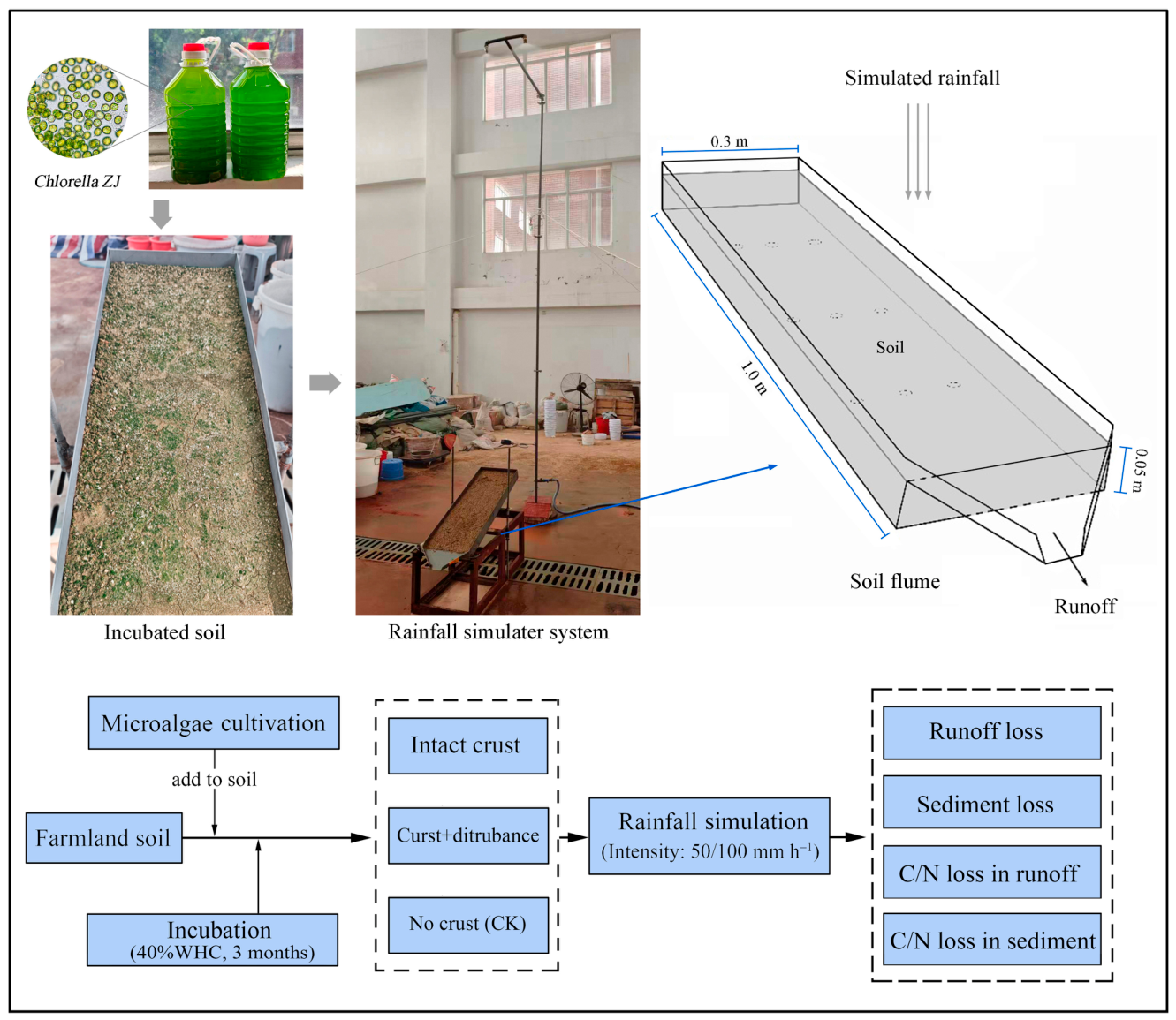
The sieved soil was packed into stainless steel soil flumes (1.0 m × 0.3 m × 0.08 m, length × width × height) to a thickness of 5 cm at a bulk density matching that of the field soil (Figure 1). The microalgae suspension was diluted with deionized (DI) water and applied at a rate of 5 mL per kilogram of soil, bringing the soil water content to 40% of its maximum water-holding capacity. The soil’s maximum water-holding capacity was determined to be 18.6% (w/w). To achieve an initial soil moisture content equal to 40% of this capacity (i.e., 7.5% w/w) after the addition of the microalgae suspension, the total volume of liquid required was calculated based on the soil’s dry mass, giving a volume of 1.45 L per box. Accordingly, 97 mL of the concentrated Chlorella ZJ suspension was diluted with deionized water to a final volume of 1.45 L (i.e., by adding 1.35 L of deionized water), and this diluted suspension was then uniformly sprayed onto the soil surface using a hand-held sprayer, ensuring both the desired moisture level and an even distribution of the algal cells across the soil. DI water was replenished daily to maintain this water content throughout the incubation period. The microalgae suspension was applied weekly throughout a 3-month incubation period.
After the incubation, the soil was allowed to dry naturally until the water content decreased to approximately 5% of its maximum water-holding capacity, and it was then used for the rainfall simulation experiments. Another treatment was designed to simulate an extreme scenario of crust destruction and soil homogenization (e.g., intensive tillage). After the 3-month period of incubation and crust formation, the soil was removed from the flume, air-dried to 5% water content, sieved through a 5 mm mesh to completely destroy the crust structure, and then repacked into the flume at the same bulk density. It is acknowledged that this treatment represents a more severe disturbance than typical field tillage; however, it allows the assessment of the maximum potential effect of crust disruption on subsequent C and N losses. A control treatment was established using DI water instead of the microalgae suspension, with all other conditions identical. In total, three treatments were established: microalgae addition with intact crust (MI), microalgae addition with disturbance (MD), and a control (CK).
To characterize the physicochemical properties of the soil after incubation, additional plastic boxes (0.3 m × 0.2 m × 0.08 m) were prepared for each treatment. These boxes were filled with the same soil to a thickness of 5 cm and at the same bulk density, and were incubated under identical conditions as the main flumes. For the MI treatment, soil samples were collected from 0 to 2 cm (MI(0–2)) and from 2 to 5 cm (MI(2–5)). Each treatment had three replicate boxes. After the incubation period, soil samples were collected from these boxes for physicochemical analysis, as the soil in the main flumes had to be left undisturbed for the subsequent rainfall simulation experiments.

2.3. Rainfall Simulation Experiments

The rainfall simulation experiments were conducted in the Soil Erosion Kinetics Laboratory at the Institute of Eco-environmental and Soil Sciences, Guangdong Academy of Sciences. The rainfall simulator system consisted of a submersible pump, a hydraulic pressure gauge, rain pipes, and two SPRACO cone jet nozzles oriented downward and positioned 5.0 m above the ground (Figure 1). The rainfall simulator generated a median raindrop diameter of 2.4 mm and provided an effective coverage of 20 m2, and simulated rainfall was conducted at two intensities (50 and 100 mm h−1). Prior to the rainfall simulation experiments, rainfall intensity was calibrated to achieve the required intensities and a uniformity coefficient exceeding 85%. The actual rainfall intensities were measured at 52.8 mm h−1 and 101.8 mm h−1, corresponding to the designed intensities of 50 and 100 mm h−1, respectively. For brevity, these two intensities are referred to as 50 and 100 mm h−1 in the following text. The soil flumes were placed on the ground below the nozzles with the slope set at 10°, which represented the typical topography of the study area. For each event, rainfall continued for 30 min after runoff began, and runoff was collected in plastic buckets at 3 min intervals, with each bucket capturing the entire runoff from its respective interval.
After each rainfall event, the runoff samples in the buckets were weighed. A subsample in each bucket was filtered through a 0.45 μm membrane filter using a syringe, and the filtrate was frozen and stored for subsequent determination of DOC, DN, NO3-N and NH4+-N concentrations in the runoff. The remaining runoff sample was allowed to settle for 2 days, after which the supernatant was discarded. The settled sediment was then transferred to an oven, dried, and weighed to calculate sediment yield. The dried sediment samples were then sieved and analyzed for C and N concentrations to determine the sediment-bound C and N loss. Each treatment was replicated twice, resulting in a total of 12 soil flumes (3 treatments × 2 rainfall intensities × 2 replicates). Strictly speaking, three replicates per treatment would be ideal. However, for this study, we chose two replicates per treatment, primarily because the rainfall simulation procedure was considerably time-consuming and entailed a substantial workload. Additionally, we employed stringent initial condition controls, including soil sieving, homogeneous mixing, stratified packing of the soil flume to ensure uniform bulk density, and rainfall uniformity control (>85%), which effectively minimized the variability. Many previously published studies [26,27,28,29] on rainfall simulations have employed a two-replicate experimental design, indicating that two replicates are widely regarded as sufficient to reveal the main trends, and the resulting data are generally acceptable and reliable.

2.4. Analysis Methods

The soil pH was measured using a Mettler Toledo pH meter (S210, Mettler-Toledo International Inc., Columbus, OH, USA) at a soil-to-water ratio of 1:2.5. Soil organic carbon was determined via the dichromate oxidation using the external heating method [30]. To determine soil particle size distribution, soil organic matter was removed using hydrogen peroxide, followed by dispersion with sodium hydroxide, and the particle size distribution was analyzed using the pipette method [31]. Total soil nitrogen was determined via the Kjeldahl method [32]. Dissolved organic carbon (DOC) was extracted from the fresh soil samples with distilled water (soil–water ratio: 1:5) at 25 °C for 30 min, and the extract was analyzed using a TOC analyzer (TOC-V cph, Shimadzu, Kyoto, Japan). Soil aggregate composition was determined using the wet sieving method [33]. The concentrations of NO3-N and NH4+-N in the runoff samples were determined using a discrete auto-analyzer (Smartchem 170, AMS Alliance, Paris, France) based on the indophenol blue method and the cadmium reduction–diazotization method [34,35].

2.5. Data Processing

One-way analysis of variance (ANOVA) was used to compare soil property indicators (including pH, mean weight diameter (MWD), GMD, TOC, DOC, DN, NO3-N and NH4+-N) among different treatments. Origin 2021 (Origin Lab Inc., Northampton, MA, USA) and GraphPad Prism 9.0 (GraphPad Software Inc., Boston, MA, USA) were employed for experimental data processing and graph presentation.

3. Results

3.1. Changes in Soil pH and Aggregate Stability

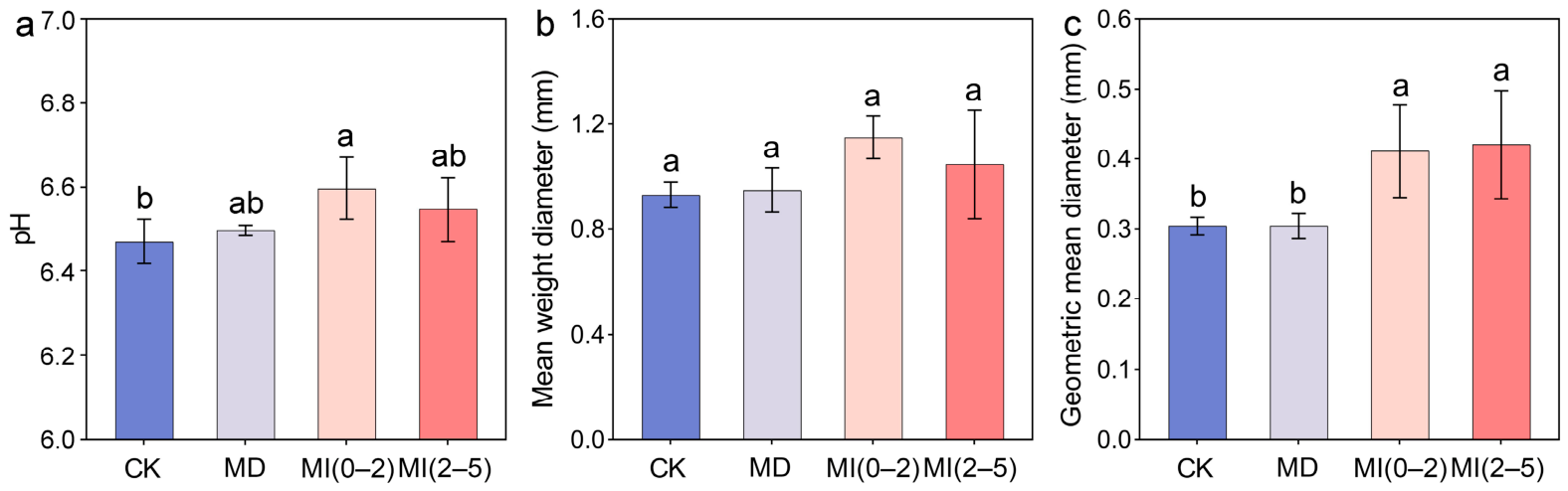
After 3 months of microalgae application, the soil pH exhibited a slight increase compared to the control (Figure 2a), and a statistically significant difference was observed in the MI(0–2) treatment only when compared with the control (CK) (p < 0.05), with the largest rise of 0.13 units. Soil aggregate stability results revealed no significant effect of microalgal treatment on MWD (p > 0.05) (Figure 2b). However, the GMD of undisturbed microalgal-crusted soils (MI (0–2) and MI (2–5)) was significantly higher than that in the CK and the MD treatment (Figure 2c). Overall, microalgae promoted soil aggregate stability in the short term to some extent, but this effect could be inhibited by soil disturbance.

3.2. Responses of Soil C and N Fractions to Microalgae Application

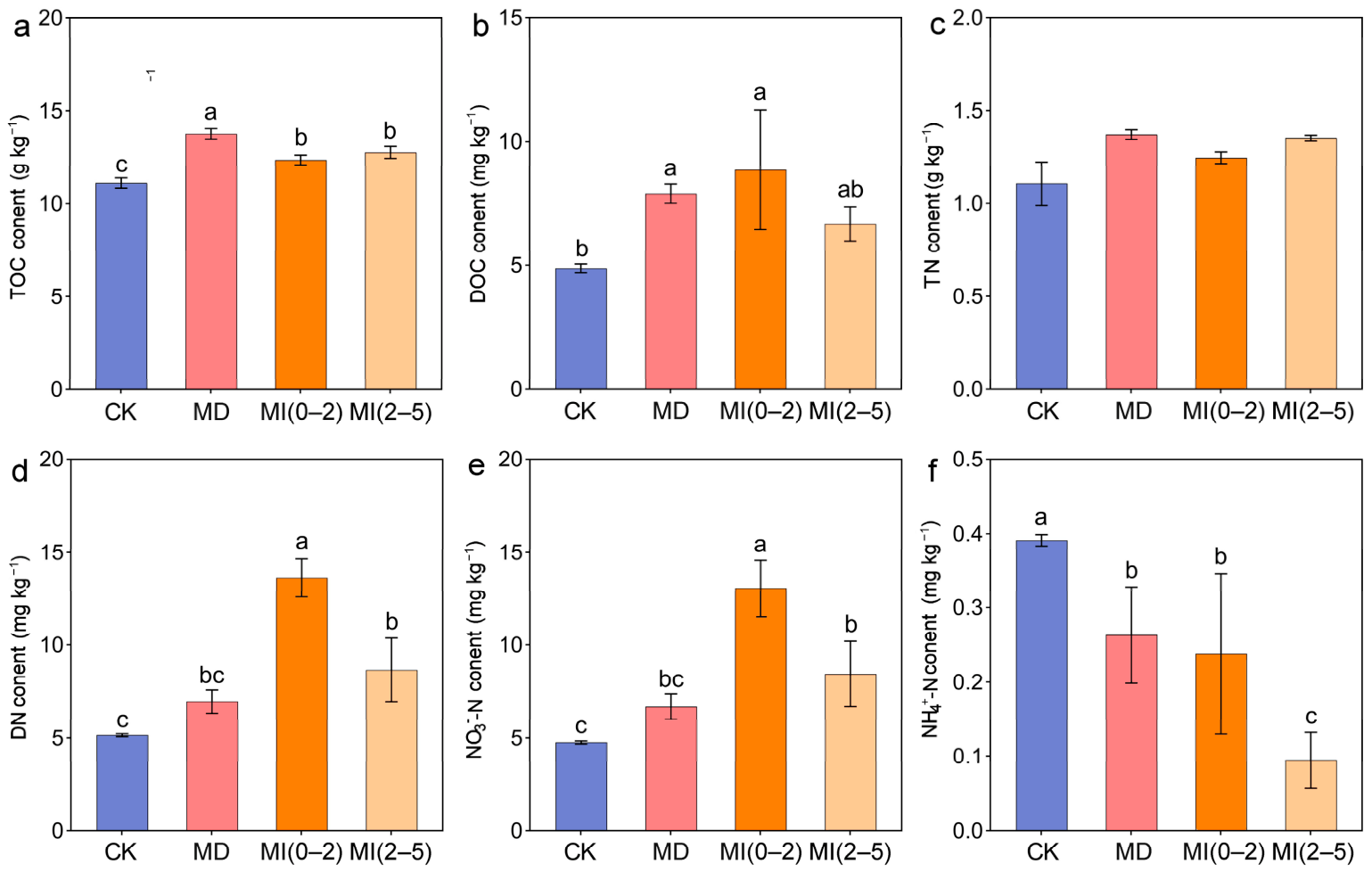
The application of the microalgae fertilizer significantly increased the contents of TOC and DOC in the soil (p < 0.05, Figure 3a). Compared with the control (11.11 ± 0.28 g kg−1), the MD treatment showed the highest increase in TOC (23.79 ± 4.03%), followed by the MI(0–2) (15.00 ± 4.11%) and MI(2–5) (11.28 ± 3.68%) treatments, and the largest increase in DOC was observed in the MI(0–2) treatment (82.02 ± 49.99%). Notably, the magnitude of DOC increase in soil induced by microalgae application (1.36- to 1.82-fold) was markedly higher than that in TOC (1.11- to 1.24-fold). Similar to C fractions, microalgae application also significantly increased the contents of TN, DN, and NO3-N in the soil (p < 0.05; Figure 3c–e). The MD treatment showed the largest increase in TN (24.63 ± 11.47%), while the MI(0–2) treatment exhibited the largest increases in DN and NO3-N, reaching 164.60 ± 7.77% and 174.19 ± 11.81%, respectively. In contrast, a significant decreasing trend in NH4+-N was observed across all microalgae treatments (p < 0.05; Figure 3f). Among them, the MI(2–5) treatment showed the lowest content (0.095 ± 0.04 mg L−1), while, the NH4+-N contents in the MD and MI(0–2) treatments were numerically close, at 0.26 ± 0.06 mg L−1 and 0.24 ± 0.11 mg L−1, respectively.
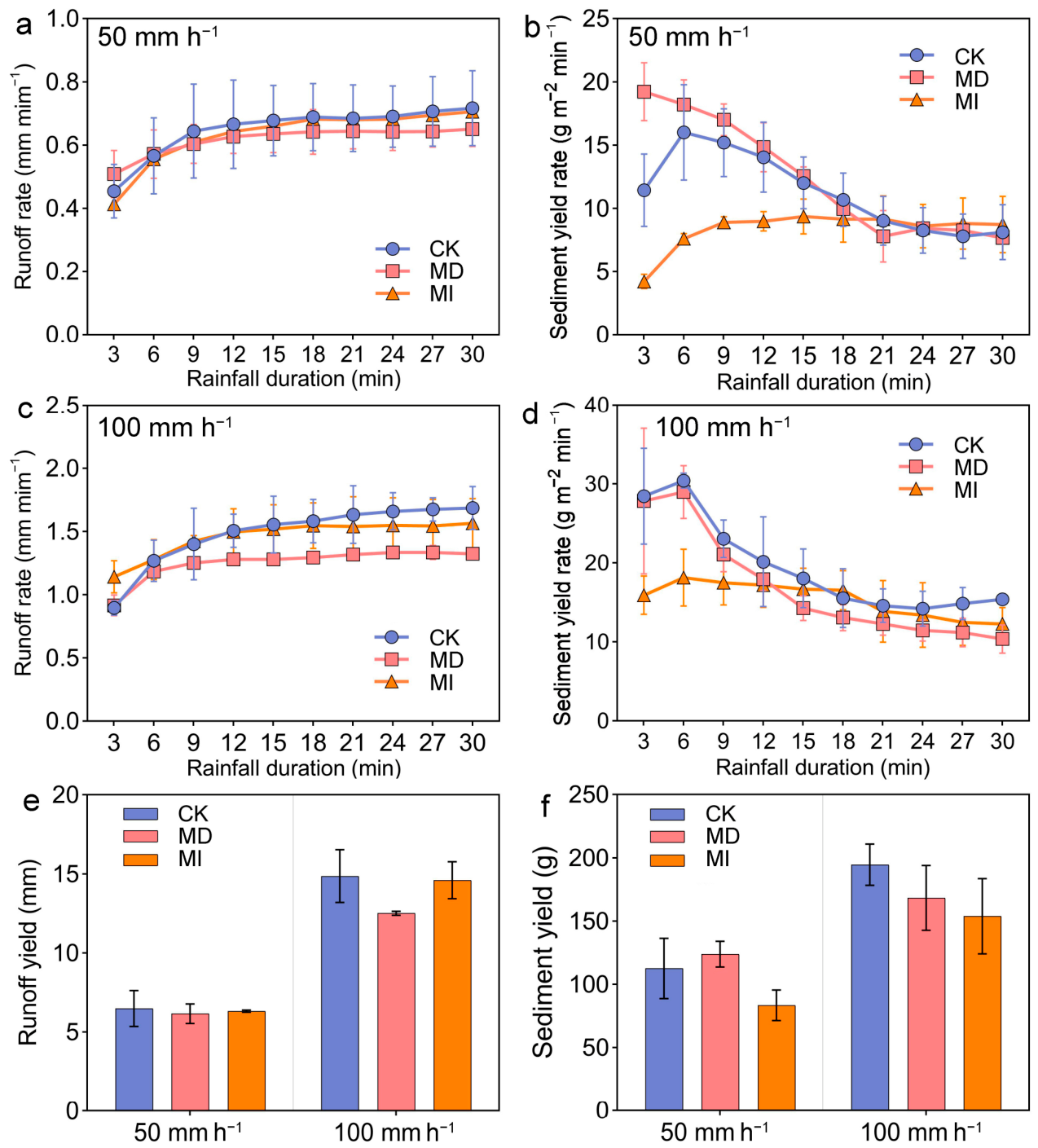
The loss characteristics of runoff and sediment during the simulated rainfall events are shown in Figure 4. At a rainfall intensity of 50 mm h−1, the dynamics of the runoff rate across different treatments over the 30 min duration were very similar, with consistently small numerical differences (Figure 4a). In all treatments, the runoff rate increased gradually during the first 0–12 min after runoff initiation and then remained stable until the end of the rainfall event. During the early stage of the rainfall event, the MD treatment showed the highest runoff rate, followed by the CK and MI. During the following stable stage, CK and MI treatments exhibited similar runoff rates (with the CK being slightly higher), while MD remained lower than both. In total, the three treatments exhibited only minor differences in total runoff (CK: 6.49 ± 1.14 mm; MD: 6.17 ± 0.62 mm; MI: 6.33 ± 0.07 mm; Figure 4e). In contrast, the dynamic patterns of sediment loss rates differed markedly among the three treatments (Figure 4b). As rainfall duration increased, the sediment loss rate of the CK first increased (0–6 min) and then continuously decreased. For the MD treatment, the sediment loss rate showed a continuous decreasing trend during the first 21 min before stabilizing, whereas the MI treatment showed a sustained increase over the initial 9 min followed by stabilization. The total sediment loss was highest in the MD treatment (124 ± 10.13 g m−2), followed by the CK (95.75 ± 23.87 g m−2), and the lowest was observed in the MI treatment (83.53 ± 12.03 g m−2) (Figure 4f).
At a rainfall intensity of 100 mm h−1, the dynamic pattern of the runoff rate was similar to that observed at the 50 mm h−1 intensity; however, the differences among the treatments were more distinct (Figure 4c). At the very beginning of the rainfall event, the runoff rate in the MI treatment was markedly higher than that in the CK and MD, whereas in the latter half of the rainfall duration, the runoff rate followed a clear order of CK > MI > MD. In all three treatments, the sediment loss rate initially increased (0–6 min) and then progressively decreased (Figure 4d). During the first 9 min, the sediment loss rates in the CK and MD were markedly higher than that in M; thereafter, the differences among the three treatments gradually diminished. In the late stage of the rainfall event, the order of sediment loss rates across different treatments also followed CK > MI > MD. Compared with the CK, the total runoff losses in MD and MI decreased by 15.78% and 17.04%, respectively, while the total sediment losses decreased by 1.74% and 20.92%, respectively (Figure 4e,f).

3.3. C and N Loss Characteristics Under Simulated Rainfall

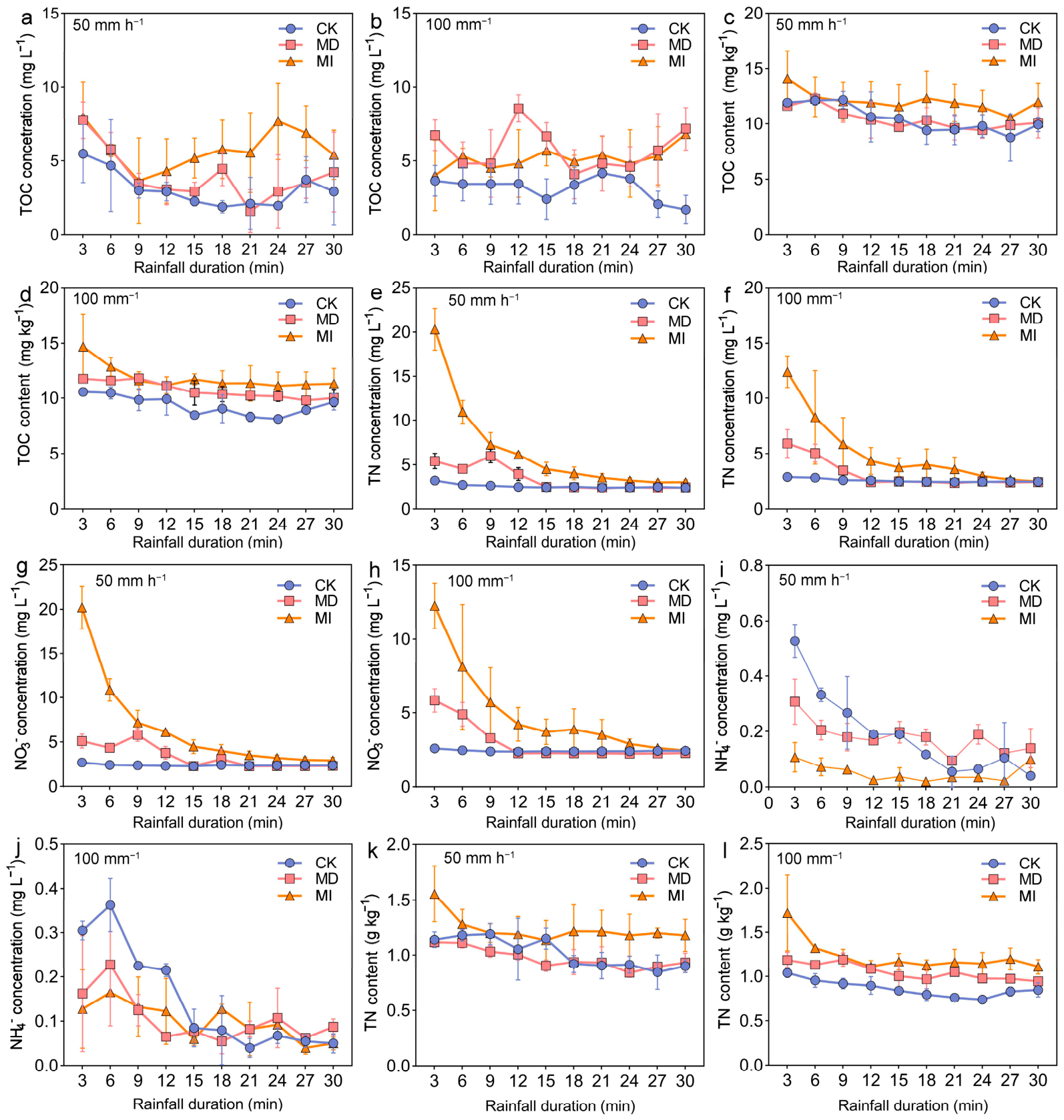
During the early stage (0–9 min) of the rainfall event at 50 mm h−1, the TOC concentrations in runoff from both the MD and the MI treatments were significantly higher than those of the control (CK) (Figure 5a). Thereafter, the TOC concentrations in runoff from MD and the CK followed a similar pattern, both showing a decreasing trend followed by a slight increase, while the TOC concentration in runoff from the MI treatment increased markedly. At 100 mm h−1, the TOC concentrations in runoff from both the MD and MI treatments remained higher than those of the CK throughout the entire rainfall duration (Figure 5b). The variation in TOC concentration in the sediment was similar to that in the runoff, exhibiting a slow decreasing trend as rainfall duration increased. At 50 mm h−1, the TOC content in the sediment from MD and CK was close to each other and lower than that from the MI treatment (Figure 5c). At 100 mm h−1, a clearer gradient was observed: the TOC content in sediment was highest in the MI treatment, followed by MD, and the lowest was observed in the CK (Figure 5d).
At both rainfall intensities, the concentrations of TN and NO3-N in runoff from different treatments showed a clear decreasing trend during the first half of the rainfall duration (0–15 min), with a consistent gradient: MI > MD > CK (Figure 5e–h). During the second half, the TN and NO3-N concentrations in runoff from the MD and CK treatments were comparable and showed almost no variation with rainfall duration. In contrast, the concentrations in the MI treatment were slightly higher and decreased continuously, approaching those in the CK and MD treatments by the end of the rainfall event. NH4+-N concentration in the runoff exhibited a similar decreasing trend to that of TN and NO3-N, but with the opposite order among different treatments: CK > MD > MI (Figure 5i,j). The variation in TN concentration in the lost sediment was highly consistent with that of TOC at both rainfall intensities (Figure 5k,l).

4. Discussion

4.1. Effects of Microalgae on Soil pH and Aggregate Stability

The addition of microalgae led to a significant increase in the pH of the studied acidic soil, which is consistent with the results reported in previous studies [36,37]. This effect was primarily attributed to the EPS secreted by the microalgae. EPSs are high-molecular-weight mixtures composed of polysaccharides, proteins, lipids, and nucleic acids, with molecular structures rich in functional groups such as carboxyl and amino groups [38]. These functional groups can directly adsorb or complex H+ in the soil solution, thereby consuming free protons and raising soil pH. Notably, compared with the soil without microalgae addition, the microalgae-treated soils exhibited a decrease in NH4+ concentration and an increase in NO3 concentration (Figure 3e,f), indicating that the nitrification process was promoted. The nitrification reaction typically generates H+, which would theoretically lead to a decline in pH. However, our results suggest that H+ consumption by EPS exceeded the amount of acid produced via nitrification, resulting in an overall rise in pH. EPSs are essentially polymeric polyelectrolytes with buffering capacity. In a previous study, we also found that the addition of microalgae significantly decreased soil pH in an alkaline soil [19]. Under alkaline conditions, the weakly acidic functional groups (e.g., carboxyl groups) in EPS dissociate, releasing protons into the soil solution and thereby neutralizing part of its alkalinity, leading to a decrease in pH [12]. These results indicate that the direction of pH regulation by EPS may depend on the initial pH conditions. Although this increase in pH was small, it is agronomically meaningful in acidic soils because even a modest change in pH can alleviate Al3+ toxicity and improve phosphorus availability in soil, which may indirectly benefit root development and nutrient uptake [39,40]. Moreover, the slight pH shift could also influence the activity of nitrifying microorganisms, potentially modulating the transformation of N forms, though the overall environmental impact is likely minor given the limited magnitude of change [41]. It should be noted that our experiment only lasted 3 months; these effects might be more pronounced over longer timescales.
The increase in MWD and GMD (Figure 2b) indicates that microalgae application effectively promotes soil aggregate formation. The EPSs secreted by microalgae act as binding agents and directly mediate the connection between soil particles [13]. They adsorb onto positively charged mineral surfaces primarily due to their abundant functional groups, which become negatively charged upon deprotonation. For instance, Ref. [42] demonstrated that electrostatic interactions play a key role in the interaction between the EPS and clay minerals such as kaolinite, montmorillonite, and goethite. The soil in the 0–2 cm layer exhibited greater improvement in aggregate stability than the subsurface soil (2–5 cm). This difference might be attributed to two factors. First, microalgae biomass was inherently higher in the surface layers, as the infiltration capacity of microalgae decreased rapidly with increasing soil depth. Second, the near-surface conditions of light and moisture were more favorable for microalgal photosynthesis and EPS production. Higher nutrient content in the surface soil also supports evidence that microalgal growth and activity were more vigorous in the surface soil (Figure 3a,b). The enhancement in soil aggregation has important implications for agricultural production, such as increasing water infiltration and reducing physical surface sealing [43,44]. Moreover, increased aggregate stability enhances the soil’s resistance to erosion, thereby mitigating soil and associated nutrient losses.

4.2. Alterations of Soil C and N Fractions by Microalgae

Chlorella ZJ is an efficient C-fixing microorganism that directly assimilates atmospheric CO2 into its own organic matter (e.g., polysaccharides and lipids) through photosynthesis. Additionally, it excretes abundant EPS, which contribute active organic C to the soil matrix [45,46]. The EPS secreted by microalgae, along with their dead residues, serves as labile organic C sources, as evidenced by a remarkable increase in DOC content observed in the microalgae-treated soil (Figure 3b). These substances can be preferentially utilized by indigenous heterotrophic microorganisms in the soil, thereby promoting their proliferation and metabolism and further driving soil C accumulation via the microbial carbon pump mechanism. Moreover, the biocrusts and aggregates formed by microalgae help regulate surface soil moisture, oxygen content, and temperature fluctuations, creating a more stable microenvironment for microbial growth and consequently influencing the form and stability of soil C. Over the 3-month incubation period, the total amount of microalgal biomass C added to the soil ranged from 0.026 to 0.032 g C kg−1 soil (other forms of C, such as soluble C in the microalgal fertilizer, were negligible). Despite this relatively small input and short period, SOC increased by 1.60 ± 0.31 g C kg−1 soil by the end of the experiment. This increment was approximately 50–60 times greater than the C directly supplied by the microalgal fertilizer. Such a substantial increase could be attributed to (1) substantial in situ proliferation of Chlorella after inoculation, as evidenced by the visible biological crusts in Figure 1, and (2) stimulation of indigenous soil microorganisms by the added microalgae, as supported by our recent study showing that even inactivated Chlorella promoted native microbial growth in degraded soils [19].
The microalgae also promoted N accumulation in the soil, particularly in the surface layer (Figure 3b). This increase can be explained by the mechanisms through which Chlorella ZJ stimulates indigenous free-living diazotrophs (e.g., Azotobacter and Azospirillum) via the secretion of photosynthetic metabolites such as sugars and organic acids that serve as C and energy sources [47]. In addition, the oxygen produced by Chlorella ZJ creates localized microaerophilic conditions that favor nitrogenase activity, thereby enhancing biological N fixation and converting atmospheric N2 into available N (NH4+). Under aerobic conditions, soil nitrifying microorganisms (e.g., Nitrosomonas and Nitrobacter) sequentially oxidize NH4+-N to NO3-N. This oxidation rate is generally faster than the production rate of NH4+, and consequently, NO3-N accounts for the vast majority of soluble total N in the soil. Furthermore, Chlorella ZJ might indirectly enhance the activity of nitrifying communities by improving soil aeration and providing trace growth factors, further consolidating the dominance of nitrate. This also explains why nitrate content was higher in the surface soil than in the subsurface layer.
The MD treatment exhibited higher TOC and TN contents than the MI treatment (Figure 3a,c). Both soils in the MD and MI treatments had been incubated for 3 months, and both developed a well-established biocrust layer on their surface. However, the MD treatment involved an additional step: after crust formation, the soil was removed from the flumes, spread out on the ground, and air-dried until its moisture content reached approximately 5%. This procedure inevitably increased the soil’s exposure to air and sunlight. Although the moisture level gradually declined, the microalgae and other microorganisms might have continued to metabolize and proliferate during the drying period, particularly due to the increased aeration and light availability. Therefore, extra accumulation of organic carbon and nitrogen could have occurred in the MD treatment compared with the MI treatment. In addition, the disturbance treatment (MD) improved soil aeration, which might stimulate the activity of heterotrophic microorganisms. These heterotrophs could substantially assimilate soluble NO3-N from the soil for their own biomass synthesis, leading to a marked decrease in DN contents. In contrast, the undisturbed soil maintained intact aggregate structures, where internal microaerophilic conditions likely support sustained N fixation and weaker heterotrophic activity, allowing N to remain at relatively higher levels.

4.3. The Impact of Microalgae on Soil C and N Loss

The growth of microalgal crusts on the soil surface generally exerts a significant influence on runoff and sediment yield under rainfall conditions. Microalgae and other microorganisms enhance soil aggregation through EPS binding, which typically helps resist raindrop impact and runoff scouring, thereby reducing sediment loss [48,49,50]. The effect of microalgal crusts on runoff yield was not pronounced. Under both rainfall intensities, the total runoff loss volume from the MI treatment was close to that of the CK, and the runoff rate was relatively high only at the beginning (0–6 min) of the high-intensity rainfall event (Figure 4e). The effect of microalgae on surface runoff is complex; some studies found that algal crusts increased runoff, while others reported a decrease or no significant effect [51,52,53]. On the one hand, the formation of a smooth crust on the soil surface and its sealing effect on pores can reduce infiltration and increase runoff. On the other hand, wetting-induced microtopography increases surface roughness, which may enhance permeability and reduce runoff. These contrasting effects are generally dependent on factors such as the biocrust successional stage, species composition, and soil texture [54]. In our study, these opposing mechanisms may have offset each other, which could explain the lack of a clear runoff response.
The MD treatment significantly reduced the runoff yield during high-intensity rainfall. After disturbance, the microalgal crust was disrupted, allowing the residual EPS and organic debris to be mixed into the soil. Although these organic binders did not reduce initial infiltration, they greatly enhanced aggregate stability and prevented the formation of a surface seal under high-intensity rainfall. Thus, the presence of intact microalgal crusts consistently reduced sediment yield compared to the control under both rainfall intensities. The erosion protection provided by Chlorella ZJ crusts relies critically on the physical continuity of the EPS network and surface biofilm. Once this continuity is broken by a disturbance, the residual EPS coating on individual particles is insufficient to confer measurable resistance to raindrop impact or surface sealing under either low or high rainfall intensities. Disturbance destroys the crust’s integrity; even if the internal soil aggregate structure becomes more stable, it cannot prevent direct raindrop impact on the surface layer and subsequent sediment production.
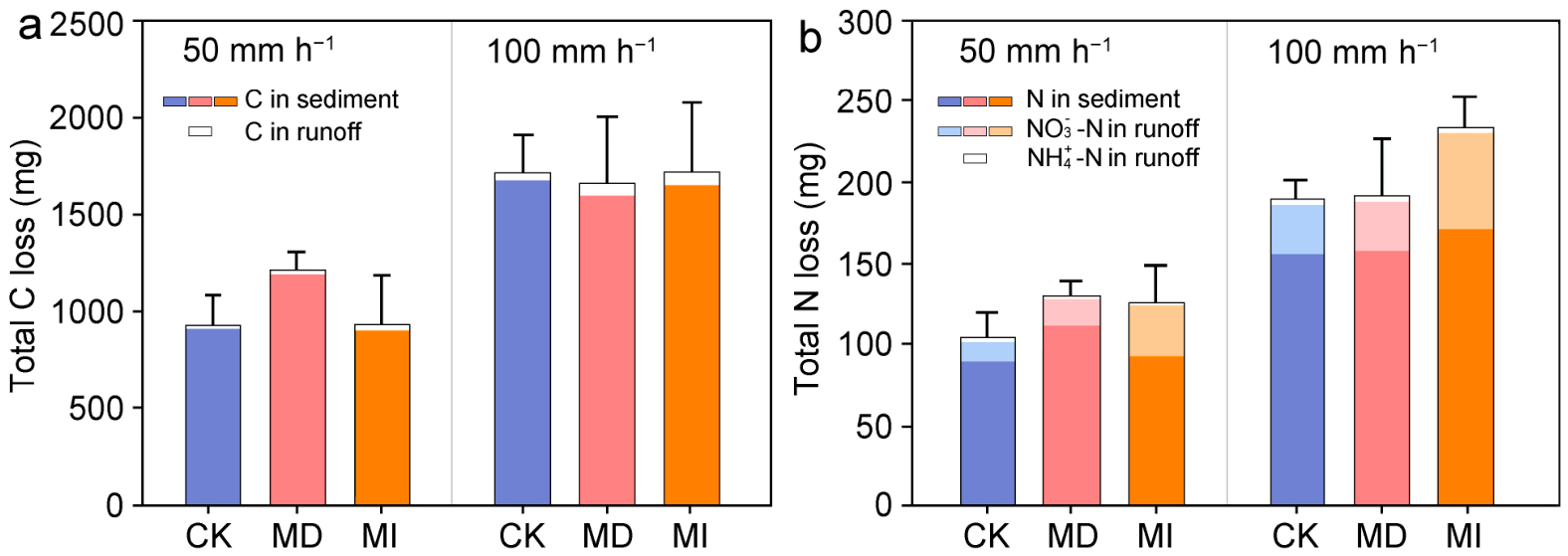
Under high rainfall intensity, the loss of TOC and TN was significantly higher, which was attributed to the higher runoff and sediment yield (Figure 6a,b). This is expected, as greater rainfall intensity generates more surface runoff and detaches more soil particles, thereby enhancing the transport of both dissolved and sediment-bound C and N from the soil [54,55,56,57]. Sediment-bound forms dominated the losses of both elements, and the proportion of sediment-bound C was higher than that of sediment-bound N. This was because the proportion of dissolved N (especially NO3-N) in total soil N was inherently larger than that of dissolved C in total soil C. Compared with C, microalgae application caused a more pronounced effect on N loss, particularly in the intact crust (M) treatment, where both the amount and proportion of NO3-N loss were considerably higher. The microalgal crust created an elevated NO3 concentration zone in the surface soil layer, from which NO3-N was more readily lost with runoff. In contrast, the MD treatment had a lower overall TN content, which was more uniformly distributed with depth; consequently, the loss of soluble NO3-N was much lower than that of the CK. Furthermore, a clear first-flush effect was observed for soluble N, with the majority of NO3-N and NH4+-N losses occurring within the first 12–15 min of the rainfall duration due to the rapid depletion of the surface-accumulated soluble pool.

4.4. Environmental Implications

In recent years, microalgae have gained increasing attention for soil improvement due to their environmentally friendly nature and high nutrient-synthesis efficiency. Moreover, microalgae-based fertilizers can be produced in a cost-effective manner. For instance, the microalgae used in this study were cultivated to capture CO2 emitted from a coal-fired power plant, representing a sustainable C recycling and utilization pathway [19]. Incorporating such microalgae biomass into soil not only sequesters atmospheric C but also enriches soil organic matter and available nutrients. Our results showed that microalgal crusts significantly increased the total and available C and N content in soil, particularly in the surface layer, which can further enhance plant nutrient availability. Thus, microalgae-based soil amendments offer a dual benefit, namely, reducing greenhouse gas emissions while substituting synthetic fertilizers, thereby supporting more sustainable and climate-smart agriculture.
Despite these agronomic advantages, our rainfall simulation experiments revealed a notable environmental risk: microalgae application substantially increased soluble N loss, especially NO3, via runoff. Under intact microalgal crust conditions, the total N concentration in runoff was quite high during the initial 0–9 min (5.85 to 20.31 mg L−1), which far exceeded the Class III surface water quality standard of 1.0 mg L−1 in China, indicating a high potential for eutrophication of receiving water bodies [58]. The intact microalgal crust created a surface zone enriched in nitrate, making it highly vulnerable to wash-off. Interestingly, soil disturbance (e.g., tillage) could reduce N loss to levels comparable to those of the CK, as it lowered the overall soil nitrate content and distributed it more uniformly with depth, thereby decreasing the surface-available soluble pool. However, disturbance also destroyed the integrity of the surface soil crust and its erosion resistance, potentially leading to higher sediment-associated nutrient loss. Therefore, when using microalgae as a fertilizer, it is necessary to adopt a reasonable management strategy to achieve a balance between erosion control and nitrogen loss reduction. For instance, keep the crust intact for soil stabilization, but perform a light disturbance several days before expected heavy rainfall. This mixes and dilutes the surface-accumulated nitrate and promotes its transformation into less mobile forms, thereby greatly reducing the nitrogen load in initial runoff. It is worth noting that the sieving and repacking disturbance (MD) scenario adopted in this study represents an extreme disturbance regime distinct from common agricultural practices such as rotary, shallow, and strip tillage, which only slightly disrupt topsoil without fully homogenizing the soil matrix. We employed this intense artificial disturbance mainly to create a clear contrast between the intact soil crust structure and fully homogenized soil so as to clarify the direct effect of soil structure destruction on C and N transformation and loss under controlled conditions. Given the extreme nature of the MD treatment, the observed response of C/N (especially N) might not be directly generalized to routine field tillage. For example, we speculate that the magnitude of NO3-N variation under real agricultural tillage practices would be smaller than that observed in the present experiment, as the actual soil disturbance in field practices is relatively milder. Thus, field experiments with practical tillage modes are necessary to verify these speculations.

4.5. Limitations of the Study

This study has several limitations. First, the three-month incubation period is relatively short; longer-term effects remain unknown. Second, only one microalgal species and one soil type were tested, limiting the generality of the conclusions. Third, although we implemented rigorous initial condition controls during the rainfall simulations and the overall trends across treatments were generally clear, some indicators (e.g., runoff and ammonia nitrogen) still exhibited considerable variability under the two-replicate design. This suggests that three or more replicates are still necessary to accurately discern the differences in experimental results among treatments when conditions permit. Fourth, the simulated rainfall experiments were conducted under controlled laboratory conditions, which may not fully represent natural rainfall patterns and field hydrology. Future studies should integrate multi-species comparisons and long-term field trials to better assess the agronomic and environmental sustainability of microalgae-based soil amendments.

5. Conclusions

This study investigated the effects of microalgae (Chlorella ZJ) application on soil C and N accumulation and their loss patterns via runoff and sediment under simulated rainfall. The results showed that microalgae application significantly increased the contents of soil organic C and dissolved organic C, total N, and NO3-N (especially in the surface layer), whereas the NH4+-N content decreased. The formation of microalgal crusts enhanced soil aggregate stability and reduced sediment loss, but it did not significantly increase runoff yield. Notably, microalgae application increased NO3-N loss via runoff, potentially posing a risk of nitrate pollution during the early stage of rainfall. Crusted soil disturbance reduced NO3-N loss to some extent, but it also led to increased sediment-associated nutrient loss. To mitigate nutrient loss, we suggest maintaining the soil crust for erosion resistance, while applying appropriate disturbance prior to heavy rainfall events to reduce the content and mobility of labile nutrients (e.g., nitrate). This strategy can effectively balance the agronomic benefits of microalgae application with environmental protection.

Author Contributions

Conceptualization, X.J. and B.H.; methodology, H.J., X.Z., C.K. and X.L.; software, C.K. and X.L.; validation, T.Z. and L.C.; investigation, Z.S., S.Q., X.J. and B.H.; data curation, Z.S., T.Z., S.Q., G.C. and D.M.; writing—original draft preparation, Z.S. and H.J.; writing—review and editing, J.C., X.J. and B.H.; visualization, D.M. and J.C.; supervision, G.C. and J.C.; funding acquisition, Z.S., X.J. and B.H. All authors have read and agreed to the published version of the manuscript.

Funding

This research was funded by the Key-Area Research and Development Program of Guangdong Province, China (2022B0111130003), the Guangdong Basic and Applied Basic Research Foundation (2025A1515010758), the National Key R&D Program of China (2021YFF0601001), the National Natural Science Foundation of China (42177343 and 42577403), and the Guangdong Foundation for Program of Science and Technology Research (Grant No. 2023B1212060044).

Institutional Review Board Statement

Not applicable.

Informed Consent Statement

Not applicable.

Data Availability Statement

Data are contained within the article.

Conflicts of Interest

Authors Zirong Shen, XingboZou, Cao Kuang, Tiancheng Zhou, Shiwei Qin, Gongda Chen and Dequn Ma were employed by the company Guangdong Energy Group Science and Technology Research Institute Co., Ltd. The remaining authors declare that the research was conducted in the absence of any commercial or financial relationships that could be construed as potential conflicts of interest.

Abbreviations

The following abbreviations are used in this manuscript:
CCarbon
NNitrogen
SOCSoil organic carbon
DOCDissolved organic carbon
TOCTotal organic carbon
DNDissolved nitrogen
MIMicroalgae addition with intact crust
MDMicroalgae addition with disturbance
CKControl
MWDMean weight diameter
GMDGeometric mean diameter

References

  1. Smith, P.; Poch, R.M.; Lobb, D.A.; Bhattacharyya, R.; Alloush, G.; Eudoxie, G.D.; Anjos, L.H.C.; Castellano, M.; Ndzana, G.M.; Chenu, C.; et al. Status of the World’s Soils. Annu. Rev. Environ. Resour. 2024, 49, 73–104. [Google Scholar]
  2. Chen, J.; Chen, J.; Tan, M.; Gong, Z. Soil degradation: A global problem endangering sustainable development. J. Geogr. Sci. 2002, 12, 243–252. [Google Scholar] [CrossRef]
  3. Liu, B.; Xie, Y.; Li, Z.; Liang, Y.; Zhang, W.; Fu, S.; Yin, S.; Wei, X.; Zhang, K.; Wang, Z.; et al. The assessment of soil loss by water erosion in China. Int. Soil Water Conserv. Res. 2020, 8, 430–439. [Google Scholar] [CrossRef]
  4. Delang, C.O. The consequences of soil degradation in China: A review. GeoScape 2018, 12, 92–103. [Google Scholar] [CrossRef]
  5. Pimentel, D.; Harvey, C.; Resosudarmo, P.; Sinclair, K.; Kurz, D.; McNair, M.; Crist, S.; Shpritz, L.; Fitton, L.; Saffouri, R.; et al. Environmental and economic costs of soil erosion and conservation benefits. Science 1995, 267, 1117–1123. [Google Scholar] [CrossRef] [PubMed]
  6. Lal, R. Soil erosion and carbon dynamics. Soil Till. Res. 2005, 81, 137–142. [Google Scholar] [CrossRef]
  7. Tiwari, A.K.; Pal, D.B. Nutrients contamination and eutrophication in the river ecosystem. In Ecological Significance of River Ecosystems; Elsevier: Amsterdam, The Netherlands, 2022; pp. 203–216. [Google Scholar]
  8. Cui, J.; Yang, B.; Zhang, M.; Song, D.; Xu, X.; Ai, C.; Liang, G.; Zhou, W. Investigating the effects of organic amendments on soil microbial composition and its linkage to soil organic carbon: A global meta-analysis. Sci. Total Environ. 2023, 894, 164899. [Google Scholar] [CrossRef] [PubMed]
  9. Costa, D.; Sutter, C.; Shepherd, A.; Jarvie, H.; Wilson, H.; Elliott, J.; Liu, J.; Macrae, M. Impact of climate change on catchment nutrient dynamics: Insights from around the world. Environ. Rev. 2022, 31, 4–25. [Google Scholar]
  10. Ball, K.; Malik, A.; Muscarella, C.; Blankinship, J. Irrigation alters biogeochemical processes to increase both inorganic and organic carbon in arid-calcic cropland soils. Soil Biol. Biochem. 2023, 187, 109189. [Google Scholar] [CrossRef]
  11. Pierobon, S.; Cheng, X.; Graham, P.; Nguyen, B.; Karakolis, E.; Sinton, D. Emerging microalgae technology: A review. Sustain. Energy Fuels 2018, 2, 13–38. [Google Scholar] [CrossRef]
  12. Song, X.; Bo, Y.; Feng, Y.; Tan, Y.; Zhou, C.; Yan, X.; Ruan, R.; Xu, Q.; Cheng, P. Potential applications for multifunctional microalgae in soil improvement. Front. Environ. Sci. 2022, 10, 1035332. [Google Scholar] [CrossRef]
  13. Costa, O.Y.; Raaijmakers, J.M.; Kuramae, E.E. Microbial extracellular polymeric substances: Ecological function and impact on soil aggregation. Front. Microbiol. 2018, 9, 1636. [Google Scholar] [CrossRef] [PubMed]
  14. Ramanna, L.; Ansari, F.A.; Rawat, I.; Bux, F. Microalgae-driven carbon sequestration and bio-fertiliser: Steps towards a sustainable future. Chem. Eng. J. 2025, 519, 164892. [Google Scholar] [CrossRef]
  15. Castro, I.M.P.; Rosa, A.; Borges, A.; Cunha, F.; Passos, F. The effects of microalgae use as a biofertilizer on soil and plant before and after its anaerobic (co-) digestion with food waste. Sci. Total Environ. 2024, 934, 173301. [Google Scholar] [CrossRef] [PubMed]
  16. Yu, S.; Li, J.; Du, D.; Li, H.; Hao, J.; Teng, Z.; Ji, X. Coal gangue ecological matrix coupled with microalgae for soil improvement and plant growth in reclaimed mining areas. Biology 2025, 14, 741. [Google Scholar] [CrossRef] [PubMed]
  17. Ma, C.; Xu, Z.; Yang, W.; Tang, T.; Liu, Q.; Zhang, D.; Prashannth, P.; Qu, Z. Co-application of microalgae and biochar increases yield and mitigates greenhouse gas emissions in saline-alkali soil. Field Crops Res. 2025, 327, 109885. [Google Scholar] [CrossRef]
  18. Ren, Y.; Wang, G.; Su, Y.; Li, J.; Zhang, H.; Yang, M.; Han, J. Microbial inoculant and microalgae fertilizer improved the growth and quality of Salvia miltiorrhiza cultivated in lead-contaminated soil. Appl. Soil Ecol. 2025, 214, 106410. [Google Scholar] [CrossRef]
  19. Yang, L.; Song, X.; Feng, Y.; Qiu, X.; Yan, X.; Ruan, R.; Cheng, P. Improving soil structure and function for continuous cropping of sweet melon using microalgae-based biological fertilizer. Algal Res. 2025, 85, 103868. [Google Scholar] [CrossRef]
  20. Su, Y.; Ren, Y.; Wang, G.; Li, J.; Zhang, H.; Yang, Y.; Pang, X.; Han, J. Microalgae and microbial inoculant as partial substitutes for chemical fertilizer enhance Polygala tenuifolia yield and quality by improving soil microorganisms. Front. Plant Sci. 2025, 15, 1499966. [Google Scholar] [CrossRef] [PubMed]
  21. Gonçalves, J.; Freitas, J.; Fernandes, I.; Silva, P. Microalgae as biofertilizers: A sustainable way to improve soil fertility and plant growth. Sustainability 2023, 15, 12413. [Google Scholar] [CrossRef]
  22. Gonzalez-Gonzalez, L.M.; De-Bashan, L.E. The potential of microalgae–bacteria consortia to restore degraded soils. Biology 2023, 12, 693. [Google Scholar] [CrossRef] [PubMed]
  23. Song, X.; Liu, J.; Feng, Y.; Zhou, C.; Li, X.; Ruan, R.; Cheng, P. Microalgae-based biofertilizers improve fertility and microbial community structures in the soil of potted tomato. Front. Plant Sci. 2024, 15, 1461945. [Google Scholar] [CrossRef] [PubMed]
  24. Chamizo, S.; Rodríguez-Caballero, E.; Román, J.R.; Cantón, Y. Effects of biocrust on soil erosion and organic carbon losses under natural rainfall. Catena 2017, 148, 117–125. [Google Scholar] [CrossRef]
  25. Zou, X.; Cheng, J.; Cheng, J.; Jiang, X.; Huang, B.; Zhou, T.; Chen, L. Effects of Microalgae (Chlorella ZJ and Anabaena azotica) Application on soil carbon and nitrogen fractions in a degraded purple soil: A laboratory incubation study. Sustainability 2026, 18, 4057. [Google Scholar] [CrossRef]
  26. Fang, Q.; Han, Z.; Fan, C.; Fang, F.; Qian, X.; Zi, R.; Zhao, L. Effects of simulated successive extreme rainfall events on surface and belowground runoff and soil loss on flumes that mimic soil-mantled karst slopes. Catena 2026, 272, 110311. [Google Scholar] [CrossRef]
  27. Yadav, G.; Ellis, R.H. Effects of rain shelter or simulated rain during grain filling and maturation on subsequent wheat grain quality in the UK. J. Agr. Sci. 2017, 155, 300–316. [Google Scholar]
  28. Xin, Y.; Xie, Y.; Liu, Y.; Liu, H.; Ren, X. Residue cover effects on soil erosion and the infiltration in black soil under simulated rainfall experiments. J. Hydrol. 2016, 543, 651–658. [Google Scholar] [CrossRef]
  29. Wu, X.; Wei, Y.; Wang, J.; Xia, J.; Cai, C.; Wei, Z. Effects of soil type and rainfall intensity on sheet erosion processes and sediment characteristics along the climatic gradient in central-south China. Sci. Total Environ. 2018, 621, 54–66. [Google Scholar] [CrossRef] [PubMed]
  30. Nelson, D.W.; Sommers, L.E. Total carbon, organic carbon and organic matter. In Methods of Soil Analysis, Part 3, Chemical Methods; Soil Science Society of America Book Series; Sparks, D.L., Page, A.L., Helmke, P.A., Loeppert, R.H., Eds.; Soil Science Society of America: Madison, WI, USA, 2001; pp. 961–1010. [Google Scholar]
  31. Gee, G.W.; Or, D. Particle Size Analysis. In Methods of Soil Analysis, Part 4, Physical Methods; Dane, J.H., Topp, C., Eds.; Soil Science Society of America Book Series; Soil Science Society of America: Madison, WI, USA, 2001. [Google Scholar]
  32. Lu, R. Methods of Soil and Agro-Chemical Analysis; China Agricultural Science and Technology Press: Beijing, China, 2000. (In Chinese) [Google Scholar]
  33. Elliott, E.T. Aggregate structure and carbon, nitrogen, and phosphorus in native and cultivated soils. Soil Sci. Soc. Am. J. 1986, 50, 627–633. [Google Scholar] [CrossRef]
  34. Ivančič, I.; Degobbis, D. An optimal manual procedure for ammonia analysis in natural waters by the indophenol blue method. Water Res. 1984, 18, 1143–1147. [Google Scholar] [CrossRef]
  35. Fishman, M.J.; Friedman, L.C. Methods for Determination of Inorganic Substances in Water and Fluvial Sediments; Open-File Report, 85–495; U.S. Geological Survey: Denver, CO, USA, 1985; Volume 5, Chapter A1. [Google Scholar]
  36. Huang, S.; Jiang, X.; Liu, H.; Jiang, H.; Cheng, J.; Jiang, H.; Yu, S.; Chen, S. Chlorella vulgaris enhances soil aggregate stability in rice paddy fields and arable land through alterations in soil extracellular polymeric substances. Agronomy 2026, 16, 239. [Google Scholar] [CrossRef]
  37. Stevenson, F.J. Humus Chemistry: Genesis, Composition, Reactions, 2nd ed.; Wiley: New York, NY, USA, 1994; ISBN 9780471594741. [Google Scholar]
  38. Xiao, R.; Zheng, Y. Overview of microalgal extracellular polymeric substances (EPS) and their applications. Biotechnol. Adv. 2016, 34, 1225–1244. [Google Scholar] [CrossRef] [PubMed]
  39. Bloom, P.R.; McBride, M.B.; Weaver, R.M. Aluminum organic matter in acid soils: Buffering and solution aluminum activity. Soil Sci. Soc. Am. J. 1979, 43, 488–493. [Google Scholar] [CrossRef]
  40. Penn, C.J.; Camberato, J.J. A critical review on soil chemical processes that control how soil pH affects phosphorus availability to plants. Agriculture 2019, 9, 120. [Google Scholar] [CrossRef]
  41. Li, Z.; Zeng, Z.; Tian, D.; Wang, J.; Fu, Z.; Zhang, F.; Zhang, R.; Chen, W.; Luo, Y.; Niu, S. Global patterns and controlling factors of soil nitrification rate. Glob. Change Biol. 2020, 26, 4147–4157. [Google Scholar] [CrossRef]
  42. Lin, D.; Ma, W.; Jin, Z.; Huang, Q.; Cai, P. Interactions of EPS with soil minerals: A combination study by ITC and CLSM. Colloids Surf. B Biointerfaces 2016, 138, 10–16. [Google Scholar] [CrossRef] [PubMed]
  43. Tanner, S.; Ben-Hur, M.; Argaman, E.; Katra, I. The effects of soil properties and aggregation on sensitivity to erosion by water and wind in two Mediterranean soils. Catena 2023, 221, 106787. [Google Scholar]
  44. Nciizah, A.D.; Wakindiki, I.I. Physical indicators of soil erosion, aggregate stability and erodibility. Arch. Agron. Soil Sci. 2015, 61, 827–842. [Google Scholar]
  45. Ramakrishnan, B.; Maddela, N.R.; Venkateswarlu, K.; Megharaj, M. Potential of microalgae and cyanobacteria to improve soil health and agricultural productivity: A critical view. Environ. Sci. Adv. 2023, 2, 586–611. [Google Scholar] [CrossRef]
  46. Hu, J.; Guo, H.; Xue, Y.; Gao, M.; Zhang, S.; Tsang, Y.F.; Li, J.; Wang, Y.; Wang, L. Using a mixture of microalgae, biochar, and organic manure to increase the capacity of soil to act as carbon sink. J. Soils Sediments 2019, 19, 3718–3727. [Google Scholar] [CrossRef]
  47. Garbowski, T. The Effect of Chlorella vulgaris (Chlorellales: Chlorellaceae) on the fertility of sandy soils and on the composition of soil leachates. J. Soil Sci. Plant Nutr. 2024, 24, 6496–6506. [Google Scholar] [CrossRef]
  48. Rodríguez-Caballero, E.; Cantón, Y.; Chamizo, S.; Afana, A.; Solé-Benet, A. Effects of biological soil crusts on surface roughness and implications for runoff and erosion. Geomorphology 2012, 145, 81–89. [Google Scholar] [CrossRef]
  49. Guan, H.; Cao, R. Effects of biocrusts and rainfall characteristics on runoff generation in the Mu Us Desert, northwest China. Hydrol. Res. 2019, 50, 1410–1423. [Google Scholar] [CrossRef]
  50. Ali, N.; Abbas, S.A.A.A.; Sharif, L.; Shafiq, M.; Kamran, Z.; Haseeb, M.; Shahid, M.A. Microbial extracellular polymeric substance and impacts on soil aggregation. In Bacterial Secondary Metabolites: Synthesis and Applications in Agroecosystem; Abd-Elsalam, K.A., Mohamed, H.I., Eds.; Elsevier: Cairo, Egypt, 2024; pp. 221–237. ISBN 978-0-323-95251-4. [Google Scholar]
  51. Belnap, J. The potential roles of biological soil crusts in dryland hydrologic cycles. Hydrol. Process. 2006, 20, 3159–3178. [Google Scholar] [CrossRef]
  52. Yair, A. Effects of biological soil crusts on water redistribution in the Negev desert, Israel: A case study in longitudinal dunes. In Biological Soil Crusts: Structure, Function, and Management; Belnap, J., Lange, O.L., Eds.; Springer: Berlin/Heidelberg, Germany, 2003; Volume 150, pp. 303–314. [Google Scholar]
  53. Rodríguez-Caballero, E.; Aguilar, M.A.; Castilla, Y.C.; Chamizo, S.; Aguilar, F.J. Swelling of biocrusts upon wetting induces changes in surface micro-topography. Soil Biol. Biochem. 2015, 82, 107–111. [Google Scholar] [CrossRef]
  54. Garcia-Pichel, F. The microbiology of biological soil crusts. Annu. Rev. Microbiol. 2023, 77, 149–171. [Google Scholar] [CrossRef] [PubMed]
  55. Defersha, M.B.; Melesse, A.M. Effect of rainfall intensity, slope and antecedent moisture content on sediment concentration and sediment enrichment ratio. Catena 2012, 90, 47–52. [Google Scholar] [CrossRef]
  56. Ma, W.; Li, Z.; Ding, K.; Huang, J.; Nie, X.; Zeng, G.; Wang, S.; Liu, G. Effect of soil erosion on dissolved organic carbon redistribution in subtropical red soil under rainfall simulation. Geomorphology 2014, 226, 217–225. [Google Scholar] [CrossRef]
  57. Wang, L.; Li, Y.; Wu, J.; An, Z.; Suo, L.; Ding, J.; Li, S.; Wei, D.; Jin, L. Effects of the rainfall intensity and slope gradient on soil erosion and nitrogen loss on the sloping fields of miyun reservoir. Plants 2023, 12, 423. [Google Scholar] [CrossRef] [PubMed]
  58. GB3838-2002; Environmental Quality Standard for Surface Water. State Environmental Protection Administration of China: Beijing, China, 2002.
Figure 1. Rainfall simulator system and schematic diagram of the experimental design.
Sustainability 18 06820 g001
Figure 2. pH (a), MWD (b), and GMD (c) of soil with different treatments. CK: control; MD: microalgae + disturbance; MI(0–2): microalgae-added soil sampled from the 0–2 cm depth; MI(2–5): microalgae-added soil sampled from the 2–5 cm depth. Different letters (a and b) indicate statistically significantly (p < 0.05) among differences treatments.
Sustainability 18 06820 g002
Figure 3. Contents of TOC (a), DOC (b), TN (c), DN (d), NO3-N (e) and NH4+-N (f) under different treatments. MI: microalgae addition with intact crust; MD: microalgae addition with disturbance; CK: control. Different letters (a, b, and c) indicate statistically significantly (p < 0.05) among differences treatments.
Sustainability 18 06820 g003
Figure 4. Runoff rates at (a) 50 mm h−1, (c) 100 mm h−1, and (e) total runoff yield; and sediment yield rates at (b) 50 mm h−1, (d) 100 mm h−1, and (f) total sediment yield under different treatments. MI: microalgae addition with intact crust; MD: microalgae addition with disturbance; CK: control.
Sustainability 18 06820 g004
Figure 5. C and N loss characteristics in runoff and sediment during rainfall events. (a) TOC in runoff at 50 mm h−1; (b) TOC in runoff at 100 mm h−1; (c) TOC in sediment at 50 mm h−1; (d) TOC in sediment at 100 mm h−1; (e) TN in runoff at 50 mm h−1; (f) TN in runoff at 100 mm h−1; (g) NO3 in runoff at 50 mm h−1; (h) NO3 in runoff at 100 mm h−1; (i) NH4+-N in runoff at 50 mm h−1; (j) NH4+-N in runoff at 100 mm h−1; (k) TN in sediment at 50 mm h−1; (l) TN in sediment at 100 mm h−1; MI: microalgae addition with intact crust; MD: microalgae addition with disturbance; CK: control.
Sustainability 18 06820 g005
Figure 6. Total (a) C and (b) N loss amounts during rainfall events. MI: microalgae addition with intact crust; MD: microalgae addition with disturbance; CK: control.
Sustainability 18 06820 g006
Table 1. Basic physicochemical properties of the soil.
pHBD
(g cm−3)
SOC
(g kg−1)
DOC
(mg kg−1)
TN
(g kg−1)
DN
(mg kg−1)
Mechanical Composition (%)
2–0.02 mm0.02–0.002 mm<0.002 mm
6.38 ± 0.091.29 ± 0.0612.52 ± 0.3719.05 ± 1.281.21 ± 0.139.38 ± 6.0148.2 ± 1.7828.11 ± 0.7723.69 ± 1.44
Note: BD: bulk density; SOC: soil organic carbon; DOC: dissolved organic carbon; TN: total nitrogen; DN: dissolved nitrogen.
Disclaimer/Publisher’s Note: The statements, opinions and data contained in all publications are solely those of the individual author(s) and contributor(s) and not of MDPI and/or the editor(s). MDPI and/or the editor(s) disclaim responsibility for any injury to people or property resulting from any ideas, methods, instructions or products referred to in the content.