Article

The Leaderful Strategy Model: How Digital Tools Translate Relational Leadership into ESG and SDG Outcomes


1
Department of Economics and Management, University of Brescia, Contrada Santa Chiara 50, 25122 Brescia, Italy
2
Department of Management, Nottingham Business School, Nottingham Trent University, 50 Shakespeare Street, Nottingham NG1 4FQ, UK
*
Author to whom correspondence should be addressed.
Sustainability 2026, 18(13), 6816; https://doi.org/10.3390/su18136816 (registering DOI)
Submission received: 29 May 2026 / Revised: 23 June 2026 / Accepted: 2 July 2026 / Published: 4 July 2026

Abstract

Small and medium-sized enterprises (SMEs) possess strong relational strengths—such as trust, teamwork, and shared leadership—yet often struggle to translate these capabilities into formal Environmental, Social, and Governance (ESG) disclosures. This study integrates Relational Leadership Theory with Leaderful Practice (LAP) to propose the Leaderful Strategy Model (LSM), examining how collective, concurrent, collaborative, and compassionate practices interact with digital transformation through a proposed process of ‘digital translation’—the process through which informal relational governance may be codified into formal ESG disclosures supporting Perceived ESG Reporting Effectiveness (PER). Using an explanatory sequential mixed-methods design, we examined 97 listed SMEs in Italy (n = 43) and Pakistan (n = 54). Multiple regression analysis reveals context-dependent patterns: leadership-driven digital transformation is a significant, uniform predictor of PER across both contexts (beta Italy = 0.608, beta Pakistan = 0.595, p < 0.001). However, relational leadership directly predicts PER in Italy (beta = 0.375, p < 0.001) but shows no significant direct association in Pakistan (beta = 0.177, p = 0.177). Qualitative interviews contextualize these findings by identifying two distinct, institutionally situated pathways of digital translation: a structured Cautious-Facilitation model in the Italian cases and a Pragmatic-Integration model in the Pakistani cases, where accessible tools such as WhatsApp and Google Sheets enable the capture and coordination of informal sustainability practices. Overall, the findings suggest that digital translation may operate as a complementary process in highly structured institutional contexts, while playing a more central enabling role in environments with weaker formal reporting systems. By comparing two contrasting institutional contexts, this study advances context-sensitive theories of digitalized relational leadership and offers practical implications for SMEs and policymakers designing proportionate sustainability frameworks aligned with the Sustainable Development Goals (SDGs).

1. Introduction

Leadership theory has evolved considerably over the past two decades. Scholars are moving away from individual-centric “hero” models and embracing relational perspectives [1,2]. As mapped in the historical curation by [3], this shift culminates in the “plural tradition”—where leadership is viewed as an in situ, intersubjective practice, mobilized through social interactions and material arrangements. At the heart of this transition is Relational Leadership Theory (RLT), which reframes leadership as a socially constructed process emerging through daily interactional work rather than a static position. Building on this, Leaderful Practice (LAP) provides the operational framework for RLT through its “Four Cs”: collective, concurrent, collaborative, and compassionate action [4,5]. This paradigm insists that leadership is not the property of a solo executive but an emergent, shared property of the social system. While early relational models focus heavily on face-to-face team dynamics, modern empirical studies indicate that decentralized small enterprise frameworks increasingly require a resilient operational structure to maintain collective behaviors across organizational shocks [6]. In this context, contemporary digital enablement acts as a critical mechanism that reinforces and scales sustainable development across resource-constrained firms [7].
This theoretical evolution arrives at a critical historical juncture, as organizations worldwide face unprecedented institutional pressure to formalize non-financial reporting. Globally, the mandate to demonstrate environmental, social, and governance (ESG) compliance has trickled down from massive multinational corporations to small and medium-sized enterprises (SMEs) via global supply chains and tightened banking regulations. In the European context, sweeping regulatory shifts—such as the Corporate Sustainability Reporting Directive (CSRD) [8]—increasingly require smaller firms to provide transparent data to retain their market positioning. Simultaneously, in developing economies, SMEs acting as vital links in international manufacturing networks are facing stringent compliance demands from foreign buyers. Consequently, sustainability disclosure is no longer a voluntary marketing exercise; it has become an absolute baseline requirement for market survival and cross-border operational legitimacy.
Despite these theoretical and structural shifts, a critical gap remains: relational practices in SMEs are often informal, localized, and invisible, making them difficult to scale into documented strategic reporting capacity. While the plural tradition illuminates how leadership emerges in situ, it offers limited guidance on how to intentionally orchestrate these emergent practices toward formal organizational outcomes such as systematic ESG disclosure tracking. To address this disconnect, we introduce the Relational–Performance Gap—the persistent organizational friction that prevents SMEs from translating relationally enacted leadership into formal, verifiable ESG disclosures. SMEs navigating evolving regulatory frameworks face significant institutional barriers due to the resource overhead required by traditional corporate accounting tools [9].
This gap exists because the current literature frequently assumes a linear, unproblematic translation from progressive organizational culture to formal administrative output. In reality, the day-to-day relational wealth of an SME—manifested through collective problem-solving and compassionate internal dynamics—frequently evaporates when confronted with the rigid, highly technical, and deeply quantitative templates mandated by international ESG standard-setters.
As Martínez-Peláez et al. [5] argue, sustainability reporting requires more than organic “good deeds”; it demands strategic orchestration of leadership practices to align decentralized efforts with evolving corporate disclosure expectations. This represents a shift toward “second-generation” leadership-as-practice research focused on sociomaterial interactions and collective change agency [7]. The core of the Relational–Performance Gap is an orchestration crisis. Standard ESG frameworks, designed primarily for large corporations [10], often overlook the context-specific relational capital of SMEs [11,12]. Consequently, SMEs face a paradox: they are relationally rich but documentation-poor. Relational leadership is therefore essential for solving coordination problems in sustainability disclosure, yet current frameworks provide no clear pathway for converting relational strengths into formal reporting. To bridge this gap, we propose the Leaderful Strategy Model (LSM). The LSM treats leaderful practices not as spontaneous behaviors but as a deliberate leadership design. When supported by digital tools, it translates relational energy into structured reporting capability. Digital transformation (DT) serves as a “relational amplifier” and “operational scaffold”—not a passive tool. By embedding tracking mechanisms directly into everyday workflows, digital infrastructure allows the flexible, fluid communication of shared leadership to be systematically captured, codified, and formatted into explicit disclosure metrics. Despite the natural synergy between RLT, LAP, and DT, these domains remain largely siloed. The present study integrates them through a strategic cross-national comparison of listed SMEs in Italy and Pakistan, anchored in institutional economics rather than broad cultural generalizations. By selecting these two nations, this study isolates how the maturity of external institutional structures shapes internal organizational translation mechanisms. Italy represents a formalized institutional framework with stringent codification, mature compliance networks, and heavy state and regional regulatory oversights regarding sustainable business practices. Conversely, Pakistan reflects an environment characterized by network-based governance, high reliance on informal social capital, and the presence of institutional voids where formal state enforcement mechanisms for ESG tracking are still developing. Comparing these distinct settings allows us to explore how macro-level institutional realities shape, constrain, or accelerate micro-level leadership designs.
Our mixed-methods [13] design first identifies statistical relationships and then explores how and why these relationships manifest differently across institutional contexts. Our findings reveal two distinct pathways: Cautious Facilitation in Italy and Pragmatic Integration in Pakistan.
This study addresses three core research questions:
  • RQ1: How does the Leaderful Strategy Model (LSM) explain the translation of relational leadership into Perceived ESG Reporting Effectiveness (PER)?
  • RQ2: Through what mechanisms do the Four Cs provide operational scaffolding for formalized sustainability disclosure?
  • RQ3: How do digital tools and leaderful practices co-constitute context-sensitive leadership designs for ESG reporting capacities across diverse institutional contexts?

2. Theoretical Framework: Developing the Leaderful Strategy Model

By addressing these questions, this study makes three primary contributions:
  • It conceptualizes the Relational–Performance Gap as an original diagnostic construct, providing a vocabulary for why relationally rich SMEs systematically underperform in formal ESG recognition.
  • The Leaderful Strategy Model (LSM) advances prior work by integrating Relational Leadership Theory (diagnostic lens) with Leaderful Practice (prescriptive blueprint) and positioning digital transformation as an active “translation” mechanism rather than a simple statistical moderator.
  • By shifting from cultural stereotypes to institutional economics, the study demonstrates context-sensitive pathways for deploying digital tools in structured versus network-based environments, offering practical guidance for SMEs and policymakers alike.
Before proceeding, it is helpful to preview the logical architecture of the Leaderful Strategy Model (LSM). This section develops the model through four progressive steps. First, we diagnose the core problem—the Relational–Performance Gap—using Relational Leadership Theory (RLT) as our diagnostic lens (Section 2.1). Second, we propose a prescriptive solution through Leaderful Practice (LAP), operationalized through the Four Cs of collective, concurrent, collaborative, and compassionate action (Section 2.2). Third, we identify the operational enabler—Digital Transformation (DT)—which provides the technical infrastructure or “scaffolding” for scaling relational practices (Section 2.3). Fourth, we integrate these three streams into the unified Leaderful Strategy Model, introducing Digital Translation as the conversion mechanism that bridges informal relationality and formal accountability (Section 2.4). This sequential logic—diagnosis, prescription, enablement, integration—provides the theoretical foundation for the empirical investigation that follows.

2.1. Relational Leadership Theory (RLT) and the Relational–Performance Gap

RLT reframes leadership as a socially constructed process through which direction, alignment, and commitment are produced in interaction. This processual view aligns with leadership-as-practice approaches that examine leadership as emergent in everyday organizing [14]. This perspective is exceptionally well-suited to understanding how sustainability in SMEs is enacted through ongoing relating and local embeddedness rather than through formal roles or top-down hierarchical mandates. As Maak and Pless [15] suggest, this relational perspective is essential for sustainability governance. It treats leadership as a ‘relational intelligence’ that enables managers to navigate the complex social and environmental demands of diverse stakeholders through dialogue and mutual commitment. However, within the sustainability reporting conversation, a significant hurdle remains. The challenge is not only explaining relational accomplishment but also specifying how it becomes stabilized into strategic organizational action. This alignment challenge—the move from fluid relational practice to sustained SDG alignment—remains under-theorized, particularly in resource-constrained SME settings [16]. To resolve this, we introduce our original conceptual contribution: the Relational–Performance Gap. We define this specifically as the persistent organizational friction that occurs when an SME’s informal, relationally enacted practices (e.g., trust-based coordination, community embeddedness, collaborative problem-solving) fail to align with the highly structured evidentiary requirements of formal ESG reporting frameworks. This gap prevents small firms from receiving strategic market credit for their internal collaborative behaviors.
Consider a concrete example: an Italian textile SME where production teams engage in daily collaborative problem-solving around fabric waste reduction. Team members share real-time observations, collectively adjust machine settings, and celebrate efficiency gains together. This rich relational process yields significant environmental benefits. However, when the annual ESG reporting deadline arrives, these deeply collaborative practices produce little more than anecdotal evidence—a few saved spreadsheets, informal WhatsApp messages, and tribal knowledge held by senior operators. The formal reporting template remains sparsely populated, and the firm receives no strategic credit for its genuine sustainability achievements. Conversely, a competitor with less collaborative culture but more sophisticated digital tracking systems produces a polished, data-rich report that garners stakeholder recognition. This gap is not a failure of the SME’s operational capability but rather a leadership design failure—the absence of intentional scaffolding to translate relational strengths into verifiable evidence. The core tension, therefore, is not a lack of actual sustainable behaviors, but rather a lack of structured alignment between informal governance and formal disclosure metrics, which dampens perceived ESG reporting effectiveness.
Before proceeding, it is important to distinguish four interrelated but conceptually distinct constructs that underpin the Leaderful Strategy Model:
  • Relational Leadership (RLT): The diagnostic lens—leadership as a socially constructed process emerging through daily interactional work.
  • Leaderful Practice (LAP): The prescriptive design—the operational framework of the Four Cs (collective, concurrent, collaborative, compassionate).
  • Digital Transformation (DT): The technical infrastructure—the digital tools and platforms (from ERP to WhatsApp) that provide the operational foundation.
  • Digital Translation: The conversion mechanism—the organizational process through which DT is intentionally deployed to convert relational practices into formal disclosures.
Throughout this manuscript, we use these terms with deliberate precision. Leadership scaffolding refers to the combined infrastructure (digital tools, processes, norms) that enables leaderful practices to scale. Operational scaffold is used synonymously with DT infrastructure. Relational amplifier describes DT’s function of extending the reach and impact of relational practices. Digital Translation is the distinct organizational process that converts informal relational governance into formal ESG disclosures. This terminology is summarized in Table 1.

2.2. Leaderful Practice (LAP) as a Prescriptive Design

To bridge this gap, we position Leaderful Practice (LAP) as the necessary prescriptive design logic. LAP is not advanced here as a competing leadership style, but as a practice ontology that foregrounds leadership as something enacted in and through everyday organizing. Drawing on the framework developed by Raelin [2,3,4], leadership is understood as an ongoing accomplishment distributed across actors and moments, emerging through patterns of interaction rather than vertical authority. Such distributed conceptualizations resonate with contemporary studies of collective leadership as a shared organizational accomplishment [17].
The four principles of LAP—collectiveness, concurrency, collaboration, and compassion—function as the organizing logics that shape how agency is distributed, coordinated, and sustained within work practices:
  • Collectiveness captures the extent to which leadership is shared across organizational members.
  • Concurrency highlights the simultaneity of leadership action across various roles and levels.
  • Collaboration emphasizes joint sense-making and mutual adjustment in the face of complexity.
  • Compassion attends to the relational conditions, such as psychological safety and trust, that enable participation and dignity.
Compassionate practice thus serves as the relational foundation for the ‘Social’ (S) dimension of ESG, ensuring that sustainability efforts are not merely top-down mandates but are inclusive of employee well-being, psychological safety, and human dignity [15,18]. By positioning these practices as an organizing logic, the Leaderful Strategy Model aligns with the latest calls to establish boundary conditions for collective agency within the flow of practice [7].
This framing is essential for addressing the Relational–Performance Gap. By organizing dispersed relational strengths, LAP offers the structure to transform informal “good deeds” into systematic, accountable action. However, existing studies provide limited explanation of how this leaderful leadership is enacted and sustained within the specific pressures of digitally transforming SME contexts [19]. Integrating these practices allows SMEs to move toward ‘Purpose-driven Leadership,’ where the collective agency of the firm is harnessed to address systemic sustainability challenges rather than just individual profit motives [20]. Unlike traditional models that focus on linear influence, the Leaderful Strategy Model adopts the concept of ‘in-fluence’ [5]. This suggests that leadership is a recursive, moving process constituted within the daily practices of the SME, where meaning-making and collaborative learning take precedence over individual expertise. Based on this foundational link between collaborative team dynamics and formal compliance structures, we propose our first baseline direct relationship for multiple regression testing. Based on this logic, we propose:
Hypothesis 1 (H1).
Relational leadership (RLEP) is positively associated with perceived ESG reporting effectiveness (PER) in SMEs, though this association is expected to be stronger in institutional contexts with formalized governance structures (Italy) than in network-based settings with weaker institutional enforcement (Pakistan).

2.3. Digital Transformation (DT) as Operational Scaffolding

Even with the logic of LAP, a critical scaling challenge remains: how to translate informal, local leaderful moments into organization-wide, reportable data points suitable for achieving the United Nations Sustainable Development Goals (SDGs). Here, Digital Transformation (DT) enters not as a mere IT upgrade, but as leadership scaffolding—the operational architecture that materializes LAP into organizational evidence. In the context of SMEs, we define DT as the integration of digital technologies—ranging from structured enterprise platforms (e.g., ERP systems) to ubiquitous, low-cost tools (e.g., WhatsApp, shared cloud documents)—that reshape how relational work is coordinated, documented, and measured. To overcome this data collection complexity, recent developments demonstrate how digital transformation and modern accounting architectures are actively reshaping sustainability reporting, providing small firms with a scalable means to establish data integrity and transparency without a bloated hierarchy [20,21].
By reframing technology as a conduit rather than just a cost, we see that DT’s primary role is to capture the “leaderful moments” that already occur in SMEs. It acts as the bridge that carries the weight of informal trust across to the side of formal reporting. While DT in SMEs is often studied through the lens of operational efficiency, it should be reconceptualized as resource orchestration —a means to scale informal relational strengths into visible strategic assets. This aligns with a socio-material perspective [14,22], where technology and social practice are constitutively entangled.
In this sense, digital tools act as ‘sociomaterial scaffolds’ that do not just store data, but actively shape the relational possibilities for ethical decision-making and shared accountability [22]. For resource-constrained SMEs, DT functions as a form of frugal innovation [23], providing a cost-effective architecture to “scale up” trust-based strengths into formal ESG compliance without requiring the expensive, rigid systems used by large corporations. When an SME successfully deploys technology to capture these collaborative behaviors, the digital infrastructure itself becomes the primary driver of formal data generation. Therefore, we propose our second baseline direct relationship for multiple regression testing:
Hypothesis 2 (H2).
Leadership-driven digital transformation (LDEP) is positively associated with perceived ESG reporting effectiveness (PER) in SMEs, and this association is consistent across institutional contexts.

2.4. The Leaderful Strategy Model: Translating Leadership into ESG and SDG Evidence

Having established the roles of RLT as a diagnostic lens, LAP as a prescriptive design, and DT as operational scaffolding, we now integrate these three streams into a unified framework: the Leaderful Strategy Model (LSM). While DT provides the technical infrastructure, Digital Translation is the organizational process through which that infrastructure is intentionally deployed to convert relational practices into formal disclosures. The LSM advances previous work in three respects. First, it integrates Relational Leadership Theory and Leaderful Practice with digital transformation in the specific context of SME sustainability reporting. Second, it extends leadership-as-practice research by examining how emergent relational practices may be intentionally organised towards formal organisational outcomes. Third, it treats digital transformation not only as technology adoption, but as infrastructure through which relational governance may be documented and formalised. Digital translation names the proposed process connecting these elements.
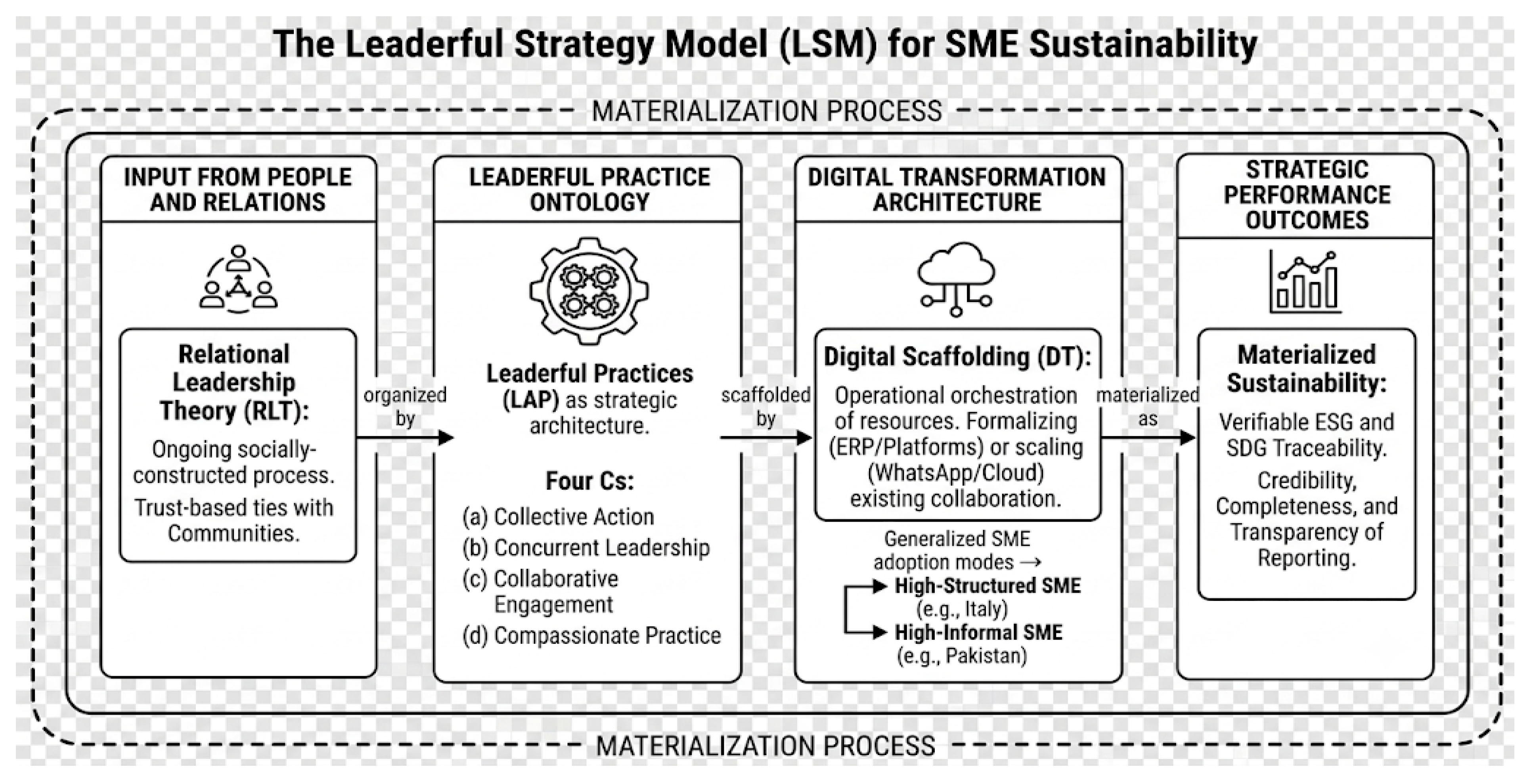
Ultimately, the Leaderful Strategy Model (LSM) functions as a relational dynamic capability that materializes informal leadership into formalized disclosure alignment through a sequential chain:
  • RLT surfaces and legitimizes sustainability as relational work.
  • LAP coordinates that work into collective, concurrent, collaborative, and compassionate action.
  • DT scaffolds those actions into shared digital routines.
  • This strategic architecture increases the transparency and shared commitment toward ESG and SDG-aligned goals.
The Leaderful Strategy Model (LSM) advances existing literature in three specific ways:
  • First: While Relational Leadership Theory (RLT) and Leaderful Practice (LAP) have been studied separately, no prior framework has explicitly integrated them with digital transformation to address the SME sustainability reporting challenge.
  • Second: Existing leadership-as-practice research focuses on describing how leadership emerges in situ but offers limited guidance on how to intentionally orchestrate emergent practices toward formal organizational outcomes. The LSM provides this missing prescriptive logic.
  • Third: While the digital transformation literature examines technology adoption, it rarely considers how digital tools can be intentionally designed to preserve—rather than erode—relational governance. The LSM directly addresses this gap by positioning DT as a “relational amplifier” rather than a neutral tool.
  • This integration into a unified framework—with Digital Translation as the bridging mechanism—constitutes the LSM’s core theoretical breakthrough.

Digital Translation as the Conversion Mechanism

To fully operationalize the LSM, it is essential to unpack the concept of Digital Translation—the organizational process through which unstructured, relational leadership practices are captured, stabilized, and converted into standardized, verifiable digital artifacts suitable for formal ESG and SDG disclosure. Digital Translation comprises four sequential process components:
First, capture—the initial recording of relational interactions through digital tools (e.g., team conversations documented in Microsoft Teams, real-time coordination logged via WhatsApp).
Second, stabilization—the transformation of fluid, ephemeral interactions into persistent digital traces (e.g., converting chat conversations into structured meeting minutes, aggregating daily production updates into weekly reports).
Third, codification—the formatting of stabilized data into standardized reporting templates aligned with ESG frameworks (e.g., mapping internal waste reduction logs to GRI disclosure requirements).
Fourth, verification—the creation of audit trails that enable internal and external validation of reported data (e.g., time-stamped records, version histories, approval workflows).
Importantly, the specific tools used shape how each translation component is enacted. In structured environments (Italy), Enterprise Resource Planning (ERP) systems with dedicated ESG modules facilitate codification and verification through pre-configured templates and automated audit trails. In network-based environments (Pakistan), ubiquitous tools like WhatsApp and Google Sheets enable capture and stabilization through real-time documentation, with codification occurring retrospectively during reporting cycles. Regardless of the tool’s formality, the leadership intent embodied by the Four Cs determines whether Digital Translation acts as a bridge (amplifying leaderful practice) or a barrier (entrenching hierarchy). Without leaderful intent, digital tools may simply automate established hierarchies, further disconnecting informal strengths from formal reporting and widening the Relational–Performance Gap.
The LSM is a process model linking relational practices to perceived reporting effectiveness via digital traceability. In the terms of Teece [24], the model enables SMEs to sense sustainability needs (via RLT), seize opportunities (via LAP), and transform informal relational energy into formalized disclosure data (via DT). This aligns with sociomaterial perspectives that treat technology and practice as constitutively entangled [22]. A tool like Microsoft Teams can serve as a mechanism for top-down control or distributed collaboration, depending on the leadership logic guiding its use [25].
Therefore, leadership intent as embodied by the Four Cs is the critical determinant of whether DT acts as a bridge (amplifying leaderful practice) or a barrier (entrenching hierarchy). Digital translation is the bridge between relational informality and formal accountability. We formally define Digital Translation as the operational process through which unstructured, relational leadership practices are captured, stabilized, and converted into standardized, verifiable digital artifacts suitable for formal ESG and SDG disclosure. The operational scaffolding of DT enables and structures the Four Cs—enabling collective action through shared platforms and compassionate engagement through inclusive tools—thereby creating a digital trail that transforms relational processes into verifiable ESG data.
SMEs should consider not only whether to “adopt” a technology, but the specific leadership logic that will be enacted through it. Conversely, in the absence of a leaderful configuration, DT may simply automate established hierarchies, further disconnecting informal strengths from formal reporting and widening the Relational–Performance Gap. By synthesizing these three streams, we propose the LSM. The LSM illustrates how SMEs can close the Relational–Performance Gap by intentionally employing digital tools to scaffold Leaderful Practices, thereby converting relational strengths into perceived ESG reporting effectiveness. The LSM provides a coherent framework for SMEs to develop digital, leadership, and sustainability capabilities simultaneously, rather than importing external corporate models ill-suited to their unique relational contexts. The integrated Leaderful Strategy Model (LSM) is illustrated in Figure 1.
In summary, the Leaderful Strategy Model (LSM) shifts the focus from leadership as an individual trait to leadership as a designed organizational architecture. By using digital tools as scaffolding for the Four Cs, SMEs can materialize their inherent relational strengths into the transparent, traceable evidence required by global ESG standards. The following section details the mixed-methods approach used to empirically test these relationships across the distinct institutional landscapes of Italy and Pakistan.

3. Materials and Methods

3.1. Mixed-Methods Design: An Explanatory Sequential Approach

This study adopted an Explanatory Sequential Mixed-Methods Design (QUAN → qual) as outlined by Creswell and Creswell [12]. This design was selected to address the inherent complexity of the Relational–Performance Gap. The initial quantitative phase focused on establishing the baseline statistical relationships between Relational Leadership (RLT), Leaderful Practice (LAP), Digital Transformation (DT), and Perceived ESG Reporting Effectiveness (PER) across a broad sample. The subsequent qualitative phase employed multiple case studies to explain, contextualize, and elaborate the statistical patterns identified in the quantitative phase. Particular attention was paid to how relational leadership and digital tools were enacted differently within the institutional frameworks of Italy and Pakistan. Following the praxis-oriented lens suggested by Raelin [4], this study examines the ‘material-discursive processes’ of SMEs. We acknowledge that leadership is an embodied, collective accomplishment shaped by both human actors and their ‘material arrangements’ (digital scaffolding), which together change the trajectory of the organizational flow.

3.2. Context and Sample: A Strategic Institutional Comparison

The study conducted a strategic comparison between two distinct economic environments. The quantitative analysis utilized survey data from 97 listed SMEs (N = 97): 43 firms from Italy and 54 from Pakistan.
For Italy, the questionnaire was administered to 126 SMEs listed on the Euronext Milan Market (Euronext Growth Milan segment, 2024). For Pakistan, the questionnaire was administered to 136 SMEs listed on the Pakistan Stock Exchange (PSX) Market (2024), selected for their comparable size and sector characteristics. The final sample spanned the Manufacturing sector (Machinery, Textiles, Food Production) and the Service sector (IT Services, Logistics). The response rates were 34.1% for Italy (43/126) and 39.7% for Pakistan (54/136), which are consistent with typical SME survey response rates in prior research [26]. While N = 97 is moderate, it aligns with SME research norms, where access to listed firms is highly restricted and response rates typically range from 20% to 40% [24]. To ensure statistical validity, a post hoc power analysis was conducted using G*Power 3.1. With N = 97, α = 0.05, and two primary predictors, the study achieved a statistical power of 0.82 to detect a medium effect size (f2 = 0.15), exceeding the standard 0.80 threshold for social science research [27,28].
The mixed-methods design compensates for the moderate sample size by providing deep qualitative evidence to contextualize the quantitative findings. Given the exploratory nature of the study and the focused sample size (N = 97), multiple regression was employed as the primary analytical tool. This approach is robust for datasets where the goal is to examine predictive linear relationships among established constructs [13]. Independent samples t-tests were also utilized to compare means between the Italian and Pakistani cohorts, identifying differences between the two institutional cohorts. By focusing on publicly listed SMEs, the study ensured access to formalized corporate messaging, providing a necessary baseline to examine how informal relational practices translate into official structures.

3.3. Quantitative Phase: Instrument Design and Analytical Rigor

A cross-sectional survey evaluated the foundational elements of the Leaderful Strategy Model (LSM) using multi-item, 5-point Likert scales (1 = Strongly Disagree to 5 = Strongly Agree). Relational Leadership and ESG Perceptions (RLEP): Adapted from Uhl-Bien [1], measuring leadership as a socially constructed, emergent process. Leaderful Practice (LAP): A multi-dimensional scale grounded in Raelin [4], measuring the operationalization of the Four Cs (Collective, Concurrent, Collaborative, Compassionate). Leadership-driven Digital Transformation (LDEP): A newly developed scale capturing the strategic use of digital tools to scaffold leaderful behaviors. Perceived ESG Reporting Effectiveness (PER): While many studies rely on standardized, secondary sustainability performance metrics, this study utilizes a dedicated subjective reporting capacity scale developed specifically for the SME context. Since standardized ESG frameworks (e.g., GRI Standards 2021, SASB Standards 2018) are designed for large corporations and fail to capture the informal relational strengths and leadership dynamics of smaller firms, this scale focuses on perceived internal and operational reporting capacities achievable within the SME context, such as localized environmental tracking efficiencies and internal social well-being disclosure.
All scales demonstrated high internal consistency, with Cronbach’s alpha coefficients ranging from 0.85 to 0.92, substantially exceeding the recommended 0.70 threshold [29]. The identical reliability coefficients for RLEP and LDEP across both national samples, combined with the near-identical coefficient for SR (0.89 in Italy, 0.85 in Pakistan), provide evidence of strong measurement invariance, supporting the cross-cultural comparability of our findings. Our decision to exclude control variables from the main regression models was intentional, theory-driven, and grounded in three considerations. First, to preserve statistical power and avoid model overfitting, which can occur when the ratio of predictors to cases falls below 1:10 [30]. With two primary predictors (RLEP and LDEP) and N = 97, this ratio (1:48) comfortably exceeds the recommended threshold. The inclusion of additional controls (e.g., firm size, age, industry) would have reduced this ratio and potentially introduced multicollinearity without substantially improving model fit, given the focused nature of our hypotheses.
Second, as an exploratory theory-building study, we prioritized parsimony to establish baseline relationships before introducing compounding variables in future confirmatory studies [20,21]. Third, preliminary analysis indicated that firm size and age did not significantly correlate with PER outcomes, reducing the risk of omitted variable bias.
Nevertheless, we fully acknowledge the constraints of this approach. The sample size and cross-sectional design preclude strong causal claims, and omitted variable bias—while mitigated by preliminary analysis—cannot be entirely ruled out. We therefore position these findings as exploratory, hypothesis-generating contributions that require replication with larger, more comprehensive datasets.

3.4. Qualitative Phase: Multiple Case Study Design

The qualitative phase sought to uncover the specific mechanisms of “digital translation.” We employed a matched-pair multiple-case study design, selecting eight SMEs (four per country). This “paradigmatic case” methodology investigated how firms either bridged or blocked the relationship between relational strength and perceived ESG reporting outcomes [10].
To ensure rigor and construct validity, data were triangulated across three primary sources: Semi-structured Interviews: Conducted with founders, CEOs, and operational leaders (n = 16) to capture lived narratives of how leadership was enacted and digitally mediated. A total of 16 interviews were conducted across the 8 case study firms (12 interviews in Pakistan, 4 in Italy). From this pool, 8 matched-pair interviews (4 per country, representing 2 participants per firm: typically, founder/CEO and operations manager) were selected for in-depth thematic analysis based on maximum variation in digital adoption profiles and perceived reporting effectiveness levels. Document Analysis: A review of voluntary sustainability disclosures, codes of ethics (highly prevalent in the Italian sample), and internal process manuals.
Contextual Observations: Where feasible, observations of meetings and digital workflows (e.g., shared cloud workspaces) provided real-time evidence of leadership-in-action.
Data were analyzed using Thematic Analysis, following an iterative coding process in three stages. First, transcripts and field notes were read repeatedly to identify first-order codes relating to leadership practice, digital coordination, sustainability decision-making, and reporting views. Second, these codes were grouped into broader analytical categories informed by the LSM, particularly the Four Cs of leaderful practice and the role of digital scaffolding. Third, cross-case comparison was used to identify recurring configurations within and across the Italian and Pakistani cases.
The coding structure proceeded through three levels. First-order codes captured descriptive practices (e.g., ‘using WhatsApp for coordination,’ ‘formal sustainability meetings,’ ‘documenting through ERP’). Second-order themes grouped these into analytical categories aligned with the LSM framework (e.g., ‘digital formalization,’ ‘relational capture,’ ‘structured facilitation,’ ‘organic integration’). Third-order aggregate dimensions—‘Cautious-Facilitation’ and ‘Pragmatic-Integration’—emerged from cross-case comparison, representing the two distinct configurations of leadership, digital tools, and institutional context. Intercoder agreement reached kappa = 0.84, indicating substantial reliability.
The two resulting interpretive models—Cautious Facilitation and Pragmatic Integration—were developed through this iterative movement between empirical material and theoretical constructs. To strengthen analytic dependability, emerging codes and themes were discussed among the authors, and discrepant interpretations were reviewed against raw interview transcripts, documents, and observational notes. Themes were identified inductively from the transcripts and then deductively mapped against the LSM. This allowed us to distinguish between digital tools used as instruments of hierarchical control versus instruments of collaboration. The interviews were unevenly distributed across the two countries (12 in Pakistan and 4 in Italy), reflecting the sampling strategy used to capture greater variation in informal digital adoption within the Pakistani cases. This imbalance should nevertheless be considered when interpreting the comparative qualitative findings. Pakistani cases were selected to capture maximum variation in informal digital adoption patterns—a phenomenon that was quantitatively more heterogeneous in the Pakistani cohort. Conversely, Italian cases were selected for their representativeness of the structured adoption pattern identified in the quantitative phase, where digital adoption followed a more uniform, formalized trajectory. For the matched-pair analysis that forms the core of our cross-country comparison, we selected 2 participants per firm (4 per country: typically, founder/CEO and operations manager), ensuring balanced cross-country representation for the in-depth thematic analysis. This approach aligns with the logic of “paradigmatic case” selection [24], where depth and representativeness are prioritized over numerical balance.
By utilizing this mixed-methods approach, the researcher acted not as a distant spectator but as a ‘co-participant’ [5]. This allowed for an interpretation of how SMEs ‘dwell with the data’ [5] of their own perceived ESG reporting mechanisms, turning disclosures from an administrative burden into a collective, leaderful practice.

3.5. Data Integration, Ethics, and Positionality

Integration occurred through a connected-data approach, where quantitative findings directly informed the purposive selection of the qualitative case studies. Integration occurred at two points: first, during the case selection phase (where quantitative patterns informed purposive sampling), and second, during the interpretation phase (where qualitative findings were mapped back to the quantitative results to refine the LSM). For example, the statistical divergence in digital adoption styles between the cohorts informed the selection of “High-Structured” (Italy) versus “High-Informal” (Pakistan) adoption cases.
This synthesis crystallized two culturally and institutionally distinct pathways within the LSM: the Cautious-Facilitation Model and the Pragmatic-Integration Model, detailed below in Table 2.
Interviews were conducted with prior informed consent and all procedures complied with GDPR requirements for data protection. Translations were checked rigorously for semantic equivalence rather than literal word-for-word transfer. This allowed us to pay careful attention to culturally embedded terms relating to trust, responsibility, family-like relations and accountability. All firms and participants were fully anonymized, and identifying details were removed from quotations and case descriptions. All data were stored on password-protected institutional servers accessible only to the research team.
The research team also maintained detailed reflexive notes during the analysis to reduce the risk of treating Italian and Pakistani practices as fixed national traits rather than as situated organizational responses to different institutional pressures and resource conditions. The full survey instrument and qualitative interview guide are provided in Appendix A.

4. Results

Our findings identify two contextually configured patterns through which digital tools were used alongside leaderful practices in the sampled firms.

4.1. Quantitative Findings

Overall, the empirical findings demonstrate how leaderful leadership emerges through relational coordination and shared sense-making rather than top-down hierarchical authority. Table 3 presents the inter-correlations of key constructs by country. The bivariate correlation analysis reveals several important patterns.
All constructs show significant positive associations in both countries, confirming the interconnectedness of relational leadership, digital transformation, and perceived reporting effectiveness. Notably, the correlation patterns suggest distinct cross-cultural pathways: Italian SMEs demonstrate substantially stronger relationships between relational leadership and reporting (r = 0.741 vs 0.576) and between digital transformation and reporting (r = 0.834 vs 0.713), indicating more direct pathways in the structured Italian context. Conversely, Pakistani SMEs show a stronger leadership-to-technology link (r = 0.670 vs 0.602), suggesting that leadership influence in Pakistan is channeled more strongly through digital enablement. These preliminary findings provide the foundation for the multivariate analysis that follows. To explore the model’s ability to predict PER, a multiple linear regression analysis was conducted, with results detailed below in Table 4.
The multiple regression analysis provides context-dependent support for Hypothesis 1 (H1). Relational Leadership (RLEP) significantly predicts perceived ESG reporting effectiveness in Italy (beta = 0.375, p < 0.001), but this direct effect is not statistically significant in Pakistan (beta = 0.177, n.s.). This study evaluates direct predictive paths using multiple linear regression; it does not test or infer statistical mediation pathways. This indicates a context-dependent pathway: in Italy, relational leadership has a direct effect on perceived reporting outcomes, while in Pakistan, relational leadership shows no direct statistical association, meaning that formal reporting readiness is driven fundamentally by the presence of digital scaffolding (LDEP). Conversely, Hypothesis 2 (H2) is fully supported across both national contexts. LDEP (digital scaffolding) emerges as a highly powerful, uniform predictor of PER (beta Italy = 0.608, p < 0.001; beta Pakistan = 0.595, p < 0.001). This confirms that digital tools serve as the essential operational mechanism through which leaderful practices are materialized into perceived reporting capacities—particularly in institutional contexts that lack formal reporting infrastructures. Consequently, the empirical research supports the argument that SMEs whose leaders actively practice Relational Leadership through collective, concurrent, collaborative, and compassionate approaches can successfully communicate and implement sustainability practices aligned with the United Nations Sustainable Development Goals (SDGs), provided they possess the necessary digital scaffolding to translate those fluid interactions into visible data points. Independent-samples t-tests were also conducted to compare the baseline levels of the core constructs between the two countries. The results (Table 5) indicated no statistically significant differences in baseline Relational Leadership (p = 0.187) or final Perceived ESG Reporting Effectiveness (p = 0.428). Interestingly, Pakistani SMEs showed a marginally higher trend toward digital adoption (M = 21.42) compared to Italy (M = 18.83), though this trend did not reach strict statistical significance (p = 0.056, d = 0.47, indicating a small-to-medium effect size). This statistical ‘tie’ in perceived reporting effectiveness despite fundamentally different institutional base lines and paths confirm a state of structural equifinality within our cross-cultural sample [29].

4.2. Qualitative Findings: Uncovering the Pathways—Two Models of Digital Enablement

The qualitative case studies helped to contextualise the quantitative patterns. The thematic analysis, which achieved substantial intercoder agreement (kappa = 0.84), identified two contextually configured patterns in the sampled firms: Cautious Facilitation in the Italian cases and Pragmatic Integration in the Pakistani cases.

4.2.1. The Cautious-Facilitation Model—Italy

The Italian case studies demonstrated a highly systematic, intentional method. Digital transformation (DT) was approached as a top-down, strategic initiative supported by significant upfront capital investments in integrated organizational platforms. These included Enterprise Resource Planning (ERP) systems featuring specialized modules for environmental, social, and governance (ESG) considerations, alongside formal collaboration platforms like Microsoft Teams. This model represents a highly structured leadership pathway where digital platforms formalize, capture, and amplify existing collaborative leadership instincts. In this framework, digital tools are considered the baseline architecture for leaders to facilitate, structure, and amplify their distributed organizing. As an example, one Italian manufacturing SME used its company-wide platform to establish digital “sustainability circles.” This initiative formalized and channeled informal, cross-departmental conversations into a designed leadership architecture that coordinates waste reduction and energy efficiency through shared digital accountability. As established by the qualitative analysis of the Italian cohort, organizations exhibit a ‘Cautious-Facilitation’ model. Rather than rewriting operational habits, digital enablers function strictly as a ‘reinforcing mesh’ designed to stabilize and strengthen an existing, process-oriented structure. This reflects a more reserved, formal approach where digital tools support structured corporate reporting lines without over-altering the relational foundation. This formalized approach extended to ethical governance, with one participant emphasizing the importance of structures and controls: ‘The integration between ethics and sustainability is ensured only when there are structures (governance, policies, controls), processes (measurement, reporting, dialogue), culture (values, behaviors, training)’.
Operations managers noted that digital platforms provided a formal structure for collaboration, making sustainability discussions visible and actionable for the entire organization rather than limiting them to meeting attendees. As one Italian participant explained, ‘Sharing the sustainability plan via an internal digital platform. KPIs are analyzed through periodic meetings.’ This process created a documented trail of both internal social safety initiatives and environmental efficiency efforts, providing tangible, structured evidence for perceived ESG reporting. This model is cautious because digitization strictly follows a clear, management-led design. It is facilitative because it provides the operational architecture to amplify the Four Cs—structuring collectivity, enabling concurrency, documenting collaboration, and systematizing compassionate engagement—directly linking everyday relational practice to formalized disclosure alignment.

4.2.2. The Pragmatic-Integration Model—Pakistan

The Pakistani cases exhibited a fundamentally different organizing logic: an organic, bottom-up approach. Here, DT was not treated as a distinct capital project but rather as the pragmatic integration of low-cost, ubiquitous tools—such as WhatsApp Business, Google Sheets, and shared cloud storage—into the daily flow of relational work. In this model, leaderful practices were not merely facilitated by technology; they were dynamically expressed through it. Digital tools acted as flexible leadership scaffolding that allowed concurrent leadership to remain agile while materializing informal trust into credible perceived reporting narratives.
A poignant example was a Pakistani textile SME where production leads, quality heads, and the firm’s owner co-managed a dedicated WhatsApp group. This digital space became the real-time nerve center for resolving production snags, reducing material waste, and coordinating safe shipments—a vibrant, lived display of collective and concurrent leadership. This model represents an organic leadership pathway where accessible tools become seamless extensions of a concurrent leadership culture. As the owner shared:
“We do not ‘implement’ digital tools. We use what works to keep our family connected. Trust and collective responsibility are already part of how we work. WhatsApp makes it faster and lets us keep an ongoing record. That record, once organized, becomes the story we tell our international buyers about our social and environmental care.” Conversely, the Pakistani cohort demonstrates a ‘Pragmatic-Integration’ approach driven by immediate operational adaptabilities and deep trust-based networks. Interview transcripts reveal that organizational actors dynamically ‘trust each other and nudge each other,’ using highly accessible, functional platforms like WhatsApp because they are ‘very practical, and providing tracking in real time.’ As one participant explained, ‘We can trust each other and encourage each other … we never make our staff member feel discourage we respect them in every situation.’ This relational foundation enables the seamless integration of digital tools into daily workflows. Management purposefully utilizes these real-time streams to ‘share goals, celebrate success, and motivate groups,’ organic mapping relational dialogue straight into execution. As one participant noted, leaders use digital platforms ‘to share goals, celebrate success, and motivate teams toward sustainable practices,’ reinforcing the motivational and inclusive function of technology in the Pakistani model. In the sampled Pakistani cases, ubiquitous consumer-grade tools were used to address resource constraints and to record aspects of everyday coordination relevant to reporting. These cases suggest that digital enablement did not necessarily depend on high capital expenditure, but on the fit between available tools and existing relational practices. This directly mirrors the principles of frugal innovation [17], where severe resource constraints spur creative digital adaptation. This model is pragmatic because it is driven by immediate operational needs and resource limitations. It is integrative because it embeds technology into the relational fabric itself, seamlessly capturing data from everyday collaborative leadership that can later be compiled into perceived ESG reporting mechanisms.

4.3. Integrated Insight: Validating the Model

Both approaches, though culturally and structurally distinct, illustrate how informal relational strengths can be translated into perceived ESG reporting effectiveness through different forms of digital scaffolding. The empirical evidence suggests that there is no single, optimal pathway to digitizing leaderful practice within smaller firms. Instead, the ultimate effectiveness of digital translation depends on the contextual fit between localized relational practices, available technological tools, and the overarching institutional environment. These findings, together with the observed equifinality in PER outcomes, raise important theoretical and practical questions about how institutional contexts shape digital translation mechanisms. We turn to these implications in the discussion that follows.

5. Discussion

5.1. Architecting Leadership Bridges from Relational Practice to Sustainable Performance

While early Leadership-as-Practice (L-A-P) research established the philosophical roots of collective agency [5], the Leaderful Strategy Model (LSM) provides the practical scaffolding required for the next generation of empirical field studies. By treating digital tools as material artifacts that stabilize turning points in an organization’s trajectory, the LSM offers a concrete method for the collective change agency demanded by recent L-A-P scholarship [12]. It is important to note that our dependent variable captures perceived ESG reporting effectiveness—reflecting how SME leaders and managers assess their internal and operational reporting capacities—rather than externally audited sustainability metrics. This perceptual measure is appropriate for the SME context, where formal verification is often absent or prohibitively costly, but we acknowledge this distinction throughout our interpretation of findings. This operational distinction aligns with recent structural findings by Xu et al. [31], who argue that digital leadership’s impact on sustainability outcomes is heavily optimized by digital knowledge integration and organizational resilience rather than simple tool acquisition. By positioning technological infrastructure alongside strategic relational direction, the LSM demonstrates how digital tools shift from static overhead to active catalysts for strategic resilience.
The Relational–Performance Gap is fundamentally a leadership design challenge rather than an inherent SME failure. Our findings demonstrate that this gap can be bridged by intentionally designing the intersection of everyday leadership practice and digital technology, utilizing Leaderful Practice (LAP) as scaffolding to transform fluid relational strengths into robust Perceived ESG Reporting Effectiveness (PER).
The LSM reframes digital transformation as a strategic leadership configuration rather than a technical procurement decision. The same digital tool can either automate rigid hierarchies or scaffold collective action, depending on the leaderful principles guiding its deployment. For SME leaders, this requires moving beyond viewing digital tools as a sunk cost or compliance burden to seeing them as a strategic lever for sustainable, distributed, and context-sensitive leadership. This design-centric approach aligns with the need for purpose-driven leadership in contemporary organizations, where technology is repurposed to serve social and operational transparency rather than mere extractive efficiency [19]. Our findings provide clear answers to our original research questions:
  • RQ1: How does the LSM explain the orchestration of relational leadership into perceived ESG reporting outcomes? Our findings demonstrate that leaderful practices (the Four Cs) serve as the vital translation mechanism. Collective practice distributes ownership for sustainability metrics across organizational levels; concurrent practice enables parallel action on multiple disclosure goals simultaneously; collaborative practice structures ongoing dialogue among diverse internal stakeholders; and compassionate practice centers the psychological safety required for operational transparency. Digital scaffolding then anchors these fluid interactions into shared organizational routines, converting relational work into high PER.
  • RQ2: Through what mechanisms do the Four Cs provide the leadership scaffolding required for perceived reporting effectiveness? We identified two empirically distinct mechanisms: formalization through structured platforms (Italy), where integrated digital systems (ERP, Microsoft Teams) create clear internal records of collective action; and capture through ubiquitous tools (Pakistan), where low-cost, consumer-grade software (WhatsApp, Google Sheets) extends and documents existing relational workflows. Both mechanisms achieve equivalent reporting outcomes, confirming structural equifinality.
  • RQ3: How do digital tools and leaderful practices co-constitute a leadership design for context-sensitive impact across diverse landscapes? Our cross-national comparison reveals a deeply recursive relationship. Leaderful practices actively shape how digital tools are used: in Italy, collaborative norms led to structured platform adoption; in Pakistan, concurrent practices drove WhatsApp integration. Conversely, digital tools expand the reach and verifiability of leaderful actions: platforms document collective decisions, while messaging apps capture real-time coordination. The two pathways—Cautious Facilitation and Pragmatic Integration—represent institutionally configured expressions of this recursive dynamic.
Together, these findings confirm H2 (digital transformation consistently predicts PER across contexts) while qualifying H1 (relational leadership’s direct effect is context-dependent, significant only in Italy).

5.2. Theoretical Contributions to Leadership Studies

The Leaderful Strategy Model (LSM) contributes to the leadership and organizational literature in three primary ways:
First, it connects theoretical diagnosis with actionable organizational design. Relational Leadership Theory (RLT) has been celebrated for revealing leadership as an emergent, socially co-constructed process [1]. Yet, RLT remains predominantly diagnostic—explaining that leadership is relational but offering few concrete tools for intentionally designing equitable relational processes [3,11]. By integrating RLT with LAP, we provide a prescriptive framework that moves beyond diagnosis to strategic orchestration. This addresses the Relational–Performance Gap by showing that sustainability disclosure is not a reporting burden to be managed, but a leadership architecture to be deliberately designed [6]. This responds directly to calls for frameworks that are both philosophically grounded and managerially applicable [14]. In our model, digital scaffolding acts as the material artifact that stabilizes turning points, translating informal relational energy into high PER. By enabling SMEs to convert relational strengths into verifiable ESG data, the LSM directly supports SDG 8 (decent work and economic growth), SDG 12 (responsible consumption and production), and SDG 17 (partnerships for the goals), demonstrating how leadership design can contribute to global sustainability targets.
Second, we introduce the intentional design of relational practices as a strategic organizational capability. This construct reframes leaderful practice from emergent, tactical behavior to strategic architecture [10]. Where prior work has described leaderful practices as naturally occurring phenomena in collaborative contexts [4], we demonstrate that they can be intentionally designed, scaled, and sustained. Rather than cultivating individual, heroic leader traits, SMEs can develop the capacity to architect relational infrastructure, advancing post-heroic leadership scholarship by providing a concrete design framework for distributing agency [2,22].
Third, we reconceptualize digital transformation as a relational design challenge rather than a technical software upgrade. Building on sociomaterial perspectives [20], we demonstrate that technology enables and scaffolds, rather than generates, collaborative leadership. Our cross-national findings reveal that digital scaffolding can take structurally distinct forms yet serve the exact same function: formalizing and scaling leaderful practices. This contributes to the digital leadership literature by specifying how technology can be intentionally designed to amplify rather than constrain relational processes [14,15]. This dual-pathway finding deeply enriches the latest conversations surrounding digital maturity models in smaller firms. For instance, recent multiple-case work by Vallée et al. [32] highlights that while higher digital maturity is broadly associated with diversified ESG practices, this integration is highly uneven and heavily conditioned by local governance mechanisms. The LSM directly resolves this unevenness by demonstrating that structural equifinality can be achieved through culturally configured expressions—whether via formal platform architectures or ubiquitous, low-cost tools—provided that leaderful practices anchor the deployment.
These contributions are bounded by the SME context and the specific institutional landscapes of Italy and Pakistan. Future research should test the LSM’s applicability in other organizational forms and national contexts.

5.3. Empirical Nuance: Two Culturally Embedded Blueprints

The empirical heart of our study reveals that effective strategy is not universal but contextually configured, manifesting in two culturally embedded models that demonstrate structural equifinality [22]. To provide a clear comparative overview of these pathways, Table 6 synthesizes the distinct digital and relational configurations observed in both contexts.
As illustrated, while the primary logic and infrastructure differ significantly between the two cohorts, the strategic outcome remains consistent. This reinforces the core argument that the Leaderful Strategy Model can be successfully adapted to diverse institutional environments without compromising its capacity to materialize perceived ESG reporting effectiveness.

5.4. Practical Imperatives for SMEs and Policymakers

Our findings suggest that SME leaders should not mimic corporate ESG tracking systems but rather develop their internal capacity for relational orchestration.
For Managers:
  • Diagnose your relational DNA before selecting tools: Assess your organization’s daily operations through the lens of the Four Cs. Where collective practice is strong, digital tools can formalize shared ownership; where concurrent practice is emergent, real-time communication platforms can enable parallel coordination.
  • Frame technology as a leadership amplifier, not an IT driver: Before procurement, ask: “Will this tool help us act more collectively, concurrently, collaboratively, or compassionately on our internal tracking goals?” This shifts the conversation from technical IT specifications to human and relational outcomes.
  • Start small and scale organically: The Pakistani model demonstrates that impactful scaffolding can begin with a single, low-cost tool that solves an immediate coordination problem, building confidence for subsequent digital steps.
For Policymakers:
  • Provide context-sensitive SME support infrastructure: In highly structured economies like Italy, assist SMEs in integrating leaderful practices into existing corporate compliance systems. In relational economies like Pakistan, focus on helping SMEs capture and structure the operational data generated through informal trust networks.
  • Incentivize the relational process, not just the quantitative output: Regulatory frameworks should focus on how digital tools enhance stakeholder inclusion and operational transparency, rather than evaluating final perceived ESG reporting scores alone. This directly aligns with the double materiality principles emerging in modern international frameworks, such as the Corporate Sustainability Reporting Directive (CSRD) [8].

5.5. Limitations and Future Research

While this study provides a novel framework for the orchestration of relational leadership, several methodological and conceptual limitations offer fertile ground for future inquiry:
  • Sample Demographics and Constraints: While our sample size ($N = 97$) achieved a statistical power of 0.82 for medium effect sizes, it remains moderate. Future research should replicate these findings with larger cohorts and explore the Four Cs as individual predictors rather than a composite measure to identify which specific practices drive distinct perceived reporting dimensions.
  • Cross-Sectional Constraints: The cross-sectional nature of the data precludes definitive causal inferences. Longitudinal studies or panel datasets are needed to determine if digital scaffolding causes leaderful practices to scale, or if pre-existing leaderful cultures simply drive superior digital adoption.
  • Boundary Conditions: Our focus on publicly listed SMEs ensured access to formalized reporting baselines but represents a specific boundary condition. Future studies should investigate unlisted or micro-SMEs, which may rely on even more frugal configurations. Furthermore, extending this research to collectivist East Asian or Latin American economies would test the cross-cultural universality of our models.
  • Construct Depth: A deeper investigation into the “Compassionate C” is warranted. Our qualitative findings suggest compassion is vital for the psychological safety required for sustainability innovation, yet the mechanisms through which compassion is digitally scaffolded remain undertheorized.
  • Perceptual and Methodological Bias: The reliance on self-reported survey items introduces potential Common Method Bias (CMB), as both independent and dependent variables were collected from the same respondents at a single point in time. We assessed the severity of CMB using Harman’s single-factor test, which yielded a total variance of 28.3% for the single factor—well below the 50% threshold, suggesting that CMB is not a pervasive threat to the validity of our findings. However, self-reported perceptions of ESG reporting effectiveness may not perfectly align with objectively verified sustainability performance metrics, such as audited carbon footprints or third-party ESG ratings. While our perceptual measure is appropriate for the SME context—where formal verification is often absent or prohibitively costly—we acknowledge this limitation and encourage future research to validate perceptual findings against objective sustainability indices, where available. Additionally, future studies could employ temporal separation of predictor and outcome variables, or marker variable techniques, to more rigorously control for CMB.
  • Non-Response Bias: Non-response bias may affect the generalizability of our findings. The response rates (34.1% for Italy, 39.7% for Pakistan) are consistent with SME survey research norms, but firms that chose to participate may differ systematically from non-respondents, particularly regarding digital maturity or sustainability orientation. Future studies should employ follow-up surveys or archival data to assess non-response patterns.
  • Subjective Measurement Scope: The subjective nature of our PER measure warrants explicit consideration. While standardized ESG frameworks (e.g., GRI, SASB) are designed for large corporations and fail to capture the informal relational strengths of SMEs, our perceptual measure captures internal and operational reporting capacities rather than externally verified outcomes. This is appropriate for the SME context but limits comparability with studies using objective disclosure indices. We encourage future research to validate perceptual findings against third-party sustainability ratings where available.
  • Measurement Validation Constraints. While our scales demonstrated strong internal consistency (Cronbach’s α = 0.85–0.92), we acknowledge that the moderate sample size (N = 97) limited our ability to conduct confirmatory factor analysis, which would provide more rigorous evidence of construct validity. However, the strong reliability coefficients, meaningful correlation patterns, and triangulation with rich qualitative data provide confidence in the measurement validity. Future research with larger samples should validate the factorial structure of the RLEP, LDEP, and PER scales through CFA to further establish their psychometric properties across diverse institutional contexts [33].
Finally, the qualitative phase must be interpreted within its case-study boundaries. Although the eight SMEs provided valuable explanatory depth, the findings rely primarily on managerial and operational accounts. Future studies could strengthen the qualitative design through longitudinal ethnography, employee-level interviews, and comprehensive supplier-buyer perspective mapping.

6. Conclusions

This research demonstrates that the Relational–Performance Gap is not a failure of SME operational capability but a deliberate leadership design challenge. By intentionally orchestrating leaderful practices through targeted digital scaffolding, smaller firms can transform their unique relational strengths into a highly credible strategic advantage.
Our empirical analysis reveals two culturally and institutionally distinct yet equally valid pathways for navigating this transformation:
In Italy, the Cautious-Facilitation Model uses structured, formal digital platforms to systematically formalize and document collective action within established frameworks.
In Pakistan, the Pragmatic-Integration Model seamlessly weaves low-cost, ubiquitous tools like WhatsApp and cloud sheets directly into existing relational workflows to capture and verify organic coordination.
Crucially, both pathways achieve equivalent results, confirming structural equifinality and demonstrating that there is no single “correct” way to build this operational bridge—only a correct alignment with the surrounding institutional context. Both models ultimately yield high Perceived ESG Reporting Effectiveness (PER), proving that relational alignment is the true engine of reporting success. By bridging the Relational–Performance Gap, both pathways contribute to the achievement of SDG 8 (Decent Work and Economic Growth), SDG 12 (Responsible Consumption and Production), and SDG 17 (Partnerships for the Goals), demonstrating how local relational practices can support global sustainability targets.
For managers, the practical implication is clear: digital transformation is fundamentally a leadership design choice rather than a technical software procurement decision. The exact same technological tool can either automate rigid, top-down hierarchies or scaffold fluid, collective action, depending entirely on the leaderful principles that guide its daily deployment.
For policymakers, support architectures must remain context-sensitive. Rather than enforcing rigid templates, policies should assist SMEs in structured economies to integrate leaderful practices into formal reporting systems, while simultaneously helping SMEs in relational economies capture and verify the data they already generate organically through informal trust networks.
Ultimately, the sustainable SME of the future is not a scaled-down version of a large corporation, but rather a digitally enabled relational ecosystem. The Leaderful Strategy Model (LSM) provides the necessary operational framework for this evolution, demonstrating that smaller firms do not need to import heavy, external bureaucratic leadership models. Instead, they can intentionally orchestrate their existing relational fabric into a verifiable architecture for localized perceived SDG reporting impact.
Future research should extend the LSM to unlisted and micro-SMEs, incorporate objective ESG metrics, and test its applicability in additional institutional contexts to further validate its cross-cultural robustness. By detailing this process, this study contributes directly to the emerging ‘second generation’ of Leadership-as-Practice (L-A-P) research, providing an actionable, empirical framework for mobilizing collective agency across highly diverse institutional and cultural landscapes. In doing so, it offers SME leaders and policymakers alike a practical roadmap for turning relational strengths into perceived, verifiable reporting impact—one leaderful practice at a time.

Author Contributions

Conceptualization, O.P. and S.F.; methodology, O.P., S.F. and A.N.; software, A.N.; validation, A.N., O.P. and S.F.; formal analysis, A.N.; investigation, A.N.; resources, A.N.; data curation, A.N.; writing—original draft preparation, A.N.; writing—review and editing, A.N., O.P. and S.F.; visualization, A.N.; supervision, O.P. and S.F.; project administration, S.F. All authors have read and agreed to the published version of the manuscript.

Funding

This research received no external funding.

Institutional Review Board Statement

The research did not involve medical procedures, clinical interventions, vulnerable populations, or the collection of special categories of personal data. Ethical review and approval were waived for this study by Institution Committee as per Article 9 of Regulation (EU) 2016/679 (GDPR).

Informed Consent Statement

The informed consent for participation obtained from the participants of this study.

Data Availability Statement

The raw data supporting the conclusions of this article will be made available by the authors on request.

Acknowledgments

The authors would like to acknowledge the Department of Economics and Management at the University of Brescia for providing the institutional support and resources necessary to conduct this PhD research. We also thank the participating SMEs for their time and cooperation in the data collection process.

Conflicts of Interest

The authors declare no conflicts of interest.

Abbreviations

The following abbreviations are used in this manuscript:
RLEPRelational Leaderful Practices & ESG Performance
LAPLeaderful Practices
LDEPLeadership-Driven ESG Performance
SRSustainable Reporting/Performance

Appendix A

Appendix A.1. Survey Instrument and Measurement Scales

Table A1. Measurement constructs, item IDs, and scale anchors used in the quantitative phase.
Construct (Variable Name)Item IDMeasurement ItemScale Anchors
Relational Leaderful Practices and ESG Performance (RLEP)RLEP1Extent to which the leader promotes shared responsibility and collaboration for ESG.1 (Not at all)–5 (To a considerable extent)
RLEP2Frequency of cross-team collaboration to achieve ESG performance.1 (Never)–5 (Very Often)
RLEP3Extent to which employees feel collectively responsible for ESG.1 (Not responsible)–5 (Very responsible)
RLEP4Level of employee contribution to ESG-related decision-making.1 (Never)–5 (Very actively)
Leadership-Driven Digital Transformation and ESG Perceptions
(LDEP)
LDEP1Frequency of digital tool usage (IoT, AI, etc.) for monitoring/reporting ESG.1 (Never)–5 (Very frequently)
LDEP2Effectiveness of digital tools in tracking and reporting ESG progress.1 (Not effective)–5 (Very effective)
LDEP3Extent to which digital communication tools (Teams, WhatsApp, etc.) support motivation for ESG.1 (Never)–5 (Very frequently)
LDEP4Use of digital tools to manage real-time dialogue aimed at ESG performance.1 (Never)–5 (Very frequently)
Perceived ESG Reporting Effectiveness (PER) (SR)SR1Rating of firm’s environmental measures (waste, energy, water).1 (Poor)–5 (Excellent)
SR2Rating of firm’s social performance (well-being, human rights).1 (Poor)–5 (Excellent)
SR3Rating of firm’s governance (transparency, responsible culture).1 (Poor)–5 (Excellent)
SR4Level of engagement in implementing UN Agenda 2030 SDGs.1 (Not engaged)–5 (Very engaged)

Appendix A.2. Qualitative Interview Guide (Case Study Phase)

To explain the statistical patterns identified in Phase 1, semi-structured interviews were conducted with the selected sample of SME leaders. The following questions guided the dialogue:
Theme 1: Orchestrating Leaderful Practice (The Four Cs)
  • How is collaboration between different teams encouraged to achieve sustainability goals? (e.g., methods, tools, or digital platforms used).
  • How are employees involved in the decision-making process regarding sustainability initiatives? (e.g., feedback mechanisms or town halls).
  • Can you provide an example of how relationships based on collaboration, empathy, or collective responsibility led to a positive sustainability outcome?
Theme 2: Digital Scaffolding and Materialization
  • How practical are the digital tools used by your company (e.g., dashboards, BI software) in tracking and reporting sustainability efforts?
  • How do digital communication tools (e.g., Microsoft Teams, WhatsApp) contribute to achieving goals and fostering real-time dialogue?
  • Can you provide an example where a digital tool allowed a junior employee to surface a sustainability idea that was then acted upon by the team?
  • What challenges or barriers (e.g., skills, culture, cost) does your company face in using digital tools for sustainable performance?
Theme 3: Strategic Alignment and Global Goals (SDGs)
  • What specific methods or tools does your company use to measure progress toward the SDGs?
  • How is sustainability reporting used to share achievements with the team and improve internal alignment?
  • How does management ensure that ESG efforts are not just compliant, but aligned with the UN Agenda 2030?

References

  1. Uhl-Bien, M. Relational leadership theory: Exploring the social processes of leadership and organizing. Leadersh. Q. 2006, 17, 654–676. [Google Scholar] [CrossRef]
  2. Raelin, J.A. Leadership-as-practice: Its past history, present emergence, and future potential. Acad. Manag. Collect. 2023, 2, 19–30. [Google Scholar] [CrossRef]
  3. Raelin, J.A. From leadership-as-practice to leaderful practice. Leadership 2011, 7, 195–211. [Google Scholar] [CrossRef]
  4. Raelin, J.A. Imagine there’s no leaders: Reframing leadership as a collaborative practice. Leadership 2016, 12, 131–158. [Google Scholar] [CrossRef]
  5. Martínez-Peláez, R.; Ochoa-Brust, A.; Rivera, S.; Félix, V.G.; Ostos, R.; Brito, H.; Félix-Carreón, R.A.; Mena, L.J. Role of Digital Transformation for Achieving Sustainability: Mediated Role of Stakeholders, Key Capabilities, and Technology. Sustainability 2023, 15, 11221. [Google Scholar] [CrossRef]
  6. Simpson, B.; den Hond, F. The Contemporary Resonances of Classical Pragmatism for Studying Organization and Organizing. Organ. Stud. 2022, 43, 127–146. [Google Scholar] [CrossRef]
  7. Florek-Paszkowska, A.; Ujwary-Gil, A. The Digital-Sustainability Ecosystem: A conceptual framework for digital transformation and sustainable innovation. J. Entrep. Manag. Innov. 2025, 21, 116–137. [Google Scholar] [CrossRef]
  8. European Union. Directive (EU) 2022/2464 of the European Parliament and of the Council of 14 December 2022 amending Regulation (EU) No 537/2014, Directive 2004/109/EC, Directive 2006/43/EC and Directive 2013/34/EU, as regards corporate sustainability reporting. Off. J. Eur. Union 2022, L322, 15–80. [Google Scholar]
  9. Hörisch, J.; Johnson, M.P.; Schaltegger, S. Implementation of Sustainability Management and Company Size: A Knowledge-Based View. Bus. Strategy Environ. 2015, 24, 765–779. [Google Scholar] [CrossRef]
  10. Baumann-Pauly, D.; Wickert, C.; Spence, L.J.; Scherer, A.G. Organizing corporate social responsibility in small and large firms: Size matters. J. Bus. Ethics 2013, 115, 693–705. [Google Scholar] [CrossRef]
  11. Wickert, C.; Scherer, A.G.; Spence, L.J. Walking and talking corporate social responsibility: Implications of firm size and static vs. dynamic asymmetries. J. Manag. Stud. 2016, 53, 1169–1196. [Google Scholar] [CrossRef]
  12. Creswell, J.W.; Creswell, J.D. Research Design: Qualitative, Quantitative, and Mixed Methods Approaches, 5th ed.; SAGE Publications: London, UK, 2018. [Google Scholar]
  13. Uhl-Bien, M.; Marion, R.; McKelvey, B. Complexity Leadership Theory: Shifting leadership from the industrial age to the knowledge era. Leadersh. Q. 2007, 18, 298–318. [Google Scholar] [CrossRef]
  14. Raelin, J.A. Toward a methodology for leadership-as-practice. Leadership 2020, 16, 480–508. [Google Scholar] [CrossRef]
  15. Maak, T.; Pless, N.M. Responsible leadership in a stakeholder society: A relational perspective. J. Bus. Ethics 2006, 66, 99–115. [Google Scholar] [CrossRef]
  16. Johnson, M.P.; Schaltegger, S. Two decades of sustainability management tools for SMEs: How far have we come? J. Small Bus. Manag. 2016, 54, 481–505. [Google Scholar] [CrossRef]
  17. Contractor, N.S.; DeChurch, L.A.; Carson, J.B.; Carter, D.R.; Keegan, B. The topology of collective leadership. Leadersh. Q. 2012, 23, 994–1011. [Google Scholar] [CrossRef]
  18. Dutton, J.E.; Heaphy, E.D. The Power of High-Quality Connections. In Positive Organizational Scholarship: Foundations of a New Discipline; Cameron, K., Dutton, J., Eds.; Berrett-Koehler Publishers: Oakland, CA, USA, 2003; pp. 262–278. [Google Scholar]
  19. Lee, C.-W.; Khan, A.Z.; Hong, T.-W.; Ngo, H.-V.; Javed, A. Ethical Leadership and CSR Engagement in SMEs: Sequential Mediation of Trust and Organizational Commitment Across Pakistan, India, and Taiwan. Sustainability 2026, 18, 2870. [Google Scholar] [CrossRef]
  20. Schaltegger, S.; Burritt, R. Business cases and corporate engagement with sustainability: Differentiating ethical motivations. J. Bus. Ethics 2018, 147, 241–259. [Google Scholar] [CrossRef]
  21. Susha, I.; Grönlund, Å.; Van Tulder, R. Data Driven Social Partnerships: Exploring an Emergent Trend in Search of Research Challenges and Questions. Gov. Inf. Q. 2019, 36, 112–128. [Google Scholar] [CrossRef]
  22. Orlikowski, W.J. Sociomaterial practices: Exploring technology at work. Organ. Stud. 2007, 28, 1435–1448. [Google Scholar] [CrossRef]
  23. Radjou, N.; Prabhu, J. Frugal Innovation: How to Do More with Less; Economist Books: Hachette, India, 2015. [Google Scholar]
  24. Teece, D.J. Explicating dynamic capabilities: The nature and microfoundations of (sustainable) enterprise performance. Strateg. Manag. J. 2007, 28, 1319–1350. [Google Scholar] [CrossRef]
  25. Leonardi, P.M.; Barley, S.R. What’s under construction here? Social mechanisms, materiality, and the grind of technologies at work. Acad. Manag. Ann. 2010, 4, 1–51. [Google Scholar] [CrossRef]
  26. Baruch, Y.; Holtom, B.C. Survey response rate levels and trends in organizational research. Hum. Relat. 2008, 61, 1139–1160. [Google Scholar] [CrossRef]
  27. Faul, F.; Erdfelder, E.; Buchner, A.; Lang, A.G. Statistical power analyses using G*Power 3.1: Tests for correlation and regression analyses. Behav. Res. Methods 2009, 41, 1149–1160. [Google Scholar] [CrossRef] [PubMed]
  28. Cohen, J. Statistical Power Analysis for the Behavioral Sciences, 2nd ed.; Lawrence Erlbaum Associates: Mahwah, NJ, USA, 1998. [Google Scholar]
  29. Nunnally, J.C.; Bernstein, I.H. Psychometric Theory, 3rd ed.; McGraw-Hill: New York, NY, USA, 1994. [Google Scholar]
  30. Green, S.B. How many subjects are required for a double regression analysis? Multivar. Behav. Res. 1991, 26, 499–510. [Google Scholar] [CrossRef] [PubMed]
  31. Asif, M.; Yang, L.; Hashim, M. The Role of Digital Transformation, Corporate Culture, and Leadership in Enhancing Corporate Sustainable Performance in the Manufacturing Sector of China. Sustainability 2024, 16, 2651. [Google Scholar] [CrossRef]
  32. Vallée, S.; Ertz, M.; Zarea, H. Digital Transformation and ESG Practices in SMEs: A Multiple-Case Study in Regional Quebec. Sustainability 2026, 18, 6131. [Google Scholar] [CrossRef]
  33. Hair, J.F.; Black, W.C.; Babin, B.J.; Anderson, R.E. Multivariate Data Analysis, 8th ed.; Cengage Learning: Boston, MA, USA, 2019. [Google Scholar]
Figure 1. The Leaderful Strategy Model: From Relational Inputs to Perceived ESG Reporting Effectiveness.
Sustainability 18 06816 g001
Table 1. Distinguishing Key Constructs in the Leaderful Strategy Model.
ConstructDefinitionFunction in the Model
Relational Leadership (RLT)Leadership as a socially constructed process emerging through daily interactional workProvides the diagnostic lens—surfaces and legitimizes relational work
Leaderful Practice (LAP)The operational framework of the Four Cs (collective, concurrent, collaborative, compassionate)Provides the prescriptive design—organizes relational energy into coordinated action
Digital Transformation (DT)Integration of digital technologies (ERP, WhatsApp, cloud documents) into organizational processesProvides the technical infrastructure—the “scaffold” and “relational amplifier”
Digital TranslationThe organizational process through which DT is intentionally deployed to convert relational practices into formal disclosures.Provides the conversion mechanism—the bridge between informal relationality and formal accountability.
Leadership ScaffoldingThe combined infrastructure (digital tools, processes, norms) that enables leaderful practices to scaleThe enabling architecture—what makes the Four Cs organizationally sustainable.
Table 2. Explanatory Sequential Integration—How Quantitative Patterns Informed Case Selection.
Quantitative Pattern (Phase 1)Qualitative Sampling Strategy (Phase 2)Case RationaleResulting Qualitative Insight
Italian SMEs scored higher on structured LDEP but showed similar Perceived ESG Reporting Effectiveness (PER) outcomes to Pakistan (t-test non-significant).Selected Italian SMEs representing “High-Structured Adoption” (n = 4).Firms with formal ERP/Teams systems and board-led digital strategy.Cautious-Facilitation Model: Digital tools formalize collaboration within existing top-down frameworks, supporting relational practices through structured platforms.
Pakistani SMEs scored lower on formal LDEP but showed high relational agility (as indicated by LAP scores).Selected Pakistani SMEs representing “High-Informal Adoption” (n = 4).Firms using low-cost tools (WhatsApp, cloud sheets) for real-time coordination.Pragmatic-Integration Model: Tools are organically embedded into workflows, scaling concurrent leadership and overcoming institutional constraints.
Leadership-driven digital transformation (LDEP) was the strongest predictor of PER across both cohorts (beta_Italy = 0.608, beta_Pakistan = 0.595, p < 0.001). Relational Leadership (RLEP) is significant in Italy (beta = 0.375, p < 0.001), while in Pakistan the relationship is fully channelled through digital transformation (beta = 0.177, n.s.).Selected matched pairs with similar Leaderful Practice (LAP) scores but divergent digital profiles.Enables cross-context comparison of how similar leaderful practices interact with different digital tools.Confirms that Leaderful Practice drives PER outcomes regardless of tool formality, but the pathway differs by institutional context.
t-tests show no significant difference in PER outcomes between Italy and Pakistan (equifinality).Purposively sampled high-PER and low-PER performers within each cohort.Explores why similar outcomes emerge from different configurations.Validates that multiple digital-relational configurations can achieve equivalent perceived reporting impact, supporting the equifinality principle.
Table 3. Inter-correlations of Key Constructs by Country.
RelationshipPakistan (n = 54)Italy (n = 43)
RLEP ↔ LDEP0.670 **0.602 **
RLEP ↔ PER0.576 **0.741 **
LDEP ↔ PER0.713 **0.834 **
Note: ** p < 0.01. RLEP = Relational Leadership and ESG Perceptions; LDEP = Leadership-Driven Digital Transformation and ESG Perceptions; PER = Perceived ESG Reporting Effectiveness.
Table 4. Regression Analysis Results.
VariablePakistan (n = 54)Italy (n = 43)Comparative Insight
BβBβ
Constant11.7350.062Different baseline levels across institutional contexts
RLEP0.1210.1770.3390.375Direct effect significant only in Italy
LDEP0.6640.595 ***0.8060.608 ***Strong positive predictor in both cohorts
R-squared0.526 0.786 Higher explanatory power in Italy
Adjusted R-squared0.508 0.775
F-statistic28.346 *** 73.272 *** Both models statistically significant
Note: *** p < 0.001. RLEP = Relational Leadership and ESG Perceptions; LDEP = Leadership-Driven Digital Transformation and ESG Perceptions. Dependent Variable: Perceived ESG Reporting Effectiveness (PER). B = unstandardized coefficients; β = standardized coefficients.
Table 5. Independent-Samples t-Test Results for Cross-Country Comparisons.
VariablePakistan (n = 54)Italy (n = 43)Statistical ComparisonEffect SizeCohen’s d
M (SD)M (SD)tp
RLEP47.53 (9.39)44.79 (10.92)1.330.1870.27
LDEP21.42 (5.75)18.83 (7.43)1.930.0560.47
PER31.74 (6.42)30.41 (9.86)0.790.4280.04
Note: RLEP = Relational Leadership and ESG Perceptions; LDEP = Leadership-Driven Digital Transformation and ESG Perceptions; PER = Perceived ESG Reporting Effectiveness. The comparison for LDEP shows a small-to-medium effect size (d = 0.47) despite not reaching conventional statistical significance (p = 0.056).
Table 6. Comparative Analysis: Culturally Embedded Blueprints for the LSM.
FeatureCautious-Facilitation Model (Italy)Pragmatic-Integration Model (Pakistan)
Primary LogicStructured/Top-Down System DesignOrganic/Bottom-Up Process Integration
Digital InfrastructureFormal Platforms (ERP, Microsoft Teams)Ubiquitous Tools (WhatsApp, Google Sheets)
Relational FocusFormalizing existing collaborative normsScaling and documenting informal trust
Role of TechnologyFacilitative Scaffolding: Provides a new, explicit architecture for coordination.Integrative Scaffolding: Seamlessly weaves into current relational workflows.
Sustainability PathwayCompliance-led, systematic documentationNeeds-based, real-time tracking and “storytelling”
Strategic OutcomeEquifinality: High PER through formalized data trails.Equifinality: High PER through captured relational agility.
Representative Quotation“Sharing the sustainability plan via an internal digital platform. KPIs are analyzed through periodic meetings”.“We do not ‘implement’ digital tools. We use what works … WhatsApp makes it faster and lets us keep an ongoing record”.
Disclaimer/Publisher’s Note: The statements, opinions and data contained in all publications are solely those of the individual author(s) and contributor(s) and not of MDPI and/or the editor(s). MDPI and/or the editor(s) disclaim responsibility for any injury to people or property resulting from any ideas, methods, instructions or products referred to in the content.