Article

AI-Driven Resource Optimization in Science Education: Assessing Pre-Service Teachers’ Readiness for Sustainable Teaching Practices and Environmental Literacy

1
Teacher Education Department, Faculty of Humanities and Social Sciences, University of Split, 21000 Split, Croatia
2
Centre for Transdisciplinary Promotion of Sustainable Development—OdRaST, Faculty of Humanities and Social Sciences, University of Split, 21000 Split, Croatia
3
Department of Biology, Faculty of Science, University of Split,21000 Split, Croatia
*
Author to whom correspondence should be addressed.
Sustainability 2026, 18(13), 6786; https://doi.org/10.3390/su18136786
Submission received: 3 May 2026 / Revised: 13 June 2026 / Accepted: 26 June 2026 / Published: 3 July 2026
(This article belongs to the Special Issue Sustainable Digital Education: Innovations in Teaching and Learning)

Abstract

The ultimate goal of integrating artificial intelligence into education is to ensure the long-term stability, quality, and sustainability of the educational process, turning it into a tool that consistently improves teaching and learning. Yet its sustainable and responsible integration depends largely on a positive mindset and the pedagogical willingness of future teachers. This study examines the attitudes and readiness of pre-service teachers, specializing in preschool, primary, and subject-specific science education, toward AI integration, with a specific focus on sustainable science education and Green Lab concepts. A mixed-methods study was conducted on a sample of 251 students from the University of Split. Data were analyzed using exploratory factor analysis, standard and Welch ANOVA with Tukey’s HSD and Games–Howell post hoc tests, and multiple linear regression in IBM SPSS 20, and qualitative content analysis. The findings reveal perceived usefulness as a primary driver of AI acceptance across all groups. Science students demonstrated the highest levels of ethical and critical sensitivity but provided the lowest ratings for AI’s practical application in sustainable science education, expressing cautious attitudes and distinct concerns about system reliability. However, no significant difference was found between students with and without a science background in regard to AI’s potential to facilitate sustainable scientific concepts. Furthermore, behavioral analysis demonstrated that even initial, occasional exposure to AI tools significantly boosted students’ perceptions of its utility and sustainable application compared to non-users, whereas increasing the frequency of use resulted in no additional gains. The transition toward sustainable science education requires moving beyond technical literacy toward a comprehensive framework that integrates pedagogical usefulness with ethical responsibility and sustainable scientific application. Future studies should explore potential models that combine the methodological creativity of pre-service educators and teachers with the analytical rigor of science students. Ultimately, this research underscores that an educational policy must integrate digital advancements while strictly maintaining ethical standards and the essential role of human supervision.

1. Introduction

The development of Artificial Intelligence (AI) has brought about profound global changes across all spheres of the contemporary world, affecting society, the economy, culture, politics, science, and industry, with a particularly significant impact on education [1,2,3,4]. Perhaps the most radical shifts are felt in the field of education, as AI is not merely a technological novelty but a disruptive tool that is reshaping the role of the educator. The learning process is becoming more personalized; both teachers and students are now able to tailor it to their specific needs, with the ultimate goal of maximizing efficiency [5].
Prerequisites for achieving greater efficiency in the teaching and learning process include a robust level of AI literacy, as well as a readiness to transition from traditional to digital methods of instruction and the use of interactive digital materials. However, while general digitization is widely discussed, contemporary environmental literacy must extend beyond reducing paper waste to encompass AI-driven resource optimization, “Green Lab” simulations, and an awareness of the technology’s own environmental footprint. Within this broader framework, sustainable teaching practices enable pre-service teachers to integrate ecological responsibility into their future pedagogical workflows [6]. The shift from classical to digital education is a gradual process requiring the systematic training of both educators and students, who often possess a higher baseline of digital fluency than their instructors. Certainly, the rapid advancement of Large Language Models (LLMs) such as ChatGPT, Claude, and Gemini, along with specialized tools like Perplexity for research or Canva Magic Studio for content creation, demands swift adaptation from educational institutions [3,7]. This digital evolution requires the strategic allocation of financial, human, and digital resources [3]. Ultimately, these efforts are closely aligned with the quality targets of SDG 4 and the resilient infrastructure demands of SDG 9 [8].
In this process, both educators and students face profound challenges as well as opportunities, inevitably raising the question of their readiness to abandon established patterns. This shift fundamentally transforms classroom dynamics, moving away from passive instruction toward active, AI-augmented collaboration. Chapman et al. [2] identified a fundamental tension in teacher attitudes, contrasting the fear that GenAI might undermine socioemotional learning with enthusiasm for its capacity to reduce workload and burnout mitigation [9] and drive innovation. However, many teachers remain troubled by threats to students’ cognitive development and autonomy [10]. Despite these concerns, pre-service teachers view tools like ChatGPT as highly useful for lesson planning and critical thinking [11]. This reinforces the view that positive attitudes are primarily driven by GenAI’s utility and workload reduction [9,11].
Science education, as an integrated part of STEM education and focused on the development of research, analytical, and problem-solving competencies, has also been transformed by AI technologies. STEM frameworks are expanding their boundaries under the influence of AI [12]. However, some studies highlight a few limitations, such as the prevalence of quantitative over qualitative research [13,14]. In such a context, integrating artificial intelligence into science teaching content represents an important step towards improving the quality of teaching and learning. It directly increases student engagement and strengthens inquiry-based learning (IBL). Crucially, core competencies like critical thinking, problem-solving skills, and scientific thinking can be effectively developed and fostered through AI technologies [12,15,16].
Successful AI integration requires a transdisciplinary approach. This includes pedagogy, psychology, and ethics, in addition to computer science [17]. Numerous studies have highlighted that AI-based simulations increase the level of personalization and interactivity of learning [18,19,20,21]. In many educational settings, conducting real experiments is not feasible, for example, when demonstrating climate change. In these cases, virtual laboratories and AI-driven simulations provide safe, accessible, and didactically effective solutions [18].
To maintain the human-centric nature of education, AI integration must be governed by strict ethical standards. These standards shield against misinformation and privacy threats, ensuring teachers maintain indispensable expert guidance [3].

Research Goal and Questions

As Generative Artificial Intelligence continues to reshape teaching and learning from early childhood through higher education, it is essential to understand how future educators engage with these technologies. However, comparative research exploring how distinct academic backgrounds influence pre-service teachers’ readiness for AI remains scarce. Most studies look at pre-service teachers as one single group and rarely investigate how their different academic programs shape their attitudes toward using AI for sustainable science teaching practices, which is the main novelty our study addresses. Therefore, this study aims to examine the readiness and attitudes of pre-service teachers across preschool, primary, and subject-specific science education toward integrating AI into the science curriculum. The choice of these three specific groups of pre-service teachers allows for a comprehensive cross-sectional analysis, contrasting educators who will work in early childhood development, general primary education, and highly specialized natural science disciplines. Specifically, we investigate how these groups perceive AI’s utility in “Green Lab” resource optimization and ecological simulations, while assessing their awareness of the technology’s environmental footprint. Furthermore, the research explores perspectives on the ethical dimensions of AI, focusing on data privacy, the preservation of cognitive autonomy, and the necessity of the “human-in-the-loop” principle. Finally, this study explores students’ perspectives on the role of higher education institutions in providing mandatory ethical training for the next generation of pedagogical leaders.
To operationalize these objectives, the study utilizes three distinct conceptual frameworks as analytical heuristics. First, the investigation of AI perceptions and predictive relationships (RQ1) is grounded in technology acceptance models, focusing on perceived utility and behavioral intent. Within this technology acceptance framework, Perceived Usefulness acts as the primary cognitive predictor, while Application in Sustainable Science Education serves as the ultimate outcome variable. The Ethical–Sustainable Dimension is conceptualized as a critical bridge between the two; rather than operating in isolation, it is hypothesized to serve as a mediator in this relationship. This implies that the pragmatic utility of AI tools does not automatically lead to sustainable pedagogical applications unless it is first filtered through pre-service teachers’ ethical and environmental literacy. Second, the exploration of differences based on academic backgrounds regarding ethical responsibility (RQ2) draws upon ethical literacy frameworks, emphasizing cognitive autonomy and human-centric governance. Finally, the analysis of demographic factors and usage frequencies in sustainable teaching (RQ3) is aligned with sustainability education frameworks, which evaluate how emerging technologies support ecological responsibility and resource optimization. To achieve these objectives and provide a comprehensive analysis of the collected data, the study addresses the following research questions:
  • RQ1: What is the relationship between the dimensions of AI perception, and which of these dimensions serve as significant predictors for the application of AI in sustainable science education?
  • RQ2: How do academic backgrounds and specific study programs differentiate students’ attitudes toward AI utility and ethical responsibility?
  • RQ3: To what extent do demographic factors and the frequency of AI tool usage influence the perceived application of AI in the context of sustainable teaching practices?

2. Materials and Methods

2.1. Participants

For the purpose of this study, science education encompasses both the integrated natural science courses taught within Early Childhood and Preschool and Teacher Education programs and the specialized scientific disciplines at the Faculty of Science. The research was conducted on a convenience sample of 251 students from the University of Split. Although convenience sampling was employed due to administrative accessibility and the willingness of participants to engage, the sample deliberately captures a diverse academic ecosystem by crossing institutional boundaries within the university.
The sample comprised three distinct groups of students:
  • Generalist pre-service educators (71.8%): Enrolled at the Faculty of Humanities and Social Sciences, specifically within the Department of Early Childhood and Preschool Education (Future Preschool Educators, 34.3%) and the Department of Teacher Education (General Education Pre-service Teachers, 37.5%). Their curriculum focuses on integrated natural sciences.
  • Subject-specialist pre-service educators (Science Pre-service Teachers, 27.9%): Enrolled at the Faculty of Science in specialized programs such as Biology, Biology and Chemistry, Physics, and Molecular Biology.
Participants were all adults, with 57.8% of respondents being younger than 21 years, primarily representing students in their first or second year of study. Data were collected through an online survey, and participation was entirely voluntary, ensuring ethical standards of anonymity and consent.

2.2. Research Instrument

Data were collected using a structured online questionnaire, developed from an existing instrument to examine attitudes towards artificial intelligence in education and adapted for the population of future educators. The starting point for creating the instrument was the questionnaire from the work Artificial intelligence in education: An exploratory survey to gather the perceptions of teachers, students, and educators around the University of Salerno, developed by Miranda (2025) [22], which was translated and adapted into Croatian for this paper. The adaptation of the original questionnaire into Croatian included a double translation process to ensure semantic equivalence with the original. Compared to the original instrument, the questionnaire was further expanded and content adjusted to encompass the specificities of the education of future teachers and educators. Statements on the pedagogical application of artificial intelligence in the natural sciences were added. The instrument was also expanded to include statements on the sustainable and responsible application of artificial intelligence in education, covering ethics, data protection, teachers’ professional responsibility, and the broader social and educational consequences of AI technologies. Given the adjustments to the instrument, its psychometric properties were verified in this study. The results of the reliability and exploratory factor analyses, on which the individual dimensions of the scale were based, are presented in the Results section. The questionnaire included statements related to the following:
  • General perception of AI in education (Items B1–B5)
  • Pedagogical usefulness of AI in the teaching process (Items C1–C10)
  • Application of AI in natural science and sustainable education (Items D1–D8)
  • Sustainable and responsible use of AI in education (Items E1–E8)
Special attention was paid to data protection, teachers’ professional responsibility, the long-term effects of digital technologies on student development, and the sustainability of digital technologies in education. The statements were assessed on a five-point Likert scale (from 1—completely disagree to 5—completely agree). The questionnaire also included demographic questions on participants’ age, study program, number of science courses taken, frequency of use of AI tools (e.g., ChatGPT or similar systems), and three open-ended questions.

2.3. Research Procedure

The research was conducted using Google Forms. Before completing the questionnaire, participants were shown an informed consent form outlining the purpose of the research, the voluntary nature of participation, the right to withdraw at any time, and the methods of data processing and storage. Participation in the research was confirmed by providing consent before beginning the questionnaire. The research was completely anonymous, and no identifying data of the participants was collected. The results are presented exclusively at the group level. The data were processed in accordance with the General Data Protection Regulation (GDPR) and stored on a secure server. The research was conducted with prior ethical approval from the competent authority of the authors’ home institutions (two faculties).

2.4. Statistical Analysis

Statistical data analysis was performed in IBM SPSS Statistics 20. Descriptive statistical indicators were first calculated for all variables. The questionnaire structure was examined using an exploratory factor analysis (EFA) with the Principal Axis Factoring method and an oblimin rotation, since the latent dimensions were assumed to be connected. Principal Axis Factoring (PAF) was selected because the aim of the analysis was to identify latent constructs underlying students’ perceptions of AI rather than merely reduce the number of observed variables. Furthermore, PAF is considered appropriate when deviations from multivariate normality may be present. Given the exploratory nature of the study and the adaptation of the original instrument to a new educational context, exploratory factor analysis was considered an appropriate procedure for examining the underlying factor structure. The suitability of the data for factor analysis was assessed by the Kaiser–Meyer–Olkin (KMO) measure of sample adequacy. The number of retained factors was determined using eigenvalues greater than 1 and a scree plot. The reliability of the obtained dimensions was assessed using Cronbach’s α.
Prior to conducting inferential analyses, composite scores (mean ratings) were calculated for each identified factor, treating the combined scales as continuous variables appropriate for parametric testing. The structural assumptions for ANOVA and t-tests were formally verified. Normality of the composite scores was assessed through skewness and kurtosis values, which fell strictly within the acceptable range of −1 to +1. Homogeneity of variances was evaluated using Levene’s test across all demographic and behavioral grouping variables.
Differences in students’ perceptions of artificial intelligence across categorical variables, study programs, and the frequency of AI tool use were analyzed using one-way analysis of variance (ANOVA) with Tukey’s HSD post hoc tests. In instances where the assumption of homogeneity of variances was violated (Levene’s test, p < 0.05), the robust Welch ANOVA adjustment with Games–Howell post hoc tests was applied.
Differences between the two groups’ independent variables (e.g., age or experience with AI tools) were examined using an independent-samples t-test, with the degrees of freedom adjusted via the Welch–Satterthwaite method in cases of unequal variances. To further examine the relationships among the identified dimensions of perception of artificial intelligence, a multiple linear regression analysis was conducted. The model included factor dimensions derived from an exploratory factor analysis, where individual factors served as predictors of the perception of AI applications in sustainable science education. The statistical significance level was set at p < 0.05.
Responses to the three open-ended questions were analyzed using qualitative content analysis. All responses were read repeatedly to achieve familiarity with the data. Initial codes were generated inductively from participants’ answers and subsequently grouped into broader thematic categories based on similarities in meaning. The coding framework was refined through iterative discussions among the authors until consensus was reached regarding the final thematic categories. Representative quotations were selected to illustrate the identified themes and provide additional context for the quantitative findings.

3. Results

3.1. Factor Analysis

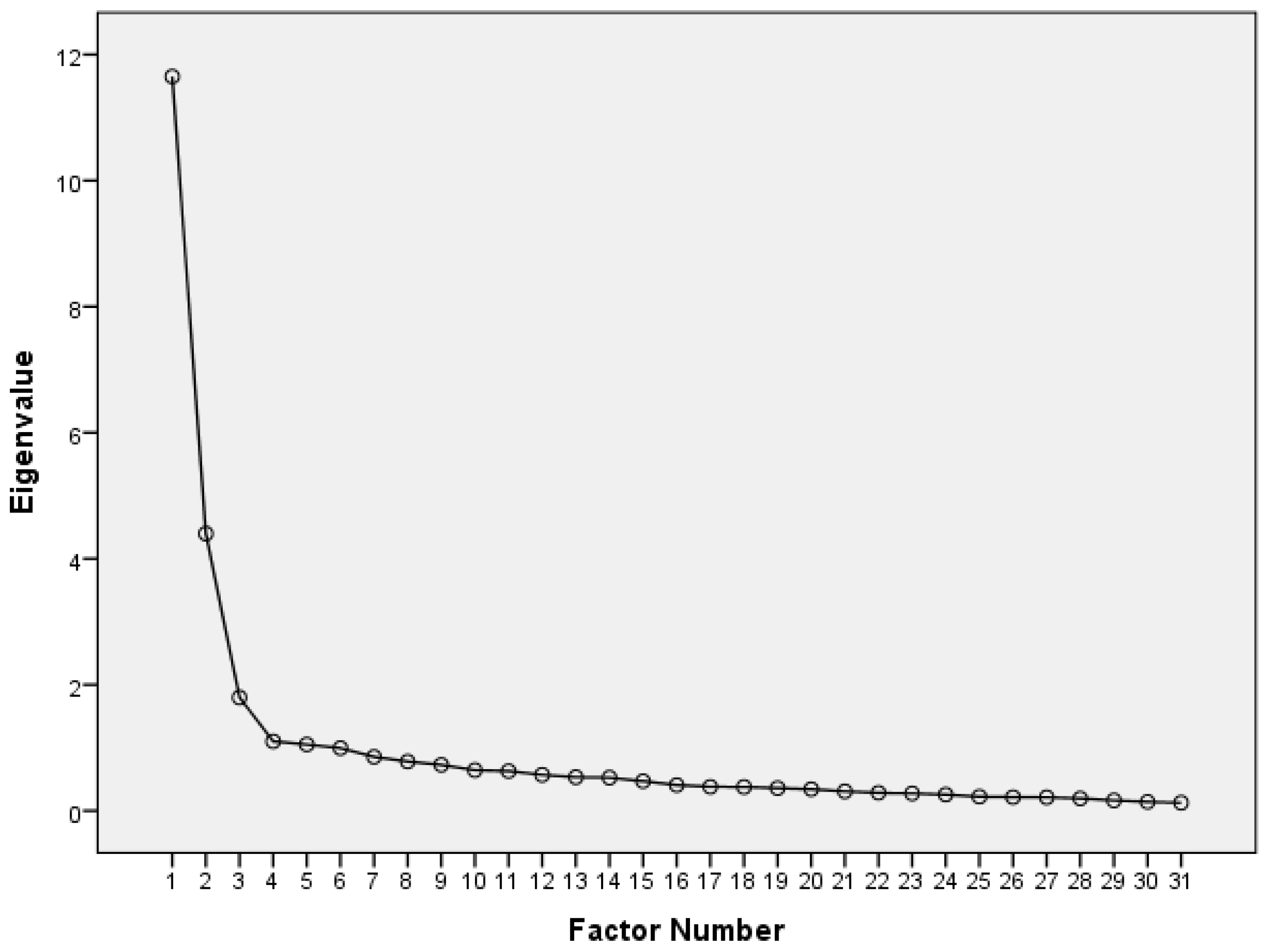
To examine the structural validity of the adapted instrument for measuring perceptions of artificial intelligence in education, an exploratory factor analysis (EFA) was conducted. The results of the analysis confirmed the very good suitability of the data for factor analysis (KMO = 0.920; Bartlett χ2(465) = 5159.922, p < 0.001), indicating a strong internal consistency of the items and a stable latent structure of the instrument. Although the criterion of an eigenvalue greater than 1 suggested five factors, the Scree plot (Figure 1) showed a clear break after the third component. In contrast, the fourth and fifth components had significantly lower eigenvalues (1.102 and 1.051) and minimal contributions to the explained variance. Such a pattern indicates that the three-factor structure is theoretically and empirically more grounded than the five-factor solution.
The initial version of the instrument consisted of 31 items. Following the exploratory factor analysis, four items (D2, D4, D6, and D8) were removed from the final version due to low factor loadings and weaker conceptual coherence with the underlying construct. The final instrument, therefore, consisted of 27 items grouped into three factors.
The overlap of items, especially between statements relating to general attitudes towards AI in education and those assessing the perceived usefulness and pedagogical potential of AI, as well as between general attitudes towards AI and the ethical or sustainable dimensions of its application, suggested that students integrate their general attitude towards AI with their assessment of its usefulness and ethical acceptability. In other words, the affective and cognitive components of the attitude towards AI are not clearly separated but form a relatively coherent framework. At the same time, the overlap of general attitudes and perceived usefulness suggested the need for a clearer conceptual demarcation of these dimensions in further validation research of the instrument. For this reason, a three-factor solution that integrates partially overlapping components into broader latent constructs offered a more theoretically coherent and methodologically stable model for interpreting the obtained results.
Therefore, based on the observed overlaps among individual blocks of statements and the relatively high correlation among factors, an additional exploratory factor analysis was conducted, with the number of factors limited to three in advance. This analysis aimed to examine whether a more theoretically coherent and interpretatively stable solution could be obtained that would unify the interconnected dimensions of attitudes towards artificial intelligence in education.
To examine the questionnaire’s latent structure, an exploratory factor analysis using the Principal Axis Factoring method with oblimin rotation (Kaiser normalization) was conducted to account for the expected interrelationships among the dimensions. The analysis included 31 items covering general attitudes towards AI in education (B1–B5), perceptions of its pedagogical usefulness (C1–C10), its application in science and sustainable teaching context (D1–D8), and the ethical and sustainable dimensions of its application (E1–E8). The prerequisites for conducting the factor analysis were met. The Kaiser–Meyer–Olkin sample adequacy measure was KMO = 0.920, indicating excellent suitability of the data for factorization. Bartlett’s test was statistically significant (χ2(465) = 5159.922, p < 0.001), indicating that the correlation matrix deviates significantly from the unit matrix. The first three factors had eigenvalues greater than 1 (11.651; 4.397; 1.796) and together explained 57.56% of the total variance (37.58%, 14.19% and 5.80%).
The first factor (F1), Perceived Usefulness and Pedagogical Potential of AI, included most items related to AI’s general usefulness and pedagogical applicability in education. The highest factor loadings were recorded for items C10 (0.860), C2 (0.801), C1 (0.770), C9 (0.769), C3 (0.731), and C4 (0.728), as well as B1 (.683) and B2 (0.690). This factor reflects a positive perception of AI as a tool that can improve teaching, individualize instruction, and enhance the efficiency of the educational process.
The second factor (F2), the Ethical–Sustainable and Critical Dimension of AI, gathers items related to ethics, responsibility, and sustainability of the application of artificial intelligence. The most pronounced values had items E4 (0.876), E5 (0.832), E8 (0.796), E7 (0.723), E1 (0.652), and B3 (0.752). This dimension reflects students’ awareness of the need for critical reflection, data protection, fairness, and the long-term consequences of applying AI in education.
The third factor (F3), Application of AI in Sustainable Science Education, includes items related to the application of artificial intelligence in the natural sciences through the prism of sustainability, as well as its contribution to sustainable development. The highest factor loadings were recorded for D1 (0.536) and D3 (0.490), while the other items from this block showed moderate values (D5 = 0.399; D7 = 0.392; D4 = 0.380; D6 = 0.331; D2 = 0.326). Item D8 had the lowest value (0.278), which indicated a weaker conceptual connection within this dimension.
The factor correlation matrix (Table 1) showed a moderate correlation between the first and second factors (r = 0.322) and weaker correlations between the first and third (r = 0.277) and the second and third (r = 0.154).
Overall, the three-factor solution proved to be theoretically coherent and empirically stable. The instrument’s structure differentiates among the general perception of AI’s Perceived Usefulness, the Ethical–Sustainable and Critical Dimension of AI, and the specific Application in Science Education, thereby confirming its construct validity in examining attitudes toward the role of artificial intelligence in education among future preschool educators, pre-service teachers, and science pre-service teachers. In direct relation to the research questions, confirming this stable and distinct factor structure serves as the necessary empirical foundation for the study. Specifically, these non-overlapping dimensions allow for a rigorous analysis of the predictive relationships outlined in RQ1, the evaluation of cohort differences across academic backgrounds in RQ2, and the examination of demographic effects in RQ3.

3.2. Construct Reliability

The internal consistency of the dimension Perceived Usefulness and Pedagogical Potential of AI (F1_Usefulness) was assessed using Cronbach’s α, which was 0.922, indicating very high reliability. The correlations of the items with the total score ranged between 0.644 and 0.794, with no item showing a negative or low contribution to the construct (Table 2). The values of α after removing a single item (from 0.910 to 0.918) further confirmed the stability of the scale, since the removal of any item would not increase reliability.
The internal consistency of the Ethical–Sustainable and Critical Dimension of AI (F2_Ethics) was α = 0.887, indicating high reliability. Correlations of the items with the total score ranged between 0.542 and 0.805, with items E4 and E5 showing the highest association with the total construct (Table 3). The analysis showed that removing any item would not increase the reliability coefficient (when the item was deleted, α = 0.850–0.895), confirming the stability and homogeneity of this dimension.
During the interpretation of the three-factor solution, particular attention was paid to items that showed low factor loadings or weaker differentiation within the construct. Particular attention was paid to items with factor loadings below 0.40, as such values indicate a relatively weak association with the underlying latent construct. Consequently, items D2 (0.326), D4 (0.380), D6 (0.331), and D8 (0.278) were excluded from the final version of the scale due to their limited contribution to construct definition and differentiation. In contrast, items D1 (0.536), D3 (0.490), D5 (0.399), and D7 (0.392) were retained because they demonstrated acceptable conceptual fit and theoretical relevance to the construct of AI application in sustainable science education. Specifically, item D5 captures the role of AI in resource optimization and the sustainability of teaching activities, while item D7 reflects the importance of AI in preparing students for future green and technology-oriented professions. These aspects represent conceptually important elements of sustainable science education that were not fully covered by the remaining items of the dimension. This decision also contributed to the satisfactory internal consistency of the scale (α = 0.785). Item correlations are given in Table 4.

3.3. Descriptive Factor Analysis

The descriptive analysis (Table 5) showed that students were moderately positive in their assessment of the perceived usefulness of artificial intelligence in education (M = 3.51, SD = 0.86). The highest average value was in the dimension of ethical and sustainable AI application (M = 4.25, SD = 0.78), while the lowest values were recorded in the dimension of AI application in sustainable science education (M = 3.04, SD = 0.90).

3.4. Differences Across Study Groups Regarding Three Key Factors: (1) Perceived Usefulness of AI; (2) Ethical–Sustainable and Critical Dimension of AI; (3) AI Integration in Sustainable Science Education

A statistically significant difference emerged among the study programs regarding the perceived usefulness of AI, F(2, 248) = 3.521, p = 0.031, with a small effect size (η2 = 0.028). Post hoc analysis (Tukey HSD, Table 6) showed that students in the Teacher Education Program rated the perceived usefulness of AI significantly higher than students at the Faculty of Science. The differences between students of Early and Preschool Education and other groups were not statistically significant.
Regarding the ethical–sustainable perception of AI, a highly significant difference emerged between the study groups (F(2, 248) = 12.583, p < 0.001), with a medium effect size (η2 = 0.092). Students from the Faculty of Science exhibited significantly higher levels of ethical and critical sensitivity toward AI than both students of Early and Preschool Education and Teacher Education (Table 7). The difference between these two groups was not statistically significant.
The integration of AI into sustainable science education also varied significantly among the study groups (F(2, 248) = 7.409, p = 0.001), demonstrating a small-to-medium effect size (η2 = 0.056). Post hoc comparisons indicated that students of the Faculty of Science rated the application of AI in sustainable science education significantly lower than both students of Early and Preschool Education and Teacher Education (Table 8). The difference between these two pedagogical groups was not statistically significant.

3.5. The Impact of Science Course Load and Student Age

No statistically significant difference in the perception of the usefulness of AI emerged between students who did not take science courses (N = 140, M = 3.54, SD = 0.76) and those who took at least one science course (N = 111, M = 3.47, SD = 0.96), t(205.57) = 0.627, p = 0.531. However, a significant difference emerged regarding the Ethical–Sustainable and Critical Dimension of AI, with students who took at least one science course scoring higher than those who did not t(248.30) = −4.51, p < 0.001, representing a medium effect size (Cohen’s d = 0.56). Finally, no statistically significant difference was found in the perception of AI applications in sustainable science education between students without prior science knowledge and those who had taken at least one science course (t(211.66) = 1.27, p = 0.207) (Table 9).
Analysis of age-group differences showed a consistent pattern (Table 10). Students aged 21 and over reported statistically significantly higher assessments of the usefulness of AI (t(249) = –3.82, p < 0.001), higher ethical sensitivity (t(247.06) = –3.11, p = 0.002), and higher perceptions of sustainable science applications of AI (t(249) = –3.17, p = 0.002) compared to younger students.

3.6. Differences in Perceptions of Artificial Intelligence in Education Based on the Frequency of Use of AI Tools

Prior to conducting the analyses, homogeneity of variances was assessed using Levene’s test. The assumption was met for the Ethical-Sustainability dimension (p = 0.619) and the Sustainable Science Application dimension (p = 0.075), whereas unequal variances were observed for the Perceived Usefulness dimension (p = 0.001). Therefore, Welch’s ANOVA was conducted for the Perceived Usefulness dimension. The results revealed a statistically significant difference between groups, Welch’s F(2, 25.71) = 5.75, p = 0.009. For the Sustainable Science Application dimension, standard one-way ANOVA revealed statistically significant differences between groups, F(2, 248) = 6.33, p = 0.002. On the other hand, no statistically significant differences were found for the Ethical-Sustainability dimension, F(2, 248) = 0.08, p = 0.921.
Games–Howell post hoc comparisons (Table 11) showed that students who had never used AI tools reported significantly lower perceived usefulness scores than both occasional users (M = 3.50; p = 0.047) and frequent users (M = 3.69; p = 0.022). However, no statistically significant difference was found between occasional and frequent users (p = 0.173). These findings suggest that even initial experience with AI tools is associated with higher perceptions of their usefulness, whereas increasing the frequency of use does not further enhance these perceptions. Similarly, Tukey HSD post hoc comparisons for the Sustainable Science Application dimension revealed that both occasional users (M = 3.09; p = 0.001) and frequent users (M = 3.07; p = 0.003) reported significantly higher scores than students who had never used AI tools (M = 2.11), with no significant difference observed between occasional and frequent users (p = 0.979).

3.7. Correlations Between Dimensions of Artificial Intelligence Perception

All analyzed dimensions of AI in education were significantly correlated with one another (Table 12). A strong positive correlation emerged between perceived usefulness and AI application in sustainable science education, while both dimensions exhibited moderate to weak positive correlations with the Ethical–Sustainable and Critical Dimension of AI. This overall pattern of associations indicates that while technical utility and sustainable application are closely aligned in students’ perceptions, their ethical evaluation operates as a distinct, more independent component of their general attitudes.
The multiple regression model predicting the dependent variable of perceptions of AI applications in sustainable science education was statistically significant (Table 13), F(2, 248) = 82.66, p < 0.001, accounting for 40% of the variance (R2 = 0.40). In response to RQ1, among the included predictors, perceived usefulness of AI emerged as a strong, positive determinant, whereas the ethical dimension did not make a statistically significant contribution to the model. Regarding pre-service teachers’ readiness and attitudes, this predictive trend shows that students’ inclination toward implementing AI in sustainability contexts is heavily driven by its perceived practical utility rather than their underlying ethical concerns.

3.8. Qualitative Analysis of Open-Ended Questions

Analysis of responses to the open-ended question—What key advantages do you see in using AI in your future profession (kindergarten/classroom/subject teaching)?—showed several dominant thematic categories. Students most often emphasized time savings and facilitation of lesson preparation, generation of creative ideas and activities, organizational support in work planning, and visualization and access to information, while some participants expressed skepticism or a critical attitude towards the use of AI in education. Table 14 presents the identified thematic categories alongside representative examples of student responses.
Furthermore, students’ responses to the challenges of using AI in their future profession—What key challenges do you see in using AI in your future profession (kindergarten/grade/subject teaching)?—are predominantly grouped around several related concerns. The most frequently highlighted concerns were the risk of inaccurate or unreliable information requiring constant verification, alongside the fear that students might uncritically accept answers. Another strong thematic cluster concerned overreliance on AI, which participants expected to weaken students’ (and potentially teachers’) critical thinking, creativity, and independence. Additionally, ethical and security aspects were often emphasized, especially children’s privacy and data protection, and copyright issues. Some participants also mentioned sociopedagogical consequences (less human contact, alienation, lower concentration), while a smaller number raised concerns about the ecological/energy footprint of modern AI systems. In Table 15, the identified thematic categories with representative examples of student responses are shown.
Analysis of the answers to the last open question—In what way, in your opinion, can artificial intelligence help achieve the Sustainable Development Goals (SDGs) within kindergartens/schools?—revealed students’ heterogeneous views. Some participants believed that artificial intelligence can contribute to sustainable development primarily through supporting education, visualizing complex ecological phenomena, and developing creative teaching activities. Students emphasized that AI can help explain complex concepts, such as climate change or ecological problems, through visual representations, animations, and simulations. In Table 16, the identified thematic categories, followed by representative examples of student responses, are presented.

4. Discussion

The results of this study provide a comprehensive overview of how university students in Croatia perceive the role of artificial intelligence within the educational landscape, particularly in the context of sustainability and science.
Descriptive analysis initially revealed a nuanced, multi-layered perspective among our students on the integration of AI into the educational process. The most important finding of this study is the students’ high level of ethical and critical awareness, which was the highest-rated dimension in the entire study. This pronounced sensitivity among students to the responsible and critical integration of AI into the educational process directly correlates with results from the University of Salerno, where 98% of respondents agree that it is necessary to use AI carefully and consciously [22]. Generally, our students also accept AI as a useful tool in education and expressed a moderately positive assessment of its perceived usefulness. The importance of this perceived usefulness and personal self-confidence, which Estonian research [23] highlights as key drivers of readiness, is clearly reflected in our results.
Background in science knowledge did not affect students’ perceptions, as the results showed that taking a science course alone does not differentiate attitudes toward the usefulness of AI in education. In contrast to the students’ perception of AI perceived usefulness, a background in science courses contributes to students’ greater sensitivity to the ethical and sustainable implications of applying AI in education. In relation to RQ3, these outcomes indicate that while prior science coursework does not alter general or pedagogical perceptions of AI, it acts as a specific catalyst for sharpening students’ ethical–sustainable awareness.
Additionally, our findings showed that the frequency of AI use directly shapes how students see this technology, especially regarding its practical value and application in science. Students who use AI tools, even if only occasionally, have a much more positive view of their usefulness than those who have no experience with them at all. Interestingly, even a small amount of practical experience seems to be enough to bridge this gap, as there was no real difference between occasional and frequent users. Regarding pre-service teachers’ readiness, this pattern indicates that while initial exposure significantly boosts the recognition of AI’s utility, increased frequency of use does not further intensify this perception. In contrast, in the study by Konstantinidou and Fachantidis [24], more experienced users showed a stronger intention to further integrate these tools, while skepticism and concern prevailed among less frequent users. However, using AI more often did not automatically make our students more ethically sensitive, suggesting that ethical awareness is developed through education rather than just through the use of tools. Regarding pre-service teachers’ sustainability attitudes, students’ high ethical scores remain constant regardless of whether they are non-users, occasional users, or frequent users of AI tools. Addressing the final aspect of RQ3, firsthand experience with AI tools significantly drives both perceived utility and readiness for sustainable application, whereas ethical concerns remain high and stable regardless of usage frequency. Furthermore, our study results revealed that, in general, older students (aged 21 and over) consistently gave higher ratings for AI usefulness, ethics, and science applications than their younger peers. These findings indicate that as students gain greater academic and professional maturity, they become more confident in both the value of AI and the importance of its ethical use. Interpreting these age-related findings within the context of RQ3, it seems that the greater maturity and prolonged academic exposure positively shift all dimensions of AI perception.
In contrast, AI applications in sustainable science education received the lowest scores, suggesting that students remain uncertain about how to use these tools in the natural sciences. While they acknowledge the general value of AI, they struggle to see its practical use in specific scientific contexts. Even with a science background, which increases ethical sensitivity, there is no corresponding increase in enthusiasm or perceived applicability for AI in science education. This gap between general utility and practical application helps explain the reservation and skepticism we found in our analysis. These findings reflect that high confidence in the use of tools does not exclude pedagogical caution [2]. The readiness of educational staff for the digital transition includes not only technical knowledge but also the development of a positive mindset [5].
Our study’s quantitative findings are further clarified by students’ open-ended responses, which explain why students see AI as useful, primarily as a tool for practical efficiency and support in preparing materials, generating ideas, and organizing the teaching process. Similar to the findings of Kayana et al. [7], our students, especially pre-service teachers and pre-service science teachers, see GenAI as a tool that can optimize administrative processes. These findings regarding the importance of perceived utility are consistent with a broad synthesis of systematic reviews from 2010 to 2023, which identifies personalized learning and teaching efficiency as the primary strengths of AI integration [18]. This efficiency can allow future teachers more time to work directly with students and provide personalized mentoring. However, it is necessary to work on teachers’ attitudes and skills, because these are the filters through which they assess whether AI will be useful to them at all [25]. In response to the question of how much AI can help make science more sustainable, students gave mixed answers. Students see AI primarily as a tool for visualizing environmental problems and reducing the consumption of physical materials, indicating that they understand sustainability in education in a very concrete and practical way. This conceptualization reflects a direct connection between digital efficiency and resource conservation. This aligns with the survey by Miranda [22], which found that respondents support AI for virtual labs, simulations, and interactive content development. In the context of our participants, however, these three pre-service teacher groups conceptualize the “Green Lab” approach differently based on their professional profiles. While foundational sustainability awareness appears uniform, conceptualizations of resource-saving behavior seem to be strictly domain-specific. For subject-specific science students, the concept frequently entails literal laboratory optimization through AI-driven simulations to mitigate physical or chemical waste. Conversely, for preschool and primary educators, this dimension undergoes a pedagogical translation, framing “Green Lab” around classroom resource efficiency, paperless instructional materials, and modeling pro-environmental habits. By simplifying the creation of digital teaching materials and implementing virtual lab simulations, AI-based education aligns with the principles of SDG 12 [8] by promoting resource efficiency and reducing the physical footprint of science classrooms. Crucially, replacing physical experimentation with AI-driven simulations introduces a critical pedagogical trade-off between resource conservation and hands-on experiential learning. While virtual environments significantly mitigate environmental impact, they must not entirely replace authentic laboratory work due to its essential importance in developing fine motor skills and practical competencies. However, responses from our students also reveal a mature dose of skepticism, as some of them justifiably question the very sustainability of AI systems given their high energy consumption. Ultimately, these student concerns regarding “Green Lab” resource optimization and ecological simulations mirror broader global debates on the technology’s physical environmental footprint. While generative AI offers innovative pedagogical avenues, its reliance on data-heavy infrastructure introduces critical ecological trade-offs, characterized by substantial carbon emissions and energy consumption [26]. Advancing sustainable science education therefore demands a transition toward “Green AI” principles, where the practical utility of digital tools is rigorously balanced against these real-world environmental costs [27]. Fostering this critical environmental literacy ensures that future educators recognize both the potential and the physical ecological burden of artificial intelligence. Utilizing AI-mediated visualization tools can also support the objectives of SDG 13 [8], equipping the next generation with the analytical skills needed to address climate challenges.
However, the findings of this study provide several critical insights into the relationship between students’ perceptions of artificial intelligence and its role in fostering sustainable science education.

4.1. The Role of Perceived Usefulness as a Driver for Sustainability

The regression analysis and the strong positive correlation underscore that perceived usefulness (F1) is the primary driver behind the acceptance of AI in sustainable science education. This finding suggests that students may prioritize a pragmatic framework over an abstract environmental prism when evaluating AI in science education. In this context, practical benefit appears to be the main driver of technology adoption; if AI is perceived as an effective tool that enhances learning and simplifies complex scientific processes, students are significantly more likely to recognize its potential to promote sustainability. Consequently, our results imply that the perceived usefulness of AI is a critical prerequisite for its integration within the framework of sustainable science education.

4.2. The Faculty of Science Paradox: Expertise vs. Critical Caution

One of the most compelling findings in our research is the contrast between the Faculty of Science students and their peers in general educational tracks. While science students exhibited the highest levels of ethical and critical sensitivity, they simultaneously provided the lowest ratings for the application of AI in sustainable science education. In relation to RQ2, students in pedagogical tracks view AI as a more favorable tool for their future professional roles than science-focused students. This Faculty of Science paradox highlights a pattern that could hypothetically reflect a form of professional skepticism; students with a deeper background in the natural sciences might be more acutely aware of the limitations of AI, such as data biases or hallucinations in scientific modeling. Furthermore, their critical perspective is potentially amplified by a broader, unmeasured awareness of the environmental costs associated with artificial intelligence, such as the massive energy and water consumption required to sustain large-scale data centers. For science students, deploying resource-intensive technology might appear inherently contradictory to the core principles of environmental sustainability. Additionally, their training may foster elevated concerns regarding data quality and validation; they are perhaps more likely to question whether automated tools can truly capture the complexity of sustainable science without introducing systemic errors. While these factors were not directly examined in our survey, this cautious approach likely reflects an emphasis on empirical rigor inherent to training in the natural sciences, potentially making them less prone to the technological optimism observed in other groups. As highlighted by research in the UAE [26], attitudes directly determine whether technology is integrated or rejected. This suggests a potential explanation for why our group of future educators, despite perhaps less initial technical knowledge, can demonstrate high readiness if they recognize AI as a tool for inclusion [28], whereas more technologically savvy individuals in the Faculty of Science appear to remain reserved due to their skeptical attitudes. Deeper scientific expertise thus seems to drive an insistence on preserving pedagogical boundaries and critical evaluation before adoption. Addressing the final aspect of RQ2, these findings establish a clear polarization: pedagogical students are more ready to implement AI in sustainable education, whereas science students maintain a highly cautious approach, which, as our discussion suggests, is likely rooted in their heightened ethical concerns.

4.3. The Ethics–Application Gap

An intriguing result is that while Faculty of Science students show the highest ethical awareness, this dimension (F2) did not emerge as a significant predictor for AI application, indicating a potential gap between ethical awareness and practical decision-making. Interpreting this in the context of RQ2, the strong medium effect size demonstrates that a pure science background fosters a significantly higher level of critical and systemic sensitivity toward AI’s ethical implications. These concerns do not currently dictate their willingness to implement AI, which might reflect a broader caution or resistance to replacing the human role. Similarly, research conducted at the University of Salerno showed that 69% of participants believe AI cannot reach the quality of human feedback [22]. However, this skepticism highlights the necessity of framing AI not as a replacement [7] but as a supplementary tool designed to support educational processes through human–machine collaboration [9]. The ethical concerns observed among our students, particularly those from the Faculty of Science, echo critical global issues highlighted in systematic reviews, including teacher resistance and the pressing need for extensive training in AI ethics [18]. As deficiencies in training remain key obstacles [23], integrating AI requires a systematic approach that connects technological literacy with continuous professional development [5]. Ultimately, the ethical and responsible use of technology must become an integral part of professional education [24], moving beyond theoretical ethics toward the practical integration of standards into AI-driven scientific workflows.

4.4. AI as a Potential Equalizer in Science Education

The lack of a statistically significant difference between students with and without prior science knowledge regarding AI’s application is highly encouraging, suggesting that AI may act as a bridge that lowers the barrier to entry for understanding sustainable scientific concepts. This implies that AI-enabled tools can facilitate interdisciplinary learning, allowing students without an extensive scientific background to engage meaningfully with green scientific practices and virtual experimentation. Our results suggest that knowledge about GenAI tools is not the only, or even decisive, factor in their application; rather, teachers’ attitudes seem to play a key role in shaping the transition from knowledge and actual practice [28]. Future educators should view GenAI as a means to achieve enhanced learning through personalized and adaptive approaches. Consequently, to close the gap between theoretical opportunities and actual practice, it is necessary to support future educators by providing an environment where technology serves as a support for mentoring rather than an additional burden [7]. Future education should leverage these findings to build digital environments that prioritize systematic support for teachers and open access to high-quality digital content [29,30].

4.5. Limitations and Future Research

The contributions of this study must be viewed within the context of its limitations. The empirical evidence relies on a convenience sample from a single university infrastructure, which may affect the immediate generalizability of the findings to the broader national population of future teachers. However, this approach is justified as it allowed for a targeted, cross-faculty investigation of students from two distinct institutional environments, the Faculty of Humanities and Social Sciences and the Faculty of Science, providing a robust exploratory baseline for comparing pedagogical backgrounds across the educational vertical. Furthermore, the study relies on self-reported perceptions, which capture students’ subjective views and pedagogical intentions rather than their actual classroom behavior.
To enhance the academic contribution and address these boundaries, future research should employ longitudinal designs to track how these perceptions evolve into actual teaching practices. Additionally, future studies would benefit from incorporating mixed-methods approaches, combining self-reported data with objective classroom observations, and expanding the sample size to include multiple regional universities for a broader comparative analysis. Additionally, while the construct validity of the adapted instrument was successfully established using Exploratory Factor Analysis (EFA), the final sample size (N = 251) and target demographic constraints precluded the execution of a Confirmatory Factor Analysis (CFA). Future research should focus on cross-validating this stable three-factor structure using CFA on a larger, independent sample to ensure broader instrument stability.

5. Conclusions

In summary, the transition toward sustainable science education appears to be heavily dependent on students’ perceptions of AI’s practical utility in terms of resource optimization. Our findings demonstrate that a clear recognition of AI’s role in supporting sustainability emerges most prominently only when students perceive it as a reliable and useful tool. While future preschool educators and primary school teachers primarily focus on the methodological and motivational potential of GenAI, future science teachers exhibit a much deeper ethical and critical sensitivity, which aligns with a more cautious approach and pronounced concerns regarding the technology’s reliability. To bridge this gap, future educators in Croatia need systematic support and ethical guidelines to turn uncertainty into constructive application.
However, students also make it clear that without environmental and digital literacy and pedagogical supervision, AI risks becoming a shortcut that could undermine critical thinking. Ultimately, the human must remain at the center of this process, ensuring that technology serves as a support rather than a replacement. To achieve this, teacher education programs should combine the methodological enthusiasm of pre-service educators and teachers with the critical and ethical rigor demonstrated by science students. To translate these findings into practice within the context of teacher education programs in Croatia, several concrete recommendations emerge. First, higher education institutions should implement interdisciplinary modules that merge generative AI tool training with media literacy and ethical evaluation, moving beyond mere technical operationalization. Second, curriculum design for future preschool and primary school teachers should explicitly integrate critical reflection exercises to balance their methodological enthusiasm, while science teacher tracks should include hands-on workshops that demonstrate the safe, practical optimization of AI in laboratory and classroom settings. To achieve this synthesis, programs should implement integrated, project-based activities, such as tasking students with designing AI-driven lesson plans (pedagogical creativity) while concurrently requiring a digital sustainability assessment that evaluates the carbon footprint and algorithmic transparency of the selected tools (simultaneously cultivating environmental literacy and ethical awareness). The ultimate goal of digital integration is not merely technological adoption but the creation of interactive environments that meet diverse student needs and foster a comprehensive understanding of sustainable development. Therefore, the preparation of future educators must look beyond technical literacy toward developing the integrated environmental and digital competencies necessary to responsibly shape the future of education in the digital age.

Author Contributions

Conceptualization, I.R. and J.J.; methodology, I.R. and J.J.; validation, I.R., J.J., and N.K.; formal analysis, I.R., N.K., and N.K.; investigation, I.R., J.J., and N.K.; data curation, I.R., J.J., and N.K.; writing—original draft preparation, I.R. and J.J.; writing, I.R., J.J., and N.K.; visualization, I.R., J.J., and N.K.; supervision, I.R. All authors have read and agreed to the published version of the manuscript.

Funding

This research received no external funding.

Institutional Review Board Statement

The study was conducted in accordance with the Declaration of Helsinki, in accordance with the Code of Ethics of the Faculty of Humanities and Social Sciences, University of Split, Croatia with the approval of the Ethics Committee (approval number: CLASS: 029-06/26-03/00001; REGISTRATION NUMBER: 2181-190-26-00013, 26 January 2026) and with the Code of Ethics of the Faculty of Science, University of Split, Croatia with the approval of the Ethics Committee (approval number: CLASS: 042-01/26-01/00003; REGISTRATION NUMBER: 2181-204-05-09-26-00002, 30 January 2026) for studies involving humans.

Informed Consent Statement

Informed consent was obtained from all subjects involved in the study.

Data Availability Statement

The data presented in this study are available on request from the corresponding author.

Acknowledgments

This work is a result of the scientific and research activities of the Center for Transdisciplinary Promotion of Sustainable Development—OdRaST—at the Faculty of Humanities and Social Sciences, University of Split, Croatia. The research was conceived and conducted under the leadership of the first author as the head of the Center, with the active cooperation of all authors as members of the Center’s team.

Conflicts of Interest

The authors declare no conflict of interest.

References

  1. Wulan, N.; Santosa, M. Artificial Intelligence Literacy and Teachers’ Readiness in EFL Context: A Systematic Literature Review. J. Engl. Lang. Teach. Linguist. Lit. (JETLEE) 2026, 6, 104–116. [Google Scholar] [CrossRef]
  2. Chapman, B.L.; Ross, A.S.; Petraki, E. Teacher readiness for generative AI: A Theory of Planned Behaviour approach. Soc. Sci. Humanit. Open 2026, 13, 102351. [Google Scholar] [CrossRef]
  3. OECD. OECD Digital Education Outlook 2023: Towards an Effective Digital Education Ecosystem; OECD Publishing: Paris, France, 2023; p. 414. [Google Scholar]
  4. Idiou, L.; Djabri, S. Digital Transformation in Education and Its Role in the Development of the Efficiency of Educational Institutions and in the Enhancement of the Quality of Their Outputs. Int. J. Innov. Technol. Soc. Sci. 2025, 2, 3961. [Google Scholar] [CrossRef]
  5. Ngongpah, G.; Oni, O. Teachers’ Readiness and Competency in Using AI in the Classroom. Asian J. Educ. Soc. Stud. 2025, 51, 742–757. [Google Scholar] [CrossRef]
  6. Sangsuwan, W.; Saithong, P.; Polpinij, J. Transforming Higher Education with Digital Solutions: A User-Centered Design Framework for Developing Student Handbook Applications. Eur. J. Educ. Res. 2026, 15, 79–99. [Google Scholar] [CrossRef]
  7. Kayanja, W.; Kyambade, M.; Kiggundu, T. Exploring digital transformation in higher education setting: The shift to fully automated and paperless systems. Cogent Educ. 2025, 12, 2489800. [Google Scholar] [CrossRef]
  8. UN. UN Resolution Adopted by the General Assembly on 25 September 2015. General Asembly Resolution 70/1 2015, 35; European Union Agency for Fundamental Rights: Vienna, Austria, 2015. [Google Scholar]
  9. Hashem, R.; Ali, N.; El Zein, F.; Fidalgo, P.; Abu Khurma, O. AI to the rescue: Exploring the potential of ChatGPT as a teacher ally for workload relief and burnout prevention. Res. Pract. Technol. Enhanc. Learn. 2024, 19, 23. [Google Scholar] [CrossRef]
  10. Chan, C.K.Y.; Tsi, L.H.Y. Will generative AI replace teachers in higher education? A study of teacher and student perceptions. Stud. Educ. Eval. 2024, 83, 101395. [Google Scholar] [CrossRef]
  11. van den Berg, G.; du Plessis, E. ChatGPT and Generative AI: Possibilities for Its Contribution to Lesson Planning, Critical Thinking and Openness in Teacher Education. Educ. Sci. 2023, 13, 998. [Google Scholar] [CrossRef]
  12. Avci, H.; Lunn, S.J.; Hazari, Z. Exploring STEM Educators’ Perspectives on the Integration of AI-Enabled Technologies in Teaching and Learning. Comput. Educ. Open 2025, 9, 100304. [Google Scholar] [CrossRef]
  13. Woodruff, K.; Hutson, J.; Arnone, K. Perceptions and Barriers to Adopting Artificial Intelligence in K-12 Education: A Survey of Educators in Fifty States. In Reimagining Education—The Role of E-Learning, Creativity, and Technology in the Post-Pandemic Era; IntechOpen: Rijeka, Croatia, 2023. [Google Scholar]
  14. Michel-Villarreal, R.; Vilalta-Perdomo, E.; Salinas Navarro, D.E.; Aguilera, R.; Gerardou, F. Challenges and Opportunities of Generative AI for Higher Education as Explained by ChatGPT. Educ. Sci. 2023, 13, 856. [Google Scholar] [CrossRef]
  15. Wan, T.; Chen, Z. Exploring generative AI assisted feedback writing for students’ written responses to a physics conceptual question with prompt engineering and few-shot learning. Phys. Rev. Phys. Educ. Res. 2024, 20, 010152. [Google Scholar] [CrossRef]
  16. Xu, W.; Ouyang, F. The application of AI technologies in STEM education: A systematic review from 2011 to 2021. Int. J. STEM Educ. 2022, 9, 59. [Google Scholar] [CrossRef]
  17. Leon, C.; Lipuma, J.; Oviedo-Torres, X. Artificial intelligence in STEM education: A transdisciplinary framework for engagement and innovation. Front. Educ. 2025, 10, 1619888. [Google Scholar] [CrossRef]
  18. Chen, L.; Chen, P.; Lin, Z. Artificial Intelligence in Education: A Review. IEEE Access 2020, 8, 75264–75278. [Google Scholar] [CrossRef]
  19. Krstić, L.; Aleksić, V.; Krstić, M. Artificial Intelligence in Education: A Review. In Proceedings of the 9th International Scientific Conference Technics and Informatics in Education (TIE 2022), Čačak, Serbia, 16–18 September 2022; pp. 223–228. [Google Scholar]
  20. Holmes, W.; Bialik, M.; Fadel, C. Artificial Intelligence in Education: Promise and Implications for Teaching and Learning; Center for Curriculum Redesign (CCR): Boston, MA, USA, 2019. [Google Scholar]
  21. Tilepbergenovna, U. The Role of Artificial Intelligence in Education. Int. J. Pedagog. 2024, 4, 184–187. [Google Scholar] [CrossRef]
  22. Miranda, S. Artificial Intelligence in Education: An Exploratory Survey to Gather the Perceptions of Teachers, Students, and Educators Around the University of Salerno. Educ. Sci. 2025, 15, 975. [Google Scholar] [CrossRef]
  23. Granström, M.; Oppi, P. Assessing teachers’ readiness and perceived usefulness of AI in education: An Estonian perspective. Front. Educ. 2025, 10, 1622240. [Google Scholar] [CrossRef]
  24. Sofia Konstantinidou, I.L.; Fachantidis, N. Are They AI-Competent? Future Teachers’ Readiness to Use Conversational Agents as Learning Assistants. Int. J. Inf. Educ. Technol. 2026, 16, 318–329. [Google Scholar] [CrossRef]
  25. Ofem, U.J.; Orim, F.S.; Edam-Agbor, I.B.; Amanso, E.O.I.; Eni, E.; Ukatu, J.O.; Ovat, S.V.; Osang, A.W.; Dien, C.; Abuo, C.B. Teachers’ preparedness for the utilization of artificial intelligence in classroom assessment: The contributory effects of attitude toward technology, technological readiness, and pedagogical beliefs with perceived ease of use and perceived usefulness as mediators. Front. Educ. 2025, 10, 1568306. [Google Scholar] [CrossRef]
  26. Strubell, E.; Ganesh, A.; McCallum, A. Energy and Policy Considerations for Deep Learning in NLP. In Proceedings of the 57th Annual Meeting of the Association for Computational Linguistics; Association for Computational Linguistics: Stroudsburg, PA, USA, 2019; pp. 3645–3650. [Google Scholar]
  27. Schwartz, R.; Dodge, J.; Smith, N.; Etzioni, O. Green AI. Commun. ACM 2020, 63, 54–63. [Google Scholar] [CrossRef]
  28. Fteiha, M.; Al-Rashaida, M.; Ghazal, M. General and special education teachers’ readiness for artificial intelligence in classrooms: A structural equation modeling study of knowledge, attitudes, and practices in select UAE public and private schools. PLoS ONE 2025, 20, e0331941. [Google Scholar] [CrossRef] [PubMed]
  29. Tawil, S.; Miao, F. Steering the Digital Transformation of Education: UNESCO’s Human-Centered Approach. Front. Digit. Educ. 2024, 1, 51–58. [Google Scholar] [CrossRef]
  30. Tang, J.; Huang, P.; Yan, S. Digital transformation in higher education: Logical framework, practical dilemmas, and implementation approaches. Front Psychol. 2025, 16, 1565591. [Google Scholar] [CrossRef] [PubMed]
Figure 1. Scree plot of eigenvalues.
Sustainability 18 06786 g001
Table 1. Factor Correlation Matrix.
FactorF1F2F3
F1_Usefulness1.000.3220.277
F2_Ethics0.3221.0000.154
F3_SusSci0.2770.1541.000
F1—Perceived Usefulness and Pedagogical Potential of AI; F2—Ethical–Sustainable and Critical Dimension of AI; F3—Application of AI in Sustainable Science Education.
Table 2. Correlation Matrix of the Perceived Usefulness and Pedagogical Potential of AI (F1_Usefulness).
Items MVarrα
B1. Artificial intelligence has the potential to improve the education system.31.6760.8000.6770.916
B2. AI can contribute to better and more efficient learning.31.6060.8570.6880.916
C1. AI can help plan teaching, laboratory, and kindergarten activities.31.4859.4750.7530.912
C2. AI can facilitate the adaptation of teaching/practice to students/children of different abilities.31.5359.3540.7940.910
C3. AI can provide additional support to students/children during learning and practice.31.5060.4830.6850.916
C4. AI can increase students’/children’s motivation and engagement in teaching/learning through play.32.0359.6030.6760.916
C5. AI can reduce the administrative burden on teachers.31.6460.6630.6440.918
C7. AI can optimize the preparation of teaching/educational materials by reducing the need for printing and paper use in the classroom/kindergarten.31.6958.9420.6920.916
C9. AI can help create tests, quizzes, and knowledge assessments.31.3259.1470.6850.916
C10. AI can help design creative activities for students/children.31.2258.3640.7750.911
M—Mean; Var—Variance; r—Pearson’s correlation coefficient; Cronbach’s α—internal consistency reliability coefficient.
Table 3. Correlation Matrix of the Ethical–Sustainable and Critical Dimension of AI (F2_Ethics).
Items MVarrα
B3. The use of AI in education requires a careful, responsible, and thoughtful approach.21.0916.0280.6770.871
E1. The use of AI in education requires a careful, responsible, and thoughtful approach.21.6415.9600.5420.895
E4. Over-reliance on AI assistants at an early age can jeopardize the development of critical thinking and cognitive independence of students/children.21.0515.0540.8050.850
E5. Responsible use of AI implies that the teacher/educator always retains the role of the final decision-maker in the pedagogical process (the so-called “human-in-the-loop” concept).21.2215.0860.7530.858
E7. As a future teacher/educator. I consider it my obligation to critically examine whether the benefits of AI in teaching/in the game outweigh the environmental damage caused by its data processing.21.3015.4900.6810.870
E8. I believe that over-reliance on AI in education can lead to the loss of basic practical skills needed for a sustainable life.21.0515.3530.7810.855
M—Mean; Var—Variance; r—Pearson’s correlation coefficient; Cronbach’s α—internal consistency reliability coefficient.
Table 4. Correlation Matrix of the Application of AI in Sustainable Science Education (F3_SusSci).
ItemsMVarrα
D1. AI simulations of experiments in teaching/science activities can effectively replace real laboratory/research activities with students/children when the goal is to reduce the consumption of harmful chemicals and waste.9.517.8430.5650.747
D3. Using AI applications to identify species (e.g., plants or insects) during field trips/nature walks reduces the need for physical sample collection, thereby directly preserving local biodiversity.8.837.5560.6050.726
D5. AI assistants can significantly contribute to the sustainability of the teaching process/activity with students/children by helping teachers/educators create personalized materials on recycling or the circular economy, thereby saving time and paper.8.787.9260.6250.717
D7. I believe that integrating AI into science curricula and activities is necessary to prepare students/children for future occupations in the green economy and sustainable technologies.9.368.1110.5750.741
M—Mean; Var—Variance; r—Pearson’s correlation coefficient; Cronbach’s α—internal consistency reliability coefficient.
Table 5. Descriptive Statistics for the Three Identified Factors.
Factor MSD
F1_Usefulness3.50760.85533
F2_Ethics4.24500.77850
F3_SusSci3.03980.90272
M—Mean; SD—Standard Deviation.
Table 6. Tukey HSD between groups on perceptions of AI perceived usefulness.
Study
Group
Study
Group
MDSEp
12−0.068180.126040.851
30.273850.136320.112
210.068180.126040.851
30.342030.133390.029 *
31−0.273850.136320.112
2−0.342030.133390.029 *
1—Early Childhood and Preschool Education; 2—Teacher Education; 3—Faculty of Science; MD—Mean Difference; SE—Standard Error; * p < 0.05.
Table 7. Tukey HSD between groups on Ethical–Sustainable and Critical Dimension of AI.
Study
Group
Study
Group
MDSEp
120.221480.110850.115
3−0.366110.119890.007 **
21−0.221480.110850.115
3−0.587590.117310.000 ***
310.366110.119890.007 **
20.587590.117310.000 ***
1—Early Childhood and Preschool Education; 2—Teacher Education; 3—Faculty of Science; MD—Mean Difference; SE—Standard Error; ** p < 0.01, *** p < 0.001.
Table 8. Tukey HSD between groups on AI Application in Sustainable Science Education.
Study
Group
Study
Group
MDSEp
12−0.146730.131050.503
30.37940 *0.141730.022 *
210.146730.131050.503
30.52613 *0.138680.001 **
31−0.37940 *0.141730.022 *
2−0.52613 *0.138680.001 **
1—Early Childhood and Preschool Education; 2—Teacher Education; 3—Faculty of Science; MD—Mean Difference; SE—Standard Error; * p < 0.05, ** p < 0.01.
Table 9. Differences in students’ perceptions of AI based on prior science course enrolment.
FactorGroupNMSDtdfpCohen’s d
F1_Usefulness11403.540.760.627205.570.531
21113.470.96
F2_Ethics11404.060.81−4.51248.300.001 ***0.56
21114.480.67
F3_SusSci11403.110.821.27211.660.207
21112.961.00
1—No science courses; 2—At least one course; N—number of students; M—Mean; SD—Standard Deviation; t—t-test statistic; df—degrees of freedom; *** p < 0.001; Cohen’s d—effect size.
Table 10. Analysis of differences in AI perception dimensions between younger and older student groups.
FactorAge GroupNMSDtdfp
F1_Usefulness11453.340.80−3.822490.001 ***
21063.740.88
F2_Ethics11454.120.83−3.11247.060.002 **
21064.420.66
F3_SusSci 11452.890.86−3.172490.002 **
21063.250.92
1—Younger students; 2—Older students (21+); N—number of students; M—Mean; SD—Standard Deviation; t—t-test statistic; df—degrees of freedom; ** p < 0.01, *** p < 0.001.
Table 11. Results of one-way ANOVA and Welch ANOVA between groups based on the frequency of use of AI tools.
VariableNever (N = 11)Occasionally (N = 161)Frequently
(N = 79)
M (SD)M (SD)M (SD)Test StatisticpPost Hoc
F1_Usefulness2.32 (1.40)3.50 (0.78)3.69 (0.78)5.75<0.009 ***N < O, F ***
F2_Ethics4.30 (0.98)4.25 (0.77)4.22 (0.77)0.080.921ns
F3_SusSci2.11 (1.19)3.09 (0.85)3.07 (0.91)6.330.002 **N < O, F **
N—number of students; M—Mean; SD—Standard Deviation; ns—non-significant; ** p < 0.01, *** p < 0.001. Post hoc comparisons were conducted using Games–Howell for F1_Usefulness and Tukey HSD for F2_Ethics and F3_SusSci. N = Never; O = Occasionally; F = Frequently.
Table 12. Pearson correlation coefficients (r) between dimensions of AI perception.
Factor F1_ UsefullnesF2_ EthicsF3_ SusSci
F1_Usefulnes10.298 ***0.632 **
F2_Ethics0.298 ***10.182 **
F3_ SusSci0.632 ***0.182 **1
** p < 0.01, *** p < 0.001 (two-tailed).
Table 13. Results of the regression analysis.
PredictorBSEβtp
(Constant)0.7270.272 2.6750.008 **
F1_Usefulness0.6700.0540.63512.316<0.001 ***
F2_Ethics−0.0090.060−0.007−0.1430.886
B = unstandardized regression coefficient; SE = standard error; β = standardized regression coefficient; t = t-test statistic; ** p < 0.01, *** p < 0.001.
Table 14. Qualitative analysis of students’ perceptions regarding the key advantages of AI integration in their future profession.
Thematic CategoryExample of a Student’s Answer
Saving time and facilitating lesson preparationIt makes lesson preparation easier, saves time, and adapts learning to students.
Reduced unnecessary time wasted in preparing materials, writing activities, etc.
Generating ideas for activities and gamesIt gives me ideas for activities I can do with the kids.
Organization and planning of the teaching processHelp in organizing time and activities.
Organization of materials, ideas for activities, and lesson planning.
Visualization and access to informationVisualization of experiments that are not possible to do in a school lab.
Better visual representation of certain things that are not easily accessible.
Skeptical or critical attitude towards AII do not see them. I do not think we should rely too much on such tools.
There is no advantage; we could have conducted without it until now, and we can continue without it in the future.
Table 15. Qualitative analysis of perceived challenges and ethical concerns regarding AI integration in the teaching profession.
Thematic Category What Students Emphasize Example Quote
Accuracy and verification of informationInaccuracy, need for verificationInaccurate information, control of our data.
Reliance and “shortcut learning”“Fake information”Overreliance on AI and lack of personal effort.
Critical thinking and
creativity
Cheating, copying, lack of effort, lack of independenceLoss of critical thinking, ready-made information is not always accurate.
Privacy, ethics, and copyrightWeakening of critical thinkingThat children will not be able to think for themselves without it.
Social and developmental consequencesCreativity, imaginationThe main challenges are ethical issues and protecting children’s privacy.
Ecological/energy aspectsChildren’s data, privacyData protection and dependence on technology.
Table 16. Opportunities for achieving Sustainable Development Goals (SDGs) through AI integration in science education.
Thematic CategoryWhat Students EmphasizeExample of an Answer
Visualization of environmental problemsAnimations, simulations, and visual representations of climate change and environmental problemsIt can use various animations to present the consequences of climate change to students.
Support for quality educationPersonalized learning, development of digital competencies, and understanding of sustainabilityTeach students how to separate waste properly through animations.
Reduction in material consumptionDigital materials and reduced use of paperAI can contribute to quality and inclusive education.
Creative teaching activitiesIdeas for projects, games, and activities related to sustainable developmentIt can help improve the quality of education in the form of some personalized learning, help support teachers, etc.
Skepticism and critical attitudesAI is considered unnecessary or unsustainable due to energy consumptionLess printing of paper, which contributes to the economy and conservation of resources.
Disclaimer/Publisher’s Note: The statements, opinions and data contained in all publications are solely those of the individual author(s) and contributor(s) and not of MDPI and/or the editor(s). MDPI and/or the editor(s) disclaim responsibility for any injury to people or property resulting from any ideas, methods, instructions or products referred to in the content.