1. Introduction
Amid the energy transition, geopolitical conflict, and climate-policy tightening, electricity, carbon allowance, and fossil fuel markets have become more closely linked [
1]. Fuel prices influence the marginal cost of power generation, carbon prices affect emissions costs and trading expectations, and electricity prices transmit part of these cost and risk signals to the demand side. From a sustainability perspective, these linkages matter because unstable fuel-cost pass-through and carbon-price spillovers may affect the affordability, reliability, and low-carbon orientation of power systems. Understanding cross-market risk connectedness is therefore important for designing energy-market governance mechanisms that support sustainable energy transition.
These linkages differ across market settings. In Europe, gas and coal price shocks can be rapidly reflected in power prices and EUA-related expectations through market-based price formation. In China, similar cost pressures exist, but their transmission to electricity and carbon prices is filtered by pricing rules, regulatory interventions, and market development stages. The selected markets should therefore be examined as an interacting system and interpreted as representative, institution-specific benchmarks rather than complete regional market systems.
A substantial body of research has examined risk linkages across energy and carbon markets. Existing studies show that carbon, fossil fuel, and electricity markets exhibit time-varying spillovers, dynamic correlations, and crisis-sensitive connectedness [
2,
3]. Other studies further show that shocks such as energy crises, extreme weather, and climate risks may generate stronger dependence in tail states than in average market states [
4,
5]. However, this body of literature leaves three issues unresolved.
First, many studies emphasize mean-state dependence, volatility spillovers, or connectedness indices. These measures are informative, but they do not fully describe how responses differ across lower-tail, median, and upper-tail states. Few studies directly compare the magnitude, persistence, and decay of shock-response paths across these states.
Second, the relationship between market complexity and system connectedness remains insufficiently examined. Existing multifractal studies usually focus on market efficiency, herding, or return complexity itself. Fewer studies ask whether a return-based complexity indicator, such as the multifractal spectrum width of electricity returns, contains stage-dependent diagnostic information about system connectedness.
Third, direct China–Europe comparisons remain limited. Some studies examine European or Chinese markets separately, and others discuss institutional differences qualitatively. However, limited evidence is available from a unified variable system, common data frequency, and consistent empirical workflow. In addition, the selected price proxies should be interpreted as representative benchmark markets rather than complete representations of all markets in China or Europe.
These gaps are not only methodological. They also limit sustainability-oriented energy governance, because policymakers may underestimate transition-related market vulnerability if systemic risk is evaluated only under average market states or within a single regional setting.
To address these gaps, this paper examines dynamic risk connectedness across electricity, carbon, coal, oil, and natural gas markets in representative Chinese and European benchmark settings. The analysis is organized around four questions. First, do the two systems show different levels and persistences of time-varying connectedness? Second, how do net transmitting roles and dominant, or backbone, spillover paths change over time? Third, do natural gas shocks generate nonlinear and asymmetric responses under different quantile states? Fourth, does electricity-return multifractality provide stage-dependent diagnostic information about system connectedness?
The empirical framework has three layers. First, a TVP-VAR-based connectedness framework is used to measure total connectedness, net spillovers, and backbone transmission paths. Second, QVAR and QIRFs are used to compare response magnitude, persistence, and decay under lower-tail, median, and upper-tail states. Third, rolling MFDFA, a diagnostic regression with lagged MFW, and rolling-coefficient estimates are used to examine the stage-dependent association between electricity-return complexity and the TCI.
The contributions of this paper are threefold. First, this study provides comparative evidence on risk connectedness patterns across representative Chinese and European electricity–carbon–fossil fuel benchmark systems, thereby clarifying how cross-market systemic risk may affect sustainable energy transition under different market settings. Second, it moves beyond mean-state connectedness by examining quantile-dependent response paths to a benchmark natural gas shock, which helps identify tail-state amplification mechanisms that may threaten energy-market resilience and the stability of low-carbon price signals. Third, it treats electricity-return MFW as a return-based complexity proxy and examines whether it can serve as a stage-dependent auxiliary diagnostic indicator for sustainability-oriented market-risk monitoring. The resulting evidence is descriptive and comparative; it does not imply that institutional differences alone determine risk transmission.
2. Literature Review
2.1. Electricity–Carbon–Fossil Fuel Market Linkages
The literature on electricity–carbon–fossil fuel linkages mainly emphasizes cost pass-through, fuel substitution, and cross-market risk transmission. In marginal-pricing electricity markets, natural gas and coal prices affect electricity prices through the marginal production cost of thermal generation, while carbon prices enter bidding decisions through emissions costs. Early European studies identified structural interactions among carbon, natural gas, and electricity prices [
6]; summarized carbon-cost pass-through into electricity prices [
7]; and showed that carbon prices are linked to broader fossil-energy price systems [
8].
Fuel substitution provides another interaction channel. Changes in the coal–gas price spread may alter generation choices, electricity prices, emissions, and allowance demand. European evidence shows significant carbon–fossil fuel–electricity spillovers and multiscale interactions during stressed periods [
9,
10]. Similar linkages have been documented in China across regional emissions markets, coal markets, new energy assets, and electricity-related prices, although the strength and speed of transmission differ from more market-oriented systems [
11,
12,
13,
14].
Recent studies have further moved from pairwise linkages to multi-market systems. TVP-VAR evidence shows that carbon–fossil energy–clean energy spillovers vary across return, volatility, and time-frequency horizons [
15], while carbon-pricing spillovers have been linked to green-asset volatility [
16]. The 2022 European energy crisis also triggered regulatory debates on balancing energy security, affordability, and sustainability [
17].
Unlike studies that examine these linkages within a single market or through pairwise relationships, this study compares representative Chinese and European benchmark markets under a unified electricity–carbon–fossil fuel variable system.
2.2. Dynamic Connectedness and TVP-VAR-Based Spillover Measurement
In multi-market risk research, the Diebold–Yilmaz spillover index and network framework provide the basis for measuring directional connectedness from forecast error variance decompositions [
18,
19,
20]. Combined with TVP-VAR estimation, this approach allows connectedness, net roles, and network positions to evolve over time and is therefore suitable for systems exposed to structural breaks and crisis shocks [
2].
Recent TVP-VAR-based studies have extended connectedness analysis to carbon, energy, electricity, and green-asset systems. Dynamic spillovers among carbon, fossil energy, and electricity markets have been examined under a TVP-VAR-SV framework [
3], while hedging and volatility spillovers among Chinese carbon, energy, and electricity markets have also been investigated [
21]. More recent studies link carbon, renewable energy, electricity, climate risk, and green-asset volatility through TVP-VAR or related connectedness models [
22,
23,
24].
These studies confirm that dynamic connectedness is event-sensitive and heterogeneous across nodes. However, most focus on one region, one market group, or one connectedness layer, and less attention is paid to whether connectedness differences are accompanied by tail-state shock responses and return-complexity patterns.
Unlike studies that focus on a single region or a single connectedness layer, this study applies a TVP-VAR-based connectedness framework under a unified China–Europe variable system and links the connectedness results with tail-state responses and return-based complexity.
2.3. Quantile-Based Connectedness and Tail-State Shock Transmission
Mean-state connectedness describes average risk diffusion, but it may understate amplification in stressed markets. Quantile regression identifies dependence under lower-tail, median, and upper-tail states [
25], and conditional-quantile impulse response analysis traces dynamic shock effects under different quantile regimes [
26]. These tools provide the basis for QVAR and quantile connectedness analysis under extreme states [
27,
28].
Recent studies show that tail-state spillovers in energy-, carbon-, and electricity-related systems can exceed median-state spillovers. European electricity-market crisis evidence indicates stronger tail dependence among electricity, natural gas, and carbon markets [
5]. QVAR and quantile connectedness studies further show that extreme weather, policy uncertainty, fintech, carbon futures, energy markets, and green assets can display intensified risk transmission under extreme conditions [
29,
30,
31,
32].
These contributions confirm the importance of tail states, but much of the literature emphasizes quantile connectedness indices, network positions, or portfolio implications. Fewer studies compare the peak, persistence, and decay of impulse response paths under the same shock framework across different institutional settings.
Rather than mainly reporting tail connectedness indices or network measures, this paper compares the magnitude, persistence, and decay of QIRF response paths across representative Chinese and European benchmark markets. Motivated by the central role of natural gas in the European energy crisis, this study uses natural gas as the benchmark upstream-energy shock and further examines coal-, oil-, and carbon-shock responses as robustness checks.
2.4. Return-Based Complexity and Multifractal Evidence
System connectedness describes cross-market shock transmission, but it does not directly describe how return structures become more or less heterogeneous across time scales. MFDFA measures multifractality in nonstationary return series by summarizing cross-scale heterogeneity through the multifractal spectrum width [
33].
In energy and green-finance research, MFDFA has been used to study market efficiency, long memory, herding, and nonlinear dependence. Evidence from clean energy, Chinese new energy assets, global technology and renewable energy prices, electricity markets, and green bond–commodity links shows that return series may exhibit pronounced multifractal behavior [
34,
35,
36,
37,
38].
These studies provide a methodological basis for using multifractal indicators, but they usually focus on efficiency, herding, or cross-correlation. They rarely connect a return-based multifractal indicator with TVP-VAR-based system connectedness.
This study therefore treats MFW as a return-based complexity proxy rather than a direct behavioral variable, and examines whether its relationship with system connectedness is stage-dependent and market-setting-dependent.
2.5. Research Gaps and Study Positioning
Overall, existing studies have provided important evidence on electricity–carbon–fossil fuel linkages, TVP-VAR-based connectedness, quantile-state transmission, and multifractal return behavior. However, these strands are usually examined separately, within a single market setting, or without directly comparing response persistence and return-based complexity under a unified China–Europe empirical workflow. This study therefore integrates TVP-VAR connectedness analysis, QVAR/QIRF tail-response analysis, and rolling MFDFA-based return-complexity measurement in representative Chinese and European benchmark markets.
Table 1 summarizes how this study differs from closely related studies in terms of region, market coverage, empirical method, tail-state analysis, complexity measurement, and cross-region comparison.
3. Theoretical Mechanisms and Empirical Framework
3.1. Cost Pass-Through Mechanism and Risk Transmission Channels
This section connects the economic transmission channels with the empirical framework used in the subsequent analysis. The aim is not to develop a full structural pricing model, but to explain why electricity, carbon, coal, oil, and natural gas returns can be examined within a unified connectedness framework. The discussion is organized around three channels: cost pass-through, fuel-substitution and carbon-market feedback, and synchronized adjustment under risk constraints during extreme shocks.
- (1).
Cost pass-through mechanism
For thermal unit
in region
, marginal generation cost is expressed as:
where
denotes marginal generation cost;
denotes the relevant fossil fuel price;
denotes thermal efficiency;
denotes emissions intensity;
denotes the carbon allowance price; and
captures other variable costs and operating frictions. Equation (1) shows how fossil fuel and carbon prices enter electricity-price formation through marginal generation costs.
Observed benchmark electricity prices may deviate from pure marginal-cost signals because of contracts, regulation, market frictions, or non-spot components. This filtering effect is represented as:
where
denotes the benchmark electricity price;
denotes the marginal cost of the price-setting unit;
denotes buffered, contract-based, regulated, or other non-marginal price components;
measures immediate cost pass-through; and
denotes an electricity-price disturbance. A larger
indicates stronger short-run pass-through from fuel and carbon costs to benchmark electricity prices.
- (2).
Fuel-substitution and carbon-market feedback
Cross-market transmission may be reinforced when gas- and coal-fired generation compete in the marginal supply stack. The relative gas–coal marginal-cost spread can be written as:
where
and
denote natural gas and coal prices, respectively;
and
denote the corresponding thermal efficiencies; and
and
denote emissions intensities. Because gas-fired generation usually has a lower emission intensity than coal-fired generation, carbon prices affect both fuel-switching incentives and electricity-price formation.
Fuel substitution changes emissions and allowance demand, which may feed back into carbon prices. A reduced-form carbon-price feedback relation can therefore be written as:
where
denotes emission-related allowance demand;
denotes available allowances;
summarizes liquidity, expectations, and compliance pressure; and
denotes a carbon-market disturbance. Equations (3) and (4) motivate the QVAR/QIRF analysis of natural gas, coal, oil, and carbon shocks, as these shocks may affect the system through cost and allowance-demand channels.
- (3).
Reduced-form risk transmission and return complexity
The observable empirical object is therefore the return vector constructed from the selected electricity, carbon, and fossil fuel benchmark prices:
where
,
,
,
, and
denote electricity, carbon, coal, oil, and natural gas returns, respectively. The cost-pass-through, fuel-substitution, carbon-feedback, liquidity, and institutional-filtering channels are not separately identified as structural parameters. Instead, their joint effects are summarized in a reduced-form TVP-VAR system:
where
denotes the reduced-form dynamic coefficient matrix and
denotes the reduced-form shock vector. Equation (6) provides the bridge between the theoretical mechanisms and the TVP-VAR connectedness analysis. Based on this reduced-form system, generalized forecast error variance decomposition is used to construct the TCI, directional spillovers, net spillovers, and backbone networks.
Finally, extreme shocks may induce synchronized adjustment in return space when cross-market positions are constrained by risk limits:
where
denotes the cross-market position vector;
denotes the conditional return covariance matrix in the risk-constraint expression; and
denotes the risk limit. When
rises or
tightens, synchronized adjustment may strengthen system connectedness. Because this behavior is not directly observed, electricity-return MFW is used as a return-based complexity proxy to test whether it contains stage-dependent diagnostic information about the TCI.
3.2. Empirical Framework and Workflow
The empirical procedure is organized into three layers: system-level connectedness, tail-state shock responses, and return-based complexity. The theoretical equations in
Section 3.1 motivate the variable selection and transmission channels. The following steps define the empirical variables, connectedness measures, QVAR/QIRF setup, MFW measure, diagnostic regression, and event-period indicators used in the estimation:
Step 1: Data preprocessing and basic characterization.
Let
denote the observed price of market
on trading day
. To reduce scale differences and improve stationarity, daily log returns are constructed as follows:
Descriptive statistics and stationarity tests are then used to assess whether the return series are suitable for VAR-type models and to support the subsequent tail-state and complexity analyses.
Step 2: Measuring system-level time-varying connectedness.
Consistent with the reduced-form relation in Equation (6), the TVP-VAR model describes time-varying linkages among electricity, carbon, and fossil fuel returns. The system-level model is estimated as:
After Equation (9) is estimated, generalized forecast error variance decomposition (GFEVD) is applied to obtain the normalized H-step-ahead variance-share matrix
. The element
denotes the share of the H-step-ahead forecast error variance of variable
attributable to shocks from variable
at time
. Diagonal elements capture own-market contributions, whereas off-diagonal elements capture cross-market spillovers. The connectedness measures in Equations (10)–(13) are therefore summary statistics derived from the GFEVD matrix implied by Equation (9). The total connectedness index (TCI) is defined as:
Directional spillovers to other variables, spillovers from other variables, and net spillovers are defined as:
A positive net spillover indicates that a market acts as a net risk transmitter over the relevant period, whereas a negative value indicates that it acts as a net risk receiver. These connectedness measures are interpreted as reduced-form indicators of dynamic risk transmission, not as structural causal effects of any specific institutional factor. To support event-period interpretation, we also report TCI summary statistics and reversion-speed indicators.
For event-period interpretation, we report the full-sample mean TCI, crisis-period and normal-period mean TCIs, crisis-period high-connectedness share, and three post-peak reversion indicators. Reversion is defined as the first post-peak date on which the TCI remains below the selected threshold for five consecutive trading days. These event-period statistics complement the dynamic TCI plot and are used only as descriptive evidence.
Step 3: Identification of dominant reduced-form spillover paths.
Based on the sample-average GFEVD, a directed weighted network is constructed, with edge weights representing the intensity of cross-market spillovers. To prevent excessive network density from obscuring interpretation, threshold filtering is used to retain only relatively strong connections. This highlights key nodes and backbone paths and enables a comparison of network density, core nodes, and transmission channels between the representative Chinese and European systems.
Step 4: Nonlinear and asymmetric responses to natural gas shocks across quantile states.
Quantile vector autoregression (QVAR) models are estimated at different quantiles
, corresponding to lower-tail, median, and upper-tail market states:
where
denotes the conditional quantile at level
given the information set
, and
denotes the quantile-specific coefficient matrix at lag
. Using the companion form of the QVAR coefficient matrix, quantile impulse response functions (QIRFs) are obtained to compare response peaks, persistence, and mean reversion speeds across quantiles. Natural gas is used as the benchmark upstream-energy shock, and coal, oil, and carbon shocks are examined as supplementary robustness checks in the
Supplementary Materials.
Step 5: Measuring return-based complexity.
Multifractal detrended fluctuation analysis (MFDFA) is used to estimate the multifractal spectrum of electricity returns within a rolling window. The multifractal spectrum width (MFW) is then used as a return-based proxy for electricity-market complexity:
where
and
denote the upper and lower bounds of the singularity spectrum in the rolling window, respectively, and
denotes the resulting spectrum width. A larger MFW indicates greater cross-scale heterogeneity in electricity returns.
Step 6: Testing the stage-dependent association between return-based complexity and connectedness.
A diagnostic regression is estimated with lagged MFW and an autoregressive term, and inference is conducted using robust standard errors:
where
denotes the coefficient on lagged MFW,
denotes additional lagged controls, and
denotes the regression disturbance. After controlling for TCI persistence and other factors,
is used to examine whether electricity-return complexity contains auxiliary diagnostic information about system connectedness. The coefficient on lagged MFW is used to test diagnostic association rather than stable forecasting power. MFW remains a return-based complexity proxy and is not a direct measure of trader behavior or market microstructure. To examine window-length sensitivity, the rolling regression is repeated using 200-, 250-, and 300-day windows. The results are reported in the
Supplementary Materials.
4. Data and Empirical Analysis
4.1. Data Description
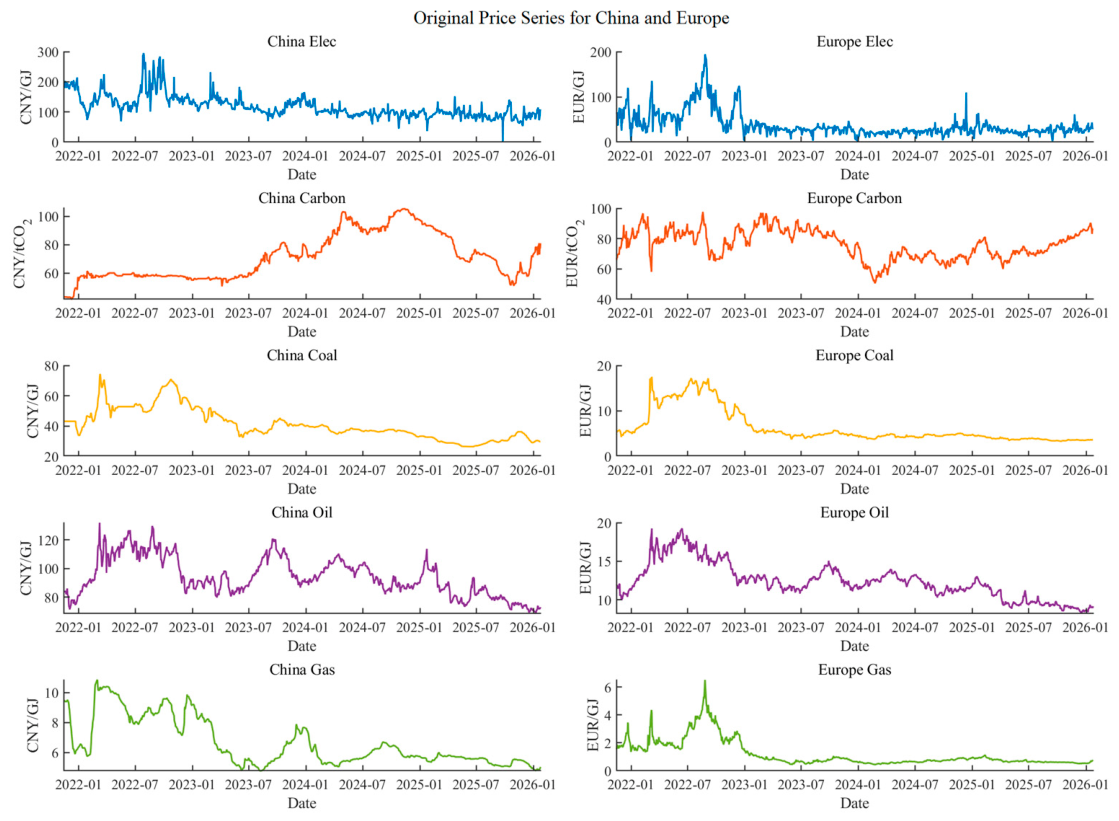
Figure 1 presents the original price series for China and Europe. Each series is plotted in a separate panel. Electricity and fossil-fuel prices are reported in energy-equivalent units after unit standardization, while carbon prices are reported per ton of CO
2. Detailed proxy definitions, data sources, original units, and estimation units are reported in
Table 2.
The sample period runs from November 2021 to January 2026. All observations are daily market data obtained from the Wind database. No forecast data are used. The sample covers the high-stress phase around the 2021–2022 energy crisis and the subsequent adjustment period within the same empirical window.
The Chinese benchmark system includes Guangdong day-ahead spot electricity prices, China Emission Allowance closing prices, Qinhuangdao Q5500 thermal coal prices, Shanghai crude oil futures continuous contract prices, and China LNG ex-factory price indices. The European benchmark system includes German day-ahead baseload electricity prices, ICE EUA December futures continuous contract prices, API2 Rotterdam/ARA coal futures prices, ICE Brent crude oil futures prices, and Dutch TTF natural gas futures prices. These proxies are selected because they are liquid, continuously available, and widely used benchmark indicators for the corresponding electricity, carbon, coal, oil, and natural gas markets. The empirical results should therefore be interpreted as representative benchmark-market evidence rather than exhaustive coverage of all Chinese and European market segments.
Specifically, German and Guangdong day-ahead spot electricity prices are used as benchmark electricity-market indicators, while EUA and CEA prices are used as carbon-market benchmark indicators. Qinhuangdao Q5500 thermal coal and China LNG ex-factory prices represent China’s coal and natural gas markets, whereas API2 Rotterdam/ARA coal futures and Dutch TTF natural gas futures serve as European coal and natural gas benchmarks. Shanghai crude oil futures and ICE Brent crude oil futures are used as representative oil-price benchmarks for China and Europe, respectively.
To improve comparability across energy commodities, electricity and fossil-fuel prices are converted into energy-equivalent units before the descriptive price plots are produced. Electricity prices are converted using 1 MWh = 3.6 GJ. Q5500 thermal coal, crude oil, and LNG prices are converted using approximately 23 GJ/t, 6.1 GJ/barrel, and 52 GJ/t, respectively. USD-denominated European coal and oil benchmarks are converted into EUR before energy-unit standardization. Carbon allowance prices are kept in per-ton CO2 units because they measure allowance prices rather than energy prices. The econometric analysis is conducted using daily log returns. Constant physical-unit conversions therefore do not alter log-return dynamics, while currency conversion is applied before return construction.
Market non-trading days are excluded, isolated missing observations on otherwise valid trading days are filled using the previous available trading-day value, and the final balanced panel retains only overlapping trading dates across all selected markets. Because the analysis is conducted at the daily frequency and focuses on return-based connectedness rather than intraday lead–lag transmission, China and Europe are synchronized by calendar trading dates. Intraday time-zone-specific transmission is outside the scope of this study.
Table 2 summarizes the variable proxies, sources, original units, estimation units, and frequencies.
The selected series are not intended to represent every regional electricity, carbon, or fossil-fuel market within China or Europe. Rather, they provide a consistent set of representative benchmark indicators with daily availability, sufficient market relevance, and comparable coverage across electricity, carbon, coal, oil, and natural gas markets. This design supports the reduced-form connectedness, QVAR/QIRF, and MFDFA analyses while maintaining a clear scope boundary for interpretation.
4.2. Empirical Results
The empirical analysis proceeds in three parts. First, total connectedness, net spillovers, and network structures are examined to compare overall risk diffusion between the Chinese and European benchmark systems under the same empirical workflow. Second, QIRFs are used to examine nonlinear and asymmetric responses to natural gas shocks across quantile states. Third, the time-varying MFW pattern and statistical tests are combined to assess whether electricity-return complexity is associated with system connectedness in a stage-dependent manner.
4.2.1. Time-Varying Evolution of System Connectedness
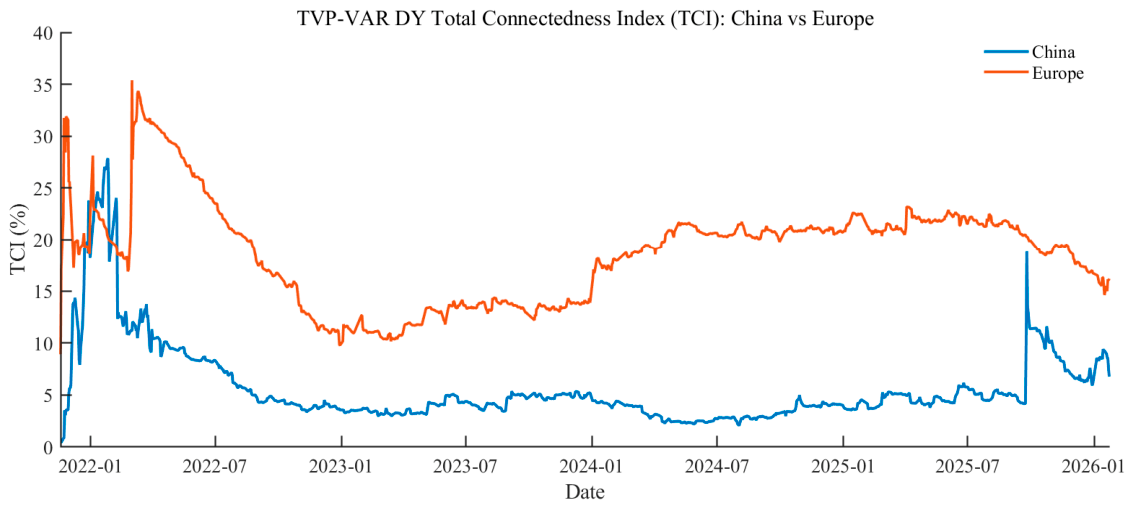
Figure 2 reports the TVP-VAR-based total connectedness index (TCI) for the Chinese and European benchmark systems. The TCI series varies substantially in both systems, with peaks occurring around major external shock periods. However, the two systems differ in peak magnitude, persistence, and post-peak adjustment.
In the European benchmark system, the TCI rises rapidly from late 2021 to early 2022 and remains high and volatile for an extended period. This pattern suggests that, during the energy crisis, electricity, carbon, and fossil fuel returns became more synchronized and more strongly connected in terms of risk. By contrast, the Chinese benchmark system also shows a stage-specific increase in TCI during the same period, but its peak is lower and the series declines more rapidly after the shock period, followed by longer intervals of low connectedness.
Table 3 complements
Figure 2 by reporting full-sample TCI levels, event-period TCI levels, high-connectedness shares, and reversion-speed indicators as defined in
Section 3.2. The crisis period is defined as 2021Q4–2022Q2, while the normal period is defined as 2023–2024. These statistics are descriptive event-period measures rather than formal causal estimates of the energy-crisis effect.
Table 3 shows that the European benchmark system has a substantially higher average connectedness level over the full sample. The full-sample mean TCI is 18.75 in Europe and 5.63 in China. During the crisis period, the mean TCI is 25.19 in Europe and 12.12 in China, while the normal-period mean TCI is 16.46 in Europe and 3.72 in China. The crisis-period peak is also higher in Europe (35.40) than in China (27.87). Relative to each region’s own full-sample distribution, the crisis-period high-connectedness share is 92.41% in China and 71.72% in Europe. Thus, the Chinese benchmark system shows a more concentrated crisis-period increase relative to its lower baseline, whereas the European benchmark system displays a higher absolute connectedness level throughout the sample.
The reversion-speed indicators distinguish between initial post-peak decline and reversion to lower connectedness thresholds. The half-life measure suggests that China experienced a much faster initial decline from the crisis peak: the Chinese TCI crossed the half-life threshold after 5 trading days, whereas the European TCI required 62 trading days. Reversion to lower connectedness thresholds gives a different comparison. China reached its full-sample 75th-percentile and normal-band thresholds after 130 and 143 trading days, respectively, while Europe reached the corresponding thresholds after 92 and 108 trading days. This comparison does not indicate uniformly faster recovery in Europe, because the Chinese thresholds are lower owing to the lower baseline TCI. Therefore, the main conclusion is that Europe maintained a higher absolute level of connectedness, while China showed a sharper initial decline but a more threshold-sensitive normalization process.
As an additional robustness check, crisis-period dummy regressions with Newey–West standard errors also show significantly higher TCI during the crisis period in both regions. The detailed regression results are reported in
Table S3 in the Supplementary Materials. These results support the descriptive event-period comparison in
Table 3, but they do not provide causal identification of the energy-crisis effect.
Taken together, the dynamic TCI pattern, full-sample statistics, event-period comparison, and reversion-speed indicators show clear differences in crisis-period connectedness and post-shock adjustment between the two benchmark systems. The European sample maintains a substantially higher absolute level of connectedness during both crisis and normal periods, suggesting stronger and more persistent system-wide coupling in absolute terms. The Chinese sample, in contrast, shows a sharp and concentrated crisis-period increase relative to its own distribution and a faster initial post-peak half-life decline. These reduced-form patterns are consistent with differences in market-adjustment mechanisms and institutional filtering, but they should be interpreted descriptively.
4.2.2. Dynamic Differences in Risk-Transmitting and Risk-Receiving Roles
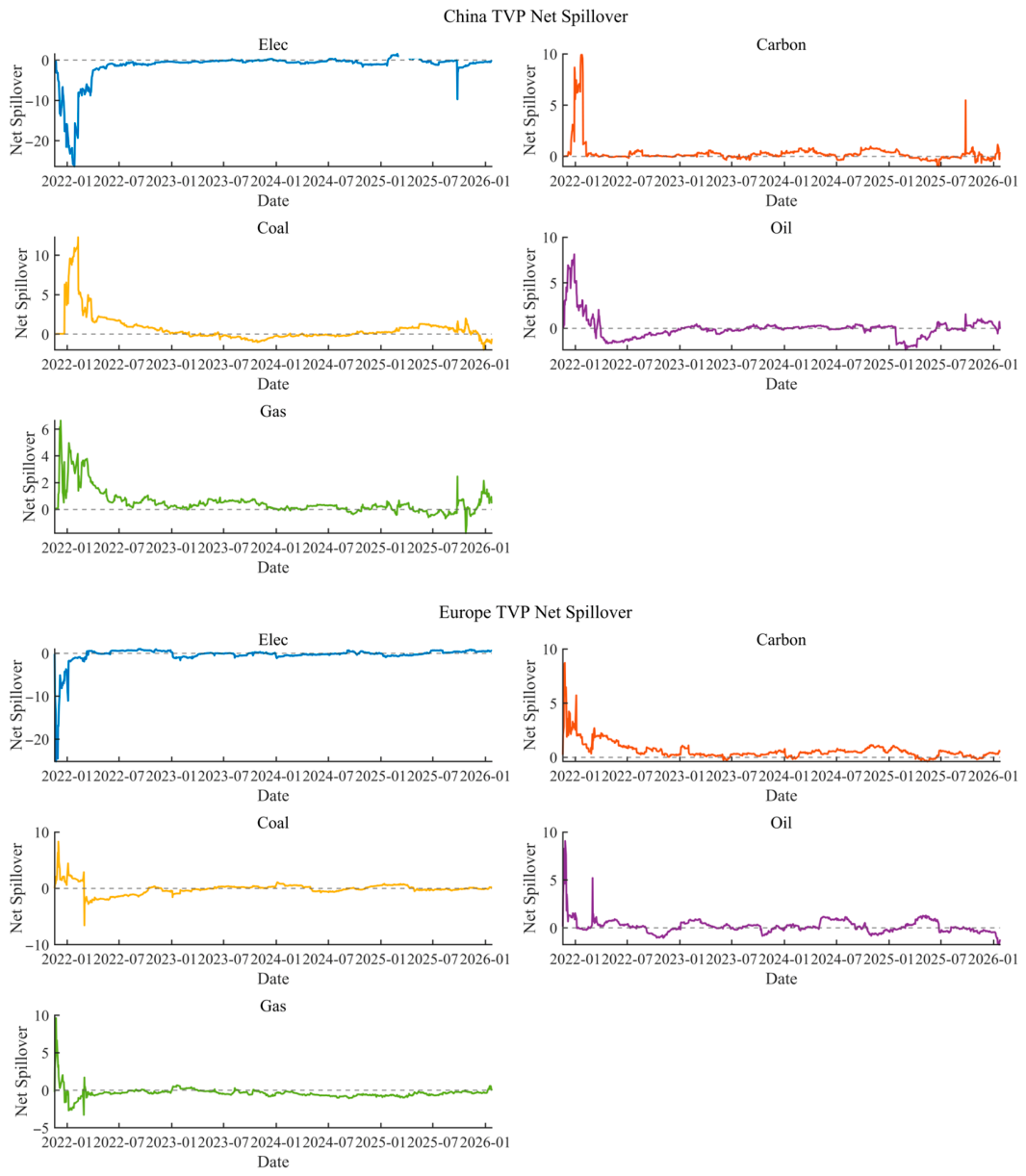
Figure 3 presents dynamic net spillovers for each variable in the Chinese and European benchmark systems, showing how markets switch between net risk-transmitting and net risk-receiving roles over time. Overall, both regions exhibit sharp spikes in net spillovers in the early part of the sample, after which most variables gradually converge toward zero, suggesting that directional dominance is concentrated mainly in the shock period.
In the Chinese benchmark system, the strongest differentiation of net roles occurs from late 2021 to early 2022: electricity displays a significantly negative net spillover and thus acts as a net receiver, whereas carbon, coal, oil, and natural gas display relatively strong positive net spillovers over the same period. This pattern suggests that upstream energy and carbon markets were more closely associated with system-wide risk diffusion during the shock episode. From the second half of 2022 onward, net spillovers of most variables converge quickly and remain close to zero for a long period, indicating weaker directional transmission and more balanced market roles during normal periods.
The European benchmark system also exhibits spike-like behavior in the early sample. Electricity shows a significantly negative net spillover in the initial shock period, while carbon and some upstream energy prices display positive spikes. Compared with the Chinese sample, the European sample retains a clearer directional pattern in the middle and later parts of the period: carbon remains a positive net transmitter over a relatively long period, whereas natural gas stays below zero for an extended phase and acts more as a net receiver. Although the roles of coal and oil switch across stages, the European benchmark system shows more persistent directional specialization, even during normal periods.
Together with
Figure 2, these results show a stage-specific shock-period structure in both benchmark systems: upstream energy and carbon markets are more closely associated with risk transmission, whereas electricity markets tend to receive risk pressure. Yet their post-shock evolution differs. In the Chinese system, net roles converge toward neutrality more quickly, suggesting that directional dominance is concentrated more heavily in crisis periods. In the European system, by contrast, key nodes such as carbon and natural gas maintain a more persistent net-role bias, suggesting a more durable risk-diffusion structure. These reduced-form patterns suggest that institutional and market-structure factors may be related to the stability of risk roles and the persistence of directional specialization.
4.2.3. Spillover Networks of Longer-Run Risk Transmission
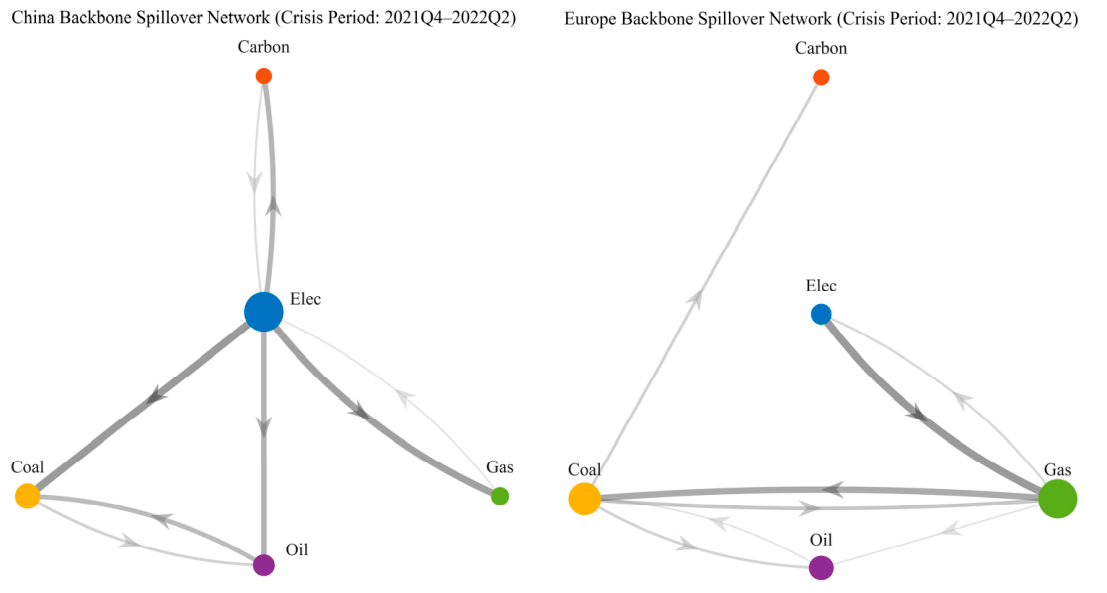
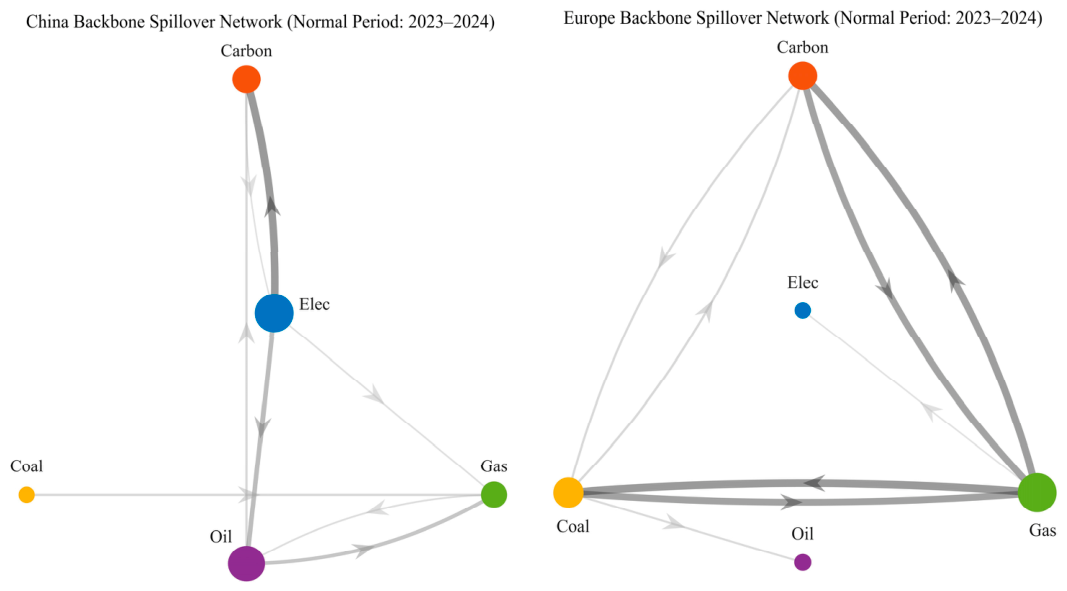
Figure 4 and
Figure 5 report the backbone spillover networks for the crisis period and the normal period, respectively. The networks are based on the average generalized forecast error variance decomposition within each subperiod, with only the strongest directed spillover edges retained to highlight dominant transmission channels.
In
Figure 4, the crisis-period networks contain stronger retained spillover edges than the normal-period networks in
Figure 5, suggesting stronger directional transmission within the system during crisis periods. Nevertheless, the dominant channels differ across the two regions. In the Chinese crisis-period network, the electricity node is more central in the retained backbone structure, with a prominent spillover edge from electricity to coal; the links from electricity to natural gas and from electricity to oil also strengthen, suggesting a more prominent electricity-related transmission pattern during crisis periods. Interactions within the fuel segment also intensify, while the bidirectional transmission between electricity and carbon remains identifiable, suggesting that the electricity–carbon linkage remains visible during crises. By contrast, the European crisis-period network shows tighter links between fuel, carbon, and electricity markets. The dominant retained links are concentrated around natural gas, carbon, coal, and electricity, and the two-way links between electricity and natural gas suggest a more visible association between electricity prices and marginal fuel prices under the energy crisis. Relative to China, the European sample therefore displays a clearer fuel–carbon–electricity backbone path in the plotted network.
In
Figure 5, the normal-period networks contain fewer dominant retained edges and more dispersed structures, although the convergence patterns differ across the two benchmark systems. In the Chinese normal-period network, strong links are less concentrated along a single chain, and interactions within the fuel segment become more dispersed. The European sample, by contrast, still shows some re-concentration around the fuel-carbon chain, while electricity-related edges weaken overall and move closer to the periphery.
Overall, the backbone networks indicate that directional transmission strengthens in both systems during the crisis period, but the persistence of dominant transmission paths differs across the two samples. The Chinese network becomes more dispersed in the normal period, whereas the European network retains more visible fuel-carbon-related backbone links. These patterns indicate different forms of post-crisis network adjustment.
Section 5 discusses the broader market-design and institutional interpretation.
4.2.4. Nonlinear and Asymmetric Responses to Natural Gas Shocks Across Quantile States
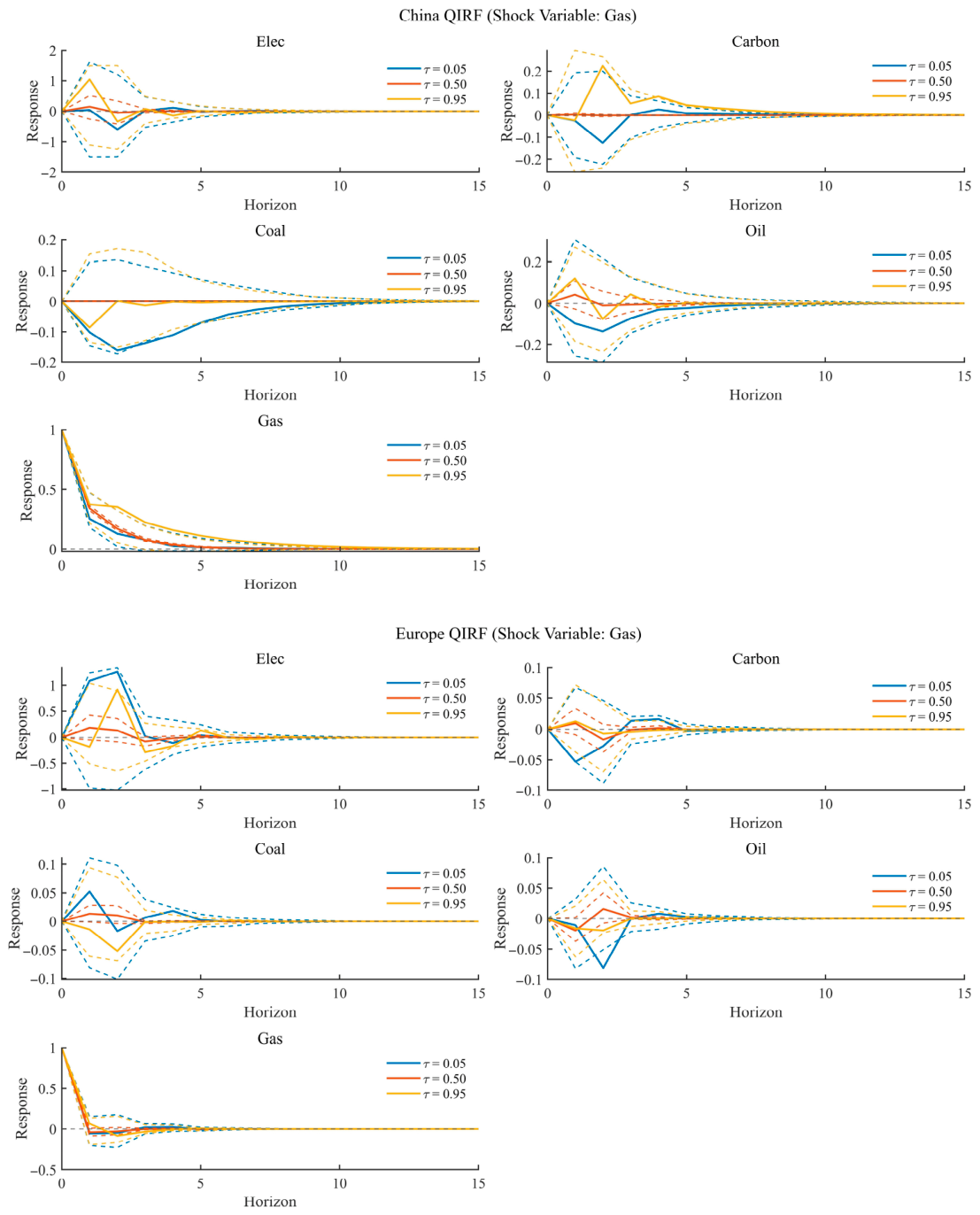
Figure 6 reports the QIRFs using natural gas as the shock variable and compares the dynamic response paths of electricity, carbon, and other variables under three quantile states:
= 0.05 (lower tail),
= 0.50 (median), and
= 0.95 (upper tail). Natural gas is used as the benchmark upstream-energy shock because of its central role in the European energy crisis and its close link with marginal electricity pricing, fuel-switching incentives, and carbon-cost pass-through. The interpretation is therefore limited to a representative upstream-energy shock rather than all possible shock sources. Overall, responses in both benchmark systems are concentrated mainly in the first few forecast horizons and then gradually decay toward zero, but clear regional differences emerge across quantile states.
In the European benchmark system, electricity exhibits short-run positive responses to the natural gas shock at all three quantiles, with the peak occurring around period 2. The peak is higher and the reversion is slower in the upper-tail state, whereas the response is weaker in the lower-tail state. This indicates that, within the European benchmark system, cross-market responses are stronger and more persistent in the upper-tail state, providing evidence of tail-state amplification and quantile asymmetry in this selected shock setting.
In the Chinese benchmark system, quantile differences under the natural gas shock are more prominently reflected in short-run directional divergence. Under the median and upper-tail states, electricity and carbon respond positively during periods 1–3 and then gradually decay; under the lower-tail state, however, both variables display negative responses during periods 1–3, rebound afterward, and then gradually converge to zero. This suggests that, in the Chinese sample, quantile dependence appears mainly as short-run directional divergence rather than sustained amplification.
Together with the overall connectedness differences shown in
Figure 2, the QIRF results in
Figure 6 further indicate that the China–Europe contrast in tail-state responses concerns both response magnitude and response form. In the European sample, quantile differences are manifested mainly in larger response magnitude and longer persistence, indicating that the response paths are stronger and more persistent under high-risk states. In the Chinese sample, by contrast, tail dependence is expressed more through short-run directional divergence than through sustained strong amplification. In the selected upstream-energy-shock setting, the European benchmark system shows more persistent responses, whereas the Chinese benchmark system shows more stage-specific and shorter-lived tail-state effects.
To avoid relying on a single shock source, we further repeat the QIRF analysis using coal, oil, and carbon shocks as supplementary robustness checks. The additional results are reported in
Figures S1–S6 and Table S1 in the Supplementary Materials.
Table S1 summarizes the electricity and carbon responses under the supplementary coal, oil, and carbon shocks in terms of peak response, peak horizon, cumulative response, and persistence horizon, while the supplementary figures report the corresponding point-QIRF paths. Overall, the China–Europe contrast remains visible across alternative shock sources, although response magnitude, direction, and persistence differ across coal, oil, and carbon shocks. Thus, the QIRF results should be read as shock-source-dependent evidence. The natural-gas-shock results should therefore be read as a benchmark case, not as an invariant response pattern across all fossil-fuel and carbon-market shocks.
4.2.5. Return-Based Electricity-Market Complexity
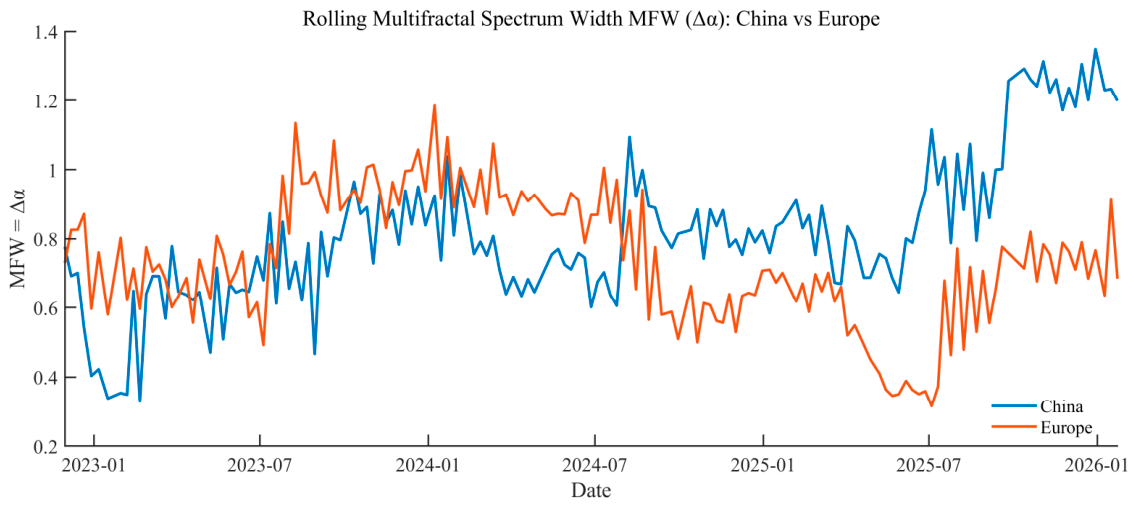
Figure 7 compares the rolling MFDFA-based multifractal spectrum width (MFW) of electricity returns in China and Europe. A larger MFW indicates greater heterogeneity of electricity returns across time scales and is interpreted in this paper as a return-based electricity-market complexity proxy rather than as a direct behavioral measure or a stable early-warning indicator. Both regions exhibit clear time variation in MFW, but their evolutionary paths differ substantially. Because MFW is calculated using a 250-day rolling window, estimates are unavailable at the beginning of the sample.
Figure 7, the diagnostic regression with lagged MFW, and the rolling-coefficient tests therefore use the effective sample period in which MFW is available.
In the Chinese sample, MFW drops sharply in early 2023, then gradually rises during the second half of 2023, and remains at a relatively high level from late 2023 to the first half of 2024. After a brief decline in the second half of 2024, it rises again from 2025 onward and reaches the highest level within the estimated MFW series near the end of the period. This pattern indicates a more evident accumulation of electricity-return complexity in the Chinese sample during the later part of the period.
In the European sample, MFW stays at a moderate level in early 2023, then rises rapidly during the second half of 2023 and reaches a stage-specific peak from late 2023 to early 2024. It then declines continuously from the second half of 2024, falls to a low level by mid-2025, and although it rebounds later, it remains below its earlier peak. This suggests that, after an earlier expansion of electricity-return complexity, the European sample exhibits a clearer process of complexity convergence.
Overall, the Chinese sample shows stronger accumulation of electricity-return complexity in the later period, whereas the European sample displays a stage-specific pattern of expansion–convergence–readjustment. Combined with the preceding results, this contrast suggests that the return-based complexity process differs across the two systems: China exhibits a more concentrated accumulation of electricity-return complexity in the later period, whereas the European MFW pattern appears more closely aligned with the earlier high-stress period.
4.2.6. Statistical Tests of Return-Based Complexity and System Connectedness
We further examine the relationship between MFW and TCI through statistical diagnostic tests. The purpose of these tests is not to establish MFW as a stable forecasting variable, but to examine whether electricity-return complexity contains stage-dependent auxiliary information about system connectedness.
- (1).
Baseline diagnostic regression with lagged MFW
Using Newey–West (HAC) robust standard errors, we estimate the baseline diagnostic regression with lagged MFW.
Table 4 reports the regression results for China and Europe, with t-statistics in parentheses.
Table 4 shows that both the Chinese and European samples exhibit significant autoregressive behavior in the lagged dependent variable, with stronger persistence in Europe. This indicates that system connectedness is more persistent in the European sample. By contrast, the coefficient on lagged MFW is positive but not statistically significant in the Chinese sample and negative but likewise insignificant in the European sample.
These findings indicate that, after controlling for the persistence of TCI, MFW does not exhibit a stable and significant linear explanatory effect at the full-sample level. In other words, the relationship between electricity-return complexity and system connectedness cannot be reduced to a linear relationship with a single direction and constant strength; it appears to depend on the institutional environment, shock source, and sample stage.
The insignificant full-sample coefficient indicates that MFW should not be interpreted as a stable linear predictor of system connectedness.
- (2).
Rolling-coefficient test
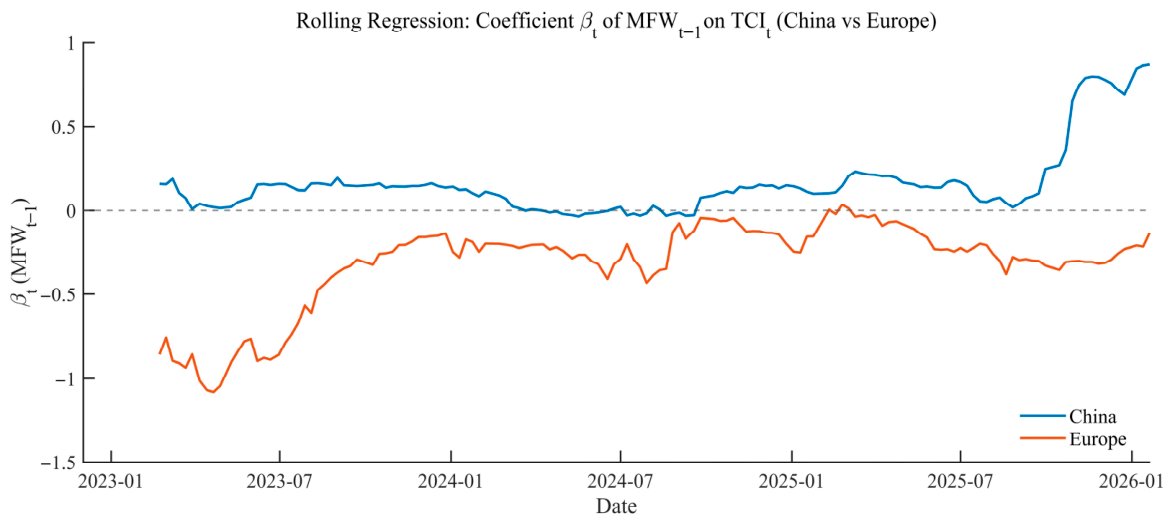
Using the same rolling-window setting as that used for MFW, we re-estimate the above regression on a rolling basis, obtain a time-varying series of , and compare the Chinese and European samples.
Compared with the baseline diagnostic regression, the rolling-estimation results in
Figure 8 further show that there is no single stable full-sample relationship between electricity-return complexity and system connectedness; instead, the relationship is clearly stage-dependent and market-setting-dependent. The rolling coefficients in the Chinese sample are mostly positive and become stronger in the latter part of the sample, suggesting that rising electricity-return complexity may correspond to higher connectedness in some stages. By contrast, the rolling coefficients in the European sample remain negative for long periods and are even significantly negative around 2023, suggesting that, in some high-connectedness stages, higher connectedness may be associated more with synchronized return structures than with further expansion of multiscale heterogeneity.
To examine whether the rolling-coefficient results are sensitive to the selected window length, we further repeat the rolling regression using 200-, 250-, and 300-day windows. The main specification uses a 250-day window. Alternative-window results are reported in
Figures S7 and S8 and Table S2 in the Supplementary Materials.
Table S2 provides the corresponding numerical robustness summary, including mean and median rolling coefficients, positive and negative coefficient shares, statistically significant coefficient shares, and the last rolling coefficient under each window length. The main stage-dependent pattern remains broadly consistent under alternative window lengths, although the coefficient magnitude and exact timing vary. In particular, the Chinese rolling coefficients remain more frequently positive in the later part of the sample, whereas the European coefficients remain negative for long periods. These results suggest that the sign and stage dependence of the MFW-TCI relationship are not solely driven by the baseline 250-day rolling-window choice.
Overall, the rolling-coefficient results suggest that the relationship between return-based complexity and connectedness is stage-dependent and differs between the Chinese and European benchmark systems. Therefore, MFW is more appropriately interpreted as a stage-dependent auxiliary diagnostic indicator rather than as a stable early-warning indicator. Because MFW is extracted from return series, it captures realized cross-scale return heterogeneity rather than the underlying behavioral mechanisms. Its relationship with TCI should therefore be interpreted as a diagnostic association rather than as direct evidence of trader behavior or market microstructure.
5. Discussion
The empirical results reveal systematic differences between the representative Chinese and European benchmark systems. These differences may reflect a combination of market design, natural-gas dependence, fuel-import exposure, carbon-market liquidity, market depth, contract structures, and financialization. The following discussion interprets the reduced-form evidence through plausible market mechanisms, without making formal causal claims.
5.1. Return-Based Complexity and System Connectedness
Taken together, the multifractality and connectedness results indicate a stage-dependent association between return heterogeneity and system connectedness. The insignificant full-sample coefficient of MFW implies that it should not be interpreted as a stable linear predictor or a fixed-direction early-warning indicator. Instead, the rolling-coefficient evidence supports interpreting MFW as a stage-dependent auxiliary diagnostic indicator whose sign and magnitude vary with the stress regime and market setting.
The opposite signs of the MFW-TCI relationship in the two samples may reflect different forms of stress adjustment. In the European sample, high-stress periods may be associated with more synchronized portfolio adjustment and stronger same-direction movements among gas, electricity, carbon, coal, and oil prices. Such synchronization may increase system connectedness as markets move more closely together, while reducing multiscale heterogeneity in electricity returns, thereby producing a negative MFW-TCI association in some stages. In the Chinese sample, regulatory constraints, contract-based arrangements, and price-stabilization mechanisms may weaken instantaneous synchronization. In this setting, risk may be reflected through local price mismatches, delayed adjustment, segmented expectations, and information noise, which can widen the multifractal spectrum while connectedness also rises. This interpretation is consistent with the more frequently positive rolling MFW-TCI coefficients in China and the persistently negative coefficients in Europe.
5.2. Market Orientation, Tail States, and Asymmetric Amplification
The natural-gas-shock QIRF results indicate state-dependent response paths, while the China–Europe contrast cannot be attributed to market design alone. In the European sample, upper-quantile states produce larger and more persistent responses. This pattern is consistent with a setting in which natural-gas dependence, cross-border trading, market depth, financial hedging activity, and marginal-pricing channels are closely linked to upstream-energy-shock transmission. In the Chinese sample, quantile differences appear more in short-run directional divergence than in prolonged amplification. This pattern may be related to regulatory filtering, contract structures, lower short-run trading depth, differing commodity exposure, and the developing stage of electricity and carbon markets. Thus, the tail-state evidence supports a comparative interpretation in which amplification differs in form and persistence across the two benchmark systems.
5.3. Institutional Roles of Electricity and Carbon Markets
In the estimated networks, the electricity market appears to play different roles across the two systems. In the European sample, electricity is more tightly embedded in the fuel–carbon chain and appears to act as an intermediary channel through which upstream cost shocks are reflected in the system. This pattern may be associated with marginal-cost pricing and cross-market trading, but it may also reflect market size, liquidity, fuel-import dependence, hedging activity, and stronger financialization of energy contracts. In the Chinese sample, the electricity market more often behaves as an initial receiver and buffer of upstream shocks. This pattern may be related to contract-based pricing, administrative smoothing, supply-security arrangements, segmented regional markets, and the still-developing spot-market mechanism.
The carbon-market contrast is similar but not identical. The European carbon market is estimated to act more frequently as an intermediary node, reflecting the deeper, more financially embedded, and more energy-linked nature of EUA trading. In the Chinese sample, the weaker short-run responsiveness of carbon-related spillovers may be associated with a more compliance-oriented market setting, lower trading depth, and a developing price-discovery process. These interpretations remain reduced-form and descriptive. They show that electricity and carbon markets transmit risk differently across the representative Chinese and European samples, without separately quantifying the causal effect of any single institutional or market-structure factor.
6. Conclusions and Policy Implications
6.1. Main Conclusions
Using daily market data for representative Chinese and European electricity, carbon, and fossil fuel benchmark markets from November 2021 to January 2026, this paper develops a three-layer empirical framework covering system-level connectedness, tail-state shock responses, and return-based complexity. The conclusions are framed as comparative descriptive evidence on risk-transmission patterns across the selected benchmark systems.
First, the TCI, net-spillover, network, and event-period evidence in
Figure 2,
Figure 3,
Figure 4 and
Figure 5 and
Table 3 show pronounced time-varying connectedness in both systems, but the absolute connectedness level is much higher in the European sample. The full-sample mean TCI is 18.75 in Europe and 5.63 in China. During the crisis period, the mean TCI is 25.19 in Europe and 12.12 in China, while the normal-period mean TCI is 16.46 in Europe and 3.72 in China. The crisis-period peak TCI is also higher in Europe (35.40) than in China (27.87). Relative to each region’s own full-sample 75th-percentile threshold, the crisis-period high-connectedness share is 71.72% in Europe and 92.41% in China, indicating that China’s crisis-period increase is more concentrated relative to a lower baseline. The reversion-speed results add a further distinction. China reaches the half-life reversion threshold after 5 trading days, compared with 62 trading days in Europe, suggesting a faster initial decline from the crisis peak. However, reversion to the full-sample Q75 threshold takes 130 trading days in China and 92 trading days in Europe, and reversion to the normal-period band takes 143 and 108 trading days, respectively. The reversion evidence therefore depends on the benchmark used rather than indicating uniformly faster recovery in either system. Overall, Europe maintains a higher absolute connectedness level, while China’s post-peak adjustment is more sensitive to the reversion benchmark used. This finding implies that sustainable energy-transition governance should pay attention not only to individual market volatility, but also to the degree to which electricity, carbon, and fossil-fuel markets become jointly exposed to systemic shocks.
Second, based on the natural-gas-shock QIRFs in
Figure 6, both systems display quantile dependence under the selected upstream-energy-shock setting, but their tail-state response patterns differ. The European sample exhibits larger and more persistent responses under upper-quantile states, suggesting that high-risk episodes may be associated with stronger cross-market transmission of natural gas shocks. In the Chinese sample, quantile dependence is more evident in short-run directional divergence than in sustained amplification. These reduced-form patterns are consistent with heterogeneous market-adjustment mechanisms, fuel-price exposure, contract structures, and regulatory conditions across the two benchmark systems. Supplementary QIRFs for coal, oil, and carbon shocks further show that the China–Europe contrast remains broadly visible across alternative shock sources, although the magnitude, direction, and persistence of responses are shock-source-dependent. Such tail-state amplification may challenge the stability of carbon-price and electricity-price signals, which are essential for guiding low-carbon investment and maintaining energy-transition credibility.
Third, based on
Figure 7,
Table 4,
Figure 8, and the rolling-window robustness results in
Table S2, there is no single stable full-sample relationship between electricity-return complexity and system connectedness. The insignificant full-sample MFW coefficient confirms that MFW should not be interpreted as a stable linear predictor of system connectedness. Instead, the rolling-coefficient results indicate that the MFW-TCI relationship is stage-dependent and differs across the two market settings. MFW is therefore more appropriately interpreted as a stage-dependent auxiliary diagnostic indicator for identifying changes in return-based complexity during changes in systemic-risk conditions, rather than as a universally reliable early-warning indicator. Therefore, MFW may be incorporated into a broader sustainability-oriented risk-monitoring framework together with TCI, net-spillover roles, backbone networks, and QIRFs.
6.2. Sustainability-Oriented Policy Implications
The policy implications are framed from the perspective of sustainable energy transition, where energy affordability, market resilience, carbon-price credibility, and low-carbon investment incentives need to be jointly maintained.
For China, the policy implication is to balance price discovery with risk buffering rather than treat immediate pass-through as an automatic policy objective. Under normal conditions, the gradual improvement in wholesale electricity-market price discovery can help cost signals be reflected more efficiently and reduce distorted inter-market signals. At the same time, coordination between medium- and long-term contracts and spot-market clearing should be strengthened so that contract positions, spot prices, and settlement rules do not generate unnecessary local price mismatches. The liquidity and participation depth of the national carbon market should also be improved, so that carbon prices can provide more reliable compliance and risk-monitoring signals. Under extreme shocks, however, necessary stabilization mechanisms, supply-security arrangements, and temporary price-smoothing tools should be retained to prevent rapid cross-market contagion. Such tools should be designed as targeted, temporary, and transparent buffers, because long-term reliance on the electricity sector as a shock-absorption channel should be avoided.
For Europe, the policy implication is to reduce excessive exposure to short-run marginal fuel-price shocks and to strengthen risk-sharing instruments under high-connectedness states. Long-term contracts, contracts for difference (CfDs), power purchase agreements (PPAs), and other hedging instruments can help weaken the immediate pass-through of upstream gas and fuel shocks to electricity prices and end-user risk. More developed hedging markets and clearer collateral arrangements may also reduce synchronized rebalancing when energy and carbon prices move sharply. When the TCI and net-spillover indicators signal high-connectedness states, temporary stabilization mechanisms, liquidity-support measures, and crisis-period market-monitoring tools may be needed to limit destabilizing trading pressure and prevent short-run fuel-price shocks from becoming system-wide electricity–carbon–energy stress.
For both market settings, policy monitoring should not rely on a single indicator. A combined framework using TCI, net-spillover roles, backbone networks, and tail-state QIRFs, with MFW used only as a stage-dependent auxiliary diagnostic indicator, can provide a more comprehensive view of systemic-risk formation. This framework is useful because the same connectedness pattern may reflect several overlapping channels, including market design, liquidity, market size, commodity dependence, contract structures, and carbon-market maturity.
6.3. Limitations and Scope of Interpretation
This study has several limitations. First, the results are comparative and descriptive rather than causal; the TVP-VAR, QVAR/QIRF, and MFDFA analyses do not identify the structural effect of any single institutional factor. Second, the selected German, Guangdong, EUA, and CEA series are representative benchmark indicators rather than exhaustive measures of all Chinese and European markets. Third, natural gas is used as the benchmark upstream-energy shock, while supplementary coal-, oil-, and carbon-shock results show that response patterns are shock-source-dependent. Fourth, MFW is a return-based complexity proxy rather than a direct observation of trader behavior, liquidity, or order-book dynamics. Fifth, the daily frequency data cannot identify intraday lead–lag transmission or time-zone-specific information flows. Finally, the China–Europe comparison is representative rather than fully matched, because the two systems differ in market design, contract structure, fuel dependence, liquidity, and carbon-market maturity.





 ,
,