Article

Sustainable Subgrade Stabilization with Calcium Lignosulfonate: A Dual Assessment of Economic Costs and Carbon Footprint in Road Pavements

Department of Civil Engineering, Faculty of Engineering, Inonu University, 44280 Malatya, Türkiye
*
Author to whom correspondence should be addressed.
Sustainability 2026, 18(13), 6750; https://doi.org/10.3390/su18136750
Submission received: 4 June 2026 / Revised: 26 June 2026 / Accepted: 29 June 2026 / Published: 3 July 2026
(This article belongs to the Section Sustainable Transportation)

Abstract

This study evaluates the economic and carbon footprint impact of using calcium lignosulfonate (CLS) in stabilizing highway subgrade on road pavement. Specifically, the effect of stabilized soil strength on layer thickness, costs, and carbon emissions during the initial construction phase was investigated. Two different soil types (clayey and sandy) were used with varying CLS concentrations. Furthermore, the performance of CLS was evaluated using sodium hydroxide-based alkaline activation (AAS). Standard proctor, unconfined compressive strength (UCS), and California bearing ratio tests were applied to the prepared samples. The experimental results showed that CLS significantly increased the CBR and UCS values of the soil samples. Additionally, it was calculated that the initial construction costs of flexible and rigid road pavements designed on stabilized clayey soil decreased by 14.34% and 25.24%, respectively, while on sandy soils, the decreases were 8.10% and 14.95%, respectively. Meanwhile, it has been determined that CO2 emissions were reduced by up to 10.76% in flexible pavement designs and by up to 17.88% in rigid pavement designs. Consequently, these findings show that the use of CLS in soil stabilization enables both a reduction in the layer thickness of road pavement designs and a reduction in environmental impacts.

1. Introduction

Today, global climate change and the rapid depletion of natural resources have shifted engineering projects away from traditional approaches toward a search for low-carbon, eco-friendly materials and methods. This pursuit closely impacts the construction processes for highways, which fulfill the transportation needs, one of the fundamental requirements of modern life. It is an essential necessity that the materials and methods used in highway construction are low-emission, economical, and capable of meeting engineering requirements. Especially in challenging terrain conditions, soil stabilization methods stand out for technical and economic reasons in highway construction conducted on weak soils with low bearing capacity [1,2,3]. In soil improvement methods, the use of pozzolanic binders such as cement and hydrated lime as traditional stabilization materials is common [3]. However, the high energy consumption and intense CO2 emissions during the production processes for these traditional binders, along with economic reasons, have led researchers toward alternative materials [4,5,6,7,8,9,10,11,12,13,14,15,16,17,18]. In this context, various studies have been conducted on the use of industrial and agricultural waste materials such as rice husk ash [4,5,6], marble dust [7], glass powder [8,9], fly ash [10], ground granulated blast furnace slag [11], carbon black [12,13], waste eggshell powder [14], coconut fiber [15], hazelnut shell fiber [16], coconut shell [17], and construction waste [18], indicating a continuous search for different alternative stabilizer materials.
Among the alternative additive materials, calcium lignosulfonate (CLS) is a material generally obtained as a byproduct of the paper and cellulose industry. Lignin, found in CLS, is a natural polymer that exists alongside cellulose in plant cell walls and provides strength-enhancing properties in mixtures. Due to its binding properties and its status as an organic-based, eco-friendly product, CLS has been included in the group of stabilizer materials with an increasing number of research studies in recent years. To better contextualize the state-of-the-art regarding CLS and raw lignosulfonate (LS; the broader by-product family from which CLS is derived) in geotechnical engineering, a systematic review of prior applications, optimum dosages, and engineering performance is essential. Recently, polymers of biological origin have attracted great interest in stabilizing problematic soils. This is due to their different chemical properties. In swelling soils and high-plasticity clays, it has been determined that the use of calcium lignosulfonate (CLS) and lignosulfonate (LS) reduces volumetric swelling pressure and plasticity index, and also increases unconfined compressive strength and California bearing ratio values [19,20,21,22,23]. Macroscopic changes have been revealed in data obtained from X-ray diffraction (XRD), X-ray computed tomography (X-CT) and mercury injection porosimetry (MIP). Here, it is seen that a stable structure is produced by eliminating cation exchange and shrinking layers and soil voids in swelling minerals such as montmorillonite [21,23,24]. The increase in strength after wetting–drying cycles has been determined in binary mixtures of CLS with industrial wastes such as granite powder, polypropylene fibers, marble dust and granite powder. This increase in strength is seen to be due to the compact structure occurring in the mixtures preventing mass loss [25,26,27,28]. In addition, it is emphasized that stabilization with CLS reduces CO2 emissions by up to 98% compared to conventional cement or lime binders [29].
Despite these developments, it is observed that there are significant gaps in the literature. While prior literature heavily focuses on laboratory-scale material characterization, collapsible loess improvement [30], and chemical behavior (including distinct adsorption and trend reversal mechanisms based on the soil’s fine or silt fractions [28]), no integrated study has systematically translated these stabilized geotechnical properties into structural pavement cross-sections via AASHTO 1993 [31] design, while simultaneously executing a dual macroscopic quantification of initial construction phase economic costs and carbon footprint reductions across contrasting soil matrices (clayey vs. sandy). Furthermore, it has been observed in the literature that there are rare studies [31,32,33,34,35,36,37] aimed at determining the amount of emissions generated during the construction phase of transportation projects for carbon dioxide, which has negative environmental impacts and constitutes 95% of greenhouse gas emissions [32]. Rogers et al. [33] compared the CO2 emissions during the construction of a crushed stone layer versus a lime-stabilized soil layer in highway design. Giustozzi et al. [34] investigated the effect of soil stabilization with hydraulic binders on the amount of CO2 emissions occurring during the construction of the road base layer. They determined that stabilizing the soil using cement could reduce emission output by more than 80%. Additionally, they recommended the use of stabilized soils to limit emissions during construction operations. Gupta et al. [35] aimed to reduce the CO2 emissions occurring during the construction phase of a flexible pavement by using a specially produced additive as a stabilization material. For this purpose, they performed improvements with the additive and conducted CBR tests. They concluded that an improvement obtained with the additive would reduce CO2 emissions from 910.9 tons to 750.8 tons for each kilometer of a four-lane road. Zhang et al. [36] calculated that using lime stabilization and geogrids in the embankment slopes of expansive soils could reduce CO2 emissions by 57.09%. Kaewunruen et al. [37] analyzed carbon emissions during the design, construction, operation, maintenance, and decommissioning stages of the Beijing-Shanghai high-speed railway line. In these analyses, they determined that the largest CO2 emissions, at a rate of 64.86%, originated from the construction stage. Tanyıldızı and Karabaş [38] examined the construction cost and CO2 emissions of concrete roads with ground granulated blast furnace slag and steel fiber additives on weak plastic clay soils, finding that while strength increased, there was no decrease in cost and CO2 emissions.
Although prior literature has independently investigated the chemical kinetics of CLS stabilization, emission modeling of highway construction stages, or empirical structural pavement design methods, these domains have remained strictly isolated from one another. While the use of CLS in soil stabilization, the evaluation of alkali activator performance, and the increase in CBR values of these mixtures have been documented, these are not presented as novelties in this study. On the contrary, the fundamental innovation is the presentation of these separate parameters within a unified framework.
In this framework, instead of bringing together the results of geotechnical tests and life cycle data, the geopolymer changes occurring as a result of stabilization have been linked to the road design impact. Here, it is shown that the micro-changes occurring allow for thinner layer structures and reduced environmental impacts. To address this literature gap, the primary objective is to evaluate how the improvements obtained from laboratory tests (CBR and UCS) affect the structural design, initial costs, and cradle-to-gate carbon footprints of both flexible and rigid pavements. Through this analysis, by comparing two different soil types (cohesive clayey soil and cohesionless sandy soil), the focus is on the following objectives: To evaluate the comparative effectiveness of mechanical properties (Standard Proctor, UCS, and CBR) in improving clay and sandy road base soils, both with CLS stabilization and with the use of CLS and sodium hydroxide (NaOH) solution. To determine the potential for layer thickness reduction for asphalt, concrete, and subbase layers, based on the AASHTO 1993 [31] design guidelines, considering optimum CBR values. To evaluate the costs of CLS and alkali activator solution by comparing the savings in initial road construction costs (up to 25.24%) and the CO2 reduction in initial construction activities (up to 17.88%).
It was thought that this study could serve as a tool for sustainable transportation infrastructure by combining these separate areas. To present these findings, the text is structured into different sections. First, it summarizes the experimental program covering soil properties, stabilizer characteristics, and mechanical test protocols. Then, by directly linking laboratory data (Standard Proctor, UCS, and CBR) to pavement layer thickness designs, cost calculations, and cradle-to-gate CO2 emission models, it presents empirical results. Lastly, it outlines the main conclusions and provides practical engineering recommendations for future projects.

2. Materials and Methods

2.1. Materials

In this study, two different soil samples, sandy and clayey, were obtained from Malatya, Turkey. To determine the soil properties, sieve analysis (ASTM C136/C136M) [39], hydrometer (ASTM D422-63) [40], consistency limits (ASTM D4318) [41], and standard Proctor tests (ASTM D698) [42] were conducted in accordance with the relevant standards. According to the Unified Soil Classification System (USCS) and the American Association of State Highway and Transportation Officials (AASHTO) standards, the clayey soil was classified as CL and A-6, respectively, while the sandy soil was classified as SP and A-3. For the CL soil, the plasticity index was determined to be 11.88%, the plastic limit 18.70%, the liquid limit 30.58%, and the specific gravity 2.72. For the SP soil, the plasticity index was determined to be NP (non-plastic), and the specific gravity was 2.67. Elemental analysis of the soils revealed that the CL soil consisted of O 50.11%, Mg 1.83%, Al 6.37%, Si 12.02%, Ca 23.46%, Fe 5.06%, and K 1.16%, whereas the SP soil consisted of O 49.21%, Mg 16.7%, Al 3.46%, Si 20.3%, Ca 5.87%, and Fe 4.46%. These results were considered during the stabilization evaluations.
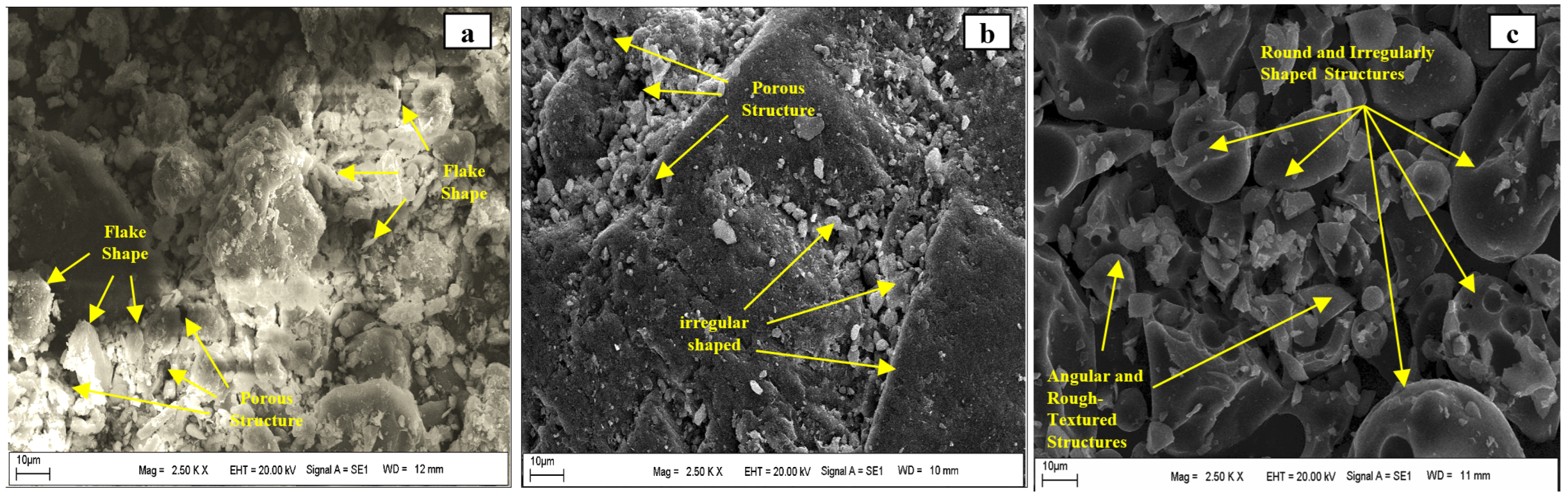
CLS is a non-toxic and non-corrosive byproduct obtained from the wood and paper processing industries. Due to the C, H, Ca, and S elements in its structure (C20H24Ca10S2), it is a complex, amorphous material derived from lignin. CLS reflects the character of lignin, which provides the woody structure and durability of plants. It is recognized as a bio-based polymer obtained as a byproduct of the paper industry [22,23]. Regarding its typical characteristics, the CLS used in this study is dark yellow in color, has a lignosulfonate content ranging from 50% to 65%, a density of approximately 0.5 g/cm3, and a pH of 4–6, and is water-soluble. The SEM analyses of CL, SP, and CLS are provided in Figure 1, respectively.
When Figure 1a is examined, it is observed that the CL soil has a heterogeneous structure. Due to being a clayey soil, it exhibits a stacked plate-like structure, which is rough, porous, and contains partial cracks. These SEM images are consistent with the descriptions in the literature [43,44]. Figure 1b shows that the grain distribution of the SP soil is irregular, consisting of large angular grains and much smaller structures, and it also possesses a porous structure. These SEM images are in agreement with the literature [37]. Figure 1c reveals that CLS consists of large and irregularly shaped particles. The particles generally have a rounded and irregular form, which is attributed to CLS being a natural polymer derived from wood pulp. The observed angular structures indicate that the product was subjected to mechanical crushing and grinding processes. The SEM image of CLS is consistent with the literature [45].
Geopolymers, formed by activating stabilizers with alkali activators, are produced by activating amorphous aluminosilicate materials with suitable alkali activators. The reaction that forms geopolymers results in a three-dimensional polymer chain with a structure containing Si-O-Al-O bonds [46]. Geopolymerization generally occurs in an alkaline environment through a five-stage process. First, the dissolution of the material by alkali ions produces silicate and aluminum. Second, the silicate and aluminate species mix to form an aluminosilicate solution, and water is released after dissolution. In the third stage, high-concentration gelation occurs, forming the geopolymer. In the fourth stage, the gel network rearranges, and the pore and microstructure of the geopolymer develop. In the last stage, the three-dimensional geopolymer is formed [47]. A strong alkaline environment is required to increase the surface hydrolysis of raw material particles by dissolving the silicate and aluminate during the geopolymerization process. This environment is made possible by single or combined alkali solutions called activators [48]. Therefore, geopolymers are most commonly provided by strong alkaline solutions such as sodium hydroxide and sodium silicate [49].
In this study, a sodium hydroxide (NaOH) solution was used as the alkali activator solution to increase the strength-enhancing effect of the additives in the mixtures through geopolymerization. The NaOH solution was prepared by dissolving crystalline NaOH particles in water. Considering the points in the literature [50,51,52,53] stating that calcium lignosulfonate is more effective with NaOH, the solution molarity was selected as 4 molar (M) (160 g/L). We chose this specific molarity based on previous literature to safely balance alkaline dissolution kinetics with mixture rheology. Mechanistically, while an increase in NaOH concentration up to 4 M accelerates the dissolution of silica and alumina phases and enhances the dissolution of the biopolymer network, exceeding this threshold induces an excessively high alkaline environment. High molarity environments (greater than 4 M) lead to premature coagulation, high fluid viscosity, and an accelerated precipitation of reaction products that cover unreacted soil particles, which ultimately hinders the long-term geopolymerization matrix and reduces overall strength performance. Similar systematic trends and strength reductions at higher molarities have been comprehensively documented by prior researchers [50,51,52,53]. This prepared alkali activator solution is referred to as AAS. The properties of the sodium hydroxide used in the study [54] can be summarized as: molecular mass 40 g/mol, pH 13–14, and relative density 2.13 g/cm3.

2.2. Preparation of Specimens

After determining the properties of the CL and SP soil samples, standard Proctor tests were applied to the CLS mixtures in accordance with the ASTM D698 [41] standard to determine the ωopt (optimum water content), ωoptAAS (optimum AAS content) and γdmax (maximum dry unit weight) values. In the experiments, mixtures were prepared by adding 0.5%, 1%, 1.5%, and 2% CLS by weight to the CL soil, and 0.5%, 1%, 1.5%, and 2% CLS by weight to the CL soil with AAS. Furthermore, mixtures were formed by adding 0.5%, 1%, 1.5%, and 2% CLS to the SP soil, and 0.5%, 1%, 1.5%, 2%, and 2.5% CLS to the SP soil with AAS. Additionally, SP and CL were prepared as reference samples. Subsequently, using the same mixture ratios and the determined ωopt, ωoptAAS, and γdmax values, unconfined compression specimens were prepared, and unconfined compressive strength tests were performed after curing periods of 1, 7, and 28 days. These tests were conducted according to the ASTM D2166 [55] standard. Based on the unconfined compressive strength results, the optimum CLS amount was determined, and CBR test specimens with CLS additives were prepared considering the ωopt, ωoptAAS, and γdmax values. The CBR values of these specimens were measured after curing periods of 1, 7, and 28 days. The CBR test was performed in accordance with the ASTM D1883-13 [56] standard.
We determined the optimum CLS dosage primarily through unconfined compressive strength (UCS) testing and validated it via California bearing ratio (CBR) values. In geotechnical practice, UCS serves as the standard baseline; even advanced durability protocols ultimately rely on post-cycle UCS to quantify residual strength. This study combines various research areas such as experimental soil mechanics, road pavement layer thicknesses, cost analyses, and carbon footprint. The inclusion of cyclic durability tests was considered to make the study more difficult to read and evaluate, thus expanding its scope. By considering test procedures encompassing different soil types, multiple stabilizer ratios, various curing times, and chemical activations, focusing on fundamental strength-oriented UCS and CBR tests has resulted in a more comprehensive set of tests.
To ensure the statistical consistency of the studies, three independent samples were produced and tested for each mixture. The average values of these results were used in the design phase. Standard deviations (SD) were calculated to visualize the data distribution and determine experimental uncertainty. It was determined that the SD values remained within a very narrow and acceptable range in both clay and sandy soil studies. Such low dispersion proves that sample preparation errors were kept to a minimum. Consequently, the pavement optimizations and CO2 mitigation models developed later in this study rest on highly reproducible engineering parameters.

2.2.1. Experimental Method

To determine the maximum dry density and optimum moisture content of the soils, the samples were subjected to the standard Proctor test in accordance with ASTM D698 [41]. The deformation and strength of the test samples prepared at the optimum moisture content were evaluated using the unconfined compressive strength test in accordance with ASTM D2166 [55]. To assess the bearing capacity of the soils, the California bearing ratio test was conducted according to ASTM D1883 [56]. The microstructural and chemical properties of the materials and mixtures were investigated using scanning electron microscopy analyses. SEM was applied to examine the surface morphology of the materials.

2.2.2. Design and Economic Evaluation of Pavements Using the AASHTO Method

A highway structure consists of two main components: the subgrade and the pavement. The subgrade refers to the portion of the road prepared to the designed elevation and cross-section. The pavement is a layered structure, composed of the subbase, base, and surface course applied over the grading (fine leveling) layer, which transfers traffic loads to the underlying soil. During the design process, factors such as soil conditions, traffic intensity, regional characteristics, and economic considerations are taken into account when determining the project life and layer thicknesses [31]. In this study, pavement designs were carried out to evaluate the effects of stabilization, considering the optimum stabilizer mixture ratio, on both flexible and rigid pavements. In the design of flexible pavements, the AASHTO (1993) method was applied, with asphalt cement used as the binder [31]. Similarly, in the design of rigid pavements based on the AASHTO (1993) method, concrete slabs made with Portland cement were placed over the base and/or subbase layers [31]. The layer thicknesses of the pavements were calculated using equations according to the AASHTO (1993) Design Guide [31]. Subsequent economic evaluations of these calculated layer thicknesses were conducted based on the official 2026 standardized unit price codes published by the Turkish Ministry of Environment, Urbanization and Climate Change (CSB). Within the scope of this research, which focuses on a comprehensive comparative performance analysis between different mixture designs, utilizing these official CSB pricing codes provides a highly consistent baseline. Material, labor, and transportation costs may vary by region. However, when all these factors are priced and calculated using the same principles, it is estimated that the percentage savings achieved in comparisons will remain unchanged.

2.3. Methodology for Sustainability Analysis

Within the framework of the sustainability analysis, the layer thicknesses calculated from the completed flexible and rigid pavement designs, as well as the CO2 emissions from the stabilized layers during the initial construction phase, were determined. The calculations were performed for a divided road (model road) 1000 m in length and 20 m in width. In these calculations, CO2 emissions generated during the production of road materials, as well as those arising from transportation, machinery use, and equipment during road construction, were taken into account.

2.3.1. Calculation of CO2 Emissions from Materials

In flexible pavements, hot mix asphalt (HMA) surface layers typically consist of approximately 93–97% aggregate and 3–7% bitumen. In this context, the unit CO2 emissions generated during the production of bitumen and aggregate were taken as 190 kg/ton [57] and 6.5 kg/ton [34], respectively. However, the CO2 emission associated with water used in the operations, which is 0.3 kg/ton [57], was considered negligible. The rigid pavement consists of concrete slabs made from Portland cement constructed over a granular base layer. In the design of rigid pavement concrete slabs, according to the Turkish Highways Concrete Pavement Design Guide [58], concrete class C35/45 was selected, and jointed plain concrete pavement criteria were considered. For the calculations, the CO2 emissions generated during the production of C35/45 ready-mixed concrete at the plant were taken as 339.57 kg/m3 [59]. For the stabilization of the subgrade soil, the CO2 emissions associated with the stabilizer material were determined based on the literature. CLS is a byproduct that emerges from sulfite pulp during production in the paper industry. During the production of this material, 200 kg/ton of CO2 emissions are generated [60]. The alkali activator solution is used to provide a strong alkaline environment during the geopolymerization process of the mixtures. During the production of this material, 633 kg/ton of CO2 emissions are generated [61]. The CO2 emissions resulting from the use of road materials (C35/45 concrete for rigid pavements and bitumen and aggregate for flexible pavements) and stabilizer materials were determined for a sample road using the Tier 1 approach. The emissions were calculated based on Equation (1), taking into account the unit CO2 emission values in kg/m3 or kg/ton [62,63].
Eco2 = AD × FE
Here,
Eco2: Carbon dioxide emissions (kg CO2),
AD: Activity data unit (ton or kg); corresponding to the quantity of material utilized in the construction,
FE: Emission factor (kg CO2/kg or kg CO2/ton of material), indicating the amount of CO2 emitted per unit mass of material.

2.3.2. Calculation of CO2 Emissions from Machinery, Equipment, and Transportation

CO2 emissions from transportation, machinery, and equipment were calculated considering the production of flexible pavement layers, including the wearing course, binder, asphalt base, plant-mix base, crushed stone subbase, and the stabilized subgrade using the stabilizer material. In the analysis of the wearing course, binder, and asphalt base layers, the calculations accounted for material transportation, surface sweeping using machinery, spraying of binder bituminous material with a distributor, mixing at a large asphalt plant, and spreading and compaction using electronic sensor-equipped pavers. For the plant-mix base layer, transportation, spreading with a grader, watering with a water truck, and compaction using a vibratory roller and pneumatic-tired roller were considered. For the crushed stone subbase, transportation, spreading with a grader, watering, and compaction with a vibratory roller were included. CO2 emissions during transportation were calculated based on the assumption that the material quantity (by weight), determined according to the design, is transported to the construction site located approximately 50 km away using a 10 ton capacity truck. The unit CO2 emission was taken as 2.96 kg/ton [35], and emissions were calculated using Equation (1). For rigid pavements, CO2 emissions were determined considering concrete slabs and stabilized subgrade layers. In the analysis of the concrete slab, the following activities were considered: transportation of concrete with a transit mixer, surface cleaning with machinery, spreading and compaction of concrete using machinery and pavers, leveling of the concrete surface, roughening with a steel brush, curing with water, and cutting of joints and slab edges. For CO2 emissions during transit mixer transport, a 6.5 m3 capacity, three-axle transit mixer transporting concrete up to 50 km to the construction site [62,64] was considered. The unit CO2 emission for concrete was taken as 9.5 kg/m3 [65]. Additionally, for the reinforced and unreinforced jointed rigid pavement, the quantities of tie and dowel bars were included in the CO2 emission calculations, considering that the production of 1 kg of construction steel generates 2.2 kg of CO2 [66].
In the analysis of subgrade stabilization with the stabilizer material, activities considered included transportation of the stabilizer, loosening the soil using a tractor ripper, distribution of the stabilizer with a bulldozer, spreading and mixing with a grader, watering with a water truck, and compaction using a vibratory roller and pneumatic-tired roller. The transportation of stabilizer material was assumed to occur using a 10 ton truck over an average distance of 50 km, with a unit CO2 emission of 2.96 kg/ton [34]. In the analysis of CO2 emissions from transportation, machinery, and equipment during the construction of flexible, rigid, and stabilized layers, fuel consumption data from the Turkish General Directorate of Highways (KGM) unit price analyses were utilized. Furthermore, for calculating the emissions from fuel consumption of other equipment used during road construction, Equation (3), based on Equation (2) from the literature [33] explaining fuel consumption, was applied.
F = BSFC × P × T × 1/γ
Here,
F: Fuel consumption (L),
BSFC: Brake-specific fuel consumption (g/(kWh)),
P: Engine power at the speed providing maximum torque (kW),
T: Time (hours),
γ: Density of the fuel used (0.832 kg/L).
εco2 = F × α
Here,
F: Fuel consumption (L),
α: Amount of CO2 generated per liter of diesel consumed (2663.9 g/L) [33].

3. Results and Discussion

3.1. Standard Proctor Test Results

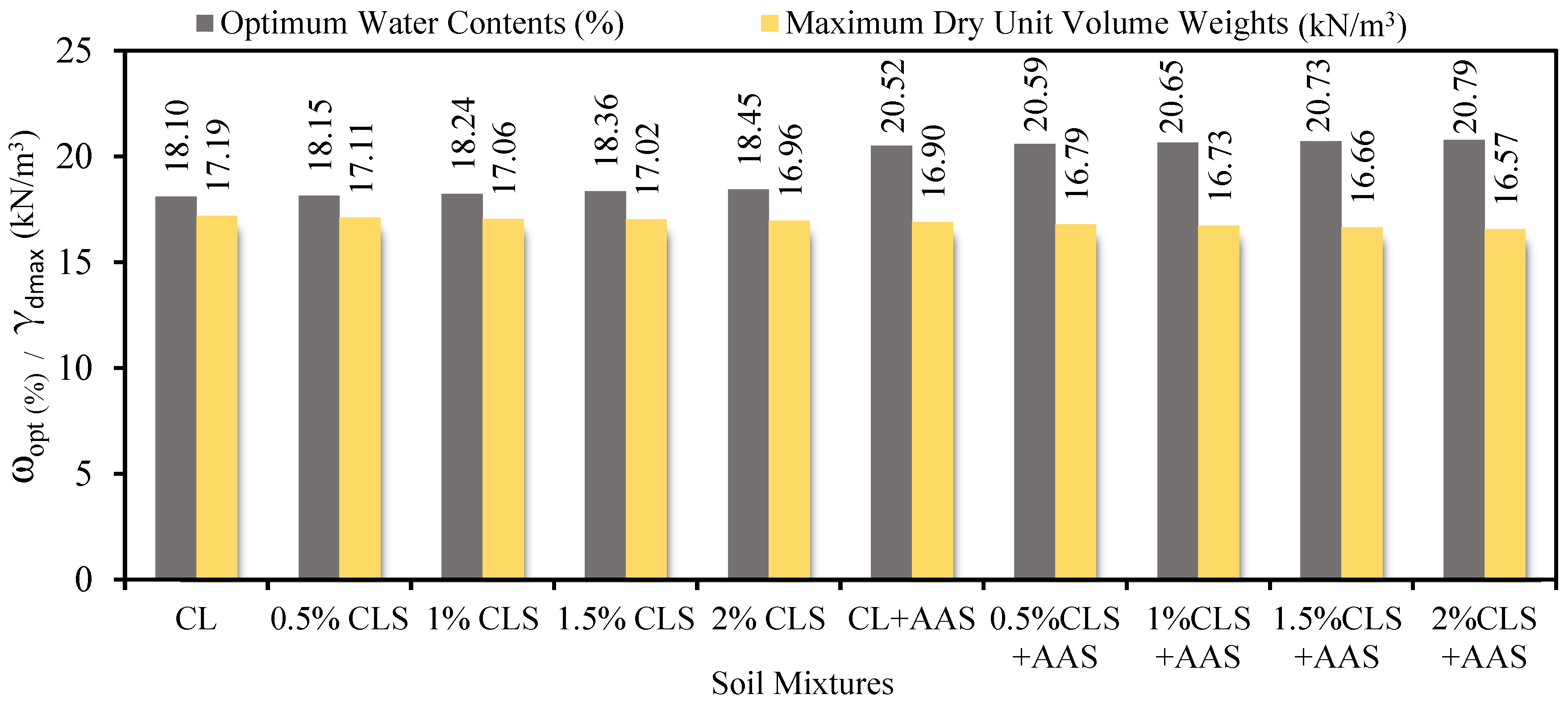
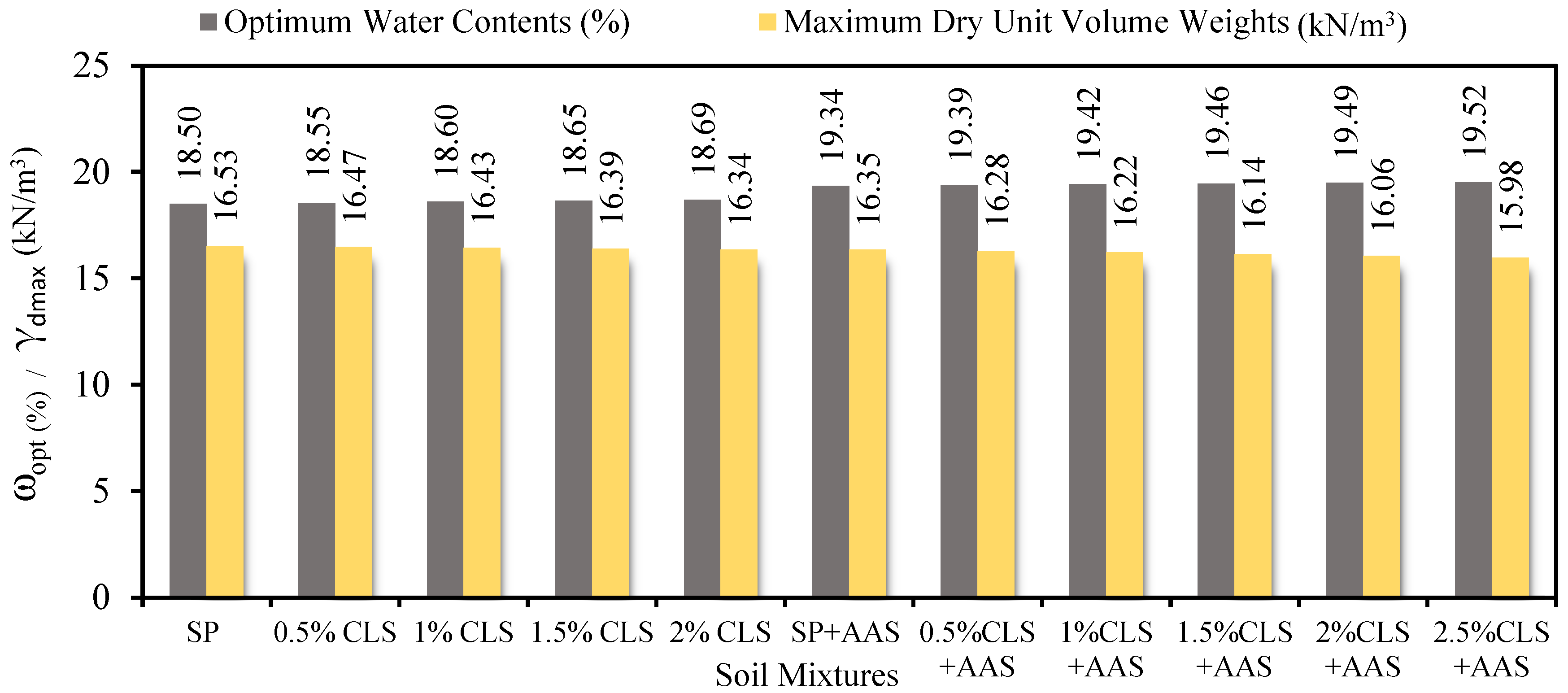
Standard Proctor tests were conducted on CL and CL with AAS specimens containing 0.5%, 1%, 1.5%, and 2% CLS by weight; SP and SP specimens containing 0.5%, 1%, 1.5%, and 2% CLS by weight; and SP with AAS specimens containing 0.5%, 1%, 1.5%, 2%, and 2.5% CLS by weight. As a result of the tests, the ωopt, ωoptAAS and γdmax values of the specimens were determined. The results obtained are presented in Figure 2 and Figure 3.
When the Proctor test results are examined, it is observed that as the CLS ratio increases in the mixtures prepared using CL and SP, the ωopt value increases, while the γdmax value decreases. These results are consistent with the literature [19,20,67]. Since CLS is a lignin-based material, it contains many hydrophilic (water-attracting) groups in its structure. These groups tend to attract and retain water; therefore, the mixture requires more water [19,20]. Consequently, it has been determined that the water absorption capacity of CLS is higher than that of the soil sample, causing the ωopt value of the mixtures to increase. Furthermore, it is evaluated that the low density of CLS leads to a decrease in the γdmax value of the prepared mixtures. It is observed that the changes in ωopt and γdmax in the mixtures are limited, which is related to the dosage of CLS used. When the Proctor test results for mixtures containing AAS are examined, it is seen that as the CLS ratio increases in mixtures prepared with CL and SP, the ωoptAAS value increases and the γdmax value decreases. This situation is attributed to the hydrophilic nature and low density inherent in the structure of CLS. Moreover, as in the mixtures prepared with water, the changes occurring in ωoptAAS and γdmax were found to be limited.
To interpret this compaction behavior from a micro-mechanical perspective, it is essential to consider the multi-phase interactions occurring between the pore water, the polymeric additive chains, and the active clay mineral surfaces. The polymer substance present in the clay matrices binds the clay particles through electrostatic and hydrogen bonds. This is similar to how polyvinyl alcohol alters montmorillonite clay in different moisture environments [68]. As the amount of CLS increases, these chains act like clay minerals to attract the available free water. This causes the clays to clump together rapidly. This water–polymer–mineral interaction prevents the particles from sliding during compression. This lack of lubrication impedes a denser packing arrangement of the soil grains, directly explaining why the optimum water content increases while the maximum dry unit weights drop.

3.2. Unconfined Compressive Strength Results

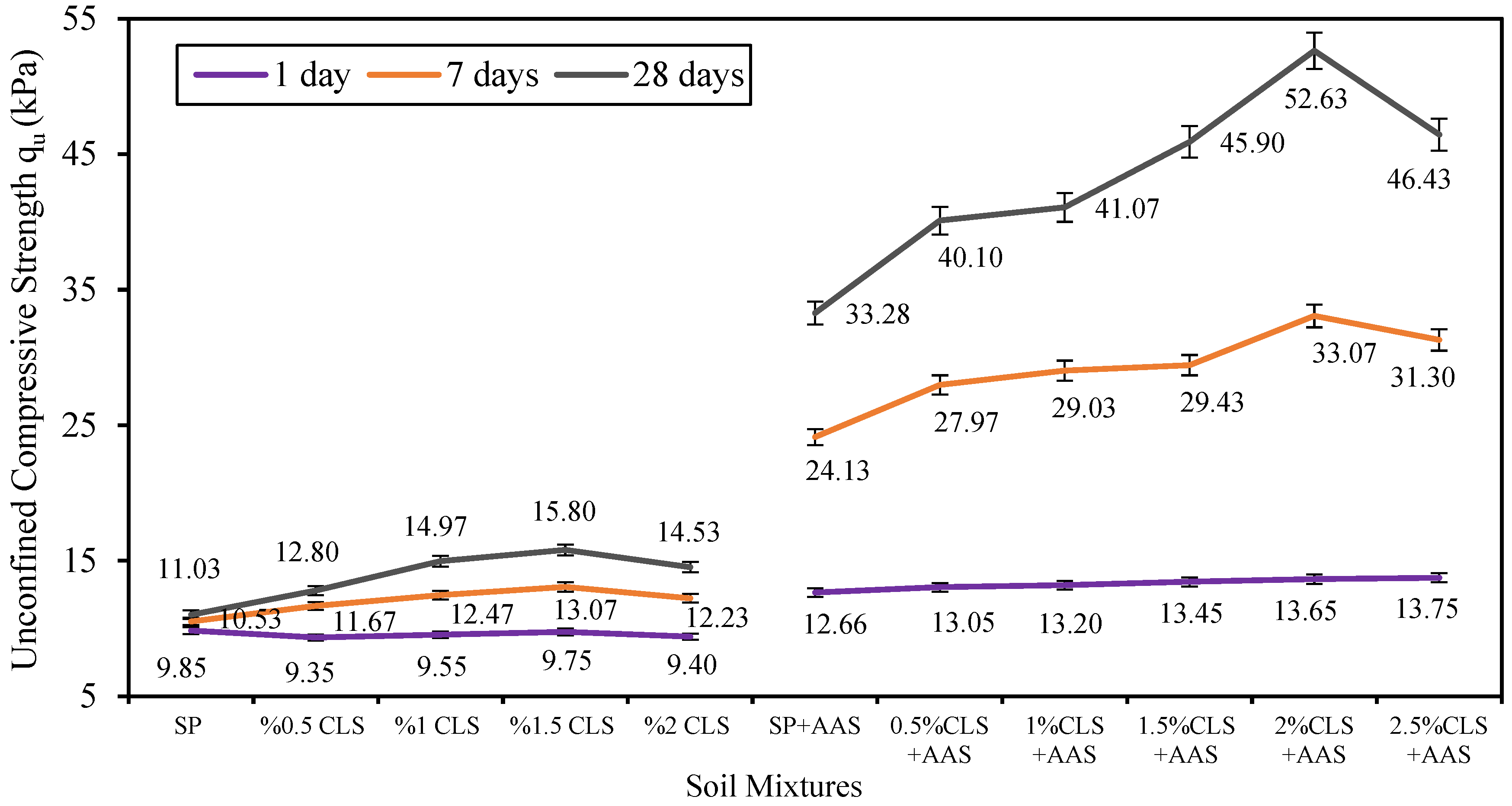
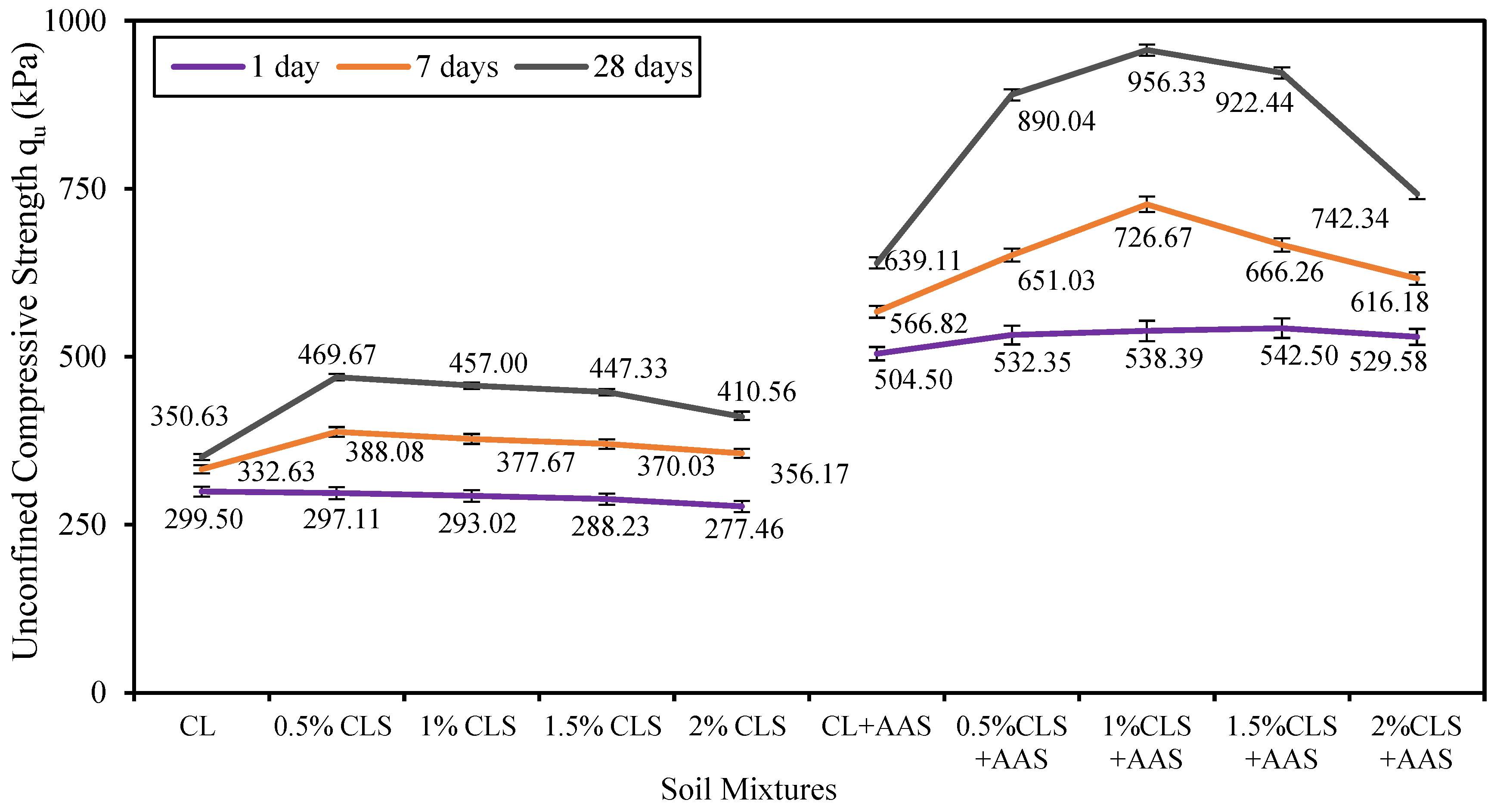
Test specimens for the unconfined compressive strength test were prepared based on the ωopt, ωoptAAS, and γdmax values determined in the standard Proctor test. These specimens were subjected to testing at the end of 1-, 7-, and 28-day curing periods. To minimize the margin of error, each test was repeated by preparing three different test specimens. The relationship between the average unconfined compressive strength (qu) of the specimens, depending on the additive amount and curing periods, is presented in Figure 4 and Figure 5.
When the unconfined compressive strength test results shown in Figure 4 and Figure 5 were examined, it was determined that the strength values of CL and SP soils were higher than those of CLS mixtures after a 1-day curing period. However, at the end of 7- and 28-day curing periods, the strength values of CLS mixtures exceeded those of the CL and SP soils, confirming that CLS increases the strength of the mixtures. In CLS-added specimens prepared with CL, the highest strength values after 7 and 28 days of curing were detected in specimens with 0.5% CLS, with calculated increases of 1.17 and 1.34 times, respectively, compared to the reference CL soil. In CLS-added specimens prepared with SP, the maximum strength values after 7 and 28 days were observed in specimens with 1.5% CLS, showing increases of 1.24 and 1.43 times, respectively, compared to the reference SP soil. It was observed that CLS also increased the strength of AAS-containing mixtures. For CLS-added specimens prepared with CL, the highest strength values were found in 1.5% CLS + AAS specimens after 1 day of curing, and in 1% CLS + AAS specimens after 7 and 28 days. The strength of CLS-added AAS mixtures at 1, 7, and 28 days increased by 1.08, 1.28, and 1.50 times, respectively, compared to the AAS-treated CL soil. For specimens prepared with SP, the maximum strength values were recorded in 2.5% CLS + AAS specimens after 1 day, and in 1.5% CLS + AAS specimens after 7 and 28 days. The strength of these CLS-added AAS mixtures increased by 1.09, 1.37, and 1.58 times compared to the AAS-treated SP soil. Consequently, it was seen that CLS additives increase the strength of both CL and SP soils, which is consistent with the literature [19,20,21], and this strength gain further intensifies with the addition of AAS. It was determined that the amorphous structure of CLS identified in SEM analyses was effective in this strength increase, and a geopolymer structure was formed in AAS-containing mixtures. Additionally, it was thought that the fine structure of CLS created larger contact surfaces, allowing for more reaction between particles. However, the optimum additive ratios obtained from the experiments indicated that adding CLS beyond a certain threshold did not provide further benefits to the strength of the mixtures. Furthermore, it was determined that the axial strain at failure decreases with the increase in CLS content and curing time, which is related to CLS increasing the stiffness of the specimens. These results align with the view in the literature [69] that soft soils undergo more deformation at failure compared to stiff soils.
Furthermore, the standard deviation (SD) values for CL and SP mixtures remained within a narrow range (ranging from 4.20 to 15.20 kPa for CL, and 0.22 to 1.34 kPa for SP), confirming the high reproducibility and homogeneity of the prepared specimens. The specific distribution of these variations across different curing periods was as follows: for CL mixtures, SD1d,7d,28d = 4.20, 6.10, 7.30 kPa for CL; 4.56, 7.26, 9.15 kPa for 0.5% CLS; 4.82, 7.25, 8.57 kPa for 1% CLS; 4.77, 7.05, 8.35 kPa for 1.5% CLS; 4.64, 6.65, 8.30 kPa for 2% CLS; 7.85, 8.57, 9.93 kPa for CL + AAS; 8.80, 9.71, 13.83 kPa for 0.5% CLS + AAS; 8.20, 11.48, 15.20 kPa for 1% CLS + AAS; 8.51, 10.21, 14.51 kPa for 1.5% CLS + AAS; 8.00, 9.21, 11.94 kPa for 2% CLS + AAS, while for SP mixtures, SD1d,7d,28d = 0.24, 0.28, 0.32 kPa for SP; 0.22, 0.30, 0.34 kPa for 0.5% CLS; 0.24, 0.32, 0.39 kPa for 1% CLS; 0.25, 0.34, 0.41 kPa for 1.5% CLS; 0.23, 0.32, 0.38 kPa for 2% CLS; 0.32, 0.60, 0.84 kPa for SP + AAS; 0.32, 0.71, 1.02 kPa for 0.5% CLS + AAS; 0.32, 0.74, 1.05 kPa for 1% CLS + AAS; 0.34, 0.75, 1.17 kPa for 1.5% CLS + AAS; 0.34, 0.84, 1.34 kPa for 2% CLS + AAS; and 0.34, 0.79, 1.18 kPa for 2.5% CLS + AAS. These low standard deviation values across all curing periods demonstrate that the dispersion of the experimental dataset is highly minimized. The tight clustering of the individual test replicates around the mean values statistically substantiates the homogeneity of the matrix structures and confirms that the mechanical improvements derived from both raw CLS and alkali-activated systems are highly significant, reproducible, and free from localized preparation errors.

3.3. CBR Results

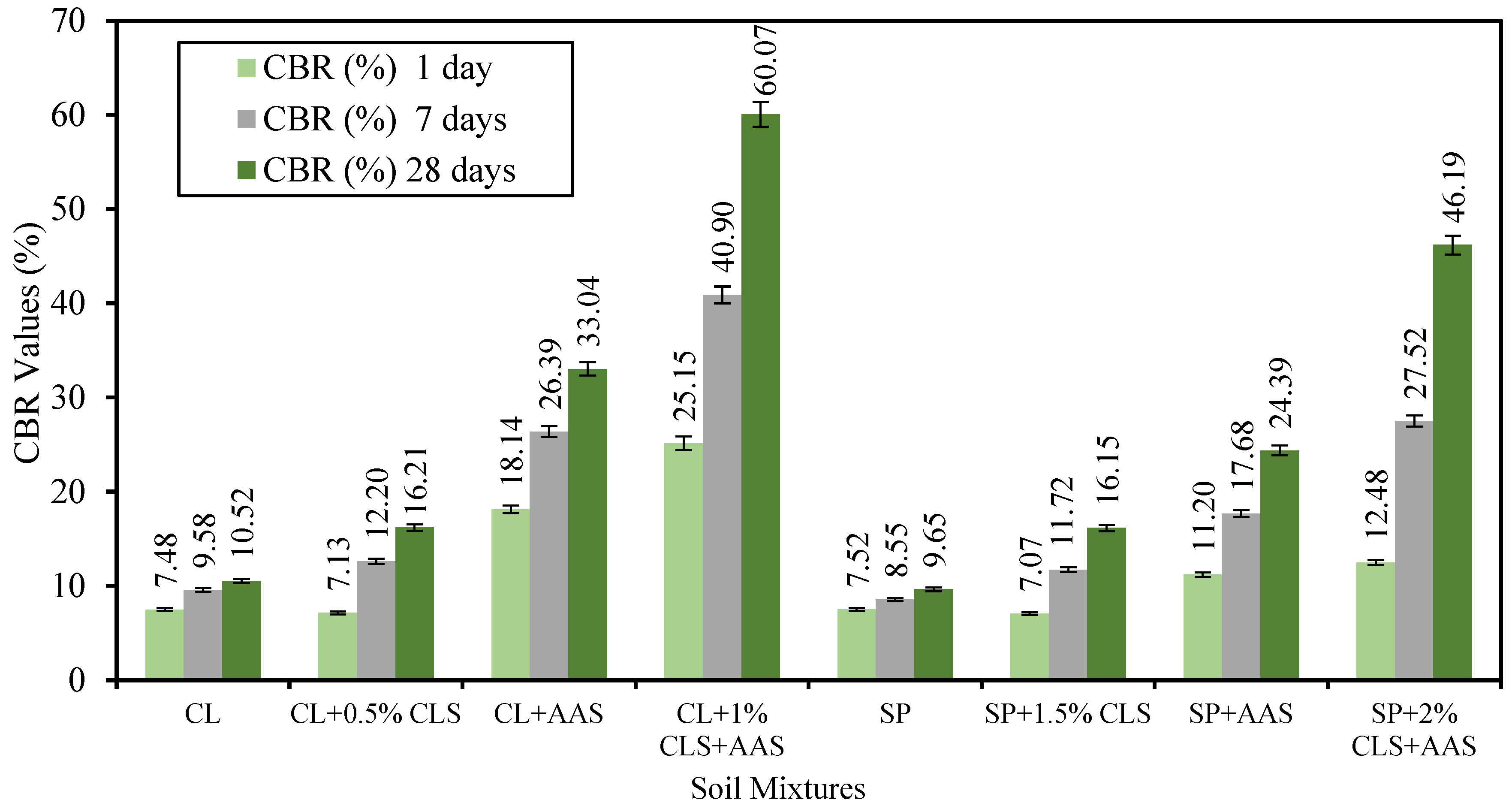
The planning for CBR tests was carried out by considering the optimum results obtained from the unconfined compressive strength tests (the specimens with the highest strength values). In this context, CBR specimens were prepared based on the ωopt and γdmax values. The CBR tests were performed after 1-, 7-, and 28-day curing periods. The CBR values obtained from these tests are presented in Figure 6.
When the results for specimens subjected to 1-, 7-, and 28-day curing for mixtures containing 0.5% CLS with CL and 1.5% CLS with SP were examined, it was observed that the CBR values of CL and SP soils were higher than those of CLS mixtures at the end of a 1-day curing period. However, at the end of 7- and 28-day curing periods, the CBR values of CLS mixtures exceeded those of the CL and SP soils, indicating that CLS increased the CBR value of the mixtures. For the 0.5% CLS-added specimens prepared with CL, CBR values were determined as 12.62% and 16.21% at the end of 7 and 28 days, respectively. The CBR values increased by 1.32 and 1.54 times compared to the reference CL soil after 7 and 28 days of curing. For the 1.5% CLS-added specimens prepared with SP, CBR values were found to be 11.72% and 16.15% at the end of 7 and 28 days, respectively. These results show that 1.37 and 1.67 times better results were obtained compared to SP soil. After curing periods of 1, 7, and 28 days, CL mixtures containing 1% CLS + AAS and SP mixtures containing 2% CLS + AAS provided better strength than the unmodified samples. This shows that CLS and AAS together provide a strong effect. In CLS-modified samples with AAS, it was observed that it improved the CBR performance of both clayey and sandy soils. The CBR values of 1% CLS + AAS samples with CL soil were 25.15%, 40.90%, and 60.07% after 1, 7, and 28 days, respectively. These results correspond to increases of 1.39, 1.55, and 1.82 times compared to the AAS-treated CL soil. For 2% CLS + AAS specimens prepared with SP, CBR values were recorded as 12.48%, 27.52%, and 46.19% after 1, 7, and 28 days. These represented increases of 1.11, 1.56, and 1.89 times compared to the AAS-treated SP soil. The fact that CLS + AAS mixture results were higher than AAS-only results revealed the strength-enhancing effect of CLS in alkali-activated mixtures and demonstrated that CLS can act synergistically with AAS. Furthermore, the results indicated that CLS additive increased the CBR values of CL and SP soils, which was consistent with the literature [24,70,71], and this increase continued to intensify with the addition of AAS. The influence of CLS was evident in the increased strength of AAS mixtures.
Furthermore, the standard deviation (SD) values for the CBR datasets of CL and SP mixtures remained within a highly narrow and acceptable range (ranging from 0.16% to 1.31% for CL, and 0.15% to 1.01% for SP), confirming the high reproducibility and homogeneity of the prepared specimens. The specific distribution of these variations across 1-, 7-, and 28-day curing periods was as follows: For CL mixtures, SD1d,7d,28d = 0.16%, 0.21%, 0.23% for CL; 0.16%, 0.27%, 0.35% for CL + 0.5% CLS; 0.39%, 0.57%, 0.71% for CL + AAS; 0.74%, 0.89%, 1.31% for CL + 1% CLS + AAS, while for SP mixtures SD1d,7d,28d = 0.16%, 0.18%, 0.21% for SP; 0.15%, 0.25%, 0.35% for SP + 1.5% CLS; 0.24%, 0.38%, 0.53% for SP+AAS; and 0.27%, 0.59%, 1.01% for SP + 2% CLS + AAS. The statistical dispersion indicators for the CBR testing program confirm that the coefficient of variation remains within strictly acceptable boundaries for geotechnical testing. This minimal data scatter statistically validates the significance of the stabilization trends, ensuring that the structural layer thickness optimizations calculated via these baseline CBR values rely on statistically stable and dependable empirical inputs.
It is known that the mechanics of sandy soil (SP) particles depend on the structure, particle shape, and contact surfaces of the particles in a cohesionless environment. In this respect, in addition to the shape of the natural anisotropic structure of wind-borne sand, the spatial arrangement of the particles is also a factor in determining the directional shear response it exhibits under true triaxial stress [72]. Although the true triaxial anisotropy condition is outside the scope of our CBR investigation, the CLS + AAS matrix included in the system directly alters this particle interaction. Geopolymer gels and chemical binders surround the sand grains, filling the voids at the grain contact points. This transforms the structure from a purely frictional, direction-dependent (anisotropic) intergranular contact geometry to a more isotropic character, a cohesive composite network. This chemical locking diminishes the negative effects of inherent particle anisotropy and orientation under vertical piston loading, thereby structurally explaining the robust and homogeneous increases observed in the macro scale CBR values of the stabilized SP subgrades. In addition to anisotropy and grain orientations, the mechanical response of stabilized sand is fundamentally governed by the evolution of the internal contact network at the micro scale. In granular assemblies similar to advanced investigations focusing on the morphological quantification of the higher order contact normal fabrics for granular materials [73], the macroscopic load transmission and shear resistance are dictated by the spatial distribution and evolution of interparticle contact normals. Although direct numerical tracking or morphological quantification of contact tensors falls beyond the empirical configuration of the baseline CBR testing program, the role of the CLS-AAS binder can be interpreted through this contact scale behavior. The introduction of the chemical stabilizer coats the sand grains and accumulates precisely at the grain-to-grain contact zones. This polymer-geopolymer accumulation acts as a localized structural wedge that redistributes the contact forces and stabilizes the contact normal fabric against shifting during vertical indentation. By rigidifying the interparticle contacts and transforming individual point-to-point contacts into stable, cohesive contact planes, the binder network prevents localized particle slip and rolling, structurally justifying the enhanced stiffness and elevated bearing capacities reported for the SP subgrades.

3.4. Microstructural Analysis Results

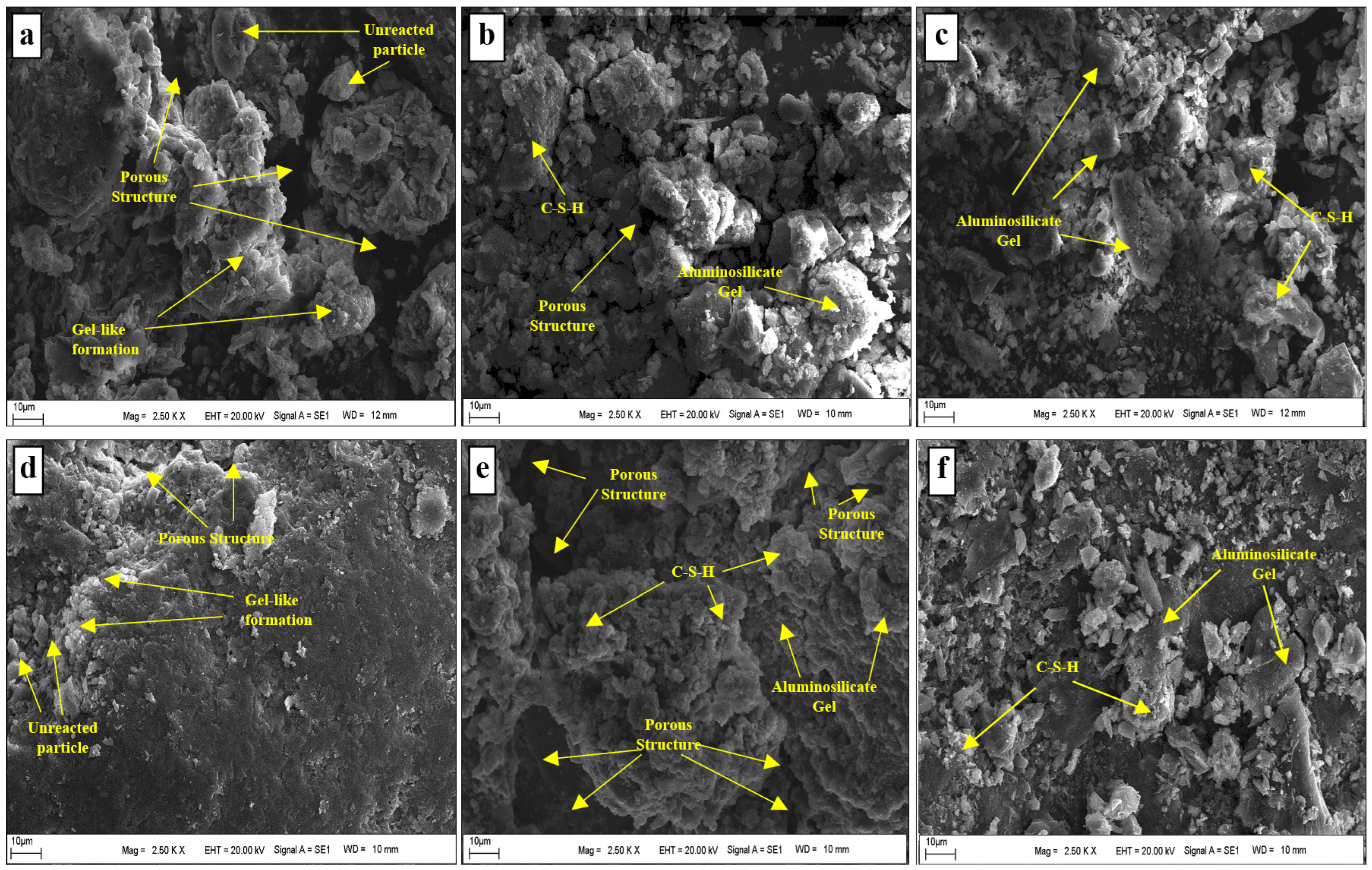
In this study, test specimens of CL + 0.5% CLS, SP + 1.5% CLS, CL + AAS, SP + AAS, CL + 1% CLS+AAS, and SP + 2% CLS + AAS were subjected to SEM analysis. This allowed for a better interpretation of the structural changes in the soil following the addition of CLS and AAS. The SEM images of these test specimens are presented in Figure 7.
In the stabilized CL + 0.5% CLS and SP + 1.5% CLS mixtures shown in Figure 7a and Figure 7d, respectively, it was determined that structures such as calcium silicate hydrate (C-S-H) gel and aluminosilicate gel could not form because SiO2 and Al2O3 minerals were absent in the CLS structure and the environment was not activated with an alkali activator like NaOH. It has been stated in the literature [19,20,21] that these formations occur more as CLS creates a thin gel structure when combined with water, establishing a physical bond between soil particles. This situation may increase strength but cannot chemically form a geopolymer phase; rather, it supports inter-particle bonding by establishing links with calcium ions. In this regard, it was determined that the structures in question occurred based on these principles. Furthermore, a limited number of unreacted CLS particles observed in the images were considered an indication that the strength of the mixture could not be further increased via CLS. The SEM images show consistency with the statements regarding gel formations in the literature [30]. In Figure 7b,e, it was thought that geopolymer gels were formed in the CL and SP soils, respectively, with the addition of AAS, and that the alumina and silica minerals present in the soil were effective in this formation. Additionally, it was considered that gel formations such as C-S-H and aluminosilicate occurred partially during soil stabilization with AAS due to the chemical composition of the AAS. The SEM images are consistent with the literature [74,75] regarding gel formations. In the stabilized CL + 1% CLS + AAS and SP 2% CLS + AAS mixtures shown in Figure 7c and Figure 7f, respectively, it was observed that the addition of AAS solution was effective in the formation of geopolymer gels. Although SiO2 and Al2O3 minerals were not present in the structure of CLS, it was determined that formations such as calcium silicate hydrate gel and aluminosilicate gel occurred partially as the AAS solution activated the Ca, Al, and Si elements in the soil structure. Furthermore, it was assessed that the pozzolanic capacity of CLS enabled the formation of a more composite structure.
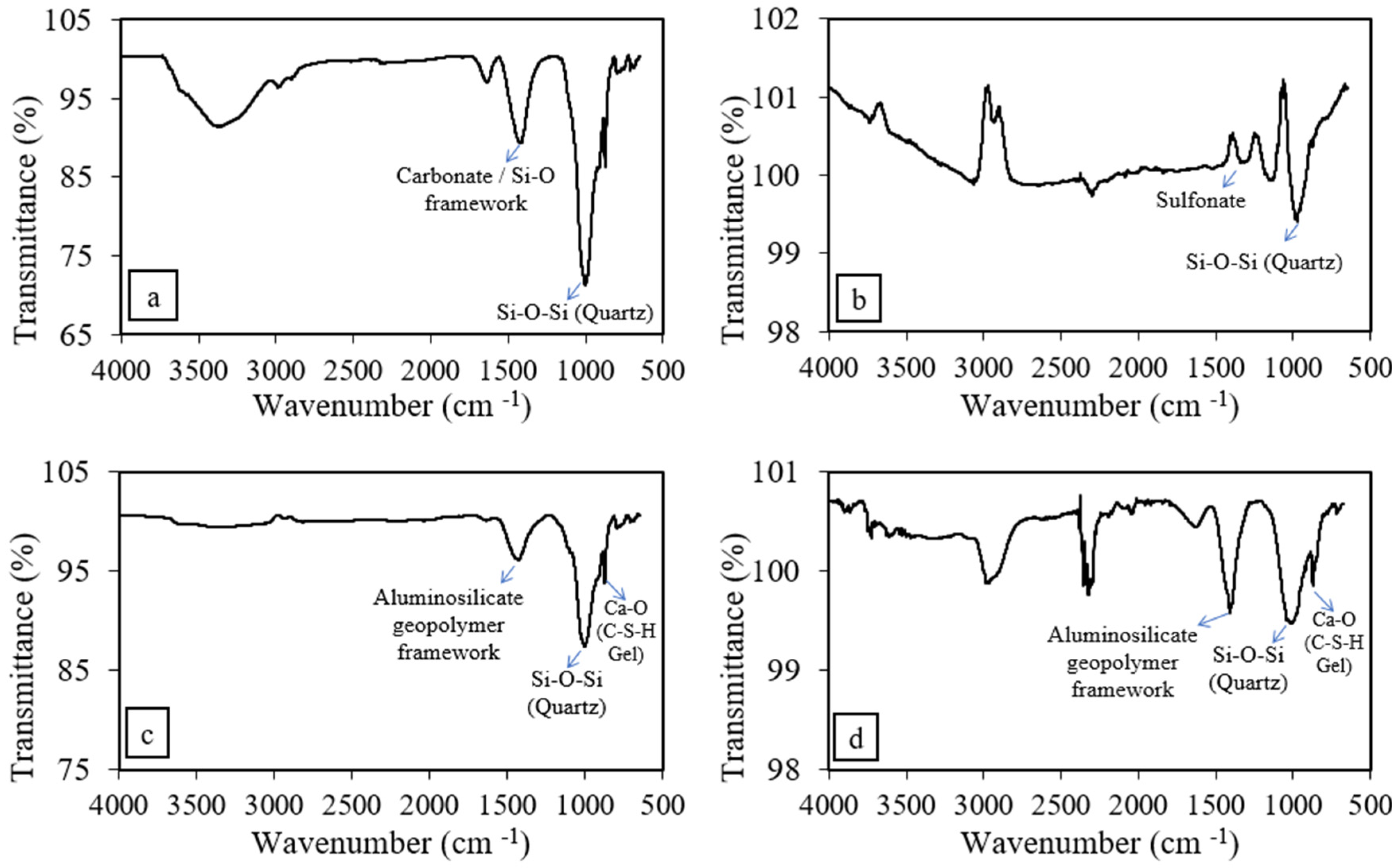
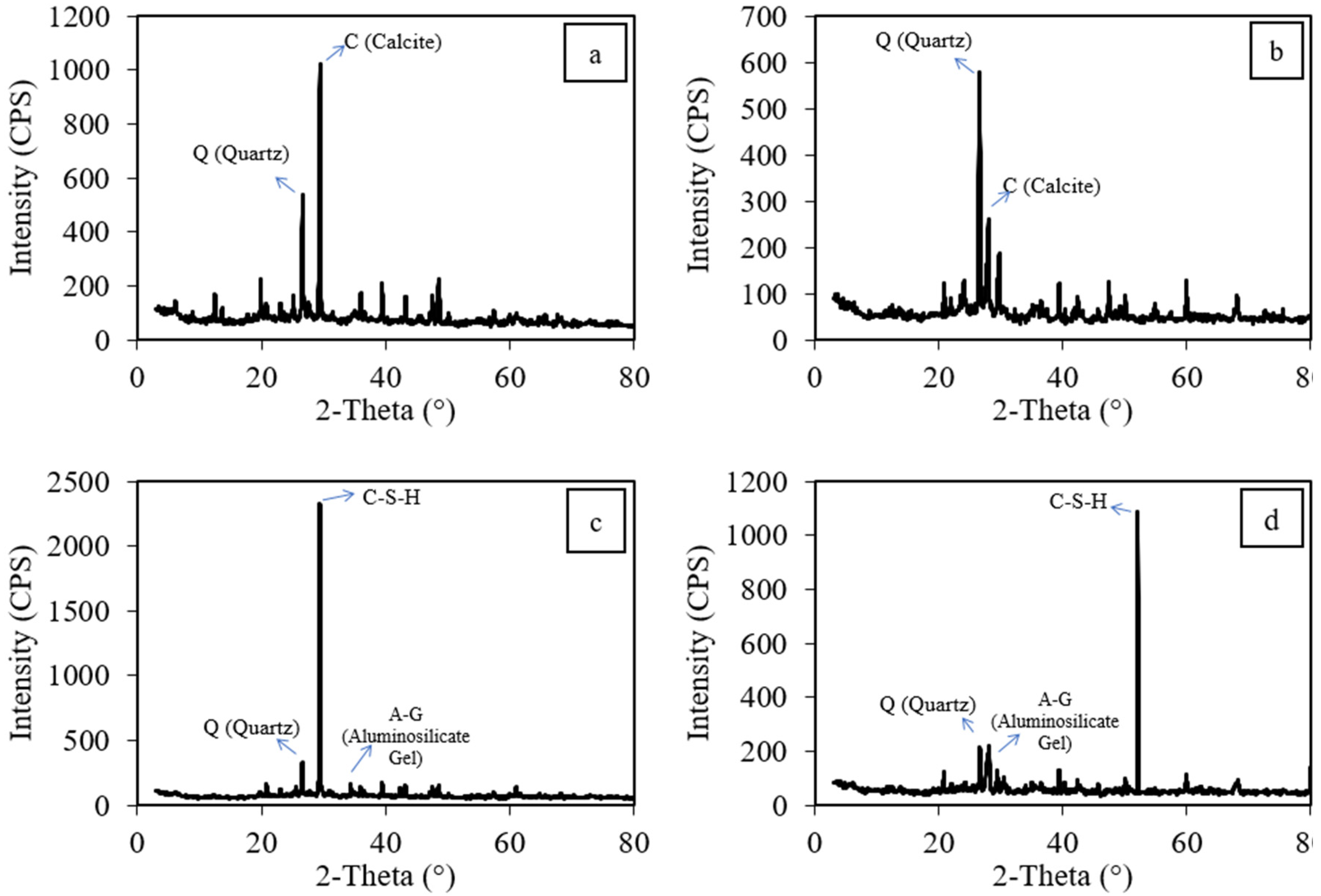
To further elucidate the mineralogical and molecular alterations backing these microstructural observations, X-ray diffraction (XRD) and Fourier-transform infrared spectroscopy (FTIR) analyses were sequentially conducted. Based on the optimum mechanical performance criteria established from the unconfined compressive strength (UCS) tests, representative stabilization configurations were selected for these scans. Consequently, XRD and FTIR specimens were prepared by incorporating 0.5% CLS and 1% CLS + AAS into the CL soil, and 1.5% CLS and 2% CLS + AAS into the SP soil by total dry weight. The mineralogical diffractograms acquired from the XRD analyses are presented in Figure 8, while the molecular vibration spectra captured via FTIR analysis are demonstrated in Figure 9.
The XRD diffractograms of the stabilized mixtures (Figure 8) provide mineralogical evidence regarding the modification mechanisms. For the CL + 0.5% CLS and SP + 1.5% CLS mixtures, the prominent and sharp diffraction peak observed near 2-theta = 26.6 degrees is attributed to quartz (SiO2), while the reflections captured around 2-theta = 29.4 degrees confirm the baseline presence of calcite (CaCO3).
A significant mineralogical transformation is captured upon alkali activation. In the CL + 1% CLS + AAS composite, the noticeable intensification and crystallization around 2-theta = 29.4 degrees represents the overlapping synthesis of calcium silicate hydrate (C-S-H) gel along with calcite, working alongside the primary quartz matrix. Concurrently, the steady baseline and subtle modifications between 2-theta = 20–35 degrees indicate the poorly crystalline nature of the aluminosilicate geopolymer gels. Similarly, for the SP + 2% CLS + AAS mixture, the prominent 2-theta = 26.6 degree peak denotes quartz, whereas the structural growth near 2-theta = 29–30 degrees validates the stable development of the interlocked C-S-H gel phase and secondary aluminosilicate frameworks, confirming that the mineralogical evolution is governed by the alkali activation process.
The FTIR spectra of the stabilized mixtures (Figure 9) elucidate the primary functional group variations driving the chemical stabilization. For the CL + 0.5% CLS specimen, the prominent absorption band observed around 1000 cm−1 corresponds to the characteristic Si-O-Si asymmetric stretching vibrations of the quartz matrix. Additionally, the broader responses of sulfonate (SO3) functional groups originating from the CLS molecular structure are detected within the baseline, signaling the dissolution and physical binder efficiency of the lignosulfonate network. Concurrently, initial reflections of carbonate modes are visible near the 1400–1500 cm−1 region. In the SP + 1.5% CLS mixture, the strong peaks positioned within the 1000–1200 cm−1 region represent the framework Si-O-Si stretching of the sandy matrix, while the stable presence of sulfonate bands further supports the physical particle-binding capacity of the stabilizer.
A major structural reorganization of functional groups is apparent upon alkali activation. For the CL + 1% CLS + AAS composite, the modification of the band around 1000 cm−1 indicates the participation of SiO2 in the geopolymerization process, while the emergence of a clear peak around 900 cm−1 is attributed to the stretching vibrations of calcium-oxygen (Ca-O) bonds, strongly suggesting the synthesis of calcium silicate hydrate (C-S-H) gel. The organic sulfonate peaks remain stable, confirming that CLS retains its active binding capabilities under highly alkaline conditions to enhance mechanical performance. Concurrently, the peaks centered around 1500 cm−1 represent altered Si-O stretching vibrations, pointing to the structural proliferation of aluminosilicate geopolymer frameworks.
In the FTIR spectrum of the SP + 2% CLS + AAS blend, quartz framework vibrations are clearly captured by the 1000 cm−1 band. The formation of the C-S-H gel is indicated by the peak at 900 cm−1, while sulfonate vibrations show the dissolution of the CLS structure. The area around 1000–1100 cm−1 indicates an aluminosilicate structure, and potential carbonate bands near 1400–1500 cm−1 represent localized carbonation.
The microstructure of the stabilized soils points to a unique mechanism rather than a generalized chemical reaction. SEM analyses show dense gel-like structures in both systems. However, XRD and FTIR trends indicate their fundamentally different nature. In unactivated mixtures, CLS forms structural bonds with calcium ions, creating a physical encapsulation and binding network. The addition of the AAS activator initiates mineralogical and molecular structuring. The shifting 1000 cm−1 quartz bands and 1500 cm−1 Si-O stretching peaks in the FTIR analysis, as well as the XRD reflections at 20°, 29°, 35°, 40°, and 48° 2-theta angles, confirm the network-structured aluminosilicate geopolymer matrix. Considering the limitations of microstructural methods, these data comprehensively confirm the mineralogical variations and functional group orientations of the visual gel condensations. In the precise quantitative analysis of the reaction products, EDS mapping requires the use of advanced techniques such as TGA/DTG, Rietveld refinement, or pore solution chemistry, but these are outside the scope of this study.
To evaluate these microanalytic data together with the mechanics of intelligence, we must assess macroscopic improvements, pore structure differences, and clay texture changes. The nanopore development processes observed in the consolidation phase of high-plasticity clay structures indicate irreversible structural changes in the clay soil structure from an open and flocculated structure to an interlocked skeleton. This directly affects the strength gain [76]. The CL soil we evaluated and the CLS + AAS mixture work through a dual mechanism. Here, while geopolymer products fill the macropores, the simultaneous chemical bonding hardens the clay particle contact points. This dual mode prevents the collapse of the nanopore skeleton under external loads and transforms the soil texture into a more stable structure. As a result, the combination of reduced porosity and restricted particle shift explains the improvements in CBR and strength values.

3.5. Durability Performance (Freeze–Thaw Resistance)

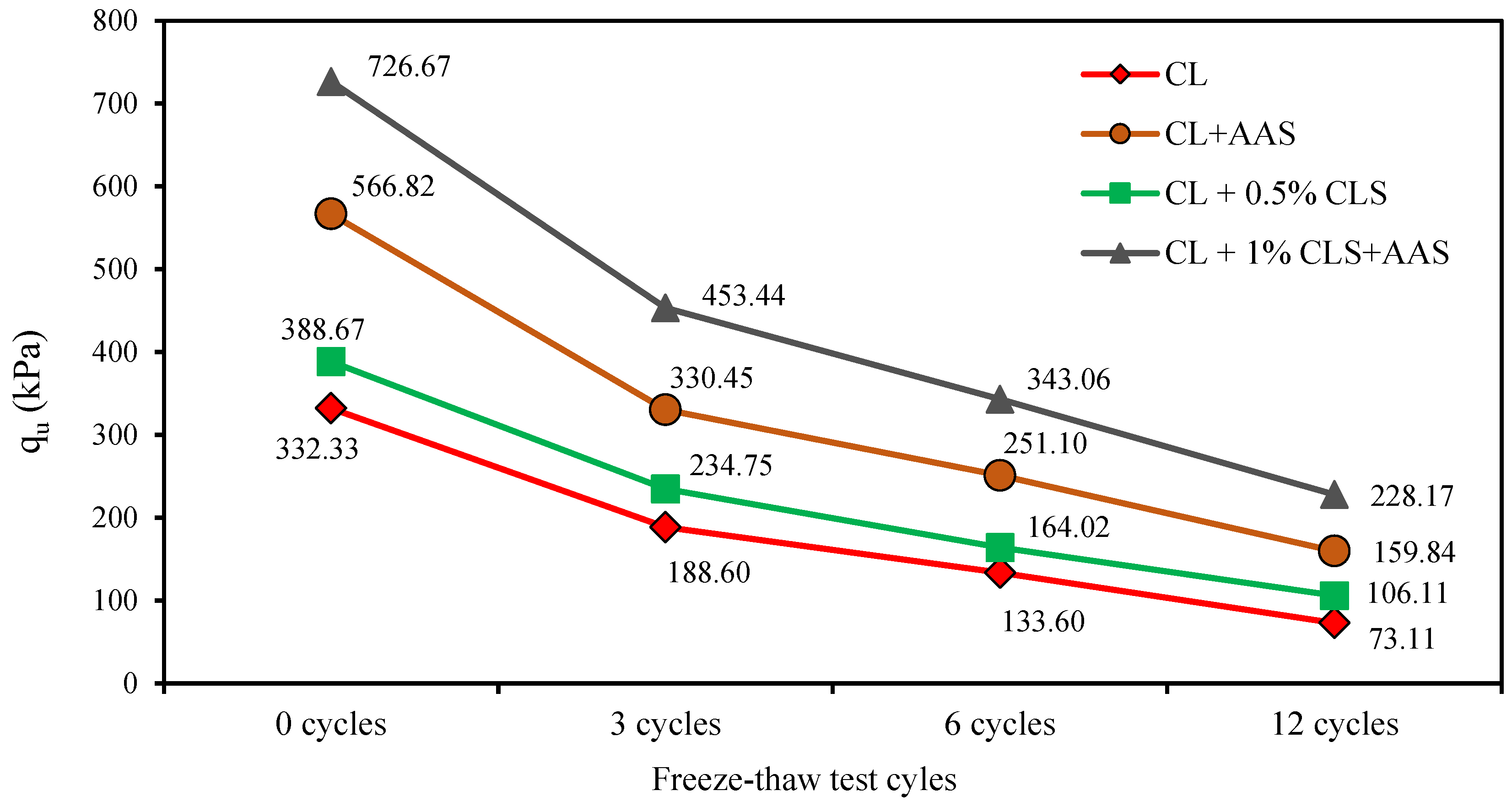
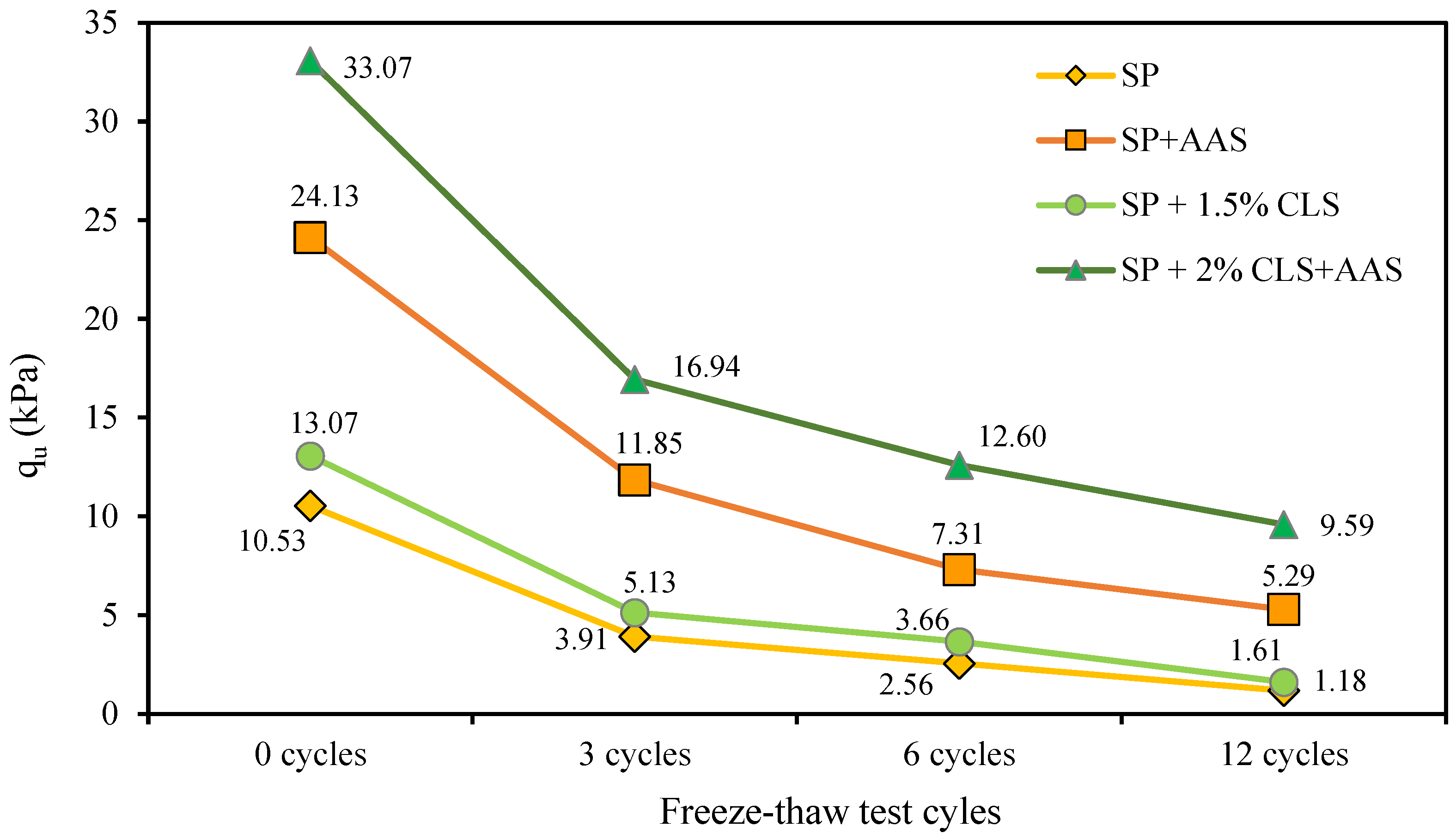
Temperature changes below freezing point cause the formation of ice lenses. The subsequent increase in temperature triggers the thawing of moisture within the soil structure. Structural deterioration occurs as a result of these pore water phase transformations. To simulate these deteriorations, a cyclical freeze–thaw test was performed. In this context, the principles specified in ASTM D560/D560M-16 [77] were followed for durability evaluation. Sample preparation, compression parameters, and unconfined compressive strength (UCS) test phase were based on these principles. After a standard 7-day curing period, the samples were subjected to freezing at −23 °C for 24 h and then thawing at a controlled environment of 23 ± 2 °C for 23 h in a special chamber. This sequential cycle constitutes a freeze–thaw cycle. Within the scope of the experiment, the number of cycles and the program were prepared taking into account the minimum of five cycles [78] specified in the General Directorate of Highways (KGM) specifications and the 12-cycle [77] criteria of the ASTM D560/D560M-16 standard. After these cycles were completed, the 7-day UCS results (0 cycles) prepared with optimum additive ratios were used as a reference in the evaluations. In addition, weight reduction and changes in unconfined compressive strength in the samples were determined. The evaluations were carried out on CL and SP soils and mixtures prepared with CLS and CLS + AAS. The comprehensive analytical correlations documenting the post-cyclic UCS evolutions and corresponding axial strain behaviors are graphically illustrated in Figure 10 and Figure 11, while the explicit numerical values for residual strength and mass losses are systematically organized in Table 1 and Table 2.
When evaluating the data obtained from the freeze–thaw tests of the CLS and CLS + AAS treated mixtures prepared using CL soil, the residual strengths after 3, 6, and 12 cycles for the CLS-stabilized specimens were determined as 234.75, 164.02, and 106.11 kPa, respectively. Accordingly, the corresponding strength losses at the end of 3, 6, and 12 cycles were calculated as 39.60%, 57.80%, and 72.70%, while the weight losses for the same specimens were recorded as 1.10%, 1.15%, and 1.23%, respectively. For the CLS + AAS treated specimens, the residual strength values were measured as 453.44, 343.06, and 228.17 kPa, with strength losses of 37.60%, 52.79%, and 68.60% after 3, 6, and 12 cycles, respectively. The mass losses for these alkali-activated mixtures were determined as 0.55%, 0.57%, and 0.64% for the same progressive cycles.
Regarding the freeze–thaw behavior of the CLS and CLS + AAS stabilized mixtures prepared with SP soil, the post-cyclic data after 3, 6, and 12 cycles revealed that the residual strengths of the CLS-treated specimens were 5.13, 3.66, and 1.61 kPa, respectively. The resulting strength reductions at the end of 3, 6, and 12 cycles were calculated as 60.71%, 72.00%, and 87.70%, with concurrent weight losses measured at 1.62%, 1.81%, and 1.97%. On the other hand, the CLS + AAS treated SP specimens exhibited residual strengths of 16.94, 12.60, and 9.59 kPa, corresponding to strength losses of 48.77%, 61.90%, and 71.00% after 3, 6, and 12 cycles, respectively. The weight losses for these specimens were quantified as 0.77%, 0.88%, and 1.03%, respectively. It was observed that the axial strain values at failure increased across the specimens, which is attributed to the progressive degradation of structural strength.
When the natural freeze–thaw resistance of un-stabilized CL and SP soils was evaluated in terms of strength degradation and mass loss, their performance was found to be lower than that of the CLS-treated specimens. This indicates that CLS incorporation successfully enhances freeze–thaw durability, a finding that aligns well with the existing literature [79,80]. Ultimately, the mixtures modified with AAS demonstrated lower weight losses and mitigated strength reductions after the freeze–thaw cycles compared to all other configurations, substantiating that the highest freeze–thaw durability was successfully achieved in the CLS mixtures activated via AAS.

3.6. Highway Pavement Design

In this study, for the highway pavement design, it was assumed that the road subgrade was composed of CL, CL + 0.5% CLS, CL + 1% CLS + AAS, SP, SP + 1.5% CLS, and SP + 2% CLS + AAS samples. Flexible and rigid pavement designs were conducted according to the AASHTO 1993 design guide [31] using the 28-day curing results, which were the highest among the CBR values obtained at the end of 1-, 7-, and 28-day curing periods. In the calculations, the resilient modulus (MR) of the road subgrade was first determined. For the calculation of MR, a correlation exists between MR and CBR values as MR (psi) = 2555 (CBR)0.64 [81], and this correlation was used to determine the MR values. It should be noted that the resilient modulus (MR) values in this experimental study were estimated using the empirical correlation provided in the AASHTO Mechanistic-Empirical Pavement Design Guide (AASHTO, 2024) [81], rather than through direct dynamic laboratory testing. Within the scope of this research, which focuses on a comprehensive experimental evaluation and comparative performance analysis between different CLS and AAS-activated mixture designs, this empirical correlation is widely accepted in modern pavement publications as a consistent Level 3 input alternative [81]. Nevertheless, while this approach serves as an exceptionally reliable baseline for our comparative engineering and sustainability assessment, conducting direct cyclic triaxial testing in future research remains important to precisely measure the true stress-dependent, non-linear behavior of geopolymer-stabilized subgrade soils. Additionally, when calculating the modulus of subgrade reaction (k), the relationship k = MR/19.4 [31] was utilized.

3.6.1. Flexible Highway Pavement Design

In the calculations performed for the flexible highway pavement design, the MR values at the end of the 28-day curing period were determined as 11,521 psi for CL soil; 15,193 psi for 0.5% CLS-added CL soil; and 35,134 psi for 1% CLS + AAS-added CL soil. Similarly, based on the 28-day curing period, the MR values were determined as 10,902 psi for SP soil; 15,157 psi for 1.5% CLS-added SP soil; and 29,696 psi for 2% CLS + AAS-added SP soil. In the study, the total layer thicknesses were calculated using the AASHTO 1993 equation [31], utilizing the common values in Table 3 and the MR values obtained for different curing periods.
The impact of soils stabilized with CLS and AAS on the construction cost of flexible highway pavements was evaluated based on General Directorate of Turkish Highways (KGM) data. In the unit price schedules published by KGM, costs are provided as unit volume (m3) for the subbase layer, unit weight (ton) for the base layers, and unit area (m2) for the bituminous base, binder, and wearing courses. In this study, the 2026 KGM unit prices [82] provided in Table 4 were utilized for the economic analysis of the highway pavements.
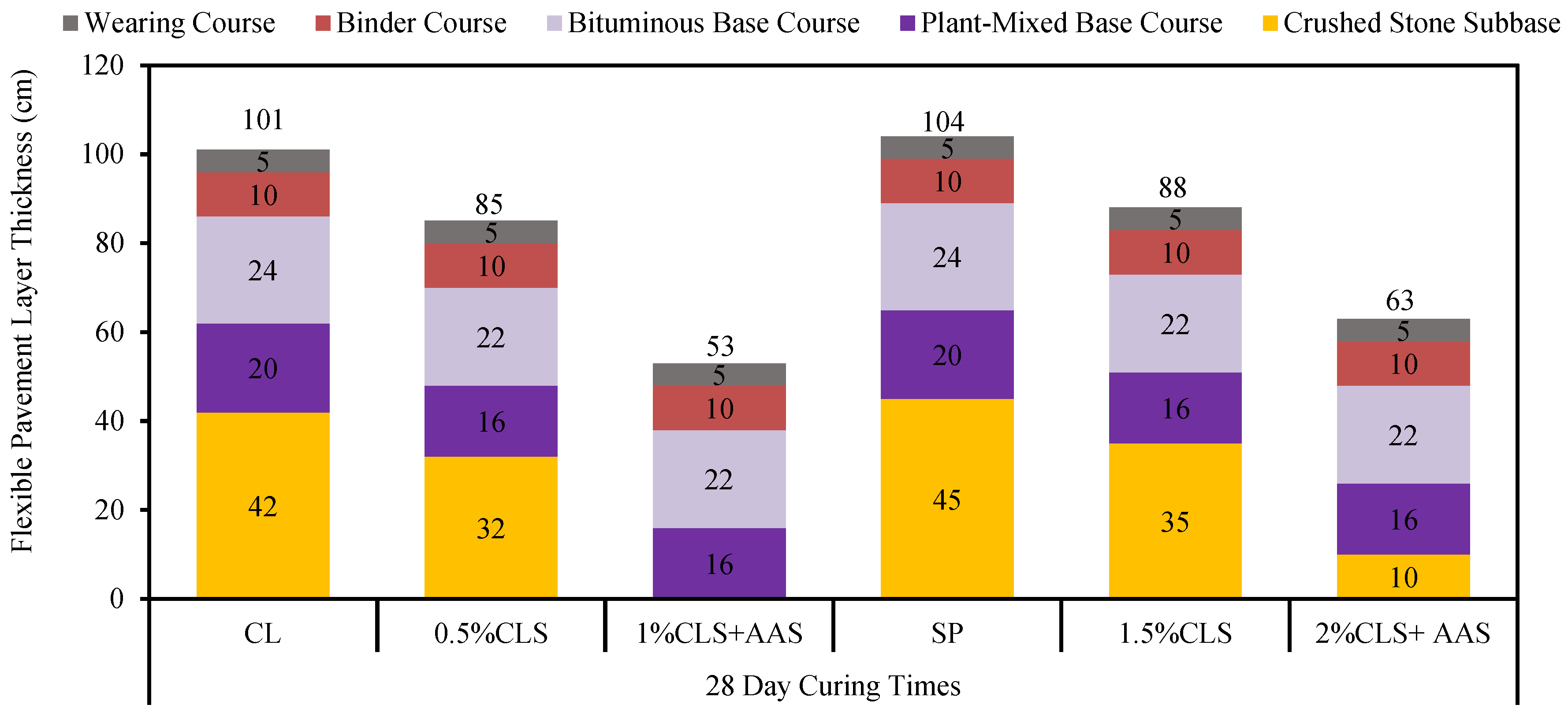
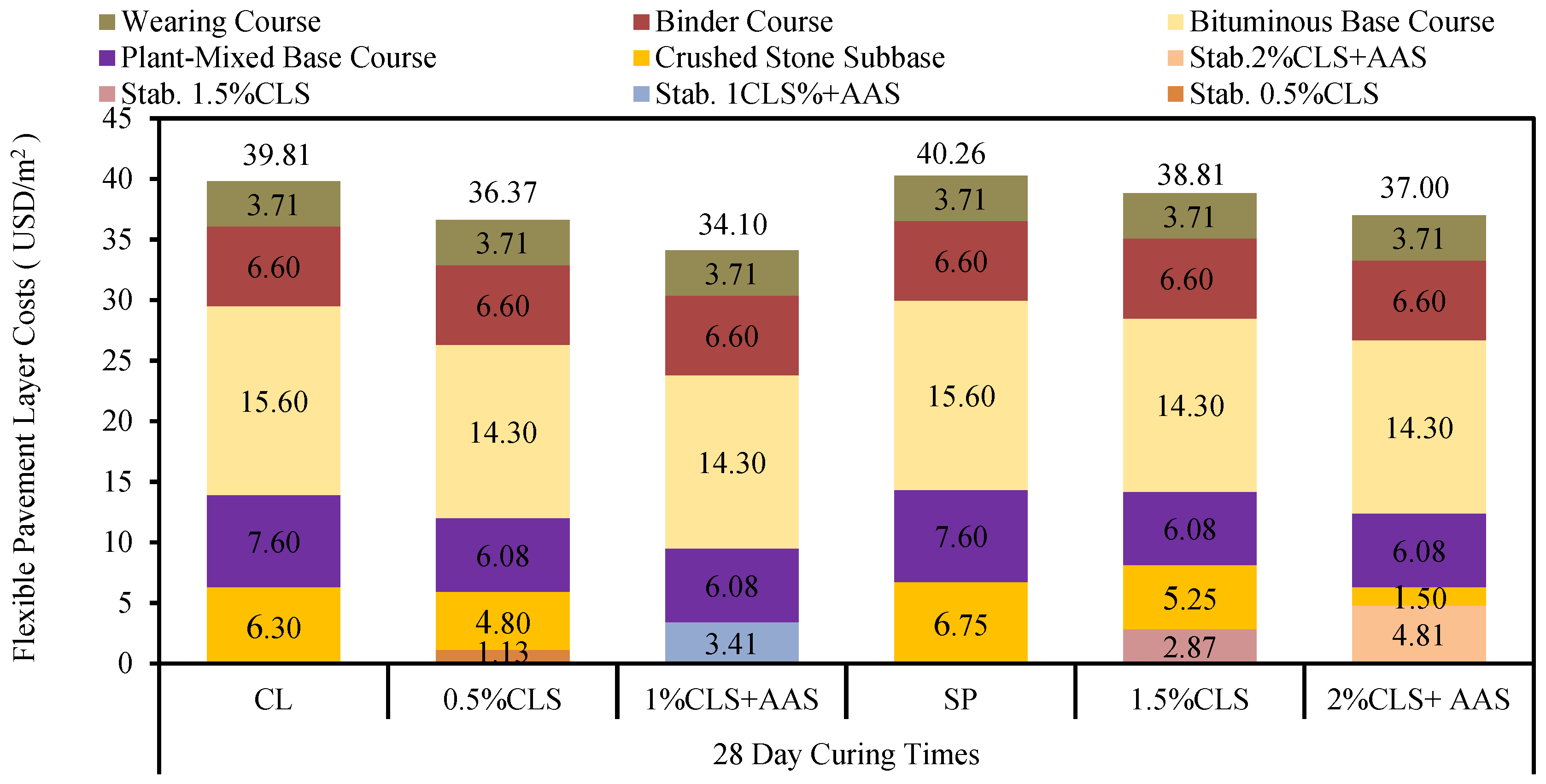
As seen in Figure 12, Figure 13 and Figure 14, a decrease occurred in the flexible pavement layer thicknesses compared to the CL soil. In comparison with the layer thicknesses of the untreated soil, total reductions of 15.84% and 47.52% were observed in the layer thicknesses of the 0.5% CLS-added and 1% CLS + AAS-added mixtures, respectively. Similarly, a reduction in flexible pavement layer thicknesses was observed compared to the SP soil. Relative to the untreated soil thicknesses, total reductions of 15.38% and 39.42% were recorded for the 1.5% CLS-added and 2% CLS + AAS-added mixtures, respectively.
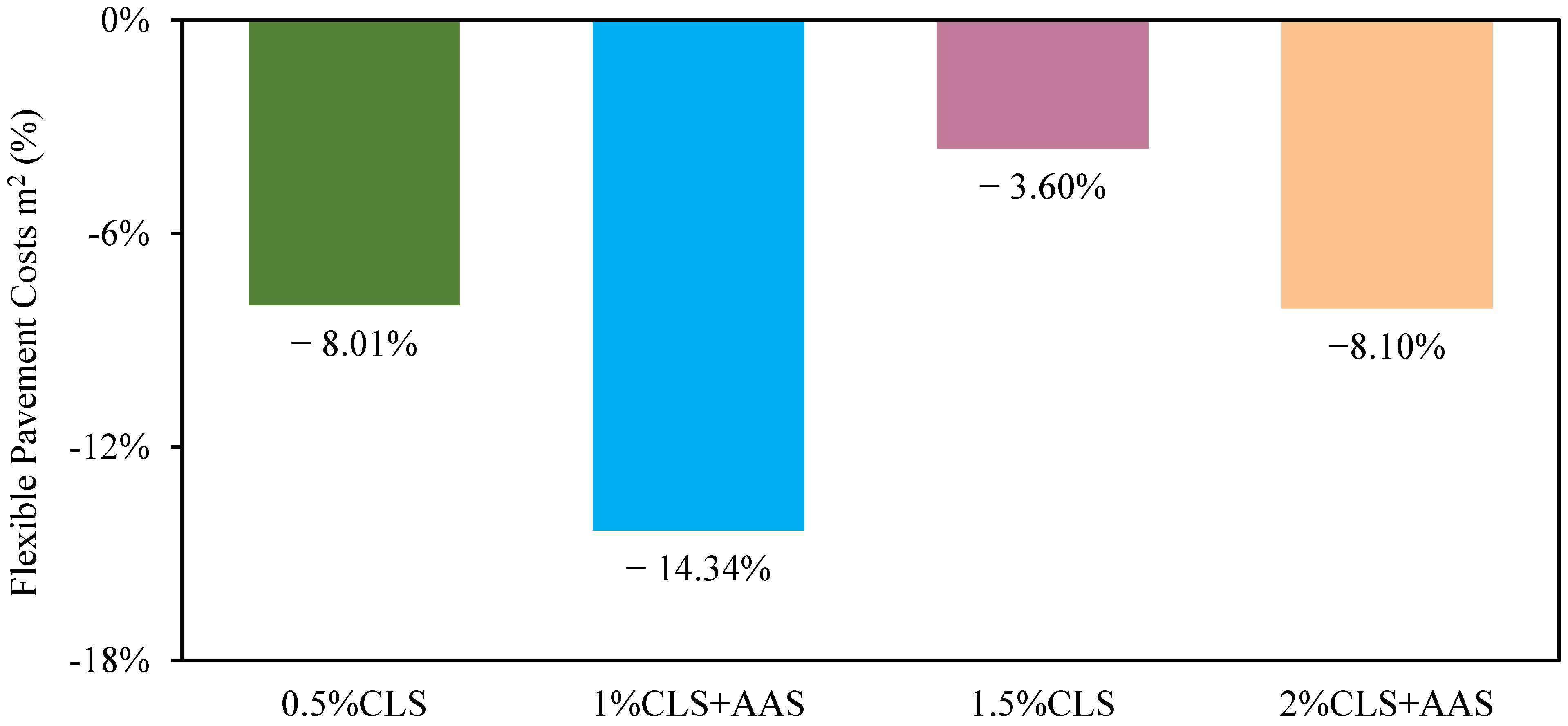
Considering the flexible pavement unit costs based on curing periods and stabilization costs, which were 1.13 USD/m2 for 0.5% CLS, 3.41 USD/m2 for 1% CLS + AAS, 2.87 USD/m2 for 1.5% CLS, and 4.81 USD/m2 for 2% CLS + AAS, the flexible pavement unit costs for mixtures containing 0.5% CLS, 1% CLS + AAS, 1.5% CLS + AAS, and 2% CLS + AAS decreased by 8.01%, 14.34%, 3.60%, and 8.10%, respectively. According to the calculations, for a divided road 1000 m in length and 20 m in width, stabilizing the road subgrade with 0.5% CLS, 1% CLS + AAS, 1.5% CLS + AAS, and 2% CLS + AAS would result in savings of 63,800, 114,200, 29,000, and 65,200 USD, respectively.
To evaluate the structural and economic robustness of these flexible design configurations against engineering uncertainties, a comprehensive sensitivity analysis was systematically performed by varying the primary design inputs based on the KGM 2008 [58] and AASHTO 1993 [31] principles. The analysis assessed the structural response by shifting the design traffic loading (Table 4 parameters) across various structural coefficient boundaries, modifying potential drainage conditions, and shifting the resilient modulus (MR) values driven by the experimental CLS and CLS-AAS stabilization dosages. The sensitivity analysis demonstrates that the required Structural Number (SN) and the cumulative construction costs are heavily governed by the subgrade bearing capacity. Upgrading the subgrade matrix from the untreated soil condition to the optimum stabilization configurations yields a systematic layer thickness optimization, which structurally justifies the recorded reductions of 15.84% to 47.52% in total structural layer thickness and the corresponding financial savings. Furthermore, the sensitivity evaluation confirms that even under conditions of simulated shifts in traffic volume or variations in drainage performance, the composite stabilization matrix effectively prevents premature serviceability loss (Delta PSI threshold depletion), proving that the CBR-correlated Level 3 design framework offers a statistically stable, highly transparent, and dependably conservative baseline for flexible pavement structural optimization.

3.6.2. Rigid Pavement Design and Cost Analysis

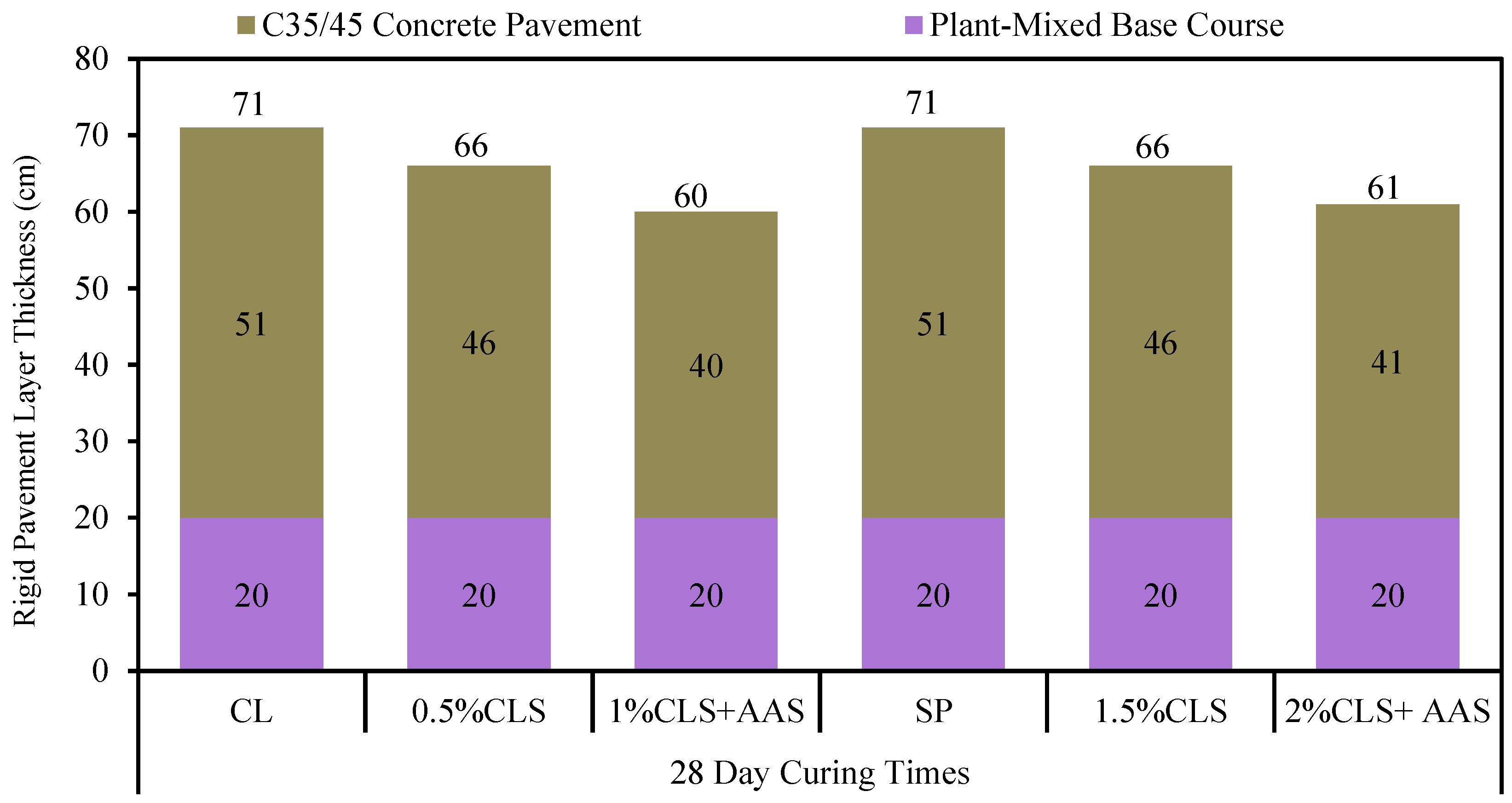
The rigid pavement design was evaluated for jointed plain concrete pavement (JPCP) thickness. The required rigid pavement layer thickness was calculated accordingly. In the calculations, taking the recommendations of the KGM Concrete Pavement Design Guide into account, the concrete class was selected as C35/45, and the plant-mix base was taken as 20 cm. Additionally, dowel and tie bars were considered based on the same guide. Following the 28-day curing period, the modulus of subgrade reaction (k) values was calculated as 594 for CL soil, 783 for 0.5% CLS-added soil, and 1811 for 1% CLS + AAS-added soil. For SP soil, k values were determined as 562 for reference, 781 for 1.5% CLS-added soil, and 1531 for 2% CLS + AAS-added soil, respectively. Using the common values in Table 5 and the k values obtained at the end of the 28-day curing period, the total layer thicknesses were calculated with the help of the AASHTO 1993 [31] equation.
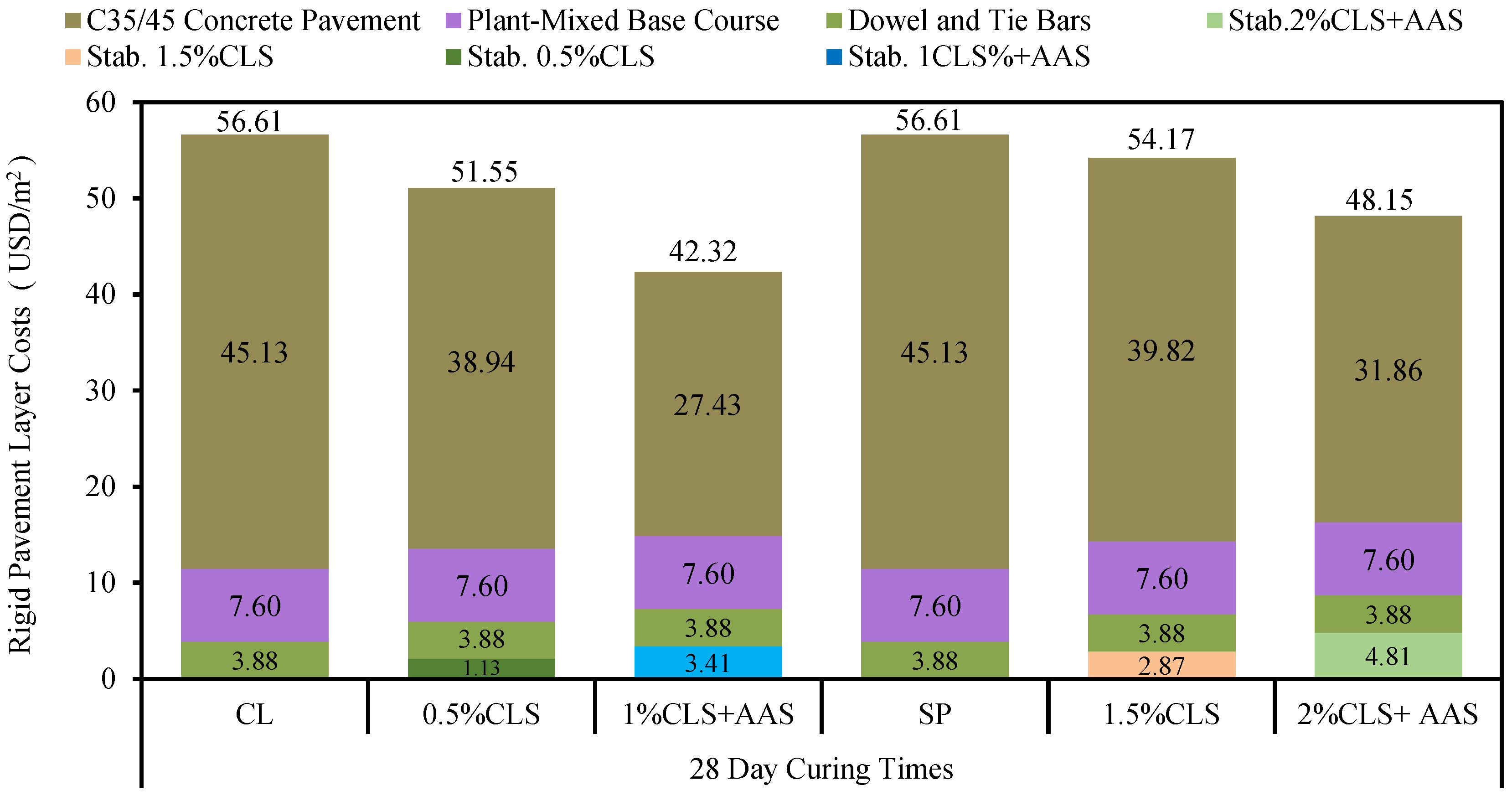
For the cost analysis of the rigid pavement, the unit price schedules published by KGM and the Ministry of Environment, Urbanization and Climate Change (ÇSB) provide unit weight (ton) costs for the base layer and unit volume (m3) costs for concrete. Based on the layer thickness determined in the design and the required reinforcement quantities, the item numbers (poz no) to be used in the cost analysis are given in Table 6.
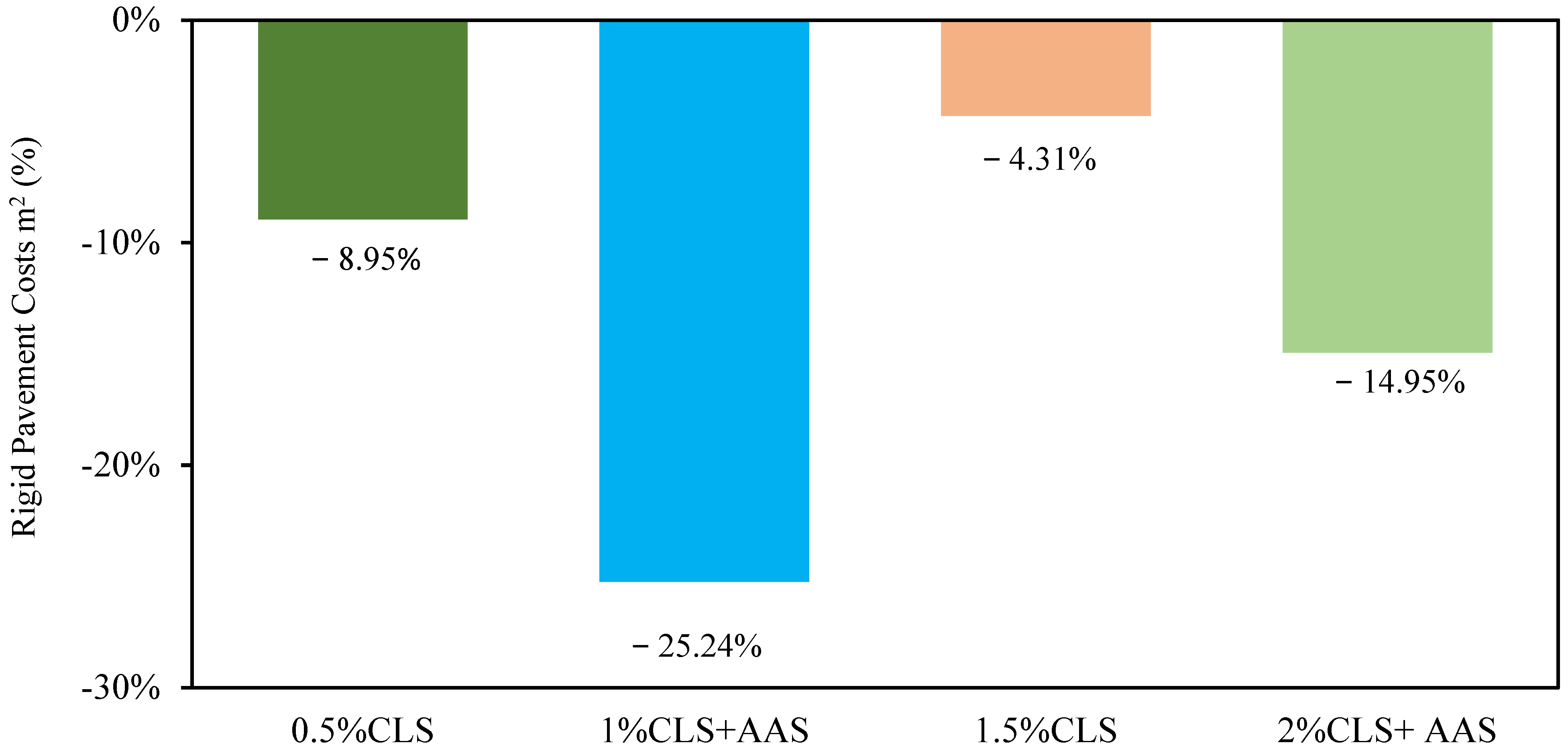
As seen in Figure 15, Figure 16 and Figure 17, a decrease occurred in the rigid pavement layer thicknesses compared to the CL and SP soils. Compared to the concrete slab thicknesses of the CL soil, reductions of 7.04% and 15.49% were observed in the slab thicknesses of the 0.5% CLS-added and 1% CLS + AAS-added mixtures, respectively. Similarly, compared to the concrete slab thicknesses of the SP soil, reductions of 7.04% and 14.08% were recorded for the 1.5% CLS-added and 2% CLS + AAS-added mixtures, respectively.
Considering the rigid pavement unit costs based on curing periods and stabilization costs, which were 1.13 USD/m2 for 0.5% CLS, 3.41 USD/m2 for 1% CLS + AAS, 2.87 USD/m2 for 1.5% CLS, and 4.81 USD/m2 for 2% CLS + AAS, the rigid pavement unit costs for mixtures containing 0.5% CLS, 1% CLS + AAS, 1.5% CLS + AAS, and 2% CLS + AAS decreased by 8.95%, 25.24%, 4.31%, and 14.95%, respectively. According to the calculations, for a divided road 1000 m in length and 20 m in width, stabilizing the road subgrade with 0.5% CLS, 1% CLS + AAS, 1.5% CLS + AAS, and 2% CLS + AAS would result in savings of 10,286, 285,760, 48,788, and 169,270 USD, respectively.
To fully evaluate the structural and financial robustness of these rigid pavement configurations against design uncertainties, a comprehensive sensitivity analysis was systematically conducted based on the guidelines of the KGM Concrete Pavement Design Guide [84] and the AASHTO 1993 [31] rigid pavement framework. To assess the overall engineering response, we performed a sensitivity analysis by systematically adjusting the primary design inputs listed in Table 5 focusing on traffic volumes, reliability levels, concrete modulus of rupture, and drainage coefficients (Cd). These variables were analyzed against the shifting modulus of subgrade reaction (k) values obtained from the experimental CLS and CLS-AAS stabilization combinations. The sensitivity analysis indicates that the calculated concrete slab thickness (D) and the final material costs are extremely sensitive to the structural support offered by the subgrade layer. Upgrading the subgrade parameters from the untreated soil base to the optimized chemical stabilization configurations yields a systematic optimization in slab design, structurally validating the recorded thickness reductions of 7.04% to 15.49% and the corresponding economic savings. Furthermore, the sensitivity evaluation confirms that even under conditions of increased operational axle loads or reduced drainage efficacy, the composite skeletal framework established by the CLS-AAS matrix successfully limits premature serviceability loss (Delta PSI threshold depletion), proving that the CBR-derived k-value approach provides a statistically stable, highly transparent, and dependably conservative framework for rigid pavement structural optimization.
In the economic evaluation of the calculated flexible and rigid pavement designs, in order to ensure equivalence to state-level infrastructure activities, the official 2026 unit price tariffs published by the General Directorate of Highways of Turkey (KGM) and the Ministry of Environment, Urbanization and Climate Change (CSB) were used for cost calculations. These regulated unit price tariffs are fixed for the entire fiscal year and provide a stable basis for budgeting. In addition, these unit prices include a mandatory 25% contractor overhead and profit margin. Unlike standard construction items, CLS and NaOH were evaluated in bulk and at project-specific wholesale market rates. All economic criteria were converted to US dollars (USD) using the average exchange rate recorded in June 2026. In addition, do market fluctuations pose a risk to these results? Changes in transportation distances and layer thicknesses, as well as a 50% increase in stabilizer costs, were modeled. It was observed that even if total expenditures change, the percentage savings achieved remain stable. Because the engineered stabilization matrices decrease the required volumes of costly structural layers, the relative economic viability of the projects fluctuates by less than 5% even under unfavorable transport or chemical price spikes, validating that this KGM-CSB application-based framework provides a universally dependable benchmark for highway pavement optimization.

3.7. Sustainability Analysis Based on CO2 Emissions During Initial Construction

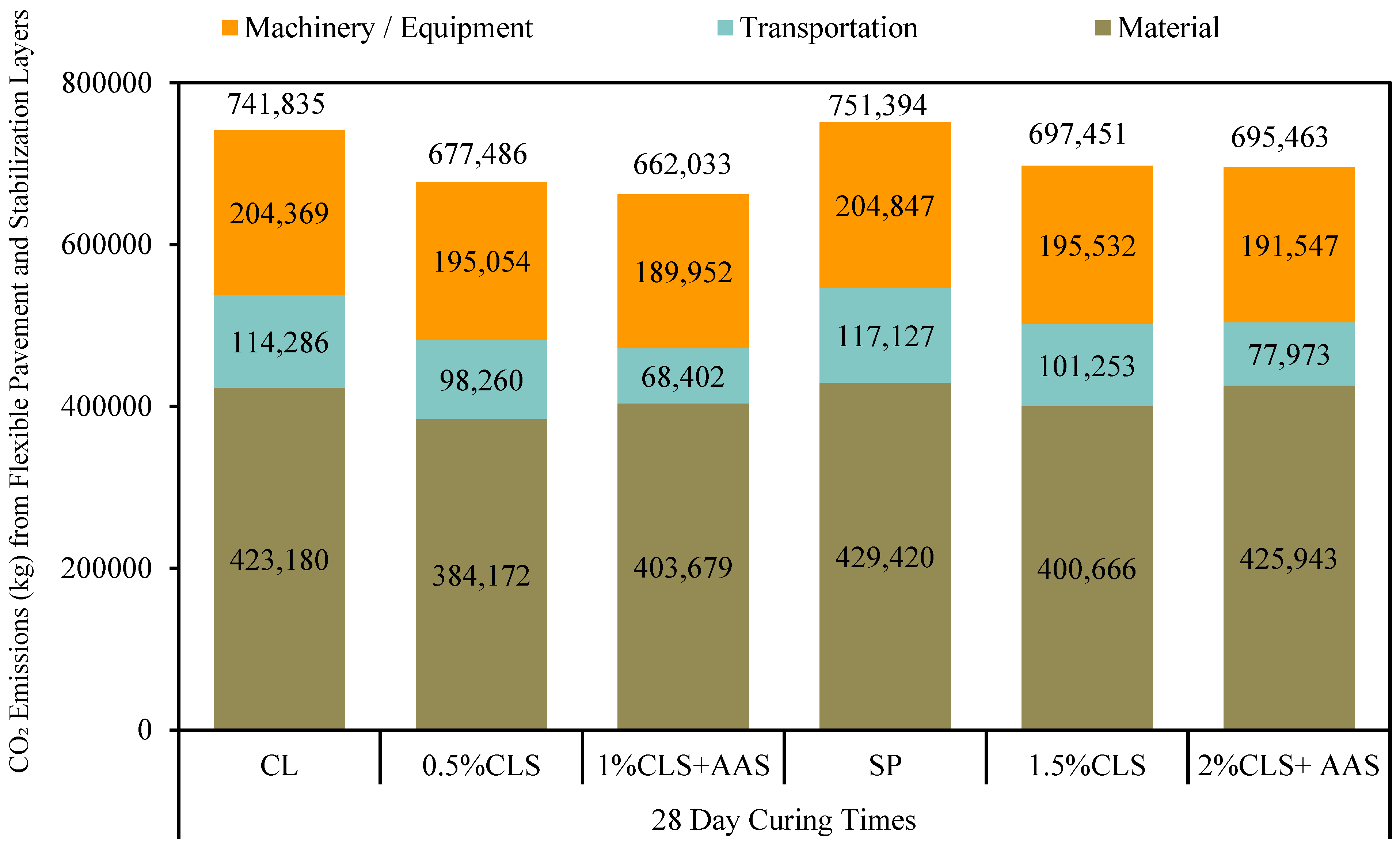
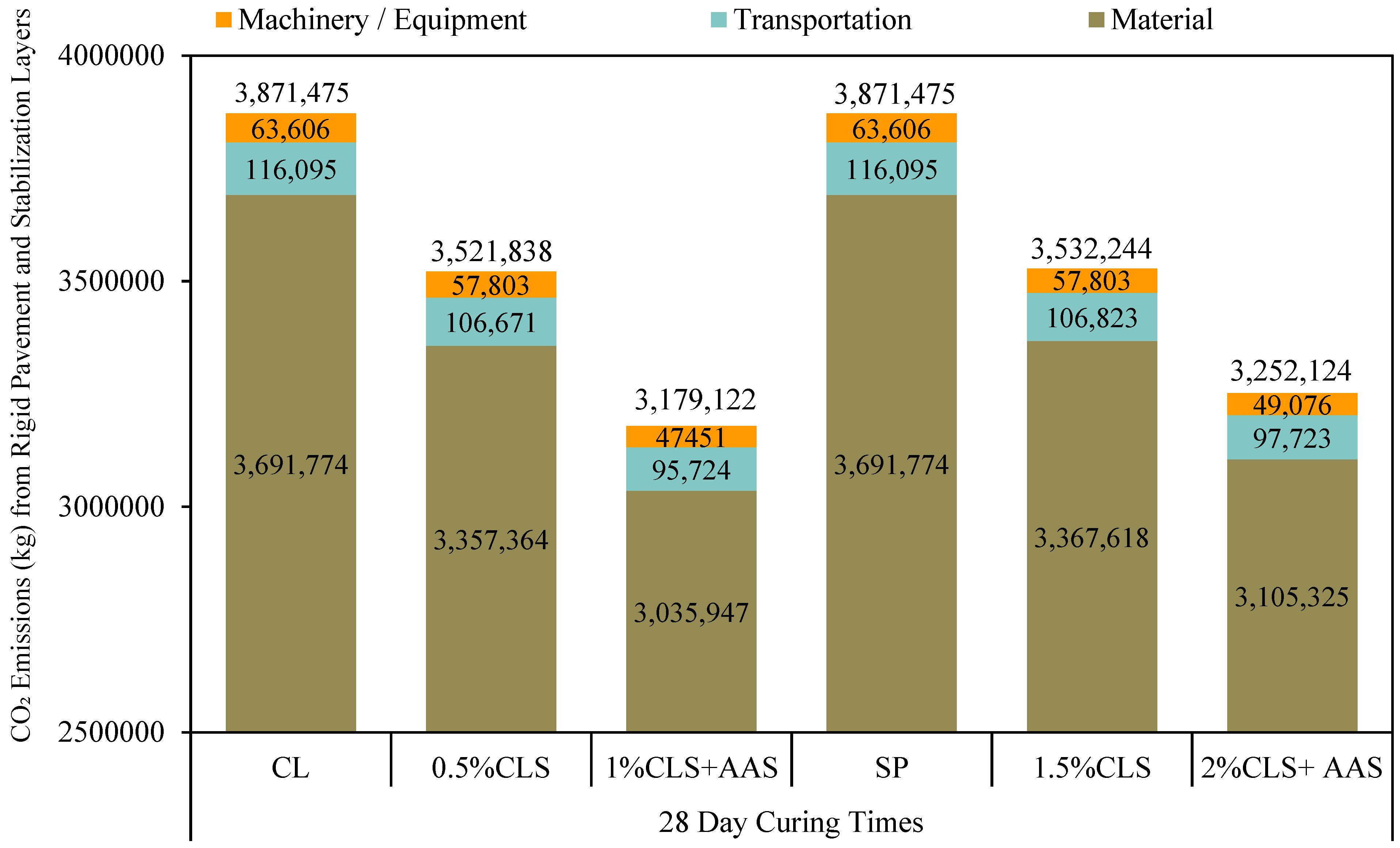
Flexible and rigid pavement designs were determined based on a 28-day curing period and 250,000,000 ESALs, considering the optimum mixture ratios identified through experiments with CLS-added and AAS-added CLS mixtures. In this context, CO2 emissions originating from materials, transportation, machinery, and equipment during the initial construction phase were compared for pavement designs with untreated subgrades (CL and SP) and CLS-stabilized subgrades. The reduction in CO2 emissions achieved through stabilization was calculated for the designs providing savings. The prepared comparison charts include the flexible and rigid pavement layers as well as the stabilization layer. Furthermore, since the dowel and tie bars in the rigid pavement are integrated within the concrete slab layer during construction, they are included in the concrete layer’s CO2 emissions in the graphical representation and shown as a total value. A comparison of the CO2 emissions generated during the initial construction of flexible pavement designs with untreated, 0.5% CLS-added, 1% CLS + AAS-added, 1.5% CLS-added, and 2% CLS + AAS-added subgrades is presented in Table 7 and Table 8 and Figure 18. In these assessments, the carbon emission sources are categorized as A for material production, B for transportation of materials, and C for construction machinery and equipment.
Based on the analysis performed in Table 7 and Table 8 and Figure 18 for the model road, it was determined that the CO2 emissions originating from the initial construction of the flexible pavement design with a CL subgrade consisted of 423,180 kg from materials, 114,286 kg from transportation, and 204,369 kg from machinery and equipment, totaling 741,835 kg. The distribution of these emissions is 57% from materials, 15.4% from transportation, and 27.6% from machinery and equipment.
For the flexible pavement design with a CL + 0.5% CLS subgrade, the CO2 emissions from initial construction were determined as 384,172 kg from materials, 98,260 kg from transportation, and 195,054 kg from machinery and equipment, totaling 677,486 kg. The distribution is 56.7% from materials, 14.5% from transportation, and 28.8% from machinery and equipment. Calculations indicate that the flexible pavement design with a 0.5% CLS subgrade reduced CO2 emissions by 8.67% compared to the CL subgrade design, providing a CO2 emission mitigation of 64,349 kg.
The CO2 emissions from the initial construction of the flexible pavement design with a CL + 1% CLS + AAS subgrade were determined as 403,679 kg from materials, 68,402 kg from transportation, and 189,952 kg from machinery and equipment, totaling 662,033 kg. The distribution is 61% from materials, 10.3% from transportation, and 28.7% from machinery and equipment.
It was determined that the 1% CLS + AAS subgrade design reduced CO2 emissions by 10.76% compared to the CL subgrade design, providing a CO2 emission mitigation of 79,801 kg.
For the flexible pavement design with SP subgrade, the CO2 emissions from initial construction were 429,420 kg from materials, 117,127 kg from transportation, and 204,847 kg from machinery and equipment, totaling 751,394 kg. The distribution is 57.3% from materials, 15.8% from transportation, and 26.9% from machinery and equipment.
The flexible pavement design with an SP + 1.5% CLS subgrade resulted in 400,666 kg from materials, 101,253 kg from transportation, and 195,532 kg from machinery and equipment, totaling 697,451 kg. The distribution is 57.5% from materials, 14.5% from transportation, and 28% from machinery and equipment. It was determined that the 1.5% CLS subgrade design reduced CO2 emissions by 7.18% compared to the SP subgrade design, providing a CO2 emission mitigation of 53,943 kg.
For the SP + 2% CLS + AAS subgrade design, the CO2 emissions were 425,943 kg from materials, 77,973 kg from transportation, and 191,547 kg from machinery and equipment, totaling 695,463 kg. The distribution is 61.2% from materials, 11.2% from transportation, and 27.6% from machinery and equipment. This design reduced CO2 emissions by 7.44% compared to the SP subgrade design, providing a CO2 emission mitigation of 55,931 kg.
The performed stabilizations were evaluated as sustainable in terms of CO2 emissions released during the initial construction of the flexible pavement design.
A comparison of the CO2 emissions during initial construction for rigid pavement designs with untreated subgrades (CL and SP) and subgrades stabilized with CLS/AAS is presented in Table 9 and Table 10 and Figure 19.
Based on the analysis in Table 9 and Table 10 and Figure 19 for the model road, the initial construction CO2 emissions for the rigid pavement design with a CL subgrade were calculated as 3,691,774 kg from materials, 116,095 kg from transportation, and 63,606 kg from machinery and equipment, totaling 3,871,475 kg. The emission distribution is 95.4% from materials, 3% from transportation, and 1.6% from machinery and equipment.
For the rigid pavement design with a CL + 0.5% CLS subgrade, emissions were determined as 3,357,364 kg from materials, 106,671 kg from transportation, and 57,803 kg from machinery and equipment, totaling 3,521,838 kg. The distribution is 95.3% from materials, 3% from transportation, and 1.7% from machinery and equipment. This design reduced CO2 emissions by 9.03% compared to the reference CL subgrade, providing a CO2 emission mitigation of 349,637 kg.
For the CL + 1% CLS + AAS subgrade design, emissions were 3,035,947 kg from materials, 95,724 kg from transportation, and 47,451 kg from machinery and equipment, totaling 3,179,122 kg. The distribution is 95.5% from materials, 3% from transportation, and 1.5% from machinery and equipment. This design reduced emissions by 17.88% compared to the CL subgrade, providing a CO2 emission mitigation of 692,353 kg.
For the SP subgrade design, total emissions were 3,871,475 kg, with a distribution of 95.4% from materials, 3% from transportation, and 1.6% from machinery and equipment. The SP + 1.5% CLS subgrade design resulted in 3,367,618 kg from materials, 106,823 kg from transportation, and 57,803 kg from machinery and equipment, totaling 3,532,244 kg. This design reduced emissions by 8.76% compared to the SP subgrade, providing a CO2 emission mitigation of 339,231 kg.
For the SP + 2% CLS + AAS subgrade design, emissions were 3,105,325 kg from materials, 97,723 kg from transportation, and 49,076 kg from machinery and equipment, totaling 3,252,124 kg. The distribution is 95.5% from materials, 3% from transportation, and 1.5% from machinery and equipment. This design reduced emissions by 16% compared to the SP subgrade, providing a CO2 emission mitigation of 619,351 kg. The performed stabilizations were evaluated as sustainable regarding CO2 emissions released during initial construction.
For the sustainability analysis, we calculated CO2 emissions within a cradle-to-gate embodied carbon framework, tracking material production, transportation, and construction machinery in strict compliance with ISO 14040 and ISO 14044 guidelines [85,86]. To ensure methodological consistency, this study focuses only on the initial construction phase instead of a full life cycle analysis. In this respect, maintenance, repair, operation processes, and end-of-life effects are completely excluded from our empirical limits. Defining system limits in this way is of great importance in monitoring low-carbon embodied carbon in infrastructure projects, as frequently stated in advanced assessment standards [87]. Previous studies in the literature [50,71] show that stabilization-focused bearing capacity improvements naturally reduce long-term maintenance needs throughout the service life of the pavement. However, adhering to the assumptions in the literature [58,85,86,88,89], we chose to exclude the aforementioned operation phase calculations from the current scope. Although this system boundary omits maintenance and end-of-life stages, subgrade stabilization fundamentally enhances long-term structural capacity. As a direct result, these stabilized cross-sections will necessitate significantly fewer rehabilitation treatments throughout their service life. Leaving out these operational phases means that the actual, long-term CO2 reductions are deeply understated in this study. What does this imply for our findings? It means the reported environmental benefits serve as an exceptionally conservative baseline.


4. Discussion

In the investigation of the use of CLS for stabilization purposes with CL and SP road subgrade soils, it was determined that it provides a double advantage by increasing both mechanical stability and environmental performance. The increase in optimum moisture content and decrease in maximum dry unit weight at high CLS inputs determined in the study are a result of the physical properties of the stabilizer. In addition, CLS, having a low specific gravity and high water absorption capacity compared to raw soil particles, alters the compaction dynamics. This behavior is quite typical for industrial by-products used in road subgrade soil stabilization.
Considering the 28-day curing results, which show a 1.43-fold increase when using only CLS in the mixtures and a 1.89-fold increase when used in combination with AAS activation, the importance of curing time is directly highlighted. When SEM findings are evaluated, it is seen that CLS activated with the correct methods forms a tighter and more compact structure through geopolymerization. It has been determined that the significant increases in CBR values used in our pavement designs are due to microstructural improvements and coincide with current milestones in lignosulfonate stabilization. The increase in optimum water content and the decrease in dry density reflect the dependence of bio-based polymers on high water affinity, low specific gravity, and flocculation tendencies, as reported in the literature [19,25]. In particular, for the 28-day CBR values obtained in AAS mixtures, it has been shown that CLS improves the soil through cation exchange and particle aggregation, and these results are consistent with the literature [20,22,23] using high-plasticity clay. Studies in the literature [21,24] show that raw lignosulfonate controls swelling and limits porosity. In our study, the inclusion of an alkali activator in the mixture enabled geopolymerization, thus filling a critical void. As a result, this improved bearing capacity optimizes pavement cross-sections and reduces overall costs. This aligns with existing sustainability frameworks [29] and demonstrates that CLS is a robust and highly viable alternative to conventional hydraulic binders.
This study critically demonstrates that judging the actual applicability of a stabilizer solely by its mechanical properties is insufficient. Furthermore, when considering large-scale highway construction activities, reducing pavement layer thicknesses creates a significant ripple effect. This reduction in pavement layer thickness directly minimizes the amount of raw materials used, decreases transportation demands, and reduces initial construction costs by up to 25.24%, particularly for rigid pavement designs. From an environmental perspective, the benefits are clear: the carbon footprint reduction for a given rigid pavement design exceeds 692,000 kg CO2.
A balanced assessment requires a rigorous eco-efficiency balance, especially for AAS prepared using sodium hydroxide. In this respect, NaOH has a high production emission factor, high material costs, and solid on-site usage risks. However, its use becomes practical when measured by the net benefit per unit of improved bearing capacity. The high alkalinity of NaOH accelerates geopolymerization within the mixture, thus providing a 1.89-fold increase in strength and CBR. This significant structural improvement effectively increases the modulus of elasticity of the road subsoil, resulting in a substantial reduction in the thickness of emission-intensive pavement layers such as asphalt concrete and rigid slabs. Based on a 1000 m road geometry, the significant savings achieved in cumulative material quantities, machinery use, and transport logistics outweigh the chemical carbon footprint and financial cost of the activator.
How does this system perform under environmental stress? In the event of flooding or rising groundwater levels, the stabilized road base exhibits strong hydro-mechanical resistance (durability). When submerged, untreated soil softens instantly, while stabilized soil, on the contrary, maintains its structural integrity through the cross-linked aluminosilicate networks within the CLS-AAS matrix. Furthermore, long-term environmental leakage risks are negligible. This is because long-term curing and geopolymerization ensure that free alkalis are permanently trapped within the water-insoluble skeletal structure, preventing leakage through groundwater layers [87].
Maintaining long-term durability in the face of environmental exposure is a key criterion, directly related to fundamental material engineering principles and encapsulation mechanisms. Similarly, evaluating degradation mechanisms observed in multi-layer protection mechanisms provides validation regarding the behavior of materials under abrasive conditions [90]. Likewise, evaluating treated road base substrates requires looking beyond isolated strength indicators to comprehensively assess multi-field stability. For the CLS-AAS structure, this durability stems from the high chemical persistence of its binder framework, which successfully isolates the road base from heavy-duty conditions.
Ultimately, CLS, which achieves an essential balance between economic gains and carbon footprint reduction, proves itself to be a practical and environmentally friendly alternative to traditional connectors within the limits of road infrastructure.
Our environmental assessments focus on the Cradle-to-Gate framework, targeting the initial construction phase. This system boundary excludes later phases of the pavement. However, the improved bearing capacity and structural performance provided by CLS stabilization will reduce future maintenance demands [89]. What does this mean for our carbon assessment? It proves that real lifecycle CO2 reductions will easily exceed the metrics calculated here. As a result, the environmental benefits presented in this study serve as a safe and conservative lower bound for sustainable pavement design.
Beyond static loading, stabilized subgrade structures are exposed to environmental conditions encompassing drying–wetting periods, seasonal moisture variations, and temperature differences. In infrastructure projects, investigating the behavior of worked soils during moisture fluctuations, similar to the response of Nanyang expanding soils to wet–dry intervals, is essential to ensuring long-term reliability. Wet–dry resilience and chemical infiltration pathways are outside the limits of our current experimental scope. However, verified strength increases and robust cementation point to a stable skeletal structure. Do these shortcomings compromise the design? Significantly not. While these findings provide a secure foundation framework, conducting detailed, multi-site resilience simulations for large-scale field validation remains a necessary next step.
Beyond environmental factors, pavement subsoils are subjected to repeated cyclic traffic loads throughout their service lives. This makes maintaining long-term durability difficult. In polymer-modified soil systems, dynamic flexibility largely depends on the persistence of the binder network, just as polyurethane curing improves the cyclic performance and structure of clay-sand mixtures [91]. In AASHTO guidelines [82], 28 days is accepted as the standard design criterion. Geopolymerization and pozzolanic kinetics in CLS-AAS extend far beyond this period, progressing to 90 days and longer. This time-dependent chemical improvement prevents internal skeletal deterioration and microcracking under cyclic stress.
To place this system behavior in a specific context, we can draw the following structural parallel. Evaluation of how regional material improvements in concrete-steel composite elements determine the overall flexural performance of larger components [92] shows that microstructural cementation at the subsoil level is directly related to the deflection control of the superstructure layers. Ultimately, the pozzolanic development over time indicates the material’s ability to maintain long-term stiffness for sustainable highway foundations.

5. Conclusions

This study evaluates the stabilization of CLS in CL and SP subsoils, which have contrasting characteristics, by correlating laboratory data with structural and environmental models. The following key findings emerge from this approach:
I.
Experimentally Demonstrated Findings (Laboratory-Scale):
  • Increasing CLS ratios in the mixtures increased the optimum moisture requirements for both soil types and decreased their maximum dry unit weights. This occurred due to the high water affinity and low specific gravity of the stabilizer, altering the compaction dynamics.
  • The increase in curing time determines the final mechanical behavior. After a 28-day reference curing period, a strength increase of up to 1.43 times was achieved with optimum additive content (0.5% for CL and 1.5% for SP), while the combined use of AAS activator through geopolymerization increased this to 1.89 times.
  • Freeze–thaw resistance testing of the mixtures has shown that alkali-activated mixtures maintain high permanent stiffness and structural cohesion, confirming their capacity to withstand cyclic thermal stress.
II.
Calculated Implications (Design and Environmental Modeling):
  • AASHTO-based pavement design calculations indicate reductions in layer thicknesses. Flexible pavement total thickness decreased by up to 47.52%, while rigid pavement slab thicknesses were reduced by up to 15.49% for stabilized subgrades.
  • Material volume reductions resulted in projected cost savings of up to 14.34% for flexible and 25.24% for rigid pavements. For a 1000 m divided road model, maximum savings reached 285,760 USD.
  • Estimated CO2 emissions during the initial construction phase were reduced by up to 10.76% (flexible) and 17.88% (rigid). Quantitative CO2 emission mitigation was significantly higher in rigid pavements, reaching a value of 692,353 kg.
III.
System Limitations and Future Outlook:
  • CLS, as an industrial by-product, presents a highly viable, eco-efficient alternative for large-scale highway infrastructure, offering substantial initial construction phase benefits. However, these findings should be interpreted as potential calculated implications rather than proven long-term field performance, as full operational sustainability benefits remain subject to further full-scale field validation and comprehensive long-term life-cycle assessments (LCAs).
  • The empirical findings, mechanical upgrades, and economic-environmental benefits reported herein are strictly valid for the tested CL and SP subgrade soils under the specific laboratory conditions, curing periods, chemical dosage levels, and structural design assumptions utilized in this study.
  • These results are specific to the study parameters. They cannot be directly applied to alternative geotechnical environments such as organic sediments, formations prone to subsidence, sulfate-rich soils, or highly plastically expanding clays. To maintain analytical clarity despite the extensive amount of data, we base these results entirely on controlled laboratory indicators (UCS, CBR, and freeze–thaw behavior). Crucially, these parameters are subject to real-world fluctuations within actual, full-scale field environments. Granted, current empirical pavement designs and cradle-to-gate boundaries leave out late life-cycle phases, wet–dry durability, or chemical leaching mechanisms. Even so, our recorded findings deliver a fully dependable, conservative baseline framework. Moving forward, we plan to execute full-scale field trials and evaluate broader soil classifications to validate these long-term parameters under actual operating conditions.

Author Contributions

Conceptualization, T.S. and B.K.; methodology, B.K.; software, T.S.; validation, T.G., T.S. and B.K.; formal analysis, B.K. and T.G.; investigation, T.S. and B.K.; resources, T.G.; data curation, T.S.; writing—original draft preparation, B.K. and T.S.; writing—review and editing, B.K. and T.G.; visualization, T.S.; supervision, B.K.; project administration, T.G. All authors have read and agreed to the published version of the manuscript.

Funding

This research was funded by Inonu University Scientific Research Projects (BAP) Coordination Unit, grant number IÜ-BAP FDK-2023-3325.

Institutional Review Board Statement

Not applicable.

Informed Consent Statement

Not applicable.

Data Availability Statement

The data presented in this study are available on request from the corresponding author.

Acknowledgments

The authors highly appreciate the administrative and technical support provided by the Faculty of Engineering and the Geotechnical Laboratory at Inonu University during the experimental phases of this study.

Conflicts of Interest

The authors declare no conflicts of interest. The funders had no role in the design of the study; in the collection, analyses, or interpretation of data; in the writing of the manuscript, or in the decision to publish the results.

Abbreviations

CLSCalcium lignosulfonate
CO2Carbon dioxide
CBRCalifornia bearing ratio
ωoptOptimum moisture content
γdmaxMaximum dry density
MREffective modulus of subgrade reaction for the subgrade soil (psi)
P0Initial serviceability index
T8.2Number of repetitions of the equivalent standard single axle load (ESAL) of 8.2 tons for the design traffic
SNStructural number (used for pavement layer thickness calculation)
ZRStandard normal deviate
ΔPSITotal serviceability loss
εAxial strain at failure
PtTerminal serviceability index
S0Composite standard error of the performance traffic prediction
quUnconfined compressive strength

References

  1. Das, B.M. Principles of Foundation Engineering, 7th ed.; Cengage Learning: Stamford, CT, USA, 2011. [Google Scholar]
  2. Nikolaides, A. Highway Engineering: Pavements, Materials and Control of Quality; CRC Press: Boca Raton, FL, USA, 2014. [Google Scholar]
  3. Tunç, A. Ulaşım Yapılarında Geoteknik Mühendisliğinin Esasları [Principles of Geotechnical Engineering in Transportation Structures]; Nobel Akademik Yayıncılık: Ankara, Türkiye, 2025. [Google Scholar]
  4. Paul, S.; Elahi, T.E.; Islam, M.S. Potential of waste rice husk ash and cement in making compressed stabilized earth blocks: Strength, durability and life cycle assessment. J. Build. Eng. 2023, 73, 106727. [Google Scholar] [CrossRef]
  5. Karatai, T.R.; Kaluli, J.W.; Kabubo, C.; Thiong’o, G. Soil stabilization using rice husk ash and natural lime as an alternative to cutting and filling in road construction. J. Constr. Eng. Manag. 2017, 143, 04016127. [Google Scholar] [CrossRef]
  6. Okafor, F.O.; Okonkwo, U.N. Effects of rice husk ash on some geotechnical properties of lateritic soil. Niger. J. Technol. 2009, 28, 46–52. [Google Scholar]
  7. Debnath, A.; Saha, S.; Chattaraj, R. Stabilization of clayey soil with marble dust. In Recent Developments in Sustainable Infrastructure; Springer: Singapore, 2021; Volume 75, pp. 175–183. [Google Scholar]
  8. Perera, S.T.A.M.; Saberian, M.; Zhu, J.; Roychand, R.; Li, J. Effect of crushed glass on the mechanical and microstructural behavior of highly expansive clay subgrade. Case Stud. Constr. Mater. 2022, 17, e01395. [Google Scholar] [CrossRef]
  9. Geçkil, T.; Sarıcı, T.; Karabaş, B. Investigation of the effect of subgrade soil stabilization with recycled glass powder on freeze-thaw resistance. Gümüşhane Univ. J. Sci. Technol. Inst. 2026, 16, 179–196. [Google Scholar] [CrossRef]
  10. Geckil, T.; Sarici, T.; Aksoy, H.S. The usability of construction and demolition wastes stabilized using alkali activated fly ash as filler material. Rev. Constr. 2025, 24, 428–448. [Google Scholar] [CrossRef]
  11. Lakkimsetti, B.; Nayak, S. Experimental investigation and performance evaluation of lithomargic clay stabilized with granulated blast furnace slag and calcium chloride. Int. J. Geosynth. Ground Eng. 2022, 8, 12. [Google Scholar] [CrossRef]
  12. Geçkil, T.; Sarıcı, T.; Karabaş, B. Effects of carbon black stabilized soil on rigid pavement thickness and cost. El-Cezeri J. Sci. Eng. 2021, 8, 1372–1384. [Google Scholar] [CrossRef]
  13. Geçkil, T.; Karabaş, B. Evaluating the effects of carbon black from recycled tires on subgrade stabilization, pavement design, and construction-phase CO2 emissions. Indian J. Eng. Mater. Sci. 2026, 33, 111–125. [Google Scholar]
  14. Kulanthaivel, P.; Harikaran, M.; Gokulakannan, S.; Vinodhkumar. Eco-friendly soil stabilization: A combined approach using lime and waste eggshell powder. Glob. NEST J. 2023, 25, 120–130. [Google Scholar] [CrossRef]
  15. Domphoeun, R.; Eisazadeh, A. Flexural and shear strength properties of laterite soil stabilized with rice husk ash, coir fiber, and lime. Transp. Infrastruct. Geotechnol. 2024, 11, 2483–2500. [Google Scholar] [CrossRef]
  16. Chakma, N.; Islam, M.S.; Paul, S. Effectiveness of areca fiber and cement on the engineering characteristics of compressed stabilized earth blocks. Constr. Build. Mater. 2024, 427, 136290. [Google Scholar] [CrossRef]
  17. Shabana, S.; Anshi, C.; Shamseera, P.; Shyamili, T.M.; Sruthi, V.; Suhaira, P. Study on CBR values of soil with crushed coconut shells. Int. J. Adv. Eng. Technol. 2014, 5, 55–58. [Google Scholar] [CrossRef]
  18. Sarıcı, T.; Ok, B.; Mert, A.; Çömez, Ş. The resilient modulus of hybrid construction and demolition wastes reinforced by a geogrid. Acta Geotech. Slov. 2022, 19, 1–13. [Google Scholar]
  19. Ta’negonbadi, B.; Noorzad, R. Stabilization of clayey soil using lignosulfonate. Transp. Geotech. 2017, 12, 45–55. [Google Scholar] [CrossRef]
  20. Ta’negonbadi, B.; Noorzad, R. Physical and geotechnical long-term properties of lignosulfonate-stabilized clay: An experimental investigation. Transp. Geotech. 2018, 17, 41–50. [Google Scholar]
  21. Roshan, K.; Choobbasti, A.S.; Kutanaei, S.S. Evaluation of the impact of fiber reinforcement on the durability of lignosulfonate stabilized clayey sand under wet-dry condition. Transp. Geotech. 2020, 23, 100359. [Google Scholar] [CrossRef]
  22. Fernández, M.T.; Orlandi, S.; Codevilla, M.; Piqué, T.M.; Manzanal, D. Performance of calcium lignosulfonate as a stabiliser of highly expansive clay. Transp. Geotech. 2021, 27, 100469. [Google Scholar] [CrossRef]
  23. Amulya, G.; Moghal, A.A.B.; Basha, B.M.; Almajed, A. Coupled effect of granite sand and calcium lignosulphonate on the strength behavior of cohesive soil. Buildings 2022, 12, 1687. [Google Scholar] [CrossRef]
  24. Chiranjeevi, V.; Singh, K.; Kishan, D. Soil stabilization by integrating dust particles with calcium lignosulphanate. Prog. Phys. Geogr. Earth Environ. 2024, 48, 60–78. [Google Scholar] [CrossRef]
  25. Mudliar, R.; Rajesh, S. Mitigation of the swelling behavior of expansive soils using hydrophobic lignosulfonate: Adsorption mechanism. J. Mater. Civ. Eng. 2025, 37, 04024486. [Google Scholar] [CrossRef]
  26. Amulya, G.; Moghal, A.A.B.; Almajed, A. Sustainable Binary Blending for Low-Volume Roads—Reliability-Based Design Approach and Carbon Footprint Analysis. Materials 2023, 16, 2065. [Google Scholar] [CrossRef] [PubMed]
  27. Bai, Z.; Li, D.; Zhao, D.; Lu, W.; Liu, J. Experimental Research on Collapsibility of Xi’an Loess Improved by Calcium Lignosulfonate. Coatings 2023, 13, 157. [Google Scholar] [CrossRef]
  28. Wu, D.; She, W.; Wei, L.; Zuo, W.; Hu, X.; Hong, J.; Miao, C. Stabilization mechanism of calcium lignosulphonate used in expansion sensitive soil. J. Wuhan Univ. Technol.-Mater. Sci. Ed. 2020, 35, 847–855. [Google Scholar] [CrossRef]
  29. Sharmila, B.; Bhuvaneshwari, S.; Landlin, G. Application of lignosulphonate-a sustainable approach towards strength improvement and swell management of expansive soils. Bull. Eng. Geol. Environ. 2021, 80, 6395–6413. [Google Scholar] [CrossRef]
  30. Chavali, R.V.P.; Reshmarani, B. Characterization of expansive soils treated with lignosulfonate. Int. J. Geo-Eng. 2020, 11, 17. [Google Scholar] [CrossRef]
  31. AASHTO. AASHTO Guide for Design of Pavement Structures; American Association of State Highway and Transportation Officials: Washington, DC, USA, 1993. [Google Scholar]
  32. Morita, Y.; Shimizu, K.; Kato, H.; Shibahara, H.; Yamasaki, T. A study for the measurement of environmental impact resulting from railway construction. In Proceedings of the Joint Rail Conference (JRC); ASME: Pueblo, CO, USA, 2011; pp. 453–459. [Google Scholar]
  33. Rogers, C.D.F.; Thomas, A.M.; Jefferson, I.; Gaterell, M. Carbon dioxide emissions due to highway subgrade improvements. Transp. Res. Rec. 2009, 2104, 80–87. [Google Scholar] [CrossRef]
  34. Giustozzi, F.; Flintsch, G.W.; Crispino, M. Environmental impact analysis of low carbon road-foundation layers. Int. J. Sustain. Transp. 2015, 9, 73–79. [Google Scholar]
  35. Gupta, G.; Sood, H.; Gupta, P.K. Carbon footprints assessment of RBI Grade 81 stabilized pavements using life-cycle approach. Indian J. Sci. Technol. 2017, 10, 26. [Google Scholar] [CrossRef][Green Version]
  36. Zhang, R.; Long, M.; Zheng, J. Comparison of environmental impacts of two alternative stabilization techniques on expansive soil slopes. Adv. Civ. Eng. 2019, 2019, 9454929. [Google Scholar] [CrossRef]
  37. Kaewunruen, S.; Sresakoolchai, J.; Peng, J. Life cycle cost, energy and carbon assessments of Beijing-Shanghai High-Speed Railway. Sustainability 2020, 12, 206. [Google Scholar] [CrossRef]
  38. Tanyıldızı, M.M.; Karabaş, B. Zayıf zeminlerde YFC ve çelik lifli beton yolların ilk yapım maliyeti ve CO2 emisyonuna etkisi. Black Sea J. Eng. Sci. 2026, 9, 516–548. [Google Scholar] [CrossRef]
  39. ASTM C136/C136M-19; Standard Test Method for Sieve Analysis of Fine and Coarse Aggregates. ASTM International: West Conshohocken, PA, USA, 2019.
  40. ASTM D422-63; Standard Test Method for Particle-Size Analysis of Soils. ASTM International: West Conshohocken, PA, USA, 2007.
  41. ASTM D4318; Standard Test Methods for Liquid Limit, Plastic Limit, and Plasticity Index of Soils. ASTM International: West Conshohocken, PA, USA, 2017.
  42. ASTM D698; Standard Test Methods for Laboratory Compaction Characteristics of Soil Using Standard Effort. ASTM International: West Conshohocken, PA, USA, 2014.
  43. Das, B.M.; Sivakugan, N. Fundamentals of Geotechnical Engineering; Cengage Learning: Boston, MA, USA, 2017. [Google Scholar]
  44. MolaAbasi, H.; Kharazmi, P.; Khajeh, A.; Saberian, M.; Chenari, R.J.; Harandi, M.; Li, J. Low plasticity clay stabilized with cement and zeolite: An experimental and environmental impact study. Resour. Conserv. Recycl. 2022, 184, 106408. [Google Scholar] [CrossRef]
  45. Fatemi, S.; Bazaz, J.B.; Ziaee, S.A. Investigating the effect of calcium lignosulfonate on the durability and performance of asphalt mixtures. Adv. Mater. Sci. Eng. 2022, 2022, 5260159. [Google Scholar] [CrossRef]
  46. Davidovits, J. Geopolymer Chemistry and Application, 4th ed.; Geopolymer Institute: Saint-Quentin, France, 2008. [Google Scholar]
  47. Duxson, P.; Fernández-Jiménez, A.; Provis, J.L.; Lukey, G.C.; Palomo, A.; van Deventer, J.S. Geopolymer technology: The current state of the art. J. Mater. Sci. 2007, 42, 2917–2933. [Google Scholar] [CrossRef]
  48. De Vargas, A.S.; Dal Molin, D.C.C.; Vilela, A.C.F.; Da Silva, F.J.; Pavao, B.; Veit, H. The effects of Na2O/SiO2 molar ratio, curing temperature and age on compressive strength, morphology and microstructure of alkali-activated fly ash-based geopolymers. Cem. Concr. Compos. 2011, 33, 653–660. [Google Scholar] [CrossRef]
  49. Palomo, A.; Grutzeck, M.W.; Blanco, M.T. Alkali-activated fly ashes: A cement for the future. Cem. Concr. Res. 1999, 29, 1323–1329. [Google Scholar] [CrossRef]
  50. Kalina, L.; Bílek, V.; Hrubý, P.; Iliushchenko, V.; Kalina, M.; Smilek, J. On the action mechanism of lignosulfonate plasticizer in alkali-activated slag-based system. Cem. Concr. Res. 2022, 157, 106822. [Google Scholar] [CrossRef]
  51. Luukkonen, T.; Abdollahnejad, Z.; Ohenoja, K.; Kinnunen, P.; Illikainen, M. Suitability of commercial superplasticizers for one-part alkali-activated blastfurnace slag mortar. J. Sustain. Cem. Based Mater. 2019, 8, 244–257. [Google Scholar] [CrossRef]
  52. Iliushchenko, V.; Bilek, V.; Kalina, L.; Hruby, P.; Opravil, T.; Bojanovsky, J. Effect of alkali cation type on the plasticizing effect of lignosulfonate in alkali-activated systems. IOP Conf. Ser. Mater. Sci. Eng. 2021, 1205, 012016. [Google Scholar] [CrossRef]
  53. Bílek, V.; Kalina, L.; Novotný, R. Structural build-up and breakdown of alkali-activated slag pastes with different order of lignosulfonate and activator addition. Constr. Build. Mater. 2023, 386, 132174. [Google Scholar] [CrossRef]
  54. Sarici, T.; Geckil, T.; Ok, B.; Aksoy, H.S. An investigation of the usability of alkali-activated blast furnace slag-additive construction demolition waste as filling material. Materials 2025, 18, 398. [Google Scholar] [CrossRef] [PubMed]
  55. ASTM D2166; Standard Test Method for Unconfined Compressive Strength of Cohesive Soil. ASTM International: West Conshohocken, PA, USA, 2016.
  56. ASTM D1883; Standard Test Method for California Bearing Ratio (CBR) of Laboratory-Compacted Soils. ASTM International: West Conshohocken, PA, USA, 2016.
  57. Safaei, M.; Oni, A.O.; Gemechu, E.D.; Kumar, A. Evaluation of energy and greenhouse gas emissions of bitumen-derived transportation fuels from toe-to-heel air injection extraction technology. Fuel 2019, 256, 115911. [Google Scholar] [CrossRef]
  58. KGM. Flexible Pavement Design Guide; Ministry of Transport, Technical Research Department: Ankara, Türkiye, 2008. (In Turkish)
  59. THBB. Ready-Mixed Concrete Life Cycle Guide; Turkish Ready-Mixed Concrete Association: İstanbul, Türkiye, 2021. (In Turkish) [Google Scholar]
  60. Varsha, B.; Moghal, A.A.B.; Rehman, A.U.; Chittoori, B.C.S. Shear, consolidation characteristics and carbon footprint analysis of clayey soil blended with calcium lignosulphonate and granite sand for earthen dam application. Sustainability 2023, 15, 6117. [Google Scholar] [CrossRef]
  61. Thannimalay, L.; Yusoff, S.; Zawawi, N.Z. Life cycle assessment of sodium hydroxide. Aust. J. Basic Appl. Sci. 2013, 7, 421–431. [Google Scholar]
  62. Eggleston, H.S.; Buendia, L.; Miwa, K.; Ngara, T.; Tanabe, K. (Eds.) 2006 IPCC Guidelines for National Greenhouse Gas Inventories; Institute for Global Environmental Strategies (IGES): Hayama, Japan, 2006. [Google Scholar]
  63. IPCC. 2019 Refinement to the 2006 IPCC Guidelines for National Greenhouse Gas Inventories; IPCC: Geneva, Switzerland, 2019; Available online: https://www.ipcc.ch (accessed on 26 April 2026).
  64. Ağar, E.; Sütaş, İ.; Öztaş, G. Concrete Roads (Rigid Pavement Structures); Istanbul Technical University Press: İstanbul, Türkiye, 1998. (In Turkish) [Google Scholar]
  65. Şanal, İ. Significance of concrete production in terms of carbon dioxide emissions: Social and environmental impacts. Polytech. J. 2018, 21, 369–378. [Google Scholar]
  66. Xu, C.; Cang, D. A brief overview of low CO2 emission technologies for iron and steel making. J. Iron Steel Res. Int. 2010, 17, 1–7. [Google Scholar] [CrossRef]
  67. Shafiei, A.; Aminpour, M.; Hasanzadehshooiili, H. Mechanical characterization of marl soil treated by cement and lignosulfonate under freeze–thaw cycles: Experimental studies and machine-learning modeling. Bull. Eng. Geol. Environ. 2023, 82, 200. [Google Scholar]
  68. Zheng, Y.; Niu, W. Coupled effects of water content and polyvinyl alcohol modification on the microstructure and mechanical behavior of montmorillonite. Colloid Surf. A 2026, 745, 140724. [Google Scholar] [CrossRef]
  69. Uzuner, B.A. Fundamentals of Soil Mechanics; Derya Bookstore: Trabzon, Türkiye, 2015. (In Turkish) [Google Scholar]
  70. Ravishankar, A.U.; Panditharadhya, B.J.; Reddy, K.J.C.; Amulya, S. Experimental investigation of lateritic soil treated with calcium lignosulfonate. In Proceedings of the Indian Geotechnical Conference (GeoNEst); IIT Guwahati: Guwahati, India, 2017. [Google Scholar]
  71. Sabitha, B.S.; Sheela Evangeline, Y. Stabilisation of Kuttanad soil using calcium and sodium lignin compounds. In Proceedings of the Indian Geotechnical Conference; Springer: Singapore, 2021; Volume 136, pp. 241–250. [Google Scholar]
  72. Li, X.; Ma, Z. Inherent anisotropy of aeolian sand with different bedding angles in true-triaxial tests. Eng. Geol. 2025, 356, 108272. [Google Scholar] [CrossRef]
  73. Li, X.; Wang, R.; Fan, G.; Song, F. Morphological quantification of the higher-order contact normal fabrics for granular materials. Tribol. Int. 2025, 214, 111348. [Google Scholar] [CrossRef]
  74. Xu, J.; Zhang, L.; Li, Y.; Li, Z.; Zhao, Y. Mechanical, mineralogical, and microstructural characterization of collapsible loess cured by NaOH solution. Constr. Build. Mater. 2024, 421, 135678. [Google Scholar] [CrossRef]
  75. Abdila, S.R.; Abdullah, M.M.A.B.; Ahmad, R.; Burduhos Nergis, D.D.; Rahim, S.Z.A.; Omar, M.F.; Vizureanu, P. Potential of soil stabilization using ground granulated blast furnace slag (GGBFS) and fly ash via geopolymerization method: A review. Materials 2022, 15, 375. [Google Scholar] [CrossRef] [PubMed]
  76. Zheng, Y.; Baudet, B.A. Evolution of nano-pores in illite-dominant clay during consolidation. Acta Geotech. 2024, 19, 71–83. [Google Scholar] [CrossRef]
  77. ASTM D560/D560M-16; Standard Test Methods for Freezing and Thawing Compacted Soil-Cement Mixtures. ASTM International: West Conshohocken, PA, USA, 2016. [CrossRef]
  78. General Directorate of Highways. Karayolu Teknik Şartnamesi (KTŞ) [Highway Technical Specifications]; General Directorate of Highways: Ankara, Turkey, 2013.
  79. Li, G.Y.; Hou, X.; Zhou, Y.; Ma, W.; Mu, Y.H.; Chen, D.; Tang, L.Y. Freeze-thaw resistance of eco-material stabilized loess. J. Mt. Sci. 2021, 18, 794–805. [Google Scholar] [CrossRef]
  80. Vakili, A.H.; Salimi, M.; Lu, Y.; Shamsi, M.; Nazari, Z. Strength and post-freeze-thaw behavior of a marl soil modified by lignosulfonate and polypropylene fiber: An environmentally friendly approach. Constr. Build. Mater. 2022, 332, 127364. [Google Scholar] [CrossRef]
  81. AASHTO. Mechanistic–Empirical Pavement Design Guide, 3rd ed.; American Association of State Highway and Transportation Officials: Washington, DC, USA, 2024. [Google Scholar]
  82. KGM. Unit Prices; General Directorate of Highways: Ankara, Türkiye, 2026. Available online: https://www.kgm.gov.tr/SiteCollectionDocuments/KGMdocuments/MerkezBirimler/ProgramIzlemeDairesiBaskanligi/2026YiliBirimFiyatListesi.pdf (accessed on 23 April 2026). (In Turkish)
  83. Republic of Turkey Ministry of Environment, Urbanization and Climate Change. Unit Prices; Republic of Turkey Ministry of Environment, Urbanization and Climate Change: Ankara, Türkiye, 2026. Available online: https://yfk.csb.gov.tr (accessed on 26 April 2026). (In Turkish)
  84. T.C. Ministry of Transport KGM Technical Research Department. Highway Concrete Pavement Design Guide; KGM Technical Research Department: Ankara, Turkey, 2019. (In Turkish)
  85. ISO 14040:2006; Environmental Management—Life Cycle Assessment—Principles and Framework. International Organization for Standardization: Geneva, Switzerland, 2006.
  86. ISO 14044:2006; Environmental Management—Life Cycle Assessment—Requirements and Guidelines. International Organization for Standardization: Geneva, Switzerland, 2006.
  87. Guo, Y.; Chen, S.; Lakhiar, M.T.; Zhuang, S.; Lakhiar, I.W. Ternary binders and recycled turbine blade fibres in mortar: Reducing embodied carbon in coastal construction. Constr. Build. Mater. 2025, 501, 144277. [Google Scholar] [CrossRef]
  88. Smith, K.L.; Pierce, L.M.; Chang, G.K.; Nadkarni, A.A. Lifecycle Cost Analysis RealCost User Manual (FHWA-HRT-23-021); Federal Highway Administration: Washington, DC, USA, 2023.
  89. Fan, X.; Li, J.; Zhang, J.; Wang, S.; Fan, Y.; Zheng, Y.; Yao, Z. Pavement maintenance: Traditional methods, intelligent solutions, and 3D printing applications. Autom. Constr. 2026, 187, 106930. [Google Scholar] [CrossRef]
  90. Afshar, A.; Jahandari, S.; Rasekh, H.; Shariati, M.; Afshar, A.; Shokrgozar, A. Corrosion resistance evaluation of rebars with various primers and coatings in concrete modified with different additives. Constr. Build. Mater. 2020, 262, 120034. [Google Scholar] [CrossRef]
  91. Zheng, Y.; Li, J.; Sun, J.; Fan, K. Enhancing the long-term cyclic performance of clay–sand mixtures by polyurethane curing for offshore foundation stability. Eng. Geol. 2026, 368, 108829. [Google Scholar] [CrossRef]
  92. Zhang, W.; Zhang, S.; Wei, J.; Huang, Y. Flexural behavior of SFRC-NC composite beams: An experimental and numerical analytical study. Structures 2024, 60, 105823. [Google Scholar] [CrossRef]
Figure 1. SEM images of CL (a), SP (b), and CLS (c).
Sustainability 18 06750 g001
Figure 2. Standard Proctor test results for CL and CLS-alkali-activated added CL.
Sustainability 18 06750 g002
Figure 3. Standard Proctor test results for SP and CLS-alkali-activated added SP.
Sustainability 18 06750 g003
Figure 4. Variation of qu in CL soil depending on CLS and alkali-activated content along with curing periods (data points represent the arithmetic mean values of three independent specimens, and error bars signify the standard deviation).
Sustainability 18 06750 g004
Figure 5. Variation of qu in SP soil depending on CLS and alkali-activated content along with curing periods (data points represent the arithmetic mean values of three independent specimens, and error bars signify the standard deviation).
Sustainability 18 06750 g005
Figure 6. CBR values of the specimens as a function of curing time (data points represent the arithmetic mean values of three independent specimens, and error bars signify the standard deviation).
Sustainability 18 06750 g006
Figure 7. SEM images of additive-treated soil specimens prepared using CL and SP: CL + 0.5% CLS (a), CL + AAS (b), CL + 1% CLS + AAS (c), SP + 1.5% CLS (d), SP + AAS (e), SP + 2% CLS + AAS (f).
Sustainability 18 06750 g007
Figure 8. XRD patterns of stabilized soil specimens: (a) CL + 0.5% CLS, (b) SP + 1.5% CLS, (c) CL + 1% CLS + AAS, and (d) SP + 2% CLS + AAS. (Note: Q: Quartz, C: Calcite, C-S-H: Calcium Silicate Hydrate gel, and A-G: Aluminosilicate gel phases are explicitly annotated on the respective diffractograms).
Sustainability 18 06750 g008
Figure 9. FTIR patterns of stabilized soil specimens: (a) CL + 0.5% CLS, (b) SP + 1.5% CLS, (c) CL + 1% CLS + AAS, and (d) SP + 2% CLS + AAS. (Note: Characteristic functional groups and major vibrational reaction peaks discussed in the text are explicitly annotated on the respective spectra).
Sustainability 18 06750 g009
Figure 10. Strength change values of CLS-added and CLS + AAS-added mixtures using CL soil after the freeze–thaw test.
Sustainability 18 06750 g010
Figure 11. Strength change values of CLS-added and CLS + AAS-added mixtures using SP soil after the freeze–thaw test.
Sustainability 18 06750 g011
Figure 12. Optimized flexible pavement layer thicknesses for natural (CL, SP) and CLS-treated subgrade soil design components after a 28-day curing period (Unit: cm).
Sustainability 18 06750 g012
Figure 13. Initial construction layer costs of flexible pavements for natural (CL, SP) and CLS-treated subgrade soils based on structural optimization after a 28-day curing period (Unit: USD/m2).
Sustainability 18 06750 g013
Figure 14. Cost variation (%) of flexible pavement layers for CL, SP, and CLS-stabilized subgrades.
Sustainability 18 06750 g014
Figure 15. Optimized rigid pavement layer thicknesses for natural (CL, SP) and CLS-treated subgrade soils after a 28-day curing period (Unit: cm).
Sustainability 18 06750 g015
Figure 16. Initial construction layer costs of rigid pavements for natural (CL, SP) and CLS-treated subgrade soils based on structural optimization after a 28-day curing period (Unit: USD/m2).
Sustainability 18 06750 g016
Figure 17. Cost variation (%) of rigid pavement layers for CL, SP, and CLS stabilized subgrades.
Sustainability 18 06750 g017
Figure 18. Comparison of CO2 emissions for flexible pavement designs with CL, SP, and CLS-stabilized subgrades.
Sustainability 18 06750 g018
Figure 19. Comparison of CO2 emissions for rigid pavement designs with CL, SP, and CLS-stabilized subgrades.
Sustainability 18 06750 g019
Table 1. Axial strain values of CLS-added and CLS + AAS-added mixtures using CL and SP soils after the freeze–thaw test.
Test SamplesResults After Freeze–Thaw Test Cycles
Corresponding Strain, εu (%)
0 Cycles3 Cycles6 Cycles12 Cycles
CL5.93%7.26%8.75%10.94%
CL + AAS2.88%3.63%3.92%4.65%
CL + 0.5% CLS5.37%5.62%6.63%7.13%
CL + 1% CLS + AAS2.34%3.57%3.84%4.51%
SP4.07%7.55%8.12%8.92%
SP + AAS2.86%5.14%5.42%5.89%
SP + 1.5% CLS2.64%5.74%6.31%6.78%
SP + 2% CLS + AAS1.71%3.03%3.22%3.62%
Table 2. Strength loss and weight loss values of CLS-added and CLS + AAS-added mixtures using CL and SP soils after the freeze–thaw test.
Test SamplesUnconfined Compressive Strength Loss (%)Sample Weight Loss (%)
3 Cycles6 Cycles12 Cycles3 Cycles6 Cycles12 Cycles
CL43.25%59.80%78.00%1.24%1.31%1.47%
CL + AAS34.87%44.66%62.70%0.78%0.81%0.85%
CL + 0.5% CLS39.60%57.80%72.70%1.10%1.15%1.23%
CL + 1% CLS + AAS37.60%52.79%68.60%0.55%0.57%0.64%
SP62.90%75.70%88.80%1.72%1.96%2.05%
SP + AAS46.00%54.70%63.70%0.75%0.84%1.02%
SP + 1.5% CLS60.71%72.00%87.70%1.62%1.81%1.97%
SP + 2% CLS + AAS48.77%61.90%71.00%0.77%0.88%1.03%
Table 3. Parameters used in the flexible pavement calculation.
ParametersSelected Values
Number of repetitions of the 8.2-ton equivalent single axle load, T8.2250,000,000
Composite standard error of the traffic forecast and performance prediction, S00.45
Initial serviceability index, P04.2
Terminal serviceability index, Pt2.5
Total loss of serviceability, ΔPSI1.7
Standard deviation, ZR−3.090
Table 4. Unit costs of layer thickness for flexible pavement [82].
Item NoDescriptionUnitUnit Price
KGM/6405/S5 cm asphalt concrete wearing coursem23.71 USD
KGM/6320Asphalt concrete binder courseton27.65 USD
KGM/6220Bituminous base courseton27.18 USD
KGM/6100Plant-mixed base courseton15.95 USD
KGM/6000Crushed stone subbase coursem314.71 USD
Table 5. Parameters used in the rigid pavement calculation.
ParametersSelected Values
Number of repetitions of the 8.2-ton equivalent single axle load, T8.2250,000,000
Load transfer coefficient, J2.7
Drainage coefficient, Cd1
Modulus of rupture of concrete (flexural tensile strength)660
Composite standard error of the traffic forecast and performance prediction, S00.35
Initial serviceability index, P04.5
Terminal serviceability index, Pt2.5
Po − Pt (amount of serviceability loss), ΔPSI2
Modulus of elasticity of concrete, Ec (C 35/45)4,786,244
Standard normal deviation, ZR−3.09
Table 6. Unit costs of layer thicknesses for rigid pavement [83].
Item NoDescriptionUnitUnit Price
15.150.1007Concrete slab (C35/45)m388.49 USD
KGM/6100Plant-mixed base courseton15.95 USD
15.160.1004Reinforcing steel bars Ø 14–28 mmton1030.47 USD
15.160.1005Reinforcing steel bars larger than Ø 28 mmton1008.99 USD
Table 7. CO2 emissions from material production, transportation, and construction machinery for flexible pavement designs with CL, 0.5% CLS, and 1% CLS + AAS-stabilized subgrades.
Layer TypeCLCL + 0.5% CLSCL + 1% CLS + AAS
A (CO2) kgB (CO2) kgC (CO2) kgA (CO2) kgB (CO2) kgC (CO2) kgA (CO2) kgB (CO2) kgC (CO2) kg
Wearing Course38,404725225,00738,404725225,00738,404725225,007
Binder Course75,24014,20848,88075,24014,20848,88075,24014,20848,880
Bituminous Base Course180,57634,099112,362165,52831,258102,999165,52831,258102,999
Plant-Mixed Base Course41,60018,94411,42433,28015,155913933,28015,1559139
Crushed Stone Subbase87,36039,783669666,56030,3115102---
Stab.---516076392791,2275293927
Total423,180114,286204,369384,17298,260195,054403,67968,402189,952
Table 8. CO2 emissions from material production, transportation, and construction machinery for flexible pavement designs with SP, 1.5% CLS, and 2% CLS + AAS-stabilized subgrades.
Layer TypeSPSP + 1.5% CLSSP + 2% CLS + AAS
A (CO2) kgB (CO2) kgC (CO2) kgA (CO2) kgB (CO2) kgC (CO2) kgA (CO2) kgB (CO2) kgC (CO2) kg
Wearing Course38,404725225,00738,404725225,00738,404725225,007
Binder Course75,24014,20848,88075,24014,20848,88075,24014,20848,880
Bituminous Base Course180,57634,099112,362165,52831,258102,999165,52831,258102,999
Plant-Mixed Base Course41,60018,94411,42433,28015,155913933,28015,1559139
Crushed Stone Subbase93,60042,624714472,800333,152558020,80094721595
Stab.---15,414228392792,6916283927
Total429,420117,127204,847400,666401,253195,532425,94377,873191,547
Table 9. CO2 emissions from material production, transportation, and construction machinery for rigid pavement designs with CL, 0.5% CLS, and 1% CLS + AAS-stabilized subgrades.
Layer TypeCLCL + 0.5% CLSCL + 1% CLS + AAS
A (CO2) kgB (CO2) kgC (CO2) kgA (CO2) kgB (CO2) kgC (CO2) kgA (CO2)
kg
B (CO2) kgC (CO2) kg
C35/45 Concrete Pavement3,650,17497,15152,1823,310,60487,65142,4522,903,12076,25132,100
Plant-Mixed Base Course41,60018,94411,42441,60018,94411,42441,60018,94411,424
Stab.---516076392791,2275293927
Total3,691,474116,09563,606335,364106,67157,8033,035,94795,72447,451
Table 10. CO2 emissions from material production, transportation, and construction machinery for rigid pavement designs with SP, 1.5% CLS, and 2% CLS + AAS-stabilized subgrades.
Layer TypeSPSP + 1.5% CLSSP + 2% CLS + AAS
A (CO2) kgB (CO2) kgC (CO2) kgA (CO2) kgB (CO2) kgC (CO2) kgA (CO2)
kg
B (CO2) kgC (CO2) kg
C35/45 Concrete Pavement3,650,17497,15152,1823,310,60487,65142522,971,03478,15133,725
Plant-Mixed Base Course41,60018,94411,42441,60018,94411,42441,60018,94411,424
Stab.---15,414228392792,6916283927
Total3,691,474116,09563,606336,718106,82357,8033,105,32597,72349,076
Disclaimer/Publisher’s Note: The statements, opinions and data contained in all publications are solely those of the individual author(s) and contributor(s) and not of MDPI and/or the editor(s). MDPI and/or the editor(s) disclaim responsibility for any injury to people or property resulting from any ideas, methods, instructions or products referred to in the content.