Article

Eggshell-Derived Biosorbents for Levomepromazine Removal: Adsorption Performance, Mechanistic Insights, and Response Surface Optimization

Laboratory of Applied Chemistry of Materials, Department of Chemistry, Faculty of Sciences, Mohammed V University in Rabat, Rabat 10090, Morocco
*
Author to whom correspondence should be addressed.
Sustainability 2026, 18(13), 6744; https://doi.org/10.3390/su18136744
Submission received: 11 May 2026 / Revised: 17 June 2026 / Accepted: 26 June 2026 / Published: 2 July 2026

Abstract

The occurrence of pharmaceutical residues in aquatic environments has become an important environmental challenge, encouraging the development of sustainable and low-cost treatment technologies. In this study, eggshell waste in the form of eggshell without membrane (ES) and eggshell with membrane (ESM) was investigated as a biosorbent for the removal of levomepromazine from aqueous solutions. The materials were characterized by XRD, FTIR, SEM–EDS, TGA, and pHPZC analyses, confirming the predominance of calcite and the presence of functional groups potentially involved in adsorption. Batch adsorption experiments were conducted to evaluate the effects of pH, adsorbent dosage, contact time, initial levomepromazine concentration, and temperature. The adsorption capacity increased with increasing pH, reaching optimum performance under alkaline conditions, while equilibrium was attained within approximately 60 min. Kinetic data were best described by the pseudo-second-order model (R2 > 0.99). Equilibrium studies showed that the Freundlich model provided the best fit to the experimental data, suggesting adsorption on heterogeneous surfaces. Regeneration experiments demonstrated that both adsorbents retained a substantial fraction of their adsorption performance after five adsorption–desorption cycles. FTIR analyses after adsorption and pHPZC measurements suggest that electrostatic interactions and hydrogen bonding may contribute to levomepromazine uptake. Response surface methodology identified adsorbent dosage and initial concentration as the most influential operating parameters. Overall, the results demonstrate the potential of eggshell-derived materials as low-cost biosorbents for levomepromazine removal from aqueous media.

1. Introduction

Untreated wastewater represents one of the most pressing environmental challenges worldwide, largely due to pollutants originating from routine domestic activities such as dishwashing, toilet use, sinks, and laundry. These everyday practices contribute substantially to the degradation of surface water bodies, including rivers and lakes, which are increasingly impacted by anthropogenic contamination. Among the diverse classes of pollutants released into aquatic environments, micropollutants such as pesticides, plasticizers, hydrocarbons, perfluorinated compounds, and brominated flame retardants are of particular concern due to their persistence and biological activity, even at trace concentrations [1].
Within this group, pharmaceutical residues have emerged as a critical subset of hazardous micropollutants, prompting growing scientific and regulatory attention [2]. These contaminants include active pharmaceutical ingredients, their metabolites, and degradation products, which enter aquatic systems through multiple pathways, including manufacturing effluents, improper disposal, and incomplete removal during conventional wastewater treatment. Levomepromazine, an aliphatic phenothiazine antipsychotic widely prescribed for the management of acute psychosis and agitation in psychiatric emergencies, has gained increasing environmental relevance [3]. Although environmental monitoring data for levomepromazine remain limited compared with more extensively studied pharmaceuticals, its continuous consumption, persistence in aquatic systems, and potential biological activity raise concerns regarding its release into the environment. Furthermore, information regarding the removal of levomepromazine using low-cost bioadsorbents remains scarce. Therefore, investigating the adsorption behavior of levomepromazine contributes to the growing effort to develop sustainable treatment technologies for emerging pharmaceutical contaminants. Owing to its extensive medical use and chemical stability, levomepromazine has been detected in aquatic environments, where its persistence raises concerns regarding ecotoxicological effects and potential risks to human health.
The continuous release and persistence of such pharmaceutical compounds highlight the urgent need for efficient, cost-effective, and environmentally sustainable removal strategies. Conventional wastewater treatment processes, including coagulation–flocculation, sedimentation, filtration, and biological treatment [4], are often insufficient for the complete removal of pharmaceutical micropollutants due to their complex molecular structures, persistence, and occurrence at trace concentrations. Consequently, advanced treatment technologies such as membrane filtration, adsorption, advanced oxidation processes (AOPs), and photocatalytic degradation have been increasingly investigated to enhance the elimination of these emerging contaminants from aquatic environments [5]. Despite their effectiveness, many of these technologies remain associated with high operational costs, energy requirements, or the generation of secondary waste, highlighting the need for sustainable and cost-effective alternatives [6]. In this context, adsorption has emerged as a particularly attractive approach, offering operational simplicity, high removal efficiency, and broad applicability to both organic and inorganic contaminants [7]. A wide variety of adsorbent materials have been investigated for the removal of pharmaceutical contaminants from water, including activated carbon, natural zeolites, clays, silica-based materials, and bio-derived adsorbents [8,9,10,11]. Among these materials, activated carbon is often regarded as one of the most effective adsorbents owing to its high surface area and adsorption capacity. However, its widespread application may be constrained by relatively high production and regeneration costs. Similarly, several engineered adsorbents require energy-intensive synthesis or modification procedures. In contrast, naturally occurring minerals and waste-derived biosorbents have attracted increasing attention as sustainable alternatives because of their low cost, abundance, and environmental compatibility. Consequently, the development of efficient bio-based adsorbents derived from agricultural and food wastes has emerged as a promising strategy for the treatment of pharmaceutical-contaminated wastewater [12].
To overcome these limitations, increasing attention has been directed toward waste-derived and naturally abundant materials that combine low cost with environmental sustainability [13]. Eggshell waste is a notable example, particularly in Morocco, where annual egg production exceeds 6 billion units, generating substantial quantities of underutilized biowaste [14,15]. Typically discarded, eggshells both with membrane (ESM) and without membrane (ES) represent a promising biosorbent matrix due to their high calcium carbonate content, inherent porosity, and surface functional groups capable of interacting with a variety of pollutants.
In this context, the present study proposes a sustainable valorization strategy for Moroccan eggshell waste by investigating its application, in both membrane-containing (ESM) and membrane-free (ES) forms, as low-cost biosorbents for the selective removal of levomepromazine from aqueous solutions. Although eggshell-based materials have been previously explored for the adsorption of dyes and heavy metals [16,17], no prior study has addressed their performance toward levomepromazine or examined the influence of the eggshell membrane on adsorption efficiency. This work therefore offers a dual contribution by targeting an under-investigated pharmaceutical contaminant while simultaneously promoting the reuse of an abundant agro-industrial waste. By combining comprehensive material characterization with adsorption modeling and optimization, this study aims to advance the development of affordable and environmentally responsible solutions for pharmaceutical wastewater remediation within a circular economy framework.

2. Materials and Methods

2.1. Sampling and Preparation of Eggshell-Based Adsorbents

Approximately 1.2 kg of raw chicken eggshell waste was collected from the Yaakoub El Mansour canteen (Rabat, Morocco) and used as the precursor material for adsorbent preparation. The collected eggshells were manually sorted to remove visible impurities and residual organic matter. Two distinct adsorbent materials were prepared: eggshells without membrane (ES) and eggshells with membrane (ESM). For ES preparation, the inner organic membrane was carefully and manually separated from the calcified shell to minimize protein residues and ensure compositional consistency.
Both ES and ESM samples were initially washed thoroughly with tap water to remove surface-adhered contaminants, followed by repeated rinsing with distilled water to eliminate soluble impurities and residual ions. The cleaned samples were air-dried under natural sunlight for 6 h to reduce surface moisture and subsequently oven-dried at 70 °C for 12 h using a laboratory drying oven (Memmert GmbH, Schwabach, Germany). This drying temperature was selected to ensure complete moisture removal while preventing thermal alteration of calcium carbonate phases or degradation of organic components in the membrane-containing samples.
After drying, the eggshell materials were allowed to cool to ambient temperature and then mechanically ground using a laboratory grinder (IKA Works GmbH & Co. KG, Staufen, Germany) to obtain fine powders. The ground materials were sieved through a 25-mesh stainless steel sieve (Endecotts Ltd., London, United Kingdom) to ensure a uniform particle size distribution, thereby minimizing mass-transfer variability during adsorption experiments and improving reproducibility. The resulting ES and ESM powders were stored in airtight polyethylene containers at room temperature to protect them from atmospheric moisture and contamination prior to physicochemical characterization and adsorption studies.

2.2. Characterization

2.2.1. X-Ray Diffraction (XRD)

X-ray diffraction analyses were performed using a Philips PW131 diffractometer with Cu-Kα radiation (λ = 1.5406 Å) to identify the crystalline phases and structural features of the samples. Diffraction patterns were collected over a 2θ range of 10–80°, using a step size of 0.02° and a counting time of 2 s per step. The instrument was operated at 40 kV and 30 mA under ambient conditions. Prior to analysis, the samples were finely ground and compacted into sample holders to ensure homogeneity.

2.2.2. Fourier Transform Infrared Spectroscopy (FTIR)

FTIR spectra were recorded using a VERTEX 70 spectrometer (UATRS-CNRTS, Rabat) to identify surface functional groups. Measurements were performed in the 500–4000 cm−1 range with a resolution of 2 cm−1 in transmission mode. For analysis, 2 mg of sample was mixed with 300 mg of spectroscopic-grade KBr and pressed into pellets. All spectra were collected at room temperature.

2.2.3. Scanning Electron Microscopy (SEM–EDS)

Surface morphology and elemental composition were examined using a JSM-IT500HR scanning electron microscope equipped with an energy-dispersive X-ray spectroscopy (EDS) detector. Images were acquired at an accelerating voltage of 10 kV. Prior to observation, samples were sputter-coated with a thin gold layer to improve electrical conductivity and minimize charging effects.

2.2.4. Thermogravimetric Analysis (TGA–DTA)

Thermal stability and decomposition behavior of ES and ESM were investigated using TGA coupled with DTA (Thermo Scientific Themis One, Waltham, MA, USA). Approximately 10 mg of each sample was heated from room temperature to 1000 °C at a rate of 10 °C min−1 under a continuous flow of synthetic air. TGA curves were used to quantify mass loss as a function of temperature, while DTA signals enabled identification of endothermic and exothermic transitions associated with moisture removal, organic matter degradation, and carbonate decomposition.

2.2.5. Determination of the Point of Zero Charge (pHPZC)

The point of zero charge (pHPZC) of the eggshell (ES) and eggshell membrane (ESM) adsorbents was determined using the pH drift method. A series of 50 mL NaCl solutions (0.01 mol·L−1) were prepared in sealed Erlenmeyer flasks, and their initial pH values were adjusted between 2 and 12 using either 0.1 mol·L−1 HCl or 0.1 mol·L−1 NaOH. Subsequently, 0.05 g of adsorbent was added to each flask and the suspensions were agitated at 150 rpm for 24 h at room temperature (25 ± 2 °C) to ensure equilibrium.
After equilibration, the final pH values were measured using a calibrated pH meter. The variation in pH (ΔpH) was calculated according to the following equation:
ΔpH = pHfinal − pHinitial
The pHPZC value was determined graphically from the plot of ΔpH versus initial pH as the point where ΔpH = 0. At this pH value, the net surface charge of the adsorbent is considered neutral. Below the pHPZC, the adsorbent surface is predominantly positively charged, whereas above the pHPZC, the surface becomes negatively charged.

2.3. Adsorption Study

2.3.1. Adsorption Experiments

A stock solution of levomepromazine (200 mg L−1) was prepared by dissolving 0.2 g of the active pharmaceutical ingredient in 1 L of demineralized water. Working solutions with concentrations ranging from 10 to 180 mg L−1 were obtained by serial dilution.
Concentrations were verified using a UV–Vis spectrophotometer (VWR 3100PC, Biochrom Limited, Cambridge, UK). Prior to the adsorption experiments, a calibration curve was established using standard levomepromazine solutions of known concentrations prepared by successive dilution of the stock solution. The absorbance measurements were performed at the maximum absorption wavelength (λmax = 302 nm) of levomepromazine, determined experimentally from the UV–Vis absorption spectrum. The calibration curve exhibited good linearity within the investigated concentration range, with the concentration of residual levomepromazine calculated from the corresponding regression equation. All absorbance measurements were performed using quartz cuvettes with an optical path length of 1 cm, and distilled water was used as the reference blank. The concentration of levomepromazine remaining after adsorption was determined from the calibration curve and subsequently used to calculate the adsorption capacity and removal efficiency.
Batch adsorption experiments were conducted to evaluate the performance of eggshell-based adsorbents with membrane (ESM) and without membrane (ES). Unless otherwise specified, experiments were performed by adding 0.2 g of adsorbent to 100 mL of levomepromazine solution (20 mg L−1) under continuous stirring (350 rpm) at 25 °C. The effects of adsorbent dosage, solution pH, initial concentration, and contact time were systematically investigated. After the desired contact time, suspensions were separated and the residual levomepromazine concentration in the supernatant was determined by UV–Vis spectrophotometry.
All adsorption experiments were conducted in triplicate under identical experimental conditions. The reported adsorption capacities and removal efficiencies correspond to the mean values of three independent measurements. Standard deviations were calculated and are presented as error bars where applicable to evaluate the reproducibility and reliability of the experimental data.

2.3.2. Adsorption Capacity and Removal Efficiency

The adsorption capacity (qe, mg·g−1) was calculated from the initial (C0) and equilibrium (Ce) concentrations using Equation (1) [18]. The removal efficiency (%) was calculated using Equation (2) [19], based on the relative decrease in solute concentration.
q e = c 0 c e m × V
R ( % ) = c 0 c e C 0 ×
where qe (mg·g−1) is the adsorption capacity at equilibrium, C0 and Ce (mg·L−1) are the initial and equilibrium concentrations of levomepromazine, respectively, V (L) is the volume of the solution, and m (g) is the mass of adsorbent used in the adsorption experiment.

2.3.3. Kinetic Models

Adsorption kinetics were analyzed using the pseudo-first-order and pseudo-second-order models, which are widely applied to describe adsorption processes on solid surfaces [20]. The linearized forms of these models are given in Equations (3) and (4) [21],
Pseudo-First-Order Model
l n ( q e q t ) = l n q e k 1 t
Pseudo-Second-Order Model
t q t = 1 k 2 q e 2 + t q e
where qe and qt (mg g−1) represent the adsorption capacities at equilibrium and at time t, respectively, and k1 and k2 are the corresponding rate constants.

2.3.4. Adsorption Isotherm Studies

Equilibrium adsorption data for levomepromazine uptake onto ES and ESM were analyzed using several adsorption isotherm models to describe the equilibrium behavior, evaluate adsorption capacity, characterize surface heterogeneity, and assess the affinity between the adsorbate and the adsorbent surface. The adsorption equilibrium data were analyzed using the linearized forms of the Langmuir, Freundlich, Dubinin–Radushkevich (D–R), Temkin isotherm models. The model parameters were determined by linear regression of the corresponding transformed equations.
The Langmuir isotherm model (Equation (5)) assumes monolayer adsorption on a homogeneous surface with a finite number of identical adsorption sites [22]. In contrast, the Freundlich isotherm model (Equation (6)) describes adsorption on heterogeneous surfaces and allows for multilayer formation [23].
Langmuir Isotherm
C e q e = 1 K L q m a x + C e q m a x
where
  • qe (mg·g−1): adsorption capacity at equilibrium
  • Ce (mg·L−1): equilibrium concentration
  • qmax (mg·g−1): maximum monolayer adsorption capacity
  • KL (L·mg−1): Langmuir affinity constant
Freundlich Isotherm
L o g ( q e ) = L o g ( K F ) + 1 n L o g ( C e )
where
  • KF: Freundlich adsorption constant
  • n: heterogeneity factor
The Dubinin–Radushkevich (D–R) isotherm was employed to evaluate the porosity characteristics of the adsorbents and to estimate the mean free adsorption energy, which provides information on the nature of the adsorption process (physical or chemical) [24]. The linear form of the D–R model is expressed by Equation (7).
Dubinin–Radushkevich (D–R) Isotherm
L n ( q e ) = l n ( q m ) β ε 2
ε = R T   l n 1 + 1 C e
where
qe: amount of adsorbate at equilibrium (mg/g)
  • Ce: equilibrium concentration (mg/L)
  • qmax: theoretical saturation capacity (mg/g)
  • β: activity coefficient related to mean adsorption energy
  • ε: Polanyi potential
Mean free energy:
E = 1 2 β
E < 8 kJ/mol: physisorption
8 < E < 16 kJ/mol: ion exchange or chemisorption
The mean adsorption energy (E) provides useful information regarding the nature of the adsorption process and can be calculated from the Dubinin–Radushkevich constant β according to Equation (9). Generally, E values lower than 8 kJ·mol−1 are associated with physical adsorption processes governed by weak intermolecular interactions such as van der Waals forces. Values ranging between 8 and 16 kJ·mol−1 are commonly attributed to ion-exchange mechanisms, while values exceeding 16 kJ·mol−1 may indicate stronger chemical interactions and chemisorption processes. Therefore, the calculated E values can provide complementary information regarding the dominant adsorption mechanism.
The Temkin isotherm model was applied to account for adsorbent–adsorbate interactions, assuming that the heat of adsorption decreases linearly with surface coverage due to these interactions [25]. The Temkin equation is given in Equation (10).
Temkin Isotherm
q e = B   l n A T + B   l n C e
where
  • B =  R T b T
  • bT: Temkin constant related to heat of sorption (J/mol)
  • AT: Temkin isotherm equilibrium binding constant (L/g)

2.3.5. Thermodynamic Studies

Thermodynamic parameters governing the adsorption of levomepromazine onto ES and ESM were evaluated to elucidate the feasibility, spontaneity, and nature of the adsorption process. Batch adsorption experiments were conducted at different temperatures (e.g., 25, 35, and 45 °C) under otherwise identical experimental conditions, including adsorbent dosage, solution pH, contact time, and initial levomepromazine concentration.
The resulting equilibrium data were used to calculate the standard Gibbs free energy change (ΔG°), enthalpy change (ΔH°), and entropy change (ΔS°) using the Van’t Hoff equation (Equation (11)):
l n K c = Δ H ° R T + Δ S ° R
where Kc is the equilibrium constant calculated from qe/Ce, R is the universal gas constant (8.314 J mol−1 K−1), and T is the absolute temperature (K).
The values of ΔH° and ΔS° were obtained from the slope and intercept of the Van’t Hoff plot, and ΔG° was calculated using (Equation (12)):
Δ G ° = Δ H ° T Δ S °

2.3.6. Regeneration and Reusability Study

The regeneration and reusability of eggshell-derived adsorbents without membrane (ES) and with membrane (ESM) were evaluated using two desorbing agents, 0.1 M hydrochloric acid (HCl) and 0.1 M sodium hydroxide (NaOH), in order to compare the effectiveness of acidic and alkaline regeneration media. These experiments were conducted to assess the stability of the adsorbents and their potential for repeated use in levomepromazine removal from aqueous solutions.
After each adsorption experiment, the levomepromazine-loaded adsorbents were separated from the solution by centrifugation at 4000 rpm for 10 min and washed several times with distilled water to remove weakly bound drug molecules. The recovered solids were then subjected to desorption using either 0.1 M HCl or 0.1 M NaOH solutions. These regenerating agents were selected for their ability to disrupt electrostatic interactions and hydrogen bonding between levomepromazine molecules and the surface functional groups of the eggshell-based adsorbents.
The desorption process was carried out by agitating the saturated adsorbents in 100 mL of the desorbing solution for 30 min at room temperature. Following desorption, the suspensions were centrifuged, and the supernatants were analyzed by UV–Visible spectrophotometry at the characteristic absorption wavelength of levomepromazine to quantify the amount of desorbed drug. The regenerated adsorbents were subsequently washed with distilled water until neutral pH, oven-dried at 70 °C, and reused in subsequent adsorption cycles.
To evaluate reusability, five consecutive adsorption–desorption cycles were performed under identical experimental conditions. After each cycle, the regenerated ES and ESM samples were directly reused without additional treatment. The adsorption capacity after each cycle was calculated using Equation (2), enabling assessment of any decrease in adsorption performance over successive reuse cycles. A comparative analysis between ES and ESM was carried out to determine the influence of the eggshell membrane on regeneration efficiency and structural stability.

2.4. Box–Behnken Experimental Design and Response Surface Methodology

To optimize the adsorption performance of levomepromazine onto the prepared eggshell-based biosorbents, a Box–Behnken Design (BBD) was employed within the framework of response surface methodology (RSM). BBD was selected due to its efficiency in evaluating the combined effects of multiple variables while requiring a reduced number of experimental runs compared to full factorial designs. This approach enables reliable modeling of nonlinear responses and interaction effects among process parameters.
A three-level, four-factor BBD was constructed using coded variables to investigate the influence of adsorbent dosage (X1), solution pH (X2), initial levomepromazine concentration (X3), and contact time (X4) on the adsorption capacity (qe). The selected factor levels (low, middle, and high) were defined based on preliminary adsorption experiments and are summarized in Table 1. These ranges were chosen to ensure adequate coverage of the experimental domain while maintaining operational relevance.
The experimental design consisted of 25 independent runs, including replicated center points, to allow estimation of pure experimental error and evaluation of model adequacy. The complete design matrix along with the corresponding experimental responses is presented in Table 2. All experiments were carried out under controlled conditions, and the adsorption capacity (qe, mg·g−1) was used as the response variable.
Statistical analysis and model development were performed using Design-Expert software (Version 13.0.5.0). The experimental data were fitted to linear and quadratic polynomial models, and analysis of variance (ANOVA) was applied to assess the statistical significance of the model terms at a 95% confidence level (p < 0.05). The quadratic model was selected as the most appropriate representation of the system based on its higher coefficient of determination (R2) and adjusted R2 values, indicating strong agreement between predicted and experimental adsorption capacities. In addition, the absence of significant lack-of-fit and the statistical significance of the model coefficients confirmed the robustness and predictive capability of the selected model.
The final quadratic polynomial equation describing the relationship between levomepromazine adsorption capacity and the independent variables is expressed as:
Y = qe (levomepromazine) = b0 + b1X1 + b2X2 + b3X3 + b4X4 + b12X1X2 + b13X1X3 + b14X1X4 + b23X2X3 + b24X2X4 + b34X3X4 + b11X12 + b22X22 + b33X32 + b44X42
where Y represents the predicted adsorption capacity of levomepromazine (mg·g−1), b0 is the intercept term, bi are the coefficients of the linear effects, bij represent the interaction effects between variables Xi and Xj, and bii correspond to the quadratic terms. The coded independent variables X1, X2, X3, and X4 correspond to adsorbent dosage, solution pH, initial levomepromazine concentration, and contact time, respectively.
This model enables quantitative evaluation of both individual and interactive effects of the operational parameters on adsorption performance and provides a reliable basis for identifying optimal conditions for maximizing levomepromazine removal efficiency.

3. Results and Discussion

3.1. X-Ray Diffraction

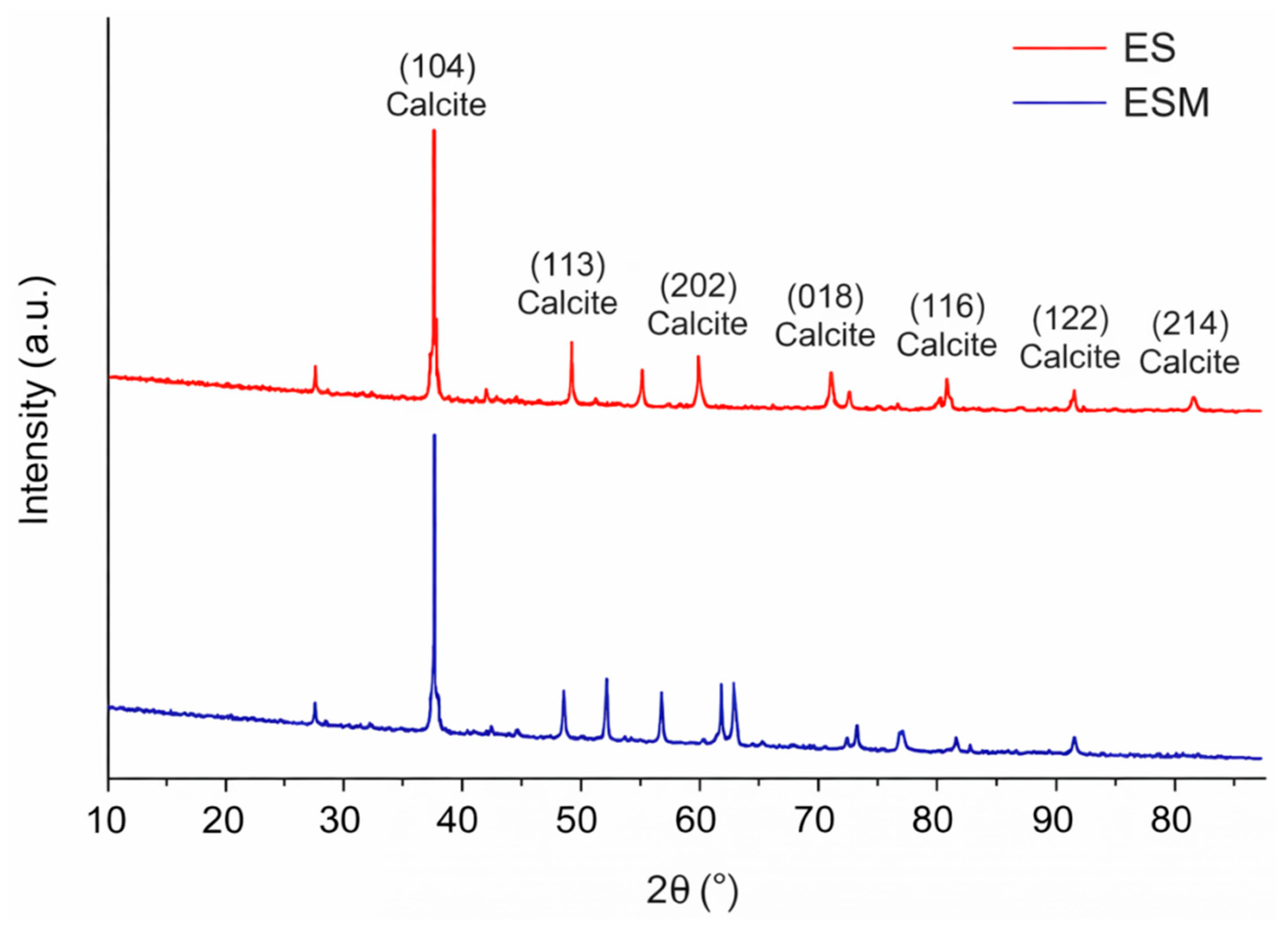
Figure 1 presents the X-ray diffraction (XRD) patterns of eggshell without membrane (ES) and eggshell with membrane (ESM). Phase identification was carried out by comparing the experimental diffraction peaks with reference data from the Joint Committee on Powder Diffraction Standards (JCPDS) database, enabling reliable identification of the crystalline phases present in the samples.
Both ES and ESM exhibit diffraction peaks at identical 2θ positions, indicating that the removal or retention of the organic membrane does not alter the fundamental crystalline structure of the eggshell matrix. The diffractograms are characterized by sharp and well-defined peaks, which can be indexed to the rhombohedral calcite phase of calcium carbonate (CaCO3), confirming that calcite is the dominant crystalline component in both materials. This observation is consistent with previous reports describing eggshells as a highly crystalline CaCO3-based biowaste, with a purity exceeding 90% [17,26].
Although the phase composition is identical, differences in peak intensities are observed between ES and ESM. These variations are attributed to the presence of the organic membrane in the ESM sample, which may influence the relative crystallite orientation and the distribution of calcite crystallites within the material rather than inducing any phase transformation. The membrane, composed mainly of proteinaceous matter rich in functional groups such as hydroxyl and amide moieties, can partially mask the mineral surface or modify local surface environments, leading to changes in diffraction intensity without altering peak positions. Importantly, the absence of additional diffraction peaks or broad amorphous features in both patterns indicates that the organic membrane does not introduce an amorphous inorganic phase detectable by XRD.
From an adsorption perspective, the high crystallinity of calcite observed for both ES and ESM is particularly relevant. Crystalline CaCO3 provides a mechanically stable framework and a chemically homogeneous surface, which favors reproducible adsorption behavior and resistance to structural degradation during adsorption–desorption cycles. At the same time, the retention of the organic membrane in ESM introduces additional surface heterogeneity at the molecular level, which is not reflected in the bulk crystalline structure but can significantly influence adsorption performance. This structural combination explains why both materials share the same mineral backbone while exhibiting different adsorption capacities and affinities toward levomepromazine, as discussed in subsequent adsorption and isotherm analyses.
The absence of secondary calcium carbonate polymorphs (such as aragonite or vaterite) and the lack of amorphous phases further suggest that the adsorption of levomepromazine occurs predominantly on well-defined calcite surfaces and membrane-associated functional groups, rather than on structurally unstable sites. This structural stability supports the suitability of both ES and ESM as low-cost, robust biosorbents for pharmaceutical removal from aqueous environments, in agreement with previous studies on eggshell-derived adsorbents [27].

3.2. Fourier Transform Infrared Spectroscopy (FTIR)

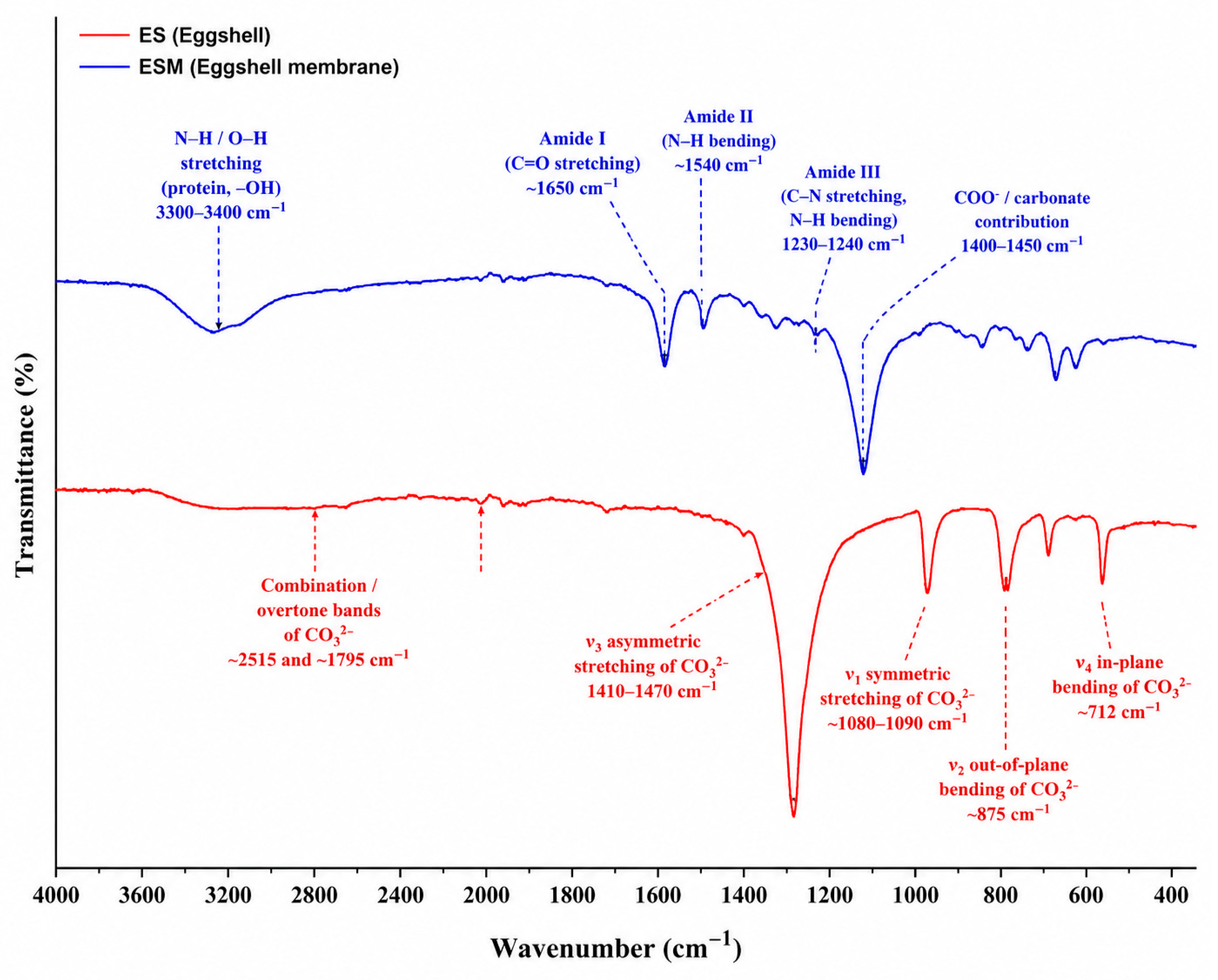
The FT-IR spectra of eggshell samples with membrane (ESM) and without membrane (ES), presented in Figure 2, reveal several characteristic absorption bands that confirm the chemical composition and surface functionalities of the materials.
For ES, the spectrum is dominated by the characteristic vibrational modes of calcite (CaCO3), which constitutes the major mineral component of eggshells. The weak bands observed at approximately 2515 and 1795 cm−1 are attributed to combination and overtone vibrations of carbonate groups. The intense absorption band centered within the 1410–1470 cm−1 region corresponds to the ν3 asymmetric stretching vibration of CO32− ions, while the band located around 1080–1090 cm−1 is assigned to the ν1 symmetric stretching mode of carbonate [28]. Additional characteristic carbonate vibrations are observed at approximately 875 cm−1 and 712 cm−1, corresponding to the ν2 out-of-plane bending and ν4 in-plane bending modes of CO32−, respectively. These bands confirm the predominance of crystalline calcite in the ES sample and are consistent with previously reported FTIR spectra of natural eggshells [29].
In contrast, the ESM spectrum exhibits characteristic absorption bands associated with proteinaceous materials. The broad band observed in the 3300–3400 cm−1 region is assigned to overlapping N–H and O–H stretching vibrations originating from amino acid residues, peptide groups, and adsorbed moisture. The absorption band located near 1650 cm−1 corresponds to the amide I vibration, primarily associated with C=O stretching of peptide bonds, whereas the band around 1540 cm−1 is attributed to amide II vibrations arising from N–H bending and C–N stretching [30]. The band observed at approximately 1230–1240 cm−1 is assigned to amide III vibrations, confirming the presence of collagenous and protein-rich components within the eggshell membrane [31]. The absorption feature observed between 1400 and 1450 cm−1 may result from contributions of carboxylate groups and residual carbonate species [32].
The marked differences between the FTIR spectra of ES and ESM reflect their distinct compositions. While ES is predominantly composed of mineral calcium carbonate, ESM contains a complex network of fibrous proteins rich in amino, amide, hydroxyl, and carboxyl groups [33] may participate in levomepromazine adsorption through hydrogen bonding and electrostatic interactions. However, these interactions should be regarded as proposed adsorption pathways inferred from the experimental results rather than directly demonstrated mechanisms.
Consequently, the FTIR analysis confirms the coexistence of mineral and organic adsorption sites within the investigated biosorbents and supports their potential application in the removal of pharmaceutical contaminants from aqueous media.

3.3. Scanning Electron Microscopy with Energy Dispersive X-Ray Spectroscopy (SEM/EDX)

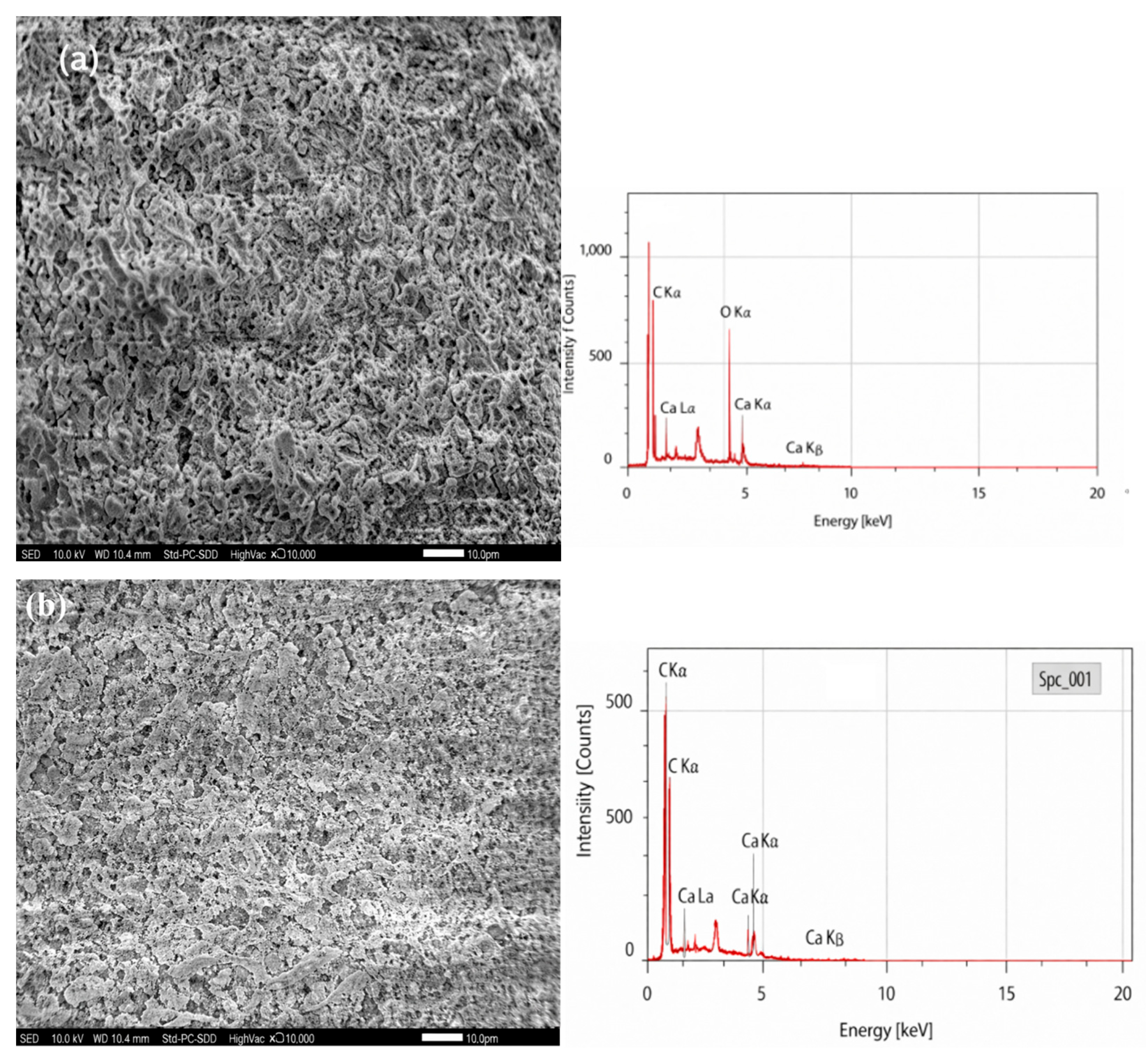
Scanning Electron Microscopy (SEM) analysis of the eggshell without membrane (ES) and eggshell with membrane (ESM) samples reveals that both materials exhibit an irregular, rough, morphology (Figure 3a,b).
A comparative examination of ES and ESM reveals that the membrane-containing sample exhibits a more heterogeneous and textured surface morphology. This difference can be attributed to the presence of the organic membrane, which introduces additional microstructural complexity and surface irregularities. The heterogeneous morphology observed for ESM suggests the existence of distinct surface environments that may influence the accessibility and distribution of surface functional groups [34].
The elemental composition of ES and ESM was further investigated by Energy Dispersive X-ray Spectroscopy (EDS), and the corresponding spectra are presented in Figure 3a (ES) and Figure 3b (ESM). Both samples are mainly composed of calcium (Ca), oxygen (O), and carbon (C), confirming that calcium carbonate (CaCO3) is the predominant constituent of the eggshell structure [35]. These findings are consistent with the XRD and FTIR analyses, which identified calcite as the dominant crystalline phase and carbonate groups as the principal chemical functionalities.
Differences in the relative elemental intensities between ES and ESM were also observed. These variations are attributed to the presence of the eggshell membrane, which contains an organic matrix mainly composed of fibrous proteins and other biomacromolecules [36]. The incorporation of this organic fraction modifies the surface composition and contributes to the distinct morphology observed in the SEM micrographs.
The SEM and EDS results demonstrate that both ES and ESM possess heterogeneous surfaces and are primarily composed of calcium carbonate, with ESM additionally containing an organic membrane component. These structural and compositional differences may contribute to variations in adsorption behavior, which are further evaluated through the adsorption experiments presented in the following sections.

3.4. Thermogravimetric Analysis (TGA)

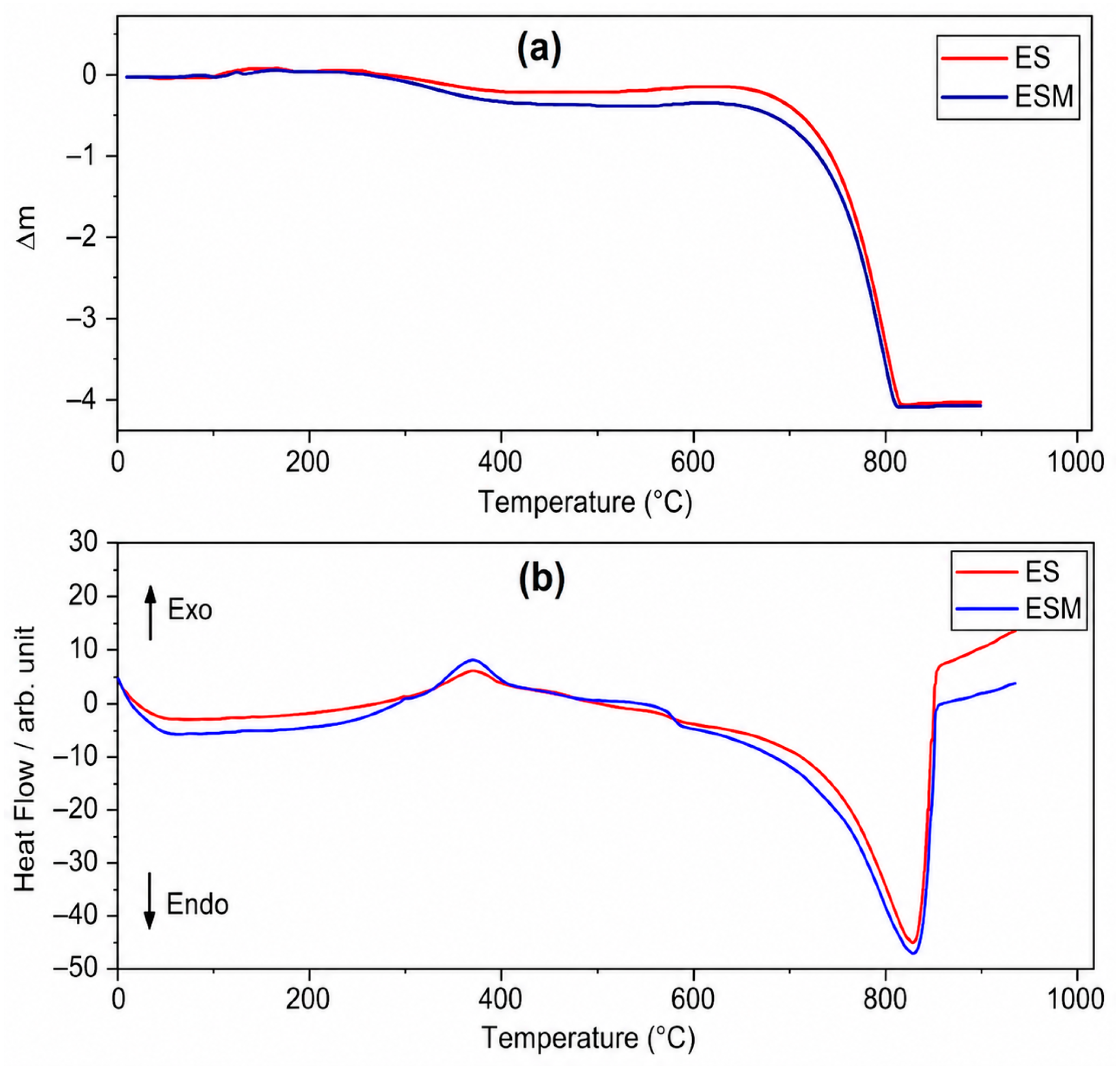
The thermogravimetric analysis (TGA) curves of eggshell (ES) and modified eggshell (ESM) (Figure 4a) reveal two distinct weight loss stages during thermal decomposition.
The thermogravimetric analysis (TGA) curves of eggshell without membrane (ES) and eggshell with membrane (ESM), presented in Figure 4a, exhibit two distinct mass loss stages associated with characteristic thermal events of the materials. The first weight loss region, occurring between 310 and 430 °C for ES and 324–438 °C for ESM, is attributed to the thermal degradation of organic matter present in the samples, in agreement with previous reports [13]. This stage corresponds to the decomposition and volatilization of residual organic compounds, mainly proteins and fibrous constituents originating from the eggshell membrane. The higher mass loss observed for ESM in this temperature range confirms its greater organic content, which is consistent with the FT-IR and SEM–EDS analyses.
The second and most prominent mass loss stage, occurring between 680 and 810 °C for both materials, is associated with the thermal decomposition of calcium carbonate (CaCO3) into calcium oxide (CaO) and carbon dioxide (CO2). This transformation is characteristic of calcite, the dominant crystalline phase of eggshells, and is well documented in the literature [37,38]. The absence of significant mass loss beyond 810 °C indicates the complete decarbonation and confirms the high thermal stability of the inorganic CaCO3 matrix.
The corresponding Differential Thermal Analysis (DTA) curves (Figure 4b) exhibit strong endothermic peaks at approximately 805 °C for ES and 800 °C for ESM, which are attributed to the energy absorption associated with CaCO3 decomposition. These endothermic events are consistent with previously reported thermal behavior of calcite-based materials [27] and further validate the structural integrity of the eggshell-derived adsorbents.
The thermogravimetric analysis confirms the compositional differences between ES and ESM and demonstrates that both materials remain thermally stable over a broad temperature range before undergoing characteristic decomposition processes associated with their mineral and organic constituents.

3.5. Point of Zero Charge (pHPZC)

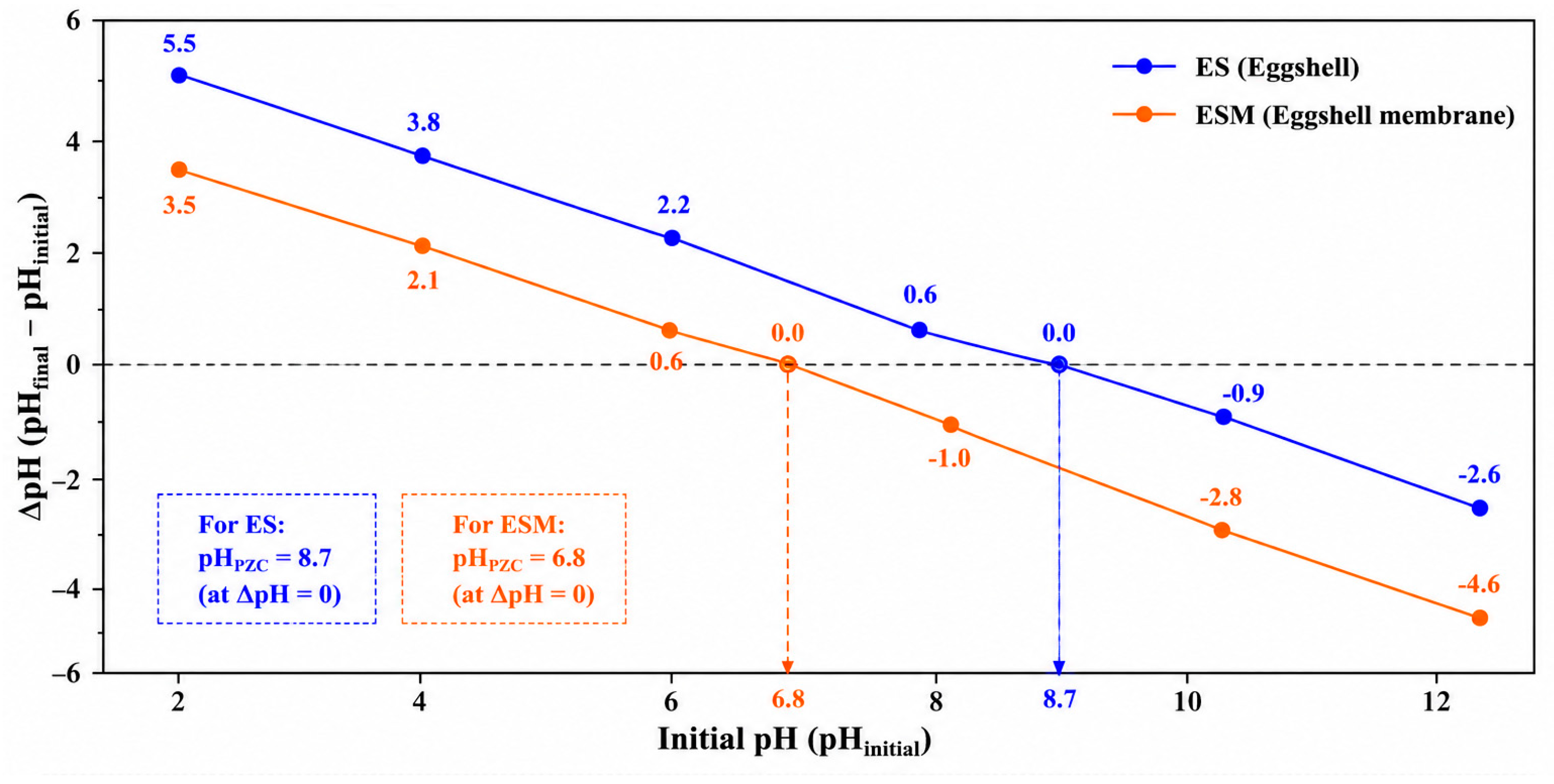
The pHPZC values of ES and ESM were determined using the pH drift method, and the corresponding ΔpH versus initial pH curves are presented in Figure 5. The pHPZC values were found to be approximately 8.7 and 6.8 for ES and ESM, respectively.
As shown in Figure 5, positive ΔpH values were observed at acidic and near-neutral pH conditions, indicating that the final pH increased after equilibration due to proton consumption by the adsorbent surface. Conversely, negative ΔpH values were obtained at alkaline pH values, suggesting the release of protons and the progressive deprotonation of surface functional groups. The transition from positive to negative ΔpH values occurred at pH 8.7 for ES and pH 6.8 for ESM, corresponding to the respective pHPZC values of the two materials.
The higher pHPZC value observed for ES is attributed to its mineral composition, which is predominantly composed of calcium carbonate (CaCO3). Carbonate-rich materials generally exhibit alkaline surface properties and therefore possess relatively high pHPZC values. In contrast, the lower pHPZC value of ESM is associated with the presence of proteinaceous components containing amino, carboxyl, and amide groups, which contribute to a more acidic surface character [39].
The pHPZC results provide valuable information regarding the electrostatic interactions involved in levomepromazine adsorption. Under the optimum adsorption conditions identified in this study (pH 10), the solution pH is higher than the pHPZC values of both ES and ESM. Consequently, the surfaces of both adsorbents are expected to be predominantly negatively charged due to the deprotonation of hydroxyl, carbonate, and protein-related functional groups. This negatively charged surface promotes electrostatic attraction with positively charged species of levomepromazine, thereby enhancing adsorption efficiency [40].
Furthermore, the higher pHPZC value of ES indicates a greater resistance to surface deprotonation and a stronger alkaline character compared with ESM. This observation is consistent with the slightly higher adsorption capacity exhibited by ES at elevated levomepromazine concentrations. Overall, the pHPZC analysis confirms that surface charge plays an important role in the adsorption process and supports the proposed mechanism involving electrostatic attraction in combination with hydrogen bonding and surface complexation interactions.

3.6. Adsorptive Removal of Levomepromazine from Aqueous Solutions

3.6.1. Effect of pH

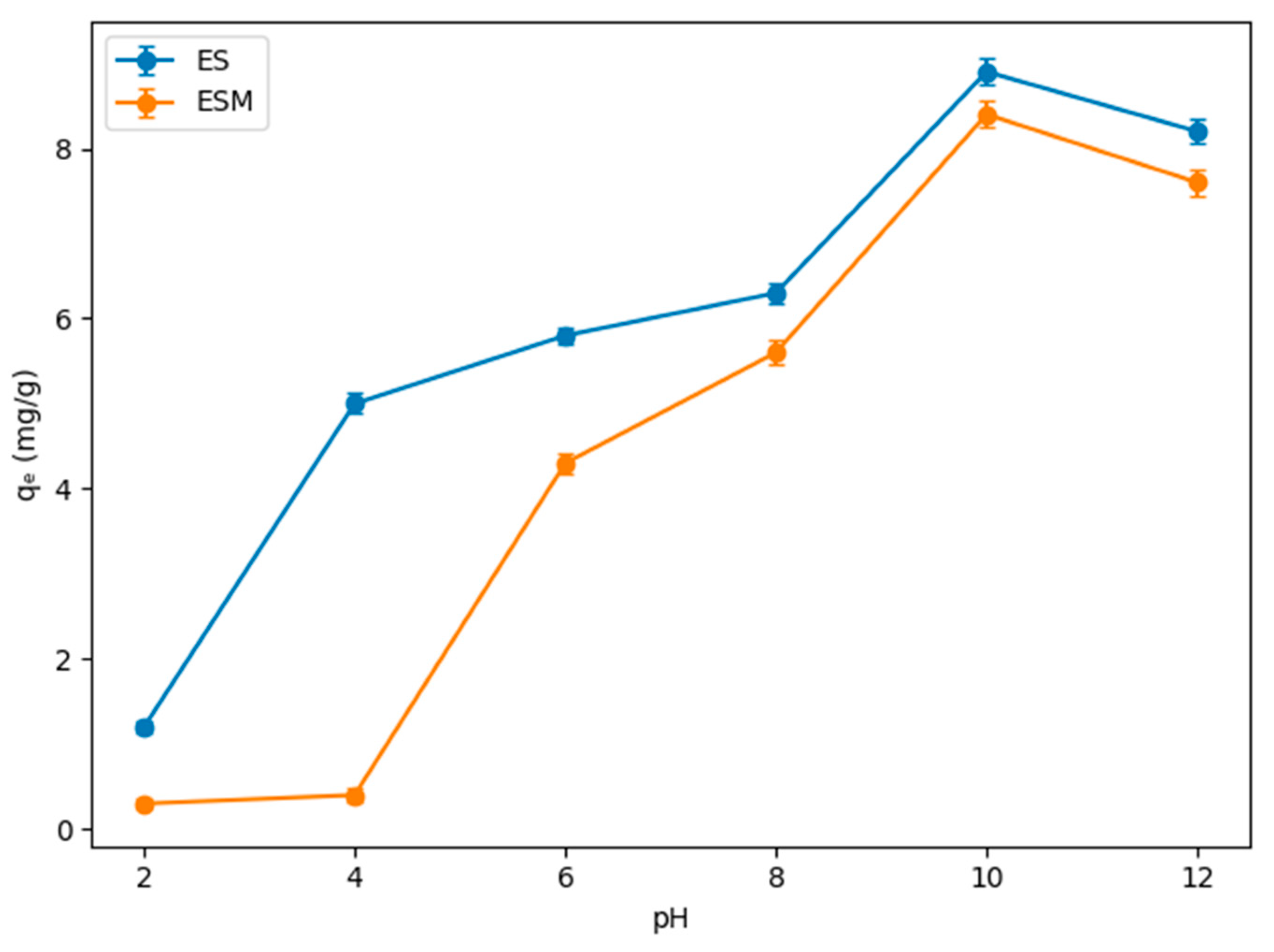
The pH of the aqueous medium is a key parameter governing the adsorption of levomepromazine, as it simultaneously influences the ionization state of the pharmaceutical compound and the surface charge characteristics of the eggshell-derived adsorbents. To investigate this effect, batch adsorption experiments were conducted over a pH range of 2–12 at 25 °C, using an initial levomepromazine concentration of 20 mg·L−1 and a contact time of 3 h. This approach allowed identification of the optimal pH for adsorption and provided insight into the dominant interaction mechanisms involved in the process (Figure 6).
As shown in Figure 6, the adsorption capacity of levomepromazine increased progressively with increasing solution pH for both eggshell without membrane (ES) and eggshell with membrane (ESM). The lowest adsorption capacities were observed under acidic conditions (pH 2–4), whereas the maximum adsorption capacities reached 8.94 mg·g−1 and 7.63 mg·g−1 for ES and ESM, respectively, at pH 10.
The influence of pH can be explained by considering both the surface charge properties of the adsorbents and the acid–base behavior of levomepromazine. The pHPZC values determined for ES and ESM were 8.7 and 6.8, respectively. Consequently, at pH values above the pHPZC, the adsorbent surfaces become predominantly negatively charged due to the deprotonation of carbonate, hydroxyl, and membrane-related functional groups [39]. In contrast, at pH values below the pHPZC, protonation of surface sites results in a less favorable surface charge environment for adsorption.
Levomepromazine is a weakly basic pharmaceutical compound with a reported pKa of approximately 9.2. Therefore, it predominantly exists in its protonated form over most of the investigated pH range and progressively converts to a neutral species as the pH approaches and exceeds its pKa. Under alkaline conditions, particularly around pH 10, the negatively charged adsorbent surface may favor interactions with levomepromazine molecules, contributing to the enhanced adsorption observed experimentally.
The lower adsorption capacities recorded under acidic conditions may be attributed to several factors. First, excess H+ ions compete with levomepromazine molecules for available adsorption sites. Second, partial dissolution of the calcium carbonate matrix may occur at low pH according to [41]:
CaCO3 + 2H+ → Ca2+ + CO2 + H2O
This process can alter the surface properties of the adsorbent and reduce the number of available adsorption sites. Similar behavior has been reported for carbonate-based adsorbents under acidic conditions.
The slight plateau observed at pH values above 10 may indicate that adsorption equilibrium is approached and that the available adsorption sites become progressively occupied. Overall, the results demonstrate that solution pH is a key parameter controlling levomepromazine adsorption and that the highest adsorption performance is achieved under mildly alkaline conditions. Consequently, pH 10 was selected as the optimum pH for all subsequent adsorption experiments.

3.6.2. Effect of Adsorbent Mass

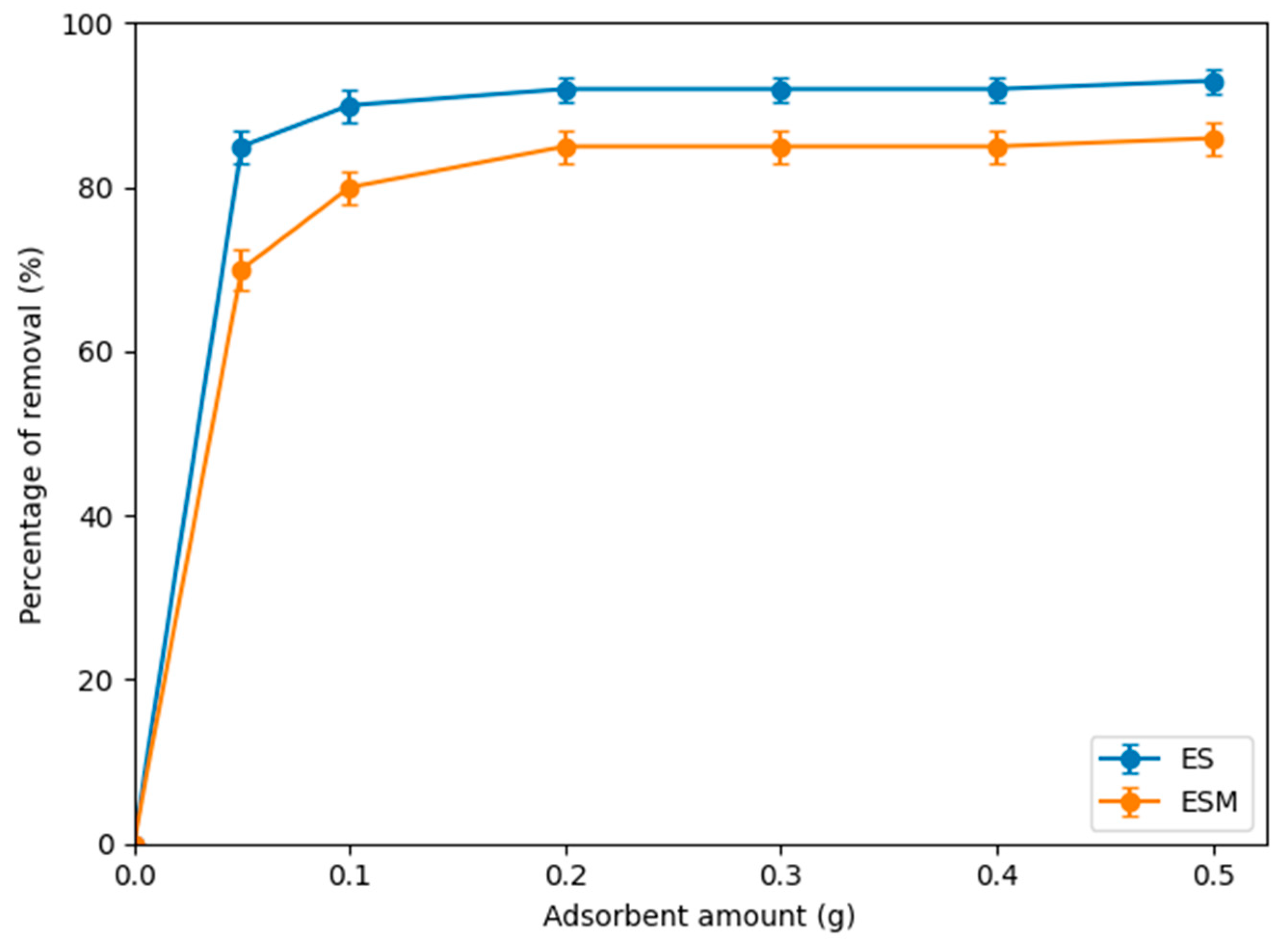
Figure 7 illustrates the influence of adsorbent dosage on the removal efficiency of levomepromazine using eggshell without membrane (ES) and eggshell with membrane (ESM). All experiments were conducted at 25 °C with an initial levomepromazine concentration of 20 mg·L−1 and a contact time of 3 h. As expected, the adsorption efficiency increases with increasing adsorbent dosage, reflecting the direct relationship between adsorbent mass and the number of available active sites.
A pronounced enhancement in removal efficiency is observed when the adsorbent dosage is increased from 0.5 to 2 g·L−1. Within this range, the removal efficiency reaches 89.85% for ES and 84.99% for ESM. The increase in adsorption efficiency may be associated with differences in surface morphology and the accessibility of surface functional groups, which enhances the probability of interactions between levomepromazine molecules and the adsorbent surface. The higher number of accessible sites facilitates effective mass transfer and promotes adsorption through electrostatic interactions and surface binding mechanisms.
Beyond an adsorbent dosage of 2 g·L−1, the removal efficiency exhibits a plateau and remains nearly constant up to 5 g·L−1. The increase in adsorption capacity became less pronounced at higher adsorbent dosages, suggesting that the available levomepromazine molecules in solution became insufficient to fully utilize the increasing number of adsorption sites. Consequently, further increases in adsorbent dosage did not result in a proportional enhancement of adsorption performance under the investigated conditions. At this stage, the concentration of levomepromazine in solution becomes the limiting factor, and the available adsorption sites exceed the number of adsorbate molecules. Consequently, further increases in adsorbent mass do not result in a significant improvement in removal efficiency. Similar saturation behavior has been widely reported in adsorption systems and is commonly associated with site saturation and equilibrium constraints [42].
The slightly higher removal efficiency observed for ES compared to ESM at equivalent dosages may be related to differences in surface accessibility and site distribution. While the membrane in ESM contributes additional functional groups, it may also partially hinder access to mineral adsorption sites, leading to marginally lower removal efficiencies under identical conditions.
The results demonstrate that eggshell-derived materials (ES and ESM) exhibit promising adsorption performance toward levomepromazine under the optimized experimental conditions investigated in this study. The adsorption process was found to be spontaneous, endothermic, and predominantly governed by physical interactions, resulting in appreciable adsorption capacities and favorable equilibrium behavior. However, it should be noted that the reported performance was obtained under controlled laboratory conditions, including alkaline pH (pH 10), a relatively high adsorbent dosage (2 g·L−1), and synthetic aqueous solutions containing a single contaminant.

3.6.3. Effect of Contact Time

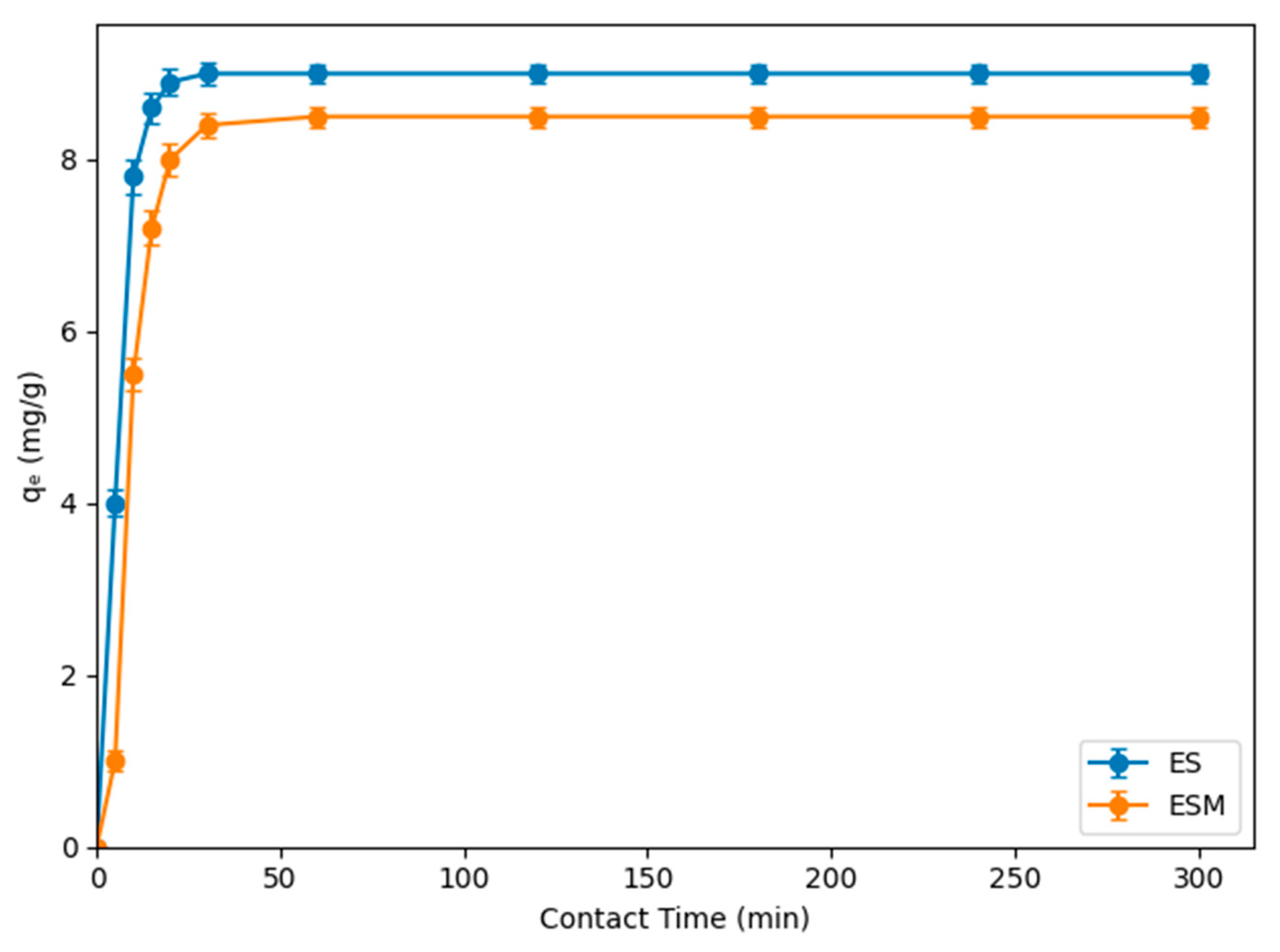
The objective of this study was to determine the equilibrium contact time required for the adsorption of levomepromazine onto eggshell without membrane (ES) and eggshell with membrane (ESM). The influence of contact time on adsorption performance was investigated under optimized conditions (T = 25 °C, pH = 10, adsorbent dosage = 2 g·L−1, and initial levomepromazine concentration = 20 mg·L−1), previously identified as favorable for maximum adsorption efficiency (Figure 8).
As illustrated in Figure 8, the adsorption of levomepromazine onto both ES and ESM follows a characteristic two-stage kinetic behavior. The first stage is marked by a rapid increase in adsorption capacity within the initial 20 min of contact. This fast uptake can be attributed to the high availability of vacant active sites on the adsorbent surfaces and the strong concentration gradient between the aqueous phase and the solid interface, which collectively promote efficient external mass transfer and rapid surface adsorption.
Following this initial phase, the adsorption rate decreases progressively, indicating the gradual occupation of active sites and an increase in mass transfer resistance as the system approaches equilibrium. During this stage, adsorption is likely governed by slower diffusion processes, including intraparticle diffusion and surface rearrangement of adsorbed molecules. Equilibrium was reached after approximately 60 min for both ES and ESM, beyond which no significant increase in adsorption capacity was observed. This behavior confirms that a dynamic equilibrium between adsorption and desorption processes had been established.
A comparative assessment of the two materials shows that ES consistently exhibits slightly higher adsorption capacities than ESM throughout the adsorption period. This difference may be attributed to the absence of the organic membrane in ES, which can result in greater exposure of the mineral CaCO3 surface and more accessible adsorption sites. In contrast, although the membrane in ESM introduces additional functional groups, it may partially hinder access to mineral adsorption sites, leading to marginally lower adsorption capacities under identical conditions. Nevertheless, both adsorbents display stable and reproducible adsorption behavior once equilibrium is achieved.
The relatively short equilibrium time observed in this study is in good agreement with previously reported adsorption systems involving eggshell-derived and mineral-based biosorbents [43,44]. This rapid attainment of equilibrium highlights the high affinity of levomepromazine for the eggshell-based materials and underscores their potential for practical wastewater treatment applications, where reduced contact time and high process efficiency are critical considerations.

Kinetic Models

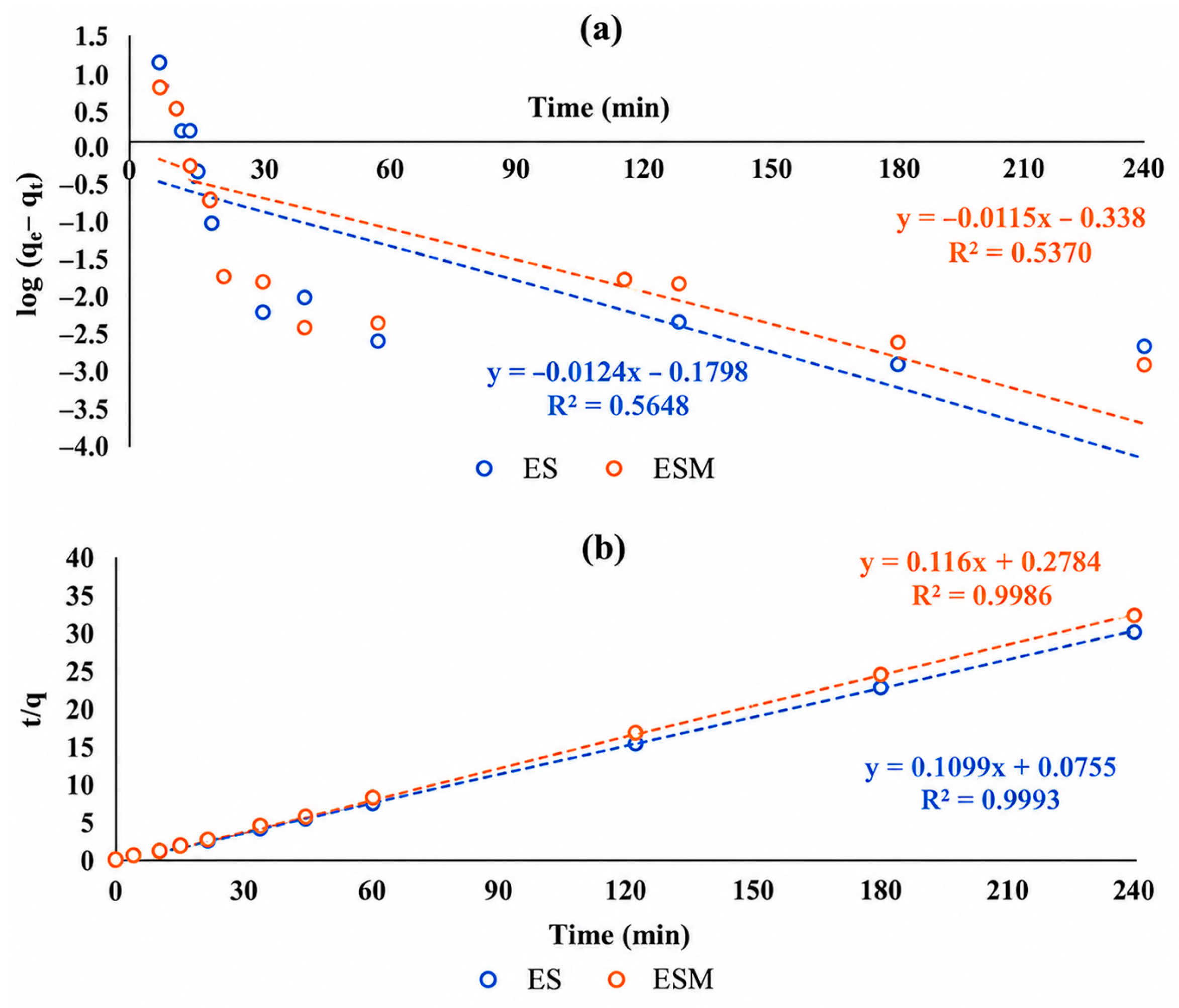
The adsorption kinetics of levomepromazine onto eggshell without membrane (ES) and eggshell with membrane (ESM) were investigated using the pseudo-first-order (PFO) and pseudo-second-order (PSO) kinetic models. The corresponding linearized plots are presented in Figure 9, where Figure 9a illustrates the PFO model and Figure 9b represents the PSO model. The kinetic parameters derived from these models, including rate constants, theoretical adsorption capacities, and regression coefficients, are summarized in Table 3, allowing a quantitative comparison of the suitability of each model in describing the adsorption process.
The kinetic parameters obtained from the pseudo-first-order (PFO) and pseudo-second-order (PSO) models are summarized in Table 3. Comparison of the correlation coefficients and calculated adsorption capacities indicates that the PSO model describes the adsorption kinetics of levomepromazine on both ES and ESM more accurately than the PFO model. The PFO model exhibited relatively low correlation coefficients and substantially underestimated the equilibrium adsorption capacities, demonstrating poor agreement with the experimental data [45].
In contrast, the PSO model provided an excellent fit for both adsorbents, with correlation coefficients approaching unity and calculated adsorption capacities that closely matched the experimental values. These results indicate that the PSO model adequately describes the adsorption process under the investigated conditions and suggest that the overall adsorption rate is strongly influenced by interactions occurring at the adsorbent surface. A comparison between the two adsorbents shows that ES exhibited slightly higher adsorption capacity and faster adsorption kinetics than ESM. This behavior may be related to differences in surface accessibility and the distribution of active sites. The presence of the membrane introduces additional organic components that may partially cover or hinder access to the mineral surface of the eggshell, resulting in a slight reduction in adsorption performance [44].
The kinetic analysis demonstrates that the pseudo-second-order model is the most suitable model for describing levomepromazine adsorption onto both ES and ESM. The results further indicate that unmodified eggshells exhibit slightly superior adsorption performance compared with membrane-containing eggshells under the investigated experimental conditions [46].

3.6.4. Effect of Initial Concentration

Adsorption isotherm experiments were carried out at different initial concentrations of levomepromazine in order to investigate the equilibrium adsorption behavior of eggshell without membrane (ES) and eggshell with membrane (ESM) (Figure 10).
As shown in Figure 10, the adsorption capacity of both ES and ESM increases progressively with increasing initial levomepromazine concentration. This behavior can be attributed to the enhanced driving force for mass transfer at higher solute concentrations, which promotes the diffusion of levomepromazine molecules from the bulk solution toward the available adsorption sites on the adsorbent surface. At low concentrations, the abundance of vacant active sites allows efficient uptake of levomepromazine, resulting in a sharp increase in qe.
With further increases in concentration, the adsorption capacity continues to rise but at a slower rate, eventually approaching a plateau at concentrations above approximately 120 mg·L−1. This plateau indicates the progressive saturation of the available adsorption sites and the establishment of adsorption equilibrium. Beyond this concentration, additional levomepromazine molecules remain in solution, as the adsorbent surface becomes increasingly occupied and no longer able to accommodate further adsorption under the given conditions.
A comparative analysis of the two adsorbents reveals that ES consistently exhibits a slightly higher adsorption capacity than ESM, particularly at higher levomepromazine concentrations. This difference suggests that the removal of the organic membrane enhances the accessibility of mineral CaCO3 surfaces in ES, providing a greater number of effective adsorption sites or facilitating stronger interactions with levomepromazine molecules [44]. In contrast, the presence of the membrane in ESM, although introducing additional functional groups, may partially limit access to mineral adsorption sites, resulting in marginally lower adsorption capacities at equilibrium [47].
Despite these differences, both ES and ESM demonstrate similar isotherm profiles and high adsorption capacities, confirming their strong affinity for levomepromazine and their effectiveness as low-cost biosorbents. The observed equilibrium behavior is consistent with previously reported studies on eggshell-derived materials used for pharmaceutical adsorption [40,41]. Overall, these results highlight the suitability of eggshell-based adsorbents for the removal of pharmaceutical contaminants from aqueous systems and provide a solid basis for further isotherm modeling and mechanistic interpretation.

Isotherm Models

The equilibrium adsorption behavior of levomepromazine onto eggshell without membrane (ES) and eggshell with membrane (ESM) was systematically evaluated using multiple adsorption isotherm models, including Langmuir, Freundlich, Dubinin–Radushkevich (D–R), Temkin. The linearized forms of the Langmuir, Freundlich, D–R, and Temkin models are presented in Figure 11a–d, while the corresponding isotherm parameters derived from these models are summarized in Table 4. This multi-model approach provides valuable insights into adsorption capacity, surface heterogeneity, and the nature of adsorbent–adsorbate interactions, thereby contributing to a better understanding of the adsorption behavior of levomepromazine on the investigated materials.
The equilibrium adsorption parameters obtained from the Langmuir, Freundlich, Temkin, and Dubinin–Radushkevich (D–R) isotherm models are summarized in Table 4, while the corresponding linearized plots are presented in Figure 11. Comparison of the correlation coefficients reveals that the Freundlich model provided the best statistical description of the experimental equilibrium data for both ES and ESM, with correlation coefficients of 0.997 and 0.995, respectively. These values were slightly higher than those obtained with the Langmuir model (0.976 for ES and 0.982 for ESM), indicating that the Freundlich equation more accurately represents the adsorption behavior of levomepromazine under the investigated conditions.
The good agreement obtained with the Freundlich model suggests that the adsorbent surfaces are not perfectly homogeneous and may contain adsorption sites exhibiting different energy distributions. This observation is consistent with the structural and compositional heterogeneity revealed by the SEM, EDS, FTIR, and pHPZC analyses, particularly for ESM, which contains both mineral and organic components. In addition, the Freundlich constants indicated favorable adsorption behavior over the investigated concentration range [43].
Although the Freundlich model provided the highest correlation coefficients, the Langmuir model also exhibited satisfactory agreement with the experimental data. The relatively high Langmuir correlation coefficients suggest that a portion of the adsorption process may occur on adsorption sites with similar energetic characteristics. Furthermore, the maximum adsorption capacities predicted by the Langmuir model were consistent with the experimentally observed adsorption capacities, supporting the internal consistency of the equilibrium data. Therefore, the adsorption behavior appears to exhibit characteristics that can be reasonably described by both Freundlich and Langmuir approaches, although the Freundlich model provides the superior statistical fit [44].
The Temkin model also adequately represented the adsorption equilibrium, with correlation coefficients exceeding 0.96 for both adsorbents. The applicability of the Temkin model suggests that adsorbate–surface interactions may contribute to the adsorption process and that the adsorption energy is not strictly constant over the entire surface coverage range. However, the Temkin model provided a less accurate description of the equilibrium data than the Freundlich model [43].
In contrast, the Dubinin–Radushkevich model exhibited considerably lower correlation coefficients (R2 < 0.80) for both adsorbents. These results indicate that the D–R equation is less suitable for describing the adsorption equilibrium of levomepromazine onto ES and ESM. Consequently, the parameters derived from this model should be interpreted with caution, and no definitive conclusions regarding the adsorption mechanism were drawn from the D–R analysis alone [48].
A comparison between the two adsorbents reveals that ES consistently exhibited slightly higher adsorption capacities than ESM. This difference may be attributed to variations in surface accessibility and the distribution of adsorption sites resulting from the presence of the membrane. The organic membrane may partially cover mineral adsorption sites, thereby reducing their accessibility to levomepromazine molecules [49].
Overall, the equilibrium analysis indicates that levomepromazine adsorption onto ES and ESM is best described by the Freundlich isotherm model, suggesting adsorption on energetically heterogeneous surfaces. The satisfactory performance of the Langmuir and Temkin models further indicates that the adsorption process is influenced by multiple surface characteristics. Nevertheless, the isotherm models should be regarded as tools for describing adsorption behavior and surface properties rather than as definitive evidence of the underlying adsorption mechanism.

3.6.5. Thermodynamic Study

The thermodynamic behavior of levomepromazine onto eggshell without membrane (ES) and eggshell with membrane (ESM) was evaluated using Van’t Hoff plots of ln(Kc) versus 1/T, as shown in Figure 12, with the corresponding apparent thermodynamic parameters summarized in Table 5.
The Van’t Hoff plots of ln Kc versus 1/T show a clear linear dependence for both eggshell without membrane (ES) and eggshell with membrane (ESM), with high correlation coefficients (R2 = 0.994 for ES and 0.992 for ESM). This linearity confirms that the adsorption equilibrium of levomepromazine is strongly temperature dependent and that the thermodynamic parameters derived from the Van’t Hoff equation are reliable within the investigated temperature range (298–318 K).
The positive values of the standard enthalpy change (ΔH° = 18.72 kJ·mol−1 for ES and 15.94 kJ·mol−1 for ESM) indicate that the adsorption process is endothermic for both materials. These moderate enthalpy values, well below those typically associated with strong chemical bonding (>40 kJ·mol−1), suggest that adsorption proceeds primarily through physical interactions. The higher ΔH° value observed for ES reflects a slightly greater energy requirement for adsorption, which is consistent with its higher adsorption capacity and stronger temperature sensitivity compared to ESM.
The positive entropy changes (ΔS° = 72.48 J·mol−1·K−1 for ES and 61.37 J·mol−1·K−1 for ESM) indicate an increase in randomness at the solid–solution interface during adsorption. This entropy gain is generally attributed to the release of water molecules from the hydration shells of both levomepromazine molecules and surface functional groups upon adsorption. The higher ΔS° value for ES suggests a more pronounced interfacial reorganization, which correlates with its higher adsorption efficiency relative to ESM.
The standard Gibbs free energy changes (ΔG°) are negative for both adsorbents at all studied temperatures, confirming that adsorption is thermodynamically spontaneous. For ES, ΔG° decreases from −2.90 kJ·mol−1 at 298 K to −4.35 kJ·mol−1 at 318 K, while for ESM it decreases from −2.31 kJ·mol−1 to −3.54 kJ·mol−1 over the same temperature range. The increasingly negative ΔG° values with rising temperature indicate that adsorption spontaneity is enhanced at higher temperatures, in agreement with the positive ΔH° and ΔS° values and the experimentally observed increase in adsorption capacity at elevated temperatures [50].
The thermodynamic analysis demonstrates that levomepromazine adsorption onto ES and ESM is spontaneous, endothermic, and entropy-driven, with adsorption governed predominantly by physical interactions. The consistently higher ΔH°, ΔS°, more negative ΔG°, values obtained for ES explain its superior adsorption performance compared to ESM. These thermodynamic results are fully coherent with the kinetic and isotherm analyses and confirm the suitability of eggshell-derived materials as efficient biosorbents for pharmaceutical removal from aqueous solutions.
It should be noted that the thermodynamic parameters reported in this study were estimated from equilibrium data obtained at a fixed initial levomepromazine concentration. Consequently, they should be considered apparent thermodynamic parameters rather than rigorous standard thermodynamic quantities. A more comprehensive thermodynamic evaluation would require complete adsorption isotherms determined at several temperatures to establish temperature-dependent equilibrium constants and construct a more rigorous Van’t Hoff analysis. This aspect will be addressed in future investigations [45].

3.6.6. Mechanism of Levomepromazine Adsorption onto ES and ESM

FTIR Analysis of ES and ESM after levomepromazine adsorption.
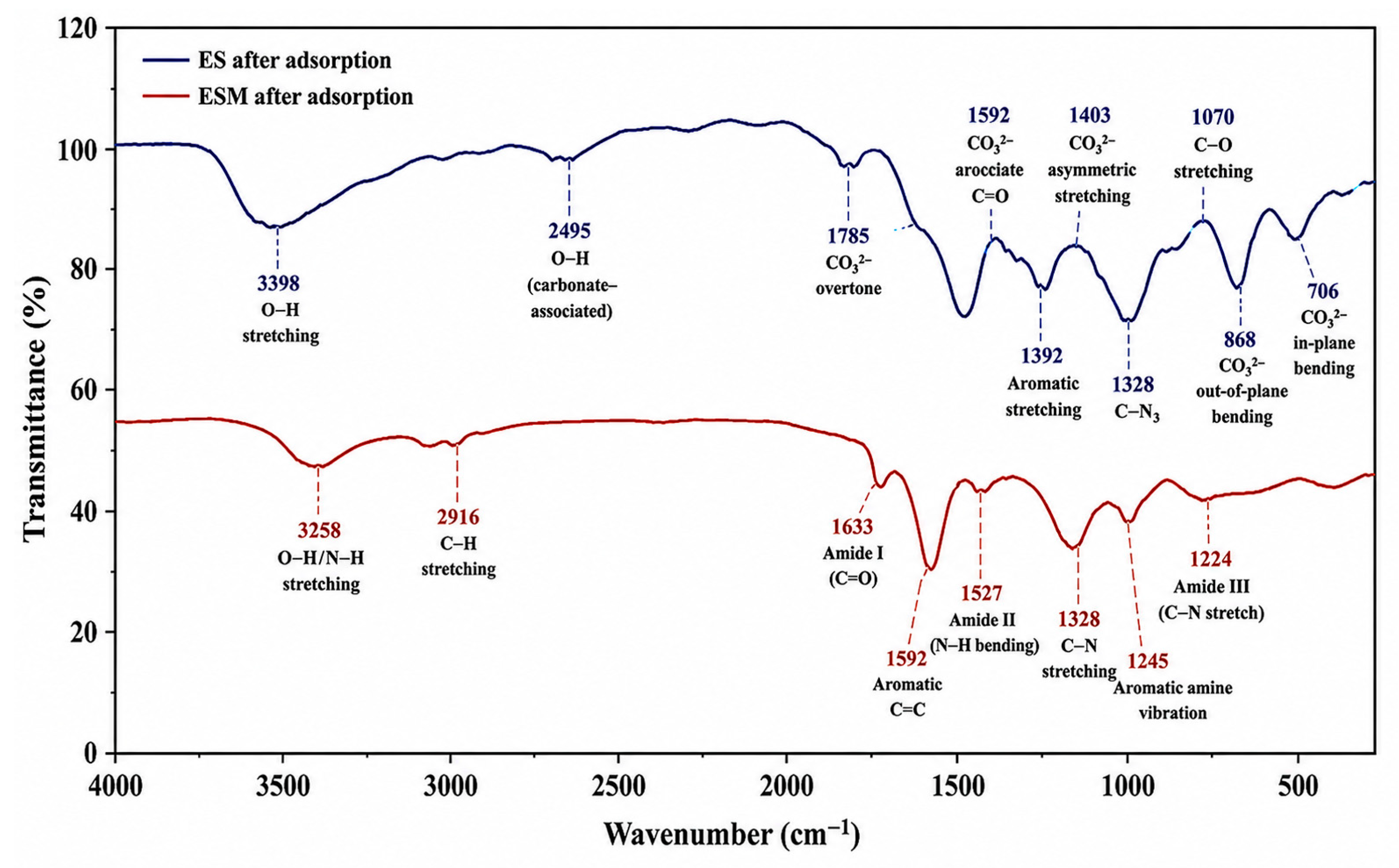
To gain further insight into the adsorption mechanism of levomepromazine onto eggshell-derived adsorbents, the FTIR spectra of ES and ESM after adsorption were examined (Figure 13). Several modifications in the characteristic absorption bands were observed, indicating the participation of surface functional groups in the adsorption process.
For ES, the broad band centered at approximately 3398 cm−1 corresponds to O–H stretching vibrations and suggests the involvement of hydroxyl groups in hydrogen-bonding interactions with levomepromazine molecules. The carbonate-associated bands located at 1403, 868, and 706 cm−1 remained prominent after adsorption, confirming that the calcium carbonate matrix constitutes the principal adsorption framework. However, slight variations in the intensity and position of these bands indicate that carbonate groups may contribute to the adsorption process through electrostatic interactions and surface complexation. Furthermore, the appearance of new absorption bands at 1592 and 1328 cm−1, assigned to aromatic C=C and C–N vibrations originating from levomepromazine, confirms the successful immobilization of the drug molecules on the eggshell surface [43].
For ESM, characteristic protein-related bands were observed at 1633 cm−1 (amide I), 1527 cm−1 (amide II), and 1224 cm−1 (amide III). The presence and slight displacement of these bands suggest that amino, amide, and peptide functional groups contained within the membrane structure participate in the adsorption process. Similar to ES, additional bands at 1592 and 1328 cm−1 were detected, providing further evidence of levomepromazine adsorption onto the membrane surface [51].
The FTIR results therefore indicate that levomepromazine adsorption is governed by multiple interaction mechanisms rather than a single adsorption pathway. The participation of hydroxyl, carbonate, and amide functional groups suggests that hydrogen bonding and electrostatic attraction play important roles in the adsorption process. These findings are consistent with the pH-dependent adsorption behavior, which demonstrated enhanced adsorption under alkaline conditions, as well as with the pseudo-second-order kinetic model, which indicates strong adsorbent–adsorbate interactions. Consequently, the adsorption of levomepromazine onto ES and ESM can be attributed to a combination of hydrogen bonding, electrostatic interactions, π–electron interactions involving the aromatic rings of levomepromazine, and surface complexation with functional groups present on the adsorbent surfaces.
Proposed adsorption mechanism of levomepromazine on ES and ESM.
The adsorption of levomepromazine onto eggshell-derived adsorbents (ES and ESM) was interpreted based on the combined analysis of pHPZC measurements, FTIR characterization before and after adsorption, and adsorption experiments. Although the available data do not allow the adsorption mechanism to be established unequivocally, they provide useful information regarding the interactions that may contribute to levomepromazine uptake. Eggshell materials are mainly composed of crystalline calcium carbonate (CaCO3), whose surface chemistry is strongly influenced by solution pH. Under alkaline conditions, particularly at pH 10 where the highest adsorption capacities were observed, surface hydroxyl and carbonate groups may undergo deprotonation, generating negatively charged adsorption sites (Figure 14).
The surface deprotonation reactions can be represented as:
≡Ca–OH ⇌ ≡Ca–O + H+
≡CO3H ⇌ ≡CO3 + H+
These reactions are consistent with the pHPZC results and may contribute to the increase in negatively charged surface sites as the solution pH increases.
Levomepromazine contains protonatable amine groups and may exist in protonated and neutral forms depending on the solution pH [44]. The protonation equilibrium can be represented as:
LMP–NH + H+ ⇌ LMP–NH2+
Under the investigated conditions, electrostatic interactions between negatively charged surface sites and protonated levomepromazine species may contribute to the adsorption process. A possible interaction can be represented schematically as:
≡CO3 + LMP–NH2+ ⇌ ≡CO3···NH2+–LMP
In addition, FTIR spectra obtained after adsorption revealed slight changes in carbonate-, hydroxyl-, and amide-related bands together with the appearance of characteristic levomepromazine bands. These observations suggest that hydroxyl, carbonate, and membrane-associated functional groups may participate in adsorbate–surface interactions. Consequently, hydrogen bonding may also contribute to the stabilization of adsorbed levomepromazine molecules, for example through interactions such as:
≡Ca–OH···N–LMP
or
   ≡CO3···H–N–LMP
Furthermore, weak van der Waals interactions may participate in the overall adsorption process and contribute to the stabilization of adsorbed molecules at the adsorbent surface.
The slightly higher adsorption capacity observed for ES compared with ESM may be related to differences in surface accessibility resulting from the presence of the organic membrane. While the membrane introduces additional functional groups, it may also partially cover mineral adsorption sites and modify the accessibility of the calcium carbonate surface [14].
Overall, the combined interpretation of pHPZC measurements, FTIR analyses, adsorption equilibrium, and kinetic studies suggests that levomepromazine adsorption onto ES and ESM may involve a combination of electrostatic attraction, hydrogen bonding, and weak intermolecular interactions. However, additional characterization techniques such as zeta potential measurements, XPS analysis, or advanced spectroscopic investigations would be required to establish the adsorption mechanism conclusively.

3.6.7. Desorption and Reuse Study

The regeneration and reuse performance of eggshell without membrane (ES) and eggshell with membrane (ESM) were evaluated over five consecutive adsorption–desorption cycles using NaOH (0.1 M) and HCl (0.1 M) as regenerating agents. The results are presented in Figure 15.
For both adsorbents, regeneration with NaOH resulted in higher adsorption efficiencies and better retention of adsorption performance over successive cycles compared with HCl.
When NaOH was used as the desorbing agent, ES retained approximately 81.5% of its initial adsorption efficiency after five cycles (92% to 75%), whereas ESM retained approximately 80.9% of its initial performance (89% to 72%). In contrast, regeneration with HCl led to a more pronounced decline in adsorption efficiency. The adsorption efficiency of ES decreased from 80% in the first cycle to 48% after the fifth cycle, while ESM decreased from 76% to 44% over the same period.
The superior regeneration performance observed with NaOH may be attributed to its greater ability to promote desorption of levomepromazine molecules from the adsorbent surface while preserving the adsorption capacity of the material. Conversely, acidic regeneration may induce partial dissolution of the calcium carbonate matrix according to:
CaCO3 + 2H+ → Ca2+ + CO2 + H2O
Such dissolution may progressively reduce the number of available adsorption sites, resulting in the more significant decrease in adsorption efficiency observed for HCl-treated samples [52].
For both regenerating agents, ES consistently exhibited slightly higher adsorption efficiencies than ESM throughout the regeneration cycles. This behavior may be associated with differences in surface accessibility resulting from the presence of the organic membrane. The membrane may partially hinder access to mineral adsorption sites and affect regeneration efficiency during repeated adsorption–desorption operations [53].
The relatively small error bars observed throughout the experiments indicate good reproducibility of the regeneration tests. Although a gradual decrease in adsorption efficiency was observed with increasing cycle number, both materials maintained a substantial fraction of their initial adsorption performance after repeated regeneration, particularly when NaOH was employed.
Overall, the regeneration study demonstrates that eggshell-derived adsorbents can be reused over multiple adsorption–desorption cycles and that NaOH is a more effective regenerating agent than HCl for maintaining adsorption performance. These results support the potential applicability of ES and ESM as low-cost and reusable adsorbents for the removal of pharmaceutical contaminants from aqueous media.

3.7. Optimization of the Adsorption Process

3.7.1. Final Regression Model in Terms of Coded Variables

Within the framework of response surface methodology, the relationship between levomepromazine adsorption capacity and the selected operating parameters was described using a second-order polynomial model expressed in coded variables. The coded form of the model is particularly useful for evaluating the relative contribution of each factor and their interactions, as it allows direct comparison of regression coefficients independent of unit scales. Based on 25 experimental runs generated by the Box–Behnken design, the final quadratic model for levomepromazine adsorption capacity (qa) is expressed as:
Quantity adsorbed = 24.43 − 47.32 × A + 4.94 × B + 22.51 × C + 0.6325 × D − 6.14×A × B − 32.19 × A × C + 1.67 × AD +1.75 × B × C +0.6708 × B × D+ 0.8353 × CD +36.65 × A2 +1.54 × B2 − 10.94 × C2 + 0.8595 × D2
where A, B, C, and D represent the coded values of adsorbent amount, solution pH, initial levomepromazine concentration, and contact time, respectively. The intercept term corresponds to the overall mean response of the experimental design, while the coefficients quantify the magnitude and direction of the individual, interaction, and quadratic effects [54]. The sign and magnitude of the coefficients indicate that adsorbent dosage and initial concentration exert the strongest influence on adsorption capacity.

3.7.2. Analysis of Variance (ANOVA)

The statistical significance and adequacy of the quadratic model were evaluated by analysis of variance (ANOVA), and the results are summarized in Table 6. The model exhibits a high coefficient of determination (R2 = 0.9536), indicating that 95.36% of the variability in adsorption capacity is explained by the model. The adjusted coefficient of determination (R2adj = 0.887) is in good agreement with R2, confirming that the model is not over-parameterized and retains strong predictive capability.
The model F-value of 14.69 demonstrates that the regression is statistically significant, with a probability of less than 0.01% that such a high F-value could arise from random noise. This confirms that the model effectively captures the underlying relationships between the process variables and the adsorption response. Furthermore, the Adequate Precision value of 13.7716, which greatly exceeds the minimum desirable value of 4, indicates a high signal-to-noise ratio and confirms that the model is suitable for navigating the design space.
Among the linear terms, adsorbent amount (A) is the most influential factor, with a very high F-value (115.33) and a p-value below 0.0001, highlighting its dominant role in levomepromazine adsorption. The initial concentration (C) is also statistically significant (p = 0.0005), confirming the importance of the concentration gradient as a driving force for adsorption. In addition, the interaction between adsorbent amount and initial concentration (AC) shows a significant synergistic effect (p = 0.0018), indicating that the impact of adsorbent dosage depends strongly on the concentration level of levomepromazine. The quadratic term A2 is also significant (p = 0.0024), reflecting the non-linear effect of adsorbent dosage on adsorption capacity.
In contrast, solution pH (B), contact time (D), and most interaction terms (AB, AD, BC, BD, and CD) exhibit p-values greater than 0.10, suggesting that their effects are less pronounced within the investigated experimental domain. Although these terms are statistically non-significant, they were retained in the model to preserve hierarchy and maintain model integrity, as recommended in response surface methodology studies [55].

3.7.3. Diagnostic Analysis of the Model

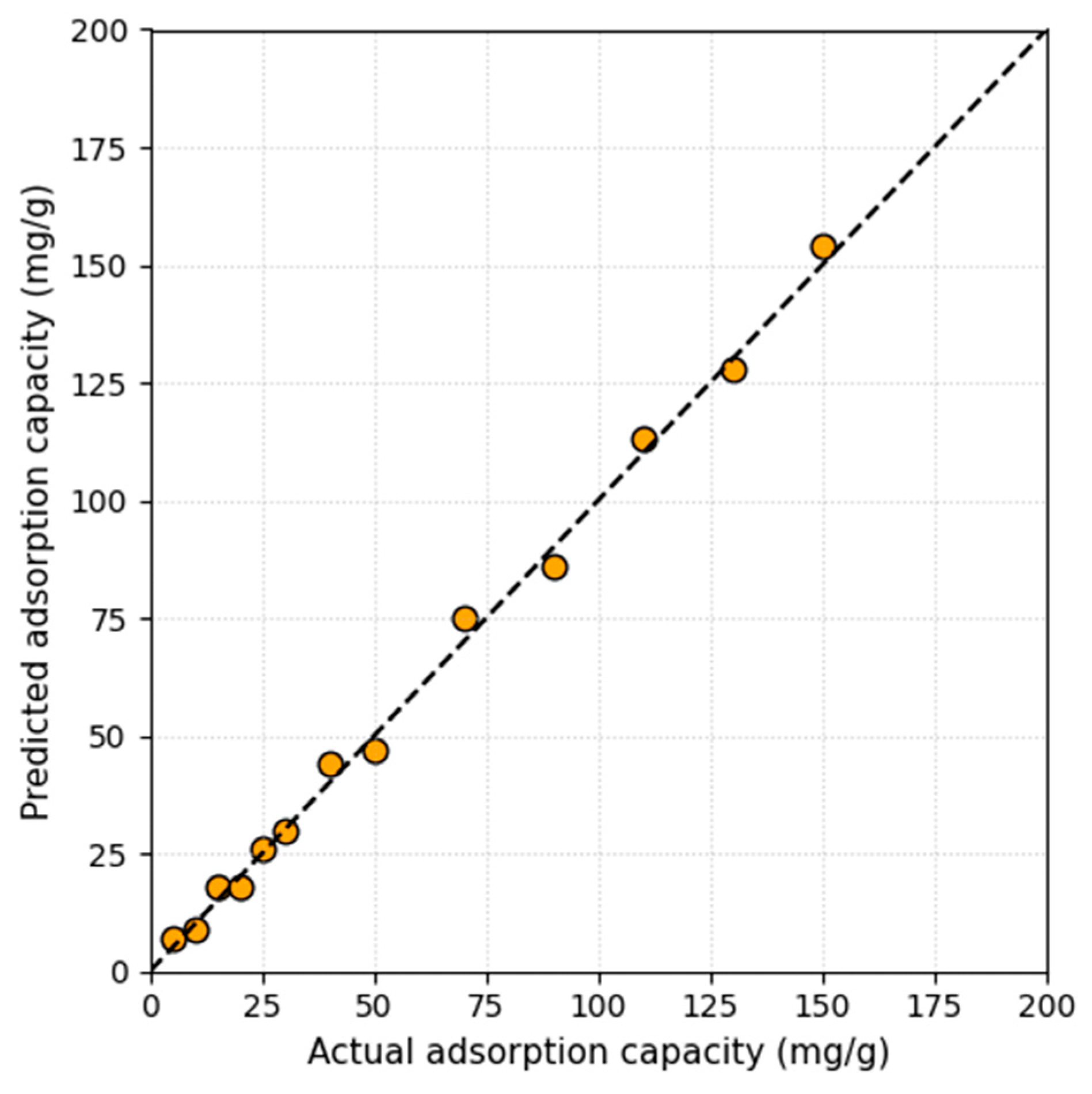
The adequacy of the developed model was further evaluated by comparing predicted adsorption capacities with experimentally observed values. As shown in Figure 16, the data points closely follow the diagonal reference line, indicating excellent agreement between predicted and actual responses. This strong correlation confirms the reliability of the regression model and demonstrates its ability to accurately describe the adsorption behavior of levomepromazine over the experimental domain.
The narrow dispersion of data points around the ideal line indicates minimal systematic deviation and further supports the robustness of the model. These diagnostic results confirm that the quadratic model provides an accurate and statistically reliable representation of the adsorption system [56].

3.7.4. Response Surface and Desirability Analysis

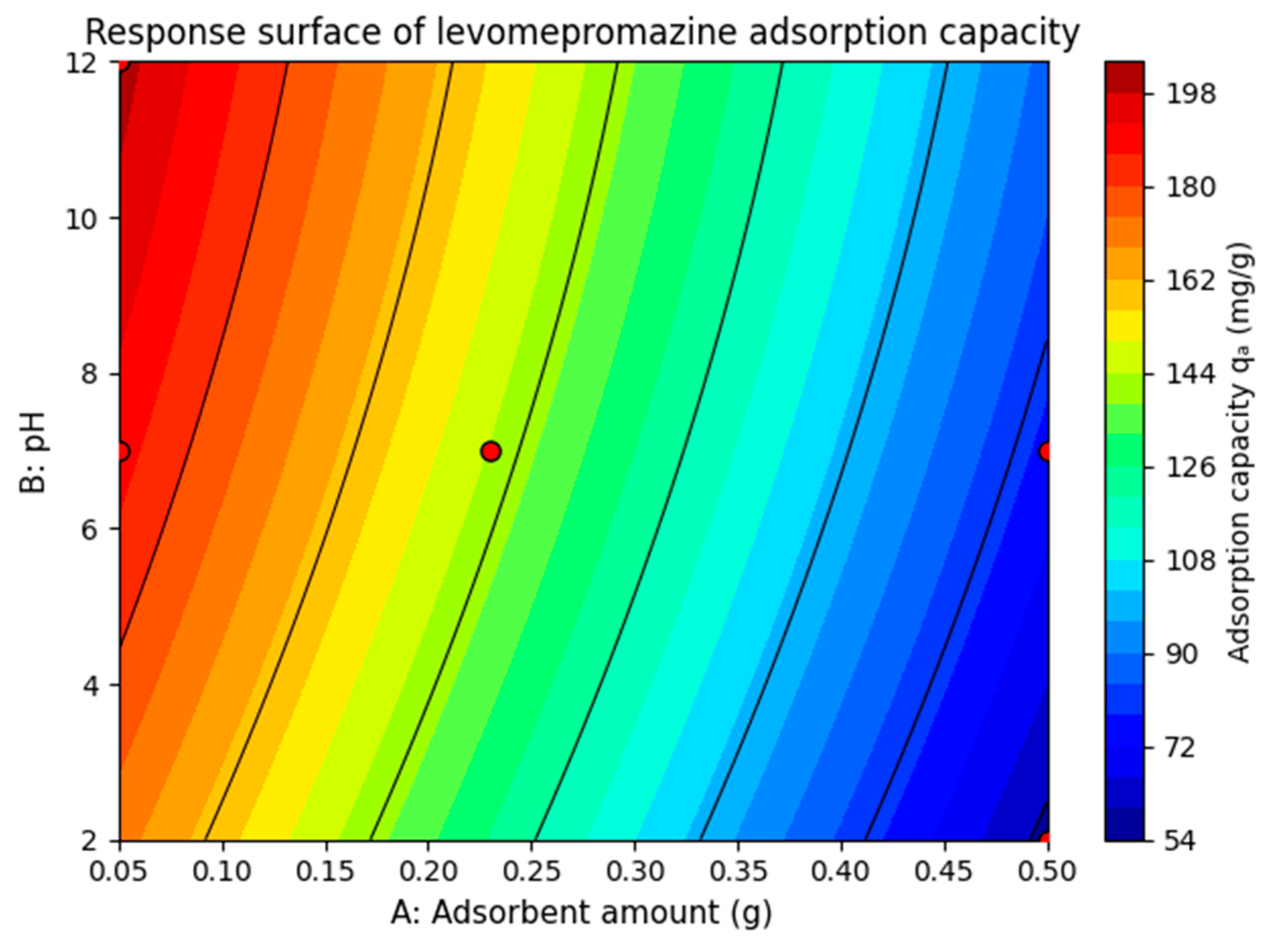
Response surface plots were employed to visualize the combined effects of the studied parameters on levomepromazine adsorption capacity and to identify optimal operating conditions. Figure 17 illustrates the variation in adsorption capacity as a function of adsorbent amount and pH, revealing a strong dependence on adsorbent dosage and a comparatively weaker influence of pH within the studied range.
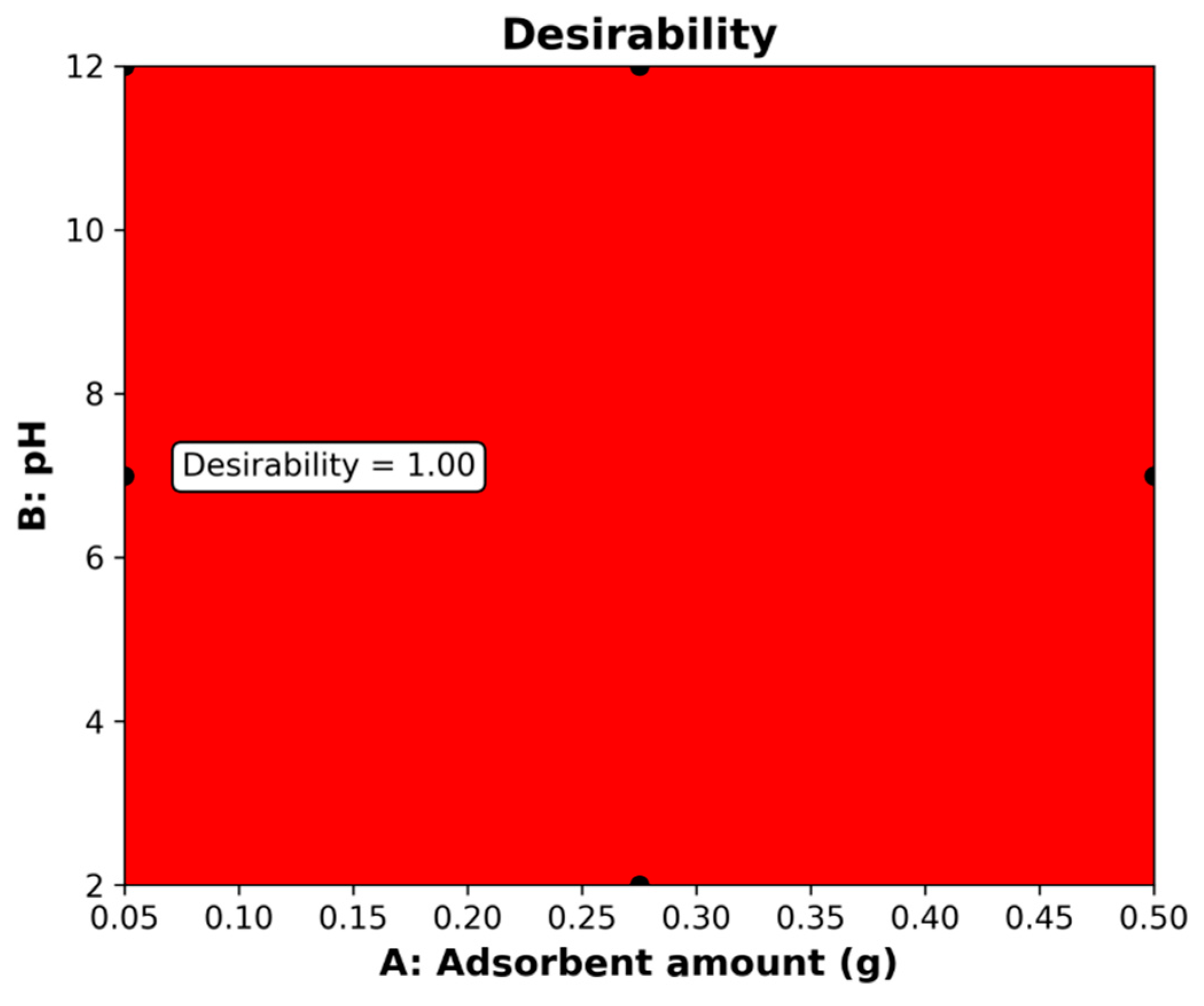
To determine the global optimum, the desirability function approach was applied. This method converts the predicted response into a dimensionless desirability value ranging from 0 to 1, where a value of 1 represents the most favorable operating conditions. As shown in Figure 18, a desirability value close to unity was achieved, confirming the existence of a well-defined optimum within the experimental domain.
The optimal conditions predicted by the model correspond to an initial levomepromazine concentration of 180 mg·L−1, solution pH of 7, adsorbent dosage of 0.05 g, and contact time of 91 min. Under these conditions, a maximum adsorption capacity of 152.149 mg·g−1 was obtained using ES. These results demonstrate the effectiveness of the Box–Behnken design and desirability function approach in optimizing levomepromazine adsorption and highlight the strong adsorption potential of eggshell-based biosorbents.

3.8. Comparative Performance of Eggshell-Based Adsorbents Toward Levomepromazine and Other Pollutants

To contextualize the adsorption performance of eggshell-derived biosorbents, the maximum adsorption capacity obtained for levomepromazine in this study was compared with previously reported pollutants removed using eggshell-based materials. Table 7 summarizes representative studies, including pharmaceutical compounds, dyes, and heavy metals, highlighting the operating conditions and corresponding adsorption efficiencies or capacities.
Table 7 summarizes selected studies reporting the use of eggshell-derived adsorbents for the removal of different pollutants from aqueous media. Direct comparison among studies should be interpreted with caution because adsorption performance is influenced by numerous factors, including pollutant properties, initial concentration, adsorbent dosage, contact time, pH, and the performance metric used. Furthermore, some studies report adsorption capacity (mg·g−1), whereas others report removal efficiency (%), making direct quantitative comparisons difficult.
Under the optimized conditions identified in the present study, ES exhibited a maximum adsorption capacity of 152.149 mg·g−1 toward levomepromazine. This value falls within the range reported for eggshell-based adsorbents applied to various organic contaminants and demonstrates the potential applicability of eggshell-derived materials for pharmaceutical removal. However, because of the differences in experimental conditions and evaluation criteria among studies, the results should be regarded as indicative rather than as evidence of superior adsorption performance relative to other pollutants reported in the literature.
The comparison highlights the versatility of eggshell-derived materials as low-cost adsorbents for the treatment of contaminated water and supports their potential use for the removal of pharmaceutical compounds such as levomepromazine.

3.9. Economic Considerations of the Proposed Adsorption Process

The use of eggshell-derived materials (ES and ESM) for levomepromazine removal presents several potential economic advantages. Eggshells are abundant by-products of the food and poultry industries and are generally discarded as waste, often generating disposal and environmental management costs. Their utilization as adsorbents therefore contributes to waste valorization while providing a low-cost raw material for water treatment applications.
The preparation of ES and ESM requires relatively simple processing steps, including washing, drying, grinding, and sieving, without the need for sophisticated equipment, costly reagents, or energy-intensive activation procedures. Compared with many engineered adsorbents that require chemical modification or high-temperature treatments, eggshell-derived materials may offer a more economical alternative from a preparation standpoint.
The regeneration experiments conducted in this study demonstrated that both ES and ESM retained a substantial fraction of their initial adsorption performance after five adsorption–desorption cycles. These results indicate promising reusability and suggest the possibility of reducing adsorbent replacement frequency during operation. However, the present results should not be interpreted as evidence of long-term durability, as only five regeneration cycles were evaluated. Additional studies involving a larger number of cycles would be necessary to assess long-term operational performance.
From an environmental perspective, the use of naturally occurring waste materials may reduce the dependence on synthetic adsorbents and supports circular economy principles through the conversion of agro-industrial residues into value-added products. Furthermore, the biodegradable nature and widespread availability of eggshell waste represent additional practical advantages.
Nevertheless, the economic feasibility of large-scale implementation cannot be established based solely on the present batch adsorption experiments. Important factors such as adsorbent collection and processing costs, regeneration efficiency under extended operation, continuous-flow performance, adsorbent lifespan, and wastewater matrix complexity were not investigated in the current study. Therefore, comprehensive techno-economic analyses, life-cycle assessments, and continuous-column adsorption studies are recommended as future research directions.
The findings suggest that eggshell-derived materials represent promising low-cost adsorbents for levomepromazine removal and provide a basis for further investigations aimed at evaluating their practical applicability in water treatment systems.

3.10. Challenges and Recommendations for Future Research

Despite the promising results obtained in this study, several challenges must be addressed before large-scale implementation of eggshell-based adsorbents can be realized. One key limitation lies in the natural variability of eggshell composition, which may arise from differences in animal diet, species, age, and processing conditions. Such variability can influence calcium carbonate content, surface morphology, and functional group distribution, potentially affecting adsorption performance and reproducibility at an industrial scale.
Another challenge concerns the regeneration and long-term stability of the adsorbents. Although desorption experiments demonstrated satisfactory reusability over multiple cycles, a gradual decline in adsorption capacity was observed, likely due to partial blockage or degradation of active sites and structural fatigue. Further optimization of regeneration strategies, including the selection of milder desorbing agents or alternative regeneration techniques, is required to enhance durability over extended operational periods.
In addition, the adsorption experiments were conducted under controlled laboratory conditions using single-solute systems. Real wastewater streams typically contain complex mixtures of inorganic ions, natural organic matter, and competing pollutants, as well as fluctuating pH and temperature conditions. These factors may adversely affect adsorption efficiency and selectivity. Future studies should therefore evaluate the performance of ES and ESM in real or simulated wastewater matrices to better assess their practical applicability.
From a materials perspective, while unmodified ES and ESM already exhibit high adsorption efficiency, targeted surface modification or functionalization could further enhance their performance. Approaches such as chemical activation, incorporation of specific functional groups, or hybridization with other biopolymers may improve selectivity and broaden the range of contaminants that can be effectively removed.
Finally, future research should incorporate comprehensive life-cycle assessment (LCA) and techno-economic analysis to quantify the environmental benefits and economic viability of scaling up the adsorption process. Coupling these assessments with dynamic adsorption studies under continuous flow conditions would provide a robust framework for transitioning eggshell-based adsorbents from laboratory-scale investigations to real-world water treatment applications.


4. Conclusions

In this study, eggshell without membrane (ES) and eggshell with membrane (ESM), two abundant and low-cost biowaste materials, were investigated as biosorbents for the removal of levomepromazine from aqueous solutions. Physicochemical characterization using XRD, FTIR, SEM–EDS, TGA, and pHPZC analyses confirmed that both materials are predominantly composed of calcite (CaCO3), while ESM additionally contains membrane-associated organic functional groups. The characterization results also revealed heterogeneous surface features and functional groups potentially involved in the adsorption process.
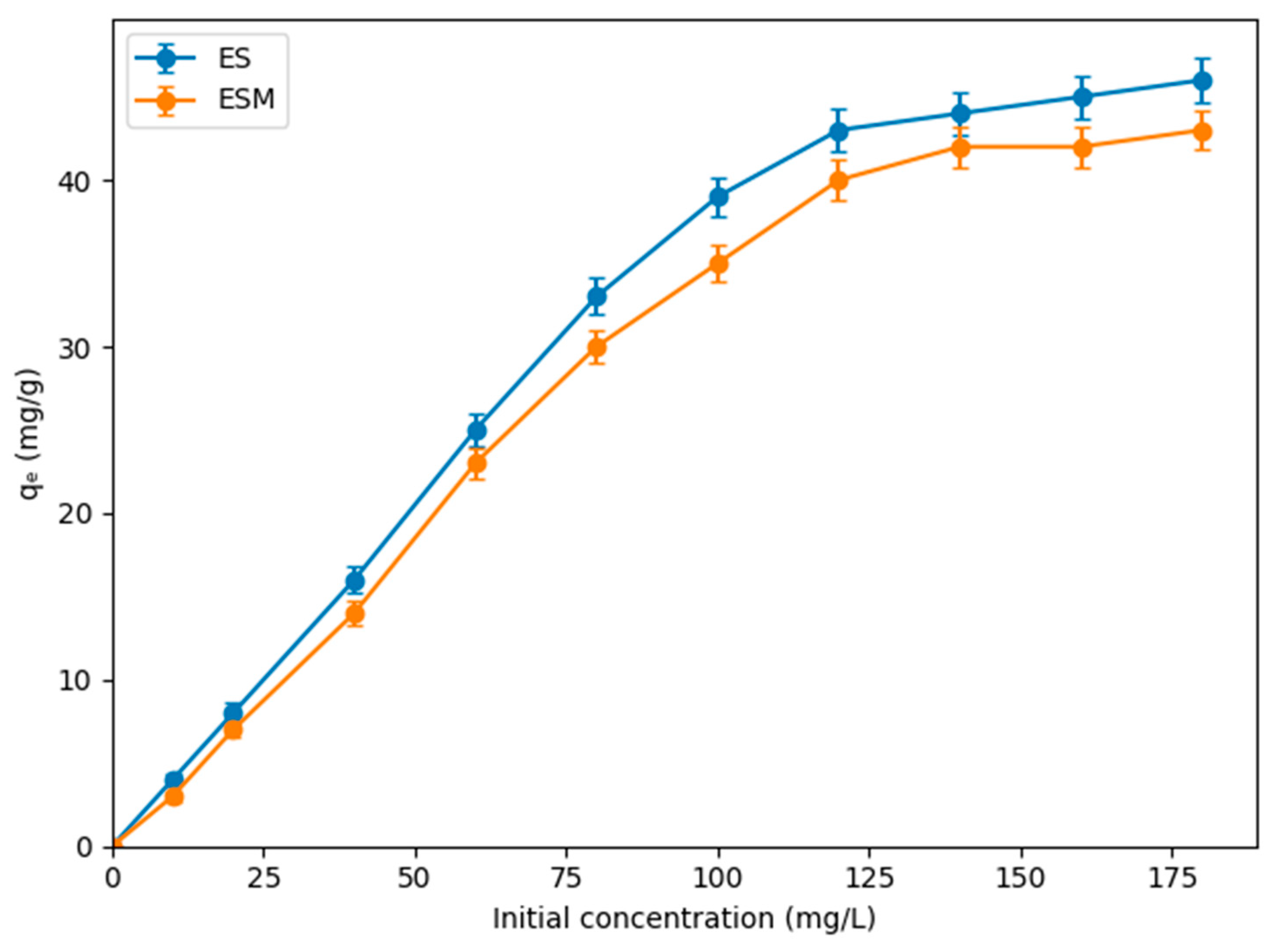
Batch adsorption experiments demonstrated that levomepromazine removal is influenced by solution pH, adsorbent dosage, contact time, and initial pollutant concentration. The highest adsorption performance was obtained under alkaline conditions, with equilibrium reached within approximately 60 min. The adsorption capacity increased with increasing levomepromazine concentration until adsorption sites became progressively occupied.
Kinetic studies showed that the pseudo-second-order model provided the best description of the experimental data (R2 > 0.99). Equilibrium data were analyzed using Langmuir, Freundlich, Temkin, and Dubinin–Radushkevich isotherm models. The Freundlich model exhibited the highest correlation coefficients, suggesting adsorption on heterogeneous surfaces, for ES under the investigated concentration range. FTIR analyses after adsorption and pHPZC measurements suggest that electrostatic interactions and hydrogen bonding may contribute to levomepromazine uptake, although the adsorption mechanism cannot be established unequivocally based on the available data.
Regeneration experiments indicated that both adsorbents retained a substantial fraction of their adsorption performance over five adsorption–desorption cycles, particularly when regenerated using NaOH. Response surface methodology coupled with a Box–Behnken design successfully identified the adsorbent dosage and initial levomepromazine concentration as the most influential operating variables, and the developed quadratic model showed satisfactory predictive capability (R2 = 0.9536).
The results demonstrate that eggshell-derived materials can serve as promising low-cost biosorbents for levomepromazine removal while contributing to the valorization of an abundant agro-industrial waste. Nevertheless, the present study was conducted using synthetic solutions and batch adsorption experiments.

Author Contributions

O.B. and S.L.: did most of the experimental work. A.B. and S.S.: Contribution to the interpretation of the results and the writing of the article. L.E.H. and A.S.: Writing—Reviewing and Editing. All authors have read and agreed to the published version of the manuscript.

Funding

The authors state that no financial support, grants, or other assistance were received during the preparation of this manuscript.

Institutional Review Board Statement

This study did not involve human participants, animals, or sensitive data requiring ethical approval. Therefore, no formal ethical approval was necessary.

Informed Consent Statement

This is to state that I give my full permission for the publication.

Data Availability Statement

The data sets used during the current study are available from the corresponding author upon reasonable request.

Conflicts of Interest

The authors declare that they have no competing interests.

References

  1. Lévi, Y. Contamination des eaux par les résidus de médicaments et stratégies de prévention. Actual. Pharm. 2020, 59, 18–23. [Google Scholar] [CrossRef]
  2. Bielen, A.; Šimatović, A.; Kosić-Vukšić, J.; Senta, I.; Ahel, M.; Babić, S.; Jurina, T.; González Plaza, J.J.; Milaković, M.; Udiković-Kolić, N. Negative environmental impacts of antibiotic-contaminated effluents from pharmaceutical industries. Water Res. 2017, 126, 79–87. [Google Scholar] [CrossRef] [PubMed]
  3. Bindra, S.; Bose, K.; Chandran Thekkantavida, A.; Parambi, D.G.T.; Alsahli, G.T.; Pant, M.; Pappachen, K.L.; Kim, H.; Mathew, B. FDA-approved drugs containing dimethylamine pharmacophore: A review of the last 50 years. RSC Adv. 2024, 14, 27657–27696. [Google Scholar] [CrossRef] [PubMed]
  4. Aragaw, T.A.; Bogale, F.M. Role of coagulation/flocculation as a pretreatment option to reduce colloidal/bio-colloidal fouling in tertiary filtration of textile wastewater: A review and future outlooks. Front. Environ. Sci. 2023, 11, 1142227. [Google Scholar] [CrossRef]
  5. Papac Zjačić, J.; Morović, S.; Košutić, K.; Ašperger, D. Combined Application of Membrane and Advanced Oxidation Processes for Removal of Pharmaceuticals from Water. Kem. U Ind. 2022, 71, 719–727. [Google Scholar] [CrossRef]
  6. Aiastui, X. Towards More Efficient Industrial Lighting: Literature Review on Energy Efficiency Improvement of Industrial Lighting. 2023. Available online: https://urn.kb.se/resolve?urn=urn:nbn:se:liu:diva-195691 (accessed on 8 June 2026).
  7. Ethiraj, S.; Samuel, M.S.; Indumathi, S.M. A comprehensive review of the challenges and opportunities in microalgae-based wastewater treatment for eliminating organic, inorganic, and emerging pollutants. Biocatal. Agric. Biotechnol. 2024, 60, 103316. [Google Scholar] [CrossRef]
  8. Lotfi, R.; Hayati, B.; Rahimi, S.; Shekarchi, A.A.; Mahmoodi, N.M.; Bagheri, A. Synthesis and characterization of PAMAM/SiO2 nanohybrid as a new promising adsorbent for pharmaceuticals. Microchem. J. 2019, 146, 1150–1159. [Google Scholar] [CrossRef]
  9. Demiti, G.M.M.; Fachina, Y.J.; Januário, E.F.D.; Scaliante, M.H.N.O.; Rodríguez, M.T.; Bergamasco, R. Removing pharmaceuticals from water with natural and modified zeolites: Kinetics, thermodynamics, and competitive adsorption in a multi-drug system. J. Mol. Liq. 2025, 418, 126688. [Google Scholar] [CrossRef]
  10. Aammouri, S.E.; Benlemlih, N.; Mohammed, I. Wastewater treatment by infiltration percolation process using fine sand and activated carbon. Res. J. Pharm. Technol. 2023, 16, 5722–5727. [Google Scholar] [CrossRef]
  11. Jatoi, A.S.; Nguyen, H.M.; Ahmed, J.; Jeyapaul, A. Bio-sorbents derived from agricultural biomass for the removal of emerging pollutants and its adsorption mechanisms. J. Iran. Chem. Soc. 2023, 20, 2457–2470. [Google Scholar] [CrossRef]
  12. Chafyq, E.H.; Legrouri, K.; Aghrouch, M.; Oumam, M.; Mansouri, S.; Hassane Khouya, E.; Hannache, H. Adsorption of ciprofloxacin antibiotic on materials prepared from Moroccan oil shales. Chem. Phys. Lett. 2021, 778, 138707. [Google Scholar] [CrossRef]
  13. Mittal, A.; Teotia, M.; Soni, R.K.; Mittal, J. Applications of egg shell and egg shell membrane as adsorbents: A review. J. Mol. Liq. 2016, 223, 376–387. [Google Scholar] [CrossRef]
  14. Mutavdžić Pavlović, D.; Ćurković, L.; Macan, J.; Žižek, K. Eggshell as a New Biosorbent for the Removal of Pharmaceuticals From Aqueous Solutions. CLEAN Soil Air Water 2017, 45, 1700082. [Google Scholar] [CrossRef]
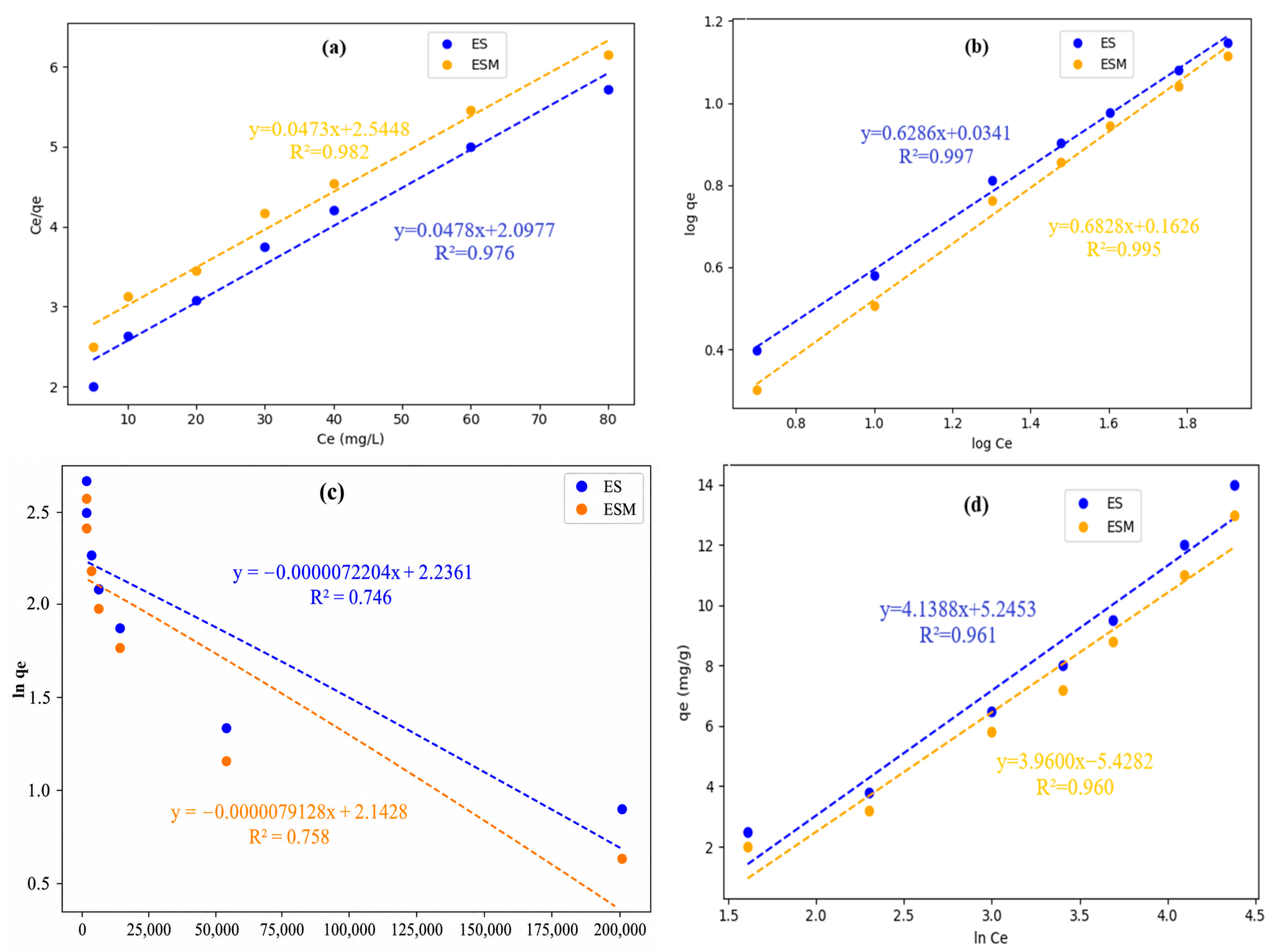
  15. Tarek-Bazza. Morocco Produces 6.6 Billion Eggs Annually, Consumes 185 Per Person. Morocco World News 2019. Available online: https://www.moroccoworldnews.com/2019/01/83552/morocco-egg/ (accessed on 8 June 2026).
  16. Rajoriya, S.; Saharan, V.K.; Pundir, A.S.; Nigam, M.; Roy, K. Adsorption of methyl red dye from aqueous solution onto eggshell waste material: Kinetics, isotherms and thermodynamic studies. Curr. Res. Green Sustain. Chem. 2021, 4, 100180. [Google Scholar] [CrossRef]
  17. Halici, Z.; Demirhan, E. Response surface methodology for optimizing adsorption process parameters for tadalafil removal by raw eggshell. Biomass Convers. Biorefinery 2025, 15, 6027–6036. [Google Scholar] [CrossRef]
  18. Sukarta, I.N.; Ayuni, N.P.S.; Sastrawidana, I.D.K.; Sudiana, I.K. Biopolymer-Based Cellulose-Zeolite Composite Membranes for Cationic and Anionic Dye Adsorption in Wastewater Systems. 2026. Available online: https://www.ecoeet.com/Biopolymer-Based-Cellulose-Zeolite-Composite-Membranes-for-Cationic-and-Anionic-Dye,218138,0,2.html (accessed on 8 June 2026).
  19. Laabd, M.; Brahmi, Y.; El Ibrahimi, B.; Hsini, A.; Toufik, E.; Abdellaoui, Y.; Abou Oualid, H.; El Ouardi, M.; Albourine, A. A novel mesoporous Hydroxyapatite@Montmorillonite hybrid composite for high-performance removal of emerging Ciprofloxacin antibiotic from water: Integrated experimental and Monte Carlo computational assessment. J. Mol. Liq. 2021, 338, 116705. [Google Scholar] [CrossRef]
  20. Ho, Y.S.; McKay, G. Pseudo-second order model for sorption processes. Process Biochem. 1999, 34, 451–465. [Google Scholar] [CrossRef]
  21. Wang, J.; Guo, X. Adsorption kinetic models: Physical meanings, applications, and solving methods. J. Hazard. Mater. 2020, 390, 122156. [Google Scholar] [CrossRef] [PubMed]
  22. Jodeh, S.; Hamed, O.; Melhem, A.; Salghi, R.; Jodeh, D.; Azzaoui, K.; Benmassaoud, Y.; Murtada, K. Magnetic nanocellulose from olive industry solid waste for the effective removal of methylene blue from wastewater. Environ. Sci. Pollut. Res. 2018, 25, 22060–22074. [Google Scholar] [CrossRef] [PubMed]
  23. Akartasse, N.; Azzaoui, K.; Mejdoubi, E.; Hammouti, B.; Elansari, L.L.; Abou-salama, M.; Aaddouz, M.; Sabbahi, R.; Rhazi, L.; Siaj, M. Environmental-Friendly Adsorbent Composite Based on Hydroxyapatite/Hydroxypropyl Methyl-Cellulose for Removal of Cationic Dyes from an Aqueous Solution. Polymers 2022, 14, 2147. [Google Scholar] [CrossRef] [PubMed]
  24. Tsubouchi, L.M.S.; Scapin, D.; Tractz, G.T.; Cardoso, F.A.R.; Cardozo-Filho, L.; Martins, A.F.; Vedoy, D.; Peron, A.P.; Junior, O.V. The use of activated carbon derived from spent coffee grounds as a reusable, sustainable, and effective solution for the removal of butylparaben from water. J. Chem. Technol. Biotechnol. 2026. early view. [Google Scholar] [CrossRef]
  25. Saleh, T.A. Chapter 4—Isotherm models of adsorption processes on adsorbents and nanoadsorbents. In Surface Science of Adsorbents and Nanoadsorbents; Saleh, T.A., Ed.; Interface Science and Technology; Elsevier: Amsterdam, The Netherlands, 2022; Volume 34, pp. 99–126. [Google Scholar]
  26. Fajrah, M.C.; Wardah, A.; Soegijono, B. Relationship of Physical Properties and Crystal Structure CaCO3 Purebred Chicken Egg Shells. J. Penelit. Pendidik. IPA 2025, 11, 433–439. [Google Scholar] [CrossRef]
  27. Haddad, B.; Mittal, A.; Mittal, J.; Paolone, A.; Villemin, D.; Debdab, M.; Mimanne, G.; Habibi, A.; Hamidi, Z.; Boumediene, M.; et al. Synthesis and characterization of Egg shell (ES) and Egg shell with membrane (ESM) modified by ionic liquids. Chem. Data Collect. 2021, 33, 100717. [Google Scholar] [CrossRef]
  28. Noah, A.Z.; El Semary, M.A.; Youssef, A.M.; El-Safty, M.A. Enhancement of yield point at high pressure high temperature wells by using polymer nanocomposites based on ZnO & CaCO3 nanoparticles. Egypt. J. Pet. 2017, 26, 33–40. [Google Scholar] [CrossRef]
  29. Rodríguez-Navarro, A.B.; Marie, P.; Nys, Y.; Hincke, M.T.; Gautron, J. Amorphous calcium carbonate controls avian eggshell mineralization: A new paradigm for understanding rapid eggshell calcification. J. Struct. Biol. 2015, 190, 291–303. [Google Scholar] [CrossRef] [PubMed]
  30. Emumejaye, P.E.; Ikpeseni, S.C.; Ekpu, M.; Sada, S.O.-O.; Ikpeseni, P.O.O. Proximate Analysis of Chicken Eggshell Using Fourier-Transform Infrared Spectroscopy Technique. NIPES J. Sci. Technol. Res. 2023, 5, 128–137. [Google Scholar] [CrossRef]
  31. Rithika, R.; Vishali, A.; Malathi, R. Synthesis of Collagen Nanoparticles from Eggshell Membrane and its Applications with Special Emphasis on Wound Healing and Water Purification. J. Stress Physiol. Biochem. 2025, 21, 47–64. [Google Scholar]
  32. Kınaytürk, N.K.; Tunalı, B.; Türköz Altuğ, D. Eggshell as a biomaterial can have a sorption capability on its surface: A spectroscopic research. R. Soc. Open Sci. 2021, 8, 210100. [Google Scholar] [CrossRef] [PubMed]
  33. Kaur, K. Valorization of Eggshell Waste into Collagen Peptides and Calcium Carbonate via a Single-Step Extraction Process. 2025. Available online: https://hdl.handle.net/10388/17235 (accessed on 8 June 2026).
  34. Kalaycı, T.; Altuğ, D.T.; Kınaytürk, N.K.; Tunalı, B. Characterization and potential usage of selected eggshell species. Sci. Rep. 2025, 15, 6241. [Google Scholar] [CrossRef] [PubMed]
  35. Kerru, N.; Gummidi, L.; Bhaskaruni, S.V.H.S.; Maddila, S.N.; Jonnalagadda, S.B. One-pot green synthesis of novel 5,10-dihydro-1H-pyrazolo[1,2-b]phthalazine derivatives with eco-friendly biodegradable eggshell powder as efficacious catalyst. Res. Chem. Intermed. 2020, 46, 3067–3083. [Google Scholar] [CrossRef]
  36. Cai, K.; Hou, B.; Hu, Y.; He, X.; Shan, Y. Subcritical water hydrolysis of eggshell membrane and its physicochemical characteristics. Food Chem. 2025, 471, 142848. [Google Scholar] [CrossRef] [PubMed]
  37. Helwani, Z.; Ramli, M.; Saputra, E.; Bahruddin, B.; Yolanda, D.; Fatra, W.; Idroes, G.M.; Muslem, M.; Mahlia, T.M.I.; Idroes, R. Impregnation of CaO from Eggshell Waste with Magnetite as a Solid Catalyst (Fe3O4/CaO) for Transesterification of Palm Oil Off-Grade. Catalysts 2020, 10, 164. [Google Scholar] [CrossRef]
  38. Laca, A.; Laca, A.; Díaz, M. Eggshell waste as catalyst: A review. J. Environ. Manag. 2017, 197, 351–359. [Google Scholar] [CrossRef] [PubMed]
  39. Kuśmierek, K.; Idźkiewicz, P.; Świątkowski, A.; Dąbek, L. Adsorptive removal of pentachlorophenol from aqueous solutions using powdered eggshell. Arch. Environ. Prot. 2017, 43, 10–16. [Google Scholar] [CrossRef]
  40. Zonato, R.d.O.; Estevam, B.R.; Perez, I.D.; Aparecida dos Santos Ribeiro, V.; Boina, R.F. Eggshell as an adsorbent for removing dyes and metallic ions in aqueous solutions. Clean. Chem. Eng. 2022, 2, 100023. [Google Scholar] [CrossRef]
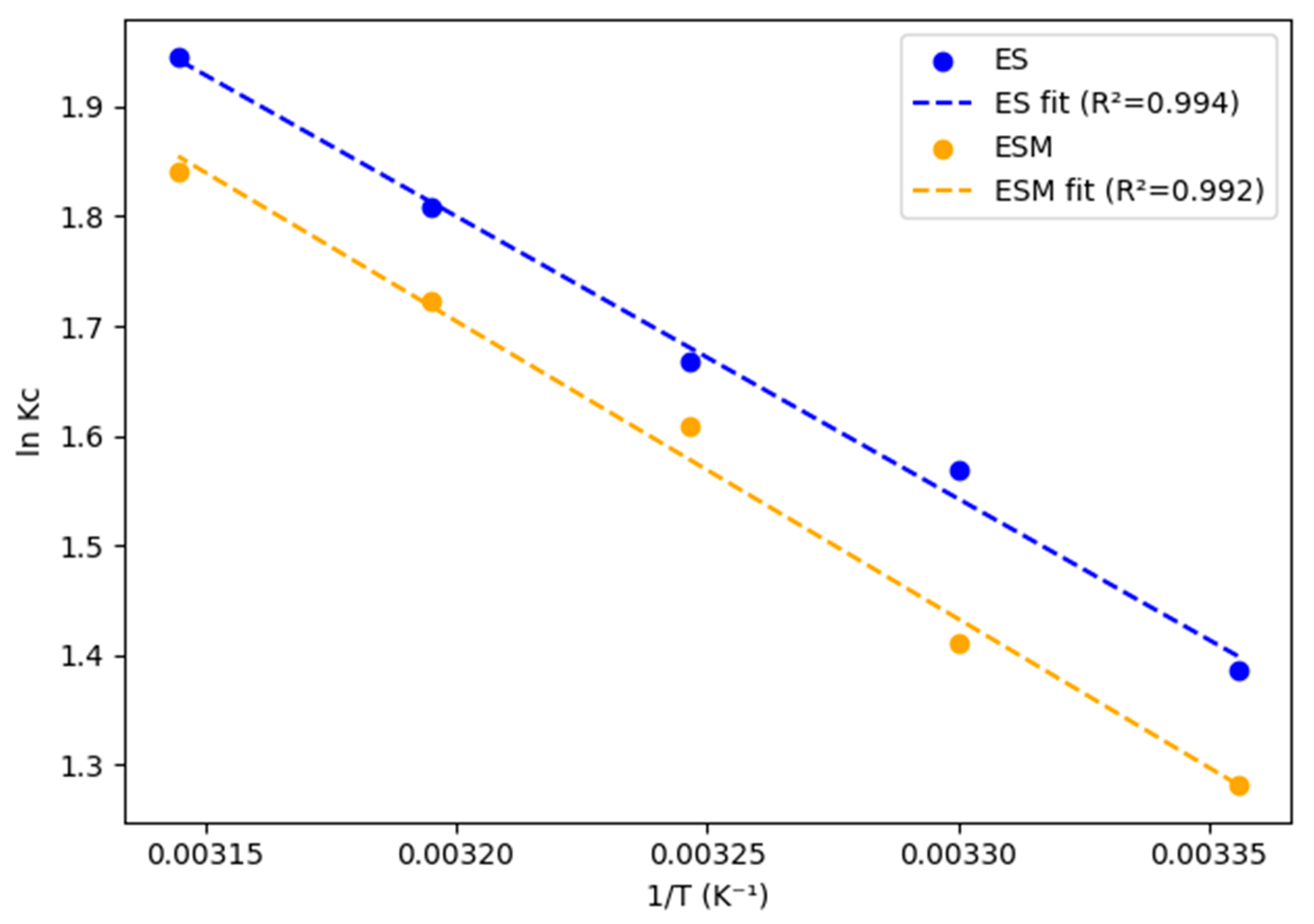
  41. Talukder, P.; Sultana, R.; Naim, M.R.; Turzo, P.I.; Naher, U.H.B. Optimization of batch process parameters for chromium (VI) removal from synthetic wastewater using eggshell–clay composite. Discov. Appl. Sci. 2024, 6, 291. [Google Scholar] [CrossRef]
  42. Alhasan, H.S.; Alahmadi, N.; Yasin, S.A.; Khalaf, M.Y.; Ali, G.A.M. Low-Cost and Eco-Friendly Hydroxyapatite Nanoparticles Derived from Eggshell Waste for Cephalexin Removal. Separations 2022, 9, 10. [Google Scholar] [CrossRef]
  43. Shan, G.N.M.; Rafatullah, M.; Siddiqui, M.R.; Kapoor, R.T.; Qutob, M. Calcium oxide from eggshell wastes for the removal of pharmaceutical emerging contaminant: Synthesis and adsorption studies. J. Indian Chem. Soc. 2024, 101, 101174. [Google Scholar] [CrossRef]
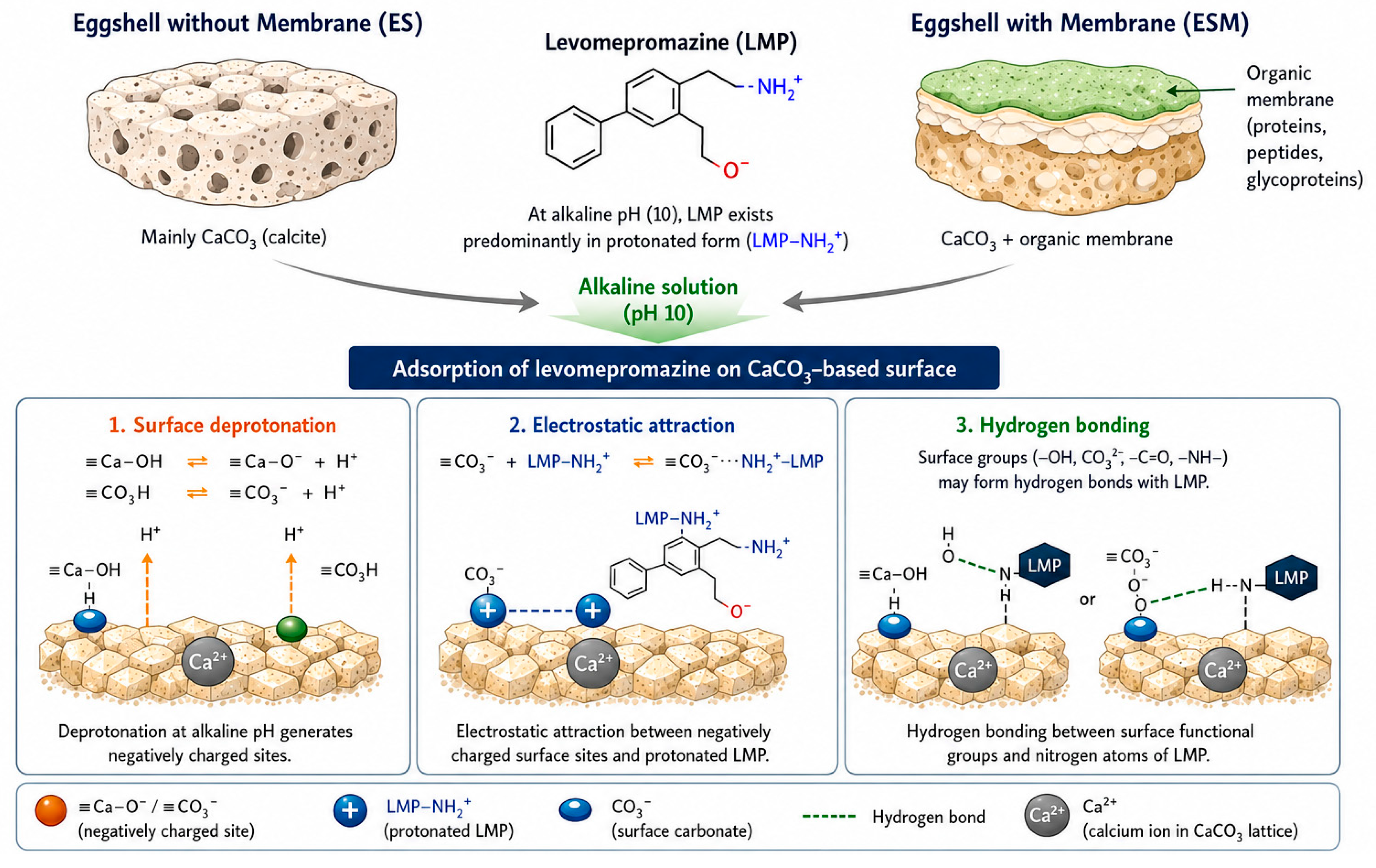
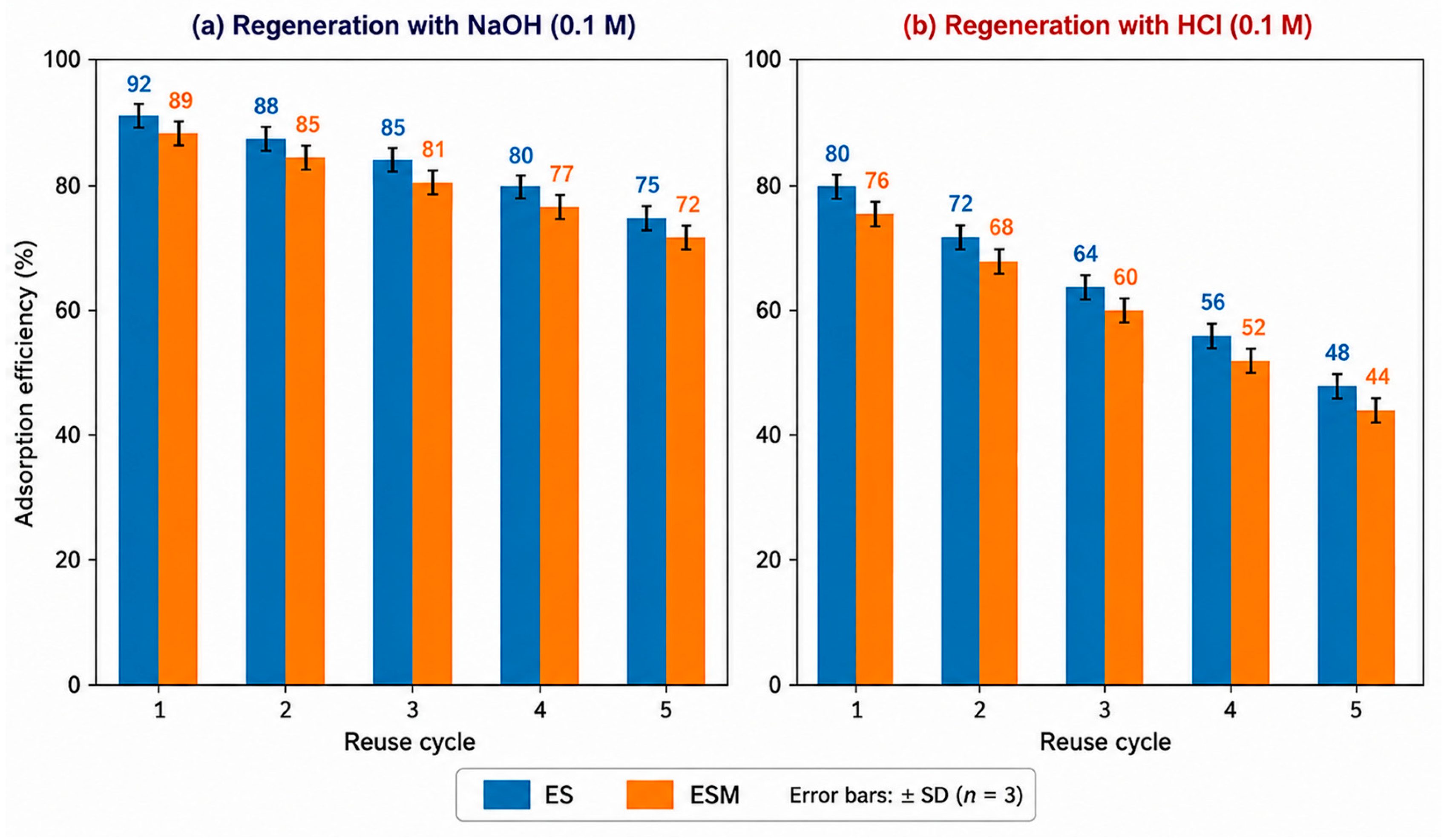
  44. Montes, M.L.; Taylor, M.A.; Alonso, R.E. Sorption of the emerging pollutant oxytetracycline on eggshell. Experimental and theoretical approaches. Appl. Surf. Sci. 2025, 682, 161781. [Google Scholar] [CrossRef]
  45. Daraei, H.; Mittal, A.; Noorisepehr, M.; Daraei, F. Kinetic and equilibrium studies of adsorptive removal of phenol onto eggshell waste. Environ. Sci. Pollut. Res. 2013, 20, 4603–4611. [Google Scholar] [CrossRef] [PubMed]
  46. Li, J.; Ng, D.H.L.; Ma, R.; Zuo, M.; Song, P. Eggshell membrane-derived MgFe2O4 for pharmaceutical antibiotics removal and recovery from water. Chem. Eng. Res. Des. 2017, 126, 123–133. [Google Scholar] [CrossRef]
  47. Sydney, B.M.; Qi, W.; Wang, B.; Wei, Q.; Yue, M.; Sun, J.; Wang, J.; Xu, D.; Wang, Q.; Gao, J.; et al. From waste to product: A review on waste eggshell membrane and its advancements. Environ. Eng. Res. 2026, 31, 250310. [Google Scholar] [CrossRef]
  48. Adeyi, A.A.; Ogundola, D.O.; Popoola, L.T.; Bernard, E.; Udeagbara, S.G.; Ogunyemi, A.T.; Olateju, I.I.; Zainul, R. Potassium permanganate–modified eggshell biosorbent for the removal of diclofenac from liquid environment: Adsorption performance, isotherm, kinetic, and thermodynamic analyses. Environ. Monit. Assess. 2024, 196, 802. [Google Scholar] [CrossRef] [PubMed]
  49. Manyatshe, A.; Sibali, L.L. A review on egg waste-based adsorbents for the removal of organic and inorganic contaminants from aqueous solution. Heliyon 2025, 11, e42278. [Google Scholar] [CrossRef] [PubMed]
  50. Elkady, M.F.; Ibrahim, A.M.; El-Latif, M.M.A. Assessment of the adsorption kinetics, equilibrium and thermodynamic for the potential removal of reactive red dye using eggshell biocomposite beads. Desalination 2011, 278, 412–423. [Google Scholar] [CrossRef]
  51. Hossain, M.; Islam, R.; Rahman, M.N.; Khan, M.I.S.; Ahmed, F.; Al-Amin, M.; Rabbi, M.A. A novel approach for the modification of eggshell powder and its application for lead and methylene blue removal. Heliyon 2024, 10, e36160. [Google Scholar] [CrossRef] [PubMed]
  52. Rezai, B.; Allahkarami, E. Chapter 13—Desorption/regeneration of adsorbents and their performance. In Sustainable Remediation Technologies for Emerging Pollutants in Aqueous Environment; Hadi Dehghani, M., Karri, R.R., Tyagi, I., Eds.; Elsevier: Amsterdam, The Netherlands, 2024; pp. 263–283. [Google Scholar] [CrossRef]
  53. Mahgoub, S.M.; Abdelazeem, R.; Moaty, S.A.A.; Radalla, A.M.; Khaled, E.; Allam, A.A.; Alfassam, H.E.; Mahmoud, R. Fabrication of novel activated carbon/carbonized cuttlefish bone bio-based adsorbent for Carbamazepine drug adsorption: High efficiency, biocompatibility, and environmental safety. Int. J. Environ. Anal. Chem. 2025, 105, 8763–8787. [Google Scholar] [CrossRef]
  54. El Hammari, L.; Hamed, R.; Azzaoui, K.; Jodeh, S.; Latifi, S.; Saoiabi, S.; Boukra, O.; Krime, A.; Boukra, A.; Saoiabi, A.; et al. Optimization of the adsorption of lead (II) by hydroxyapatite using a factorial design: Density functional theory and molecular dynamics. Front. Environ. Sci. 2023, 11, 1112019. [Google Scholar] [CrossRef]
  55. Virupakshappa, P.K.S.; Krishnaswamy, M.B.; Mishra, G.; Mehkri, M.A. Optimization of Crude Oil and PAHs Degradation by Stenotrophomonas rhizophila KX082814 Strain through Response Surface Methodology Using Box-Behnken Design. Biotechnol. Res. Int. 2016, 2016, 4769542. [Google Scholar] [CrossRef] [PubMed]
  56. Tounsadi, H.; Khalidi, A.; Machrouhi, A.; Farnane, M.; Elmoubarki, R.; Elhalil, A.; Sadiq, M.; Barka, N. Highly efficient activated carbon from Glebionis coronaria L. biomass: Optimization of preparation conditions and heavy metals removal using experimental design approach. J. Environ. Chem. Eng. 2016, 4, 4549–4564. [Google Scholar] [CrossRef]
  57. Abdel-Khalek, M.A.; Abdel Rahman, M.K.; Francis, A.A. Exploring the adsorption behavior of cationic and anionic dyes on industrial waste shells of egg. J. Environ. Chem. Eng. 2017, 5, 319–327. [Google Scholar] [CrossRef]
  58. Chou, M.-Y.; Lee, T.-A.; Lin, Y.-S.; Hsu, S.-Y.; Wang, M.-F.; Li, P.-H.; Huang, P.-H.; Lu, W.-C.; Ho, J.-H. On the removal efficiency of copper ions in wastewater using calcined waste eggshells as natural adsorbents. Sci. Rep. 2023, 13, 437. [Google Scholar] [CrossRef] [PubMed]
Figure 1. XRD patterns of eggshell without membrane (ES) and eggshell with membrane (ESM).
Sustainability 18 06744 g001
Figure 2. FT-IR spectra of eggshell without membrane (ES) and eggshell with membrane (ESM).
Sustainability 18 06744 g002
Figure 3. SEM images of eggshell (a) without membrane (ES) and (b) with membrane (ESM).
Sustainability 18 06744 g003
Figure 4. (a) TGA and (b) DTA of eggshell without membrane (ES) and eggshell with membrane (ESM).
Sustainability 18 06744 g004
Figure 5. Determination of the point of zero charge (pHPZC) of eggshell (ES) and eggshell membrane (ESM) using the pH drift method.
Sustainability 18 06744 g005
Figure 6. Effect of pH on levomepromazine adsorption capacity (qe) of eggshell without membrane (ES) and eggshell with membrane (ESM) (m = 0.2 g, C0 = 20 ppm, t = 3H, T = 25 °C).
Sustainability 18 06744 g006
Figure 7. Effect of adsorbent mass on levomepromazine adsorption of eggshell without membrane (ES) and eggshell with membrane (ESM) (pH = 10, C0 = 20 ppm, t = 3H, T = 25 °C).
Sustainability 18 06744 g007
Figure 8. Effect of contact time on levomepromazine adsorption by eggshell without membrane (ES) and eggshell with membrane (ESM) (pH = 10, C0 = 20 ppm, m = 0.2 g, T = 25 °C).
Sustainability 18 06744 g008
Figure 9. Linear representations of the (a) pseudo-first-order and (b) pseudo-second-order kinetic models for levomepromazine adsorption by eggshell without membrane (ES) and eggshell with membrane (ESM).
Sustainability 18 06744 g009
Figure 10. Effect of initial concentration on levomepromazine adsorption by eggshell without membrane (ES) and eggshell with membrane (ESM) (pH = 10, t = 3H, m = 0.2 g, T = 25 °C).
Sustainability 18 06744 g010
Figure 11. Langmuir (a), Freundlich (b), Dubinin–Radushkevich (c), and Temkin (d) isotherm plots for levomepromazine adsorption onto eggshell without membrane (ES) and eggshell with membrane (ESM).
Sustainability 18 06744 g011
Figure 12. Van’t Hoff plots for the adsorption of levomepromazine onto eggshell without membrane (ES) and eggshell with membrane (ESM).
Sustainability 18 06744 g012
Figure 13. FTIR spectra of ES and ESM after levomepromazine adsorption.
Sustainability 18 06744 g013
Figure 14. Mechanism of levomepromazine adsorption onto ES and ESM.
Sustainability 18 06744 g014
Figure 15. Desorption and reuse performance of eggshell without membrane (ES) and eggshell with membrane (ESM) for levomepromazine adsorption over five consecutive cycles using (a) NaOH and (b) HCl. (pH = 10, C0 = 20 ppm, m = 0.2 g, t = 3H, T = 25 °C).
Sustainability 18 06744 g015
Figure 16. Predicted versus experimental values for levomepromazine adsorption capacity.
Sustainability 18 06744 g016
Figure 17. Optimized response surface for levomepromazine adsorption.
Sustainability 18 06744 g017
Figure 18. Desirability function plot for levomepromazine adsorption by ES.
Sustainability 18 06744 g018
Table 1. Process factors and their levels.
FactorsLevels of Box–Behnken
Low (−1)Middle (0)High (+1)
Adsorbent amount (g) (A)0.050.2750.5
pH (B)2712
Initial Concentration (mg/L) (C)1095180
Contact Time (min) (D)291180
Table 2. The Box–Behnken design matrix used in the present study.
RunFactor 1: A (g)Factor 2: B (pH)Factor 3: C (mg/L)Factor 4: D (min)Response: qe (mg/g)
10.2757101802.16
20.52959111.098
30.2757959124.43
40.275210911.411
50.27529518020.076
60.2751295226.024
70.057952116.156
80.512959114.84
90.2757180229.264
100.275129518029.768
110.5795210.125
120.0529591102.507
130.275121809133.946
140.27521809125.183
150.057109114.264
160.5710911.108
170.27571021.84
180.05129591130.829
190.579518012.875
200.275295219.0152
210.275718018032.925
220.05795180112.21
230.571809115.394
240.05718091157.322
250.2751210913.189
Table 3. Kinetic parameters for the pseudo-first-order and pseudo-second-order models for levomepromazine adsorption onto eggshell without membrane (ES) and eggshell with membrane (ESM).
ESESM
Maximum experimental capacity qmax (mg/g)9.0698.523
Pseudo First orderk1 (min−1)0.0285570.026484
qe,1 (mg/g)0.660990.45919
R20.56480.537
Pseudo Second orderk2 (g/mg.min)0.1599730.04833
qe,2(g/mg)9.0991818.620689
R20.99930.9986
Table 4. Isotherm parameters for levomepromazine adsorption onto ES and ESM.
Isotherm ModelParametersESESM
LangmuirKL (L·mg−1)0.02280.0186
qmax (mg·g−1)20.9221.15
R20.9760.982
Freundlichn1.591.46
KF (mg·g−1)1.081.45
(R2)0.9970.995
Dubinin–Radushkevich (D–R)β (mol2·kJ−2)7.22 × 10−67.91 × 10−6
qmax (mg·g−1)9.368.52
E (kJ·mol−1)0.2630.251
R20.7460.758
TemkinbT (J·mol−1)597625
aT (L·mg−1)0.0190.016
R20.9610.960
Table 5. Apparent Thermodynamic parameters for levomepromazine adsorption onto ES and ESM.
Apparent Thermodynamic ParametersESESM
Enthalpy change (ΔH°) (KJ/mol)18.7215.94
Entropy change (ΔS°) (KJ/mol.K)77.4861.37
R20.9940.992
Standard Gibbs free energy change (ΔG°) (KJ/mol) (×104)T1 = 298 K−2.9T1 = 298 K−2.31
T2 = 308 K−3.63T2 = 308 K−2.92
T3 = 318 K−4.35T3 = 318 K−3.54
Table 6. ANOVA for quadratic model.
SourceSum of SquaresdfMean SquareF-Valuep-Value
Model47,907.46143421.9614.69<0.0001Significant
A-Adsorbent amount26,870.76126,870.76115.33<0.0001
B-pH293.111293.111.260.2882
C-Initial concentration6077.7516077.7526.090.0005
D-Contact Time4.8014.800.02060.8887
AB151.041151.040.64830.4394
AC4145.4314145.4317.790.0018
AD11.21111.210.04810.8308
BC12.19112.190.05230.8237
BD1.8011.800.00770.9317
CD2.7912.790.01200.9150
A23791.7013791.7016.270.0024
B26.7016.700.02880.8687
C2338.231338.231.450.2560
D22.0912.090.00900.9265
Residual2329.8210232.98
Cor Total50,237.2924
Table 7. Comparison of eggshell adsorption capacities for levomepromazine and other pollutants.
AdsorbateOptimum ConditionsRemoval Efficiency/Adsorption CapacityReferences
TadalafilpH 5, 25 °C, 7.5 g adsorbent per 100 mLRemoval: 72.9%[17]
Congo red1000 mg·L−1, room temperatureqm = 49.5 mg·g−1[57]
Methylene blue1000 mg·L−1, room temperatureqm = 94.9 mg·g−1[57]
Copper (Cu2+)25 mg·L−1, adsorbent dose 10 mg, 25 °CRemoval: 90.5%[58]
Levomepromazine (this study)180 mg·L−1, pH 7, 0.05 g adsorbent, 91 minqm = 152.149 mg·g−1Present study
Disclaimer/Publisher’s Note: The statements, opinions and data contained in all publications are solely those of the individual author(s) and contributor(s) and not of MDPI and/or the editor(s). MDPI and/or the editor(s) disclaim responsibility for any injury to people or property resulting from any ideas, methods, instructions or products referred to in the content.