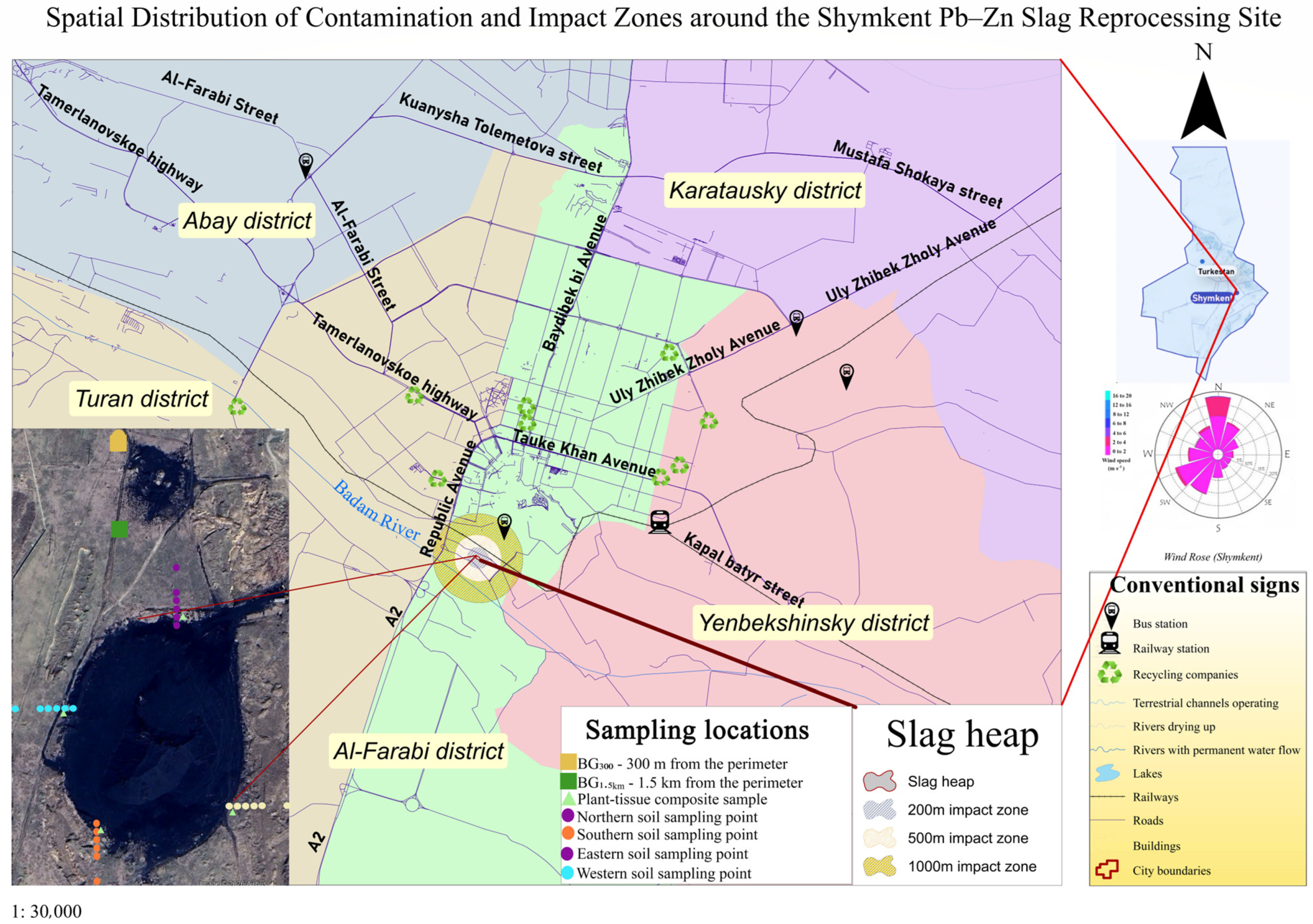
1. Introduction
Reprocessing historical lead–zinc (Pb–Zn) slag remains a globally significant environmental challenge. Slag heaps and tailings impoundments, accumulated over decades of pyrometallurgical operations, act as persistent metal reservoirs, releasing Pb, Zn, Cd, As, and Hg into surrounding soils via wind-driven particle transport, surface runoff, and slow leaching into groundwater [
1,
2,
3]. Although secondary recovery of residual metals from such slags is increasingly recognized as a circular-economy opportunity [
4,
5], reprocessing operations can remobilize legacy contaminants if dust suppression, runoff control, and surface stabilization are inadequate [
6,
7]. This duality—slag as both a valuable secondary raw material and a chronic source of soil-borne metal release—underscores the need for site-specific environmental assessment as an integral component of any reprocessing program. Where engineered containment, dust control, and runoff management are absent or insufficient, the same operations that close the metal loop can paradoxically extend the contamination footprint of the original smelting legacy, transferring risk from the heap itself to surrounding agricultural and residential land.
Southern Kazakhstan, specifically the Turkestan Region, hosts the Achisai polymetallic ore field and the Shymkent lead–zinc processing complex, together forming one of the largest concentrations of Pb–Zn metallurgical legacy in Central Asia [
8]. The former Shymkent lead plant operated for about seven decades before Yuzhpolymetal JSC closed in 2012, leaving an uncontained slag heap that remains subject to aeolian dispersion under the semi-arid climate [
6,
8]. For regional context, the neighboring single-industry town of Kentau, 60 km to the south, which shares the same Pb–Zn ore–processing legacy, still had elevated soil Pb and Cd levels after more than two decades of passive recovery [
9], underscoring the persistence of smelter contamination across the Turkestan Region. Recent assessments across Kazakhstan have likewise documented elevated soil heavy-metal burdens at industrial and urban sites [
10,
11], and Monte Carlo-based health risk modeling in comparable Pb–Zn mining areas confirms cadmium and arsenic as dominant carcinogenic risk drivers despite the conventional emphasis on lead [
12].
To contextualize analytical data from such legacy sites, six complementary normalized indices are conventionally used. The contamination factor (
CF) and the geoaccumulation index (
Igeo) express contamination relative to a geochemical background; the enrichment factor (
EF) distinguishes anthropogenic enrichment from lithogenic input; the pollution load index (
PLI) and the modified degree of contamination (
mCd) summarize multi-element loading; and the potential ecological risk index (RI) translates these into an integrated ecosystem-hazard score [
13]. In situ phytoindication, based on tissue concentrations in native vegetation, provides independent biological validation of geochemical findings and identifies candidate species for phytostabilization [
14].
Existing assessments of the Achisai–Kentau metallurgical corridor have examined individual aspects—soil chemistry, atmospheric deposition, or human exposure—in isolation. The present study integrates ICP-OES geochemistry along four cardinal-direction transects, a six-index pollution framework referenced to the upper continental crust (UCC), composite plant-tissue biomonitoring of two native species (Centaurea pseudosquarrosa and Plantago lanceolata), and US EPA RAGS-based health and ecosystem risk modeling into a single, site-specific analysis. To our knowledge, this combination has not been applied previously at the Shymkent slag reprocessing site, and the resulting framework is directly transferable to analogous Pb–Zn legacy reprocessing sites across Central Asia and globally. By translating contamination evidence into a tiered remediation strategy that reconciles secondary-resource recovery with contamination control, the study addresses the sustainability dimension of slag reprocessing and contributes directly to the United Nations Sustainable Development Goals on good health and well-being (SDG 3), sustainable cities and communities (SDG 11), responsible consumption and production (SDG 12), and life on land (SDG 15).
The specific objectives of this study were therefore to: (i) quantify Pb, Zn, Cd, Cu, As, Hg, Cr, Ni, Mn, and Fe concentrations in soils along four cardinal-direction transects (0–100 m) and at two distal reference points (300 m and 1.5 km) at an active Pb–Zn slag reprocessing site in Shymkent, Southern Kazakhstan; (ii) classify the resulting contamination using six complementary geochemical indices (CF, Igeo, EF, PLI, mCd, RI) referenced to the upper continental crust; (iii) characterize community-level metal uptake in two native species (Centaurea pseudosquarrosa and Plantago lanceolata) via the bioconcentration factor; (iv) quantify human-health and ecosystem risks using US EPA RAGS and REACH PNEC-based RCR frameworks; and (v) translate the integrated evidence into a site-specific, three-tier remediation prioritization framework transferable to analogous Pb–Zn legacy reprocessing sites in Central Asia and globally.
Comparable site-resolved assessments of Pb–Zn smelter and slag-reprocessing legacy contamination have been reported across multiple continents. Yang et al. [
15] characterized the distribution of heavy metals in topsoil around a Pb–Zn smelter in Henan Province (Central China), reporting Pb, Cd, and As enrichment levels that consistently exceeded national risk-screening thresholds. Ettler et al. [
16] used Pb isotopic evidence to trace the dispersal of contamination in stream sediments from the Příbram mining and smelting district (Czech Republic), demonstrating that smelter-derived Pb persists in the fluvial environment decades after operational closure. Angelovičová et al. [
17] documented suppression of soil enzymatic activity in the Middle Spiš mining area (Slovakia), and Tembo et al. [
18] quantified Cu–Pb–Cd–Zn contamination around the Kabwe smelter (Zambia)—a site that consistently ranks among the world’s most polluted urban environments. More recently, Wang et al. [
19] applied Monte Carlo simulation to characterize health risks in the Xicheng Pb–Zn mining area (China), identifying Cd and as dominant carcinogenic drivers despite a smaller absolute Pb burden. In post-Soviet Central Asia, Junusbekov et al. [
9] documented elevated heavy-metal levels in soils around the Kentau Pb–Zn complex (~150 km north of Shymkent), Tleuova et al. [
20] reported hydrogeological controls on heavy-metal mobility in Southern Kazakhstan, and Faurat et al. [
10] characterized snow–soil–vegetation transfer of heavy metals in an industrial city in Kazakhstan. Across these geographically diverse cases, three recurring patterns emerge: (i) the spatial footprint of contamination consistently extends well beyond the immediate slag-deposit perimeter; (ii) Cd and As, rather than the more abundant Pb and Zn, often dominate human-health and ecosystem risk; and (iii) integrated assessments combining geochemistry, plant biomonitoring, and quantitative risk modeling remain rare relative to single-component studies. The present study addresses this last gap for the Achisai–Shymkent corridor of Central Asia, which to date has been examined only through fragmented single-aspect assessments [
11].
3. Results
3.1. Heavy Metal Concentrations and Spatial Distribution
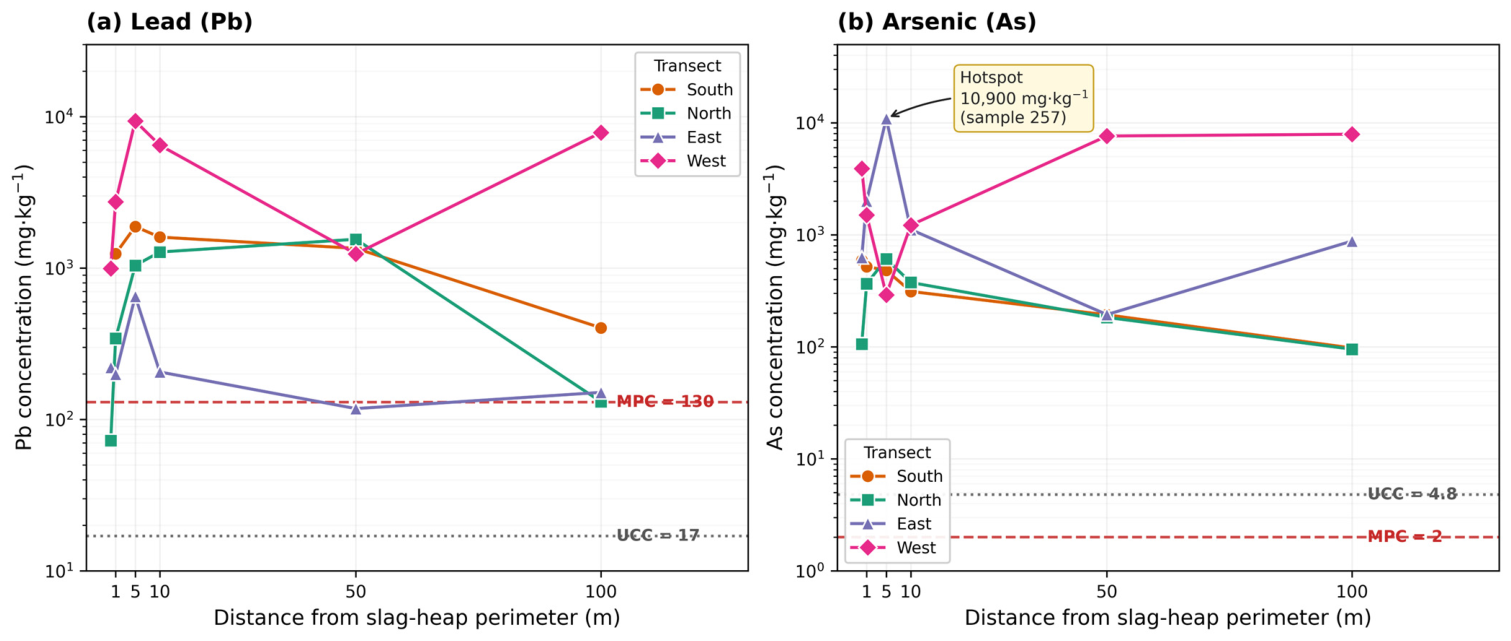
Soil concentrations of As, Cd, Cu, Hg, Pb, and Zn at the slag reprocessing site substantially exceeded both the upper continental crust geochemical background and Kazakhstan MPC values across all four cardinal-direction transects (
Table 1,
Figure 2). The site-mean ± SD concentrations across the 24 transect samples were 1754 ± 2447 mg·kg
−1 Pb, 1254 ± 873 mg·kg
−1 Zn, 53.7 ± 80 mg·kg
−1 Cd, 684 ± 886 mg·kg
−1 Cu, 1753 ± 2832 mg·kg
−1 As, and 8.0 ± 16 mg·kg
−1 Hg. The high standard deviations relative to the means reflect substantial directional and spatial heterogeneity rather than a smooth concentration gradient (see below).
The highest single-sample concentrations were observed at 5 m on the western transect (sample 263): 9350 mg·kg
−1 Pb (72× MPC), 290 mg·k
−1 Cd (290× MPC), 2870 mg·kg
−1 Zn (13× MPC), and 47.4 mg·kg
−1 Hg (23× MPC), all co-occurring in a single soil aliquot. Arsenic peaked at 5 m on the eastern transect (sample 257) at 10,900 mg·kg
−1, exceeding the Kazakhstan MPC by 5450-fold and forming a discrete hotspot likely associated with arsenopyrite-bearing slag fragments (
Section 4.5). Copper reached 4230 mg·kg
−1 at 5 m on the southern transect (128× MPC), a finding not previously reported at this site. Chromium, nickel, and manganese remained at or below their respective MPCs at all transect points and showed
CF and
EF values consistent with a lithogenic origin (
Table 2); these elements were therefore excluded from subsequent risk discussion.
The spatial distribution of metal concentrations was strongly asymmetric across cardinal directions, and the transect with the highest absolute single-sample peak was not always the transect with the highest mean concentration (
Table 2). The western transect carried the highest mean values for Pb (4777 ± 3272 mg·kg
−1), Cd (165 ± 94), Hg (30 ± 18), and As (3735 ± 3044), and contained the absolute peak concentrations of Pb (9350 mg·kg
−1 at West 5 m, sample 263), Cd (290 at the same point), Zn (2870 at the same point), and Hg (47.4 at the same point), all four metals co-occurring in a single soil aliquot.
Arsenic showed a contrasting spatial pattern. The absolute peak (10,900 mg·kg−1 at East 5 m, sample 257) occurred on the eastern transect, but the mean As concentration on the eastern transect (2621 ± 3743 mg·kg−1) was lower than that on the western transect (3735 ± 3044 mg·kg−1), because the eastern signal is dominated by a single extreme hotspot (10,900 mg·kg−1) flanked by markedly lower concentrations at the other five eastern sampling distances (630, 2010, 1113, 194, and 879 mg·kg−1 at 0, 1, 10, 50, and 100 m respectively), whereas the western transect exhibits broadly elevated As across multiple distances (3890 at 0 m, 7610 at 50 m, 7900 at 100 m), without any single extreme outlier. This pattern is consistent with two different contamination processes operating on the two transects: a discrete arsenopyrite-bearing slag fragment producing a localized point hotspot at East 5 m, versus broadly distributed atmospheric deposition and surface-runoff redistribution producing diffusely elevated As across the entire western transect.
Copper showed a third distribution pattern: although its mean was highest at the southern transect (1387 ± 1508 mg·kg−1), the absolute peak (4230 mg·kg−1 at South 5 m, sample 245) was substantially higher than any value recorded on the western transect, indicating that Cu, like As, exhibits localized hotspot behavior rather than smooth radial decay. Pb concentrations did not decline monotonically with distance from the slag heap on either the western or northern transects: a secondary Pb maximum of 7850 mg·kg−1 was recorded at 100 m on the western transect, demonstrating that a simple radial dispersion model does not adequately describe the contamination plume around the heap. Together, these directional asymmetries—different mean-peak relationships across metals, secondary off-perimeter maxima, and the co-occurrence of multiple priority metals in a single West-transect aliquot—are consistent with patchy deposition controlled by the prevailing easterly–westerly wind regime, by topographic gradients, and by the discrete redistribution of arsenopyrite- and galena-bearing slag fragments during episodic surface-runoff events.
The two background reference samples revealed an instructive contrast (
Table 2). The 300 m sample (Bg300) still showed clearly elevated As (259 mg·kg
−1), Cd (5.73), Hg (1.18), and Cu (116)—values 30–60× the UCC background—confirming that the impact zone of this site extends beyond 300 m. The 1.5 km sample (Bg1.5 km), in contrast, returned As, Cd, and Hg values close to UCC; however, its Pb concentration of 205 mg·kg
−1 (12× UCC) indicates that aerial Pb deposition from the heap, or from related historical operations within the Achisai–Shymkent corridor, extends to at least 1.5 km. For this reason, all pollution indices reported here use UCC as the geochemical reference; the local 1.5 km sample is reported alongside for context but is not used as
Bn in
CF and
Igeo calculations.
The persistence of elevated As, Cd, Hg, and Cu at 300 m and of elevated Pb at 1.5 km most plausibly reflects three superimposed processes acting on overlapping timescales. First, long-range aeolian deposition of fine slag particulates (predominantly <10 μm aerodynamic diameter) accumulated during the multi-decadal operational period of the former Shymkent lead plant (c. 1940–2012) under the prevailing easterly and westerly wind regime [
8]; particles in this size class can remain airborne over kilometre-scale distances under semi-arid conditions and account for the broad spatial footprint of the contamination signal documented at the 300 m reference point. Second, the site lies within the broader Achisai–Shymkent metallurgical corridor, which has hosted Pb–Zn extraction and processing since the early 20th century; the elevated Pb concentration of 205 mg·kg
−1 at the 1.5 km reference point (12× UCC), in contrast to the near-UCC Cd, As, and Hg values at the same point, is consistent with a cumulative regional Pb-deposition signal that cannot be attributed to the present slag heap alone [
9]. Third, episodic high-intensity precipitation events generate surface runoff that redistributes coarser arsenopyrite- and galena-bearing slag fragments along topographic gradients toward downslope catchment areas, producing localized off-perimeter hotspots inconsistent with a smooth radial decay model. Together, these three mechanisms—atmospheric dispersion, cumulative regional emissions, and runoff-mediated particulate redistribution—account for the observed extension of the impact zone well beyond 300 m and provide the methodological rationale for the use of UCC, rather than locally collected reference soils, as the geochemical baseline (Bn) in all index calculations reported below.
3.2. Geochemical Pollution Indices
All six pollution indices placed the site in the highest contamination categories for Pb, Cd, Zn, As, and Hg, while confirming that Cr, Ni, and Mn were within the lithogenic range (
Table 3). Mean
CF values were Cd = 597, As = 365, Hg = 160, Pb = 103, Cu = 24, and Zn = 19—all greatly exceeding the threshold of 6 for very high contamination [
13,
31]. Mean
Igeo values placed Cd (7.4), As (6.5), Pb (4.9), Hg (4.0), and Zn (3.0) in the heavily-to-extremely contaminated range; the corresponding maxima (Cd 11.1, As 10.6, Hg 9.3, Pb 8.5, Cu 6.7) all reached
Igeo Class 6 (extreme contamination,
Igeo > 5). Of the 24 transect samples, Class 6 was reached by 22 samples for Cd, 18 for As, 14 for Pb, 6 for Hg, and 3 for Cu.
Enrichment factors (Fe-normalized) far exceeded the conventional threshold of 40, taken to indicate an exclusively anthropogenic origin [
34]: mean
EF values reached 11,501 for Cd, 5066 for As, 3654 for Hg, 2369 for Pb, and 526 for Cu, with sample-level maxima of 90,871 (Cd), 30,008 (As), and 26,735 (Hg).
EF values for Cr (mean 1.7), Ni (5.2), and Mn (5.9) remained below 10, confirming a lithogenic origin for these elements and supporting the choice of Fe as the normalizing element. The combined indices
PLI (mean 9.6, max 35.5),
mCd (mean 141, max 652), and
RI (mean 28,605, max 138,355) all classified the site as ultra-high multi-element contamination, with
RI exceeding the conventional very-high threshold of 600 by approximately two orders of magnitude. Among individual element contributions to the Hakanson
RI, mercury and cadmium dominated (mean Er for Hg = 6396; for Cd = 5370; for As = 3652) owing to their high toxic-response factors of 40 and 30, respectively [
30]; lead, despite the highest absolute concentrations, contributed proportionally less (mean Er = 516).
The fold-excess values of all indices relative to Kazakhstan MPC are presented in
Table 4.
3.3. Vegetation Tissue Analysis and Bulk Canopy Ratios
The bulk vegetative canopy ratio (C
plant/C
soil-mean) calculated for each cardinal-direction composite is reported in
Table 5.
The ratio varied substantially across directions: on the eastern transect, where mean soil contamination was moderate, the ratios for Cd (5.24), Zn (2.19), and Cu (1.53) exceeded 1, indicating that the combined above-ground tissue burden of the two species exceeded the corresponding mean soil concentration. On the northern transect, the ratios for Cd (2.76) and Zn (1.49) also exceeded 1, while at the southern and western transects, where mean soil contamination was intermediate to extreme, all ratios were below 1 (e.g., Cd 0.66 south, 0.11 west; Pb 0.11 south, 0.04 west). Across the four directional composites, the bulk canopy ratio for Cd, Pb, and Zn decreased visually with increasing mean soil contamination.
These ratios are reported here as descriptive bulk-canopy observations only. They do not support inference about the metal-uptake strategy of either constituent species, because each composite combined approximately equal biomass proportions of
Centaurea pseudosquarrosa (
Asteraceae) and
Plantago lanceolata (
Plantaginaceae), and the resulting signal averages potentially divergent species-level uptake, translocation, and detoxification patterns into a single value (
Section 4.3). For the same reason, no inferential statistical test (rank-based or parametric correlation) is reported across these four composite values: with a single observation per cardinal direction and biologically heterogeneous composites, such tests would have negligible statistical power and would not constitute meaningful evidence for a soil-to-plant relationship. The directional pattern is noted here as a visual observation that motivates expanded, species-resolved, replicated sampling in the next phase of the project (
Section 4.5).
3.4. Human-Health and Ecosystem Risk
Health and ecosystem risk metrics for the adult occupational scenario are summarized in
Table 6. The total carcinogenic risk at the worst-case sampling point reached CR = 4.3 × 10
−3, exceeding the US EPA acceptable threshold of 10
−4 by 43-fold and the negligible threshold of 10
−6 by 4310-fold. Arsenic was the dominant contributor (92.7% of CR), followed by cadmium (7.3%); chromium and nickel together contributed less than 0.01%. Across the 24 transect samples, the site-mean carcinogenic risk was
CR = 7.0 × 10
−4, still 7-fold above the US EPA acceptable limit. The non-carcinogenic hazard index reached
HI = 26.6 at the worst-case sampling point (As-driven, 93%; Pb 5%; Cd 1%) and
HI = 4.3 at the site mean—both far above the threshold of 1, indicating adverse non-carcinogenic effects.
Ecosystem risk, based on PEC/PNEC ratios, reached
RCRtotal = 223 at the site mean, with cadmium as the dominant component (
RCRCd = 96, 43% of total), followed by arsenic (
RCRAs = 60, 27%), mercury (
RCRHg = 36, 16%), copper (
RCRCu = 11), zinc (
RCRZn = 10), and lead (
RCRPb = 8). Although Pb dominated the absolute mass loading and the individual ecological risk index in the Hakanson framework (mean
ErPb = 516), Cd emerged as the dominant ecological-risk driver in the
PEC/
PNEC framework, owing to its extremely low PNEC (0.56 mg·kg
−1) and high bioavailability under the site’s neutral-to-alkaline soil conditions (pH 7.5–8.5). Arsenic contributed comparably high ecosystem risk in absolute terms—a finding not captured by the Hakanson framework alone and one that motivates the dual As + Cd priority-contaminant designation argued in
Section 4.
4. Discussion
The geochemical, plant-tissue, and risk evidence presented above place the Shymkent Pb–Zn slag reprocessing site among the most severely contaminated metallurgical legacy sites documented in Central Asia and globally. In the following sections, we develop the implications of this evidence for contaminant prioritization, vegetation-mediated containment, and site management.
4.1. Contamination Context
Peak soil concentrations at Shymkent (Pb 9350, Zn 2870, Cd 290, Cu 4230, As 10,900, Hg 47.4 mg·kg
−1) substantially exceed both Kazakhstan MPC values and concentrations reported for analogous Pb–Zn smelter-affected soils on three continents (
Table 7). Among published comparator sites, only the Kabwe mine–smelter complex in Zambia approaches the Pb maximum recorded here, whereas the Cd, Cu, As, and Hg maxima at Shymkent exceed all listed comparators by factors of 4–100×. Notably, the 10,900 mg·kg
−1 maximum at the eastern transect 5 m point is unprecedented at Pb–Zn smelter sites globally and is a defining feature of this site, warranting its independent recognition as an As-priority contamination zone. This designation is supported by three additional lines of evidence within our dataset. First, the high
Igeo class 6 frequency for As (18 of 24 transect samples;
Table 3) shows that extreme As contamination is not confined to the 10,900 mg·kg
−1 hotspot but extends across most of the impact zone. Second, the As enrichment factor (mean 5066; maximum 30,008;
Table 3) exceeds the conventional threshold for exclusive anthropogenic origin [
34] by two to three orders of magnitude, confirming that the As burden cannot be attributed to natural lithogenic variability [
28]. Third, As dominates the site’s carcinogenic risk profile (92.7% of
CR at the worst-case point and the dominant contributor to site-mean
CR;
Table 6), elevating the human-health relevance of the As signal above that of any other detected metal at this site. Together with the unprecedented maximum concentration, these spatial, geochemical, and toxicological lines of evidence justify the independent recognition of this site as an As-priority contamination zone.
The hierarchy
EFCd >
EFAs >
EFHg > EFPb >
EFZn differs from the
EFPb >
EFZn >
EFCd ranking commonly reported at Western European and Chinese Pb–Zn smelter sites [
15,
16], reflecting the unusually heavy contribution of Cd and As to the Shymkent contamination signature. This is consistent with the polymetallic ore feed of the Achisai deposit, in which arsenopyrite, sphalerite, and Cd-bearing sulfides constitute a larger proportion of the original ore than at most monometallic Pb–Zn operations.
4.2. Arsenic and Cadmium as Co-Priority Contaminants
The risk-assessment results (
Section 3.4) reveal a striking disconnect between mass-based and toxicity-based contaminant prioritization at this site [
37]. By mass, Pb dominates the soil burden at most sampling points and is the contaminant most readily addressed by conventional regulatory frameworks. However, the human-health risk assessment identifies arsenic as the dominant driver of carcinogenic and non-carcinogenic risk (92.7% of CR; 93% of
HI at the worst-case point), reflecting both the extreme As hotspot of 10,900 mg·kg
−1 on the eastern transect and the high IRIS slope factor for inorganic As (SFinh = 15.1 (mg·kg
−1·d
−1)
−1). The ecosystem risk assessment, in turn, identifies cadmium as the dominant driver (
RCRCd = 96, 43% of the total) owing to its extremely low PNEC (0.56 mg·kg
−1) and high bioavailability under the neutral-to-alkaline soil conditions documented at this site (pH 7.5–8.5).
Three structural causes explain the disconnect between mass-based and toxicity-based prioritization and clarify why the contaminant with the largest absolute soil burden need not be the dominant driver of risk at the same site. First, the IRIS inhalation slope factor for inorganic arsenic (SFinh = 15.1 (mg·kg
−1·d
−1)
−1) is approximately three orders of magnitude higher than that of lead and four orders of magnitude higher than that of zinc, so that [
37] even a moderately elevated As concentration produces a far larger contribution to
CR than a much higher Pb concentration at the same point. Second, the REACH-derived
PNEC for soil cadmium (0.56 mg·kg
−1) is the lowest among the eight priority metals assessed here—roughly 400× lower than the
PNEC for Pb (212 mg·kg
−1) [
29]—so that even modest Cd enrichment produces a disproportionately large
RCRCd in the ecosystem risk framework. Third, the neutral-to-alkaline soil conditions documented at this site (pH 7.5–8.5) preferentially mobilize Cd
2+ relative to Pb
2+, because Pb
2+ is strongly retained by carbonate and Fe-oxide surfaces under these conditions, whereas Cd
2+ is comparatively more bioavailable to plant roots and soil organisms [
40]. The combined effect of these three factors—differential toxicological potency, differential PNEC stringency, and differential pH-dependent bioavailability—is that absolute mass loading and toxicity-weighted risk identify different priority contaminants at the same site, even when measured concentrations and risk frameworks are both internally consistent.
These three lines of evidence—mass loading, human-health risk, and ecosystem risk—therefore identify three priority contaminants (Pb, As, and Cd, respectively). A defensible management framework for this site must address all three simultaneously rather than treating Pb in isolation. Approaches that reduce Pb mobility without addressing Cd or As—such as phosphate amendments that form stable pyromorphite [Pb5(PO4)3Cl] but leave Cd and As in exchangeable form—would fail to reduce the principal ecosystem and human-health risk drivers. Conversely, a strategy targeting only the As hotspot would overlook the broadly distributed Cd and Pb burden across the impact zone. The implication is clear: Pb–Zn smelter legacy sites should not be classified or prioritized based on Pb concentration alone, particularly at sites with polymetallic ore feeds.
4.3. Vegetation Biomonitoring: Bulk Canopy Metal Burden
Composite aboveground plant tissue (a mixture of
Centaurea pseudosquarrosa and
Plantago lanceolata, with approximately equal biomass proportions) was analyzed along the four cardinal-direction transects to characterize the bulk metal burden carried by the dominant native vegetation canopy at the site. Tissue Cd concentrations ranged from 17.5 mg·kg
−1 DW (south) to 44.8 mg·kg
−1 DW (east); tissue Zn from 426 to 1120 mg·kg
−1 DW; and tissue Pb from 93.7 to 221 mg·kg
−1 DW (
Table 4). Arsenic and mercury concentrations in plant tissue were below detection limits in all four directions, despite very high soil concentrations of these elements on the western and eastern transects.
The bulk canopy ratio Cplant/Csoil (
Table 5) exceeded 1 for several metals at the eastern and northern transects (Cd 5.24 and 2.76; Zn 2.19 and 1.49) and was consistently below 1 across all metals at the southern and western transects, where soil contamination was most severe. These ratios reflect the combined aboveground burden of the two species; they do not allow either species to be classified as an excluder or an accumulator in the sense of Baker [
36], because the underlying composite samples conflate species-specific uptake, translocation, and detoxification patterns into a single signal.
C. pseudosquarrosa (
Asteraceae) and
P. lanceolata (
Plantaginaceae) belong to phylogenetically distinct families that can exhibit opposite uptake strategies at the same site [
14,
41,
42]; the composite design therefore averages potentially divergent species-level behaviors into an undifferentiated bulk signal that lacks a straightforward physiological interpretation.
For the same reason, the apparent inverse rank ordering between mean soil Cd, Pb, or Zn and the corresponding bulk canopy ratio across the four directional composites is interpreted here as a descriptive observation only. No mechanistic inference about physiological down-regulation of root uptake, selective mortality of accumulator phenotypes, or rhizosphere biogeochemical immobilization can be drawn from these four data points: each direction yielded a single composite sample combining two species, and species-resolved tissue concentrations, paired root–shoot transfer factors, and rhizosphere chemistry would all be required to support any such interpretation. The data presented here, therefore, document the combined metal burden in the dominant above-ground vegetation at this site but do not provide evidence of the metal-uptake strategy of either constituent species.
Species-resolved tissue analysis, with paired root and shoot sampling of
C. pseudosquarrosa and
P. lanceolata analyzed independently and replicated within each cardinal direction, is mandatory before any uptake-strategy interpretation can be supported. This species-resolved campaign is scheduled within the 2026–2028 continuation of the AP25795537 project (
Section 4.6). Pending those data, no recommendation regarding the phytostabilization or phytoremediation potential of either species can be drawn from the present bulk-canopy results, and any such recommendation in the present manuscript has been removed.
4.4. Implications for Site Management
Integrating geochemical severity, plant biomonitoring, and risk-assessment data supports a preliminary three-tier zonation for remediation prioritization. Framed as a sustainable management strategy, this zonation is designed to reconcile two objectives often treated separately at legacy sites: recovering residual value from the slag as a secondary raw material and arresting the off-site migration of contaminants that threaten adjacent agricultural land, the Badam River, and the residential districts of Shymkent. The three tiers are:
Zone 1 (0–10 m perimeter;
PLI > 20;
RCRtotal > 100): Active engineered intervention is essential. Options include (i) physical containment of the slag heap with a multilayer cover and surface stabilization; (ii) selective pyrometallurgical reprocessing of the slag, which has been shown to recover >70% of residual Zn and Pb from comparable feedstock while fixing Cd in stable gangue phases [
4,
5]; and (iii) hotspot excavation and off-site treatment of the highest As-bearing zones (e.g., East 5 m). Selective pyrometallurgical reprocessing, in particular, not only reduces the residual metal burden at this site but also offers a circular-economy pathway for resource recovery from secondary metallurgical materials, simultaneously addressing contamination and resource-recovery opportunities. The Badam River, located 20 m west of the facility, makes runoff control a particular priority for this zone; direct quantification of fluvial metal transport through dedicated sediment sampling is scheduled for the next phase of the project (
Section 4.6).
Zone 2 (10–100 m;
PLI 5–20;
RCRtotal 10–100): Phytostabilization using
C. pseudosquarrosa and
P. lanceolata, potentially combined with mycorrhizal inoculation and biochar amendment, is a cost-effective intervention pending the confirmatory studies outlined in
Section 4.3. Concurrent monitoring of plant tissue concentrations, soil pH, and DTPA-extractable Cd should accompany any pilot-scale deployment.
Zone 3 (>100 m; PLI < 5; RCRtotal < 10): Monitored natural attenuation with periodic resampling is appropriate, with priority attention to the west, where elevated concentrations were detected at 100 m and the 1.5 km background sample also showed elevated Pb. The persistence of measurable Pb deposition at 1.5 km has direct implications for residential exposure risk in the western and southwestern districts of Shymkent and warrants integration with city-level air-quality monitoring data.
4.5. Limitations
Several limitations of this study should be acknowledged. The most important is the composite vegetation-sampling design: as noted in
Section 2.2, each directional plant sample pooled two phylogenetically distinct species—
Centaurea pseudosquarrosa (
Asteraceae) and
Plantago lanceolata (
Plantaginaceae)—in approximately equal proportions, so the resulting C
plant/C
soil ratios reflect a bulk canopy burden and cannot be interpreted in terms of species-level uptake strategy or the excluder/accumulator categories of Baker [
36]; the four-direction design also precludes inferential statistics on the plant data (
Section 3.3). Second, the study rests on a single April 2026 topsoil (0–50 cm) campaign and therefore does not capture seasonal variability in metal mobility under the episodic moisture regime of the semi-arid Turkestan Region; in particular, the As hotspot at sample 257 (East 5 m, 10,900 mg·kg
−1) is likely associated with discrete arsenopyrite-bearing slag fragments rather than a smooth concentration gradient, which finer-resolution sampling along the eastern transect would resolve. Third, the human-health risk estimates (
Section 2.6) are deterministic single-point values calculated from US EPA RAGS default exposure factors for an adult occupational scenario, without adjustment for site-specific conditions; given the arid, high-wind, dust-prone climate of Shymkent, the reported worst-case CR of 4.3 × 10
−3 and
HI of 26.6 should be regarded as conservative screening estimates rather than best-estimate central tendencies. These limitations directly define the priority directions for follow-up research set out in
Section 4.6.
4.6. Future Research Directions
Priority directions for follow-up research are outlined in the 2026–2028 continuation of the AP25795537 research project and comprise five interlinked work packages. First, seasonal resampling of the impact zone is planned for spring, summer, and autumn 2026–2027 to capture temporal variability in metal mobility, dust deposition, and surface runoff under contrasting moisture regimes. Second, BCR sequential extraction [
43] is scheduled for the 2027 analytical campaign on archived and freshly collected soil samples to determine operationally defined speciation of Pb, Zn, Cd, and As and to refine bioavailability estimates beyond the total-concentration measurements reported here. Third, species-resolved tissue analysis with paired root and shoot sampling of
Centaurea pseudosquarrosa and
Plantago lanceolata is planned for the 2026–2027 vegetation campaign to compute species-level transfer factors, distinguish the physiological and ecological mechanisms underlying the community-level accumulator-to-excluder shift documented in this study, and confirm or refine the preliminary phytostabilizer designation. Fourth, a dedicated Badam River sediment-sampling campaign is scheduled for August–September 2026. Fifth, a probabilistic Monte Carlo re-analysis of the human-health risk component is planned for the 2027 modeling campaign, incorporating site-specific occupational exposure parameters (localized inhalation, ingestion, and dermal adherence distributions for outdoor industrial workers in semi-arid urban settings) and a seasonal wind-blown dust factor; this analysis will replace the deterministic
CR and
HI point estimates reported here with full probability distributions, allowing direct evaluation of exceedance probability at the US EPA 10
−4 and 10
−6 thresholds. Together, these scheduled activities will deliver the species-, season-, speciation-, and uncertainty-resolved evidence base required to support the operational deployment of the three-tier remediation framework proposed here.
Complete methodological details, supplementary data tables, and additional analytical results, including per-sample heavy-metal concentrations, computed pollution indices, and risk metrics for all sampled locations, are provided in the
Supplementary Materials.
5. Conclusions
Integrated geochemical, vegetation, and risk assessment at an active Pb–Zn slag reprocessing site in Shymkent (Southern Kazakhstan) places it among the most severely contaminated Pb–Zn legacy sites documented in Central Asia and globally: cadmium and arsenic reached Geoaccumulation Class 6 across most of the impact zone, and enrichment factors for all six priority metals exceeded the anthropogenic-origin threshold by two to three orders of magnitude.
The principal contribution of this work is the identification of three distinct priority contaminants, depending on the assessment framework—lead by absolute mass loading, arsenic by human health risk (at worst-case points, >90% of the carcinogenic risk and hazard index), and cadmium by ecosystem risk. This disconnect between mass-based and toxicity-based prioritization argues for elevating arsenic and cadmium to co-priority status alongside lead at polymetallic Pb–Zn legacy sites, rather than targeting Pb in isolation. Composite vegetation analysis documented the bulk above-ground canopy burden but, by design, does not support species-level uptake inference; therefore, species-resolved tissue analysis is identified as a mandatory next step before any phytoremediation recommendation can be made (
Section 4.5 and
Section 4.6).
The integrated framework deployed here is directly transferable to analogous Pb–Zn reprocessing legacy sites and supports a three-tier zonation for remediation prioritization: active engineered intervention within the 0–10 m perimeter, pilot interventions and further characterization in the 10–100 m zone, and monitored attenuation beyond 100 m. By coupling secondary resource recovery with contamination control, this evidence-based framework advances the sustainable rehabilitation of metallurgical legacy land and contributes to UN Sustainable Development Goals 3, 11, 12, and 15.