1. Introduction
Population aging is no longer only a demographic transition; it is an institutional test of whether societies can sustain inclusive community life across the life course. As older populations expand, governments face increasing pressure to provide conditions under which later life can be lived not merely longer, but with security, autonomy, social connection, and access to public support. This challenge is particularly acute in South Korea, where demographic aging is proceeding at exceptional speed. Recent OECD projections suggest that Korea’s old-age-to-working-age ratio will rise sharply over the coming decades and may become one of the highest among OECD countries by mid-century [
1]. In this context, the question of where and how older adults live is directly connected to the social sustainability of aging societies.
Aging in place (AIP) has become a central policy response to this challenge. It is commonly understood as the ability of older adults to remain in their own homes and communities as they age, rather than moving prematurely into institutional settings. International policy frameworks, including the age-friendly cities agenda, emphasize housing, transportation, social participation, respect and social inclusion, communication, and community support as conditions for age-friendly living [
2]. Empirical studies similarly show that older adults often value AIP because it preserves familiarity, autonomy, identity, and social relationships [
3]. AIP is therefore not simply a residential preference. It represents a broader aspiration to remain connected to place, community, and everyday routines in later life.
However, the normative appeal of AIP can obscure an important problem: not everyone perceives remaining in place as equally feasible when vulnerability increases. Existing research has identified a wide range of determinants of AIP, including health status, functional capacity, housing conditions, neighborhood characteristics, access to care, and social support [
3,
4]. These studies have greatly advanced the understanding of the practical conditions associated with remaining in the community. Yet much of the literature still tends to treat AIP preference as an individual or household-level matter, rather than as a socially stratified perception shaped by unequal conditions. The central question is therefore not only whether older adults prefer to remain in their communities, but who expects to be able to do so when mobility limitation becomes salient.
This study develops the concept of stratified aging in place to address this problem. In the present analysis, stratified AIP refers to the unequal distribution of the perceived conditions that make continued community residence seem feasible under anticipated mobility limitation. AIP intention becomes stratified when stable housing, accessible services, family or community support, digital connectivity, and fair treatment by public institutions are available to some older adults but not others. From this perspective, the intention to age in place is not merely an individual choice; it is a stated preference formed in relation to material resources, social integration, and institutional inclusion. This framing allows the study to connect AIP intention more directly to social sustainability.
The concept of social sustainability is useful because it shifts attention from environmental or economic endurance alone to the conditions under which people can maintain well-being, participation, and community membership over time. Urban social sustainability has been associated with equitable access, social interaction, community stability, and participation in collective life [
5]. More broadly, the social dimension of sustainability concerns whether development arrangements maintain inclusion, fairness, and quality of life across groups and generations [
6]. If AIP is available primarily to homeowners, socially connected individuals, or those with better access to institutions and digital resources, then it cannot be considered socially sustainable in a robust sense. Sustainable aging requires not only helping older adults remain at home, but also ensuring that the ability to remain in the community is not restricted to advantaged groups.
Housing inequality is a particularly important mechanism through which AIP becomes stratified. In societies where housing functions as a central form of welfare and retirement security, tenure status and housing quality shape later-life options in profound ways. The asset-based welfare literature has shown that homeownership can operate as a substitute or complement to public welfare, especially where individuals rely on accumulated property wealth to manage life-course risks [
7]. In the Korean context, where household assets are strongly tied to real estate and where later-life income security remains uneven, housing tenure is likely to matter not only as a financial indicator but also as a condition of residential control. Older homeowners may have greater ability to adapt their dwellings, remain in familiar neighborhoods, and manage care arrangements, whereas renters or those in insecure tenure may face constraints that make AIP less feasible when mobility declines.
At the same time, material resources alone do not fully explain the sustainability of community-based aging. Age-friendly environments and community characteristics influence older adults’ expectations of aging in place, but these effects often vary by income, neighborhood resources, and social position [
8]. Recent evidence also suggests that social inequities shape the ability to age in place across OECD countries, reflecting unequal access to health, care, support networks, and social resources [
9]. Social connectedness is therefore central to sustainable community living. Older adults who remain socially engaged may be better able to mobilize information, informal support, and emotional resources that help sustain everyday life in the community [
10]. Civic and social participation in later life also matters because it reflects not only activity, but continued membership in collective life [
11].
The institutional dimension of AIP deserves equal attention. Public institutions do not simply provide services; they also shape whether older adults experience recognition, accessibility, and equal treatment. When older adults encounter discrimination or exclusion in public agencies, administrative offices, or service systems, their ability to remain in the community may be weakened even if housing or health conditions appear adequate. From a political science perspective, this matters because policy design and institutional encounters influence the public status of older citizens [
12]. AIP is therefore not only a matter of care provision or residential adaptation. It is also a question of whether older adults can continue to interact with the state and local institutions as recognized members of the community.
Digital adaptability has become another emerging condition of stratified AIP. As public services, welfare information, health communication, banking, transportation, and community interaction increasingly rely on digital access, older adults’ ability to use digital tools can affect their capacity to remain independently connected to society. Research on technology and aging in place has emphasized that home-based and digital technologies may support monitoring, safety, and independent living [
13]. Yet digital resources can also produce new inequalities if older adults differ in their ability to access and use them. In this sense, digital adaptability should be understood not merely as a technical skill, but as part of the civic infrastructure of sustainable aging.
Against this background, this study asks: Who intends to age in place under anticipated mobility limitation in South Korea, and how is this perceived feasibility stratified by housing inequality, institutional exclusion, and social sustainability-related capacities? To answer this question, the study uses the 2023 National Survey of Older Koreans and examines older adults’ stated intention to remain in their current residence when mobility becomes limited [
14]. This dependent variable provides a stricter test than a general residential preference because it asks respondents to imagine continued residence under conditions of increased vulnerability. When mobility declines, intending to remain at home may reflect not only attachment to place, but also perceived access to adequate housing, functional support, social connection, institutional accessibility, and the ability to navigate services.
This study makes three contributions. First, it conceptualizes AIP intention under anticipated mobility limitation as a stratified condition of social sustainability rather than as a universally shared or uniformly attainable policy ideal. Second, it empirically examines how housing tenure, housing satisfaction, family structure, health limitations, social participation intention, institutional discrimination, government trust, and digital adaptability jointly shape the stated intention to remain in place in a rapidly aging society. Third, it brings a political science perspective into the AIP literature by emphasizing institutional exclusion, civic capacity, and unequal recognition as conditions that shape perceived feasibility of community-based aging. In doing so, the study argues that sustainable aging policy must move beyond the narrow goal of encouraging older adults to remain in their homes and instead address the unequal distribution of the resources and institutional conditions that make community residence appear feasible under vulnerability.
The remainder of the article is organized as follows.
Section 2 develops the conceptual framework linking stratified aging in place, housing inequality, institutional exclusion, and social sustainability.
Section 3 describes the data, variables, and analytical strategy.
Section 4 presents the empirical results.
Section 5 discusses the theoretical and policy implications of the findings.
Section 6 concludes by outlining how AIP policy can be reoriented toward a more inclusive model of sustainable aging.
2. Theoretical Framework and Hypotheses
2.1. From Aging in Place to Stratified Aging in Place
Aging in place (AIP) is often presented as a desirable and broadly shared goal of later life. It is associated with autonomy, continuity, familiarity, and the ability to remain connected to one’s home and community. Previous studies have shown that older adults frequently attach meaning to place because it sustains identity, everyday routines, social relationships, and a sense of control over later life [
3]. Scoping reviews of AIP have similarly identified home, neighborhood, social relationships, support systems, health, and technology as key dimensions of remaining in place [
4]. These studies have made an important contribution by moving AIP beyond a narrow interpretation of residential location. At the same time, AIP research has also emphasized that remaining at home is not automatically beneficial or feasible unless the home environment, support arrangements, and care conditions are aligned with older adults’ changing needs [
15]. This point is important because the value of AIP depends not only on staying in a familiar place, but also on whether that place can support security, autonomy, and care under conditions of vulnerability [
16].
However, the strong normative appeal of AIP can obscure a critical question: who perceives aging in place as feasible when vulnerability increases? In policy discourse, AIP is often treated as if the preference to remain at home were generally available and equally realistic. Yet the perceived ability to remain in one’s current residence and community depends on unequally distributed resources. Older adults differ in housing security, income, family support, health status, social participation, institutional accessibility, and digital capacity. These differences do not simply influence AIP intention at the margins; they structure whether remaining in place is perceived as realistic under anticipated mobility limitation.
This study therefore conceptualizes AIP intention under anticipated mobility limitation as a stratified outcome. Stratified aging in place, as used in this study, refers to the unequal distribution of the conditions that lead older adults to perceive continued residence in their current community as feasible when functional vulnerability emerges. This concept shifts the focus from whether older adults generally prefer to remain at home to whether they perceive themselves as having the material, social, and institutional conditions required to do so under anticipated mobility limitation. AIP intention becomes stratified when homeowners perceive greater residential control than renters, when socially connected older adults expect to mobilize support more easily than isolated individuals, when digitally capable older adults perceive themselves as better able to access information and services than digitally excluded groups, and when older adults who experience fair treatment from public institutions view community-based support systems as more navigable.
This framing also clarifies the relationship between AIP intention and social sustainability. Social sustainability concerns the conditions under which individuals and groups can maintain well-being, participation, inclusion, and community life over time [
5,
6]. From this perspective, AIP should not be treated as socially sustainable merely because older adults express a preference to remain physically located in their homes. The intention to remain in place becomes meaningful for social sustainability only when perceived continued residence is supported by equitable access to housing, care, services, information, and social participation.
Accordingly, this study treats AIP intention under anticipated mobility limitation as an empirical indicator of unequal perceived feasibility within community-based aging. This conceptualization is related to, but distinct from, the broader literature on social exclusion in later life. Whereas social exclusion frameworks emphasize multidimensional disadvantages such as exclusion from material resources, social relations, civic participation, services, and community life, stratified AIP focuses more specifically on how these unequal conditions shape older adults’ perceived feasibility of remaining in their current residence under anticipated mobility limitation [
17]. In this sense, stratified AIP is not simply another term for social exclusion; it identifies a specific residential and policy-relevant expression of inequality in later life. This distinction is especially important in rapidly aging societies, where governments increasingly promote community-based aging as an alternative to institutional care. Without attention to inequality, AIP policies may unintentionally reinforce existing disparities by assuming that older adults perceive remaining in place as equally feasible regardless of housing conditions, institutional experiences, or civic capacities.
2.2. Housing Inequality and the Material Basis of Community-Based Aging
Housing is the most immediate material condition of AIP. Remaining in place requires not only a preference for one’s current home but also sufficient control over the dwelling, stability of tenure, and satisfaction with the residential environment. Housing tenure is therefore not merely an economic variable. It is a structural condition that shapes whether older adults can adapt their living arrangements, maintain neighborhood ties, and plan for care under changing health conditions.
The asset-based welfare literature provides an important foundation for this argument. In societies where homeownership functions as a key source of later-life security, housing assets can partly substitute for public welfare and provide individuals with greater control over life-course risks [
7]. For older adults, homeownership may provide not only financial value but also residential security. Owners are more likely to remain in a familiar dwelling, make modifications, coordinate home-based care, and resist involuntary relocation. By contrast, renters or those in less secure tenure arrangements may face greater uncertainty, weaker control over dwelling adaptation, and more limited ability to sustain community residence when mobility declines.
Empirical AIP research supports the importance of housing and neighborhood conditions. Studies on age-friendly communities show that residential environments, access to services, and neighborhood characteristics influence expectations of aging in place [
8]. Recent systematic evidence further suggests that socioeconomic position, homeownership, social resources, and family structure shape the likelihood of aging in place across OECD countries [
9]. These findings indicate that AIP is not simply a function of health or individual preference. It is also embedded in the unequal distribution of material and spatial resources.
Housing satisfaction is equally important. Even when tenure is stable, older adults may be less willing or less able to remain in place if the dwelling is physically unsuitable, unsafe, inaccessible, or poorly matched to later-life needs. Housing satisfaction captures the subjective assessment of whether the current dwelling can support everyday life. In this sense, housing satisfaction complements tenure status: while tenure reflects structural control, satisfaction reflects the perceived adequacy of the home as a place for continued living.
In the Korean context, this distinction is especially important because later-life security is closely tied to housing assets and family-based support. Older adults who own their homes may have greater residential stability, but ownership alone does not guarantee sustainable AIP if the dwelling is physically unsuitable or if care and service access are limited. Conversely, non-owners may desire to remain in their communities but lack the structural security necessary to do so under conditions of mobility limitation. Thus, housing inequality should be understood as a foundational mechanism through which AIP becomes stratified. This also suggests that sustainable aging policy should not assume that the current home is always the best or only desirable setting. The more relevant question is whether older adults can remain, move, or receive care in the “right place” under conditions that match their vulnerabilities, resources, and support needs [
16]. From this perspective, housing inequality matters not only because it affects the possibility of staying put, but also because it structures the range of residential and care options that older adults perceive as realistic.
Hypothesis 1. Housing Inequality Hypothesis: Older adults with more secure and satisfactory housing conditions are more likely to intend to age in place under mobility limitation.
2.3. Functional Vulnerability and the Limits of Place-Based Continuity
AIP becomes most meaningful when older adults face declining functional capacity. General preferences to remain at home may be widespread, but such preferences become more constrained when everyday activities require assistance. For this reason, this study focuses on the intention to remain in one’s current residence under mobility limitation rather than on a general preference for staying at home.
Functional limitations alter the practical meaning of home. A familiar dwelling may support autonomy when older adults can perform daily tasks independently, but the same dwelling may become restrictive when bathing, dressing, cooking, moving outside, or using transportation becomes difficult. Activities of daily living (ADL) limitations are therefore especially relevant to AIP because they directly affect the feasibility of remaining in the current residence without substantial support. Instrumental activities of daily living (IADL) limitations also matter because they affect the capacity to manage household tasks, transportation, shopping, communication, and financial affairs.
Theoretical and empirical AIP literature has long emphasized that health and functional capacity are central to remaining in place [
4]. However, a stratified perspective adds a further point: functional decline does not affect all older adults in the same way. Its consequences depend on whether housing can be adapted, whether family or community support is available, whether services can be accessed, and whether institutions respond effectively. Thus, functional vulnerability should not be interpreted as an isolated individual condition. It interacts with broader material, social, and institutional environments.
Nevertheless, under conditions of mobility limitation, ADL restrictions are expected to reduce the likelihood of intending to remain in the current residence. This is because ADL limitations increase dependence on support and make the adequacy of the home environment more consequential. If the dwelling, family network, or service environment cannot compensate for functional decline, older adults may perceive institutional care, senior housing, or relocation near family as more viable alternatives.
Hypothesis 2. Functional Vulnerability Hypothesis: Older adults with limitations in activities of daily living are less likely to intend to age in place under mobility limitation.
2.4. Institutional Exclusion, Civic Capacity, and Social Sustainability
AIP is not sustained by housing and health conditions alone. Older adults must also be able to remain connected to the social and institutional systems that make community living possible. From a political science perspective, this means that AIP depends on more than private resources. It also depends on whether older adults can access public institutions, participate in community life, and use the informational infrastructure required for everyday governance and service navigation. This also connects AIP to broader debates on inclusive and socially sustainable mobility. Recent work on the CalmMobility paradigm emphasizes that mobility transitions should be socially embedded, human-centered, and sequenced in ways that reduce fragmentation and inequality [
18]. Although mobility is not the central focus of this study, this perspective helps clarify why AIP under mobility limitation depends not only on housing, but also on access to services, public institutions, transport, digital infrastructures, and community life.
Institutional exclusion is particularly important. Public institutions shape access to welfare benefits, health and care services, housing support, transportation systems, digital services, and administrative information. When older adults experience age discrimination in public institutions, such experiences may weaken their sense that local institutions are accessible, fair, and responsive. Discrimination is therefore not merely an interpersonal inconvenience. It signals a form of institutional exclusion that may reduce confidence in remaining in the community. This interpretation is consistent with broader ageism research, which shows that age-based stereotypes, prejudice, and discriminatory practices can operate across institutional settings and shape older adults’ access to recognition, services, and social participation [
19]. In the context of AIP, age discrimination in public institutions may therefore matter not only as a negative encounter, but also as a signal that community-based support systems are not equally navigable for all older adults. Prior political science research has emphasized that policy design affects the public status and political power of older people [
12]. In this study, institutional discrimination is treated as a concrete experience through which older adults encounter the state and public service systems.
Social participation intention represents a different but related dimension of civic capacity. The aging literature has long treated social participation as an important but conceptually heterogeneous construct, encompassing activities that range from interpersonal contact and group membership to community, civic, and productive engagement [
20]. Social participation has also been discussed as an indicator of successful aging because it is associated with health, well-being, and continued involvement in social life [
21]. In this study, however, the measure should be understood not as a direct indicator of actual participation or existing social capital, but as a prospective orientation toward political and social engagement. Older adults who express stronger intention to participate in political and social activities may be more likely to view themselves as connected to collective life and capable of mobilizing information or support when needed. However, because this measure captures intended future participation rather than actual membership in religious groups, senior centers, voluntary associations, leisure groups, or neighborhood organizations, it should be interpreted cautiously as an indicator of civic orientation rather than as direct evidence of current social embeddedness.
Digital adaptability is increasingly central to the same process. Public services, health information, financial transactions, transportation systems, welfare applications, and everyday communication are increasingly mediated by digital technologies. Older adults who can use digital tools may be better positioned to access information, coordinate services, maintain social contact, and manage independent living. Research on in-home monitoring and technology for AIP shows that digital technologies can support safety, health monitoring, and independent living [
13]. Research also shows that older adults’ acceptance of supportive technologies for AIP depends on multiple factors, including perceived usefulness, privacy concerns, costs, usability, and compatibility with everyday life [
22]. Studies of the “grey divide” further demonstrate that digital access and internet use remain unevenly distributed within older populations, making digital adaptability an important axis of later-life inequality rather than a merely technical skill [
23]. In this sense, digital adaptability should be understood not merely as a technical skill, but as part of the civic infrastructure of sustainable aging.
Government trust requires a more cautious theoretical treatment. On one hand, trust in public institutions may increase confidence that community-based services will be available when needed. On the other hand, trust in institutions may also make older adults more open to alternatives such as senior housing, long-term care facilities, or publicly supported residential services. For this reason, this study includes government trust as an institutional orientation variable but does not assume a single directional effect. The direction of its association with AIP is treated as empirically open. This possibility is presented as a theoretical expectation rather than as a directly measured mechanism, because the survey does not directly assess older adults’ awareness, availability, or evaluation of alternative residential and care facilities.
Taken together, institutional exclusion, social participation, and digital adaptability clarify why AIP should be analyzed as a condition of social sustainability. A socially sustainable model of aging does not simply encourage older adults to remain in their homes. It ensures that older adults can remain connected to institutions, services, information, and community life. If older adults remain physically in place but are excluded from public systems, cut off from social participation, or unable to access digital services, AIP may become a form of isolated residence rather than sustainable community-based living.
Hypothesis 3. Institutional Exclusion Hypothesis: Older adults who have experienced age discrimination in public institutions are less likely to intend to age in place under mobility limitation.
Hypothesis 4. Civic Capacity Hypothesis: Older adults with higher levels of social participation and digital adaptability are more likely to intend to age in place under mobility limitation.
These hypotheses together define stratified aging in place as a multidimensional outcome. Housing inequality captures the material basis of community residence. Functional vulnerability captures the bodily limits of remaining in place. Institutional exclusion captures the extent to which older adults experience public systems as accessible or alienating. Civic capacity captures the social and digital resources that allow older adults to remain connected members of the community. The empirical analysis that follows tests whether these dimensions jointly structure AIP intention under mobility limitation in South Korea.
4. Results
This section presents the empirical findings in two stages. It begins by examining the descriptive distribution of aging-in-place preferences under different health conditions and then turns to multivariate models that assess how material conditions, functional vulnerability, institutional exclusion, and civic capacity jointly structure the likelihood of intending to remain in place under mobility limitation. This sequence is important because the descriptive patterns establish the substantive contrast between a general preference for remaining at home and the more demanding question of whether older adults still intend to remain in their current residence when mobility limitation arises.
4.1. Descriptive Patterns of Aging in Place
Before turning to multivariate analysis, it is necessary to clarify how aging-in-place preferences are distributed in the analytic sample and how these preferences change when the residential question is posed under conditions of increased vulnerability. The weighted descriptive evidence already suggests that the intention to age in place in South Korea is not a single, stable preference. Rather, it is highly sensitive to whether respondents are asked to imagine continued residence under conditions of independence or under conditions of declining functional capacity.
Panel A of
Table 4 presents the weighted descriptive statistics for the analytic sample of 9951 self-respondents. The weighted mean of the dependent variable—aging in place under mobility limitation—is 0.489, indicating that fewer than half of respondents prefer to remain in their current home when health deterioration makes independent daily living difficult. By contrast, the weighted mean for the supplementary healthy-condition item is 0.872, indicating that the vast majority of older adults prefer to remain in their current home when health is maintained. The sample has a weighted mean age of 74.04 years, reports an average of 2.15 chronic conditions, and has a mean household income position of 3.00 on the five-quintile scale. The weighted mean of real estate assets is 31,857.27 in units of KRW 10,000, although the dispersion of this variable is substantial.
The descriptive profile also shows that the analytic sample is characterized by considerable residential stability, but not uniformly secure later-life conditions. Approximately 80.2% of respondents are homeowners, while 7.9% report at least one ADL limitation and 4.5% report age discrimination in public institutions. On the recoded scales used in the analysis, the weighted means for social participation intention, government trust, and digital adaptability are 1.78, 2.37, and 2.15, respectively. These values suggest that civic and institutional capacities are present but unevenly distributed, which is consistent with the broader argument that aging in place depends on more than housing or health alone.
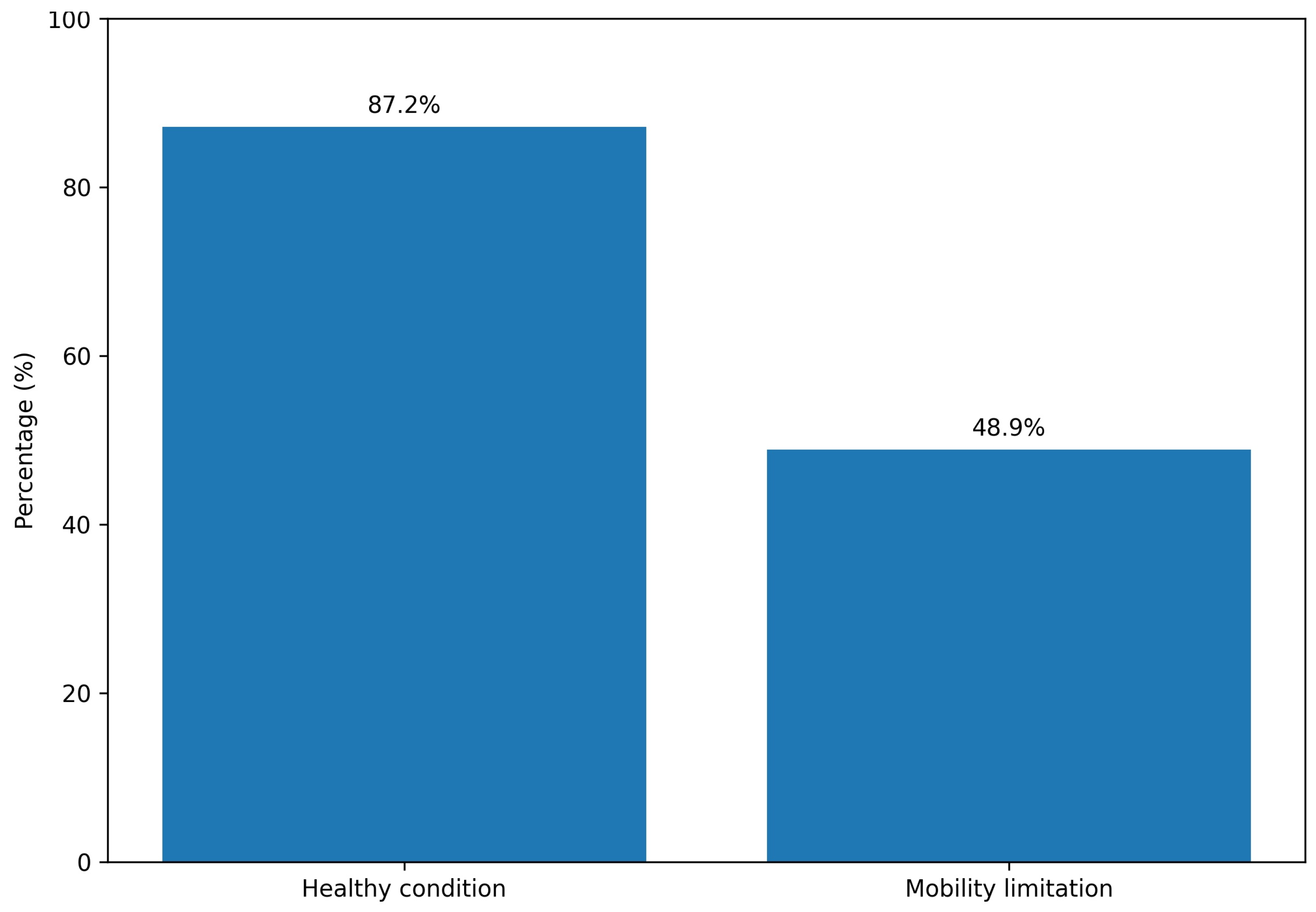
Panel B of
Table 4 and
Figure 1 illustrate the most important descriptive contrast in the study. Under the scenario in which health is maintained and independent daily living remains possible, 87.2% of respondents prefer to continue living in their current home. Only 8.1% prefer moving to another general housing arrangement, and 4.7% prefer senior housing. The pattern changes substantially when the same respondents are asked to imagine a situation in which health deteriorates and independent daily living becomes difficult. In that case, the proportion preferring to remain in the current home drops to 48.9%, while 16.5% prefer senior housing and 27.7% prefer entering a long-term care facility. In addition, 6.8% prefer either co-residing with children or relatives or living nearby.
This shift is substantively important. If aging in place were simply a stable expression of place attachment, the contrast between the healthy-condition scenario and the mobility-limitation scenario would be modest. Instead, the difference is large and systematic. The feasibility of remaining in the community appears to be reassessed once older adults are asked to consider actual dependence, care needs, and support arrangements. The descriptive results therefore provide the first empirical basis for the study’s central claim: the intention to age in place is widely expressed in principle, but perceived feasibility becomes much less evenly distributed when later-life vulnerability becomes salient. In this sense, the descriptive evidence already points to stratified aging in place rather than a uniform or unconditional preference for remaining at home.
4.2. Housing Inequality and Functional Vulnerability
To move beyond descriptive contrasts and examine whether the intention to age in place under mobility limitation is systematically structured by unequal conditions,
Table 5 reports the weighted logistic regression results for Model 1 and Model 2. Model 1 includes only sociodemographic controls, whereas Model 2 adds the variables related to material conditions and functional vulnerability. This sequential comparison makes it possible to assess whether the baseline compositional patterns observed in the sample persist once housing, economic resources, health, and functional limitations are taken into account.
In the baseline model, several sociodemographic characteristics are already associated with the intention to remain in place under mobility limitation. Women are significantly less likely than men to intend to remain in the current home (OR = 0.839, p < 0.001). Educational attainment also shows a negative gradient: compared with respondents with elementary education or less, those with middle school, high school, and college education have lower odds of intending to remain in place. By contrast, household composition matters in the opposite direction. Older adults living with adult children are more likely than those living alone to report an intention to remain in the current home (OR = 1.339, p < 0.001), suggesting that family co-residence may provide a baseline expectation of practical support if functional limitation occurs. Model fit is limited at this stage, however, indicating that demographic composition alone provides only a partial account of stratified aging in place.
Once material conditions and functional vulnerability are introduced in Model 2, the explanatory picture becomes much sharper. The model fit improves substantially, with the Nagelkerke pseudo-R2 increasing from 0.012 to 0.058, indicating that unequal access to housing and health-related resources explains a meaningful share of the variation in the intention to remain in place. Most notably, housing tenure emerges as one of the strongest sets of predictors in the model. Relative to homeowners, respondents in jeonse housing are much less likely to intend to remain in the current home (OR = 0.398, p < 0.001). The same is true for those in monthly rental housing with a deposit (OR = 0.640, p < 0.001), monthly rental housing without a deposit (OR = 0.398, p < 0.01), and free housing (OR = 0.602, p < 0.001). These coefficients indicate that the feasibility of aging in place depends less on a generic preference for familiar surroundings than on the degree of control and security attached to one’s present dwelling.
Housing satisfaction is also strongly and positively associated with the intention to remain in place under mobility limitation. Respondents who report higher satisfaction with their current dwelling are significantly more likely to intend to remain there under mobility limitation (OR = 1.260, p < 0.001). This result suggests that material security should not be reduced to legal tenure status alone. Even among community-dwelling older adults, the current home must also be perceived as adequate, livable, and capable of supporting daily life in later old age. Together, the tenure and satisfaction results indicate that housing inequality structures aging in place not only through ownership versus non-ownership, but also through the perceived suitability of the dwelling as a place in which care needs can be managed.
By contrast, the effects of broader economic resources are more mixed. Household income quintiles do not display a monotonic relationship with aging in place. Compared with the lowest income quintile, the second and fifth quintiles show significantly lower odds of intending to remain in the current home, whereas the middle quintiles are not statistically distinguishable from the lowest group. Likewise, real estate assets are negatively associated with the intention to remain in place, although the magnitude of the effect is relatively small (OR = 0.972, p < 0.001). This finding suggests that AIP intention under anticipated mobility limitation should not be understood simply as a linear function of accumulated wealth. One possible interpretation is that older adults with greater economic resources may be more open to considering alternatives such as senior housing or institutional care rather than remaining in the current dwelling. However, because the present analysis does not directly measure awareness, availability, or evaluation of such alternatives, this explanation should be treated as suggestive rather than conclusive. In this sense, the results point to the importance of housing security and residential control, rather than generalized affluence alone, as a key material condition shaping perceived AIP feasibility.
The findings on functional vulnerability also show a differentiated pattern. As expected, ADL limitation significantly reduces the likelihood of intending to remain in the current home (OR = 0.748, p < 0.01). This confirms that basic functional dependence makes staying in the current dwelling substantially more difficult to imagine when older adults anticipate mobility limitation. By contrast, IADL limitation is not statistically significant, and the number of chronic conditions is likewise not significantly associated with aging in place. These results imply that the practical feasibility of remaining in place is shaped less by disease burden per se than by whether older adults anticipate difficulties in performing the most fundamental daily activities. Functional vulnerability therefore matters most when it directly alters the manageability of the home environment.
A more nuanced pattern appears in the case of subjective health status, which is statistically significant but modest in magnitude (OR = 0.940, p < 0.05). Because the dependent variable asks respondents to imagine future living arrangements under worsening health, self-rated current health may capture not only current physical well-being but also respondents’ expectations about future care needs and residential options. The coefficient should therefore be interpreted cautiously. Similarly, public transportation accessibility within 15 min on foot is negatively associated with the intention to remain in place (OR = 0.743, p < 0.01). This result should not be interpreted as evidence that accessibility is unimportant for later-life well-being or community living. A more cautious interpretation is that older adults in more service-rich or urban environments may be less likely to view remaining in the current home as the only viable option when mobility limitation becomes salient. However, the analysis does not directly observe service awareness, actual access to care facilities, or preferences for specific residential alternatives. Therefore, this interpretation remains a plausible explanation rather than a directly tested mechanism.
One further point deserves emphasis. After material and health variables are added, co-residence with adult children remains positively associated with the intention to remain in place under mobility limitation (OR = 1.316, p < 0.001), while the effect of couple-only households becomes statistically insignificant. This suggests that what matters is not simply the presence of another household member, but the expectation of available support in the event of increasing need. In this respect, aging in place remains embedded in family support structures even after accounting for housing and health conditions.
Taken together, the results in
Table 5 provide strong support for the study’s argument that AIP intention under mobility limitation is stratified by unequal material and functional conditions. The most substantial predictors in Model 2 are not household income in the abstract, but housing tenure, housing satisfaction, co-residence with adult children, and ADL limitation. These patterns support Hypothesis 1 and Hypothesis 2 and indicate that the intention to remain in place is structured above all by the security and suitability of the current living arrangement and by the extent to which functional decline threatens its viability. These material and functional inequalities form the baseline upon which the institutional and civic factors examined in the next section are layered.
4.3. Institutional Exclusion and Civic Capacity
Section 4.2 showed that AIP intention under mobility limitation is already strongly structured by housing inequality and functional vulnerability. The next question is whether these material and bodily conditions exhaust the explanation, or whether older adults’ relationships to public institutions and community life add further explanatory power. To address this issue,
Table 6 presents the final weighted logistic regression model, which adds the variables related to institutional exclusion and civic capacity to the material and functional baseline established in Model 2.
The results indicate that institutional and civic factors do not replace the importance of housing and health-related conditions, but they do add a meaningful second layer of explanation. The overall model fit improves from a Nagelkerke pseudo-R2 of 0.058 in Model 2 to 0.068 in Model 3. The information criteria show the same pattern: AIC decreases from 13,401.07 to 13,333.31, and BIC decreases from 13,581.22 to 13,549.49. Because both AIC and BIC penalize model complexity, these results suggest that the addition of institutional exclusion and civic capacity variables improves relative model fit beyond material security and functional vulnerability alone.
Among these variables, social participation intention shows the clearest positive association with the intention to remain in place under mobility limitation. Respondents who express a stronger intention to engage in political and social activities in the future are more likely to intend to remain in their current home under mobility limitation (OR = 1.178, p < 0.001). This result suggests that aging in place is not only a matter of having a secure dwelling, but also of imagining oneself as still connected to social and public life. Older adults who anticipate continued participation may perceive the community not simply as a physical setting, but as a meaningful arena of everyday engagement. In this sense, social participation functions as an indicator of civic capacity—that is, the ability to remain socially connected and purposive within the community as later-life needs increase.
At the same time, the results show that not all institutional orientations operate in the same direction. Government trust is negatively associated with the intention to remain in place (OR = 0.915,
p < 0.01), whereas trust in neighbors is positively associated but not statistically significant (OR = 1.044, n.s.). This negative association should be interpreted cautiously. It should not be read as evidence that trust in government directly weakens the intention to age in place, nor as direct evidence that older adults with higher institutional trust actually have access to, are aware of, or positively evaluate alternative residential or care arrangements. One possible interpretation is that higher government trust may be associated with a greater willingness to consider publicly supported care or residential alternatives when mobility limitation becomes salient. However, the present data do not directly measure the availability, awareness, evaluation, or future use of specific alternatives such as senior housing, long-term care facilities, home- and community-based services, or other organized care arrangements [
26,
27]. Therefore, this interpretation should be understood as a plausible explanation for the observed association, rather than as a conclusive or empirically tested mechanism. This is consistent with the theoretical framework, which treats government trust as an empirically open institutional orientation rather than as a variable with a predetermined directional effect.
By contrast, institutional discrimination shows a clear and substantively important negative association with the intention to remain in place under mobility limitation. Older adults who report having experienced age discrimination in public institutions are significantly less likely to intend to remain in their current residence under mobility limitation (OR = 0.733, p < 0.01). This finding provides direct support for the study’s institutional exclusion argument. The issue is not simply that discriminatory treatment is unpleasant. Rather, such experiences may weaken older adults’ confidence that public agencies, administrative offices, and service systems will respond fairly and accessibly when support is needed. Even though the proportion reporting discrimination is relatively small in descriptive terms, the coefficient indicates that this experience carries meaningful implications for how older adults evaluate the viability of remaining in the community.
Digital adaptability is also positively associated with the intention to remain in place under mobility limitation (OR = 1.091, p < 0.01). This result suggests that adapting to a rapidly changing digital environment is not merely a matter of technological convenience. In an increasingly digitized welfare and service landscape, digital adaptability appears to function as an enabling capacity for community-based living. Older adults who are more capable of navigating digital environments may be better positioned to access information, maintain communication, use public and commercial services, and coordinate the practical supports necessary for continued residence. In this sense, digital adaptability operates as a contemporary form of civic capacity that supports the sustainability of aging in place.
An important feature of the final model is that the institutional and civic variables do not displace the material inequalities identified earlier. The key housing coefficients remain highly stable after the addition of the new variables. Relative to homeowners, respondents in jeonse (OR = 0.392, p < 0.001), monthly rent with deposit (OR = 0.647, p < 0.001), monthly rent without deposit (OR = 0.399, p < 0.01), and free housing (OR = 0.614, p < 0.001) continue to show substantially lower odds of aging in place. Housing satisfaction remains strongly positive (OR = 1.258, p < 0.001), and ADL limitation continues to reduce the likelihood of remaining in the current home (OR = 0.740, p < 0.01). These patterns reinforce the study’s central claim: aging in place is structured first by material and functional inequalities and then further shaped by institutional exclusion and civic capacity.
The same layered logic is visible in the family and demographic controls. Co-residence with adult children remains positively associated with aging in place (OR = 1.326, p < 0.001), indicating that expected family support continues to matter even in the final specification. The negative gradient by educational attainment also persists, while age shows a small positive effect. These findings suggest that institutional and civic factors do not merely stand in for family support or sociodemographic composition. Rather, they operate alongside them as an additional dimension of stratification.
Taken together, the findings in
Table 6 provide strong support for the argument that aging in place in South Korea is not simply a housing preference, but a stratified outcome shaped by layered inequalities. Hypothesis 3 is supported: institutional exclusion, measured as age discrimination in public institutions, reduces the likelihood of intending to remain in place under mobility limitation. Hypothesis 4 is also supported: civic capacity, captured here through social participation intention and digital adaptability, increases the likelihood of intending to remain in place. At the same time, the mixed results for trust variables suggest that institutional orientation is more complex than a straightforward linear resource. Most importantly, the final model shows that institutional and civic conditions matter in addition to, rather than instead of, housing inequality and functional vulnerability. Aging in place is therefore best understood as a multidimensional form of unequal sustainability.
4.4. Substantive Effects and Adjusted Predicted Probabilities
Although the odds ratios reported in
Table 5 and
Table 6 identify the direction and relative strength of the associations, they do not by themselves convey the substantive magnitude of the differences across groups. To make the results more interpretable,
Table 7 and
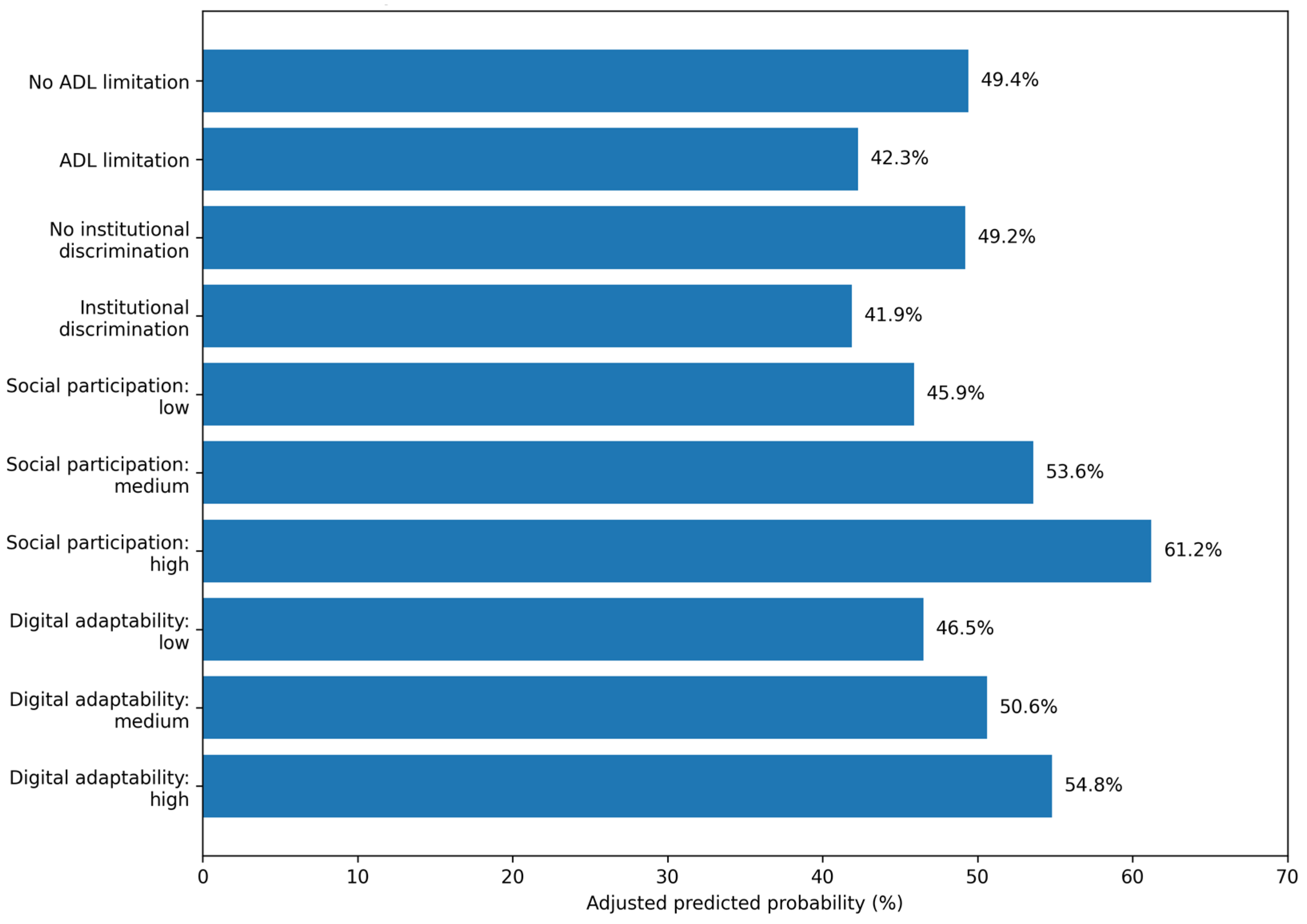
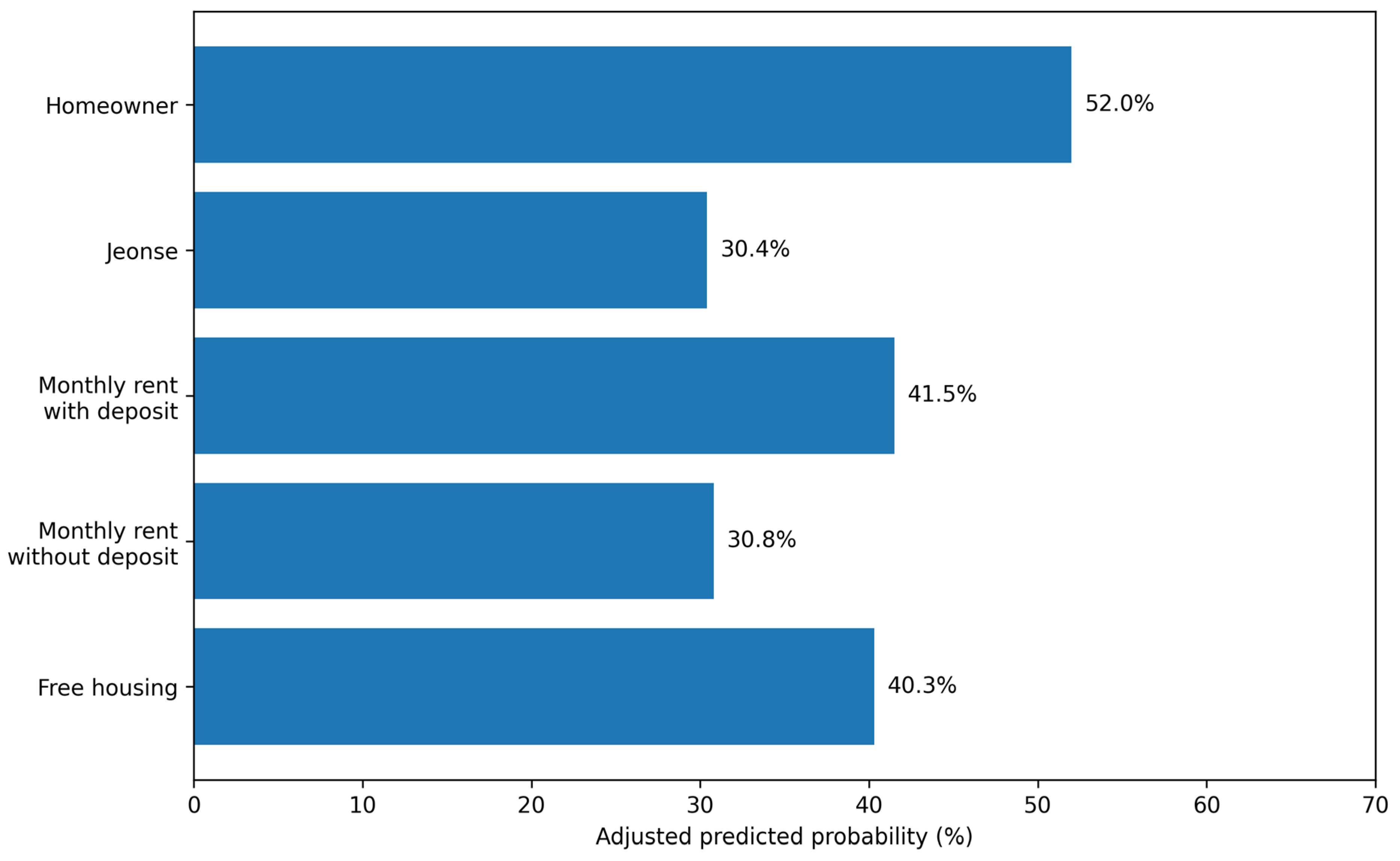
Figure 2 and
Figure 3 present adjusted predicted probabilities derived from the final model. These probabilities were calculated by setting focal variables to selected values while leaving all remaining covariates at their observed values and then averaging the predicted probabilities across the analytic sample using survey weights. This approach allows the estimated differences to be interpreted on the probability scale rather than only through odds ratios.
The first set of results concerns housing tenure, which remains the most consequential structural dimension of stratified aging in place. As shown in
Table 7 and
Figure 2, the adjusted predicted probability of intending to remain in the current home under mobility limitation is 0.520 for homeowners. By contrast, the comparable probabilities are only 0.304 for those in jeonse housing, 0.415 for those in monthly rental housing with a deposit, 0.308 for those in monthly rental housing without a deposit, and 0.403 for those in free housing. These differences indicate that the housing-tenure gap is not merely statistically significant but also substantively large. Relative to homeowners, older adults in jeonse or monthly rental housing without a deposit show a deficit of roughly 21 percentage points in the adjusted probability of intending to remain in place under mobility limitation. This pattern reinforces the conclusion that the core divide is not simply between richer and poorer individuals, but between more and less secure forms of residential control.
The second set of results concerns functional vulnerability and institutional exclusion. Respondents without ADL limitation have an adjusted predicted probability of 0.494, whereas those with ADL limitation have a probability of 0.423. A similarly meaningful gap appears in relation to discrimination in public institutions. Older adults who do not report institutional discrimination have an adjusted probability of 0.492, compared with 0.419 among those who report such discrimination. In substantive terms, both functional dependence and discriminatory institutional experience reduce the expected probability of intending to remain in place by around 7 percentage points. These contrasts confirm that the viability of remaining in the community depends not only on residential circumstances, but also on whether the home can still support daily functioning and whether public institutions are experienced as accessible rather than exclusionary.
The third set of results concerns civic capacity, especially social participation intention and digital adaptability. The adjusted predicted probability of intending to remain in place increases from 0.459 among respondents with the lowest level of social participation intention to 0.536 at the middle level and 0.612 at the highest level. A similar, although more moderate, gradient appears for digital adaptability: the predicted probability rises from 0.465 at the lowest level to 0.506 at the middle level and 0.548 at the highest level. These gradients suggest that social participation intention and digital adaptability are associated with substantively meaningful differences in how older adults evaluate the perceived feasibility of remaining in place under mobility limitation. However, the social participation variable should be interpreted as an indicator of prospective civic orientation, not as direct evidence of actual participation, existing social capital, or access to community support. By contrast, the negative association of government trust also becomes visible on the probability scale: when government trust is moved from the lowest to the highest level, the adjusted predicted probability declines from 0.517 to 0.455. This result is consistent with the cautious interpretation offered in
Section 4.3: the negative association may reflect a possible openness to institutional or publicly supported residential alternatives when mobility limitation becomes salient, but this mechanism is not directly tested in the present analysis.
To illustrate the combined nature of stratification,
Table 7 also reports two illustrative joint profiles based on the final model. An older adult with a comparatively advantaged set of conditions—homeownership, no ADL limitation, no institutional discrimination, high social participation intention, and high digital adaptability—has an adjusted predicted probability of 0.705 of intending to remain in the current home. By contrast, an older adult facing a constrained set of conditions—jeonse residence, ADL limitation, institutional discrimination, low social participation intention, and low digital adaptability—has an adjusted probability of only 0.166. This contrast should not be interpreted as a deterministic forecast for any single individual. Rather, it illustrates the cumulative way in which material, functional, institutional, and civic inequalities can combine to widen the gap in the perceived feasibility of aging in place under anticipated mobility limitation.
Taken together, these adjusted probabilities strengthen the central conclusion of this study: the intention to age in place in South Korea is not only associated with unequal conditions in a statistical sense, but is also substantively stratified in ways that are large enough to matter for policy interpretation. The final model therefore supports a view of AIP intention as a layered and unequal form of social sustainability, in which housing security, bodily capacity, institutional treatment, and civic resources jointly structure who perceives remaining in the community as realistic under conditions of later-life vulnerability.
5. Discussion
5.1. Main Findings
A central finding of this study is that aging in place in South Korea cannot be inferred from general residential attachment alone. The descriptive results show that the preference to remain in the current home is overwhelmingly high when health is maintained, but it declines sharply once respondents are asked to imagine a situation in which independent daily living becomes difficult. This contrast matters because it reveals a clear distinction between wanting to remain in place and being able to imagine doing so under conditions of vulnerability. Aging in place is therefore not a fixed residential ideal; it is a conditional judgment shaped by anticipated care needs, functional decline, and the practical viability of remaining in one’s current dwelling and community.
Within this more demanding scenario, housing inequality emerges as the strongest structural basis of stratified aging in place. Housing tenure and housing satisfaction remain robust predictors across the multivariate models, even after health, family structure, and institutional variables are taken into account. Older adults who do not own their homes are consistently less likely to intend to remain in place, while those who evaluate their dwelling more positively are more likely to do so. These findings suggest that the material basis of aging in place is not reducible to income or wealth in a general sense. What matters most is whether older adults have secure and usable control over the dwelling in which later-life vulnerability must be managed. In this respect, the results support a view of aging in place as a housing-mediated form of inequality rather than as a neutral expression of place attachment [
7,
8,
9].
Functional vulnerability deepens this pattern of stratification. The negative association between ADL limitation and aging in place indicates that the feasibility of remaining at home is closely tied to the ability to perform the most basic daily activities. By contrast, the number of chronic conditions and IADL limitation do not show the same consistent relationship. This suggests that later-life residential decisions are shaped less by illness burden in the abstract than by whether older adults expect the home to remain manageable when direct assistance becomes necessary. Aging in place becomes difficult not simply when health worsens, but when the home is no longer imagined as a workable site of everyday functioning.
The results also show that the sustainability of community residence is shaped by institutional and civic conditions in ways that extend beyond conventional housing and health explanations. Experiences of age discrimination in public institutions significantly reduce the likelihood of intending to remain in place, while social participation intention and digital adaptability increase it. These findings indicate that community-based aging depends not only on private resources and family arrangements, but also on whether older adults can remain connected to public systems, social networks, and increasingly digitalized infrastructures. In that sense, the study identifies a second layer of stratification: even among older adults facing similar housing and health conditions, the feasibility of aging in place varies according to institutional treatment and civic capacity [
10,
11,
12,
13].
The result for government trust should be interpreted more cautiously than the other findings. The model shows that higher government trust is negatively associated with the intention to remain in the current home under mobility limitation, but this should not be read as evidence that trust in government directly weakens the desire to age in place. Nor should it be interpreted as empirical evidence that older adults with greater institutional trust evaluate alternative residential or care facilities more positively or intend to use them. The present survey does not directly measure older adults’ awareness, availability, evaluation, or use of senior housing, transitional care arrangements, long-term care facilities, home- and community-based services, or other publicly supported residential and care alternatives. Therefore, the interpretation of this association is offered only as a discussion point rather than as an empirically tested mechanism. One possible hypothesis for future research is that greater trust in public institutions may be linked to greater openness to publicly supported alternatives when mobility limitation becomes salient. The present finding should therefore be understood as identifying a negative association between government trust and AIP intention, not as demonstrating the mechanism that produces it.
Taken together, the findings support the claim that AIP intention under mobility limitation in South Korea is best understood as a stratified outcome. It is widely desired in principle, but unevenly attainable in practice. Material security establishes the baseline conditions of feasibility, functional vulnerability tests those conditions, and institutional exclusion and civic capacity further widen or narrow the range of viable options.
5.2. Theoretical Contributions
This study contributes to the aging-in-place literature by shifting analytical attention from stated preference to feasibility under vulnerability. Previous research has shown that older adults attach meaning to home through familiarity, autonomy, identity, and continuity [
3], and that aging in place is shaped by an interrelated set of domains including place, support, relationships, and technology [
4]. The present study builds on these insights but argues that they must be interpreted through the lens of unequal distribution. The relevant question is not only whether older adults value staying in place, but whether they possess the material, institutional, and civic resources that make such continuity viable when health declines.
A second contribution lies in clarifying the role of housing inequality. Existing work has already linked age-friendly environments and residential conditions to expectations of aging in place [
8], while broader welfare scholarship has emphasized the importance of homeownership as a form of asset-based security [
7]. The present findings sharpen this discussion by showing that housing tenure is not merely a proxy for socioeconomic position, but a direct structural condition of residential control. The persistence of tenure effects across all model specifications indicates that housing inequality should be treated as the material anchor of aging in place rather than as one covariate among many. This matters theoretically because it places the dwelling itself—its security, suitability, and durability—at the center of later-life community continuity.
The study also extends the literature by foregrounding institutional exclusion as a relevant dimension of aging in place. Much of the established literature has focused on care arrangements, health, social ties, and neighborhood environments [
4,
9,
10]. Less attention has been paid to how older adults experience public institutions as sites of access, recognition, or exclusion. The negative association between age discrimination in public institutions and aging in place suggests that the feasibility of remaining in the community depends partly on whether older adults encounter administrative systems as fair, navigable, and responsive. This adds a more explicit institutional dimension to the study of aging in place and helps connect the literature to broader concerns about public inclusion, policy design, and unequal treatment in later life [
12].
Another theoretical contribution concerns civic capacity. The positive effects of social participation intention and digital adaptability indicate that sustainable community residence depends not only on care and housing, but also on continued access to participation, communication, and service navigation. Research on social connectedness and civic participation has already shown that older adults’ later-life engagement is closely tied to inclusion and collective membership [
10,
11], while technology studies have highlighted the potential role of digital tools in supporting independent living [
13]. The present study brings these strands together by suggesting that social participation and digital adaptability should be understood not simply as beneficial add-ons, but as enabling capacities that shape who can realistically sustain community-based living.
Taken together, these findings support the argument that aging in place should be theorized as a layered form of unequal sustainability. Material conditions shape the baseline possibility of remaining in place. Functional vulnerability reveals the fragility of that possibility. Institutional exclusion and civic capacity then further stratify later-life residence by shaping whether support systems remain accessible and usable. From this perspective, aging in place is neither a purely private choice nor a purely health-related outcome. It is a socially organized form of continuity whose feasibility reflects how unevenly the conditions of sustainable aging are distributed [
5,
6].
5.3. Policy Implications for Social Sustainability
The findings have direct implications for how aging policy is framed and implemented in rapidly aging societies. If aging in place is treated as a universally desirable and broadly feasible outcome, policy may overlook the unequal conditions that make community residence viable for some older adults but fragile for others. A socially sustainable policy approach should therefore focus not only on encouraging residence in place, but on reducing the inequalities that structure who can realistically remain in the community under conditions of later-life vulnerability.
Housing policy is central to this task. Because housing tenure and housing satisfaction are the strongest and most consistent predictors in the analysis, aging-in-place policy cannot be limited to service delivery or medical support alone. Dwelling stability, tenure-sensitive support, home modification, and housing–care coordination should be treated as core pillars of sustainable aging policy. Without these measures, community-based aging is likely to remain disproportionately available to homeowners and to older adults whose dwellings are already suitable for living with increasing care needs. More concrete measures may include home modification grants, rental security protections for older tenants, housing–care coordination services, and targeted support for older adults in insecure tenure arrangements.
Institutional accessibility is equally important. The negative association between public-institution discrimination and aging in place indicates that later-life community residence depends partly on whether older adults experience administrative systems as fair and approachable. This implies that age-inclusive policy design should extend beyond welfare entitlements to the everyday usability of public institutions. Administrative simplification, age-sensitive service delivery, anti-discrimination practices, and support for navigating public systems should all be considered part of the infrastructure of sustainable aging. These measures could be complemented by accessible public-service interfaces and anti-ageism training for frontline public officials.
Digital inclusion should be understood in similar terms. As health information, welfare access, communication, finance, transportation, and service coordination become more digitized, the ability to adapt to digital environments is becoming increasingly relevant to independent community residence. The present findings suggest that digital inequality is no longer peripheral to aging policy. It is part of the practical architecture of whether older adults can remain connected to the systems that sustain daily life. Policies that expand digital training, improve usability, maintain assisted access, and preserve non-digital alternatives are therefore likely to be essential components of sustainable aging. At the same time, digital assistance programs should be linked to offline service channels so that digitalization does not unintentionally deepen exclusion among older adults with low digital adaptability.
The results also underscore the importance of social participation. Older adults who anticipate continued engagement in political and social activities are more likely to imagine remaining in place under mobility limitation. This suggests that community-based aging is supported not only by care arrangements, but also by the expectation that local life remains socially meaningful. Age-friendly transport services and accessible local mobility support are also important because remaining in the community depends not only on the dwelling itself, but also on whether older adults can reach services, public institutions, and social activities under conditions of mobility limitation. Opportunities for participation through community centers, local associations, volunteering, education, and neighborhood networks should therefore be viewed as part of the enabling environment of aging in place rather than as secondary or optional programs.
At the same time, the findings caution against equating successful aging policy with staying in the same home at all costs. The negative coefficient for government trust raises a possible discussion point, but it does not directly test whether older adults with higher institutional trust evaluate alternative residential or care facilities as secure or supportive, or whether they intend to use such options. Because the present survey does not directly measure awareness, availability, evaluation, or use of alternative residential and care arrangements, this interpretation should be treated as discussion-oriented rather than as an empirical finding. From a social sustainability perspective, the policy goal should therefore not be to maximize immobility. Rather, it should be to ensure that older adults can make later-life residential decisions under conditions of security, recognition, and support, whether that involves remaining in the current home or having access to dignified and publicly supported alternatives that better meet their needs.
5.4. Limitations and Future Research
Several limitations should be acknowledged when interpreting the findings of this study. The first concerns the cross-sectional nature of the data. Because the analysis relies on a single wave of survey data, the results identify patterned associations rather than causal relationships. Housing insecurity, functional vulnerability, institutional discrimination, and digital adaptability are all meaningfully associated with aging in place, but the temporal ordering of these relationships cannot be established with certainty. The present findings therefore clarify the structure of unequal perceived feasibility, not the full causal sequence through which aging-in-place intentions are formed or later translated into actual residential behavior.
Another methodological limitation is that the regression models applied survey weights and robust standard errors but did not explicitly incorporate primary sampling units and strata as part of a full complex survey design specification. Although this approach improves population representativeness and reduces some concerns about heteroskedasticity, statistical significance should be interpreted with caution because the standard errors may not fully reflect all features of the original stratified cluster sampling design.
A second limitation concerns the measurement of the dependent variable. The study examines the intention to remain in the current home under mobility limitation rather than observed future residential behavior. This design has an important advantage because it offers a more demanding and policy-relevant test than a general question about preferred residence under healthy conditions. At the same time, intended arrangements under hypothetical vulnerability are not identical to actual later-life transitions. Residential decisions may change as health deteriorates, as family members become more or less available, or as institutional alternatives become more or less accessible. For this reason, the empirical claims of this study are intentionally framed in terms of stated intention and perceived feasibility, not actual residential behavior. The dependent variable should therefore be interpreted as an indicator of perceived feasibility under anticipated vulnerability rather than as a direct measure of realized residential continuity [
24,
25]. In addition, the analysis does not directly measure older adults’ awareness, availability, evaluation, or use of specific alternative residential or care arrangements, which means that interpretations concerning alternative options should be understood as plausible explanations rather than directly tested mechanisms. Accordingly, the interpretation of government trust offered in this study should be understood as hypothesis-generating and discussion-oriented, rather than as an empirical finding about older adults’ evaluation of alternative facilities.
A related measurement limitation concerns the social participation variable. The measure used in this study captures future intention to participate in political and social activities, not actual participation in organizations or community groups. It therefore cannot be interpreted as direct evidence of existing social capital, social embeddedness, or access to community support. Future research should examine whether the results remain robust when actual participation in religious groups, senior centers, voluntary associations, leisure groups, neighborhood organizations, or other community-based activities is incorporated into the analysis. Such work would also help distinguish more clearly between social participation as actual activity, social embeddedness, and the prospective participation intention measured in the present study [
20,
21].
A third limitation follows from the decision to restrict the analysis to self-respondents. This restriction improves interpretive consistency for variables that depend on subjective evaluation, such as preferred living arrangement, trust, participation intention, and perceived adaptation to digital environments. However, it also means that the analytic sample is less likely to include older adults with the most severe cognitive, communicative, or functional limitations. Because such respondents may face particularly strong constraints in housing adaptation, service navigation, institutional encounters, and daily living, the analysis may understate the degree to which AIP intention is stratified at the most vulnerable end of the older population. The negative associations of ADL limitation and institutional discrimination should therefore be interpreted as estimates derived from a self-respondent sample, rather than as a full representation of all frail older adults. Future research should explore ways to assess aging-in-place feasibility among more frail groups without sacrificing conceptual clarity.
A fourth limitation concerns measurement scope. One specific limitation concerns the housing tenure measure. Although free housing is included as a distinct category, the dataset does not distinguish whether this arrangement reflects private family assistance, informal support from relatives or acquaintances, or public welfare housing. As a result, the estimated association for free housing may combine heterogeneous forms of residential support. Future research should distinguish the sources of free housing more precisely in order to assess whether publicly provided and privately supported free housing have different implications for AIP intention. Institutional exclusion is represented here by age discrimination in public institutions, and civic capacity is captured primarily through social participation intention and digital adaptability. These are substantively meaningful indicators, but they do not fully cover the wider institutional and civic ecology of community-based aging. Future research could extend this framework by incorporating more direct measures of service accessibility, administrative burden, neighborhood-level support infrastructure, local welfare capacity, and actual rather than intended participation. Future research should also examine whether the association between digital adaptability and AIP intention varies by educational attainment, since education may condition older adults’ ability to convert digital skills into effective access to information, services, and institutional support. Similarly, the role of trust deserves further refinement, especially given the differentiated pattern observed between government trust and trust in neighbors. In particular, future studies should distinguish between trust as confidence in community-based public support and trust as confidence in institutional alternatives outside the current dwelling. Similarly, the negative association between public transportation accessibility and AIP intention should be examined with more direct measures of service environments, residential alternatives, and care accessibility, because the present analysis cannot determine whether better transport access reflects greater mobility support for remaining in place or greater exposure to alternative residential and care options.
In addition, the 15 min public transportation accessibility measure is based on the categorical structure of the survey item and does not capture continuous walking time, service frequency, quality of transport connections, or urban–rural differences in public transportation infrastructure. Future research should examine whether the findings remain robust when more fine-grained or continuous measures of accessibility are used.
The findings also point to several productive directions for future research. Longitudinal designs would be particularly valuable in clarifying whether the inequalities identified here translate into actual residential trajectories, including moves to senior housing, transitions into long-term care, or continued residence with expanding support needs. Multilevel approaches would also strengthen the analysis by assessing whether regional housing markets, transportation systems, welfare infrastructure, and community resources condition the feasibility of aging in place. More broadly, future work should examine whether stratified aging in place varies across welfare regimes, housing systems, and levels of digitalization in ways that reshape the social sustainability of aging.
Despite these limitations, the present study makes a clear empirical and conceptual contribution. It demonstrates that aging in place in South Korea is not best understood as a general wish to remain at home, nor as an outcome reducible to health status alone. It is a socially differentiated possibility whose feasibility depends on the layered distribution of material, functional, institutional, and civic conditions. That conclusion remains robust even when the constraints of cross-sectional survey analysis are fully acknowledged.
6. Conclusions
This study has examined the intention to age in place under anticipated mobility limitation in South Korea as a stratified form of social sustainability. Using nationally representative data from the 2023 National Survey of Older Koreans, it has shown that the stated intention to remain in the current home when independent daily living becomes difficult is not evenly distributed across the older population. The results indicate that AIP intention under mobility limitation is shaped most strongly by housing inequality, especially tenure security and housing satisfaction. Functional vulnerability, particularly limitation in activities of daily living, further reduces the likelihood of remaining in place. Beyond these material and bodily conditions, institutional discrimination lowers the likelihood of intending to remain in place, whereas social participation intention and digital adaptability increase it. The findings therefore show that AIP intention under mobility limitation is neither a simple housing preference nor a purely health-related response. It is a socially organized and unequally distributed possibility.
The study makes three principal contributions. It reconceptualizes AIP intention under anticipated mobility limitation as stratified aging in place, shifting the analytical focus from broad preference to unequal feasibility under conditions of vulnerability. It shows that housing inequality remains the core structural axis of aging in place even after health, family, and institutional factors are taken into account. It also demonstrates that the sustainability of community-based aging depends on more than material security, extending the analysis to include institutional inclusion and civic capacity as integral conditions of later-life residence.
This argument also has comparative implications for other rapidly aging East Asian societies. Japan has developed community-based integrated care as a policy framework for supporting older adults to remain in familiar local settings, while China has expanded home- and community-based elderly care services as part of its response to population aging [
28,
29]. The Korean case shares with these societies a growing emphasis on community-based aging, but it also reveals a distinctive pathway of stratification rooted in the housing system. In particular, the jeonse system places many older non-homeowners in an intermediate position between ownership and monthly rental housing: it may provide more residential stability than monthly rent, but it still lacks the residential control and asset security associated with homeownership [
30]. The strong negative association between jeonse tenure and AIP intention therefore highlights how Korea’s real-estate-centered welfare structure can produce a distinctive form of stratified AIP intention that is not fully captured by general owner–renter comparisons.
These conclusions have direct implications for aging policy. A policy framework that simply promotes remaining at home will be insufficient if the conditions that make community residence feasible remain unequally distributed. A more socially sustainable approach requires simultaneous attention to housing security, dwelling suitability, functional support, institutional accessibility, digital inclusion, and opportunities for social participation. The central issue is not merely how to keep older adults in place, but how to ensure that remaining in the community is a realistic and equitable option rather than a possibility reserved for those with more secure housing, stronger support, or greater adaptive capacity.
At the same time, aging policy should avoid treating residence in the current home as the only desirable outcome. Some older adults may prefer senior housing, supported residential arrangements, or institutional care when such alternatives are available under conditions of dignity and security. The negative association between government trust and AIP intention is consistent with this broader caution, but it should not be interpreted as evidence that older adults with higher institutional trust positively evaluate or prefer alternative facilities. Rather, it raises a discussion point for future research: publicly trusted systems may shape how older adults consider residential and care alternatives when mobility limitation becomes salient. Because the present analysis does not directly measure the availability, awareness, evaluation, or use of such alternatives, this interpretation should be treated as discussion-oriented rather than as an empirically tested mechanism. From the perspective of social sustainability, the goal should not be to maximize immobility, but to create conditions under which older adults can make residential decisions with security, recognition, and support.
Although the study is limited by its cross-sectional design and its reliance on intended rather than observed residential behavior, it provides clear evidence that the future of community-based aging in South Korea will depend on how unequally its enabling conditions are distributed. The intention to age in place is widely expressed, but its perceived feasibility is unevenly distributed. Sustainable aging policy will therefore depend less on affirming residence in place as a universal ideal than on reducing the inequalities that shape whether older adults perceive remaining in the community as realistic when later-life vulnerability becomes salient.