Article

Integrating Digital Tools for Automated Circularity Assessment of Construction Products: A Case Study


1
Department of Civil Engineering and Architecture, University of Catania, Via Santa Sofia, 64, 95125 Catania, Italy
2
Department of Economics and Business, University of Catania, Corso Italia, 55, 95129 Catania, Italy
3
UNI Italian Standards Body, Innovation and Standardization, Via Sannio, 2, 20137 Milan, Italy
*
Author to whom correspondence should be addressed.
Sustainability 2026, 18(13), 6650; https://doi.org/10.3390/su18136650
Submission received: 25 May 2026 / Revised: 22 June 2026 / Accepted: 29 June 2026 / Published: 1 July 2026

Abstract

The circular economy is recognised as a key topic that requires the development of user-friendly methodologies for circularity assessment, with digitalisation supporting more accurate evaluation processes. This study proposes an automated digital tool to calculate products’ Circularity Level (LC), defined in UNI/TS 11820:2024 and aligned with ISO/TC 323 circular economy standards (ISO 59004, ISO 59010, and ISO 59020) and the Level(s) EU sustainability framework. Specifically, an Excel-based calculator is developed to encode regulatory requirements, automatically compute LC values, generate radar charts highlighting improvement areas, and export results to MS Word for automated stakeholder reporting. Additionally, for construction materials, an information flow between MS Excel and Autodesk Revit is established using Dynamo, enabling the automated creation of product-related BIM objects and the integration of circularity data into the BIM model. The workflow is demonstrated through its application to a single case, namely the ITER Project, which implements earthen plasters enhanced by by-products from the agricultural and stone supply chains. An LC of 43.77% is obtained, driven by material efficiency and recovery, but limited by renewable energy use and end-of-life management. Future research will investigate AI techniques to optimise indicator scores and enhance digital circularity assessment in the construction sector.

1. Introduction

The Architecture, Engineering, and Construction (AEC) sector is globally recognised as one of the most resource-intensive industries, accounting for approximately 28% of global energy consumption, 37% of global CO2 emissions, and nearly 50% of global material extraction [1]. These underscore the need to transition from the linear economic model, based on a “take-make-dispose” paradigm, to a Circular Economy (CE) framework that prioritises the reduction, reuse, and recovery of resources throughout the lifecycle of construction products [2]. In this context, a focus is placed on recycled and recyclable materials, whose integration into building design and construction processes represents a critical lever for decarbonising the built environment and reducing the depletion of virgin natural resources [3]. Furthermore, their adoption constitutes a key strategy for mitigating waste generation, enhancing resource efficiency, reducing environmental pollution, supporting sustainable economic growth, and fostering more resilient and responsible production and consumption systems with positive social impacts [4,5].
To facilitate this transition, a structured normative landscape has gradually developed across various scales. Globally, frameworks such as the United Nations Sustainable Development Goals (SDGs) [6] and the Ellen MacArthur Foundation’s CE [7] principles have established the conceptual basis for circular strategies in construction. At the European Union (EU) level, initiatives such as the European Green Deal [8], the Circular Economy Action Plan [9], and the Level(s) framework [10] have introduced common metrics and indicators to advance circularity in the building sector. Alongside these policy-driven instruments, the ISO/TC 323 [11] technical committee has developed a set of internationally recognised standards specifically dedicated to the circular economy, providing a globally applicable methodological foundation for defining, implementing, and measuring circularity across sectors and organisational scales. Nonetheless, assessments of circularity remain highly context-dependent, as each member state operates within its own regulatory environment. In Italy, this results in an application-focused normative approach, exemplified by the technical specification UNI/TS 11820:2024 [12,13], which offers a structured, quantitative method for measuring circularity in products and services, thereby bridging European ambitions with practical implementation standards.
The application of these multi-scalar frameworks yields heterogeneous, interdependent data covering material composition, end-of-life scenarios, supply chain tracking, and circularity metrics [14]. Handling this complex data with manual, traditional methods often results in fragmented information, inefficient processing, and a high risk of data loss during critical transfers [15]. Consequently, adopting digital tools is essential for effectively managing and improving circularity assessments throughout the lifecycle of construction products [16]. In this context, Building Information Modelling (BIM) has become a key methodology for digitalising the AEC sector and implementing circularity assessment workflows. BIM’s ability to unify semantic, geometric, and material data in a shared, interoperable platform enables the development of data-driven approaches to circularity evaluation [17]. By employing Visual Programming Languages (VPLs), such as Dynamo (a plug-in for Autodesk Revit), BIM workflows are integrated with external databases [18], assessment framework [19], and lifecycle analysis tools [20], facilitating automated data retrieval and calculations while reducing manual effort and the risk of data degradation across various process stages [21].
Although there is an increasing amount of research on BIM-based sustainability assessments and circular economy frameworks for the built environment, three main limitations are identified in the existing literature: (1) frameworks usually evaluate circularity from only one perspective, missing multiple areas of circular performance at once; (2) demonstration mostly happens at the building level, making it difficult to evaluate product-specific circular performance and standardise product documentation; and (3) BIM integration is still limited, and assessment results rarely update or improve the digital model. This paper addresses these gaps by developing a Decision Support System (DSS) that systematically integrates digital tools to automate the circularity assessment of construction products, demonstrating the potential of a BIM-enabled, data-driven approach to support the AEC sector’s transition toward a circular economy.
Specifically, the proposed tool automates: (1) the calculation of circularity indicators and Circularity Level (LC) via an Excel-based calculator; (2) produces UNI/TS 11820:2024-compliant LC Reports in MS Word; and (3) integrates circularity data into BIM objects through an Excel–Revit workflow implemented via Dynamo parametric scripts, which automate the creation of materials, the definition of custom parameters, and their population with circularity data within Autodesk Revit. This approach aims to shift the circularity assessment from a static compliance task to a dynamic, proactive tool for design and production optimisation.
In order to demonstrate its threefold automated procedure, the tool is applied to the ITER (Ecological Recyclable Earthen Plasters) project [22], which focuses on the development of ecological, high-performance, and fully recyclable earthen plasters, incorporating waste materials derived from agricultural and marble-processing supply chains. The developed tool enables both manufacturers and designers to treat circularity as an ex-ante strategic decision, embedded from the earliest stages of product development, facilitating informed material choices, process optimisation, and end-of-life planning. However, the present demonstration is grounded in a single BIM-based case study. Future research could extend the validation of the workflow to diverse material categories, production contexts, and software environments, further consolidating its scalability.
This paper is structured as follows: Section 2 describes the normative landscape of the circular economy, focusing on UNI/TS 11820:2024. Section 3 highlights current literature gaps. Section 4 explains the digital engines that form the proposed tool. Section 5 presents the ITER case study and its results. Section 6 discusses these findings in the context of existing literature. Finally, Section 7 draws the conclusions.

2. Normative Framework for Circularity Assessment

2.1. Global and European CE Framework

As discussed in Section 1, the framework governing the circular economy in construction has gradually solidified across various scales. Globally, the ISO/TC 323 [11] technical committee developed a comprehensive set of standards that form the conceptual and methodological foundation for implementing CE across industries. ISO 59004:2024 [23] clarifies core terminology principles and guidance for adopting circular economy strategies, promoting a shared language worldwide. ISO 59010:2024 [24] provides structured guidance for organisations to transition business models toward circular approaches, focusing on redesigning value chains to reduce resource loss and enhance material retention. ISO 59020:2024 [25] offers a measurement framework to evaluate circularity performance at both organisational and product levels, including calculation methods and indicators for a consistent, quantifiable assessment. Complementing this ISO family, the European standard EN 15804 [26] is established as the core product category rules for Environmental Product Declarations (EPDs) of construction products. Under EN 15804, a harmonised methodology for calculating and communicating the environmental performance of construction products across their full lifecycle is provided, including indicators directly relevant to circularity such as recycled input content, recyclability potential, and end-of-life waste scenarios. EPDs generated in accordance with EN 15804 are increasingly recognised as a primary data source for circularity assessments, as they provide verified, third-party-audited material and environmental data at the product level [27].
At the EU level, the framework for promoting circularity in the built environment involves several interconnected instruments. The Waste Framework Directive (WFD) [28] provides the basis for waste management across member states, establishing the waste hierarchy (i.e., prevention, reuse, recycling, recovery, and disposal) as a binding priority that influences end-of-life strategies for construction products and materials. Supporting this, the Circular Economy Action Plan (CEAP) [9] highlights construction and buildings as key value chains needing systemic change, encouraging measures to enhance the durability, repairability, and recyclability of construction materials throughout their lifecycle. The Construction Products Regulation (CPR) [29] requires harmonised technical specifications and performance declarations to ensure products meet essential standards, especially regarding sustainable resource use. Moreover, its revision aims to include explicit requirements for circularity, increasing demand for standardised, quantitative circularity documentation at the product level. The EU Level(s) [10] framework, developed by the European Commission as a voluntary reporting scheme, helps translate broader CE principles into 6 specific building-level objectives and 16 indicators. Under its Macro-Objective 2-Resource-efficient and circular material life cycles [30,31], the framework outlines methods to evaluate material flows, recycled content, and end-of-life scenarios at the building scale. It also provides a common metric system for comparability across countries while allowing flexibility for specific national regulatory contexts. Level(s) acts as a link between the European Green Deal and CE plans and the practical measurement needs of designers, manufacturers, and certifiers.

2.2. The Italian Normative Context: Focus on UNI/TS 11820:2024

In Italy, circular economy principles in the construction sector are not governed by a single legislative act but are embedded within a broader national framework combining strategic planning and mandatory procurement instruments [32]. The National Strategy for the Circular Economy [33], aligned with the National Recovery and Resilience Plan (PNRR) [34], defines objectives to improve resource efficiency, reduce waste generation, and enhance material recovery. Operationally, these principles are implemented through the Minimum Environmental Criteria (CAM) [35], which translates Green Public Procurement (GPP) [36] approaches into binding requirements under the Italian Public Contracts Code (Legislative Decree 36/2023) [37]. In the construction sector, CAM establishes provisions on recycled material content, design for disassembly, durability, and end-of-life management of building components, thereby directly integrating circularity into procurement and design practices. In this context, the shift toward a standardised, quantitative method for assessing circularity in construction follows a clearly application-focused path. The release of UNI/TS 11820:2024 [12,13], by the Italian Organisation for Standardisation (UNI), marks a key milestone: it introduces an operational approach by refining calculation procedures, expanding the indicator set, and aligning more closely with both the ISO/TC 323 family [11] and the EU Level(s) framework [10]. This progression improves the standard’s practical utility for manufacturers, designers, and certifying bodies.
In detail, UNI/TS 11820:2024 specifies a set of 68 CE indicators used to evaluate, through a final score, the product or service’s Circularity Level (LC). The final score does not establish minimum circularity thresholds but provides an overall evaluation of the level achieved. Specifically, indicators are structured along four distinct classification dimensions: (1) tier structure, (2) subject of assessment, (3) assessment mode, and (4) reference category. These four dimensions are not mutually exclusive categories but concurrent attributes: each indicator is simultaneously assigned a position along all four axes of classification.
The first dimension concerns the tier structure, through which indicators are designated as core, specific, or rewarding. Core indicators represent the essential set of circularity metrics that must be calculated for any product or service evaluated under the standard, providing a baseline for comparability across different product types. In the current version, 10 core indicators are defined. Moreover, 45 specific indicators are customised for particular product categories, offering a more detailed and representative assessment. Additionally, 13 reward indicators are introduced as an additional set of metrics that recognise and promote exceptional circularity performance beyond minimum standards, encouraging innovation in material design and manufacturing. UNI/TS 11820:2024 also assigns a specific weight to each indicator type for calculating the final score: 1 for core and specific indicators and 0.5 for rewarding indicators.
The second dimension classifies indicators into 6 specific reference categories, each representing a distinct area of circularity performance. The categories, namely (1) Material Resources, Products, and Services, (2) Energy and Water Resources, (3) Waste and Emissions, (4) Logistics, (5) Product/Services, and (6) Human Resources, Assets, Policies, and Sustainability, are not limited to product-level characteristics alone but encompass both the construction product and the manufacturing organisation, enabling a holistic assessment of circularity that spans material composition, production processes, organisational practices, and end-of-life management, thereby evaluating circularity performance in its full systemic complexity.
The third dimension specifies the assessment subject, classifying each indicator as applying to products (P), services (S), or combined product-and-service systems (P/S). This distinction recognises that circularity evaluations in construction can focus on physical products, such as building materials and components, or on services, such as maintenance, rental, or take-back schemes. The P/S classification ensures that the indicators used in each assessment are appropriately aligned with the evaluated object, preventing the overemphasis on irrelevant aspects and missing relevant ones.
The fourth dimension focuses on the assessment mode, categorising indicators as quantitative, semi-quantitative, or qualitative. This reflects the different types of data across various circularity dimensions. Quantitative indicators rely on numerically measurable parameters, such as material composition certificates, production waste records, or energy audits. Semi-quantitative indicators are structured around predefined performance thresholds or scoring scales, through which a product or organisation is positioned within a graduated range of circularity performance levels. Qualitative indicators operate through binary verification logic and are typically applied to characteristics whose circularity relevance cannot be expressed numerically, such as the formal adoption of a circular economy policy. Each indicator score ranges from 0 to 1: binary qualitative indicators are scored 1 when the condition is met and 0 when it is not, while quantitative and semi-quantitative indicators are assigned values according to predefined formulas outlined in the standard.
The full set of circularity indicators is organised by reference category and presented in Table 1, Table 2, Table 3, Table 4, Table 5 and Table 6.
In conclusion, the LC is defined as a percentage index obtained by aggregating the scores of the Core, Specific, and Rewarding indicators, expressed as the ratio of the achieved score to the maximum theoretical score, ranging from 0% to 100%. Indicators that are deemed technically non-applicable to a given product or organisational context are excluded from both the numerator and the denominator of the LC formula, provided that the non-applicability is supported by documented justification and objective evidence.
The UNI/TS 11820:2024 requires that the results of the circularity assessment be formalised in a structured LC Report, in which the following information is collected: the organisational profile of the assessed entity, the assessment typology, objectives and evaluation perimeter, the list of applicable and non-applicable indicators, each accompanied by calculated values, supporting evidence, and applicable cut-off thresholds, the total LC value, and, optionally, the circularity levels by reference category, their graphical representation, and the resulting circularity claim [38].

3. Previous Studies

The existing literature on digital tools for circularity assessment in the AEC sector is characterised by a growing body of research. Table 7 summarises the reviewed studies and highlights gaps that limit the applicability and scalability of current approaches.
A clear pattern among the reviewed studies is the tendency to focus on a single aspect of circularity. For example, Adesope et al. [39] concentrate on quantifying and reducing embodied carbon through material substitution strategies, comparing concrete, steel, and wood across LCA stages A1–A3, without considering end-of-life options or disassembly potential. Felicioni et al. [40] also focus on comparing the LCA and LCC performance of different structural systems, highlighting trade-offs between environmental and economic factors but not including circularity indicators like reusability or recyclability. Conversely, Allam et al. [41] and Lima et al. [42] explore deconstruction and Design for Deconstruction, respectively, emphasising end-of-life planning and disassembly but not linking these to earlier design choices or material selection. Han et al. [43] address demolition waste management using MCDA-based scenario comparison, while Annette Davis examines the influence of lifespan assumptions in LCA by comparing component-level and layer-level replacement strategies over a century. Al Quazzaz et al.’s [44] approach is perhaps the most integrated, combining BCA, LCA, and LCC in a BIM-based decision support system. The focus on reuse potential is limited to components, neglecting wider systemic aspects like urban material flows or supply chain circularity. Chang et al.’s [45] EBCI framework aims to assess circularity across material, product, system, and building levels but functions as a standalone indicator without integration into digital design tools.
A second concern relates to the scale at which the proposed frameworks are tested and validated. Except for Allam et al. [41], whose case study operates at the product level by extracting and processing IFC component data, most studies use a building-scale case study for validation, covering areas from residential villas [47] and energy-efficient houses [46] to public museums [40] and industrial warehouses [48]. While this approach aligns with the focus on whole-building assessments, it leaves the product and component scales less explored, despite their growing recognition as crucial entry points for circularity in the built environment. Assessing circularity at the component or material level would enable more detailed evaluations of reusability, recyclability, and substitution potential. It also aligns better with emerging frameworks like material passports, partially addressed by Al Quazzaz et al. [44] via its Airtable-based MP interface and product-level EPD. Relying primarily on building-scale validation makes it harder to generalise the findings across different typologies and contexts and may limit applying these methods to early-stage design, where component decisions are still open and greatly impact the building’s environmental performance.
A key technical gap identified in the comparative analysis is the limited role and depth of BIM integration across the reviewed workflows. Although all studies use BIM, specifically Autodesk Revit, as a central platform, its application is mostly confined to upstream data extraction tasks. Adesope et al. [39], Felicioni et al. [40], Davis et al. [46], Han [43], and Rodriguez [48] mainly or exclusively utilise Revit for creating Bills of Quantities (BoQ) or exporting geometric and material data to external tools, without integrating assessment outputs back into the BIM environment. Mowafy et al. [47] slightly broaden this by using VPL for iterative scenario development, but the optimisation results from NSGA-II and DEA remain external to the BIM model. Lima et al. [42] employ Dynamo to automate disassembly design routines within Revit, representing a more bidirectional BIM use, although it mainly manages DfD parameters rather than conducting comprehensive life cycle assessments.
Most studies mention integration with third-party software, but this often involves manual file exchanges, such as IFC exports, CSV transfers, or XML outputs, limiting interoperability. For example, Allam et al.’s [41] framework follows a sequential data pipeline: from IFC to RDF, then to Knowledge Graph, CSV, and XLS for Primavera P6, and finally XML for 4D simulation in Blender, with each step requiring a separate export. Rodriguez et al. [48] note that neither Athena Impact Estimator nor SimaPro offers fully automated data transfer from Revit, indicating manual intervention remains essential in current BIM-LCA workflows. Additionally, none of the reviewed studies explicitly address integrating document management or archiving within the BIM environment, such as storing EPDs, assessment reports, or material passports in a directly linked and retrievable format. This gap is significant, especially given upcoming regulatory requirements like the EU Level(s) initiative and the CPR, which emphasise auditability, traceability, and structured environmental data documentation.
The proposed tool addresses these gaps by operating at the product scale, structuring the circularity assessment across six reference categories aligned with UNI/TS 11820:2024, generating standardised LC Reports, and closing the BIM feedback loop via Dynamo scripts that populate BIM objects with circularity data directly within Autodesk Revit.

4. Materials and Method

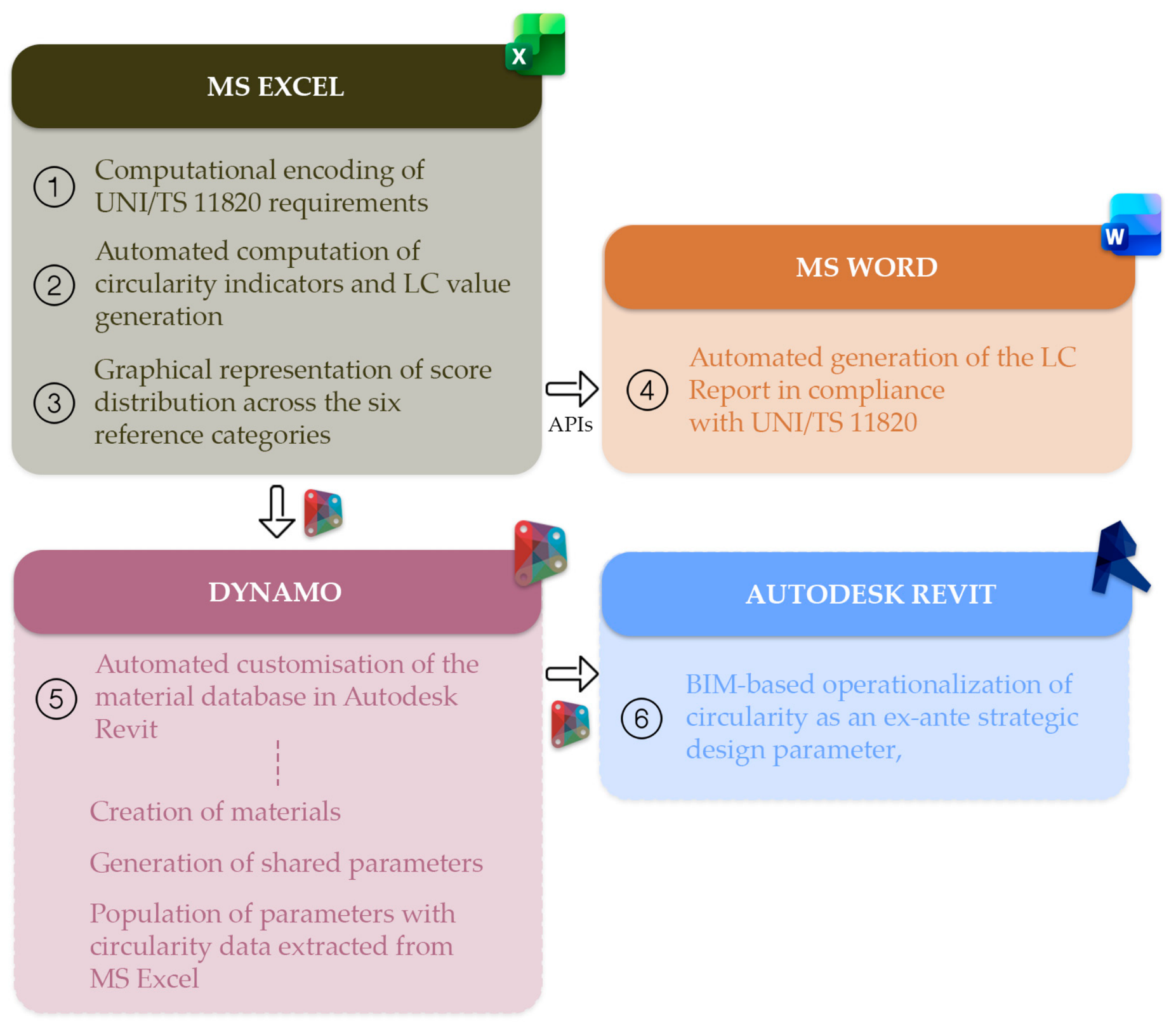
Figure 1 illustrates the digital tool developed in this study to automate LC calculations and incorporate product-specific circularity data into BIM. The tool is specifically implemented for Autodesk Revit, the most widely adopted BIM software in the construction industry (see Section 3), and, as highlighted in Figure 1, is composed of interdependent modules in which the output of each module serves as the direct input for the subsequent one, ensuring an automated process.
An Excel calculator (MS Excel v. 16.101.3) automates the computation of circularity metrics and the LC value for products and services by using survey and documentation data. These results are then automatically exported to MS Word (v. 16.101.3) to produce the LC Report in accordance with UNI/TS 11820:2024 (see Section 4.1). Subsequently, a data exchange between Excel and Autodesk Revit v.2025.1 is structured via Dynamo v.3.0.3 parametric scripts, enabling the automatic creation of BIM material parameters and the integration of circularity data for construction materials (see Section 4.2). Interoperability across the data flow is ensured by the combined use of VPL scripts implemented in Dynamo and APIs, which enable structured, reliable data exchange between the Excel environment and the Autodesk Revit platform without manual intervention.
The demonstration of the proposed tool’s methodology relies on detailed technical specifications, calculation methods, and weighting criteria for circularity indicators outlined in UNI/TS 11820:2024, as discussed in Section 2. These specifications serve as a methodological guide for executing the automated calculation process, ensuring that the digital workflow complies with the standard’s requirements and that the resulting LC values and reports are consistent and reliable.

4.1. Excel-Based Circularity Calculator and Automated LC Report Generation

In an initial phase, the study develops an Excel-based calculator that automates the full circularity assessment workflow, from processing manufacturer-provided inputs to computing individual indicator values and deriving the final LC value. The calculator is conceived as the computational core of the digital tool, embedding the complete rule-based encoding of UNI/TS 11820:2024 calculation requirements into a structured, interoperable spreadsheet environment that ensures methodological consistency across different assessment subjects, products, and service typologies.
The initial module offers comprehensive guidance on completing the assessment form, covering data entry conventions, documentation standards, and the types of evidence needed for each indicator to meet traceability standards. This onboarding component aims to minimise input errors and ensure that manufacturers and designers collect data for a valid LC assessment.
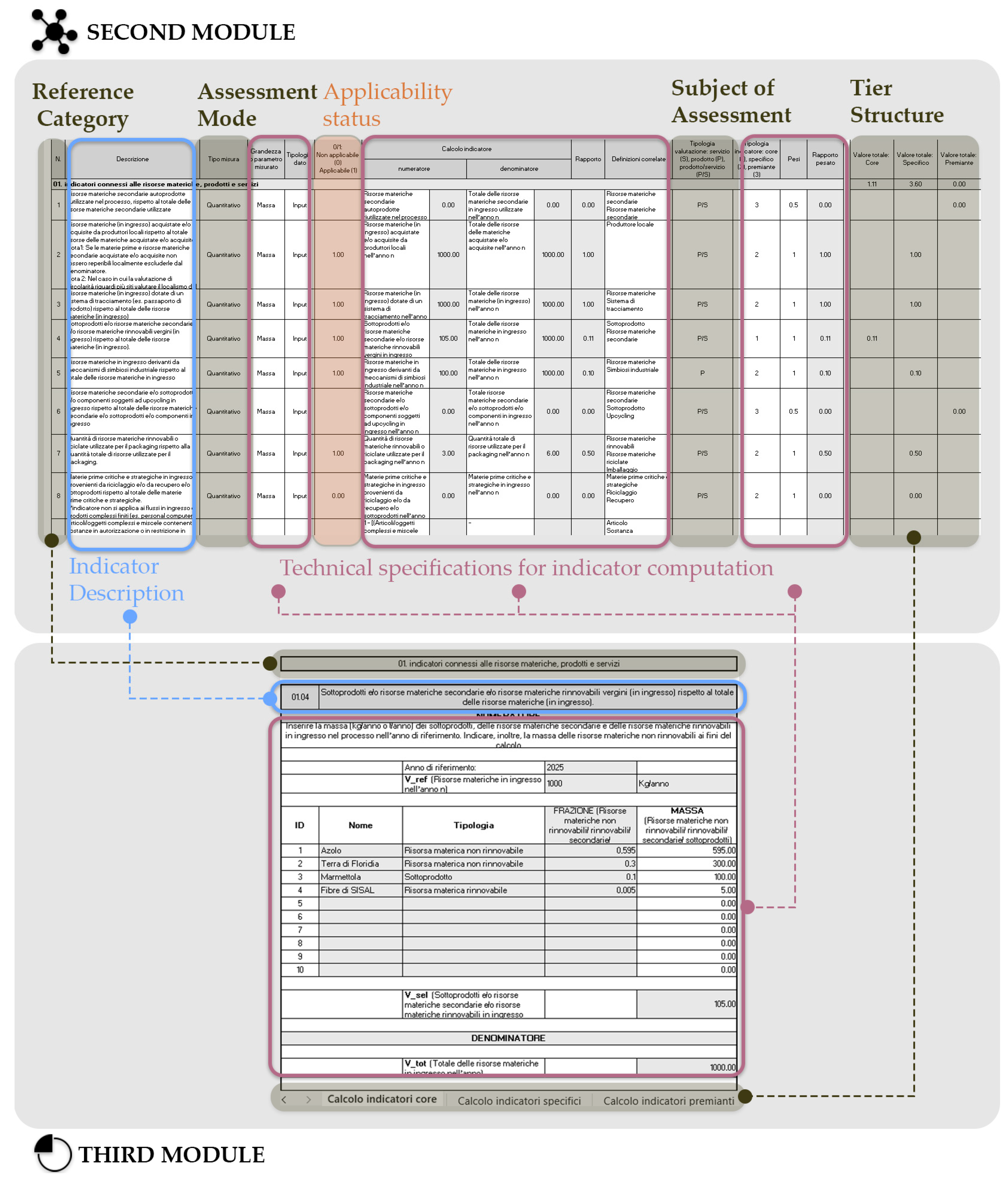
The second module serves as the indicator registry for the tool, in which all 68 indicators defined by UNI/TS 11820:2024 are collected and organised by reference category and key classification features. This includes specifics such as indicator description, tier (core, specific, or rewarding), assigned weight, subject assessment (product, service, or product/service), and assessment mode (qualitative, quantitative, or semi-quantitative), as summarised in Table 1, Table 2, Table 3, Table 4, Table 5 and Table 6. Users can use a dedicated selection interface (e.g., applicability status) to dynamically customise the indicator set for the LC calculation. Indicators that are technically non-applicable can be excluded from the calculation, with the tool automatically recording the exclusion and prompting users to provide the necessary evidence for non-applicability declarations in accordance with UNI/TS 11820:2024. This flexible configuration ensures the tool remains adaptable to various construction product types while fully adhering to the standard’s indicator selection rules.
The third module functions as the calculation engine of the digital tool, offering a set of automatically populated tables for each indicator, organised by their tier structure. For the quantitative indicators, it automatically executes the prescribed calculation method by computing a numerator and denominator from manufacturer-provided inputs, following formulas specified by UNI/TS 11820:2024. For the semi-quantitative indicators, predefined performance thresholds are listed and automatically used to assign scores based on the measured values. For the qualitative indicators, Boolean yes/no checks are implemented to verify whether conditions outlined by the standard are met, converting documentary evidence into binary compliance results that directly influence the LC value computation. Details of each indicator cannot be reported in this section due to UNI/TS 11820:2024 copyright restrictions.
As shown in Figure 2, the second and third modules are designed to work together: the first defines the assessment scope and organises the indicators, while the second performs the calculations for each selected indicator, converting user input into circularity scores using automated, standards-compliant methods.
The fourth, central module automatically applies the calculation method outlined in UNI/TS 11820:2024 for each selected indicator, computing both the raw indicator value and its weighted contribution to the overall LC score. The logic distinguishes between quantitative indicators, calculated via direct formulas on the input data; semi-quantitative indicators, evaluated against specific performance thresholds; and qualitative indicators, verified through binary compliance checks. The weighted combination of these indicator values then directly feeds into the automated calculation of the LC value, as specified by Equation (1):
L C = i = 1 n c i + J = 1 m s j + 0.5   k = 1 f p k c + s
where c i is the value of the i-th core indicator, s j is the value of the j-th applied specific indicator, and p k is the value of the k-th compiled rewarding indicator, n is the number of evaluated core indicators, m is the number of applied specific indicators and f is the number of compiled rewarding indicators, c is the total number of core indicators provided and s is the total number of applicable specific indicators [13]. The formula reflects the standard’s hierarchical weighting logic, in which core indicators constitute the mandatory baseline, specific indicators provide category-tailored refinement, and rewarding indicators introduce a performance incentive mechanism that valorises exceptional circularity practices beyond the minimum requirements. All indicator values are normalised on a 0 to 1 scale, where 1 indicates full compliance or optimal performance and 0 indicates non-compliance or the absence of the practice. This normalisation is built into the calculation logic specified by UNI/TS 11820:2024 and is applied across quantitative, semi-quantitative and qualitative indicators. Consequently, the denominator (c + s) represents the maximum possible score from core and specific indicators alone, making the LC value range between 0 and 100 when expressed as a percentage. UNI/TS 11820:2024 excludes rewarding indicators from the denominator because they denote optional best practices that surpass the minimum standards. Their influence is further reduced by a coefficient of 0.5, as highlighted in Section 2, indicating they carry half the weight of core and specific indicators. This setup ensures that rewarding indicators can only raise the LC score above the baseline established by core and specific indicators.
To fully meet UNI/TS 11820:2024’s documentation standards and ensure data traceability during the assessment, the calculated results are automatically sent to MS Word via API integration. This enables direct, structured extraction of the LC Report without manual reformatting or data entry. The report reflects the full structure required by the standard, including the organisational profile, assessment type and scope, a list of relevant and non-relevant indicators with their values and supporting evidence, the total LC value, and optional circularity levels by reference category. It also features an automatically generated radar chart that provides a visual overview of the distribution of circularity scores across six reference categories. This chart helps manufacturers and designers quickly identify weak areas in circularity, focus improvement efforts, and refine the LC value through targeted changes to materials, processes, or end-of-life strategies.

4.2. Dynamo-Based Automated Circularity Data Integration into Revit

The subsequent step involves developing Dynamo scripts that establish a data workflow between the Excel-based calculator and Autodesk Revit, extracting the computed circularity parameters from the calculator, and automatically transferring them into the BIM environment by customising the Revit material database.
This BIM integration step impacts both designers and manufacturers. For designers, circularity parameters embedded in Revit materials allow for informed, data-driven material choices from the early design stages. Instead of relying on external documents or independent assessments, designers can directly access verified, standards-compliant circularity data within their BIM environment and select only the parameters relevant to their project. This enhances the model’s information content without forgoing performance or manageability. It makes circularity a strategic design consideration from the beginning, rather than a compliance check at the end of the project.
For manufacturers, the workflow produces a BIM-ready digital representation of their product, enriched with verified circularity data and fully compatible with the interoperable workflows adopted by designers. This is a key aspect in a market context where construction product manufacturers increasingly provide BIM object libraries, making it an expected practice that enables seamless integration of product data into design models and supports the specification, procurement, and documentation processes [49,50]. By broadening this established practice to incorporate standards-compliant circularity parameters, this digital tool empowers manufacturers to actively participate in circular design workflows. It provides clients with the necessary information infrastructure to make informed BIM-based decisions on circularity at each stage of the project lifecycle.
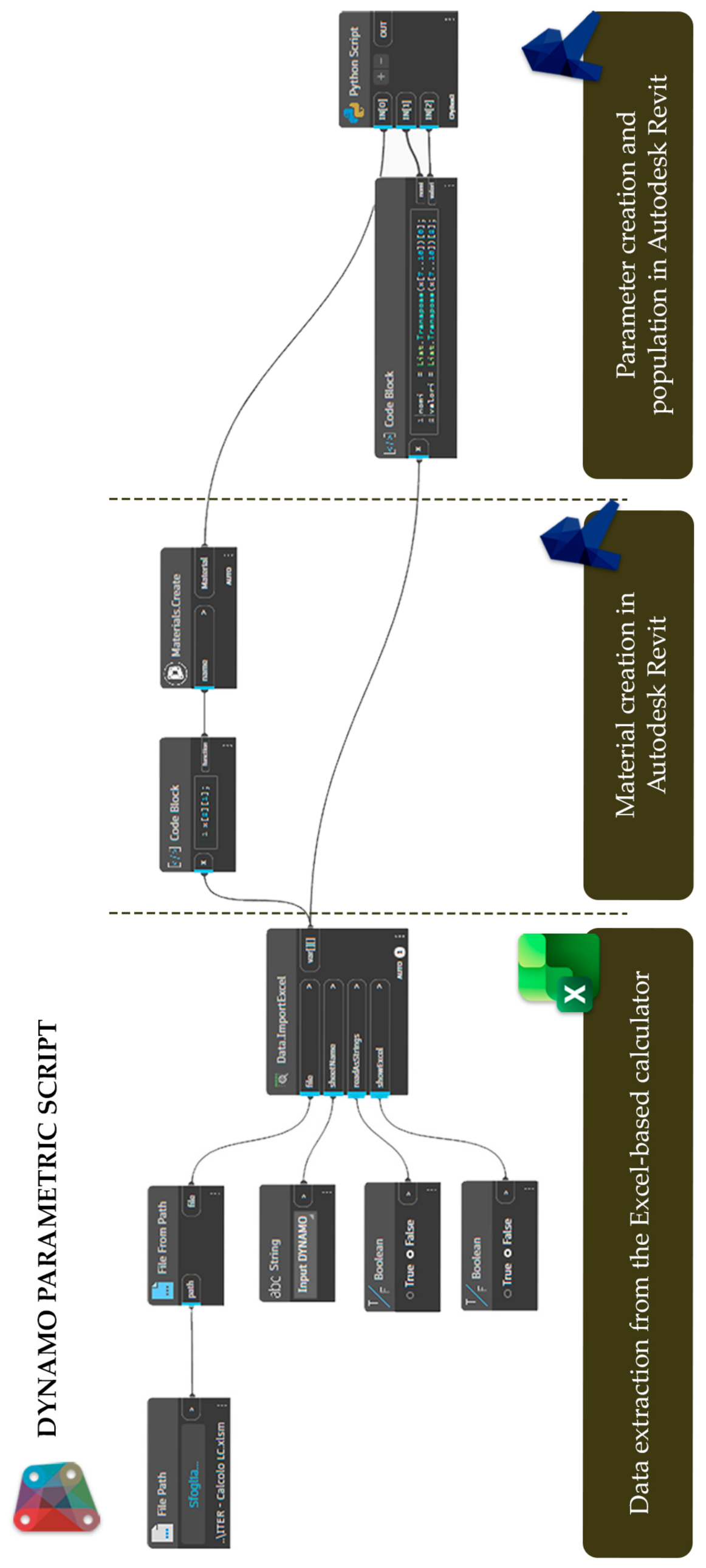
Specifically, these parametric scripts perform three sequential automated operations, as highlighted in Figure 3: (1) the creation of materials within the Revit environment based on the product data processed by the calculator; (2) the generation of custom shared parameters associated with each material, encoding the full set of circularity attributes defined by UNI/TS 11820:2024; and (3) the automated population of these parameters with the computed indicator values and LC score.
Specifically, the initial phase connects the Dynamo environment with the Excel calculator. A “File Path” node specifies the source file, which is then accessed via a “File From Path” node. Data import is managed by a “Data.ImportExcel” node, which takes three inputs: the file reference, the SheetName”, indicating the worksheet for data extraction, the “readAsStrings” parameter, controlling whether data is imported as strings, and the “showExcel” Boolean parameter, deciding if the Excel file opens during execution. Two additional “Boolean” nodes (True/False) control the “readAsStrings” and “showExcel” options.
The second phase involves processing the extracted data to generate materials and customise the material database within Autodesk Revit. A “Code Block” node organises the imported data (e.g., material name) using a list indexing operation, preparing it for material creation. The output from this step is then fed into a “Materials.Create” node, which takes the material name as input and adds the new material entries directly to Revit’s material database. The “Materials.Create” node is sourced from the “archilab” package, a third-party Dynamo library that provides extended BIM automation functionality.
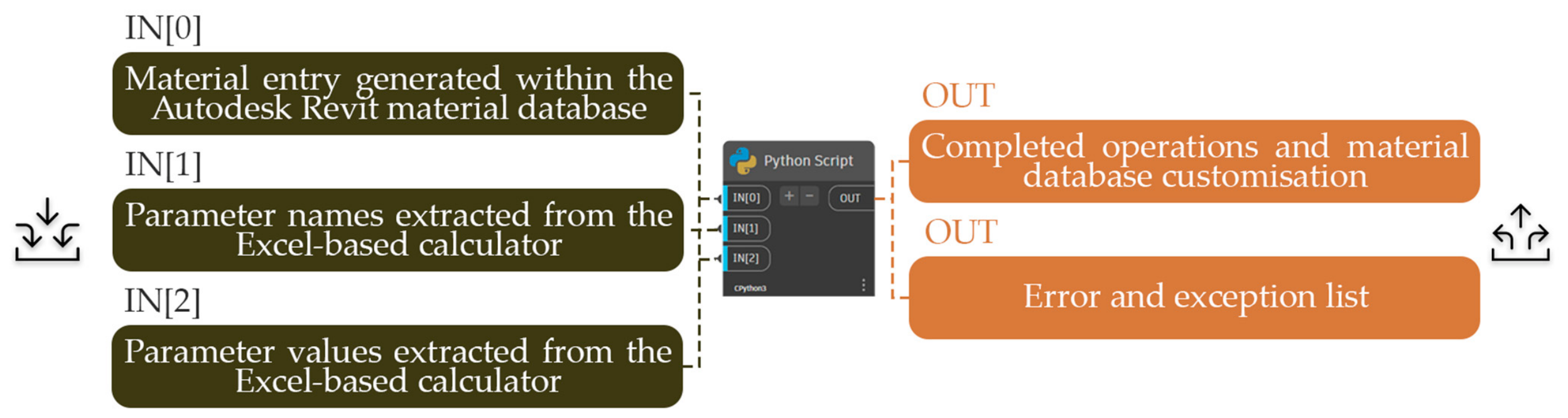
The third phase involves creating and populating parameters in Autodesk Revit, specifically defining circularity parameters for the generated materials. A second “Code Block” node transposes the data list twice, restructuring the data matrix by separating parameter names from their respective values using two sequential “List.Transpose” nodes. This reorganised data is then fed into a “Python Script” node, which automatically creates shared parameters and fills them with circularity values obtained from the Excel calculator, culminating in a final output through two output ports. A detailed overview of the Python script logic is provided in Figure 4 and Figure 5.
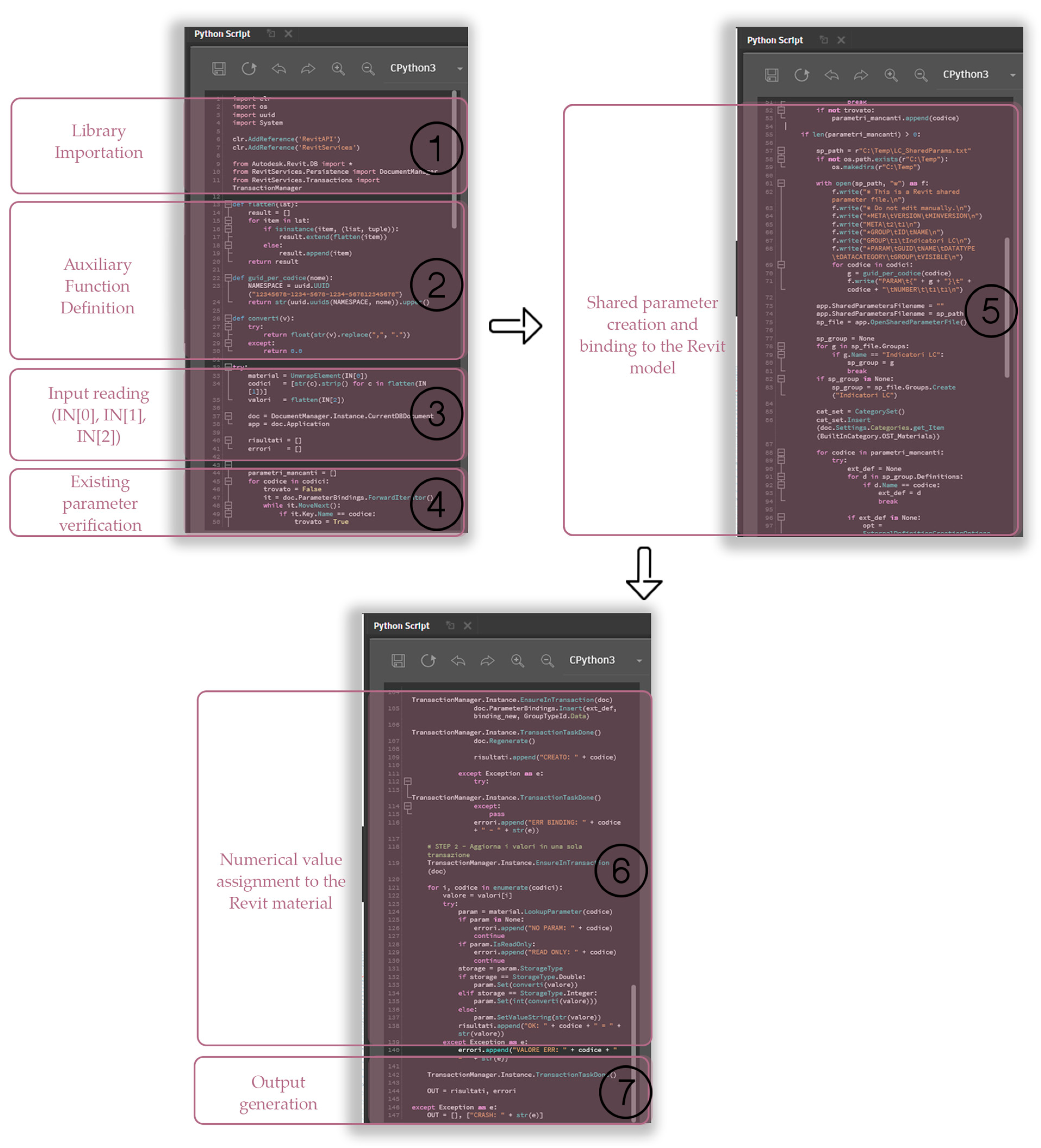
The “Python Script” node serves as the main automation component during the parameter creation and population stage in the workflow. Developed in IronPython and run directly within Dynamo, the script handles the entire process of transferring circularity data from the Excel calculator to the Autodesk Revit material database. Its internal structure comprises six consecutive units (Figure 5).
In Unit 1 (code lines 1–12), all necessary libraries are imported to initialise the script. The “Common Language Runtime” library is loaded to enable IronPython to access “Microsoft.NET” libraries. “RevitAPI” and “RevitServices” are referenced to expose Revit classes and methods and manage transactions. The standard Python libraries “Operating System Interface” and “Universally Unique Identifier” (UUID) are imported to handle file system operations and generate Globally Unique Identifiers (GUIDs), while “System” is loaded to support the “System.Guid” type required by the Revit API. In Unit 2 (code lines 13–31), three auxiliary functions are defined to convert nested list structures into linear lists, generate a deterministic GUID from each parameter name via UUID version 5, and convert generic values into decimals, handling both comma and period separators to ensure compatibility between Italian-formatted Excel files and the Revit API. In Unit 3 (code lines 32–43), three input ports are processed. The target Revit material is received through IN[0] and unwrapped via the “UnwrapElement” function. The list of circularity indicator parameter names is received through IN[1], flattened, and converted to strings. The corresponding numerical values from the Excel calculator are received through IN[2]. The active Revit document and application instance are retrieved via “DocumentManager”. In Unit 4 (code lines 44–51), the “ParameterBindings” iterator of the Revit document is examined to identify which parameters are already registered in the project. Parameters not yet included are added to a missing list for further processing, helping to avoid duplication errors and enhancing script efficiency. A shared parameters file is automatically created in Unit 5 (code lines 52–104), registering each parameter with its unique GUID, name, data type, and group. Each parameter is then linked to the Revit “Materials” category as an instance parameter in the “Data” group, allowing it to be viewed in the properties panel of any project material. In Unit 6 (code lines 105–140), numerical values are written to the target Revit material within a single transaction. For each parameter, writability is verified, and the correct storage type is identified before the value is assigned. In conclusion, in Unit 7 (code lines 140–147), granular error handling is implemented at the parameter level, and all results and exceptions are returned to the Dynamo graph through two dedicated output ports.
The complete implementation of the Python script, structured across the seven units described above, is publicly available in an open-access GitHub repository https://github.com/eleonoragiuffrida1706/revit-material-circularity-importer/tree/main (accessed on 28 June 2026). To reproduce the workflow, the script can be directly embedded into a Python script node within Dynamo.
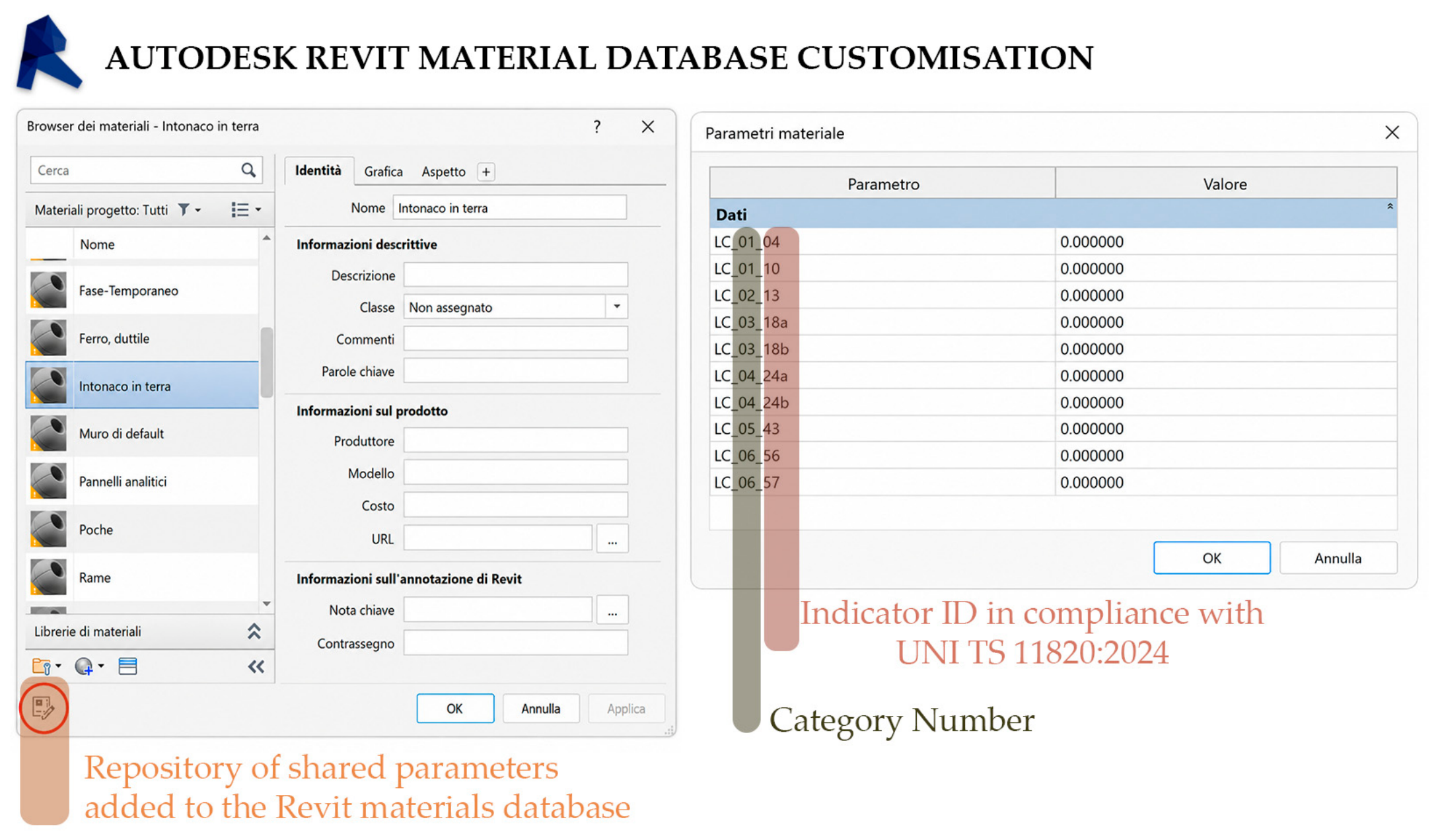
The results of this script are shown in Figure 6. The circularity parameters are displayed directly within the shared parameters of the selected material in Autodesk Revit and are named following the convention “LC_a_bb”, where LC stands for Circularity Level, a denotes the category number as described in Section 2, and bb is the indicator ID in compliance with UNI/TS 11820:2024, as highlighted in Table 1, Table 2, Table 3, Table 4, Table 5 and Table 6.

5. Application to a Case Study

5.1. ITER Case Study

The ITER project is being carried out at the University of Catania to test and optimise the production of fully recyclable, earthen plasters incorporating waste materials from agricultural and marble-processing supply chains [22].
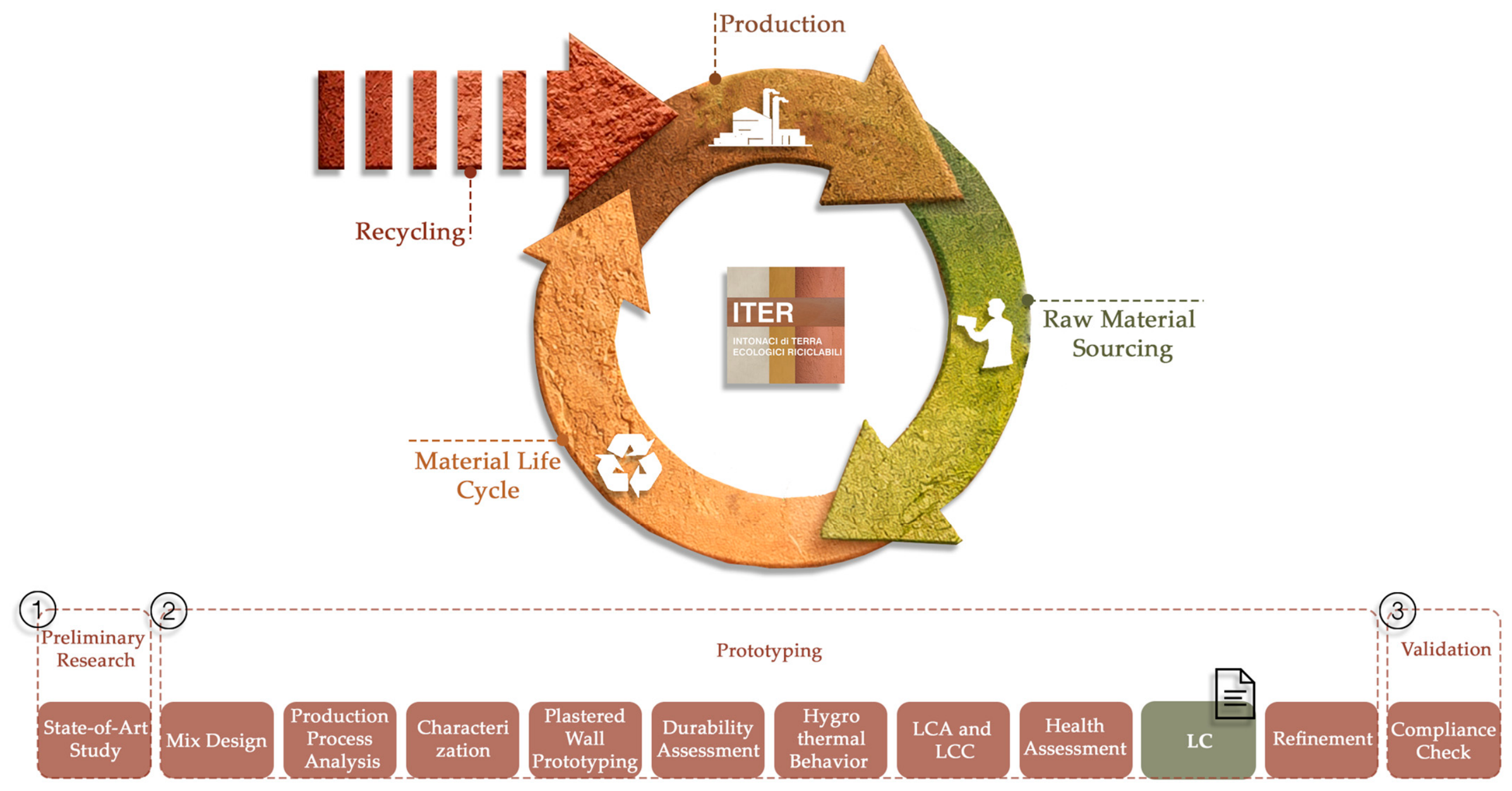
These materials are locally sourced to reduce transportation impacts and strengthen regional economies. The current formulation includes Floridia soil (30%) as a binder, Azolo sand (59.5%) and marble dust (10%) as aggregate, and sisal fibres (0.5%) as mechanical reinforcement. Water is added separately, accounting for about 18% of the total dry weight [51]. The project is structured according to a Research by Design approach and is organised into three main phases, as highlighted in Figure 7: preliminary research, prototyping, and validation [52].
The preliminary phase involves the systematic review of scientific literature, reference standards, case studies, and commercial products. The prototyping phase is articulated into ten sub-activities, through which mix designs are tested, the production process is analysed, materials are characterised, wall prototypes are realised, and performances are assessed across multiple dimensions. In this context, environmental and economic performance is assessed through a combined Life Cycle Assessment (LCA) and Life Cycle Costing (LCC) study, conducted in accordance with ISO 14040 standards. The present research contributes to this broader assessment framework by computing the LC of the ITER plasters through the automated digital tool presented in Section 4. The LC score and the LCA-based assessment capture complementary but distinct dimensions of sustainability: while the former measures the degree of circular economy alignment at both product and organisational levels, the latter quantifies environmental burdens and impacts across the full life cycle. The two frameworks should therefore be read in conjunction to provide a complete picture of a product’s sustainability profile. In the final demonstration phase, compliance with reference standards is verified.
The dual purpose of ITER is outlined: it aims to produce a premixed plaster that offers superior mechanical, thermal, and durability performance, while also streamlining the production process to reduce waste, lower energy use, and encourage the recycling of by-products. The framework for operations adopts industrial symbiosis, fostering productive interactions among separate sectors such as agriculture, stone/marble processing, and construction, with waste streams being redirected instead of discarded [53].
ITER has been chosen as the demonstration case for the presented digital tool because its material composition, which relies on traceable, locally sourced by-products, offers a reproducible dataset for testing the tool’s automated calculations. Also, the circularity assessment process required by ITER is a multi-step and data-intensive workflow. If done manually, this process could be inaccessible to building product manufacturers and designers. Digital automation in the BIM environment is therefore a key aspect to make circularity assessments scalable, repeatable, and practical for professionals.
In this context, UNI/TS 11820:2024 is applied directly, as the standard is designed to be applicable to any industrial product or process. ITER serves as a representative case study to demonstrate the threefold automated procedure of the digital tool: (1) the calculation of the LC value in compliance with UNI/TS 11820:2024; (2) the generation of the LC report; and (3) the transfer of the results into Autodesk Revit. The digital tool is demonstrated through a case that mirrors the complexities of real product development and highlights the importance of user-friendly tools that integrate regulatory standards with design and manufacturing choices within a BIM-based workflow.

5.2. Application Results

The application of the digital tool to the ITER project for the automated calculation of LC values is carried out in three successive steps: (1) data collection through structured surveys administered to both researchers and manufacturers; (2) automatic tool customisation based on indicator applicability and data entry; and (3) results reading and interpretation.
Data collection involves structured surveys conducted with the research team responsible for developing the material and with Cooperativa Guglielmino, a local Sicily-based manufacturer of construction materials involved in producing the ITER plaster mix at its local facilities. These survey tools aim to gather complementary insights: researchers provide information on the product’s technical and compositional details, while the manufacturer shares insights on operational and organisational aspects of the manufacturing process. This approach aligns with the dual focus of the UNI/TS 11820:2024 standard, which requires evaluating circularity both at the product level and organisational level as interconnected parts of a comprehensive circularity profile. The thematic areas covered by the surveys are defined on the basis of the indicators required by UNI/TS 11820:2024 and include: raw material sourcing and traceability, use of secondary and recycled materials, incorporation of industrial by-products in line with the principle of industrial symbiosis, share of renewable and locally sourced inputs, production waste generation and management, energy consumption per unit of product and share from renewable sources, water use and recovery, end-of-life recyclability and reverse logistics provisions, packaging composition, circular economy strategy at the organisational level, and investments in research and circular product design. Survey validity is maintained through a link between each question and a specific UNI/TS 11820:2024 indicator, ensuring every response can be mapped to a measurable circularity metric. If an indicator is not relevant to the product or organisational context, it is documented and influences the tool’s automatic customisation. This method ensures the collected data are both qualitatively valuable and practically applicable within the automated calculation process, maintaining consistency from data collection to indicator assignment.
In the second step, the survey data is utilised to evaluate how well each of the 68 circularity indicators defined by UNI/TS 11820:2024 applies to the specific context of the ITER project. Since not all indicators are relevant to every product or organisational setup, this applicability assessment is performed as an initial step before data entry. The results of this assessment are then directly incorporated into the Excel-based calculator. The digital tool is designed to respond dynamically to this input. Within the Excel-based calculator, a dedicated “Applicability Status” column is provided for each indicator (Figure 2). As this column fills up by marking each indicator as applicable or not based on survey data, the tool automatically enables or disables the related input fields. Non-applicable indicator fields are locked and excluded from calculations, while applicable ones are unlocked for data entry. This process occurs automatically without manual changes to the tool’s structure. This mechanism ensures that the LC value calculation relies solely on indicators genuinely relevant to the case, preventing distortions caused by irrelevant metrics. Additionally, it enhances the tool’s usability by displaying only the fields applicable to the specific product and organisation, keeping the interface user-friendly, and making the digital tool more accessible to non-expert users, such as manufacturers and practitioners lacking detailed knowledge of the UNI/TS 11820:2024 framework.
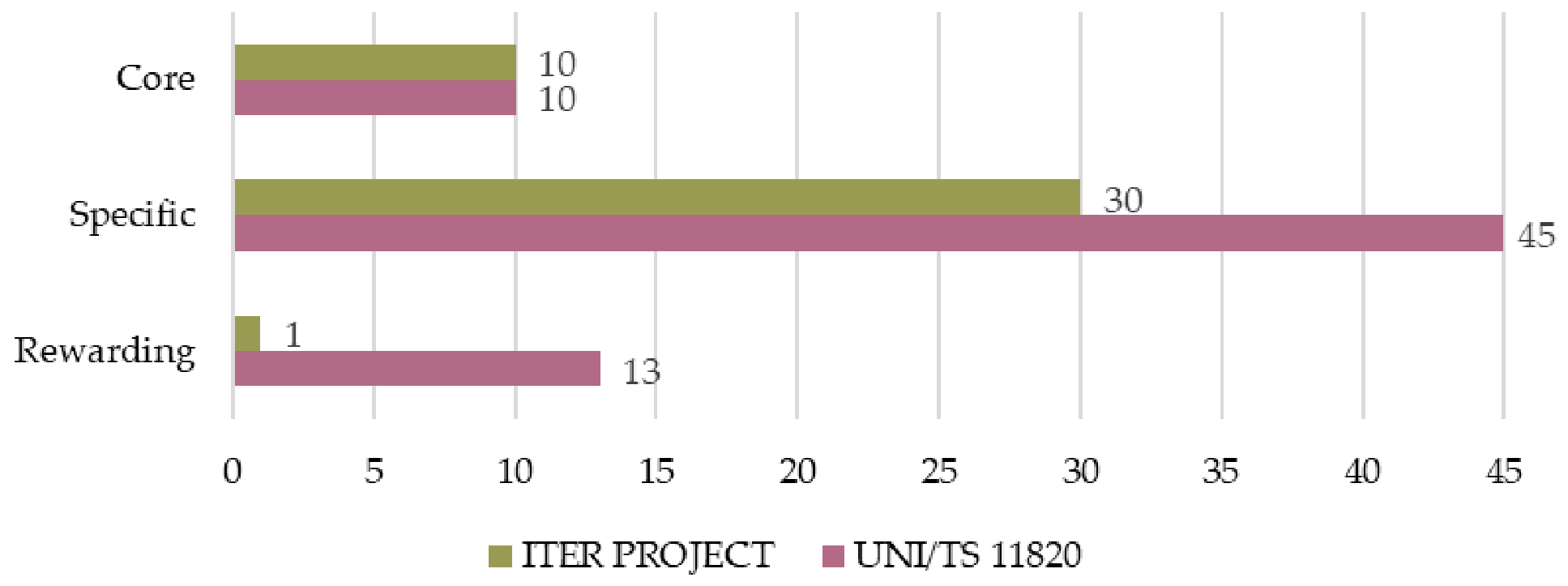
For the ITER project, 41 of 68 indicators are assessed as applicable and retained for the LC value calculation, as shown in Figure 8.
Among these, all Core indicators are included, as their compilation is mandatory for computing the LC value under UNI/TS 11820:2024. Among the 45 Specific indicators, 30 are retained while 15 are excluded, and out of the 13 Rewarding indicators, only 1 is applicable. As shown in Table 8, a group of the excluded indicators falls within the industrial symbiosis cluster, reflecting the manufacturer’s current lack of integration into symbiotic networks for the exchange of material, water, and energy flows. Several exclusions also concern the end-of-life and service dimension, as the manufacturer does not yet offer extended warranty schemes, repair support documentation, or Product-as-a-Service models. Furthermore, the absence of a carbon footprint assessment on incoming material resources and of a product tracking system points to gaps in the monitoring and traceability infrastructure. Taken together, these exclusions delineate a clear profile of the organisational and operational boundaries of the current production model and implicitly identify the areas where targeted interventions could most effectively contribute to improving the aggregate LC value in future iterations of the assessment.
As shown in Table 8, the excluded indicators fall into two distinct tiers with different implications for the LC calculation.
The 15 Specific indicators that are excluded are considered technically not relevant to the product and organisational context of the ITER case study. Therefore, they are removed from both the numerator and denominator of Equation (1), following UNI/TS 11820:2024 guidelines. This removal is based on objective evidence obtained through structured surveys, material composition datasheets, production process documentation, and manufacturer declarations. The 12 Rewarding indicators that are excluded are also deemed technically irrelevant to the current organisational context. Since these indicators are excluded from the denominator of Equation (1) by definition, their omission does not artificially increase the final LC value.
In this regard, UNI/TS 11820:2024 mandates that supporting documentation must be provided and kept for both applicable and non-applicable indicators. The digital tool facilitates this by allowing users to attach documents directly within the Excel calculator. This ensures that every indicator, whether included or excluded from the calculation, is supported by verifiable evidence. The documentation is then automatically transferred to the BIM via the corresponding Revit parameters, embedding all circularity-related information into the digital model. This integration makes the entire assessment process fully traceable and verifiable.
The LC value for the ITER project, determined using the digital tool, is 43.77 out of 100 (Table 9). The per-category LC values shown in Table 9 represent the average scores of the indicators within each reference category and the individual indicator scores. The overall LC value of 43.77 is not the arithmetic mean of these per-category values; rather, it is calculated across all indicators together as per Equation (1), which assigns different weights based on whether an indicator is core, specific, or rewarding. The findings indicate a highly varied circularity profile, showing notable differences between categories.
All indicator values are based on structured surveys conducted with the manufacturer and researchers involved in developing the ITER plasters. These are supported by material composition datasheets, production process documentation, and manufacturer declarations where applicable.
The highest performance is recorded for indicators connected to the Product/Service category, which reach an LC of 70.0. This result is reflected in the intrinsic characteristics of the ITER plaster: its composition is based on natural, locally sourced, and traceable materials; its high end-of-life recyclability, with material recoverable through simple sieving operations; and the absence of hazardous or restricted substances. This strong performance indicates that the material design of the product aligns well with circular economy principles. It also shows that the formulation decisions made during the ITER project’s development have resulted in tangible circularity benefits at the product level. Indicators related to the Material Resources, Products, and Services category also yield a strong result of 57.86, supported by the share of local inputs, the use of marble dust as an industrial by-product, and the established practice of reintegrating production scraps into the process. Indicators connected to the Human Resources, Assets, Policy, and Sustainability category reach 54.1, reflecting a long-standing orientation towards circular economy principles, active participation in research partnerships, and investments in circular product development. The scores in this category show that the strategic and relational aspects of circularity are well developed, indicated by high scores in research partnership and circular product development. However, the operational and governance aspects are less advanced, especially in social impact assessment and sustainable mobility planning, which both score 0.00. Conversely, the lowest performance is recorded for indicators connected to the Energy and Water Resources category, which score 0.0. This result is attributed to the absence of renewable energy sources at the production facility, as no photovoltaic system or green energy supply is currently in the factory. This outcome is common among small and medium-sized construction material manufacturers, where renewable energy transition is limited by investment and grid issues, not a lack of sustainability commitment. This category offers the highest potential to improve LC value: with all three indicators at 0.00, even a partial shift to renewable energy, like a green supply contract, could activate this cluster and boost the overall LC score. Indicators connected to the Waste and Emissions category and the Logistics category are scored at 16.67 and 17.50, respectively, reflecting the limited waste recovery practices, and the absence of low-emission logistics strategies currently adopted by the factory. These results highlight a key aspect of the UNI/TS 11820:2024 standard: the LC value reflects a holistic assessment that considers both the product’s dimensions and the manufacturer’s organisational factors. Furthermore, the implications for policy and industry are emphasised: it indicates that circularity assessment frameworks focused solely on product-level properties may systematically overstate the overall circularity performance of such manufacturers.
Therefore, focusing on production methods and facility equipment could boost the overall LC value without altering the product formulation. In this context, a what-if scenario is carried out. Specifically, as reported in Table 10, five indicators are introduced to reflect improvements in the manufacturer’s operational practices: the proportion of energy from renewable or recovery sources (Indicator 13), the civil buildings’ energy performance class (Indicator 16), the rate of special waste sent to material recovery facilities (Indicator 20), the inclusion of circular economy clauses in logistics operator selection (Indicator 25), and the share of assets and infrastructure designed for circular end-of-life management (Indicator 61).
These indicators are scored from 0.80 to 1.00, indicating that the manufacturer adopts best-practice standards in energy procurement, waste management, logistics, and asset governance. These interventions do not require changes to the product’s material composition or formulation; instead, they focus solely on organisational measures. The LC value increases from 43.77 to 56.27, about 29%, indicating that circularity performance depends not only on the product’s material properties but also on the operational context in which it is produced. In this regard, the presented digital tool offers a DSS function: alternative configurations are calculated in real time by modifying the input data, thereby simulating and comparing different improvement strategies before any operational decision is made. This capability enables more informed, critically grounded decisions, thereby reducing the risk of isolated or suboptimal interventions.
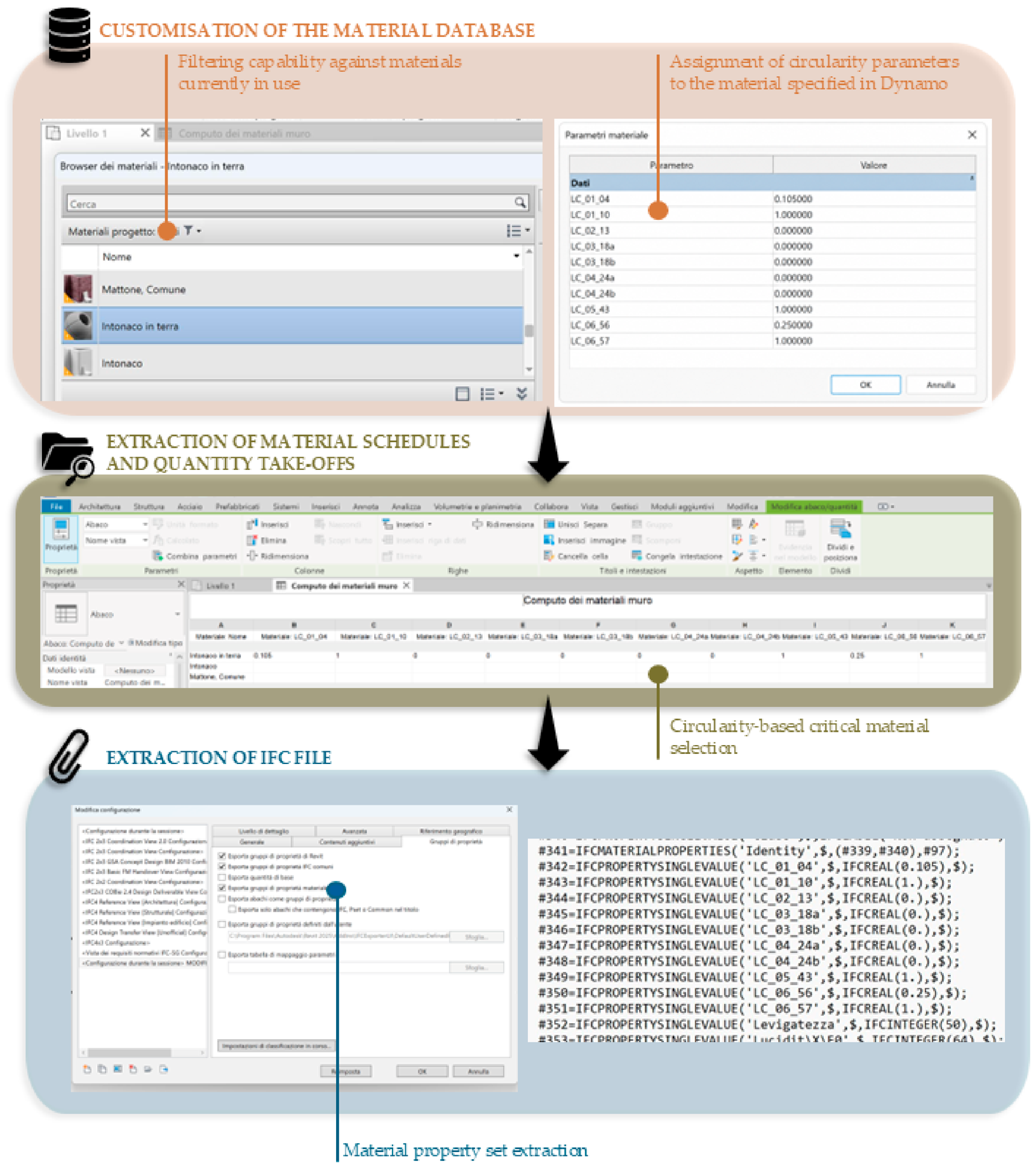
Following the LC value calculation, the ITER plaster is automatically created in Autodesk Revit through the workflow illustrated in Section 4.2. As highlighted in Figure 9, the material database is customised using the generated circularity data, with Autodesk Revit parameters automatically populated.
Specifically, each material includes a set of shared parameters that represent the indicator structure of UNI/TS 11820:2024. This parametric enhancement allows the BIM model to serve as both a geometric representation and a structured repository of circularity data at the material level. Additionally, Revit’s native scheduling feature can automatically generate circularity schedules, enabling designers to filter, sort, and compare materials by LC score. This facilitates better material selection during design, allowing the identification of low-performing components and the exploration of substitution scenarios directly within the BIM environment. Furthermore, the BIM model with added circularity parameters is exported in Industry Foundation Classes (IFC) format. This confirms that the circularity indicators are properly assigned as custom IfcPropertySingleValue linked to the relevant materials and building components. As a result, the embedded circularity data can be accessed and viewed using any IFC-compliant software, without needing the original Revit model. This enables the sharing of verified circularity information across the entire project supply chain in a platform-independent and open format.
Additionally, in another phase of the project (see Figure 7), a series of test boxes is constructed and instrumented with environmental sensors to monitor the hygrothermal and physical behaviour of the earth-based plasters under real conditions. In this context, the automated customisation of the Autodesk Revit material database is conceived as the foundational step in structuring a digital twin of the test boxes. By embedding circularity parameters directly into the BIM objects, a structured and semantically rich digital environment is established, within which circularity data and sensor-derived data, including temperature and relative humidity, are correlated and jointly interrogated.
This integration paves the way for a multi-criteria interpretation and optimisation framework, where the circularity performance of the plaster is evaluated not in isolation but in the context of its actual in-use behaviour.

6. Discussion

6.1. Research Contributions and Limitations of the Digital Tool

The gaps outlined in Section 3 set the context for assessing the proposed tool’s contribution. The analysis reveals three main limitations: a limited and segmented approach to circularity assessment, a focus on building-scale validation rather than detailed product-level analysis, and incomplete BIM integration within current workflows.
The reviewed studies show that most existing frameworks focus on only one aspect of circularity. Adesope et al. [39] and Felicioni et al. [40] emphasise embodied carbon reduction via material substitution; Allam et al. [41] and Lima et al. [42] work on end-of-life deconstruction planning; Han et al. [43] look at demolition waste management; and Davis et al. [46] examine the methodological effects of lifespan assumptions in LCA. Even more comprehensive frameworks, like Al Quazzaz et al.’s [44] BIM-based DSS combining BCA, LCA, and LCC, or Chang et al.’s [45] EBCI indicator system, are limited to specific circularity dimensions and do not capture the full range of circular performance. The tool presented in this research adopts a different strategy by assessing circularity across six categories aligned with UNI/TS 11820:2024, each representing a different aspect of circular performance. This multi-dimensional approach enables a more complete evaluation at the product level, moving beyond the single-indicator or single-dimension methods. Instead of replacing these focused approaches, the tool complements them by providing a structured framework to evaluate multiple circularity aspects simultaneously, facilitating more informed and holistic decisions during design and production.
A further limitation from the literature concerns the demonstration scale. Aside from Allam et al. [41], who process IFC component data at the element level, all reviewed studies validate methodologies at the building level [40,46,47,48]. Building-scale assessments are crucial for whole-life carbon accounting and design comparisons but tend to aggregate component details, potentially obscuring the circularity performance of individual materials and products. The proposed tool specifically operates at the product level, evaluating circularity indicators for individual construction products per UNI/TS 11820:2024. This detailed approach aligns with the rise in product-level tools like EPD and material passports, the latter partially addressed by Al Quazzaz et al. [44] via an Airtable interface, though without standardised compliance outputs. By generating UNI/TS 11820:2024-compliant LC Reports in MS Word, the tool bridges assessment and documentation, providing structured outputs that support product certification, procurement, and regulatory compliance.
A technical gap identified in the literature concerns the limited integration of BIM. Most reviewed studies use Revit mainly for data extraction, such as generating BoQ or exporting geometric information to external LCA or circularity tools, without integrating assessment outputs into the BIM environment. Rodriguez et al. [48] confirm that neither Athena Impact Estimator nor SimaPro provides a fully automated data transfer from Revit, while Allam et al. [41] pipeline shows how workflows across multiple software can fragment data flow into disconnected manual steps. The digital tool presented in this research addresses this by providing an Excel-to-Revit data flow module, implemented through Dynamo scripts and APIs, which automates material creation, custom parameter definitions, and population with circularity data inside Autodesk Revit. This effectively closes the feedback loop, making circularity data an active, queryable, and visible part of the BIM model, thus supporting dynamic design optimisation. Also, unlike prior studies, this tool incorporates document generation within the workflow, producing standardised LC Reports linked directly to assessments, filling a documentation gap that others do not resolve.
Furthermore, the digital tool proposed in this research is modular and scalable. Its first two modules, namely the LC calculator and automated report generator, depend on standards, as their indicator structures, weighting factors, and reporting criteria follow UNI/TS 11820:2024. Nonetheless, their core architecture is flexible and can be adapted to any indicator-based regulatory or assessment system by updating the relevant calculation rules and output templates. The third module, which manages the Excel-to-Revit data flow via Dynamo VPL scripts and APIs, is inherently independent of standards. It serves as a data exchange pipeline between spreadsheets and BIM, independent of the specific standard, enabling reuse across various circularity or sustainability assessments without structural changes. This modular approach allows the tool to adapt to regulatory updates, incorporate future revisions of UNI/TS 11820:2024, and extend to other indicator-based evaluation frameworks, ensuring it remains a versatile and future-ready solution for digital circularity assessment in construction.
The present study, while contributing a novel methodological approach, is subject to limitations. First, the present demonstration is grounded in a single BIM-based case study that encompasses one product type and one manufacturer. Although this case is selected for its complexity and representativeness, the computational correctness of the formulae is guaranteed by the standard itself; what a single case cannot rule out are implementation errors in untested scenarios. Therefore, the generalisability of the findings to other construction product categories and organisational setups cannot be fully assumed. Furthermore, data is gathered through structured surveys administered to researchers and the manufacturer. Furthermore, while the tool automates the core computational and reporting tasks, data entry remains a manual step, as indicator values are gathered through structured surveys and entered by the user into the Excel-based calculator. This approach aligns with the UNI/TS 11820:2024 indicator structure but depends on self-reported data, which relies on respondents’ knowledge of the standard’s requirements and represents a partial automation boundary of the current version of the tool. Moreover, while the tool incorporates a DSS enabling real-time simulation of alternative configurations, the optimisation of indicator scores through advanced computational methods, such as AI techniques, is not yet implemented, representing a recognised boundary of the current version of the digital tool that future research is expected to address.

6.2. Future Research Directions

Future research is expected to address the limitations outlined in Section 6.1. The demonstration can be expanded to cover additional construction product categories like cement-based products, insulation materials, or prefabricated components, as well as different organisational settings. This will help identify potential implementation issues in untested scenarios and enhance the transferability and scalability of the workflow across various materials and software environments. Moreover, the reliability of survey-based data collection could be improved by creating a structured data-quality classification system. This would allow users to tag inputs by evidence level and gradually incorporate third-party-verified sources, such as Environmental Product Declarations (EPDs), thereby moving the tool closer to the formal compliance pathway described in standards for claim-based assessments. Additionally, since UNI/TS 11820:2024 aligns closely with the ISO/TC 323 family and the EU Level(s) framework, as noted in Section 2, the tool is compatible with these international and European standards. Although this cross-standard alignment is not yet explicitly integrated into the current version, it offers a future route for future updates. This could involve expanding the modular architecture to include indicator structures and reporting requirements from other circularity assessment frameworks, thereby enhancing the tool’s applicability and regulatory scope.
The circularity parameters transferred to Autodesk Revit are used, as discussed in Section 5.2, to facilitate filtering and comparing materials across different product configurations. They also support the automatic creation of schedules that report circularity performance at the component or assembly level, showcasing the benefits of BIM integration over static reporting methods. Future developments aim to further improve these features by integrating Artificial Intelligence (AI) and. For example, data analysis libraries such as NumPy, Pandas, and Matplotlib are designed to enable automated processing and visualisation of large volumes of circularity data across multiple products and scenarios. The use of deep learning frameworks such as PyTorch is expected to aid the development of predictive models that can automatically identify the best indicator combinations to maximise the LC score. Workflow automation tools like N8N are also considered to connect the system with external data sources, product databases and BIM platforms, supporting continuous updates of circularity parameters. Also, the strucutre of autonomous AI agents is envisioned to transform the system from a DSS into a proactive system that offers adaptive recommendations for circularity optimisation throughout the entire product lifecycle.

7. Conclusions

This study introduces a digital tool designed to automate the assessment of construction product circularity in accordance with UNI/TS 11820:2024. It tackles ongoing gaps in the current literature, including workflow automation, the digital integration of formal circularity standards within BIM environments, the oversight of organisational factors in product-level evaluations, and the limited number of studies focusing on individual construction products.
The proposed tool comprises two interoperable engines. The first is an Excel-based calculator that encodes the complete calculation logic of UNI/TS 11820:2024. It allows for the automated calculation of 68 circularity indicators, the derivation of the LC value, and the creation of a standards-compliant LC Report in MS Word via API integration. This report includes a radar chart that visualises the distribution of circularity scores across six reference categories. The second engine features a Dynamo-based BIM workflow that automatically transfers the calculated circularity data into Autodesk Revit. This enables the creation of materials, the generation of shared parameters, and their population with circularity data without manual input. Together, these engines form an interoperable, standards-compliant digital workflow that positions circularity as a strategic, early-stage decision for both manufacturers and designers throughout product development and project planning.
In order to demonstrate its threefold automated procedure, the tool is applied to the ITER project, which aims to develop ecological, fully recyclable earth-based plasters that incorporate by-products from the agriculture and stone-processing industries. Evaluating 41 relevant indicators results in a total LC score of 43.77, indicating a highly varied circularity profile: high scores are seen in the Product and Services category (70.0) and Material Resources category (57.8), reflecting the product’s composition and recyclability at end-of-life, while much lower scores are found in Energy and Water Resources (0.0), Waste and Emissions (16.7), and Logistics (17.5), mainly due to organisational factors of the manufacturing entity rather than the product itself. This outcome highlights the value of a comprehensive assessment framework that captures both product and organisational aspects of circularity and affirms the tool’s ability to serve as a DSS capable of real-time simulation of improvement strategies.
Furthermore, this study confirms that the UNI (Italian National Standardisation Body) provides an effective and detailed operational standard for circularity assessment at the construction product level.
The present study is subject to limitations that define its current applicability. Demonstration is conducted on a single product typology, data collection relies on self-reported survey inputs, and the BIM integration workflow is currently implemented exclusively within the Autodesk Revit environment. Future research is expected to address these constraints by extending the tool’s validation across diverse construction product categories, integrating third-party verified data sources such as EPDs, broadening interoperability across different BIM platforms, and incorporating AI techniques to support the automated optimisation of circularity indicator scores. In this regard, the development of a structured data-quality classification system, enabling users to tag each input according to its evidence level, would further strengthen the robustness of the assessment workflow and bring it closer to the compliance pathway outlined by the standard for claim-based assessments.
The digital tool, designed to be user-friendly and automated, offers decision support early in the design process. It primarily serves two user groups: manufacturers aiming to assess and enhance their products’ circularity and designers needing BIM-compatible data to guide material choices and circular strategies. Consequently, the tool advances a methodological approach that integrates circularity assessment into manufacturing and design workflows, fostering a shift towards more systematic and evidence-based circular economy practices within the AEC sector.

Author Contributions

Conceptualization, A.M. and R.C.; methodology, G.P., S.A., T.C., A.M. and R.C.; software, G.P. and E.G.; validation, G.P., S.A., T.C., E.G., C.P.B. and R.C.; formal analysis, G.P., S.A., T.C., E.G. and C.P.B.; investigation, G.P., S.A., T.C. and E.G.; resources, G.P., S.A., T.C., E.G. and C.P.B.; data curation, G.P., S.A., T.C. and E.G.; writing—original draft preparation, G.P. and E.G.; writing—review and editing, A.M. and R.C.; visualisation, G.P. and E.G.; supervision, A.M. and R.C.; project administration, R.C.; funding acquisition, R.C. All authors have read and agreed to the published version of the manuscript.

Funding

The ITER project was funded by the MASE (Ministry of the Environment and Energy Security, ex MITE) of Italy-Direzione Generale Economia Circolare e Bonifiche (ex Direzione Generale Economia Circolare), CUP E63C23001320006.

Institutional Review Board Statement

Not applicable.

Informed Consent Statement

Not applicable.

Data Availability Statement

The original contributions presented in this study are included in the article.

Acknowledgments

This contribution is part of the research project “ITER-Intonaci di Terra Ecologici Riciclabili” (CUP E63C23001320006), Bando “Non serviti”-Ed. 2021, funded by the MASE (Ministry of the Environment and Energy Security, ex MITE) of Italy—Direzione Generale Economia Circolare e Bonifiche (ex Direzione Generale Economia Circolare). UNI’s contribution to the normative framework of this study is gratefully acknowledged. The collaboration ensured alignment with established standardisation practices. With thanks to Guglielmino Cooperativa enterprise for the support in providing data.

Conflicts of Interest

The authors declare no conflicts of interest.

References

  1. United Nations Environment Programme; Global Alliance for Buildings and Construction. Building Fast. Falling Short. As Climate Risks Rise and Cities Grow, We Must Rethink How We Build to Create Better Lives for All—Global Status Report for Buildings and Construction 2025/26; United Nations Environment Programme: Nairobi, Kenya, 2026. [Google Scholar]
  2. Salimi, R.; Taherkhani, R. The Transition towards a Sustainable Circular Economy through Life Cycle Assessment in the Building and Construction Sector: A Review and Bibliometric Analysis. Environ. Sci. Pollut. Res. 2024, 31, 62588–62622. [Google Scholar] [CrossRef] [PubMed]
  3. de Oliveira, J.; Schreiber, D.; Jahno, V.D. Circular Economy and Buildings as Material Banks in Mitigation of Environmental Impacts from Construction and Demolition Waste. Sustainability 2024, 16, 5022. [Google Scholar] [CrossRef]
  4. Wu, J.; Ye, X.; Cui, H. Recycled Materials in Construction: Trends, Status, and Future of Research. Sustainability 2025, 17, 2636. [Google Scholar] [CrossRef]
  5. Barikdar, C.R.; Hassan, J.; Saimon, A.S.M.; Alam, G.T.; Rozario, E.; Ahmed, M.K.; Hossain, S. Life Cycle Sustainability Assessment of Bio-Based and Recycled Materials in Eco-Construction Projects. J. Ecohumanism 2022, 1, 151–162. [Google Scholar] [CrossRef]
  6. Sustainable Development Goals-EUR-Lex. Available online: https://eur-lex.europa.eu/EN/legal-content/glossary/sustainable-development-goals.html (accessed on 23 May 2026).
  7. Ellen Macarthur Foundation. Economic and Business Rationale for an Accelerated Trans. In Towards the Circular Economy; Ellen Macarthur Foundation: Cowes, UK, 2013. [Google Scholar]
  8. European Green Deal|EUR-Lex. Available online: https://eur-lex.europa.eu/EN/legal-content/summary/european-green-deal.html (accessed on 23 May 2026).
  9. European Commissions. A New Circular Economy Action Plan for a Cleaner and More Competitive Europe; European Commissions: Brussels, Belgium, 2020. [Google Scholar]
  10. Dodd, N.; Donatello, S.; Cordella, M. Level(s)—A Common EU Framework of Core Sustainability Indicators for Office and Residential Buildings User Manual 1: Introduction to the Level(s) Common Framework (Publication Version 1.1); Publications Office of the European Union: Luxembourg, 2021. [Google Scholar]
  11. ISO/TC 323; Circular Economy. International Organization for Standardization: Geneva, Switzerland. Available online: https://www.iso.org/committee/7203984.html (accessed on 23 May 2026).
  12. UNI/TS 11820:2022; Measuring Circularity—Methods and Indicators for Measuring Circular Processes in Organizations. Italian Organisation for Standardisation (UNI): Milan, Italy, 2022. Available online: https://store.uni.com/en/uni-ts-11820-2022 (accessed on 23 May 2026).
  13. UNI/TS 11820; Measuring Circularity: Methods and Indicators for Measuring Circular Processes in Organizations. Italian Organisation for Standardisation (UNI): Milan, Italy, 2024.
  14. Pimenow, S.; Pimenowa, O.; Rembisz, W. Circular Economy Pathways for Critical Raw Materials: European Union Policy Instruments, Secondary Supply, and Sustainable Development Outcomes. Sustainability 2026, 18, 562. [Google Scholar] [CrossRef]
  15. Sgambaro, L.; Chiaroni, D.; Frattini, F. Digital Technologies as Enablers of Circular Economy: An Exploratory Analysis of Functions and Product Lifecycle. IEEE Trans. Eng. Manag. 2025, 72, 4051–4066. [Google Scholar] [CrossRef]
  16. Thirumal, S.; Udawatta, N.; Karunasena, G.; Al-Ameri, R. Barriers to Adopting Digital Technologies to Implement Circular Economy Practices in the Construction Industry: A Systematic Literature Review. Sustainability 2024, 16, 3185. [Google Scholar] [CrossRef]
  17. Eftekhari, A.F.; Khodabakhshian, A.; Cecconi, F.R.; Daniotti, B. Improving Circularity in Construction Through a BIM-Based Waste Management Framework. IOP Conf. Ser. Earth Environ. Sci. 2024, 1363, 012042. [Google Scholar]
  18. Cecchini, C. From Data to 3D Digital Archive: A GIS-BIM Spatial Database for the Historical Centre of Pavia (Italy). J. Inf. Technol. Constr. (ITcon) 2019, 24, 459. [Google Scholar]
  19. Parisi, G.; Cascone, S.; Gugliuzzo, A.; Caponetto, R. Automated BIM-Driven Multi-Criteria Assessment of External Wall Design: Evaluating Thermal Insulation Alternatives. Sustainability 2026, 18, 3585. [Google Scholar] [CrossRef]
  20. Carvalho, J.P.; Villaschi, F.S.; Bragança, L. Assessing Life Cycle Environmental and Economic Impacts of Building Construction Solutions with BIM. Sustainability 2021, 13, 8914. [Google Scholar] [CrossRef]
  21. Cascone, S. Digital Technologies and Sustainability Assessment: A Critical Review on the Integration Methods between BIM and LEED. Sustainability 2023, 15, 5548. [Google Scholar] [CrossRef]
  22. ITER|University of Catania. Available online: https://www.unict.it/en/research/projects/iter (accessed on 23 May 2026).
  23. ISO 59004:2024; Circular Economy—Vocabulary, Principles and Guidance for Implementation. International Organization for Standardization: Geneva, Switzerland. Available online: https://www.iso.org/standard/80648.html (accessed on 23 May 2026).
  24. ISO 59010:2024; Circular Economy—Guidance on the Transition of Business Models and Value Networks. International Organization for Standardization: Geneva, Switzerland. Available online: https://www.iso.org/standard/80649.html (accessed on 23 May 2026).
  25. ISO 59020:2024; Circular Economy—Measuring and Assessing Circularity Performance. International Organization for Standardization: Geneva, Switzerland. Available online: https://www.iso.org/standard/80650.html (accessed on 23 May 2026).
  26. Seseña, M.S.O.; Ríos, J.A.T.; Ortega, G.S.; Brockmann, T.; Conde, M. UNE-EN 15804:2012+A2: Analysis of the Stabilisation of Environmental Impacts in Environmental Product Declarations. Case of Mass Concrete. IOP Conf. Ser. Earth Environ. Sci. 2025, 1546, 012075. [Google Scholar]
  27. Van Gulck, L.; Wastiels, L.; Steeman, M. How to Evaluate Circularity through an LCA Study Based on the Standards EN 15804 and EN 15978. Int. J. Life Cycle Assess. 2022, 27, 1249–1266. [Google Scholar] [CrossRef]
  28. European Parliament. Directive 2008/98/EC on Waste and Repealing Certain Directives (Text with EEA Relevance); European Parliament: Luxembourg, 2009.
  29. Construction Products Regulation (CPR). Internal Market, Industry, Entrepreneurship and SMEs. Available online: https://single-market-economy.ec.europa.eu/sectors/construction/construction-products-regulation-cpr_en (accessed on 23 May 2026).
  30. Dodd, N.; Donatello, S. Level(s) Indicator 2.3: Design for Adaptability and Renovation User Manual: Introductory Briefing, Instructions and Guidance (Publication Version 1.1); Publications Office of the European Union: Luxembourg, 2021. [Google Scholar]
  31. Donatello, S.; Dodd, N. Level(s) Indicator 2.1: Bill of Quantities, Materials and Lifespans User Manual: Introductory Briefing, Instructions and Guidance (Publication Version 1.1); Publications Office of the European Union: Luxembourg, 2021. [Google Scholar]
  32. Perissinotti Bisoni, C.; Brondi, C.; Rosso, C.; Cutaia, L. Towards a Global Framework to Measure and Assess Circular Economy. Symphonya Emerg. Issues Manag. 2020, 88–100. [Google Scholar] [CrossRef]
  33. Ministry of Ecological Transition. National Strategy for Circular Economy; Ministry of Ecological Transition: Rome, Italy, 2022. [Google Scholar]
  34. Italy’s Recovery and Resilience Plan—Reforms and Investments. Available online: https://reforms-investments.ec.europa.eu/recovery-and-resilience-facility-1/country-pages/italys-recovery-and-resilience-plan_en (accessed on 23 May 2026).
  35. Ministero della Transizione Ecologica. Criteri Ambientali Minimi per l’Affidamento del Servizio di Progettazione ed Esecuzione dei Lavori di Interventi Edilizi; Ministero dell’Ambiente e della Sicurezza Energetica: Rome, Italy, 2022.
  36. Green Public Procurement—Green Forum—European Commission. Available online: https://green-forum.ec.europa.eu/green-business/green-public-procurement_en (accessed on 23 May 2026).
  37. Italian Government. Legislative Decree 31 March 2023, n.36-Italian Public Contract Code; Italian Government: Rome, Italy, 2023.
  38. Bux, C.; Farace, B.; Apicella, A. The Measurement of Circularity in the Agri-Food Sector by the UNI/TS 11820:2022. In Proceedings of the Qualità e Sostenibilità nella filiera agroalimentare. Il contributo delle Scienze Merceologiche, March 2025; RomaTrE-Press: Roma, Italy, 2025. [Google Scholar]
  39. Adesope, S.F.; Ostręga, A.; Borowski, M. Case Study-Based Assessment of Carbon Footprint Reduction in Construction Materials Using BIMIntegrated LCA and Sensitivity Analysis. Inz. Miner. 2025, 2, 1–12. [Google Scholar] [CrossRef]
  40. Felicioni, L.; Casalone, L.; Marchi, L.; Gaspari, J. Integrating Life Cycle Assessment and Cost Analysis in Decision Making: Optimising Design Choices in a Public Building Case Study. Energy Build. 2025, 347, 116399. [Google Scholar] [CrossRef]
  41. Allam, A.S.; Nik-Bakht, M. Integrating Industry Foundation Classes and Knowledge Graphs for Automated Deconstruction Planning. J. Build. Eng. 2025, 106, 112564. [Google Scholar] [CrossRef]
  42. Lima, P.R.B.; de; de Souza Rodrigues, C.; Post, J.M. Integration of BIM and Design for Deconstruction to Improve Circular Economy of Buildings. J. Build. Eng. 2023, 80, 108015. [Google Scholar] [CrossRef]
  43. Han, D.; Kalantari, M.; Rajabifard, A. The Development of an Integrated BIM-Based Visual Demolition Waste Management Planning System for Sustainability-Oriented Decision-Making. J. Environ. Manag. 2024, 351, 119856. [Google Scholar] [CrossRef] [PubMed]
  44. Al-Qazzaz, I.; Osorio-Sandoval, C.A.; Tokbolat, S.; Thermou, G. A BIM-Based Decision Support System for Circularity and Sustainability Assessment in the Early Design Stages. Archit. Eng. Des. Manag. 2025, 1–23. [Google Scholar] [CrossRef]
  45. Chang, Y.T.; Hsieh, S.H. Development and Application of an Enhanced Building Circularity Indicator: A Pilot Study in Taiwan. J. Clean. Prod. 2025, 502, 145363. [Google Scholar] [CrossRef]
  46. Davis, A.; Quintana-Gallardo, A.; Martí Audí, N.; Guillén Guillamón, I. The Impact of Lifespan Assumptions in LCA: Comparing the Replacement of Building Parts versus Building Layers—A Housing Case Study. Energy Build. 2025, 326, 115050. [Google Scholar] [CrossRef]
  47. Mowafy, N.; El Zayat, M.; Marzouk, M. Parametric BIM-Based Life Cycle Assessment Framework for Optimal Sustainable Design. J. Build. Eng. 2023, 75, 106898. [Google Scholar] [CrossRef]
  48. Fernández Rodríguez, J.F.; Picardo, A.; Aguilar-Planet, T.; Martín-Mariscal, A.; Peralta, E. Data Transfer Reliability from Building Information Modeling (BIM) to Life Cycle Assessment (LCA)—A Comparative Case Study of an Industrial Warehouse. Sustainability 2025, 17, 1685. [Google Scholar] [CrossRef]
  49. Borkowski, A.S. Automated Identification of Heavy BIM Library Components: A Multi-Criteria Analysis Tool for Model Optimization. Smart Cities 2026, 9, 22. [Google Scholar] [CrossRef]
  50. Nehasilová, M.; Lupíšková, P.C.; Železná, J.; Veselka, J.; Kupsa, T.; Lupíšek, A. EnviBIM: Environmental Data Module for BIM Library of Construction Elements. IOP Conf. Ser. Earth Environ. Sci. 2020, 588, 052019. [Google Scholar]
  51. Rapisarda, R.; Giuffrida, G.; Albachiara, F.; Caponetto, R. Production Process Analysis of Earth-Based Plasters. In Proceedings of the Colloqui.AT.e 2025—Envisioning the Futures—Designing and Building for People and the Environment; Albatici, R., Dalprà, M., Gatti, M.P., Maracchini, G., Torresin, S., Eds.; Springer: Berlin/Heidelberg, Germany, 2025. [Google Scholar]
  52. Caponetto, R.; Giuffrida, G.; Rapisarda, R. ITER Project: Experimentation on Ecological and Recyclable Raw Earth Plasters. In Proceedings of the New Frontiers of Construction Management. CMW 2024. Digital Innovations in Architecture, Engineering and Construction; Bragadin, M.A., Kähkönen, K., Witt, E., Eds.; Springer: Berlin/Heidelberg, Germany, 2025. [Google Scholar]
  53. Rapisarda, R.; Giuffrida, G.; Rodonò, G.; Azzaro, S.; Caponetto, R. Earth-Based Plasters with Recycled Additives. In Proceedings of the Colloqui.AT.e 2025—Envisioning the Futures—Designing and Building for People and the Environment; Albatici, R., Kähkönen, K., Gatti, M.P., Maracchini, G., Torresin, S., Eds.; Springer: Berlin/Heidelberg, Germany, 2025. [Google Scholar]
Figure 1. Overview of the proposed methodology.
Sustainability 18 06650 g001
Figure 2. Functional overview of the indicator registry (Module 2) and calculation engine (Module 3). Readers are referred to [12,13] for the specification of each indicator, which cannot be reproduced here due to copyright restrictions.
Sustainability 18 06650 g002
Figure 3. The Dynamo parametric script is structured into three sequential phases.
Sustainability 18 06650 g003
Figure 4. Python script node within the Dynamo parametric workflow: input and output port configuration.
Sustainability 18 06650 g004
Figure 5. Zoom view of the Python script implementation.
Sustainability 18 06650 g005
Figure 6. Autodesk Revit visualisation of the Dynamo script outputs.
Sustainability 18 06650 g006
Figure 7. Circular life cycle of ITER earth-based plasters and an overview of the research by design methodology. The LC evaluation phase is highlighted in green within the diagram.
Sustainability 18 06650 g007
Figure 8. Number of applicable indicators per tier structure for the ITER project compared to the total UNI/TS 11820:2024 indicators.
Sustainability 18 06650 g008
Figure 9. BIM integration of circularity data (customisation of the material database with UNI/TS 11820:2024-compliant shared parameters and extraction of circularity-based material schedules and quantity take-offs in Autodesk Revit) and IFC export.
Sustainability 18 06650 g009
Table 1. Overview of Category 1 circularity indicators as defined by UNI/TS 11820:2024.
Reference CategoryIndicator IDBrief DescriptionTier
Structure
Subject of
Assessment
Assessment Mode
1—Material Resources, Products and Services01Self-produced secondary
Resources reused in process
RewardingP/SQuantitative
02Material resources purchased from local producersSpecificP/SQuantitative
03Input resources with product tracking systemSpecificP/SQuantitative
04By-products, secondary or virgin renewable resources as inputCoreP/SQuantitative
05Input resources from industrial symbiosis mechanismsSpecificP/SQuantitative
06Secondary resources or by-products subject to upcyclingRewardingP/SQuantitative
07Renewable or recycled materials used for packagingSpecificP/SQuantitative
08Critical raw materials from
recycling or recovery
SpecificP/SQuantitative
09Articles containing substances
under authorisation or restriction
SpecificP/SQuantitative
10Difference between input
Resources and waste produced
CoreP/SQuantitative
11Input resources from suppliers with organisation sustainability certificationsSpecificP/SQuantitative
12Input resources from suppliers with product sustainability
certifications
SpecificP/SQuantitative
Table 2. Overview of Category 2 circularity indicators as defined by UNI/TS 11820:2024.
Reference CategoryIndicator IDBrief DescriptionTier
Structure
Subject of
Assessment
Assessment Mode
2—Energy and Water
Resources
13Energy from renewable or
recovery sources
SpecificP/SQuantitative
14Freshwater from recovery or
recycling processes
SpecificP/SQuantitative
15Saltwater from recovery or
recycling processes
SpecificP/SQuantitative
16Average energy performance
index of civil buildings
SpecificP/SSemiquantitative
17Energy efficiency improvement actions implementedSpecificP/SSemiquantitative
Table 3. Overview of Category 3 circularity indicators as defined by UNI/TS 11820:2024.
Reference CategoryIndicator IDBrief DescriptionTier
Structure
Subject of
Assessment
Assessment Mode
3—Waste and
Emissions
18aMunicipal waste disposed of over total producedCoreP/SQuantitative
18bSpecial waste disposed of over
total produced
CoreP/SQuantitative
19Separately collected municipal waste over total producedSpecificP/SQuantitative
20Special waste sent to material
recovery facilities
SpecificP/SQuantitative
21Organisation carbon footprint
assessed per ISO 14064-1
SpecificP/SQualitative
22Carbon footprint of input material resources assessedRewardingPSemiquantitative
23Carbon footprint of output
products assessed
SpecificPSemiquantitative
Table 4. Overview of Category 4 circularity indicators as defined by UNI/TS 11820:2024.
Reference CategoryIndicator IDBrief DescriptionTier
Structure
Subject of
Assessment
Assessment Mode
4—Logistics24aMunicipal waste treated at local recovery facilitiesCoreP/SQuantitative
24bSpecial waste treated at local
recovery facilities
CoreP/SQuantitative
25Circular economy clauses in
outsourced logistics contracts
SpecificP/SQualitative
26Input resources subject to
end-of-life reverse logistics
SpecificPQuantitative
27Output resources subject to
end-of-life reverse logistics
SpecificPQuantitative
28Effective load capacity utilisation of transport vehiclesSpecificP/SQuantitative
29Employees participating in
sustainable mobility initiatives
SpecificP/SQuantitative
Table 5. Overview of Category 5 circularity indicators as defined by UNI/TS 11820:2024.
Reference CategoryIndicator IDBrief DescriptionTier
Structure
Subject of
Assessment
Assessment Mode
5—Product/Services30Unsellable products reused by
organisation or third parties
SpecificPQuantitative
31Output products with product tracking systemRewardingPQuantitative
32By-products over total production residues generatedSpecificPQuantitative
33Products with sustainability or circularity certificationsSpecificP/SQuantitative
34Supplies from reuse, recovery, refurbishment and repairRewardingP/SQuantitative
35Product-as-a-Service supplies over total suppliesRewardingP/SQuantitative
36Products supported by repair documentation or toolsRewardingP/SQuantitative
37Remanufactured products re-introduced to marketRewardingPQuantitative
38Products with extended warranty beyond legal requirementRewardingP/SQuantitative
39Strategy and monitoring system for product lifespan extensionSpecificPQualitative
40Output quantity over material and water resources usedSpecificPQuantitative
41Products and services sourced from local producersSpecificP/SQuantitative
42Formalised partnerships for
circular economy development
SpecificP/SQualitative
43Investments in circular design of products or servicesCoreP/SQualitative
44Investments in circular design of processesSpecificP/SQualitative
45Investments in circular design of assetsSpecificP/SQualitative
46R&D investments linked to circular economy principlesSpecificP/SQuantitative
47By-products valorised through
industrial symbiosis externally
SpecificPQuantitative
48Input water resources from
industrial symbiosis mechanisms
SpecificPQuantitative
49Output water resources valorised through industrial symbiosisSpecificPQuantitative
50Input energy resources from
industrial symbiosis mechanisms
SpecificP/SQuantitative
51Output energy resources
valorised through industrial
symbiosis
SpecificP/SQuantitative
52Input services from industrial symbiosis mechanismsSpecificSQuantitative
53Output services valorised through industrial symbiosis externallySpecificSQuantitative
54Organisation implements
industrial symbiosis for asset sharing
SpecificP/SQualitative
Table 6. Overview of Category 6 circularity indicators as defined by UNI/TS 11820:2024.
Reference CategoryIndicator IDBrief DescriptionTie
Structure
Subject of
Assessment
Assessment Mode
6—Human Resources, Assets,
Policies and Sustainability
55Unsellable products reused by
organisation or third parties
RewardingP/SQualitative
56Output products with product tracking systemCoreP/SSemiquantitative
57By-products over total production residues generatedCoreP/SQualitative
58Products with sustainability or circularity certificationsRewardingP/SQualitative
59Supplies from reuse, recovery,
refurbishment and repair
RewardingP/SQualitative
60Product-as-a-Service supplies over total suppliesSpecificP/SQualitative
61Products supported by repair documentation or toolsSpecificP/SQuantitative
62Remanufactured products re-introduced to marketSpecificP/SQuantitative
63Products with extended warranty beyond legal requirementSpecificP/SQualitative
64Strategy and monitoring system for product lifespan extensionSpecificP/SQualitative
65Output quantity over material and water resources usedRewardingP/SQualitative
66Products and services sourced from local producersSpecificP/SQualitative
Table 7. Comparative Overview of the previous studies.
Ref.Research ObjectiveCase StudyUse of BIMThird-Party Software
Integration
[39]Quantify and reduce the carbon footprint of major construction materials to support sustainable design decisionsBuildingYes, BIM software:
Autodesk Revit. Task: BoQ extraction, data upload to LCA software
Yes, software: One Click LCA (Autodesk Revit plug-in). Task: Quantify embodied carbon in
structural systems
[40]Integrate LCA and LCC within a BIM environment to support
sustainable design decisions from the earliest design stages
BuildingYes, BIM software: Autodesk Revit. Task: BoQ
extraction
Yes, software: One Click LCA (Autodesk Revit plug-in). Task: LCA and LCC
[41]Automate deconstruction
planning by integrating IFC (BIM data) and Knowledge Graphs
ProductYes, BIM software: Autodesk Revit. Task: IFC
extraction
No real-time data
exchange, software: Blender + Bonsai, IfcOpenShell, Blazegraph, Primavera P6
[42]Propose a BIM-based solution to expand deconstruction practice in buildings by implementing Design for Deconstruction (DfD) principlesBuildingYes, BIM software: Autodesk Revit. Task: BoQ
extraction
Yes, software: Dynamo (Autodesk Revit plug-in). Task: Automate
deconstruction design
[43]Develop a BIM-based system for sustainable demolition waste management (DWM) planningBuildingYes, BIM software: Autodesk Revit. Task: BoQ
extraction
No real-time data
exchange, database:
Ecoinvent to retrieve environmental profiles
[44]Develop a BIM-based prototype tool integrating BCA, LCA and LCC to simultaneously evaluate circularity and sustainability in early design stagesBuildingYes, BIM software: Autodesk Revit. Task: Extract geometric information of building elementsYes, software: customised Autodesk Revit plug-in. Task: Calculate total
embodied carbon and total life cycle cost
[45]Develop an enhanced framework to assess building circularity more comprehensively than the traditional Ellen MacArthur Foundation MCIBuildingYes, BIM software: Autodesk Revit. Task: BoQ
extraction
No, the entire process is manual
[46]Compare two LCA approaches for buildings to determine which approach most significantly
influences carbon emissions
BuildingYes, BIM software: Autodesk Revit. Task: BoQ extractionNo real-time data
exchange, software: (1) AutoCAD to extract geometric data, (2) SimaPro for GWP calculation
[47]Develop a parametric BIM-based framework to quantify the environmental impacts across the
entire life cycle of a building
BuildingYes, BIM software:
Autodesk Revit. Task:
Geometric data extraction and data foundation for the 5-module framework
Yes, software: VPL. Task: Connect Revit to
calculation modules and optimise design decisions with Pareto frontier
[48]Evaluate the reliability of data transfer from BIM models to LCA toolsBuildingYes, BIM software: Autodesk Revit. Task: BoQ
extraction
No real-time data
exchange, database: SimaPro, Athena Impact Estimator
Table 8. Organisation- and product-level indicators excluded from the LC assessment of the ITER plasters, with the corresponding reasons for non-applicability.
Tier StructureIndicator IDReasons for Exclusion
Specific8No critical and strategic raw materials sourced from recycling, recovery processes or by-products
14No freshwater consumption
15No saltwater consumption
28No means of transport employed
30All products and components used have an established market, the manufacturer does not reuse products or components
32No by-products generated relative to total production residues
41No additional products or services sourced from local suppliers beyond what is declared under Indicator 2
47No incoming water resources valorised externally through industrial symbiosis mechanisms
48No incoming water resources derived from industrial symbiosis mechanisms
49No outgoing water resources valorised externally through industrial symbiosis mechanisms
51No outgoing energy resources valorised externally through industrial symbiosis mechanism
52No incoming services derived from industrial symbiosis mechanisms
53No outgoing services derived from industrial symbiosis mechanisms
61The assets and infrastructure held by the manufacturer do not incorporate circular end-of-life management solutions
62The manufacturer does not plan investments in sustainable asset reconversion activities
Rewarding1No self-produced secondary material resources
22No carbon footprint assessment carried out on incoming material resources
31By-products valorised through industrial symbiosis externally
34No tracking system for outgoing products and by-products
35No Product-as-a-Service (PaaS) supply model in place
36No documentation provided to customers to support repair activities
37No remanufactured products reintroduced to the market
38No warranty extension beyond the legally required minimum
55The organisation’s civil-use buildings hold no sustainability certifications
58The organisation does not provide bonuses or incentives linked to circular economy targets
59The organisation has not carried out any documented assessment of its social impact
65The organisation does not have a sustainable mobility plan
For details on the brief description, subject of assessment, assessment mode and reference category of each indicator, the reader is referred to Table 1, Table 2, Table 3, Table 4, Table 5 and Table 6. The detailed calculation procedures for each indicator are instead defined in UNI/TS 11820:2024.
Table 9. Indicators included in the LC assessment of the ITER plasters, classified by reference category, with individual indicator scores, per-category average values and the resulting total weighted LC score.
Reference CategoryIndicator IDIndicator ValueCategory Value
Material Resources, Product and Services21.0057.86
31.00
40.11
50.10
60.05
70.95
91.00
101.00
110.00
120.00
Energy and Water Resources130.000.00
160.00
170.00
Waste and Emissions18a0.0016.67
18b0.00
191.00
200.00
210.00
230.00
Logistics24a0.0017.50
24b0.00
260.00
270.80
290.25
Product/Services330.0070.00
391.00
401.00
421.00
431.00
441.00
451.00
461.00
500.00
540.00
Human Resources, Assets, Policies and Sustainability560.2554.17
571.00
600.00
631.00
641.00
660.00
Total weighted LC score43.77
For details on the tier structure, subject of assessment, assessment mode and reference category of each indicator, the reader is referred to Table 1, Table 2, Table 3, Table 4, Table 5 and Table 6. The detailed calculation procedures for each indicator are instead defined in UNI/TS 11820:2024.
Table 10. Organisation-level indicators included in the what-if scenario.
Reference CategoryIndicator IDValue
Energy and Water Resources131.00
Energy and Water Resources161.00
Waste and Emissions200.90
Logistics251.00
Human Resources, Assets, Policies and Sustainability610.80
For details on the tier structure, subject of assessment, assessment mode and brief description of each indicator, the reader is referred to Table 1, Table 2, Table 3, Table 4, Table 5 and Table 6. The detailed calculation procedures for each indicator are instead defined in UNI/TS 11820:2024.
Disclaimer/Publisher’s Note: The statements, opinions and data contained in all publications are solely those of the individual author(s) and contributor(s) and not of MDPI and/or the editor(s). MDPI and/or the editor(s) disclaim responsibility for any injury to people or property resulting from any ideas, methods, instructions or products referred to in the content.