1. Introduction
In recent years, the issue of global climate change has become increasingly severe. In response to the climate governance requirements of the Paris Agreement, China officially proposed the climate action goals of “carbon emission peak and carbon neutrality” (referred to as the “dual-carbon goal”) at the 75th Session of the United Nations General Assembly in 2020, further promoting in-depth research on carbon sink mechanisms in the academic community [
1]. In 2021, The State Council issued the “Action Plan for Carbon Dioxide Peaking Before 2030”, aiming to promote the realization of carbon neutrality goals through multi-dimensional implementation paths such as optimizing the energy structure and enhancing carbon sinks in ecosystems. At the level of territorial space planning, the latest revised technical regulations for the demarcation of the “Three Zones and Three Lines” by the Ministry of Natural Resources include the improvement of carbon sink efficiency as an important assessment indicator and provide the core framework for dividing spatial functions and implementing rigid control in China’s territorial spatial planning, including urban space, agricultural space, ecological space, and the corresponding three control lines. Specifically, “The three zones” refer to three types of functional spaces: (1) urban space—centered around the production and living of urban residents, it encompasses economic, social, political, and cultural elements, and serves as the carrier of urban activities and functional areas; (2) agricultural space—mainly consisting of agricultural production and rural life, it includes permanent basic farmland, general farmland, and rural residential land, ensuring food security and agricultural product supply; (3) ecological space—primarily focused on providing ecological services or ecological products, including natural areas such as forests, grasslands, wetlands, rivers, lakes, tidal flats, wastelands, and deserts, for the purpose of safeguarding ecological security and biodiversity. The “three line” is a set of three rigid control lines corresponding to the “three zones”, that is, (1) the permanent basic farmland protection red line, which stipulates that cultivated land must not be occupied or its use changed without authorization, to ensure agricultural production; (2) the ecological protection red line, which designates mandatory protection for important ecological functional areas, ecologically sensitive areas, and ecologically fragile areas to safeguard national ecological security; and (3) the urban development boundary, which limits the concentrated construction area of towns, ensuring that urban development takes place within the planned boundaries [
1].
Under the promotion of the “dual-carbon” strategic goals, exploring and analyzing the impact of Land Use and Land Cover Change (LUCC) on the regional carbon budget has become one of the key issues in regulating the carbon cycle of the human–land system. Relevant studies at home and abroad have shown that LUCC has become the second-largest source of greenhouse gas emissions after the combustion of fossil fuels, exerting a significant impact on regional carbon emissions and carbon absorption [
2]. At present, the relevant research mainly focuses on the following dimensions: Regarding the carbon emissions accounting system, a binary classification framework of direct carbon emission method and indirect carbon emission method for land use is generally adopted. The research mainly focuses on the spatio-temporal evolution of carbon sequestration capacity [
3,
4], influencing factors of carbon emissions, and carbon balance zoning and carbon compensation [
5]. The research methods widely adopted trend analysis, spatial autocorrelation analysis, three-dimensional model individualization technology, social network analysis technology [
6], etc. Regarding theoretical research, the academic community has systematically expounded the concept of regional carbon compensation and established a theoretical system including compensation models, institutional frameworks, and operational mechanisms. In particular, based on the spatial heterogeneity characteristics of regional carbon budgets, relevant scholars have innovatively proposed the “carbon source–carbon sink” balance account theory and suggested establishing a carbon compensation system at the national level. The research scale ranges from national-level urban agglomerations to county-level economic units [
7]. Studies at different scales have revealed the spatial differentiation patterns of regional carbon budgets and proposed differentiated low-carbon development paths. However, research on carbon emissions from land use during the process of urbanization is still in the exploratory stage, and a unified research paradigm and consensus have not yet formed [
8,
9].
Based on the current academic progress and practical exploration in the research of land use carbon emissions and carbon absorption, the Beijing–Tianjin–Hebei region was selected as the research object to conduct an analysis of the spatial difference characteristics regarding typical high-intensity carbon emissions, resource endowment, development stage, and industrial structure in the region [
6], as well as the regional land resource situation. Based on this analysis, a scientific and reasonable land use carbon budget and expenditure accounting system and carbon neutrality zoning model were constructed to provide theoretical support for the optimization and decision-making of the low-carbon transformation path under the coordinated development strategy of the Beijing–Tianjin–Hebei region of China [
7].
2. Data and Methods
2.1. The Study Area
As the core economic zone in northern China, the urban agglomeration of the Beijing–Tianjin–Hebei region plays a significant strategic role in China’s modernization drive. In 2024, the total GDP of the Beijing–Tianjin–Hebei region was 11.54 trillion yuan, accounting for 8.55% of the national GDP. The overall urbanization rate reached 71.9%. This region is building China’s first cross-provincial administrative region coordinated development demonstration zone through the “one core and two wings”, where the core area is Beijing and the two wings are Xiongan’s new area and the urban sub-center of Beijing’s Tongzhou district [
10]. Specifically, the research area covered 13 cities, namely, Beijing, Tianjin, and 11 prefecture-level cities in Hebei province, with a total land area of 217,000 km
2 and a population of approximately 110 million [
7].
2.2. Data Sources
The research data include three major categories: land use, ecological environment, and economic and social data. The specific sources and explanations are shown in
Table 1.
In addition, for some missing data, the research adopted the time series linear interpolation method and the correlation statistical modeling method for correction and supplementation.
2.3. Research Method
2.3.1. Land Use Carbon Budget
Different land use types exhibit significant sink and source differences in the carbon cycle system. Based on existing research results and field investigation data, this study made the following assumptions about carbon sinks and sources of land use types: cultivated land has dual attributes of carbon sink and source; construction land is usually a high-intensity carbon emission source; and forest land, grassland, water area, and unused land belong to carbon sink land use types. Based on the above assumptions, the IPCC carbon emissions and absorption estimation model was adopted for carbon emission/absorption calculations. The specific formula is
where
,
, and
represent the carbon emissions volume (t), area (km
2), and carbon emission/absorption coefficient (t/km
2) of the
ith type of land, respectively.
Referring to existing studies [
14], the values of carbon emission and absorption coefficients of cultivated land are 0.00422 × 10
4 t/km
2 and 0.00007 × 10
4 t/km
2, respectively. By calculating the difference between the two, the net carbon emission coefficient of cultivated land is determined to be 0.00415 × 10
4 t/km
2.
Based on the above assumptions, the carbon sink of construction land could be disregarded. Therefore, regarding energy consumption, a carbon emission accounting model for construction land was constructed. Combined with the development characteristics of the Beijing–Tianjin–Hebei region, the specific formula is
where
represents the carbon emissions volume (t) generated by construction land;
is the total industrial output value (
= 2, 3) (ten thousand yuan);
is the energy consumption per unit GDP (tons per ten thousand yuan), and
is the energy consumption coefficient, with a value of 0.7476 tons of carbon per ton of energy (t C/t). The carbon absorption and emission coefficients for different land use types are shown in
Table 2.
2.3.2. Carbon Neutrality in Land Use
According to the carbon neutrality goal, carbon neutrality is achieved when the carbon emissions from land use are equal to carbon absorption. Carbon neutrality cannot be achieved when carbon emissions exceed carbon absorption. Therefore, without considering the time factor, this study used the difference between the carbon emissions and absorption from land use, that is, the net carbon emissions, to represent the measurement of carbon neutrality. The specific formula is
where
represents the net carbon emission (tons). If
, it means that carbon neutrality has not been achieved; if
, it means that carbon neutrality has been achieved.
and
represent the carbon emissions of construction and cultivated lands (t), respectively, and
represents the carbon absorption of cultivated land, forest land, grassland, water area, and unused land (t).
2.3.3. Carbon Emission Impact
The impact of carbon emissions is mainly reflected by the economic contribution rate of carbon emissions and the ecological carrying capacity coefficient of carbon absorption. The economic contribution rate of carbon emissions reflects the economic benefits of different carbon resource utilization, measuring the economic output efficiency corresponding to a unit of carbon emissions. The specific formula is
where
represents the economic contribution rate of carbon emissions;
and
represent the GDP of city
and the total GDP of the Beijing–Tianjin–Hebei region, respectively;
and
represent the net carbon emissions of the city
and the Beijing–Tianjin–Hebei region, respectively; and
or
indicate that the carbon emissions have a greater or smaller impact on economic benefits, respectively.
The carbon absorption ecological carrying capacity coefficient reflects the intensification degree of carbon absorption and emissions in different ecosystems. It is represented by the quotient of the proportion of regional carbon absorption and the proportion of regional carbon emissions [
17]. The specific expression is
where
represents the carbon absorption ecological carrying capacity coefficient;
and
represent the carbon absorption amounts of the city
and the Beijing–Tianjin–Hebei region, respectively;
and
represent the carbon emission amounts of the city
and the Beijing–Tianjin–Hebei region, respectively; and
indicates that the regional ecosystem has a strong carbon sequestration capacity, while
indicates that its capacity is relatively weak.
2.3.4. Zoning for Optimal Allocation of Land Resources
Based on the quantitative relationship between
and
, the Beijing–Tianjin–Hebei region was divided into four carbon neutrality functional zones, namely, the low-carbon maintenance zone, the carbon intensity control zone, the carbon sink functional zone, and the high-carbon optimization zone. The specific division criteria are shown in
Table 3.
3. Results and Analysis
3.1. Spatio-Temporal Variations of Carbon Emissions from Land Resource Utilization
3.1.1. Time Dimensions
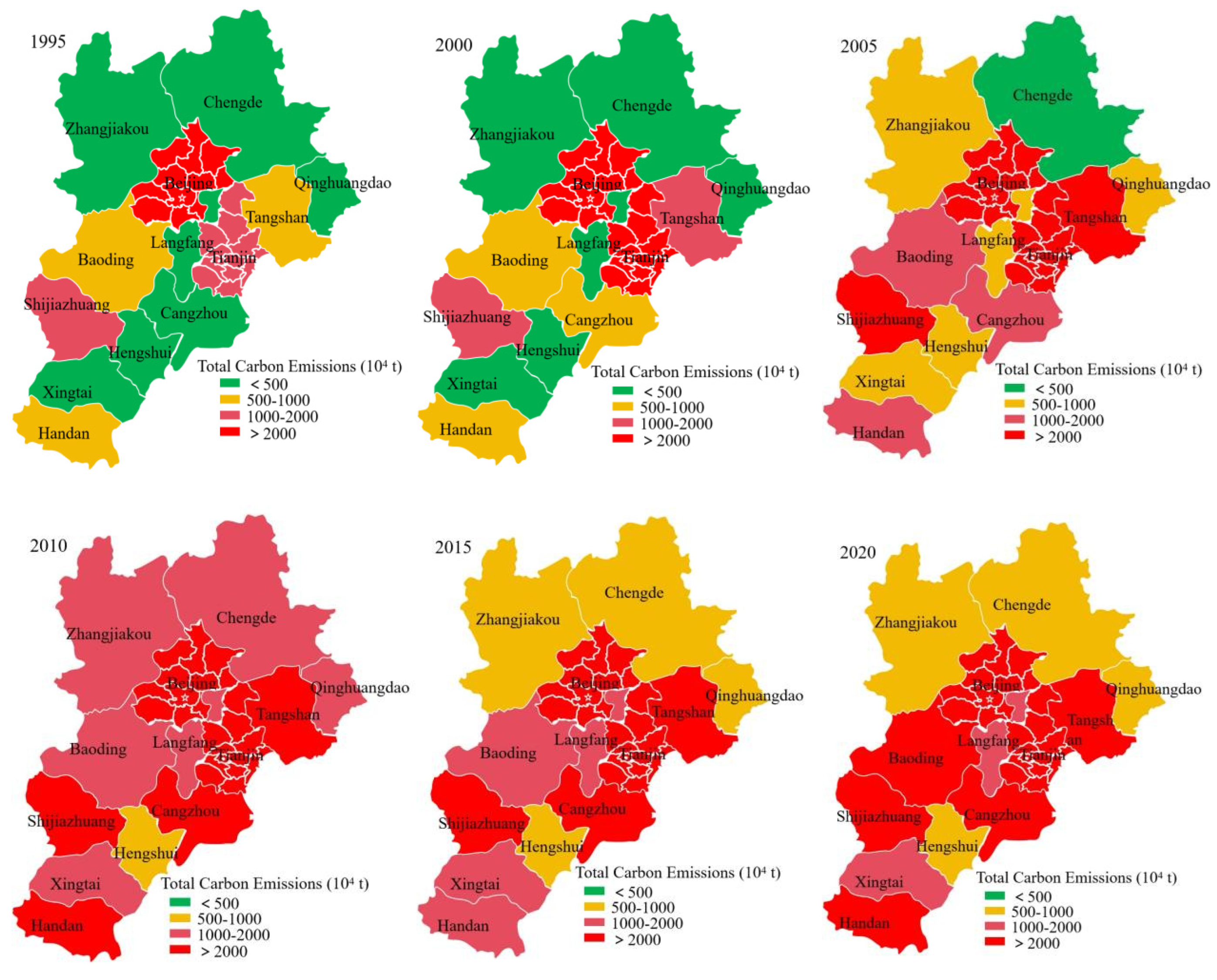
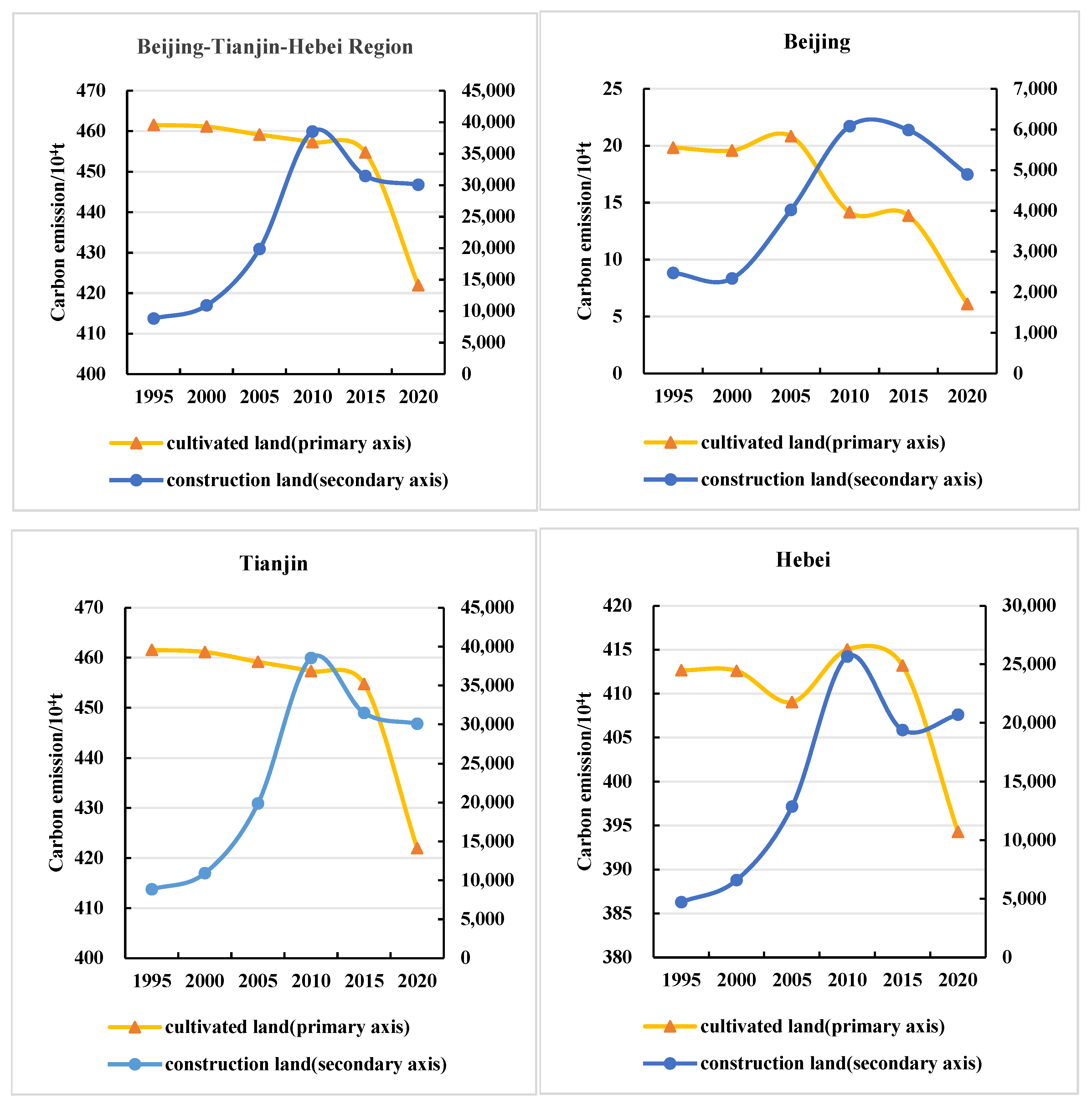
The spatio-temporal variations in carbon emissions from land resource utilization in the Beijing–Tianjin–Hebei region from 1995 to 2020 are shown in
Figure 1, where an “inverted U” shape is presented. Specifically, the period from 1995 to 2010 showed rapid growth in carbon emissions, with the total carbon emissions increasing from 93.1144 million tons to 390,025 million tons, with an average annual growth rate of 9.8%. The growth rate was the fastest from 2000 to 2010, with an increase of 276,063,400 tons. The period from 2010 to 2020 showed a slow decline. The total carbon emissions dropped to 305,116,300 tons, with a cumulative reduction of 84,886,200 tons. However, this was still 227.68% higher than that in 1995 [
18]. Regarding the energy consumption comparison statistics, in 2020, the proportion of carbon emissions from energy consumption in the Beijing–Tianjin–Hebei region to the total carbon emissions was 98.62%, higher than the 95.04% in 1995. This proportion reflects the energy demand during the process of industrialization and urbanization, highlighting the idea that regional carbon emissions are typically energy-driven [
19].
The land use patterns varied in different regions, and their carbon emissions also showed obvious characteristics of phased changes.
- (1)
The carbon emissions from construction land rapidly increased from 88.4986 million t to 300.8966 million t during 1995 to 2020, a growth of 240%. The carbon emissions proportion rose from 95.04% in 1995 to 98.62% in 2020, making it the largest carbon source among the land use types in the Beijing–Tianjin–Hebei region. The increase in carbon emissions from construction land was mainly driven by regional industrial expansion, the rise in production and living, and the growth in transportation demand [
10].
- (2)
The carbon emissions from cultivated land showed a continuous and gradual downward trend. Over the 25 years examined, the total carbon emissions from cultivated land in the Beijing–Tianjin–Hebei region decreased from 4.6158 million tons to 4.2197 million tons, a reduction of 396,100 tons. Specifically, Beijing reduced its carbon emissions by 137,300 tons, Tianjin 75,200 tons, and Hebei 183,600 tons. The proportion of carbon emissions from cultivated land dropped from 4.96% in 1995 to 1.38% in 2020. The decline in carbon emissions from cultivated land was mainly influenced by two reasons: first, agricultural technological progress has reduced production energy consumption; second, the promotion of national green economic policies has facilitated the development of circular and ecological agriculture. As a result, the use of pesticides and chemical fertilizers in the Beijing–Tianjin–Hebei region decreased, thereby reducing carbon emissions from agricultural production [
18].
3.1.2. Spatial Dimensions
Based on the carbon emissions calculation data of the urban agglomeration in the Beijing–Tianjin–Hebei region [
10], the regional carbon emissions were classified into four grades (
Table 4).
According to the classification criteria, regarding regional carbon emissions, from 1995 to 2020, the spatial distribution pattern of carbon emissions in the Beijing–Tianjin–Hebei region presented a characteristic of “core–periphery” differentiation (
Figure 1), where the core circle of the Beijing–Tianjin–Tangshan region remained in a high-emission state for a long time, the central and southern part of Hebei showed a gradually decreasing gradient transition state, and the carbon emissions in the ecological zone of northern Hebei remained at a low level.
Regarding carbon emissions in different cities, the ranking of total carbon emissions in the Beijing–Tianjin–Hebei region from 1995 to 2020 was as follows: Beijing > Tianjin > Tangshan > Shijiazhuang > Cangzhou > Handan > Baoding > Langfang > Xingtai > Zhangjiakou > Qinhuangdao > Hengshui > Chengde. Among them, the carbon emissions of the top six cities accounted for 73.32% of the total emissions, and the carbon emission grades were mainly medium and heavy areas (
Table 5). Regarding the growth characteristics of carbon emissions in various cities, Tangshan city had the fastest growth rate, with a total increase of 33.8043 million tons over 25 years and an average annual growth rate of 15.5%. Zhangjiakou city had the slowest growth rate, with a total increase of 5.69 million tons and an average annual growth rate of 6.45%. Based on the heterogeneity of land use structure and regional differences in economic development levels between cities in the Beijing–Tianjin–Hebei region, there was a positive correlation between the total carbon emissions from land use and GDP.
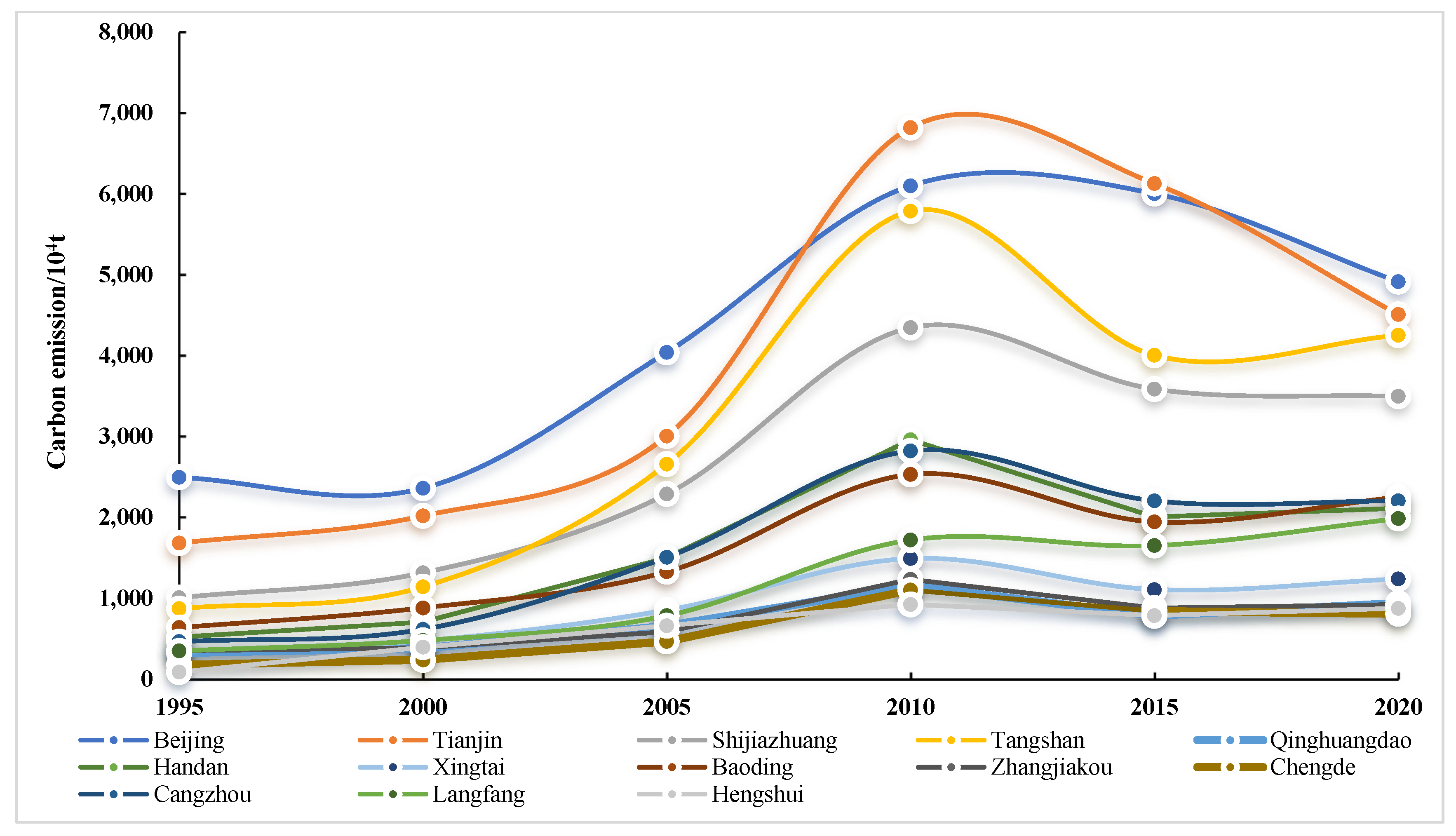
Based on the data in
Table 5, the temporal change in carbon emissions due to land use in each city of the Beijing–Tianjin–Hebei region is given in
Figure 2. The carbon emissions in the study area showed an overall trend of first increasing and then declining, with a peak in 2010. This indicates that the coordinated development of the Beijing–Tianjin–Hebei region and the implementation of the carbon emission joint prevention and control policy have gradually achieved results since 2010. The specific spatial evolution characteristics were as follows:
- (1)
During the upward period from 1995 to 2010, the Beijing–Tianjin–Hebei region prioritized economic development, which resulted in a large total amount of carbon emissions. The total carbon emissions of Hengshui, Tangshan, Chengde, and Cangzhou increased by more than 500%. However, regarding the proportion of urban carbon emissions, Beijing had the largest total carbon emissions, accounting for 18.74%, while Chengde had the lowest, with a proportion of only 2.48%.
- (2)
During the decline period of 2010–2020, the economic development of the Beijing–Tianjin–Hebei region reduced the dependence on resources and environment, and gradually reduced carbon emissions. Tianjin, Handan, Chengde, and Tangshan showed the greatest carbon emissions reduction, with a drop of more than 25%. During this period, the proportion structure of urban carbon emissions also changed. Tianjin had the highest carbon emissions, accounting for 17.21%, while Hengshui had the lowest, accounting for only 2.55%.
3.2. Analysis of Spatio-Temporal Variations in Carbon Absorption of Land Resources
3.2.1. Time Dimension
Calculations showed that from 1995 to 2020 (
Figure 3), the total amount of carbon absorbed by land resources in the Beijing–Tianjin–Hebei region increased from 3.3836 million tons to 3.4355 million tons, an increase of 1.5%, and the carbon sink supply capacity improved.
The carbon uptake of land resources periodically changed the Beijing–Tianjin–Hebei region’s features as follows:
- (1)
From 1995 to 2000, the carbon absorption of different land use types decreased slightly, with an average annual reduction of 1000 tons. Hebei province had the greatest reduction, reaching 4600 tons. However, the carbon absorption in Beijing and Tianjin rose, with a cumulative increase of approximately 1200 tons.
- (2)
From 2000 to 2005, different land use type carbon absorption amounts showed a trend of slow growth, with an increase of 22,900 t (0.68%).
- (3)
From 2005 to 2015, different land use types showed a slow and volatile carbon absorption reduction trend, with a 6200 t reduction.
- (4)
From 2015 to 2020, different land use type carbon uptakes showed a rapid growth of 39,200 t (1.15%), with the largest carbon uptake found in Hebei (26,700 t).
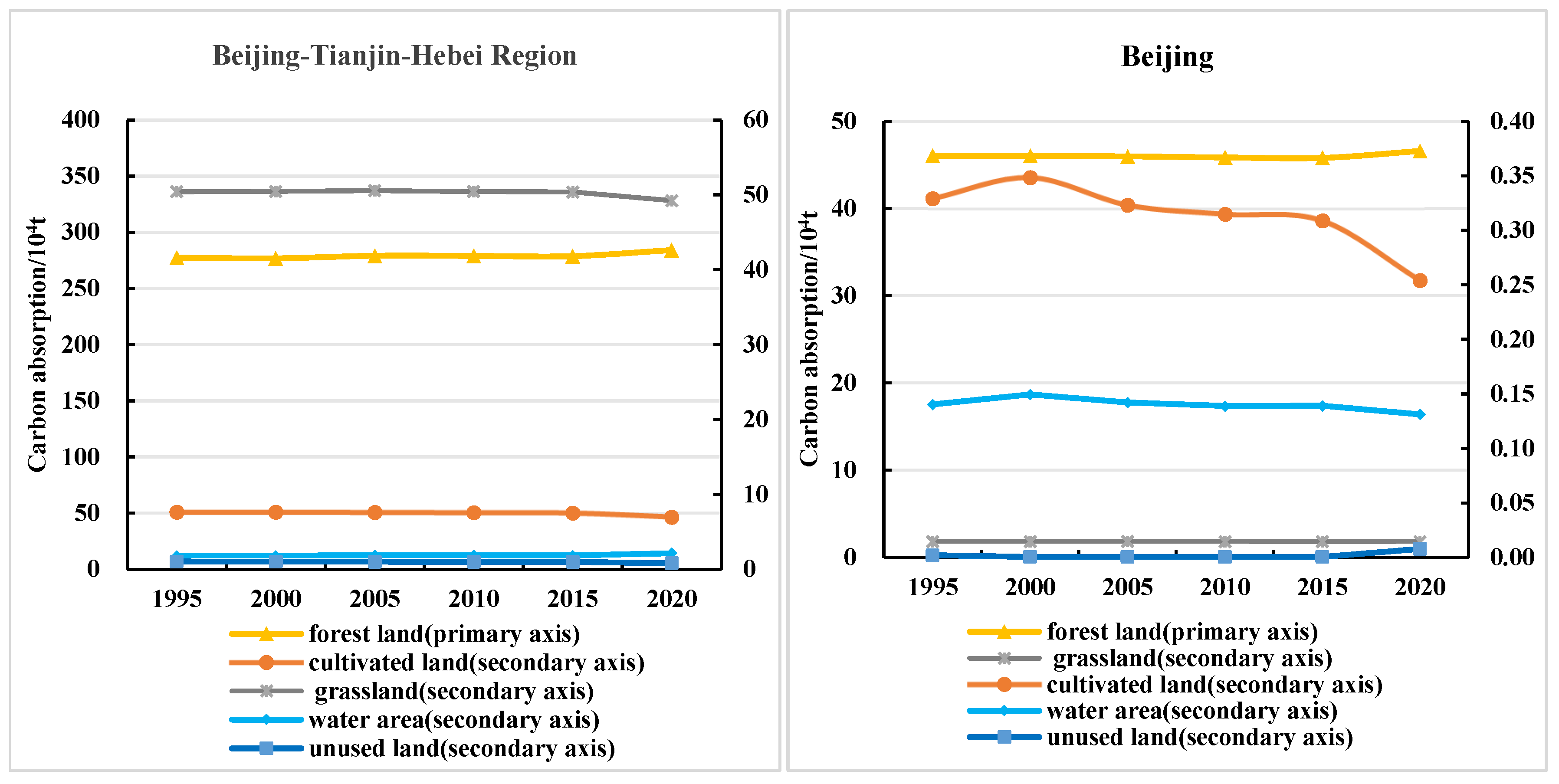
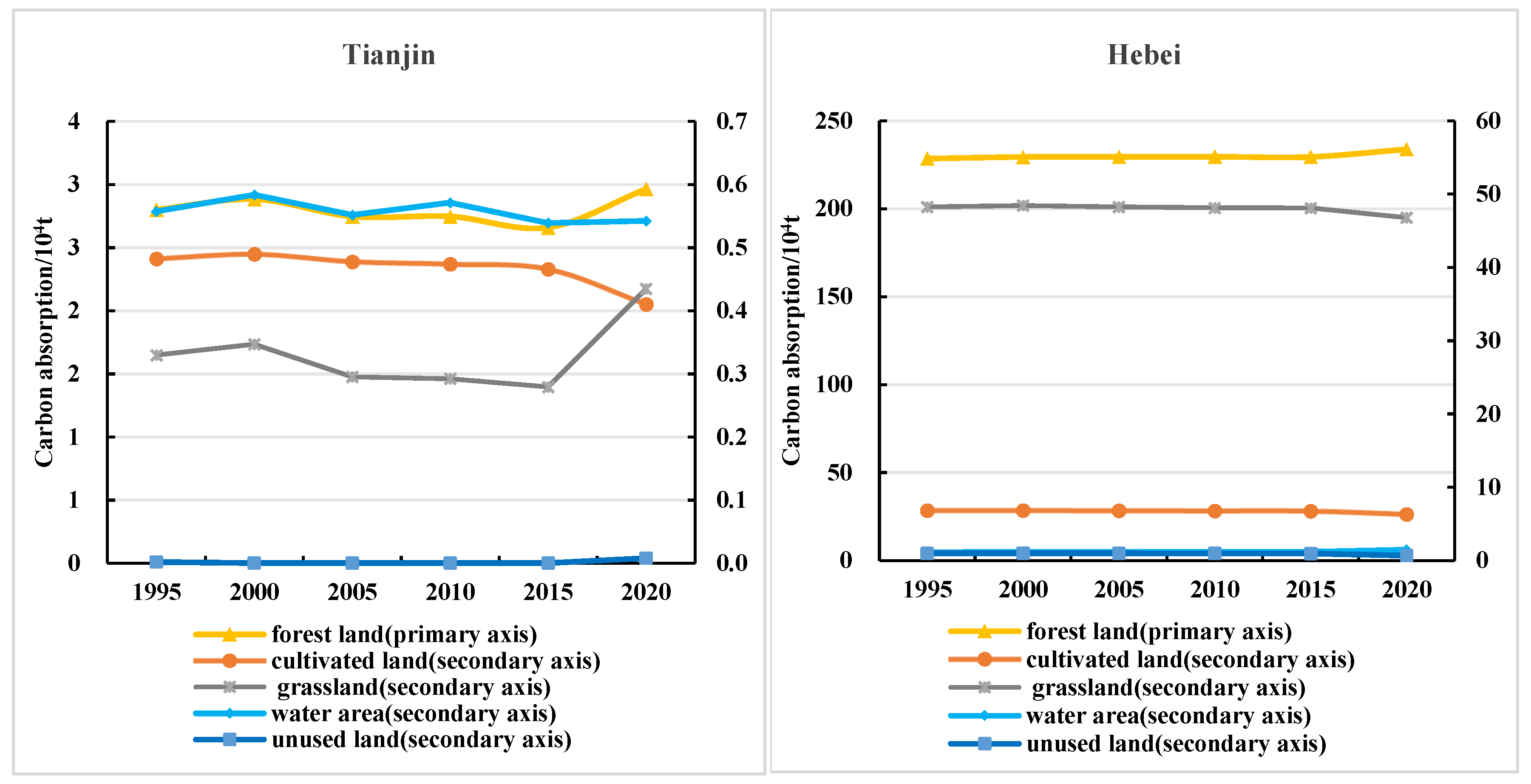
Figure 4 shows that there were certain differences in the carbon absorption (sink) capacities between different land use types. The order of their carbon sink capacities was forest land > grassland > cultivated land > water area > unused land. During the entire research period, forest land was the most important carbon sink resource in the region, with its absorption accounting for 82.16%. Grassland and cultivated land came second and third, accounting for 14.78% and 2.21%, respectively. The carbon absorption from water areas and unused land was small, accounting for only 0.85% of the total absorption.
In addition,
Figure 4 shows that from 1995 to 2015, the total carbon absorption of five major land use types, such as forest land and grassland, in the Beijing–Tianjin–Hebei region showed a slow and steady downward trend. However, from 2015 to 2020, the carbon absorption volume changed; while cultivated land, grassland, and unused land maintained a decreasing trend, the carbon absorption volume of forest land and water areas showed a reverse growth trend [
19].
3.2.2. Spatial Dimension
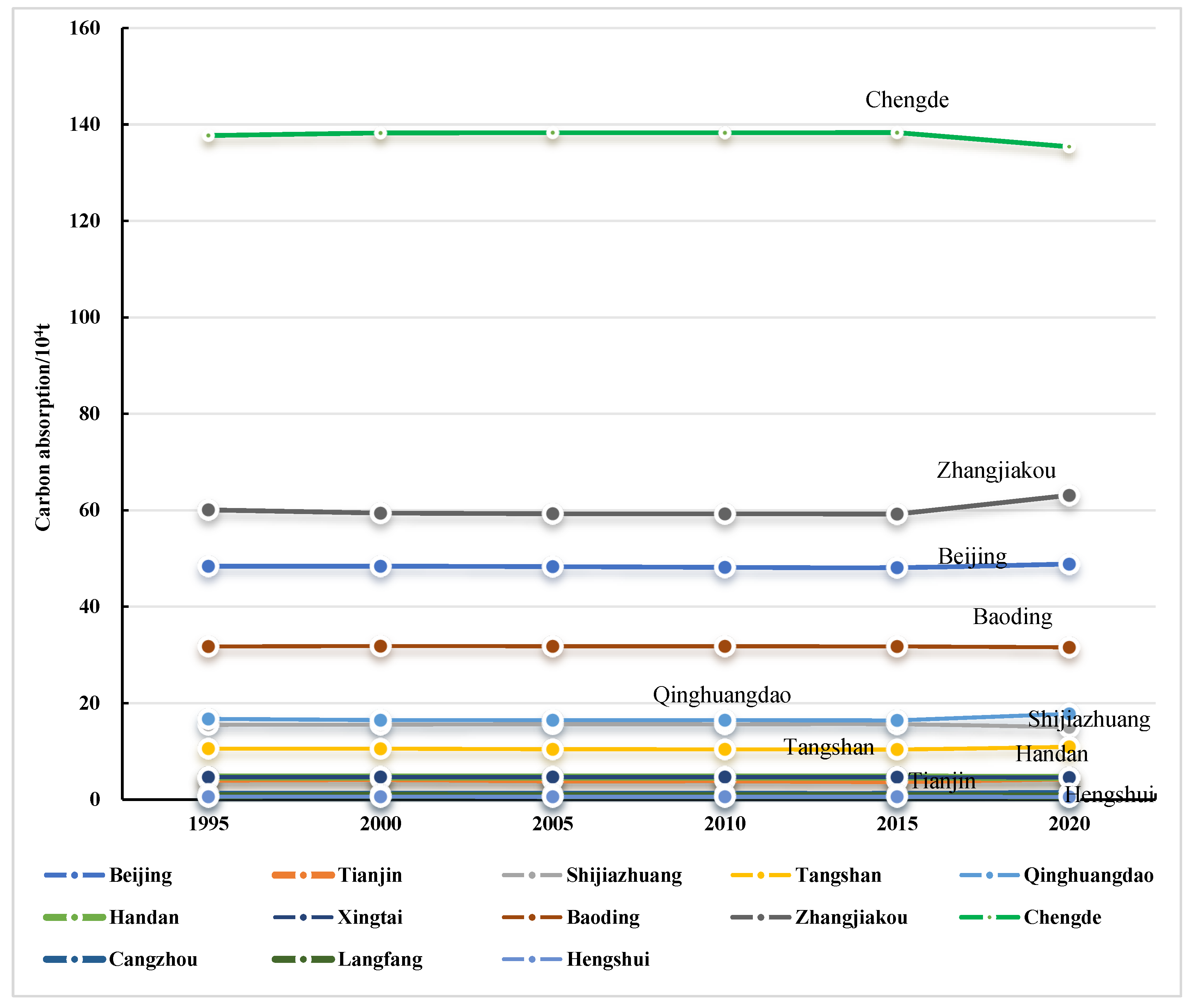
Regarding the spatial dimension, the carbon absorption of different land use types in the Beijing–Tianjin–Hebei region showed a changing pattern of being high in the northwest and low in the southeast [
18]. The order of carbon absorption in different regions was as follows: Chengde > Zhangjiakou > Beijing > Baoding > Qinhuangdao > Shijiazhuang > Tangshan > Xingtai > Handan > Tianjin > Cangzhou > Langfang > Hengshui (
Table 6). Specifically, Chengde city had the highest carbon absorption, accounting for 40.6%, while Hengshui city had the lowest carbon absorption, only 0.17%. Regarding the growth rate, during the 25 years from 1995 to 2020, Cangzhou city had the largest increase in carbon absorption, with 14.16%, while Langfang city had the largest decrease, with 12.03%.
Similarly,
Figure 5 shows the temporal changes in the total carbon absorption in the Beijing–Tianjin–Hebei region from 1995 to 2020. The total carbon absorption in the Beijing–Tianjin–Hebei region maintained a stable changing trend from 1995 to 2020; specifically, the forest land and grassland in the main carbon sink areas of the Beijing–Tianjin–Hebei region changed little, and the spatial distribution pattern of carbon absorption remained basically unchanged. Furthermore, the areas with increased carbon absorption mainly occurred after 2015. Cangzhou city had the largest increase in carbon absorption, followed by Tianjin, Qinhuangdao, and Zhangjiakou. However, the carbon absorption volume in Chengde city showed a decreasing trend, with a decline of 2.12%.
3.3. Analysis of Spatio-Temporal Changes in Carbon Neutrality of Land Resource Utilization
3.3.1. Time Dimension
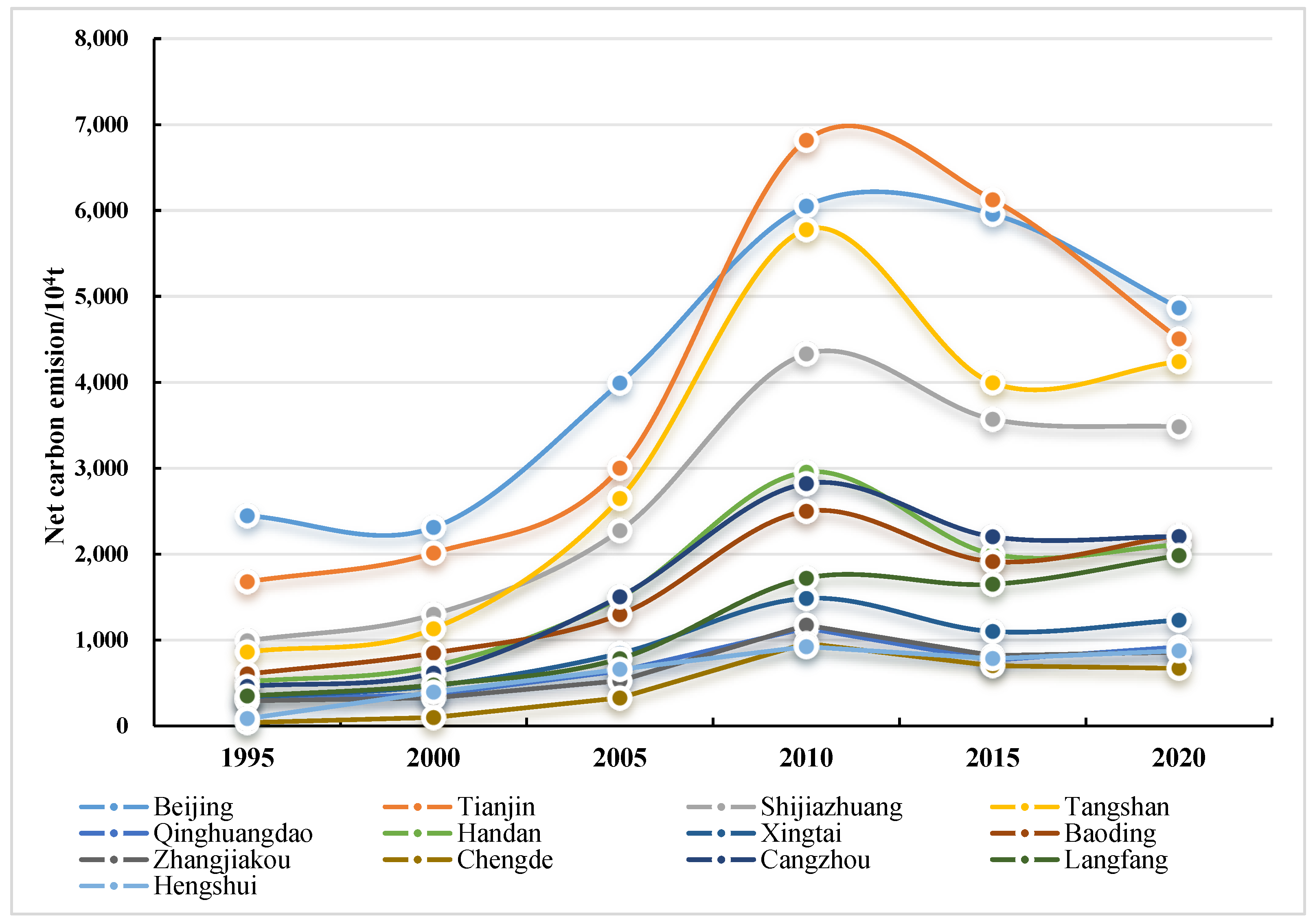
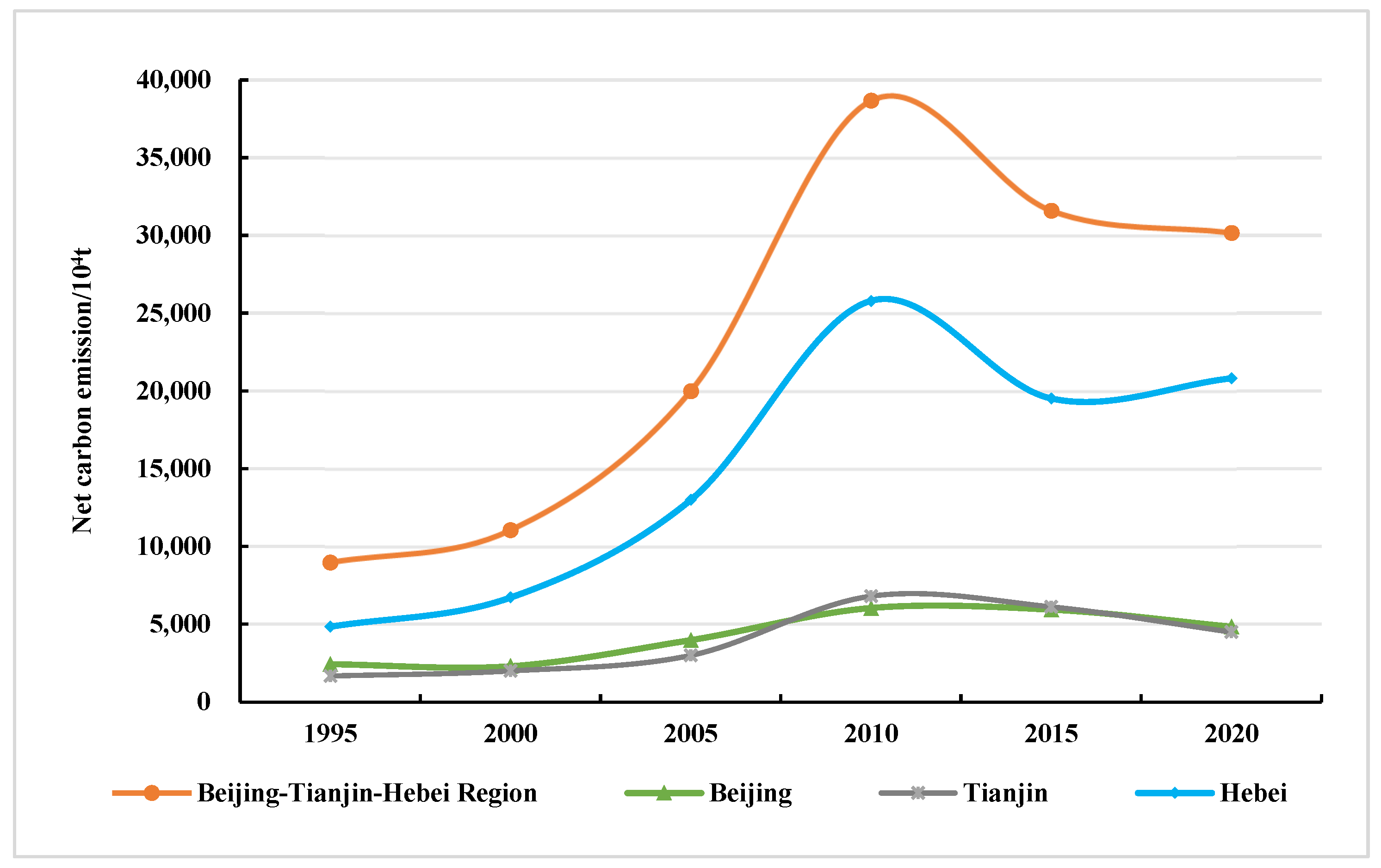
Without considering the time difference and based on the net carbon emission carbon neutrality balance equation of “carbon neutrality amount = carbon emission amount-carbon absorption amount” [
20], this study calculated that over 25 years, the net carbon emissions in the Beijing–Tianjin–Hebei region amounted to 211,951,100 tons, which is greater than 0. Compared with 1995, the increase in 2020 was 236.21%. This result indicates that during the process of industrialization and urbanization in the Beijing–Tianjin–Hebei region, carbon balance has not been achieved within the region. Carbon neutrality shows negative growth, presenting a significant carbon deficit state (
Figure 6).
Over the study period, the variation in the carbon neutrality volume in the Beijing–Tianjin–Hebei region was as follows:
- (1)
The period from 1995 to 2010 witnessed a sharp increase in net carbon emissions. In 2010, the net carbon emissions in the Beijing–Tianjin–Hebei region reached their peak during this period, amounting to 386.6026 million tons. Over the 15 years from 1995 to 2010, the net increase was 296.8728 million tons, representing a growth rate of 330.85%. During this period, the Beijing–Tianjin–Hebei region showed rapid economic growth, and the functional positioning of the region underwent significant adjustments. Beijing was no longer positioned as an economic center, and emphasis was placed on the development of the tertiary industry [
17]. Tianjin strengthened its role as a northern economic center, promoted high-quality development of advanced manufacturing, and actively expanded the scale of the tertiary industry. Hebei province clearly defined the development orientation of “leveraging Beijing” and “facing the Bohai sea”, accelerating the upgrading of regional industries [
19]. During this period, affected by the adjustment of the national production capacity policy, energy-intensive industries began to transfer within the region, leading to an increase in the frequency and scale of energy flow within the Beijing–Tianjin–Hebei region. This caused industrial enterprises mainly characterized by high energy consumption, high emissions, and low efficiency to continuously gather in the region, resulting in a rapid increase in the total carbon emissions of the region [
18,
20].
- (2)
The period 2010 to 2020 saw carbon emission regulations and a consequent reduction in net carbon emissions. During 2010 to 2020, the net carbon emissions in the Beijing–Tianjin–Hebei region decreased by 84.9217 million tons, representing a decline of 21.97%. In this period, the Beijing–Tianjin–Hebei region carried out coordinated environmental protection governance and coordinated construction of factor markets, achieving a transformation in economic development from scale growth to quality and efficiency improvements. Carbon emissions were effectively controlled, and the net carbon emissions showed a decreasing trend [
18], with the amount of carbon neutrality also reduced.
3.3.2. Spatial Dimension
From 1995 to 2020, the spatial distribution of net carbon emissions in the Beijing–Tianjin–Hebei region presented a pattern of “high in the southeast and low in the northwest”, where the high-value areas of net carbon emissions were concentrated in five cities—Beijing, Tianjin, Shijiazhuang, Tangshan and Handan—and their combined values accounted for 67.04% of the total net carbon emissions. The low-value areas were located in major ecological function zones such as the Bashang plateau and the mountainous areas of northern Hebei. The combined net carbon emissions of Zhangjiakou, Chengde, and Hengshui accounted for 7.5% of the total. This indicates that although the region is rich in ecological capital, forest and grassland resources, etc., and has outstanding carbon sink capacity, it still has the potential to further develop towards carbon neutrality. The specific temporal changes in the carbon neutrality volume of each city are shown in
Figure 7.
- (1)
From 1995 to 2010, the net carbon emissions of each city in the Beijing–Tianjin–Hebei region showed a slow growth trend. Specifically, Tianjin had the largest increase in net carbon emissions, adding 51.3857 million tons over the last five years in this period, with an average annual growth rate of 20.40%. Tangshan and Beijing followed, increasing by 49.161 million tons and 36.0596 million tons, respectively, with average annual growth rates of 38.02% and 9.82%.
- (2)
From 2010 to 2015, the net carbon emissions of each city in the Beijing–Tianjin–Hebei region showed a decreasing trend. Specifically, the net carbon emissions of Tangshan city decreased the most, reaching 17.8396 million tons, with a reduction rate of 30.87%. This was followed by Handan city and Shijiazhuang city, which saw decreases of 9.5367 million tons and 7.5966 million tons, respectively, with reduction rates of 32.27% and 17.54%, respectively. The city with the smallest reduction was Hengshui, with a decrease of 701,500 tons, representing a reduction rate of 4.08%.
- (3)
The period from 2015 to 2020 showed differentiated adjustments in net carbon emissions. While the continuous decrease in net carbon emissions in Beijing, Tianjin, Shijiazhuang and Chengde, the net carbon emissions of other cities showed an upward trend. Specifically, the reduction in carbon neutrality in Tianjin was the largest, with a decrease of 16.198 million tons, representing a reduction of 26.44%. During this period, Langfang city saw the largest increase in carbon neutrality, reaching 3.3386 million tons, with a growth rate of 11.34%. The main reason for the disparity in net carbon emissions in the Beijing–Tianjin–Hebei region was the combined influence of natural and socio-economic factors, among which the most important reason was the changes in energy consumption and land use structures [
17,
18].
4. Optimal Allocation Plan for Land Resource Utilization
In combination with the carbon neutrality zoning, the national main functional zone planning, and the positioning of the main functional zones for the coordinated development of the Beijing–Tianjin–Hebei region, to further increase the carbon neutrality of land resource utilization and reduce net carbon emissions, this study optimized the allocation of land resource utilization in the Beijing–Tianjin–Hebei region and conducted functional zoning of territorial space. Specifically, six types of land resource utilization allocation schemes are proposed (
Table 7).
The specific scope and functional positioning of each land resource utilization and allocation plan are as follows: (1) Chengde city: low-carbon conservation—main production area of agricultural products; (2) Beijing and Tianjin: carbon intensity control—optimization development zone; (3) Zhangjiakou and Baoding cities: carbon sink function—key ecological function zone; (4) Qinhuangdao city: carbon sink function—key development zone; (5) Tangshan, Cangzhou, and Langfang cities: high-carbon optimization—optimization development zone; (6) Shijiazhuang, Handan, Xingtai, and Hengshui cities: high-carbon optimization—key development zones.
4.1. Low-Carbon Conservation—Major Agricultural Product Production Areas
The data from this study shows that Chengde city has distinct characteristics of low-carbon conservation and can be classified as a major production area of low-carbon conservation—agricultural products. The total carbon emissions in this region accounted for only 2.55% of the entire area, the intensity of land development remains at a low level of 2.01%, and the contribution rate to GDP is 1.87%. The economic contribution rate of carbon emissions is 1.28, and the economic output per unit of carbon emissions is high. The ecological carrying coefficient of carbon absorption reaches 5.94, demonstrating a significant ecological carbon sequestration capacity. Therefore, the direction of optimal allocation of land resource utilization in Chengde city is as follows:
- (1)
Demarcate ecological protection and sink enhancement spaces. Strengthen the function of the ecological security barrier, with a focus on implementing biodiversity conservation, wetland restoration, and the management and protection of permanent basic farmland. Under the premise of ensuring ecological security, the spatial layout of urban and rural land resource utilization should be optimized through tapping the potential of existing land and intensive utilization.
- (2)
Promote low-carbon agriculture as the main focus. Carry out green transformation of traditional industries and establish a low-carbon production system [
20]. Give full play to the advantages of characteristic agriculture; build deep processing industrial chains of edible fungi, economic forest fruits, and other agricultural products; and promote the integrated development of agriculture and tourism. As a low-carbon maintenance zone, by leveraging local advantages, it should be continuously explored market-based regulatory mechanisms such as carbon emission rights trading, converting carbon sink resources into calculable and tradable ecological assets, achieving stock optimization, and contributing to carbon neutrality development [
21].
4.2. Carbon Intensity Control—Optimizing Development Zones
This study designated Beijing and Tianjin as carbon intensity control-optimization development zones. This area has a high urbanization density, and the intensity of territorial space development reaches 25.05% [
18]. The economic development of the two cities is outstanding. Their combined GDP accounts for 55.14% of the regional total, and the economic contribution rate of carbon emissions reaches 1.56. The most important carbon source in this area is industrial carbon emissions, accounting for 35.15%. The ecological carrying coefficient of regional carbon absorption is 0.44, but the carrying capacity of resources and the environment is weak, and the carbon sequestration capacity of the ecosystem is insufficient. The optimal allocation of land resources in this area can be developed as follows:
- (1)
Strengthen the constraints on construction land and achieve control of carbon “sources”. By raising the environmental standards and carbon emission thresholds for industrial access and implementing mandatory integrated construction standards of “green buildings + sponge implementation”, the pressure on resources and the environment can be alleviated [
22]. Industrial structure adjustment should guide high-energy-consuming and high-emission industries to shift towards high-value-added and low-carbon-intensive directions regarding space to facilitate centralized governance and reduce carbon emission intensity.
- (2)
Enhance the carbon sequestration capacity of forestry ecosystems. Strengthen the management and protection of existing ecological reserves such as the Summer Palace and Xishan National Forest Park to enhance the carbon sequestration benefits of forests. By expanding the area of urban greenery and the scale of landscape rivers, the regional carbon absorption capacity can be enhanced, and the ecological service value of the ecosystem can be improved.
- (3)
Promote “land composite utilization” and “tridimensional development” to build a coordinated development ecosystem. In areas around the capital, such as Langfang, it is necessary to plan and develop an ecological green and low-carbon industrial system; promote the construction of urban green areas, transportation green corridors, and urban forest parks; form an ecological barrier with a carbon sink function and economic value; and achieve synergy between carbon sink capacity improvement and high-quality economic development [
22].
4.3. Carbon Sink Function—Key Ecological Function Area
This study designated Zhangjiakou city and Baoding city as carbon sink function—key ecological function zones. This area has prominent ecological advantages, with a carbon absorption ecological carrying coefficient of 2.77, which is much higher than the average level of the Beijing–Tianjin–Hebei region. The regional ecosystem has a remarkable carbon sequestration capacity and undertakes key ecological functions such as water conservation, wind prevention and sand fixation, and climate regulation. It is the “natural green lung” of the Beijing–Tianjin–Hebei region [
18]. The economic development of this region lags, and the intensity of territorial space development is low, at 15.69%. Its GDP accounts for only 6.74% of the Beijing–Tianjin–Hebei region’s GDP. However, the region is large, covering 27.82% of the total land area of the Beijing–Tianjin–Hebei region. It has a good ecological background and considerable potential for carbon sinks.
Specifically, Zhangjiakou city and Baoding city are important ecological barrier areas in the Yanshan–Taihang mountains, with strong ecological service functions. In the future, the development of land resources should adhere to the principle of ecological security and build a green and low-carbon development system. Regarding agricultural land, efforts should be made to promote water-saving irrigation and ecological planting techniques, reduce reliance on high-water-consuming and high-emission industries, and ensure the demand for ecological water. Regarding ecological space, systematic ecological governance should be advanced with water source conservation, soil and water conservation, and degraded grassland management projects as the core. At the same time, we recommend deepening the regional joint prevention and control mechanism for the ecological environment, transforming ecological advantages into development momentum, and providing support for the low-carbon and green development of the Beijing–Tianjin–Hebei region.
4.4. Carbon Sink Function—Key Development Zones
This study classified Qinhuangdao city as a key development zone for carbon sink function, mainly because the ecological background advantage of this area is obvious, with a carbon absorption ecological carrying coefficient of 1.66. Regarding carbon sink production, it has the dual carbon sink functions of the ecological barrier of the Yanshan mountains and the coastal wetland. However, the economic development of this region is sluggish. Its total GDP accounts for 2.04% of the total of this indicator in the Beijing–Tianjin–Hebei region. The economic contribution rate of carbon emissions is 0.69%, and the proportion of carbon emissions in the total carbon emissions of the region is 2.98%. The pressure to reduce emissions is small. The intensity of land development is only 2.81%, and there is sufficient space for ecological conservation.
The optimization of the future territorial space in this region can be carried out from the following three aspects: First, build a low-carbon industrial system, with a focus on cultivating green service industries, such as coastal tourism and health care for the elderly; developing high-tech industries and low-carbon industrial clusters, such as marine biomedicine; and promoting the application of clean energy. Second, we recommend strengthening refined land use management and building a three-dimensional ecological pattern of “mountain–city–sea”. Specifically, in the northern Yanshan mountain area, we recommend enhancing the construction of water conservation forests; in the central urban area, we recommend improving the green space ecosystem and build sponge cities; and in the southern coastal belt, we recommend strengthening the protection of wetlands and the protective forest system. Furthermore, ecological restoration projects should be conducted with a focus on the governance of degraded coastal zones. Third, innovate the spatial governance mechanism, establish a mechanism for realizing the value of ecological products, explore carbon sink trading and ecological compensation systems, and give full play to the ecological advantages of the interaction between mountains and seas [
23].
4.5. High-Carbon Optimization-Optimizing Development Zones
This study classified Tangshan city, Cangzhou city, and Langfang city as high-carbon optimization—optimization development zones. The contradiction between the economy and the environment in this area is prominent. The combined GDP of the three cities accounts for 17.21% of the GDP of the Beijing–Tianjin–Hebei region. The intensity of land development reaches 27.69%. The regional carbon emissions are high, accounting for 24.92%, and the carbon emission efficiency is 0.68. The environmental pressure is large [
18]. The carbon absorption capacity of the region is weak, with a carbon emission intensity of 0.15. However, this area has an important coastline along Bohai Bay and possesses inherent conditions for developing a port-related economy. The marine resources in this region have considerable development value.
Regarding the optimal allocation of land resources, this region mainly achieves green and low-carbon transformation from the following aspects: (1) Carry out a differentiated land use layout, where Cangzhou city focuses on cultivating low-carbon marine industries, such as marine new energy and low-carbon shipping, while Tangshan city mainly focuses on the adjustment of industrial and urban land use structure in the port area and concentrates on the low-carbon upgrading of the chemical industry in the port area. (2) Cangzhou city and others have implemented the mountain–sea linkage ecological restoration and “blue carbon” sink enhancement project, advanced the restoration of coastal wetlands, established a multi-level coastal protection forest system, protected important estuarine ecological corridors, and innovated the “sea–land integration” ecological compensation mechanism. Tangshan city has implemented the coastal blue carbon restoration and industrial and mining abandoned land reclamation and greening project, achieving coordinated increases in blue carbon, greening, and carbon sinks. Langfang city has strengthened the construction of regional ecological corridors and established a cross-regional carbon sink value conversion linkage mechanism.
4.6. High-Carbon Optimization—Key Development Zones
This study classified four cities, namely, Shijiazhuang, Handan, Xingtai, and Hengshui, as high-carbon optimization—key development zones. This area is dominated by industrial economic development, and the GDP of the four cities accounts for 16.99% of the GDP of the Beijing–Tianjin–Hebei region. The region has a high degree of industrialization, with a territorial space development intensity of 26.74%. The economic contribution coefficient of carbon emissions is 0.68, and the proportion of carbon emissions in the total regional carbon emissions is 24.62%. The environmental load is heavy [
18], and the region’s carbon absorption capacity is limited, with the ecological carrying capacity of carbon absorption being only 0.33.
According to the regional characteristics, the specific land resource optimization plan for this area is as follows: Shijiazhuang city, Xingtai city, and Handan city, as important industrial development zones along the Taihang Mountains in the central and southern part of Hebei province, should thoroughly implement the “three removes and one reduction” industrial policy regarding industrial development; optimize the industrial spatial layout; strictly control land access for new industrial projects; and promote the transformation of traditional manufacturing in high-end, intelligent, and green directions. By leveraging digital means, a real-time monitoring system for industrial carbon emissions should be established to enhance the capacity for environmental monitoring and urban pollution control.
Hengshui city can rely on the ecological resource of Hengshui Lake to create a green development model of “coexistence of lake and city”, make overall plans for the construction of the lakeside new town and the ecological landscape belt around the lake, and strengthen the governance of the urban ecological environment. At the same time, Hengshui city can strictly protect basic farmland, forests, grasslands, and other carbon sink resources to enhance the regional carbon sink capacity [
24]. In addition, by implementing differentiated policies, the green transformation of traditional industrial bases in the region can be achieved by implementing a new model of sustainable development for the southern part of the Beijing–Tianjin–Hebei region [
12].
5. Discussion
Land is not only a spatial carrier for carbon emissions and absorption but also a bearer of carbon sinks and sources and a tool for regional collaborative governance. Through zonation guidance and spatial optimization, it promotes the coordination of regional carbon balance and ecological environment governance, as well as achieves the organic unity of land and resource optimization, high-quality development, and ecological security in the Beijing–Tianjin–Hebei region under the goal of carbon neutrality.
Considering the above conclusions and the problems existing in different regions, in the future management of low-carbon transformation and optimal allocation of land and resources, the following issues are worthy of further discussion:
5.1. Institutional Integration of Land-Based Carbon Sinks into Regional Governance
A central challenge lies in aligning land carbon sequestration functions with regional coordinated development mechanisms [
18]. Future inquiry should address. How can institutional and regulatory frameworks embed land carbon budgets into metropolitan governance to the sustainable development goals of “Climate Action” (SDG 13) and “Sustainable Cities and Communities” (SDG 11) [
25]? Concrete steps include establishing a Beijing–Tianjin–Hebei Land-Use Carbon Neutrality Committee, enacting regional regulations such as the Beijing–Tianjin–Hebei Land Carbon Balance Ordinance, and piloting linked markets for land development rights and carbon sink quotas. Such measures would directly support the “integrating climate change measures into policies” (SDG 13.2) and “integrated disaster risk reduction and climate adaptation planning” (SDG 11.b).
5.2. Operationalizing Regional Land Carbon Accounts and Ecological Compensation
Despite advances in remote sensing and IoT-based carbon flux monitoring, translating biophysical data into economic and governance instruments remains underdeveloped, a key question emerges. Can spatially explicit, grid-based land carbon accounts improve the efficiency of carbon markets and ecological compensation mechanisms in ways that reinforce “Life on Land” of SDG 15 [
25]? Establishing “carbon sink banks,” developing “photovoltaic +” agrivoltaics, forest-voltaics, etc., composite land-use models, and creating cross-regional trading platforms could safeguard terrestrial ecosystems while mobilizing finance for climate action [
6,
14]. This is also a very worthy topic for discussion.
5.3. Spatial Heterogeneity, Climate Resilience, and Nature-Based Solutions
The spatial unevenness of carbon deficits suggests that uniform policies may fail to deliver equitable outcomes. This raises a critical research question: How can spatially explicit governance address carbon budget imbalances while enhancing ecosystem resilience through nature-based solutions? Prioritizing multifunctional land systems, particularly those restoring degraded lands and conserving biodiversity, can contribute to the Sustainable Development Goals of sustainable forest management (SDG 15.2) and “strengthening climate resilience” (SDG 13.1) [
22,
25]. Such strategies would also offer a replicable “Beijing–Tianjin–Hebei model” for other global megacity regions pursuing integrated climate–ecological transitions.
In addition to the above three issues, the limitations of carbon measurement methods, the sensitivity of carbon emission coefficients for different land use types, and the inherent uncertainty of land use and land cover change data also need to be further improved and discussed in the future study.
6. Conclusions
This study reconstructs the territorial carbon budget of the Beijing–Tianjin–Hebei region from 1995 to 2020 and proposes a net-carbon–oriented land allocation framework aligned with China’s carbon neutrality commitment. Three principal findings emerge.
First, carbon emission trajectories exhibit a distinct inverted-U curve, with construction land acting as the dominant carbon source. Emissions display a persistent core–periphery structure: Beijing, Tianjin, and Tangshan form a high-emission core; central–southern Hebei constitutes a transitional gradient; and the ecologically sensitive northern belt remains a low-emission hinterland. Despite a modest upward trend in regional carbon sinks, no self-sufficient carbon equilibrium has been achieved, underscoring the urgency of expanding net sink capacity while optimizing existing land stocks.
Second, spatially differentiated land-use strategies are essential. By integrating net-carbon performance with local socioeconomic and ecological endowments, the Beijing–Tianjin–Hebei region is partitioned into six functional zones: (1) Chengde city: Low-carbon conservation and agricultural carbon sink resources assetization; (2) Beijing and Tianjin: Carbon-intensity–constrained development prioritizing high-efficiency, low-carbon industries; (3) Zhangjiakou and Baoding city: Consolidation of carbon-sink functions within key ecological zones; (4) Qinhuangdao city: Refined land management fostering mountain–urban–coastal synergy; (5) Tangshan, Cangzhou and Langfang city: Industrial restructuring and blue-carbon enhancement along port corridors; (6) Shijiazhuang, Handan, Xingtai and Hengshui city: Green upgrading of high-carbon industrial bases.
Third, this zonal scheme operationalizes the interdependence of sustainable development goals for “Sustainable Cities and Communities” (SDG 11), and “Climate Action” (SDG 13), as well as “Life on Land” (SDG 15) separately, offering a transferable template for megacity regions balancing urbanization with terrestrial carbon governance.
While this study advances subnational carbon–land governance, data granularity and cross-contextual comparability remain limited. Future research should deepen longitudinal policy evaluation, integrate cross-regional benchmarks, and refine spatially explicit pathways toward resilient, low-carbon land systems that sustain both development and ecological integrity.
Author Contributions
Conceptualization, X.L.; methodology, Y.Z., X.L. and M.L.; formal analysis, X.L. and Y.Z.; investigation, Y.Z., X.L. and M.L.; writing—original draft preparation, Y.Z. and M.L.; writing—review and editing, Y.Z., X.L. and M.L. All authors have read and agreed to the published version of the manuscript.
Funding
This research funded by the Major Project of National Social Science Foundation of China [grant number 24&ZD108].
Institutional Review Board Statement
Not applicable.
Informed Consent Statement
Not applicable.
Data Availability Statement
Conflicts of Interest
The authors declare no conflicts of interest.
References
- Wang, C.X.; Li, M.Q. Research Progress on the Intersection of Land Use Change and Carbon Sink Assessment Based on bibliometrics. Acta Ecol. Sin. 2024, 44, 5893–5903. [Google Scholar]
- Zhao, R.Q.; Huang, X.J.; Chui, X.W. Myth in the research of the land use carbon emissions in China and the future tendency. J. China Land Sci. 2016, 30, 83–92. [Google Scholar]
- Huang, Z.H.; Du, H.Q.; Li, X.J.; Mao, F.J. A Review of Land Use/Cover Change and Its Impact on Forest Carbon Budget. J. Remote Sens. 2025, 29, 49–69. [Google Scholar] [CrossRef]
- Zhao, X.C.; Niu, Y.W.; Xiao, J.; Zhang, Z.X. Research on the Spatio-Temporal Pattern of Carbon Emissions in Yueyang City Based on Land Use Change. J. Hunan Univ. Technol. 2022, 36, 10–19. [Google Scholar]
- Zhao, R.Q.; Chen, Z.G.; Huang, X.J.; Zhong, T.Y.; Quan, X.W.; Lai, L.; Zhang, M.Y. Research progress of Nanjing University land use carbon emissions. J. Geogr. Sci. 2012, 32, 1473–1480. [Google Scholar]
- Zhang, Z.F.; Zhang, D. Spatial Correlation of Carbon Emissions and Carbon Balance Zoning in the Beijing-Tianjin-Hebei Region Based on Social Network Analysis. China Environ. Sci. 2023, 43, 2057–2068. [Google Scholar]
- Zhang, L.S.; Jing, C.F.; Wu, S.Z.; Zhou, Z.Y.; Fang, Z.R. Spatial Correlation Evolution and Scenario Prediction of Carbon Emissions from Land Use in the Beijing-Tianjin-Hebei Region. Sci. Surv. Mapp. 2025, 50, 142–151. [Google Scholar]
- Yang, X.; Liu, X.Z. Carbon Transmission Effect and Prediction of Land Type Transfer in Changsha-Zhuzhou-Xiangtan Urban Agglomeration. Environ. Sci. 2022, 43, 5850–5860. [Google Scholar]
- Zhou, R.B.; Hong, W.Y. Spatial Correlation of Carbon Emissions from Land Use and Optimal Zoning of Carbon Balance in Guangdong Province from the Perspective of Social Network Analysis. Environ. Sci. 2025, 46, 5403–5414. [Google Scholar]
- Zhang, P.L.; Du, Q.J. Research on the Influencing Factors of Carbon Emissions in the Beijing-Tianjin-Hebei Region: Based on the Extended STIRPAT Model. Sci. Technol. Manag. Land Resour. 2022, 39, 14–23. [Google Scholar]
- Wang, F.C.; Wang, D.C.; Zhang, L.H.; Liu, J.Y.; Hu, B.X.; Sun, Z.C.; Chen, J.H. Spatiotemporal analysis of the dynamic changes in land use ecological risks in the urban agglomeration of Beijing-Tianjin-Hebei region. Acta Ecol. Sin. 2018, 38, 4307–4316. [Google Scholar] [CrossRef]
- Peng, W.Y.; Chen, Z.Y.; Sun, J.F.; Shan, Z.Y.; Sun, Y. Spatio-temporal Pattern of Green Land Use Efficiency in Beijing-Tianjin-Hebei and Its Influencing Factors. J. Soil Water Conserv. 2024, 38, 257–266. [Google Scholar]
- Wang, G.; Yu, Q.; Yang, D.; Zhao, X.T.; Zhao, G.F.; Yue, D.P. Relationship between Change of Ecological Spatial Pattern and Land Surface Temperature in Beijing-Tianjin-Hebei Urban Agglomeration. Trans. Chin. Soc. Agric. Mach. 2021, 52, 209–218. [Google Scholar]
- IPCC. Climate Change 2014: Impacts, Adaptation, and Vulnerability. Part A: Global and Sectoral Aspects. In Contribution of Working Group II to the Fifth Assessment Report of the Intergovernmental Panel on Climate Change; Field, C.B., Barros, V.R., Dokken, D.J., Mach, K.J., Mastrandrea, M.D., Bilir, T.E., Chatterjee, M., Ebi, K.L., Estrada, Y.O., Genova, R.C., et al., Eds.; Cambridge University Press: Cambridge, UK; New York, NY, USA, 2014; 1132p. [Google Scholar]
- IPCC. 2006 IPCC Guidelines for National Greenhouse Gas Inventories; Eggleston, H.S., Buendia, L., Miwa, K., Ngara, T., Tanabe, K., Eds.; Institute for Global Environmental Strategies (IGES): Kanagawa, Japan, 2006. [Google Scholar]
- Yu, J.W.; Cheng, Z.H.; An, D.X.; Zhang, W.L.; Niu, Y.F.; Tong, J. Spatio-temporal Characteristics Evolution of Carbon Emissions from Land Use in China from 2000 to 2021 and Carbon Emission Prediction. Environ. Sci. 2025, 1–29. [Google Scholar] [CrossRef]
- Lu, J.Y.; Huang, X.J.; Dai, L.; Chen, Z.G.; Li, Y. Analysis of Carbon Emission Equity of Energy Consumption in Provincial Regions of China Based on Spatiotemporal Scale. J. Nat. Resour. 2012, 27, 2006–2017. [Google Scholar]
- Guo, M.X.; Zhou, L.; Guo, Q.; Yin, J.F.; Wang, H.M. Study on ecosystem service functions based on land cover change in the Beijing-Tianjin-Hebei Urban Agglomeration. Urban Reg. Plan. Stud. 2023, 15, 134–150. [Google Scholar]
- Chen, D.K.; Shi, L.Y. Landscape Ecological Risk Assessment and Prediction of Xiongan New Area Based on Land Use Change. Ecol. Econ. 2021, 37, 224–229. [Google Scholar]
- Wang, Z.F.; Cai, Y.W.; Luo, S.W.; Yang, Y.F. Analysis of Spatio-temporal Trend Characteristics and Influencing Factors of Carbon Emissions in the Chengdu-Chongqing Urban Agglomeration. Environ. Sci. Technol. 2023, 46, 205–215. [Google Scholar]
- Yuan, R.Y.; Zhang, N.; Shao, L.W.; Yan, Y.Z.; Xu, X.; Zhang, Q. Landscape Ecological Risk Assessment and Driving Factor Analysis of Nature Reserves in Inner Mongolia from 1990 to 2020. J. Inn. Mong. Univ. (Nat. Sci. Ed.) 2023, 54, 519–528. [Google Scholar]
- Qing, X.; Li, W.; Lu, Z.G. Land Use Change and Ecological Risk Assessment of Urban agglomerations in the Yellow River Basin. China Environ. Sci. 2024, 44, 984–991. [Google Scholar]
- Sun, Q.R.; Tu, X.S.; Dan, C.L.; Xu, G.L. Estimation of Land Resources Asset Value and Analysis of Its Dynamic Changes: A Case Study of Jiangxi Province. China’s Land Resour. Econ. 2019, 32, 83–89. [Google Scholar]
- Xie, C.X.; Zhang, S.H.; Li, H.L.; Zhang, S.X.; Song, Z.Y.; Liu, Y.; Zhang, X.Y.; Xu, H. Impact of land use change on carbon storage in Xinshui River Basin from 1987 to 2020. Acta Ecol. Sin. 2024, 44, 8021–8032. [Google Scholar]
- United Nations. Transforming Our World: The 2030 Agenda for Sustainable Development (Resolution A/RES/70/1); UN General Assembly: New York, NY, USA, 2015; Available online: https://sdgs.un.org/2030agenda (accessed on 21 October 2015).
| Disclaimer/Publisher’s Note: The statements, opinions and data contained in all publications are solely those of the individual author(s) and contributor(s) and not of MDPI and/or the editor(s). MDPI and/or the editor(s) disclaim responsibility for any injury to people or property resulting from any ideas, methods, instructions or products referred to in the content. |