1. Introduction
Seasonally ice-covered lakes are widespread in cold and temperate regions and are increasingly regarded as sentinels of climate and environmental change. Winter ice cover regulates heat and gas exchange, light penetration, and mixing regimes, thereby exerting strong control over lake biogeochemistry and ecology [
1,
2]. Recent syntheses show that the duration and extent of lake ice have declined in many regions and are projected to decrease further under continued warming, with potentially profound consequences for water quality, ecosystem metabolism, and biodiversity [
3,
4]. Shallow lakes that provide drinking water or support intensive agriculture are particularly vulnerable to winter oxygen depletion, internal nutrient loading, and shifts in community composition that may cascade into the open-water season [
5].
Microbial communities are central to the functioning and resilience of these systems. Bacteria and fungi jointly mediate organic-matter decomposition, nitrogen and phosphorus cycling, and energy transfer to higher trophic levels, and can remain metabolically active under ice [
6,
7]. Recent work emphasizes fungi as critical members of lake microbiota, contributing extracellular enzymes, parasitizing phytoplankton, and potentially stabilizing ecosystems subject to harmful algal blooms [
8]. At the same time, planktonic versus benthic habitats impose fundamentally different selective pressures—oxygen availability, nutrient gradients, substrate surfaces—that lead to divergent assemblages and environmental controls in the water column and surface sediments [
9,
10]. Although bacterial communities in these habitats and their seasonal changes have been documented in a range of lakes, cross-kingdom (bacteria–fungi) patterns remain much less explored, especially in seasonally ice-covered shallow lakes and when water and sediments are examined simultaneously [
11,
12].
Co-occurrence network analysis provides a powerful system-level lens on microbial organization by capturing non-random associations, modules, and putative keystone taxa that may stabilize or destabilize communities [
13,
14]. Network studies in aquatic systems have revealed distinct architectures in water versus sediments, habitat-specific keystone taxa, and shifts in positive versus negative associations along gradients of eutrophication, pollution, or hydrological disturbance [
15]. Extending this framework to cross-kingdom networks further illuminates how bacteria and microeukaryotes or fungi interact across habitats, and how the loss or turnover of generalist keystone taxa can affect stability [
16,
17]. In parallel, contemporary community-assembly theory synthesizes four basic processes—selection, dispersal, drift, and diversification—as drivers of microbial biogeography [
18]. Null-model approaches now partition compositional turnover into heterogeneous and homogeneous selection, homogenizing dispersal, dispersal limitation, and undominated processes, enabling quantitative evaluation of deterministic versus stochastic mechanisms [
19,
20]. Applications to lakes and rivers show that bacterioplankton and microeukaryotes often occupy different positions along this spectrum, with habitat heterogeneity and connectivity strongly modulating the balance between selection and dispersal [
21,
22]. In our previous work in the same broader region, we documented spatial heterogeneity in bacterial diversity and organophosphorus pesticide risks in Lianhuan Lake [
23], elucidated nitrogen-metabolism pathways and water-quality dynamics in the Xisha River [
24], and revealed how nitrogen enrichment reshapes microbial communities and N-cycling functional genes in the nitrogen-polluted Shi River using metagenomics [
25]. We further showed that microbial dynamics in agricultural reservoirs of Daqing are tightly linked to nutrient status and ecological risk levels [
26]. However, these studies largely focused on ice-free conditions and single domains or functions, leaving open how seasonal ice cover reorganizes bacterial–fungal communities, cross-kingdom networks, and assembly mechanisms in shallow lakes.
Lianhuan Lake, a large shallow lake on the cold-temperate Songnen Plain of Northeast China, offers an opportunity to address these gaps. The lake experiences seasonal ice cover, marked winter–spring contrasts in temperature, oxygen, and nutrient conditions, and strong coupling between water and surface sediments under agricultural influence. In this study, we combined 16S rRNA gene and ITS1 amplicon sequencing with physicochemical profiling to characterize bacterial and fungal communities in surface water and sediments during the frozen (winter) and thawed (spring) periods. By constructing cross-kingdom co-occurrence networks for each season–habitat combination and applying neutral and phylogenetic null-model frameworks, we asked: (i) how seasonal ice cover and spring opening reshape the diversity and composition of bacterial and fungal communities in water and sediments; (ii) how seasonal transitions reorganize cross-kingdom network complexity, interaction patterns, and keystone taxa in pelagic versus benthic habitats; and (iii) whether bacteria and fungi in these habitats share common or distinct assembly pathways. We hypothesized that bacterioplankton in the well-mixed water column would exhibit a dispersal-assisted, selection-tuned assembly route, whereas sediment-associated bacteria and fungi would be governed predominantly by selection-dominated, habitat-constrained assembly, together forming dual assembly pathways of bacterial–fungal communities in a seasonally ice-covered shallow lake.
2. Materials and Methods
2.1. Overview of the Study Area
Lianhuan Lake is a large shallow lake located on the Songnen Plain, with a north-high, south-low topography. It spans approximately 60 km from north to south and 30.5 km from east to west, with a flat lake bottom. The region has a temperate continental monsoon climate, characterised by long, harsh winters and short, hot, humid summers. It serves as an important fishery resource and winter ice tourism (ice fishing, ice skating) base for Daqing City, with its surrounding reed wetlands also functioning as a crucial stopover site for migratory birds. The lake begins to freeze over by late November each year, with full freezing occurring by mid-December. Thawing gradually occurs across the entire lake from late March to mid-April the following year, with an average annual ice cover period of approximately 140–150 days.
2.2. Sample Collection
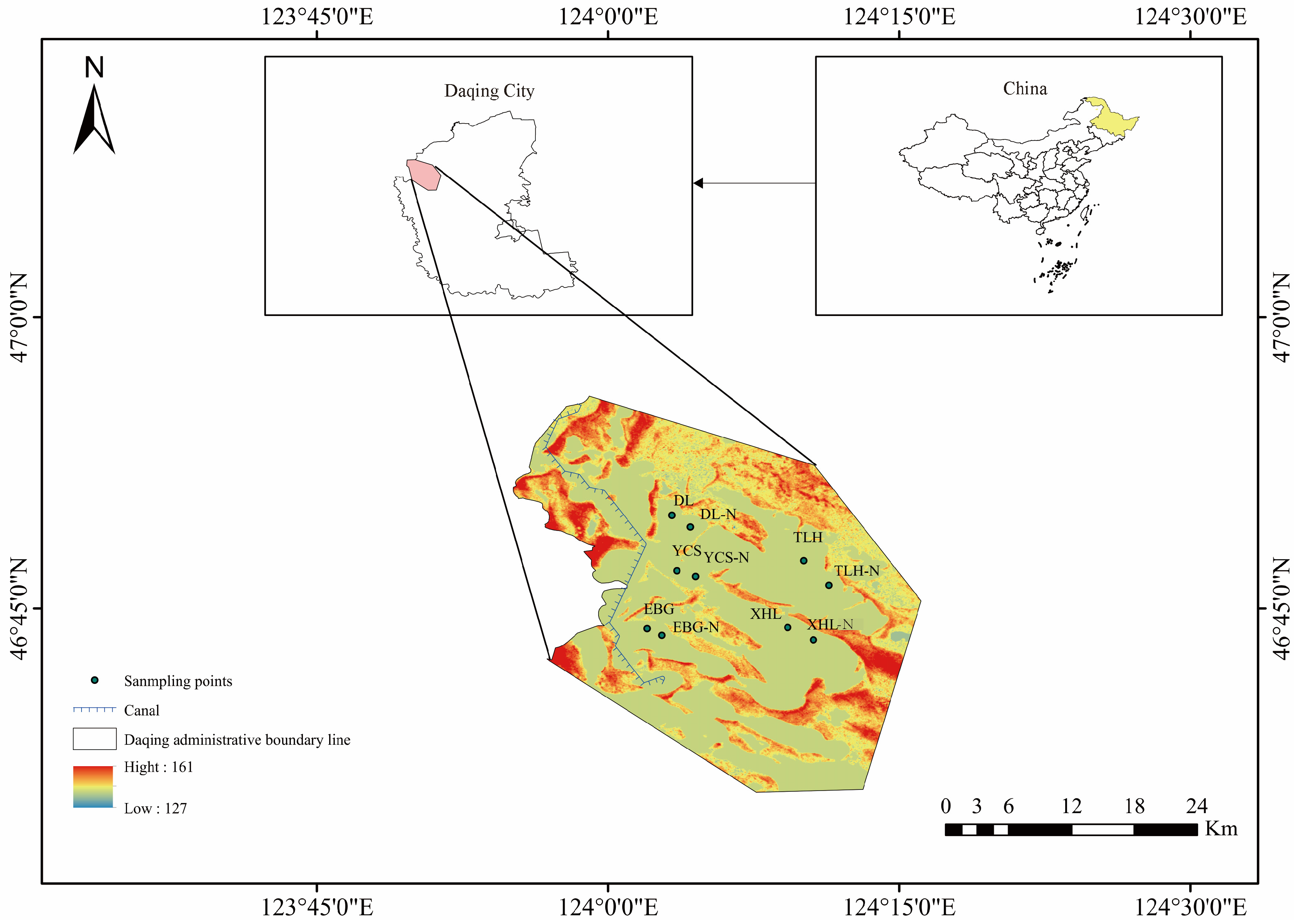
Field sampling was conducted in January 2024 (frozen period, FP) and April 2024 (thaw period, TP) at five representative sites in Lianhuan Lake (DL, EBG, TLH, XHL, and YCS) (
Figure 1). These sites were selected to capture the spatial heterogeneity of the lake and its varying eutrophication levels. During the frozen period, holes were drilled in the ice using a gas-powered ice auger (Jiffy Model 30, Ardisam, Inc., Cumberland, WI, USA). At each site, water was collected from beneath the ice using a Ruttner water sampler (KC Denmark A/S, Silkeborg, Denmark) at five parallel points spaced 1 m apart in the horizontal direction, then composited to form one integrated water sample. The mixed samples were transferred into acid-washed polyethylene bottles (Nalgene, Thermo Fisher Scientific, Waltham, MA, USA). Sediments were collected from the surface layer (0–5 cm) using a Kajak corer (KC Denmark A/S, Silkeborg, Denmark), with three parallel subsamples taken within 1 m of each other and composited into one representative sediment sample, then stored in sterile Whirl-Pak
® bags (Nasco Sampling LLC, Pleasant Prairie, WI, USA). After ice melt in April, the same procedure was repeated at the same sites to ensure seasonal comparability. All samples were placed in insulated coolers (Beijing Roloo Technology Co., Ltd., Beijing, China) with ice packs and transported to the laboratory at ~4 °C within 12 h. In the laboratory, each sample was divided into two fractions: one for microbial analysis (water filtered through 0.22 μm PES membranes, Merck Millipore, Burlington, MA, USA; sediments subsampled aseptically) and stored at −80 °C in a low-temperature freezer (Thermo Fisher Scientific, Waltham, MA, USA), and the other for physicochemical analyses.
2.3. Physicochemical Analyses
The physical and chemical parameters measured for water samples include water temperature (WT), dissolved oxygen (DO), pH, transparency (SD), permanganate index (COD
Mn), ammonia nitrogen (NH
3–N), nitrite nitrogen (NO
2–N), chlorophyll a (Chl a), water total nitrogen (WTN), and water total phosphorus (WTP). COD
Mn was used as a bulk proxy for total oxidisable organic matter and does not specifically quantify dissolved or labile organic carbon. The physical and chemical parameters measured for sediment samples include sediment organic matter (SOM), sediment total nitrogen (STN), and sediment total phosphorus (STP). Detailed testing instruments and analysis procedures are provided in
Supplementary Material Text S1.
2.4. DNA Extraction and PCR Amplification
Total microbial DNA was extracted from water and sediment samples using the E.Z.N.A.
® Soil DNA Kit (Omega Bio-tek, Inc., Norcross, GA, USA) according to the manufacturer’s instructions. DNA quality was verified by agarose gel electrophoresis and concentration/purity were assessed using a NanoDrop™ 2000 spectrophotometer (Thermo Fisher Scientific, Waltham, MA, USA). The bacterial 16S rRNA V3–V4 region (primers 338F/806R) and the fungal ITS1 region (primers ITS1F/ITS2) were amplified, and PCR products were purified, quantified, pooled in equimolar concentrations, and sequenced using paired-end 2 × 300 bp reads on an Illumina NextSeq 2000 platform (Illumina, Inc., San Diego, CA, USA). Sequencing was performed by Shanghai Meiji Biotechnology Co., Ltd. (Shanghai, China). Detailed PCR conditions and sequencing data processing are provided in
Supplementary Text S2. Sequencing data processing followed established protocols [
27,
28,
29,
30,
31,
32,
33,
34].
2.5. Network Analysis of Cross-Domain Microbial Associations
Interdomain microbial associations were explored by constructing cross-domain co-occurrence networks that integrated bacterial and fungal OTUs from water and sediment samples during the frozen (FW, FS) and thawed (TW, TS) periods. OTU tables were filtered to reduce noise: for bacteria, only OTUs with prevalence ≥60% across samples and mean relative abundance ≥0.1% were retained; for fungi, the thresholds were prevalence ≥ 50% and mean relative abundance ≥ 0.05%. Pairwise correlations among the retained OTUs were calculated using Spearman’s rank correlation, and significant associations were defined as |ρ| ≥ 0.60 with p < 0.05. These domain-specific thresholds were adopted because fungal ITS datasets contained substantially fewer OTUs with a more skewed abundance distribution than bacterial 16S datasets; applying the stricter bacterial criteria to fungi would have removed most fungal OTUs and left too few nodes for reliable network construction. Relaxing the fungal thresholds thus retained a comparable and adequate number of nodes while still excluding spurious rare taxa. For greater robustness of network topology and Zi–Pi role classification, modules with fewer than five nodes were merged into their best-connected neighboring module, and nodes with degree <2 were removed. Networks were constructed using the igraph and Hmisc packages in R (version 3.3.1), and a suite of topological properties was calculated, including node and edge numbers, average degree, clustering coefficient, network density, average path length, modularity, and the proportion of cross-domain (bacteria–fungi) edges. Keystone taxa were identified on the basis of within-module connectivity (Zi) and among-module participation (Pi), where Zi > 2.5 and Pi > 0.62 were used to classify nodes as network hubs, module hubs, connectors, or peripherals.
2.6. Data Processing and Statistical Analysis
Data processing and statistical analyses were primarily conducted on the Majorbio Cloud Platform (
https://cloud.majorbio.com), with additional analyses performed using R v4.5.1 and specific packages as detailed in
Supplementary Text S3.
3. Results
3.1. Seasonal Changes in the Physical and Chemical Characteristics of Water Bodies
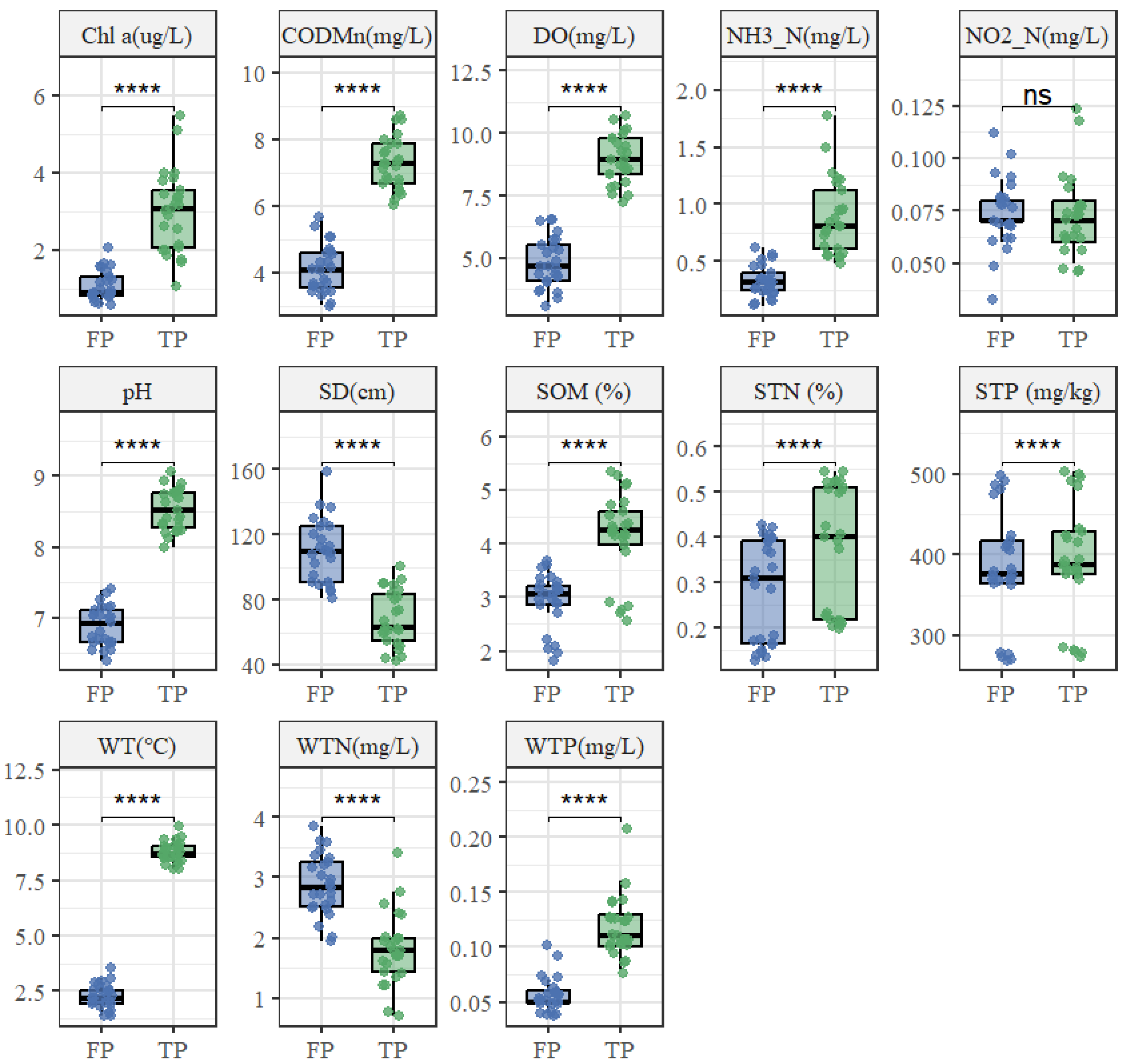
Water and sediment physicochemistry differed significantly between the freeze period and thaw period (
Figure 2). Temperature and oxygen rose sharply after thaw: water temperature increased from 1.6–3.0 °C to 8.2–9.9 °C, and DO from 3.2–6.5 mg/L (approaching hypoxia at some sites) to 7.2–10.6 mg/L, reflecting renewed atmospheric re-aeration and enhanced photosynthesis. Nitrogen forms showed contrasting trends: WTN declined from 2.0–3.9 mg/L to 0.8–3.4 mg/L (consistent with algal uptake and runoff dilution after ice-off), whereas NH
3-N rose from 0.1–0.6 to 0.5–1.7 mg/L; NO
2−-N remained low and stable (0.03–0.11 vs. 0.05–0.12 mg/L). WTP increased from 0.03–0.10 to 0.06–0.21 mg/L, indicating thaw-driven release and resuspension of internal phosphorus together with possible snowmelt inputs. Organic-matter and algal indicators all increased after thaw: COD
Mn rose from 3.0–5.7 to 6.2–8.7 mg/L, Chl a from 0.5–2.0 to 1.0–5.5 μg/L, and pH from 6.4–7.2 to 8.2–9.1, while SD decreased from 80–160 cm to 40–90 cm, together signalling increased algal biomass and CO
2 drawdown. In sediments, SOM and STN were significantly higher in the thaw period, whereas STP showed no significant seasonal difference.
These results demonstrate a typical seasonal transition: winter exhibits a stable state characterized by low temperatures, low oxygen, high nitrogen, high transparency, and low algae; spring shifts to an active state characterized by rising temperatures, reoxygenation, decreased nutrients, increased algal blooms, and decreased transparency. These environmental changes were associated with the subsequent reorganization of microbial community diversity and the reshaping of interaction networks.
3.2. Freeze–Thaw Differences in Microbial Community Diversity and Composition
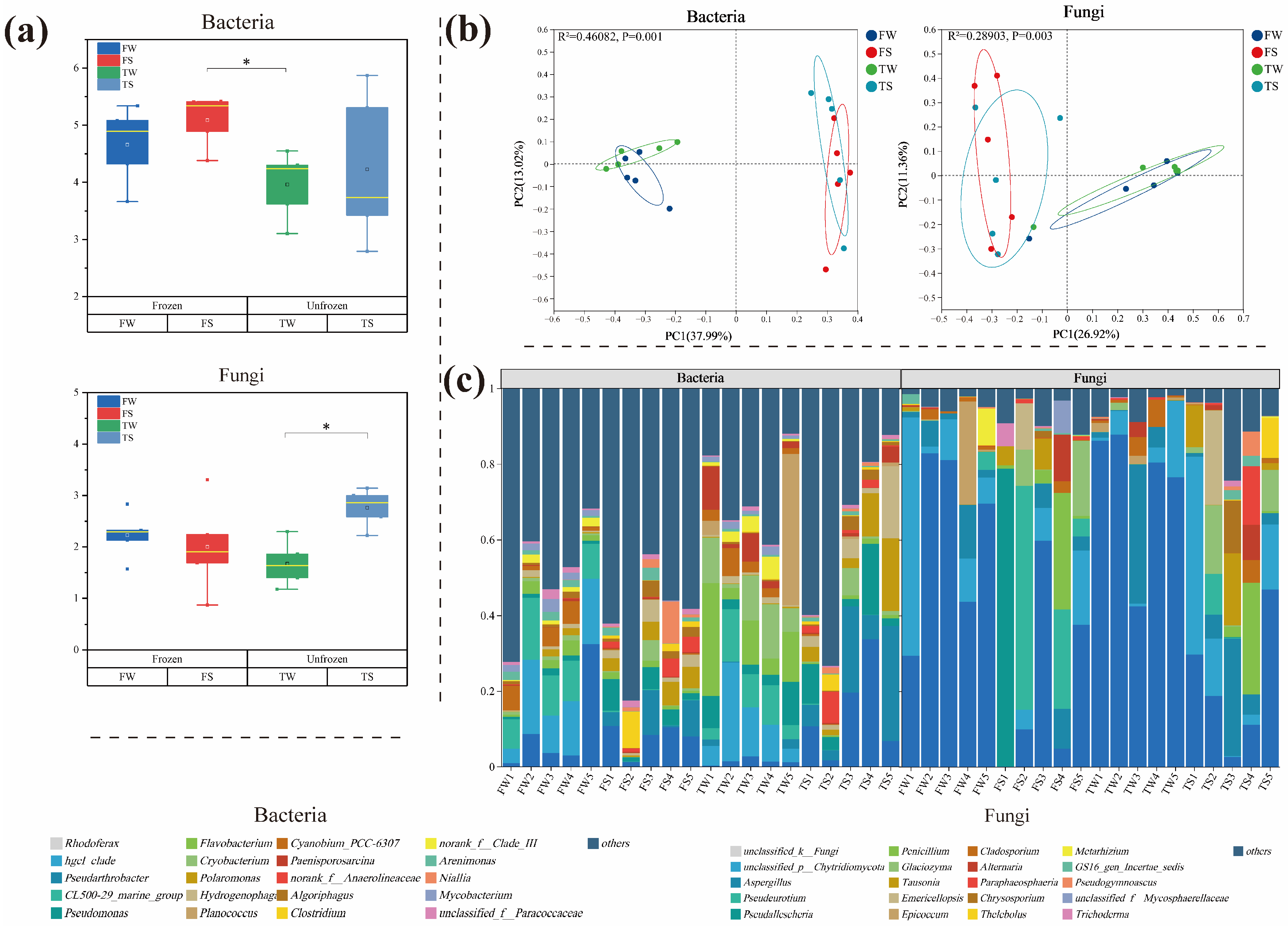
Microbial α-diversity showed only minor fluctuations between FP and TP (
Figure 3a). Although bacterial Shannon diversity was slightly higher in frozen water than in thawed water, and richness (Chao1) tended to be greater in sediments than in the water column, these differences were not statistically significant (ANOVA with Games–Howell,
p > 0.05). Fungal diversity remained similarly stable across periods and habitats. These results indicate that freeze–thaw exert limited influence on overall richness and evenness.
In contrast, β-diversity revealed clearer patterns (
Figure 3b). Principal coordinate analysis based on Bray–Curtis distances showed a strong separation between water and sediment samples, highlighting habitat filtering as a dominant structuring force. Within each habitat, seasonal differentiation was more evident in bacteria than in fungi. PERMANOVA confirmed that bacterial communities underwent stronger turnover across freeze–thaw transitions (R
2 = 0.46,
p = 0.001), while fungal communities showed weaker but still significant seasonal shifts (R
2 = 0.29,
p = 0.003). In the PCoA ordination (
Figure 3b), sediment samples showed smaller within-group dispersion than water samples in both seasons, suggesting that benthic assemblages were comparatively less variable across the freeze–thaw transition.
At the phylum level (
Figure S1), bacterial communities were dominated by Pseudomonadota, Actinomycetota, and Bacteroidota, while fungal assemblages were dominated by Ascomycota and Basidiomycota. At the genus level (
Figure 3c), oligotrophic Actinomycetota (e.g.,
hgcI_clade) and Bacteroidota lineages were characteristic of water samples, whereas Pseudomonadota such as
Rhodoferax and
Pseudomonas were enriched in sediments. Fungal communities were structured by typical aquatic genera such as
Aspergillus and
Cladosporium in water, and soil-derived taxa including
Penicillium and
Tausonia in sediments. Seasonal differences were modest, primarily involving shifts in relative abundance of secondary taxa rather than changes in dominant groups.
Taken together, these findings demonstrate that while overall diversity metrics remained stable, bacterial communities—especially in the water column—exhibited greater compositional turnover across freeze–thaw transitions, whereas fungal communities maintained higher structural stability.
3.3. Microbial Co-Occurrence Network Structure in Freeze–Thaw
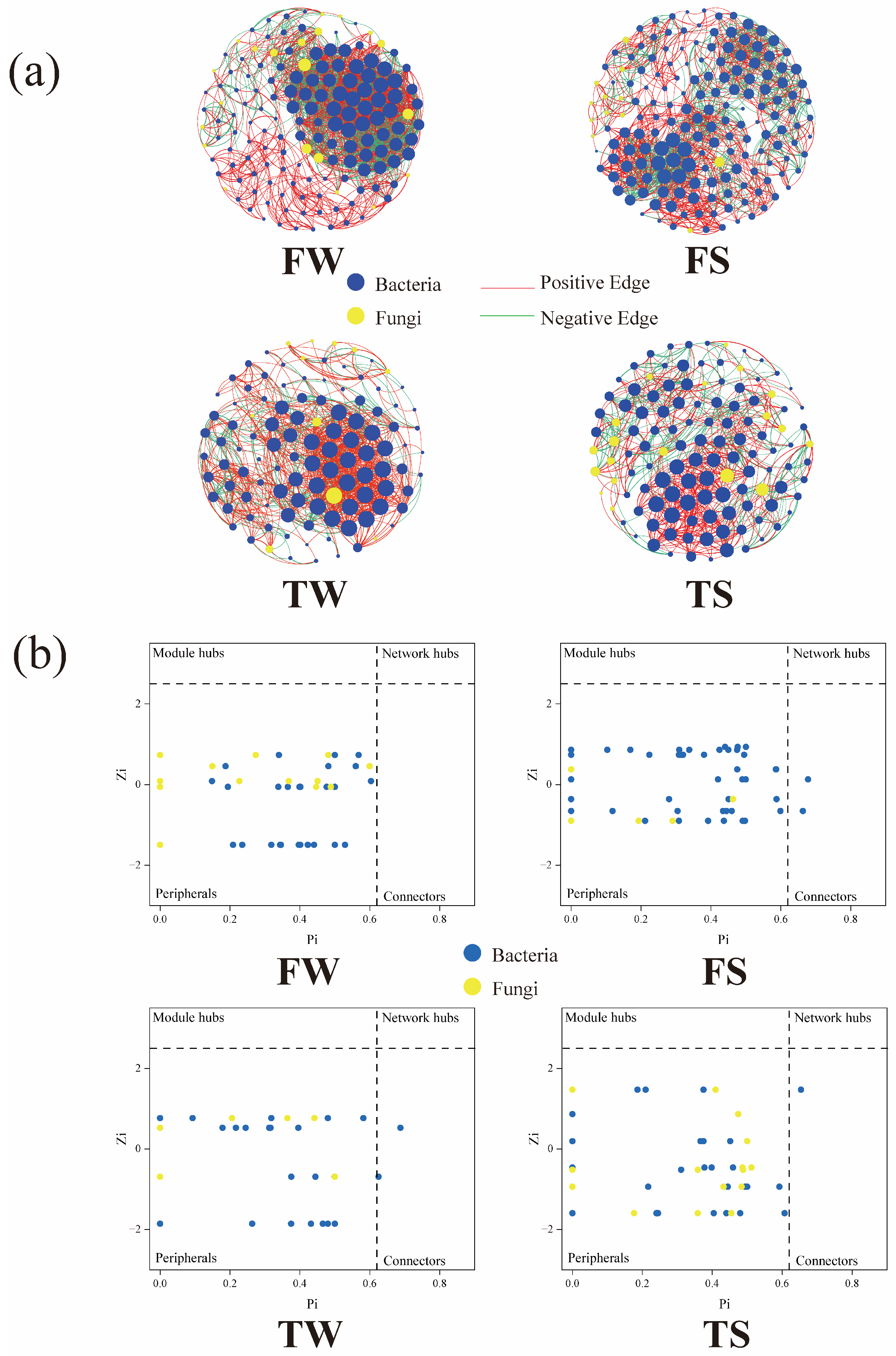
Based on correlation-based co-occurrence analysis of bacterial and fungal communities, we constructed four cross-domain ecological networks to examine how seasonal freeze–thaw transitions reshape microbial interactions across habitats. The resulting networks (
Figure 4a) revealed clear seasonal and habitat-dependent contrasts in topological architecture, highlighting distinct structural organization between frozen and thawed periods. As summarized in
Table S1, the frozen-water (FW) network exhibited the highest complexity, with 153 nodes and 1933 edges, the greatest average degree (25.27), clustering coefficient (0.65), and the largest proportion of cross-domain edges (~15%, 289/1933). In contrast, the frozen-sediment (FS) network was less connected (average degree = 16.82) but showed stronger modularity (0.58), with markedly fewer cross-domain associations (~5%, 72/1430); this combination of high modularity and few inter-module and cross-domain links indicates that benthic interactions were largely confined within discrete micro-niches rather than forming a well-connected whole. Following thawing, both habitats exhibited a reduction in overall connectivity. The thawed-water (TW) network decreased to 941 edges with an average degree of 17.27, while the thawed-sediment (TS) network contained 704 edges (average degree = 11.73) but displayed the strongest modular partitioning (modularity = 0.60) and a striking increase in cross-domain links (~16.5%, 116/704). These quantitative shifts suggest that thawing reorganized the interaction web—from a dense, cooperative winter structure toward a more modular and functionally specialized configuration.
Zi–Pi analysis (
Figure 4b) further indicated that FW was dominated by peripheral taxa, whereas FS contained several connectors, such as
Comamonadaceae and CL500-29 marine group (Ilumatobacteraceae). In spring, connectors shifted towards
Luteolibacter and
Rhodoferax in water, and
Flavobacterium and
Sutcliffiella in sediment, taxa commonly involved in organic matter degradation and nutrient cycling.
Finally, we compared the seasonal dynamics of keystone taxa (
Table 1). FW was composed predominantly of peripheral nodes (e.g.,
Polaromonas,
Pseudomonas,
Candidatus Limnoluna, and
hgcI clade), with no module/network hubs detected. In winter sediments (FS), we detected six connector nodes (Pi = 0.663–0.678) bridging distinct modules, taxonomically assigned to unclassified Comamonadaceae (two OTUs), Blastocatellaceae JGI_0001001-H03, CL500-29 marine group (Ilumatobacteraceae), and Actinomarinales lineages. During spring, the keystone set shifted:
Luteolibacter and
Rhodoferax emerged as connectors in water (TW), whereas
Flavobacterium and
Sutcliffiella were identified as connectors in sediments (TS). Taken together, these patterns indicate a marked seasonal replacement of keystone taxa, with winter benthic connectors dominated by metabolically versatile lineages—unclassified Comamonadaceae, Blastocatellaceae (JGI_0001001-H03), the CL500-29 marine group (Ilumatobacteraceae), and Actinomarinales—under resource-limited conditions, and spring connectors associated with organic-carbon and algal-detritus processing, namely
Luteolibacter and
Rhodoferax in water, and
Flavobacterium and
Sutcliffiella in sediment.
3.4. Environmental Drivers of Community and Network Changes
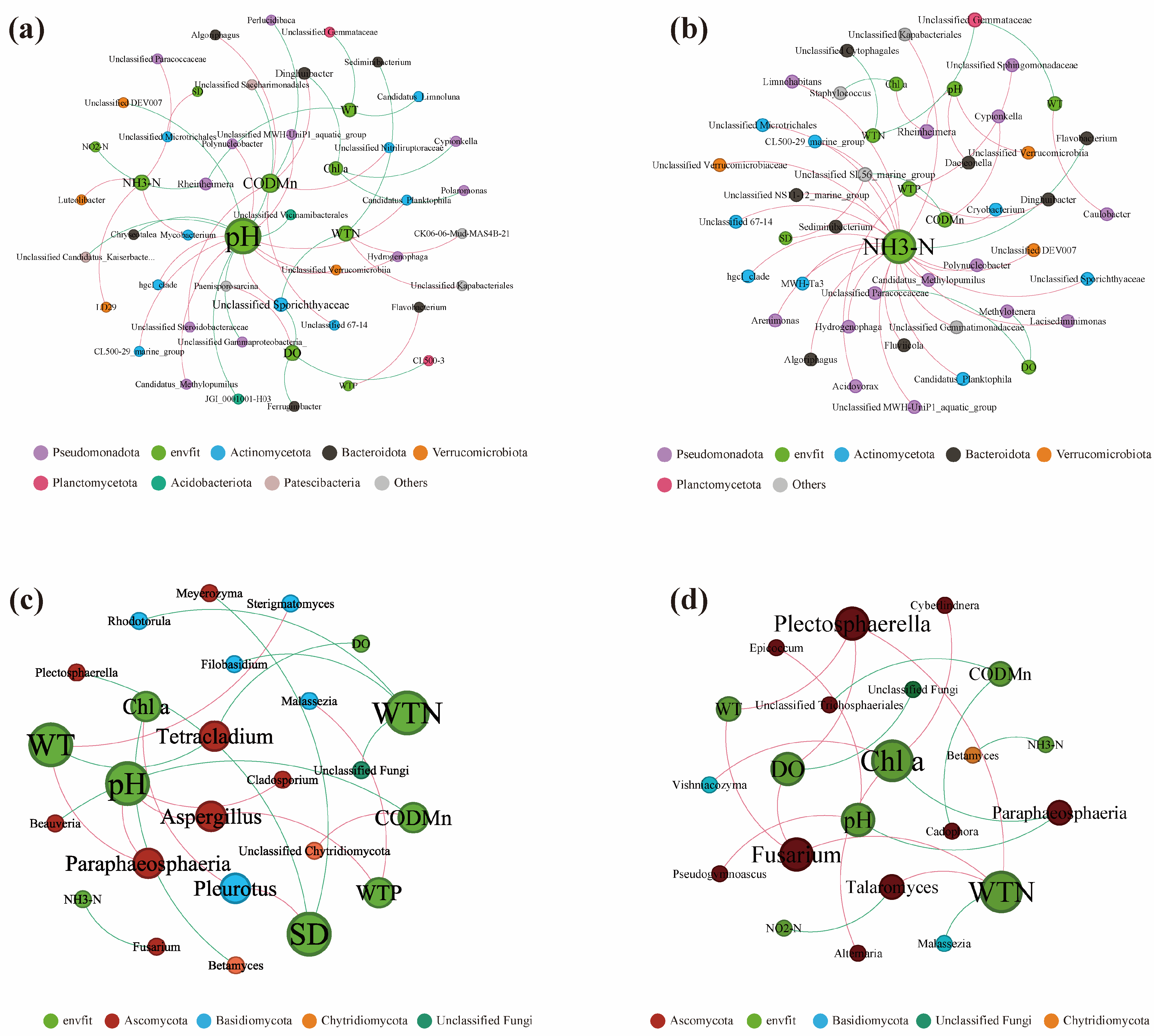
Integration of network topology with environmental associations revealed distinct seasonal and habitat-dependent drivers of microbial interactions. In the water column (
Figure 5), pH was the dominant environmental hub during winter, with COD
Mn and NH
3-N as secondary hubs, linking to bacterial genera such as
Rheinheimera and
Limnohabitans. With thaw, nutrients—particularly NH
3-N—emerged as dominant hubs, driving positive associations with copiotrophic taxa including
Acinetobacter and
Flavobacterium. For fungi, winter networks were primarily associated with pH and WTP (e.g.,
Aspergillus,
Tetracladium), whereas in spring they were more influenced by WTN, pH, Chl a, and DO, co-varying with indicators of enhanced primary productivity.
In sediments (
Figure S2), bacterial networks were consistently structured by nitrogen pools (STN) and organic matter (SOM). In winter, SOM showed predominantly positive correlations (e.g., with Sphingomonas and Pseudomonas), but after thaw it shifted to largely negative associations, indicating intensified resource competition. Fungal networks were more constrained: in winter, STN, STP, and SOM exerted strong negative effects (e.g., suppressing Mortierella and Penicillium), while in spring, STN exhibited limited positive influences, but STP and SOM continued to inhibit fungal interactions.
Mantel tests (
Table S2) showed mostly weak or non-significant correlations between environmental variables and community dissimilarity; we therefore interpret the following trends as suggestive rather than confirmatory, and note that they are broadly consistent with the network analyses. Nutrients such as WTN and WTP exhibited positive associations with community β-diversity, while NH
3-N, STN, and total phosphorus repeatedly appeared as hub factors in network analyses, underscoring their importance in microbial restructuring. In contrast, pH and DO had limited explanatory power in Mantel tests but acted as local hubs within the networks, suggesting they regulate specific taxa rather than driving overall community patterns.
Overall, bacterial network connectivity tended to expand with nutrient availability—especially nitrogen forms—during thaw, whereas fungal network connectivity tended to be more limited under nutrient accumulation and physicochemical stress. These are correlational patterns derived from network co-occurrence and environmental associations.
3.5. Community Assembly Under Neutral and Null Model Frameworks in Freeze–Thaw Lakes
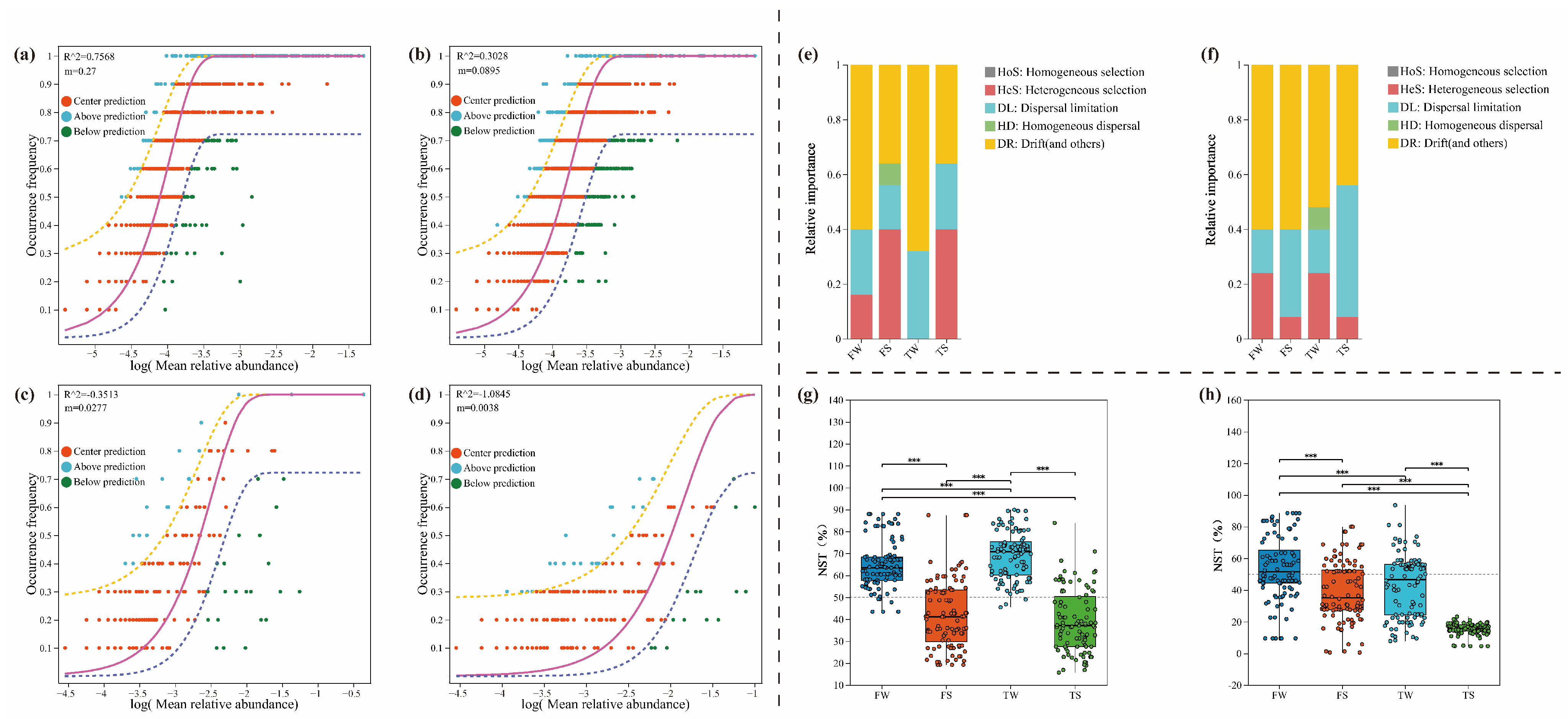
Neutral and null model analyses revealed contrasting assembly mechanisms for bacteria and fungi (
Figure 6). For bacteria, the neutral community model (NCM) fitted waterborne assemblages well (R
2 ≈ 0.76, m ≈ 0.27), indicating that stochastic dispersal contributed substantially to structuring planktonic bacteria. In sediments, however, the fit was weak (R
2 ≈ 0.30, m ≈ 0.09), suggesting that deterministic forces were more influential. In contrast, fungal communities exhibited negative R
2 values in both habitats, demonstrating that their distributions could not be explained by neutral expectations and were instead shaped by environmental filtering and dispersal limitation.
Consistent with NCM, βNTI analyses indicated that bacterial assembly was dominated by heterogeneous selection (~65%), but stochasticity played a larger role in water than in sediments. Fungal assembly was partitioned roughly equally among heterogeneous selection (~32.5%), dispersal limitation (~32.0%), and undominated processes (~33.5%), indicating that no single assembly process dominated and that both deterministic forces (selection and dispersal limitation) and stochastic elements jointly shaped fungal community structure. NST results confirmed these patterns: bacterial communities in water (NST > 0.6) were mainly stochastic, while sediment bacteria (NST < 0.5) were more deterministic; fungal communities showed even lower stochasticity, particularly in spring sediments (NST = 0.16).
Taken together, these results highlight a strong domain-level contrast: bacteria, especially in the water column, are partially governed by neutral processes, whereas fungi are predominantly shaped by deterministic forces, with heterogeneous selection and dispersal limitation contributing in roughly equal measure rather than either process dominating alone. Freeze–thaw thus amplify habitat- and domain-specific assembly rules, with dispersal-driven dynamics in planktonic bacteria but environmentally constrained assembly in sediments and fungi.
4. Discussion
4.1. Environmental Shifts Across Freeze–Thaw and Their Ecological Implications
Between the freezing and thawing periods of the Lianhuan Lake, significant seasonal variations occur in the physicochemical conditions of the water body and sediments, fully reflecting the regulatory role of freeze–thaw processes on the lake ecosystem [
35]. During the freeze period, higher concentrations of WTN and increased SD indicated limited external nutrient input, low algal biomass, and enhanced light penetration in the water. Research indicated that elevated WTN levels likely stem from nitrogen accumulation in subglacial environments, where nitrogen retention occurs due to restricted biological uptake and gas-water exchange [
36]. Increased transparency suggested reduced particulate matter and phytoplankton abundance, consistent with the low productivity characteristic of subglacial conditions [
37].
Following the onset of the thaw period, significant increases were observed in WTP, Chl-a, DO, NH
3-N, WT, pH, and COD
Mn. This reflects the lake’s transition from a quiescent winter state to a more productive, metabolically active spring phase. Previous research indicated that thaw-driven physical mixing and sediment resuspension released substantial nutrients, thereby promoting algal proliferation and stimulating microbial respiration [
38]. Although respiration consumes oxygen, the net increase in DO after thaw indicates that oxygen inputs from renewed primary production, atmospheric re-aeration following ice-off, and water-column mixing collectively outweighed respiratory oxygen demand; the concomitant rise in pH is consistent with CO
2 drawdown by enhanced photosynthesis. In contrast, elevated NH
3-N and COD
Mn reflected intensified organic-matter decomposition and ammonification [
39].
In the sediments, soil total nitrogen (STN) and soil organic matter (SOM) increased markedly during the thawed period, whereas soil total phosphorus (STP) showed little seasonal change. This pattern suggested that, in spring, fresh organic detritus derived from algal senescence and intensified microbial metabolism settled to the lakebed, augmenting benthic nitrogen and organic carbon stocks. The relative stability of STP indicated that phosphorus remained largely bound to mineral phases or complexed with organic matter, making it less sensitive to short-term seasonal fluctuations compared to nitrogen.
4.2. Microbial Diversity and Community Composition
Despite marked physicochemical contrasts between frozen and thawed periods, microbial α-diversity in Lianhuan Lake remained largely stable, with only modest and non-significant fluctuations. This suggests that freeze–thaw exert limited influence on overall richness and evenness. Previous work has identified several mechanisms that can stabilize community richness and evenness across the freeze–thaw cycle. First, top-down control is suppressed under ice, with reduced grazing pressure and viral lysis. Second, life-history strategies such as dormancy and spore formation preserve taxa during unfavorable periods. Third, mixing-mediated dispersal at ice-off sustains a broad species pool. Together, these processes likely account for the minor, non-significant seasonal fluctuations in α-diversity observed here [
40]. β-diversity analysis revealed significant but habitat-dependent compositional turnover across the freeze–thaw transition. Principal coordinates analysis (PCoA) and PERMANOVA showed that habitat differences explained the largest share of variation, with water and sediment communities forming distinct clusters irrespective of season (for example, adonis R
2 ≈ 0.46,
p = 0.001 for water; R
2 ≈ 0.18,
p > 0.05 for sediment). This pronounced partitioning underscores strong habitat filtering: the planktonic versus benthic habitats impose fundamentally different selective pressures (oxygen availability, nutrient gradients, substrate surfaces) that lead to divergent assemblages [
41,
42]. Seasonal change was a secondary but measurable influence—bacterial assemblages exhibited more pronounced turnover than fungal assemblages. In particular, the dominant bacterial phyla (Pseudomonadota, Actinomycetota, Bacteroidota) shifted in relative abundance between winter and spring, whereas the dominant fungal phyla (
Ascomycota,
Basidiomycota) showed only minor changes in relative abundance. Previous studies demonstrated that bacteria often display rapid succession in response to nutrient pulses and temperature shifts [
43], while fungal communities remain relatively stable due to their spore-forming life histories and utilization of more recalcitrant substrates [
44]. Thus, bacteria and fungi in our system were decoupled in their seasonal responses: bacterial community composition tracked freeze–thaw induced resource and physicochemical change more closely, whereas fungal composition varied little.
In summary, our findings highlight a unique pattern: bacterial communities in the water column undergo moderate but significant seasonal turnover, while fungal communities remain largely stable. This contrast underscores different ecological strategies—bacteria rapidly responding to environmental fluctuations, fungi maintaining continuity through resistance and dormancy. Such domain- and habitat-specific responses emphasize the resilience of Lianhuan Lake microbiota to seasonal freeze–thaw forcing, providing an ecological foundation for understanding subsequent changes in microbial networks.
4.3. Network Complexity and Keystone Taxa Dynamics
The freeze–thaw transition markedly reshaped microbial interaction networks in both water and sediment habitats, reflecting how environmental fluctuations restructured ecological relationships. The high connectivity and clustering observed in the frozen water network (FW) likely reflected enhanced cooperative and syntrophic interactions among taxa coping with oligotrophic and low-temperature conditions [
45]. Research has found that resource limitation favors interspecies complementarity and cross-feeding strategies that enhance metabolic efficiency [
46]. In contrast, the frozen sediment (FS) network displayed higher modularity (0.58) but weaker connectivity (average degree 16.82;
Table S1), indicating a more spatially structured interaction pattern in which taxa were organized into discrete, weakly interconnected modules. This feature may arise from micro-scale gradients of oxygen and nutrients within sediments, which promote localized guild formation and niche partitioning [
47]. With thawing, overall network connectivity decreased, particularly in the water column, suggesting that disturbance and nutrient influx disrupted weaker associations and simplified the interaction network. This structural simplification resembles network “pruning” effects reported under other disturbance regimes, such as drought or nutrient pulses, which reduce network density but enhance modular specialization [
48]. However, the thawed sediment (TS) network showed an opposite trend: its modularity remained high while the proportion of cross-domain edges rose markedly relative to frozen sediment (from ~5% in FS to ~16.5% in TS, a more than threefold increase), implying intensified bacterial–fungal coupling in organic-rich microsites after thaw. This is likely linked to the deposition of algal detritus after thaw, as fungi and heterotrophic bacteria jointly participate in labile carbon mineralization and nutrient regeneration within benthic hotspots [
49,
50]. Therefore, thawing appeared to stimulate stronger local cooperation between bacteria and fungi within sediments.
The turnover of keystone taxa highlights a pronounced habitat-dependent reorganization of microbial networks during the freeze–thaw transition. In the frozen sediment (FS) network, connectors were dominated by members of Comamonadaceae, Blastocatellaceae (JGI_0001001-H03), CL500-29 marine group (Ilumatobacteraceae), and Actinomarinales lineages. These taxa are typically associated with diverse metabolic capacities, including the degradation of complex organic matter and the mediation of nitrogen or carbon fluxes under oligotrophic conditions [
51,
52]. Their occurrence as cross-module connectors suggested that, under the low-temperature and nutrient-limited winter environment, benthic microbial interactions relied heavily on a few metabolically versatile taxa that bridge micro-niches and sustain baseline biogeochemical processes. This pattern reflects a functional consolidation strategy, where ecosystem stability is maintained by a small number of broad-spectrum bacteria with strong ecological tolerance. In contrast, the thawed networks (TW and TS) exhibited a clear replacement of keystone taxa, characterized by the emergence of
Rhodoferax,
Luteolibacter,
Flavobacterium, and
Sutcliffiella. These genera are widely recognized for their involvement in organic carbon turnover and algal-derived detritus degradation during post-thaw nutrient enrichment events [
53,
54].
Rhodoferax in particular has been reported to proliferate under meltwater and DOC-rich conditions in other systems [
55,
56]; we note that organic matter in the present study was quantified only as COD
Mn—a bulk oxidisable organic matter proxy—so this DOC-based mechanism is inferred from the literature rather than directly measured here.
Flavobacterium specializes in high-molecular-weight organic matter decomposition, linking bacterial and fungal networks through carbon flow pathways. The spring sediment network, dominated by
Flavobacterium and
Sutcliffiella, thus reflects a functional activation mode, where microbial interactions reorganize to accelerate nutrient regeneration and organic matter remineralization following thaw [
57].
Together, these patterns indicate a seasonal shift from a stability-maintaining, densely wired winter state to a resource-responsive, modular spring state, with keystone replacement tracking the underlying resource and redox regimes. This coupling between topology and keystone turnover provides a mechanistic basis for predicting how cold-region lake microbiomes will reorganize under altered ice phenology and nutrient pulses.
4.4. Environmental Drivers of Microbial Interactions
Environmental factors exerted contrasting controls on microbial interactions across freeze–thaw, with clear divergences between habitats and microbial domains. In winter water, pH and background nutrient levels (e.g., NH
3-N, WTN) structured microbial associations, consistent with a stable under-ice environment where subtle chemical gradients organized co-occurrence patterns [
58]. Fungi also responded to pH and WTP, suggesting that even under oligotrophic conditions, phosphorus availability could promote saprotrophic or spore germination processes [
59]. With thaw, bacterial networks in the water column were strongly promoted by ammonium, which showed overwhelmingly positive associations with copiotrophic taxa such as Flavobacterium and Acinetobacter. This underscores a tight coupling of nitrogen availability with algal-derived carbon inputs, driving broad bacterial co-occurrence. In contrast, fungal networks in spring water were relatively sparse and constrained: while some positive associations with NH
3-N and bulk organic matter (measured as COD
Mn) were detected, overall interactions declined under high WTN, elevated pH, and abundant oxygen, consistent with competitive exclusion by fast-growing bacteria during blooms. In sediments, bacterial interactions were consistently structured by nitrogen pools (STN) and organic matter (SOM), but their effects shifted seasonally. In winter, SOM and STN promoted bacterial connectivity, reflecting cooperative use of scarce resources in nutrient-limited microsites. After thaw, however, SOM became negatively associated with many taxa, suggesting intensified competition or redox stress under organic matter influx. Fungal networks in sediments were strongly inhibited by STN, STP, and SOM across both seasons, with only limited relaxation in spring, indicating that nutrient-rich microsites favored bacteria and suppressed fungal co-occurrence.
Collectively, these patterns reveal a fundamental dichotomy: bacterial networks expand with nutrient enrichment, whereas fungal networks are constrained by it. Moreover, driver effects were habitat-specific: water column interactions tracked immediate chemical shifts (pH, NH3-N, algal activity), while sediment interactions reflected nutrient reservoirs and organic matter dynamics. These findings highlight the ecological strategies of bacteria and fungi under freeze–thaw forcing—rapid, resource-driven bacterial responses versus fungal persistence in low-nutrient niches. Such contrasts have broader implications: future nutrient enrichment or altered ice duration may strengthen bacterial dominance and weaken fungal contributions to decomposition, reshaping microbial interaction webs in temperate lakes.
4.5. Assembly Mechanisms: Balancing Stochasticity and Selection Across Freeze–Thaw Regimes
The contrasting freeze–thaw regimes in Lianhuan Lake provided a natural experiment to evaluate the balance between stochastic (neutral) and deterministic (niche-based) assembly. Using both the Sloan neutral community model (NCM) and phylogenetic null modeling (βNTI), we found a consistent dominance of deterministic processes—particularly environmental selection—with clear habitat and domain contrasts.
NCM fits indicated that bacterial communities in the water column conformed partly to neutral expectations (R
2 ≈ 0.76; migration rate m ≈ 0.27), whereas sediment bacteria showed weak neutrality (R
2 ≈ 0.30; m ≈ 0.09). This pattern suggests that homogenizing dispersal and demographic drift contribute appreciably to bacterial assembly in the water column, consistent with a well-mixed medium [
60]. Sediment bacterial communities are governed primarily by environmental filters (e.g., redox microgradients, particle-attachment niches) and biotic interactions [
61]. Research indicated that well-mixed water bodies tend toward neutrality, while more stable sediments with weaker connectivity primarily rely on deterministic filtration [
62]. In contrast, fungal communities in both habitats yielded negative NCM R
2, indicating that their occurrence–abundance distributions were not captured by a neutral model, reflecting a stronger departure from neutral expectations than bacteria and pointing to the importance of substrate specificity and dispersal limitation in structuring fungal communities.
βNTI further resolved which deterministic forces prevailed. Bacteria were dominated by heterogeneous (variable) selection (~65.5%), consistent with the pronounced environmental contrasts among habitats (water vs. sediment) and seasons (frozen vs. thawed). Fungal assembly was split among heterogeneous selection (~32.5%), dispersal limitation (~32.0%), and undominated processes (~33.5%), suggesting mixed controls with a notable role for restricted dispersal [
63]. Normalized Stochasticity Ratio (NST) values corroborated these inferences: water bacteria NST > 0.5 (≈0.64 in frozen water; ≈0.69 in thawed water) signaled a moderate stochastic component, whereas sediment bacteria NST < 0.5 (≈0.42 frozen; ≈0.39 thawed) and very low fungal NST (down to ≈0.16 in thawed sediments, with other groups also below or near the 0.5 threshold) indicated that fungal assembly was more consistently governed by deterministic processes than water-column bacteria, though the degree varied across season–habitat combinations.
Ecologically, these results align with our environmental-driver and network findings. Under ice, subtle but persistent chemical gradients (notably pH and background nitrogen in water; STN/SOM in sediments) enforced niche filtering, while modest dispersal in the water column maintained some neutrality. After thaw, resource pulses (e.g., NH3-N in water; STN and newly deposited SOM in sediments) installed a new set of selective filters: water bacteria exhibited slightly higher stochastic signals under mixing and inflow, yet community shifts remained selection-guided; sediments retained deterministic control, likely reinforced by redox stratification and priority effects. The predominantly deterministic assembly tendency of fungi, driven jointly by heterogeneous selection and dispersal limitation, is consistent with their compositional stability and niche specialization observed across seasons, as well as their weaker network integration during nutrient-rich phases.
5. Conclusions
This study disentangles how freeze–thaw forcing reshapes lake microbiomes by linking taxonomic change, interaction topology, environmental controls, and assembly rules across habitats and domains. Despite marked physicochemical contrasts between ice-covered and post-thaw periods, α-diversity remained broadly stable, while β-diversity and composition shifted in a habitat-contingent manner: water and sediment formed distinct assemblages, and bacteria exhibited stronger seasonal turnover than fungi. Co-occurrence analyses revealed a clear “interaction rewiring”: under ice, networks—especially in the water column—were denser and more clustered with moderate cross-domain coupling; after thaw, connectivity declined and modularity increased, with the sediment network showing the sharpest rise in bacteria–fungi links, consistent with localized re-mineralization hotspots. Keystone taxa turned over accordingly: winter emphasized benthic connectors from Actinomycetota/Acidobacteriota lineages, whereas spring favored Luteolibacter and Rhodoferax in water and Flavobacterium and Sutcliffiella in sediments, indicating a shift toward DOC processing and algal-detritus degradation after thaw. Environmental drivers coherently explain these topology shifts. In winter, subtle but persistent chemical gradients (pH and background nitrogen in water; STN/SOM in sediments) enforced niche filtering and supported many, diffuse associations. After thaw, resource pulses re-organized controls: NH3-N (water) and STN/fresh SOM (sediment) expanded copiotroph-centered links in the plankton yet fragmented sediment networks via competition and redox stress, while fungal interactions were comparatively constrained during nutrient-rich phases. Assembly modeling integrated these patterns: water-column bacteria partially conformed to neutral expectations (high NCM fit; NST > 0.6), reflecting homogenizing dispersal in a well-mixed medium; by contrast, sediment bacteria were more strongly deterministic (weak NCM fit, R2 ≈ 0.30; NST < 0.5), dominated by heterogeneous selection; fungi showed the lowest stochasticity overall (negative NCM R2; NST as low as 0.16 in thawed sediments) but were governed by a combination of heterogeneous selection and dispersal limitation in roughly equal proportions, rather than by selection alone. Together, these lines of evidence support a dual-channel assembly mechanism: a mixed, dispersal-assisted route for water bacteria versus a selection-dominated route for sediments and fungi. Collectively, these findings clarify the mechanisms by which freeze–thaw reorganize inter-domain interactions and community assembly, offering actionable indicators for forecasting and managing biogeochemical stability in seasonally frozen lakes.