Review

Sustainable Resource Utilization of Pisha Sandstone in China: A Review from Erosion Control to Preparation of Low-Carbon Geopolymer Cementitious Materials and Amelioration of Degraded Soils


1
State Key Laboratory of Water Engineering Ecology and Environment in Arid Area, Inner Mongolia Agricultural University, Hohhot 010018, China
2
College of Water Conservancy and Civil Engineering, Inner Mongolia Agricultural University, Hohhot 010018, China
*
Author to whom correspondence should be addressed.
Sustainability 2026, 18(13), 6522; https://doi.org/10.3390/su18136522 (registering DOI)
Submission received: 3 June 2026 / Revised: 22 June 2026 / Accepted: 23 June 2026 / Published: 26 June 2026
(This article belongs to the Section Soil Conservation and Sustainability)

Abstract

Pisha sandstone (PS) is a weakly cemented soft rock widely distributed in the middle reaches of the Yellow River, China. PS disintegrates rapidly upon contact with water and has poor erosion resistance, making it a major source of coarse sediment in the Yellow River. However, PS is rich in aluminosilicate minerals and clay fractions, offering great potential as a sustainable precursor for geopolymer cementitious materials and as an amendment for degraded soils. The sustainable resource utilization of PS provides a new pathway for coordinated ecological and economic development in the PS areas. This paper first reviews the mineralogical and chemical characteristics of PS, clarifying that low diagenetic degree and high montmorillonite content cause poor erosion resistance, and that compound erosion from freeze–thaw, water, wind, and gravity erosion creates a superimposed amplification effect, which is the primary driver of severe soil erosion. Subsequently, three major control measures for soil erosion in the PS areas are summarized, namely biological measures using sea-buckthorn (Hippophae rhamnoides), chemical solidification, and microbially induced calcium carbonate precipitation (MICP), with analyses of their mechanisms, efficiency, and limitations. Furthermore, the research progress on the sustainable resource utilization of PS in the preparation of geopolymer cementitious materials and the amelioration of degraded soils is elaborated. Finally, future research directions are discussed to support the control of soil erosion and the green, sustainable resource utilization of PS.

1. Introduction

Pisha sandstone (PS) is characterized by a low diagenetic degree, weak cementation, a loose pore structure and high montmorillonite content. It readily disintegrates and collapses upon contact with water, leading to extremely poor erosion resistance [1,2,3]. The PS region is located in the northern Loess Plateau at the junction of the Inner Mongolia Autonomous Region, Shanxi Province, and Shaanxi Province, falling within the arid–semi-arid climatic transition zone of northern China and featuring a highly fragile ecological environment [4]. Coupled with the poor weathering resistance of PS, soil erosion in this region is extremely severe, which seriously endangers the stability of the Lower Yellow River channel and regional ecological security [5,6,7]. At the same time, PS is rich in framework silicates (e.g., quartz and feldspar) and clay minerals (e.g., montmorillonite and illite), endowing it with potential as a precursor for geopolymer cementitious materials and as an amendment for degraded soils [8,9]. Converting such ecological disadvantages into resource advantages holds significant scientific importance and practical engineering value for ensuring ecological security and promoting high-quality sustainable development in the Yellow River Basin.
For a long time, extensive research has been conducted on the erosion mechanism of PS, which has clarified its internal causes and external driving forces [10,11]. In terms of internal factors, the strong water-absorbing and swelling properties of montmorillonite in PS serve as the primary cause of water-induced disintegration and structural deterioration of the rock mass. Chemical weathering of minerals including feldspar and calcite, coupled with the migration of soluble ions, further weakens the intergranular cementation, thereby providing a material basis for erosion development [12,13,14]. With respect to external environmental factors, the arid and semi-arid climatic conditions in PS areas generate multiple erosive agents, including freeze–thaw erosion, water erosion, wind erosion and gravitational erosion. These agents overlap spatially and alternate temporally, forming a complex multi-agent erosion system. This process creates an efficient sediment yield and transport chain dominated by freeze–thaw loosening, wind erosion transport, and water erosion transport, further aggravating regional soil erosion [15,16,17].
In response to serious soil erosion in PS areas, researchers have developed three major types of control techniques, including biological measures, chemical solidification measures, and microbial reinforcement measures. Among them, the biological measures represented by sea-buckthorn (Hippophae rhamnoides) effectively control soil erosion in the gentle slope gullies of PS areas through the synergistic effect of three lines of defense, namely interception of rainfall by the canopy layer, slowing down of runoff by the litter layer, and retention of soil by the root layer [18,19,20]. Chemical solidification measures also exhibit unique advantages in slope protection. The EN-1 ionic curing agent can remarkably enhance the shear strength of soil, while the W-OH hydrophilic polyurethane possesses multiple properties including soil stabilization, erosion resistance and water retention, which are conducive to vegetation growth [21,22,23]. In addition, microbially induced calcium carbonate precipitation (MICP), as an emerging and environmentally friendly reinforcement technology, shows great potential in soil erosion control. The calcium carbonate crystals produced by microbial metabolism can effectively cement soil particles and significantly improve the erosion resistance of PS [24,25].
Notably, current research has shifted from conventional soil erosion control to the resource utilization of PS. PS is rich in oxides such as silica, alumina, and calcia, as well as clay fractions, which endow it with natural potential as a precursor for geopolymer cementitious materials and as an amendment for degraded soils [26,27]. In the field of PS geopolymer cementitious (PSGC) materials, PS can react with alkali activators along with high-activity industrial solid wastes such as fly ash, blast furnace slag, steel slag, and silica fume to form a dense calcium aluminosilicate gel with high strength and durability via geopolymerization. Under appropriate mix proportions and curing conditions, the 28-day mechanical properties of PSGC materials are comparable to or even superior to those of ordinary Portland cement. Furthermore, their life cycle carbon emissions are reduced by over 70% compared to ordinary Portland cement, showing excellent green and low-carbon potential [28,29]. In the field of degraded soil amelioration, PS exhibits natural complementarity with degraded soils such as aeolian sandy soil in physicochemical properties. Incorporating silt and clay fractions from PS into aeolian sandy soil can optimize soil particle size distribution, improve soil pore structure, and enhance the water and nutrient retention capacity of soil. This technology has been successfully applied to soil amelioration demonstration projects in the Mu Us Sandy Land (one of China’s four major sandy lands, located in the southern Inner Mongolia Autonomous Region and the northern Loess Plateau in Shaanxi Province), yielding positive ecological and economic benefits [30,31,32].
In summary, scholars have conducted numerous studies on the erosion mechanisms, erosion control measures, and resource utilization of PS. However, most existing research findings are scattered among different research directions, lacking systematic integration from the erosion mechanisms and control measures to resource utilization. In this context, this paper systematically reviews the research progress of PS in terms of erosion mechanisms, control measures, and resource utilization. The limitations of existing studies are summarized, and future research prospects are discussed. This paper is expected to provide a scientific basis and technical reference for integrated soil erosion control and green resource utilization in PS areas.

2. Material Basis and Compound Erosion of PS Under Multiple Factors

2.1. Material Basis of PS Erosion

2.1.1. Mineral Composition and Erosion Sensitivity

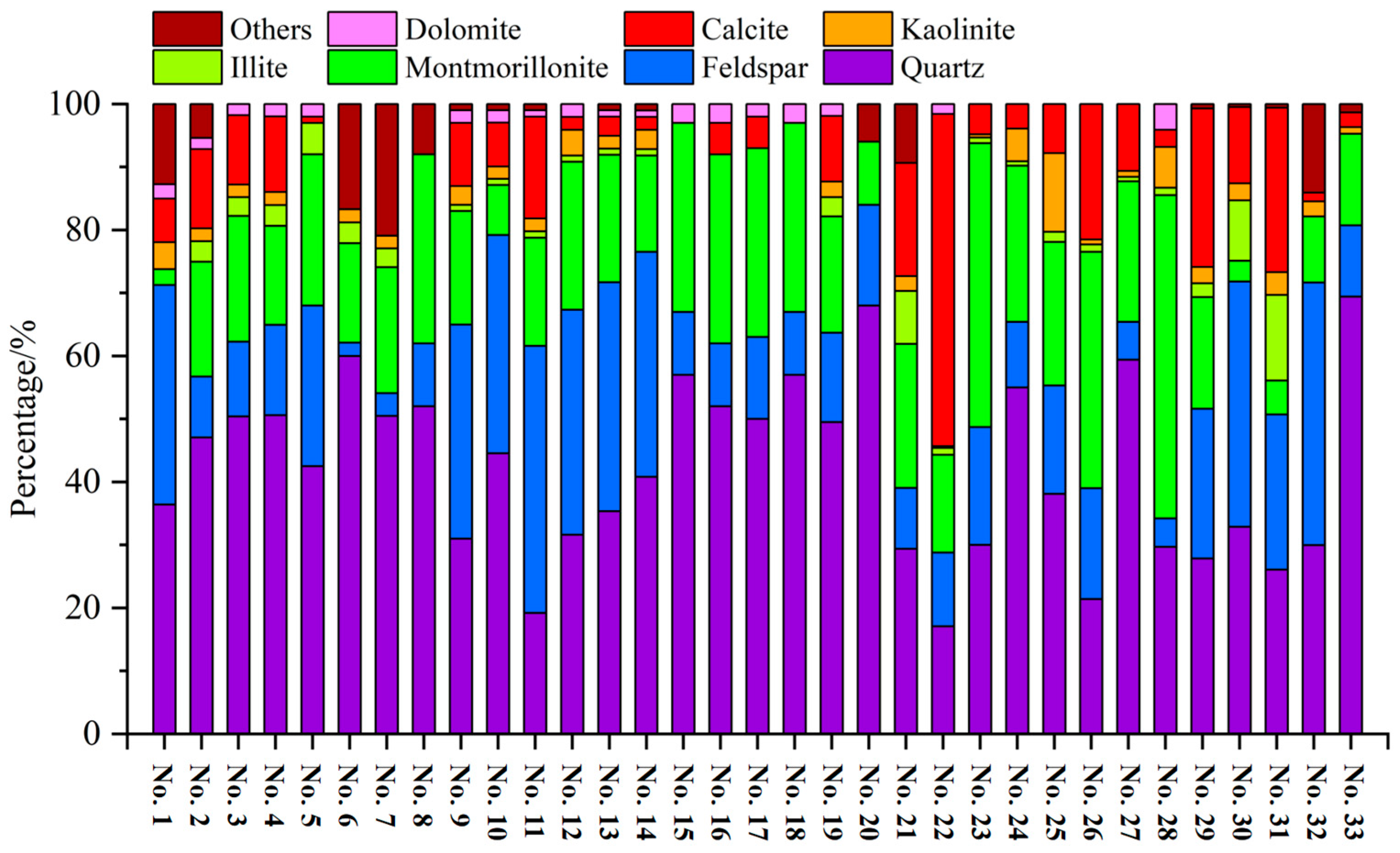
The main mineral composition of PS includes quartz, feldspar (potassium feldspar and plagioclase), clay minerals (montmorillonite, illite, and kaolinite), calcite, and dolomite. The color of PS is significantly correlated with its mineral composition. Due to differences in mineral composition and mass fractions, PS exhibits various colors, such as white, red, yellow, gray, purple, grayish-white, grayish-yellow, and purplish-red [33]. Additionally, the mineral composition and mass fractions of PS exhibit significant spatial heterogeneity. Even among PS samples taken from the same sampling region or of the same color, significant differences exist in their mineral compositions and mass fractions. Figure 1 illustrates the main mineral components of 33 PS samples from distinct sources and with varying colors. Table 1 summarizes the mass fraction ranges, functional characteristics, and effects of these mineral components on the properties of PS.
As shown in Figure 1 and Table 1, the mass fractions of minerals such as quartz and montmorillonite vary significantly among different samples. For the 33 samples included in the statistical analysis, the quartz content ranged from 17.10% to 69.41%, with most values below 50%, indicating that PS has an overall low diagenetic degree. The montmorillonite content of the samples ranged from 2.51% to 51.33%, showing a more than 20-fold difference, which largely dominates the remarkable differences in water disintegration characteristics among different PS samples.
In addition to the above-mentioned minerals, a portion of the analyzed PS samples contains minerals such as mica, hematite, and pyrite. Shi et al. [34] detected 10.49% hydromica in PS from southern Inner Mongolia. Wu et al. [37,38] found 1.00% hematite in purple, white and purplish-red PS collected from Nuanshui Township, Jungar Banner. Wang et al. [43] identified 3.56% biotite and 5.82% hematite in red PS from Longkou Town, Jungar Banner. Peng et al. [44] detected a small amount of pyrite in brown, grayish-brown and yellowish-brown PS from Ordos City and Yulin City, with mass fractions of 0.70%, 0.50% and 0.60%, respectively. Dong et al. [45] found 0.35% hematite and 3.07% chlorite in white and red PS from Ordos, respectively.
PS is formed by framework minerals such as quartz and feldspar, which are bound together by the cementation and filling action of hydrophilic, weakly cementing materials like montmorillonite, as well as by frictional interlocking between the mineral grains [46]. The structural characteristics, water sensitivity, and weathering stability of different minerals vary significantly. The types of minerals and their percentage contents directly determine the erosion susceptibility of PS. The influences of the main minerals in PS on its erosion resistance are as follows [47,48].
Quartz is a mineral with highly stable physical and chemical properties and serves as the primary stable framework mineral in PS. Therefore, quartz does not contribute to the weathering of PS [49]. However, the quartz content in most PS is less than 50%, which fundamentally accounts for its low diagenetic degree and weak erosion resistance. Feldspar (including potassium feldspar and plagioclase) is a tectosilicate mineral with two sets of perfect cleavage. In arid and semi-arid environments, feldspar is highly susceptible to chemical weathering. This process produces chemically stable silicon dioxide, as well as secondary clay minerals with poor weathering resistance such as montmorillonite and kaolinite. Meanwhile, it weakens the cementation between mineral particles, creating favorable conditions for pore development and structural deterioration of PS. Carbonate minerals such as calcite possess high chemical activity. They exhibit particularly weak weathering resistance in acidic or water-rich environments and are highly susceptible to dissolution. This process directly weakens the cementation between mineral particles and induces the development of secondary pores. The weathering and dissolution of calcite not only generate a new secondary pore network within PS, but also promote the gradual expansion of primary pores. This dual pore evolution process reduces the effective bearing area of supporting structures and intensifies the stress concentration effect, thereby leading to a progressive decline in the bearing capacity of supporting structures. Ultimately, it induces structural rearrangement and integrity loss of PS, which is specifically manifested as the weakening of interparticle cementation and the deterioration of mechanical properties. This further creates prerequisite conditions for the weathering of PS [50].
Montmorillonite belongs to the smectite group and is a 2:1-type layered aluminosilicate clay mineral. Its basic structure consists of an alumina octahedral sheet sandwiched between two silica tetrahedral sheets [51]. There are neither hydrogen bonds nor K+ connections between the crystal layers of montmorillonite. The mineral layers are stacked together merely through weak van der Waals forces and exchangeable cations (Na+ and Ca2+), thereby endowing montmorillonite with prominent water absorption and swelling behavior, ion exchange performance, and plasticity [52,53]. The hydration and swelling of montmorillonite mainly include three stages, namely, surface hydration, ion hydration, and osmotic hydration. Firstly, a large number of unsaturated broken bonds, such as Si-OH and Al-OH, exist on the surfaces and edges of the montmorillonite structure. These bonds can form hydrogen bonds with water molecules or coordinate water molecules via the adsorbed exchangeable cations. Secondly, the exchangeable interlayer cations are hydrated to form hydrated cations. Thirdly, when the interlayer spacing increases to a certain extent, the ion concentration difference between the interior and exterior of crystal layers produces an osmotic pressure difference. Water molecules then enter the interlayer space, and cations diffuse within the interlayer water to form an electrical double layer. The resulting repulsive force further enlarges the interlayer spacing and induces swelling [54,55,56]. When the stress generated by water absorption and swelling of montmorillonite exceeds the cementation strength between PS particles, the internal structure of PS will be damaged, eventually leading to the overall structural failure of PS.
Therefore, silicate minerals such as potassium feldspar and plagioclase are prone to weathering, carbonate minerals including calcite and dolomite exhibit weak cementation capacity, and montmorillonite possesses strong water absorption and swelling behavior. These factors collectively dominate the poor weathering resistance of PS.

2.1.2. Chemical Composition and Erosion Sensitivity

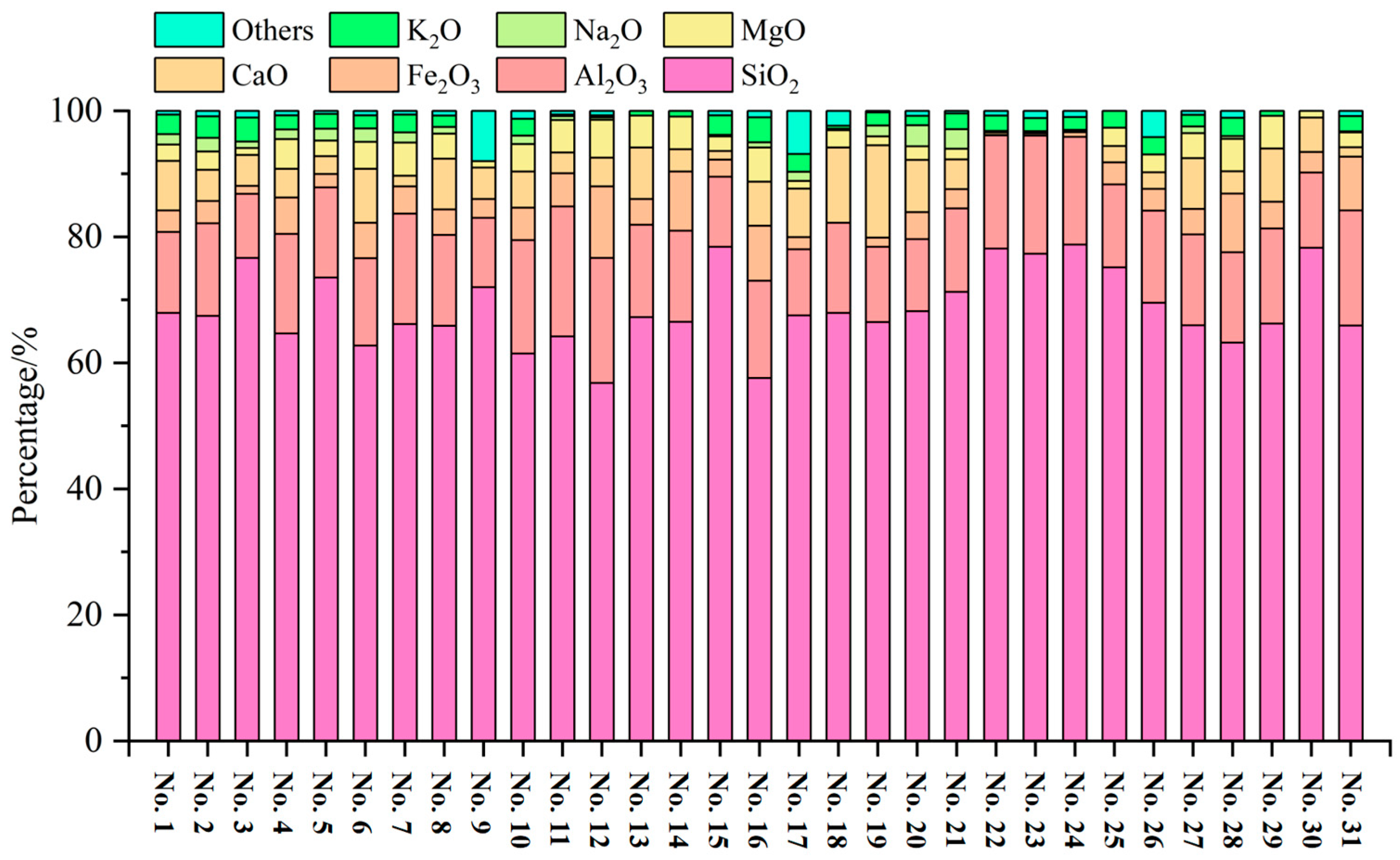
The chemical composition of PS is primarily dominated by the oxides of silicon, aluminum, iron, calcium, sodium, and potassium. To date, nine to 13 chemical components have been detected, the majority of which are silicon dioxide (SiO2), aluminum oxide (Al2O3), ferric oxide (Fe2O3), calcium oxide (CaO), magnesium oxide (MgO), sodium oxide (Na2O), and potassium oxide (K2O). The mass fraction of each component is closely related to the sampling region, lithological characteristics and color [57]. Figure 2 presents the main chemical components and their corresponding mass fractions of 31 PS samples from distinct origins and with varying colors. Table 2 summarizes the mass fraction ranges of these oxides, their corresponding source minerals, and their effects on the weathering and erosion behaviors of PS.
In addition to the aforementioned chemical components, scholars have also detected small quantities of other chemical components in PS, including manganese oxide (MnO), ferrous oxide (FeO), titanium dioxide (TiO2), phosphorus pentoxide (P2O5), and sulfur trioxide (SO3) [37,42,60,62,63,65,66,72].
As shown in Figure 2 and Table 2, SiO2 is the dominant and most abundant chemical component in PS. It originates primarily from quartz and framework silicate minerals, and forms the fundamental material basis for maintaining the structural stability of PS. Its content is positively correlated with the diagenetic degree and structural stability. Al2O3 is the second most abundant component in PS, and originates primarily from feldspar and clay minerals. It is not only the core component that endows PS with alkali-activated cementitious activity, but also a critical factor closely related to the swelling behavior of PS. Fe2O3 is the primary component controlling the color of PS, and its content exhibits a decreasing trend with increasing sampling depth. Meanwhile, the ferrous (Fe2+) ions in FeO are easily oxidized to ferric (Fe3+) ions under acidic conditions. This process disrupts the internal physicochemical balance of PS and accelerates surface weathering and spalling [73]. Although alkaline oxides such as CaO, MgO, Na2O and K2O account for a relatively low proportion of the total chemical composition of PS, they exhibit high chemical activity. When encountering water, they readily release soluble cations that migrate with pore water, resulting in pore enlargement between mineral particles and the degradation of structural integrity. Among them, Na+ can significantly enhance the water absorption and swelling capacity of montmorillonite, while K+ can inhibit the expansion of montmorillonite crystal layers to a certain extent. The relative content of the two ions directly governs the swelling behavior of montmorillonite. In addition, P2O5 and SO3 in PS react with water to generate H3PO4 and H2SO4. These acidic substances chemically react with carbonate minerals in PS, weaken the skeletal supporting capacity of carbonate minerals, and further reduce the weathering resistance of PS.

2.2. Erosion Process Under Single Factor

2.2.1. Freeze–Thaw Erosion

Freeze–thaw erosion is defined as a geological process whereby rock and soil are physically disintegrated and displaced due to repeated freezing and thawing. The distribution area of PS features an arid to semi-arid climate, with low temperatures in winter and spring, and high temperatures in summer [74]. Such seasonal temperature variations can drive the pore water within PS to undergo repeated freeze–thaw cycles, resulting in periodic frost heave and thaw settlement. During the freezing process, the pore water within PS changes from liquid to solid. The volume expansion induced by this phase transformation increases the intergranular spacing of mineral particles. During the thawing process, differential settlement drives mineral particle rearrangement, thereby inducing structural reorganization of the particle skeleton and further modifying the pore distribution characteristics. This process triggers the rearrangement of the supporting particle skeleton and redistributes internal forces within the load transfer system, thereby inducing structural changes accompanied by crack initiation and propagation. Therefore, freeze–thaw cycles, driven by periodic temperature changes and the resultant water phase transitions, are essentially a high-intensity physical weathering process that significantly affects the structural integrity, physical properties, and mechanical properties of rock masses [75,76,77,78].
On this basis, it is of great significance to clarify the influencing factors and explore the freeze–thaw response characteristics of PS under different conditions to reveal its freeze–thaw erosion mechanism. Existing studies have shown that the freeze–thaw properties of PS are closely related to the moisture content, freezing temperature, dry density, and other factors [79]. Focusing on these factors, numerous freeze–thaw tests have been conducted on both remolded and undisturbed PS soil samples. Liu et al. [80] conducted freezing tests on remolded PS specimens under various moisture contents, freezing temperatures, and dry densities. The results showed that during the freezing process, almost no frost heave occurred when the moisture content was below 11%; when the moisture content ranged from 12% to 16%, the frost heave amount increased linearly with the moisture content. Overall, the frost heave increased with the freezing temperature, but an abnormal phenomenon was observed at the dry density of 1.85 g·cm−3. When the dry densities were 1.74 g·cm−3, 1.77 g·cm−3, and 1.80 g·cm−3, the frost heave amount increased with the decreasing freezing temperature; however, when the dry density increased to 1.85 g·cm−3, the frost heave amount decreased as the freezing temperature decreased. Zhang et al. [81] analyzed the effect of freeze–thaw cycles on the microstructure of remolded PS soil using a 3D ultra-depth-of-field digital microscope, and pointed out that the higher the moisture content of the specimen, the greater the influence of freeze–thaw cycles on pore structure evolution and particle displacement. Li et al. [82,83] investigated the effects of freeze–thaw cycles and moisture content on the mechanical properties and stress–strain relationship of remolded PS soil specimens through triaxial compression tests. The results showed that freeze–thaw cycles affected the shear strength of the specimens mainly by reducing their cohesion. When the moisture content was lower than the saturated moisture content, the effects of freeze–thaw cycles on the elastoplastic characteristics of the specimens were insignificant. Once the moisture content of the specimens reached the saturated moisture content, the specimens almost lost their elastic deformation capacity, and their stress–strain curves fully entered the plastic deformation stage. The stress–strain curves of the specimens without freeze–thaw cycles exhibited slight strain-softening characteristics, while those of the specimens subjected to freeze–thaw cycles exhibited strain-hardening characteristics. Li et al. [84] established a constitutive model based on the Duncan–Chang model to describe the stress–strain relationship for remolded PS soil specimens considering the effects of the moisture content and confining pressure, and adopted the model to predict the stress–strain response of the specimens under different moisture contents and confining pressures. Chen et al. [85,86] conducted freeze–thaw cycle tests using a dedicated test system to investigate the effects of the number of freeze–thaw cycles and moisture content on the deformation characteristics of undisturbed red PS specimens from Ordos. The results showed that the frost heave amount of the specimens in the freezing stage was closely related to factors such as the moisture content and the number of freeze–thaw cycles, among which the moisture content exerted a more significant influence on the frost heave. In the thawing stage, the deformation behavior presented a dual-mode response, namely specimens with low moisture content underwent compressive deformation, while those at high moisture content transformed into expansive deformation. Chang et al. [87] investigated the effects of the number of freeze–thaw cycles N and moisture content on the pore characteristics of undisturbed PS specimens. The results indicated that most pores in PS were distributed within the optimal pore size range for frost heave, and the corresponding freeze–thaw damage mechanisms included a volume expansion mechanism, capillary mechanism, hydrostatic pressure mechanism, and crystallization pressure mechanism. When N was less than 10, the initial moisture content and N exerted similar effects on freeze–thaw damage. When N was greater than 10, the number of freeze–thaw cycles became the dominant factor affecting the pore structure of PS.
Notably, snowmelt is potentially an important factor influencing freeze–thaw erosion in PS areas. Snowmelt water can rapidly infiltrate soil pores, aggravating freeze–thaw weathering when subsequent refreezing occurs, and can also generate concentrated surface runoff that causes scouring erosion. This combined process may act as a key trigger of severe erosion in PS areas in early spring. However, existing studies on freeze–thaw erosion in PS areas have largely focused on the mechanical and structural degradation of PS under alternating freezing and thawing, and have rarely involved the erosion processes directly driven by snowmelt. Future experimental studies, field monitoring, and modeling efforts are needed to fill this gap.

2.2.2. Water Erosion

Water erosion refers to the process by which soil and other surface materials are detached, entrained, transported, and deposited under the action of precipitation, surface runoff, and subsurface runoff. The rainfall in PS areas is mainly concentrated from June to September, accounting for approximately three-quarters of the annual precipitation. In particular, July and August are characterized by abundant rainfall and frequent concentrated rainstorm events [88]. Static water durability tests of PS revealed that upon immersion, air bubbles emerged immediately, accompanied by a small amount of particle shedding. After 2 min, a large number of particles began to detach from PS, while it still maintained its overall structure. After 5 min, PS started to disintegrate. After 10 min, PS completely collapsed into loose sandy particles [89]. Based on the above phenomena, Li et al. [90] divided the water-induced disintegration process of PS into four stages, namely the initial limited water infiltration stage, the hydraulic fracturing stage, the local disintegration stage, and the complete disintegration stage. Notably, the water erosion characteristics of PS exhibit significant spatial variability, and the disintegration time of PS collected from different sampling areas differed significantly under water immersion conditions. For example, Wu et al. [26] also conducted static water durability tests on red PS sampled from the Jungar Banner, Ordos City. However, their samples completely lost structural strength and disintegrated into loose sandy sediment after only 1 min of static water immersion. The above test results were observed under static water conditions. Under rainfall or flowing water erosion conditions, the disintegration process is further accelerated, resulting in a significantly shorter complete disintegration time.
In recent years, researchers have conducted in-depth studies on the erosion laws of PS slopes subjected to rainfall splash erosion and rainwater scouring through field observations and laboratory-simulated rainfall tests. Su et al. [91,92] investigated the effects of the scouring discharge and slope angle on the hydrodynamic characteristics of PS slopes through field runoff scouring tests. The results showed that the runoff velocity and Froude number (Fr) increased with the increasing scouring discharge and slope angle. Meanwhile, both the Reynolds number (Re) and the Darcy–Weisbach drag coefficient (f) increased with the increasing scouring discharge, and the critical slope angles for Re and f were 40° and 60°, respectively. Chang et al. [93,94] conducted flow scouring experiments on PS slopes under different scouring discharges and slope angles. The results indicated that the slope angle was the dominant factor affecting flow velocity, while the discharge per unit width and slope angle were the main factors influencing the erosion rate. Meanwhile, based on the analysis of the above test results, they established a prediction model for the rill erosion sediment yield of PS slopes under flow scouring conditions. Wang et al. [95] compared the water erosion characteristics of three types of slopes, namely loess soil, reddish-brown PS, and purple PS, under natural rainfall and simulated runoff scouring conditions. The results demonstrated that there was a positive correlation between the runoff yield and sediment yield for all three slopes. The average runoff yield and sediment yield were the highest for loess soil, followed by reddish-brown PS, and the lowest for purple PS. Yang et al. [96] analyzed the runoff yield and sediment yield processes on undisturbed slopes of white and red PS under water scouring conditions. The results revealed that the water erosion mechanisms and sediment yield were consistent for the two types of slopes. Nevertheless, the water infiltration rate of the red PS slope was higher than that of the white one. Meanwhile, both the sediment yield and the sediment concentration of overland flow on the red slope were greater than those on the white PS slope, indicating that the red PS possessed weaker resistance to water erosion compared with the white one. Zhang et al. [97,98] adopted a rainfall simulation system to investigate the effects of the rainfall intensity, slope angle, and bulk density on the water erosion characteristics of weathered PS slopes. The results showed that the erosion yield of the slopes increased exponentially with the increasing rainfall intensity and slope angle. For slopes with bulk densities of 1.5 g·cm−3 and 1.6 g·cm−3, the erosion yield was mainly controlled by gravitational erosion, whereas for the slope with a bulk density of 1.7 g·cm−3, the erosion yield was dominated by water flow scouring. Guo et al. [99] investigated the influence of the slope angle on the splash erosion characteristics of purplish-red PS slopes through simulated rainfall splash erosion tests. The results indicated that the slope angle was a direct factor affecting the maximum transport distance of soil particles. With the increasing slope angle, the splash erosion yield on the upslope decreased linearly, while the splash erosion yield on the downslope first increased and then gradually decreased. Li and Guo [100] found that the slope angle and rainfall intensity were the dominant factors controlling the splash erosion of PS. When the slope angle was less than 30°, splash erosion was most sensitive to rainfall intensity. As the slope angle increased further, the sensitivity of splash erosion to the slope angle increased significantly. In addition, splash erosion exhibited the most significant sorting effect on fine sand particles in the dispersed PS soil, followed by medium sand, very fine sand, and silt. Li et al. [101,102] investigated the morphological changes in and erosion characteristics of PS landforms under natural rainfall conditions. The results showed that influenced by rainfall, the surface roughness, relief amplitude, and dissection degree all presented a cumulative increasing trend throughout the rainfall events, while the surface curvature exhibited irregular fluctuations. Additionally, moderate rain contributed the most to the runoff and sediment yield, followed by heavy rain, while light rain contributed the least, indicating that moderate rain exerted the most significant influence on PS slope erosion.

2.2.3. Wind Erosion

Wind erosion is a comprehensive process involving the detachment, transport, and deposition of surface soil and rock by wind [103]. The PS region is characterized by a dry climate and sparse vegetation, resulting in an extremely fragile ecological environment. Wind erosion and sand transport activities occur frequently in spring and autumn, with April and May being the peak period of wind erosion in this region [49].
Numerous studies have demonstrated that factors such as the wind velocity, soil moisture content, and vegetation coverage all exert an influence on wind erosion in PS areas. According to the experimental observations of Wang [104], the soil moisture content can effectively inhibit the wind erosion of PS. However, as the wind velocity increased, the inhibitory effect of the soil moisture content on wind erosion gradually weakened. Based on the meteorological data of the study area from 1980 to 2017, Du et al. [105] applied the modified Wind Erosion Equation (WEQ) to analyze the effects of wind erosion-related meteorological factors and vegetation coverage changes on the spatiotemporal variations in wind erosion in PS areas. The results showed that the wind erosion modulus was significantly positively correlated with wind erosion-related meteorological factors, while it was significantly negatively correlated with vegetation coverage. The increase in wind erosion-related meteorological factors led to intensified fluctuation of wind erosion, and this fluctuation tended to intensify in PS areas with low vegetation coverage. Yang et al. [106] established a formula for calculating the threshold wind velocity of wind–sand particles on PS slopes, and analyzed the initiation law of wind–sand flow on gully slopes using this formula. The results demonstrated that under a fixed wind direction, the threshold wind velocity decreased as the slope angle increased; for a given slope gradient, the threshold wind velocity rose with the increase in the angle between the wind direction and the vertical.

2.2.4. Gravitational Erosion

Gravitational erosion refers to the mass movement process of rock and soil masses caused by instability under the action of gravity [107]. Gravitational erosion in PS areas is closely related to factors such as the slope angle, lithology (including mineral composition, chemical composition, and structural characteristics), and external environmental conditions (such as temperature, rainfall, and relative humidity). The primary types of gravitational erosion in PS areas include landslides and collapses.
Tang et al. [108] found that gravitational erosion in PS areas mainly occurred on gully slopes with an angle greater than 30°. When the slope angle ranged from 35° to 60°, landslides were the dominant type of gravitational erosion. When the slope angle exceeded 60°, collapses became the primary gravitational erosion type. Additionally, Zhang [109] demonstrated that rainfall-induced structural damage to PS was the main cause of landslides and collapses, while the deterioration in PS shear strength caused by rainfall infiltration was the primary factor triggering collapses. Ye et al. [63,110,111] considered that the resistance to weathering, weathering-induced erosion rate, and weathering degree of PS were closely correlated with lithological characteristics such as mineral composition, chemical composition, and structural properties. The differential weathering and erosion of PS with different lithologies were an important factor inducing gravitational erosion. Meanwhile, variations in the contents of chemical components including K2O, FeO, MgO, and MnO could modify the shear cohesion of PS, thereby significantly affecting the development of gravitational erosion. Zhao et al. [112] investigated the correlation between landslide development characteristics and various influencing factors on gully slopes in PS areas. The results showed that the landslide yield was significantly correlated with topographic factors such as surface roughness and surface relief, as well as meteorological factors including temperature and wind velocity. Meanwhile, topographic factors generally exhibited an increasing trend from downslope to upslope. Both surface roughness and surface relief on the upslope varied significantly, while the corresponding parameters on the midslope and downslope changed slowly with minor fluctuations. Ren et al. [113] found that the slope aspect was a key topographic factor affecting gravitational erosion on gully slopes in PS areas, and that both the gravitational erosion intensity and the variation range of surface roughness were greater on sunny slopes than on shady slopes. In July and August, on sunny slopes, air temperature was the most important meteorological factor controlling landslide occurrence, followed by relative humidity, wind velocity, rainfall, and solar radiation; on shady slopes, air temperature was the most important, followed by rainfall, solar radiation, relative humidity, and wind velocity.

2.3. Compound Erosion Under Multiple Factors

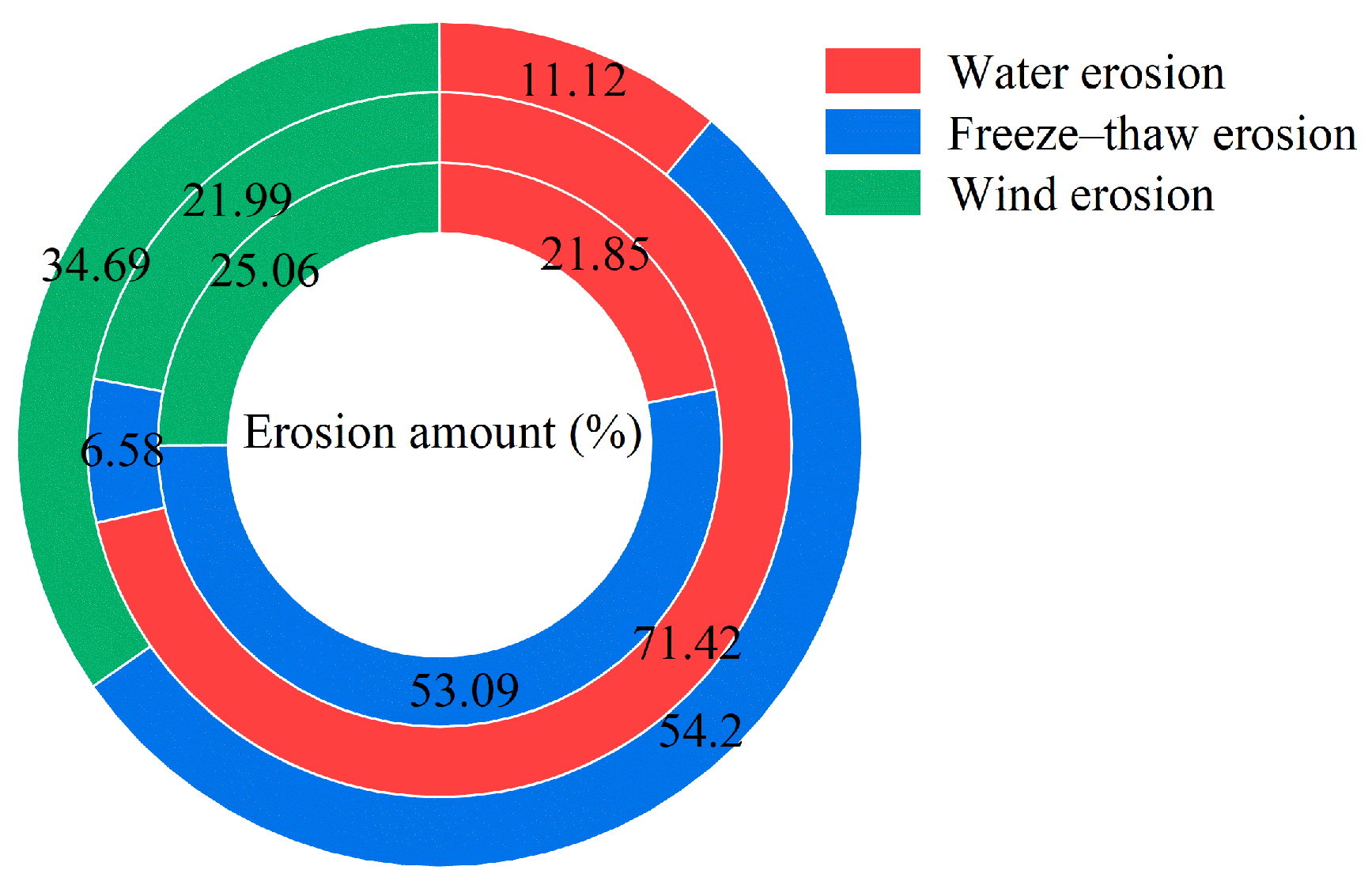
In fact, freeze–thaw erosion, water erosion, wind erosion, and gravitational erosion rarely occur independently. Instead, they are characterized by spatial coupling and superposition, as well as temporal alternation. In other words, weathering and erosion in PS areas are characterized by multi-factor compound erosion, while the dominant erosion types vary significantly across seasons. Overall, freeze–thaw erosion is the dominant driver of erosion in PS areas in winter and spring, while water erosion prevails in summer and autumn. Each of these dominant erosion processes is commonly accompanied by wind erosion and gravitational erosion. For example, during the transition periods from autumn to winter and from winter to spring, the dominant erosion type is freeze–thaw and wind compound erosion. Wind erosion dominates from April to May, while gravitational and hydraulic compound erosion becomes the primary type from May to September. In other periods, the erosion is dominated by the combined action of freeze–thaw, wind, and gravitational erosion [49,52]. Zhang et al. [114] analyzed the intra-annual variation in erosion in the Erlaohugou Small Watershed of Jungar Banner through statistical methods. The results showed that there were three high-risk erosion periods within a year in the PS area. The period from early February to mid-to-late March was the superimposed period of wind erosion and freeze–thaw erosion; the period from early-to-mid June to mid-to-late August was the superimposed period of wind erosion and water erosion; and the period from mid-October to mid-to-late November was the superimposed period of water erosion, wind erosion, and freeze–thaw erosion. Fu et al. [115] investigated the seasonal interaction characteristics of freeze–thaw erosion, water erosion, and wind erosion in PS areas, based on the measured slope erosion yield of bare PS slopes (Figure 3) and the corresponding meteorological data in the Erlaohugou Small Watershed of Jungar Banner from March 2018 to April 2019. The results indicated that slope erosion was predominantly driven by freeze–thaw erosion from March to June 2018 and from November 2018 to April 2019, with freeze–thaw erosion accounting for 53.09% and 54.20% of the erosion amount in the two periods, respectively. Water erosion dominated the slope erosion process from July to October 2018, accounting for 71.42% of the total erosion amount over the entire study period. The erosion driving forces were ranked in descending order of importance as water erosion, freeze–thaw erosion, and wind erosion.
Compound erosion under multiple factors is the result of the combined action of natural factors including temperature, wind, and water, and exhibits distinct coupling characteristics in terms of spatiotemporal distribution, energy supply, and sediment supply. In other words, compound erosion under multiple factors is not a simple linear superposition of individual erosion processes, but a complex system formed by the coupling of multiple erosion dynamics. All factors play distinct roles in the compound erosion process, and they act synergistically to form an efficient sediment yield and transport chain. PS has a dense structure but is prone to disintegration when encountering water. Repeated freeze–thaw cycles further degrade its internal rock structure, rendering it loose and fragmented, which in turn provides a material basis for subsequent erosion. The primary role of wind force is to redistribute loose weathered materials on the surface or cause direct deflation. Although wind action alone produces a small amount of sediment, it can intensify the fragmentation of surface rocks. Runoff generated by rainfall serves as the main driving force for sediment transport. Individual freeze–thaw erosion or wind erosion cannot directly lead to a sharp increase in sediment yield. Only when rainfall occurs can the loose materials produced by freeze–thaw action and wind action be extensively washed into river channels. Zhao [116] pointed out that bank slopes composed of aeolian sand deposits continuously retreated under water erosion and gravitational erosion. The eroded aeolian sediments were continuously transported downstream by gully runoff. Meanwhile, wind action constantly carried sediment to replenish the aeolian deposits on the bank slopes. The interactive effects of wind, water, and gravitational erosion acted as an important source of coarse sediment for the channel of the Lower Yellow River. Tang et al. [108] indicated that the sediment yield process in PS areas was governed by the compound effect of water erosion, wind erosion, and gravitational erosion. The temporal alternation of these erosion forces prolonged the erosion duration, expanded the erosion scope, and further increased the erosion intensity. Zhang et al. [117] demonstrated that isolated freeze–thaw erosion or wind erosion only increased the sediment source for water erosion and had no significant effect on the sediment yield of PS slopes. A significant increase in sediment yield was only observed under compound erosion conditions, confirming a significant superimposed amplification effect during the compound erosion process. The superimposed effects of freeze–thaw and hydraulic compound erosion, and freeze–thaw, wind, and hydraulic compound erosion were approximately 1.27 times and 1.64 times those of single erosion, respectively. Wei et al. [118] found that the runoff and sediment yield processes under isolated water erosion exhibited significantly attenuated characteristics compared with those under compound erosion. Furthermore, the peak values and variation ranges of the runoff and sediment yield of PS slopes increased as the number of erosion forces increased. Gao et al. [119] considered that PS slopes were dominated by bulk erosion under isolated water erosion, with the particle size of the eroded sediment remaining relatively stable. Under freeze–thaw and hydraulic compound erosion, the yield of coarse sediment particles was prominent, indicating that freeze–thaw action exerted a significant effect on the mobilization of coarse particles. Under freeze–thaw, wind, and hydraulic compound erosion, slope stability was the lowest, and the variation in sediment particle size was the most pronounced.
Existing studies have confirmed the significant superimposed amplification effect of compound erosion, clarified the efficient sediment yield chain consisting of freeze–thaw loosening, wind erosion transport and water erosion migration, and revealed the differentiation characteristics of erosion dynamics in different seasons. However, current research is still dominated by qualitative descriptions and laboratory tests under ideal working conditions. There is a lack of watershed-scale quantitative erosion prediction models that consider the multi-field coupling of freeze–thaw, hydraulic, wind, and gravitational effects, making it impossible to achieve the refined simulation and precise prevention and control of erosion and sediment yield in PS areas.

3. Soil Erosion Control Measures in PS Areas

3.1. Biological Measures

PS areas have suffered serious soil erosion, which has severely damaged the local ecological environment. To control soil erosion in these areas, relevant management institutions have adopted various measures and successively introduced and cultivated stress-tolerant vegetation such as Simon poplar (Populus simonii), Chinese red pine (Pinus tabuliformis), and alfalfa (Medicago sativa). However, none of these early restoration efforts have achieved the expected results. After years of exploration, it has been found that sea-buckthorn (Hippophae rhamnoides) features well-developed root systems, strong drought tolerance, and rapid tillering ability. It can survive under harsh geological conditions such as PS gullies, and is regarded as a pioneer plant for controlling soil erosion in PS areas [120]. In 1998, the Ministry of Water Resources of China launched sea-buckthorn-dominated ecological projects to control soil erosion in PS areas. The mechanism of sea-buckthorn in controlling soil erosion is generally attributed to the synergistic effect of three lines of defense. The first line of defense is the canopy layer, where dense canopy branches and foliage intercept rainfall and reduce the direct splash erosion of topsoil by raindrops. The second line of defense is the litter layer. The litter covering the soil surface increases surface roughness, improves the soil water infiltration capacity, and attenuates the surface runoff velocity. The third line of defense is the underground root layer. The three-dimensional network formed by sea-buckthorn roots consolidates and anchors the soil, thereby significantly enhancing the soil shear strength.
After years of development, sea-buckthorn has played an important role in soil erosion control in PS areas and has achieved remarkable ecological benefits. Wu et al. [121] reported that after large-scale sea-buckthorn planting, the average annual total flood reduction and sediment load reduction in three tributaries (i.e., the Huangfuchuan River, Gushanchuan River, and Kuye River) amounted to 4.8084 million m3 and 3.0265 million t, respectively, during the period 2002–2008. Based on the analysis of field-measured data of freeze–thaw erosion in the Xizhaogou small watershed, Yang et al. [122] demonstrated that 7 years after large-scale sea-buckthorn afforestation, the erosion modulus on the slopes of the upper, middle, and lower reaches of the branch gullies decreased by 69.9%, indicating that sea-buckthorn played a significant role in preventing freeze–thaw erosion. Based on the successful practices of sea-buckthorn ecological restoration, Bi and Li [123] proposed the concept of planting sea-buckthorn within gully channels to construct flexible vegetation dams, thereby effectively controlling soil erosion in PS gully areas. The working principle of the flexible vegetation dam is that several rows of sea-buckthorn are planted within gully channels perpendicular to the flow direction to form the primary dam frameworks. By intercepting and blocking water flow with their stems and branches, these dams achieve coordinated regulation of sediment retention, runoff discharge, and overflow. After the flood season, as sediment accumulates in the gully bed, sea-buckthorn continues to grow vertically and horizontally, gradually developing into stable flexible dam groups and continuously sustaining their long-term soil and water conservation. The results showed that the construction of sea-buckthorn flexible vegetation dams not only effectively attenuated flood peak intensity, reduced flow velocity, and alleviated gully bed erosion, but also enhanced soil infiltration, reduced evaporation, and regulated soil moisture, thereby achieving sustainable and efficient control of soil erosion in PS areas [124]. Biological measures dominated by sea-buckthorn have achieved remarkable long-term ecological benefits in PS gully areas. With the advantages of low cost, high sustainability, and ecological synergy, they serve as the fundamental measure for regional soil erosion control.
However, this sea-buckthorn-based biological control technology still has its inherent limitations. Firstly, it has limited adaptability to steep slopes. When the slope angle exceeds 35°, the root growth of sea-buckthorn is significantly restricted, and it rarely survives on slopes steeper than 60°. Secondly, it has a long lag phase in effectiveness, and it usually takes 3–5 years after planting to form a stable protection system. Thirdly, under extreme climate events such as droughts and rainstorms, its vegetation survival rate and protection effect exhibit significant uncertainty [125].

3.2. Chemical Solidification Measures

Chemical solidification measures refer to the mixing, injection, or spraying of chemical stabilizers into loose, collapsible, and water-softened PS. These measures modify the bonding mode and microstructure of PS particles through physicochemical reactions such as ion exchange and chemical cementation, thereby improving the mechanical strength, water disintegration resistance, scouring resistance, and structural stability of PS rock masses. For soil erosion control in PS areas, the commonly used chemical stabilizers mainly include EN-1 soil stabilizer and W-OH hydrophilic polyurethane.
EN-1 soil stabilizer is formulated from a strong oxidant, solubilizer, and dispersant. After EN-1 dissolves in water, the dissociated high-valence cations undergo ion exchange with low-valence cations on the surface of PS particles, destroying the electrical double-layer structure on their surfaces and reducing the interparticle spacing. Meanwhile, this stabilizer decreases the surface tension of bound water and the water adsorption capacity of PS particle surfaces, thereby expelling interparticle adsorbed water. This process enables dispersed PS particles to flocculate and agglomerate, significantly improving the overall strength and erosion resistance of PS soil [126]. Su et al. [21] found that EN-1 could effectively improve the shear strength of weathered PS soil. The shear strength of solidified PS soil reached its peak when the EN-1 dosage was 0.20% and the curing age was 30 days. Meanwhile, laboratory scouring test results indicated that with the increasing EN-1 dosage, curing age and compaction degree, the slope runoff velocity of the PS solidified soil increased, while the Reynolds number (Re) and Darcy–Weisbach drag coefficient (f) decreased. Except for the low compaction degree group, whose runoff flow regime presented turbulent and subcritical flow at the later scouring stage, other treatment groups were dominated by laminar and supercritical flow, demonstrating that the slope erosion resistance of PS soil solidified by EN-1 was significantly enhanced [127]. Although EN-1 has been shown to effectively enhance the overall strength and water erosion resistance of PS soil, it fails to adequately meet the requirements for water retention and plant growth promotion in slope vegetation restoration projects in PS areas. Specifically, this stabilizer cannot satisfy the synergistic requirements of soil consolidation, water conservation, and vegetation restoration, and thus exhibits insufficient comprehensive performance in soil erosion control [128].
The unique mineral composition and internal microstructure of PS are the fundamental reasons for its high susceptibility to erosion. W-OH, a hydrophilic polyurethane, is a representative organic polymer material. It effectively penetrates into the interior of PS, enhances interparticle cementation, and coats the surface of individual PS particles to form a dense consolidated matrix that serves as a protective barrier, thereby significantly improving the erosion resistance of PS [129,130]. Wang et al. [131] found that a stable protective layer was formed on the PS slope surface after W-OH treatment, which not only isolated rainwater from PS, but also increased slope surface smoothness, thereby facilitating rapid runoff drainage. This dual mechanism greatly weakened the erosive impact of rainfall on PS and resulted in excellent erosion mitigation performance. The sediment reduction ratio remained above 98% across all different rainfall intensities (20, 50, and 80 mm/h) and slope angles (20°, 30°, and 40°). Notably, the modification effect of W-OH is closely related to the spraying concentration and amount of its aqueous solution. Li et al. [23] found that the optimal improvement effect of W-OH on the erosion resistance of PS was obtained when the concentration was 4% and the spraying amount was 1.5 L/m2. Liang et al. [132] indicated that under constant conditions of flow discharge (2, 3, and 4 L/min) and slope angle (5°, 7.5°, and 10°), the reduction in the soil detachment rate of PS slopes became more pronounced and the slope erosion resistance was further enhanced with the increasing W-OH solution concentration. When the concentration exceeded 2%, a remarkable consolidation effect on the slopes was observed.
In addition, unlike EN-1, W-OH not only improves soil erosion resistance, but also enhances soil water and nutrient retention and promotes plant growth [133]. W-OH is an organic polymer that undergoes rapid reaction with water to form an elastic network gel. This gel exhibits excellent water and nutrient retention capabilities. It is capable of slowly and reversibly absorbing and releasing the water required for plant growth, prolonging the plant growth period, and thereby exerting a growth-promoting effect. Liang et al. [134] investigated the effects of W-OH on soil water and nutrient retention and vegetation growth via soil evaporation tests, soil column leaching experiments, and small-scale engineering demonstrations. The results showed that with increasing W-OH concentrations (3%, 4%, and 5%), the soil evaporation rates decreased by approximately 45.2%, 45.8%, and 50.3%, respectively, compared to the control group. Similarly, cumulative soil total nitrogen losses were reduced by approximately 43.57%, 48.14%, and 63.99%, and cumulative total phosphorus losses decreased by approximately 27.96%, 45.70%, and 61.17%. Furthermore, small-scale engineering demonstrations revealed that the vegetation coverage of W-OH-treated gullies increased by approximately 11.35% compared to the untreated control. However, W-OH is susceptible to degradation under ultraviolet irradiation, leading to structural deterioration of the consolidated layer. Under the natural conditions of PS areas, the effective service life of the consolidated layer is only approximately six months [22]. To address the insufficient durability of the W-OH consolidated layer induced by ultraviolet irradiation, Liang et al. [135] conducted 32-day simulated UV aging tests on consolidated specimens fabricated by compounding W-OH with ultraviolet stabilizers UV531 and UV770. The results showed that UV531 and UV770 could mitigate ultraviolet-induced degradation through absorption, quenching, or chemical reaction participation, thereby extending the service life of the consolidated layer from six months to several years.
Although W-OH can meet the collaborative governance requirements of soil consolidation, water retention, and vegetation restoration, its consolidated layer exhibits high brittleness and limited deformation resistance. Under the actions of uneven soil settlement, long-term repeated freeze–thaw cycles and dry–wet cycles in PS areas, the consolidated layer is highly prone to cracking. Once penetrating cracks are formed, rainwater infiltration will induce the disintegration of the underlying pristine soft sandstone, resulting in complete failure of the entire protective system [136,137]. Therefore, how to improve the ultraviolet aging resistance and flexibility of W-OH polyurethane gel while retaining its superior performance in water retention and plant growth promotion has become a critical research direction for the development of organic gel-based soil stabilization materials.

3.3. Microbial Solidification Measures

Microbially induced calcium carbonate precipitation (MICP) is a biomineralization technology driven by the metabolic activity of specific functional microorganisms. Its core principle is that microbial enzymatic reactions alter the local microenvironment, induce supersaturation of the pore solution, and promote the formation of insoluble calcium carbonate crystals, thereby realizing the cementation, reinforcement, and repair of geotechnical media, concrete, and other engineering materials [138].
As an emerging eco-friendly soil reinforcement technology, MICP has been gradually applied in research on soil erosion control in PS areas in recent years [139]. Feng et al. [24] pointed out that after PS was solidified by MICP, the induced calcium carbonate crystals could fill the pores of PS and exert a cementing effect. When PS expanded upon water absorption or was eroded by external forces, the interparticle mineral cementation could resist the resulting expansion and erosion forces, thereby improving the overall strength and erosion resistance of PS. Wang et al. [140] found that for PS specimens treated with MICP, the maximum calcium carbonate content reached 15%, and the maximum unconfined compressive strength (UCS) of the solidified specimen was up to 1 MPa. The 30 min disintegration rate of the treated specimens was only 1.95%, compared with 39.64% for the undisturbed PS soil and 100% for the remolded PS soil specimens, which disintegrated completely within the same duration. In addition, at a wind velocity of 31 m/s and an erosion angle of 30°, the wind erosion resistance of the treated specimens was on average approximately 20 times higher than that of undisturbed PS specimens.
Numerous studies have shown that the solidification effect of MICP is closely related to factors such as the bacterial species, bacterial solution concentration, cementing solution dosage, and grouting methods [141,142]. Considering that Sporosarcina pasteurii, the most widely used strain in mainstream MICP technology, exhibits poor adaptability to the low annual mean temperature in PS areas, Shao et al. [25] compared the solidification effects of indigenous bacteria and Sporosarcina pasteurii on PS soil. The results showed that compared with that of the Sporosarcina pasteurii-treated group, the thickness of the solidified layer treated with indigenous bacteria increased by 4.65%. Under low-temperature conditions, the reductions in the solidified layer thickness and strength of the indigenous bacteria-treated group were 13.04% and 13.39%, respectively, which were lower than those of the Sporosarcina pasteurii-treated group. Wang et al. [43] evaluated the effects of the bacterial solution concentration, the ratio of bacterial solution to calcium source solution, and the ratio of calcium to urea on the solidification performance of PS. The results indicated that the optimal solidification effect was achieved at a urea consumption of 0.4 mol, an optical density at 600 nm (OD600) of 1.2 for the bacterial suspension, a ratio of bacterial solution-to-calcium source solution of 1:20, and a ratio of calcium-to-urea of 1:1. After solidification, the porosity of PS specimens decreased by 62.4%, and the water-saturated strength remained at 43.6% of that of the dry specimens. Shao et al. [143] investigated the effects of the bacterial solution concentration and number of solidification cycles on the mechanical properties and water erosion resistance of PS. The results revealed that under the same number of solidification cycles, the optimal solidification effect was achieved when the OD600 was 0.8, and the UCS of the specimens was 20–50% higher than that of specimens treated with other concentrations. Under the optimal bacterial solution concentration, after five solidification cycles, the water erosion resistance of PS was the best, and the total water erosion loss was reduced to 10% of that before solidification. Feng et al. [144] investigated the effects of the grouting methods, namely the single-phase injection method and the self-absorption two-phase injection method, on the solidification performance of PS. The results demonstrated that the single-phase injection method could only achieve partial solidification of PS columns. In contrast, the self-absorption two-phase injection method enabled a more uniform spatial distribution of bacteria and better integrity of specimens.
MICP technology provides a new pathway for the eco-friendly reinforcement of PS. Laboratory tests have demonstrated that it can significantly improve the erosion resistance and water stability of PS. Nevertheless, this technology still faces two major bottlenecks in engineering application. Firstly, PS is characterized by a high clay particle content and low permeability, which readily leads to uneven infiltration of bacterial solution and cementing solution, resulting in a limited reinforcement depth and unstable reinforcement effect. Secondly, under the cold and arid environment of PS areas, the microbial activity and the long-term durability of the calcium carbonate cementitious products still lack systematic field monitoring data, posing a significant barrier to large-scale engineering application.
Table 3 summarizes the comparison of biological measures, chemical solidification measures, and microbial solidification measures for soil erosion control in PS areas. It should be emphasized that biological measures dominated by sea-buckthorn serve as the fundamental strategy for the long-term ecological management of gentle slopes and gully areas, delivering sustained ecological benefits at low cost but requiring long establishment periods. Chemical solidification measures act as the core emergency control method for steep and bare slopes, providing immediate erosion protection but facing durability and aging challenges. Microbial solidification measures offer an emerging eco-friendly approach for shallow slope ecological restoration, with favorable environmental compatibility but limitations in treatment depth and low-temperature applicability, and the potential ecological risk of ammonia nitrogen from urease hydrolysis also requires attention.
The prioritization of the above three measures for distinct application scenarios should be tailored to local conditions. For gentle slopes and gully areas targeting long-term ecological restoration, sea-buckthorn biological measures are the first-priority strategy, offering substantial long-term ecological benefits at low cost, despite a long establishment period. For steep bare slopes requiring short-term emergency stabilization, chemical solidification represented by W-OH serves as the secondary option, with rapid onset of effect but medium durability and aging risks. For shallow slope restoration projects with strict low-carbon requirements, MICP technology based on indigenous cold-tolerant bacteria can be adopted as a tertiary alternative, with favorable environmental compatibility but limitations in treatment depth and low-temperature adaptability. For slopes exceeding 60°, the applicability of any single technology remains highly uncertain, and combined composite reinforcement systems may be necessary, though this warrants further investigation.
From the perspective of large-scale engineering promotion, the three technologies also differ significantly in economic cost and logistical feasibility. Sea-buckthorn biological measures have the lowest unit area investment and simplest logistical requirements, with locally available seedlings and low construction difficulty, making them suitable for large-area popularization; however, the costs of early management and maintenance and the long establishment period are non-negligible practical constraints. W-OH chemical solidification faces high raw material costs and bulk transportation expenses, and construction equipment has difficulty accessing steep and remote slopes, resulting in a high economic threshold for large-scale application. MICP microbial solidification entails high costs for large-scale strain cultivation and grouting equipment deployment, involves complex on-site construction and maintenance procedures, and is currently only suitable for small-scale pilot projects in accessible areas. It should be emphasized that the technical performance advantages verified in laboratory studies need to be fully weighed against practical constraints such as material cost, site accessibility, and long-term operation and maintenance investment in large-scale promotion, and technical expectations should be rationally matched with engineering economic feasibility.
Notably, a single universal priority ranking across all PS areas is conceptually inappropriate; rather, site-specific priority rankings should be developed based on local conditions, comprehensively considering the slope gradient, intervention urgency, available resources, and long-term management objectives. Future research should further develop multi-criteria decision analysis frameworks that integrate effectiveness, risk, cost and logistical constraints to support more refined technology selection.

4. Sustainable Resource Utilization of PS in the Preparation of Low-Carbon Geopolymer Cementitious Materials and the Amelioration of Degraded Soils

Overall, the above-mentioned three existing measures are primarily designed to mitigate the inherent defects of PS (e.g., water-induced disintegration and poor erosion resistance) with a focus on passive erosion control, and each technology has distinct limitations, with none fully exploiting the inherent resource attributes of PS. PS is naturally rich in aluminosilicate minerals and clay fractions, which endow it with natural potential to serve as a precursor for geopolymer cementitious materials and as an amendment for degraded soils. In this regard, relevant research has shifted from passive erosion control mitigation to active resource utilization, realizing the conversion of its ecological disadvantage into a resource advantage.

4.1. PS Geopolymer Cementitious Materials

PS geopolymer cementitious (PSGC) materials are synthesized via alkali activation, which cleaves the Si-O-Si and Si-O-Al covalent bonds within the crystal structures of clay minerals present in PS, such as montmorillonite, kaolinite, and illite. This process induces the depolymerization of mineral lattices, releasing reactive silicate and aluminate ions, which subsequently polycondense to form cementitious products [145,146,147]. Compared with traditional Portland cement, geopolymer cementitious materials exhibit significant advantages such as low-carbon emissions and low energy consumption during production. They are regarded as promising green cementitious materials and have become a research focus in the field of resource utilization of PS in recent years [148,149].
To fundamentally elucidate the alkali activation characteristics of PS, Li et al. [62] investigated a pure NaOH-activated system free of mineral admixtures. The results showed that the alkali concentration significantly influenced the dissolution of SiO2 and Al2O3 in PS, and their dissolution amounts increased markedly with the increasing alkali concentration. In 2 mol/L NaOH solution, the dissolution percentages of both SiO2 and Al2O3 in white and red PS exceeded 30%, indicating that PS possesses a certain potential for alkali activation. However, PS inherently exhibits low pozzolanic activity, resulting in limited improvement in the mechanical properties of PSGC materials prepared by direct alkali activation. To achieve ideal mechanical performance and enable the co-disposal of industrial solid wastes, researchers have successively introduced high-activity industrial solid waste mineral admixtures such as fly ash (FA), blast furnace slag (BFS), steel slag (SS), and silica fume (SF). Through the complementarity of active components and the synergistic effect of alkali activation between PS and these mineral admixtures, the comprehensive performance of PSGC materials can be significantly improved [150].
FA, a bulk solid waste from coal-fired power plants, is widely available, low-cost, and exhibits moderate pozzolanic activity, making it a widely used admixture for preparing cost-effective PSGC materials. Li et al. [28] investigated the effects of the FA dosage, NaOH dosage, and water glass dosage on the mechanical properties of PSGC materials. The results indicated that when the FA dosage was 13.8%, the NaOH dosage was 1.2%, and the water glass dosage was 7.4%, the 90-day compressive strength of the PSGC materials reached 20.3 MPa with a softening coefficient of 0.86, compared to only 2.6 MPa and 0 for untreated PS. Under these experimental conditions, the geopolymer cementitious material consisted primarily of amorphous calcium silicate hydrate (C-S-H) gel, which can react with carbon dioxide to form calcium carbonate. Although FA-based systems exhibit significant cost advantages, their low pozzolanic activity leads to inferior mechanical properties of modified PSGC materials, making them unsuitable for engineering applications with high strength requirements.
BFS and SS are abundant industrial solid wastes generated by the iron and steel industry. Among them, BFS is rich in active CaO, SiO2, and Al2O3, which can form high-strength C-S-H and calcium aluminosilicate hydrate (C-A-S-H) gels through hydration and pozzolanic reactions. Additionally, it supplies essential calcium ions for the geopolymerization of PS, making it one of the most widely used mineral admixtures for the alkali activation modification of PS [151]. Dong et al. [29,67,152] investigated the alkali activation modification of PS using BFS as a mineral admixture. The results showed that at a BFS dosage of 40% and a NaOH activator dosage of 2%, the 7-day compressive strength of the PSGC materials reached 32 MPa, corresponding to a 627% increase compared with the specimen without BFS addition. When the NaOH activator dosage was fixed at 1.5% and the BFS dosage increased from 0 to 40%, the 90-day compressive strength of the PSGC materials increased from 6.9 MPa to 56.2 MPa, and the softening coefficient increased from 0.40 to 0.95. Based on the above optimal NaOH activator and slag dosages, the additional incorporation of 4.0% sodium silicate activator further increased the 90-day compressive strength to 82.0 MPa. Dong et al. [153] prepared a novel cement-free alkali-activated cementitious material (APKC) using PS and BFS as the main raw materials. Its flowability and mechanical properties were comparable to those of ordinary Portland cement (OPC), providing a sustainable alternative to traditional cement. The results showed that under the conditions of a water-to-binder ratio of 0.3, an alkali activator dosage of 17.5%, and a PS-to-BFS mass ratio of 1:1, the flowability of APKC reached 195 mm, with a 28-day compressive strength of 59.1 MPa and a flexural strength of 9.96 MPa. Its main hydration products were hydrotalcite, calcium sodium aluminosilicate hydrate (C,N-A-S-H) gel, C-S-H gel, and natrolite. Meanwhile, the cost, carbon emissions, and energy consumption for producing one ton of APKC were 64.01%, 22.76% and 28.56% of those for OPC, respectively, demonstrating great potential to replace OPC in engineering applications. In addition to BFS, SS, another bulk solid waste generated by the iron and steel industry, has also been attempted for the modification of PS. Dong et al. [154] investigated the alkali activation modification of PS using SS as a mineral admixture. The results indicated that at an SS dosage of 40% and a NaOH activator dosage of 1%, the 90-day compressive strength of the PSGC materials reached 46 MPa. Under these conditions, the main reaction products were C-S-H gel and geopolymer gel, whereas obvious carbonation was observed in the C-S-H gel.
Additionally, SF is a by-product generated during the smelting of ferrosilicon alloy and industrial silicon. It contains a large amount of highly reactive SiO2 and is also widely used in the modification of PS. Under alkali-activated conditions, SF rapidly releases reactive silicon species, increasing the Si-to-Al ratio of the geopolymer system. Meanwhile, it significantly reduces the matrix porosity and refines the pore structure through the micro-aggregate filling effect and the gel formation effect, thereby improving the mechanical properties and water resistance of the PSGC materials. Dong et al. [155] revealed that the addition of SF to PS could provide sufficient reactive silica, remarkably promote the formation of Si-Al gels, and accelerate the consumption of montmorillonite, feldspar, and ussingite during the alkali-activated reaction. With a fixed NaOH dosage of 3%, when the SF dosage increased from 0 to 10%, the 28-day compressive strength of PSGC materials increased from 8.8 MPa to 44.8 MPa, an increase of 409%, while the softening coefficient rose from 0.56 to 0.98, representing an improvement of 75%. Correspondingly, the Si-to-Al ratio in the Si-Al gels increased from 1 to 3. The main hydration product was Si-Al geopolymer gel, and the strength, water resistance, and drying shrinkage properties of the PSGC materials were comparable to those of traditional cement, which could meet the application requirements of most practical engineering projects.
Notably, alkali activators account for approximately 20–40% of the total cost of alkali-activated cementitious materials, making their cost one of the key factors restricting their industrial promotion and application. Calcium carbide slag (CCS), a bulk solid waste generated by the chlor-alkali industry, is rich in Ca(OH)2. It can serve simultaneously as an alkali activator and cementitious component to partially replace a conventional alkali activator, thereby greatly reducing the production cost of the materials [156,157]. Guo et al. [158] conducted a modification study on PS using CCS and BFS as cementitious materials. The results showed that CCS could promote the pozzolanic reaction of PS and further accelerate the hydration of BFS, generating more C-A-S-H gel and thereby enhancing the strength of the geopolymer materials. However, with a further increase in the dosage of CCS, large amounts of alkali feldspar, portlandite, and calcite remained in the system. Meanwhile, the gel structure deteriorated, leading to a loose internal structure of the geopolymer materials and restricting the strength development. When the mass fraction of carbide slag in the cementitious materials was 15%, the 7-day compressive strength reached 5.4 MPa, which could meet the strength requirements for structural layers of expressways Class I highways.
As mentioned above, PSGC materials are a typical class of cost-effective, low-carbon green cementitious materials produced by synergistically incorporating PS with various industrial solid wastes such as FA, BFS, SS, SF, and CCS. This technology enables the simultaneous resource utilization of PS and the recycling of multiple industrial solid wastes. Their production cost, energy consumption and carbon emissions are lower than those of ordinary Portland cement, with carbon emissions accounting for only approximately 1/4 to 1/5 of those of ordinary Portland cement. However, PS exhibits inherently low pozzolanic activity, and the strength improvement achieved by alkali activation alone is rather limited. Therefore, the strength development of PSGC materials relies on the activity complementation of mineral admixtures. Furthermore, the mechanical properties of PSGC materials are highly sensitive to the type, dosage and mixing proportion of both the mineral admixtures and alkali activators. In addition, most existing studies have focused on the short-term mechanical properties of PSGC materials, while systematic investigations into their long-term durability, such as resistance to freeze–thaw and dry–wet cycles, remain insufficient. More importantly, the current carbon emission assessment generally adopts a cradle-to-gate system boundary, only accounting for emissions from raw material production and alkali activation processes. The carbon footprint and economic costs of PS mining, mechanical pretreatment (crushing and grinding), and especially long-distance transportation have not been systematically incorporated into the evaluation system, and this omission may result in an overestimation of the actual low-carbon benefits of PSGC materials in engineering practice.

4.2. Amelioration Materials for Degraded Soils

Degraded soils, such as aeolian sandy soil, possess the characteristics of an excessively high sand fraction and severely low silt and clay fractions. This results in a loose soil structure, poor aggregate stability, and low water and nutrient retention capacity. These inherent soil properties severely constrain agricultural production and ecological restoration in the aeolian sandy areas of northern China. Table 4 shows the particle size distribution of PS commonly used in the amelioration of degraded soils [95,159,160,161,162,163,164]. It can be seen that the sum of mass fractions of silt and clay particles ranged from 46.15% to 87.43%, with an average value of 64.53%. Therefore, PS is rich in silt and clay fractions, and the clay minerals in PS, dominated by montmorillonite, possess excellent water absorption and retention capacity, cation exchange capacity, and particle cementation ability. PS exhibits natural physicochemical complementarity with degraded soils, and thus is regarded as an ideal material for the amelioration of degraded soils [165]. At present, relevant scholars have investigated the amelioration effects of PS on degraded soils from the perspectives of soil physical structure optimization, hydraulic property regulation, and nutrient retention enhancement.
The fundamental basis of PS in ameliorating degraded soils lies in the optimization of soil particle size distribution and the enhancement in aggregate stability. Existing studies have demonstrated that PS supplements silt and clay fractions to optimize the particle size distribution of degraded soils, thereby driving the transformation of soil texture from sand to sandy loam, loam, and silt loam. Meanwhile, it promotes the formation of water-stable aggregates and enhances soil structural stability and erosion resistance [166]. In terms of soil particle size distribution optimization and soil texture amelioration, Liu et al. [164] pointed out that the addition of PS and weathered coal to sandy loess could increase the content of fractions with a particle size of less than 0.25 mm in mechanically stable aggregates, increase the mean weight diameter and geometric mean diameter of water-stable aggregates, and enhance the soil structural stability. Li et al. [167] discovered that the proportion of fine soil particles (0–0.05 mm) in the amended soil, formed by mixing PS and aeolian sandy soil in a volume ratio of 1:2, increased from 3% in original aeolian sandy soil to 41%. Zhang et al. [168] analyzed the variation characteristics of particle composition in compound soil prepared by mixing PS and sand at different volume ratios. The results indicated that with the increase in the PS proportion, the contents of silt and clay gradually increased, while the sand content decreased. After blending PS and sand, the soil particle size distribution evolved in a benign direction, and the texture type of the compound soil showed a favorable transition trend from sand to sandy loam, loam, and silt loam in sequence. In terms of the improvement in water-stable aggregates, Zhang et al. [169] analyzed the variation characteristics of water-stable aggregates and mean weight diameter of compound soil with different volume ratios of PS and aeolian sandy soil (1:1, 1:2, and 1:5) during maize planting from 2010 to 2018. The results showed that with the increasing planting years, the content of water-stable microaggregates with a particle size < 0.25 mm gradually decreased, while the content of water-stable macroaggregates with a particle size > 0.25 mm increased. By 2018, after 9 years of planting, the mean weight diameter values of water-stable aggregates in the three compound soils had increased to 2.13, 2.85, and 2.58 times the initial values, respectively. Liu et al. [170] investigated the mechanism by which PS as a soil amendment improves the structural stability of aeolian sandy soil at the microscopic level. The results revealed that the incorporation of PS enhanced the van der Waals attractive force between soil particles, reduced the net repulsive force among particles, and promoted the aggregation and stabilization of aeolian sandy soil particles.
In addition to supplementing silt and clay fractions and optimizing the soil particle size composition, PS can further optimize the ratio of capillary pores to non-capillary pores in the aeolian sandy soil, thereby enhancing the water retention capacity of soil. This effect is another major advantage of PS application for the amelioration of degraded aeolian sandy soil [40]. Aeolian sandy soil is dominated by large non-capillary pores, which give it favorable aeration and water permeability but extremely poor water-holding capacity, resulting in severe water leakage and deep percolation. The fine particles of PS can effectively fill the large pores of aeolian sandy soil, optimize the soil pore size distribution, reduce the soil water leakage rate and saturated hydraulic conductivity, and increase the field capacity and saturated water content, thereby effectively improving the water retention capacity of aeolian sandy soil [163]. Sun et al. [171] pointed out that the appropriate addition of PS could enhance the soil water storage capacity of aeolian sandy soil from 100 mm to over 200 mm. This amendment could gradually regulate the soil moisture to a deficit-free state for crop growth, and further significantly improve the water retention capacity of aeolian sandy soil. Jia et al. [172] found that, compared with the unamended control soil, the addition of PS could increase the saturated water content of aeolian sandy soil by 37–61%, raise the field capacity by 29–44%, and reduce the saturated hydraulic conductivity by 94.31%. Han et al. [173] considered that with the increase in the volume mixing ratio of PS to aeolian sandy soil, the capillary porosity of aeolian sandy soil gradually increased from 26.3% to 44.9%, while the saturated hydraulic conductivity of the soil decreased from 7.10 mm/min to 0.07 mm/min. Zhang et al. [161] pointed out that with the increasing PS content in compound soil, the field capacity, available water content and available water porosity all increased gradually, while the capillary porosity exhibited a quadratic trend of initially decreasing and then increasing.
In addition to the above effects, PS also exerts a significant regulatory effect on nutrient retention and availability improvement in degraded soil. Aeolian sandy soil is deficient in clay particles and organic matter, with a low cation exchange capacity and extremely poor nutrient adsorption and retention capacity. Nutrients such as nitrogen and phosphorus are highly susceptible to leaching loss through water percolation, resulting in extremely low fertilizer use efficiency. In contrast, the appropriate addition of PS can not only improve soil physicochemical properties and reduce nutrient leaching loss, but also regulate the adsorption and desorption characteristics of nutrients via the cation exchange properties of montmorillonite in PS, thereby enhancing soil nutrient availability and fertilizer use efficiency [174,175]. Wang et al. [176] found that with an increase in the incorporation ratio of PS in compound soil, the content of soil organic matter, available nitrogen, and available phosphorus increased gradually. Zhang et al. [177] pointed out that, after nine years of cultivation, compared with the original sandy soil, at PS to sandy soil volume ratios of 1:1, 1:2, and 1:5, the soil organic matter content and total nitrogen content had increased to 10, 12, and 11 times, and 5.5, 5.4, and 3.9 times the original value, respectively. Wang et al. [178] revealed that the application of a mixture of PS and sandy loess could significantly increase the contents of soil organic carbon, total nitrogen, nitrate nitrogen and available phosphorus in coal mine dump soil. With the exception of total nitrogen, all the other aforementioned nutrient indicators basically reached or exceeded the levels of undisturbed soil in the original landscape. She et al. [162,179] investigated the effects of PS amendment on the adsorption characteristics of phosphorus and ammonium nitrogen in aeolian sandy soil. The results showed that with the increase in the incorporation ratio of PS, the maximum phosphorus adsorption capacity of the amended soil decreased linearly, while the adsorption capacity for ammonium nitrogen increased linearly. This indicates that the addition of PS can significantly enhance the adsorption of ammonium nitrogen and reduce the adsorption and fixation of phosphorus in aeolian sandy soil, thereby improving the sustainability of soil nitrogen retention and the availability of applied phosphorus fertilizer.
Existing studies have confirmed the scientific validity and feasibility of PS as an amendment material for degraded soils. The effects of PS on optimizing particle size distribution and improving water and nutrient retention have been clarified, and its optimal mixing ratio and application mode have also been determined. Furthermore, large-scale field applications have been realized in the Mu Us Sandy Land [180,181]. Nevertheless, current research remains unclear regarding the long-term fertility sustainability of amended soil, the risk of secondary salinization, and the non-point source pollution risk induced by nitrogen and phosphorus leaching.

5. Conclusions and Prospects

The low diagenetic degree of PS, the strong water absorption and water-induced swelling and disintegration of montmorillonite, and the high weathering susceptibility of feldspar and calcite constitute the intrinsic causes of its poor erosion resistance. Compound erosion driven by multiple dynamic factors including freeze–thaw, hydraulic, wind and gravitational forces forms the external driving force with a superimposed amplification effect. Sea-buckthorn-based biological measures deliver remarkable long-term ecological benefits, but have poor adaptability to steep slope conditions and require a long period to attain stable effectiveness. EN-1 can effectively improve the overall strength and water erosion resistance of PS, but it can hardly meet the water retention and vegetation growth requirements for slope vegetation restoration in PS areas. W-OH takes effect rapidly, yet it is limited by the prominent drawbacks of ultraviolet aging and freeze–thaw cracking. MICP is environmentally friendly, but its large-scale field applications are restricted by bottlenecks such as uneven infiltration, insufficient reinforcement depth, low bacterial activity under low-temperature conditions, and high application cost. In terms of resource utilization, PS can be used to prepare alkali-activated geopolymer cementitious materials, which enables the co-disposal of solid waste and reduces carbon emissions. Meanwhile, it can optimize the particle gradation and improve the water and nutrient retention performance of degraded soil owing to its natural particle size complementarity with the degraded soil in the Loess Plateau.
In the future, particular emphasis should be placed on the following research directions in this field:
It is necessary to develop high-durability and anti-aging organic–inorganic composite gel protection systems and optimize the low-temperature grouting process of MICP to achieve deep and uniform reinforcement. Efforts should be devoted to the screening of and genetic improvement in cold-tolerant and drought-tolerant engineering strains to promote the transformation of relevant technologies from laboratory tests to large-scale field applications. Equally important is the need for systematic risk assessment of optimization schemes. Currently, there is a general lack of multi-year field monitoring evidence to systematically confirm that these optimizations do not generate unintended secondary risks. For example, large-scale sea-buckthorn plantations may experience vegetation degradation and negatively affect soil microbial communities and nutrient cycling in the long term. W-OH consolidated layers may create preferential flow paths upon cracking that accelerate localized erosion. Optimized MICP grouting improves cementation uniformity but increases the technical complexity and cost; the long-term stability of biogenic calcium carbonate under freeze–thaw conditions remains unverified, and ammonia nitrogen from urease hydrolysis carries potential ecological risks. Future research should combine multi-year in situ environmental monitoring and indoor multi-field accelerated aging tests to quantify the secondary risk threshold of each optimized formula, and establish a unified safety evaluation standard prior to large-scale engineering popularization.
Furthermore, while advancing technical performance optimization, future research should simultaneously focus on reducing the cost and logistical barriers to large-scale application, including developing low-cost local alternative materials, simplifying on-site construction processes, and developing modular lightweight construction equipment, thereby lowering the threshold for large-scale engineering popularization and facilitating the translation of technical achievements from laboratory verification to practical field application.
For PSGC materials, while laboratory-based accelerated aging tests including carbonation, freeze–thaw cycles, and dry–wet cycles are valuable for preliminary durability assessment, they cannot fully replicate the coupled effects of real-world environmental exposure. Therefore, long-term field exposure tests over 10 to 15 years should be established to monitor the chemical and mechanical stability of PSGC materials under actual service conditions. Key monitoring parameters should include: (1) Phase evolution and structural integrity of cementitious gels under natural carbonation and environmental attack. (2) Long-term strength retention and elastic modulus degradation. (3) Resistance to sulfate attack and chloride ingress, particularly given the potential presence of soluble salts in PS and industrial solid wastes. (4) Freeze–thaw and dry–wet durability under the continental climate of the PS areas. Establishing such long-term field monitoring programs is essential to validate laboratory-based performance predictions and to build confidence in the durability and safety of PSGC materials for mainstream engineering applications.
Additionally, a cradle-to-grave life cycle assessment framework should be established to cover the entire life cycle stages of PS mining, pretreatment, long-distance transportation, material preparation, engineering application, and end-of-life disposal. Taking transportation distance and transportation mode as core variables, systematic sensitivity analysis of carbon footprint and life cycle cost, as well as break-even distance calculation relative to ordinary Portland cement, should be carried out. This will rigorously verify whether the carbon reduction advantage of PSGC materials remains valid when logistics and processing costs are fully included, and further clarify the economic and environmental applicability radius for localized utilization of PS resources.
For the amelioration of degraded soil, long-term fixed-site monitoring over 10 to 15 years must be established to systematically evaluate the chemical and ecological stability of the amended soil. The monitoring program should encompass: (1) Soil fertility evolution, including organic matter content, total nitrogen, available phosphorus, and cation exchange capacity. (2) Secondary salinization risk, particularly the accumulation of soluble salts such as Na+, Ca2+, Mg2+, SO 4 2 , and Cl induced by the high montmorillonite content of PS. (3) Non-point pollution effects induced by nitrogen and phosphorus leaching. (4) Soil structural stability, including aggregate size distribution and water-stable aggregate persistence over multiple planting cycles. (5) The long-term ecological risk of trace element accumulation or release from PS materials. Such multi-decadal monitoring is essential to confirm that PS-based soil amelioration achieves not only short-term fertility improvement but also sustainable ecological restoration without delayed adverse environmental consequences.

Author Contributions

Q.Z.: Writing—original draft, software, resources, methodology, investigation, formal analysis, data curation, conceptualization. X.L.: Writing—review and editing, writing—original—draft, visualization, validation, formal analysis, data curation. H.X. and D.L.: Validation, investigation. All authors have read and agreed to the published version of the manuscript.

Funding

This research was funded by the Natural Science Foundation of Inner Mongolia Autonomous Region (2025MS05049), the Inner Mongolia Autonomous Region Education Special Fund Project (2025), the Scientific Research Startup Project for Excellent Doctoral Talents Introduction of Inner Mongolia Agricultural University (NDYB2022–29), the National Natural Science Foundation of China (42467042), the Key R&D and Achievement Transformation Program of Inner Mongolia Autonomous Region (2025YFHH0160), and the First–class Academic Subjects Special Research Project of the Education Department of Inner Mongolia Autonomous Region (YLXKZX–NND–023).

Institutional Review Board Statement

Not applicable.

Informed Consent Statement

Not applicable.

Data Availability Statement

Data are contained within the article.

Conflicts of Interest

The authors declare no conflicts of interest.

Abbreviations

The following abbreviations are used in this manuscript:
PSPisha sandstone
PSGCPisha sandstone geopolymer cementitious
FAFly ash
BFSBlast furnace slag
SSSteel slag
SFSilica fume
CCSCalcium carbide slag

Appendix A

Appendix A.1

Table A1. Sample color and data source information for Figure 1.
Sample No.ColorReferenceSample No.ColorReference
NO. 1Not available[34]NO. 18Not available[40]
NO. 2Not available[35]NO. 19Not available[41]
NO. 3Grayish-whiteNO. 20Not available[42]
NO. 4Purplish-redNO. 21Red[43]
NO. 5Alternating grayish-white and purplish-redNO. 22Pinkish-red[44]
NO. 6Red[36]NO. 23Grayish-yellow
NO. 7GrayNO. 24Grayish-green
NO. 8WhiteNO. 25Purple
NO. 9Purple[37]NO. 26Yellow
NO. 10WhiteNO. 27Gray
NO. 11PinkNO. 28Light brown
NO. 12GrayNO. 29Brown
NO. 13Red[38]NO. 30Grayish-brown
NO. 14WhiteNO. 31Yellowish-brown
NO. 15Red[39]NO. 32Red[45]
NO. 16WhiteNO. 33White
NO. 17Gray
Note: This table provides detailed metadata for all samples compiled in Figure 1 of the main text. Except for Nos. 28–33 collected from Yulin City, Shaanxi Province, the other 27 samples were collected from Ordos City, Inner Mongolia Autonomous Region.

Appendix A.2

Table A2. Sample color and data source information for Figure 2.
Sample No.ColorReferenceSample No.ColorReference
No. 1Not available[34]No. 17Not available[63]
No. 2Not availableNo. 18Yellowish-brown[64]
No. 3Not availableNo. 19Grayish-white[65]
No. 4Purple[37]No. 20Reddish-white
No. 5WhiteNo. 21Purplish-red
No. 6PinkNo. 22White[66]
No. 7GrayNo. 23Light red
No. 8Not available[42]No. 24Pinkish-red
No. 9Red[58]No. 25Red[67]
No. 10Not available[59]No. 26Not available[68]
No. 11White[60]No. 27White[69]
No. 12RedNo. 28Red
No. 13White[61]No. 29Not available[70]
No. 14RedNo. 30Red[71]
No. 15White[62]No. 31Red[72]
No. 16Red
Note: This table provides detailed metadata for all samples compiled in Figure 2 of the main text. Except for Nos. 18 and 31 collected from Yulin City, Shaanxi Province, the other 29 samples were collected from Ordos City, Inner Mongolia Autonomous Region.

References

  1. Liu, Y.H.; Zhang, S.; Wang, J.W.; Gao, R.Y.; Liu, J.X.; Liu, S.Q.; Hu, X.B.; Liu, J.R.; Bai, R.Q. Dynamic quantification of PISHA sandstone rill erosion using the SFM-MVS method under laboratory rainfall simulation. Atmosphere 2025, 16, 1045. [Google Scholar] [CrossRef]
  2. Yang, Z.Q.; Guo, J.Y.; Qin, F.C.; Li, Y.; Wang, X.; Li, L.; Liu, X.Y. Spatiotemporal variability of soil erosion in the Pisha sandstone region: Influences of precipitation and vegetation. Sustainability 2024, 16, 9313. [Google Scholar] [CrossRef]
  3. Zhao, X.Z.; Li, X.L.; Li, D.H. Analysis of material changes in Pisha sandstone geopolymer composite cement-cured soil under dry-wet-salt intrusion coupling based on TG/DTA-FTIR. Arch. Civ. Mech. Eng. 2025, 25, 142. [Google Scholar] [CrossRef]
  4. Hu, J.; Ren, Y.Z.; Tang, M.; Zhang, Z.; Yang, K.Q.; Zhen, Q.; Han, F.P. Effects of vegetation restoration on infiltration patterns and preferential flow in semi-arid areas with shallowly buried soft bedrock (Pisha sandstone) in China. J. Hydrol. 2025, 661, 133546. [Google Scholar] [CrossRef]
  5. Zhang, P.; Xiao, P.Q.; Yao, W.Y.; Liu, G.B.; Sun, W.Y. Characteristics of sediment particle size distribution in the Pisha sandstone area of the middle Yellow River under the effects of vegetation and complex erosion. Earth Surf. Process. Landf. 2023, 48, 1281–1289. [Google Scholar] [CrossRef]
  6. Fan, S.H.; Qin, F.C.; Che, Z.H. Geochemical indicators to constrain weathering, provenance and tectonic setting of the Pisha Sandstone (Early-Middle Triassic) in Northeast Ordos Basin, China. Heliyon 2024, 10, e29120. [Google Scholar] [CrossRef] [PubMed]
  7. Liu, W.; Xu, X.T.; Lin, G.C.; Liu, Y. Erosion and damage resistance of exposed Pisha slopes by modified Pisha sandstone. Bull. Eng. Geol. Environ. 2025, 84, 633. [Google Scholar] [CrossRef]
  8. Liang, Z.S.; Fang, X.W.; Gao, H.Y.; Pan, B.; Zhang, J.S. Effects of Pisha sandstone application rate and microbial agents on soil nutrient dynamics and microbial characteristics in sandy soil. Sci. Rep. 2025, 15, 40755. [Google Scholar] [CrossRef] [PubMed]
  9. Geng, K.Q.; Chai, J.R.; Qin, Y.; Li, X.L.; Zhou, H. Collapse inhibition mechanism analysis and durability properties of cement-stabilized Pisha sandstone. Bull. Eng. Geol. Environ. 2022, 81, 144. [Google Scholar] [CrossRef]
  10. Liang, Z.S.; Wu, Z.R.; Yao, W.Y.; Noori, M.; Yang, C.Q.; Xiao, P.Q.; Leng, Y.B.; Deng, L. Pisha sandstone: Causes, processes and erosion options for its control and prospects. Int. Soil Water Conserv. Res. 2019, 7, 1–8. [Google Scholar] [CrossRef]
  11. Jing, Y.; Liu, X.; Qiao, Z.; Liu, Z.X.; Pang, Y.T.; Qi, H.R.; Wang, J.J. Mixture-proportioning design of cement soil containing Pisha sandstone for mine filling. Case Stud. Constr. Mater. 2024, 20, e02904. [Google Scholar] [CrossRef]
  12. Zhao, Y.B.; Yang, C.Q.; Qu, F.; Wu, Z.R.; Ding, K.J.; Liang, Z.S. Effect of wet-dry cycles on the mechanical performances and microstructure of Pisha sandstone. Molecules 2023, 28, 2533. [Google Scholar] [CrossRef] [PubMed]
  13. Zhu, J.H.; Li, X.L. Strength and microscopic mechanism analysis of CFBCA-based geopolymer-Pisha sandstone cement composite soil. Environ. Sci. Pollut. Res. 2022, 29, 65197–65210. [Google Scholar] [CrossRef] [PubMed]
  14. Li, C.M.; Wang, Y.Z.; Zhao, S.B.; Jia, B.; Tong, Y.S.; Li, R.J.; Gong, Y.X. Investigating the resistance to severe environmental erosion of modified Pisha sandstone composite materials. Case Stud. Constr. Mater. 2025, 22, e04123. [Google Scholar] [CrossRef]
  15. Liu, X.T.; Li, X.L.; Shao, X.H.; Feng, Z.J.; Ma, B.K. Method improvement and micromechanism analysis of plant urease-induced calcium carbonate precipitation for curing Pisha sandstone. J. Mater. Civ. Eng. 2025, 37, 04025201. [Google Scholar] [CrossRef]
  16. Zhang, P.; Li, L.; Wang, J.; Zhang, S.X.; Zhu, Z.Z. Effects of hydraulic erosion on the spatial redistribution characteristics of soil aggregates and SOC on Pisha sandstone slope. Sustainability 2023, 15, 13276. [Google Scholar] [CrossRef]
  17. Zhang, P.; Xiao, P.Q.; Yao, W.Y.; Liu, G.B.; Sun, W.Y. Analysis of complex erosion models and their implication in the transport of Pisha sandstone sediments. Catena 2021, 207, 105636. [Google Scholar] [CrossRef]
  18. Yang, F.S.; Cao, M.M.; Li, H.E.; Wang, X.H.; Bi, C.F. Simulation of sediment retention effects of the single seabuckthorn flexible dam in the Pisha Sandstone area. Ecol. Eng. 2013, 52, 228–237. [Google Scholar] [CrossRef]
  19. Yang, K.Q.; Zhang, Z.; Tang, M.; Ren, Y.Z.; Hu, J.; Zhen, Q.; Zheng, J.Y. Seabuckthorn (Hippophae rhamnoides L.) plantation degradation aggravates microbial metabolic C and P limitations on the Northern Loess Plateau in China. Sci. Total Environ. 2024, 945, 174088. [Google Scholar] [CrossRef] [PubMed]
  20. Wu, J.; Yang, G.; Wang, C.G.; Ma, Y.X.; Wang, Z.M.; Lu, N.J.; Han, X.Y. Effect of vegetation restoration on soil infiltration at gully heads in the Loess Plateau Pisha sandstone region. Catena 2026, 265, 109892. [Google Scholar] [CrossRef]
  21. Su, T.; Zhang, X.C.; Wang, R.J. Effect of EN-1 on shear strength characteristics of Pisha sandstone solidified soil. Trans. Chin. Soc. Agric. Mach. 2013, 44, 86–90+67. (In Chinese) [Google Scholar]
  22. Deng, L.; Xiang, R.L.; Shi, Y.B.; Wu, Z.Y.; Sun, Y.F.; Yang, C.Q. Anti-UV performance of W-OH consolidating Pisha sandstone. Environ. Sci. Technol. 2016, 39, 122–127. (In Chinese) [Google Scholar]
  23. Li, J.J.; Gao, H.Y.; Yao, W.Y. Critical quantity of W-OH soil stabilizer to control soil erosion in Pisha sandstone region. Yellow River 2016, 38, 22–25. (In Chinese) [Google Scholar]
  24. Feng, Z.J.; Li, X.L.; Liu, X.T.; Ma, B.K. Effect of structural properties of unsaturated soils on the performance of biomineralized cementation. Sci. Rep. 2025, 15, 19253. [Google Scholar] [CrossRef] [PubMed]
  25. Shao, X.H.; Li, X.L.; Wang, H.J.; Jia, Z.Y.; Liu, C.T. Comparison and mechanism study on solidification of loose Pisha sandstone by indigenous bacteria and Sporosarcina pasteurii. Case Stud. Constr. Mater. 2024, 21, e03844. [Google Scholar] [CrossRef]
  26. Wu, S.Y.; Li, X.L.; Chang, P.; Zhang, Y.; Guo, L.M. Experimental study on mechanical properties of red Pisha-sandstone cement soil under wetting-drying cycles. J. Drain. Irrig. Mach. Eng. 2019, 37, 1093–1099. (In Chinese) [Google Scholar]
  27. Geng, K.Q.; Chai, J.R.; Qin, Y.; Li, X.L.; Zhou, H.; Zhang, X.W. Strength damage mechanism and pore structure evolution of modified Pisha sandstone cement soil with metakaolin. Q. J. Eng. Geol. Hydrogeol. 2022, 55, qjegh2021-162. [Google Scholar] [CrossRef]
  28. Li, C.M.; Zhang, T.T.; Wang, L.J. Mechanical properties and microstructure of alkali activated Pisha sandstone geopolymer composites. Constr. Build. Mater. 2014, 68, 233–239. [Google Scholar] [CrossRef]
  29. Dong, J.L.; Li, C.M.; Liu, H.; Zhang, L.Q.; Liu, J.Q. Investigating the mechanical property and reaction mechanism of geopolymers cement with red Pisha Sandstone. Constr. Build. Mater. 2019, 201, 641–650. [Google Scholar] [CrossRef]
  30. Wang, Y.K.; Luo, X.L.; Hua, W.D.; Li, J.; Zhang, J. Screening of water characteristic curve model based on different mass ratios of feldspathic sandstone and sand compound soil. J. Arid Land Resour. Environ. 2019, 33, 167–173. (In Chinese) [Google Scholar]
  31. Han, J.C.; Liu, Y.S.; Zhang, Y. Sand stabilization effect of feldspathic sandstone during the fallow period in Mu Us Sandy Land. J. Geogr. Sci. 2015, 25, 428–436. [Google Scholar] [CrossRef]
  32. Jia, L.; Yu, K.X.; Li, Z.B.; Ren, Z.P.; Li, H.T.; Li, P. Identification of vegetation coverage variation and quantitative the impact of environmental factors on its spatial distribution in the Pisha sandstone area. Sustainability 2023, 15, 6054. [Google Scholar] [CrossRef]
  33. Dong, W.; Li, J.X.; Liu, X.; Lin, Y.J.; Yang, D.; Liu, Z.H. Deformation characteristics and failure modes of basalt fiber Pisha sandstone cement-soil under multi-level cyclic loading. Fatigue Fract. Eng. Mater. Struct. 2026, 49, 2138–2155. [Google Scholar] [CrossRef]
  34. Shi, J.S.; Ye, H.; Wang, Q.H.; Sun, Y.M. Effect of water-rock interaction on the weathering and erosion of Pi-sandstone southern Inner Mongolia China. Geosci. 2009, 23, 171–177. (In Chinese) [Google Scholar]
  35. Ye, H.; Shi, J.S.; Li, X.Q.; Hou, H.B.; Shi, Y.C.; Cheng, Y.P. The effect of soft rock lithology upon its anti-erodibility. Acta Geosci. Sin. 2006, 27, 145–150. (In Chinese) [Google Scholar] [CrossRef]
  36. Zhang, L.; Qi, R.P.; Zhang, Y.L.; Zheng, J.Y.; Zhang, X.C. Effects of amendment of aeolian sandy soil and loess with soft sandstone on soil water retention curve and evaporation. Acta Pedol. Sin. 2015, 52, 77–86. (In Chinese) [Google Scholar] [CrossRef]
  37. Wu, Y.; Yang, F.Z.; Liu, H.; Cai, H.S.; Wei, M. Effect of composition on nutrient of Pisha sandstone. Yellow River 2016, 38, 18–21+25. (In Chinese) [Google Scholar]
  38. Wu, Y.; Cai, H.S.; Liu, H.; Yang, Z.F. Relationship between shear strength and structural characteristics of Pisha sandstone. Adv. Sci. Technol. Water Resour. 2019, 39, 21–26. (In Chinese) [Google Scholar]
  39. Wen, J.; Zhu, Y.J.; Yin, X.Q.; Zhang, X.C. Pb(II) adsorption property of Pisha sandstone. Acta Sci. Circumstant. 2014, 34, 2491–2499. (In Chinese) [Google Scholar]
  40. She, X.Y.; Zhang, X.C.; Wei, X.R. Improvement of water absorbing and holding capacities of sandy soil by appropriate amount of soft rock. Trans. Chin. Soc. Agric. Eng. 2014, 30, 115–123. (In Chinese) [Google Scholar]
  41. Shi, Y.C.; Ye, H.; Hou, H.B.; Bi, Z.W. The internal cause of the erosion in “Pisha” sandstone area southern Inner Mongolia. Acta Geosci. Sin. 2004, 25, 659–664. (In Chinese) [Google Scholar]
  42. Li, C.M.; Wang, L.J.; Zhang, T.T.; Yang, D.L.; Song, L.S. Preparation of geopolymeric materials by Pisha sandstone. J. Build. Mater. 2016, 19, 373–378. (In Chinese) [Google Scholar]
  43. Wang, Y.X.; Li, C.; Ge, X.D.; Gao, L.P. Experimental study on improvement of weathered Pisha sandstone soil in Inner Mongolia section of the Yellow River Basin based on microbially induced carbonate precipitation technology. Rock Soil Mech. 2022, 43, 708–718. (In Chinese) [Google Scholar]
  44. Peng, B.; Qi, L.; Ye, S.L. Quantitative relationship between mineral composition and mechanical composition of soft rock in Mu Us sandy land in China. Land Dev. Eng. Res. 2019, 4, 21–24+62. (In Chinese) [Google Scholar]
  45. Dong, J.L.; Chen, L.W.; Zheng, F.Y.; Liu, L.; Xiao, G.Y.; Tu, F.Q.; Zhang, X.Q.; Zhang, H.N. Study on the structural composition of Pisha sandstone. J. East China Jiaotong Univ. 2022, 39, 10–19. (In Chinese) [Google Scholar]
  46. Yin, H.H.; Zhang, Y.N.; Wang, Q.J.; Zhang, J.S.; Liu, X. Study of the hydration characteristics of alkali-activated materials with spontaneous combustion coal gangue, waste ceramic powder and slag. Mater. Today Commun. 2025, 43, 111597. [Google Scholar] [CrossRef]
  47. Liu, H.; Shi, M.L.; Cai, H.S.; Wu, Y. Experimental study of the physical characteristics of the Pisha sandstone on its erosion. Yellow River 2016, 38, 8–10. (In Chinese) [Google Scholar]
  48. Xiang, J. Microstructure and Pore Distribution of the Siltstone Based on X-Ray Scanning. Yellow River 2020, 42, 112–115. (In Chinese) [Google Scholar]
  49. Yao, W.Y.; Li, C.M.; Zhang, P.; Wang, Y.C. Prospect and research on the erosion mechanism of Pisha sandstone. Yellow River 2018, 40, 1–7+65. (In Chinese) [Google Scholar] [CrossRef]
  50. Huang, S.J.; Huang, K.K.; Feng, W.L.; Tong, H.P.; Liu, L.H.; Zhang, X.H. Mass exchanges among feldspar, kaolinite and illite and their influences on secondaryporosity formation in clastic diagenesis—A case study on the Upper Paleozoic, Ordos Basin and Xujiahe Formation, Western Sichuan Depression. Geochim. 2009, 38, 498–506. (In Chinese) [Google Scholar]
  51. Li, C.M. Research on the Swelling Inhibition Mechanism and Modification Experiment of Pisha Sandstone Montmorillonite. Ph.D. Thesis, Dalian University of Technology, Dalian, China, 2016. (In Chinese) [Google Scholar]
  52. Li, C.M.; Fu, Y.B.; Di, L.F.; Jin, Y.B.; Qu, F.L.; Jia, D.Y.; Tian, X.J. Progress in the physicochemical properties and harness and utilization of Pisha sandstone in the middle reaches of the Yellow River. J. North China Univ. Water Resour. Electr. Power (Nat. Sci. Ed.) 2023, 44, 41–50. (In Chinese) [Google Scholar]
  53. Fan, H.H.; Wu, P.T.; Li, P.; Jia, L.; Zhang, S. Study on identification of dispersive clay soils. Chin. J. Geotech. Eng. 2005, 27, 75–81. (In Chinese) [Google Scholar]
  54. Xu, Z.Q.; Liu, J.; Wang, H.F.; Zhang, Z.J. Inhibition of potassium ions on hydration swelling of montmorillonite. J. China Coal Soc. 2016, 41, 464–468. (In Chinese) [Google Scholar]
  55. Tan, L.R. Study on mechanism of expansion and shrinkage of the montmorillonite crystal. Rock Soil Mech. 1997, 18, 13–18. (In Chinese) [Google Scholar]
  56. Mei, J. Analysis of the Rheological Properties and Mechanism of Modified Montmorillonite. Ph.D. Thesis, China University of Geosciences, Wuhan, China, 2021. (In Chinese) [Google Scholar]
  57. Li, H.H.; Zhang, M.S.; Feng, L.; Zheng, S.M.; Du, Z. Research status and prospect of soil and water loss mechanism and prevention measures in Pisha sandstone area. Northwest. Geol. 2023, 56, 109–120. (In Chinese) [Google Scholar]
  58. Yang, J.; Li, X.L.; Wang, H.; Geng, K.Q. A Study of the structural evolution and strength damage mechanisms of Pisha-sandstone cement soil modified with fly ash. J. Renew. Mater. 2021, 9, 2241–2260. [Google Scholar] [CrossRef]
  59. Li, C.M.; Cheng, H.F.; Cao, Y.L.; Ding, C.; Jia, D.Y.; Zhao, S.B.; Yang, S. Dissolution characteristics and microstructure of waste pisha sandstone minerals in alkaline solutions. Minerals 2023, 13, 378. [Google Scholar] [CrossRef]
  60. Li, C.M.; Wang, L.J.; Yang, D.L.; Zhang, T.T.; Han, J.N.; Dong, J.L. Characters of montmorillonite of Pisha sandstone. Yellow River 2016, 38, 11–14. (In Chinese) [Google Scholar]
  61. Dong, J.L.; Zhang, T.T.; Wang, L.J.; Li, C.M. Properties of Pisha sandstone in Inner Mongolia and its influence to mechanical properties of cement. Soil Water Conserv. China 2015, 7, 46–49+73. (In Chinese) [Google Scholar]
  62. Li, C.M.; Zhang, T.T.; Wang, L.J. Pozzolanic activity of Pisha sandstone and mechanical properties of alkali-activated Pisha sandstone materials. J. Chin. Ceram. Soc. 2015, 43, 1090–1098. (In Chinese) [Google Scholar]
  63. Ye, H.; Shi, J.X.; Wang, G.L.; Hou, H.B.; Shi, Y.C.; Cheng, Y.P. Effect of chemical compositions of Pisha sandstone on the gravity erosion. Hydrogeol. Eng. Geol. 2006, 6, 5–8. (In Chinese) [Google Scholar]
  64. Ge, L.; Lu, Y.J.; Cao, T.T. Study on microstructure characteristics and disintegration microscopic characteristics of yellow-brown soft rock. J. Chin. Electron Microsc. Soc. 2021, 40, 126–131. (In Chinese) [Google Scholar]
  65. Liang, Z.S.; Yang, C.Q.; Wu, Z.R. Study on mechanical properties of Pisha sandstone solidified body with W-OH composite. Yellow River 2016, 38, 30–34. (In Chinese) [Google Scholar]
  66. Song, T.S.; Liu, L.; Wang, Y.J.; Liu, N.; Yu, M. Characteristics and genesis of the bleached Pisha sandstone in Ordos Basin. Oil Gas Geol. 2014, 35, 679–684. (In Chinese) [Google Scholar]
  67. Dong, J.L.; Wang, L.J.; Zhang, L.Q. Study on modified feldspathic stone composite materials. Yellow River 2015, 37, 103–107. (In Chinese) [Google Scholar]
  68. Liu, H.; Li, L.F.; Zhao, Z.Z.; Hai, R. Study on the mechanical properties of modified Pisha sandstone materials. Yellow River 2020, 42, 120–123. (In Chinese) [Google Scholar]
  69. Li, C.M.; Guan, J.F.; Liu, H.; Cao, Y.L.; Yao, W.Y.; Wang, L.J. Properties of Pisha sandstone materials modified by grinding and calcination. J. Chin. Ceram. Soc. 2019, 47, 1143–1150. (In Chinese) [Google Scholar]
  70. Dong, J.L.; Zhang, T.T.; Wang, L.J. Alkali-activated modified steel slag/Pisha sandstone composites. Acta Mater. Compos. Sin. 2016, 33, 132–141. (In Chinese) [Google Scholar]
  71. Li, D.H.; Li, X.L.; Wang, C.Y.; Zhao, X.Z. Experimental study on effect of alkali-activated gangue powder on strength of Pisha sandstone cement composite soil. J. Drain. Irrig. Mach. Eng. 2024, 42, 818–825+850. (In Chinese) [Google Scholar]
  72. Zhang, Y.; Wang, Z.Q.; He, H.; Zhang, X.B.; Shen, W.B. Impact of feldspathic stone on performance of Portland cement and sulphoaluminate cement. China Powder Sci. Technol. 2016, 22, 40–45. (In Chinese) [Google Scholar] [CrossRef]
  73. Li, X.L.; Su, Y.; Qi, X.H.; Liang, W. The experimental analysis study of soft sandstone soil properties in the plateau hilly region. J. Inn. Mongol. Agric. Univ. (Nat. Sci. Ed.) 2011, 32, 315–318. (In Chinese) [Google Scholar]
  74. Yang, J.R.; Fang, D.; Bi, C.F.; Qiao, W.L.; Li, G.F.; Li, W.P. Study on the model of freeze-thaw and weathering erosion of smaller watershed in soft rock area. Chin. J. Geol. Hazard Control 2003, 14, 89–95. (In Chinese) [Google Scholar] [CrossRef]
  75. Li, X.L.; Yu, J.W.; Liu, L.J. Study on relationship between pisha-sandstone soil erosion and climatic conditions of ordos. J. Inn. Mongol. Agric. Univ. (Nat. Sci. Ed.) 2014, 35, 105–109. (In Chinese) [Google Scholar]
  76. Cai, G.J.; Tian, H.L.; Liu, L.L.; Liu, X.Y.; Zhang, R.J. Research progress on the evolution characteristics of engineering properties of expansive soils in complex environments. J. Basic Sci. Eng. 2024, 32, 1511–1537. (In Chinese) [Google Scholar]
  77. Wang, P.C.; Liu, M. Study on the performance of microwave modified expansive soil under freeze-thaw cycles. J. Hefei Univ. Technol. (Nat. Sci.) 2025, 48, 119–126. (In Chinese) [Google Scholar]
  78. Pan, B.; Zeng, Z.T.; Mo, Y.H.; Liu, Z.Q.; Cui, Z.Q. Temperature effects on shrinkage properties of swell-shrink soils. Chin. J. Geotech. Eng. 2022, 4, 115–120. (In Chinese) [Google Scholar]
  79. Zhang, Q.; Li, X.L.; Liu, L.J.; Xie, W.D. Study on thawing settlement performance of feldspathic sandstone subjected to various factors. Bull. Soil Water Conserv. 2017, 37, 45–50. (In Chinese) [Google Scholar]
  80. Liu, L.J.; Bai, Y.; Li, X.L.; Yu, J.W. Experimental research on the freeze capacity of pisha sandstone under the multifactors. J. Harbin Inst. Technol. 2016, 48, 169–173. (In Chinese) [Google Scholar]
  81. Zhang, Q.; Song, Z.P.; Li, X.L.; Wang, J.B.; Liu, L.J. Deformation behaviors and meso-structure characteristics variation of the weathered soil of Pisha sandstone caused by freezing-thawing effect. Cold Reg. Sci. Technol. 2019, 167, 102864. [Google Scholar] [CrossRef]
  82. Li, M.Y.; Li, X.L.; Cheng, S.H.; Zhang, Q. Effects of freeze-thaw cycles on mechanical properties of Ordos remolded Pisha-sandstone soil. J. Drain. Irrig. Mach. Eng. 2016, 34, 897–903. (In Chinese) [Google Scholar]
  83. Li, M.Y.; Li, X.L.; Chen, S.H.; Zhang, Q.; Chang, P.; Wu, S.Y. Experiment study on strength and stress-strain curve characteristics of Pisha-sandstone remolded soil. J. Drain. Irrig. Mach. Eng. 2018, 36, 179–184. (In Chinese) [Google Scholar]
  84. Li, X.L.; Li, M.Y.; Xie, W.D. Experimental research on mechanical properties and constitutive model of Pisha-sandstone remolded soil. J. Drain. Irrig. Mach. Eng. 2019, 37, 909–914. (In Chinese) [Google Scholar]
  85. Chen, S.H.; Li, X.L.; Li, M.Y.; Zhang, Q. Thawing characteristics of red Pisha-sandstone freezing-thawing cycles in Ordos. Chin. J. Undergr. Space Eng. 2016, 12, 457–462. (In Chinese) [Google Scholar]
  86. Chen, S.H.; Li, X.L.; Zhang, Q.; Li, M.Y. Deformation characteristics of red pisha-sandstone during freezing-thawing cycles in Ordos. Sci. Soil Water Conserv. 2016, 14, 34–41. (In Chinese) [Google Scholar]
  87. Chang, P.; Li, X.L.; Li, M.Y.; Chen, S.H.; Wu, S.Y. Analysis on freezing-thawing damages of Pisha-sandstone by IPP software. Bull. Chin. Ceram. Soc. 2018, 37, 2109–2114. (In Chinese) [Google Scholar] [CrossRef]
  88. Huang, J.B.; Fu, Q.; Wang, B.; An, T.Y.; Zheng, J.Y. Rainfall analysis on slope land of wind-water erosion crisscross region in northern Loess Plateau. Trans. Chin. Soc. Agric. Eng. 2011, 27, 108–114. (In Chinese) [Google Scholar]
  89. Li, C.M.; Song, L.S.; Wang, L.J. Mineral composition and anti-erodibility of Pisha sandstone. Sci. Soil Water Conserv. 2015, 13, 11–16. (In Chinese) [Google Scholar]
  90. Li, C.M.; Song, L.S.; Yao, W.Y.; Qu, F.L.; Wang, L.J.; Sun, Y.C. Study on swelling collapse and swelling inhibit mechanism of Yellow River Pisha sandstone. Yellow River 2018, 40, 96–99+104. (In Chinese) [Google Scholar]
  91. Su, T.; Zhang, X.C.; Zhao, H.Y. Study on hydraulic characteristics of slope runoff in Pisha sandstone region. J. Northwest A F Univ. (Nat. Sci. Ed.) 2011, 39, 203–209. (In Chinese) [Google Scholar]
  92. Su, T.; Zhang, X.C. Hydraulic characteristics of steep slope runoff of Pisha sandstone. J. Soil Water Conserv. 2012, 26, 17–21. (In Chinese) [Google Scholar]
  93. Chang, P.; Li, X.L.; Li, M.Y.; Chen, S.H.; Wu, S.Y. Analysis of rill erosion characteristics of Pisha-sandstone slope under the conditions of erosion. Yellow River 2018, 40, 98–102+106. (In Chinese) [Google Scholar]
  94. Chang, P.; Li, X.L.; Li, M.Y.; Chen, S.H.; Wu, S.Y. Experimental study on hydraulic scouring characteristics of sheet flow in Pisha-sandstone. J. Drain. Irrig. Mach. Eng. 2019, 37, 325–331. (In Chinese) [Google Scholar]
  95. Wang, L.J.; Zhang, X.C.; Han, F.M.; Jia, J.C.; Zhang, Y.L. Research on water erosion of Pisha sandstone soil steep slope in Shanxi-Shaanxi-Inner Mongolia adjacent area. Yellow River 2015, 37, 92–96. (In Chinese) [Google Scholar]
  96. Yang, J.S.; Yao, W.Y.; Zheng, M.G.; Shen, Z.Z.; Liu, H. Experimental study on runoff production and sediment yield process on the undisturbed sandstone slopes. Yellow River 2017, 39, 98–101+109. (In Chinese) [Google Scholar]
  97. Zhang, Y.; Li, X.L.; Chang, P.; Guo, L.M.; Wu, S.Y. Experiments on water erosion mechanism of weathered Pisha sandstone slope with different densities. J. Drain. Irrig. Mach. Eng. 2021, 39, 75–80+88. (In Chinese) [Google Scholar]
  98. Zhang, Y.; Li, X.L.; Chang, P.; Guo, L.M.; Wu, S.Y. Influencing factors of hydraulic erosion on weathered Pisha sandstone slope. J. China Hydrol. 2019, 39, 14–18. (In Chinese) [Google Scholar]
  99. Guo, L.M.; Li, X.L.; Wang, W.; Zhang, Y.; Chang, P. Influence of slope on the splash erosion of mauve Pisha-sandstone in bare areas. Sci. Soil Water Conserv. 2019, 17, 1–9. (In Chinese) [Google Scholar]
  100. Li, X.L.; Guo, L.M. Grain size sorting characteristics of loose Pisha-sandstone in Ordos under rainfall splash and its sensitivity analysis. Sci. Soil Water Conserv. 2022, 20, 25–33. (In Chinese) [Google Scholar]
  101. Li, L.; Qin, F.C.; Qian, Q.Y.; Dong, X.Y.; Zhang, R.X.; Zhang, P. Micro-geomorphic change characteristics and process of slope under water erosion in Pisha sandstone area. Soils 2022, 54, 198–205. (In Chinese) [Google Scholar]
  102. Li, L.; Zhang, P.; Guo, Y.; Yu, Y. Micromorphology and erosion characteristics of rills on feldspathic sandstone slopes under natural rainfall conditions. Bull. Soil Water Conserv. 2021, 41, 15–22. (In Chinese) [Google Scholar]
  103. Xie, M.Y.; Ren, Z.P.; Miao, B.X.; Li, Z.B.; Ma, X.N.; Yan, R. Variation characteristics of two erosion forces and their potential risk assessment in the Pisha sandstone area. Sustainability 2023, 15, 6064. [Google Scholar] [CrossRef]
  104. Wang, W. Experimental Research on Wind Erosion Characteristics of Loose Pisha-Sandstone in Ordos. Master’s Thesis, Inner Mongolia Agricultural University, Hohhot, China, 2019. (In Chinese) [Google Scholar]
  105. Du, R.Z.; Li, W.D.; Gao, W.H.; Fu, J.X.; Qi, Y.B.; Li, Z. Influence of climate and surface cover changes on spatiotemporal changes of wind erosion in Pisha sandstone area. Res. Soil Water Conserv. 2023, 30, 31–40. (In Chinese) [Google Scholar]
  106. Yang, J.R.; Fang, D.; Bi, C.F.; Li, G.F.; Li, W.P.; Liu, X.N. The initiation thresholds of blown sand over the slope. Mech. Eng. 2003, 25, 14–17. (In Chinese) [Google Scholar]
  107. Yang, J.S.; Yao, W.Y.; Ma, X.P.; Shao, H.; Wang, L.L. Progress of the gravity erosion and sediment yield study in the Loess Plateau. Yellow River 2011, 33, 77–79. (In Chinese) [Google Scholar]
  108. Tang, Z.H.; Cai, G.Q.; Li, Z.W.; Zhao, H.Y. Study on interaction among wind erosion, hydraulic erosion and gravity erosion in sediment-rock region of Inner Mongolia. J. Soil Water Conserv. 2001, 15, 25–29. (In Chinese) [Google Scholar]
  109. Zhang, W.D. Study on the Formation Mechanism of Gravity Erosion Induced by Rainfall on Steep Slope of Pisha Sandstone. Bachelor’s Thesis, Inner Mongolia University, Hohhot, China, 2024. (In Chinese) [Google Scholar]
  110. Ye, H.; Shi, J.S.; Hou, H.B.; Shi, Y.C.; Cheng, Y.P.; Guo, J. Effect of the lithologic characters of Pisha sandstone on gravity erosion in south Inner Mongolia. Arid Zone Res. 2008, 25, 402–405. (In Chinese) [Google Scholar]
  111. Ye, H.; Shi, J.S.; Cheng, Y.P.; Hou, H.B.; Shi, Y.C. A new method based on GPS and GIS for quantitative assessment of gravity erosion in Pi-sandstone area. Acta Geosci. Sin. 2004, 25, 479–482. (In Chinese) [Google Scholar]
  112. Zhao, W.Z.; Qin, F.C.; Dong, X.Y.; Li, L.; Yang, Z.Q.; Hu, X.B.; Yao, L.Q. Relationship between gully slope slumping erosion characteristics and topographic factors in bare sandstone area. Res. Soil Water Conserv. 2024, 31, 155–163. (In Chinese) [Google Scholar] [CrossRef]
  113. Ren, Y.N.; Li, L.; Zhang, S.X.; Zhang, Y.; Zhou, X.C. Slope aspect differentiation of Pisha sandstone slide erosion and its response to meteorological factors. J. Soil Water Conserv. 2024, 38, 44–53. (In Chinese) [Google Scholar]
  114. Zhang, P.; Yao, W.Y.; Liu, G.B.; Xiao, P.Q. Dynamic characteristics of complex erosion in a typical small watershed of soft sandstone area. J. Hydraul. Eng. 2019, 50, 1384–1391. (In Chinese) [Google Scholar]
  115. Fu, J.X.; Wang, J.; Zhang, B.L.; Wu, J.; Yang, Y.C.; Xiao, P.Q.; Yao, W.Y. Contributions of composite erosion forces on undisturbed Pisha sandstone slope in different season. Trans. Chin. Soc. Agric. Eng. 2020, 36, 66–73. (In Chinese) [Google Scholar]
  116. Zhao, G.J. Research on the laws of soil and water loss in sand rock region, Inner Mongolia. Res. Soil Water Conserv. 2001, 8, 158–160. (In Chinese) [Google Scholar]
  117. Zhang, P.; Yao, W.Y.; Xiao, P.Q.; Liu, G.B.; Yang, C.X. Interactive superposition effect of multi-dynamic erosion in the Pisha sandstone area of the Yellow River basin. J. Hydraul. Eng. 2022, 53, 109–116. (In Chinese) [Google Scholar]
  118. Wei, W.Y.; Xiao, P.Q.; Zhang, P.; Yang, C.X.; Yao, Z.H. Experiment on runoff and sediment production process of pisha sandstone slope under composite erosion. J. Soil Water Conserv. 2020, 34, 18–22. (In Chinese) [Google Scholar] [CrossRef]
  119. Gao, X.N.; Xiao, P.Q.; Zhang, P.; Zheng, S.L.; Yang, C.X. Particle characteristics of erosion sediment on pisha sandstone slope under composite erosion. J. Soil Water Conserv. 2021, 35, 44–49. (In Chinese) [Google Scholar]
  120. Zhang, K.; Xu, M.Z.; Wang, Z.Y. Study on reforestation with seabuckthorn in the Pisha Sandstone area. J. Hydroenviron. Res. 2009, 3, 77–84. [Google Scholar] [CrossRef]
  121. Wu, Y.H.; Hu, J.Z.; Yan, X.L.; Liu, X.J.; Zuo, T.M. Reduction effects of flood and sediment yield of Hippophae rhamnoides linn forest in soft sandstone area. Sci. Soil Water Conserv. 2011, 9, 68–73. (In Chinese) [Google Scholar]
  122. Yang, J.R.; Fang, D.; Bi, C.F.; Qiao, W.L.; Li, G.F.; Li, W.P. Action of seabuckthorn in freeze-thaw and weathering erosion of small watershed in soft rock area. J. Soil Water Conserv. 2002, 16, 41–44. (In Chinese) [Google Scholar]
  123. Bi, C.F.; Li, G.F. Special functions of seabuckthorn in controlling soil and water loss in the Pisha sandstone region. Express Water Resour. Hydropower Inf. 1998, 19, 2–4. (In Chinese) [Google Scholar] [CrossRef]
  124. Yang, F.S.; Bi, C.F.; Cao, M.M.; Li, H.E.; Wang, X.H.; Wu, W. Simulation of sediment retention effects of the double seabuckthorn plant flexible dams in the Pisha sandstone area of China. Ecol. Eng. 2014, 71, 21–31. [Google Scholar] [CrossRef]
  125. Wang, H.; Huang, C.L.; Yang, F.S.; Li, H.E. Root habitat flexibility of seabuckthorn in the Pisha sandstone area. Chin. J. Appl. Ecol. 2019, 30, 157–164. (In Chinese) [Google Scholar]
  126. Li, J.D.; Li, B.W.; Zhang, Y.J.; Wang, X.; Liu, D.R.; Niu, Y.Q.; He, F. Research status and prospect of loess reinforcement with new soil stabilizer materials. Mater. Rep. 2025, 39, 369–379. (In Chinese) [Google Scholar]
  127. Su, T.; Zhang, X.C. Effects of EN-1 soil stabilizer on slope runoff hydraulic characteristics of Pisha sandstone stabilized soil. Trans. Chin. Soc. Agric. Mach. 2011, 42, 68–75. (In Chinese) [Google Scholar]
  128. Li, C.M.; Fu, Y.B.; Cheng, H.F.; Wang, Y.Z.; Jia, D.Y.; Liu, H. Green and low-cost modified Pisha sandstone geopolymer gel materials for ecological restoration: A phase review. Gels 2024, 10, 302. [Google Scholar] [CrossRef] [PubMed]
  129. Liang, Z.S.; Wu, Z.R.; Yang, C.Q.; Yao, W.Y.; Leng, Y.B. Mechanism of erosion resistance and vegetation promotion by W-OH in Pisha sandstone. J. Hydraul. Eng. 2016, 47, 1160–1166. (In Chinese) [Google Scholar]
  130. Liang, Z.S.; Wu, Z.R.; Deng, L.; Gao, H.Y. Improving the consolidation properties of hydrophilic polyurethane for feldspathic sandstone water erosion prevention. Environ. Sci. Pollut. Res. 2020, 27, 17642–17651. [Google Scholar] [CrossRef] [PubMed]
  131. Wang, Q.D.; Gao, H.Y.; Liang, Z.S.; Yang, J.S.; Yao, W.Y.; Xiao, P.Q. Effect of a novel hydrophilic polyurethane on improving Pisha sandstone resistance to rainfall erosion. J. Soil Water Conserv. 2016, 30, 29–32+114. (In Chinese) [Google Scholar]
  132. Liang, Z.S.; Liu, H.W.; Zhang, L.X.; Guo, C.; Zhao, Y.B.; Wu, Z.R.; Gao, H.Y. Effect of W-OH material on the denudation rate and microstructure of Pisha sandstone slope. J. Soil Water Conserv. 2020, 34, 355–360. (In Chinese) [Google Scholar]
  133. Liang, Z.S.; Wu, Z.R.; Noori, M.; Yang, C.Q.; Yao, W.Y. A new ecological control method for Pisha sandstone based on hydrophilic polyurethane. J. Arid Land 2017, 9, 790–796. [Google Scholar] [CrossRef]
  134. Liang, Z.S.; Sun, Y.; Fang, X.W.; Pan, B.; Xiao, Y.; Gao, H.Y.; Wu, Z.R. Effect of W-OH material on water/fertilizer retention and plant growth in the Pisha sandstone area of china. Sustainability 2024, 16, 6369. [Google Scholar] [CrossRef]
  135. Liang, Z.S.; Wu, Z.R.; Feng, Q.; Deng, L.; Noori, M. Durability of the Pisha sandstone consolidation body solidified by hydraulic polyurethane in UV simulated test. Fresenius Environ. Bull. 2018, 27, 5882–5890. [Google Scholar] [CrossRef]
  136. Ma, W.B.; Yang, K.; Zhou, X.; Luo, Z.D.; Guo, Y.F. Effect of hydrophilic polyurethane on interfacial shear strength of Pisha sandstone consolidation under freeze-thaw cycles. Polymers 2023, 15, 2131. [Google Scholar] [CrossRef] [PubMed]
  137. Ma, W.B.; Tang, P.; Zhou, X.; Li, G.D.; Zhu, W. Study on the failure mechanism of a modified hydrophilic polyurethane material Pisha sandstone system under dry–wet cycles. Polymers 2022, 14, 4837. [Google Scholar] [CrossRef] [PubMed]
  138. Ma, G.L.; Xiao, Y.; Chu, J.; Yin, Z.Y.; Zhou, B.; Liu, H.L. Pore-scale investigation of MICP in simplified pore structures through microfluidic tests. Water Resour. Res. 2025, 61, e2024WR037807. [Google Scholar] [CrossRef]
  139. Feng, Z.J.; Li, X.L. Microbially induced calcite precipitation and synergistic mineralization cementation mechanism of Pisha sandstone components. Sci. Total Environ. 2023, 865, 161348. [Google Scholar] [CrossRef] [PubMed]
  140. Wang, Y.X.; Li, C.; Wang, C.Y.; Gao, Y. Improving the erosion resistance performance of Pisha sandstone weathered soil using MICP technology. Crystals 2021, 11, 1112. [Google Scholar] [CrossRef] [PubMed]
  141. Feng, Z.J.; Li, X.L.; Ma, B.K. The hydraulic erosion resistance effects and mechanisms of PAC-MICP synergistically consolidated Pisha sandstone slopes. J. Environ. Chem. Eng. 2026, 14, 120963. [Google Scholar] [CrossRef]
  142. Ma, B.K.; Li, X.L.; Feng, Z.J.; Liu, X.T. Microbial modified basalt fiber synergistic solidification of Pisha sandstone: Study on mechanical properties and mechanism. J. Microbiol. Methods 2026, 243, 107433. [Google Scholar] [CrossRef] [PubMed]
  143. Shao, X.H.; Li, X.L.; Wang, H.J.; Liu, X.T.; Feng, Z.J. Study on the mechanism of resistance to water erosion of loose Pisha sandstone solidified by microorganisms. Res. Soil Water Conserv. 2024, 31, 261–270. (In Chinese) [Google Scholar]
  144. Feng, Z.J.; Li, X.L.; Shao, X.H.; Wang, L.M. Preferred injection method and curing mechanism analysis for the curing of loose Pisha sandstone based on microbially induced calcite precipitation. Environ. Sci. Pollut. Res. 2023, 30, 12005–12019. [Google Scholar]
  145. Li, C.M.; Cheng, H.F.; Fu, Y.B.; Cao, Y.L.; Zhao, S.B.; Jia, D.Y.; Li, C.Y.; Ding, X.X.; Qin, S.L. Properties and microstructure evolution of Pisha sandstone after water/alkali leaching. Constr. Build. Mater. 2024, 428, 136327. [Google Scholar] [CrossRef]
  146. Zhao, X.Z.; Li, X.L.; Feng, Z.J. Classification of impact damage patterns of cement cured soils in Pisha sandstone geopolymer based on critical strain rate. Sci. Rep. 2025, 15, 19605. [Google Scholar] [CrossRef] [PubMed]
  147. Li, C.M.; Song, L.S.; Cao, Y.L.; Zhao, S.B.; Liu, H.; Yang, C.; Cheng, H.F.; Jia, D.Y. Investigating the mechanical property and enhanced mechanism of modified Pisha sandstone geopolymer via ion exchange solidification. Gels 2022, 8, 300. [Google Scholar] [CrossRef] [PubMed]
  148. Ma, W.B.; Zhao, Z.G.; Guo, S.C.; Zhao, Y.B.; Wu, Z.R.; Yang, C.Q. Performance evaluation of the polyurethane-based composites prepared with recycled polymer concrete aggregate. Materials 2020, 13, 616. [Google Scholar] [CrossRef] [PubMed]
  149. Li, C.M.; Fu, Y.B.; Cheng, H.F.; Jia, D.Y.; Zhao, S.B. Development of environment-friendly engineering composite materials utilizing Pisha sandstone and solid waste under different curing conditions. Case Stud. Constr. Mater. 2024, 20, e02925. [Google Scholar] [CrossRef]
  150. Li, C.M.; Dong, J.L.; Zhao, S.B.; Liu, H.; Yao, W.Y.; Wang, L.J. Development of low cost supplementary cementitious materials utilizing thermally activated Pisha sandstone. Constr. Build. Mater. 2018, 174, 484–495. [Google Scholar] [CrossRef]
  151. Dong, J.L.; Wang, L.J.; Yang, D.L.; Zhang, T.T.; Li, C.M.; Han, J.N. Experimental study on the strength and hydration products of alkali-activated Pisha sandstone. Yellow River 2016, 38, 35–38. (In Chinese) [Google Scholar]
  152. Dong, J.L.; Li, L.H.; Shi, Z.H.; Ding, Y.; Chen, X.L.; Zong, Y.L. Strength development and hydration products of alkali-activated Pisha sandstone geopolymer cement. Front. Mater. 2023, 10, 1280088. [Google Scholar] [CrossRef]
  153. Dong, J.L.; Wu, H.; Xie, S.; Shang, X.P.; Li, L.H.; Tu, Z.; Zhou, P.; Zhang, T.T. Preparation and characterization of alkali-activated Pisha sandstone-slag composite cement. Constr. Build. Mater. 2024, 447, 138137. [Google Scholar] [CrossRef]
  154. Dong, J.L.; Wang, L.J.; Zhang, T.T. Study on the strength development, hydration process and carbonation process of NaOH-activated Pisha Sandstone. Constr. Build. Mater. 2014, 66, 154–162. [Google Scholar] [CrossRef]
  155. Dong, J.L.; Zhang, T.T.; Liu, H.; Wang, K.; Liu, J.Q.; Wang, Z.P. Silica fume-reinforced alkali-activated uncalcined Pisha Sandstone-based geopolymer cement. Constr. Build. Mater. 2021, 269, 121296. [Google Scholar] [CrossRef]
  156. Zheng, Y.; Zhang, Z.Y.; Liu, Y.S.; Zhang, X.Z.; Kang, S.G.; Lv, L.Y.; Zhou, J.B. Preparation of low carbon silicomanganese slag-based alkali-activated materials using alkali-activated silica waste. Buildings 2024, 14, 3835. [Google Scholar] [CrossRef]
  157. Li, X.Y.; Liu, H.Y.; Xing, J.X.; Gan, M.; Ji, Z.Y.; Fan, X.H.; Sun, Z.Q. Seawater mixed with one part alkali activated material: An environmental and cost evaluation. Materials 2024, 17, 4113. [Google Scholar] [CrossRef] [PubMed]
  158. Guo, C.X.; Li, X.L.; Xie, W.D.; Li, D.H.; Wang, J.F.; Zhao, X.Z. Study on strength and micro-mechanism of carbide slag-ground granulated blast furnace slag-based Pisha sandstone composite soil. Mater. Rep. 2025, 39, 72–79. (In Chinese) [Google Scholar]
  159. Chai, M.M.; Han, J.C.; Luo, L.T.; Wang, H.Y.; Ma, Z.H. Effects of soft rock and sand mixing ratios and crop planting frequency on soil and crop yield. J. Northwest A F Univ. (Nat. Sci. Ed.) 2013, 41, 179–184+192. [Google Scholar]
  160. Wei, B.; Zhao, X. Effect of Addition of Feldspathic sandstone on improvement of aeolian sand soil quality and the time effect. Res. Soil Water Conserv. 2017, 24, 16–21. [Google Scholar]
  161. Zhang, L.; Han, J.C.; Luo, L.T.; Ma, Z.H.; Wang, H.Y. Water-holding characteristics of compounded soil with feldspathic sandstone and aeolian sandy soil. J. Northwest A F Univ. (Nat. Sci. Ed.) 2014, 42, 207–214. (In Chinese) [Google Scholar]
  162. She, X.Y.; Wei, X.R.; Wei, Y.C.; Ma, T.E.; Xu, J.J.; Zhang, X.C. Effects of soft rock modified sandy soil on NH+ 4-N adsorption characteristics. Trans. Chin. Soc. Agric. Mach. 2015, 46, 165–173. (In Chinese) [Google Scholar]
  163. Zhou, L.; Li, J.W.; Xu, C.Y.; Du, W.; Liu, Z.; Hu, F.A. Effects of Pisha sandstone additions on microstructural stability of sandy soil in Mu Us Sandy Land, China. Soil Till. Res. 2025, 248, 106437. [Google Scholar] [CrossRef]
  164. Liu, H.T.; Zheng, J.Y.; Li, G.L.; Ma, Z.H.; Yang, K.Q. Characteristics of soil aggregates in the Shanxi-Shaanxi-Inner Mongolia opencast coal dump, China. J. Agro-Environ. Sci. 2021, 40, 137–143. (In Chinese) [Google Scholar]
  165. Cheng, J.; Han, J.C.; Xie, J.C.; Wang, H.Y.; Sun, Z.H.; Du, Y.C.; Sun, Y.Y. The long-term performance of composited soil with feldspathic sandstone amendment on sandy soil and its effects on corn yield. Plant Soil Environ. 2019, 65, 395–400. [Google Scholar] [CrossRef]
  166. Zhang, L.; Han, J.C.; Wang, H.Y.; Ma, Z.H. Grain size composition change after feldspathic sandstone and aeolian sandy soil compounding. Sci. Soil Water Conserv. 2015, 13, 44–49. (In Chinese) [Google Scholar]
  167. Li, Y.R.; Fan, P.C.; Cao, Z.; Feng, W.L.; Chen, Z.F.; Wang, H.Y.; Liu, Y.S. Analysis of micro-structure of composited Soil with feldspathic sandstone and sand through the scanning electronic microscope in Mu Us sandy land region. J. Basic Sci. Eng. 2019, 27, 707–719. (In Chinese) [Google Scholar] [CrossRef][Green Version]
  168. Zhang, H.O.; Xie, J.C.; Nan, H.P.; Han, J.C.; Wang, N.; Sun, Y.Y.; Zhang, L. Dynamic change characteristics of soil particle composition of soft rock and sand compound soil in Mu Us Sandy Land. Sci. Soil Water Conserv. 2019, 17, 34–40. (In Chinese) [Google Scholar]
  169. Zhang, H.O.; Shi, C.D.; Li, J. Changes of aggregates in soft rock improved sandy soil after years of corn plantation. J. Arid Land Resour. Environ. 2022, 36, 110–115. (In Chinese) [Google Scholar]
  170. Liu, Z.; Zhou, L.; Zhang, Y.; Han, J.C.; Sun, Y.Y.; Zhang, R.Q.; Li, X.X.; Hu, F.A. Internal force mechanism of Pisha sandstone as a soil amendment to improve sandy soil structural stability in Mu Us sandy land. Sustainability 2024, 16, 4415. [Google Scholar] [CrossRef]
  171. Sun, Y.Y.; Sun, X.B.; Cao, T.T.; Zhang, H.O. Study on the influence of soft rock on moisture storage capacity of sandy soil. Res. Soil Water Conserv. 2017, 24, 105–110+121. (In Chinese) [Google Scholar]
  172. Jia, J.C.; Zhang, P.P.; Yang, X.F.; Zhang, X.C. Feldspathic sandstone addition and its impact on hydraulic properties of sandy soil. Can. J. Soil Sci. 2018, 98, 399–406. [Google Scholar] [CrossRef]
  173. Han, J.C.; Xie, J.C.; Zhang, Y. Potential role of feldspathic sandstone as a natural water retaining agent in Mu Us Sandy Land, Northwest China. Chin. Geogr. Sci. 2012, 22, 550–555. [Google Scholar] [CrossRef]
  174. Li, G.L.; Shang, Z.K.; Ren, Y.Z.; Zhen, Q.; Zheng, J.Y.; Gao, J.E. Pisha sandstone application methods determined the processes of nitrogen leaching in sandy soil. Land Degrad. Dev. 2025, 36, 3428–3438. [Google Scholar] [CrossRef]
  175. Wang, J.P.; Zhen, Q.; Xin, J.W.; Wang, Y.; Zhang, X.C. Phosphorus removal from aqueous solution using Al-modified Pisha sandstone. J. Clean. Prod. 2021, 308, 127255. [Google Scholar] [CrossRef]
  176. Wang, W.W.; Zhang, L.X.; Liang, Z.S.; Zhao, Y.B.; Zhang, J.S.; Wang, Z.; Yuan, Q.; Ye, L.N. Physical and nutrient characteristics of sand soil improved by Pisha sandstone via field experiment. Sci. Soil Water Conserv. 2022, 20, 136–142. (In Chinese) [Google Scholar]
  177. Zhang, H.O.; Guo, Z.; Zhou, H.; Yang, C.X.; Wang, Y.G. Study on soil quality effect of reconstructing by Pisha sandstone and sand soil. Open Geosci. 2023, 15, 20220492. [Google Scholar] [CrossRef]
  178. Wang, L.L.; Zhen, Q.; Wang, Y.; Sun, C.C.; Yan, X.; Zheng, J.Y. Effect of soil amelioration on soil nutrients at mining dumps in the Shanxi-Shaanxi-Inner Mongolia region. Acta Pedol. Sin. 2018, 55, 1525–1533. (In Chinese) [Google Scholar]
  179. She, X.Y.; Wei, X.R.; Ma, T.E.; Wang, Y.H.; Zhang, X.C. Phosphorus adsorption characteristics of soft rock modified sandy soil. J. Plant Nutr. Fertil. 2015, 21, 1373–1380. (In Chinese) [Google Scholar]
  180. Zhang, L.; Han, J.C. Improving water retention capacity of an aeolian sandy soil with feldspathic sandstone. Sci. Rep. 2019, 9, 14719. [Google Scholar] [CrossRef] [PubMed]
  181. Han, J.C.; Fu, P.; Wang, H.Y.; Luo, L.T.; Hu, Y.T.; Ma, Z.H.; Wang, Q. The popularization and application of mixing soils farmland technology of arsenic rock zone and sand in Mu Us desert land reclamation engineering. Sci. Technol. Eng. 2013, 13, 7287–7293. (In Chinese) [Google Scholar]
Figure 1. Main mineral composition of PS from 33 samples [34,35,36,37,38,39,40,41,42,43,44,45]. (Detailed information is provided in Appendix A.1 Table A1.)
Sustainability 18 06522 g001
Figure 2. Main chemical compositions of PS from 31 samples [34,37,42,58,59,60,61,62,63,64,65,66,67,68,69,70,71,72]. (Detailed sample information is provided in Appendix A.2 Table A2.)
Sustainability 18 06522 g002
Figure 3. Water, freeze–thaw and wind erosion amounts in different periods [115]. (From inside to outside: March to June, July to October, and November to April of the following year.) Note: Percentages may not total 100% due to rounding.
Sustainability 18 06522 g003
Table 1. Mass fraction ranges, functional characteristics, and effects of the mineral components on the properties of PS.
Mineral CompositionMass Fraction Ranges (%)Functional CharacteristicsEffects of the Mineral Components on the Properties of PS
Quartz17.10–69.41Skeleton support function
(Stable component)
Physicochemically stable, it forms the basic skeleton of the PS; the lower the content, the weaker the diagenetic degree
Feldspar2.10–42.00Skeleton support function (Weather-prone component)Prone to chemical weathering, forming secondary clay minerals, weakening intergranular cementation, and promoting pore development
Montmorillonite2.51–51.33Clay mineral
(Strong expansibility)
Exhibits an extremely strong water-swelling property, which is the primary cause of water-induced disintegration and poor erosion resistance of PS
Illite0.00–13.60Clay mineral
(Weak expansibility)
Has weak expansibility, affecting plasticity and water retention performance of PS
Kaolinite0.00–12.50Clay mineral
(Weak activity)
Chemically stable secondary mineral derived from feldspar weathering
Calcite0.00–52.70Cementing function
(Soluble component)
Soluble in acidic environments, weakening intergranular cementation and reducing the structural stability of PS
Dolomite0.00–4.10Cementing function
(Slightly soluble carbonate component)
Has lower chemical activity than calcite; dissolves in acidic environments, exerting a weaker impact on the cementation performance of PS than calcite
Other Minerals
(Hematite, Mica, Pyrite, etc.)
Trace amountsAuxiliary componentHematite determines the color of PS and inhibits clay mineral swelling; mica, pyrite and other minerals affect the chemical stability of PS
Table 2. Mass fraction ranges, source minerals, and effects of the chemical composition on the properties of PS.
Chemical CompositionMass Fraction Ranges (%)Source MineralsEffects of the Chemical Composition on the Properties of PS
SiO251.20–78.25Quartz, feldspar, etc.Forms the aluminosilicate framework and determines the fundamental structural stability of PS
Al2O39.57–20.07Feldspar, montmorillonite, illite, etc.Provides the primary source of alkali-activated cementitious activity and controls the swelling behavior of clay minerals
Fe2O30.05–11.15Hematite, etc.Determines the color of PS and affects its chemical stability and weathering rate
CaO0.09–14.05Calcite and dolomiteReadily dissolves to release soluble ions, inducing structural deterioration of PS, and supplies a calcium source for cementitious reactions
MgO0.16–5.98Dolomite and montmorilloniteInfluences the cation exchange capacity of clay minerals and participates in cementitious hydration reactions
Na2O0.04–3.00Feldspar and montmorilloniteHighly soluble; ion migration induces pore development and significantly enhances the interlayer swelling of montmorillonite
K2O0.25–3.92Potassium feldspar and illiteLess soluble than Na2O; inhibits montmorillonite swelling and improves the weathering resistance of PS
Other oxidesTtrace amountsOther mineralsIncludes MnO, FeO, TiO2, P2O5, and SO3, which affect the chemical weathering process of PS
Table 3. Comparison of the three measures for soil erosion control in PS areas.
AspectBiological Measures
(Sea-Buckthorn)
Chemical Solidification Measures
(W-OH and EN-1)
Microbial Solidification Measures
(MICP)
Functional PrincipleErosion control via the synergistic effect of three defense lines: canopy, litter, and root layersIon exchange, interparticle cementation, and surface film formation enhance the shear strength and disintegration resistance of PSUrease-driven CaCO3 precipitation fills PS pores, cements adjacent particles, and improves the structural integrity and erosion resistance of PS
Anti-erosion EffectA 7-year sea-buckthorn plantation reduced the slope erosion modulus by 69.9%; the annual reduction in flood volume and sediment load reached 4.8084 million m3 and 3.0265 million tEnhanced slope anti-scouring capacity; ≥98% sediment reduction after W-OH treatment; improved shear strength after EN-1 treatment30 min disintegration rate 1.95%; wind erosion resistance approximately 20 times that of undisturbed soil; water erosion mass loss reduced to 10% of that before solidification
AdvantagesHigh ecological sustainability, prominent long-term ecological benefits, and additional functions of carbon sequestration and biodiversity enhancementRapid effect onset and excellent short-term erosion resistance; W-OH provides water retention and growth promotion, which fully satisfy the requirements of ecological restorationEnvironmentally friendly, excellent compatibility with soil, and superior long-term stability compared with organic chemical materials
LimitationLow survival rate on steep slopes (>35°) due to harsh site conditions; long restoration cycle with weak early-stage erosion resistanceInsufficient long-term durability; W-OH consolidated layer susceptible to UV degradation and freeze–thaw cracking; EN-1 lacks water retention and growth-promoting functionsUneven infiltration in low-permeability PS, resulting in insufficient reinforcement depth; low temperature inhibits bacterial activity and weakens solidification effect; relatively high engineering cost
Reference[121,122,125][21,127,131][140,143]
Table 4. Particle size distribution of PS.
Specimen No.Particle Mass Fraction/%Reference
SandSiltClay
No. 141.8049.508.70[95]
No. 219.5772.947.49[159]
No. 312.5778.948.49[160]
No. 434.8558.097.06[161]
No. 551.1118.6630.23[162]
No. 653.8537.208.95[163]
No. 734.5559.086.37[164]
Note: The particle size ranges for Nos. 1–5 are d < 0.002 mm, 0.002 mm ≤ d < 0.05 mm, and 0.05 mm ≤ d < 2 mm, corresponding to the USDA system, while those for No. 6 and No. 7 are d < 0.002 mm, 0.002 mm ≤ d < 0.02 mm, and 0.02 mm ≤ d < 2 mm, corresponding to the International system. No. 1 and No. 5 to No. 7 were collected from Ordos City, Inner Mongolia Autonomous Region, and No. 2 to No. 4 were collected from Yulin City, Shaanxi Province.
Disclaimer/Publisher’s Note: The statements, opinions and data contained in all publications are solely those of the individual author(s) and contributor(s) and not of MDPI and/or the editor(s). MDPI and/or the editor(s) disclaim responsibility for any injury to people or property resulting from any ideas, methods, instructions or products referred to in the content.