Adaptive Biophilic Infrastructure and Resource Governance in Post-War Ukrainian Cities



Abstract
1. Introduction
- RQ1: How can adaptive biophilic infrastructure contribute to sustainable urban resilience in post-war Ukrainian cities?
- RQ2: In what ways can vertical greening, light-integrated underground systems, and multifunctional urban spaces improve environmental performance and psycho-emotional well-being in dense urban environments?
- RQ3: How can eco-modified building materials support adaptive resource governance through thermal regulation, moisture stabilization, and environmental responsiveness?
- RQ4: What role does integrated resource governance play in connecting ecological infrastructure, resilient urban systems, and sustainable post-war reconstruction?
- RQ5: How can interdisciplinary adaptive urban frameworks support the transition from conventional infrastructure recovery toward long-term socio-ecological resilience?
2. Materials and Methods
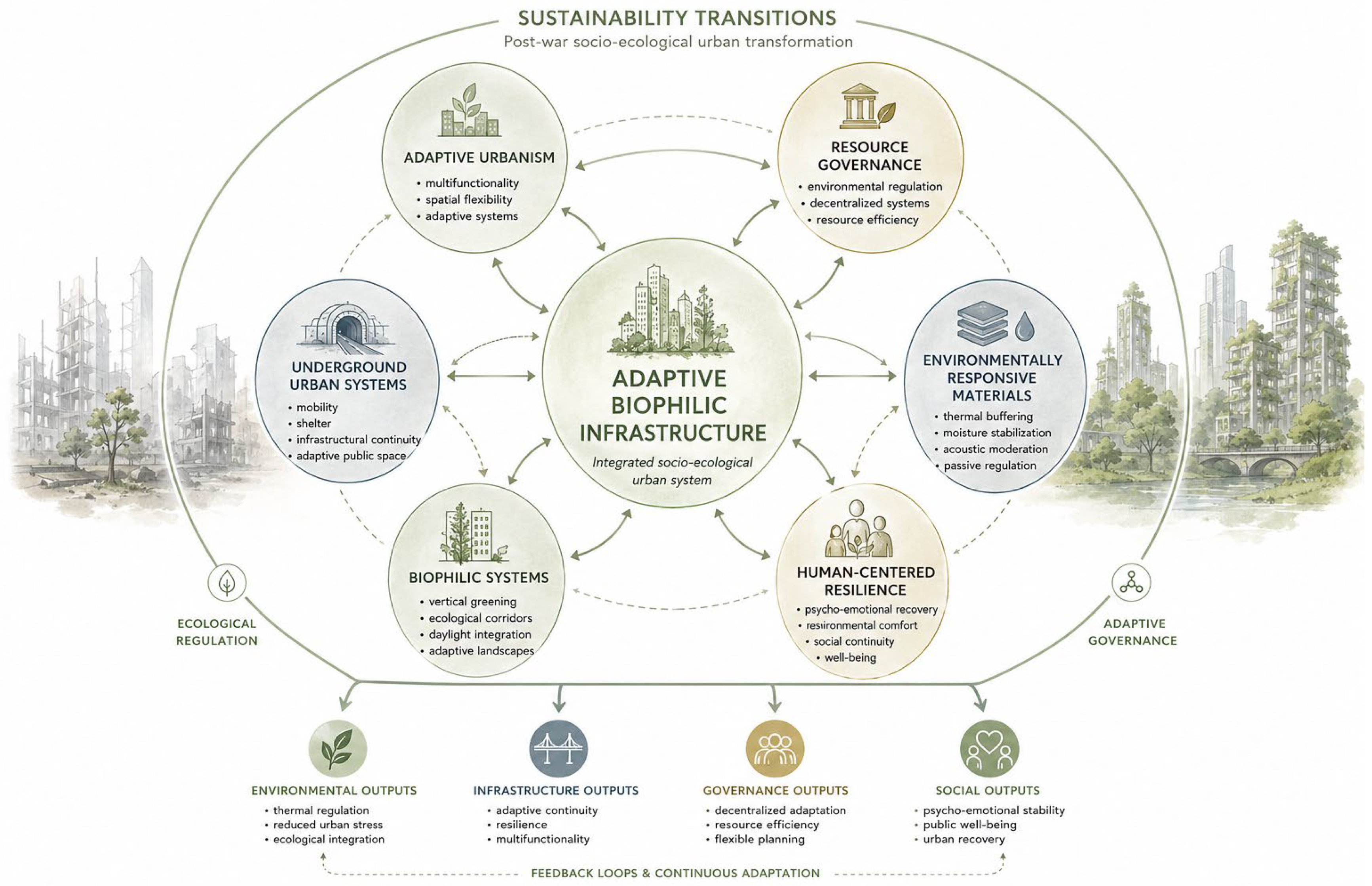
2.1. Conceptual Framework
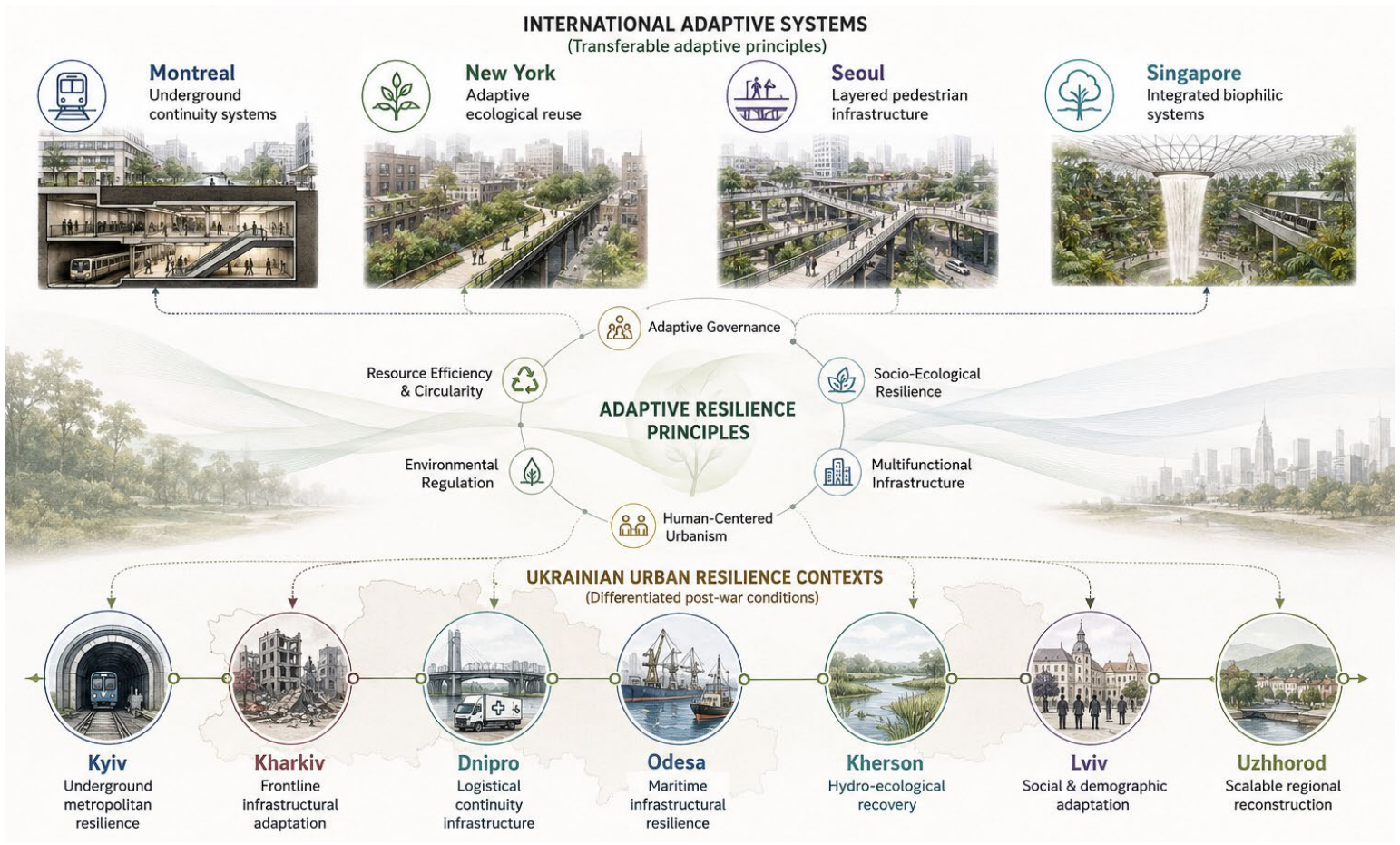
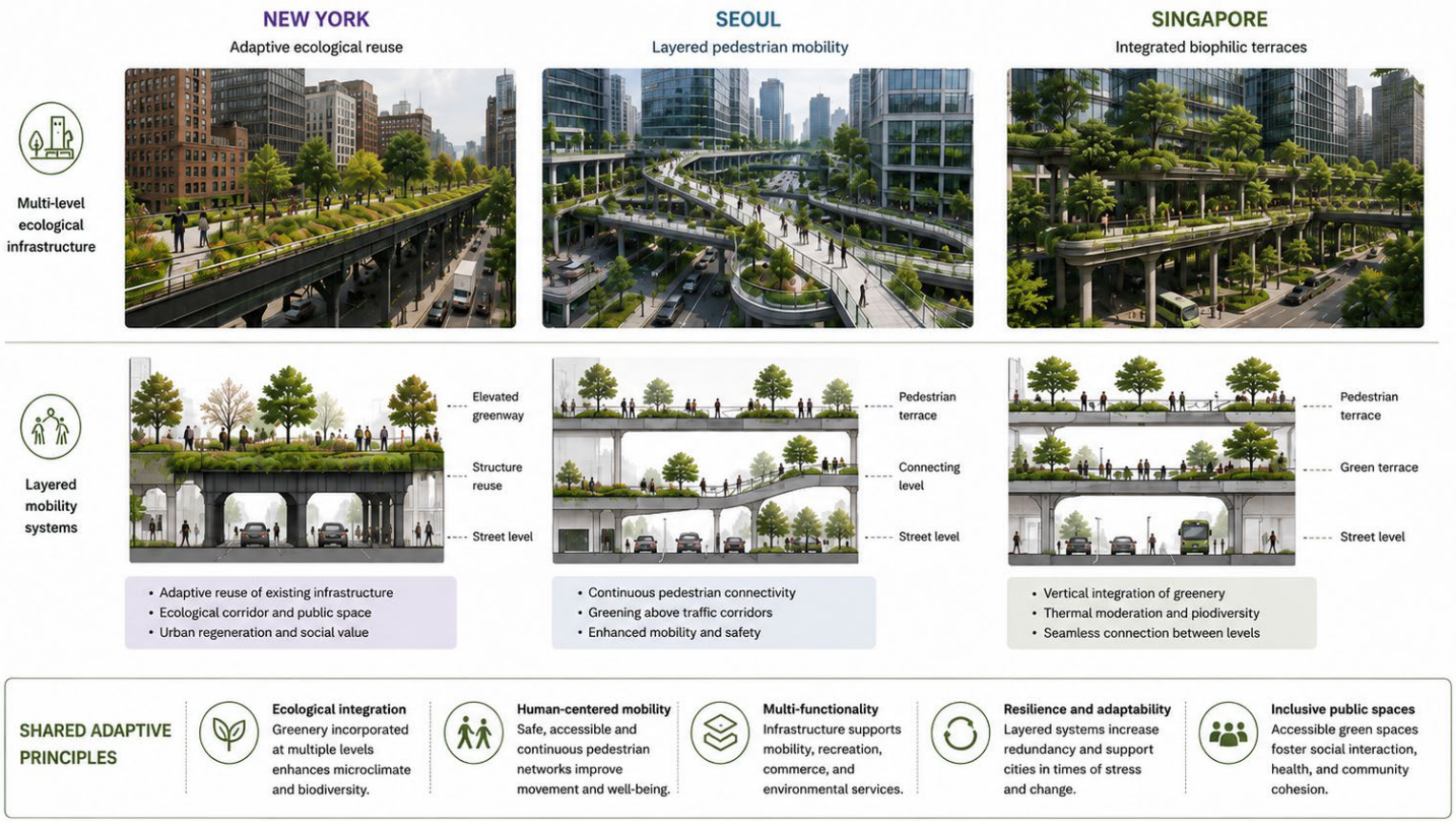
2.2. Comparative Urban Case Analysis
2.3. Experimental Assessment of Eco-Modified Materials
3. Results
3.1. Adaptive Biophilic Infrastructure and Urban Environmental Regulation
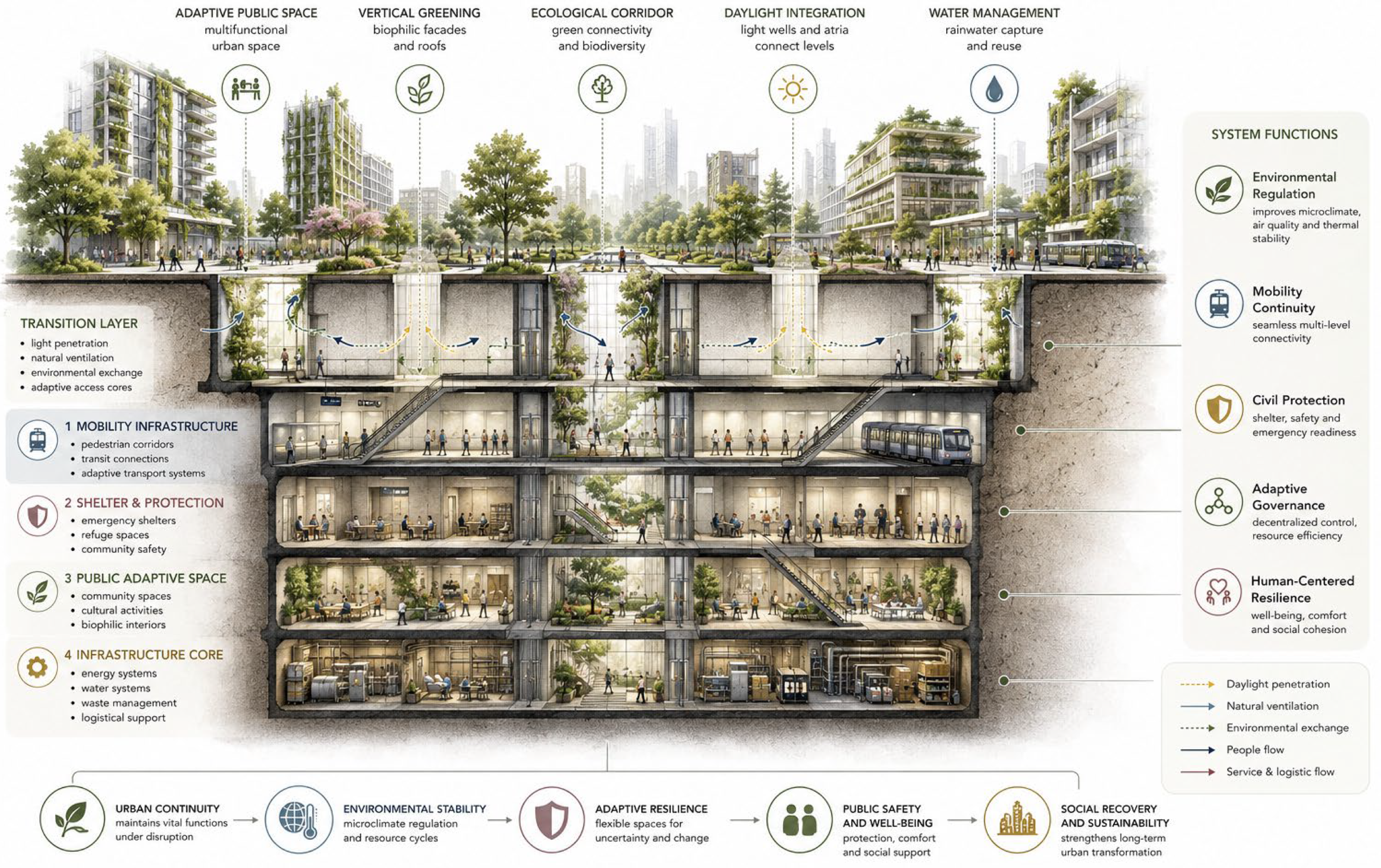
3.2. Underground Urban Systems and Post-War Resilience
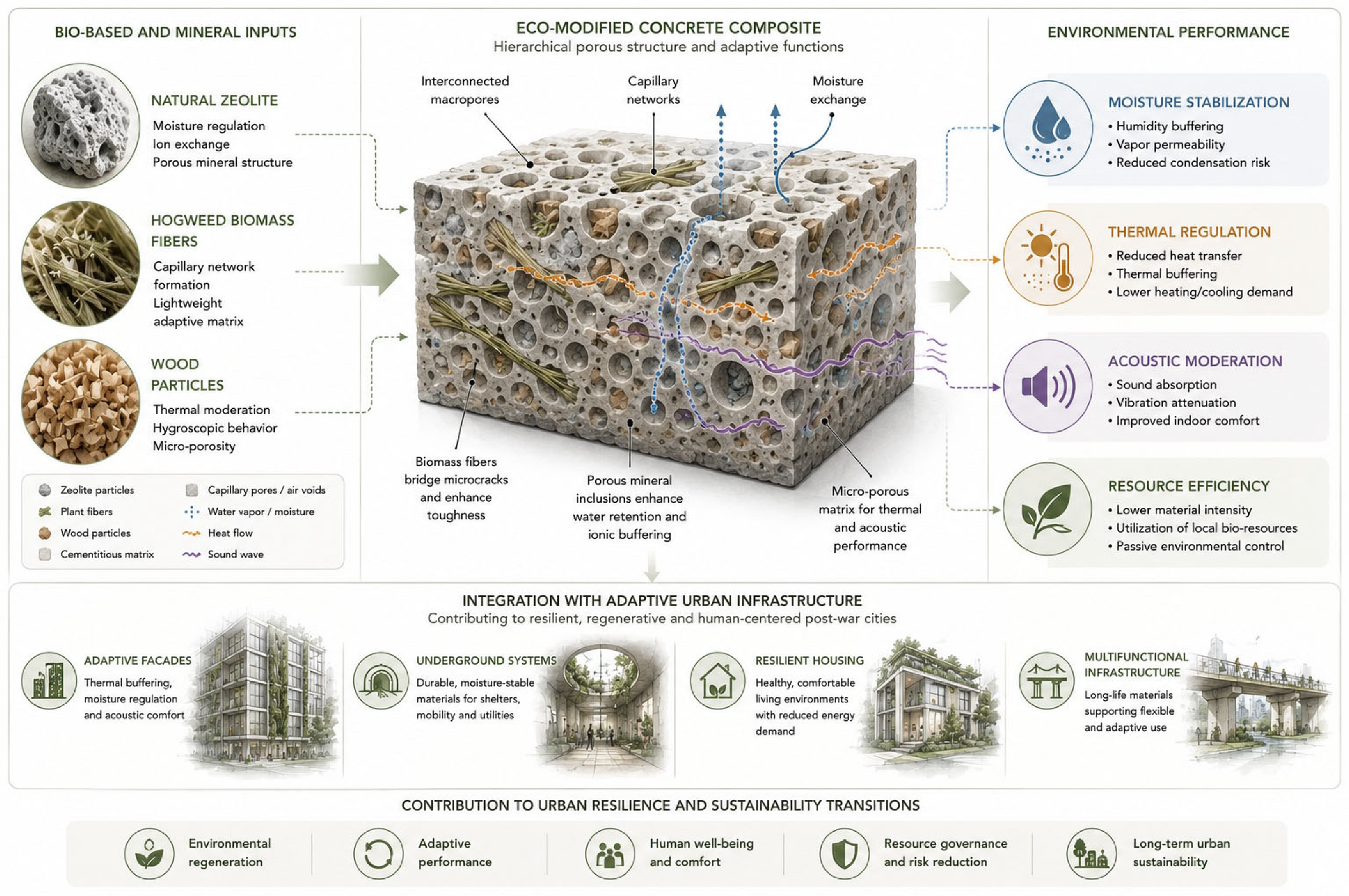
3.3. Performance of Eco-Modified Materials in Adaptive Urban Systems
4. Discussion
4.1. Adaptive Biophilic Infrastructure as Urban Governance Strategy
4.2. Socio-Ecological Resilience and Post-War Reconstruction
4.3. Environmentally Responsive Materials and Sustainability Transitions
4.4. Governance and Implementation Pathways for Post-War Reconstruction
5. Conclusions
Author Contributions
Funding
Institutional Review Board Statement
Informed Consent Statement
Data Availability Statement
Acknowledgments
Conflicts of Interest
References
- Batty, M. The New Science of Cities; MIT Press: Cambridge, MA, USA, 2017; ISBN 978-0-262-01952-1. [Google Scholar]
- Folke, C.; Carpenter, S.; Walker, B.; Scheffer, M.; Elmqvist, T.; Gunderson, L.; Holling, C.S. Regime Shifts, Resilience, and Biodiversity in Ecosystem Management. Annu. Rev. Ecol. Evol. Syst. 2004, 35, 557–581. [Google Scholar] [CrossRef] [Scilit]
- Meerow, S.; Newell, J.P.; Stults, M. Defining Urban Resilience: A Review. Landsc. Urban Plan. 2016, 147, 38–49. [Google Scholar] [CrossRef] [Scilit]
- Agboola, O.P.; Uzun, T.I.; Soydaş Çakır, H. Harnessing Adaptive Urban Service Frameworks and Smart Technologies for Sustainable Urban Development in Rapidly Urbanising Cities. Sustain. Futures 2026, 11, 101682. [Google Scholar] [CrossRef] [Scilit]
- United Nations. World Urbanization Prospects 2025: Summary of Results; UN DESA/POP/2025/TR/ NO. 12; United Nations: New York, NY, USA, 2025. [Google Scholar]
- Seto, K.C.; Güneralp, B.; Hutyra, L.R. Global Forecasts of Urban Expansion to 2030 and Direct Impacts on Biodiversity and Carbon Pools. Proc. Natl. Acad. Sci. USA 2012, 109, 16083–16088. [Google Scholar] [CrossRef] [Scilit] [PubMed]
- Raihan, A. Sustainable Human Settlements in the 21st Century: A Multidimensional Review of Challenges and Solutions. Hum. Settl. Sustain. 2026, 2, 83–107. [Google Scholar] [CrossRef] [Scilit]
- Beatley, T. Biophilic Cities: Integrating Nature into Urban Design and Planning; Island Press: Washington, DC, USA, 2011; ISBN 978-1-59726-715-1. [Google Scholar]
- Beatley, T.; Newman, P. Biophilic Cities Are Sustainable, Resilient Cities. Sustainability 2013, 5, 3328–3345. [Google Scholar] [CrossRef] [Scilit]
- Newman, P.; Beatley, T.; Boyer, H. Resilient Cities: Responding to Peak Oil and Climate Change; Island Press: Washington, DC, USA, 2009; ISBN 978-1-59726-498-3. [Google Scholar]
- Arnfield, A.J. Two Decades of Urban Climate Research: A Review of Turbulence, Exchanges of Energy and Water, and the Urban Heat Island. Int. J. Climatol. 2003, 23, 1–26. [Google Scholar] [CrossRef] [Scilit]
- Oke, T.R. The Energetic Basis of the Urban Heat Island. Q. J. R. Meteorol. Soc. 1982, 108, 1–24. [Google Scholar] [CrossRef] [Scilit]
- Santamouris, M. Regulating the Damaged Thermostat of the Cities—Status, Impacts and Mitigation Challenges. Energy Build. 2015, 91, 43–56. [Google Scholar] [CrossRef] [Scilit]
- IPCC. Climate Change 2023: Synthesis Report. Contribution of Working Groups I, II and III to the Sixth Assessment Report of the Intergovernmental Panel on Climate Change. In AR6 Synthesis Report: Climate Change 2023; Intergovernmental Panel on Climate Change: Geneva, Switzerland, 2023. [Google Scholar]
- Menges, A. Morpho-Ecologies: Towards Heterogeneous Space. In Architecture Design; AA Publications: London, UK, 2008; ISBN 978-1-902902-53-1. [Google Scholar]
- Loonen, R.C.G.M.; Trčka, M.; Cóstola, D.; Hensen, J.L.M. Climate Adaptive Building Shells: State-of-the-Art and Future Challenges. Renew. Sustain. Energy Rev. 2013, 25, 483–493. [Google Scholar] [CrossRef] [Scilit]
- Velikov, K.; Thün, G. Responsive Building Envelopes: Characteristics and Evolving Paradigms. In Design and Construction of High-Performance Homes; Trubiano, F., Ed.; Routledge: London, UK, 2013; pp. 1–18. [Google Scholar]
- Zuidgeest, J.; van der Burgh, S.; Kalmeyer, B. Planning by Parameters. Archit. Des. 2013, 83, 92–95. [Google Scholar] [CrossRef] [Scilit]
- Geels, F.W. Technological Transitions as Evolutionary Reconfiguration Processes: A Multi-Level Perspective and a Case-Study. Res. Policy 2002, 31, 1257–1274. [Google Scholar] [CrossRef] [Scilit]
- Swilling, M.; Annecke, E. Just Transitions: Explorations of Sustainability in an Unfair World; UCT Press: Cape Town, South Africa, 2022; ISBN 978-1-920541-67-5. [Google Scholar]
- Walker, B.; Salt, D.; Reid, W. Resilience Thinking: Sustaining Ecosystems and People in a Changing World; Island Press: Washington, DC, USA, 2012; ISBN 978-1-59726-093-0. [Google Scholar]
- Kapucu, N.; Ge, Y.; Rott, E.; Isgandar, H. Urban Resilience: Multidimensional Perspectives, Challenges and Prospects for Future Research. Urban Gov. 2024, 4, 162–179. [Google Scholar] [CrossRef] [Scilit]
- Uhlíř, D.; Myslín, J. Enhancing Urban Resilience Through Project Management: Linking Strategy and Implementation: Research Article. Crisis Resil. 2026, 2, 28–42. [Google Scholar] [CrossRef] [Scilit]
- Kellert, S.R.; Heerwagen, J.; Mador, M. Biophilic Design: The Theory, Science and Practice of Bringing Buildings to Life; Wiley: Hoboken, NJ, USA, 2008; ISBN 978-0-470-16334-4. [Google Scholar]
- Chen, S.; Olivieri, F.; Peng, L.; Li, J. Benefits and Monetary Values of Vertical Greening Systems: A Semi-Systematic Review. Build. Environ. 2025, 284, 113463. [Google Scholar] [CrossRef] [Scilit]
- Dominici, L.; Comino, E.; Torpy, F.; Irga, P. Vertical Greening Systems: A Critical Comparison of Do-It-Yourself Designs. Plants 2022, 11, 3230. [Google Scholar] [CrossRef] [Scilit] [PubMed]
- Pérez-Urrestarazu, L.; Fernández-Cañero, R.; Franco-Salas, A.; Egea, G. Vertical Greening Systems and Sustainable Cities. J. Urban Technol. 2015, 22, 65–85. [Google Scholar] [CrossRef] [Scilit]
- Allen, J.G.; MacNaughton, P.; Laurent, J.G.C.; Flanigan, S.S.; Eitland, E.S.; Spengler, J.D. Green Buildings and Health. Curr. Environ. Health Rep. 2015, 2, 250–258. [Google Scholar] [CrossRef] [Scilit] [PubMed]
- Russo, A.; Cirella, G.T. Urban Ecosystem Services: New Findings for Landscape Architects, Urban Planners, and Policymakers. Land 2021, 10, 88. [Google Scholar] [CrossRef] [Scilit]
- Bélanger, P. Landscape as Infrastructure. Landsc. J. 2009, 28, 79–95. [Google Scholar] [CrossRef] [Scilit]
- Graham, S. Vertical: The City from Satellites to Bunkers; Verso: London, UK, 2016; ISBN 978-1-78168-793-2. [Google Scholar]
- Lindner, C.; Rosa, B.; Baker, T.; Brash, J.; Birge-Liberman, P.; Corner, J.; Larson, S.; Loughran, K.; Millington, N.; Patrick, D.; et al. Deconstructing the High Line: Postindustrial Urbanism and the Rise of the Elevated Park; Rutgers University Press: New Brunswick, NJ, USA, 2017; ISBN 978-0-8135-7645-9. [Google Scholar]
- Anand, V.; Kadiri, V.L.; Putcha, C. Passive Buildings: A State-of-the-Art Review. J. Infrastruct. Preserv. Resil. 2023, 4, 3. [Google Scholar] [CrossRef] [Scilit] [PubMed]
- Parracho, D.F.R.; Nour El-Din, M.; Esmaeili, I.; Freitas, S.S.; Rodrigues, L.; Poças Martins, J.; Corvacho, H.; Delgado, J.M.P.Q.; Guimarães, A.S. Modular Construction in the Digital Age: A Systematic Review on Smart and Sustainable Innovations. Buildings 2025, 15, 765. [Google Scholar] [CrossRef] [Scilit]
- Ashby, M.F. Materials and the Environment: Eco-Informed Material Choice; Butterworth-Heinemann: Amsterdam, The Netherlands, 2009; ISBN 978-1-85617-608-8. [Google Scholar]
- Berge, B.; Butters, C.; Henley, F. The Ecology of Building Materials; Architectural Press: Amsterdam, The Netherlands, 2009; ISBN 978-1-85617-537-1. [Google Scholar]
- Pacheco-Torgal, F.; Jalali, S.; Labrincha, J.; John, V.M. (Eds.) Eco-Efficient Concrete; Woodhead Publishing: Cambridge, UK, 2013; ISBN 978-0-85709-424-7. [Google Scholar]
- Rosa Latapie, S.; Abou-Chakra, A.; Sabathier, V. Microstructure of Bio-Based Building Materials: New Insights into the Hysteresis Phenomenon and Its Consequences. Buildings 2023, 13, 1650. [Google Scholar] [CrossRef] [Scilit]
- Ahmad, W.; McCormack, S.J.; Byrne, A. Biocomposites for Sustainable Construction: A Review of Material Properties, Applications, Research Gaps, and Contribution to Circular Economy. J. Build. Eng. 2025, 105, 112525. [Google Scholar] [CrossRef] [Scilit]
- Zeng, H.; Tao, S.; Yang, J.; Xu, J.; Chu, H.; Huang, F.; Gao, S.; Zhang, C. A Novel Nutrient-Rich Biochar Modified Eco-Concrete with Simultaneously Enhanced Mechanical and Planting Performance. Case Stud. Constr. Mater. 2025, 23, e05382. [Google Scholar] [CrossRef] [Scilit]
- Belkhiri, K.; Onescu, I.; Szitar-Sirbu, M.-A. Integrating Sustainability into Urban Planning: A Systematic Review of Policies Addressing Hazard Risks and Climate Change. Sustainability 2026, 18, 2068. [Google Scholar] [CrossRef] [Scilit]
- Mazaherylaghab, H. Green Infrastructure Planning and Balanced Territorial Development: Insights from Milan Rural Metropolis. J. Environ. Manag. 2025, 390, 126300. [Google Scholar] [CrossRef] [Scilit] [PubMed]
- Silva, C.; Zhang, S.; Sun, T.; Xue, S. Operationalising ‘Integral Density’: A Procedural Approach for the Planning and Assessment of High-Density Environments. Urban Des. Int. 2026. [Google Scholar] [CrossRef] [Scilit]
- Coppens, T.; Van Acker, M.; Machiels, T.; Compernolle, T. A Real Options Framework for Adaptive Urban Design. J. Urban Des. 2021, 26, 681–698. [Google Scholar] [CrossRef] [Scilit]
- Tsahor, M.; Katoshevski-Cavari, R.; Alfasi, N. Assessing Urban Adaptability: The Key Is in the Land Use Plan. Land Use Policy 2023, 126, 106508. [Google Scholar] [CrossRef] [Scilit]
- Torrens, J.; Westman, L.; Wolfram, M.; Broto, V.C.; Barnes, J.; Egermann, M.; Ehnert, F.; Frantzeskaki, N.; Fratini, C.F.; Håkansson, I.; et al. Advancing Urban Transitions and Transformations Research. Environ. Innov. Soc. Transit. 2021, 41, 102–105. [Google Scholar] [CrossRef] [Scilit]
- Li, Y.; Beeton, R.J.S.; Zhao, X.; Fan, Y.; Yang, Q.; Li, J.; Ding, L. Advancing Urban Sustainability Transitions: A Framework for Understanding Urban Complexity and Enhancing Integrative Transformations. Humanit. Soc. Sci. Commun. 2024, 11, 1064. [Google Scholar] [CrossRef] [Scilit]
- Tekin, B.H.; Izmir Tunahan, G.; Disci, Z.N.; Ozer, H.S. Biophilic Design in the Built Environment: Trends, Gaps and Future Directions. Buildings 2025, 15, 2516. [Google Scholar] [CrossRef] [Scilit]
- Sholanke, A.B.; Adebisi, A.S. Review of Biophilic Design Concept as a Sustainable Approach in Architecture. Front. Sustain. Cities 2026, 8, 1797670. [Google Scholar] [CrossRef] [Scilit]
- Cirella, G.T. (Ed.) Sustainable Human–Nature Relations: Environmental Scholarship, Economic Evaluation, Urban Strategies; Advances in 21st Century Human Settlements; Springer: Singapore, 2020; ISBN 978-981-15-3048-7. [Google Scholar]
- Usip, E.; Essien, E.; Ema, I. A Review of Biophilic Architectural Design Strategies and Their Effects on Human Wellbeing in Contemporary Built Environments. Discov. Environ. 2026, 4, 170. [Google Scholar] [CrossRef] [Scilit]
- Manyani, A.; Biggs, R.; Hill, L.; Preiser, R. The Evolution of Social-Ecological Systems (SES) Research: A Co-Authorship and Co-Citation Network Analysis. Ecol. Soc. 2024, 29, 33. [Google Scholar] [CrossRef] [Scilit]
- Wang, Y.; Gong, J.; Yang, Z.; Zhu, Y. Social-Ecological System Research in a Changing World: State of the Art and Future Challenges. J. Clean. Prod. 2025, 489, 144725. [Google Scholar] [CrossRef] [Scilit]
- Bulkeley, H.; Betsill, M.M. Revisiting the Urban Politics of Climate Change. Environ. Politics 2013, 22, 136–154. [Google Scholar] [CrossRef] [Scilit]
- Robinson, J. Cities in a World of Cities: The Comparative Gesture. Int. J. Urban Reg. Res. 2011, 35, 1–23. [Google Scholar] [CrossRef] [Scilit]
- Ward, K. Towards a Relational Comparative Approach to the Study of Cities. Prog. Hum. Geogr. 2010, 34, 471–487. [Google Scholar] [CrossRef] [Scilit]
- Galik, A.; Bąk, M.; Bałandynowicz-Panfil, K.; Cirella, G.T. Evaluating Labour Market Flexibility Using the TOPSIS Method: Sustainable Industrial Relations. Sustainability 2022, 14, 526. [Google Scholar] [CrossRef] [Scilit]
- El-Geneidy, A.; Kastelberger, L.; Abdelhamid, H.T. Montréal’s Roots: Exploring the Growth of Montréal’s Indoor City. J. Transp. Land Use 2011, 4, 33–46. [Google Scholar] [CrossRef] [Scilit]
- Jo Black, K.; Richards, M. Eco-Gentrification and Who Benefits from Urban Green Amenities: NYC’s High Line. Landsc. Urban Plan. 2020, 204, 103900. [Google Scholar] [CrossRef] [Scilit]
- De Block, G.; Vicenzotti, V.; Diedrich, L. Revisiting the High Line as Sociopolitical Project. J. Landsc. Archit. 2019, 14, 72–73. [Google Scholar] [CrossRef] [Scilit]
- Hong, Y. Actual Condition of Seoullo 7017 Overpass Regeneration Project Based on Field Surveys. Front. Archit. Res. 2018, 7, 415–423. [Google Scholar] [CrossRef] [Scilit]
- Choung, E.; Park, S.; Choi, S.; Yoon, H. Urban Regeneration, Tourism, and Sustainability: A Critical Assessment of Seoullo 7017. Sustainability 2026, 18, 4160. [Google Scholar] [CrossRef] [Scilit]
- Thomson, G.; Newman, P. Green Infrastructure and Biophilic Urbanism as Tools for Integrating Resource Efficient and Ecological Cities. Urban Plan. 2021, 6, 75–88. [Google Scholar] [CrossRef] [Scilit]
- Newman, P. Biophilic Urbanism: A Case Study on Singapore. Aust. Plan. 2014, 51, 47–65. [Google Scholar] [CrossRef] [Scilit]
- Cirella, G.T.; Tao, L. The Index of Sustainable Functionality: An Application for Measuring Sustainability. World Acad. Sci. Eng. Technol. Int. J. Humanit. Soc. Sci. 2009, 3, 268–274. [Google Scholar] [CrossRef]
- Bertin, I.; Lebrun, F.; Braham, N.; Le Roy, R. Construction, Deconstruction, Reuse of the Structural Elements: The Circular Economy to Reach Zero Carbon. IOP Conf. Ser. Earth Environ. Sci. 2019, 323, 012020. [Google Scholar] [CrossRef] [Scilit]
- Ben Rjiba, I.; Tóth-Nagy, G.; Kristófné, É.M.; Sebestyén, V. Comparative Environmental Assessment of Construction Materials in Climate Action Projects. Results Eng. 2026, 29, 109796. [Google Scholar] [CrossRef] [Scilit]
- Pancaldi, F.; van den Oever, M.; van der Weide, R.; van Baren, S.; Abdulbawab, S.; van Rooij, S.; van Buuren, M.; van der Voort, M.; van Kampen, A.; Trindade, L.M. Prospects for Using Plant-Based Biomass in the Construction of Bio-Based Houses. Front. Plant Sci. 2025, 16, 1697154. [Google Scholar] [CrossRef] [Scilit] [PubMed]
- Snehal, K.; Manimaran, N.; Basuroy, D.; Maity, S.; Chaunsali, P. Beneficial Utilization of Biomass Waste in Construction Material: Research Monograph. Res. Data Rep. 2025, 1, 1–68. [Google Scholar] [CrossRef] [Scilit]
- Sarsenbayev, B.; Murtazaev, S.-A.; Salamanova, M.; Kuldeyev, E.; Saidumov, M.; Sarsenbayev, N.; Auyesbek, S.; Sauganova, G.; Abduova, A. Utilization of Anthropogenic and Natural Waste to Produce Construction Raw Materials. Sustainability 2025, 17, 2791. [Google Scholar] [CrossRef] [Scilit]
- Colella, C. Natural Zeolites in Environmentally Friendly Processes and Applications. Stud. Surf. Sci. Catal. 1999, 125, 641–655. [Google Scholar] [CrossRef] [Scilit]
- Colella, C.; de’ Gennaro, M.; Aiello, R. Use of Zeolitic Tuff in the Building Industry. Rev. Mineral. Geochem. 2001, 45, 551–587. [Google Scholar] [CrossRef] [Scilit]
- Meenu, P.C.; Meena, B.; Smirniotis, P.G. A Review on the Applications of Various Zeolites and Molecular Sieve Catalysts for Different Gas Phase Reactions: Present Trends in Research and Future Directions. Processes 2026, 14, 132. [Google Scholar] [CrossRef] [Scilit]
- Senila, M.; Cadar, O. Modification of Natural Zeolites and Their Applications for Heavy Metal Removal from Polluted Environments: Challenges, Recent Advances, and Perspectives. Heliyon 2024, 10, e25303. [Google Scholar] [CrossRef] [Scilit] [PubMed]
- Slavova, M.; Slavov, I.; Terziev, V.; Mladenova, E.; Abrashev, B. Application of Zeolite and Comparable Porous Materials for Enhancing the Performance of Different Types of Secondary Batteries: A Review Article. J. Energy Storage 2024, 98, 112949. [Google Scholar] [CrossRef] [Scilit]
- Célino, A.; Fréour, S.; Jacquemin, F.; Casari, P. The Hygroscopic Behavior of Plant Fibers: A Review. Front. Chem. 2014, 1, 43. [Google Scholar] [CrossRef] [Scilit] [PubMed]
- Tilioua, A.; Benallel, A.; Khrissi, Y. Assessment of Thermal, Hygroscopic, and Mechanical Properties of Plant Fiber-Reinforced Resin Composites for Eco-Friendly Building Insulation. Ind. Crops Prod. 2025, 236, 121851. [Google Scholar] [CrossRef] [Scilit]
- Gentile, V.; Libralato, M.; Fantucci, S.; Shtrepi, L.; Autretto, G. Enhancement of the Hygroscopic and Acoustic Properties of Indoor Plasters with a Super Adsorbent Calcium Alginate BioPolymer. J. Build. Eng. 2023, 76, 107147. [Google Scholar] [CrossRef] [Scilit]
- EN 12390-4; Testing Hardened Concrete-Part 4: Compressive Strength-Specification for Testing Machines. CEN: Brussels, Belgium, 2025.
- Pérez, G.; Coma, J.; Martorell, I.; Cabeza, L.F. Vertical Greenery Systems (VGS) for Energy Saving in Buildings: A Review. Renew. Sustain. Energy Rev. 2014, 39, 139–165. [Google Scholar] [CrossRef] [Scilit]
- Perini, K.; Ottelé, M.; Fraaij, A.L.A.; Haas, E.M.; Raiteri, R. Vertical Greening Systems and the Effect on Air Flow and Temperature on the Building Envelope. Build. Environ. 2011, 46, 2287–2294. [Google Scholar] [CrossRef] [Scilit]
- Spring, C.; Cirella, G.T. Fostering Sustainable Development: Green Energy Policy in the European Union and the United States. In Human Settlements: Urbanization, Smart Sector Development, and Future Outlook; Springer: Singapore, 2022; pp. 101–137. ISBN 978-981-16-4030-8. [Google Scholar]
- Deb, A.; Sultana, H. Urban Resilience: Assessment of Performance and Science Mapping from a Climate Change Perspective. Sustain. Environ. 2024, 10, 2388936. [Google Scholar] [CrossRef] [Scilit]
- Naderi, A.; Khoshnevis, K. The Sustainable Future of Cities Under Uncertainty: Identifying Key Factors of Adaptive Urban Resilience in Yazd, Iran. Ain Shams Eng. J. 2025, 16, 103732. [Google Scholar] [CrossRef] [Scilit]
- Cirella, G.T. Handbook on Post-War Reconstruction and Development Economics of Ukraine: Catalyzing Progress; Contributions to Economics; Springer International Publishing: Cham, Switzerland, 2024; ISBN 978-3-031-48734-7. [Google Scholar]



| Urban Context | Primary Adaptive Function | Infrastructure Type | Ecological Integration | Resilience Contribution | Reconstruction Relevance |
|---|---|---|---|---|---|
| Montreal | Underground continuity | Subterranean systems | Moderate | Climatic continuity | Underground resilience |
| New York | Adaptive ecological reuse | Elevated infrastructure | High | Public-space regeneration | Adaptive reuse |
| Seoul | Layered pedestrian mobility | Multi-level mobility | High | Connectivity resilience | Pedestrian adaptation |
| Singapore | Integrated biophilic systems | Environmental infrastructure | Very high | Environmental regulation | Human-centered resilience |
| Kyiv | Underground metropolitan resilience | Metro/shelter systems | Moderate | Civil continuity | Post-war underground adaptation |
| Kharkiv | Frontline infrastructural adaptation | Emergency infrastructure | Moderate | Urban continuity | Crisis resilience |
| Dnipro | Logistical continuity | Adaptive public systems | Moderate | Operational continuity | Regional stabilization |
| Odesa | Maritime resilience | Port infrastructure | Moderate | Strategic continuity | Coastal vulnerability |
| Kherson | Hydro-ecological recovery | Water systems | High | Environmental recovery | Ecological resilience |
| Lviv | Demographic adaptation | Public/social infrastructure | Moderate | Social resilience | Displacement adaptation |
| Uzhhorod | Regional adaptive reconstruction | Scalable urban systems | Moderate | Decentralized resilience | Scalable reconstruction |
| Material Component | Functional Role | Environmental Contribution | Adaptive Performance Characteristic | Urban Sustainability Relevance |
|---|---|---|---|---|
| Natural zeolite | Porous mineral additive | Moisture stabilization | Hygroscopic regulation | Passive climate control |
| Wood particles | Biomass inclusion | Thermal moderation | Reduced thermal conductivity | Energy efficiency |
| Hogweed biomass | Capillary modifier | Moisture exchange | Microporous regulation | Environmental responsiveness |
| Porous concrete matrix | Structural-environmental system | Acoustic moderation | Thermal buffering | Adaptive infrastructure |
| Eco-modified composite | Integrated adaptive material | Resource efficiency | Multifunctional regulation | Sustainable reconstruction |
Disclaimer/Publisher’s Note: The statements, opinions and data contained in all publications are solely those of the individual author(s) and contributor(s) and not of MDPI and/or the editor(s). MDPI and/or the editor(s) disclaim responsibility for any injury to people or property resulting from any ideas, methods, instructions or products referred to in the content. |
© 2026 by the authors. Licensee MDPI, Basel, Switzerland. This article is an open access article distributed under the terms and conditions of the Creative Commons Attribution (CC BY) license.
Share and Cite
Kaynts, D.; Mykaylo, O.; Cirella, G.T. Adaptive Biophilic Infrastructure and Resource Governance in Post-War Ukrainian Cities. Sustainability 2026, 18, 6484. https://doi.org/10.3390/su18136484
Kaynts D, Mykaylo O, Cirella GT. Adaptive Biophilic Infrastructure and Resource Governance in Post-War Ukrainian Cities. Sustainability. 2026; 18(13):6484. https://doi.org/10.3390/su18136484
Chicago/Turabian StyleKaynts, Diana, Oksana Mykaylo, and Giuseppe T. Cirella. 2026. "Adaptive Biophilic Infrastructure and Resource Governance in Post-War Ukrainian Cities" Sustainability 18, no. 13: 6484. https://doi.org/10.3390/su18136484
APA StyleKaynts, D., Mykaylo, O., & Cirella, G. T. (2026). Adaptive Biophilic Infrastructure and Resource Governance in Post-War Ukrainian Cities. Sustainability, 18(13), 6484. https://doi.org/10.3390/su18136484