1. Introduction
Rice is one of the most important staple crops worldwide, and its stable production is fundamental to food security and nutrition [
1,
2]. Maintaining rice production under increasing land, water, and climate constraints remains essential for food security in major rice-producing regions [
1]. However, conventional transplanted rice production has long relied on nursery raising, transplanting, and continuous shallow flooding, which require substantial labor inputs and large amounts of irrigation water [
3]. With rising agricultural labor costs and increasing constraints on water resources, direct-seeded rice has been widely regarded as an important alternative to conventional transplanted rice because of its lower labor requirement, water-saving potential, and higher operational efficiency. Previous studies have shown that direct-seeded rice has clear advantages in reducing labor demand and improving production efficiency, but it also faces challenges such as weed competition, lodging risk, more difficult nutrient management, and insufficient stability in yield and grain quality [
4,
5,
6]. In China, the expansion of direct-seeded rice, particularly in regions such as the Yangtze River Basin, is often accompanied by changes in yield performance, fertilizer use, pesticide input, and field management practices [
7,
8,
9]. Farm survey evidence further indicates that the adoption of direct-seeded rice can alter input-use patterns, suggesting that its production and environmental effects should be evaluated in an integrated manner [
7,
9]. Therefore, direct-seeded rice should not be viewed merely as a labor-saving alternative, but rather as a production system in which resource inputs, nitrogen-related environmental risk, and yield formation must be coordinated.
In paddy rice production, water management is a key factor regulating resource-use efficiency and environmental outcomes. Nitrogen transport in paddy fields is strongly governed by hydrological processes; therefore, irrigation practices and drainage regimes directly affect nitrogen transfer and export within the soil–floodwater system. Previous studies have shown that nitrogen export from paddy fields is strongly event-driven, with early drainage generated by rainfall or overflow after fertilization often contributing disproportionately to total nitrogen export [
10]. Field evidence shows that paddy-field runoff losses of nitrogen and phosphorus are affected by fertilization, water-management, and drainage conditions, with consequences for nutrient losses and rice yield [
11,
12,
13]. Thus, identifying and controlling critical post-fertilization drainage events is central to reducing drainage-related TN export from paddy fields.
From the broader perspective of water saving and environmental performance, a global meta-analysis of alternate wetting and drying irrigation showed that this practice can generally maintain rice yield while reducing global warming potential, provided that wetting–drying thresholds are properly managed to balance productivity and environmental outcomes [
14]. These findings suggest that water-saving irrigation practices, such as controlled irrigation, may not only improve water-use efficiency but also provide a process basis for mitigating drainage-related nitrogen export and optimizing water–nitrogen management by regulating drainage processes and nitrogen transport pathways [
12,
15,
16]. However, different rice establishment methods may respond differently to a single water-management practice. Direct-seeded rice may be more vulnerable to seedling-establishment and nutrient-management constraints, and its establishment characteristics can increase sensitivity to rainfall- or overflow-driven nitrogen-export risk after fertilization [
8,
10]. In addition, maintaining late-season crop status under stresses such as high temperature can be more difficult, increasing the challenge of sustaining yield stability. By contrast, mechanically transplanted rice usually exhibits more stable canopy establishment and yield performance. These differences suggest that, in high-risk cultivation systems such as direct-seeded rice, relying solely on water management may be insufficient to simultaneously control nitrogen-export risk and ensure yield stability. It is therefore necessary to evaluate strategies that integrate water regulation with early-stage measures for root-zone nutrient regulation and late-stage measures for crop regulation. Against this background, the present study focuses on the overall effects of a controlled-irrigation-based integrated management regime, combined with functional basal fertilizer and foliar regulation at key growth stages, under different rice establishment systems.
In addition to water regulation, early-stage root-zone nutrient regulation may be important for reducing post-fertilization nitrogen-export risk while supporting crop establishment. Functional fertilizer additives such as poly-γ-glutamic acid, fulvic acid, silicon-based materials, and plant-growth-promoting microorganisms have been reported to influence nutrient retention, root-zone nutrient availability, root growth, and crop stress tolerance. For example, polyglutamic-acid-based materials have been used in fertilizer design to regulate nitrogen budget and crop performance in rice fields [
17], fulvic acid has been reported to improve rice seedling performance and phosphorus uptake under low-phosphorus stress [
18], nano-silicon has been associated with improved rice seedling growth and stress tolerance under salt-stress conditions [
19], and
Lysinibacillus sphaericus has been identified as a rice-rhizosphere phosphorus-solubilizing bacterium with plant-growth-promoting potential [
20]. In the present study, these components were not evaluated as independent factors; rather, they were incorporated into the optimized basal fertilizer as a complementary early-stage nutrient-regulation component of the integrated management regime. This design was intended to support early crop establishment and nutrient retention without changing the total N–P–K input, thereby allowing the field performance of the integrated regime to be evaluated under comparable nutrient-input conditions.
Nevertheless, the evaluation of such system-level integrated management regimes remains insufficient. First, previous studies on nitrogen-export mitigation through controlled irrigation have mainly focused on transplanted rice or general paddy-field systems, whereas the characteristics of TN export during critical drainage events under direct-seeded rice remain less well understood [
21]. Second, existing studies have often examined the effects of water management on nitrogen export, water use, or yield formation separately, with limited systematic evaluation of the overall field performance of a controlled-irrigation-based integrated management regime combined with complementary agronomic measures. In particular, few studies have linked nitrogen export during critical drainage events with soil mineral N dynamics, yield formation, and late-season SPAD-based leaf status under both direct-seeded and mechanically transplanted rice systems. Therefore, a comparative field evaluation of integrated management across these two establishment systems is needed [
5,
6,
8].
We hypothesized that the integrated management regime, which combined controlled irrigation with functional basal fertilizer and key-stage foliar regulation, would reduce the drainage volume and monitored-event TN export while sustaining the grain yield in both rice establishment systems, and that the relative improvement would be more pronounced in direct-seeded rice because of its higher baseline drainage-related nitrogen-export risk.
Accordingly, this study was conducted as a production-field experiment in the lower Yangtze River region, China, with traditional and optimized treatments established under both direct-seeded and mechanically transplanted rice systems. The objectives were to (1) quantify TN concentration dynamics and cumulative TN export loads during monitored drainage events; (2) evaluate soil mineral N dynamics and stage-specific water-regime implementation under the optimized treatments; and (3) compare yield formation and grain quality responses between the two establishment systems. By evaluating these processes together, this study aimed to clarify the overall field performance and limitations of the integrated management regime rather than separating the individual contribution of each management component.
2. Materials and Methods
2.1. Experimental Site and Conditions
The experiment was conducted during the 2025 rice-growing season at a rice production base in Qinwang Village, Cheluo Town, Gaoyou City, Jiangsu Province, China (119°30′ E, 32°44′ N;
Figure S1). The experimental site is located in the Lixiahe Plain of the Yangtze River Delta, a typical rice–wheat rotation region with a northern subtropical monsoon climate. According to long-term climatological statistics provided by the Gaoyou meteorological authority, the region has a mean annual temperature of 14.7 °C, annual sunshine duration of 2132.6 h, annual precipitation exceeding 1035 mm, precipitation mainly concentrated from June to September, mean annual evaporation of 1058 mm, and average frost-free period of approximately 240 days. Daily precipitation and mean air temperature during the experimental period are shown in
Figure S2. To evaluate the meteorological representativeness of the experimental growing season, daily meteorological records from the local meteorological station in Gaoyou City from 1994 to 2025 were additionally used to calculate monthly precipitation and mean air temperature from June to October. The 1994–2024 records were used as the long-term reference period, and the 2025 growing-season values were compared with these long-term averages to characterize precipitation deviations and temperature anomalies (
Figure S3 and
Table S4). Compared with the 1994–2024 long-term average, the 2025 rice-growing season had slightly higher June–October precipitation and a warmer mean air temperature, providing a relatively high drainage-risk and warm-season context for interpreting the field experiment.
The soil in the experimental field was hydromorphic paddy soil. Basic soil chemical properties of the 0–20 cm layer were determined before the experiment. Soil pH was measured in a 1:2.5 soil-to-water suspension using a pH meter (PHS-3E, Shanghai INESA Scientific Instrument Co., Ltd., Shanghai, China); soil organic matter was determined by the potassium dichromate oxidation method; total nitrogen by the Kjeldahl method; total phosphorus by molybdenum–antimony colorimetry after digestion; and total potassium by flame photometry after digestion. The 0–20 cm soil layer had an organic matter content of 28.7 g kg−1, a pH of 7.3, and total nitrogen, total phosphorus, and total potassium contents of 1.72, 1.35, and 20.12 g kg−1, respectively. The bulk density of the 0–30 cm soil layer was 1.30 g cm−3.
2.2. Experimental Design
The experiment was conducted in locally managed large-scale rice fields and was designed as a large-plot comparative experiment under production-field conditions. The rice cultivar used in this study was Nanjing 9108, a widely cultivated, high-quality japonica rice cultivar in the local rice-production area and suitable for local rice establishment systems. Four treatments were established by combining the rice establishment method and management regime: optimized mechanically transplanted rice (Opt-MT), optimized direct-seeded rice (Opt-DS), traditional direct-seeded rice (Trad-DS), and traditional mechanically transplanted rice (Trad-MT).
The optimized treatments were designed to address the main production and environmental constraints considered in this study: drainage-related TN export during post-fertilization events, early-stage nutrient regulation, and late-season canopy maintenance. Controlled irrigation served as the core hydrological measure for regulating field water status, increasing rainfall-storage capacity, and reducing drainage output during critical drainage-risk windows. The functional basal fertilizer was introduced at basal fertilization with the same N–P–K formulation as the conventional basal fertilizer, thereby incorporating early-stage root-zone nutrient regulation without changing the total N–P–K input. The selected functional basal fertilizer was chosen because it could be applied using the same basal-fertilization practice as the conventional compound fertilizer while maintaining the same N–P–K formulation. Its additives were considered technically compatible with the intended early-stage root-zone nutrient-regulation function of the optimized regime, rather than being tested as individually optimized or universally superior components. Foliar regulation was applied during high-temperature-sensitive growth periods to support late-season leaf functional maintenance and grain filling. Thus, the optimized treatment represented a controlled-irrigation-based integrated management regime targeting linked hydrological, nutrient-regulation, and canopy-maintenance processes, rather than a test of any single agronomic component. The traditional treatments followed local conventional flooding irrigation and fertilization practices. Each treatment included three relatively independent production plots as replicates, and each experimental unit covered approximately 6500 m2. The replicate plots were distributed within the same production area, with comparable preceding crop, soil type, and irrigation and drainage conditions. Experimental units were separated by field bunds and equipped with relatively independent irrigation and drainage channels to minimize water cross-flow and nutrient exchange among treatments.
2.3. Water Management
Different water management regimes were implemented during the rice-growing season. The irrigation lower limits, irrigation upper limits, and water-layer control criteria for the traditional treatments are shown in
Table 1. The traditional treatments (Trad-MT and Trad-DS) followed the local conventional continuous flooding regime, in which a 30–50 mm water layer was maintained except during late-tillering field drying and final drainage at the yellow ripeness stage.
Water regulation in the optimized treatments (Opt-MT and Opt-DS) followed a controlled irrigation regime. After regreening, no long-term standing water layer was maintained. Instead, irrigation was scheduled according to stage-specific soil water thresholds expressed as percentages of saturated volumetric soil water content reference values for the corresponding root-zone observation layers, following established controlled-irrigation criteria (
Table 1). Soil volumetric water content was monitored at 08:00 to support irrigation decision-making, and irrigation was applied when the monitored value approached or fell below the corresponding lower limit. After irrigation, a shallow 30 mm water layer was established and then allowed to recede naturally. Relatively high rain-storage upper limits were set to enhance rainfall retention capacity and reduce surface runoff and drainage output under rainfall conditions. The θ
s-based reference values and root-zone observation layers adopted for interpreting the stage-specific controlled-irrigation thresholds are summarized in
Table S5, and field implementation of the optimized irrigation regime was evaluated using the monitored soil water content dynamics (
Figure S4).
2.4. Fertilizer Management
2.4.1. Fertilization Regime
To avoid confounding treatment effects with differences in nutrient input, the total nitrogen application rate was kept consistent across all treatments at 288 kg N ha
−1 during the entire growing season. The fertilization schedule, fertilizer types, and nutrient inputs for each treatment are shown in
Table 2.
The main difference among treatments was the type of basal fertilizer. The traditional treatments received conventional compound fertilizer (15–6–9), whereas the optimized treatments received drought-resistant functional fertilizer with the same N–P–K formulation (15–6–9). This functional fertilizer contained the same conventional N–P–K nutrients but was additionally fortified with poly-γ-glutamic acid (γ-PGA), fulvic acid, nano-silicon, and Lysinibacillus sphaericus as functional additives. The timing, fertilizer type, and application rate of tillering and panicle fertilizers were kept identical across treatments.
2.4.2. Foliar Regulation During High-Temperature Periods
Foliar regulation was applied only in the optimized treatments on 22 July and 23 August, corresponding to warm or high-temperature-sensitive growth periods during the rice-growing season. The maximum air temperatures during the three days leading up to the two applications averaged 33.16 °C and 34.88 °C, respectively. Each application included 0.02% dihydroporphyrin iron soluble powder at 45 g ha−1 (trade name: Bairui; registration No. PD20190031; Anqing Bostec Biological Engineering Co., Ltd., Anqing, China), polymerized phosphorus–potassium fertilizer at 750 mL ha−1 (P2O5 ≥ 42%, K2O ≥ 42%, and Zn + B ≥ 1%), and amino acid water-soluble fertilizer at 600 mL ha−1 (amino acids ≥ 240 g L−1, containing chelated Fe, Mn, Zn, and B). The three foliar products were tank-mixed and diluted in 600 L ha−1 of carrier water before spraying, which was within the label-recommended dilution ranges for the products.
These foliar applications represented the late-season canopy-regulation component of the optimized treatment.
2.5. Measurements and Calculations
2.5.1. Determination of Irrigation Amount
A field water-level gauge was installed in each experimental unit to continuously record changes in the surface water layer. Irrigation amount was determined in combination with field irrigation records. The amount of each irrigation event was calculated from the change in surface water level before and after irrigation and converted to water depth in mm according to plot area. Cumulative irrigation amount during the entire growing season was calculated as the sum of all irrigation events.
2.5.2. Monitoring of Critical Drainage Events and Calculation of TN Export Loads
An event-driven monitoring strategy was adopted to simultaneously monitor drainage volume and water quality during critical drainage events throughout the rice-growing season. Six critical events were monitored, including four rainfall-runoff events [21 June, heavy rainfall after basal fertilization; 29 June; 10 August, rainfall after panicle fertilization; and 24 September] and two management drainage events [21 July, irrigation overflow after tillering fertilization; and 31 July, drainage for field drying]. The cumulative loads from these monitored critical drainage events were used to characterize event-driven drainage-related TN export risk during the growing season.
Relatively independent plots were used as irrigation and drainage monitoring units for each treatment. Drainage flow and water samples were collected simultaneously at the outlet of each plot. After drainage began, outflow water samples were collected at 0, 30, 60, 120, 240, and 360 min to determine total nitrogen (TN) concentration in surface drainage water. TN concentration was determined using alkaline potassium persulfate digestion followed by ultraviolet spectrophotometry.
Event drainage volume was calculated by measuring instantaneous flow using the standard volumetric method and integrating the flow hydrograph by time intervals. Specifically, a fixed monitoring point was established at the drainage outlet of each experimental unit. A pre-calibrated 10 L container and a stopwatch accurate to 0.01 s were used to record the time required to collect a fixed outflow volume, from which the instantaneous flow rate was calculated. The flow rate was measured every 15 min during the first 0–60 min after drainage began, every 30 min during 60–180 min, and every 60 min during 180–360 min. Each measurement was repeated twice, and the mean value was used. A drainage event was considered to have ended when two consecutive flow measurements were both below 5% of the peak flow of that event and this condition persisted for at least 30 min. The drainage volume of each event was converted to drainage depth in mm according to plot area.
The event mean concentration (EMC) was calculated as follows:
where C
i is the TN concentration at the ith sampling time (mg L
−1), V
i is the outflow volume during the interval between two adjacent sampling times (L), and n is the number of sampling times during the event.
The TN export load of a single drainage event was calculated as follows:
where L
event is the TN export load of a single drainage event (kg ha
−1), and Q
event is the drainage depth of that event (mm).
The cumulative TN export load over the monitored drainage events was calculated as follows:
where L
cum is the cumulative TN export load over the monitored drainage events (kg ha
−1), and m is the total number of monitored drainage events.
2.5.3. Soil Sampling and Nitrogen Determination
Soil samples were collected at the regreening, mid-tillering, late-tillering, jointing–booting, heading, and yellow ripeness stages, corresponding to 22 June, 22 July, 4 August, 12 August, 5 September, and 12 October, respectively. Soil samples were collected from the 0–20 cm and 20–40 cm layers in each treatment, and composite samples were prepared using a multi-point mixing method for the determination of soil ammonium nitrogen and nitrate nitrogen.
Soil NH4+-N and NO3−-N were determined using a potassium chloride extraction–continuous-flow analysis method. Fresh soil passed through a 2 mm sieve was extracted with 2 mol L−1 KCl solution at a soil-to-solution ratio of 1:5. The suspension was shaken at 200 rpm for 30 min and then centrifuged at 8000 rpm for 10 min. The supernatant was filtered through a 0.45 μm membrane and analyzed for NH4+-N and NO3−-N using a continuous-flow analyzer (AA3, SEAL Analytical, Norderstedt, Germany).
2.5.4. Measurement of Tiller Dynamics, Yield, and Grain Quality
Tiller density was recorded at the early tillering, mid-tillering, late tillering, jointing, heading, milky, and yellow ripeness stages. Continuous observations were conducted at fixed sampling points within each replicate. At the yellow ripeness stage, SPAD values of the top three functional leaves were measured using a SPAD-502Plus chlorophyll meter (Konica Minolta, Osaka, Japan) to characterize relative leaf greenness.
Before harvest, representative samples were collected from each replicate to determine yield components. For mechanically transplanted rice, 10 hills were randomly selected; for direct-seeded rice, samples were collected from a 1 m2 quadrat. Effective panicle number, spikelets per panicle, seed-setting rate, and 1000-grain weight were then determined. At maturity, approximately 667 m2 in the central area of each replicate was harvested using a combine harvester. Grain weight and moisture content were measured, and actual yield was converted to a standard moisture content of 14.5%.
Harvested grain samples were air-dried to the standard moisture content and then sent to the Testing Center of the China National Rice Research Institute for grain quality analysis. Milling and appearance quality traits were measured using image acquisition and automatic segmentation of elongated objects, combined with manual-assisted identification of head rice and chalkiness, to determine head rice rate, grain shape, chalky grain rate, chalkiness degree, and transparency. Gel consistency and alkali spreading value were determined according to NY/T 83-2017 [
22]. Amylose content was determined by spectrophotometry according to NY/T 2639-2014 [
23]. Eating quality score was comprehensively evaluated according to GB/T 15682-2008 [
24], and protein content was determined using the Dumas combustion method according to NY/T 2007-2011 [
25]. RVA profile characteristics were determined according to NY/T 1753-2009 [
26] using a Super3 Rapid Visco Analyzer (Newport Scientific, Warriewood, NSW, Australia) to measure starch pasting properties.
2.6. Statistical Analysis
Experimental data were organized using Microsoft Excel 2019, and statistical analyses were performed using R 4.3.1 [
27] and SPSS 26.0. All data were first tested for normality and homogeneity of variance. When the assumptions for analysis were met, one-way analysis of variance was used to compare differences among the four treatment combinations, and Duncan’s multiple range test was used for mean separation at
p < 0.05. Figures were generated in R, mainly using the ggplot2 package (version 4.0.1) [
28].
3. Results
3.1. Dynamics of TN Concentration in Surface Drainage Water During Critical Drainage Events
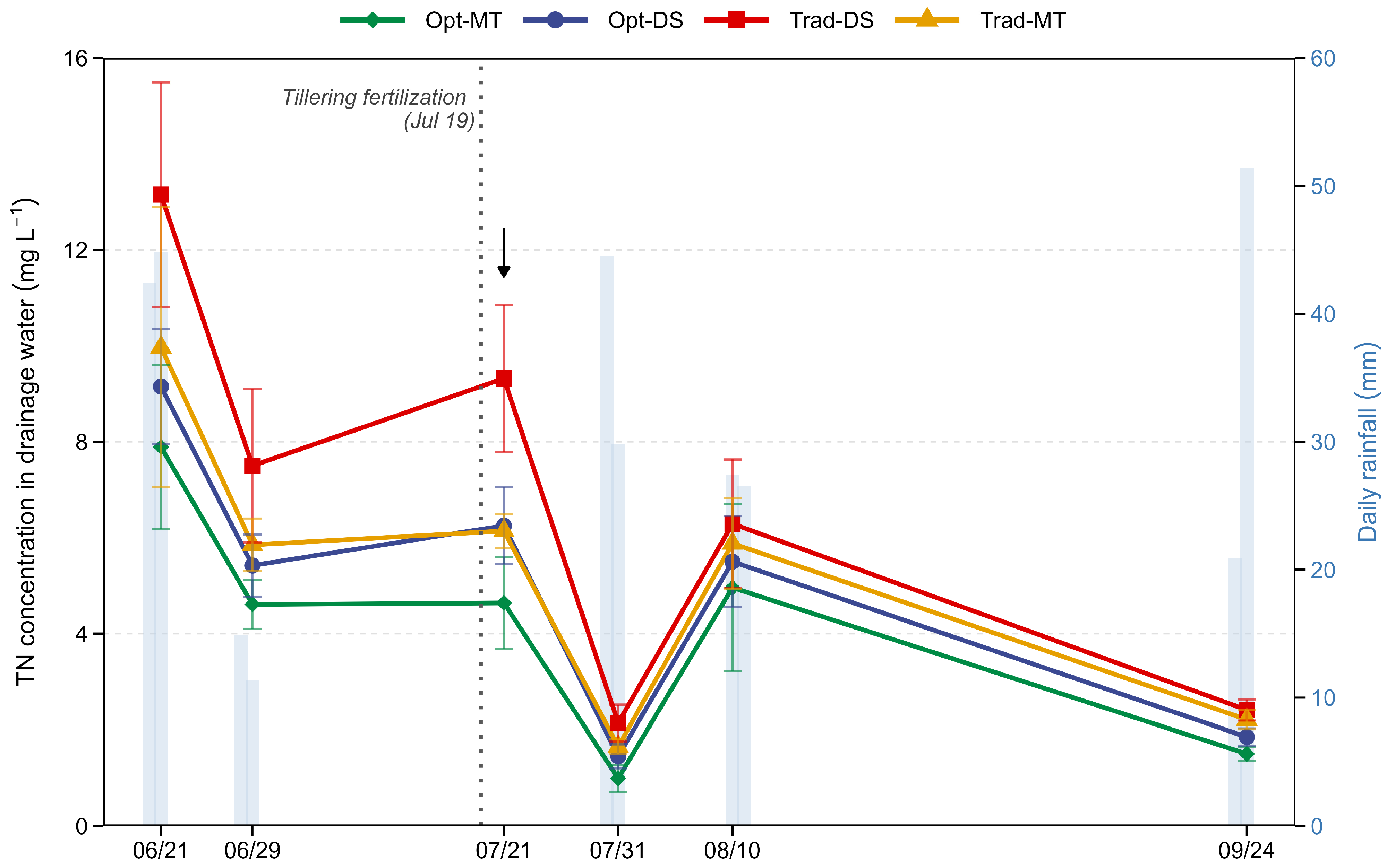
Total nitrogen (TN) concentration in surface drainage water varied across drainage events and treatments during the rice-growing season (
Figure 1). In general, higher TN concentrations were observed in the traditional treatments than in the optimized treatments, and the highest values occurred during the early drainage events following fertilization.
During the heavy rainfall event after basal fertilization on 21 June, TN concentrations reached the highest levels of the season. TN concentrations were 13.15 and 9.97 mg L−1 in Trad-DS and Trad-MT, respectively, compared with 9.15 and 7.89 mg L−1 in Opt-DS and Opt-MT, respectively. During the subsequent rainfall-induced drainage event on 29 June, TN concentrations decreased across treatments, although Trad-DS still maintained a relatively high concentration.
During the irrigation-overflow event after tillering fertilization on 21 July, TN concentration increased again. Trad-DS reached 9.32 mg L−1 and Trad-MT reached 6.14 mg L−1, whereas Opt-DS and Opt-MT were 6.25 and 4.64 mg L−1, respectively. During the rainfall event after panicle fertilization on 10 August, the traditional treatments also showed higher TN concentrations than the optimized treatments. By the pre-maturity rainfall event on 24 September, TN concentrations had decreased to relatively low levels across all treatments, and treatment differences had narrowed.
Overall, TN concentration peaks were mainly observed during heavy rainfall after basal fertilization, irrigation overflow after tillering fertilization, and rainfall after panicle fertilization. Compared with the corresponding traditional treatments, the optimized treatments showed lower TN concentration peaks during the monitored drainage events under both rice establishment methods. Detailed event-specific TN concentrations and TN export loads are provided in
Table S2.
3.2. Cumulative Drainage Volume and Monitored-Event TN Export Load
The stage-specific soil volumetric water content dynamics under optimized irrigation are shown in
Figure S4. In both Opt-MT and Opt-DS, monitored soil water content fluctuated around the prescribed lower irrigation thresholds and responded to rainfall and irrigation events. These observations support the field implementation of the threshold-based optimized irrigation regime and provide water-regime context for the subsequent drainage and TN export results.
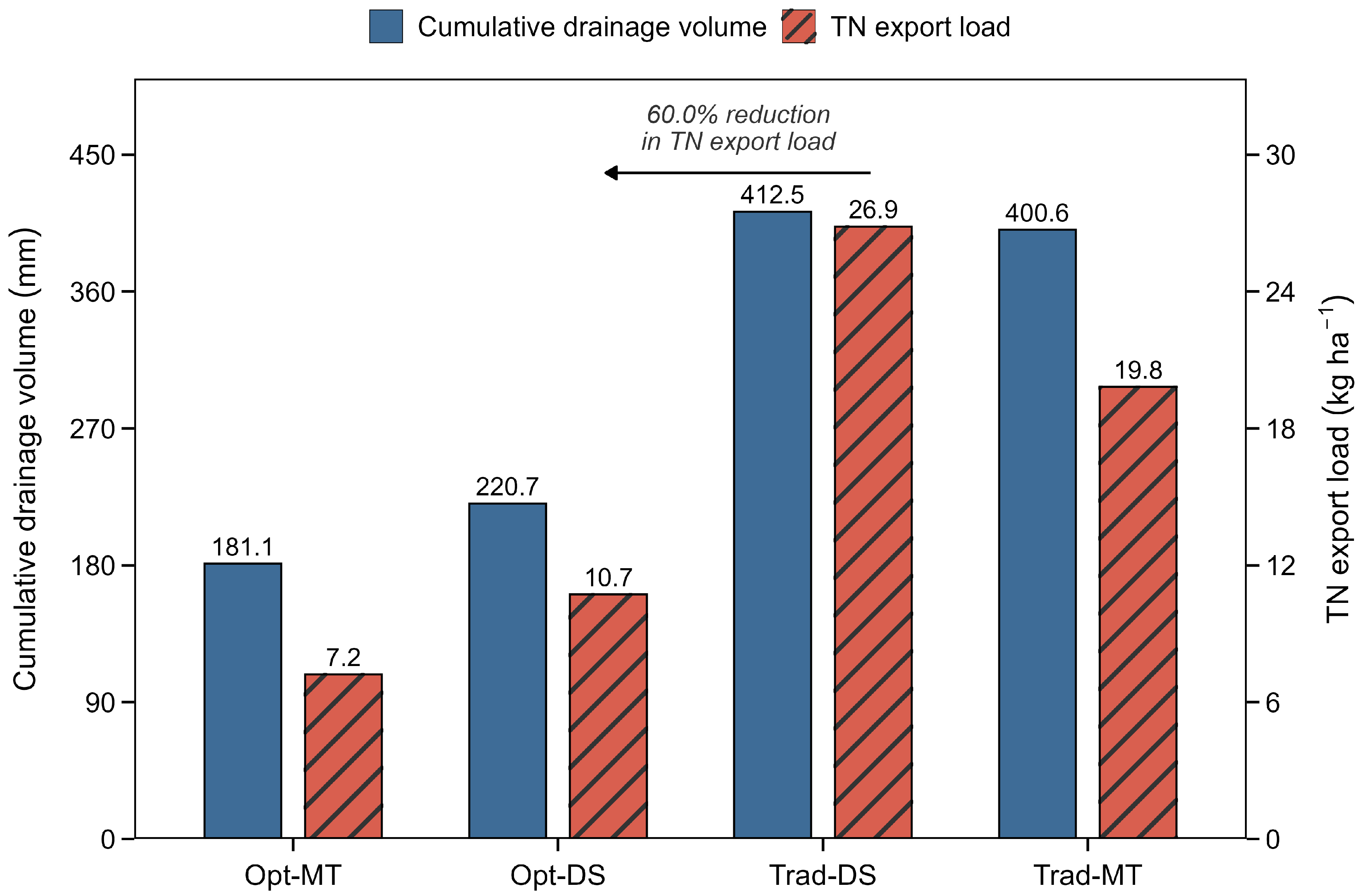
Cumulative drainage volume and TN export load under different treatments are shown in
Figure 2. Overall, optimized management reduced cumulative irrigation input and decreased both drainage output and cumulative TN export load over the monitored drainage events. Trad-DS showed the highest cumulative drainage volume and TN export load, whereas Opt-MT showed the lowest values.
Compared with the corresponding traditional treatments, optimized management reduced cumulative irrigation input by 28.5% and 26.4% in the mechanically transplanted and direct-seeded rice systems, respectively, and reduced cumulative drainage volume by 54.8% and 46.5%, respectively. The cumulative TN export load over the monitored drainage events showed a similar pattern: Opt-MT and Opt-DS decreased by 63.6% and 60.0%, respectively, compared with their corresponding traditional treatments. Under optimized management, the mechanically transplanted rice system had a lower absolute drainage volume and TN export load, whereas the direct-seeded rice system showed a pronounced reduction relative to its traditional counterpart.
Overall, optimized management reduced drainage output and cumulative TN export load over the monitored drainage events under both rice establishment methods. Compared with the mechanically transplanted rice system, the direct-seeded rice system still showed a higher absolute drainage volume and TN export load, but its relative response to optimized management was also pronounced. Detailed drainage depths, TN concentrations, and single-event TN export loads for each monitored drainage event are provided in
Tables S1 and S2.
3.3. Dynamics of Soil Mineral Nitrogen
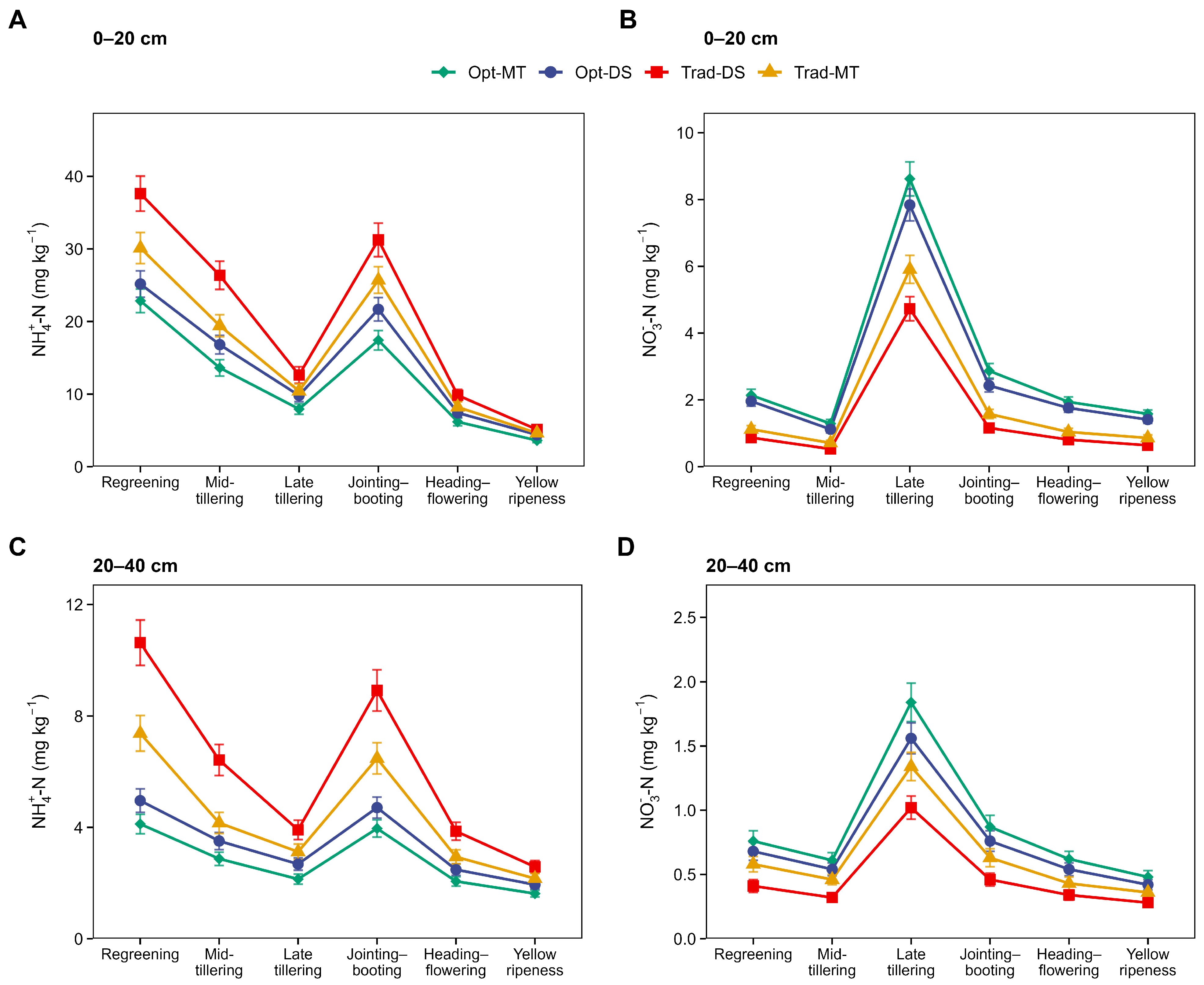
Soil mineral nitrogen varied across growth stages, soil layers, and treatments during the rice-growing season (
Figure 3). Overall, the traditional treatments, especially Trad-DS, generally showed higher NH
4+-N concentrations than the optimized treatments, whereas NO
3−-N concentrations were relatively higher in the optimized treatments at several growth stages. These treatment differences were more evident in the 0–20 cm soil layer than in the 20–40 cm soil layer.
In the 0–20 cm soil layer, the NH
4+-N concentration in Trad-DS remained relatively high from regreening to the jointing–booting stage (
Figure 3A). By contrast, NH
4+-N concentrations in Opt-MT and Opt-DS were lower during the early and middle growth stages, with peak values 30.6–48.3% lower than those in Trad-DS. From heading to yellow ripeness, surface-soil NH
4+-N decreased across all treatments. For NO
3−-N, the optimized treatments showed higher values than the traditional treatments at several sampling stages, particularly at late tillering. At this stage, NO
3−-N concentrations in Opt-MT and Opt-DS reached 8.62 and 7.84 mg kg
−1, respectively, which were 82.2% and 65.7% higher than the corresponding value in Trad-DS (
Figure 3B).
In the 20–40 cm soil layer, mineral N concentrations were generally lower than those in the surface layer, but the treatment patterns were broadly similar (
Figure 3C,D). Trad-DS showed relatively high NH
4+-N concentrations during the early growth stages, whereas NO
3−-N concentrations in the optimized treatments were higher than those in the traditional treatments at several stages. NO
3−-N concentrations in the deeper layer declined gradually during the later growth stages.
Overall, the optimized treatments showed lower NH4+-N accumulation and relatively higher NO3−-N concentrations at several growth stages under both rice establishment methods. Among the treatments, Trad-DS showed the most pronounced NH4+-N enrichment, whereas Opt-MT and Opt-DS showed lower NH4+-N levels during the early and middle growth stages.
3.4. Tiller Dynamics and Late-Season SPAD Value
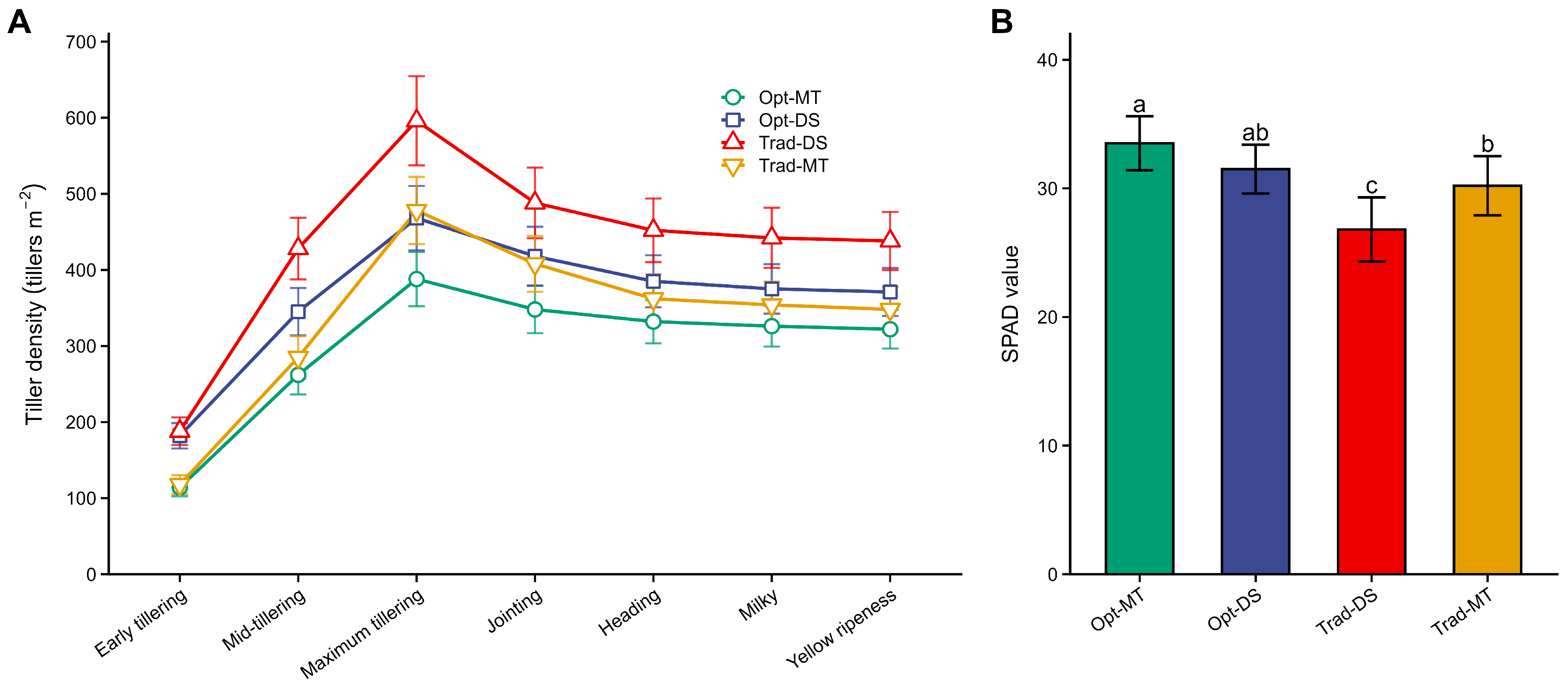
Tiller density differed among treatments during the rice-growing season (
Figure 4A). Overall, tiller density increased during the tillering period, reached a maximum at the maximum-tillering stage, and then declined after jointing across all treatments. Trad-DS developed the highest early-season tiller density, reaching 920 tillers m
-2 at the maximum-tillering stage, but it also showed the greatest decline during the late growth period. By contrast, the optimized treatments did not further increase early-season tiller-density peaks.
In the direct-seeded rice system, Opt-DS had a lower early-season tiller density than Trad-DS but showed a more gradual decline from jointing to yellow ripeness. In the mechanically transplanted rice system, tiller density changed more moderately, and the difference between Opt-MT and Trad-MT was smaller than that between Opt-DS and Trad-DS.
SPAD values at the yellow-ripeness stage differed among treatments (
Figure 4B). The optimized treatments had higher SPAD values than their corresponding traditional treatments, and the mechanically transplanted rice system generally showed higher SPAD values than the direct-seeded rice system. Opt-MT had the highest SPAD value, whereas Trad-DS had the lowest. Compared with the corresponding traditional treatments, SPAD values increased by 17.5% in Opt-DS and by 11.0% in Opt-MT.
Overall, the optimized treatments showed a slower late-season decline in tiller density and higher SPAD values at yellow ripeness under both rice establishment methods. The difference between optimized and traditional management was more pronounced in the direct-seeded rice system, whereas mechanically transplanted rice maintained higher SPAD values overall.
3.5. Grain Yield and Yield Components
Grain yield and yield components under different treatments are shown in
Table 3. In numerical terms, actual grain yield followed the order Opt-MT > Opt-DS > Trad-MT > Trad-DS. Compared with the corresponding traditional treatments, optimized management increased actual grain yield under both rice establishment methods, with increases of 6.5% in Opt-MT and 7.2% in Opt-DS. The mechanically transplanted rice system maintained a higher absolute yield level, whereas the direct-seeded rice system showed a greater relative yield response to optimized management.
Yield components differed among treatments. Trad-DS had the highest number of effective panicles, but its spikelets per panicle, seed-setting rate, and 1000-grain weight were the lowest among the four treatments. Opt-DS had fewer effective panicles than Trad-DS, but its spikelets per panicle, seed-setting rate, and 1000-grain weight were higher, reaching 122.4, 91.8%, and 27.1 g, respectively. Opt-MT had the highest values for spikelets per panicle, seed-setting rate, and 1000-grain weight and achieved the highest actual grain yield.
Overall, optimized management increased actual grain yield under both rice establishment methods. The yield response was accompanied by higher spikelets per panicle, seed-setting rate, and 1000-grain weight rather than by an increase in effective panicle number.
3.6. Grain Quality Performance
Key grain quality traits differed among treatments (
Table 4). For milling quality, head rice rate was lower under the optimized treatments than under the corresponding traditional treatments. Head rice rate was 63.8% in Opt-MT and 64.2% in Opt-DS, compared with 69.6% in Trad-MT and 66.5% in Trad-DS.
For appearance quality, the optimized treatments showed a lower chalky grain rate and chalkiness degree than the corresponding traditional treatments. In Opt-MT, the chalky grain rate and chalkiness degree decreased by 31.4% and 39.2%, respectively, compared with Trad-MT. In the direct-seeded rice system, Opt-DS also showed a lower chalky grain rate and chalkiness degree than Trad-DS, although the differences were smaller than those observed between Opt-MT and Trad-MT.
The amylose content was higher under the optimized treatments than under the corresponding traditional treatments. The amylose content was 11.8% in Opt-MT and 10.8% in Opt-DS, compared with 8.6% in Trad-MT and 8.5% in Trad-DS. Additional grain quality traits, including brown rice rate, milled rice rate, gel consistency, alkali spreading value, and transparency grade, are provided in
Table S3.
4. Discussion
This study evaluated the field performance of a controlled-irrigation-based integrated management regime in direct-seeded and mechanically transplanted rice systems. The optimized regime reduced drainage-related TN export over the monitored drainage events while sustaining a high grain yield under production-field conditions. The mechanically transplanted rice system showed a lower absolute monitored-event TN export load and higher grain yield, whereas the direct-seeded rice system showed a greater relative response to optimized management under a higher drainage-related nitrogen-export risk. These results indicate that the field performance of the integrated regime depended not only on the management package itself but also on the baseline characteristics of the rice establishment system. Because the optimized treatment combined controlled irrigation, functional basal fertilizer, and foliar regulation, the results should be interpreted as the overall response to the integrated management regime rather than as the independent effect of any single component.
4.1. Drainage Process Regulation and Monitored TN Export Reduction
Drainage-related TN export from paddy fields is closely controlled by hydrological processes and their timing relative to fertilization. In this study, the largest TN concentration peaks occurred during heavy rainfall after basal fertilization, irrigation overflow after tillering fertilization, and rainfall after panicle fertilization. These results support the interpretation that monitored drainage-related TN export was strongly event-driven and was associated with the coupling between fertilizer application and subsequent drainage events. Recent studies have shown that optimized irrigation and drainage practices can reduce runoff- or drainage-related N export by regulating water movement and drainage volume, although paddy-field nitrogen fate may also involve leaching and gaseous loss pathways that cannot be inferred solely from surface drainage measurements [
12,
14,
15,
16,
29]. Therefore, controlling drainage during post-fertilization risk windows is critical for reducing surface drainage-related TN export, while the interpretation should remain limited to the monitored drainage pathway.
The reduction in cumulative TN export load over the monitored drainage events was primarily associated with the lower drainage volume under optimized management. The added soil water content dynamics showed that the optimized treatments followed a threshold-based wetting–drying pattern during the rice-growing season, providing process evidence for the implementation of controlled irrigation under field conditions. Compared with the corresponding traditional treatments, Opt-MT and Opt-DS reduced cumulative irrigation input and drainage volume, thereby decreasing the hydrological pathway for surface TN export. Because TN export load is jointly determined by the solute concentration and drainage volume, a lower drainage output can reduce the total TN exported from the field even when concentration peaks occur during critical events.
The optimized treatments also showed lower TN concentration peaks during the monitored drainage events. This response may reflect the combined effects of water-regime regulation, fertilizer formulation, crop uptake, and event timing. However, these processes cannot be separated in the present experimental design. Within the integrated management regime, the hydrological regulation component may have contributed by increasing rainfall-storage capacity and reducing surface drainage, while the functional basal fertilizer and foliar regulation components may have supported the early-stage root-zone nutrient status and late-season crop condition. Because these components were applied as an integrated package, the observed decrease in monitored-event TN export should be attributed to the overall management regime rather than to controlled irrigation or fertilizer additives alone.
It should also be emphasized that lower monitored-event TN export does not necessarily indicate a proportional reduction in all nitrogen-loss pathways. In particular, the relatively higher soil NO
3−-N concentrations observed in some optimized treatments may have increased the potential for downward nitrate movement during rainfall or irrigation events. Recent evidence has shown that the paddy-field nitrogen fate can involve leaching, nitrification, denitrification, microbial regulation, and gaseous N emissions, which cannot be inferred solely from surface drainage measurements [
29]. In addition, wetting–drying irrigation may increase N
2O emissions under some conditions [
30]. Therefore, because deep percolation, nitrate leaching below the root zone, ammonia volatilization, denitrification, and N
2O emissions were not measured in the present study, the results should be interpreted as evidence of reduced drainage-related TN export over the monitored drainage events rather than as comprehensive nitrogen-loss mitigation or whole-season nitrogen-balance improvement.
4.2. Soil Mineral N Dynamics Under Integrated Management
Paddy soils involve coupled oxidation–reduction processes that regulate NH
4+-N and NO
3−-N transformations, crop N uptake, and potential N-loss pathways [
31]. The soil mineral N results further showed that the integrated management regime altered the temporal distribution and form of mineral N in the soil profile. Compared with the traditional treatments, especially Trad-DS, the optimized treatments generally showed lower NH
4+-N accumulation during the early and middle growth stages, while NO
3−-N concentrations were relatively higher at several sampling stages. This pattern may be related to the combined influence of water-regime regulation, soil aeration status, fertilizer formulation, and crop N uptake. Under traditional flooding, reduced soil conditions tend to favor NH
4+-N persistence, whereas the wetting–drying pattern under controlled irrigation may create more favorable conditions for nitrification and thus increase the relative presence of NO
3−-N. However, because the nitrification rate, denitrification rate, microbial activity, and crop N uptake were not directly measured, this interpretation should be regarded as a plausible explanation rather than a mechanism directly verified in this study.
The lower NH4+-N accumulation under the optimized treatments may help explain, but does not independently demonstrate, the lower TN concentration peaks observed during post-fertilization drainage events, particularly when drainage occurred shortly after fertilization. Nevertheless, soil mineral N pools and drainage-related TN export are not directly interchangeable. The TN concentration in drainage water is affected not only by soil mineral N status but also by fertilizer timing, surface-water N concentration, rainfall intensity, drainage volume, and hydrological connectivity between floodwater and drainage outlets. Therefore, the soil mineral N results should be interpreted as supporting evidence for treatment-related differences in soil N status, rather than as a direct mass-balance explanation for TN export reduction.
The relatively higher NO3−-N concentrations under the optimized treatments deserve cautious interpretation. On the one hand, the presence of NO3−-N may reflect a more oxidized soil environment under intermittent wetting and drying. On the other hand, NO3−-N is more mobile than NH4+-N and may be more susceptible to leaching or denitrification losses under certain hydrological and redox conditions. Because nitrate leaching below the root zone, denitrification, and gaseous N losses were not monitored, the higher NO3−-N levels cannot be interpreted as evidence of improved nitrogen-use efficiency. Instead, they indicate that integrated water and nutrient management changed soil mineral N dynamics, while additional measurements are needed to evaluate the full nitrogen-loss pathway and whole-season nitrogen balance.
4.3. Yield Formation, Tiller Dynamics, and Late-Season SPAD Status
In addition to reducing drainage-related TN export, the integrated management regime maintained or increased grain yield in both rice establishment systems. The yield response was not driven by an increase in effective panicle number. Trad-DS had the highest number of effective panicles, but it also had the lowest spikelets per panicle, seed-setting rate, 1000-grain weight, and actual yield. By contrast, the optimized treatments increased yield mainly through higher spikelets per panicle, seed-setting rate, and 1000-grain weight rather than through further expansion of the early-season tiller population. This pattern suggests that yield formation under optimized management was more closely associated with productive tiller retention and grain-filling-related yield components than with maximum early tiller density [
8,
32].
Tiller dynamics further support this agronomic interpretation. Direct-seeded rice under traditional management formed a large early-season population, but its tiller density declined markedly after jointing. Excessive early tiller density can increase intra-population competition and reduce the proportion of productive tillers during later growth stages. In contrast, Opt-DS had a lower early-season tiller density than Trad-DS but maintained a slower decline during the late growth period. In the mechanically transplanted rice system, tiller dynamics were generally more stable, and optimized management mainly increased yield through higher spikelets per panicle, seed-setting rate, and 1000-grain weight.
SPAD values at yellow ripeness were higher under the optimized treatments than under their corresponding traditional treatments. SPAD is commonly used as an indicator of relative chlorophyll content and leaf nitrogen status, and in this study, it was used to characterize late-season relative leaf greenness and SPAD-based leaf status. Therefore, the higher SPAD values under optimized management should be interpreted as evidence of an improved SPAD-based leaf status at yellow ripeness, not as direct evidence of enhanced carbon-assimilation capacity. Together with the slower late-season tiller decline, these results suggest that optimized management was associated with a more stable late-season crop status, which may have contributed to a higher seed-setting rate and 1000-grain weight. However, direct measurements of leaf gas exchange, leaf senescence physiology, and assimilate remobilization were not conducted, and these mechanisms require further verification [
33,
34].
4.4. Grain Quality Responses and the Trade-Off Between Appearance and Milling Quality
The grain quality results showed that optimized management improved appearance-related traits but did not improve milling quality synchronously. In both rice establishment systems, the optimized treatments reduced the chalky grain rate and chalkiness degree, indicating lower visible chalkiness. However, the head rice rate was lower under Opt-MT and Opt-DS than under the corresponding traditional treatments. This divergent response suggests that appearance quality and milling quality were not fully coupled under the field conditions of this study.
Previous evidence also shows that water management can affect milling recovery and appearance-related quality traits differently across direct-seeded and transplanted rice systems [
35]. Although chalkiness is often associated with imperfect grain filling and may influence milling performance, the head rice rate is also affected by water-management conditions, harvest moisture status, drying conditions, grain fissuring, grain hardness, and milling processes [
35,
36]. Therefore, the lower head rice rate under the optimized treatments cannot be explained by chalkiness alone. From a practical production perspective, the decrease in head rice rate is important because milling recovery directly affects the proportion of marketable whole grains and therefore the commercial value of harvested rice. Thus, the improvement in appearance-related quality traits under optimized management should not be interpreted as an overall improvement in industrial grain quality. A possible explanation is that the threshold-based wetting–drying regime and late-season field drying conditions altered grain moisture dynamics before harvest, which may have increased the susceptibility of some grains to fissuring or breakage during milling. However, grain moisture dynamics, fissure occurrence, and postharvest drying responses were not directly measured in this study. Therefore, the observed combination of lower chalkiness and lower head rice rate should be interpreted as a trade-off or decoupling between appearance-related traits and milling quality, rather than as comprehensive improvement in rice quality.
The amylose content is largely determined by cultivar genetic background and is generally less responsive to short-term agronomic management than appearance-related traits. The higher amylose content observed under the optimized treatments therefore requires cautious interpretation. The amylose content is strongly associated with Wx genotype, but its expression and related grain quality traits can also be affected by environmental and crop-management conditions during grain filling, including temperature, nitrogen supply, and water status [
34,
37]. Because the same cultivar was used across treatments, the differences in amylose content may reflect treatment-associated changes in the grain-filling environment and source–sink processes. Nevertheless, starch biosynthesis, Wx gene expression, enzyme activity, and within-canopy grain-filling temperature were not measured. Thus, the amylose response should be regarded as an observed treatment-associated quality difference rather than direct evidence of a specific starch-regulation mechanism.
4.5. Limitations and Implications for Integrated Rice Management
Several limitations should be considered when interpreting the results of this study. First, the experiment was conducted during a single rice-growing season at one production-field site. Although the added comparison with the 1994–2024 meteorological averages provides context for the 2025 growing season, interannual variation in rainfall distribution, temperature, and drainage-event timing may influence both TN export and yield formation. In this context, the warmer and wetter 2025 growing season may have enhanced drainage-risk conditions and influenced the magnitude of the observed drainage-related TN export response. Therefore, multi-year and multi-site experiments are needed to evaluate the stability and broader applicability of the integrated management regime.
Second, the experiment was conducted as a large-plot comparative study under production-field conditions, with three relatively independent plots per treatment. This design improved the practical relevance of the results but limited the number of independent replicates and therefore constrained statistical power. The findings should thus be interpreted as field-based evidence under the tested production conditions rather than as universally generalizable responses across all rice-growing regions.
Third, the optimized treatment was an integrated management package combining controlled irrigation, functional basal fertilizer, and key-stage foliar regulation. Because the experiment was not designed as a factorial trial, the individual contributions of these components cannot be separated. The observed reductions in monitored-event TN export and the yield responses should therefore be attributed to the integrated management regime as a whole, rather than to controlled irrigation, fertilizer additives, or foliar regulation alone. Similarly, this study did not compare alternative fertilizer-additive combinations; therefore, the selected functional basal fertilizer should be interpreted as one technically feasible component of the integrated package rather than as an optimized additive combination by itself.
Fourth, this study focused on drainage-related TN export during monitored surface drainage events. Recent meta-analytic evidence indicates that the effects of water-saving technologies on nitrogen losses in rice fields vary among loss pathways and management contexts; therefore, reduced monitored-event drainage TN export should not be interpreted as comprehensive mitigation of all nitrogen-loss pathways [
38]. Other nitrogen-loss pathways, including nitrate leaching below the root zone, deep percolation, ammonia volatilization, denitrification, and N
2O emissions, were not measured. Although θs-based reference values and root-zone observation layers were reported for interpreting the controlled-irrigation thresholds, comprehensive site-specific hydrophysical properties, such as field capacity, saturated hydraulic conductivity, and soil water-retention curves, were not systematically characterized. These limitations restrict the mechanistic interpretation of nitrogen fate and soil water movement.
Despite these limitations, the results provide useful field evidence for developing integrated water–nutrient–crop management strategies in rice production. Under the conditions evaluated here, the controlled-irrigation-based integrated regime reduced drainage-related TN export over monitored events while sustaining a high grain yield. The mechanically transplanted rice system showed a better absolute performance, whereas the direct-seeded rice system showed greater relative improvement under a higher drainage-related nitrogen-export risk. Future research should further evaluate this management approach using factorial designs, multi-year field trials, full nitrogen-balance measurements, and more detailed grain-quality and soil-water-process measurements.
5. Conclusions
This production-field study showed that the controlled-irrigation-based integrated management regime reduced drainage-related TN export over monitored surface drainage events while sustaining a high grain yield in both direct-seeded and mechanically transplanted rice systems. The reduction in monitored-event TN export was mainly associated with a lower drainage output and lower TN concentration peaks during critical post-fertilization drainage events. Mechanically transplanted rice showed a better absolute performance, with a lower TN export load and higher grain yield, whereas direct-seeded rice showed a greater relative improvement under a higher drainage-related nitrogen-export risk.
The optimized treatments also reduced the chalky grain rate and chalkiness degree, but the head rice rate did not improve synchronously, indicating that appearance-related traits, milling performance, and potential market-related value should be considered together when evaluating practical sustainability. Overall, the results provide field-based evidence that integrated water-nutrient-crop management may help coordinate monitored drainage-related nitrogen-export control and yield maintenance under similar production-field conditions.
These conclusions should be interpreted within the relatively warm and wet conditions of the 2025 growing season and the one-season, single-site production-field design. Because other nitrogen-loss pathways, full economic outcomes, and the individual contributions of each management component were not evaluated, further multi-year, multi-site, factorial, and full nitrogen-balance studies under contrasting climatic conditions are needed before broader recommendations can be made.




 ,
,