Review

Feeding Strategies for Optimizing Black Soldier Fly Hermetia illucens (L.) Larval Production for Sustainable Organic Material-to-Protein Conversion

Aquaculture Research and Development Center, National Fisheries Resources Research Institute, Kampala P.O. Box 530, Uganda
*
Author to whom correspondence should be addressed.
Sustainability 2026, 18(13), 6446; https://doi.org/10.3390/su18136446
Submission received: 23 February 2026 / Revised: 26 May 2026 / Accepted: 27 May 2026 / Published: 24 June 2026
(This article belongs to the Section Sustainable Agriculture)

Abstract

Insect larvae are naturally part of the diet of farmed animals, for instance poultry, pigs, and fish. Thus, the black soldier fly, Hermetia illucens (Linnaeus, 1758) (Diptera: Stratiomyidae) has been grown for use as a source of protein in animal feed. Black soldier fly larvae (BSFL) feed on various organic materials and bioaccumulate the nutrients obtained from the organic materials. This results in BSFL with protein content ranging from 25 to 60% depending on the type of organic material fed. Feeding strategies customized for optimizing BSFL growth and protein deposition are essential for sustainably increasing the production of BSFL to meet the growing demand for their use in animal feed. Feeding strategies for sustainable BSFL production should: ensure nutrient utilization efficiency to optimize BSFL growth and protein deposition; use readily available local organic material of good nutritional quality, safe, and acceptable for use in the animal feed industry; ensure economic and environmental sustainability; and adhere to existing legislature. While substantial information on feeding BSFL is available in different data sources, the literature mainly focuses on increasing BSFL production without integrating sustainability issues, especially economic and environmental sustainability. The objective of this review was to synthesize and consolidate existing information on feeding strategies for BSFL production from different sources and point out sustainable feeding strategies, existing knowledge gaps, and aspects that require further research. The purpose of the review is to provide information on feeding practices for the sustainable production of BSFL to meet the growing demand for BSFL in animal feed. This will contribute to improved food security, environmental management, and job creation. BSFL can feed on mixed organic material food sources more efficiently, reducing the volume of the food by up to 72%, while bioaccumulating the nutrients better than when feeding on individual organic sources such as fruit or vegetable waste.

1. Introduction

Naturally poultry, pigs, and fish do feed on insect larvae as part of their diet [1,2]. This dietary habit is being adopted in fish and livestock production, by domesticating edible insects and using them as a feed ingredient in animal feed [1,2,3]. The farming of black soldier fly larvae (BSFL), Hermetia illucens (L.), has been adopted in many countries [1,2,4,5,6]. BSFL naturally exist in warm tropical areas and have a short life cycle of about 4 weeks from the egg to adult stage under optimal growth conditions [7]. The eggs hatch into first instar black soldier fly larvae (BSFL) in 4–5 days [7,8,9]. The first instar larvae develop into pre-pupae within 2–3 weeks, and pre-pupae are the life stage often used in animal feed [8,10,11]. BSFL are polyphagous, adapting and adjusting to feeding on a wide range of plant- and animal-based organic material, while bioaccumulating the nutrients (protein, fat and minerals) from the organic material or substrate [1,5,6,8,9,12,13,14]. This has made BSFL one option for controlling organic waste burden and environmental pollution, in addition to providing a protein source for fish and livestock. The structure and physiology of the midgut of BSFL facilitates the digestion of a range of organic substrates [15]. The crude protein content of BSFL ranges from about 25–60% depending on the organic material fed on by the BSFL, and BSFL has an amino acid profile comparable with that of fishmeal [8,10,11,12,15,16,17]. Defatted BSFL can attain up to 65% crude protein [1]. BSFL-based feed has been formulated to optimize growth, health and survival rates of poultry, pigs, and some fish species (e.g., tilapia) to similar extents as fishmeal-based feed. This makes BSFL a viable, sustainable alternative protein source to fishmeal in animal feed, thus addressing food security in an environmentally safe manner.
While BSFL can feed on a wide range of organic substrates, maximizing BSFL production for sustainable waste-to-protein conversion requires feeding strategies that: (a) optimize nutrient utilization efficiency to maximize BSFL growth and protein deposition; (b) use readily available local organic material that is of good nutritional quality, safe, and acceptable for use in the animal feed industry; (c) ensure economic and environmental sustainability; and (d) adhere to existing legislature. High nutrient utilization efficiency can be achieved by feeding BSFL organic materials/substrates that are highly digestible and meet BSFL’s nutritional requirements for optimal growth and protein accretion. In addition, feeding methods and rations that minimize nutrient losses and improve production efficiency are crucial [12,17]. Furthermore, BSFL could be fed on local organic materials with limited competition with humans, livestock and fish as food. These include leftover food, agricultural by-products, and manure containing no toxic elements. Economically sustainable feeding practices are those that minimize production costs to increase profits without compromising BSFL dietary requirements and environmental integrity. For industrial BSFL production, upscaling production by using cost-effective automated feeding systems could drive economies of scale. To further increase profit margins, it is recommended to sell BSFL along with other products derived from them, e.g., frass as fertilizer. On the other hand, environmentally sustainable feeding strategies involve minimizing the environmental impact of BSFL feeding. Possible options include minimizing greenhouse gas (GHG) emissions by: (a) sourcing organic material from the vicinity of the production facility to minimize the distance traveled and associated GHG emissions from the vehicles used, (b) using organic materials with low environmental footprint, e.g., food scraps, and (c) utilizing renewable energy sources such as solar panels, biogas, and wind vanes to power feed processing and BSFL feeding equipment, thus reducing the use of fossil fuels. Closed-loop water systems could also be adopted to minimize water usage during BSFL rearing and processing. Integrating BSFL farming with crop–livestock–fish farming activities is also an environmentally safe practice that creates a circular nutrient system. Besides the technical aspects mentioned above, BSFL producers are expected to adhere to the existing legislation guiding BSFL production. While the legislation varies for each region and continent, it largely focuses on the safety of organic material used to feed BSFL and the intended use of the BSFL produced. Some of the standards focus on organic waste treatment before feeding BSFL. However, most developing countries do not have specific standards on BSFL production and use.
Appropriate feeding regimes for BSFL require synergy with conducive environmental conditions for BSFL growth and development. The key environmental conditions include a temperature of 25–30 °C, relative humidity 60–70%, moisture content in the substrate of 60–70%, dark environments for the larvae, and organic material of pH 6–7; aeration of the material is critical to manage heat produced from BSFL metabolic activity. These environmental conditions influence voluntary feed intake in BSFL and have an impact on the efficiency of nutrient utilization. While information on feeding approaches and environmental conditions for BSFL production is available in various databases, it largely does not point out which feeding strategies promote sustainable BSFL production. Thus, the novelty of this review lies in identifying feeding strategies that optimize BSFL growth, ensure environmental, economic, and social sustainability, and address legal considerations for long-term BSFL production for use in animal feed, thereby addressing food security and organic waste management. The aim of this review was to synthesize and consolidate existing information on feeding strategies for sustainable BSFL production, identify existing knowledge gaps, and identify aspects that require further research. Sustainable practices in BSF farming not only enhance the efficiency and profitability of the operations but also contribute to improving food security (through animal feeds), environmental management, and job creation.

2. Materials and Methods

The information in this review paper was derived from a literature search for data on BSFL nutrition, feeding techniques, reproductive and productive aspects, biological cycle, economic aspects of BSFL production, environmental sustainability issues, sustainable BSFL production, environmental factors and legislation associated with BSFL production. The information was obtained from indexed published papers (research publications, review papers, reports and short communications) and other online information sources. The literature search was carried out from January to December 2025 for articles published in the English language. Papers published not more than 20 years before January 2025 were considered. Databases and search engines used to collect the information included Google, Google Scholar and PubMed. Key words used in the search included black soldier fly feeding, black soldier fly diet, optimal feeding of black soldier fly, black soldier fly substrate, and nutritional requirements black soldier fly; probiotics in black solder fly production, yeast in black soldier fly production; black soldier fly welfare, legal and regulatory issues on BSFL, and economic viability of BSFL production.

3. Results and Discussion

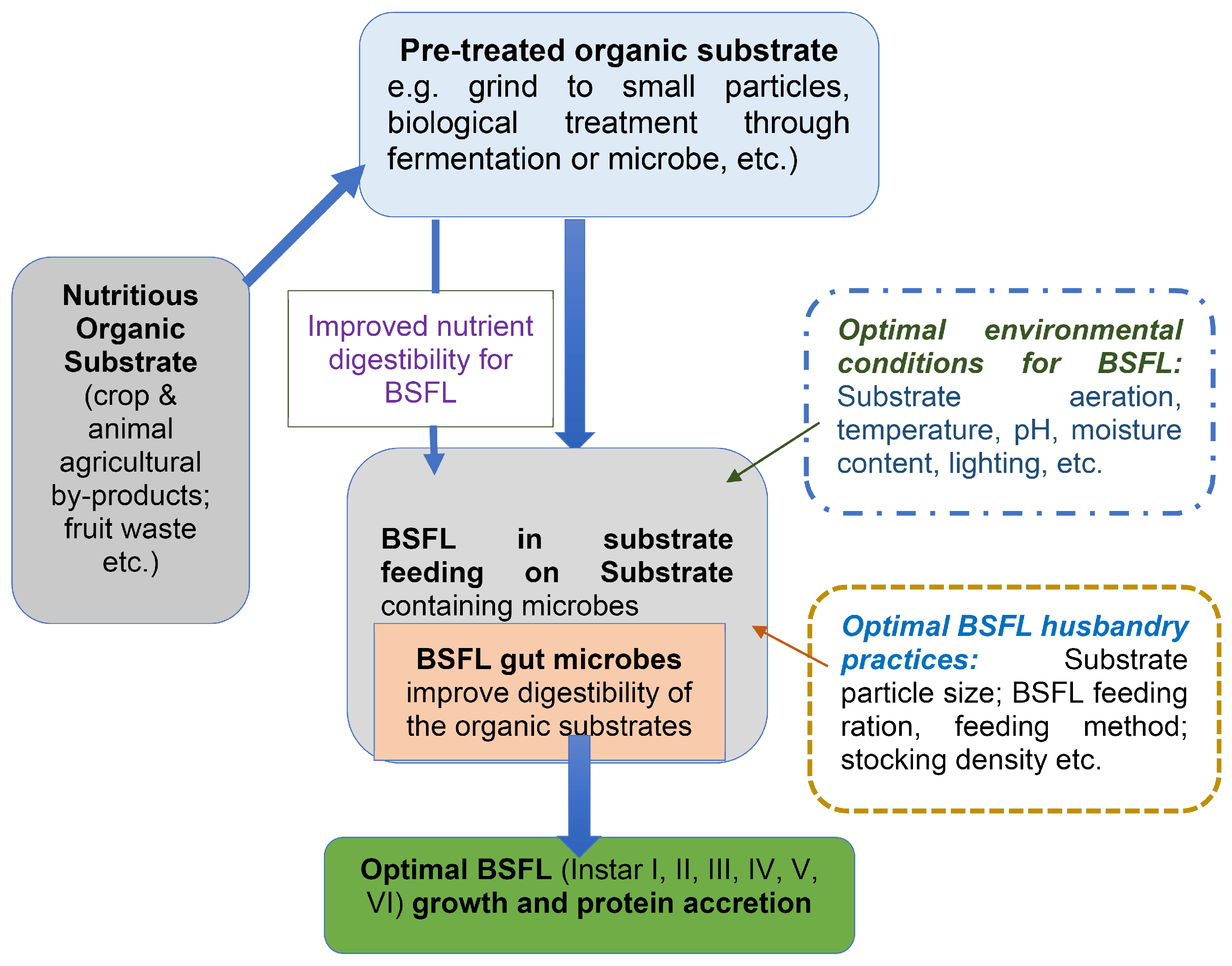
Our literature search revealed that feeding strategies for optimal growth and protein accretion of BSFL involve interconnected processes that take place within the organic substrate, BSFL, and the environment as illustrated in Figure 1. Feeding strategies customized for sustainable increase in BSFL production and protein deposition include use of nutritious organic substrates, optimizing nutrient utilization efficiency, use of non-toxic substrates, optimal feeding regimes, integrating optimal environmental conditions in feeding regimes, profit-oriented feeding practices, enabling legislature, and consumer acceptance of the use of BSFL in animal feed.

3.1. Feeding Strategies for Optimal Growth and Protein Deposition of BSFL for Sustainable Organic Material-to-Protein Conversion

3.1.1. Nutritional Quality of Organic Substrate for Feeding BSFL

The BSFL can feed on a range of organic materials/substrates and grow (Table 1), but the growth rates of the larvae vary depending on the type of substrate used [10,12,18,19]. This is because different types of organic substrates have differing nutritional values [12,15] as shown in Table 1 and Table 2. For instance, it was observed that BSFL fed diets containing cow dung performed poorly compared to those fed on poultry or swine manure [11]. In addition, the nutritional value of plant-based organic substrates differ greatly depending on the type of plant, plant species, age, season of growth, soil where the plant was grown, and type of container used to grow the larvae [5,11]. Thus, the time taken for BSFL to develop from egg, larvae, pupae and adult stages is highly dependent on the nutritional quality and nutrient balance in the organic substrate [11,20].
Some of the organic materials/substrates that have been used to grow BSFL include fruit waste, brewers’ spent grain (BSG), rice bran, wheat bran, palm kernel meal, coffee husks/pulp, leftover food, food peelings, livestock manure (from pigs, poultry, goats, cattle), mushroom stem and slaughterhouse waste [12,15,23,24]. When one organic substrate is used, the substrate may not contain all the nutrients required by BSFL in the right proportions for optimal BSFL growth, efficient protein accretion, and cost-effective production [15,16,19]. It is recommended to use combinations of substrates so that nutrients lacking/limited in one substrate are supplied by the other organic substrate(s) [16,18,19]. A well-balanced diet with the right proportions of protein, carbohydrates, and fats facilitates optimal growth and protein accretion of BSFL [17,19].

3.1.2. Optimizing Nutrient Utilization Efficiency

Although organic material containing very high fiber content can change the composition and abundance of microbiota in BSFL’s gut, leading to more cellulose-degrading bacteria, the larvae still grow slowly due to the low nutritional value of the fibrous diets [25]. Hence, organic materials with high proportions of lignin, cellulose and hemicellulose need to be pretreated to reduce the concentration of lignocellulose [8,24,26,27]. Plant materials with a substantial amount of lignin include: wheat bran, maize bran, rice bran, banana peels, fruit peels, vegetable waste, BSG, sugarcane bagasse, coffee husks, palm oil kernel, and maize straw [8,9,26,27,28]. These organic materials can be pretreated to degrade the fiber and improve its digestibility using mechanical, chemical, thermal and biological methods [26,27]. However, chemical methods present a risk of chemical residues remaining in the organic substrate, while thermal methods are often expensive [27].
Improving Digestibility of Fiber in the Organic Material
When BSFL are fed entirely on plant-based diets with high proportions of fiber, their growth is generally much slower [4,10,17,25]. Table 3 shows proportions of lignin, cellulose, hemicellulose, carbon to nitrogen (C:N) ratio and protein in some plant materials. The main components of fiber are residual total dietary fiber, soluble fiber, hemicellulose, cellulose, and lignin [9,28]. Lignin is often embedded in cellulose and hemicellulose as lignocellulose. It is an antinutritional factor (ANF) because it is largely indigestible, and high proportions of lignin in the diet affect effective nutrient digestibility [4,9,10,17,26,28]. Digestibility parameters measure the proportion of feed or nutrients absorbed by an animal, calculated as a percentage of total intake, whereby higher values signify better feed quality.
(A)
Mechanical pretreatment of organic substrates
Mechanical treatment of organic substrates through milling fibrous organic material to smaller particles of 0.5, 1, or 2 mm has been observed to enhance digestibility of lignin and hemicellulose [9,30]. Milling organic material to smaller particle sizes improves the texture and porosity of the material, making it more digestible, with more nutrients released [6]. Peguero et al. [29] observed that BSFL fed on spent grain and grass clippings milled to 0.5 mm had 44–53% and 13–32% increase in protein bioconversion rate and fresh BSFL weights respectively, compared to BSFL fed on the un-milled material. Hull materials milled to 6.35 mm also improved the digestibility of lignin [30].
(B)
Chemical pretreatment of lignin and cellulose in organic substrates using alkaline pretreatment
Chemical pretreatment of organic material to degrade lignin and cellulose has largely been accomplished through alkaline pretreatment using ammonia solution which is not a protein nitrogen [22]. This is achieved by the ammonia solution breaking the ether and ester bonds holding lignin and hemicellulose together, as well as by separating C–O–C bonds in lignin [31]. Previous studies have demonstrated the effectiveness of chemical pretreatment in degrading lignin and cellulose in rice straw, sugarcane bagasse, brewers’ spent grain, oat pulp, grass clippings and dessert banana peels at different concentrations of ammonia solution and treatment durations [31,32,33]. The concentration of ammonium hydroxide and the temperature and duration of the chemical pretreatment influence the efficiency of the chemical treatment of organic waste (Table 4). Isibika et al. [21] report that 0.8–1.0% ammonia pretreatment of banana peels significantly increased BSFL weight and biomass conversion ratios compared with the treatment without ammonia pretreatment (Table 4). However, pretreatment of the substrate using 5% ammonia solution significantly decreased BSFL growth performance compared to the untreated control [22]. This possibly implies that when over 5% ammonia is present in the substrate, some ammonia accumulates in the substrate thereby negatively impacting the growth of BSFL. Future studies could explore environmentally safe measures for clearing any remnants of ammonia from the substrate.
(C)
Thermal Pretreatment of Organic Substrates
While thermal or heat pretreatment of organic substrates before feeding BSFL may destroy complex fiber components (e.g., lignin) in the substrate enabling BSFL to access the nutrients, optimal temperature and duration for effectively degrading the fiber varies depending on the type of organic substrate [29,34,35,36]. For instance, Liew et al. [36] observed that thermal pretreatment of waste activated sludge (WAS) at either 30, 60, 75 or 90 °C for durations of 2, 4, 8, or 16 h improved BSFL growth. In addition, the WAS pretreatment at 90 °C for 16 h produced BSFL with 68% more protein and 71% more lipid than the controlled WAS (Table 5). Van Looveren et al. [34] reports that thermal pretreatment can also destroy some pathogens that might exist in organic substrate, thus boosting health, survival and growth performance of BSFL. In contrast, Peguero et al. [29], observed that cow manure, spent grain, and grass clippings subjected to heat pretreatment at 90 °C for 0.5, 1 or 4 h did not affect larval performance. Looveren et al. [34] also found that heat pretreatment of supermarket food waste at 50 or 60 °C for 10 min did not influence BSFL growth. This suggests that substrate composition, heating temperature and duration influence the extent of fiber degradation. In addition, Isibika et al. [21] observed that higher thermal pretreatment of banana peels at 120 °C for one hour does not degrade fiber-bound polyphenols nor improve final larval weight. This may be attributed to the presence of high proportions of polyphenols, especially tannins, that are also antinutritional factors in plants and cannot be degraded using heat.
Ribeiro et al. [37] noted high BSFL mortality when fresh spinach and grape pomace were fed to BSFL. These plants also contain tannin, an ANF, known to attach to minerals and proteins in livestock feed, negatively affecting digestion and absorption of the nutrients. The extent to which this concept is applicable to BSFL needs to be investigated and effective solutions need to be sought. However, the above effect of spinach and grape pomace on BSFL survival cannot be generalized for all fruits and vegetables because different species of plants have different compositions and quantities of bioactive compounds. Renna et al. [38] observed that BSFL fed on grape pomace from the Becuet variety (red grape) grew significantly better (4.4 mg/day) than BSFL fed on the Moscato variety (white grape) (3.2 mg/day). This is attributed to the difference in chemical composition of these two varieties of grape. Nevertheless, low concentrations of bioactive phenolic compounds such as flavonoids have beneficial effects such as antioxidant, anti-inflammatory and anti-microbial properties in livestock. Future studies could explore if flavonoids also exhibit antioxidant, anti-inflammatory and anti-microbial properties in BSFL, at what concentrations, and using which mechanisms of action.
Chitin in the cuticle of BSFL (6.7–10%) has been noted to be an antinutritional factor in animal feed. As BSFL develops into pre-pupae, chitin and ash levels increase in the cuticle and tissues respectively. High levels of chitin act as antinutritional factors in livestock feed by hindering effective digestion of feed and absorption of nutrients. On the other hand, high ash levels lead to a risk of causing mineral imbalance. Low levels of chitin in animal feed might have prebiotic benefits. Thus, BSFL need to be harvested before they deposit high amounts of chitin and ash. This is to enable optimal digestibility of protein and fat to promote BSFL growth.
(D)
Biological pretreatment
Biological pretreatment of organic materials prior to feeding BSFL has been shown to enhance the growth of BSFL (Table 6). Biological pretreatment is mainly through microbial fermentation by means of aerobic or anaerobic degradation of organic material prior to using it to feed BSFL [8,9,26,39]. It is recommended to homogenize and grind the organic material into smaller particles before fermenting it [9,27] for at least 10 days. This provides a larger surface area of the substrate for the microbiota to colonize and effectively carry out the fermentation process. Organic material with over 70% water should be de-watered to contain 60–70% water content.
The aerobic fermentation process involves decomposition of organic waste in the presence of oxygen [8,27,40]. An organic substrate with a moisture content of 60–70% is placed inside a container in about a 5–6 cm thick layer and enclosed using a mosquito mesh-size net to allow aeration but avoid entrance of unwanted organisms [8]. After a few days, the top layer of the substrate gets colonized by aerobic micro-organisms [40]. The substrate needs to be turned periodically facilitating more aeration of the substrate with less odor experienced. Water needs to be added to maintain a moisture content of 60–70% because the micro-organisms that decompose organic matter feed on moist substrates, but the substrate should not be very wet [8,27]. Degradation of cellulose, hemicellulose, and lignin in the organic material mainly occurs through enzymatic activity of the micro-organisms (bacteria and fungi), thereby releasing nutrients for BSFL to utilize [8,11,26]. The decomposition process generates heat, promoting multiplication of the micro-organisms. After about 10 days, the substrate can be fed to BSFL [8]. As BSFL feed on the fermented substrate, they ingest lignocellulose-degrading micro-organisms (bacteria and fungi) from the substrate, and this changes the microflora in the gut of BSFL, thereby further enhancing nutrient digestibility [8,26,40]. This is achieved by the micro-organisms secreting lignocellulose-degrading enzymes [40]. BSFL can also feed on the bacteria in organic substrates such as food [11].
On the other hand, anaerobic fermentation involves degradation of organic material in the absence of oxygen [8,26,40,41]. Organic material with 60–70% moisture content is placed in a container/digester that is filled-up and sealed air-tight to cut off oxygen [41]. Anaerobic fermentation is usually slower than aerobic fermentation. An inoculum of lignin-degrading fungi could be added to quicken the anaerobic fermentation process [26]. Anaerobic fermentation basically comprises an enzymatic hydrolysis and an acidification stage [41]. The enzymatic hydrolysis phase involves a range of micro-organisms that degrade lignin, hemicellulose and cellulose thereby improving the digestibility properties of the organic material [8,41]. Lactic acid bacteria are normally the most common micro-organisms that develop in the substrate during anaerobic fermentation and can outcompete other organisms [41]. Lactic acid bacteria play a key role in the acidification phase by releasing organic acids that cause the pH of the organic material to lower [26]. Acidification of the organic substrate also takes place with the release of carbon dioxide into the substrate as a by-product of the fermentation process [8,40]. The low pH of the substrate further breaks down lignin and hemicellulose [26].
Overall, the type of organic material and its components determine the extent to which the fermentation processes can degrade lignocellulose in the substrate [11,26,27]. Thus, future studies could investigate which pretreatment method is most suitable for the different kinds or categories of organic material.
Feeding BSFL Based on Their Optimal Dietary Requirements
Proteins, carbohydrates and lipids are crucial macronutrients in the diet of BSFL, with proteins providing the essential amino acids and carbohydrates and lipids supplying energy [1]. The ratio of protein to carbohydrate and their total amount in the diet influences the development rate, growth, fecundity of BSFL, egg hatchability, survival rate, and economic viability of BSF production [13,17,42]. Table 7 shows the nutritional requirements for BSFL. Organic substrates that supply the right proportions of proteins, carbohydrates and lipids required by BSFL need to be used in the diet of BSFL. This is because an ideal carbon-to-nitrogen(C:N) ratio or energy to protein ratio in BSFL feed is a nutritional driver that determines metabolism, nutrient availability, and nutrient utilization efficiency [1,10,11,17]. Diets with protein amounts beyond BSFL’s nutritional needs lead to a high nitrogen (protein) load whereby the excess protein is excreted in the form of total ammonia nitrogen, which can reach toxic levels for BSFL. On the other hand, carbon-rich substrates make beneficial heterotrophic bacteria multiply. These bacteria consume the dissolved toxic nitrogen and assimilate it into microbial protein.
Cammack and Tomberlin [43] observed that BSFL reared on a dry, chemically defined, cellulose-based diet comprising 21% protein and 21% carbohydrate (1:1 ratio) with 70% moisture content developed fastest on the lowest feed ration and had the highest survival rate to the pre-pupal stage. Eggink et al. [44] fed BSFL on moist diets containing casein, corn starch, linseed oil, fiber mixture, and vitamin–mineral mixture, and found the optimal dietary protein to carbohydrate ratio (P:C) for industrially reared BSFL to be between 1:2 and 1:3. This corresponded with a protein to energy ratio (P:E) of 11.2–14.4 g/MJ. Larvae reared on these substrates had the highest final yield, highest survival, and the lowest feed conversion ratio. In contrast, according to the findings by Cammack and Tomberlin [43], BSFL fed on semi-purified and isoenergetic diets composed of corn, rice husk, casein and starch for 18 days had an optimal protein level of 16% on dry matter basis, for maximum BSFL growth [47]. On the other hand, a prediction model developed by Broeckx et al. [17], found that the BSFL fed on a diet containing chicken start mash, sunflower oil, wheat starch, casein, and cellulose had the highest final dry weight at a protein content of 23.48%, carbohydrate content of 20.64%, and fat content of 1.91%, based on dry matter. This gives a protein to carbohydrate ratio of 1.14 to 1.0. An omnivorous diet with a protein to carbohydrate ratio of 1.0:0.5 also provided a 10% increase in BSFL growth [44]. From the studies highlighted above, the optimal P:C ratios in the diets of BSFL appears to be within the range of 1:1 to 1:2. However, the authors did not determine the nutritional needs of each developmental stage of BSFL, given that BSFL develop through six different instars or stages (Instar I, II, III, IV, V and VI). The difference in protein-to-carbohydrate ratios in some of the results above might be due to the different compositions of the substrate used to grow the larvae and substrate digestibility. Future research could focus on developing standardized diets for BSFL to minimize such variations.
Furthermore, studies demonstrate that BSFL fed on organic substrates containing very high proportions of either carbohydrate, protein or fat can experience stunted growth and low protein accretion, with low survival rates [10,44,48,49]. Organic substrates with over 37% crude protein content can cause toxic effects that can compromise BSFL survival due to high ammonia production by BSFL while converting the excess protein into amino acids [20,48,49,50]. A vegetarian diet with a much lower protein to carbohydrate ratio of 1:10 also resulted in poor BSFL performance and reduced fitness [48,49]. On the contrary, Barragan-Fonseca et al. [50] observed that a chicken feed-based diet with a higher carbohydrate (C) to protein (P) ratio (C55% and P17% respectively) had the highest BSFL growth performance and protein content. The differences in utilization of the diets with very high carbohydrate to protein ratio could be that each experiment used different types of carbohydrate in the feed [51]. The vegetarian diet could have had a high proportion of indigestible fiber, while the chicken feed-based diet is more refined and could have had highly digestible carbohydrates.
Future studies could also develop cost-effective stabilized nutritional concentrates from organic materials for BSFL production. The concentrates could be designed to provide a consistent supply of high quality and quantity of nutrients, thereby overcoming the variability of nutrients in raw organic waste.
Formulation of Least Cost Combinations of Organic Substrates Based on BSFL Nutritional Needs
Previous studies have recommended that optimal diets for BSFL could be formulated based on the principle of animal feed formulation and production [48,49,50,52], by applying the steps stated below:
(i)
Utilize the nutritional requirements for optimal growth and development of BSFL as stated in Table 7.
(ii)
Determine the nutritional quality of organic materials selected for formulating BSFL diets.
(iii)
Determine the cost of each organic material.
(iv)
Apply the information from (i) and (ii) above to generate BSFL feed formulations that meet the nutritional needs for the optimal growth of BSFL, while bearing in mind the minimum and maximum limits for each organic material in the diet and cost effectiveness of the diets formulated.
Further studies could be carried out to determine what needs to be optimized further in the animal feed formulation concept to customize it to BSFL diet formulation. We also recommend that the feed formulae factor in a component of minimizing carbon emissions from the organic material into the environment.
Apply Probiotics in Black Soldier Fly Larval Production
(A)
Probiotic bacteria
Probiotics are micro-organisms which when ingested have a beneficial effect on growth and wellbeing of organisms [53]. Once eaten by insects they can also provide nutrients in the form of triglycerides and lipids essential for the growth and reproduction of insects as well as energy provision during the pupal stage [53,54]. Table 8 shows the effect of different probiotic bacteria, fungi and yeasts on the growth of BSFL.
Probiotic bacteria such as Lactiplantibacillus plantarum, Lactiplantibacillus fermentum, Bacillus subtilis strains, Arthrobacter AK19 and Rhodococcus rhodochrous 21198 have been demonstrated to improve BSFL growth rate when inoculated in an organic substrate [53,54,55,58]. Witriana et al. [55] observed the best BSFL growth performance and protein content when 6-day-old BSFL were fed for 14 days on seafood restaurant leftovers (mainly fish waste) fermented with Lactiplantibacillus plantarum E2 and Lactiplantibacillus fermentum F5 for 10 days before feeding the larvae. The probiotic isolate was 106 cell/mL whereby 100 mL of the probiotics was inoculated in 500 g of mashed seafood leftovers. Similarly, Bacillus velezensis EEAM 10B (10B) inoculated in wheat bran and fed to 10-day-old BSFL for 10 days increased the survival of BSFL and regulated the amino acid synthetic and metabolic process of BSFL, increasing the protein content of BSFL [56].
Kooienga et al. [53] also compared mean daily weights of 11-day-old BSFL of larvae fed on a Gainesville diet composed of 30% alfalfa meal, 20% corn meal, and 50% wheat bran with water inoculated with 8 g (approximately 6 × 10⁵ CFU/g) of R. rhodochrous 21198 or Arthrobacter AK19 added to 6 kg of diet and stocked with approximately 10,000 BSFL either non-supplemented or supplemented with the bacterium. BSFL fed the diet with Rhodococcus and Arthrobacter were consistently larger until pupation stage compared to BSFL fed the control diet. Gorrens et al. [58] observed that when Bacillus subtilis strains from BSFL gut was inoculated in manure fed to BSFL, it significantly increased BSFL survival rate, weight gain, and lowered feed conversion ratio. However, not all Bacillus subtilis strains appeared to have probiotic effects because the B. subtilis strain isolated from eggs and inoculated in chicken manure did not enhance BSFL development. Hence, there is a need to determine which Bacillus strain has significant probiotic effects in a particular kind of organic substrate and the optimal concentration per unit volume of substrate to inoculate into the organic material.
(B)
Probiotic fungi
Apart from bacteria, yeast also has probiotic properties [22,60,61]. Probiotic bacteria and fungi interface with bacteria and yeast in the gut of BSFL to enhance the growth performance of BSFL [62]. When yeast is supplemented in the diet of BSFL, it can further enhance BSFL growth [60]. For instance, feeding BSFL on brewer’s spent grain with brewer’s spent yeast (BSY) added into it increased BSFL growth with increasing inclusions of BSY [59]. Liew et al. [39] found that palm kernel fermented with fungi, Rhizopus oligosporus, improved the growth and protein yield of BSFL. The optimal inoculum was found to be 10 mL/10 g dry weight of palm kernel. However, excessive addition of the yeast led to competition between BSFL and the fungi for nutrients, resulting in reduced growth of BSFL. Therefore, it is important to utilize the appropriate concentration of yeast to avoid compromising BSFL growth. On the contrary, BSFL fed with yeast species Saccharomyces cerevisiae (Sc) and Candida spp. (Cs) had significantly increased larval body weight with Cs compared to the Sc treatment [60]. This suggests that different types of organic substrates may require different concentrations of yeast to be inoculated in the substrate to enhance BSFL growth performance.
Interestingly, Phanerochaete chrysosporium, Trametes versicolor and Pleurotus sajorcaju inoculated in a 600 g substrate containing either cacao pod husk (CPH) or oil palm frond (OPF) and stocked with 1200 6-day BSFL had decreased lignin concentration but did not improve BSFL growth [15]. BSFL had a shorter growth time of 1 week in CPH than OPF. This further suggests that the effect of the fungi could be dependent on the type of substrate used. Further studies need to be carried out to identify the appropriate species of fungi to be used on specific substrates, the optimal concentration of the fungi to inoculate, ideal incubation time for each type of fungi in the different kinds of substrate before introducing BSFL into the substrate, and the BSFL stocking density for maintaining an ideal population of fungi in the substrate to enhance BSFL growth performance.
Feeding Method, Ration and Frequency for Optimizing Black Solder Fly Larval Production
An optimal diet needs to be provided to BSFL at an appropriate feeding ration and frequency to achieve good growth. Paz et al. [63] observed that the ideal feeding ration for BSFL stocked at a density of 1.2 larvae/cm2 is 163 mg/larva/day (dry base). For mass production of BSFL, a maximum feeding ratio of 95 mg of substrate/larva/day (dry base) was recommended for larvae stocked at 5 larvae/cm2. In another study, 6-day-old BSFL were fed on an organic substrate containing fecal sludge (FS) supplemented with 30% organic waste (food remains, brewer’s waste, and banana peelings) and feeding rates of 200 mg/larva/day and 250 mg/larva/day had significantly higher pre-pupal yield (179 ± 3.3 and 190 ± 1.2 g) than the control diet (100% FS), as well as shorter larval development time to pre-pupal stage (16.7 and 15 days) respectively [64]. When BSFL were fed on an omnivorous diet comprising 16.66% potato, 16.67% carrot, 16.67% thresher of beer, 25.00% epiglottis of beef, and 25.00% cod and fed at feeding rates of 50, 100, and 200 mg feed/larva per day, the feeding ration of 90 mg of substrate/larva per day at a larval stocking density of 5 larvae/cm2 led to optimal the performance of BSFL [49]. The difference in feeding rations for the BSFL reported above probably arises due to differences in the type of substrate (fecal sludge versus omnivorous diet) used and their nutritional content. Hence, further studies need to determine BSFL feeding rations for varies categories of substrate (e.g., vegetarian, highly fibrous, omnivorous, carnivorous, fish/marine waste streams, and commercial poultry diets). Additionally, previous authors determined feeding rations for the early larval stage to the pre-pupae stage; however, as the larvae increase in size, their optimal feeding rate might change, hence highlighting the need for future studies to determine specific food rations for the different larval stages (Instar I, II, III, IV, V and VI).
In terms of feeding frequencies, the most commonly used feeding regimes are batch feeding, which involves giving BSFL all the feed for the larval development stage in one batch, and continuous feeding comprising giving fresh feed to BSFL after a few days have elapsed [7,48,49,64]. In both feeding strategies, the daily feeding ration is computed based on the amount of feed needed to feed the BSFL for the given number of days. There have been contradictory findings on which of the two feeding strategies is more effective in enhancing the growth performance of BSFL. Five-day-old BSFL fed on Gainesville, a standard diet (consisting of 50% wheat bran, 30% alfalfa meal, and 20% corn meal) at a rate of 40 g diet/daily on wet basis had the highest final weight of larvae when fed using the continuous feeding system, but required a longer time (11.3 days) than the batch feeding system to reach the pre-pupa stage [65]. The total amount of feed during the batch feeding system was calculated according to the number of days that the BSFL population took to develop into the pre-pupa stage and it was all provided to the larvae at the start of the trial, whereas for the continuous feeding regime, 40 g (on WB) of diet was provided daily. It is argued that while batch feeding can enable BSFL to feed on as much food as they can, the nutrients in the substrate get depleted faster than the continuous feeding system because the substrate gets colonized by a diversity of micro-organisms that compete with BSFL for the nutrients in the substrate. This compromises the growth performance of BSFL [7]. In contrast, a comparison of larval growth rate was carried out using fecal sludge under four feeding regimes: a daily feeding regime (DF), after four days feeding (AFD), weekly feeding (WF) and lump sum feeding (LF) [64]. A feeding rate of 200 mg substrate/larvae/day was used to compute the amount of substrate to provide the larvae under the different feeding systems. No significant effect of feeding regime was observed on larval development rate to pre-pupae stage. Similarly, two diets, one with fruit waste (papaya, pineapple and orange) and chicken manure as organic waste, and the second diet, a commercial chicken feed, were fed to BSFL over a period of 15 days and had no differences in larval growth and survival rates [14]. One set of larvae were fed using the continuous feeding system at four different feeding rations, i.e., 5/0, 100, 150, or 200 mg of diet/larva/day every two days, and another set of larvae were fed using the batch feeding system where different feeding rations of 50, 100, 150, or 200 mg of diet/larva/day were calculated for 15 days and supplied to the larvae once at the start of the experiment [14]. The contradictory findings above on which feeding system is more effective probably arise from the fact that the study by Meneguz et al. [65] used a much higher daily feeding ration (40 g) compared to the feeding ration of up to 200 mg = 0.2 g used by Nyakeri et al. [64] and Dzepe et al. [14]. In addition, there was a difference in the time interval in which feed was provided to BSFL under the continuous feeding system. Meneguz et al. [65] provided fresh substrate to the BSFL on a daily basis and observed significantly higher BSFL weights than Dzepe et al. [14] and Nyakeri et al. [64] who were skipping days 2 and 4, respectively, before providing fresh substrate to the larvae. In addition, Meneguz et al. [65] used a standard diet for BSFL while Nyakeri et al. [64] and Dzepe at al. [14] used fecal sludge and a fruit-based substrate, respectively, that might have had low digestibility, and nutritional deficiencies [11,12,15]. In addition, Dzepe et al. [14] observed that variations in larval feeding frequency, ingestion rates, and metabolic needs are regulated by larval stocking density and substrate moisture content.
Overall, the literature above shows that when BSFL is provided an optimal diet at a feeding ration of at least 40 g of fresh portions of substrate on a daily basis (continuous feeding regime), the growth performance of BSFL is significantly enhanced compared to when a few days are skipped before providing a fresh substrate. This is probably because the fresh substrate has more nutrients than the old decaying substrate [14].

3.1.3. Safety of Organic Substrate Fed to Black Soldier Fly Larvae

Previous studies have detected residues of mycotoxins, pesticides, antibiotics, and heavy metals in some substrates used to grow BSFL [38,41,66] as shown in Table 9. Leni et al. [67] observed that BSFL have the ability to metabolize mycotoxins such as Fusarium toxins deoxynivalenol (DON), fumonisin B1 and B2 (FB1 and FB2) and zearalenone (ZEN) that contaminate wheat and corn without bioaccumulating in BSFL. This was attributed to the ability of BSFL to excrete the mycotoxins through their fecal matter. Niermans et al. [68] also found that both BSFL and substrate-specific micro-organisms can detoxify aflatoxin B1 (AFB1). This is because BSFL possesses a genetic set-up that produces enzymes that can metabolize AFB1 without affecting BSFL survival [36]. Mycotoxins such as aflatoxins B1/B2/G2, deoxynivalenol, ochratoxin A, and zearalenone as well as pesticides such as chlorpyrifos, chlorpyrifos-methyl, pirimiphos-methyl were also found to not affect the growth of BSFL, including no bioaccumulation of those pesticides observed in BSFL tissue [29]. Spranghers et al. [37] observed that although fifth instar BSFL fed on an organic substrate mixed with fungicide, fenpropimorph and herbicide, pendimethalin at a rate of 5 mg/kg bioaccumulated the fungicide and herbicide but the concentrations of the fungicide and herbicide reduced when the larvae reached pre-pupae stage. This was attributed to the capability of the pre-pupae stage to metabolize and excrete these fungicides and herbicides. Meijer et al. [69] however noted that the effect of pesticides depends on the type of pesticide used, the concentration used and its mode of action in BSFL (Table 1). Meijer et al. [69] found that pesticides such as chlorpyrifos, propoxur, and tebufenozide did not affect the survival or biomass growth of BSFL even when each of the pesticides was introduced into the organic substrate above the maximum residue levels (MRL) permitted by the European Union in feed and fed to BSFL. Interestingly, imidacloprid pesticide enhanced the growth performance of BSFL better than the control treatments. This biological response sometimes happens in BSFL when in contact with low concentrations of some stressors or toxins [46]. On the contrary, spinosad and cypermethrin reduced the growth and survival of BSFL when introduced into the organic substrate fed on by BSFL above the MRL [69].
All the pesticides in Table 9 could be detected in BSFL at a mean factor of 0.01, but this was below the MRL. Conversely, cypermethrin accumulated in BSFL at a factor of 0.79 at 0.1 mg/kg when blended with piperonyl butoxide (PBO), a synergist. Lieves et al. [70] also reports that cyromazine and pyriproxyfen may bioaccumulate in the BSFL above the MRL levels. Furthermore, Foukmeniok et al. [71] reported that pesticide λ-cyhalothrin can accumulate in fruits and vegetables when it is used to kill weeds in orchards and horticulture. More than 30 times the MRL hinders the growth and survival of BSFL, although BSFL could metabolize the pesticide, avoiding accumulation of the pesticide in BSFL.
While some previous authors have reported that BSFL can metabolic toxins and excrete them in fecal matter, the detoxification potential of BSFL varies across BSFL’s life stage. The fifth instar feeds continuously, utilizing a dynamic gut microbial community that bioconverts nutrients in the organic material. In contrast, the pre-pupal stage slowly develops into the pupae stage where it stops eating, and metabolic activity also stops, limiting BSFL’s ability to process and excrete new toxins. During the fifth instar stage, insects experience peak detoxification via Cytochrome P450s and Glutathione S-transferases. As they transition into the non-feeding, pre-pupal stage, where the enzymatic activities of Cytochrome P450s and Glutathione S-transferases drastically decline, it is important to harvest the BSFL in order to prevent bioaccumulation of toxins in BSFL.
In terms of antibiotic contamination of organic substrates, Lalander et al. [72] observed that high concentrations of carbamazepine, roxithromycin, and trimethoprim, could compromise BSF’s yield and distort the gut microbiome structure. With regard to heavy metals, Purschke et al. [73] noted that just-hatched BSFL fed on a corn-based substrate having heavy metals like arsenic (As), cadmium (Cd), chromium (Cr), mercury (Hg), nickel (Ni), and lead (Pb) for 10 days at 28 °C and 67% a relative humidity led to a considerable reduction in BSFL yield and feed efficiency. Studies show that Cd and Pb exert the highest hazard on the development and survival of BSFL [70,73,74]. Thus, bioaccumulation of heavy metals (Cd, Pb) and pesticides such as cypermethrin and λ-cyhalothrin by BSFL from the rearing substrate possess a public health risk through the biomagnification of toxins in animal feed containing BSFL. In this case, the concentration of toxic substances (like heavy metals or pesticides) could potentially multiply as the toxins move up the food chain to humans, the final consumers of the livestock. More research is necessary to determine other possible hazardous compounds that could get into organic materials used for BSFL production as well as their hazardous concentrations. The physiological response of BSFL to the different kinds of potentially harmful compounds also needs to be determined.

3.1.4. Environmental Conditions That Work in Synergy with Feeding to Optimize BSFL Production

Appropriate optimal diets and feeding regimes alone may not maximize BSFL growth and protein deposition. Optimal environmental conditions for BSFL also need to be put in place in the organic substrate and shelter/house used for rearing BSFL [6,9,11,43,44,47,48,49]. Crucial aspects to do with the organic substrate include the moisture content, depth of the substrate in the container, temperature in the substrate, aeration of the substrate, and stocking density of BSFL (Table 10).
Optimal Moisture Content for Organic Material/Substrate
A moist substrate is key for growing BSFL because moisture interacts with the texture of the substrate, microbial activity, and larval movements to feed on the substrate [6,76]. This has a bearing on larval survival, development time, and pre-pupae size [76]. Studies indicate that an organic substrate should have 60–70% moisture content to make it ideal for BSFL to effectively eat and digest the substrate in order to optimize growth [1,17,18,77]. In addition, BSFL fed diets with 70% moisture required less food than those reared on diets at 55% moisture [18]. Larval survival and growth decreased/stopped with either too much water content or a too dry substrate [17,78]. Organic substrates with 40% moisture content caused BSFL to fail to develop [18]. Substrates that quickly dry can cause larval death. On the other hand, substrates with very high moisture content or dense textures can decrease the aeration of the substrate, compromising oxygen diffusion into the substrate [79]. This forms anaerobic zones within the substrate that can suffocate and kill the larvae [6].
Lalander et al. [79] observed reduced biomass conversion and BSFL survival with more than 80% moisture in the substrate. A waterlogged substrate also limits BSFL’s ability to breathe, because it blocks the pores that they use for respiration, thereby causing death of BSFL [80]; hence watery substrates should first be de-watered [6]. Substrates with high fiber content and 40% moisture content may also cause 100% mortality of BSFL [18,77]. This is attributed to low water holding capacity of the fiber-rich substrates [78]. The water holding capacity can vary for different substrates at the same moisture level [64]. This implies that different kinds of substrate will require different amounts of water per unit volume of substrate in order to attain 70% moisture content in the substrate. Studies could be carried out to confirm the amount of water required for each type of substrate and combination of substrate(s). In addition, studies have largely assessed the moisture requirements for the diet of BSFL till the pre-pupae stage but information is scant on the ideal moisture content for the substrates while pre-pupae BSFL are transitioning to the pupa stage. Moisture also influences effective separation of larvae from the frass while harvesting [64].
While adult BSF do not feed on solid food and mainly depend on energy reserves that they stored in their bodies during the larval stage [7,8], they need to be provided water, 5–10% honey solution, and/or protein-rich liquid such as milk powder solution [81,82,83]. Water is provided in the form of moisture using various approaches such as mist droplets, fountains or moist cloth/sponge [6,7,8]. The water, honey, and protein-rich liquids help adult flies to survive longer [6,82]. In the wild, BSF feed on honey and nectar as their carbohydrate sources and hence they prefer honey solution to water, with a longer BSF lifespan attained with honey solution [6,81,83,84]. This is attributed to the energy that they obtain from the honey. Nonetheless, a much longer life span and fecundity of BSF have been realized while feeding BSF on protein-rich milk powder solution [81]. This is important for mass production of BSFL at a commercial scale.
Kluger et al. [13] went ahead to examine the impact of different carbohydrate (honey and D-glucose) and plant protein sources (Spirulina and Chlorella powder) on a variety of life history traits of BSF using a highly standardized single pair approach. Feeding a 5% honey solution made females live 2.8 days longer, become more fecund (nine egg clutches per 10 females) and lay more eggs (increasing 1.7-fold to 182.4 mg per 10 females), reducing the number of failed oviposition events 3-fold and increasing multiple oviposition events from 2 to 15 compared with BSF fed the plant-based protein. Additionally, female longevity after oviposition improved 1.7-fold from 6.7 to 11.5 days. The difference in these results compared with those observed by Bertinett et al. [81] might suggest that animal protein sources are more effective than plant protein sources in influencing the reproductive performance and lifespan of BSF. Future studies could explore the effect of blending protein and carbohydrate sources in varying proportions on BSF reproductive traits.
Ideal Temperature
The temperature in the substrate is crucial because BSFL live in the substrate. A temperature ranging from 25 to 30 °C is suitable for BSFL growth and survival when feeding on diets meeting their nutritional requirements [4,6]. As BSFL grow, they transition through five different larval stages before the pupa stage then the imago stage and the adult fly stage. However, when the substrate is below 20 °C and excessively humid, larvae and pupae tend to regress [47]. Palma et al. [30] and Li et al. [85] report a relationship between the temperature in the substrate, carbon to nitrogen ratio of the substrate and BSFL performance. Palma et al. [30] noted that BSFL grown at 28 °C had a decreased dry weight, specific growth rate and yield with increasing C:N ratio from 16 to 49 in the substrate. This study also showed that larval masses can heat their immediate environment by no more than 6 °C when kept at optimal dietary ration and reared at 28 °C. Given that larvae may increase heat production and metabolic activity as their size increases, there is need to ensure that the temperature of the substrate and environment keeps within the optimal limit for BSFL. Automated systems can apply mist to cool the temperature [7]. The substrate could also be turned daily because, in the process of turning the substrate, heat is lost. Li et al. [86] also found the highest mean larval weights (i.e., 0.126 and 0.124 g) and feed conversion ratios (i.e., 1.92 and 2.08 g/g) with higher biomass of larvae (10,000 larvae) grown together at 20 °C or low larval biomass (100 larvae) grown at 30 °C. A change in the temperature from high (30 °C) to low (20 °C) when the larvae were about 10 days old increased larval production by 16% and feed conversion ratios by 14%. Future studies need to determine the optimal temperatures for each life stage (larvae, pupae, adults) to customize production systems/facilities to required temperatures.
Particle Size of the Organic Material
Particle size ranging from 4 to 10 mm increases the rate at which BSFL ingest organic material and grow [75]. Palma et al. [30] observed a relationship between particle size, carbon to nitrogen (C:N) ratio of the substrate and BSFL growth. Hull material with a maximum particle size of 6.35 mm showed a maximum BSFL growth at a C:N ratio of about 29 and hull consumption increased with increasing C:N ratio in the organic substrate. Overall, more homogeneous and denser substrates with 60–70% moisture content led to better BSFL performance [11]. However, Wang et al. [75] noted that an organic substrate with a particle size below 2 mm is not suitable for bioconversion by BSFL, possibly because the particles are very small and clog the pores of BSFL, thereby affecting BSF respiration, causing mortality.
There is also a correlation between the size of particles in the organic substrate and the degree to which air can be infused into the organic substrate [77]. Apart from regulating temperature in the substrate, aeration of the organic substrate facilitates increased decomposition of the substrate thereby making the nutrients more accessible for BSFL growth and protein accretion [48]. Small-sized particles (less than 4 mm) hardly contain air spaces to enable the movement of air in the substrate. Large-sized coarser particles often facilitate more aeration of the substrate because they have more air spaces that are linked [77]. Excessively wide particle spaces or materials that are barriers to air movement could however affect air distribution. Wang et al. [75] shows that the ideal particle size to facilitate efficient bioconversion by BSFL is between 4 and 10 mm. Substrates with particle size less than 4 mm led to a 38% decrease in BSFL biomass. Palma et al. [30] also found that an increase in almond hull particle size increased larval mass by 10%, which was attributed to substrate texture, less bulk density and aeration. Yakti et al. [77] also states that substrates with less dense or bulky fiber (e.g., cellulose) lead to higher larvae growth over time in comparison to substrates with higher bulk density fibers. Cattano et al. [48] found that an aeration rate of 0.84 m3/s would increase the growth of BSFL fed on soybean curd residue. A rotary drum could be used to aerate the substrate [6]. Turning the substrate frequently by hand could also serve to aerate the substrate as well as application of moderate air fluidization.
Depth of Organic Material for Optimal Feeding and Growth of BSFL
The feeding containers should have organic material at a depth of 5–6 cm [9,48] for the larvae to reach the bottom of the container and feed on all the waste. When the substrate is too deep, heat builds up and may cause larval mortality. In addition, increased depth may cause anaerobic conditions at the bottom which can cause bad odors. A substrate that is too shallow does not allow the larvae to burrow, and yet burrowing is a survival instinct for BSFL to hide from light and maximize ingesting food.
Stocking Density of BSF Larvae per Unit Volume of Substrate
A correlation between stocking density, substrate depth and feeding rations for BSFL is crucial for determining an appropriate stocking density for optimal growth and protein accretion of BSFL. BSFL stocked at a rate of 40,000 larvae per m2 of substrate at a depth of 5 cm performed well. This depth avoided unprocessed waste at the bottom and enabled aeration to prevent zones of low oxygen that could compromise the welfare of BSFL [6]. BSFL is reported to have also grown well at a density of about 2.5 larvae per square centimeter of surface area [7]. A larval density of 1.2 larvae/cm2 was found to be ideal for rearing BSFL at a feeding rate of 163 mg/larva per day (dry base) with a maximum stocking density of five larvae per square centimeter at a feeding rate not more than 95 mg/larva per day (dry matter basis) [63]. This study shows that at lower stocking densities, a higher feeding rate can be applied and at higher stocking densities, the feeding rate has to be reduced. Differences in stocking density could be due to differences in the level of ventilation of the substrate, particle size of the substrate, the rate of biodegradation of the substrate and emission of ammonia into the substrate [6,7].
Lighting Conditions for BSFL
The lighting conditions in the facility where BSFL is growing can affect their development. BSFL prefer dark environments and will tend to burrow inside the substrate [8,49]. Exposure of BSFL to bright light may slow down their development.
On the other hand, adult black soldier flies prefer direct sunlight for mating. Mating mainly begins at 8:30 am with the peak at 10:00 am, when the light intensity is about 110 μmol·m−2·s−1. The rate of mating drops once the light intensity changes. Once the wavelength is 450–700 nm, it enables the males to spot the females ready for mating [87,88,89]. The vision of the adult flies is impaired when the wavelength is over 700 nm (red). To aid continuous mating, artificial light can be used indoors using the quality and intensity of light similar to natural sun rays. This has been accomplished by using quartz–iodine lamps with wavelengths of 440 nm to 540 nm, within the blue–green spectrum [88]. Mating can be further enhanced using both LED lights (LED ratio ultraviolet (UV) and quartz–iodine blue (B) and green (G) lights at a ratio of 1:1:3) [89,90]. However, fluorescent lights still need to be optimized to facilitate more effective mating of the flies. Short photoperiods interfere with the mating of the flies [87,88,89,90]. The ideal photoperiod should have 12 h of light. The artificial LED lights can also be used during periods of poor sunlight.

3.1.5. Environmental Sustainability

Environmental sustainability of BSFL farming should apply feeding strategies that effectively reduce waste management challenges and produce BSFL without affecting the integrity of the environment [91,92]. Such environmentally sustainable BSFL feeding practices should minimize greenhouse gas (GHG) emissions. Some key practices include repurposing organic material/waste by feeding it to BSFL. This reduces emissions of methane that would be released from organic material/waste when disposed of in landfills. The practice of disposing waste in landfills is common in developing countries. Other measures include sourcing local organic waste from nearby places to minimize transportation distance and GHG emissions from the vehicles used, using organic materials with low environmental footprint, e.g., food scraps, utilizing renewable energy sources such as solar panels and wind vanes to power processing and feeding equipment and having closed-loop systems that conserve water by minimizing water usage during BSFL rearing and processing phases. Integrating BSFL farming with crop–livestock–fish farming activities also creates a circular nutrient system. The continuous BSFL feeding method that involves supplying fresh organic waste of a predetermined amount to BSFL every couple of days is an efficient sustainable strategy for managing food waste. This approach, rather than batch feeding (supply all food for the whole growth period at once), helps optimize waste reduction/bioconversion rates and keeps the larvae productive.
The primary waste outputs from BSFL farming include frass, larval excreta, pupae cases, and remaining unconsumed substrate. These can be processed into organic fertilizer while larvae are harvested for animal feed. This leaves no waste behind. Liquid waste that drains from the organic material during its fermentation can be allowed to drain into a container and incorporated into the compost, rather than being released into the environment. Implementing these strategies ensures resource efficiency without compromising the health and productivity of the BSFL.
The use of frass (feeding waste) as an organic fertilizer for crops or as a soil improvement creates a closed-loop system where frass is converted into plant resources that can be used to obtain organic materials to feed BSFL.
Recent studies demonstrate that gender impacts environmental actions with females being more sensitive to environmental concerns, beliefs, and behavioral tendencies [93]. The attitudes are mainly influenced by socio-cultural perceptions associated with gender.

3.1.6. Economic Sustainability

BSFL production can be made economically sustainable by ensuring low BSFL operational costs and producing and selling high-value products such as animal feed, BSFL oil, and organic fertilizer [91,94,95]. There is also need to raise awareness of economic sustainability in feeding strategies and targeted research to develop novel cost-effective feeding approaches [95].
Operational costs to do with feeding can be reduced by feeding BSFL using low-cost locally available organic material of good nutritional quality to reduce input costs and ensure efficient conversion rates. This includes agricultural by-products and food waste accessed from markets and farms. The products have to be free from toxic substances. Sourcing local organic waste from nearby places minimizes transport distance and costs. Utilizing more efficient and low-cost BSFL feeding technologies can allow for upscaling production at low operational costs. This involves the application of cost-effective automated feeding systems in commercial-oriented systems to take advantage of the economies of scale to increase profit margins by reducing cost per unit as production volumes rise. This will spread fixed costs like machinery over a large output, enhancing competitiveness and profitability. BSFL farming can be labor intensive and hence manual labor is more feasible for small scale operations, creating jobs and improving food security, especially in developing countries. In addition, large companies could advance to use cost-effective robots in feeding BSFL. Automation is transforming insect farming from a manual, small-scale process into an efficient, high-volume industrial technology. Commercial companies could also secure lower interest rates and spread marketing costs across a larger customer base. However, farms should put in place measures to avoid management inefficiencies and unnecessarily high operational costs as they grow bigger. Consideration should also be given to using cost-effective power sources for processing organic substrates and feeding BSFL. Small-scale BSFL farms are ideal for faster return on investment, and cooperative models can help reduce operational costs and share benefits. A backyard integrated circular cottage farming system can also provide a low-cost, zero-waste small scale farming system ideal for local communities to scale up BSFL production [95].

3.1.7. Legislature on BSFL Production

Sustainable BSFL production requires putting in place legislation on BSFL production and adherence to the legislature [91]. Fines and penalties for not abiding by the existing legal frameworks exist. The regulations vary in different countries, regions and continents; the laws largely focus on safety of the organic material used to feed BSFL and the planned use of the BSFL. This is to avoid human health risks.
The safety standards require avoiding contaminated waste and preventing pathogen transfer from the organic material to humans. Therefore, while BSFL can efficiently feed on organic waste and reduce its volume, the organic material must not contain pathogens if the BSFL are to be used as feed or food. For instance, the use of fecal matter and sludge is forbidden in many countries. Recommended substrates include agricultural, market, and food industry by-products. Some regulations require monitoring the presence of toxic substances in the organic substrates so as to avoid using substrates with toxins in concentrations above regulatory thresholds. In addition, some standards necessitate the treatment of organic waste to kill pathogens. However, most developing countries do not have specific standards on BSFL production and use. Their activities are mainly regulated/guided using local environmental and agricultural standards for waste recycling.
There is need for evidence-based research to effectively guide policy development and remove obsolete regulatory barriers in order to scale up production. The public needs to be sensitized to the regulatory measures that they should adhere to.

4. Conclusions

Sustainable production of BSFL to convert organic material to protein is anchored on using readily available organic material of good nutritional quality, safe, and acceptable for use in the animal feed industry, enhancing nutrient utilization efficiency to optimize BSFL growth and protein deposition, ensuring economic and environmental sustainability and adhering to existing legislature. These aspects are interconnected and need to be addressed simultaneously.
Crucial aspects in ensuring high nutrient utilization efficiency include feeding BSFL combinations of organic substrates (animal and plant-based organic material) to complement each other, to meet the nutritional requirements for BSFL. Single organic substrates often do not contain all the nutrients required by the BSFL in the right proportions to enable optimal growth of BSFL, efficient protein accretion, and cost-effective BSFL production. Furthermore, the ratio of protein to carbohydrate and their total amount in the diet influences the development rate, growth, fecundity of BSF, egg hatchability, survival rate, and economic viability of BSF production. An optimal protein to carbohydrate ratio for use in the diets of BSFL is within the range of 1:1 to 1:2 with the optimal crude protein for maximizing growth efficiency of BSFL ranging between 15.23% and 25.50% with 1.91% fat and 23.48% carbohydrate. Digestibility of the organic substrates used to feed BSFL can be improved to enhance BSFL growth and protein accretion. Mechanical and biological methods are the most commonly used pretreatment means to improve the digestibility of organic materials. Mechanical treatment involves grinding organic materials to a particle size of 0.5, 1, or 2 mm to break down fibrous components, while biological pretreatment involves fermenting the organic material for at least 10 days. Probiotic bacteria and yeast (fungi) can be added to the pretreated substrate to modulate the gut microbiome of BSFL to improve digestive enzymatic activity to further optimize BSFL growth and protein accretion. Some of the confirmed probiotic bacteria include Lactiplantibacillus plantarum, Lactiplantibacillus fermentum, Bacillus subtilis strains, Arthrobacter AK19 and Rhodococcus rhodochrous 21198 and yeast species such as brewer’s spent yeast, Rhizopus oligosporus and Saccharomyces cerevisiae. An optimal diet fed to BSFL at a feeding ration of 40 g of fresh substrate on a daily basis (continuous feeding regime) was noted to significantly enhance the growth performance of BSFL compared to when a few days were skipped before providing fresh substrate to the larvae. The continuous feeding regime also enhanced BSFL’s performance better than the batch feeding system where feed was provided as one batch to BSFL to feed on until the pre-pupae stage. Ideal environmental conditions for BSFL should be maintained while feeding BSFL on organic substrates that meet the nutritional requirements described in this review paper. This is to enable BSFL to maximize its growth and protein accretion potential. Some of the crucial environmental conditions to maintain in the organic substrate include moisture content of 60–70%, depth of the substrate of 1–5 cm, temperature of 25–30 °C, adequate aeration, stocking density of BSFL 2.5–7 larvae/cm2, relative humidity of 60–70% and dark environmental conditions for the BSFL. BSFL producers and prospective practitioners need to integrate the optimal nutritional regimes and the environmental, economic and legal issues highlighted in this manuscript to optimize and sustain BSFL production and waste-to-protein bioconversion. Future prospects of sustainable BSFL production are promising as a circular bio-economy-based organic waste-management solution, turning organic waste into high-value protein for sustainable fish and livestock production and creating employment opportunities especially in developing nations.

5. Aspects for Further Research

From the literature review, we identified the following research gaps that we recommend for further investigation:
(a)
BSFL develops through six instars (instar I, II, III, IV, V, IV) during the larval phase. We recommend that the nutritional needs for each developmental stage of the instars are investigated.
(b)
Studies on antinutritional factors (ANFs) in the diet of BSFL have focused on lignin and hemicellulose, the indigestible non-carbohydrate polymers found in plant cell walls. We recommend that further studies explore if there are other antinutritional factors in the diet of BSFL that reduce the bioavailability of nutrients and limit BSFL growth and protein accretion. There is a need to determine the mode of action of the ANF(s) and develop strategies to overcome them in the diet of BSFL.
(c)
There have been differences in the growth performance and protein accretion of BSFL fed different diets. To minimize this challenge, we recommend that future research could explore the development and use of economically viable concentrates in BSFL production.
(d)
The proportions of each macro-nutrient (protein, carbohydrate and lipid) required for optimal growth and protein accretion by BSFL have been determined by previous authors. However, there is scant information on key micro-nutrients (minerals, vitamins) required by BSFL in their diet to further enhance their performance. We recommend that future studies bridge this knowledge and information gap.
(e)
The literature reviewed showed that the nature or kind of organic material and its constituents determine the extent to which the fermentation processes can degrade lingo-cellulose in the substrate. We recommend that studies are carried out to identify which fermentation method(s) is most suitable for different kinds of organic substrate.
(f)
Our literature review indicated that the effectiveness of probiotic bacteria and yeast on BSFL performance can also be influenced by the kind of substrate that the probiotic bacteria/yeast is inoculated into. Hence, we recommend that further studies identify the appropriate species of bacteria and yeast to be used on different categories of substrates, the optimal concentration of the probiotic bacteria/yeast to inoculate, ideal incubation duration for each type of bacteria/yeast in the different kinds of substrate before introducing BSFL into the substrate, and BSFL stocking density that is ideal for maintaining an optimal population of probiotic in the substrate to enhance BSFL performance.

Author Contributions

Conceptualization, M.A.; methodology, M.A. and D.O.; investigation, M.A. and D.O.; writing—original draft preparation, M.A. and D.O.; writing—review and editing, M.A. and D.O.; visualization, M.A.; project administration, M.A.; software, M.A.; validation, M.A.; data curation, M.A. and D.O.; formal analysis. D.O. All authors have read and agreed to the published version of the manuscript.

Funding

This research received no external funding.

Institutional Review Board Statement

Not applicable.

Informed Consent Statement

Not applicable.

Data Availability Statement

All data or information cited in this manuscript are available within the article.

Acknowledgments

The authors thank the management of the Aquaculture Research and Development Center, Kajjansi, Uganda, for giving us time to write this article.

Conflicts of Interest

The authors have no conflicts of interest.

References

  1. Abd El-Hack, M.E.; Shafi, M.E.; Alghamdi, W.Y.; Abdelnour, S.A.; Shehata, A.M.; Noreldin, A.E.; Ashour, E.A.; Swelum, A.A.; Al-Sagan, A.A.; Alkhateeb, M.; et al. Black Soldier Fly (Hermetia illucens) Meal as a Promising Feed Ingredient for Poultry: A Comprehensive Review. Agriculture 2020, 10, 339. [Google Scholar] [CrossRef] [Scilit]
  2. Gałecki, R.; Zielonka, L.; Zasepa, M.; Gołebiowska, J.; Bakula, T. Potential Utilization of Edible Insects as an Alternative Source of Protein in Animal Diets in Poland. Front. Sustain. Food Syst. 2021, 5, 675796. [Google Scholar] [CrossRef] [Scilit]
  3. Hong, J.; Kim, Y.Y. Insect as feed ingredients for pigs. Anim. Biosci. 2022, 35, 347–355. [Google Scholar] [CrossRef] [Scilit] [PubMed]
  4. Barragán-Fonseca, K.B.; Gómez, D.; Lalander, C.H.; Dzepe, D.; Chia, S.Y. Review–Insect farming for food and feed in the Global South: Focus on black soldier fly production. Animal 2025, 19, 1751–7311. [Google Scholar] [CrossRef] [Scilit] [PubMed]
  5. Sankara, F.; Pousga, S.; Coulibaly, K.; Nacoulma, J.P.; Ilboudo, Z.; Ouédraogo, I.; Somda, I.; Kenis, M. Optimization of Production Methods for Black Soldier Fly Larvae (Hermetia illucens L.) in Burkina Faso. Insects 2023, 14, 776. [Google Scholar] [CrossRef] [Scilit] [PubMed]
  6. Barrett, M.; Chia, S.Y.; Fischer, B.; Tomberlin, J.K. Welfare considerations for farming black soldier flies, Hermetia illucens (Diptera: Stratiomyidae): A model for the insects as food and feed industry. J. Insects Food Feed. 2023, 9, 119–148. [Google Scholar] [CrossRef] [Scilit]
  7. Sheppard, D.C.; Tomberlin, J.K.; Joyce, J.A.; Kiser, B.C.; Sumner, S.M. Rearing Methods for the Black Soldier Fly (Diptera: Stratiomyidae). J. Med. Entomol. 2002, 39, 695–698. [Google Scholar] [CrossRef] [Scilit] [PubMed]
  8. Caruso, D.; Devic, E.; Subamia, I.W.; Talamond, P.; Baras, E. Technical Handbook of Domestication and Production of Diptera Black Soldier Fly (BSF) Hermetia illucens, Stratiomyidae; © IRD-DKP: Bogor, Indonesia, 2013.
  9. Lalander, C.; Lopes, I.G. Advances in substrate source composition for rearing black soldier fly larvae as a protein source. In Insects as Alternative Sources of Protein for Food and Feed; BDSAS: Cambridge, UK, 2024; 26p. [Google Scholar] [CrossRef] [Scilit]
  10. Danieli, P.P.; Lussiana, C.; Gasco, L.; Amici, A.; Ronchi, B. The Effects of Diet Formulation on the Yield, Proximate Composition, and Fatty Acid Profile of the Black Soldier Fly (Hermetia illucens L.) Prepupae Intended for Animal Feed. Animals 2019, 9, 178. [Google Scholar] [CrossRef] [Scilit] [PubMed]
  11. Barragan-Fonseca, K.B.; Dicke, M.; van Loon, J.J.A. Nutritional Value of the Black Soldier Fly (Hermetia illucens L.) and its Suitability as Animal Feed—A Review. J. Insects Food Feed. 2017, 3, 105–120. [Google Scholar] [CrossRef] [Scilit]
  12. El Deen, S.N.; van Rozen, K.; Elissen, H.; van Wikselaar, P.; Fodor, I.; van der Weide, R.; Hoek-van den Hil, E.F.; Rezaei Far, A.; Veldkamp, T. Bioconversion of Different Waste Streams of Animal and Vegetal Origin and Manure by Black Soldier Fly Larvae Hermetia illucens L. (Diptera: Stratiomyidae). Insects 2023, 14, 204. [Google Scholar] [CrossRef] [Scilit] [PubMed]
  13. Klüber, P.; Arous, E.; Zorn, H.; Rühl, M. Protein- and Carbohydrate-Rich Supplements in Feeding Adult Black Soldier Flies (Hermetia illucens) Affect Life History Traits and Egg Productivity. Life 2023, 13, 355. [Google Scholar] [CrossRef] [Scilit] [PubMed]
  14. Dzepe, D.; Nana, P.; Kuietche, H.M.; Kimpara, J.M.; Magatsing, O.; Tchuinkam, T.; Djouaka, R. Feeding strategies for small-scale rearing black soldier fly larvae (Hermetia illucens) as organic waste recycler. SN Appl. Sci. 2021, 3, 252. [Google Scholar] [CrossRef] [Scilit]
  15. Fitriana, E.L.; Laconi, E.B.; Astuti, D.A.; Jayanegara, A. Effects of various organic substrates on growth performance and nutrient composition of black soldier fly larvae: A meta-analysis. Bioresour. Technol. Rep. 2022, 18, 101061. [Google Scholar] [CrossRef] [Scilit]
  16. Oonincx, D.G.A.B.; Van Broekhoven, S.; Van Huis, A.; Van Loon, J.J.A. Feed Conversion, Survival and Development, and Composition of Four Insect Species fed on Diets Composed of Food By-Products. PLoS ONE 2015, 10, e0144601. [Google Scholar] [CrossRef] [Scilit] [PubMed]
  17. Broeckx, L.; Frooninckx, L.; Berrens, S.; Goossens, S.; ter Heide, C.; Wuyts, A.; Dallaire-Lamontagne, M.; Van Miert, S. Macronutrient Based Predictive Modelling of Bioconversion Efficiency in Black Soldier Fly Larvae (Hermetia illucens) Through Artificial Substrates. Insects 2025, 16, 77. [Google Scholar] [CrossRef] [Scilit] [PubMed]
  18. Cammack, J.A.; Tomberlin, J.K. Environmental conditions influencing growth and development of the black soldier fly (Hermetia illucens (L.)) (Diptera: Stratiomyidae). J. Insects Food Feed. 2023, 10, 1697–1706. [Google Scholar] [CrossRef] [Scilit]
  19. Grossule, V.; Henjak, M.; Beggio, G.; Tomberlin, J.K. Biowaste treatment using black soldier fly larvae: Effect of substrate macronutrients on process performance. J. Environ. Manag. 2025, 373, 123605. [Google Scholar] [CrossRef] [Scilit] [PubMed]
  20. Seyedalmoosavi, M.M.; Mielenz, M.; Veldkamp, T.; Daş, G.; Metges, C.C. Growth efficiency, intestinal biology, and nutrient utilization and requirements of black soldier fly (Hermetia illucens) larvae compared to monogastric livestock species: A review. J. Anim. Sci. Biotechnol. 2022, 13, 31. [Google Scholar] [CrossRef] [Scilit] [PubMed]
  21. Isibika, A.; Vinnerås, B.; Kibazohi, O.; Zurbrügg, C.; Lalander, C. Pre-treatment of banana peel to improve composting by black soldier fly (Hermetia illucens (L.), Diptera: Stratiomyidae) larvae. Waste Manag. 2019, 100, 151–160. [Google Scholar] [CrossRef] [Scilit] [PubMed]
  22. Peguero, D.A.; Gold, M.; Endara, A.; Niu, M.; Zurbrügg, C.; Mathys, A. Evaluation of ammonia pretreatment of four fibrous biowastes and its effect on black soldier fly larvae rearing performance. Waste Manag. 2023, 160, 123–134. [Google Scholar] [CrossRef] [Scilit] [PubMed]
  23. Purkayastha, D.; Sudipta, S. Performance evaluation of black soldier fly larvae fed on human faeces, food waste and their mixture. J. Environ. Manag. 2023, 326, 116727. [Google Scholar] [CrossRef] [Scilit] [PubMed]
  24. Jucker, C.; Leonardi, M.G.; Rigmonti, I.; Lupi, D.; Salvoldell, S. Brewery’s waste streams as a valuable substrate for Black Soldier Fly, Hermetia illucens (Diptera: Stratiomyidae). J. Entomol. Acarol. Res. 2020, 51, 87–94. [Google Scholar] [CrossRef] [Scilit]
  25. Klüber, P.; Gurusinga, F.F.; Hurka, S.; Vilcinskas, A.; Tegtmeier, D. Turning trash into treasure: Hermetia illucens microbiome and biodegradation of industrial side streams. Appl. Entomol. Zool. 2024, 90, e00991-24. [Google Scholar] [CrossRef] [Scilit] [PubMed]
  26. Yu, Z.; Xie, C.; Zhang, Z.; Huang, Z.; Zhou, J.; Wang, C. Microbial fermentation and black soldier fly feeding to enhance maize straw degradation. Chemosphere 2024, 353, 141498. [Google Scholar] [CrossRef] [Scilit] [PubMed]
  27. Klüber, P.; Tegtmeier, D.; Hurka, S.; Pfeiffer, J.; Vilcinskas, A.; Rühl, M.; Zorn, H. Diet Fermentation Leads to Microbial Adaptation in Black Soldier Fly (Hermetia illucens; Linnaeus, 1758) Larvae Reared on Palm Oil Side Streams. Sustainability 2022, 14, 5626. [Google Scholar] [CrossRef] [Scilit]
  28. Abbas, A.; Cohn, Z.; Fimbres, W.G.; Latty, T. The Influence of Dietary Fibre on Black Soldier Fly Larvae Performance and Composition. SSRN 2023. [Google Scholar] [CrossRef] [Scilit]
  29. Peguero, D.A.; Gold, M.; Velasquez, L.; Niu, M.; Zurbrügg, C.; Mathys, A. Physical pretreatment of three biowastes to improve black soldier fly larvae bioconversion efficiency. Waste Manag. 2024, 178, 280–291. [Google Scholar] [CrossRef] [Scilit] [PubMed]
  30. Palma, L.; Fernández-Bayo, J.; Niemeier, D.; Pitesky, M.; VanderGheynst, J. Managing high fiber food waste for the cultivation of black soldier fly larvae. npj Sci. Food 2019, 3, 15. [Google Scholar] [CrossRef] [Scilit] [PubMed]
  31. Kim, M.; Aita, G.; Day, D.F. Compositional changes in sugarcane bagasse on low temperature, long-term diluted ammonia treatment. Appl. Biochem. Biotechnol. 2010, 161, 34–40. [Google Scholar] [CrossRef] [Scilit] [PubMed]
  32. Orden, E.A.; Yamaki, K.; Ichinohe, T.; Fujihara, T. Feeding Value of Ammoniated Rice Straw Supplemented with Rice Bran in Sheep: II. In Situ Rumen Degradation of Untreated and Ammonia Treated Rice Straw. Asian-Australas. J. Anim. Sci. 2000, 13, 906–912. [Google Scholar] [CrossRef] [Scilit]
  33. Liu, C.; Wang, C.; Yao, H.; Chapman, S.J. Pretreatment is an important method for increasing the conversion efficiency of rice straw by black soldier fly larvae based on the function of gut microorganisms. Sci. Total Environ. 2021, 762, 144118. [Google Scholar] [CrossRef] [Scilit] [PubMed]
  34. Van Looveren, N.; Verbaet, L.; Frooninckx, L.; Van Miert, S.; Van Campenhout, L.; Van Der Borght, M.; Vandeweyer, D. Effect of heat treatment on microbiological safety of supermarket food waste as substrate for black soldier fly larvae (Hermetia illucens). Waste Manag. 2023, 164, 209–218. [Google Scholar] [CrossRef] [Scilit] [PubMed]
  35. Mube, K.H.; Gatchueng, F.L.; Ndomou, C.H.S.; Dzepe, D.; Shaphan, Y.C.; Kana, J.P.; Kenfack, A.; Djouaka, R.; Sali, A.N. Pretreatment methods for organic waste management as feed for black soldier fly. Clean. Waste Syst. 2025, 12, 100365. [Google Scholar] [CrossRef] [Scilit]
  36. Liew, C.S.; Mong, G.R.; Lim, J.W.; Raksasat, R.; Rawindran, H.; Hassan, M.A.; Lam, M.K.; Khoo, K.S.; Zango, Z.U. Low-temperature thermal pre-treated sewage sludge for feeding of black soldier fly (Hermetia illucens) larvae: Protein, lipid and biodiesel profile and characterization. Renew. Sustain. Energy Rev. 2023, 178, 113241. [Google Scholar] [CrossRef] [Scilit]
  37. Ribeiro, N.; Costa, R.; Ameixa, O.M.C.C. The Influence of Non-Optimal Rearing Conditions and Substrates on the Performance of the Black Soldier Fly (Hermetia illucens). Insects 2022, 13, 639. [Google Scholar] [CrossRef] [Scilit] [PubMed]
  38. Renna, M.; Gasco, L.; Livorsi, L.; Mele, M.; Conte, G.; Meneguz, M.; Lussiana, C. Growth performance, proximate composition and fatty acid profile of black soldier fly larvae reared on two grape pomace varieties. Animal 2024, 18, 101240. [Google Scholar] [CrossRef] [Scilit] [PubMed]
  39. Liew, C.S.; Wong, C.Y.; Abdelfattah, E.A.; Raksasat, R.; Rawindran, H.; Lim, J.W.; Kiatkittipong, W.; Kiatkittipong, K.; Mohamad, M.; Yek, P.N.Y.; et al. Fungal Fermented Palm Kernel Expeller as Feed for Black Soldier Fly Larvae in Producing Protein and Biodiesel. J. Fungi 2022, 8, 332. [Google Scholar] [CrossRef] [Scilit] [PubMed]
  40. Quan, J.; Wang, Y.; Cheng, X.; Li, C.; Yuan, Z. Revealing the effects of fermented food waste on the growth and intestinal microorganisms of black soldier fly (Hermetia illucens) larvae. Waste Manag. 2023, 171, 580–589. [Google Scholar] [CrossRef] [Scilit] [PubMed]
  41. Wang, X.; Ming, X.; Chen, M.; Han, X.; Li, X.; Zhang, D. Effect of acidification pretreatment on two-phase anaerobic digestion of acidified food waste. Waste Manag. 2024, 190, 208–216. [Google Scholar] [CrossRef] [Scilit] [PubMed]
  42. Wang, Z.L.; Wang, X.P.; Li, C.R.; Xia, Z.Z.; Shi-Xiang, L. Effect of Dietary Protein and Carbohydrates on Survival and Growth in Larvae of the Henosepilachna vigintioctopunctata (F.) (Coleoptera: Coccinellidae). J. Insect Sci. 2018, 18, 3. [Google Scholar] [CrossRef] [Scilit] [PubMed] [PubMed Central]
  43. Cammack, J.A.; Tomberlin, J.K. The Impact of Diet Protein and Carbohydrate on Select Life-History Traits of The Black Soldier Fly Hermetia illucens (L.) (Diptera: Stratiomyidae). Insects 2017, 8, 56. [Google Scholar] [CrossRef] [Scilit] [PubMed]
  44. Eggink, K.M.; Donoso, I.G.; Dalsgaard, J. Optimal dietary protein to carbohydrate ratio for black soldier fly (Hermetia illucens) larvae. J. Insects Food Feed. 2023, 9, 789–798. [Google Scholar] [CrossRef] [Scilit]
  45. Shah, P.; Niermans, K.; Hil, E.; Dicke, M.; van Loon, J. Effects of aflatoxin B1 on metabolism- and immunity-related gene expression in Hermetia illucens L. (Diptera: Stratiomyidae). Pestic. Biochem. Physiol. 2024, 202, 105944. [Google Scholar] [CrossRef] [Scilit] [PubMed]
  46. Awasthi, M.K.; Dregulo, A.M.; Yadav, A.; Kumar, V.; Solanki, M.K.; Garg, V.K.; Sindhu, R. Hormesis of black soldier fly larva: Influence and interactions in livestock manure recycling. J. Environ. Manag. 2024, 369, 122352. [Google Scholar] [CrossRef] [Scilit] [PubMed]
  47. Oddon, S.R.; Biasato, I.; Gasco, L. Isoenergetic-practical and semi-purified diets for protein requirement determination in Hermetia illucens larvae: Consequences on life history traits. J. Anim. Sci. Biotechnol. 2022, 13, 17. [Google Scholar] [CrossRef] [Scilit] [PubMed]
  48. Cattaneo, A.; Belperio, S.; Sardi, L.; Martelli, G.; Nannoni, E.; Meneguz, M.; Dabbou, S.A. A First Step Towards Black Soldier Fly Larvae (Diptera: Stratiomyidae) Welfare by Considering Dietary Regimes (Part I). Insects 2024, 15, 817. [Google Scholar] [CrossRef] [Scilit] [PubMed]
  49. Cattaneo, A.; Belperio, S.; Sardi, L.; Martelli, G.; Nannoni, E.; Dabbou, S.; Meneguz, M. Black Soldier Fly Larvae’s Optimal Feed Intake and Rearing Density: A Welfare Perspective (Part II). Insects 2025, 16, 5. [Google Scholar] [CrossRef] [Scilit] [PubMed]
  50. Barragan-Fonseca, K.B.; Gort, G.; Dicke, M.; van Loon, J.J.A. Effects of Dietary Protein and Carbohydrate on Life-History Traits and Body Protein and Fat Contents of the Black Soldier Fly Hermetia illucens. Physiol. Entomol. 2019, 44, 148–159. [Google Scholar] [CrossRef] [Scilit]
  51. Cohn, Z.; Latty, T.; Abbas, A. Understanding dietary carbohydrates in black soldier fly larvae treatment of organic waste in the circular economy. Waste Manag. 2022, 137, 9–19. [Google Scholar] [CrossRef] [Scilit] [PubMed]
  52. Hardy, R.W.; Brezas, A. Diet formulation and manufacture. In Fish Nutrition, 4th ed.; Hardy, R.W., Kaushik, S.J., Eds.; Academic Press: Cambridge, MA, USA, 2022; p. 643. [Google Scholar]
  53. Kooienga, E.M.; Baugher, C.; Currin, M.; Tomberlin, J.K.; Jordan, H.R. Effects of Bacterial Supplementation on Black Soldier Fly Growth and Development at Benchtop and Industrial Scale. Front. Microbiol. 2020, 11, 587979. [Google Scholar] [CrossRef] [Scilit] [PubMed]
  54. Lin, S.W.; Shelomi, M. Black Soldier Fly (Hermetia illucens) Microbiome and Microbe Interactions: A Scoping Review. Animals 2024, 14, 3183. [Google Scholar] [CrossRef] [Scilit] [PubMed]
  55. Witriana, N.; Ardyati, T.; Jatmiko, Y.D. The Use of probiotics in fermenting food wastes for production of black soldier fly larvae (Hermetia illucens L.; Diptera: Stratiomyidae). Berk. Penelit. Hayati. 2023, 29, 99–105. [Google Scholar] [CrossRef] [Scilit]
  56. Pei, Y.; Zhao, S.; Chen, X.; Zhang, J.; Ni, H.; Sun, M.; Lin, H.; Liu, X.; Chen, H.; Yang, S. Bacillus velezensis EEAM 10B Strengthens Nutrient Metabolic Process in Black Soldier Fly Larvae (Hermetia illucens) via Changing Gut Microbiome and Metabolic Pathways. Front. Nutr. 2022, 9, 880488. [Google Scholar] [CrossRef] [Scilit] [PubMed]
  57. Mazza, L.; Xiao, X.; Rehman, K.; Cai, M.; Zhang, D.; Fasulo, S.; Tomberlin, J.K.; Zheng, L.; Soomro, A.Z.; Yu, Z.; et al. Management of chicken manure using black soldier fly (Diptera: Stratiomyidae) larvae assisted by companion bacteria. Waste Manag. 2020, 102, 312–318. [Google Scholar] [CrossRef] [Scilit] [PubMed]
  58. Gorrens, E.; Lecocq, A.; De Smet, J. The Use of Probiotics during Rearing of Hermetia illucens: Potential, Caveats, and Knowledge Gaps. Microorganisms 2023, 11, 245. [Google Scholar] [CrossRef] [Scilit] [PubMed]
  59. Resconi, A.; Oddon, B.S.; Ferrocino, I.; Loiotine, Z.; Caimi, C.; Gasco, L. Effects of brewery by-products on growth performance, bioconversion efficiency, nutritional profile, and microbiota and mycobiota of black soldier fly larvae. Animal 2024, 18, 101288. [Google Scholar] [CrossRef] [Scilit] [PubMed]
  60. Kannan, M.; Vitenberg, T.; Ben-Mordechai, L.; Khatib, S.; Opatovsky, I. Effect of yeast supplementation on growth parameters and metabolomics of black soldier fly larvae, Hermetia illucens (L.) (Diptera: Stratiomyidae). J. Insects Food Feed. 2023, 9, 1353–1364. [Google Scholar] [CrossRef] [Scilit]
  61. Kannan, M.; Vitenberg, T.; Schweitzer, R.; Opatovsky, I. Hemolymph metabolism of black soldier fly (Diptera: Stratiomyidae), response to different supplemental fungi. J. Insect Sci. 2024, 24, 5. [Google Scholar] [CrossRef] [Scilit] [PubMed]
  62. Li, X.Y.; Mei, C.; Luo, X.Y.; Wulamu, D.; Zhan, S.; Huang, Y.P.; Yang, H. Dynamics of the intestinal bacterial community in black soldier fly larval guts and its influence on insect growth and development. J. Insect Sci. 2023, 30, 947–963. [Google Scholar] [CrossRef] [Scilit] [PubMed]
  63. Parra Paz, A.S.; Carrejo, N.; Rodriguez, C. Effects of larval density and feeding rates on the bioconversion of vegetable waste using black soldier fly larvae Hermetia illucens (L.) (Diptera: Stratiomyidae). Waste Biomass Valorization 2015, 6, 1059–1065. [Google Scholar] [CrossRef] [Scilit]
  64. Nyakeri, E.; Ayieko, M.; Amimo, F.; Salum, H.; Ogola, H. An optimal feeding strategy for black soldier fly larvae biomass production and faecal sludge reduction. J. Insects Food Feed. 2019, 5, 201–214. [Google Scholar] [CrossRef] [Scilit]
  65. Meneguz, M.; Gasco, L.; Tomberlin, J.K. Impact of pH and feeding system on black soldier fly (Hermetia illucens, L.; Diptera: Stratiomyidae) larval development. PLoS ONE 2018, 13, e0202591. [Google Scholar] [CrossRef] [Scilit] [PubMed]
  66. Siddiqui, S.A.; Fernando, I.; Nisa’, K.; Shah, M.A.; Rahayu, T.; Rasool, A.; Aidoo, O.F. Effects of undesired substances and their bioaccumulation on the black soldier fly larvae, Hermetia illucens (Diptera: Stratiomyidae)—A literature review. Environ. Monit. Assess. 2023, 195, 823. [Google Scholar] [CrossRef] [Scilit] [PubMed]
  67. Leni, G.; Cirlinic, M.; Jacobs, J.; Depraetere, S.; Gianotten, N.; Sforza, S.; Dall’Asta, C. Impact of Naturally Contaminated Substrates on Alphitobius diaperinus and Hermetia illucens: Uptake and Excretion of Mycotoxins. Toxins 2019, 11, 476. [Google Scholar] [CrossRef] [Scilit] [PubMed]
  68. Niermans, K.; Hoek- van den Hil, E.F.; van der Fels-Klerx, H.J.; van Loon, J.J.A. The role of larvae of black soldier fly and house fly and of feed substrate microbes in biotransformation of aflatoxin B. Ecotoxicol. Environ. Safe 2024, 279, 116449. [Google Scholar] [CrossRef] [Scilit] [PubMed]
  69. Meijer, N.; de Rijk, T.; van Loon, J.J.A.; Zoet, L.; van der Fels-Klerx, H.J. Effects of insecticides on mortality, growth and bioaccumulation in black soldier fly (Hermetia illucens) larvae. PLoS ONE 2021, 16, E0249362. [Google Scholar] [CrossRef] [Scilit] [PubMed]
  70. Lievens, S.; Poma, G.; De Smet, J.; Van Campenhout, L.; Covaci, A.; Van Der Borght, M. Chemical safety of black soldier fly larvae (Hermetia illucens), knowledge gaps and recommendations for future research: A critical review. J. Insects Food Feed. 2021, 7, 383–396. [Google Scholar] [CrossRef] [Scilit]
  71. Foukmeniok, S.M.; Ogbon, A.; Tchoumi, H.H.B.; Dzepe, D.; Santos, J.C.C.; Riggi, L.; Kenfack, I.T.; Djouaka, R. Effect of the Rearing Substrate Contamination with λ-Cyhalothrin Pesticide on the Growth Performance and Survival of Black Soldier Fly (Hermetia illucens) Larvae: A Study of Biodegradation Kinetics. Chem. Afr. 2024, 7, 2833–2844. [Google Scholar] [CrossRef] [Scilit]
  72. Lalander, C.; Senecal, J.; Gros, C.M.; Ahrens, L.; Josefsson, S.; Wiberg, K.; Vinnerås, B. Fate of pharmaceuticals and pesticides in fly larvae composting. Sci. Total Environ. 2016, 565, 279–286. [Google Scholar] [CrossRef] [Scilit] [PubMed]
  73. Purschke, B.; Scheibelberger, R.; Axmann, S.; Adler, A.; Jäger, H. Impact of substrate contamination with mycotoxins, heavy metals and pesticides on the growth performance and composition of black soldier fly larvae (Hermetia illucens) for use in the feed and food value chain. Food Addit. Contam. Part A 2017, 34, 1410–1420. [Google Scholar] [CrossRef] [Scilit] [PubMed]
  74. Spranghers, T.; Houbraken, M.; Spanoghe, P.; De Clercq, P. Effects of rearing substrate and larval stage on the contamination levels of chemicals in black soldier fly larvae. J. Insects Food Feed. 2025. [Google Scholar] [CrossRef] [Scilit]
  75. Wang, Y.; Quan, J.; Cheng, X.; Li, C.; Yuan, Z. Relationship of black soldier fly larvae (BSFL) gut microbiota and bioconversion efficiency with properties of substrates. Waste Manag. 2024, 180, 106–114. [Google Scholar] [CrossRef] [Scilit] [PubMed]
  76. Nayak, A.; Kluber, P. The hidden drivers: Unraveling the impact of density, moisture, and scale on Hermetia illucens rearing. PLoS ONE 2025, 20, e0317049. [Google Scholar] [CrossRef] [Scilit] [PubMed]
  77. Yakti, W.; Müller, M.; Klost, M.; Mewis, I.; Dannehl, D.; Ulrichs, C. Physical Properties of Substrates as a Driver for Hermetia illucens (L.) (Diptera: Stratiomyidae) Larvae Growth. Insects 2023, 8, 266. [Google Scholar] [CrossRef] [Scilit] [PubMed] [PubMed Central]
  78. Frooninckx, L.; Broeckx, L.; Goossens, S.; Wuyts, A.; Miert, S. Optimizing substrate moisture content for enhanced larval survival and growth performance in Hermetia illucens: Exploring novel approaches. Discov. Anim. 2024, 1, 7. [Google Scholar] [CrossRef] [Scilit]
  79. Lalander, C.; Ermolaev, E.; Wiklicky, V.; Vinnerås, B. Process efficiency and ventilation requirement in black soldier fly larvae composting of substrates with high water content. Sci. Total Environ. 2020, 729, 138968. [Google Scholar] [CrossRef] [Scilit] [PubMed]
  80. Bekker, N.S.; Heidelbach, S.; Vestergaard, S.Z.; Nielsen, M.E.; Riisgaard-Jensen, M.; Zeuner, E.J.; Bahrndorff, S.; Eriksen, N. Impact of substrate moisture content on growth and metabolic performance of black soldier fly larvae. Waste Manag. 2021, 127, 73–79. [Google Scholar] [CrossRef] [Scilit] [PubMed]
  81. Bertinetti, C.; Samayoa, A.C.; Hwang, S.Y. Effects of Feeding Adults of Hermetia illucens (Diptera: Stratiomyidae) on Longevity, Oviposition, and Egg Hatchability: Insights into Optimizing Egg Production. J. Insect Sci. 2019, 19, 19. [Google Scholar] [CrossRef] [Scilit] [PubMed]
  82. Tomberlin, J.K.; Sheppard, D.C. Factors Influencing Mating and Oviposition of Black Soldier Flies (Diptera: Stratiomyidae) in a Colony. J. Entomol. Sci. 2002, 37, 345–352. [Google Scholar] [CrossRef] [Scilit]
  83. Amri, N.N.; Ardiasani, S.; Elvira, N.; Putri, L.S.E.; Sahari, B. Longevity and Fecundity of Female Black Soldier Fly (Hermetia illucens L.) Maintained with Honey Solution at Different Concentrations; RESILIENCE EAI: Jakarta, Indonesia, 2024. [Google Scholar] [CrossRef] [Scilit]
  84. Romano, N.; Fischer, H.; Egnew, N. Color and sugar preferences of adult black soldier fly (Hermetia illucens) (Dipetera: Stratiomyidae) for feeding and oviposition. J. Environ. Biol. 2020, 41, 1132–1137. [Google Scholar] [CrossRef] [Scilit]
  85. Li, C.; Rusch, T.W.; Dickerson, A.J.; Tarone, A.M.; Tomberlin, J.K. Larval diet impacts black soldier fly (Diptera: Stratiomyidae) thermal tolerance and preference. Insect Sci. 2025, 32, 1033–1046. [Google Scholar] [CrossRef] [Scilit] [PubMed]
  86. Li, C.; Addeo, N.F.; Rusch, T.W.; Tarone, A.M.; Tomberlin, J.K. Black soldier fly (Diptera: Stratiomyidae) larval heat generation and management. Insect Sci. 2023, 30, 964–974. [Google Scholar] [CrossRef] [Scilit] [PubMed]
  87. Zhang, J.; Huang, L.; He, J.; Tomberlin, J.K.; Li, J.; Lei, C.; Sun, M.; Liu, Z.; Yu, Z. An Artificial Light Source Influences Mating and Oviposition of Black Soldier Flies, Hermetia illucens. J. Insect Sci. 2010, 10, 202. [Google Scholar] [CrossRef] [Scilit] [PubMed]
  88. Schneider, J.C. Effects of light intensity on mating of the black soldier fly (Hermetia illucens, Diptera: Stratiomyidae). J. Insects Food Feed. 2019, 6, 111–120. [Google Scholar] [CrossRef] [Scilit]
  89. Rahman, M.T. Influences of Artificial Light on Mating of Black Soldier Fly (Hermetia illucens)—A Review. Int. J. Trop. Insect Sci. 2022, 42, 2779–2783. [Google Scholar] [CrossRef] [Scilit]
  90. Heussler, C.D.; Walter, A.; Oberkofler, H.; Insam, H.; Arthofer, W.; Schlick-Steiner, B.C.; Steiner, F.M. Influence of three artificial light sources on oviposition and half-life of the Black Soldier Fly, Hermetia illucens (Diptera: Stratiomyidae): Improving small-scale indoor rearing. PLoS ONE 2018, 13, e0197896. [Google Scholar] [CrossRef] [Scilit] [PubMed]
  91. Kasima, J.S.; Mugonola, B.; Menya, E.; Ndaula, S.; Ndyomugyenyi, E.K. Black soldier flies as a latent driver to attaining selected SDGs in a developing country context- the case of Uganda. Sustain. Environ. 2025, 11, 2478704. [Google Scholar] [CrossRef] [Scilit]
  92. Eskandari, K.; Kargar, Z.; Sanei, M.E.; Hashamfirooz, M.; Momeniha, F.; Akbarzadeh, K. The role of black soldier fly in food waste management and their environmental impacts: A systematic review. Sustain. Futures 2026, 11, 101696. [Google Scholar] [CrossRef] [Scilit]
  93. Dewi, P.S.; Azizah, A.L.; Muhisom, M.; Maulina, D.; Darwis, R. From inquiry learning innovation: The impact of maggot BSF (Black Soldier Fly) on school organic waste mitigation and sustainability awareness. J. Environ. Sustain. Educ. 2026, 4, 12–21. [Google Scholar] [CrossRef] [Scilit]
  94. Naranjo-Guevara, N.; Steevenz, J.; Floto-Stammen, S. A sustainable business model for Black Soldier Fly production in the feed supply chain: Exploring business models for a farming transition with Black Soldier Fly. In New Business Models Conference Proceedings 2023; Maastricht University Press: Maastricht, The Netherlands, 2023. [Google Scholar] [CrossRef] [Scilit]
  95. Soma, K.; Juma, F.; Tenywa, M.; Ndambi, A.; Naser El Deen, S.; Kanyuguto, C.M. Bottlenecks and Opportunities for Enhancing Black Soldier Fly (BSF) Production in Local Communities in Uganda: Study Conducted in Uganda; Wageningen Social & Economic Research Report; WASS: Wageningen, The Netherlands, 2026; pp. 74–76. [Google Scholar]
Figure 1. Schematic diagram of key processes that take place within and between the organic substrate, BSFL, and the environment to influence optimal BSFL growth and protein accretion.
Sustainability 18 06446 g001
Table 1. Nutritional value of different organic materials as reported in previous studies.
Organic MaterialsNutritional Value of Organic Material (%)Reference
ProteinFatAshFiber
Banana peel from Musa acuminata, Cavendish bananas (‘dessert peel’)* 0.861.3-68%Isibika et al. [21]
Banana peel from ripe Pisang Awak bananas (‘juice peel’)* 0.881.4-68.6%Isibika et al. [21]
Chicken starch mash205--Broeckx et al. [17]
Casein78%2% Broeckx et al. [17]
Spent grain24.52.9-59.4Peguero et al. [22]
Cow manure9.14.4-52.2Peguero et al. [22]
Oat pulp36.35–12-31.5Peguero et al. [22]
Grass clippings14<5-47.2Peguero et al. [22]
Chicken feed19.77%5.28%5.19%6.20%El Deen et al. [12]
Pig manure slurry mixed with roadside silage grass8.22%--%5.45%55.54%El Deen et al. [12]
Secondary sludge from slaughter waste26.6%27.38%3.49%26.50%El Deen et al. [12]
Fast food waste18.09%27.74%3.13%1.13%El Deen et al. [12]
Mushroom stems6.18%-%3.44%58.62%El Deen et al. [12]
Pig manure solid15.86%5.98%15.4%26.02%El Deen et al. [12]
Combinations of Organic MaterialsNutritional Value of Organic Material (%)Reference
ProteinFatAshFiber
Ground corn—50%, wheat bran—20%, dehydrated alfalfa—30%10.6%4.2%3.3%* 22.2%; ** 10.5%Danieli et al. [10]
Ground barley—68%, wheat bran—20%, dehydrated alfalfa—12%11.1%4.0%2.4%* 13.6% ** 9.6%Danieli et al. [10]
Ground barley—16%, wheat bran middlings—50%, dehydrated alfalfa—10%, wheat straw—24%11.2%4.4%4.1%* 29.2%; ** 19.6%Danieli et al. [10]
Ground barley—15%, wheat middlings—55%, dehydrated alfalfa—30%13.8%4.0%4.1%* 22.0% ** 11.6%Danieli et al. [10]
Spent grain 60%; beer yeast 20%; cookie remains 20%21.9---Oonincx et al. [16]
Beer yeast 50%; potato steam peelings 30%; beet molasses 20%22.9---Oonincx et al. [16]
Cookie remains 50%; bread 50%12.9---Oonincx et al. [16]
Potato steam peelings 30%; beet molasses 20%; bread 50%14.4---Oonincx et al. [16]
* NDF: Neutral Detergent Fiber; ** ADF: Acid Detergent Fiber.
Table 2. Effects of different types of substrate on protein, lipid, fiber, carbon to nitrogen (C:N) ratio, wet weight of BSFL and * pre-pupae at harvest, developmental time and survival rate.
Type of Organic SubstrateRearing
Temperature (°C)
Protein (% DM)Lipid (% DM)Fiber (% DM)C:N RatioBSFL Weight (mg Lavae−1)Pre-Pupae Weight (mg)Developmental Time (Days)Survival Rate (%)Reference
Banana peel from Musa acuminata, Cavendish bananas (‘dessert peel’) 1.368%62.633 ± 297.7 ± 1.9 Isibika et al. [21]
Banana peel from ripe Pisang Awak bananas (‘juice peel’) 1.468.6%53.3134 ± 391.5 ± 6.8 Isibika et al. [21]
Manure9–3232–4518–33---70–29930–3474–93Seyedalmoosavi et al. [20]
Feed concentrate20–3580–9839–76---99–25215–2481–93Seyedalmoosavi et al. [20]
By-products20–3545–4620–31---60–7819–3080–98Seyedalmoosavi et al. [20]
Sludge21–28-----70–19015–2039–76Seyedalmoosavi et al. [20]
Table 3. Lignin, cellulose, hemicellulose, carbon to nitrogen (C:N) ratio and protein content in some plant materials.
Organic Material% Lignin% Cellulose% HemicelluloseC:N RatioProtein (%)Reference
Spent grain8.217.533.612.624.5Peguero et al. [22,29]
Cow manure10.724.217.319.99.1
Oat pulp9.46.615.5--
Grass clippings7.321.418.614.414.0
All values are expressed on dry matter basis.
Table 4. Type of alkaline solution, concentration, pretreatment temperature, duration, and the impact on fiber content in different organic materials and growth of black soldier fly larvae fed on the pretreated materials.
Organic MaterialConcentration of Alkaline SolutionDuration of Pretreatment (Days)Temperature (°C)Key Results from the StudyReference
Banana peels* NH3 0.8% N728On fiber: % fiber reduced from 68.6% in untreated banana peels to 60.9% and 61.7% in peels treated with NH3 0.8% N for 7 and 14 days respectively.
On BSFL growth: Higher final weight of BSFL (176–177 mg larva−1) fed on peels treated with NH3 0.8%N and NH3 1%N for 7 days than BSFL fed on NH3 0.8% N for 14 days and those fed on untreated banana peels.
Isibika et al. [21]
* NH3 1% N728
* NH3 0.8% N1428
Rice strawAlkaline per
oxide (NaoH—30 wt%)
0.4 (6 h)30On fiber: Cellulose decomposition was 70.9% in the pretreatment rice straw and 58.2% in untreated rice straw.
On BSFL: Conversion rates of rice straw to BSFL were 10.7% for untreated rice straw and 11.4% for rice straw with pretreatment.
The gut micro-organisms in BSFL fed rice straw with pretreatment was dominated by Actinomyces, Dysgononasm Devisiam & Pelagibacterium for digesting rice straw.
Liu et al. [33]
Spent grain, cow manure, oat pulp, grass clippingsAmmonia 1%, 3% and 5% based on Dry Matter3 and 728On fiber: 3-day pretreatment with 5% ammonia decreased total fiber by 8–23% in spent grain, oat pulp, and grass clippings except with cow manure.
On BSFL growth: Ammonia pretreatment decreased BSFL performance in all pretreatments compared to the untreated substrate.
Peguero et al. [22]
* 24.5% ammonia solution.
Table 5. Effect of heat pretreatment of different organic materials at varying temperatures and durations on the fiber content and nutrient composition.
Organic SubstrateTemperature Treatment (°C)Duration (Hours)Impact on BSFL GrowthReference
Waste activated sludge30, 60, 75, or 902, 4, 8, or 16The BSFL fed with pretreated WAS had high protein contents (44–54%) and moderate lipid contents (21–25%).

The WAS pretreated at 90 °C for 16 h produced BSFL with the highest protein and lipid yields, achieving 69% and 71% of increments, respectively, as compared with the controlled WAS.

Highest weight gain recorded at 2.16 mg/larva and 90 °C/16 h.

Heat pretreated activated sludge at 90 °C for 16 h produced BSFL with 68% more protein and 71% more lipid than the untreated control.
Liew et al. [36]
Cow manure, spent grain, and grass clippings900.5, 1 or 4Heat treatment at 90 °C for 0.5, 1 or 4 h did not affect larval performance.

Bioconversion rate of grass clippings improved by 23–44%.
Peguero et al. [29]
Supermarket food waste50 or 600.17 (10 min)Heat treatment at 50 or 60 °C for 10 min did not affect larval performance.Looveren et al. [34]
Banana peels1201Heat treatment at 120 °C for 1 h did not degrade fiber-bound polyphenols. Improvement in BSFL growth.Isibika et al. [21]
Table 6. Biological pretreatment of organic material using fermentation to degrade lignin, cellulose and hemicellulose, and impact on BSFL growth.
Organic MaterialComponents of the Organic MaterialBiological Pretreatment MethodDuration (Days)Temperature (°C)Impact on FiberImpact on BSFL GrowthReferences
Maize strawCellulose, hemicellulose, ligninMicrobial fermentation using frass combined with black soldier fly larvae (BSFL) feeding10 68.28%, 81.43% and 99.95% increases in the degradation of cellulose, hemicellulose, lignin compared with substrate without frassIncrease in relative abundance of Enterococcus and Actinobacteria in the gut of BSFL, positive role in lignocellulose degradationYu et al. [26]
Empty fruit bunches (EFB) from palm oil side streams and palm kernel meal (PKM) Pretreated with B. adusta (BAD) developed significantly more quickly and reached a higher final weight than those reared on the other pretreatments and non-fermented reference --Kluber et al. [27]
Food waste (FW)Microbial fermentation 10 Lactobacillus-dominated fermented food wasteMaximum BSFL biomass of 222 mg per larvae harvested when feeding FW fermented for 8 days
Microbial interactions between the gut and food waste restructured microbial communities.
Quan et al. [40]
Table 7. Optimal dietary requirements of BSFL based on studies carried out by previous authors.
Organic SubstrateOptimal Dietary Requirement DeterminedEffect on BSFLReference
Dry, chemically defined, cellulose-based diet21% protein (P) and 21% carbohydrate giving 1:1 ratio with 70% moisture contentBSFL performed best in the lowest feed ration and had the highest survival rate to the pre-pupal stageCammack and
Tomberlin [43]
Casein, corn starch, linseed oil, fiber mixture, and vitamin–mineral mixtureP:C ratio between 1:2 and 1:3Highest final yield,

highest survival, and the lowest feed conversion ratio
Eggink et al. [44]
Semi-purified and isoenergetic diets composed of corn, rice husk, casein and starch16% proteinMaximized BSFL growthShah et al. [45]
Chicken start mash, sunflower oil, wheat starch, casein, and cellulose23.48% P, 20.64% C, 1.91% fat (F), on dry matter
P:C ratio = 1.14:1.0.
Optimal crude protein contents for maximizing growth efficiency were between 15.23% and 25.50%
Maximized BSFL growthBroeckx et al. [17]
Omnivorous dietP:C ratio of 1.0:0.510% increase in BSFL growthEggink et al. [44]
Chicken feed-based dietC55% and P17%Highest BSFL growth performance and protein contentBarragan-Fonseca et al. [46]
Table 8. Effects of various microbiota and fungi (yeast) inoculated in organic substrate on BSFL performance.
Organic Substrate Used to Inoculate ProbioticType of Probiotic Probiotic Inoculated Duration in Substrate Before Introducing BSFLProportion of Probiotics InoculatedNumber of Days BSFL Fed on the Organic SubstrateEffect of Probiotic on BSFLAuthors
Probiotic bacteria:
Mashed seafood leftover (mainly fish waste)Lactiplantibacillus plantarum E2 and Lactiplantibacillus fermentum F5 10 days before feeding the larvae106 cell/mL with 100 mL inoculated in 500 g of mashed seafood leftover6-day-old BSFL fed for 14 daysSignificantly higher BSFL growth performance and protein contentWitriana et al. [55]
Wheat branBacillus velezensis EEAM 10B (10B) 10 days of incubation 3rd instar larvae fed for 10 daysIncreased BSFL survival, protein accretion, improved gut microbiome, digestive enzyme activity, feed conversion ratioPei et al. [56]
Gainesville diet composed of 30% alfalfa meal, 20% corn meal, and 50% wheat bran R. rhodochrous 21198 or Arthrobacter AK19 8 g (approximately 6 × 10⁵ cfu/g) in 6 kg of diet and stocked with approximately 10,000 BSFL 11-day-old BSFL grown until pupae stageSignificantly higher daily weights Kooienga et al. [53]
Chicken manure Bacillus subtilis strains from BSFL gut 6 log cfu/g6 daysSignificantly increased BSFL survival rate, weight gain, feed utilization efficiency and BSFL nutrient contentMazza et al. [57]
Chicken manureKocuria marina
Lysinibacillus boronotolerans (C)
Proteus mirabilis (D)
6 log cfu/g6 daysSignificantly increased BSFL survival rate, weight gain, feed utilization efficiency and BSFL nutrient contentMazza et al. [57]
Manure Bacillus subtilis strains from BSFL gut Significantly increased BSFL survival rate, weight gain, and lowered feed conversion ratioGorrens et al. [58]
Probiotic fungi and Yeast:
Brewers spent grain (BSG) with Gainesville (GA) diet as the controlBrewer’s spent yeast (BSY) 75 g/kg of BSY and 925 g/kg of BSG (7.5% BSY)
100 g/kg of BSY and 900 g/kg of BSG (10% BSY)
100 six-day-old larvae grown in 90 g BSG-BSY-based diet or GA
6-day-old BSFL fed to pre-pupae stageImproved BSFL growth, nutritional profile, and microbiota and mycobiota, with 7.5 and 10% of BSY inclusion levels Resconi et al. [59]
Palm kernelRhizopus oligosporus fungi 10 mL/10 g dry weight of palm kernel Improved growth and protein yield of BSFL
NB: Excessive yeast reduced BSFL growth
Liew et al. [39]
Cacao pod husk (CPH) or oil palm frond (OPF)Fungi: Phanerochaete chrysosporium, Trametes versicolor and Pleurotus sajorcaju Inoculated in a 600 g substrate stocked with 1200 six-day-old BSFL Shortened BSFL growth time by 1 week in CPH Fitriana et al. [15]
Table 9. Pesticides/insecticides evaluated by previous studies, the category of pesticide, the mode of operation, and maximum residue level (MRL) permitted in the European Union for feed or maize.
Type of PesticideCategory of PesticideMode of OperationMaximum Residue Level (MRL) (mg/kg): For Feed (Directive 2002/32/EC), or Maize (Reg. (EC) No 396/2005)
Chlorpyrifos Organophosphates Acetylcholinesterase (AChE) inhibitors 0.05
Propoxur CarbamatesAcetylcholinesterase (AChE) inhibitors 0.05
Cypermethrin Pyrethroids Sodium channel modulators 0.3
Imidacloprid Neonicotinoids Nicotinic acetylcholine receptor (NAchR) competitive modulators 0.1
Spinosad Spinosyns Nicotinic acetylcholine receptor (NAchR) allosteric modulators–site I 2.0
Tebufenozide Insect growth regulators (IGRs) Ecdysone receptor agonists 0.05
Piperonyl butoxide Synergist Synergist Not a plant protection product;
no MRL
Source: Meijer et al., 2021 [69].
Table 10. Summary of optimal environmental conditions for growing black soldier fly larvae.
ParameterOptimal RangeRemarksSource/Reference
Temperature25–30 °CTemperature below 20 °C and excessively humid conditions make BSFL and pupae regress.[4,6]
BSFL stocking density2.5–7 larvae/cm2Higher stocking densities lead to smaller larvae.
A correlation between stocking density, substrate depth and feeding ration for BSFL determines appropriate stocking density for optimal growth and protein accretion of BSFL.
[6,7]
Depth of organic material1.0–5.0 cmAbove 5 cm reduces aeration/efficiency.[6]
Particle size of organic material4 mm to 10 mmIncreases the rate at which BSFL ingest organic material and grow.
Below 2 mm is not suitable for bioconversion by BSFL, possibly because the particles are very small and clog the pores of BSFL, thereby affecting respiration, causing mortality.
[75]
Moisture60–70%Larval survival and growth decreases/stops with either too much water content or a too dry substrate.
Very high moisture content can decrease the aeration of the substrate, suffocating BSFL.
[1,17,18,76,77,78]
Lighting conditions for BSFLDarknessBSFL prefer dark environments and will tend to burrow inside the substrate. [8,49].
Disclaimer/Publisher’s Note: The statements, opinions and data contained in all publications are solely those of the individual author(s) and contributor(s) and not of MDPI and/or the editor(s). MDPI and/or the editor(s) disclaim responsibility for any injury to people or property resulting from any ideas, methods, instructions or products referred to in the content.