Article

Impact and Mechanism of Ecological Civilization Demonstration Zones on Green Total Factor Productivity

1
School of Economics, Hebei University, Baoding 071000, China
2
Research Center of Resources Utilization and Environmental Conservation, Hebei University, Baoding 071000, China
3
Baoding Key Laboratory of Carbon Neutralization and Data Science, Baoding 071000, China
*
Author to whom correspondence should be addressed.
Sustainability 2026, 18(13), 6387; https://doi.org/10.3390/su18136387 (registering DOI)
Submission received: 12 April 2026 / Revised: 31 May 2026 / Accepted: 12 June 2026 / Published: 23 June 2026
(This article belongs to the Section Development Goals towards Sustainability)

Abstract

This study examines whether China’s Ecological Civilization Demonstration Zones (ECDZs) promote urban green total factor productivity (GTFP). Using panel data for 282 prefecture-level cities from 2011 to 2022, when six batches of policy pilots were implemented, the paper employs a super-efficiency SBM model to estimate GTFP and a difference-in-differences (DID) model to identify the policy effects. The results indicate that ECDZs significantly improve urban GTFP. Specifically, the baseline estimates show that the implementation of ECDZs increases GTFP by approximately 6.52% relative to the sample means. Potential transmission channels further show that technological innovation and industrial structure upgrading are important channels through which ECDZs promote green productivity growth. In addition, significant regional and city-type heterogeneity is observed. The positive policy effects are more pronounced in central regions and in non-resource-based cities, whereas the effects are relatively weak in eastern regions, western regions, and resource-based cities. These findings suggest that differences in economic foundations, industrial structures, and innovation capacities may influence the effectiveness of ECDZs. Overall, this study provides empirical evidence on the green development effects of ECDZs and offers policy implications for improving differentiated environmental governance and promoting high-quality sustainable development in China.

1. Introduction

Against the backdrop of intensifying global climate change, the ongoing loss of biodiversity, and the transboundary spread of environmental pollution, ecological and environmental governance has become a central issue on the global sustainable development agenda. The United Nations 2030 Agenda for Sustainable Development integrates climate action, ecological conservation, and the green transition into the global governance system, reflecting the international community’s growing commitment to sustainable development. As a practical approach to balance economic growth, resource utilization, and ecological conservation, ecological civilization development has become a vital strategic choice for nations seeking to address environmental constraints and promote the transformation of development patterns [1].
For China, rapid industrialization and urbanization have fueled long-term economic growth, but they have also created urgent problems, including intensive resource consumption, worsening ecosystem degradation, and the accumulation and spread of environmental pollution. As the marginal benefits of traditional extensive growth models continue to diminish, the question of how to achieve high-quality economic development under tightening environmental constraints has become a major practical challenge in the process of China’s modernization. It was against this backdrop that the 18th National Congress of the Communist Party of China first incorporated “ecological civilization construction” into the “Five-Sphere Integrated Plan”, marking the elevation of ecological civilization construction from a development concept to a national strategy. Since then, the government has steadily promoted institutional innovation focused on reforming the ecological civilization governance system, shifting to a green development model, and improving regional green governance capacity. Following the issuance of the “Opinions on Establishing Unified and Standardized Ecological Civilization Demonstration Zones (ECDZs)” in 2016, the work of designating model cities and counties for ecological civilization construction has been gradually rolled out. The aim is to explore ecological civilization development pathways that are replicable and scalable via pilot initiatives and suited to China’s national conditions. This builds a green transition mechanism that expands from pilot sites to wider regions and from local practices to national implementation.
As a key environmental policy integrating institutional trials, policy coordination, and governance innovation, ECDZs are designed to explore institutional and mechanism innovations for ecological civilization. They also aim to achieve goals such as advancing regional green development and promoting a comprehensive green transformation of the economy and society. In this sense, a systematic assessment of whether ECDZs can effectively enhance urban GTFP, as well as their mechanisms of action and scope of applicability, not only helps deepen our understanding of the practical outcomes of China’s ecological civilization initiatives but also holds significant practical implications for optimizing future policy design and improving the green governance system.
In recent years, many scholars have conducted extensive research on the policy of establishing National ECDZs. Zhu [2] pointed out that the establishment of ECDZs aims to address issues such as the difficulties in implementing institutional reforms for ecological civilization and insufficient local enforcement capacity. By granting pilot zones the authority to pioneer and experiment, the policy seeks to break through the barriers of the current system and explore a systematic institutional framework for ecological civilization. Nie [3], Jiang and Wang [4], and Li et al. [5] indicate that the policy can enhance GTFP by compelling enterprises to adopt and upgrade green technologies and optimizing resource allocation, with particularly significant long-term effects. Research by Liu and Zhang [6] points out that policy effects exhibit regional heterogeneity; due to differences in technological absorptive capacity and policy enforcement intensity, the extent of GTFP growth varies between regions with stronger economic foundations and those with weaker ecological endowments. Meanwhile, studies by Li et al. [5], Wang and Tao [7], and Chen et al. [8] indicate that the intensity of environmental regulations must exceed a specific threshold and synergize with industrial agglomeration patterns to achieve a “win-win” outcome in both ecological and economic benefits [9]. These findings provide important evidence for optimizing the differentiated design of policies for ECDZs and strengthening the synergy between technological innovation and institutional frameworks. Wang [10] and Guo et al. [11] indicate that the development of ecological civilization pilot demonstration zones can reduce carbon emission intensity through the rational development of green finance and the effective promotion of technological progress. Yuan [12] demonstrates that the national policy for ecological civilization demonstration counties has significantly reduced carbon emissions in these counties and promoted green and low-carbon development. Wang and Zhong [13] point out that ECDZs can enhance GTFP in corresponding regions by promoting the application of innovative technologies and moderately increasing environmental protection fiscal expenditures. Research by Chen and Li [14] shows that the ECDZs not only significantly improved GTFP in pilot provinces but also generated significant spatial spillover effects. Li et al. [5] examined the relationship between environmental regulations and GTFP, finding that environmental regulations exhibit a “threshold effect” on the transformation of industrial development patterns. Wang et al. [15], using the Qiantang River headwaters region in Zhejiang Province as a case study, empirically tested the positive impact of the “Mountain and Water Project” on the level of GTFP in forestry. Guo and Xiong [16] found that the construction of pilot demonstration zones for ecological civilization can significantly enhance the welfare of green development through measures such as the advancement of green technology.
Regarding the economic effects of ECDZs and related ecological and environmental policies, existing literature has undertaken extensive research, primarily focusing on the following aspects. First, on policy positioning and institutional roles, studies show that ECDZs and related demonstration zones are designed to address practical barriers. These include difficulties in implementing ecological civilization institutional reforms and weak local enforcement capacity. By granting pilot regions the authority to pioneer and experiment, these initiatives promote institutional innovation, policy integration, and the restructuring of governance models, thereby providing replicable reform experiences for the entire country. Second, on policy outcomes, existing research generally finds that ecological civilization policies can promote green technological progress, optimize resource allocation, and lower carbon intensity. They also improve GTFP. Some studies further note that these policies exhibit significant long-term effects and spatial spillover effects. Third, regarding the mechanism of action, existing research has examined the potential transmission channels through which policies influence green development from perspectives such as environmental regulation, green finance, technological innovation, fiscal expenditure, and industrial agglomeration. It suggests that policy effects often depend on the synergistic interaction among the intensity of environmental regulation, conditions supporting innovation, and characteristics of industrial structure. Fourth, regarding heterogeneity, some literature notes that due to differences in economic foundations, ecological endowments, industrial structures, and institutional enforcement capabilities, the degree of policy response varies across different regions and city types, exhibiting distinct regional and typological heterogeneity.
Although existing research has laid an important foundation for understanding the implementation outcomes of ECDZs, there remains room for further exploration. First, regarding the research subjects, existing literature often conducts integrated analyses of various policy types, such as ECDZs, ecological civilization pioneer demonstration zones, and demonstration counties. However, systematic studies identifying the ECDZs promoted in batches by the General Office of the Ministry of Ecology and Environment since 2017 remain relatively scarce, particularly lacking dynamic policy evaluations based on the context of continuous expansion across successive batches. We specifically focus on ECDZs, thereby providing evidence based on a more policy-consistent quasi-natural experiment. Second, regarding research content, while existing studies generally focus on the impact of policies on green development performance, the theoretical framework explaining “how policies influence GTFP” remains to be further integrated. There is a lack of a unified analytical framework for the synergistic mechanisms of industrial structure optimization, technological innovation, and public service. Overall, we provide an incremental extension to the existing literature by offering updated empirical evidence and a more systematic mechanism interpretation of the green development effects of ECDZs.
Based on this, this paper takes the ECDZs promoted in six batches by the General Office of the Ministry of Ecology and Environment as its research subject, treating them as a quasi-natural experiment with phased rollout characteristics. Using panel data from 282 prefecture-level cities covering the period 2011–2022, the study systematically examines the impact of this policy on urban GTFP, its mechanisms of action, and its heterogeneous characteristics. Specifically, this paper first estimates city-level GTFP using a super-efficiency SBM model. Building on this, it incorporates the temporal differences in the phased establishment of the demonstration zones by employing a multi-period difference-in-differences model to identify policy effects and ensures the reliability of the identification results through various robustness tests. Furthermore, this study reveals the underlying mechanisms through which the policy influences GTFP from the dual dimensions of technological innovation and industrial structure optimization and examines the heterogeneous manifestations of policy effects from the perspectives of regional differences and variations in resource endowments.

2. Theoretical Analysis and Research Hypotheses

2.1. The Direct Impact of the ECDZs

The impact of ECDZs on GTFP can be understood as a process through which the government corrects environmental market failures and promotes green innovation through institutional arrangements, thereby improving both resource allocation efficiency and production efficiency.
From the perspective of externality theory, environmental pollution generates significant negative externalities. During production, firms typically bear only private costs while failing to fully account for the social costs resulting from pollution emissions. This may result in distorted environmental resource pricing, inefficient factor allocation, and excessive pollutant discharge [17]. Under these circumstances, market mechanisms struggle to spontaneously achieve a balance between resource allocation efficiency and environmental protection objectives. Through policy tools such as environmental standards, ecological compensation mechanisms, and green performance evaluation systems, ECDZs gradually internalize the social costs of pollution emissions as private costs in corporate decision-making, thereby correcting market failures in the environmental sector. As environmental cost constraints are strengthened, production factors such as capital, labor, and technology are more likely to shift from high-pollution, low-efficiency sectors to green, low-consumption, high-efficiency sectors. This will reduce ineffective inputs and undesirable outputs, enhance resource allocation efficiency, and lay the foundation for GTFP growth [18].
In addition, the Porter Hypothesis suggests that appropriately designed environmental regulations may stimulate innovation and partially offset the compliance costs associated with environmental governance, thereby improving firms’ productivity and long-term competitiveness [19]. Ecological civilization demonstration zones have dual features of constraints and incentives. On the one hand, strict environmental targets and assessment rules raise firms’ pollution control and compliance costs. They encourage enterprises to cut these costs via technological improvements, process upgrades, and management optimization. This creates innovation pressure. On the other hand, supporting policies such as green credit, fiscal subsidies, and R&D support reduce the risks and costs of green innovation to some extent, enhancing firms’ motivation to engage in green technology R&D [20,21]. Under the dual influence of “regulatory pressure and policy incentives”, enterprises are more motivated to improve resource utilization efficiency and reduce pollution emission intensity through technological progress, thereby gradually transitioning from traditional factor-driven development to green innovation-driven development.
Overall, ECDZs may improve GTFP through two complementary channels. First, by internalizing environmental costs and correcting market failures, the policy contributes to improvements in resource allocation efficiency. Second, by strengthening innovation incentives and encouraging green technological progress, ECDZs may enhance production efficiency and facilitate green transformation. Through the interaction of these mechanisms, the policy is expected to contribute to sustained improvements in urban GTFP. Based on the above analysis, this paper proposes the following hypothesis:
H1: 
ECDZs can significantly enhance urban GTFP.

2.2. Potential Indirect Impacts of the ECDZs

In addition to direct effects, ECDZs may also exert indirect influences on GTFP through specific intermediary mechanisms. Drawing on Porter’s hypothesis and the structural dividend hypothesis, this paper argues that technological innovation and industrial structure upgrading are the two key transmission channels through which ECDZs promote GTFP growth.
First, ECDZs may enhance GTFP by promoting technological innovation. According to Porter’s hypothesis, well-designed environmental regulations can stimulate firms to engage in innovative activities and, through the “innovation compensation effect”, partially or even fully offset environmental compliance costs, thereby improving production efficiency and market competitiveness [19]. By raising environmental entry barriers, strengthening emission constraints, and enhancing performance evaluations, ECDZs increase pressure on enterprises to improve environmental governance, compelling them to increase investment in green R&D and shift from end-of-pipe treatment to source reduction and process optimization [22]. At the same time, policy tools such as green credit, R&D subsidies, and tax incentives can alleviate the financing constraints and uncertainties faced by enterprises in green innovation, thereby promoting the concentration of innovation resources in green sectors [23]. On this basis, green technological progress not only improves the utilization efficiency of factors such as energy, capital, and labor but also helps reduce unwanted outputs such as pollution emissions, thereby driving an increase in GTFP.
Second, ECDZs may also promote GTFP growth by driving industrial structure upgrading. The structural dividend hypothesis posits that when production factors such as capital and labor flow from low-efficiency sectors to high-efficiency sectors, the economy as a whole gains from resource reallocation, which manifests as an increase in total factor productivity [24,25]. By strengthening environmental regulations and optimizing green development policies, ECDZs, on the one hand, restrict the development space of energy-intensive, high-pollution, and low-value-added industries, prompting the orderly phasing out of outdated production capacity; on the other hand, they utilize green finance, industrial support, and project guidance to direct capital, technology, and labor toward high-value-added, low-pollution sectors such as green manufacturing, modern services, and energy-saving and environmental protection industries [23,26]. As the industrial structure evolves toward greener, higher-end, and service-oriented sectors, the regional economy can achieve higher output levels with lower resource consumption and environmental costs, thereby unleashing “structural dividends” and enhancing GTFP.
In summary, ECDZs directly improve resource allocation efficiency via institutional constraints. They also boost green development momentum and raise GTFP through two mediating pathways: promoting technological innovation and driving industrial structure upgrading. Based on this, this paper proposes the following hypothesis:
H2: 
ECDZs may indirectly enhance urban GTFP through two transmission pathways: promoting technological innovation and driving industrial structure upgrading.

2.3. Heterogeneity in the Impact of ECDZs on GTFP

The promoting effect of ECDZs on GTFP is not consistent across regions and city types. Regional development bases, resource endowments, industrial structures, and institutional environments differ greatly. Thus, policy outcomes show obvious heterogeneity. Based on theories of uneven regional development and the resource curse, this paper analyzes two perspectives: regional disparities and urban resource endowment differences.
Regarding regional disparities, the theory of regional uneven development posits that the spatial distribution of economic activity is uneven; factors such as capital, technology, and talent tend to concentrate in regions with initial advantages, thereby forming a distinct core-periphery structure [27]. During policy implementation, regions with better initial conditions have a stronger ability to attract production factors, institutional resilience, and policy execution capacity. They can more easily convert policy benefits into real productivity. In China, eastern and central regions generally have higher levels of economic development, deeper marketization, stronger capabilities for technology absorption and innovation transformation, and industrial structures that are better suited to the requirements of the green transition [28]. On this basis, demonstration zones can better use mechanisms like innovation incentives, structural optimization, and resource reallocation. This leads to more obvious GTFP growth. In contrast, the western regions, constrained by a relatively weak economic foundation, insufficient technology absorption capacity, inadequate green infrastructure, and high resource dependency, may face obstacles in policy transmission, leading to relatively weaker policy outcomes [29].
From the perspective of differences in urban resource endowments, the resource curse theory posits that regions rich in natural resources, due to their long-term reliance on resource extraction, are prone to issues such as industrial monoculture, institutional inertia, and insufficient innovation, which in turn constrain long-term sustainable growth [30]. Resource-based cities, due to their long-term dependence on resource extraction and primary processing, typically exhibit strong characteristics of industrial path dependence and structural lock-in. On the one hand, the high proportion of traditional energy-intensive and polluting industries leads to exit costs, transition costs, and sunk costs associated with environmental regulations that are significantly higher than in non-resource-based cities, thereby weakening the constraining effect of policy. On the other hand, resource-based cities lack the aggregation of innovation factors, investment in R&D, and the ability to translate research, making it difficult to fully realize the “innovation compensation effect” triggered by environmental regulations. Consequently, the implementation of ECDZs in resource-based cities is often subject to significant constraints, and their role in promoting GTFP may be relatively limited. In contrast, non-resource-based cities typically possess more diversified industrial structures, stronger market adjustment capabilities, and greater flexibility for transformation. They can respond more quickly to policy incentives and realize the benefits of green transformation, thereby demonstrating a stronger effect on GTFP growth.
Based on the above analysis, ECDZs’ impact on urban GTFP shows obvious regional and resource endowment heterogeneity. Policy effects depend on regional development bases, industrial adaptability, and innovation capacity. Accordingly, this paper proposes the following hypothesis:
H3: 
The impact of ECDZs on the improvement of GTFP is heterogeneous.

3. Materials and Methods

3.1. Methods

Since 2017, China has progressively implemented the ECDZ policy across multiple batches. The staggered implementation of the policy provides a quasi-natural experiment for evaluating its impact on urban GTFP. Following the existing literature, this study adopts a multi-period difference-in-differences (DID) framework to identify the policy effect.
Specifically, this paper constructs a policy dummy variable based on the timing of the six batches of ECDZs implemented between 2017 and 2022. Considering that regional heterogeneity may affect GTFP dynamics, particularly differences in resource endowments and development conditions, failing to control for these factors may bias the estimated policy effects. Jiang [4] also points out that variations in regional resource endowments contribute to heterogeneous changes in GTFP following the implementation of ecological civilization policies. Therefore, to mitigate potential omitted-variable bias and control for unobserved heterogeneity, this study employs a two-way fixed-effects multi-period DID model.
G T F P i t = α 0 + α 1 D I D i t + α 2 X i t + ρ i + q t + ε i t
In Equation (1), GTFPit denotes the GTFP of region i at time t, where i = 1, 2,…, N and t = 1, 2,…, T, Xit denotes the k-dimensional control variables for region i at time t, and DIDit is the corresponding dummy variable for the ECDZs. If region i belongs to the treatment group (treat = 1) and t occurs after the policy shock (time = 1), then DIDit = 1; otherwise, it is 0. α0 is the constant term, and α1 represents the policy effect, which is the primary coefficient of interest in this study. If α1 is significantly positive, it indicates that ECDZs can increase GTFP; conversely, it implies a negative effect on GTFP. α2 is the parameter to be estimated for other control variables, ρi and qt are individual and time fixed effects, respectively, and εit is the error term.

3.2. Selection of Variables

3.2.1. Dependent Variable

With the continuous in-depth development of ecological civilization, GTFP has been widely used in research and policy analysis. It serves as a key indicator to comprehensively measure economic and ecological benefits. Drawing on the methodology of Shi and Li [31], this study closely links the inputs of production factors—such as labor and capital—to regional gross domestic product (GDP) as the desired output, while simultaneously incorporating undesired outputs such as industrial sulfur dioxide, particulate matter, and wastewater into the analysis. In particular, the capital stock is calculated using the perpetual inventory method, with a depreciation rate of 9.6%. Labor input is calculated based on the total number of employed persons in the economy. By employing a super-efficiency SBM model for precise calculations, the study derives GTFP data for each region [32]. The super-efficiency SBM model that accounts for these undesired outputs is as follows:
ρ * = min 1 1 N n = 1 N s n x x k n t 1 + 1 M + I ( m = 1 M s m y y k m t + i = 1 I s i b b k i t ) s . t . k = 1 K z k t x k n t + s n x = x k n t , n = 1 , , N k = 1 K z k t y k m t s m y = y k m t , m = 1 , , M k = 1 K z k t b k i t + s i b = b k i t , i = 1 , , I z k t 0 , s n x 0 , s m y 0 , s i b 0
In Equation (2) x k n t represents the input-output variables at period t, y k m t represents the desired output variables at period t, and b k i t represents the undesired output variables at period t. The slack variables are s n x , s m y , and s j b . If a slack variable is greater than zero, it indicates that the use of resources is inefficient or unreasonable. Here, inputs include capital and labor, while outputs include desired and undesired outputs.

3.2.2. Key Explanatory Variables

The DID variable is constructed as the interaction between the treatment indicator (treat) and the post-policy indicator (time). The variable treat equals 1 for cities designated as ECDZs and 0 otherwise. The policy was rolled out in six batches between 2017 and 2022. The variable time equals 1 for the year in which a city joined the ECDZ program and all subsequent years, and 0 otherwise.

3.2.3. Control Variables

Based on Lin et al. [33] on GTFP and ECDZs, and taking into account the economic development status of each region, this study chooses the following indicators: population density (pop), general government budget expenditure (budget), highway freight volume (traffic), level of openness (open), highway density (high), urban-rural income gap (gap), annual average precipitation (rain), and annual average temperature (tem). Population density is defined as the ratio of the total population at the end of the year to the administrative area, taken as a logarithm; budget expenditure is defined as general government budget expenditure, taken as a logarithm; highway freight volume is defined as the total volume of goods transported by road, taken as a logarithm; level of openness is defined as the ratio of total imports and exports to regional GDP, taken as a logarithm; highway density is defined as the ratio of total road mileage to land area; the urban-rural income gap is defined as the ratio of urban per capita disposable income to rural per capita net income; for natural climatic factors, annual average precipitation and annual average temperature were selected and also processed as logarithms. All the above continuous variables have been truncated at the 1% level.

3.2.4. Mechanism Variables

Mechanism variables include industrial restructuring (indus), technological progress (tech), and regional public service provision (public). Industrial restructuring is measured by the ratio of the value added by the tertiary sector to regional GDP; technological progress serves as a key pillar of regional economic development. Due to the difficulty in obtaining relevant data, this paper follows the approach taken by Chang, et al. [34] and others, using the number of domestic invention patents to measure the level of technological progress. Strengthening primary healthcare services ensures the provision of basic public services, and landline telephones, as part of the communications infrastructure, also reflect the level of basic public service provision in each area. Therefore, due to the difficulty in obtaining data, we use two variables—the number of hospital beds and the number of landline subscribers—to measure the provision of public services.

3.3. Data Source

This study examines 282 cities in mainland China from 2011 to 2022. It is worth noting that specific rules were followed during the sample selection process: if a pilot zone was located at the district or county level, the city to which it belonged was included in the sample to ensure the consistency and validity of the study; if different districts or counties in the same prefecture-level city were designated at different times, they were uniformly classified into the earlier batch to ensure data continuity and comparability. The primary sources of research data include the *China Urban Statistical Yearbook*, the *Statistical Yearbooks* and statistical bulletins of individual cities, as well as the official websites of provincial people’s governments. During the data collection process, isolated instances of missing data inevitably occurred. To address these issues, this study employs scientific data processing methods, such as the ARIMA imputation method, to fill in the gaps, thereby ensuring the integrity and accuracy of the data and, consequently, the reliability and validity of the research results. The descriptive statistical analysis of the variables is shown in Table 1, where columns (1) through (5) represent sample size, mean, standard deviation, minimum value, and maximum value, respectively.

4. Results

4.1. Baseline Regression

Table 2 reports the baseline regression results for the impact of ECDZs on urban GTFP based on Equation (1). To examine the robustness of the estimated policy effects, this study adopts a stepwise regression strategy. Column (1) includes no control variables or fixed effects. Column (2) includes only control variables. Column (3) includes city and time fixed effects but no control variables, while Column (4) reports the full model with both control variables and two-way fixed effects.
Column (1) shows that the estimated DID coefficient is 0.0563 and is significant at the 1% level. This indicates that ECDZ implementation raises urban GTFP by about 0.0563, a relative increase of roughly 16.30% relative to the sample mean. However, the explanatory power of the model is relatively low (R2 = 0.0250), implying that the estimated policy effect may be biased upward due to unobserved regional heterogeneity.
After adding control variables in Column (2), the DID coefficient decreases substantially and becomes statistically insignificant, suggesting that part of the estimated policy effect may be associated with observable regional characteristics.
After further controlling for both city and time fixed effects in Column (3), the DID coefficient rebounds to 0.0221 and remains significant at the 5% level. Relative to the sample means of GTFP, this corresponds to an increase of approximately 6.40%. Meanwhile, the explanatory power of the model increases substantially (R2 = 0.6872), indicating that regional heterogeneity and time effects account for a considerable proportion of the variation in GTFP.
In the full specification shown in Column (4), the DID coefficient remains significantly positive at 0.0225. Relative to the sample means, this implies that the ECDZ policy is associated with an increase of approximately 6.52% in urban GTFP. In addition, variables such as fiscal expenditure exhibit significantly positive coefficients, suggesting that higher levels of public fiscal capacity may be positively associated with GTFP growth. Overall, these findings provide empirical support for Hypothesis H1 and are broadly consistent with previous studies emphasizing the positive role of ecological civilization policies in promoting green development.

4.2. Parallel Trends Test

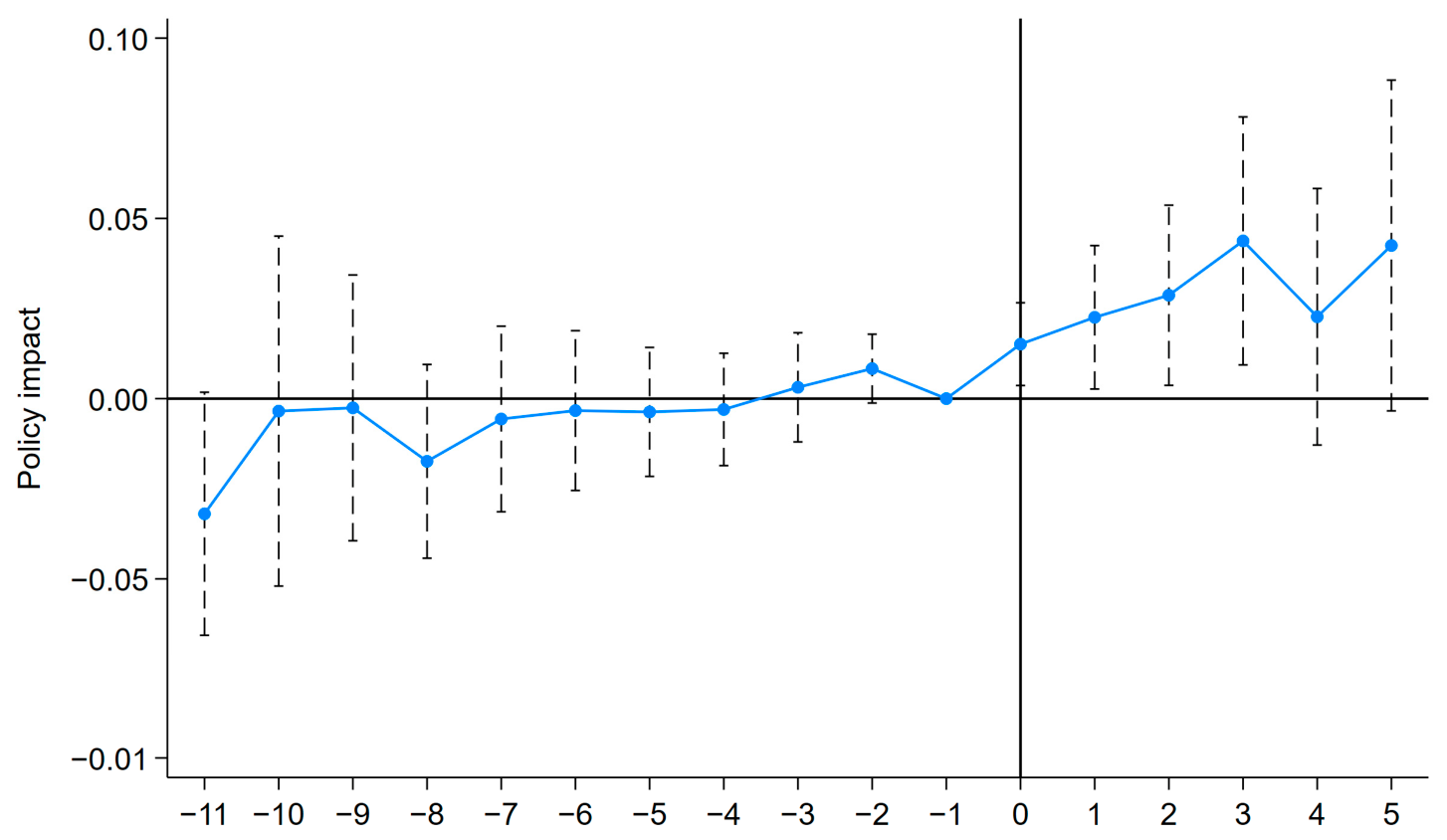
The validity of the DID estimation relies on the parallel trends assumption. Specifically, in the absence of the policy intervention, the treatment and control groups are expected to exhibit similar pre-policy trends. Under this condition, post-policy differences can be interpreted as the causal effect of the policy. To examine whether the parallel trends assumption holds, this study conducts an event-study analysis by plotting the dynamic effects of ECDZs on GTFP before and after the policy intervention (Figure 1).
Figure 1 presents the dynamic effects of ECDZ implementation on GTFP estimated using the event-study specification. The coefficients in the pre-policy periods are statistically insignificant and fluctuate around zero, suggesting that the treatment and control groups followed similar pre-policy trends. This finding supports the validity of parallel trends assumption.
After policy implementation, the estimated coefficients become significantly positive and gradually increase over time. The policy effect reaches its largest magnitude in the third post-policy year, suggesting that the impact of ECDZ construction on GTFP exhibits a gradual dynamic adjustment process. This dynamic pattern is broadly consistent with previous studies emphasizing the lagged effects of environmental governance and green transformation policies [35].

4.3. Robustness Tests

The baseline regression provides preliminary evidence that ECDZs are beneficial for increasing GTFP. To ensure the stability and reliability of the estimation results, a series of robustness tests are conducted below.

4.3.1. Placebo Test

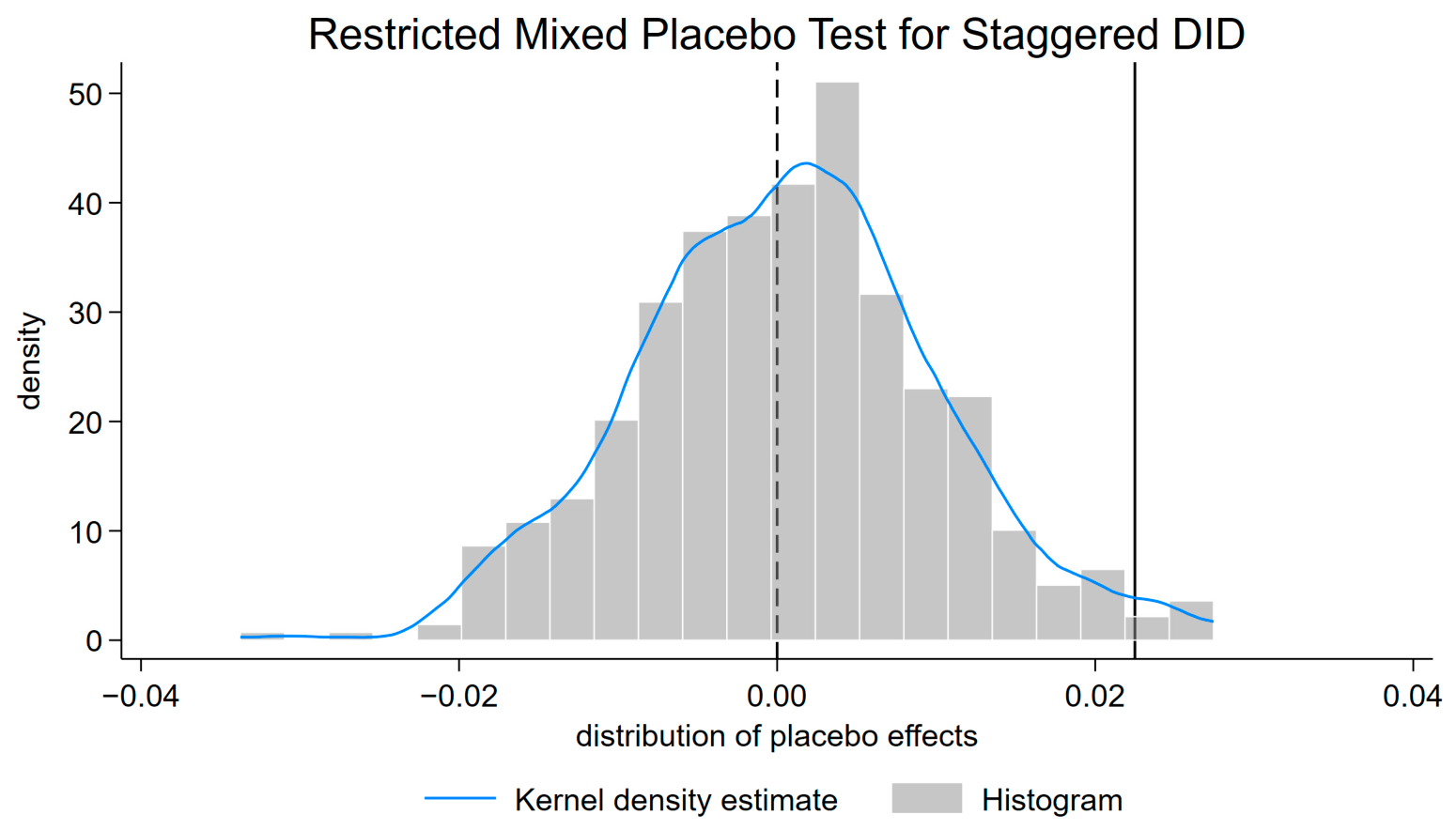
To mitigate potential biases arising from unobservable factors, this study employs a mixed placebo test. We construct a pseudo-treatment group of cities and a pseudo-treatment time and randomly select a pseudo-treatment time for each city from a uniform distribution covering the period from 2017 to 2022. We then conduct 500 rounds of two-way fixed-effects estimation. The results are presented in Table 3.
As shown in Figure 2 and Table 3, most of the pseudo-effects in the figure are concentrated around 0 (dotted line) and follow an approximately normal distribution. This indicates that there is no systematic bias in the random assignment, and that the true regression coefficients (solid line) lies in the right tail of the kernel density distribution, far from the zero line, with no significant overlap with the distribution of pseudo-effects. Both the two-sided and right-sided tests in the table are significant; therefore, we can reject the null hypothesis that “the treatment effect is zero”.

4.3.2. Heterogeneous Treatment Effects

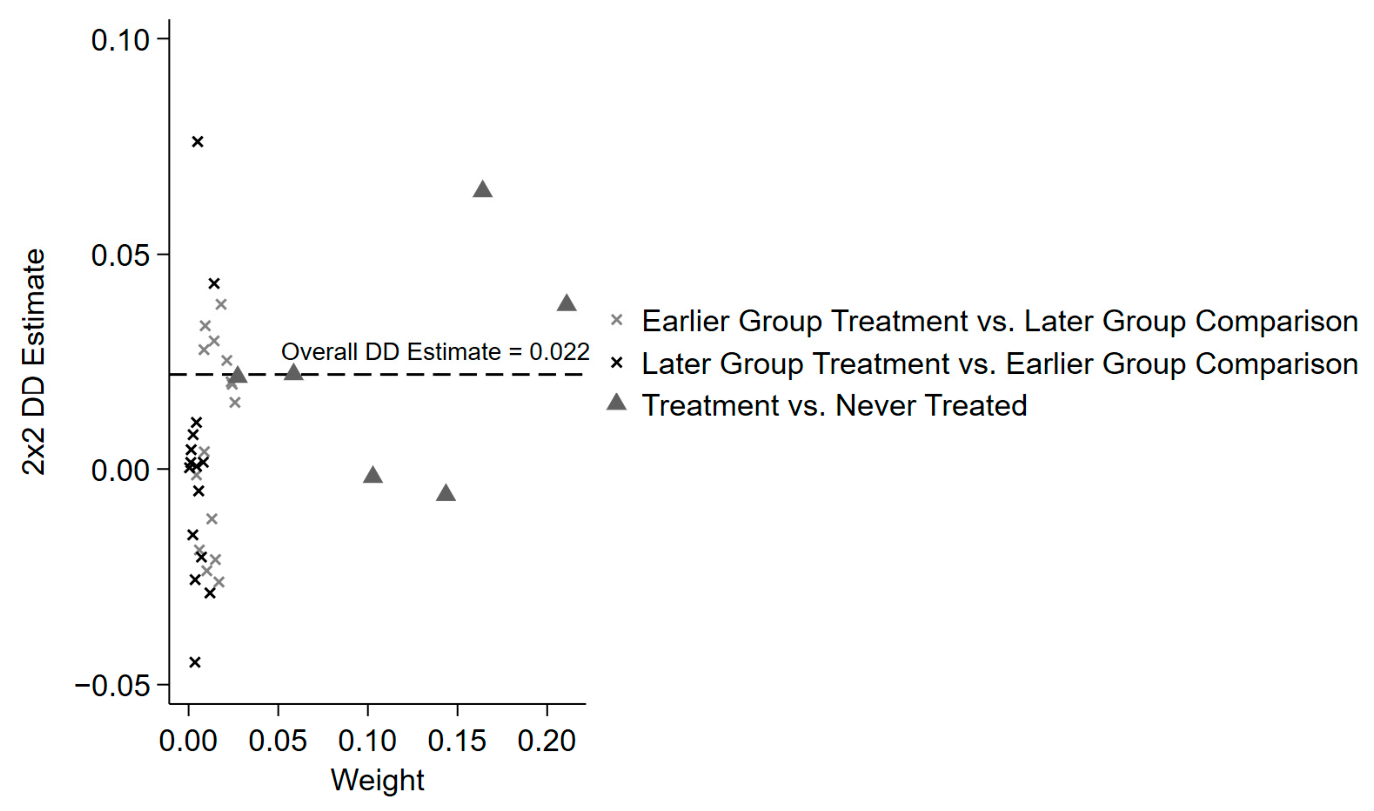
This paper employs the Goodman–Bacon decomposition to examine the estimation bias in a multi-period difference-in-differences (DID) model. As shown in Table 4 and Figure 3, the overall policy effect of the baseline two-way fixed-effects DID is 0.0225. Specifically, the “Earlier Group Treatment vs. Later Group Comparison” and the “Treatment Group vs. Never-Treated Group” accounted for 21.8% and 70.7% of the weights, respectively; The combined weight of “Later Group Treatment vs. Earlier Group Comparison” was only 7.5%, and the estimated results for the three subsamples were consistent in direction, with no issues of negative weights. This indicates that the baseline DID estimates in this paper are less susceptible to interference from treatment effect heterogeneity, and the core conclusions are robust and reliable.

4.3.3. CSDID

Multi-period DID estimates can be viewed as weighted averages of multiple treatment effects, where the weights may be negative. This multi-period DID approach may lead to biased estimates. Therefore, this study employs the CSDID method to diagnose and test for heterogeneous treatment effects. The results of Model (1) in Table 5 indicate that the overall average treatment effect is 0.0240 and is positive at the 5% significance level. This result is consistent with the baseline regression findings, confirming the robustness of the study’s results.
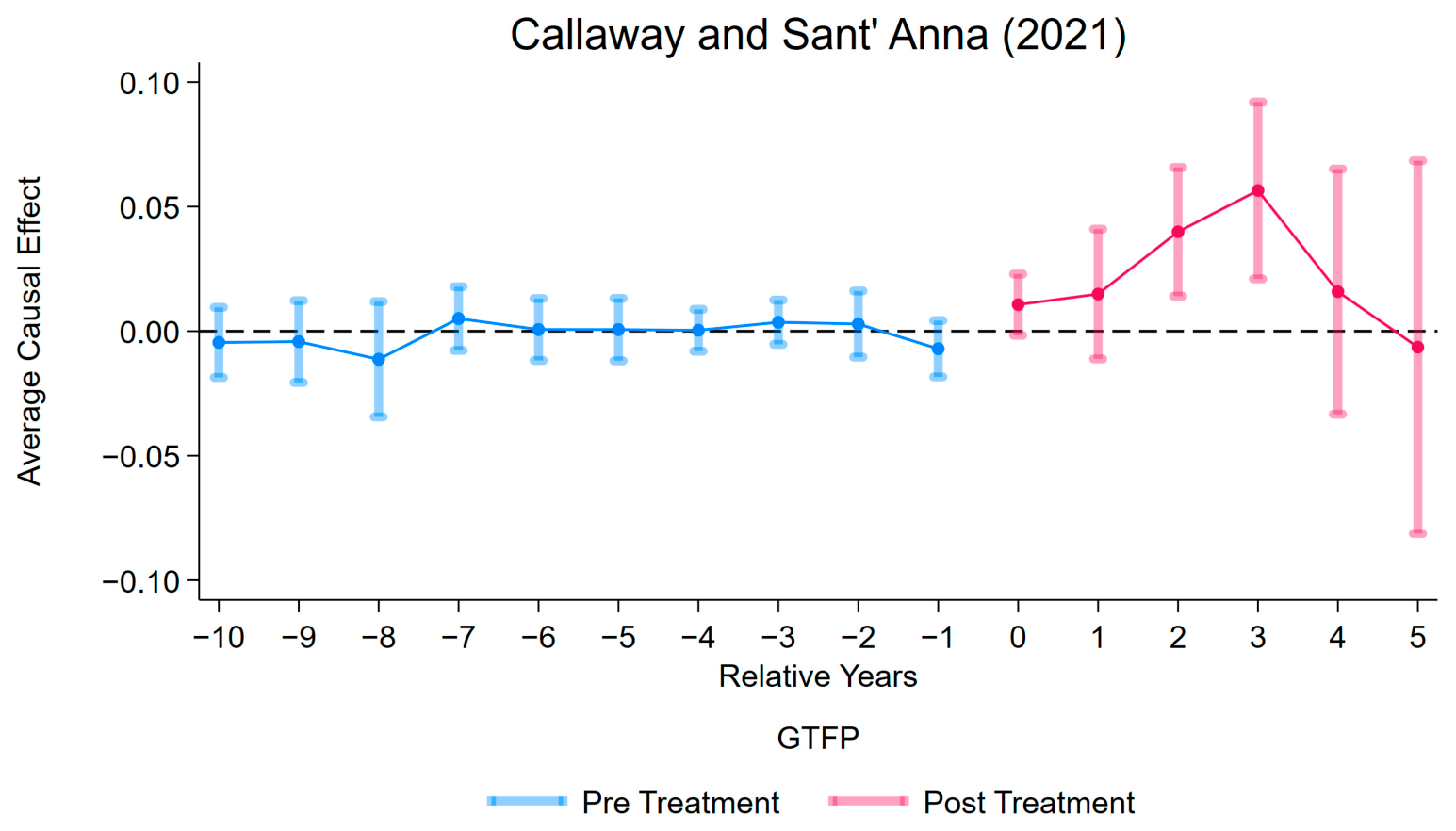
In addition, after switching to CSDID, the parallel trends test plot is shown in Figure 4. The policy effects were not significant prior to implementation but became significant starting from the second period. The test was passed, indicating that the treatment and control groups satisfied the parallel trends assumption prior to policy implementation, that the policy effects are robust, and that the baseline regression results are reliable.

4.3.4. Excluding Provincial Capitals

Given the significant differences between provincial capitals and other cities in terms of economic development, fiscal capacity, and policy implementation, this study re-estimated the model after excluding provincial capitals. The results reported in Column (2) of Table 5 show that the DID coefficient remains positive and statistically significant at the 10% level after excluding these cities, although the magnitude of the coefficient declines relative to the baseline estimate.
This finding suggests that the positive impact of ECDZs on GTFP is not solely driven by provincial capitals. At the same time, the reduction in the coefficient magnitude may indicate that provincial capitals benefit more strongly from the policy, possibly due to their advantages in fiscal resources, technological capacity, and administrative support.

4.3.5. Changing the Observation Period

To account for the potential influence of other major environmental policies implemented prior to the ECDZ program, this study restricts the sample period to 2016–2022. The regression results reported in Column (3) of Table 5 show that the DID coefficient remains significantly positive at the 10% level, indicating that the positive effect of ECDZs on GTFP remains robust after excluding the potential interference of earlier environmental policies.

4.3.6. PSM-DID

To reduce potential selection bias between the treatment and control groups, this study first estimates propensity scores based on the control variables used in the baseline regression. A 1:1 nearest-neighbor matching method is then applied to match demonstration-zone cities with non-demonstration-zone cities exhibiting similar characteristics, thereby improving comparability between the two groups.
Column (4) of Table 5 reports the regression results from the PSM-DID estimation. In Column (4), the DID coefficient is positive (0.0199) and becomes significant at the 10% significance level. This result is generally consistent with the findings of the baseline regression, suggesting that the positive effect of ECDZ on GTFP is unlikely to be driven entirely by sample selection bias. Furthermore, the estimated coefficients of the control variables are generally consistent with the results reported in the baseline model, further supporting the reliability of the matched samples. Overall, the PSM-DID results provide additional support for the robustness of the baseline findings.

4.3.7. Consider the Spatial Correlation of the Residual Term

Given the spatial spillover effects of GTFP, a city’s GTFP may be influenced by surrounding cities, potentially leading to spatial correlation in the residuals. Therefore, following Zhang et al. [36], this study adopts the spatial HAC standard errors proposed by Conley [37]. Table 5, Column (5), presents regression results with a spatial bandwidth of 100 km and a time lag of three periods. The results indicate that the policy effects of ECDZs on GTFP remain robust.

4.3.8. Omitted Variable Bias Test

To examine the impact of omitted variables and unobserved selection bias on the baseline results, this paper conducts a sensitivity analysis using the method proposed by Oster [38]. As shown in Table 6, when the explanatory variable is DID, setting δ = 1 and Rmax = 1.3R2 yields an estimated value β that falls within the 95% confidence interval of the baseline regression estimate, passing the test. The estimated δ = 2.0449, exceeding the conventional threshold of 1, indicating that unobserved confounding is unlikely to explain the main effect. In summary, this study does not suffer from serious omitted variable problems.

4.4. Potential Transmission Channels

The baseline regression and robustness tests consistently suggest that ECDZs have a significant positive effect on urban GTFP. To further examine the underlying channels through which this policy affects green productivity, this study investigates three potential mechanisms: technological progress, industrial structure upgrading, and public service provision. The corresponding estimation results are reported in Table 7.
The results reported in Column (1) of Table 7 suggest that technological progress may be a key driver of GTFP growth in ECDZs. Specifically, the estimated coefficients indicate that implementing ECDZ policies can increase the number of patent grants by approximately 443.1. Compared to the sample means, this represents an increase of about 32.47%, indicating that the policy significantly stimulates regional innovation activity. This finding is broadly consistent with the theoretical expectations of the “Porter Hypothesis,” which argues that appropriately designed environmental regulations may stimulate innovation and partially offset compliance costs through efficiency improvements. This may be attributed to the fact that the implementation of policies for ecological demonstration zones incentivizes enterprises to increase R&D investment and adopt clean production technologies, thereby improving resource utilization efficiency and reducing pollution emissions [5,7]. Furthermore, fiscal subsidies and tax incentives provided by these policies help channel innovation resources toward green technology sectors [34,39], boost local green technology GDP through technological innovation [40], and consequently enhance regional green total factor productivity. In addition, industrial upgrading associated with ecological governance policies may further strengthen technological spillover effects and enhance the contribution of innovation to productivity growth [41].
The empirical results reported in Column (2) of Table 7 suggest that industrial upgrading may be an important channel through which ECDZs enhance GTFP. Specifically, the estimated coefficient of 0.0133 (significant at the 5% level) indicates that the implementation of ECDZ policies increases the industrial structure upgrading index by approximately 0.0133 points. Relative to the sample means, this corresponds to an increase of about 2.95%. This finding implies that the ECDZ policy may promote the reallocation of production factors from pollution-intensive and low-efficiency sectors toward cleaner and more technology-intensive industries, thereby improving resource allocation efficiency and supporting green economic transformation. This may be because ecological civilization demonstration zones can curb the expansion of highly polluting industries through environmental regulation and restrictions on industrial access, while simultaneously directing capital toward energy-saving and environmentally friendly industries through fiscal support policies [14]. This helps reduce the share of highly polluting industries and expand the cleaner service sector, thereby improving resource utilization efficiency and supporting the long-term growth of GTFP.
The results reported in columns (3) through (4) of Table 7 suggest that the ECDZs may boost GTFP through the provision of public services. Specifically, the implementation of ECDZ policies increases the number of hospital beds by approximately 1465 (a 6.86% rise relative to the sample mean) and raises the number of handline subscribers per 10,000 people by about 0.3713 (a 7.59% increase relative to the sample mean). These findings demonstrate that the establishment of ECDZs significantly enhances local public service supply. This confirms that improvements in the provision of public services contribute to green productivity growth. The transmission pathway may be as follows: Ecological governance policies can enhance regional productivity by increasing investment in public goods and accumulating human capital [42], with high-quality healthcare services attracting a skilled workforce, improving human capital quality, and supporting long-term economic transformation [43]; improving telecommunications infrastructure can effectively reduce transaction costs, accelerate the flow of information, and promote the widespread dissemination of green technologies [44]; meanwhile, fiscal subsidies and green financial instruments resulting from policy implementation can also drive investment in information infrastructure and deepen regional connectivity [45]. Ultimately, by optimizing basic public services such as healthcare and telecommunications, a transmission pathway is formed that enables the demonstration zone to achieve green development and drive growth in green total factor productivity.

4.5. Heterogeneity Analysis

4.5.1. Geographic Heterogeneity

Given large regional differences in economic development, industrial structure, and resource endowments, ECDZs’ effects on GTFP may vary across regions. To examine regional heterogeneity, this study divides the sample into eastern, central, and western regions and conducts separate regressions for each subsample. The estimation results are reported in Columns (1)–(3) of Table 8. In addition, this paper employs Fisher’s combined test to examine differences in coefficients across groups, while controlling for city and time fixed effects by generating city and time dummy variables.
The results indicate that the impact of ECDZs on GTFP varies significantly across regions. Specifically, the policy significantly raises GTFP in the central region, with a DID coefficient of 0.0435, significant at the 1% level. By contrast, the eastern coefficient is positive but insignificant, and the western coefficient is negative but insignificant, indicating limited policy effects in both regions.
For the eastern region, the DID coefficient is 0.0281, but it is not statistically significant. This may be because the eastern region industrialized early, with an industrial structure dominated by low-pollution and high-end manufacturing and services. The region’s higher level of economic development and innovation capacity has already brought pollution emissions to a relatively low level, thereby weakening the effects of the ecological functional zone policy.
Second, the central DID coefficient is 0.0435 and significant at 1%, showing strong positive policy effects here. This pattern may reflect ongoing industrial transformation in the central region. In recent years, the central region has undertaken industrial relocation from coastal areas while simultaneously facing increasing environmental governance pressures. Under the policy framework of ECDZs, local governments may have stronger incentives to promote industrial upgrading and green transformation, thereby contributing to improvements in GTFP. In addition, compared with the eastern region, the central region may still possess greater potential for marginal improvements in environmental efficiency, which could partly explain the relatively strong estimated policy effect.
The western DID coefficient is −0.0011 and insignificant, indicating no significant productivity effect here. One possible explanation is that the western region remains more dependent on resource-intensive industries, while constraints related to economic development, technological capacity, and environmental governance may limit the effectiveness of policy implementation. In addition, the relatively weaker industrial base and lower innovation capacity in some Western cities may reduce the ability of firms to respond to environmental policy incentives through technological upgrading. However, the statistically insignificant coefficient does not necessarily imply policy failure; rather, it suggests that regional differences in economic conditions and governance capacity should be considered in future policy design and implementation.

4.5.2. Heterogeneity of Resource Endowments

Resource-based cities are typically characterized by a high dependence on the extraction and processing of natural resources, such as minerals, energy, and forestry resources. Due to their industrial structure and development path, they face greater environmental pressure and stronger path dependence than non-resource-based cities. As a result, the effects of environmental policies may differ substantially across the two types of cities.
The effectiveness of ECDZ policies may vary across cities with different industrial structures and resource endowments. Specifically, the two city types differ in industrial upgrading, environmental governance, and technology transformation potential. Based on the list of 262 resource-based cities released by the National Development and Reform Commission, this paper divides the sample into resource-based and non-resource-based cities to examine the heterogeneous effects of ECDZ policies on GTFP. The empirical results are reported in Table 9.
The heterogeneity test in Table 9 indicates that the policy on ECDZs has a significantly different impact on the GTFP of resource-based and non-resource-based cities: the policy effect coefficient for resource-based cities is 0.0165 (statistically insignificant), while that for non-resource-based cities reaches 0.0247 (significant at the 10% level). Furthermore, the Fisher test confirms that there is a significant difference in policy effects between resource-based cities and non-resource-based cities. This divergence primarily stems from the interaction between resource endowment constraints and the costs of green transition. For resource-based cities, the non-significant policy effect reflects a dual dilemma of “structural rigidity” and “transition friction”. First, the inertia in factor allocation resulting from a resource-dependent economy makes it difficult for traditional production factors to rapidly adapt to the requirements of green technological innovation, leading to a lack of compatibility between environmental regulatory policies and the industrial technology system. Second, resource-based cities generally face more severe sunk costs in environmental governance; the exit costs of pollution-intensive industries and the marginal costs of green technology investment are both significantly higher than in non-resource-based cities, which objectively weakens the effectiveness of policy incentives. In contrast, the significant positive policy effects observed in non-resource-based cities reflect the synergistic interaction between “structural advantages” and “innovation resilience.” Their relatively flexible industrial structures and diversified economic foundations enable them to achieve rapid diffusion of green technological innovations through the reallocation of factors of production. Particularly in areas of incremental improvement—such as the application of clean technologies and the upgrading of environmental protection equipment—non-resource-based cities are better positioned to establish a virtuous cycle of “policy response—efficiency enhancement.”

5. Discussion

5.1. In-Depth Analysis

At a critical stage when China vigorously promotes ecological civilization construction and explores green and sustainable development paths, GTFP, as a core indicator reflecting the coordination between economic growth and ecological protection, has become increasingly important. Evaluating the effects of ECDZ policies not only meets the core requirements of green development and helps translate the concept that “lucid waters and lush mountains are invaluable assets” into concrete outcomes but also provides important quantitative evidence and practical guidance for China’s ecological civilization construction.
The ECDZs can significantly increase GTFP, which is of great significance for promoting regional green development, and then contribute to the coordination of economic performance and environmental efficiency. The findings are generally consistent with existing studies on ecological civilization policies and green development. Previous research has shown that environmental governance and ecological civilization policies can promote green technological progress, improve resource allocation efficiency, and facilitate industrial upgrading, thereby enhancing GTFP [14]. The results of this study provide additional empirical evidence supporting the positive role of ECDZs in promoting green productivity growth. Compared with previous studies, this paper further evaluates the dynamic policy effects of the six batches of ECDZs implemented after 2017 and examines the heterogeneous impacts across different regions and city types.
The potential transmission channels further suggest that technological progress and industrial structure upgrading may serve as important channels through which ECDZs affect GTFP. On the one hand, the policy appears to promote regional innovation activities, which may facilitate the adoption of green technologies and improve production efficiency. On the other hand, the policy may encourage the reallocation of production factors toward cleaner and more efficient sectors, thereby contributing to industrial upgrading and improvements in environmental efficiency. These findings are broadly consistent with the theoretical expectations of the Porter Hypothesis and with existing studies emphasizing the role of environmental regulation in promoting green transformation. In addition, enhanced public service provision serves as an important mechanism through which ECDZs generate green development effects.
Heterogeneity analysis reveals a markedly uneven policy impact: the estimated treatment effects are statistically significant and stronger in the central regions and non-resource-based cities, whereas they remain insignificant in the eastern regions, western regions, and resource-based cities. This divergence likely originates from the central regions’ superior technological absorption capacities, more adaptive industrial structures, and higher policy implementation effectiveness; conversely, resource-based cities tend to be constrained by the lock-in effects of traditional industries and elevated transformation costs, which limit their ability to realize the policy dividends. More fundamentally, such spatial and typological disparities may reflect broader regional differences in industrial structure, innovation capacity, and environmental governance conditions, suggesting that cities endowed with stronger economic foundations and more diversified industrial portfolios are better positioned to respond to environmental policy incentives through technological upgrading and industrial transformation.

5.2. Limitations

Despite the robust findings, this study has several limitations. First, the analysis focuses primarily on city-level data, potentially overlooking intra-city variations and local policy nuances that may affect GTFP. Future research could explore more granular data at the district or enterprise level to capture heterogeneity within cities. Second, it is worth noting that the policy effects in the eastern region are highly sensitive to standard error specifications. This is likely due to strong intra-regional correlations, weak baseline effects, and limited inter-city differences, which result in insignificant marginal significance under cluster analysis at the city level. Third, while this study considers unintended outcomes, it primarily focuses on industrial “three wastes”; Other air pollutants are not included in the indicator system. Future research could further integrate environmental, social, and economic indicators to conduct a more comprehensive assessment of the impacts on green development. Subsequent studies could also examine the long-term sustainability of policy effects, as well as the interactive relationships between ecological civilization demonstration zones and environmental initiatives in other regions or countries, thereby providing more detailed insights into pathways for high-quality green development.

6. Conclusions and Policy Implications

6.1. Conclusions

Against the backdrop of intensified global climate change and mounting ecological pressures, China has implemented the strategy of ecological civilization construction, establishing Ecological Civilization Demonstration Zones (ECDZs) to explore pathways for high-quality green development. Using panel data from 282 prefecture-level cities from 2011 to 2022, this study employs a super-efficiency SBM model to measure urban green total factor productivity (GTFP) and applies a multi-period difference-in-differences (DID) approach to evaluate the effects of ECDZs.
The empirical findings indicate that the establishment of ECDZs significantly enhances urban GTFP, with an average increase of approximately 6.52%. Potential transmission channels further reveal that technological innovation and industrial structure upgrading serve as primary channels through which the policy promotes green productivity, while improvements in public services and information infrastructure also contribute positively. Notably, the policy effects exhibit significant heterogeneity: they are more pronounced in central regions and in non-resource-based cities, whereas eastern and western regions and resource-dependent cities experience weaker impacts. Overall, the study provides robust empirical evidence of the effectiveness of ECDZs in advancing green development and highlights the importance of tailoring policy implementation to regional economic foundations, industrial structures, and innovation capacities.

6.2. Policy Implications

Based on the findings of the above study, the following policy recommendations are proposed to better leverage the role of the ECDZs, enhance GTFP, and promote sustainable economic and social development:
First, policymakers should adopt differentiated governance strategies according to regional development conditions and resource endowments. The heterogeneity analysis indicates that the positive effects of ECDZs on GTFP are more pronounced in eastern and central regions, whereas the policy effects remain relatively weak in western and resource-based cities. This suggests that the effectiveness of ecological governance policies depends not only on policy intensity but also on local industrial structures, technological capabilities, and institutional capacity. Therefore, for western and resource-based cities, greater policy support should be directed toward green technology upgrading, environmental infrastructure construction, and industrial transformation capacity. Targeted fiscal support, green finance instruments, and technical assistance may help reduce the adjustment costs associated with green transition and alleviate the path dependence of resource-intensive industries. In contrast, eastern and central regions can further innovate in green finance, carbon trading, and digital environmental governance, thus enhancing demonstration and spillover effects.
Second, the government should further strengthen innovation-oriented environmental governance mechanisms. The mechanism analysis shows that technological progress constitutes an important channel through which ECDZs improve GTFP. This finding implies that ecological governance policies should place greater emphasis on stimulating green innovation and improving the efficiency of technology diffusion. In practice, governments can strengthen support for green technology research and development via fiscal subsidies, tax incentives, green credit policies, and innovation compensation mechanisms. Meanwhile, promoting closer cooperation among enterprises, universities, and research institutions helps accelerate the commercialization and diffusion of green technologies. In addition, improving the institutional environment for intellectual property protection and green technology transactions could further strengthen firms’ incentives to engage in long-term green innovation activities.
Third, ecological governance policies should be better coordinated with industrial transformation strategies. The empirical results suggest that industrial structure upgrading plays a significant role in enhancing GTFP. Therefore, future policy design should promote a gradual shift in production factors from pollution-intensive sectors toward green and technology-intensive industries. On the one hand, local governments should continue to strengthen environmental regulations on high-energy-consuming and high-pollution industries to accelerate industrial upgrading and eliminate outdated production capacity. On the other hand, greater policy support should be provided for the development of green manufacturing, environmental protection industries, digital industries, and producer services, thereby cultivating new drivers of sustainable economic growth. Moreover, improvements in public service provision and information infrastructure may further enhance factor allocation efficiency and support the long-term process of green urban transformation.
Finally, greater attention should be paid to improving policy coordination and long-term institutional effectiveness. Since the effects of ECDZs exhibit certain lag characteristics, ecological governance should be viewed as a long-term institutional arrangement rather than a short-term administrative intervention. Policymakers should therefore establish more stable assessment mechanisms centered on green development performance and GTFP improvement, while strengthening.

Author Contributions

Conceptualization, K.D. and M.H.; methodology, Y.S.; software, H.M.; validation, Y.S. and M.H.; formal analysis, Y.S.; investigation, M.H.; resources, K.D.; data curation, H.M.; writing—original draft preparation, K.D. and H.M.; writing—review and editing, M.H.; visualization, Y.S.; supervision, M.H.; project administration, M.H.; funding acquisition, M.H. All authors have read and agreed to the published version of the manuscript.

Funding

This research was funded by National Natural Science Foundation of China (72303055), Central Guided Local Science and Technology Development Funding Program in Hebei Province (246Z4203G).

Institutional Review Board Statement

Not applicable.

Informed Consent Statement

Not applicable.

Data Availability Statement

Data will be made available on request from the corresponding author. The data are not publicly available due to data management.

Conflicts of Interest

The authors declare no conflict of interest.

References

  1. Chen, P.; Shi, X. A review of ecological civilization research based on literature network analysis. Acta Ecol. Sin. 2019, 39, 3787–3795. [Google Scholar] [CrossRef]
  2. Zhu, C.; Zhuo, L. Towards “rule of rules”: Constructing Fujian pilot zone for judicial guarantee of national ecological civilization. Strait Commun. 2016, 10, 26–27. [Google Scholar]
  3. Nie, C.F.; Lu, J.X.; Feng, Y.; Hu, Z.L. Impact of innovative city construction on green total factor productivity. Chin. J. Popul. Resour. Environ. 2021, 31, 117–127. [Google Scholar] [CrossRef]
  4. Jiang, L.Y. An Empirical Study on the Impact of the Establishment of “National Ecological Civilization Pilot Demonstration Zones” on Green Total Factor Productivity. Doctoral Dissertation, Liaoning University, Shenyang, China, 2022. [Google Scholar] [CrossRef]
  5. Li, B.; Peng, X.; Ouyang, M.K. Environmental Regulation, Green Total Factor Productivity and the Transformation of China’s Industrial Development Model: Analysis Based on Data of China’s 36 Industries. China Ind. Econ. 2013, 4, 56–68. [Google Scholar] [CrossRef]
  6. Liu, Y.Q.; Zhang, J.L. A study on the construction of Jiangxi ecological civilization pilot zone from a comparative perspective: Based on a comparison of the three first batch ecological civilization pilot zones in Fujian, Jiangxi and Guizhou. Ecol. Econ. 2018, 34, 214–220. [Google Scholar]
  7. Wang, Y.F.; Tao, W.Q. The impact and effects of low-carbon city pilots on the growth of urban green total factor productivity. Chin. J. Popul. Resour. Environ. 2021, 31, 78–89. [Google Scholar]
  8. Chen, Z.B.; He, G.; Jiang, S.Z. The impact of environmental regulation and industrial agglomeration on air pollution: On the spatial spillover perspective. Int. J. Environ. Sci. Technol. 2024, 21, 2585–2604. [Google Scholar] [CrossRef]
  9. Wu, Y.; Miao, C.; Miao, J.; Zhang, Y. How does environmental regulation affect the location of new polluting firms? Exploring the agglomeration threshold of effective environmental regulation. Int. J. Environ. Res. Public Health 2020, 17, 1279. [Google Scholar] [CrossRef] [PubMed]
  10. Wang, K.L.; Xu, R.Y.; Zhang, F.Q.; Miao, Z. The impact of the construction of ecological civilization demonstration zones on carbon emission intensity. Chin. J. Popul. Resour. Environ. 2022, 32, 57–70. [Google Scholar]
  11. Guo, Q.; Zhang, H.; Wang, Q.; Dong, Y. Impact of green finance on carbon intensity: Empirical research based on dynamic spatial Durbin model. Res. Sq. 2022; preprint. [CrossRef] [PubMed]
  12. Yuan, H. Ecological civilization construction and green low-carbon development: New evidence from county-level regions in China. Coal Econ. Res. 2024, 44, 110–118. [Google Scholar] [CrossRef]
  13. Wang, Y.S.; Zhong, M.C. Study on the impact and mechanism of ecological civilization demonstration zone construction on green total factor productivity. Mod. Financ. Econ. J. Tianjin Univ. Financ. Econ. 2023, 43, 89–107. [Google Scholar] [CrossRef]
  14. Chen, J.Y.; Li, X. Study on the Impact and Spillover Effect of National Ecological Civilization Pilot Zone on Provincial Green Total Factor Productivity. J. Guizhou Univ. Financ. Econ. 2023, 4, 91–100. [Google Scholar]
  15. Wang, J.Y.; Lu, H.G.; Xu, C.Y.; Kong, F.B. Impact of the Implementation of “Shan-Shui Initiative” on Forestry Green Total Factor Productivity: A Case Study of the Qiantang River Source Area in Zhejiang Province. Sci. Silvae Sin. 2025, 61, 191–203. [Google Scholar] [CrossRef]
  16. Guo, Q.B.; Xiong, W.S. How does the construction of ecological civilization demonstration zones affect green development welfare? Chin. J. Popul. Resour. Environ. 2023, 33, 18–29. [Google Scholar]
  17. Meade, J. The Theory of Economic Externalities: The Control of Environmental Pollution and Similar Social Costs; Brill Nijhoff: Leiden, The Netherlands, 1979. [Google Scholar]
  18. Jaffe, A.B.; Palmer, K. Environmental Regulation and Innovation: A Panel Data Study (NBER Working Paper No. 5545). Rev. Econ. Stat. 1997, 79, 610–619. Available online: https://www.nber.org/papers/w5545 (accessed on 10 March 2026). [CrossRef]
  19. Rexhäuser, S.; Rammer, C. Environmental innovations and firm profitability: Unmasking the Porter hypothesis. Environ. Resour. Econ. 2014, 57, 145–167. [Google Scholar] [CrossRef]
  20. Lanoie, P.; Laurent-Lucchetti, J.; Johnstone, N.; Ambec, S. Environmental Policy, Innovation and Performance: New Insights on the Porter Hypothesis; Cahier de recherche No. IEA-07-06; Institut d’Économie Appliquée, HEC Montréal: Montreal, QC, Canada, 2007. [Google Scholar]
  21. Tian, Y.; Yang, H.; Zhang, M.; Wang, J. Green innovation effects of ecological civilization pilot policies. Pol. J. Environ. Stud. 2024, 33, 2331–2343. [Google Scholar] [CrossRef] [PubMed]
  22. Zhang, W.; Zhu, B.; Li, Y.; Yan, D. Revisiting the Porter hypothesis: A multi-country meta-analysis of the relationship between environmental regulation and green innovation. Humanit. Soc. Sci. Commun. 2024, 11, 232. [Google Scholar] [CrossRef]
  23. Qi, M. Green credit, financial ecological environment, and investment efficiency. Complexity 2021, 2021, 5539195. [Google Scholar] [CrossRef]
  24. Zhao, Y.; Peng, S.; Zhang, Q.; Wang, Y.; Gong, C.; Lu, X. Land finance, local government debt and economic green transformation. Land 2024, 13, 975. [Google Scholar] [CrossRef]
  25. Liang, G.; Yu, D.; Ke, L. An empirical study on dynamic evolution of industrial structure and green economic growth: Based on data from China’s underdeveloped areas. Sustainability 2021, 13, 8154. [Google Scholar] [CrossRef]
  26. Guan, S.; Liu, J.; Liu, Y.; Du, M. The nonlinear influence of environmental regulation on the transformation and upgrading of industrial structure. Int. J. Environ. Res. Public Health 2022, 19, 8378. [Google Scholar] [CrossRef] [PubMed]
  27. Krugman, P.; Venables, A.J. Globalization and the inequality of nations (NBER Working Paper No. 5098). Q. J. Econ. 1995, 110, 857–880. Available online: https://www.nber.org/papers/w5098 (accessed on 10 March 2026).
  28. Lou, F. The impact of the “Belt and Road” initiative on industrial structure upgrading along the corridor. Proc. Bus. Econ. Stud. 2024, 7, 194–199. [Google Scholar] [CrossRef]
  29. Chen, D.; Huang, Q. The new policy for innovative transformation in regional industrial chains, the conversion of new and old kinetic energy, and energy poverty alleviation. Energies 2024, 17, 2667. [Google Scholar] [CrossRef]
  30. Sachs, J.D.; Warner, A.M. Natural Resource Abundance and Economic Growth; Harvard Institute for International Development Discussion Paper No. 539; Harvard University: Cambridge, MA, USA, 1995. [Google Scholar]
  31. Shi, D.; Li, S.L. Emissions Trading System and Energy Use Efficiency: Measurements and Empirical Evidence for Cities at and above the Prefecture Level. China Ind. Econ. 2020, 9, 5–23. [Google Scholar] [CrossRef]
  32. Xiong, X. Analysis and evaluation of ecological civilization construction in national ecological civilization pilot demonstration zones based on the DPSIR model: A case study of the Xiangjiang River Source. Acta Ecol. Sin. 2020, 40, 5081–5091. [Google Scholar]
  33. Lin, S.X.; Qi, Y. Incentive effects and strategic choices of location-oriented ecological and environmental policies. Fisc. Res. 2021, 6, 85–103. [Google Scholar] [CrossRef]
  34. Chang, Z.Z.; Chen, C.J.; Zhang, J. Applicability of the innovation-driven development strategy from the perspective of industrial structure upgrading: An empirical analysis based on panel data of China’s four major economic regions. Economist 2019, 8, 62–74. [Google Scholar] [CrossRef]
  35. Liang, Q.; Xiao, S.P.; Liu, Y.B. A study on the impact and mechanism of environmental policies on urban ecological efficiency: A quasi-natural experiment based on national ecological civilization pilot demonstration zones. J. Xi’an Jiaotong Univ. Soc. Sci. Ed. 2022, 42, 61–70. [Google Scholar] [CrossRef]
  36. Zhang, H. Can Low-carbon City Construction Reduce Carbon Emissions? Evidence from a Quasi-natural Experiment. Bus. Manag. J. 2020, 6, 25–41. [Google Scholar] [CrossRef]
  37. Conley, T.G. GMM Estimation with Cross Sectional Dependence. J. Econom. 1999, 92, 1–45. [Google Scholar] [CrossRef]
  38. Oster, E. Unobservable Selection and Coefficient Stability: Theory and Validation. J. Bus. Econ. Stat. 2019, 37, 187–204. [Google Scholar]
  39. Lu, J.; Li, T.T. Industrial structure upgrading, technological innovation and green total factor productivity: A study from the heterogeneous perspective. Chin. J. Popul. Sci. 2021, 4, 86–97+128. [Google Scholar]
  40. Wu, D.; Ma, X.; Cai, F.; Liu, L.; Xu, Y.; Tu, Y. Reform of eco-governance and the green performance: A quasi-natural experiment based on the national ecological civilization pilot zone in China. Environ. Res. Commun. 2025, 7, 065020. [Google Scholar] [CrossRef]
  41. Li, L.; Tao, F. Selection of Optimal Environmental Regulation Intensity for Chinese Manufacturing Industry: Based on the Green TFP Perspective. China Ind. Econ. 2012, 5, 70–82. [Google Scholar] [CrossRef]
  42. Zhao, W.; Xu, Y. Public expenditure and green total factor productivity: Evidence from Chinese prefecture-level cities. Int. J. Environ. Res. Public Health 2022, 19, 5755. [Google Scholar] [CrossRef] [PubMed]
  43. Wu, D.Y. A Study on the Impact of Health Policy on Regional Economic Development Under the Background of High-Quality Transformation. Doctoral Dissertation, Wuhan University, Wuhan, China, 2023. [Google Scholar] [CrossRef]
  44. Nie, T. A Study on the Impact of Information Infrastructure Construction on Urban Green Total Factor Productivity. Doctoral Dissertation, Jiangxi University of Finance and Economics, Nanchang, China, 2024. [Google Scholar] [CrossRef]
  45. Lu, D.; Wang, Z. Towards green economic recovery: How to improve green total factor productivity. Econ. Change Restruct. 2023, 56, 3163–3185. [Google Scholar] [CrossRef]
Figure 1. Parallel Trend Chart.
Sustainability 18 06387 g001
Figure 2. Placebo Test.
Sustainability 18 06387 g002
Figure 3. Goodman-Bacon decomposition result.
Sustainability 18 06387 g003
Figure 4. CSDID’s Test for Parallel Trends.
Sustainability 18 06387 g004
Table 1. Descriptive Statistics for Variables.
VariablesSample SizeMeanS.D.Min.Max.
Dependent variable:
GTFPGTFP33840.34530.14080.10261.1770
Key independent variables:
Development of ECDZsDID33840.19360.39510.00001.0000
Mediating variable:
Number of granted invention patentstech33841.36464.58350.000088.1270
Number of landline subscribers at year-endhandline33844.89105.21440.360044.3300
Number of beds in hospitals and health centersbed33842.13511.93460.135218.6135
Industrial restructuringindus33840.45120.11340.03992.0028
Control variables:
Population densitypop33845.74160.98271.79769.0886
General government budget expenditurebudget33845.59170.86583.23803.2444
Highway freight volumetraffic33849.05390.84466.737010.9877
Level of opennessopen3384−2.60931.4237−6.44610.4143
Highway densityhigh33841.14400.60180.06796.3271
Urban-rural income gapgap33842.32510.50340.00005.0000
Annual average precipitationrain33844.29620.55882.49455.2135
Average annual temperaturetem33672.56590.50020.59353.1672
Table 2. Regression Results for GTFP in ECDZs.
VariablesGTFPGTFPGTFPGTFP
(1)(2)(3)(4)
DID0.0563 ***0.00080.0221 **0.0225 **
(0.0061)(0.0062)(0.0108)(0.0101)
pop 0.0336 *** 0.0814 **
(0.0040) (0.0356)
budget 0.0625 *** 0.0241 **
(0.0034) (0.0103)
traffic −0.0210 *** −0.0004
(0.0035) (0.0086)
open 0.0053 *** −0.0089
(0.0019) (0.0064)
high −0.0387 *** −0.0374 ***
(0.0048) (0.0128)
gap −0.0336 *** 0.0373 **
(0.0048) (0.0599)
rain 0.0204 *** 0.0568 ***
(0.0057) (0.0140)
tem −0.0255 *** 0.1230 **
(0.0071) (0.0599)
Constant0.3344 ***0.1069 ***0.3411 ***−0.8853 ***
(0.0027)(0.0366)(0.0021)(0.3282)
City FENoNoYesYes
Year FENoNoYesYes
Obs.3384336733843366
R-squared0.02500.20060.68720.6970
Note: *** and ** denote significance levels of 1% and 5%, respectively; the numbers in parentheses represent the robust standard errors of clustering at the city level.
Table 3. Placebo Test.
VariableCoefficientp-Value
Two-SidedLeft-SidedRight-Sided
DID0.02250.02000.98400.0160
Table 4. Goodman-Bacon decomposition result.
2 × 2 DID ComparisonsDID
WeightsAverage Treatment Effect
Earlier Group Treatment vs. Later Group Comparison0.2180.011
Later Group Treatment vs. Earlier Group Comparison0.0750.004
Treatment vs. Never treated0.7070.028
Table 5. Robustness Tests.
VariablesCSDIDExcluding Provincial CapitalsChange the Observation PeriodPSM-DIDConsider the Spatial Correlation of the Residual Term
GTFPGTFPGTFPGTFPGTFP
(1)(2)(3)(4)(5)
DID 0.0203 *
(0.0104)
0.0176 *
(0.0095)
0.0199 *
(0.0102)
0.0225 ***
(0.0076)
ATT0.0240 **
(0.0119)
ControlsYesYesYesYesYes
City FEYesYesYesYesYes
Year FEYesYesYesYesYes
Constant −0.5955 **
(0.2920)
−0.4925
(0.4492)
−0.9410 ***
(0.3370)
0.0000
(0.0021)
Obs.33633057196532683367
R-squared 0.68980.76700.68380.0360
Note: ***, **, and * denote significance levels of 1%, 5%, and 10%, respectively; the numbers in parentheses represent the robust standard errors of clustering at the city level.
Table 6. Omitted Variable Bias Test.
VariablesSpecific StepsCalculation ResultsEvaluation CriteriaPassed or Failed
DIDβ = 0 Rmax = 1.3R2 δ = 2.0449 δ > 1 or δ < 0Yes
δ = 1 Rmax = 1.3R2 β * ( R max ,   δ ) = 0.0116 β * ( R max ,   δ ) [0.0025, 0.0425]Yes
Note: * denotes significance level of 10%.
Table 7. Potential transmission channels.
VariablesTechnological InnovationStructure OptimizationPublic Service
TechIndusBedHandline
(1)(2)(3)(4)
DID0.4431 ***
(0.1618)
0.0133 **
(0.0058)
0.1465 ***
(0.0491)
0.3713 ***
(0.1237)
Constant−4.9527
(3.6603)
0.7976 ***
(0.1586)
−3.9550 **
(1.5619)
0.5059
(2.3556)
ControlsYesYesYesYes
City FEYesYesYesYes
Year FEYesYesYesYes
Obs.3366336633663366
R-squared0.88290.84230.96790.9752
Note: *** and ** denote significance levels of 1% and 5%, respectively; the numbers in parentheses represent the robust standard errors of clustering at the city level.
Table 8. Heterogeneity of geographic location.
Variables(1)(2)(3)
EasternCentralWestern
DID0.02810.0435 ***−0.0011
(0.0186)(0.0165)(0.0115)
Constant−1.5754 *−1.1441 **−0.4143
(0.8367)(0.4766)(0.4506)
ControlsYesYesYes
City FEYesYesYes
Year FEYesYesYes
Obs.12001185981
R-squared0.64200.71500.7355
Non-Eastern vs. EasternNon-central vs. CentralNon-Western vs. Western
Group difference (p-value)−0.046 ***−0.020 *0.049 ***
Note: ***, **, and * denote significance levels of 1%, 5%, and 10%, respectively; the numbers in parentheses represent the robust standard errors of clustering at the city level.
Table 9. Heterogeneity of Resource-Based Cities.
Variables(1)(2)
Resource-Based CityNon-Resource-Based Cities
DID0.01650.0247 *
(0.0116)(0.0149)
Constant−0.3005−1.0012 *
(0.2740)(0.5498)
ControlsYesYes
City FEYesYes
Year FEYesYes
Obs.13532013
R-squared0.72670.6679
Non-resource vs. Resource
Group difference (p-value)0.024 **
Note: **, and * denote significance levels of 5% and 10%, respectively; the numbers in parentheses represent the robust standard errors of clustering at the city level.
Disclaimer/Publisher’s Note: The statements, opinions and data contained in all publications are solely those of the individual author(s) and contributor(s) and not of MDPI and/or the editor(s). MDPI and/or the editor(s) disclaim responsibility for any injury to people or property resulting from any ideas, methods, instructions or products referred to in the content.