1. Introduction
The significant increase in the occurrence of disasters associated with hydrological events and climate change reinforces the urgency of new strategies to address socio-environmental risks. In the context of ongoing climate change, there has been a widespread increase in the frequency of extreme events, such as high-intensity and high-volume rainfall [
1,
2]. This is aggravated by the urbanisation model of global cities, which has been disorderly, with high levels of soil sealing and occupation of environmentally fragile land. Thus, the urban population, especially in socially vulnerable areas, has faced serious environmental impacts, such as flooding, flash floods, landslides and inundations.
In most cases, these impacts are not felt uniformly, since the most vulnerable portion of the urban population suffers most from these events, mainly due to living in areas susceptible to disasters [
3]. The occurrence of events related to hydrological, geological, and geotechnical tragedies is closely related to the model of urban expansion and occupation of land with high susceptibility to disasters, such as valley bottoms and steep slopes [
4]. These areas are mostly occupied by low-income populations who, limited by high real estate prices and a lack of housing policies, are forced to occupy peripheral areas of expansion, environmental protection areas, and slums in high-risk areas [
5]. As a result, this segment of the population is more exposed to socio-environmental risks and has less resilience due to a lack of capital.
Historically, the issue of risk has been addressed with a focus on civil defence agencies and post-disaster emergency actions, with little emphasis on preventive and mitigation actions [
6]. In addition, actions are often taken to remove families living in these areas and demolish their homes. Studies and plans should focus on increasing safety in these areas, managing and mitigating risk situations and reducing removal actions in places where the scenario can be reversed. Removals can be traumatic processes and generate other types of social risks, such as family breakdown, unemployment, and loss of support networks [
7]. In addition, removals from a given place led these same people to seek other places in even worse conditions, as they do not have many decent housing options.
Creating the possibility of coexisting with risk requires, above all, a deep understanding of the determining factors and causes of the problems affecting a specific territory. It is believed that building this knowledge is feasible through the articulation between science, technology, and the community, overcoming limitations for the qualification of diagnosis and proposal of solutions adapted to the territory [
8]. In this sense, hydrological–hydraulic modelling has established itself as an important tool, applied to various contexts related to stormwater management. Modelling enables the analysis of runoff, demonstrating the speed, level and volume of water after a rainfall event in a given location, helping to identify areas susceptible to flooding and flash floods, for example.
In addition to predicting the behaviour of drainage basins subjected to specific precipitation situations, these models demonstrate the impacts of implementing mitigation measures, guiding decision-making on the most appropriate measures and solutions. Given its various applications, modelling has become a prominent tool, contributing to everything from minimising unnecessary expenditure on construction works, within its application for dimensioning drainage networks, to reducing human losses in disasters, within its application for risk analysis and understanding the hydrological dynamics of a given region [
9].
In parallel, for some authors the failure of dominant disaster risk reduction practices around the world lies in the limitation of decisions and the development of plans to restricted groups of technicians and managers [
6]. More recent currents of thought point to the importance of addressing socio-environmental problems through dialogue and joint reflection with communities, above all, promoting their autonomy and resilience [
10]. In this context, solutions focused solely on technical concepts developed by a restricted group of specialists should give way to a dialogue extended to those affected by the situation, forming what they call an ‘extended peer community’, making it possible to integrate technical solutions with local knowledge and experience [
11].
Despite conceptual advances towards more participatory and integrated approaches, there are still few reviews that systematise the knowledge produced specifically on the application of hydrological–hydraulic modelling in the context of risk management with a focus on community processes. Many systematic literature reviews have explored each of these fields in isolation, without considering an effective articulation between them. Existing review studies on stormwater management, community participation, and hydrological–hydraulic modelling reveal distinct yet complementary lines of research, highlighting both advances and persistent gaps in the field.
A first group of studies focuses primarily on technical and model-oriented approaches, emphasising the optimisation, resilience, and performance of stormwater management systems. For example, Islam et al. [
12] identified “resilience,” “climate change,” and “uncertainty” as emerging keywords in the literature, also pointing to gaps in empirical experimentation of different types of low-impact development (LID), which remain largely concentrated on bioretention systems. Similarly, Webber et al. [
13] highlighted that, although the literature recognises the benefits of stormwater management technologies—particularly in quantitative analyses—most studies are still dominated by conceptual modelling, with limited practical application. These findings suggest that, despite significant technical advances, modelling approaches remain insufficiently tested across diverse urban contexts and scales, limiting their applicability in evidence-based policymaking.
A second line of investigation emphasises the importance of governance, sustainability, and stakeholder engagement in stormwater management. More recent studies, in particular, highlight the need to incorporate local actors and contextual factors into decision-making processes. Wu et al. [
14], for example, proposed a comprehensive framework for evaluating sustainable stormwater management in developing countries, structuring assessment indicators around four dimensions: stormwater systems, integrated management, social engagement, and urban development. In a similar direction, Sun et al. [
15] examined decision support tools for sustainability assessment and highlighted the need to better integrate governance dimensions, particularly through greater stakeholder engagement and the incorporation of long-term and retrospective assessment approaches.
Despite these advances, a recurring limitation in the literature is the weak articulation between technical modelling and participatory or socio-institutional dimensions. This gap is explicitly recognised in studies such as that of Tansar et al. [
16], who observed that research has advanced significantly with the development of sophisticated hydrological–hydraulic modelling tools but remains largely focused on technical and operational objectives, often limited to small-scale interventions. These results reinforce previous observations by Islam et al. [
12] and Webber et al. [
13], pointing to the need to incorporate socio-ecological objectives and stakeholder participation to ensure the effective implementation of sustainable stormwater management strategies.
Taken together, these studies indicate that modelling and participatory approaches have evolved in parallel, with limited integration in practice. Although technical advances have improved the ability to simulate and optimise stormwater systems, and governance-oriented studies have strengthened the understanding of social and institutional dynamics, there is still a lack of systematic approaches that effectively combine these dimensions.
It is observed that most reviews have focused on technical and operational aspects. Studies such as those by Islam et al. [
12] and Webber et al. [
13] highlight significant advances in the use of technologies and models for quantitative analysis but recognise limitations in terms of the scale of interventions and the integration of socio-ecological aspects. Other works, such as those by Wu et al. [
14], Sun et al. [
15] and Tansar et al. [
16], go further by recommending future studies on stormwater management assessment that effectively incorporate social participation in the planning and implementation of strategies.
However, previous review studies have not identified how modelling can be used in the specific context of collective construction of socio-environmental risk management. This gap highlights the need for systematic mapping of the literature to examine how, and to what extent, these fields have been integrated, thereby informing and strengthening more effective and adaptive community resilience strategies. Therefore, this study conducts a systematic review of scientific publications addressing the use of hydrological–hydraulic modelling as a tool for socio-environmental risk management, with particular emphasis on participatory approaches.
2. Materials and Methods
This study was conducted as a systematic literature review following the Preferred Reporting Items for Systematic Reviews and Meta-Analyses (
Supplementary Materials, PRISMA 2020) guidelines. In order to understand how hydrological–hydraulic modelling can be used in the participatory management of socio-environmental risks, this study systematised a method capable of identifying the main scientific publications that intersect the themes of hydraulic-hydrological modelling, risk management, and community participation. The aim was to extract information related to the application of hydrological–hydraulic modelling for community risk management. As a starting point, exploratory research was conducted in Google Scholar to identify the main terms used in study titles related to (i) hydrological–hydraulic modelling, (ii) community participation, and (iii) environmental risk management. The most frequently used terms are listed in
Table 1.
A protocol was developed prior to data extraction to define eligibility criteria, search strategy, and synthesis procedures. To define the search protocol, this preliminary set of terms (
Table 1) was then tested in the selected scientific databases to assess their performance in terms of relevance and comprehensiveness. At this stage, adjustments were made to balance sensitivity (capturing a wide range of relevant studies) and specificity (excluding unrelated results). The final set of keywords was defined based on their adherence to the databases, considering their ability to retrieve studies aligned with the research objectives, minimising noise. Thus, seeking to relate the three themes using Boolean operators, the final search protocol was defined as follows: (“hydrological modelling” OR “hydraulic modelling” OR “flood modelling”) AND (“participatory management” OR “stakeholder participation” OR “community involvement”) AND (“socio-environmental risk” OR “disaster risk” OR “social vulnerability”).
The search protocol was then applied to the Scopus, ScienceDirect, and Web of Science (Main Collection) bibliographic databases. The final search was performed in June 2025. Studies were included if they were: (i) peer-reviewed scientific articles; (ii) published between 2015 and 2025; and (iii) addressed at least two of the following dimensions: hydrological–hydraulic modelling (e.g., rainfall-runoff modelling, flood modelling, or hydraulic simulation); community participation, stakeholder engagement or participatory governance; and socio-environmental risk management, disaster risk reduction, vulnerability, or resilience. Studies were excluded if they: (i) consisted of literature reviews, editorials, conference abstracts, or non-peer-reviewed documents; (ii) focused exclusively on technical modelling without at least some minimal reference to implications related to governance, social vulnerability, or risk management; or (iii) did not provide sufficient methodological detail to allow for an assessment of their relevance.
The temporal scope (2015–2025) was defined based on exploratory searches conducted across the selected databases. These tests indicated that studies simultaneously addressing hydrological–hydraulic modelling, socio-environmental risk management, and participation began to appear more consistently from 2015 onwards. Prior to this, the literature tended to address these dimensions in a more fragmented manner. Therefore, this period was selected to encompass the set of research most relevant to the review.
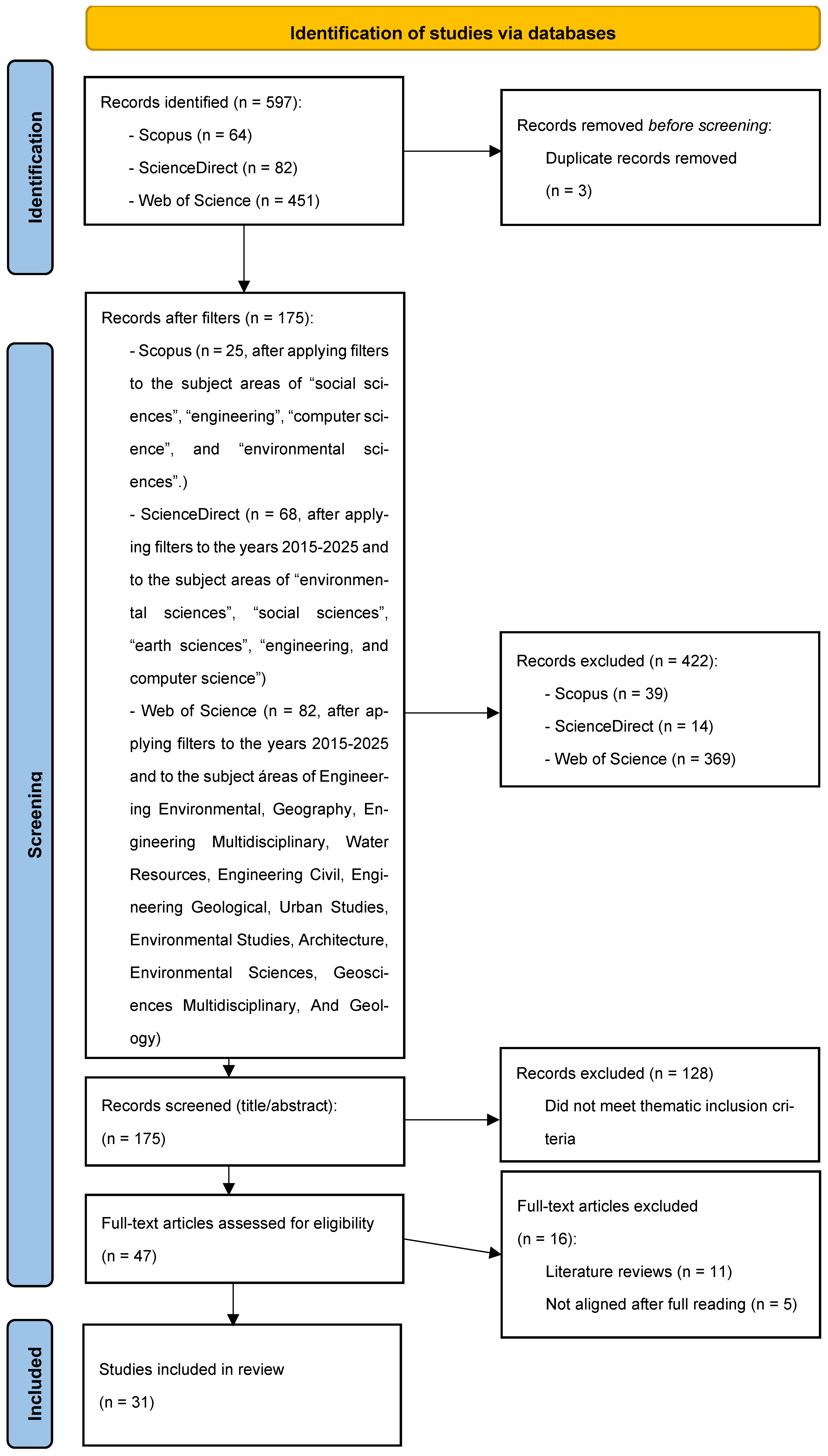
Initially, 64 results were found in the Scopus database. After applying filters to limit the search to the subject areas of social sciences, engineering, computer science, and environmental sciences, the search was restricted to 25 scientific articles. It was not necessary to apply a filter for the year of publication, as all the studies found were published from 2015 to 2025. After reading the abstracts, 10 papers most relevant to the proposed theme were selected. Of these, two referred to literature reviews and three others were not relevant to the study after reading, according to the predefined inclusion and exclusion criteria. Thus, 5 papers were analysed in the end (
Figure 1).
The search on ScienceDirect initially yielded 82 results. Filters were applied for year (2015 to 2025) and subject area (environmental sciences, social sciences, earth sciences, engineering, and computer science), resulting in 68 studies. Of these, three were duplicates from Scopus, resulting in 65 published works. After screening the abstracts, 28 studies were selected based on their relevance to the research questions. Of these, six were literature review articles and two others did not adhere to the predefined inclusion and exclusion criteria after reading. Therefore, 20 studies were analysed in the end.
In Web of Science (Main Collection), 451 documents were initially identified from the search protocol. Applying filters for year (2015 to 2025) and subject area (Engineering Environmental, Geography, Engineering Multidisciplinary, Water Resources, Engineering Civil, Engineering Geological, Urban Studies, Environmental Studies, Architecture, Environmental Sciences, Geosciences Multidisciplinary, and Geology) reduced this number to 82. In addition, a “most cited articles” filter was additionally applied to prioritise studies with demonstrated academic impact, resulting in 40 papers. This criterion was used as a relevance refinement tool rather than as a quality assessment proxy. After reading the abstracts, only nine papers that were most relevant to the theme were selected. Of these, three corresponded to literature review studies, resulting in six papers being analysed.
Scientific databases present inherent differences in their structure and available filtering tools, which require adaptations in search strategies. In this study, the “most cited articles” filter was applied in Web of Science to prioritise studies with greater academic relevance and to refine the large volume of initial results. As this filter is not available in other databases, equivalent criteria could not be consistently applied. In these cases, study selection relied on predefined inclusion and exclusion criteria and systematic screening of titles, abstracts, and full texts.
Therefore, the studies were analysed in three main stages by only one of the authors: (i) duplicate removal; (ii) title and abstract screening; and (iii) full-text assessment for eligibility. No automation tools were used during this analysis. As a result, 31 papers were selected, grouping the three bibliographic databases (
Figure 1). For data extraction and cataloguing, information on the author, year, country or study location, object of study, objectives, methods, type of modelling tool applied, nature and degree of community participation and main results was extracted and organised in a spreadsheet. No automation tools were used during extraction.
The review focused on extracting qualitative outcome domains related to the integration of hydrological–hydraulic modelling and community participation in socio-environmental risk management. The primary outcomes for which data were sought included:
Type and application of hydrological–hydraulic modelling, including modelling approaches, tools, and purposes (e.g., simulation, risk mapping, scenario analysis);
Forms and degree of community participation, classified as consultative, collaborative, or co-decisional;
Mode of integration between modelling and participatory processes, including whether participation informed modelling inputs, validation, decision-making, or communication;
Reported contributions of integration, such as improved risk understanding, decision-making, resilience, or knowledge co-production;
Barriers and limitations to participatory risk management and modelling integration; and
Contextual characteristics, including geographical setting and socio-economic context (e.g., developed vs. developing countries).
All results reported in each included study that were relevant to these outcome domains were considered, regardless of methodological approach or study design. No restrictions were applied regarding specific measures, time frames, or analytical techniques, given the qualitative and heterogeneous nature of the literature. Where studies reported multiple findings, data were selectively extracted based on their relevance to the review objectives and research question. This selection was guided by the predefined analytical framework and thematic domains established prior to data extraction.
In addition to the primary outcome domains, additional variables were extracted to support contextualisation and comparative analysis of the included studies. These variables included:
Bibliographic information: author(s), year of publication;
Geographical context: country and region of the study;
Study characteristics: research objectives, study design, and methodological approach (qualitative, quantitative, or mixed methods);
Type of modelling tools and techniques used, including software, modelling frameworks, or simulation approaches;
Type of participatory methods applied, such as workshops, interviews, participatory mapping, or stakeholder engagement processes;
Scale of analysis, where reported (e.g., local, urban, watershed, regional); and
Institutional and socio-economic context, particularly distinctions between developed and developing countries.
Where information was missing, incomplete, or unclear, no assumptions were made beyond what was explicitly reported in the original studies. In such cases, the data were recorded as “not reported” and excluded from comparative analysis where necessary. Given the qualitative nature of the review, no imputation or inference procedures were applied.
All studies meeting the inclusion criteria were considered eligible for qualitative synthesis. Following data extraction, studies were organised and compared based on key characteristics, including type of modelling approach, forms of community participation, and thematic relevance to socio-environmental risk management. Studies were then grouped into predefined analytical domains to support structured synthesis.
Extracted data were standardised and organised in a spreadsheet to enable consistent comparison across studies. Given the qualitative nature of the review, no statistical data transformations were required. Where information was missing or insufficiently detailed, it was recorded as “not reported” and excluded from specific comparisons where necessary.
Results were organised using thematic categorisation and descriptive comparison. A PRISMA flow diagram was used to illustrate the study selection process. Additionally, tabular and narrative approaches were employed to summarise study characteristics and to support the interpretation of findings across thematic domains.
A narrative synthesis was conducted due to the methodological heterogeneity of the included studies, which precluded quantitative meta-analysis. Studies were grouped into six analytical categories: (i) integration of modelling and participation; (ii) social vulnerability and modelling; (iii) participation without modelling; (iv) modelling without participation; (v) obstacles to participatory processes; and (vi) socio-technical integration frameworks. This approach enabled the identification of patterns, gaps, and emerging trends in the literature.
Heterogeneity among studies was explored through comparative analysis across different geographical and socio-economic contexts, particularly between developed and developing countries. Differences in modelling complexity, forms of participation, and institutional contexts were examined to identify factors influencing the integration of technical and social approaches.
No formal sensitivity analyses were conducted due to the qualitative and exploratory nature of the synthesis. However, consistency of findings was assessed through cross-comparison of studies within and across thematic categories. Due to the qualitative and heterogeneous nature of the included studies, no quantitative effect measures (e.g., risk ratios or mean differences) were used. Instead, the synthesis relied on qualitative outcome descriptors aligned with the predefined outcome domains.
After data extraction, initially the studies were categorised, distinguishing those that intersected the three themes (hydrological–hydraulic modelling, social participation and socio-environmental risk management) from those that did not. After this, the primary analytical domains considered in this review were: (i) understanding how popular participation took place in the methods in which it was included (consultative, collaborative and co-decisional); (ii) what role popular participation played in enriching the analyses; (iii) how modelling was integrated into participatory processes and vice versa; and, finally, (iv) understanding reported barriers and limitations in participatory risk management. No quantitative effect measures were extracted, as the review focused on qualitative synthesis of methodological and conceptual integration. These analyses provided the necessary guidance to answer the central question of the research.
A narrative synthesis approach was adopted due to the conceptual and methodological heterogeneity among the selected studies. A thematic categorisation was carried out, grouping the studies into six analytical categories: importance of integration of modelling and participation; social vulnerability and modelling; participation without modelling; modelling without participation; obstacles to participatory processes; and socio-technical articulation frameworks. Finally, a comparative analysis was undertaken to examine differences between developed and developing country contexts, to understand the stage of the subject matter and to identify existing methodological gaps in the literature.
Table 2 outlines the outcome domains and data extraction criteria used for the analytical process of this study. No meta-analysis was conducted due to the absence of comparable quantitative outcome measures across the studies.
Given the methodological heterogeneity of included studies and the predominance of case-based and qualitative approaches, a formal risk of bias tool was not applied. Instead, methodological transparency, clarity of participatory procedures, and modelling validation processes were critically appraised during qualitative analysis. The review acknowledges potential selection bias due to the use of citation filters in one database.
In the Web of Science database, a “most cited articles” filter was applied as an additional refinement step after subject-area and year restrictions. This criterion was adopted to prioritise studies demonstrating demonstrable academic influence within the defined time window (2015–2025), under the assumption that citation frequency reflects scholarly recognition and engagement within the field. The filter was not used as a proxy for methodological quality, nor as a substitute for eligibility screening. Rather, it functioned as a relevance-ranking mechanism to manage the large volume of retrieved records and to ensure inclusion of studies that have significantly contributed to academic discourse on hydrological–hydraulic modelling and socio-environmental risk management. Importantly, all records retained after citation filtering were subsequently subjected to full abstract and full-text screening according to the predefined inclusion and exclusion criteria. The potential limitation associated with citation-based filtering, namely the underrepresentation of recent but not yet highly cited publications, is acknowledged.
Another important potential bias to consider is the predominance of publications in English, which may have excluded relevant studies published in other languages.
The potential for reporting bias due to missing results (e.g., publication bias or selective reporting) was considered qualitatively. Given the nature of the included studies and the absence of comparable quantitative outcomes, no formal statistical methods (e.g., funnel plots or regression-based tests) were applied. To minimise the risk of reporting bias, the search strategy included multiple bibliographic databases (Scopus, ScienceDirect, and Web of Science) and was based on predefined eligibility criteria. Only peer-reviewed articles were included, which may increase the reliability of reported findings but may also introduce publication bias by excluding grey literature. Additionally, the use of a “most cited articles” filter in one database (Web of Science) may have favoured well-established studies and underrepresented recent publications. This potential source of bias is acknowledged and considered in the interpretation of results. No additional methods were used to identify unpublished studies or to assess selective outcome reporting within individual studies. Therefore, the findings of this review should be interpreted with awareness of possible reporting biases inherent in the available literature. No formal framework for assessing certainty or confidence in the body of evidence was applied, as the included studies were predominantly qualitative, case-based, and methodologically heterogeneous, without comparable quantitative outcomes.
3. Results
The main characteristics and findings of the included studies are summarised in
Table 3. To facilitate reading and understanding, the table has been organised by level of socio-technical integration. Given the qualitative and heterogeneous nature of the evidence, no quantitative summary statistics or effect estimates were calculated. Instead, results are presented using structured qualitative descriptors aligned with the predefined outcome domains, including modelling approaches, forms of participation, and levels of integration, which were defined based on the degree of interaction between modelling and participatory processes, ranging from isolated applications to fully integrated co-production approaches, and reported contributions to risk management. For each study, the “effect” is interpreted as the reported contribution or outcome associated with the integration (or absence) of hydrological–hydraulic modelling and participatory processes. These qualitative effect-equivalents enable comparison across studies despite differences in methodology, scale, and context.
The analysis revealed that studies contributing to the syntheses on integration between modelling and participation and on socio-technical articulation frameworks generally showed greater methodological breadth, as they combined technical modelling tools with stakeholder engagement, workshops, mapping exercises, interviews, or participatory validation processes. These studies tended to provide more context-sensitive and operationally relevant findings.
In contrast, studies included in the syntheses on modelling without participation were generally stronger in technical simulation or spatial analysis but were limited by the absence of community validation or social incorporation. Similarly, studies grouped under participation without modelling contributed valuable local and experiential knowledge but lacked technical simulation or scenario-testing capacity. Studies synthesised under obstacles to participatory processes highlighted recurrent institutional, communicative, and socio-political barriers that constrained the effective integration of social and technical dimensions in risk management.
Studies that effectively combined hydrological–hydraulic modelling with participatory processes generally reported more robust, context-responsive, and decision-relevant outcomes than studies relying exclusively on modelling or participation alone. At the same time, the review found that such integration remains limited in the literature, with many studies privileging either technical modelling or participatory approaches without fully articulating the two. Differences between developed and developing country contexts also emerged, with the former tending to employ more advanced and institutionalised methods, and the latter more frequently using simpler or adaptive participatory approaches in response to data and governance constraints.
The first aspect observed in the analysis of the studies was the topicality of the subject, with most of the scientific articles produced in the last 5 years. Although there is already a consolidated body of literature involving the use of hydrological–hydraulic modelling in various types of research, studies that integrate the use of the tool with participatory processes began to gain greater significance around 2017. This reveals a field that is still recent and consolidating, which has grown mainly due to the intensification of climate change [
17,
18]. Some studies have noted the relevance of integrating hydrological–hydraulic modelling and community participation for risk management and reduction [
19,
20,
21,
22,
23].
It is noticeable that such heterogeneity in the results arose predominantly from differences in governance structures, variations in the complexity of the modelling, divergent definitions of participation, and different levels of institutional maturity in risk management in different countries. No formal sensitivity analyses were conducted due to the qualitative nature of the synthesis.
3.1. The Importance of Integrating Modelling and Community Participation for Risk Management and Reduction
Across a range of geographic and institutional contexts, the integration of hydrological–hydraulic modelling with stakeholder participation has consistently produced more comprehensive and actionable risk assessments than either approach delivers alone. Viavattene et al. [
19] developed a study based on ten European case studies to discuss how the Coastal Risk Assessment Framework (CRAF) was developed as part of a toolkit to increase resilience in coastal regions. The analysis methodology included two steps: (i) restricting the assessment to a small number of sectors to map potential critical points; and (ii) adopting an integrated modelling approach, improving the regional risk assessment of the identified critical points and calculating regional systemic impact indicators with the participation of stakeholders. The results showed that stakeholder involvement is crucial not only for selecting hotspots and validating results, but also for supporting information gathering. Thus, CRAF allows for a comprehensive and systemic risk analysis of the regional coastline, identifying areas of greatest risk. However, according to the authors, further efforts are still needed in the data collection process.
Stakeholder involvement also plays a decisive role in translating model outputs into viable disaster risk reduction strategies. Mohammed [
20] conducted a study in the Philippines with the aim of developing a flood prediction model for the city of Tarlac. The method involved 2D flood risk modelling and conducting workshops with stakeholders. Some of the study’s results pointed to the importance of community awareness of the process and the need for collaboration and a sense of community belonging for the more effective implementation of disaster risk reduction plans. In informal urban areas, Mulligan et al. [
21] sought to develop knowledge about the application of participatory flood modelling based on participatory planning. To this end, a case study of the application of participatory modelling in a neighbourhood in the city of Nairobi, Kenya, was analysed. The results showed that, in addition to public involvement providing greater understanding of the proposals and the development of more responsive plans, it enabled detailed risk mapping to create a more effective defence tool.
Shmueli et al. [
22] argue that participatory tools and techniques help overcome resistance to preventive planning by pooling local knowledge and skills that generate engagement and collective understanding of the community and its assets. Ibrahim et al. [
23] reached complementary conclusions in a study that examined the vulnerability of land use to flooding and local coping and adaptation strategies to achieve resilience in Tamale and Wa, cities in Ghana. The study used participatory mapping based on a GIS (Geographic Information System) tool to identify the spatial distribution of land uses vulnerable to flooding and residents’ coping strategies. The results showed that participatory mapping offers community resilience benefits by providing context for the community’s challenges and potentialities, enabling a deeper understanding of the socio-environmental relationship that contributes to flood vulnerability. In addition, it strengthens community adaptation strategies through the use of local knowledge.
The urgency of this integrated approach has grown sharper as climate change intensifies the frequency and severity of flood events. The integration of modelling tools with public participation is being considered as a response to overcome the ever-increasing challenges posed by climate change [
17,
18]. Awah et al. [
17] showed in Limbe, Cameroon, that participatory modelling techniques enabled the identification and prioritisation of flood risk mitigation actions in direct collaboration with stakeholders, promoting flood risk management planning more attuned to the realities of local risk exposure. O’Shea et al. [
18] advanced this methodology in Lusaka, Zambia, by using community narratives to iteratively refine initial flood maps, capturing spatial and social nuances. As a result, a more accurate mapping of flood risks was obtained, providing a framework for better use of available resources and better assessment of needs and measures for building local resilience. This recognition and appreciation of popular participation have driven conceptual and methodological changes in studies involving risk management and reduction, including through important international milestones, as shown below.
3.2. Social Vulnerability and Hydrolocal-Hydraulic Modelling
A conceptual shift in disaster risk management can be observed when comparing early international frameworks with more recent ones. When comparing, for example, the International Decade for Natural Disaster Reduction, launched by the UN in 1990, with the Sendai Framework for Action, the result of the 3rd World Conference on Disaster Risk Reduction [
48], it can be observed that, in the latter, vulnerability issues gain greater visibility and social participation is incorporated as a central strategy in addressing socio-environmental problems. This shift reflects important advances in understanding the social dimension of risk and, gradually, in studies involving hydrological–hydraulic modelling and other technical tools in the context of disaster risk management and analysis, as perceived from some of the studies analysed. Works such as those by Aerts et al. [
24], Sarmah et al. [
25], Tate et al. [
26], Zhang et al. [
27], Duhamel et al. [
28] and Majumder et al. [
29] exemplify this evolution by incorporating socioeconomic data into technical risk frameworks, addressing the relationship between vulnerability and socio-environmental risk to produce socially grounded assessments.
A clear manifestation of this trend can be observed in Aerts et al. [
24]. The authors demonstrated the importance of including human behaviour and vulnerability data in quantitative risk assessment models. To this end, the study involved the application of statistical methods that use historical data to provide flood risk estimates in hydrodynamic models that simulate the processes during a flood. By adopting a multidisciplinary approach that integrates all components, including vulnerability and behavioural data with technical frameworks, better-calibrated flood risk assessments were produced, driving more effective adaptation policies to address climate change. Such findings reinforce the argument that technical modelling segregated from social data could generate fragile adaptation policies.
Spatial and survey-based approaches reveal that social vulnerability is unevenly distributed and does not always correspond directly to areas of flood risk exposure. Sarmah et al. [
25] explored this gap in the city of Guwahati, India, by addressing the relationship between human vulnerability and flood risks. To this end, GIS was used to map risks, using factors that cause urban flooding, grouping the environment and urbanisation. For vulnerability mapping, questionnaires were administered to 1023 residents of the city’s 31 neighbourhoods that face recurrent flooding, based on the Human Development Index (HDI) and other published disaster vulnerability indices. In 38.70% of cases, the areas dropped one category from the risk grouping to the vulnerability grouping, meaning that not all flood-prone areas are equally vulnerable. On the other hand, in the other 61.3% of cases, the risk areas were equally vulnerable, validating the relationship between vulnerability and assumed risk.
The identification of spatial patterns of vulnerability further supports the prioritisation of targeted interventions in high-risk areas. Tate et al. [
26] examined the geography of flood exposure in a specific region of the United States, based on spatial analysis of the extent of river and storm flooding, land cover, and social vulnerability. As a method, critical points with high flood exposure and high social vulnerability were mapped using local bivariate indicators of spatial association. Next, the dominant indicators of social vulnerability in these locations were identified. The variables that most distinguished the clusters were used to develop a set of indicators of vulnerability to flood exposure. The results showed that mobile homes and racial minorities are the most vulnerable to flooding. Thus, the study contributed to the identification of priority locations for interventions.
Integrated frameworks that combine hydrological–hydraulic modelling with socioeconomic vulnerability analysis provide a comprehensive understanding of risk and are capable of supporting more effective adaptation strategies. In this sense, Zhang et al. [
27] proposed a new integrated flood risk assessment framework to map hazard and vulnerability by combining hydrological–hydraulic models and vulnerability analysis on the Brahmaputra River floodplain in Bangladesh. The study combined data pre-processing, extreme event frequency analysis, and simulation with the HEC-HMS and HEC-RAS (1D–2D) models. The information generated in the modelling was then combined with socio-economic data to feed into a flood risk and vulnerability analysis. Finally, the authors argued that the proposed framework and associated findings are valuable for developing adaptation strategies and early warning systems to reduce the impacts of future floods.
In the same vein, Duhamel et al. [
28] explored an approach based on both physical and human dimensions of risk in order to produce a more realistic and spatial analysis in the city of New Brunswick, Canada. Multi-criteria analysis was used to produce a comprehensive risk index. The relative importance of the indicators was determined through a participatory process involving local and national experts in civil safety and flooding. Special attention was given to individual vulnerability, including perception and preparedness for flood risk, which were explored through the application of a questionnaire. Ultimately, the integration of physical and vulnerability data into a GIS allowed not only for the visualisation and spatialisation of risk, but also of each of its components, enriching the analyses.
The challenge of mapping social vulnerability across a large number of settlements simultaneously has driven the development of composite indicators capable of capturing spatial heterogeneity at a systematic level. Majumder et al. [
29] addressed this challenge to quantify social vulnerability and risk in urban areas in 146 cities in eastern India. Based on three dimensions (exposure, sensitivity, and adaptive capacity), an urban social vulnerability index was calculated based on 15 indicators. By using a GIS programme, a composite measure was applied to identify and map the spatial heterogeneity of social vulnerability for the 146 urban centres. The results confirmed that most urban locations in the study area experience moderate to high exposure and high sensitivity. Low adaptive capacity emerged as the main causal factor for extreme social vulnerability. Such findings suggest that policy interventions solely based on physical exposure alone are insufficient. Lasting risk reduction requires addressing the underlying factors that shape community resilience.
3.3. Community Participation in Risk Management Without the Application of Technical Tools
Local knowledge held by flood-affected communities is a useful source of information that can be analysed in a systematic way. Studies that have used this approach, without technical modelling tools, show both its value and its limitations. For example, Cruz-Bello et al. [
30] conducted a study in the city of Progreso, Mexico, to capture and understand residents’ local knowledge about reducing vulnerability to flooding. The method included participatory workshops and semi-structured interviews with public officials and the community. At the end of the study, the importance of popular participation in flood risk reduction planning became evident, given their knowledge of the situation to which they are exposed, in the development of adaptive measures and proposals for vulnerability reduction.
Similar to this study, Utami et al. [
31] also sought to explore the local potential of a community and design a food resilience model based on residents’ wisdom regarding flooding in the coastal region of the Bengawan Solo River in Indonesia. The study was developed through focus group discussions with the community and policymakers in the region to map data, based on the principles of the socio-technical system, and through the application of a questionnaire to measure the level of local wisdom. The results showed that local wisdom is important for flood mitigation and food resilience in disaster-affected communities. Furthermore, consideration of local knowledge provides a more elaborate explanatory framework for understanding human behaviour, overcoming many of the theoretical problems encountered.
As far as the analysed literature goes, only Cruz-Bello et al. [
30] and Utami et al. [
31] conducted studies focused on community-based risk management and the importance of popular participation in these processes without the use of technical modelling tools as part of the methods employed. Despite their relevance, such approaches remain relatively underrepresented, highlighting a gap in studies that prioritise community participation without the support of technical modelling tools.
3.4. Application of Hydrological–Hydraulic Modelling Without Community Participation
A complementary gap exists at the opposite end of the methodological spectrum. A significant portion of the studies analysed rely solely on technical modelling to support flood risk analysis and management and make no provision for community participation in any stage of their methodological process (Ntajal et al. [
32], Caprario et al. [
33] and Havrys et al. [
34]). Ntajal et al. [
32] assessed and mapped the risk of flooding disasters in the Mono River Basin, a maritime region of Togo, Africa. The study combined GIS and remote sensing techniques for mapping and modelling floods in the city. According to the authors, the result provided a good visual impression of risk levels, which is useful for planning and developing early warning systems. For them, the risk is complex and dynamic, as it includes danger, exposure and vulnerability, and it is crucial to consider all these dynamics within the community. In addition, the development of strategies requires efforts from the population, institutions, organisations and government. Despite this recognition of the relevance of popular participation in the construction of risk management, the method applied to the study did not integrate it into the modelling process.
Even though some studies explicitly demonstrate the potential of technical tools as a resource for participatory processes, they fail to integrate such processes into their own application. For instance, Caprario et al. [
33] developed a study proposing a technical tool for the point and spatial mapping of susceptibility to flooding in urban areas in the city of Florianópolis, Brazil. The development of the tool consisted of two main parts: (i) the IMAAI method (Mapping Instrument for Areas Susceptible to Waterlogging and Flooding), which consists of the analysis, tabulation, and weighting of eight factors that condition the flooding process in urban areas; and (ii) scenario simulation. According to the authors, the tool can provide a simple and consistent view, achieving an overall accuracy of 73.67% of flood points. The authors add that the tool provides information that can support decision-making by government agencies, as well as civil society, in relation to participatory urban zoning, drainage management, and water conservation. Nevertheless, the study’s methodology was restricted to technical limits, citing the possibility of using the tool in participatory processes, but without effectively integrating it into the stages of the work.
Similarly, Havrys et al. [
34] conducted a study aimed at developing tools for the application of computational modelling in the analysis of flood risk areas for territorial governments. On one hand, the authors developed a tool capable of identifying flood risk areas through modelling, guiding decision-making for preventive measures and population protection. On the other hand, the study does not mention community participation as an integral part of the method developed. Even so, the authors point out that, subsequently, the tool developed could assist in management at the community level.
In view of this, it is worth noting that several authors argue that the main challenge to the success of disaster risk reduction (DRR) practices around the world is the lack of public involvement through participatory actions and methodologies. For these authors, popular participation not only increases the level of awareness and preparedness of residents but also generates more effective proposals based on their demands and knowledge of the territory [
6,
11]. In this context, some of the studies analysed in this review also addressed the difficulties and obstacles in participatory processes for developing risk management and reduction strategies [
35,
36,
37,
38,
39].
3.5. Obstacles to Participatory Risk Management Processes
One of the main structural barriers to effective participatory risk management is the fragmentation of knowledge. More specifically, the way in which risk-relevant information remains limited to the technical and scientific communities and is unavailable to the public who most need to act on it. Spiekermann et al. [
35], in their study, sought to identify what hinders the use of knowledge to make appropriate decisions for risk mitigation based on a case study in Salzburg, Austria. The authors developed a method to analyse knowledge fragmentation using the knowledge-data-information-wisdom and disaster management continuum applied to the case study. The main finding was that although knowledge on risks has increased, it is not available to everyone, as it is restricted to a technical and scientific body. Furthermore, results suggest that knowledge is commonly fragmented due to a lack of coordination, partnership, good communication, and sharing of what is known.
Where knowledge fragmentation represents a structural barrier, failures in communication and institutional design create a second overlapping set of obstacles in the translation of disaster risk reduction policy into community-level action. Perera et al. [
36] conducted research with the objectives of identifying social challenges in flood warning communication, preparedness, and response capabilities. In addition to discussing the role of Civil Society Organisations (CSOs) in addressing these gaps, particularly at the community level, and formulating policy recommendations to strengthen governance and institutional capacity at all levels. To this end, the authors conducted extensive research based on a case study of a project entitled ‘Views from the Frontline’, carried out by the Global Network of CSOs for Disaster Reduction in countries such as Nigeria, India, Cameroon, Tonga and Bangladesh. On one hand, the study identified a major failure in the use of participatory approaches involving the community and inadequate translation of disaster risk reduction policies into action at the community level. On the other hand, CSOs showed promise in addressing local challenges, contributing to community-tailored solutions through community organisation and coordination.
Cultural and political factors also act as structural barriers limiting the development of inclusive and resilient risk governance systems. Imperiale et al. [
37] developed a broader study to discuss the main elements of the disaster risk reduction (DRR) and resilience paradigm, using as a case study a community affected by an earthquake in Aquila, Italy. The method used was a reflective and qualitative analysis of the case study. In analysing the failures in disaster management, the authors identified the commonly adopted approach of strict control of knowledge and resources for risk reduction as an important cultural and political barrier to improving DRR and community resilience. According to them, it is necessary to build a local culture of community well-being and resilience, as well as socially sustainable risk governance, to overcome cultural and political barriers to DRR and sustainable development.
Socioeconomic inequalities and marginalisation further undermine community preparedness and participation in risk management processes. Monteil et al. [
38] explored how responsibility for disaster preparedness is shared among stakeholders, based on a case study in a neighbourhood in the city of Nîmes, in southern France. A quantitative approach was used, based on questionnaires administered throughout the city, combined with a qualitative approach, based on interviews with local stakeholders. The study identified an inconsistency between the centralised top-down approach adopted by city officials and the authorities’ call for individual preparedness. The main forms of marginalisation that prevent people from preparing include economic marginalisation, with around 45% of the neighbourhood’s population living below the poverty line, and the social and political marginalisation of the entire neighbourhood, which lacks a common space for interaction, for example.
The process of professionalisation that might occur within communities’ process of organisation in flood risk management presents both opportunities and limitations for community engagement, reflecting the complex nature of participatory processes. In the same year, Puzyreva et al. [
39] conducted an interesting study on the ambivalent implications of professionalisation for community engagement in flood risk management in communities in Italy, Germany, England and the Netherlands. Organised groups involved in flood risk management in their local environments were studied. Empirical research was conducted by four research teams in seven locations in the four European countries over five months. It was concluded that professionalisation contributes to better coordination of group members’ activities and alignment with the needs and priorities of the region and increases the sense of belonging of community members in the professional field of risk management. At the same time, it might also impose additional formal requirements, restrict broader participation and reinforce the perception of risk management as a specialised domain, inaccessible to the general public. This finding suggests that the design of participatory processes must attend carefully to the conditions under which engagement is organised if it is not to reproduce the exclusions it sets out to overcome.
3.6. Articulation Between Technology and Social Participation for Risk Management
The literature highlights a growing body of work dedicated to identifying principles, frameworks and practical strategies for effectively integrating technical tools and community participation in risk management. Another category of studies observed refers to those that identified and described criteria, guidelines, and recommendations to be considered in the integration of technical tools for risk management, such as hydrological modelling and computer simulations, and community participation. By addressing different geographical realities and using a variety of methodological approaches, these studies highlighted everything from technical aspects to organisational and socio-political dimensions [
40,
41,
42,
43,
44,
45]. Taken together, they provide important conceptual and practical insights to guide future research that seeks to explore the intersection between science, technology, and social participation for risk management.
A central theme across these studies is the role of social learning and communication processes in the process of enabling an effective socio-technical integration. Evers et al. [
40] sought to describe how social learning and collaborative decision-making can be carried out as part of participatory governance and how they can be supported by socio-technical approaches and instruments. The method was based on the application of collaborative modelling developed and tested in a case study in the Alster River Basin in northern Germany. The authors identified that the learning process occurs both through interactions between different groups and individuals in the process and through support environments that convey the results obtained by various models. When it comes to the design and development of such environments, transparency and comprehensible visualisation are the most important characteristics.
Participatory modelling approaches further demonstrate the importance of combining knowledge integration, democratic processes and organisational alignment. Hedelin et al. [
41] produced a study with the aim of exploring how participatory modelling can be used as a tool for sustainable processes in the context of complex problems, such as natural resource management and disaster risk management. Five research projects applying participatory modelling in different locations were analysed, providing an empirical basis for the study: the DEMO project (Sweden), the DIANE-CM project (Germany and the United Kingdom), the SEAMLESS project (different European countries), the VASTRA programme (Rhone River coast, Europe) and the WPI + project (location not mentioned). The study pointed to three key issues for participatory modelling as a tool for sustainable development: (i) knowledge and learning: by using support tools, such as computer-based simulations, showing cause-and-effect relationships in an understandable way, knowledge integration can be achieved; (ii) values and democracy: the combination of tools has the potential to make management processes more transparent and to support democratic deliberation; and (iii) organisational integration: for participatory modelling to be an effective tool in practice, procedures for organisational integration need to be improved.
The development of tools that enable community engagement in data collection and decision-making also represents a key pathway for strengthening integration. O’Grady et al. [
42] analysed community participation in flood risk reduction actions in the Dyfi Biosphere, Wales. The method included the development of a set of tools for data collection by the population related to flood risk. Community participation proved to be feasible and had significant potential in the context analysed. Nevertheless, the authors warned of the need to standardise the data provided by the population and ensure safety in the field.
At the methodological level, the literature emphasises that participatory techniques are context-specific and should be used to complement technical modelling approaches. Maintaining scientific rigour requires a precise balance between community engagement and technical modelling. Maskrey et al. [
43] assessed the potential of participatory modelling to facilitate engagement and co-production of knowledge between risk management and hydrological modelling professionals and other stakeholders in some regions of the United Kingdom. Participatory techniques such as Bayesian networks, system dynamics and fuzzy cognitive mapping were qualitatively analysed from case studies. The results pointed to two main issues: first, that participatory techniques should complement rather than replace hydrological–hydraulic modelling, and second, that the choice of participation technique should consider the local context.
Another study developed in this context was that of Onsay et al. [
44], which presented innovative approaches to disaster risk management through comprehensive insights derived from the experiences of previously affected residents in Bicol, Philippines. The study employed a qualitative-quantitative approach. In the quantitative segment, secondary data were obtained from local agencies, and machine learning and econometric modelling techniques were applied. In the qualitative component, the study involved 12 participants who had experienced flooding, as well as contributions from various stakeholders. A platform (Convergent Parallel Design) was used to analyse qualitative and quantitative data separately before integrating them to identify areas of convergence and divergence.
The authors listed five important points identified in the research: (i) improved infrastructure, poverty reduction, and technology integration are fundamental to disaster resilience preparedness; (ii) the importance of tailored measures and community involvement; (iii) community experience highlights the need for proactive government action and holistic approaches; (iv) preparedness programmes can empower residents to respond; and (v) collaborative efforts involving government entities, local communities, NGOs and academia can create the holistic approach needed to reduce disaster risk.
Innovations in data visualisation and communication further enhance the accessibility and practical use of modelling outputs. Munz et al. [
45] conducted a study in Switzerland with the aim of exploring how scientific information on extreme precipitation and flood impacts can be conveyed in a way that allows recipients to obtain information relevant to their practical work. To this end, a modelling system was developed to simulate the spatiotemporal dynamics of flood events and their impacts based on precipitation and climate information. Subsequently, the way in which the modelling results were visualised and published was developed in a participatory manner, through interviews and workshops. As a result, it was found that narratives of extreme events presented as storymaps, in contrast to static risk maps, are more favourable for planning emergency interventions and training and, therefore, for raising awareness and improving local disaster preparedness.
Rahman et al. [
46] used modelling based on a more objective approach, focused on simulating scenarios with the application of possible solutions, where the residents themselves participated in the selection of the solutions used. The study was conducted in the Gangnam district of South Korea and aimed to identify priority vulnerable areas for green infrastructure implementation, identify factors contributing to poor drainage in urban areas, and select green infrastructure controls based on perceived benefits for flood resilience in urban areas. The method employed included the simulation of scenarios with the implementation of green infrastructure using the Storm Water Management Model (SWMM). The infrastructure used was selected according to the preferences of local residents. The scenarios demonstrated a reduction in surface runoff, reducing risk, as well as offering ecological and social benefits. The results highlight the value of multifunctional green infrastructure controls, not only in reducing flood risks but also in promoting long-term sustainability and community well-being.
Overall, evidence shows that the link between participation and environmental outcomes is complex. Not all participatory methods work the same way, and how a process is designed impacts its success. Newig et al. [
47] conducted an analysis based on 305 case studies of public environmental decision-making in 22 Western countries. The research sought to answer the following questions: (i) How do more participatory decision-making processes compare to less participatory ones in promoting effective environmental governance outcomes? (ii) What design features make a difference? and (iii) what role does the decision-making context play? The results highlight that different dimensions of participation have different influences on environmental outcomes. Delegating decision-making power to participants had the most positive and consistent impact on both conservation and environmental health. The intensity of communication was relevant only for conservation outcomes. The environmental stance of stakeholders was also a strong predictor, showing that their interests shape participatory decisions. Generic citizen participation did not show a significant impact, while organised civil society participation had positive effects on conservation, suggesting that organised actors contribute better to lasting environmental outcomes, as demonstrated by the study conducted by Perera et al. [
36].
4. Discussion
The analysis of the results of this systematic review showed a growing recognition and appreciation of the integration between technical tools and community participation for risk management [
17,
18,
19,
20,
21,
22]. This growth is in line with the most recent literature on socio-environmental risk management which, according to Sulaiman et al. [
10], has pointed to more territorialised approaches, based on dialogue and reflection with the community, in the face of the challenges posed by climate change. However, although some studies show significant advances, the integration between hydrological–hydraulic modelling, risk management and community participation is still a field in consolidation, permeated by some challenges.
On the one hand, there are studies such as those by Ntajal et al. [
32], Caprario et al. [
33] and Havrys et al. [
34] that exemplify methodologies that recognise the importance of community participation but do not operationalise it. On the other hand, a gap was observed in other studies, which incorporated social data into their analyses and sought to map locations of vulnerability for priority interventions. However, such data were obtained from secondary sources, and community participation was not articulated in the methods. Studies such as those by Aerts et al. [
24], Tate et al. [
26], Zhang et al. [
27], and Majuder et al. [
29], which, despite advancing by articulating vulnerability data with modelling, do not present effective community participation, endorse the study by Spiekermann et al. [
35], which showed that, although knowledge on the subject has advanced, it is still restricted to technical limits. The problems identified in these studies lie in factors such as the lack of active local engagement, which, according to Awah et al. [
17], is vital for addressing socio-environmental challenges, and the failure to capture social nuances and refine results, compromising risk mitigation actions.
Studies such as those by Mohamed [
20], Mulligan et al. [
21], O’Shea et al. [
18] and Awah et al. [
17] stand out by proposing methodologies with effective articulation between modelling and community participation, achieving more refined results that are contextualised with the observed reality, overcoming some of the limitations of the simulation tools used. In these cases, analyses and diagnoses pave the way for the construction of robust solutions aimed at risk mitigation. In addition, the studies reveal that the integration of technical-scientific and community knowledge enhances engagement, autonomy, and local response capacity. It is important to note that these studies were conducted in developing countries in Africa and Asia, revealing a possible trend already identified by Basco-Carreca et al. [
49] and Kotir et al. [
50], who argue that socio-technical methods are particularly interesting to use in more vulnerable urban contexts, where environmental and social relations require new approaches to engagement.
Thus, it was found that of the 31 studies analysed, 15 focused on developing countries, mostly in Asia and Africa, 13 referred to developed countries, mostly in Europe, and three did not mention the object of study. In general, studies conducted in both developed and developing countries showed similar degrees of progress in the use of hydrological–hydraulic modelling and in the use and recognition of the importance of community participation. However, when comparing them, it was clear that developed countries use more advanced methods of analysis (Bayesian networks, system dynamics, fuzzy cognitive mapping, multi-criteria analysis, knowledge-data-information-wisdom and disaster management continuum) and the processes are generally institutionalised. Meanwhile, studies from developing countries employ simpler methods, and participatory processes are often alternatives to the absence of systematised data and institutional vulnerability.
Furthermore, there is a notable scarcity of studies applied to the South American context. Among those analysed, only one study was applied in Brazil [
33]. This gap reinforces the need to develop methodologies adapted to the specific conditions of those countries, given the recognition of the serious situation of socio-environmental vulnerability and the occurrence of hydrological disasters in these places.
In this context, and considering this as a field still in consolidation, the studies analysed in this review provide broad paths for the development of experiences and methodologies to be applied in local contexts. According to Di Gregorio and Couto [
51], socio-environmental risk management is based on the following processes: mitigation, preparation, response and recovery. For the authors, the main stages are mitigation, which involves risk, hazard and vulnerability analysis; preparedness, involving communication protocols, planning and training; and response, including monitoring, safety assessment and contingency planning.
In this sense, the results of the systematic review show that the articulation between hydrological–hydraulic modelling and community participation can strategically support these stages of risk management. In the mitigation stage, the incorporation of data obtained with community participation and the validation of information allows for a more realistic identification of hydrological dynamics, risk areas, and vulnerability factors, nuances not captured by technical tools, as shown in the works of O’Shea et al. [
18] and Mohamed [
20]. These works are examples of methodologies that, through community participation, have developed more contextualised and detailed local analyses, adjusted results and defined priority areas for intervention.
In the preparation stage, the use of modelling as a tool for dialogue and scenario visualisation reinforces collective understanding, contributing to more effective communication protocols, early warning systems and training, facilitated by community engagement achieved through their involvement in the process [
17,
21,
23]. Finally, studies such as those by Onsay et al. [
44] and Evers et al. [
40] show that community empowerment through integration with technology and learning processes via interactions between different groups and individuals strengthens the development of autonomy and local community response capacity. Thus, in contexts marked by inequalities and high vulnerability, such as in countries of the global south, the integration of community participation and technical tools, such as hydrological–hydraulic modelling, may represent a promising path for the consolidation of more equitable and efficient risk management practices.
A closer look at the reviewed studies reveals important nuances when comparing how different socioeconomic backgrounds shape methodological choices. Research conducted in developing countries is often framed around limitations related to data availability, weaker institutional capacity or restricted access to advanced modelling tools. Despite such limitations, studies within this context revealed greater methodological flexibility, incorporating local and empirical knowledge aligned with the realities experienced by the local population, giving greater contextual relevance to risk management processes. Participatory approaches born out of data-scarce realities frequently show a remarkable degree of methodological flexibility, diving deeper into local knowledge, generating outcomes that are meaningfully grounded in the communities they serve. In contrast, studies carried out in developed countries were technically sophisticated, where model-driven methods tend to dominate. These approaches offer real advantages in analytical precision and predictive capacity. However, such methodological approaches are not without their own challenges, related to stakeholder engagement, accessibility and the translation of technical outputs into practical action. These observations suggest that the distinction between “simple” and “complex” methods is better understood as a reflection of different problem-solving strategies based on their socioeconomic background and should not be interpreted as a hierarchy of methodological quality but rather as complementary strategies for addressing uncertainty and complexity under different conditions. Recognising both methodological strengths is essential to advance a balanced and context-sensitive approach to the integration of hydrological–hydraulic modelling and community participation in socio-environmental risk management.
The findings of this review should be interpreted in light of several limitations inherent to the body of evidence analysed. First, the included studies are predominantly based on qualitative, case-specific approaches, which limits the generalisability of the findings across different geographical and institutional contexts. Second, there is considerable methodological heterogeneity among studies, including differences in modelling techniques, participatory approaches, and analytical frameworks. This variability constrains direct comparison between studies and limits the ability to establish standardised conclusions. Third, many studies exhibit limited methodological transparency, particularly in the description of participatory processes, stakeholder selection, and validation of modelling outputs. This introduces uncertainty regarding the robustness and reproducibility of the reported findings. Additionally, a significant portion of the literature focuses either on technical modelling or on participatory approaches in isolation, with relatively few studies achieving full integration between these components. This imbalance affects the strength of evidence regarding the effectiveness of socio-technical approaches. Finally, the predominance of studies conducted in specific regions, particularly in Europe, Asia, and Africa, and the limited representation of South American contexts, restricts the geographical applicability of the findings. Taken together, these limitations suggest that the available evidence provides valuable insights into emerging trends and practices but remains fragmented and context-dependent.
5. Conclusions
This study aimed to conduct a systematic review of scientific publications that discuss the use of hydrological–hydraulic modelling as a tool for socio-environmental risk management, with a focus on participatory approaches. To this end, 31 scientific publications from 2015 to 2025 available in the Scopus, Web of Science and ScienceDirect bibliographic databases were analysed. The analysis of the studies sought to answer the following research question: how can hydrological–hydraulic modelling be used in the participatory management of socio-environmental risks?
The studies analysed indicated that the combination of technical modelling tools and the engagement of local communities enhances the understanding of existing risks, facilitates the identification of priority areas for intervention and directs more effective solutions. This integration allows the models to be used as a means of communication and learning, contributing to more inclusive planning processes. Thus, hydrological–hydraulic modelling can be used in the participatory management of socio-environmental risks as a tool capable of simplifying and strengthening the dialogue between scientific knowledge and local knowledge, allowing for the qualification of risk management stages and offering more contextualised analyses and solutions that are better adapted to territorial realities.
Some studies have explored hydrological–hydraulic modelling as a visual aid in risk analysis, which has enabled better visualisation of areas susceptible to flooding, flash floods and inundations, promoting collective understanding and supporting the debate on mitigation alternatives. It was observed that this visualisation was fundamental in facilitating dialogue between the community, technicians and managers during workshops, public meetings or focus groups, for example.
In other cases, the tool enabled the simulation and visualisation of alternative scenarios, incorporating mitigation strategies such as nature-based solutions and other structural interventions. This facilitates local understanding of the possible solutions to be adopted and improves the decision-making process, adapting strategies to the physical and social conditions of each territory. Thus, the tool, linked to participatory processes, serves to empower the community, assuming a role in the mediation of knowledge, with an educational character, contributing to the population’s knowledge about possible solutions and the participatory construction of responses to risks.
There is significant convergence in the recognition of the relevance of integration between modelling and community participation for risk management and reduction, as recorded in some of these studies. However, despite the advances observed, some critical reflections on these studies are in order, considering the fragmentation in the approach to the themes, the degree and form of community participation, and the implications of this integration. There is a predominance of approaches that are still centred on the technical application of modelling, or with community participation restricted to the final stages or in a superficial manner without effective influence on the process. Therefore, there is still a lack of methodologies that effectively combine participatory data collection, joint scenario building, and the continued use of models as tools for monitoring and community appropriation.
Considering the context of developing countries, for example, where studies have made little progress, overcoming these methodological gaps is essential to developing more inclusive and effective approaches, considering the social inequalities and institutional vulnerabilities of these countries. In this way, it is possible to reverse the current situation, where the issue of risks is concentrated in civil defence agencies and post-disaster emergency actions, and shift the focus to preventive and mitigation actions, developed together with the affected population [
6]. Thus, effective coordination between science, technology, and the community can overcome limitations in diagnosis and propose solutions adapted to the territory, reducing the risks associated with flooding, flash floods, and inundations, empowering the population and creating possibilities for addressing socio-environmental risks.
Regarding the limitations, this review presents methodological constraints that must be acknowledged. First, the search was restricted to three databases (Scopus, ScienceDirect, and Web of Science). Although these platforms index high-quality peer-reviewed literature, relevant studies indexed elsewhere may have been omitted. Second, in the Web of Science database, a “most cited” filter was applied as a relevance-ranking refinement. While this strategy aimed to prioritise influential studies, it may have underrepresented recently published but not yet highly cited contributions, introducing potential citation bias. Third, no formal quantitative risk-of-bias assessment tool was applied due to the methodological diversity and predominance of qualitative case studies. Although methodological transparency was critically appraised during synthesis, the absence of a structured bias assessment instrument limits formal evaluation of internal validity. Fourth, the review did not perform meta-analysis or statistical synthesis because the included studies did not report comparable effect measures. Consequently, findings are based on narrative synthesis, which is inherently interpretative. Finally, although screening and data extraction were conducted with independent verification, the review did not use automation tools or machine-assisted screening, which could have enhanced reproducibility. These limitations do not invalidate the findings but indicate areas where methodological robustness and transparency could be strengthened in future reviews. Given the qualitative nature of the evidence, findings reflect convergent patterns rather than statistically robust estimates.
Future research should prioritise the evaluation of socio-technical interventions and the development of evaluation frameworks capable of measuring the quality of the integration between modelling and participatory processes. It should also seek greater representation of vulnerable regions and promote comparative analyses of institutional models that successfully incorporate participatory modelling into governance structures. Strengthening methodological rigour in both modelling practices and participatory design will be essential to consolidate this emerging research field.
From a practical perspective, the findings suggest that policymakers and stakeholders should prioritise the early and continuous integration of participatory approaches into hydrological–hydraulic modelling processes, rather than limiting community involvement to consultative stages. This includes investing in accessible modelling tools and visualisation techniques that support dialogue, co-learning and transparency, as well as establishing institutional arrangements that enable the systematic incorporation of local knowledge into data collection, scenario development and decision-making. Strengthening intersectoral coordination and capacity-building initiatives is also essential to ensure effective engagement between technical teams and communities. Furthermore, embedding participatory modelling within preventive and adaptive planning strategies can support more inclusive governance processes and contribute to resilient, context-sensitive and sustainable risk management outcomes.




 ,
,